Article

Analysis Method of Operating Characteristics and Optimal Arrangement of 500 KV Homopolar Parallel Cables


College of Information Science and Engineering, Huaqiao University, Xiamen 361021, China
*
Author to whom correspondence should be addressed.
Energies 2026, 19(9), 2145; https://doi.org/10.3390/en19092145
Submission received: 8 February 2026 / Revised: 22 March 2026 / Accepted: 21 April 2026 / Published: 29 April 2026

Abstract

The normal operational characteristics of power cables are a crucial foundation for developing their protection devices. To analyze the current and voltage characteristics of parallel cable lines, the parameter matrix of the phase-aligned parallel cable lines is first established based on Carson’s formula. The metal sheath is treated as a general line, considering its self-inductance and mutual inductance with the core loop, and its sheath circulating current is calculated. Then, the relationship between line voltage and current is established, and the effect of the sheath circulating current is equivalently incorporated into the line’s phase impedance matrix. A π-type equivalent circuit of the cable line is established, from which the operational parameters of the phase-aligned parallel cables are calculated. Indicators measuring the operational characteristics of phase-aligned parallel operation—sheath circulating current, imbalance, carrying capacity, and voltage deviation—are introduced, and the optimal arrangement is determined using the analytic hierarchy process. This study integrates Carson’s formula for impedance modeling and fuzzy AHP for multi-criteria optimization, addressing gaps in single-indicator approaches. The proposed method identifies the three-phase vertical layout as optimal, improving ampacity by 10% and reducing sheath circulating current by 28%, offering direct guidance for 500 kV cable projects.

1. Introduction

To meet the ever-increasing power demand, it is necessary to expand the capacity of existing 500 kV transmission cable systems. At present, the transmission capacity of urban overhead trunk lines has reached approximately 3600 MW; however, even with advanced technologies designed to enhance current-carrying capability, the ampacity of 500 kV three-phase single-core cables is typically limited to around 2200 A, corresponding to a maximum transmission capacity of roughly 1900 MW [1,2,3]. To address this capacity gap, homopolar parallel cables have emerged as an effective and economically feasible solution for capacity expansion, attracting growing attention in modern power transmission systems [4,5]. Nevertheless, the strong electromagnetic interactions between parallel circuits give rise to several critical operational issues, including parameter imbalance caused by the lack of conductor transposition, excessive sheath circulating currents induced by electromagnetic coupling, reduced ampacity due to proximity effects and thermal constraints, and power quality degradation resulting from electromagnetic asymmetry—these challenges are particularly prominent in short-distance, large-capacity transmission scenarios.
Notably, these operational challenges are closely associated with the application scenarios of cable systems, making it crucial to distinguish between conventional HVAC (High-Voltage AC) and EHVAC (Extra-High-Voltage AC) cable systems [6]. Specifically, HVAC cables are generally utilized for medium-to-long-distance transmission, where capacitive charging currents and reactive power compensation are the primary concerns. In contrast, EHVAC cable systems are typically employed in short-distance, large-capacity transmission scenarios—exactly the scenarios where the aforementioned electromagnetic and thermal challenges are most severe—where strong electromagnetic coupling, significant sheath circulating currents, and strict thermal limits become the dominant issues, while long-distance reactive power management plays a secondary role [7]. Although previous studies have explored various aspects of cable systems, including ampacity calculation, electromagnetic coupling, and cable arrangement optimization, most existing works either focus on long-distance transmission with reactive power compensation or single-indicator optimization problems [8], leaving a research gap in comprehensive multi-criteria optimization for short-distance parallel cable systems that face the aforementioned critical challenges.
The calculation and analysis of electrical parameters of homopolar parallel cables are the foundation for studying their operating characteristics and determining the optimal arrangement methods. Currently, the Carson formula [9,10,11] is widely used for the calculation of cable line parameters. This method is highly accurate and versatile, and it can provide precise and reliable cable parameters for subsequent research on cables. For cable lines exceeding 1 km, the metallic sheath is typically grounded using a cross-bonded interconnection method. Reference [12] treats the metallic sheath and the cable core as conductors, formulates voltage and current equations based on this assumption, and eliminates variables related to the metallic sheath from the equations according to the grounding method of the metallic sheath, by modifying the parameters in the impedance matrix to account for the influence of the metallic sheath. Reference [13] evaluates the parameter asymmetry under various arrangements by analyzing the electromagnetic imbalance during the operation of homopolar parallel cables. Electromagnetic imbalance is an important indicator for measuring parameter symmetry, the smaller its value, the better the system’s parameter symmetry. The paper first summarizes five main factors that may affect electromagnetic imbalance: cable mutual impedance, cable arrangement, sub-cable spacing, cable length, and different core resistivities. It then uses Magnet software v7.4.1 for finite element simulation to analyze the impact of these factors on imbalance. Finally, it determines the optimal arrangement by analyzing the imbalance under different conditions. The research results show that if the cable phase sequence arrangement meets the spatial symmetry of the cable, the imbalance is minimized under this arrangement. Based on this, Reference [14] proposes using magnetic rings to suppress the electromagnetic imbalance of parallel cables. References [15,16] point out that parallel cables have issues of uneven current distribution and stray magnetic fields, and effectively solve these problems by optimizing the arrangement of parallel cables. The simulation results show that good symmetry of cable positions is the essential characteristic of the optimal cable arrangement. References [17,18] indicate that the current-carrying capacity of parallel cables is affected by the arrangement, and they calculate various possible arrangements of parallel cables. The results show that the current-carrying capacity increases with the increase in the distance between cable phases. Reference [19] establishes a calculation model for the sheath circulating current of homopolar parallel cables in MATLAB R2024a, studies the impact of cable arrangement on sheath circulating current, and finds that the cable core current varies significantly with different arrangements [20]. As the phase spacing increases, the sheath circulating current increases significantly. Using the magnitude of sheath circulating current as the main evaluation indicator for the optimal arrangement, it is concluded that the “delta” arrangement has the smallest sheath circulating current [21,22].
The above studies provide references for the arrangement of multiple cable circuits. However, these analyses mainly focus on a single specific factor such as current-carrying capacity, imbalance degree, or the magnitude of sheath circulating current, and fail to comprehensively consider the optimal arrangement of homopolar parallel cables under multiple key factors that need to be paid attention to in actual operation, such as the magnitude of current-carrying capacity, the magnitude of sheath circulating current, system imbalance degree, and possible voltage deviations. Moreover, transmission cables above 110 kV usually exceed 1 km in length, and their metallic sheaths are grounded by cross-bonding. Therefore, the above studies all have certain limitations.
In summary, establishing a calculation model for the parameters of homopolar parallel cable lines is the foundation for analyzing their voltage and current operating characteristics during normal operation, and further for studying the optimal arrangement of homopolar parallel cables considering multiple factors. Therefore, this paper first simplifies the 12th-order impedance parameter matrix and admittance parameter matrix of a 500 kV homopolar parallel cable into a 6th-order equivalent impedance matrix, based on the self-induction and mutual-induction voltage and current relationships of each small section of the cable sheath in cross-bonding. A mathematical model of voltage and current is established through the π-type equivalent circuit of the 500 kV homopolar parallel cable, to obtain the models of cable operating characteristic indicators such as sheath circulating current, imbalance degree, current-carrying capacity, and voltage deviation. Subsequently, the optimal arrangement of homopolar parallel cables is proposed. Finally, taking four different arrangements of a 3 km long 500 kV homopolar parallel cable as an example, the optimal arrangement of the 500 kV homopolar parallel cable is determined through simulation in the commercial electromagnetic transient simulation software PSCAD 4.6.2.

2. Parameter Acquisition of Homopolar Parallel Cables

2.1. A Impedance Parameter Calculation Model

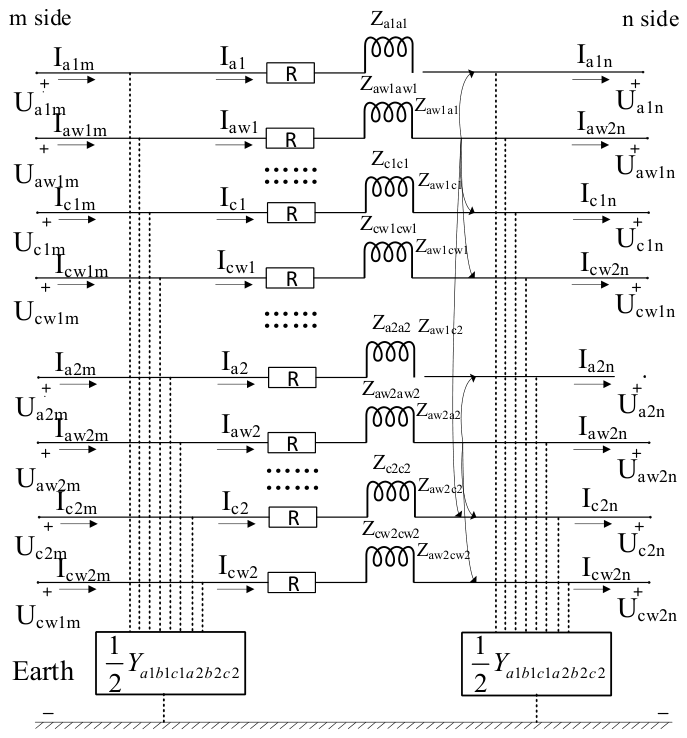
Parameter imbalance is a fundamental characteristic of homopolar parallel cables, and establishing an accurate cable parameter calculation model is the basis for analyzing the operating characteristics of cables. The propagation speed of electromagnetic waves in cables is approximately 2 × 10⁸ m/s. According to transmission line theory, when the length of the cable line l and the wavelength λ of the electromagnetic wave propagating in the cable satisfy l > 0.1λ, that is, under a frequency of 50 Hz when l > 400 km, the cable needs to be treated with a distributed parameter model; otherwise, a lumped parameter model should be used. Typically, a 500 kV cable is within 30 km, so this paper adopts the lumped parameter π model for the two-circuit homopolar parallel cable, as shown in Figure 1.
In the figure, Ia1m, Ia2m, Ic1m and Ic2m represent the core currents of phase A and phase C of the two circuits on side of the line, respectively. Ua1m, Ua2m, Uc1m, Uc2m, Ua1m, Ua2m, Uc1m, Uc2m represent the voltages between the core and sheath on side m of the line. Ia1, Ia2, Ic1, Ic2, Iaw1, Iaw2, Icw1, Icw2 represent the sheath circulating currents of phase A and phase C of the two circuits on side m of the line. Za1a1, Zaw1aw1, Zc1c1, Zcw1cw1, Za2a2, Zaw2aw2, Zc2c2, Zcw2cw2 represent the self-impedances of the core and sheath of phase A and phase C of the two circuits, respectively. Zaw1a1, Zaw1c1, Zaw1cw1, Zaw1c2, Zaw2a2, Zaw2c2, Zaw2cw2 represent the mutual impedances between the core and sheath, with others following the same principle. Ya1b1c1a2b2c2 represents the ground admittance of the cable.
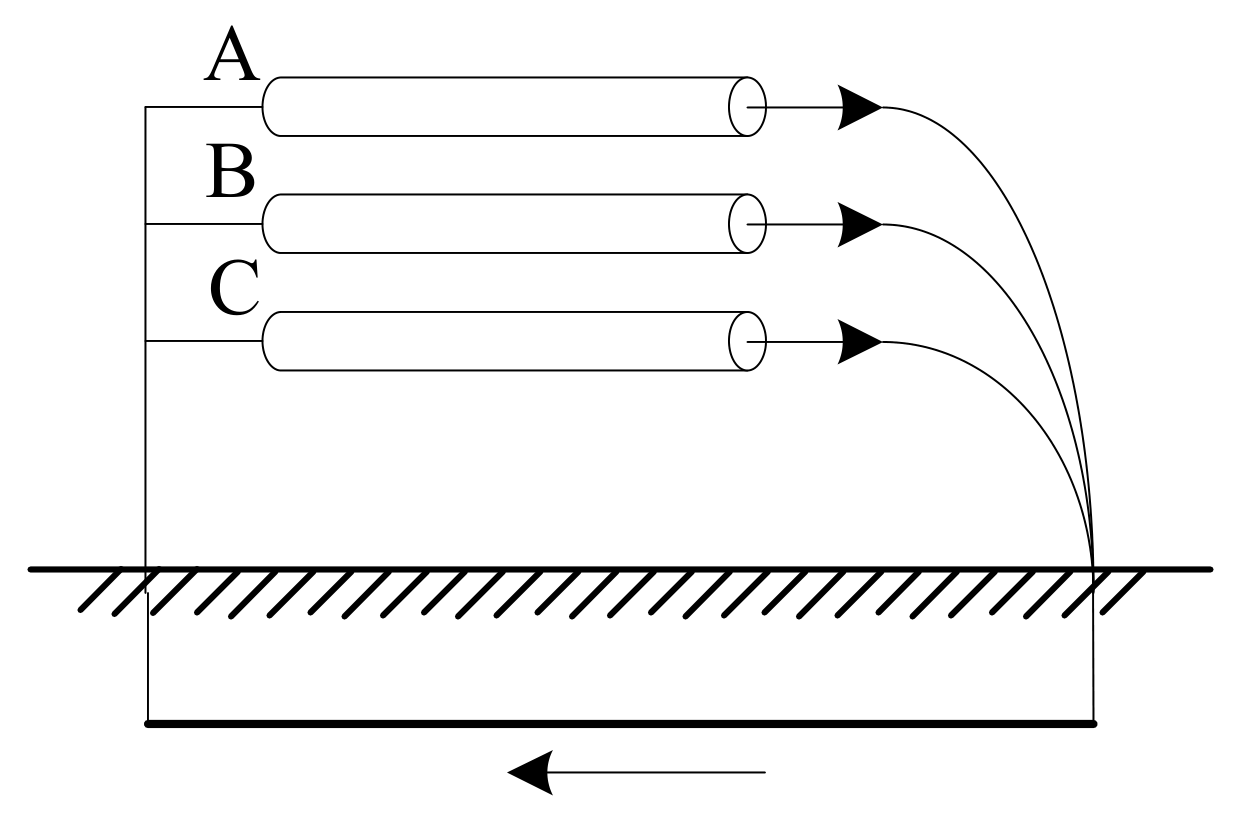
Referring to Carson’s analysis method, it is assumed that the Earth is an infinitely large homogeneous solid with a uniform surface and constant resistivity. Under this assumption, the return path of all ground currents can be represented by a virtual conductor, as shown in Figure 2. Using the method of conductor mirroring, the self-impedance of the cable line and the mutual impedance between cables can be determined. The impedance/admittance derivations in this section assume uniform soil resistivity, equal cross-bond section lengths, and negligible sheath-to-sheath eddy-current coupling at 50 Hz. These are common assumptions for long-line engineering sheath estimates. To assess their impact, a comparison with PSCAD shows calculated currents and impedances deviate by less than 1% for studied configurations, confirming minor engineering-level deviations. Scenarios like strongly heterogeneous soil, very short line sections, or high-frequency transients may require re-evaluating these assumptions, and we briefly outline model adaptation approaches for such cases.
Loop   Z c c = r c + r e + j 0.1445 log D e d G M R c Z s s = r s + r e + j 0.1445 log D e d G M R s Z s c = r e + j 0.1445 log D e d G M R s Z s c = r e + j 0.1445 log D e D
The mutual impedance between two “core-earth” loops and the mutual impedance between two “sheath-earth” loops are both represented by the aforementioned equation.
In the equation, Zcc is the self-impedance of the “core-earth” loop, Zss is the self-impedance of the “sheath-earth” loop, Zsc is the mutual impedance between the “core-earth” loop and the “sheath-earth” loop when the core and sheath are in the same phase, and Z′sc is the mutual impedance between the “core-earth” loop and the “sheath-earth” loop when the core and sheath are in different phases. The mutual impedance between two “core-earth” loops and the mutual impedance between two “sheath-earth” loops can also be calculated using the corresponding formula for Z′sc. rc is the alternating current resistance per unit length of the core; rs is the alternating current resistance per unit length of the sheath; re is the equivalent resistance of the earth, re = π2f × 10−4 = 0.0493 Ω/km; De is the equivalent loop depth when the earth is used as the return path, where ρe is the resistivity of the earth and f is the system frequency; dGMRc is the geometric mean radius of the core; dGMRs is the geometric mean radius of the sheath; D is the distance between the conductors of each phase.
Considering the effect of the metallic sheath, an initial impedance matrix is established:
Z = Z a 1 a 1 Z a 1 b 1 Z a 1 c 1 Z a 1 a w 2 Z a 1 b w 2 Z a 1 c w 2 Z b 1 a 1 Z b 1 b 1 Z b 1 c 1 Z b 1 a w 2 Z b 1 b w 2 Z b 1 c w 2 Z c 1 a 1 Z c 1 b 1 Z c 1 c 1 Z c 1 a w 2 Z c 1 b w 2 Z c 1 c w 2 Z a w 2 a 1 Z a w 2 b 1 Z a w 2 c 1 Z a w 2 a w 2 Z a w 2 b w 2 Z a w 2 c w 2 Z b w 2 a 1 Z b w 2 b 1 Z b w 2 c 1 Z b w 2 a w 2 Z b w 2 b w 2 Z b w 2 c w 2 Z c w 2 a 1 Z c w 2 b 1 Z c w 2 c 1 Z c w 2 a w 2 Z c w 2 b w 2 Z c w 2 c w 2 Z = Z i i Z j i Z i j Z j j
In the matrix, each parameter in [Zii] represents the self-impedance and mutual impedance between the “core-earth” loops; each parameter in [Zij] and [Zji] represents the mutual impedance between the “core-earth” loop and the “sheath-earth” loop; each parameter in [Zjj] represents the self-impedance between the “metallic sheath-earth” loops. [Zii], [Zij], [Zji], [Zjj] are all 6 × 6 matrices.
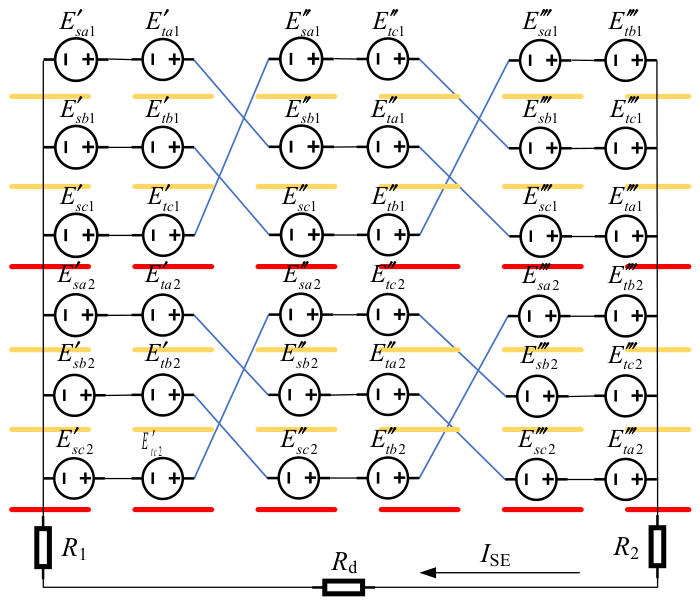
In the figure, R1 and R2 are the grounding resistance values at the two ends of the cross-boned sheath; Rd is the leakage resistance to earth; E s i 1 , E s i 1 , E s i 1 , E s i 2 , E s i 2 , E s i 2 are the induced electromotive forces (EMFs) generated by the core currents of the two circuits in the three small sections, where i = A, B, C; E t i 1 , E t i 1 , E t i 1 , E t i 2 , E t i 2 , E t i 2 are the induced EMFs generated by the sheath circulating currents of the two circuits on the cable sheath; where i = A, B, C; Isa1, Isa2, Isb1, Isb2, Isc1, Isc2 are the sheath circulating currents flowing through the sheaths of the three-phase cables; ISE is the total grounding current of the cable sheath.
Since the cable cores are not transposed, after equidistant cross-bonding, taking the first circuit as an example, the impedances have the following relationships:
Z a 1 a w 1 = Z a 1 b w 1 = Z a 1 c w 1 = Z a 1 a w 1 + Z a 1 b w 1 + Z a 1 c w 1 / 3 Z b 1 a w 1 = Z b 1 b w 1 = Z b 1 c w 1 = Z b 1 a w 1 + Z b 1 b w 1 + Z b 1 c w 1 / 3 Z c 1 a w 1 = Z c 1 b w 1 = Z c 1 c w 1 = Z c 1 a w 1 + Z c 1 b w 1 + Z c 1 c w 1 / 3 Z a w 1 a w 1 = Z b w 1 b w 1 = Z c w 1 c w 1 = Z a w 1 a w 1 + Z b w 1 b w 1 + Z c w 1 c w 1 / 3 Z a w 1 b w 1 = Z a w 1 c w 1 = Z b w 1 c w 1 = Z a w 1 b w 1 + Z a w 1 c w 1 + Z b w 1 c w 1
Therefore, the induced electromotive force (EMF) generated by the core current on the metallic sheath is the same in each section of cross-bonding. The induced EMFs in the three small sections of cross-bonding can be obtained as follows:
E S = Z S × I a b c × l E S = Z S I a b c × l E S = Z S I a b c × l
In the equation, [E]′s, [E]″s, [E]‴s, [I]abc are all 6 × 1 matrices, l is the length of the cable in earth cross-bonded section, and the lengths of three cross-bonded sections are usually equal. [Z]S is a 6 × 6 impedance matrix:
Z S = Z a w 1 a 1 Z b w 1 a 1 Z c w 1 a 1 Z a w 2 a 2 Z b w 2 a 2 Z c w 2 a 2 Z a w 1 b 1 Z b w 1 b 1 Z c w 1 b 1 Z a w 2 b 1 Z b w 2 b 1 Z c w 2 b 1 Z a w 1 c 1 Z b w 1 c 1 Z c w 1 c 1 Z a w 2 c 1 Z b w 2 c 1 Z c w 2 c 1 Z a w 1 a 2 Z b w 1 a 2 Z c w 1 a 2 Z a w 2 a 2 Z b w 2 a 2 Z c w 2 a 2 Z a w 1 b 2 Z b w 1 b 2 Z c w 1 b 2 Z a w 2 b 2 Z b w 2 b 2 Z c w 2 b 2 Z a w 1 c 2 Z b w 1 c 2 Z c w 1 c 2 Z a w 2 c 2 Z b w 2 c 2 Z c w 2 c 2
The circulating current flowing through the metallic sheath will induce an electromotive force (EMF) on the sheaths of the other phases. Since the sheath current is much smaller than the current flowing through the core, the induced voltage from the sheath current will also be much smaller compared to the induced voltage caused by the core current. Based on electromagnetic induction, a mathematical model can be established for the sheath-induced EMF on a particular phase sheath caused by the sheath currents of the other phases. Taking the first section as an example:
E t a 1 E t b 1 E t c 1 E t a 2 E t b 2 E t c 2 = Z a w 1 a w 1 Z b w 1 a w 1 Z c w 1 a w 1 Z a w 2 a w 1 Z b w 2 a w 1 Z c w 2 a w 1 Z a w 1 b w 1 Z b w 1 b w 1 Z c w 1 b w 1 Z a w 2 b w 1 Z b w 2 b w 1 Z c w 2 b w 1 Z a w 1 c w 1 Z b w 1 c w 1 Z c w 1 c w 1 Z a w 2 c w 1 Z b w 2 c w 1 Z c w 2 c w 1 Z a w 1 a w 2 Z b w 1 a w 2 Z c w 1 a w 2 Z a w 2 a w 2 Z b w 2 a w 2 Z c w 2 a w 2 Z a w 1 b w 2 Z b w 1 b w 2 Z c w 1 b w 2 Z a w 2 b w 2 Z b w 2 b w 2 Z c w 2 b w 2 Z a w 1 c w 2 Z b w 1 c w 2 Z c w 1 c w 2 Z a w 2 c w 2 Z b w 2 c w 2 Z c w 2 c w 2 × I s a 1 I s b 1 I s c 1 I s a 2 I s b 2 I s c 2 × l
Combining with Equation (3), the induced electromotive forces (EMFs) for the other two sections can be obtained as:
E T = Z × I a b c w × l E T = Z × I a b c w × l
According to the current loop method, the equations can be written based on the equivalent circuit in Figure 3:
R d + R d 1 + R d 2 × I S E = E s a 1 + E s b 1 + E s c 1 + E t a 1 + E t a 1 + E t a 1 R d + R d 1 + R d 2 × I S E = E s b 1 + E s c 1 + E s a 1 + E t b 1 + E t b 1 + E t b 1 R d + R d 1 + R d 2 × I S E = E s c 1 + E s a 1 + E s b 1 + E t c 1 + E t c 1 + E t c 1
R d + R d 1 + R d 2 × I S E = E s a 2 + E s b 2 + E s c 2 + E t a 2 + E t a 2 + E t a 2 R d + R d 1 + R d 2 × I S E = E s b 2 + E s c 2 + E s a 2 + E t b 2 + E t b 2 + E t b 2 R d + R d 1 + R d 2 × I S E = E s c 2 + E s a 2 + E s b 2 + E t c 2 + E t c 2 + E t c 2
I s a 1 + I s a 2 + I s b 1 + I s b 2 + I s c 1 + I s c 2 = I S E
The parameter R d denotes the grounding resistance at the cross-bonding point, while R d 1 and R d 2 represent the grounding resistances at both ends of the cable sheath. The vector [ I ] s represents the sheath circulating currents of all phases and circuits, and I S E denotes the total grounding current flowing through the cable sheath system.
By combining the impedance matrix formulation in (5) with the EMF expressions derived in (4), (6) and (7), and substituting them into the sheath current Equation (8), the sheath circulating currents can be obtained.
R 0 × I a b c w = Z x × I a b c + Z + Z + Z I a b c w I a b c w = R 0 Z + Z + Z 1 × Z x × I a b c
In this context, [R]0 is a 6th-order full matrix with each element being Rd + Rd1 + Rd2; since the sheath circulating current of each cable passes through phases A, B, and C in sequence after cross-bonding, the element in the first row and first column of the [Z]x matrix actually represents the sum of the mutual inductances of the core current in phase A of the first circuit on the metallic sheaths of phases A, B, and C, that is Zaw1a1 + Zbw1a1 + Zcw1a1. By analogy, the other elements in the [Z]x matrix can be derived.
Combining with Figure 1, according to Kirchhoff’s Voltage Law, we have
V a b c m V a b c n = Z i i × I a b c Z i j × I a b c w
By solving Equations (11) and (12) simultaneously, the impedance matrix can be simplified to a 6 × 6 matrix. The simplified impedance matrix is
Z a b c = Z i i Z i j × R 0 Z + Z + Z 1 × Z x
The reduction from the 12th-order to the 6th-order impedance matrix is achieved by grouping symmetric sheath–core coupling terms based on the equivalence of the three single-core cables within each cross-bonded section. This follows the standard Carson-based coupling reduction procedures described in Equations (5)–(7) and (10), ensuring that the dominant physical coupling relations are preserved while improving numerical stability.

2.2. Admittance Parameter Calculation Model

In addition to the impedance parameters of the cable, its admittance parameters are also an indispensable part in the analysis of operating currents. Since analyzing the admittance of the shielded cables used in engineering is relatively complex, the analysis begins with the commonly used coaxial cables.
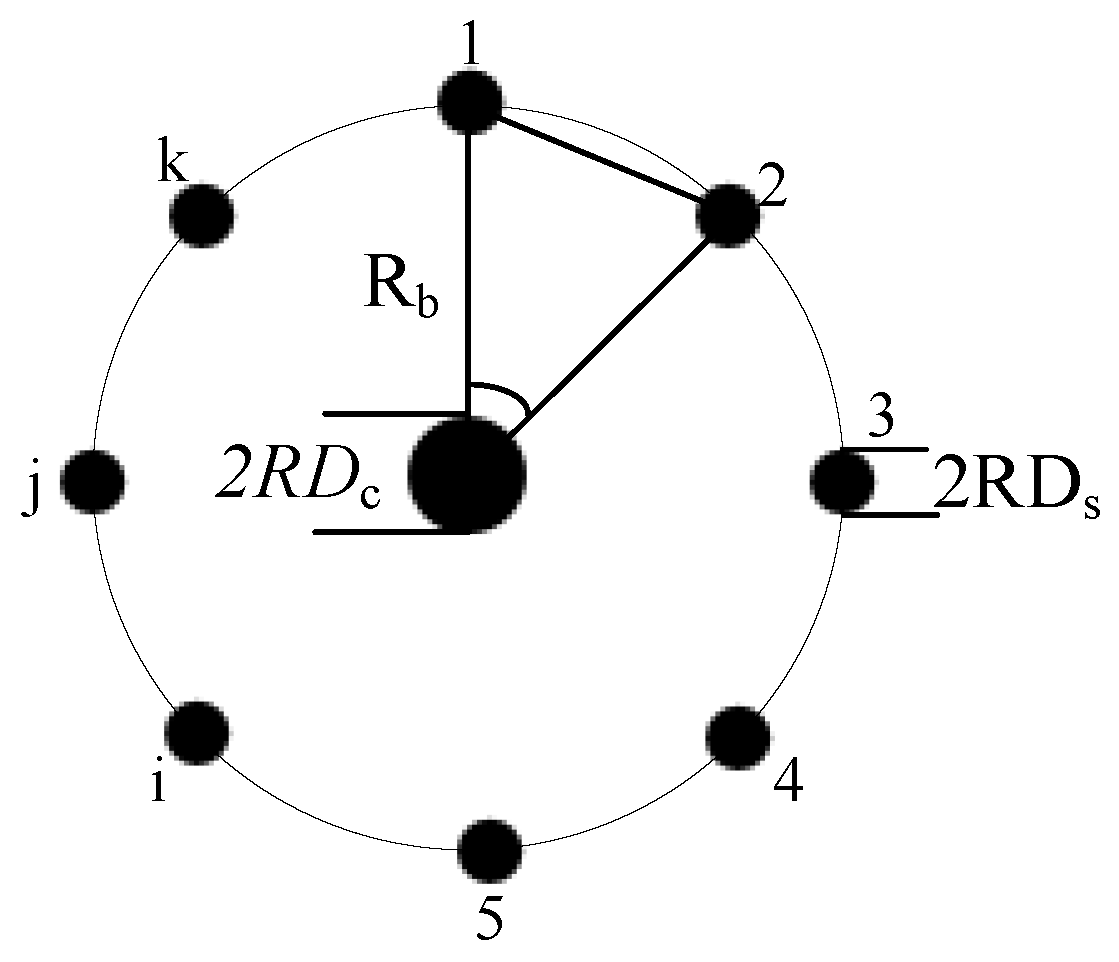
As shown in Figure 4, a basic neutral line coaxial cable is presented, where the core conductor is the phase conductor, and the coaxial neutral line is replaced by a series of wires at a distance Rb from the central conductor.
To calculate the magnitude of the ground capacitance of the core conductor, it can be obtained by calculating the potential difference between the core and a neutral line. Since the neutral line is grounded, its potential is 0 and equal, so only one neutral line needs to be considered. Taking into account the effects of all neutral lines and the core conductor, the following equation can be written:
V p 1 = q p 2 π ε ln R b R D c 1 k ln k R D s R b C p g = q p V p 1 = 2 π ε ln R b / R D c 1 / k ln k R D s / R b y p g = j w C p g = j w 2 π ε ln ( R b / R D c ) ( 1 / k ) ln ( k R D s / R b )
In the equation, Cpg is the capacitance between the phase and ground of a single neutral line coaxial cable, ypg is the admittance of the cable, qp is the charge density on the phase conductor; ε is the permittivity of the phase conductor; Rb is the distance between the surrounding wires and the central conductor; RDc is the radius of the phase conductor; k is the number of neutral lines; RDs is the radius of the neutral line.
For shielded cables, since they contain a shielding layer in their structure, the electric field is confined in the same way as in a coaxial cable. Thus, they can be regarded as a special type of neutral line coaxial cable with the number of neutral lines k considered as infinitely large. In this case, the second term in the denominator of the admittance calculation formula tends to zero. Therefore, the formula for calculating the shunt admittance of shielded cables can be derived as follows:
y a g = 0 + j ω 2 π ε ln R b / R D c
In the formula, Rb is the distance from the core to the metallic sheath, and RDc is the radius of the core.
Due to the presence of the shielding layer, the electric field generated by the core conductor is not associated with adjacent conductors. Therefore, only diagonal elements exist in its phase admittance matrix, with all other elements being zero. The diagonal elements can be calculated using Equation (15), thereby obtaining the phase admittance matrix Ya1b1c1a2b2c2.

3. Voltage and Current Calculation Model

3.1. Phase Voltage and Phase Current Calculation Model

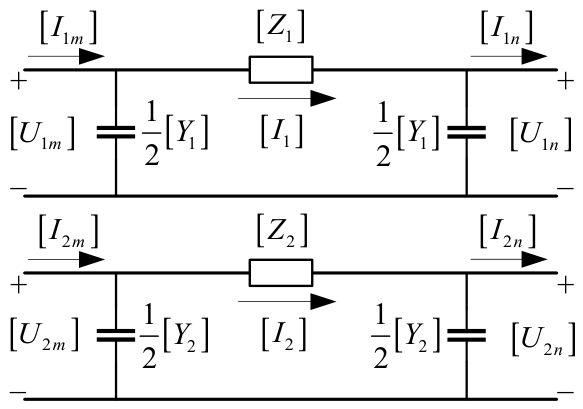
As shown in Figure 5, the π-type equivalent circuit of the 500 kV homopolar parallel cable line is established.
Based on the π-type circuit, the equations for solving the line currents of the two circuits can be written as
I 1 I 2 = I 1 m I 2 m 1 2 × Y 11 0 0 Y 22 × V 1 m V 2 m I = I m 1 2 × Y × V m
In which Y11 and Y22 represent the 3 × 3 self-admittance parameter matrices of the two circuits, and Y12 and Y21 represent the 3 × 3 mutual admittance parameter matrices of the two circuits, The parameters within the matrices are obtained (1).
For the receiving end voltage:
V 1 n V 2 n = V 1 m V 2 m Z 11 Z 12 Z 21 Z 22 × I 1 I 2 V n = V m Z × I
Similarly, Z11, Z22, Z12, Z21 are all the phase impedance matrices obtained after simplification as mentioned earlier.
By solving Equations (16) and (17) simultaneously, we obtain
V m = a × V n + b × I n a = E + 1 2 × Z × Y b = Z
Similarly, based on Figure 6, the relationship between the receiving-end current and the input voltage and current can be obtained as
I n = c × V m + d × I m c = 1 2 × Y + Y × a = Y 1 4 × Y × Z × Y d = E 1 2 × Y × b = E + 1 2 × Y × Z
In the derivation process mentioned above, the matrices [a], [b], [c], and [d] obtained are all 6 × 6 matrices. They include the self-impedances of the two parallel circuits and the mutual impedance between them. According to Equation (19), the magnitudes of the currents in each line of the 500 kV homopolar parallel cable line can be calculated, and subsequent analyses can be carried out based on this.

3.2. Sequence Voltage and Sequence Current Calculation Model

In practice, when analyzing the asymmetry of the operating currents in cable lines, the magnitudes of the cable sequence current parameters are needed. Therefore, it is necessary to calculate the sequence voltages and sequence currents of the cables.
According to the method of symmetrical components, the transformation function of sequence voltage is as follows:
U a 1 U b 1 U c 1 U a 2 U b 2 U c 2 = 1 1 1       1 a 2 a       1 a a 2             1 1 1       1 a 2 a       1 a a 2 × U 1 0 U 1 1 U 1 2 U 2 0 U 2 1 U 2 2         U a b c = A × U 012
Thus, the phase currents can be transformed into sequence currents using the following equation:
I a b c = A × I 012
Based on the relationship between line voltage and current, the sequence impedance parameter matrix can be obtained as
Z 012 = A 1 × Z a b c × A
In reality, the sequence impedance matrix obtained using the method of symmetrical components is not a fully decoupled diagonal matrix but rather has the same form as the line impedance matrix, with complex coupling relationships existing between the different sequence components.
Since the admittance matrix of the parallel cables, [Ya1b1c1a2b2c2] is a diagonal matrix, the sequence admittance matrix obtained after symmetrical component transformation is the same as the phase admittance matrix.
By substituting the sequence impedance matrix and the sequence admittance matrix into Equation (22), the mathematical model of sequence voltage can be obtained:
A × U m 120 = a × A × U n 120 + b × A × I n 120 U m 120 = A 1 × a × A × U n 120 + A 1 × b × A × I n 120
Since an independent sequence impedance matrix has not been formed, there is a certain error in the sequence voltage and sequence current of the above cable, but the error is small and meets the requirements of engineering applications.

4. Optimal Arrangement

4.1. General Overview

The parameters that reflect the operating characteristics of parallel cables are not limited to phase voltages and currents, as well as sequence voltages and currents. Since increasing the cable’s current-carrying capacity is the fundamental purpose of using homopolar parallel cables for transmission, the magnitude of the current-carrying capacity is the most important indicator for measuring the operating characteristics of parallel cables. The normal operation of parallel cables is subject to many constraints, such as electromagnetic imbalance, sheath circulating currents, and voltage deviations. Electromagnetic imbalance, caused by the asymmetry of line parameters, can generate zero-sequence and negative-sequence currents, which may lead to maloperation of protection devices or damage equipment in the system, thus significantly affecting the safe operation of the system. Therefore, electromagnetic imbalance should be minimized during the normal operation of parallel cables. Since large sheath circulating currents can reduce the cable’s transmission capacity and cause overheating of the metallic sheath, which in turn degrades the performance of the main insulation and shortens the cable’s service life, these currents should also be restricted during the operation of parallel cables. Voltage deviation, as an important indicator of power quality, should be strictly controlled within the limits specified by the national power quality standards during the normal operation of parallel cables.
Variations in conductor spacing and heat dissipation conditions across different cable installation configurations directly influence key operational indicators, including current-carrying capacity, imbalance degree, sheath circulating current, and voltage deviation. To ensure that homopolar parallel cable systems achieve safe and reliable operation while meeting capacity-expansion requirements, this study integrates Carson’s formula for accurate impedance modeling with a fuzzy AHP-based multi-criteria optimization framework to jointly evaluate these four critical performance indicators. This approach effectively overcomes the limitations of prior studies that focused on single indicators [8,14], thereby enabling a more quantitative, systematic, and robust assessment of cable performance.

4.2. Indicator Acquisition

4.2.1. Current-Carrying Capacity Calculation Model

According to the international standard IEC-60287, the formula for calculating the current-carrying capacity of cables at different temperatures can be obtained [15]:
I = Δ θ W d 0.5 T 1 + n T 2 + T 3 + T 4 R T 1 + n R 1 + λ 1 T 2 + n R 1 + λ 1 + λ 2 T 3 + T 4 0.5
In the formula: I is the current flowing through the core conductor (A); Δθ is the temperature rise of the conductor above the ambient temperature (K); Rapture (K); R is the alternating current resistance of the conductor per unit length at the maximum operating (Ω/m), Wd is the dielectric loss around the conductor per unit length (W/m); T1 is the thermal resistance per unit length between the core conductor and metallic sheath (K·m/w); T2 is the thermal resistance per unit length of the bedding between the metallic sheath and the armor (K·m/w); T3 is the thermal resistance per unit length of the cable’s outer sheath (K·m/w); T4 is the thermal resistance per unit length between the cable surface and the surrounding medium (K·m/w); n is the number of conductors carrying the load in the cable (conductors of the same cross-sectional area and carrying the same load); λ 1 is the ratio of the loss in the cable’s metallic sheath to the total loss of all conductor; λ 2 is the ratio of the loss in the cable’s armor to the total loss of all conductors.
The alternating current (AC) resistance of the cable during operation affects the current-carrying capacity, and its calculation formula is as follows:
R = R 1 + Y S + Y P
In the formula, YS is the skin effect factor of the cable, R′ is the direct current resistance of the conductor at the operating temperature, and YP is the proximity effect factor between cables. Their calculation formulas are as follows: The proximity effect between parallel cables (i.e., the electromagnetic interaction between adjacent cables) reduces the effective current-carrying capacity of the cables, as the magnetic field of adjacent cables enhances the eddy current losses within the cable conductors, increasing the AC resistance of the conductors. According to the international standard IEC-60287, the formulas for calculating YS and YP are
Y P = X p 4 192 + 0.8 X p 4 d c s 2 0.312 d c s 2 + 1.18 X p 4 192 + 0.8 X p 4 + 0.27 X p 4 = 8 π f R 2 × 10 14 k p 2
In the formula, dc is the diameter of the core conductor’s represents the mutual geometric mean distance between each cable, f is the system frequency, and kp is taken as 0.25.

4.2.2. Electromagnetic Imbalance Degree Calculation Model

The degree of imbalance in parallel cable lines can be measured by zero-sequence and negative-sequence imbalance. These are divided into direct-type electromagnetic imbalance M0T and M2T, and circulating current-type electromagnetic imbalance M0C and M2C, which are defined as follows:
M 0 T = I 0 I + I 0 I I I 1 I + I 1 I I M 2 T = I 2 I + I 2 I I I 1 I + I 1 I I
M 0 C = I 0 I I 0 I I I 1 I + I 1 I I M 2 C = I 2 I I 2 I I I 1 I + I 1 I I
In the formula, I0I, I1I, I2I and I0I, I1II, I2II represent the zero-sequence, positive-sequence, and negative-sequence currents of the two circuits, respectively.

4.2.3. Voltage Deviation Calculation Mode

For homopolar parallel cables, the voltage deviation during normal operation is defined as the relative value of the deviation of the actual operating voltage from the system nominal voltage, and its calculation formula is as follows:
δ U = U r e U N U N × 100 %
Equation (29) is applied specifically to 500 kV HVAC/EHVAC cable systems, with the voltage deviation calculated at the cable line termination node and evaluated under the rated full-load operating condition—the benchmark scenario for cable power capacity design. Compared with system-level network parameters such as short-circuit capacity and reactive power compensation configuration, cable layout exerts a localized and direct influence on voltage deviation: it directly modifies the line impedance and thus the voltage drop, enabling precise regulation of terminal voltage deviation through engineering adjustments like optimizing conductor cross-section and shortening the cable route. In contrast, adjustments to system-level network parameters typically involve overall power grid dispatch or infrastructure upgrades, which entail significantly higher implementation costs and technical barriers.
In the formula, δU represents the voltage deviation, Ure represents the actual operating voltage of the system, and UN represents the rated voltage of the system.
According to widely adopted international power quality standards, such as those issued by the International Electrotechnical Commission (IEC 60038, IEC 61000 series) and the Institute of Electrical and Electronics Engineers (IEEE Std 1159), the steady-state voltage deviation in high-voltage systems is typically required to remain within an acceptable range (commonly within ±5% to ±10% of the nominal voltage).

4.3. Optimal Arrangement Based on Fuzzy Analytic Hierarchy Process

This paper employs the Analytic Hierarchy Process (AHP) [16,17] in conjunction with the aforementioned indicators to evaluate the operating characteristics of homopolar parallel cables. Since the fundamental purpose of using homopolar parallel cables for transmission is to increase the current-carrying capacity, this indicator is given the highest priority. The fuzzy AHP method was selected for its robustness in handling subjective judgments and uncertainty in multi-criteria optimization. It allows for the integration of expert evaluations and quantitative data, ensuring a balanced assessment of key operational indicators such as current-carrying capacity, imbalance degree, sheath circulating current, and voltage deviation. Given that current imbalance can pose significant risks to the safe operation of the power grid, the current imbalance degree is given more attention than other indicators, except for the current-carrying capacity. The magnitude of sheath circulating currents and voltage deviations are also issues that need to be monitored during normal cable operation, but they can be given the least attention if they do not exceed the limits. Based on the above analysis and using the nine-point scale, the judgment matrix shown in Table 1 can be formed:
The AHP judgment matrix is aligned with IEEE 60287 (ampacity prioritization) and 500 kV cable industry norms (imbalance as a safety-critical indicator). After calculation, the corresponding weights of each indicator are obtained as shown in Table 2:
Weights were assigned based on engineering priorities: current-carrying capacity (0.455) as the primary objective, imbalance degree (0.263) for grid safety, and sheath current/voltage deviation (0.141 each) as secondary concerns. After the consistency test, the consistency ratio (CR) of the above judgment matrix is 0.0038, which is much smaller than 0.1. Therefore, the weight setting is reasonable.
Since current-carrying capacity, electromagnetic imbalance degree, sheath circulating current, and voltage deviation are different types of physical quantities with different dimensions, normalization is required. In this paper, the indicators are scored using the numbers 1–10, where a higher score indicates a better parameter. The normalization principle is shown in Table 3:
According to the normalization principle given in the above table, the scores of the operating parameters of the parallel cable transmission lines under different arrangement methods can be calculated. By substituting these scores into Equation (30), the comprehensive score can be obtained. The optimal arrangement method can then be determined by comparing the magnitude of the scores.
p = p 1 , p 2 , p 3 , p 4 w 1 w 2 w 3 w 4
In the equation, p1, p2, p3 and p4 are the scores for current-carrying capacity, imbalance degree, sheath circulating current, and voltage deviation, respectively w1, w2, w3 and w4 are the corresponding indicators, p is the final score.

5. Simulation Analysis

5.1. A Cable Parameter Model

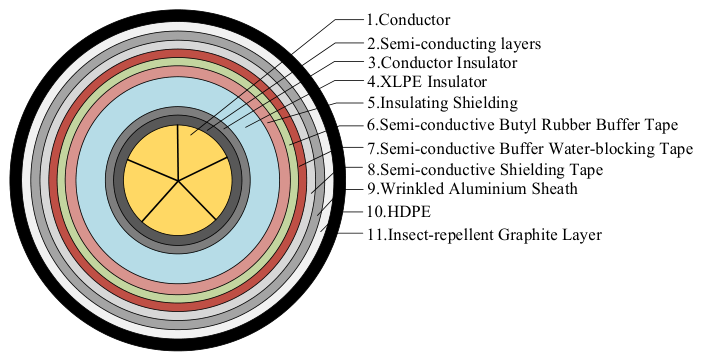
The cable model used in the study is YJLW02-Z 290/500 1 × 2500 mm2. Its main structure is shown in Figure 6, and its main parameters are listed in Table 4.
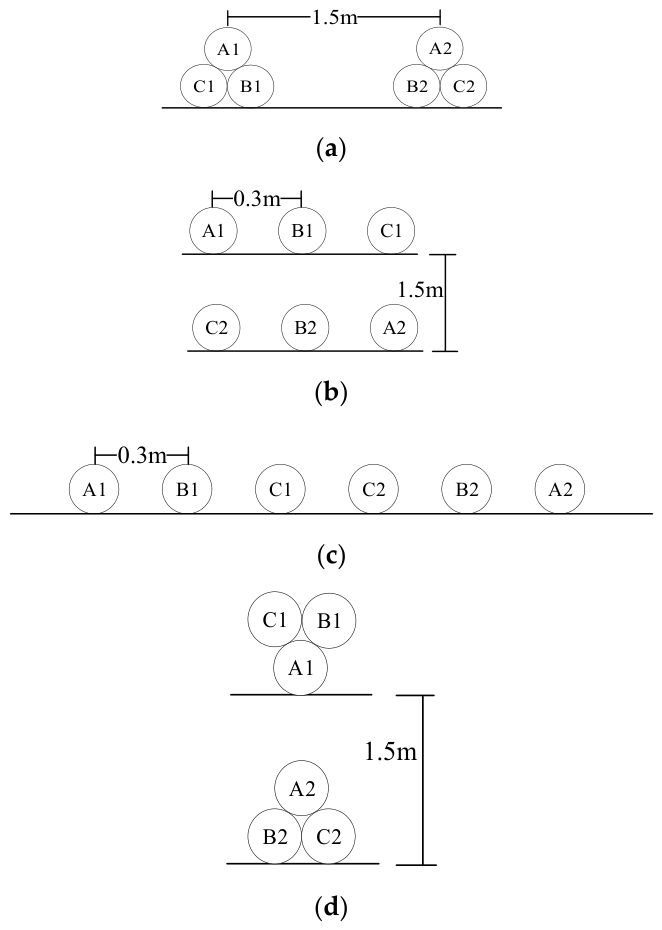
In engineering, there are many layout methods for parallel cable lines of the same phase, such as three-phase horizontal arrangement, three-phase vertical arrangement, “trefoil” horizontal arrangement and “inverted triangle” arrangement. Referring to the optimal phase sequence of parallel cables in reference [17], the arrangement diagrams of the compared arrangements in this paper are shown in Figure 7.

5.2. Verification of Parameter Calculation Correctness

To verify the correctness of the aforementioned theoretical calculations, the phase impedance parameters and operating currents of the phase-to-phase parallel cables are calculated, and the calculated results are compared and analyzed with those obtained from the PSCAD simulation. Taking the “inverted triangle” layout as an example, the line length is 3 km, the metal sheath grounding method is cross interconnected with both ends directly grounded, the line is divided into three sections, each section is 0.5 km long, and the line is in the rated load state.
The unit length impedance matrix obtained by calculation and that obtained by simulation are shown in the figure below. Equation (31a) is the impedance matrix calculated theoretically, and Equation (31b) is the impedance matrix calculated by simulation.
0 . 0565 + j 0 . 6487 0 . 0493 + j 0 . 5387 0 . 0493 + j 0 . 5387 0 . 0493 + j 0 . 3804 0 . 0493 + j 0 . 3934 0 . 0493 + j 0 . 3999 0 . 0493 + j 0 . 5387 0 . 0565 + j 0 . 6487 0 . 0493 + j 0 . 5387 0 . 0493 + j 0 . 3934 0 . 0493 + j 0 . 3906 0 . 0493 + j 0 . 4037 0 . 0493 + j 0 . 5387 0 . 0493 + j 0 . 5387 0 . 0565 + j 0 . 6487 0 . 0493 + j 0 . 3999 0 . 0493 + j 0 . 4037 0 . 0493 + j 0 . 4037 0 . 0493 + j 0 . 3804 0 . 0493 + j 0 . 3934 0 . 0493 + j 0 . 3999 0 . 0565 + j 0 . 6487 0 . 0493 + j 0 . 5387 0 . 0493 + j 0 . 5387 0 . 0493 + j 0 . 3934 0 . 0493 + j 0 . 3906 0 . 0493 + j 0 . 4037 0 . 0493 + j 0 . 5387 0 . 0565 + j 0 . 6487 0 . 0493 + j 0 . 5387 0 . 0493 + j 0 . 3999 0 . 0493 + j 0 . 4037 0 . 0493 + j 0 . 4037 0 . 0493 + j 0 . 5387 0 . 0493 + j 0 . 5387 0 . 0565 + j 0 . 6487
0 . 0608 + j 0 . 6636 0 . 0492 + j 0 . 5411 0 . 0492 + j 0 . 5411 0 . 0492 + j 0 . 4090 0 . 0492 + 0 . 4162 0 . 0492 + 0 . 4162 0 . 0492 + j 0 . 5411 0 . 0608 + j 0 . 6636 0 . 0492 + j 0 . 5411 0 . 0492 + 0 . 4162 0 . 0492 + j 0 . 4090 0 . 0492 + j 0 . 4090 0 . 0492 + j 0 . 5411 0 . 0492 + j 0 . 5411 0 . 0608 + j 0 . 6636 0 . 0492 + 0 . 4162 0 . 0492 + j 0 . 4090 0 . 0492 + j 0 . 4090   0 . 0492 + j 0 . 4090 0 . 0492 + 0 . 4162 0 . 0492 + 0 . 4162 0 . 0608 + j 0 . 6636 0 . 0492 + j 0 . 5411 0 . 0492 + j 0 . 5411 0 . 0492 + 0 . 4162 0 . 0492 + j 0 . 4090 0 . 0492 + 0 . 4090 0 . 0492 + j 0 . 5411 0 . 0608 + j 0 . 6636 0 . 0492 + j 0 . 5411 0 . 0492 + 0 . 4162 0 . 0492 + 0 . 4090 0 . 0492 + 0 . 4027 0 . 0492 + j 0 . 5411 0 . 0492 + j 0 . 5411 0 . 0608 + j 0 . 6636
It can be seen from Equation (31a,b) that the error between the two matrices is very small. The main sources of error are the calculation errors in the equivalent radius of the line and the equivalent depth of the virtual ground wire. Moreover, the cable in the PSCAD simulation model contains inner and outer semi-conductive tapes, which also have a certain impact on the calculation results.

5.3. Verification of the Correctness of the Operating Voltage and Current Calculation Model

The effective values of the input voltage and current of the power supply are shown in Table 5 and Table 6. The theoretical calculation of the receiving end current obtained by the method in this paper is compared with the PSCAD simulation value as shown in Table 6.
It can be seen that the error between the calculated value and the PSCAD simulated value is very small, and the error is mainly caused by the calculation errors of the cable impedance parameters and admittance parameters. The modeling assumes uniform soil resistivity, identical lengths among cross-bonded sections, and negligible eddy-current coupling between metallic sheaths at the 50 Hz operating frequency. These simplifications preserve the essential electromagnetic characteristics of the studied 500 kV system. Verification against PSCAD results (Table 6) demonstrates that the resulting current and impedance deviations remain below 1%, indicating that the assumptions have limited impact on engineering accuracy.

5.4. Analysis of Operating Characteristics of Phase-to-Phase Parallel Cables

5.4.1. Current-Carrying Capacity Under Different Layout Method

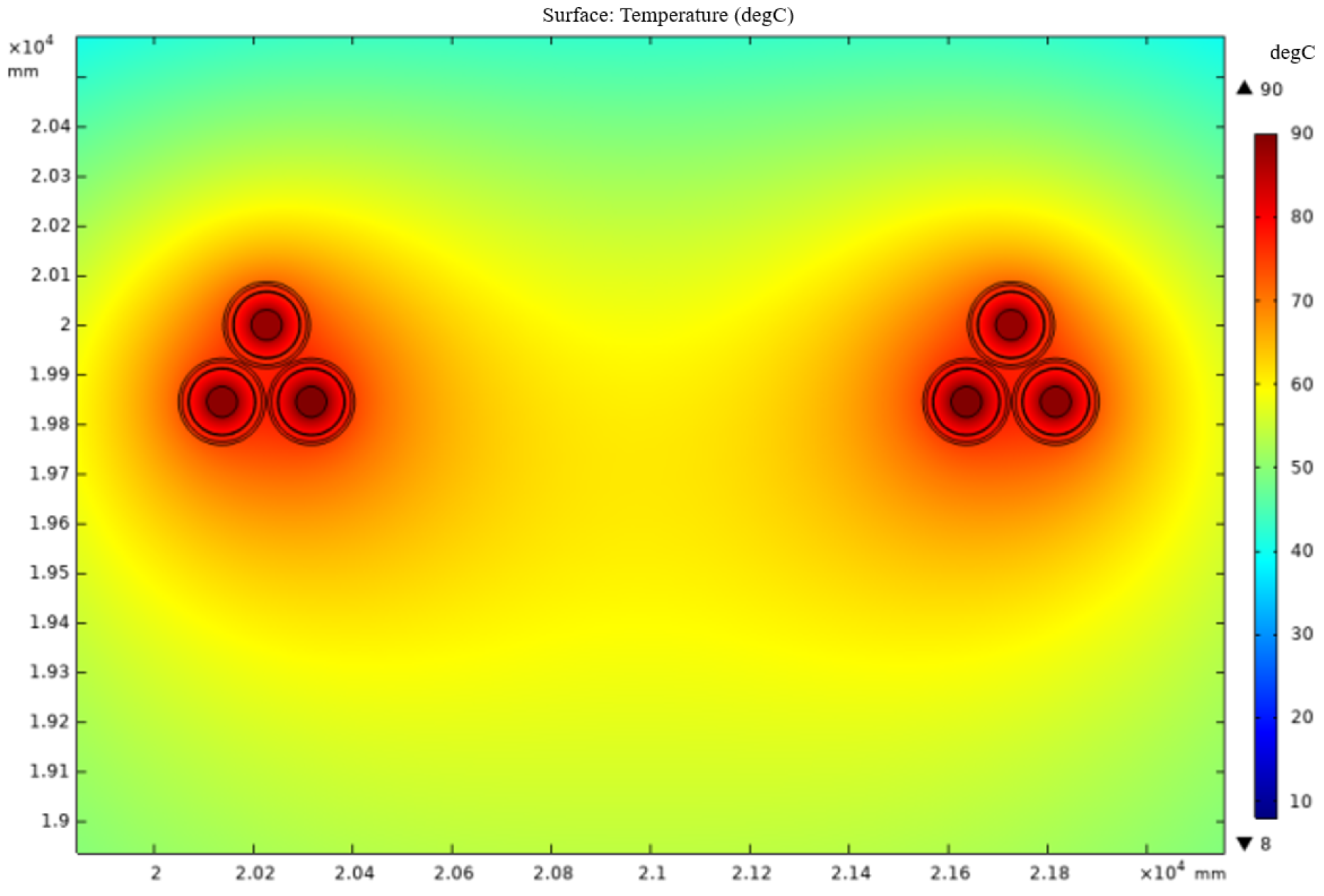
The current-carrying capacity of parallel cables is influenced by factors such as cable core spacing and cooling conditions, which vary for different arrangement methods. In fact, due to the poorer cooling conditions of the “delta” shape compared to the three-phase horizontal and vertical arrangements, the current-carrying capacity is also smaller. The current-carrying capacity under different layout methods is calculated using COMSOL 6.3. Taking the “delta” horizontal layout as an example, as shown in Figure 8.
After calculation, the current-carrying capacity of the 500 kV same-phase parallel cables in the “delta” horizontal arrangement is approximately 2600 A. Compared to the three-phase horizontal arrangement with larger air gaps and better cooling conditions, and the three-phase vertical arrangement, the “delta” shape arrangement has a smaller current-carrying capacity due to the closer proximity of the three-phase cables. Additionally, the current-carrying capacity of cables arranged longitudinally is higher than that of cables arranged transversely in a loop, meaning the “inverted triangle” arrangement has a greater current-carrying capacity than the “delta” horizontal arrangement; the three-phase vertical arrangement has a greater current-carrying capacity than the three-phase horizontal arrangement.
The calculation results of the current-carrying capacity under different layout methods show that there is a small difference in the current-carrying capacity between the longitudinal and transverse layouts. The current-carrying capacity of the “delta” layout is about 100 A lower than that of the three-phase layout. Therefore, the three-phase horizontal and vertical arrangements are scored 10 points, while the “inverted triangle” and “delta” horizontal arrangements are scored 9 points.

5.4.2. Imbalance Degree Under Different Layout Methods

The imbalance degree of each sequence current circulating in parallel cables and the zero-sequence through imbalance degree under rated load for the four typical layout methods are shown in Table 7 and Table 8.
It can be seen that in all layout methods, the circulating current type imbalance degree and the zero-sequence through-type imbalance degree are very small and can be neglected. The negative-sequence through-type imbalance degree of the “inverted triangle” layout is the smallest, followed by the “delta” horizontal layout. The negative-sequence through-type electromagnetic imbalance degree of the three-phase horizontal and three-phase vertical layouts is relatively large, with the three-phase horizontal layout being the largest.

5.4.3. Sheath Circulating Current Under Different Layout Methods

To ensure the safe operation of cables, the sheath circulating current should not exceed 10% of the load current [16]. Since 500 kV phase-to-phase parallel cables uses cross-connected grounding, the sheath circulating current is equal for phases A, B, and C in the same circuit, while the currents between two circuits are not equal. This paper takes the larger circulating current between the two circuits for analysis. The sheath circulating current under typical layout methods is shown in Table 9.
It can be seen that the sheath circulating current percentage of the “delta” layout is smaller than that of the three-phase layout. This is because the circulating current is related to the conductor spacing; the larger the spacing, the greater the circulating current. The “inverted triangle” layout has the smallest circulating current percentage, followed by the “delta” horizontal layout, with the three-phase horizontal layout having the largest percentage.

5.4.4. Voltage Deviation Under Different Layout Methods

Operating voltage and voltage deviation under different layout methods are shown in Table 10. It can be seen that, regardless of the layout method, the operating voltage and voltage deviation at the end of the cable for each phase are basically the same.

5.4.5. Optimal Layout Method

Based on Table 7, Table 8, Table 9 and Table 10, combined with the above analysis, the ranking and final scores of the four typical layout methods can be obtained by Equation (29), as shown in Table 11 and Table 12.
Single-criterion optimization leads to highly scattered optimal solutions for different performance indicators, failing to form a unified and operable engineering decision. It cannot reflect the practical priority of engineering objectives and easily deviates from the core demand of 500 kV cable capacity expansion. In contrast, the fuzzy-AHP multi-criteria framework scientifically integrates four key indicators with engineering-priority weights, screening out the three-phase vertical layout as the only comprehensive optimal solution. This solution not only guarantees the maximum current-carrying capacity but also ensures all safety and quality indicators are within acceptable ranges, providing a quantitative, reproducible decision method for cable layout design. It effectively solves the limitations of single-criterion optimization and realizes a balance between multiple core engineering requirements.
It can be seen that in cable arrangement, if the optimal phase sequence is adopted, the three-phase vertical layout method scores the highest. Although the “delta” horizontal layout has better performance in terms of imbalance degree, sheath circulating current, and voltage deviation, its current-carrying capacity is the smallest, resulting in a lower comprehensive score.

5.4.6. Current Characteristics Under Different Loads

The magnitude of the load is one of the important factors affecting the operation of parallel cable lines. Using PSCAD, the degree of imbalance in the line can be analyzed when the load changes. Taking the “three-phase vertical” layout as an example, the line load is adjusted, and the changes in the imbalance degree are calculated and analyzed, as shown in Table 13.
It can be seen that with the increase of the load, the circulating current type imbalance degree is very small, and the through-type imbalance degree remains almost unchanged.
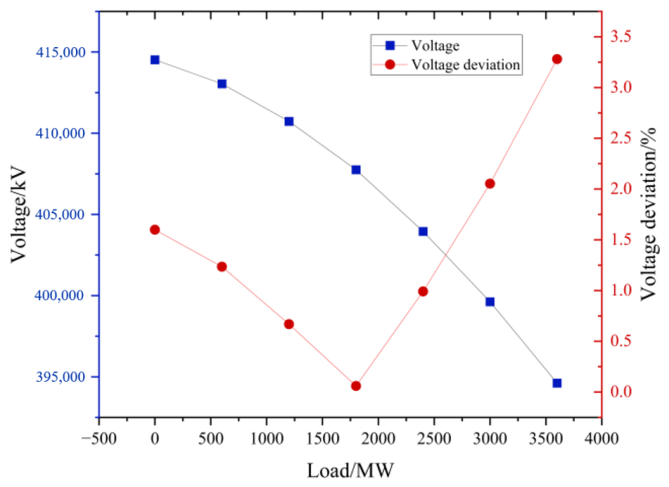
Figure 9 shows the voltage and voltage deviation change curves of the 500 kV phase-to-phase parallel cable under different load conditions. It can be seen that under different loads, the voltage deviation is less than 10% stipulated by the national power quality standard of China. With the increase of load, the line voltage shows a nearly linear downward trend. For voltage deviation, there is a trend of first decreasing and then increasing, with the lowest point near the rated capacity of a single cable.

5.4.7. The Impact of Temperature on Cable Line Imbalance

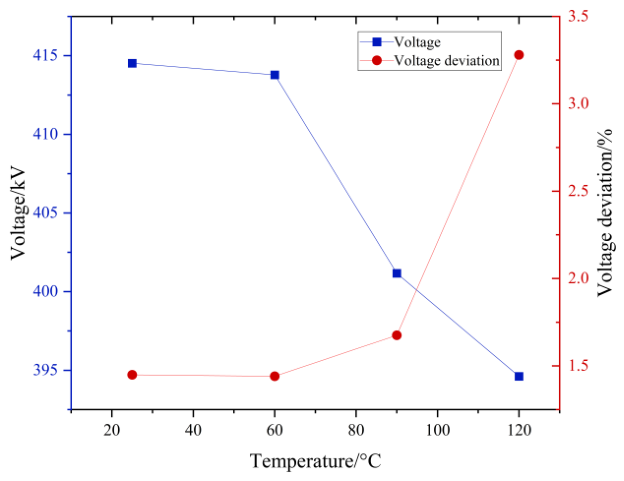
Taking the “three-phase vertical” layout as an example, the working current of the 500 kV phase-to-phase parallel cable under different working conditions can be calculated by Equation (25), as shown in Table 14.
The zero-sequence and negative-sequence imbalance degrees at different temperatures are shown in Table 15.
It can be seen that as the temperature of the cable core conductor gradually increases, the negative-sequence through-type imbalance degree is the smallest at around 90 °C, which is the rated load. The circulating current type imbalance degree and the zero-sequence through-type imbalance degree are both very small. When the line is short-term overloaded, the temperature of the core conductor reaches 120 °C, and the imbalance degree is also very small at this time, which indicates that the stability of the cable line will not change significantly during short-term overload.
The change curve of voltage and voltage deviation of the 500 kV phase-to-phase parallel cable with temperature is established as shown in Figure 10. It can be seen that as the temperature increases, the voltage shows a downward trend, while the voltage deviation shows an upward trend. When the line is overloaded, the voltage deviation increases significantly, but the voltage deviation at each temperature is less than 10%.

6. Conclusions

Phase-to-phase parallel cables have a clear advantage in improving the transmission capacity of cable lines. In this paper, the voltage and current characteristics of the normal operation of 500 kV phase-to-phase parallel cables are analyzed by theory and simulation, and a method for analyzing the optimal layout of cables is proposed. The following main conclusions are obtained:
(1)
The Carson line model has good accuracy. When calculating the impedance parameters of multiple cable loops, the metal sheath can be equivalent to a conductor. The equivalent voltage source column of self-inductance and mutual inductance between each conductor under the metal sheath cross-interconnection can be written into the circuit equation. Based on this, the influence of the metal sheath can be eliminated. The impedance matrix obtained by the parameter calculation method in this paper and the PSCAD simulation has an error of less than 1%.
(2)
For the 500 kV phase-to-phase parallel cable transmission line, considering the four indicators of current-carrying capacity, imbalance degree, sheath circulating current, and voltage deviation comprehensively, the three-phase vertical layout is the optimal under the optimal phase sequence, which is of guiding significance to practical projects.
(3)
The voltage deviation under each layout method meets the national standard regulations, and the impact of different layout methods on voltage deviation can be neglected.
(4)
With the increase of load, both the negative-sequence and zero-sequence imbalance degrees are very small and change little with the load, and the voltage deviations all comply with the national standard regulations.
(5)
As the load of the cable line increases gradually from no-load to overload, the corresponding cable core temperature rises. The negative-sequence and zero-sequence imbalance degrees do not change significantly. The voltage deviation under different load conditions is within the specified range.
The comparative results indicate that the three-phase vertical layout exhibits superior performance compared to other configurations, owing to improved electromagnetic symmetry, which mitigates phase imbalance, and enhanced thermal dissipation, which increases current-carrying capacity, resulting in reduced sheath circulating currents and increased ampacity under high load. For practical projects—particularly in constrained corridors such as tunnels, ducts or cable trays—adopting the vertical configuration can improve operational margins and reduce the risk of protection misoperations caused by unbalanced currents. These findings provide direct, actionable guidance for arrangement selection in large-capacity 500 kV cable projects.
This study is limited to numerical simulation because 500 kV field test facilities were not available. To strengthen validation, future work will include scaled laboratory experiments to reproduce electromagnetic–thermal coupling under controlled conditions and the development of adaptive weighting strategies that update fuzzy-AHP criteria using field operational measurements. These extensions will improve practical applicability and enable dynamic decision support during operation.

Author Contributions

Conceptualization, G.C.; methodology, M.Z.; software, W.C.; validation, W.C. and J.C.; formal analysis, M.Z.; investigation, M.Z.; resources, H.S.; data curation, M.Z.; writing—original draft preparation, M.Z.; writing—review and editing, G.C.; visualization, W.C.; supervision, G.C.; project administration, G.C.; funding acquisition, G.C. All authors have read and agreed to the published version of the manuscript.

Funding

This research was funded by Guangxi Power Grid Limited Liability Company, grant number GXKJXM20230277.

Data Availability Statement

The original contributions presented in this study are included in the article. Further inquiries can be directed to the corresponding.

Conflicts of Interest

The authors declare that they have no known competing financial interests or personal relationships that could have appeared to influence the work reported in this paper. The funders had no role in the design of the study; in the collection, analyses, or interpretation of data; in the writing of the manuscript; or in the decision to publish the results.

References

  1. Zhu, J.; Wu, G.; Shi, C.; Gan, D.; Cao, Y.; Wu, C. Research on the electric unbalance degree of multiple transmission lines non-parallelly erected entirely in one common corridor. Int. J. Electr. Power Energy Syst. 2017, 85, 67–76. [Google Scholar] [CrossRef]
  2. Wang, Y.; Xu, X.; Xue, H. Method to measure the unbalance of the multiple-circuit transmission lines on the same tower and its applications. IET Gener. Transm. Distrib. 2016, 10, 2050–2057. [Google Scholar] [CrossRef]
  3. Xie, Y.; Li, S.; Wang, C.; Yang, D. Analysis and treatment of current unbalance abnormal situation of 750 kV double-circuit parallel transmission line. Int. J. Metrol. Qual. Eng. 2023, 14, 2. [Google Scholar] [CrossRef]
  4. Sessa, S.D. Fast and reliable evaluation of transmission capacity in long HVAC Cables: An analytical approach. Electr. Power Syst. Res. 2026, 253, 112496. [Google Scholar] [CrossRef]
  5. Treider, T.; Holdyk, A. Long HVAC Subsea Cable Connections: Review of Technical Challenges and Research Needs. J. Phys. Conf. Ser. IOP Publ. 2025, 3131, 012020. [Google Scholar] [CrossRef]
  6. Vrana, T.K.; Mo, O. Optimal operation voltage for maximal power transfer capability on very long HVAC cables. Energy Procedia 2016, 94, 399–408. [Google Scholar] [CrossRef]
  7. Musso, A.; Cavallucci, L.; Angeli, G.; Bocchi, M.; L’abbate, A.; Vitulano, L.C.; Sessa, S.D.; Sanniti, F.; Breschi, M. Techno-economic assessment of coaxial HTS HVAC transmission cables with critical current grading between phases using the OSCaR tool. Appl. Sci. 2024, 14, 7488. [Google Scholar] [CrossRef]
  8. Hu, R.; Hou, G.; Xie, L.; Zhang, X.; Zhao, C.; Fan, M. Transmission Capacity Analysis of Low-Frequency AC Transmission Overhead Line Under New Energy Delivery Scenario. In 2025 International Conference on New Power System Technology (PowerCon); IEEE: Piscataway, NJ, USA, 2025; pp. 1–6. [Google Scholar]
  9. Deng, X.; Yin, X.; Zhang, Z.; He, Z.; Li, Z. Study on Unbalance Factor of Sequence Impedance for Parallel Multi-Circuit Cable Lines; Wang, X., Wang, F., Zhong, S., Eds.; Electrical, Information Engineering and Mechatronics 2011; Springer: London, UK, 2012; Volume 138, pp. 1675–1681. [Google Scholar]
  10. Candela, R.; Gattuso, A.; Mitolo, M.; Sanseverino, E.R.; Zizzo, G. A Model for Assessing the Magnitude and Distribution of Sheath Currents in Medium and High-Voltage Cable Lines. IEEE Trans. Ind. Appl. 2020, 56, 6250–6257. [Google Scholar] [CrossRef]
  11. Xu, X.; Chen, X.; Meng, F.; Paramane, A. Grounding System Analysis of 220 kV power Cable Lines Installed Underneath a Bridge. IEEE Trans. Power Deliv. 2022, 37, 1130–1139. [Google Scholar] [CrossRef]
  12. Zhang, P.; Zhang, H.; Li, W.; Li, B.; Li, L. Study on optimization of laying mode of two parallel high voltage cables in the same phase of two circuits. Energy Rep. 2022, 8, 1839–1846. [Google Scholar] [CrossRef]
  13. Bian, J.; Zhang, J.; Yuping, H.; Jiang, S.; Qiu, X.; Mai, J. Study on factors influencing the unbalance of double-split parallel cable current carrying. AIP Adv. 2024, 14, 125127. [Google Scholar] [CrossRef]
  14. Bian, J.; Zhang, J.; Kong, S.; Quan, W.; He, W. Study of balancing methods for parallel cable transmission lines. AIP Adv. 2024, 14, 125217. [Google Scholar] [CrossRef]
  15. Ocłoń, P.; Rerak, M.; Rao, R.V.; Cisek, P.; Vallati, A.; Jakubek, D.; Rozegnał, B. Multiobjective optimization of underground power cable systems. Energy 2021, 215, 119089. [Google Scholar] [CrossRef]
  16. Giaccone, L. Optimal layout of parallel power cables to minimize the stray magnetic field. Electr. Power Syst. Res. 2016, 134, 152–157. [Google Scholar] [CrossRef]
  17. Brakelmann, H.; Anders, G.J. Ampacity Calculations of Underground Power Cables with End Effects. IEEE Trans. Power Deliv. 2023, 38, 1968–1976. [Google Scholar] [CrossRef]
  18. Rasoulpoor, M.; Mirzaie, M.; Mirimani, S.M. Effects of non-sinusoidal current on current division, ampacity and magnetic field of parallel power cables. IET Sci. Meas. Technol. 2017, 11, 553–562. [Google Scholar] [CrossRef]
  19. Wu, R.; Zou, W.; Yuan, J.; Bao, H.; Wang, S.; Liu, Y.; Yang, W. Comparison of Methods for Suppressing Circulating Current in Metal Sheath of Cables Connected in Parallel. Energies 2023, 16, 4265. [Google Scholar] [CrossRef]
  20. IEC 60287-1-1:2023; Electric Cables—Calculation of the Current Rating—Part 1-1: Current Rating Equations (100% Load Factor) and Calculation of Losses—General. IEC: Geneva, Switzerland, 2023. Available online: https://webstore.iec.ch/en/publication/68118 (accessed on 21 February 2025).
  21. Khani, M.; Ghazi, R.; Nazari, B. Decision support system for optimal location of HIFDs in real distribution network using an integrated EPSO-fuzzy AHP model. IET Gener. Transm. Distrib. 2020, 14, 1616–1626. [Google Scholar] [CrossRef]
  22. Ying, L.; Jia, Y.; Li, W. Research on state evaluation and risk assessment for relay protection system based on machine learning algorithm. IET Gener. Transm. Distrib. 2020, 14, 3619–3629. [Google Scholar] [CrossRef]
Figure 1. Model of Homopolar Parallel Cable Line.
Energies 19 02145 g001
Figure 2. Single Conductor-Earth.
Energies 19 02145 g002
Figure 3. Equivalent Circuit Model of Cross-Bonded Homopolar Parallel Cables.
Energies 19 02145 g003
Figure 4. Basic Neutral Line Coaxial Cable.
Energies 19 02145 g004
Figure 5. π-type Equivalent Circuit of Homopolar Parallel Cables.
Energies 19 02145 g005
Figure 6. YJLW02-Z 290/500 1 × 2500 mm2 Cable Structure Diagram.
Energies 19 02145 g006
Figure 7. Four Typical Layout Methods. (a) “Trefoil” horizontal arrangement. (b) Three-phase vertical arrangement. (c) Three-phase horizontal arrangement. (d) “inverted triangle” arrangement.
Energies 19 02145 g007
Figure 8. Thermal Field Diagram of the “Delta” Horizontal Layout.
Energies 19 02145 g008
Figure 9. Voltage and Voltage Deviation Change Curves under Different Loads.
Energies 19 02145 g009
Figure 10. Voltage Deviation Curve at Different Temperatures.
Energies 19 02145 g010
Table 1. Indicator Scale Division.
IndicatorCurrent-Carrying CapacityImbalance DegreeSheath Circulating CurrentVoltage Deviation
current-carrying capacity1233
imbalance degree1/2122
sheath circulating current1/31/211
voltage deviation1/31/21/31
Table 2. Weight Settings.
IndicatorSheath Circulating CurrentImbalance DegreeCurrent-Carrying CapacityVoltage Deviation
Weight (w)0.1410.2630.4550.141
Table 3. Normalization Principle of Each Indicator.
IndicatorNormalization Principle
sheath circulating currentThe maximum current-carrying capacity is mapped to 10 points, with a deduction of 1 point for every 100 A decrease, and the minimum is 1 point.
imbalance degreeThe imbalance degree from 0% to 10% is linearly mapped to 10 to 1 point.
current-carrying capacityThe sheath circulating current magnitude from 0% to 10% is linearly mapped to 10 to 1 point, and greater than 10% is mapped to 1 point.
voltage deviationThe sum of the absolute values of positive and negative deviations, which is 0–10% of the nominal voltage, is linearly mapped to 10 to 1 point, and greater than 10% is mapped to 1 point.
Table 4. Basic Parameters of ZB-YJLW02-Z 290/500 Cable.
ParametersValueParametersValue
conductor outer diameter61.0 mmper phase unit length insulation medium loss5.55 W/m
sheath outer diameter131.9 mmmetal sheath loss factor0.495
sheath thickness14.55 mminner shielding layer thermal resistance0.0212 K·m/W
conductor resistivity1.68 × 10−8 Ω/minsulation layer thermal resistance0.325 K·m/W
DC resistance at 20 °C0.0072 Ω/kmsemi-conductive shielding layer thermal resistance0.2323 K·m/W
AC resistance at 90 °C0.0108 Ω/kmouter sheath thermal resistance0.037 K·m/W
conductor capacitance0.192 μF/mexternal environment thermal resistance0.3101 K·m/W
Table 5. Comparison of Calculated and Simulated Operating Current Values.
Cable Serial NumberA1A2B1B2C1C2
current/kA2.6372.6372.6462.6452.6312.631
Voltage/kV399.599399.599399.556399.556399.629399.629
Table 6. Comparison of Calculated and Simulated Receiving End Current Values.
Cable Serial NumberA1A2B1B2C1C2
calculated value/kA2.6182.6182.6272.6262.6122.612
simulated value/kA2.6222.6222.6142.6142.6282.628
error/%0.150.150.50.490.610.61
Table 7. Sequence Currents under Four Typical Layout Methods.
Layout MethodI+/AI−/AI0/AII+/AII−/AII0/A
inverted triangle20010.0290.00820010.0370.009
“delta” horizontal20010.0410.00420010.0410.008
three-phase horizontal204720.02204720.02
three-phase vertical20111.120.01119991.120.01
Table 8. Electromagnetic Imbalance Degree under Four Typical Layout Methods.
Layout MethodThrough-Type Imbalance DegreeCirculating Current Type Imbalance Degree
M0TM2TM0CM2C
inverted triangle<10−51.64 × 10⁻⁵<10−5<10−5
“delta” horizontal<10−52.05 × 10−500
three-phase horizontal<10−50.00100
three-phase vertical<10−50.00010<10−5
Table 9. Sheath Circulating Current under Typical Layout Methods.
Layout MethodMaximum Sheath Circulating Current/ALoad Current/APercentage/%
inverted triangle5228381.83
“delta” horizontal5228311.84
three-phase horizontal8428312.97
three-phase vertical7128332.51
Table 10. Operating Voltage and Voltage Deviation under Typical Layout Methods.
Layout MethodPhase SequenceOperating Voltage/kVVoltage Deviation/%
inverted triangleA394.6183.28
B394.5733.29
C394.6463.27
“delta” horizontalA394.5783.29
B394.5773.29
C394.6573.27
three-phase horizontalA394.5583.29
B394.5703.29
C394.6593.27
three-phase verticalA394.5003.31
B394.5613.29
C394.6873.26
Table 11. Scores and Ranking of Typical Layout Methods.
Layout Method/IndicatorCurrent-Carrying CapacityImbalance DegreeSheath Circulating CurrentVoltage DeviationFinal Score
ScoreWeightScoreWeightScoreWeightScoreWeight
inverted triangle9.00.455100.2638.170.1416.750.1418.82
“delta” horizontal8.89.98.166.738.82
three-phase horizontal9.99.87.036.729.09
three-phase vertical109.87.496.719.17
Table 12. Scores and Weights of Typical Layout Methods.
Layout Method/IndicatorCurrent-Carrying CapacityImbalance DegreeSheath Circulating CurrentVoltage Deviation
ScoreWeightScoreWeightScoreWeightScoreWeight
inverted triangle9.011008.1706.750
“delta” horizontal8.809.918.1606.730
three-phase horizontal9.909.807.0316.720
three-phase vertical1009.807.4906.711
Table 13. Zero-Sequence and Negative-Sequence Imbalance Degrees under the “Inverted Triangle” Layout.
Load/MWThrough-Type Imbalance DegreeCirculating Current Type Imbalance Degree
M0TM2TM0CM2C
0<10−52.90 × 10⁻⁵≈0≈0
600<10−52.82 × 10⁻⁵≈0≈0
1200<10−52.82 × 10⁻⁵≈0≈0
1800<10−52.82 × 10⁻⁵≈0≈0
2400<10−52.82 × 10⁻⁵≈0≈0
3000<10−52.88 × 10⁻⁵≈0≈0
3600<10−52.94 × 10⁻⁵≈0≈0
Table 14. Working Conditions and Working Currents at Different Temperatures.
Temperature (°C)LoadCurrent (A)
25no-load1462
6050% load1581
90rated load2543
120overload3103
Table 15. Electromagnetic Imbalance Degree under Typical Layout Methods.
Temperature/°CThrough-Type Imbalance DegreeCirculating Current Type Imbalance Degree
M0TM2TM0CM2C
25<10−52.90 × 10⁻⁵≈0≈0
60<10−52.86 × 10⁻⁵≈0≈0
90<10−52.85 × 10⁻⁵≈0≈0
120<10−52.99 × 10⁻⁵≈0≈0
Disclaimer/Publisher’s Note: The statements, opinions and data contained in all publications are solely those of the individual author(s) and contributor(s) and not of MDPI and/or the editor(s). MDPI and/or the editor(s) disclaim responsibility for any injury to people or property resulting from any ideas, methods, instructions or products referred to in the content.