Article

Critical Benchmark Validation of the Core Physics Multigroup Cross-Section Library TPEX

1
China Nuclear Data Center, China Institute of Atomic Energy, Beijing 102413, China
2
College of Nuclear Science and Technology, Harbin Engineering University, Harbin 150001, China
3
Department of Physics, Zhejiang University, Hangzhou 310030, China
*
Author to whom correspondence should be addressed.
Energies 2026, 19(9), 2143; https://doi.org/10.3390/en19092143
Submission received: 11 March 2026 / Revised: 5 April 2026 / Accepted: 16 April 2026 / Published: 29 April 2026

Abstract

Core physics multigroup cross-section libraries provide essential cross-section and burnup data for reactor neutron physics calculations, serving as a fundamental prerequisite for reactor physics analysis. The China Nuclear Data Center has developed the TPEX multigroup cross-section library for pressurized water reactors (PWRs) based on the Chinese Evaluated Nuclear Data Library CENDL-3.2. A systematic critical benchmark validation of the newly developed TPEX library has been performed. To verify its applicability and accuracy, the validation has been conducted against 131 critical benchmark experiments from the International Criticality Safety Benchmark Evaluation Project (ICSBEP 2006) and the WIMS-D library update project. The calculated effective multiplication factors ( k e f f ) are compared with the experimental values, results from equivalent multigroup libraries, and reference solutions from Monte Carlo code. The results indicate that the absolute average deviations between the calculated k e f f values using the TPEX library and the experimental measurements are 280 pcm for the uranium solution experiments, 410 pcm for the plutonium solution experiments, 10 pcm for the uranium metal lattice experiments, 20 pcm for the uranium dioxide lattice experiments, 22 pcm for the MOX fuel lattice experiments, and 150 pcm for the LCT001 uranium oxide assembly experiments. Accordingly, the TPEX library demonstrates excellent performance in reactivity predictions for PWRs.

1. Introduction

Neutron physics calculations for nuclear reactors are the fundamental basis of reactor system design and safety analysis, with their computational accuracy exerting a direct impact on the assessment of reactor safety and economic performance. The core physics multigroup cross-section library provides cross-section and burnup data that are essential for neutron physics calculations in nuclear reactors, which act as a critical input for all numerical simulations. The accuracy of the multigroup cross-section data in the core physics library directly governs the precision of reactor physics calculations and subsequent design processes. Internationally representative lattice physics calculation codes (e.g., CASMO5 and HELIOS2) are typically accompanied by dedicated multigroup cross-section libraries developed from well-established evaluated nuclear data libraries, such as ENDF/B, JEFF and JENDL. Confidence in these libraries is established through systematic critical benchmark validations. These validation efforts extensively cover a diverse range of experiments, such as thermal-spectrum solutions, fuel lattices and fuel assemblies, forming a comprehensive data validation framework that provides a solid foundation for the engineering application of multigroup cross-section libraries. For instance, the CASMO5 code has verified the accuracy of multigroup cross-section libraries developed based on the ENDF/B-VIII.0, ENDF/B-VIII.1. β 2 and JENDL-5 libraries, respectively [1,2,3]. The DRAGON code has validated the DRALIB library constructed from the ENDF/B-VII.1 and JEFF3.1 libraries [4,5]. HELIOS2 has conducted verification of the multigroup cross-section library generated with the ENDF/B-VII.0 library [6]. PARAGON2 has confirmed the performance of the UFEML library derived from the ENDF/B-VII.1 library [7]. APOLLO2 has validated the APOLIB library developed using the JEFF-3.1.1 library [8]. In addition, the WIMS-D Library Update Project (WLUP) integrates a variety of evaluated nuclear data libraries and has systematically validated the accuracy of the WIMS-D library [9,10].
The Chinese Evaluated Nuclear Data Library (CENDL) has undergone decades of development, with the latest version, CENDL-3.2 [11], released in 2020. However, systematic critical validation efforts for the multigroup cross-section libraries developed on the basis of CENDL-3.2 remain relatively limited. The existing research is mostly limited to a small number of test cases, lacking category-based statistical analyses and error attribution studies conducted from the perspective of benchmark problem types. This research gap restricts understanding of its engineering applicability and impedes the popularization and application of CENDL-3.2 data in reactor design. To address this gap, the present study develops a 45-group multigroup cross-section library TPEX (hereinafter referred to as the TPEX library) based on TPAMS [12]—a core physics multigroup cross-section generation system developed by the China Nuclear Data Center. Subsequently, the deterministic calculation code ALPHA developed by Zhejiang University is employed to conduct systematic validation against 131 thermal-spectrum-critical benchmark experiments. These experiments are classified into three categories: uranium and plutonium solution experiments, designed to verify the fission spectrum data of key fissile nuclides; WLUP benchmark problems (including U-metal, U O 2 and MOX fuel lattice experiments), used to validate resonance-related data; and uranium oxide fuel assembly experiments, utilized to assess the accuracy of transport calculations for complex geometries. This study quantifies the accuracy and applicability of the TPEX library from three aspects—categorical statistical analysis of C/E biases, comparison with international multigroup libraries, and comparison with reference solutions from the Monte Carlo code JMCT [13]. It also analyzes the sources of biases and provides applicable validation conclusions for the engineering application of data based on CENDL-3.2.
This paper is organized as follows. Section 2 provides a detailed introduction to the TPEX library. Section 3 focuses on verification and validation, including a brief overview of the ALPHA code, calculation models and conditions, as well as the results and discussion related to the TPEX library. Finally, Section 4 summarizes the overall work and presents the corresponding conclusions.

2. Core Physics Multigroup Cross-Section Library TPEX

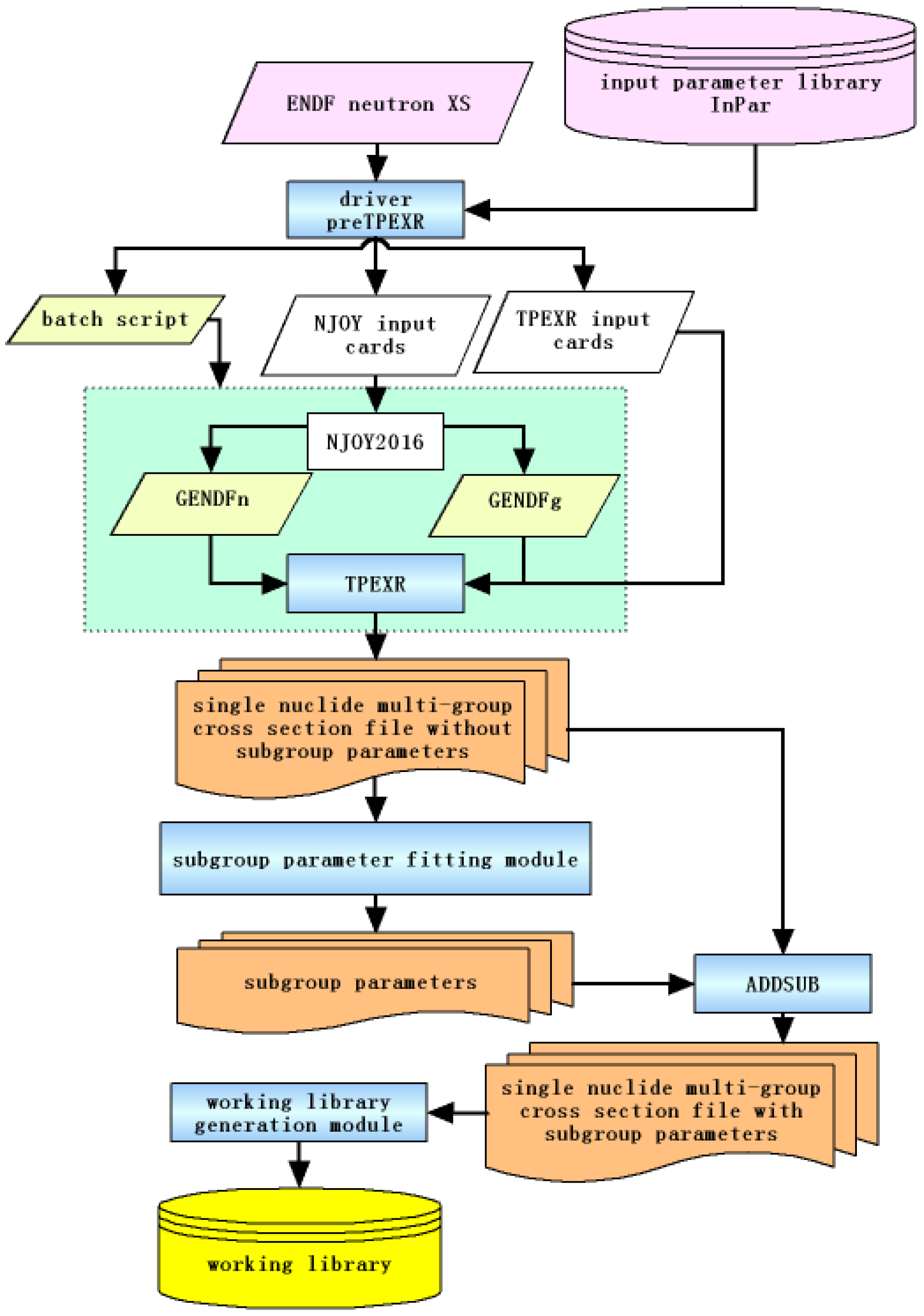
The TPAMS system includes an online input parameter library, a driver, a data processing program, and a test program. The procedure for generating a multigroup cross-section library based on TPAMS is illustrated in Figure 1 [12]. The TPEX library is generated by the TPAMS system and is developed based on CENDL-3.2. Decay data for the TPEX library are adopted from NuDat [14], and the effective fission yields are computed using the ENDF/B VII.1 library [15]. Thermal scattering law data utilized in the library are sourced from ENDF/B VII.1, while the thermal scattering law for light water is evaluated by the CAB laboratory in Argentina. The TPEX library is a 45-neutron-energy-group library, consisting of 9 fast groups (20 MeV to 9.1188 keV), 16 resonance groups with shielded data (9.1188 keV to 1.8554 eV) and 20 thermal groups (below 1.8554 eV). The neutron energy group structure is defined as shown in Table 1. The TPEX library comprises a total of 649 nuclides. For non-moderator materials, the evaluated nuclide temperatures cover 293 K, 600 K, 900 K, 1200 K, 1500 K, 1800 K, 2100 K and 2500 K. For thermal scattering materials, the temperature grid is consistent with that adopted in the corresponding thermal scattering law files.
There are several major data components that comprise TPEX library:
  • Multigroup microscopic cross-section data for: σ f , σ a , σ t r , σ s , ν σ f and P 0 scattering matrices;
  • P n scattering data (up to order 5 for nuclides where anisotropic scattering is important);
  • Resonance data (shielding data tabulated at 16 and 32 background cross-sections and up to 8 temperatures spanning 293 K to 2500 K) and subgroup parameters;
  • Goldstein–Lambda values and resonance upscatter data;
  • (n, 2n) and (n, 3n) data;
  • Neutron fission spectra;
  • Fission yield and radioactive decay data and energy release per fission data;

3. Verification and Validation

Benchmarking refers to a research methodology that employs robust validation codes to perform calculations for well-characterized benchmark experiments, compares the computational predictions against the corresponding reference benchmark values, analyzes the sources of computational discrepancies, and thereby assesses the accuracy and reliability of a nuclear data library for the specific application scenarios represented by the benchmark experiments. Validation of the TPEX library not only provides data support for subsequent data adjustments within the library but also quantifies the numerical accuracy of the TPEX library corresponding to the specific application types represented by the benchmark experiments. This section describes the transport calculation code ALPHA utilized in the validation of the TPEX library, together with the computational results and numerical analyses of critical benchmark experiments.

3.1. ALPHA Code Description

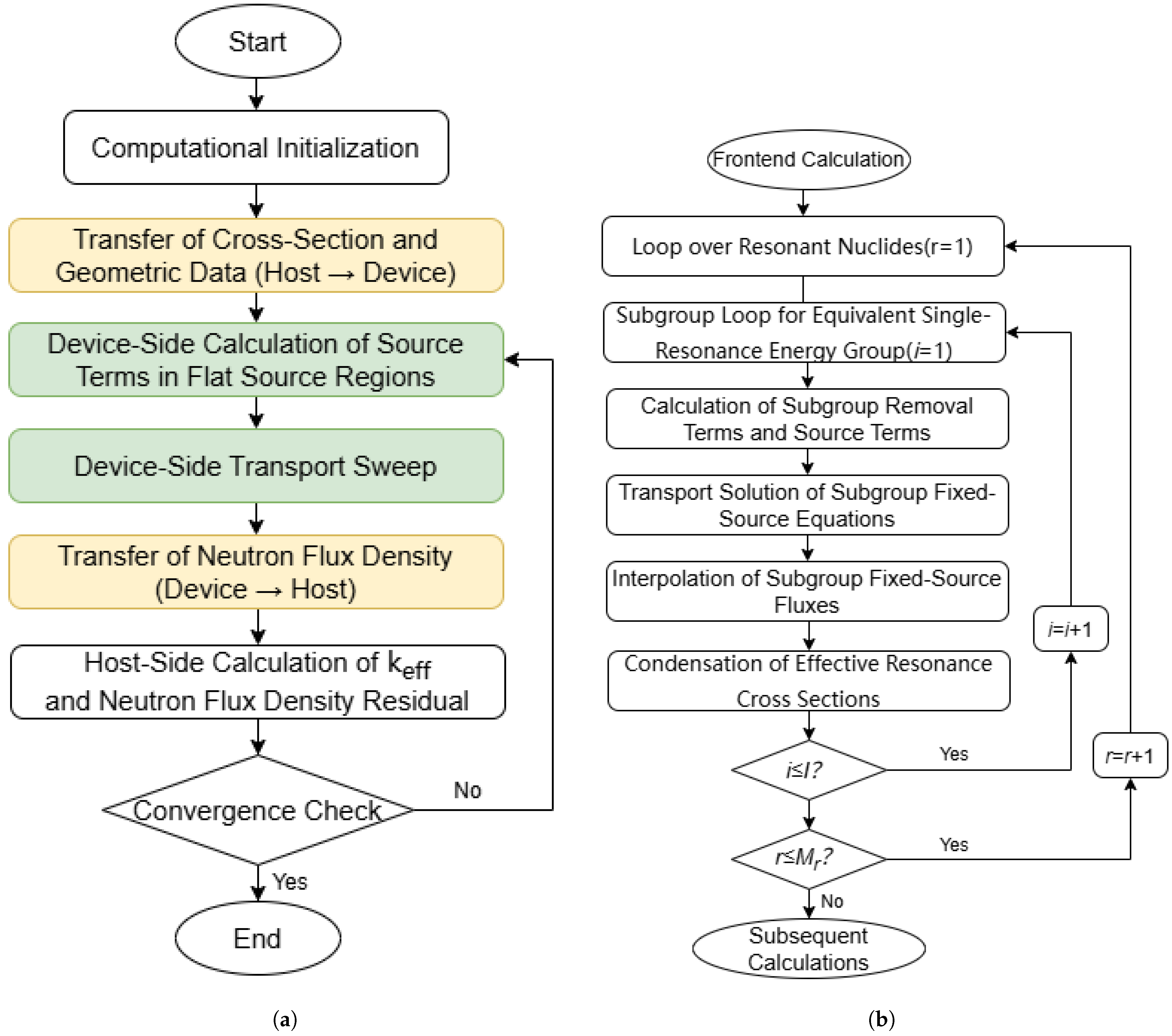
ALPHA is a high-fidelity core neutron transport calculation code tailored for heterogeneous computing systems, developed at Zhejiang University. The flowchart associated with the ALPHA code is presented in Figure 2. The key numerical schemes and parallel implementation features of the ALPHA code are outlined as follows:
  • Method of Characteristics (MoC) employed for core neutron transport calculations;
  • Subgroup method adopted for resonance self-shielding computations;
  • Performance-optimized 2D MoC computing kernel with native graphics processing unit (GPU) parallelization;
  • Coarse- and fine-grained multi-node parallelization on heterogeneous systems implemented via a hybrid M P I + C U D A programming model, coupled with communication-hiding optimization techniques.
Figure 2. This is the flowchart for the ALPHA code: (a) GPU-accelerated parallel MoC Algorithm. (b) Circular logic of subgroup transport calculation.
Energies 19 02143 g002

3.2. Calculation Model and Condition

A total of 131 critical experiments selected from the ICSBEP 2006 and WLUP handbooks are adopted to validate the TPEX library, including 29 solution experiments, 95 lattice experiments and 7 assembly experiments. The calculation models and boundary conditions corresponding to the three categories of experiments are elaborated separately in this section.

3.2.1. Solution Experiments

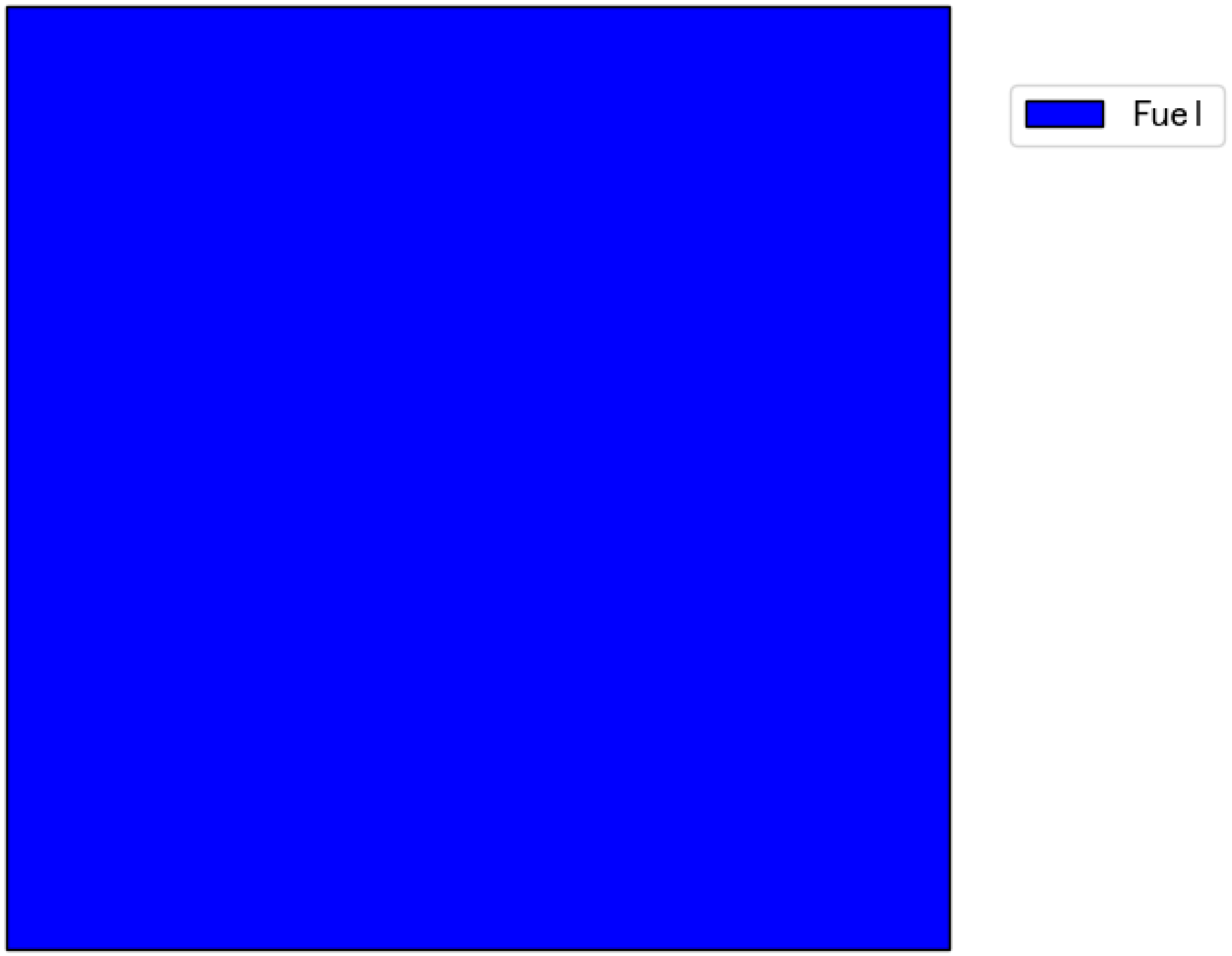
A solution-filled spherical or cylindrical tank assembly can be approximated as a homogeneous model. Therefore, a two-dimensional single-cell model with reflective boundary conditions is adopted in the critical calculations for the solution experiments, and the geometric model established using the ALPHA code is presented in Figure 3. The experiments HEU-SOL-THERM-001, HEU-SOL-THERM-013, HEU-SOL-THERM-027, HEU-SOL-THERM-032, HEU-SOL-THERM-036, PU-SOL-THERM-011 and PU-SOL-THERM-021 are selected from ICSBEP 2006 for the validation. The material compositions and temperatures of the cell are taken from the relevant references [16].
Since components such as end plugs are not included in the criticality calculations of the ALPHA code, the JMCT [13] Monte Carlo code is utilized to perform calculations for both the detailed and simplified models of solution experiments to obtain k e f f and k . A correction factor ξ is defined as the ratio of k e f f to k to quantify the impact of these omitted components. The k , c a l output from the ALPHA code calculations is then corrected using the correction factor ξ to derive the calculated value of the effective multiplication factor, k e f f , c a l ,
k e f f , c a l = ξ k , c a l

3.2.2. WLUP Experiments

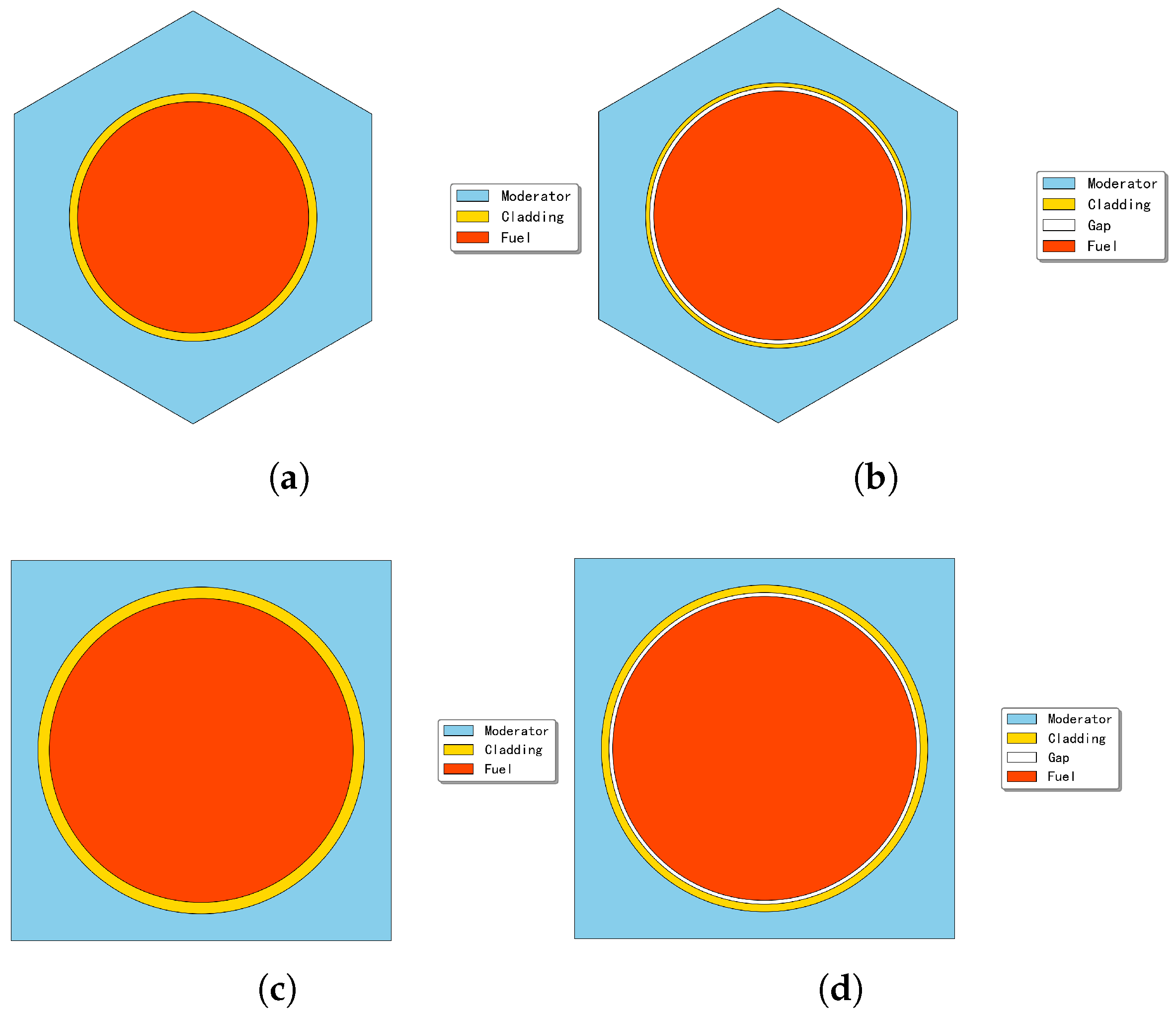
Several critical benchmark experiments are conducted under the WLUP to validate the WIMS-D library. A set of uranium metal, uranium oxide and MOX fuel experiments from the WLUP handbook are selected to validate the TPEX library. For modeling these experiments, two-dimensional single-cell models with reflective boundary conditions are employed. The geometric configurations comprise rectangular and hexagonal lattices, and axial buckling is used to account for neutron leakage in the axial direction. Of the 95 lattices investigated in this study, 3 are moderated by heavy water and the remainder by light water. Among the light water-moderated lattices, 53 use U-metal fuel, 15 use U O 2 fuel and 24 use MOX fuel. The 235U enrichments vary from 0.928 to 4.43 wt%. V m o d / V f u e l varies from approximately 0.86 to 11.58. Fuel rod diameters from 1.03 cm to 6.868 cm are used; both stainless steel and aluminum clad are studied as well as both square and hexagonal lattice arrays. The data for all the cases are given in Table 2. The cell materials, material temperatures and axial buckling values are obtained from the WLUP handbook. The geometric models for all cases are established in strict accordance with the WLUP handbook. Given the large number of cases, schematic diagrams of four representative geometric models constructed using the ALPHA code are presented in Figure 4 herein.

3.2.3. LCT001 Experiments

LEU-COMP-THERM-001 [16] in the ICSBEP 2006 handbook documents a series of critical experiments performed by the Pacific Northwest Laboratories (PNL), which employed clusters of aluminum clad U ( 2.35 ) O 2 fuel rods in a large water-filled tank (hereinafter abbreviated as LCT001). These experiments include rectangular square-pitched lattice clusters with pitches of 2.032 cm and no absorber plates, reflecting walls, dissolved poison, or gadolinium impurity.
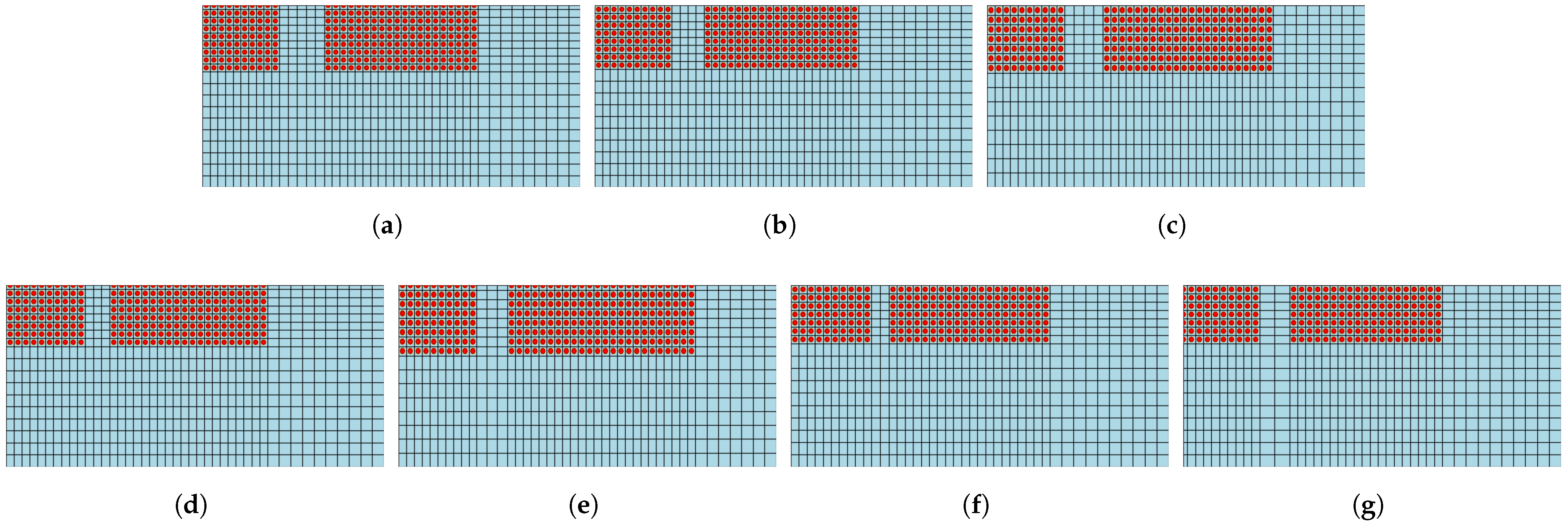
2D assembly models are adopted in the ALPHA code for the simulation of this experimental series, with axial buckling employed to account for axial neutron leakage. Given the quarter symmetry of Cases 2–8, quarter-modeling is implemented for these cases, and the geometric models established with the ALPHA code are presented in Figure 5, where the left and upper boundaries are set as white reflective conditions and the right and lower boundaries as vacuum conditions.
Furthermore, since the measured axial buckling is not provided for the LCT001 experiments, it is necessary to derive this parameter via calculation. As indicated by Equation (2) for the reactor geometric buckling, the axial buckling can be calculated from the effective core height.
B z 2 = ( π z e f f ) 2 ,
The formula for the effective core height of a core with reflectors and end plugs is given in Equation (3), where the extrapolation distance λ e x p = 0.7104 λ t r = 0.7104 / Σ t r and the diffusion length L = λ a λ t r / 3 = 1 / 3 Σ a Σ t r . The transport cross-sections and absorption cross-sections are all calculated using the ALPHA code.
z e f f = z + 2 λ e x p + L c o r e L p l u g z p l u g + L c o r e L r e f l e c t o r z r e f l e c t o r
The geometric and material information for the LCT001 experiments is presented in Table 3 and Table 4, respectively.

3.3. Results and Discussion

This section presents the deviations between the experimental values and the calculated k e f f results obtained using the TPEX library and the ALPHA code, the H45 library (a 45-group library processed from ENDF/B-VI.8 [17]) with the ALPHA code, as well as the CENACE library derived from CENDL-3.2 with the JMCT Monte Carlo code. Furthermore, the accuracy and applicable scope of the TPEX library are discussed in detail on the basis of the numerical calculation results. In addition, a reduced chi-square value is calculated for all critical experiments to account for experimental uncertainties, as shown in the following equation.
χ 2 = 1 N n = 1 N ( k e f f , n E X P n u n c e r t a i n t y ) 2

3.3.1. Solution Experiments

Table 5 and Table 6 present the experimentally measured k e f f values and the corresponding calculated results from various libraries for the uranium solution-critical experiments and plutonium solution-critical experiments, respectively. The EALF values listed in the table denote the energy spectral index, which characterizes the energy characteristics of the relevant experiments. It serves as the benchmark reference for the experimental neutron spectrum indices in ICSBEP 2006 and represents a widely accepted international standard [16]. EALF represents the energy corresponding to the average neutron lethargy causing fission. The calculation formula is presented in Equation (5). The average neutron lethargy causing fission is defined for group calculations by the right-hand side of Equation (5).
E A L F = E 0 e u ¯ , u ¯ = m g ( u g ¯ × Σ f , g m ϕ g m ) m g ( Σ f , g m ϕ g m )
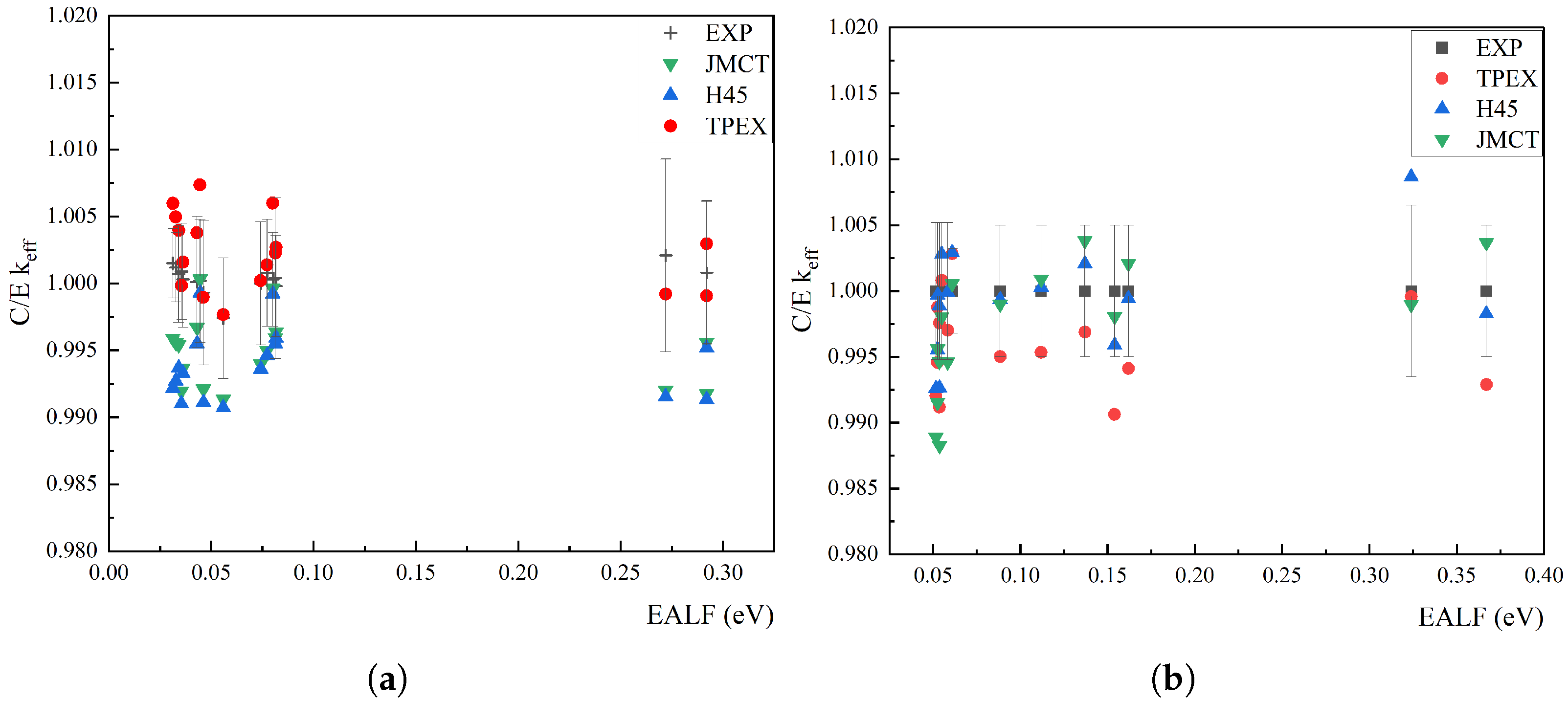
where m is a physical zone inside the core; u g is the midpoint of the g t h lethargy group, defined as lethargy of neutron with energy E g ¯ = E g E g 1 ; Σ f , g is the group macroscopic fission cross-section; and ϕ g is the neutron flux within lethargy group g. Lethargy u of a neutron with energy E is defined as l n ( E 0 / E ) , where E 0 is defined as 10 MeV. A higher EALF value indicates a harder energy spectrum for the selected experiment, and a smaller value indicates a softer energy spectrum for the experiment. The columns of k e f f , M C and k i n f , M C in the table correspond to the calculation results of the detailed model and the simplified model obtained with the JMCT code, respectively. Figure 6 shows the variation in C/E with EALF for the solution experiments.
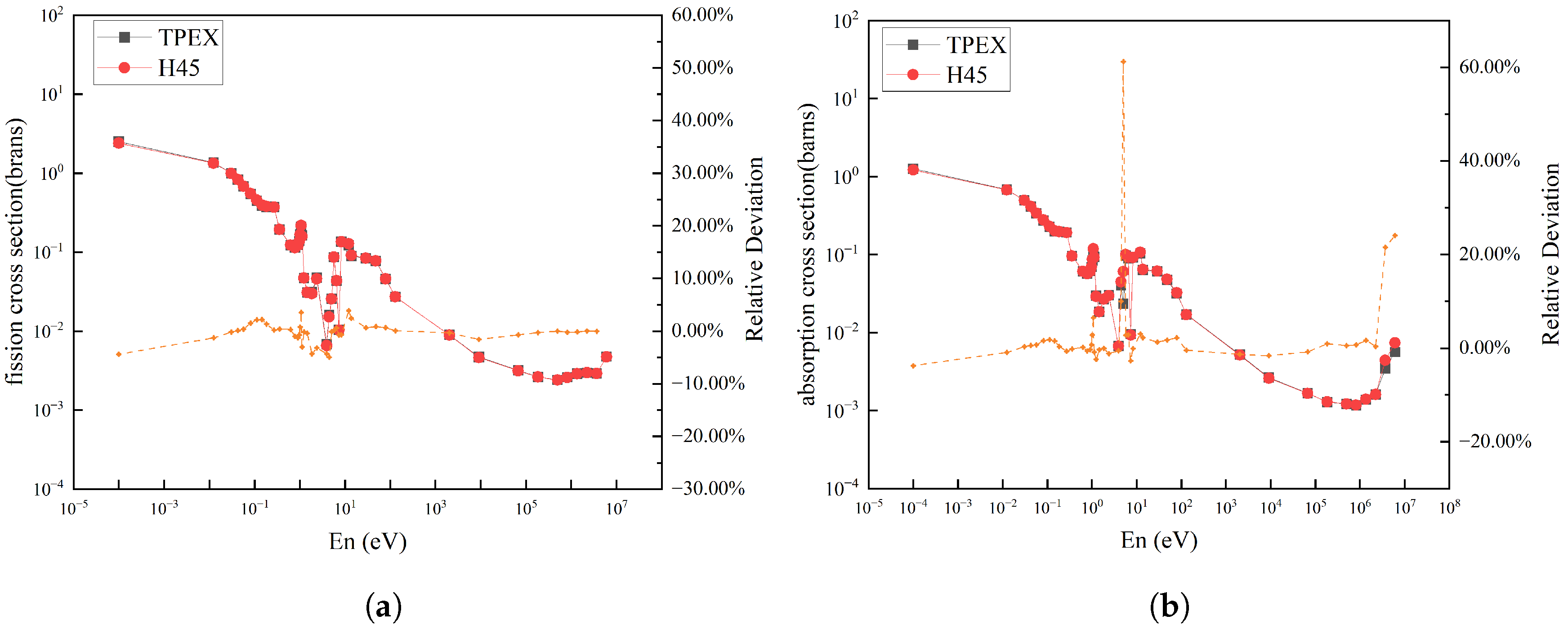
The numerical results indicate that the k e f f predictions using the TPEX library outperform those obtained with the H45 library for uranium solution-critical experiments. For both libraries, the calculated k e f f values exhibit a decreasing trend as the neutron energy spectrum hardens within the EALF range of 0.02 eV to 0.06 eV, whereas an increasing trend in k e f f is observed as the spectrum hardens within the EALF range of 0.065 eV to 0.1 eV. In contrast, for plutonium solution-critical experiments, the k e f f values predicted by the TPEX library are generally lower than those predicted by the H45 library, with the H45 library demonstrating superior performance. To investigate the cause of the underprediction by the TPEX library in the PST experiments, the experiment PST001_04, which exhibits the lowest predicted k e f f , is selected as the research object. The effective fission cross-sections and effective absorption cross-sections of the material between the TPEX library and the H45 library are compared, as shown in Figure 7. The results indicate that the relative deviation in the effective fission cross-sections is small; however, the effective absorption cross-sections calculated by the TPEX library are significantly overestimated around 10 eV. This overestimation of absorption leads to the underprediction of k e f f . No consistent variation in k e f f with EALF is observed for the plutonium solution-critical experiments. Overall, the TPEX library exhibits superior predictive performance in solution-critical experiments, particularly for uranium solutions.

3.3.2. WLUP Experiments

Due to the absence of three-dimensional experimental data for the WLUP experiments, the k e f f values predicted by the TPEX library are compared only with the experimental measurements and the results from the H45 library. Table 7 presents the experimentally measured k e f f values and the corresponding calculated results from various libraries for the uranium metal critical experiments. The q values listed in the table denote the number of fission neutrons that slow down below 2.6 eV. The q value characterizes the hardness of the spectrum and has a value of 1 for soft spectra in well-moderated low-absorbing lattices and is smaller for hard-spectrum lattices [9].
q = g > 2.5 e V ( ϕ g h < 2.6 e V Σ s , g h ) g ϕ g ν g Σ f , g
where ϕ g is the cell spectrum from the region; Σ s , g h is the component of scattering matrix from group g to h; ν g Σ f , g is the macroscopic fission yield.
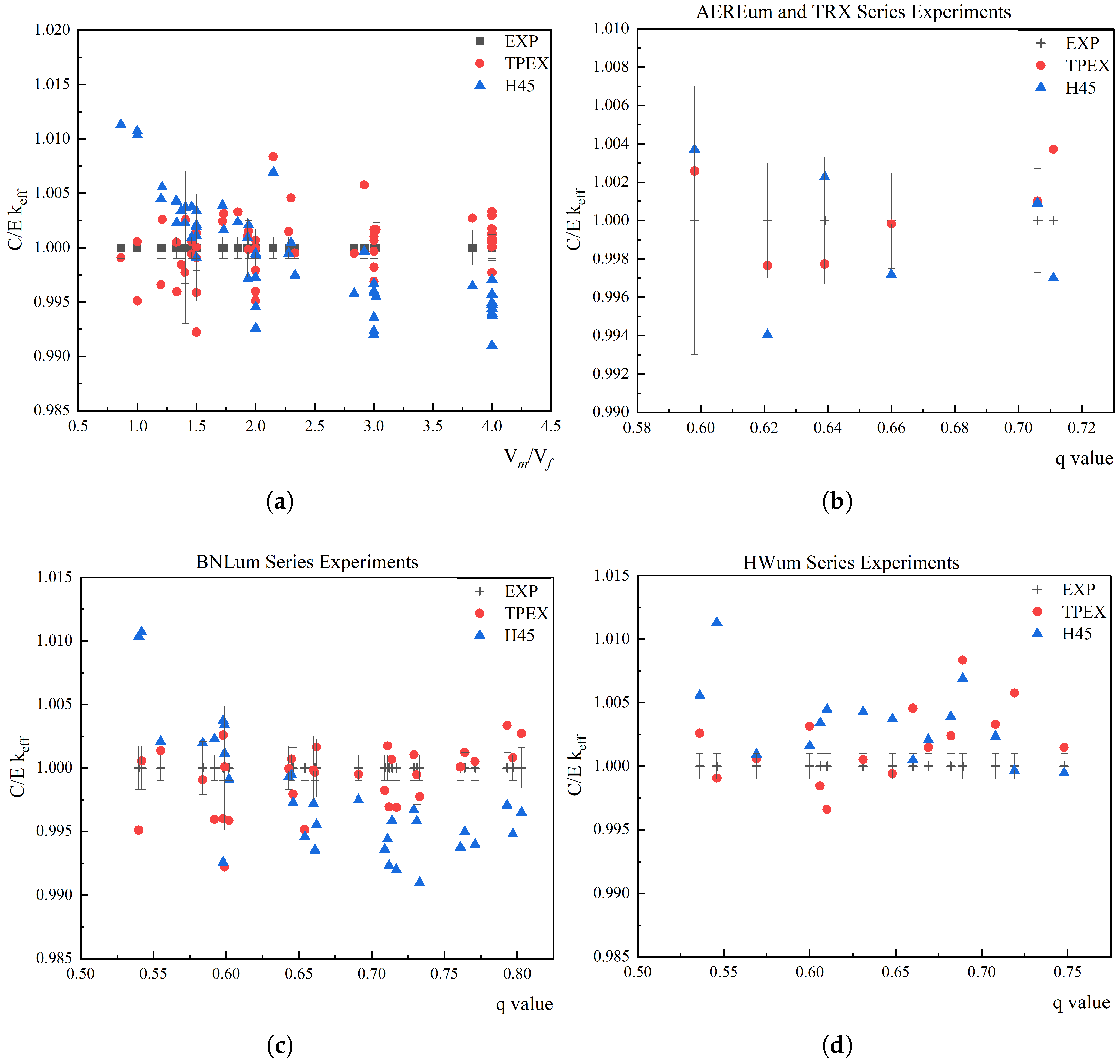
It can be seen from Table 7 that the k e f f values predicted by the TPEX library are superior to those by the H45 library, with a lower standard deviation as well. Figure 8 presents the calculated C/E k e f f results for uranium metal critical experiments.
According to the results in the figures, the k e f f values predicted by the H45 library exhibit an obvious negative correlation with the increase in V m o d / V f u e l , whereas no distinct regular variation is observed for the TPEX library. With the increase in the q value, i.e., the softening of the neutron energy spectrum, the k e f f values predicted by the H45 library show a decreasing trend. For the BNLum-series experiments, the k e f f values predicted by the TPEX library display a slight increasing trend with the rise in the q value, and this trend is more pronounced for the HWum-series experiments.
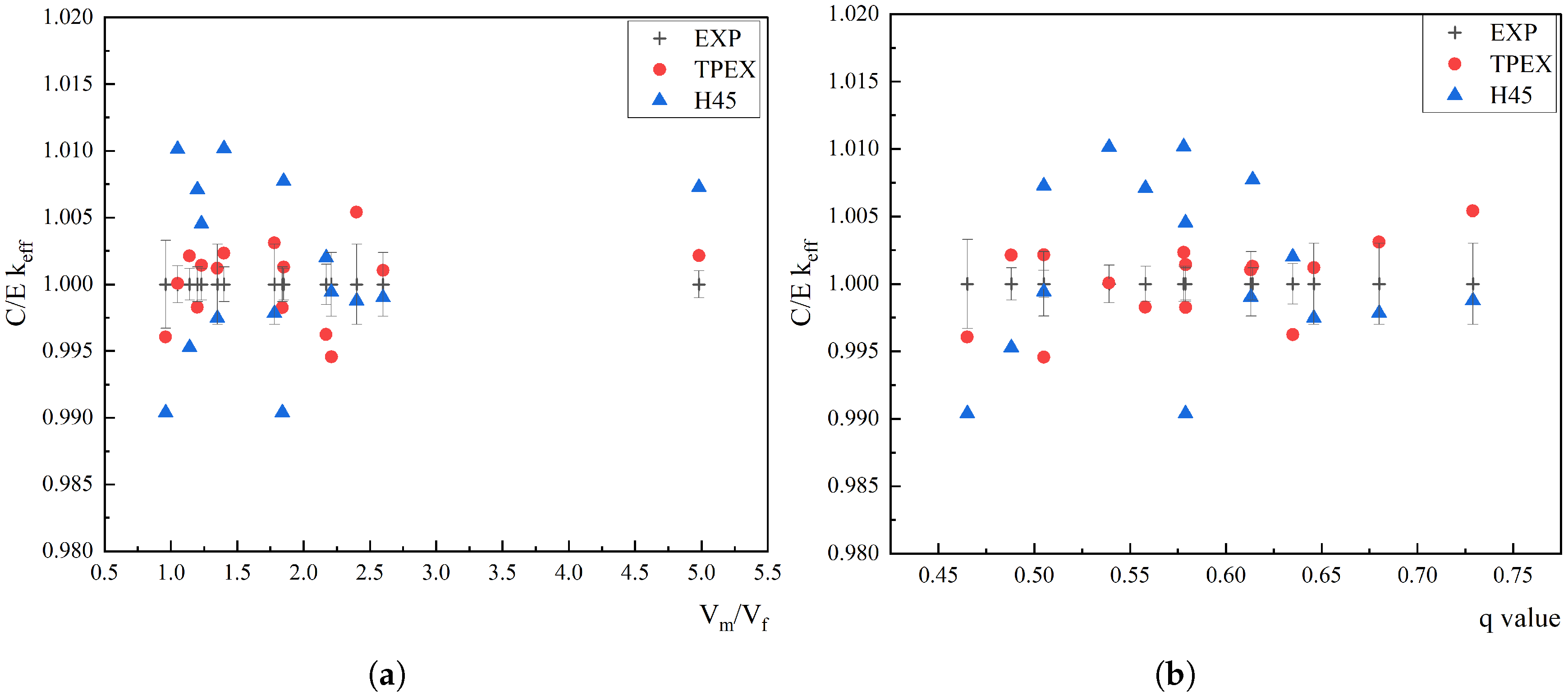
Table 8 summarizes the experimental k e f f measurements and the associated calculated outcomes from different libraries for the U O 2 experiments. Figure 9 presents the C/E ratios of k e f f for the U O 2 experiments. Table 8 demonstrates that the TPEX library yields a mean deviation of 20 pcm between the predicted k e f f values and experimental measurements, exhibiting superior predictive accuracy over the H45 library along with a lower standard deviation. As evidenced by Figure 9, the k e f f values predicted by the TPEX library show a slight increase with the rising q value. For the H45 library, the predicted k e f f increases with the softening of the neutron energy spectrum in the q range of 0.45–0.5, whereas a decreasing trend is observed with the further softening of the energy spectrum in the range of 0.5–0.65.
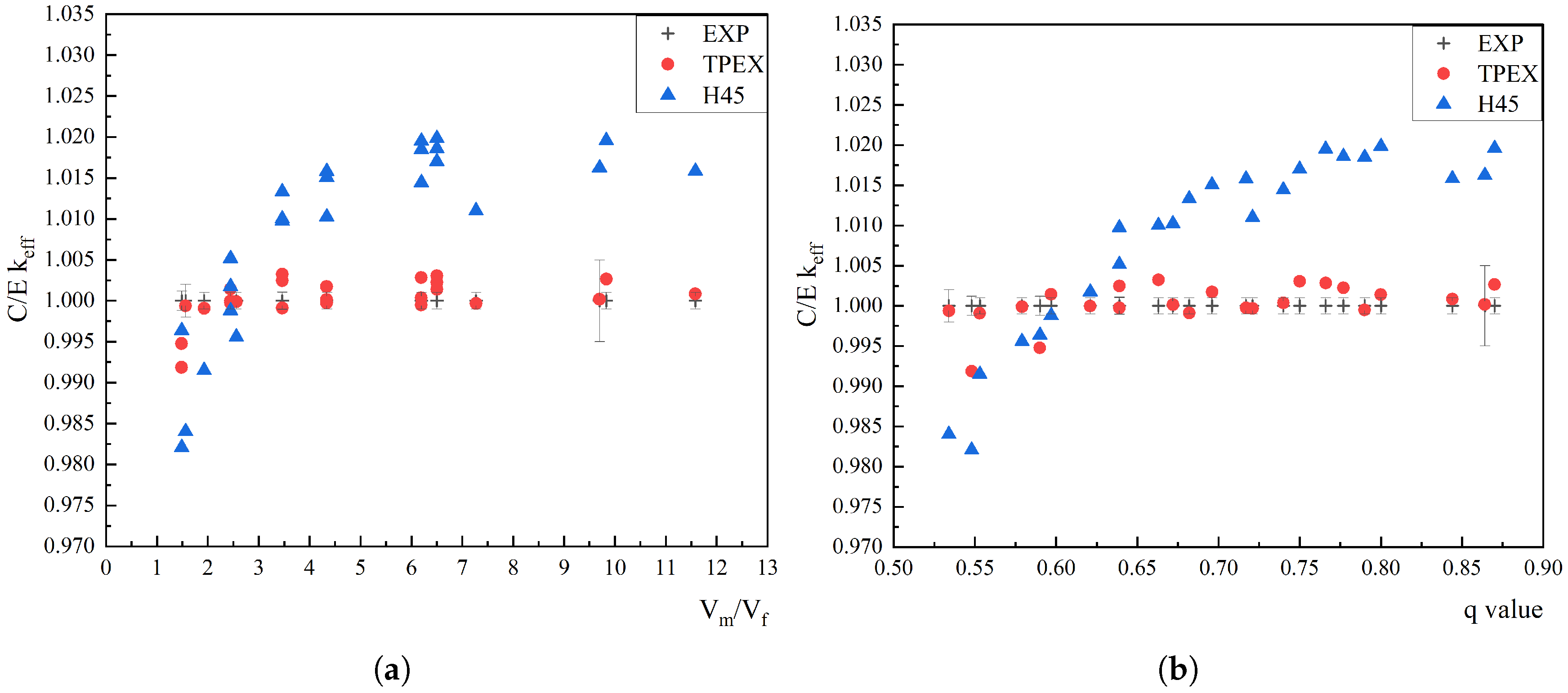
Table 9 lists the experimental k e f f values and the corresponding calculated results from various libraries for the MOX critical experiments. Figure 10 shows the C/E k e f f results of MOX fuel experiments. As can be observed from Table 9, the average deviation between the k e f f values predicted by the TPEX library and the experimental data is 22 pcm, which is considerably better than that of the H45 library, accompanied by a much lower standard deviation.
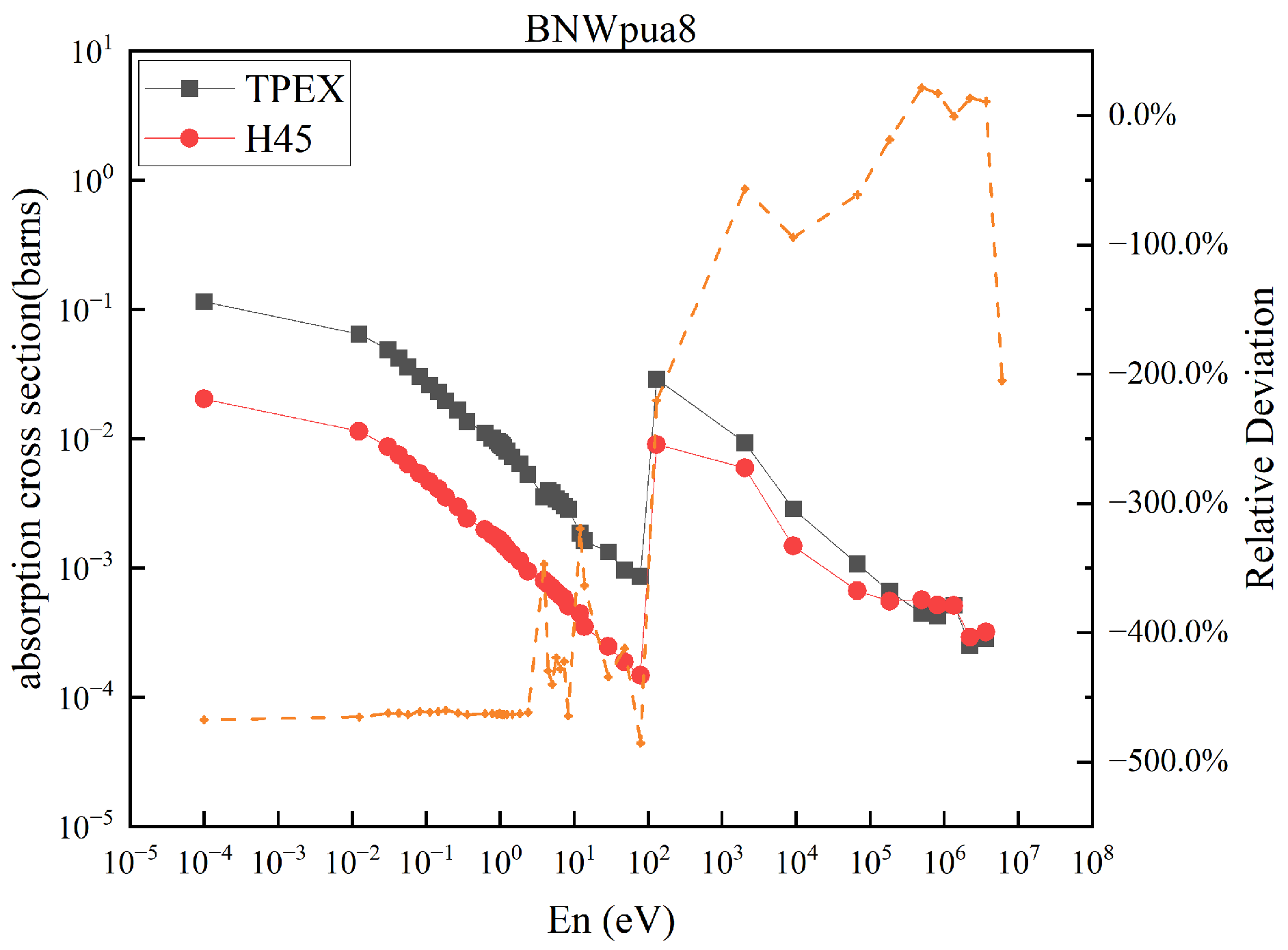
According to Figure 10, the k e f f values calculated by the H45 library exhibit an obvious positive correlation with both the increasing q value and the rising V m o d / V f u e l . Considering the satisfactory performance of the H45 library in plutonium solution experiments, it is inferred that such discrepancies may arise from the inaccurate subgroup parameters of 239Pu. The BNWpua8 experiment, which exhibits a significant overprediction of k e f f , is adopted as the study case. The energy-dependent effective absorption cross-sections in the lattice, calculated using the TPEX library and the H45 library, are compared. As illustrated in Figure 11, the effective absorption cross-section computed with the H45 library is notably underestimated in the thermal energy region, leading to the overestimation of k e f f . In contrast, no evident systematic trend is observed in the k e f f values predicted by the TPEX library with the increase in either the q value or V m o d / V f u e l .
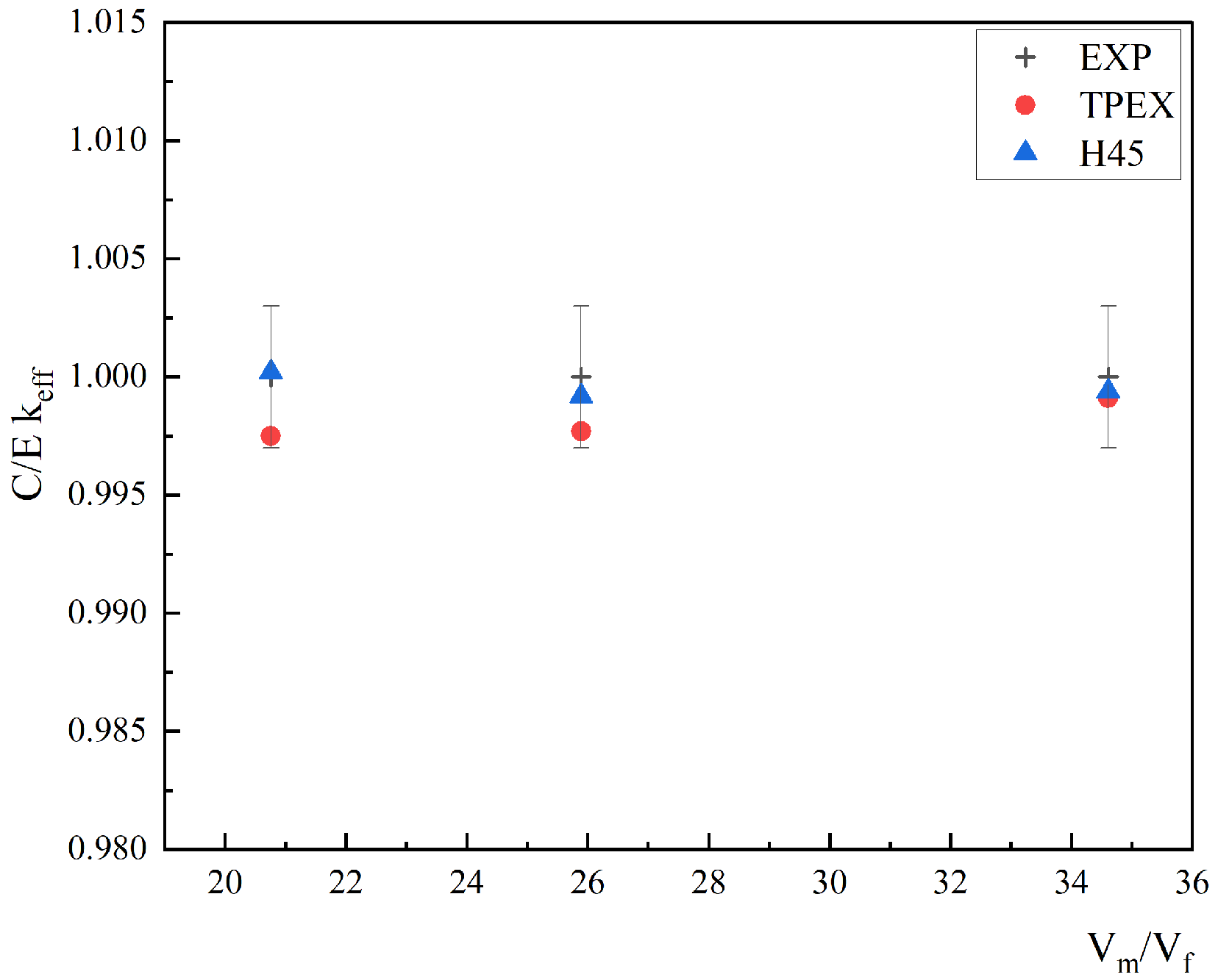
Figure 12 presents the results for the MIT-series experiments moderated by heavy water. It can be observed from the figure that both the TPEX and H45 libraries yield accurate predictions of k e f f .
Collectively, the TPEX library demonstrates favorable predictive performance in the WLUP experiments and exhibits exceptional accuracy, particularly for MOX fuel experiments.

3.3.3. LCT001 Experiments

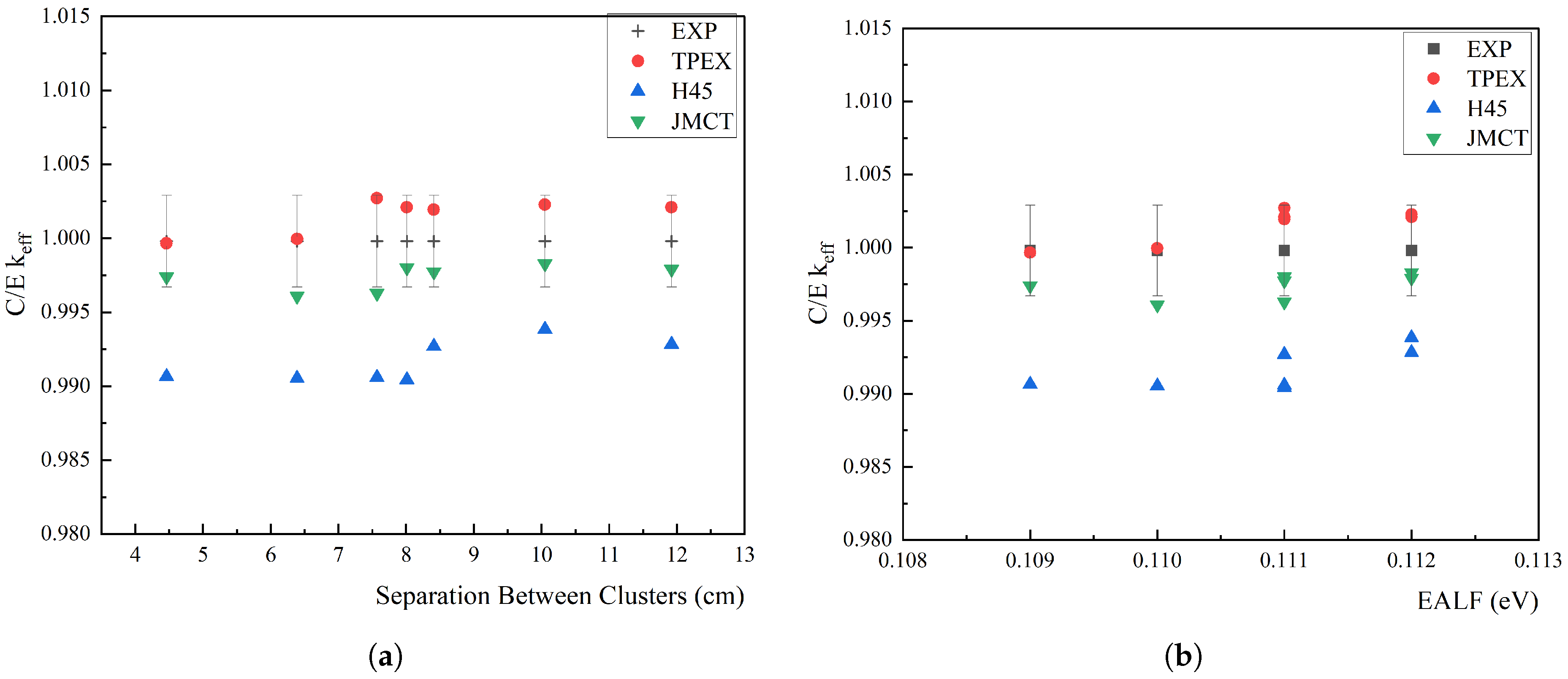
Table 10 presents the experimental k e f f values and the corresponding calculated results from various libraries for the LCT001 experiment. Figure 13 illustrates the C/E k e f f values of LCT001. It can be observed from the above results that the average deviation between the k e f f values predicted by the TPEX library and the experimental data is 150 pcm, which is superior to that of the H45 library. Accordingly, the TPEX library also exhibits excellent performance in calculations involving complex geometries. Notably, the method used to calculate axial bulking assumes isotropic scattering, which tends to overestimate the effective height z e f f . This overestimation leads to an underestimation of bulking B z 2 , thereby reducing neutron leakage and causing an overestimation of k e f f . Consequently, the discrepancies between the k e f f values obtained from the TPEX library and the H45 library relative to the experimental data arise not only from multigroup cross-section data but also from errors introduced by the bulking approximation. As shown in the results presented in Table 10, the TPEX library overpredicts k e f f compared to the Monte Carlo results, which do not involve bulking treatment.

4. Conclusions

In this paper, a 45-group multigroup cross-section library designated as TPEX has been developed based on CENDL-3.2 and the core physics multigroup constant processing system TPAMS. Systematic validation is performed using the deterministic code ALPHA against 131 thermal-spectrum-critical experiments, covering uranium solution experiments, plutonium solution experiments, the WLUP series (including U-metal, U O 2 and MOX fuel lattice experiments), and thermal-spectrum uranium oxide fuel assembly experiments. The calculation accuracy and applicability of the TPEX library are evaluated by statistical analysis of C/E deviations, comparison with the H45 multigroup library derived from ENDF/B-VI.8, and verification against the reference solutions obtained with the Monte Carlo code JMCT. The main conclusions are drawn as follows:
Firstly, a dimension-reduction modeling approach for the three-dimensional experimental configurations has been implemented. For solution experiments, a model correction factor ξ is proposed. For three-dimensional experiments where the axial curvature is not explicitly provided, the axial curvature is derived from the effective height of the fuel assemblies. This treatment overcomes the limitation that lattice transport calculation codes cannot establish full three-dimensional models, thereby extending the validation scope of the multigroup cross-section library. Secondly, the numerical results indicate that the TPEX library exhibits excellent overall performance in thermal-spectrum-critical experiments. For solution-critical experiments with EALF in the range of 0.03–0.367 eV, the TPEX library yields smaller C/E deviations and lower standard deviations than the H45 library. The underestimation of k e f f observed in some calculations is mainly attributed to insufficient treatment of the resonance self-shielding for the radiative capture cross-section of 238U. For the WLUP-series fuel lattice experiments with q values from 0.465 to 0.87, the TPEX library provides more accurate k e f f predictions with more stable trends and effectively mitigates the distinct systematic underestimation and strong sensitivity to energy spectrum and geometric parameters observed in the H45 library. For complex geometry assembly experiments such as LCT001, the TPEX library still maintains favorable predictive capability, demonstrating strong engineering applicability. In general, the TPEX library based on CENDL-3.2 exhibits high precision and reliability in thermal reactor physics computations and can provide significant validation support for engineering applications in reactor design and safety analysis.

Author Contributions

Conceptualization, H.W. and Y.C.; methodology, L.W.; software, J.Z. and Q.Z.; validation, Y.C., Y.X. and X.W.; formal analysis, H.W.; investigation, H.Z.; resources, X.W., Q.Z. and H.Z.; data curation, Y.C., L.W. and Y.X.; writing—original draft preparation, Y.C., H.W., Y.X. and J.Z.; writing—review and editing, L.W., Q.Z., X.W. and H.Z.; visualization, H.W., J.Z. and H.Z. All authors have read and agreed to the published version of the manuscript.

Funding

This work was financially supported by the Continuous-Support Basic Scientific Research Project and The APC was funded by China Institute of Atomic Energy.

Data Availability Statement

The original contributions presented in this study are included in the article. Further inquiries can be directed to the corresponding authors.

Conflicts of Interest

Authors Ying Chen, Haicheng Wu, Lili Wen, Yue Xiao, Xiaofei Wu and Huanyu Zhang were employed by China Institute of Atomic Energy. The remaining authors declare that the research was conducted in the absence of any commercial or financial relationships that could be construed as a potential conflict of interest. The authors declare that this study received funding from China Institute of Atomic Energy. The funder was not involved in the study design, collection, analysis, interpretation of data, the writing of this article or the decision to submit it for publication.

References

  1. Margulis, M.; Blaise, P.; Ferrer, R.; Rhodes, J. Generation and initial validation of a new casmo5 endf/b-viii.0 nuclear data library. In EPJ Web of Conferences; EDP Sciences: Les Ulis, France, 2021; pp. 1–10. [Google Scholar]
  2. Ferrer, R.; Wemple, C.; Hykes, J. Initial benchmarking of a new ENDF/B-VIII.1.β2-based CASMO5 neutron data library. In International Conference on Physics of Reactors (PHYSOR 2024); American Nuclear Society: New York, NY, USA, 2024; pp. 778–789. [Google Scholar] [CrossRef]
  3. Watanabe, T.; Suyama, K.; Tada, K.; Ferrer, R.; Hykes, J.; Wemple, C. Initial Verification and Validation of a New CASMO5 JENDL-5 Nuclear Data Library for Typical LWR Applications. Nucl. Sci. Eng. 2024, 198, 2230–2239. [Google Scholar] [CrossRef]
  4. Jaï, O.; El Hajjaji, O.; Hébert, A.; Tajmouati, J.; El Bardouni, T.; Didi, A. Validation study of the reactor physics lattice transport code DRAGON5 based on DRAGLIB libraries by TRX and BAPL critical experiments of light water reactors for neutronic analysis of TRIGA MARK-II research reactor. Mosc. Univ. Phys. Bull. 2017, 72, 633–637. [Google Scholar] [CrossRef]
  5. Al Zain, J.; El Hajjaji, O.; El Bardouni, T.; Lahdour, M. Validation of deterministic code DRAGON5 for the fuel depletion analysis of a PWR pin-cell benchmark. Radiat. Phys. Chem. 2021, 186, 109545. [Google Scholar] [CrossRef]
  6. Wemple, C.; Simeonov, T. Advances in HELIOS2 nuclear data library. Kerntechnik 2017, 82, 445–447. [Google Scholar] [CrossRef]
  7. Ouisloumen, M. Analyses of integral and mox critical experiments to qualify paragon2 predictions. In EPJ Web of Conferences; EDP Sciences: Les Ulis, France, 2021; Volume 247. [Google Scholar] [CrossRef]
  8. Petrov, N.; Todorova, G.; Kolev, N.P. APOLLO2 and TRIPOLI4 solutions of the OECD VVER-1000 LEU and MOX assembly benchmark. Ann. Nucl. Energy 2013, 55, 93–107. [Google Scholar] [CrossRef]
  9. Trkov, A.; Leszczynski, F.; Aldama, D. WIMS-D Library Update, Final Report of a Co-ordinated Research Project. In IAEA; Atomic Energy Agency: Vienna, Austria, 2006. [Google Scholar]
  10. Malec, J.; Cabellos, O.; Kromar, M.; Trkov, A. Generation and validation of a new WIMS-D library based on ENDF/B-VIII.0. Ann. Nucl. Energy 2024, 211, 110989. [Google Scholar] [CrossRef]
  11. Ge, Z.; Xu, R.; Wu, H.; Zhang, Y.; Chen, G.; Jin, Y.; Shu, N.; Chen, Y.; Tao, X.; Tian, Y.; et al. CENDL-3.2: The new version of chinese general purpose evaluated nuclear data library. EPJ Web Conf. 2020, 239, 09001. [Google Scholar] [CrossRef]
  12. Wen, L.; Wu, H.; Chen, Y.; Chai, X.; Wu, X.; Tu, X.; Liu, Y. Development of multigroup cross section library generation system TPAMS. Nucl. Eng. Technol. 2024, 56, 2208–2219. [Google Scholar] [CrossRef]
  13. Deng, L.; Li, G.; Zhang, B.; Li, R.; Shi, D.; Fu, Y.; Shangguan, D.; Hu, Z.; Zhang, L.; Peng, L. JMCT monte carlo code with capability of integrating nuclear system feedback. In International Conference on Applied Mathematics, Modelling and Statistics Application (AMMSA 2018); Atlantis Press: Sanya, China, 2018. [Google Scholar] [CrossRef]
  14. Sonzogni, A.A. NuDat 2.0: Nuclear Structure and Decay Data on the Internet. AIP Conf. Proc. 2005, 769, 574–577. [Google Scholar] [CrossRef]
  15. Chadwick, M.B.; Herman, M.; Obložinský, P.; Dunn, M.E.; Danon, Y.; Kahler, A.C.; Smith, D.L.; Pritychenko, B.; Arbanas, G.; Arcilla, R.; et al. ENDF/B-VII.1 nuclear data for science and technology: Cross sections, covariances, fission product yields and decay data. Nucl. Data Sheets 2011, 112, 2887–2996. [Google Scholar] [CrossRef]
  16. International Handbook of Evaluated Criticality Safety Benchmark Experiments; NEA/NSC/DOC(95)03; Nuclear Energy Agency: Paris, France; OECD: Paris, France, 2006.
  17. Lemmel, H.D.; McLaughlin, P.K.; Pronyaev, V.G. ENDF/B-VI Release 8 (Last Release of ENDF/B-VI); The U.S. Evaluated Nuclear Data Library for Neutron Reaction Data, IAEA-NDS-100, Rev.11; The U.S. Evaluated Nuclear Data Library: Upton, NY, USA, 2001. [Google Scholar]
Figure 1. Procedure of generating multigroup cross-section library based on TPAMS. Source: Figure 1 from Reference [12].
Energies 19 02143 g001
Figure 3. Geometry model for solution experiments.
Energies 19 02143 g003
Figure 4. The geometric models established using the ALPHA code: (a) Typical three-region hexagonal model (fuel–clad–moderator). (b) Four-region hexagonal model (fuel–gap–clad–moderator). (c) Typical three-region rectangular model (fuel–clad–moderator). (d) Four-region rectangular model (fuel–gap–clad–moderator).
Energies 19 02143 g004
Figure 5. LCT001 geometric models established with the ALPHA code, where the red region represents the fuel and the blue region represents the moderator: (a) LCT001_02 case model. (b) LCT001_03 case model. (c) LCT001_04 case model. (d) LCT001_05 case model. (e) LCT001_06 case model. (f) LCT001_07 case model. (g) LCT001_08 case model.
Energies 19 02143 g005
Figure 6. C/E k e f f results for solution experiments: (a) Dependence of C/E on EALF for uranium solution experiments. (b) Dependence of C/E on EALF for plutonium solution experiments.
Energies 19 02143 g006
Figure 7. Effective cross-section results for PST001_04 experiment, where the orange line denotes the relative deviation between the H45 library and the TPEX library: (a) The effective fission cross-section results. (b) The effective absorption cross-section results.
Energies 19 02143 g007
Figure 8. C/E k e f f results for uranium metal critical experiments: (a) C/E k e f f results as a function of V m o d / V f u e l . (b) Corresponding C/E k e f f variations with the q value for the AEREum-series experiments. (c) Corresponding C/E k e f f variations with the q value for the BNLum-series experiments. (d) Corresponding C/E k e f f variations with the q value for the HWum-series experiments.
Energies 19 02143 g008
Figure 9. C/E k e f f results for U O 2 critical experiments: (a) C/E k e f f results as a function of V m o d / V f u e l . (b) Variation in C/E k e f f with the q value.
Energies 19 02143 g009
Figure 10. C/E k e f f results for MOX critical experiments: (a) C/E k e f f results as a function of V m o d / V f u e l . (b) Variation in C/E k e f f with the q value.
Energies 19 02143 g010
Figure 11. The effective absorption cross-section results for BNWpu8, where the orange line denotes the relative deviation between the H45 library and the TPEX library.
Energies 19 02143 g011
Figure 12. C/E k e f f results for MIT experiments.
Energies 19 02143 g012
Figure 13. C/E k e f f results for LCT001 experiments: (a) C/E k e f f values of LCT001 as a function of the separation between clusters. (b) Variation in C/E k e f f with the EALF.
Energies 19 02143 g013
Table 1. Neutron energy group structure.
GroupEnergy (eV)GroupEnergy (eV)GroupEnergy (eV)
02.0000 ×   10 7 161.2099 ×   10 1 329.1000 ×   10 1
16.0653 ×   10 6 178.3153 ×   10 0 337.8208 ×   10 1
23.6788 ×   10 6 187.3382 ×   10 0 346.2506 ×   10 1
32.2313 ×   10 6 196.4760 ×   10 0 353.5767 ×   10 1
41.3534 ×   10 6 205.7150 ×   10 0 362.7052 ×   10 1
58.2085 ×   10 5 215.0435 ×   10 0 371.8443 ×   10 1
64.9787 ×   10 5 224.4509 ×   10 0 381.4572 ×   10 1
71.8316 ×   10 5 233.9279 ×   10 0 391.1157 ×   10 1
86.7379 ×   10 4 242.3824 ×   10 0 408.1968 ×   10 2
99.1188 ×   10 3 251.8554 ×   10 0 415.6922 ×   10 2
102.0347 ×   10 3 261.4574 ×   10 0 424.2755 ×   10 2
111.3007 ×   10 2 271.2351 ×   10 0 433.0613 ×   10 2
127.8893 ×   10 1 281.1254 ×   10 0 441.2396 ×   10 2
134.7851 ×   10 1 291.0722 ×   10 0 451.0000 ×   10 4
142.9023 ×   10 1 301.0137 ×   10 0
151.3710 ×   10 1 319.7100 ×   10 1
Table 2. The data for all WLUP cases.
Case IDFuel TypeNumber of CasesFuel Enrichment (wt%)Lattice Pitch (cm)Moderator V mod / V fuel q Value
U O 2 Cases
AEEWJUNO U O 2 13.0031.87 H 2 O 2.60.613
BAWcx10 U O 2 12.461.64 H 2 O 1.840.579
BAY2b U O 2 24.021.45–1.51 H 2 O 0.96–1.140.465–0.488
WAPDcrx U O 2 82.7–3.71.03–1.69 H 2 O 1.05–4.980.505–0.635
BAPL U O 2 31.31–4.431.11–1.81 H 2 O 1.35–2.40.646–0.729
U-Metal Cases
AEREumU-metal40.928–1.1424.267–4.75 H 2 O 1.402–1.9370.598–0.706
BNLumU-metal321.016–1.2991.064–4.058 H 2 O 1.0–4.00.54–0.803
HWumU-metal150.95–1.443.556–6.858 H 2 O 0.86–2.920.536–0.748
TRXU-metal21.31.81–2.17 H 2 O 2.35–4.020.621–0.711
MITU-metal30.71911.43–14.605 D 2 O 20.76–34.61
MOX Cases
BNWpuMOX242.0–4.02.032–4.318 H 2 O 1.486–11.580.534–0.87
Table 3. The geometric information for the LCT001 experiments.
Case IDNumber of ClustersCluster Dimensions
(Number of Rods)
Separation Between Clusters (cm)Effective Core Height (cm)Axial Buckling
LCT001_02320 × 1711.92 ±  0.0498.378441.019764 ×   10 3
LCT001_03320 × 168.41 ±  0.0598.3808971.019714 ×   10 3
LCT001_04320 × 16 (center)
22 × 16 (two outer)
10.05 ±  0.0598.3820351.019690 ×   10 3
LCT001_05320 × 156.39 ±  0.0598.3787861.019757 ×   10 3
LCT001_06320 × 15 (center)
24 × 15 (two outer)
8.01 ±  0.0698.3890291.019545 ×   10 3
LCT001_07320 × 144.46 ±  0.1098.378631.019761 ×   10 3
LCT001_08319 × 167.57 ±  0.0498.375531.019825 ×   10 3
Table 4. The material information for the LCT001 experiments.
MaterialIsotopewt.%Atom Density
(barn-cm)−1
U ( 2.35 ) O 2 fuelU-2340.01372.8563 ×   10 6
U-2352.354.8785 ×   10 4
U-2360.01713.5348 ×   10 6
U-23897.622.0009 ×   10 2
O-4.1202 ×   10 2
6061 Aluminum clad: 2.69 g/cm3Al97.3255.8433 ×   10 2
Cr0.26.2310 ×   10 5
Cu0.256.3731 ×   10 5
Mg16.6651 ×   10 4
Mn0.0752.2115 ×   10 5
Ti0.0752.5375 ×   10 5
Zn0.1253.0967 ×   10 5
Si0.63.4607 ×   10 4
Fe0.351.0152 ×   10 4
WaterH-6.6706 ×   10 2
O-3.3353 ×   10 2
Table 5. Calculation results for uranium solution experiments.
Case IDEALF (eV)EXPUncertainty k eff , mc k inf , mc ξ k inf k eff
TPEX H45 TPEX H45
HST001_010.08141.00040.00600.99631.82630.54551.83801.82561.00270.9959
HST001_020.2721.00210.00720.99411.85590.53561.86941.85501.00130.9936
HST001_030.08011.00030.00350.99991.82410.54821.83581.82341.00630.9995
HST001_040.2921.00080.00530.99641.85460.53731.86831.85391.00380.9960
HST001_050.04311.00010.00490.99681.62590.61311.63741.62391.00390.9956
HST001_060.04461.00020.00461.00051.65080.60611.66241.64901.00760.9995
HST001_070.07731.00080.0040.99581.81950.54731.83121.81881.00220.9954
HST001_080.08170.99980.00380.99621.82630.54541.83801.82561.00250.9957
HST001_090.2921.00080.00540.99261.85460.53521.86831.85390.99990.9921
HST001_100.04620.99930.00540.99141.67060.59341.68221.66900.99830.9904
HST013_010.03271.00120.00260.99681.21380.82121.22531.21031.00620.9939
HST013_020.03411.00070.00360.99611.20870.82411.21911.20661.00470.9944
HST013_030.03551.00090.00360.99281.20130.82651.21081.20021.00070.9919
HST013_040.03621.00030.00360.99401.20050.82801.21011.20011.00190.9936
HST027_010.07421.00000.00460.99401.80570.55051.81691.80501.00020.9936
HST032_010.03131.00150.00260.99741.07180.93061.08261.06781.00750.9937
HST036_010.05590.99740.00450.99131.74190.56911.75301.74080.99770.9907
Average1.00280.9944
χ 2 1.03732.6933
Table 6. Calculation results for plutonium solution experiments.
Case IDEALF(eV)EXPUncertainty k eff , mc k inf , mc ξ k inf k eff
TPEX H45 TPEX H45
PST001_010.08851.00000.00500.99901.69180.59051.68501.69240.99500.9993
PST001_020.11201.00000.00501.00091.69250.59141.68311.69140.99531.0003
PST001_030.13701.00000.00501.00381.69150.59341.67981.68860.99691.0021
PST001_040.15401.00000.00500.99811.68760.59141.67501.68390.99060.9959
PST001_050.16201.00000.00501.00211.68720.59391.67381.68270.99410.9994
PST001_060.36701.00000.00501.00371.66040.60451.64261.65150.99290.9983
PST011_060.05171.00000.00520.98891.45240.68091.45701.45790.99200.9926
PST011_070.05271.00000.00520.99561.46190.68101.46661.46800.99870.9997
PST011_080.05261.00000.00520.99151.45700.68051.46151.46290.99460.9956
PST011_090.05371.00000.00520.98831.46180.67611.46611.46830.99120.9926
PST011_100.05501.00000.00520.99801.46630.68071.47041.47331.00081.0028
PST011_110.05841.00000.00520.99461.48300.67071.48661.49100.99700.9999
PST011_120.05361.00000.00520.99471.46800.67761.47231.47420.99760.9989
PST021_070.06101.00000.00321.00061.60300.62421.60661.60681.00281.0029
PST021_080.32401.00000.00650.99901.64510.60731.64611.66100.99961.0087
Average0.99590.9993
χ 2 1.20860.6210
Table 7. Results for U-metal critical experiments.
Case ID V mod / V fuel *q ValueEXPUncertainty k eff
TPEX H45
TRX-12.350.6211.00000.0030.99770.9940
TRX-24.020.7111.00000.0031.00370.9970
AEREuma31.4020.6391.00000.00330.99771.0023
AEREuma41.9310.7061.00000.00271.00101.0009
AEREumb11.4070.5981.00000.0071.00261.0037
AEREumb21.9370.661.00000.00250.99980.9972
BNLuma120.6461.00000.00160.99790.9973
BNLuma230.7121.00000.0010.99690.9923
BNLuma340.7641.00000.00121.00120.9950
BNLuma41.50.6021.00000.0010.99590.9991
BNLuma530.7171.00000.0010.99690.9920
BNLuma610.5421.00000.00171.00051.0107
BNLuma740.7971.00000.0011.00080.9948
BNLumb11.50.5991.00000.00490.99221.0011
BNLumb220.6431.00000.00170.99990.9993
BNLumb330.7091.00000.0010.99820.9936
BNLumb440.7611.00000.0011.00010.9937
BNLumb51.50.5991.00000.0011.00011.0034
BNLumb620.6451.00000.0011.00070.9995
BNLumb730.7141.00000.0011.00070.9958
BNLumb840.7711.00000.0011.00050.9940
BNLumb910.541.00000.00170.99511.0103
BNLumb1020.6541.00000.0010.99510.9946
BNLumb1130.7291.00000.0011.00100.9967
BNLumb1240.7931.00000.00121.00330.9971
BNLumb131.3340.5921.00000.0010.99591.0023
BNLumb142.3340.6911.00000.0010.99950.9975
BNLumb152.8340.7311.00000.00290.99950.9958
BNLumb163.8340.8031.00000.00161.00270.9965
BNLumc140.7331.00000.0010.99770.9910
BNLumc21.50.5841.00000.00210.99911.0020
BNLumd11.50.5551.00000.0011.00141.0021
BNLumd220.5981.00000.0010.99600.9926
BNLumd330.6611.00000.0010.99970.9935
BNLumd43.0180.6621.00000.00231.00160.9955
BNLumd540.7111.00000.0011.00170.9944
BNLumd630.6761.00000.0011.00160.9960
BNLumd740.6761.00000.0011.00290.9957
HWuma11.20.611.00000.0010.99661.0045
HWuma21.460.6481.00000.0010.99941.0037
HWuma31.720.6821.00000.0011.00241.0039
HWuma42.280.7481.00000.0011.00150.9995
HWumb11.370.6061.00000.0010.99841.0034
HWumb21.940.6691.00000.0011.00151.0021
HWumb32.150.6891.00000.0011.00841.0069
HWumb40.860.5461.00000.0010.99911.0113
HWumb51.330.6311.00000.0011.00051.0043
HWumb61.850.7081.00000.0011.00331.0024
HWumc11.210.5361.00000.0011.00261.0056
HWumc21.460.5691.00000.0011.00061.0009
HWumc31.730.61.00000.0011.00311.0016
HWumc42.30.661.00000.0011.00461.0005
HWumc52.920.7191.00000.0011.00580.9997
Average1.00010.9993
St.dev. (pcm)289487
χ 2 6.147219.201
* Vmod/Vfuel—the moderator-to-fuel volume ratio in the lattice, consistently defined in subsequent tables.
Table 8. Results for U O 2 critical experiments.
Case ID V mod / V fuel q ValueEXPUncertainty k eff
TPEX H45
AEEWJUNO2.60.6131.00000.00241.00110.99901
BAWcx101.840.5791.00000.00130.99830.99038
BAY2b10.960.4651.00000.00330.99610.99038
BAY2b21.140.4881.00000.00121.00210.99528
WAPDcrxa11.050.5391.00000.00141.00011.01013
WAPDcrxa21.20.5581.00000.00130.99831.0071
WAPDcrxa31.40.5781.00000.00131.00231.01017
WAPDcrxa41.850.6141.00000.00121.00131.00773
WAPDcrxa52.170.6351.00000.00150.99631.00201
WAPDcrxb14.980.5051.00000.0011.00221.00727
WAPDcrxb21.230.5791.00000.00121.00141.00453
WAPDcrxc2.210.5051.00000.00240.99460.99942
BAPL-11.350.6461.00000.0031.00120.9975
BAPL-21.780.681.00000.0031.00310.9978
BAPL-32.40.7291.00000.0031.00540.9988
Average1.00021.0012
St.dev. (pcm)288630
χ 2 2.309222.2756
Table 9. Results for MOX critical experiments.
Case ID V mod / V fuel q ValueEXPUncertainty k eff
TPEX H45
BNWpua11.4860.5481.00000.00120.99190.9821
BNWpua22.4470.5971.00000.0011.00140.9988
BNWpua33.4630.6391.00000.00111.00251.0097
BNWpua44.3350.6721.00000.0011.00011.0103
BNWpua56.1960.741.00000.0011.00041.0145
BNWpua66.5010.751.00000.0011.00311.0170
BNWpua79.6960.8641.00000.0051.00021.0162
BNWpua89.8310.871.00000.0011.00271.0196
BNWpub12.4470.6211.00000.0011.00001.0017
BNWpub23.4630.6631.00000.0011.00321.0100
BNWpub34.3350.6961.00000.0011.00171.0151
BNWpub46.1960.7661.00000.0011.00281.0195
BNWpub56.5010.7771.00000.0011.00221.0186
BNWpuc11.4860.591.00000.00120.99480.9964
BNWpuc22.4470.6391.00000.0010.99971.0052
BNWpuc33.4630.6821.00000.0010.99911.0133
BNWpuc44.3350.7171.00000.0010.99971.0158
BNWpuc56.1960.791.00000.0010.99951.0185
BNWpuc66.5010.81.00000.0011.00141.0199
BNWpud11.5640.5341.00000.0020.99940.9841
BNWpud21.9290.5531.00000.0010.99910.9915
BNWpud32.5630.5791.00000.0010.99990.9956
BNWpud47.2710.7211.00000.0010.99971.0110
BNWpud511.580.8441.00000.0011.00091.0158
Average1.000221.0083
St.dev. (pcm)2491114
χ 2 4.9952170.106
Table 10. Calculation results for LCT001 experiments.
Case IDSeparation *EALF (eV)EXPUncertainty k eff C/E k eff
TPEX H45 JMCT TPEX H45 JMCT
LCT001_0211.920.1120.99980.00311.00190.99260.99771.00210.99280.9979
LCT001_038.410.1110.99980.00311.00170.99250.99751.00190.99270.9977
LCT001_0410.050.1120.99980.00311.00210.99360.99811.00230.99380.9983
LCT001_056.390.110.99980.00310.99980.99030.99591.00000.99050.9961
LCT001_068.010.1110.99980.00311.00190.99020.99781.00210.99040.9980
LCT001_074.460.1090.99980.00310.99940.99040.99720.99960.99060.9974
LCT001_087.570.1110.99980.00311.00250.99040.99611.00270.99060.9963
Average1.00150.99170.9974
St.dev. (pcm)11213280
χ 2 0.37427.42150.7771
* Separation between clusters (cm).
Disclaimer/Publisher’s Note: The statements, opinions and data contained in all publications are solely those of the individual author(s) and contributor(s) and not of MDPI and/or the editor(s). MDPI and/or the editor(s) disclaim responsibility for any injury to people or property resulting from any ideas, methods, instructions or products referred to in the content.