Effect of Graphene Nanoplatelet Size on the Thermal Properties of Bio-Based Phase-Change Materials for Thermal Energy Storage

 ,
, 
Abstract
1. Introduction
2. Materials and Methods
2.1. Materials
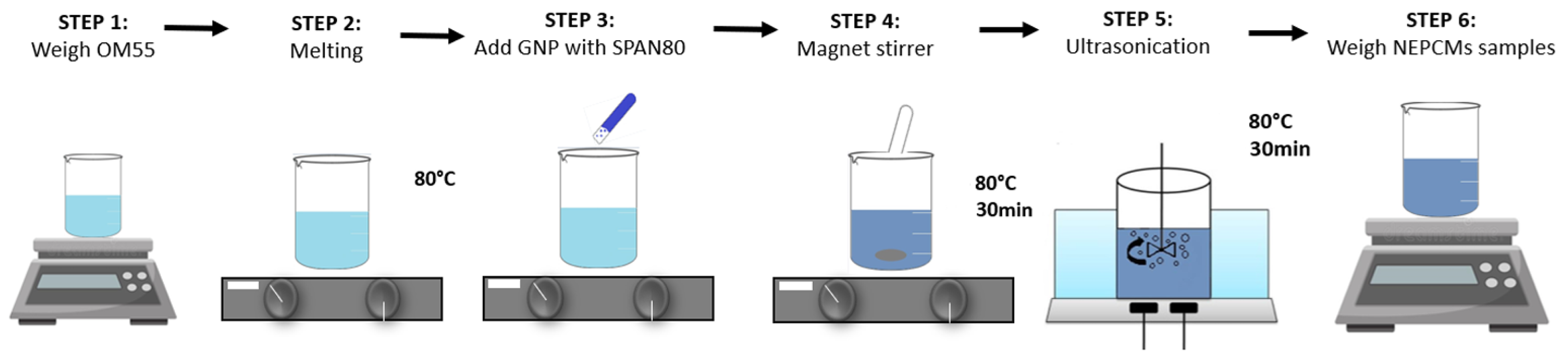
2.2. Preparation Methods
2.3. Characterisation Methods
2.3.1. Scanning Electron Microscopy (SEM)
2.3.2. Differential Scanning Calorimetry (DSC)
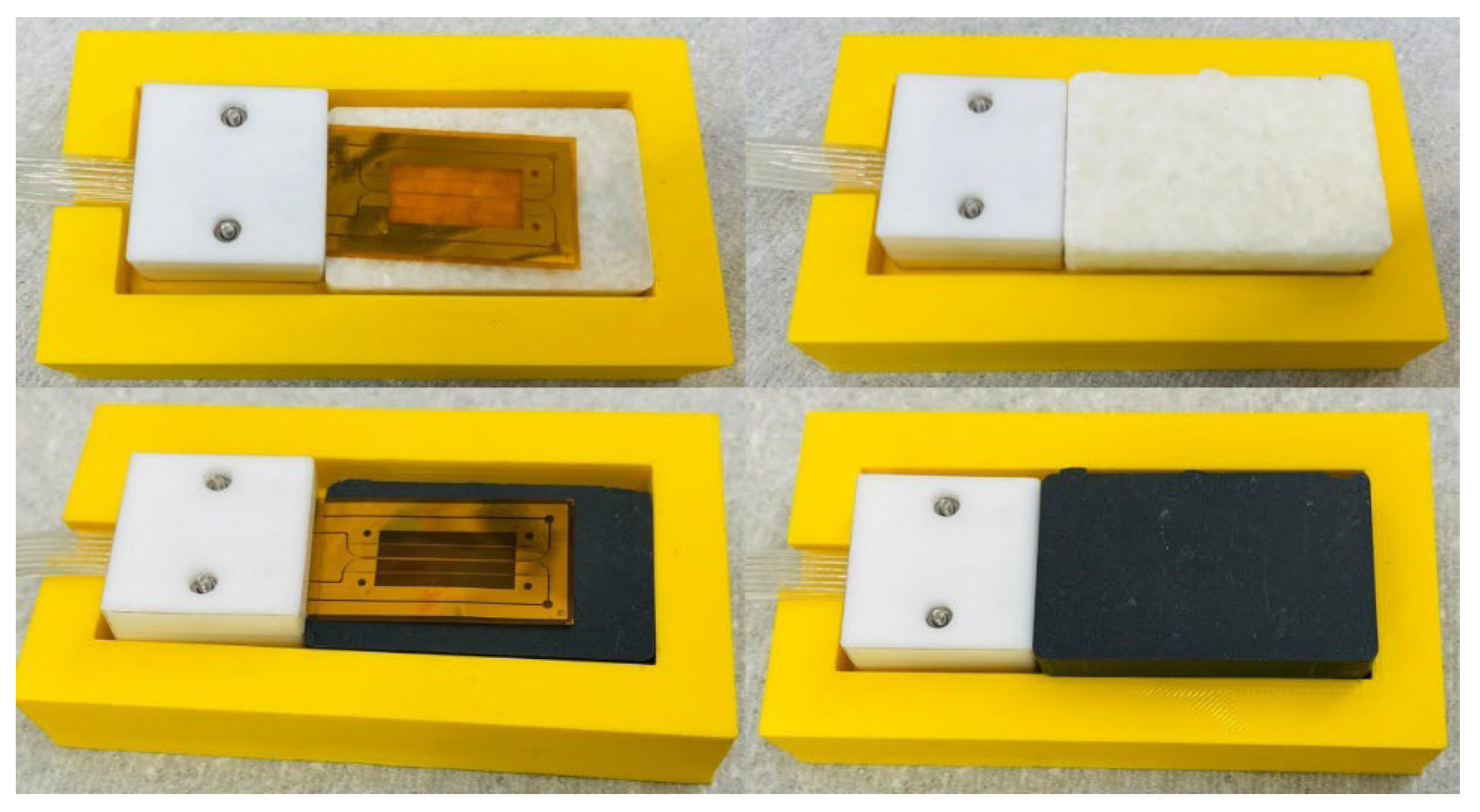
2.3.3. Thermal Conductivity (Transient Hot Bridge)
2.3.4. Viscosity Measurement
2.3.5. Density (Archimedes’ Principle)
3. Results and Discussion
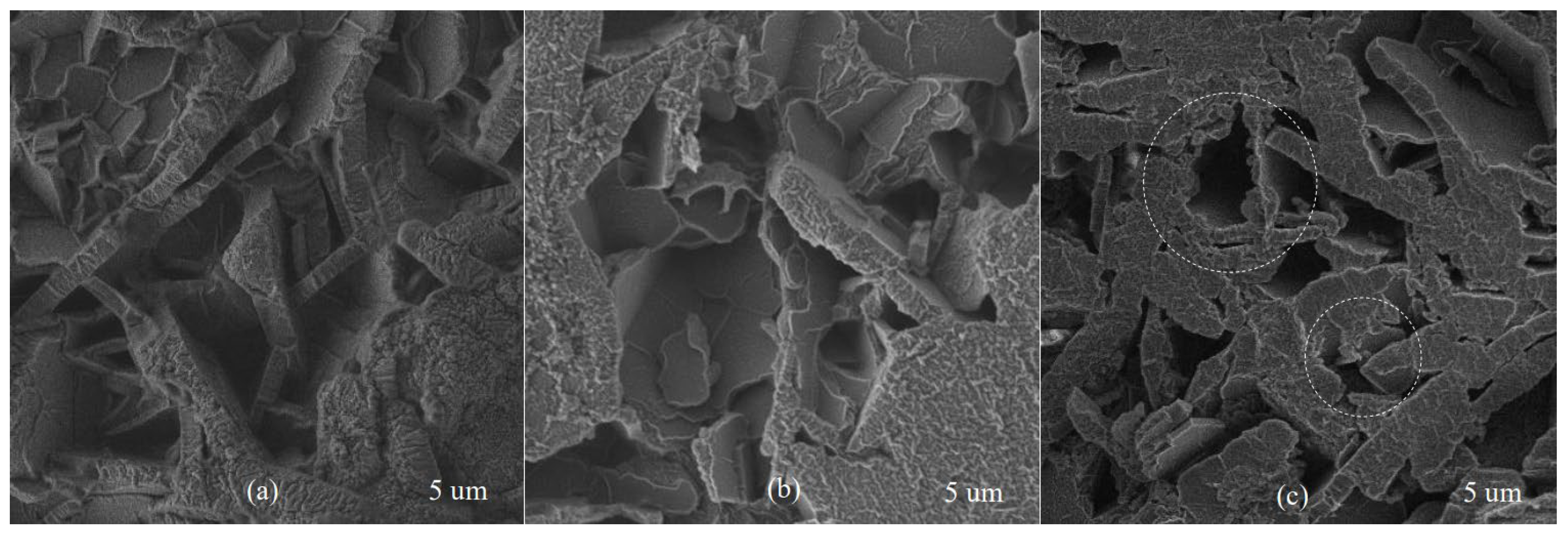
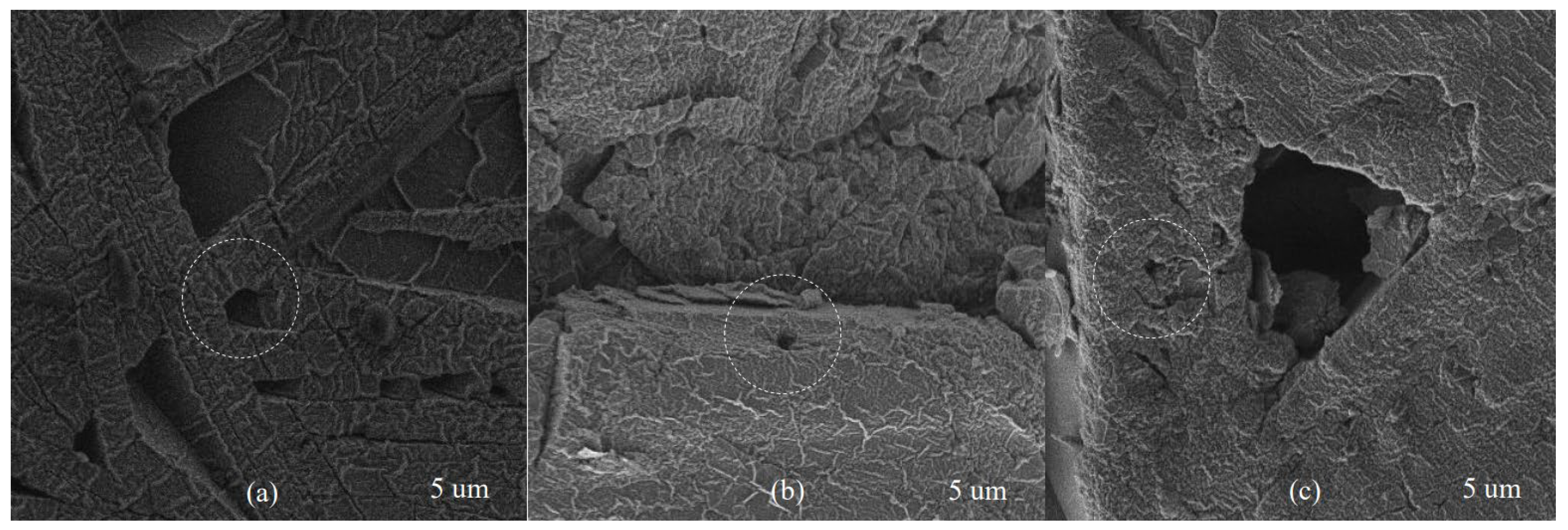
3.1. Microstructure Analysis Using SEM
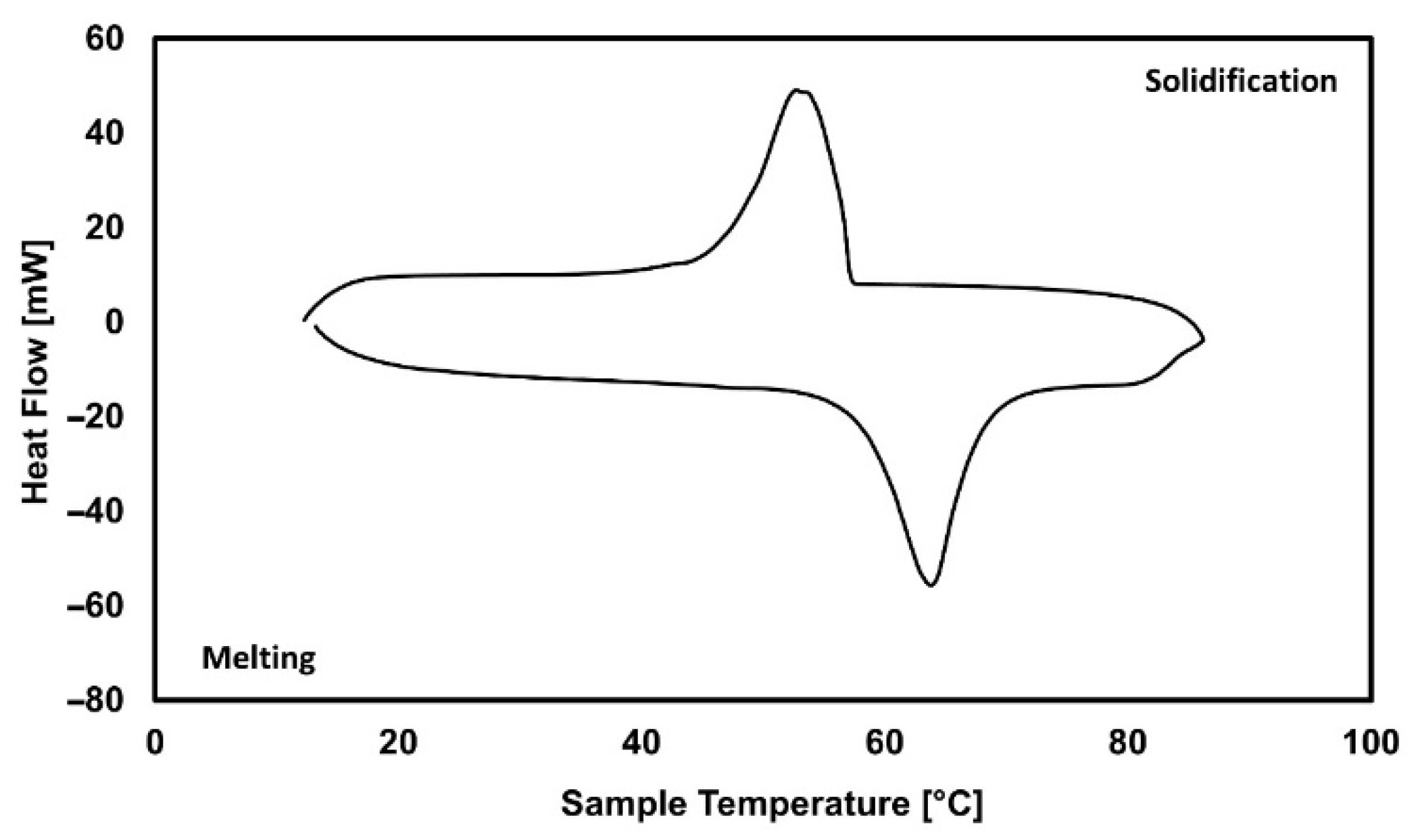
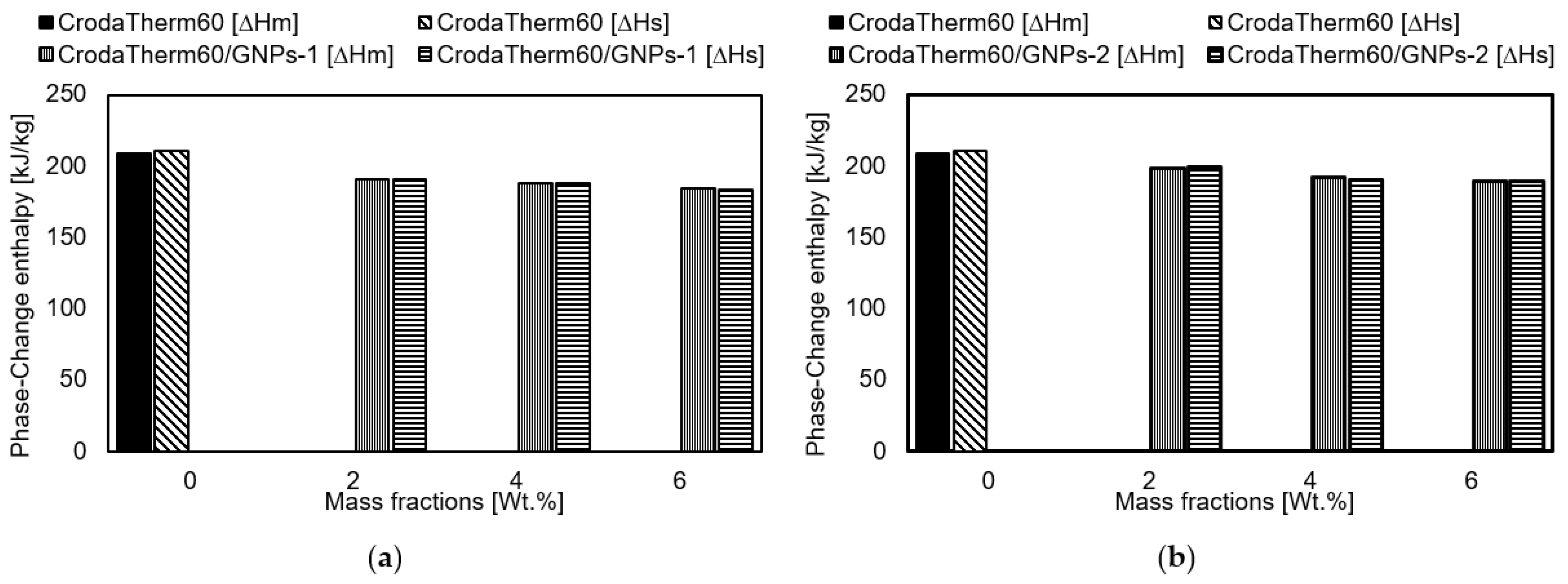
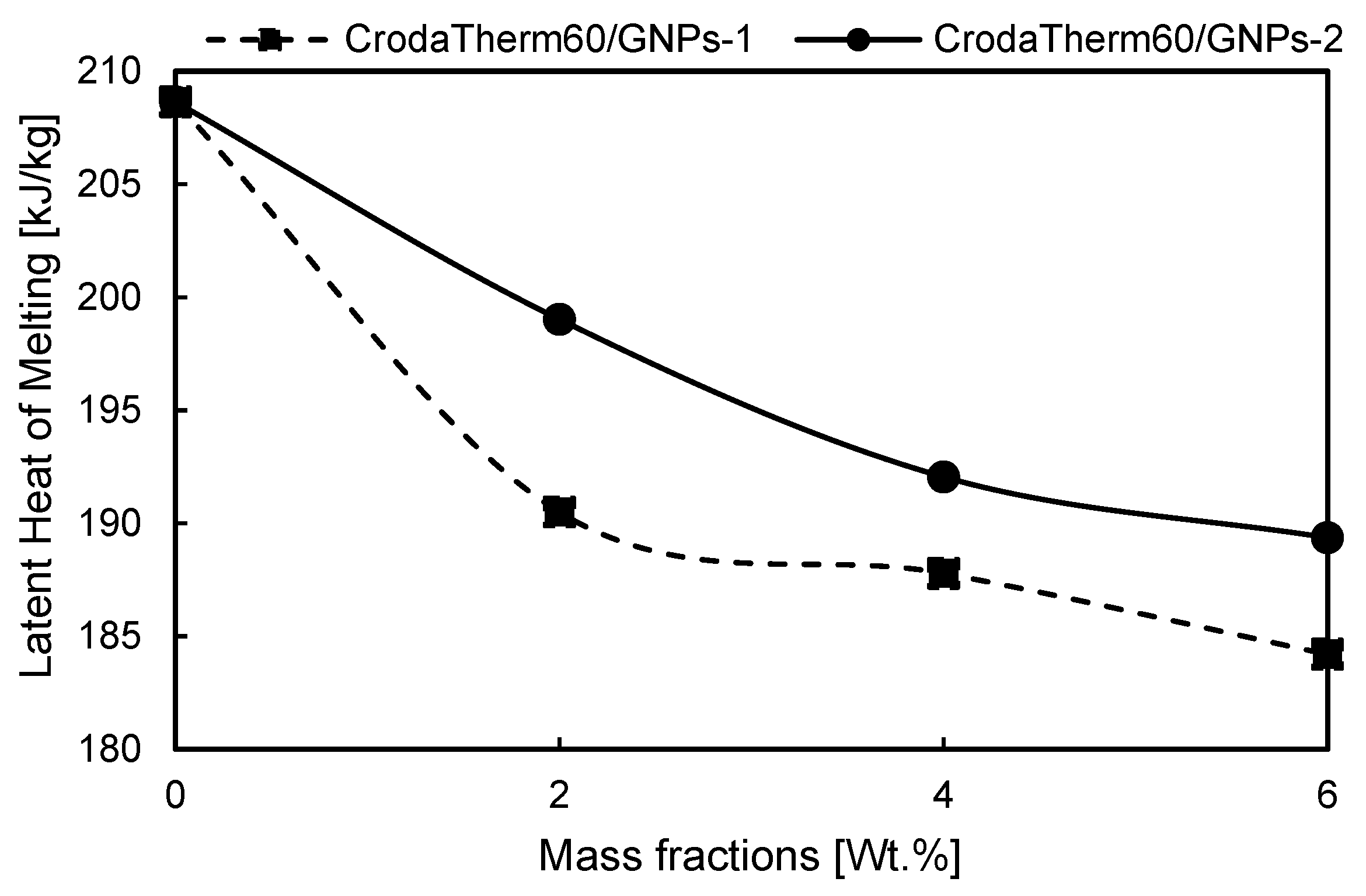
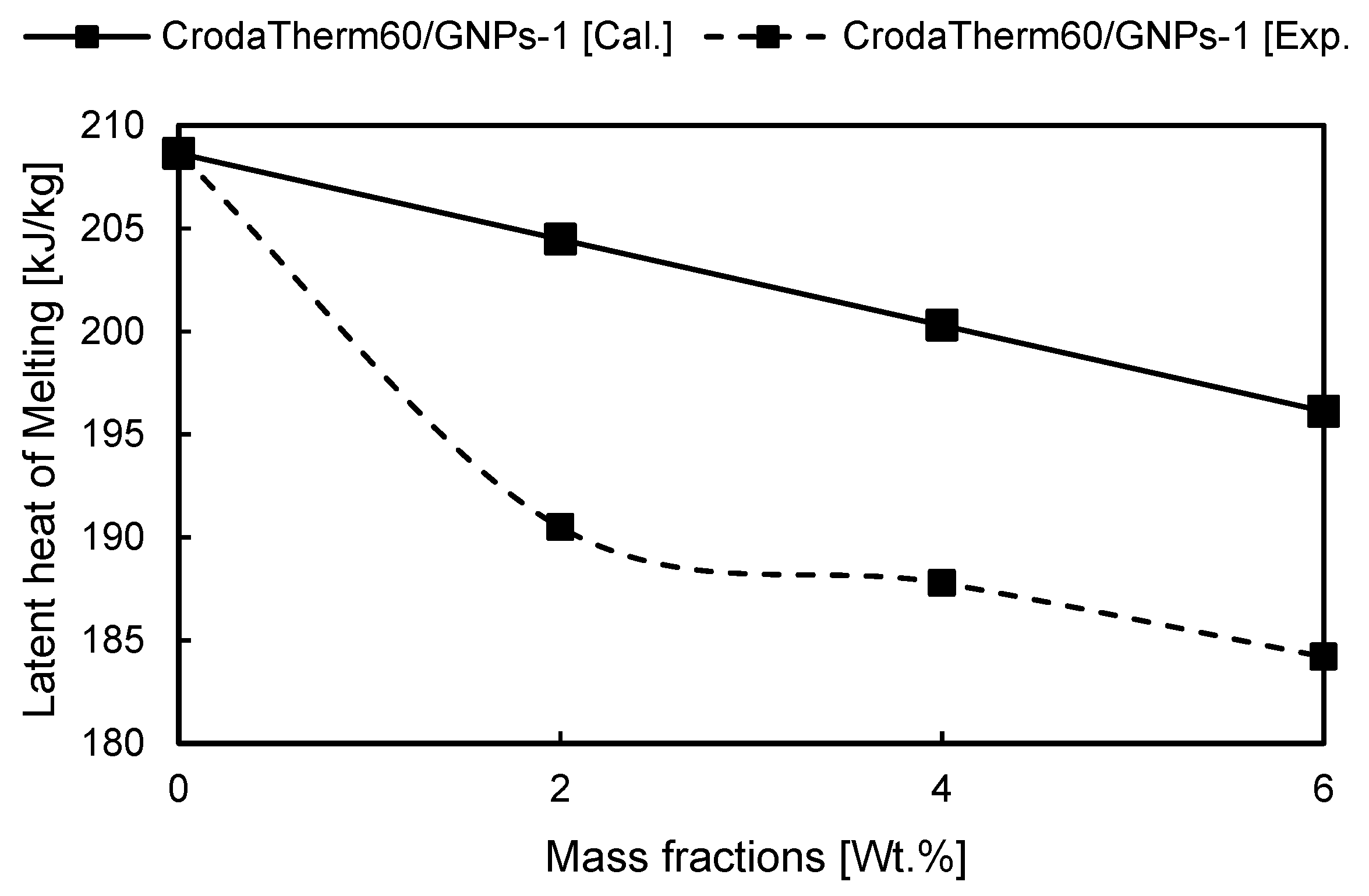
3.2. Latent Heat and Phase-Change Temperatures
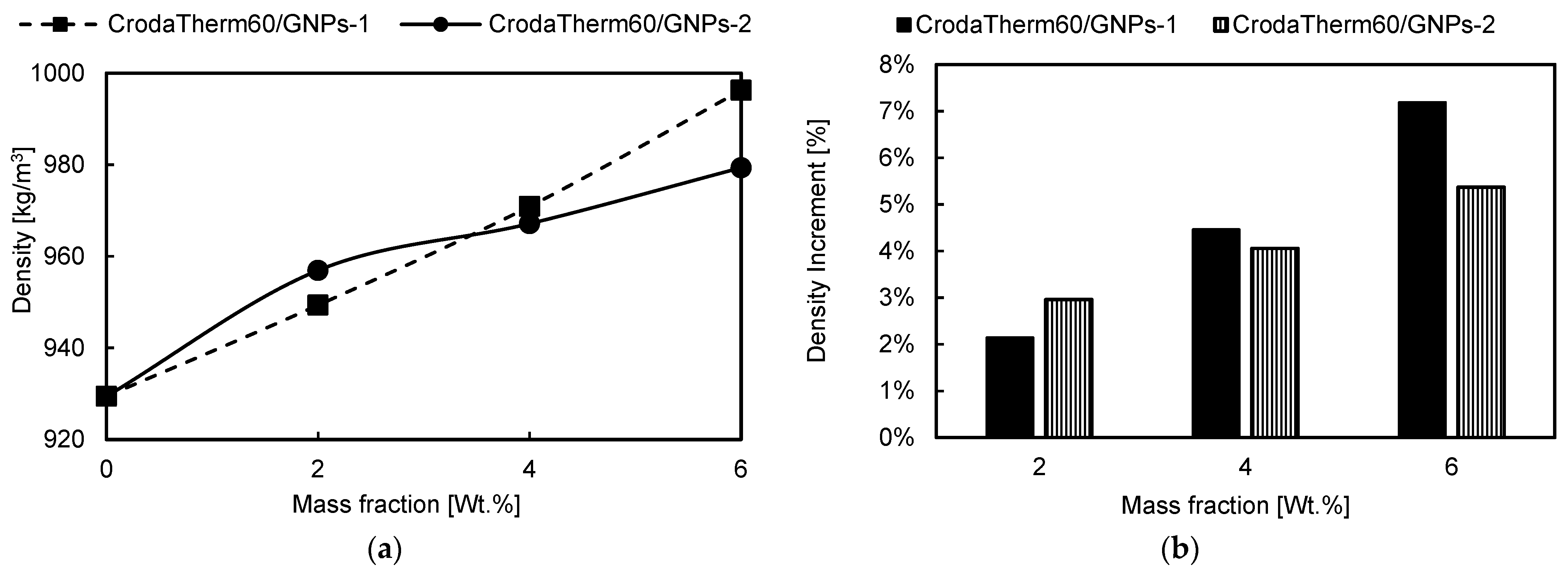
3.3. Density
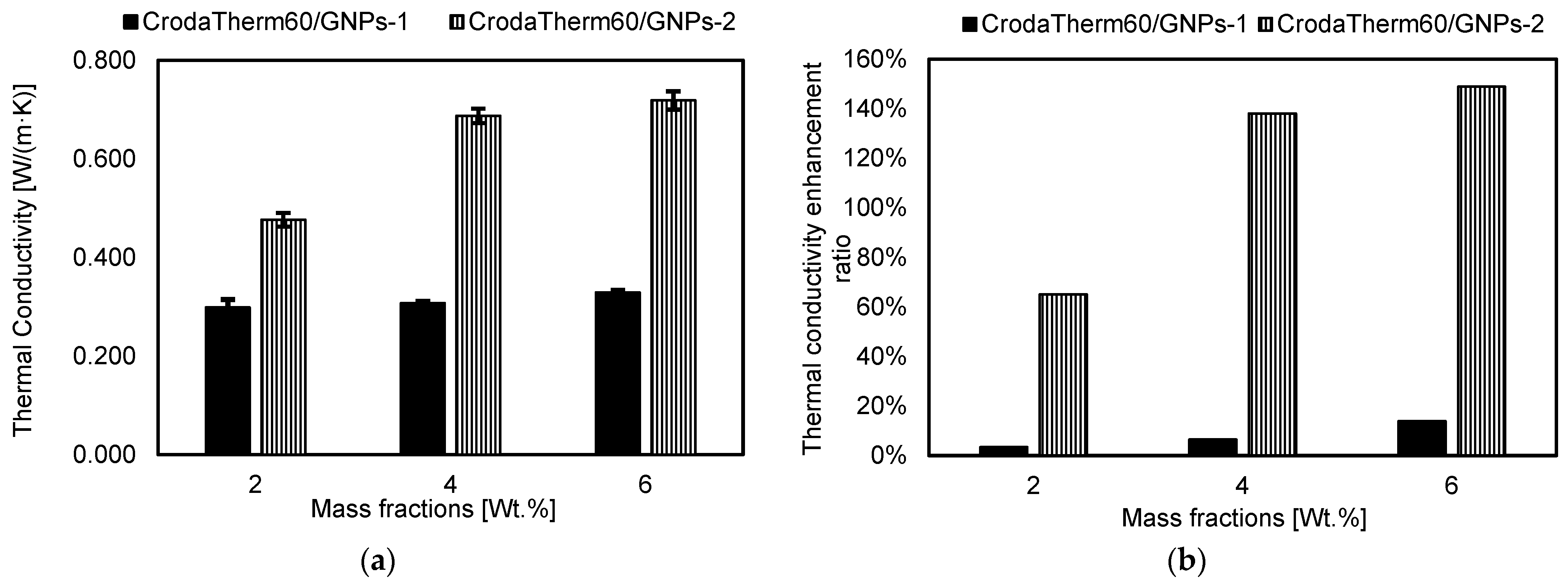
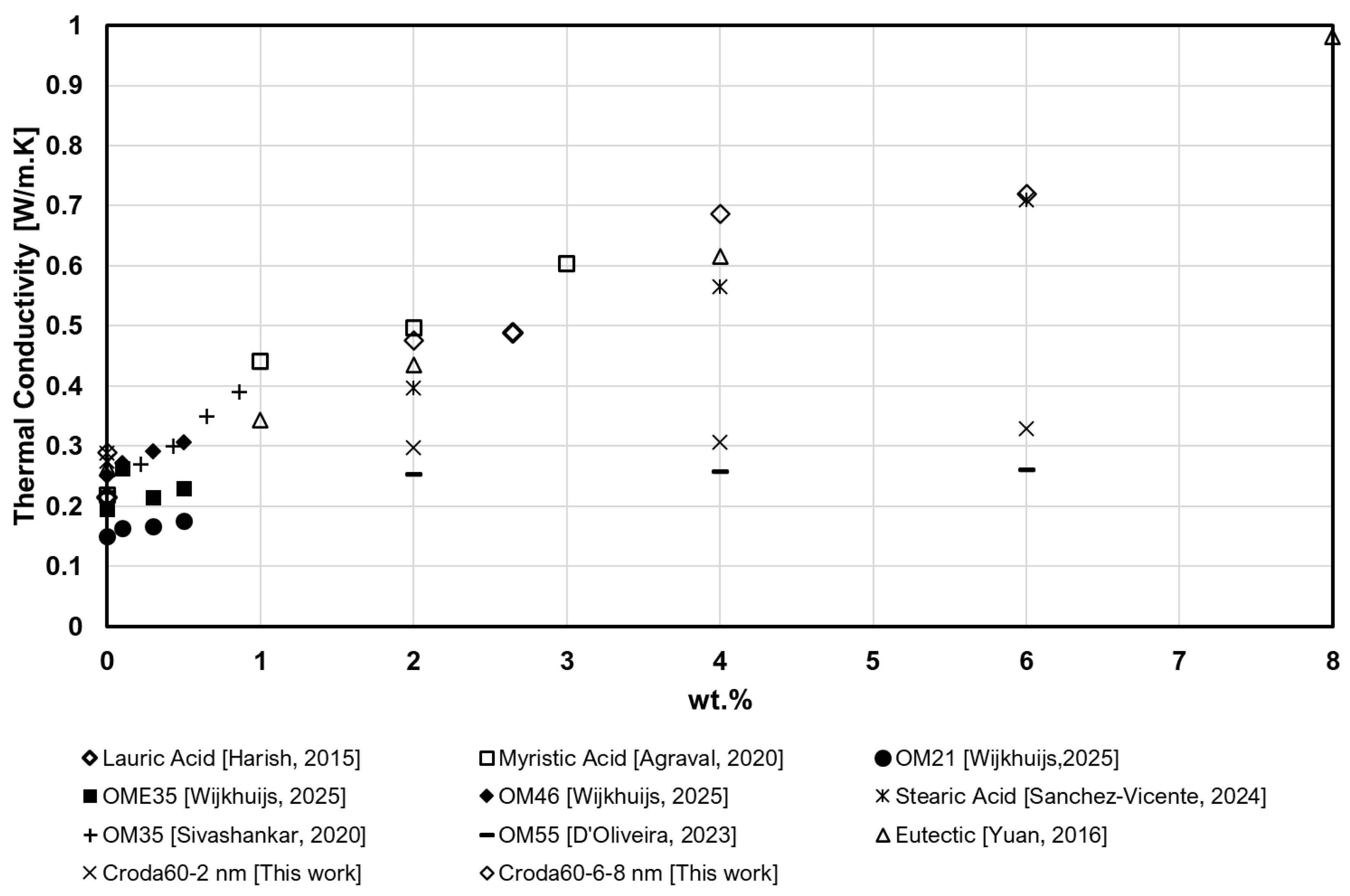
3.4. Thermal Conductivity
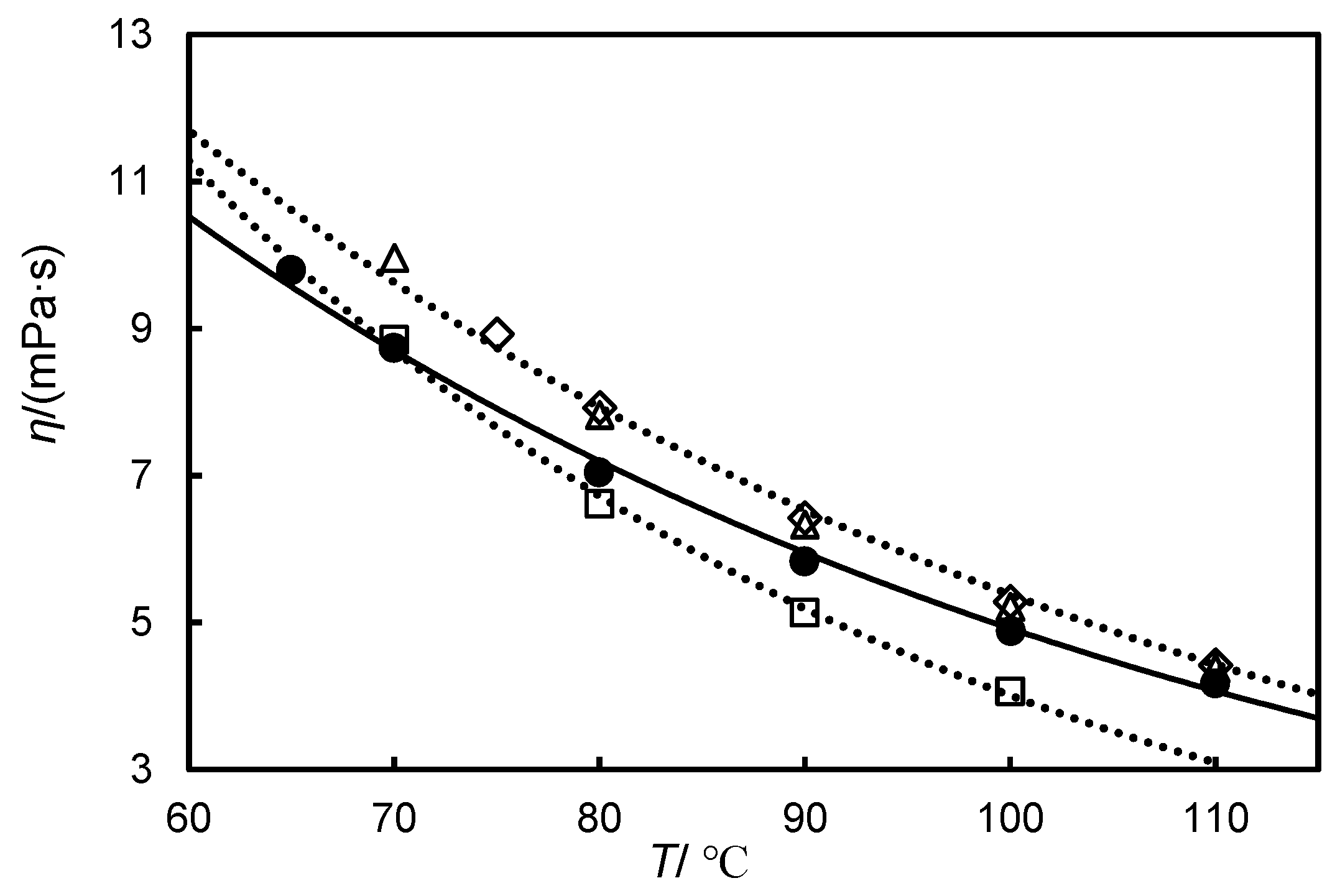
3.5. Viscosity
4. Conclusions
- Differential scanning calorimetry (DSC) results showed variations in melting temperature and latent heat with the addition of GNPs. However, the standard deviation in the DSC measurements was relatively high, leading to partial overlap in the latent heat values across samples. As a result, the impact of GNP concentration on latent heat cannot be conclusively established, and any observed reductions should be interpreted with caution. The greatest reduction in latent heat (11.7%) occurred for the PCM with 6 wt.% GNP-1.
- Clear differences were observed between the two GNP types. GNP-1 (≈2 nm thickness, high surface area) offered only modest thermal improvements, likely due to the lack of effective conductive pathways. In contrast, GNP-2 (6–8 nm thickness) produced a more efficient network structure, demonstrating that platelet thickness, aspect ratio, and network connectivity have a more decisive influence on heat transfer than surface area alone.
- The most significant improvement occurred in the sample containing 6 wt.% GNP-2, where the thermal conductivity increased from 0.289 W/(m·K) to 0.708 W/(m·K), an enhancement of approximately 149%. This non-linear increase is consistent with the establishment of a more continuous conductive network and reflects a percolation-like behaviour typical of carbon-based thermal additives when sufficient connectivity is achieved, even without surfactants. Thermal conductivity measurements were performed only in the solid state at 20–25 °C, substantially below the PCM’s melting temperature, and future work should therefore include temperature-dependent measurements near and above the phase-transition region to fully assess NePCM performance under realistic operating conditions.
- NePCMs incorporating GNP-2 showed marked gains in thermal conductivity and retained latent heat values within acceptable limits. Although this reflects clear potential at the material level, comprehensive stability testing and additional validation are necessary prior to assessing their suitability for practical deployment.
- The addition of GNPs resulted in an increase in solid density, reflecting the higher density of the carbon nanostructures with the matrix. Viscosity decreased with temperature and remained within ranges reported for similar PCMs. The addition of GNPs (2–6 wt.%) is expected to increase the viscosity of Croda60 and modify its rheological behaviour. Therefore, a comprehensive rheological analysis is required before evaluating its suitability for practical pumping or heat transfer applications.
- It should also be noted that the long-term stability of the nanocomposite PCM, including thermal cycling durability and potential sedimentation, was not assessed in this study, and future work should address these aspects to fully determine its suitability for practical thermal energy storage applications.
Author Contributions
Funding
Data Availability Statement
Acknowledgments
Conflicts of Interest
Abbreviations
| Greek Symbols | |
| α | Thermal diffusivity (m2s−1) |
| ρ | Density (kg/m3) |
| Abbreviations | |
| DSC | Differential Scanning Calorimeter |
| GNP | Graphene Nanoplatelet |
| LHTES | Latent Heat Thermal Energy Storage |
| MePCMs | Microencapsulated Phase-Change Materials |
| MWCNTs | Multi-Walled Carbon Nanotubes |
| NePCMs | Nano-Enhanced Phase-Change Materials |
| PCMs | Phase-Change Materials |
| PMMA | Polymethyl Methacrylate |
| PVP | Polyvinyl Pyrrolidone |
| SDS | Sodium Deoxycholate |
| SEM | Scanning Electron Microscope |
| TES | Thermal Energy Storage |
References
- Mehling, H.; Cabeza, L.F. Phase change materials and their basic properties. In Thermal Energy Storage for Sustainable Energy Consumption: Fundamentals, Case Studies and Design; Springer: Berlin/Heidelberg, Germany, 2007; pp. 257–277. [Google Scholar]
- Shi, J.-N.; Ger, M.-D.; Liu, Y.-M.; Fan, Y.-C.; Wen, N.-T.; Lin, C.-K.; Pu, N.-W. Improving the thermal conductivity and shape-stabilisation of phase change materials using nanographite additives. Carbon 2013, 51, 365–372. [Google Scholar] [CrossRef]
- Zalba, B.; Marı, J.M.; Cabeza, L.F.; Mehling, H. Review on thermal energy storage with phase change: Materials, heat transfer analysis and applications. Appl. Therm. Eng. 2003, 23, 251–283. [Google Scholar] [CrossRef]
- Wuliu, Y.; Liu, J.; Zhang, L.; Wang, S.; Liu, Y.; Feng, J.; Liu, X. Design of bio-based organic phase change materials containing a “safety valve”. Green Chem. 2021, 23, 8643–8656. [Google Scholar] [CrossRef]
- Hu, X.; Huang, H.; Hu, Y.; Lu, X.; Qin, Y. Novel bio-based composite phase change materials with reduced graphene oxide-functionalised spent coffee grounds for efficient solar-to-thermal energy storage. Sol. Energy Mater. Sol. Cells 2021, 219, 110790. [Google Scholar] [CrossRef]
- Okogeri, O.; Stathopoulos, V.N. What about greener phase change materials? A review on biobased phase change materials for thermal energy storage applications. Int. J. Thermofluids 2021, 10, 100081. [Google Scholar] [CrossRef]
- Advincula, P.; De Leon, A.; Rodier, B.; Kwon, J.; Advincula, R.; Pentzer, E. Accommodating volume change and imparting thermal conductivity by encapsulation of phase change materials in carbon nanoparticles. J. Mater. Chem. A 2018, 6, 2461–2467. [Google Scholar] [CrossRef]
- Zhang, H.; Wang, X.; Wu, D. Silica encapsulation of n-octadecane via sol–gel process: A novel microencapsulated phase-change material with enhanced thermal conductivity and performance. J. Colloid Interface Sci. 2010, 343, 246–255. [Google Scholar] [CrossRef]
- Khadiran, T.; Hussein, M.Z.; Zainal, Z.; Rusli, R. Shape-stabilised n-octadecane/activated carbon nanocomposite phase change material for thermal energy storage. J. Taiwan Inst. Chem. Eng. 2015, 55, 189–197. [Google Scholar] [CrossRef]
- Sarı, A.; Karaipekli, A. Thermal conductivity and latent heat thermal energy storage characteristics of paraffin/expanded graphite composite as phase change material. Appl. Therm. Eng. 2007, 27, 1271–1277. [Google Scholar] [CrossRef]
- Putra, N.; Rawi, S.; Amin, M.; Kusrini, E.; Kosasih, E.A.; Mahlia, T.M.I. Preparation of beeswax/multi-walled carbon nanotubes as novel shape-stable nanocomposite phase-change material for thermal energy storage. J. Energy Storage 2019, 21, 32–39. [Google Scholar] [CrossRef]
- Abdulateef, A.M.; Abdulateef, J.; Al-Abidi, A.A.; Sopian, K.; Mat, S.; Mahdi, M.S. A combination of fins-nanoparticle for enhancing the discharging of phase-change material used for liquid desiccant air conditioning unite. J. Energy Storage 2019, 24, 100784. [Google Scholar] [CrossRef]
- Kok, B. Examining effects of special heat transfer fins designed for the melting process of PCM and Nano-PCM. Appl. Therm. Eng. 2020, 170, 114989. [Google Scholar] [CrossRef]
- Ren, Q.; Meng, F.; Guo, P. A comparative study of PCM melting process in a heat pipe-assisted LHTES unit enhanced with nanoparticles and metal foams by immersed boundary-lattice Boltzmann method at pore-scale. Int. J. Heat Mass Transf. 2018, 121, 1214–1228. [Google Scholar] [CrossRef]
- Al-Janabi, A.S.; Hussin, M.; Abdullah, M. Stability, thermal conductivity and rheological properties of graphene and MWCNT in nanolubricant using additive surfactants. Case Stud. Therm. Eng. 2021, 28, 101607. [Google Scholar] [CrossRef]
- Amin, M.; Putra, N.; Kosasih, E.A.; Prawiro, E.; Luanto, R.A.; Mahlia, T. Thermal properties of beeswax/graphene phase change material as energy storage for building applications. Appl. Therm. Eng. 2017, 112, 273–280. [Google Scholar] [CrossRef]
- Kalidasan, B.; Pandey, A.; Rahman, S.; Sharma, K.; Tyagi, V. Experimental Investigation of Graphene Nanoplatelets Enhanced Low Temperature Ternary Eutectic Salt Hydrate Phase Change Material. Energies 2023, 16, 1574. [Google Scholar] [CrossRef]
- Prado, J.I.; Lugo, L. Enhancing the thermal performance of a stearate phase change material with graphene nanoplatelets and MgO nanoparticles. ACS Appl. Mater. Interfaces 2020, 12, 39108–39117. [Google Scholar] [CrossRef] [PubMed]
- Jurčević, M.; Nižetić, S.; Arıcı, M.; Tuan, A.H.A.; Giama, E.; Papadopoulos, A. Thermal constant analysis of phase change nanocomposites and discussion on selection strategies with respect to economic constraints. Sustain. Energy Technol. Assess. 2021, 43, 100957. [Google Scholar] [CrossRef]
- Liu, Y.; Yang, Y. Use of nano-α-Al2O3 to improve binary eutectic hydrated salt as phase change material. Sol. Energy Mater. Sol. Cells 2017, 160, 18–25. [Google Scholar] [CrossRef]
- Du, Y.; Zhou, T.; Zhao, C.; Ding, Y. Molecular dynamics simulation on thermal enhancement for carbon nano tubes (CNTs) based phase change materials (PCMs). Int. J. Heat Mass Transf. 2022, 182, 122017. [Google Scholar] [CrossRef]
- Bilisik, K.; Akter, M. Graphene nanoplatelets/epoxy nanocomposites: A review on functionalisation, characterisation techniques, properties, and applications. J. Reinf. Plast. Compos. 2022, 41, 99–129. [Google Scholar] [CrossRef]
- Harish, S.; Orejon, D.; Takata, Y.; Kohno, M. Thermal conductivity enhancement of lauric acid phase change nanocomposite with graphene nanoplatelets. Appl. Therm. Eng. 2015, 80, 205–211. [Google Scholar] [CrossRef]
- D’Oliveira, E.; Pereira, S.C.C.; Azimov, U.; Groulx, D.; Costa, T. Experimental investigation on the thermal performance of low-temperature OM55/GNPs/SPAN80 nanocomposites. In Proceedings of the Heat Powered Cycles Conference 2023, Edinburgh, UK, 3–6 September 2023. [Google Scholar]
- D’Oliveira, E.J.; Pereira, S.C.C.; Groulx, D.; Azimov, U. Thermophysical properties of Nano-enhanced phase change materials for domestic heating applications. J. Energy Storage 2022, 46, 103794. [Google Scholar] [CrossRef]
- Punniakodi, B.M.S.; Senthil, R. Recent developments in nano-enhanced phase change materials for solar thermal storage. Sol. Energy Mater. Sol. Cells 2022, 238, 111629. [Google Scholar] [CrossRef]
- Agrawal, R.; Singh, K.D.P.; Paswan, M.K. Review on enhancement of thermal conductivity of phase change materials with nanoparticle in engineering applications. Mater. Today Proc. 2020, 22, 1617–1627. [Google Scholar] [CrossRef]
- Hayat, M.A.; Chen, Y.; Bevilacqua, M.; Li, L.; Yang, Y. Characteristics and potential applications of nano-enhanced phase change materials: A critical review on recent developments. Sustain. Energy Technol. Assess. 2022, 50, 101799. [Google Scholar] [CrossRef]
- He, M.; Yang, L.; Lin, W.; Chen, J.; Mao, X.; Ma, Z. Preparation, thermal characterisation and examination of phase change materials (PCMs) enhanced by carbon-based nanoparticles for solar thermal energy storage. J. Energy Storage 2019, 25, 100874. [Google Scholar] [CrossRef]
- Tahan Latibari, S.; Eversdijk, J.; Cuypers, R.; Drosou, V.; Shahi, M. Preparation of phase change microcapsules with the enhanced photothermal performance. Polymers 2019, 11, 1507. [Google Scholar] [CrossRef]
- Croda International Plc. CrodaTherm 60. 2021. Available online: https://www.crodatherm.com/en-gb/products-and-applications/product-finder/product/1366/CrodaTherm_1_60 (accessed on 10 May 2021).
- Ionic Liquids Technologies GmbH. IoLiTec Nanomaterials. 2021. Available online: https://nanomaterials.iolitec.de/sites/nanomaterials.iolitec.de/files/downloads/2017-01-25-SP%20Price%20List%20Nano2017_V1.pdf (accessed on 10 May 2021).
- Fang, X.; Fan, L.-W.; Ding, Q.; Wang, X.; Yao, X.-L.; Hou, J.-F.; Yu, Z.-T.; Cheng, G.-H.; Hu, Y.-C.; Cen, K.-F. Increased thermal conductivity of eicosane-based composite phase change materials in the presence of graphene nanoplatelets. Energy Fuels 2013, 27, 4041–4047. [Google Scholar] [CrossRef]
- Masoumi, H.; Mirfendereski, S. Modification of physical and thermal characteristics of stearic acid as a phase change materials using TiO2-nanoparticles. Thermochim. Acta 2019, 675, 9–17. [Google Scholar] [CrossRef]
- Ezhumalai, D.; Sriharan, G.; Harikrishnan, S. Improved thermal energy storage behavior of CuO/palmitic acid composite as phase change material. Mater. Today Proc. 2018, 5, 14618–14627. [Google Scholar] [CrossRef]
- Costa, T.; Sanchez-Vicente, Y.; Yang, Z.; Stevens, L.A.; Dias, F.D.S.; Pereira, S.C.C. Thermophysical properties of tetrabutylammonium chloride, paraffin and fatty acids for thermal energy applications. RSC Adv. 2024, 14, 26246–26258. [Google Scholar] [CrossRef]
- BS EN ISO 1183-1:2025; Plastics—Methods for Determining the Density of Non-Cellular Plastics—Immersion Method, Liquid Pycnometer Method and Titration Method. British Standards Institution (BSI): London, UK, 2025.
- Fallahi, A.; Guldentops, G.; Tao, M.; Granados-Focil, S.; Van Dessel, S. Review on solid-solid phase change materials for thermal energy storage: Molecular structure and thermal properties. Appl. Therm. Eng. 2017, 127, 1427–1441. [Google Scholar] [CrossRef]
- Shamseddine, I.; Pennec, F.; Biwole, P.; Fardoun, F. Supercooling of phase change materials: A review. Renew. Sustain. Energy Rev. 2022, 158, 112172. [Google Scholar] [CrossRef]
- Arshad, A.; Jabbal, M.; Yan, Y. Preparation and characteristics evaluation of mono and hybrid nano-enhanced phase change materials (NePCMs) for thermal management of microelectronics. Energy Convers. Manag. 2020, 205, 112444. [Google Scholar] [CrossRef]
- Yahya, M.N.; Norddin, M.; Ismail, I.; Rasol, A.; Risal, A.R.; Oseh, J.O.; Yakasai, F.; Ngouangna, E.N.; Khan, S.; Al-Ani, M. Modified locally derived graphene nanoplatelets for enhanced rheological, filtration and lubricity characteristics of water-based drilling fluids. Arab. J. Chem. 2023, 16, 105305. [Google Scholar] [CrossRef]
- Santos, R.M.; Mould, S.T.; Formánek, P.; Paiva, M.C.; Covas, J.A. Effects of Particle Size and Surface Chemistry on the Dispersion of Graphite Nanoplates in Polypropylene Composites. Polymers 2018, 10, 222. [Google Scholar] [CrossRef]
- Vigneshwaran, P.; Shaik, S.; Arulmani, S.; Arıcı, M.; Alam, T.; Shaik, A.H. Incorporation of graphene nanoplatelets with organic phase change materials—Studies on thermal conductivity enhancement, and thermal and chemical stability. Int. J. Thermofluids 2023, 20, 100456. [Google Scholar] [CrossRef]
- Khezri, A.; Sahebi, M.; Mohammadi, M. Fabrication and Thermal properties of graphene nanoplatelet-enhanced phase change materials based on paraffin encapsulated by melamine–formaldehyde. J. Therm. Anal. Calorim. 2021, 147, 7683–7691. [Google Scholar] [CrossRef]
- Wijkhuijs, L.E.A.; Schmit, P.; Schreur-Piet, I.; Huinink, H.; Tuinier, R.; Friedrich, H. Graphene Nanoplatelet Distribution Governs Thermal Conductivity and Stability of Paraffin-Based PCMs. Nanomaterials 2025, 15, 587. [Google Scholar] [CrossRef] [PubMed]
- Sanchez-Vicente, Y.; Bismilla, A.; Ismail, I.; Soudari, R.; Mohamed, M.; Gonzalez, M.A.; Tenorio, M.-J.; D’Oliveira, E.J.; Costa, S.C. Thermodynamic of Phase Change Materials Based on Stearic Acid with Graphene Nanoplatelets. In Proceedings of the 33rd European Symposium on Applied Thermodynamics ESAT 2024, Edinburgh, UK, 9–12 June 2024. [Google Scholar]
- Yuan, Y.; Zhang, N.; Li, T.; Cao, X.; Long, W. Thermal performance enhancement of palmitic-stearic acid by adding graphene nanoplatelets and expanded graphite for thermal energy storage: A comparative study. Energy 2016, 97, 488–497. [Google Scholar] [CrossRef]
- Sivashankar, M.; Selvam, C.; Manikandan, S.; Harish, S. Performance improvement in concentrated photovoltaics using nano-enhanced phase change material with graphene nanoplatelets. Energy 2020, 208, 118408. [Google Scholar] [CrossRef]
- Andrade, E. The Viscosity of Liquids. Nature 1930, 125, 309–310. [Google Scholar] [CrossRef]
- Gonzalez, M.A.; Tenorio, M.J.; Bismilla, A.Z.; D’Oliveira, J.E.; Pereira, S.-C.C.; Sanchez-Vicente, Y. Molecular dynamics simulations and experimental measurements of density and viscosity of phase change material based on stearic acid with graphene nanoplatelets. Fluid Phase Equilibria 2025, 593, 114361. [Google Scholar] [CrossRef]



| Properties | Notes | CrodaThermTM 60 |
|---|---|---|
| Latent heat of melting [kJ/kg] | DSC scanning rate 1 K/min | 217 |
| Peak melting temperature [°C] | DSC scanning rate 1 K/min | 60 |
| Latent heat of solidification [kJ/kg] | DSC scanning rate 1 K/min | −212 |
| Peak solidification temperature [°C] | DSC scanning rate 1 K/min | 58 |
| Density [solid] [kg/m3] | 55 °C | 922 |
| Density [liquid] [kg/m3] | 65 °C | 821 |
| Specific heat capacity [solid] [kJ/kg K] | 2.3 | |
| Specific heat capacity [liquid] [kJ/(kg·K)] | 1.4 | |
| Thermal conductivity [solid] [W/(m·K)] | 0.29 | |
| Thermal conductivity [liquid] [W/(m·K)] | 0.27 | |
| Volume expansion 55 to 65 °C | 11.9% |
| Properties | GNP-1 | GNP-2 |
|---|---|---|
| Thickness [nm] | 2 | 6–8 |
| Specific Surface Area (SSA) [m2/g] | 750 | 120–150 |
| Purity [%] | 99.5 | 99.5 |
| Samples | wt [%] | Melting | Solidification | |||||||||
|---|---|---|---|---|---|---|---|---|---|---|---|---|
[°C] | [°C] | [kJ/kg] | [%] | [kJ/kg] | [°C] | [°C] | [kJ/kg] | [%] | ||||
| Croda60 | - | - | 57.2 | 60.6 | 208.64 | - | - | 58.2 | 55.7 | 210.47 | - | 4.9 |
| GNP-1 | 2 | 57.5 | 60.5 | 190.49 | 8.7 | 204.4 | 58.4 | 56.4 | 191.15 | 9.1 | 4.1 | |
| 4 | 57.7 | 60.1 | 187.78 | 10.0 | 200.2 | 58.4 | 56.9 | 188.55 | 10.4 | 3.2 | ||
| 6 | 58.1 | 60.1 | 184.20 | 11.7 | 196.1 | 58.2 | 57.2 | 183.29 | 12.9 | 2.9 | ||
| GNP-2 | 2 | 57.7 | 60.1 | 199.02 | 4.6 | 204.4 | 55.2 | 57.3 | 199.31 | 5.3 | 4.4 | |
| 4 | 57.4 | 60.2 | 192.05 | 7.9 | 200.2 | 58.6 | 56.1 | 190.73 | 9.3 | 2.9 | ||
| 6 | 57.3 | 60.6 | 189.36 | 9.2 | 196.1 | 58.5 | 56.4 | 189.75 | 9.8 | 4.5 | ||
| Samples | wt [%] | Melting | Solidification | |||||||||
|---|---|---|---|---|---|---|---|---|---|---|---|---|
[°C] | [°C] | [kJ/kg] | [%] | [kJ/kg] | [°C] | [°C] | [kJ/kg] | [%] | ||||
| Croda60 | - | - | 57.6 | 60.6 | 195.45 | - | 57.2 | 53.43 | 210.20 | 7.2 | ||
| GNP-1 | 2 | 57.5 | 60.5 | 181.46 | 13.0 | 191.54 | 58.1 | 55.25 | 183.44 | 12.8 | 5.3 | |
| 4 | 56.9 | 60.1 | 184.99 | 11.3 | 187.63 | 58.2 | 55.18 | 187.01 | 11.1 | 4.9 | ||
| 6 | 58.3 | 60.1 | 182.39 | 12.5 | 183.72 | 58.2 | 56.19 | 189.46 | 9.9 | 3.9 | ||
| GNP-2 | 2 | 57.8 | 60.1 | 197.29 | 5.4 | 191.54 | 58.2 | 55.10 | 195.87 | 6.9 | 5 | |
| 4 | 57.8 | 60.2 | 179.95 | 13.7 | 187.63 | 58.2 | 55.88 | 189.29 | 10.0 | 4.3 | ||
| 6 | 58.0 | 60.6 | 183.67 | 11.9 | 183.72 | 58.1 | 53.88 | 187.01 | 11.1 | 6.7 | ||
| PCM | Nano | wt. [%] | Temperature [°C] | Density (Solid) [kg/m3] | Increment in Density [%] | Standard Deviation [kg/m3] |
|---|---|---|---|---|---|---|
| Croda60 | - | 0 | 24 | 929 | - | 1 |
| GNP-1 | 2 | 23 | 949 | 2.14 | 1 | |
| 4 | 23 | 971 | 4.46 | 3 | ||
| 6 | 23 | 996 | 7.19 | 1 | ||
| GNP-2 | 2 | 24 | 959 | 3.24 | 4 | |
| 4 | 23 | 967 | 4.06 | 4 | ||
| 6 | 23 | 979 | 5.37 | 7 |
| PCM | Additive | wt.% | Temperature [°C] | Thermal Conductivity [W/(m·K)] | Thermal Conductivity Enhancement [%] | Standard Deviation [W/(m·K)] |
|---|---|---|---|---|---|---|
| Croda60 | - | - | 19.0 | 0.289 | - | 0.014 |
| GNP-1 | 2 | 24.0 | 0.298 | 3.4 | 0.016 | |
| 4 | 22.9 | 0.307 | 6.4 | 0.004 | ||
| 6 | 21.4 | 0.329 | 13.9 | 0.005 | ||
| GNP-2 | 2 | 19.0 | 0.476 | 65.0 | 0.014 | |
| 4 | 19.9 | 0.687 | 138.0 | 0.015 | ||
| 6 | 24.9 | 0.719 | 148.9 | 0.019 |
| PCM | GNP + Additive | wt.% | Thermal Conductivity [W/(m·K)] | Thermal Conductivity Enhancement [%] |
|---|---|---|---|---|
| Lauric Acid [23] | - | 0 | 0.215 | |
| 5–10 nm | 2.65 | 0.489 | 127% | |
| Myristic Acid [27] | 0 | 0.2186 | ||
| 3–10 nm | 1 | 0.4405 | 102% | |
| 2 | 0.4963 | 127% | ||
| 3 | 0.6039 | 176% | ||
| Stearic Acid [46] | 0 | 0.275 | ||
| 6–8 nm 150 m2/g | 2 | 0.396 | 44% | |
| 4 | 0.565 | 105% | ||
| 6 | 0.710 | 158% | ||
| OM21 [43] | 0 | 0.150 | ||
| 300 m2/g | 0.1 | 0.164 | 9% | |
| 0.3 | 0.167 | 11% | ||
| 0.5 | 0.176 | 17% | ||
| OM30 [43] | 0 | 0.275 | ||
| 300 m2/g | 0.1 | 0.289 | 5% | |
| 0.3 | 0.337 | 23% | ||
| 0.5 | 0.351 | 28% | ||
| OM35 [43] | 0 | 0.195 | ||
| 300 m2/g | 0.1 | 0.262 | 34% | |
| 0.3 | 0.214 | 10% | ||
| 0.5 | 0.229 | 17% | ||
| OM35 [48] | 0 | 0.22 | ||
| 6–10 nm + SDS | 0.2 * | 0.25 | 14% | |
| 0.4 * | 0.27 | 23% | ||
| 0.7 * | 0.30 | 36% | ||
| 0.9 * | 0.35 | 59% | ||
| 1.0 * | 0.39 | 77% | ||
| OM46 [43] | 0 | 0.251 | ||
| 300 m2/g | 0.1 | 0.272 | 8% | |
| 0.3 | 0.291 | 16% | ||
| 0.5 | 0.306 | 22% | ||
| OM55 [24] | 0 | 0.222 | ||
| 2 nm 750 m2/g | 2 | 0.252 | 14% | |
| 4 | 0.256 | 15% | ||
| 6 | 0.259 | 17% | ||
| Eutectic Palmitic–Stearic Acid [47] | 0 | 0.263 | ||
| 4–20 nm + PVP | 1 | 0.343 | 30% | |
| 2 | 0.435 | 65% | ||
| 4 | 0.615 | 134% | ||
| 8 | 0.981 | 273% |
| PCM | Temperature [°C] | Viscosity [mPa·s] | Standard Deviation [mPa·s] |
|---|---|---|---|
| Croda60 | 65 | 9.79 | 0.02 |
| 70 | 8.73 | 0.03 | |
| 80 | 7.04 | 0.03 | |
| 90 | 5.83 | 0.06 | |
| 100 | 4.88 | 0.01 | |
| 110 | 4.17 | 0.02 |
| PCM | A [mPas] | b [°C] | AAD [mPa∙s] | R2 |
|---|---|---|---|---|
| Croda60 | 1.27 | 134.73 | 0.021 | 0.9933 |
Disclaimer/Publisher’s Note: The statements, opinions and data contained in all publications are solely those of the individual author(s) and contributor(s) and not of MDPI and/or the editor(s). MDPI and/or the editor(s) disclaim responsibility for any injury to people or property resulting from any ideas, methods, instructions or products referred to in the content. |
© 2026 by the authors. Licensee MDPI, Basel, Switzerland. This article is an open access article distributed under the terms and conditions of the Creative Commons Attribution (CC BY) license.
Share and Cite
D’Oliveira, E.J.; Sanchez-Vicente, Y.; Mehvari, S.; Costa Pereira, S.C. Effect of Graphene Nanoplatelet Size on the Thermal Properties of Bio-Based Phase-Change Materials for Thermal Energy Storage. Energies 2026, 19, 1504. https://doi.org/10.3390/en19061504
D’Oliveira EJ, Sanchez-Vicente Y, Mehvari S, Costa Pereira SC. Effect of Graphene Nanoplatelet Size on the Thermal Properties of Bio-Based Phase-Change Materials for Thermal Energy Storage. Energies. 2026; 19(6):1504. https://doi.org/10.3390/en19061504
Chicago/Turabian StyleD’Oliveira, Elisangela Jesus, Yolanda Sanchez-Vicente, Saeid Mehvari, and Sol Carolina Costa Pereira. 2026. "Effect of Graphene Nanoplatelet Size on the Thermal Properties of Bio-Based Phase-Change Materials for Thermal Energy Storage" Energies 19, no. 6: 1504. https://doi.org/10.3390/en19061504
APA StyleD’Oliveira, E. J., Sanchez-Vicente, Y., Mehvari, S., & Costa Pereira, S. C. (2026). Effect of Graphene Nanoplatelet Size on the Thermal Properties of Bio-Based Phase-Change Materials for Thermal Energy Storage. Energies, 19(6), 1504. https://doi.org/10.3390/en19061504