Article

Thermal Characterization of Paraffin-Based Phase Change Materials for Thermal Energy Storage and Improved Thermal Comfort

1
Univ Paris Est Creteil, CERTES, F-94010 Creteil, France
2
Univ Paris Est Creteil, CERTES, F-77567 Lieusaint, France
*
Author to whom correspondence should be addressed.
Energies 2025, 18(23), 6331; https://doi.org/10.3390/en18236331 (registering DOI)
Submission received: 14 November 2025 / Revised: 25 November 2025 / Accepted: 27 November 2025 / Published: 2 December 2025

Abstract

Urban densification intensifies urban heat islands (UHIs), leading to higher temperatures in cities which negatively affect residents’ health and comfort and increase energy consumption for air conditioning, thereby raising carbon emissions. Reducing UHIs is therefore essential. Phase change materials (PCMs) are a promising solution, as they can store and release significant amounts of thermal energy during phase transitions. Selecting paraffins with suitable properties is crucial for effective application. In this study, three paraffins (RT28HC, RT31, and RT35HC) with phase change temperatures of 28 °C, 31 °C, and 35 °C were characterized to evaluate their potential for summer UHI mitigation. Thermogravimetric analysis (TGA), differential scanning calorimetry (DSC), and measurements of thermophysical properties and density were performed. Results showed that RT28HC and RT35HC exhibit relatively simple and efficient phase transitions, while RT31 has a more complex mechanism with a wide phase change temperature range. During limited summer day–night temperature variations, RT31 may not fully crystallize, reducing the effective utilization of stored energy. These findings highlight the importance of selecting paraffins with appropriate phase change temperatures and thermal properties to optimize the performance of PCMs for urban heat mitigation.

1. Introduction

Urban heat islands (UHIs) are areas where the air and surface temperatures are higher than in nearby rural areas due to human activities and the characteristics of cities (buildings, roads, lack of vegetation, etc.). This results in an accumulation of thermal energy during the summer, particularly during heat waves. The efficient storage of this excess energy offers a potential strategy for limiting temperature increases, improving urban thermal comfort, and mitigating the impacts of UHIs [1,2,3]. In this context, thermal energy storage (TES) systems are an effective means of storing energy when it is abundant [4]. Thermal energy storage systems are classified into three categories: sensible heat storage, latent heat storage, or a combination of both. In sensible heat storage, the heat is transferred to the storage material, increasing its temperature without changing its physical state [5,6]. Latent heat storage is based on the phase transition of a substance. When heated, the substance absorbs a large amount of thermal energy to change phase from a solid to a liquid, which is known as an endothermic process. Conversely, when cooled, it releases all the stored energy to change from a liquid to a solid state, which is known as an exothermic process [7,8,9,10]. The use of phase change materials to store thermal energy through latent heat is one of the most efficient techniques for storing and releasing energy [11,12]. They are able to store and release a large amount of latent energy during a phase change at a specific temperature [13].
Phase change materials are widely used in a variety of applications, including thermal management of batteries [14], solar energy storage systems [7], and thermal comfort in buildings [15]. Some requirements must be considered when incorporating PCMs into building materials: The PCM must have an appropriate phase change temperature, which depends on the climatic conditions and the desired comfort temperature. It must have minimal or no supercooling, a phenomenon commonly observed in phase change materials where the material crystallizes at a temperature below its melting point. Finally, the material should be stable over the long term, non-toxic, compatible with construction materials, and have minimal volume variation during the phase transition [16].
PCMs are classified as organic, including paraffin and non-paraffin; inorganic, including hydrated salts and fatty acids; or eutectic, a mixture of organic–organic, inorganic–inorganic or organic–inorganic compounds [17]. Organic PCMs are the most commonly used materials for thermal energy storage because of their abundance, good chemical stability, low density, and ability to store large amounts of energy with good thermal stability. They are also compatible with most building materials. However, their major disadvantage is their low thermal conductivity, which is around 0.2 W·m−1·K−1. As for inorganic PCMs, although they have a high energy storage capacity and high thermal conductivity, they are corrosive and are subject to phase transitions with considerable volume changes, significant segregation, and supercooling [18,19].
In this study we focused on paraffins, which are alkanes with the chemical formula CnH2n+2, where n represents the number of carbon atoms. Paraffins have three specific characteristics, the first characteristic being the presence of intermediate structural phases which appear between the isotropic liquid phase and the crystalline solid phase; these phases are called rotator phases, and they were studied by Müller [20] for the first time in 1932. Rotator phases are composed of lamellar molecular layers in which the molecules have long-range positional order in all three dimensions but no long-range order in their rotational degree of freedom. Researchers have supposed that alkane chains rotate freely around their long axis in intermediate phases [21,22]; recent studies have shown that in most cases the molecules vibrate with an amplitude around their long axis, and these phases are also called plastic or highly ordered smectic phases [23]. There are five rotator phases: RI, RII, RIII, RIV, and RV. These phases are different from each other because of the crystal lattice formed by the molecules and their angle and direction of inclination to adjacent molecules [24].
The second characteristic of alkanes is the phenomenon of surface freezing: an ordered layer forms on the surface of the alkane at a few degrees to around 3 °C above its crystallization temperature. Sirota et al. carried out surface tension measurements on liquid n-alkanes and the results showed the existence of an ordered superficial layer similar to the rotator RII phase [25].
The third unique characteristic of alkanes is the even/odd effect in the low temperature range: in the case of even alkanes with a carbon number between 12 and 26, the alkane crystallizes in a triclinic system; when the carbon number is between 28 and 36, the alkane crystallizes in a monoclinic system; for alkanes with a carbon number between 38 and 60, it crystallizes in an orthorhombic system; as for odd alkanes, they all crystallize in an orthorhombic system [26].
Pure alkanes with 18, 19, and 20 carbon atoms exhibit melting temperatures suitable for building thermal storage applications in France, as they are at 28 °C, 32.1 °C, and 36.8 °C, respectively. The nature of their thermal transitions depend on the chain length and parity: even-numbered alkanes (C18, C20) show a single solid–liquid transition with high melting enthalpies (244–249 J·g−1), while the odd-numbered alkane C19 displays two successive transitions—solid to rotator phase and rotator phase to liquid—with corresponding enthalpies of 51.4 J·g−1 and 171.5 J·g−1. During cooling, transient or metastable rotator phases may appear in even alkanes, whereas odd alkanes exhibit stable rotator phases, resulting in two endothermic peaks for C19. In binary alkane mixtures, melting temperatures are intermediate due to interactions between the chains, making the phase behavior more complex [24].
This article explores the characterization of paraffins whose phase transitions occur at temperatures close to summer thermal comfort during heat waves, with the aim of identifying the paraffin offering optimal thermal properties, particularly in terms of melting temperature and enthalpy, for effective integration into a thermal management system. The selected paraffins (RT28HC, RT31, and RT35HC) have phase change temperatures that correspond to the day/night temperature cycles observed in several European cities. During the hottest hours of the day they melt and absorb excess heat (for example RT35HC when the temperature exceeds 35 °C), while at night they solidify and release the stored energy when the temperature drops. These PCMs can thus effectively buffer urban temperature fluctuations and help reduce the heat island effect, thereby improving thermal comfort. These PCMs reduce the energy consumption of air conditioning systems [27,28]. For example, Bagazi et al. [27] evaluated the effect of adding RT35 PCMs to the cavities of a brick compared to an empty hollow brick and a brick filled with polystyrene foam. The results showed that the room built with bricks containing PCMs buffered heat better, with performance 24% higher than that of foam and 28% higher than that of brick alone, thus enabling an energy saving of approximately 0.533 kWh for a single wall.

2. Materials and Methods

Considering the specific context of application, which aims to reduce the increases in temperature of surfaces such as pavements or walls in cities, the melting temperature of PCMs has been chosen as between 24 °C and 40 °C due to these temperatures being close to the variations in temperature during a heatwave in Paris and corresponding to 27 °C for the comfort temperature [29,30,31]. Three types of commercial paraffin, RT28HC, RT31, and RT35HC, with phase change temperature of 28 °C, 31 °C, and 35 °C, respectively, were selected. These paraffins were supplied by Rubitherm Technologies GmbH, Berlin, Germany. The characteristics of these paraffin are shown in Table 1.

2.1. Thermogravimetric Analysis (TGA)

The degradation temperatures of the paraffins were determined using a Perkin Elmer TGA 4000 (Waltham, MA, USA) with an accuracy of ±1 °C. The sample weights were between 10 and 15 mg, and the tests were operated at a heating rate of 3 °C·min−1 over a temperature range of 30 °C to 650 °C under nitrogen atmosphere.

2.2. Differential Scanning Calorimetry (DSC)

In order to determine the phase change temperatures and enthalpies of PCMs, a Perkin Elmer power-compensated differential scanning (Diamond) calorimeter (Waltham, MA, USA) was used at heating rates of 10 °C·min−1 and 0.5 °C·min−1. The calorimetric measurements have an accuracy of ±1%, and the measured temperatures have an uncertainty of ±0.1 °C. The instrument was calibrated at these two rates using reference samples of indium and tin (99.9% purity) and ultrapure water (obtained with Milli-Q® 8/16 System, Darmstadt, Germany. Hermetically sealed liquid containers from TA Instruments (New Castle, DE, USA) with an internal volume of 20 µL were used for this analysis.
DSC is also used to determine the specific heat of paraffin. This is performed by heating an empty pan, then the sapphire, and finally the sample in the same pan and over the same temperature range, with 5 min isotherms before and after heating. The equation (Equation (1)) of the specific heat of sapphire as a function of temperature was obtained from theoretical values [32], which will then allow us to calculate the Cp of the paraffin using Equation (2) [33].
Cp(sapphire) = 4.17114·10−11 T4 + 9.36005·10−9 T3 − 6.68102·10−6 T2 + 2.43960·10−3 T + 7.17984·10−1
C p S a m p l e T = C p S a p p h i r e T U S a m p l e U e m p t y U S a p p h i r e U e m p t y T m S a p p h i r e m S a m p l e
Specific heat was measured at a heating rate of 0.5 °C·min−1, as the melting peaks of paraffins are wider at 10 °C·min−1. Moreover, at the higher speed it would be necessary to increase temperatures in order to determine Cp, which is unfavorable as it may lead to paraffin degradation.

2.3. Thermal Conductivity Measurements

A Hot Disk analyzer (TPS 2500s) (Gothenburg, Sweden) was used to measure the thermal conductivity and thermal diffusivity of PCMs. The method involves the use of a planar sensor that acts as both a heat source and a temperature sensor. The sensor consists of a 10 µm nickel film embedded in a 25 to 30 µm layer of Kapton [34]. A double spiral circuit is etched into the film. During measurements, the sensor is placed between two identical samples of the material under test. Constant power is applied for a set time and the heat generated in the double spiral dissipates into the samples in the form of circular waves. Hot Disk software (version 7.5.10) calculates the thermal conductivity and thermal diffusivity of the materials under study.

2.4. Density Measurements

The density of paraffin was determined by the Archimedes method [35]. Paraffin samples, solid at room temperature (25 °C), were weighed in air (m1) and then in water (m2) using a Sartorius measuring kit (Sartorius MC 210 P) (Göttingen, Germany). The density of the paraffin was calculated using the following equation:
ρ = m 1 × ρ w a t e r m 1 m 2
where ρwater is the density of the water.

3. Results

3.1. Thermogravimetric Analysis

Thermogravimetric analysis was carried out to evaluate the thermal stability of paraffin. The results of the TGA and its derivative (DTG) are shown in Figure 1. Figure 1a shows the evolution of the mass of the paraffin samples as a function of temperature. It can be seen that the paraffins degrade in a single step at approximately 81.3 °C, 84.2 °C, and 93.4 °C for RT28HC, RT31, and RT35HC, respectively. These temperatures were determined at the onset of the mass loss curve.
Table 2 summarizes the degradation temperatures at different mass loss percentages (5%, 25%, 50%, and 100%). The paraffins are completely degraded at approximately 229.2 °C, 253.5 °C, and 249.4 °C for RT28HC, RT31, and RT35HC, respectively.
The DTG curve is shown in Figure 1b. It can be seen that the RT28HC and RT35HC paraffins show two peaks at different temperatures, which can be explained by the heterogeneous composition of these commercial paraffins. It is therefore possible that these paraffins contain chains of different lengths, with the lower-molecular-weight chains degrading first at a lower temperature, while the longer chains degrade at a higher temperature. RT31 has a single, larger, and lower peak, which explains the progressive loss of mass over a wide range of temperatures. The maximum application temperature indicated on the data sheet is 50 °C for RT28HC and RT31 and 75 °C for RT35HC, due to the volatility of these paraffins [36,37,38].

3.2. Differential Scanning Calorimetry

3.2.1. Error Analysis

Before discussing the results of the DSC experiments, it is important to consider the factors that can influence the measured enthalpy. These factors may lead to variations in the reported values and should be considered when interpreting the data:
  • Impact of thermal history: The enthalpy of fusion depends on the thermal history of the sample. A difference of up to 5 J·g−1 is frequently observed between the first and second heating.
  • Influence of integration limits: The choice of integration limits can also lead to variations in the enthalpy of phase change. For paraffin, these variations can reach 1 to 4 J·g−1.
  • Cup leakage: In order to avoid errors due to possible leakage from the cups, it is recommended that the samples be weighed before and after analysis. Loss of mass during heating can affect measurements and explain the scattered values reported in the literature.
  • Repeatability and reproducibility: Short-term repeatability: when several successive analyses are carried out on the same sample, the values obtained remain coherent.
    Long-term reproducibility: On the other hand, if the sample is changed or the measurements are repeated after a long period, deviations may occur.
    Taking these precautions into account, it is then possible to compare the values obtained by varying the heating speed.
Another important factor affecting the accuracy of DSC measurements is the calibration of the instrument. The choice of calibration materials and their properties can influence the measured onset temperatures and enthalpies.
As the Perkin Elmer DSCs were calibrated for each heating rate, the melting onset temperatures should theoretically be identical. However, the choice of calibration material is crucial. Ideally, these should include materials that melt at temperatures below and above the melting temperature of the studied material. In the case of paraffin, indium (156.60 °C) and tin (231.88 °C), which are commonly used for calibration, are unsuitable. In fact, their melting temperatures are outside the range studied for paraffin, which compromises the comparability of results between different instruments.
To improve accuracy, we followed the recommendations of previous studies [39] and chose to calibrate with pure water, indium, and tin. This choice provides a more reliable calibration for phase transitions around 30 °C, with the range from 0 °C (melting of water) to 156.6 °C (melting of indium) being covered. However, the purity of the water can influence the melting temperature measured, so it is essential to use pure water. In addition, the accuracy of the calibration depends on the linearity of the temperature sensors. In this case, the DSC Diamond, fitted with a platinum sensor [40,41], presents an intrinsically non-linear response, which can affect the measurements.

3.2.2. DSC Results at 10 °C·min−1

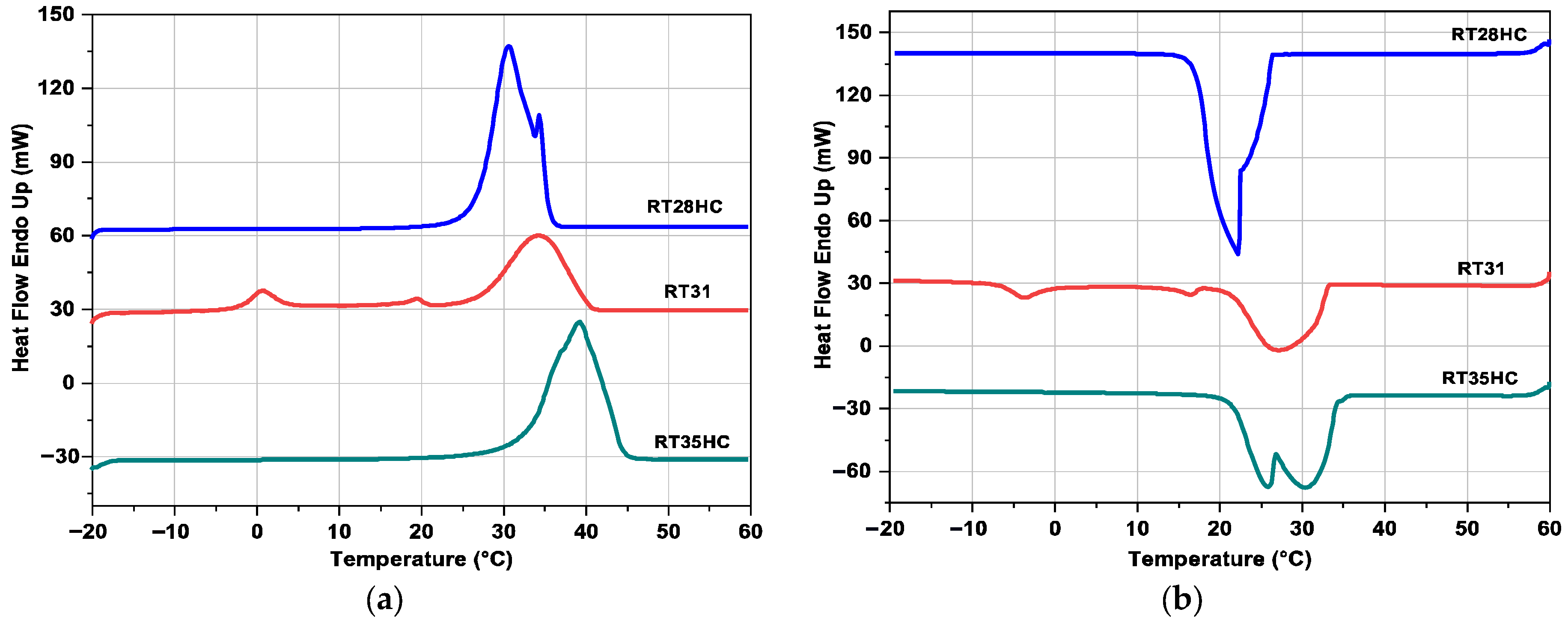
The melting thermograms of the paraffins at 10 °C·min−1 are shown in Figure 2a. All paraffins were submitted to three heating and cooling cycles, and the thermograms of the second cycle were analyzed. Temperature and phase change enthalpy values are shown in Table 3. Under heating, the melting temperature is determined as the onset of the endothermal peak. The crystallization temperature is determined as the onset of the exothermal peak during the cooling.
RT28HC and RT35HC present a main endothermic peak with onset temperatures of 26.5 °C and 33.8 °C and enthalpies of 225.1 J·g−1 and 197.9 J·g−1. These two peaks show, respectively, a splitting or a shoulder which both indicate the existence of two superimposed peaks. These endothermic peaks may be attributed to melting.
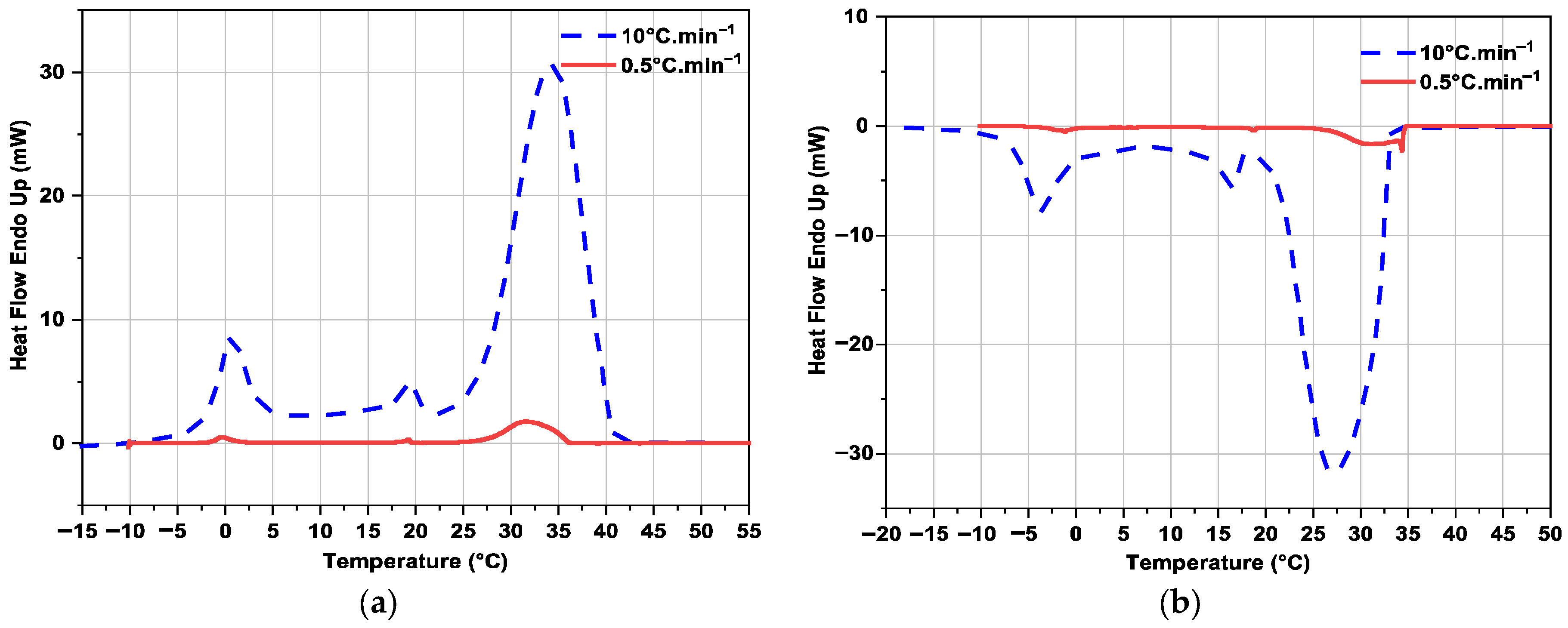
RT31 shows three endothermic peaks corresponding to the intermediate phase transitions between the crystalline solid phase and the isotropic liquid phase, probably due to the existence of rotator phases [23,24]. In that case, the first peak at −2.0 °C mays correspond to the solid–rotator phase transition, the second peak at 17.4 °C represents the transition between two rotator phases rotator—rotator, and the major peak at 27.0 °C represents the transition from the rotator phase to the liquid phase rotator, with enthalpies of 12.9 J·g−1, 3.7 J·g−1, and 111.9 J·g−1, respectively. RT31 starts to melt at 27 °C, similarly to RT28HC, which differs from the values specified by the supplier. The data sheet indicates a melting range between 29 °C and 34 °C for RT31, and between 27 °C and 29 °C for RT28HC. The lower melting enthalpy of RT31 compared with RT28HC is not favorable to the use of RT31.
The crystallization thermograms at 10 °C·min−1 are illustrated in Figure 2b. RT28HC crystallizes in a single step at 25.1 °C, with an enthalpy of crystallization of 220.7 J·g−1. However, the shape of the peak indicates the existence of at least two phenomena. This first transition can be explained by the presence of rotator phases. In that case, the rotator phase is transient and short-lived, and is only observed when cooling [24].
RT31 reaches the crystalline state in several steps. Three exothermic peaks are observed, with the first main peak appearing at 33.1 °C. The first peak, at 33.1 °C with an enthalpy of crystallization of 114.6 J·g−1, corresponds to the transition from the liquid state to the rotator phase. It is interesting to note that crystallization of RT31 starts at a temperature higher than its melting temperature. This behavior could be explained by the presence of successive transitions, leading to a complex structural organization where the last transition, occurring at a high temperature, initiates crystallization first. The second peak, at 17.6 °C with an enthalpy of 3.4 J·g−1, may be attributed to the transition between rotator phases. The third peak, at −0.2 °C with an enthalpy of 15.2 J·g−1, can be attributed either to the transition from the rotator phase to the solid phase or to the presence of a mixture of paraffins with different chain lengths. In the first case, the rotator phases are thermodynamically stable and can be observed during both heating and cooling. In the second case, the phase change occurs over a wide temperature range corresponding to the different components of the mixture. This complexity is in agreement with the literature on similar paraffins, where the presence of multiple phase transitions (rotator phase) can lead to successive solid–solid and solid–liquid transitions [42,43].
The RT35HC thermogram presents two overlapped peaks: a first peak at 34.1 °C and a second peak at 28.4 °C. If RT35HC is not a mixture of different length alkanes, these peaks may correspond to the transition from the liquid phase to the rotating phase and the transition from the rotator phase to the solid phase. It is difficult to determine the enthalpy of each peak in this case, so we have calculated the enthalpy of the two peaks at the same time.

3.2.3. Influence of Heating or Cooling Rate on DSC Curves

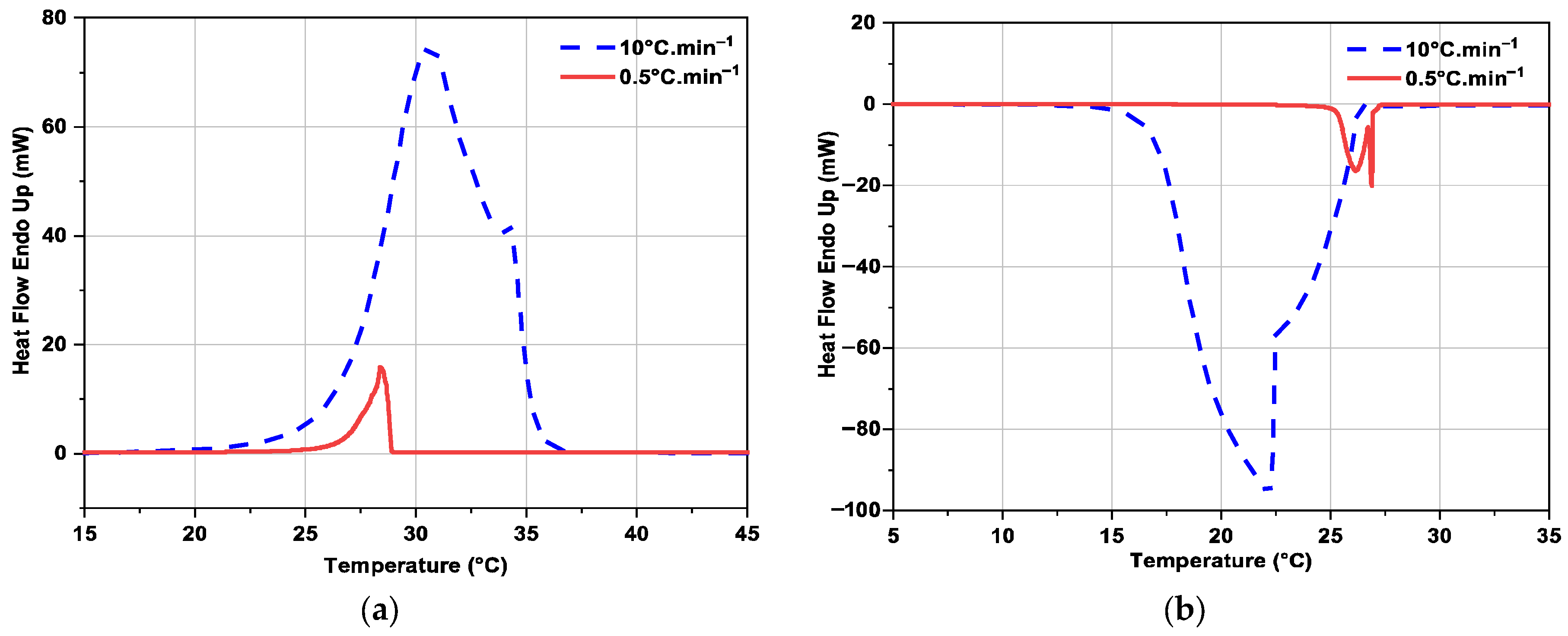
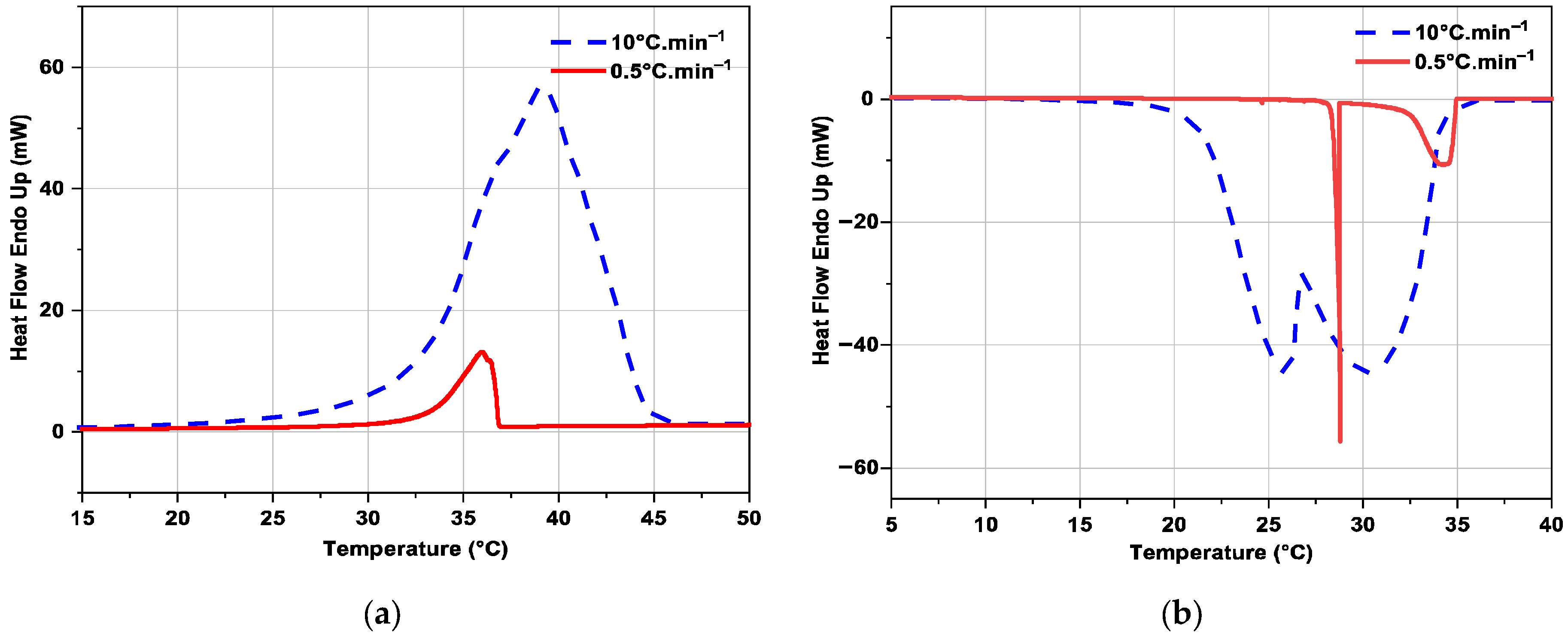
To evaluate the effect of heating and cooling rates on the temperatures and enthalpies of phase transitions, paraffins were analyzed at a rate of 0.5 °C·min−1. Different samples were analyzed. The melting and crystallization thermograms are shown in Figure 3, Figure 4 and Figure 5. Paraffin phase change temperatures and enthalpies are presented in Table 4.
For RT28HC and RT35HC paraffins, a maximum variation of 0.3 °C in melting temperature was observed compared to the results obtained at a rate of 10 °C·min−1. This temperature difference may be due to either the temperature uncertainty (0.1 °C) or the shape of the baseline, which can influence the measured value. In addition, a slight increase in enthalpy was observed at low heating rates for RT28HC and RT35HC.
An interesting phenomenon observed at low speed is the separation of crystallization peaks. For RT28HC, at a speed of 10 °C·min−1 the paraffin crystallizes in a single step. However, in reality, two peaks are overlapped. The first transition is not visible at 10 °C·min−1, but appears clearly at 0.5 °C·min−1. For RT35HC, a similar phenomenon is observed: at 10 °C·min−1 the paraffin crystallizes in two steps, with a rotator–solid transition appearing before the end of the liquid–rotator transition. At low speeds, the two peaks are distinctly separated.
During cooling, the crystallization temperature increases slightly at low speed, with a variation of 1.5 °C. In DSC analysis, the enthalpy of phase change and the melting onset temperature are normally independent of heating rate and sample mass. However, the crystallization onset temperature varies due to the phenomenon of supercooling, because it depends on the cooling rate [44].
For RT31, at a speed of 0.5 °C·min−1 a variation of around 0.5 °C was also observed in the melting temperature. It can be observed that the temperature at the end of the melting peak increases with the heating rate for the three paraffins [45]. This is because a high heating rate induces a temperature gradient within the sample, making its internal temperature non-uniform: the core of the sample remains colder than its periphery. This phenomenon is accentuated by the low thermal conductivity of paraffins, which limits thermal homogenization. As a result, some areas of the sample begin to melt while others remain solid, causing a delay in the melting process. Consequently, the phase transition no longer occurs within a narrow temperature range but instead extends over a wider range, resulting in a broadening of the melting peak in the DSC curve. This is also observed during cooling.
Variations in melting and crystallization enthalpies are observed for all paraffins. Since paraffins have a complex crystallization behavior—often occurring in multiple stages—it is difficult to accurately calculate the area under the peaks. This is particularly problematic for paraffins with overlapping crystallization peaks where the end of the first peak cannot be clearly identified because the second transition begins before the first is complete, as in the case of RT35HC.
A comparison between our DSC results and the values reported in the literature and presented in Table 5 highlights the dispersion of values observed in the literature. These variations are usual, as the characterization of paraffins in DSC is delicate. The most serious error made by some authors is to take the temperature of the peak maximum or the peak start as the phase change temperature instead of taking the onset temperature as specified by the manufacturers.
The heating rates also influence the measured values as high rates tend to increase the signal intensity, while very low rates produce noisier curves that reduce the accuracy of the enthalpy determination.
The type of DSC instrument also plays a role. For example, thermal flux DSC measures the temperature difference between the sample and the reference, while the power compensation DSC (used in this study) measures the electrical power required to maintain the sample and reference at equal temperatures, which can lead to different phase change temperatures and enthalpies [40,41].
Other factors such as sample mass, cup type, integration limits, and baseline drift also affect the results. In particular, baseline instability can alter peak areas and thus the calculated enthalpy. The introduction of short isothermal steps at the beginning and end of each ramp is known to improve baseline stability and measurement reliability [46].
The differences in the uncertainty of each instrument (±1% in calorimetric accuracy for a power compensation DSC and ±2% in thermal flux DSC of Perkin Elmer) and all these methodological effects compound the differences observed between our values and those found in the literature.
Table 5. DSC data available in the literature.
PCMReferenceRateTm (°C)ΔHf (J·g−1)Tc (°C)ΔHc (J·g−1)
RT28HCCurrent work10 °C·min−126.5225.1 ± 3.825.1220.7 ± 3.7
Current work0.5 °C·min−126.7225.3 ± 3.826.4224.3 ± 3.8
[47]0.5 °C·min−124.74189.124.27183.2
[47]2 °C·min−124.60191.224.42188.6
[47]5 °C·min−123.57201.824.77190.0
[48]0.5 °C·min−127.4242.927.6246.4
RT31Current work10 °C·min−127.0111.9 ± 1.933.1114.6 ± 2.0
Current work0.5 °C·min−127.5115.7 ± 2.034.5115.4 ± 2.0
[42]5 °C·min−123.4130.9226.30 (peak)73.44
[43]10 °C·min−125.34154.3--
RT35HCCurrent work10 °C·min−133.8197.9 ± 3.434.1196.2 ± 3.3
Current work0.5 °C·min−133.5199.2 ± 3.435.6188.3 ± 3.2
[49]5 °C·min−133.9424233.92244
[50]1 °C·min−134.06255.8831.71260.79
Nevertheless, the factors influencing the melting enthalpy values of paraffins are not only related to the analysis methods but also depend on the nature of these materials. They are sensitive to thermal history and crystallize differently depending on it. They are also sensitive to oxidation and to the presence of impurities, which leads to a decrease in the melting enthalpy.

3.2.4. Specific Heat Capacity

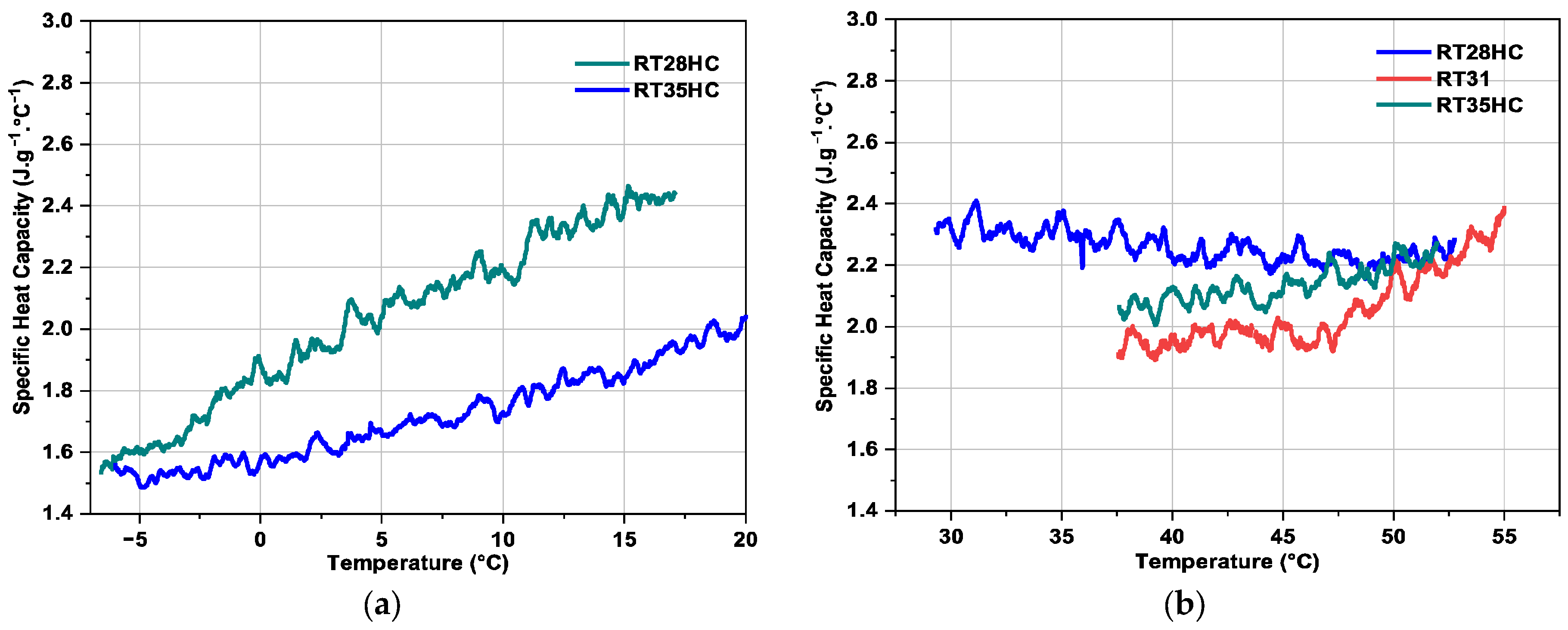
The specific heat capacity was determined at 0.5 °C·min−1 by first measuring with an empty cup to establish a baseline, then using a pure sapphire sample, and finally a paraffin sample. These were analyzed over a temperature range of 60 °C, which is recommended by the supplier Perkin Elmer. The RT28HC and RT35HC paraffins were analyzed from −7 °C to 53 °C, and RT31 was analyzed over a temperature range from −10 °C to 55 °C. The thermograms obtained are superimposed, and the baseline is subtracted from those of the sapphire and paraffin. The specific heat of the sapphire is calculated. This value is then used to determine the specific heat of the paraffin. The results are shown in Figure 6a,b.
Figure 6a shows the specific heat in the solid state (before melting) and Figure 6b shows the liquid state (after melting) for RT28HC, RT31, and RT35HC. The results show a slight increase in the solid Cp with increasing temperature. When the temperature rises, the energy supplied increases the vibration and rotation of the molecules. As melting approaches, a large increase in Cp is observed, and this increase is due not only to molecular vibrations but also to conformational movements [41,51]. After melting, the intermolecular interactions are different from those in the solid state; the molecules move freely in the liquid state, which explains why the liquid Cp varies only slightly as a function of temperature. In pure paraffin, the value of the specific heat of the solid phase is greater than that of the liquid phase, which is not the case in commercial paraffin [52].
For RT31, the specific heat capacity in solid state could not be determined due to the presence of peaks around −1.6 °C, as previously mentioned. However, analyzing the specific heat capacity (Cp) over a wide range of temperatures proves difficult, particularly when very low temperatures are involved. In this context, the Cp values obtained under these conditions are not of particular interest.
The experimental Cp data obtained by differential scanning calorimetry (DSC) were fitted to a polynomial equation of the fourth order, in accordance with the following equation:
Cp(T) = aT4 + bT3 + cT2 + dT + e
where T is the temperature and the values of the coefficients a, b, c, d, and e are shown in Table 6.

3.3. Thermal Conductivity

The thermal conductivity of the paraffins was measured at room temperature, with all paraffins in the solid state. The results obtained are presented in Table 7.
The thermal conductivities of RT28HC, RT31, and RT35HC are 0.34 W·m−1·K−1, 0.24 W·m−1·K−1, and 0.42 W·m−1·K−1, respectively. A difficulty encountered in this measurement is the presence of holes in the samples. Thermal conductivity measurements of n-octadecane and n-eicosane revealed comparable values at room temperature, reinforcing the notion that RT28HC and RT35HC are composed of n-octadecane and n-eicosane [10]. The higher conductivity and thermal diffusivity values of RT28HC and RT35HC reinforce the interest for even-numbered paraffins in energy applications. The values measured in this study agree with those reported for paraffins with similar phase change temperatures, such as n-octadecane, n-nonadecane, and n-eicosane, whose thermal conductivity varies between 0.210 and 0.425 W·m−1·K−1 [10,53,54]. These comparisons show that the PCMs studied here have typical conductivity values for organic paraffins.
Although these values are relatively low compared to inorganic PCMs, which have higher thermal conductivity, inorganic PCMs often suffer from significant supercooling and corrosion issues which limit their applications [55]. In practical applications, low thermal conductivity can slow down charging and discharging processes, limiting the rate at which the PCM absorbs or releases heat. In contrast, composites with improved conductivity can significantly improve thermal response, reducing melting/solidification times and optimizing energy management in buildings or thermal storage systems. Numerous studies have been conducted to improve this property, including the use of PCM-based composites and metal foams [56] to accelerate heat exchange, or the addition of fillers such as Fe3O4 magnetite [57], metal nanoparticles such as Al2O3, metal fins, or even a combination of these solutions [58,59]. For example, incorporating 95% by mass of graphite into a PCM reduces the melting time by 13.3% [60].

3.4. Density Measurements

The density of the paraffins was determined at room temperature (23 °C). The measured values were 859.8 kg·m−3 for RT28HC, 853.0 for RT31, and 832.1 kg·m−3 for RT35HC. These values show a slight difference compared to those reported in the datasheets [36,37,38], which can be attributed to the different measurement temperature (15 °C in the datasheets) as well as the presence of cavities in the solid samples.

4. Conclusions

This study evaluated the thermal stability and phase transition properties of three commercial paraffins with transition temperatures close to summer comfort conditions (RT28HC, RT31, and RT35HC) using thermogravimetric analysis (TGA) and differential scanning calorimetry (DSC) for their potential use in thermal management to reduce urban heat islands.
The TGA results showed that the thermal degradation of the paraffins occurred in a single main step, with initial degradation temperatures ranging from 81.3 °C to 93.4 °C depending on the composition of each PCM. It is interesting to note that RT28HC and RT31 degrade at the same temperature, whereas RT35HC is more resistant, with a degradation temperature that is 12 °C higher. This increase in its degradation temperature is probably due to the use of a long-chain alkane. The presence of several peaks on the DTG curves for RT28HC and RT35HC suggests heterogeneity in the distribution of carbon chain lengths.
DSC analyses revealed that RT28HC and RT35HC show a main melting peak with shoulders, suggesting that other transitions occur during melting, while RT31 is characterized by the presence of three successive endothermic transitions characteristic of rotator phases. The influence of heating and cooling rates was also studied, revealing a slight variation in melting and crystallization temperatures, as well as a supercooling phenomenon affecting the crystallization process.
In addition, this study identified several factors that could affect the accuracy of the DSC measurements, such as the thermal history of the samples, the choice of calibration materials, and the experimental conditions (tightness of the cups, curvature of the baseline). These results highlight the importance of optimizing experimental protocols to guarantee the reliability of DSC measurements.
In conclusion, the paraffins studied exhibited distinct thermal behaviors, influenced by their composition and structure. RT28HC and RT35HC offer interesting thermal performance in terms of enthalpy and phase change temperature, but the presence of several phases may influence their stability and their use as phase change materials (PCMs). RT31, on the other hand, is structurally complex due to transitions between rotator phases, which could affect its effectiveness in certain applications as these phases can limit the total restitution of melting enthalpy due to incomplete crystallization. In addition, measurements of the specific heat capacity (Cp) showed a significant variation between the solid and liquid states, underlining the importance of this parameter for assessing the thermal capacities of materials. However, thermal conductivity measurements revealed that paraffins have low conductivity, which requires improvement to optimize their efficiency in thermal storage systems. These results provide a solid basis for selecting and optimizing PCMs according to the specific thermal requirements of the applications under consideration. The data obtained in this study will be integrated into heat transfer models to predict the thermal behavior of these materials in energy storage systems, with a comparison between experimental data and models.
Based on these results, future work should focus on evaluating the performance of RT28HC and RT35HC in realistic configurations, for example, using small-scale test cells exposed to controlled climate cycles. At the same time, a numerical model of heat transfer coupled with phase change will be developed to predict charging and discharging kinetics under the effects of daily temperature variations. This study was also carried out with the aim of identifying the most suitable paraffin to be integrated into a roadway in order to limit the effects of heat islands in summer, storing large amounts of energy in a porous layer through which a heat transfer fluid flows. Other applications will also be considered, including the integration of these paraffins into cement matrices to improve the thermal comfort of buildings.

Author Contributions

Conceptualization, L.F., M.F. and L.I.; methodology, L.F. and M.F.; validation, M.F. and L.I.; formal analysis, L.F., M.F. and L.I.; investigation, L.F.; resources, M.F.; data curation, L.F.; writing—original draft preparation, L.F.; writing—review and editing, M.F. and L.I.; visualization, L.F.; supervision, M.F. and L.I.; project administration, M.F.; funding acquisition, M.F. and L.I. All authors have read and agreed to the published version of the manuscript.

Funding

This research was funded by the ANR CONVINCES project (ANR-21-CE50-0029).

Data Availability Statement

The data presented in this study are available on request from the corresponding author.

Conflicts of Interest

The authors declare no conflicts of interest. The funding agencies had no role in the design of the study, data collection, analysis, interpretation, writing of the manuscript, or decision to publish the results.

Abbreviations

The following abbreviations are used in this manuscript:
UHIUrban Heat Islands
TESThermal Energy Storage
PCMPhase Change Materials
TGAThermogravimetric Analysis
DTGThermogravimetric Analysis Derivative
DSCDifferential Scanning Calorimetry
CpSpecific Heat Capacity (J·g−1·°C−1)
TTemperature (°C)
ρDensity (kg·m−3)
TmMelting Temperature (°C)
ΔHmMelting Enthalpy (J·g−1)
TCCrystallization Temperature (°C)
ΔHCCrystallization Enthalpy (J·g−1)
λThermal Conductivity (W·m−1·K−1)
αThermal Diffusivity (m2·s−1)

References

  1. Montavez, J.P.; Rodriguez, A.; Jimenez, J.I. A study of the Urban Heat Island of Granada. Int. J. Climatol. 2000, 20, 899–911. [Google Scholar] [CrossRef]
  2. Heaviside, C.; Macintyre, H.; Vardoulakis, S. The Urban Heat Island: Implications for Health in a Changing Environment. Curr. Environ. Health Rep. 2017, 4, 296–305. [Google Scholar] [CrossRef]
  3. Shahmohamadi, P.; Che-Ani, A.I.; Maulud, K.N.A.; Tawil, N.M.; Abdullah, N.A.G. The Impact of Anthropogenic Heat on Formation of Urban Heat Island and Energy Consumption Balance. Urban Stud. Res. 2011, 2011, 497524. [Google Scholar] [CrossRef]
  4. Al-Salami, H.A.; Dhaidan, N.S.; Abbas, H.H.; Al-Mousawi, F.N.; Homod, R.Z. Review of PCM charging in latent heat thermal energy storage systems with fins. Therm. Sci. Eng. Prog. 2024, 51, 102640. [Google Scholar] [CrossRef]
  5. Mehling, H.; Cabeza, L.F. Heat and Cold Storage with PCM: An up to Date Introduction into Basics and Applications; Heat and Mass Transfer; Springer: Berlin/Heidelberg, Germany, 2008. [Google Scholar] [CrossRef]
  6. Kraiem, M. Contribution à la Caractérisation Thermophysique des Composites Mousses Métalliques/Matériaux à Changement de Phase Solide-Liquide. Ph.D. Thesis, University of Paris Est Créteil, Créteil, France, 2021. [Google Scholar]
  7. Chaturvedi, R.; Islam, A.; Sharma, K. A review on the applications of PCM in thermal storage of solar energy. Mater. Today Proc. 2021, 43, 293–297. [Google Scholar] [CrossRef]
  8. Regin, A.F.; Solanki, S.C.; Saini, J.S. Heat transfer characteristics of thermal energy storage system using PCM capsules: A review. Renew. Sustain. Energy Rev. 2008, 12, 2438–2458. [Google Scholar] [CrossRef]
  9. Sharma, A.; Tyagi, V.V.; Chen, C.R.; Buddhi, D. Review on thermal energy storage with phase change materials and applications. Renew. Sustain. Energy Rev. 2009, 13, 318–345. [Google Scholar] [CrossRef]
  10. Vélez, C.; Khayet, M.; Ortiz De Zárate, J.M. Temperature-dependent thermal properties of solid/liquid phase change even-numbered n-alkanes: N-Hexadecane, n-octadecane and n-eicosane. Appl. Energy 2015, 143, 383–394. [Google Scholar] [CrossRef]
  11. Zalba, B.; Marín, J.M.; Cabeza, L.F.; Mehling, H. Free-cooling of buildings with phase change materials. Int. J. Refrig. 2004, 27, 839–849. [Google Scholar] [CrossRef]
  12. Ning, N.; Sun, C.; Ma, Z.J.; Guo, S.; Jiang, S.; Zhang, J.; Hou, D.; Wang, C. A review of incorporating PCMs in various types of concrete: Thermal and mechanical properties, crack control, frost-resistance, and workability. J. Energy Storage 2025, 114, 115814. [Google Scholar] [CrossRef]
  13. Griffiths, P.W.; Huang, M.J.; Smyth, M. Improving the heat retention of integrated collector/storage solar water heaters using Phase Change Materials Slurries. Int. J. Ambient Energy 2007, 28, 89–98. [Google Scholar] [CrossRef]
  14. Li, Z.; Liang, G.; Ding, Y.; Liao, Q.; Zhu, X.; Cheng, M. Experimental study on the thermal management performance of lithium-ion battery with PCM combined with 3-D finned tube. Appl. Therm. Eng. 2024, 245, 122794. [Google Scholar] [CrossRef]
  15. Wang, G.; Li, X.; Chang, C.; Ju, H. Multi-objective passive design and climate effects for office buildings integrating phase change material (PCM) in a cold region of China. J. Energy Storage 2024, 82, 110502. [Google Scholar] [CrossRef]
  16. Baetens, R.; Jelle, B.P.; Gustavsen, A. Phase change materials for building applications: A state-of-the-art review. Energy Build. 2010, 42, 1361–1368. [Google Scholar] [CrossRef]
  17. Ikutegbe, C.A.; Farid, M.M. Application of phase change material foam composites in the built environment: A critical review. Renew. Sustain. Energy Rev. 2020, 131, 110008. [Google Scholar] [CrossRef]
  18. Lamrani, B.; Johannes, K.; Kuznik, F. Phase change materials integrated into building walls: An updated review. Renew. Sustain. Energy Rev. 2021, 140, 110751. [Google Scholar] [CrossRef]
  19. Erkizia, E.; Strunz, C.; Dauvergne, J.-L.; Goracci, G.; Peralta, I.; Serrano, A.; Ortega, A.; Alonso, B.; Zanoni, F.; Düngfelder, M.; et al. Study of paraffinic and biobased microencapsulated PCMs with reduced graphene oxide as thermal energy storage elements in cement-based materials for building applications. J. Energy Storage 2024, 84, 110675. [Google Scholar] [CrossRef]
  20. Müller, A. An X-ray investigation of normal paraffins near their melting points. Proc. R. Soc. Lond. Ser. Contain. Pap. Math. Phys. Character 1932, 138, 514–530. [Google Scholar] [CrossRef]
  21. Doucet, J.; Denicolo, I.; Craievich, A. X-ray study of the “rotator” phase of the odd-numbered paraffins C17H36, C19H40, and C21H44. J. Chem. Phys. 1981, 75, 1523–1529. [Google Scholar] [CrossRef]
  22. Ungar, G.; Masic, N. Order in the rotator phase of n-alkanes. J. Phys. Chem. 1985, 89, 1036–1042. [Google Scholar] [CrossRef]
  23. Sirota, E.B.; King, H.E.; Singer, D.M.; Shao, H.H. Rotator phases of the normal alkanes: An x-ray scattering study. J. Chem. Phys. 1993, 98, 5809–5824. [Google Scholar] [CrossRef]
  24. Cholakova, D.; Denkov, N. Rotator phases in alkane systems: In bulk, surface layers and micro/nano-confinements. Adv. Colloid Interface Sci. 2019, 269, 7–42. [Google Scholar] [CrossRef]
  25. Wu, X.Z.; Ocko, B.M.; Sirota, E.B.; Sinha, S.K.; Deutsch, M.; Cao, B.H.; Kim, M.W. Surface Tension Measurements of Surface Freezing in Liquid Normal Alkanes. Science 1993, 261, 1018–1021. [Google Scholar] [CrossRef] [PubMed]
  26. Fu, D.; Liu, Y.; Liu, G.; Su, Y.; Wang, D. Confined crystallization of binary n-alkane mixtures: Stabilization of a new rotator phase by enhanced surface freezing and weakened intermolecular interactions. Phys. Chem. Chem. Phys. 2011, 13, 15031. [Google Scholar] [CrossRef] [PubMed]
  27. Bagazi, M.S.; Melaibari, A.A.; Khoshaim, A.B.; Abu-Hamdeh, N.H.; Alsaiari, A.O.; Abulkhair, H. Using Phase Change Materials (PCMs) in a Hot and Humid Climate to Reduce Heat Gain and Energy Consumption. Sustainability 2021, 13, 10965. [Google Scholar] [CrossRef]
  28. Zeinelabdein, R.; Omer, S.; Mohamed, E.; Gan, G. Free cooling using phase change material for buildings in hot-arid climate. Int. J. Low-Carbon Technol. 2018, 13, 327–337. [Google Scholar] [CrossRef]
  29. Furst, N. Évaluation de L’impact du Changement Climatique sur le CONFORT d’été des bâtiments à Basse Consummation; Centre d’études et d’expertise sur les risques, l’environnement; Cerema: Lyon, France, 2016. [Google Scholar]
  30. Octobre 2022, le Mois le Plus Chaud à Paris… Depuis 1873! Available online: https://www.paris.fr/pages/temperatures-extremes-tempetes-tous-les-records-meteo-a-paris-20612 (accessed on 12 November 2025).
  31. Le Climat Futur en France, à quoi D’adapter? Available online: https://meteofrance.com/changement-climatique/quel-climat-futur/le-climat-futur-en-france (accessed on 12 November 2025).
  32. Ditmars, D.A.; Ishihara, S.; Chang, S.S.; Bernstein, G.; West, E.D. Enthalpy and Heat-Capacity Standard Reference Material: Synthetic Sapphire (Alpha-Al2O3) from 10 to 2250 K. J. Res. Natl. Bur. Stand. 1982, 87, 159. [Google Scholar] [CrossRef]
  33. Günther, E.; Hiebler, S.; Mehling, H.; Redlich, R. Enthalpy of Phase Change Materials as a Function of Temperature: Required Accuracy and Suitable Measurement Methods. Int. J. Thermophys. 2009, 30, 1257–1269. [Google Scholar] [CrossRef]
  34. Mesure de L’effusivité Thermique. Available online: https://www-techniques-ingenieur-fr.ezproxy.u-pec.fr/base-documentaire/mesures-analyses-th1/methodes-thermiques-d-analyse-42384210/mesure-de-l-effusivite-thermique-r2958/ (accessed on 24 June 2024).
  35. Li, S.; He, L.; Lu, H.; Hao, J.; Wang, D.; Shen, F.; Song, C.; Liu, G.; Du, P.; Wang, Y.; et al. Ultrahigh-performance solid-solid phase change material for efficient, high-temperature thermal energy storage. Acta Mater. 2023, 249, 118852. [Google Scholar] [CrossRef]
  36. Techdata_-RT28HC. Available online: https://www.rubitherm.eu/media/products/datasheets/Techdata_-RT28HC_EN_09102020.PDF (accessed on 12 November 2025).
  37. Techdata_-RT31. Available online: https://www.rubitherm.eu/media/products/datasheets/Techdata_-RT31_EN_18042024.PDF (accessed on 12 November 2025).
  38. Techdata_-RT35HC. Available online: https://www.rubitherm.eu/media/products/datasheets/Techdata_-RT35HC_EN_09102020.PDF (accessed on 12 November 2025).
  39. Lazaro, A.; Peñalosa, C.; Solé, A.; Diarce, G.; Haussmann, T.; Fois, M.; Zalba, B.; Gshwander, S.; Cabeza, L.F. Intercomparative tests on phase change materials characterisation with differential scanning calorimeter. Appl. Energy 2013, 109, 415–420. [Google Scholar] [CrossRef]
  40. van der Plaats, G. The Practice of Thermal Analysis; Mettler: Columbus, OH, USA, 1991. [Google Scholar]
  41. Wunderlich, B. Thermal Analysis of Polymeric Materials; Springer: Berlin/Heidelberg, Germany, 2005. [Google Scholar] [CrossRef]
  42. Fabiani, C.; Santini, C.; Barbanera, M.; Giannoni, T.; Rubino, G.; Cotana, F.; Pisello, A.L. Phase change materials-impregnated biomass for energy efficiency in buildings: Innovative material production and multiscale thermophysical characterization. J. Energy Storage 2023, 58, 106223. [Google Scholar] [CrossRef]
  43. Sánchez-Silva, L.; Rodríguez, J.F.; Sánchez, P. Influence of different suspension stabilizers on the preparation of Rubitherm RT31 microcapsules. Colloids Surf. Physicochem. Eng. Asp. 2011, 390, 62–66. [Google Scholar] [CrossRef]
  44. Reserved M-TII. All Rights Evaluation and Interpretation of Peak Temperatures of DSC Curves. Part 1: Basic Principles. Available online: https://www.mt.com/in/en/home/supportive_content/matchar_apps/MatChar_UC232.html (accessed on 20 October 2025).
  45. Klimeš, L.; Charvát, P.; Mastani Joybari, M.; Zálešák, M.; Haghighat, F.; Panchabikesan, K.; El Mankibi, M.; Yuan, Y. Computer modelling and experimental investigation of phase change hysteresis of PCMs: The state-of-the-art review. Appl. Energy 2020, 263, 114572. [Google Scholar] [CrossRef]
  46. Feng, G.; Huang, K.; Xie, H.; Li, H.; Liu, X.; Liu, S.; Cao, C. DSC test error of phase change material (PCM) and its influence on the simulation of the PCM floor. Renew. Energy 2016, 87, 1148–1153. [Google Scholar] [CrossRef]
  47. Laasri, I.A.; Charai, M.; Es-sakali, N.; Mghazli, M.O.; Outzourhit, A. Evaluating passive PCM performance in building envelopes for semi-arid climate: Experimental and numerical insights on hysteresis, sub-cooling, and energy savings. J. Build. Eng. 2024, 98, 111161. [Google Scholar] [CrossRef]
  48. Xiong, T.; Kua, H.W.; Shah, K.W.; Hussein, G.F.; Zhang, B. Graphene nanoplatelets and copper foams for improving passive cooling performance of PCMs in Singapore’s tropical climate. J. Energy Storage 2024, 80, 110195. [Google Scholar] [CrossRef]
  49. Öztop, H.F.; Gürgenç, E.; Gür, M. Thermophysical properties and enhancement behavior of novel B4C-nanoadditive RT35HC nanocomposite phase change materials: Structural, morphological, thermal energy storage and thermal stability. Sol. Energy Mater. Sol. Cells 2024, 272, 112909. [Google Scholar] [CrossRef]
  50. Arshad, A.; Jabbal, M.; Yan, Y. Thermophysical characteristics and application of metallic-oxide based mono and hybrid nanocomposite phase change materials for thermal management systems. Appl. Therm. Eng. 2020, 181, 115999. [Google Scholar] [CrossRef]
  51. Jin, Y.; Wunderlich, B. Heat capacities of paraffins and polyethylene. J. Phys. Chem. 1991, 95, 9000–9007. [Google Scholar] [CrossRef]
  52. Kahwaji, S.; Johnson, M.B.; Kheirabadi, A.C.; Groulx, D.; White, M.A. A comprehensive study of properties of paraffin phase change materials for solar thermal energy storage and thermal management applications. Energy 2018, 162, 1169–1182. [Google Scholar] [CrossRef]
  53. Faden, M.; Höhlein, S.; Wanner, J.; König-Haagen, A.; Brüggemann, D. Review of Thermophysical Property Data of Octadecane for Phase-Change Studies. Materials 2019, 12, 2974. [Google Scholar] [CrossRef]
  54. Sharma, S.D.; Sagara, K. Latent Heat Storage Materials and Systems: A Review. Int. J. Green Energy 2005, 2, 1–56. [Google Scholar] [CrossRef]
  55. Min, K.-E.; Jang, J.-W.; Kim, J.-K.; Wern, C.; Yi, S. Thermophysical Properties of Inorganic Phase-Change Materials Based on MnCl2·4H2O. Appl. Sci. 2022, 12, 6338. [Google Scholar] [CrossRef]
  56. Li, W.Q.; Zhang, T.Y.; Li, B.B.; Xue, Z.R.; Wang, H.; Zhang, D. Enhanced energy management performances of passive cooling, heat storage and thermoelectric generator by using phase change material saturated in metal foam. Int. J. Therm. Sci. 2023, 184, 107869. [Google Scholar] [CrossRef]
  57. Şahan, N.; Fois, M.; Paksoy, H. Improving thermal conductivity phase change materials—A study of paraffin nanomagnetite composites. Sol. Energy Mater. Sol. Cells 2015, 137, 61–67. [Google Scholar] [CrossRef]
  58. Zhang, J.; Cao, Z.; Huang, S.; Huang, X.; Liang, K.; Yang, Y.; Zhang, H.; Tian, M.; Akrami, M.; Wen, C. Improving the melting performance of phase change materials using novel fins and nanoparticles in tubular energy storage systems. Appl. Energy 2022, 322, 119416. [Google Scholar] [CrossRef]
  59. Li, B.; Mao, Z.; Song, B.; Chen, P.; Wang, H.; Sundén, B.; Wang, Y.-F. Enhancement of phase change materials by nanoparticles to improve battery thermal management for autonomous underwater vehicles. Int. Commun. Heat Mass Transf. 2022, 137, 106301. [Google Scholar] [CrossRef]
  60. Zeng, J.-L.; Chen, Y.-H.; Shu, L.; Yu, L.-P.; Zhu, L.; Song, L.-B.; Cao, Z.; Sun, L.-X. Preparation and thermal properties of exfoliated graphite/erythritol/mannitol eutectic composite as form-stable phase change material for thermal energy storage. Sol. Energy Mater. Sol. Cells 2018, 178, 84–90. [Google Scholar] [CrossRef]
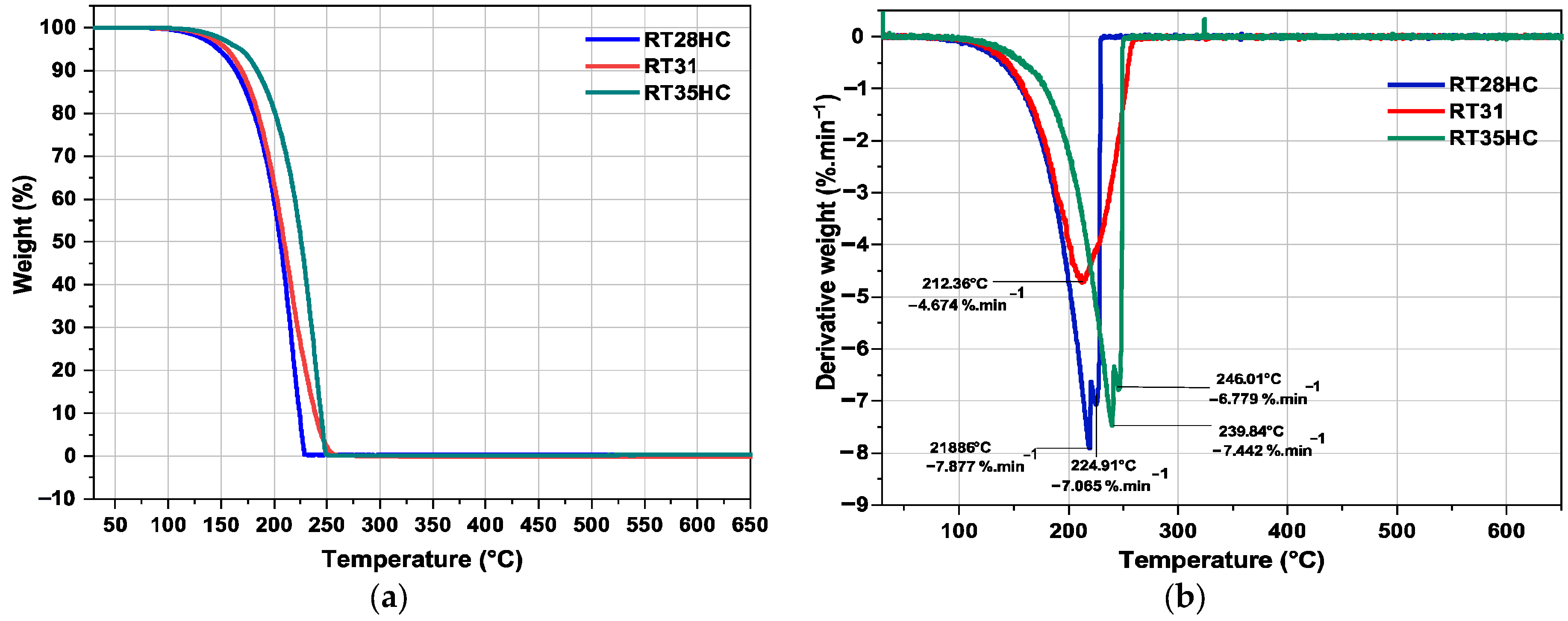
Figure 1. Evolution of paraffin weight and its derivative as a function of temperature: (a) weight (TGA) curves; (b) derivative weight (DTG) curves.
Energies 18 06331 g001
Figure 2. DSC thermograms upon: (a) heating; (b) cooling of RT28HC, RT31, and RT35HC at 10 °C·min−1.
Energies 18 06331 g002
Figure 3. Thermograms upon of (a) heating and (b) cooling of RT28HC at 10 °C·min−1 and 0.5 °C·min−1.
Energies 18 06331 g003
Figure 4. Thermograms upon of (a) heating and (b) cooling of RT31 at 10 °C·min−1 and 0.5 °C·min−1.
Energies 18 06331 g004
Figure 5. Thermograms upon of (a) heating and (b) cooling of RT35HC at 10 °C·min−1 and 0.5 °C·min−1.
Energies 18 06331 g005
Figure 6. DSC specific heat capacity of: (a) solid state; (b) liquid state of RT28HC, RT31, and RT35HC at 0.5 °C·min−1.
Energies 18 06331 g006
Table 1. Characteristics of paraffins.
PCMTm (°C)Temperature Range (°C)Latent Heat + Sensible Heat
in the Temperature Range
(J·g−1)
Density
(kg·m−3)
Heat Conductivity (W·m−1·K−1)
RT28HC27–2921 to 36250.0 ± 18.7880 at 15 °C
770 at 40 °C
0.2
RT3129–3423 to 28165.0 ± 12.4830 at 15 °C
760 at 45 °C
0.2
RT35HC34–3627 to 42240.0 ± 18.0880 at 25 °C
770 at 40 °C
0.2
Table 2. Paraffin temperatures at different mass loss rates.
PCMDegradation Temperature (°C)T5% (°C)T25% (°C)T50% (°C)T100% (°C)
RT28HC81.3147.4187.2205.9229.2
RT3184.2155.2190.1209.4253.5
RT35HC93.4168.1206.7225.6249.4
Table 3. Temperatures and enthalpies of phase changes in paraffins at 10 °C·min−1.
PCMTm (°C)ΔHm (J·g−1)Tc (°C)ΔHc (J·g−1)
RT28HC26.5225.1 ± 3.825.1220.7 ± 3.7
RT31−2.012.9 ± 0.333.1114.6 ± 2.0
17.43.7 ± 0.117.63.4 ± 0.1
27.0111.9 ± 1.9−0.215.2 ± 2.0
RT35HC33.8197.9 ± 3.434.1196.2 ± 3.3
Table 4. Temperatures and enthalpies of phase changes in paraffins at 0.5 °C·min−1.
PCMTm (°C)ΔHm (J·g−1)Tc (°C)ΔHc (J·g−1)
RT28HC26.7225.3 ± 3.826.4224.3 ± 3.8
RT31−1.613.1 ± 0.334.5115.4 ± 2.0
18.44.8 ± 0.119.04.2 ± 0.1
27.5115.7 ± 2.01.416.2 ± 0.3
RT35HC33.5199.2 ± 3.435.6188.3 ± 3.2
Table 6. The values of the coefficients in the specific heat equation.
abcde
RT28HC
Solid1.6415 · 10−6−3.1957 · 10−5−4.4534 · 10−44.5437 · 10−21.8372
Liquid8.9185 · 10−7−1.1392 · 10−45.1577 · 10−3−1.0234 · 10−13.1084
RT31
Solid-----
Liquid−2.6128 · 10−54.9156 · 10−3−3.4290 · 10−11.0531 · 101−1.1835 · 102
RT35HC
Solid2.0557 · 10−6−6.1754 · 10−57.8453 · 10−41.5286 · 10−21.5722
Liquid−1.7551 · 10−53.2106 · 10−3−2.1882 · 10−16.5977−7.2248
Table 7. Thermal conductivity and diffusivity of paraffin.
PCMRT28HCRT31RT35HC
λ (W·m−1·K−1)0.344 ± 0.0170.242 ± 0.0120.422 ± 0.021
α (mm2·s−1)0.074 ± 0.0070.059 ± 0.0050.114 ± 0.011
Disclaimer/Publisher’s Note: The statements, opinions and data contained in all publications are solely those of the individual author(s) and contributor(s) and not of MDPI and/or the editor(s). MDPI and/or the editor(s) disclaim responsibility for any injury to people or property resulting from any ideas, methods, instructions or products referred to in the content.