1. Introduction
Gas-insulated switchgear (GIS) has been widely applied in power systems due to its distinct advantages, including operational safety, high reliability, compact footprint, and minimal environmental impact [
1,
2,
3]. In recent years, however, the frequent occurrence of insulation discharge faults in GIS equipment has compromised the reliability of regional power supply. Consequently, enhancing the operational reliability and insulation condition sensing capability of GIS equipment has become a critical issue requiring urgent resolution [
4,
5].
During the manufacturing process, minor defects may inevitably be introduced into GIS equipment. Under the influence of long-term stress, these insulation defects can trigger partial discharge (PD), which inflicts damage on the insulating medium, accelerates insulation degradation, and may gradually evolve into insulation flashover or breakdown [
6,
7,
8]. In recent years, researchers have developed various detection methods based on the abundant information reflecting insulation status contained in PD signals, variations in GIS vibration signals, and SF
6 decomposition products [
9,
10,
11,
12,
13,
14], thereby achieving effective detection of insulation defects.
Despite these advances, substantial differences remain among detection methods in terms of working principles, anti-interference capability, and engineering feasibility. Current studies predominantly focus on single detection modalities, lacking a systematic comparison and comprehensive evaluation of their technical characteristics and limitations. Although several reviews on GIS PD detection have been published in recent years, they are often confined to individual techniques or single physical domains. To address this gap, this paper provides an integrated, engineering-oriented perspective by systematically comparing electrical, electromagnetic, acoustic, and chemical detection methods within a unified framework. Beyond theoretical principles, particular emphasis is placed on technological maturity and field applicability, thereby offering practical guidance for GIS insulation defect diagnosis and complementing the existing body of literature.
2. Electrical Methods
2.1. Pulse Current
The pulse current method is currently the most widely applied technique internationally for measuring apparent charge, governed by clear specifications (IEC 60270 and GB/T7354 standards) [
15,
16,
17]. When PD occurs, the carrier recombination process induced by electric field distortion within the dielectric generates nanosecond-scale transient current pulses. By detecting the time-domain and frequency-domain characteristics of these pulse signals, the quantitative characterization of PD can be achieved. The current pulse signals generated by PD possess a broad spectrum, with their primary energy typically distributed within the frequency band ranging from tens of kHz to several hundred MHz [
18].
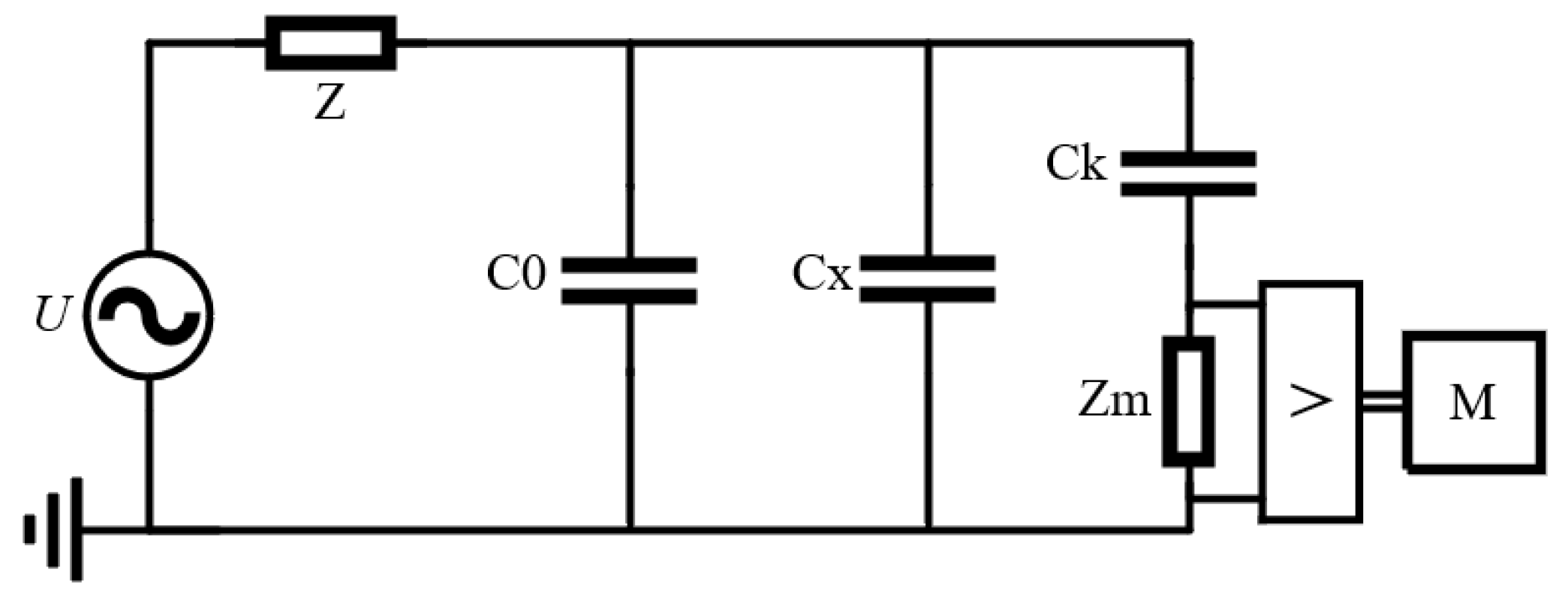
The measurement circuit of the pulse current method is illustrated in
Figure 1, where
Z is the protective impedance,
Ck represents the coupling capacitance,
ZM denotes the measuring impedance,
C0 is the equivalent capacitance of the connecting fixtures between the test object and the power supply, and
CX refers to the equivalent capacitance of the test object. When a PD occurs in the tested equipment
CX, the generated pulse current flows through the coupling circuit and passes through the detection impedance
ZM. By measuring the voltage signal across the impedance and performing calibration, information such as the apparent charge and discharge phase corresponding to the PD pulse can be obtained [
19,
20]. Based on parameters such as apparent charge, discharge repetition rate, and phase distribution, Phase Resolved Partial Discharge (PRPD) patterns or Phase Resolved Pulse Sequence (PRPS) patterns are constructed to facilitate the identification and analysis of discharge modes [
21]. Researchers relying on the pulse current method have reached an extensive consensus regarding PD characteristics in various power equipment and insulating media, establishing a relatively comprehensive quantitative evaluation system [
22].
The pulse current method can be categorized into two technical routes based on bandwidth characteristics: the wideband method (100–900 kHz) and the narrowband method (9–30 kHz). The wideband method offers high pulse resolution and abundant information but suffers from a relatively low signal-to-noise ratio (SNR) and is susceptible to wideband electromagnetic interference, such as switching operations. Conversely, the narrowband method is characterized by high sensitivity, strong anti-interference capability, and excellent SNR; however, significant high-frequency information is lost during signal processing, which may lead to blind spots in PD identification. Therefore, to surmount the limitations of conventional pulse current methods in extracting PD characteristic information, a coupling method based on the Rogowski coil has been introduced. This has led to the development of High Frequency (HF) and Ultra-Wideband (UWB) pulse current methods, extending the detection frequency band to 30–100 MHz. Although these methods have significantly enhanced the detection capability of PD signals, the broadened frequency band has inevitably introduced increased noise interference [
23,
24,
25]. Consequently, optimization research regarding high-frequency pulse current methods predominantly focuses on noise suppression and signal separation [
26,
27,
28].
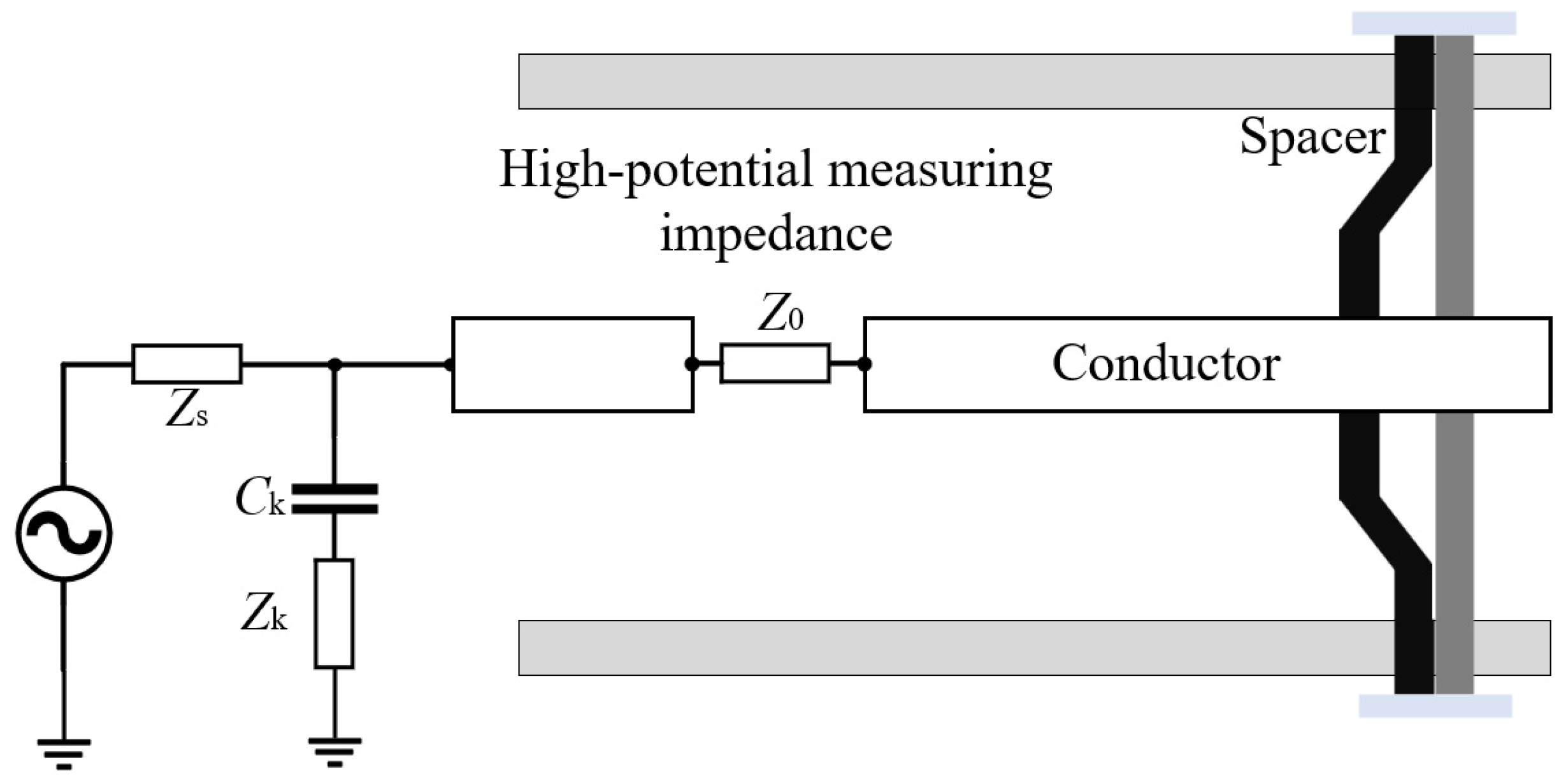
To suppress noise interference on discharge signals, Li Xing et al. [
29] proposed the high-potential pulse current method. By connecting the measurement impedance directly in series with the high-voltage conductor to measure pulse current signals, this method not only effectively circumvents ground loops and external electromagnetic interference but also achieves high-sensitivity measurement for the entire GIS. The measurement principle is illustrated in
Figure 2. When PD occurs on the test object side, the pulse current flows through the loop formed by the test object, the coupling capacitor
Ck, protective impedance
ZS, measuring impedance
Zk and the high-voltage conductor. The pulse current signal can be measured by inserting the measurement impedance into either the grounding line of the coupling capacitor or the high-voltage conductor.
The high-potential pulse current method and the Ultra-High Frequency (UHF) method were employed to detect PD signals. An insulator surface flashover occurred after the voltage was stepped up to 500 kV. The results indicate that the traditional pulse current method failed to effectively acquire PD signals due to severe interference. In contrast, the high-potential pulse current signal maintained high detection sensitivity under field conditions, successfully detecting PD caused by metal particles on the insulator surface.
In summary, due to the highly complex electromagnetic environment on-site, it is difficult for measured signals to achieve ideal anti-interference effects. The identification of PD types necessitates that testing personnel compare measurement results with standard patterns, which renders the process prone to false negatives and false positives under noise interference. Although direct measurement of discharge signals at high potential can effectively circumvent interference, the configuration of inserting impedance directly into the high-voltage conductor compromises the structural stability of the GIS, introducing new risks regarding insulation and operational reliability. Furthermore, the pulse current method relies on a single-point access measurement approach, lacking the capability to localize the PD source [
30]. Finally, constrained by the contact-based measurement nature, the traditional pulse current method is difficult to apply to online monitoring. Currently, it is primarily utilized in offline detection environments such as type tests, preventive tests, and laboratory research of power equipment.
2.2. Ultra-High Frequency
When PD occurs, the carrier recombination process within the insulating medium not only excites transient current pulses but also radiates three types of signal waves into the surrounding space along the waveguide direction: Transverse Electromagnetic (TEM), Transverse Electric (TE), and Transverse Magnetic (TM) waves. These signals are collectively classified as UHF electromagnetic signals [
31,
32,
33]. According to Maxwell’s equations, PD-excited electromagnetic waves can be modeled as spherical waves radiated from a point source. Their spectral characteristics are closely related to the insulation status of the discharge gap and the geometric structure of the PD source [
34,
35,
36,
37,
38]. Typically, PD-excited electromagnetic wave signals exhibit rise times on the order of nanoseconds, with frequencies exceeding 1 GHz, demonstrating extremely wide bandwidth characteristics [
26,
39,
40].
Furthermore, the coaxial structure, where the GIS conductor is situated at the center of the metal enclosure, constitutes an excellent electromagnetic waveguide, allowing PD-excited electromagnetic waves to propagate internally in specific guided modes [
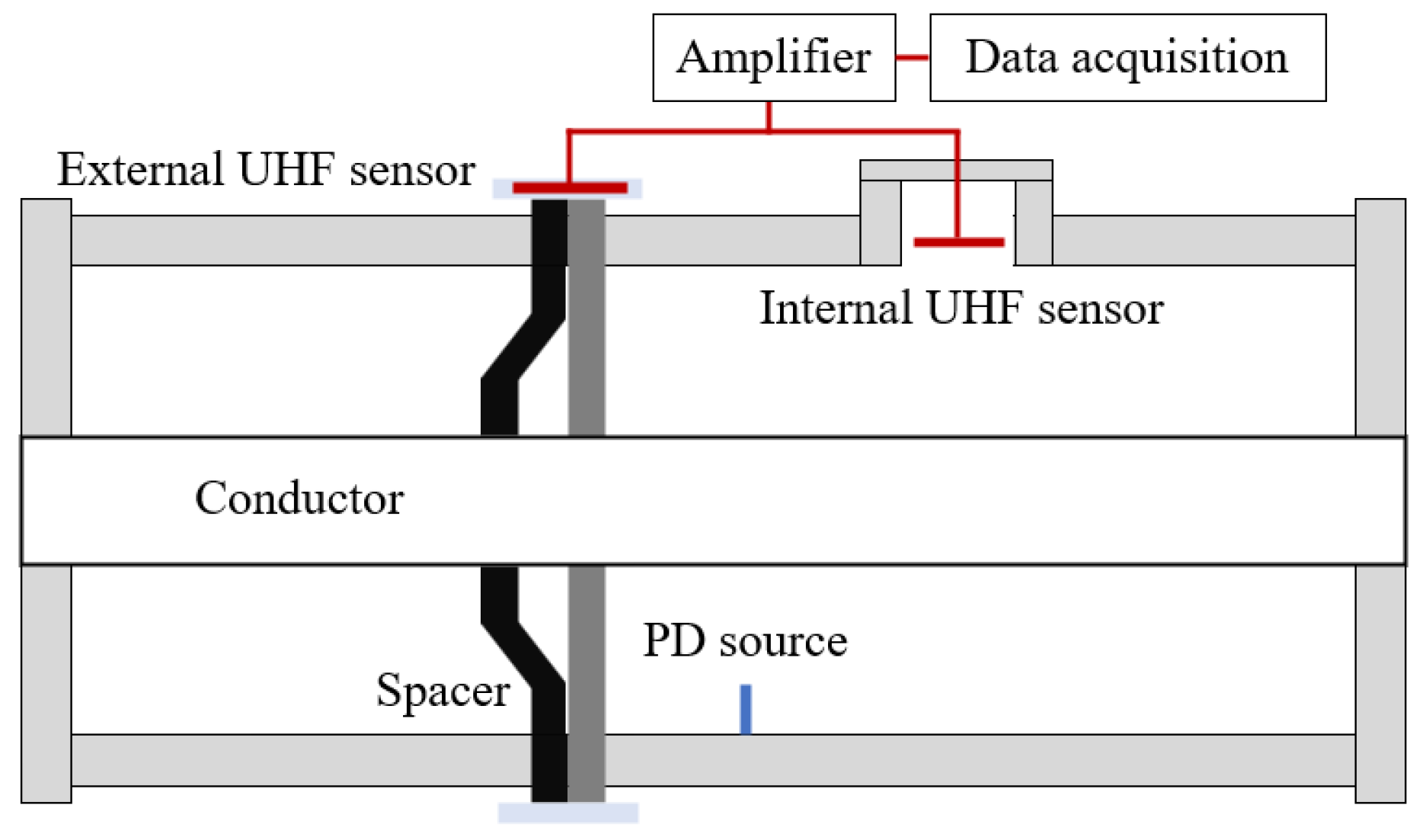
41,
42]. UHF sensors can be categorized into external and internal types based on their installation method [
43], as shown in
Figure 3.
During propagation, electromagnetic wave signals attenuate with increasing distance; therefore, internal sensors must be arranged at specific intervals within the GIS [
44]. Localization of the PD source can be achieved based on the Time Difference of Arrival (TDOA) of signals received by different sensors. On the other hand, electromagnetic signals can radiate outward at the GIS basin insulators. Based on this characteristic, UHF sensors can be installed in the outer diameter region of the insulators to receive UHF signals generated by PD. GIS equipment typically contains multiple basin insulators. These insulators not only offer multiple optional locations for sensor deployment but, as critical components of the GIS insulation system, the signals detected at these points can also sensitively reflect the insulation condition of the basin insulators themselves.
The technical characteristics of the UHF method are highly compatible with the fully metal-enclosed structure of GIS. Signals received by internal sensors originate primarily from internal PD, thereby effectively shielding against external interference [
45]. In substation environments, the frequency of most electromagnetic interference is below 300 MHz; consequently, external sensors can also effectively evade low-frequency noise interference, enhancing the SNR and the reliability of detection results.
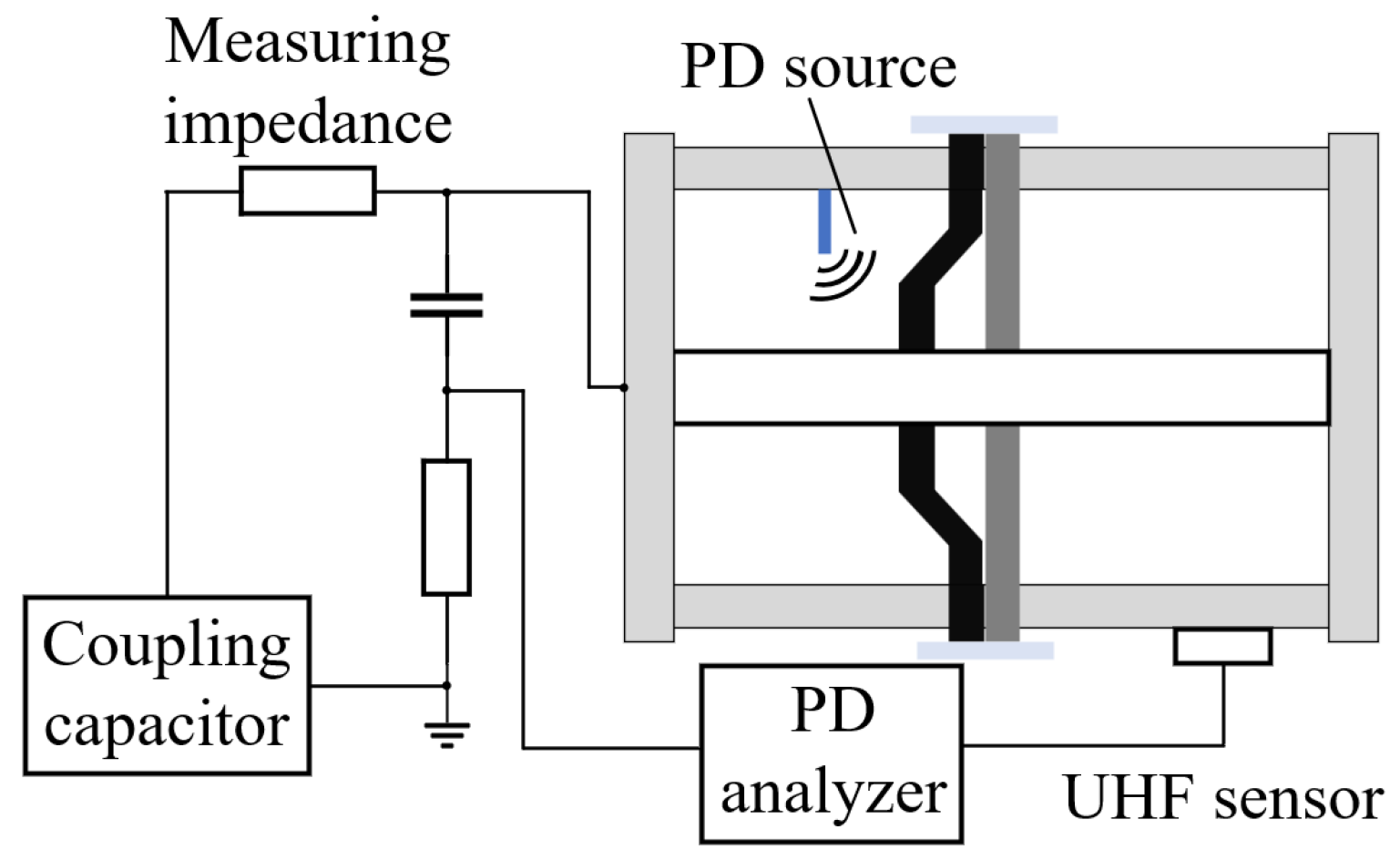
Lu Yao constructed a UHF measurement platform for typical GIS defects [
46], as illustrated in
Figure 4, to measure PD signals under conditions of no PD (background noise), free particle discharge, floating electrode discharge, insulation discharge, and corona discharge. Based on the corresponding PRPD and PRPS patterns, it was concluded that the background noise in the absence of PD signals exhibited a uniform amplitude distribution. In contrast, the discharge caused by free particles was characterized by a wide dispersion of discharge amplitudes and unstable discharge intervals. Consequently, the detection of particles was successfully achieved using the UHF method.
However, a critical limitation of this method is the lack of a direct and stable quantitative correlation between the apparent charge generated by the discharge source and the UHF signal received by the sensor. Consequently, it remains difficult to achieve precise calibration of the apparent charge. Possessing the capability for live monitoring, this method is frequently employed in conjunction with detection means such as the pulse current method and is widely utilized for PD monitoring in GIS equipment. Currently, research related to the UHF method primarily focuses on the development of novel sensors and the exploration of discharge quantity calibration methods.
3. Ultrasonic
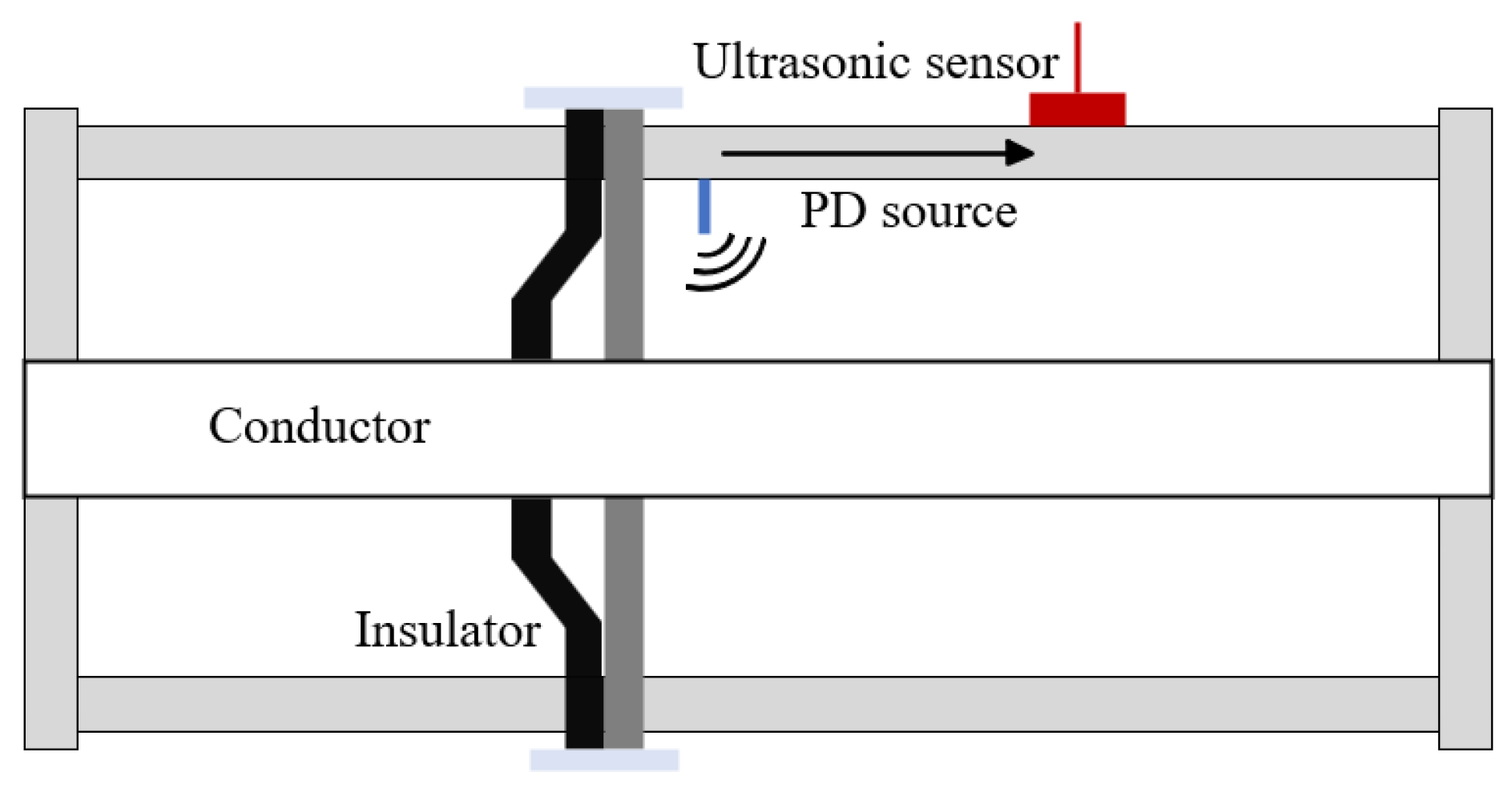
PD within GIS equipment is inherently a rapid energy release process. The gas within the discharge channel is instantaneously heated and expands drastically, triggering violent collisions between gas molecules and forming micro-shockwaves. Subsequently, the gaseous medium rapidly cools and contracts. This intense expansion–contraction process excites high-frequency mechanical vibrations, which propagate outward through the medium in the form of acoustic waves, typically with a frequency range distributed between 20 kHz and 100 kHz. This phenomenon realizes the conversion process from electrical energy to mechanical energy, and finally to acoustic signals. The detection principle is illustrated in
Figure 5.
The most prominent advantage of the ultrasonic method lies in its exceptional immunity to electromagnetic interference. Since ultrasonic signals are physically independent of the electromagnetic signals accompanying the discharge, and the propagation mechanisms of acoustic and electromagnetic signals differ, the method remains effective even in environments with strong electromagnetic noise. As a non-contact detection method, detection can be implemented simply by mounting sensors on the equipment enclosure without connecting to the electrical circuit, thus ensuring no impact on the normal operation of the equipment [
47]. Consequently, the ultrasonic method is widely applied in equipment such as GIS [
48,
49,
50,
51,
52].
However, this method also possesses several limitations. As mechanical waves, the propagation of ultrasound relies heavily on the medium and suffers significant energy attenuation during transmission. Acoustic attenuation is particularly pronounced when signals pass through basin insulators. This results in a limited detection range for traditional piezoelectric transducers (PZT), typically necessitating the deployment of multiple sensors on the equipment surface to cover critical areas, which increases the workload and introduces inconvenience to on-site applications. Secondly, this method is susceptible to interference from non-electrical environmental noise, such as the mechanical vibration of the equipment body, potentially leading to misjudgment of PD categories. Finally, there is no simple linear relationship between the strength of the ultrasonic signal and the severity of PD. Its response is collectively influenced by factors such as discharge type, location, and propagation path, making it difficult to achieve a precise evaluation of the discharge magnitude [
53].
He Yanliang et al. constructed a 252 kV GIS chamber as a test platform and arranged metal particles, cracks, and bubbles as basin insulator defects [
54]. The time-domain and frequency-domain signals were subsequently measured using the ultrasonic method. The observations indicate that the difference in maximum time-domain amplitude between clean and defective basin insulators is minimal, distributed around 200 mV; however, a distinct shift exists in their dominant frequencies. The results demonstrate that time-domain amplitude alone is insufficient for reliable defect discrimination, as clean and cracked basin insulators exhibit nearly identical peak values. In contrast, their frequency-domain characteristics show clear differences, with the dominant frequency shifting from 24.00 kHz to 14.83 kHz, indicating that spectral features provide a more robust and reliable indicator for ultrasonic-based defect identification in GIS basin insulators.
Although the technology for acquiring ultrasonic signals using PZT sensors is mature and easy to operate, the inherent sensitivity limitations of these sensors render them less than ideal when applied to large-scale power equipment such as power transformers [
55]. With the increasing maturity of optoelectronic technology, fiber optic ultrasonic sensors have become a key means to break through the bottlenecks of traditional detection techniques. Based on sensing principles, fiber optic ultrasonic sensors can be categorized into three types: passive grating, active grating, and fiber optic interferometric types.
Passive grating sensors are based on Fiber Bragg Gratings (FBG), while active grating sensors rely on phase-shifted grating structures capable of spontaneously generating sensing optical signals. When the ultrasonic signals received by either grating change, the center wavelength of the reflected or output optical signal is altered, thereby realizing the perception of PD. Fiber optic interferometric sensors achieve PD detection by analyzing the influence of ultrasonic waves on the phase of the interference optical path between the sensing light and the reference light [
56,
57,
58].
Grating-type sensors have already surpassed traditional PZT sensors in sensitivity; however, to achieve early warning of insulation defects, further improvement in detection sensitivity is still required. Furthermore, due to the severe attenuation of ultrasonic waves in large equipment, multiple sensors are often required in practical applications, placing higher demands on multiplexing technology. Currently, passive grating sensors only support Time Division Multiplexing (TDM), whereas active grating sensors can utilize Wavelength Division Multiplexing (WDM) to achieve signal separation and demodulation, making them more suitable for multi-channel synchronous detection and localization. Although fiber optic interferometric sensors hold good development potential, their high difficulty in multiplexing makes it challenging to support distributed detection, and related technologies still await further in-depth research and breakthroughs. Currently, fiber optic ultrasonic sensing technology is primarily applied in transformers and GIS equipment [
59].
4. Optical Methods
4.1. Optical Fiber Spectroscopy
In the process of PD, in addition to electromagnetic and ultrasonic signals, optical radiation constitutes a significant physical manifestation. In GIS equipment, the presence of insulation defects leads to local electric field concentration, inducing gas ionization and generating free electrons. Electrons transition from the ground state or lower energy states to higher energy states. Carriers in these unstable high energy states spontaneously transition back to lower states, releasing energy in the form of photon radiation, thereby realizing the conversion from electrical energy to optical energy [
60,
61]. As an inherent characteristic of gas discharge, optical radiation exhibits a high degree of synchronicity with the discharge event. Therefore, through the measurement and analysis of optical signals, the severity of PD can be effectively reflected [
62,
63,
64,
65].
Optical fiber spectroscopy involves acquiring the spectral distribution of PD and analyzing light intensity characteristics at different wavelengths to identify the discharge type and evaluate its severity. The implementation of optical measurement methods relies on high-sensitivity photoelectric converters, with the Photomultiplier Tube (PMT) being a commonly used core component [
66,
67,
68]. Currently, measurement probes for optical fiber spectroscopy are primarily divided into two categories: quartz fibers and fluorescent fibers. These probes work in conjunction with PMTs and spectrometers to complete the acquisition, amplification, conversion, and analysis of weak optical signals [
69,
70,
71]. It is worth noting that quartz fibers are constrained by their Numerical Aperture (NA); they cannot receive divergent light signals from PD and are limited to capturing only the portion of the spectrum within the acceptance angle defined by the NA [
72].
Fluorescent fiber sensors are similarly composed of a core and cladding. The cladding wraps around the exterior of the core and is transparent, while the core is doped with specific fluorescent substances. These substances absorb light of specific wavelengths to excite fluorescent signals, which are then transmitted within the fiber and ultimately collected and converted by equipment such as PMTs at the terminal end. Unlike ordinary quartz fibers, fluorescent fibers are less constrained by the numerical aperture limitation due to their absorption–re-emission mechanism. They possess the capability to receive weak optical signals from all directions, thereby offering higher detection sensitivity [
73,
74]. Furthermore, their installation is more convenient, requiring deployment only at critical insulation locations within the GIS.
Ren Ming et al. [
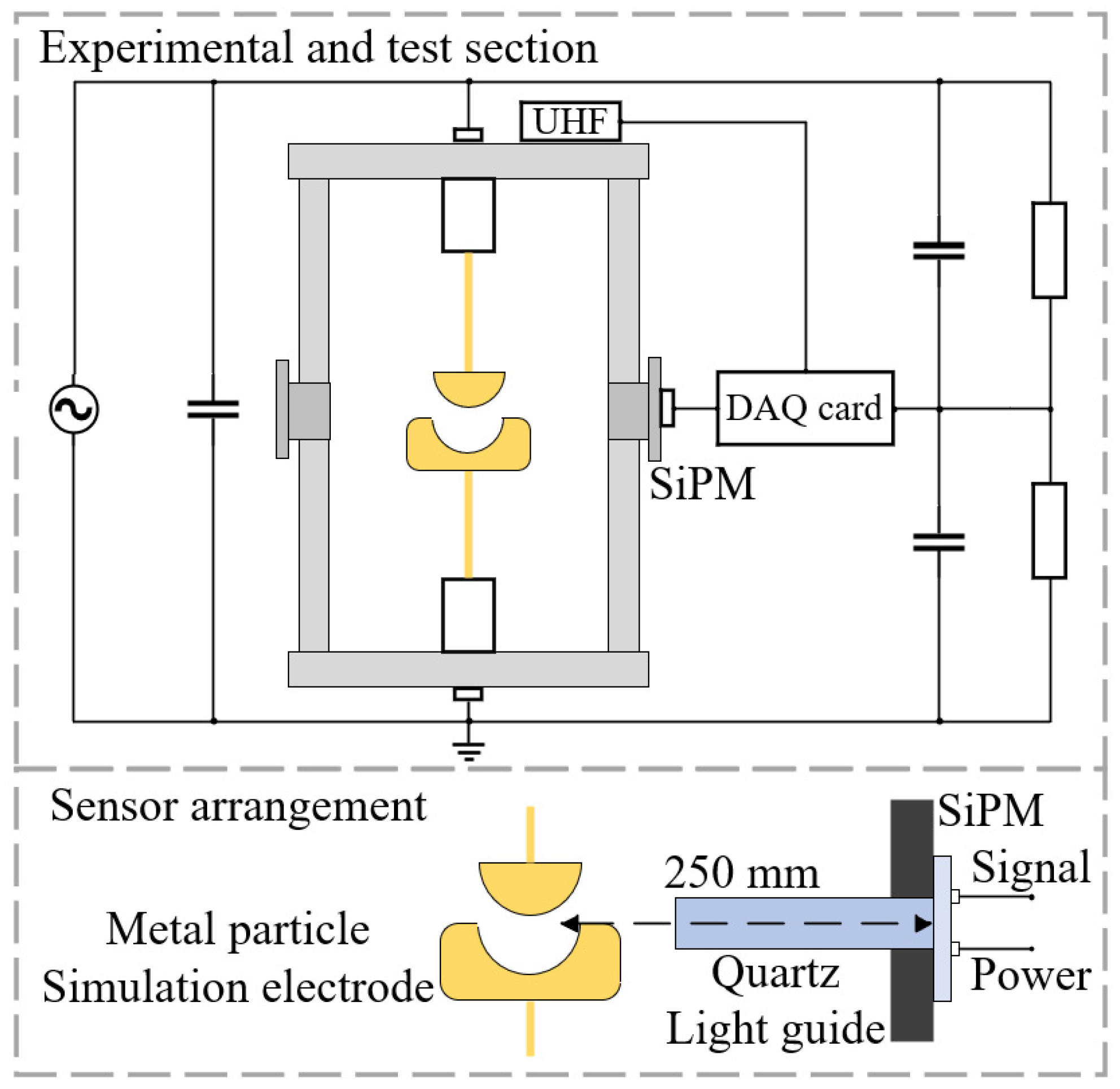
75] constructed a gas-insulated optical-electrical joint test system. They introduced metal particles to induce PD and collected the resulting optical signals. By investigating the distribution morphology of multi-spectral phase patterns and time-series waveforms, as well as time-domain amplitude characteristics, they verified the effectiveness of optical fiber spectroscopy in PD detection. The structural composition of the system is illustrated in
Figure 6.
The multi-spectral sensor was positioned approximately 250 mm from the simulated electrode. The system comprises a quartz light guide, a three-band Silicon Photomultiplier (SiPM) array, a multi-channel detection and amplification circuit, and a DC power supply system. The UHF method was configured as a reference measurement to validate the effectiveness of the multi-spectral detection system.
The experiments were conducted in 0.3 MPa SF6 gas. Granular and linear particles in quantities of 1, 3, and 9 were respectively placed inside a bowl electrode, and a voltage of 36 kV was applied to a spherical electrode. The results indicate that as the number of particles increased, the optical pulse intensities in all spectral bands exhibited an increasing trend. The overall morphology manifested a typical “double-peak” structure. Optical fiber spectroscopy can effectively detect PD signals induced by metal particles and possesses the capability to identify the type and quantity of particles.
Optical measurement methods not only enable live monitoring of PD but also allow for precise localization of the discharge source. They are highly suitable for internal insulation monitoring environments and possess excellent immunity to electromagnetic interference. However, to avoid interference from ambient light sources such as natural light, optical fibers must be deployed inside enclosed equipment like GIS and penetrate near critical insulation components for signal detection. This results in complex installation and relatively high costs. Consequently, this method is currently still in the experimental and research stage.
4.2. Photon Counting
During the inception stage of PD, electric charges recombine with trapped carriers within the material and release photons, a phenomenon known as electroluminescence (EL). Utilizing a photon counting probe to detect this phenomenon enables high-sensitivity monitoring of the insulation condition. The intensity of optical radiation induced by PD typically exceeds that of ordinary electroluminescence by more than two orders of magnitude [
76,
77,
78]; consequently, electroluminescence is often regarded as a precursor to the initiation of insulation degradation [
79,
80]. By detecting and analyzing electroluminescence induced by insulation defects, it is promising to achieve early warning capabilities for insulation faults.
Gong Duohu et al. [
81] constructed a scaled-down GIS platform to detect surface defects on basin insulators using the photon counting method. The platform was placed within an electromagnetically shielded darkroom to isolate it from external interference. They prepared basin insulator samples with metal particle and surface scratch defects, respectively. The experimental chamber was filled with 0.1 MPa of N
2 gas. Based on UHF detection results, the stable PD inception voltage for the defective insulator samples was approximately 4.2 kV. To capture photon counting signals prior to the initiation of PD, the experimental voltage was set to 3 kV.
Experimental results show that the average photon counts for the defect-free sample, 0.5 mm diameter block-shaped particle, 1 mm diameter block-shaped particle and spherical particle were 820, 1745, 2111, and 1757 pes, respectively. Due to the presence of sharp tips on the block-shaped particles, the electric field intensity is more concentrated, which more readily induces air ionization and enhances electroluminescence intensity [
82]. Furthermore, the average photon counts for the defect-free sample and the 3 mm, 5 mm, and 7 mm scratch samples were 820, 958, 2022, and 3087 pes, respectively. These results indicate that the photon counting method exhibits high sensitivity to various types of millimeter-scale micro-defects and can clearly reflect the influence of the presence and size differences in defects on measurement outcomes.
Similar to optical fiber spectroscopy, the application scenarios of the photon counting method are confined to enclosed equipment. The distinction lies in the fact that the probe used in the photon counting method can collect light emission signals through the observation window of the GIS equipment without the need for internal intrusion. This offers advantages such as simple deployment, high sensitivity, and immunity to electromagnetic and acoustic interference. However, as the photon counting probe is extremely sensitive to optical signals, measurements must be conducted in a strictly light-tight environment. Consequently, the photon counting method is primarily applied in enclosed equipment such as GIS.
5. Modal Analysis
Modal analysis is a pivotal technique for acquiring the inherent mechanical characteristics of mechanical structures. Its modal parameters—including natural frequency, damping ratio, and mode shape—are determined by the structure’s mass, stiffness, and damping distribution. When insulation defects occur within the equipment and induce changes in the mechanical structure, the structural stiffness changes accordingly, directly manifesting as distortions in modal parameters and mode shapes. Therefore, extracting the multi-order natural frequencies and corresponding mode shapes via modal analysis allows for the revelation of structural property anomalies based on changes in the equipment’s vibration state, thereby achieving early detection and precise identification of GIS insulation defects [
83,
84].
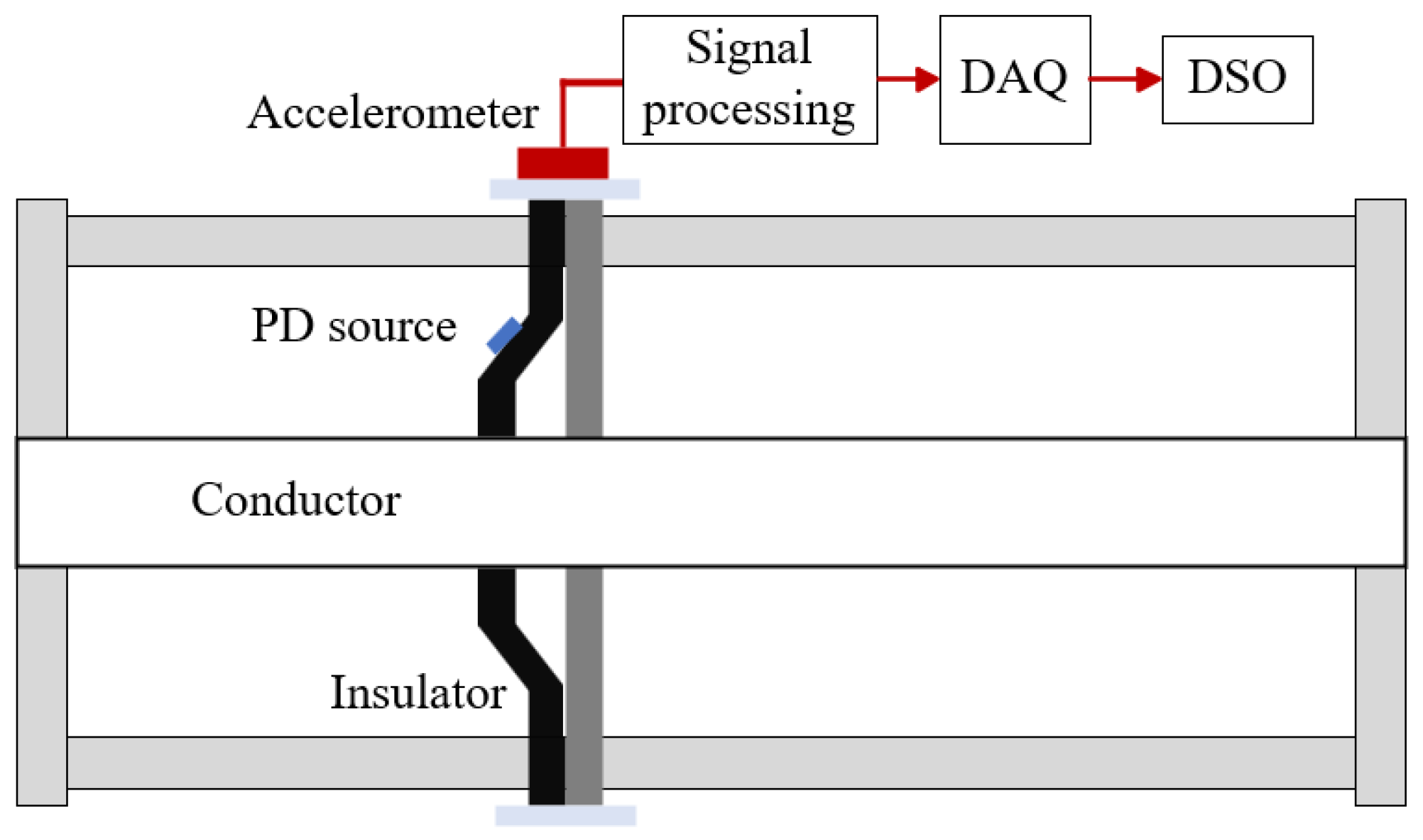
When internal issues such as surface defects on basin insulators, poor contact of contacts, or changes in electrical contact states exist within GIS equipment, the specific mechanical vibrations generated can propagate to the enclosure surface [
85,
86,
87,
88]. Consequently, multiple vibration acceleration sensors can be deployed on the outer surface of the GIS enclosure to realize continuous monitoring of the equipment’s operating status. After spectral analysis, the collected vibration signals can effectively yield characteristic frequencies and energy variation trends associated with defects, thereby allowing for the assessment of the presence and severity of insulation defects [
89,
90,
91]. The schematic principle is illustrated in
Figure 7.
Li Lu et al. constructed a 220 kV GIS model and conducted experimental research on surface pollution and cracks of basin insulators based on modal analysis [
92]. The authors uniformly smeared pollution, comprising a mixture of 100 g of fine sand and dust, onto the basin insulator. The Frequency Response Function (FRF) curves before and after the application of pollution were collected. The results indicate that differences exist in the FRF curves before and after adding pollution, primarily concentrated at two extremum points at 900 Hz and 2000 Hz. When pollution is present on the basin insulator, the amplitudes at 990 Hz and 2000 Hz decreased by approximately 18.3% and 9.7%, respectively, compared to the clean condition.
When crack defects exist on the surface of the basin insulator, the extremum points of its FRF curve in the 2–3 kHz frequency band shift toward higher frequencies. Furthermore, crack defects induce a significant enhancement in the amplitude of the FRF within the 2–4 kHz frequency band. The characteristic differences presented in the vibration responses of pollution and crack defects can serve as a basis for distinguishing between the two.
Technologically, modal analysis is transitioning from laboratory-scale validation to specialized field diagnostics. Its primary engineering advantage is its non-invasive nature, enabling live monitoring without compromising the operational integrity or dielectric strength of the GIS. Critically, mechanical vibration signals exhibit intrinsic immunity to the intense EMI prevalent in high-voltage substations, providing a superior SNR over traditional electrical detection methods in electrically hostile environments.
Nevertheless, several constraints impede its large-scale industrial deployment. The intricate internal geometry of GIS often results in modal frequency aliasing among various components, which complicates the isolation and localization of specific insulation defects based on enclosure-derived data. Furthermore, diagnostic sensitivity is susceptible to environmental and operational variables—such as gas pressure and load-induced thermal stress—which may alter structural stiffness and obscure defect-related signatures. Currently, the absence of a standardized diagnostic library across diverse equipment models necessitates extensive data acquisition under varied conditions. Consequently, advancing this technology for routine application requires further investigation into blind source separation and the establishment of robust baseline databases.
6. Gas Component Analysis
Sulfur hexafluoride (SF
6) gas possesses excellent insulation and arc-extinguishing properties and has been applied on a large scale in high-voltage power equipment such as GIS since the 1960s. When a discharge occurs within GIS equipment, SF
6 molecules undergo splitting due to electron collisions and overheating, forming various low-fluorine sulfides. These intermediate species further react with electrodes, insulating materials, oxygen, or water molecules to generate stable decomposition products [
93]. While pure SF
6 is a colorless, odorless, and non-toxic inert gas, its decomposition products typically possess high chemical activity, corrosiveness, and toxicity, posing threats to the reliable operation of power equipment and the health of maintenance personnel [
94]. Consequently, previous studies have sought to monitor the operating status of GIS, diagnose internal insulation states, and predict development trends by detecting SF
6 decomposition products assisted by reliable pattern recognition algorithms. The SF
6 component analysis method is immune to electromagnetic interference, possesses high sensitivity, and can perform qualitative and quantitative analyses to identify defect types. As a result, it has become a hotspot in GIS defect detection research since the 1990s [
95].
Currently, detection methods for SF
6 decomposition products include Gas Chromatography (GC) and Infrared Spectroscopy (IR). The detection ranges and engineering bottlenecks of various detection methods, as summarized from existing research, are presented in
Table 1 [
96].
Several representative studies have conducted extensive research on the decomposition characteristics and fault diagnosis methods of SF
6 gas-insulated equipment under PD. In terms of fault correlation, Liu Youwei and Yan Xianglian verified the strong correlation between decomposition products and both discharge magnitude and fault type [
97,
98]. They pointed out that the gas production rate of metal protrusion defects is significantly higher than that of floating potential defects, establishing the feasibility of component analysis in equipment condition diagnosis.
Regarding product generation laws, Qi Bo et al. revealed the evolution trend where product concentration correlates positively with voltage and pressurization time, and negatively with gas pressure [
99]. Wang Yuanyuan et al. further elucidated the kinetic differences under different defects, discovering that under metal protrusions, SO
2F
2 exhibits linear growth while SO
2 shows saturation characteristics, whereas surface discharge is typically characterized by the linear growth of CF
4 [
100].
In terms of characteristic component selection, Luo Lishi et al. proposed that highly active HF could serve as a real-time indicator for judging PD status [
101]. To achieve refined identification of defect types, the teams of Tang Ju and Zhang Xiaoxing deeply explored the influence of trace moisture and trace oxygen [
102,
103,
104,
105,
106]. They discovered that an increase in oxygen content suppresses CF
4 generation while promoting the growth of sulfur-based oxides. Based on this, they proposed a fault diagnosis coding method based on characteristic ratios such as c(SO
2F
2)/c(SOF
2), significantly enhancing the accuracy and practicality of diagnosis.
Although a direct link exists between SF
6 gas decomposition components and PD in GIS equipment, the type and content of components are influenced by multiple factors, including insulation defect type, impurity content, and gas pressure. Currently, there is no unified conclusion regarding the specific influence of these various factors, nor has a reliable insulation defect recognition system been established. Furthermore, SF
6 decomposition occurs after the discharge event, leading to the limitation of response lag [
7].
7. Alternative Methods
In addition to the aforementioned insulation detection techniques, various other methods exist, including infrared imaging, the Transient Earth Voltage (TEV) method, and X-ray imaging. Infrared imaging detects PD by measuring the spatial distribution of infrared radiation on the external surface of equipment, thereby inferring PD severity from surface temperature variations. This technique is technically mature and provides intuitive visualization of thermal anomalies. However, its applicability to GIS insulation diagnosis is inherently limited, as the fully enclosed metallic structure effectively shields internal thermal radiation, preventing direct detection of micro-discharges occurring within the gas-insulated compartment [
107]; TEV monitoring is a non-intrusive online technique that detects PD-induced electromagnetic transients propagating along the equipment enclosure and leaking at structural discontinuities such as joints or insulating gaskets. While TEV demonstrates high sensitivity and convenient field deployment in metal-clad switchgear, its applicability to GIS is fundamentally constrained. The continuous and highly conductive metallic enclosure of GIS significantly attenuates high-frequency transient signals, and the absence of accessible leakage paths suppresses TEV signal coupling to the external surface. Moreover, the weak residual signals are highly susceptible to onsite electromagnetic interference, resulting in a low signal-to-noise ratio and limiting reliable PD detection in GIS applications [
108]; X-ray digital imaging provides direct visual inspection of the internal structure of GIS equipment by penetrating the enclosure with X-rays, offering the highest diagnostic certainty for identifying structural and insulation defects. Nevertheless, its engineering practicality remains limited due to the need for comprehensive scanning of large-scale GIS units and the strong dependence on manual image interpretation, which leads to substantial workload and potential misjudgment in practical applications [
109].
The integration of machine learning algorithms with PD feature extraction and signal separation techniques represents a significant trend in the field of insulation defect detection. Taking the pulse current method as an example, while it preserves the authentic physical characteristics of PD pulses, it is inevitably accompanied by challenges such as noise interference and the aliasing of multi-source patterns. Consequently, AI-based signal separation and clustering recognition technologies have emerged as research hotspots to overcome these bottlenecks. In recent studies, Si Wenrong et al. proposed a combined strategy based on Competitive Learning Networks (CLNs) and Least Squares Support Vector Machines (LS-SVM), achieving rapid classification and recognition of PD pulse groups under GIS and DC conditions [
110,
111]. Luo Xiang et al. explored spatial clustering algorithms, such as DBSCAN, based on Time–Frequency (TF) maps [
112,
113]. A. R. Mor et al. verified the feasibility of multi-source separation based on key physical parameters (peak value, charge, energy) in the time–frequency domain [
114], while J. A. Ardila-Rey et al. effectively resolved the aliasing between PD signals and electrical noise using Spectral Power Clustering Techniques (SPCT) [
115]. In summary, although the rich time–frequency information provided by pulse current method offers a physical basis for improving clustering effectiveness, the field still faces significant challenges: while existing clustering algorithms are numerous, they lack standardized implementation norms and recommendation guidelines, and the universality of various algorithms across broader scenarios remains to be further verified.
Furthermore, against the backdrop of the power grid’s digital transformation and the construction of intelligent operation and inspection systems, PD detection technology is accelerating towards intelligence and full-factor sensing. Regarding the traditional pulse current method, constrained by existing standards, current research primarily focuses on anti-interference techniques and PRPD pattern-assisted recognition based on algorithms like competitive clustering [
116,
117]. However, the lack of universality in fingerprint libraries continues to limit their application effectiveness across different insulating media. The High-Frequency Pulse Current method, a mainstream approach for live detection, is evolving towards sensor miniaturization and multi-parameter integrated measurement [
118]. Nevertheless, its AI recognition algorithms generally face challenges regarding poor generalization performance when transferring from laboratory models to complex on-site operating conditions. Moreover, addressing the high-fidelity modeling requirements for substation digital twins, high-frequency pulse current detection serves as a critical supporting technology due to its rich information content. However, there is an urgent need to reach an industry consensus regarding data acquisition standards, device specifications, and algorithm interpretability. In conclusion, future research in PD detection will focus on enhancing the generalization ability and interpretability of AI algorithms in on-site environments, establishing standardized fingerprint databases, and developing precise fault localization technologies based on multi-physics coupling and multi-source information fusion. These advancements aim to support the safe and controllable operation of new power systems.
8. Conclusions
This paper has discussed insulation defect detection technologies for GIS equipment and summarized the vast majority of current PD detection methods. A comparison of these methods is presented in
Table 2. The main conclusions are as follows:
Among electrical methods, the pulse current method, serving as the international standard, possesses mature quantitative analysis capabilities but is susceptible to environmental electromagnetic noise, making online monitoring difficult. As indicated in
Table 2, this trade-off is reflected by its high sensitivity but relatively weak anti-interference performance in complex field environments. The High-Potential Pulse Current Method avoids interference by connecting directly in series with the high-voltage conductor, but its intrusive installation poses challenges to the normal operation of GIS equipment. In the contrast, the UHF method demonstrates strong anti-interference capability and localization potential, which is consistent with its strong anti-interference rating in
Table 2, but lacks the ability to calibrate the discharge magnitude.
The ultrasonic method exhibits strong immunity to EMI and enables non-intrusive online monitoring. As summarized in
Table 2, its overall sensitivity and practicality are evaluated as medium, primarily due to severe signal attenuation and the need for dense sensor deployment in large-scale GIS equipment.
Optical methods, including optical fiber spectroscopy and photon counting, are characterized by high sensitivity, strong anti-interference capabilities, and high localization accuracy. According to
Table 2, these advantages make optical techniques particularly suitable for detecting discharge inception and micro-defects. However, their poor economic and practical performance, mainly caused by complex installation and strict light-shielding requirements, currently limits large-scale field application.
The Modal Analysis Method effectively detects insulation defects caused by mechanical faults by capturing the intrinsic mechanical properties of GIS equipment and exhibits excellent EMI immunity. According to
Table 2, it is characterized by good anti-interference capability and practical feasibility for online monitoring; however, its sensitivity is primarily limited to defects accompanied by discernible structural variations. Moreover, current vibration-based investigations have yet to fully account for the diversity of modal responses under different fault conditions, indicating that further methodological refinement is required.
The Decomposition Component Analysis Method has become an important tool for GIS insulation condition monitoring due to its excellent EMI immunity and advantages in the qualitative and quantitative analysis of defect types. Existing research has confirmed a strong correlation between SF
6 decomposition byproducts and discharge energy/fault types, establishing fault diagnosis models based on characteristic components and product ratios. As summarized in
Table 2, component analysis exhibits strong anti-interference capability and good practicality, supporting its application in fault confirmation and long-term condition assessment. However, this method is inherently a post-event detection technique with response latency limitations. Furthermore, there is no unified conclusion regarding the specific influence mechanisms of complex factors like trace moisture, trace oxygen, and gas pressure on decomposition characteristics in actual operation, which restricts the development and application of highly reliable insulation defect identification systems.
With increasing environmental concerns and regulatory pressure, many countries and regions are actively promoting the reduction and substitution of SF6 due to its extremely high global warming potential. Alternative insulating gases, such as N2, CO2, and their mixtures, are being gradually introduced in GIS applications. This trend places new requirements on insulation defect detection technologies, particularly regarding their adaptability to different gas environments. It should be noted that most physical-signal-based detection methods (electrical, UHF, ultrasonic, optical, and modal analysis) are essentially independent of the insulating gas type and can be directly extended to GIS filled with alternative gases. In contrast, gas component analysis is highly dependent on the specific decomposition characteristics of SF6 and requires re-establishment of diagnostic criteria for new insulating media.
We believe that insulation defect detection methods based on a single physical signal generally struggle to achieve comprehensive optimization across key indicators such as detection sensitivity, anti-interference capability, and adaptability to online monitoring. Therefore, in practical engineering, differentiated selection strategies should be adopted for different operating conditions: for offline scenarios requiring extremely high sensitivity, such as factory testing and handover acceptance, the pulse current method with its mature quantitative standards should be prioritized. Conversely, for on-site online monitoring and live detection, the UHF method should be the preferred solution due to the complex electromagnetic interference environment. For the final confirmation of defect nature and long-term trend assessment, reliance should be placed on the Decomposition Component Analysis method to provide chemical fingerprint evidence.
Based on this, it is recommended to further promote complementary multi-source fusion applications: utilizing UHF + Ultrasonic to achieve precise acoustic-electrical spatiotemporal localization; employing “online monitoring alarms + offline component analysis” for multi-dimensional physical–chemical verification to eliminate false alarms; and combining vibration modal analysis to construct a mechanical-electrical integrated sensing system. By implementing these strategies and further introducing machine learning and big data analysis methods, constructing a monitoring system capable of multi-source information fusion and intelligent diagnosis will provide technical support for more accurate and reliable insulation condition assessment and fault early warning. This represents an important development trend in GIS equipment insulation defect detection.
In summary, this review proposes a holistic diagnostic framework that transcends the limitations of single-modal detection. By synthesizing multi-physics coupling perspectives, this study demonstrates that cross-validating electrical, acoustic, and chemical signals is essential for ensuring diagnostic reliability in complex environments. Furthermore, the integration of modal analysis offers a novel vantage point for identifying mechanical precursors to failure-an early-warning capability often overlooked by traditional methods. As the industry transitions toward SF6 alternatives, the strategic roadmap presented here regarding sensor adaptability and intelligent data fusion provides a technical foundation for next-generation, full-factor proactive maintenance of gas-insulated equipment.
Author Contributions
Conceptualization, T.L. and C.L.; methodology, T.L. and Q.X.; formal analysis, T.L.; investigation, T.L. and J.C.; writing—original draft preparation, T.L.; writing—review and editing, Q.X., K.G., Z.Y. and C.L.; visualization, T.L.; supervision, C.L.; project administration, C.L.; funding acquisition, C.L. All authors have read and agreed to the published version of the manuscript.
Funding
This research was supported by Science and Technology Program of State Grid Shanghai Electric Power Company, grant number 52094025001A.
Data Availability Statement
The original contributions presented in this study are included in the article. Further inquiries can be directed to the corresponding author.
Conflicts of Interest
Authors T.L., Q.X., K.G., Z.Y. and J.C. were employed by the State Grid Shanghai Municipal Electric Power Company, Ltd. The authors declare that the research was conducted in the absence of any commercial or financial relationships that could be construed as potential conflicts of interest. The authors declare that this study received funding from Science and Technology Program of State Grid Shanghai Electric Power Company. The funder had no role in the design of the study; in the collection, analyses, or interpretation of data; in the writing of the manuscript; or in the decision to publish the results.
References
- Liu, P.; Zhu, S.; Xie, Z.; Pang, X.; Xu, T.; Yuan, H. Semiconductive Buffer Layer for the Conductor–Insulator Interface of HVDC GIS/GIL. IEEE Trans. Dielectr. Electr. Insul. 2024, 31, 2759–2767. [Google Scholar] [CrossRef]
- Li, Q.; Xue, N.; Wang, Y.; Wei, L.; Yang, R.; Wang, J.; Li, X.; Wang, C.; Di, Q. Key Technologies for Operation Safety of AC/DC Gas Insulated Transmission Lines. Proc. CSEE 2024, 44, 1629–1649. [Google Scholar]
- Riechert, U.; Holaus, W. Ultra high-voltage gas-insulated switchgear—A technology milestone. Eur. Trans. Electr. Power 2012, 22, 60–82. [Google Scholar] [CrossRef]
- Feng, Y.; Wu, J.; Wang, Z.; Hao, J.; Shao, Y.; Wang, C. Study on Generation Mechanism and Experiment of GIS Multi-frequency Vibration Signals. Proc. CSEE 2024, 44, 7863–7877. [Google Scholar]
- Yan, Z.; Yang, Y.; Liu, Y.; Shang, W.; Li, H.; Fan, X. Multi-aware GIS Partial Discharge Identification Based on Neural Supervision Decision Tree. Proc. CSEE 2024, 44, 5821–5833. [Google Scholar]
- Xu, Y. Investigation on Mechanism of Metallic Particle Induced Flashover of GIS Insulators in Operation Condition. Ph.D. Thesis, North China Electric Power University, Beijing, China, 2020. [Google Scholar]
- Li, J.; Han, X.; Liu, Z.; Li, Y. Review on Partial Discharge Measurement Technology of Electrical Equipment. High Volt. Eng. 2015, 41, 2583–2601. [Google Scholar]
- Ni, H.; Yao, W.; Fu, C.; Su, L.; Yan, N.; Wu, X.; Si, W. Review on Status of Technical Standards of Partial Discharge in Electrical Equipment. High Volt. Appar. 2022, 58, 1–15. [Google Scholar]
- Liao, X.; Wang, H.; Ding, D.; Zhou, D.; Zhang, X.; He, Y. GIS Basin Insulator Defect Analysis Based on Ultra-high Frequency Time-frequency Analysis. High Volt. Appar. 2019, 55, 47–53. [Google Scholar]
- Li, X.; Ding, D.; Xu, Y.; Jiang, J.; Chen, X.; Wang, L. Signal Denoising and Defect Localization for GIS/GIL Partial Discharge Based on Ultra-high Frequency and Ultrasound Method United. High Volt. Eng. 2025, 51, 2384–2393. [Google Scholar]
- Guo, C.; Yang, M.; Rong, F.; Chen, N.; Huang, C.; Dong, P. Basin Insulator Damage Detection System Based on Vibration Response Analysis. Chin. J. Sens. Actuators 2016, 29, 1606–1612. [Google Scholar]
- Huang, Q.; Wei, X.; Xu, J.; Zhou, Z. Research of GIS Bus Loose Contact Fault Diagnosis Techniques Based on Mechanical Vibration. High Volt. Appar. 2017, 53, 99–104+108. [Google Scholar]
- Faizol, Z.; Zubir, F.; Saman, N.M.; Ahmad, M.H.; Rahim, M.K.A.; Ayop, O.; Jusoh, M.; Majid, H.A.; Yusoff, Z. Detection method of partial discharge on transformer and gas-insulated switchgear: A review. Appl. Sci. 2023, 13, 9605. [Google Scholar] [CrossRef]
- Qiu, Z.; Ruan, J.; Huang, D.; Zhang, Y.; Zhang, E. Mechanical Faults Analysis of High Voltage Disconnectors and Review of Diagnosis Technology. High Volt. Appar. 2015, 51, 171–179. [Google Scholar]
- Eberhard, L.; Sonja, B.; Edward, G.; Michael, M.; Edwin, P.; Thomas, S.; Wolfgang, H.; Johannes, R.; Guiseppe, R. Guide for Electrical Partial Discharge Measurements; Electra: Dhamra, India, 2008. [Google Scholar]
- IEC 60270; Partial Discharge Measurements. International Electrotechnical Commission: Geneva, Switzerland, 2025.
- GB/T 7354-2018; High-Voltage Test Techniques-Partial Discharge Measurements. State Administration for Market Regulation, China National Standardization Administration: Xi’an, China, 2018.
- Liu, J.; Zheng, Z.; Chu, H.; Huang, X.; Feng, J.; Yan, P. Necessity of Wide-Band Detection in Transformer PD Test and Analysis of Frequency Band Selection. Transformer 2016, 53, 54–59. [Google Scholar]
- Xu, Y.; Liu, W.; Chen, W.; Li, X.; Yang, Y.; Bi, J. High-sensitivity Measurement Method and Application of GIS Spacer Partial Discharge. Proc. CSEE 2020, 40, 1703–1713. [Google Scholar]
- Wang, W.; Zhao, X.; Wang, D.; Wang, K.; Tan, X.; Peng, J. Analysis on the Method of GIS Partial Discharge Detection. High Volt. Appar. 2012, 48, 13–17+23. [Google Scholar]
- Hauschild, W.; Mosch, W. Statistical Techniques for High-Voltage Engineering; IET: London, UK, 1992. [Google Scholar]
- DL/T 417-2019; Guide for Field Measurement of Partial Discharge of Power Equipment. China Electric Power Press: Beijing, China, 2019.
- Uwiringiyimana, J.P.; Khayam, U.; Montanari, G.C. Design and implementation of ultra-wide band antenna for partial discharge detection in high voltage power equipment. IEEE Access 2022, 10, 10983–10994. [Google Scholar] [CrossRef]
- Emeraldi, P.; Khayam, U. Design of matching impedance for ultra wideband partial discharge detection. In 2013 International Conference on Information Technology and Electrical Engineering (ICITEE); IEEE: New York, NY, USA, 2013; pp. 349–354. [Google Scholar]
- Zhang, Z. Research on Wide-Band Online Monitoring Technology with Multi-Terminals for Partial Discharge of Transformers. Master’s Thesis, North China Electric Power University, Beijing, China, 2017. [Google Scholar]
- Xiong, J.; Wang, Y.; Ma, G.M.; Zhang, Q.; Zheng, S.S. Field applications of ultra high frequency techniques for defect detection in GIS. Sensors 2018, 18, 2425. [Google Scholar] [CrossRef] [PubMed]
- Chen, S.; Guo, J.; Hu, C.; Tao, F.; Xie, T.; Xu, Y.; Jia, J. The electromagnetic effect study of GIS enclosure under high-frequency electromagnetic pulse. J. Eng. 2019, 2019, 2837–2841. [Google Scholar] [CrossRef]
- Zhang, J.; Chen, H.; Zhou, P. New de-noising method for partial discharge signals based on wavelet threshold. Adv. Technol. Electr. Eng. Energy 2017, 36, 80–88. [Google Scholar]
- Li, X.; Ding, D.; Zhang, Y.; Xu, Y.; Yuan, M.; Liu, W. High Potential Partial Discharge Pulse Current Detection Method for GIS/GIL Equipment. High Volt. Eng. 2025, 11, 5472–5480. [Google Scholar] [CrossRef]
- Ni, H.; Fu, C.; Hu, H.; Wu, X.; Si, W. Review on Detection Technique of Pulse Current Method for PD Measurement of Electrical Equipment. High Volt. Appar. 2023, 59, 1–14. [Google Scholar]
- Li, J.; Han, X.; Liu, Z.; Li, D.; Li, Y. A novel GIS partial discharge detection sensor with integrated optical and UHF methods. IEEE Trans. Power Deliv. 2016, 33, 2047–2049. [Google Scholar] [CrossRef]
- Wang, Y.; Wang, Z.; Li, J. UHF Moore fractal antennas for online GIS PD detection. IEEE Antennas Wirel. Propag. Lett. 2016, 16, 852–855. [Google Scholar] [CrossRef]
- Han, X.; Li, J.; Zhang, L.; Pang, P.; Shen, S. A novel PD detection technique for use in GIS based on a combination of UHF and optical sensors. IEEE Trans. Instrum. Meas. 2018, 68, 2890–2897. [Google Scholar] [CrossRef]
- Schichler, U.; Koltunowicz, W.; Gautschi, D.; Girodet, A.; Hama, H.; Juhre, K. UHF partial discharge detection system for GIS: Application guide for sensitivity verification. In VDE High Voltage Technology 2016; ETG-Symposium; VDE: Frankfurt, Germany, 2016; pp. 1–9. [Google Scholar]
- Liang, R.; Wu, S.; Chi, P.; Peng, N.; Li, Y. Optimal placement of UHF sensors for accurate localization of partial discharge source in GIS. Energies 2019, 12, 1173. [Google Scholar] [CrossRef]
- Li, Y.; Chen, D.; Li, L.; Zhang, J.; Li, G.; Liu, H. Study of comparison between Ultra-high Frequency (UHF) method and ultrasonic method on PD detection for GIS. In IOP Conference Series: Earth and Environmental Science; IOP Publishing: Bristol, UK, 2017; Volume 94, p. 012086. [Google Scholar]
- Zhao, X.; Meng, Y.; Cheng, Y.; Wu, K.; Gao, F. Time-Domain Characteristic Site Analysis for Ultra-High Frequency Partial Discharge in Power Transformer. J. Xi’an Jiaotong Univ. 2011, 45, 82–86+128. [Google Scholar]
- Jia, D.; Liang, W. Research on Application of GIS UHF Intelligent Sensor. In 2022 IEEE 4th International Conference on Civil Aviation Safety and Information Technology (ICCASIT); IEEE: New York, NY, USA, 2022; pp. 282–287. [Google Scholar]
- Hikita, M.; Ohtsuka, S.; Wada, J.; Okabe, S.; Hoshino, T.; Maruyama, S. Study of partial discharge radiated electromagnetic wave propagation characteristics in an actual 154 kV model GIS. IEEE Trans. Dielectr. Electr. Insul. 2012, 19, 8–17. [Google Scholar] [CrossRef]
- Darwish, A.; Refaat, S.S.; Toliyat, H.A.; Abu-Rub, H. On the electromagnetic wave behavior due to partial discharge in gas insulated switchgears: State-of-art review. IEEE Access 2019, 7, 75822–75836. [Google Scholar] [CrossRef]
- Xu, H.; Yuan, C.; Ding, X.; Xu, Z.; Zhu, L. Simulation study of partial discharge UHF signal propagation characteristics in GIS. J. Phys. Conf. Ser. 2023, 2661, 012021. [Google Scholar] [CrossRef]
- Zhi, Y.; Min, L.; Li, X.; Yan, L.; Zhang, D.; Liu, H. Study on UHF electromagnetic wave propagation characteristics of partial discharge in GIS. In 4th International Symposium on Power Electronics and Control Engineering (ISPECE 2021); SPIE: Bellingham, WA, USA, 2021; Volume 12080, pp. 364–371. [Google Scholar]
- Ju, T.; Xu, Z.; Zhang, X.; Sun, C. GIS partial discharge quantitative measurements using UHF microstrip antenna sensors. In 2007 Annual Report-Conference on Electrical Insulation and Dielectric Phenomena; IEEE: New York, NY, USA, 2007; pp. 116–119. [Google Scholar]
- Li, T.; Rong, M.; Zheng, C.; Wang, X. Development simulation and experiment study on UHF partial discharge sensor in GIS. IEEE Trans. Dielectr. Electr. Insul. 2012, 19, 1421–1430. [Google Scholar] [CrossRef]
- Chai, H.; Phung, B.T.; Mitchell, S. Application of UHF sensors in power system equipment for partial discharge detection: A review. Sensors 2019, 19, 1029. [Google Scholar] [CrossRef]
- Lu, Y. Research on Partial Discharge Monitoring System of GIS Based On UHF Signal Analysis. Master’s Thesis, Nanchang University, Nanchang, China, 2023. [Google Scholar]
- Zheng, Y.; Hao, Y.; Liu, L.; Zhang, Z.; Yang, L.; Wang, G. An ultrasonic nondestructive testing method for density uniformity of basin-type insulators in GIS. IEEE Trans. Instrum. Meas. 2021, 70, 6010308. [Google Scholar] [CrossRef]
- Tian, F.; He, Y.; Zou, Z.; Zheng, Y.; He, W.; Yang, L.; LI, L. Ultrasonic LCR Method for Detecting Micro-cracks on the Surface of Epoxy Composite Insulation. Guangdong Electr. Power 2019, 32, 106–112. [Google Scholar]
- Chi, J. Ultra-High Voltage Basin Insulator Crack Monitoring Method Based on Ultrasonic. Autom. Appl. 2022, 6, 98–100. [Google Scholar] [CrossRef]
- Ma, J.; Sun, X.; Li, S.; Lv, F.; Tang, Z.; Yue, X. Detection and Location for Defects of Basin-type Insulator Based on Ultrasonic Guided Wave. High Volt. Eng. 2019, 45, 3941–3948. [Google Scholar]
- Wang, K.; Zhao, Y.; Yuan, S.; Cai, X.; Duan, X.; Zhang, H. The Crack Defect Detection Method of 220 kV GIS Basin-Type Insulators Based on Electric Field Calculation and Modal Analysis. Power Syst. Clean Energy 2021, 37, 32–38+47. [Google Scholar]
- Sun, H.; Zhou, Y.; Lv, Y.; Wu, J.; Zhou, Y. Research on defect detection method of basin insulator based on low frequency dual probe ultrasonic. Insul. Mater. 2023, 56, 110–114. [Google Scholar]
- He, L.; Li, S.; Zhou, D.; Ding, D.; Wang, J.; Ma, X. Analysis method of abnormal condition in GIS based on ultrasonic detection. In 2016 International Conference on Condition Monitoring and Diagnosis (CMD); IEEE: New York, NY, USA, 2016; pp. 570–573. [Google Scholar]
- He, Y.; Xing, B.; Xin, L.; Xu, D.; Bian, S.; Yang, C.; Ren, S.; Xue, J. Defect detection of GIS basin insulator based on ultrasonic method. Insul. Mater. 2025, 58, 126–133. [Google Scholar]
- Ma, G.M.; Zhou, H.; Zhang, M.; Li, C.; Yin, Y.; Wu, Y. A high sensitivity optical fiber sensor for GIS partial discharge detection. IEEE Sens. J. 2019, 19, 9235–9243. [Google Scholar] [CrossRef]
- Chai, Q.; Luo, Y.; Ren, J.; Zhang, J.; Yang, J.; Yuan, L.; Peng, G. Review on fiber-optic sensing in health monitoring of power grids. Opt. Eng. 2019, 58, 072007. [Google Scholar] [CrossRef]
- Ma, G.; Zhou, H.; Liu, Y.; Gao, S.; Xia, Y.; Zhang, W.; Zhang, Z.; He, R.; Peng, G. Optical Fiber Ultrasonic Detection Technology for Partial Discharge in Power Transformer and New Multiplexing Method. High Volt. Eng. 2020, 46, 1768–1780. [Google Scholar]
- Liu, Z.; Li, X.; Gong, Y.; Tian, X.; Liu, X. A Partial Discharge Defect Caused by Cracks in GIS Internal Insulator Based on Acoustic and Optic Joint. Guangdong Electr. Power 2023, 36, 100–106. [Google Scholar]
- Ma, G.; Wang, S.; Zhang, X.; Yang, Q.; Li, J.; Zhuang, C.; Zeng, F.; Zhang, W.; Jiang, J.; Zhou, H.; et al. Research on Optical Fiber/Optical Sensing for State Information of Transformer Equipment. High Volt. Eng. 2024, 50, 3354–3386. [Google Scholar]
- Fang, C. Research on the Ultraviolet Features and Multi-Spectral Imaging Technology of High Voltage Air Discharge. Ph.D. Thesis, Shanghai Institute of Technical Physics, Shanghai, China, 2016. [Google Scholar]
- Fabrikant, I.I.; Hotop, H.; Allan, M. Elastic scattering, vibrational excitation, and attachment in low-energy electron-SF 6 scattering: Experiment and effective range theory. Phys. Rev. A—At. Mol. Opt. Phys. 2005, 71, 022712. [Google Scholar] [CrossRef]
- Mangeret, R.; Farenc, J.; Ai, B.; Destruel, P.; Puretolas, D.; Casanovas, J. Optical detection of partial discharges using fluorescent fiber. IEEE Trans. Electr. Insul. 1991, 26, 783–789. [Google Scholar] [CrossRef]
- Zhou, W.; Wang, G.; Zou, J.; Gao, L. Spectral Distribution of Discharge in Transformer Oil. High Volt. Eng. 1996, 4, 52–54. [Google Scholar]
- Huang, W.; Liu, S.; Yan, P. Optical characteristics of flashover in transformer oil under nanosecond pulses. High Power Laser Part. Beams 2009, 21, 787–790. [Google Scholar]
- Jia, S.; Jia, Y.; Bu, Z.; Li, S.; Lv, L.; Ji, S. Detection technology of partial discharge in transformer based on optical signal. Energy Rep. 2023, 9, 98–106. [Google Scholar] [CrossRef]
- Guo, L.; Chen, P.; Li, L.; Wu, S.; Tian, J. Research Progress on Key Technologies of Photomultiplier Tubes. Vac. Electron. 2020, 4, 1–13+27. [Google Scholar]
- Zhao, W. Developments in technology of Photomultipliers. Optoelectron. Technol. 2011, 31, 145–148. [Google Scholar]
- Cheng, B.; Dai, Q.; Xie, X.; Xu, Q.; Zhang, S.; Song, H. Research progress of single-photon detectors. Laser Technol. 2022, 46, 601–609. [Google Scholar]
- Sun, Y.; Chen, H.; Qian, S.; Guo, X.; Xu, Y. Progress of Fiber Optic Sensor in Partial Discharge Detection for Power Cables. High Volt. Appar. 2018, 54, 1–8. [Google Scholar]
- Guo, S.; Han, L.; Xu, L.; Gao, Y. Review of research on fiber optic sensors for partial discharge detection. Adv. Technol. Electr. Eng. Energy 2016, 35, 47–53+80. [Google Scholar]
- Ren, M.; Li, X.; Wang, S.; Xia, C.; Zhou, J.; Cui, X. Gas Insulated Discharge Optical Pulse Detection Technology and Sensing Performance Based on Avalanche Diode Array. Power Syst. Technol. 2021, 45, 3627–3636. [Google Scholar]
- Sun, Y. Research on Emission Spectrum Characteristics of Partial Discharge in Air. Master’s Thesis, Shenyang University of Technology, Shenyang, China, 2023. [Google Scholar]
- Tang, J.; Ouyang, Y.P.; Fan, M.; Zhang, X.; Liu, Y. System Using Fluorescent Fiber for Partial Discharge Detection in Transformer. High Volt. Eng. 2011, 37, 1129–1135. [Google Scholar]
- Qi, B.; Li, C.; He, Z.; Geng, B.; Xu, D.; Liu, S.; Deng, C. Evolution Phenomena and Features of Surface Partial Discharge Initiated by Immobilized Metal Particles on GIS Insulators. Proc. CSEE 2011, 31, 101–108. [Google Scholar]
- Ren, M.; Yu, J.; Wang, K.; Guan, H.; Wang, Y.; Dong, M.; He, J.; Zhang, C. Multispectral Pulse Detection and Characteristic Analysis of Gas Insulated Particle Discharge. Proc. CSEE 2022, 42, 295–304. [Google Scholar]
- Yang, X.; Jia, Y.; Gao, L.; Ji, C.; Li, Z.; Liu, Y. Method for Measuring Surface Electric Field Intensity of Insulators Based on Electroluminescence Effect. High Volt. Eng. 2021, 47, 1411–1419. [Google Scholar]
- Le Roy, S.; Segur, P.; Teyssedre, G.; Laurent, C. Description of bipolar charge transport in polyethylene using a fluid model with a constant mobility: Model prediction. J. Phys. D Appl. Phys. 2003, 37, 298. [Google Scholar] [CrossRef]
- Pandey, J.C.; Gupta, N. Study of treeing in epoxy-alumina nanocomposites using electroluminescence. IEEE Trans. Dielectr. Electr. Insul. 2019, 26, 648–654. [Google Scholar] [CrossRef]
- Bamji, S.S. Electroluminescence-a technique to detect the initiation of degradation in polymeric insulation. IEEE Electr. Insul. Mag. 2002, 15, 9–14. [Google Scholar] [CrossRef]
- Bamji, S.S.; Bulinski, A.T.; Chen, Y.; Densley, R. Threshold voltage for electrical tree inception in underground HV transmission cables. IEEE Trans. Electr. Insul. 2002, 27, 402–404. [Google Scholar] [CrossRef]
- Gong, D.; Fan, X.; Zhan, Z.; Li, S.; Duo, D.; Li, C. Research on surface microdefect detection of GIS/GIL epoxy insulation materials based on photon counting. Insul. Mater. 2024, 57, 125–130. [Google Scholar]
- Liu, B.; Su, W.; Zhang, Z.; Gong, D.; Yang, M.; Chen, G.; He, J.; Li, C. Motion Characteristics, Suppression and Detection Methods of Metal Particles in DC GIS/GIL. High Volt. Eng. 2025, 51, 1038–1051. [Google Scholar]
- Bian, C.; Zhang, Z.; Zhao, K.; Shu, T. Study on Mechanical Vibration Characteristics of GIS Bus Misalignment Based on FEM. High Volt. Appar. 2020, 56, 72–79. [Google Scholar]
- Yang, D.; Ye, X.; Niu, B.; Huang, Q. Simulation Research on Modal Characteristics of GIS Basin Insulator. High Volt. Appar. 2020, 56, 26–31+41. [Google Scholar]
- Zhang, J. Research on Fault Diagnosis Technology of GIS Equipment Based on Shell Vibration Signal. Master’s Thesis, Shenyang University of Technology, Shenyang, China, 2024. [Google Scholar]
- Ma, H.; Liu, B.; Xu, H.; Chen, B.; Ju, P.; Zhang, L.; Qu, B. GIS mechanical state identification and defect diagnosis technology based on self-excited vibration of assembled circuit breaker. IET Sci. Meas. Technol. 2020, 14, 56–63. [Google Scholar] [CrossRef]
- Zhou, X.; Lu, T.; Luo, R.; Zhang, B.; Yu, G.; Wan, J. Detection and Evaluation Method of Electrical Contact State in Gas Insulated Switchgear. High Volt. Eng. 2015, 41, 217–224. [Google Scholar]
- Han, S.; Lv, Z.; Sui, H.; Wang, W.; Tu, Y.; Gao, C. Partial discharge pattern recognition in GIS based on EFPI sensor. Electr. Power Eng. Technol. 2022, 41, 149–155. [Google Scholar]
- Yang, J.; Zhao, K.; Teng, Y.; Li, H.; Li, Y.; Xiao, H.; Ma, J.; Zhang, L. Research on Vibration Defect Detection Method of GIS Based on Singular Spectrum Analysis and Decision Tree. High Volt. Appar. 2024, 60, 33–42. [Google Scholar]
- Ji, W.; Liu, J.; Lu, W.; Wu, S.; Wang, D. Research on Vibration and Distribution Characteristics of Transformer Core. High Volt. Appar. 2023, 59, 134–141. [Google Scholar]
- Lin, J.; Zhang, J.; Li, X.; Zhu, X.; Chen, Y.; Guo, Y.; Lin, Z.; Wang, L. Research on Bolt Looseness of High Voltage Circuit Breaker Based on Vibration Signal. High Volt. Appar. 2023, 59, 28–33. [Google Scholar]
- Li, L.; Peng, Q.; Su, Z.; Liu, C.; Song, Y.; Li, J. Live Detection Technology of GIS Insulating Spacer Based on Modal Analysis. High Volt. Appar. 2025, 61, 214–222. [Google Scholar]
- Chen, H. Research on Measurement Model and Construction of Gas Sensor Arrays for Detecting sf6 Decomposition Components. Master’s Thesis, Northeast Electric Power University, Jilin, China, 2025. [Google Scholar]
- Christophorou, L.G.; Olthoff, J.K.; Van Brunt, R.J. Sulfur hexafluoride and the electric power industry. IEEE Trans. Electr. Insul. 1997, 13, 20–24. [Google Scholar] [CrossRef]
- Ju, T.; Fan, L.; Meng, Q.; Zhang, X.; Tao, J. Partial discharge recognition through an analysis of SF6 decomposition products part 2: Feature extraction and decision tree-based pattern recognition. IEEE Trans. Dielectr. Electr. Insul. 2012, 19, 37–44. [Google Scholar] [CrossRef]
- Ji, C.; Zhong, L.; Liu, K.; Li, J.; Cui, Y.; Wang, Y.; Guo, J.; Ji, G. Research Status and Development of SF6 Decomposition Components Analysis Under Discharge and Its Application. Proc. CSEE 2015, 35, 2318–2332. [Google Scholar]
- Youwei, L.; Liyuan, W.; Yanpeng, G. Investigation on SF6 decomposition products in GIS and affecting factors. Power Syst. Technol. 2009, 33, 58–61. (In Chinese) [Google Scholar]
- Xianglian, Y.; Chengyu, W.; Ren, Y.; Ji, Y.; Su, Z.; Yao, Q. Fault diagnosis of high voltage switchgears by decomposition products of SF6. Power Syst. Technol. 2011, 35, 118–123. (In Chinese) [Google Scholar]
- Qi, B.; Li, C.R.; Luo, L.S.; Zhang, Y.; Zheng, S. Experiment on the correlation between partial discharge and gas decomposition products in GIS. Gaodianya Jishu/High Volt. Eng. 2010, 36, 957–963. (In Chinese) [Google Scholar]
- Wang, Y.; Ji, S.; Li, J.; Liu, H.; Wang, W.; Xu, L. Investigations on discharge and decomposition characteristics of SF6 under various experimental conditions. High Voltage Eng. 2013, 39, 1952–1959. [Google Scholar]
- Luo, L.; Yao, W.; Wang, J.; Li, C.; Zheng, S.; Wu, X.; Mao, T. Research on partial discharge diagnosis of GIS by decomposed gas of SF6. Power Syst. Technol. 2010, 34, 225–230. (In Chinese) [Google Scholar]
- Tang, J.; Liu, F.; Zhang, X.; Meng, Q.; Zhou, J. Partial discharge recognition through an analysis of SF6 decomposition products Part 1: Decomposition characteristics of SF 6 under four different partial discharges. IEEE Trans. Dielectr. Electr. Insul. 2012, 19, 29–36. [Google Scholar] [CrossRef]
- Tang, J.; Chen, C.; Zhang, X.; Liu, F.; Ren, X. Influence of trace-level O2 on SF6 decomposition characteristics under partial discharge. High Volt. Eng. 2011, 37, 8–14. (In Chinese) [Google Scholar]
- Tang, J.; Chen, C.; Liu, F.; Zhang, X.; Meng, Q. Detection of constituents from SF6 decomposition under partial discharge and recognition of insulation defect coding. Power Syst. Technol. 2011, 35, 110–116. (In Chinese) [Google Scholar]
- Tang, J.; Liang, X.; Yao, Q.; He, J.; Liu, F. Analysis of SF6 gasous decomposition components under two kinds of PD defects. Proc. CSEE 2012, 32, 78–84. (In Chinese) [Google Scholar]
- Tang, J.; Ren, X.; Tan, Z.; Qiu, Y.; Sun, C. Correlation character between partial discharge quantity and SF6 decomposition components under needle-plate defect model. High Volt. Eng. 2012, 38, 527–534. (In Chinese) [Google Scholar]
- Zhang, J.; Fu, Q.; Yuan, Y. Application Research of Electric Detection Technology of Partial Discharge for Transformer. Transformer 2018, 55, 66–71. [Google Scholar]
- Ren, M.; Peng, H.; Chen, X.; Dong, M. Comprehensive Detection of Partial Discharge in Switchgear Using TEV. High Volt. Eng. 2010, 36, 2460–2466. [Google Scholar]
- Lei, H.; Jia, Z. Research on Combined Method of Ultra High Frequency and X-ray Digital Imaging for Detecting Internal Discharge Defects of GIS Solid Insulation. High Volt. Appar. 2018, 54, 224–229. [Google Scholar]
- Si, W.; Li, J.; Yuan, P.; Yang, J.; Li, D.; Li, Y. Detection and identification techniques for multi-PD source in GIS. Proc. CSEE 2009, 29, 119–126. [Google Scholar]
- Si, W.; Fu, C.; Liu, J.; Ni, H.; Xu, Q. Demand analysis of ultra-wideband detection data processing for DC partial discharge of converter transformer. Power Energy 2022, 43, 18–25. [Google Scholar]
- Du, J.; Yang, Z.; Yang, R.; Han, Y.; Qian, J. Classification method of partial discharge of cable based on DBSCAN algorithm. Telecom Power Technol. 2017, 34, 173–176. [Google Scholar]
- Luo, X.; Zhang, K.; Cai, J.; Chen, M. Separation technique of partial discharge pulse based on fuzzy clustering for XLPE cables. High Volt. Appar. 2013, 49, 102–107. [Google Scholar]
- Mor, A.R.; Heredia, L.C.; Muñoz, F.A. New clustering techniques based on current peak value, charge and energy calculations for separation of partial discharge sources. IEEE Trans. Dielectr. Electr. Insul. 2017, 24, 340–348. [Google Scholar] [CrossRef]
- Ardila-Rey, J.A.; Montero, E.; Poblete, N.M. Application of meta-heuristic approaches in the spectral power clustering technique (SPCT) to improve the separation of partial discharge and electrical noise sources. IEEE Access 2019, 7, 110580–110593. [Google Scholar] [CrossRef]
- Peng, Q.; Nie, D.; Liu, F.; Deng, J.; Yao, X.; He, X. On-site partial discharge test anti-interference technology of UHV converter transformer. Transformer 2013, 50, 50–54. [Google Scholar]
- Shen, C. Design and Development of XLPE Cable Partial Discharge Data Analysis System Based on Feature Map and Recognition Technology. Master’s Thesis, Shanghai Jiao Tong University, Shanghai, China, 2018. [Google Scholar]
- Mu, H.; Zhao, H.; Zhang, D.; Zhang, L.; Zhang, G.; Han, Y. Study on multi-parameter intelligent sensing technology for transformer oil-paper bushing. High Volt. Eng. 2020, 46, 1903–1912. [Google Scholar]
| Disclaimer/Publisher’s Note: The statements, opinions and data contained in all publications are solely those of the individual author(s) and contributor(s) and not of MDPI and/or the editor(s). MDPI and/or the editor(s) disclaim responsibility for any injury to people or property resulting from any ideas, methods, instructions or products referred to in the content. |