Article

A Fast Dynamic Response Control Method for DAB Converters in Microgrids

1
State Grid Shandong Electric Power Research Institute, Jinan 250002, China
2
State Grid Shandong Electric Power Company, Jinan 250001, China
3
State Key Laboratory of Smart Power Distribution Equipment and System, Tianjin University, Tianjin 300072, China
*
Author to whom correspondence should be addressed.
Energies 2026, 19(5), 1307; https://doi.org/10.3390/en19051307
Submission received: 30 January 2026 / Revised: 2 March 2026 / Accepted: 4 March 2026 / Published: 5 March 2026

Abstract

To address the issues of significant dc bus voltage and load fluctuations, as well as unstable power transmission in dual active bridge (DAB) converters within dc microgrid systems, this article proposes a segmented gain adjustment method based on multiplicative feedforward control (MFC-SGA). First, considering both steady-state and dynamic performance of DAB converters, two hybrid optimization control methods are proposed, and their advantages and disadvantages in terms of circuit parameter sensitivity and controller gain are analyzed. Second, to overcome the limitation of multiplicative feedforward control in light-load conditions due to restricted controller gain, the MFC-SGA method is introduced to enable adaptive parameter adjustment. Finally, an experimental prototype is built. Experimental results show that the MFC-SGA method is independent of inductance accuracy. When the operating condition changes, compared with the traditional method, the settling time is shortened by 60–83% and the overshoot is reduced by 37.5–62.5%; especially in light-load mode (10% of rated current), the dynamic response speed is improved by 68.75% compared with the MFC method, and the settling time is reduced from 32 ms to 10 ms. The experimental results verify the feasibility and effectiveness of the proposed method.

1. Introduction

The intermittent nature and stochastic fluctuations of renewable energy sources, combined with frequent charge–discharge transitions in grid-connected energy storage systems and drastic load demand variations, have significantly intensified the complexity and uncertainty of power system operations [1]. This dynamic environment imposes more stringent requirements on the rapid response capabilities of power electronic converters [2].
The dual active bridge (DAB) converter has been widely adopted due to its operational simplicity under single phase-shift (SPS) modulation [3], where effective regulation can be achieved through a single voltage loop, making it suitable for most conventional applications [4].
Segaran et al. [5] developed a linearized dynamic model of the DAB system, proposing a load current-based compensation strategy to enhance its disturbance-rejection capability. However, the feedforward compensation in this approach relies on a lookup table, making real-time online updates difficult to implement. To improve the output voltage response speed under load disturbances, Krismer et al. [6] applied current feedforward control to the closed-loop control of DAB, establishing a cascaded control structure with an inner current loop and an outer voltage loop, significantly enhancing the system’s response speed to load transients. Dutta et al. [7] proposed a predictive current control method, which dynamically calculates the phase-shift angle command for the next control cycle based on the sampled inductor current and control variables of the current cycle. However, its effectiveness heavily depends on the precise sampling of high-frequency inductor current, resulting in poor robustness. Li et al. [8] introduced a sliding mode control approach, but its high sensitivity to variations in inductor parameters limits its adaptability in practical applications. Ali et al. [9] presented a disturbance observer-based control method, embedding a disturbance observer in the voltage feedback loop to estimate and compensate for the total disturbance caused by external interference in real time. Compared to conventional single-voltage-loop control, this method significantly improves output impedance characteristics and enhances the system’s robustness against circuit parameter variations.
All the aforementioned control strategies employ SPS modulation. However, SPS modulation has only one degree of freedom, making it difficult to directly apply these control strategies when multi-degree-of-freedom phase-shift modulation is adopted. To address the control methods for multi-degree-of-freedom phase-shift modulation, An et al. [10] proposed a model predictive control method based on dual-phase-shift (DPS) modulation. This method constructs a cost function using a weighted combination of the output voltage tracking error and its rate of change, dynamically optimizing the phase-shift ratios to effectively reduce voltage overshoot during load transients. Song et al. [11] developed a single-voltage-feedback control under triple-phase-shift (TPS) modulation. By introducing two slow-loop components, it achieved isolation between the efficiency optimization module and the output voltage regulation, preventing the phase-shift control variables generated by the efficiency optimization strategy from affecting the output voltage adjustment during dynamic responses. However, this approach may result in phase-shift ratio combinations that do not satisfy the optimal current stress relationship during transients. Li et al. [12] proposed an optimized control-based model predictive control method that eliminates the need for an optimization search process, enabling real-time computation of optimal phase-shift ratios within the control horizon. Under ideal sampling conditions, this method significantly improves dynamic response speed. However, in practical systems, high-frequency sampling noise can cause the predicted trajectory to deviate from the actual state, leading to reduced control accuracy.
Under the assumption of negligible power loss, Song et al. [13] verified that the power transfer characteristics of the DAB converter during transient processes remain consistent with those in steady-state conditions. Building on this finding, Dai et al. [14] and Tarisciotti et al. [15] proposed the virtual power direct control method inspired by direct torque control principles. By directly regulating the power transfer target value, this approach maintains fast output voltage response characteristics during transient processes such as startup, load step changes, and input voltage disturbances, significantly enhancing the dynamic performance of DAB converters.
The characteristics of existing DAB control methods are summarized in Table 1, with a comparison to the MFC-SGA method proposed in this paper. Existing research on optimizing the dynamic performance of DAB converters generally suffers from the following limitations: most methods struggle to simultaneously improve both steady-state and dynamic performance [16], as steady-state performance optimization, including circulating power suppression, soft-switching realization, and current stress optimization, typically requires multi-degree-of-freedom modulation strategies that are difficult to directly apply to dynamic performance improvement [17,18]. Furthermore, existing control methods exhibit poor robustness due to their high sensitivity to variations in circuit parameters.
Therefore, this article proposes a fast dynamic response control method for DAB converters based on multiplicative feedforward control, which improves the converter’s dynamic response performance and parameter robustness within the tested operating range and enhances its adaptability to complex scenarios.
This research primarily focuses on two aspects: First, considering both efficiency and dynamic response optimization of DAB converters, and building upon the power-segmented three-phase-shift (PSTPS) optimization modulation method proposed in [19] for coordinated optimization of bilateral reactive power and soft switching, two hybrid optimization control methods for steady-state and dynamic performance are developed. These methods are categorized as additive feedforward control (AFC) and multiplicative feedforward control (MFC) based on the relationship between the compensation component and model-based component, with thorough analysis of their respective advantages and disadvantages, particularly focusing on circuit parameter sensitivity and controller gain under both control schemes. Second, addressing the limitations of MFC in controller regulation under light-load conditions, a multiplicative feedforward control-based segmented gain adjustment (MFC-SGA) method is proposed to achieve adaptive parameter tuning.
The rest of this article is organized as follows. Section 2 introduces the general modulation and control structure of DAB converters. Section 3 presents the proposed MFC-SGA method. Section 4 validates the effectiveness and rationality of the proposed control method through experimental results obtained from a prototype platform. Section 5 draws the conclusion.

2. General Modulation and Control Structure of the DAB Converter

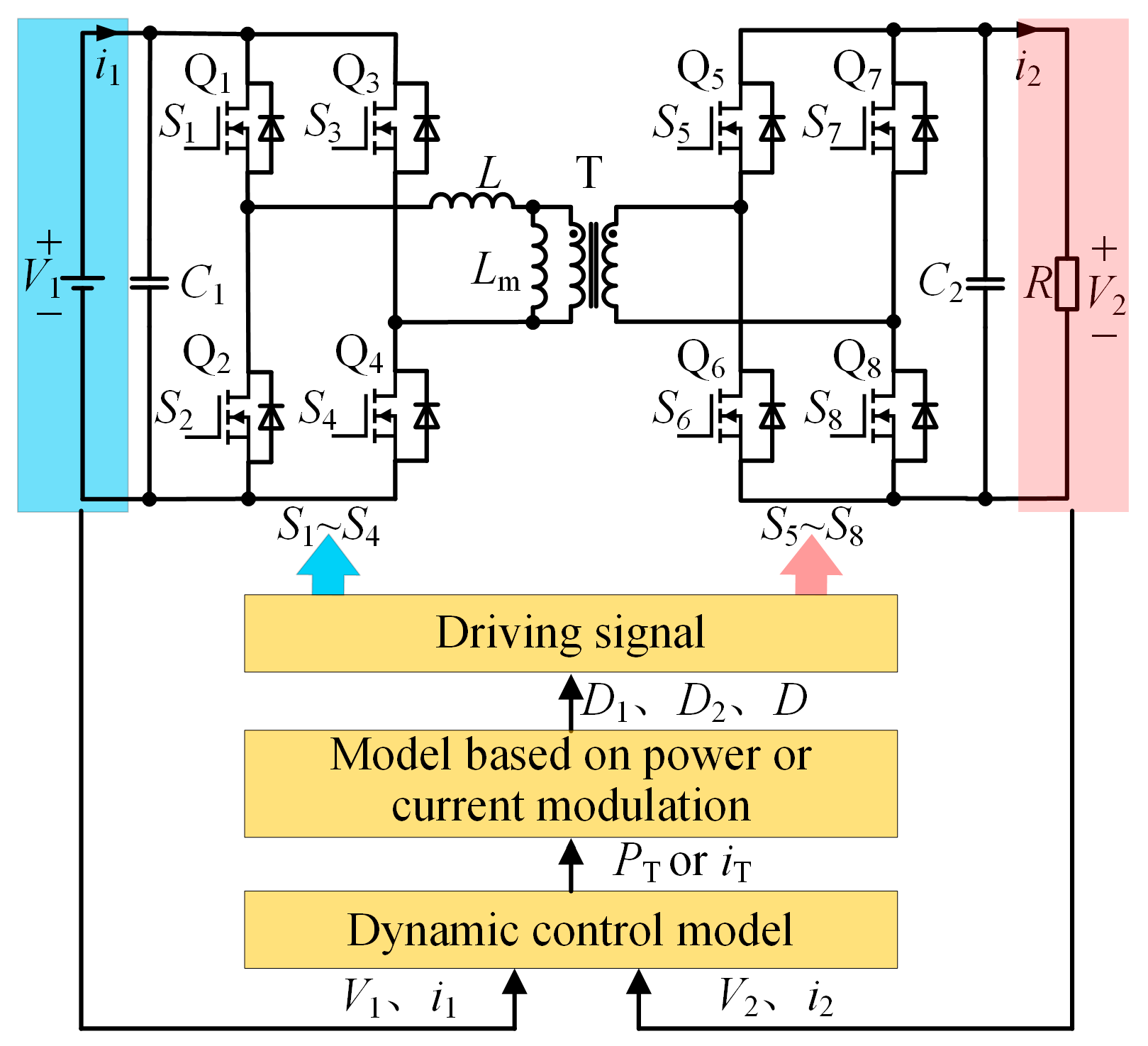
The general modulation and control structure of the DAB converter is shown in Figure 1. In the diagram, power switches Q1–Q4 and Q5–Q8 form the primary-side and secondary-side H-bridges, respectively. S1S8 represent the driving signals for the power switches. T denotes a high-frequency transformer with turns ratio, n; L represents its leakage inductance; and Lm is the magnetizing inductance. V1 and V2 are the input and output voltages; C1 and C2 are the filter capacitors; and R is the load resistance.
When power losses are neglected and single phase-shift modulation is employed, the transmission power, PT, of the DAB can be expressed as follows [20]:
P T = n V 1 V 2 D 1 D 2 L f s
where D is the phase-shift ratio between the primary and secondary sides, defined as D = φ/π, with φ being the phase-shift angle between the driving signals of the primary and secondary bridge arms, and fs being the switching frequency.
From (1), it can be observed that when the circuit parameters are known, the phase-shift ratio can be directly determined from the transmission power. Similarly, under other phase-shift modulation schemes, the corresponding phase-shift ratio combination can be obtained once the transmission power is known, thereby enabling the modulation and control of the DAB converter.
The general modulation and control structure employs a closed-loop control strategy based on dynamic models to achieve precise tracking control of the transmission power or current. The power command output from the control algorithm is converted into corresponding phase-shift ratios through the phase-shift modulation module, which then generates PWM driving signals to control the operation of the power-switching devices in the DAB converter.
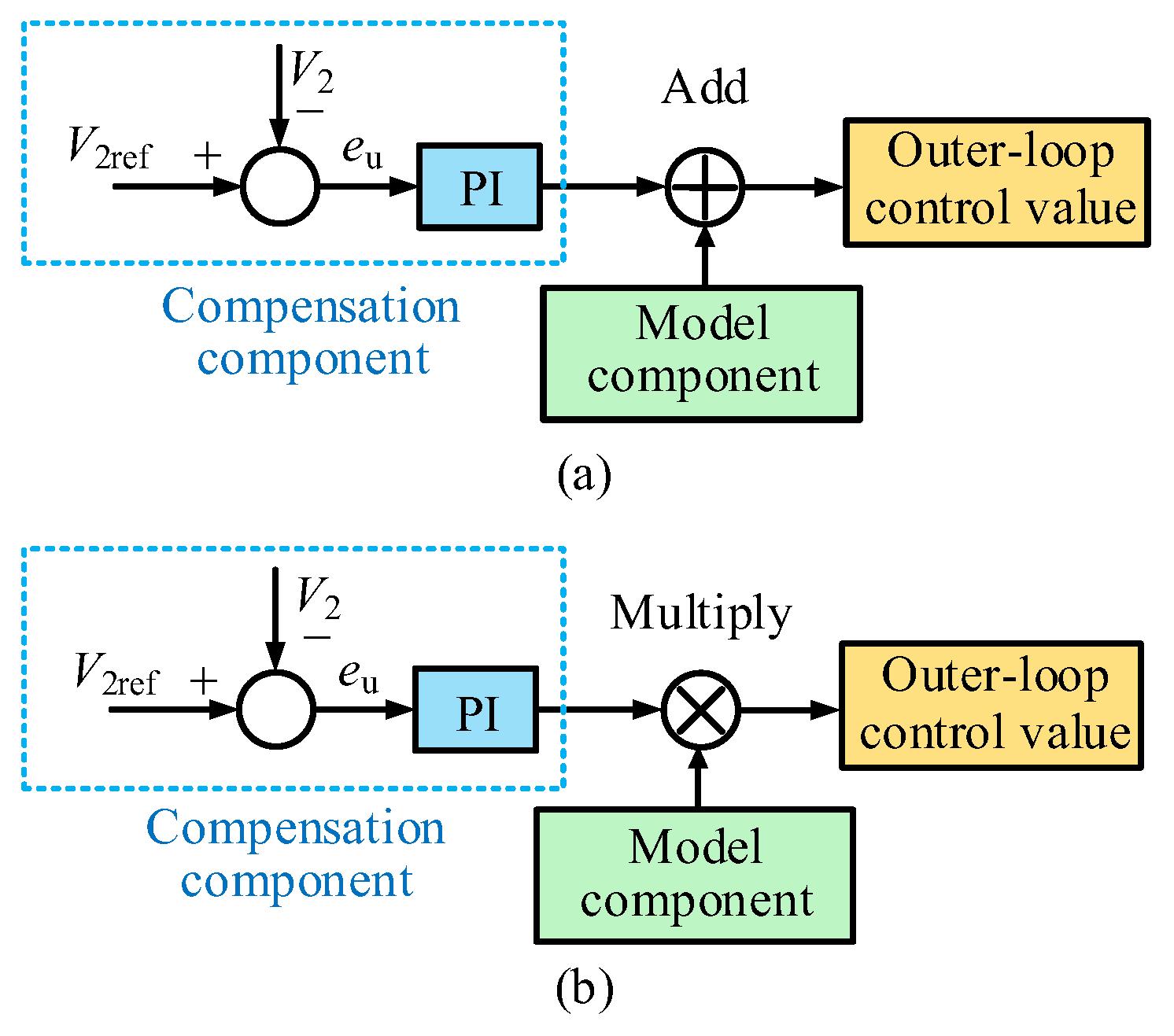
To improve the dynamic response of the DAB converter, existing methods can be classified into AFC and MFC methods based on the relationship between the compensation component and model-based component, with their structural block diagrams shown in Figure 2a,b, respectively.
As illustrated in Figure 2, the AFC method adds the output of the compensation component to the model-based component to obtain the outer-loop control value, while the MFC method multiplies these two components to derive the outer-loop control value. Typically, the model-based component consists of sampled input voltage and load current, primarily handling disturbances from input voltage and load variations, whereas the compensation component corrects errors caused by power losses and other uncertainties between the model and actual converter system.

3. Proposed MFC-SGA Method

Based on the general modulation and control structure of the DAB converter and combined with steady-state optimization modulation methods, this article analyzes two hybrid optimization control approaches for both steady-state and dynamic performance, where dynamic performance optimization is achieved through either MFC or AFC methods. A comparative analysis of the advantages and disadvantages of both control schemes is presented, and to address the limitations of the MFC approach, the MFC-SGA method is proposed.

3.1. Hybrid Optimization Control Approaches for Both Steady-State and Dynamic Performance

Building upon the PSTPS optimization modulation method, this article proposes two hybrid optimization control approaches that simultaneously address both steady-state and dynamic performance. As derived from the PSTPS optimization modulation method, accurate calculation of transmission power serves as the prerequisite for power segmentation.
The transmission power, PT, can be expressed as follows:
P T = V 2 ref i T
where V2ref represents the reference voltage value on the secondary side, and iT denotes the transmission current.
Taking Pmax = nV1V2/8fsL as the power base value, the per-unit value of transmission power, pT, is obtained by normalizing (2):
p T = P T P max = 8 f s L V 2 ref i T n V 1 V 2
When the required transmission current (iT) is obtained, the DAB converter can derive the corresponding phase-shift ratio through phase-shift modulation strategies. To improve dynamic response during load resistance variations, the load current can be used as a feedforward value for calculating the transmission current, ensuring fast response under changing input voltage and load conditions. However, if the output voltage deviates from its reference value, load current variations will cause the transmission current (iT) to deviate from its set point. To address this issue, switching the load current to a reference load current, ioref, can enhance control system stability, where ioref = V2ref io/V2.
The transmission current of a DAB converter should equal its output current under ideal conditions. However, power losses inevitably occur during operation, creating a discrepancy between the transmission current (iT) and output current (io). Consequently, deviations from the reference output voltage are unavoidable. To compensate for current errors caused by power losses and other uncertain factors, a Proportional–Integral (PI) controller is used to obtain the compensation value of the transmission current, thereby determining the actual transmission current. In the AFC method, the compensation value is defined as α, while in the MFC method, it is defined as β.
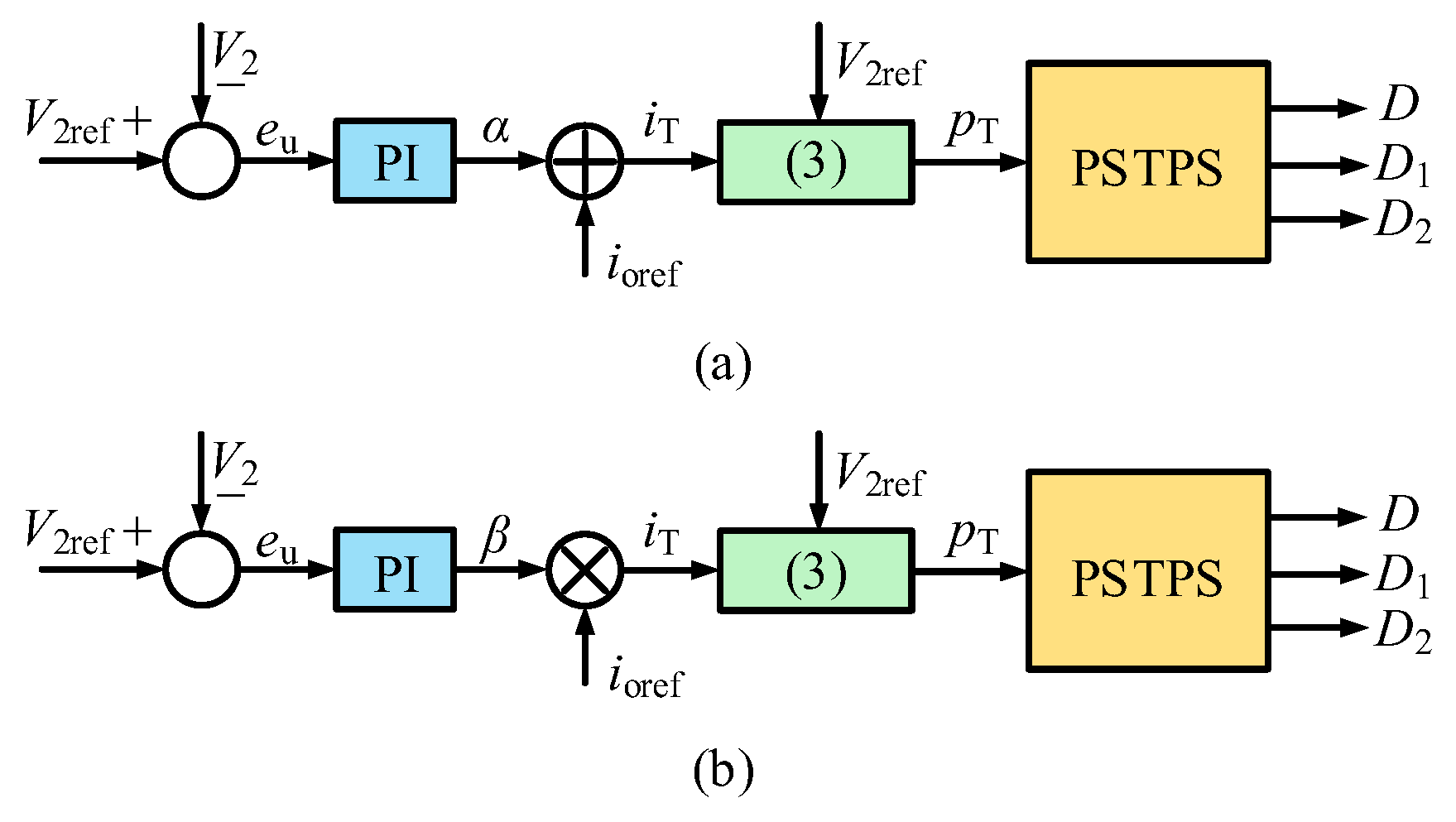
Combining Figure 2 with (3), the hybrid optimization control method for steady-state and dynamic performance is divided into AFC and MFC approaches, with their corresponding structural block diagrams illustrated in Figure 3a,b respectively.
As illustrated in Figure 3, the control process can be described as follows: The DAB converter’s input voltage (V1), output voltage (V2), and output current (io) are sampled. The voltage error between the reference output voltage (V2ref) and actual output voltage (V2) is processed through a PI controller to generate transmission current compensation. In the AFC method, the transmission current compensation value (α) is added to the desired output current (ioref) to obtain the transmission current (iT), while in the MFC method, the compensation value (β) is multiplied by ioref to determine iT. The transmission current (iT) is then converted to normalized transmission power (pT) using (3), after which the power range is identified and the optimal phase-shift ratio combination is derived through the PSTPS optimization modulation method.
For the AFC method, the transmission power (pT) and transmission current (iT) can be expressed as
p T = 8 f s L V 2 ref ( α + V 2 ref V 2 i o ) n V 1 V 2
i T = α + V 2 ref i o V 2
For the MFC method, the transmission power (pT) and transmission current (iT) can be expressed as
p T = 8 β f s L V 2 ref 2 i o n V 1 V 2 2
i T = β i oref = β V 2 ref i o V 2

3.2. Performance Comparison Between MFC and AFC

According to (3) and Figure 3, both the AFC and MFC methods utilize circuit parameters such as the transformer turns ratio (n) and inductance (L) to calculate the normalized transmission power. Consequently, it is essential to analyze the correlation of circuit parameters, particularly when the inductance value is imprecise. Furthermore, in the calculation of normalized transmission power, the transmission current, iT, also significantly impacts dynamic performance.
To investigate the influence of circuit parameters and transmission current (iT) on the AFC and MFC methods, an intermediate variable (T) incorporating these factors is defined as
T = L n ( α + V 2 ref i o V 2 ) AFC L n β V 2 ref i o V 2 MFC
When accounting for inductance inaccuracies, let the imprecise inductance be denoted as L’, which can be expressed in terms of the nominal inductance (L) as L’ = kLL, where kL represents the inductance inaccuracy coefficient. Consequently, under steady-state conditions with imprecise inductance values, the corresponding intermediate variable, T, can be formulated as
T = 1 n L ( α + V 2 ref i o V 2 ) AFC 1 n L β V 2 ref i o V 2 MFC
where α’ and β’ represent the steady-state compensation values corresponding to imprecise inductance conditions.
By substituting L’ into (9) and combining with (8), the compensation value α’ for the AFC method can be derived as
α = α + V 2 ref V 2 i o k L V 2 ref V 2 i o
When circuit parameters are precise, no additional compensation of the transmission current is required, and the value of α approaches zero. Therefore, α’ can be approximately expressed as
α ( 1 k L 1 ) V 2 ref V 2 i o
When the load resistance undergoes a sudden change, the load current becomes ionew. By combining (8)–(11), the intermediate variable (T) under imprecise inductance (L) conditions can be further expressed as
T = L n [ ( 1 k L ) V 2 ref V 2 i o + k L V 2 ref V 2 i onew ]
Furthermore, since α ≈ 0 when circuit parameters are precise, the intermediate variable, T, for the AFC method under exact inductance conditions can also be represented as
T = L n V 2 ref V 2 i onew
By combining (12) and (13), the error in the intermediate variable T for the AFC method during DAB converter load resistance transients is derived as
Δ T = L n ( 1 k L ) V 2 ref V 2 ( i o i onew )
As derived from (14), when the inductance value is imprecise and the load resistance changes, the error in the intermediate variable, T, of the AFC method correlates with the inductance inaccuracy coefficient kL, preventing immediate acquisition of the accurate target value. Consequently, the PI controller must compensate for this deviation, which adversely affects the dynamic response speed of the AFC method. This demonstrates that the AFC method exhibits high sensitivity to circuit parameters such as L and n.
Similarly, under imprecise inductance conditions, the intermediate variable, T, for the MFC method can be further expressed as
T = 1 n L β V 2 ref V 2 i o = 1 n L β V 2 ref V 2 i onew
By combining (8) and (15), the error in the intermediate variable, T, of the AFC method during DAB converter load resistance transients can be derived as
Δ T = L n β V 2 ref V 2 ( i o i onew )
From (16), it can be concluded that for the MFC method, the error in intermediate variable, T, is independent of the inductance inaccuracy coefficient, kL. This means that when load resistance changes occur, no additional compensation is required. Thus, the MFC method demonstrates insensitivity to circuit parameters such as the transformer turns ratio (n) and inductance value (L), exhibiting superior robustness against parameter variations compared to the AFC method.
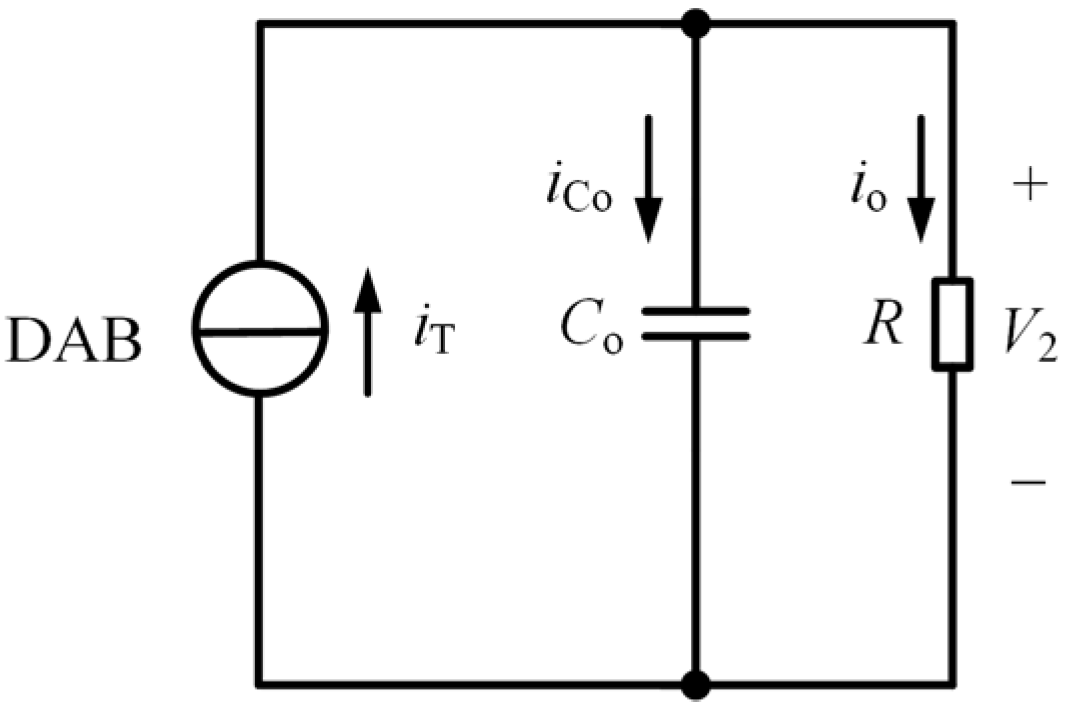
However, the MFC method also has certain limitations. During transient responses of the DAB converter, the primary focus is on the rapid adjustment of output voltage or current under load variations or input voltage fluctuations. Although the inductance, L, introduces some delay, its impact on transient performance is relatively minor. The DAB converter exhibits simplified dynamic characteristics similar to a first-order system, as illustrated in the simplified circuit diagram in Figure 4.
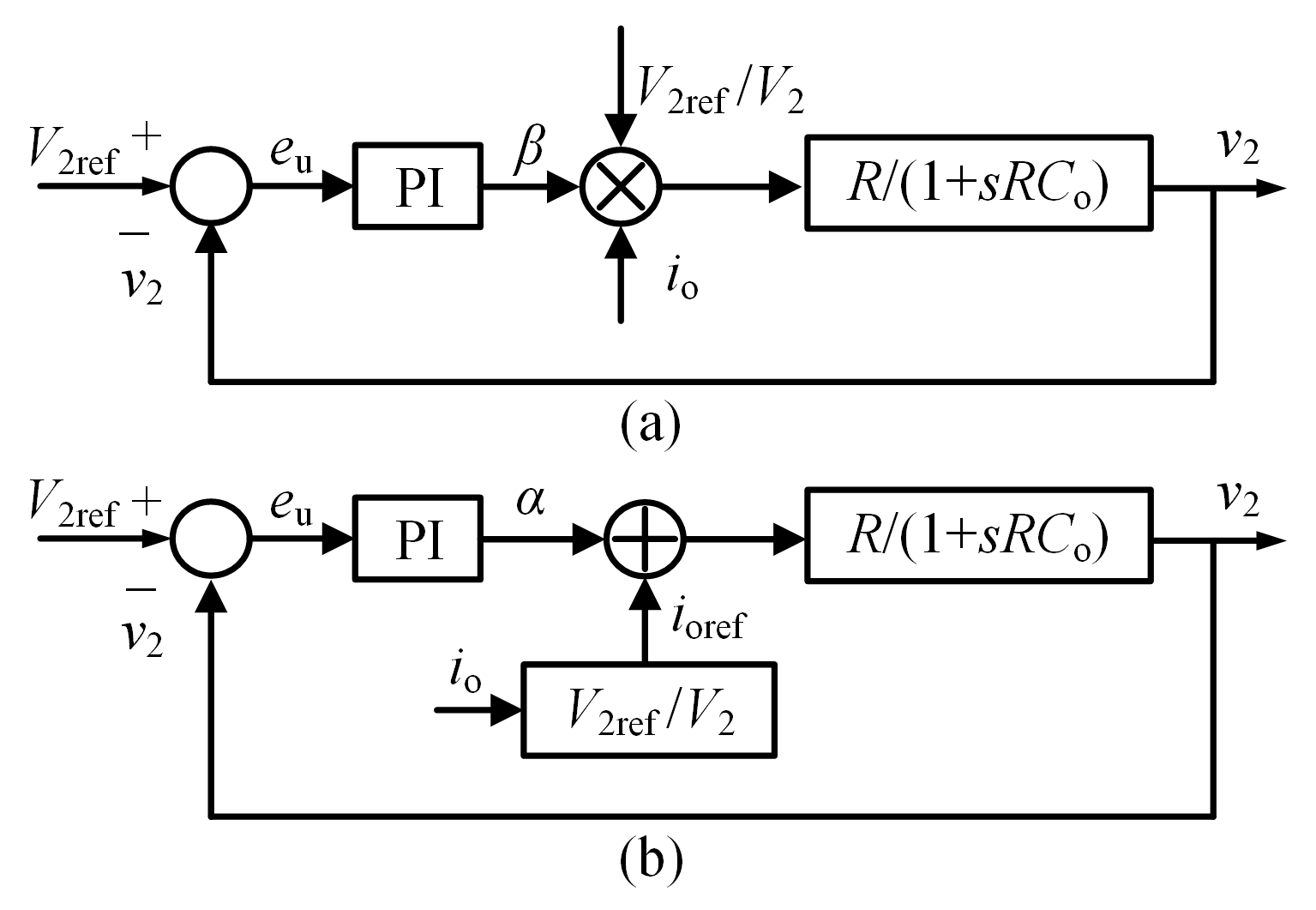
By integrating the structural block diagrams of the MFC and AFC methods shown in Figure 3 with the simplified DAB converter circuit illustrated in Figure 4, the complete control block diagrams for both methods can be derived as presented in Figure 5.
From Figure 5a, the open-loop transfer function Hs(s) under the MFC method can be derived as shown in (17). Similarly, Figure 5b yields the open-loop transfer function Hp(s) for the AFC method, given by (18).
H s ( s ) = i o V 2 ref V 2 k p s + k i s R 1 + s R C o
H p ( s ) = ( k p s + k i s + i o V 2 ref V 2 ) R 1 + s R C o
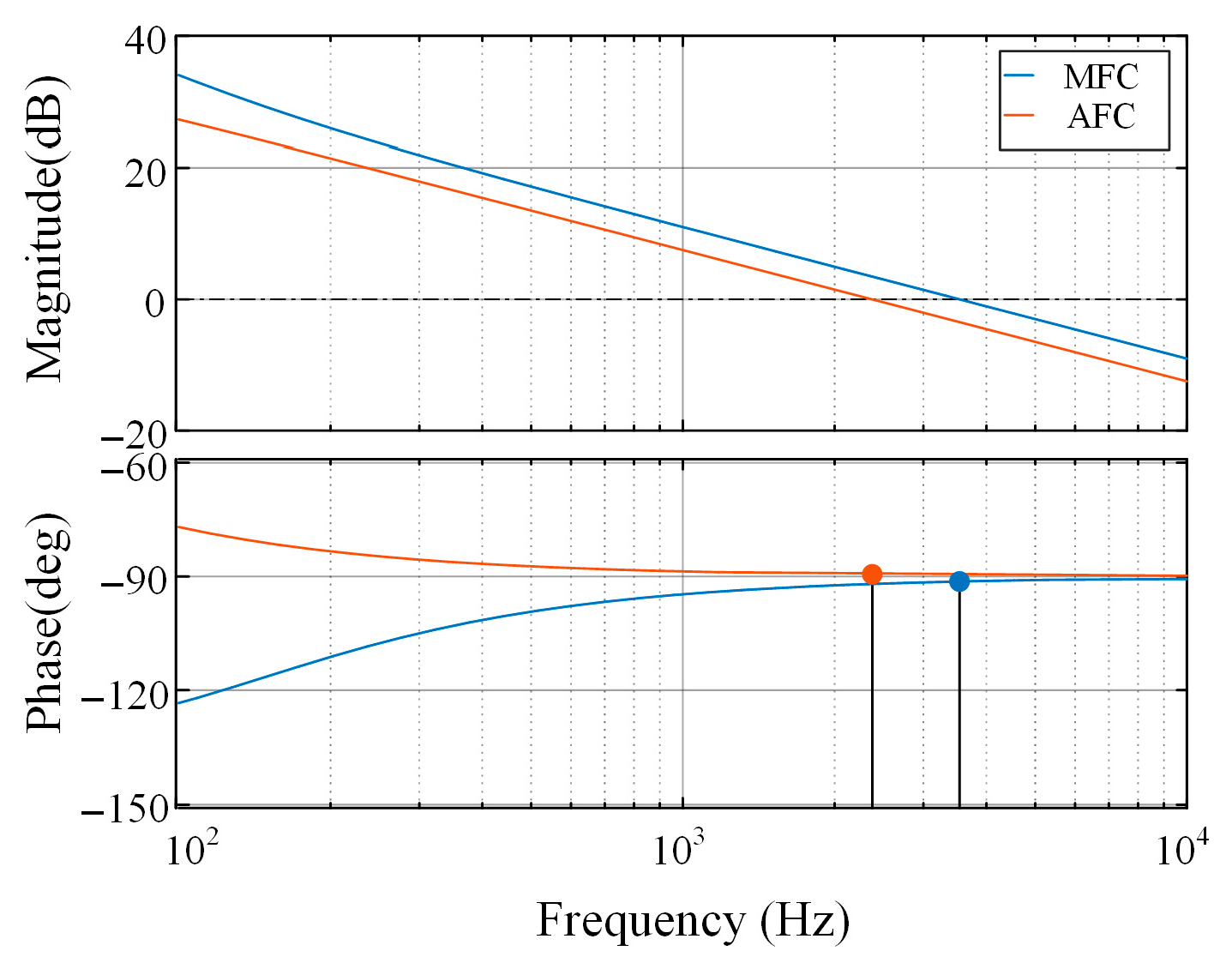
From (17) and (18), it is evident that the DAB converter constitutes a minimum-phase system, where the crossover frequency and phase margin critically determine both system stability and dynamic performance. Based on (17) and (18), the corresponding Bode plots are depicted in Figure 6 to quantitatively compare their dynamic response speeds and stability characteristics.
Based on Figure 6, the MFC method exhibits a crossover frequency of 3538.40 Hz, with a phase margin of 88.66°, while the AFC method shows a crossover frequency of 2375.40 Hz and a phase margin of 90.56°. Both control methods demonstrate excellent stability margins, but the MFC method’s higher crossover frequency indicates superior dynamic response speed compared to AFC, making it more advantageous for transient performance.
However, (17) reveals that when the DAB converter operates under light-load conditions, the load current decreases significantly. In the MFC method, the PI controller output multiplies with the load current. The reduced load current equivalently decreases the PI controller gain, weakening its ability to amplify error signals. This limitation restricts the controller’s regulation capability and degrades dynamic response performance.
In contrast, (18) shows that the AFC method adds the PI controller’s output directly to the load current, making the controller gain independent of load current magnitude.
In practical applications where inductor parameter accuracy cannot be guaranteed due to manufacturing tolerances and temperature effects, the MFC method’s insensitivity to inductance variations gives it a significant advantage. Although the MFC method faces PI controller gain reduction in light-load conditions, this can be effectively addressed through optimized adaptive control strategies to substantially improve dynamic response performance.

3.3. MFC-SGA Method

To address the impact of light-load conditions on controller gain in the MFC method, the MFC-SGA method is proposed. This method uses the PI parameters designed for heavy-load operation as a baseline and achieves adaptive adjustment of controller parameters during light-load operation through dynamic tuning.
In the MFC method, the PI controller gain under light-load conditions is proportional to io. Therefore, considering the system stability, dynamic response performance, and engineering application conditions comprehensively, a segmented gain adjustment function based on the output current is designed, with 10% of the rated current, iN, selected as the threshold reference value and by normalizing io as io* = io/(10%iN). Using the normalized current io* = 1 as the threshold point, the system operates in light-load mode when io* < 1 and enters heavy-load mode when io* ≥ 1. The corresponding segmented gain adjustment function can be expressed as
f ( i o * ) = 1 i o i o * < 1 10 i N i o * 1
When io* = 1, 1/io = 1/(10%iNio*) = 10/iN, ensuring continuity of this segmented gain adjustment function.
The PI parameters k p and k i of the controller under the MFC-SGA method can be expressed as
k p = k p f ( i o ) k i = k i f ( i o )
Substituting Equation (20) into (17) gives the open-loop transfer function represented by PI controller parameters in the MFC-SGA method:
H s ( s ) = i o V 2 ref V 2 k p s + k i s R 1 + s R C o           = V 2 ref V 2 k p s + k i s R 1 + s R C o i o * < 1 10 i N i o V 2 ref V 2 k p s + k i s R 1 + s R C o i o * 1
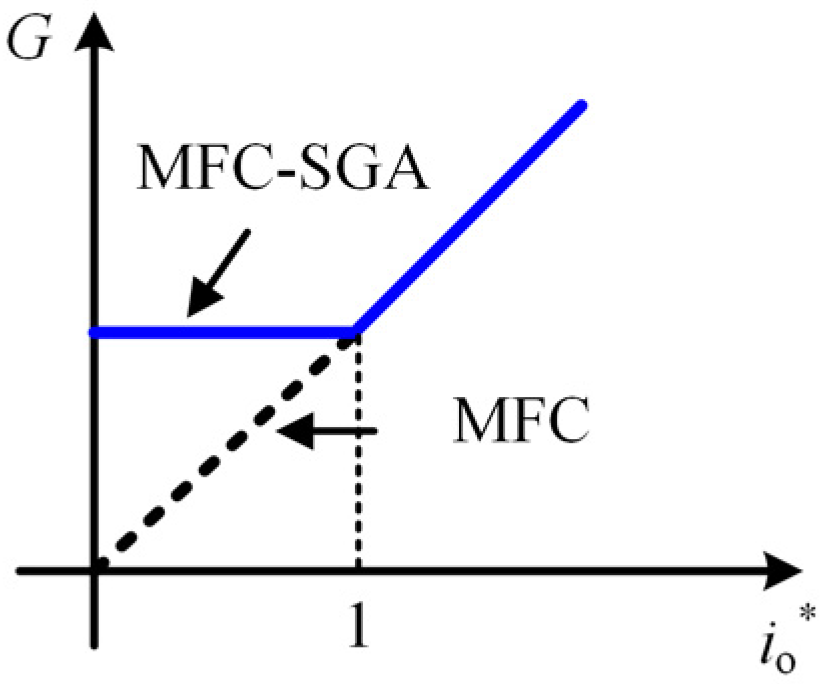
From (21), the loop gain, G, from the output voltage error (eu) to transmission current (iT) in the MFC-SGA method is given by (22), with a schematic representation shown in Figure 7.
G = k p V 2 ref V 2   or   k i V 2 ref V 2 i o * < 1 k p 10 i o V 2 ref i N V 2   or k i 10 i o V 2 ref i N V 2 i o * 1
As evidenced by (22) and Figure 7, the MFC-SGA method decouples the loop gain, G, from io under light-load conditions, maintaining consistent loop gain, G, stability that ensures robust dynamic performance. During heavy-load operation, the loop gain, G, adaptively increases with io, where enhanced gain effectively improves the system’s dynamic response speed for rapid load variation tracking.
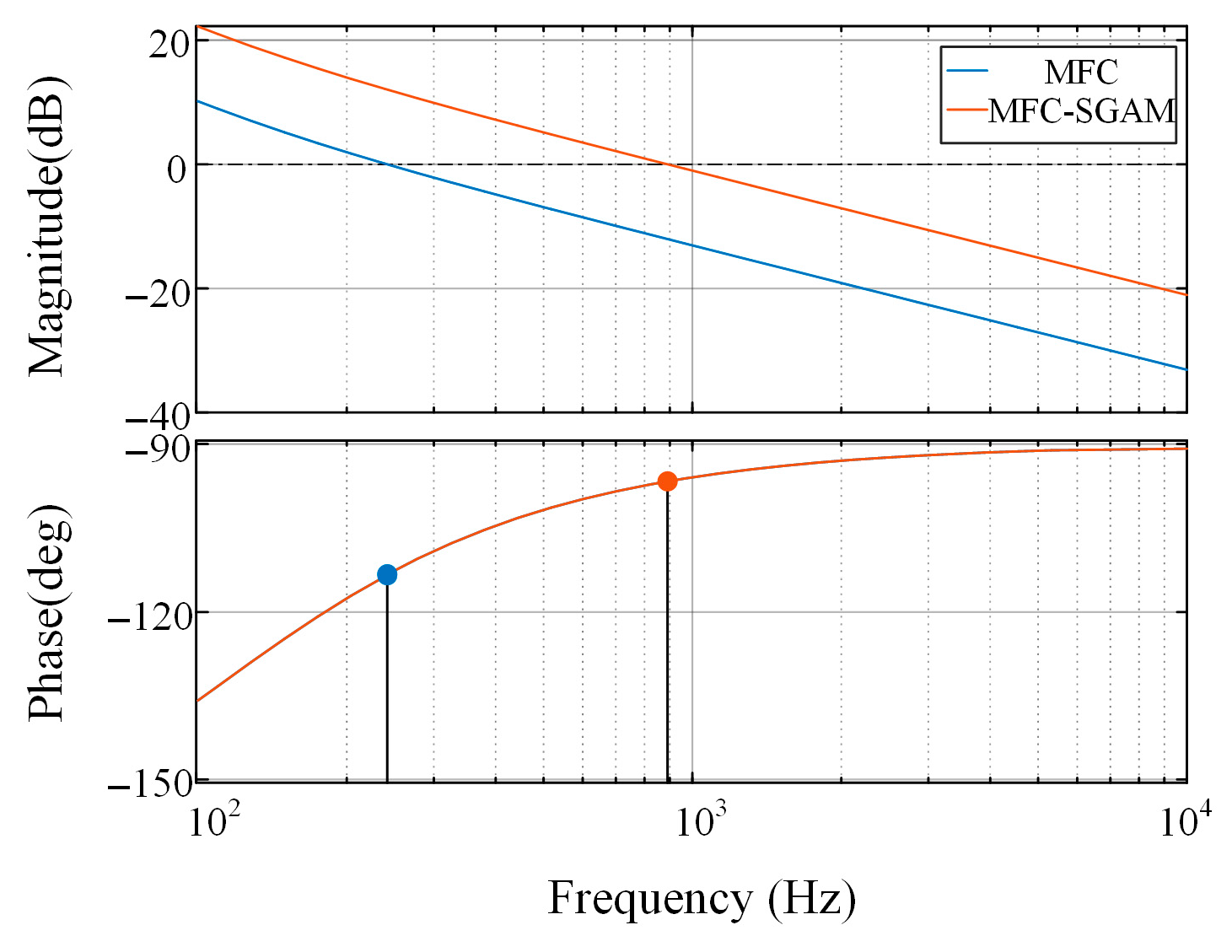
Figure 8 presents the Bode plots comparing conventional MFC and MFC-SGA methods under light-load conditions, derived from (17) and (21).
From Figure 8, it can be observed that the MFC method has a crossover frequency of 241.45 Hz, with a phase margin of 66.63°, while the MFC-SGA method achieves a significantly higher crossover frequency of 890.57 Hz and an improved phase margin of 83.30°. Both methods maintain stable operation, as evidenced by their sufficient phase margins, but the MFC-SGA method demonstrates superior dynamic performance through its substantially increased crossover frequency, indicating faster system response. The enhanced performance confirms that the adaptive PI parameter adjustment in the MFC-SGA method effectively addresses the dynamic limitations of conventional MFC in light-load conditions.

4. Experimental Results and Analysis

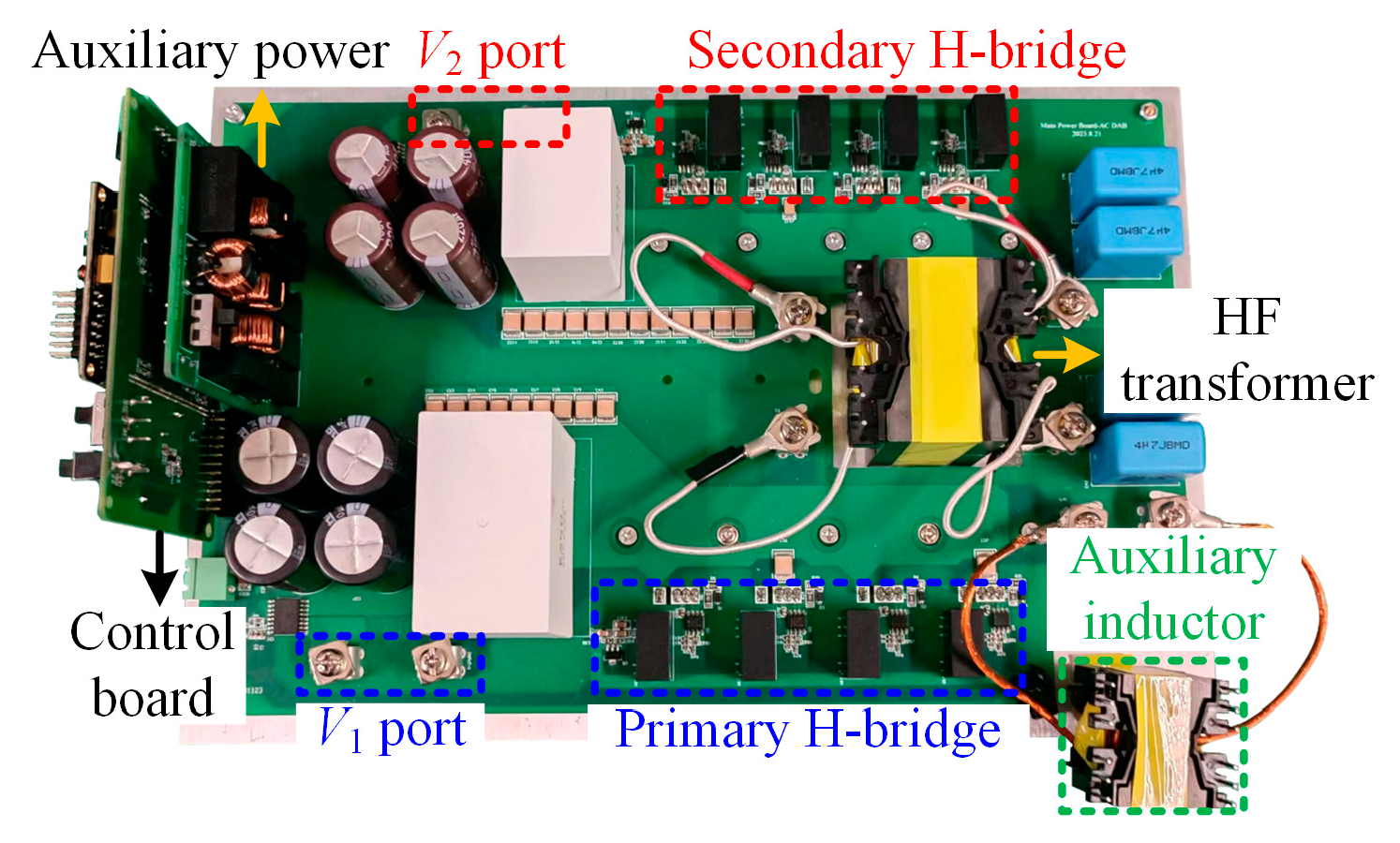
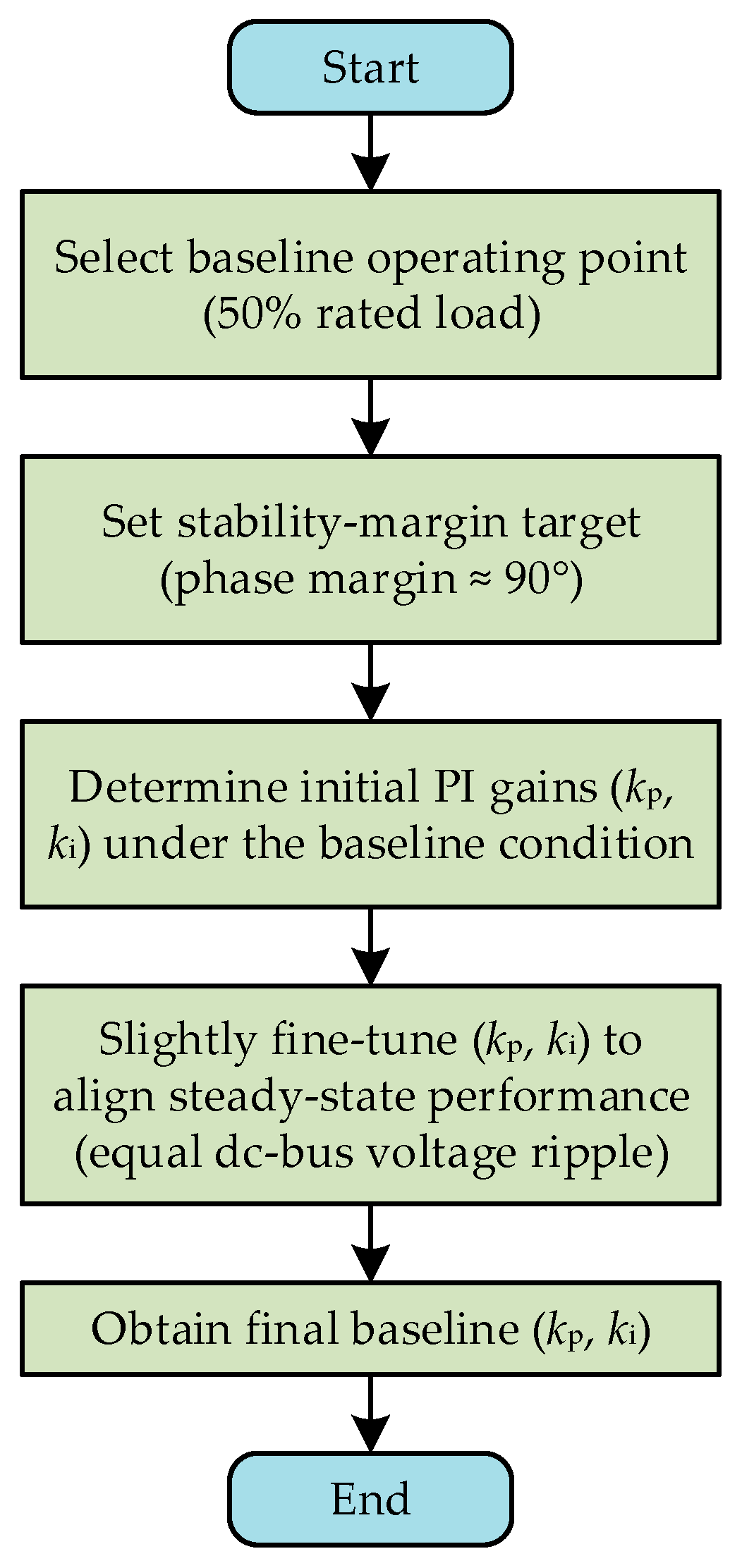
To verify the effectiveness of the proposed MFC-SGA method, a 500 W prototype was implemented as shown in Figure 9, with detailed parameters listed in Table 2. The prototype utilizes TMS320F28335 (from Texas Instruments, Dallas, TX, USA) as the digital controller and employs C3M0120065K (from Wolfspeed, Durham, NC, USA) as power switches. For a fair and consistent evaluation, the PI controllers used in MFC, AFC, and the conventional PI-based control are designed under the same heavy-load operating point (50% rated load) with comparable stability margins. Specifically, the PI gains are selected such that the open-loop phase margins of the three methods are kept at a similar level (approximately 90°) at the heavy-load condition. Then, based on these baseline gains, kp and ki are slightly fine-tuned to make the steady-state performance essentially consistent among different methods, particularly achieving approximately equal dc-bus voltage ripple. In this way, the subsequent comparisons mainly reflect the differences in transient behavior rather than steady-state discrepancies. The PI controller design procedure is summarized in Figure 10. In addition, since all methods operate under the same modulation and switching frequency (100 kHz), the steady-state output-voltage ripple is mainly distributed around the switching frequency and its multiples, and thus it has limited impact on dc microgrid power quality [21].
To verify the dynamic performance of the MFC method, experiments first compared the dynamic characteristics of MFC, AFC, and conventional PI control when the inductance value was accurate, then examined the sensitivity of MFC and AFC methods to circuit parameters, and finally validated the effectiveness of the MFC-SGA method.
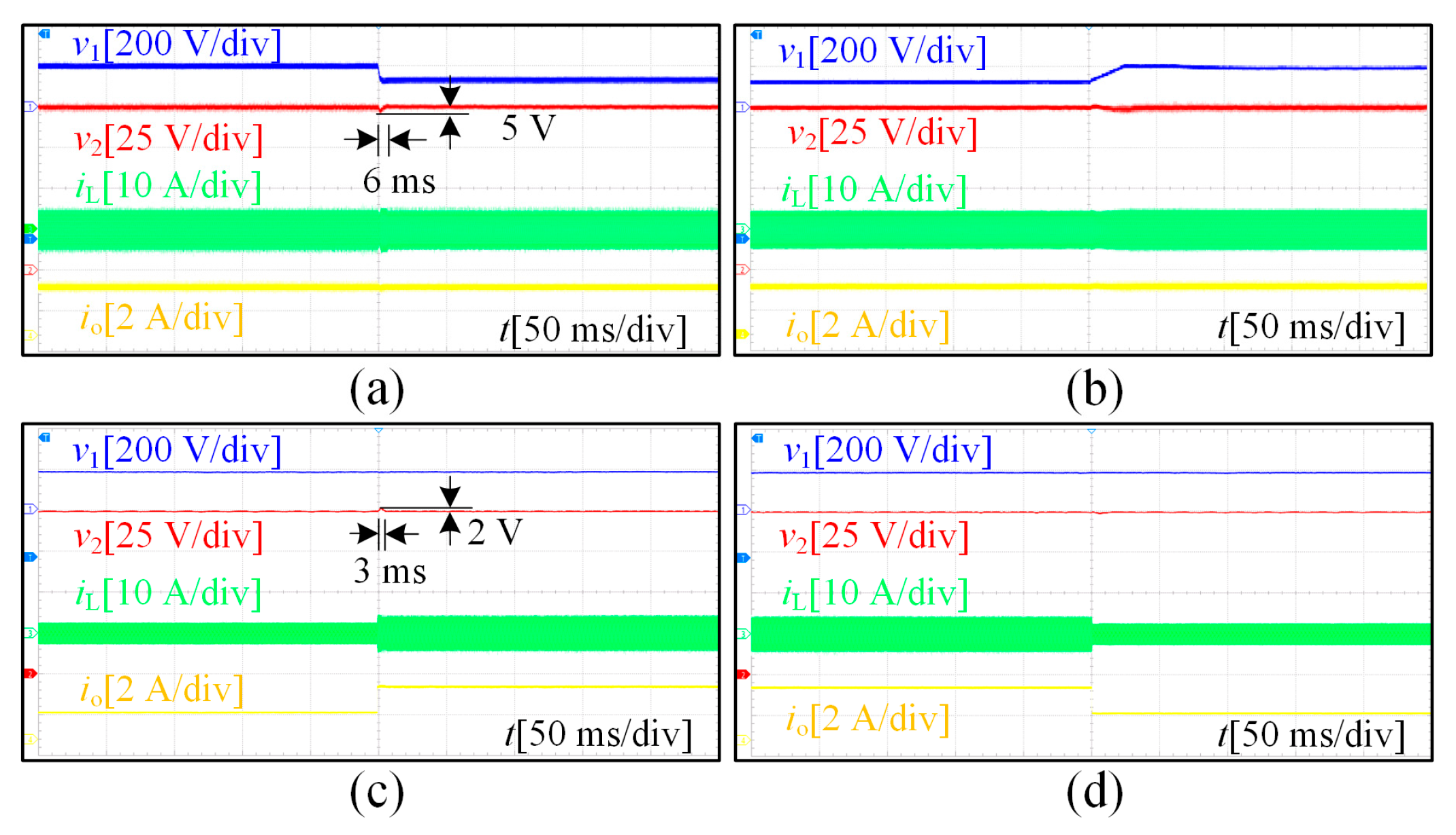
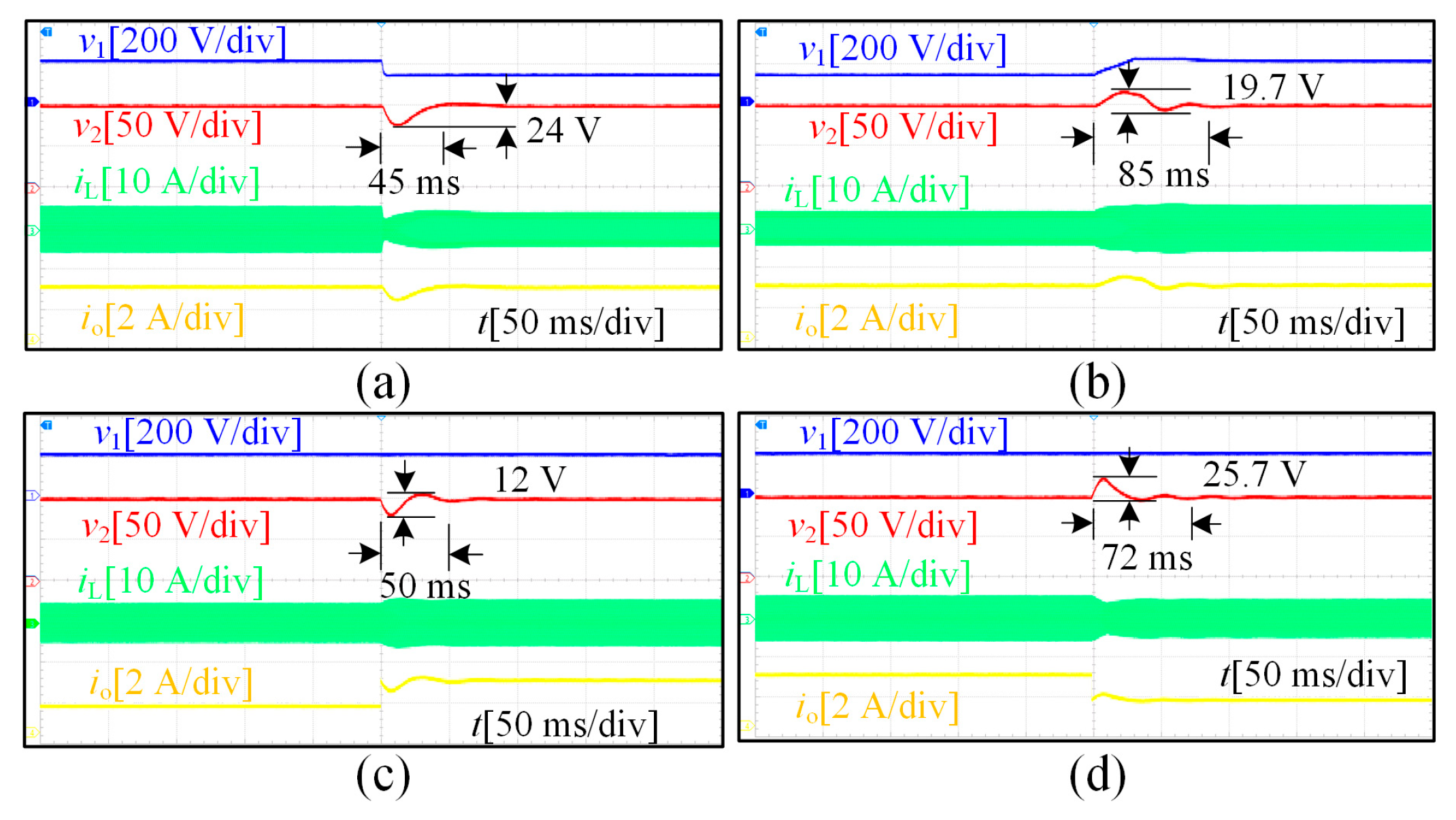
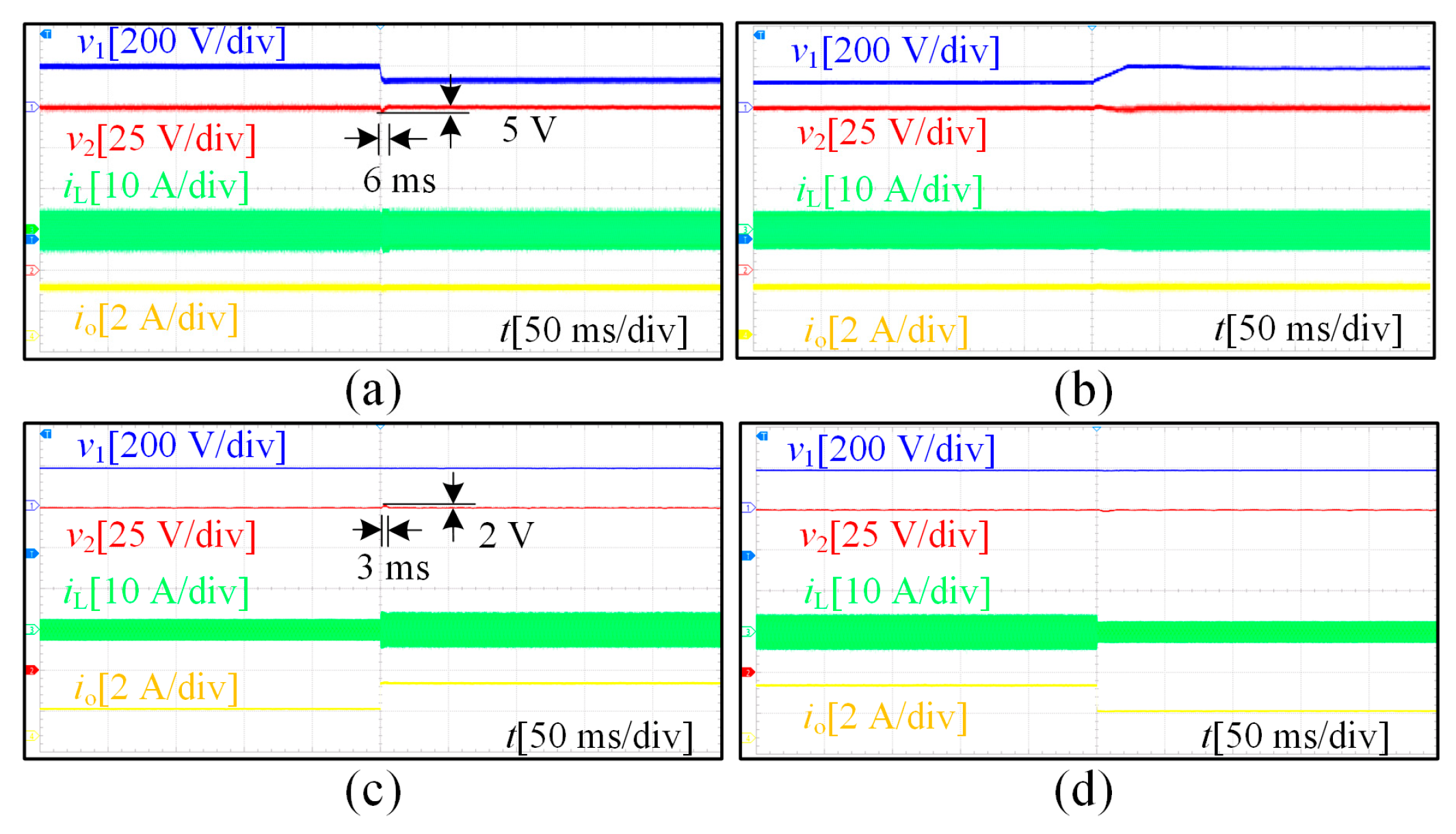
Under precise inductance conditions, the dynamic performance of MFC, AFC, and traditional PI control was compared by observing output voltage variations during input voltage or load resistance changes. The experimental results for MFC, AFC, and conventional PI control are shown in Figure 11, Figure 12 and Figure 13.
Figure 11, Figure 12 and Figure 13 demonstrate that for MFC, AFC, and PI control with accurate inductance values, the DAB converter’s dynamic performance under both MFC and AFC methods significantly outperforms conventional PI control during either input voltage or load resistance variations, exhibiting substantially shorter settling times and smaller overshoots. Comparing MFC and AFC methods directly, during input voltage decreases, both methods show 5 V overshoot, but MFC achieves a faster (6 ms) settling time. Under increasing load resistance, the MFC method achieves a 3 ms settling time with 2 V overshoot, compared to the 20 ms settling time and 6 V overshoot for the AFC method, demonstrating MFC’s superior transient response with both faster stabilization and lower voltage deviation. During load resistance decreases, the MFC method maintains stable output voltage with negligible variation, while the AFC method exhibits a 10 ms settling time and 5 V overshoot. Consequently, the MFC method demonstrates superior performance during load resistance variations compared to the AFC method.
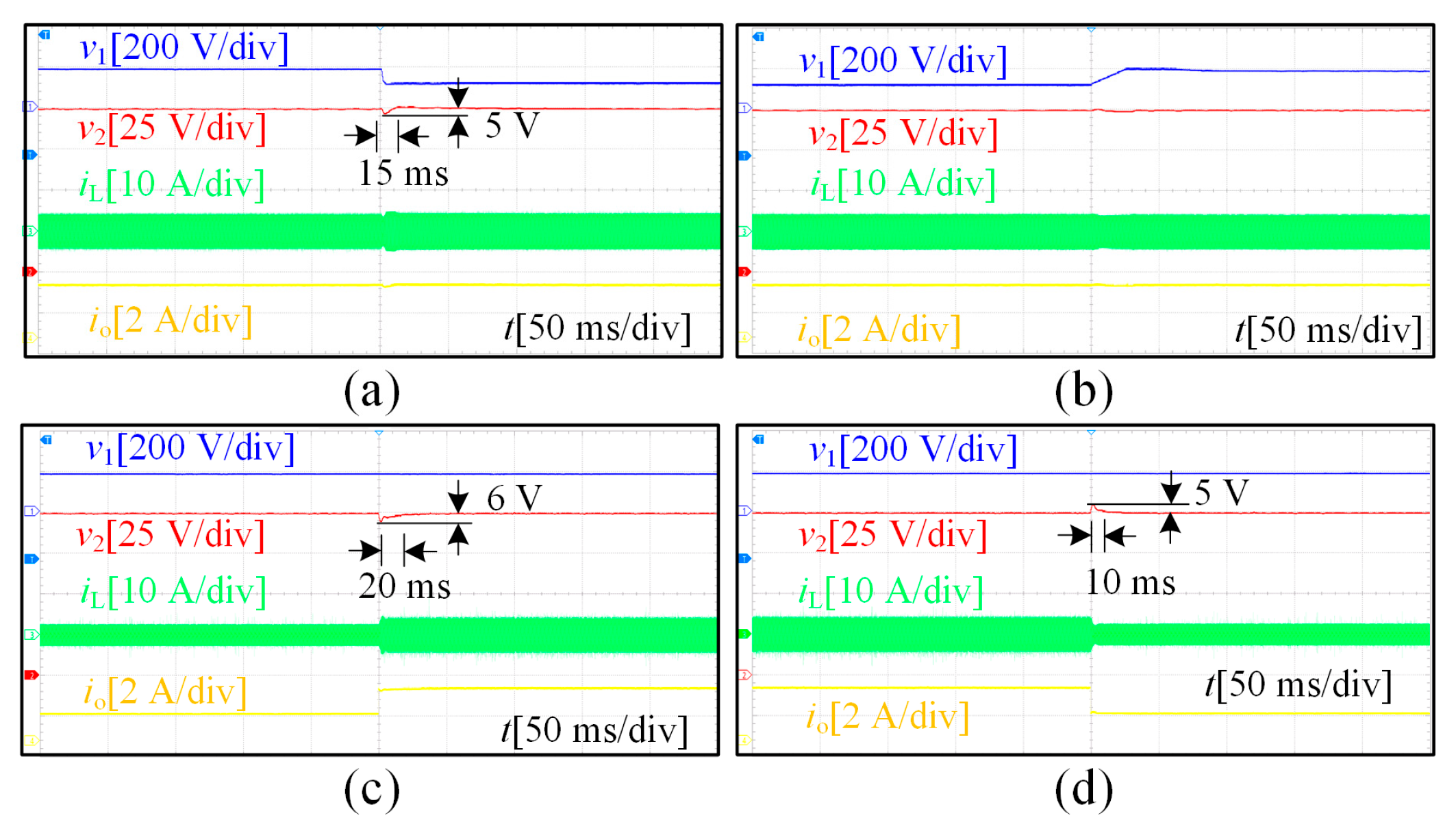
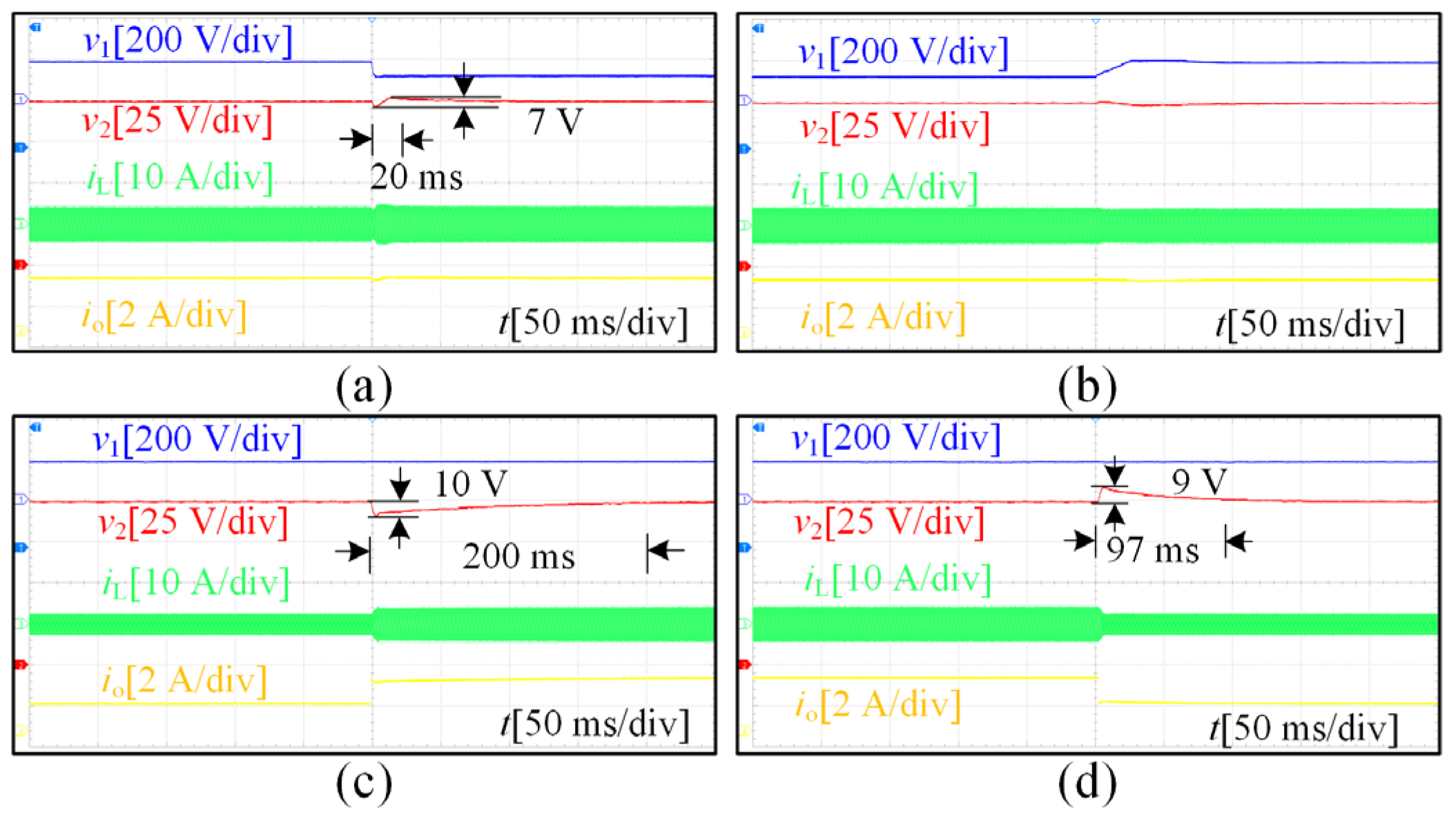
To examine circuit parameter effects on the MFC and AFC methods, output voltage responses were similarly compared during input voltage and load resistance changes under inaccurate inductance conditions, with experimental results shown in Figure 14 and Figure 15. Inaccurate inductance conditions were simulated by setting the inductance parameter in the controller to 80% of the actual measured value.
As shown in Figure 14 and Figure 15, the accuracy of inductance values has no impact on the dynamic response of the MFC method during either input voltage or load resistance variations, demonstrating the MFC method’s insensitivity to DAB converter circuit parameters. For the AFC method, circuit parameters show minor influence during input voltage changes: the overshoot increases by 2 V and settling time extends by 5 ms when input voltage decreases. However, during load resistance variations with inaccurate inductance values, the dynamic response speed deteriorates severely, with settling times potentially extending tenfold, even becoming slower than conventional PI control under identical conditions. These results confirm the MFC method’s superior robustness against circuit parameter variations compared to AFC.
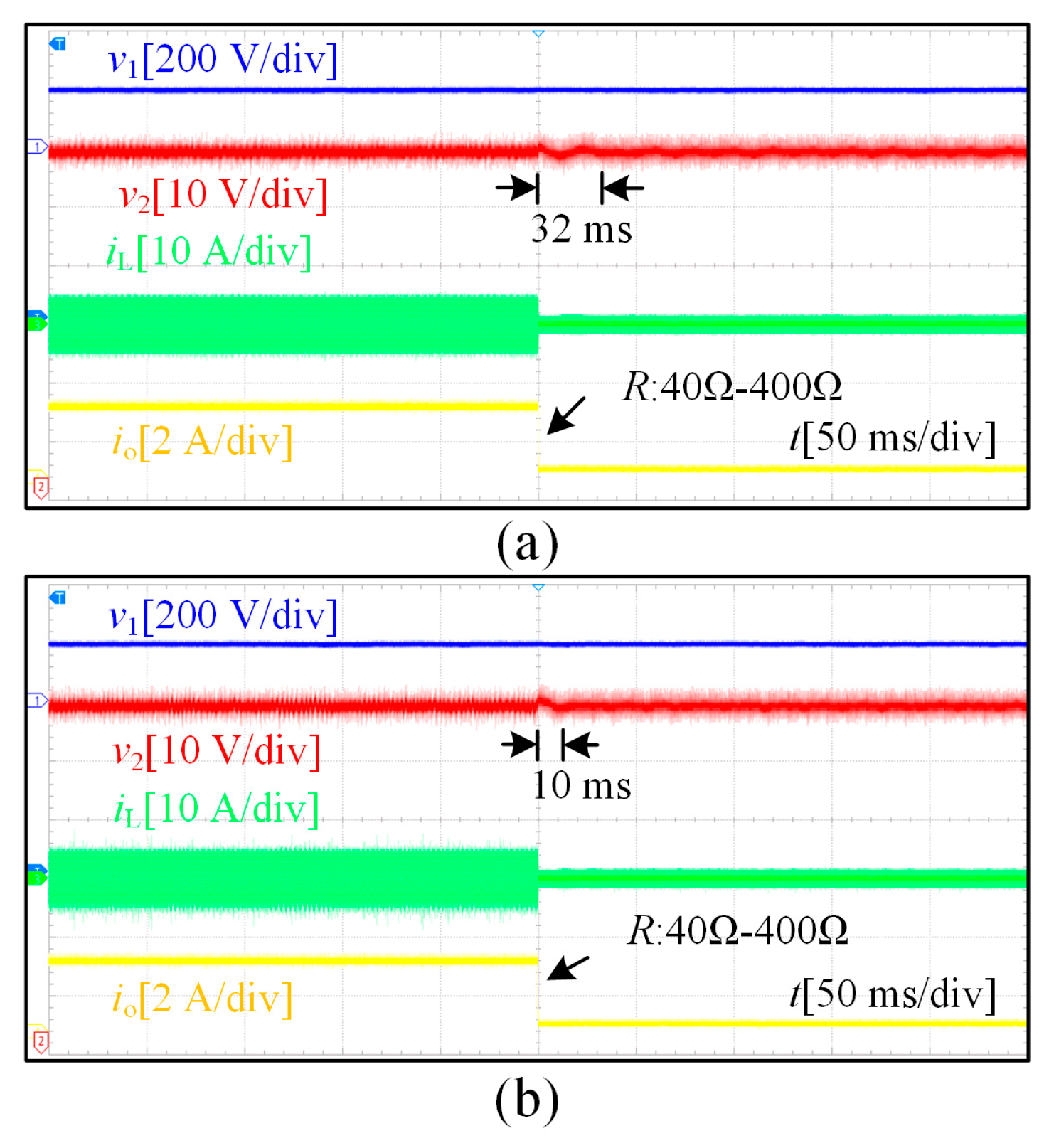
Previous analysis revealed that the MFC method’s limitation lies in load current magnitude affecting controller gain during light-load operation. To address this, the MFC-SGA method was proposed. For validation, with input voltage fixed at 200 V and output voltage at 100 V, the load resistance changes from 40 Ω to 400 Ω, representing a transition from heavy-load to light-load conditions, with the resulting output voltage dynamic waveform shown in Figure 16. The abovementioned experimental results are shown in Table 3.
Figure 16 demonstrates that when the DAB converter transitions from heavy-load to light-load mode, the MFC method exhibits a dynamic response time of 32 ms, while the MFC-SGA method achieves a significantly faster 10 ms response time, confirming the performance advantage and effectiveness of the MFC-SGA method in light-load operating conditions.

5. Conclusions

This article proposes a fast dynamic response control method for DAB converters based on multiplicative feedforward control (MFC). Combined with the optimized PSTPS modulation strategy, two hybrid optimized control methods (MFC and AFC) that balance steady-state and dynamic performance are proposed, significantly improving the steady-state and dynamic performance of DAB converters. The MFC method effectively reduces the sensitivity of control performance to changes in circuit parameters; however, due to the adoption of multiplicative feedforward, the dynamic performance of the converter degrades significantly under light-load mode, thus leading to the proposal of the MFC-SGA method. The MFC-SGA method further overcomes the limitation of limited regulation capability under light-load conditions through adaptive gain adjustment. Subsequently, experiments are conducted to compare AFC, MFC, and traditional PI control methods, as well as MFC and MFC-SGA control methods. Experimental results demonstrate that the proposed MFC-SGA method achieves fast dynamic response over a wide load range, verifying its effectiveness and applicability.

Author Contributions

Conceptualization, J.S., S.S. and Y.W.; methodology, P.Y., J.S., T.L. and S.S.; software, S.S.; validation, J.X. and Y.C.; formal analysis, Y.W. and X.Z.; data curation, J.X., Y.C. and X.W.; writing—original draft preparation, J.X. and J.S.; writing—review and editing, X.Z., T.L. and X.W.; supervision, T.L.; funding acquisition, P.Y. All authors have read and agreed to the published version of the manuscript.

Funding

This work is supported by the Science and Technology Project of State Grid Shandong Electric Power Company (Project Number: 520626250014).

Data Availability Statement

The original contributions presented in this study are included in the article. Further inquiries can be directed to the corresponding author.

Conflicts of Interest

Authors Xinbin Zuo and Xiao Wei were employed by the State Grid Shandong Electric Power Company. The remaining authors declare that the research was conducted in the absence of any commercial or financial relationships that could be construed as a potential conflict of interest.

References

  1. Alam, M.J.E.; Muttaqi, K.M.; Sutanto, D. Effective Utilization of Available PEV Battery Capacity for Mitigation of Solar PV Impact and Grid Support with Integrated V2G Functionality. IEEE Trans. Smart Grid 2016, 7, 1562–1571. [Google Scholar] [CrossRef]
  2. Zhao, L.; Jin, Z.; Wang, X. Small-Signal Synchronization Stability of Grid-Forming Converters with Regulated DC-Link Dynamics. IEEE Trans. Ind. Electron. 2023, 70, 12399–12409. [Google Scholar] [CrossRef]
  3. Xu, C.; Liu, S.; Guo, X.; Xiao, C.; Zou, X.; Zhang, L.; Liu, C.; Jiang, W. A Novel Converter Integrating Buck-Boost and DAB Converter for Wide Input Voltage. In Proceedings of the IECON 2020 The 46th Annual Conference of the IEEE Industrial Electronics Society, Singapore, 18–21 October 2020; pp. 2877–2882. [Google Scholar] [CrossRef]
  4. Chen, X.; Xu, G.; Han, H.; Liu, D.; Sun, Y.; Su, M. Light-Load Efficiency Enhancement of High-Frequency Dual-Active-Bridge Converter Under SPS Control. IEEE Trans. Ind. Electron. 2021, 68, 12941–12946. [Google Scholar] [CrossRef]
  5. Segaran, D.; Holmes, D.G.; McGrath, B.P. Enhanced Load Step Response for a Bidirectional DC–DC Converter. IEEE Trans. Power Electron. 2013, 28, 371–379. [Google Scholar] [CrossRef]
  6. Krismer, F.; Kolar, J.W. Accurate Small-Signal Model for the Digital Control of an Automotive Bidirectional Dual Active Bridge. IEEE Trans. Power Electron. 2009, 24, 2756–2768. [Google Scholar] [CrossRef]
  7. Dutta, S.; Hazra, S.; Bhattacharya, S. A Digital Predictive Current-Mode Controller for a Single-Phase High-Frequency Transformer-Isolated Dual-Active Bridge DC-to-DC Converter. IEEE Trans. Ind. Electron. 2016, 63, 5943–5952. [Google Scholar] [CrossRef]
  8. Li, K.; Yang, Y.; Tan, S.C.; Hui, R.S.Y. Sliding-Mode-Based Direct Power Control of Dual-Active-Bridge DC-DC Converters. In Proceedings of the 2019 IEEE Applied Power Electronics Conference and Exposition (APEC), Anaheim, CA, USA, 17–21 March 2019; pp. 188–192. [Google Scholar] [CrossRef]
  9. Ali, M.; Yaqoob, M.; Cao, L.; Loo, K.H. Disturbance-Observer-Based DC-Bus Voltage Control for Ripple Mitigation and Improved Dynamic Response in Two-Stage Single-Phase Inverter System. IEEE Trans. Ind. Electron. 2019, 66, 6836–6845. [Google Scholar] [CrossRef]
  10. An, F.; Song, W.; Yu, B.; Yang, K. Model Predictive Control with Power Self-Balancing of the Output Parallel DAB DC–DC Converters in Power Electronic Traction Transformer. IEEE J. Emerg. Sel. Top. Power Electron. 2018, 6, 1806–1818. [Google Scholar] [CrossRef]
  11. Song, C.; Chen, A.; Chen, J.; Du, C.; Zhang, C. Optimized modulation scheme for dual active bridge DC-DC converter. In Proceedings of the 2018 IEEE Applied Power Electronics Conference and Exposition (APEC), San Antonio, TX, USA, 4–8 March 2018; pp. 3569–3574. [Google Scholar] [CrossRef]
  12. Li, X.; Dong, Z.; Cao, Y.; Qin, J.; Zhang, Z.; Tse, C.K.; Wang, R. Model-Predictive Control with Parameter Identification for Multi-Dual-Active-Bridge Converters Achieving Accurate Power Balancing. IEEE Trans. Power Electron. 2023, 38, 10880–10894. [Google Scholar] [CrossRef]
  13. Song, W.; Hou, N.; Wu, M. Virtual Direct Power Control Scheme of Dual Active Bridge DC–DC Converters for Fast Dynamic Response. IEEE Trans. Power Electron. 2018, 33, 1750–1759. [Google Scholar] [CrossRef]
  14. Dai, Y.; Luo, S.; Li, Z. Direct Power Based Control Strategy for DAB DC-DC Converter with Cooperative Triple Phase Shifted Modulation. IEEE Access 2021, 9, 147791–147800. [Google Scholar] [CrossRef]
  15. Tarisciotti, L.; Chen, L.; Shao, S.; Dragičević, T.; Wheeler, P.; Zanchetta, P. Finite Control Set Model Predictive Control for Dual Active Bridge Converter. IEEE Trans. Ind. Appl. 2022, 58, 2155–2165. [Google Scholar] [CrossRef]
  16. Shao, S.; Jiang, M.; Ye, W.; Li, Y.; Zhang, J.; Sheng, K. Optimal Phase-Shift Control to Minimize Reactive Power for a Dual Active Bridge DC–DC Converter. IEEE Trans. Power Electron. 2019, 34, 10193–10205. [Google Scholar] [CrossRef]
  17. Jin, H.; Pei, Y.; Wang, L.; Wen, J.; Yang, C.; Dong, X. Achieving Rated Power and ZVS for Dual Active Bridge Converter Considering the Interaction of Nonidealities. IEEE Trans. Ind. Electron. 2023, 70, 7867–7878. [Google Scholar] [CrossRef]
  18. Li, S.; Yuan, X.; Wang, Z.; Wang, K.; Zhang, Y.; Wu, X. A Unified Optimal Modulation Strategy for DAB Converters to Tradeoff the Backflow Power Reduction and All ZVS in the Full Operating Range. IEEE J. Emerg. Sel. Top. Power Electron. 2023, 11, 5701–5723. [Google Scholar] [CrossRef]
  19. Wu, F.; Feng, F.; Gooi, H.B. Cooperative Triple-Phase-Shift Control for Isolated DAB DC–DC Converter to Improve Current Characteristics. IEEE Trans. Ind. Electron. 2019, 66, 7022–7031. [Google Scholar] [CrossRef]
  20. Shao, S.; Chen, L.; Shan, Z.; Gao, F.; Chen, H.; Sha, D.; Dragičević, T. Modeling and Advanced Control of Dual-Active-Bridge DC–DC Converters: A Review. IEEE Trans. Power Electron. 2022, 37, 1524–1547. [Google Scholar] [CrossRef]
  21. Niu, S.; Lyu, R.; Lyu, J.; Chau, K.T.; Liu, W.; Jian, L. Optimal Resonant Condition for Maximum Output Power in Tightly Coupled WPT Systems Considering Harmonics. IEEE Trans. Power Electron. 2025, 40, 152–156. [Google Scholar] [CrossRef]
Figure 1. General modulation and control structure of the DAB converter.
Energies 19 01307 g001
Figure 2. The control structure block diagrams of the DAB converter. (a) AFC structure block diagram. (b) MFC structure block diagram.
Energies 19 01307 g002
Figure 3. Hybrid steady-state/dynamic optimization control method block diagram. ⊕ denotes the summation node, and ⊗ denotes the multiplication node. (a) AFC. (b) MFC.
Energies 19 01307 g003
Figure 4. Simplified circuit of the DAB converter.
Energies 19 01307 g004
Figure 5. Control block diagrams of MFC and AFC methods. ⊕ denotes the summation node, and ⊗ denotes the multiplication node. (a) MFC block diagram. (b) AFC block diagram.
Energies 19 01307 g005
Figure 6. Comparison of dynamic performance between MFC and AFC methods. Blue dot: crossover frequency of MFC. Red dot: crossover frequency of AFC.
Energies 19 01307 g006
Figure 7. Loop gain characteristics in MFC and MFC-SGA methods.
Energies 19 01307 g007
Figure 8. Comparison of MFC and MFC-SGA methods under light-load conditions. Blue dot: crossover frequency of MFC. Red dot: crossover frequency of AFC.
Energies 19 01307 g008
Figure 9. Experimental platform.
Energies 19 01307 g009
Figure 10. Flowchart of the PI controller design.
Energies 19 01307 g010
Figure 11. MFC experimental results under accurate inductance conditions. (a) Input voltage variation from 200 V to 130 V. (b) Input voltage variation from 130 V to 200 V. (c) Load resistance variation from 40 Ω to 80 Ω. (d) Load resistance variation from 80 Ω to 40 Ω.
Energies 19 01307 g011
Figure 12. AFC experimental results under accurate inductance conditions. (a) Input voltage variation from 200 V to 130 V. (b) Input voltage variation from 130 V to 200 V. (c) Load resistance variation from 40 Ω to 80 Ω. (d) Load resistance variation from 80 Ω to 40 Ω.
Energies 19 01307 g012
Figure 13. PI experimental results under accurate inductance conditions. (a) Input voltage variation from 200 V to 130 V. (b) Input voltage variation from 130 V to 200 V. (c) Load resistance variation from 40 Ω to 80 Ω. (d) Load resistance variation from 80 Ω to 40 Ω.
Energies 19 01307 g013
Figure 14. MFC experimental results under inaccurate inductance conditions. (a) Input voltage variation from 200 V to 130 V. (b) Input voltage variation from 130 V to 200 V. (c) Load resistance variation from 40 Ω to 80 Ω. (d) Load resistance variation from 80 Ω to 40 Ω.
Energies 19 01307 g014
Figure 15. AFC experimental results under inaccurate inductance conditions. (a) Input voltage variation from 200 V to 130 V. (b) Input voltage variation from 130 V to 200 V. (c) Load resistance variation from 40 Ω to 80 Ω. (d) Load resistance variation from 80 Ω to 40 Ω.
Energies 19 01307 g015
Figure 16. Comparative experimental results of MFC and MFC-SGA. (a) MFC. (b) MFC-SGA.
Energies 19 01307 g016
Table 1. Comparison of existing DAB control methods vs. the proposed MFC-SGA.
Control MethodDynamic ResponseModel Parameter SensitivitySampling Noise SensitivityComputational Complexity
Current feedforward control [6]FastHighHighLow
Model predictive control [7,12]Relatively fastHighHighHigh
Sliding mode control (SMC) [8]Relatively fastHighMediumMedium
Disturbance observer-based control [9]MediumLowMediumHigh
Virtual direct power control [13,14]FastHighMediumMedium
MFC-SGAFastLowMediumLow
Table 2. Experimental platform parameters.
ParameterValue
Inductance, L60 μH
Magnetizing inductance, Lm210 μH
Rated power, PN500 W
Transformer turns ratio, n1:1
Switching frequency, fs100 kHz
Dead time, tdead100 ns
Parasitic capacitance, Coss45 pF
Table 3. Experimental comparison of dynamic performance under MFC, AFC, and traditional PI controls.
Operating ConditionControl MethodInductance ValueOvershoot Percentage/%Settling Time/ms
V1 200-130 VMFCAccurate56
Inaccurate56
AFCAccurate515
Inaccurate720
Traditional PI controlAccurate2445
V1 130-200 VMFCAccurate00
Inaccurate00
AFCAccurate00
Inaccurate00
Traditional PI controlAccurate19.785
Load 80-40 ΩMFCAccurate23
Inaccurate23
AFCAccurate620
Inaccurate10200
Traditional PI controlAccurate1250
Load 40-80 ΩMFCAccurate00
Inaccurate00
AFCAccurate510
Inaccurate997
Traditional PI controlAccurate25.772
Disclaimer/Publisher’s Note: The statements, opinions and data contained in all publications are solely those of the individual author(s) and contributor(s) and not of MDPI and/or the editor(s). MDPI and/or the editor(s) disclaim responsibility for any injury to people or property resulting from any ideas, methods, instructions or products referred to in the content.