Article

Modulation with Full-Range Zero Voltage Switching and Current Peak Optimization for AC–DC Converter


1
State Grid Henan Integrated Energy Service Co., Ltd., Zhengzhou 450052, China
2
School of Electrical Engineering, Zhengzhou Electric Power College, Zhengzhou 450000, China
3
School of Electrical and Information Engineering, Zhengzhou University, Zhengzhou 450001, China
*
Author to whom correspondence should be addressed.
Energies 2026, 19(4), 948; https://doi.org/10.3390/en19040948
Submission received: 24 November 2025 / Revised: 12 January 2026 / Accepted: 3 February 2026 / Published: 11 February 2026

Abstract

To address the issues of limited soft-switching range and high inductor current peak in traditional single phase shift (SPS) modulation for AC–DC converters under a wide range of voltage conversion ratio conditions, this paper proposes an optimized modulation strategy based on SPS modulation. First, the steady-state operating characteristics under SPS modulation are analyzed, and the current-transfer equation is derived. A conversion coefficient is then introduced to transform the conventional phase-shift ratio into a new variable. Based on this, the time-domain characteristics of the inductor current peak and the constraints for zero voltage switching (ZVS) are analyzed. An analytical expression of the conversion coefficient is obtained, which ensures ZVS operation for all switches in the dual-active-bridge (DAB) converter and minimizes the inductor current peak. Finally, experiments verify the effectiveness and feasibility of the proposed modulation strategy.

1. Introduction

Against the backdrop of the profound transformation of the global energy structure, renewable power generation technologies, represented by wind and solar energy, are being integrated into all facets of the power system at an unprecedented rate. However, the inherent intermittency and volatility pose a significant challenge to the stable operation of the power grid. This urgently necessitates the introduction of flexible and efficient energy storage means to achieve smooth regulation of power [1,2].
Against this background, Mobile Energy Storage Systems (MESSs), as an emerging solution, have been garnering significant attention due to their flexibility and mobility. Typically integrated into electric vehicles or dedicated mobile platforms, MESSs can be rapidly deployed to critical nodes experiencing power shortages, insufficient reliability, or requiring fault recovery, in direct response to grid demands. This capability effectively enhances the resilience of the distribution network and provides robust support for the large-scale integration of renewable energy [3]. The core of an MESS lies in efficient, reliable, and bidirectional power exchange with the grid. As the pivotal component responsible for this interface, the AC–DC power converter must possess key capabilities, including bidirectional power flow and galvanic isolation [4,5].
Conventional AC–DC converters typically employ a two-stage structure, consisting of a front-stage power factor correction (PFC) rectifier and a rear-stage DC–DC converter. Although this configuration benefits from simple control and technological maturity, it suffers from inherent drawbacks such as a large volume, high cost, and limited efficiency [6,7]. To mitigate the limitations of this conventional structure, the single-stage AC–DC converter has garnered increasing attention. By integrating the rectification and isolated DC–DC conversion functions into a single power stage, this topology offers a more compact structure and higher efficiency, making it particularly suitable for scenarios requiring bidirectional power exchange. Among these topologies, the DAB-based AC–DC converter has become a major research focus due to its characteristics of high-frequency isolation, soft-switching capability, and inherent bidirectional power flow [8,9].
However, the single-stage DAB converter faces a number of challenges in practical applications. The conventional SPS modulation is widely regarded as the most basic control strategy among its peers. However, since it possesses only one control variable, and this variable is primarily used to satisfy the PFC requirement, it leaves no degree of freedom for performance optimization. Consequently, the SPS modulation suffers from high current stress and a narrow soft-switching range. Its performance severely deteriorates under light-load conditions or when the voltage ratio deviates from the nominal value [10,11]. To enhance the overall performance of converters, scholars have proposed various improved modulation strategies. Expanding the count of phase-shift ratios, modulation strategies such as extended phase shift (EPS) [12,13], double phase shift (DPS) [14], and triple phase shift (TPS) [15,16] have been developed. However, these advanced strategies are primarily developed for DAB-based DC–DC converters. They are not directly applicable to the AC–DC case, where the fundamental requirement of grid-side PFC imposes an additional and critical constraint on the modulation design.
For DAB AC–DC converters, by modeling the subsequent DAB converter as a resistive load, PFC and lower total harmonic distortion (THD) in the input current are achieved in [17]; however, the optimization of soft switching and current stress remains unaddressed. In [18], by adopting an EPS modulation strategy that combines fixed-frequency and variable-frequency operation, both PFC and ZVS across the entire power range are achieved. Additionally, researchers have proposed a modulation strategy that integrates multiple operation modes [19,20,21]. To resolve the current-distortion issue in the variable-frequency EPS modulation strategy under light-load conditions, researchers have, respectively, employed fixed-frequency SPS [19] and fixed-frequency TPS [20]. In [21], a hybrid triangular modulation (TRM)-trapezoidal modulation (TZM) scheme is proposed to reduce the THD without compromising the root mean square (RMS) current performance.
Although existing modulation strategies employing sophisticated mode-switching or multiple phase-shift schemes can enhance performance, their inherent complexity entails substantial real-time processing, making them less suitable for practical implementation. Currently, some scholars have simplified control complexity. In [22], based on the EPS inner mode, the modulation was simplified by setting the initial current to zero and defining a control variable as the voltage conversion ratio. This achieved zero current switching (ZCS) of AC-side switches and ZVS of DC-side switches. In [9], based on the EPS outer mode, one control variable was defined as half of the other. Combined with frequency control, this approach achieved ZVS. However, the authors did not consider the optimization of current stress.
In summary, existing approaches in the literature mainly suffer from three limitations. First, the modulation strategies are primarily designed for DC–DC converters and are not directly applicable to AC–DC topologies. Second, the enhanced performance of complex multi-mode or multi-phase-shift schemes comes at the cost of significantly increased control complexity. Third, simplified modulation strategies typically focus on a single-objective optimization. In contrast, this paper proposes a novel approach based on the fundamental SPS modulation by introducing variable-frequency control. This strategy successfully achieves full-range soft switching and optimizes current stress, while maintaining comparatively low control complexity.
The remainder of this paper is structured as follows: Section 2 details the system topology; Section 3 investigates the developed modulation approach; Section 4 focuses on optimizing current peak; Section 5 examines the implementation of ZVS; Section 6 details the key parameter selection and experimental verification; Section 7 encapsulates the core findings and contributions.

2. Topology Structure

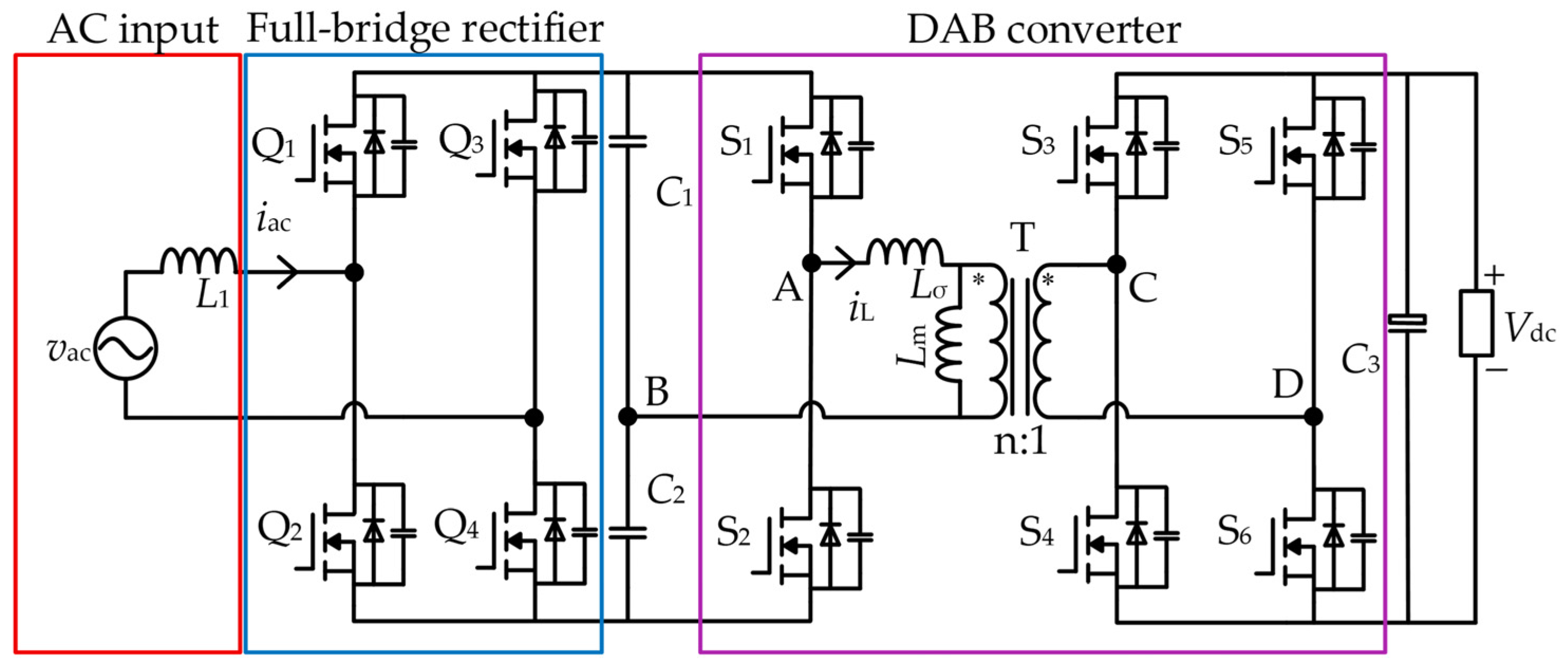
Figure 1 illustrates the topology employed in this paper. This topology was first introduced in [23]. It is an improved version of the DAB-based AC–DC converter. The front-end rectifier full bridge is composed of switches Q1–Q4, while the rear-end DAB converter is formed by switches S1–S6. L1 is the AC-side input filter inductor. C1 and C2 are the filter capacitors, and C3 is the DC-link capacitor. The transformer leakage inductance is denoted as Lσ. A HF transformer T with a turn ratio of n links the primary and secondary sides of the DAB.
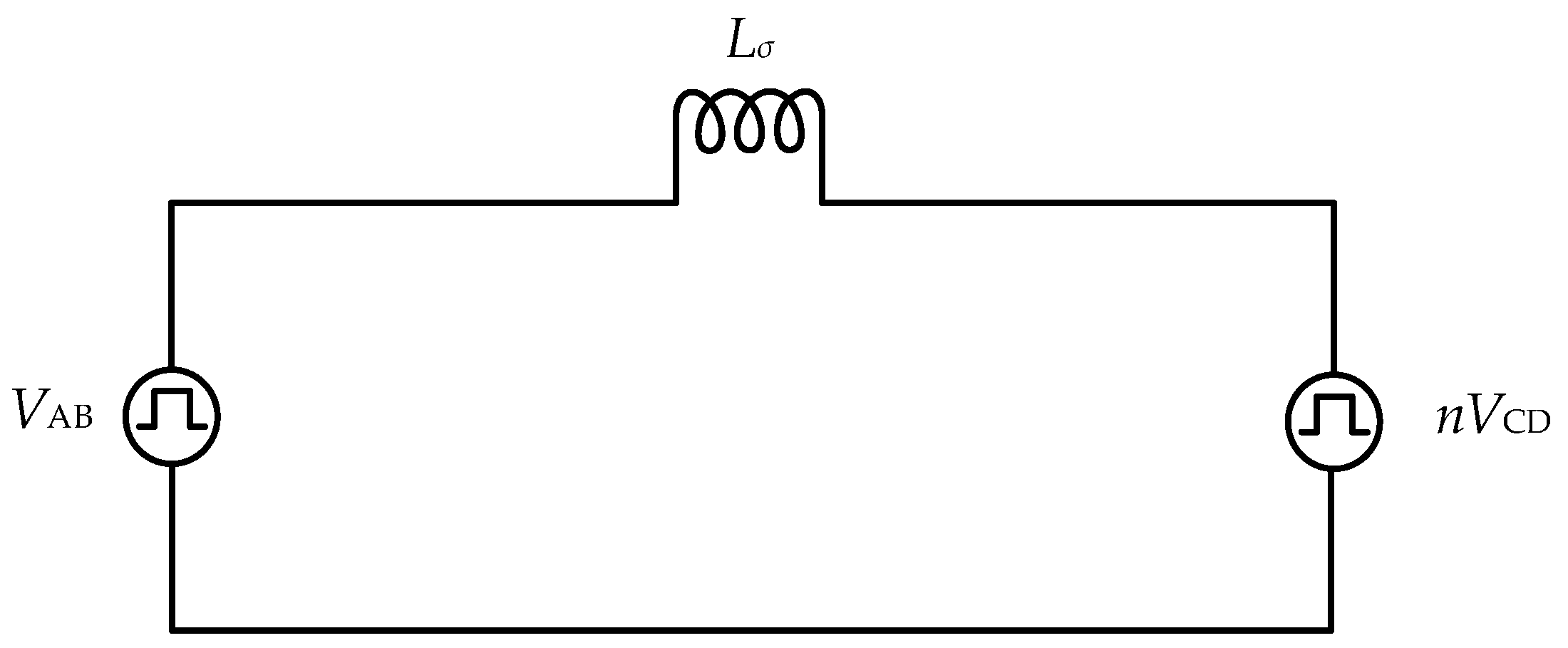
Since switches Q1–Q4 operate only at the line frequency for rectification, their switching losses are negligible compared to the high frequency switching losses of the subsequent DAB converter. Therefore, the modulation analysis focuses primarily on the rear-end DAB stage. The magnetizing inductance Lm typically ranges from several hundred microhenries to a few millihenries, which is in the order of tens of times larger than the leakage inductance Lσ. Therefore, it is often neglected to simplify the analysis. Based on the above assumptions, an equivalent circuit of the DAB converter is established to simplify the analysis, as shown in Figure 2. The power transfer is governed by the voltages VAB and nVCD, which are applied across the transformer leakage inductance Lσ.

3. Proposed Modulation Strategy

3.1. Phase-Shift Operational Principle

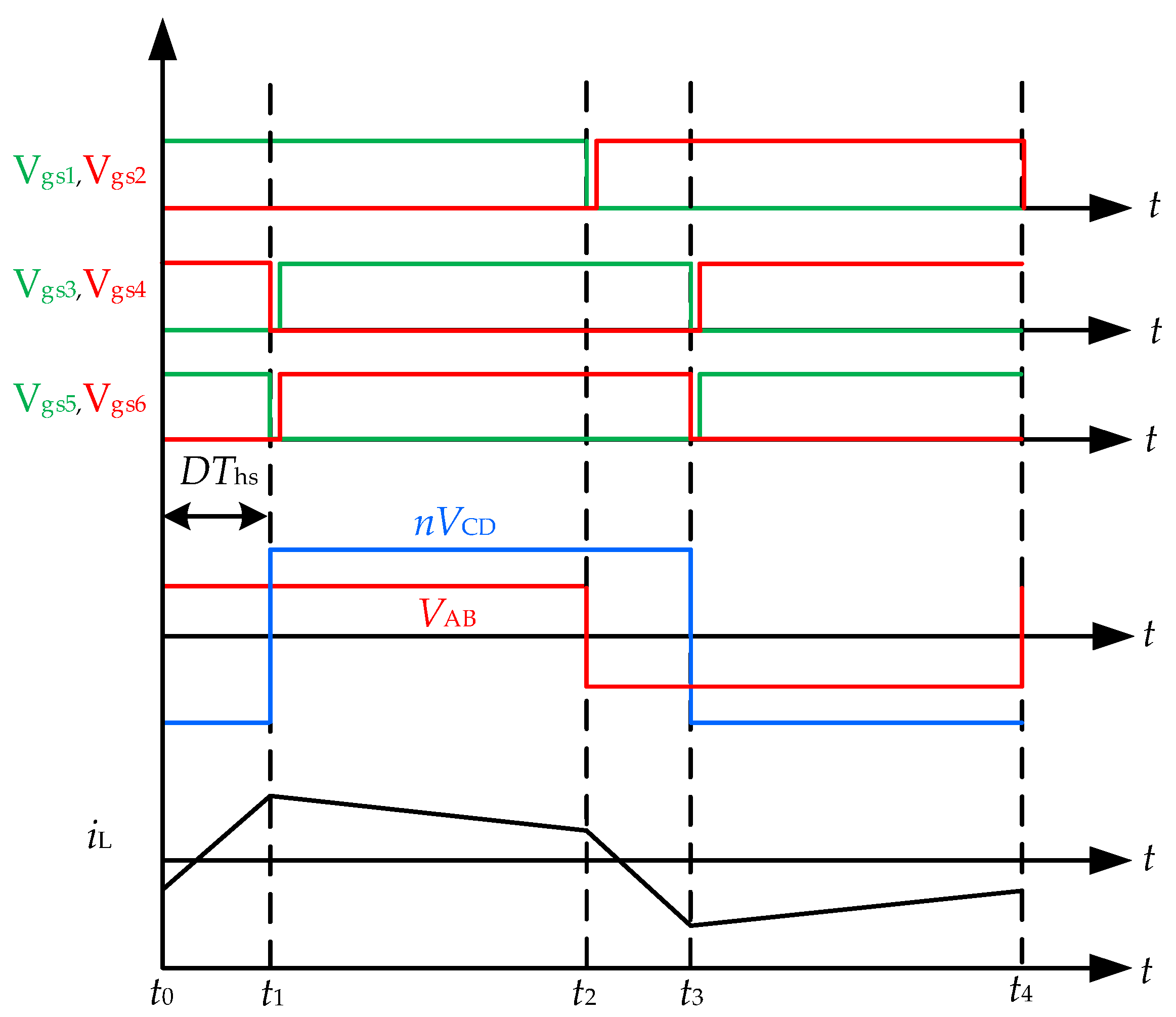
As illustrated in Figure 3, the primary-side voltage VAB is a two-level square wave with an amplitude of ±|vac|/2. When referred to the primary side, the secondary-side voltage VCD becomes nVCD, which is a two-level square wave with an amplitude of ±nVdc. The phase-shift ratio between switches S1 and S4 is defined as D, where D ranges from 0 to 1, and Ths is the half-switching period, given by Ths = 1/(2fs), with fs being the switching frequency.
The fundamental relationship that governs the slope of the leakage inductor current iL(t) is defined by the voltage difference applied across Lσ, as given by the following expression:
d i L ( t ) d t = V AB ( t ) n V CD ( t ) L σ
Based on Equation (1) and the operational waveforms in Figure 3, the expression for the leakage inductance current can be derived:
i L ( t ) = i L ( t 0 ) + | v ac | / 2 + n V dc L σ Δ t , t [ t 0 , t 1 ) i L ( t 1 ) + | v ac | / 2 n V dc L σ Δ t , t [ t 1 , t 2 )
As can be seen from Figure 3, assuming the initial time instant is t0 = 0, all subsequent time instants can be expressed as follows:
t 1 = D T hs t 2 = T hs
Based on the half-period symmetry characteristic of the inductor current, the values of the inductor current at key time instants can be determined:
i L ( t 0 ) = n V dc 8 L σ f s ( 4 D K + 2 ) i L ( t 1 ) = n V dc 8 L σ f s ( 2 K D K + 2 ) i L ( t 2 ) = n V dc 8 L σ f s ( 4 D + K 2 )
where K is the voltage conversion ratio, defined as K = |vac|/nVdc.
The expression for the DAB current can be derived by calculating the average value of the inductor current through integration over a half-period:
i DAB = 1 2 T hs t 0 t 2 i L ( t ) d t = n V dc 4 L σ f s D ( 1 D )
As evidenced by the equation above, only a single control variable D is available. This variable must be dedicated to maintaining in-phase AC input voltage and current to achieve PFC. Consequently, there is no degree of freedom left to optimize other performance metrics such as current stress, RMS current, or soft-switching operation. This inherent limitation means that SPS modulation exhibits a constrained soft-switching range and high peak current, particularly under a wide voltage conversion ratio.

3.2. Variable Frequency Modulation Strategy

To address this limitation, a new control variable θ is introduced. The original variable D is converted to this new variable by defining D = 1 − , where c is a conversion coefficient. Subsequently, Equation (5) is modified as follows:
i DAB = n V 2 4 L σ f s ( c c 2 θ ) θ
From the constraint 0 ≤ D ≤ 1, the permissible range for θ in the equation can be obtained as follows:
0 θ 1 c
By introducing a virtual frequency fa, the switching frequency fs is defined as:
f s = f a ( c c 2 θ )
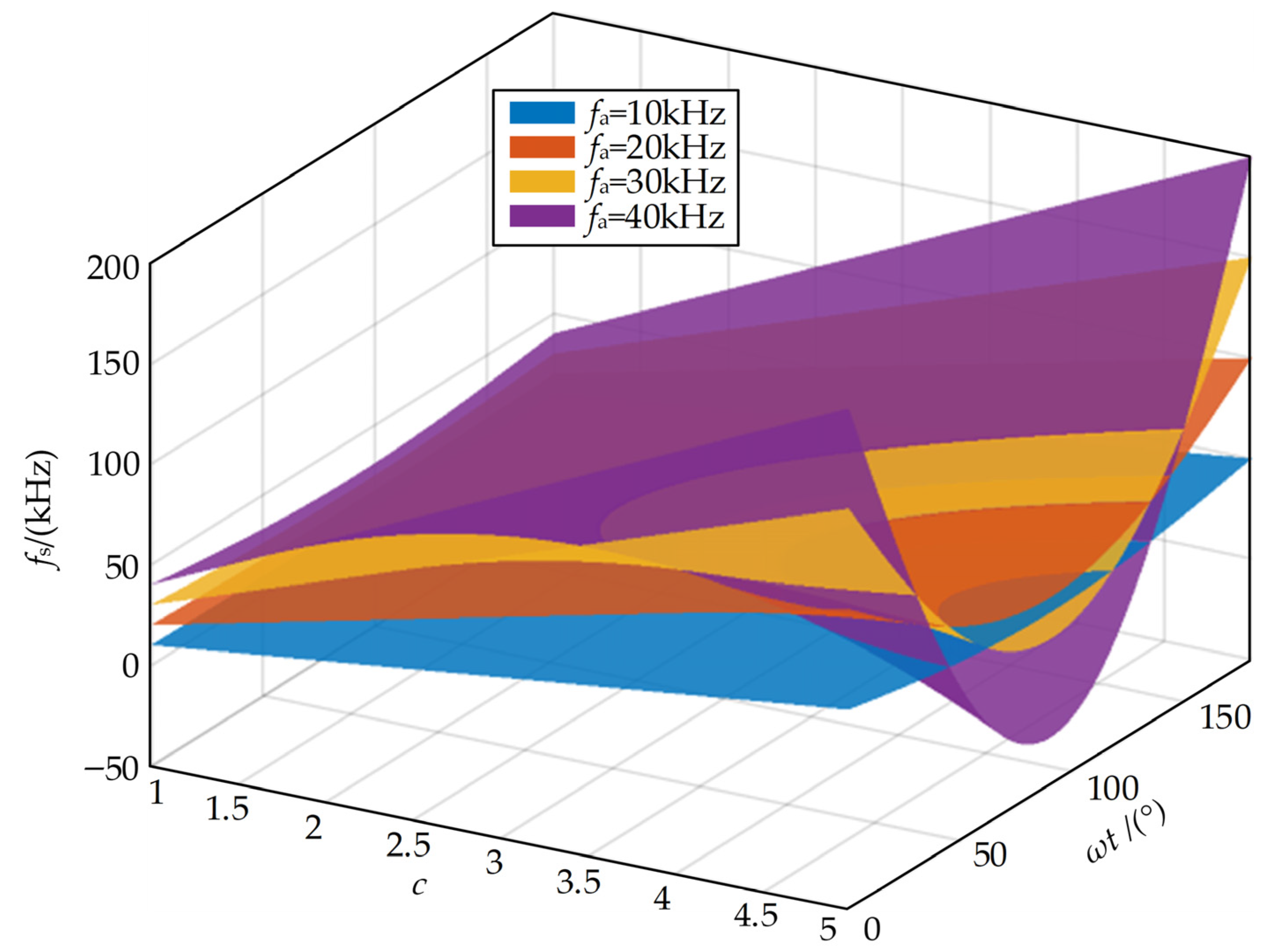
As depicted in Figure 4, the maximum value of fs increases with the parameter c. Furthermore, a larger value of fa results in a wider variation range of fs throughout the entire transmission range. If the values of the virtual frequency fa and the coefficient c are excessively large, the actual phase angle θ will exceed the constraint given by Equation (7). Simultaneously, the switching frequency fs will attain negative values around ωt = 90°.
Substituting Equation (8) into Equation (6) yields:
i DAB = n V dc 4 L σ f a θ
To achieve PFC on the AC side, the following condition must be satisfied:
i DAB = I ref | sin ( w t ) |
where Iref denotes the amplitude of the AC-side input current, which can be calculated using Equation (11):
I ref = 2 P rate V ac
where Prate denotes the rated power and Vac denotes the amplitude of the AC input voltage.
Thus, the expression for θ under the PFC condition is derived as:
θ = 4 L σ f a I ref | sin ( w t ) | n V dc

4. Current Peak Optimization

As observed in Figure 3, the inductor current attains its maximum Imax at t1.
I max = n V dc 8 L σ f s ( 2 K D K + 2 )
Substituting the expression D = 1 − and Equation (8) into Equation (13) yields:
I max = n V dc 8 L σ f a 2 K c θ + K + 2 c c 2 θ
Calculate the partial derivative of Imax with respect to c:
A = I max c = n V d c 8 L σ f a 2 K θ 2 c 2 + 2 θ c ( K + 2 ) K 2 c 2 ( 1 θ c ) 2
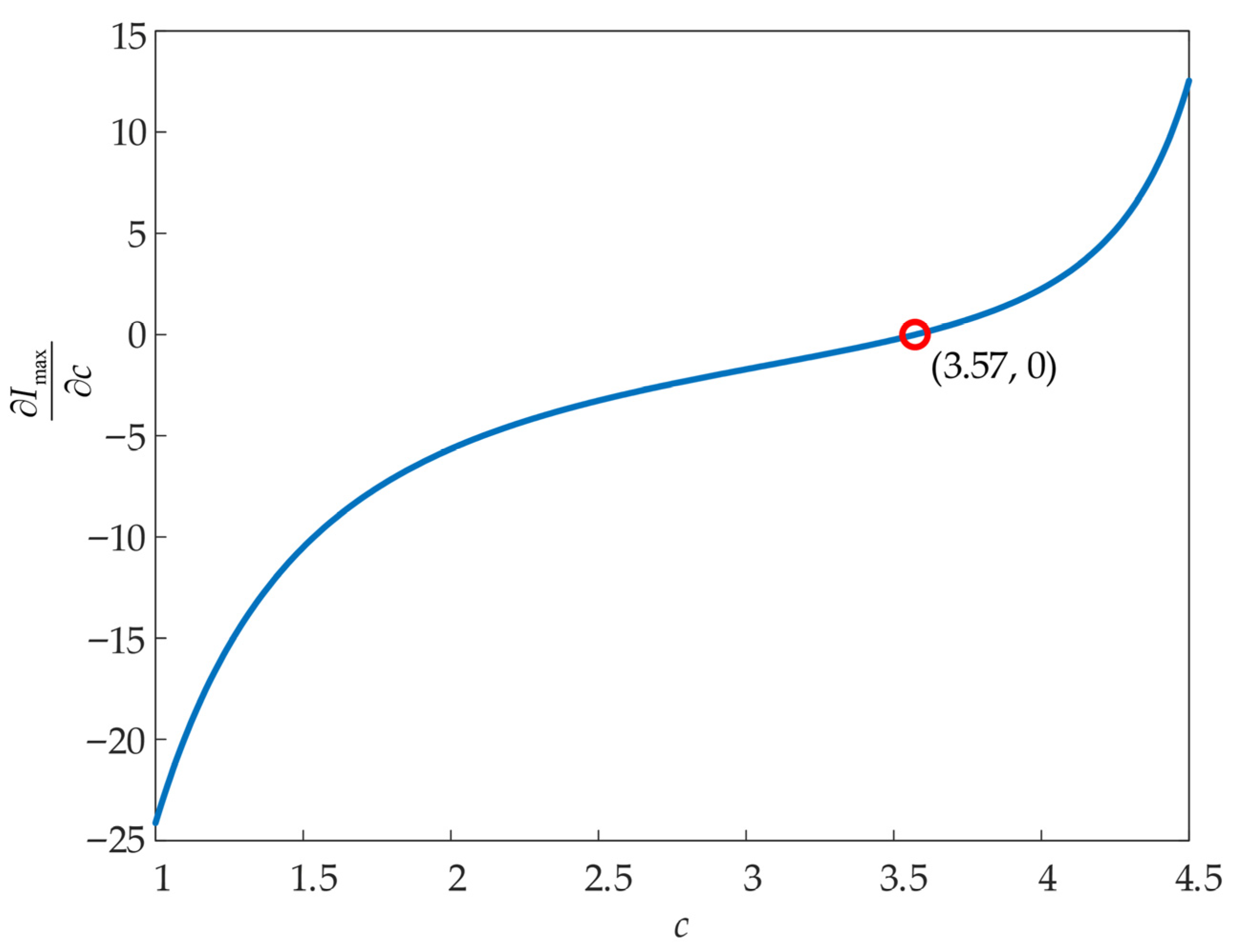
With respect to ωt, Imax reaches its peak value at ωt = 90°. When ωt = 90°, the variation in A with c is shown in Figure 5. As c increases, the value of A changes from negative to positive. Hence, a minimum point exists. The simulation parameters are as follows: the rated power P is 100 W, the transformer turns ratio n is 1, the AC input voltage vac is 50 V at 50 Hz, the DC output voltage Vdc is 50 V, the leakage inductance Lσ is 25 μH, and the virtual frequency fa is 35 kHz.
Setting A = 0 yields:
c = 2 θ ( K + 2 ) 4 θ 2 ( K + 2 ) 2 8 ( K + 2 ) K θ 2 4 K θ 2
It should be noted that when ωt = 90°, K and θ are equal to Kmax and θmax.
K max = | V ac | / n V dc
θ max = 4 L σ f a I ref n V dc
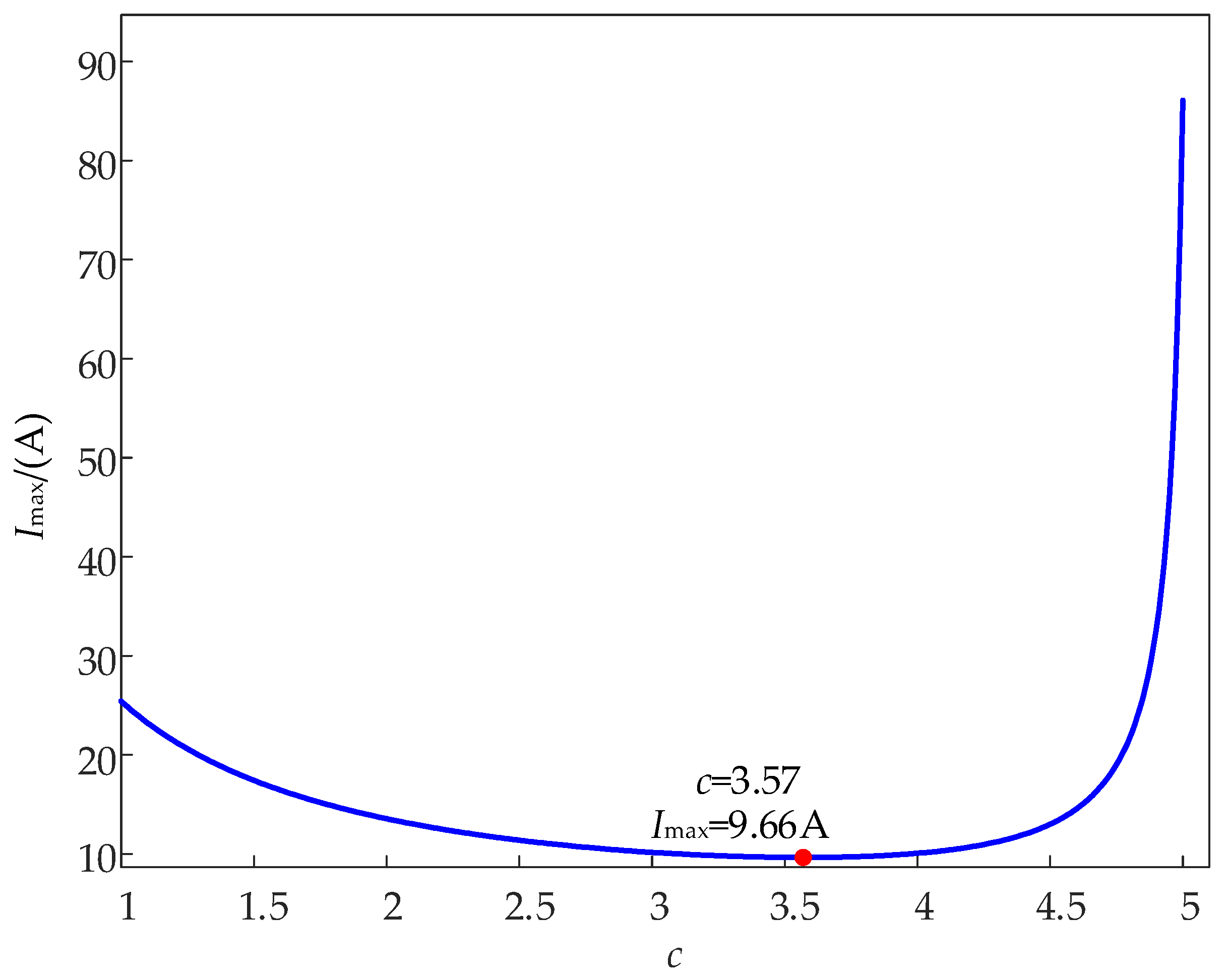
As shown in Figure 6, under the same parameters as above, A equals zero when ωt = 90° and c = 3.57. At this point, the minimum value of Imax, approximately 9.66 A, is achieved.

5. Analysis and Implementation of Soft Switching

To realize ZVS for every switch over the full operating range, the inductor current must satisfy the following constraint at all times:
i L ( t 0 ) 0 i L ( t 1 ) 0
Substituting Equation (4) into Equation (19) yields the constraint on D for achieving ZVS:
D 1 2 K 4 D 1 2 1 K
Since K > 0, the ZVS condition is always satisfied when D > 1/2.
A further analysis reveals that for K ≤ 2, if D ≥ 1/2 − K/4 holds, the condition D ≥ 1/2 − 1/K is always satisfied. Conversely, for the case when K > 2, if D ≥ 1/2 − 1/K holds, the constraint D ≥ 1/2 − K/4 is automatically satisfied. From Equation (16), it is required that the expression under the square root must be non-negative, which leads to the condition K ≤ 2. Thus, with the proposed modulation strategy, only the condition D ≥ 1/2 − K/4 needs to be considered.
Substituting D = 1 − into the inequality D ≥ 1/2 − K/4, the condition for θ to achieve ZVS when D < 1/2 is derived as follows:
θ max 1 2 c + K 4 c
Therefore, if it satisfies the constraint specified in Equation (21), it ensures that all switching devices in the DAB converter achieve ZVS across the entire transmission power range.
Substituting Equation (18) into Equation (21) yields the constraint on c required for ZVS:
c ( 2 + K ) n V dc 16 L σ f a I ref
Combining Equations (16) and (22), ensuring the realization of ZVS when D < 1/2 requires satisfying:
c 1 > c 2
where:
c 1 = ( 2 + K ) n V dc 16 L σ f a I ref
c 2 = 2 θ max ( K max + 2 ) 4 K max θ max 2 4 θ max 2 ( K max + 2 ) 2 8 ( K max + 2 ) K max θ max 2 4 K max θ max 2
Equation (23) is equivalent to an inequality:
2 + K max x 4 > ( K max + 2 ) ( K max + 2 ) ( 2 K max ) 2 K max
where x = |sin(ωt)|.
Solving the above inequality yields:
x 1 = 4 2 4 K max 2 K max 2 x x 2 = 4 + 2 4 K max 2 K max 2
Since x2 ≥ 1 holds for all K < 2, it suffices to ensure x > x1. In this case, D ≤ 1/2 is equivalent to 1/2c1θ ≤ 1/c1, which can be transformed into:
x min = 1 + 1 + 2 K max K max < x < 1 + 1 + 4 K max K max = x max
Therefore, satisfying the condition xmin > x1 is sufficient to ensure ZVS achievement when D < 1/2. Solving this yields a maximum voltage conversion ratio of Kmax < 1.677. Consequently, by setting an appropriate transformer turns ratio n and output DC voltage such that the converter operates with K < 1.677, ZVS for all high frequency switches can be achieved concurrently with minimized peak current.
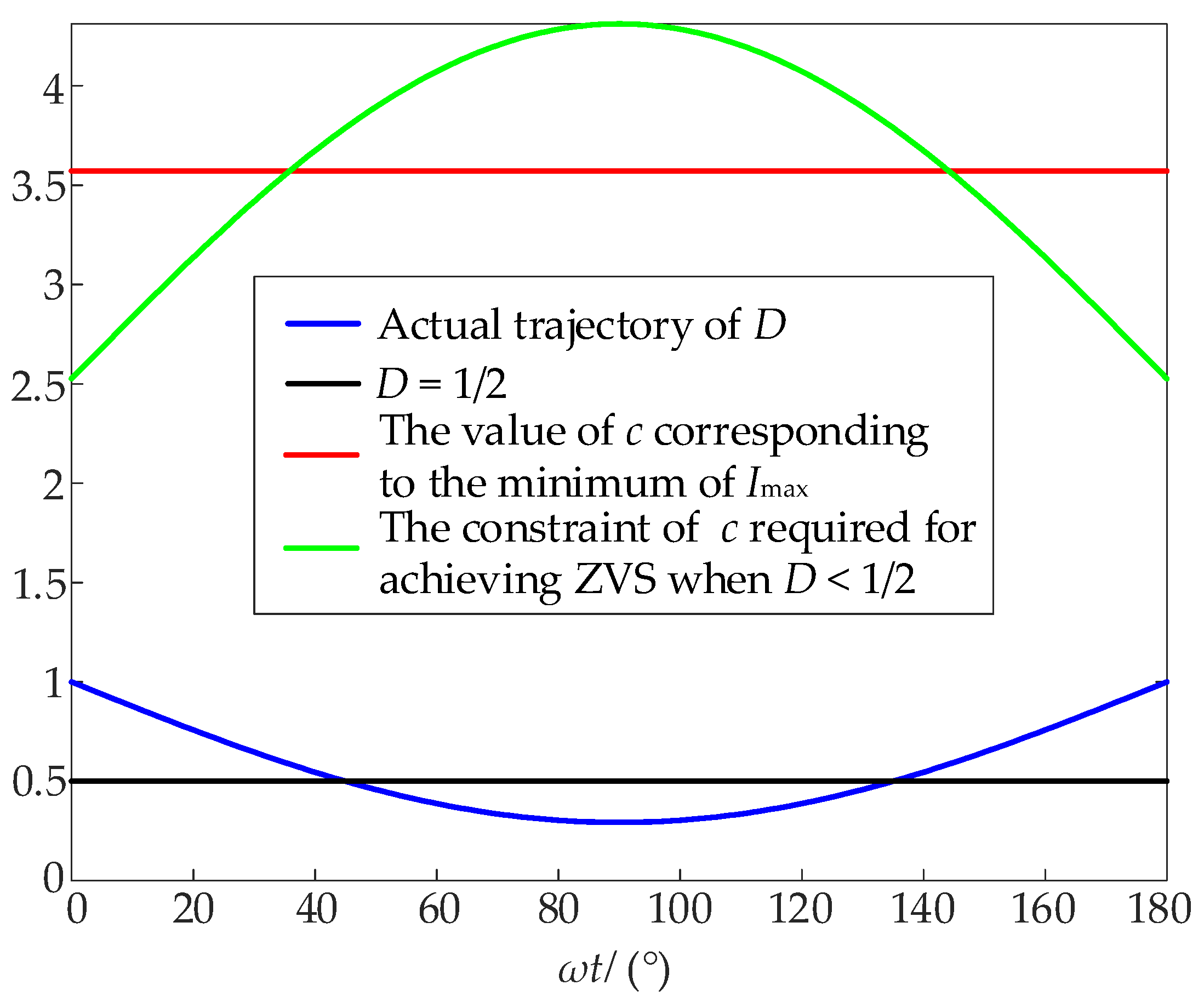
As shown in Figure 7, all switches consistently meet the ZVS condition for D > 1/2. While for D < 1/2, ZVS can also be guaranteed provided that the value of c satisfies the condition given in Equation (22).

6. Experimental Verification

6.1. Experimental Setup

This experimental prototype serves as a proof-of-concept platform, with the primary aim of validating the effectiveness of the proposed modulation strategy. To this end, the system was configured with a 50 Vrms/50 Hz AC input and a 50 V DC output., resulting in a voltage conversion ratio of K ≈ 1.4, which satisfies the necessary condition K < 1.677. Furthermore, based on the analysis presented in Figure 4, and to avoid excessively high switching losses, the switching frequency was selected as fa = 35 kHz.
The transformer turns ratio was set to unity (n = 1), a configuration that helps minimize both the RMS and peak currents in the transformer windings [24].
Beyond the turns ratio, the leakage inductance represents the most critical parameter in the transformer design. Based on Equation (9) and the method for calculating the leakage inductance presented in [24], the leakage inductance can be derived through the following procedure:
The maximum power transfer under SPS modulation is given by:
P S P S = n V a c V d c 4 L σ f a θ max
PSPS must be designed to exceed the maximum actual power transmitted. Therefore, the following condition must be satisfied:
P SPS 2 P rate
Consequently, the constraint condition for the leakage inductance is derived as follows:
L σ n V ac V dc 8 f a P rate θ max
By substituting the parameters from Table 1 (n = 1, V ac = 50 2 V , Vdc = 50 V, fa = 35 kHz, Prate = 100 W, c = 3.57) into Equation (31) in conjunction with Equation (7), the calculation yields a constraint for the leakage inductance as L < 35.37 μH.
To ensure a sufficient design margin, a value of L = 25 μH was deliberately chosen. In the experimental prototype, a precise external inductor was connected in series with the primary winding of the high-frequency transformer to achieve the total designed leakage inductance of 25 μH.
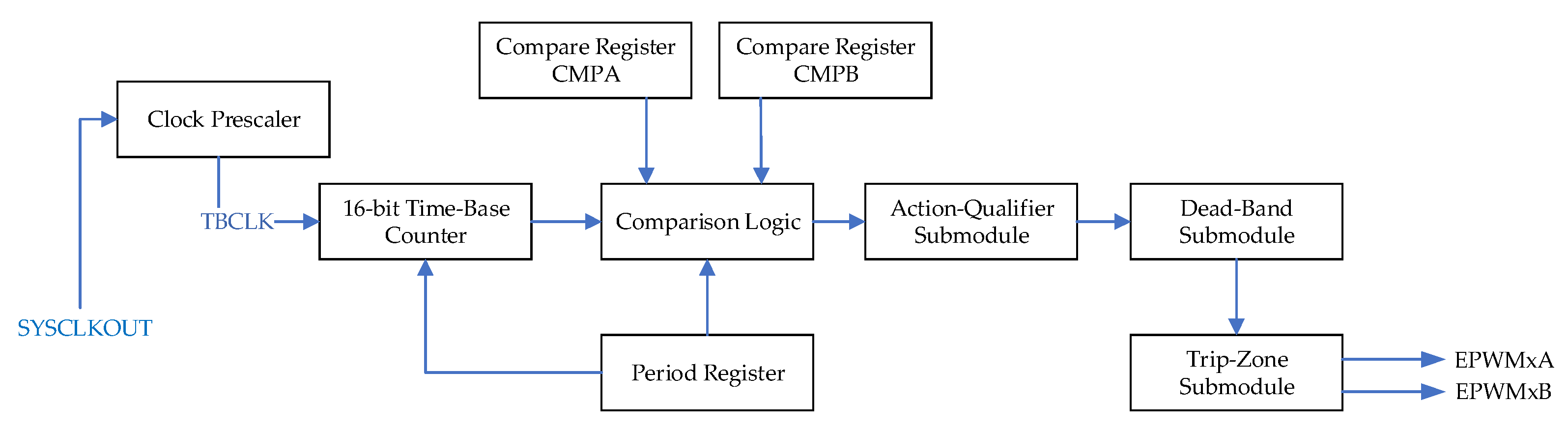
The specific PWM module employed in this experiment is depicted in Figure 8.
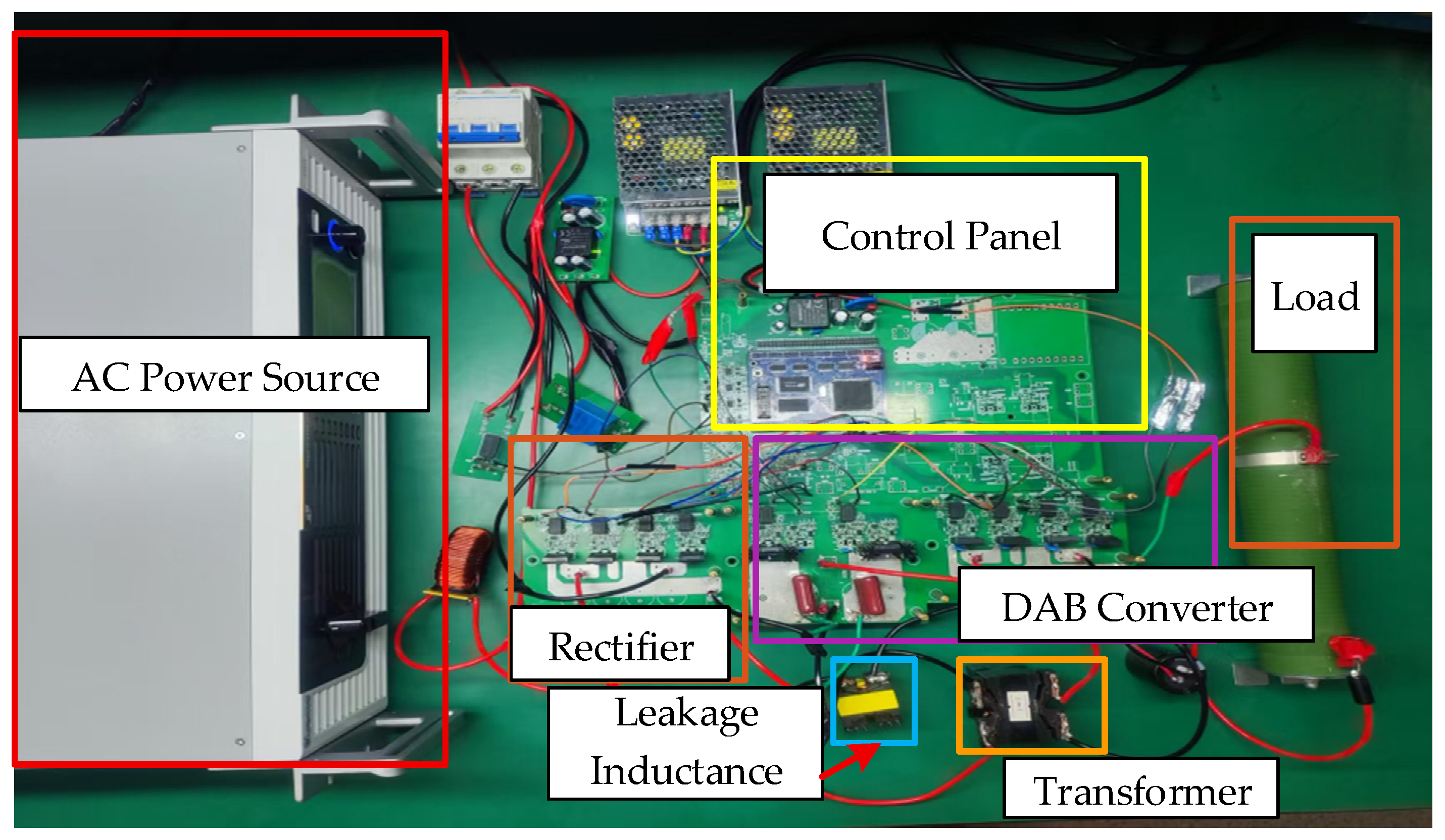
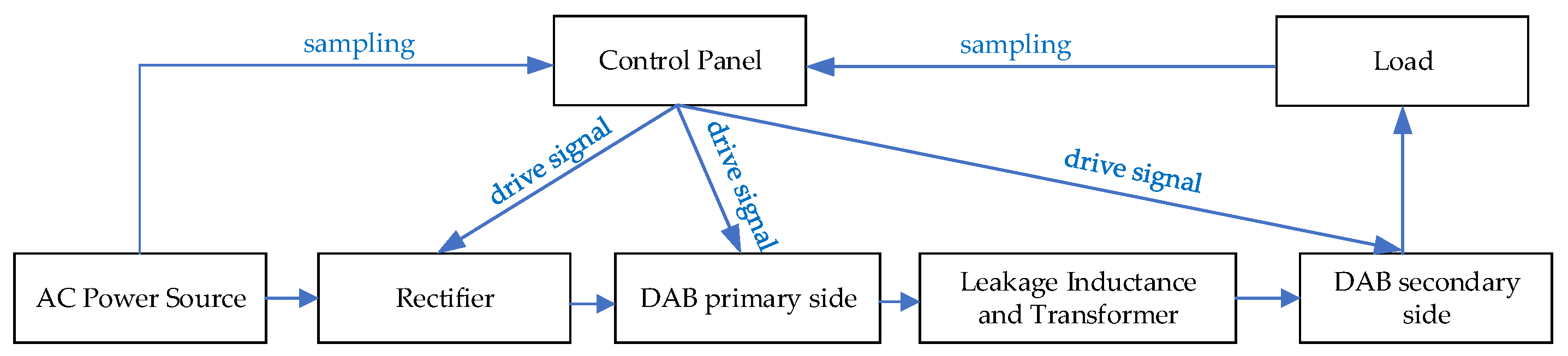
Based on the experimental parameters listed in Table 1, an experimental platform was built around a TMS320F28335 DSP, as shown in Figure 9, with its connection block diagram shown in Figure 10.

6.2. Experimental Results Analysis

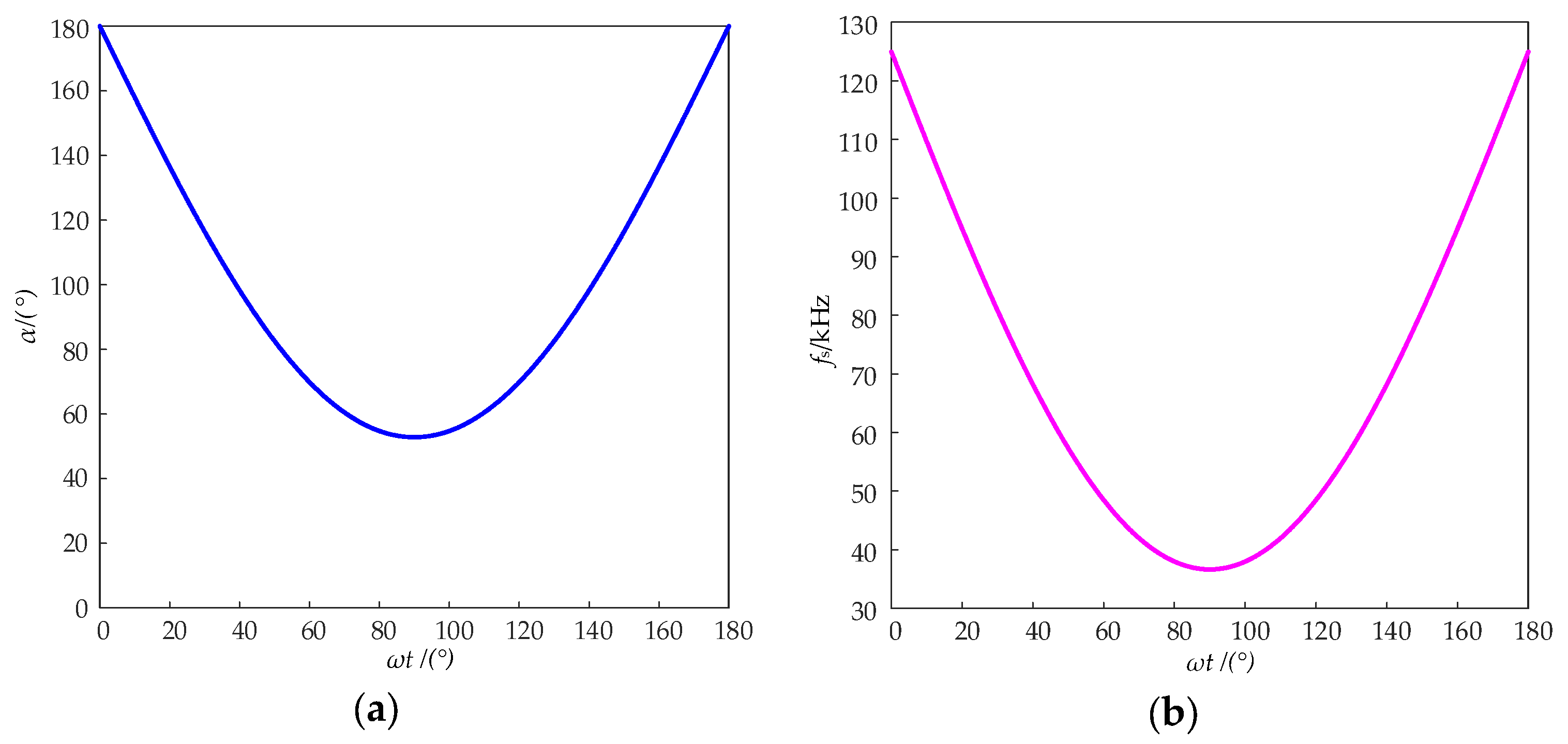
As shown in Figure 11, the control range of the phase-shift angle α is [52.77°, 180.00°], and that of the switching frequency fs is [36.63, 124.95] kHz.
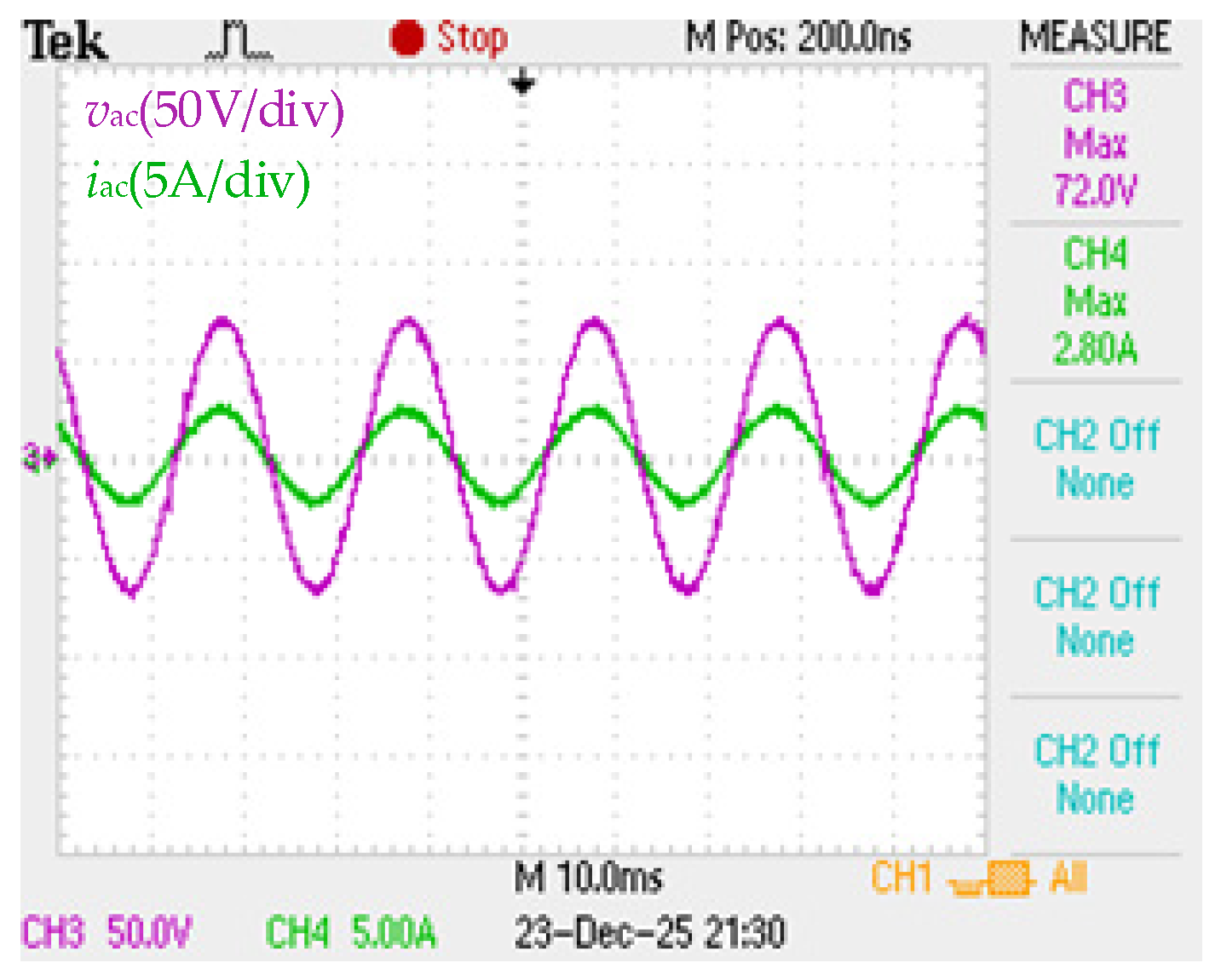
Figure 12 shows the waveforms of the AC-side input voltage and AC- side input current. The peak value of the AC voltage is 72 V, and the peak value of the AC current is 2.8 A. Based on these values, the input power is calculated to be approximately 100.8 W. Moreover, the input voltage and current maintain the same phase, demonstrating effective PFC operation.
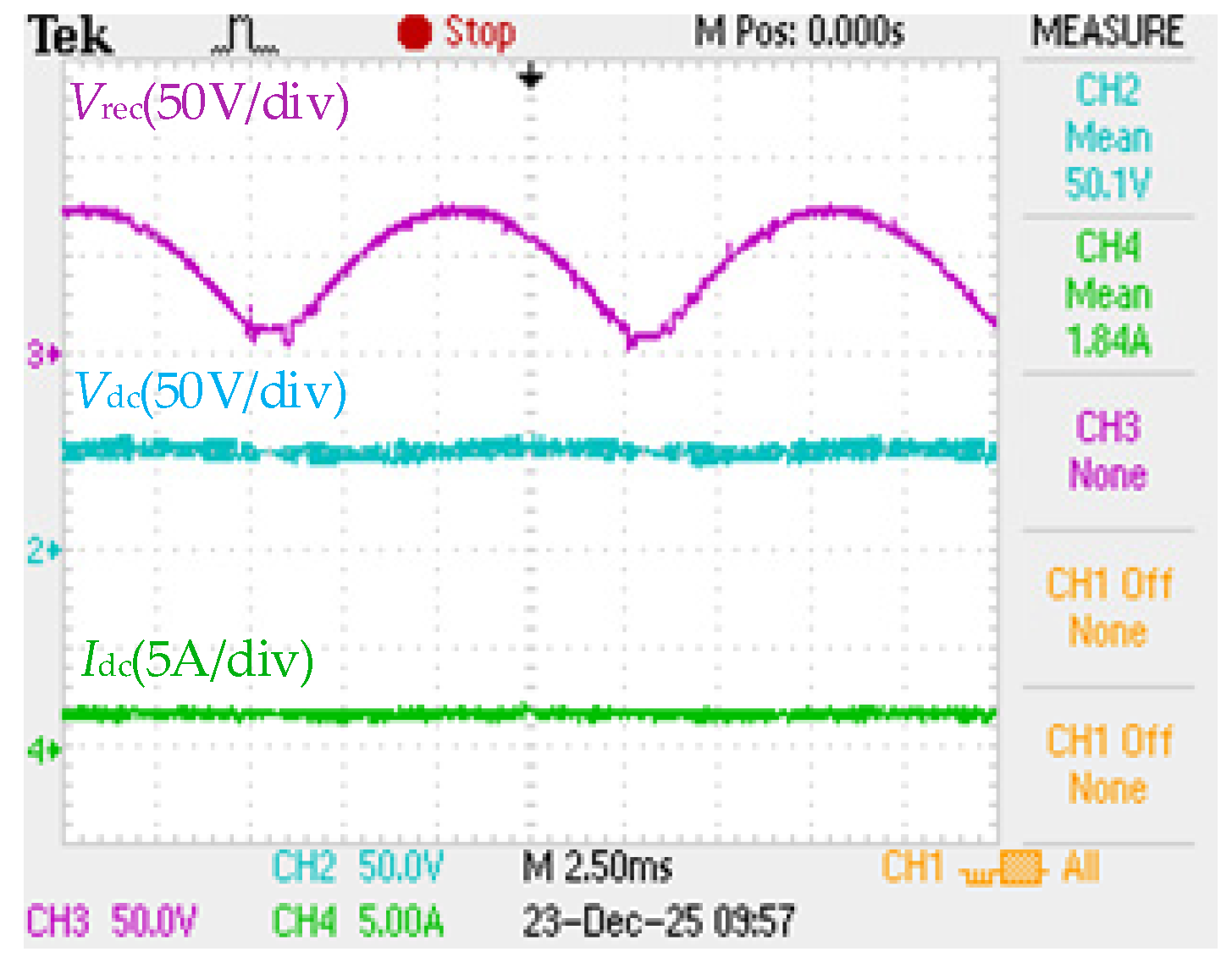
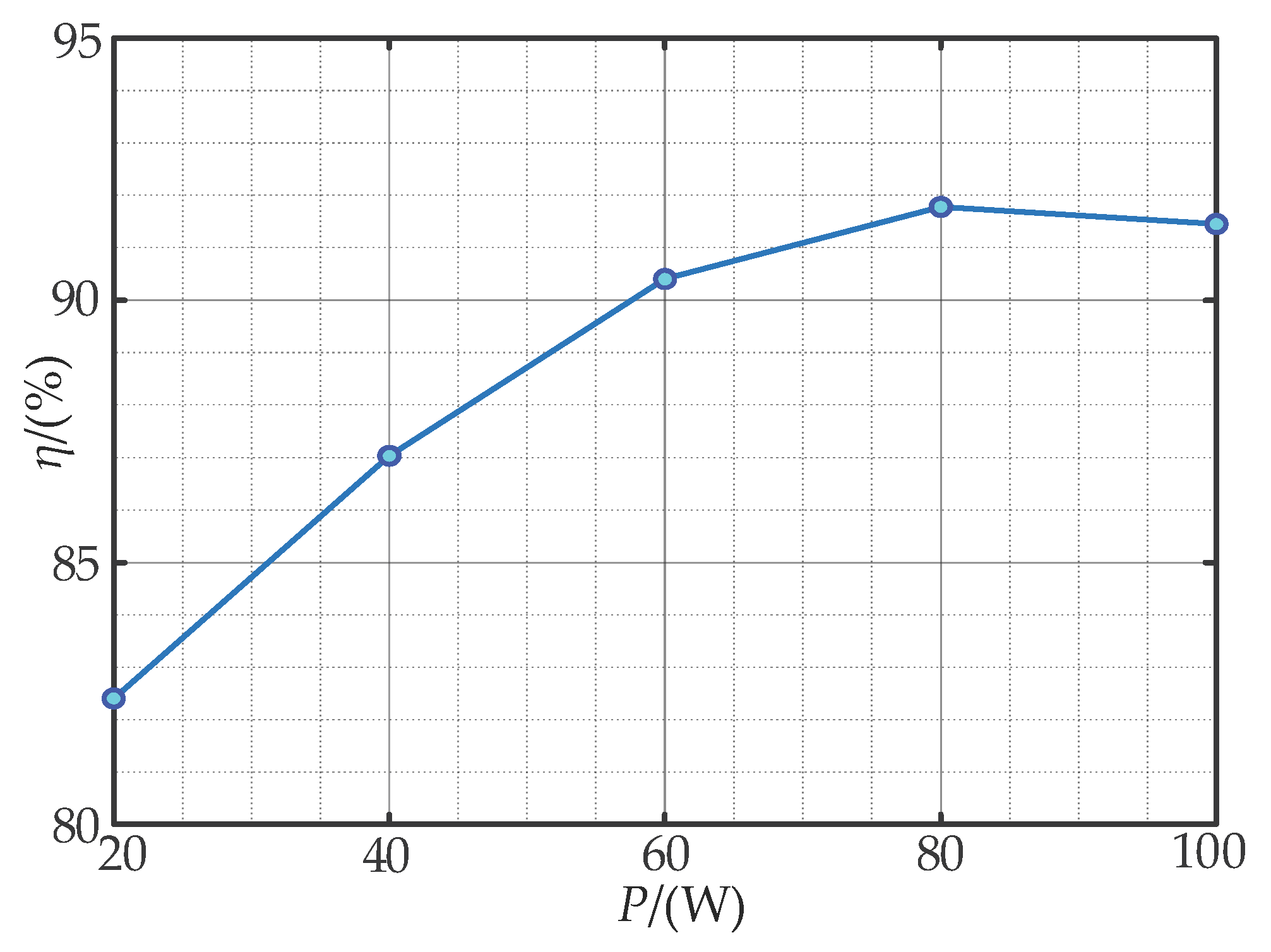
Figure 13 displays the input voltage Vrec, output voltage Vdc, and output current Idc of the DAB side at rated power. It should be specifically mentioned that the DAB input voltage Vrec is obtained by rectifying the AC voltage and is therefore of a pulsating DC nature. The average value of the output DC voltage is 50.1 V and the average output DC current is 1.84 A. From these measurements, the output power is calculated to be approximately 92.184 W. The corresponding efficiency under this condition is approximately 91.45%. It is worth noting that the reported efficiency was measured on the experimental prototype. Following further optimization for product development, the converter efficiency is expected to be improved.
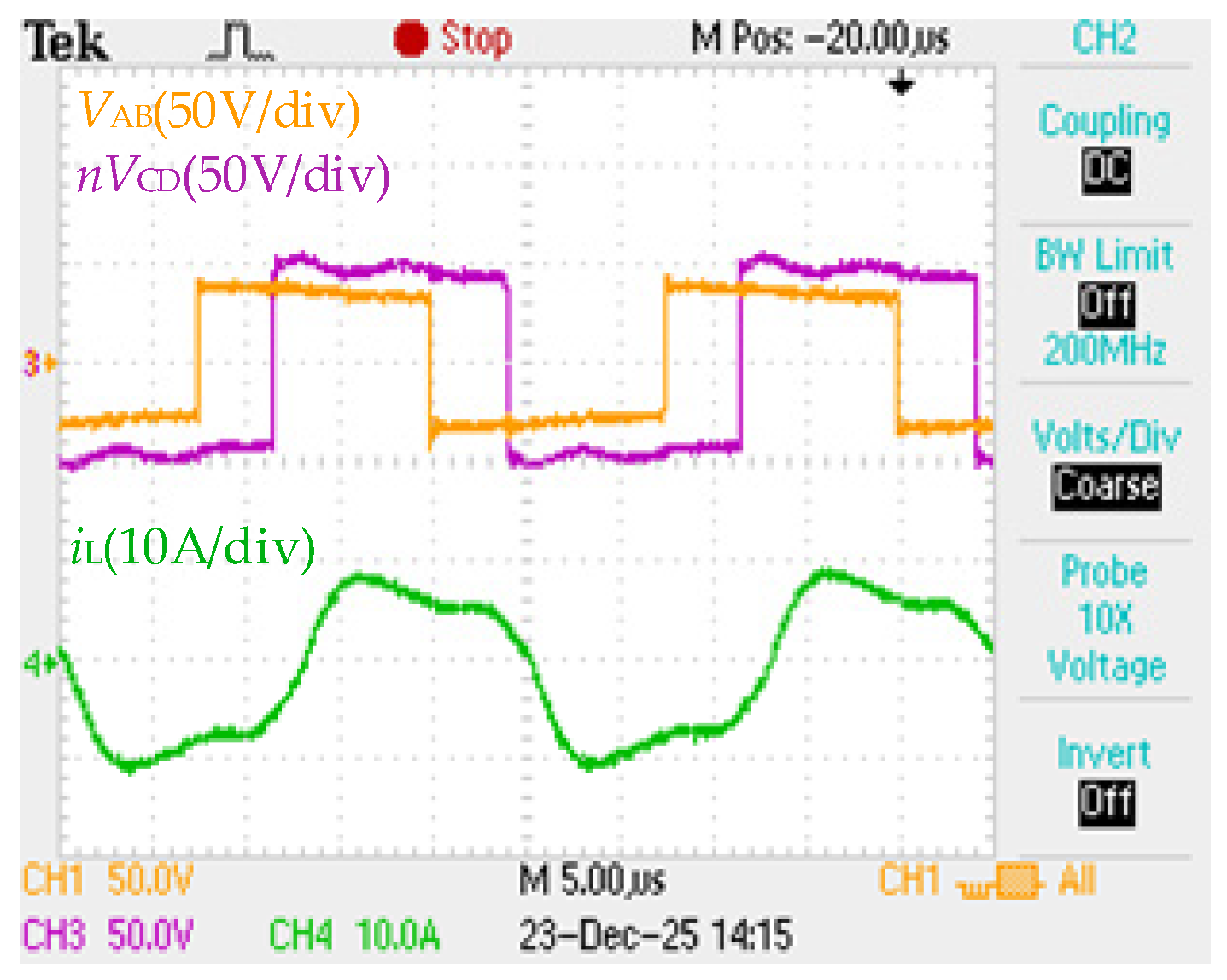
As illustrated in Figure 14, the waveforms of the voltage across the transformer and the inductor current are shown. Two-level square waves are observed on both the primary and secondary sides of the transformer, in line with theoretical analysis. It is noteworthy that the measured inductor current exhibits slight resonant characteristics during switching transients. This is attributed to the parasitic capacitances in practical devices resonating with the inductance during the switching process. This resonance primarily occurs within the dead time. Subsequent experimental results have demonstrated that this resonant behavior does not affect the successful implementation of ZVS.
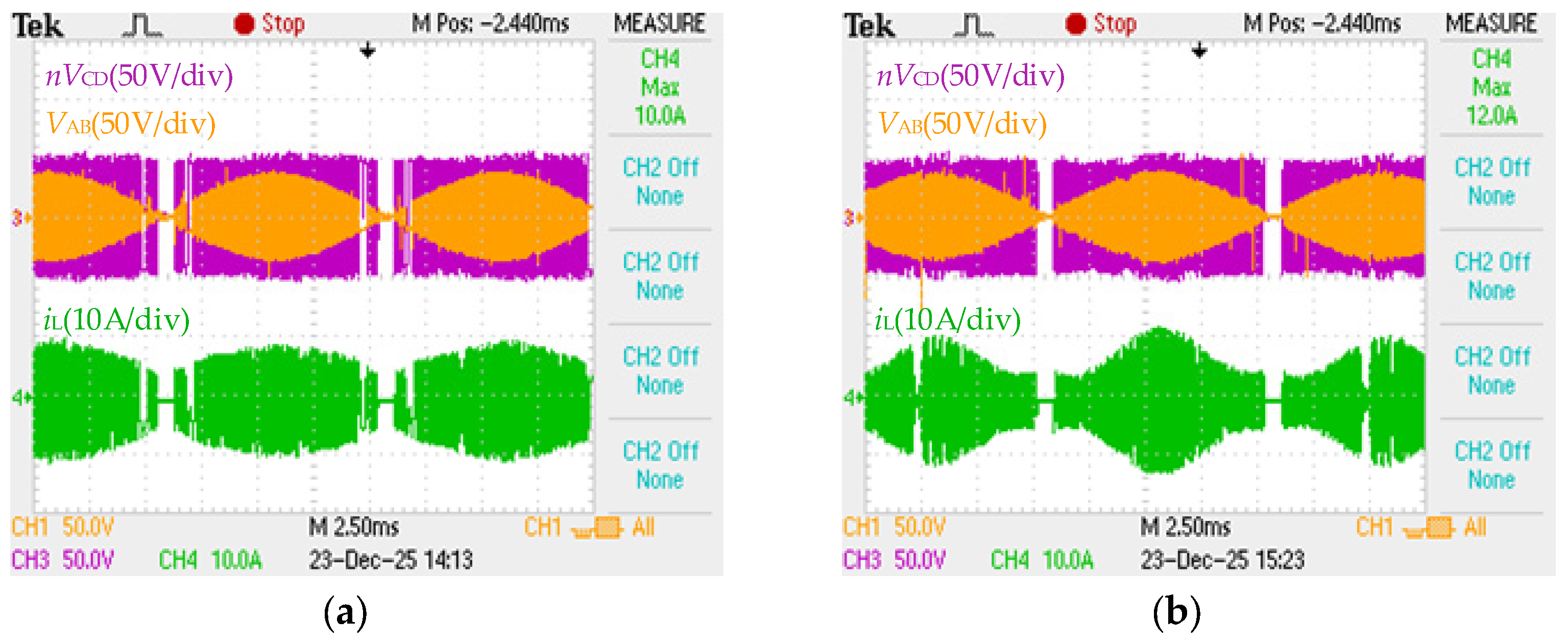
As shown in Figure 15, which compares the current stress between the proposed modulation strategy and the method from reference [24], the maximum current stress of the proposed strategy is 10 A, compared to 12 A for the method in reference [25]. This represents a reduction in current stress of approximately 16.7%.
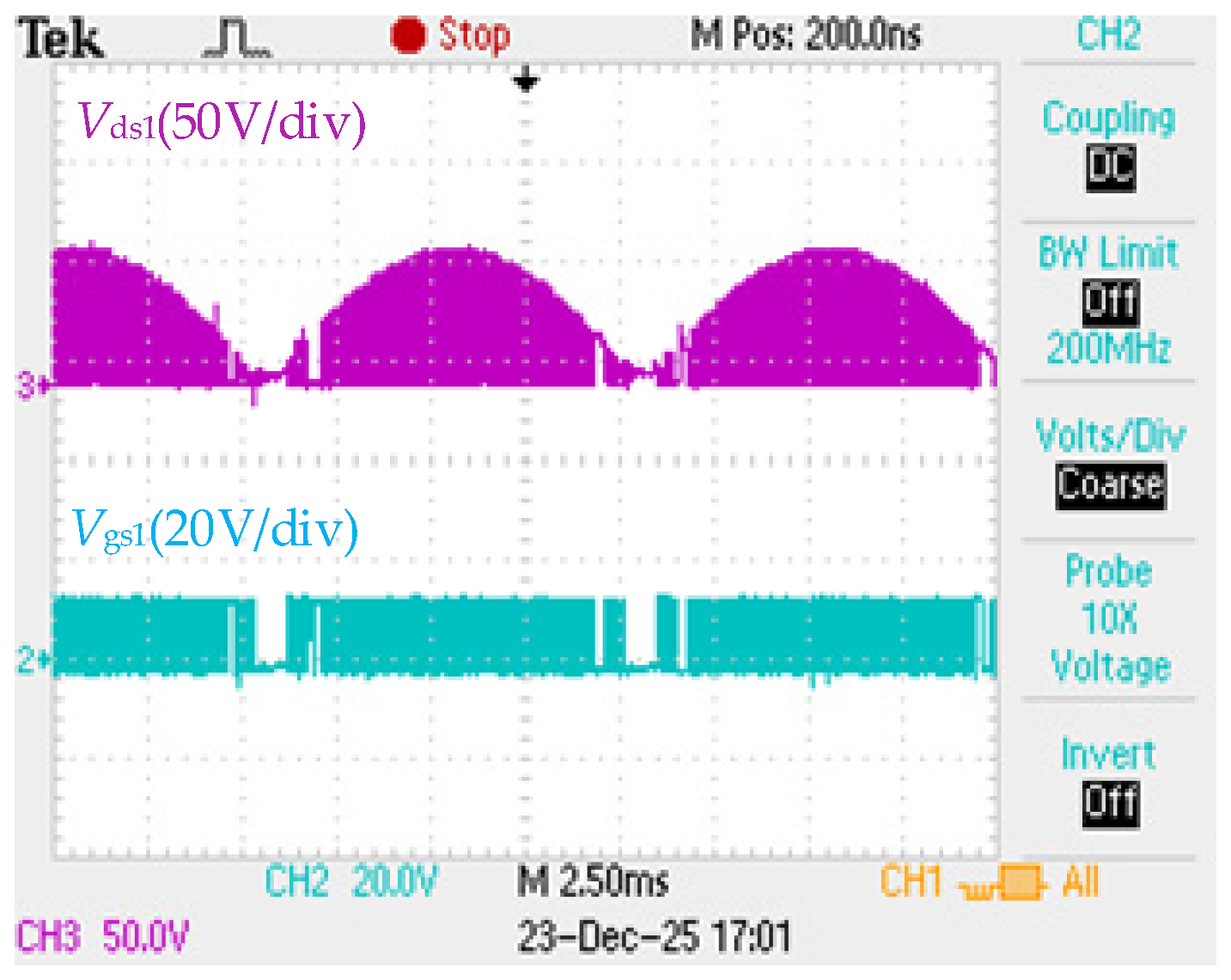
Figure 16 shows the drain-source voltage Vds1 and gate drive signal Vgs1 of switch S1 under line-frequency conditions. The voltage Vds1 varies with the phase angle ωt, reaching its minimum under light-load conditions, around ωt = 0°, and its maximum under heavy-load conditions, around ωt = 90°.
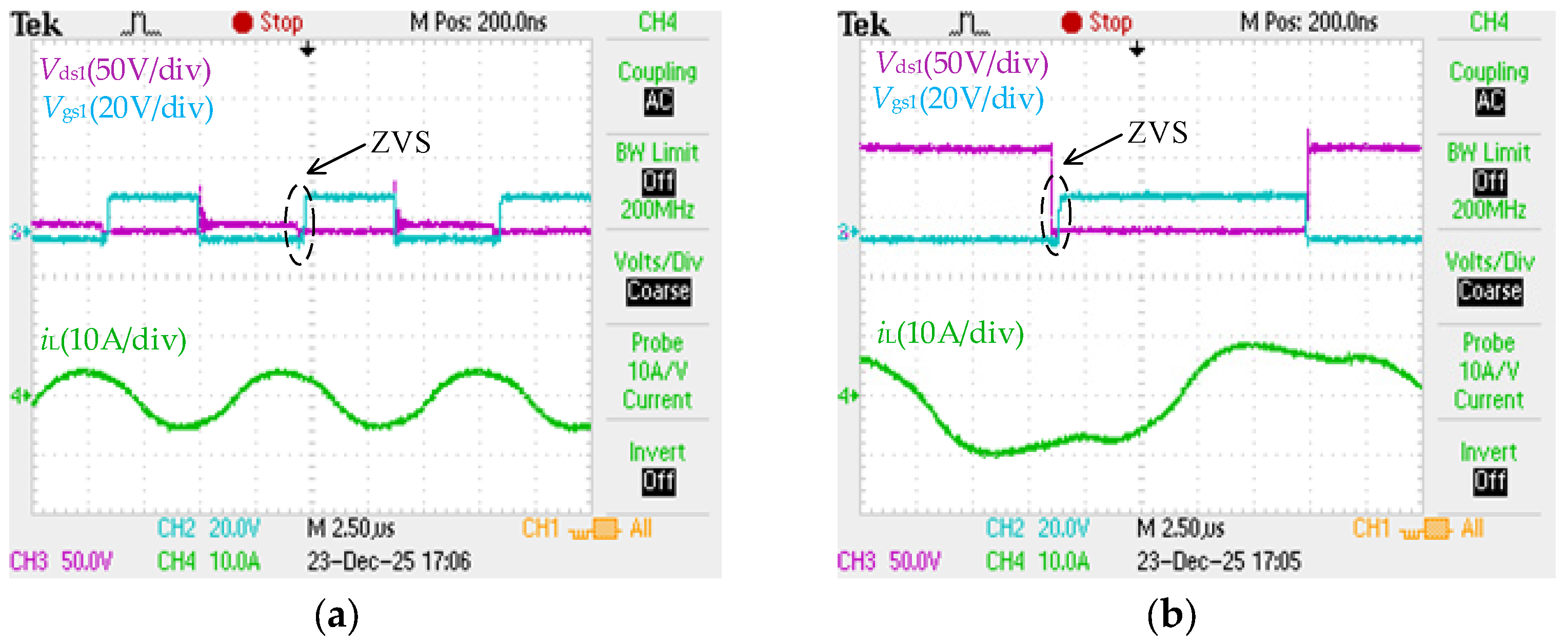
Figure 17 shows the gate drive signal Vgs1 and the voltage Vds1 across the primary-side switch S1 under light and heavy load conditions. It can be observed that the voltage across S1 drops to zero before the arrival of the gate drive signal. This clearly demonstrates that ZVS is effectively achieved across the entire load range.
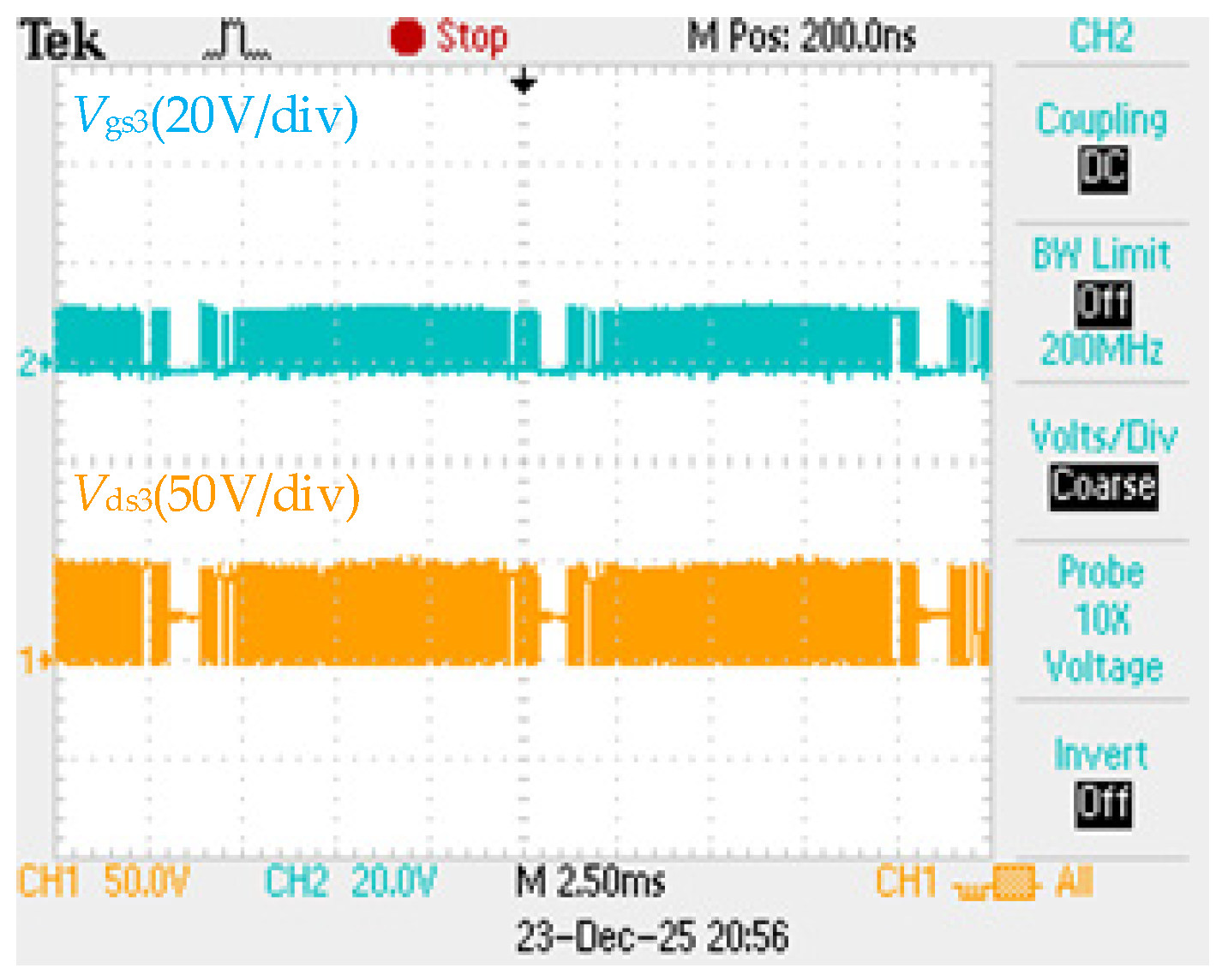
The drain-source voltage Vds3 and gate drive signal Vgs3 of switch S3 are presented in Figure 18. The Vds3 waveform collapses to approximately zero when the switch is turned on, and rises to a constant value representing the DC output voltage when the switch is off. Over the entire grid cycle, the Vds3 exhibits a square wave with constant amplitude.
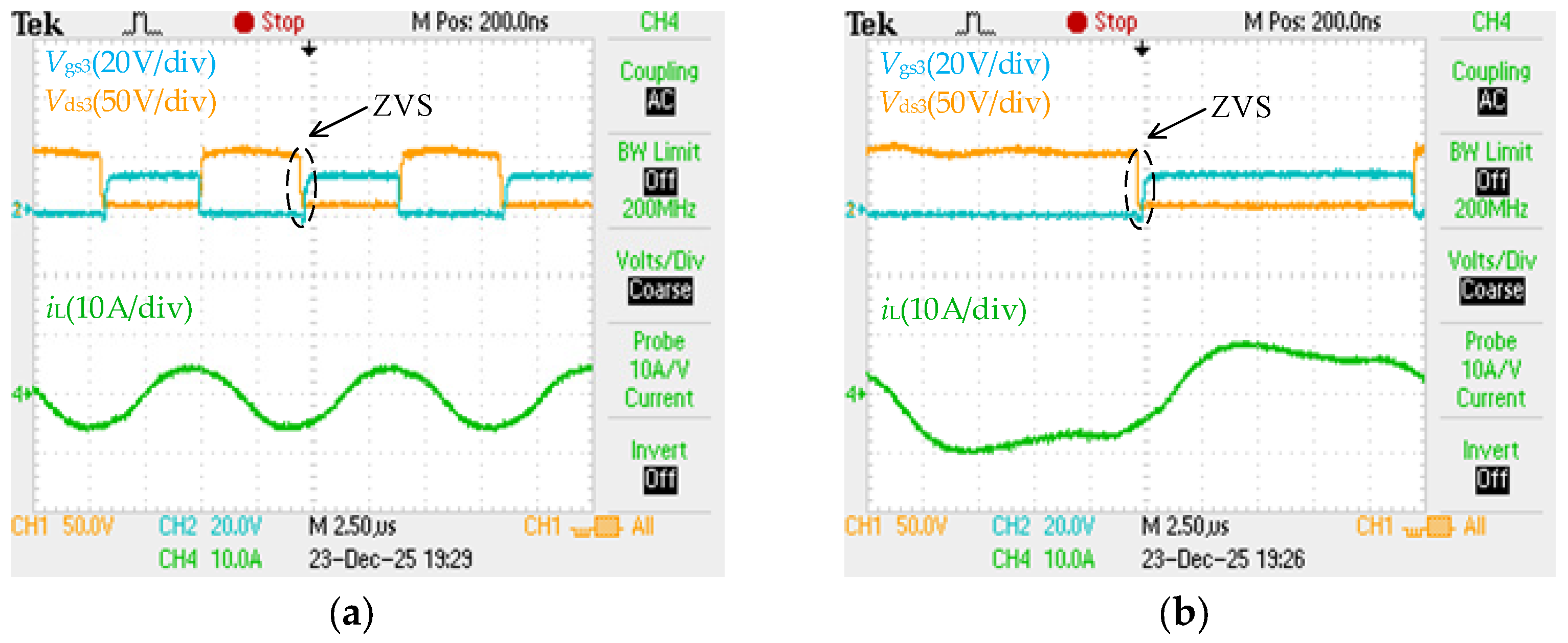
Figure 19 presents the gate drive signal Vgs3 and the voltage Vds3 across the secondary-side switch S3 under light and heavy load conditions. Prior to the gate drive signal being applied, the voltage across switch S3 attains zero, as verified. This clearly demonstrates that ZVS is effectively achieved for the secondary-side switch across the entire load range.
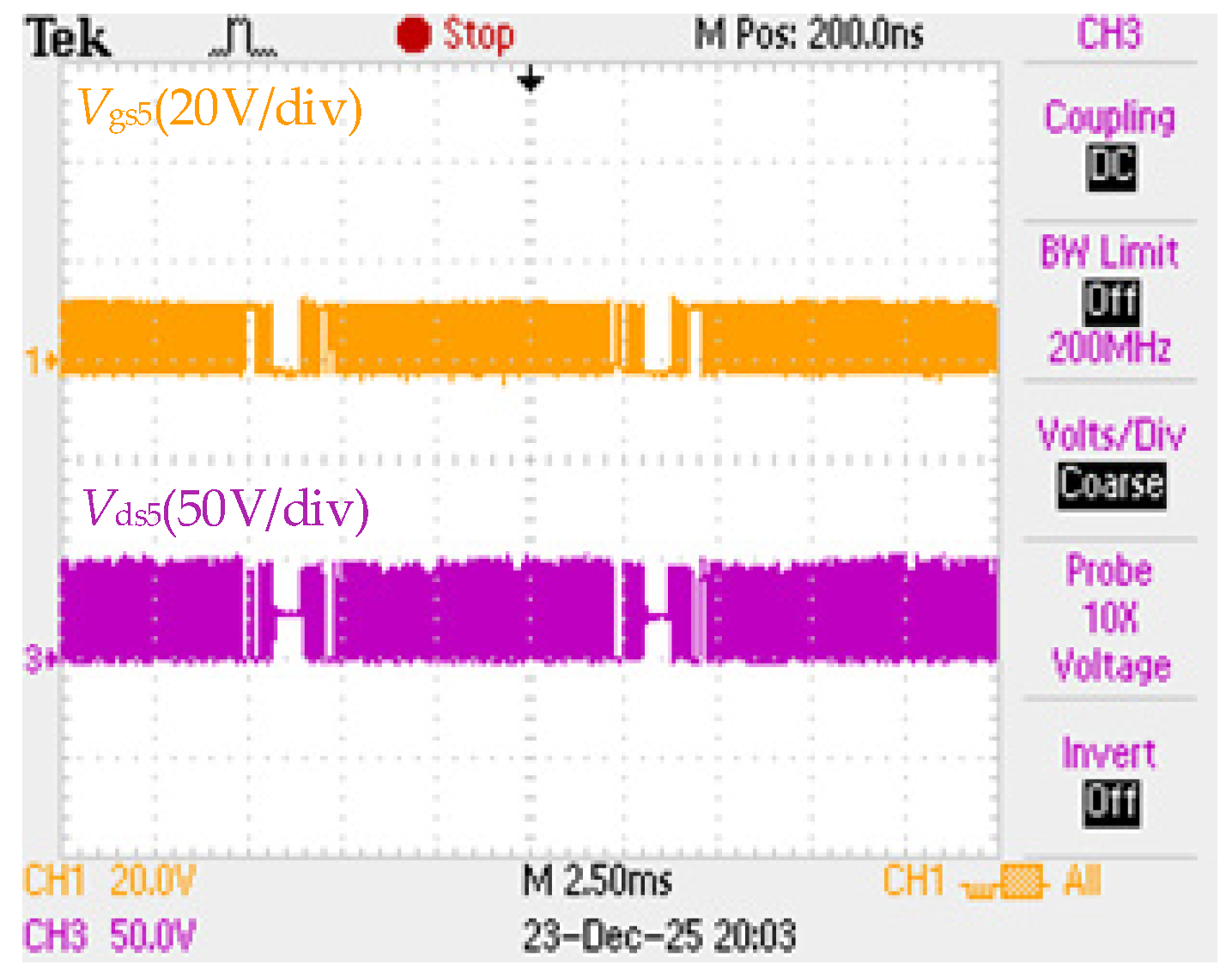
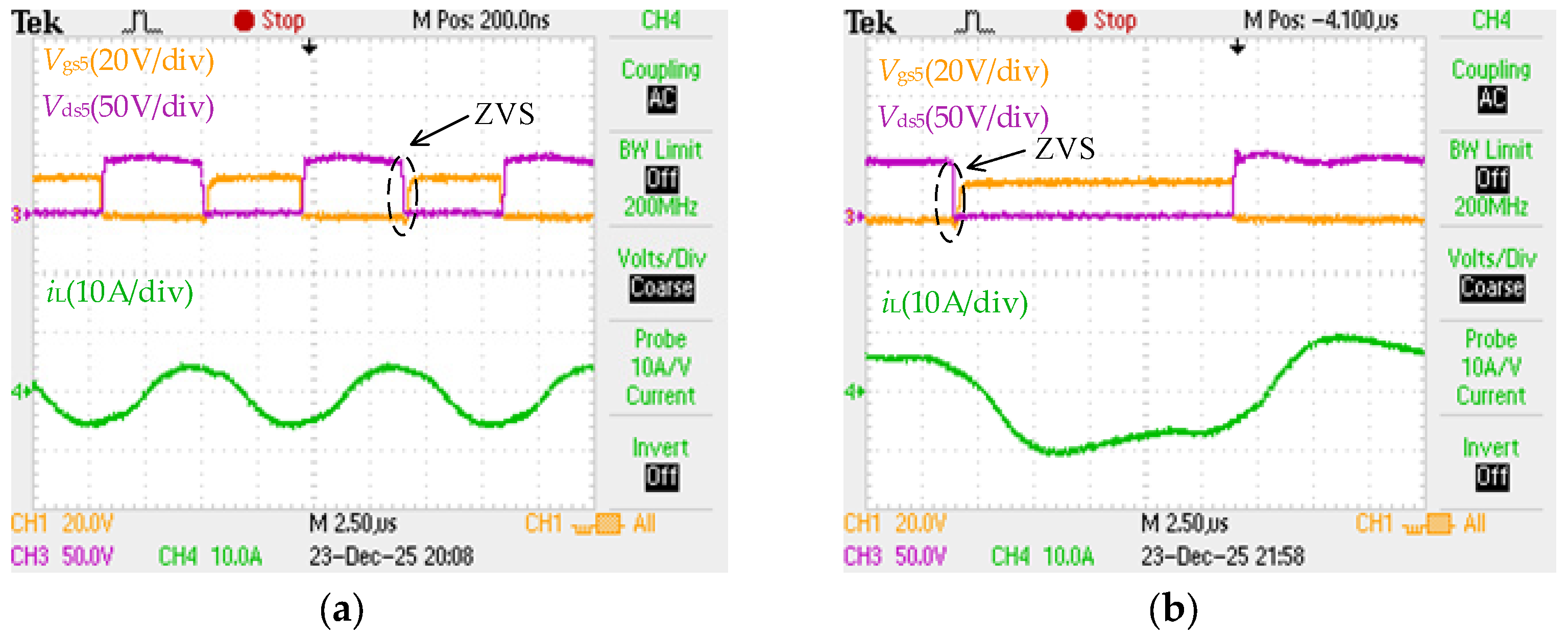
The drain-source voltage Vds5 and gate drive signal Vgs5 of switch S5 are presented in Figure 20. The Vds5 waveform collapses to approximately zero when the switch is turned on, and rises to a constant value representing the DC output voltage when the switch is off. Over the entire grid cycle, the Vds5 exhibits a square wave with constant amplitude.
Figure 21 shows the gate drive signal Vgs5 and drain-to-source voltage Vds5 of the switch S5 under light and heavy load conditions. Clear ZVS is achieved across the entire operating range, as the voltage across S5 drops to zero prior to gate signal activation.
In summary, due to the complementary and symmetric nature of the two switches in each bridge leg, ZVS is achieved for all switches in the rear-end DAB converter across the entire power-transfer range.
Figure 22 shows the efficiency curve of the converter. A peak efficiency of approximately 91.78% is achieved, with an efficiency of 91.45% at the rated power.
As summarized in Table 2, the proposed method achieves full-range ZVS in a single mode of operation while maintaining the switching frequency within a low range.

7. Conclusions

This paper presents a hybrid modulation strategy integrating phase-shift and variable-frequency control to overcome the limitations of conventional SPS modulation, particularly its narrow soft-switching range and high current stress. The proposed method ensures ZVS across the entire operating range for all power switches while significantly reducing the peak current stress. Experimental comparison shows that the current stress is reduced by approximately 16.7% compared to existing methods. The proposed strategy achieves a steady-state efficiency of 91.45% at the rated power on the prototype platform, with potential for further improvement through optimization. These results validate the effectiveness and correctness of the proposed approach. Furthermore, compared to complex mode-switching or multi-phase-shift modulation methods, the proposed strategy offers lower control complexity, providing a solution for single-stage AC–DC converters.

Author Contributions

Conceptualization Y.W.; methodology, L.S. and Y.W.; software, Z.L.; validation, L.S., Z.L., K.W., H.S. and Z.W.; formal analysis, Y.W. and L.S.; investigation, Z.L., K.W., H.S. and Z.W.; resources, Y.W.; writing—original draft preparation, Y.W.; writing—review and editing, L.S. and Y.W.; visualization, Z.L., K.W. and H.S.; supervision, Y.W.; funding acquisition, L.S., Z.L., K.W., H.S., Z.W. and Y.W. All authors have read and agreed to the published version of the manuscript.

Funding

This research was supported by the Science and Technology Project of State Grid Henan Electric Power Company under Grant Number 5217S0250005.

Data Availability Statement

The original contributions presented in this study are included in the article. Further inquiries can be directed to the corresponding author.

Conflicts of Interest

Authors Lingling Shi, Ke Wang, Hui Shen, and Zhe Wu were employed by State Grid Henan Integrated Energy Service Co., Ltd. at the time this study was conducted. All authors declare that this employment and the funding received from Science and Technology Project of State Grid Henan Electric Power Company (grant number 5217S0250005) did not influence the study design, data collection, analysis, interpretation, writing of the article, or the decision to submit it for publication. The authors declare that the research was conducted in the absence of any commercial or financial relationships that could be construed as a potential conflict of interest.

References

  1. Tian, W.; Xi, H. Comparative analysis and optimization of pumped thermal energy storage systems based on different power cycles. Energy Convers. Manag. 2022, 259, 115581. [Google Scholar] [CrossRef]
  2. Choudhury, S. Review of energy storage system technologies integration to microgrid: Types, control strategies, issues, and future prospects. J. Energy Storage 2022, 48, 103966. [Google Scholar] [CrossRef]
  3. Yan, Z.; Zhang, Y.; Yu, J. An allocative method of stationary and vehicle-mounted mobile energy storage for emergency power supply in urban areas. Energy Storage 2024, 6, e681. [Google Scholar] [CrossRef]
  4. Ali, A.; Mousa, H.H.H.; Shaaban, M.F.; Azzouz, M.A.; Awad, A.S.A. A Comprehensive Review on Charging Topologies and Power Electronic Converter Solutions for Electric Vehicles. J. Mod. Power Syst. Clean Energy 2024, 12, 675–694. [Google Scholar] [CrossRef]
  5. Liu, S.; Wan, Y.; Zhong, Y.; Zhou, X.; Wang, Y.; Li, J. A New Three-Port Electric Drive Reconfiguration Converter for Mobile Emergency Energy Storage Vehicle. IEEE Trans. Power Electron. 2025, 40, 10456–10468. [Google Scholar] [CrossRef]
  6. Ma, P.; Sha, D.; Song, K. A Single-Stage Semi Dual-Active-Bridge AC–DC Converter With Seamless Mode Transition and Wide Soft-Switching Range. IEEE Trans. Ind. Electron. 2023, 70, 1387–1397. [Google Scholar] [CrossRef]
  7. Zhang, Y.; Yang, G.; Li, J.; Kong, Z.; Zhu, X. A Modulation Scheme With Full Range ZVS and Natural Power Factor Correction for Bridgeless Single-Stage Isolated AC–DC Converter. IEEE Trans. Power Electron. 2023, 38, 195–205. [Google Scholar] [CrossRef]
  8. Sha, D.; Zhang, D.; Zhang, J. A Single-Stage Dual-Active-Bridge AC–DC Converter Employing Mode Transition Based on Real-Time Calculation. IEEE Trans. Power Electron. 2021, 36, 10081–10088. [Google Scholar] [CrossRef]
  9. Cho, Y.W.; Cha, W.J.; Kwon, J.M.; Kwon, B.H. High-Efficiency Bidirectional DAB Inverter Using a Novel Hybrid Modulation for Stand-Alone Power Generating System With Low Input Voltage. IEEE Trans. Power Electron. 2016, 31, 4138–4147. [Google Scholar] [CrossRef]
  10. Wen, H.; Xiao, W.; Su, B. Nonactive Power Loss Minimization in a Bidirectional Isolated DC–DC Converter for Distributed Power Systems. IEEE Trans. Ind. Electron. 2014, 61, 6822–6831. [Google Scholar] [CrossRef]
  11. Guo, Z.; Han, X. Control Strategy of AC-DC Converter Based on Dual Active Bridge With Minimum Current Stress and Soft Switching. IEEE Trans. Power Electron. 2022, 37, 10178–10189. [Google Scholar] [CrossRef]
  12. Xu, G.; Li, L.; Chen, X.; Xiong, W.; Liang, X.; Su, M. Decoupled EPS Control Utilizing Magnetizing Current to Achieve Full Load Range ZVS for Dual Active Bridge Converters. IEEE Trans. Ind. Electron. 2022, 69, 4801–4813. [Google Scholar] [CrossRef]
  13. Xu, F.; Liu, J.; Dong, Z. Minimum Backflow Power and ZVS Design for Dual-Active-Bridge DC–DC Converters. IEEE Trans. Ind. Electron. 2023, 70, 474–484. [Google Scholar] [CrossRef]
  14. Zhao, B.; Song, Q.; Liu, W.; Sun, W. Current-Stress-Optimized Switching Strategy of Isolated Bidirectional DC–DC Converter With Dual-Phase-Shift Control. IEEE Trans. Ind. Electron. 2013, 60, 4458–4467. [Google Scholar] [CrossRef]
  15. Wang, X.; Yang, M.; Sima, W.; Yuan, T.; Sun, P.; Lin, S. Composite Duty Modulation of Dual Active Bridge Converters to Minimize Output Voltage Ripples and Inductor RMS Currents. IEEE Trans. Power Electron. 2024, 39, 5662–5681. [Google Scholar] [CrossRef]
  16. Ren, Q.; Xiao, F.; Liu, J.; Chen, P.; Zhu, Z. Efficiency Improvement and High-Performance Control of Dual-Active-Bridge DC-DC Converter with Triple-Phase-Shift Modulation. CSEE J. Power Energy Syst. 2024, 10, 2434–2445. [Google Scholar] [CrossRef]
  17. Guzmán, P.; Vázquez, N.; Liserre, M.; Orosco, R.; Vaquero, J.; Hernández, C. AC-DC DAB Converter with Power Factor Correction. Energies 2023, 16, 320. [Google Scholar] [CrossRef]
  18. Liu, B.; Davari, P.; Blaabjerg, F. A Flexible Control Scheme for Single-Stage DAB AC/DC Converters. In Proceedings of the 2018 IEEE International Power Electronics and Application Conference and Exposition (PEAC), Shenzhen, China, 4–7 November 2018. [Google Scholar] [CrossRef]
  19. Tian, Q.; Huang, A.Q.; Bai, H.; Lu, J.; Hui, T.; Mcammond, M.; Brown, A. A novel light load performance enhanced variable-switching-frequency and hybrid single-dual-phase-shift control for single-stage dual-active-bridge based AC/DC converter. In Proceedings of the IECON 2016—42nd Annual Conference of the IEEE Industrial Electronics Society, Florence, Italy, 23–26 October 2016. [Google Scholar] [CrossRef]
  20. Taylor, A.; Liu, G.; Bai, H.; Brown, A.; Johnson, P.M.; McAmmond, M. Multiple-Phase-Shift Control for a Dual Active Bridge to Secure Zero-Voltage Switching and Enhance Light-Load Performance. IEEE Trans. Power Electron. 2018, 33, 4584–4588. [Google Scholar] [CrossRef]
  21. Zengin, S.; Boztepe, M. A Novel Current Modulation Method to Eliminate Low-Frequency Harmonics in Single-Stage Dual Active Bridge AC–DC Converter. IEEE Trans. Ind. Electron. 2020, 67, 1048–1058. [Google Scholar] [CrossRef]
  22. Weise, N.D.; Castelino, G.; Basu, K.; Mohan, N. A Single-Stage Dual-Active-Bridge-Based Soft Switched AC–DC Converter With Open-Loop Power Factor Correction and Other Advanced Features. IEEE Trans. Power Electron. 2014, 29, 4007–4016. [Google Scholar] [CrossRef]
  23. Everts, J.; Van den Keybus, J.; Driesen, J. Switching Control Strategy to Extend the ZVS Operating Range of a Dual Active Bridge AC/DC Converter. In Proceedings of the IEEE Energy Conversion Congress and Exposition (ECCE), Phoenix, AZ, USA, 17–22 September 2011; pp. 4107–4114. [Google Scholar] [CrossRef]
  24. Ma, P.; Sha, D. A Single-Stage AC–DC Converter Based on Semi Dual-Active-Bridge With Decoupled Inductor Current Modulation Strategy. IEEE Trans. Power Electron. 2023, 38, 10170–10182. [Google Scholar] [CrossRef]
  25. Wang, Z.; Li, J.; Zhou, Y. Control Strategy of Isolated Bi-Directional AC/DC Converter Controlled by Single Phase Shift Control. In Proceedings of the 2022 IEEE/IAS Industrial and Commercial Power System Asia (I&CPS Asia), Shanghai, China, 8–11 July 2022; pp. 263–268. [Google Scholar] [CrossRef]
Figure 1. Single-stage AC–DC converter. * The colored blocks, from left to right, denote the key functional sections: ac input stage (red), full-bridge rectifier (blue), and DAB converter (purple).
Energies 19 00948 g001
Figure 2. DAB equivalent circuit diagram. The voltages VAB and nVCD represent the two-level square waves generated by the primary side and secondary side bridges, respectively.
Energies 19 00948 g002
Figure 3. SPS modulation operational waveforms. From top to bottom, the first three rows represent the gate drive signals of switches S1–S6, the fourth row corresponds to the voltage across the transformer, and the fifth row shows the inductor current.
Energies 19 00948 g003
Figure 4. Switching frequency variation curve.
Energies 19 00948 g004
Figure 5. I max / c varying with c when ωt = 90°.
Energies 19 00948 g005
Figure 6. Imax variation curve with c when ωt = 90°.
Energies 19 00948 g006
Figure 7. ZVS implementation parameter trajectory.
Energies 19 00948 g007
Figure 8. Block diagram of PWM module.
Energies 19 00948 g008
Figure 9. Experimental platform.
Energies 19 00948 g009
Figure 10. Connection diagram of experimental platform.
Energies 19 00948 g010
Figure 11. Control parameter trajectories. (a) α; (b) fs.
Energies 19 00948 g011
Figure 12. AC input voltage and current.
Energies 19 00948 g012
Figure 13. DAB converter input voltage, output voltage, and output current.
Energies 19 00948 g013
Figure 14. Voltage across the transformer and inductor current.
Energies 19 00948 g014
Figure 15. Current stress comparison. (a) Presented method; (b) Reference [25].
Energies 19 00948 g015
Figure 16. Switch S1 drain-to-source voltage and gate drive signal at line frequency.
Energies 19 00948 g016
Figure 17. ZVS implementation of switch S1. (a) Light load condition; (b) heavy load condition.
Energies 19 00948 g017
Figure 18. Switch S3 drain-to-source voltage and gate drive signal at line frequency.
Energies 19 00948 g018
Figure 19. ZVS implementation of switch S3. (a) Light load conditions; (b) heavy load conditions.
Energies 19 00948 g019
Figure 20. Switch S5 drain-to-source voltage and gate drive signal at line frequency.
Energies 19 00948 g020
Figure 21. ZVS implementation of switch S5. (a) Light load conditions; (b) heavy load conditions.
Energies 19 00948 g021
Figure 22. Efficiency curve.
Energies 19 00948 g022
Table 1. Key experimental parameters.
ParametersValue
AC voltage (vac)50 VRMS, 50 Hz
DC voltage (Vdc)50 V
Leakage inductance (Lσ)25 μH
Turns ratio (n)1
Filter capacitor (C1/C2)5 μF
Filter inductor (L1)1 mH
Virtual frequency (fa)35 kHz
Output power (P)100 W
Table 2. Comparison with other works.
Comparison ItemsDAB
AC/DC [6]
DAB
AC/DC [8]
DAB
AC–DC [19]
Proposed
One
Operating modesTwo
modes
Two
modes
Three
modes
One
mode
Switch numbers1281210
Power directionUnidirectional BidirectionalBidirectionalBidirectional
ZVS scopePartialPartialFullFull
Max switching frequency100 kHz100 kHz500 kHz124.95 kHz
Disclaimer/Publisher’s Note: The statements, opinions and data contained in all publications are solely those of the individual author(s) and contributor(s) and not of MDPI and/or the editor(s). MDPI and/or the editor(s) disclaim responsibility for any injury to people or property resulting from any ideas, methods, instructions or products referred to in the content.