1. Introduction
1.1. Background and Context
Developing countries, despite possessing significant renewable energy potential, remain among the most underserved in terms of access to reliable and sustainable energy services. Consequently, they continue to rely heavily on traditional fuel sources for their daily energy needs, exposing them to global energy geopolitics, energy insecurity and the adverse effects of climate change such as prolonged droughts, accelerated desertification, and flooding among others. Biogas offers a dual solution to these challenges by enhancing energy security, while improving sanitation and waste management practices in households and communities. In this way, biogas contributes simultaneously to communities’ energy needs, environmental protection goals, and well-being. Estimates show that developing countries possess over 80% of the 1000 billion cubic metres (bcme) of sustainable biogas potential from crop residues and manure [
1]. If unlocked, this potential would significantly benefit local agricultural sectors through alternative revenue streams and biofertilizer use, create jobs, and strengthen rural livelihoods.
However, small-scale biogas systems in these regions are typically designed for readily digestible feedstock such as livestock manure. To fully exploit the biogas potential of crop residues, pretreatment is required to make lignocellulosic materials more accessible to anaerobic digestion (AD) microorganisms. Beyond improving agricultural residue utilization, biogas from small-scale biogas plants can play a key role in providing clean energy for cooking and heating, replacing high-emission fuels like charcoal, and firewood. This transition is crucial in reducing indoor air pollution, which affected approximately 2.6 billion people globally and caused about 2.8 million deaths in 2023 [
2], a notable increase from 2.3 million deaths in 2019 [
3]. In addition to domestic use, biogas can fuel gas-engine-driven water pumps for irrigation and household applications [
4], thereby supporting agricultural productivity and rural development while helping curb deforestation and land degradation.
Although small-scale biogas systems have been widely deployed across many countries, their long-term viability depends on overcoming key challenges related to feedstock availability and system maintenance. Reliable access to diverse substrates and sustained technical support are critical for realizing their full potential in developing regions [
5,
6,
7]. Co-digestion of livestock manure with crop residues or other organic waste has emerged as a promising strategy to enhance reliability and sustainability. For instance, co-digesting cattle dung with straw can stabilize gas production and offset fluctuations in manure supply [
6]. Such diversification reduces the risk of underfeeding, supports consistent biogas yields, and improves farm economics by utilizing available residues. However, most small-scale plants are designed for manure digestion only, limiting operators’ ability to exploit these benefits due to the technical and economic barriers associated with implementing pretreatment at the household level.
Small-scale biogas digesters remain a key technology for rural energy, yet their reliance on livestock manure makes them vulnerable to feedstock shortages. Evidence from Bangladesh, Rwanda and other countries shows that between one-quarter and one-third of digesters are underfed or non-functional [
4], often due to droughts, disease or fluctuations in livestock numbers. Such failures erode user confidence and hinder further adoption despite government and donor-supported programs. To address this challenge, a previous study proposed co-digestion and applied the Analytic Hierarchy Process (AHP) to prioritize alternative feedstocks [
4]. Building on that work, the present paper applies the AHP framework to evaluate pretreatment strategies (mechanical, thermal, chemical and biological) that can convert crop residues and other waste into digestible substrates in the small-scale context. Pretreatment can improve methane yields by 20 to 150% [
8], enabling underutilized residues to supplement or replace manure and thereby alleviate feedstock shortages. This paper provides a systematic method for selecting appropriate pretreatment techniques based on simplicity, energy requirements, cost, effectiveness, and environmental impact, contributing to the sustainability and resilience of small-scale biogas systems.
1.2. Research Gap and Study Objectives
Although interest in enhancing feedstock flexibility in small-scale biogas systems is increasing, structured guidelines for selecting and implementing suitable pretreatment methods remain limited [
9]. As a result, most systems continue to depend on readily digestible substrates, mainly livestock manure and, to a lesser extent, household food waste. This reliance limits both operational efficiency and resilience to feedstock fluctuations. Moreover, while the digestate produced is nutrient-rich, its poor structural properties (characterized by high moisture and low fibre content) restrict its effectiveness as a soil amendment by impairing soil porosity and aeration, thereby reducing soil microbial populations. This limits its uptake as a fertilizer substitute and undermines potential benefits for soil health and reduced dependence on mineral fertilizers. Notably, studies indicate that substituting up to 35% of mineral fertilizers with digestate can enhance crop yields and soil quality [
10].
To address this gap, the presented research applies a systematic decision-support approach based on the AHP method to evaluate, prioritize, and select suitable pretreatment technologies for agricultural residues, considering the technical, economic, and operational constraints of small-scale biogas systems and their users. In doing so, it establishes a practical methodological framework for implementing pretreatment and co-digestion in small-scale biogas systems. Additionally, it develops a conceptual demonstration plant design that integrates co-digestion of livestock manure with pretreated crop residues. To accomplish these research objectives, the following research questions are addressed:
- i
What are the characteristics of potential small-scale biogas plant feedstocks?
- ii
What are the potential pretreatment methods available for biogas plant feedstocks?
- iii
What are the key criteria for selecting appropriate pretreatment methods for small-scale biogas systems?
- iv
Based on these criteria, which pretreatment methods or combinations are most suitable for implementation in such systems?
- v
How can the selected pretreatment approach be effectively integrated into a functional small-scale biogas plant?
The paper is therefore structured as follows:
Section 2 presents the state-of-the-art, outlining the role of co-digestion, feedstock pretreatment, typical feedstock characteristics, and multi-criteria decision-making methods.
Section 3 details the materials and methods, describing the approach used to address the research questions, including the selection of potential pretreatment methods, definition and justification of evaluation criteria, and application of the AHP methodology.
Section 4 presents and discusses the prioritization results.
Section 5 presents a conceptual design for integrating pretreatment and co-digestion in small-scale biogas systems.
Section 6 outlines the limitations of the study. Finally,
Section 7 outlines the conclusions and recommendations for future research.
2. State-of-the-Art
2.1. Co-Digestion and Its Role in Small-Scale Biogas Systems
Co-digestion, the simultaneous digestion of more than one substrate with complimentary characteristics, is an innovative non-pretreatment strategy commonly used in commercial anaerobic digesters to overcome the limitations of single-feedstock digestion, which include substrate properties (chemical composition, bioavailability, biodegradability, bio-accessibility), operating parameters (pH, Temp, etc.) [
11], and feedstock supply challenges through feedstock diversification. Co-digestion results in the formation of rich nutrients in the substrates that enhance microbial growth and tremendously improve biogas and methane production [
12,
13]. This improvement is a result of substrate combinations that bring a positive interaction within the system, reducing the effects of inhibitory or toxic compounds, nutrient supplementation, balancing the buffer capacity, adjusting the carbon-to-nitrogen (C/N) ratio, and stability within the bioreactor [
11].
Small-scale biogas plants can benefit significantly from co-digesting locally available crop residues with livestock manure. These feedstocks are complementary in terms of nutrient balance (particularly the C/N ratio), storability, and seasonal availability [
4]. Due to the seasonal variability of crop residues, livestock manure serves as an ideal primary feedstock, as is common in agricultural residue co-digestion [
14]. Co-digestion enhances methane production as compared to mono-digestion, thereby reducing fossil fuel dependence. It also supports waste management and nutrient recycling through the use of digestate, further mitigating environmental impacts [
15]. Although these benefits are well-documented in large-scale systems, adoption in small-scale plants remains limited due to the recalcitrant, lignocellulosic nature of most crop residues, which makes them indigestible in their collected form.
2.2. Lignocellulosic Feedstocks and Pretreatment
Crop residues, the unutilized portion left after harvesting, are promising co-digestates for biogas production when combined with livestock manure. Unlike dedicated energy crops, they do not require separate land, as they are part of the harvested portion of crops such as wheat straw, rice straw, maize straw, and maize cobs [
16]. Alongside livestock manure, they represent one of the most abundant renewable feedstock sources, particularly in small-scale household biogas systems [
16,
17].
A survey of farms in the Fès-Meknès region of Morocco identified straw from cereals and manure from cattle, sheep and chickens as the most common residues available for small-scale biogas systems (cattle manure was the top feedstock, followed by straw) [
4,
7]. These residues are complementary: straw provides carbon and structural carbohydrates while manure supplies nitrogen and essential microorganisms and micronutrients. However, the structural complexity of lignocellulose makes crop residues difficult to digest.
Lignocellulosic biomass is mainly composed of cellulose (30–50% of dry matter (DM)), hemicellulose (20–35%DM), and lignin (12–25%DM) depending on the crop type, weather, maturity and storage conditions arranged in a tightly bound matrix [
18]. The high lignin content protects the carbohydrate fractions from microbial attack, so untreated straw is recalcitrant in anaerobic digesters. Pretreatment is therefore essential to disrupt the lignin structure, increase surface area and expose cellulose and hemicellulose to microbial hydrolysis.
Pretreatment methods can be grouped into physical, chemical, physicochemical, and biological. Physical pretreatment such as milling or shredding decreases particle size and increases surface area but is energy-intensive and may account for a significant portion of operating costs [
19,
20]. Chemical pretreatment uses acids or alkalis to solubilize hemicellulose and improve access to carbohydrates [
21]. Alkaline pretreatment removes lignin and decreases cellulose crystallinity, thereby improving digestibility [
22,
23]. Biological pretreatment utilizes microbes (such as naturally occurring microbial consortia from digestate, white rot fungi) or specifically formulated enzymes (such as cellulases and hemicellulases) to break down lignocellulosic biomass [
21]. Although pretreatment may represent more than 40% of the total processing cost [
23], it is crucial for making cellulose and hemicellulose bioavailable and improving methane yields, especially where co-digested residues are majorly straw or other lignocellulosic residues.
2.3. Feedstock Characteristics
Selecting an appropriate pretreatment method requires a thorough understanding of the physicochemical characteristics of the feedstocks. Beyond this, the performance of a method is judged by its economic viability, specifically, whether the cost of pretreatment is justified by the resulting increase in methane yield. Nonetheless, the physicochemical characteristics, structure, composition of the biomass, and the operating conditions often have a greater influence on the pretreatment effectiveness [
17,
24]. The potential feedstocks assessed in this research are mainly farm residues comprising both livestock and crop residues such as straw (from wheat, maize, and barley), cattle manure, chicken manure, and sheep manure. These were identified through a farm survey in the Fès-Meknès region of Morocco as the most prevalent feedstocks [
7], and subsequently prioritized using the AHP method as the most suitable for enhancing the resilience and operational sustainability of small-scale biogas systems [
4]. They are broadly representative of feedstocks common across developing countries, with only minor regional variations. Their typical characteristics and effects on anaerobic digestion are summarized in
Table 1 [
25,
26].
Based on these feedstock characteristics, the primary objectives of feedstock pretreatment are to [
19,
33]:
- i
Reduce feedstock size to facilitate handling, increase bulk density (as smaller, more uniform particles can pack more efficiently into a given volume) and minimize floating layer formation in digesters.
- ii
Partially break down tough crop residues with high lignin content and crystallinity, enabling hydrolytic and methanogenic microorganisms to effectively degrade the feedstock.
- iii
Increase feedstock specific surface area and porosity to enhance interaction with anaerobic digestion microorganisms.
- iv
Accelerate hydrolysis, reducing residence time in the digester and allowing for a smaller digester size for a given biogas/methane yield.
- v
Remove impurities (especially inerts) that could hinder equipment function and occupy digester space through deposition/sinking layers.
The selected pretreatment method should be able to meet these pretreatment objectives considering the techno-economic conditions of small-scale biogas system adopters.
2.4. Multi-Criteria Decision-Making Tools (AHP) in Technology Selection
The use of multi-criteria decision-making tools such as the Analytic Hierarchy Process (AHP) in technology selection is not a new concept. Developed by Saaty in the 1970s, AHP is built on the weighted sum method [
34] and has been widely applied in selecting renewable energy technologies, optimizing installation sites, and supporting decision-making involving multiple and conflicting criteria. Its application is demonstrated in assessing and prioritizing floating photovoltaic systems in Laos [
35] and in ranking sustainable energy resources in Afghanistan [
36]. In the biogas sector, AHP has been used to rank barriers to small-scale biogas systems adoption in rural India [
37] and to prioritize and select the most suitable AD process for biomass-based energy production in Iran [
38]. It has also been applied in prioritizing and selecting potential feedstocks for small-scale biogas plants in developing countries [
4].
In this study, AHP is utilized in the prioritization and selection of pretreatment methods because of its versatility, which includes its adaptability to both qualitative and quantitative evaluation criteria, ability to organize complex problems hierarchically, and facilitate clear prioritization of criteria and alternatives through weighted comparisons. AHP also enhances decision quality by including a consistency check to validate the logical coherence and transivity of the decision-maker’s preferences and minimize bias, ensuring judgements are consistently applied across all comparisons. Furthermore, its adaptability to both qualitative and quantitative criteria, along with its simplicity and ease of application, makes it suitable for diverse decision-making contexts [
39].
3. Materials and Methods
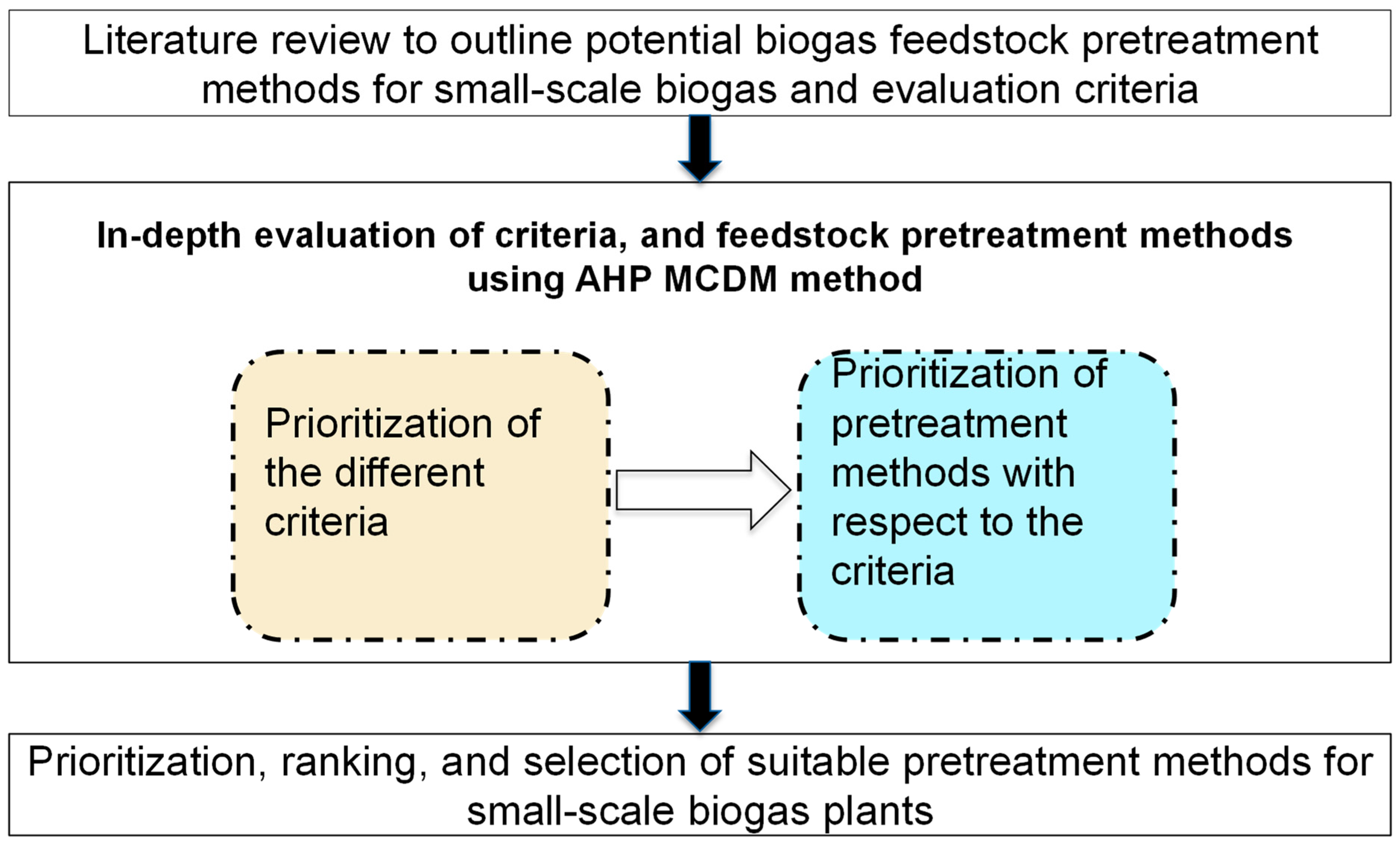
The methodology employed in this research is outlined in
Figure 1. An in-depth literature review was conducted to identify potential feedstock pretreatment methods applicable to small-scale biogas systems, along with relevant selection criteria. These criteria were subsequently prioritized using the Analytic Hierarchy Process (AHP). Based on the established criteria, the identified pretreatment methods were evaluated and prioritized. The resulting prioritization informed the recommendation of the most suitable pretreatment method and/or combinations for application in small-scale biogas systems.
3.1. Selection of Potential Pretreatment Methods
Several pretreatment methods for AD feedstocks have been developed and implemented in recent years. These methods aim to accelerate AD processes, enhance biogas production, utilize locally available feedstocks, and address issues of high energy demand and environmental impact [
21]. The pretreatment methods commonly applied to biodigester feedstocks, and their strengths and weaknesses are summarized in
Table 2:
3.2. Definition and Justification of Evaluation Criteria
The criteria utilized in the prioritization of the potential pretreatment criteria are derived from an in-depth literature review. The most important factors considered when selecting a suitable pretreatment technology include energy consumption and costs (capital and operating). Most often, however, pretreatments with low energy demand have little impact on degradation rate and biogas yields as compared to high energy pretreatment processes. Therefore, a wrong selection of pretreatment process can render the pretreatment non-economic [
21]. The ideal pretreatment method should possess several key characteristics: it must be simple and cost-effective; effective in improving microorganisms’ accessibility to substrates; not produce inhibitory products; require low energy; be applicable to a wide range of lignocellulosic biomass; and not generate by-products harmful to the environment [
17,
42,
43]. The pretreatment methods evaluation and selection criteria are summarized in
Table 3.
3.3. Application of AHP to Pretreatment Methods Prioritization
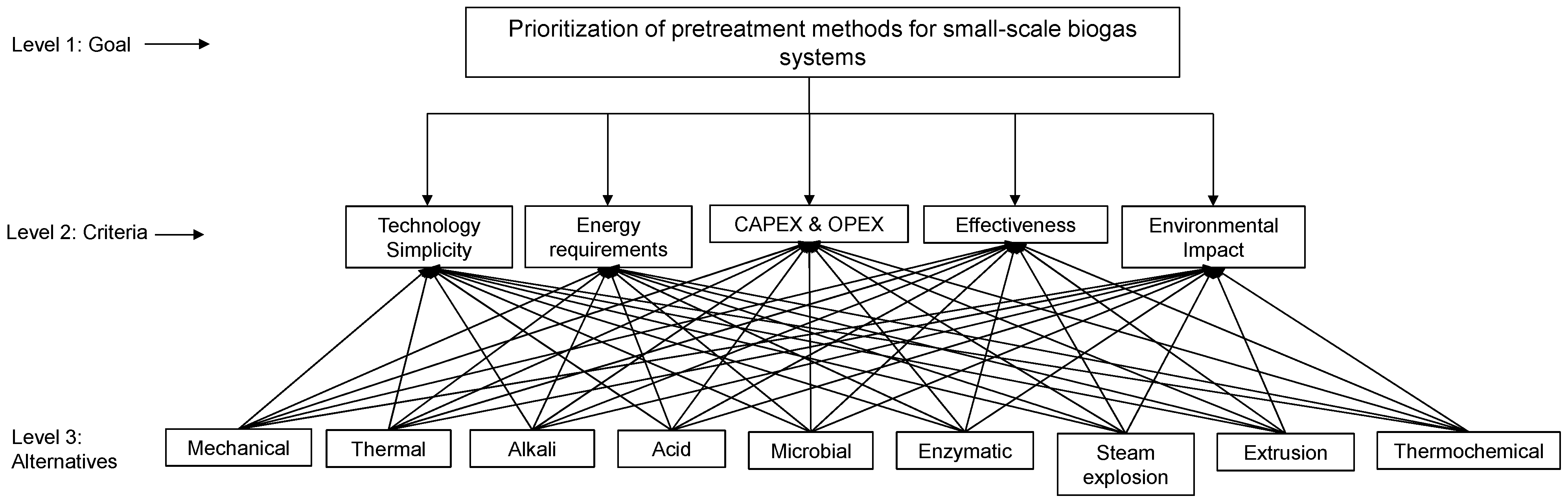
The AHP structure employed in this research is adapted from the previous work on feedstock selection [
4] and comprises three hierarchical levels as illustrated in
Figure 2. The top level defines the overall goal of the decision-making process, followed by the second level, which outlines the evaluation criteria. The third level consists of the alternatives (potential pretreatment methods). Each level is evaluated with respect to the level directly above it.
To implement the AHP methodology in prioritizing potential feedstock pretreatment methods, the following steps are followed [
4,
35,
46,
47]:
- i
Outline the goal, criteria, and alternatives;
- ii
Create a set of judgements using pairwise comparisons for the criteria with respect to the goal;
- iii
Determine the relative weights of the different criteria;
- iv
Verify judgement consistency;
- v
Perform pairwise comparisons of the available potential pretreatment methods with respect to each criterion, checking the consistency of the same;
- vi
Prioritize the pretreatment methods based on criteria-relative weights and their prioritization with respect to each criterion.
Figure 2.
The AHP structure used in this research (adapted from [
4,
35,
48]).
Figure 2.
The AHP structure used in this research (adapted from [
4,
35,
48]).
Pairwise Comparison Matrices
To apply the AHP MCDM method for prioritizing feedstock pretreatment options in small-scale biogas systems, pairwise comparison matrices were constructed for both the selection criteria and pretreatment alternatives. These were informed by literature evidence, technical considerations, and the authors’ expert judgement, reflecting the conditions of the Fès-Meknès region of Morocco, where the relevant feedstocks were identified. The nine-point Saaty scale given in
Table 4 of preference intensity ranging from 1 (‘equal importance’) to 9 (‘extreme importance’), with intermediate values (2, 4, 6 and 8) representing intermediate judgments was used. Reciprocal values (1/3, 1/5, 1/7, 1/9, etc.) were used when a criterion or alternative was less important [
46].
The pairwise comparisons were organized into reciprocal matrices , where denotes the preference of element over element . Each column of was normalized by dividing its entries by the column sum, and the weights were obtained by averaging each row of the normalized matrix. Consistency of judgements was assessed using the consistency ratio (CR), computed from the matrix’s maximum eigenvalue and compared with Saaty’s random consistency index. A CR value below 0.1 indicates acceptable consistency, while higher values suggest the need to review the judgements.
4. Results and Discussion
4.1. Determination of Criteria Weights
The weights of the criteria are determined according to their relative importance in influencing the decision of adopting a given pretreatment method in small-scale biogas systems. The criterion that most significantly enhances suitability for such systems is assigned the highest weight. Based on this rationale, the pairwise comparison and corresponding normalized matrix presented in
Table 5 are developed. The normalized matrix is obtained by dividing each element of the pairwise comparison matrix by the sum of its respective column. The weight of each criterion is then calculated as the average of the elements in its corresponding row.
Capital and operating expenses (CAPEX and OPEX) have the greatest influence (34.5% relative weight) on the suitability of pretreatment methods for small-scale biogas installations. This is primarily because such systems are typically adopted for domestic or household purposes, where users often have limited purchasing power, low disposable income, and rely heavily on subsistence farming. In these contexts, high upfront and running costs are significant barriers to the adoption of new technologies, as has been widely documented in developing countries [
7].
The second most important criterion is the effectiveness (22.8% weight) of the pretreatment method. A more effective process enhances biogas yield, thereby increasing the overall appeal and viability of the technology. Improved yield directly translates to better energy returns, which is critical for users with limited resources. Simplicity of the technology ranks third (20% weight). A straightforward and easy-to-operate process is more likely to be adopted and consistently used, especially by rural or technically non-specialized users. Ease of operation reduces the need for specialized skills and lowers maintenance challenges, both of which are important for sustainability in small-scale settings.
Energy requirements (11.8% weight) and environmental impact (10.9% weight) rank fourth and fifth, respectively. For adopters of small-scale biogas plants, who are typically rural households or smallholder farmers, these factors are generally of lower priority compared to cost, effectiveness, and simplicity [
49,
50]. The selected methods should address this gap by minimizing operational complexity and energy input, thereby reducing the economic burden on users. In practice, energy efficiency and environmental considerations often become relevant only once the technology is affordable, reliable, and easy to operate, or when external drivers such as subsidy programs, fuel scarcity, or environmental concerns raise their importance. Nonetheless, these factors remain critical for ensuring long-term economic, social, and environmental sustainability of small-scale biogas systems, particularly as deployment scales up.
4.2. Prioritization of Potential Pretreatment Methods
4.2.1. Prioritization with Respect to the Criteria
The identified feedstock pretreatment methods were evaluated against the defined criteria and the specific pretreatment requirements of the feedstocks characterized in
Section 2.3. Based on this analysis, the pretreatment alternatives were prioritized.
The pairwise comparison matrix of alternatives was constructed by systematically comparing each pair of pretreatment methods under each criterion using the Saaty scale presented in
Table 4. For example, under Criterion C1 (technology simplicity), Alternative A1 (mechanical) was compared with Alternative A2 (thermal); where A1 was judged to be strongly preferred over A2, a value of 5 was assigned according to the Saaty scale (see
Table S3 in the Supplementary Material). The reciprocal value (1/5) was then assigned when assessing A2 relative to A1, ensuring matrix consistency. This procedure was applied to all alternative pairs across all evaluation criteria.
The complete pairwise comparison matrices, normalized matrices, and consistency assessments are provided in the
Supplementary Material. The resulting prioritization outcomes are summarized in
Table 6.
For technology simplicity (C1) and energy requirements (C2) criteria, microbial pretreatment ranks highest, followed by enzymatic pretreatment. These methods require no specialized machinery or specialized technical expertise and demand minimal or no external energy inputs. Mechanical pretreatment ranks third in simplicity due to its adaptability to utilize common or modified farm equipment, which can be operated with basic skills. However, its energy demand is relatively higher compared to microbial or enzymatic methods. In contrast, thermochemical, steam explosion, and acid/alkali pretreatments require specialized equipment, operator training, and substantial energy input (primarily in the form of heat or electricity), leading to lower weights under criterion C1 and C2.
Regarding capital and operational costs (C3), microbial pretreatment again ranks highest due to its compatibility with existing infrastructure and low input requirements. Its slower reaction rate may necessitate proportionately larger reactor dimensions or multiple parallel reactors to compensate for the extended residence time required for effective hydrolysis, consequently raising capital costs. However, this can be mitigated by incorporating mechanical size reduction or adjusting operational parameters (e.g., using thermophilic conditions) to accelerate hydrolysis. Other methods generally incur higher operating costs due to recurring input requirements, such as enzymes or chemicals. Acid and alkali pretreatments, in particular, require corrosion-resistant equipment and post-treatment systems to handle residual chemicals, significantly increasing both capital and operational expenditures.
In terms of effectiveness (C4), thermochemical pretreatment ranks highest, followed by steam explosion, extrusion, and alkali pretreatment. These methods efficiently disrupt cellulose and hemicellulose structures and, in some cases, particularly alkali pretreatment, partially solubilize lignin, thereby enhancing substrate digestibility. However, their high effectiveness is tempered by the risk of generating inhibitory compounds such as furans and phenolic derivatives at elevated temperatures, which can impair microbial activity during anaerobic digestion. In instances where the risk of inhibitory compounds is high, mitigation strategies such as dilution or optimizing operation parameters such as temperature to reduce inhibitor formation can be explored. Although microbial pretreatment is less effective on its own, its performance can be significantly improved when combined with physical methods. Experimental studies have shown that using the liquid fraction of digestate to pretreat cereal residues accelerates hydrolysis, enhances biodegradability, and increases biogas yields [
51,
52,
53,
54,
55]. It also overcomes the issue of substrate depletion (e.g., fermentable sugars) often observed with other microbial pretreatments, such as those utilizing certain fungi that consume these compounds.
For the environmental impact (C5) criterion, microbial and enzymatic pretreatments score highest, as they are inherently low-impact processes that do not produce harmful by-products. In contrast, acid and alkali pretreatments pose environmental hazards due to chemical residues, requiring post-treatment or recovery prior to disposal. Other methods, such as thermal and thermochemical techniques, have indirect environmental impacts linked to their high energy consumption, particularly when fossil-based energy sources are used.
4.2.2. Overall Prioritization
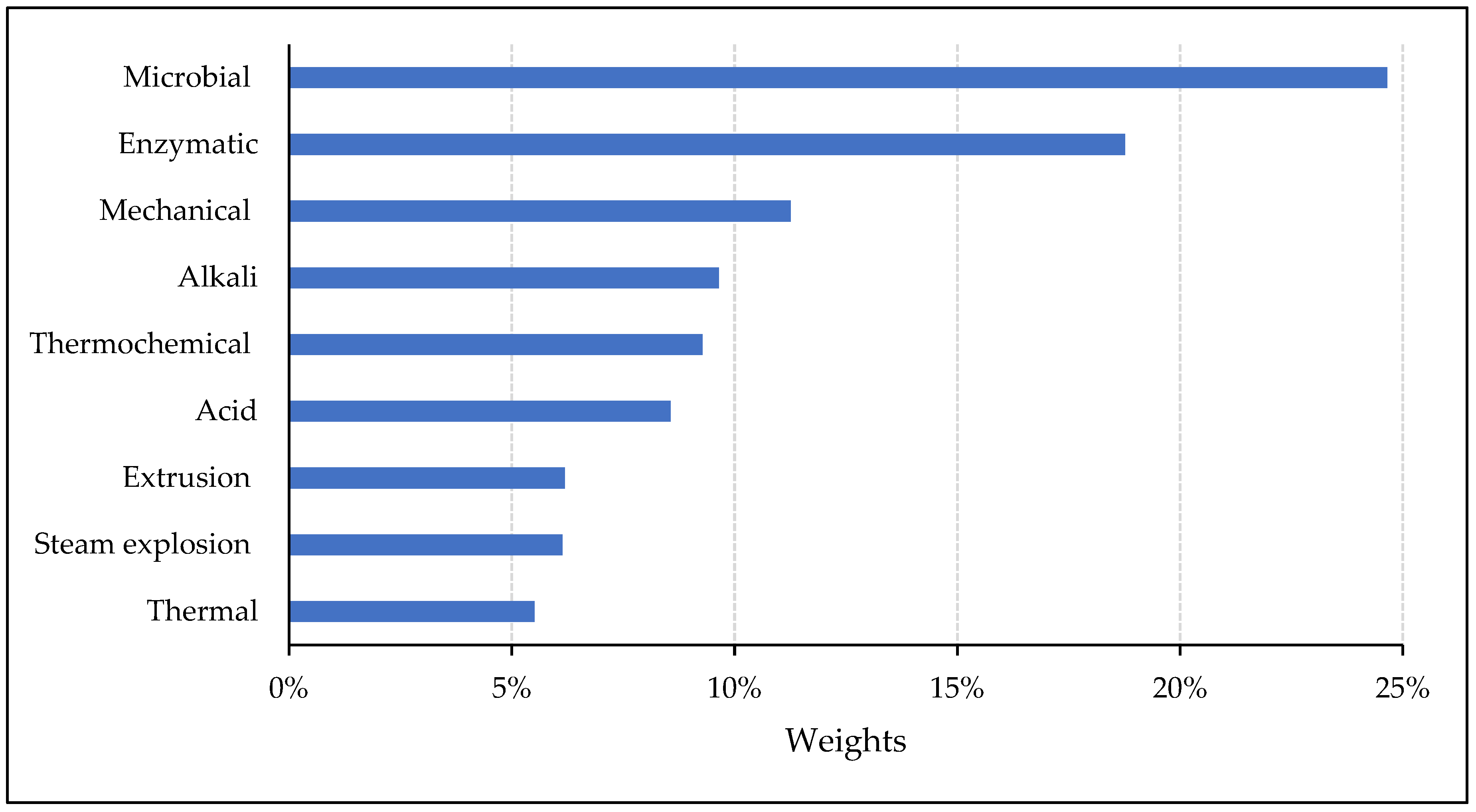
The overall prioritization of the various potential pretreatment methods for small-scale biogas systems is established by calculating the weighted sum of each method’s relative priority with respect to individual criteria and the corresponding criterion weight. The final prioritization is illustrated in
Figure 3.
Thermal (5.5% wt), steam explosion (6.1% wt), extrusion (6.2% wt), and thermochemical (9.3% wt) pretreatment methods are generally unsuitable for small-scale biogas systems due to their high energy demands, operational complexity, and risk of generating inhibitory compounds. Similarly, acid and alkali pretreatments require corrosion-resistant equipment and involve secondary pollution concerns, necessitating costly post-treatment processes that are impractical for decentralized applications and are weighted at 8.6% and 9.6% respectively. Although enzymatic pretreatment is effective and ranks second in the prioritization (18.8% wt), it is limited by the need for regular procurement of expensive, specific enzymes, making it economically unfeasible for small-scale operations. However, ongoing research into the production of enzymes such as cellulase from agricultural and food wastes through solid-state fermentation may help overcome this limitation [
56]. If on-farm enzyme production becomes technically and economically viable, the overall ranking and feasibility of enzymatic pretreatment could improve.
In contrast, microbial pretreatment presents a more appropriate solution (24.6% wt) due to its low energy demand, operational simplicity, and environmental compatibility. While the process is relatively slow, its effectiveness can be enhanced by integrating upstream mechanical size reduction (11.3% wt), which increases substrate surface area and accelerates hydrolysis. Biological pretreatments have also been shown to improve the anaerobic digestion performance of lignocellulosic materials [
57]. Moreover, combining pretreatment methods often produces superior outcomes compared to single techniques [
28]. For instance, mechanical size reduction using knife or hammer mills has been shown to increase feedstock specific surface area by up to 189% and improve methane yield by up to 13% compared to untreated agricultural residues [
58]. Similarly, applying the liquid fraction of digestate has demonstrated significant benefits: improving biogas yield by ~70% and reducing digestion time by ~40% for corn stover [
55]; increasing methane yield by 25% and reducing digestion time by 37% for corn stover co-digested with cattle manure [
52]; and enhancing biogas yield by 39% with a 35% reduction in digestion time for wheat straw [
51]. By combining these two methods, previously unexplored feedstocks can become mainstream in small-scale biogas systems, ensuring feedstock diversification and operational sustainability.
Nevertheless, the effectiveness of microbial pretreatment is influenced by the source of the liquid digestate used. Evidence indicates that digestate origin significantly affects pretreatment performance. For example, a study assessing the impact of liquid digestate fraction source on the anaerobic digestion of wheat straw reported methane production improvements ranging from 33% to 55% when using digestate derived from food waste, swine manure, and wheat straw. Among these, digestate from food waste demonstrated the highest performance, followed by swine manure and then wheat straw [
53].
For regions in developing countries such as Fès-Meknès, a practical combination would involve mechanical pretreatment using equipment like a chaff cutter (to reduce straw to optimal particle sizes), followed by microbial treatment using the liquid fraction of digestate. While individual aspects (such as the performance of microbial communities from different digestate sources [
53] and mechanical size reduction [
59]) have been studied, the systematic multi-criteria selection framework to identify and justify this specific combined strategy tailored to small-scale adoption is a novel contribution of this research.
In small-scale contexts, pretreatment methods must minimize capital and operational costs, avoid energy-intensive processes, and be simple enough for users with limited technical expertise. Preference should be given to technologies that can serve multiple on-farm applications. For example, equipment that can serve both biodigester feed preparation and livestock feed preparation, or repurposed agricultural tools such as feed grinders fitted with smaller output screens for finer biomass comminution. Although such multi-use practices introduce additional energy demands, studies indicate that mechanical pretreatment maintains a positive energy balance. For instance, pretreatment of agro-residues achieved a net gain of 7–27 kJ/kJ [
58], pretreatment of water hyacinth resulted in a 28.7% net primary energy enhancement [
59], and pretreatment of ley crop silage increased methane yield by 59% while maintaining a positive energy balance [
60].
4.2.3. Sensitivity Analysis
Sensitivity analysis is conducted to evaluate the robustness of model outputs in response to variations in input parameters [
61]. Two main approaches are commonly applied. The first is local sensitivity analysis, often referred to as one-at-a-time analysis, in which the output is assessed by varying a single input while holding all other inputs constant. The second is global sensitivity analysis, where all inputs are varied simultaneously to examine their combined influence on the output [
35].
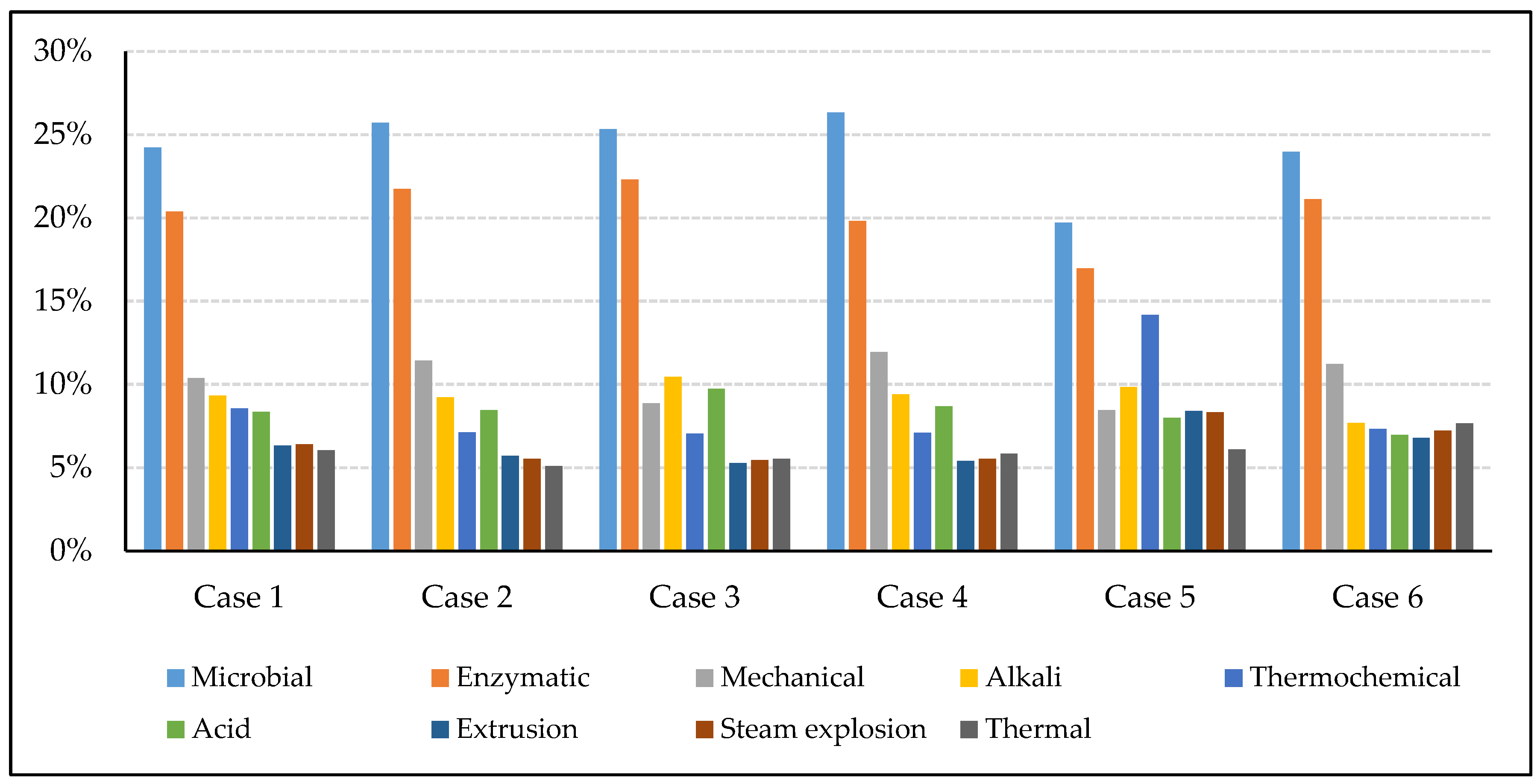
In this study, both approaches were applied to the pretreatment alternatives across six different cases by varying the criteria weights. In Case 1, all criteria were assigned equal weights of 20%. In Cases 2 to 6, one criterion at a time (starting with criteria C1 (technology simplicity) to criteria C5 (environmental impact)) was assigned a weight of 40%, while the remaining criteria were equally weighted at 15%. The results of the sensitivity analysis, summarized in
Figure 4, show that microbial pretreatment consistently ranks highest followed by enzymatic pretreatment across all cases. This suggests that the relative preference for microbial pretreatment is stable and not significantly influenced by changes in criteria weighting, demonstrating the robustness of the ranking outcome.
5. Demonstration System Design
The proposed pretreatment process integrates a two-stage approach, mechanical size reduction followed by microbial pretreatment using the liquid fraction of digestate, into the feedstock handling section of small-scale biogas systems. This follows recommendations that an inline pretreatment-anaerobic digestion system should be investigated to effectively utilize lignocellulosic biomass in biogas production [
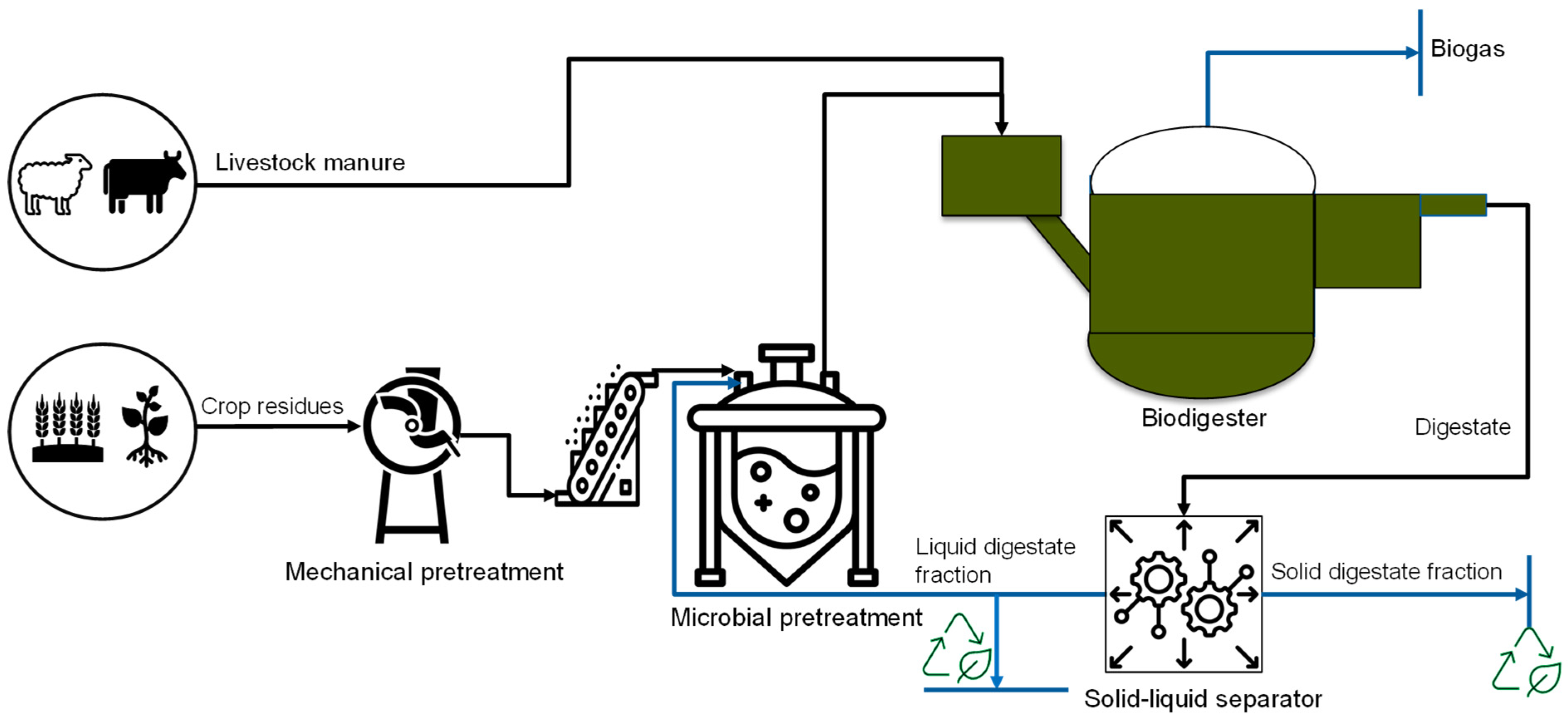
62]. In both retrofitted and newly designed plants, the process begins at the feedstock preparation stage. Crop residues are first subjected to size reduction using simple mechanical equipment such as a chaff cutter or hammer mill to increase surface area and reduce fibre complexity. The shredded material is then transferred to a dedicated pretreatment reactor, typically an insulated tank or pit, where it is mixed with the liquid fraction of digestate extracted from the effluent separation unit downstream of the main digester.
This mixture is allowed to incubate under controlled mesophilic (~37 °C) conditions, achieved through insulation and partial burial of the digesters, for a defined residence time (typically 3 to 7 days). During this stage, indigenous microbial communities from the digestate initiate hydrolysis of lignocellulosic compounds. Gentle mixing is recommended, preferably once per day before fresh feeding, to ensure uniform contact between substrates and microorganisms and to prevent floating layers, which is a common challenge when digesting straw and similar low-density feedstock. After the pretreatment phase, the hydrolysed slurry is co-fed with livestock manure into the main digester. The process flow for the proposed conceptual system is as shown in
Figure 5.
In existing plants, minimal retrofitting is required: a solid–liquid separator for digestate, a mixing tank, and piping for internal recirculation can be added. For new systems, these units can be integrated into the layout from the outset, allowing seamless coupling of pretreatment with the anaerobic digestion process. This approach leverages on-site resources, improves feedstock flexibility, and enhances biogas yield with minimal additional energy input or operational complexity.
For this system, temperature control can be achieved through passive solar heating or insulation, while continuous pH monitoring with simple litmus or indicator strips supports stable operation by detecting potential ammonia accumulation and enabling timely corrective actions to maintain optimal microbial activity and prevent inhibition.
For a typical small-scale household digester with an operating volume of 6 m
3 and a hydraulic retention time (HRT) of 30 days, the recommended feed flow rate is obtained by dividing the reactor volume by the HRT, resulting in a daily flow rate of 0.2 m
3 day
−1. Based on an average pretreatment residence time of 5 days, identified as effective in studies on liquid digestate pretreatment under ambient temperature conditions [
51,
52,
55,
63], the required pretreatment reactor volume is calculated by multiplying the flow rate (0.2 m
3 day
−1) by the pretreatment duration, yielding approximately 1 m
3. Under these conditions, semi-continuous feeding (once per day) at the designed loading rate would maintain the required pretreatment duration while ensuring adequate and consistent loading to the main digester. For a household biodigester in Kenya, capable of producing two hours of cooking gas per day at an estimated cost of €1400 [
64], the addition of a 1 m
3 pretreatment unit would increase the capital cost proportionally by about 16.67%.
To evaluate and optimize the performance of the proposed system, a baseline study should be conducted comparing mono-digestion of livestock manure with co-digestion of manure and crop residues following mechanical size reduction. This comparison would allow the quantitative demonstration of improvements offered by the integrated pretreatment system. Measurements should be taken once the process reaches steady state after each transition between operating regimes (e.g., from mono-digestion to co-digestion).
6. Limitations of This Study
The prioritization developed in this study is based on feedstocks identified in the Fès-Meknès region of Morocco and is informed by literature evidence, technical considerations, and expert-informed judgement within the AHP framework. As a context-specific application, the weighting and ranking of pretreatment methods may differ in regions with alternative feedstock availability, stakeholder priorities, or expert perspectives. In addition, variations in government policies, support mechanisms, and material or energy costs may influence the relative importance of decision criteria and, consequently, the final prioritization outcomes. Moreover, although AHP provides a transparent and structured decision-making approach, it has inherent limitations, particularly in its capacity to explicitly account for uncertainty compared with methods such as Fuzzy AHP or TOPSIS.
7. Conclusions and Recommendations
This research demonstrates that the Analytic Hierarchy Process (AHP) is an effective multi-criteria decision-making (MCDM) tool for prioritizing and ranking pretreatment methods for small-scale biogas systems. Based on the study results, microbial pretreatment combined with mechanical size reduction was identified as the most suitable approach. This finding offers a cost-effective and simple alternative to more energy-intensive pretreatments, such as thermal or chemical methods, which are often impractical for resource-constrained rural contexts. The AHP framework supports this combined method as an optimal solution for sustainable deployment. Integrating pretreatment upstream of the anaerobic digester enables utilization of lignocellulosic residues, particularly straw, alongside livestock manure, enhancing feedstock flexibility and improving system resilience, reducing the risks of underperformance and abandonment. A sensitivity analysis examining variations in criteria weights indicates that the ranking of microbial pretreatment as the highest option, followed by enzymatic pretreatment remains robust.
Looking forward, implementing this co-digestion strategy could improve the reputation of biogas technology, accelerate adoption, and support the introduction of medium- and large-scale biogas systems in developing countries. Additionally, using liquid digestate as a microbial source has the potential to reduce reliance on external inputs and minimize operational costs, distinguishing this approach from other biological pretreatments that depend on specialized enzymes or fungal cultures.
The prioritization framework was developed using feedstocks identified in the Fès-Meknès region of Morocco considering the realities of the region. Nevertheless, the findings are broadly applicable to other developing regions with similar agricultural profiles and resource constraints, as the evaluation criteria (cost, simplicity, effectiveness) and feedstock categories (manure and straw) are widely representative. However, variations in lignocellulosic composition and local energy costs may affect pretreatment performance and rankings. Therefore, the framework should be adapted to site-specific conditions (feedstocks, energy costs, etc.) and further refined through pilot-scale validation and broader expert participation where possible.
Future research should focus on in situ implementation, evaluating impacts on biogas yields, system resilience, and techno-economic performance. A comprehensive analysis using metrics such as Net Present Value (NPV), Internal Rate of Return (IRR), and payback period is needed to confirm viability. This should also capture the added value of digestate as biofertilizer, reducing dependence on synthetic fertilizers, while testing sensitivity to factors such as feedstock costs, fuel prices, and policy incentives. Furthermore, a comparative evaluation of the results obtained using the AHP approach with other established multi-criteria decision-making methods, such as Fuzzy AHP and TOPSIS, is recommended to further assess the robustness and consistency of the prioritization outcomes.
Author Contributions
Conceptualization, J.K.N. and W.Z.; formal analysis, J.K.N.; funding acquisition, W.Z.; project administration, T.B. and W.Z.; supervision, T.B. and W.Z.; visualization, J.K.N.; writing—original draft, J.K.N.; writing—review and editing, J.K.N., T.B. and W.Z. All authors have read and agreed to the published version of the manuscript.
Funding
The research leading to this paper was funded by the German Academic Exchange Service (DAAD) with funds from the Federal Ministry for Economic Cooperation and Development (BMZ) under the AMBER project (Project ID: 57647326). Joshua Ngetuny received a scholarship from the German Academic Exchange Service (DAAD) under the Kenyan-German Postgraduate Training Programme (Number: 57606985) to conduct this research. We acknowledge support by the Open Access Publication Fund of Technische Hochschule Ingolstadt (THI).
Data Availability Statement
The data that support the findings of this study are included in the published paper.
Conflicts of Interest
The authors declare no conflicts of interest.
References
- IEA. Outlook for Biogas and Biomethane: A Global Geospatial Assessment; IEA: Paris, France, 2025; Available online: https://www.iea.org/reports/outlook-for-biogas-and-biomethane (accessed on 27 June 2025).
- Health Effects Institute. State of the Global Air Report: A Report on Air Pollution and its Role in the World’s Leading Causes of Death; Health Effects Institute: Boston, MA, USA, 2025; Available online: https://www.stateofglobalair.org/ (accessed on 6 November 2025).
- Bennitt, F.B.; Wozniak, S.S.; Causey, K.; Burkart, K.; Brauer, M. Estimating disease burden attributable to household air pollution: New methods within the Global Burden of Disease Study. Lancet Glob. Health 2021, 9, S18. [Google Scholar] [CrossRef]
- Ngetuny, J.; Baldauf, T.; Zörner, W. Optimizing Feedstock Selection for Sustainable Small-Scale Biogas Systems Using the Analytic Hierarchy Process. Energies 2025, 18, 1739. [Google Scholar] [CrossRef]
- Clemens, H.; Bailis, R.; Nyambane, A.; Ndung’u, V. Africa Biogas Partnership Program: A Review of Clean Cooking Implementation through Market Development in East Africa. Energy Sustain. Dev. 2018, 46, 23–31. [Google Scholar] [CrossRef]
- Bhat, P.R.; Chanakya, H.N.; Ravindranath, N.H. Biogas plant dissemination: Success story of Sirsi, India. Energy Sustain. Dev. 2001, 5, 39–46. [Google Scholar] [CrossRef]
- Ngetuny, J.; Hsaine, J.; Mabrouki, A.; Rachidi, F.; El Asli, A.; Zörner, W. Assessment of agricultural residues for small-scale biogas plants and adoption drivers: A case study of the Fès-Meknès region in Morocco. Biomass Conv. Biorefin. 2025, 15, 29207–29223. [Google Scholar] [CrossRef]
- Darmey, J.; Narra, S.; Achaw, O.-W.; Stinner, W.; Ahiekpor, J.C.; Ansah, H.F.; N’guessan, B.A.; Agyekum, T.O.; Nutakor, E.M.K. A Review of Pretreatment Strategies for Anaerobic Digestion: Unlocking the Biogas Generation Potential of Wastes in Ghana. Waste 2025, 3, 24. [Google Scholar] [CrossRef]
- Issahaku, M.; Derkyi, N.S.A.; Kemausuor, F. A systematic review of the design considerations for the operation and maintenance of small-scale biogas digesters. Heliyon 2024, 10, e24019. [Google Scholar] [CrossRef]
- Sa, Q.; Zheng, J.; Zhang, K.; Wang, Y. Effects and assessment of the combined application of biogas slurry and chemical fertilizers on greenhouse tomato growth, yield, and soil quality. Sci. Hortic. 2025, 344, 114113. [Google Scholar] [CrossRef]
- Korbag, I.; Mohamed Saleh Omer, S.; Boghazala, H.; Ahmeedah Aboubakr Abusasiyah, M. Recent Advances of Biogas Production and Future Perspective. In Biogas: Recent Advances and Integrated Approaches; El-Fatah Abomohra, A., Elsayed, M., Qin, Z., Ji, H., Liu, Z., Eds.; IntechOpen: London, UK, 2021; ISBN 978-1-83962-668-5. [Google Scholar]
- Muzenda, E. Bio-methane generation from organic waste: A Review. In Proceedings of the World Congress on Engineering and Computer Science, San Fransisco, CA, USA, 22–24 October 2014; IAENG International Association of Engineers: Hong Kong, China, 2014; ISBN 9789881925206. [Google Scholar]
- García-Gen, S.; Sousbie, P.; Rangaraj, G.; Lema, J.M.; Rodríguez, J.; Steyer, J.-P.; Torrijos, M. Kinetic modelling of anaerobic hydrolysis of solid wastes, including disintegration processes. Waste Manag. 2015, 35, 96–104. [Google Scholar] [CrossRef]
- Karki, R.; Chuenchart, W.; Surendra, K.C.; Shrestha, S.; Raskin, L.; Sung, S.; Hashimoto, A.; Kumar Khanal, S. Anaerobic co-digestion: Current status and perspectives. Bioresour. Technol. 2021, 330, 125001. [Google Scholar] [CrossRef]
- Zhang, Y.; Jiang, Y.; Wang, S.; Wang, Z.; Liu, Y.; Hu, Z.; Zhan, X. Environmental sustainability assessment of pig manure mono- and co-digestion and dynamic land application of the digestate. Renew. Sustain. Energy Rev. 2021, 137, 110476. [Google Scholar] [CrossRef]
- Singh, R.; Hans, M.; Kumar, S.; Yadav, Y.K. Potential Feedstock for Sustainable Biogas Production and its Supply Chain Management. In Biogas Production: From Anaerobic Digestion to a Sustainable Bioenergy Industry, 1st ed.; Balagurusamy, N., Chandel, A.K., Eds.; Springer International Publishing: Cham, Switzerland, 2020; pp. 147–165. ISBN 978-3-030-58826-7. [Google Scholar]
- Olatunji, K.O.; Ahmed, N.A.; Ogunkunle, O. Optimization of biogas yield from lignocellulosic materials with different pretreatment methods: A review. Biotechnol. Biofuels 2021, 14, 159. [Google Scholar] [CrossRef]
- Andersen, L.F.; Parsin, S.; Lüdtke, O.; Kaltschmitt, M. Biogas production from straw—The challenge feedstock pretreatment. Biomass Convers. Biorefin. 2022, 12, 379–402. [Google Scholar] [CrossRef]
- Meraj, S.; Liaquat, R.; Raza Naqvi, S.; Sheikh, Z.; Zainab, A.; Khoja, A.H.; Juchelkova, D.; Atabani, A. Enhanced Methane Production from Anaerobic Co-Digestion of Wheat Straw Rice Straw and Sugarcane Bagasse: A Kinetic Analysis. Appl. Sci. 2021, 11, 6069. [Google Scholar] [CrossRef]
- Kratky, L.; Jirout, T. Biomass Size Reduction Machines for Enhancing Biogas Production. Chem. Eng. Technol. 2011, 34, 391–399. [Google Scholar] [CrossRef]
- Montgomery, L.F.; Bochmann, G. Pretreatment of Feedstock for Enhanced Biogas Production. 2014. Available online: https://task37.ieabioenergy.com/wp-content/uploads/sites/32/2022/02/pretreatment_web.pdf (accessed on 18 September 2024).
- Chen, Y.; Yang, H.; Zou, H.; Sun, T.; Li, M.; Zhai, J.; He, Q.; Gu, L.; Tang, W.Z. Effects of acid/alkali pretreatments on lignocellulosic biomass mono-digestion and its co-digestion with waste activated sludge. J. Clean. Prod. 2020, 277, 123998. [Google Scholar] [CrossRef]
- Hernández-Beltrán, J.U.; Hernández-De Lira, I.O.; Cruz-Santos, M.M.; Saucedo-Luevanos, A.; Hernández-Terán, F.; Balagurusamy, N. Insight into Pretreatment Methods of Lignocellulosic Biomass to Increase Biogas Yield: Current State, Challenges, and Opportunities. Appl. Sci. 2019, 9, 3721. [Google Scholar] [CrossRef]
- Karuppiah, T.; Azariah, E.V. Biomass Pretreatment for Enhancement of Biogas Production. In Anaerobic Digestion; Banu, J.R., Ed.; IntechOpen: London, UK, 2019; ISBN 978-1-83881-849-4. [Google Scholar]
- Koch, K.; Post, M.; Auer, M.; Lebuhn, M. Feedstock-specific Characteristics in Process Control. 2017. Available online: https://www.biogas-forum-bayern.de/media/files/0003/einsatzstoffspezifische-besonderheiten-in-der-prozessf-hrung.pdf (accessed on 2 December 2024).
- Stockmann, F.; Letalik, C.; Schaffner, S.; Suttner, G.; Hofmann, D.; Thurner, S.; Kuntscher, T.; Portner, J.; Burger, T. Residual Materials and by-products—Biogas Substrate. 2021. Available online: www.biogas-forum-bayern.de/bif19 (accessed on 29 November 2024).
- Dandikas, V.; Hülsemann, B.; Herrmann, C. Gas Yield in Agricultural Biogas Plants: Potential, Yields, Influencing Factors; Kuratorium für Technik und Bauwesen in der Landwirtschaft e.V. (KTBL): Darmstadt, Germany, 2021; ISBN 9783945088852. [Google Scholar]
- Kumari, D.; Singh, R. Pretreatment of lignocellulosic wastes for biofuel production: A critical review. Renew. Sustain. Energy Rev. 2018, 90, 877–891. [Google Scholar] [CrossRef]
- Hou, J.; Chen, B.; Zhang, P.; Wang, Y.; Tan, H.; Han, H.; Bao, F.; Zhao, F. The nitrogen supply capacity and application methods of straw-chemical mixed fertilizer in the sweet corn variety ‘Zhetian 19’. Eur. J. Agron. 2025, 163, 127438. [Google Scholar] [CrossRef]
- Sung, S.; Liu, T. Ammonia inhibition on thermophilic anaerobic digestion. Chemosphere 2003, 53, 43–52. [Google Scholar] [CrossRef] [PubMed]
- Neshat, S.A.; Mohammadi, M.; Najafpour, G.D.; Lahijani, P. Anaerobic co-digestion of animal manures and lignocellulosic residues as a potent approach for sustainable biogas production. Renew. Sustain. Energy Rev. 2017, 79, 308–322. [Google Scholar] [CrossRef]
- Godara, R.S.; Kumar, A.; Thakur, R.; Bhatt, R.S.; Singh, M.; Dutt, T. Characterization and Dilution of Sheep Manure for Optimization of Biogas Production. Indian J. Small Rumin. 2025, 31, 236–241. [Google Scholar] [CrossRef]
- Holliger, C.; Alves, M.; Andrade, D.; Angelidaki, I.; Astals, S.; Baier, U.; Bougrier, C.; Buffière, P.; Carballa, M.; de Wilde, V.; et al. Towards a standardization of biomethane potential tests. Water Sci. Technol. 2016, 74, 2515–2522. [Google Scholar] [CrossRef]
- Saaty, T.L. A scaling method for priorities in hierarchical structures. J. Math. Psychol. 1977, 15, 234–281. [Google Scholar] [CrossRef]
- Nhiavue, Y.; Lee, H.S.; Chisale, S.W.; Cabrera, J.S. Prioritization of Renewable Energy for Sustainable Electricity Generation and an Assessment of Floating Photovoltaic Potential in Lao PDR. Energies 2022, 15, 8243. [Google Scholar] [CrossRef]
- Zaheb, H.; Obaidi, O.; Mukhtar, S.; Shirani, H.; Ahmadi, M.; Yona, A. Comprehensive Analysis and Prioritization of Sustainable Energy Resources Using Analytical Hierarchy Process. Sustainability 2024, 16, 4873. [Google Scholar] [CrossRef]
- Yadav, P.; Yadav, S.; Singh, D.; Giri, B.S. Sustainable rural waste management using biogas technology: An analytical hierarchy process decision framework. Chemosphere 2022, 301, 134737. [Google Scholar] [CrossRef]
- Maleki-Ghelichi, E.; Sharifi, M. Prioritize and choose the best process of anaerobic digestion to produce energy from biomass using analytic hierarchy process (AHP). Geol. Ecol. Landsc. 2017, 1, 219–224. [Google Scholar] [CrossRef]
- Akadiri, O.P. Development of a Multi-Criteria Approach for the Selection of Sustainable Materials for Building Projects. Ph.D. Thesis, University of Wolverhampton, Wolverhampton, UK, 2011. [Google Scholar]
- Vanegas, C.H.; Hernon, A.; Bartlett, J. Enzymatic and organic acid pretreatment of seaweed: Effect on reducing sugars production and on biogas inhibition. Int. J. Ambient Energy 2015, 36, 2–7. [Google Scholar] [CrossRef]
- Eduok, S.; John, O.; Ita, B.; Inyang, E.; Coulon, F. Enhanced Biogas Production from Anaerobic Co-digestion of Lignocellulosic Biomass and Poultry Feces Using Source Separated Human Urine as Buffering Agent. Front. Environ. Sci. 2018, 6, 67. [Google Scholar] [CrossRef]
- Patinvoh, R.J.; Osadolor, O.A.; Chandolias, K.; Sárvári Horváth, I.; Taherzadeh, M.J. Innovative pretreatment strategies for biogas production. Bioresour. Technol. 2017, 224, 13–24. [Google Scholar] [CrossRef] [PubMed]
- Shah, F.A.; Mahmood, Q.; Rashid, N.; Pervez, A.; Raja, I.A.; Shah, M.M. Co-digestion, pretreatment and digester design for enhanced methanogenesis. Renew. Sustain. Energy Rev. 2015, 42, 627–642. [Google Scholar] [CrossRef]
- Paudel, S.R.; Banjara, S.P.; Choi, O.K.; Park, K.Y.; Kim, Y.M.; Lee, J.W. Pretreatment of agricultural biomass for anaerobic digestion: Current state and challenges. Bioresour. Technol. 2017, 245, 1194–1205. [Google Scholar] [CrossRef]
- Jankovičová, B.; Hutňan, M.; Sammarah, M. Enhancing Biogas Production: Pre-Treatment of Lignocellulosic Biomass Using Biogas Plant Digestate. Sustainability 2025, 17, 3898. [Google Scholar] [CrossRef]
- Saaty, R.W. The Analytic Hierarchy Process—What it is and how it is used. Math. Model. 1987, 9, 161–176. [Google Scholar] [CrossRef]
- Mirjat, N.H.; Uqaili, M.; Harijan, K.; Mustafa, W.M.; Rahman, M.; Khan, M. Multi-Criteria Analysis of Electricity Generation Scenarios for Sustainable Energy Planning in Pakistan. Energies 2018, 11, 757. [Google Scholar] [CrossRef]
- Saaty, T.L. How to make a decision: The analytic hierarchy process. Eur. J. Oper. Res. 1990, 48, 9–26. [Google Scholar] [CrossRef]
- Omer, A.M. Sustainable Development and Environmentally Friendly Energy Systems. Int. J. Phys. Sci. Eng. 2017, 1, 1–34. [Google Scholar] [CrossRef]
- Clausen, L.T.; Rudolph, D. Renewable energy for sustainable rural development: Synergies and mismatches. Energy Policy 2020, 138, 111289. [Google Scholar] [CrossRef]
- Liu, T.; Zhou, X.; Li, Z.; Wang, X.; Sun, J. Effects of liquid digestate pretreatment on biogas production for anaerobic digestion of wheat straw. Bioresour. Technol. 2019, 280, 345–351. [Google Scholar] [CrossRef] [PubMed]
- Wei, Y.; Li, X.; Yu, L.; Zou, D.; Yuan, H. Mesophilic anaerobic co-digestion of cattle manure and corn stover with biological and chemical pretreatment. Bioresour. Technol. 2015, 198, 431–436. [Google Scholar] [CrossRef]
- Wei, Y.; Lan, Y.; Li, X.; Gao, M.; Yuan, S.; Yuan, H. Effect of wheat straw pretreated with liquid fraction of digestate from different substrates on anaerobic digestion performance and microbial community characteristics. Sci. Total Environ. 2022, 818, 151764. [Google Scholar] [CrossRef]
- Elsayed, M.; Abomohra, A.E.-F.; Ai, P.; Jin, K.; Fan, Q.; Zhang, Y. Acetogenesis and methanogenesis liquid digestates for pretreatment of rice straw: A holistic approach for efficient biomethane production and nutrient recycling. Energy Convers. Manag. 2019, 195, 447–456. [Google Scholar] [CrossRef]
- Hu, Y.; Pang, Y.; Yuan, H.; Zou, D.; Liu, Y.; Zhu, B.; Chufo, W.A.; Jaffar, M.; Li, X. Promoting anaerobic biogasification of corn stover through biological pretreatment by liquid fraction of digestate (LFD). Bioresour. Technol. 2015, 175, 167–173. [Google Scholar] [CrossRef]
- Khaswal, A.; Mishra, S.K.; Chaturvedi, N.; Saini, S.; Pletschke, B.; Kuhad, R.C. Microbial enzyme production: Unlocking the potential of agricultural and food waste through solid-state fermentation. Bioresour. Technol. Rep. 2024, 27, 101880. [Google Scholar] [CrossRef]
- Khan, M.U.; Usman, M.; Ashraf, M.A.; Dutta, N.; Luo, G.; Zhang, S. A review of recent advancements in pretreatment techniques of lignocellulosic materials for biogas production: Opportunities and Limitations. Chem. Eng. J. Adv. 2022, 10, 100263. [Google Scholar] [CrossRef]
- Garuti, M.; Sinisgalli, E.; Soldano, M.; Fermoso, F.G.; Rodriguez, A.J.; Carnevale, M.; Gallucci, F. Mechanical pretreatments of different agri-based feedstock in full-scale biogas plants under real operational conditions. Biomass Bioenergy 2022, 158, 106352. [Google Scholar] [CrossRef]
- Dell’Omo, P.P.; Spena, V.; La Froscia, S. Assessment of a Mechanical Pretreatment to Enhance Biogas Production from the Noxious Weed Eichhornia Crassipes on Industrial Scale. In Proceedings of the 5th International Symposium on Environment-Friendly Energies and Applications (EFEA 2018), Rome, Italy, 24–26 September 2018; Bruzzese, C., Ed.; IEEE: Piscataway, NJ, USA, 2018; pp. 1–6. [Google Scholar]
- Lindmark, J.; Leksell, N.; Schnürer, A.; Thorin, E. Effects of mechanical pre-treatment on the biogas yield from ley crop silage. Appl. Energy 2012, 97, 498–502. [Google Scholar] [CrossRef]
- Erkut, E.; Tarimcilar, M. On Sensitivity Analysis in the Analytic Hierarchy Process. IMA J. Math. Appl. Bus. Ind. 1991, 3, 61–83. [Google Scholar] [CrossRef]
- AB AZIZ, I.F.; Che Man, H.; Demirci, A.; Hamzah, M.H.; Omar, R.; Jamali, N.S.; Katibi, K.K.; Mohammed, A. Lignocellulosic Biomass-Derived Biogas: A Review on Sustainable Energy in Malaysia. J. Oil Palm Res. 2024, 37, 16–43. [Google Scholar] [CrossRef]
- Sun, J.; Li, Z.; Zhou, X.; Wang, X.; Liu, T.; Cheng, S. Investigation on methane yield of wheat husk anaerobic digestion and its enhancement effect by liquid digestate pretreatment. Anaerobe 2019, 59, 92–99. [Google Scholar] [CrossRef] [PubMed]
- HomeBiogas. Systems—HomeBiogas. Available online: https://www.homebiogas.com/shop/backyard-systems/ (accessed on 20 February 2026).
| Disclaimer/Publisher’s Note: The statements, opinions and data contained in all publications are solely those of the individual author(s) and contributor(s) and not of MDPI and/or the editor(s). MDPI and/or the editor(s) disclaim responsibility for any injury to people or property resulting from any ideas, methods, instructions or products referred to in the content. |