1. Introduction
With the rapid advancement of mobile electric technology and automation, indoor mobile robots have become essential components of modern warehouses and industrial facilities. Indoor mobile robots typically include automated guided vehicles (AGVs) and autonomous mobile robots (AMRs) [
1]. Mobile robots are usually equipped with batteries that need to be recharged over time. Conventional chargers require direct electrical contact between the mobile robot and the charging platform. This approach is straightforward, but it has disadvantages, such as sparking when the connection is made (or if the contact is poor). Mechanical contacts generally have a relatively short service life [
2]. To make the charging process more convenient and reliable, wireless battery chargers have become very popular. Because they do not rely on mechanical contact, they have a much longer service life than conventional chargers and eliminate sparking [
2,
3,
4]. Moreover, they impose less stringent requirements on the mobile robot’s positioning accuracy compared with conventional chargers [
2,
5].
There are various types of wireless power transfer. Considering the power levels of mobile robots and the distances between a mobile robot and the wireless charging platform, resonant-inductive wireless charging is the most suitable approach [
6,
7]. As shown in
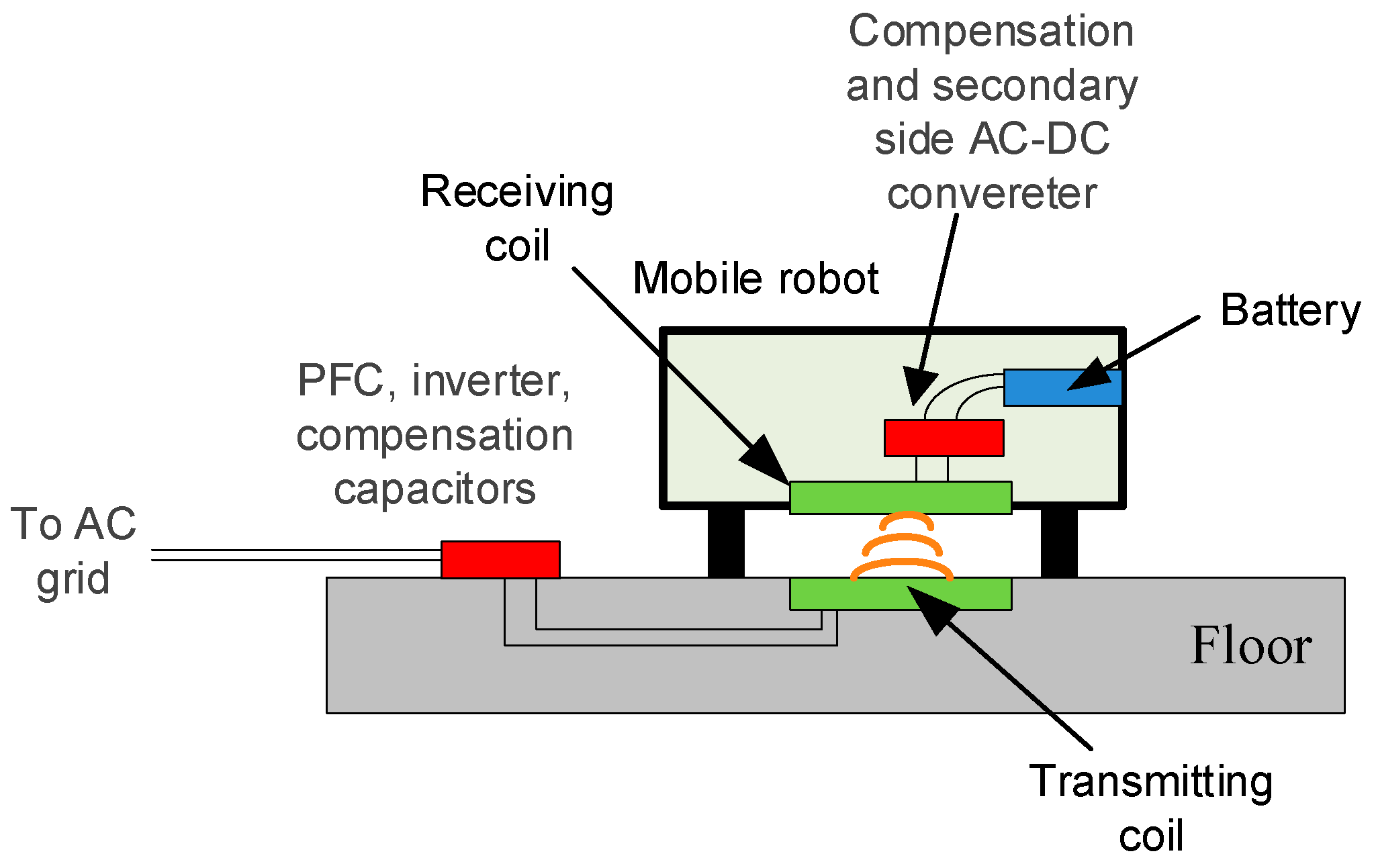
Figure 1, the transmitting coil is embedded in the floor, while the receiving coil is mounted on the underside of the mobile robot for resonant-inductive wireless charging.
As non-linear resistive–reactive loads on the AC grid, wireless battery chargers and other types of switching power converters can pollute the grid with low-frequency harmonics, increase losses in AC grid conductors and substation transformers, and cause cross-interference with electrical equipment connected to the same grid [
8,
9]. Due to these low-frequency harmonics, they can also cause malfunctions in distribution-grid protection devices [
10]. Power-quality standards (such as IEC 61000-3-2 Class A [
11]) therefore require wireless charging systems to comply with specific limits. As a result, wireless battery chargers—especially those operating at medium or high power levels—should be equipped with input power factor correctors (PFCs) [
12]. PFCs improve the power factor (PF), reduces the total harmonic distortion of the input current (THDI), and keeps the low-frequency components in the input-current spectrum low [
9,
13].
A conventional single-phase power-factor-corrected resonant-inductive wireless charging system consists of an input electromagnetic interference (EMI) filter, a bridge rectifier followed by a PFC stage, a high-frequency inverter, a primary compensation circuit, a transmitting coil, a secondary compensation circuit, a rectifier with filter, output voltage and current sensors, a radio communication link between the output and the inverter’s control circuit, and the PFC control circuit [
14,
15,
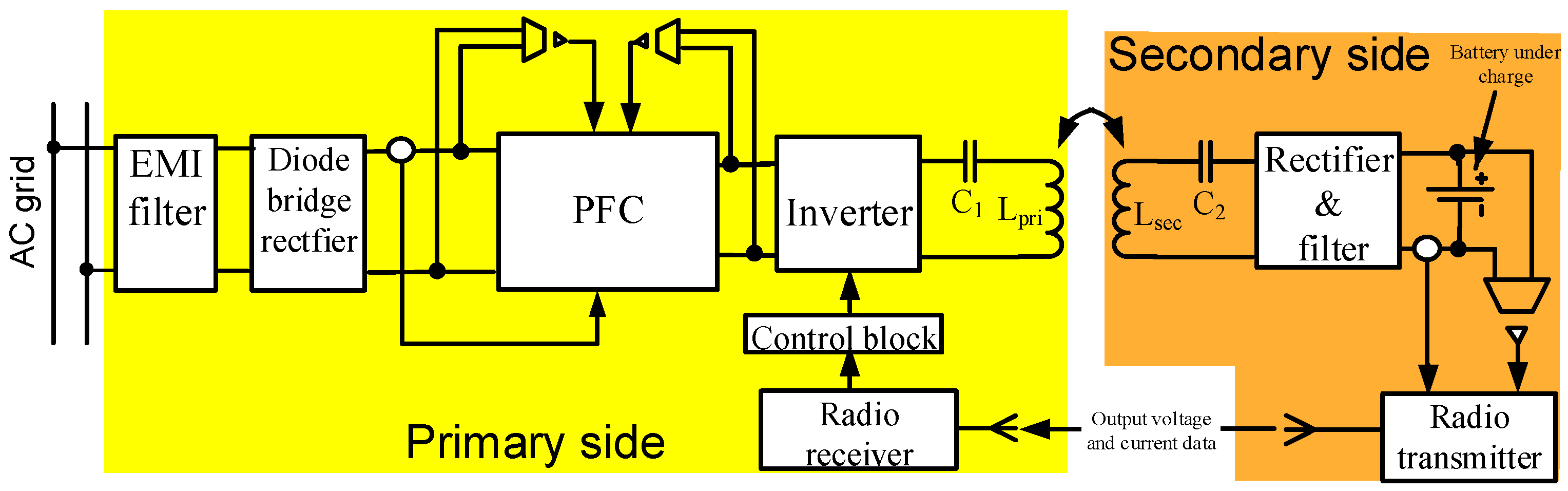
16]. The communication link is necessary to implement constant current (CC)/constant voltage (CV) charging of a battery. A block diagram of a conventional power-factor-corrected wireless charger is depicted in
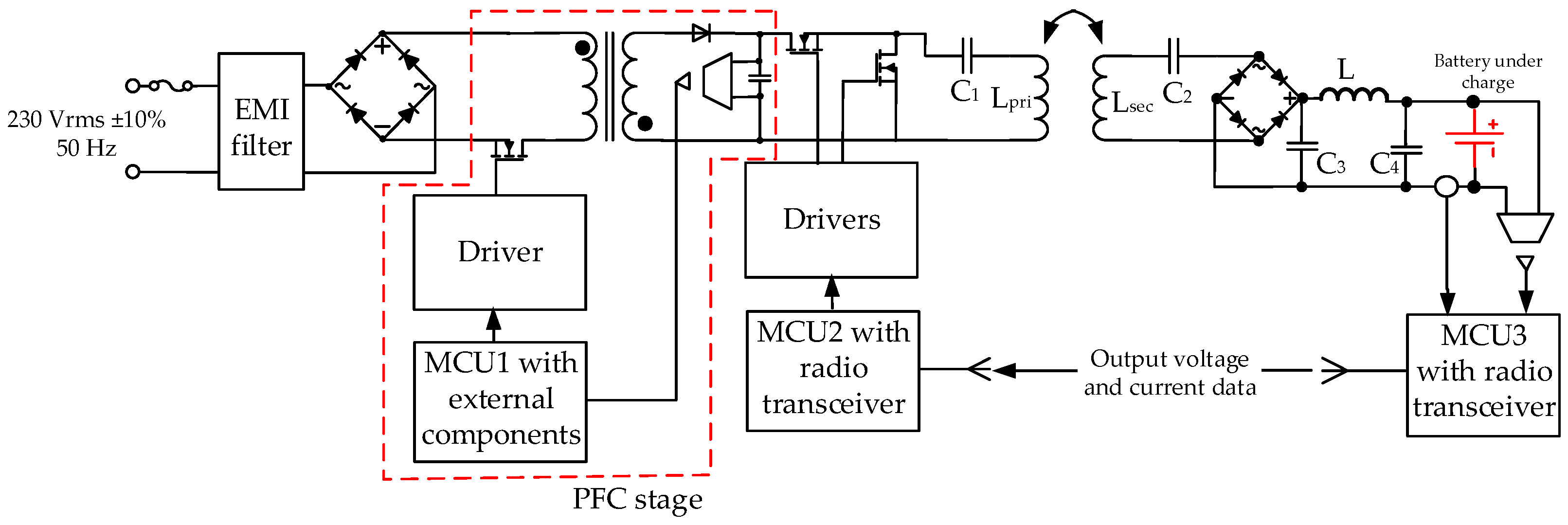
Figure 2. For low power levels (<100 W), a flyback or buck-boost converter operating in discontinuous conduction mode (DCM) can be used as the PFC stage. A simplified schematic diagram of a conventional low-power power-factor-corrected wireless charging system with a flyback-based PFC operating in DCM is shown in
Figure 3. To reduce the number of components, volume, and size of the primary side, as well as to increase the efficiency of a wireless charging system, some researchers propose combining the PFC stage with the inverter stage on the primary side [
12,
17,
18]. However, single-stage approaches also have their disadvantages. Despite the fact that the single-stage structure based on an ac-ac matrix converter proposed in [
18] offers improvements in terms of higher efficiency and a more compact, less-expensive primary side, it does not achieve low THDI (i.e., THDI = 18% [
18]), which may be unacceptable in many applications. The primary side of the wireless charging system based on the single-stage PFC and inverter proposed in [
17] has a reduced number of components, a reduced size of the primary side, high efficiency, and low THDI. However, since an additional DC-DC converter for CC/CV charging is introduced on the secondary side [
17], the size and volume of the secondary side increase, which may not be suitable for mobile robots because the secondary side should be as compact as possible, especially for small mobile robots. Despite the fact that the single-stage PFC-inverter structure and advanced control proposed in [
12] provide high efficiency and low TDHI, the requirement for at least four switches (and a more complicated control circuit) on the primary side may not reduce the cost of a low-power (<100 W) power-factor-corrected wireless charging system when compared with the conventional three-switch low-power wireless charging system with PFC (shown in
Figure 3). Moreover, the power-factor-corrected wireless charging system proposed in [
12] has a more complicated control than the conventional one.
Despite the fact that a conventional low-power, power-factor-corrected wireless charging system based on a flyback or buck–boost converter operating in DCM has relatively simple power electronic circuits, its control circuit is comparatively complex because it relies on three feedback loops (one for PFC output-voltage control and two additional loops for implementing CC and CV outputs on the secondary side) as well as a radio communication link using complex communication protocols to transfer data of at least 8 bits. Moreover, the control circuits are relatively expensive because three microcontrollers (MCUs) with additional electronic components are required: one MCU for the PFC stage, another for the inverter stage, and a third for radio communication and processing of the output sensor signals on the receiving side. As a result, the design complexity and design time are relatively high, and a highly qualified engineer with strong programming and radio-communication knowledge is necessary. Moreover, wireless communication protocols (e.g., Bluetooth Low Energy, ZigBee, etc.) introduce significant data-transmission latency [
19,
20], which can degrade control-loop stability and slow the system’s response to output transients. To address the disadvantages of the conventional control of low-power wireless charging systems, a simpler and less expensive control and communication approach is proposed in this paper. The novelty lies in the use of output voltage and current limiting combined with a low-latency wireless link transferring 1-bit logic signals (pulses of defined width indicating whether charging voltage or current exceeds a predefined threshold), which enhances the cost-effectiveness of the control circuit and reduces overall system complexity, while keeping the receiving side compact in power-factor-corrected resonant inductive wireless charging systems.
This paper is partly based on the results of a Bachelor’s thesis [
21].
The paper is organized as follows.
Section 2 presents a detailed description of the proposed improved control and communication approach.
Section 3 presents and discusses the simulation model of the wireless charging system with the proposed control, along with its simulation results. The most important measurement results and their analysis are presented in
Section 4. A comparison of the main features of the power-factor-corrected wireless charging system with the proposed control and communication approach against the state-of-the-art solutions is presented in
Section 5. Finally, the conclusions are given in
Section 6.
2. Description of the Proposed Control Approach and Communication
To reduce the complexity and cost of the control and communication stages in conventional wireless charging systems, we analyzed the literature on battery charging processes and the features of mobile robots. We concluded that:
During CC charging, moderate current accuracy (up to ±10% of the nominal value) is acceptable [
22]; a moderate decrease in charging current during the CC mode does not negatively affect battery service life, although it moderately prolongs the charging process; however, the charging current must remain below the maximum allowable charging current for the battery [
22].
During CV charging, voltage accuracy must be high; for example, it should not be worse than ±1% of the nominal charging voltage [
23,
24].
During the charging process, the equivalent input resistance of a battery (and therefore the battery voltage) slowly increases over time; a standard charging process with C-rate of 1C can last up to 2.5 h [
24].
Modern mobile robots typically have a positioning accuracy of ±1 cm or better [
25].
Based on the conclusions, several important simplifications of the charging process can be made:
Because a series–series compensated resonant-inductive wireless power transfer system can operate in approximate CC mode at its natural resonant frequency, and high charging current accuracy in CC mode is not required, the output-current control loop of the wireless charging system can be eliminated; however, since the charging current must remain below the maximum allowable value, output-current limiting is still necessary; this can be implemented by using a simple comparator on the secondary side and reducing PFC duty cycle on the primary side.
Considering conclusion 3, proportional-integration-derivative (PID) control is not necessary to maintain constant voltage in CV mode; instead, a single output-voltage comparator and reference source can be used on the secondary side, and a pulse from the comparator with a defined width should be transferred to the primary-side PFC controller; the PFC will then reduce the duty ratio to limit the charging voltage.
Since only pulses with a defined width need to be transferred from the secondary side to the primary side, the communication stage becomes very simple; there is no need for complex communication protocols that are used in conventional wireless charging systems.
Considering conclusion 4, there is no need for radio communication; instead, simple optical communication based on a light-emitting diode (LED) and one or more of the photodiodes can be used.
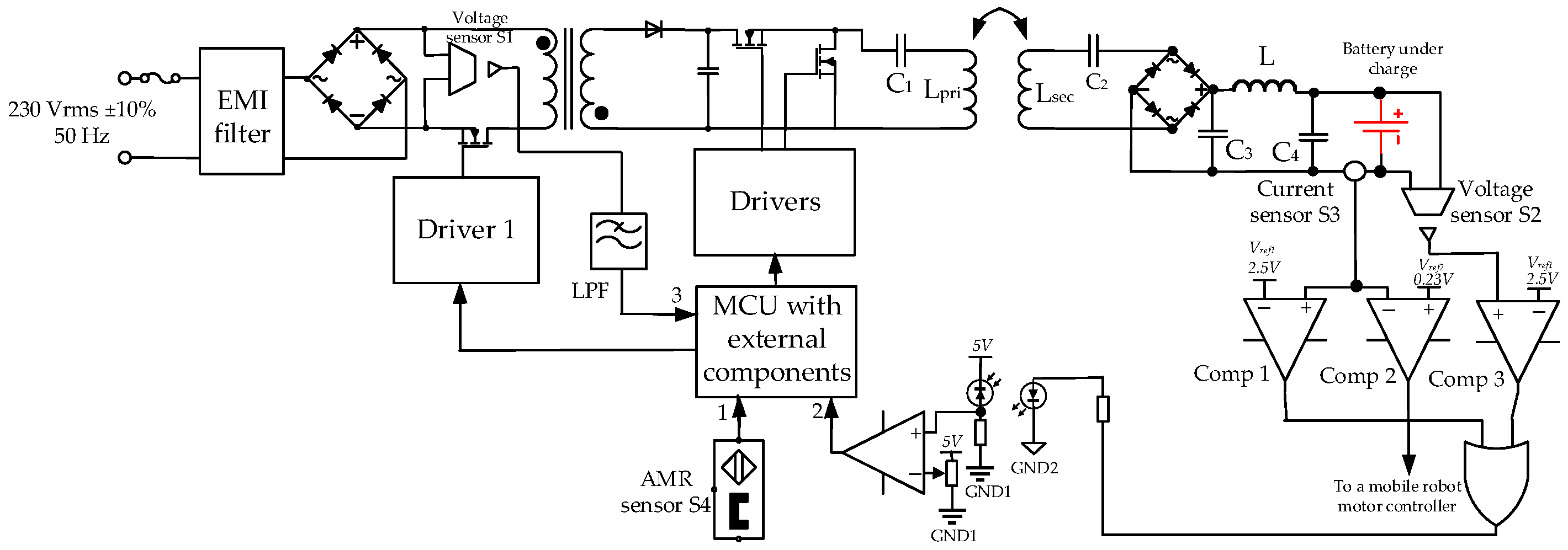
The proposed control and communication approach can be implemented either using a single MCU with some analog devices or using only analog circuits. A simplified schematic diagram of the wireless battery charger with the proposed MCU-based control and communication approach, along with some analog devices, is depicted in
Figure 4. Contrary to the conventional power-factor-corrected wireless charging system, the wireless charging system with the proposed control and communication approach uses only a single MCU (
Figure 4).
The duty cycle
D of the PFC control signal is constant during CC mode. However, if the charging current exceeds a certain threshold value (e.g., 2.2 A for a battery with a 2 A nominal charging current), the output of comparator Comp 1 and MCU input 2 will go high, and the MCU will reduce
D unless the Comp 1 output becomes low. When charging current is below the threshold, Comp 1 output and MCU input 2 are low, so the MCU stops reducing
D. The initial
D value (
D1) should be predetermined so that the charging current reaches its maximum threshold, which corresponds to the maximum input equivalent resistance of the battery
RbatmaxCC during the CC phase. Then, the
D1 value can be entered into the MCU code.
D1 can be determined using the following expression:
where
Inom is the nominal charging current,
is the maximum allowable current error (e.g., 10%);
is the grid voltage nominal RMS value (i.e., 230 V),
fsw is the PFC switching frequency,
Lm is the flyback transformer magnetizing inductance.
RbatmaxCC can be calculated as follows:
where
Vnom is the nominal output voltage of the wireless charging system during CV phase. Note that (1) is derived under the assumption of a lossless wireless charging system. In a practical implementation,
D1 will be slightly higher due to power losses. Therefore, to obtain a more accurate value of
D1, numerical simulations of the wireless charging system model, including loss components, will be performed.
During the soft start, the MCU slowly increases D from 0 to D1 = Dmax. During CV charging, when the charging voltage exceeds its threshold (equal to the nominal charging voltage in CV mode), the output of comparator Comp 3 and MCU input 2 becomes high, causing the MCU to reduce D. If the charging voltage falls below the threshold, Comp 3 output and MCU input 2 become low, and D remains constant until the charging voltage exceeds the threshold again. Basically, the MCU and Comp 3 function as voltage limiters, ensuring relatively high accuracy of the charging voltage during CV mode.
It should be noted that the minimum change in the PFC duty cycle (Δ
D) should be small enough to achieve a smooth charging voltage without noticeable drops. Considering that the wireless charging system output voltage is proportional to the PFC stage control signal
D, the duty cycle increment Δ
D should satisfy:
where
Dmin is the minimum duty cycle (at the end of charging), Δ
Vout is the maximum allowable peak-to-peak output voltage ripple caused by a change in
D. Assuming Δ
Vout = 0.3 V,
Vnom = 29.4 V and
Dmin = 12.7%, Δ
D should be lower than 0.13%. It should be noted that Δ
D is limited by the PWM resolution of the MCU, which is determined by the timer clock frequency (
fclock) and the selected PFC switching frequency. Theoretically, an excessively small Δ
D may increase the charging voltage ripple, since the charging voltage rises as the battery’s equivalent input resistance
Rbat increases. However, during CV charging
Rbat increases very slowly. Considering typical clock frequencies of inexpensive MCUs (e.g., 32–84 MHz) and typical switching frequencies of DCM flyback converters (50–200 kHz), a practical rule of thumb is to use the minimum achievable duty-cycle step, i.e., Δ
D =
fsw/
fclock, to obtain the best performance.
Comparator Comp 2 is used to stop the charging process if the charging current falls below a minimum threshold (e.g., 10% of the rated charging current). If this occurs, Comp 2 output goes high, the mobile robot controller switches on the motor, and the robot drives off the charging platform. Consequently, the anisotropic magnetoresistive (AMR) sensor (S4) will switch off driver 1, and the MCU will enter the standby mode. If the input RMS voltage of the PFC stage is nearly constant, or if there is no situation in which the input RMS voltage decreases, then the voltage sensor S1 and low-pass filter (LPF) are not needed. However, since there can be situations where the input RMS voltage decreases—leading to a noticeable drop in the charging current during CC mode or in the charging voltage during CV mode—S1 and LPF are required. Because the output voltage of the wireless charging system is directly proportional to the PFC stage control signal duty ratio, the MCU calculates the duty cycle
Di+1 during the
i-th switching period as follows:
where
is the output voltage of the LPF (measured by the MCU during a steady state) at 230 Vrms;
is the output voltage of the LPF at a given input voltage RMS value during
i-th switching period. Note that the voltages
and
must not exceed the maximum allowable MCU input voltage
Vmcumax (e.g., 3.3 V). Therefore, the input voltage sensor S1 should be designed with a gain
H1 determined as follows:
where
Vinrmsmax is the maximum grid RMS voltage.
At steady state, the LPF output voltage is proportional to the RMS value of the PFC input voltage. The choice of the LPF cut-off frequency is twofold. On one hand, the frequency should be much lower than the AC grid frequency in order not to increase the nonlinear distortion of the input current. On the other hand, an excessively low cut-off frequency would result in long output voltage transients if the grid voltage RMS value abruptly changes from its maximum value to its minimum value, or vice versa. The appropriate LPF parameters will be determined through simulations.
Comparators Comp 1 and Comp 3 are configured with a threshold (reference) voltage
Vref1 (
Figure 4), whose typical value is, for example, 2.5 V. Since the charging voltage (
Vcharge) threshold is equal to
Vnom (in CV mode), the gain of the charging voltage sensor S2, denoted as
H2, can be calculated as follows:
The gain of the charging current sensor S3, denoted as
H3, is given by the ratio of
Vref1 to the maximum allowable charging current (maximum charging current threshold), as follows:
Comp 2 has the minimum threshold (reference) voltage
Vref2 (
Figure 4), which can be calculated as follows:
where
Imin is the minimum allowable charging current during CV phase (the minimum charging current threshold), which is equal to 0.1
Inom.
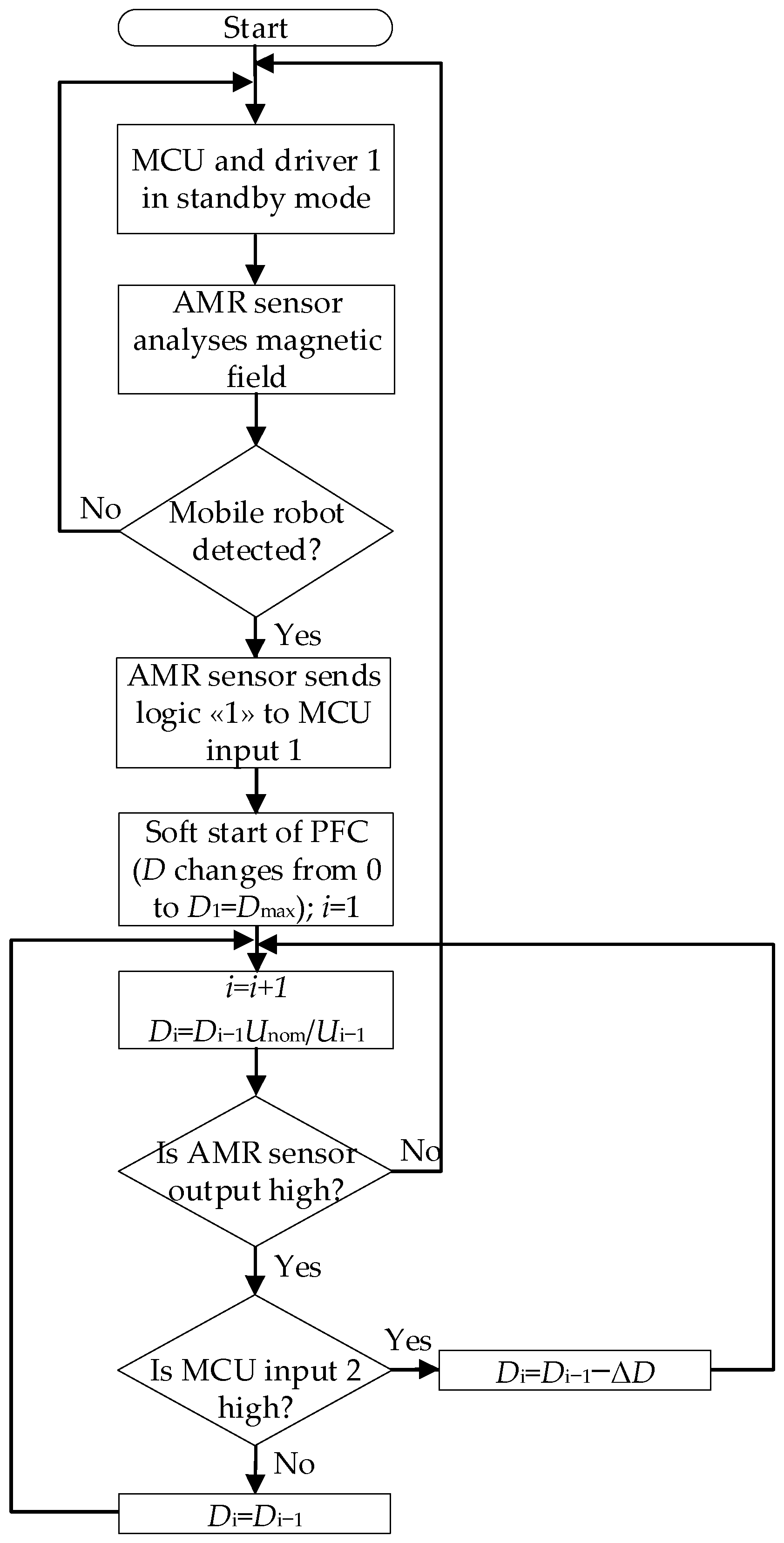
To better illustrate the operating principle of the proposed control circuit, a flowchart of the MCU program is shown in
Figure 5.
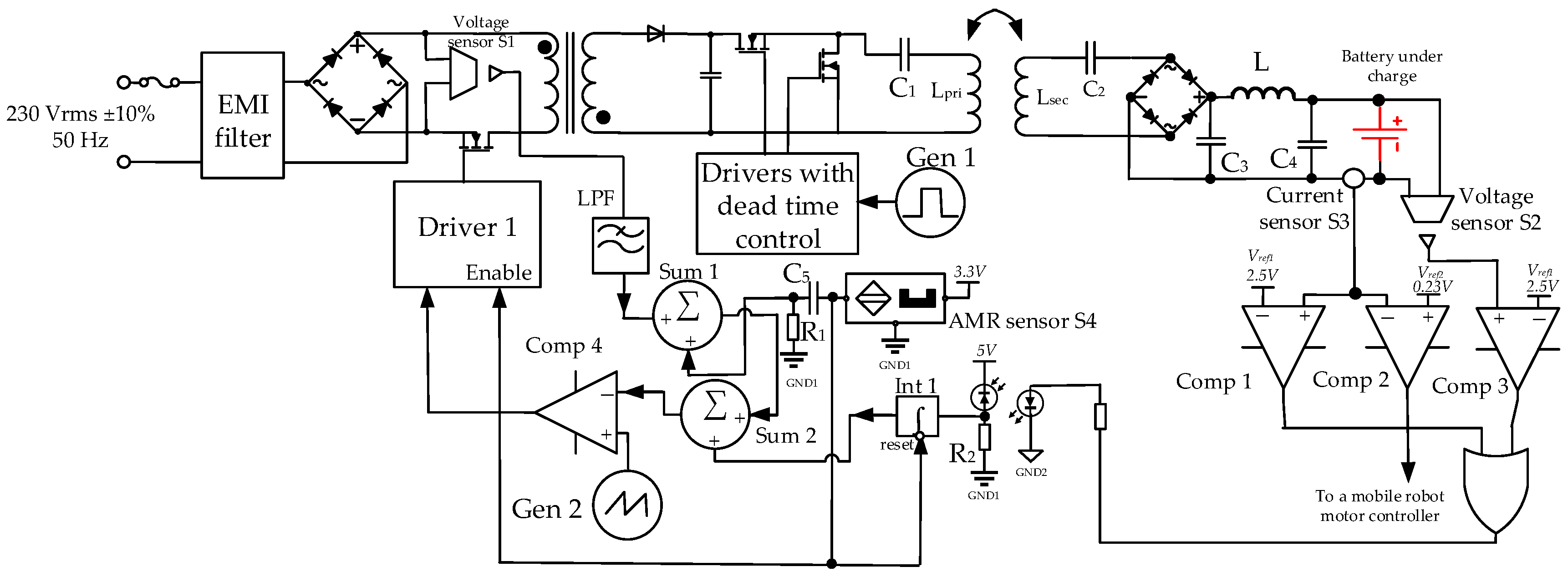
A simplified schematic diagram of the wireless battery charger with the proposed control and communication approach based on simple and inexpensive analog circuits is shown in
Figure 6. The secondary side of the charger is the same as in the proposed MCU-based solution. On the primary side, instead of the MCU, there are analog summers (Sum 1 and Sum 2), an integrator (Int 1), a differentiator (R
1C
5), a comparator Comp 4, a square voltage generator (Gen 1) and a ramp voltage generator (Gen 2).
Gen1 is used to control the inverter switches (MOSFETs). Its operating frequency
finv must be selected within the range permitted by wireless power standards, such as the Qi standard. In practice, the frequency is typically chosen near the midpoint of the allowable range (e.g., approximately 150 kHz for the Qi standard) in order to provide sufficient margin with respect to the boundary limits. The maximum value of the Gen1 output voltage must satisfy the digital logic high-level requirements of the gate-driving circuitry (typically ≈ 3.3 V). The duty cycle is set to 0.5, since, as will be demonstrated in
Section 3, this value results in the minimum amplitudes of the higher-order harmonics in the resonant tank current.
Gen2 is used as the ramp reference voltage for Comp 4 (
Figure 6). Its frequency equals the PFC switching frequency,
fsw, which must be selected below the critical switching frequency to ensure DCM operation of the flyback converter over a wide range of PFC load resistances. The most critical condition for maintaining DCM occurs at the lowest PFC load resistance, which is inversely proportional to the battery equivalent resistance
Rbat. Therefore,
fsw must satisfy the following inequality evaluated at the maximum battery input equivalent resistance
RbatmaxCV in CV mode:
where
Mmin is the minimum mutual inductance between the transmitting and receiving coils (at the maximum misalignment),
RbatmaxCV is the ratio of
Vnom to
Imin (at the end of the CV phase),
N1/
N2 is the flyback transformer turns ratio. The minimum duty cycle, which also occurs at the end of the CV phase, can be calculated as follows:
It should be noted that if condition (9) is satisfied at
RbatmaxCV, then it is automatically satisfied for all other values of
Rbat.
The duty cycle
D of the PFC switch, for a given LPF filter output voltage
VLPF and the maximum value of the Gen 2 output ramp voltage
Vrampmax, can be calculated as follows:
where
Vint is the integrator Int 1 output voltage.
Vrampmax must be lower than the maximum allowable input voltage of Comp 4. Therefore, its value should be selected within the permissible input range of the comparator. In practice, typical values of Vrampmax are in the range of 1–5 V. The minimum value of the Gen 2 output voltage is 0 V.
The gains of the sensors S2 and S3 are determined using (6) and (7). The gain
H1 of the input voltage sensor S1 (
Figure 6) can be calculated from the condition that the charging process starts when the duty cycle
D reaches its initial value
D1 (according to (1)) as follows:
The differentiator is necessary for the soft start of the PFC. Its time constant C
5R
1 should be selected considering the LPF cut-off frequency
fcut as follows:
The operating principle is straightforward: if the outputs of comparators Comp 1 and/or Comp 3 are high, the photodiode detects a light beam, and the integrator begins to increase its voltage
Vint proportionally to the received light pulses width
τ as follows:
where
Kint is the time constant of Int 1, and
VR2 is the voltage across the resistor
R2 connected in series with the photodiode (see
Figure 6). As a result, the duty ratio of the PFC control signal decreases according to (11).
If the PFC input RMS voltage increases, the PFC control-signal duty ratio decreases proportionally (because VLPF increases in (11)); if the input RMS voltage decreases, the duty ratio increases proportionally (because VLPF decreases in (11)). This ensures smooth charging even if the input RMS voltage varies within 230 Vrms ± 10%. When the charging process is finished, the mobile robot drives away from the charging platform, causing the AMR sensor output to go low. Consequently, the PFC driver (driver 1) is disabled, and the integrator is reset.
The proposed solution has a moderately higher cost and larger size for the primary-side control circuit, but it may be more attractive to engineers without MCU programming skills compared to the single-MCU solution (
Figure 4). Only basic knowledge of power and analog electronics is required.
The proposed control and communication approach is scalable to higher power levels and applicable to different PFC topologies, provided that the PFC output voltage is controllable through its primary control variable (e.g., duty cycle). It should be noted that operation at higher power levels requires a different PFC topology and conduction mode. For example, instead of a flyback topology operating in DCM, higher-power PFC stages typically employ boost converters or more advanced topologies (e.g., six-switch three-phase active rectifiers) operating in CCM. Nevertheless, the proposed control and communication approach remains fully applicable regardless of the selected topology or conduction mode.
3. Validation of the Proposed Control Approach Through Simulations
The main parameters of the wireless charging system used to validate the proposed control approach through simulations and experiments are shown in
Table 1. The output of the wireless charging system can be connected either to a resistive load with resistances
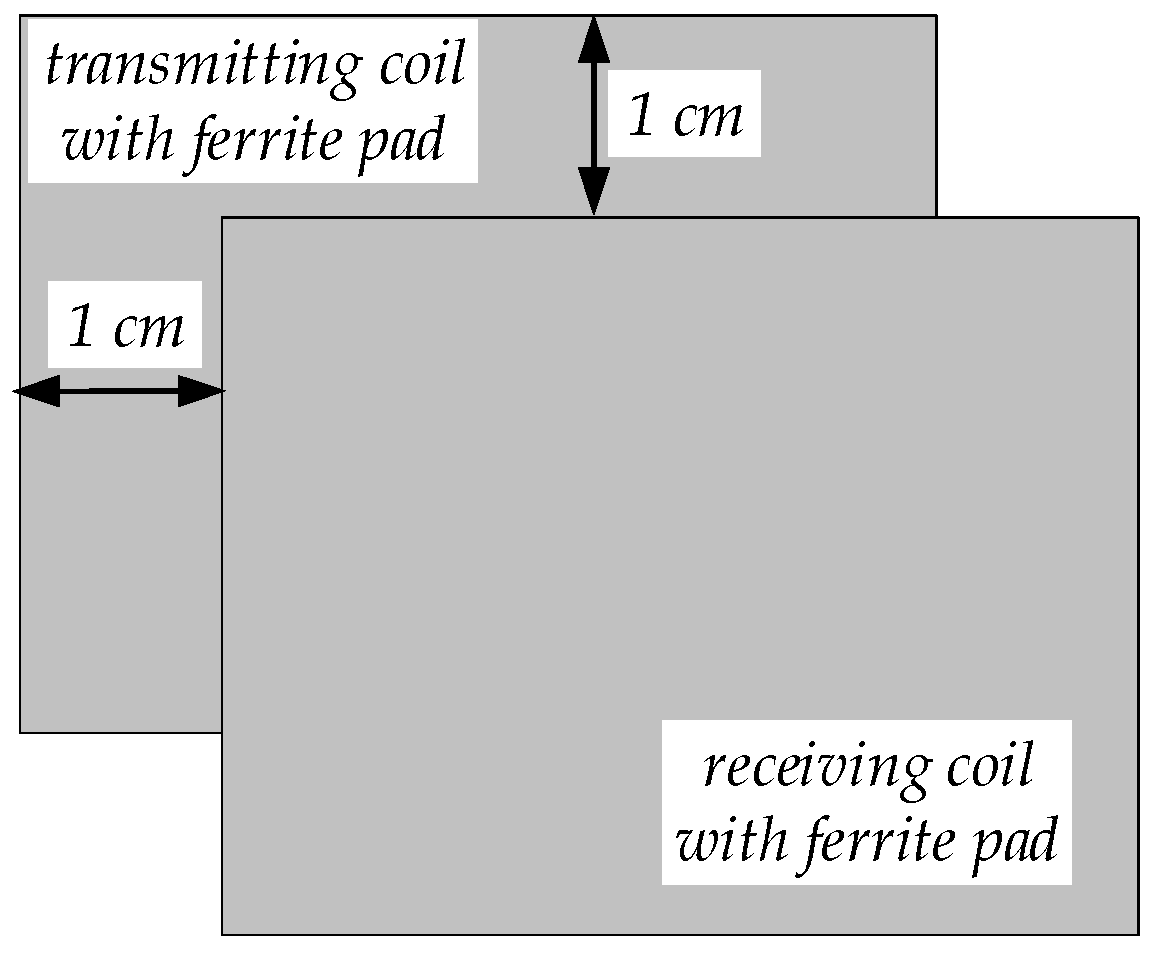
Rbat ranging from 12.2 to 140 Ω or a Li-ion battery consisting of seven cells connected in series. It is assumed that the cutoff charge voltage of the battery is 29.4 V and the cutoff discharge voltage is 25.8 V. Since the main application of the wireless charging system is the wireless charging of indoor mobile robots, the distance between the transmitting and receiving coils is fixed at 2.6 cm; however, lateral misalignment of the receiving coil may occur. For different types of modern mobile robots, the positioning error usually does not exceed ±1 cm [
25]; therefore, the maximum lateral misalignment of the receiving coil is assumed to be 1 cm (as shown in
Figure 7). Note that the inductances of the transmitting and receiving coils (
Lpri and
Lsec), the capacitances of the compensation capacitors
C1 and
C2, and the mutual inductance between
Lpri and
Lsec are obtained through measurements. In the simulations, it is assumed that
Lpri =
Lsec = 28.1 µH for different coil misalignments.
Altair PSIM Professional software (version 2025.1.0.5718) is used to validate the proposed control and communication approach for the wireless charging system. For improved accuracy of the results, a fixed simulation time step of 100 ns was used. The total simulation time was 3 s.
Two models were created in PSIM: (1) a model of the wireless charging system with conventional control; (2) a model of the wireless charging system with the proposed control.
The model of the charger with conventional control is based on the schematic diagram shown in
Figure 3. In the model, analog control is used for both the PFC stage and the inverter stage instead of digital control. The crossover frequency of the PFC stage’s open-loop gain is chosen, according to the recommendations in [
9], to be much lower than 100 Hz to eliminate nonlinear distortions in the PFC input current. Therefore, an integrator with a time constant of 1/3 is used as the compensation network for the PFC output voltage control loop. To simplify the model, a radio communication module is not included. However, considering the significant latency of modern radio communication protocols (from 1 ms to tens of ms [
19,
20]), the feedback loop between the wireless charging system output and the inverter is modeled as relatively slow. Therefore, the transfer function of the feedback loop compensation network is set to 2.5/s. The PFC stage step-down transformer has a turns ratio of 6:1 and a magnetizing inductance of 0.3 mH (the values are taken from the flyback transformer WE750811330 data sheet).
The PFC stage output capacitor has a capacitance of 1 mF, which effectively reduces low-frequency ripples at twice the grid frequency. The output Π-filter of the charging system consists of two capacitors, C
3 and C
4, each with a capacitance of 470 µF, and an inductor L with an inductance of 150 µH (
Figure 6). The values of these filter components were determined through numerical simulations in PSIM to ensure that the wireless charging system’s output peak-to-peak voltage ripple remains below the maximum allowable limit of 0.3 V.
The wireless charging coils,
Lpri and
Lsec, were adopted from our previous wireless charger prototype [
5]. The inverter resonant frequency,
fres = 143.2 kHz, is chosen approximately at the midpoint of the allowable range specified by the Qi standard and is equal to
finv. The LC resonant tank capacitances,
C1 and
C2, can then be calculated as follows:
The models of the components are modelled with having the most significant parasitics. Equivalent series resistance (ESR) is included in the models of the capacitors and coils, with typical ESR values assumed. The ESR of the PFC stage output capacitor is assumed to be 15 mΩ, the ESRs of the Π-filter capacitors (C3 and C4) are 40 mΩ, the ESRs of C1 and C2 are 50 mΩ, and the ESRs of the transmitting and receiving coils are 0.11 Ω. The transistors are modelled with drain-source on-resistance (Rdson). For instance, the Rdson of the inverter transistors is assumed to be 75 mΩ. The diodes are modelled with typical threshold voltage and forward resistance. For example, the PFC stage diode has a threshold voltage of 0.3 V and a forward resistance of 0.05 Ω. The transformer parasitics include leakage inductances and winding resistances.
The charger model with the proposed control is based on the schematic diagram shown in
Figure 6. The power stage parameters and components are the same as those in the previously described model.
Comparator Comp 1 was configured with a threshold (reference) voltage Vref1 = 2.5 V. Since the Vcharge threshold is equal to Vnom = 29.4 V (in CV mode), the gain of the output voltage sensor S2, calculated using (6), is equal to 0.085. Comparator Comp 3 was used for overcurrent protection with the same threshold voltage Vref1 = 2.5 V. The maximum Icharge threshold was selected to be slightly lower than , i.e., 2.17 A. Therefore, according to (7), the gain of the charging current sensor S3 is calculated as 1.15 V/A. The reference voltage Vref2 of Comp 2 was calculated using (8) and is equal to 0.23 V, because the minimum Icharge threshold is 0.2 A and the current sensor gain is 1.15 V/A.
The time constant
Kint of the integrator Int 1 is 1. Such a constant was selected through simulations because it provided an optimal trade-off between stability and transient response. The differentiator used for soft start has a capacitor
C5 = 10 µF and a resistor
R1 = 10 kΩ according to (13). The LPF is a second-order filter with a cutoff frequency of 3 Hz, a damping ratio of 1, and a gain of 1. The appropriate LPF parameters were determined through simulations in accordance with the recommendations presented in
Section 2.
To calculate the gain H1 of the voltage sensor S1, the initial duty cycle D1 was determined using (1). The calculation yielded a value of 31.5%, which was then slightly increased to 32.5% to account for losses, since (1) assumes a lossless case. The adjusted duty cycle D1 = 0.325 was then used in (12) to calculate S1 gain, resulting in H1 = 0.0032. This value is applied in the model to ensure that Icharge reaches its maximum threshold, which corresponds to the maximum Rbat during CC phase.
The frequency of Gen 1 is set to
finv = 143.2 kHz, and its duty cycle is 0.5, following the recommendation in
Section 2. The frequency of Gen 2 is
fsw = 100 kHz, which is below the critical frequency of 130 kHz (calculated according to (9) at the maximum
Rbat to ensure DCM operation across the full range of
Rbat. The maximum and minimum values of the Gen 2 output voltage are 1 V and 0 V, respectively.
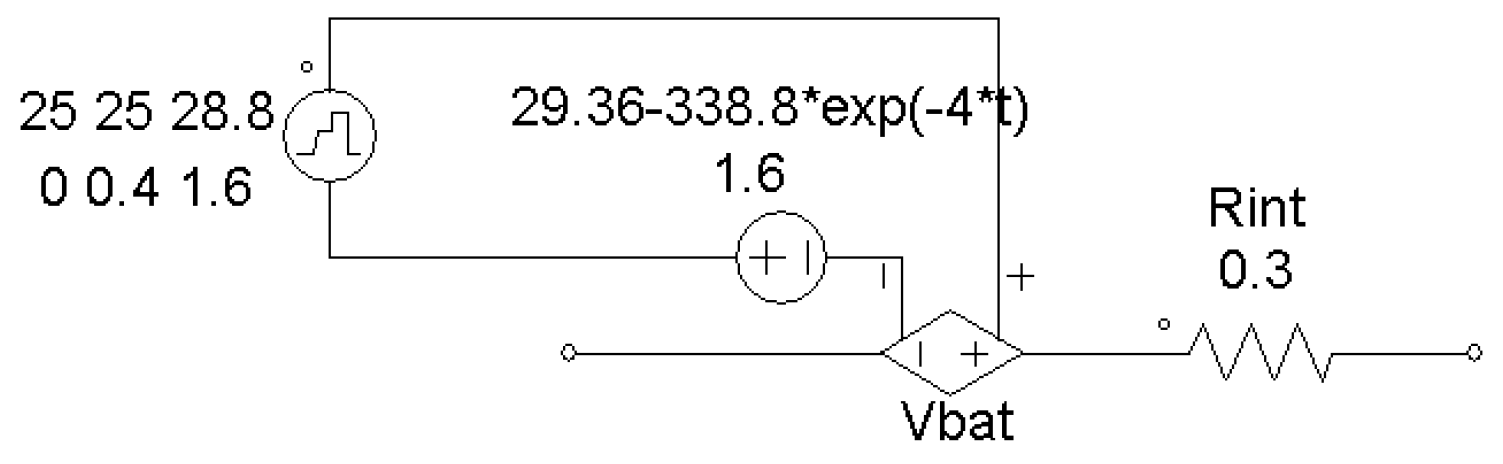
The battery used for validation is modeled as a voltage-controlled voltage source with an internal resistance in series, as shown in
Figure 8. The internal resistance is assumed to be constant and equal to 0.3 Ω. It is well known from basic battery theory that during the CC phase, the internal voltage changes almost linearly with time, and exhibits exponential-like behavior during the CV phase [
26]. Therefore, the voltage of the voltage-controlled voltage source,
Vbat, is assumed to increase linearly from 25 to 28.8 V during the time interval from 0.4 to 1.6 s, and then to increase exponentially from 28 to 29.34 V during the time interval from 1.6 to 2.4 s, as follows:
During some simulations, the time intervals during which
Vbat linearly and exponentially increases were 0.8–2 s and 2–2.8 s, respectively, or 1.6–2.8 s and 2.8–3.6 s, respectively. Note that the actual charging time of a real battery is much longer than that assumed in the simulations.
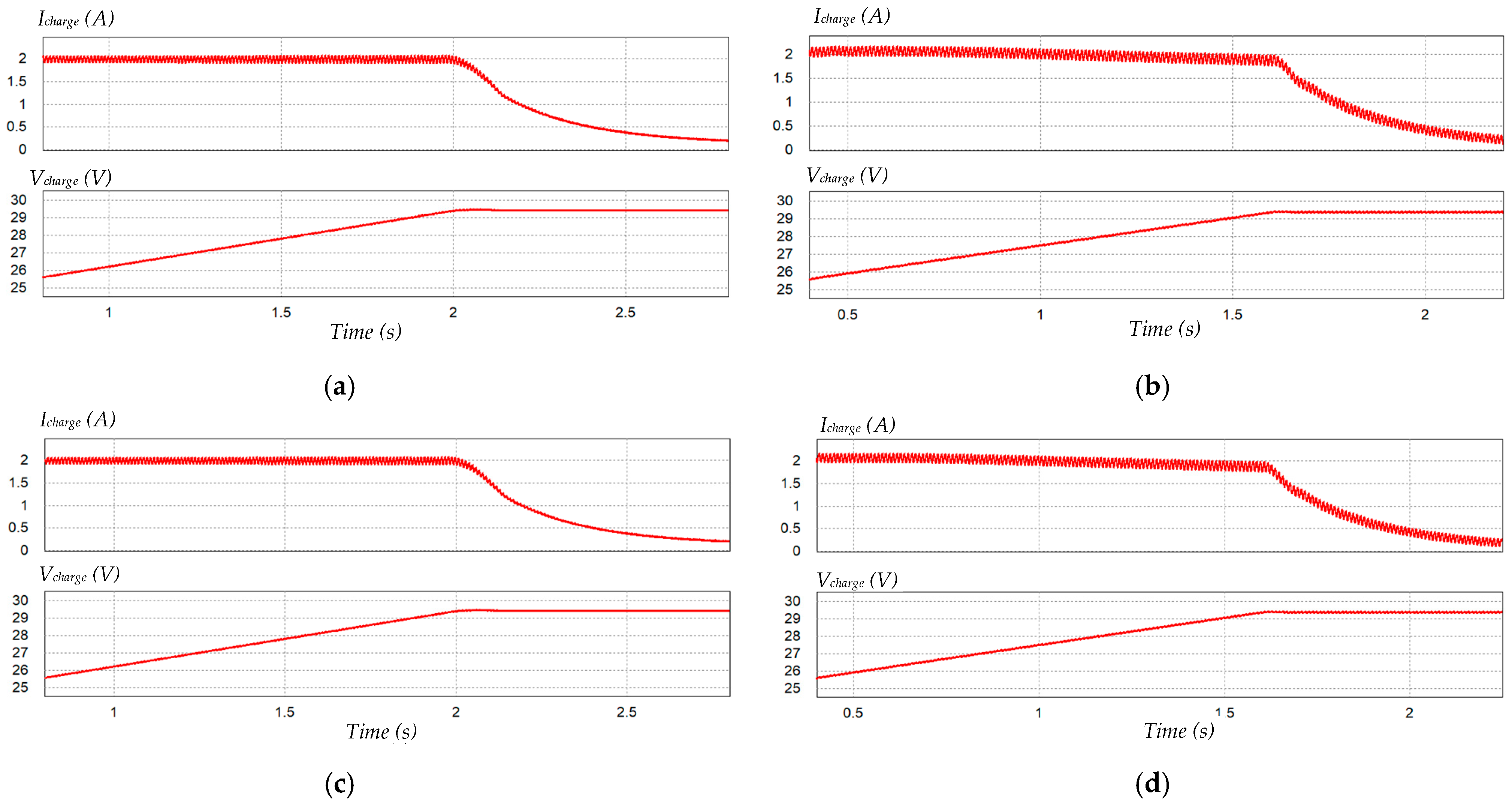
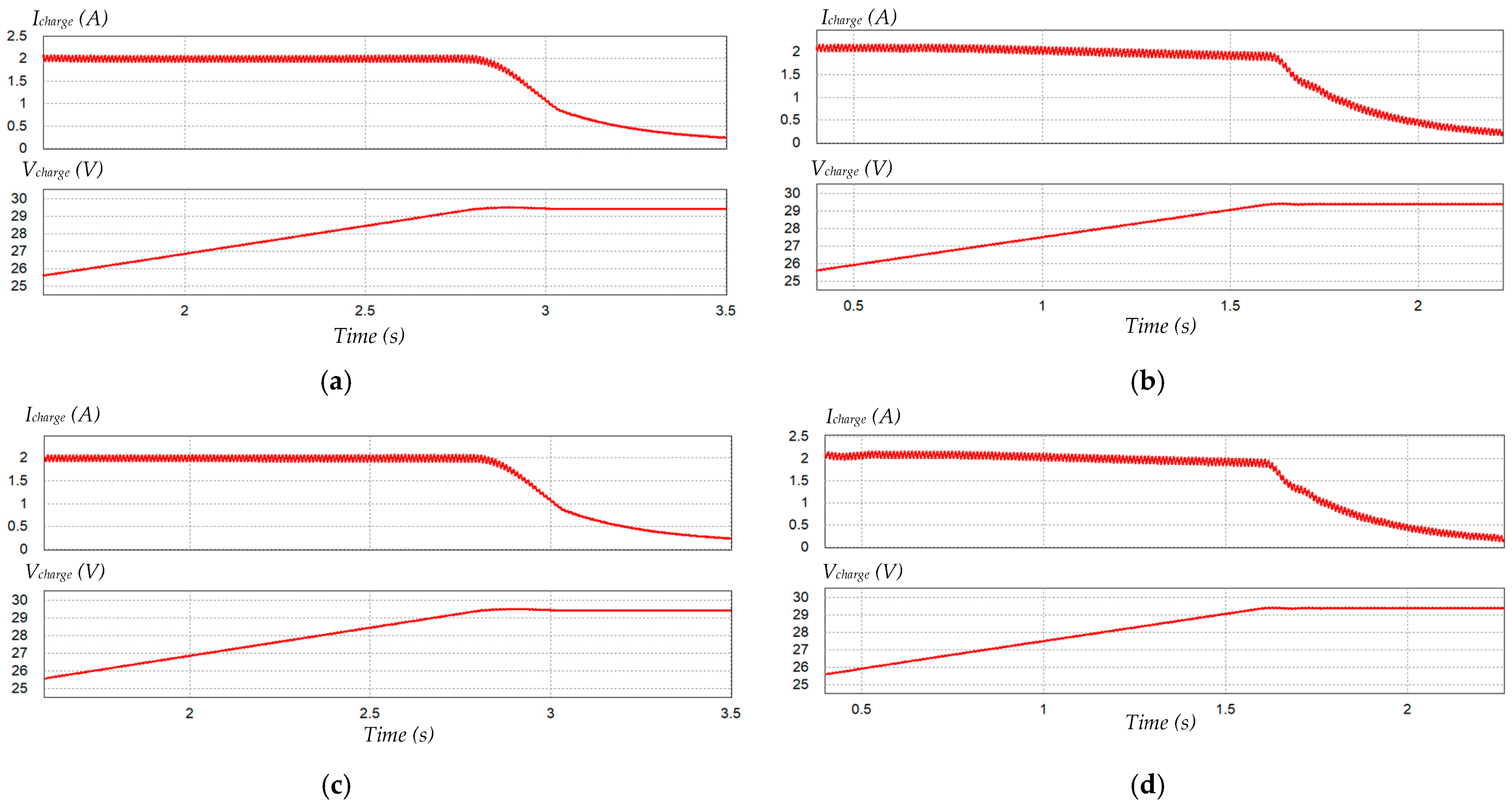
The main simulation results for different cases are presented in
Figure 9,
Figure 10,
Figure 11 and
Figure 12,
Table 2 and
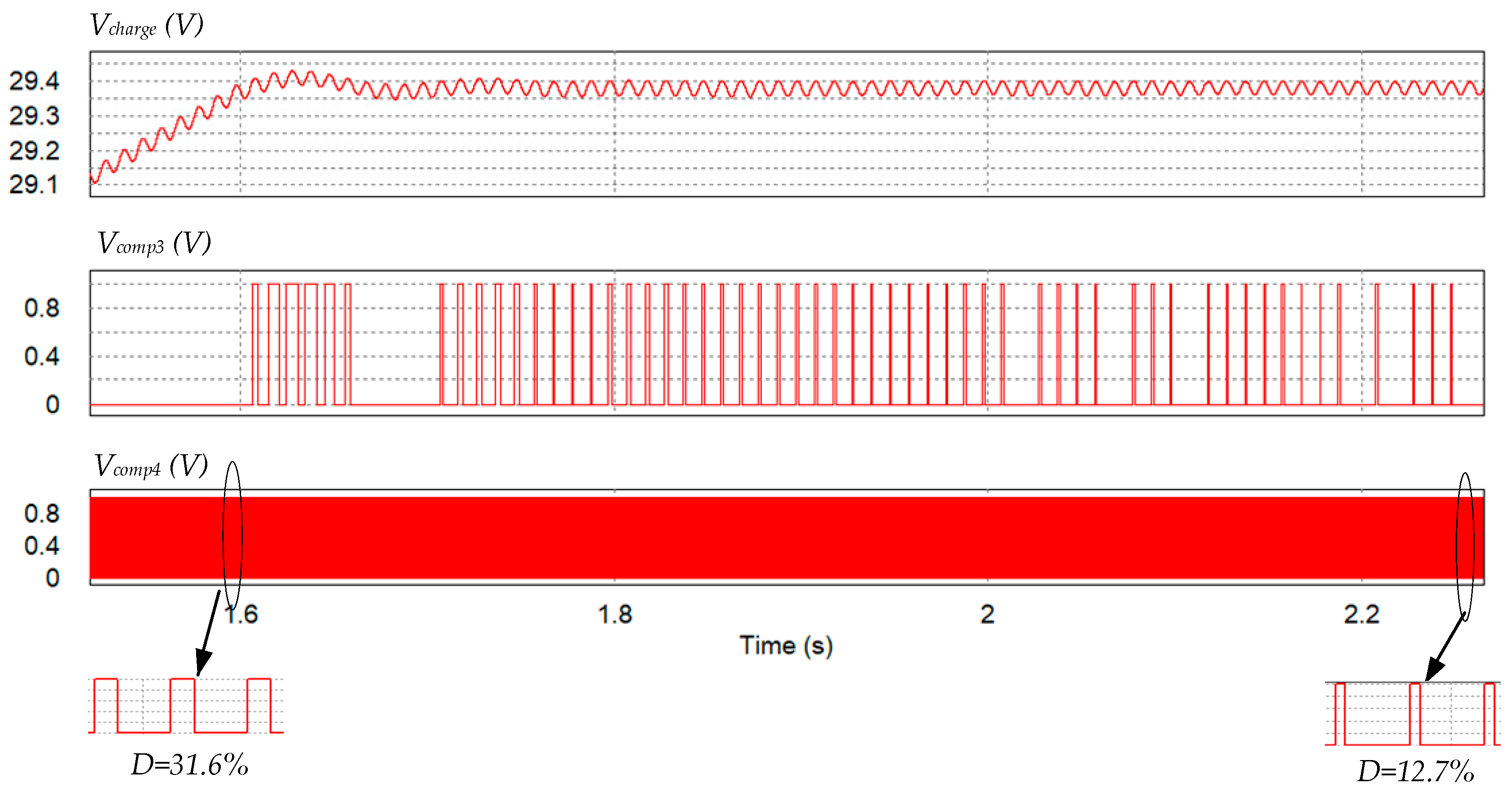
Table 3. The operating principle of the proposed charging system in CV mode is clearly illustrated in
Figure 9. When the charging voltage is equal to or higher than the cutoff charge voltage of 29.4 V, the output voltage comparator goes high, the integrator voltage Int 1 increases, and, consequently, the duty cycle of the comparator Comp 4 output voltage (and the PFC switch control voltage) decreases, leading to an almost constant charging voltage.
The simulation results (presented in
Figure 10 and
Figure 11) of the wireless charging system with either the conventional or the proposed control clearly show that the system operates correctly, because during the CV phase, the charging voltage remains almost constant, and during the CC phase, the charging current remains almost constant, despite variations in
Vinrms and misalignments of the receiving coil. The charging voltage is very accurate during the CV phase (error < ±0.35%) for both the conventional and the proposed control. The charging current during the CC phase shows moderate accuracy for both control techniques, as shown in
Table 2. However, when the conventional control is used, the accuracy of charging current
Icharge is moderately better (by up to 5%) than when the proposed control is used. Because the minimum current during the CC phase for the proposed control is 4.5% lower than that of the conventional control, the battery charging time is slightly longer with the proposed control.
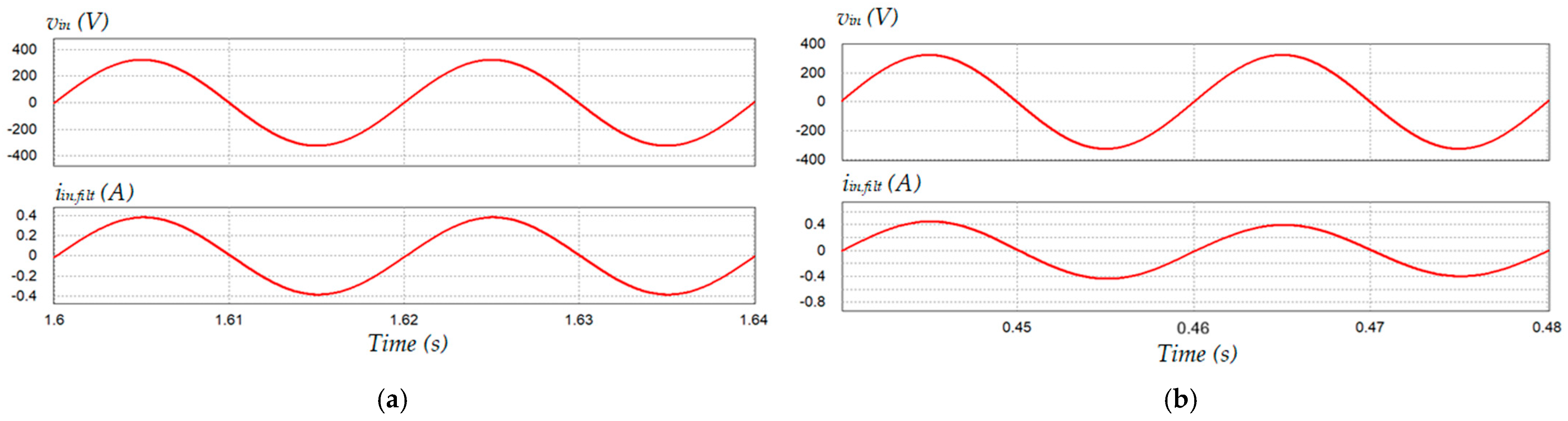
As shown in
Figure 12 and
Table 3, the PFC stage of the wireless charging system with the proposed control performs well: the input filtered current is in phase with the AC grid voltage, the THDI is low, and the PF is nearly unity. For both control strategies, the PF remains the same for different values of
Rbat. The THDI is slightly lower in the wireless charging system with the proposed control. For both control strategies, the THDI increases as
Rbat increases. Similar observations were made from simulations conducted at different values of
M (9.1–11.25 µH) and
Vinrms (207–253 V). The simulated efficiency of the charging system with the proposed control is similar to that of the conventional control approach for a given value of
Rbat,
Vinrms and misalignment of the receiving coil.
As the inverter of the wireless charging system with the proposed control always operates at a 50% duty cycle, the transmitting coil
Lpri current is much “cleaner” than that of the system with the conventional control, as it does not contain even harmonics. Moreover, the
Lpri current of the charging system with the proposed control also has lower amplitudes of higher-order odd harmonics at higher
Rbat (
Table 3). Since radiated emissions from the transmitting coil are proportional to the amplitudes and frequencies of its current harmonics, the wireless charging system with the proposed control has lower radiated emissions than the conventional control, especially at higher
Rbat.





 ,
,