1. Introduction
To address global climate change and energy scarcity, energy conservation and emission reduction are common global goals [
1]. In 2023, China proposed the “dual carbon” targets. Against this backdrop, the rapid proliferation of electric vehicles (EV) [
2] has positioned electric vehicle charging stations (EVCSs) as a critical nexus between transportation and power systems [
3,
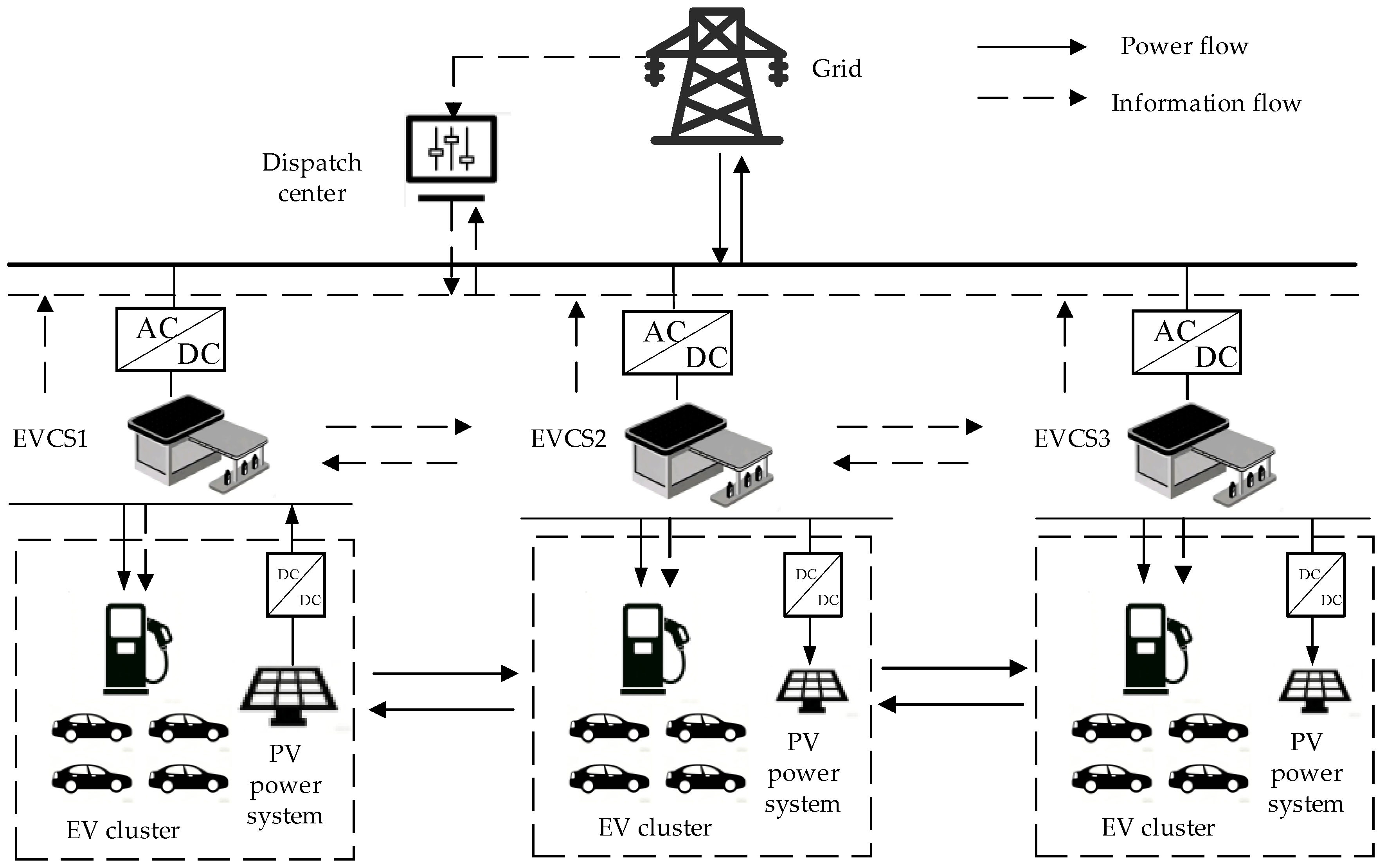
4]. They have become essential flexible regulation resources in the future new power system. By supplying electricity generated from on-site distributed photovoltaic (PV) power to other EVCSs, EVCSs can reduce operational costs while aggregating internal EV clusters to interact with the grid as a unified entity [
5]. Therefore, researching coordinated operation mechanisms for multiple charging stations in scenarios with high PV penetration is crucial for enhancing the operational efficiency of EVCSs and the grid’s ancillary service support capabilities.
Early research on the optimal operation of EVCSs primarily focused on energy management and the scheduling of charging and discharging behaviors. References [
6,
7,
8] present multi-objective scheduling or optimization frameworks for EVCSs, integrating wind power and energy storage, or carbon emission mechanisms and dynamic economic dispatch to enhance station revenue. To enhance the coordinated operation capabilities between EVCS and distribution grids, some studies further integrate EVCS into unified dispatch. Reference [
9] proposes a coordinated operation method for EVCSs and distribution networks considering integrated energy and reserve regulation. References [
10,
11,
12] focus on interactive energy management or real-time coordination between EVCSs and distribution systems or PV generation, utilizing methods such as game theory, deep reinforcement learning, and coordinated charging and discharging scheduling to reduce operational costs and grid dependency. Additionally, some studies have begun to focus on the coordination and transactions between EVCS and integrated energy systems (IES) or among multiple EVCSs. References [
13,
14] investigate coordinated operation or energy trading models between EVCS and IES to balance their interests. References [
15,
16] develop coordination frameworks or strategies for multiple EVCSs (including fast-charging stations), addressing uncertainty or enabling power-sharing and vehicle scheduling. Reference [
17] proposes a hierarchical peer-to-peer (P2P) trading framework to reduce operating costs while ensuring privacy. References [
18,
19] establish a coordinated optimization model for EVCS and distributed generation resources, aiming to reduce total social cost. Reference [
20] proposes a mathematical model of tri-level hierarchical coordinated control and a multi-layer optimization framework, aiming to find a method to effectively manage and control large-scale electric vehicle charging behavior, so as to ensure the safe and stable operation of the power system and optimize resource allocation. Aforementioned study research indicates that EVCS positively contribute to enhancing system flexibility and operational economics. However, existing studies have primarily focused on vehicle to station or station to grid interactions, with insufficient attention given to inter-station coordination. The mechanisms underlying the cooperative operation of multiple EVCSs thus warrant further investigation.
Furthermore, the uncertainty of PV output within EVCSs imposes higher demands on the reliability of system scheduling strategies. Currently, commonly used methods for handling uncertainty include robust optimization [
21] and stochastic optimization [
22]. However, the former is overly conservative, while the latter is more sensitive to assumptions about probability distributions and sample quality. The distributionally robust chance-constrained (DRCC) algorithm [
23,
24,
25] has become an effective approach to overcome the shortcomings of robust optimization and stochastic optimization in dealing with uncertainties [
26]. DRCC primarily employs ambiguity sets constructed based on either the Wasserstein distance [
27,
28] or the Kullback–Leibler (KL) divergence [
29] metric, allowing constraint violations to occur with a controlled probability under a predefined confidence level. Reference [
30] employs a DRCC approach to handle uncertainties in PV output and load. Reference [
31] constructs a DRCC model based on the Wasserstein probability distance. However, research on further embedding DRCC into collaborative decision-making for P2P energy sharing and joint frequency regulation remains relatively limited.
A critical aspect of multi-agent coordinated operation lies in the allocation of cooperative benefits. Nash bargaining is widely used to reconcile the interests of multiple stakeholders, whereas asymmetric Nash bargaining can capture heterogeneity in participants’ contributions and bargaining power by introducing differentiated weights. In [
32], asymmetric Nash bargaining is adopted to design an incentive compensation scheme for EV participation in resilient distribution system restoration, where the amount of restored load is used as a contribution indicator. In the context of P2P energy trading, References [
33,
34] introduce asymmetric Nash bargaining to enable fair allocation of cooperative surplus among participants and develop cooperative game theoretic mechanisms for energy trading and coordinated charging among multiple EVCSs, thereby enhancing system economics and reducing user costs. Reference [
35] proposes a decentralized incentive mechanism based on aggregative game theory, aiming to cost-effectively unlock the regulation potential of large-scale electric vehicles, enabling them to actively provide frequency regulation services for the grid. Overall, existing bargaining-based mechanisms are mostly tailored to single application settings, such as incentives, planning, or energy trading, while studies on multi-dimensional contribution quantification and benefit allocation for coupled P2P energy sharing and joint frequency regulation remain limited.
Despite the progress made in the cooperative optimal operation of EVCSs, deficiencies remain in terms of coordination scope, handling of intra-station PV output uncertainty, and benefit allocation. Regarding the coordination scope, existing studies primarily focus on internal energy management or vehicle-to-station interactions, while research on P2P energy sharing and joint frequency regulation among multiple EVCSs is rarely explored. Concerning the handling of PV output uncertainty, existing research seldom considers the uncertainty of intra-station PV generation, which leads to a decline in the risk-resistance capability of EVCSs. In terms of benefit allocation, existing mechanisms mostly rely on standard Nash bargaining or a single-dimensional allocation based solely on energy trading, lacking an asymmetric Nash bargaining benefit allocation mechanism that accounts for the multi-dimensional differentiated contributions of both energy sharing and joint frequency regulation.
The core problem addressed in this paper is the optimal day-ahead coordinated scheduling of multiple EVCSs participating in both P2P energy sharing and joint frequency regulation. Specifically, this scheduling aims to minimize the overall system cost while preserving individual station privacy and ensuring operational robustness against the uncertainty of PV generation. Within the scope of this research, this paper focus exclusively on EVCS-level economic dispatch based on a distributionally robust optimization and ADMM framework.
Given the above problems, this paper aims to establish a novel multi-EVCS cooperative framework, guided by three measurable objectives. Specifically, the economic objective aims to minimize the total day-ahead operational cost of the multi-EVCS coalition via P2P energy sharing. Furthermore, the robustness objective seeks to tightly control the risk of operational constraint violations caused by PV uncertainty within a predefined probability threshold via DRCC, thereby ensuring reliable regulation capabilities. Finally, the fairness objective is designed to equitably distribute the cooperative surplus by comprehensively quantifying the multi-dimensional contributions of each EVCS. The main contributions of this paper are threefold:
A collaborative framework for P2P energy sharing and joint frequency regulation among EVCSs is established, and the Minkowski Summation (M-sum) aggregation model is employed to accurately characterize the dispatchable potential and power boundaries of EV clusters.
The distributionally robust chance constraint (DRCC) method based on Kullback–Leibler (KL) divergence is introduced into the coordinated scheduling model, which reliably handles the uncertainty of photovoltaic power generation and balances operational economy without assuming an exact probability distribution.
An asymmetric Nash bargaining benefit allocation mechanism based on multi-dimensional contributions is proposed. This mechanism quantifies the differentiated contributions in energy trading and frequency regulation accuracy using a nonlinear mapping function, and achieves a privacy-preserving distributed solution via the alternating direction method of multipliers (ADMM).
3. EVCS Participation in Dynamic Frequency Modulation Optimization Model
3.1. Minkowski Sum-Based Aggregation Model for Electric Vehicles
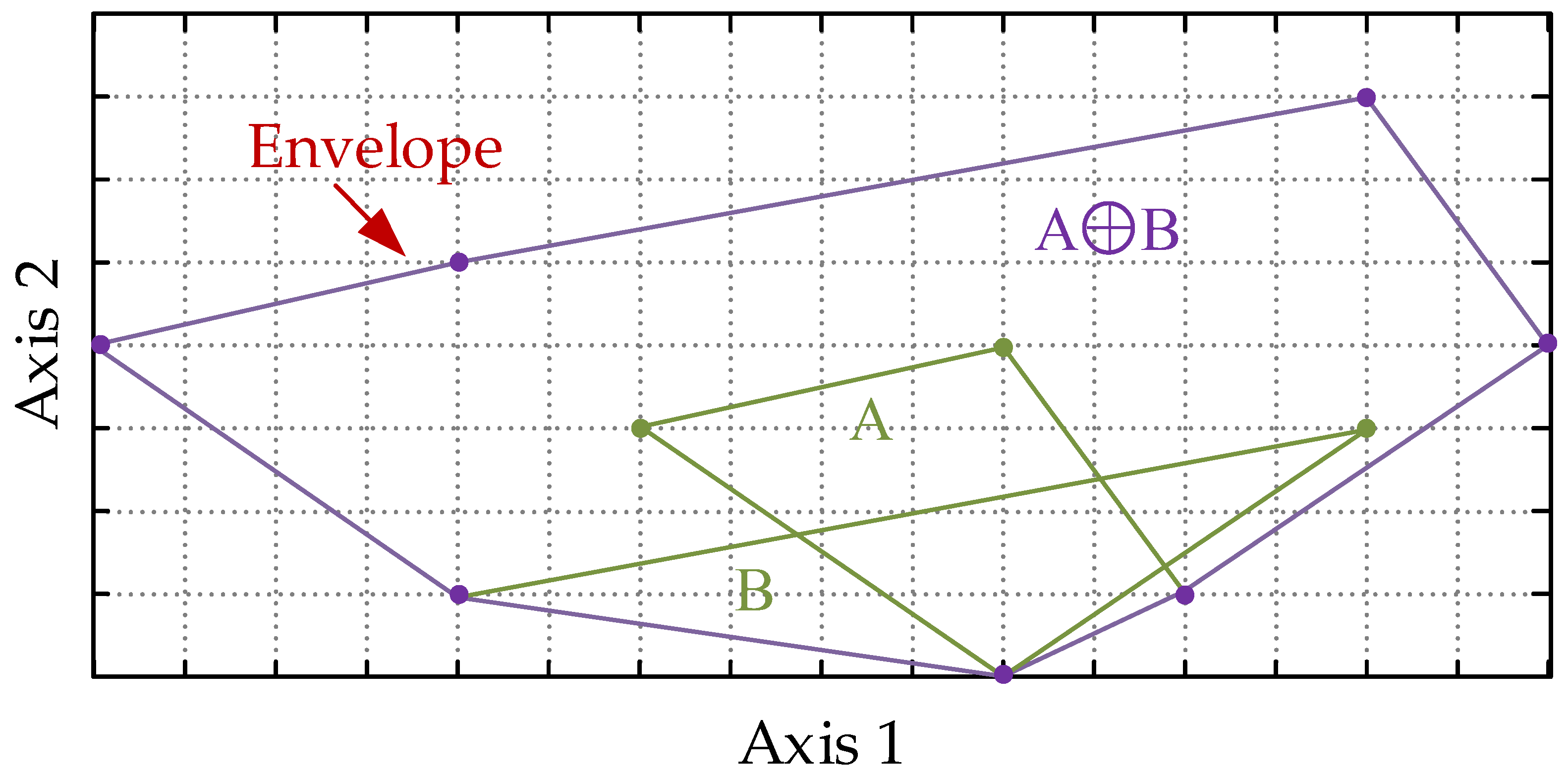
Although the driving characteristics of EVCSs vary, their underlying charging models are highly similar. According to reference [
36], this paper adopts the M-sum method to aggregate large-scale EV clusters into a generalized energy storage device. To address the nonconvex feasible region caused by the discrete charging and discharging states of individual EVs, the M-sum method relaxes the discrete constraints into continuous intervals and computes the geometric sum of their convex hulls, thereby constructing an accurate convex outer approximation of the aggregated flexibility of the EV cluster. This approach preserves the constraints of individual EVs while effectively overcoming computational difficulties. Moreover, in scenarios where EVs frequently connect to and disconnect from the grid, the aggregation model dynamically computes the geometric sum of the polyhedral constraints of all EVs currently connected to the station at each specific time step, thereby smoothing the power and energy boundaries at the aggregated EV cluster level.
The boundaries for the real-time energy and charging/discharging power of the
th EV connected to EVCS
i are defined as follows:
In the equation: and represent the charging and discharging power of the -th EV during time period , respectively; and represent the maximum charging and discharging power of the -th EV, respectively; and represent the battery capacity of the -th EV during time period and , respectively; and represent the charging and discharging efficiency of the EV, respectively; denotes the adjustment time window; represents the upper bound of the SOC for the -th EV; represents the lower bound of the SOC for the -th EV.
The parking state of an EV is defined as follows:
In the equation: represents the state of the k-th EV at time , where indicates the EV is in off-grid mode and indicates the EV is in grid-connected mode; denotes the start time of charging for the -th EV; denotes the end time of charging for the -th EV.
The generalized energy storage parameters obtained based on the M-sum method are given by Equations (5)–(7). Among them, Equations (5)–(7) satisfy Minkowski additivity.
In the equation:
and
represent the maximum charging and discharging power of EVCS
i during time period
t, respectively;
is the capacity of EVCS
i at time period
t;
denotes the instantaneous step-change in the capacity of a charging station caused by the arrival or departure of an electric vehicle;
and
represent the capacity bounds of EVCS
i at time period
t, respectively;
is the set of EVs at the charging station. It is worth noting that the dynamic arrivals and departures of EVs described in Equation (7) are essentially a time-varying linear combination of feasible solution sets. Although the physical state of an individual EV may involve discrete characteristics, under the M-sum aggregation framework, the individual flexibility is relaxed into a continuous convex interval. According to convex analysis theory, the M-sum of a finite number of convex sets remains convex. Consequently, the aggregated boundary at any time instant consistently forms a compact convex polytope [
37]. This outer convex approximation property ensures the continuity of the P2P optimization problem and the convergence of the ADMM solution process see
Appendix A for the mathematical proof.
At this point, the variable space of the EV cluster within the charging station is compressed into the variable space of the station’s generalized energy storage device. The aggregated strategy space constraints for the EV cluster are given by the following expression:
In the equation: and represent the charging and discharging power of EVCSi during time period t, respectively.
3.2. Dynamic Frequency Modulation Power Output Modeling for EV Clusters
In this paper, denotes electricity consumption from the grid (EV charging). denotes power injected into the grid (V2G operation).
Positive frequency regulation power represents upward regulation, meaning an increase in power injection (or reduction in consumption) in response to system frequency; Negative frequency regulation power represents downward regulation, meaning increased consumption (or reduced injection).
In the paper, the unit for power variables is kW; the PV installed capacity, downward capacity and upward capacity are kW; the energy variables (including SOC, supplied energy, received energy and frequency regulation imbalance) is kW·h; the unit of electricity price and trading price are CNY/kW·h.
To ensure the safe and reliable operation of EV batteries during V2G interactions, the baseline charging model strictly enforces SOC dynamics and operational boundaries. Specifically, the SOC evolution over time is determined by the continuous integration of charging and discharging power, properly accounting for the corresponding energy conversion efficiencies. At any given time step, the SOC must be maintained within predefined upper and lower battery capacity limits to prevent overcharging or deep discharging. Furthermore, the instantaneous charging and discharging powers are bounded by the physical limits of the EV chargers, and simultaneous charging and discharging states are strictly prohibited. Finally, a target SOC constraint is strictly enforced at the expected departure time to guarantee that the EV battery stores sufficient energy to meet the user’s subsequent driving requirements.
Prior to participating in frequency regulation, a charging schedule is formulated for each individual electric vehicle. This paper adopts, as the baseline scheme, the approach of minimizing charging cost while ensuring the required state of charge at departure. The corresponding optimization model is presented below.
In the equation: denotes the baseline charging schedule; denotes the time-of-use electricity price; denotes the state of charge at departure; denotes the required SOC.
It should be noted that the joint frequency regulation problem studied in this paper focuses on power allocation. In the model, represents the system’s frequency regulation power demand for each station. Since this paper focuses on the coordination mechanism for energy sharing and frequency regulation tasks among multiple sites, the physical processes of the grid’s real time dynamic frequency response, such as frequency deviation and rate of change of frequency ROCOF, are temporarily not included in the modeling scope of this analysis.
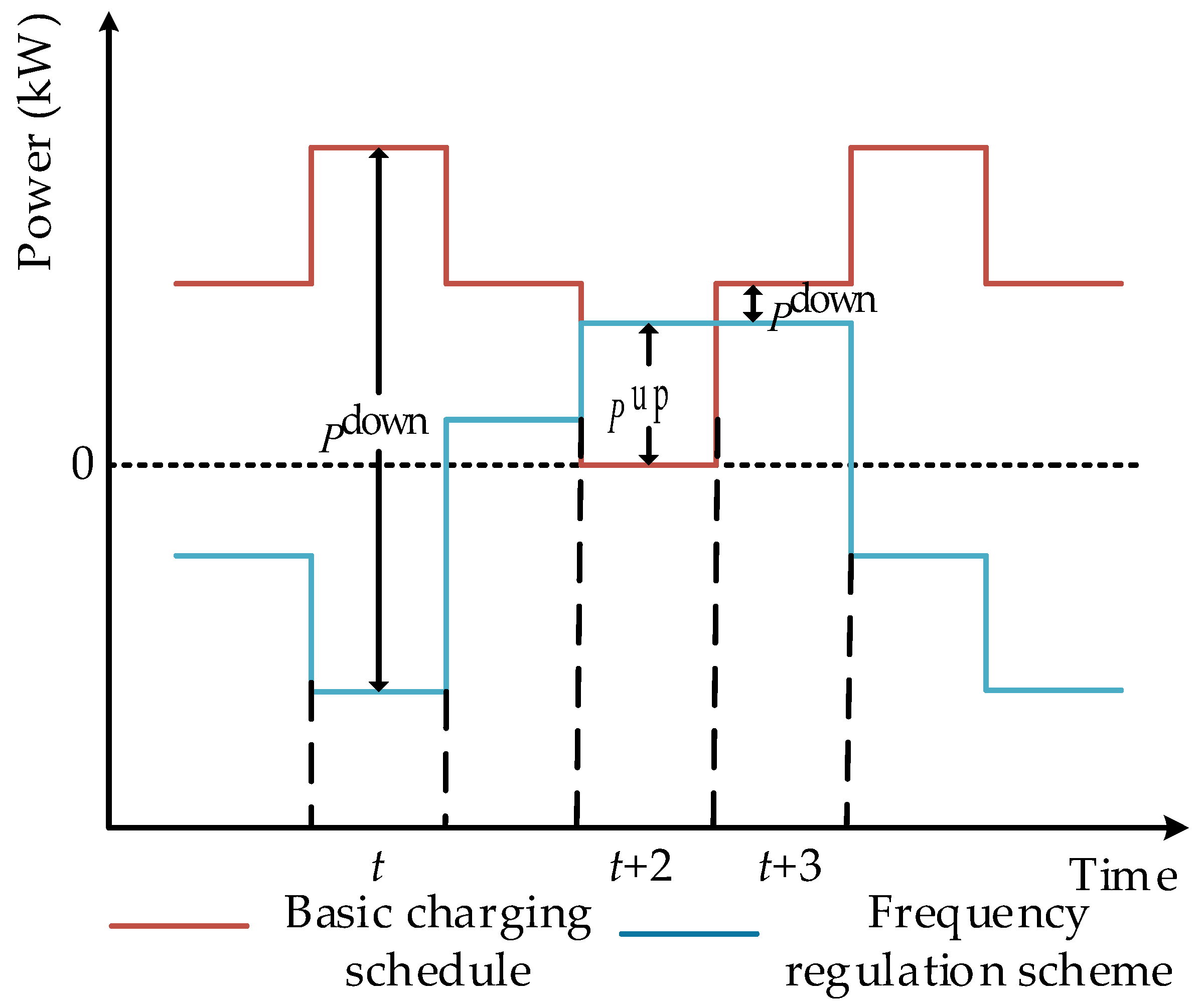
After establishing the baseline charging schedule, the equality constraints of Equation (10) are no longer strictly satisfied. The EVCS will regulate the charging and discharging status of the on-site EV cluster in response to grid frequency regulation commands. When the EVCS receives a negative grid frequency regulation command, it adjusts the cluster’s charging power above the baseline charging power to provide upward power output support to the grid, corresponding to the
t + 2 time period in
Figure 2. The relevant calculation is shown in Equation (11). When receiving a positive grid frequency regulation command, the EVCS guides the EV cluster to provide downward power output through two approaches one involves switching to discharge mode, where the EV cluster transitions from charging load state to discharging power to the grid, corresponding to the
t time period in
Figure 2; the other maintains the charging state unchanged while only reducing the charging power below the baseline charging plan, corresponding to the
t + 3 time period in
Figure 2, as detailed in Equation (12).
In the equation: and represent the up-regulation output and down-regulation output, respectively, of the EV cluster within EVCSi; and represent the equivalent charging status and discharging status, respectively, of the EV cluster within EVCSi, both of which are 0–1 variables. indicates that the EV cluster in EVCSi is in charging state; indicates that the cluster is in discharging state.
To accurately assess the frequency regulation potential of the aggregated EVCS, the upward and downward power outputs calculated from the above equation are used to determine the charging station’s upward capacity and downward capacity [
38]. The proposed frequency regulation model characterizes the allocation and tracking of regulation power commands at the scheduling level, rather than detailed system frequency dynamics such as inertia or droop control.
In the equation: and represent the upward capacity and downward capacity.
3.3. Consideration of the PV Power Output Model Within DRCC Charging Stations
The photovoltaic output within an EVCS often exhibits strong uncertainty. To describe the uncertainty of photovoltaic output, the photovoltaic output at time period t is defined as:
In the equation: is the actual PV output of the EVCS at time t; is the forecasted PV output of the EVCS at time t; is the forecast error of the PV output of the EVCS at time t.
To ensure the feasibility of the scheduling plan, it is required that the planned photovoltaic output does not exceed the actual available output at a confidence level
, thereby obtaining the chance constraint:
In the equation: is the confidence level.
However, Equation (14a) relies on the true distribution of the prediction error , which is often unknown in practice. DRCC do not require assuming a true distribution for the random variable. Instead, they allow for the construction of an ambiguity set D, which contains the true distribution, based on a finite set of historical data samples. This is achieved by enforcing that the chance constraint holds for every distribution within the ambiguity set.
In this paper, the KL divergence is employed to measure the distance between two different probability distributions, based on which an ambiguity set is constructed. Given
historical data samples, an empirical distribution
is constructed as the reference distribution (typically denoted as
), and the KL divergence is used to quantify the distance between the actual distribution
and the reference distribution
. For the actual distribution
and the reference distribution
, the KL divergence is defined as:
In the equation: denotes the number of uncertain variable samples; and represent the probabilities of the actual distribution and the reference distribution at sample , respectively.
Based on the KL divergence, the ambiguity set D and divergence radius [
39] are defined as follows:
In the equation: D denotes the ambiguity set;
denotes the divergence radius, which is the similarity threshold between the reference distribution and the actual probability distribution. A larger value of d enhances the robustness of the model but leads to more conservative optimization strategies.
denotes the upper quantile of the chi-square distribution with
degrees of freedom, which ensures, with a probability not exceeding
, that the actual distribution is contained in the ambiguity set D. The DRCC is given by:
The optimization problem in Equation (17a) involves finding the worst-case probability distribution over the ambiguity set, which is non-convex and computationally intractable. Therefore, to obtain a solvable formulation, binary variables
and auxiliary dual indicators
and
are introduced for linearization. The mixed-integer linear programming formulation is as follows:
In the equation: denotes the number of PV output samples; denotes the minimum available PV output under the worst-case scenario; denotes the PV output of the m-th historical sample for the robust lower bound of PV output; is a sufficiently large positive number used to tighten the constraints; and are auxiliary variables introduced by the robust lower bound to determine the safety margin of PV output; are violation indicator variables, where indicates that the m-th sample is allowed to violate the constraint (treated as an outlier or extreme case), and enforces the constraint; is the PV output under the worst-case scenario within the KL divergence ambiguity set D.
To ensure feasibility under the worst-case scenario, the Gurobi solver is used to solve Equation (17b) to obtain the lower bound
of the stochastic PV output over the entire prediction horizon. The first inequality in Equation (17b) limits the total number of samples that violate the criterion based on the divergence radius. The divergence radius and the confidence level ensure the simplified constraint. After obtaining the robustly guaranteed photovoltaic output
through Equation (17b), the model only needs to constrain the planned photovoltaic output in the scheduling to not exceed this robust value. Ultimately, the original chance constraint is treated as a linear inequality:
Thus, under any distribution covered by the KL divergence ambiguity set D, the chance constraint corresponding to Equation (17a) holds with a confidence level .
The deterministic reformulation of the DRCC introduces auxiliary binary variables—rendering the original problem into a mixed-integer programming (MIP) formulation—the reformulated model possesses a standard algebraic structure. Consequently, it can be directly and efficiently solved using mature off-the-shelf commercial solvers (e.g., Gurobi, CPLEX). This exact solution method effectively avoids the limitations of traditional meta-heuristic algorithms regarding convergence and global search capabilities.
3.4. Peer-to-Peer Trading Model for Multi-Electric Vehicle Charging Stations
3.4.1. Objective Function
The objective function
for EVCS
i is formulated as minimizing the system’s comprehensive cost, which comprises the electricity purchase/sale cost with the main grid, the EV cluster discharge discomfort penalty cost, the penalty cost for any remaining frequency regulation power imbalance, and the cost of energy transactions with other EVCS, as follows:
In the equation:
is the electricity purchase/sale cost between the EVCS and the main grid;
is the discharge discomfort penalty cost of the EV cluster within the EVCS;
is the penalty cost for the remaining frequency regulation power imbalance at the EVCS;
is the energy transaction cost between EVCS
i and other charging stations.
In the equation: and are the power purchase and sale, respectively, between EVCSi and the main grid at time t; and are the electricity purchase and sale prices, respectively, of the main gird at time t; is the discomfort cost coefficient for EV discharge, set at 0.3 CNY; and are the positive and negative deviations, respectively, of the unfulfilled frequency regulation power at EVCSi at time t; is the unit penalty cost for unfulfilled frequency regulation power, set at 0.8 CNY/kW·h; is the set of charging stations participating in energy trading, representing the indices of EVCS connected to station i; and are the energy trading price and the scheduled energy trading quantity, respectively, between EVCS i and EVCSj at time t.
3.4.2. Constraints of EV Charging Stations
In the equation: is the upper limit for the power interaction between the EVCS and the main grid; is a binary purchasing status variable (0–1) for EVCSi at time t, indicating whether it purchases electricity from the main grid.
- 2.
Frequency Regulation Constraints for EV Charging Stations
In the equation: is the frequency regulation power demand dispatched to EVCSi, with the physical unit of kW.
- 3.
Operating Constraints of the EV Cluster
Constraints (4)–(8).
- 4.
Electricity Sharing Constraints between EVCS i and Other Stations
In the equation: is the upper limit for the power of electricity sharing between EVCSi and EVCSj.
- 5.
Power Balance Constraints for EV Charging Stations
5. Case Study
5.1. Parameter Settings
This paper considers a fleet of 1000 EVs, comprising 400 private cars, 200 ride-hailing vehicles, and 400 commuter EVs, each with a battery capacity of 32 kW·h. Travel data are generated using Monte Carlo simulation and assigned to individual charging stations, as detailed in
Table 1 and
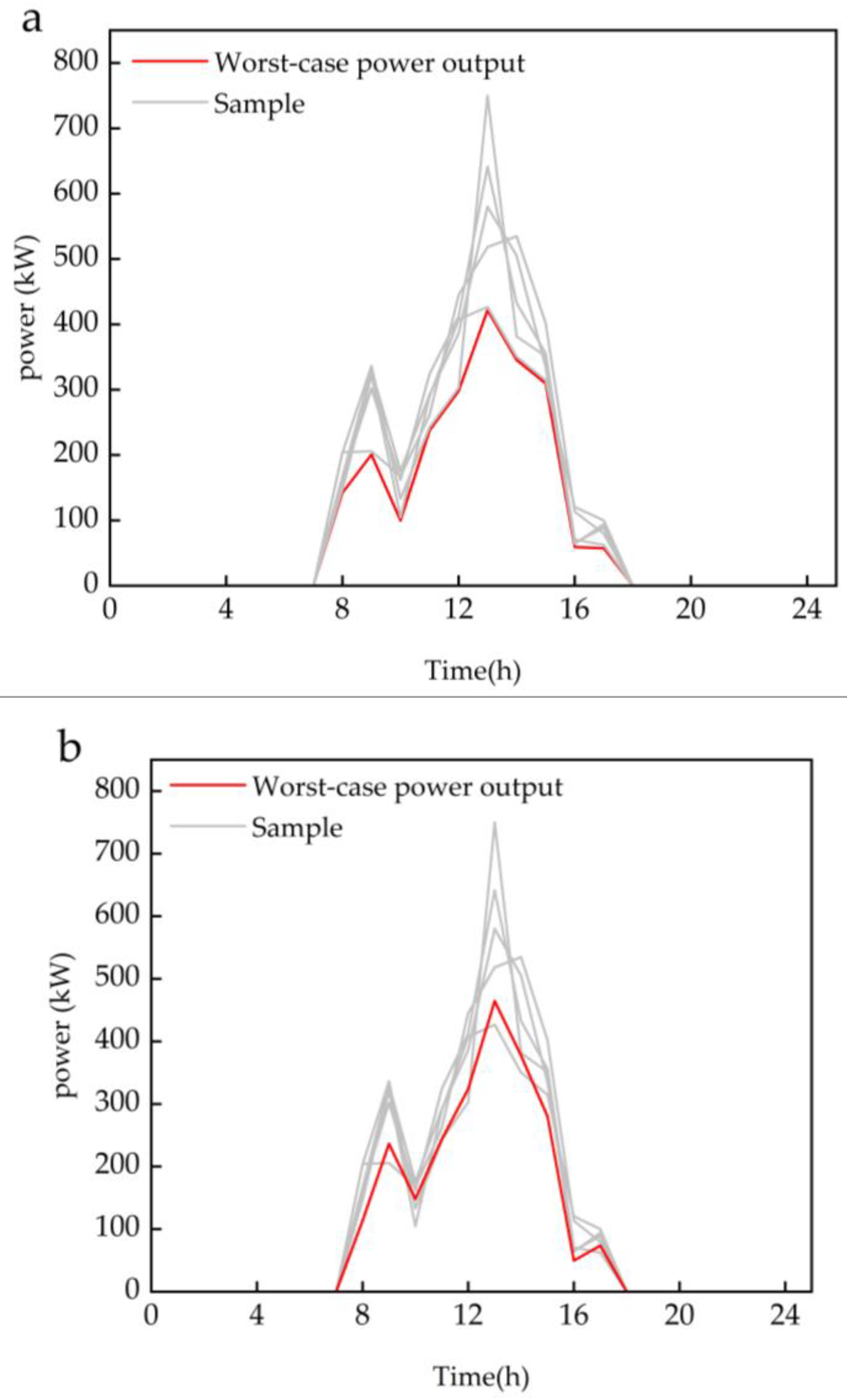
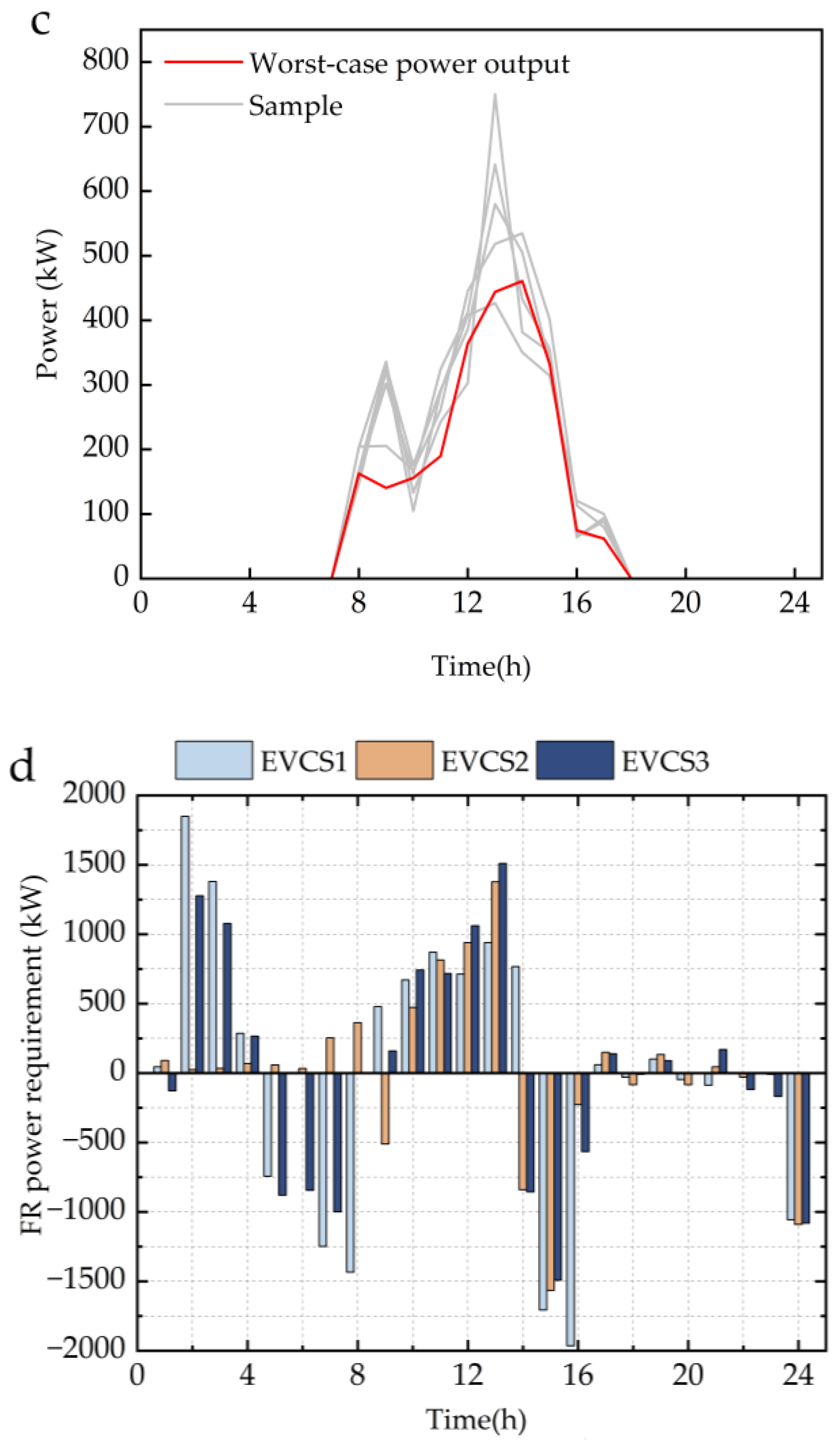
Table 2. Here, N denotes a normal distribution and U a uniform distribution. 5 typical PV output scenarios are constructed via Latin Hypercube Sampling combined with the synchronous back-reduction method. The worst-case lower bound of PV output obtained from a DRCC model is taken as the input for subsequent calculations; the corresponding results are presented in
Figure 4a–c. The day-ahead frequency regulation demand power is shown in
Figure 4d. The time-of-use electricity price of the grid is listed in
Table 3.
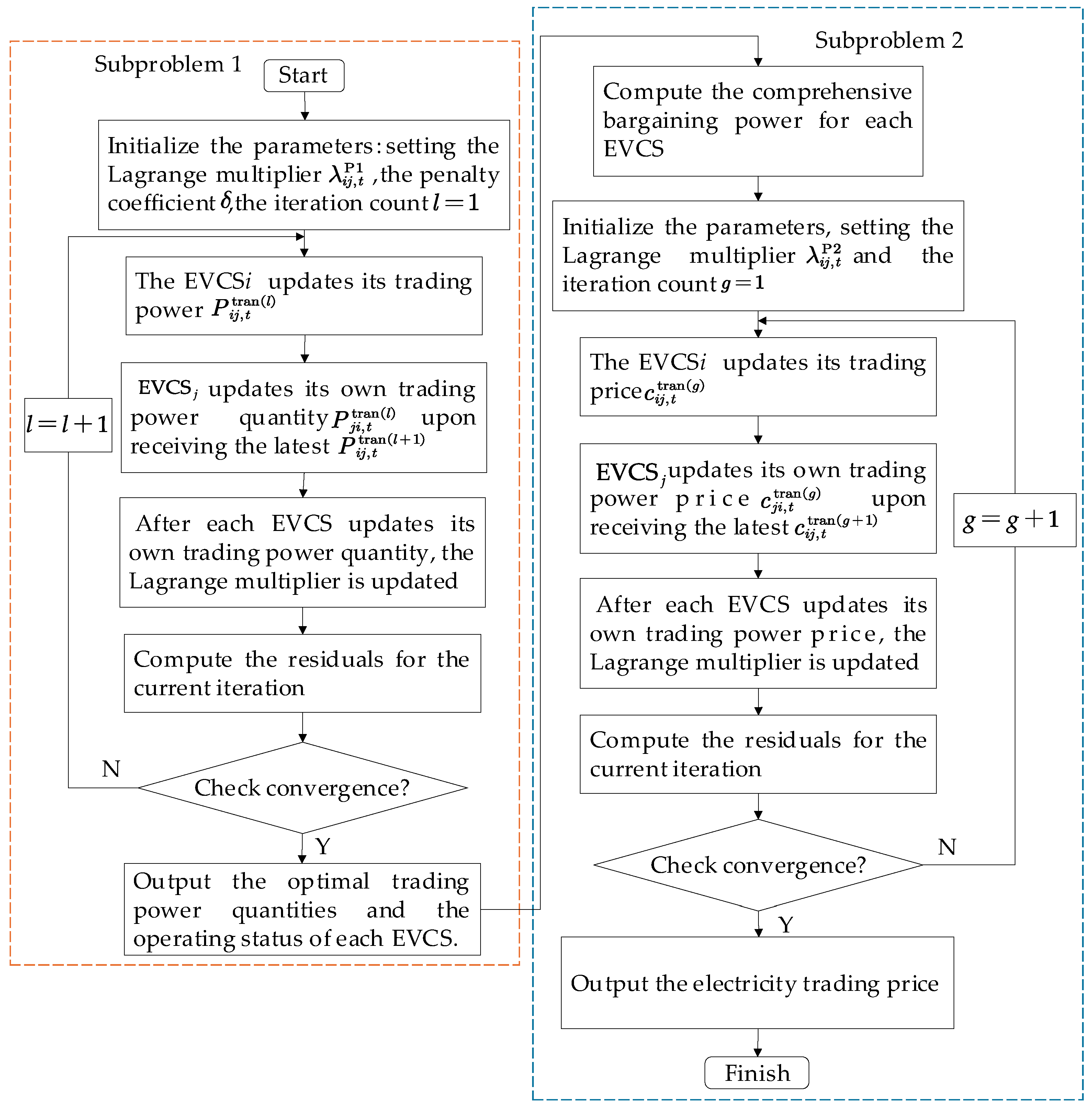
In the proposed ADMM distributed framework, the solver parameters for the two subproblems are configured independently to accommodate their distinct mathematical characteristics and ensure computational efficiency. For Subproblem 1 (the EVCS Coalition Cost Minimization Subproblem (P1)), the penalty parameter is set to , with a convergence tolerance of and a maximum iteration limit of 20. For Subproblem 2 (the Payoff Allocation Subproblem (P2) Based on Asymmetric Nash Bargaining), the convergence tolerance is strictly set to , with a maximum iteration limit of 100. For the KL divergence-based DRCC, the number of PV generation scenarios is , , .
In practice, key DRCC parameters are selected to balance robustness and economy. The sample size is determined by historical data availability and computational limits. Instead of relying solely on theoretical bounds, the KL-divergence radius is empirically calibrated. Specifically, is scaled inversely with and fine-tuned via a data-driven trade-off analysis, effectively preventing over-conservatism while strictly satisfying chance constraints.
This paper takes 24 h as a dispatching cycle and 1 h as a dispatching interval.
All numerical experiments are implemented in MATLAB R2025a, where the YALMIP toolbox is used to model the problem and the solvers, Gurobi, and MOSEK are employed to solve the problem.
5.2. Algorithm Convergence Analysis
5.2.1. Subproblem 1 (P1): Inter-Interaction Electricity Flow Among Electric Vehicle Charging Stations
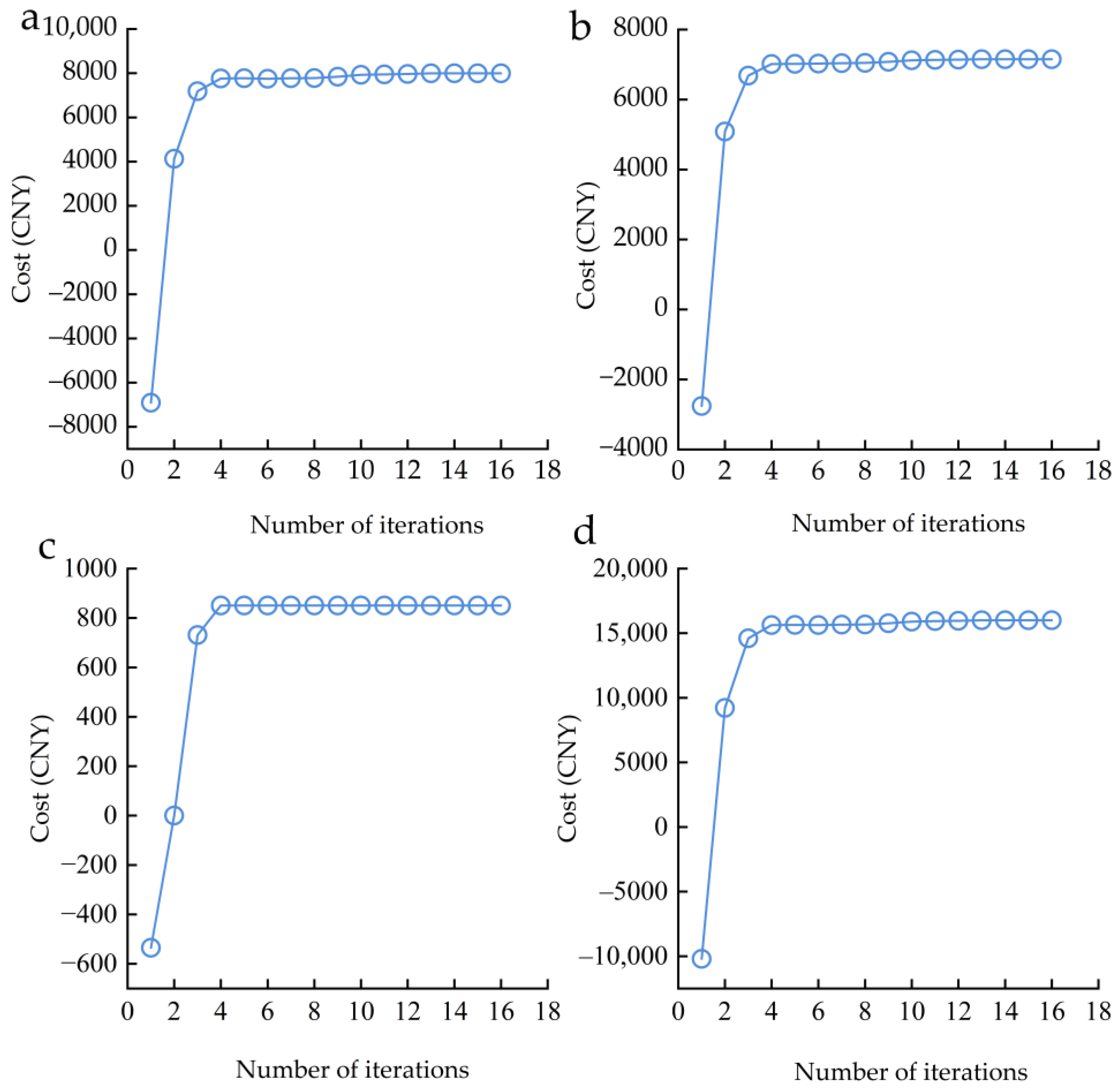
This paper employs the ADMM algorithm to distribute the solution of the interactive power flow problem among EVCSs. The cost convergence over iterations for each entity is presented as shown in
Figure 5. Assuming a convergence accuracy of 0.1 for P1, the figure indicates that the proposed method converges after 16 iterations. The average iteration costs for all entities begin to converge around the 5th iteration, with a total convergence duration of 6.81 s. The final convergence values for each EVCS and the coalition are CNY 7993.35, CNY 7153.78, CNY 850.34, and CNY 15,997.47, respectively.
5.2.2. Subproblem 2 (P2): Interactive Pricing Among EVCSs
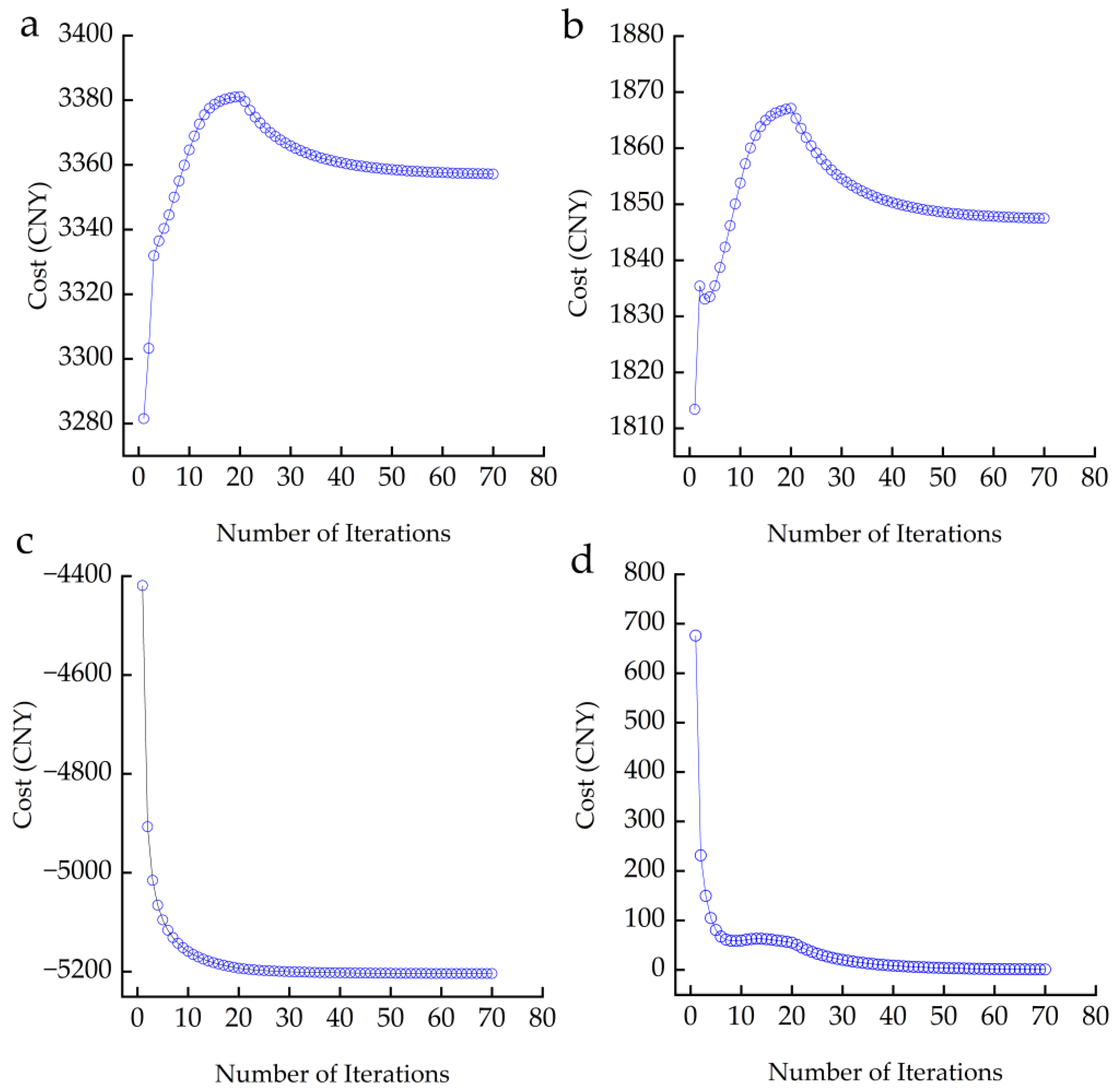
Similarly, the ADMM algorithm is employed to distribute the solution for the interactive electricity pricing problem among EVCSs. Bargaining cost convergence over iterations for each entity is presented as shown in
Figure 6. Assuming an algorithmic convergence accuracy of 0.001, the figure indicates that the proposed method converges after 70 iterations. The bargaining costs for each entity begin to converge on average around the 40th iteration, with a total computation time of 21.19 s, with final convergence values of CNY 3357.21, CNY 1847.49, CNY −5203.90, and CNY 0.80 for each EVCS and EVCS coalition, respectively.
5.3. Analysis of Electric Vehicle Frequency Regulation Capability
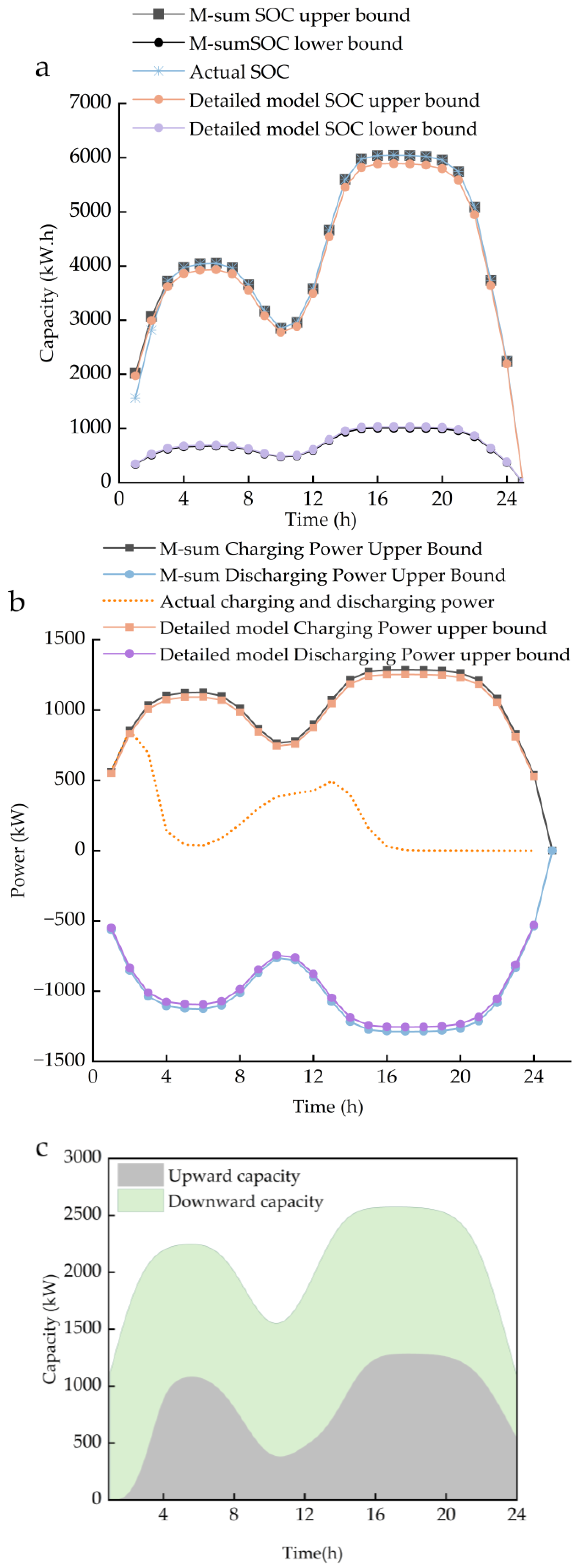
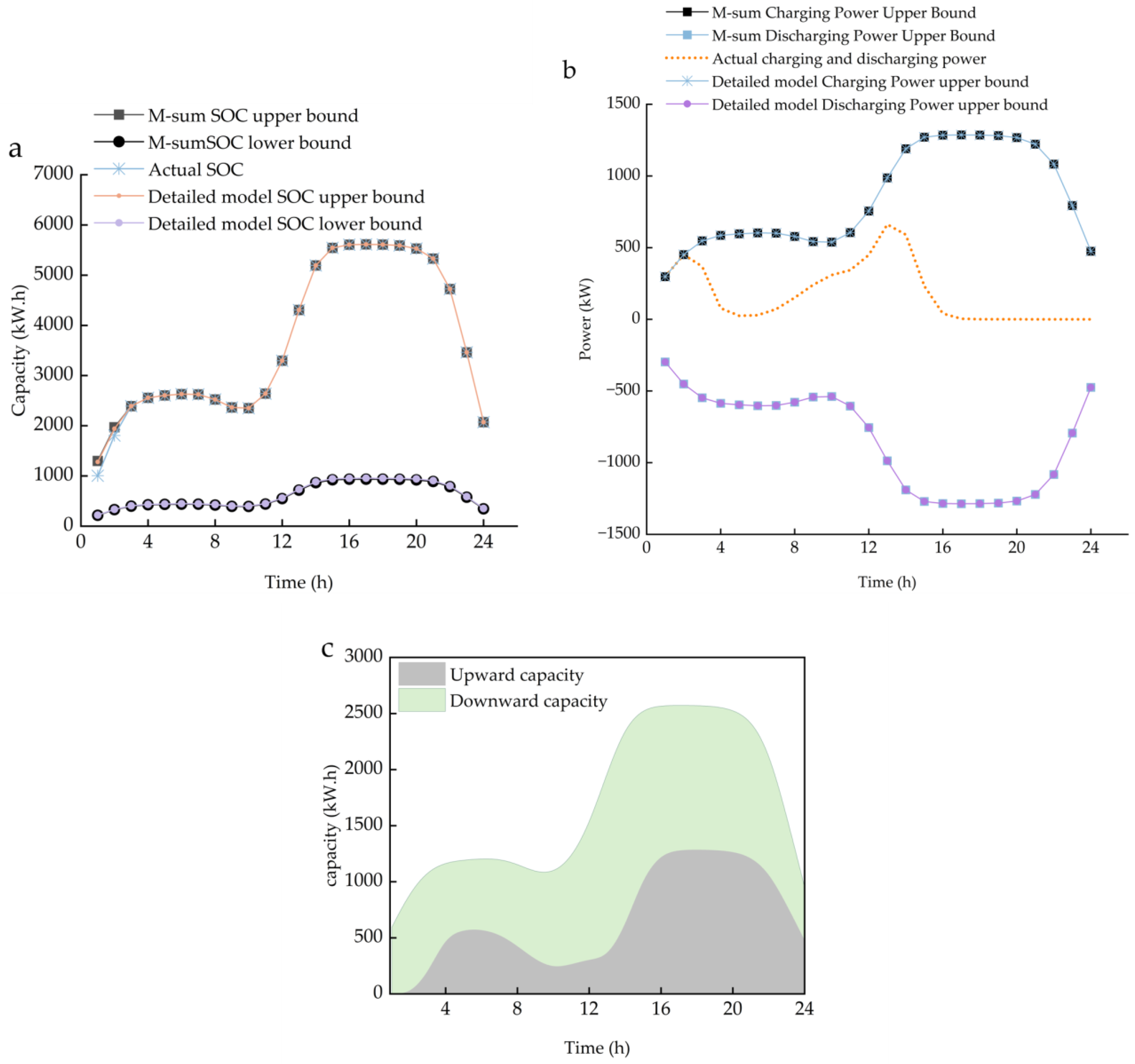
The dispatchable potential of EVCS1 is presented as shown in
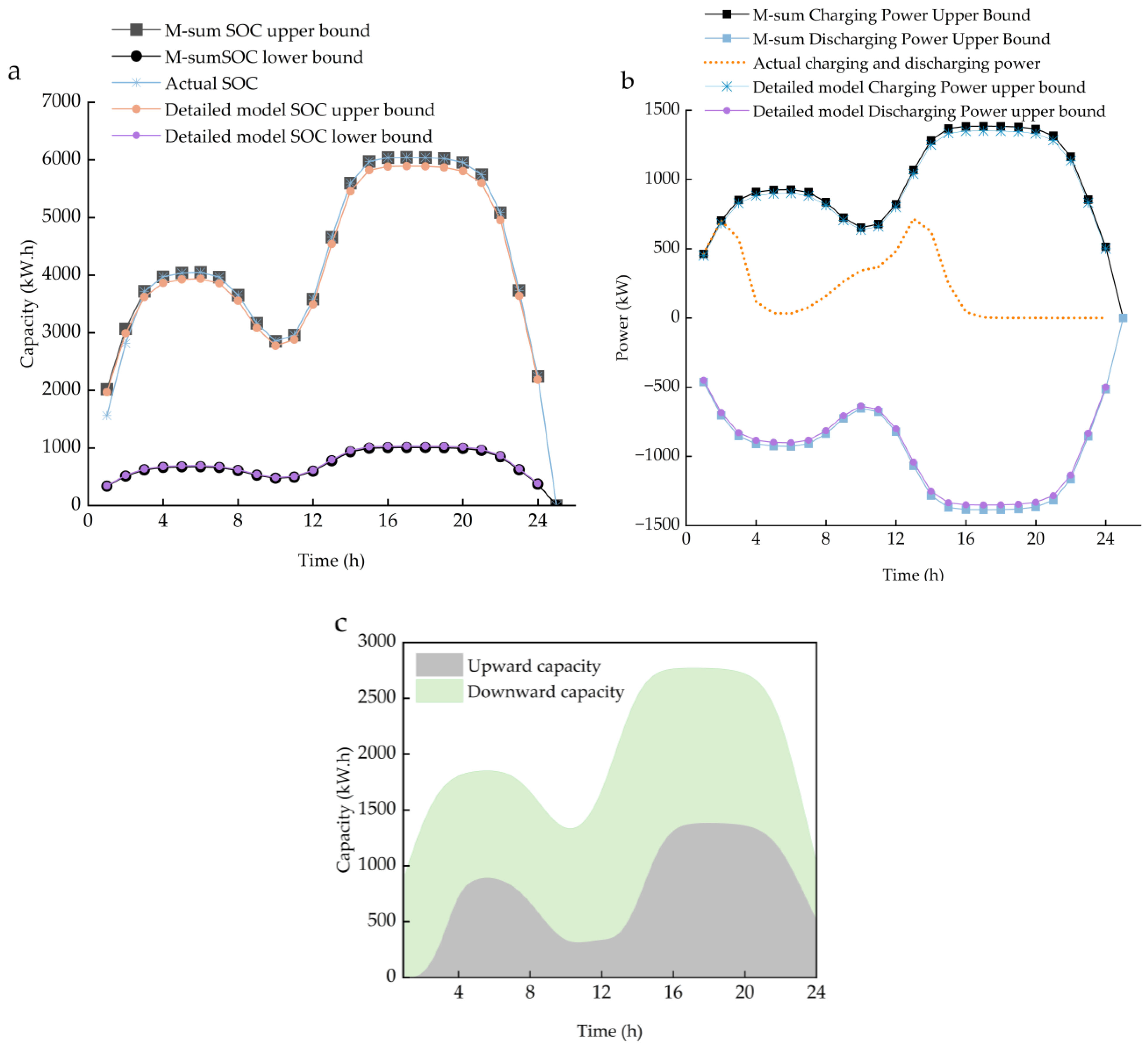
Figure 7; the dispatchable potentials of EVCS2 and EVCS3 are provided in
Appendix C. Taking EVCS1 as an example, the dispatchable potential of the EVCS is analyzed, while those of the other two charging stations are not analyzed.
Before analyzing the specific regulation capabilities, it is essential to quantify the approximation error introduced by the M-sum aggregation method. As shown in
Figure 7a,b, the feasible boundaries derived from the M-sum aggregation are compared with a detailed benchmark model that explicitly optimizes individual EVs. The comparison reveals that the M-sum model acts as an outer approximation, with its boundaries closely enveloping those of the detailed model. This behavior is consistent with the theoretical properties of M- sum. Quantitatively, the average relative error of the SOC boundaries over the dispatch period is approximately 2.65%, indicating a high degree of aggregation fidelity. Furthermore, the actual dispatch trajectories for SOC and power consistently remain strictly within the physical limits of the detailed model, confirming that the solution is physically feasible. Given the minimal error and significant reduction in computational complexity, the M-sum model is considered sufficiently accurate for the subsequent research.
Based on this validated model,
Figure 7c presents the calculated regulation capacities. As shown in
Figure 7, the adjustable potential of EVCS 1 is simultaneously constrained by the dual coupling of the SOC energy boundary and the charging/discharging power boundary. During nighttime, a large number of EVs connect to the grid and charge at high power, raising the SOC close to its upper limit. Under this condition, the downward capacity exceeds the upward capacity. For instance, at 14:00, the downward capacity reaches 1615.89 kW, while the upward capacity is only 817.60 kW. When the actual charging power approaches zero, the SOC remains at a relatively high level due to the constraint of the energy boundary, and the downward capacity still surpasses the upward capacity. The frequency regulation potential of the EV cluster is primarily limited by the upper charging power boundary in the early stage and by the SOC energy upper boundary in the later stage. Throughout the day, the maximum downward capacity is greater than the upward capacity. This indicates that EVCSs possess the potential to participate in frequency regulation ancillary services.
5.4. Analysis of Asymmetric Nash Bargaining Interaction Results Considering Integrated Contribution
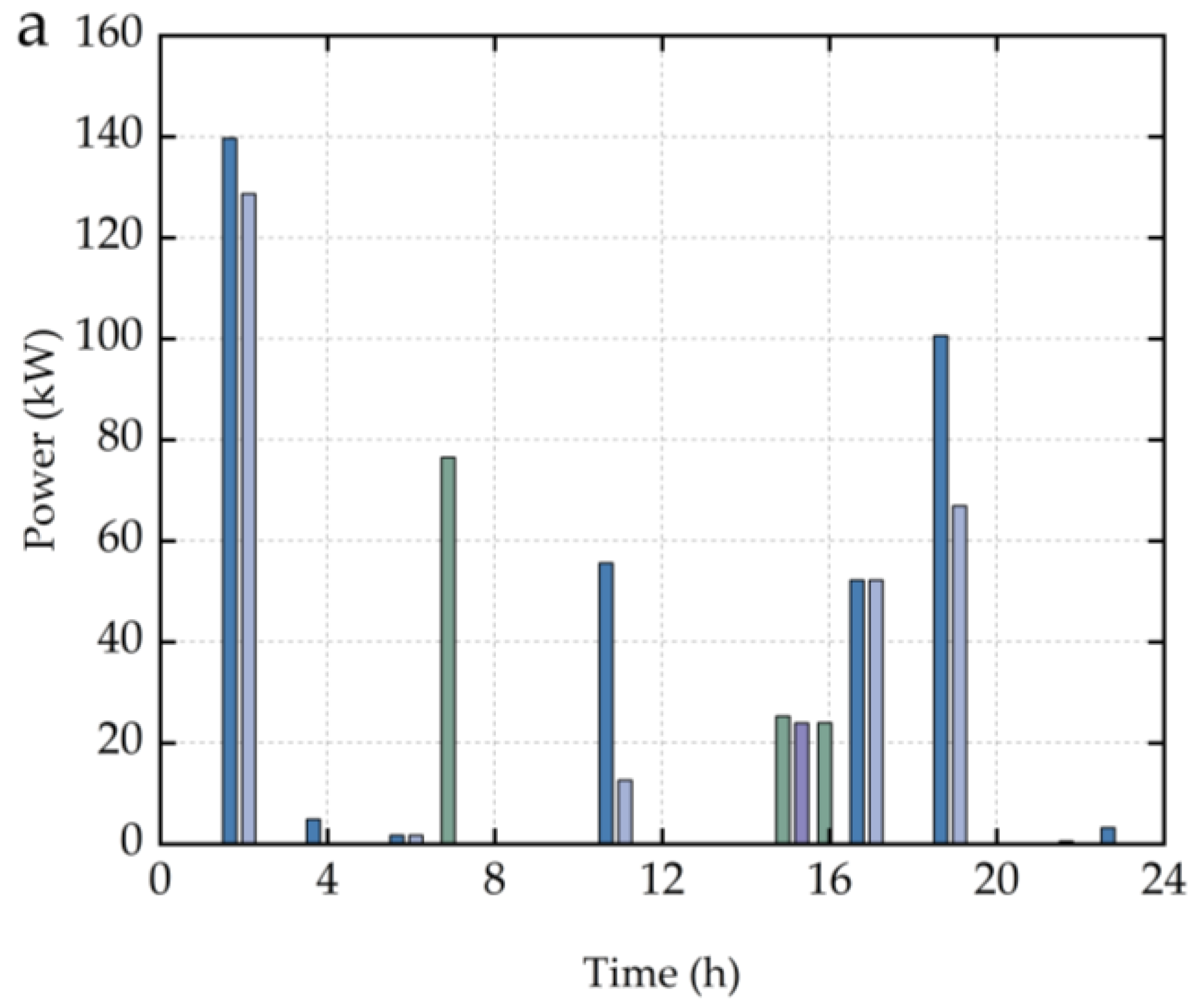
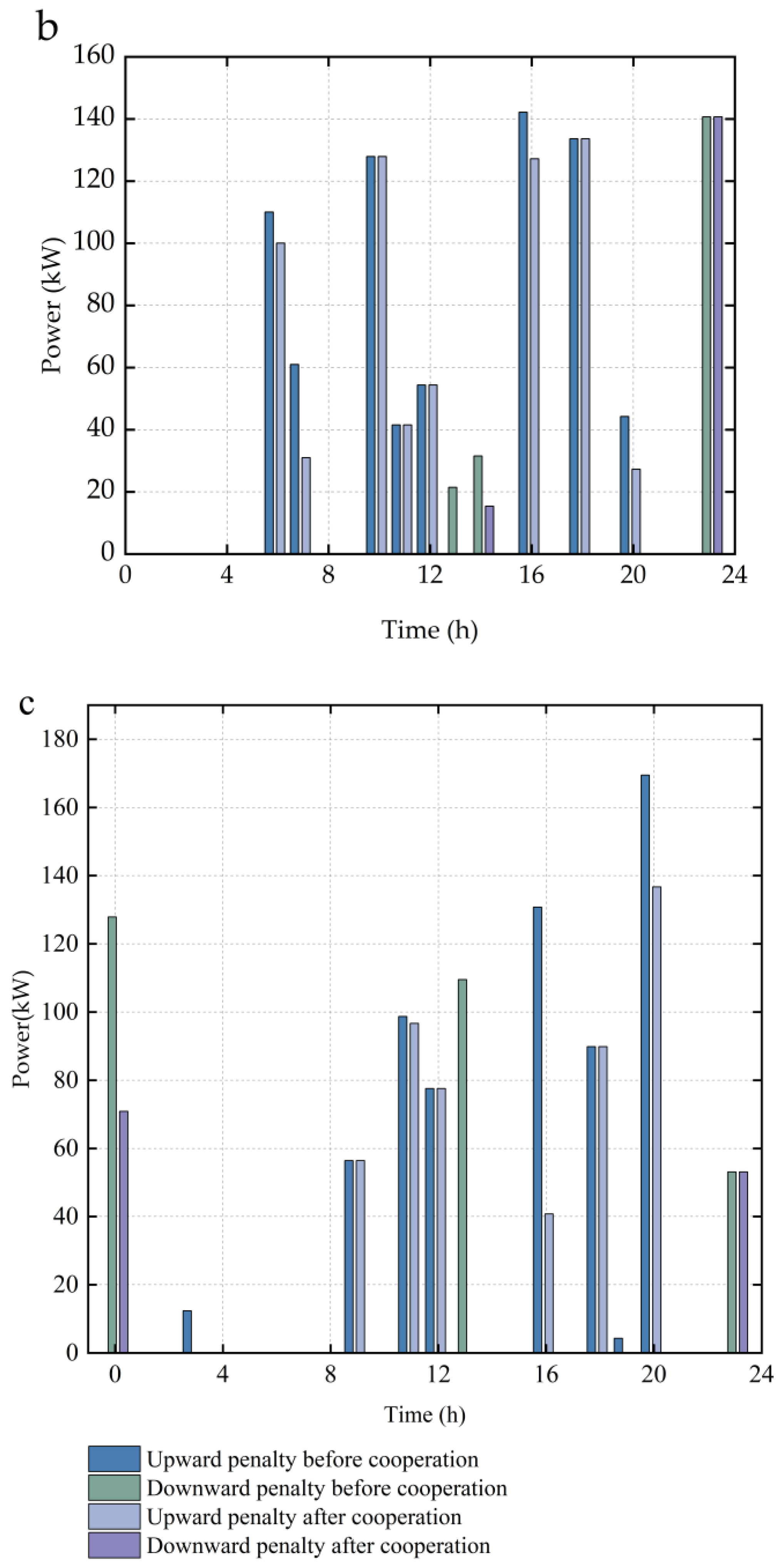
The frequency regulation deviation results of the EVCSs are shown in
Figure 8.
Table 4 compares the frequency regulation completion rates before and after cooperation.
As shown in
Figure 8, during midday hours with high volatility in PV output, the penalty curves for both upward and downward regulation are smoother and yield lower values under the cooperative scheme compared to the non-cooperative scenario. This improvement stems from the fact that, without cooperation, each EVCS could only rely on its own limited resources to respond to frequency regulation signals, often suffering from insufficient dispatchable potential. After forming a coalition, however, each EVCS pools its distributed EV regulation potential and PV output, creating an aggregated “flexibility resource pool” through sharing. This enables the optimal allocation of frequency regulation tasks. For instance, at 14:00, EVCS1 experienced high PV output but had inadequate upward regulation potential. At the same time, EVCS2 possessed abundant upward potential and thus assisted in absorbing this surplus power. According to
Table 4, after implementing energy sharing among the charging stations, the frequency regulation completion rates for EVCS1, EVCS2, and EVCS3 increased by 5.7%, 5.2%, and 4.4%, respectively, compared to their performance in the independent operation mode. The results indicate that by establishing an internal interaction mechanism through Nash bargaining, the EVCSs share the reliable frequency regulation potential aggregated from their EVs. This facilitates spatiotemporal complementarity of resources and consequently enhances the accuracy of the EVCSs in tracking frequency regulation signals.
5.5. Analysis of Transaction Optimization Results
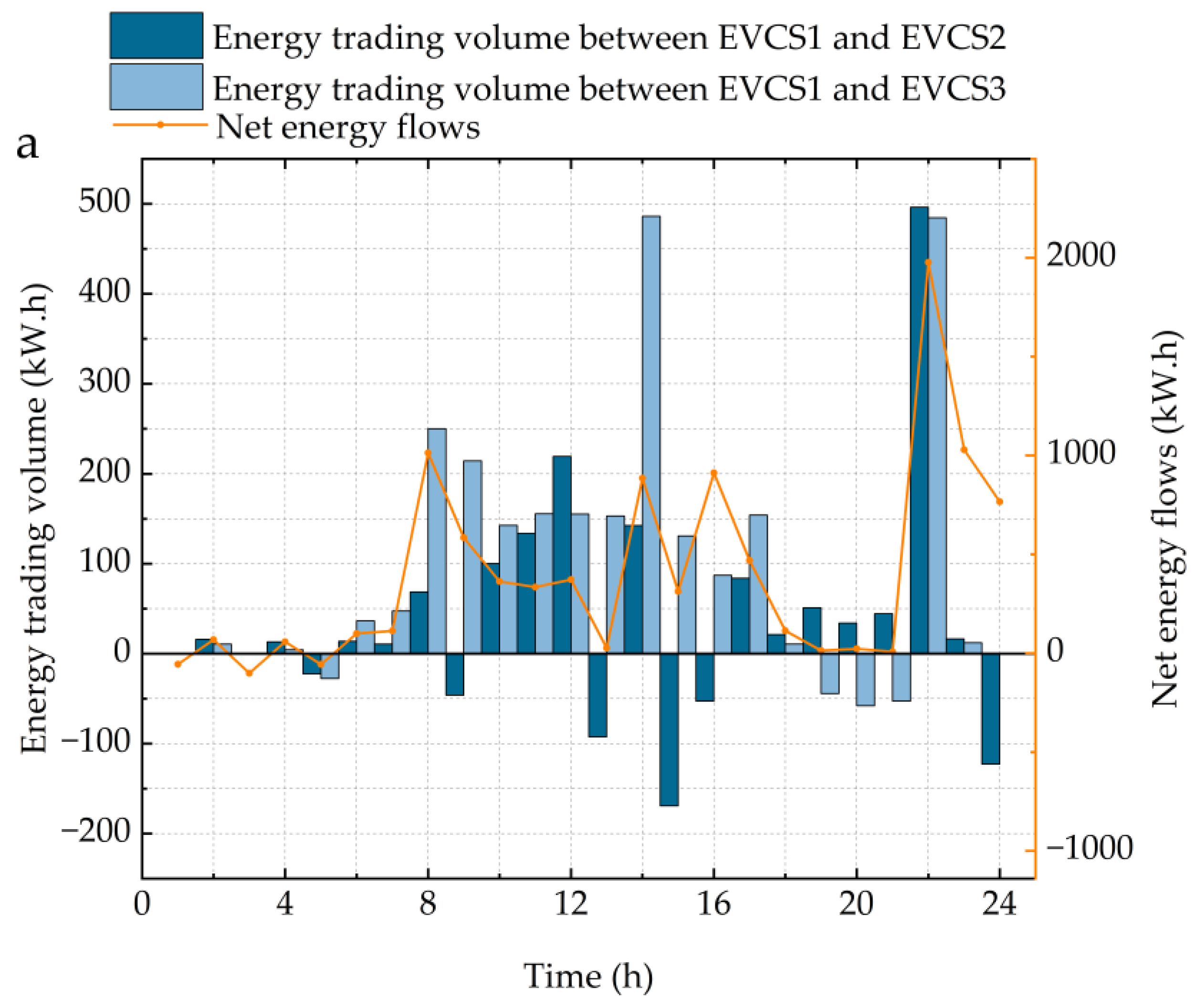
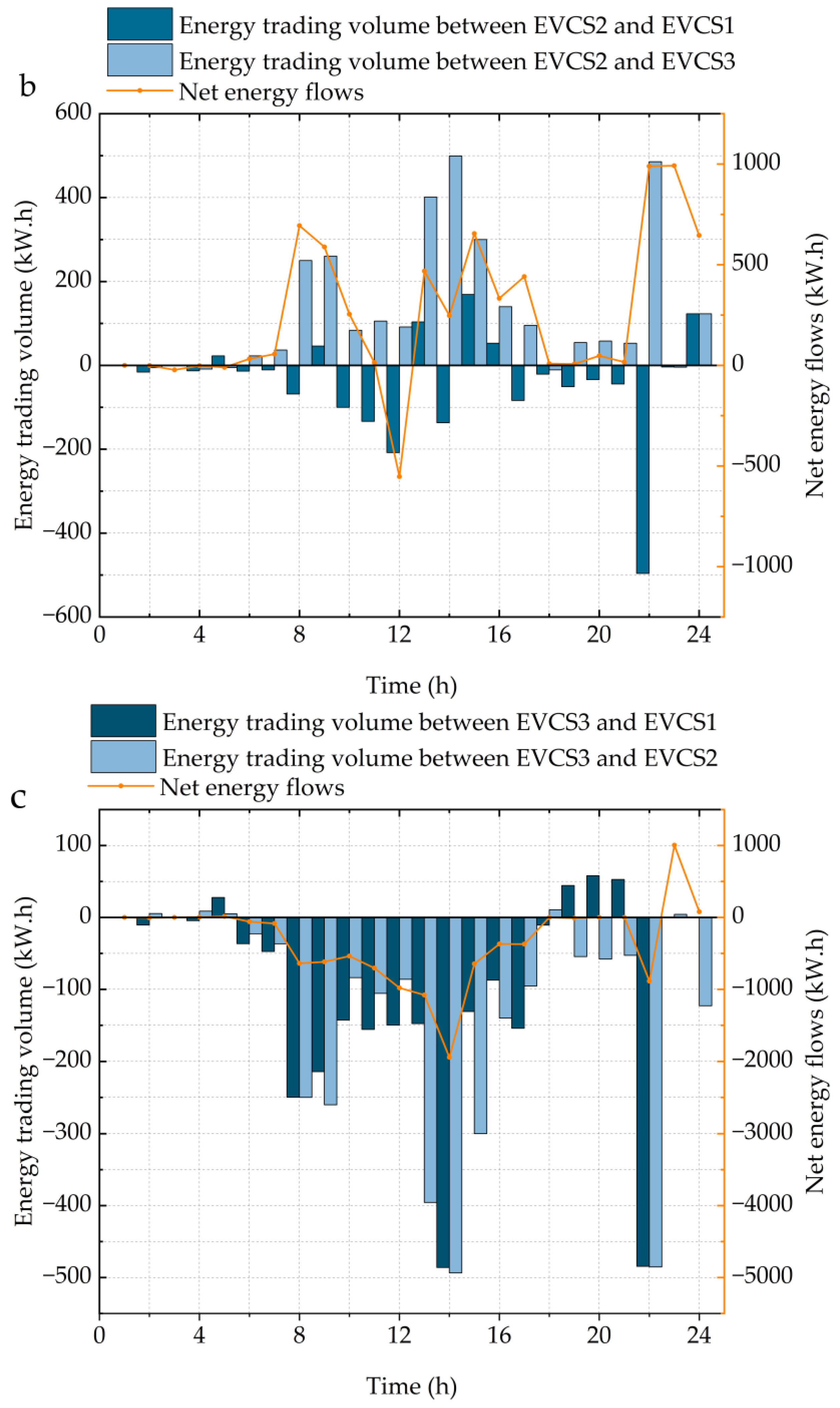
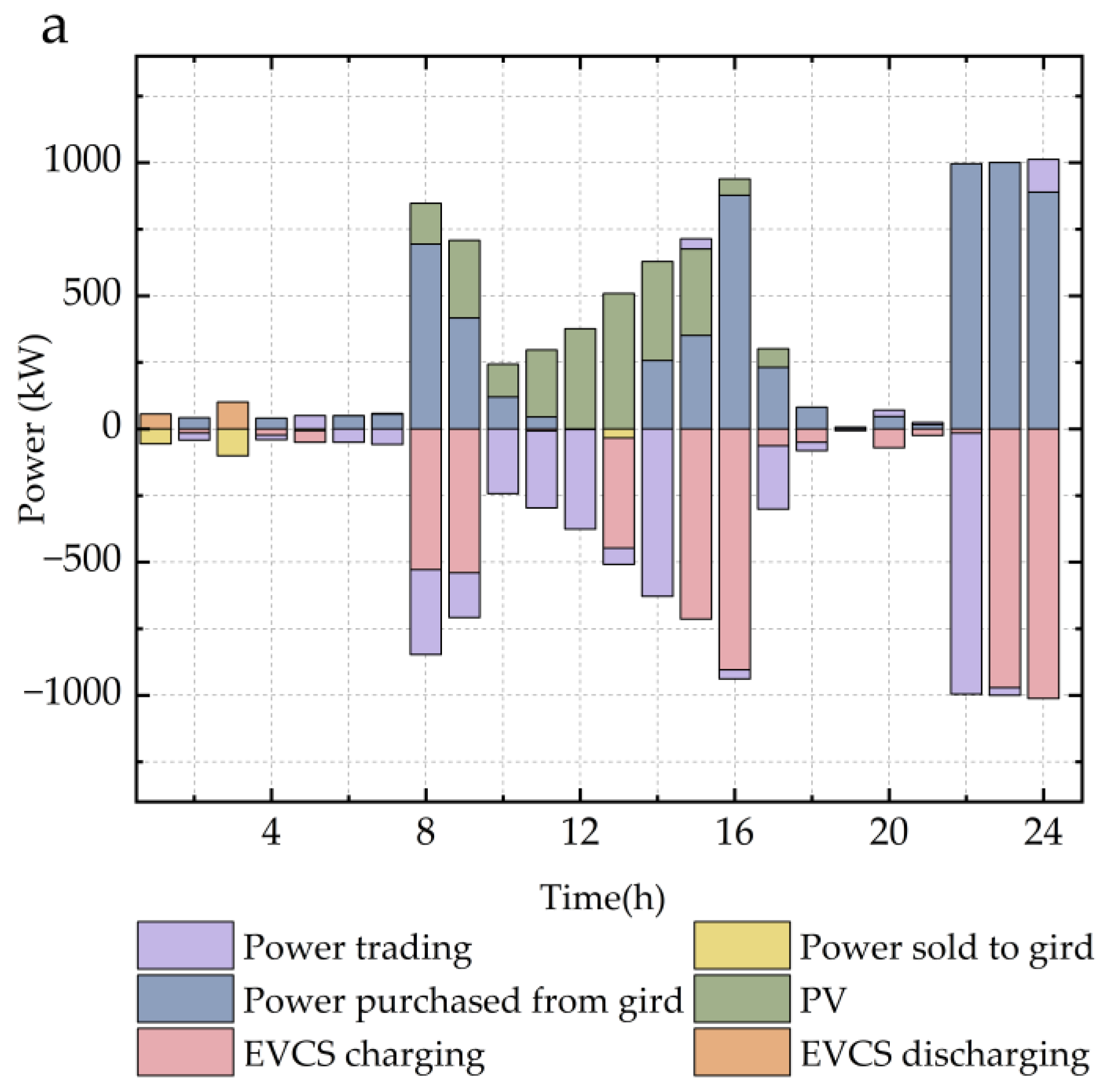
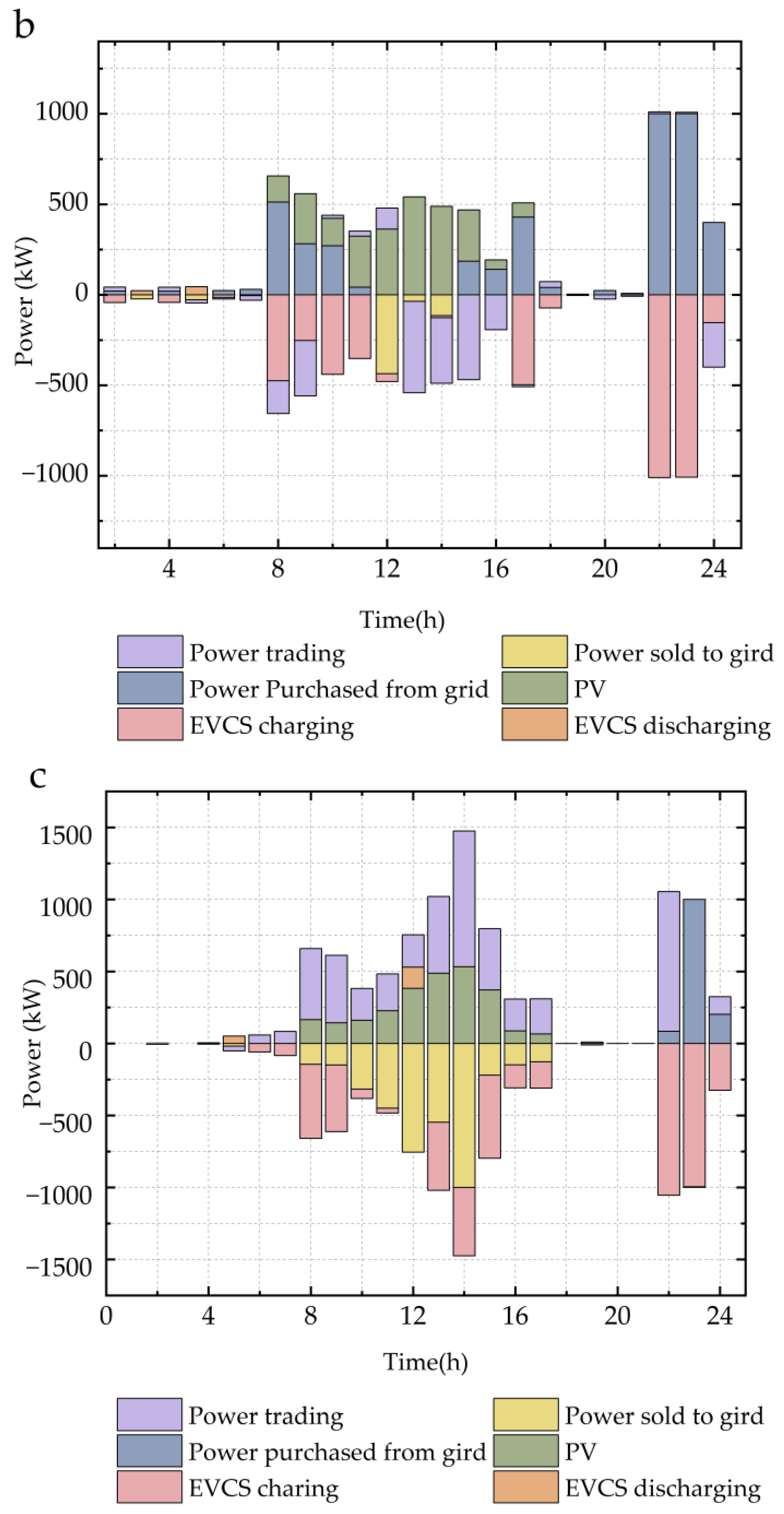
The power trading interactions among EVCSs are shown in
Figure 9. Net energy flow is defined as the sum of grid power and P2P power, where positive values indicate net power injection into the grid and negative values indicate net consumption.
As shown in
Figure 9, during the 1:00–7:00 period, the energy demand of each EVCS remained at low levels, with net energy flows fluctuating around zero and very limited internal power sharing among the stations. From 8:00–17:00, EVCS3 experienced power shortages, reaching a peak energy shortage at 14:00. To meet its supply demand, EVCS3 purchased a large amount of electricity from the coalition. During this period, EVCS1 had sufficient electricity and continuously supplied power to EVCS3. Meanwhile, EVCS2 shared its surplus power with EVCS3, while also purchasing electricity from EVCS1 between 12:00 and 14:00 to meet its own supply demand. During the 18:00–21:00 period, the energy flows of each EVCS fluctuated around zero, although some power transactions still occurred among the stations. At times of sharp fluctuations in frequency regulation demand, such as at 8:00 and 16:00, the EVCSs cooperatively allocated the aggregated resources to the station in greatest need, jointly satisfying the system’s frequency regulation signals. This effectively matched the spatiotemporal distribution of generation and load, thereby significantly enhancing the coalition’s onsite PV consumption and overall frequency regulation economic efficiency.
A comparison of energy sharing and combined frequency regulation contribution levels among the EVCSs is presented in
Table 5.
As shown in
Table 5, EVCS1 is the primary net power supplier within the coalition, while also exhibiting the smallest frequency regulation deviation. This confirms that EVCS1 not only contributes substantially to maintaining energy balance but also holds significant value in providing high-accuracy, fast-response frequency regulation ancillary services. EVCS2 ranks second in overall contribution level; its high energy contribution stems from its capability to supply power, yet its frequency regulation contribution is constrained mainly by its relatively large regulation deviation, resulting in a more limited role in regulation services. EVCS3, being a net energy consumer and having a larger output deviation in frequency regulation, shows the lowest overall contribution level. This situation directly reflects the respective bargaining power of each member within the cooperation.
The optimal power operational strategy for each individual EVCS is shown in
Figure 10.
Taking EVCS1 as an example for analysis, as shown in
Figure 10, the PV output of this charging station is primarily concentrated during the 8:00–17:00 period, while the electric vehicle charging load exhibits distinct scattered peaks, mainly occurring at 8:00–9:00, 13:00, 15:00–16:00, and during the late-night hours of 23:00–24:00. During periods when the PV output cannot fully meet the EV charging demand, the EVCS prioritizes purchasing power from the grid to ensure that vehicle charging needs are satisfied. When PV output is abundant, in addition to fulfilling the station’s own load requirements, the surplus power is traded with other EV charging stations through electricity sharing, thereby further increasing revenue and reducing overall operational costs. Furthermore, during the 1:00 and 3:00 intervals, owing to the presence of a power surplus, the station opts to sell the excess electricity to the grid to obtain additional income. Through the flexible switching of multiple operational modes, the dispatch strategy of EVCS1 not only makes effective use of PV resources but also achieves more economical operation via internal energy interactions within the coalition.
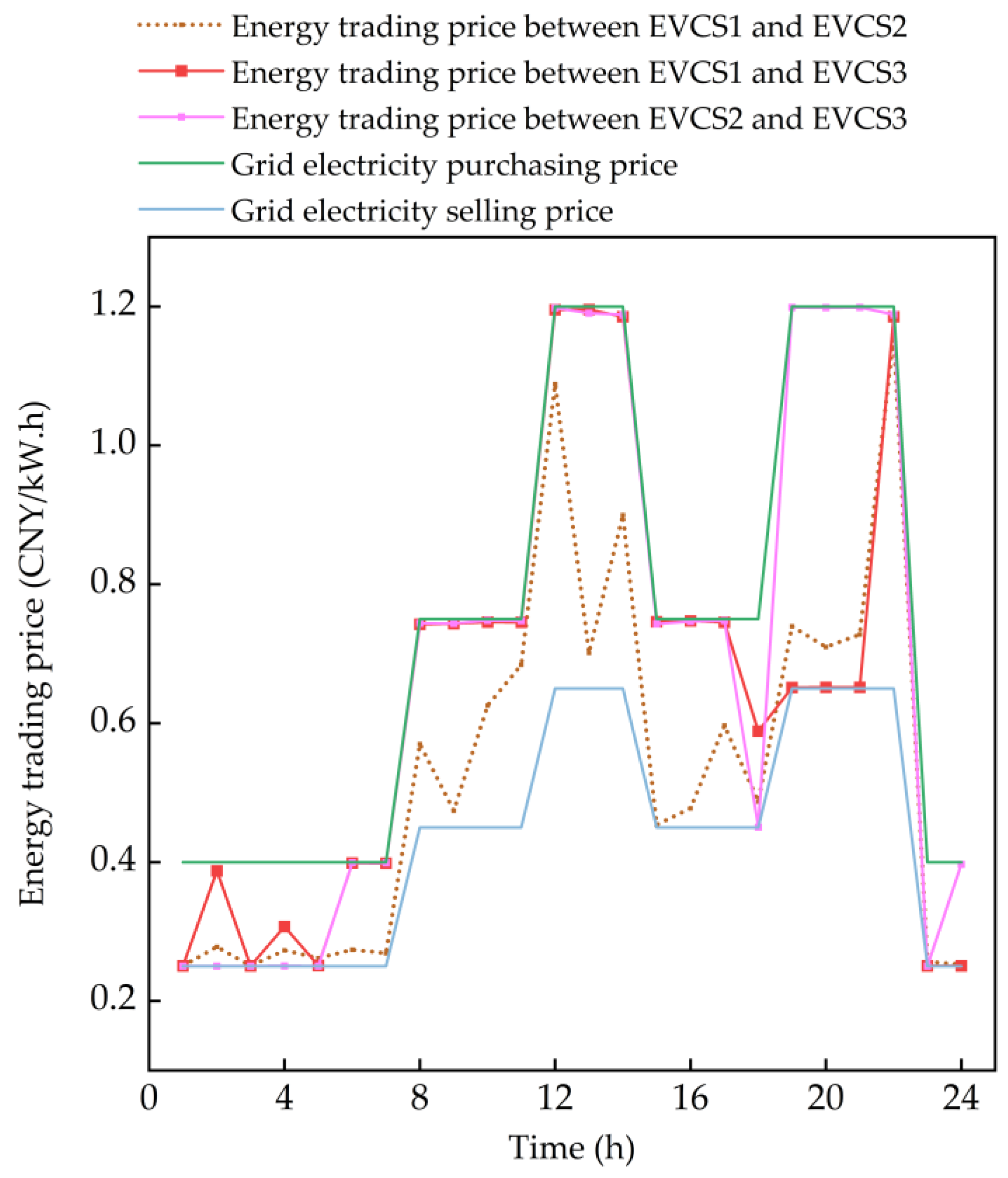
The trading prices after asymmetric Nash bargaining shown in
Figure 11.
As shown in
Figure 11, across all intervals, the internal trading prices consistently fall within the boundaries defined by the grid electricity selling price and the grid purchase price. Therefore, each EVCS can sell electricity when the grid electricity purchasing price is high and buy electricity when the grid electricity selling price is low. On this basis, engaging in P2P electricity trading can enhance the revenues of individual EVCSs within the coalition, thereby achieving the goal of minimizing total operating costs.
5.6. Transaction Benefits and Costs Analysis
The cost differences for each EVCS before and after participation in P2P energy trading are presented in
Table 6.
As shown in
Table 6, the operating costs of all EVCS are lower than those under standalone operation. Throughout the trading process, EVCS1 and EVCS2 increased their gains by supplying power to EVCS3, while EVCS3 incurred higher costs due to purchasing power from the other two stations. Compared with standalone operation, the cooperative operation among the EVCSs raised their respective gains by CNY 96.45, CNY 79.29, and CNY 15.18. These increased gains account for approximately 50.5%, 41.5%, and 8% of the total cooperative gains, respectively, verifying that the model can effectively enhance the economic performance of EVCSs.
To justify the selection of the exponential mapping function in the asymmetric Nash bargaining model, a comparative sensitivity analysis is conducted against the linear and logarithmic mapping schemes, as shown in
Table 7.
As illustrated in
Table 7, logarithmic mapping tends to equalize the benefit allocation, leading to a lack of sufficient differentiation among stations with varying contribution levels. While linear mapping facilitates proportional distribution, it fails to provide robust incentive signals for high-performing stations. In contrast, the exponential mapping adopted in this paper significantly amplifies the allocation proportion for high-contributing stations (e.g., EVCS1), effectively widening the disparity between participants. The results demonstrate that the exponential mapping approach establishes a more efficient allocation mechanism, incentivizing EVCSs to enhance their frequency regulation precision and commitment to P2P energy sharing.
To further examine the fairness and incentive properties of the proposed cooperative strategy, a sensitivity analysis is conducted on the relative weights assigned to frequency regulation contribution and energy sharing contribution in the bargaining-based profit allocation mechanism. The impact of contribution weights on profit allocation is shown in
Table 8.
As shown in
Table 8, when
is low (energy-weighted allocation), EVCSs with strong charging demand flexibility benefit more. When
is high (regulation-weighted allocation), stations providing upward/downward reserve gain a larger share.
The sensitivity analysis demonstrates that although the contribution weight does not affect the system-level optimization results, it plays a crucial incentive steering role. Specifically, increasing the contribution weight effectively encourages individual EVCSs to enhance their frequency regulation capabilities. However, excessively high or low values may create distribution imbalance. Moderate weighting (0.4 ≤ ≤ 0.6) achieves a balanced distribution while preserving cooperation stability.
Consequently, the adjustable contribution weight provides operational flexibility: System operators can emphasize reliability (higher ), whereas energy sharing alliances may emphasize mutual load balancing (lower ). This demonstrates that the proposed bargaining framework is not only fair but also adaptable to different market priorities.
5.7. Comparative Analysis of Different Bargaining Models
To validate the effectiveness of the proposed asymmetric Nash bargaining method, different bargaining models are compared and analyzed: Scheme 1: the conventional Nash bargaining model; Scheme 2: considering only the frequency regulation contribution level; Scheme 3: considering only the energy contribution level; and Scheme 4: the proposed asymmetric Nash bargaining model that integrates both frequency regulation and energy contribution levels. The comparative results are presented in
Table 9.
As shown in
Table 9, Scheme 1 employs the conventional Nash bargaining model, which overlooks the differentiated contributions of members in energy support and frequency regulation services. Consequently, EVCS1, the member with the highest contribution level, achieves a gain of only CNY 72.66, failing to reflect its value in frequency regulation support. This effectively transfers part of its deserved revenue to EVCS3, which has a lower contribution level. Such an incentive imbalance not only weakens the motivation for key members to improve service quality but also undermines the sustainability of the coalition. Although Schemes 2 and 3 introduce some focus in the allocation, they still exhibit limitations: Scheme 2 distributes revenue solely based on the frequency regulation contribution level, which benefits EVCS1 significantly but neglects EVCS2’s contribution to energy sharing; Scheme 3 considers only the energy contribution level, substantially compressing EVCS3’s gain. Both schemes rely on a one-sided evaluation of contribution levels and therefore cannot capture the comprehensive value provided by each member. Scheme 4, by incorporating the overall contribution level, achieves a balanced valuation of both energy and frequency regulation services. This mechanism ensures that revenue allocation strictly corresponds to actual contributions: the gain of EVCS1, the member with the largest contribution, is duly safeguarded; EVCS2’s gain increases by 42.8% compared to Schemes 2 and 3, while EVCS3’s gain rises by 18.9% relative to those schemes. The simulation results demonstrate that members who provide greater flexibility and superior service quality to the coalition receive commensurate economic returns, thereby ensuring the long-term stability and efficient coordinated operation of the coalition.
To further validate the necessity and effectiveness of the proposed bargaining mechanism, a comparison is conducted under two scenarios with and without the bargaining mechanism, and the results are shown in
Table 10. In this scenario, cooperative energy sharing is maintained, but the Nash bargaining-based benefit allocation mechanism is removed. Instead, revenue is allocated proportionally based on energy contribution.
As shown in
Table 10, the system-level total cost under the bargaining mechanism remains close to the fully cooperative model. However, without bargaining, individual profits become unevenly distributed, reducing economic incentives for smaller EVCSs and weakening long-term cooperation stability. This demonstrates that the bargaining mechanism primarily enhances fairness and incentive compatibility rather than total system efficiency.
5.8. Uncertainty-Based Optimization Analysis
5.8.1. Parameter Sensitivity Analysis
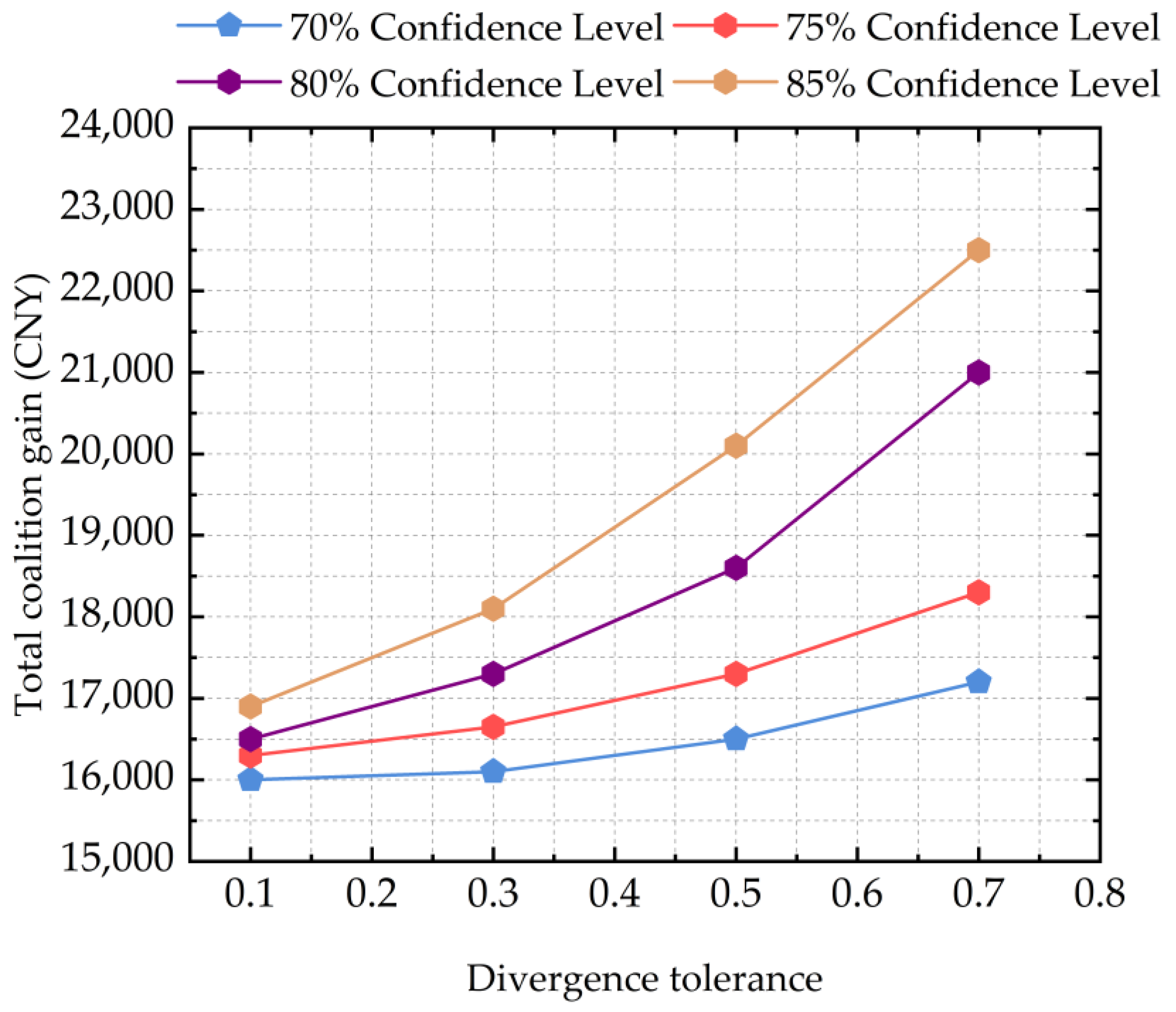
To verify the impact of photovoltaic output uncertainty within EVCSs on the coalition-wide performance, a parameter sensitivity analysis is conducted by varying the DRCC parameters.
As shown in
Figure 12, with the decrease in the confidence level, the chance constraints become less stringent in meeting the power balance and frequency regulation requirements of the PV charging stations, thereby reducing the conservatism of the dispatch decisions and correspondingly lowering the total operating cost of the coalition. Additionally, the total operating cost decreases as the ambiguity radius (divergence tolerance) is reduced. This is because a smaller divergence tolerance indicates a more compact distributional set for the uncertain photovoltaic output variable, making the worst-case scenario considered closer to the empirical distribution and thus reducing the conservatism of the DRCC model. Simulation results show that when the confidence level drops from 85% to 70%, the operating cost under the same divergence tolerance decreases significantly; while under the same confidence level, the cost increases as the divergence tolerance grows. For example, at a 70% confidence level, the cost rises by approximately 20.34% when the divergence tolerance increases from 0.1 to 0.7.
5.8.2. Comparative Analysis of Uncertainty Optimization Methods
To verify the effectiveness of the proposed DRCC model based on KL divergence, a comparative study is conducted with SO and RO. As indicated in
Table 11, SO, which makes decisions based on expected scenarios, achieves the lowest cost. However, this approach neglects the default risk associated with actual photovoltaic power fluctuations, resulting in an overly optimistic optimization outcome. In contrast, the RO method accounts for the worst-case scenario, thereby ensuring system robustness but at the expense of excessively high economic cost. Comparatively, the optimization results from the DRCC model employing KL divergence lie between those of SO and RO. This method does not rely on precise probability distributions for uncertain variables such as PV output. Instead, it constructs an ambiguity set of probability distributions using limited historical data or empirical information. By making dispatch decisions that consider the worst-case distribution within this ambiguity set, the EVCS ensures economically efficient operation at a predetermined confidence level when confronted with real-world distributional uncertainties.
To verify the necessity of DRCC in addressing PV uncertainty and ensuring system robustness, a comparative experiment with and without DRCC is conducted to investigate its role in balancing system economy and frequency regulation reliability. As shown in
Table 12.
In this scenario, the DRCC is removed and replaced by a deterministic constraint based on the empirical mean value of PV output. All other model settings remain unchanged.
As shown in
Table 12, when the DRCC is removed, the total operating cost decreases by approximately 7% due to the reduced conservativeness of the scheduling model. However, this approach leads to a significant increase in frequency regulation violations, particularly under conditions of high PV volatility. This stark contrast indicates that while removing DRCC may improve short-term economic performance, it compromises operational robustness under uncertainty.
5.9. Scalability Analysis
To evaluate scalability, the number of EVCSs is increased from the base case to 5, 10, and 20 stations. The load and PV profiles are proportionally expanded with heterogeneous arrival patterns, as shown in
Table 13.
As shown in
Table 13, the total system cost reduction increases with aggregation size due to improved spatial complementarity. Additionally, the frequency regulation capacity increases approximately linearly with the system scale. The computational time grows moderately, confirming the tractability of the proposed solution framework. Specifically, when the number of EVCSs increases to 20, the total cost reduction improves by 35.6% compared to standalone operation, and the regulation revenue increases by 372%. Importantly, the optimization problem remains solvable within an acceptable computation time.
6. Conclusions
To address the challenges of insufficient frequency regulation capability, sub-optimal economic efficiency, and unfair benefit allocation among individual EVCSs under PV uncertainty, this paper proposed a coordinated optimization framework for multiple EVCSs participating in P2P energy sharing and joint frequency regulation. By integrating M-sum-based EV aggregation, KL divergence-based DRCC, and an asymmetric Nash bargaining mechanism, the proposed model effectively addresses the coupled challenges of economic efficiency, operational robustness, and benefit fairness in a multi-station cooperative environment.
The research results demonstrate that the proposed framework significantly enhances the operational economics and frequency regulation performance of the system. By leveraging the inherent spatial-temporal complementarity among different EVCSs, the coordinated aggregation of regulation resources notably improves the frequency regulation completion rates of individual stations, with the coalition-wide completion rate increasing from 92.9% to 97.4%. In terms of economics, the coordinated operation reduces the total operating cost of the coalition from CNY 16,187.61 under the non-cooperative mode to CNY 15,997.47. Furthermore, the introduction of the asymmetric Nash bargaining mechanism ensures a fair and incentive-compatible profit allocation based on multidimensional contributions. By explicitly pricing the marginal contribution of each station, this mechanism fundamentally circumvents the “free-riding” phenomenon of benefiting without substantial contribution and stimulates the active participation of individual stations in cooperative scheduling.
The proposed approach offers significant practical implications for both EVCS operators and the power grid. For operators, it diversifies revenue streams by simultaneously monetizing energy flexibility and regulation capabilities, while guaranteeing risk-aware scheduling under PV uncertainty. For the grid, the aggregated multi-EVCS forms a reliable virtual flexibility resource that improves regulation tracking accuracy. Despite these advantages, it should be acknowledged that the validation of the proposed framework currently remains simulation-based, providing a theoretical and numerical proof-of-concept rather than empirical field results. Furthermore, the current study is limited to day-ahead scheduling without explicitly modeling real-time frequency dynamics, and it assumes static contribution weights during the bargaining process.
To further extend this research, future work will focus on integrating real-time dynamic frequency response models and battery life-cycle degradation models into the coordinated scheduling framework. Additionally, the existing model will be extended to incorporate explicit ancillary service market-clearing mechanisms and price uncertainties, along with the development of an adaptive bargaining weight strategy driven by market signals. Finally, we will conduct scalability analyses for large-scale EVCS networks under shorter dispatch intervals to ensure the practical applicability of the framework in complex power systems.