Article

Controller Synthesis of an Energy Generation System Under State and Input Constraints

by
Ouiza Adjemout
1,
Hamid Bentarzi
1 and
Abdallah Hedir
2,3,*
1
Signals and Systems Laboratory, IGEE, University of M’hamed BOUGARA of Boumerdes, Boumerdes 35000, Algeria
2
Laboratoire de Technologies Avancées en Génie Electrique, Université Mouloud Mammeri de Tizi Ouzou, Tizi-Ouzou 15000, Algeria
3
Advanced High Voltage Engineering Centre, School of Engineering, Cardiff University, Queen’s Buildings, The Parade, Cardiff CF24 3AA, UK
*
Author to whom correspondence should be addressed.
Energies 2026, 19(5), 1249; https://doi.org/10.3390/en19051249
Submission received: 5 February 2026 / Revised: 25 February 2026 / Accepted: 26 February 2026 / Published: 2 March 2026
(This article belongs to the Section F: Electrical Engineering)

Abstract

This paper deals with state feedback control synthesis for a boiler-turbine system using a set invariance property and a piecewise affine modelling procedure. The nonlinear model of the considered system is linearized around different equilibrium points. After that, the obtained piecewise affine model is exploited to design feedback gains that guarantee compliance with state and control constraints, as well as asymptotic stability of the closed-loop system. The feedback gains are computed by solving a linear programming problem, which can be achieved by numerous effective solvers. Finally, the validity and efficacy of the proposed approach are demonstrated through a numerical example.

1. Introduction

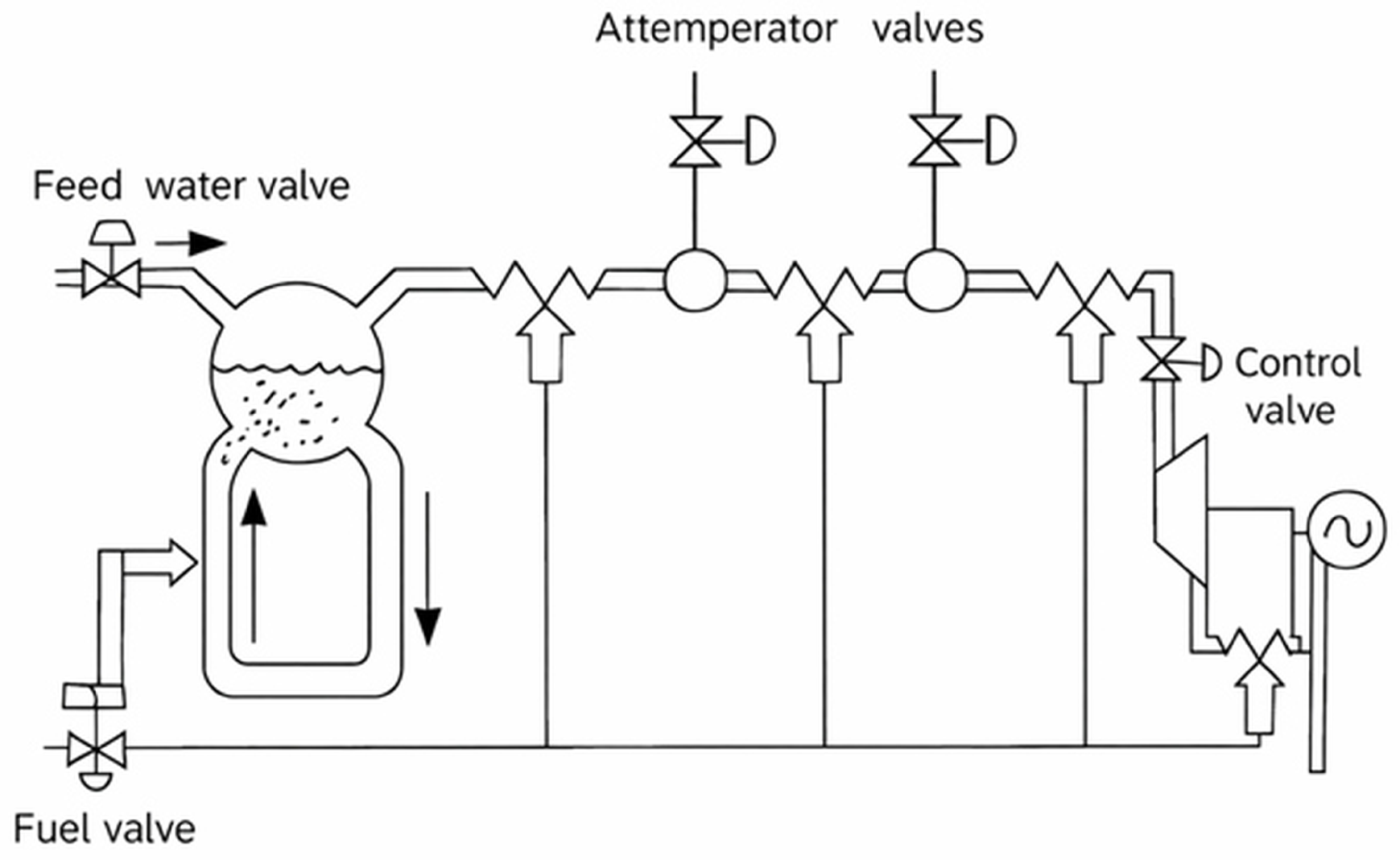
A boiler-turbine system, illustrated in Figure 1, is a conventional energy production system in which the steam is generated at high pressure and temperature conditions, and subsequently transformed into mechanical energy through a turbine.
The controller in these systems must match the electricity demand and maintain the drum pressure and water level within given values. Hence, the controller synthesis must consider the strong coupling inherent in the system dynamics, as well as the presence of multiple constraints on the control inputs and state trajectories.
Several strategies have been explored to address the control problem of nonlinear boiler-turbine systems. These strategies can be classified into two categories. The first directly exploits the nonlinear model to derive control laws for the plant [1,2,3,4]. The second, which is more prevalent, relies on linearizing the nonlinear Boiler-turbine dynamics around representative operating points. Within this framework, both control design and system analysis have been investigated in [5,6]. Specifically, Ref. [5] examines the implementation of a conventional controller like (PI and LQR), where the control parameters are optimized using genetic algorithms. In [6], it is demonstrated that the impact of nonlinearities can be reduced, allowing for the design of a controller that is effective within a specified operating domain. A fractional-order PID controller combined with iterative learning control was proposed in [7] to achieve the stability, robustness, and disturbance rejection properties of the synthesized controller.
Due to the hard constraints on both the control and state vectors, Model Predictive Control (MPC) has been widely used over the last decade for the control synthesis of boiler-turbine systems. Lawrynczuk [8] addressesd the boiler-turbine control problem through MPC based on an online successive linearization procedure. A multi-model Takagi–Sugeno (TS) fuzzy approximation of the nonlinear dynamics, derived via linearization, is proposed in [9], while fuzzy predictive control methods are developed in [10,11] for power output regulation under disturbances and uncertainties. These works demonstrate superior robustness compared with conventional MPC formulations. Furthermore, Ref. [11] extends this approach by introducing a fuzzy economic MPC (EMPC) scheme that incorporates optimization with respect to load demand and energy efficiency. In [12], artificial-intelligence-based methodologies have been introduced, such as the recurrent fuzzy neural network model employed to capture boiler-turbine dynamics and enhance the closed-loop performance. More recently, the authors in [13] proposed an error-compensated strategy that combines an extended-state Kalman filter with model predictive control (MPC) to improve the controller performance.
The hybrid system framework has also proven to be an effective tool for both modeling and controller design in boiler-turbine systems. In [14], the plant is represented by discrete-time piecewise affine (PWA) models obtained from linearization at multiple operating points, and explicit MPC is compared against an H controller. Similarly, the mixed logical dynamical (MLD) formulation based on PWA linearization is investigated in [15]. An event-triggered control mechanism combined with a state-dependent switching rule ensuring exponential convergence is proposed in [16], while a PWA-based approximation of the nonlinear model along with a corresponding PWA controller was presented in [17]. Constrained piecewise affine (PWA) systems are typically controlled through model predictive control (MPC) strategies, as highlighted by Camacho and Bordons [18]. The optimal input sequence is computed, online, by solving a quadratic optimization problem, respecting the state and input constraints across a receding prediction horizon. The authors in [19] addressed the heavy computational demands of this online process by developing an explicit mpQP-based solution. This precomputed method produces a piecewise affine (PWA) feedback control law. Nevertheless, it faces challenges from the exponential growth in critical polyhedral regions is required to represent the feedback function. In contrast, control synthesis using polyhedral invariant sets remains underexplored for piecewise affine (PWA) systems. Building on this, the authors in [20] applied polyhedral invariance to piecewise linear (PWL) systems, while in [21] the concept was extended to PWA systems with dwell-time switching.
Motivated by existing research, this study develops control laws for a boiler-turbine unit represented as a discrete-time piecewise affine (PWA) system. The underlying nonlinear dynamics are approximated through linearization around selected operating points. Our methodology designs state-feedback controllers to achieve asymptotic stability while adhering to state/input constraints, utilizing positive invariance, contractivity, and the extended Farkas Lemma [22]. In contrast with prior solutions based on optimal control [23] or predictive schemes [24], our approach employs geometric inclusion of polyhedra to formulate LMI-based conditions, thereby extending and improving upon [20] for piecewise linear systems to the broader PWA setting. This extended methodology is demonstrated on the boiler-turbine system. Furthermore, necessary and sufficient conditions are introduced to enforce constraints on the control input rate.
The remainder of this paper is organized as follows. Section 2 presents a nonlinear model of the boiler-turbine system along with its piecewise affine (PWA) representation. Section 3 formulates the control problem. Section 4 derives necessary and sufficient conditions for closed-loop system convergence. Finally, Section 5 validates the proposed methodology through a numerical example.

Notation

Table 1 summarizes the principal notation employed throughout this paper along with their corresponding explanations.

2. Boiler-Turbine Mathematical Model

Many nonlinear models of boiler-turbine dynamics have been developed, among them the Bell and Åström model [25] and the Flynn and O’Malley model [26]. In this work, the model introduced by Bell and Åström, representing a 160 MW power plant, is adopted. The model parameters were estimated using data obtained from the Synvendska Kraft AB plant in Malmö, Sweden [25]. The nonlinear state-space model describing the dynamic behaviour of the boiler–turbine system is given by the following equations:
d x 1 ( t ) d t = 0.0018 u 2 ( t ) x 1 9 / 8 ( t ) + 0.9 u 1 ( t ) 0.15 u 3 ( t ) , d x 2 ( t ) d t = ( 0.073 u 2 ( t ) 0.016 ) x 1 9 / 8 ( t ) 0.1 x 2 ( t ) , d x 3 ( t ) d t = 1 85 ( 141 u 3 ( t ) ( 1.1 u 2 ( t ) 0.19 ) x 1 ( t ) ) .
where x 1 , x 2 , and x 3 denote the drum pressure ( kg / m 3 ) , the electrical output power (MW), and the fluid density ( kg / m 3 ) , respectively. The control variables u 1 , u 2 , and u 3 represent the valve positions for fuel flow, steam flow, and feed-water flow, respectively. The outputs y 1 , y 2 , and y 3 of the system are the drum pressure ( kg / m 3 ) , the electrical output power (MW), and the drum water-level deviations (m), respectively.
The outputs variables of the considered system are:  
y 1 = x 1 y 2 = x 2 y 3 = 0.13073 x 3 + 100 a c s + q e / 9 67.975 20
where a c s and q e are the steam quality and the evaporation rate, respectively, which are given by:
a c s = 1 0.001538 x 3 ( 0.8 x 1 25.6 ) x 3 ( 1.0394 0.0012304 x 1 )
q e = ( 0.85 u 2 0.147 ) x 1 + 45.59 u 1 2.514 u 3 2.096
The control variables must evolve within the interval [ 0 , 1 ] . Additionally, the rate of change of the derivative control vector components is also constrained as follows:
0.007 d u 1 ( t ) d t 0.007 , 1 d u 2 ( t ) d t 0.02 , 0.05 d u 3 ( t ) d t 0.05 ,

Piecewise Affine Model Approximation

In this subsection, the nonlinear model (1) is approximated as a PWA system, a class extensively explored in the literature [27,28,29]. Notice that PWA class of systems are analogous to mixed logical dynamical hybrid systems [30]. In addition, PWA systems are widely used in Model Predictive Control strategies. Moreover, many nonlinear systems can be approximated as PWA models [31,32].
In our context, the nonlinear model in (2) is approximated as a PWA model. More precisely, a linearization procedure using Taylor series at nominal operating points is performed to enhance the exploitability of the studied system for control purpose. The functioning around an operating point defines an operating mode or an operation phase. The linearization process results in the piecewise affine models, which are expressed as:
x ˙ ( t ) = A r x ( t ) + B r u ( t ) + a r ,
where:
  • x ( t ) and u ( t ) are already introduced
  • A r = f ( x , u ) x | ( x c r , u c r ) , is the state matrix for the operating point of the mode r,
  • B r = f ( x , u ) u | ( x c r , u c r ) , is the control matrix for the operating point of the mode r,
    a r R n is an additive constant vector for the operating point of the mode r,
  • with r represents the r t h operating mode, and a r = A r x c r B r u c r .
The couple ( x c r , u c r ) represents the operating point of the mode m r .
Table 2 reproduces the most commonly used operating points [9], denoted as m i , of the boiler-turbine system given in (1). For each operating point, the values of the control inputs and the states are provided.
As pointed out by [11], the system of (4) obtained after linearization is dependent solely on the variable x 1 , which represents the drum pressure. The validity range of each operating mode is given in Table 3.
To illustrate the method, two (2) typical operating modes (mode m 2 and mode m 3 ) are considered; model 2 is obtained by linearization around the operating point m 2 . The linearization procedure gives the following matrices,
A 2 = 0.0022 0 0 0.0585 0.1000 0 0.0058 0 0 ,   B 2 = 0.9000 0.3100 0.1500 0 12.5732 0 0 1.2579 1.6588   and   a 2 = 0.2134 8.4422 0.7809 .
The validity range of x 1 for this mode is: 91.8 x 1 102.6 .
Model 3 corresponds to the nominal operating mode m 3 , the linearization produces the following matrices:
A 3 = 0.0025 0 0 0.0694 0.1000 0 0.0067 0 0 ,   B 3 = 0.9000 0.3490 0.1500 0 14.1555 0 0 1.3976 1.6588   and   a 3 = 0.2701 10.5975 0.9664 .
The validity range of x 1 for this mode is: 102.6 x 1 113 .
The system in Equation (4) is discretized using a sampling time θ . The resulting discrete-time model is given by:
x ( k + 1 ) = ( θ A r + I 3 ) x ( k ) + θ B r u ( k ) + θ a r ,
where:
  • x ( k ) and u ( k ) are the state and control input vectors, respectively.
  • A r , B r , and a r are defined below.
As in Lawrynczuk’s work [8,33], the sampling time is choosen to be 1 s ( θ = 1 s). This is due to the slow dynamics of system (1), which is characterized by a settling time of t s = 1591.4  s.
Without loss of generality, the discretized model is expressed as:
x ( k + 1 ) = A r x ( k ) + B r u ( k ) + a r ,
where: A r : = A r + I 3 .

3. Control by Invariance of Boiler-Turbine System Modelled by PWA Models

First, some basic materials that will be used in the control synthesis are introduced.
Definition 1
([34]). The intersection of closed half-spaces defines a polyhedron, denoted by P ( G , g ) = x R n , G x g , where G R q × n , g R q , q , n N .
A polytope is a closed and bounded polyhedron.
Definition 2
([35]). The polyhedron P ( G , g ) is positively invariant for the system (5) if the condition:
x ( k ) P ( G , g ) x ( k + 1 ) P ( G , g ) ,
holds true for all k.
The set P ( G , g ) is said to be the controlled invariant for the system (5) if there u for which the system is positively invariant [35].
Definition 3
([35]). A polytope P ( G , g ) is said to be contractive for the system (5) if there exists a positive λ < 1 , ensuring:
x ( k ) P ( G , g ) x ( k + 1 ) P ( G , λ g ) ,
for all k.
Lemma 1.
(Extended Farkas Lemma) [22] The following inclusion of polyhedra holds
P ( P , p ) P ( G , q )
if and only if there exists a nonnegative matrix H of appropriate dimensions, such that
G = H P H p q .

3.1. Problem Formulation

The nonlinear dynamics in Equation (1) are approximated by a discrete-time piecewise affine (PWA) model. A stabilizing state-feedback controller is designed to respect both the input and state constraints of this PWA representation.
Hypothesis 1.
In the considered study, the boiler-turbine state variables are assumed to be available either by measurement or reconstructed by a state observer.
As pointed out in the linearization step, the dynamic of each mode is defined over a set defined by:
P ( G r , g r ) = x R 3 , G r x g r ) .
It is also assumed that the dynamics of the resulting PWA model are continuous, i.e., no jump phenomena occur in the state dynamics.
The system (5) is controlled by:
u ( k ) = F r ( x ( k ) x d ) + u d ,
where F r R 3 × 3 is the feedback gain for the mode r.
According to the expression of the control vector (9), the closed loop system is expressed by:
e ( k + 1 ) = A r b f e ( k ) + a ¯ r ,
with: e ( k ) = ( x ( k ) x d ) , A r b f = A r + B r F r and a ¯ r = A r d x d + B r d u d + a r .
Notice that the desired state and control vectors ( x d , u d ) defines an operating mode, therefore, A r d x d + B r d u d + a r d = 0 hold true.
The state of our system is constrained to remain positive and must not exceed specific limits. Hence, the state x ( t ) must belong to a polytopic convex set, given by
P ( Q , g ) = e ( t ) R n , Q x ( k ) g ,
which becomes:
P ( Q , μ ) = e ( t ) R n , Q e ( k ) μ ,
where: μ = g Q x d 0 and e = x x d .
As introduced in Section 2, the control vector components values must belong within the interval [0, 1]. So, the control vector must respect:
U m i n u ¯ ( k ) U m a x .
where, u ¯ ( k ) = u ( k ) u d . Substituting (9) in the last inequalities, the following polyhedral form is obtained,
P ( S r , ρ ) = e ( k ) R 3 , S r e ( k ) ρ ,
with S r = F r F r and ρ = U m a x U m i n .
In boiler-turbine systems, the rate of change of the control inputs is constrained by
v ̲ d u ( t ) d t v ¯ ,
which, in discrete form, becomes
v ̲ u ( k ) u ( k 1 ) v ¯ .
By considering the control and state evolution expressions, the following inequalities are obtained:
v ̲ F r ( x ( k ) x ( k 1 ) ) v ¯
leading to:
v ̲ F r A r ¯ ( x ( k 1 ) x c r ) + F r B r ( u ( k 1 ) u c r ) v ¯
Taking, for all k, x ^ ( k ) = x ( k ) x c r and u ^ ( k ) = u ( k ) u c r , these constraints induce, for each mode, a convex polytopic set
P ( M r , ζ ) = x ¯ R 6 | M r x ¯ ( k ) ζ , r = 1 , , N
with x ¯ = x ^ u ^ , M r = F r A r ¯ F r B r F r A r ¯ F r B r , ζ = v ¯ v ̲ and A r ¯ = ( A r I 3 ) .
  • Considering the previous constraints on the state and control vectors, the vector x ¯ is defined in the following set
    P ( P , p r ) = x ¯ R 6 , P x ¯ p r .
    where: P = Q 0 0 C and p r = μ ¯ r ρ r , with μ ¯ r = μ Q x c r and ρ r = ρ C u c r . The matrix C is related to the control constraints given in (13).

3.2. Control Synthesis

This subsection aims to develop a control law structured like (9) that achieves two key objectives: guaranteeing the asymptotic convergence to equilibrium for the system in (10), and rigorously adhering to the constraints placed on both state variables and control inputs. The presented methodology offers a structured approach to concurrently satisfy stability and feasibility demands, critical for real-world boiler–turbine control implementations.
In this class of systems, each mode r is associated with a polyhedral region denoted by P ( G r , g r ) . The intersection P ( Q , μ ) P ( G r , g r ) , yields a family of sets P ( Q r , μ r ) , where
Q r = Q G r , μ r = μ g r .
The invariance property for this category of piecewise affine systems can be stated as follows.
Theorem 1.
The polyhedron P ( Q , μ ) is positively invariant with respect to the dynamics (10) if and only if there exist non-negative matrices H r , satisfying:
H r Q r = Q A r b f , H r μ r μ ¯ r ,
for each mode r, with μ ¯ r = μ Q a ¯ r .
Proof. 
By definition, P ( Q , μ ) is positively invariant for (10) if, for every e ( k ) P ( Q r , μ r ) , the successor state satisfies e ( k + 1 ) P ( Q , μ ) . This is equivalent to requiring that
A f r e ( k ) + a ¯ r P ( Q , μ ) , e ( k ) P ( Q r , μ r ) .
In the same way, this condition can be stated as e ( k ) P ( Q A f r , μ ¯ r ) , where μ ¯ r = μ Q a ¯ r . Hence, the invariance holds for each mode, when
P ( Q r , μ r ) P ( Q A f r , μ ¯ r ) .
The algebraic conditions in (19) are then obtained by the application of Lemma 1.
The conditions in the proposition below enable the synthesis of controller of the form (9) in the presence of constraints on the control vector (13).    □
Proposition 1
([20]). The constraints on the control vector (13) are respected for each mode r, if and only if there exist matrices D r and D r * with non-negative entries for which the conditions:
D r Q = F r D r μ U m a x
and
D r * Q = F r D r * μ U m i n
hold true.
The following proposition provides necessary and sufficient conditions that guarantee the respect of constraints on the derivative of the control vector (16).
Proposition 2.
The constraints (16) on the rate of the control vector are satisfied for each mode r, if and only if there exist non-negative matrices L r , such that the conditions:
L r P = M r L r p r ζ
are satisfied.
Proof. 
The constraints in (16) are respected, if and only if
x ¯ P ( P , p r )   then   x ¯ P ( M r , ζ ) ,
hold true for each mode r. The conditions in (22) come down immediately using extended Farkas lemma.    □
Remark 1.
It is noteworthy that this contribution was originally developed in the context of a boiler-turbine control problem, where a necessary and sufficient condition guaranteeing the satisfaction of the control input rate constraints was first introduced.
As stated in [35], the invariance conditions stated in (19) are not sufficient to guarantee the convergence of the closed-loop trajectory (10) to the desired operating mode. A necessary and sufficient condition to ensure the asymptotic stability of a system within a polytopic convex set is to guarantee its contractivity for the considered system [35]. Theorem 2 provides necessary and sufficient conditions ensuring the contractivity of the polytope P ( Q , μ ) for the system in (10), which in turn guarantees the convergence of the system trajectories in (10) to the desired operating mode.
Theorem 2.
The polytopic set P ( Q , μ ) is contractive for the system (10), if and only if there exist non-negative matrices H r , and a positive λ < 1 , such that the following conditions hold:
H r Q r = Q A r b f H r μ r λ μ ¯ r .
for r 1 , , N and with μ ¯ r = μ Q a ¯ r .
Proof. 
The contractivity condition stated in Definition 3 is interpreted, in our context, as follows:
e ( k ) P ( Q r , μ r ) A f r e ( k ) + a ¯ r P ( Q , λ μ ) .
Consequently, the contractivity condition is expressed by the following inclusions:
P ( Q r , μ r ) P ( Q . A f r , μ ¯ r ) ,
for each mode r, with μ ¯ r = λ μ Q a ¯ r .
The condition (23) is derived by applying Lemma 1.    □
Remark 2.
The explicit state feedback gains solution of the linear programming (20)–(23) are computed offline. The system is then looped by these feedback gains in an online way. Indeed, this is the major benefits of the proposed method compared to the MPC based control.

4. Numerical Example

Consider a boiler-turbine system modeled by the equations in (1), approximated by the discrete piecewise affine system in (5), and controlled by the feedback law in (9). Our goal is to drive the closed-loop system (10) to the desired operating point 3. The state of the system in (5) is constrained to evolve within the following range:
μ 2 x ( k ) μ 1 ,
with,
μ 1 = 150 130 500   and ,   μ 2 = 0 0 0 .
Yielding to
μ 2 x d e ( k ) μ 1 x d ,
which is equivalent to:
P ( Q , p ) = e ( k ) , Q e μ ,
where Q = I 3 I 3 , and, μ = μ 1 x d x d .
  • In each operating mode, the control variables are constrained to respect the following:
    u d u ¯ ( t ) 1 u d .
    with 1 = 1 1 1 .
  • So, the sets P ( S r , ρ ) are defined by:
S r = F r F r and ρ = 0.66 0.31 0.57 0.34 0.69 0.43 .
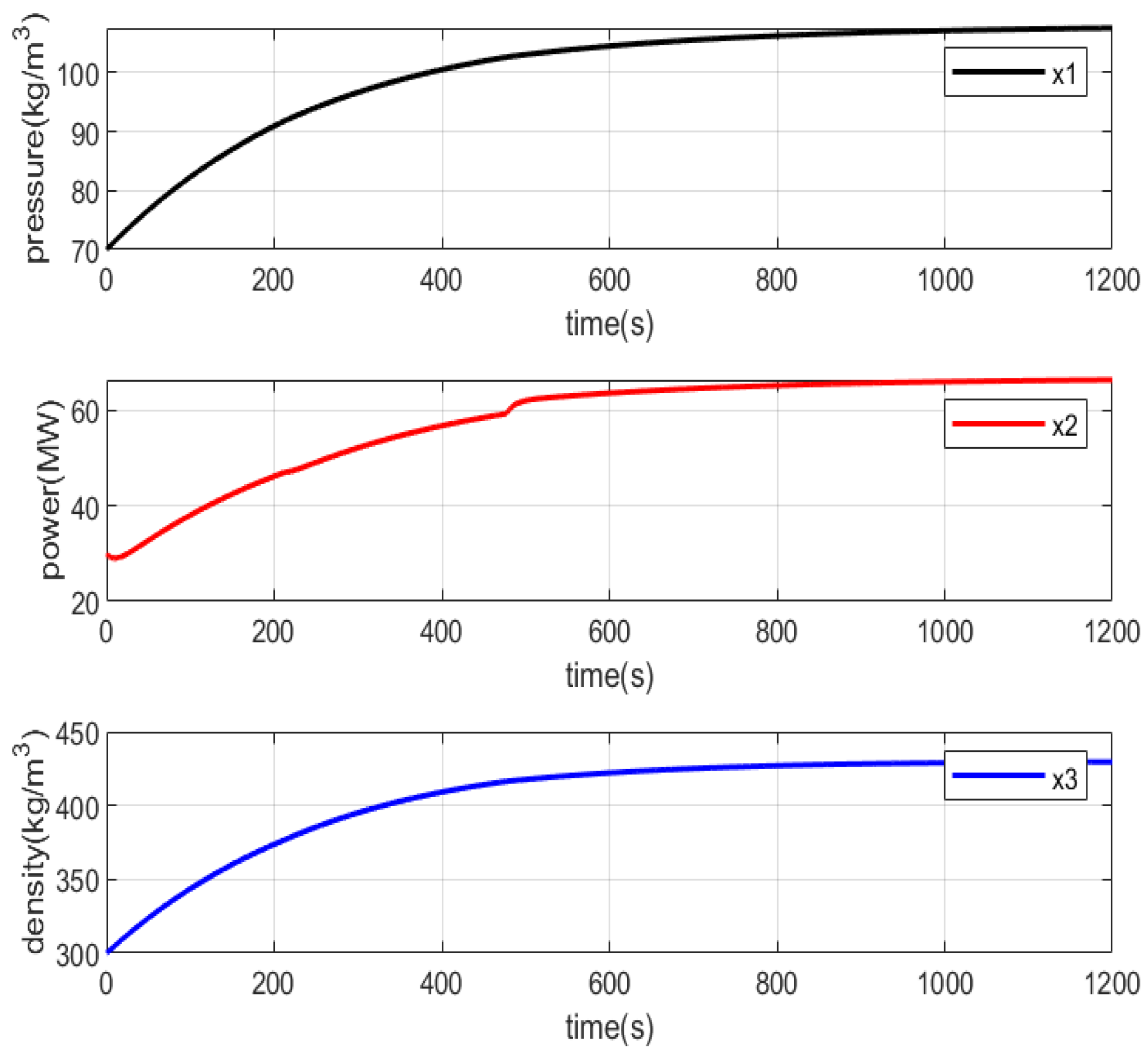
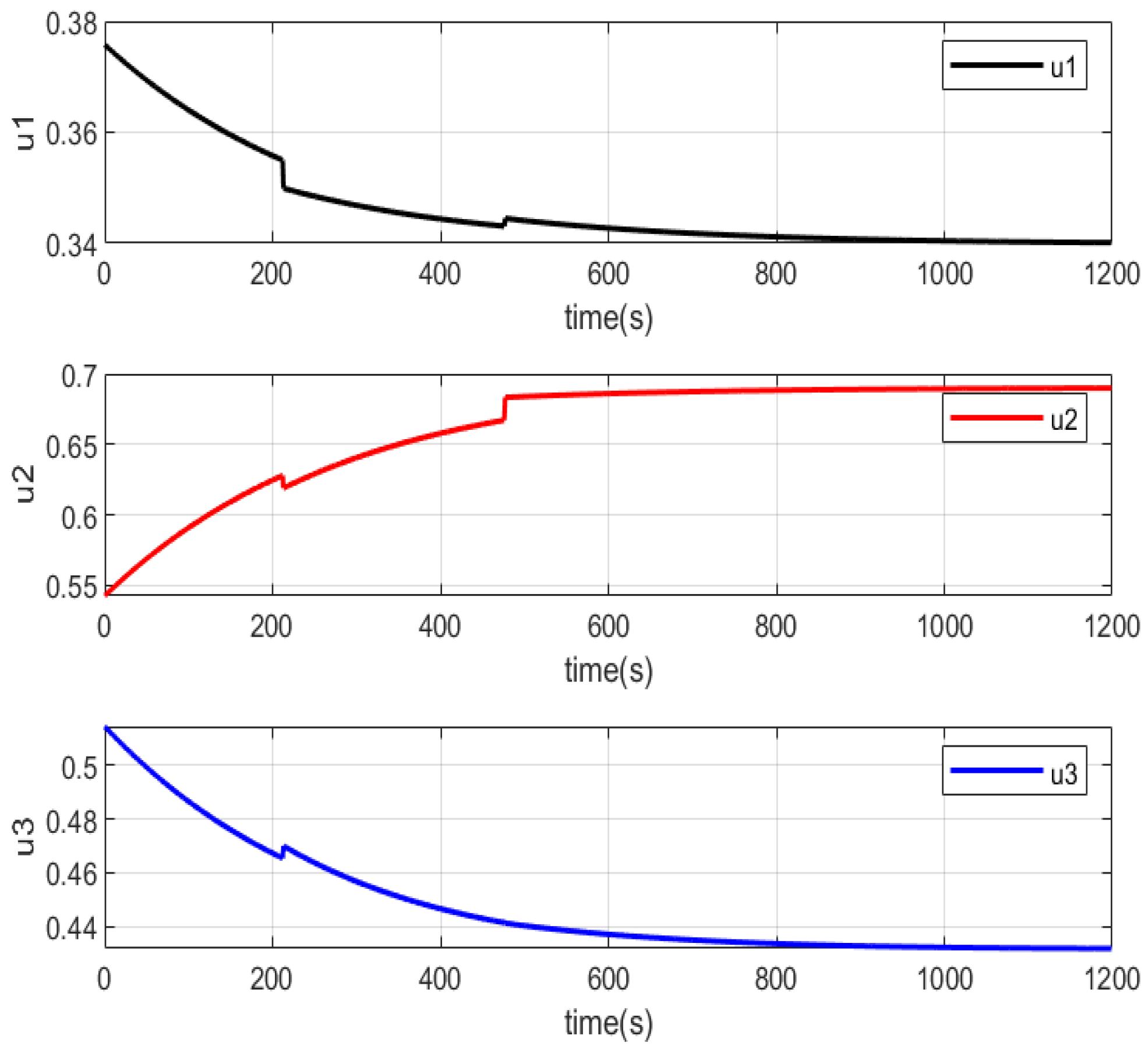
Simulations employ the piecewise affine (PWA) discrete-time model (5), linearized at four operating points: m 1 , m 2 , m 3 , and m 4 . The initial condition is x 0 = ( 70 , 30 , 300 ) T , which belongs to the mode m 1 . The regulation target corresponds to mode 3 operating conditions: x d = ( 108 , 66.65 , 428 ) T and u d = ( 0.34 , 0.69 , 0.433 ) T , ensuring satisfaction of all state and input constraints throughout the trajectory. The design of stabilizing feedback gains for the boiler-turbine system for any switching between the previous operating modes and respecting the control and state constraints is intimately related to the the existence of non-negatives matrices H r , D r , D r * , and L r , which are solutions to conditions (20)–(23). To solve these linear conditions, CVX for Matlab (version 9.4) was used [36,37]. The computed gains are applied to the system and the following trajectories are obtained:
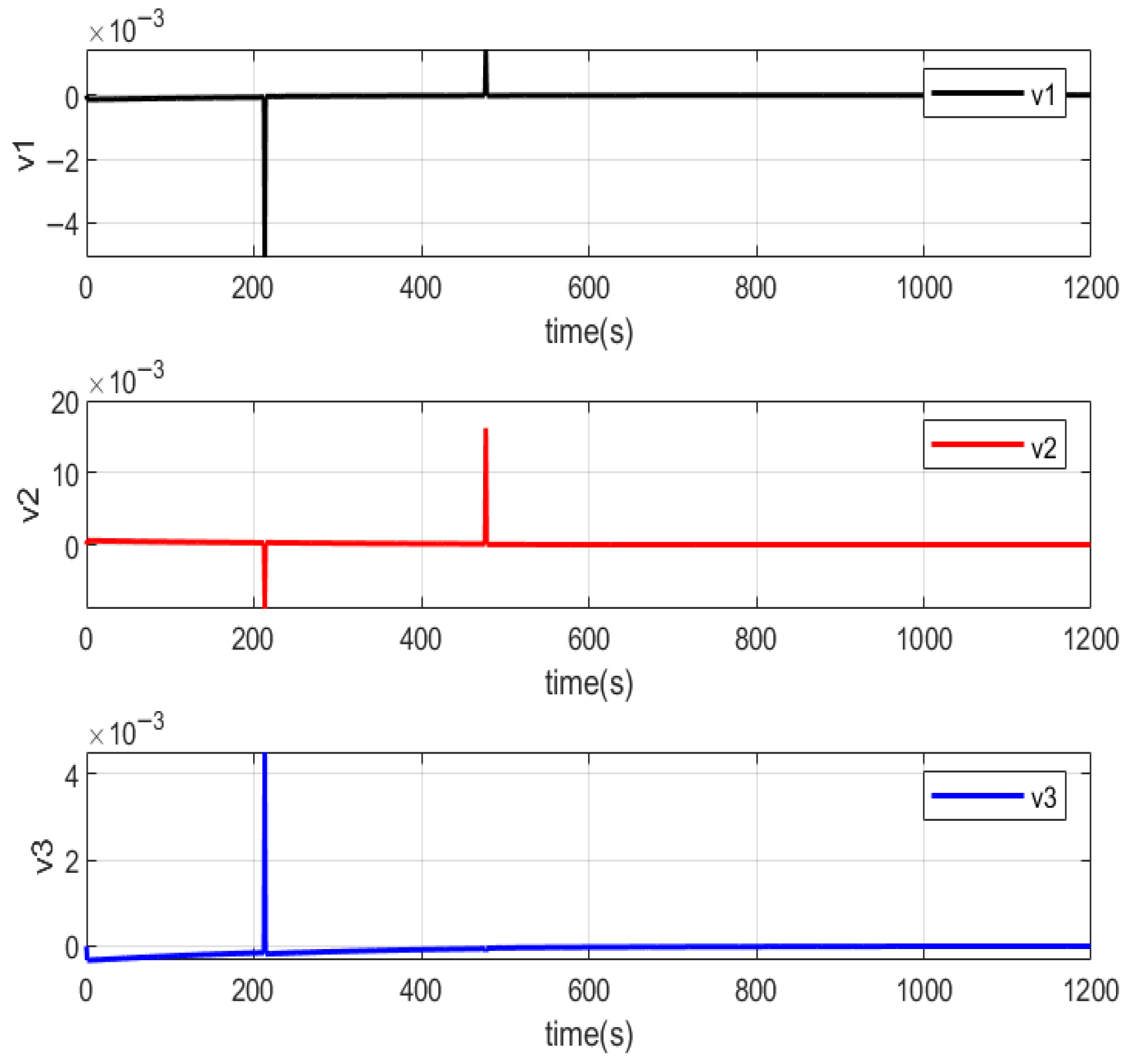
The state and control trajectories are presented in Figure 2 and Figure 3, respectively. Clearly, the computed feedback gains allow the boiler–turbine model to reach asymptotically the desired equilibrium point while respecting both the state and control constraints. Furthermore, Figure 4 illustrates that the constraints on the rate of the control input are also satisfied. These simulation results confirm the effectiveness of the proposed method in stabilizing the boiler-turbine system, while fulfilling all imposed constraints. MPC performance in respecting constraints hinges heavily on prediction horizon selection, a critical design choice [6]. Additionally, solving the quadratic program (QP) at each timestep creates substantial real-time computational burdens. Conversely, our invariant set approach computes state-feedback laws ahead of time using linear programs over polyhedral domains, yielding explicit controllers that require only region identification online. This strategy delivers formal guarantees of constraint adherence and recursive feasibility across the entire safe set, free from online solver dependence or prediction horizon sensitivity.

5. Conclusions

In this work, a control approach was proposed for the constrained state feedback synthesis of a boiler-turbine system modeled as a PWA system. The synthesized state feedback gains ensure compliance with the control objectives in terms of both stability and constraint satisfaction. Moreover, the derived conditions for the existence of a control law of the form (9) are necessary and sufficient, and they are formulated as a linear programming problem. The proposed methodology has been validated through a numerical example.
Future work will have to focus on addressing the case in which the boiler-turbine system is approximated by a switched piecewise affine system with controlled switching.

Author Contributions

Conceptualization, O.A., H.B. and A.H.; Validation, O.A., H.B. and A.H.; Investigation, O.A., H.B. and A.H. All authors have read and agreed to the published version of the manuscript.

Funding

This research received no external funding.

Data Availability Statement

The original contributions presented in the study are included in the article, further inquiries can be directed to the corresponding author.

Conflicts of Interest

The authors declare no conflict of interest.

References

  1. Moon, U.C.; Lee, K.Y. A Boiler-turbine system control using a fuzzy auto-regressive moving average (FARMA) model. IEEE Trans. Energy Convers. 2003, 18, 142–148. [Google Scholar] [CrossRef]
  2. Wu, J.; Krug, M.; Nguang, S.K.; Shen, J.; Li, Y.G. H fuzzy tracking control for Boiler-turbine systems. In 2009 IEEE International Conference on Control and Automation; IEEE: Piscataway, NJ, USA, 2009; pp. 1980–1985. [Google Scholar]
  3. Bentarzi, H.; Chentir, A.R.; Belaidi, N.; Dif, S.; Mastorakis, N.E. A New approach applied to thermal power plant using fuzzy logic. WSEAS Trans. Adv. Eng. Educ. 2009, 6, 275–284. [Google Scholar]
  4. Moradi, H.; Alasty, A.; Vossoughi, G. Nonlinear dynamics and control of bifurcation to regulate the performance of a boiler–turbine unit. Energy Convers. Manag. 2013, 68, 105–113. [Google Scholar] [CrossRef]
  5. Dimeo, R.; Lee, K.Y. Boiler-turbine control system design using a genetic algorithm. IEEE Trans. Energy Convers. 1995, 10, 752–759. [Google Scholar] [CrossRef]
  6. Tan, W.; Niu, Y.G.; Liu, J.Z. H control for a Boiler-turbine unit. In IEEE Conference on Control Applications, Kohala Coast, HI, USA, 22–27 August 1999; IEEE: Piscataway, NJ, USA, 1999; pp. 807–810. [Google Scholar]
  7. Jan, A.Z.; Kedzia, K.; Abbass, M.J. Fractional-Order PID Controller (FOPID)-Based Iterative Learning Control for a Nonlinear Boiler System. Energies 2023, 16, 1045. [Google Scholar] [CrossRef]
  8. Lawrynczuk, M. Nonlinear predictive control of a Boiler-turbine unit: A state-space approach with successive on-line model linearization and quadratic optimisation. ISA Trans. 2017, 67, 476–495. [Google Scholar] [CrossRef]
  9. Habbi, H.; Zelmat, M.; Bouamama, B.O. A dynamic fuzzy model for a drum–Boiler–turbine system. Automatica 2003, 39, 1213–1219. [Google Scholar] [CrossRef]
  10. Sarailoo, F.; Rahmani, Z.; Rezaie, B. Fuzzy Predictive Control of a Boiler–Turbine System Based on a Hybrid Model System. Ind. Eng. Chem. Res. 2014, 53, 2362–2381. [Google Scholar] [CrossRef]
  11. Liu, X.; Cui, J. Fuzzy economic model predictive control for thermal power plant. IET Control Theor. Appl. 2019, 13, 1113–1120. [Google Scholar] [CrossRef]
  12. Zhao, M.; Wan, J.; Peng, C. Generalized predictive control using improved recurrent fuzzy neural network for a Boiler-turbine unit. Eng. Appl. Artif. Intell. 2023, 121, 106053. [Google Scholar] [CrossRef]
  13. Guo, M.; Hao, Y.; Chen, G.; Lee, K.Y.; Sun, L. Energy balance error compensated extended-state Kalman filter-based model predictive control of a 300 MW boiler-turbine unit. Chem. Eng. Res. Des. 2025, 328–341. [Google Scholar] [CrossRef]
  14. Keshavarz, M.; Yazdi, M.B.; Jahed-Motlagh, M.R. Piecewise affine modeling and control of a Boiler–turbine unit. Appl. Therm. Eng. 2010, 30, 781–791. [Google Scholar] [CrossRef]
  15. Sarailoo, F.; Rezaie, B.; Rahmani, Z. MLD Model of Boiler-turbine system based on PWA linearization approach. Int. J. Control Sci. Eng. 2012, 2, 88–92. [Google Scholar] [CrossRef]
  16. Hu, H.; Huang, S.; Zhang, Z. Event-triggered Control for Switched Affine Linear Systems. Int. J. Control Autom. Syst. 2020, 18, 2867–2878. [Google Scholar] [CrossRef]
  17. Ren, W.; Yang, H.; Jiang, B. Fault recoverability analysis of nonlinear systems: A piecewise affine system approach. Int. J. Control Autom. Syst. 2017, 15, 547–556. [Google Scholar] [CrossRef]
  18. Camacho, E.F.; Bordons, C. Model Predictive Control in the Process Industry; Springer: London, UK, 2007. [Google Scholar]
  19. Bemporad, A.; Morari, M.; Dua, V.; Pistikopoulos, E.N. The explicit linear quadratic regulation for constrained systems. Automatica 2002, 38, 3–20. [Google Scholar] [CrossRef]
  20. Kara, R.; Ahmane, M.; Loiseau, J.-J.; Djennoune, S. Constrained state feedback control of piecewise affine systems. IFAC Proc. Vol. 2009, 42, 198–203. [Google Scholar] [CrossRef]
  21. Yang, X.; Lin, X.; Xu, Y. Stabilization of a class of discrete-time hybrid systems with switchings: A set-theoretical approach. In IEEE International Conference on Information and Automation; IEEE: Piscataway, NJ, USA, 2014; pp. 131–136. [Google Scholar]
  22. Hennet, J.-C. Une extention du lemme de Farkas et son application au problème de régulation linéaire sous contraintes. CR Acad. Sci. 1989, 308, 415–419. [Google Scholar]
  23. Jedda, O.; Douik, A. Optimal Discrete-time Integral Sliding Mode Control for piecewise Affine Systems. Int. J. Control Autom. Syst. 2019, 17, 1221–1232. [Google Scholar] [CrossRef]
  24. Borrelli, F. Constrained optimal control Of linear and hybrid systems. In Lecture Notes in Control and Information Sciences; Springer: Berlin/Heidelberg, Germany, 2003; Volume 290. [Google Scholar]
  25. Bell, R.D.; Astrom, K.J. Dynamic Models for Boiler-Turbine Alternator Units: Data Logs and Parameter Estimation for a 160 MW Unit; Technical Report LUTFD2/(TFRT-3192); Lund Institute of Technology: Lund, Sweden, 1987; pp. 1–137. [Google Scholar]
  26. Flynn, M.E.; O’Malley, M.J. A drum Boiler model for long term power system dynamic simulation. IEEE Trans. Power Syst. 1999, 14, 209–217. [Google Scholar] [CrossRef]
  27. Sontag, E.D. Remarks on the time-optimal control of a class of hamiltonian systems. In Proceedings of IEEE Conference on Decision and Control; IEEE: Piscataway, NJ, USA, 1989; pp. 217–221. [Google Scholar]
  28. Peleties, P.A.; Decarlo, R.A. Asymptotic stability of m-swtiched systems using Lyaponuv-like functions. In American Control Conference; IEEE: Piscataway, NJ, USA, 1991; pp. 1679–1684. [Google Scholar]
  29. Decarlo, R.A.; Branicky, M.S.; Pettersson, S.; Lennartson, S. Perspectives and results on the stability and stabilizability of hybrid systems. Proc. IEEE 2000, 88, 1069–1082. [Google Scholar] [CrossRef]
  30. Bemporad, A. Efficient conversion of mixed logical dynamical systems into an equivalent piecewise affine form. IEEE Trans. Autom. Control 2004, 49, 832–838. [Google Scholar] [CrossRef]
  31. Johansson, M.; Rantzer, A. Piecewise linear quadratic optimal control. IEEE Trans. Autom. Control 2000, 45, 629–637. [Google Scholar]
  32. Rodrigues, L.; How, J. Automated control design for a piecewise-affine approximation of a class of nonlinear systems. In Proceedings of the American Control Conference; IEEE: Piscataway, NJ, USA, 2001; pp. 3189–3194. [Google Scholar]
  33. Morila, F. Benchmark for PID control based on the Boiler control problem. IFAC Proc. Vol. 2012, 45, 346–351. [Google Scholar] [CrossRef]
  34. Schrijver, A. Theory of Linear and Integer Programming; John Wiley and Sons: Hoboken, NJ, USA, 1987. [Google Scholar]
  35. Blanchini, F. Set invariance in control. Automatica 1999, 35, 1747–1767. [Google Scholar] [CrossRef]
  36. Grant, M.; Boyd, S.; Ye, Y. CVX: Matlab Software for Disciplined Convex Programming, (Web Page and Software). 2008. Available online: https://cvxr.com/cvx/ (accessed on 4 February 2026).
  37. Grant, M.; Boyd, S. Graph implementations for non smooth convex programs. In Recent Advances in Learning and Control; Springer: Berlin/Heidelberg, Germany, 2008; pp. 95–110. [Google Scholar]
Figure 1. A boiler-turbine diagram.
Energies 19 01249 g001
Figure 2. State evolution versus time.
Energies 19 01249 g002
Figure 3. Control inputs versus time.
Energies 19 01249 g003
Figure 4. The derivative of the input versus time.
Energies 19 01249 g004
Table 1. Principal notations.
SymbolsDefinition
R The set of real numbers.
N The set of natural numbers.
x ( k ) State vector at time k.
x i The i t h component of state vector.
u ( k ) Control vector at time k
u l The i t h component of the control vector.
y j The j t h component of the output vector.
a c s The steam quality constant
q e The evaporation rate constant
( x c r , u c r ) Represents the operating point of the mode r.
A r The state matrix for the mode r
B r The control matrix for the mode r
a r Additive constant vector for the mode r
P ( G , g ) A polyhedron defined by the matrix G and the vector g.
F r Feedback gain associated to the mode r
( x d , u d ) The desired operating point of the mode r.
e ( k ) The state error vector defined by: e ( k ) = x ( k ) x d .
u ¯ ( k ) The control error vector defined by: u ¯ ( k ) = u ( k ) u d .
x ^ ( k ) The vector defined by: x ^ ( k ) = x ( k ) x c r .
u ^ ( k ) The vector defined by: u ^ ( k ) = u ( k ) u c r .
Table 2. Typical operation mode.
m 1 m 2 m 3 m 4 m 5
x 1 86.497.20108118.8129.6
x 2 36.6550.5266.6585.06105.8
x 3 342.4385.2428470.8513.6
u 1 0.2090.2710.340.4180.505
u 2 0.5520.6210.690.7590.828
u 3 0.2560.3400.4330.5430.663
Table 3. Validity range of each operating mode m i .
Range of x 1
m 1 60 x 1 91.8
m 2 91.8 x 1 102.6
m 3 102.6 x 1 113
m 4 113 x 1 124.2
m 5 124.2 x 1 160
Disclaimer/Publisher’s Note: The statements, opinions and data contained in all publications are solely those of the individual author(s) and contributor(s) and not of MDPI and/or the editor(s). MDPI and/or the editor(s) disclaim responsibility for any injury to people or property resulting from any ideas, methods, instructions or products referred to in the content.