An Abnormal Increase in Switching Frequency in Multi-Sources Line Commutated Converter and Suppression Method


Abstract
1. Introduction
- (1)
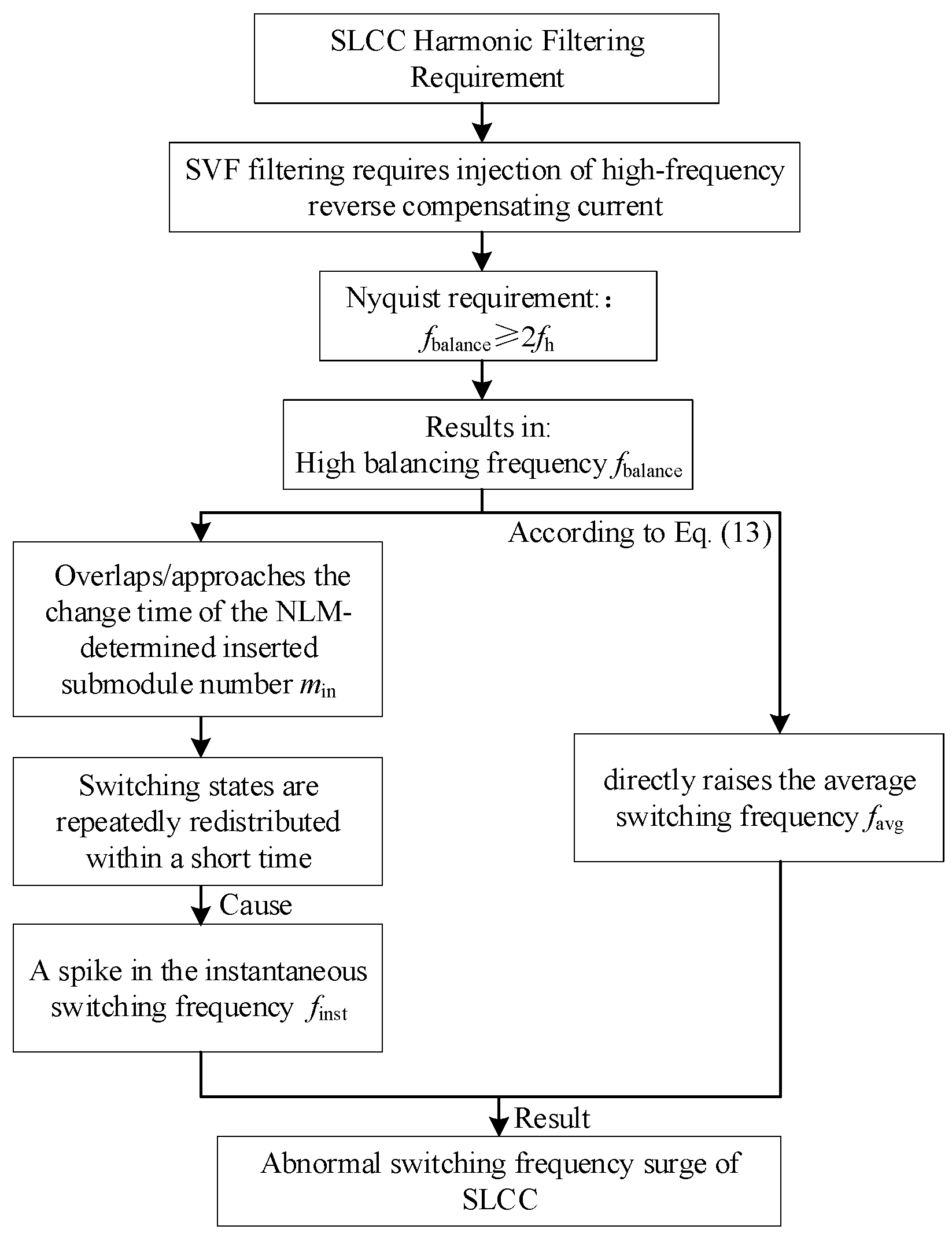
- Mechanism Revelation and Risk Quantification: This study reveals that harmonic filtering in SLCC-SVF systems forces the balancing frequency to rise to satisfy the Nyquist theorem, causing the average switching frequency to surge to over five times that of the fundamental condition (MMC operating condition), posing a unique reliability risk.
- (2)
- Mathematical Modeling and Theoretical Analysis: A mathematical model is established to quantify the strong coupling relationship between the number of inserted submodules and the redistribution of switching signals, providing a theoretical basis for analyzing frequency anomalies.
- (3)
- Adaptive Strategy and Parameter-Core Closed Loop: An adaptive hybrid modulation strategy based on a junction temperature criterion is proposed to achieve active thermal management. Furthermore, a non-integer modulation frequency ratio optimization theory is constructed to suppress low-frequency oscillations, deepening the solution from a macro-strategy to a micro-parameter core to form a complete closed-loop control system.
2. Modulation and Voltage Balancing Strategy in the SLCC-SVF System
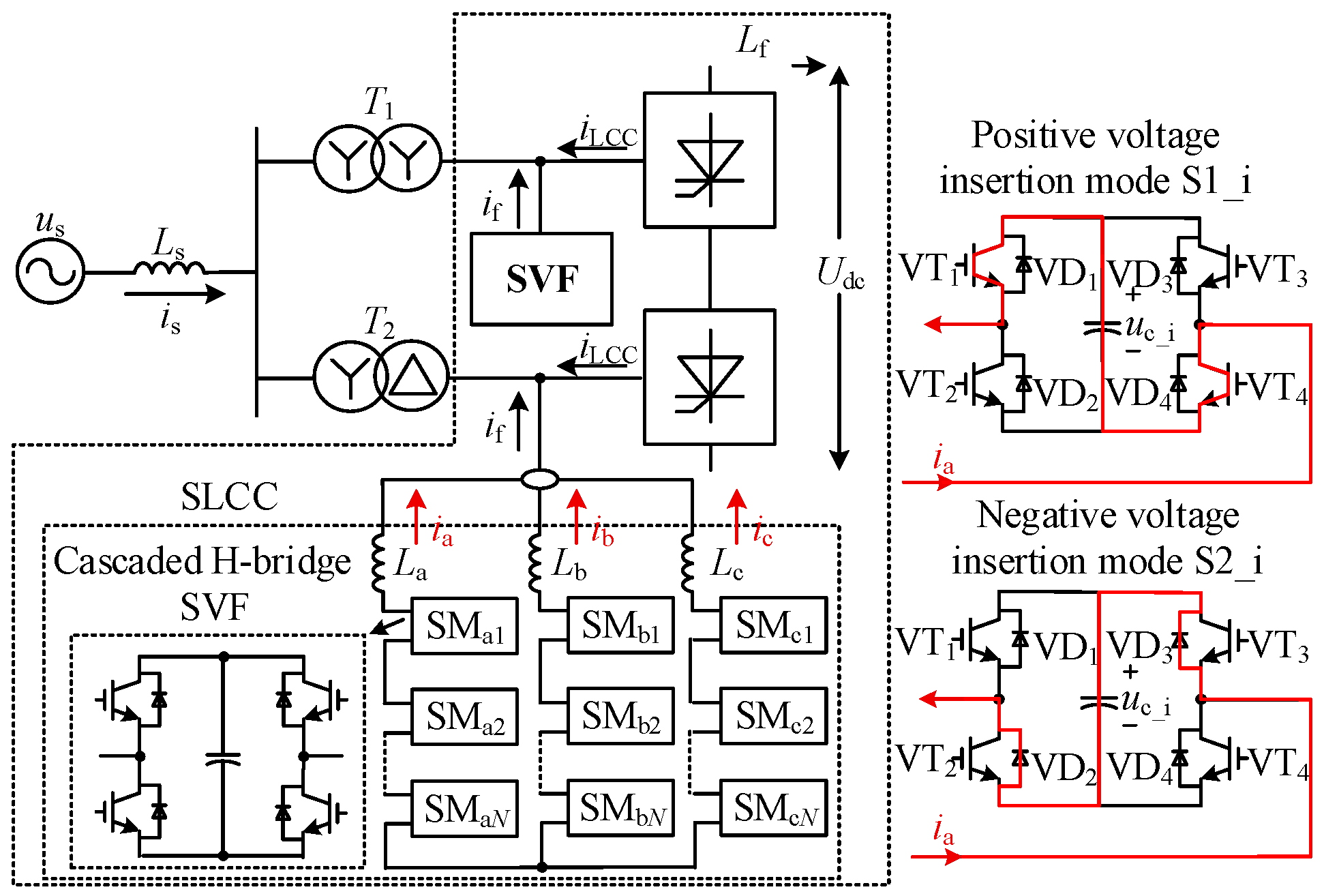
2.1. Topology of the SLCC-SVF System
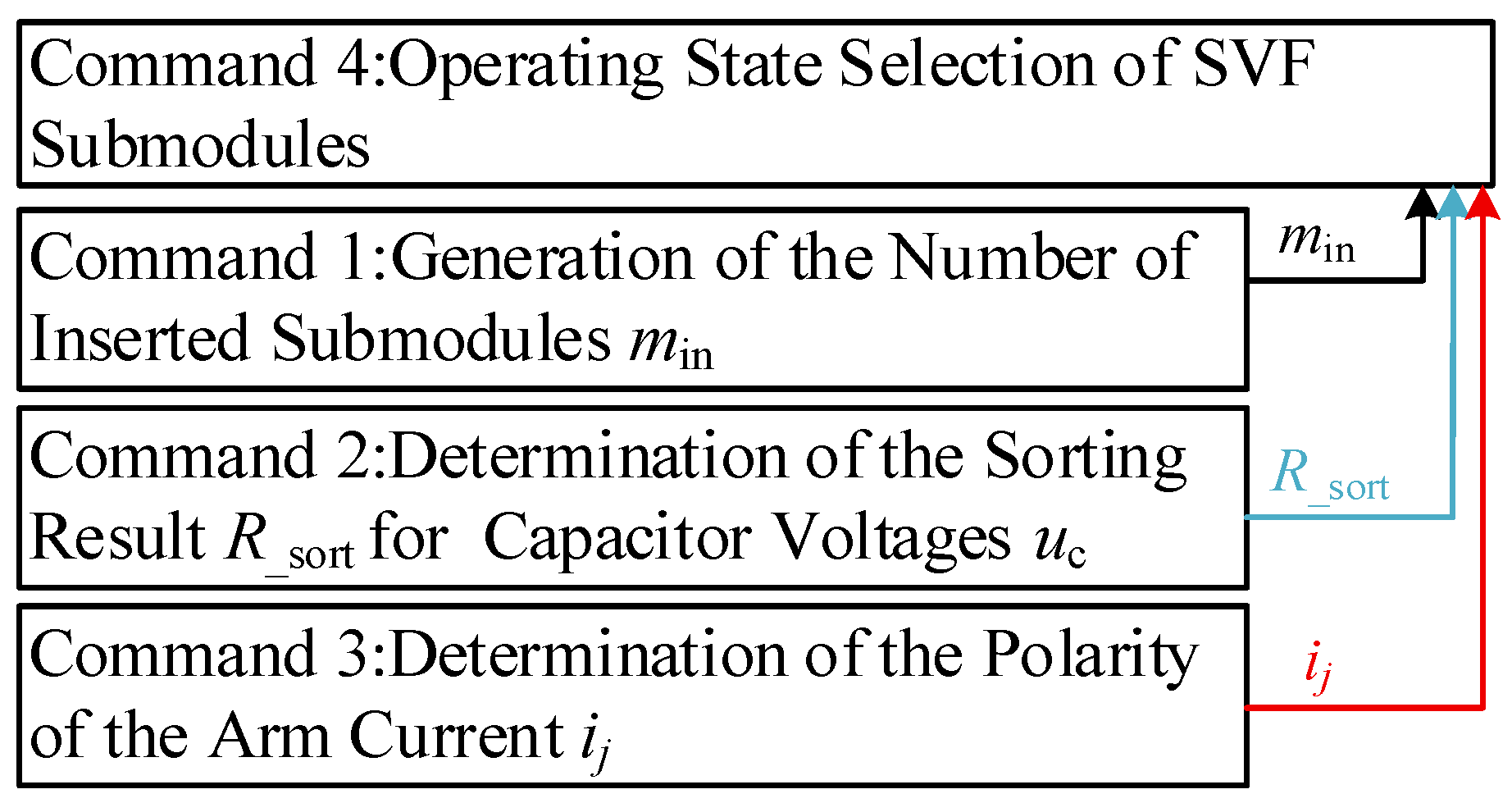
2.2. NLM Strategy and a Sorting Algorithm—Based Voltage Balancing Strategy
- (a)
- Step 1: The required number of inserted submodules, denoted as min, is determined based on the NLM strategy.
- (b)
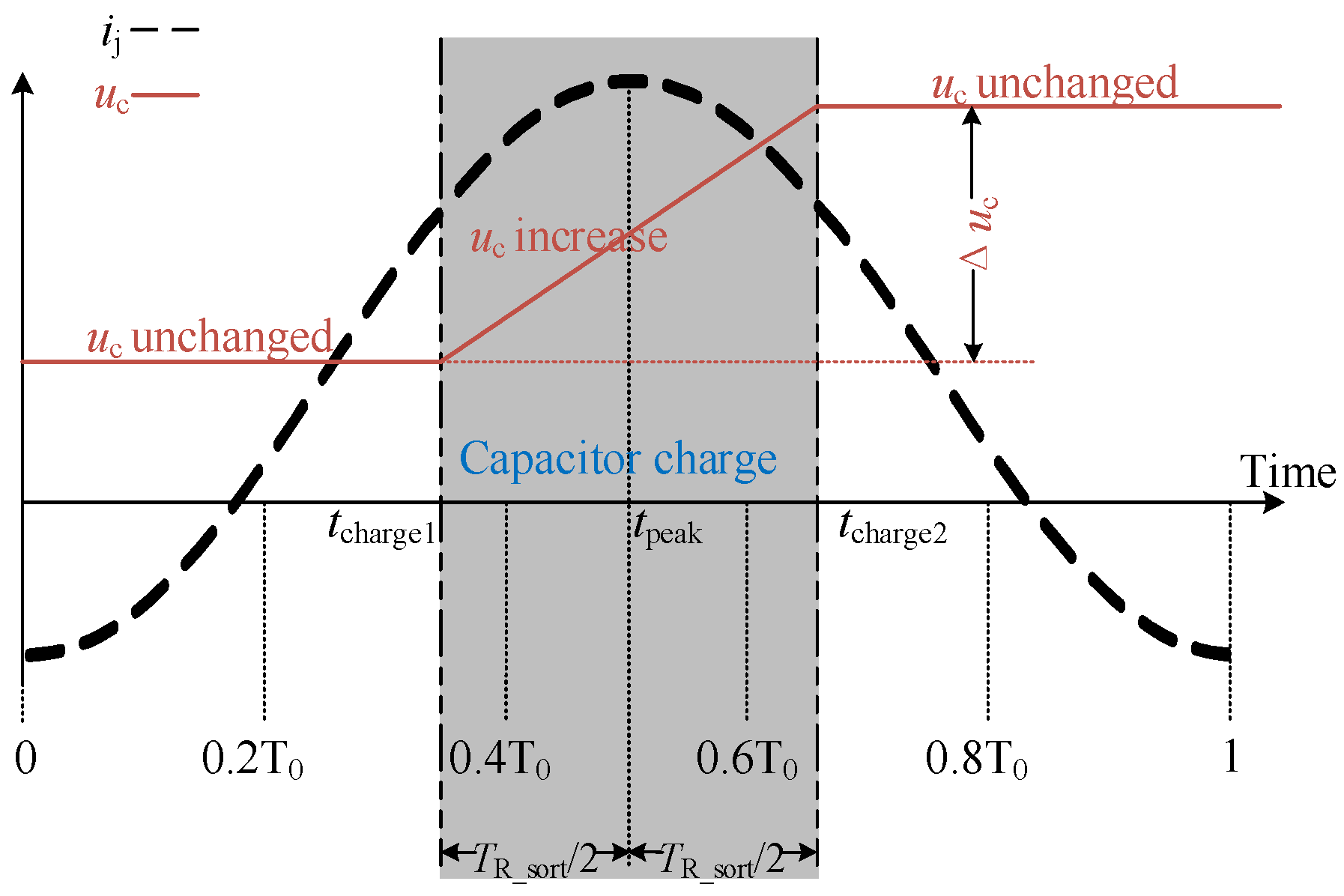
- Step 2: The capacitor voltages uc are sorted (e.g., in ascending or descending order), yielding the sorting rank R_sort.
- (c)
- Step 3: The polarity of the arm current ij is detected.
- (d)
- Step 4: The final gate switching signals are synthesized by integrating the results from the previous steps.
2.3. Distribution Metrics of Driving Signals: Instantaneous Switching Frequency finst and Average Switching Frequency favg
3. Mechanism of Switching Frequency Variation in SLCC-SVF Under Voltage Balancing Strategy and Harmonic Filtering Effects
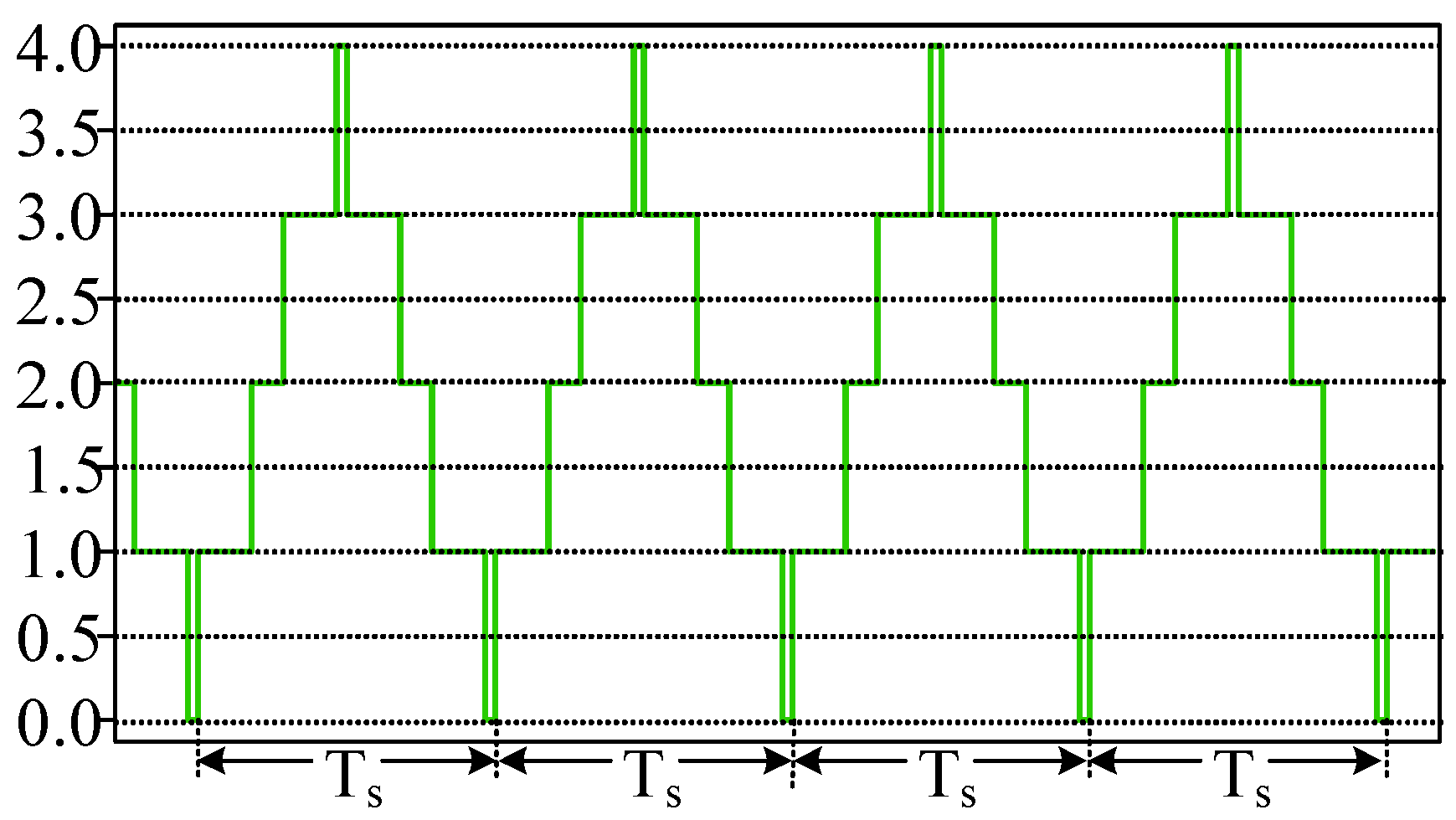
3.1. Definition: Variation Frequency of Inserted Submodules, Update Frequency of Capacitor Voltage Sorting and Voltage Balancing Frequency
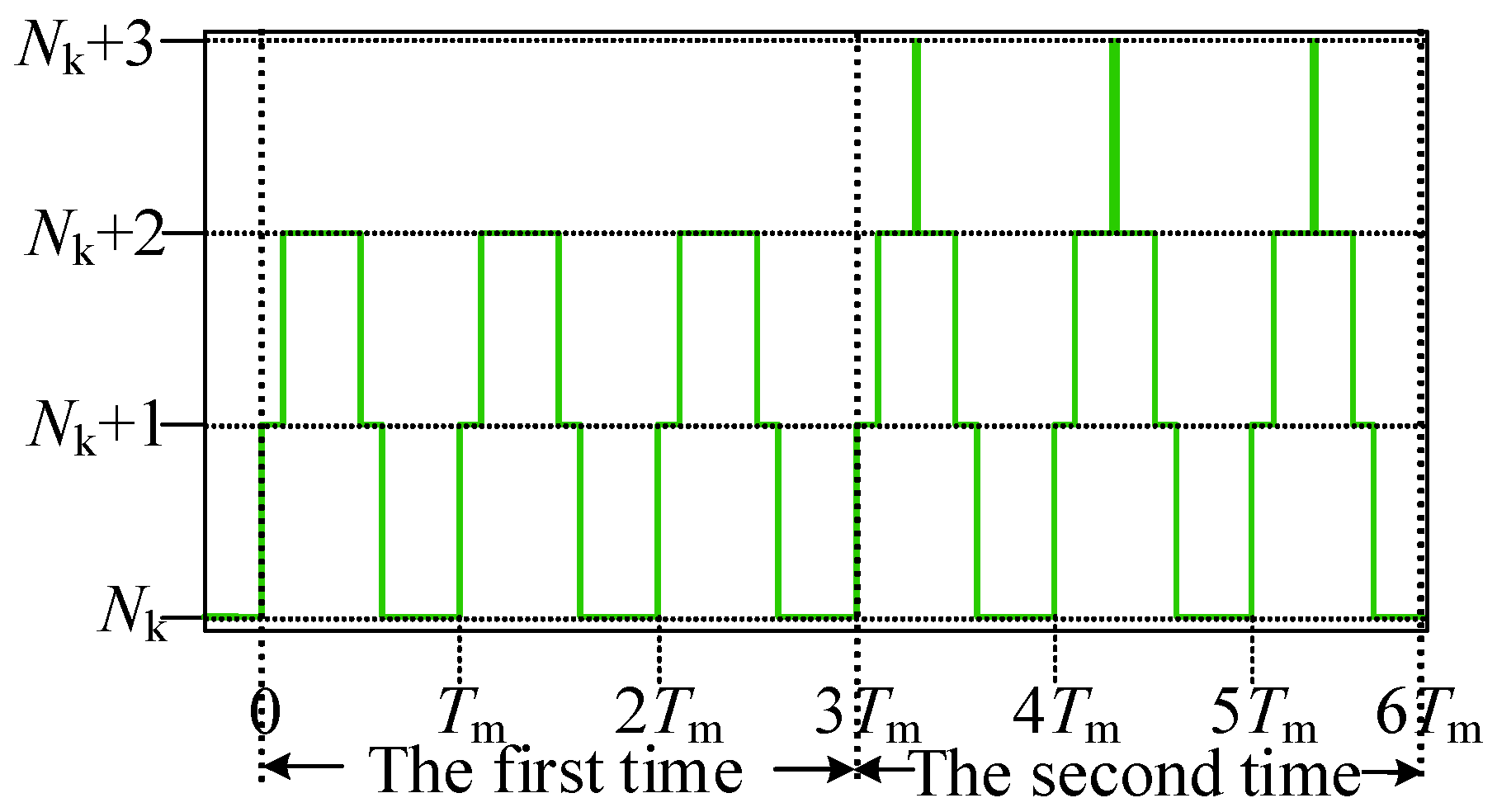
3.2. Range of the Instantaneous Switching Frequency finst Under Voltage Balancing Strategy
- (1)
- Value of Instantaneous Switching Frequency Under Changing Insertion Count with Unchanged Sorting Result
- (2)
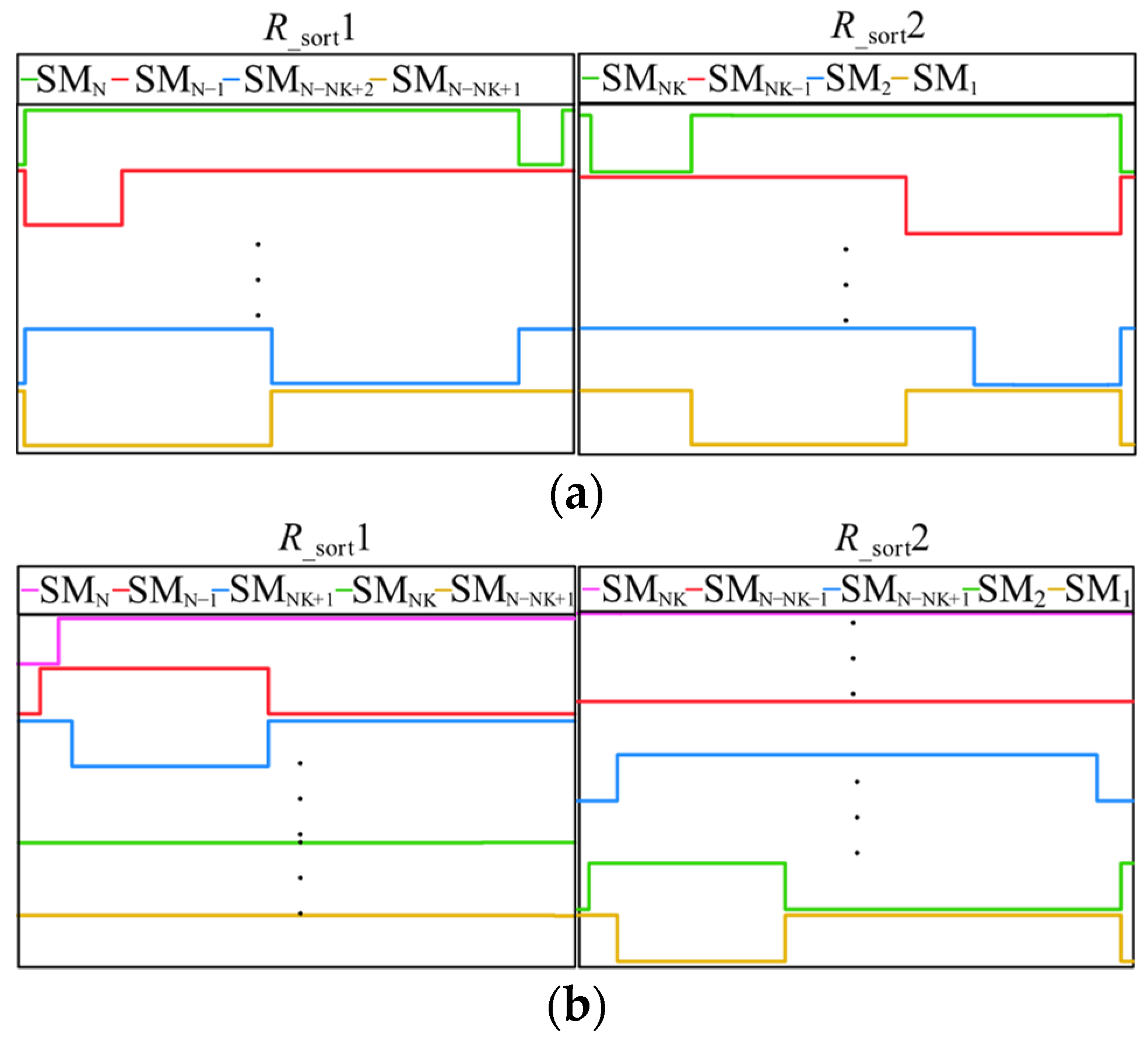
- Value of Instantaneous Switching Frequency Under Unchanged Insertion Count with Changing Sorting Result
- (3)
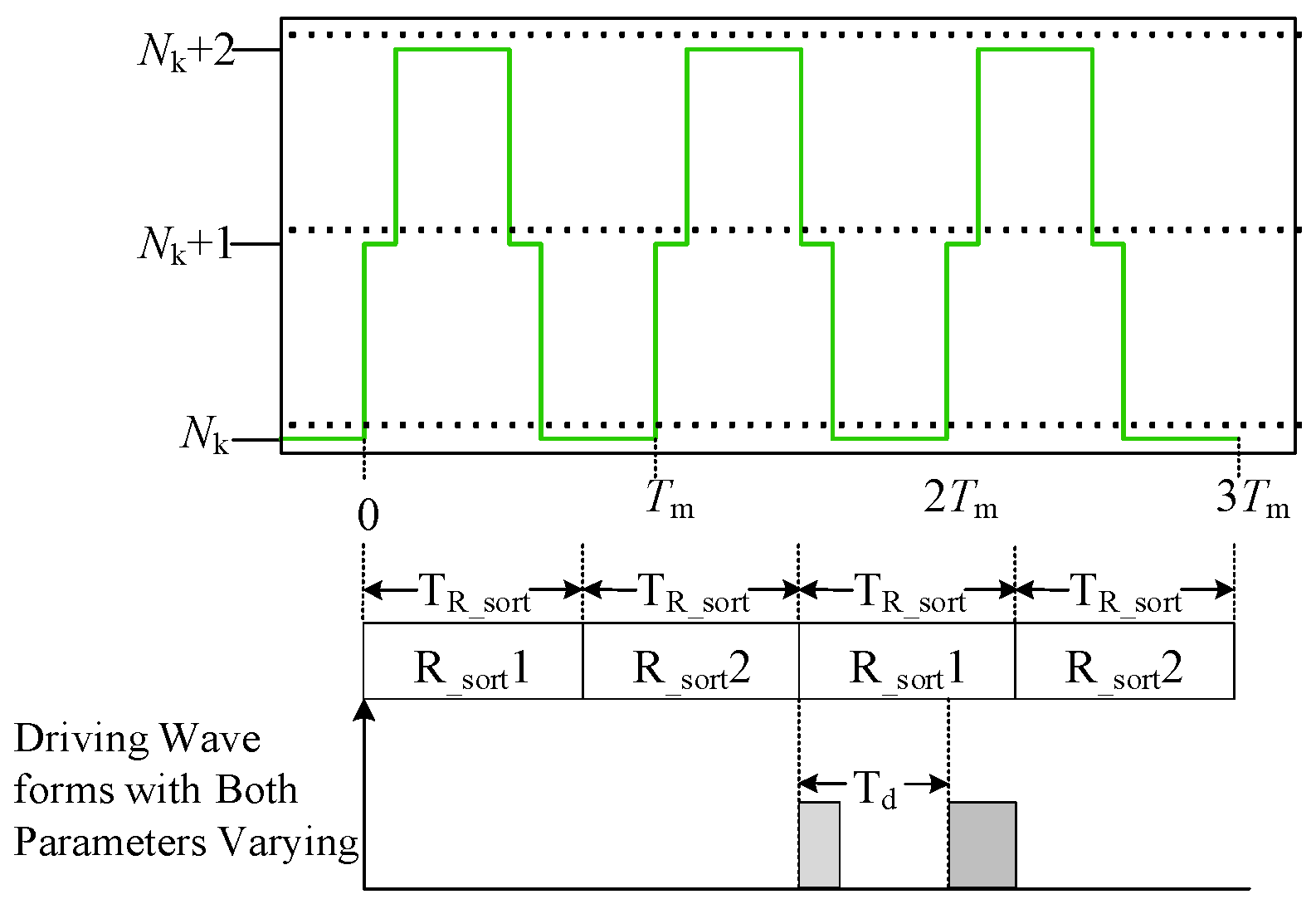
- Value of Instantaneous Switching Frequency Under Simultaneous Changes in Insertion Count and Sorting Result
3.3. Range of the Average Switching Frequency favg Under Voltage Balancing Strategy
- (1)
- Value of the Average Switching Frequency Under Changing Insertion Count with Unchanged Sorting Result
- (2)
- Value of the Average Switching Frequency Under Simultaneous Changes in Insertion Count and Sorting Result
3.4. Values of Instantaneous and Average Switching Frequency Under Harmonic Filtering Effects
4. Limitation Methods and Optimal Generation Strategies for SLCC-SVF Switching Frequency Under Voltage Balancing and Harmonic Filtering Effects
4.1. Limitation Method for the Instantaneous Switching Frequency finst
4.2. Limitation Method for the Average Switching Frequency favg
4.3. Optimized Generation Strategy for Submodule Driving Signals
- (a)
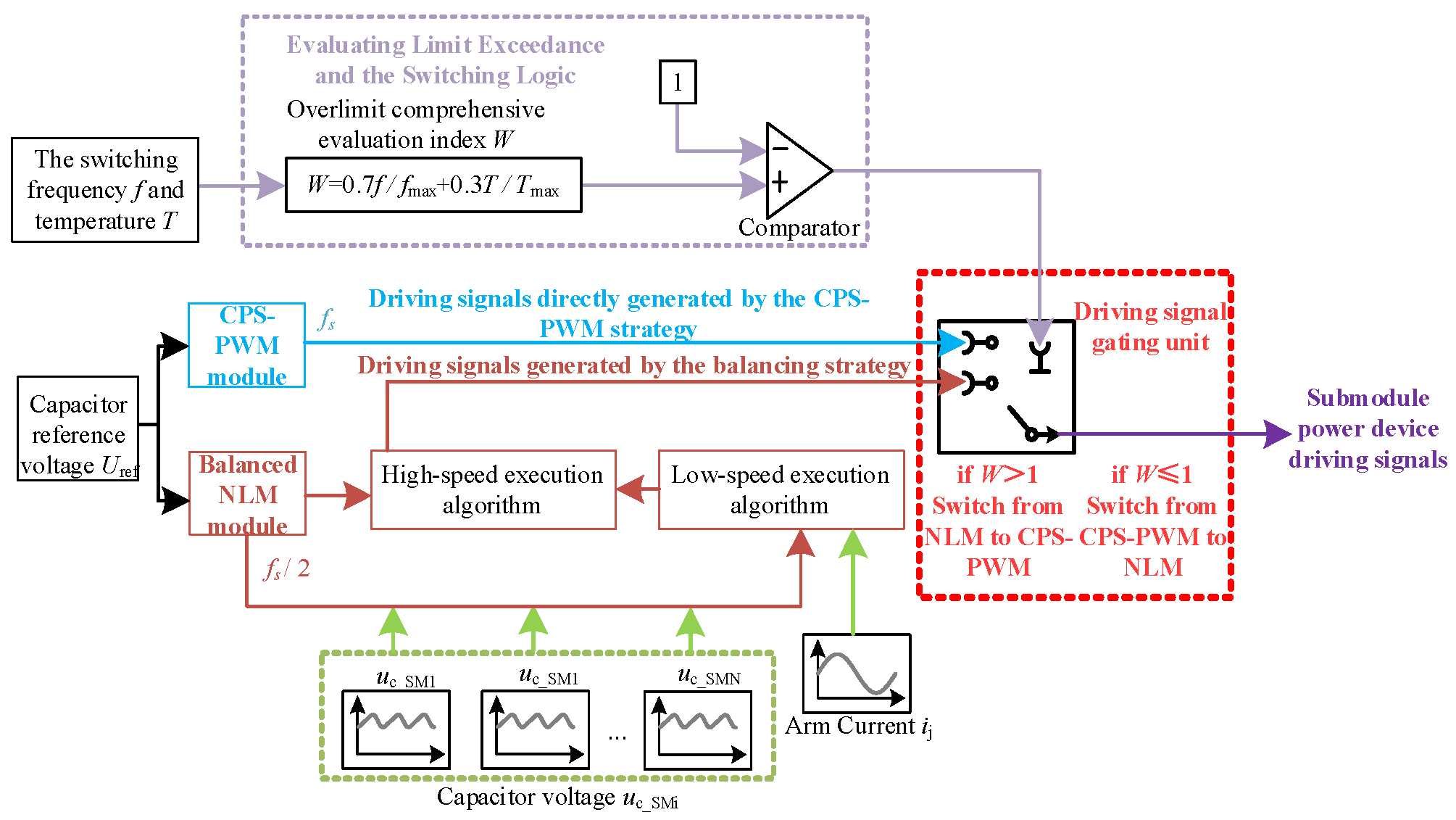
- Parameter Initialization and Data Acquisition: The system generates capacitor voltage references for each submodule and distributes them to both the NLM and CPS-PWM modules. Simultaneously, it acquires the real-time switching frequency (freal) and junction temperature (Treal) of all submodules for threshold assessment.
- (b)
- Adaptive Signal Generation: During normal operation, driving signals are generated via NLM with sorting-based balancing, where the sorting rank R_sort dynamically optimizes the insertion priority. However, if the comprehensive evaluation metric W of a specific submodule exceeds Threshold 1, the system switches that submodule’s control to the CPS-PWM scheme. This mode utilizes phase-shifted carriers and closed-loop balancing to rapidly regulate voltage and mitigate the abnormal stress state.The comprehensive evaluation metric W for threshold detection is defined as follows:
- (c)
- Threshold Monitoring and Switching Logic: The system continuously computes the comprehensive evaluation metric W for each submodule in real time. Upon detecting W > 1, the system determines that this sub-module is in an abnormal stress condition (due to excessive switching frequency or high temperature). The controller immediately initiates a handover, shifting the submodule’s modulation source to the CPS-PWM scheme. To prevent chattering, the system reverts to the NLM-based strategy only after W returns to the normal range (W ≤ 1) and remains stable for a predefined hysteresis period. The hysteresis cycle is set to 10 fundamental wave cycles, corresponding to a 50 Hz system, which is approximately 0.2 s. This real-time decision-making is implemented via digital comparators, obviating the need for complex computational overhead.
- (d)
- Driving Signal Gating and Output: The gating unit arbitrates the output signals based on the threshold assessment. For submodules operating within normal limits (W ≤ 1), signals from the NLM-based balancing strategy are passed; for submodules exceeding the threshold (W > 1), signals from the CPS-PWM scheme are engaged. The gating logic is designed to ensure seamless switching between the two modulation sources, effectively eliminating transient disturbances during mode transitions.
5. Simulation
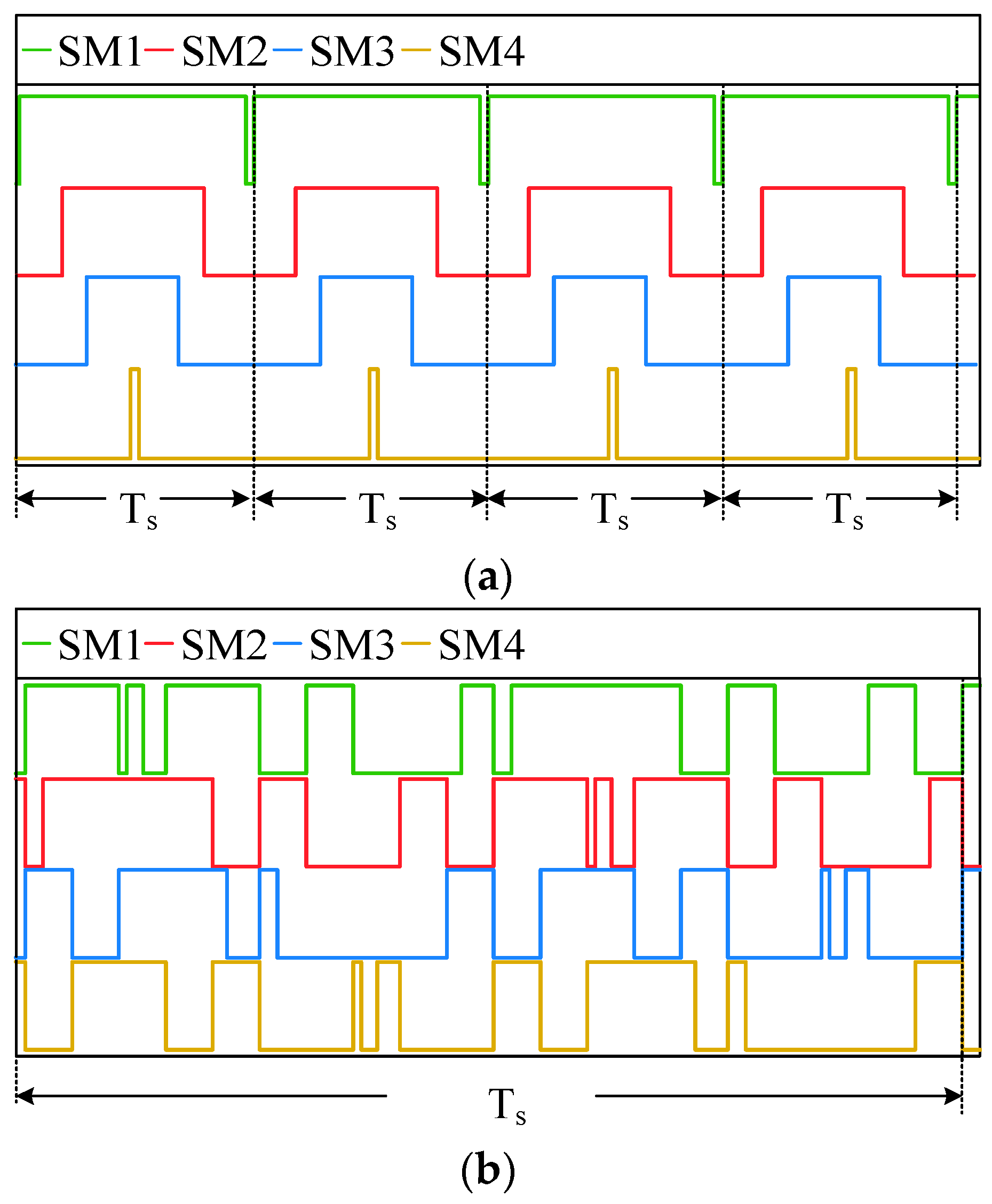
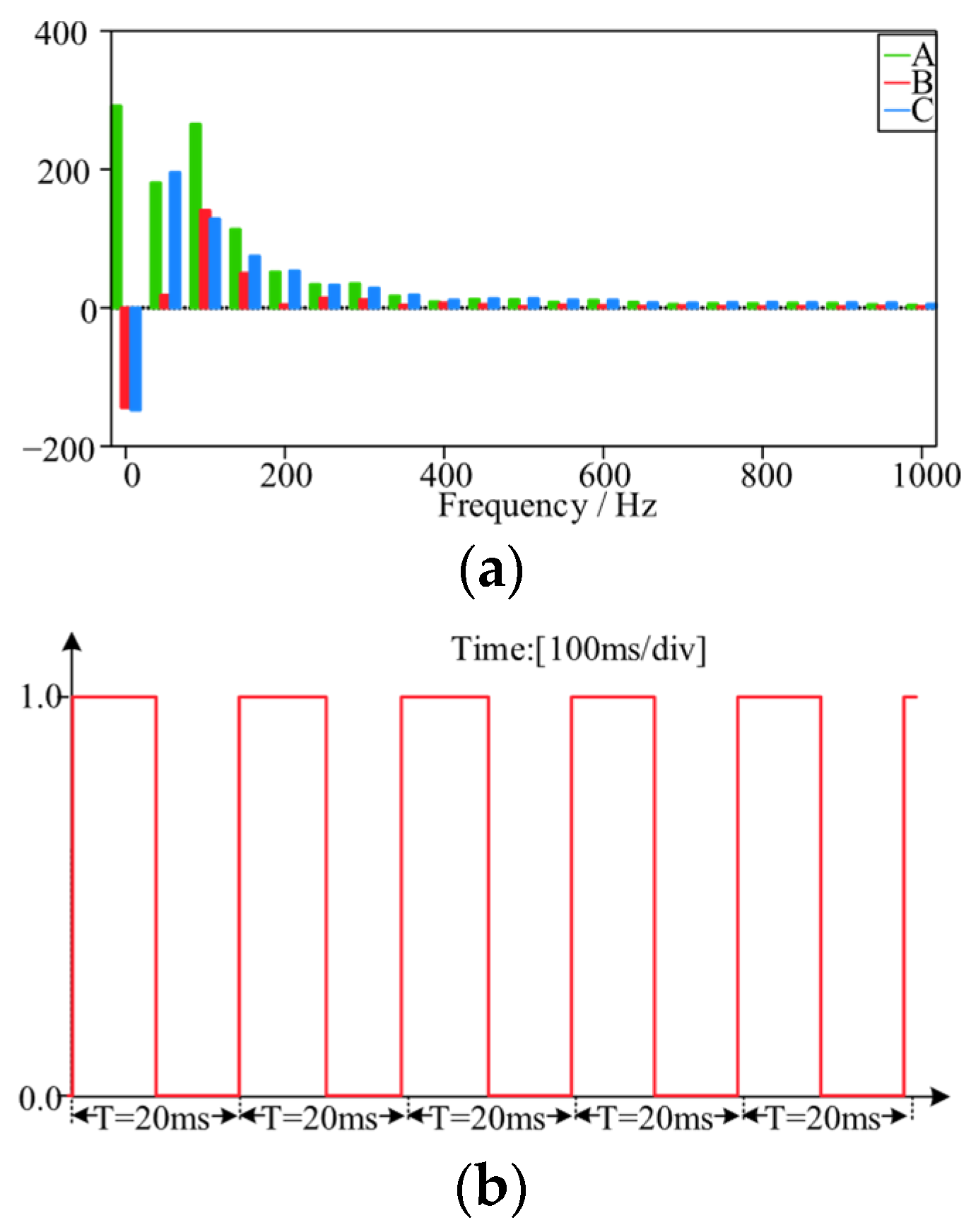
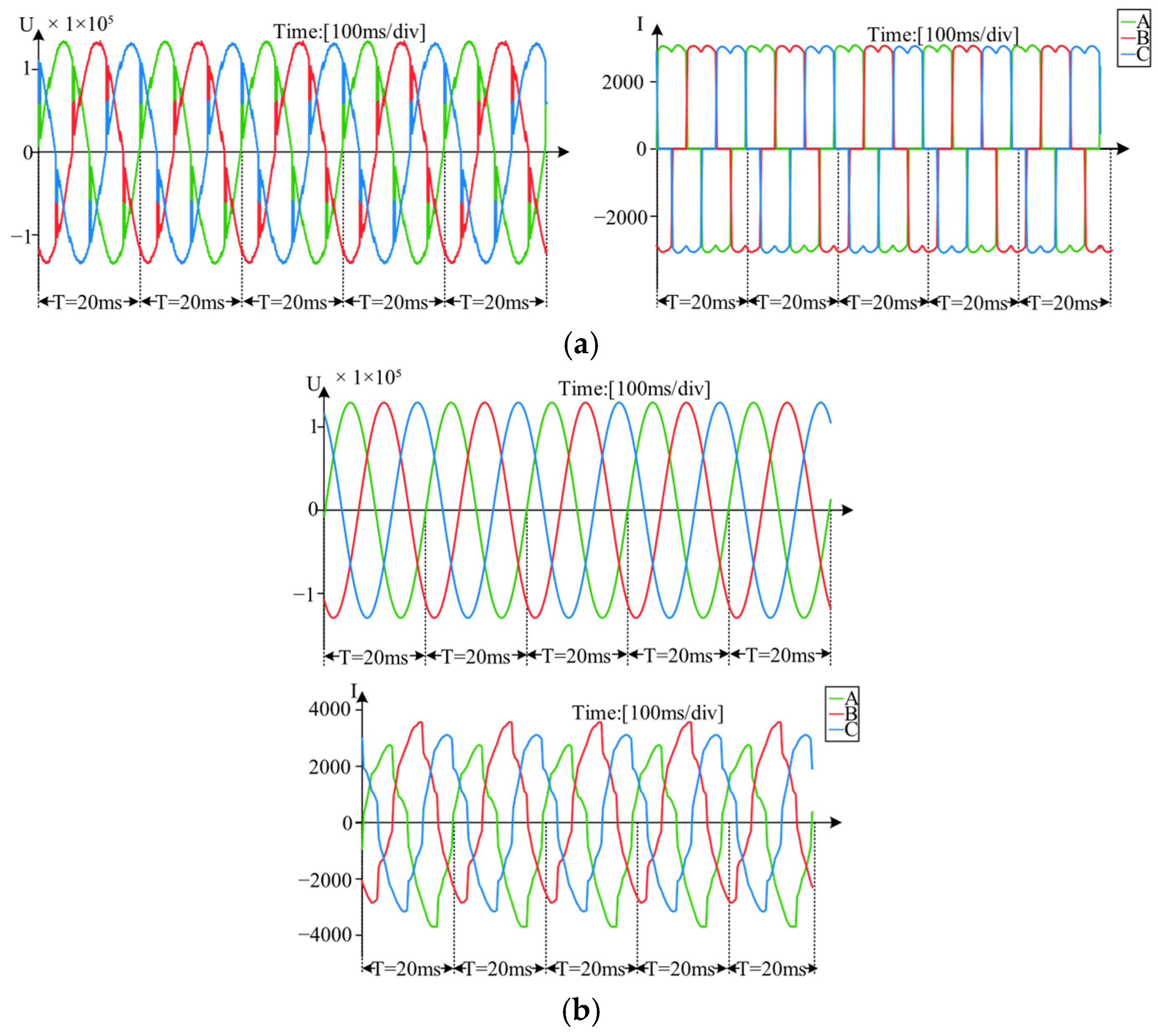
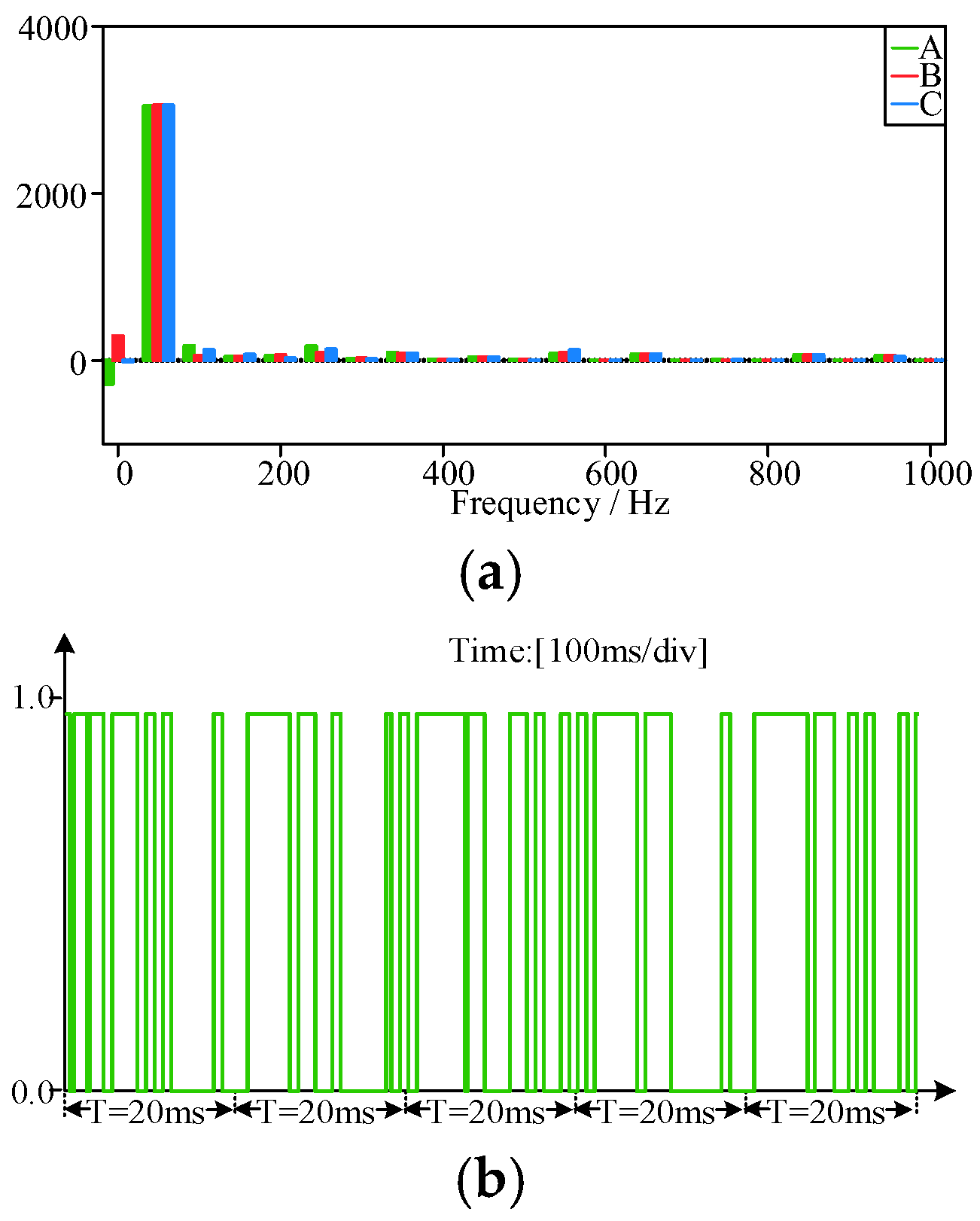
5.1. Impact of Balancing Frequency on SLCC-SVF Submodule Driving Signals with Non-Harmonic Filtering Conditions
- (1)
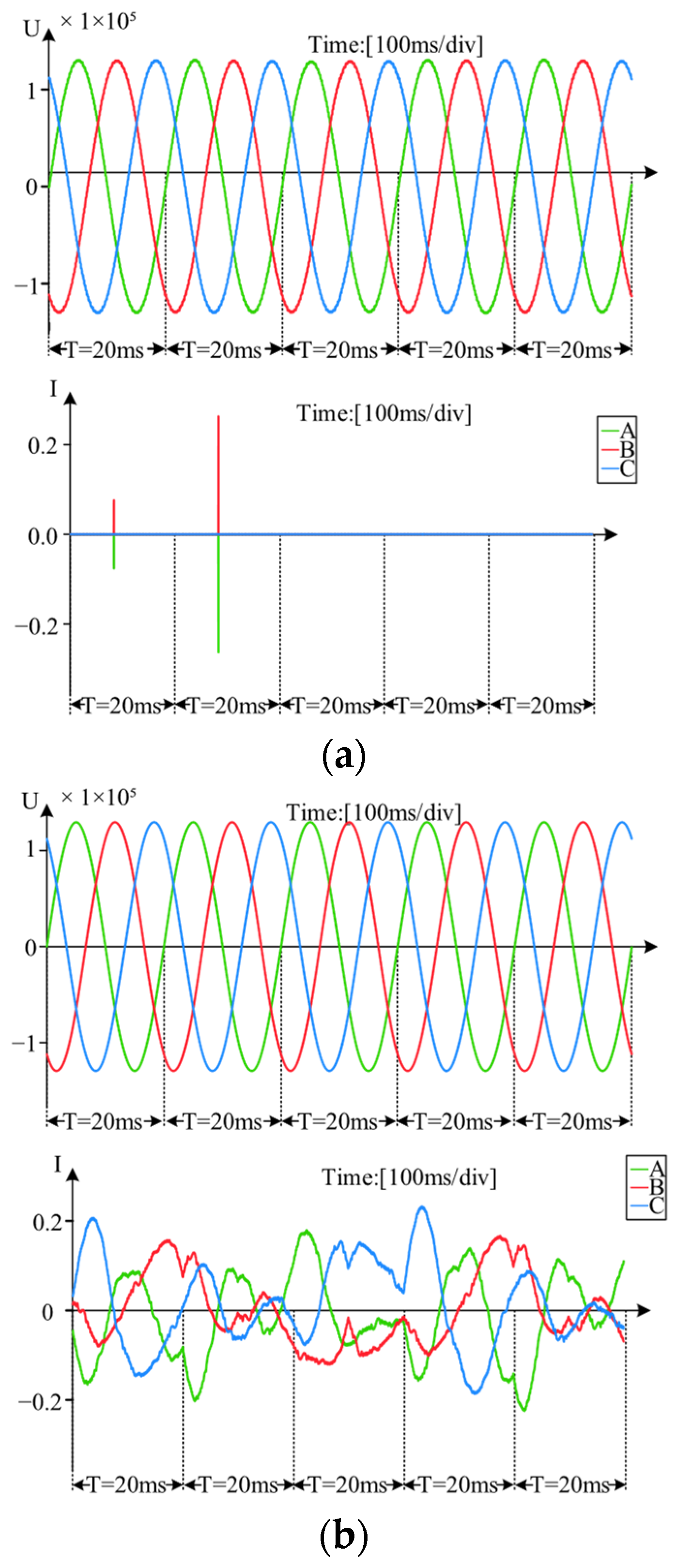
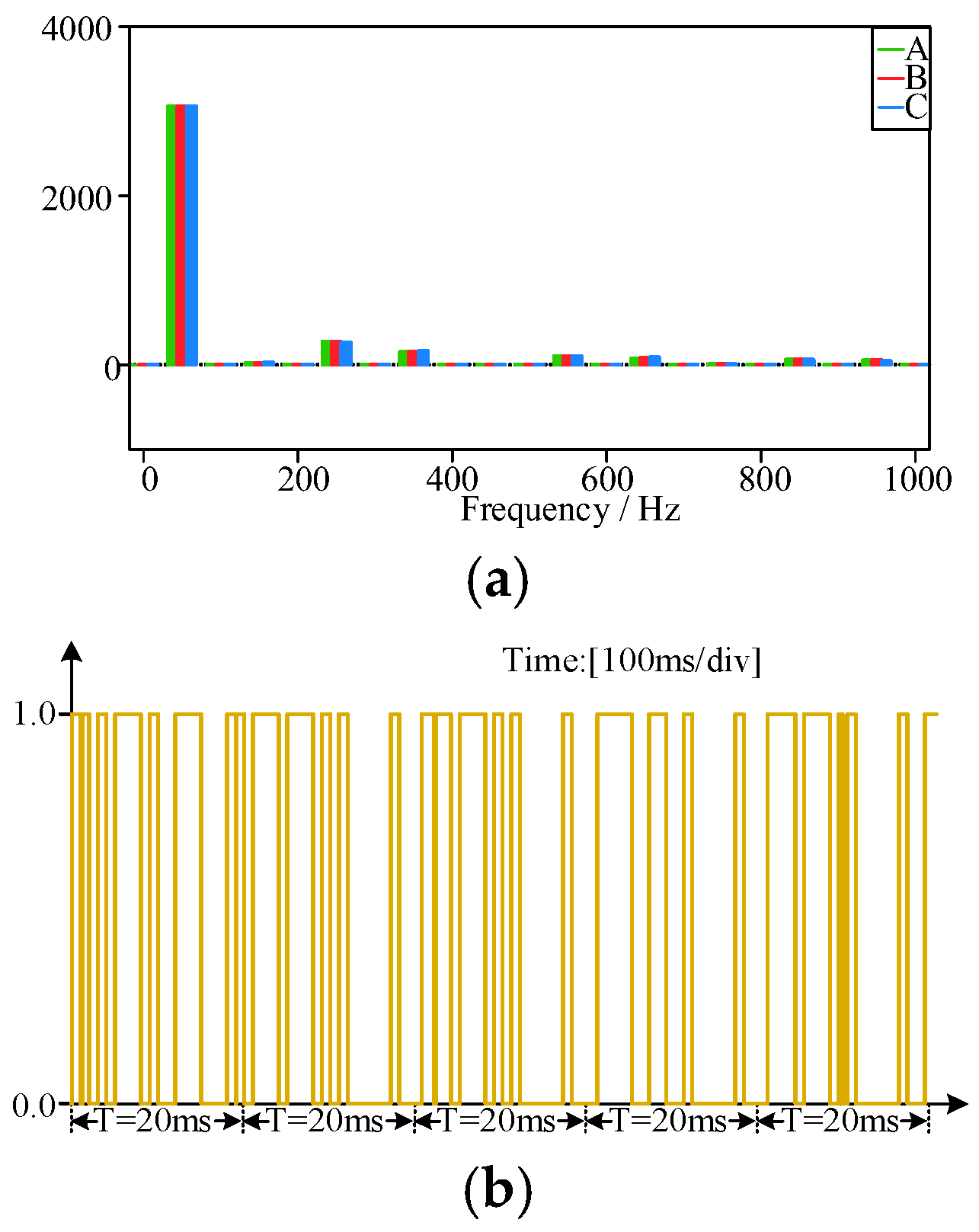
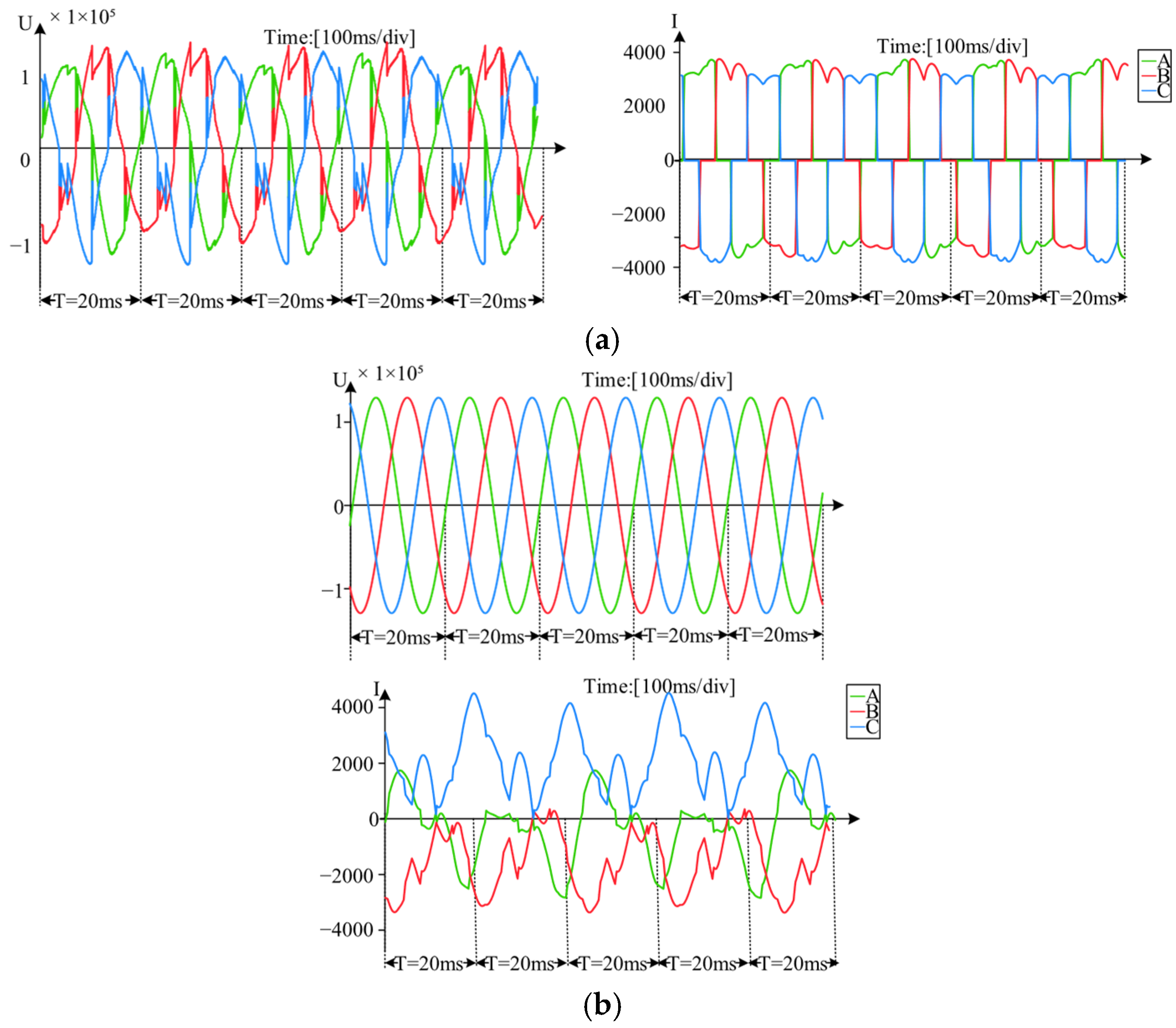
- Case with a Balancing Frequency of 100 Hz
- (2)
- Case with a Balancing Frequency of 500 Hz
- (3)
- Case with a Balancing Frequency of 1000 Hz
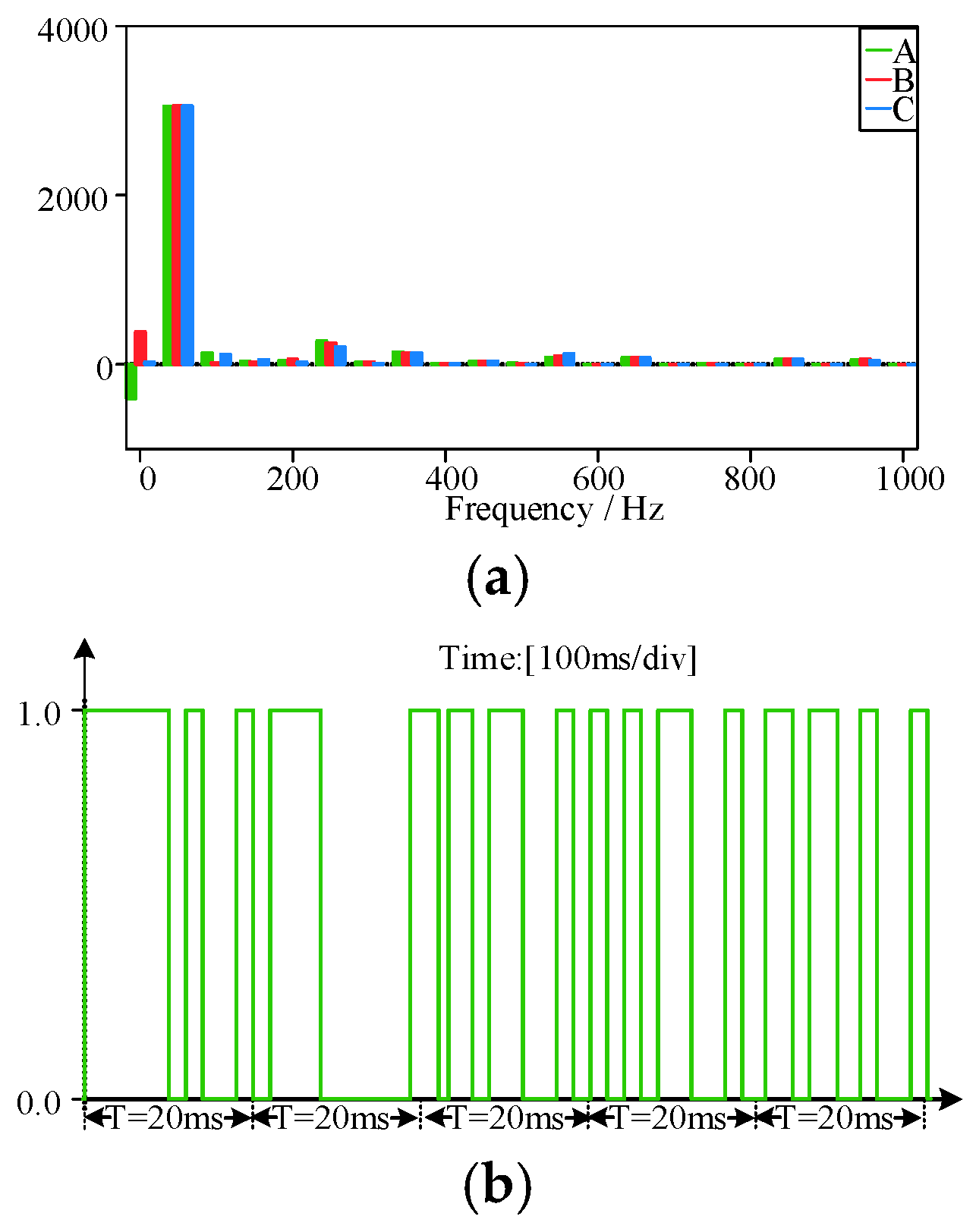
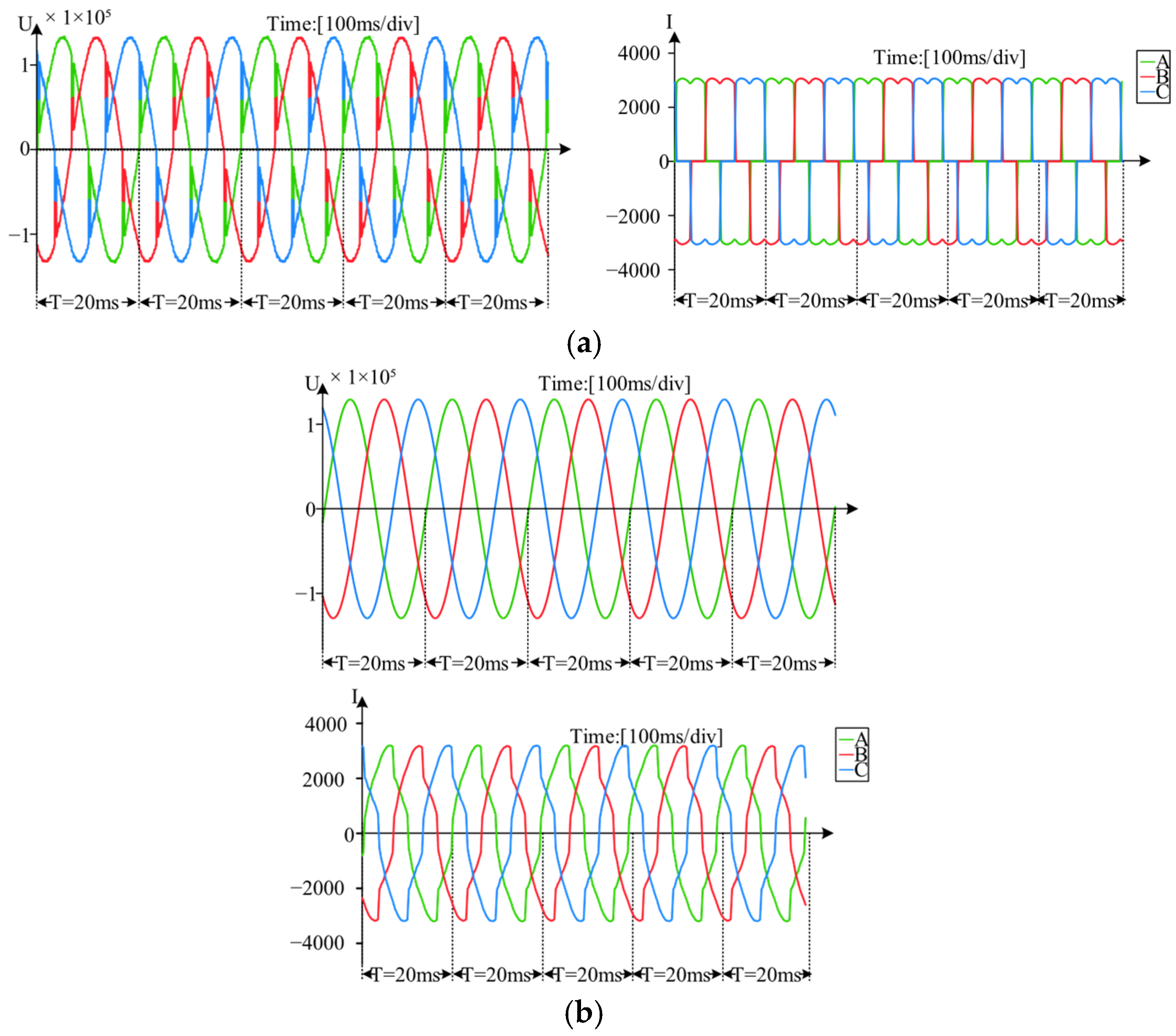
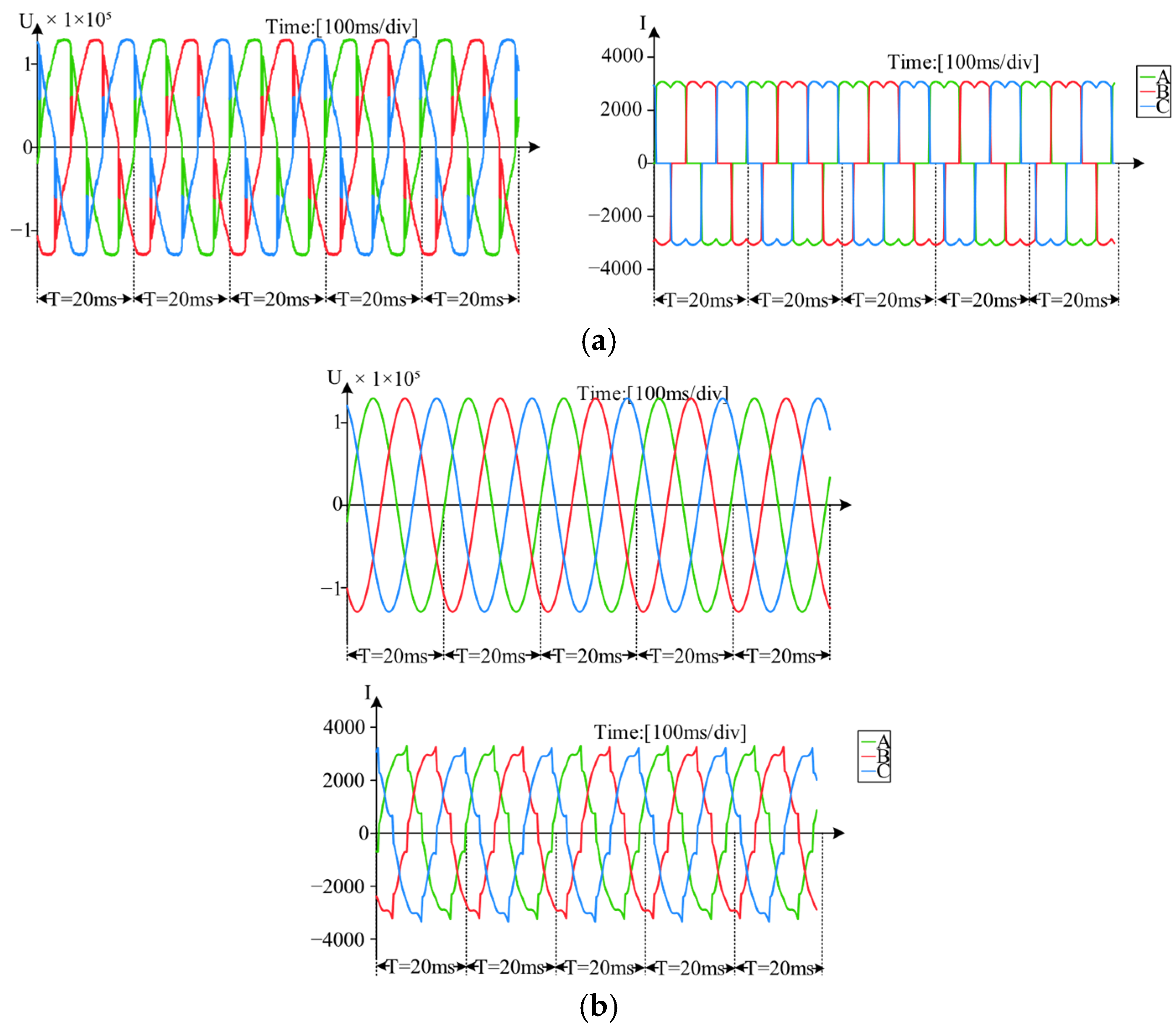
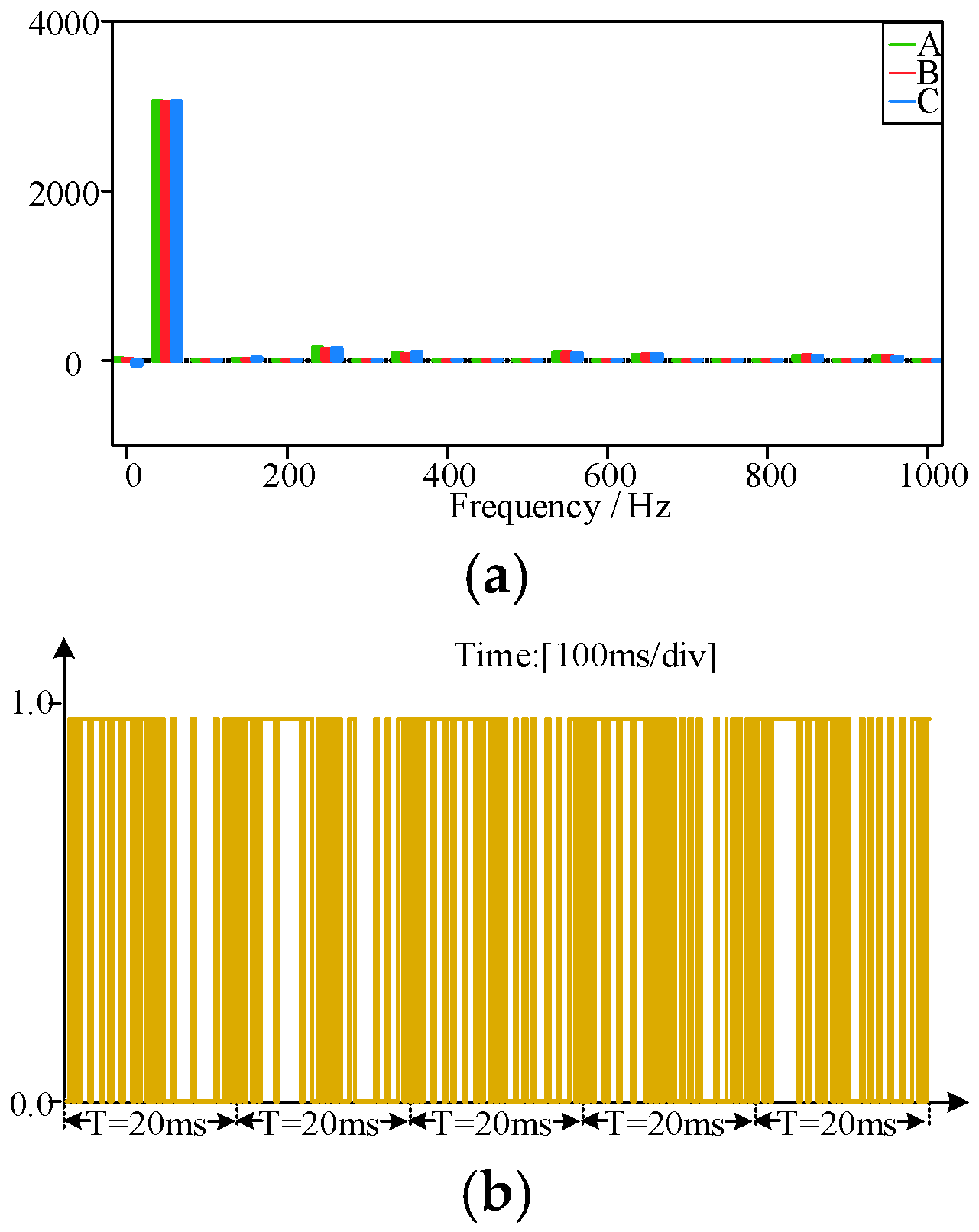
5.2. Impact of Balancing Frequency on SLCC-SVF Submodule Driving Signals with Harmonic Filtering Conditions
- (1)
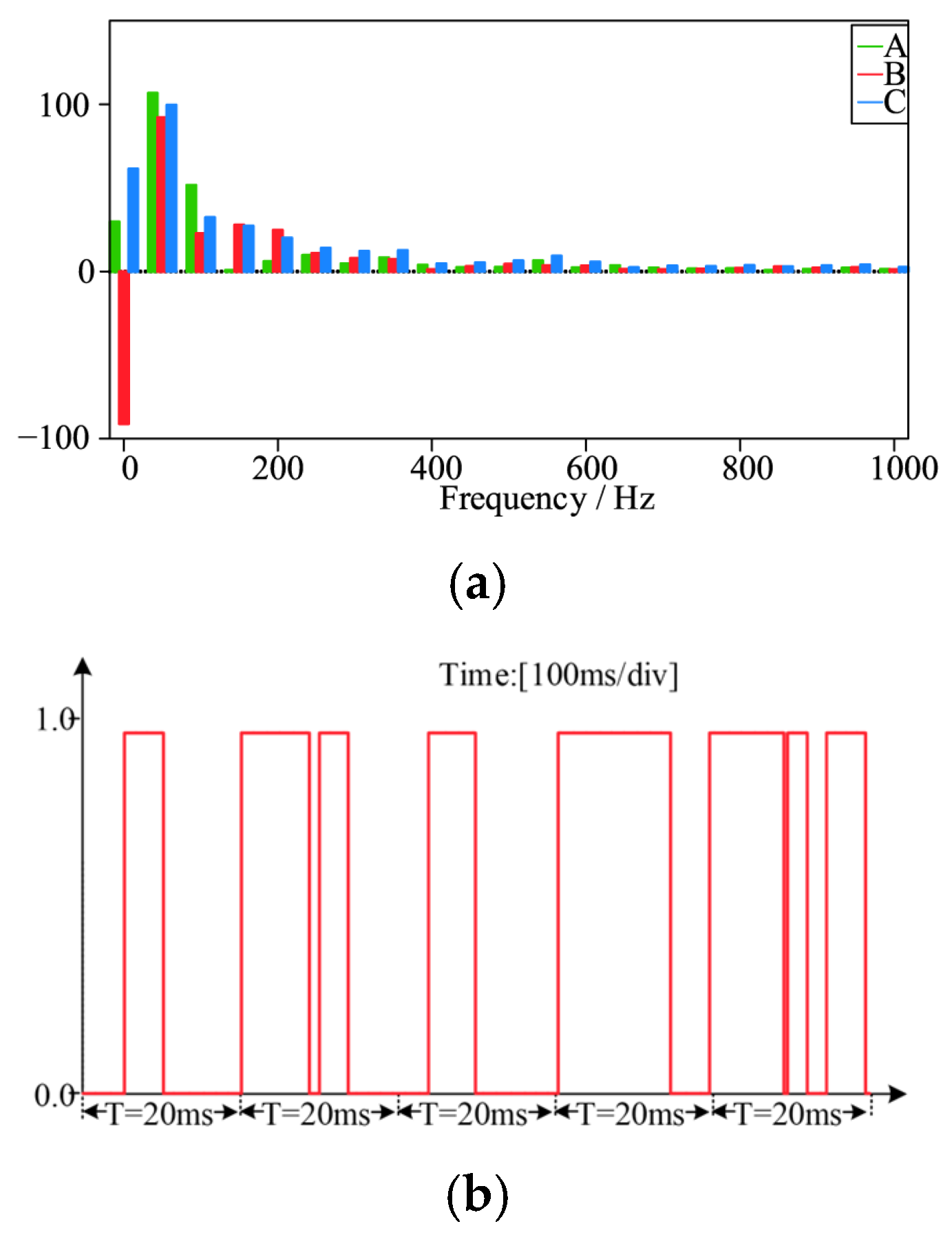
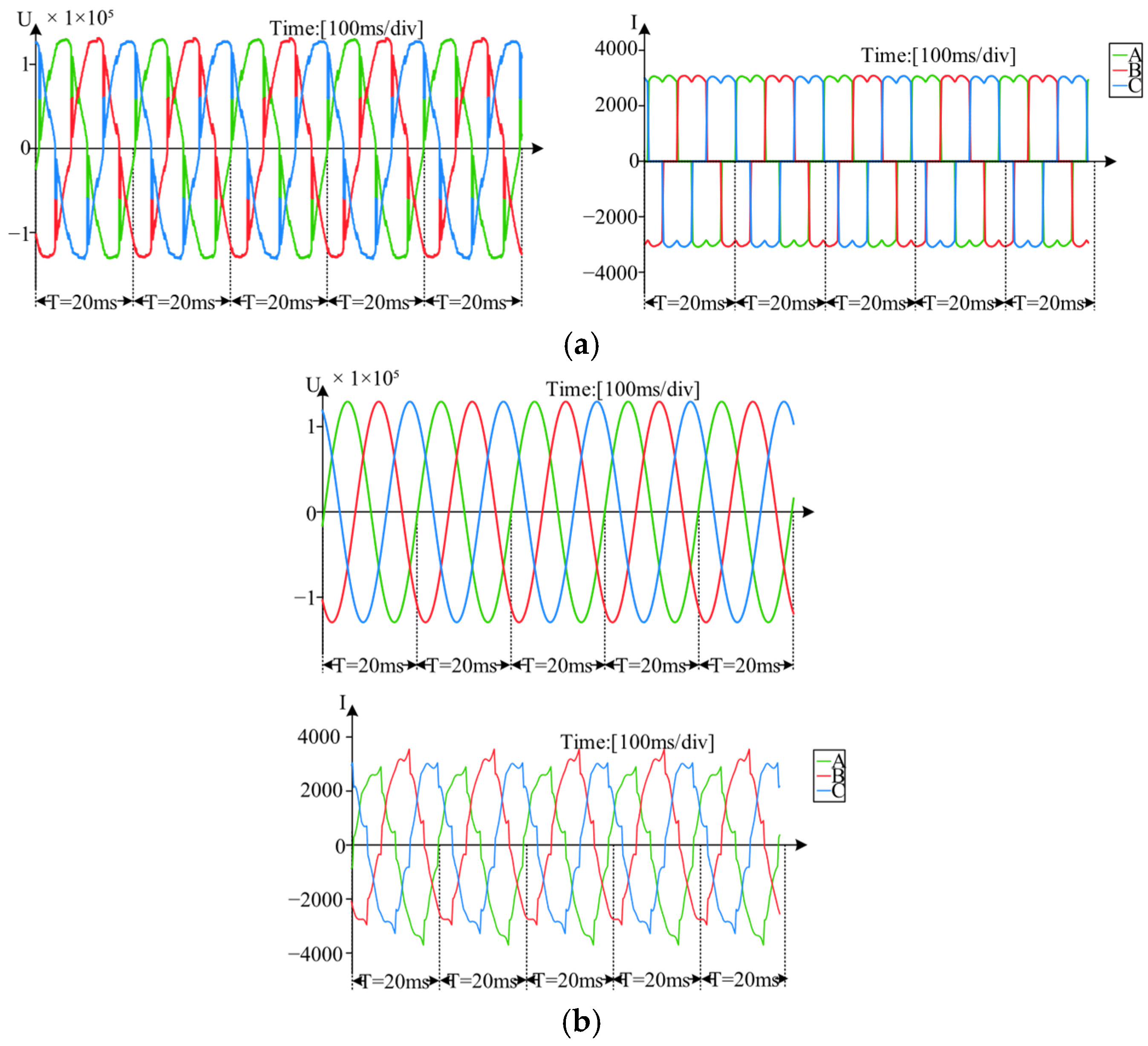
- Case with a Balancing Frequency of 200 Hz and SVF-Injected Harmonic Frequency of 250 Hz
- (2)
- Case with a Balancing Frequency of 1000 Hz and SVF-Injected Harmonic Frequencies of 250 Hz, 350 Hz and 450 Hz
- (3)
- Case with a Balancing Frequency of 3000 Hz and SVF-Injected Harmonic Frequencies of 250 Hz, 350 Hz, 450 Hz, 550 Hz and 650 Hz
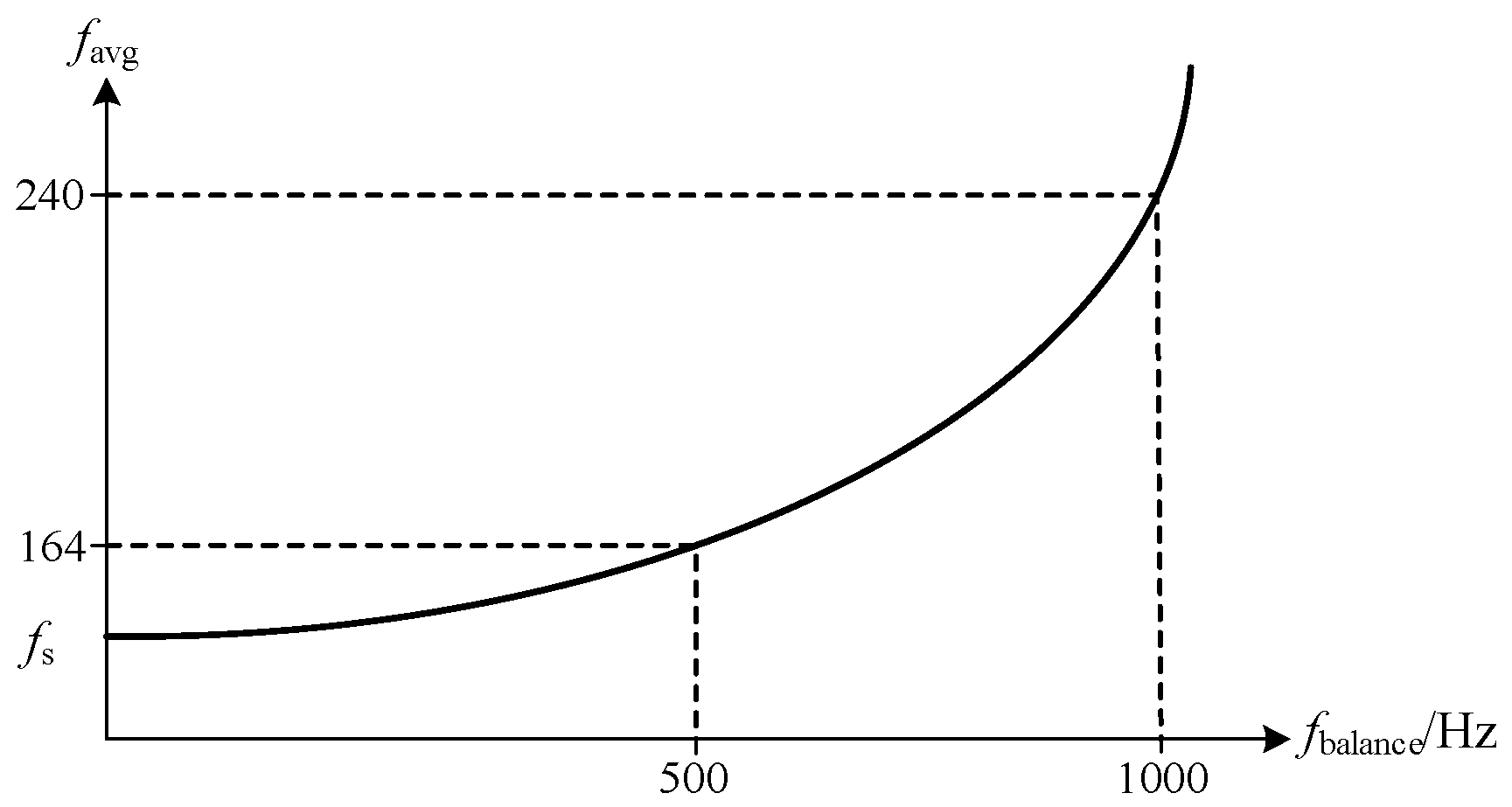
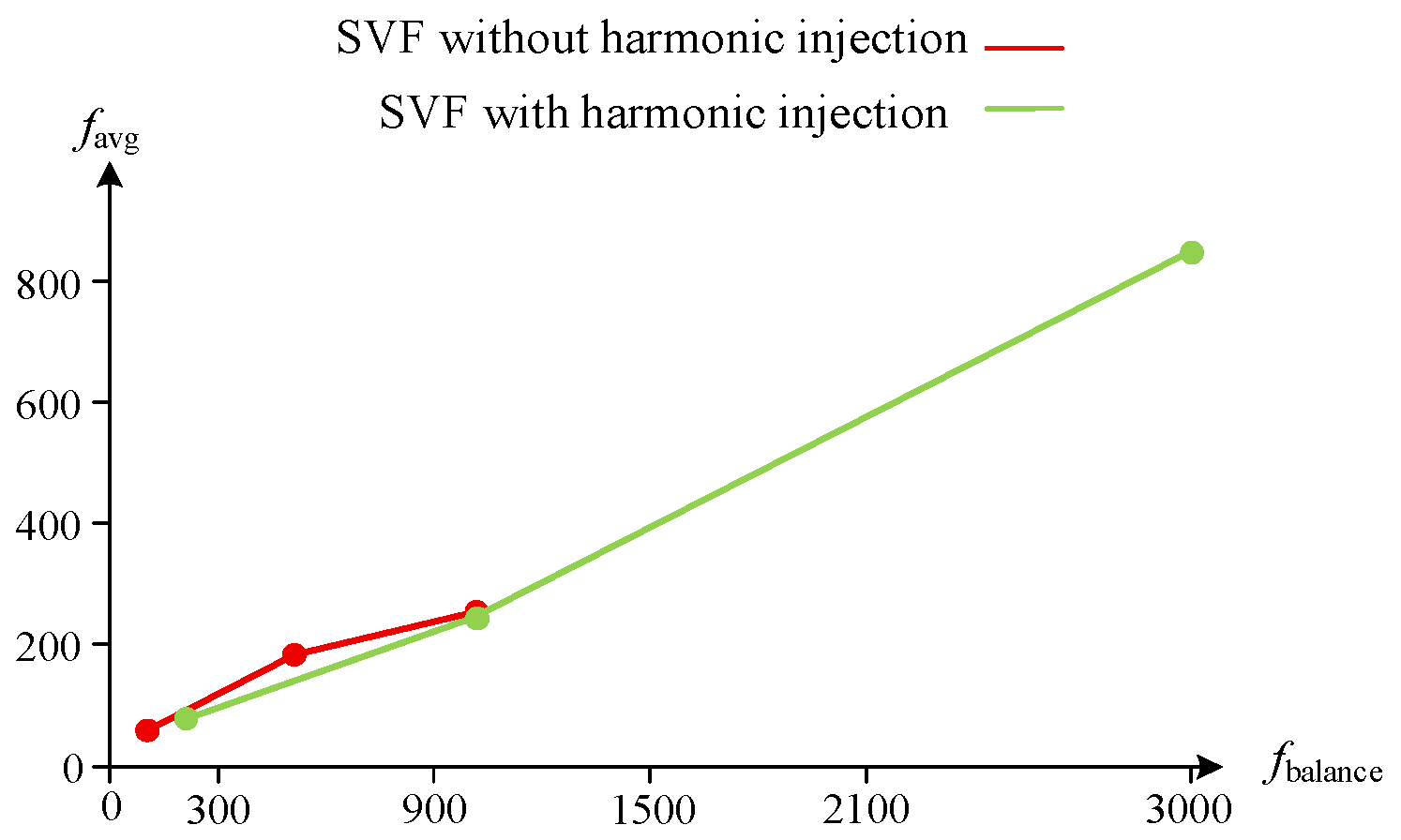
5.3. Average Switching Frequency Under Various Operating Conditions
5.4. Average Switching Frequency Under Optimized Generation Strategy
5.5. Limitations and Future Work
6. Conclusions
Author Contributions
Funding
Data Availability Statement
Conflicts of Interest
Abbreviations
| SLCC | Multi-Sources Line Commutated Converter1 |
| SVF | Static Var & Filter |
| NLM | Nearest Level Modulation |
| THD | Total harmonic distortion |
| MMC | Modular Multilevel Converter |
| Ls | The grid-side inductance |
| Lf | The DC-filter inductance |
| us | The AC voltage |
| Udc | The DC-link voltage |
| is | The AC input current |
| if | The filter branch current |
| uc | The capacitor voltage of each submodule |
| ij | The arm current |
| I(n) | The RMS value of the nth harmonic current |
| φn | The phase angle of the nth harmonic current |
| Id | The DC current |
| ω | The fundamental angular frequency |
| Nsub | The number of submodules |
| min | The number of inserted submodules |
| R_sort | The sorting result of capacitor voltage |
| Ts | The switching period |
| finst | The instantaneous switching frequency |
| favg | The average switching frequency |
| fh | The SVF-injected harmonic frequency |
| fbalance | The balancing frequency |
| fs | The switching frequency |
| fm | The variation frequency of min |
| Tm | The variation period of min |
| TR_sort | The update period of R_sort |
| fR_sort | The update frequency of R_sort |
| ∑Sc | The total number of switchings |
| tcharge1 | The start time of the charging process |
| tcharge2 | The end time of the charging process |
| tpeak | The peak current time |
| freal | The real-time switching frequency |
| Treal | The real-time switching temperature |
| fmax | The predefined safety thresholds of frequency |
| Tmax | The predefined safety thresholds of temperature |
| W | The comprehensive evaluation metric |
| FR | Frequency Ratio |
References
- Hu, C.; Wu, X.; Cai, H. Research on the Operation Performance Enhancement of Hybrid AC/DC Power System with Multi-Type Embedded HVDC. IEEE Trans. Power Deliv. 2025, 40, 606–617. [Google Scholar] [CrossRef]
- Xu, R.; Jiang, Q.; Kuang, W.; Zheng, J.; Li, B.; Peng, Q.; Nan, L. Analysis and control method of SLCC-HVDC system oriented to retrofit AC transmission lines. In Proceedings of the 2024 3rd International Conference on Power Systems and Electrical Technology (PSET), Tokyo, Japan, 5–8 August 2024; pp. 268–272. [Google Scholar]
- Zhao, Y.; Zhu, Z.; Wang, C. High-Precision Calculation Method for SLCC Commutation Overlap Angle Incorporating SVF-LCC Coupling Dynamics. In Proceedings of the 2025 8th International Conference on Electrical Engineering and Green Energy (CEEGE), Yangzhou, China, 4–6 July 2025; pp. 19–24. [Google Scholar]
- Sabetnam, M.; Khoshooei, A. Four-Switch Three-Phase Static VAR Compensator with Capacitor Voltage Offset Suppression. In Proceedings of the 2020 11th Power Electronics, Drive Systems, and Technologies Conference (PEDSTC), Tehran, Iran, 4–6 February 2020; pp. 1–6. [Google Scholar]
- Wang, C.; Zhang, L.; Xiao, L.; Wu, F.; Zheng, X.; Jiang, H. Analysis and Suppression of the Frequency-Decrease Effect in the Capacitor Voltage Related to the Low Modulation Frequency Ratio in an MMC System. IEEE Trans. Power Electron. 2020, 35, 9119–9132. [Google Scholar] [CrossRef]
- Choudhury, A.; Shimada, T.; Kanouda, A.; Mabuchi, Y. Reduced Switching Loss Based Cell Capacitor Voltage Balancing Strategy for MMC. In Proceedings of the 2020 IEEE International Conference on Power Electronics, Drives and Energy Systems (PEDES), Jaipur, India, 16–19 December 2020; pp. 1–5. [Google Scholar]
- Jin, H.; Li, H.; Li, J.; Tan, L.; Ma, K. An MMC optimal balancing control strategy based on SMs’ Capacitor Voltage Characteristics. In Proceedings of the 2024 IEEE International Conference on DC Technologies and Systems (DCTS), Zhuhai, China, 19–20 October 2024; pp. 195–200. [Google Scholar]
- Fan, Y.; Zhang, S.; Yang, J.; Wen, T. An Optimal Voltage Balancing Control Strategy for MMC-HVDC. In Proceedings of the 2025 IEEE International Conference on Power and Integrated Energy Systems (ICPIES), Haikou, China, 7–9 April 2025; pp. 119–123. [Google Scholar]
- Muthavarapu, A.K.; Biswas, J.; Barai, M. An Efficient Sorting Algorithm for Capacitor Voltage Balance of Modular Multilevel Converter With Space Vector Pulsewidth Modulation. IEEE Trans. Power Electron. 2022, 37, 9254–9265. [Google Scholar] [CrossRef]
- Yang, R.; Li, B.; Yang, J.; Chen, K.; Xiong, W.; Zhang, S.; Xiang, W.; Wen, J. An LCC-MMC hybrid cascaded inverter applicable for UHVDC power overhead line transmission and dynamic reactive power self-compensation. Energy Rep. 2020, 6, 943–952. [Google Scholar] [CrossRef]
- Wang, Z.; Peng, L.; Zhang, J. Decomposed Nearest Level PWM Method With Reduced Switching Frequency for MMC. IEEE Trans. Power Electron. 2023, 38, 3340–3351. [Google Scholar] [CrossRef]
- Dash, J.R.; Mohanty, P.K.; Agarwal, P.; Jena, P.; Padhy, N.P. Temporal Convolutional Network-Based Capacitor Voltage Prediction With Reduced Switching Frequency for Voltage Balancing in MMC. IEEE Trans. Ind. Appl. 2025, 61, 7443–7458. [Google Scholar] [CrossRef]
- Chen, J.; Jiang, D.; Sun, W.; Pei, X. Common-Mode Voltage Reduction Scheme for MMC With Low Switching Frequency in AC–DC Power Conversion System. IEEE Trans. Ind. Inform. 2022, 18, 278–287. [Google Scholar] [CrossRef]
- Chen, W.; Anna, W.; Tao, Z.; Hualiang, Z. A Capacitor Voltage Balancing Control Method for Modular Multilevel Converter Based on Variable Threshold Interval Sub-modules Grouping. In Proceedings of the 2021 IEEE 4th International Conference on Electronics Technology (ICET), Chengdu, China, 7–10 May 2021; pp. 597–602. [Google Scholar]
- Luo, W.; Ma, Y.; Zheng, C. Selection-based capacitor voltage balancing control for modular multilevel converters. J. Power Electron. 2021, 21, 1427–1438. [Google Scholar] [CrossRef]
- Chaki, R.; Tambe, S.; Dey, A. A reduced switching space vector modulation for medium voltage grid connected MMC. Electr. Power Syst. Res. 2025, 241, 111322. [Google Scholar] [CrossRef]
- Zhang, Y.; Zhang, J.; Deng, F. Improved CPS-PWM Approach for Over-Modulation Operations of Hybrid Modular Multilevel Converter. IEEE J. Emerg. Sel. Top. Power Electron. 2022, 10, 5933–5943. [Google Scholar] [CrossRef]
- Chen, D.; Xiao, L.; Song, W. Novel Hybrid Modulation Method for Modular Multilevel Converter Based Energy Storage System. IEEE Access 2023, 11, 23420–23432. [Google Scholar] [CrossRef]
- Wang, Y.; Wang, C.; Tao, J.; Wei, Z.; Xu, T. Topology and Modulation of Fractional-Level MMC for DC Distribution Grids. IEEE Trans. Ind. Appl. 2023, 59, 3615–3626. [Google Scholar] [CrossRef]
- Weimin, M.; Xiaolin, S.; Liang, C. A Novel LCC HVDC Transmission Technology Based on the Static Var Generator and Filter. In Proceedings of the 2024 International Conference on HVDC (HVDC), Urumqi, China, 8–9 August 2024; pp. 541–545. [Google Scholar]
- Rao, P.; Bahirat, H.J. Mitigation of Subsequent Commutation Failure in Dual Infeed LCC HVDC Connected to the Weak Grid by Adopting Hybrid Infeed HVDC. In Proceedings of the 2024 23rd National Power Systems Conference (NPSC), Indore, India, 14–16 December 2024; pp. 1–6. [Google Scholar]
- Shen, X.; Du, S.; Liu, Y.; Wu, Y.; Yu, X.; Gu, F. Grid-Forming STATCOM for Commutation Failure Mitigation in LCC-HVDC System. In Proceedings of the 2025 IEEE 20th Conference on Industrial Electronics and Applications (ICIEA), Yantai, China, 3–6 August 2025; pp. 1–5. [Google Scholar]
- Bakas, P.; Okazaki, Y.; Shukla, A.; Patro, S.K.; Ilves, K.; Dijkhuizen, F.; Nami, A. Review of Hybrid Multilevel Converter Topologies Utilizing Thyristors for HVDC Applications. IEEE Trans. Power Electron. 2021, 36, 174–190. [Google Scholar] [CrossRef]
- Wang, C.; Zeng, W.; Wang, Y.; Dai, Q.; Wang, Y.; Yang, X. SVPWM Strategy with Minimum Common-Mode Voltage for Multilevel Converter Combining the Concept of the Nearest Level. IEEE Trans. Power Electron. 2023, 38, 9933–9943. [Google Scholar] [CrossRef]
- Wang, W.; Ma, K.; Cai, X. Flexible Nearest Level Modulation for Modular Multilevel Converter. IEEE Trans. Power Electron. 2021, 36, 13686–13696. [Google Scholar] [CrossRef]



| Operating Condition | fbalance/fh | favg |
|---|---|---|
| Non-harmonic filtering conditions | fbalance = 100 Hz | 61.2 Hz |
| fbalance = 500 Hz | 161.4 Hz | |
| fbalance = 1000 Hz | 250 Hz | |
| Harmonic filtering conditions | fbalance = 200 Hz; fh = 250 Hz | 82.4 Hz |
| fbalance = 1000 Hz; fh = 250 Hz, 350 Hz, 450 Hz | 240.4 Hz | |
| fbalance = 3000 Hz; fh = 250 Hz, 350 Hz, 450 Hz, 550 Hz, 650 Hz | 863 Hz |
| Operating Condition | fbalance/fh | favg |
|---|---|---|
| Harmonic filtering conditions | fbalance = 200 Hz; fh = 250 Hz | 62.6 Hz |
| fbalance = 1000 Hz; fh = 250 Hz, 350 Hz, 450 Hz | 197.8 Hz | |
| fbalance = 3000 Hz; fh = 250 Hz, 350 Hz, 450 Hz, 550 Hz, 650 Hz | 678.3 Hz |
| fbalance | Different Weight | favg |
|---|---|---|
| 3000 Hz | 0.6:0.4 | 853.7 Hz |
| 0.8:0.2 | 785.6 Hz | |
| 0.7:0.3 | 678.3 Hz |
Disclaimer/Publisher’s Note: The statements, opinions and data contained in all publications are solely those of the individual author(s) and contributor(s) and not of MDPI and/or the editor(s). MDPI and/or the editor(s) disclaim responsibility for any injury to people or property resulting from any ideas, methods, instructions or products referred to in the content. |
© 2026 by the authors. Licensee MDPI, Basel, Switzerland. This article is an open access article distributed under the terms and conditions of the Creative Commons Attribution (CC BY) license.
Share and Cite
Mao, X.; Zhang, X.; Ling, J.; Yan, H.; Jing, R.; Liu, Z.; Wang, C. An Abnormal Increase in Switching Frequency in Multi-Sources Line Commutated Converter and Suppression Method. Energies 2026, 19, 870. https://doi.org/10.3390/en19040870
Mao X, Zhang X, Ling J, Yan H, Jing R, Liu Z, Wang C. An Abnormal Increase in Switching Frequency in Multi-Sources Line Commutated Converter and Suppression Method. Energies. 2026; 19(4):870. https://doi.org/10.3390/en19040870
Chicago/Turabian StyleMao, Xintong, Xianmeng Zhang, Jian Ling, Honglin Yan, Rui Jing, Zhihan Liu, and Chuyang Wang. 2026. "An Abnormal Increase in Switching Frequency in Multi-Sources Line Commutated Converter and Suppression Method" Energies 19, no. 4: 870. https://doi.org/10.3390/en19040870
APA StyleMao, X., Zhang, X., Ling, J., Yan, H., Jing, R., Liu, Z., & Wang, C. (2026). An Abnormal Increase in Switching Frequency in Multi-Sources Line Commutated Converter and Suppression Method. Energies, 19(4), 870. https://doi.org/10.3390/en19040870