1. Introduction
Energy consumption is the main driver of greenhouse gas pollution and climate change [
1,
2,
3]. According to the latest Eurostat data, household energy consumption in the European Union (EU) is increasing. Therefore, a big issue remains, how to reduce energy consumption in the EU. Thus, analysing the main determinants of energy consumption and energy efficiency behaviour is critical. Energy consumption behaviour is considered daily, repetitive, and often routine-based, while energy efficiency behaviour is discrete, investment-based, and requires planning, financial, and cognitive resources. Despite their differences, both types of behaviour are related to reduced energy use, which is particularly important for mitigating climate change.
In various theories of behaviour, such as the Theory of Planned Behaviour, the Theory of Reasoned Action, Value–Belief–Norms, and environmental factors, such as attitudes, are among the main determinants of pro-environmental behaviour. Environmental attitudes are essential motives for citizens to perform energy-saving behaviour and to seek energy efficiency in the households as well [
4]. In the literature, authors encompassed broad categories of variables, such as environmental awareness, attitudes, values and knowledge [
5,
6,
7]. In this paper, the environmental attitudes and the confidence of personal energy reduction were examined as the environmental aspect.
However, previous theories, such as the Theory of Planned Behaviour and Goal Framing theory, showed that environmental attitudes alone are insufficient to produce energy-saving behaviour. Ref. [
8] revealed that household consumption depends not only on psychological mechanisms, but also has a practical side. According to Goal Framing theory, the gain motive is one of the main reasons people save energy to save money. Furthermore, the economic aspect is a conditional facet when the price is an important motive. The financial aspects were fundamental during the first year of war in Ukraine in 2022, when the energy crisis occurred, and one of the main features was the growth of energy prices, which affected not only production [
9,
10] but the household sector as well [
11,
12]. Thus, the economic aspect has become one of the main reasons to reduce energy consumption [
13,
14]. In the literature, authors analysing the economic and price impact on energy consumption and efforts seeking energy efficiency revealed different results [
15,
16,
17]. However, to the best of our knowledge, none of the previous authors have explored the importance of economic factors for energy consumption and efficiency behaviours during the war in Ukraine. Parag et al. [
18] emphasised that this period could be the perfect time to encourage people to reduce energy consumption. Thus, it is vital to explore how economic aspects influence European citizens’ behaviour. In this paper, the seriousness of the energy price problem and how much people are willing to pay more (WTP) to speed up green transition were considered as the economic aspect. The last factor could also be regarded as an environmental factor, as it reflects citizens’ willingness to contribute to the green transition. However, since this factor encompasses the cost level, this paper treats it as an economic factor.
Perceived social legitimacy is crucial as well, as it relates to the barriers or facilitators to performing the analysed behaviours, which is essential in the Theory of Planned Behaviour. Therefore, in addition to environmental attitudes, attitudes towards the tools of environmental policy were considered. The environmental policy could be separated into a promotion policy, which is focused on subsidies or investments, and a ban-and-fee policy, emphasising taxes or energy quotas. Furthermore, these policies can affect the economy by influencing changes in the prices and costs of energy sources and energy-efficient appliances and measures. In the literature, authors mainly analysed the impact of taxes [
19,
20] or subsidies [
21,
22,
23] on energy consumption. In this paper, the impact of attitudes toward the different environmental policies on energy consumption and efficiency behaviours was analysed. It shows how people regarded these policies and how they affected their behaviour. This area, to the best of our knowledge, has not been studied, and this paper fills the gap, providing policymakers with valuable insights. Thus, this paper aimed to analyse the attitudes towards environmental policy and the impact of economic and environmental aspects on the energy consumption and energy efficiency behaviours in EU countries in the period of war in Ukraine. The compatibility of economic and environmental goals is a key factor in achieving not only environmentally friendly behaviour but also sustainable development goals [
24].
1.1. The Impact of Economic Aspects on Energy Consumption and Energy Efficiency Behaviours
The specificity of energy-saving behaviour is that it is directly related to economic benefits, as discussed in Goal Framing theory. Usually, people perform this behaviour due to the gain motives, such as saving money [
25,
26,
27,
28], emphasising that the perceived benefit is significant for consumers. Ref. [
29] explains that less environmentally friendly respondents were more likely to perform energy-saving behaviour, highlighting the monetary motives as the most important. Ref. [
30] also showed that saving money is an essential factor in resource-saving behaviour. However, refs. [
31,
32] revealed contradicting results, and one of the reasons for this could be the level of a country’s development, which previous researchers did not analyse. In this paper, the relationship between economic growth and the importance of economic factors was considered.
As economic factors, the price or cost of energy sources being essential to energy consumption and energy efficiency behaviours [
6,
15] was considered. According to the economic theory, the prices should motivate people to consume less [
33]. Ref. [
34] showed that energy price is an essential factor for energy-saving performance. Ref. [
35] also showed that bill consciousness influenced energy conservation intentions. However, ref. [
36] revealed that changes in price only in the short term can affect the behaviour to neutralise the energy price growth. Other authors stated that the prices insignificantly influenced the residential electricity consumption [
16,
17,
30,
37]. Ref. [
38] also stated that the growth of electricity prices caused limited energy savings. In the context of the war in Ukraine, analysing this factor is particularly important because during this period, a significant energy crisis occurred, leading to rapid price increases. Thus, in this paper, we expect that the seriousness of the energy price problem motivates a reduction in energy consumption.
The monetary and gain factors are also crucial in investing in energy efficiency in the household sector [
39]. Furthermore, the price effect is not only significant for energy consumption but also for energy efficiency behaviour [
37]. Ref. [
40] also suggested that higher energy prices could motivate people to adopt energy-efficient measures in their households. Meanwhile ref. [
41] stated that one of the barriers to energy efficiency behaviour could be low expenditure on energy. These contradictory results reveal a gap in research on how economic factors and prices influence this behaviour, particularly in the context of the war in Ukraine. Thus, we expect that the seriousness of the energy price problem does not motivate citizens to engage in energy-efficiency behaviour.
In this paper, WTP to speed up green transition also is considered as one of economic factors affecting the energy consumption and energy-efficiency behaviours. In the literature, authors usually analysed the WTP as a dependent variable [
42,
43,
44,
45]. However, to the best of our knowledge, how this factor influences pro-environmental behaviour related to energy consumption has not been analysed. Thus, in this paper, we explored whether people who are willing to sacrifice money for the green transition are also likely to reduce their energy consumption and achieve energy efficiency in their households. Thus, in this paper, not only the impact of price was analysed, but also the willingness to financially contribute to reducing energy consumption was also considered.
1.2. The Impact of Environmental Aspects on Energy Consumption and Energy Efficiency Behaviours
Authors analysing pro-environmental behaviour usually consider environmental aspects [
46,
47]. However, environmental factors, such as attitudes, do not always encourage this behaviour [
25]. Considering energy-saving or consumption behaviour [
48], it was stated that solely environmental awareness does not decrease energy consumption. Thus, authors included more environmental factors and found that environmental concern and responsibility influenced the energy-saving actions [
49]. Ref. [
50] found that environmental awareness and consumer effectiveness positively affected these habits. Ref. [
51] also emphasised the role of self-efficacy on energy behaviours. Ref. [
28] highlighted the individual’s role in climate change impact on energy consumption. Meanwhile, ref. [
52] showed that attitude–behaviour links were insignificant. Refs. [
5,
53] revealed a weak relationship between attitudes toward energy consumption and efforts to save energy and responsibility. Furthermore, the level of concern about the environment varied across countries in the EU [
53]. In this paper, the environmental attitudes and confidence in personal energy reduction were analysed as environmental variables. In general, environmental attitudes reveal the relationship between attitudes and behaviour. The confidence level shows the level of self-efficacy in reducing energy consumption. In this analysis, we expected that both environmental aspects would positively influence energy consumption behaviour.
Considering the energy efficiency behaviour, the authors found somewhat similar results that the attitude is the main factor in willingness to pay more for energy efficiency measures [
54]. Ref. [
55] also showed that self-identity determined the intention to change a heating appliance for a more energy-efficient one. Meanwhile, ref. [
39] revealed that the perception of environmental benefits had little effect on investments in energy efficiency. However, we expected that, in this case, ecological aspects would contribute to energy-efficiency behaviour.
1.3. The Impact of Attitudes Towards Environmental Policy on Energy Consumption and Energy Efficiency Behaviours
Implementation of environmental policy is considered as an external factor, as a primary barrier or facilitator, and authors found that this factor significantly determined energy-saving behaviour [
6,
31,
37]. It revealed that the optimal policy situation also improves saving behaviour. Considering the policy directions charging or subsidies, ref. [
56] showed that the energy charging system is motivated to adopt energy-saving measures. Meanwhile, subsidy policies negligibly influenced purchasing decisions [
41]. However, from the perspective of citizens, only the perception of environmental policy could be analysed. Ref. [
57] revealed that the perceived government initiatives determined pro-environmental behaviour. In this paper, the attitudes towards promotion, ban, and fee policies were analysed, showing how people regard these policies and whether people who prefer one policy to another behave in an environmentally friendly manner in terms of energy consumption.
2. Materials and Methods
2.1. Data Source
The data for the analysis of attitudes towards environmental policy and the impact of economic and environmental aspects on energy consumption and efficiency behaviours refers to the Eurobarometer 97.4 survey performed in May–June 2022, GESIS (2022) [
58]. Thus, the survey was conducted in the first year of the war in Ukraine, when concern and anxiety were widespread across the EU. In this survey, 26,395 respondents from all EU countries, of different social status and demographic groups, were questioned. Detailed information about the number of respondents from separate EU countries is presented in
Appendix A. The respondents were selected randomly. The confidence intervals and interview methods are provided in the European Commission report [
58].
2.2. Used Scales and Questionnaire
The primary dependent variables, energy consumption and energy efficiency behaviours, were analysed. The energy consumption behaviour was assessed by answering the following question: “How does your energy consumption compare with that of other people in (our country)?” The used scale was from 1 to 10, where 1 means ‘among the lowest compared with other people in (our country)’, and 10 means ‘among the highest compared with other people in (our country)’. The energy efficiency behaviour was evaluated using a dichotomous question: “In the last 5 years, you have taken measures to make your home more energy efficient” (1—I do it; 0—I do not do it).
Variables analysed as the main determinants from an economic perspective were: the seriousness of the price problem and WTP to speed up the green transition. Primarily, the respondents were asked about the severity of the problem with energy prices across all types. The authors constructed this scale. Thus, before hypothesis testing, exploratory factor analysis was conducted to assess the dimensionality of the complete measurement set. The WTP was evaluated on a scale from 1—“I am not willing to pay” to 5—“above 30% more I am willing to pay to speed up green transition”. As environmental aspects, the environmental attitudes and confidence in personal energy reduction were evaluated. The scale of environmental attitudes was adopted by studies [
5,
59]. The confidence level was evaluated on a 10-point scale from 1—“I am not at all confident of personal energy reduction” to 10—“I am completely confident of personal energy reduction”. This variable captures perceived self-efficacy rather than objectively measured behavioural capacity. Such subjective measures are commonly used in large-scale behavioural surveys, particularly when the objective measurement of individual energy reduction is not feasible. Given the study’s behavioural focus, perceived confidence is considered an appropriate proxy for personal agency in energy-related decision-making. Attitudes towards environmental policy were separated into ban, fee, and promotion policies. The items related to the ban and fee policy considered attitudes towards energy taxes and quotas. In the scale of attitudes towards the promotion policy, statements about investments and subsidies were included.
All analysed scales were constructed applying factor analysis. To guarantee that this analysis is suitable, the Kaiser–Meyer–Olkin (KMO) and Bartlett’s test coefficient were assessed, and the value 0.8 and
p < 0.01 indicated that these assumptions were satisfied [
60]. The items of the scales were measured applying a four-point Likert scale ranging from (1) not serious (do not agree) to (5) very serious (strongly agree). The validity of the used scales was tested using Pearson Product–Moment correlations. The correlation between items and the total score was assessed, revealing the validity of the scales. The reliability of constructs was measured using Cronbach’s alpha. The coefficients of this statistic, provided in
Table 1 (0.50–0.76), showed that all constructs were moderately reliable and generally acceptable [
61].
Cross-sectional data from all analysed EU countries were used to evaluate the relationships among economic development, energy consumption, and energy efficiency behaviours. The economic development level was assessed based on Gross Domestic Product (GDP) per capita data (in PPP (purchasing power parity) consistent with the 2018 international $) for 2021. The World Bank database provided this data. Furthermore, in this paper, we also evaluated which aspect, economic or environmental, citizens give priority to in each separate EU country. These tendencies were assessed considering the average of answers to the provided question in the survey: “Thinking about the main reason why you would reduce your energy use, which one corresponds best to your own situation? You would reduce your energy use from 1 (for economic reasons to save money) to 4 (for environmental reasons to help tackle climate change).
2.3. Statistical Methods
The scales were constructed using factor analysis. The relationships among energy consumption, energy efficiency behaviour, economic development, and the priority of environmental or economic aspects were evaluated using Spearman’s correlation analysis and cross-sectional data from EU countries. A p-value less than 0.05 was considered significant for the analysed relationships.
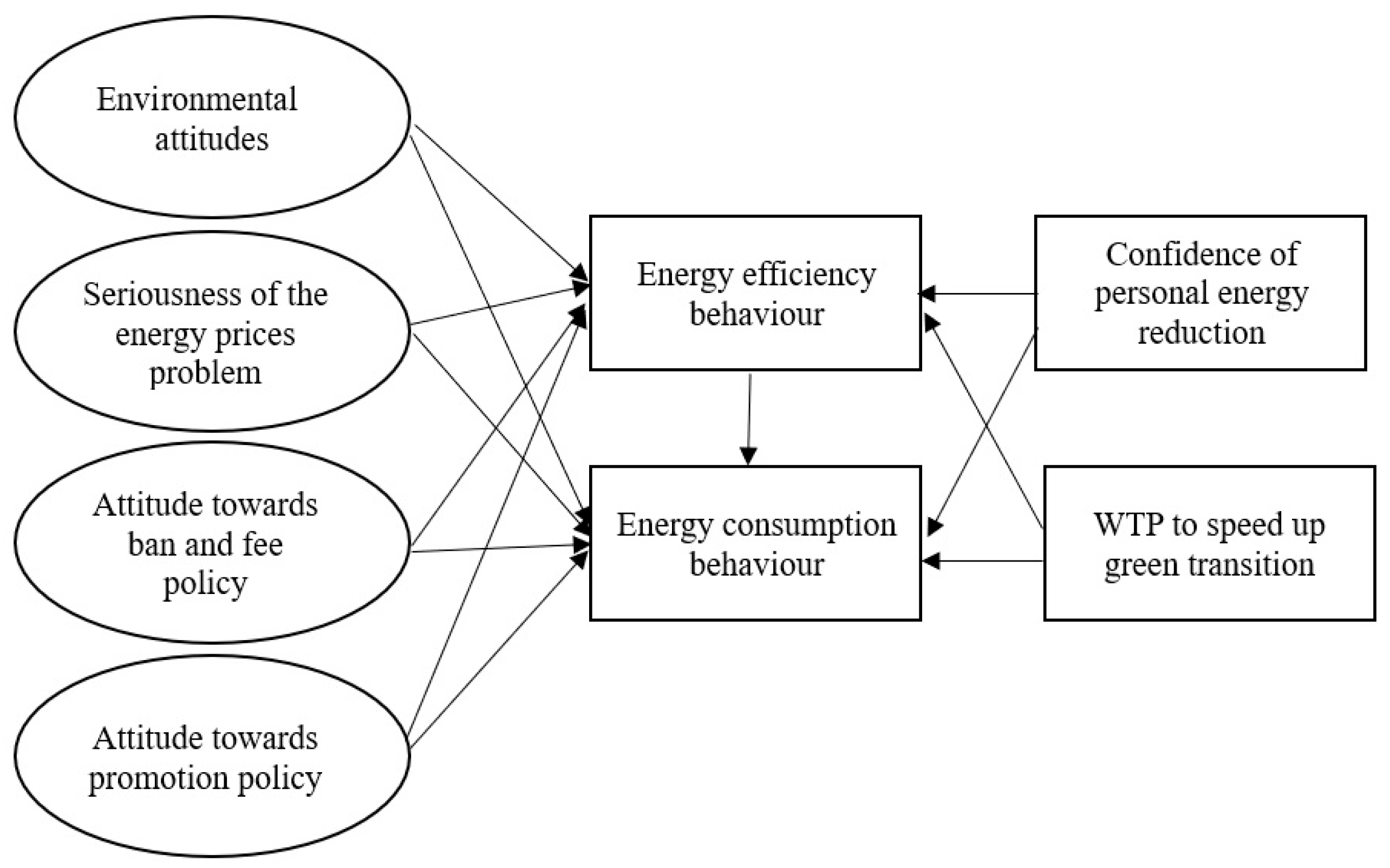
To reveal the main determinants of energy consumption and energy efficiency behaviours, different regression analyses were applied, which are consistent with the conceptual model presented in
Figure 1. Energy consumption behaviour was first analysed using a multiple linear regression model, which allows for straightforward interpretation and comparison with earlier studies. Given the ordinal nature of the self-assessed energy consumption variable, additional ordered logistic regression models were estimated as robustness checks. Multicollinearity among explanatory variables was assessed using variance inflation factors (VIFs), which indicated no concerns. The main determinants of energy efficiency behaviour were analysed using binary logistic regression, as this behaviour was measured dichotomously. Model fit was assessed using the Nagelkerke R
2, the omnibus test, and the overall classification accuracy. An omnibus test
p-value below 0.001 indicates that the logistic regression model is statistically significant.
3. Results
3.1. The Priority of Environmental or Economic Aspects in the EU Countries and Their Relationship with Economic Development
In general, environmental attitudes across all EU countries were relatively high. People mostly agreed that the green transition should not leave anyone behind. However, among those who stated that climate change frightens them, only a minor share agreed. It shows that climate change does not scare people. This problem is long-term and global, so people with other issues, such as war, rising energy prices, and pandemics, do not consider it particularly dangerous. The majority of citizens agree that prices are a grave problem. However, when considering separate energy types, respondents evaluated the seriousness of the price problem at a lower level. It could be related to the fact that governments used compensation tools to mitigate the impact of price increases in energy sources in the household sector. However, rising energy prices affected individuals not only directly but also indirectly, as prices across various consumption categories, particularly food, rose, and inflation during this period grew rapidly. Considering attitudes towards environmental policy, people were more likely to agree that the promotion policy, including subsidies and investments, should be implemented. At the same time, depending on whether the policy is taxes or quotas, only a minor share of respondents agreed that these tools are essential to tackle climate change. Therefore, people hardly agree with tax policy, particularly when the economy slows down due to the energy prices. The promotion policy is more favoured by citizens. The level of confidence in personal energy reduction in the EU was average. People paid little attention to energy conservation even during a critical period, such as the war in Ukraine. The level of WTP in EU countries was also very low. The increasing prices did not enhance the level of willingness to pay more for green transition, and usually in periods of crisis, the environmental issues are not the most important [
30].
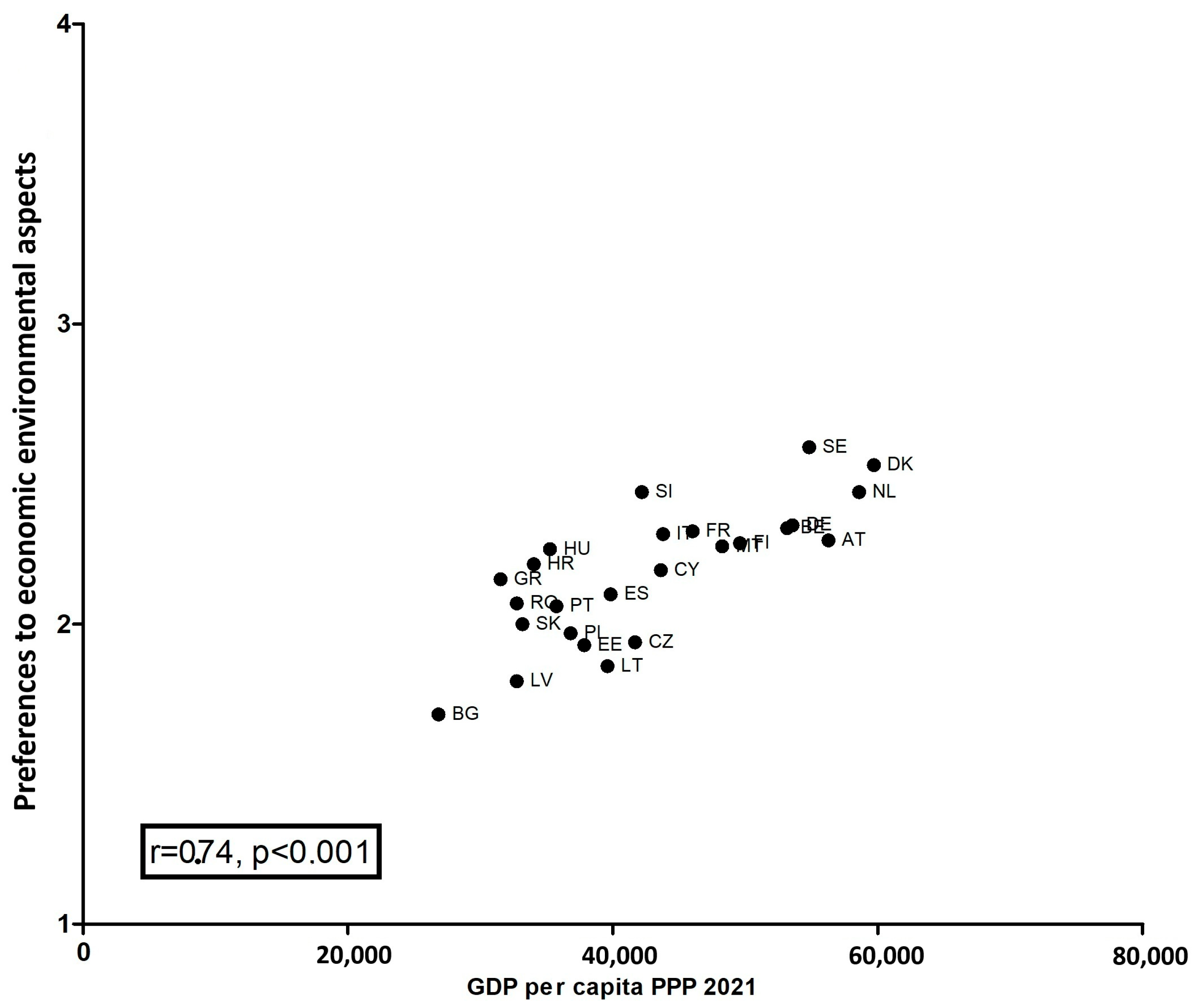
Analysing the preferences of motives to reduce energy consumption, two necessary poles, economic and environmental reasons, were considered. Through analysing the relationship between these preferences and economic development level, a positive, statistically significant correlation was observed. From
Figure 2, we see that people in the wealthiest countries, such as Sweden, Denmark, and the Netherlands, more often cited environmental reasons for reducing energy consumption. Meanwhile, in Bulgaria, Latvia and Lithuania, the less rich EU countries, the economic motive was the most important for energy saving. In the literature, authors also confirmed that rich countries pay more attention to environmental aspects, and this consideration is significant for them [
62,
63]. In developing and lower-income countries, the economic motive is the most important.
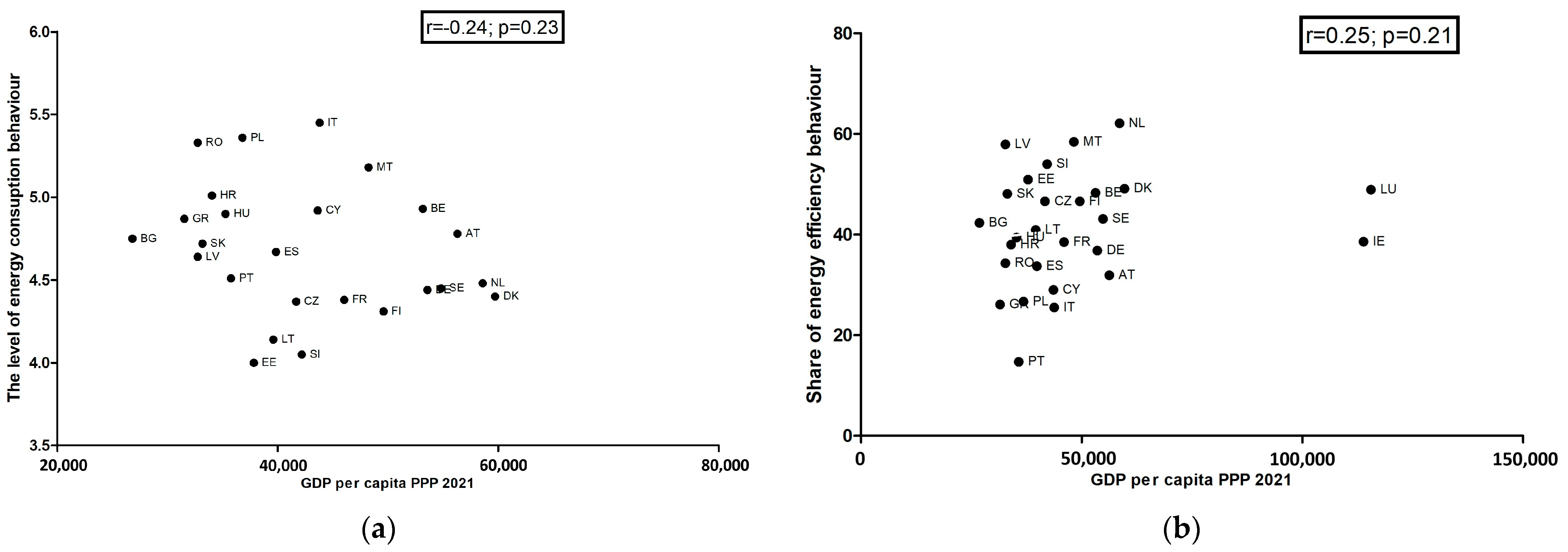
Regarding energy consumption and energy efficiency behaviours, the relationships with economic development were statistically insignificant. Thus, the level of economic growth was not related to pro-environmental behaviour regarding energy consumption. The tendencies of these relationships were different. The relationship between energy consumption and the development level was negative, however, insignificant. Meanwhile, the relationship between energy efficiency and GDP level was positive. The positive correlation between income and the purchase of energy-efficient appliances was observed in ref. [
64]. This result also confirmed that rich people can spend more on seeking energy efficiency. Meanwhile, ref. [
29] highlighted the income level for energy consumption. However, they contradict each other and support the monetary motivation. Among EU countries, Estonia, Slovenia, and Lithuania reported lower energy consumption than others. In these countries, people try to save energy in their households. Meanwhile, energy consumption was highest in Italy, Poland, and Romania (
Figure 3a).
Regarding energy-efficiency behaviour, more than half of respondents in Latvia, Malta, and the Netherlands stated that in the last 5 years they have taken measures to make their homes more energy-efficient. This tendency was the rarest in Portugal, Italy and Greece (
Figure 3b). Thus, for citizens of Southern Europe, pursuing energy efficiency was not essential. It shows that people do not understand the importance of reducing energy consumption or how to do so.
3.2. The Relationships Between the Preferences of EU Citizens and Energy Consumption and Efficiency Behaviours
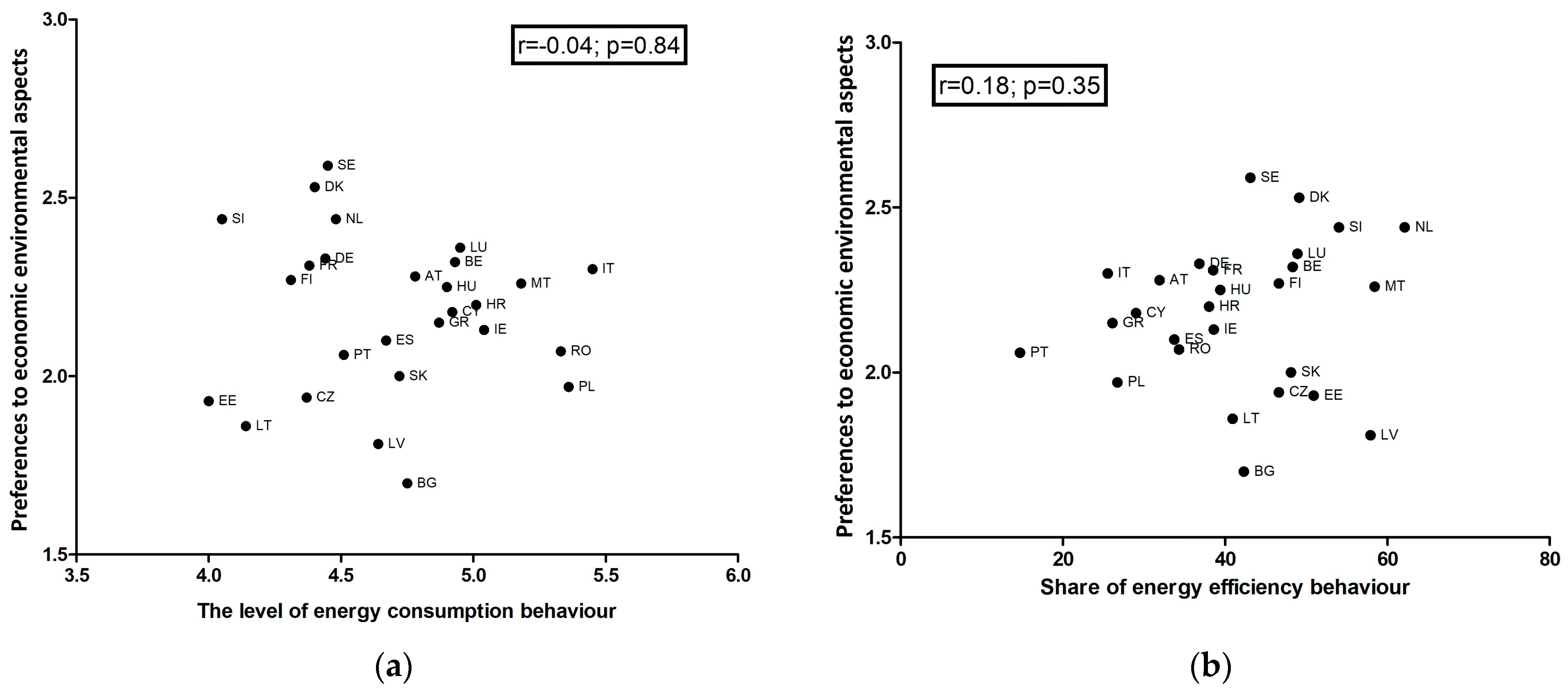
Considering the two poles of motives as economic and environmental aspects, the results revealed that the relationships between these aspects and the analysed behaviours were insignificant (
Figure 4a,b). Thus, neither energy consumption nor energy efficiency behaviours were related to whether environmental factors or economic benefits were more important to citizens. Therefore, it is necessary to analyse in more detail how separate motive categories influenced people’s performance of pro-environmental behaviours.
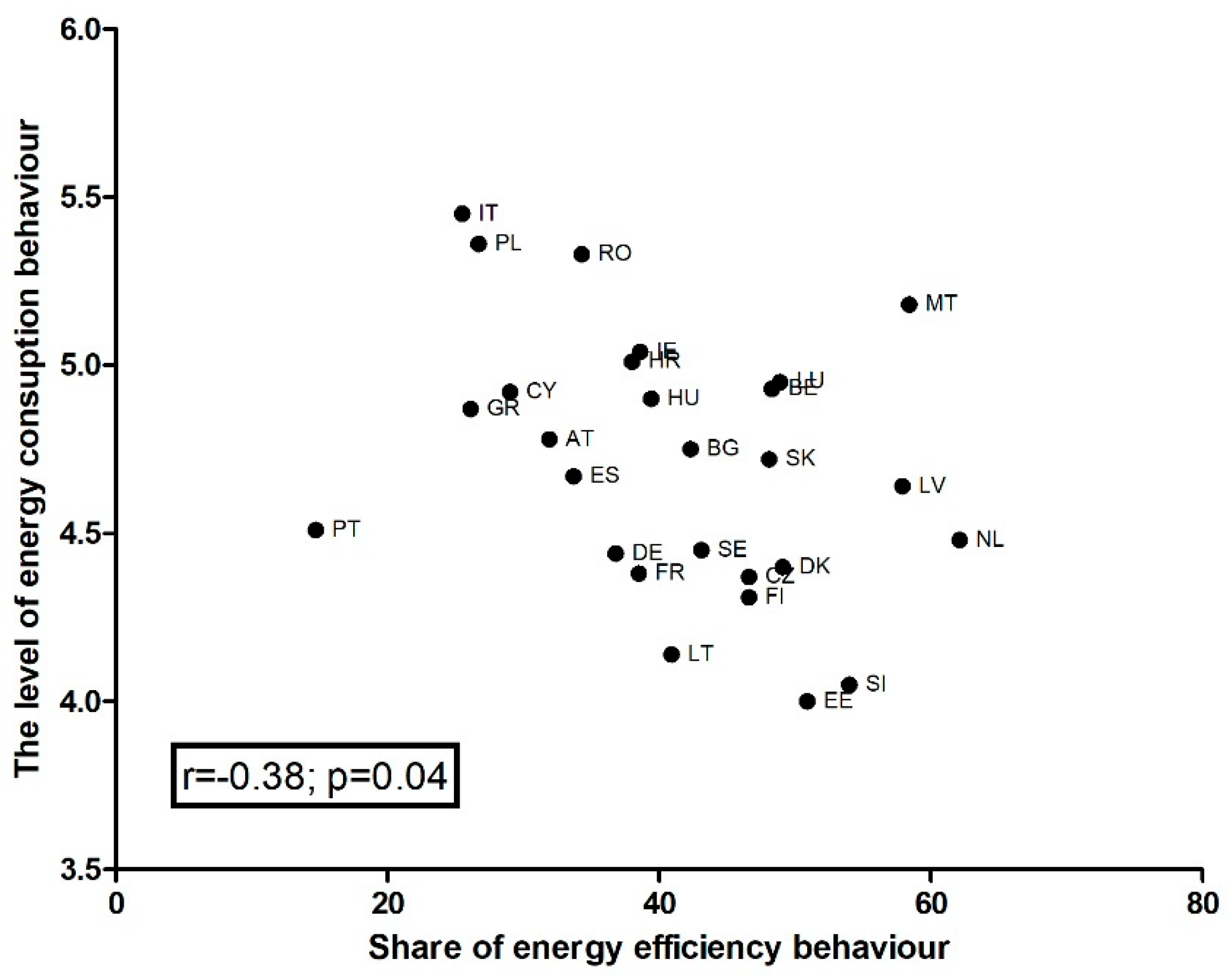
Considering the cross-sectional data and evaluating the relationship between the energy consumption and energy efficiency behaviours, the correlation coefficient was positive and statistically significant (
Figure 5). This result revealed that in countries where people reported performing more energy-efficiency behaviours, they also reported lower energy consumption than others. Therefore, promoting one behaviour can be expected to change other behaviours related to energy consumption.
3.3. The Results of Regression Analysis
To analyse the main determinants of energy consumption and energy efficiency behaviours, multiple linear and binary logistic regression analyses were applied. The results of energy efficiency behaviour analysis showed that all analysed factors significantly influenced this behaviour in EU countries. Considering the environmental aspects as environmental attitudes and confidence of personal energy reduction, these factors positively influenced the energy efficiency behaviour (
Table 2). Thus, citizens with higher levels of environmental attitudes and greater confidence in their reduction behaviour also reported performing energy-efficiency behaviours. These results matched other authors’ findings [
54,
55]. However, refs. [
65,
66] stated that environmental beliefs alone were not enough to motivate individuals to improve the energy efficiency in households. Thus, the economic aspect was simultaneously analysed.
Considering the economic aspect, different tendencies were observed. The impact of the seriousness of the energy price problem on the energy efficiency behaviour was negative and statistically significant. Thus, the more people stated that prices were substantial to them, the less likely they were to engage in energy-efficient behaviour. It may be because the cost of this behaviour is high, which can demotivate people from performing energy-efficiency behaviours. Ref. [
41] also stated that one barrier to energy-efficiency behaviour could be the high cost of implementing energy-efficiency measures. Meanwhile, the impact on WTP to speed up the green transition was positive and the highest among the other factors. Thus, this result showed that energy efficiency behaviour is one of the main expressions of seeking a green transition, and people who declared that they are willing to pay more for it are also motivated to engage in energy efficiency behaviour. Attitudes towards environmental policy also influenced energy efficiency behaviour differently. The impact of attitudes toward environmental promotion policy was significant and positive. Meanwhile, attitudes towards the fee-and-ban policy negatively affected this behaviour. Therefore, people who preferred subsidies and investments were more likely to engage in energy-efficiency behaviour. This result contradicts ref. [
41]’s findings. However, in the vast majority of papers, the subsidy policy is the most recommended to enhance household energy efficiency [
67,
68]. Furthermore, people who care about energy efficiency mostly emphasised subsidies and investment policies. Meanwhile, individuals who believed that taxes and quotas were the central policies to tackle climate change were less likely to engage in energy-efficiency behaviour (
Table 2). It may be because they do not relate energy efficiency to energy-saving behaviour. Furthermore, respondents could assume that this type of policy is punitive and does not encourage people to adopt energy-efficient behaviour, and they prefer the carrot approach.
The results of the multiple regression analysis of energy consumption behaviour are presented in
Table 3. These results differed from the energy efficiency behaviour analysis. In this case, environmental factors, such as attitudes toward environmental issues and confidence in personal energy consumption reduction, significantly and positively influenced energy consumption. Thus, despite higher levels of environmental attitudes and confidence, people were more likely to consume more energy than other citizens. These results contradict refs. [
50,
51]’s findings. However, this confirmed that when we speak about energy consumption, the environmental aspects are not very important [
5,
7,
29,
53]. Furthermore, this behaviour is routine, and authors usually observe a gap between attitudes and behaviour. Moreover, in light of the Goal Framing theory, gain motives in this case could be vital.
To assess the robustness of the empirical results, several additional checks were conducted. First, ordered logistic regression models were estimated to account for the ordinal structure of the self-assessed energy consumption variable. Second, alternative model specifications were tested by including and excluding selected explanatory variables and by adding socio-demographic controls. Third, additional specifications allowing for heteroskedasticity were also estimated. Across all robustness specifications, the main results remain stable in terms of coefficient signs and statistical significance, although the magnitude of some effects varies slightly. The inclusion of household and socio-demographic characteristics does not alter the main conclusions, suggesting that omitted variable bias is unlikely to drive the reported relationships. However, given the economic significance of the energy price problem, the results showed that the impact of this factor is significant and positive, contradicting [
32,
33]’s findings. Thus, the more prices were a serious problem for people, the more likely they were to increase their energy consumption. It may be related to the fact that prices are still not at a level that motivates people to save. Refs. [
36,
38] also showed that rising electricity prices led to only limited energy savings because people were willing to save in other ways. Various economic factors, such as WTP to accelerate the green transition, also significantly and positively influenced energy consumption behaviour. Thus, despite people being willing to pay for the green transition, they did not report using less energy. It may be related to the fact that respondents’ reduced energy consumption does not constitute a green transition. Furthermore, the green transition can be associated with technological progress, which may require greater energy consumption.
Considering attitudes towards environmental policy, we also got different results. Respondents who favoured the ban-and-fee policy more were more likely to say they consume more energy than others. Meanwhile, citizens who positively evaluated the environmental promotion policy were more likely to report consuming less energy. It could be that the willingness to obtain subsidies is one reason households save energy. However, in the model including energy efficiency behaviour, the results showed that it significantly and positively influenced energy consumption. Therefore, even though people stated that they perform energy efficiency behaviour, they also indicated that they used more energy compared with others, which confirms the rebound effect; despite the increasing energy efficiency, the energy consumption also increases [
69,
70,
71]. Furthermore, respondents who perform energy efficiency behaviour feel that they contribute to the environmental issues, and they can spend more money and time on energy-intensive activities and goods, which is defined as an adverse spillover effect [
72,
73,
74].
4. Limitations and Future Research Directions
In this paper, the main determinants of the energy consumption and energy efficiency behaviours were evaluated. The main limitation is that energy consumption behaviour was assessed by asking respondents about their energy consumption relative to others. Future researchers analysing energy consumption behaviour should focus on the actual level of energy consumption. However, this paper reveals the initial tendencies of energy consumption and its main determinants. In analysing the economic and environmental aspects, income level is essential. However, due to the different currencies, this effect was not studied in this paper. Thus, future researchers should consider a specific country and include the income level in their models for the mediator effect. Analysing the price impact on the energy consumption and energy efficiency behaviours, different scenarios should be analysed, for example, whether people will remain motivated to perform these behaviours when the energy prices increase by 20 per cent or more. The current price level, particularly when subsidies were applied to mitigate the negative social consequences, did not motivate people to save energy. Thus, it is interesting to analyse the different forecasts to determine which could encourage people to reduce energy consumption and increase energy-efficient behaviour. A further limitation concerns the explanatory power of the statistical models, which was low, indicating that internal psychological factors and economic concerns explain only a small portion of energy consumption and energy efficiency behaviour. This suggests that structural factors—such as energy system characteristics, climate, and price structures—likely play a significant role. Future research should systematically integrate these indicators to better account for cross-country differences and their contribution to energy consumption.
5. Conclusions and Policy Implications
Increasing energy consumption is a big challenge regarding climate change. Reducing energy consumption and improving energy efficiency in the household sector remain significant issues. Given these behaviours, economic and environmental factors are essential. Environmental aspects were included because, in various theories of pro-environmental behaviour, this angle is critical. Meanwhile, financial factors were included because the goal of gain drives behaviour related to energy consumption, and prices and costs can also play significant roles. The environmental policy also plays an important role. Thus, this paper aims to analyse attitudes towards ecological policy and the impact of economic and environmental factors on energy consumption and energy efficiency behaviours in EU countries during the war in Ukraine.
Analysing the relationship between economic development and preferences for saving energy, the results showed that environmental motives were more prevalent in richer EU countries. In contrast, financial motives were preferred in poorer countries. Therefore, in general, when applying the various tools in developed countries, policymakers should pay more attention to the provision of knowledge and information on energy-saving and to increasing environmental awareness, as these countries place greater importance on these tools. In less wealthy countries, the authorities should highlight the economic benefits to motivate citizens to engage in pro-environmental behaviour. In contrast, in these countries, respondents highlighted these tools as their primary choice. However, the results showed that the level of economic development and the analysed preferences did not significantly influence energy consumption or efficiency behaviour. Therefore, it does not depend on whether the country is very rich or less wealthy; the levels of energy consumption and energy efficiency behaviour did not differ significantly. Therefore, it is necessary to analyse in more detail how separate categories influence people to engage in pro-environmental behaviours. Considering the cross-sectional data and evaluating the relationship between the energy consumption and energy efficiency behaviours, the correlation coefficient was positive and statistically significant. Therefore, policymakers should promote one behaviour and expect the other, related to energy consumption, to change as well.
Applying the binary logistic regression method, the results showed that the main determinants of energy efficiency behaviour, which positively influenced it, were environmental attitudes, confidence in personal energy consumption reduction, willingness to pay more to accelerate the green transition, and attitudes toward environmental promotion behaviour. Meanwhile, the seriousness of the energy prices problem and attitudes towards the ban-and-fee policy negatively influenced this behaviour. Considering the energy consumption behaviour, the results showed that all analysed factors, except attitudes toward the environmental promotion policy, significantly and positively determined energy consumption behaviour. Thus, promoting energy reduction is very difficult. To encourage this behaviour, it is not enough to enhance environmental awareness or focus on rising prices. The main issue there remains to avoid the rebound and adverse spillover effects. The robustness analyses confirm that these conclusions are stable across alternative model specifications and variable coding, strengthening confidence in the reported relationships.
The policy implications should be interpreted in a differentiated manner across EU regions. In Southern European countries, where the share of energy efficiency behaviours remains relatively low, policy measures could prioritise targeted financial incentives combined with information campaigns focusing on household-level cost savings from energy-efficient appliances and renovations. In lower-income Eastern European countries, where economic considerations dominate behavioural decisions, subsidy schemes could be designed to reduce upfront investment costs, for example, through higher co-financing rates or simplified access procedures for vulnerable households. In contrast, in wealthier EU member states, where environmental attitudes play a stronger role, policy efforts may focus on strengthening behavioural nudges, public awareness campaigns, and feedback mechanisms that link individual energy-saving actions to climate mitigation outcomes. Across all contexts, policy effectiveness could be enhanced by combining financial instruments with continuous information provision through local authorities, energy suppliers, and digital platforms, and by periodically evaluating and adjusting policy measures in response to behavioural outcomes.
Author Contributions
Conceptualisation, G.L. and R.K.; methodology, R.K.; software, R.K.; validation, R.K. and G.L.; formal analysis, G.L.; investigation, R.K.; resources, G.L.; data curation, G.L.; writing—original draft preparation, G.L.; writing—review and editing, R.K.; visualisation, G.L.; supervision, G.L.; project administration, G.L.; and funding acquisition, R.K. All authors have read and agreed to the published version of the manuscript.
Funding
This research received no external funding.
Data Availability Statement
The data used in this study are derived from the Eurobarometer survey conducted by the European Commission. The datasets analysed during the current study are publicly available and can be accessed through the European Commission’s Eurobarometer database.
Conflicts of Interest
The authors declare no conflicts of interest.
Abbreviations
The following abbreviations are used in this manuscript:
| EU | European Union |
| KMO | Kaiser–Meyer–Olkin |
| PPP | purchasing power parity |
| WTP | willing to pay more |
Appendix A
The list of countries and number of respondents: Austria (n = 1011)—AU, Belgium (n = 1004)—BE, Bulgaria (n = 1027)—BG, Cyprus (n = 504)—CY, Czech Republic (n = 1002)—CZ, Denmark (n = 1004)—DK, Estonia (n = 1001)—EE, Spain (n = 1005)—ES, Finland (n = 1044)—FL, France (n = 1001)—FR, Germany (n = 1520)—GE, Greece (n = 1015)—GR, Croatia (n = 1001)—HG, Hungary (n = 1031)—HU, Ireland (n = 1022)—IE, Italy (n = 1028)—IT, Latvia (n = 1000)—LV, Lithuania (n = 1000)—LT, Malta (n = 503)—MT, the Netherlands (n = 1039)—NL, Poland (n = 1009)—PL, Portugal (n = 1014), Romania (n = 1056)—RO, Slovakia (n = 1004)—SK, Slovenia (n = 1009)—SL, and Sweden (n = 1045)—SE.
References
- Acheampong, A.O. Economic growth, CO2 emissions and energy consumption: What causes what and where? Energy Econ. 2018, 74, 677–692. [Google Scholar] [CrossRef]
- Khan, M.K.; Teng, J.Z.; Khan, M.I.; Khan, M.O. Impact of globalization, economic factors and energy consumption on CO2 emissions in Pakistan. Sci. Total Environ. 2019, 688, 424–436. [Google Scholar] [CrossRef] [PubMed]
- Pejović, B.; Karadžić, V.; Dragašević, Z.; Backović, T. Economic growth, energy consumption and CO2 emissions in the countries of the European Union and the Western Balkans. Energy Rep. 2021, 7, 2775–2783. [Google Scholar] [CrossRef]
- Trotta, G. Factors affecting energy-saving behaviours and energy efficiency investments in British households. Energy Policy 2018, 114, 529–539. [Google Scholar] [CrossRef]
- Paço, A.; Lavrador, T. Environmental knowledge and attitudes and behaviours towards energy consumption. J. Environ. Manag. 2017, 197, 384–392. [Google Scholar] [CrossRef]
- Belaïd, F.; Joumni, H. Behavioral attitudes towards energy saving: Empirical evidence from France. Energy Policy 2020, 140, 111406. [Google Scholar] [CrossRef]
- Rizzi, F.; Annunziata, E.; Contini, M.; Frey, M. On the effect of exposure to information and self-benefit appeals on consumer’s intention to perform pro-environmental behaviours: A focus on energy conservation behaviours. J. Clean. Prod. 2020, 270, 122039. [Google Scholar] [CrossRef]
- Du, Z.; Lv, G. Can Digital Finance Unleash the Potential for Household Consumption? A Comparison Based on the Inconsistency Between Income and Consumption Classes. J. Theor. Appl. Electron. Commer. Res. 2025, 20, 275. [Google Scholar] [CrossRef]
- Hosoe, N. The cost of war: Impact of sanctions on Russia following the invasion of Ukraine. J. Policy Model. 2023, 45, 305–319. [Google Scholar] [CrossRef]
- Martínez-García, M.Á.; Ramos-Carvajal, C.; Cámara, Á. Consequences of the energy measures derived from the war in Ukraine on the level of prices of EU countries. Resour. Policy 2023, 86, 104114. [Google Scholar] [CrossRef]
- Kuzemko, C.; Blondeel, M.; Dupont, C.; Brisbois, M.C. Russia’s war on Ukraine, European energy policy responses & implications for sustainable transformations. Energy Res. Soc. Sci. 2022, 93, 102842. [Google Scholar] [CrossRef]
- Guan, Y.; Yan, J.; Shan, Y.; Zhou, Y.; Hang, Y.; Li, R.; Liu, Y.; Liu, B.; Nie, Q.; Bruckner, B.; et al. Burden of the global energy price crisis on households. Nat. Energy 2023, 8, 304–316. [Google Scholar] [CrossRef]
- Zakeri, B.; Paulavets, K.; Barreto-Gomez, L.; Echeverri, L.G.; Pachauri, S.; Boza-Kiss, B.; Zimm, C.; Rogelj, J.; Creutzig, F.; Ürge-Vorsatz, D.; et al. Pandemic, war, and global energy transitions. Energies 2022, 15, 6114. [Google Scholar] [CrossRef]
- Ruhnau, O.; Stiewe, C.; Muessel, J.; Hirth, L. Natural gas savings in Germany during the 2022 energy crisis. Nat. Energy 2023, 8, 621–628. [Google Scholar] [CrossRef]
- Zhou, B.; Li, W.; Chan, K.W.; Cao, Y.; Kuang, Y.; Liu, X.; Wang, X. Smart home energy management systems: Concept, configurations, and scheduling strategies. Renew. Sustain. Energy Rev. 2016, 61, 30–40. [Google Scholar] [CrossRef]
- Wang, B.; Yuan, Z.; Liu, X.; Sun, Y.; Zhang, B.; Wang, Z. Electricity price and habits: Which would affect household electricity consumption? Energy Build. 2021, 240, 110888. [Google Scholar] [CrossRef]
- Moshiri, S. The effects of the energy price reform on households consumption in Iran. Energy Policy 2015, 79, 177–188. [Google Scholar] [CrossRef]
- Parag, Y.; Fawcett, T.; Hampton, S.; Eyre, N. Energy saving in a hurry: A research agenda and guidelines to study European responses to the 2022–2023 energy crisis. Energy Res. Soc. Sci. 2023, 97, 102999. [Google Scholar] [CrossRef]
- Shahzad, U. Environmental taxes, energy consumption, and environmental quality: Theoretical survey with policy implications. Environ. Sci. Pollut. Res. 2020, 27, 24848–24862. [Google Scholar] [CrossRef] [PubMed]
- Ahmed, N.; Sheikh, A.A.; Hamid, Z.; Senkus, P.; Borda, R.C.; Wysokińska-Senkus, A.; Glabiszewski, W. Exploring the causal relationship among green taxes, energy intensity, and energy consumption in nordic countries: Dumitrescu and Hurlin causality approach. Energies 2022, 15, 5199. [Google Scholar] [CrossRef]
- Albatayneh, A.; Juaidi, A.; Abdallah, R.; Pena-Fernandez, A.; Manzano-Agugliaro, F. Effect of the subsidised electrical energy tariff on the residential energy consumption in Jordan. Energy Rep. 2022, 8, 893–903. [Google Scholar] [CrossRef]
- Dube, I. Impact of energy subsidies on energy consumption and supply in Zimbabwe. Do the urban poor really benefit? Energy Policy 2003, 31, 1635–1645. [Google Scholar] [CrossRef]
- Lin, B.; Kuang, Y. Household heterogeneity impact of removing energy subsidies in China: Direct and indirect effect. Energy Policy 2020, 147, 111811. [Google Scholar] [CrossRef]
- Bajwa, F.A.; Fu, J.; Bajwa, I.A.; Rehman, M.; Abbas, K. Digital financial inclusion and its dual impact on economic and environmental outcomes in ASEAN countries. Data Sci. Financ. Econ. 2025, 5, 53–75. [Google Scholar] [CrossRef]
- Grilli, G.; Curtis, J. Encouraging pro-environmental behaviours: A review of methods and approaches. Renew. Sustain. Energy Rev. 2021, 135, 110039. [Google Scholar] [CrossRef]
- Liobikienė, G.; Minelgaitė, A. Energy and resource-saving behaviours in European Union countries: The Campbell paradigm and goal framing theory approaches. Sci. Total Environ. 2021, 750, 141745. [Google Scholar] [CrossRef] [PubMed]
- Park, E.; Kwon, S.J. What motivations drive sustainable energy-saving behavior? An examination in South Korea. Renew. Sustain. Energy Rev. 2017, 79, 494–502. [Google Scholar] [CrossRef]
- Long, C.; Mills, B.F.; Schleich, J. Characteristics or culture? Determinants of household energy use behavior in Germany and the USA. Energy Effic. 2018, 11, 777–798. [Google Scholar] [CrossRef]
- Fiorillo, D.; Sapio, A. Energy saving in Italy in the late 1990s: Which role for non-monetary motivations? Ecol. Econ. 2019, 165, 106386. [Google Scholar] [CrossRef]
- Matiiuk, Y.; Liobikienė, G. The role of financial, informational, and social tools on resource-saving behaviour in Lithuania: Assumptions and reflections of real situation. J. Clean. Prod. 2021, 326, 129378. [Google Scholar] [CrossRef]
- Wang, B.; Wang, X.; Guo, D.; Zhang, B.; Wang, Z. Analysis of factors influencing residents’ habitual energy-saving behaviour based on NAM and TPB models: Egoism or altruism? Energy Policy 2018, 116, 68–77. [Google Scholar] [CrossRef]
- Innocent, M.; Francois-Lecompte, A. The values of electricity saving for consumers. Energy Policy 2018, 123, 136–146. [Google Scholar] [CrossRef]
- Buckley, P. Prices, information and nudges for residential electricity conservation: A meta-analysis. Ecol. Econ. 2020, 172, 106635. [Google Scholar] [CrossRef]
- Belaid, F.; Garcia, T. Understanding the spectrum of residential energy-saving behaviours: French evidence using disaggregated data. Energy Econ. 2016, 57, 204–214. [Google Scholar] [CrossRef]
- Chen, C.F.; Xu, X.; Day, J.K. Thermal comfort or money saving? Exploring intentions to conserve energy among low-income households in the United States. Energy Res. Soc. Sci. 2017, 26, 61–71. [Google Scholar] [CrossRef]
- Słupik, S.; Kos-Łabędowicz, J.; Trzęsiok, J. How to Encourage Energy Savings Behaviours? The Most Effective Incentives from the Perspective of European Consumers. Energies 2021, 14, 8009. [Google Scholar] [CrossRef]
- Yue, T.; Long, R.; Chen, H.; Liu, J.; Liu, H.; Gu, Y. Energy-saving behavior of urban residents in China: A multi-agent simulation. J. Clean. Prod. 2020, 252, 119623. [Google Scholar] [CrossRef]
- Prasanna, A.; Mahmoodi, J.; Brosch, T.; Patel, M.K. Recent experiences with tariffs for saving electricity in households. Energy Policy 2018, 115, 514–522. [Google Scholar] [CrossRef]
- Aravena, C.; Riquelme, A.; Denny, E. Money, comfort or environment? Priorities and determinants of energy efficiency investments in Irish households. J. Consum. Policy 2016, 39, 159–186. [Google Scholar] [CrossRef]
- Mustapa, S.I.; Rasiah, R.; Jaaffar, A.H.; Bakar, A.A.; Kaman, Z.K. Implications of COVID-19 pandemic for energy-use and energy saving household electrical appliances consumption behaviour in Malaysia. Energy Strategy Rev. 2021, 38, 100765. [Google Scholar] [CrossRef]
- Nie, H.; Vasseur, V.; Fan, Y.; Xu, J. Exploring reasons behind careful-use, energy-saving behaviours in residential sector based on the theory of planned behaviour: Evidence from Changchun, China. J. Clean. Prod. 2019, 230, 29–37. [Google Scholar] [CrossRef]
- Streimikiene, D.; Balezentis, T.; Alisauskaite-Seskiene, I.; Stankuniene, G.; Simanaviciene, Z. A review of willingness to pay studies for climate change mitigation in the energy sector. Energies 2019, 12, 1481. [Google Scholar] [CrossRef]
- Han, X.; Wei, C. Household energy consumption: State of the art, research gaps, and future prospects. Environ. Dev. Sustain. 2021, 23, 12479–12504. [Google Scholar] [CrossRef]
- Solà, M.D.M.; de Ayala, A.; Galarraga, I.; Escapa, M. Promoting energy efficiency at household level: A literature review. Energy Effic. 2021, 14, 1–22. [Google Scholar] [CrossRef]
- Balezentis, T.; Streimikiene, D.; Stankuniene, G.; Shobande, O.A. Willingness to pay for climate change mitigation measures in households: Bundling up renewable energy, energy efficiency, and renovation. Sustain. Dev. 2023, 32, 2385–2402. [Google Scholar] [CrossRef]
- Wee, S.C.; Choong, W.W.; Low, S.T. Can “nudging” play a role to promote pro-environmental behaviour? Environ. Chall. 2021, 5, 100364. [Google Scholar] [CrossRef]
- van Valkengoed, A.M.; Abrahamse, W.; Steg, L. To select effective interventions for pro-environmental behaviour change, we need to consider determinants of behaviour. Nat. Hum. Behav. 2022, 6, 1482–1492. [Google Scholar] [CrossRef] [PubMed]
- Li, X.; Zhang, D.; Zhang, T.; Ji, Q.; Lucey, B. Awareness, energy consumption and pro-environmental choices of Chinese households. J. Clean. Prod. 2021, 279, 123734. [Google Scholar] [CrossRef]
- Han, M.S.; Cudjoe, D. Determinants of energy-saving behavior of urban residents: Evidence from Myanmar. Energy Policy 2020, 140, 111405. [Google Scholar] [CrossRef]
- Dincă, V.M.; Busu, M.; Nagy-Bege, Z. Determinants with Impact on Romanian Consumers’ Energy-Saving Habits. Energies 2022, 15, 4080. [Google Scholar] [CrossRef]
- Vainio, A.; Pulkka, A.; Paloniemi, R.; Varho, V.; Tapio, P. Citizens’ sustainable, future-oriented energy behaviours in energy transition. J. Clean. Prod. 2020, 245, 118801. [Google Scholar] [CrossRef]
- Carrus, G.; Tiberio, L.; Mastandrea, S.; Chokrai, P.; Fritsche, I.; Klöckner, C.A.; Masson, T.; Vesely, S.; Panno, A. Psychological predictors of energy saving behavior: A meta-analytic approach. Front. Psychol. 2021, 12, 648221. [Google Scholar] [CrossRef] [PubMed]
- Boto-García, D.; Bucciol, A. Climate change: Personal responsibility and energy saving. Ecol. Econ. 2020, 169, 106530. [Google Scholar] [CrossRef]
- Prete, M.I.; Piper, L.; Rizzo, C.; Pino, G.; Capestro, M.; Mileti, A.; Pichierri, M.; Amatulli, C.; Peluso, A.M.; Guido, G. Determinants of Southern Italian households’ intention to adopt energy efficiency measures in residential buildings. J. Clean. Prod. 2017, 153, 83–91. [Google Scholar] [CrossRef]
- Neves, J.; Oliveira, T. Understanding energy-efficient heating appliance behavior change: The moderating impact of the green self-identity. Energy 2021, 225, 120169. [Google Scholar] [CrossRef]
- Nie, H.; Kemp, R.; Fan, Y. Investigating the adoption of energy-saving measures in residential sector: The contribution to carbon neutrality of China and Europe. Resour. Conserv. Recycl. 2023, 190, 106791. [Google Scholar] [CrossRef]
- Mohanty, P.K.; Patro, A.; Harindranath, R.M.; Kumar, N.S.; Panda, D.K.; Dubey, R. Perceived government initiatives: Scale development, validation and impact on consumers’ pro-environmental behaviour. Energy Policy 2021, 158, 112534. [Google Scholar] [CrossRef]
- European Commission, Brussels. Directorate General Communication, COMM.A.3 ‘Media Monitoring and Eurobarometer’(ZA7901; Version 2.0.0) [Data Set]; GESIS: Cologne, Germany, 2022. [Google Scholar] [CrossRef]
- Jakučionytė-Skodienė, M.; Dagiliūtė, R.; Liobikienė, G. Do general pro-environmental behaviour, attitude, and knowledge contribute to energy savings and climate change mitigation in the residential sector? Energy 2020, 193, 116784. [Google Scholar] [CrossRef]
- Chia, J.; Harun, A.; Kassim, A.W.M.; Martin, D.; Kepal, N. Understanding factors that influence house purchase intention among consumers in Kota Kinabalu: An application of buyer behavior model theory. J. Technol. Manag. Bus. 2016, 3, 94–110. [Google Scholar]
- Hinston, P.H.; Brownlow, C.; McMurray, I.; Cozens, B. SPSS Explained, 1st ed.; Routledge: London, UK, 2004. [Google Scholar] [CrossRef]
- Teoh, C.W.; Gaur, S.S. Environmental concern: An issue for poor or rich. Manag. Environ. Qual. Int. J. 2019, 30, 227–242. [Google Scholar] [CrossRef]
- Ul-Durar, S.; Arshed, N.; Anwar, A.; Sharif, A.; Liu, W. How does economic complexity affect natural resource extraction in resource rich countries? Resour. Policy 2023, 86, 104214. [Google Scholar] [CrossRef]
- Boomsma, C.; Jones, R.V.; Pahl, S.; Fuertes, A. Do psychological factors relate to energy saving behaviours in inefficient and damp homes? A study among English social housing residents. Energy Res. Soc. Sci. 2019, 47, 146–155. [Google Scholar] [CrossRef]
- Casado, F.; Hidalgo, M.C.; García-Leiva, P. Energy efficiency in households: The effectiveness of different types of messages in advertising campaigns. J. Environ. Psychol. 2017, 53, 198–205. [Google Scholar] [CrossRef]
- Pelenur, M. Household energy use: A study investigating viewpoints towards energy efficiency technologies and behaviour. Energy Effic. 2018, 11, 1825–1846. [Google Scholar] [CrossRef]
- Li, Z.; Solaymani, S. Effectiveness of energy efficiency improvements in the context of energy subsidy policies. Clean Technol. Environ. Policy 2021, 23, 937–963. [Google Scholar] [CrossRef]
- Fanghella, V.; Faure, C.; Guetlein, M.C.; Schleich, J. Discriminatory subsidies for energy-efficient technologies and the role of envy. Resour. Energy Econ. 2022, 68, 101298. [Google Scholar] [CrossRef]
- Wang, Z.; Han, B.; Lu, M. Measurement of energy rebound effect in households: Evidence from residential electricity consumption in Beijing, China. Renew. Sustain. Energy Rev. 2016, 58, 852–861. [Google Scholar] [CrossRef]
- Freire-González, J. Evidence of direct and indirect rebound effect in households in EU-27 countries. Energy Policy 2017, 102, 270–276. [Google Scholar] [CrossRef]
- Velez-Henao, J.A.; García-Mazo, C.M.; Freire-Gonzalez, J.; Vivanco, D.F. Environmental rebound effect of energy efficiency improvements in Colombian households. Energy Policy 2020, 145, 111697. [Google Scholar] [CrossRef]
- Sorrell, S.; Gatersleben, B.; Druckman, A. The limits of energy sufficiency: A review of the evidence for rebound effects and negative spillovers from behavioural change. Energy Res. Soc. Sci. 2020, 64, 101439. [Google Scholar] [CrossRef]
- Liu, Y.; Kua, H.W.; Lu, Y. Spillover effects from energy conservation goalsetting: A field intervention study. Resour. Conserv. Recycl. 2021, 170, 105570. [Google Scholar] [CrossRef]
- Sun, H.; Edziah, B.K.; Sun, C.; Kporsu, A.K. Institutional quality and its spatial spillover effects on energy efficiency. Socio-Econ. Plan. Sci. 2022, 83, 101023. [Google Scholar] [CrossRef]
| Disclaimer/Publisher’s Note: The statements, opinions and data contained in all publications are solely those of the individual author(s) and contributor(s) and not of MDPI and/or the editor(s). MDPI and/or the editor(s) disclaim responsibility for any injury to people or property resulting from any ideas, methods, instructions or products referred to in the content. |