Perspective

Electric Vehicle Behavior Modeling for Vehicle-to-Grid Integration: Methods, Challenges, and Perspectives

1
School of Electrical Engineering and Automation, Harbin Institute of Technology, Harbin 150001, China
2
Suzhou Research Institute, Harbin Institute of Technology, Suzhou 215104, China
3
BYD Auto Industry Company Limited, Shenzhen 518118, China
*
Author to whom correspondence should be addressed.
Energies 2026, 19(4), 871; https://doi.org/10.3390/en19040871
Submission received: 26 December 2025 / Revised: 23 January 2026 / Accepted: 4 February 2026 / Published: 7 February 2026
(This article belongs to the Section E: Electric Vehicles)

Abstract

The widespread adoption of electric vehicles (EVs) presents significant opportunities and challenges for power systems, especially in Vehicle-to-Grid (V2G) integration. Accurate modeling of EV charging and mobility behaviour is therefore crucial for enabling reliable and efficient V2G operation. This paper reviews current paradigms of EV behavior modeling, including statistical, data-driven, and decision-oriented approaches, and compares them from a V2G-service-oriented rather than purely algorithm-centric perspective. The analysis focuses on modeling assumptions, data requirements, computational characteristics, and their suitability for different V2G tasks and decision layers. Key challenges are identified, including data availability and heterogeneity, limited cross-scenario generalizability, insufficient integration of physical and behavioral constraints, and computational barriers to large-scale and real-time deployment. To address these limitations, this paper introduces a Task–Data–Deployment perspective framework, which emphasizes aligning modeling paradigms with specific V2G tasks, realistic data conditions, and deployment feasibility. Rather than proposing new algorithms, this perspective provides practical guidance for selecting and applying EV behavior models in real-world V2G systems. These insights clarify current gaps between modeling research and deployment needs, and support the development of scalable, transferable, and operationally viable EV behavior modeling frameworks for future large-scale V2G integration.

1. Introduction

As environmental issues become increasingly severe worldwide, reducing carbon emissions has grown more urgent. The transportation sector, being a major source of carbon emissions, is undergoing a critical transition toward electrification. In 2021, CO2 emissions from China’s transport sector reached 969 Mt, accounting for 9% of the country’s total emissions [1]. The large-scale adoption of electric vehicles (EVs) is widely regarded as a key pathway to significantly reduce carbon emissions in this sector [2]. Thanks to their zero tailpipe emissions and low noise levels, EVs have gained substantial popularity in recent years [3]. According to the International Energy Agency’s Global EV Outlook 2025, global EV sales volume is projected to surpass 20 million by 2025, representing over a quarter of total vehicle sales volume, with this proportion expected to exceed 40% by 2030 [4].
In parallel, the power system is accelerating its decarbonization [5]. The installed capacity of renewable energy sources, such as wind and solar power, has expanded rapidly, leading to a fundamental transformation of the energy structure [6,7]. However, the intermittent and variable nature of renewable generation poses new challenges to grid stability, making the deployment of flexible resources and energy storage inclusive of EVs essential for maintaining system balance and reliability [8,9].
Statistical analysis of EV usage behavior reveals that EVs remain parked most of the time, presenting a significant opportunity for them to serve as distributed mobile storage [10,11]. Nevertheless, the widespread integration of EVs, if coupled with uncoordinated and stochastic charging behaviors, could lead to sharp increases in electricity demands and peak loads, thereby straining grid operation [12,13]. Within this challenge lies a transformative opportunity, and Vehicle-to-Grid (V2G) technology is the key to unlocking it.
Against this backdrop, accurately modeling EV charging and mobility behavior has emerged as a foundational requirement for enabling the efficient and reliable operation of V2G systems. Since EV charging decisions are inherently driven by users’ daily travel routines, preferences, socioeconomic factors, and battery-related constraints, their behavior exhibits strong heterogeneity and temporal variability [14]. These uncertainties directly affect charging demand distribution, load profiles, and system-level energy balancing. As a result, simplistic or deterministic assumptions about EV behavior are insufficient for capturing the complex interactions between EVs and the power grid.
Realistic behavior modeling enables the prediction of spatiotemporal charging patterns, assessment of grid impacts under high EV penetration, and optimization of multi-layer V2G coordination strategies involving the grid, aggregators, and individual vehicles [15,16]. Particularly in large-scale deployments, the accuracy of EV behavior models determines not only the effectiveness of V2G control algorithms but also the feasibility of demand response programs, peak shaving strategies, and renewable energy accommodation. Furthermore, the transition from unidirectional charging to bidirectional energy flow introduces stringent requirements on the real-time management of EV batteries, forecasting of state-of-charge trajectories, and assessment of user participation willingness, all of which must be reflected in the underlying behavior models.
Despite extensive studies on EV behavior modeling, several limitations remain that hinder its effectiveness in large-scale V2G deployment. Existing studies are predominantly organized from an algorithm-centric perspective, with a strong emphasis on predictive accuracy [17,18], while offering limited guidance on model selection across diverse V2G tasks, temporal scales, and operational constraints. Moreover, data availability is often treated implicitly, even though real-world V2G systems operate under heterogeneous and dynamically evolving data conditions, which significantly affect model scalability and transferability. To address these limitations, this paper presents a V2G-application-oriented review of EV behavior modeling methods and introduces a Task–Data–Deployment perspective framework to guide the selection of appropriate EV behavior models for practical V2G deployment.
The rest of the paper is structured as follows. Section 2 outlines the main modeling paradigms, covering statistical, data-driven, and decision-oriented approaches; Section 3 provides comparative analysis of these paradigms from a V2G-service-oriented perspective; Section 4 identifies and ranks the key challenges that constrain the scalable and reliable deployment of EV behavior models in practical V2G systems. Building on these observations, Section 5 discusses future research perspectives and methodological pathways toward more transferable, computationally efficient, and deployment-ready modeling frameworks. Finally, Section 6 concludes the paper.

2. EV Behavior Modeling Methods

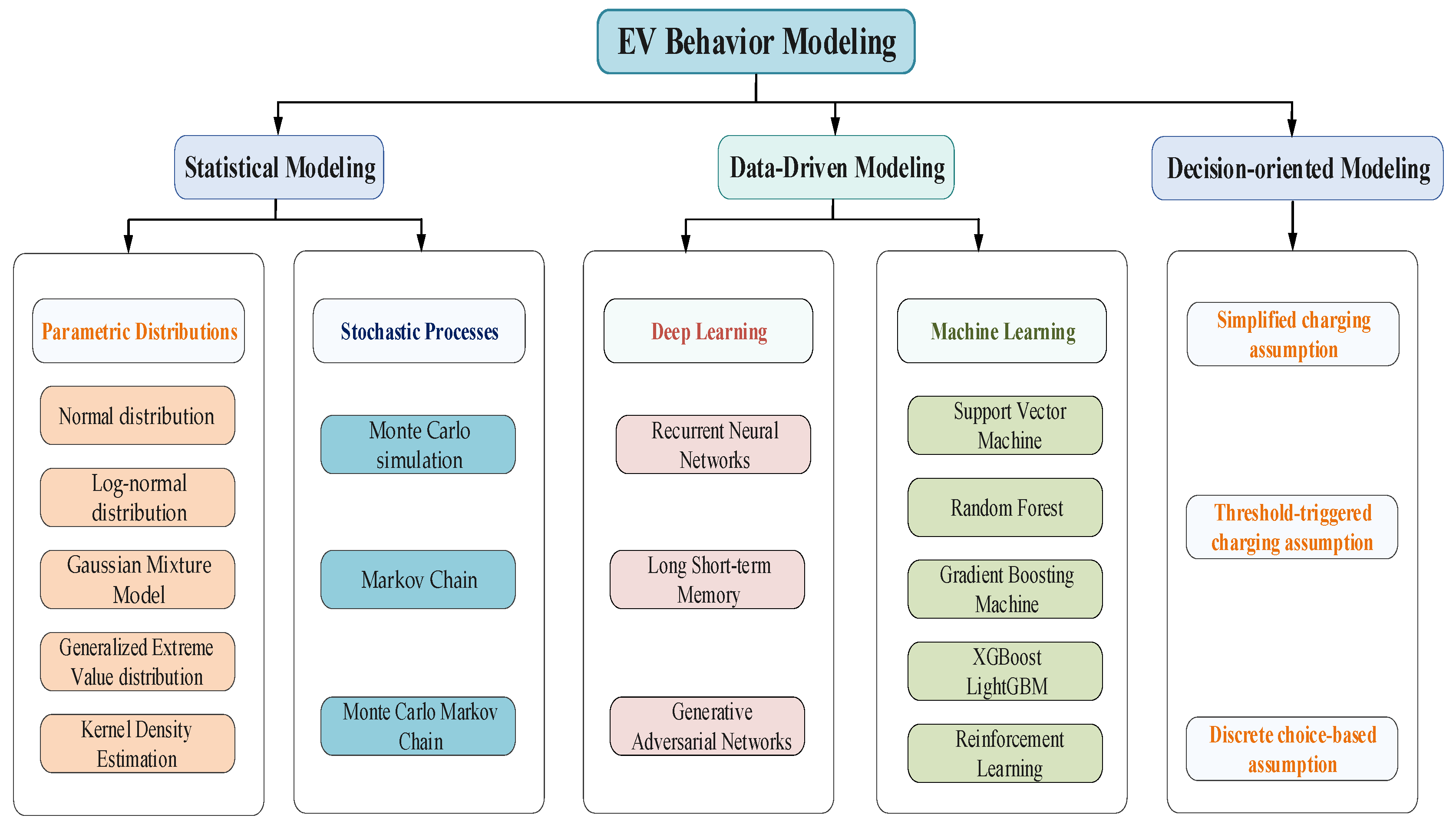
Accurate modeling of EV behavior is fundamental to V2G research [19] since both charging and discharging activities are inherently driven by user habits, mobility patterns, and battery constraints. Realistic behavior modeling enables reliable forecasting of charging demands, scalable simulation of large EV fleets, and efficient hierarchical scheduling across the grid, aggregator, and vehicle layers [20]. Current research on EV behavior modeling can be broadly classified into statistical modeling, data-driven modeling, and decision-oriented modeling, as shown in Figure 1. These approaches represent a progressive evolution from simple probabilistic representation to intelligent, data-centric, and real-time adaptive frameworks [21].

2.1. Statistical Modeling Approaches

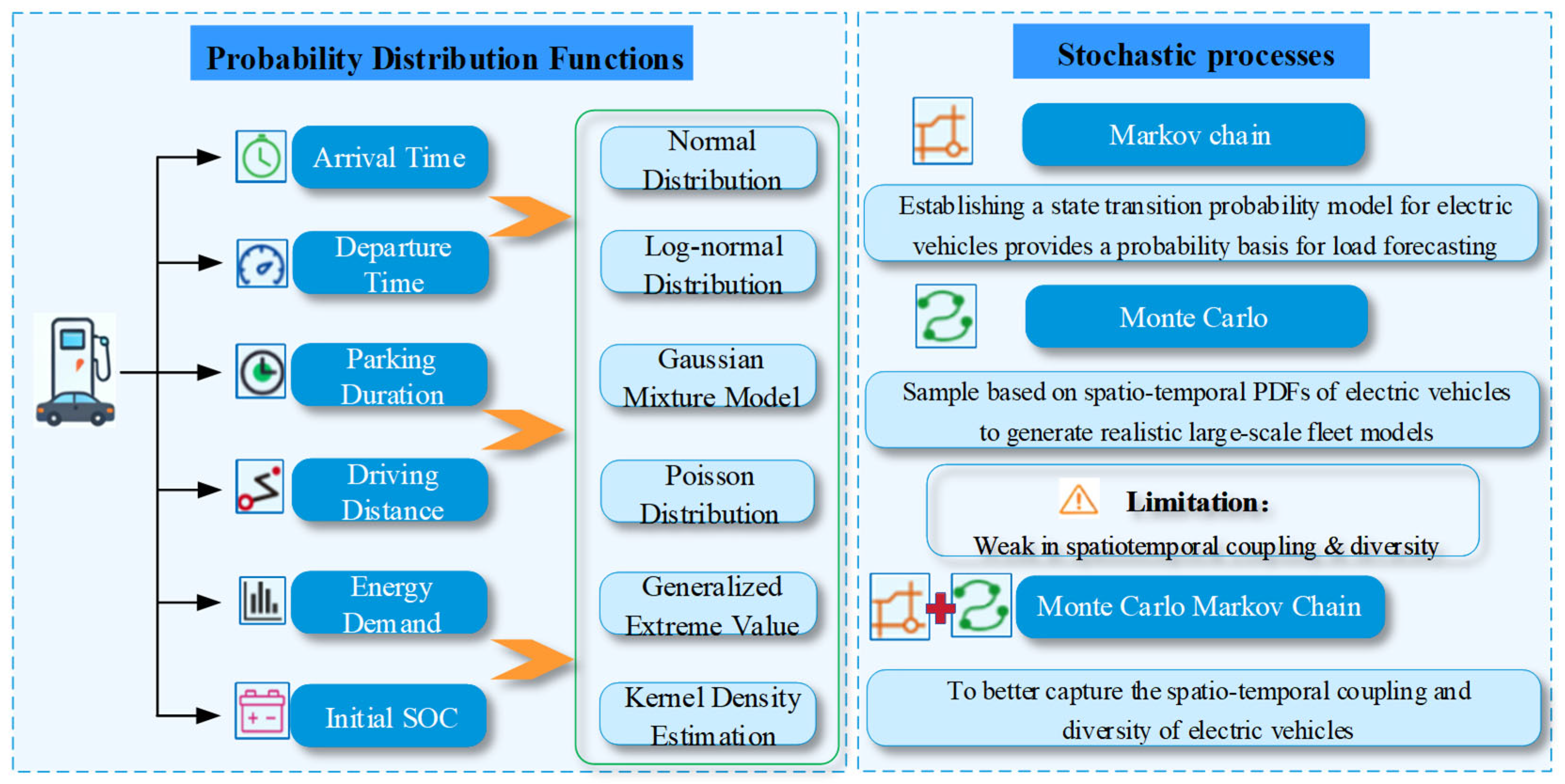
Statistical modeling represents the earliest yet still widely used approach for characterizing EV behavior [22,23]. Key behavioral parameters—such as arrival time, departure time, parking duration, driving distance, and energy demand—are modeled using probability distribution functions (PDFs) [22,24]. These distributions are selected based on empirical observations from transportation surveys or measured charging station data and are widely applied in stochastic processes to generate synthetic EV populations with diverse mobility characteristics [25], as shown in Figure 2.
Mathematically, a generic EV behavioral variable x (e.g., arrival time or charging demand) is described by a PDF f ( x ) , satisfying
+ f ( x ) d x = 1
By sampling from f ( x ) , statistical models generate realizations of EV behavior that collectively reproduce the observed probabilistic characteristics of real-world charging activities.
EVs exhibit a distinct bimodal pattern in their first departure and last arrival times at charging stations during the day, a phenomenon particularly pronounced on weekdays [19]. Owing to its simplicity and analytical tractability, the normal distribution has therefore been widely adopted to probabilistically model EV arrival and departure behaviors, especially at the aggregate level [26,27,28,29]. A typical Gaussian PDF is expressed as
f x = 1 2 π σ e x p x μ 2 2 σ 2
where μ and σ denote the mean and standard deviation, respectively. In EV behavior modeling, these parameters are estimated from historical data to capture the central tendency and dispersion of user travel patterns.
In addition, the log-normal distribution is frequently employed to characterize non-negative and right-skewed variables, such as parking durations and charging demands [27,30,31], with the PDF given by
f x = 1 x σ 2 π e x p l n x μ 2 2 σ 2 , x > 0
Nevertheless, real-world EV charging activities are subject to significant uncertainties arising from heterogeneous user habits, flexible travel schedules, and diverse charging scenarios. As a result, EV behavioral patterns often deviate from standard parametric distributions, limiting their effectiveness in capturing complex temporal dynamics [32]. To address this issue, many studies adopt Gaussian Mixture Model (GMM), which represent the PDF as a weighted sum of multiple Gaussian components [29,33,34,35,36]:
f ( x ) = k = 1 K W k N k ( μ k , σ k 2 )
In which, K represents the number of Gaussian components; W k indicates the weight of the k-th Gaussian component; N k ( μ k , σ k 2 ) is the PDF of the k-th Gaussian component.
By explicitly accounting for user heterogeneity and multimodal charging patterns, GMM has demonstrated strong suitability, particularly in public fast-charging stations where behavioral diversity is more pronounced [37]. Considering the circular nature of departure and arrival time, a mixture of von Mises models which are circular analogue to Gaussian models has also been used [38].
Beyond parametric and mixture-based models, alternative statistical techniques have also been explored to characterize different aspects of EV behavior [39]. Event-driven randomness in EV arrivals and charging activities can be effectively captured using the Poisson distribution, which is well suited for modeling the number of stochastic charging events within a fixed time interval [40]. Moreover, the Generalized Extreme Value (GEV) distribution has been applied to model extreme or boundary behaviors, such as the first daily departure time from home, revealing distinctive temporal patterns [41]. Non-parametric approaches, including kernel density estimation (KDE), have been further leveraged to estimate PDF directly from data and construct confidence intervals, enabling more accurate quantification of uncertainty in the energy storage capacity provided by EV fleets [42]. Although most statistical EV behavior models are traditionally calibrated in an offline manner using historical data, practical V2G systems operate under evolving behavioral patterns driven by changes in user habits, charging infrastructure, pricing mechanisms, and policy incentives. As a result, static parameter assumptions may gradually lose validity over time. To address this issue, recent studies have explored online learning and incremental updating strategies within statistical modeling frameworks [43]. These methods allow statistical models to track gradual shifts in arrival times, parking durations, and charging demand distributions without abandoning their probabilistic interpretability.
Beyond parametric distribution methods, stochastic process modeling approaches such as Markov chains and Monte Carlo simulations have been extensively adopted to capture the temporal dependency and population-level uncertainties of EV behaviors. The Markov Chain framework models EV state transition probabilities to describe temporal behavior patterns, thereby offering a probabilistic basis for load forecasting [44]. In contrast, the Monte Carlo method performs sampling based on the spatiotemporal PDF of EVs to generate a realistic, large-scale fleet model [45]. A recognized limitation of the standalone Monte Carlo approach is its inability to precisely capture the spatiotemporal coupling and inherent diversity of EVs [46]. To overcome this limitation, contemporary research has incorporated Monte Carlo sampling into the Markov chain structure, developing an advanced probabilistic model known as the Monte Carlo Markov Chain (MCMC) to better capture the spatiotemporal coupling and diversity of EVs [47]. Overall, statistical modeling approaches emphasize probabilistic representation and population-level consistency, offering high transparency and computational efficiency, but at the cost of limited responsiveness to real-time behavioral changes.

2.2. Data-Driven Behavior Modeling

Driven by the rapid advancement of big data and computing power, data-driven modeling methods have found extensive applications in V2G systems [48,49,50]. These methods primarily learn from real-world EV behavior and charging station data, leveraging machine learning (ML) and deep learning (DL) techniques to model the system [51]. This enables accurate forecasting of EV behavior and charging demands, while shifting the modeling paradigm from explicit probabilistic representation toward data-driven pattern learning [52].
ML is a computational approach that enables machines to train models based on data, extract patterns or insights from the data, and subsequently make predictions or informed decisions on unseen data. ML algorithms commonly employed for EV behavior modeling can be broadly categorized into three classes: supervised learning, unsupervised learning, and reinforcement learning [53].
Supervised learning methods rely on labeled datasets to establish quantitative mappings between input features and target variables [54]. In V2G-related studies, algorithms such as random forest (RF), support vector machine (SVM) and gradient boosting machine (GBM) have been extensively applied to predict EV charging durations, charging power demands, state of charge evolution, and aggregated load profiles [55]. RF is an ensemble learning method that aggregates multiple decision trees to mitigate inter-feature correlations and enhance model robustness [56]. Owing to its strong capability in handling nonlinear relationships and heterogeneous input features, RF has been widely adopted for EV charging demand forecasting, occupancy duration estimation, and aggregated load prediction at charging stations and fleet levels [51,57,58,59]. Moreover, RF exhibits a high tolerance to noisy and incomplete data, making it particularly suitable for real-world V2G scenarios where charging behavior data is often sparse and irregular [60]. However, the performance of supervised learning models is inherently constrained by the availability of labeled data and their limited ability to extrapolate beyond observed operating conditions.
SVM can be extended to nonlinear regression estimation by employing kernel functions to nonlinearly map sample data into a high-dimensional feature space, thereby effectively capturing complex nonlinear relationships between inputs and outputs. As a widely studied topic in machine learning, SVM is particularly well-suited for prediction tasks such as EV charging load forecasting, which exhibits both discernible patterns and inherent stochasticity [61]. SVM functions not merely as a standalone forecasting tool, but rather serves as an integrative computational framework for multisource data fusion and intelligent decision-making. By embedding physical and data-driven information—such as traffic simulation outputs, grid analysis and meteorological factors—into the SVM input features, a hybrid data-physics predictive system can be constructed, exhibiting both strong interpretability and high forecasting accuracy [62,63].
GBM, inclusive of its popular variants such as extreme gradient boosting (XGBoost) and Light GBM (LightGBM), builds predictive models in a stage-wise manner by iteratively minimizing residual errors. XGBoost is an efficient gradient boosting tree algorithm known for its high accuracy, flexibility and computational efficiency [64]. It could achieve strong predictive performance while maintaining scalability by aggregating multiple decision trees and efficiently exploiting leaf-node information [65]. To that end, XGBoost has been widely adopted for EV charging load forecasting to provide valuable decision support for grid operation, charging station planning, large-scale EV integration, etc. [66,67]. LightGBM is based on histogram learning and leaf-wise growth strategies, featuring fast training and low memory consumption [68]. Its ability to handle categorical features without one-hot encoding makes it suitable for large-scale EV behavior modeling [69]. In V2G studies, LightGBM has been applied to capture heterogeneity in charging behavior and external influencing factors, providing reliable predictions for coordinated charging and grid load management [70,71].
Beyond supervised learning, unsupervised learning and reinforcement learning (RL) have also gained attractions in EV behavior modeling. Unsupervised learning refers to a ML paradigm that operates without labeled data or explicit ground truths. By leveraging tailored objective functions, it enables models to capture intrinsic data structures and implicit constraints, making it well suited for high-dimensional, nonlinear and constraint-coupled optimization problems [54]. Recent studies have applied unsupervised learning to coupled power–transportation systems, proposing efficient frameworks for EV charging load and traffic flow allocation that alleviate the computational burden and iterative complexity of conventional user-equilibrium traffic assignment methods [72]. RL is centered on autonomous agents which learn optimal decision-making policies through trial-and-error interactions within a dynamic environment. By continuously adjusting their actions to maximize long-term cumulative rewards, RL operates without requiring labeled datasets, making it particularly suitable for complex scenarios characterized by sequential decision-making and uncertainty [73]. RL has been widely applied to EV charging scheduling and V2G interaction scenarios, with objectives spanning multi-dimensional requirements such as cost minimization, enhancement of power grid stability, preservation of user satisfaction, and reduction of carbon emissions [74,75].
While classical ML methods provide interpretable and efficient solutions for mid-scale datasets, DL techniques excel in modeling complex, high-dimensional, and temporally correlated EV behavior [76,77]. Recurrent neural networks (RNNs), particularly long short-term memory (LSTM) networks, and Transformer architectures have been widely adopted for time-series forecasting of EV arrivals, departures, and load profiles [78,79,80]. Generative models, such as generative adversarial networks (GANs), have been utilized to synthesize realistic charging patterns or extreme operational scenarios, which are valuable for stress-testing grid integration strategies [81,82,83]. By leveraging these advanced models, researchers can capture nonlinearities, long-term dependencies, and cross-feature interactions in EV behavior, offering a robust foundation for scalable, data-driven V2G system design. Collectively, these data-driven approaches have significantly advanced the capability of modelling realistic, heterogeneous, and temporally correlated EV behaviors. However, the choice of modeling paradigm depends on the available data, computational resources, interpretability requirements, and intended application that ranges from station-level forecasting to fleet-scale simulation. Such considerations naturally motivate comparative discussions on EV modeling paradigms in terms of their objectives, data requirements, scalability, and practical deployment, and further highlight the limitations of purely predictive models when direct operational decision-making is required.

2.3. Decision-Oriented Modeling Approaches

Decision-oriented modeling approaches refer to the modeling of EV users’ charging decision behavior after arriving at destinations equipped with charging facilities. Charging is not a mandatory action upon arrival; rather, it is a discretionary decision influenced by multiple factors. This decision directly determines the spatiotemporal distribution and aggregate scale of charging demand, making it a critical yet often overlooked behavioral component in V2G systems.
The charging decision logic of EV users is driven by multiple dimensions of factors. Vehicle factors include the current battery state of charge (SOC), the expected parking duration, charging power limits of the facility, and battery charging efficiency. Economic factors mainly involve electricity price and charging service fees. User factors encompass users’ demographics, trip purpose, range anxiety regarding subsequent trips, and perceived quality of charging services [84]. Based on how this decision process is represented, existing decision-oriented modeling approaches can be broadly classified into three categories: simplified charging assumption, threshold-triggered charging assumption, and discrete choice-based assumption [19].
Under simplified charging assumption, EV users are assumed to always charge upon parking, typically until the battery is fully charged, without explicitly considering SOC levels, electricity price, or other contextual factors. Such models enable rapid estimation of aggregate charging demand and substantially simplify charging scheduling formulations. Owing to their minimal complexity, they require no behavioral data calibration and can be easily integrated into large-scale simulation and optimization frameworks. However, these assumptions ignore users’ heterogeneity and realistic decision logic, often leading to an overestimation of charging demand and potential discrepancies between optimized scheduling strategies and real-world operations.
Threshold-triggered charging assumption defines explicit conditions under which charging is initiated, most commonly in the form of a minimum SOC threshold and a minimum parking duration threshold [85]. Charging is triggered only when these predefined conditions are satisfied. This category of models aims to achieve a balance between modeling realism and computational simplicity. They offer clear decision logic, high computational efficiency, and the ability to quickly identify potential charging users. Nevertheless, threshold values are typically selected based on heuristic rules or simplified assumptions rather than empirical user data, limiting their ability to capture behavioral diversity and decision variability in complex real-world scenarios [86].
Discrete choice-based assumption models the charging decision as the outcome of utility maximization, in which EV users trade off the perceived benefits and costs of charging. Charging probability is modeled as a function of SOC, electricity price, parking duration, and user-specific characteristics [87]. Many studies adopt logistic regression or logit-based models, where the probability of charging is expressed as a linear combination of these explanatory variables [88]. Such approaches can effectively capture behavioral heterogeneity and the interactions among multiple decision factors, making them more consistent with realistic user decision-making processes. However, their increased modeling complexity requires large-scale behavioral data for calibration, and they are often difficult to directly integrate into large-scale charging scheduling and optimization frameworks.

3. Comparative Analysis of EV Behavior Modeling Paradigms

Section 2 reviews the major modeling approaches for EV behavior; however, a purely method-centric comparison provides limited guidance for practical V2G deployment. In real-world systems, the value of an EV behavior model is not determined by algorithmic sophistication alone, but by its ability to support specific grid services under uncertainty, physical constraints, data availability, and computational limitations. Consequently, EV behavior modeling should be interpreted as a task-oriented model selection problem, where different paradigms are evaluated based on standardized V2G tasks, quantitative performance indicators, and engineering feasibility. From this perspective, this section adopts a unified and deployment-oriented evaluation framework, under which different modeling paradigms are evaluated along the following dimensions: task alignment across V2G decision layers, key metrics, data dependency, computational complexity and scalability, and engineering suitability. These dimensions collectively reflect the practical requirements of grid planning, forecasting, and real-time control, and form the basis of the comparative analysis that follows.
From the perspective of modeling objectives and spatiotemporal resolution, different paradigms naturally align with distinct layers of V2G decision-making. Statistical approaches are primarily oriented toward long-term planning and aggregate-level assessment, where the emphasis lies in capturing population-level charging demands, flexibility margins and uncertainty envelopes rather than individual vehicle precision [89,90]. By abstracting heterogeneous EV behavior into distributions or stochastic processes, these statistical methods offer analytically tractable representations that support large-scale simulation and infrastructure planning [90,91]. Within the proposed evaluation framework, their performance is primarily assessed using aggregate indicators such as expected load profiles, variance, confidence intervals, and probabilistic coverage ratios, rather than pointwise prediction errors. In this context, statistical models offer strong robustness, transparency, and computational efficiency, making them well suited for planning horizons ranging from months to years. However, their limited temporal resolution and static parameterization constrain their effectiveness in short-term operational forecasting.
Data-driven models, including conventional ML and DL approaches, are more effective for short- and medium-term forecasting tasks with higher temporal resolution, such as station-level or feeder-level charging load prediction, arrival–departure time estimation, and fleet-level behavior characterization [92,93]. Under the evaluation framework, modeling performance for these approaches is quantified using error-based metrics such as RMSE, MAE, and MAPE, as well as probabilistic scores when uncertainty is explicitly modeled. Empirical studies consistently demonstrate that machine learning models reduce forecasting errors by approximately 10–25% compared with statistical regression or distribution-based baselines, while DL architectures further achieve 20–40% error reduction in data-rich environments [94,95]. Such improvements are particularly pronounced in scenarios characterized by strong temporal dependencies and nonlinear user behavior, including fast-charging stations and mixed-use parking facilities. Nevertheless, these accuracy gains are accompanied by increased data dependency and computational cost, which represent critical trade-offs under the proposed evaluation dimensions.
RL extends EV behavior modeling from passive prediction to active decision-making by explicitly optimizing sequential control objectives. In V2G applications, RL-based approaches are primarily applied to charging scheduling, peak shaving, energy arbitrage, and grid regulation. Unlike prediction-oriented models, their effectiveness within the evaluation framework is assessed using operational performance indicators rather than forecasting accuracy. Typical metrics include peak load reduction ratio, operational cost savings, renewable energy utilization improvement, and constraint violation rates. Existing literature reports that RL-based charging strategies can achieve peak demand reductions of approximately 10–30% and operational cost savings of 5–20% compared with rule-based or optimization-based benchmarks under comparable conditions [96,97]. These results highlight the potential of RL for adaptive and goal-oriented V2G control. However, RL models typically require extensive interaction data or high-fidelity simulators for training, and their performance is sensitive to reward design and environment non-stationarity, posing challenges for stability, interpretability, and scalability.
From the perspective of data dependency and generalizability, clear distinctions can be observed among the paradigms. Statistical models are highly dependent on types and characteristics of EV charging data. A single probability distribution is often insufficient to represent all charging scenarios; instead, the selected distribution must be tailored to the statistical properties of each specific context to ensure robust generalizability. If a particular model is applied without respecting indiscriminately differences in data types, substantial fitting errors might occur and ultimately distort analytical results [37]. Data-driven models are highly dependent on sufficient and high-quality training data. In scenarios where data is scarce, the accuracy of vehicle behavior predictions would drop significantly. Even though cluster analysis can enhance the model’s pertinence by grouping similar charging behavior, it will further reduce the amount of training data and intensify the contradiction of data dependence. Some statistical regression-based models exhibit limited cross-scenario migration capability and can adapt to different charging scenarios to a certain extent; however, their generalization performance is strongly influenced by the underlying model structure. In particular, linear regression-based statistical models tend to show weak generalization, as their inherent linear assumptions limit their ability to capture nonlinear charging behaviors and complex user heterogeneity [18,63,74].
Computational complexity and scalability constitute another critical dimension for comparative evaluation. Statistical models generally feature the lowest complexity since they rely on closed-form probability distributions or low-order stochastic processes, making them highly efficient for large-scale Monte Carlo simulations and long-term scenario generation. Their simplicity enables rapid deployment, though limiting their ability to capture fine-grained behavioral heterogeneity [98]. Data-driven models, especially deep neural networks, demand significantly higher computational resources due to large parameter spaces, nonlinear structures and iterative optimization processes [99]. Training times commonly range from several hours to days depending on model size and data volume, while inference latency typically falls within 10–100 ms under standard hardware configurations [94]. Reinforcement learning models introduce the highest computational complexity, with training horizons extending to days or weeks and inference latency potentially reaching hundreds of milliseconds, which may constrain their applicability to time-critical grid services without hierarchical coordination or model simplification [96].
Engineering interpretability and deployability further differentiate the modeling paradigms. Statistical models offer high transparency and ease of integration with existing planning and simulation tools, making them attractive for regulatory studies and system-level assessments. Machine learning models provide moderate interpretability, which can be enhanced through feature importance analysis or explainable learning techniques, but their deployment typically requires stable data pipelines and computational infrastructure. Reinforcement learning models, while powerful, often operate as black-box decision agents, raising concerns regarding operational safety, explainability, and acceptance by grid operators. From a deployment-oriented evaluation perspective, these limitations represent nontrivial barriers to real-world V2G implementation despite their demonstrated performance benefits.
Overall, the comparison across prediction accuracy, operational performance, data requirements, and computational feasibility indicates that no single EV behavior modeling paradigm can independently satisfy the multi-scale, stochastic, and real-time requirements of practical V2G systems. Table 1 summarizes the main characteristics, strengths, and limitations of statistical, data-driven, and reinforcement-learning-based approaches under these evaluation dimensions, providing a concise overview to support task-oriented model selection in practical V2G applications. Statistical models provide robustness, interpretability, and scalability for long-term planning and aggregate analysis. Data-driven models deliver substantial accuracy improvements for short-term forecasting under data-rich conditions. RL enables adaptive and goal-oriented control with measurable operational benefits, albeit at higher computational and deployment cost. These complementary strengths have motivated increasing interest in hybrid and integrated modeling frameworks that combine probabilistic representations with data-driven learning and control. Such frameworks represent a promising pathway toward unified and adaptive EV behavior modeling ecosystems capable of supporting scalable and reliable V2G operation under real-world uncertainties and engineering constraints.
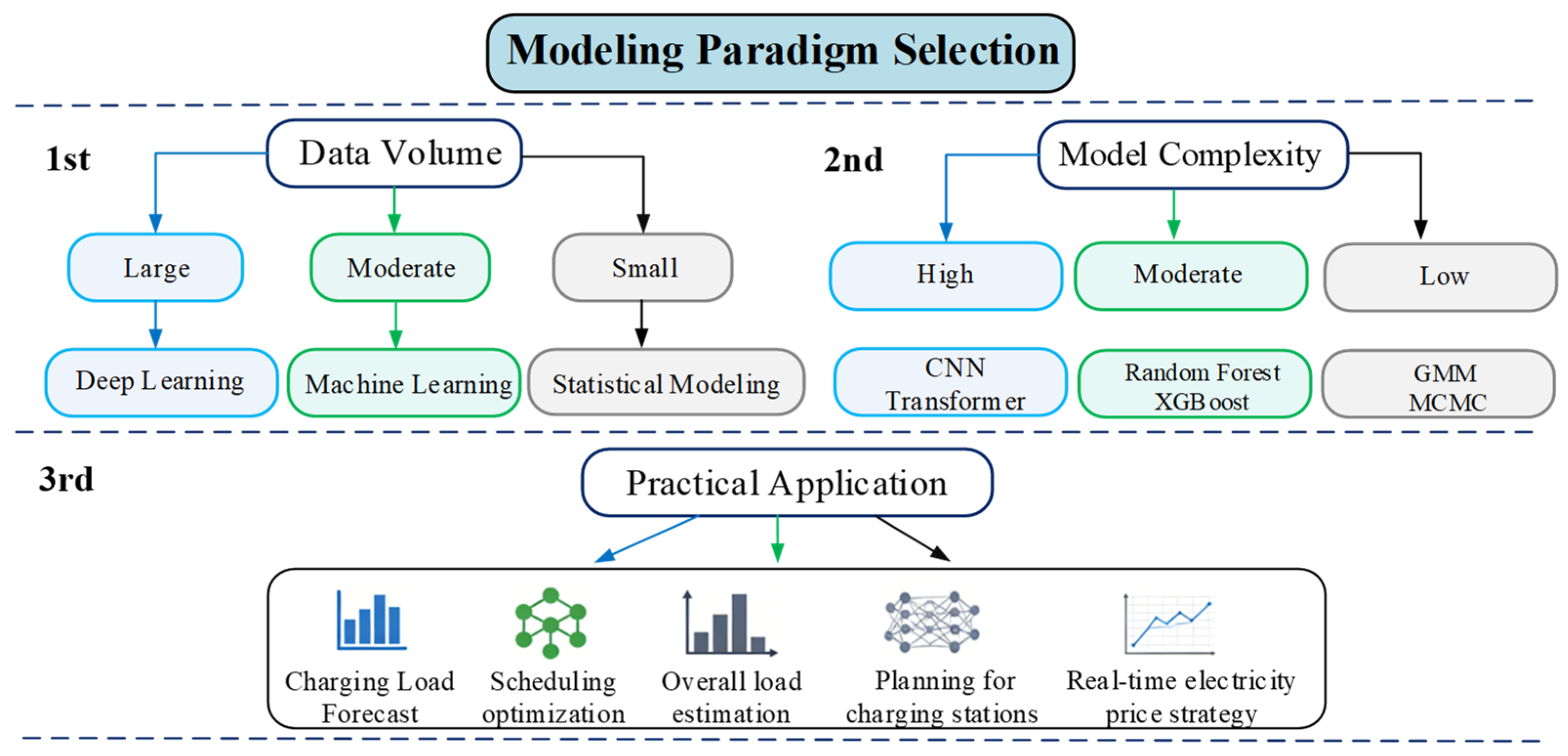
As illustrated in Figure 3, the choice of EV behavior modeling approaches is closely related to the scale and richness of available data. When data are scarce, typically involving on the order of 102–103 vehicles or trips, limited temporal coverage, and coarse-grained behavioral features, statistical modeling and stochastic processes are often preferred due to their strong interpretability and low data dependence [100]. With moderate data availability, commonly characterized by 104–105 samples and moderately rich temporal or contextual features, traditional machine learning methods provide a balance between modeling flexibility and robustness [101,102]. In data-rich scenarios, where large-scale datasets exceeding 106 EV records with fine-grained spatiotemporal resolution and high-dimensional features are available, DL approaches enable more accurate representation of complex spatiotemporal and behavioral patterns [82]. This paradigm-selection perspective highlights that no single modeling approach is universally optimal; instead, appropriate methods should be selected according to data conditions and modeling objectives.

4. Challenges

Although substantial progress has been made in developing modeling paradigms for EV behavior, their practical applications within V2G systems remain constrained. The scarcity of open and comprehensive datasets limits the development of modeling approaches that rely on high-quality data for training, while existing paradigms often exhibit limited generalizability and scalability across diverse scenarios. This section ranks the major obstacles according to their impact on scalable and reliable V2G implementation, ranging from data availability to real-time operational feasibility.
Data availability constitutes the most critical bottleneck for EV behavior modeling in practical V2G systems. Research related to EV behavior modeling relies heavily on large volumes of real-world data so as to accurately characterize charging activities. In turn, the quality of available datasets directly determines the accuracy and reliability of modeling outcomes [32]. Existing studies typically draw on three primary data sources—charging station records, user survey data, and vehicle trajectory datasets. However, all the aforementioned data sources have the following inherent limitations and are essentially difficult to fully support EV behavior modeling.
  • Data availability, quality and openness constraints. Charging station data is commonly collected from large numbers of stations within a region and provide strong quantitative support, including information such as start time, end time and durations of charging [103]. However, these datasets lack users’ behavioral attributes and thus cannot capture long-term charging patterns driven by individual preferences and mobility habits.
  • Limited representativeness of user survey data. User survey data which is obtained through interviews or questionnaires intrinsically embeds behavioral attributes such as charging choices and preferences, as well as users’ satisfaction with local charging infrastructure and services [88]. In addition to costly and time-consuming collections, the limited number of respondents often restricts representativeness and scalability. Vehicle trajectory data which is collected via satellite positioning technologies offers spatiotemporal information that can be used to infer potential charging needs and behavioral characteristics [104], such as destinations, travel frequency and mileage [105]. However, positioning data cannot provide state-of-charge or charging/discharging status of onboard batteries, making it unsuitable for direct predictions on charging demands.
  • Lack of integrated multi-source datasets. Obtaining large-scale, long-term datasets of EV trajectory and onboard battery states remains difficult [106]. Data processing must simultaneously ensure spatiotemporal coherence and accuracy, requiring substantial computational resources. Current datasets usually rely on simulation models or a single data type, lacking integrated analyses that combine high-resolution battery information with large-scale mobility traces. As a result, existing data resources fall short of enabling fine-grained modeling of EV charging behavior, energy-use patterns and spatiotemporal distributions of potential charging demands [107].
Beyond data scarcity, the second most impactful challenge lies in the limited generalizability of existing modeling paradigms. Most EV behavior models are typically trained under narrowly defined scenarios, making them poorly suited to the dynamic uncertainties inherent in real-world V2G systems. Factors such as heterogeneous charging behavior, rapidly varying grid loads and volatile renewable generation are often insufficiently represented during training, resulting in significant performance degradation when deployed in practice [108]. Therefore, the generalizability and scalability of the existing modeling paradigms are limited.
  • Scenario-specific training and cross-regional limitations. Current models are largely developed based on localized energy policies and region-specific user behavior data, without adequately accounting for geographic conditions, regulatory differences, or behavioral patterns across different cities. Consequently, their applicability in cross-region deployment remains limited [109]. In addition, the models struggle to accommodate urban–rural disparities, diverse energy mixes and heterogeneous energy demands across residential, commercial and industrial sectors. Model performance typically deteriorates substantially when transferred across scenarios.
  • Data heterogeneity and lack of standardized benchmarks. DL models, in particular, require large volumes of scenario-specific labeled data, though EV datasets from different regions and operators often vary in format and lack standardized benchmarking protocols. This inconsistency hampers cross-regional and cross-device generalization while amplifying the adverse effects of data quality discrepancies.
Finally, computational complexity poses a significant barrier, particularly for large-scale and real-time V2G applications. DL and advanced RL models demand substantial computational resources and exhibit considerable inference latency, making them unsuitable for large-scale EV fleet deployment where low-latency scheduling and real-time grid control are required [110]. In high-dimensional data contexts or large-scale EV integration scenarios, the computational efficiency of many ML models deteriorates sharply, limiting their feasibility for managing large-scale V2G systems [111].
In summary, the practical adoption of EV behavior modeling in V2G systems remains hindered by data limitations, insufficient model generalizability and high computational burdens associated with advanced modeling paradigms. These challenges constrain the reliability of behavior-driven forecasting and decision-making, especially in large-scale and highly dynamic V2G contexts. Addressing these issues requires more standardized, transferable and computationally efficient modeling frameworks with support of richer, multi-source datasets and improved cross-scenario compatibility.

5. Perspectives

Despite rapid methodological advances, a gap remains between EV behavior modeling research and large-scale V2G deployment. Most existing studies focus primarily on algorithmic development or predictive accuracy, with limited consideration of the system-level requirements inherent to real-world V2G applications. A deployment-oriented perspective, in which modeling paradigms are aligned with specific V2G tasks, available data, and operational constraints, may provide a more effective framework for bridging this gap. Building on this perspective, a Task–Data–Deployment framework as a unifying viewpoint for future EV behavior modeling research. Instead of organizing studies solely by modeling techniques, the framework emphasizes the tasks being addressed, the data realistically available, and the feasibility of deploying the resulting models at scale.
A first key research question concerns how EV behavior models can be designed to be task-aware across heterogeneous V2G decision layers. EV applications span long-term planning, short-term forecasting, and real-time control, each requiring different temporal and spatial resolutions. Developing unified modeling frameworks that can degrade or refine behavioral representations according to task requirements remains an open challenge. Methodological pathways to address this include task-conditioned model architectures, multi-resolution behavior representations, and hierarchical modeling aligned with grid–aggregator–EV layers.
A second critical question is how EV behavior models can adapt to heterogeneous and evolving data conditions. Given the persistent scarcity of integrated multi-source datasets, future models must operate robustly under diverse data regimes. Rather than assuming data-rich environments, research should prioritize data-adaptive modeling, enabling graceful performance degradation under limited data and rapid improvement when richer data become available. Approaches such as multi-source data fusion with uncertainty awareness, transfer learning and meta-learning for cross-region adaptation, and privacy-preserving collaborative learning can expand effective data coverage while maintaining user confidentiality.
A third research question addresses how physical and behavioral constraints can be systematically embedded into learning-based models. Purely data-driven approaches often fail to generalize due to insufficient representation of battery degradation, mobility limitations, and user decision logic. Hybrid modeling paradigms that integrate structural priors with adaptive data-informed components can improve both interpretability and generalizability. Techniques include physics-informed and constraint-aware learning, hybrid statistical–ML–RL frameworks, and explicit modeling of user decision uncertainty and bounded rationality.
Finally, computational feasibility remains a decisive factor for real-world adoption, particularly for large EV fleets and time-critical grid services. Future work must balance modeling fidelity with operational constraints, emphasizing lightweight and hardware-aware model design, model compression, surrogate modeling, and scheduling that leverages edge–cloud collaborative architectures to reduce latency.
In contrast to conventional reviews that focus on comparing modeling techniques, this perspective emphasizes deployment-driven co-design of tasks, data, and models. By framing EV behavior modeling as a system-level enabler rather than a standalone prediction problem, the proposed Task–Data–Deployment framework offers a structured pathway toward scalable, transferable, and operationally viable V2G solutions, providing actionable guidance for researchers and practitioners seeking to bridge the gap between algorithm development and real-world deployment.

6. Conclusions

This paper systematically reviewed the state-of-the-art methods for EV behavior modeling in the context of V2G systems. Statistical and data-driven modeling paradigms have been analyzed in terms of their objectives, data dependencies, computational complexity and applicability to various V2G scenarios. While statistical models provide simplicity and interpretability, they are limited in capturing the fine-grained heterogeneity of EV behavior. Data-driven methods offer superior predictive performance but face challenges related to data scarcity, generalizability across regions and high computational burdens. RL extends modeling to adaptive, decision-oriented tasks, supporting peak shaving, energy arbitrage, and real-time control. Despite these advances, practical V2G deployment remains constrained by limited multi-source datasets, insufficient cross-scenario generalizability, and high computational costs for large-scale, real-time applications. To address these gaps, this paper proposes a Task–Data–Deployment framework that emphasizes co-design of models with specific V2G tasks, available data, and operational feasibility. Future research directions under this framework include task-aware modeling that adapts temporal and spatial resolutions according to operational requirements, data-adaptive and privacy-preserving approaches for heterogeneous and evolving datasets, hybrid modeling that integrates statistical, learning-based, and constraint-aware methods to enhance interpretability and generalizability, and computationally efficient architectures leveraging lightweight models, surrogate modeling, and edge–cloud collaboration. By reframing EV behavior modeling as a system-level enabler rather than a purely predictive exercise, the Task–Data–Deployment framework provides actionable guidance for scalable, transferable, and operationally viable V2G solutions. Implementing these directions will improve grid interaction, support renewable integration, and enable flexible energy management, advancing both the scientific understanding and practical deployment of V2G systems.

Author Contributions

Conceptualization, C.Z. and F.F.; formal analysis, C.Z. and F.F.; investigation, C.Z., F.F., Y.T., J.J., C.S., R.X. and K.S.; resources, F.F., C.Z. and K.S.; writing—original draft preparation, C.Z. and F.F.; writing—review and editing, Y.T., J.J., C.S., R.X., G.Y. and K.S.; project administration, F.F. and K.S.; funding acquisition, F.F. and K.S. All authors have read and agreed to the published version of the manuscript.

Funding

This research was supported by the Research Startup Funding for Talent Introduction (Grant No. AUGA2160500125).

Data Availability Statement

No new data were created or analyzed in this study.

Conflicts of Interest

Author Guang Yang was employed by the BYD Auto Industry Company Limited. The remaining authors declare that the research was conducted in the absence of any commercial or financial relationships that could be construed as a potential conflict of interest.

References

  1. Tian, B.; Shen, W.; Zhang, C.; Anderson, J.E.; Degner, M.W.; Lu, X.; Zhao, S.; Wu, Y.; Zhang, S. Optimizing the Charging Behaviors of Private BEVs to Enhance Coordinated Charging and V2G in Beijing. eTransportation 2025, 26, 100470. [Google Scholar] [CrossRef]
  2. Ou, Y.; Kittner, N.; Babaee, S.; Smith, S.J.; Nolte, C.G.; Loughlin, D.H. Evaluating Long-Term Emission Impacts of Large-Scale Electric Vehicle Deployment in the US Using a Human-Earth Systems Model. Appl. Energy 2021, 300, 117364. [Google Scholar] [CrossRef]
  3. Yang, X.; Yun, J.; Zhou, S.; Lie, T.T.; Han, J.; Xu, X.; Wang, Q.; Ge, Z. A Spatiotemporal Distribution Prediction Model for Electric Vehicles Charging Load in Transportation Power Coupled Network. Sci. Rep. 2025, 15, 4022. [Google Scholar] [CrossRef] [PubMed]
  4. Global EV Outlook 2025. Available online: https://www.iea.org/reports/global-ev-outlook-2025 (accessed on 20 December 2025).
  5. Obiora, S.C.; Bamisile, O.; Hu, Y.; Ozsahin, D.U.; Adun, H. Assessing the Decarbonization of Electricity Generation in Major Emitting Countries by 2030 and 2050: Transition to a High Share Renewable Energy Mix. Heliyon 2024, 10, e28770. [Google Scholar] [CrossRef]
  6. Gopal, J.; Muthu, M.; Sivanesan, I. A Comprehensive Compilation of Graphene/Fullerene Polymer Nanocomposites for Electrochemical Energy Storage. Polymers 2023, 15, 701. [Google Scholar] [CrossRef] [PubMed]
  7. Farajzadeh, R.; Khoshnevis, N.; Solomon, D.; Masalmeh, S.; Bruining, J. Life-Cycle Assessment of Oil Recovery Using Dimethyl Ether Produced from Green Hydrogen and Captured CO2. Sci. Rep. 2025, 15, 4027. [Google Scholar] [CrossRef]
  8. Pan, Y.; Hu, J.; Fang, Y.; Liu, N. Robust Optimization and DRL-Based Control Strategies for Electric Vehicle Aggregators to Provide Frequency Regulation Service. IEEE Trans. Smart Grid 2025, 16, 5262–5274. [Google Scholar] [CrossRef]
  9. Rahman, M.M.; Dadon, S.H.; He, M.; Giesselmann, M.; Hasan, M.M. An Overview of Power System Flexibility: High Renewable Energy Penetration Scenarios. Energies 2024, 17, 6393. [Google Scholar] [CrossRef]
  10. Niu, J.; Li, X.; Tian, Z.; Yang, H. Uncertainty Analysis of the Electric Vehicle Potential for a Household to Enhance Robustness in Decision on the EV/V2H Technologies. Appl. Energy 2024, 365, 123294. [Google Scholar] [CrossRef]
  11. Zheng, S.; Huang, G.; Lai, A.C.K. Coordinated Energy Management for Commercial Prosumers Integrated with Distributed Stationary Storages and EV Fleets. Energy Build. 2023, 282, 112773. [Google Scholar] [CrossRef]
  12. Wang, S.; Luo, Y.; Yu, P.; Yu, R. Integrated Coordinated Control of Source–Grid–Load–Storage in Active Distribution Network with Electric Vehicle Integration. Processes 2025, 13, 1285. [Google Scholar] [CrossRef]
  13. Kene, R.O.; Olwal, T.O. Energy Management and Optimization of Large-Scale Electric Vehicle Charging on the Grid. World Electr. Veh. J. 2023, 14, 95. [Google Scholar] [CrossRef]
  14. Xing, Q.; Chen, Z.; Zhang, Z.; Wang, R.; Zhang, T. Modelling Driving and Charging Behaviours of Electric Vehicles Using a Data-Driven Approach Combined with Behavioural Economics Theory. J. Clean. Prod. 2021, 324, 129243. [Google Scholar] [CrossRef]
  15. Yamashita, D.Y.; Vechiu, I.; Gaubert, J.-P.; Jupin, S. Hierarchical Model Predictive Control to Coordinate a Vehicle-to-Grid System Coupled to Building Microgrids. IEEE Trans. Ind. Appl. 2023, 59, 169–179. [Google Scholar] [CrossRef]
  16. Huang, P.; Ma, Z. Unveiling Electric Vehicle (EV) Charging Patterns and Their Transformative Role in Electricity Balancing and Delivery: Insights from Real-World Data in Sweden. Renew. Energy 2024, 236, 121511. [Google Scholar] [CrossRef]
  17. Tian, C.; Liu, Y.; Zhang, G.; Yang, Y.; Yan, Y.; Li, C. Transfer Learning Based Hybrid Model for Power Demand Prediction of Large-Scale Electric Vehicles. Energy 2024, 300, 131461. [Google Scholar] [CrossRef]
  18. Zafar, R.; Huang, P.; Sun, Y. Enhancing Electric Vehicle Charging Load Prediction in Data-Scarce Scenarios: A Hybrid Deep Learning-Based Approach Integrating Clustering Analysis and Transfer Learning. Energy AI 2025, 21, 100545. [Google Scholar] [CrossRef]
  19. Li, X.; Wang, Z.; Zhang, L.; Sun, F.; Cui, D.; Hecht, C.; Figgener, J.; Sauer, D.U. Electric Vehicle Behavior Modeling and Applications in Vehicle-Grid Integration: An Overview. Energy 2023, 268, 126647. [Google Scholar] [CrossRef]
  20. Fachrizal, R.; Qian, K.; Lindberg, O.; Shepero, M.; Adam, R.; Widén, J.; Munkhammar, J. Urban-Scale Energy Matching Optimization with Smart EV Charging and V2G in a Net-Zero Energy City Powered by Wind and Solar Energy. eTransportation 2024, 20, 100314. [Google Scholar] [CrossRef]
  21. Nespoli, A.; Ogliari, E.; Leva, S. User Behavior Clustering Based Method for EV Charging Forecast. IEEE Access 2023, 11, 6273–6283. [Google Scholar] [CrossRef]
  22. Wang, S.; Liu, B.; Li, Q.; Han, D.; Zhou, J.; Xiang, Y. EV Charging Behavior Analysis and Load Prediction via Order Data of Charging Stations. Sustainability 2025, 17, 1807. [Google Scholar] [CrossRef]
  23. Covello, A.; Martino, A.D.; Longo, M. Experimental Observation and Validation of EV Model for Real Driving Behavior. IEEE Access 2024, 12, 130763–130776. [Google Scholar] [CrossRef]
  24. Kucuksari, S.; Erdogan, N. Modeling and Data Analysis of Electric Vehicle Fleet Charging. In Proceedings of the 2022 IEEE Transportation Electrification Conference & Expo (ITEC), Anaheim, CA, USA, 15 June 2022; pp. 1139–1143. [Google Scholar]
  25. Kamana-Williams, B.; Bishop, D.; Hooper, G.; Chase, J.G. Driving Change: Electric Vehicle Charging Behavior and Peak Loading. Renew. Sustain. Energy Rev. 2024, 189, 113953. [Google Scholar] [CrossRef]
  26. Dai, Y.; Liu, X.; Li, H.; Liu, X.; Zhang, T.; Su, Z.; Zhao, S.; Zhou, Y. Building-Related Electric Vehicle Charging Behaviors and Energy Consumption Patterns: An Urban-Scale Analysis. Transp. Res. Part Transp. Environ. 2025, 141, 104663. [Google Scholar] [CrossRef]
  27. Wang, Z.; Zheng, F.; Liu, M. Charging Scheduling of Electric Vehicles Considering Uncertain Arrival Times and Time-of-Use Price. Sustainability 2025, 17, 1100. [Google Scholar] [CrossRef]
  28. Meng, Q.; Tong, X.; Hussain, S.; Luo, F.; Zhou, F.; Liu, L.; He, Y.; Jin, X.; Li, B. Revolutionizing Photovoltaic Consumption and Electric Vehicle Charging: A Novel Approach for Residential Distribution Systems. IET Gener. Transm. Distrib. 2024, 18, 2822–2833. [Google Scholar] [CrossRef]
  29. Adam, R.; Qian, K.; Brehm, R. Electric Vehicle User Behavior Prediction Using Gaussian Mixture Models and Soft Information: 10th IEEE PES Innovative Smart Grid Technologies Conference—Asia 2021. In Proceedings of the 2021 IEEE PES Innovative Smart Grid Technologies—Asia (ISGT Asia), Brisbane, Australia, 5–8 December 2021. [Google Scholar] [CrossRef]
  30. Qin, Y.; Wang, J.; Ren, S.; Li, Z. Prediction of EV Random Charging Load Based on Monte Carlo Simulation Method. In Proceedings of the 2023 3rd International Conference on New Energy and Power Engineering (ICNEPE), Huzhou, China, 24 November 2023; pp. 295–298. [Google Scholar]
  31. Sadhukhan, A.; Ahmad, M.S.; Sivasubramani, S. Optimal Allocation of EV Charging Stations in a Radial Distribution Network Using Probabilistic Load Modeling. IEEE Trans. Intell. Transp. Syst. 2022, 23, 11376–11385. [Google Scholar] [CrossRef]
  32. Yu, Q.; Li, J.; Feng, D.; Liu, X.; Yuan, J.; Zhang, H.; Wang, X. Modeling Electric Vehicle Behavior: Insights from Long-Term Charging and Energy Consumption Patterns through Empirical Trajectory Data. Appl. Energy 2025, 380, 125066. [Google Scholar] [CrossRef]
  33. Wang, R.; Ji, H.; Li, P.; Yu, H.; Zhao, J.; Zhao, L.; Zhou, Y.; Wu, J.; Bai, L.; Yan, J.; et al. Multi-Resource Dynamic Coordinated Planning of Flexible Distribution Network. Nat. Commun. 2024, 15, 4576. [Google Scholar] [CrossRef] [PubMed]
  34. Bian, H.; Ren, Q.; Guo, Z.; Zhou, C.; Zhang, Z.; Wang, X. Predictive Model for EV Charging Load Incorporating Multimodal Travel Behavior and Microscopic Traffic Simulation. Energies 2024, 17, 2606. [Google Scholar] [CrossRef]
  35. Wu, S.; Li, H.; Wang, H. Seasonal Load Statistics of EV Charging and Battery Swapping Stations Based on Gaussian Mixture Model for Charging Strategy Optimization in Electric Power Distribution Systems. Energies 2025, 18, 5504. [Google Scholar] [CrossRef]
  36. Saklani, M.; Saini, D.K.; Gupta, Y.K. Clustering of Electric Vehicle Charging Behaviors Using Gaussian Mixture Models for Optimized Load Profiling. In Proceedings of the 2025 IEEE 5th International Conference in Power Engineering Applications (ICPEA), Bandar Baru Bangi, Malaysia, 14–15 July 2025; pp. 193–198. [Google Scholar]
  37. Hasan, K.N.; Preece, R.; Milanović, J.V. Probabilistic Modelling of Electric Vehicle Charging Demand Based on Charging Station Data. In Proceedings of the 2022 17th International Conference on Probabilistic Methods Applied to Power Systems (PMAPS), Manchester, UK, 12–15 June 2022; pp. 1–6. [Google Scholar]
  38. Fan, F.; Bayram, I.S.; Zafar, U.; Bayhan, S.; Stephen, B.; Galloway, S. Probabilistic Assessment of Community-Scale Vehicle Electrification Using GPS-Based Vehicle Mobility Data: A Case Study in Qatar. IEEE Open J. Veh. Technol. 2023, 4, 796–808. [Google Scholar] [CrossRef]
  39. Wang, R.; Xing, Q.; Chen, Z.; Zhang, Z.; Liu, B. Modeling and Analysis of Electric Vehicle User Behavior Based on Full Data Chain Driven. Sustainability 2022, 14, 8600. [Google Scholar] [CrossRef]
  40. Tang, Y.; Liu, W.; Chau, K.T.; Hou, Y.; Guo, J. Stochastic Behavior Modeling and Optimal Bidirectional Charging Station Deployment in EV Energy Network. IEEE Trans. Intell. Transp. Syst. 2025, 26, 6231–6247. [Google Scholar] [CrossRef]
  41. Mahmoudi, E.; Santos Barros, T.A.D.; Filho, E.R. Forecasting Urban Electric Vehicle Charging Power Demand Based on Travel Trajectory Simulation in the Realistic Urban Street Network. Energy Rep. 2024, 11, 4254–4276. [Google Scholar] [CrossRef]
  42. Yu, H.; Wang, Y.; Chen, Y.; Li, Q.; Xiao, X.; Chen, Y.; Li, S. Probabilistic Assessment Method for Evaluation of Adjustable Capacity of Electric Vehicle Charging Stations for Volt–Var Control in Distribution Networks. Appl. Energy 2025, 398, 126436. [Google Scholar] [CrossRef]
  43. Bian, H.; Tang, X.; Ji, K.; Zhang, Y.; Xie, Y. Prediction of Electric Vehicle Charging Load Considering User Travel Characteristics and Charging Behavior. World Electr. Veh. J. 2025, 16, 502. [Google Scholar] [CrossRef]
  44. Ul-Haq, A.; Azhar, M.; Mahmoud, Y.; Perwaiz, A.; Al-Ammar, E. Probabilistic Modeling of Electric Vehicle Charging Pattern Associated with Residential Load for Voltage Unbalance Assessment. Energies 2017, 10, 1351. [Google Scholar] [CrossRef]
  45. Jiang, W.; Ameer, H.; Wang, Y. Electric Vehicle User Profiling and Spatiotemporal Charging Demand Forecasting Based on Monte Carlo Method. In Proceedings of the 2024 IEEE 25th China Conference on System Simulation Technology and its Application (CCSSTA), Tianjin, China, 21–23 July 2024; pp. 493–498. [Google Scholar]
  46. Zheng, X.; Zhu, Y.; Wang, M.; Lv, B.; Lv, Y. Hierarchical Markov Chain Monte Carlo Framework for Spatiotemporal EV Charging Load Forecasting. Appl. Sci. 2025, 15, 11094. [Google Scholar] [CrossRef]
  47. Jenkins, M.; Kockar, I. Electric Vehicle Aggregation Model: A Probabilistic Approach in Representing Flexibility. Electr. Power Syst. Res. 2022, 213, 108484. [Google Scholar] [CrossRef]
  48. Xie, T.; Zhang, Y.; Zhang, G.; Zhang, K.; Li, H.; He, X. Research on Electric Vehicle Load Forecasting Considering Regional Special Event Characteristics. Front. Energy Res. 2024, 12, 1341246. [Google Scholar] [CrossRef]
  49. Di Martino, A.; Miraftabzadeh, S.M.; Longo, M. Strategies for the Modelisation of Electric Vehicle Energy Consumption: A Review. Energies 2022, 15, 8115. [Google Scholar] [CrossRef]
  50. Marzbani, F.; Osman, A.H.; Hassan, M.S. Electric Vehicle Energy Demand Prediction Techniques: An In-Depth and Critical Systematic Review. IEEE Access 2023, 11, 96242–96255. [Google Scholar] [CrossRef]
  51. Tappeta, V.S.R.; Appasani, B.; Patnaik, S.; Ustun, T.S. A Review on Emerging Communication and Computational Technologies for Increased Use of Plug-In Electric Vehicles. Energies 2022, 15, 6580. [Google Scholar] [CrossRef]
  52. Deb, S. Machine Learning for Solving Charging Infrastructure Planning: A Comprehensive Review. In Proceedings of the 2021 5th International Conference on Smart Grid and Smart Cities (ICSGSC), Tokyo, Japan, 18 June 2021; pp. 16–22. [Google Scholar]
  53. Chen, Y.; Guo, M.; Chen, Z.; Chen, Z.; Ji, Y. Physical Energy and Data-Driven Models in Building Energy Prediction: A Review. Energy Rep. 2022, 8, 2656–2671. [Google Scholar] [CrossRef]
  54. Sarker, I.H. Machine Learning: Algorithms, Real-World Applications and Research Directions. SN Comput. Sci. 2021, 2, 160. [Google Scholar] [CrossRef] [PubMed]
  55. Mazhar, T.; Asif, R.N.; Malik, M.A.; Nadeem, M.A.; Haq, I.; Iqbal, M.; Kamran, M.; Ashraf, S. Electric Vehicle Charging System in the Smart Grid Using Different Machine Learning Methods. Sustainability 2023, 15, 2603. [Google Scholar] [CrossRef]
  56. Lu, Y.; Li, Y.; Xie, D.; Wei, E.; Bao, X.; Chen, H.; Zhong, X. The Application of Improved Random Forest Algorithm on the Prediction of Electric Vehicle Charging Load. Energies 2018, 11, 3207. [Google Scholar] [CrossRef]
  57. Deb, S.; Gao, X.-Z. Prediction of Charging Demand of Electric City Buses of Helsinki, Finland by Random Forest. Energies 2022, 15, 3679. [Google Scholar] [CrossRef]
  58. Makhmudov, F.; Kilichev, D.; Giyosov, U.; Akhmedov, F. Online Machine Learning for Intrusion Detection in Electric Vehicle Charging Systems. Mathematics 2025, 13, 712. [Google Scholar] [CrossRef]
  59. Fescioglu-Unver, N.; Yıldız Aktaş, M. Electric Vehicle Charging Service Operations: A Review of Machine Learning Applications for Infrastructure Planning, Control, Pricing and Routing. Renew. Sustain. Energy Rev. 2023, 188, 113873. [Google Scholar] [CrossRef]
  60. Sulaiman, M.H.; Mustaffa, Z. State of Charge Estimation for Electric Vehicles Using Random Forest. Green Energy Intell. Transp. 2024, 3, 100177. [Google Scholar] [CrossRef]
  61. Peng, Q.; Zheng, Z.; Hu, H. Defect Prediction for Capacitive Equipment in Power System. Appl. Sci. 2024, 14, 1968. [Google Scholar] [CrossRef]
  62. Zhang, Q.; Lu, J.; Kuang, W.; Wu, L.; Wang, Z. Short-Term Charging Load Prediction of Electric Vehicles with Dynamic Traffic Information Based on a Support Vector Machine. World Electr. Veh. J. 2024, 15, 189. [Google Scholar] [CrossRef]
  63. Kene, R.O.; Olwal, T.O. Data-Driven Modeling of Electric Vehicle Charging Sessions Based on Machine Learning Techniques. World Electr. Veh. J. 2025, 16, 107. [Google Scholar] [CrossRef]
  64. Choi, D.-K. Data-Driven Materials Modeling with XGBoost Algorithm and Statistical Inference Analysis for Prediction of Fatigue Strength of Steels. Int. J. Precis. Eng. Manuf. 2019, 20, 129–138. [Google Scholar] [CrossRef]
  65. Chen, T.; Guestrin, C. XGBoost: A Scalable Tree Boosting System. In Proceedings of the 22nd ACM SIGKDD International Conference on Knowledge Discovery and Data Mining, San Francisco, CA, USA, 13 August 2016; pp. 785–794. [Google Scholar]
  66. Almaghrebi, A.; Aljuheshi, F.; Rafaie, M.; James, K.; Alahmad, M. Data-Driven Charging Demand Prediction at Public Charging Stations Using Supervised Machine Learning Regression Methods. Energies 2020, 13, 4231. [Google Scholar] [CrossRef]
  67. Lim, Y.; Bae, S.; Moon, J. Optimal Control Scheme of Electric Vehicle Charging Using Combined Model of XGBoost and Cumulative Prospect Theory. Energies 2024, 17, 6457. [Google Scholar] [CrossRef]
  68. Genov, E. Forecasting Flexibility of Charging of Electric Vehicles: Tree and Cluster-Based Methods. Appl. Energy 2024, 353, 121969. [Google Scholar] [CrossRef]
  69. Florek, P.; Zagdański, A. Benchmarking State-of-the-Art Gradient Boosting Algorithms for Classification. arXiv 2023, arXiv:2305.17094. [Google Scholar]
  70. Mu, Y.; Zhou, R.; Zhao, K.; Jia, H.; Zu, G.; Yang, Y. A Charging Demand Prediction Method for Individual Electric Vehicle Users Based on Dual-Layer Multisource Data Clustering and a LightGBM. Energy AI 2025, 22, 100644. [Google Scholar] [CrossRef]
  71. Zhang, T.; Peng, Q.; Zeng, S. Predicting EV Charging Demand in Renewable-Energy-Powered Grids Using Explainable Machine Learning. Sustainability 2025, 17, 4158. [Google Scholar] [CrossRef]
  72. Qian, T.; Liang, Z.; Shao, C.; Guo, Z.; Hu, Q.; Wu, Z. Unsupervised Learning for Efficiently Distributing EVs Charging Loads and Traffic Flows in Coupled Power and Transportation Systems. Appl. Energy 2025, 377, 124476. [Google Scholar] [CrossRef]
  73. Shakya, A.K.; Pillai, G.; Chakrabarty, S. Reinforcement Learning Algorithms: A Brief Survey. Expert Syst. Appl. 2023, 231, 120495. [Google Scholar] [CrossRef]
  74. Michailidis, P.; Michailidis, I.; Kosmatopoulos, E. Reinforcement Learning for Electric Vehicle Charging Management: Theory and Applications. Energies 2025, 18, 5225. [Google Scholar] [CrossRef]
  75. Almughram, O.; Abdullah Ben Slama, S.; Zafar, B.A. A Reinforcement Learning Approach for Integrating an Intelligent Home Energy Management System with a Vehicle-to-Home Unit. Appl. Sci. 2023, 13, 5539. [Google Scholar] [CrossRef]
  76. Sarker, I.H. Deep Learning: A Comprehensive Overview on Techniques, Taxonomy, Applications and Research Directions. SN Comput. Sci. 2021, 2, 420. [Google Scholar] [CrossRef]
  77. Alzubaidi, L.; Zhang, J.; Humaidi, A.J.; Al-Dujaili, A.; Duan, Y.; Al-Shamma, O.; Santamaría, J.; Fadhel, M.A.; Al-Amidie, M.; Farhan, L. Review of Deep Learning: Concepts, CNN Architectures, Challenges, Applications, Future Directions. J. Big Data 2021, 8, 53. [Google Scholar] [CrossRef] [PubMed]
  78. Tian, J.; Liu, H.; Gan, W.; Zhou, Y.; Wang, N.; Ma, S. Short-Term Electric Vehicle Charging Load Forecasting Based on TCN-LSTM Network with Comprehensive Similar Day Identification. Appl. Energy 2025, 381, 125174. [Google Scholar] [CrossRef]
  79. Yang, X.; Zhang, L.; Han, X. Electric Vehicle Charging Load Forecasting Method Based on Improved Long Short-Term Memory Model with Particle Swarm Optimization. World Electr. Veh. J. 2025, 16, 150. [Google Scholar] [CrossRef]
  80. Wang, C.; Wang, Y.; Song, F. Research on Electric Vehicle Charging Load Forecasting Method Based on Improved LSTM Neural Network. World Electr. Veh. J. 2025, 16, 265. [Google Scholar] [CrossRef]
  81. Li, Y.; Dong, B.; Qiu, Y. Conditional Generative Adversarial Network (cGAN) for Generating Building Load Profiles with Photovoltaics and Electric Vehicles. Energy Build. 2025, 335, 115584. [Google Scholar] [CrossRef]
  82. Shen, X.; Zhao, H.; Xiang, Y.; Lan, P.; Liu, J. Short-Term Electric Vehicles Charging Load Forecasting Based on Deep Learning in Low-Quality Data Environments. Electr. Power Syst. Res. 2022, 212, 108247. [Google Scholar] [CrossRef]
  83. Jeng, S.-L. Generative Adversarial Network for Synthesizing Multivariate Time-Series Data in Electric Vehicle Driving Scenarios. Sensors 2025, 25, 749. [Google Scholar] [CrossRef]
  84. Daina, N.; Sivakumar, A.; Polak, J.W. Electric Vehicle Charging Choices: Modelling and Implications for Smart Charging Services. Transp. Res. Part C Emerg. Technol. 2017, 81, 36–56. [Google Scholar] [CrossRef]
  85. Yi, T.; Zhang, C.; Lin, T.; Liu, J. Research on the Spatial-Temporal Distribution of Electric Vehicle Charging Load Demand: A Case Study in China. J. Clean. Prod. 2020, 242, 118457. [Google Scholar] [CrossRef]
  86. Wolinetz, M.; Axsen, J.; Peters, J.; Crawford, C. Simulating the Value of Electric-Vehicle–Grid Integration Using a Behaviourally Realistic Model. Nat. Energy 2018, 3, 132–139. [Google Scholar] [CrossRef]
  87. Liu, Y.S.; Tayarani, M.; Gao, H.O. An Activity-Based Travel and Charging Behavior Model for Simulating Battery Electric Vehicle Charging Demand. Energy 2022, 258, 124938. [Google Scholar] [CrossRef]
  88. Wang, Y.; Yao, E.; Pan, L. Electric Vehicle Drivers’ Charging Behavior Analysis Considering Heterogeneity and Satisfaction. J. Clean. Prod. 2021, 286, 124982. [Google Scholar] [CrossRef]
  89. Singh, S.; Vaidya, B.; Mouftah, H.T. Smart EV Charging Strategies Based on Charging Behavior. Front. Energy Res. 2022, 10, 773440. [Google Scholar] [CrossRef]
  90. Li, Z.; Li, C.; Zhang, B.; Duan, Q.; Liu, L.; Zu, G.; Li, Q. Research on New Energy Vehicle Charging Prediction Based on Monte Carlo Algorithm and Its Impact on Distribution Network. Front. Energy Res. 2023, 11, 1269041. [Google Scholar] [CrossRef]
  91. Gschwendtner, C.; Knoeri, C.; Stephan, A. The Impact of Plug-in Behavior on the Spatial–Temporal Flexibility of Electric Vehicle Charging Load. Sustain. Cities Soc. 2023, 88, 104263. [Google Scholar] [CrossRef]
  92. Ostermann, A.; Haug, T. Probabilistic Forecast of Electric Vehicle Charging Demand: Analysis of Different Aggregation Levels and Energy Procurement. Energy Inform. 2024, 7, 13. [Google Scholar] [CrossRef]
  93. Zhou, D.; Guo, Z.; Xie, Y.; Hu, Y.; Jiang, D.; Feng, Y.; Liu, D. Using Bayesian Deep Learning for Electric Vehicle Charging Station Load Forecasting. Energies 2022, 15, 6195. [Google Scholar] [CrossRef]
  94. Kong, W.; Dong, Z.Y.; Jia, Y.; Hill, D.J.; Xu, Y.; Zhang, Y. Short-Term Residential Load Forecasting Based on LSTM Recurrent Neural Network. IEEE Trans. Smart Grid 2019, 10, 841–851. [Google Scholar] [CrossRef]
  95. Zhang, X.; Chan, K.W.; Li, H.; Wang, H.; Qiu, J.; Wang, G. Deep-Learning-Based Probabilistic Forecasting of Electric Vehicle Charging Load with a Novel Queuing Model. IEEE Trans. Cybern. 2021, 51, 3157–3170. [Google Scholar] [CrossRef]
  96. Wei, T.; Wang, Y.; Zhu, Q. Deep Reinforcement Learning for Building HVAC Control. In Proceedings of the 2017 54th ACM/EDAC/IEEE Design Automation Conference (DAC), Austin, TX, USA, 18–22 June 2017; pp. 1–6. [Google Scholar]
  97. Menos-Aikateriniadis, C.; Sykiotis, S.; Georgilakis, P.S. Optimal Scheduling of Electric Vehicle Charging with Deep Reinforcement Learning Considering End Users Flexibility. In Proceedings of the 13th Mediterranean Conference on Power Generation, Transmission, Distribution and Energy Conversion (MEDPOWER 2022), Valletta, Malta, 7–9 November 2022; Volume 2022, pp. 284–289. [Google Scholar]
  98. Xing, Y.; Li, F.; Sun, K.; Wang, D.; Chen, T.; Zhang, Z. Multi-Type Electric Vehicle Load Prediction Based on Monte Carlo Simulation. Energy Rep. 2022, 8, 966–972. [Google Scholar] [CrossRef]
  99. An, D.; Cui, F.; Kang, X. Optimal Scheduling for Charging and Discharging of Electric Vehicles Based on Deep Reinforcement Learning. Front. Energy Res. 2023, 11, 1273820. [Google Scholar] [CrossRef]
  100. Weiller, C. Plug-in Hybrid Electric Vehicle Impacts on Hourly Electricity Demand in the United States. Energy Policy 2011, 39, 3766–3778. [Google Scholar] [CrossRef]
  101. Shepero, M.; Munkhammar, J.; Widén, J.; Bishop, J.D.K.; Boström, T. Modeling of Photovoltaic Power Generation and Electric Vehicles Charging on City-Scale: A Review. Renew. Sustain. Energy Rev. 2018, 89, 61–71. [Google Scholar] [CrossRef]
  102. Xydas, E.; Marmaras, C.; Cipcigan, L.M.; Jenkins, N.; Carroll, S.; Barker, M. A Data-Driven Approach for Characterising the Charging Demand of Electric Vehicles: A UK Case Study. Appl. Energy 2016, 162, 763–771. [Google Scholar] [CrossRef]
  103. Hecht, C.; Das, S.; Bussar, C.; Sauer, D.U. Representative, Empirical, Real-World Charging Station Usage Characteristics and Data in Germany. eTransportation 2020, 6, 100079. [Google Scholar] [CrossRef]
  104. Baghali, S.; Guo, Z.; Hasan, S. Investigating the Spatiotemporal Charging Demand and Travel Behavior of Electric Vehicles Using GPS Data: A Machine Learning Approach. In Proceedings of the 2022 IEEE Power & Energy Society General Meeting (PESGM), Denver, CO, USA, 17 July 2022; pp. 1–5. [Google Scholar]
  105. Yang, X.; Zhuge, C.; Shao, C.; Huang, Y.; Tang, J.H.C.G.; Sun, M.; Wang, P.; Wang, S. Characterizing Mobility Patterns of Private Electric Vehicle Users with Trajectory Data. Appl. Energy 2022, 321, 119417. [Google Scholar] [CrossRef]
  106. Wang, S.; Chen, A.; Wang, P.; Zhuge, C. Predicting Electric Vehicle Charging Demand Using a Heterogeneous Spatio-Temporal Graph Convolutional Network. Transp. Res. Part C Emerg. Technol. 2023, 153, 104205. [Google Scholar] [CrossRef]
  107. Aduama, P.; Zhang, Z.; Al-Sumaiti, A.S. Multi-Feature Data Fusion-Based Load Forecasting of Electric Vehicle Charging Stations Using a Deep Learning Model. Energies 2023, 16, 1309. [Google Scholar] [CrossRef]
  108. Adegbohun, F.; Von Jouanne, A.; Agamloh, E.; Yokochi, A. A Review of Bidirectional Charging Grid Support Applications and Battery Degradation Considerations. Energies 2024, 17, 1320. [Google Scholar] [CrossRef]
  109. Mystakidis, A.; Tsalikidis, N.; Koukaras, P.; Skaltsis, G.; Ioannidis, D.; Tjortjis, C.; Tzovaras, D. EV Charging Forecasting Exploiting Traffic, Weather and User Information. Int. J. Mach. Learn. Cybern. 2025, 16, 6737–6763. [Google Scholar] [CrossRef]
  110. Xie, H.; Song, G.; Shi, Z.; Zhang, J.; Lin, Z.; Yu, Q.; Fu, H.; Song, X.; Zhang, H. Reinforcement Learning for Vehicle-to-Grid: A Review. Adv. Appl. Energy 2025, 17, 100214. [Google Scholar] [CrossRef]
  111. Tolun, Ö.C.; Zor, K.; Tutsoy, O. A Comprehensive Benchmark of Machine Learning-Based Algorithms for Medium-Term Electric Vehicle Charging Demand Prediction. J. Supercomput. 2025, 81, 475. [Google Scholar] [CrossRef]
Figure 1. Modeling paradigms for EV behavior in V2G systems.
Energies 19 00871 g001
Figure 2. Statistical modeling framework for EV behavior.
Energies 19 00871 g002
Figure 3. Selection of data-driven paradigms under different conditions.
Energies 19 00871 g003
Table 1. Summary of EV behavior modeling paradigms.
ParadigmTask TypeKey MetricsData & ComputationEngineering SuitabilityReferences
StatisticalLong-term planning;
aggregate-level assessment
Variance, confidence intervalsLow data requirement; negligible computationPlanning, capacity assessment[74,88,89,90,97]
ML/DLShort and medium-term forecastingMAE, RMSE, MAPEHigh data dependence; moderate–high computationHigh-resolution forecasting[91,92,93,94,98]
RLDecision and controlPeak reduction, cost savingInteraction-heavy; high computational costAdaptive charging, real-time V2G control[95,96]
Disclaimer/Publisher’s Note: The statements, opinions and data contained in all publications are solely those of the individual author(s) and contributor(s) and not of MDPI and/or the editor(s). MDPI and/or the editor(s) disclaim responsibility for any injury to people or property resulting from any ideas, methods, instructions or products referred to in the content.