Review

Mapping the Nexus of Climate Resilience, Investment, Land Use, and Energy Justice in Energy Transition Regions: A Review

by
Sofia Pavlidou
1,
Lefteris Topaloglou
2,
Despoina Kanteler
2,
Efthimios Tagaris
2,* and
Rafaella-Eleni P. Sotiropoulou
1,*
1
Department of Mechanical Engineering, University of Western Macedonia, 50100 Kozani, Greece
2
Department of Chemical Engineering, University of Western Macedonia, 50100 Kozani, Greece
*
Authors to whom correspondence should be addressed.
Energies 2026, 19(3), 704; https://doi.org/10.3390/en19030704
Submission received: 27 December 2025 / Revised: 23 January 2026 / Accepted: 27 January 2026 / Published: 29 January 2026

Abstract

Energy transition regions (ETRs) face simultaneous pressures as decarbonisation policies intersect climate hazards, land-use constraints, and economic uncertainty. Although research on renewable energy deployment, climate vulnerability, spatial planning, and investment behaviour has expanded, these topics often remain disconnected, limiting their usefulness for guiding regional energy strategies. This review applies a structured, PRISMA-informed (but not protocol-registered) search and screening process, combining bibliometric mapping with qualitative thematic synthesis. In total, 231 peer-reviewed studies published between 2015 and 2025 were analysed to identify how climate-related risks, financial conditions, and territorial constraints jointly influence energy system choices in ETRs. Four major themes emerge: climate risk and infrastructure vulnerability, investment dynamics and policy stability, land-use governance and siting conflicts, and renewable energy system integration. Across these areas, common challenges include the impact of extreme events on system reliability, the influence of policy uncertainty on capital flows, and the role of land scarcity in shaping technology mixes. To link these dimensions, this study proposes the Resilience–Investment–Land Nexus (RILN), a framework that describes how climate exposure, investment risk, spatial suitability, and social acceptance interact to shape transition pathways. The results highlight the need for climate-informed planning, stable regulatory environments, and stronger spatial decision-support tools. It also identifies gaps in integrating climate risk, land-use modelling, and investment analysis and offers directions for future work on resilient, region-specific energy transitions.

1. Introduction

Energy transition regions (ETRs) are territories characterised by structural economic dependence on long-standing carbon-intensive activities, such as coal mining, hydrocarbon extraction, heavy industry, renewable megaprojects, or large hydropower cascades that are being restructured in line with decarbonisation and climate-neutrality goals [1]. ETRs face simultaneous and interdependent challenges, such as phasing out fossil-fuel infrastructures, deploying new renewable capacities, addressing socio-economic vulnerabilities, navigating complex land-use conflicts, managing path-dependent economic structures, and mitigating social vulnerability in combination with ambitious climate and energy targets [2,3,4,5,6,7]. These challenges extend well beyond technological substitution, given that decarbonisation pathways are shaped by the interaction of climate risks, geopolitical tensions, land-use pressures, investment conditions, governance capacity, and social legitimacy. In recent years, these interactions have become more pronounced as climate impacts intensify, renewable deployment accelerates, and competition for land and capital increases across multiple sectors. At the same time, the global push for low-carbon development, circular economy practices, and new forms of sustainable finance reshapes the conditions under which investments in energy systems and related infrastructures can be made [1,8,9,10,11,12,13,14,15,16,17]. In this context, ETRs are not peripheral spaces but key testbeds for how climate-resilient and socially acceptable energy transitions can be designed and implemented.
A growing body of research has examined individual dimensions of this transformation. Studies on climate resilience and vulnerability have documented how droughts, heatwaves, floods, and wildfires affect energy infrastructure reliability, system performance, and demand patterns [18,19,20]. Parallel strands of literature focus on renewable energy deployment and system integration, highlighting technical challenges related to intermittency, grid capacity, storage, and system optimisation under environmental constraints [16,21]. At the same time, economic and policy-oriented research has emphasised the role of investment dynamics, financial risk, and regulatory stability in shaping the pace and spatial distribution of energy transitions [17,22,23].
Climate hazards are already altering the conditions for energy production, transmission, and demand in many of these territories. Droughts and shifting hydrological patterns affect the performance of hydro-dependent systems and thermal plants reliant on water for cooling [12,24,25]. Heatwaves and changing temperature profiles modify electricity demand patterns and reduce the efficiency of generation and transmission assets [18,20,26]. Coastal and riverine regions face increasing risks from flooding and storm surges, which can threaten energy infrastructure, critical facilities, and settlement patterns [19,20,27,28,29]. Territorial climate strategies and adaptation plans highlight the need to integrate such climate-risk information into long-term planning and investment decisions, yet this integration remains uneven across countries and regions [30,31,32,33].
Land and territorial constraints further complicate the development of low-carbon energy systems in ETRs. The deployment of wind, solar, storage, and grid infrastructure requires space that is often already claimed by agriculture, forestry, conservation, tourism, or urban expansion [7,34,35,36]. Siting studies show how zoning rules, setback distances, environmental designations, and local regulations can significantly narrow the set of technically and socially acceptable locations for new renewable energy projects [35,36,37,38,39,40]. In rural and peri-urban contexts, renewable plants and associated business models can reconfigure land values and local economies, creating both opportunities for new forms of development and conflicts over landscape change [4,41]. Urban and regional planning instruments are slowly beginning to reflect these tensions but often do so in parallel to, rather than fully integrated with, energy system planning [33,42,43,44,45].
Financial conditions and policy signals are equally important in shaping transition pathways. Empirical work links renewable energy investment to perceptions of financial risk, institutional quality, and the stability of climate and energy policies [1,17,46,47,48,49]. Green finance instruments, including green bonds, specialised credit lines, and taxonomy-aligned investment frameworks, are expanding, but their effectiveness depends on regulatory clarity and credible long-term transition strategies [23,50,51,52,53]. In many cases, uncertainty about carbon-pricing trajectories, environmental regulation, or climate policy ambition constrains capital flows or raises the cost of equity for low-carbon projects [13,22,54,55]. At the same time, there is growing recognition that digital technologies and financial innovation, including green fintech, can help manage risk, improve disclosure, and support more resilient investment decisions in the energy sector [51,56,57,58].
Social and spatial justice concerns run through these developments. ETRs are often marked by legacies of socio-economic dependence on carbon-intensive activities and by unequal exposure to both environmental degradation and climate risk [5,7,59,60]. Research on energy justice and just transition has emphasised that distributional, procedural, and recognition aspects of change must be considered alongside technical and economic metrics [60,61,62,63,64]. Community-based and cooperative renewable energy initiatives, as well as nature-based and ecosystem-oriented solutions, can offer alternative development pathways, but their feasibility depends on governance arrangements, access to finance, and the design of participation mechanisms [4,42,65,66,67]. In tourism-dependent, island, and rural regions, perceptions of fairness, place attachment, and place identity further influence how energy projects and wider transition strategies are received [41,68,69,70].
Despite this rich and rapidly growing body of work, the literature remains fragmented across disciplinary and sectoral boundaries. Climate-risk studies often focus on physical exposure and system performance, with limited attention to financial constraints or land-use conflicts [12,19,28,71]. Analyses of green and climate finance frequently centre on national or sector-wide indicators, without fully capturing the territorial specificities and infrastructural legacies of ETRs [1,17,23,46,48]. Spatial planning and land-use studies examine zoning, regulatory frameworks, and conflicts around siting but only occasionally integrate detailed energy system modelling or investment behaviour [35,36,38,39,40,44]. Work on energy justice and just transitions, in turn, tends to highlight socio-political processes and distributional outcomes, often in parallel to, rather than integrated with, system design and investment analysis [59,60,61,62,63,64]. This separation makes it difficult to understand how climate risk, land constraints, financial conditions, and justice considerations jointly shape feasible energy pathways in specific regions.
There is therefore a need for an integrative perspective that can connect these strands and support decision-making in contexts where multiple pressures interact. While existing studies have examined climate resilience, energy investment, and land-use governance through parallel or partially overlapping analytical lenses, no unified framework has explicitly conceptualised their combined and reciprocal interactions in energy transition regions. In ETRs, questions about technology portfolios, siting strategies, network reinforcement, storage and flexibility options, as well as employment, local development, and ecosystem protection, are closely interdependent [3,72,73,74,75]. Approaches inspired by systems thinking, nexus methodologies, and adaptive pathways planning suggest ways of dealing with complexity and uncertainty but have not yet been systematically applied to the combined challenges of climate risk, land availability, investment dynamics, and justice in energy transitions [20,28,76,77,78]. What is missing is a framework that explicitly links these dimensions and enables empirical findings from different domains to be interpreted within a common analytical language.
Against this background, there is a clear need for an integrative perspective capable of connecting climate risk, land-use constraints, investment dynamics, and justice considerations within a single analytical framework. In energy transition regions, decisions regarding technology portfolios, infrastructure siting, grid reinforcement, storage options, and flexibility measures are inseparable from spatial planning choices, financial conditions, governance capacity, and societal acceptance [40,60]. While systems thinking, nexus approaches, and adaptive pathways planning offer useful conceptual foundations [19,28,79], they have rarely been applied in a way that explicitly captures the joint influence of climate vulnerability, territorial constraints, and investment behaviour on regional energy transitions [22,23,64,79]. Building on this synthesis, the paper develops and introduces the Resilience–Investment–Land Nexus (RILN) as a novel conceptual framework proposed by the authors.
This paper addresses the following research question: How can energy transition regions optimise energy investment strategies by integrating justice, climate resilience, and vulnerability considerations into spatial planning and decision-making frameworks? Justice is included here because distributional and procedural dimensions shape social acceptance and governance legitimacy, which in turn influence permitting outcomes and the feasibility of investment strategies in energy transition regions. To answer this question, the study synthesises evidence from 231 peer-reviewed publications [1,2,3,4,5,6,7,8,9,10,11,12,13,14,15,16,17,18,19,20,21,22,23,24,25,26,27,28,29,30,31,32,33,34,35,36,37,38,39,40,41,42,43,44,45,46,47,48,49,50,51,52,53,54,55,56,57,58,59,60,61,62,63,64,65,66,67,68,69,70,71,72,73,74,75,76,77,78,79,80,81,82,83,84,85,86,87,88,89,90,91,92,93,94,95,96,97,98,99,100,101,102,103,104,105,106,107,108,109,110,111,112,113,114,115,116,117,118,119,120,121,122,123,124,125,126,127,128,129,130,131,132,133,134,135,136,137,138,139,140,141,142,143,144,145,146,147,148,149,150,151,152,153,154,155,156,157,158,159,160,161,162,163,164,165,166,167,168,169,170,171,172,173,174,175,176,177,178,179,180,181,182,183,184,185,186,187,188,189,190,191,192,193,194,195,196,197,198,199,200,201,202,203,204,205,206,207,208,209,210,211,212,213,214,215,216,217,218,219,220,221,222,223,224,225,226,227,228,229,230,231] spanning energy systems analysis, climate adaptation and resilience, spatial and land-use governance, environmental and energy economics, green and climate finance, and energy justice research. Rather than treating these domains in isolation, the study examines how their interactions shape feasible transition pathways in regions undergoing structural change.
Section 2 describes the PRISMA-informed search and screening process and the bibliometric and qualitative synthesis methods used in this review. Section 3 synthesises the literature into four clusters. Section 4 elaborates on the RILN framework. Section 5 provides a cross-cutting discussion and outlines policy implications. Section 6 concludes.

2. Materials and Methods

This study adopts a structured literature review design, combining a PRISMA-informed search and screening process with bibliometric analysis and qualitative thematic synthesis. While bibliometric methods are used to map publication trends and thematic structures, the primary contribution of the review lies in the integrative qualitative analysis and the development of an analytical framework that synthesises insights across disciplinary boundaries.
Building on the conceptual synthesis outlined in the preceding section, the review employs the Resilience–Investment–Land Nexus (RILN) as the analytical framework guiding the structuring, screening, and interpretation of the literature. RILN is introduced in this review as a novel integrative framework, synthesising insights from previously separate strands of literature on climate resilience, spatial planning, energy investment, and justice, rather than reproducing an existing model. The framework is designed to capture systemic relationships between climate hazards and environmental pressures, land availability and spatial governance, financial risk and policy signals, and governance and justice outcomes.
Rather than functioning as a prescriptive model, RILN provides a structured lens through which fragmented empirical findings can be interpreted consistently. In methodological terms, the framework supports the identification of leverage points for policy and planning by highlighting how investment decisions, land-use choices, and climate-resilience measures co-evolve and condition the social legitimacy and long-term viability of energy transitions in territorially diverse contexts. To operationalise this framework within the review process, the literature was organised using four conceptual blocks reflecting the core analytical dimensions underpinning RILN (Table 1).
It should be pointed out here that energy justice was included as a search dimension because justice-related concerns, such as procedural inclusion, distributional equity, and recognition, have been shown to influence social acceptance, governance stability, and ultimately investment feasibility in energy transition regions.

2.1. Review Design and Analytical Orientation

This study adopts an integrative review approach. Such methodologies are well-suited to sustainability and energy-transition research, where evidence spans multiple disciplines and methodological traditions (e.g., [21,121,218]). Here, instead of pursuing a bibliometric mapping or citation-network analysis as a primary objective, the study performs a thematic synthesis and relational interpretation, consistent with framework-oriented reviews in energy policy and regional transition studies (e.g., [3,221]).
The analytical orientation is grounded in the premise that transitions in ETRs emerge from interacting subsystems, i.e., climate risk and environmental pressures, spatial and land-use constraints, investment and financial conditions, and governance and justice processes, which are often examined separately in the literature (e.g., [60,61,64]). Addressing these interactions requires a synthesis strategy capable of linking empirical findings across domains rather than ranking or quantifying publication patterns. Accordingly, this review does not aim to exhaustively identify or statistically aggregate all available evidence but to synthesise and structure fragmented findings across disciplines into an integrative analytical framework.

2.2. Scope Definition and Literature Selection

The scope of the review was defined to capture studies addressing energy transitions under conditions of structural economic change, spatial constraint, and climate risk, with particular attention to regions characterised by fossil-fuel dependence, large-scale energy infrastructure, or accelerated low-carbon restructuring (e.g., [4,5,7]). The review primarily covers peer-reviewed journal articles published between 2015 and 2025, while also incorporating earlier foundational contributions that provide essential conceptual or methodological grounding (e.g., [18,124]). The 2015–2025 window was selected to align with the post-Paris Agreement period and with the observed expansion of interdisciplinary research explicitly linking energy transitions with climate vulnerability, governance arrangements, and investment risk—central dimensions of this review.
Literature was identified through structured searches in the Scopus database, commonly used in energy and environmental research. Search strings combined terms related to energy transition and decarbonisation with keywords associated with climate risk and resilience, spatial planning and land use, investment and finance, governance, and justice. Full database-specific search strings and keyword combinations are reported in Appendix A (Table A1) to ensure transparency and replicability without disrupting the narrative flow of the main text.

2.3. Screening Procedure and Inclusion Criteria

The initial search returned a broad set of records, which were screened through a multi-stage process. Titles and abstracts were first assessed to exclude studies clearly unrelated to energy systems, territorial transitions, or climate and sustainability challenges. Full-text screening was subsequently conducted to ensure that retained studies provided substantive analytical insights into at least one of the core dimensions relevant to ETRs.
Inclusion in the final corpus was based on analytical relevance rather than methodological homogeneity. Quantitative modelling studies, qualitative case studies, policy analyses, comparative assessments, and conceptual contributions were all considered, provided they examined climate hazards and vulnerability affecting energy systems [12,24], spatial planning and land-use constraints shaping energy infrastructure deployment [35,38,40], investment dynamics and financial risk [17,23,46], or governance, justice, and participation processes [60,61,63].
This process resulted in a final review dataset of 231 peer-reviewed studies. A detailed overview of the screening logic and selection outcomes is provided in Appendix A (Figure A1; Table A1).

2.4. Data Extraction and Thematic Coding

Initial coding categories were informed by transition and resilience frameworks, emphasising climate risk, spatial constraints, investment conditions, and governance capacity [20,28,78]. Subsequent iterations refined these categories and identified cross-cutting mechanisms such as policy coherence, uncertainty management, decision-support tools, and stakeholder participation [76,77,226]. This iterative coding process allowed patterns, relationships, and recurring analytical dimensions to be identified systematically while remaining open to themes not anticipated at the outset of the review, and the resulting thematic structure informed both the qualitative synthesis and the development of the Resilience–Investment–Land Nexus (RILN) framework. A full Boolean search strategy logic is reported in Appendix A (Table A2).
Given the scale and disciplinary breadth of the review dataset, findings are synthesised thematically rather than attributed to individual studies on a one-to-one basis. Tables in Section 3, therefore, summarise dominant mechanisms and recurring patterns identified across groups of studies within each thematic cluster. Full mappings between individual studies, thematic codes, and cluster dimensions are documented in Appendix A.

2.5. Synthesis Strategy and Framework Development

The synthesis phase focused on identifying systemic interactions across thematic domains rather than aggregating results by method or region. Comparative analysis enabled the identification of recurring mechanisms, such as the influence of climate risk on investment behaviour through policy uncertainty or insurance costs, and the role of land-use governance in shaping social acceptance and financing conditions for renewable energy projects [4,22,35].
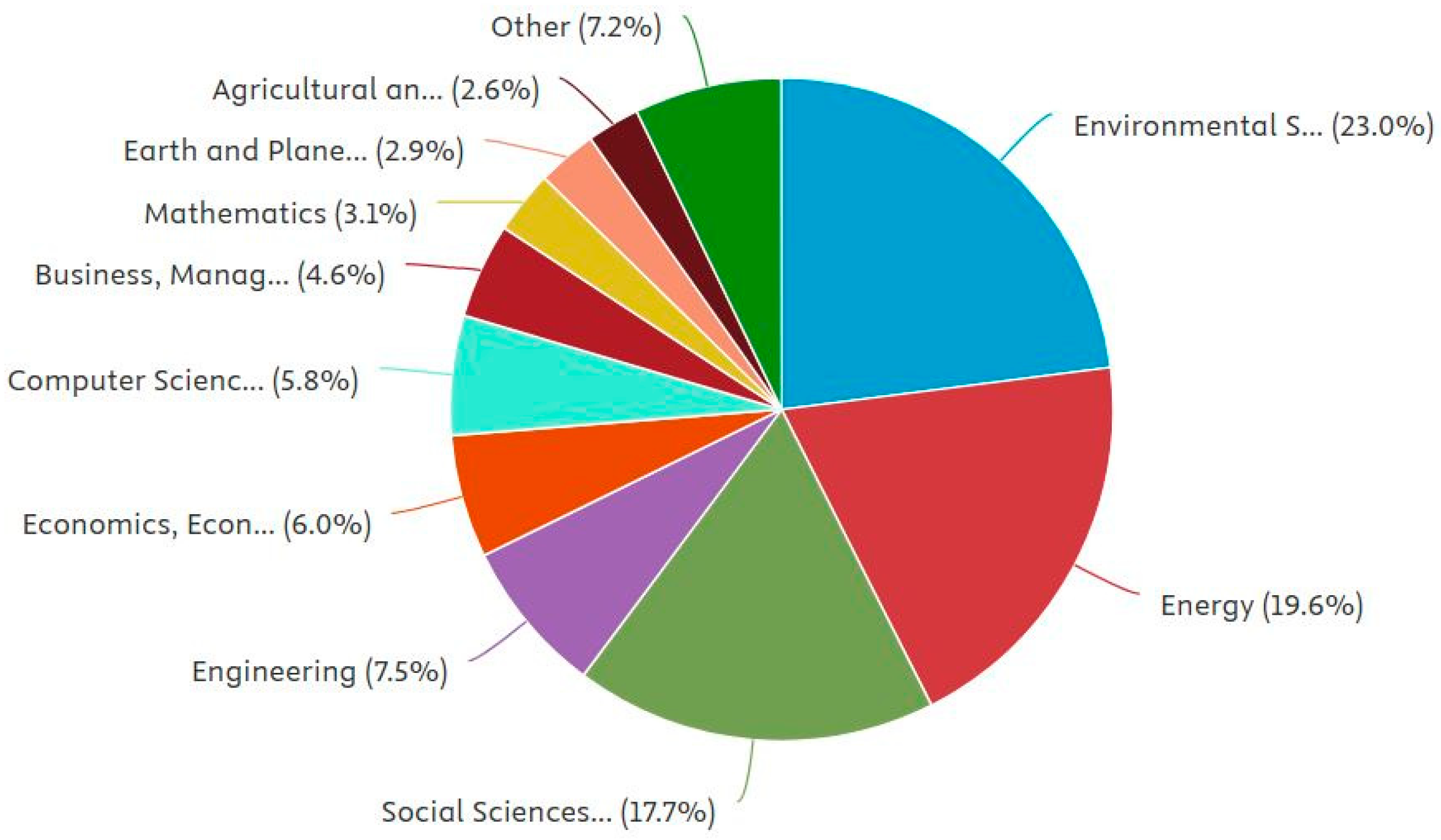
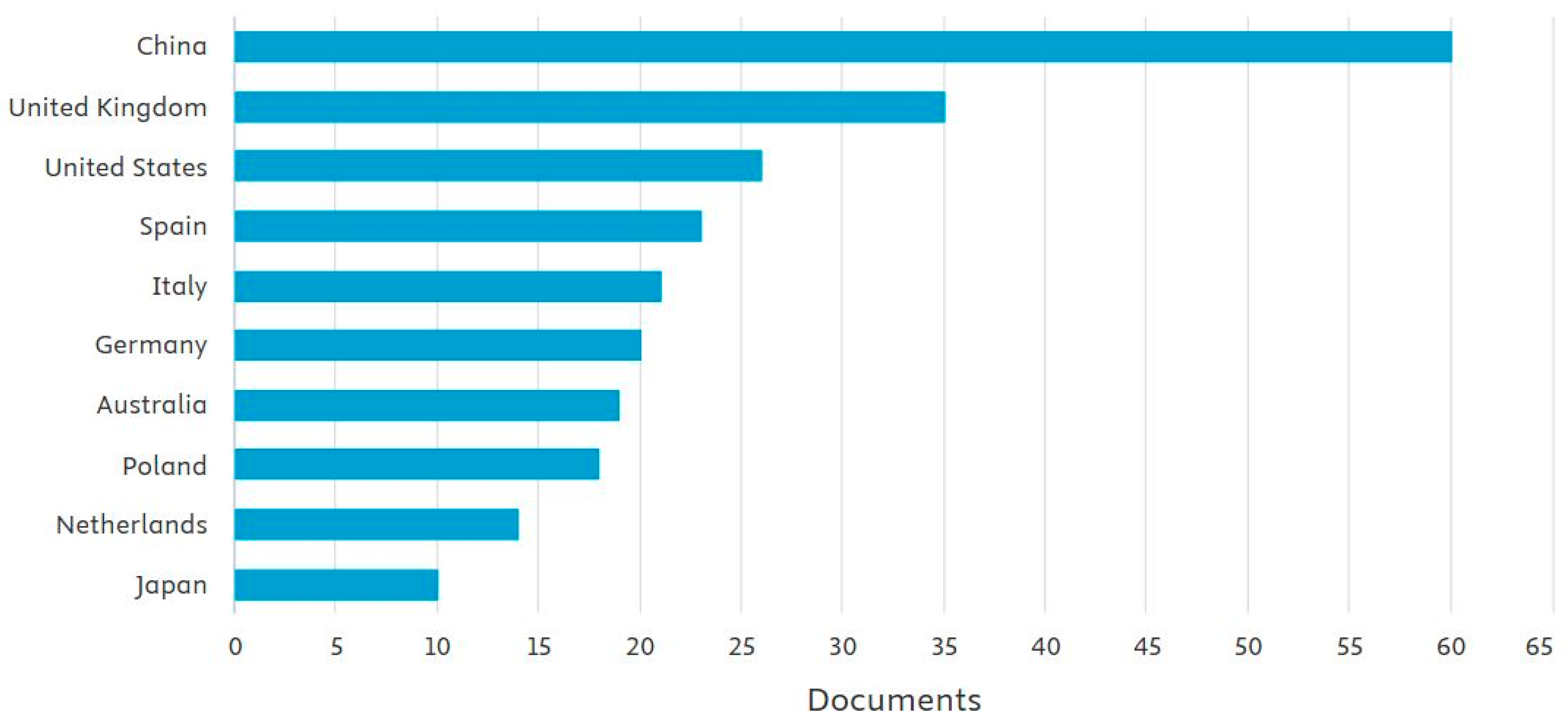
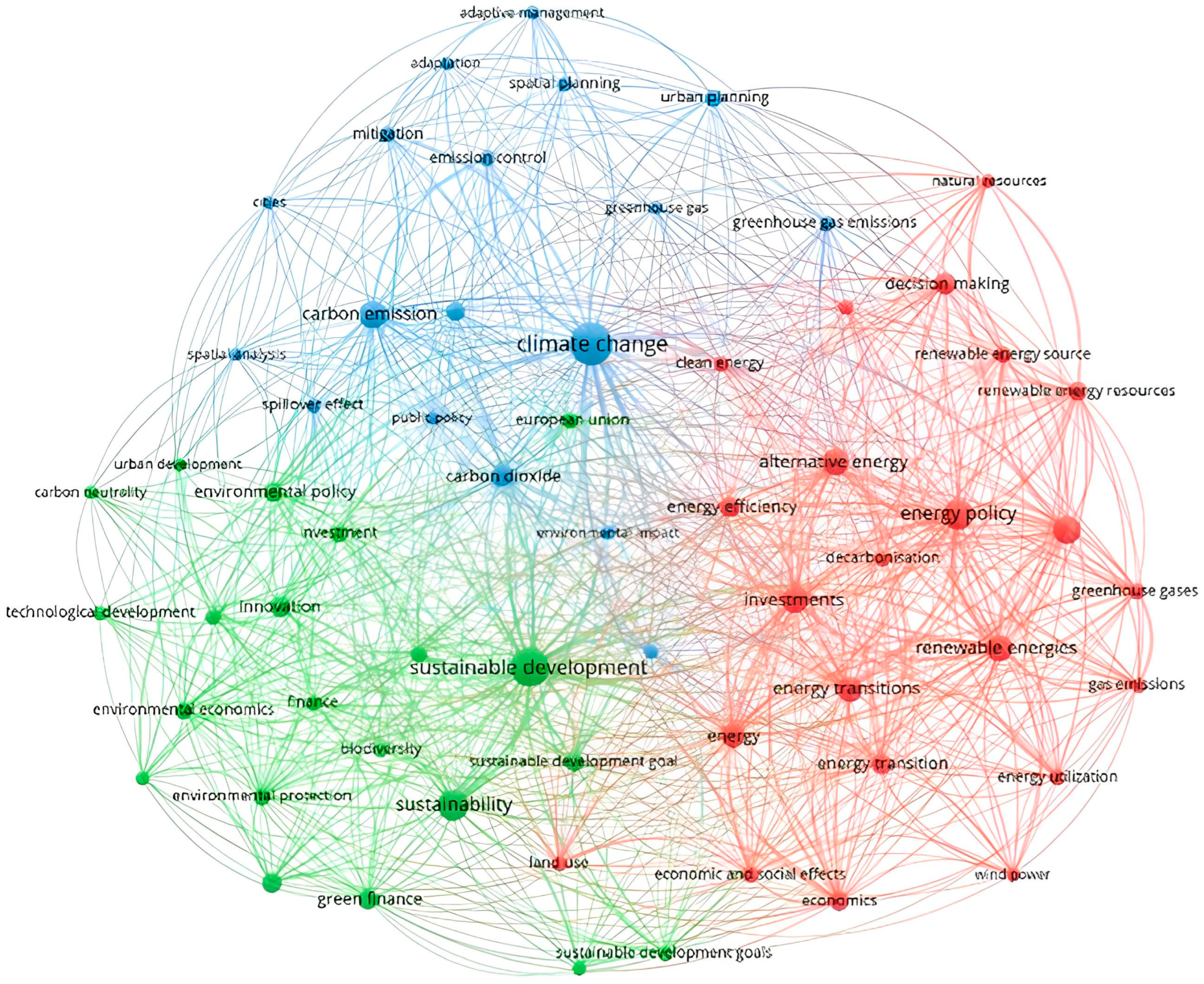
Based on this integrative synthesis, the proposed RILN framework was developed as a conceptual structure linking climate and environmental pressures, spatial and land-use constraints, investment and financial dynamics, and governance and justice outcomes. Similar framework-building approaches have been employed in energy-transition and climate-adaptation research to bridge disciplinary divides and support decision-making under uncertainty [3,20,55]. Exploratory quantitative mappings used during the analytical process, involving (a) documents by year, (b) documents by subject area, (c) documents by country or territory, and (d) the VOSviewer version 1.6.20 co-occurrence network, are documented in Appendix A (Figure A2, Figure A3, Figure A4 and Figure A5).

2.6. Methodological Considerations and Limitations

As with any integrative review analysis, certain limitations should be acknowledged. The focus on peer-reviewed journal literature may underrepresent practitioner reports or grey literature relevant in specific regional contexts. In addition, the diversity of methods and case-study designs limits the direct comparability of quantitative results. These limitations are well recognised in reviews of complex socio-technical systems [151,218] and are mitigated here through a synthesis strategy that prioritises relational insights and cross-domain consistency over statistical aggregation. Depth within individual technological or national contexts is necessarily limited by the integrative scope of the review, which prioritises cross-domain mechanisms over single-sector optimisation.
Additional methodological details, including the full Boolean search architecture, PRISMA-based screening procedures, and exploratory publication trend analyses conducted to contextualise the literature corpus, are provided in Appendix A.

3. Results

3.1. Structure of the Reviewed Literature and Analytical Clustering

The analysis of 231 peer-reviewed studies showed that the research field is characterised by both fragmentation and an increasing integration across different domains. The energy transition in ETRs is viewed not only as a technological change but also as a process that is deeply rooted in the geographical context. These transitions are influenced by factors such as climate risk, spatial limitations, investment ecosystems, and governance capacities [3,18,21,60,61,64,125,218,221].
The literature was organised into four main clusters, based on exploratory mapping (detailed in Appendix A.2) and further refined through thematic synthesis. These clusters highlight key themes and mechanisms:
  • RED: climate risk, vulnerability assessment, and adaptation;
  • BLUE: investment dynamics, green finance, and policy uncertainty;
  • YELLOW: spatial governance, land-use conflict, and territorial planning;
  • GREEN: energy system integration and renewables.
Although analytically distinct, the clusters exhibit strong interdependencies, reflecting the systemic nature of transitions in ETRs [20,28,79,151].

3.2. Cluster RED—Climate Risk, Vulnerability Assessment, and Adaptation Dynamics

The RED cluster primarily focuses on studies that examine how climate change impacts exposure, sensitivity, and adaptive capacity in energy-relevant systems and regions. This body of work consistently identifies droughts, heatwaves, floods, and wildfires as significant contributors to infrastructure stress, altered demand patterns, and reduced system reliability. These factors affect both supply-side and demand-side dynamics [19,20,27,28,29,140]. A significant portion of the literature examines hydro-climatic impacts, particularly the sensitivity of hydropower systems and thermoelectric cooling to variations in precipitation, drought frequency, and extreme temperature events. These impacts extend beyond generation losses, affecting regional energy security, operational costs, and long-term investment risks [12,24,70,98]. Additionally, climate extremes have been shown to worsen energy poverty and demand volatility, especially in regions with vulnerable housing and limited capacity to adapt [26,72,112].
As synthesised in Table 2, the RED cluster illustrates that climate hazards actively reshape feasible transition pathways by changing optimal energy mixes, infrastructure design requirements, and spatial deployment strategies. Regions that are prone to drought are increasingly moving away from dependence on hydropower toward solar–wind hybrids and decentralised systems. Meanwhile, flood-prone areas need to focus on redundancy, system hardening, and the spatial reconfiguration of grids and generation assets [12,24,27]. Vulnerability is shown to vary significantly across different locations, reflecting the interactions between hydro-climatic conditions, land-use patterns, settlement structures, and socio-economic sensitivities within and across ETRs [26,98,108].
A significant theme emerging from RED studies is the operationalisation of climate adaptation through planning frameworks and adaptive pathways. The literature increasingly advocates for approaches that move beyond optimisation based on stationary climate assumptions. Instead, it emphasises the integration of deep uncertainty, scenario discovery, and adaptive pathway logic into decision-making processes [20,28,80]. These approaches are shown to improve robustness under uncertainty, particularly in regions facing multiple climate hazards.
However, several studies underline implementation gaps, where adaptation is acknowledged but not effectively incorporated into spatial planning instruments, infrastructure governance, and energy investment assessments. This disconnect is repeatedly identified as a source of maladaptation and lock-in, especially in areas characterised by fragmented governance or limited institutional capacity [18,40,99].
Overall, the RED cluster positions climate risk and vulnerability not only as background factors but as fundamental forces that influence the feasibility, sequencing, and long-term stability of energy transition pathways in ETRs. These findings establish climate exposure and adaptive capacity as essential inputs into the investment, spatial, and system-integration dynamics examined in the subsequent clusters, directly supporting the RILN framework.

3.3. Cluster BLUE: Investment Dynamics, Green Finance, and Policy Uncertainty

The BLUE cluster focuses on how investment decisions, financing conditions, and institutional stability impact or limit energy transition trajectories in ETRs. The literature reviewed indicates that investment is not treated as a passive response to technological readiness but rather as an active integrating mechanism that links climate exposure, spatial feasibility, governance credibility, and energy system performance. As a result, this cluster is the most cross-linked within the research corpus, connecting insights from climate risk research, spatial planning, and system integration studies. The core findings identified in this cluster are summarised in Table 3, which consolidates evidence on risk pricing, regulatory credibility, the enabling role of green and digital finance, and the influence of social preferences on capital allocation in the context of ETRs [17,22,46,82,146].
Empirical evidence shows that financial risk and the development of renewable energy are shaped by a combination of macro-structural factors, such as urbanisation dynamics, resource rents, and the sectoral composition of the economy. Institutional quality and governance arrangements also play a significant role. Comparative analyses across different countries and regions indicate that urbanisation patterns and natural resource endowments affect both the scale and direction of investment in renewable energy, while weak institutional environments can amplify perceived risks and hinder capital mobilisation [46,113,117,230]. These dynamics are particularly evident in regions experiencing rapid structural change or transitioning away from fossil fuels, where existing infrastructures and labour dependencies increase uncertainty surrounding the transition [5,7].
A recurring theme identified in this cluster is the central role of policy uncertainty and regulatory credibility in shaping risk premiums, capital costs, and investment timing. Several studies show that unstable subsidy regimes, retroactive tariff adjustments, fragmented permitting systems, and inconsistent climate policy signals can undermine investor confidence, potentially delaying or distorting the geographical distribution of energy investments [22,90,95]. In contrast, transparent and stable regulatory frameworks, coupled with long-term policy commitments, are associated with lower financing costs and greater innovation uptake [47,112,176].
Social preferences influence capital allocation indirectly by shaping policy priorities, regulatory stability, and public support, which in turn affect perceived investment risk, permitting timelines, and the durability of revenue frameworks [22,35,82,90,230]. Recent contributions increasingly suggest that public investors tend to prioritise regulatory stability and policy credibility [17,22,46,82,176,230], private investors are more sensitive to climate risk exposure, land-use conflict, and regulatory uncertainty [46,90,95,146,176], and development-oriented actors place greater emphasis on vulnerability reduction, institutional capacity, and social legitimacy alongside financial viability [1,23,50,52]. Together, these patterns highlight the limitations of assuming a uniform investment logic in energy transition analysis.
In this context, much of the literature focuses on the role of green finance instruments, such as green bonds, green credit, climate finance mechanisms, and sustainable investment taxonomies. While these instruments are widely recognised as essential for accelerating low-carbon investment, evidence consistently indicates that finance alone is insufficient. Their effectiveness depends on governance capacity, regulatory coherence, and innovation ecosystems [17,23,52,146,176]. Furthermore, several studies highlight that green finance can worsen regional disparities when access is uneven, often benefiting regions with stronger institutional frameworks and mature financial markets [1,50,99].
More recent contributions point to the growing importance of green fintech and digital finance as enablers of resilience-oriented investment decisions, particularly in contexts where traditional financial systems fail to price climate risks adequately or to reach peripheral and rural regions. Digital platforms, fintech-enabled credit scoring, and data-driven risk assessment tools are shown to improve transparency, reduce transaction costs, and support investment under uncertainty [51,56,58,137]. However, the literature also warns that digital finance may reproduce or even intensify inequalities if regulatory oversight and inclusion mechanisms are weak [13,50].
An additional strand of the BLUE cluster emphasises the interaction between investment dynamics and social legitimacy. Public attitudes, climate awareness, and perceptions of fairness play a critical role in shaping policy design and political commitment, which, in turn, affect the investment landscape. Studies show that where energy initiatives align with local expectations and considerations of justice, investment conditions improve through enhanced stability and reduced conflict [61,63,68,82].
Taken together, the BLUE cluster supports a systemic interpretation that investment is a key mechanism for integrating efforts in ETRs. Capital allocation responds simultaneously to climate exposure, land-use constraints, governance credibility, and justice and legitimacy conditions, and in turn reshapes regional transition possibilities by enabling or constraining technological deployment, spatial planning options, and adaptive capacity. This integrative role of investment provides a key empirical foundation for the RILN framework, which is presented later in the paper.

3.4. Cluster YELLOW: Spatial Governance, Land-Use Conflicts, and Territorial Planning

The YELLOW cluster confirms that spatial governance is a fundamental aspect of energy transitions in ETRs, rather than a peripheral implementation issue. The analysis of the literature carried out here showed that land availability, zoning regimes, siting regulations, and multi-level planning coherence mediate the translation of national and supranational decarbonisation objectives into regionally feasible and socially acceptable infrastructure deployment [4,35,36,38,40].
A consistent finding is that land-use conflicts often serve as significant constraints, particularly when the expansion of renewable energy competes with agriculture, the conservation of biodiversity, forestry, cultural heritage landscapes, or settlement patterns. Numerous studies have documented the trade-offs relating to the conversion of agricultural land, the protection of forests, and spatial incompatibilities, which increase the friction involved in obtaining permits, delay project timelines, and fuel local contestation [34,181,183,231]. In particular, the siting of wind energy installations is highly sensitive to governance structures. Factors such as permitting procedures, public participation, and procedural transparency significantly influence social acceptance, legal challenges, and perceived investment risks [35,40,171].
The cluster also highlights a rapidly expanding toolkit of spatial decision-support methods, which includes GIS-based suitability modelling, multi-criteria decision analysis (MCDA), analytic hierarchy processes (AHPs), and hybrid evaluation frameworks. These tools are increasingly used to integrate land constraints, environmental impacts, climate exposure, and stakeholder priorities within a single analytical framework [78,79,92,193]. However, several studies caution that spatial tools alone are insufficient to resolve conflict or reduce uncertainty unless they are incorporated into coherent governance structures and linked to investment screening and climate resilience assessments [79,171,181].
As summarised in Table 4, spatial governance mechanisms often serve as channels through which climate vulnerability (RED) and investment uncertainty (BLUE) materialise as concrete implementation barriers. Climate variability intensifies land-use trade-offs by altering flood risk, drought exposure, and ecosystem sensitivity, thereby reshaping siting priorities and infrastructure design requirements [36,231]. At the same time, access to adaptation and transition finance is uneven across different regions, with urban areas typically attracting funding more easily than rural or coal-dependent regions. This disparity reinforces spatial inequalities in transition capacity and resilience [1,50,99].
Overall, the YELLOW cluster demonstrates that spatial governance and land-use conflicts are systemic factors through which climate risks and financial uncertainties impact real-world transition outcomes, rather than just presenting implementation challenges. These findings position territorial planning as a critical hinge linking climate adaptation, investment dynamics, and energy system design, directly informing the RILN framework developed in the subsequent section.

3.5. Cluster GREEN: Energy System Integration and Renewables

The GREEN cluster focuses on the technical and operational aspects of energy transitions, with particular attention to system integration and renewable deployment under conditions of increasing variability, constraint, and resilience requirements. Across the examined literature, studies address challenges related to renewable integration in microgrids [100] and large-scale systems [16,69], flexibility and storage needs, system design optimisation, and technology-specific siting and performance considerations [86].
A key area of research within this cluster examines techno-economic optimisation of renewable energy systems under spatial and environmental constraints. Contributions analyse the optimisation of floating solar PV layouts, spacing, tilt strategies, and hybrid configurations [86,193], as well as microgrid integration challenges linked to intermittency, demand variability, and operational stability [100]. Off-grid and decentralised transitions emerge as both technical and developmental strategies, particularly in vulnerable or remote contexts where grid extension is infeasible and where reliability and resilience jointly determine transition viability [79,154,199,211].
Crucially, the technical literature increasingly acknowledges cross-domain dependencies that link system design to climate risk, spatial governance, and investment dynamics. Resource availability and system performance are shaped by climate variability and extremes, while land constraints and public acceptance influence technology choice, scale, and configuration [12,21,27]. At the same time, inadequate grid capacity, limited storage deployment, and weak forecasting accuracy are shown to reduce investment returns and amplify vulnerability, feeding back into financial risk assessments and policy uncertainty [22,23,230].
As synthesised in Table 5, system integration emerges as a major conditionality for successful energy transitions in ETRs. Without coordinated investments in grids, storage, digital control, and flexibility mechanisms, renewable deployment may exacerbate volatility rather than enhance resilience. Several studies highlight the growing use of multi-criteria decision analysis (MCDA), analytic hierarchy processes (AHPs), and hybrid evaluation frameworks to balance cost, resilience, land-use impacts, and social acceptance across diverse contexts, including cities, hospitals, islands, and industrial zones [78,92,171].
Beyond purely technical performance, an emerging strand of the GREEN cluster links system design to justice and equity outcomes. Technical choices, such as centralised versus decentralised configurations, or the allocation of storage and grid upgrades, shape who benefits from transition investments and who bears associated costs and risks [60,63,64]. In parallel, nature-based and urban design solutions, including greening, shading, and microclimate interventions, are increasingly recognised as complementary measures that reduce heat stress, stabilise demand, and enhance overall system resilience [21,34].
Taken together, the GREEN cluster demonstrates that energy system integration is not a purely technical exercise but a systemic enabler that mediates interactions among climate exposure, spatial constraints, investment conditions, and justice outcomes. These findings reinforce the view that technical system design constitutes a critical leverage point within the RILN framework.

3.6. Cross-Cluster Interactions and Emergent System Dynamics

Across the studies that were analysed in the framework of this analysis, the most consistent and policy-relevant result is the presence of strong interdependencies across the four analytical clusters, indicating that energy transitions in ETRs emerge from coupled rather than isolated dynamics. This pattern is particularly evident in regions exposed to compound climate and economic stress, such as drought-affected hydropower systems and coal-dependent industrial regions, where climate impacts, land constraints, and investment conditions interact directly. As synthesised across Table 2, Table 3, Table 4 and Table 5 and the cross-cluster mechanisms in Table 6, climate hazards and vulnerability (RED) shape investment risk and finance conditions (BLUE) both directly, through impacts on asset performance, reliability, and operational costs, and indirectly via insurance markets, regulatory responses, and heightened uncertainty [12,20,22,230].
At the same time, spatial governance and land-use constraints (YELLOW) delimit the feasibility, timing, and social legitimacy of infrastructure deployment, thereby shaping both investment outcomes (BLUE) and the configuration of technical systems (GREEN). Evidence shows that permitting delays, zoning conflicts, and fragmented planning frameworks translate climate exposure and financial uncertainty into concrete implementation barriers, increasing capital costs and discouraging large-scale deployment [35,38,40,171].
In turn, energy system design and integration choices (GREEN) can either mitigate or amplify vulnerability by influencing system flexibility, exposure to extremes, and the capacity to absorb and recover from shocks. Studies consistently show that inadequate grid capacity, limited storage, and rigid system architectures increase sensitivity to climate variability, reinforcing vulnerability patterns identified in the RED cluster [16,21,23]. Conversely, integrated and flexible system designs can dampen climate impacts and stabilise investment environments.
Across all clusters, justice and legitimacy considerations emerge as critical feedback mechanisms. Inequitable spatial outcomes, exclusion from decision-making, or uneven distribution of transition benefits undermine social acceptance, weaken governance credibility, and feed back into investor confidence and policy durability [60,61,63,64]. These dynamics demonstrate that justice is not an external normative add-on but an endogenous factor shaping system stability.
Taken together, these coupled interactions provide the empirical foundation for the RILN framework introduced in the following section. The framework formalises the feedback structure linking climate exposure (RED), spatial constraints (YELLOW), investment ecosystems (BLUE), and system integration and justice outcomes (GREEN), offering a coherent lens for analysing transition pathways under climate and institutional uncertainty [3,20,79].

4. The Resilience–Investment–Land Nexus (RILN) Framework

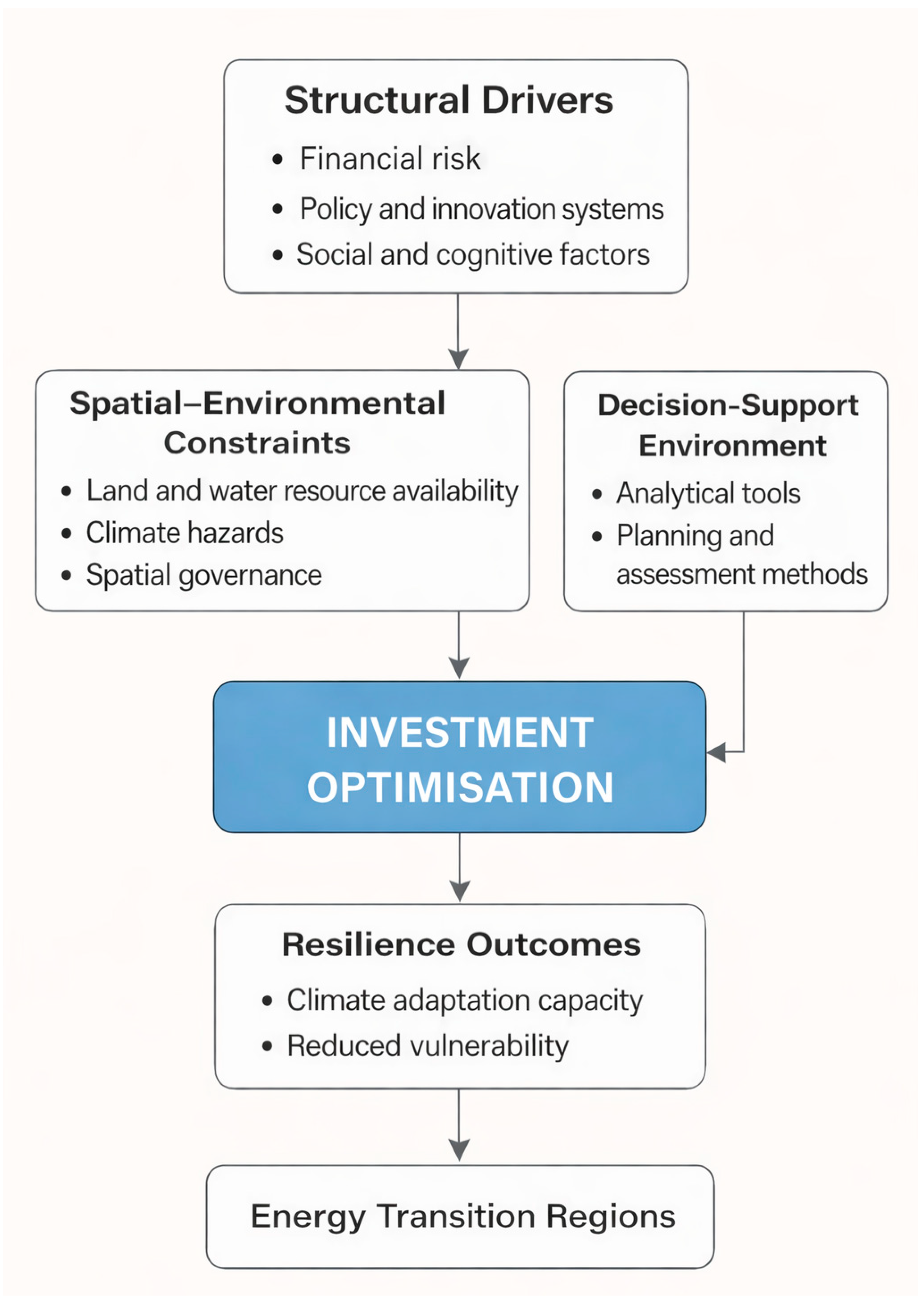
ETRs operate at the intersection of technological transformation, structural economic change, and accelerating climate impacts, a reality that is particularly evident in regions facing simultaneous industrial decline and climate stress, such as lignite regions in Central Europe or drought-exposed energy systems in Africa. The findings of this study indicate that successful transition trajectories in such contexts are shaped not only by technology choices or the availability of capital but by continuous feedback between climate vulnerability, investment ecosystems, and land-use constraints [20,22,28]. The RILN framework is therefore introduced as an integrative conceptual architecture that reflects these interdependencies and the conditions under which transition outcomes are delivered. (Figure 1). As such, the RILN framework is intended as an analytical and diagnostic structure derived from systematic synthesis, rather than as a predictive model.
Compared to established energy transition frameworks such as technology–organisation–institution (TOI) or socio-technical transition models, RILN differs in two key respects. First, it explicitly integrates climate hazard exposure and land-use constraints as coequal structural conditions, rather than treating them as external context variables. Second, it positions investment decision-making as the integrating mechanism through which climate risk, spatial feasibility, governance credibility, and justice outcomes interact, shifting analytical focus from component optimisation to constraint diagnosis and sequencing. This distinction allows RILN to operate as a decision-oriented synthesis framework rather than a descriptive system typology [55,60,64].
The RILN framework depicts a hybrid conceptual and system-dynamics representation of energy transitions in ETRs, moving beyond approaches that treat climate risk, investment, and land as separate domains. Instead, it conceptualises transitions as relational and cyclical processes in which financial flows, climate exposure, spatial feasibility, and governance mechanisms jointly shape system performance and social outcomes [20,60,64]. This perspective aligns with evidence from the analysed literature showing cross-domain dependencies between hazards and vulnerability [19,29], investment risk and policy stability [46,90,230], and spatial governance constraints [38,40].
At the core of the RILN framework lies the recognition that investment optimisation functions as the system’s integrating mechanism, rather than as a linear output of policy or technology choices. Investment decisions are continuously reshaped by climate exposure, land competition, regulatory credibility, and local perceptions of fairness; in turn, these decisions alter regional risk profiles, governance legitimacy, and social expectations [22,61,63]. As illustrated in Figure 1, the nexus operates through reinforcing and balancing feedback loops: climate hazards shape risk premiums and asset performance, land constraints delimit spatial feasibility, policy stability and public trust condition capital allocation, and transition outcomes feed back into resilience and acceptance [3,20,79]. Unlike existing energy–water–land or socio-technical transition frameworks that primarily map sectoral interactions, RILN explicitly positions investment decision-making as the integrating mechanism linking climate exposure and spatial feasibility, thereby focusing analytical attention on actionable bottlenecks rather than on system components in isolation.

4.1. Structural Drivers

The first dimension of RILN concerns structural drivers, most notably financial risk, policy stability, and innovation capacity. The literature consistently shows that volatile subsidy regimes, policy reversals, and fragmented regulatory environments elevate risk premiums and destabilise investment strategies, whereas transparent governance, digitalisation, and sustained R&D mobilisation enhance investor confidence and operational resilience [22,51,90,95,146]. Findings on green finance further indicate that instruments such as green bonds and green credit can mobilise capital, but effectiveness depends on institutional credibility and complementary innovation capacity [17,23,52,176].
Social legitimacy is repeatedly identified as a pivotal determinant of whether transition policies translate into material change, particularly in regions facing distributional tensions, historical distrust, or entrenched industrial identities [60,61,63,64]. Complementary evidence also suggests that climate awareness and perceptions of initiative effectiveness influence behavioural and political support for energy policies, with downstream implications for investment stability [68,82].

4.2. Spatial–Environmental Constraints

The second dimension addresses spatial and environmental constraints, which impose tangible boundaries on transition pathways. Land availability, agricultural competition, biodiversity protection, and hydrological variability condition the feasibility and social acceptability of renewable energy expansion [34,183,231]. Evidence from spatial planning studies shows that zoning regimes, siting rules, and multi-level planning coherence shape deployment speed, legal certainty, and local acceptance [35,36,38,40].
Climate hazards, like drought, heat stress, flood exposure, and wildfire probability, modify not only infrastructure safety and cost structures but also the resilience value embedded within investment portfolios and the long-run viability of specific technology choices [12,24,26,27]. In this sense, spatial planning and climate modelling define the territorial geometry of transition feasibility, rather than acting as downstream implementation considerations [20,28,171].

4.3. Decision-Support Environment

The third dimension, the decision-support environment, represents the methodological and institutional infrastructure through which constraints and drivers are translated into strategic action. The literature shows convergence toward integrated spatial–financial decision-support tools, including GIS-based risk mapping, multi-criteria decision analysis, scenario modelling, and techno-economic simulations, enabling joint evaluation of cost, resilience, land-use impacts, emissions, and social acceptance [78,92,181,193]. Reviews of urban and regional energy system design similarly emphasise the need for integrated frameworks that connect technical performance with governance and planning realities [21,79].
Approaches addressing uncertainty, adaptive pathways, scenario discovery, and robustness-oriented planning are increasingly advocated to avoid maladaptation and lock-in under non-stationary climate conditions [20,28,80]. These decision-support advances provide the operational layer through which RILN feedback can be made actionable.

4.4. Resilience and Justice Outcomes

The fourth dimension focuses on resilience and justice outcomes, which emerge as essential performance indicators rather than secondary considerations. Resilience is framed as the capacity of communities, infrastructures, and institutions to anticipate, absorb, and adapt to climate and market volatility, while justice, procedural, distributional, and recognition conditions acceptance, political durability, and governance stability [60,61,64]. Evidence consistently indicates that infrastructures perceived as inequitable, through land burdens, uneven benefit allocation, or exclusion from decision-making, face higher resistance and lower durability, feeding back into investment risk and policy credibility [35,63].
Taken together, the RILN framework reframes energy transitions in ETRs as systems of conditional interdependencies, in which climate exposure, spatial governance, financial systems, and societal legitimacy continuously influence one another [3,79]. It advances the field by positioning ETR transitions not as isolated technological substitutions but as territorially grounded, climate-informed, financially credible, institutionally coordinated, and socially legitimised processes [20,21,40]. The framework, therefore, functions as both a conceptual synthesis and a practical lens for identifying the binding constraint limiting transition momentum in specific regional contexts. While RILN is presented here as a qualitative synthesis framework, its structure is compatible with future quantitative and system-dynamics applications.

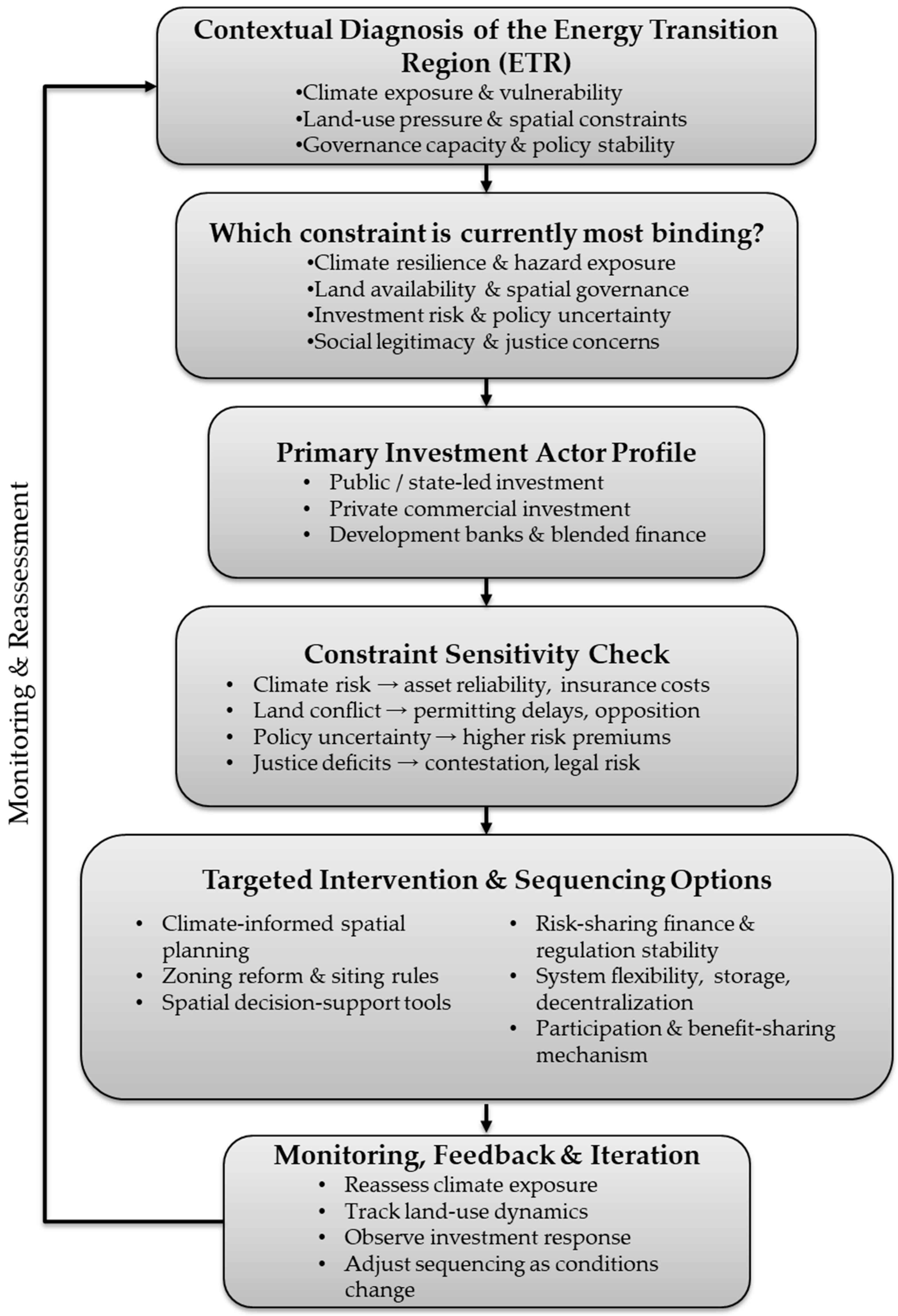
4.5. Applying the RILN Framework: A Hybrid Decision-Tree Logic for Energy Transition Regions

Although the RILN framework has been introduced as an integrative analytical framework, its primary contribution lies in how it can inform real-world decision-making in contexts characterised by uncertainty, spatial constraint, and institutional complexity. In this sense, RILN can be interpreted as a hybrid decision-tree logic, supporting planners, policymakers, and investors in diagnosing dominant constraints and sequencing interventions in ETRs.
Rather than functioning as a prescriptive model, the framework offers a structured way of thinking through trade-offs and priorities. It combines sequential reasoning with adaptive branching, allowing decisions to respond to regional characteristics, investment behaviour, and evolving climate and governance conditions.
A first step in applying RILN involves establishing the regional context and exposure profile. This entails a preliminary assessment of whether climate-related risks (such as droughts, floods, or heat stress), land-use pressures (including competition with agriculture, biodiversity protection, or settlement patterns), or governance-related factors (for example, regulatory instability or fragmented permitting processes) represent the most immediate constraints on transition pathways. At this stage, the objective is not detailed modelling but an initial screening that helps clarify which pressures are likely to dominate early investment and planning decisions. In many hydropower-dependent or climate-vulnerable regions, climate exposure may emerge as a first-order concern, whereas in densely populated or environmentally sensitive areas, land availability and siting conflict often play a more decisive role.
Once the broader context has been clarified, attention shifts to the nature of the investment actors involved. A key insight from the analysed literature is that capital in ETRs is highly heterogeneous. Public or state-led investors, private commercial actors, and development or blended-finance institutions respond differently to climate risk, land-use conflict, and policy uncertainty. Public investors may be more willing to engage in complex spatial or high-risk environments but are constrained by fiscal capacity and political accountability. Private investors, by contrast, tend to be more sensitive to regulatory volatility and social contestation, while development banks often operate at the intersection of financial discipline and public mandates. Recognising these differences is essential, as the same constraint may deter one type of investor while mobilising another.
Building on this differentiation, RILN supports the identification of the binding constraint that most strongly limits progress at a given point in time. This constraint may stem from inadequate climate resilience, restrictive spatial governance, unfavourable investment conditions, or deficits in social legitimacy. Importantly, the framework emphasises that not all constraints can be addressed simultaneously or with equal urgency. Instead, it encourages prioritisation, focusing attention on the bottleneck whose relaxation is most likely to unlock subsequent transition steps.
Strategy selection then follows from this diagnosis. Depending on the dominant constraint and the investment context, relevant interventions may include integrating climate risk more explicitly into spatial planning, revising zoning and siting rules, strengthening regulatory credibility, introducing risk-sharing financial instruments, or investing in system flexibility and decentralised solutions. In many cases, governance and participation measures, such as improved stakeholder engagement or benefit-sharing arrangements, play a critical role in stabilising both social acceptance and investment conditions. RILN does not imply a single optimal pathway; rather, it supports context-sensitive sequencing, in which spatial, financial, technical, and institutional measures are aligned with regional realities. For example, governance capacity and social legitimacy often constitute the dominant binding constraints in coal-dependent regions, whereas climate exposure and system flexibility tend to dominate early decision stages in island or hydropower-dependent systems, illustrating how RILN supports place-sensitive prioritisation. Across all decision stages, justice-related considerations, such as procedural inclusion, benefit distribution, and recognition of territorial identities, act as cross-cutting conditions shaping social acceptance, governance credibility, and ultimately the bankability of transition investments.
Finally, the framework explicitly acknowledges that energy transitions unfold under changing conditions. Climate impacts, market dynamics, and political priorities evolve, often altering which constraints are most binding. For this reason, RILN is best understood as an iterative decision-support logic, encouraging periodic reassessment and adjustment as new information becomes available. In this way, the framework moves beyond static planning approaches and offers a practical lens for guiding adaptive, place-based transition strategies across diverse ETRs.
Figure 2 translates the Resilience–Investment–Land Nexus (RILN) into a hybrid decision tree that illustrates how the framework can be used to support planning and investment decisions in energy transition regions. Rather than prescribing a single transition pathway, the figure visualises a structured diagnostic logic in which decision-makers first assess regional climate exposure, land-use pressures, and governance conditions, then identify the dominant binding constraint shaping investment feasibility. By explicitly distinguishing between different investment actor profiles, the decision tree highlights how the same constraint can generate divergent responses depending on whether capital is primarily public, private, or development-oriented. The figure further shows how constraint diagnosis informs the selection and sequencing of spatial, financial, technical, and governance interventions, while feedback loops emphasise the need for periodic reassessment as climate, market, and policy conditions evolve. In this way, the figure operationalises RILN as a decision-support logic that is adaptive, place-sensitive, and compatible with existing planning and investment processes.

5. Discussion

The findings of this literature review confirm that energy transitions in carbon-intensive and climate-exposed regions do not unfold as linear processes of technological substitution but as territorially embedded transformations shaped by interacting climatic, spatial, financial, governance, and social factors. Evidence from coal-dependent regions in Central and Eastern Europe and climate-vulnerable hydropower systems in Sub-Saharan Africa illustrates that transition trajectories are mediated by regional context rather than driven by technology alone [20,21,221]. Across the literature, a consistent pattern emerges: transition outcomes are determined by the interactions between domains such as climate exposure, land-use governance, investment dynamics, and social legitimacy, rather than by the performance of any single domain in isolation [3,60,64]. Across the reviewed literature, justice emerges not as a parallel concern but as an endogenous mechanism through which climate risk, land-use decisions, and investment strategies translate into durable or contested transition outcomes.
Climate exposure increasingly functions as a systemic condition influencing both infrastructure performance and investment risk. Drought-prone territories experience declining hydropower yields and cooling-water scarcity [12,19,29], while wildfire-prone regions face heightened infrastructure fragility and operational disruption [24,26,27]. Flood-exposed areas, in turn, incur higher insurance requirements and redundancy costs, further altering project feasibility [27,29]. At the same time, climate vulnerability can act as a catalyst for diversification and resilience-oriented system design. Several studies document shifts toward hybrid energy portfolios, decentralised generation, and adaptive system architectures in response to increasing climate stress [20,28,199]. Regions that integrate hazard mapping, probabilistic forecasting, and scenario-based planning into decision frameworks demonstrate greater capacity to allocate technologies resiliently and to balance hydropower variability, solar–wind complementarities, and microgrid deployment [21,79,80].
Spatial constraints and land-use competition further shape transition trajectories by defining where and how renewable infrastructures can materialise. The literature consistently shows that land is neither neutral nor infinitely divisible but embedded within ecological systems, productive bases, cultural meanings, and regional identities [34,231]. Renewable energy deployment, therefore, competes directly with agriculture, forestry, biodiversity corridors, tourism, and heritage landscapes, making siting decisions central to perceptions of fairness and legitimacy [35,183]. Empirical studies indicate that even technically mature and economically viable projects may stall when spatial governance is fragmented or when land-use decisions impose disproportionate burdens on specific communities [171,181]. In contrast, regions characterised by strong territorial governance capacity—including multi-level coordination, transparent permitting, and long-term spatial planning—tend to experience more rapid adoption and lower levels of contestation [36,40].
Within this landscape, investment dynamics emerge as a key mediating mechanism linking climate exposure and spatial feasibility to realised transition outcomes. Financial flows respond not only to resource availability or cost competitiveness but also to regulatory credibility and institutional quality [22,230]. Stable and transparent policy environments are associated with lower risk premiums and accelerated deployment [47,112], whereas abrupt policy shifts, subsidy withdrawals, or opaque administrative procedures amplify uncertainty and deter capital mobilisation [90,95]. The expansion of green finance instruments—such as green bonds, concessional credit, climate funds, and revenue-recycling mechanisms—has demonstrated the capacity to steer low-carbon investment, but only when embedded within coherent regulatory frameworks and robust governance structures [17,23,52,176]. Digitalisation and innovation ecosystems further reinforce investment confidence and operational resilience, particularly through data-intensive forecasting, smart-grid technologies, and adaptive market instruments [51,137,146].
Justice and legitimacy considerations cut across all these dimensions. Procedural, distributional, and recognition-based justice increasingly influence investment decisions, permitting processes, and long-term system stability [60,61,64]. Where communities perceive exclusion, unequal benefit allocation, or cultural and environmental harm, resistance intensifies, increasing the likelihood of delays, legal challenges, and governance breakdowns [35,63]. Conversely, participatory planning, transparent benefit-sharing arrangements, and mechanisms for local ownership and co-investment have been shown to foster acceptance and reduce institutional friction [66,68,229]. This reinforces a growing consensus that resilience is not only infrastructural but fundamentally social, rooted in trust, equity, and the capacity of institutions to negotiate change [3,19].
Taken together, these dynamics affirm the analytical value of the RILN as a problem-driven, integrative framework. By framing energy transitions as systems of conditional interdependence among climate exposure, spatial feasibility, investment behaviour, governance capacity, and justice outcomes, RILN provides a coherent lens for interpreting why constraints differ across regions and why similar policy instruments produce divergent results [22,23,79]. Rather than categorising challenges into isolated domains, the framework emphasises interaction and prioritisation, enabling identification of the binding constraint in a given territory—whether climate vulnerability, land-use conflict, policy credibility, or decision-support capacity—and supporting more targeted and effective intervention design.
In summary, the success of energy transitions depends not solely on investment scale or technological sophistication, but on the alignment of finance and technology with territorial realities, climate constraints, governance maturity, and social legitimacy. By foregrounding these interactions, the RILN framework advances a relational understanding of transition dynamics that complements existing transition and nexus literature while providing a structured basis for decision-oriented synthesis.

6. Conclusions

This study demonstrates that the trajectories of energy transition regions (ETRs), including industrial coal regions, peripheral rural territories, and climate-vulnerable hydropower-dependent areas, are shaped by interdependent climate, spatial, financial, and governance dynamics, rather than by technological deployment alone. By synthesising evidence across 231 peer-reviewed studies, the analysis shows that energy transition outcomes depend critically on how climate hazards, land-use constraints, investment conditions, and social legitimacy interact at the regional level, determining whether transitions accelerate, stall, or encounter sustained resistance.
A central finding of the study is that investment optimisation in ETRs cannot be treated as a purely financial or techno-economic exercise. Climate vulnerability alters the feasibility and risk profile of technology portfolios, land scarcity and spatial conflict constrain where infrastructures can be realised, and governance maturity and regulatory predictability shape investor confidence as strongly as subsidy design or market signals. Justice considerations, including procedural inclusion, benefit sharing, and recognition of territorial identity, emerge not as peripheral concerns but as structural conditions influencing policy durability and long-term system stability.
In response to these interconnected challenges, the Resilience–Investment–Land Nexus (RILN) is introduced in this review as a novel integrative framework, synthesising insights from previously separate strands of literature on climate resilience, spatial planning, energy investment, and justice, rather than reproducing an existing model. Importantly, RILN is not only explanatory but also decision-oriented. As illustrated in Figure 2, the framework can be operationalised through a hybrid decision-tree logic that guides decision-makers through (i) contextual diagnosis of regional constraints, (ii) identification of the dominant binding bottleneck, (iii) differentiation of investment actor profiles, and (iv) selection and sequencing of targeted spatial, financial, technical, and governance interventions. By embedding feedback loops, the framework also supports adaptive reassessment as climate, market, and policy conditions evolve.
This operational perspective allows the research question guiding the review to be answered explicitly: energy transition regions can optimise energy investment strategies by integrating climate resilience and vulnerability considerations into spatial planning and decision-making, moving beyond isolated financial or technological criteria through structured constraint diagnosis, actor-sensitive prioritisation, and adaptive sequencing of interventions. Rather than prescribing uniform solutions, RILN supports place-sensitive strategies that recognise heterogeneity across regions and investment contexts.
The review also highlights several strategic implications. First, regulatory stability and institutional credibility are decisive for reducing investment risk and mobilising long-term capital. Second, spatial planning must explicitly integrate climate hazard information, land-use competition, and ecological sensitivity to avoid maladaptive siting and lock-in. Third, investment in geospatial and multi-criteria decision-support tools enhances the capacity of regional authorities to negotiate trade-offs transparently and coherently. Fourth, justice and participation need to be embedded early in transition planning, as neglecting social legitimacy consistently increases conflict, delay, and policy volatility.
Finally, the review priorities for future research. Further work is needed to operationalise RILN through integrated decision support, system dynamics, or agent-based models capable of simulating feedback among climate risk, investment behaviour, land-use conflict, and governance responses under alternative scenarios. Comparative analyses across different ETR types—such as coal-dependent regions, island systems, and rapidly urbanising territories—are also required to explain why similar policy instruments produce divergent outcomes. Advancing empirical indicators for procedural, distributional, and recognition-based justice remains an additional research priority.
In conclusion, energy transitions will ultimately be judged not only by emissions reductions or installed capacity, but by their ability to enhance resilience, support communities, steward landscapes, and maintain institutional trust. By explicitly linking resilience, investment, and land within a decision-oriented framework, RILN provides a robust basis for designing energy transitions that are not only low-carbon but also adaptive, equitable, and territorially grounded.


Author Contributions

Conceptualisation, L.T., E.T. and R.-E.P.S.; Methodology, S.P., D.K., E.T., R.-E.P.S., and L.T. Formal Analysis, S.P. and D.K.; Investigation, S.P. and R.-E.P.S.; Resources, L.T.; Data Curation, S.P. and D.K.; Writing—Original Draft Preparation, S.P. and L.T.; Writing—Review and Editing, L.T., E.T., D.K., and R.-E.P.S.; Visualisation, S.P., L.T., and D.K.; Supervision, E.T. and R.-E.P.S.; Project Administration, L.T. All authors have read and agreed to the published version of the manuscript.

Funding

This research received no external funding.

Data Availability Statement

No new data were created or analyzed in this study.

Acknowledgments

This research was supported by the European Union—Next Generation EU, National Recovery and Resilience Plan Greece 2.0, HFRI within the project JT-OBSERVATORY.

Conflicts of Interest

The authors declare no conflicts of interest.

Abbreviations

The following abbreviations are used in this manuscript:
ETEnergy Transition
EIEnergy Investment
CRVClimate Resilience and Vulnerability
GAGGeospatial Analysis and Governance
GISGeographic Information Systems
MCDAMulti-Criteria Decision Analysis
AHPAnalytic Hierarchy Process
RILNResilience–Investment–Land Nexus
SDGsSustainable Development Goals

Appendix A

The appendix provides additional methodological detail and supporting analyses that enhance the transparency and reproducibility of the review process. These materials include the full Boolean search structure, expanded descriptions of the PRISMA-based screening process, and exploratory analyses of publication trends by year, discipline, geography, and journal source. The supplementary content is intended to document the analytical pathway used to construct and validate the literature corpus, while the main manuscript focuses on the conceptual synthesis and development of the Resilience–Investment–Land Nexus (RILN) framework.

Appendix A.1. Expanded Methodological Background and Exploratory Analysis

Appendix A.1.1. PRISMA-Based Literature Identification, Screening, and Eligibility Process

The literature identification and screening process followed a PRISMA-informed approach, designed to ensure methodological transparency and conceptual relevance. A structured Boolean search strategy was developed to capture interdisciplinary research at the intersection of energy transitions, climate resilience, spatial planning, investment dynamics, and energy justice. All records were retrieved from the Scopus database, selected for its broad coverage of peer-reviewed journals and suitability for systematic screening and subsequent bibliometric exploration. The search was limited to peer-reviewed journal articles published in English between 2015 and 2025, with a preference for open-access sources. Only final publication versions were considered.
The 2015–2025 time period was selected to align with the post-Paris Agreement period, which marked a global policy shift toward integrated climate and energy planning, the consolidation of just transition frameworks, and the rapid expansion of climate finance as a mainstream research and policy domain. This period also coincides with a notable increase in interdisciplinary scholarship linking energy transitions with climate vulnerability, spatial governance, and investment risk, core dimensions of energy transition regions (ETRs). The inclusion and exclusion criteria applied to the literature search are summarised in Table A1.
Table A1. Inclusion and exclusion criteria.
CategoryInclusion CriteriaExclusion Criteria
Database SourceArticles retrieved from Scopus, offering interdisciplinary coverage across energy, climate, and policyArticles not sourced from Scopus or lacking academic indexing
Publication TypePeer-reviewed journal articles with final publication statusPreprints, early access articles, reports, book chapters, or conference papers
LanguageWritten in EnglishArticles in other languages
Access TypeOpen-access articles prioritised for transparency and reuseClosed-access articles accepted only if conceptually critical
Publication DatePublished between 2015 and 2025Published before 2015 or scheduled after 2025
To operationalise these criteria within a transparent and reproducible framework, a structured Boolean search strategy was developed. The architecture was grounded in a multidimensional logic model designed to capture intersections across four key conceptual domains relevant to ETRs: energy transition, energy investment, climate resilience and vulnerability, and geospatial analysis and governance. The Boolean logic was implemented through structured query blocks in the Scopus database, ensuring that retrieved studies addressed cross-domain linkages rather than remaining confined within single disciplinary silos. The full Boolean structure, including single-, double-, triple-, and full-domain intersections, is illustrated in Table A2.
Table A2. The Boolean search structure.
Single-block Boolean searches (A, B, C, D)Each block was executed independently in Scopus using the extended synonym sets. Example structure (ET): ("energy transition" OR "clean energy transition" OR "low-carbon transition" … OR "zero-carbon transition") AND PUBYEAR > 2014 AND PUBYEAR < 2026 AND (LIMIT-TO (SRCTYPE, "j")) AND (LIMIT-TO (PUBSTAGE, "final")) AND (LIMIT-TO (SUBJAREA, "ENER" OR "ENGI" OR "SOCI" OR "ECON" OR "ENVI")) Counts: ET: 81,800, EI: 20,552, CRV: 146,830, GAG: 303,874
Two-block intersections (AB, AC, AD, BC, BD, CD)To ensure relevance to ETRs, intersections were required. Examples: ET ∩ EI (AB): 7334. ET ∩ CRV (AC): 9905. ET ∩ GAG (AD): 11,422. EI ∩ CRV (BC): 2823. EI ∩ GAG (BD): 2604. CRV ∩ GAG (CD): 38,733. These intersections ensure no single-domain papers enter the review.
Three-block intersectionsThe review emphasised studies addressing at least two, and preferably three, domains. Counts: ET ∩ EI ∩ CRV (ABC): 1351. ET ∩ CRV ∩ GAG (ACD): 2508. EI ∩ CRV ∩ GAG (BCD): 580. ET ∩ EI ∩ GAG (ABD): 1051. These studies represent the most integrative segment of the literature.
Full intersection (ABCD)The most restrictive Boolean filter yielded ET ∩ EI ∩ CRV ∩ GAG (ABCD): 239 studies. These 239 studies formed the conceptual backbone of the review and the first screening pool.

Appendix A.1.2. PRISMA-Based Screening Process

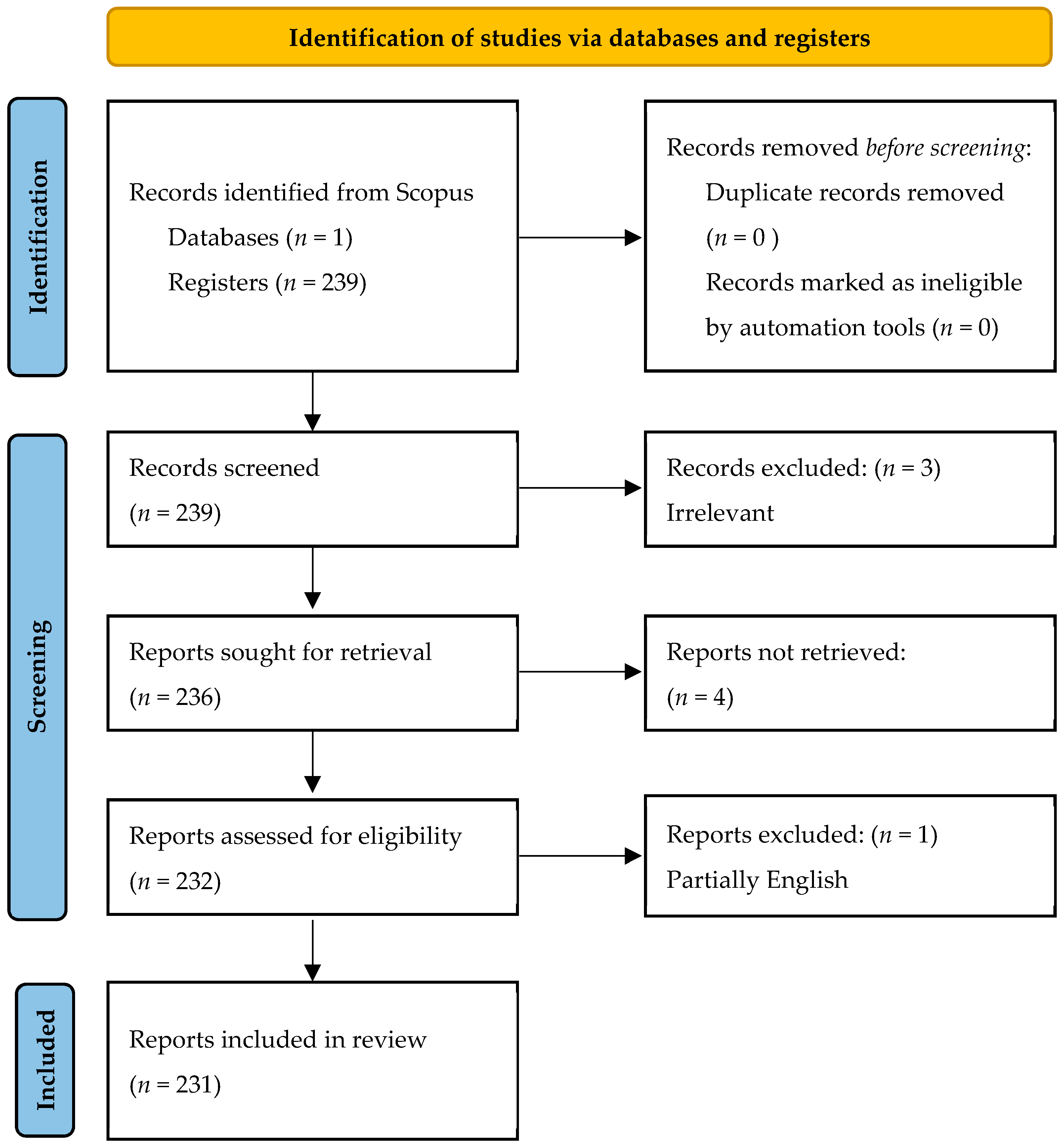
The review followed a PRISMA (Preferred Reporting Items for Systematic Reviews and Meta-Analyses)-informed screening protocol designed to ensure transparency, reproducibility, and coherence across the diverse research domains covered. During the identification stage, an extensive search was conducted in the Scopus database using a four-block Boolean intersection strategy targeting energy transition (ET), energy investment (EI), climate resilience and vulnerability (CRV), and geospatial analysis and governance (GAG). This initial search yielded 239 studies located at the full intersection of all four conceptual blocks. Additional studies retrieved from single- and double-block intersections were examined to support conceptual validation and coverage assessment.
In the title and abstract screening stage, studies were evaluated against three core criteria: (i) engagement with more than one of the four conceptual domains; (ii) inclusion of a territorial, land-use, or governance-related component; and (iii) consideration of climate, financial, or spatial interaction mechanisms. This filtering step ensured that selected studies contributed to an integrative understanding of energy transition regions rather than remaining within narrowly defined disciplinary boundaries.
The full-text assessment stage applied exclusion criteria to remove studies lacking cross-domain relevance. This included engineering optimisation studies without governance or spatial dimensions, climate science analyses not linked to energy systems or investment, and finance-focused studies that did not consider environmental or spatial constraints. Following the completion of all screening stages, a total of 231 peer-reviewed studies were retained for in-depth thematic synthesis. The screening process and final corpus selection are illustrated in Figure A1.
Figure A1. PRISMA-based literature identification, screening, and eligibility process.
Energies 19 00704 g0a1

Appendix A.1.3. Exploratory Bibliometric Trends

To contextualise the scope and evolution of the reviewed literature, exploratory bibliometric analyses were conducted focusing on publication dynamics, disciplinary composition, geographic distribution, and journal sources. These analyses were used to support coverage assessment and contextual interpretation rather than as a primary analytical contribution.
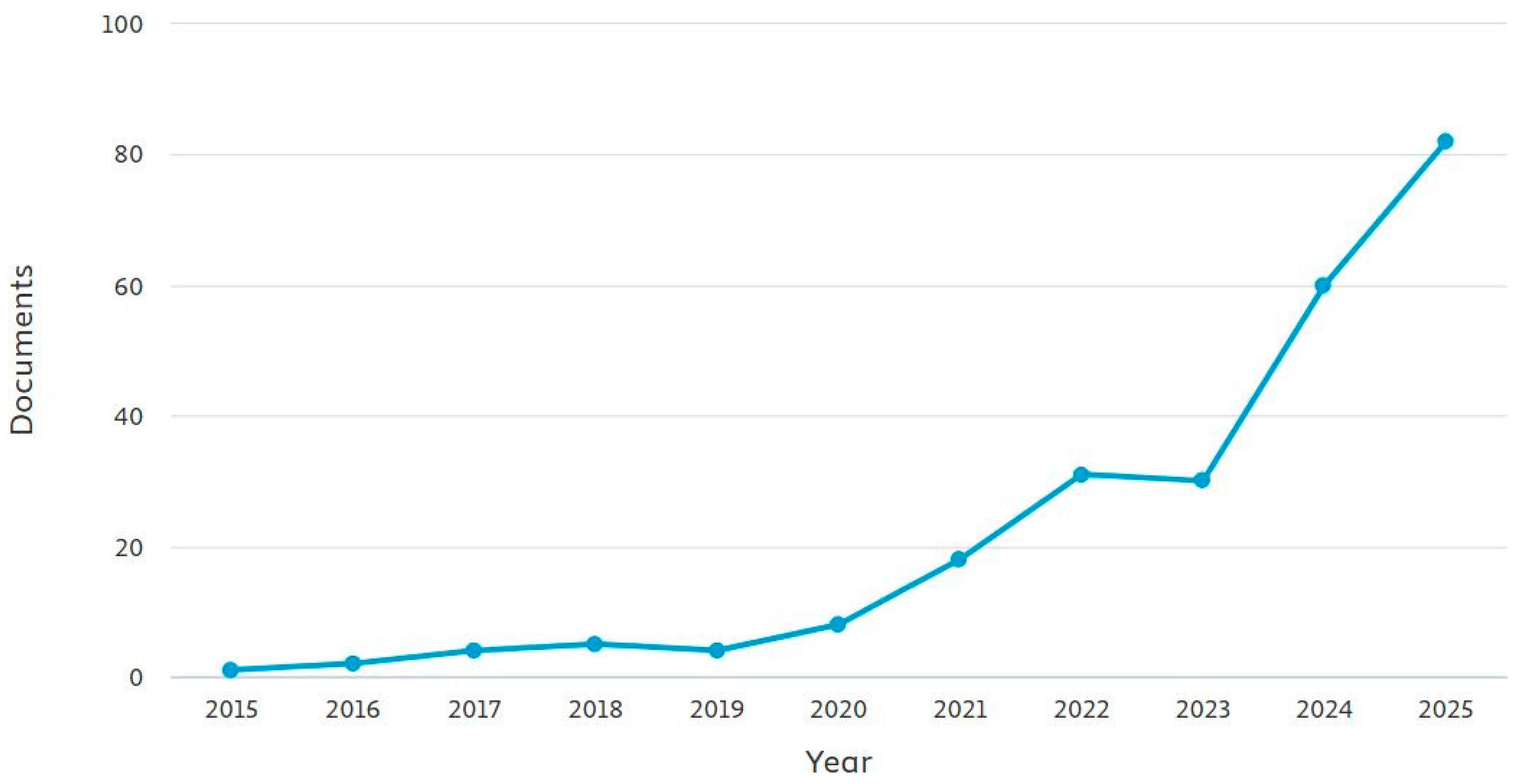
Acceleration in Annual Publications
The temporal evolution of publications, shown in Figure A2, reveals a marked increase in research output after 2018, with a pronounced acceleration after 2020. This trend aligns with the implementation of the Paris Agreement, the emergence of European Green Deal policy frameworks, national coal phase-out strategies, and the mainstreaming of climate finance and adaptation policies. The post-2023 surge reflects intensifying climate hazards affecting infrastructure reliability, escalating land-use tensions associated with large-scale renewable deployment, and the institutionalisation of just transition frameworks that foreground regional equity, community participation, and labour restructuring.
Figure A2. Document by year (2015–2025).
Energies 19 00704 g0a2
Growing Multidisciplinarity of the Research Field
The distribution of publications by subject area, presented in Figure A3, demonstrates increasing disciplinary diversity. Environmental sciences and energy-related research remain dominant, reflecting the centrality of decarbonisation, climate adaptation, and renewable integration. However, the substantial contribution of social sciences, economics, business and management, and engineering confirms a shift from technology-centric optimisation toward governance, behavioural, and regional development perspectives. Smaller but growing contributions from earth sciences, mathematics, and agricultural sciences indicate increasing attention to land, hydrological, and food–energy–water interactions.
Figure A3. Documents by subject area.
Energies 19 00704 g0a3
Geographic Concentration of Research Output
The geographic distribution of publications, shown in Figure A4, highlights strong clustering in China, the United Kingdom, and the United States, followed by several European countries. This pattern reflects differences in research capacity, policy experimentation, and the territorial political economy of decarbonisation, with higher output in regions undergoing rapid socio-technical transformation, regulatory innovation, or coal-phase-out processes.
Figure A4. Documents by country.
Energies 19 00704 g0a4

Appendix A.2. Exploratory Thematic Mapping of the Literature

To support coverage assessment and to validate dominant thematic emphases within the reviewed corpus, exploratory keyword co-occurrence mapping and clustering were conducted. These analyses were used to contextualise the literature landscape and provide an initial, data-supported overview of thematic proximity across concepts commonly associated with ETR transitions. The findings from this mapping informed—but did not determine—the thematic synthesis presented in the main Section 3 to support the identification of dominant thematic emphases and cross-domain linkages within the reviewed corpus. Exploratory keyword co-occurrence and network analyses were conducted. These analyses were used to contextualise the literature and inform the subsequent thematic synthesis, rather than serving as a primary analytical outcome.
Figure A5 presents the keyword co-occurrence network, illustrating the relative prominence and connectivity of key terms spanning climate risk, investment dynamics, spatial governance, and system integration. The YELLOW cluster emerges analytically from thematic coding of spatial governance and land-use concepts, even where co-occurrence density leads to visual overlap with adjacent clusters in the network representation.
Figure A5. VOSviewer keyword co-occurrence network for the reviewed literature (n = 231). The visualisation displays three dominant colour clusters based on keyword co-occurrence patterns. Spatial governance and land-use terms associated with the YELLOW thematic cluster are distributed across adjacent clusters rather than forming a visually isolated group. The four-cluster analytical structure (RED, BLUE, YELLOW, and GREEN) is therefore informed by combined network interpretation and qualitative thematic synthesis, as documented in Table A4.
Energies 19 00704 g0a5
Table A3 reports the ten most frequently co-occurring terms across the literature corpus, highlighting the repeated prominence of climate resilience and vulnerability language alongside governance, finance, and spatial suitability concepts. The reported link-strength categories are derived from total link-strength values produced by the VOSviewer keyword co-occurrence analysis, which quantify the cumulative strength of co-occurrence links between terms across the corpus.
Link-strength categories (very high, high, and medium) were defined using quantile-based thresholds derived from the distribution of total link-strength values, following common bibliometric practice. Very high link strength corresponds to terms located in the upper tier of the distribution, indicating dense co-occurrence across multiple thematic clusters. High link strength represents terms with consistently strong but less dominant connectivity, while medium link strength captures terms with meaningful but more selective connections within the network.
Table A3. The top 10 most frequently co-occurring terms across the reviewed studies.
RankTermOccurrencesLink Strength
1Climate resilience132Very high
2Energy investment118Very high
3Land-use planning109High
4Policy uncertainty102High
5GIS99High
6Renewable energy97High
7Vulnerability95High
8System integration91Medium
9Green finance88Medium
10Just transition85Medium
Table A4 shows the clustering structure derived from the network map and supports the four-cluster organisation applied in the main results (RED/BLUE/YELLOW/GREEN).
Table A4. Cluster structure derived from keyword co-occurrence mapping, supporting the RED/BLUE/YELLOW/GREEN thematic organisation.
ClusterKeywordsFocus
(RED)—Climate Risk, Vulnerability Assessment, and Adaptation Dynamics“climate resilience”, “climate vulnerability”, “exposure”, “drought”, “extreme events”, “hazard”, “adaptation”, “sensitivity”.This cluster highlights the dominance of hazard-focused modelling, hydrological impacts, and vulnerability mapping
(BLUE)—Investment Dynamics, Green Finance, and Policy Uncertainty“energy investment”, “financial risk”, “policy uncertainty”, “green finance”, “capital flows”, “economic efficiency”, “innovation capacity”.This is the most interconnected cluster linking institutional stability with green investment outcomes.
(YELLOW)—Spatial Governance, Land-Use Conflicts, and Territorial Planning“GIS”, “land-use planning”, “spatial suitability”, “zoning”, “territorial governance”, “siting”, “spatial decision support”.This cluster confirms that spatial constraints are a central axis of the ETR literature
(GREEN)—Energy System Integration and Renewables“renewable energy integration”, “solar PV”, “wind optimisation”, “floating PV”, “microgrid”, “storage”, “flexibility”, “system design”.Strong focus on technical system integration under climate constraints
These exploratory mappings provided an initial overview of the literature landscape and supported the validation of the four analytical clusters discussed in the main Section 3. However, the substantive findings and interpretations presented in the main manuscript are based on qualitative thematic synthesis rather than network metrics or bibliometric indicators.

References

  1. Fang, Y.; Lee, C.-C.; Li, X. Financing a Sustainable Future: The Effectiveness of Climate Finance across the Primary, Energy, and Water Sectors. Humanit. Soc. Sci. Commun. 2025, 12, 921. [Google Scholar] [CrossRef]
  2. Elkebti, O.A.M.; Khalifa, W.M.S. Assessing the Saudi and Middle East Green Initiatives: The Role of Environmental Governance, Renewable Energy Transition, and Innovation in Achieving a Regional Green Future. Sustainability 2025, 17, 5307. [Google Scholar] [CrossRef]
  3. Wehbi, H. Powering the Future: An Integrated Framework for Clean Renewable Energy Transition. Sustainability 2024, 16, 5594. [Google Scholar] [CrossRef]
  4. Prados, M.-J.; Pallarès-Blanch, M.; García-Marín, R.; del Valle, C. Renewable Energy Plants and Business Models: A New Rural Development Perspective. Energies 2021, 14, 5438. [Google Scholar] [CrossRef]
  5. Dmochowska-Dudek, K.; Wójcik, M. Socio-Economic Resilience of Poland’s Lignite Regions. Energies 2022, 15, 4966. [Google Scholar] [CrossRef]
  6. Majava, A.; Vadén, T.; Toivanen, T.; Järvensivu, P.; Lähde, V.; Eronen, J.T. Sectoral Low-Carbon Roadmaps and the Role of Forest Biomass in Finland’s Carbon Neutrality 2035 Target. Energy Strategy Rev. 2022, 41, 100836. [Google Scholar] [CrossRef]
  7. Ciski, M.; Rząsa, K. The Environmental Dimension of Sustainable Development in Relation to the Transition from Brown to Green Energy—A Case Study of Poland from 2005 to 2023. Energies 2025, 18, 2993. [Google Scholar] [CrossRef]
  8. Georgescu, L.P.; Fortea, C.; Antohi, V.M.; Balsalobre-Lorente, D.; Zlati, M.L.; Barbuta–Misu, N. Economic, Technological and Environmental Drivers of the Circular Economy in the European Union: A Panel Data Analysis. Environ. Sci. Eur. 2025, 37, 76. [Google Scholar] [CrossRef]
  9. Mboringong, F.A.; Riggs, R.A.; Langston, J.D.; Boedhihartono, A.K.; Endamana, D.; Ge, Y.; Innes, J.L.; Lu, J.; Meyfroidt, P.; Weng, L.; et al. Anticipatory Governance for Responsible Investment in Energy Transition Minerals in the Western Congo Basin. Extr. Ind. Soc. 2025, 24, 101749. [Google Scholar] [CrossRef]
  10. Zou, J.; Li, Y.; Qi, W. Green Information Framing Effects on Farmers’ Willingness for Sustainable Production in China. Discov. Sustain. 2025, 6, 719. [Google Scholar] [CrossRef]
  11. Guo, Z.; Zhang, X. The Impact of China’s High-Standard Farmland Construction Plan on Low-Carbon Development in Agriculture. Sustain. Futur. 2025, 10, 100934. [Google Scholar] [CrossRef]
  12. Abuzayed, A.; Chitandula, A.; Nyoni, K.J.; Solá Vilalta, A. Power System Expansion and Renewable Integration for Drought-Resilient Electrification in Zambia. Energy Policy 2025, 206, 114786. [Google Scholar] [CrossRef]
  13. Cao, Z.; Lai, Z.; Bilawal Khaskheli, M.; Wang, L. The Risk of Global Environmental Change to Economic Sustainability and Law: Help from Digital Technology and Governance Regulation. Sustainability 2025, 17, 7094. [Google Scholar] [CrossRef]
  14. Chen, S.; Wang, Z.; Du, D.; Kong, Q. How Does Green-Infrastructure Investment Empower Urban Sustainable Development?—Mechanisms and Empirical Tests. Sustainability 2025, 17, 5751. [Google Scholar] [CrossRef]
  15. Panagiotopoulos, P.; Vardopoulos, I.; Maialetti, M.; Ciaschini, C.; Koundouri, P.; Salvati, L. Reimagining Sustainable Development and Economic Performance Indicators: A Human-Centric Maslow–Bossel Blueprint. Economies 2024, 12, 338. [Google Scholar] [CrossRef]
  16. Hannan, M.A.; Al-Shetwi, A.Q.; Ker, P.J.; Begum, R.A.; Mansor, M.; Rahman, S.A.; Dong, Z.Y.; Tiong, S.K.; Mahlia, T.M.I.; Muttaqi, K.M. Impact of Renewable Energy Utilization and Artificial Intelligence in Achieving Sustainable Development Goals. Energy Rep. 2021, 7, 5359–5373. [Google Scholar] [CrossRef]
  17. Tolliver, C.; Keeley, A.R.; Managi, S. Green Bonds for the Paris Agreement and Sustainable Development Goals. Environ. Res. Lett. 2019, 14, 064009. [Google Scholar] [CrossRef]
  18. Carter, J.G.; Cavan, G.; Connelly, A.; Guy, S.; Handley, J.; Kazmierczak, A. Climate Change and the City: Building Capacity for Urban Adaptation. Prog. Plan. 2015, 95, 1–66. [Google Scholar] [CrossRef]
  19. Favretto, N.; Stringer, L.C. Climate Resilient Development in Vulnerable Geographies. Mitig. Adapt. Strateg. Glob. Change 2024, 29, 90. [Google Scholar] [CrossRef]
  20. Haasnoot, M.; Di Fant, V.; Kwakkel, J.; Lawrence, J. Lessons from a Decade of Adaptive Pathways Studies for Climate Adaptation. Glob. Environ. Change 2024, 88, 102907. [Google Scholar] [CrossRef]
  21. Ulpiani, G.; Vetters, N.; Shtjefni, D.; Kakoulaki, G.; Taylor, N. Let’s Hear It from the Cities: On the Role of Renewable Energy in Reaching Climate Neutrality in Urban Europe. Renew. Sustain. Energy Rev. 2023, 183, 113444. [Google Scholar] [CrossRef]
  22. Borozan, D.; Pirgaip, B. Climate Policy Uncertainty and Firm-Level Carbon Dioxide Emissions: Assessing the Impact in the U.S. Market. Bus. Strategy Environ. 2024, 33, 5920–5938. [Google Scholar] [CrossRef]
  23. Kwilinski, A.; Lyulyov, O.; Pimonenko, T. The Role of Green Finance in Attaining Environmental Sustainability within a Country’s ESG Performance. J. Innov. Knowl. 2025, 10, 100674. [Google Scholar] [CrossRef]
  24. Liu, Y.; Huang, G.; Zhai, M.; Wang, N.; Fu, Y.; Pan, X. Unveiling Long-Term Indirect Socio-Economic and Environmental Effects of Large-Scale Hydropower Project. Sci. Total Environ. 2025, 959, 178317. [Google Scholar] [CrossRef] [PubMed]
  25. Zhang, L.; Qin, M.; Su, C.W. The Inevitable Role of the Oil Market: Does Its Price Really Matter for Forestry Investment in China? Ann. For. Res. 2024, 67, 135–149. [Google Scholar] [CrossRef]
  26. Sun, X.; Cheng, Z.; Shi, H.; Zhang, J. Abnormal Temperature and Rural Energy Poverty: A Threshold Effect Analysis Based on the Urban–Rural Gap and the Quality of Rural Housing. Energies 2025, 18, 489. [Google Scholar] [CrossRef]
  27. Wang, H.; Han, B.; Wu, T.; Leung, F.; Ren, Y. Pre-Adopting New Urban Areas to Climate Change with Coastal Nature-Based Solutions. Ecol. Indic. 2025, 177, 113693. [Google Scholar] [CrossRef]
  28. Di Fant, V.; Middelkoop, H.; Dunn, F.E.; Haasnoot, M. Supporting Adaptive Pathways Planning Using Archetypes for Climate Adaptation. Reg. Environ. Change 2025, 25, 31. [Google Scholar] [CrossRef]
  29. Dharmarathne, G.; Waduge, A.O.; Bogahawaththa, M.; Rathnayake, U.; Meddage, D.P.P. Adapting Cities to the Surge: A Comprehensive Review of Climate-Induced Urban Flooding. Results Eng. 2024, 22, 102123. [Google Scholar] [CrossRef]
  30. Strange, K.F.; Satorras, M.; March, H. Pathways to Transformative Urban Adaptation: From Plans to Action. Environ. Res. Clim. 2025, 4, 045005. [Google Scholar] [CrossRef]
  31. Zhang, T.; Wang, C.; Duan, D. Pilot Climate Resilient Cities and Ecological Resilience: Evidence from Double Machine Learning Method. Front. Environ. Sci. 2025, 13, 1530104. [Google Scholar] [CrossRef]
  32. Page, J.; Zhou, H.; Pan, H.; Zhou, C.; Pei, P.; Kalantari, Z. (Non-)Terrestrial and (Non-)Local Pathways of Behavioral Policy Diffusion in European Cities’ Climate Action Plans: Contextual, Cultural, and Leadership Framing. Land Use Policy 2024, 147, 107373. [Google Scholar] [CrossRef]
  33. Nowak, M.J.; Bera, M.; Lazoglou, M.; Olcina-Cantos, J.; Vagiona, D.G.; Monteiro, R.; Mitrea, A. Comparison of Urban Climate Change Adaptation Plans in Selected European Cities from a Legal and Spatial Perspective. Sustainability 2024, 16, 6327. [Google Scholar] [CrossRef]
  34. Bellocchi, A.; Saltari, E.; Travaglini, G. Land Scarcity, Sustainable Uses and Environmental Policies. Resour. Energy Econ. 2025, 84, 101532. [Google Scholar] [CrossRef]
  35. Gao, X.; Zhou, S.; Luo, T. Navigating Wind Energy Siting in the U.S.: The Role of Permitting and Siting Regulations and Public Engagement. Energy Policy 2025, 205, 114692. [Google Scholar] [CrossRef]
  36. Yang, D.; Zhang, X.; Song, W. Mapping the Optimal Regions for Wind Farm Construction in China. Resour. Conserv. Recycl. 2025, 222, 108455. [Google Scholar] [CrossRef]
  37. Hao, S.; Michaud, G. Assessing Property Value Impacts near Utility-Scale Solar in the Midwestern United States. Sol. Compass 2024, 12, 100090. [Google Scholar] [CrossRef]
  38. Blaszke, M.; Foryś, I.; Nowak, M.J.; Mickiewicz, B. Selected Characteristics of Municipalities as Determinants of Enactment in Municipal Spatial Plans for Renewable Energy Sources—The Case of Poland. Energies 2022, 15, 7274. [Google Scholar] [CrossRef]
  39. Nowak, M.; Pantyley, V.; Blaszke, M.; Fakeyeva, L.; Lozynskyy, R.; Petrisor, A.-I. Spatial Planning at the National Level: Comparison of Legal and Strategic Instruments in a Case Study of Belarus, Ukraine, and Poland. Land 2023, 12, 1364. [Google Scholar] [CrossRef]
  40. Nowak, M.J.; Monteiro, R.; Olcina-Cantos, J.; Vagiona, D.G. Spatial Planning Response to the Challenges of Climate Change Adaptation: An Analysis of Selected Instruments and Good Practices in Europe. Sustainability 2023, 15, 10431. [Google Scholar] [CrossRef]
  41. Miramontes-Viña, V.; Romero-Castro, N.; López-Cabarcos, M.Á. Advancing towards a Sustainable Energy Model, Uncovering the Untapped Potential of Rural Areas. AIMS Environ. Sci. 2023, 10, 287–312. [Google Scholar] [CrossRef]
  42. Panori, A.; Komninos, N.; Latinopoulos, D.; Papadaki, I.; Gkitsa, E.; Tarani, P. Blending Nature with Technology: Integrating NBSs with RESs to Foster Carbon-Neutral Cities. Designs 2025, 9, 60. [Google Scholar] [CrossRef]
  43. Wei, L.; Guo, D.; Ji, J.; Chen, Z.; Hu, H.; Peng, X. Optimization of Spatial Layouts for Underground Facilities to Achieve Carbon Neutrality in Cities: A Multi-Agent System Model. Undergr. Space 2024, 19, 251–278. [Google Scholar] [CrossRef]
  44. Balouktsi, M. Carbon Metrics for Cities: Production and Consumption Implications for Policies. Build. Cities 2020, 1, 233–259. [Google Scholar] [CrossRef]
  45. Santopietro, L.; Solimene, S.; Lucchese, M.; Di Carlo, F.; Scorza, F. An Economic Appraisal of the SE(C)AP Public Interventions towards the EU 2050 Target: The Case Study of Basilicata Region. Cities 2024, 149, 104957. [Google Scholar] [CrossRef]
  46. Li, R.; Wang, Q.; Sun, J. Financial Risk and Renewable Energy: Exploring the Influence of Urbanization and Natural Resource Rents across 112 Countries. Humanit. Soc. Sci. Commun. 2025, 12, 170. [Google Scholar] [CrossRef]
  47. Soto, G.H.; Balsalobre-Lorente, D.; Martinez-Cobas, X. Environmental Legislative Shaping or Green Competitive Advantages? The Role of FDI among Environmental Regulations. Energy Econ. 2025, 145, 108445. [Google Scholar] [CrossRef]
  48. Joshi, G.; Dash, R. A Bibliometric Analysis of Climate Investing. Int. J. Energy Econ. Policy 2023, 13, 396–407. [Google Scholar] [CrossRef]
  49. Muchiri, M.K.; Erdei-Gally, S.; Fekete-Farkas, M.; Lakner, Z. Bibliometric Analysis of Green Finance and Climate Change in Post-Paris Agreement Era. J. Risk Financ. Manag. 2022, 15, 561. [Google Scholar] [CrossRef]
  50. Lapinskienė, G.; Gudaitis, T.; Martišienė, R. Green Loans: Expert Perspectives. J. Risk Financ. Manag. 2025, 18, 188. [Google Scholar] [CrossRef]
  51. Shi, Y.; Yang, B. China’s Energy System Building toward an Era of Resilience: How Green Fintech Can Empower? Int. Rev. Econ. Financ. 2025, 98, 103876. [Google Scholar] [CrossRef]
  52. Wang, F.; Cai, W.; Elahi, E. Do Green Finance and Environmental Regulation Play a Crucial Role in the Reduction of CO2 Emissions? An Empirical Analysis of 126 Chinese Cities. Sustainability 2021, 13, 13014. [Google Scholar] [CrossRef]
  53. Shao, J.; Huang, P. The Policy Mix of Green Finance in China: An Evolutionary and Multilevel Perspective. Clim. Policy 2023, 23, 689–703. [Google Scholar] [CrossRef]
  54. Vogl, M.; Kojić, M.; Schlüter, S. Decrypting the Triad of Climate Policies, Macroeconomic Interdependencies and Quantitative Modelling: A Literature Review on Quantifying Climate Risks. Reg. Sci. Policy Pract. 2025, 17, 100229. [Google Scholar] [CrossRef]
  55. Brutschin, E.; Pianta, S.; Tavoni, M.; Riahi, K.; Bosetti, V.; Marangoni, G.; van Ruijven, B.J. A Multidimensional Feasibility Evaluation of Low-Carbon Scenarios. Environ. Res. Lett. 2021, 16, 064069. [Google Scholar] [CrossRef]
  56. Liu, X.; Ji, K.; Sun, Y.; Lu, J. Unveiling the Nonlinear Impact: Green Finance, Carbon Emission Intensity, and Digital Economy Integration. Sustain. Futur. 2025, 9, 100610. [Google Scholar] [CrossRef]
  57. Liu, Y.; Zheng, M.; Shum, W.Y. On the Linkages between Digital Finance and Real Economy in China: A Cointegration Analysis. Innov. Green Dev. 2024, 3, 100109. [Google Scholar] [CrossRef]
  58. Liu, K.; Du, R.; Xu, B.; He, J.; Wang, Z. Measurement, Dynamic Evolution and Pollution Emission Effects of the Coupling of Green Finance and Digital Technology-Evidence from China. Front. Environ. Sci. 2024, 12, 1395302. [Google Scholar] [CrossRef]
  59. Brown, D.; Martin, A.; Fisher, J.A.; Gingembre, M. Towards a Transformative Approach to Just Rural Transitions: Landscape Restoration in the Scottish Highlands. Environ. Plan. E Nat. Space 2025, 8, 1839–1865. [Google Scholar] [CrossRef]
  60. Markkanen, S.; Anger-Kraavi, A. Social Impacts of Climate Change Mitigation Policies and Their Implications for Inequality. Clim. Policy 2019, 19, 827–844. [Google Scholar] [CrossRef]
  61. Shabir, M.; De Lucia, C.; Pazienza, P. Investigating a New Energy Justice Index on Carbon Emissions: A Global Study of 95 Economies during 1996–2021. J. Environ. Manag. 2025, 388, 125920. [Google Scholar] [CrossRef] [PubMed]
  62. da Silva Hyldmo, H.; Rye, S.A.; Vela-Almeida, D. A Globally Just and Inclusive Transition? Questioning Policy Representations of the European Green Deal. Glob. Environ. Change 2024, 89, 102946. [Google Scholar] [CrossRef]
  63. Nsude, C.C.; Loraamm, R.; Wimhurst, J.J.; Chukwuonye, G.N.; Debnath, R. Renewables but Unjust? Critical Restoration Geography as a Framework for Addressing Global Renewable Energy Injustice. Energy Res. Soc. Sci. 2024, 114, 103609. [Google Scholar] [CrossRef]
  64. Jenkins, K.; Sovacool, B.K.; McCauley, D. Humanizing Sociotechnical Transitions through Energy Justice: An Ethical Framework for Global Transformative Change. Energy Policy 2018, 117, 66–74. [Google Scholar] [CrossRef]
  65. Romero-Castro, N.; Ángeles López-Cabarcos, M.; Miramontes-Viña, V.; Ribeiro-Soriano, D. Sustainable Energy Transition and Circular Economy: The Heterogeneity of Potential Investors in Rural Community Renewable Energy Projects. Environ. Dev. Sustain. 2025, 27, 18051–18076. [Google Scholar] [CrossRef]
  66. Otte, L.; Schmid, L.; Baerens, T.; Tomboanjara, M.; Ahmed, F.; Heinz, B. An Energy Transition for All: Investigating Determinants of Citizen Support for Energy Community Initiatives on the Island of Mayotte. Energy Res. Soc. Sci. 2024, 116, 103690. [Google Scholar] [CrossRef]
  67. Cabarcos, M.Á.L.; Castro, N.R.; Viña, V.M. Autonomía energética local y desarrollo rural sostenible. Análisis de la pre-disposición a participar en comunidades energéticas renovables. Rev. Galega Econ. 2020, 29, 1–25. [Google Scholar] [CrossRef]
  68. Brennan, N.; van Rensburg, T.M. Palm Trees, Energy Security and Green Hydrogen Futures: Tourists’ Views on Mallorca’s Low Carbon Transition. Energy Res. Soc. Sci. 2025, 120, 103923. [Google Scholar] [CrossRef]
  69. Wang, J.; Song, C.; Huang, Z.; Campbell, A.; Konarova, M. Remote Island Renewable Transition Potential: Affordable, Reliable and Sustainable Generation Optimisation for Mornington Island. Renew. Sustain. Energy Transit. 2024, 5, 100084. [Google Scholar] [CrossRef]
  70. Johansen, I.C.; Mayer, A.P.; Moran, E.F. Up Close, It Gets Worse: Comparison of Hydropower Perceptions between Impacted Populations in the Amazon and Those of the Brazilian Population as a Whole. Energy Res. Soc. Sci. 2024, 110, 103455. [Google Scholar] [CrossRef]
  71. Tarpaga, P.M.; Jalil, M.H.E.; Mouhat, O. Enhancing Climate Resilience: Comparative Analysis of Territorial Strategies in Tangier, Andalusia, Tunis, and Marseille. Polityka Energ. Energy Policy J. 2025, 28, 127–150. [Google Scholar] [CrossRef]
  72. Hernandez-Hurtado, U.; Medina-Marín, J.; Seck-Tuoh-Mora, J.C.; Hernández-Romero, N.; Martin-del-Campo, C. An Analysis to Identify the Key Factors in Power System Planning: The Case of Mexico. Energies 2025, 18, 1316. [Google Scholar] [CrossRef]
  73. Su, H.; Ali, F.; Lyulyov, O.; Pimonenko, T.; Chen, Y. Renewable Energy Development Efficiency: Spatial Dynamic Evolution and Influencing Factors. Nat. Resour. Forum 2024, 48, 1392–1416. [Google Scholar] [CrossRef]
  74. Jałowiec, T.; Wojtaszek, H. Analysis of the RES Potential in Accordance with the Energy Policy of the European Union. Energies 2021, 14, 6030. [Google Scholar] [CrossRef]
  75. Zhang, Y.; Zhang, H.; Hao, F. Spatiotemporal Evolution of Investment-Carbon Emission Coupling Coordination in China’s Electricity Market. Front. Energy Res. 2023, 10, 946451. [Google Scholar] [CrossRef]
  76. Dhirasasna, N.; Sahin, O. A Multi-Methodology Approach to Creating a Causal Loop Diagram. Systems 2019, 7, 42. [Google Scholar] [CrossRef]
  77. Shivakumar, A.; Alfstad, T.; Niet, T. A Clustering Approach to Improve Spatial Representation in Water-Energy-Food Models. Environ. Res. Lett. 2021, 16, 114027. [Google Scholar] [CrossRef]
  78. Mrówczyńska, M.; Skiba, M.; Leśniak, A.; Bazan-Krzywoszańska, A.; Janowiec, F.; Sztubecka, M.; Grech, R.; Kazak, J.K. A New Fuzzy Model of Multi-Criteria Decision Support Based on Bayesian Networks for the Urban Areas’ Decarbonization Planning. Energy Convers. Manag. 2022, 268, 116035. [Google Scholar] [CrossRef]
  79. Jafino, B.A.; Kwakkel, J.H. A Novel Concurrent Approach for Multiclass Scenario Discovery Using Multivariate Regression Trees: Exploring Spatial Inequality Patterns in the Vietnam Mekong Delta under Uncertainty. Environ. Model. Softw. 2021, 145, 105177. [Google Scholar] [CrossRef]
  80. Koirala, B.; Bendiek-Laranjo, A.; Biéron, M.; Chen, Y.C.; Humbert, G.; Hunhevicz, J.; Mutschler, R.; Obrist, M.; Romano, E.; Vulic, N.; et al. Ten Questions Concerning the Design of Urban Energy Systems. Build. Environ. 2025, 283, 113348. [Google Scholar] [CrossRef]
  81. Ali, S.; Ullah, S.; Kartal, M.T. Long-Run Effects of Technological Innovation, Green Innovation, and Green Energy on CO2 Emissions in Pakistan: An Augmented ARDL Approach. Sustain. Futur. 2025, 10, 101300. [Google Scholar] [CrossRef]
  82. Baiardi, D.; Cristofoletti, E.; Menegatti, M. It Only Works If You Believe in It: How Climate Change Awareness Affects the Effectiveness of Energy Initiatives. Energy Econ. 2025, 151, 108912. [Google Scholar] [CrossRef]
  83. Chen, Z.; Lee, C.; Huang, J.; Ogata, S. The Greening of the Tax System and Corporate Carbon Emission Reduction: Empirical Evidence from the Implementation of Environmental Protection Tax Law in China. Sustain. Futur. 2025, 10, 101131. [Google Scholar] [CrossRef]
  84. Akomea-Frimpong, I.; Blay Jnr, A.V.K. Examining Strategies to Manage Climate Risks of PPP Infrastructure Projects. Risks 2025, 13, 191. [Google Scholar] [CrossRef]
  85. Sandra, M.; Narayanamoorthy, S.; Suvitha, K.; Pamucar, D.; Kang, D. Optimizing non-invasive remote sensing for geothermal exploration with t-spherical dual hesitant fuzzy decision model. Facta Univ. Ser. Mech. Eng. 2025, 23, 533–554. [Google Scholar] [CrossRef]
  86. Ullah, M.R.; Hasan, M.; Biswas, D.; Ali, M.F.; Hasan, M.G. Techno-Economic Analysis of Tilt Angle and Inter-Row Spacing: Optimization of a 200 MW Floating Solar PV Plant. Energy Convers. Manag. X 2025, 28, 101245. [Google Scholar] [CrossRef]
  87. Xue, R.; Ong, T.S.; Di Vaio, A. Environmentally Sustainable Development: The Role of Supply Chain Digitalization in Firms’ Green Productivity. Sustain. Dev. 2025, 33, 7807–7825. [Google Scholar] [CrossRef]
  88. Zafarullah, H.; Mehnaz, M. Balancing Economic Growth and Sustainability for Environmental Protection in Southeast Asia: A Regional Perspective. Southeast Asia Multidiscip. J. 2025, 25, 95–107. [Google Scholar] [CrossRef]
  89. Reinhart, V.; Wolf, L.; Sismanidis, P.; Bechtel, B. A Data-Driven Framework to Identify Tree Planting Potential in Urban Areas: A Case Study from Dortmund, Germany. Urban Sci. 2025, 9, 381. [Google Scholar] [CrossRef]
  90. Wei, Q.; Wang, Z. How Does Carbon Constraint Policy Uncertainty Affect the Corporate Green Governance? Evidence from Chinese Industrial Enterprises. Sustainability 2025, 17, 7938. [Google Scholar] [CrossRef]
  91. Zhang, X. Managerial Climate Attention and Systemic Risk of New Energy Vehicle Firms: Evidence from China. Sustainability 2025, 17, 8042. [Google Scholar] [CrossRef]
  92. Ventura, C.; Chiacchio, F.; D’Urso, D.; Tina, G.M.; Castillo, G.J.; Oliveri, L.M. An AHP-Based Multicriteria Framework for Evaluating Renewable Energy Service Proposals in Public Healthcare Infrastructure: A Case Study of an Italian Hospital. Energies 2025, 18, 4680. [Google Scholar] [CrossRef]
  93. Siiskonen, H.; Tikkanen, J.; Pykäläinen, J. Policy Integration and Coherence of EU and Finnish Forest Policy. For. Policy Econ. 2025, 178, 103586. [Google Scholar] [CrossRef]
  94. Cavoli, C.; Oviedo, D.; Levy, C.; Chong, A.Z.W.; Macarthy, J.M.; Koroma, B.; Romero de Tejada, J.; Machanguana, C.A.; Yusuf, Y.; Jones, P. Leapfrogging towards Sustainable Mobility: Policy Challenges and Opportunities for Sub-Saharan African Cities. Transp. Policy 2025, 171, 513–530. [Google Scholar] [CrossRef]
  95. Dai, J. Impact of Climate Policy Uncertainty on Agriculture Development: Multidimensional Analysis From Land Use, Food Structure, and Carbon Emissions. Land Degrad. Dev. 2025, 36, 4545–4561. [Google Scholar] [CrossRef]
  96. Acosta-Banda, A.; Aguilar-Esteva, V.; Hechavarría Difur, L.; Campos-Mercado, E.; Cortés-Martínez, B.; Patiño-Ortiz, M. Grid-Connected Photovoltaic Systems as an Alternative for Sustainable Urbanization in Southeastern Mexico. Urban Sci. 2025, 9, 329. [Google Scholar] [CrossRef]
  97. Kumar, B.; Kumar, J.; Amjad, A.Q.; Kumar, L.; Sassanelli, C. Sustainable Aviation Finance: Integration of Environmental Impact Mitigation and Green Investment Strategies. Res. Transp. Bus. Manag. 2025, 61, 101410. [Google Scholar] [CrossRef]
  98. Hasan, S.S.; Li, Z.; Zhang, F. Exploring Regional Variations in Agricultural Greenhouse Gas Emissions: Insights from Bangladesh’s Districts. Geogr. Sustain. 2025, 6, 100298. [Google Scholar] [CrossRef]
  99. Venner, K.; Olazabal, M.; García-Lamarca, M.; Treville, A.; Arbau, L.C.; Bertoldi, P. Who Leads, Who Lags? Inter-Urban Inequities in European Climate Adaptation Funding and Financing. Environ. Res. Lett. 2025, 20, 074061. [Google Scholar] [CrossRef]
  100. Almihat, M.; Munda, J. Comprehensive Review on Challenges of Integration of Renewable Energy Systems into Microgrid. Sol. Energy Sustain. Dev. J. 2025, 14, 199–236. [Google Scholar] [CrossRef]
  101. Peng, W.; Hu, Z.; Li, J.; Li, C. Urban Agglomeration Technology Innovation Networks, Spatial Spillover, and Agricultural Ecological Efficiency: Evidence from the Urban Agglomeration in the Middle Reaches of the Yangtze River in China. Sustainability 2025, 17, 5109. [Google Scholar] [CrossRef]
  102. Wan, S.; Liu, L.; Chen, G.; Wang, P.; Lan, Y.; Zhang, M. Low-Carbon Transformation of Tourism in Characteristic Towns Under the Carbon Neutral Goal: A Three-Dimensional Mechanism Analysis of Tourists, Residents, and Enterprises. Sustainability 2025, 17, 5142. [Google Scholar] [CrossRef]
  103. Firoozi, A.A.; Firoozi, A.A.; Maghami, M.R. Sustainable Practices in Geotechnical Engineering: Forging Pathways for Resilient Infrastructure. Results Eng. 2025, 26, 105577. [Google Scholar] [CrossRef]
  104. Mwape, M.C.; Parmar, A.; Roman, F.; Emmambux, N.M.; Azouma, Y.O.; Hensel, O. Life Cycle Sustainability Assessment of Staple Food Processing: A Double and Dynamic Materiality Approach. Sustain. Prod. Consum. 2025, 56, 343–363. [Google Scholar] [CrossRef]
  105. Huo, C.; Mohsin, M.; Alidarous, M. Agent-Based Modeling of Energy Efficiency Policies: Enhancing Sustainable Development and Economic Growth. Energy Strategy Rev. 2025, 59, 101738. [Google Scholar] [CrossRef]
  106. Krupa, J.; Busch, F.; Gladwin, D.; Ellis, N. Financing Clean Technologies within Canada’s Indigenous Communities: Perspectives on Sustainable Energy Transition from Practitioners and Academics. Energy 2025, 322, 134930. [Google Scholar] [CrossRef]
  107. Yuan, Z.; Lee, C.-C.; He, Z.-W. How Does Green Finance Improve Food Security? From the Perspective of Rural Human Capital. Int. Rev. Econ. Financ. 2025, 99, 103981. [Google Scholar] [CrossRef]
  108. Zhou, Q.; Gianoli, A.; Liu, Y.; Qu, S. Impact of Town Planning on Direct Residential CO2 Emissions in Rural China. Geogr. Sustain. 2025, 6, 100240. [Google Scholar] [CrossRef]
  109. Zheng, L.; Zhang, J.; Liu, H. Evaluation of New Smart Cities and Its Influencing Factors in the Era of Mobile Internet: Empirical Evidence from China. Environ. Res. Commun. 2025, 7, 045026. [Google Scholar] [CrossRef]
  110. Wu, H.; Du, J.; Rasool, Y. Navigating Environmental Concerns: Unveiling the Role of Economic Governance, Energy Transition, and Population Aging on Transport-Based CO2 Emissions in China. Energies 2025, 18, 1748. [Google Scholar] [CrossRef]
  111. Stander, H.-M.; Harrison, S.T.L.; Broadhurst, J.L. Early-Stage Design and Development of Mine Waste Valorisation Technologies with Expert Input. J. Clean. Prod. 2025, 496, 145103. [Google Scholar] [CrossRef]
  112. Hao, Z.; Zhao, Z.; Pan, Z.; Tang, D.; Zhao, M.; Zhang, H. Spatial Effects of Financial Agglomeration and Green Technological Innovation on Carbon Emissions. Sustainability 2025, 17, 2746. [Google Scholar] [CrossRef]
  113. Andrei, J.V.; Armeanu, D.Ș.; Gherghina, Ș.C.; Joldeș, C.C. The Nexus between CO2 Emissions, Renewable Energy Consumption, Foreign Direct Investment, and Economic Growth: Evidence across Different Income Groups of Countries. Environ. Res. Commun. 2025, 7, 025023. [Google Scholar] [CrossRef]
  114. Khanchel, I.; Lassoued, N.; Khiari, C. Are Pollution Control Bonds and Public Ownership Really Blessing for Utility Firms? J. Public Aff. 2025, 25, e70004. [Google Scholar] [CrossRef]
  115. Jiang, X.; Wei, S.; Yi, C.; Liu, S.; Yang, B.; Wu, Y. The Impact of Urban Polycentralization and Scale Expansion on Economic Efficiency: Evidence from Chinese Cities. Front. Environ. Sci. 2025, 13, 1545346. [Google Scholar] [CrossRef]
  116. Khan, M.A.; Anser, M.K.; Usman, B.; Nabi, A.A.; Ahmad, I.; Zaman, K. Decoding Carbon Sequestration: The Impact of Agriculture, Conservation Policies, Climate, and Land Use. Asian J. Water Environ. Pollut. 2025, 22, 52–66. [Google Scholar] [CrossRef]
  117. Luo, X.; Ding, Q. Climate Risk and Renewable Energy Development: The Non-Linear Moderating Role of Institutional Environment. Quant. Financ. Econ. 2025, 9, 506–528. [Google Scholar] [CrossRef]
  118. Kőszeghy, L. Energiaátmenet, energiaválság és háztartási adaptáció: Társadalmi, térbeli egyenlőtlenségek és igazságtalanságok. Szociol. Szle. 2025, 35, 8–34. [Google Scholar] [CrossRef]
  119. Jäger-Waldau, A. Snapshot of Photovoltaics—March 2025. EPJ Photovolt. 2025, 16, 22. [Google Scholar] [CrossRef]
  120. Xu, T.; Umair, M.; Cheng, W.; Hakimova, Y.; Mang, G. Evaluating Eco-Efficiency as a Metric for Sustainable Urban Growth: A Comparative Study of Provincial Capital Cities in China. Ecol. Indic. 2024, 169, 112959. [Google Scholar] [CrossRef]
  121. Abulibdeh, A. Towards Zero-Carbon, Resilient, and Community-Integrated Smart Schools and Campuses: A Review. World Dev. Sustain. 2024, 5, 100193. [Google Scholar] [CrossRef]
  122. Wang, H.; Zhang, T.; Wang, X. High-Speed Railways Reduces Carbon Emissions: Mediating Effects of Green Innovation and the Resilience of Environmental Investment. Humanit. Soc. Sci. Commun. 2024, 11, 1127. [Google Scholar] [CrossRef]
  123. Alam, Z.; Ali, Y.; Pamucar, D. Elevating Pakistan’s Flood Preparedness: A Fuzzy Multi-Criteria Decision Making Approach. Financ. Innov. 2024, 10, 140. [Google Scholar] [CrossRef]
  124. Miar, M.; Rizani, A.; Pardede, R.; Basrowi, B. Analysis of the Effects of Capital Expenditure and Supply Chain on Economic Growth and Their Implications on the Community Welfare of Districts and Cities in Central Kalimantan Province. Uncertain Supply Chain Manag. 2024, 12, 489–504. [Google Scholar] [CrossRef]
  125. Hall, S.; Roelich, K. Business Model Innovation in Electricity Supply Markets: The Role of Complex Value in the United Kingdom. Energy Policy 2016, 92, 286–298. [Google Scholar] [CrossRef]
  126. Busch, J.; Roelich, K.; Bale, C.S.E.; Knoeri, C. Scaling up Local Energy Infrastructure; An Agent-Based Model of the Emergence of District Heating Networks. Energy Policy 2017, 100, 170–180. [Google Scholar] [CrossRef]
  127. Hiteva, R.; Sovacool, B. Harnessing Social Innovation for Energy Justice: A Business Model Perspective. Energy Policy 2017, 107, 631–639. [Google Scholar] [CrossRef]
  128. Colenbrander, S.; Gouldson, A.; Roy, J.; Kerr, N.; Sarkar, S.; Hall, S.; Sudmant, A.; Ghatak, A.; Chakravarty, D.; Ganguly, D.; et al. Can Low-Carbon Urban Development Be pro-Poor? The Case of Kolkata, India. Environ. Urban. 2017, 29, 139–158. [Google Scholar] [CrossRef]
  129. Millward-Hopkins, J.; Gouldson, A.; Scott, K.; Barrett, J.; Sudmant, A. Uncovering Blind Spots in Urban Carbon Management: The Role of Consumption-Based Carbon Accounting in Bristol, UK. Reg. Environ. Change 2017, 17, 1467–1478. [Google Scholar] [CrossRef] [PubMed]
  130. Burke, M.J. Mutually-Beneficial Renewable Energy Systems. Relat. Anthr. 2018, 6, 87–116. [Google Scholar] [CrossRef]
  131. Ku, A.Y.; Cook, P.J.; Hao, P.; Li, X.; Lemmon, J.P.; Lockwood, T.; Mac Dowell, N.; Singh, S.P.; Wei, N.; Xu, W. Cross-Regional Drivers for CCUS Deployment. Clean Energy 2020, 4, 202–232. [Google Scholar] [CrossRef]
  132. Quendler, E.; Morkūnas, M. The Economic Resilience of the Austrian Agriculture since the EU Accession. J. Risk Financ. Manag. 2020, 13, 236. [Google Scholar] [CrossRef]
  133. Kedward, K.; Ryan-Collins, J.; Chenet, H. Biodiversity Loss and Climate Change Interactions: Financial Stability Implications for Central Banks and Financial Supervisors. Clim. Policy 2023, 23, 763–781. [Google Scholar] [CrossRef]
  134. Zhu, H.; Jiang, S. Innovating for Cleaner Skies: A Study on the Impact of China’s National Innovation Demonstration Zones on Urban Air Quality from the Perspective of Energy Consumption. Energy Strategy Rev. 2024, 54, 101438. [Google Scholar] [CrossRef]
  135. Kennedy, C.; Zhong, M.; Corfee-Morlot, J. Infrastructure for China’s Ecologically Balanced Civilization. Engineering 2016, 2, 414–425. [Google Scholar] [CrossRef]
  136. He, C.; Shi, R.; Wen, H. The Peer Effects of Residents’ Carbon Emission Behavior: An Empirical Analysis in China. Sustainability 2024, 16, 9300. [Google Scholar] [CrossRef]
  137. Wu, Q. From Bits to Emissions: How FinTech Benefits Climate Resilience? Empir. Econ. 2024, 67, 2009–2037. [Google Scholar] [CrossRef]
  138. Eitan, A. Climate Change Adaptation through Renewable Energy: The Cases of Australia, Canada, and the United Kingdom. Environments 2024, 11, 199. [Google Scholar] [CrossRef]
  139. Nsude, C.C.; Wimhurst, J.J.; Debnath, R. A Global Fairtrade Partnership Needed to Address Injustices in the Supply Chains of Clean Energy Technology Materials. MRS Energy Sustain. 2024, 11, 401–408. [Google Scholar] [CrossRef]
  140. Liu, Y.; Murthy, U.; Feng, C. The Neighborhood Effects of National Climate Legislation: Learning or Competition? Sustainability 2024, 16, 7800. [Google Scholar] [CrossRef]
  141. Green, P.A.; Vörösmarty, C.J.; Koehler, D.A.; Brown, C.; Rex, W.; Rodriguez Osuna, V.; Tessler, Z. Mapping a Sustainable Water Future: Private Sector Opportunities for Global Water Security and Resilience. Glob. Environ. Change 2024, 88, 102906. [Google Scholar] [CrossRef]
  142. Waheed, A.; Kousar, S.; Khan, M.I.; Fischer, T.B. Environmental Governance in Pakistan: Perspectives and Implications for the China-Pakistan Economic Corridor Plan. Environ. Sustain. Indic. 2024, 23, 100443. [Google Scholar] [CrossRef]
  143. Dhirasasna, N.; Becken, S.; Sahin, O. A Systems Approach to Examining the Drivers and Barriers of Renewable Energy Technology Adoption in the Hotel Sector in Queensland, Australia. J. Hosp. Tour. Manag. 2020, 42, 153–172. [Google Scholar] [CrossRef]
  144. Schumacher, K.; Chenet, H.; Volz, U. Sustainable Finance in Japan. J. Sustain. Financ. Invest. 2020, 10, 213–246. [Google Scholar] [CrossRef]
  145. Wolniak, R.; Gajdzik, B.; Grebski, M.; Danel, R.; Grebski, W.W. Business Models Used in Smart Cities—Theoretical Approach with Examples of Smart Cities. Smart Cities 2024, 7, 1626–1669. [Google Scholar] [CrossRef]
  146. Hossain, M.R.; Rao, A.; Sharma, G.D.; Dev, D.; Kharbanda, A. Empowering Energy Transition: Green Innovation, Digital Finance, and the Path to Sustainable Prosperity through Green Finance Initiatives. Energy Econ. 2024, 136, 107736. [Google Scholar] [CrossRef]
  147. Kawulur, H.R.; Saraswati, E.; Ghofar, A.; Prastiwi, A. Carbon Strategy, Political Connection and Carbon Performance: Evidence from Polluting Industries. Int. J. Energy Econ. Policy 2024, 14, 251–264. [Google Scholar] [CrossRef]
  148. Perri, S.; Levin, S.; Cerasoli, S.; Porporato, A. Socio-Political Dynamics in Clean Energy Transition. Environ. Res. Lett. 2024, 19, 074017. [Google Scholar] [CrossRef]
  149. Crabb, L.; Agar, C.C.; Böhm, S. Internal Colonialism as Socio-Ecological Fix: The Case of New Clark City in the Philippines. Antipode 2024, 56, 1233–1263. [Google Scholar] [CrossRef]
  150. Dovie, D.B.K.; Dzodzomenyo, M.; Dodor, D.E.; Amoah, A.-B.; Twerefou, D.K.; Codjoe, S.N.A.; Kasei, R.A. Multi-Vector Approach to Cities’ Transition to Low-Carbon Emission Developments. Sustainability 2020, 12, 5382. [Google Scholar] [CrossRef]
  151. Lieu, J.; Spyridaki, N.A.; Alvarez-Tinoco, R.; Van der Gaast, W.; Tuerk, A.; Van Vliet, O. Evaluating Consistency in Environmental Policy Mixes through Policy, Stakeholder, and Contextual Interactions. Sustainability 2018, 10, 1896. [Google Scholar] [CrossRef]
  152. Rennings, M.; Baaden, P.; Block, C.; John, M.; Bröring, S. Assessing Emerging Sustainability-Oriented Technologies: The Case of Precision Agriculture. Scientometrics 2024, 129, 2969–2998. [Google Scholar] [CrossRef]
  153. Qin, C.; Xue, Q.; Zhang, J.; Lu, L.; Xiong, S.; Xiao, Y.; Zhang, X.; Wang, J. A Beautiful China Initiative Towards the Harmony between Humanity and the Nature. Front. Environ. Sci. Eng. 2024, 18, 71. [Google Scholar] [CrossRef]
  154. Falchetta, G.; Pachauri, S.; Byers, E.; Danylo, O.; Parkinson, S.C. Satellite Observations Reveal Inequalities in the Progress and Effectiveness of Recent Electrification in Sub-Saharan Africa. One Earth 2020, 2, 364–379. [Google Scholar] [CrossRef]
  155. Kor, S.; Qamruzzaman, M. Decoding the Environmental Synergy in BRI Nations: Analyzing the Influence of Renewable Energy Adoption, Financial Evolution, FDI, and Capital Resilience on Sustainability. Int. J. Energy Econ. Policy 2024, 14, 582–599. [Google Scholar] [CrossRef]
  156. Brazzola, N.; Moretti, C.; Sievert, K.; Patt, A.; Lilliestam, J. Utilizing CO2 as a Strategy to Scale up Direct Air Capture May Face Fewer Short-Term Barriers than Directly Storing CO2. Environ. Res. Lett. 2024, 19, 054037. [Google Scholar] [CrossRef]
  157. Do, T.N. Insider Perspectives on Southeast Asia’s Clean Energy Transition. Asia Pac. Policy Stud. 2024, 11, e390. [Google Scholar] [CrossRef]
  158. Rozhkov, A. Applying Graph Theory to Find Key Leverage Points in the Transition toward Urban Renewable Energy Systems. Appl. Energy 2024, 361, 122854. [Google Scholar] [CrossRef]
  159. Ali, N.; Garfias Royo, M.; Cupers, K.; Arabbu Ndege, G.; Campbell-Clause, J.; Bennett, J. How Can Africa’s Urban Majority Reframe Sustainability Agendas? Environ. Urban. 2024, 36, 13–32. [Google Scholar] [CrossRef]
  160. Armisen, A.; de-Uribe-Gil, C.-E.; Arimany-Serrat, N. Navigating Carbon Offsetting: How User Expertise Influences Digital Platform Engagement. Sustainability 2024, 16, 2171. [Google Scholar] [CrossRef]
  161. Sánchez-García, E.; Martínez-Falcó, J.; Marco-Lajara, B.; Manresa-Marhuenda, E. Revolutionizing the Circular Economy through New Technologies: A New Era of Sustainable Progress. Environ. Technol. Innov. 2024, 33, 103509. [Google Scholar] [CrossRef]
  162. Somosi, S.; Kiss, G.D.; Md Tanvir Alam, S. Examination of Carbon Dioxide Emissions and Renewables in Southeast Asian Countries Based on a Panel Vector Autoregressive Model. J. Clean. Prod. 2024, 436, 140174. [Google Scholar] [CrossRef]
  163. Qu, W.; Tang, X.; Zhang, X.; Li, G.; Zhang, J.; Song, X.; Zhao, M.; Han, R. Grain Supply–Demand in Countries along the “Belt and Road” from 1993 to 2021: Spatiotemporal Evolution, Match, Security and Driving Mechanism. Front. Sustain. Food Syst. 2024, 8, 1491594. [Google Scholar] [CrossRef]
  164. Nurgozhayeva, R. The Belt and Road Initiative and Sustainability: A Driving Force for Change or a Missed Opportunity? Chin. J. Environ. Law 2024, 8, 119–166. [Google Scholar] [CrossRef]
  165. Ecological Aspect of Sustainable Development of High-Mountain Regions in the Conditions of Innovative Economy Formation. Available online: https://naukagor.ru/en-gb/Articles/ecological-aspect-of-sustainable-development-of-high-mountain-regions-in-the-conditions-of-innovative-economy-formation-19930 (accessed on 7 December 2025).
  166. Kourtit, K.; Nijkamp, P.; Suzuki, S. The Principle of Cascadic Prosilience—Assessment of Territorial Recovery Strategies after Disrupted Regional Infrastructure Systems in Iraq. J. Infrastruct. Policy Dev. 2024, 8, 2924. [Google Scholar] [CrossRef]
  167. Jäger-Waldau, A. Snapshot of Photovoltaics—February 2024. EPJ Photovolt. 2024, 15, 21. [Google Scholar] [CrossRef]
  168. Liu, X. Analysis on the Effect of Financial Development on Urban Low-Carbon Transition Based on STIRPAT Model. Pol. J. Environ. Stud. 2024, 33, 3829–3843. [Google Scholar] [CrossRef]
  169. Wojtaszek, H.; Miciuła, I.; Modrzejewska, D.; Stecyk, A.; Sikora, M.; Wójcik-Czerniawska, A.; Smolarek, M.; Kowalczyk, A.; Chojnacka, M. Energy Policy until 2050—Comparative Analysis between Poland and Germany. Energies 2024, 17, 421. [Google Scholar] [CrossRef]
  170. Agaton, C.B.; Guila, P.M.C. Success Factors and Challenges: Implications of Real Options Valuation of Constructed Wetlands as Nature-Based Solutions for Wastewater Treatment. Resources 2024, 13, 11. [Google Scholar] [CrossRef]
  171. Papari, C.-A.; Toxopeus, H.; Polzin, F.; Bulkeley, H.; Menguzzo, E.V. Can the EU Taxonomy for Sustainable Activities Help Upscale Investments into Urban Nature-Based Solutions? Environ. Sci. Policy 2024, 151, 103598. [Google Scholar] [CrossRef]
  172. Hilbrandt, H.; Grafe, F.-J. Thinking Topologically about Urban Climate Finance: Geographical Inequalities and Mexico’s Urban Landscapes of Infrastructure Investment. Urban Geogr. 2024, 45, 332–351. [Google Scholar] [CrossRef]
  173. Furmankiewicz, M.; Hewitt, R.J.; Kapusta, A.; Solecka, I. Climate Change Challenges and Community-Led Development Strategies: Do They Fit Together in Fisheries Regions? Energies 2021, 14, 6614. [Google Scholar] [CrossRef]
  174. Haces-Fernandez, F. Risk Assessment Framework for Electric Vehicle Charging Station Development in the United States as an Ancillary Service. Energies 2023, 16, 8035. [Google Scholar] [CrossRef]
  175. Liu, X.; Yang, D.; Arentze, T.; Wielders, T. The Willingness of Social Housing Tenants to Participate in Natural Gas-Free Heating Systems Project: Insights from a Stated Choice Experiment in the Netherlands. Appl. Energy 2023, 350, 121706. [Google Scholar] [CrossRef]
  176. Zhao, X.; Zeng, S.; Ke, X.; Jiang, S. The Impact of Green Credit on Energy Efficiency from a Green Innovation Perspective: Empirical Evidence from China Based on a Spatial Durbin Model. Energy Strategy Rev. 2023, 50, 101211. [Google Scholar] [CrossRef]
  177. Li, Z.; Qamruzzaman, M. Nexus between Environmental Degradation, Clean Energy, Financial Inclusion, and Poverty: Evidence with DSUR, CUP-FM, and CUP-BC Estimation. Sustainability 2023, 15, 14161. [Google Scholar] [CrossRef]
  178. Chen, H.-S.; Tam, K.-I.; Zhao, Y.-L.; Yuan, L.; Wang, W.; Lin, M.; Chiang, P.-C. Development of Environmental Action Plans for Adaptation to Climate Change: A Perspective of Air Quality Management. Aerosol Air Qual. Res. 2023, 23, 220377. [Google Scholar] [CrossRef]
  179. Yadav, S.; Samadhiya, A.; Kumar, A.; Majumdar, A.; Garza-Reyes, J.A.; Luthra, S. Achieving the Sustainable Development Goals through Net Zero Emissions: Innovation-Driven Strategies for Transitioning from Incremental to Radical Lean, Green and Digital Technologies. Resour. Conserv. Recycl. 2023, 197, 107094. [Google Scholar] [CrossRef]
  180. Sá, J.C.; Carvalho, A.; Fonseca, L.; Santos, G.; Dinis-Carvalho, J. Science Based Targets and the Factors Contributing to the Sustainable Development of an Organisation from a Literature Review to a Conceptual Model. Prod. Eng. Arch. 2023, 29, 241–253. [Google Scholar] [CrossRef]
  181. Muñoz, I.; Hernández, P.; Pérez-Iribarren, E.; García-Gusano, D.; Arrizabalaga, E. How Can Cities Effectively Contribute towards Decarbonisation Targets? A Downscaling Method to Assess the Alignment of Local Energy Plans with National Strategies. Energy Strategy Rev. 2023, 49, 101137. [Google Scholar] [CrossRef]
  182. Segura, E.; Belmonte, L.M.; Morales, R.; Somolinos, J.A. A Strategic Analysis of Photovoltaic Energy Projects: The Case Study of Spain. Sustainability 2023, 15, 12316. [Google Scholar] [CrossRef]
  183. Stubenrauch, J.; Garske, B. Forest Protection in the EU’s Renewable Energy Directive and Nature Conservation Legislation in Light of the Climate and Biodiversity Crisis—Identifying Legal Shortcomings and Solutions. For. Policy Econ. 2023, 153, 102996. [Google Scholar] [CrossRef]
  184. Bharadwaj, B.; Subedi, M.N.; Malakar, Y.; Ashworth, P. Low-Capacity Decentralized Electricity Systems Limit the Adoption of Electronic Appliances in Rural Nepal. Energy Policy 2023, 177, 113576. [Google Scholar] [CrossRef]
  185. Moncada, J.A.; Verstegen, J.A.; Posada, J.A.; Junginger, M.; Lukszo, Z.; Faaij, A.; Weijnen, M. Exploring the Emergence of a Biojet Fuel Supply Chain in Brazil: An Agent-Based Modeling Approach. GCB Bioenergy 2019, 11, 773–790. [Google Scholar] [CrossRef]
  186. Sornn-Friese, H.; Sofev, P.; Kondratenko, K. The Port Authority as System Builder in Cross-Border Regionalization: An Exploratory Study of Port Esbjerg in the Development of North Sea Wind. Marit. Transp. Res. 2023, 4, 100084. [Google Scholar] [CrossRef]
  187. González-Ruiz, J.D.; Botero-Botero, S.; Duque-Grisales, E. Financial Eco-Innovation as a Mechanism for Fostering the Development of Sustainable Infrastructure Systems. Sustainability 2018, 10, 4463. [Google Scholar] [CrossRef]
  188. Yang, T.; Yu, N.; Yang, T.; Hong, T. How Do Urban Socio-Economic Characteristics Shape a City’s Social Recovery? An Empirical Study of COVID-19 Shocks in China. Int. J. Disaster Risk Reduct. 2023, 90, 103643. [Google Scholar] [CrossRef]
  189. Truby, J. Decarbonizing the GCC: Sustainability and Life after Oil and in GCC Countries. J. World Energy Law Bus. 2023, 16, 160–177. [Google Scholar] [CrossRef]
  190. Aall, C.; Meyer-Habighorst, C.; Gram-Hanssen, I.; Korsbrekke, M.H.; Hovelsrud, G. “I’m Fixing a Hole Where the Rain Gets in, and Stops My Mind from Wandering”: Approaching Sustainable Climate Change Adaptations. Weather Clim. Soc. 2023, 15, 349–364. [Google Scholar] [CrossRef]
  191. Li, L.; Lange, K.W. Planning Principles for Integrating Community Empowerment into Zero-Net Carbon Transformation. Smart Cities 2023, 6, 100–122. [Google Scholar] [CrossRef]
  192. Overland, I.; Sagbakken, H.F.; Chan, H.-Y.; Merdekawati, M.; Suryadi, B.; Utama, N.A.; Vakulchuk, R. The ASEAN Climate and Energy Paradox. Energy Clim. Change 2021, 2, 100019. [Google Scholar] [CrossRef]
  193. Castillo-Calzadilla, T.; Garay-Martinez, R.; Andonegui, C.M. Holistic Fuzzy Logic Methodology to Assess Positive Energy District (PathPED). Sustain. Cities Soc. 2023, 89, 104375. [Google Scholar] [CrossRef]
  194. Yuslaini, N.; Sumadinata, R.W.S.; Fedryansyah, M.; Abdillah, A.; Prianto, A.L.; Febriyanti, D. Sustainable investment strategies in the palm oil industry in Indonesia. J. Infrastruct. Policy Dev. 2023, 7, 2288. [Google Scholar] [CrossRef]
  195. Long, J. Crisis Capitalism and Climate Finance: The Framing, Monetizing, and Orchestration of Resilience-Amidst-Crisis. Polit. Gov. 2021, 9, 51–63. [Google Scholar] [CrossRef]
  196. Obergassel, W.; Lah, O.; Rudolph, F. Driving towards Transformation? To What Extent Does Global Climate Governance Promote Decarbonisation of Land Transport? Earth Syst. Gov. 2021, 8, 100098. [Google Scholar] [CrossRef]
  197. Lv, Y. Transitioning to Sustainable Energy: Opportunities, Challenges, and the Potential of Blockchain Technology. Front. Energy Res. 2023, 11, 1258044. [Google Scholar] [CrossRef]
  198. Jäger-Waldau, A. Snapshot of Photovoltaics—May 2023. EPJ Photovolt. 2023, 14, 23. [Google Scholar] [CrossRef]
  199. Moner-Girona, M.; Kakoulaki, G.; Falchetta, G.; Weiss, D.J.; Taylor, N. Achieving Universal Electrification of Rural Healthcare Facilities in Sub-Saharan Africa with Decentralized Renewable Energy Technologies. Joule 2021, 5, 2687–2714. [Google Scholar] [CrossRef]
  200. Mahmud, H.; Roy, J. Barriers to Overcome in Accelerating Renewable Energy Penetration in Bangladesh. Sustainability 2021, 13, 7694. [Google Scholar] [CrossRef]
  201. Han, Y.; Liu, Y.; Liu, X. Research progress on the market-oriented investment in ecological remediation for the realisation of ecological product value. Acta Ecol. Sin. 2023, 43, 176–188. [Google Scholar] [CrossRef]
  202. Bąk, I.; Spoz, A.; Zioło, M.; Dylewski, M. Dynamic Analysis of the Similarity of Objects in Research on the Use of Renewable Energy Resources in European Union Countries. Energies 2021, 14, 3952. [Google Scholar] [CrossRef]
  203. Sudmant, A.; Gouldson, A.; Millward-Hopkins, J.; Scott, K.; Barrett, J. Producer Cities and Consumer Cities: Using Production- and Consumption-Based Carbon Accounts to Guide Climate Action in China, the UK, and the US. J. Clean. Prod. 2018, 176, 654–662. [Google Scholar] [CrossRef]
  204. Etongo, D.; Naidu, H. Determinants of Household Adoption of Solar Energy Technology in Seychelles in a Context of 100% Access to Electricity. Discov. Sustain. 2022, 3, 38. [Google Scholar] [CrossRef]
  205. Chodkowska-Miszczuk, J.; Kuziemkowska, S.; Verma, P.; Martinát, S.; Lewandowska, A. To Know Is to Accept. Uncovering the Perception of Renewables as a Behavioural Trigger of Rural Energy Transition. Morav. Geogr. Rep. 2023, 30, 311–323. [Google Scholar] [CrossRef]
  206. Yang, P. Urban Expansion of Energiewende in Germany: A Systematic Bibliometric Analysis and Literature Study. Energy Sustain. Soc. 2022, 12, 52. [Google Scholar] [CrossRef]
  207. Zhai, T.; Wu, L.; Chen, Y.; Nazir, M.F.; Chang, M.; Ma, Y.; Cai, E.; Ding, G.; Zhao, C.; Li, L.; et al. Ecological Compensation in the Context of Carbon Neutrality: A Case Involving Service Production-Transmission and Distribution-Service Consumption. Land 2022, 11, 2321. [Google Scholar] [CrossRef]
  208. Liu, L.; Zhang, Y.; Liu, B.; Xiu, P.; Sun, L. How to Achieve Carbon Neutrality: From the Perspective of Innovative City Pilot Policy in China. Int. J. Environ. Res. Public. Health 2022, 19, 16539. [Google Scholar] [CrossRef] [PubMed]
  209. Fu, L.; Wang, C. Performance of the Combination of Decarbonisation Policy Instruments and Implications for Carbon Neutrality in China. Adv. Clim. Change Res. 2022, 13, 923–937. [Google Scholar] [CrossRef]
  210. López-Bernabé, E.; Linares, P.; Galarraga, I. Energy-Efficiency Policies for Decarbonising Residential Heating in Spain: A Fuzzy Cognitive Mapping Approach. Energy Policy 2022, 171, 113211. [Google Scholar] [CrossRef]
  211. Gebreslassie, M.G.; Cuvilas, C.; Zalengera, C.; To, L.S.; Baptista, I.; Robin, E.; Bekele, G.; Howe, L.; Shenga, C.; Macucule, D.A.; et al. Delivering an Off-Grid Transition to Sustainable Energy in Ethiopia and Mozambique. Energy Sustain. Soc. 2022, 12, 23. [Google Scholar] [CrossRef]
  212. Wang, X.; Elahi, E.; Khalid, Z. Do Green Finance Policies Foster Environmental, Social, and Governance Performance of Corporate? Int. J. Environ. Res. Public. Health 2022, 19, 14920. [Google Scholar] [CrossRef]
  213. Allam, Z.; Bibri, S.E.; Sharpe, S.A. The Rising Impacts of the COVID-19 Pandemic and the Russia–Ukraine War: Energy Transition, Climate Justice, Global Inequality, and Supply Chain Disruption. Resources 2022, 11, 99. [Google Scholar] [CrossRef]
  214. Simionescu, M.; Strielkowski, W.; Gavurova, B. Could Quality of Governance Influence Pollution? Evidence from the Revised Environmental Kuznets Curve in Central and Eastern European Countries. Energy Rep. 2022, 8, 809–819. [Google Scholar] [CrossRef]
  215. Hafezi, M.; Stewart, R.A.; Sahin, O.; Giffin, A.L.; Mackey, B. Evaluating Coral Reef Ecosystem Services Outcomes from Climate Change Adaptation Strategies Using Integrative System Dynamics. J. Environ. Manag. 2021, 285, 112082. [Google Scholar] [CrossRef]
  216. Lewandowska, A.; Chodkowska-Miszczuk, J. The Role of Participation in the Development of the Smart City Idea: Frameworks, Opportunities, Mechanisms. Bull. Geogr. Socio-Econ. Ser. 2022, 57, 93–111. [Google Scholar] [CrossRef]
  217. Pappis, I. Strategic Low-Cost Energy Investment Opportunities and Challenges towards Achieving Universal Electricity Access (SDG7) in Forty-Eight African Nations. Environ. Res. Infrastruct. Sustain. 2022, 2, 035005. [Google Scholar] [CrossRef]
  218. Moglia, M.; Frantzeskaki, N.; Newton, P.; Pineda-Pinto, M.; Witheridge, J.; Cook, S.; Glackin, S. Accelerating a Green Recovery of Cities: Lessons from a Scoping Review and a Proposal for Mission-Oriented Recovery towards Post-Pandemic Urban Resilience. Dev. Built Environ. 2021, 7, 100052. [Google Scholar] [CrossRef]
  219. Shrestha, A.; Kakinaka, M. Remittance Inflows and Energy Transition of the Residential Sector in Developing Countries. Sustainability 2022, 14, 10547. [Google Scholar] [CrossRef]
  220. Hu, G.; Wang, J.; Laila, U.; Fahad, S.; Li, J. Evaluating Households’ Community Participation: Does Community Trust Play Any Role in Sustainable Development? Front. Environ. Sci. 2022, 10, 951262. [Google Scholar] [CrossRef]
  221. Allam, Z.; Bibri, S.E.; Chabaud, D.; Moreno, C. The Theoretical, Practical, and Technological Foundations of the 15-Minute City Model: Proximity and Its Environmental, Social and Economic Benefits for Sustainability. Energies 2022, 15, 6042. [Google Scholar] [CrossRef]
  222. Klemens, B.; Solga, B.; Heffner, K.; Gibas, P. Environmental and Energy Conditions in Sustainable Regional Development. Energies 2022, 15, 5758. [Google Scholar] [CrossRef]
  223. Stoenoiu, C.E. Sustainable Development—A Path to a Better Future. Sustainability 2022, 14, 9192. [Google Scholar] [CrossRef]
  224. Wu, G.; Xu, Q.; Niu, X.; Tao, L. How Does Government Policy Improve Green Technology Innovation: An Empirical Study in China. Front. Environ. Sci. 2022, 9, 799794. [Google Scholar] [CrossRef]
  225. Matsumoto, K.; Matsumura, Y. Challenges and Economic Effects of Introducing Renewable Energy in a Remote Island: A Case Study of Tsushima Island, Japan. Renew. Sustain. Energy Rev. 2022, 162, 112456. [Google Scholar] [CrossRef]
  226. Koasidis, K.; Nikas, A.; Karamaneas, A.; Saulo, M.; Tsipouridis, I.; Campagnolo, L.; Gambhir, A.; Van de Ven, D.-J.; McWilliams, B.; Doukas, H. Climate and Sustainability Co-Governance in Kenya: A Multi-Criteria Analysis of Stakeholders’ Perceptions and Consensus. Energy Sustain. Dev. 2022, 68, 457–471. [Google Scholar] [CrossRef]
  227. Avendano-Uribe, B.; Lukosch, H.; Milke, M. Playing with Uncertainty: Facilitating Community-Based Resilience Building. Urban Plan. 2022, 7, 278–294. [Google Scholar] [CrossRef]
  228. Liu, X.; Zhang, J.; Liu, T.; Zhang, X. Can the Special Economic Zones Promote the Green Technology Innovation of Enterprises? An Evidence From China. Front. Environ. Sci. 2022, 10, 870019. [Google Scholar] [CrossRef]
  229. Romero-Castro, N.; Miramontes-Viña, V.; López-Cabarcos, M.Á. Understanding the Antecedents of Entrepreneurship and Renewable Energies to Promote the Development of Community Renewable Energy in Rural Areas. Sustainability 2022, 14, 1234. [Google Scholar] [CrossRef]
  230. Trinks, A.; Ibikunle, G.; Mulder, M.; Scholtens, B. Carbon Intensity and the Cost of Equity Capital. Energy J. 2022, 43, 181–214. [Google Scholar] [CrossRef]
  231. Havrysh, V.; Kalinichenko, A.; Szafranek, E.; Hruban, V. Agricultural Land: Crop Production or Photovoltaic Power Plants. Sustainability 2022, 14, 5099. [Google Scholar] [CrossRef]
Figure 1. Resilience–Investment–Land Nexus (RILN) framework. The framework conceptualises energy transitions in ETRs as outcomes of interacting structural drivers, spatial–environmental constraints, and decision-support environments, with investment optimisation acting as the integrating mechanism shaping resilience outcomes.
Energies 19 00704 g001
Figure 2. Hybrid decision-tree representation of the Resilience–Investment–Land Nexus (RILN) framework. The figure illustrates how RILN can be applied as a decision-support logic in energy transition regions, guiding users through contextual diagnosis, identification of the dominant binding constraint, differentiation of investment actor types, and selection and sequencing of targeted intervention strategies. The single feedback loop represents periodic reassessment and adaptive adjustment as climate, spatial, market, and governance conditions evolve, rather than continuous system-dynamics coupling.
Energies 19 00704 g002
Table 1. Conceptual building blocks underpinning the analytical framework (RILN) adopted in this study. The blocks represent thematic domains used to structure the synthesis and interpretation of the literature, rather than the operational search syntax. Details of database queries and screening procedures are provided in the Section 2 and the Appendix A.
Block A—Energy Transition (ET)Includes more than 40 controlled synonyms such as “energy transition”, “clean energy transition”, “low-carbon transition”, “renewable energy transition”, “post-coal transition”, “decarbonisation/decarbonization”, “carbon neutrality”, “energy system transformation”, “transition pathway”. This block ensures broad coverage of decarbonisation processes in ETRs.
Block B—Energy Investment (EI)Includes terms such as “energy investment”, “renewable energy investment”, “green investment”, “capital investment (energy)”, “FDI in renewable energy”, “energy investment risk”, and “investment in clean technology”. This block captures financial, economic, and decision-making studies.
Block C—Climate Resilience and Vulnerability (CRV)Includes more than 50 resilience-related terms, such as “climate resilience/resilient”, “climate vulnerability”, “physical climate risk”, “extreme weather events”, “climate hazard”, “drought risk”, “resilience governance”, “adaptation planning”, “climate-resilient infrastructure”. This ensures strong coverage of climate hazard modelling and resilience assessments.
Block D—Geospatial Analysis and Governance (GAG)Includes more than 40 spatial governance terms, including “geospatial”, “GIS-based analysis”, “spatial modelling”, “land-use planning”, “territorial governance”, “spatial decision support system (SDSS)”, “land-use management”, “spatial data infrastructure”, and “geospatial governance”. This block captures the spatial constraints essential for understanding ETRs.
Table 2. Core findings in cluster RED—climate risk, vulnerability, and adaptation dynamics.
Core FindingSynthesised Evidence
Climate hazards reshape energy system vulnerabilityDroughts, heatwaves, floods, and wildfires directly affect infrastructure reliability, cooling efficiency, hydropower output, and peak electricity demand, increasing operational stress across energy systems.
Hazard profiles alter feasible energy mixesDrought-prone regions increasingly shift away from hydropower dependence toward solar–wind hybrid configurations, while flood-prone territories require grid redundancy, spatial reconfiguration, and hardened infrastructure.
Vulnerability is spatially differentiatedExposure and sensitivity vary substantially across regions as a function of hydro-climatic regimes, land-use patterns, settlement structures, and socio-economic conditions, leading to uneven transition capacities within and across ETRs.
Adaptation capacity strongly conditions transition robustness and continuityRegions with integrated climate modelling, adaptive planning, monitoring systems, and early-warning mechanisms show higher resilience and lower disruption during climate extremes.
Climate risk is insufficiently embedded in planningMany studies report persistent gaps between climate risk assessments and spatial planning, energy system design, and investment appraisal processes.
Sources (indicative studies): [12,18,19,20,24,26,27,28,29,40,98,99,108,140].
Table 3. Core findings in cluster BLUE—investment dynamics, green finance, and policy uncertainty.
Core FindingSynthesised Evidence
Financial risk suppresses renewable investmentElevated risk premiums and uncertainty reduce capital allocation to solar, wind, and storage technologies, particularly in regions exposed to climate hazards or volatile policy environments.
Policy instability amplifies investment riskFrequent regulatory changes, retroactive subsidy adjustments, and fragmented governance frameworks delay project deployment and weaken long-term innovation incentives.
Green finance is effective only with institutional stabilityGreen bonds, green credit, carbon pricing, and sustainable finance instruments accelerate decarbonisation where regulatory environments are predictable, transparent, and supported by enforcement capacity.
Digitalisation and R&D enhance investment resilienceDigital finance and green fintech, AI-enabled forecasting, smart-grid investments, and data-driven markets improve flexibility, risk screening, and operational resilience under climate volatility and market uncertainty.
Social preferences influence capital allocationPublic attitudes, climate awareness, and perceptions of fairness shape political priorities and policy design, influencing investor confidence and the stability of transition finance; distributive and procedural justice considerations affect legitimacy and thus capital flows.
Sources (indicative studies): [1,17,22,23,46,47,50,51,61,63,68,82,90,95,99,110,117,137,140,146,176,212,230].
Table 4. Core findings in cluster YELLOW—spatial governance, land-use conflicts, and territorial planning.
Core FindingSynthesised Evidence
Land availability is a binding constraintRenewable energy deployment increasingly competes with agriculture, biodiversity protection, heritage landscapes, and tourism economies, constraining feasible siting options.
Spatial planning shapes transition feasibilityZoning regimes, siting rules, and spatial suitability analysis determine deployment speed, legal certainty, and social acceptance of projects.
Governance fragmentation increases investment riskOverlapping jurisdictions and inconsistent planning competencies delay permitting, raise uncertainty, and deter large-scale investment.
Climate variability intensifies land-use trade-offsFlood and drought risks alter siting priorities, infrastructure design requirements, and environmental constraints, increasing spatial conflict under climate change.
Adaptation finance is territorially unevenUrban regions tend to attract adaptation and transition finance more readily than rural or coal-dependent regions, widening spatial disparities in resilience capacity.
Sources (indicative studies): [34,35,38,40,46,47,50,78,79,92,99,117,171,181,183,193,230,231].
Table 5. Core findings in cluster GREEN—energy system integration and renewables.
Core FindingSynthesised Evidence
System integration conditions transition performanceWithout adequate grid capacity, forecasting accuracy, storage deployment, and flexibility mechanisms, renewable integration reduces returns and increases system vulnerability.
Multi-criteria tools support system optimisationMCDA, AHP, and hybrid optimisation approaches are widely applied to balance cost, resilience, land-use impacts, and social acceptance across diverse contexts.
Cross-sector integration improves resilienceCoupling energy systems with water, agriculture, and urban systems reduces long-term vulnerability and enhances adaptive capacity.
Technical choices interact with justice outcomesSystem design decisions influence the distribution of benefits and burdens, affecting social acceptance and long-term system durability.
Nature-based solutions support system stabilityUrban greening, shading strategies, and microclimate-sensitive design reduce heat stress, cooling demand, and peak loads.
Sources (indicative studies): [12,16,21,22,23,34,60,63,64,78,79,86,92,100,154,193,199,211,230].
Table 6. Cross-cluster mechanisms shaping energy transition outcomes.
MechanismCluster InteractionSystemic Implication
Climate risk propagates into investment riskRED → BLUEExposure to droughts, floods, heatwaves, and wildfires increases asset vulnerability, insurance costs, and risk premiums, reshaping investment timing and technology choice.
Land constraints condition capital allocationYELLOW → BLUEPermitting delays, land-use conflicts, and spatial incompatibilities reduce investor confidence and redirect capital toward regions with lower governance and siting friction.
Policy instability limits system upgradingBLUE → GREENRegulatory uncertainty and weak investment signals delay grid reinforcement, storage deployment, and flexibility upgrades, constraining system integration.
System rigidity amplifies climate vulnerabilityGREEN → REDInflexible systems with limited storage and redundancy increase exposure to climate extremes, reinforcing vulnerability and operational instability.
Spatial injustice undermines governance credibilityYELLOW → BLUEUnequal distribution of land burdens and benefits erodes social acceptance, increasing contestation, legal risk, and volatility of policy.
Integrated planning reduces systemic transition riskRED–YELLOW–BLUE–GREENCoordinated climate risk assessment, spatial planning, investment screening, and system design improve resilience, legitimacy, and long-term transition stability.
Sources (indicative studies): [3,12,16,20,21,22,23,35,38,40,60,61,64,79,95,139,230].
Disclaimer/Publisher’s Note: The statements, opinions and data contained in all publications are solely those of the individual author(s) and contributor(s) and not of MDPI and/or the editor(s). MDPI and/or the editor(s) disclaim responsibility for any injury to people or property resulting from any ideas, methods, instructions or products referred to in the content.