1. Introduction
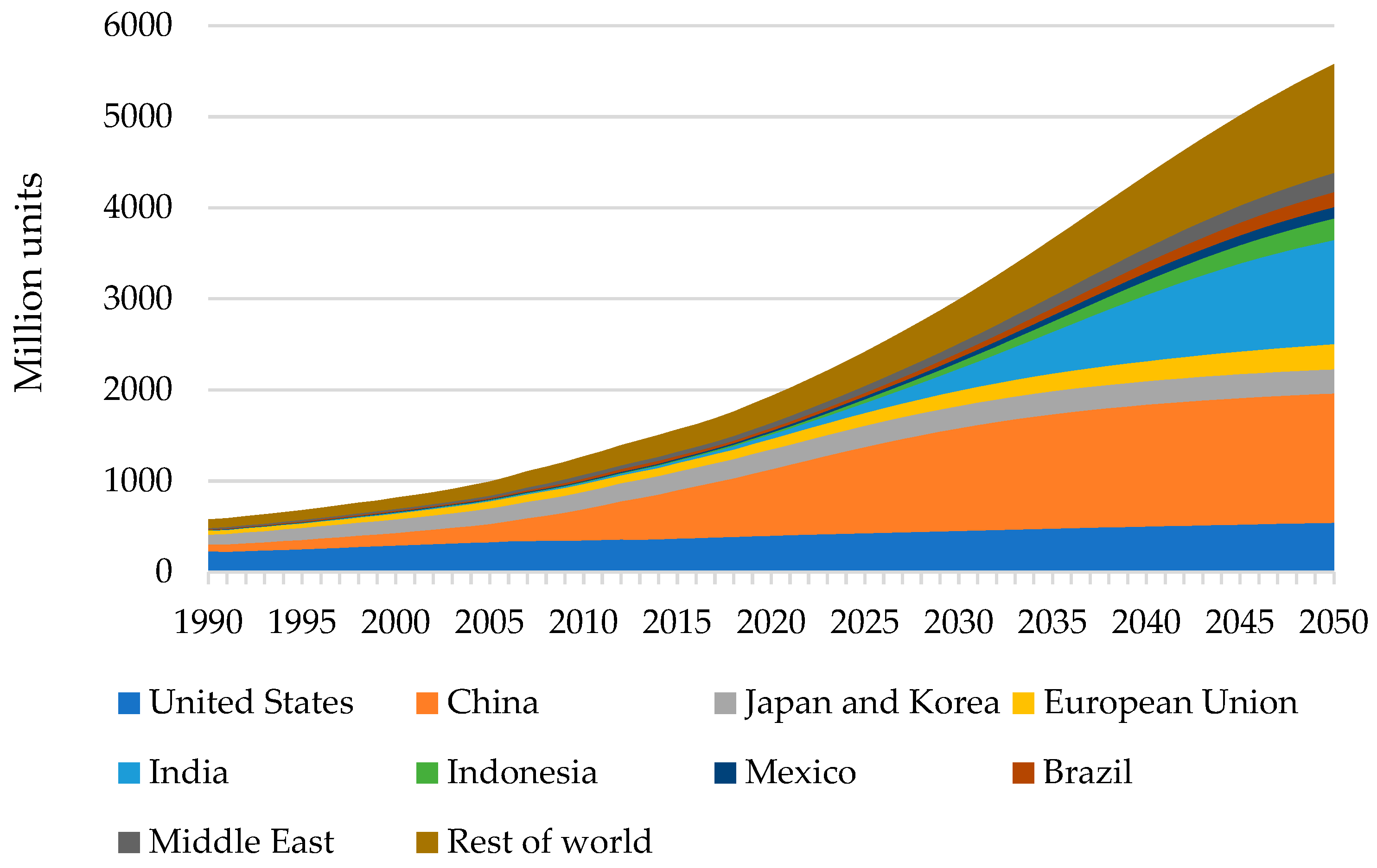
In the last three decades the market for cooling has been growing and will increase until the middle of the century even more [
1], shown in
Figure 1. Thereby many opportunities for new business models will arise, especially for renewable cooling as those technologies shall be used primarily in the EU [
2,
3].
Also, funding opportunities are not suitable for every cooling solution which generates a need of different options of business and financing models for renewable and sustainable cooling.
Through different regulations, it can be found that in future times, cooling in Europe will be dominated by devices using natural refrigerants to avoid greenhouse effects by striking cooling devices [
4].
This study presents a new business model—applied both on renewable and on innovative technology of REGEN-BY-2—that brings advantages for renewable energies compared to conventional solutions, as costs are the main driver for the clean energy transition. According to Jakob et al., the IEA SHC Task 65 focused on promoting solar cooling in the Global South to sustainably address growing cooling demands. Over four years, experts analysed and adapted solar technologies to optimise costs and reduce the environmental impact. They developed guidelines, standardised kits, and financing models to support market penetration [
5]. The task emphasised the importance of policy support and of demonstration projects to overcome technical and non-technical barriers. Overall, solar cooling shows potential to reduce emissions and electricity demand in high-need regions [
5].
Air conditioners and electric fans consume nearly 20% of global building electricity, straining power systems and increasing emissions. Without policy interventions, cooling demand will continue to rise, but improving equipment efficiency offers a significant opportunity to mitigate this growth sustainably [
6]. The adaptation of existing and the development of new business models are needed to pave the way for sustainable cooling and heating. The work incorporates outcomes of the EU-funded LIFE project Cooling Down and is applied to the EU-funded Horizon 2020 project REGEN-BY-2.
The novel business model is based on learnings and the systematic approach of energy communities [
7,
8] and servitisation schemes like ESCO and CaaS [
9,
10]. The aim was to combine the advantages of the participatory aspects of energy communities with the business advantages for operators from servitisation schemes.
While citizen participation in renewable energy projects has gained attention through cooperative models [
11], these approaches often rely on collective ownership rather than hybrid financing mechanisms that combine private investments with operator-led service provision. Similarly, servitisation models like Cooling-as-a-Service (CaaS) [
9] focus on risk transfer to operators, but neglect the potential of collective citizen financing to reduce upfront costs. Moreover, risk allocation studies in decentralised energy systems primarily address large-scale investors [
12], leaving a gap for models that integrate small private investors while ensuring operator profitability. The hereby proposed Initial-Aid Cashback (IAC) model addresses these gaps by combining collective financing (citizen investments), dynamic pricing (discounts for investors) and risk minimization for operators through reduced OPEX. By shifting initial capital costs to a pool of private investors, the IAC model lowers operator risk compared to CaaS models, where operators bear full financing risks [
9]. The development of the new IAC model followed the method of science research design [
13].
2. Literature Review
The literature review provides an overview of business models and financing strategies. These contain well-approved systems and models, but also new opportunities that were developed recently.
2.1. Definition of Target Groups
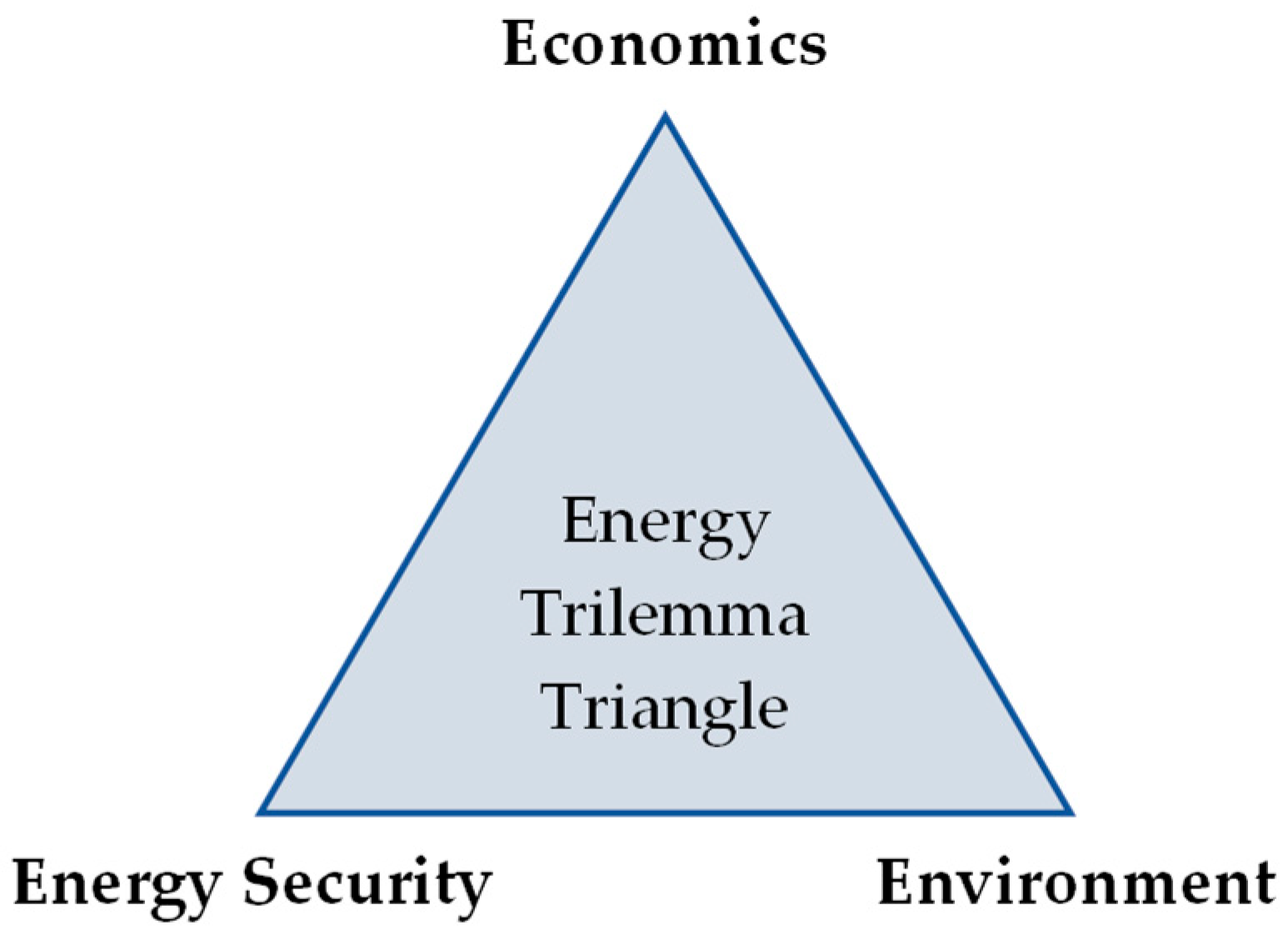
This research on innovative and novel financing and business models targets clients/end consumers of heat, cold and electricity; energy providers; and public bodies. Thereby, the triangle of the energy trilemma [
14] shows the three main aspects of evaluating energy costs. Renewable energies must be (i) economically affordable, but at the same time (ii) environmentally friendly and additionally (iii) available at any time. These requirements may interfere with each other, as conventional cooling solutions may be cost-effective and provide security of supply, but are not environmentally friendly.
Studies about the Energy Trilemma, presented in
Figure 2, have shown that the main focus changes due to external events. The World Energy Council developed reports over more than 25 years, which can be compared, considering different crises that appeared, such as the invasion of Russia into Ukraine. Also, the focus is different when looking at different countries, depending on the direction the governments and the public opinion go [
15]. When looking at the EU, since 2019, energy security has increased in importance [
15,
16,
17].
One of the main challenges for trading renewable energies is the very diverse needs for different applications. The focus of this research lies on private housing and office buildings.
2.2. Business and Financing Model Review
This section provides the basis for the development of a new, renewable-energy-tailored business model. Therefore, an overview of different kinds of business models and financing options is given, which is grouped into three sections.
Profit-oriented financing options;
Profit-oriented business models;
Social-oriented business and investment models.
2.2.1. Profit-Oriented Financing Options
This section presents an overview of opportunities for financial support of private companies. All opportunities contain monetary investments by natural or legal persons.
Seed funding: Seed funding is also referred to as early-stage financing, which involves providing financial support during the initial phase of a start-up. [
18]. It not only contains support by cash but also by writing business plans, creating prototypes or commencing [
19]. Gcobisa Hazel Nxozi and Zandisile Mkubukeli examined the impact of seed funding, provided by the local government, on the growth of informal small businesses in the Winelands District. Through a quantitative analysis of 60 entrepreneurs, it was found that the seed funding was helpful in purchasing equipment and machinery. However, the allocated amount was insufficient to ensure long-term stability and sustainability for these businesses. The study recommends that the government reevaluate its strategies and provide case-specific financial support to better address the unique needs of each business, contributing to job creation and poverty reduction [
20].
Private Equity: Private equity refers to investments in non-publicly traded companies. Through these investments, companies gain not only capital but also expertise from investors. In return, investors receive ownership stakes in the company, which may yield financial returns over time [
21]. The recent growth of private equity markets has sparked increased interest in its nature and effects, particularly in later-stage buyouts, which have been a controversial focus [
22]. Private equity has become an increasingly popular financing method, particularly in the context of corporate crises, where traditional financing options may be limited. It is considered a viable solution for turnaround or distressed investments, as it can provide necessary capital and expertise. The growth of private equity, especially in Germany, suggests its potential for future dominance, despite uncertainties due to regulatory and economic changes. While private equity and corporate crises may seem unrelated, private equity has proven beneficial in addressing financial difficulties and driving business recovery [
23].
Venture Capital: Venture capital is a form of private equity financing provided by professional investors to early-stage or rapidly growing companies that are not listed on public stock exchanges. Unlike traditional corporate finance, which typically involves passive investors and readily traded shares, venture capitalists actively participate in the management of the companies they fund, often sitting on boards and guiding key decisions. These investments are high-risk, as the companies are often innovative and unproven, but they offer the potential for significant returns through capital gains when the firms succeed or go public. Due to asymmetric information, where entrepreneurs often know more about the business than investors, venture capital relies on close monitoring and staged financing to manage uncertainty and align incentives [
24].
Blended finance: Blended finance refers to the strategic use of public or philanthropic funding, often in the form of grants or concessional finance, to attract additional private investment into projects that support sustainable development, especially in developing countries. The aim is to make projects financially viable by sharing risk, improving the risk/return profile, or closing funding gaps that would otherwise deter private sector involvement [
25]. Though definitions vary, blended finance typically combines Official Development Assistance (ODA) with non-grant resources and is designed to mobilise more capital than public finance alone could achieve [
25]. The Bank of America defines blended finance as a kind of financing fund where different kinds of private and non-private stakeholders can pay in to take part in projects with different levels of risk [
26]. Blended finance refers to the use of concessional public or philanthropic capital to attract private investment into sustainable development, especially in developing countries. It aims to reduce investment risks and mobilise private sector resources to help achieve the Sustainable Development Goals (SDGs) [
27].
Crowdfunding: Crowdfunding is a form of financing where a large number of people collectively fund a project or idea. With the rise of the internet, crowdfunding evolved rapidly, initially gaining popularity in the creative sector. Backers typically receive a reward or simply help bring a project to life. Crowdfunding includes types such as donations, lending, and investing. The significant growth in funding amounts highlights its strong potential [
28]. It is important to point out that this kind of financing is independent of banks [
29]. By the EU, crowdfunding is described as “an emerging source of financing involving open calls to the public, generally via the internet, to finance projects through monetary contributions in exchange for a reward, product preordering, lending, or investment. For small businesses, access to this form of finance represents an alternative (or a complement) to more traditional sources of finance like debt finance” [
30].
Bulk procurement: This type of financing involves the procurement of goods valued at over €100,000. By increasing the volume of purchased goods, the unit price can be reduced [
31]. Thereby, this kind of financing has several advantages, such as access to better deals containing lower prices, the quality of the goods will not vary and also the invest of time will shrink.
Cash machine model: This model contains a prepay system, which leads purchasers to pay for goods and services in advance. Thereby, the provider has the money upfront to deliver the service that has been paid for [
32]. The advantage for the provider is the low financial risk.
Pay as you go: This financing model allows companies to acquire goods without upfront payments or additional compensation. It is commonly used in the IT sector, for example, when renting online storage or server capacities. This means the purchasing company avoids preparatory efforts and does not incur post-project costs [
33].
2.2.2. Profit-Oriented Business Models
Towards the financing options, business models do not only contain financing but also services that are offered in a common package. The business models can contain monetary support, but also selling goods or services.
ESCO financing: ESCOs (Energy Service Companies) emerged in the 1980s in the U.S. to address energy crises and promote sustainability. They offer full-service energy efficiency solutions, including project design, financing, implementation, and savings verification. Modern ESCOs, now global and innovation-driven, extend beyond efficiency to energy trading and environmental services. As knowledge-intensive service providers, they drive service innovation, adapt flexible business models, and play a key role in reducing emissions and fossil fuel dependence [
34]. ESCOs support energy-efficient building retrofits without requiring upfront investment from clients. Through energy performance contracts (EPCs), ESCOs provide comprehensive services including audits, installation, maintenance, and financing. These contracts help clients to lower energy costs, shift risk, and focus on their core business. Two main EPC types exist: shared savings and guaranteed savings, with the latter being more common in regions like the US, Europe, and Korea. While ESCOs enable significant energy and cost savings, both clients and ESCOs prioritise profitability, making additional cash flow essential for project viability [
35,
36].
Leasing-financing: “An agreement between two parties whereby one party allows the other to use his/her property for a certain period of time in exchange for a periodic fee. The property covered in a lease is usually real estate or equipment such as an automobile or machinery. There are two main kinds of leases. A capital lease is long-term and ownership of the asset transfers to the lessee at the end of the lease. An operating lease, on the other hand, is short-term and the lessor retains all rights of ownership at all times.” [
37]. Lease finance companies, classified as Non-Bank Financial Institutions (NBFIs), play a key role in supporting various economic sectors and strengthening the financial system. In Bangladesh, lease financing has become a popular funding method for entrepreneurs, with the industry growing by 25.5% in 2001–2002 compared to the previous year [
38].
Guaranteed availability: This model refers to a type of service guarantee where a company promises that a service will be available at a specific time, level, or under certain conditions—and if not, the company commits to compensating the customer or taking corrective action [
39]. By having the guaranteed availability, consumers pay an extra amount to the provider. By those payments additional installations can be done to renovate the system or create redundancies whereby the delivery of the good or service can be assured [
40].
Cooling as a Service: Cooling as a Service (CaaS) is an innovative business model where customers pay for cooling as a service rather than owning the equipment. The provider finances, installs, maintains, and manages the system, while clients only pay for the cooling they use. This model reduces upfront investment and encourages energy-efficient, sustainable solutions. However, adoption varies across regions and sectors due to local barriers, regulatory gaps, and limited stakeholder collaboration. Communication between providers, manufacturers, and policymakers is often insufficient, and there is a lack of clarity on necessary partnerships. To overcome these challenges, tailored business models, improved financing mechanisms, supportive policies, and awareness campaigns are needed. Future efforts should also include more diverse stakeholder perspectives and quantitative research [
9]. The SET alliance was founded to make “Servitisation” business offers available on a global scale. Servitisation means that not only is a product sold within a contract, but also services targeting the net-zero goal of the SDG are rendered [
19]. CaaS is part of this alliance and focuses on sustainable cooling by providing full installation and services of cooling to users [
41].
Green Bonds: Bonds are securities in which an investor lends money to a company or government for a fixed period of time. In return, the investor receives regular interest payments. At the end of the term, also known as maturity, the investor is repaid the amount invested. The term “fixed-income securities” is often used synonymously with bonds, as the investment generates fixed payments over the term. The maturity date marks the point in time at which the issuer of the bond repays the borrowed capital to the investor [
42]. Della Coce et al. defined Green Bonds as “fixed-income debt securities issued (by governments, multi-national banks or corporations) in order to raise the necessary capital for a project which contributes to a low carbon, climate resilient economy” [
43].
2.2.3. Social-Oriented Business and Investment Models
There are also opportunities where business and investment models are provided by communities or social facilities.
Citizen Cooperative: The EU defines a cooperative as „an autonomous association of persons united to meet common economic, social, and cultural goals. They achieve their objectives through a jointly owned and democratically controlled enterprise.” [
44]. Recently, cooperatives have experienced a renewal, adapting to address modern societal challenges like low-skilled employment, environmental sustainability, affordable housing, and fair trade [
11]. New forms, such as multi-stakeholder cooperatives, have emerged, where various stakeholders (workers, consumers, producers) collaborate for the public good. These cooperatives are often seen as social enterprises. The cooperative model is effective in situations where market power is excessive, contracts fail, or public goods are needed [
8]. By giving ownership to users, cooperatives reduce transaction costs, increase trust, and avoid exploitation common in investor-owned firms. In monopolistic markets, for example, consumer cooperatives allow members to ensure access to quality goods at fair prices, focusing on collective well-being rather than profit maximisation [
11].
Philanthropy: Philanthropic funding for cold-related initiatives involves support and funding of projects that address cooling challenges and serve as an investment model. These include the expansion of cold chain infrastructure for temperature-sensitive goods, but also cooling solutions for communities in hot climates or disadvantaged populations. Philanthropic funding supports innovation, research and sustainable cooling solutions to strengthen public health, food security and climate resilience [
45].
Community cooling hub: The goal of community cooling hub (CCHs) is to provide cold for a group of stakeholders in a sustainable way, according to the Paris Agreement and the UN Sustainable Development Goals [
46]. Other than using sectoral divided cooling solutions, cooling hubs can provide cold to several consumers, and interdependences can be used in a positive way. An example of a community cooling hub is the Kiambu County hub in Kenya, where the Lari Horticulture Co-operative Ltd. provides farmers access to sustainable cold-chain technologies, training, and storage solutions to reduce post-harvest losses and improve production quality, while also fostering collective action and market access for the community [
47]. Furthermore, Debnath et al. provide suggestions for several community cooling hubs for rural communities [
48]. This shows the feasibility of Community cooling hubs in rural areas.
2.2.4. Identification of Research Gap of Business Models
Despite the diversity of existing business models for renewable energy installations and energy service offerings, the literature review shows that there are gaps in theory and practice, especially when it comes to hybrid models for sustainable energies. A comprehensive systematic review by Engelken et al. (2016) highlights that the current literature on business models for renewable energies is fragmented and focuses on individual cases or regions, while quantitative data, robust comparative studies and global framework analyses are lacking [
49]. As a result, market players, especially small investors and final consumers, have little reliable basis for evaluating the economic viability of new models such as CaaS or hybrid-financed business model variants. In addition, several structural barriers have been identified in an analysis of the cooling industry that hinder the transition to sustainable cooling models: Current business practices and structures are heavily product-oriented and focus on the sale of physical devices rather than on establishing servitisation or usage-based models, which makes innovation beyond traditional product sales difficult [
50].
Furthermore, research on the servitisation approach for energy and cooling shows that CaaS and similar servitisation-based approaches have not yet been sufficiently empirically investigated and operationalised and that there is a lack of clear framework conditions for their implementation, e.g., with regard to value and cost allocation, measurement of servitisation effects or regulatory requirements. Overall, the literature suggests that there are conceptual, empirical and application-oriented gaps in existing business models, underscoring the need for further theoretical frameworks and empirically tested models—especially in sectors such as sustainable cooling, where traditional sales models dominate and new, usage-based financing concepts are not yet mainstream [
51].
3. New Innovative Business Model
In addition to the models presented in
Section 2, this section introduces a new concept: the Initial-Aid Cashback (IAC) model. Developed under the Cooling Down project, this model offers citizens an additional opportunity to participate in the CET for cooling supply. For the REGEN-BY-2 project, the model was adapted for a small district, consisting of several residential and office buildings for heating, cooling and electricity supply.
3.1. The Initial-Aid Cashback Model Methodology
The primary objective of the IAC model is to significantly accelerate the deployment and adoption of renewable energy technologies while not being dependant on subsidies. To achieve this, the model is specifically designed to target system operators as the key stakeholder group. By tailoring the financial and operational structure to their needs, the model seeks to enhance the attractiveness of renewable energy solutions among operators and thereby stimulate their market engagement. The model functions through a collaborative investment financing and operational discount mechanism.
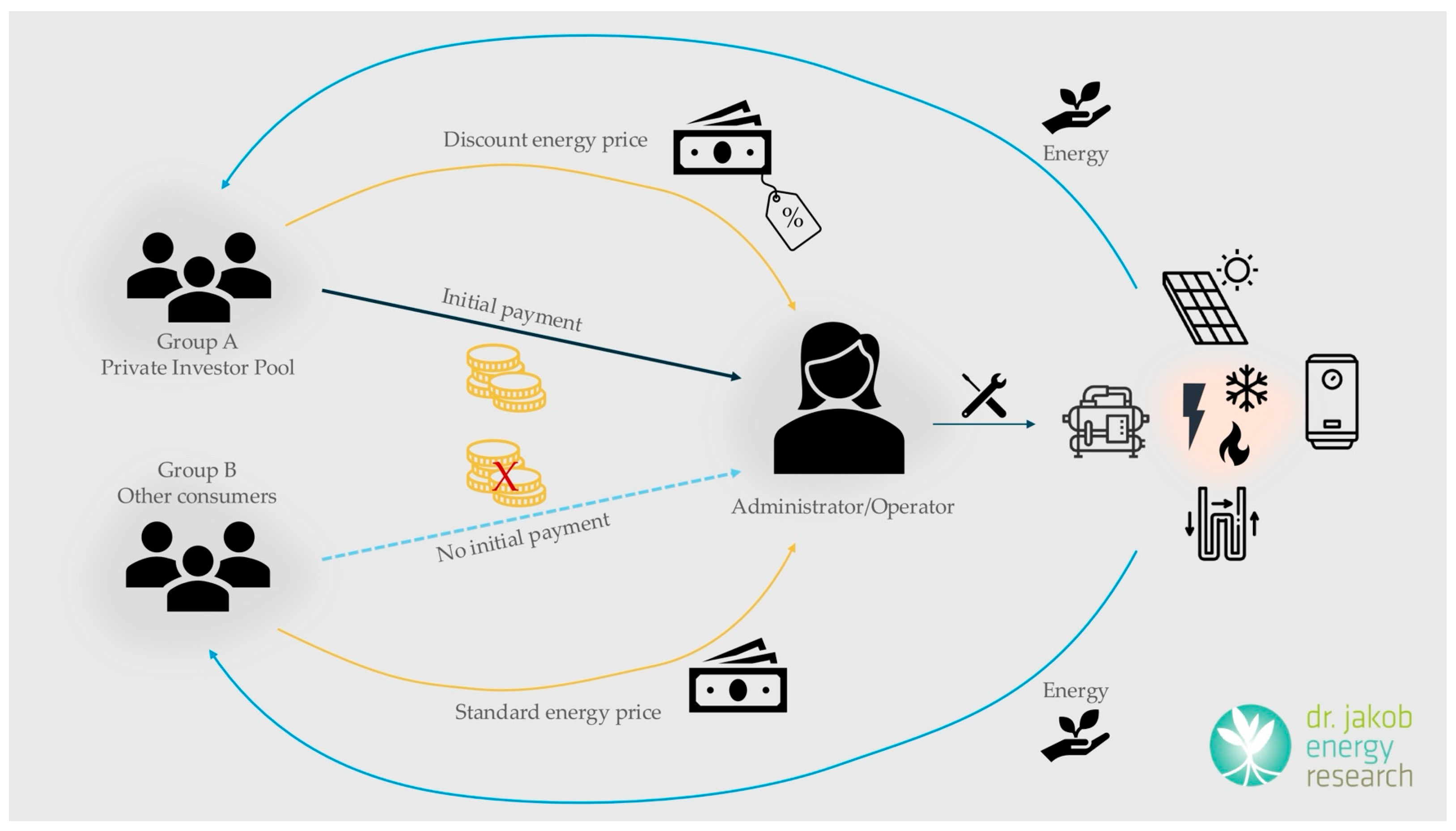
The need for heating, cooling and electricity among a group of end users is fundamental. A share of these private customers makes a financial contribution intended to fund the installation of the renewable-based heating, cooling and/or electric system partly or completely. Moreover, the system operator is responsible for constructing and operating the energy infrastructure. Importantly, the operator retains ownership of the installed technology, ensuring long-term control over its maintenance and service provision. Those end users who contribute to the initial investment will benefit from access to renewable energy services—specifically cooling—at a reduced price compared to those end users who will not contribute. This group of end users can be labelled as an energy community, since this group is characterised by a joint interest and belief realised by a collaborative action [
7]. This discounted service works as a form of return on investment. For the operator, the model offers substantial benefits: the initial capital requirements are partially offset through external investment, and the provision of cooling services can be initiated without the need to secure conventional bank credit. Moreover, the financial risk associated with offering cooling services is minimised due to the upfront cost-sharing and the long-term service relationship with customers.
Thus, the model establishes a mutually beneficial arrangement. Operators gain operational flexibility and lower financial exposure, while private investors are incentivized through reliable returns in the form of reduced energy costs.
Figure 3 illustrates the structural logic of the model, highlighting the flow of financial resources and energy services between the involved stakeholders.
3.2. Numerical Approach
The Initial-Aid Cashback (IAC) model can have positive effects for both the operator and the private investors. For the calculation, the main factors are the investment costs, operational costs, number of private investors, number of consumers, annual energy demand and discount (%) for initial aid to private investors. The following equations were defined in [
52].
Operational costs (OPEX) are calculated by
With
Operational costs, maintenance costs and energy costs in €/a
Sales of energy are calculated by
With
ES = Sales of energy in kWh/a
EDemand,Investors = Annual energy demand of investors in kWh/a
EDemand,Others = Annual energy demand of investors in kWh/a
PriceDiscount = Energy price for private investors, including discount in €/kWh
PriceStandard = Energy price for consumers that not invested in €/kWh
Profit of operator per year can be calculated by
With
Profit of operator in €/a
Sales of energy in €/a
Operational costs in €/a
Savings per private investor as a result of calculation:
With
SavingsInvestors = Total annual monetary savings of investors in €/a
EDemand,Investors = Annual energy demand of investors in kWh/a
PriceDiscount = Energy price for private investors, including discount in €/kWh
PriceStandard = Energy price for consumers that not invested in €/kWh
By the comparison of the total savings with the investment, the amortisation of the investment can be identified.
3.3. Case Study I: Office Building in Romania
For the evaluation of the IAC business model, a multi-storey building in Romania is taken to be considered as the best practice case, which was conducted by the Cooling Down project [
53].
The three-storey office with a usable area of 368 m2 is highly energy efficient. It is well insulated: the walls are 25 cm thick with 20 cm of mineral wool insulation, and there is a ventilated façade. The windows are triple-glazed for high thermal performance, and the flat roof is made of reinforced concrete with 40 cm of insulation.
The office is located in a region with a temperate-continental climate, with an average yearly temperature of around 11.7 °C. The building operates mainly on weekdays from 8:00 a.m. to 4:30 p.m. and includes open office areas, individual offices, and meeting rooms.
Energy-efficient systems reduce consumption outside working hours. Heating is provided by a central geothermal heat pump system. Cooling is handled by a passive system that uses the naturally cool temperature of the ground (free cooling) and distributes it through a Thermally Activated Building Structure (TABS). The system includes five geothermal probes, which work with the heat pump to efficiently regulate indoor temperature and humidity. By using the ground as a seasonal energy store, the building maintains comfort while minimising energy use. For the application of the IAC-model, it was assumed that the device for cooling is replaced and fully financed by the consumers of the cold.
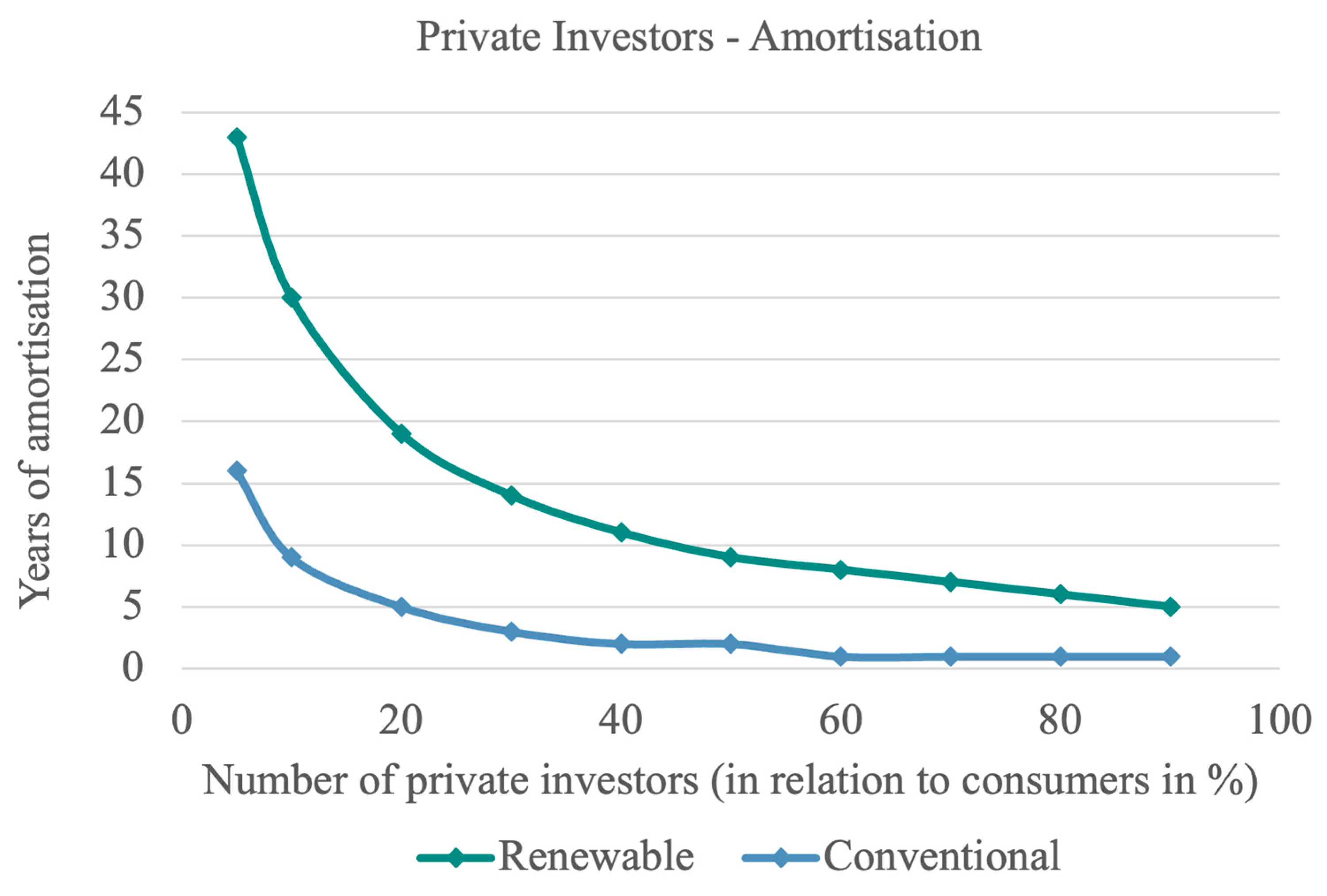
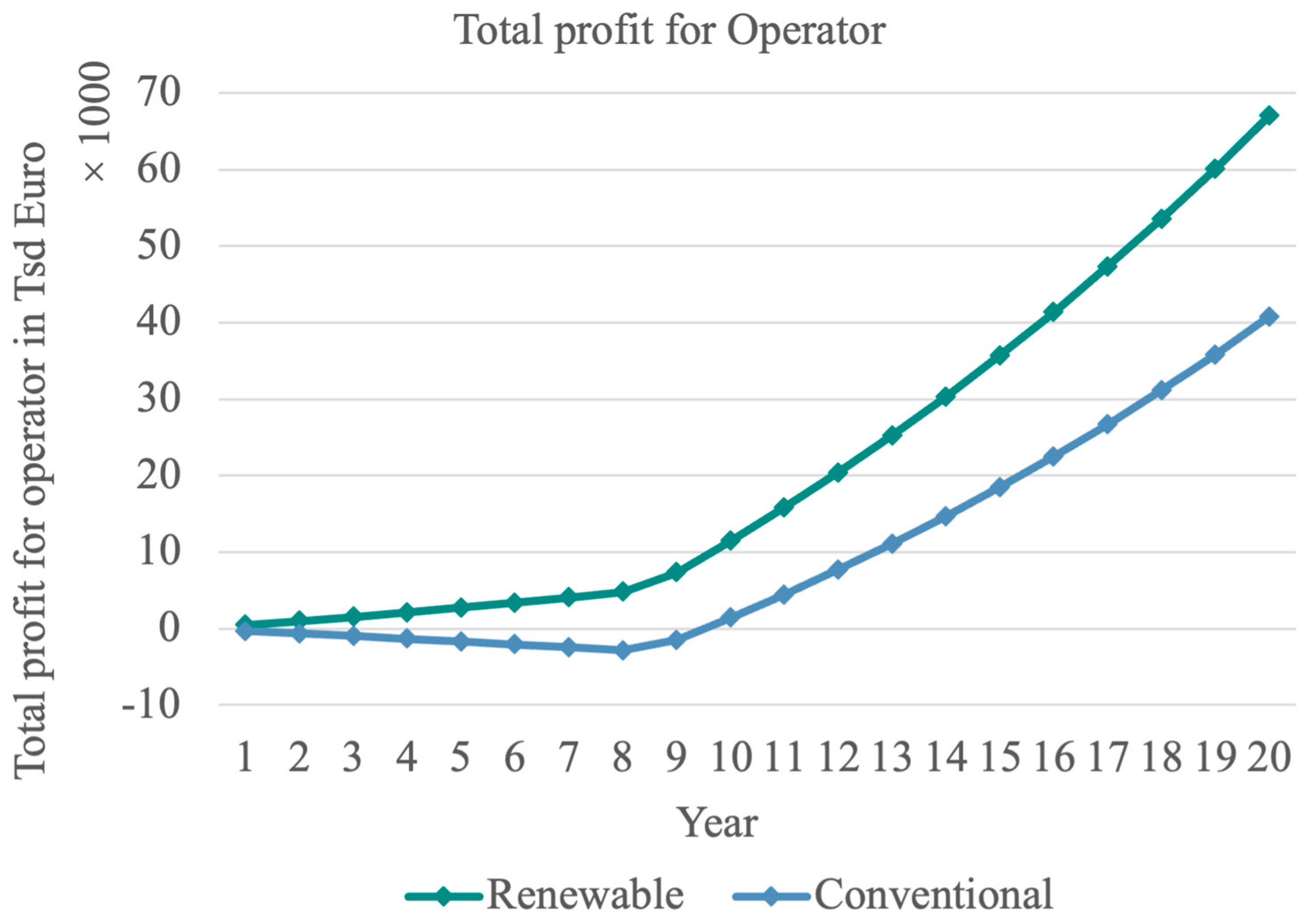
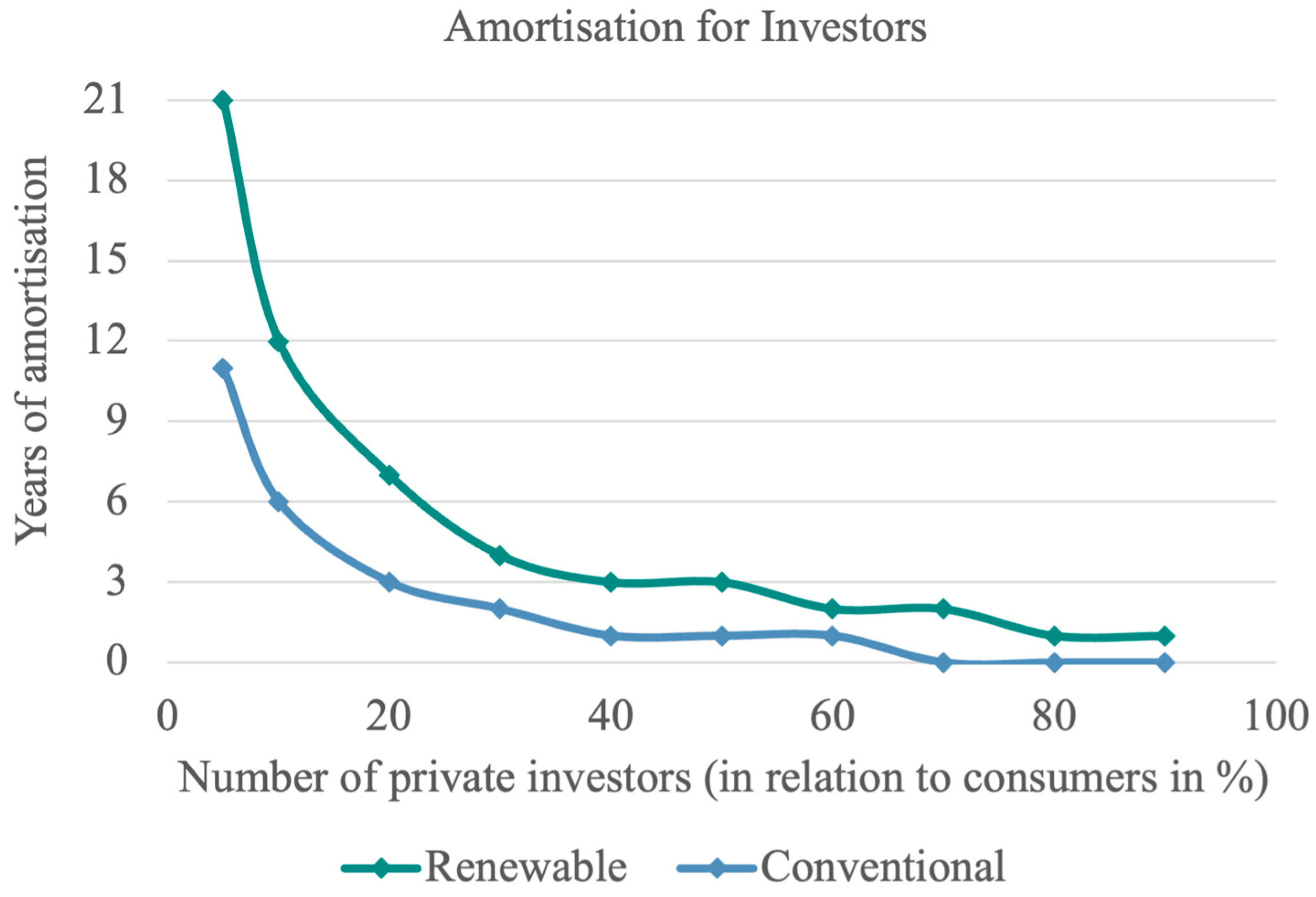
The result of those calculations shows that renewables are more interesting for the operator than conventional cooling by the application of the IAC-model, which is the result of lower OPEX.
Figure 4 shows amortisation time for the investors.
One of the most important factors of the new business model is the profit for the operators, shown in
Figure 5, as this decides if renewables are more interesting for operating companies than conventional energies. In this case study, the operator would benefit from applying the Initial-Aid Cashback model.
The case study shows that the point of view is important for the evaluation of the application of the Initial-Aid Cashback model. For operators, the installation of renewables would increase the profit due to low ongoing costs. On the other side, investors would have a longer period of amortisation, investing in renewables compared to conventional energies.
3.4. Case Study II: REGEN-BY-2 Technology
REGEN-BY-2 is an EU-funded H2020 project aimed at developing a lab-scale prototype of a thermodynamic cycle heating, cooling end electricity generation plant [
54]. The technology uses two-phase fluids to efficiently convert various renewable thermal sources into electrical, heating, and/or cooling energy. The project technology was developed by the startup TIFEO, founded in 2018, which holds the exclusive licence for the driving patent [
55].
The goal is to create a versatile and highly efficient plant that can exploit renewable thermal sources ranging from small-scale (e.g., residential) to large-scale (e.g., industrial) applications. The technology combines direct and inverse Carnot cycles with two-phase fluids, achieving higher efficiency and operational flexibility compared to commercialised systems, aiming to support the EU sustainability goals.
This section discusses the question of the pricing of the new technology, answering whether it is still financially attractive. The technology was applied in the example as a supply for heating, cooling and electricity in a housing–office mixed area. Therefore, different demands need to be considered, as for the office buildings, the cooling demand is a lot higher than for the housing buildings.
Table 1 shows the assumed annual energy demand for heating, cooling and electricity.
In addition to the building specifications,
Table 2 shows the input parameters of the IAC model calculation for this case. For the purposes of the REGEN-BY-2 case study, the total rated output of the REGEN-BY-2 plant was assumed to be 1766 kW. The total energy demand is examined and includes heating, cooling and electricity. In addition, the energy price is averaged and weighted according to energy sources. Ultimately, the consumer pays per kWh at the cost of the weighted price. This methodology was adapted to the tri-generation technology of the REGEN-BY-2 project.
It is assumed that the application of the REGEN-BY-2 technology is fully financed by private self-using housing owners and offices. Through the IAC model, they receive a discount to repay their investment. The balance is shown in
Figure 6, where the amortisation time for the private investors is shown.
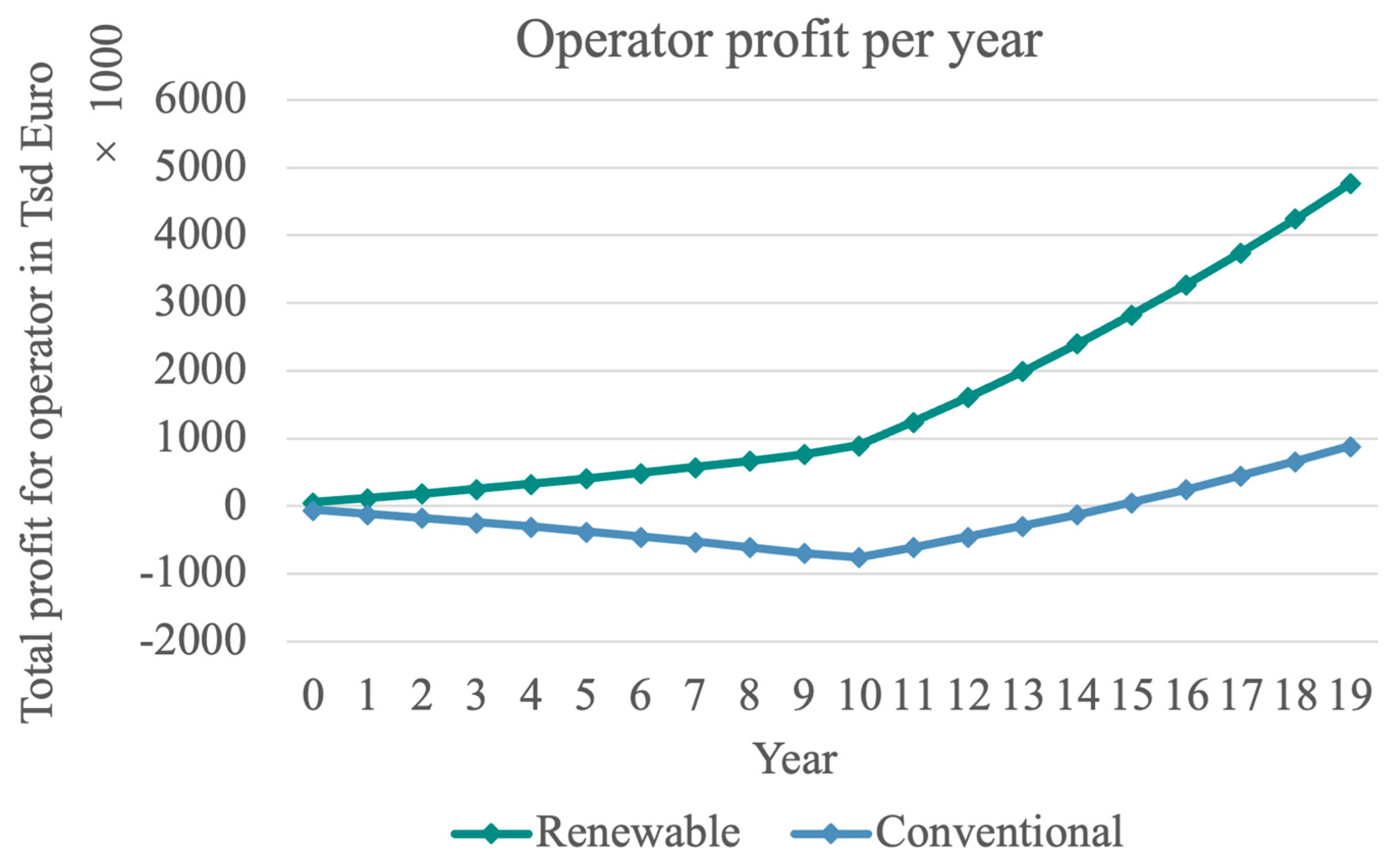
Besides the point of view of the private investors, the result of the application of the REGEN-BY-2 technology shows that the operator and owner of the system can generate high profit by applying the technology for heating, cooling and electric supply. As the operator and owner do not pay investment costs directly, the maintenance, but mainly the energy bills, determine the profit. For the REGEN-BY-2 technology case, it is assumed that the operator uses cheap waste heat, which makes it a lot more profitable to run the new technological system.
Figure 7 shows the annual profit for the operator, considering operation costs for maintenance and energy supply.
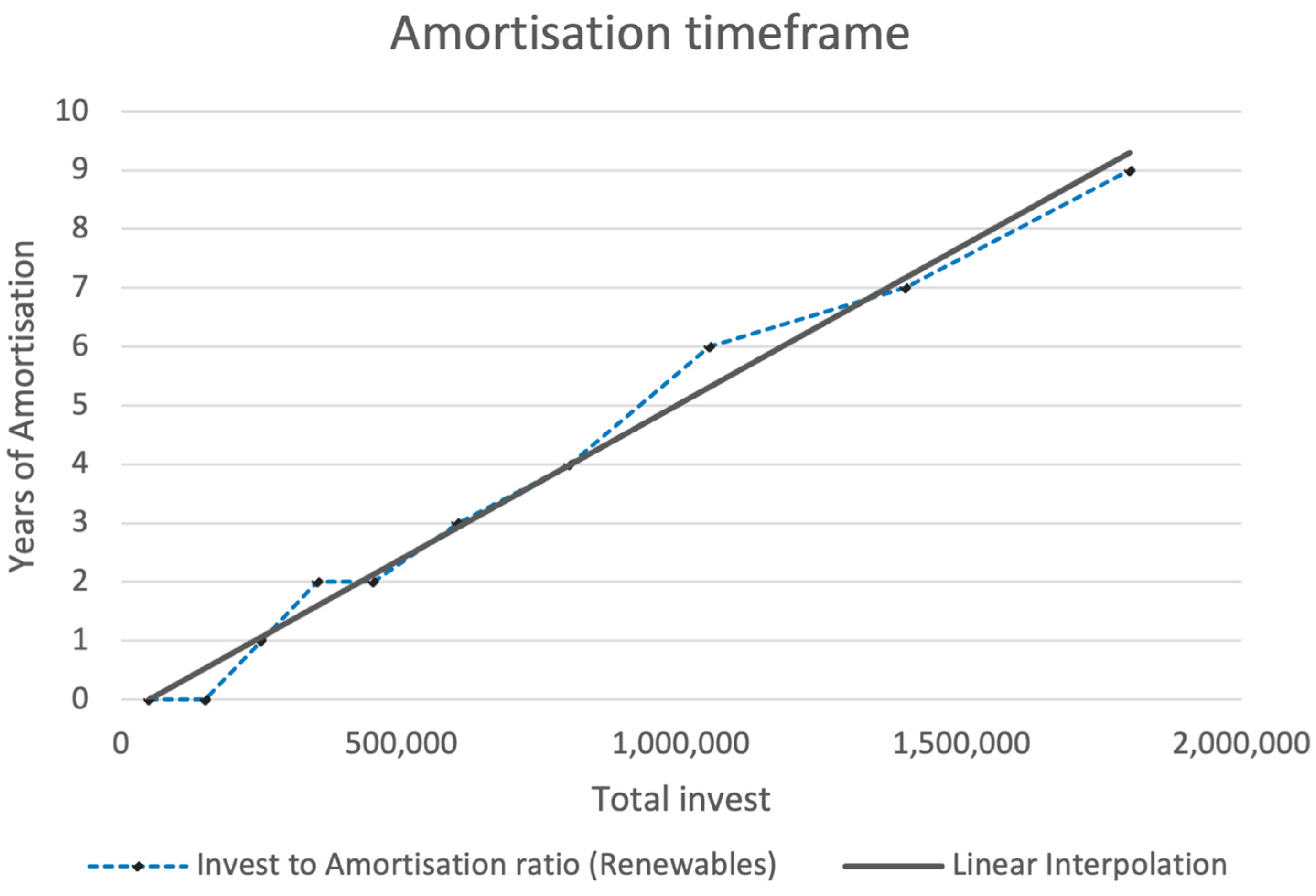
The time of amortisation for investors strongly depends on the pricing of the energy device.
Figure 8 shows the amortisation timeframe in relation to the total invest.
The analytics were conducted through a sensitivity analysis, where all input parameters of
Table 2 were varied. Results indicate that the number of investors and operational costs are the most critical factors: sufficient investor participation ensures economic viability for investors, while operational costs directly determine the operator’s profitability.
4. Results
4.1. General Results
The IAC model addresses energy poverty and offers flexibility, making it particularly beneficial for energy systems with several small energy consumers. The calculation results show that it is an advantage for the investors, if the number of investors is increased. It incentivizes private investors by providing discounted renewable energy services. The model’s adaptability to various consumer needs and its ability to be easily scaled are advantageous. The IAC model entails several challenges, including the complexity of defining appropriate discount levels. Additionally, the legal and contractual agreements required for the IAC model can be complicated, potentially deterring stakeholders. Also, the governance model for investors, including voting rights and decision-making processes, needs to be clearly defined to ensure the model’s success.
One main barrier is the limited budget of the investor group if they are private [
11], which requires an even larger group of investors. Furthermore, trust among stakeholders can be identified as a significant barrier to the model’s implementation. A further identified barrier is the long-term commitment required from investors and the ongoing maintenance and payback period for investments.
In conclusion, the IAC model offers a promising approach to financing sustainable energy solutions, with potential benefits for public housing and energy poverty alleviation. However, its implementation faces challenges related to trust, contract complexity, and the need for clear governance structures. Addressing these issues through practical testing and refining the model’s framework will be crucial for its success.
4.2. Stakeholder Consideration and Risk Allocation
Risk allocation in participatory energy models has so far focused primarily on large investors such as private equity firms or operator models such as ESCOs (energy service companies) and Cooling-as-a-Service (CaaS), while private small investors have been largely ignored [
12]. These models usually transfer risks to institutional players or operators, but not to end users or small investors.
The Initial-Aid Cashback (IAC) model addresses this gap by minimising risks for small investors through guaranteed price reductions and, at the same time, reducing operator risks through collective pre-financing. It thus creates an innovative approach that increases both the attractiveness for private investors and the stability for operators.
Rather than being tailored to a particular energy technology, the IAC model is based on a generalised financial architecture that can be applied across different renewable energy systems and use cases. The IAC model is structured around three fundamental elements: capital contribution, asset ownership, and the return mechanism. The capital contribution is provided by a group of end users who act as investors by supplying upfront financial resources to support the implementation of the energy system. In contrast, ownership of the physical energy infrastructure remains exclusively with the system operator, who keeps responsibility for installation, operation, maintenance, and long-term system performance. Following the investment and installation phase, investors benefit from reduced energy prices for the energy services consumed over the operational lifetime of the system. Consequently, the IAC model can be assumed to be generalisable across different technologies and application contexts.
Furthermore, the following
Table 3 and
Table 4 show the advantages and challenges of the model, regarding the different stakeholder groups.
The IAC model offers diverse stakeholders the opportunity to invest in the clean energy transition. However, the associated risks of private investments must be carefully evaluated. As outlined by Egli, the energy sector is exposed to multiple risk categories, including price risk, curtailment risk, resource risk, policy risk, and technology risk, which require systematic assessment to ensure sustainable investment decisions [
12]. The following
Table 5 shows risks for investors and the operator and provides opportunities for risk mitigation.
5. Discussion
The usability of a business model depends on its scope and the individual role of the operator. Generally, the following three findings stand out.
First, the Initial-Aid Cashback (IAC) model is an innovative business model for financing and operating renewable heating and cooling technologies. It combines the participation of private end users in covering the investment costs with the operational management by system operators. Investors benefit from reduced energy prices as a return on their investment, while operators own and operate the installed technology in the long term.
Second, the economic appeal of the model is evident for both operators and investors. Case studies, such as the application of REGEN-BY-2 technology or an office building in Romania, illustrate that operators can achieve high profits through low OPEX and the use of cost-effective energy sources. Private investors recoup their investments through the energy price discounts granted, with the payback period depending heavily on investment and energy prices. The model proves to be particularly economically attractive for small consumers, public buildings and operators of mixed-use facilities, even without being dependent on subsidies.
Last, there are challenges and barriers to implementing the IAC model. A minimum number of investors and clearly defined contractual and governance structures are necessary to build trust. The complexity of determining appropriate discount levels, legal frameworks and the long-term commitment of investors can make implementation difficult. Practical testing and model adjustments are therefore necessary to ensure scalability, flexibility and acceptance among the various stakeholders.
The applicability of the IAC model and its exploitation depend on the individual needs, barriers, but moreover, opportunities and the interests of stakeholders. Therefore,
Table 5 shows where the model can be applied in principle and its degree of generalisability.
The potential of the IAC model cannot only be analysed for stakeholder types, but also for building types. The decision for the different building and use types is based on Task 4.1 and its deliverable D4.1 of the Cooling Down project [
56].
Table 5 and
Table 6 show that the application of the IAC model is not only a single case evaluation but can also be categorised in a broad way, and that it can be exploited for various applications. In general, the IAC model is good to integrate many citizens and small, private investors in the CET, overcoming structural barriers and providing them the opportunity to gain money from the transition.
6. Conclusions
The Initial-Aid Cashback (IAC) model presents a novel and flexible approach to financing renewable energy solutions, particularly in the rapidly expanding sector of renewable heating and cooling without the dependence on subsidies. By aligning the interests of private investors, system operators, and public authorities, the model addresses key barriers to the adoption of sustainable technologies, namely, high upfront costs and financial risk. By distributing the financial load of investment on multiple end users, the individual users benefit from reduced risk, which in turn increases the interest of the system operator. The two investigated case studies of the REGEN-BY-2 technology and the Romanian office building demonstrate that the IAC model can generate significant benefits for operators through reduced operational costs and increased profitability, while offering private investors an attractive return on investment via discounted energy prices. The model’s adaptability to various building types and consumer groups further underscores its potential to drive the clean energy transition (CET) and promote citizen participation in renewable energy projects.
However, the successful implementation of the IAC model depends on overcoming several challenges. The need for a minimum number of investors to ensure financial viability, the complexity of legal and contractual agreements, and the requirement for long-term trust and commitment among stakeholders are critical factors that must be addressed. Additionally, the model’s focus on energy generation, rather than efficiency improvements, may limit its applicability in certain contexts. Clear governance structures, supportive policies, and practical testing will be essential to build confidence among potential participants and refine the model’s framework.
From a stakeholder perspective, the IAC model is particularly advantageous for energy system operators and providers, who benefit from low-risk investments and ownership of the technology. For private consumers and small investors, the model offers an accessible entry point into the CET, with the potential for financial returns and participation in sustainable energy generation. Public authorities can leverage the model to foster renewable energy adoption, enhance tax revenues, and address energy poverty. The model’s scalability and adaptability make it suitable for a wide range of applications, including residential multi-family buildings, offices, and small cooling grids, though its effectiveness varies depending on the specific context and stakeholder dynamics.
In conclusion, the IAC model represents a promising tool for accelerating the deployment of renewable cooling technologies and integrating citizens into the energy transition. Future research should focus on practical testing, refining governance mechanisms, and expanding the model’s applicability to diverse regional and sectoral contexts. By addressing the identified challenges and leveraging the model’s strengths, the IAC model can play a pivotal role in advancing sustainable cooling solutions and achieving the goals of the clean energy transition.
Author Contributions
Conceptualization, B.H. and M.S.; methodology, B.H., U.J. and M.S.; software, B.H.; validation, B.H., U.J. and M.S.; formal analysis, B.H. and M.S.; investigation, B.H. and M.S.; resources, B.H., U.J. and M.S.; data curation, B.H.; writing—original draft preparation, B.H. and M.S.; writing—review and editing, B.H., U.J. and M.S.; visualization, B.H. and M.S.; supervision, U.J. and M.S.; project administration, U.J.; funding acquisition, U.J. All authors have read and agreed to the published version of the manuscript.
Funding
This research was funded partially from the European Union’s Horizon 2020 research and innovation programme under grant agreement N° 851541, project REGEN-BY-2.
Data Availability Statement
The original contributions presented in this study are included in the article. Further inquiries can be directed to the corresponding author.
Acknowledgments
The IAC-model was developed as part of the EU-LIFE project Cooling Down under grant agreement N° 101077140.
Conflicts of Interest
Authors Benjamin Hueber, Uli Jakob and Michael Strobel were employed by the company Dr. Jakob Energy Research GmbH & Co. KG. The authors declare that the research was conducted in the absence of any commercial or financial relationships that could be construed as a potential conflict of interest.
Abbreviations
The following abbreviations are used in this manuscript:
| IAC model | Initial-Aid Cashback model |
| OPEX | Operational Expenditures |
| kW | Kilo-Watt |
| ESCOs | Energy Service Companies |
References
- Bayer, E. Consumers Can Transform Latin America’s Power Systems: Here’s How. Available online: https://www.iea.org/commentaries/consumers-can-transform-latin-america-s-power-systems-here-s-how (accessed on 11 April 2025).
- Umweltbundesamt EU Regulation Concerning Fluorinated Greenhouse Gases. Available online: https://www.umweltbundesamt.de/en/topics/climate-energy/fluorinated-greenhouse-gases-fully-halogenated-cfcs/statutes-regulations/eu-regulation-concerning-fluorinated-greenhouse (accessed on 11 April 2025).
- European Council Renewable Energy: Council Adopts New Rules. Available online: https://www.consilium.europa.eu/en/press/press-releases/2023/10/09/renewable-energy-council-adopts-new-rules/ (accessed on 11 April 2025).
- Stoll, J. Fluorierte Treibhausgase und PFAS. Available online: https://www.umweltbundesamt.de/fluorierte-treibhausgase-pfas (accessed on 11 April 2025).
- Jakob, U.; Vasta, S.; Weiss, W.; Neyer, D.; Kohlenbach, P. Solar Cooling for the Sunbelt Regions. In Proceedings of the ISES Solar World Congress 2021, Virtual, 25–29 October 2021; International Solar Energy Society: Freiburg, Germany, 2021; pp. 1–8. [Google Scholar]
- International Energy Agency. The Future of Cooling: Opportunities for Energy-Efficient Air Conditioning; OECD: Paris, France, 2018; ISBN 978-92-64-30199-3. [Google Scholar]
- Moroni, S.; Alberti, V.; Antoniucci, V.; Bisello, A. Energy Communities in the Transition to a Low-Carbon Future: A Taxonomical Approach and Some Policy Dilemmas. J. Environ. Manag. 2019, 236, 45–53. [Google Scholar] [CrossRef] [Scilit] [PubMed]
- International Labour Organization. Cooperatives and the Sustainable Development Goals; International Labour Organization: Geneva, Switzerland, 2014. [Google Scholar]
- Palafox-Alcantar, P.G.; McElroy, C.; Trotter, P.; Khosla, R.; Thomas, A.; Karutz, R. Servitization for the Energy Transition: The Case of Enabling Cooling-as-a-Service (CaaS). J. Clean. Prod. 2024, 482, 144190. [Google Scholar] [CrossRef] [Scilit]
- Cebekhulu, B.M.B.; Mathaba, T.N.D.; Mbohwa, C. Identifying Trends and Research Gaps in ESCO Research: A Systematic Literature Review. Energy Strategy Rev. 2024, 55, 101516. [Google Scholar] [CrossRef] [Scilit]
- Huybrechts, B.; Mertens, S. The Relevance of the Cooperative Model in the Field of Renewable Energy. Ann. Public Coop. Econ. 2014, 85, 193–212. [Google Scholar] [CrossRef] [Scilit]
- Egli, F. Renewable Energy Investment Risk: An Investigation of Changes over Time and the Underlying Drivers. Energy Policy 2020, 140, 111428. [Google Scholar] [CrossRef] [Scilit]
- Coffay, M.; Bocken, N. Sustainable by Design: An Organizational Design Tool for Sustainable Business Model Innovation. J. Clean. Prod. 2023, 427, 139294. [Google Scholar] [CrossRef] [Scilit]
- del-Río, B.; Fernández-Sainz, A.; de Alegria, I.M. Diversity or Concentration of Sources in the Management of the Energy Trilemma? The Case of India. J. Clean Energy Technol. 2019, 7, 32–35. [Google Scholar] [CrossRef] [Scilit]
- World Energy Council. World Energy Trilemmy Index 2019; World Energy Council: London, UK, 2020. [Google Scholar]
- World Energy Council; Wyman, O. World Energy Trilemma Index 2022; World Energy Council: London, UK, 2023. [Google Scholar]
- World Energy Council. World Energy Trilemma Index 2024; World Energy Council: London, UK, 2025. [Google Scholar]
- Gründerszene Was Ist Eine Seed-Finanzierung? Available online: https://www.businessinsider.de/gruenderszene/lexikon/begriffe/seed-finanzierung/ (accessed on 11 April 2025).
- AlleAktien Return on Assets (ROA). Available online: https://www.alleaktien.com/lexikon/return-on-asset (accessed on 11 April 2025).
- Hazel Nxozi, G.; Mkubukeli, Z.; Nambei Asoba, S.; Nteboheng, P.M. The Influence of Seed Funding on the Growth of Informal Small Businesses In the Winelands District of Western Cape. Int. J. Sci. Res. 2022, 78, 72–83. Available online: https://www.pontejournal.online/wp-content/uploads/2022/11/Full-Paper-THE-INFLUENCE-OF-SEED-FUNDING-ON-THE-GROWTH-OF-INFORMAL-SMALL-BUSINESSES-IN-THE-WINELANDS-DISTRICT-OF-THE-WESTERN.pdf (accessed on 11 April 2025). [CrossRef]
- Bundesfinanzministerium Glossar: Private Equity. Available online: https://www.bundesfinanzministerium.de/Web/DE/Service/FAQ_Glossar/Glossar/Functions/glossar.html?lv2=176858&lv3=176866 (accessed on 11 April 2025).
- Wood, G.; Wright, M. Private Equity: A Review and Synthesis. Int. J. Manag. Rev. 2009, 11, 361–380. [Google Scholar] [CrossRef] [Scilit]
- Müller, F. Private Equity in der Unternehmenskrise; Gabler: Wiesbaden, Germany, 2010; ISBN 978-3-8349-2492-6. [Google Scholar]
- Wright Robbie, M.K. Venture Capital and Private Equity: A Review and Synthesis. J. Bus. Financ. Account. 1998, 25, 521–570. [Google Scholar] [CrossRef] [Scilit]
- Pereira, J. Blended Finance: What It Is, How It Works and How It Is Used; Oxfam International: Oxford, UK, 2017. [Google Scholar]
- International Energy Agency. Africa Energy Outlook 2022; World Energy Outlook Special Report; International Energy Agency: Paris, France, 2023. [Google Scholar]
- Mutambatsere, E.; Schellekens, P. The Why and How of Blended Finance (English); World Bank Group: Washington, DC, USA, 2020; Available online: http://documents.worldbank.org/curated/en/856201613568586386 (accessed on 11 April 2025).
- Assenmacher, K. Crowdfunding Als Kommunale Finanzierungsalternative; essentials; Springer Gabler Wiesbaden: Wiesbaden, Germany, 2017; ISBN 978-3-658-17152-0. [Google Scholar]
- Günther, E.; Riethmüller, T. Einführung in das Crowdfunding: Formen, Anwendungsbereiche, Erfolgsfaktoren, Rechtlicher Rahmen; Springer Fachmedien Wiesbaden: Wiesbaden, Germany, 2020; ISBN 978-3-658-14589-7. [Google Scholar]
- European Commission. Crowdfunding. Available online: https://finance.ec.europa.eu/capital-markets-union-and-financial-markets/financial-markets/crowdfunding_en (accessed on 11 April 2025).
- Law Insider. Bulk Procurement Definition. Available online: https://www.lawinsider.com/dictionary/bulk-procurement (accessed on 11 April 2025).
- Business Model Navigator. Cash Machine Business Model Pattern. Available online: https://businessmodelnavigator.com/pattern?id=6 (accessed on 11 April 2025).
- Fakturia. Was Ist “Pay as You Go—Eine Erklärung”? Available online: https://www.fakturia.de/lexikon/pay-as-you-go (accessed on 11 April 2025).
- Shyu, J.Z.; Wang, J.S.; Peng, C.C.; Tang, Y.H. Service Innovation Elements in Energy Service Company (ESCO) Business Model. Adv. Mater. Res. 2012, 524–527, 3139–3153. [Google Scholar] [CrossRef] [Scilit]
- Kirigin, D.; Mihic, M.; Zavrski, I. ESCO Models for Improving Energy Efficiency in the Construction Industry. 2015. Available online: https://www.researchgate.net/profile/Matej-Mihic/publication/329752954_ESCO_Models_for_Improving_Energy_Efficiency_in_the_Construction_Industry/links/5c18f0fb4585157ac1cb31a8/ESCO-Models-for-Improving-Energy-Efficiency-in-the-Construction-Industry.pdf (accessed on 15 April 2025).
- Yi, H.; Lee, S.; Kim, J. An ESCO Business Model Using CER for Buildings’ Energy Retrofit. Sustainability 2017, 9, 591. [Google Scholar] [CrossRef] [Scilit]
- Steuertipps. de Finanzierungsleasing. Available online: https://www.steuertipps.de/lexikon/f/finanzierungsleasing (accessed on 11 April 2025).
- Salam, M.A. Effects of Lease Finance on Performance of SMEs in Bangladesh. Int. J. Sci. Res. 2013, 2, 367–370. [Google Scholar]
- Wirtz, J. Development of a Service Guarantee Model. Asia Pac. J. Manag. 1998, 15, 51–75. [Google Scholar] [CrossRef] [Scilit]
- Gassmann, O.; Frankenberger, K.; Csik, M. Geschäftsmodelle Entwickeln: 55 Innovative Konzepte mit dem St. Galler Business Model Navigator, 2nd ed.; Carl Hanser Verlag GmbH & Co. KG: München, Germany, 2017; ISBN 978-3-446-45175-9. [Google Scholar]
- Caas Initiative Cooling as a Service|CaaS. Available online: https://www.caas-initiative.org/ (accessed on 11 April 2025).
- Napoletano, E.; Adams, M. Fixed-Income Basics: What Is A Bond? Available online: https://www.forbes.com/advisor/investing/what-is-a-bond/ (accessed on 11 April 2025).
- Della Croce, R.; Kaminker, C.; Stewart, F. The Role of Pension Funds in Financing Green Growth Initiatives; Organisation for Economic Co-operation and Development: Paris, France, 2011; Volume 10. [Google Scholar] [CrossRef]
- European Commission Cooperatives. Available online: https://single-market-economy.ec.europa.eu/sectors/proximity-and-social-economy/social-economy-eu/cooperatives_en (accessed on 11 April 2025).
- Lamb, H. As Deadly Heatwaves Sweep the World, Philanthropy Can Create a Cool Future. Available online: https://www.alliancemagazine.org/blog/deadly-heatwaves-sweep-world-philanthropy-create-cool-future/ (accessed on 11 April 2025).
- Centre for Sustainable Cooling CCH Community Cooling Hub 2023. Available online: https://www.sustainablecooling.org/cch-community-cooling-hub/ (accessed on 11 April 2025).
- Moran, T. Clean Cooling Network Launches Work with Kenyan Farmers to Build Their Own Community Cooling Hub. Available online: https://cleancooling.org/news-and-events/news/clean-cooling-network-launches-work-with-kenyan-farmers-to-build-their-own-community-cooling-hub?utm_source=chatgpt.com (accessed on 30 October 2025).
- Debnath, K.B.; Wang, X.; Peters, T.; Menon, S.; Awate, S.; Patwardhan, G.; Wadkar, N.; Patankar, M.; Shendage, P. Rural Cooling Needs Assessment towards Designing Community Cooling Hubs: Case Studies from Maharashtra, India. Sustainability 2021, 13, 5595. [Google Scholar] [CrossRef] [Scilit]
- Engelken, M.; Römer, B.; Drescher, M.; Welpe, I.M.; Picot, A. Comparing Drivers, Barriers, and Opportunities of Business Models for Renewable Energies: A Review. Renew. Sustain. Energy Rev. 2016, 60, 795–809. [Google Scholar] [CrossRef] [Scilit]
- Lizana, J.; Miranda, N.D.; Gross, L.; Mazzone, A.; Cohen, F.; Palafox-Alcantar, G.; Fahr, P.; Jani, A.; Renaldi, R.; McCulloch, M.; et al. Overcoming the Incumbency and Barriers to Sustainable Cooling. Build. Cities 2022, 3, 1075–1097. [Google Scholar] [CrossRef] [Scilit]
- Singh, M.; Jiao, J.; Klobasa, M.; Frietsch, R. Servitization of Energy Sector: Emerging Service Business Models and Startup’s Participation. Energies 2022, 15, 2705. [Google Scholar] [CrossRef] [Scilit]
- Hueber, B.; Strobel, M.; Jakob, U. Novel Business Models for Solar and Geothermal Cooling. Cooling Down (LIFE-2021-CET-COOLING DOWN), EU. 2025. Available online: https://gogeothermal.eu/wp-content/uploads/2025/07/D4.2.pdf (accessed on 19 December 2025).
- De Carli, M.; Bordignon, S.; Prataviera, E.; Khajedehi, M.H.; Marigo, M. Assessment of Technologies Report Based on Case Studies and Modelling of Scenarios, Deliverable D3.1, Cooling Down (LIFE-2021-CET-COOLING DOWN), EU. 2024. Available online: https://gogeothermal.eu/wp-content/uploads/2025/07/D3.1.pdf (accessed on 17 October 2025).
- CORDIS|European Commission. Available online: https://cordis.europa.eu/project/id/851541 (accessed on 22 April 2025).
- Briola, S. Plant and Method for the Supply of Electric Power and/or Mechanical Power, Heating Power and/or Cooling Power. AU2017232720B2, 14 March 2017. [Google Scholar]
- AFPG; EGEC. Deliverable 4.1—Economic and Technical Report. Cooling Down (LIFE-2021-CET-COOLING DOWN), EU. 2024. Available online: https://gogeothermal.eu/wp-content/uploads/2025/07/D4.1.pdf (accessed on 30 October 2025).
| Disclaimer/Publisher’s Note: The statements, opinions and data contained in all publications are solely those of the individual author(s) and contributor(s) and not of MDPI and/or the editor(s). MDPI and/or the editor(s) disclaim responsibility for any injury to people or property resulting from any ideas, methods, instructions or products referred to in the content. |