Article

Laser-Induced Phosphorescence Thermometry for Dynamic Temperature Measurement of an Effusion-Cooled Aero-Engine Model Combustor Liner Under Wide-Range Swirling Premixed Flames


1
State Key Laboratory of Clean Energy Utilization, Zhejiang University, Hangzhou 310027, China
2
Guiyang Engine Design Research Institute, Aero Engine Corporation of China, Guiyang 550081, China
*
Author to whom correspondence should be addressed.
Energies 2026, 19(3), 805; https://doi.org/10.3390/en19030805
Submission received: 6 January 2026 / Revised: 28 January 2026 / Accepted: 29 January 2026 / Published: 3 February 2026

Abstract

The liner temperature distribution of an aero-engine combustor is a critical parameter for evaluating its cooling effectiveness. It provides essential guidance for designing the combustor cooling flow field, assessing combustion performance, identifying critical regions, and predicting service life. However, current research on surface temperature field measurements in real or model aero-engine combustors remains limited. Existing studies focus primarily on the liner temperature measurement under near-steady-state conditions, with less attention to its dynamic changes. This study employs Laser-Induced Phosphorescence (LIP) thermometry to measure the effusion-cooled liner temperature field of an aero-engine model combustor under various CH4/Air swirling premixed flame conditions and varying blowing ratios. Based on the geometric characteristics of the effusion-cooled liner, an optimization method for matching phosphorescence images of different wavelengths is proposed. This enhances the applicability of phosphorescence intensity ratio-based LIP thermometry in high-vibration environments. The study specifically focuses on the dynamic response of LIP thermometry for monitoring combustor liner temperature. The instantaneous effects of blowing ratio variations on liner temperature rise rates were investigated. Additionally, the influence mechanisms of a broad range of combustion conditions and the blowing ratios on the combustor liner temperature distribution and cooling effectiveness were examined. These findings provide theoretical and technical support for cooling design and dynamic liner temperature field measurement in real aero-engine combustors.

1. Introduction

An aero-engine serves as the propulsion system for an aircraft. It is a complex aero-thermodynamic system comprising rotating and non-rotating components. Among these, hot-section components such as a combustor liner endure severe operational conditions, including thermal, aerodynamic, and vibration loads, along with high-temperature gas erosion. Without timely and effective cooling, these components are highly susceptible to failures like overheating, warping, deformation, cracking, and ablation. This causes performance degradation and threatens equipment safety. Therefore, during aero-engine operation, air discharged by the high-pressure compressor, besides participating in combustion, is allocated for cooling critical hot-section components. Modern aircraft increasingly demand higher aero-engine performance. This drives rapid development towards aero-engines with higher turbine inlet temperatures and increased thrust-to-weight ratios [1,2,3], which significantly elevates the thermal load on the combustor liner. Additionally, greater air allocation for combustion reduces the cooling air availability, while elevated compressor discharge temperatures lower cooling effectiveness. Collectively, these effects consequently pose major challenges for effectively cooling the combustor liner. Therefore, advanced cooling technologies will be crucial for the success of future high-performance aero-engines [3].
The combustor liner temperature distribution serves as a critical parameter for assessing aero-engine cooling efficiency, guiding the cooling flow field design, combustion performance evaluation, critical zone identification, and operational lifespan prediction. Measurement methods for solid surface temperatures can be categorized into intrusive and non-intrusive techniques [4]. Intrusive measurements necessitate direct physical contact with the target, consequently disturbing thermal equilibrium and altering the temperature field. This introduces measurement errors, entails complex installation procedures, and is confined to single-point measurements. Non-intrusive techniques eliminate the need for physical contact, avoiding disturbance to the temperature field. These methods exhibit rapid response characteristics and demonstrate suitability for surface temperature measurement in high-temperature complex environments. Contemporary non-intrusive methods include colorimetric thermometry, infrared thermography, and thermochromic paints, among others [5,6,7]. Radiation-based techniques such as colorimetric thermometry can theoretically acquire temperature fields but encounter inherent limitations: dependence on Planck’s law necessitates precise emissivity values, which exhibit significant variation with wavelength, material composition, and surface conditions, rendering accurate determination inherently challenging. Moreover, continuous radiation interference from surrounding high-temperature environments further compromises measurement precision. Thermochromic paints determine temperature through irreversible color transitions during heating; however, this fundamentally precludes their capacity for real-time monitoring. They provide only an indication of peak temperature, with limited resolution and accuracy, and are inherently single-use. Each temperature measurement cycle necessitates component disassembly for thermal indication interpretation and paint reapplication, rendering the process operationally cumbersome and resource-intensive.
Recent advancements in laser technology have enabled a non-intrusive, in situ surface temperature field measurement for aero-engine hot-section components using laser spectroscopy. LIP thermometry is an optical thermometric method based on the thermal quenching effect during phosphorescence emission. When a thermographic phosphor-coated solid surface is excited by a laser at a specific wavelength, the electrons will transition from the ground state to the singlet excited states. Some excited electrons subsequently undergo intersystem crossing into triplet excited states and ultimately return to the ground state via radiative or non-radiative transitions. The photons released during radiative transitions are referred to as phosphorescence, while non-radiative transitions primarily manifest as thermal quenching, and no phosphorescence is produced. As the temperature rises, the non-radiative transition probability increases, reducing the radiative photon emission and thus decreasing phosphorescence intensity. For phosphors with multiple excited-state energy levels, the thermal quenching effects vary across levels. Therefore, two characteristic phosphorescence emission peaks exhibiting significantly different or even opposing thermal responses can be selected. By calibrating their intensity ratios across temperatures, the target temperature can be quantified. This approach is termed the phosphorescence intensity ratio method. Since the phosphorescence wavelength and intensity are independent of thermal radiation, LIP thermometry enables temperature measurement without target emissivity while remaining immune to ambient interference. With the advantages including rapid response, high sensitivity, and wide temperature measurement range, it serves as an ideal non-intrusive testing method for solid surface temperature fields.
Global research efforts have extensively explored the application of LIP thermometry for solid surface temperature field measurement in aero-engines. In 1986, Los Alamos National Laboratory proposed the application of LIP thermometry to aero-engine temperature measurement [8], and experimentally validated its feasibility [9]. The research team led by Prof. Marcus Aldén at Lund University [10,11,12] employed LIP thermometry to measure the surface temperature of an afterburner outlet nozzle in a Volvo RM12 engine. Their measurements spanned 200 to 850 °C, capturing dynamic temperature variations during rapid engine start-up and shutdown processes. This demonstrated the capability of LIP thermometry for transient temperature monitoring under high-temperature, harsh conditions. In recent years, scholars from the DLR [13,14,15,16], TU Darmstadt [17], CNRS [18,19,20], and other institutions worldwide have established aero-engine model combustors to simulate diverse engine operational conditions in laboratory environments, thereby enabling LIP thermometry investigations on the film-cooled combustor liner. Nevertheless, such studies remain scarce, as existing literature mainly focuses on quasi-steady-state temperature distributions of the combustor liner under varied cooling configurations, while dynamic temperature variations during operation are rarely reported. Moreover, during actual aero-engine operation, cooling air volume fluctuates significantly due to varying operational conditions and environmental constraints. Consequently, quantifying the transient impact of altered cooling air flow rates on the liner temperature will deliver critical data for thermal stress analysis and lifetime prediction in operational aero-engines.
This study employs LIP thermometry to characterize the temperature field of an effusion-cooled liner in an aero-engine model combustor under diverse operational conditions. Based on the geometric characteristics of the effusion-cooled liner, an optimization method for matching phosphorescence images of different wavelengths is proposed, enhancing the applicability of intensity ratio-based LIP thermometry in high-vibration environments. The analysis emphasizes the LIP’s dynamic temperature monitoring capability and quantifies transient impacts of film-cooling flow variations on combustor liner temperatures. Additionally, the effects of combustion parameters and blowing ratios on liner temperature distribution and cooling effectiveness are systematically evaluated.

2. Experimental Setup and Methods

2.1. Aero-Engine Model Combustor

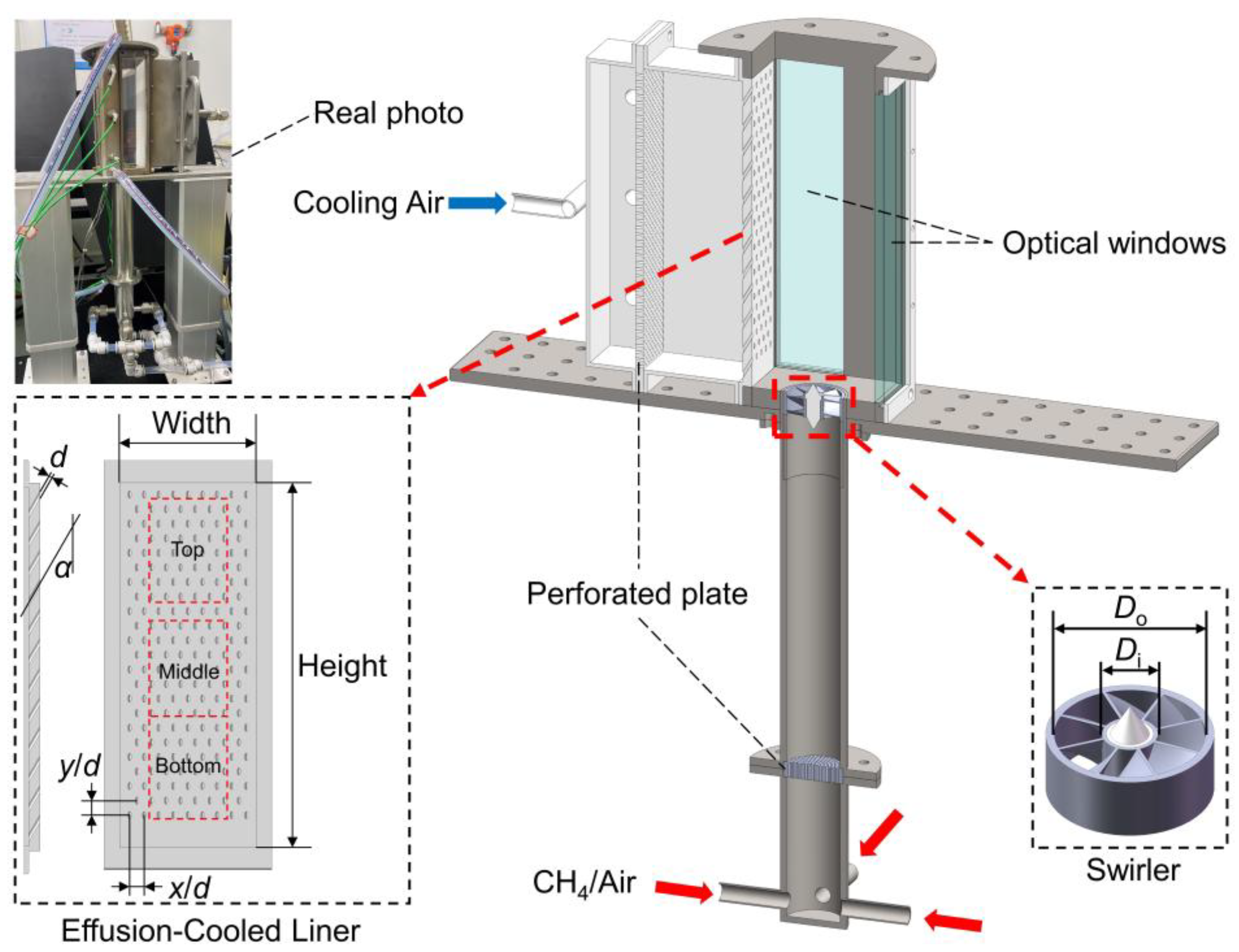
The Aero-Engine Model Combustor, as illustrated in Figure 1, includes a swirl burner, an optically accessible combustion chamber, and a film-cooling device. The premixed CH4/air mixture enters the swirl burner uniformly through four bottom-mounted pipelines, undergoes flow straightening through a perforated plate, and subsequently passes through the swirler to form a stabilized swirling flame. The swirler incorporates eight vanes with a blade angle of 45°, yielding a swirl number of approximately 0.73, calculated as follows [21,22]:
S = 2 3 1 D i / D o 3 1 D i / D o 2 tan θ
In the equation, θ denotes the vane angle, and Dᵢ and Dₒ represent the inner and outer diameters of the swirler, respectively. The optically accessible combustion chamber, mounted above the swirl burner, features a cross-section of 80 mm × 80 mm and a height of 200 mm. Three sides are equipped with optical windows to facilitate laser input for LIP measurements and optical signal detection, while the fourth side serves as the effusion-cooled liner. This liner is perforated with densely distributed 2 mm diameter holes inclined at 30° to the vertical axis, as detailed in Table 1. Except for the effusion-cooled liner, the entire test rig is enclosed in a water-cooled jacket to maintain operational temperatures below 150 °C.
During the experiment, the fuel and air were supplied from a high-pressure methane gas cylinder and an air compressor, respectively. Mass flow controllers (SevenStar, Beijing, China; CS230A for fuel, ±0.35% F.S. accuracy; D07-60J for oxidizer and film-cooling air, ±1.5% F.S. accuracy each) were employed to precisely regulate the flow rates of the fuel, oxidizer, and film-cooling air streams. Prior to entering the swirl burner, the fuel and oxidizer are preliminarily premixed via a three-way connector to generate the combustible mixture. The interaction between the mainstream and cooling film flows was characterized by the blowing ratio M, defined as:
M = ρ c u c ρ m u m
where ρc and ρm denote the densities of the cooling flow and mainstream flow, respectively, and uc and um represent the velocities of the cooling flow and mainstream flow, respectively. The specific experimental conditions are presented in Table 2.

2.2. Combustion Diagnostics System

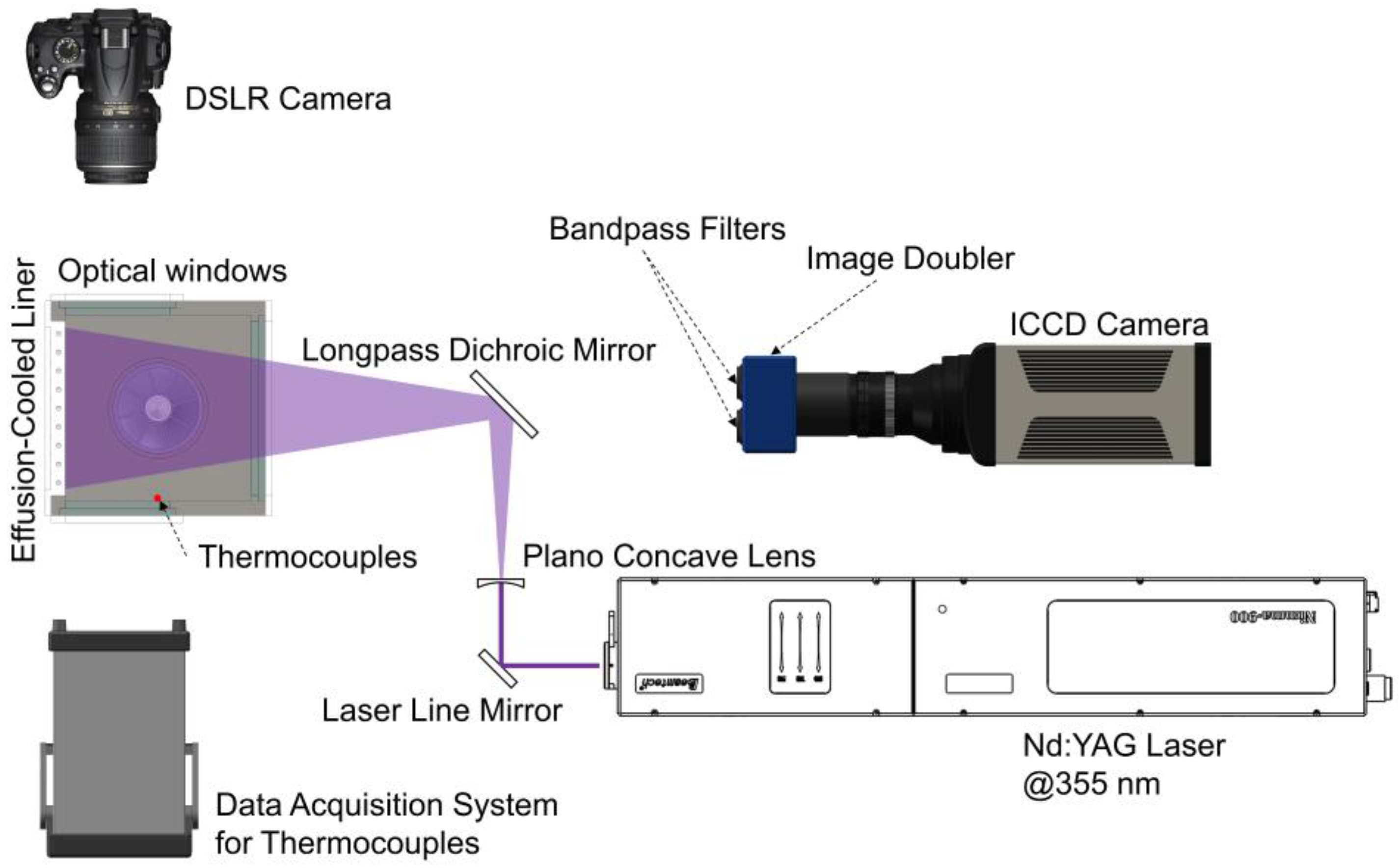
The combustion diagnostics system established in this study is shown in Figure 2. LIP thermometry was utilized to characterize the temperature field of the effusion-cooled liner. YAG:Dy phosphor (Phosphor Technology, Stevenage, UK) was selected as the thermographic phosphor and was mixed with a high-temperature-resistant HPC binder (ZYP Coatings, Oak Ridge, TN, USA) at a ratio of 5 mL binder per 1 g phosphor. The mixture was uniformly applied to the target wall surface using an airbrush driven by a high-pressure air pump. To ensure complete curing, the coated liner was heated in a muffle furnace sequentially at 350 °C and 700 °C for one hour per stage. Experimental studies [23] and theoretical analyses [24] indicate that temperature gradients within the phosphor coating are negligible when the thickness remains below 20 μm. In this study, the coating thickness was maintained at approximately 15–20 μm using a precision thickness gauge. An Nd:YAG laser (Beamtech, Beijing, China; Nimma-900, 10 Hz) generated 355 nm ultraviolet pulses, which were expanded by a plano-concave lens (Thorlabs, Newton, NJ, USA; LC4888-UV) and reflected by a dichroic mirror (Thorlabs, Newton, NJ, USA; DMLP425R) to illuminate the effusion-cooled wall with an 80 mm diameter laser spot at an energy density of 2 mJ/cm2. Given the limited laser spot size, LIP temperature field measurements were performed sequentially on the top, middle, and bottom sections of the effusion-cooled liner, as detailed in Figure 1. Phosphorescence signals induced by the laser were captured by an ICCD camera (Teledyne Princeton Instruments, Trenton, NJ, USA; PI-MAX4), which is equipped with an 85 mm f/1.8 lens (Nikon, Tokyo, Japan) and an image doubler (LaVision, Göttingen, Germany). Bandpass filters centered at 458 nm (Edmund, Barrington, NJ, USA; #65-142, FWHM 10 nm) and 495 nm (Lbtek, Changsha, China; ET495/10x, FWHM 11.5 nm) were mounted before the image doubler to enable simultaneous dual-wavelength phosphorescence imaging. Based on the luminescence lifetime of YAG:Dy, the ICCD gate width was set to 100 μs, and a 100 ns delay between the ICCD and laser was implemented to suppress interference from inelastic scattering and fluorescence. Additionally, during the experiments, a DSLR camera (Nikon, Tokyo, Japan; D5000) was employed to capture flame structures and morphologies under different operating conditions. Type B thermocouples were mounted at multiple positions on the combustor liner, with their exposed measuring junctions tightly affixed to the liner surface to measure near-wall mainstream temperatures at various heights.

2.3. YAG:Dy Temperature Sensitivity Calibration and Phosphorescence Image Matching

A stainless-steel plate with an identical material composition to the effusion-cooled liner was selected. Following the phosphor coating application via the aforementioned procedure, the plate was positioned within a high-temperature electric furnace for YAG:Dy temperature sensitivity calibration. Type B thermocouples monitored the furnace temperature, while identical thermocouples embedded on the calibration plate’s backside measured the actual surface temperature. Covering ambient temperature to 1150 °C, the furnace temperature was incremented in 50 °C steps. At each temperature level, a 15-min holding period was implemented to ensure quasi-steady-state conditions, followed by the acquisition of 100 dual-wavelength phosphorescence images at a frequency of 10 Hz. To minimize systematic errors, experimental parameters (e.g., laser energy density, phosphorescence detection system settings) were maintained consistent with those used during combustor liner LIP temperature measurements. During calibration, phosphorescence signals, background thermal radiation signals, and spatial reference images (namely, flat-field images) were acquired at each temperature point. The flat-field images were used to correct the spatial non-uniformity caused by ICCD camera pixel variations [12] and were obtained by imaging a uniform light source under identical system parameters (ICCD gain, exposure time, etc.). The phosphorescence intensity ratio was determined after implementing background subtraction and spatial non-uniformity correction according to the following equation:
Ratio = I 458 B 458 Ref 458 Ref 495 I 495 B 495
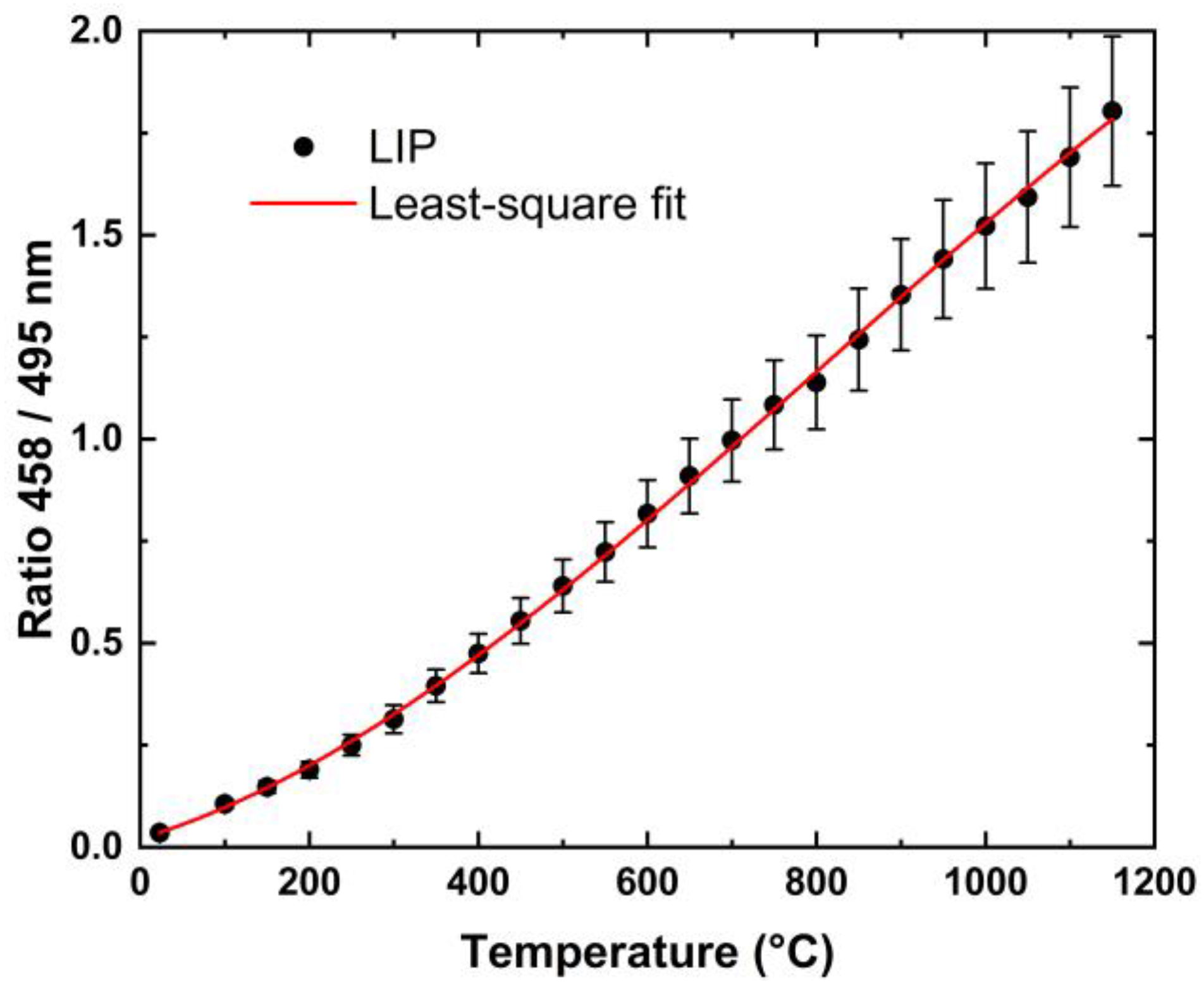
where I denotes the raw phosphorescence image, B denotes the background thermal radiation image, and Ref denotes the spatial reference image. The resultant YAG:Dy temperature sensitivity calibration curve is presented in Figure 3. The standard deviation of 100 phosphorescence intensity ratios acquired at each temperature measurement point is indicated in Figure 3. It can be observed that the standard deviation gradually increases with rising temperature. This trend is primarily attributed to the enhanced thermal radiation signal and the concomitant decrease in phosphorescence intensity at 495 nm due to thermal quenching. As a result, the signal-to-noise ratio degrades, leading to more pronounced fluctuations in the measured values. Despite the increase in the standard deviation of the phosphorescence intensity ratios, the relative error in temperature measurement remains essentially stable, as the measured temperature also rises correspondingly. Within the temperature range of 400–1000 °C, the average measurement uncertainty derived from these standard deviations is approximately ± 5% of the full scale.
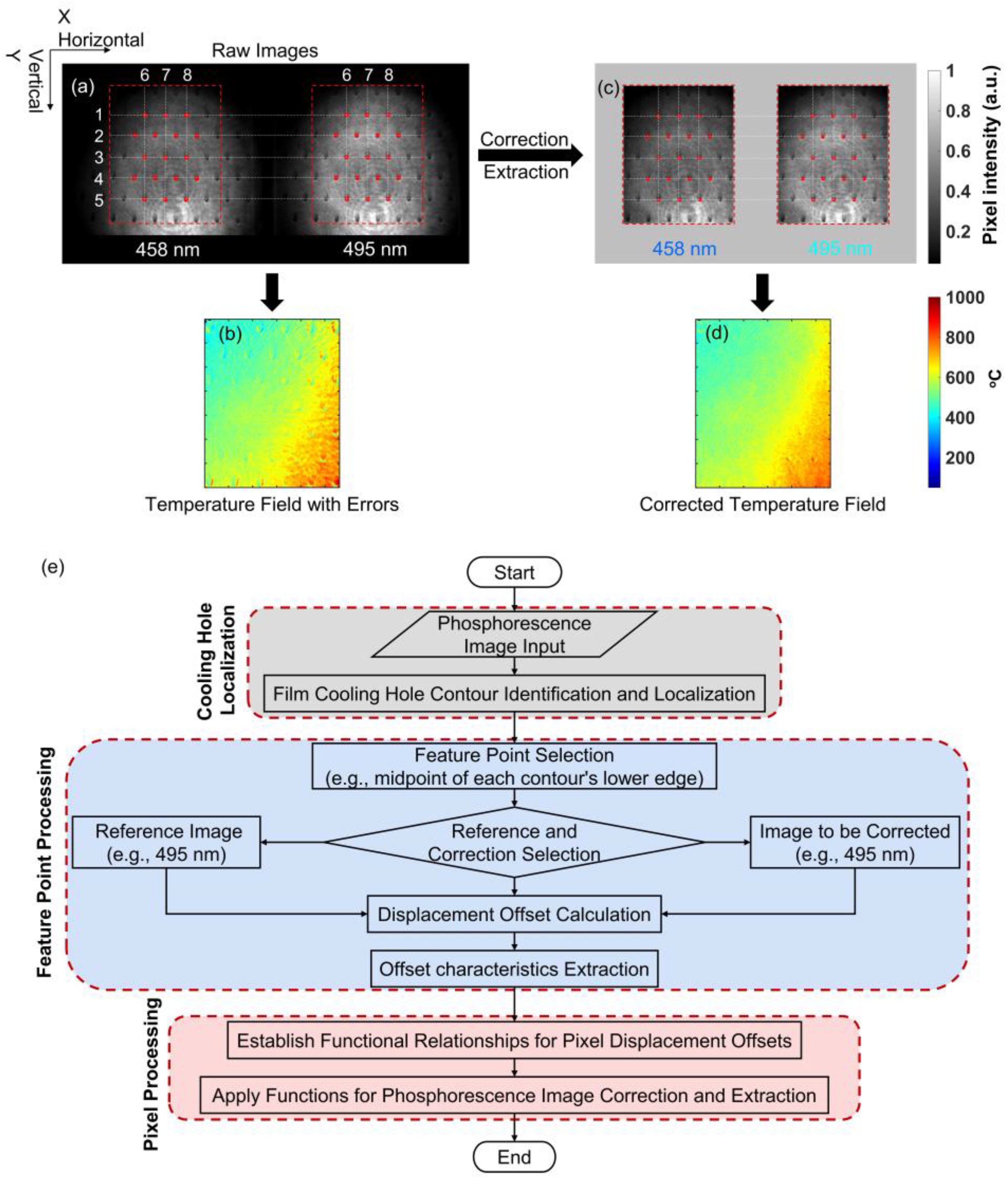
Based on the calibrated temperature sensitivity curve of YAG:Dy in Figure 3, the wall temperature field was determined via pixel-wise calculation of phosphorescence intensity ratios derived from experimentally acquired phosphorescence images of the effusion-cooled liner subjected to swirling flame impingement. Taking ϕ = 0.7, V = 20 m/s, and M = 1 as a representative case, Figure 4a displays the raw phosphorescence images of the middle region on the effusion-cooled liner. Here, the left and right sides correspond to phosphorescence emissions captured at characteristic wavelengths of 458 nm and 495 nm, respectively. However, the integration of optical components such as an image doubler inevitably introduces image distortion, with distortion magnitudes differing between the two characteristic wavelengths. Marking the position of each film cooling hole with a red dot located at its center and tangent to the lower contour edge, it can be observed that the left and right phosphorescence images with different characteristic wavelengths exhibit varying degrees of offset in both horizontal and vertical directions. For the horizontal direction (reference lines 1–5), marker points in the 495 nm image align centrally with dashed lines, whereas those at 458 nm exhibit variable vertical offsets dependent on X-axis coordinates. Similarly, for the vertical direction (reference lines 6–8), horizontal offsets differ between the two spectral bands. Although the aforementioned distortion amounts to a misalignment of only several pixels, the high perforation density of the effusion-cooled liner renders these misalignments visually pronounced. Direct ratio calculation using the uncorrected 458 nm and 495 nm images at this stage would induce temperature field errors due to spatial mismatch, as illustrated in Figure 4b. At the edge of the film cooling holes, temperature field distortions are distinctly observable due to bilateral registration misalignment. Therefore, spatial registration correction must be applied to the raw dual-wavelength phosphorescence images. Conventional studies typically utilize pre-calibrated spatial mapping matrices for correction, but this approach is applicable only under laboratory conditions with static targets. In actual aero-engine combustor environments characterized by severe vibrations, cold-state spatial corrections are inadequate for operational measurements. Consequently, resolving spatial registration between multi-wavelength images is essential for the broader implementation of spectral intensity ratio-based LIP thermometry in aero-engine hot-section components.
The film cooling holes on the combustor liner, while accentuating temperature measurement errors induced by mismatched phosphorescence image registration, simultaneously function as densely distributed feature points viewed from a different perspective. For any phosphorescence image, firstly, this study identifies and locates the contours of all film cooling holes, and the midpoint of each contour’s lower edge is selected as a feature point, denoted by red markers in Figure 4a. Subsequently, using feature points in the phosphorescence image of one characteristic wavelength (e.g., 495 nm) as references, the displacement offsets of corresponding points in the image with the other characteristic wavelength (e.g., 458 nm) are calculated. Thereafter, based on offset characteristics from multiple feature points, fitting establishes functional relationships describing the displacement offset magnitudes of each pixel in the 458 nm image as functions of their X and Y coordinates. These functions are then utilized to correct and extract phosphorescence images for each characteristic wavelength, as shown in Figure 4c. The aforementioned image processing procedure is shown in Figure 4e. In the corrected images, marker points across the different characteristic wavelengths are aligned on the same horizontal line and exhibit consistent offset characteristics in the vertical direction. Finally, ratio calculation performed on the extracted phosphor images after correction yields the wall temperature field, shown in Figure 4d. It can be observed that temperature deviations around the film cooling holes induced by spatial misregistration are eliminated, and the temperature gradient transitions smoothly. Therefore, for LIP thermometry on combustor film-cooled liner, adopting the aforementioned method eliminates the need for prior spatial-physical coordinate calibration and enables independent distortion correction and precise spatial registration of wavelength-specific phosphorescence signal regions within individual phosphorescence images, thus remaining unaffected by ambient vibrations while achieving high-precision matching. Subsequent temperature field measurements on the effusion-cooled liner in this study consistently implemented this spatial registration approach.

3. Results and Discussion

3.1. Flame Structures

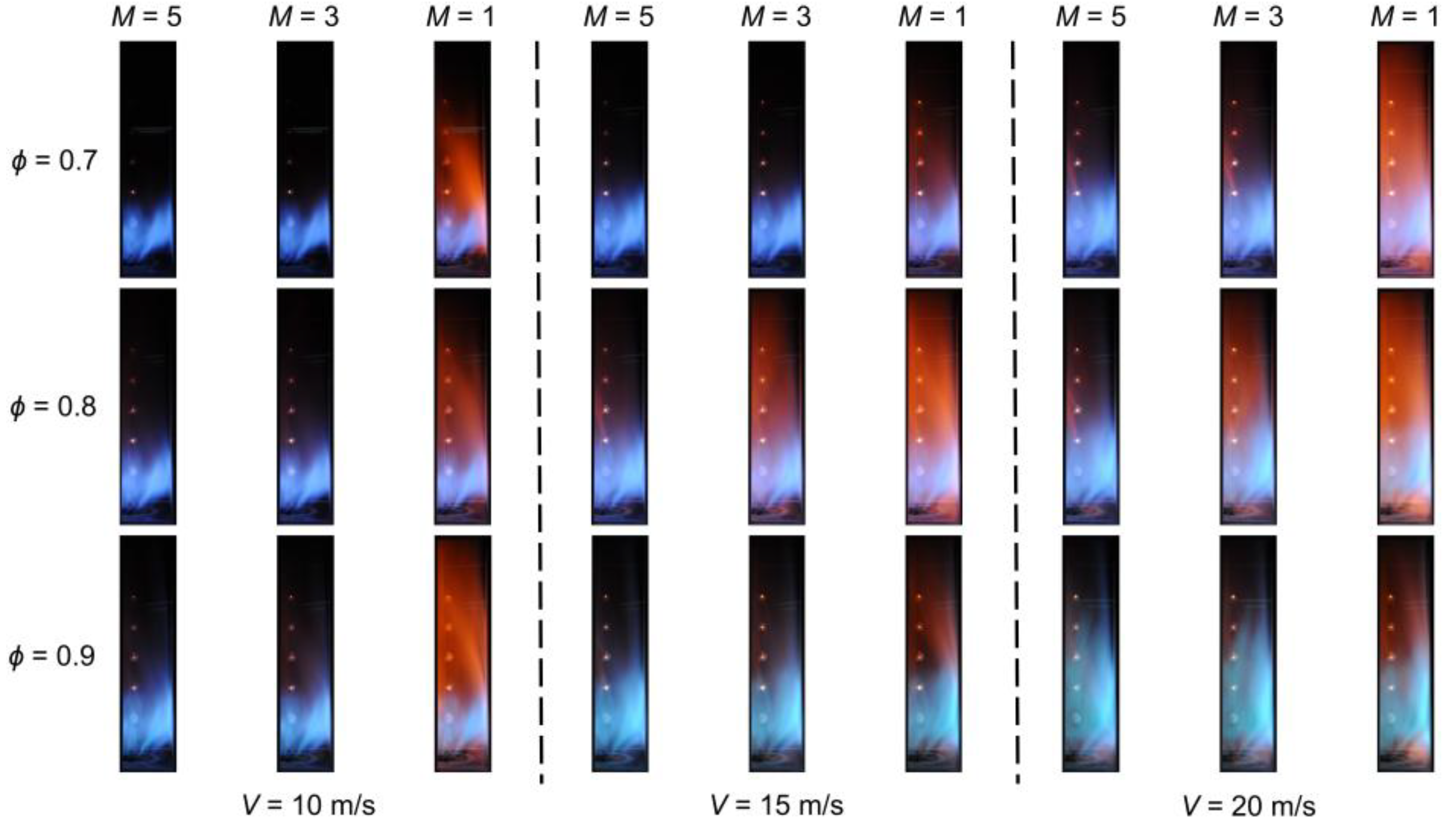
Figure 5 displays half-section morphologies of CH4/Air premixed swirling flames under all 27 operational conditions captured by a DSLR camera, parameterized by equivalence ratio (ϕ), inlet velocity (V), and blowing ratio (M). The right side of each image corresponds to the film-cooled liner, featuring bright spots originating from heated thermocouple probes behind the flames due to intense thermal radiation. Owing to the 45° swirler configuration, the upstream flame morphology exhibits V-shaped structures across nearly all conditions, persisting downstream after wall impingement. It can be clearly seen that the increasing ϕ and V, combined with decreasing M, markedly intensify flame combustion and wall impingement severity. Specifically, elevated ϕ and V not only enhance combustion intensity (manifested as increased flame luminosity) but also elongate flame fronts, potentially elevating wall temperatures and altering high-temperature zone distributions, which will be analyzed subsequently. The M value represents the amount of cooling air, significantly influencing the flame characteristics and combustor liner temperature. For instance, under the M = 1 condition, a substantial reduction in cooling airflow elevates the near-wall flame temperature; more critically, this reduction intensifies flame-wall proximity, resulting in enhanced thermal impingement, while the diminished inherent cooling capacity concurrently increases thermal loading on the wall surface.

3.2. Dynamic Response of LIP Thermometry

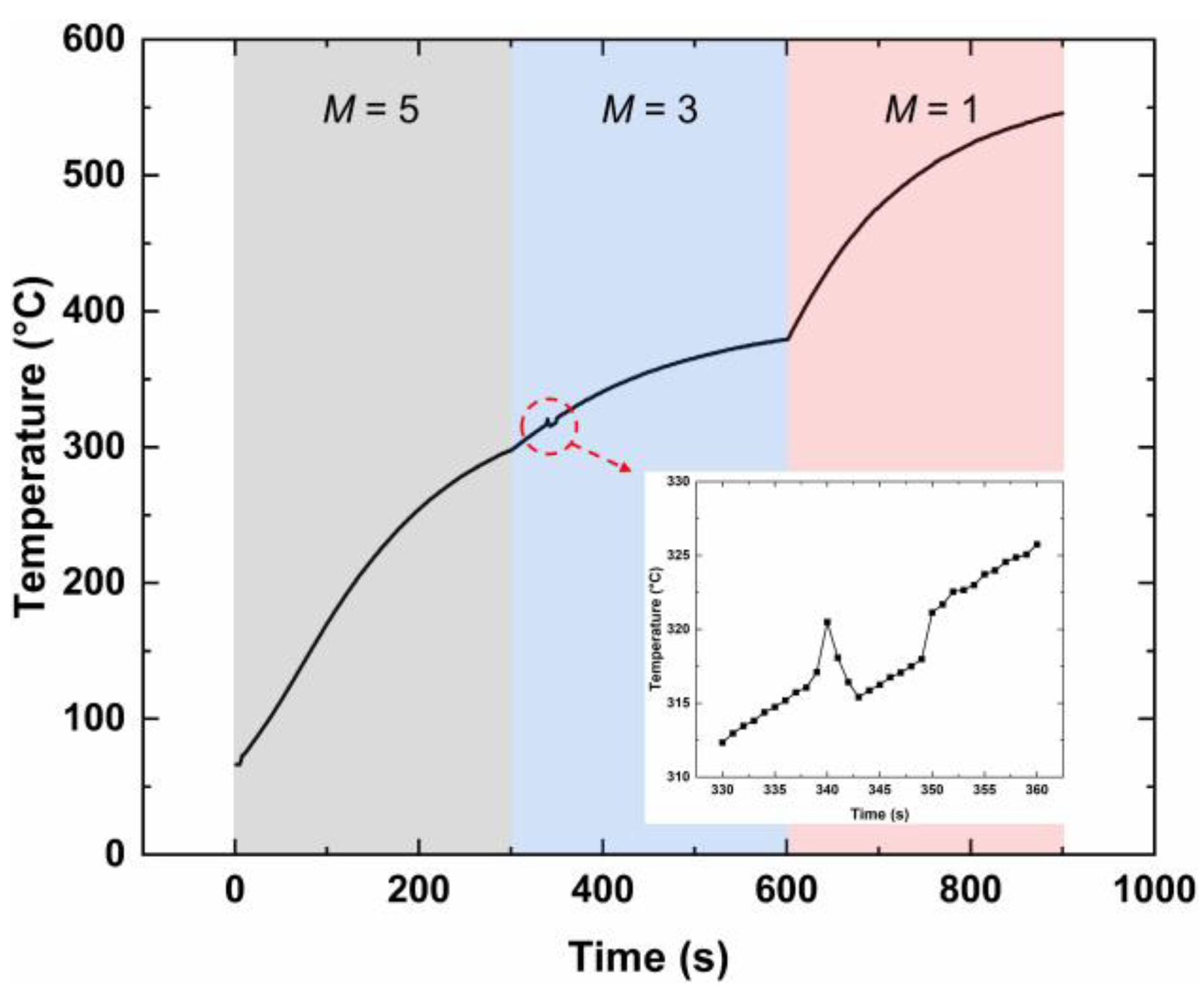
Owing to the persistent erosive impingement of turbulent high-temperature flames on the combustor liner, transient temperature variations are often more critical than steady-state temperatures. Consequently, LIP thermometry was employed to dynamically monitor temperature evolution across operational regimes, simultaneously capturing transient temperature responses and eventual steady-state distributions. Figure 6 presents the dynamic variation in average temperature within the middle region of the effusion-cooled liner measured using LIP thermometry for a representative case, spanning from the initial ignition phase through the gradual reduction in M from 5 to 1. The data indicate progressively increasing temperature throughout this process, with abrupt reductions in M inducing pronounced increases in wall heating rates. The magnified view in the lower-right corner demonstrates LIP thermometry’s capability to analyze transient temperature fluctuations induced by combustion instability during operation. These experimental results demonstrate that the LIP thermometry system developed in this study enables accurate and rapid capture of dynamic liner temperature changes during combustion, achieving a time resolution on the order of seconds. Compared to the prior LIP temperature measurements conducted on quasi-steady film-cooled liners in model aero-engine combustors, this system achieves higher temporal resolution in wall temperature field monitoring.

3.3. Effusion-Cooled Liner Temperature Rise Rate

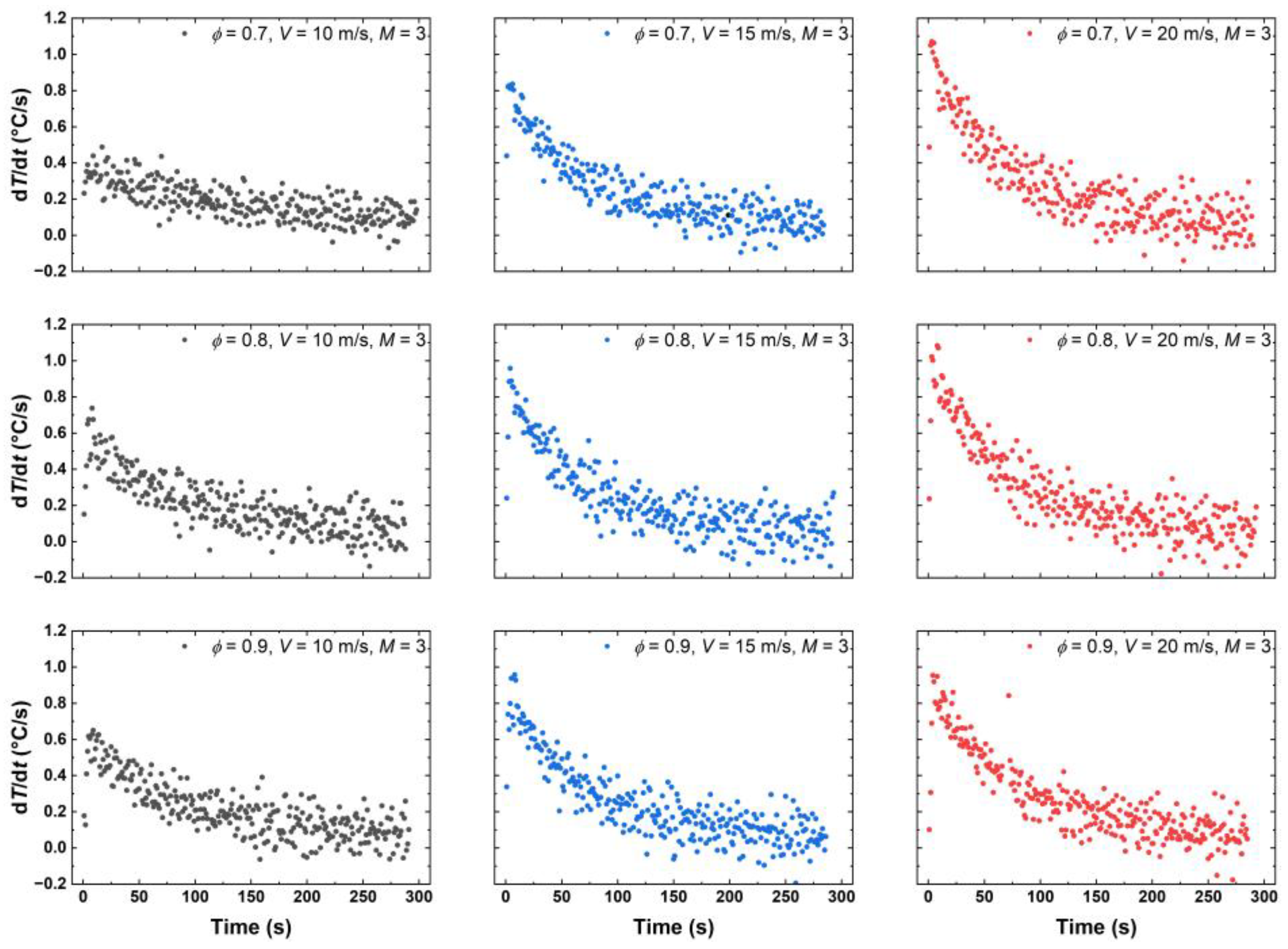
As preliminarily observable in Figure 6, for all operating conditions, when ϕ and V are held constant, an instantaneous change in M will induce a marked variation in the temperature rise rate. To quantitatively characterize this behavior, the time derivative of the dynamic spatially averaged temperature is computed to obtain specific heating rate values. Owing to article length constraints, the top region of the effusion-cooled wall is designated the characteristic region, as it experiences weaker flame impingement compared to the central and bottom regions, thereby minimizing flame-induced interference to better investigate the effect of M on the heating rate. Figure 7 presents the temporal evolution of the average heating rates in this region following a reduction in M from 5 to 3 under various combustion conditions. Consistently across all operating conditions, reducing M causes the wall heating rate to rise sharply to a peak value within a short duration before progressively decreasing over time until it asymptotically approaches zero, indicating that the wall temperature approaches a steady state. Comparison of heating rates under different conditions reveals that, for a fixed V, the immediate enhancement of the wall heating rate triggered by reducing M is largely consistent across varying ϕ. However, when ϕ is held constant, increasing V leads to a substantially more pronounced immediate enhancement of the wall heating rate upon reducing M. Taking ϕ = 0.7 as an example, at V = 10 m/s, the heating rate increases only to a maximum of approximately 0.5 °C/s instantaneously when M is reduced to 3. Furthermore, at V = 15 m/s, it instantly rises to a maximum of approximately 0.8 °C/s, and at V = 20 m/s, it jumps to a peak of approximately 1.1 °C/s. These data indicate that under operating conditions featuring a high inlet velocity of the combustible premixture, a reduction in M exerts a more pronounced effect on the wall heating rate in the ensuing short period. Therefore, for aero engines operating under high inlet airflow velocity conditions, even brief film cooling system instability or failure can lead to an increased rate of wall temperature rise, subsequently accelerating thermal stress accumulation and ablation risk. Consequently, the design and operational monitoring of advanced aero engine combustors must prioritize ensuring dynamic coolant flow stability under high-velocity conditions. Furthermore, stricter safety thresholds and faster-reacting fault response strategies must be established for such operating regimes. These strategies are essential to effectively prevent uncontrolled wall temperature surges and to maximize combustor liner structural integrity and service life.

3.4. Effusion-Cooled Liner Temperature Field

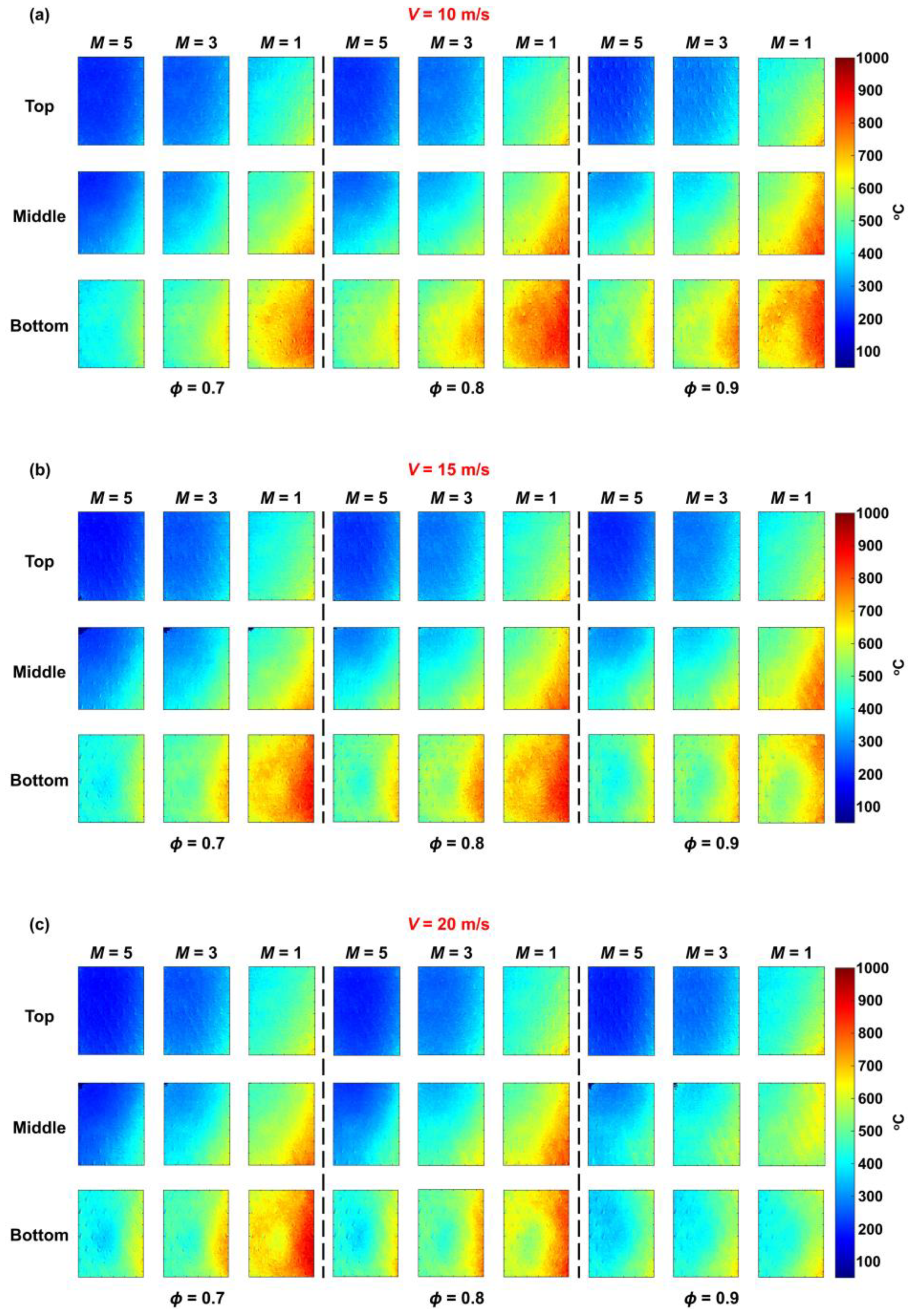
Based on the dynamically measured wall temperature field data, we identify the time at which the heating rate approaches zero and select the temperature field at this instant as representative of the near-steady-state condition, with results presented in Figure 8. Under nearly all operating conditions, the overall wall temperature decreases gradually from bottom to top due to direct flame impingement on the lower portion of the film-cooling plate. Within each distinct region (bottom, middle, and top), the temperature exhibits a gradual decrease from lower-right to upper-left, primarily driven by the counterclockwise swirl direction of the flame. For conditions with fixed ϕ and V, a reduction in M increases both the near-wall local equivalence ratio and flame temperature while decreasing the coolant flow rate at the wall surface, consequently elevating wall temperature significantly. Similarly, for constant V and M, increasing ϕ elevates flame temperature while the coolant flow rate remains essentially unchanged, thus also increasing the wall temperature. However, when ϕ and M are held constant, an increase in V, although indicating greater combustible premixed gas input and higher combustor thermal power, exhibits a relatively minor effect on wall temperature elevation. A notable exception occurs at M = 1; specifically, under conditions of ϕ = 0.9 and M = 1, the wall temperature even decreases significantly with increasing V. This is attributed to the concurrent increase in coolant flow rate under constant M, which mitigates the liner temperature rise despite increased combustor inlet flow velocity.
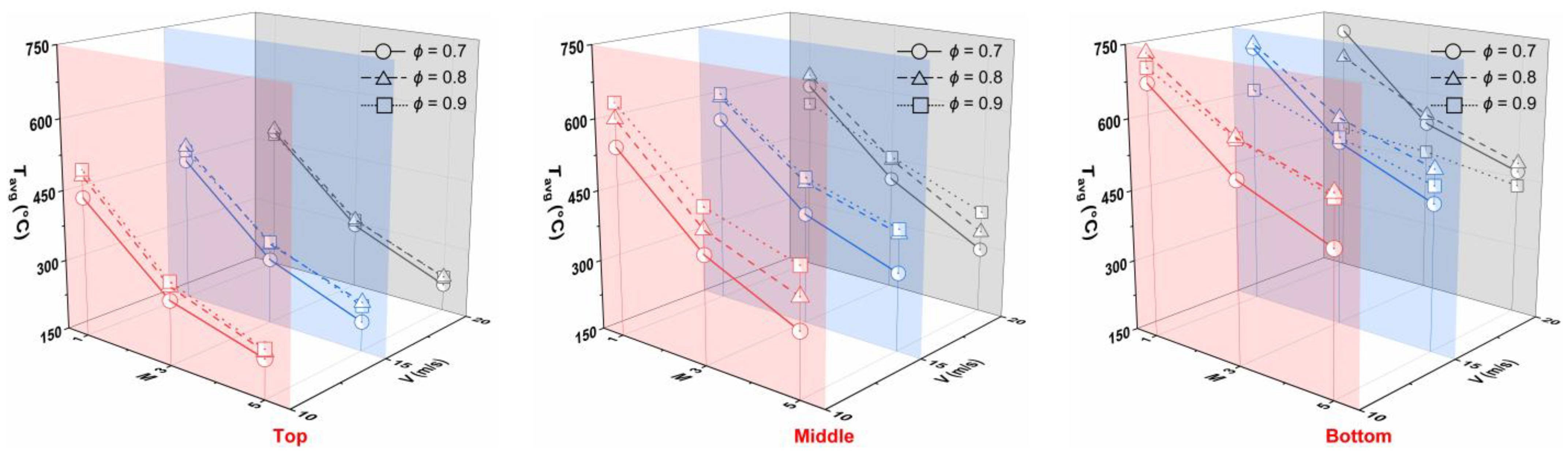
The average temperatures within these distinct regions under various operating conditions are calculated and presented in Figure 9, providing further quantitative detail on the influence patterns of ϕ, V, and M on effusion-cooled liner temperature. Furthermore, with the exception of the bottom region, the effect of ϕ on wall temperature depends strongly on V. Considering the middle region average temperature at M = 3 as an illustrative case, the temperature variation induced by different ϕ is approximately 100 K at V = 10 m/s, while diminishing to roughly 50 K at V = 20 m/s. Analysis of all experimental data confirms that the influence of ϕ on the average liner temperature of the middle and top regions significantly diminishes with increasing V.

3.5. Temperature Distribution Along the Liner Height Direction

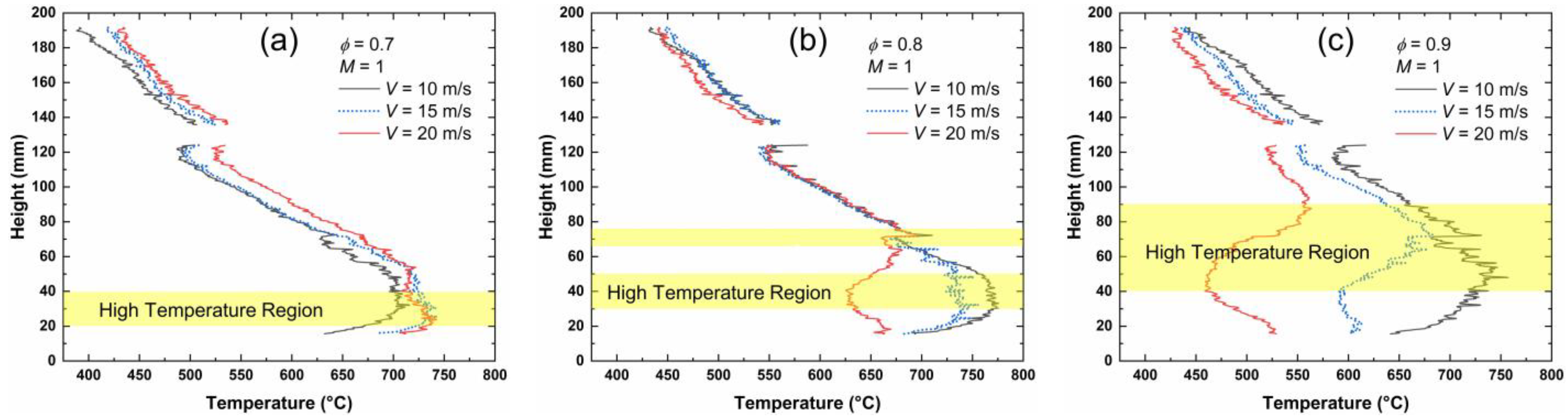
The temperature distribution along the wall height direction reflects, to a certain extent, the degree of influence from factors including swirling flame structure and flame impingement location. To minimize the cooling film interference on the analysis, operating conditions corresponding to M = 1 were selected. Liner temperatures were averaged horizontally, yielding the temperature distribution along the liner height shown in Figure 10. Compared to the temperature field in Figure 8, Figure 10 provides a more intuitive and precise visualization of its spatial temperature evolution. For most conditions, the overall temperature decreases from bottom to top, with high temperature regions appearing at various heights above the liner bottom, identified through analysis as experiencing relatively intense flame impingement from the swirling flow. As ϕ increases, influenced by flame structure, the position of this high-temperature region progressively shifts upwards. Specifically, at ϕ = 0.7, the maximum temperature locations across different V all occur at height = 30 mm; however, at ϕ = 0.8, they rise to approximately height = 40 mm, shifting further upward at ϕ = 0.9. Furthermore, at ϕ = 0.7, increasing V has a negligible impact on the height-wise temperature distribution. Yet when ϕ increases to 0.8, compared to the lower V, V = 20 m/s shifts the high temperature region upward noticeably by approximately 30 mm. This upward shift intensifies as ϕ rises to 0.9, additionally, due to flame front elongation under high V at this elevated ϕ, the temperature gradient along the wall height direction is further reduced. Specifically, the difference between the maximum and minimum wall temperatures decreases from about 300 °C at V = 10 m/s to below 150 °C at V = 20 m/s, representing a reduction of approximately 50%.

3.6. Cooling Effectiveness Along the Liner Height Direction

This study employs cooling effectiveness η to evaluate the combustor liner cooling performance, expressed as:
η = T m T w T m T c
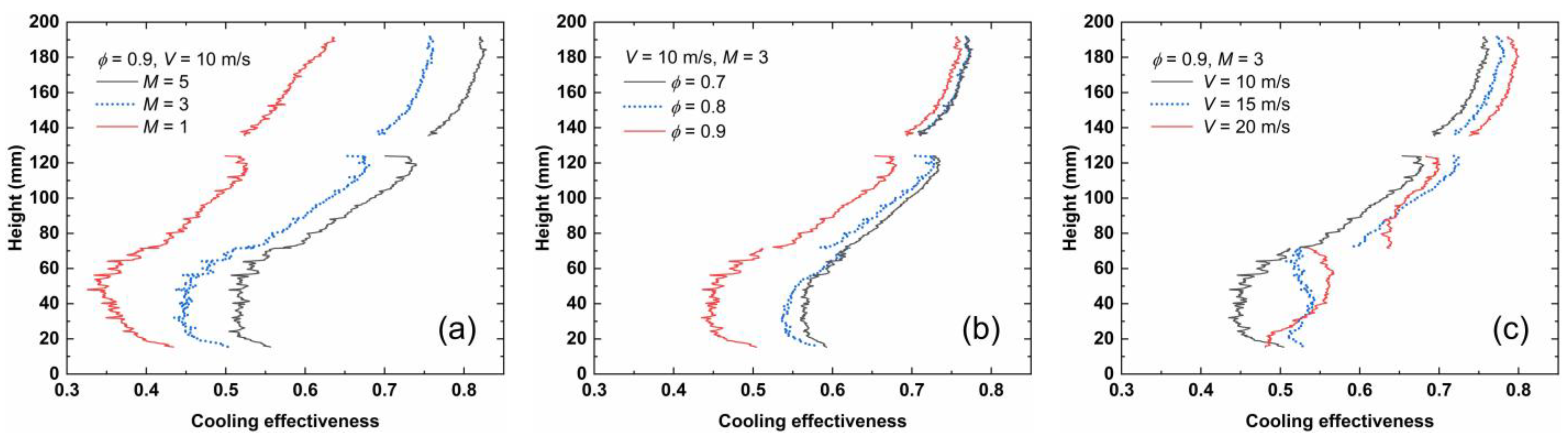
Here, Tm denotes the uncooled mainstream gas temperature near the wall, Tw represents the combustor liner temperature, and Tc signifies the cooling air temperature. Based on the liner temperature distributions along the height direction acquired via LIP thermometry and radiation-corrected uncooled mainstream gas temperatures near the combustor liner measured by thermocouples, the height-wise distribution of η under different operating conditions is presented in Figure 11. Figure 11a illustrates η at various M values for a constant combustion condition. As anticipated, η is proportional to M, indicating that increasing the coolant mass flux significantly enhances η. Figure 11b,c depict the influence of combustion parameters on η at constant M. Figure 11b shows that increasing ϕ alone significantly decreases η. Unlike Figure 11a, the η variation is non-uniform along the height; the decrease is most pronounced near the wall bottom, where an increase in ϕ causes η to drop by approximately 0.15. The magnitude of this change progressively diminishes toward the top, until η near the wall top becomes virtually unaffected by ϕ. Analysis integrating the flame structure images and liner temperatures indicates this occurs primarily because increasing ϕ alone substantially elevates the fuel proportion within the premixed gas, leading to significantly increased flame temperature and consequent local heat flux. With V and M unchanged, the supplied coolant mass flux remains constant, consequently causing a significant reduction in η. As the intensity of flame impingement decays progressively upward from the plate bottom, the impact of increasing ϕ on η follows this spatial gradient. Figure 11c depicts the effect of V on η. Evidently, for a constant M, increasing V yields significantly higher η. This conclusion also accounts for the phenomenon observed before, although increasing V raises combustor thermal power, the concomitant significant increase in η results in a lower temperature for the effusion-cooled liner.

4. Conclusions

Based on the LIP thermometry technique, this study measures the effusion-cooled liner temperature field of an aero-engine model combustor at varying blowing ratios and different swirling combustion states. An optimization method utilizing the geometric characteristics of the effusion-cooled liner for matching phosphorescence images at different wavelengths is introduced, extending the application of LIP thermometry based on phosphorescence intensity ratio to vibration environments. Focus then shifts to the dynamic temperature monitoring response of the LIP technique for the combustor liner, verifying its seconds-timescale dynamic temperature response capability. Leveraging this dynamic monitoring capability, the study investigates the instantaneous impact of M variations on the combustor liner temperature field. It is found that under high-V conditions, reducing M induces a more significant increase in the liner temperature rise rate immediately after the change. Subsequently, LIP measurements capture near-steady-state liner temperature fields across a broad range of combustion and cooling conditions. Accurate temperature fields of the effusion-cooled combustor liner are obtained within ϕ of 0.7–0.9, V of 10–20 m/s, and M of 1–5. The interaction mechanisms between ϕ, V, and M, concerning their effects on both the average temperature of the film-cooled liner and the temperature distribution along the liner height, are examined. Experimental results demonstrate that a decrease in M and an increase in ϕ significantly elevate the effusion-cooled liner temperature, whereas increased V exerts a negligible influence on wall temperature elevation (except when M = 1). Notably, higher V values diminish the impact of ϕ on the average wall temperature of the middle and top regions. Analysis of the temperature distribution along the wall height further reveals that increases in both ϕ and V shift the high-temperature region upward, with ϕ exerting a stronger influence. Concurrent increases in both ϕ and V produce increasingly uniform temperature distributions along the height direction. Finally, based on the liner temperature distributions along the height direction, acquired via LIP thermometry and radiation-corrected uncooled mainstream gas temperatures near the combustor liner measured by thermocouples, the study derives height-resolved cooling efficiency distributions under various conditions. These research outcomes can offer valuable insights and methodological support for cooling design and dynamic surface temperature field measurement in actual aero-engine combustors.

Author Contributions

Conceptualization, Z.W. (Zhihua Wang 1) and Z.W. (Zhihua Wang 2); methodology, Y.H. (Yu Huang), S.L. and T.Z.; software, Y.H. (Yu Huang); validation, Y.H. (Yu Huang), S.L. and X.W.; formal analysis, Y.H. (Yu Huang); investigation, Y.H. (Yu Huang) and X.W.; resources, Z.W. (Zhihua Wang 2); data curation, Y.H. (Yu Huang); writing—original draft preparation, Y.H. (Yu Huang); writing—review and editing, Y.H. (Yu Huang), S.L., T.Z., W.W., Z.W. (Zhihua Wang 1), Y.H. (Yong He) and Z.W. (Zhihua Wang 2); visualization, Y.H. (Yu Huang); supervision, W.W., Y.H. (Yong He) and Z.W. (Zhihua Wang 2); project administration, Z.W. (Zhihua Wang 1) and Z.W. (Zhihua Wang 2); funding acquisition, Z.W. (Zhihua Wang 2). All authors have read and agreed to the published version of the manuscript.

Funding

This research was funded by the Project of the Aero Engine Corporation of China, grant number HFZL2022CXY023, National Natural Science Foundation of China, grant number 52125605, National Key R&D Program of China, grant number 2023YFE0114400, Fundamental Research Funds for the Central Universities, grant number 2022ZFJH04.

Data Availability Statement

The original contributions presented in this study are included in the article. Further inquiries can be directed to the corresponding author.

Conflicts of Interest

Authors Tingjie Zhao and Zhihua Wang 1 were employed by the company Guiyang Engine Design Research Institute, Aero Engine Corporation of China. The remaining authors declare that the research was conducted in the absence of any commercial or financial relationships that could be construed as a potential conflict of interest. The authors declare that this study received funding from Project of the Aero Engine Corporation of China. The funding sponsors had no role in the design of the study; in the collection, analyses, or interpretation of data; in the writing of the manuscript; or in the decision to publish the results.

Abbreviations

The following abbreviations are used in this manuscript:
BBackground thermal radiation image
CNRSCentre national de la recherche scientifique
dHole diameter
DiInner diameter of the swirler
DLRDeutsches Zentrum für Luft- und Raumfahrt
DoOuter diameter of the swirler
IRaw phosphorescence image
LIPLaser-Induced Phosphorescence
MBlowing ratio
nNumber of holes
PPorosity
PthTheoretical thermal power
QcoolCooling air volume flow
QfuelFuel volume flow
QoxOxidizer volume flow
RefSpatial reference image
SSwirl number
TU DarmstadtTechnische Universität Darmstadt
VAxial inlet flow velocity
x/dAxial distance
y/dLateral distance
αAngle
θVane angle
ϕEquivalence ratio

References

  1. Krewinkel, R. A review of gas turbine effusion cooling studies. Int. J. Heat Mass. Transf. 2013, 66, 706–722. [Google Scholar] [CrossRef]
  2. Yellu Kumar, K.R.; Qayoum, A.; Saleem, S.; Qayoum, F. Effusion Cooling in Gas Turbine Combustion Chambers—A Comprehensive Review. IOP Conf. Ser. Mater. Sci. Eng. 2020, 804, 012003. [Google Scholar] [CrossRef]
  3. Wang, W.; Yan, Y.; Zhou, Y.; Cui, J. Review of Advanced Effusive Cooling for Gas Turbine Blades. Energies 2022, 15, 8568. [Google Scholar] [CrossRef]
  4. Liu, S.; Huang, Y.; He, Y.; Zhu, Y.; Wang, Z. Review of Development and Comparison of Surface Thermometry Methods in Combustion Environments: Principles, Current State of the Art, and Applications. Processes 2022, 10, 2528. [Google Scholar] [CrossRef]
  5. Tian, J.; Fu, T.; Xu, Q.; Jiang, H. Effective Spectral Emissivity of Gas Turbine Blades for Optical Pyrometry. J. Heat Transf. Trans. ASME 2017, 139, 072701. [Google Scholar] [CrossRef]
  6. Gao, S.; Zhang, X.; Chen, L.; Cui, Y.; Jiang, J.; Zhang, Z.; Yu, P.; Wang, C. Review: Radiation temperature measurement methods for engine turbine blades and environment influence. Infrared Phys. Technol. 2022, 123, 104204. [Google Scholar] [CrossRef]
  7. Ji, J.; Yan, B.; Sun, C.; Wang, B.; Ding, M. ANew Positioning Method of Multichannel Pyrometer in Aeroengine. IEEE Sens. J. 2023, 23, 29749–29760. [Google Scholar] [CrossRef]
  8. Noel, B.W.; Borella, H.M.; Franks, L.A.; Marshall, B.R.; Allison, S.W.; Cates, M.R.; Stange, W.A. Proposed laser-induced fluorescence method for remote thermometry inturbine engines. J. Propul. Power 1986, 2, 565–568. [Google Scholar] [CrossRef]
  9. Noel, B.W.; Borella, H.M.; Lewis, W.; Turley, W.D.; Beshears, D.L.; Capps, G.J.; Cates, M.R.; Muhs, J.D.; Tobin, K.W. Evaluating Thermographic Phosphors in an Operating Turbine Engine. J. Eng. Gas. Turbines Power-Trans. ASME 1991, 113, 242–245. [Google Scholar] [CrossRef]
  10. Seyfried, H.; Sa¨rner, G.; Omrane, A.; Richter, M.; Schmidt, H.; Alde’n, M. Optical Diagnostics for Characterization of a Full-Size Fighter-Jet Afterburner. In Proceedings of the ASME Turbo Expo 2005: Power for Land, Sea, and Air, Reno, NV, USA, 6–9 June 2005; American Society of Mechanical Engineers: New York, NY, USA, 2005; Volume 1, pp. 813–819. [Google Scholar] [CrossRef]
  11. Seyfried, H.; Richter, M.; Aldén, M.; Schmidt, H. Laser-Induced Phosphorescence for Surface Thermometry in the Afterburner of an Aircraft Engine. AIAA J. 2007, 45, 2966–2971. [Google Scholar] [CrossRef]
  12. Aldén, M.; Omrane, A.; Richter, M.; Särner, G. Thermographic phosphors for thermometry: A survey of combustion applications. Prog. Energy Combust. Sci. 2011, 37, 422–461. [Google Scholar] [CrossRef]
  13. Nau, P.; Yin, Z.; Geigle, K.P.; Meier, W. Wall temperature measurements at elevated pressures and high temperatures in sooting flames in a gas turbine model combustor. Appl. Phys. B-Lasers Opt. 2017, 123, 279. [Google Scholar] [CrossRef]
  14. Yin, Z.; Nau, P.; Meier, W. Responses of combustor surface temperature to flame shape transitions in a turbulent bi-stable swirl flame. Exp. Therm. Fluid Sci. 2017, 82, 50–57. [Google Scholar] [CrossRef]
  15. Nau, P.; Yin, Z.; Lammel, O.; Meier, W. Wall Temperature Measurements in Gas Turbine Combustors with Thermographic Phosphors. J. Eng. Gas. Turbines Power-Trans. ASME 2018, 141, 041021. [Google Scholar] [CrossRef]
  16. Arndt, C.M.; Nau, P.; Meier, W. Characterization of wall temperature distributions in a gas turbine model combustor measured by 2D phosphor thermometry. Proc. Combust. Inst. 2021, 38, 1867–1875. [Google Scholar] [CrossRef]
  17. Greifenstein, M.; Hermann, J.; Boehm, B.; Dreizler, A. Flame–cooling air interaction in an effusion-cooled model gas turbine combustor at elevated pressure. Exp. Fluids 2018, 60, 10. [Google Scholar] [CrossRef]
  18. Petit, S.; Blaise, A.; Godard, G.; Mille, B.; Muller, T.; Toutain, P.; Grisch, F.; Xavier, P. Experimental Study of the Interaction between a Turbulent Flame and a Cooling Air Film. In Proceedings of the 20th International Symposium on the Application of Laser and Imaging Techniques to Fluid Mechanics, Lisbon, Portugal, 11–14 July 2022. [Google Scholar] [CrossRef]
  19. Petit, S.; Quevreux, B.; Morin, R.; Guillot, R.; Grisch, F.; Xavier, P. Experimental Investigation of Flame-Film Cooling Interactions with an Academic Test Rig Optical Laser Diagnostics. J. Turbomach. Trans. ASME 2022, 145, 041007. [Google Scholar] [CrossRef]
  20. Blaise, A.; Petit, S.; Grisch, F.; Xavier, P. Effect of the blowing ratio on the interaction between a flame and an air-cooled combustor wall. In Proceedings of the ASME Turbo Expo 2023: Turbomachinery Technical Conference and Exposition, Boston, MA, USA, 26–30 June 2023. [Google Scholar] [CrossRef]
  21. Huang, Y.; Yang, V. Dynamics and stability of lean-premixed swirl-stabilized combustion. Prog. Energy Combust. Sci. 2009, 35, 293–364. [Google Scholar] [CrossRef]
  22. Cavaliere, D.E.; Kariuki, J.; Mastorakos, E. A Comparison of the Blow-Off Behaviour of Swirl-Stabilized Premixed, Non-Premixed and Spray Flames. Flow. Turbul. Combust. 2013, 91, 347–372. [Google Scholar] [CrossRef]
  23. Knappe, C.; Algotsson, M.; Andersson, P.; Richter, M.; Tunér, M.; Johansson, B.; Aldén, M. Thickness dependent variations in surface phosphor thermometry during transient combustion in an HCCI engine. Combust. Flame 2013, 160, 1466–1475. [Google Scholar] [CrossRef]
  24. Pilgrim, C.C.; Feist, J.P.; Heyes, A.L. On the effect of temperature gradients and coating translucence on the accuracy of phosphor thermometry. Meas. Sci. Technol. 2013, 24, 105201. [Google Scholar] [CrossRef]
Figure 1. Schematic diagram of an aero-engine model combustor.
Energies 19 00805 g001
Figure 2. Combustion diagnostics system for the aero-engine model combustor.
Energies 19 00805 g002
Figure 3. Temperature sensitivity calibration curve of YAG:Dy.
Energies 19 00805 g003
Figure 4. Comparison of raw images post-processing workflows: direct ratio calculation vs. calculation following images correction and matching. (a) Raw phosphorescence images. (b) Temperature field with errors. (c) Corrected and extracted phosphorescence images. (d) Corrected temperature field. (e) Flowchart of phosphorescence images correction processing.
Energies 19 00805 g004
Figure 5. Flame structure under different operating conditions captured by a DSLR camera.
Energies 19 00805 g005
Figure 6. Dynamic evolution of mid-region average temperature measured by LIP thermometry.
Energies 19 00805 g006
Figure 7. Variation in temperature rise rate after reduction in M from 5 to 3 under different operating conditions.
Energies 19 00805 g007
Figure 8. Effusion-cooled liner temperature fields under various operating conditions. (a) Various operating conditions at V = 10 m/s. (b) Various operating conditions at V = 15 m/s. (c) Various operating conditions at V = 20 m/s.
Energies 19 00805 g008
Figure 9. Regional average surface temperatures of an effusion-cooled liner under different operating conditions.
Energies 19 00805 g009
Figure 10. Temperature distribution along the effusion-cooled liner height direction at M = 1 and V = 10, 15, 20 m/s for different ϕ. (a) ϕ = 0.7. (b) ϕ = 0.8. (c) ϕ = 0.9.
Energies 19 00805 g010
Figure 11. Cooling effectiveness along the effusion-cooled liner height direction. (a) M = 5, 3, 1 for ϕ = 0.9, V = 10 m/s. (b) ϕ = 0.7, 0.8, 0.9 for V = 10 m/s, M = 3. (c) V = 10, 15, 20 m/s for ϕ = 0.9, M = 3.
Energies 19 00805 g011
Table 1. Effusion geometry.
PropertySymbolValueUnit
Width-75mm
Height-200mm
Number of holesn196-
Angleα30°
Hole diameterd2mm
Axial distancex/d4-
Lateral distancey/d4-
PorosityP4%
Material-S31008-
Table 2. Experimental operating conditions.
PropertySymbolValueUnit
Equivalence ratioϕ[0.7, 0.8, 0.9]-
Axial inlet flow velocityV[10, 15, 20]m/s
Blowing ratioM[1, 3, 5]-
Theoretical thermal powerPth[20–50]kW
Fuel volume flowQfuel[34–86]SLM
Oxidizer volume flowQox[454–927]SLM
Cooling air volume flowQcool[46–464]SLM
Disclaimer/Publisher’s Note: The statements, opinions and data contained in all publications are solely those of the individual author(s) and contributor(s) and not of MDPI and/or the editor(s). MDPI and/or the editor(s) disclaim responsibility for any injury to people or property resulting from any ideas, methods, instructions or products referred to in the content.