Article

An Empirical Assessment of the Green Energy Transition, Sustainable Development, and Socioeconomic Impacts Under the New Normal Framework in the European Union


by
Jean Vasile Andrei
1,2,*,
Violeta Sima
1,2,
Ileana Georgiana Gheorghe
2,
Mihaela Oprea
1 and
Marius George Popa
3,*
1
National Institute for Economic Research “Costin C. Kiriţescu”, Romanian Academy, 050711 Bucharest, Romania
2
Business Administration Department, Faculty of Economic Scienses, Petroleum-Gas University of Ploiesti, B-dul Bucuresti, No. 39, 100680 Ploiesti, Romania
3
Faculty of Agrifood and Environmental Economics, Doctoral School of Economics II, Bucharest University of Economic Studies, 010374 București, Romania
*
Authors to whom correspondence should be addressed.
Energies 2026, 19(3), 807; https://doi.org/10.3390/en19030807
Submission received: 7 December 2025 / Revised: 25 January 2026 / Accepted: 27 January 2026 / Published: 3 February 2026

Abstract

The transition toward climate neutrality and sustainable energy systems is reshaping economic structures, labor markets, and social well-being across the European Union, reconfiguring production patterns, altering sectoral competitiveness, and redefining labor market dynamics. This study analyzes the socioeconomic impact of the green transition in the EU member states during the 2013–2022 period. Hierarchical clustering is applied to group countries based on nine indicators reflecting energy transition and environmental performance, and six indicators capturing socioeconomic outcomes, while controlling for economic prosperity through GDP per capita. The analysis assesses whether convergence in the intensity of green transition adoption translates into a convergence in socioeconomic outcomes. Empirical results highlight that the transmission of green transition dynamics into socioeconomic effects is neither uniform nor linear, and uniform policy frameworks are insufficient, supporting the adoption of differentiated strategies that simultaneously advance environmental objectives and safeguard social and economic cohesion.

1. Introduction

The green transition, as set out in the European Green Deal, is the process of moving from a fossil fuel-based economy to a low-carbon, resource-efficient, and socially inclusive economy [1,2]. In the current debate on energy transitions, climate change remains one of the most pressing global challenges, requiring immediate and concerted efforts to move towards climate-neutral energy systems. Achieving climate neutrality requires a major transformation of the current energy system, involving a shift from high-carbon energy sources to renewables, as well as changes in the type of energy used and how energy is produced, distributed, and consumed. The energy transition is a multidimensional process that addresses the pressing issue of climate change to secure a future that promises greater energy independence, economic growth, and environmental stewardship, and is essential to ensuring a sustainable planet.
In this context, scholars [3,4,5,6] defined the green transition as the process of moving from the traditional economy, based on fossil fuels, to a sustainable economy, aiming to reduce carbon emissions and increase resilience to climate change. Studies on the green energy transition and its effects on the socio-economic environment have begun to appear and multiply as the economic paradigm has accelerated its pace of change. Green growth has been gaining momentum in highly industrialized economies, bringing both economic value and improvements in environmental imbalances, with technological progress being the main driver of growth. Thus, Zhao [7] showed that, among OECD member economies, the adoption of green energy has been stimulated by economic growth and technological innovation, playing an essential role in promoting sustainable development. Researchers have focused primarily on specific sectors or regions as data has become available. An important aspect that has caught researchers’ attention is the resistance to change. Thus, Debnath et al. [8] studied online communication behavior regarding climate change and sustainability. Based on regression modeling, they showed that the fossil fuel industry seeks to influence social network communication, showing a tendency to discuss topics related to public relations, advertising, and corporate sustainability [8].
According to Muhire et al., the drivers of green energy transition could be categorized into Economic, Social, Political/Legal, Technological, and Environmental factors [9]. In a broad sense, the debates on the green transition aim to develop strategies and courses of action aimed at reducing the impact on the environment, mitigating climate change, and promoting sustainable development. To achieve these objectives, specific actions are needed in the energy and natural resources sectors, aimed at saving energy and reducing pollution by promoting clean technologies, as is presented in Beg et al. [10], Miao et al. [11], Chien et al. [12], and Imran et al. [13]. The aim is to transform the methods of energy production radically, but also consumption patterns. This paradigm shift implicitly affects society as a whole: the social dimension can be discussed at the level of quality of life, if we are looking at increasing energy prices; in terms of increased needs, to ensure energy security or improve public health services; and in terms of the labor market, if we are referring to the emergence of new jobs.
Implementing the green transition requires appropriate infrastructure to ensure low emissions, as an OECD [14] document shows. However, this requires time and resources. The permitting process is currently quite cumbersome. In this regard, the International Energy Agency (IEA) has shown that this process needs to be simplified; the aforementioned OECD document shows this, with the most common permits including environmental, land-use, and building regulations, as well as the International Energy Agency (IEA) [15], with additional permits depending on the type of low-emission infrastructure. Given these issues, governments are faced with managing these constraints to balance the public risks of low-emission infrastructure with their ability to meet their climate change commitments. In the OECD’s view, these risks should no longer be assessed in isolation, but in a broader context, taking into account the negative impacts of climate change relative to the slowing of the energy transition. However, at the individual level, new infrastructure developments generate concerns. The construction of wind farms generates visual and auditory discomfort. At the same time, property values may decrease, or cultural sites may be affected. That is why the OECD documents [16] emphasize the need for the participation of all stakeholders in major infrastructure developments, and they also refer to the United Nations Aarhus Convention [17], which requires access to information and allows citizens to participate in decision-making on environmental issues. These implications highlight the need for governments to make significant investments in low-emission infrastructure, on the one hand, and to better plan and regulate these issues, on the other. Although governments have tried to stimulate responsible corporate behavior, on the one hand by providing incentives to the eco-industry and, on the other hand, by imposing emissions taxes, there are growing concerns among policymakers about the link between competition and environmental investments, which manifests in strategic planning at the corporate level. The Internet has allowed firms to design discriminatory, personalized, behavior-based pricing schemes. Building on this observation, Pan et al. [18] have shown the importance of combining reasonable emission taxation policies and green financing for renewable energy projects, as well as confidentiality regulations regarding green financing and renewable energy projects, to encourage uniform pricing of renewable energy products.
The economic impact affects Gross Domestic Product (GDP) and investment levels, the job market, sectoral transformations, and price and cost levels, and, in terms of GDP and investment, the green transition requires massive investments in renewable energy infrastructure, energy efficiency, and new technologies, which can stimulate economic activity and boost GDP growth in the long term.
Given the above, the green transition brings about a fundamental change in economic systems. This transformation generates significant socioeconomic effects. Researchers are concerned about the complex societal impacts of decarbonization efforts, which show that decarbonization affects populations differently [19], potentially amplifying existing social inequalities or creating new vulnerable groups. The impact can spread, creating ripple effects that amplify economic harm to communities heavily dependent on brown industries [20]. Mandelli et al. [21] highlight that the vectors through which decarbonization could affect people and communities unequally include the following: the distributional effects of policy costs, labor market segmentation, geographical disparities, and differences between generations. Mandelli et al. [21] show that carbon pricing or other climate policies can lead to increased energy costs, putting additional pressure on the population, particularly affecting low-income households where energy expenses represent a significant part of their income. Also, workers specialized in fossil fuel-based industries need longer transition periods than those in more transferable occupations, leading to temporary but significant income disruptions. At the same time, the closure of production capacities in brown sectors in mono-industrial regions causes economic contractions, in contrast to areas where renewable energy production centers are developing, also amplifying regional inequality. Younger workers can more easily adapt to green jobs than older workers, who may face difficulties with reskilling and employment transitions. World Bank scenarios [19] estimate that, under extreme conditions (a 10% increase in the Gini coefficient by 2050), the number of people who could fall into poverty would increase by almost 150 million. This finding creates a tension, while the green transition may cause short-term economic disruption in certain sectors, failure to transition would create even more severe economic consequences, particularly for vulnerable populations. The policies that the green transition’s implementation imposes generate opposition within society, which feels threatened by the possibility of securing livelihoods. Workers in polluting “brown” sectors perceive a high degree of economic and social insecurity, but also stigmatization from progressive civil society [22]. This social stigma has profound implications for workers’ identities and social status. Unlike economic displacement from trade or automation, which can be framed as impersonal market forces, the green transition carries moral judgments about certain types of work [20]. At the macroeconomic level, important socioeconomic consequences emerge. The World Bank itself speaks of a “polycrisis” driven by slower economic growth, increased fragility, climate risks, and increased uncertainty. However, if we consider the avoided climate impacts relative to initial costs, there is significant potential for net gains in GDP from implementing sectoral adaptation policies. In this regard, the current literature identifies three critical policy dimensions, namely: (1) compensation mechanisms; (2) integrated approaches; and (3) sociotechnical barriers. Regarding compensation mechanisms, Bolet et al. [20] and Blondeel et al. [22] show that traditional economic compensation may be insufficient, requiring community-based approaches that take into account social stigma. Integrated approaches involve simultaneously considering poverty reduction and environmental protection issues [20]. Sociotechnical barriers were identified through systematic analyses that identified 95 social, economic, behavioral, and political barriers to decarbonization, highlighting the need for multidimensional policy [23]. The sectors most affected by the green transition in terms of job losses are coal mining, oil and gas extraction, and specific carbon-intensive manufacturing industries. This regional dimension is particularly pronounced in areas where a single industry dominates the local economy; the magnitude of the phenomenon, however, differs from one region to another.
Previous research on the socio-economic implications of the green transition (Vandeplas et al. 2022 [24], Petmesidou and Guillén, 2022 [25], Li et al., 2023 [26], Ignjatović et al. 2024 [27], and Pastore and de Santoli, 2025 [28]) has examined how policies, market structures, and technological changes can affect employment, wages, and broader distributional impacts across European economies and beyond. Scholars have sought to link macroeconomic policy objectives with microeconomic or sectoral outcomes, highlighting both the opportunities and challenges that may arise as economies move towards low-carbon solutions. As energy has become increasingly expensive, the idea that a significant share of the energy sector aims to ensure thermal comfort across different building categories has made the construction sector an area of interest for researchers. Heinz et al. [23] argues that, globally, progress in decarbonizing the construction sector is inhibited primarily by economic barriers, followed by political barriers, suggesting that, specifically in this sector, there is a certain slowness in adopting decarbonization strategies.
Studies on the socio-economic implications of the green transition highlighted a desire to understand how policies, market structures, and technological changes can affect employment and wages, as well as broader distributional impacts. Scholars, such as Boehl et al., 2024 [29], Wieners et al., 2026 [30], or Attílio, 2025 [31], have considered the correlation of macroeconomic policy objectives with microeconomic or sectoral outcomes, highlighting both the opportunities and challenges that may arise as economies move towards low-carbon solutions.
The evolution of employment dynamics is of particular interest, as the green transition induces job creation and displacement across sectors, reshapes skill requirements, and alters labor demand structures. Thus, Markandya et al. [32] highlight an interest in how the implementation of low-carbon technologies can influence the labor market. In this regard, the authors show that EU initiatives, such as the Green Jobs Initiative and the 2030 Energy and Climate Framework, aim to channel employment growth while reducing emissions. They analyzed the changes that occurred during the transition from a carbon-intensive energy mix to renewable sources. To this end, multi-regional input–output models have been applied to illustrate how sectoral and transnational spillover effects can shape net employment effects. This article highlights that early debates often focus on employment effects but may overlook more subtle spillover effects. This finding requires a closer analysis of the energy sector’s specific outcomes, accounting for both geographic and economic regions. Broz et al. [33] show how the impact of implementing the green transition affects entire communities. The labor market is affected by the elimination of polluting industries, generating social reverberations in communities that rely heavily on these occupations. Thus, housing prices, local services, and adjacent sectors change, requiring an expansion of traditional individual-centered analyses of economic transitions. This combination of material and psychological threats requires an approach that goes beyond traditional economic impact assessment. The economic impact of the green transition is, in fact, the most studied dimension in the specialized literature and starting from these premises, Marin and Vona examined how climate policies affect labor demand and the distribution of employment across different categories of workers in EU economies, and they highlighted that, even with broader employment resilience, there are distributional considerations, i.e., special attention needs to be paid to vulnerable workers. Wage also remains an essential motivational factor [34].
Broadening the conceptual scope, Serrano and Zaveri provided a systematic view of what constitutes a green energy transition. They showed that understanding the transition requires acknowledging a variety of factors—economic, political, and regional—and argued that progress toward a long-term, cost-effective transition depends on clarifying the underlying drivers and regional contexts. Serrano and Zaveri showed that there is no consensus on the definition of the energy transition, while emphasizing that there are certain critical factors that can negatively affect the dynamics of this phenomenon, namely household income levels and government environmental policy [35].
Using an advanced methodological approach, Caldarola, Mazzilli, Napolitano, Patelli, and Sbardella have used economic complexity to investigate the transition to sustainability. Their analysis has shown that complexity indicators can reveal the nature of green products and, at the same time, assess the readiness of current productive and technological structures for sustainability transitions. They linked green technological development to green and non-green knowledge bases, illustrating how economic structure and knowledge dynamics influence readiness for a green transformation [36]. More recently, Xu, Liu, Wider, Zhang, Fauzi, Jiang, Udang, and An have developed a bibliometric analysis of research at the intersection of energy transition and green finance, highlighting the role of green finance instruments—such as green bonds—in accelerating the energy transition by aligning long-term planning with regulatory and market mechanisms. They argued that financial sector adaptation and robust green finance can enhance firm resilience, improve policies, and contribute to achieving sustainable development goals by strengthening renewable energy investments and improving efficiency [37].
The literature identifies certain factors that determine regional vulnerability to the green transition and create “landscapes of energy injustice,” in which certain regions face disproportionate disadvantages in adapting to the green transition. The factors cited relate to the degree of economic dependence on polluting industries, the availability of alternative economic opportunities, existing economic diversification, the quality of infrastructure and education systems, and geographical constraints on alternative economic development. Lu et al. [38] argued that green growth is directly proportional to economic growth and to renewable energy consumption. On the other hand, their study showed that technological innovation and globalization have weaker effects on green growth in lower-income economies, attributing this to weaker institutions and a lower degree of green innovation.
Research has shown that the green transition also has important social implications [39,40,41], affecting all segments of society. Thus, studies have shown the benefits, in the immediate term, of the emergence of new jobs in green industries and, in the long term, of improving public health by reducing pollution and promoting a healthier lifestyle. At the same time, researchers and decision-makers are concerned about the adverse effects at the social level, including the disappearance of jobs in sectors based on traditional fuels, which are in decline and at risk of extinction [42]. Thus, Żuk and Żuk [43] showed the situation in Eastern European countries, where the green transition raises concerns among certain social groups due to additional socioeconomic costs, including loss of health, loss of employment, and limited access to healthy food and water. The study’s authors show that economic inequality, along with lower cultural and educational levels, creates barriers to accessing modern transport or healthy, organic food, accentuating social exclusion. To counter these perceptions, governments need to develop public programs that improve access to cheap, environmentally friendly energy and to healthy food.
Based on the definitions of the energy transition identified in the specialized literature [3,5,9,23,44], we selected nine indicators to assess the level of energy transition in the EU member states, namely: circular material use rate, resource productivity, municipal waste recycling rate, ECO innovation performance, greenhouse gas emissions intensity, PM emissions intensity, share of energy from renewable sources, final energy consumption, and zero-emission electricity production. Also, based on the results of existing studies, we used six indicators to evaluate the socio-economic impact. Thus, considering the results of the World Bank scenarios [9], but also of Heddesheimer et al. [20] and Blondeel et al. [22], we considered the number of people at risk of poverty or social exclusion. The portion of the population that cannot keep their home adequately heated according to poverty status and the inequality of income distribution in climate change mitigation are indicators that we considered, based on the results from studies by Mandelli et al. [21], Blondeel et al. [22], Heinz et al. [23], Markandya et al. [32], Broz et al. [33], Marin and Vona [34], and Żuk and Żuk [43]. Based on the results of Serrano and Zaveri [35] and Xu et al. [37], we considered that the level of investment in environmental protection in the total economy helps assess the socio-economic impact of the green transition. Finally, employment in the environmental goods and services sector is an indicator we considered in our analysis, based on the results of Silverman [39], Liu [40], Cotta [41], and Gerstenberg [42].
The adverse effects of implementing the green transition make it necessary to adopt a more social vision of policies to green the economy and, at the same time, a more ecological vision among negatively impacted, marginalized groups, which would enable a just energy transition and improve the natural environment, as Newell shows [45], advocating the “greening of globalization” and the “globalization of ecology”. That is why solutions are being sought to provide training and support for workers at risk, and, in this regard, policymakers must find a balance between protective and productive social policies [46].
Stukalo and Simakhova [47] analyzed the concept of the “green” economy from a social perspective, exploring the impact of “green” development on various dimensions of social life, namely, education, health, employment, and welfare of the population. They identified areas of interest for strengthening the social effect of the development of the “green” economy, aiming to increase the awareness of the population to improve the population’s adherence to greening measures. Thus, the concept of a just transition has become an increasingly discussed topic, given the multiple challenges that the greening of the economy poses to the labor market and social cohesion [48,49,50]. In this perspective, the EU has adopted a middle ground, promoting a “green growth” strategy that balances environmental improvements with social risks, as shown by Cigna et al. [51].
Another issue the green transition raises is the territorial distribution [52]. Just as the impact of climate change manifests differently at the regional level, the effects of climate policies must also be discussed in this context. Thus, the regional vulnerability index for the green transition was constructed to assess Europe’s regional vulnerability to socio-economic changes driven by the green transition [52]. Significant regional differences were thus identified, with less developed, peri-urban, and rural regions in Southern and Eastern Europe appearing more exposed to the risks arising from the green transition, thereby supporting the results from Żuk and Żuk [43].
Another highlighted issue arising from the research of Rodríguez-Pose and Bartalucci [53] is that vulnerability to the adverse effects of the green transition is correlated with GDP levels, with poorer regions being more exposed. To reduce regional polarization in the EU, general policy actions that encourage governments to design participatory, transparent, and equitable policies are needed, as well as increased consultation with local communities, as shown by Doukas et al. [54], Carattini et al. [55], and Mehleb et al. [56]. Furthermore, the Development Co-operation Report 2024 [57] shows that the ecological transition can contribute to the exacerbation of economic, social, and territorial inequalities.
Some studies on the relevance of the social dimension of the circular economy [58] highlight the importance of socio-cultural and behavioral changes and show the need to develop a framework for monitoring the social dimension.
Given the above, the aim of this paper is to analyze and discuss the socioeconomic impacts of the green transition in the EU area. Previous studies have mainly followed the effects of the green transition, considering economic aspects, described by the emergence of new discrepancies or the deepening of existing ones, or social aspects, especially in the labor market, and the analyses have been carried out mainly at the level of a few countries. Although the volume of research is important, suggesting growing attention among researchers, we considered that several gaps remain, especially regarding how the social and economic spheres intersect with the green transition.
The main objective of the present study was to determine whether the grouping of countries by the degree of adoption of the green transition is equivalent in terms of socio-economic impact. The research hypothesis was that there are differences between the degree of adoption of the green transition and its socio-economic impact. In this sense, we aimed to assess whether, in addition to the level of economic well-being (measured by GDP, as shown in the study by Rodríguez-Pose and Bartalucci [53]), other factors should be taken into account when characterizing countries in terms of the level of social well-being in relation to the degree of adoption of the green transition. Although the literature on the green energy transition in the European Union has increased substantially, important gaps remain. Most of the existing studies analyze the economic or social effects of the green transition separately, often focusing on specific sectors, regions, or individual countries. As a result, there is limited evidence on how environmental performance and socioeconomic outcomes interact at the cross-country EU level, and whether countries that evolve similarly in the green transition experience comparable social and economic effects.
The present study elaborates on the literature by analyzing the complex, multidimensional interdependencies that emerge from implementing green transition policies. First, the study reviews the existing literature to consolidate current theoretical perspectives and empirical findings, and to identify persistent conceptual ambiguities and research gaps. Following this assessment, the analysis pursues a dual and interrelated objective. First, it aims to synthesize and structure existing knowledge to improve the understanding of the current state of research. Second, it aims to develop an integrated analytical framework based on a structured, contextually relevant system of indicators to assess the intensity of green transition adoption and its associated socioeconomic impacts. This approach enables a methodical conceptualization and empirical assessment of differing transition pathways across the EU member states, providing a framework for comparative analysis and policy-related findings.
This paper contributes to the literature on the green energy transition by addressing several conceptual and methodological issues related to its socioeconomic implications in the European Union. While earlier research has examined the economic, environmental, or social dimensions of the green transition, most of these studies have focused on a single aspect in relation to the degree of green transition adoption and its socioeconomic consequences across countries. As a result, the empirical evidence remains fragmented regarding whether progress in environmental performance is accompanied by comparable improvements in social well-being at the European Union level.
The originality of this study is centered on its integration and comparative analytical framework, which simultaneously captures environmental performance, socioeconomic impacts, and economic prosperity across the EU member states. By simultaneously considering circular economy performance, emissions intensity, renewable energy penetration, investment dynamics, labor market effects, and social vulnerability indicators, the study moves beyond sectoral or single-dimension analyses and captures the inherently multidimensional nature of the green transition.
The empirical studies have largely relied on regression-based or sectoral approaches, which are effective for estimating average causal relationships but less suited to capturing the structural heterogeneity and multidimensional nature of the green transition. Given the diversity of economic structures, institutional capacities, and social conditions across the EU member states, assuming uniform responses risks overlooking important differences. In addition, many comparative studies classify countries using ex ante criteria (such as income level or geographical location), rather than allowing for groupings to emerge endogenously from the observed performance across multiple indicators. Second, to address these gaps, this study adopts hierarchical clustering as an exploratory methodology, applied in contexts where the number and composition of groups are not known a priori and where the objective is to identify natural groupings based on multidimensional similarity. Unlike regression-based or input–output approaches commonly used in the literature, hierarchical clustering does not impose prior assumptions regarding functional relationships or country classifications. This methodological approach enables the direct testing of the hypothesis that progress in the green transition is mirrored by similar socioeconomic effects. The observed discrepancy between these groupings underscores the presence of asymmetric impacts, thereby substantiating the subsequent implementation of mediation and moderation analyses. Through this integrated, data-driven framework, the study fills an important gap by providing an integrated, data-driven assessment of the relationship between green transition adoption and social well-being in the European Union. Third, the study further supports the existing literature by incorporating economic prosperity (GDP per capita) as a conditioning factor and by extending the analysis through mediation and moderation models. This approach provides explanatory depth, showing that differences in socioeconomic outcomes cannot be attributed solely to the degree of green transition adoption or to income levels, but also to intermediary mechanisms, such as resource productivity, eco-innovation performance, and renewable energy penetration. In this way, the paper responds to recent calls for more nuanced, mechanism-oriented analyses of the green transition. In summary, the research is structured as an empirical study and begins with an introduction framing the green energy transition within the European Green Deal and formulating the central hypothesis that the degree of green transition adoption does not necessarily translate into similar socioeconomic outcomes across the EU member states. This is followed by a literature review section that synthesizes theoretical and empirical contributions on energy transition, social inequality, labor market effects, and regional vulnerability, arguing for the selection of environmental, economic, and social indicators. The Materials and Methods section details the data set for the 27 EU member states over the 2013–2022 period, the construction of green transition and socioeconomic indicators, and the application of hierarchical clustering alongside mediation and moderation analyses. The Results and Discussion section compares country groupings based on green performance and socioeconomic impact, revealing divergent patterns and highlighting the role of economic development, resource productivity, and innovation as explanatory mechanisms. Finally, the study concludes by confirming the non-equivalence between green transition progress and social outcomes, drawing policy implications for a just and differentiated transition, and outlining limitations and directions for future research.

2. Materials and Methods

2.1. Data

In order to achieve the research goals, the authors examined the 27 EU member states. The 2013–2022 period represents the full-time coverage of the selected variables: circular material use rate (CMU), resource productivity (RP), recycling rate of municipal waste (RMW), ECO innovation performance (EI), air emission intensity—greenhouse gases (AEI_GHG), air emissions intensities—PM (AEI_PM), share of energy from renewable sources (SERS), final energy consumption (FEC), and zero-emission electricity production (ZEEP). Furthermore, six indicators were selected to assess the socioeconomic impact, namely, persons at risk of poverty or social exclusion (PRPSE), population unable to keep home adequately warm by poverty status (PUKHW), inequality of income distribution (IID), investments in climate change mitigation (ICCM), environmental protection investments of total economy (EPIE), employment in the environmental goods and services sector (EEGS), and Gross Domestic Product (GDP), expressed as Main GDP aggregates per capita and considered according to Eurostat as the newest internationally compatible EU accounting framework for a systematic and detailed description of an economy (https://ec.europa.eu/eurostat/databrowser/view/nama_10_pc__custom_18255913/default/table (accessed between August–September 2025)). We chose these indicators to assess the level of implementation of the green transition because they measure the performance of the single market in areas relevant to the green transition.
This study analyzed data extracted from Eurostat, except for EI. The table below presents the data series considered in designing the research, the symbols used for designating each series, and their sources (Table 1).
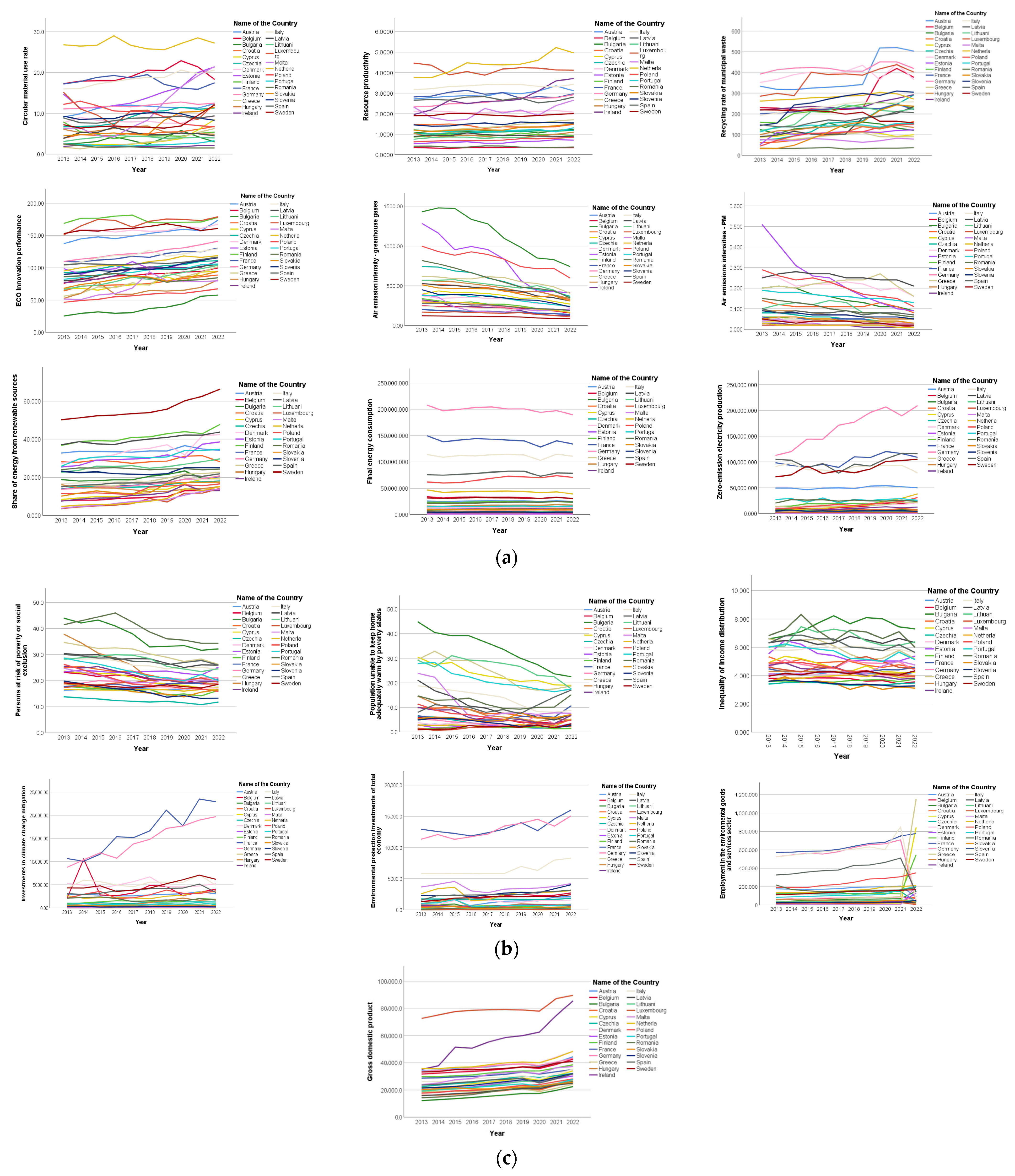
Preliminary data analysis identified 6% of missing data for 2013, as presented in Table 1. The analysis of the complete data set for 2013–2022 using the MCAR Little test yielded a significant result (Chi-Square = 32.249, DF = 19, Sig. = 0.029), indicating that the data were not missing at random. The absence of 2013 PRPSE data was due to insufficient reporting. Considering the evolution of the variables, as shown in Figure 1, we applied simple linear interpolation. This methodological choice constitutes a notable limitation of the analysis.
Analyzing the figures in the descriptive statistics table (Table 2) and the evolutions of the variables analyzed during the 2013–2022 period (Figure 1), we can notice the following:
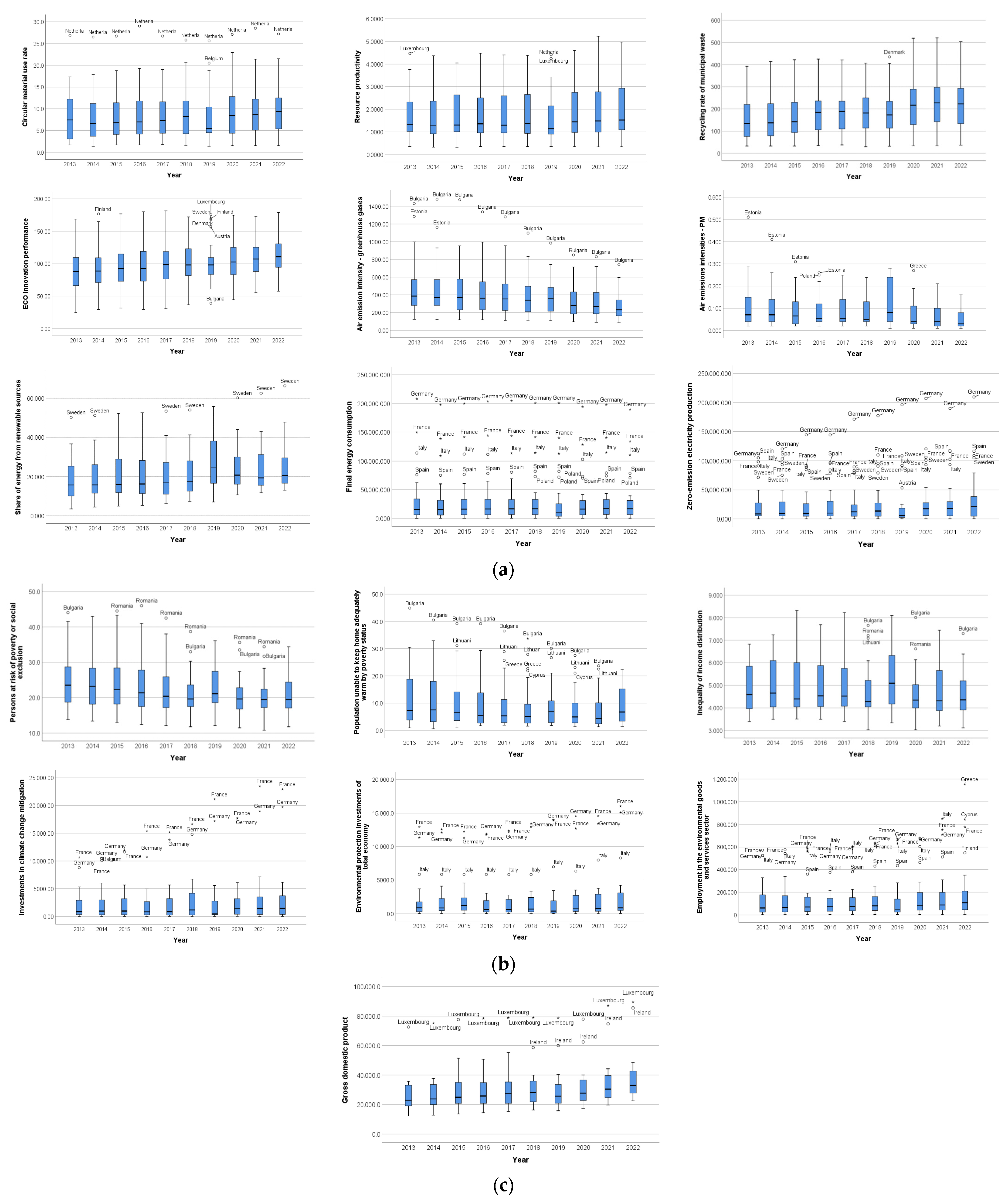
Regarding CMU, the average value slowly increased during the analyzed period in the cases of Austria, Belgium, Croatia, Cyprus, and the Czech Republic until 2020; Denmark and Estonia, starting 2014; France, until 2018; Germany, until 2020; and Greece, Italy, and Slovakia, until 2019. In the other countries, the evolution fluctuated. This could represent the effect of the concerted efforts made by the EU members in order to increase the amount of secondary materials that replace primary raw materials, to reduce the environmental impact of raw material extraction. Regarding RP, increases were recorded in Austria, Cyprus, the Czech Republic, Estonia, Germany, Greece, Hungary, Ireland, Italy, the Netherlands, and Poland, showing an increasingly high capacity of these economies to create wealth with less extraction of natural resources, as a result of efforts to reduce domestic material consumption. In the case of RMW, it increased in Austria starting in 2015; in Croatia, the Czech Republic, France, Greece, Lithuania, the Netherlands, and Poland across the analyzed period; in Denmark, except for 2017; and in Slovakia until 2021. In these countries, it is evident that the authorities were increasingly concerned, on the one hand, with educating the population to reduce waste volumes and, on the other hand, with implementing new solutions to treat them. Looking at the EI, the indicator showed an increasing trend across all EU member states, with very high rates in Bulgaria and Poland, despite also having the lowest levels. Also, regarding AEI_GHG, all the countries analyzed registered decreasing trends. The countries with the highest values, namely, Bulgaria and Estonia, also had the highest rates of decrease, showing the concern for improving air quality. Looking at SERS, this indicator increased during the analyzed period across all EU member states. Sweden stood out as the country with the highest share of energy from renewable sources. Regarding FEC in EU countries, it showed a downward trend over the period under review, reaching, in 2023, the second lowest level since 1990. Key factors that influenced this evolution included increased energy efficiency, structural economic changes, and the impact of high-energy prices, especially after 2022. The energy mix was also changing, with electricity and renewables gaining shares, while oil and coal declined. In the case of ZEEP, analyzing its evolution during the 2013–2022 period, we observed a positive trend in all EU member states. However, Germany stood out, registering the highest levels of this indicator and the highest growth rates. Regarding the percent of persons at risk of poverty or social exclusion (PRPSE) in the EU members, it continuously decreased. The countries with the highest values of this indicator were Romania and Bulgaria, raising questions about whether the green transition leaves regions already at the bottom of the rankings even further behind. At the opposite end was Germany with the lowest level of PRPSE. It is worth noting that in countries with high shares of people at risk, the rate of decline in this indicator was higher, suggesting greater government concern to improve the situation. Looking at the share of the population unable to heat their homes (PUKHW), the country with the highest value was Bulgaria. The evolution of inequality of income distribution differed across countries in the European Union. In Bulgaria, during the first part of the analyzed period, this indicator increased, with the country recording the EU’s highest level of IID in 2022. However, the Bulgarian government made efforts to reduce it. On the contrary, the Czech Republic had the lowest level of inequality in income distribution. Regarding the value of investments in climate change mitigation, the lowest level of this indicator was recorded in Cyprus and Malta, unlike France and Germany, where governments invested considerable sums to reduce the effects of climate change. The same could be said about investments for environmental protection. If we consider the level of employment in the environmental goods and services sector across the European Union countries, we found that, during the analyzed period, it increased. It is worth noting, however, that in Italy, Germany, and Spain, there were significant decreases in this indicator in 2022, whereas in Greece, Cyprus, and Finland, there were, conversely, substantial increases. Looking at the values of the skewness coefficient, we observed that it is positive for all analyzed indicators, indicating that the distributions are asymmetric to the right, with more values concentrated to the left of the average in EU countries. The Kurtosis coefficient is greater than 3 only for AEI_GHG and FEC, indicating a flattened (leptokurtic) distribution with more outliers, as confirmed by the boxplots.
Given the economic implications highlighted by numerous studies [59] as the effects of the green transition, we considered it essential to also examine the evolution of economic prosperity and the standard of living in the EU member countries, as measured by GDP per capita. Figure 1 shows a continuous increase in GDP across the EU area, with a rising rate since 2020. These upward trends suggest that the economic performance of the EU member states remains uneven, with gaps widening. It is worth noting, in this regard, the case of Luxembourg, which remained in first place, as well as that of Ireland, with a spectacular growth rate, especially after the end of a health crisis.
To further illustrate the behavior of these indicators, the box plots for the data set were built (Figure 2). From the analysis of the boxplot graphs, a first conclusion refers to the variability of the data, in the sense that it is higher in the case of states with higher values of the indicators, both in the case of variables describing the level of implementation of the green transition and in the case of those describing its social impact. In the CMUR data, the Netherlands was identified as an outlier, with very high values recorded throughout the analyzed period. Also, for AEI_GHG, Bulgaria was noted as the country with the highest levels. In the case of FEC, levels well above the average range were observed in Germany, Italy, France, and Spain, and, starting in 2018, also in Poland. This suggests, on the one hand, the increasing energy needs of final consumers in these countries and, on the other hand, the need for decision-makers to develop and strengthen the effectiveness of energy efficiency policies and objectives. Regarding PRPSE, Bulgaria and Romania were outliers among the EU member states, unfortunately registering very high values for this indicator. Bulgaria also held the same negative record regarding PUKHW in the second part of the analyzed interval, joined by Lithuania, and, in 2017–2018, by Greece and Cyprus. At the opposite pole were states such as France and Germany, with extremely high levels of ICCM and EPIE, as well as Italy (EPIE) and Spain (EEGS).
These distributions suggest differences across the EU countries, both in the degree of implementation of the green transition and in its social impact. At the same time, it was observed that the differences were not uniform: countries acted differently, and they also seemed to react differently, which supported our approach.

2.2. Methodology

To group and compare EU countries according to the variables considered, we used cluster analysis, which allowed for labeling and comparative study [60] and provided a basis for decision-making by examining similarities and dissimilarities between countries. Since there was no information on the number of classes or the membership of countries in these classes, we applied the hierarchical clustering method, an unsupervised learning method suitable for small data sets. For processing, we used SPSS software version 20.0 (SPSS Inc., Chicago, IL, USA) [61].
The clustering algorithm aims to group N objects (organized as rows of a matrix) into K clusters. In hierarchical clustering, starting with n observations, at each stage an observation or a cluster of observations is absorbed into another cluster [62]. The following elements should be considered:
  • N—the number of objects to be clustered;
  • dij—the distance between clusters i and j;
  • cluster i contains ni objects;
  • D—the set of all remaining dij.
According to Kaufman and Rousseeuw [61], in the first stage, the smallest element dij remaining in D is identified. In the second stage, clusters i and j are merged into a new cluster, k. In the third stage, using Equation (1), a new set of distances dkm is calculated to replace dim and djm in D:
d k m = α i d i m + α j d j m + β d i j + γ d i m d j m
where m represents any cluster other than k. These three steps are repeated until D contains a distinct group of all objects, with decreasing similarity. There are a few different methods used to determine which clusters should be joined at each stage. To determine which clusters should be merged at each stage, the Ward method (also called the centroid method) was used, as it measures the degree of homogeneity within clusters and assesses intra-cluster variability [63]. According to Rencher and Cormack [62,64], the Ward method allows for the determination of the number of clusters. Equations (2)–(5) define the coefficients of the distance equation for the Ward method:
α i = n i + n m n k + n m
α j = n j + n m n k + n m
β = n m n k + n m
γ = 0
The quality of a clustering is evaluated based on the sum of squared errors (SSE) for each point in the data set (i.e., its Euclidean distance to the nearest centroid), as in Equation (6):
S S E = i = 1 k x k i d i s t c i , x 2
The centroid is the center of gravity of a cluster, calculated as the average of its elements (7):
c i = 1 n i x k i x
where x is an object (case to be clustered), ki is the ith cluster, and dist is the standard Euclidean distance between two objects in Euclidean space. ci is the centroid of cluster ki, K is the number of clusters, and ni is the number of objects in the ith cluster.
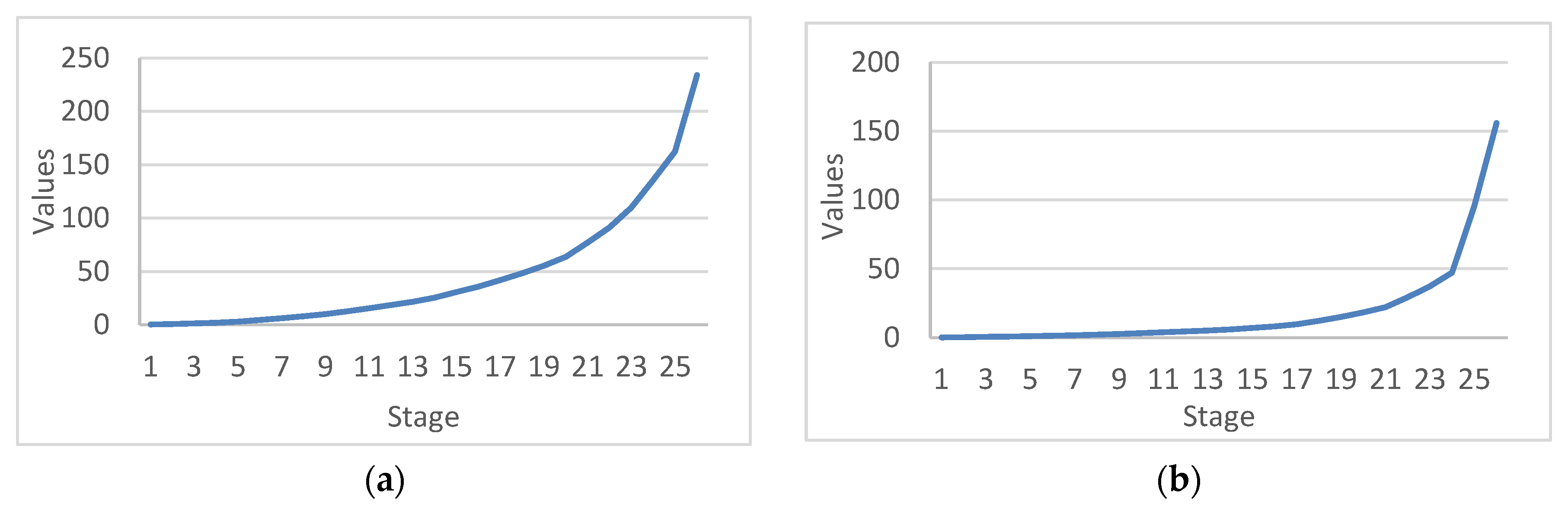
Heterogeneous and distinct clusters were desired. Since the cluster structure was descriptive, it was necessary to validate the results of the cluster analysis, which implied confirming the chosen clustering solution, as shown by Milligan [65]. In the present case, we established the optimal number of clusters based on dendrogram analysis, a value confirmed by the agglomeration schedule coefficients, which indicated the amount of heterogeneity observed in the cluster solution.
The grouping of the EU member states differed between analyses based on the level of implementation of the green transition and on socioeconomic variables. Starting from the idea that the implementation of the energy transition produced effects in social and economic terms, it was interesting to approach it by identifying causal relationships. The different reflections of the two phenomena, as evaluated using the variables considered, led us to propose an additional exploration. Thus, we considered the possibility of mediation or moderation effects that could explain the differences observed. In this sense, using mediation analysis, we sought to identify the mechanisms by which the implementation of the green transition could account for certain socio-economic phenomena. Using moderation analysis, we sought to determine under what conditions the relationship between the level of implementation of the green transition and changes in socioeconomic impact would vary.
In short, as shown by Hayes [66], mediation analysis is used to test hypotheses about intermediary factors that can account for significant additional effects of causal variables, and moderation analysis is used to explore the existence of interaction effects. The two methods of analysis are integrated into a “conditional process analysis” that aims to clarify the contingencies or conditions under which the mechanisms operate. Moderating effects are different from mediating effects. Thus, a variable is a mediator if it is responsible for the causal link between two variables, as shown by Baron & Kenny [67], while a moderating variable can help us understand when, or under what conditions, one variable has a causal effect on another.

3. Results and Discussion

3.1. Establishing the Clusters

By applying the methodology described in Section 2, we aimed to verify whether the variables considered to assess the level of energy transition (ET) and, respectively, those considered to evaluate the socioeconomic impact (SEI) in the EU member states divided the 27 countries into similar groups. We used hierarchical clustering because we did not have a really large data set. However, K-means was very sensitive to outliers. As in the case of the analyzed variables, we observed that such elements exist (Figure 2). Because the analyzed variables had different units of measurement, we standardized the variables using z-scores per year to eliminate bias and ensured that each variable contributed equally to the distance metric. Convergence was assessed based on the Euclidean distance, with the two elements being in an inversely proportional relationship. The application of the methodology led to the classification of the 27 EU member states into clusters based on the research criteria described.
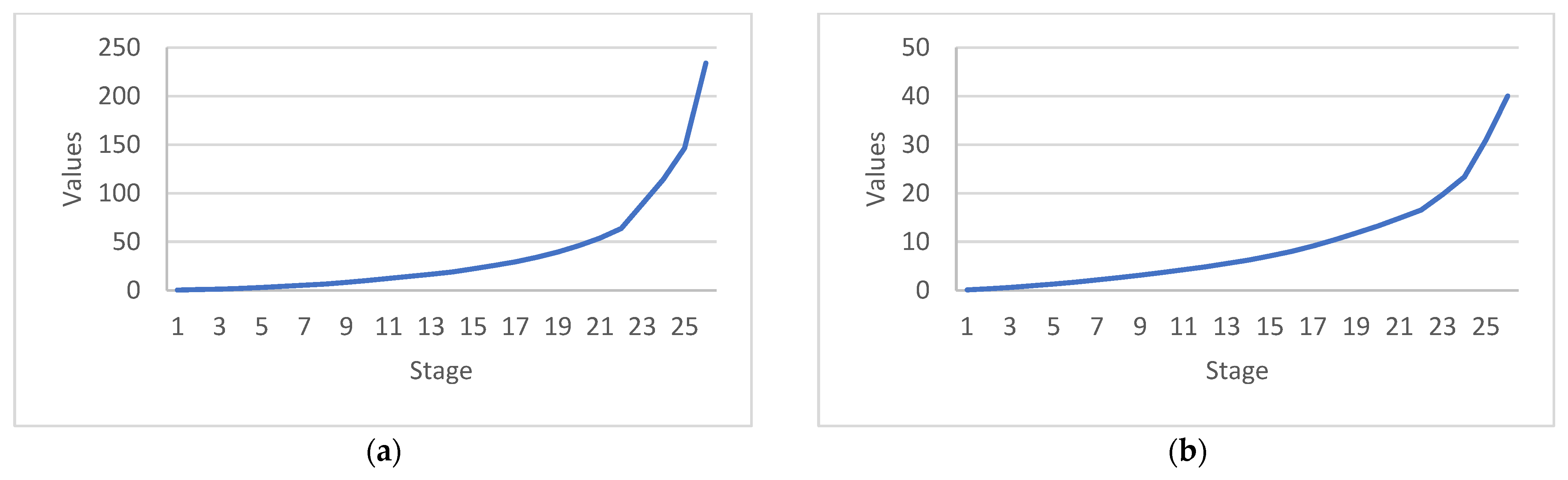
The optimal number of clusters established by the dendrogram analysis was five in both situations. Based on the degree of change in the agglomeration schedule coefficients (Figure 3), a significant increase in the coefficients is observed after stage 22. Since we aimed to obtain clusters that were as homogeneous and distinct as possible, and heterogeneity between clusters was desired, we chose five clusters. The number of clusters suggested by the agglomeration schedule coefficients was calculated as the difference between the number of cases (27 in our discussion) and the elbow point in the graph (22 in this case).
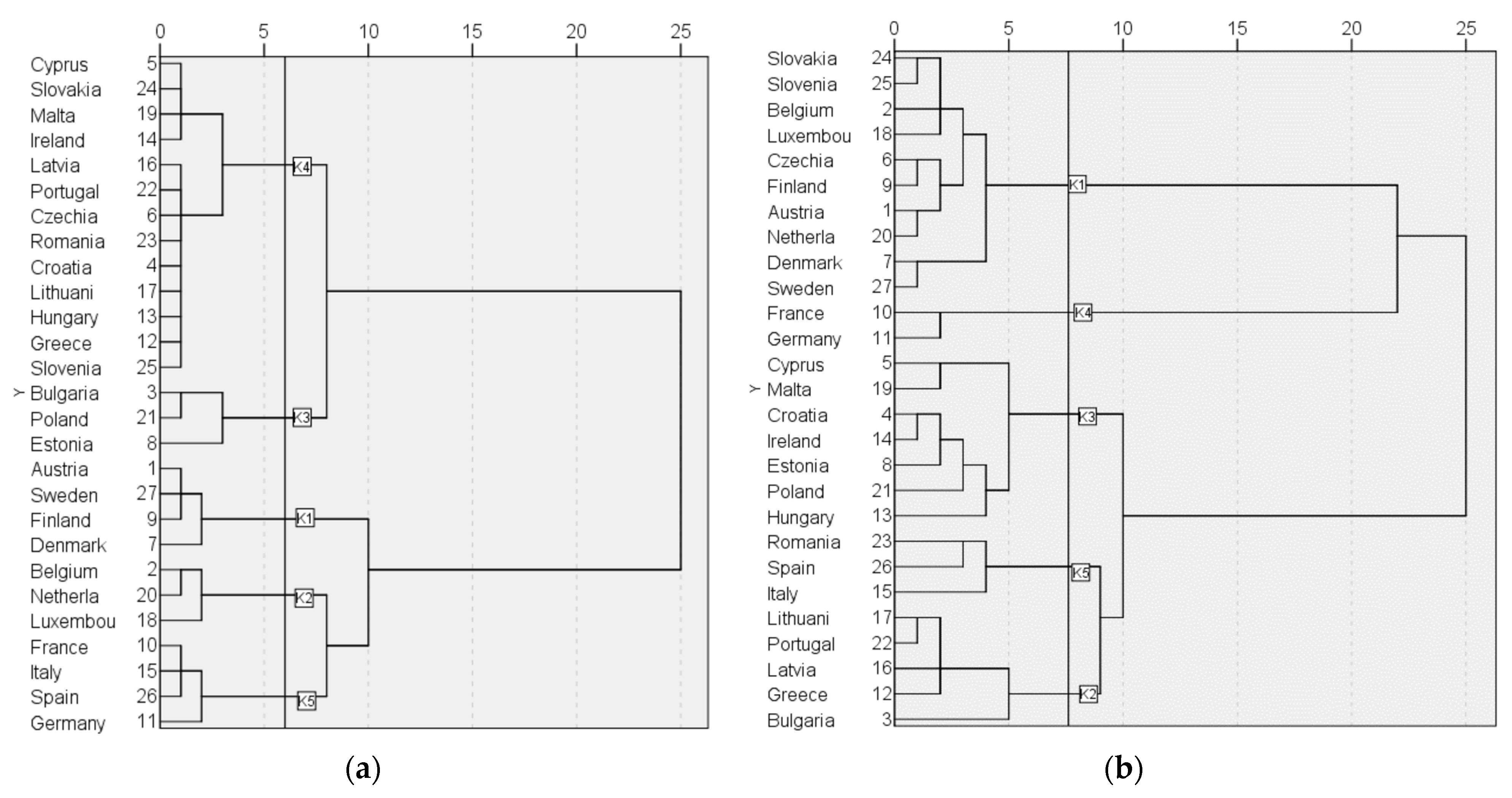
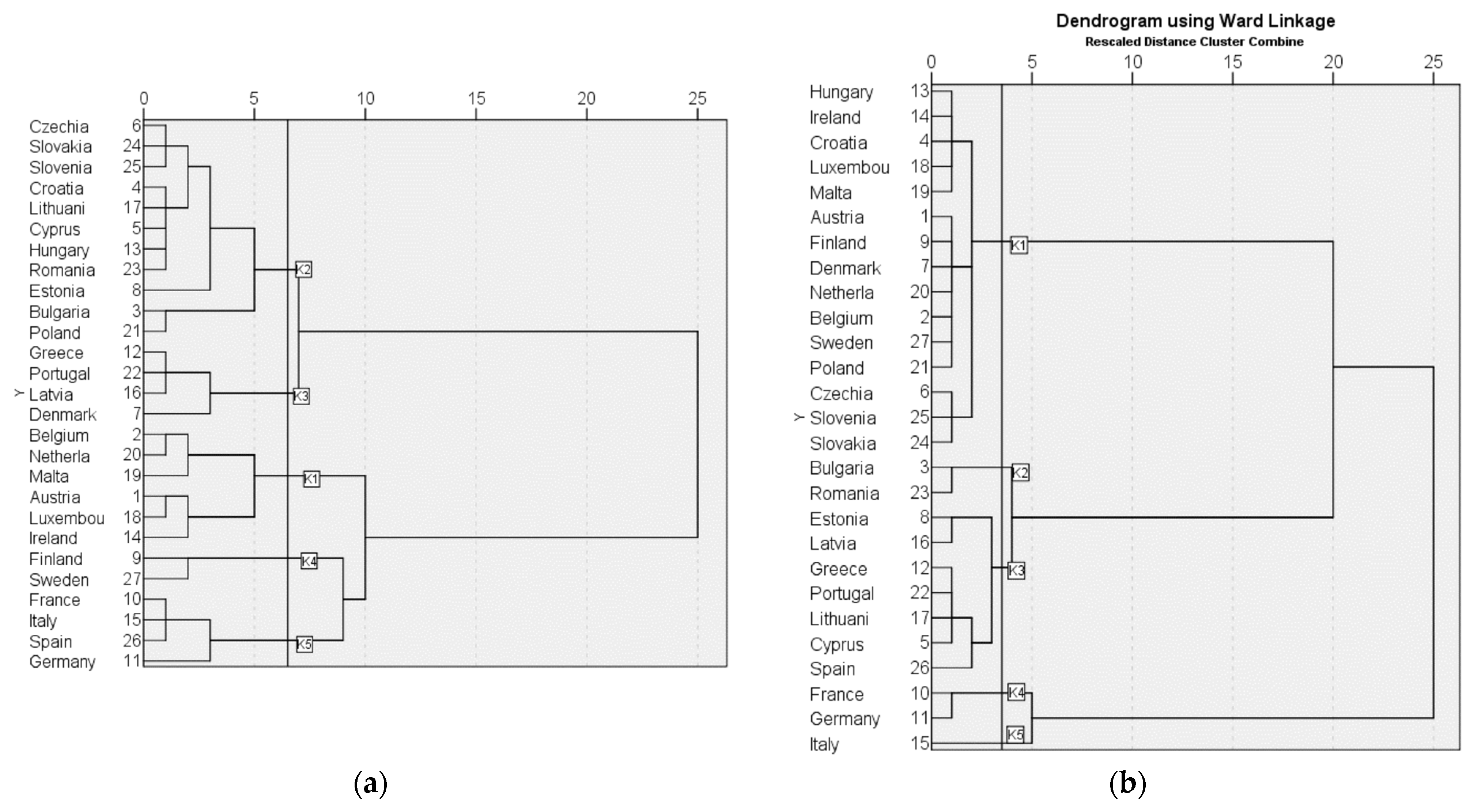
Based on the 2013 data values, Figure 4 presents the dendrogram obtained using the squared Euclidean distance and Ward’s method, suggesting solutions with two to five clusters, both in the case of the variables considered to assess the level of green transition (a), and in the case of the variables considered to evaluate the socioeconomic impact of the green energy transition (b).
Analyzing the results summarized in Figure 3 and Table 3, we found that there were important differences in the grouping of countries according to the level of implementation of the green transition and, respectively, its socioeconomic impact. These results suggest that the green transition fundamentally differed from other economic transformations in several key issues, which shaped its socioeconomic implications. Thus, in the first cluster, in the case of classification according to the variables describing the socioeconomic impact, many more countries were grouped together. In addition to Austria, Denmark, Finland, and Sweden, which made up the first cluster, the classification according to variables describing the level of implementation of the green transition also included Belgium, the Czech Republic, Luxembourg, the Netherlands, Slovakia, and Slovenia. In the similarity method, countries were grouped based on the criterion of homogeneity or compactness, measured by the sum of squared distances between the elements of a cluster. The countries were assigned to a cluster based on the criterion of minimum distance, meaning that there were minimal differences between the countries of the cluster in terms of the socioeconomic effects of implementing the green transition. They also captured the effect of coordinated efforts to strengthen institutions, stimulate green investment, and develop innovation ecosystems, which smoothed out differences between countries.
Table 3 summarizes the clusters obtained for the two data subsets. Some differences in the composition of the clusters were observed, suggesting that, in addition to the variables considered in the research, other factors also affected the social response at the level of European economies. The element we considered was the level of economic development, assessed based on GDP per capita. This conclusion was in line with the results from Caldarola et al. [36], which showed that countries with higher incomes were those in which research was, in turn, better developed, suggesting a positive association between the size of GDP per capita and their capacity to conserve the environment. The same relationship was observed in emerging economies, where higher GDP levels were associated with a greater environmental impact, driven by their strong focus on growth.
The dendrogram in Figure 4a shows that, in 2013, cluster K3 correlates better with cluster K4 and cluster K2 correlates better with cluster K5 than either one with cluster K1. These correlations confirm that clusters 2 and 5, which contained the wealthiest countries, correlate better with each other regarding energy transition, as evident in cluster 1. Also, the grouping of the remaining countries confirmed the situation before the initiation of the green transition, when many Eastern European nations had high emissions levels. Bulgaria, Estonia, and Poland (K4), in turn, recorded higher emission levels per capita than most EU countries.
The dendrogram in Figure 3b shows that, in 2013, cluster K1 correlates better with cluster K4 and cluster K2 correlates better with cluster K5 than either one with cluster K3. These correlations confirm that clusters 2 and 5, which include the wealthiest countries, as well as countries like Slovakia and Slovenia, accelerated the implementation of the energy transition and recorded high rates of economic growth, relative to the socioeconomic effects of the transition.
Table 4 and Figure 5 and Figure 6 illustrate the grouping of EU countries in 2022, at the end of the analysis period.
Analyzing the results for the year 2022, summarized in Figure 5 and Table 4, there were important differences in the grouping of countries according to the level of implementation of the green transition compared to the grouping of countries according to their socioeconomic impact. In addition, there were differences when compared to 2013, indicating that the green transition operated through mechanisms distinct from classical economic ones, generating socioeconomic effects. These behaviors aligned with previous studies [21] showing that the green transition can exacerbate inequalities between countries. In addition, they showed that appropriate policy interventions could mitigate these discrepancies. This concern was essential for developing countries that faced the doubled challenge of pursuing economic development while simultaneously transitioning to low-carbon trajectories. Several phenomena can explain the attenuation of differences. Thus, the erosion of community identity can reduce cohesion. Some studies [68] argued that the green transition threatens not only economic viability, but also cultural cohesion and shared identity. Another phenomenon cited in the literature [69] was the disruption of social networks. As traditional industries declined, the social networks that sustained communities for generations began to fragment.
If we look at the grouping of countries in 2022 according to the variables describing the socioeconomic impact of the green transition, in the first cluster, as in 2013, many more countries were grouped. In addition to Austria, Ireland, Luxembourg, the classification also included Belgium, Croatia, the Czech Republic, Denmark, Finland, Hungary, Malta, the Netherlands, Poland, Slovakia, Slovenia, and Sweden.
The dendrogram in Figure 5a shows that, in terms of the ecological transition, in 2022, cluster K2 correlates better with cluster K3 and cluster K4 correlates better with cluster K5 than either one with cluster K1. The structure of the clusters confirms the hypothesis of the attenuation of differences between countries as an effect of the implementation of the energy transition. On the contrary, looking at Figure 5b, we find that, in terms of the socioeconomic impact, these differences are sharpened. Thus, cluster K4 correlates better with cluster K5 and cluster K2 correlates better with cluster K3 than either one with cluster K1.
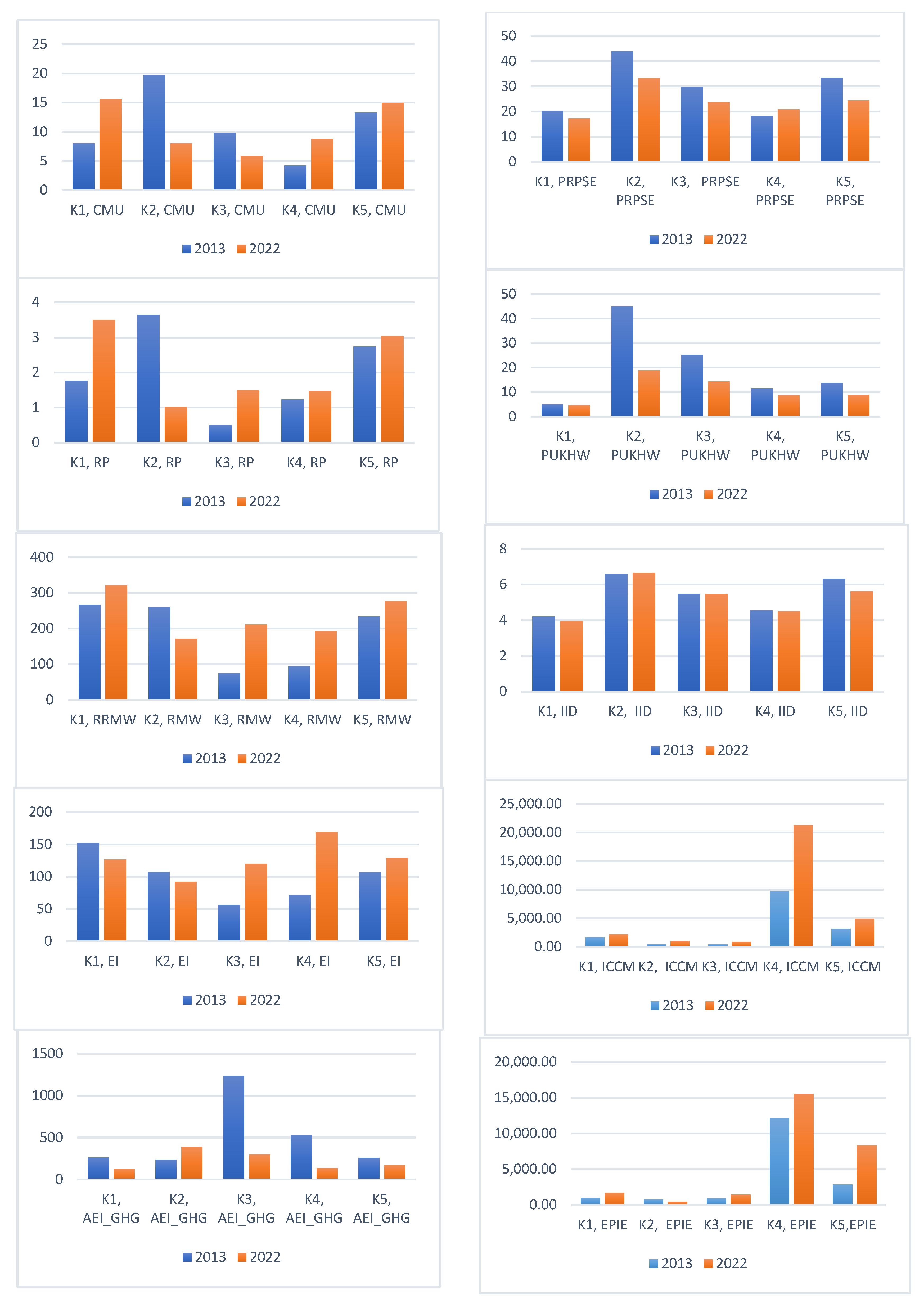
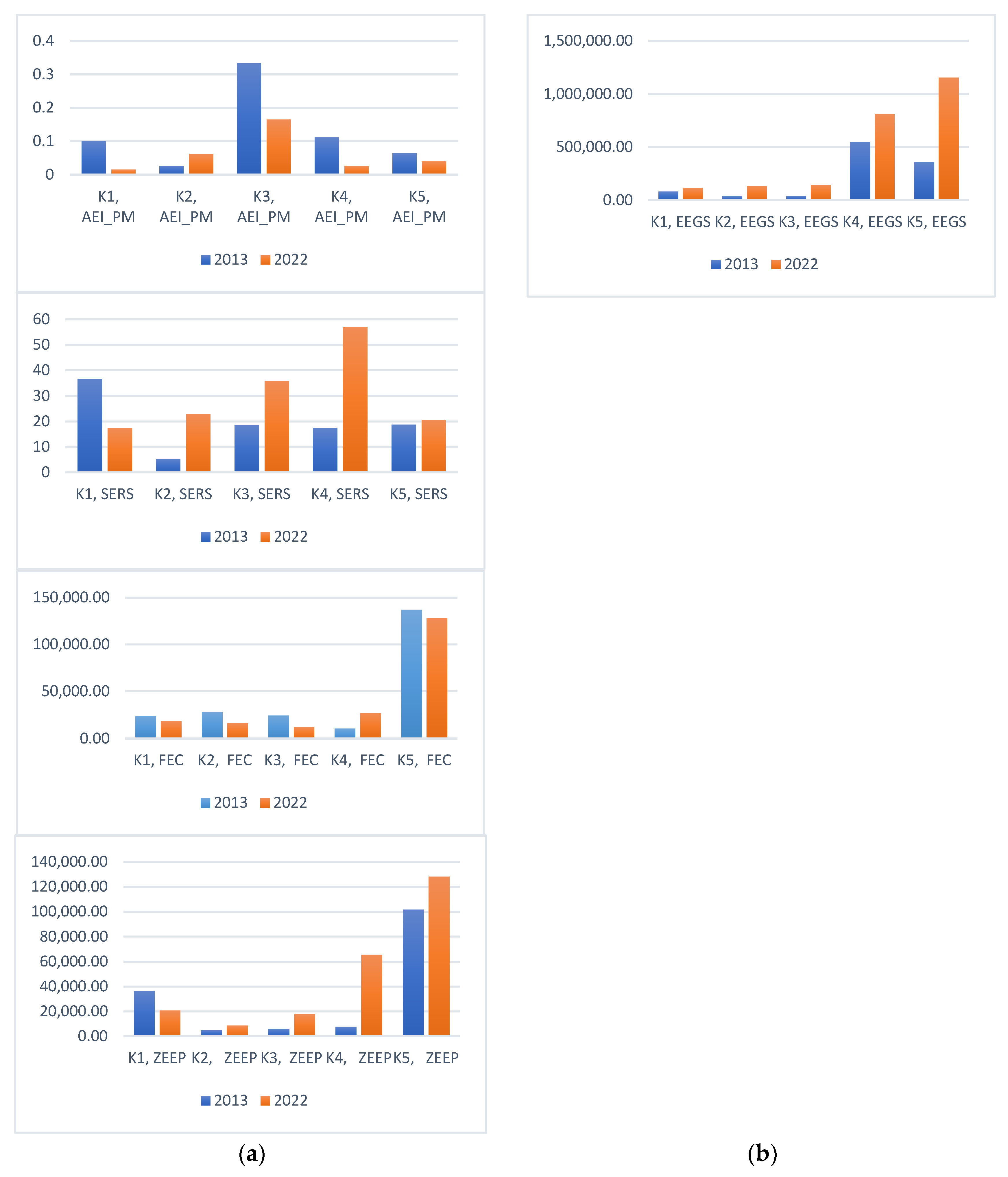
This segmentation expresses the green performance of the countries, as shown in Table 5 and Figure 7. While the EU member states have made progress, achieving climate neutrality by 2050 requires, for some, such as Romania and Bulgaria, a faster pace and, at the same time, better synchronization of policies, strategies, programs, and measures in terms of content and timing to combat climate change and safeguard prosperity.
As we can see from Figure 7a, the changes recorded during the analyzed period in terms of the score of the variables describing the level of implementation of the energy transition showed progress towards improving the recycling rate of municipal waste, resource productivity, ECO innovation performance, share of energy from renewable sources, final energy consumption, and zero-emission electricity production, as well as improving environmental health by reducing the level of greenhouse gas emissions and suspended particles for most EU countries. The exceptions were the countries in cluster 2, namely Bulgaria, Greece, Latvia, Lithuania, and Portugal, for the resource productivity and recycling rate of municipal waste. It is also important to note contradictory developments regarding the circular material use rate. Thus, this variable showed growth trends only in K1 and K3, i.e., the most economically advanced countries.
Figure 7b depicts the changes recorded during 2013–2022 in scores for variables describing the level of socioeconomic impact of implementing the energy transition. Thus, the weights for persons at risk of poverty or social exclusion and, respectively, the population unable to keep home adequately warm due to poverty status have decreased. The exceptions were the countries in K4, respectively, France and Germany, where PRPSE tended to increase.
In the case of the other indicators in this category, Figure 7b shows the progress towards climate change mitigation by recording the improvement of the analyzed indicators at the level of the entire EU area.

3.2. Conditional Process Analysis by Applying Mediation and Moderation Procedures

Based on these observations, we set out to expand the research beyond simple relationships between two variables, aiming to obtain a more complete and more detailed picture of the real relationship between the chosen variables.
Thus, starting from the idea that the degree of economic development, as measured by GDP per capita, is also a determinant of the social effects of the energy transition, we examined whether a moderating relationship exists. We tested several variants on data from 2013 and 2022 and discovered several significant relationships discussed below.

3.2.1. Model 1

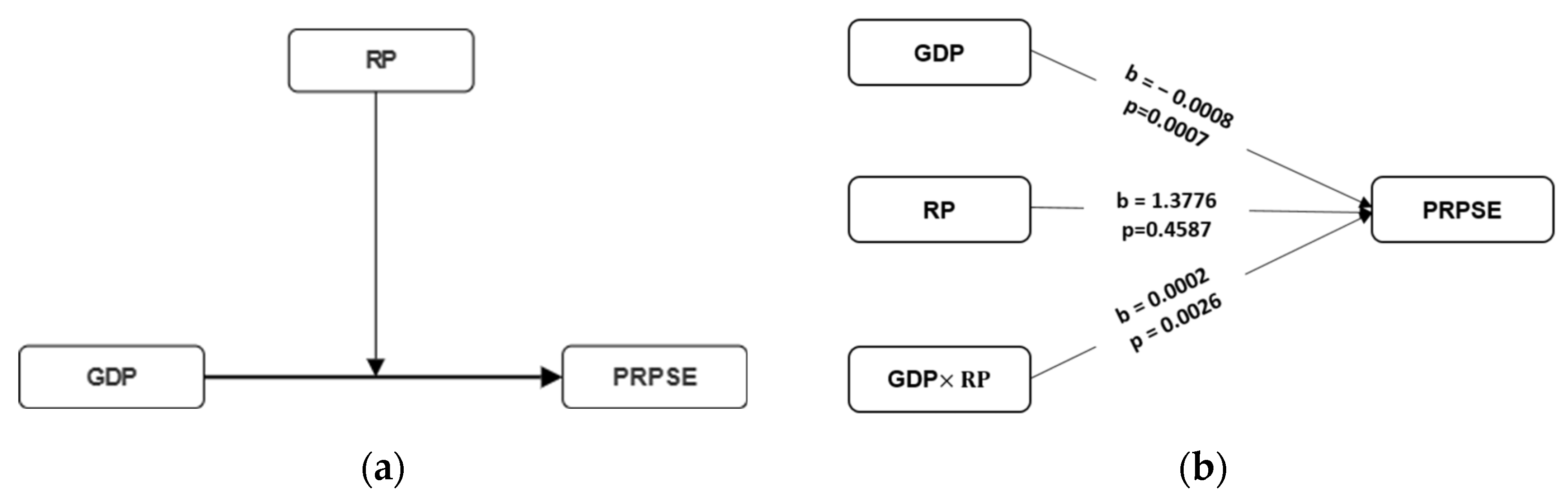
In this model (Figure 8), we tested the moderating role of resource productivity to examine how it influenced and modified the intensity or direction of the associative relationship between GDP per capita (as an independent variable) and the number of persons at risk of poverty or social exclusion (as a dependent variable), in 2013.
The model presented in Figure 8 shows the effect of introducing RP as a moderator in the causal relationship between GDP and PRPSE. The interaction effect was statistically significant, given p = 0.0026 < 0.05. The introduction of the interaction term led to a significant increase in the coefficient of determination, amounting to almost 23%. These results showed an interaction. Investigating this interaction, we found that the effect of GDP on PRPSE was significant for all categories of countries in terms of the size of RP (Figure 9).
The regression equation with moderation presented in Equation (8) shows that for a one-unit increase in GDP per capita, there is a decrease of 0.0008 in the percentage of people at risk of poverty or social exclusion. Moreover, RP serves as a moderator, dampening the negative relationship between GDP and PRPSE. This relationship can serve as a potential input for policymakers. They should consider not only increasing economic performance but also advancing technologies that would enable greater resource productivity and reduced waste.
P R P S E = 22.6210 0.0008 × G D P + 1.3766 × R P + 0.0002 × R P × G D P

3.2.2. Model 2

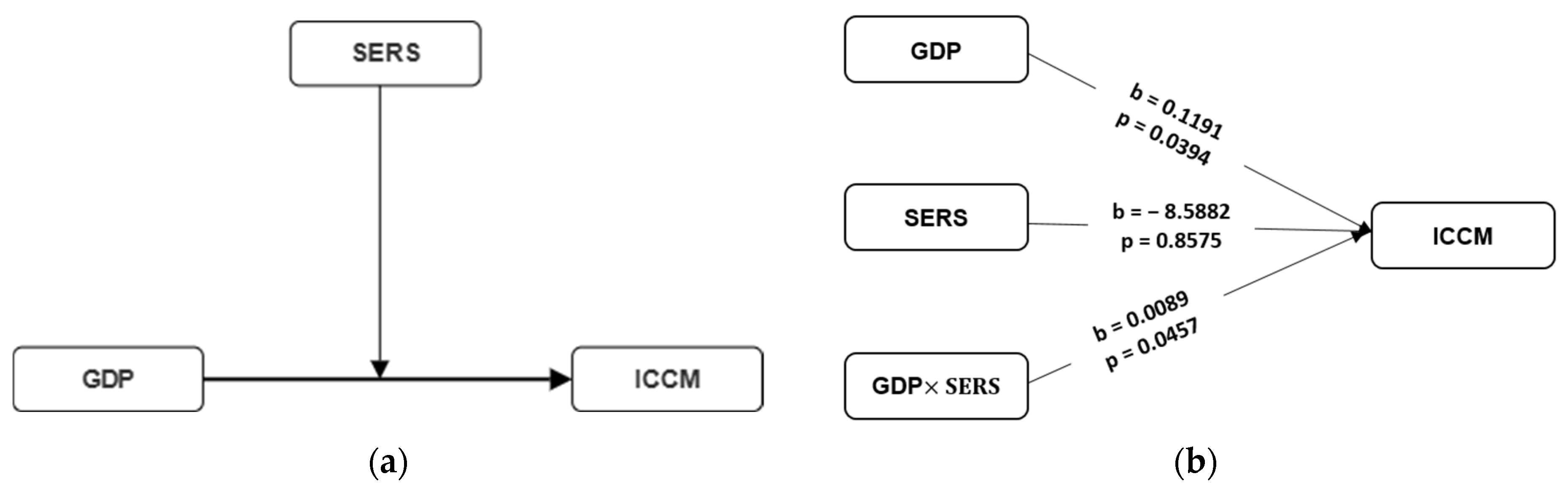
In this model (Figure 10), we tested the moderating role of share of energy from renewable sources (SERS) to examine how it influenced and modified the intensity or direction of the relationship between GDP per capita (independent variable) and level of investments in climate change mitigation (ICCM) (dependent variable), in 2013.
The model presented in Figure 10 shows the effect of introducing SERS as a moderator in the causal relationship between GDP and ICCM. The interaction effect is statistically significant, given p = 0.0457 < 0.05. The introduction of the interaction term led to a significant increase in the coefficient of determination, amounting to over 15%. These results showed an interaction. Investigating this interaction, we found that the effect of GDP on ICCM was significant only in the case of countries with average and above SERS levels (Figure 11b,c).
The regression equation with moderation presented in Equation (9) shows that for a one-unit increase in GDP per capita, there is an increase of 0.1191 in the level of investments in climate change mitigation. Moreover, SERS serves as a moderator, strengthening the positive relationship between GDP and ICCM. The model in Equation (9) supports the objectives assumed by the EU strategy, which aim to increase the level of investments in climate change mitigation. At the same time, Equation (9) shows that policymakers can solve this goal by increasing the share of energy from renewable sources.
I C C M = 2312.5063 + 0.1191 × G D P 8.5882 × S E R S + 0.0089 × S E R S × G D P

3.2.3. Model 3

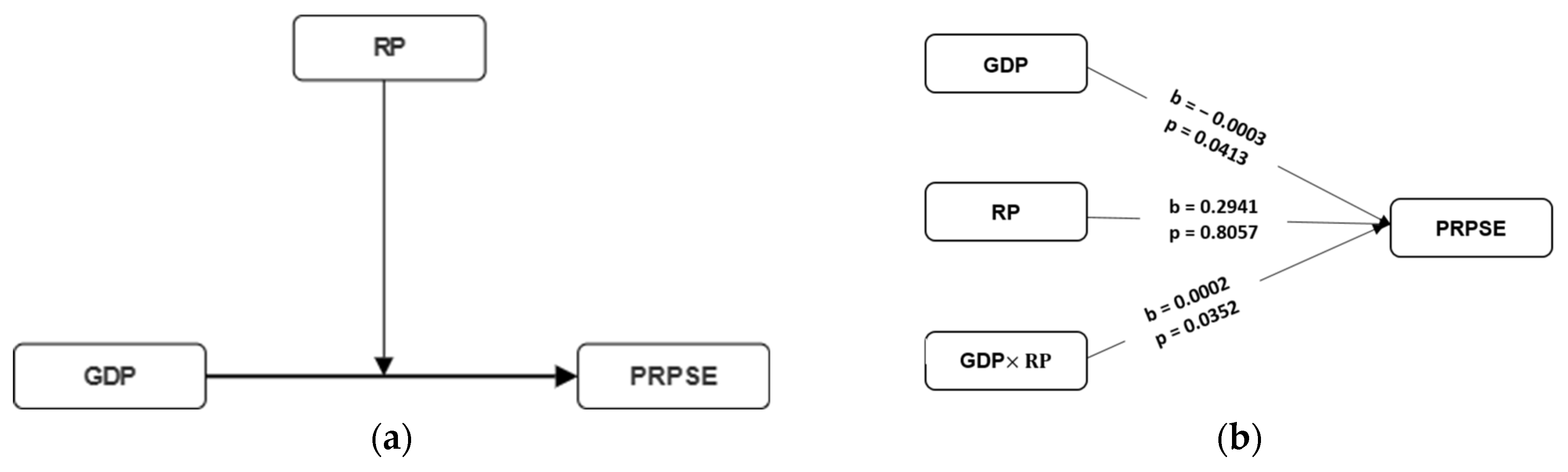
In this model (Figure 12), we tested the moderating role of resource productivity (RP) to examine how it influenced and modified the intensity or direction of the relationship between GDP per capita (independent variable) and the number of persons at risk of poverty or social exclusion (PRPSE) (dependent variable), in 2022.
The model presented in Figure 12 shows the effect of introducing RP as a moderator in the causal relationship between GDP and PRPSE. The interaction effect was statistically significant, given p = 0.0352 < 0.05. The introduction of the interaction term led to a significant increase in the coefficient of determination, amounting to over 16%. These results showed an interaction. Investigating this interaction, we found that the effect of GDP on PRPSE was significant only in the case of countries that were average and below in terms of the size of RP (Figure 13).
The regression equation with moderation presented in Equation (10) shows that for a one-unit increase in GDP per capita, there is a decrease of 0.0003 in the percentage of people at risk of poverty or social exclusion. Moreover, RP serves as a moderator, dampening the negative relationship between GDP and PRPSE.
P R P S E = 18.6553 0.0003 × G D P + 0.2941 × R P + 0.0002 × R P × G D P
We consider this result important because it shows that, over time, the role of GDP in influencing the percentage of people at risk of poverty and exclusion in a country seemed to diminish, while the interaction effect between resource productivity and GDP per capita remained at the same level. This conclusion calls for further investigation. We can therefore conclude that resource productivity increased by 0.0002 for each unit of change in the gap between GDP per capita and the share of people at risk of poverty or social exclusion.
To explore possible relationships for forecasting models, we also conducted a mediation analysis to discover the causal pathways through which changes driven by the energy transition could generate effects at the social and economic levels. Also, the share of energy from renewable sources increased by 0.0089 in the level of change between GDP per capita and investments in climate change mitigation.

3.2.4. Model 4

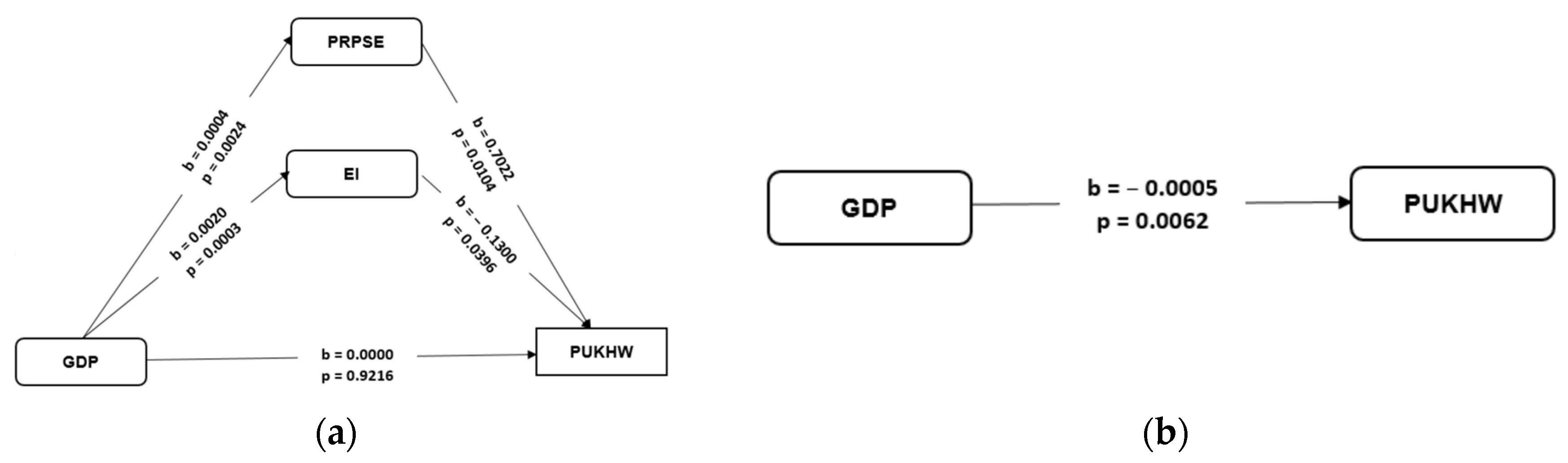
In this model (Figure 14), we tested the mediating role of percent of persons at risk of poverty or social exclusion (PRPSE) and the level of ECO innovation performance (EI) to examine how they explain the way GDP per capita (independent variable) influenced the share of the population unable to keep home adequately warm by poverty status (PUKHW), in 2013.
Figure 14a shows the relationship between the independent variable (GDP) and the dependent variable (PUKHW), expressed as a direct effect, and, respectively, the relationship between the independent variable (GDP) and the mediators (PRPSE, EI). Thus, the left branch in Figure 14a shows that the effect of GDP per capita on the share of persons at risk of poverty or social exclusion was negative and statistically significant (p = 0.0024 < 0.05), showing that a one-unit increase in GDP led to a 0.0004-unit decrease in PRPSE (Figure 14a). This result was consistent with previous studies [21,22,23,32,33,34,43] showing that the higher a country’s economic performance, the higher its quality of life, and therefore, the share of people at risk of poverty decreased. The effect of GDP per capita on ECO innovation performance level was positive and statistically significant (p = 0.0003 < 0.05), indicating that a one-unit increase in GDP was associated with a 0.0020-unit increase in EI (Figure 14a). This result was also consistent with previous studies [32,37] showing that environmental innovation performance is directly proportional to economic performance. The horizontal branch in Figure 14a shows the direct effect of GDP on PUKHW, that is, the relationship between the independent and dependent variables in the presence of the mediator. It was also observed that the direct effect of GDP per capita on PRPSE was not statistically significant (p = 0.9216 > 0.05) (Figure 14a), showing total mediation, with the effect being transmitted through mediators. The right branch in Figure 14a shows the effect of mediators on the dependent variable. The effect of PRPSE on PUKHW was positive and statistically significant (p = 0.0104), showing that a one-unit increase in the share of persons at risk of poverty or social exclusion led to a 0.7022-unit rise in the share of the population unable to keep their homes adequately warm by poverty status (Figure 14a). The effect of EI on PUKHW was, this time, negative and statistically significant (p = 0.0396), showing that a one-unit increase in the level of eco-innovation performance led to a 0.13 decrease in the share of population unable to keep home adequately warm by poverty status (Figure 14a).
The total effect (Figure 14b) shows that the impact of GDP per capita on PRPSE in the absence of the mediator was statistically significant (p = 0.0062), with a one-unit increase in GDP leading to a 0.0005-unit decrease in the share of PRPSE. Analyzing the mediation effect, in the case of PRPSE, the magnitude was b = −0.0003 and was statistically significant; in the case of EI, the magnitude was b = −0.0003, but it was not statistically significant, showing that EI was not a mediator between GDP and PUKHW, in agreement with results from Lu et al. [38], suggesting that technological innovation cannot always be associated with green growth, as it could be pollution-intensive. The total indirect effect, i.e., mediation effect, was b = −0.0005, and it was statistically significant. The conclusion is that PRPSE was the only mediator between GDP and PUKHW. Since the direct effect between the independent and dependent variables was not statistically significant, the mediation was complete. We consider this result extremely important because it shows that, in reducing the percentage of the population unable to keep their homes adequately warm, the state of innovation played an important role, alongside the level of economic performance. These results were also consistent with previous studies [21,22,23,32,33,34,43]. We considered this result extremely important because it showed that, in reducing the percentage of the population unable to keep their homes adequately warm, the state of innovation played an important role, alongside the level of economic performance. Thus, eco-innovation could constitute a fundamental premise for the development of green transition policies, providing support levers for resilience in economies affected by shifts in the economic paradigm.
No other significant moderation or mediation relationships of interest were identified between the studied variables across the analyzed period.

3.3. Discussions

Our analyses show that the grouping of countries by the degree of adoption of the green transition differed from that obtained when considering the socioeconomic impact of the transition to green energy, both at the beginning of the considered period (2013) (Figure 3) and at its end (2022) (Figure 5). Moreover, the structure of the clusters changes. For the year 2013, the dendrogram in Figure 3a shows that, for the ET variables, cluster K3 was more closely connected to cluster K4, and cluster K2 to cluster K5. In addition, cluster K1 was also connected to clusters K2 and K5, grouping eleven of the most prosperous economies of the EU. This association can be explained by the fact that these three clusters, which included the wealthiest countries (and are also the oldest EU members), were better connected to each other than to the other two clusters, which contained the poorest countries, and were also the newer EU members (Table 3). The situation, however, changed for the SEI variables (Figure 3b). Thus, cluster K4—which included Germany and France, the biggest EU economies—was better connected to cluster K1, which included Austria, Belgium, the Czech Republic, Denmark, Finland, Luxembourg, the Netherlands, Slovakia, Slovenia, and Sweden; economies that were also rich, but not the largest. We also explained this by greater similarities in terms of cultural patterns (Table 3). For the year 2022, the dendrogram in Figure 5a shows that, for the ET variables, cluster K2 was more closely linked to cluster K3, and cluster K4 to cluster K5. In this case, cluster K1 was also connected to clusters K4 and K5, which aligned with their status as the EU’s most prosperous economies. The surprise at the 2022 level was Malta’s presence in this large group, the only change compared to 2013. The high level of circular material use rate could explain this improvement. Another change in this group of stronger economies was the proximity of Finland and Sweden to the group of the four leading economies, Germany, France, Italy, and Spain, which maintained their position. At the same time, Belgium, Luxembourg, and the Netherlands distanced themselves from the group of four (Table 4). These countries were not necessarily the richest, nor did they have similarities in terms of culture. However, they were the countries that recorded the highest levels of circular material use rate, resource productivity, and the eco-innovation index, as well as high levels of final energy consumption. Somewhat curiously, cluster K2, which contained Bulgaria, Croatia, Cyprus, the Czech Republic, Estonia, Hungary, Lithuania, Poland, Romania, Slovakia, and Slovenia, was better connected to cluster K4, which included Greece, Denmark, Latvia, and Portugal (Table 3). Thus, in terms of the degree of implementation of the green transition, one of the most progressive economies in the EU, namely, Denmark, was closer to the newer EU members. This association could be explained by the latter’s ambitious goals and strong determination to catch up with more developed countries. Economies in clusters K2 and K3 did not necessarily have similarities in terms of economic power; some similarities in cultural patterns could be considered. Thus, Greece and Portugal belonged to the Mediterranean model, but Denmark and Latvia belonged to the Scandinavian model, and the Czech Republic, Hungary, Slovakia, Poland, Bulgaria, Estonia, Latvia, Lithuania, Romania, and Slovenia were former members of the CMEA. Reflecting these particularities of the social model in the grouping of countries by the degree of implementation of the strategic transition aligned with Thomas and Doerflinger’s [19] opinion, who, in referring only to trade unions, showed that sectoral interests were a key factor in positions on greening. Thus, although Fortea et al. [70] demonstrated that, at least in the most prosperous EU economies, the impact of the green transition and environmental protection spending became stronger as economic development increased, the implications differed in less developed economies.
Our analysis suggests that socioeconomic issues were not entirely aligned with green transition paradigms, which, as Markandya [32] has shown, were contested by vested interests in growth and labor, highlighting the need for multidimensional policy, as Heinz et al. [23] and Santos [71] have also shown. Based on these results, we can state that the environmental paradigm was shaped, on the one hand, by the trajectory of economic policies. On the other hand, social aspects were shaped by both the trajectory of the economic outcomes and the trajectory of greening the economy. Future research is needed to test the causal role of some of the factors determined by the green transition in socioeconomic outcomes. It would be important to assess the extent to which the measures imposed by the green transition can affect the achievement of the objectives proposed by the sustainable well-being agendas. As Heinz et al. [23] have shown, speaking about the construction sector, economic, but also political, barriers prevented decarbonization. Our results showed that, at least at the EU level, there was no overlap between countries in the degree of adoption of the green transition and its socioeconomic effects. This conclusion may mean that other factors that prevented the achievement of social and economic objectives should also be taken into account. Grouping countries also suggests the consideration of cultural patterns. Our results, in line with Lu et al. [38], who also showed that technological innovation cannot always be associated with green growth, as it can be pollution-intensive, were contradictory to Yu and Guo [72], who showed that, in China, economic growth negatively affected the long-term transition to green energy, whereas technological innovation positively influenced it. As shown by Caldarola et al. [36], promoting the transition to sustainability and economic complexity can be related to geography, the environment, green products, and technologies. Further investigations are needed to develop an analytical model of the link between the social, economic, and environmental domains. This approach implies expanding the empirical scope of the studies.

4. Conclusions

This study reveals that, by analyzing the level of implementation of the transition according to the specified indicators, a socioeconomic impact can be observed across all EU member states. The results obtained are consistent with both other studies and our assumption that a focus on economic growth negatively affects the natural environment. On the other hand, however, the analysis also showed that the green transition can increase inequalities between countries, particularly affecting developing countries pursuing economic development while facing restrictions determined by the objectives of the European Green Deal. The novelty of our work is that it clearly showed that EU economies can be grouped differently depending on the level of implementation of the green transition, on the one hand, and its socioeconomic impact, on the other.
Given the results obtained through the analysis, we consider that we have achieved the main objective of this study, which led to the conclusion that the green transition, even when assessed only through circular material use rate (CMU), resource productivity (RP), recycling rate of municipal waste (RMW), ECO innovation performance (EI), air emission intensity—greenhouse gases (AEI_GHG), air emissions intensities—PM (AEI_PM), share of energy from renewable sources (SERS), final energy consumption (FEC), and zero-emission electricity production (ZEEP), determines effects both in social and economic terms. Moreover, a causal relationship can be highlighted between GDP per capita and the population unable to keep home adequately warm by poverty status (PUKHW), mediated by the share of persons at risk of poverty or social exclusion PRPSE and EI, which can be used in forecasts. Also, the moderating roles of RP between GDP and PRSPE, and of SERS between GDP and ICCM, were highlighted.
The European Union’s long-term competitiveness strategy identified circularity as an enabler of resilient competitiveness. After 2020, in particular, EU countries have made some progress in the green transition. However, to achieve the objectives of the European Green Deal, major efforts are still needed in some member states that lag behind the EU average. The European Union’s long-term competitiveness strategy identified circularity as an enabler of resilient competitiveness, enabling countries to adapt to the constraints imposed by the green transition. Thus, EU documents showed that by 2023, zero-emission energy sources would account for 60% of EU electricity production. However, the results varied greatly between EU countries. Whereas 98% of Swedish electricity came from zero-emission sources, less than 13% of this same metric was observed in Malta. On the other hand, renewable energy use in the EU has been steadily increasing over the past few years. The recycling rate of municipal waste in the EU increased to 48.7% in 2022, but remained below the EU target of 55% by 2025. The EU’s material productivity has improved by over 20% in the last 3 years, probably due to a combination of efficiency gains and structural changes in the economy. In terms of the climate neutrality and zero pollution objectives, indicators showed a decreasing trend in the greenhouse gas intensity of the EU economy, as well as in particulate emissions [73].

Research Limitations and Future Research Directions

Starting from the relationships identified in the present study, we considered developing a future model to evaluate the social impact of the green transition in relation to the level of economic development, capable of generating sound forecasts to substantiate specific policies.
The lack of data was the main limitation. Since some indicators lacked a complete data series, we estimated missing values using linear forecasting. To ensure temporal continuity and maintain the longitudinal structure of the data set, missing observations were addressed using simple linear interpolation. This approach was applied to the case of recycling rates for municipal waste in Ireland and the Czech Republic. Also, for 2013 and 2014, data were not available for persons at risk of poverty or social exclusion. Moreover, in the case of environmental protection investments and employment in the environmental goods and services sector, for the year 2013, many of the countries analyzed did not provide reports, or in other cases, such as the Czech Republic, Italy, Latvia, Slovakia, Finland, and Sweden, for EPIE; and Italy, Cyprus, Hungary and Slovakia, for the EEGS, there were gaps in the first part of the analyzed period. While this approach facilitated comparability across years and avoided discontinuities in trend analysis, it represented a methodological limitation of the study, as interpolation might have attenuated or amplified variance in certain indicators and thus influenced dispersion-based results. This potential effect should be considered when interpreting the findings.

Author Contributions

Conceptualization, J.V.A., V.S., I.G.G., M.O. and M.G.P.; Methodology, V.S. and I.G.G.; Formal analysis, V.S. and M.O.; Data curation, J.V.A., V.S. and M.O.; Writing—original draft, J.V.A., V.S., I.G.G., M.O. and M.G.P.; Writing—review & editing, V.S., I.G.G., M.O. and M.G.P. All authors have read and agreed to the published version of the manuscript.

Funding

This research received no external funding.

Data Availability Statement

The original contributions presented in this study are included in the article. Further inquiries can be directed to the corresponding authors.

Conflicts of Interest

The authors declare no conflicts of interest.

Abbreviations

The following abbreviations are used in this manuscript:
EUEuropean Union
OECDOrganization for Economic Co-operation and Development
IEAInternational Energy Agency
GDPGross Domestic Product
CMUCircular material use rate
RPResource productivity
RMWRecycling rate of municipal waste
EIECO innovation performance
AEI_GHGAir emission intensity—greenhouse gases
AEI_PMAir emissions intensities—PM
SERSShare of energy from renewable sources
FECFinal energy consumption
ZEEPZero-emission electricity production
PRPSEPersons at risk of poverty or social exclusion
PUKHWPopulation unable to keep home adequately warm by poverty status
IIDInequality of income distribution
ICCMInvestments in climate change mitigation
EPIEEnvironmental protection investments of total economy
EEGSEmployment in the environmental goods and services sector
ETEnergy transition
SEISocioeconomic impact
CMEACouncil for Mutual Economic Assistance

References

  1. European Commission. Speech by President-Elect von der Leyen in the European Parliament Plenary on the Occasion of the Presentation of Her College of Commissioners and Their Programme. 2019. Available online: https://ec.europa.eu/commission/presscorner/detail/es/speech_19_6408 (accessed on 15 June 2020).
  2. See Siddi, M. The European Green Deal: Assessing its Current State and Future Implementation. 2020. Volume 114. Available online: https://fiia.fi/wp-content/uploads/2020/05/wp114_european-green-deal.pdf (accessed on 4 March 2025).
  3. Fouquet, R.; Pearson, P.J.G. Past and prospective energy transitions: Insights from history. Energy Policy 2012, 50, 1–7. [Google Scholar] [CrossRef]
  4. Sovacool, B.K. How long will it take? Conceptualizing the temporal dynamics of energy transitions. Energy Res. Soc. Sci. 2016, 13, 202–215. [Google Scholar] [CrossRef]
  5. Blazquez, J. A Road Map to Navigate the Energy Transition; Oxford Institute for Energy Studies: Oxford, UK, 2019. [Google Scholar]
  6. Elavarasan, R.M.; Nadarajah, M.; Pugazhendhi, R.; Sinha, A.; Gangatharan, S.; Chiaramonti, D.; Houran, M.A. The untold subtlety of energy consumption and its influence on policy drive towards Sustainable Development Goal 7. Appl. Energy 2023, 334, 120698. [Google Scholar] [CrossRef]
  7. Zhao, T.; Shah, S.A.A. Green Energy, Economic Growth, and Innovation for Sustainable Development in OECD Countries. Sustainability 2024, 16, 10113. [Google Scholar] [CrossRef]
  8. Debnath, R.; Ebanks, D.; Mohaddes, K.; Roulet, T.; Alvarez, R.M. Do fossil fuel fi rms reframe online climate and sustainability communication? A data-driven analysis. npj Clim. Action 2023, 2, 47. [Google Scholar] [CrossRef] [PubMed]
  9. Muhire, F.; Turyareeba, D.; Adaramola, M.S.; Nantongo, M.; Atukunda, R.; Olyanga, A.M. Drivers of green energy transition: A review. Green Energy Resour. 2024, 2, 100105. [Google Scholar] [CrossRef]
  10. Beg, N.; Morlot, J.C.; Davidson, O.; Afrane-Okesse, Y.; Tyani, L.; Denton, F.; Sokona, Y.; Thomas, J.P.; La Rovere, E.L.; Parikh, J.K.; et al. Linkages between climate change and sustainable development. Clim. Policy 2002, 2, 129–144. [Google Scholar] [CrossRef]
  11. Miao, Y.; Bukhari, A.A.A.; Bukhari, W.A.A.; Ahmad, S.; Hayat, N. Why fossil fuels stifle green economic growth? An environmental management perspective in assessing the spatial spillover impact of energy consumption in South Asia. J. Environ. Manag. 2025, 373, 123471. [Google Scholar] [CrossRef]
  12. Chien, F.; Chau, K.Y.; Sadiq, M. Impact of climate mitigation technology and natural resource management on climate change in China. Resour. Policy 2023, 81, 103367. [Google Scholar] [CrossRef]
  13. Imran, M.; Alam, S.; Zhang, J.; Ozturk, I.; Wahab, S.; Doğan, M. From resource curse to green growth: Exploring the role of energy utilization and natural resource abundance in economic development. Nat. Resour. Forum 2025, 49, 2025–2047. [Google Scholar] [CrossRef]
  14. Addison, R.; Ottimofiore, G.; Caputi, C.; Morales, A.; Shankar, H. Towards the Green Transition: Stimulating Investment and Accelerating Permits for Low Emissions Infrastructure; OECD Publishing: Paris, France, 2024; Volume 68. [Google Scholar] [CrossRef]
  15. IEA. Renewables. Available online: https://www.iea.org/energy-system/renewables (accessed on 4 November 2025).
  16. OECD Recommendation of the Council on the Governance of Infrastructure. OECD/LEGAL/0460. 2020. Available online: https://legalinstruments.oecd.org/en/instruments/OECD-LEGAL-0460 (accessed on 4 March 2025).
  17. United Nations Convention on Access to Information, Public Participation in DecisionMaking and Access to Justice in Environmental Matters. Available online: https://treaties.un.org/Pages/ViewDetails.aspx?src=IND&mtdsg_no=XXVII-13&chapter=27#1 (accessed on 4 March 2025).
  18. Pan, W.; Cao, H.; Liu, Y. ‘Green’ innovation, privacy regulation and environmental policy. Renew. Energy 2023, 203, 245–254. [Google Scholar] [CrossRef]
  19. Thomas, A.; Doerflinger, N. Trade union strategies on climate change mitigation: Between opposition, hedging and support. Eur. J. Ind. Relat. 2020, 26, 383–399. [Google Scholar] [CrossRef]
  20. Heddesheimer, V.; Hilbig, H.; Voeten, E. The Green Transition and Political Polarization Along Occupational Lines. Am. Polit. Sci. Rev. 2025, 1–23. [Google Scholar] [CrossRef]
  21. Mandelli, M.; Domorenok, E.; Graziano, P.; Zimmermann, K. Navigating Eco-Social Policymaking: Trends, Drivers, and Barriers. Introduction to the Special Issue. Regul. Gov. 2025, 1–14. [Google Scholar] [CrossRef]
  22. Blondeel, M.; Colgan, J.; Van de Graaf, T. What drives norm success? Evidence from anti–fossil fuel campaigns. Glob. Environ. Polit. 2019, 19, 63–84. [Google Scholar] [CrossRef]
  23. Heinz, E.; Sovacool, B.K.; Kwan, T.; Petit, V. Reviewing the 95 sociotechnical barriers to the decarbonization of buildings. Nat. Commun. 2025, 16, 9983. [Google Scholar] [CrossRef]
  24. Vandeplas, A.; Vanyolos, I.; Vigani, M.; Vogel, L. The Possible Implications of the Green Transition for the EU Labour Market; Publications Office of the European Union: Luxembourg, 2022. [Google Scholar]
  25. Petmesidou, M.; Guillén, A.M. Europe’s green, digital and demographic transition: A social policy research perspective. Transf. Eur. Rev. Labour Res. 2022, 28, 317–332. [Google Scholar] [CrossRef]
  26. Li, B.; Wang, J.; Nassani, A.A.; Binsaeed, R.H.; Li, Z. The future of Green energy: A panel study on the role of renewable resources in the transition to a Green economy. Energy Econ. 2023, 127, 107026. [Google Scholar] [CrossRef]
  27. Ignjatović, J.; Filipović, S.; Radovanović, M. Challenges of the green transition for the recovery of the Western Balkans. Energy Sustain. Soc. 2024, 14, 2. [Google Scholar] [CrossRef]
  28. Pastore, L.M.; de Santoli, L. Socio-economic implications of implementing a carbon-neutral energy system: A Green New Deal for Italy. Energy 2025, 322, 135682. [Google Scholar] [CrossRef]
  29. Boehl, G.; Budianto, F.; Takáts, E. The Macroeconomics of Green Transitions; Bank for International Settlements, Monetary and Economic Department: Basel, Switzerland, 2024. [Google Scholar]
  30. Wieners, C.; Lamperti, F.; Dosi, G.; Roventini, A. Policies for rapid decarbonization with steady economic transition and employment creation. Nat. Sustain. 2026, 9, 117–129. [Google Scholar] [CrossRef]
  31. Attílio, L.A. Spillover effects of climate policy uncertainty on green innovation. J. Environ. Manag. 2025, 375, 124334. [Google Scholar] [CrossRef]
  32. Markandya, A.; Arto, I.; González-Eguino, M.; Román, M.V. Towards a green energy economy? Tracking the employment effects of low-carbon technologies in the European Union. Appl. Energy 2016, 179, 1342–1350. [Google Scholar] [CrossRef]
  33. Broz, J.L.; Frieden, J.; Weymouth, S. Populism in Place: The Economic Geography of the Globalization Backlash. Int. Organ. 2021, 75, 464–494. [Google Scholar] [CrossRef]
  34. Marin, G.; Vona, F. Climate policies and skill-biased employment dynamics: Evidence from EU countries. J. Environ. Econ. Manag. 2019, 98, 102253. [Google Scholar] [CrossRef]
  35. Serrano, P.V.H.; Zaveri, A. Venturing the Definition of Green Energy Transition: A Systematic Literature Review. April 2020. Available online: https://arxiv.org/pdf/2004.10562 (accessed on 4 November 2025).
  36. Caldarola, B.; Mazzilli, D.; Napolitano, L.; Patelli, A.; Sbardella, A. Economic complexity and the sustainability transition: A review of data, methods, and literature. J. Phys. Complex. 2024, 5, 022001. [Google Scholar] [CrossRef]
  37. Xu, J.; Liu, Q.; Wider, W.; Zhang, S.; Fauzi, M.A.; Jiang, L.; Udang, L.N.; An, Z. Research landscape of energy transition and green finance: A bibliometric analysis. Heliyon 2024, 10, e24783. [Google Scholar] [CrossRef]
  38. Lu, Y.; Ahmad, S.; Noureen, S.; Salman, M. Green growth and sustainable energy transitions: Evaluating the critical role of technology, resource efficiency, and innovation in Europe’s low-carbon future. Humanit. Soc. Sci. Commun. 2025, 12, 1527. [Google Scholar] [CrossRef]
  39. Silverman, V. Sustainable Alliances: The Origins of International Labor Environmentalism. Int. Labor Work. Hist. 2004, 66, 118–135. [Google Scholar] [CrossRef]
  40. Liu, K. Circular economy and the separated yet inseparable social dimension: Views from European circular city experts. Sustain. Prod. Consum. 2024, 51, 474–483. [Google Scholar] [CrossRef]
  41. Cotta, B. The eco-social aspects of the European Green Deal and the Farm to Fork. Glob. Soc. Policy 2025, 25, 112–130. [Google Scholar] [CrossRef]
  42. Gerstenberg, A. Ideas in transition? Policymakers’ ideas of the social dimension of the green transition. Z. Für Polit. 2024, 34, 137–159. [Google Scholar] [CrossRef]
  43. Żuk, P.; Żuk, P. Ecology for the rich? Class aspects of the green transition and the threat of right-wing populism as a reaction to its costs in Poland. Sustain. Sci. Pract. Policy 2024, 20, 2351231. [Google Scholar] [CrossRef]
  44. Oertel, C.; Matschullat, J.; Zurba, K.; Zimmermann, F.; Erasmi, S. Greenhouse gas emissions from soils—A review. Chem. Der Erde 2016, 76, 327–352. [Google Scholar] [CrossRef]
  45. Newell, P. Globalization and the Environment: Capitalism, Ecology and Power; Polity Press: Cambridge, UK, 2012. [Google Scholar]
  46. Tóth, T. Social and Labour Market Impacts of the Green Transition in the European Union. Európai Tükör 2024, 27, 75–93. [Google Scholar] [CrossRef]
  47. Stukalo, N.; Simakhova, A. Social Dimensions of Green Economy. Filos. Sociol. 2019, 30, 91–99. [Google Scholar] [CrossRef]
  48. Stevis, D.; Felli, R. Global labour unions and just transition to a green economy. Int. Environ. Agreem. Polit. Law Econ. 2014, 15, 29–43. [Google Scholar] [CrossRef]
  49. McCauley, D.; Heffron, R. Just transition: Integrating climate, energy and environmental justice. Energy Policy 2018, 119, 1–7. [Google Scholar] [CrossRef]
  50. Galgóczi, B. Just transition on the ground: Challenges and opportunities for social dialogue. Eur. J. Ind. Relat. 2020, 26, 367–382. [Google Scholar] [CrossRef]
  51. Cigna, L.; Fischer, T.; Abuannab, E.H.; Heins, E.; Rathgeb, P. Varieties of Just Transition? Eco-Social Policy Approaches at the International Level. Soc. Policy Soc. 2023, 22, 730–746. [Google Scholar] [CrossRef]
  52. van Daalen, K.R.; Romanello, M.; Rocklöv, J.; Semenza, J.C.; Tonne, C.; Markandya, A.; Dasandi, N.; Jankin, S.; Achebak, H.; Ballester, J.; et al. The 2022 Europe report of the Lancet Countdown on health and climate change: Towards a climate resilient future. Lancet Public Health 2022, 7, e942–e965. [Google Scholar] [CrossRef] [PubMed]
  53. Rodríguez-Pose, A.; Bartalucci, F. The green transition and its potential territorial discontents. Camb. J. Reg. Econ. Soc. 2024, 17, 339–358. [Google Scholar] [CrossRef]
  54. Doukas, H.; Nikas, A.; Stamtsis, G.; Tsipouridis, I. The Green Versus Green Trap and a Way Forward. Energies 2020, 13, 5473. [Google Scholar] [CrossRef]
  55. Carattini, S.; Kallbekken, S.; Orlov, A. How to win public support for a global carbon tax. Nature 2019, 565, 289–291. [Google Scholar] [CrossRef]
  56. Mehleb, R.I.; Kallis, G.; Zografos, C. A discourse analysis of yellow-vest resistance against carbon taxes. Environ. Innov. Soc. Transit. 2021, 40, 382–394. [Google Scholar] [CrossRef]
  57. OECD. Development Co-Operation Report 2024; OECD Publishing: Paris, France, 2024. [Google Scholar] [CrossRef]
  58. Galarza-María, J.; de Junguitu, A.D.; Labaien, I. Social dimension of the circular economy: Impact categories through fuzzy Delphi method. Sustain. Dev. 2024, 32, 4726–4737. [Google Scholar] [CrossRef]
  59. Kumar, P.; Kaur, R.; Radulescu, M.; Kalaš, B.; Hagiu, A. Drivers of Environmental Sustainability, Economic Growth, and Inequality: A Study of Economic Complexity, FDI, and Human Development Role in BRICS+ Nations. Sustainability 2025, 17, 4180. [Google Scholar] [CrossRef]
  60. Stuetzle, W.; Nugent, R. A generalized single linkage method for estimating the cluster tree of a density. J. Comput. Graph. Stat. 2010, 19, 397–418. [Google Scholar] [CrossRef]
  61. Kaufman, L.; Rousseeuw, P.J. Finding Groups in Data. An Introduction to Cluster Analysis; Wiley: Hoboken, NY, USA, 1990. [Google Scholar]
  62. Rencher, A.C. Methods of Multivariate Analysis, 2nd ed; Wiley Publishing: New York, NY, USA, 2002. [Google Scholar]
  63. Arabie, P.; Hubert, L.J.; Hubert, L.; de Soete, G. (Eds.) Clustering and Classification; World Scientific: River Edge, NJ, USA, 1996. [Google Scholar]
  64. Cormack, R.M. A Review of Classification. J. R. Stat. Soc. Ser. A 1971, 134, 321–353. [Google Scholar] [CrossRef]
  65. Cormack, R.M. Ultrametric hierarchical clustering algorithms. Psychometrika 1979, 44, 343–346. [Google Scholar] [CrossRef]
  66. Hayes, A.F. Introduction to Mediation, Moderation, and Conditional Process Analysis, 2nd ed.; The Guilford Press: New York, NY, USA; London, UK, 2022. [Google Scholar]
  67. Baron, R.M.; Kenny, D.A. The moderator-mediator variable distinction in social psychological research: Conceptual, strategic, and statistical considerations. J. Pers. Soc. Psychol. 1986, 51, 1173–1182. [Google Scholar] [CrossRef]
  68. Sobhaninia, S.; Amirzadeh, M.; Lauria, M.; Sharifi, A. The relationship between place identity and community resilience: Evidence from local communities in Isfahan, Iran. Int. J. Disaster Risk Reduct. 2023, 90, 103675. [Google Scholar] [CrossRef]
  69. Naga, J.F.; Ebardo, R.A. Social network sites (SNS) an archetype of techno-social stress: A systematic review. Heliyon 2025, 11, e41119. [Google Scholar] [CrossRef] [PubMed]
  70. Fortea, C.; Dinca, M.S.; Ionescu, R.V.; Zlati, M.L.; Antohi, V. Analyzing the Socio-Economic and Energy Implications of Green Economy Transition Across Six EU Member States. Eur. Res. Stud. J. 2023, XXVI, 680–693. [Google Scholar] [CrossRef]
  71. Santos, E. Renewable Energy and Socio-Economic Transformation: Three Case Studies. Sustainability 2025, 17, 1196. [Google Scholar] [CrossRef]
  72. Yu, Z.; Guo, X. Influencing factors of green energy transition: The role of economic policy uncertainty, technology innovation, and ecological governance in China. Front. Environ. Sci. 2023, 10, 1058967. [Google Scholar] [CrossRef]
  73. EU Commission Outcomes and Competitiveness. Single Market and Competitiveness Scoreboard. Available online: https://single-market-scoreboard.ec.europa.eu/node/1090_el (accessed on 4 March 2025).
Figure 1. Evolution of the variables across the data set. (a) Indicators to assess the level of energy transition, (b) indicators to assess the social dimension, and (c) GDP per capita. Source: Authors’ computations based on Table 1.
Energies 19 00807 g001
Figure 2. Boxplots for the data set. (a) Indicators to assess the level of energy transition, (b) indicators to assess the social dimension, and (c) GDP per Capita. Source: Authors’ computations based on Table 1.
Energies 19 00807 g002
Figure 3. Agglomeration schedule coefficients, using data from 2013: (a) for the ET variables; (b) for the SEI variables. Source: Authors’ computations.
Energies 19 00807 g003
Figure 4. Dendrogram using the Ward linkage method, using data from 2013: (a) for the ET variables; (b) for the SEI variables. Source: Authors’ computations.
Energies 19 00807 g004
Figure 5. Dendrogram using the Ward linkage method, using data from 2022: (a) for the ET variables; (b) for the SEI variables. Source: Authors’ computations.
Energies 19 00807 g005
Figure 6. Agglomeration schedule coefficients, using data from 2022: (a) for the ET variables; (b) for the SEI variables. Source: Authors’ computations.
Energies 19 00807 g006
Figure 7. Evolution of the variables, during 2013–2022: (a) for the ET variables; (b) for the SEI variables. Source: Authors’ computations.
Energies 19 00807 g007aEnergies 19 00807 g007b
Figure 8. Moderation model of the influence of GDP on PRSPE through RP, in 2013: (a) moderation model; (b) conditional effect of GDP on PRPSE through RP. Source: Authors’ computations.
Energies 19 00807 g008
Figure 9. Interaction effect of RP in the causal relationship between GDP and PRPSE, in 2013: (a) RP = −1.0550; (b) RP = 0.000; (c) RP = 1.0050. Source: Authors’ computations.
Energies 19 00807 g009
Figure 10. Moderation model of the influence of GDP on ICCM through SERS, in 2013: (a) moderation model; (b) conditional effect of GDP on ICCM through SERS. Source: Authors’ computations.
Energies 19 00807 g010
Figure 11. Interaction effect of RP in the causal relationship between GDP and PRPSE, in 2013: (a) SERS = −11.4154; (b) SERS = 0.000; (c) SERS = 11.4154. Source: Authors’ computations.
Energies 19 00807 g011
Figure 12. Moderation model of the influence of GDP on PRSPE through RP, in 2022: (a) moderation model; (b) conditional effect of GDP on PRPSE through RP. Source: Authors’ computations.
Energies 19 00807 g012
Figure 13. Interaction effect of RP in the causal relationship between GDP and PRPSE, in 2022: (a) RP = −1.1229; (b) RP = −0.4261; (c) RP = 1.3107. Source: Authors’ computations.
Energies 19 00807 g013
Figure 14. Mediation model of the influence of GDP on PUKHW through PRSPE and EI, in 2013: (a) mediation model; (b) Total effect of GDP on PUKHW through PRSPE and EI. Source: Authors’ computations.
Energies 19 00807 g014
Table 1. Variable descriptions and data series availability.
SymbolVariable DescriptionSource/DOIVersionDate Pulled
CMUThe share of material recycled and fed back into the economy; Percentage10.2908/cei_srm03013 November 202429 September 2025
RPThe gross domestic product (GDP) divided by domestic material consumption; Euro per kilogram10.2908/env_ac_rp4 July 202528 August 2025
RMWMunicipal waste by waste management operations; Kilograms per capita *10.2908/env_wasmun13 February 202529 September 2025
EIThe composite ECO-Innovation Indexhttps://green-forum.ec.europa.eu/eco-innovation_en (accessed on 29 September 2025)during 2012–202229 September 2025
AEI_GHGAir emissions intensities of greenhouse gases (CO2, N2O, CH4, HFC, PFC, SF6, and NF3, in CO2 equivalent); Grams per euro (current prices) 10.2908/env_ac_aeint_r213 December 202430 September 2025
AEI_PMAir emissions intensities of particulates < 2.5 µm; Grams per euro (current prices) 10.2908/env_ac_aeint_r213 December 202430 September 2025
SERSShare of energy from renewable sources, Percentage10.2908/nrg_ind_ren25 June 202529 September 2025
FECFinal energy consumption by sector (energy use); Thousand tonnes of oil equivalent10.2908/ten001242 May 202529 September 2025
ZEEPGross production of electricity and derived heat from non-combustible fuels (total); Gigawatt-hour10.2908/nrg_ind_pehnf21 August 202529 September 2025
PRPSEThe sum of persons who are at risk of poverty after social transfers, severely materially deprived, or living in households with very low work intensity; Percentage **10.2908/sdg_01_1025 September 202530 September 2025
PUKHWThe share of the population who are unable to keep their home adequately warm; Percentage10.2908/sdg_07_6024 July 202528 August 2025
IIDThe ratio of total income received by the 20% of the population with the highest income to that received by the 20% of the population with the lowest income; Ratio 10.2908/tespm15125 September 202530 September 2025
ICCMInvestments in climate change mitigation (total); Euro (millions)10.2908/env_ac_ccminv25 November 202030 September 2025
EPIEEnvironmental protection investments of the total economy; Euro (millions) ***10.2908/env_ac_epite116 June 202530 September 2025
EEGSEmployment in the environmental goods and services sector (total); Full-time equivalent ****10.2908/env_ac_egss15 June 202530 September 2025
GDPGross domestic product at market prices (current prices); Purchasing power standard (PPS, EU27 from 2020) per capita10.2908/nama_10_pc1 October 20251 October 2025
Source: The authors. * Data were not available for Ireland for 2013. ** Data were not available for 2013 and 2014. *** Data were available only for Germany, Spain, Cyprus, Malta, the Netherlands, Poland, Romania, and Slovenia for 2013. **** Data were available only for Bulgaria, France, Lithuania, Luxembourg, Malta, the Netherlands, Austria, Romania, Slovenia, Finland, and Sweden for 2013.
Table 2. Descriptive statistics.
Min.Max.MeanStd.
Deviation
VarianceSkewness
Statistic
(Std. Err.)
Kurtosis
Statistic
(Std. Err.)
CMU1.329.08.9926.304639.7471.123
(0.148)
0.778
(0.295)
RP0.29955.22721.7710081.10765341.2270.888
(0.148)
−0.026
(0.295)
RMW30521196.88109.80412,056.8960.749
(0.148)
−0.055
(0.295)
EI25.18181.55103.000835.389481252.4150.486
(0.148)
−0.316
(0.295)
AEI_GHG85.011479.92393.2129257.4901266,301.1621.796
(0.148)
3.893
(0.295)
AEI_PM0.0100.5100.090930.0817660.0071.512
(0.148)
2.600
(0.295)
SERS3.49466.28721.9394811.890595141.3861.021
(0.148)
0.978
(0.295)
FEC421.114208,057.42134,155.8028346,812.6281962,191,422,158.6612.204
(0.148)
4.350
(0.295)
ZEEP29.555209,413.00029,587.3593342,221.9857501,782,696,080.6822.006
(0.148)
3.829
(0.295)
PRPSE10.846.022.3856.762945.7371.174
(0.148)
1.402
(0.295)
PUKHW0.644.99.6279.108382.9601.488
(0.148)
1.565
(0.295)
IID3.0308.3204.864371.1897661.4160.778
(0.148)
−0.254
(0.295)
ICCM12.3023,482.152699.81744184.3584117,508,855.2862.820
(0.148)
8.502
(0.295)
EPIE8.515,998.22169.2473414.462811,658,556.5222.532
(0.148)
5.656
(0.295)
EEGS31991,153,508157,142.81199,110.59939,645,030,810.2322.040
(0.148)
3.845
(0.295)
GDP12,194.189,574.030,544.09113,629.8964185,774,074.7012.177
(0.148)
5.709
(0.295)
Source: Authors’ computations.
Table 3. The structure of the clusters according to data from 2013.
Cluster Countries Included in Cluster
For the ET variablesK1Austria, Denmark, Finland, and Sweden
K2Belgium, Luxembourg, and the Netherlands
K3Bulgaria, Estonia, and Poland
K4Croatia, Cyprus, the Czech Republic, Greece, Hungary, Ireland, Latvia, Lithuania, Malta, Portugal, Romania, Slovakia, and Slovenia
K5France, Germany, Italy, and Spain
For the SEI variablesK1Austria, Belgium, the Czech Republic, Denmark, Finland, Luxembourg, the Netherlands, Slovakia, Slovenia, and Sweden
K2Bulgaria, Greece, Latvia, Lithuania, and Portugal
K3Croatia, Cyprus, Estonia, Hungary, Ireland, Malta, and Poland
K4France and Germany
K5Italy, Romania, and Spain
Source: Authors’ design.
Table 4. The structure of the clusters in 2022.
ClusterCountries Included in Cluster
For the ET variablesK1Austria, Belgium, Ireland, Luxembourg, the Netherlands, and Malta
K2Bulgaria, the Czech Republic, Croatia, Cyprus, Estonia, Hungary, Lithuania, Poland, Romania, Slovakia, and Slovenia
K3Denmark, Greece, Latvia, and Portugal
K4Finland and Sweden
K5France, Germany, Italy, and Spain
For the SEI variablesK1Austria, Belgium, Croatia, the Czech Republic, Denmark, Finland, Hungary, Ireland, Luxembourg, Malta, the Netherlands, Poland, Slovakia, Slovenia, and Sweden
K2Bulgaria and Romania
K3Cyprus, Estonia, Greece, Latvia, Lithuania, Portugal, and Spain
K4France and Germany
K5Italy
Source: Authors’ design.
Table 5. Summary statistics.
YearVariableMinimumMaximumMeanStd.
Deviation
VarianceSkewnessKurtosis
StatisticStd. ErrorStatisticStd. Error
2013CMUR1.7026.808.476.1738.011.1830.4481.4180.872
RP0.354.471.721.061.110.8710.4480.3230.872
RMW33.00392.00156.56101.6710,336.330.8190.448−0.2090.872
EI25.18168.6791.2736.141306.090.5580.448−0.1940.872
AEI_GHG123.461430.45493.80322.69104,129.581.6010.4482.4290.872
AEI_PM0.020.510.120.110.011.9680.4484.7400.872
SERS3.4950.1519.0211.42130.310.8380.4480.6300.872
FEC421.11208,057.4234,564.4749,615.492,461,696,841.822.3890.4485.7000.872
ZEEP29.56112,529.0025,391.5936,150.191,306,836,522.211.5720.4480.9730.872
PRPSE13.9044.0024.887.8661.780.9070.4480.3050.872
PUKHW0.9044.9012.7611.57133.881.1530.4480.6650.872
IID3.406.834.881.101.210.3810.448−1.2520.872
ICCM19.6810,661.612049.572665.337,103,961.002.0380.4484.1470.872
EPIE8.5012,925.601953.103207.8710,290,404.322.7000.4486.9540.872
EEGS3199.00571,471.00133,258.28164,957.3227,210,916,213.181.8060.4482.3170.872
GDP_per_Cap12,194.1072,586.2025,921.6211,726.94137,521,134.052.4910.4489.0930.872
2022CMUR1.5027.2010.476.7946.080.8180.448−0.0300.872
RP0.344.971.971.211.460.7460.448−0.1340.872
RMW37.00503.00227.67115.8013,407.960.5530.448−0.1810.872
EI57.73179.02115.3033.221103.540.5730.448−0.3110.872
AEI_GHG85.01740.20271.08148.8522,156.861.5200.4482.9410.872
AEI_PM0.010.210.060.050.0031.3860.4481.3340.872
SERS13.0766.2925.7512.83164.501.5510.4482.4980.872
FEC592.78189,698.4233,445.7245,752.182,093,261,865.222.2380.4484.8960.872
ZEEP289.45209,413.0034,641.9149,095.332,410,351,698.342.2290.4485.3590.872
PRPSE11.8034.4020.675.2627.690.9210.4480.9030.872
PUKHW1.4022.508.626.2438.990.9030.448−0.5400.872
IID3.127.304.651.041.090.8000.4480.1420.872
ICCM19.2622,906.993257.885518.5730,454,637.852.8990.4488.2800.872
EPIE60.8015,998.202619.874134.8917,097,294.322.5560.4486.1330.872
EEGS3577.001,153,508.00211,252.63287,923.9082,900,170,298.632.1640.4484.2170.872
GDP_per_Cap22,449.9089,574.0037,562.8716,191.07262,150,608.942.3240.4485.6630.872
Source: Authors’ computations.
Disclaimer/Publisher’s Note: The statements, opinions and data contained in all publications are solely those of the individual author(s) and contributor(s) and not of MDPI and/or the editor(s). MDPI and/or the editor(s) disclaim responsibility for any injury to people or property resulting from any ideas, methods, instructions or products referred to in the content.