Article

Synthesis of Sliding Mode Control Strategy for T-Type Grid Inverter in Presence Grid Voltage Disturbance


Institute of Automatic Control, Faculty of Electrical, Electronic, Computer and Control Engineering, Lodz University of Technology, 90-924 Łódź, Poland
*
Author to whom correspondence should be addressed.
Energies 2026, 19(3), 790; https://doi.org/10.3390/en19030790
Submission received: 15 December 2025 / Revised: 20 January 2026 / Accepted: 30 January 2026 / Published: 3 February 2026
(This article belongs to the Special Issue Advanced Control Strategies for Power Converters and Microgrids)

Abstract

The paper proposes a new hybrid sliding mode control algorithm based on saturated-type reaching law for current regulation of a grid-following inverter in a microgrid connected to the power grid, ensuring system stability under severe main grid voltage disturbances. The system contains the control system, T-type inverter, LCL filter, and DC source. First, a mathematical model of the above-described microgrid structure is proposed. The designs of well-known SMC algorithms used to control the power grid current are presented. This work introduces a new hybrid SMC method based on saturated-type reaching law, which is later used in the control system for a specific test scenario including voltage grid disturbance. For this case, an additional and extended stability analysis is conducted to obtain the controller parameters that shall provide the system with greater robustness and a faster convergence to the desired state after prior displacement. The primary objective of this study is to enhance the quality of transmitted energy in a power electronic system by means of a novel sliding mode control approach with a hybrid reaching law, while reducing the system’s sensitivity to selected external disturbances.

1. Introduction

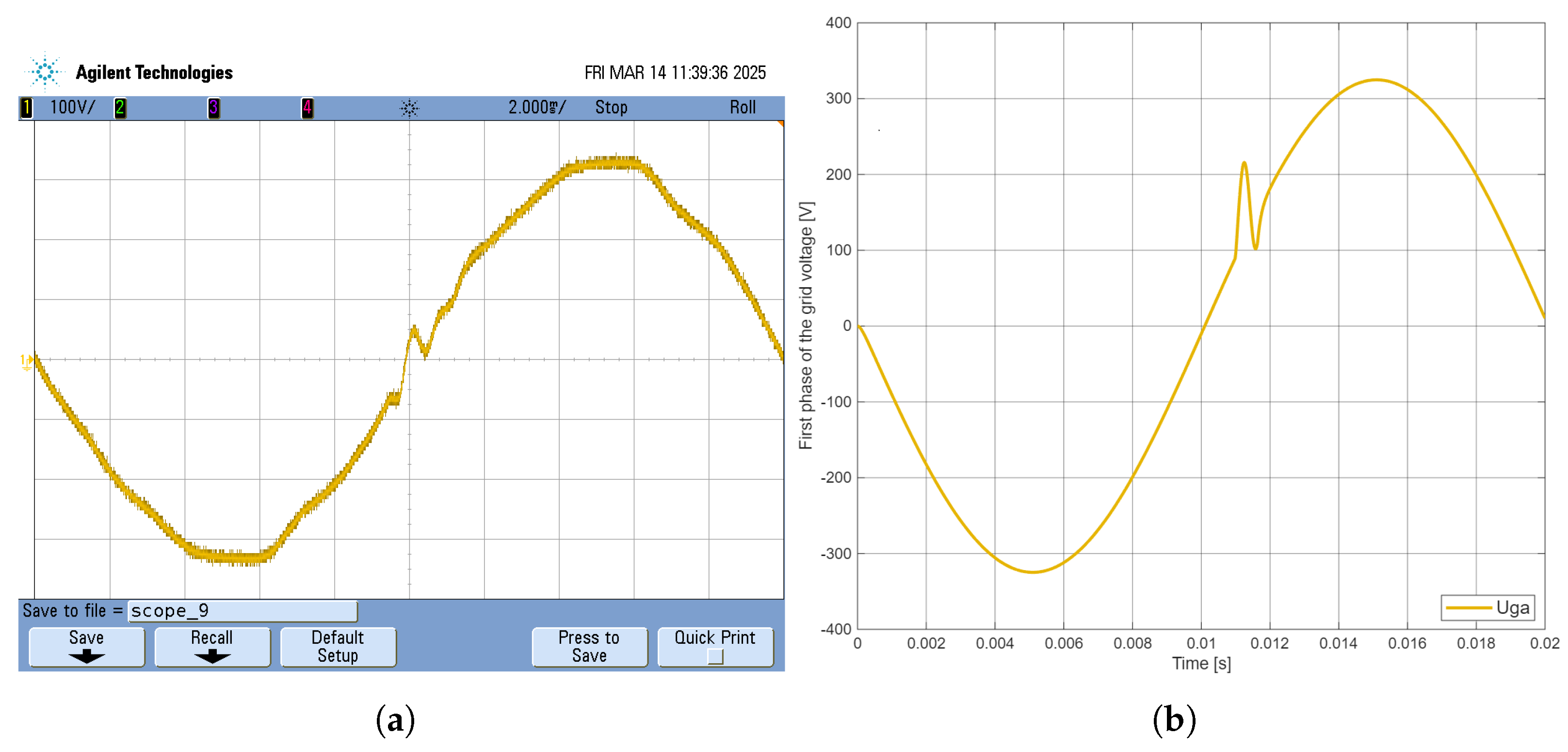
The three-phase AC power grid is a solution that, despite enormous technological advances, has remained essentially unchanged for years. The system’s operating principle, based on synchronized generators that maintain the appropriate voltage and frequency, is highly versatile and relatively simple to implement. From the user’s perspective, the main role is played by the three-phase transformer, which is usually characterized by very low impedance’s, enabling high network rigidness. The RLE gird model [1,2,3,4] is commonly used, perfectly reflecting the network’s characteristics. With the development of electronics, the nature of loads connected to the grid has changed. A large number of devices with rectifiers have emerged, and more recently, systems that exchange energy bidirectionally with the grid [3,4,5,6,7,8,9]. Currently, most modern devices are transistor inverters. The emergence of this class of devices has led to numerous unfavorable phenomena in AC networks. Some of these phenomena are solved by using various inverter typologies [10] or introducing very complex control methods [11]. The vast number and diversity of loads poses new challenges for the design of control systems, which must cope with the interactions between multiple interconnected devices. Although grid converters face numerous requirements related to their interaction with the grid [4,12,13,14], many phenomena arise that can significantly impact the stability of grid components and entire systems [6,14,15,16,17]. In the case of PV systems, these include difficulties with DC voltage stabilization and the occurrence of undesirable AC harmonics [2,13,14,18]. Another important phenomenon that can cause instability in grid converter systems is the possibility of a sudden voltage disturbance caused by direct connection of a rectifier with discharged DC link capacitors [14]. Figure 1a shows a single-phase voltage oscillogram recorded in an industrial district city Lodz in Poland, in a building near by a large metalworking facility. The disturbance presented and its simulation mode (Figure 1b) became the starting point for analyzing the stability of the grid-based inverter control system.
It was assumed that the controlled system is thrown out of equilibrium by a short-term interaction with a voltage-disrupting object via the power grid. Considering the aforementioned issues related to the occurrence of voltage disturbances—classified as short-term and transient oscillatory interference’s [19,20]—a sliding mode controller was employed for the purpose of conducting the study. Sliding mode control (SMC) algorithms, belonging to the class of variable structure control (VSC) systems, are recognized as robust controllers with high dynamic performance [21,22,23,24]. This type of control strategy has been increasingly applied in demanding control processes, particularly in fields such as electric drives [25,26], power electronics [9,17,27,28,29,30], and even unmanned aerial vehicles (UAVs) [31]. In this work, a sliding mode control algorithm based on the so-called reaching law method [24,32,33,34,35] in the form of a saturated-type characteristic is proposed [30,32,36,37]. This type of reaching law is continuously being developed within the framework of continuous and discrete sliding mode control algorithms. An area of growing interest in contemporary control theory is that of hybrid controllers, which are also being designed within the sliding mode control paradigm [5,25,26,38,39,40]. The proposed algorithm, based on a hybrid form of the saturated-type reaching law, has been compared with both classical and hybrid control schemes reported in the literature, in order to verify the response of the considered control methods to the previously described disturbance. Furthermore, an extended Lyapunov analysis has been conducted to demonstrate system stability even in the presence of specific perturbations. Therefore, the algorithm proposed in this work aims to minimize the effects of the mentioned voltage disturbances while simultaneously providing improved control performance and, consequently, enhanced quality of the current supplied from the microgrid, through a novel hybrid sliding mode control algorithm. The remainder of the paper is organized as follows. Section 2 presents the methodology, including a description of the considered object, i.e., the power electronic system, and—most importantly in the context of this work—a detailed discussion of the proposed control algorithm. Section 3 presents and discusses the results obtained from both simulation and laboratory experiments and also provides a summary of the present study. Finally, Section 4 contains the conclusions drawn on the basis of the obtained and previously discussed results.

2. Methodology

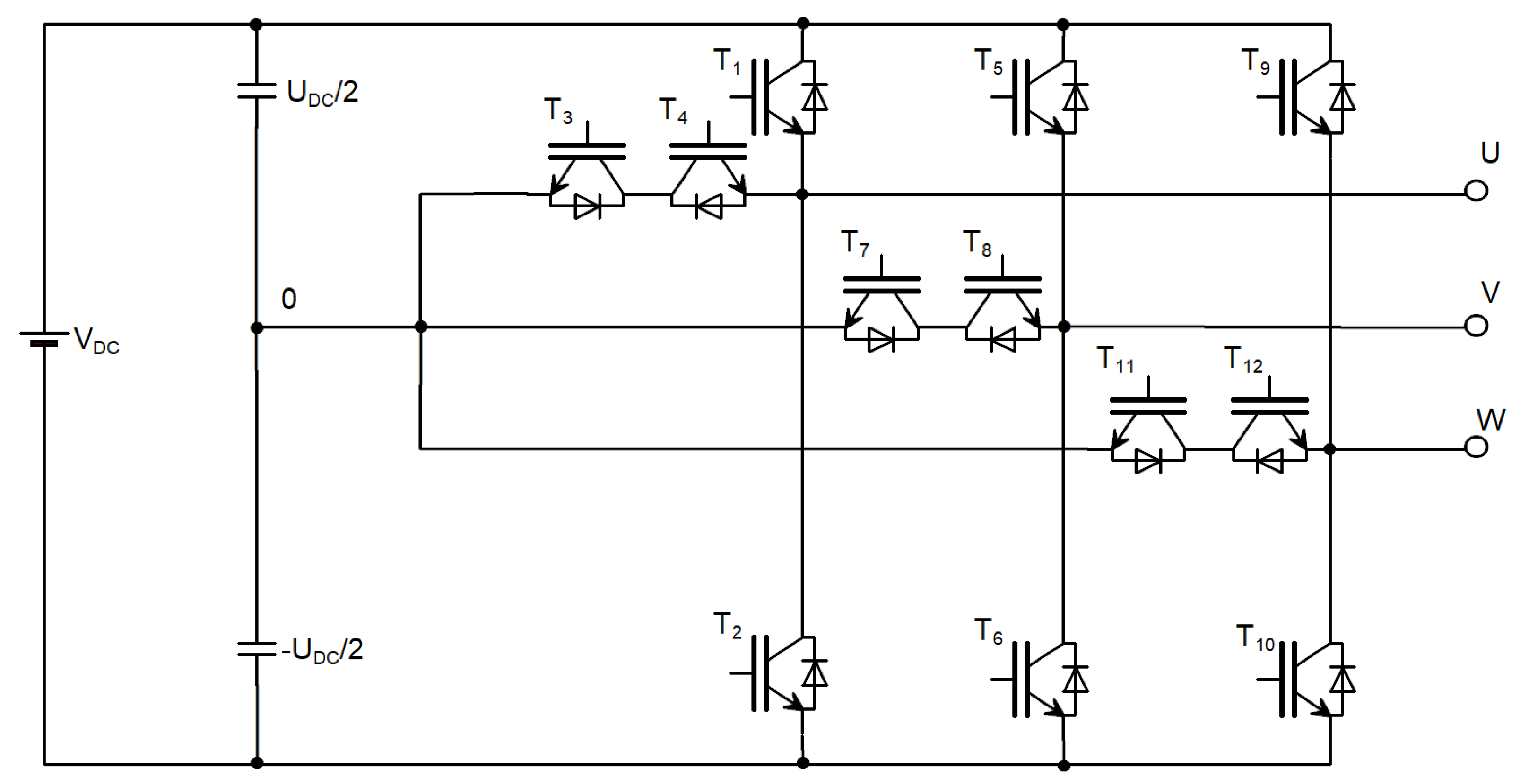
This paper focuses on the simulation and laboratory experimental studies of the proposed sliding mode control strategy of grid current for the power inverter connected via LCL filter with the main grid with particular emphasis on phenomena occurring during and after a major voltage disturbance in the gird. Figure 2 presents simplified main circuit diagram of bidirectional T-type inverter. The DC voltage source with capacitive filter, as a power inlet, represents the PV microgrid [4,5,9,16,29,41,42].
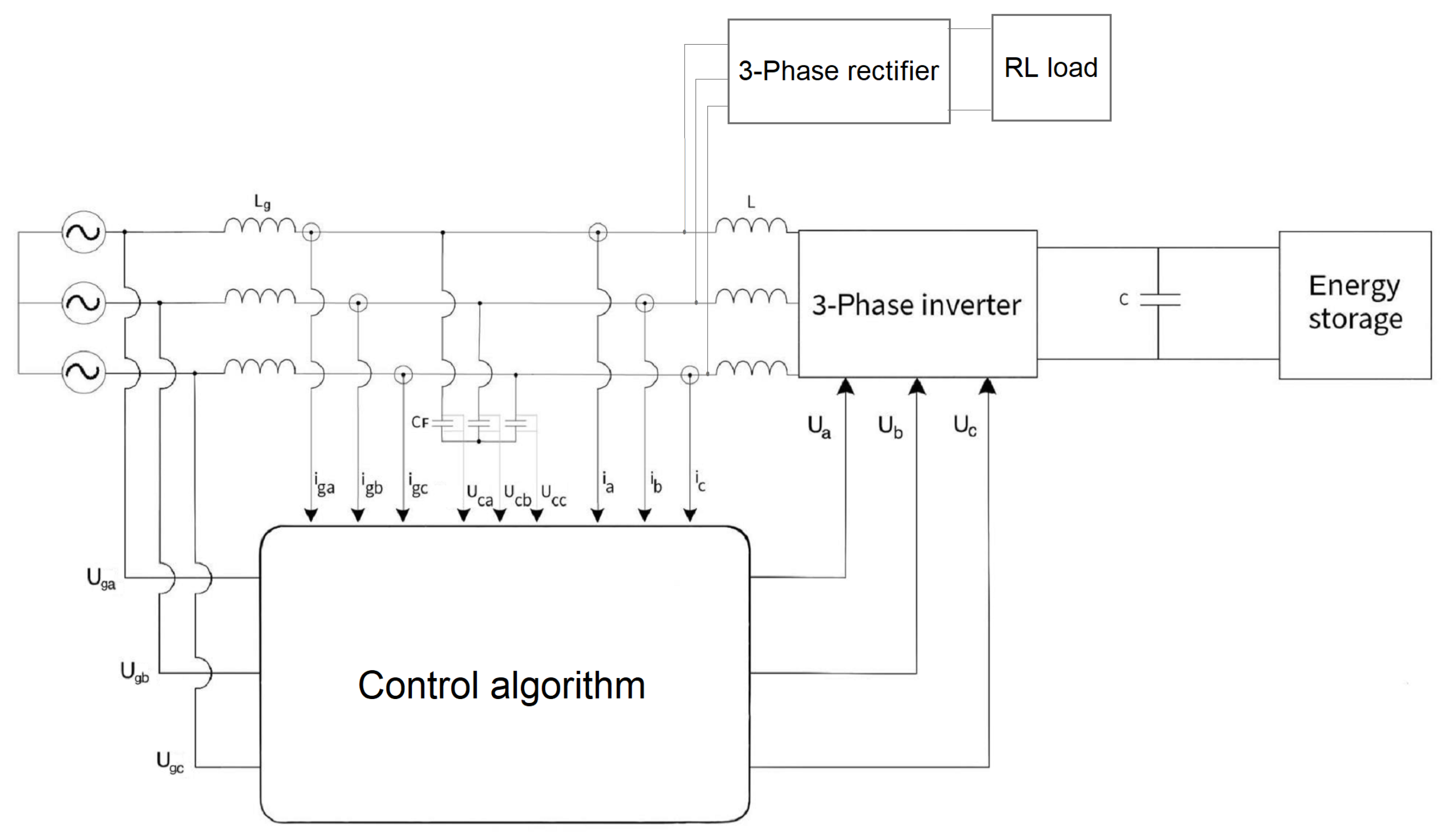
Figure 3 shows block diagram of the investigated system. The systems consists of a three-phase power source, which constitutes the power grid; LCL filter, where L g defines dynamic of power line and LC ensures EMC compatibility; and three-phase T-type bidirectional power inverter, which is supplied from energy storage unit (PV, battery, etc.). In parallel to the inverter, a three-phase rectifier with a configurable R L load is connected.
The foundation of sliding mode control design is the formulation of an appropriate sliding variable whose structure defines the system dynamics during the so-called sliding motion [23,24]. The sliding variable corresponds to a hyperplane on which the trajectory of the system state is expected to evolve during this mode of operation. To properly parameterize the proposed hyperplane, a coefficient-selection procedure was employed in which a multidimensional grid of candidate coefficient combinations was generated, and only those sets that yield a stable closed-loop system were retained. System stability was assessed by analyzing the closed-loop state matrix obtained after introducing the equivalent control [17,30]. The regulation process governed by sliding mode control can be divided into two phases. The reaching phase refers to the interval during which the system state trajectory approaches the hyperplane, whereas the sliding phase corresponds to the interval during which the trajectory evolves on the hyperplane. In this work, the sliding variable was constructed using the state variables of an inverter with an LCL filter, expressed in the dq0 reference frame. The considered system is modeled by the following set of equations:
L d d t i d i q = U D C d d d q U c d U c q L ω i q i d C f d d t U c d U c q = i d i q i g d i g q C f ω U c q U c d L g d d t i g d i g q = U c d U c q U g d U g q L g ω i g q i g d ,
where
-
L—filter inductance;
-
L g —grid inductance;
-
C f —filter capacity;
-
U D C —energy storage voltage (inverter DC voltage source);
-
i d , i q —inverter output current vector components;
-
i g d , i g q —grid current vector components;
-
U c d , U c q —capacitive filter voltage vector components;
-
U g d , U g q —grid voltage vector components;
-
d d , d q —voltage modulator duty cycle vector components;
-
ω —pulsation.

2.1. Sliding Mode Controller Synthesis

A sliding hyperplane for the system defined in Equation (1) is designed using the following expression for the d-axis component of the sliding variable vector:
s d = c 1 ( i d i d s e t ) + c 2 ( U c d U c d s e t ) + c 3 ( i g d i g d s e t ) ,
where
-
s d —sliding variable;
-
c 1 , c 2 , c 3 —sliding variable coefficients, where c 1 > 0 , c 2 > 0 , c 3 > 0 ;
-
i d s e t , U c d s e t , i g d s e t —desired values of the state variables.
The derivations are presented only for the d-axis component of the quantity vectors. The derivations for the second component follow analogously. By applying the well-known stability criterion for systems whose dynamics are described by a sliding hyperplane,
s d s d ˙ = 0 ,
the following form of the so-called equivalent control is obtained:
u d e q = L U D C U c d + L ω i q L i d s e t ˙ L c 2 c 1 U D C i d i g d + C f ω U c q C f U c d s e t ˙ L c 3 c 1 U D C U c d U g d + L g ω i g q L g i g d s e t ˙ .
For such a control, the system stability is guaranteed in the Lyapunov sense, although it is not asymptotic. First, an appropriate form of the Lyapunov function must be proposed:
V d = 1 2 s d 2 .
Considering Equation (5), which incorporates the proposed form of the Lyapunov function, a stability analysis can be conducted based on the time derivative of this function:
V d ˙ = s d s d ˙ = 0 .
It is also necessary to consider the forms of the desired and virtual variables, as well as to adopt certain assumptions:
ω = c o n s t ,
i g q s e t = 0 ,
U c d s e t = U g d = c o n s t U c d s e t ˙ = 0 ,
U g q = c o n s t U g q ˙ = 0 ,
U c q s e t = U g q + ω L g i g d s e t U c q s e t ˙ = ω L g i g d s e t ˙ ,
i d s e t = C f U g d ˙ + i g d s e t ω C f U g q ω 2 C f L g i g d s e t i d s e t ˙ = i g d s e t ˙ 1 ω 2 C f L g ,
i q s e t = C f U g q ˙ + ω C f U g d i q s e t ˙ = 0 .
The parameters describing the grid voltage are treated as constants, as they represent estimated nominal values for the system. This approach can be seen as a form of feed-forward control based on known nominal values within the system. A common solution employed in the design of sliding mode controllers is the use of the so-called reaching law. The specific form of the reaching law significantly affects the reaching phase, while the discontinuous component strongly influences the sliding phase. Two widely recognized methods from the literature are briefly presented below. The first method represents a simple approach, employing a proportional reaching law along with a discontinuous switching component of constant amplitude. The control law based on this first method is expressed as follows:
u d = k 1 sgn ( s d ) k 2 s d u d e q ,
where
-
u d —control law for the d component;
-
k 1 , k 2 —positive gains for corresponding control law parts.
The application of the control algorithm described by Equation (14) guarantees asymptotic stability of the system in the Lyapunov sense, for s d 0 :
V d ˙ = s d k 1 sgn ( s d ) k 2 s d < 0 .
The next widely recognized method involves the use of a so-called hybrid controller, in which a power-type reaching law is switched with a proportional reaching law depending on the distance of the system’s state-representing point from the hyperplane [5]. Due to the property of raising one to a power, the natural choice for the switching point is the system’s operating point at s d = 1 . Additionally, this method incorporates a modification in which the amplitude of the discontinuous control is variable. This approach helps to reduce the impact of the so-called chattering phenomenon on the system [5,31]. Chattering refers to high-frequency, low-amplitude oscillations, which are a typical problem in systems employing switching sliding mode controllers [23,24,30,35,37]. An example of a well-known hybrid algorithm is presented in the following form:
u d = k 1 | s d | 1 α sgn ( s d ) k 2 H s d , α u d e q ,
where
-
α —an additional parameter for hybrid control law, where 1 > α > 0 ;
-
H s d , α —an additional function to implement power hybrid control type, expressed by the following equation:
H s d , α = | s d | 1 + α sgn ( s d ) for | s d | > 1 , H s d , α = s d for | s d | 1 .
The stability analysis for this method, considering s d 0 :
V d ˙ = s d k 1 | s d | 1 α sgn ( s d ) k 2 H s d , α < 0 .
This work proposes a new hybrid controller based on a so-called saturated-type reaching law, which is switched with a proportional reaching law. The design objective of this hybrid controller is to enable interdependent parameterization of both reaching laws in such a way as to achieve a fast and properly shaped reaching phase while maintaining chattering reduction through the use of a variable amplitude of the discontinuous control. During the sliding phase, and in the vicinity of the system state point and the hyperplane, the proportional reaching law exhibits superior performance compared to its power-type counterpart [5,25]. Another crucial aspect is the proper selection of the switching point—the hybrid switching reaching laws should be parameterized so that the control signals for a given sliding variable intersect (i.e., have equal values) at a chosen switching point. In the proposed hybrid method, this point can be appropriately selected. The equations describing the proposed control algorithm are as follows:
u d = k 1 | s d | 1 α sgn ( s d ) k 2 H S T c S T s d u d e q ,
where
-
H S T c S T —an additional function to implement saturated-type hybrid control type, expressed by equation:
H S T c S T = 1 c S T 1 s 0 d s 0 d + | s d | for | s d | > P s , H S T c S T = c S T for | s d | P s .
where
-
c S T —coefficient coupling the two types of reaching law, 1 > c S T > 0 ;
-
s 0 d —primary parameter of the saturated-type reaching law, s 0 d > 0 ;
-
P s —defined switching point of the reaching law, corresponding to the case when the output signal of the proportional reaching law equals that of the saturated-type reaching law.
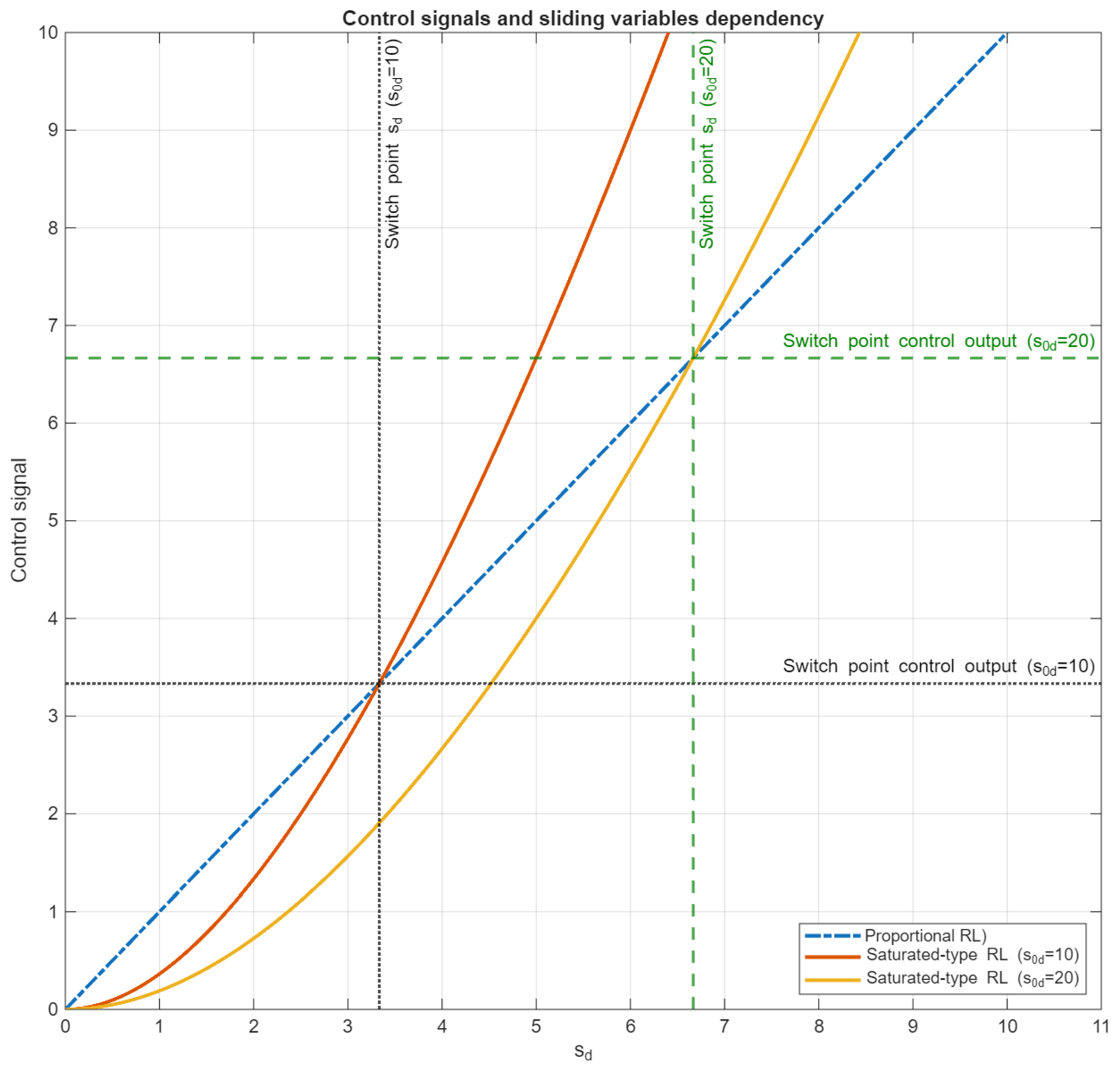
Equations (19) and (20) present a new control algorithm based on a hybrid approach that incorporates both proportional and saturated-type reaching laws. In this approach, a common gain coefficient k 2 is used for both types of reaching laws; this coefficient does not affect the value of the switching point and thus constitutes a fundamental and general parameter of the proposed hybrid algorithm. Another introduced parameter is the coupling coefficient between the two reaching laws, c S T , which serves to amplify one type of reaching law while attenuating the other. Increasing value of c S T strengthens the proportional component, whereas decreasing it strengthens the saturated-type component, and vice versa. This parameter also influences the value of the switching point P s . For c S T = 1 , no common point exists for the control signal trajectories corresponding to s d . The final parameter of the new hybrid algorithm is the characteristic parameter of the saturated-type reaching law, s 0 d , which affects both the switching point P s and the shape of the saturated-type reaching law. Smaller values of s 0 d result in a more aggressive control signal response with respect to s d , while increasing s 0 d smooths the trajectory, making it resemble that of the proportional law. The switching point P s is defined as follows:
P s = s 0 d 1 c S T 2 1 + 1 .
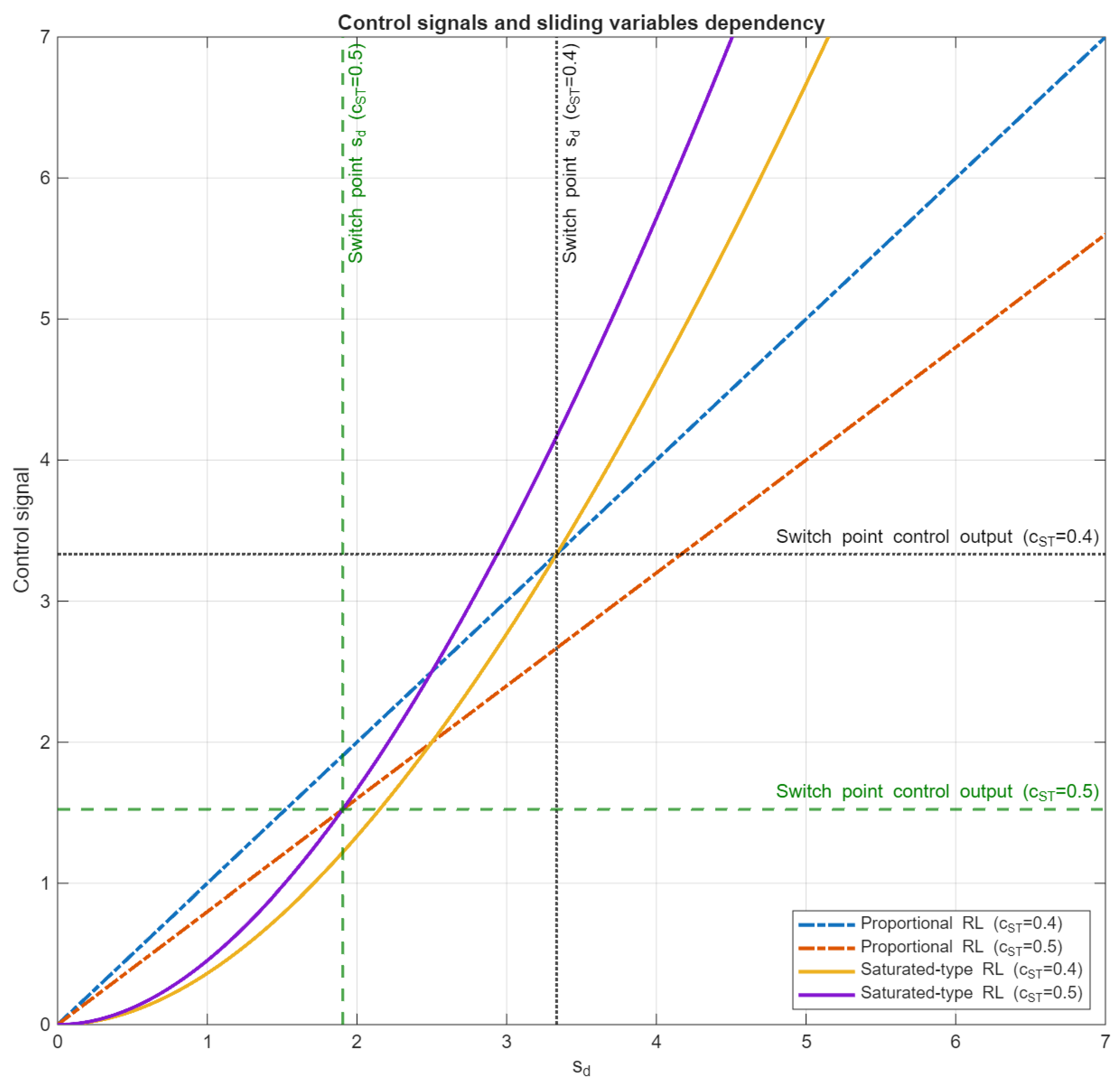
The graphical representation of the operation of the discussed hybrid algorithm is presented in Figure 4 and Figure 5. In the first case, the effect of changing the parameter s 0 d is shown, which, according to the previously described explanation, affects only the saturated-type reaching law and the location of the switching point. In the second case, the change concerns the coefficient c S T , which parameterizes both types of reaching laws and also influences the value of the switching point. In a system with high dynamic complexity, such as the power electronic system considered in this work, certain types of disturbances, like those described in the previous chapters, are likely to occur. It is therefore possible to account for the estimated forms of these disturbances and extend the stability analysis. The basic analysis presented, which originates from [43], does not consider such disturbances and may be insufficient for systems exposed to this type of perturbation.
The extended stability analysis is based on the consideration of a certain estimated value by which the grid voltage may change due to a modification of the network structure, e.g., through the connection of a rectifier, in the equivalent control law. Considering this estimated value, representing a potential variation of one of the system’s input quantities, namely the grid voltage, allows the controller parameters to be selected in such a way as to achieve greater system insensitivity to external disturbances and to accelerate the regulation time after the system is displaced from its equilibrium point. The form of the equivalent control is therefore revised, taking into account the potential change in the grid voltage, which is estimated based on nominal values and acts as a form of feed-forward control in the equivalent control scheme:
u d e q Δ = L U D C U c d + L ω i q L i d s e t Δ ˙ L c 2 c 1 U D C i d i g d + C f ω U c q C f U c d s e t Δ ˙ L c 3 c 1 U D C U c d U g d Δ + L g ω i g q L g i g d s e t ˙ .
where
-
u d e q Δ —equivalent control law modified by the voltage disturbance presence;
-
i d s e t Δ , U c d s e t Δ —desired values of the state variables modified by the voltage disturbance presence;
-
U g d Δ —grid voltage d component modified by the voltage disturbance presence.
Including the voltage disturbance requires comparing the default form of the equivalent control with its modified version. It is therefore necessary to define all quantities that may have changed due to the presence of the disturbance:
U g d Δ = U g d + Δ U g d U g d Δ ˙ = Δ U g d ˙ ,
where
-
Δ U g d —grid voltage disturbance signal:
U c d s e t Δ = U g d Δ U c d s e t Δ ˙ = Δ U g d ˙ ,
i d s e t Δ = C f U g d Δ ˙ + i g d s e t ω C f U g q ω 2 C f L g i g d s e t       i d s e t Δ ˙ = i g d s e t ˙ 1 ω 2 C f L g + C f Δ U g d ¨ .
Taking into account the relations from Equations (23)–(25), the difference between the nominal form of the equivalent control and its modified version can be determined as follows:
Δ u d e q = u d e q u d e q Δ ,
where
-
Δ u d e q —equivalent control signal difference with disturbance signal consideration.
Next, the equation must be rearranged and simplified so that only the terms resulting from the presence of the voltage disturbance remain:
Δ u d e q = s d L U D C c 3 Δ U g d c 1 L g + c 2 Δ U g d ˙ c 1 + C f Δ U g d ¨ ,
The form of the Lyapunov function derivative obtained within the basic stability analysis of the control system with the proposed control law, for s d 0 , is given by
V d ˙ = s d k 1 | s d | 1 α sgn ( s d ) k 2 H S T c S T s d < 0 ,
since s d 0 : sgn ( H S T c S T s d ) = sgn ( s d ) . This stability result indicates that the system is asymptotically stable in the Lyapunov sense. When driven away from the equilibrium, the plant should return to the reference value once the voltage disturbance vanishes. Using the proposed extended stability analysis, it is possible to reduce the sensitivity of the system (increase its robustness) to external disturbances by incorporating the previously determined disturbance influence, described by Equation (27), for s d 0 :
V d ˙ = s d k 1 | s d | 1 α sgn ( s d ) k 2 H S T c S T s d Δ u d e q < 0 s d k 1 | s d | 1 α sgn ( s d ) k 2 H S T c S T s d < s d L U D C c 3 Δ U g d c 1 L g + c 2 Δ U g d ˙ c 1 + C f Δ U g d ¨ .
Applying suitable values of the control gains and parameters makes it possible to reduce the influence of the voltage disturbance described by Equation (27), and consequently enables the control system to attenuate its effects more rapidly. In the considered power electronic system, this corresponds to a reduction of the current spike induced by the grid voltage disturbance, as well as a shorter regulation process once the cause of the perturbation has disappeared. The selection of the controller parameters can be carried out on the basis of the following relations:
k r a t = k 1 k 2 ,
where
-
k r a t —additional positive parameter representing the ratio value of the discontinuous control gain to the reaching law gain.
The case s d > 0 Δ U g d > 0 is presented, since for s d < 0 the inequality is symmetric in the sense of the absolute value, and therefore the resulting controller gain values are identical. By transforming inequality (29), it can be rewritten in the following form:
k 1 s d 1 α sgn ( s d ) k 2 H S T c S T s d < L U D C c 3 Δ U g d c 1 L g + c 2 Δ U g d ˙ c 1 + C f Δ U g d ¨ .
To simplify the expression in (31), a new quantity is introduced, representing the maximum estimated influence of the voltage disturbance on the system:
U d i s m a x = m a x L U D C c 3 Δ U g d c 1 L g + c 2 Δ U g d ˙ c 1 + C f Δ U g d ¨ ,
where
-
U d i s m a x —maximum impact of the voltage disturbance on the system.
Thus, the updated form of inequality (31) is given as follows, for s d m a x = m a x s d s d > 0 , where s d m a x denotes the maximum value of s d after the occurrence of the voltage disturbance:
k 1 s d m a x 1 α + k 2 H S T c S T s d m a x > U d i s m a x ,
which, upon substitution of Equation (30), leads to
k r a t k 2 s d m a x 1 α + k 2 H S T c S T s d m a x > U d i s m a x ,
thus, it is possible to write
k 2 k r a t s d m a x 1 α + H S T c S T s d m a x > U d i s m a x .
Ultimately, the following expressions are obtained:
k 2 > U d i s m a x k r a t s d m a x 1 α + H S T c S T s d m a x ,
k 1 = k r a t k 2 .
Based on the relationship presented in Equation (32), it is possible to estimate, with an additional margin further increasing the insensitivity range, the maximum impact of the disturbance on the power system. For the purpose of selecting appropriate parameter values, this relationship has been updated to the following form, considering the case s d > 0 :
U d i s m a x = L U D C c 3 M 0 c 1 L g + c 2 M 1 c 1 + C f M 2 ,
where
-
M 0 : = m a x Δ U g d ;
-
M 1 : = m a x | Δ U g d ˙ | ;
-
M 2 : = m a x | Δ U g d ¨ | .
Due to the fact that 0 < M 1 1 and 0 < M 2 1 for very short durations of these signals with nonzero values, the following form is ultimately obtained:
U d i s m a x L c 3 M 0 L g c 1 U D C .
Thus, the selection of the controller parameters to be used in the event of a disturbance should be based on the following relationship:
k 2 > L c 3 M 0 L g c 1 U D C k r a t s d m a x 1 α + H S T c S T s d m a x .
The estimated and adopted values of the described parameters are presented in the next chapter: Section 2.2.

2.2. Simulation Model of T-Type Biderectional Power Grid Converter

The values of the disturbance parameters, introduced in Equation (38) and presented in Table 1, are estimated based on the disturbance waveform from Figure 1a,b.
The control algorithm parameters values introduced in Table 2 are adopted by assumptions or calculated. Sliding hyperplane coefficients are selected according to the method mentioned in Section 2.1 from [17,30]. The gains of the individual components of the control law for the scenario including grid voltage disturbances are calculated using Equation (40). However, for the static system operation, these parameters are selected with manual tuning method. The switching point parameter value is selected regarding the measured amplitude of sliding variable oscillatory signal induced by the discontinuous part of the control law. The third column values from Table 2 are selected when there is no voltage disturbance present in the system; the second column values from the same table are activated for the case of Δ U g d > 0 and deactivated when s d = 0 . Using the parameters presented in both tables, the investigation is carried out, and its results illustrate the differences between the system operating with active compensation of the effects of a disturbance and without such compensation.
Table 3 presents system parameters used for both simulation and laboratory experiments.
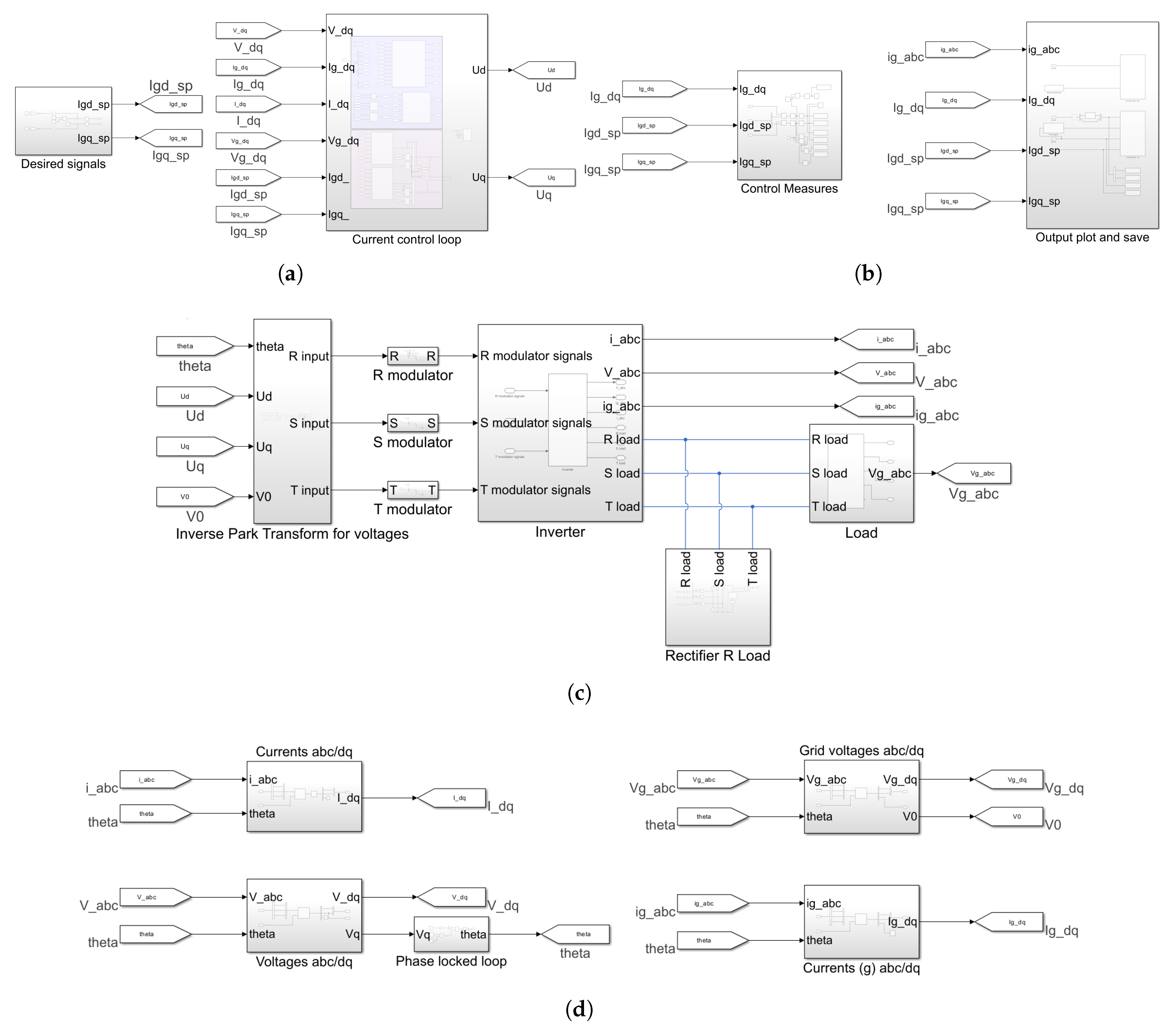
Figure 6 shows the MATLAB/Simulink (R2025a software version) model used for investigation of control algorithms presented in Section 2.1. Part (a) of this figure contains a control system model implemented to control both grid currect vector components, using equivalent, discontinuous, and reaching law control parts. The outputs of this system are voltage pattern signals reproduced afterwards at the inverter output by the modulator. The next part, (b), is a simple system used for plotting obtained data and save it to the MATLAB workspace. Figure (c) presents top view of the power electronic systems, containing grid-following inverter, a rectifier, and the load (power grid) implemented using specialized tool library Simscape for application of electric components such as resistors, inductors, transistors, etc. The last part, which is part (d), shows the subsystems used for dq0 transformation calculations.

2.3. Laboratory Stand of T-Type Bidirectional Power Grid Converter

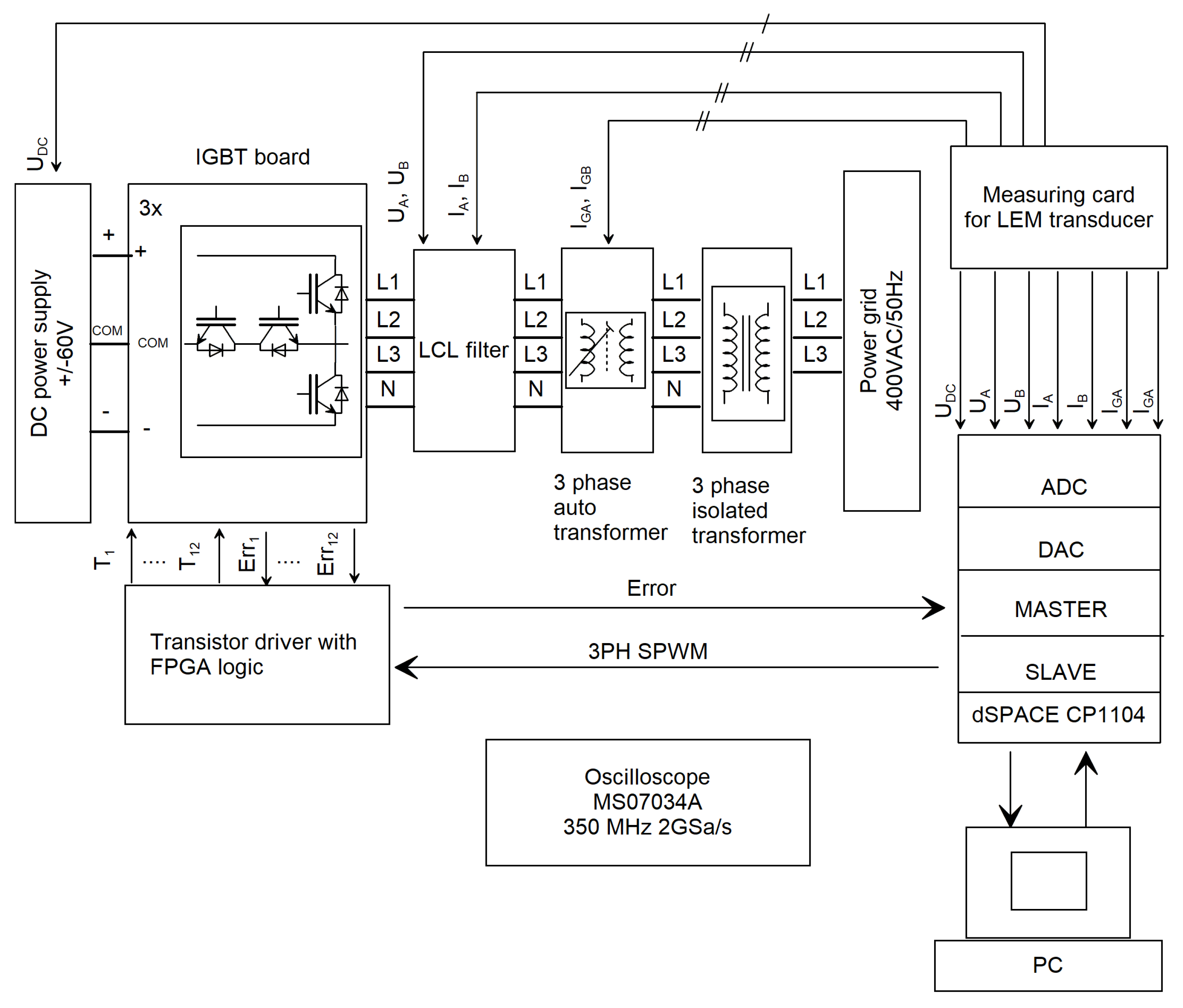
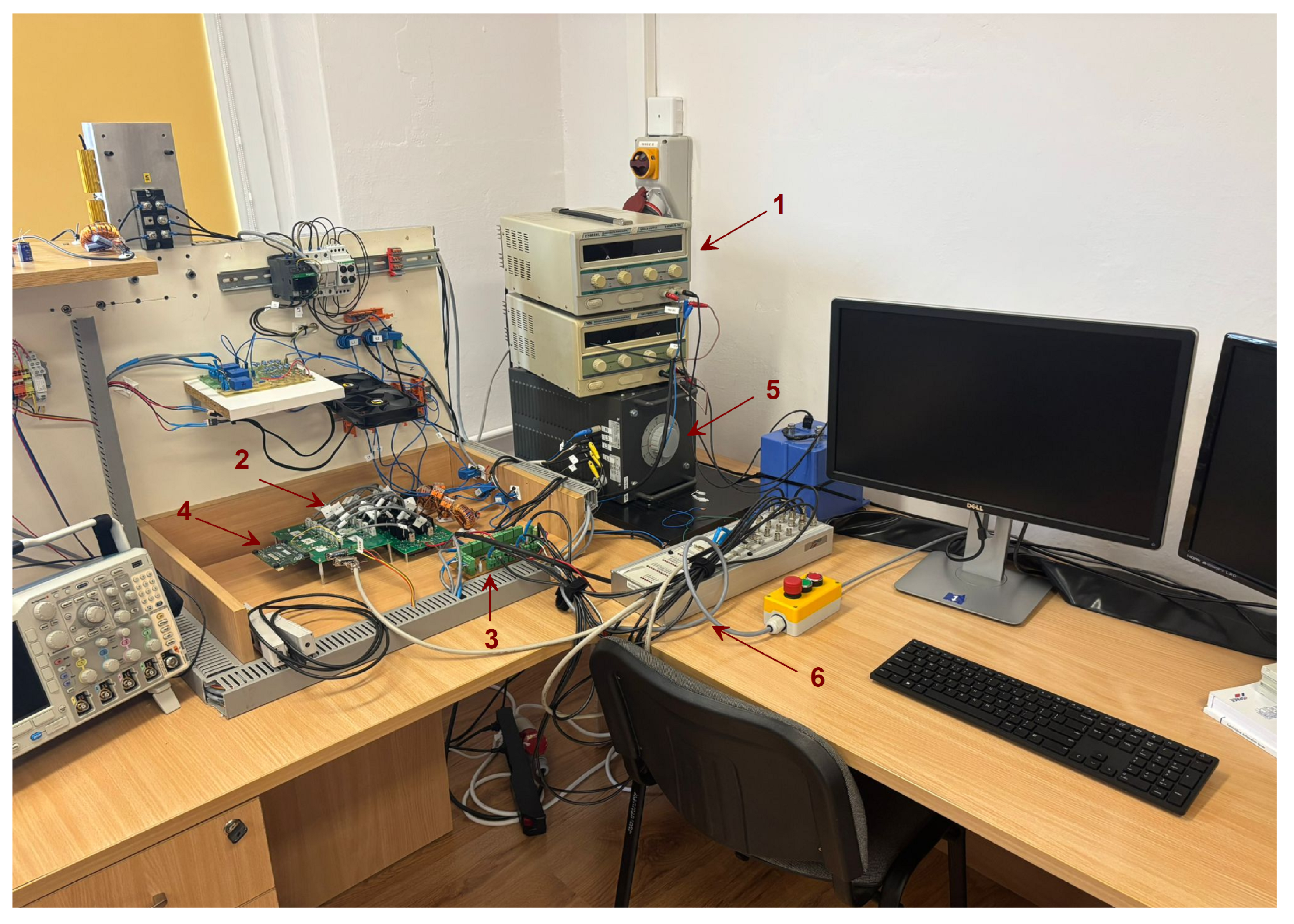
An illustrative diagram of the laboratory stand and its view are shown in the Figure 7 and Figure 8, respectively. In the Figure 7, several basic elements of system are presented:
  • DC power supply which represents energy storage device;
  • T-type bidirectional power grid converter with 12 IGBTs transistors and Concept drivers (Power Integrations 2SC0106T2A1-12);
  • Measurement card cooperating with LEM current and voltage converters, adjust-ing the voltage level for the dSPACE card;
  • Transistor logic and control board with Xilinx CPLD Coolrunner II module;
  • Separating transformer for personal safety;
  • Auto-transformer for adjusting the grid voltage to DC power supply limitations;
  • LCL grid filter;
  • dSPACE GmbH DS1104 card, which, together with a PC computer with MATLAB/Simulink and dSPACE GmbH ControlDesk 7.5 software installed, constitutes the acquisition and control part.
Since the dSPACE GmbH DS1104 measurement and control card is only capable of directly driving the two-level grid inverter, the Xilinx CPLD Coolrunner II module was used to obtain a proper logic enabling a three level T-type bidirectional grid inverter to be driven.

3. Results

In this section of the paper, both simulation and experimental outcomes are presented. Both simulation and laboratory studies confirmed the consistency of the results in terms of the behavior and operation of the control systems and the regulated power electronic device. These investigations further supported the validity of the presented theoretical considerations.

3.1. Simulation Experiment Results of Described SMC Algorithms

The simulation studies are carried out using MATLAB Simulink software, version R2025a. Power and power electronic systems are constructed using components from the dedicated Simscape library. Simulation model is designed based on the system scheme from Figure 3.
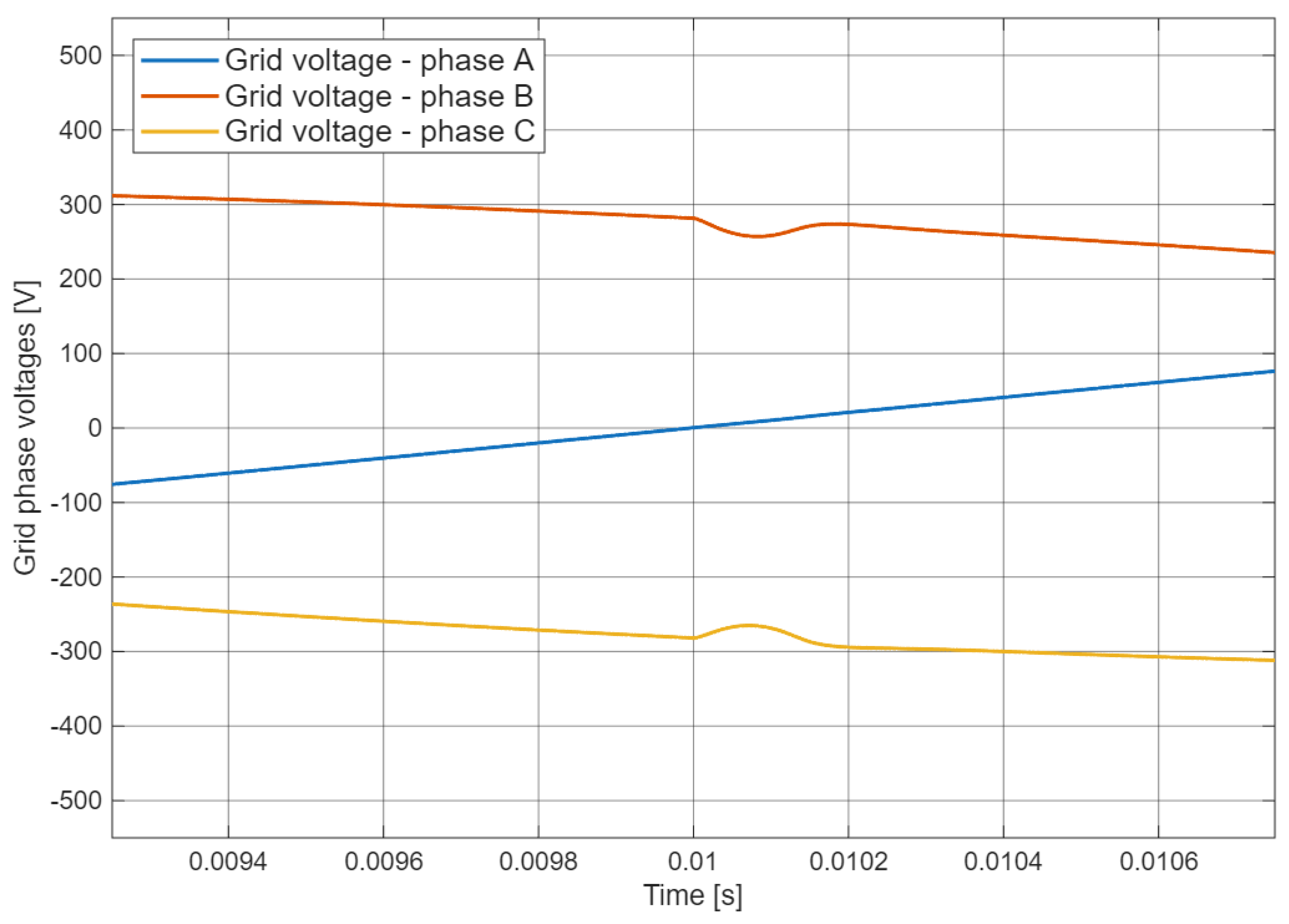
Tests are conducted for the following parameterization of the study scenario: the system regulates the grid current to a set value of 10 A; at a time instant of 10 ms, a load is connected to the system, causing potential changes in grid parameters. This load, as previously mentioned, is an R C load on the DC side of the six-pulse rectifier. The disturbance defined in the introduction Section 1 belongs to the short-duration oscillatory voltage transient type of disturbance. The sudden connection of the rectifier with an R C load can induce such a disturbance as seen from the grid voltage perspective. The effect of such a disturbance, measured from the perspective of the voltage across the capacitor filter, are shown in Figure 9. Initially, the case is examined in which only the controller settings selected for steady-state operation are used.
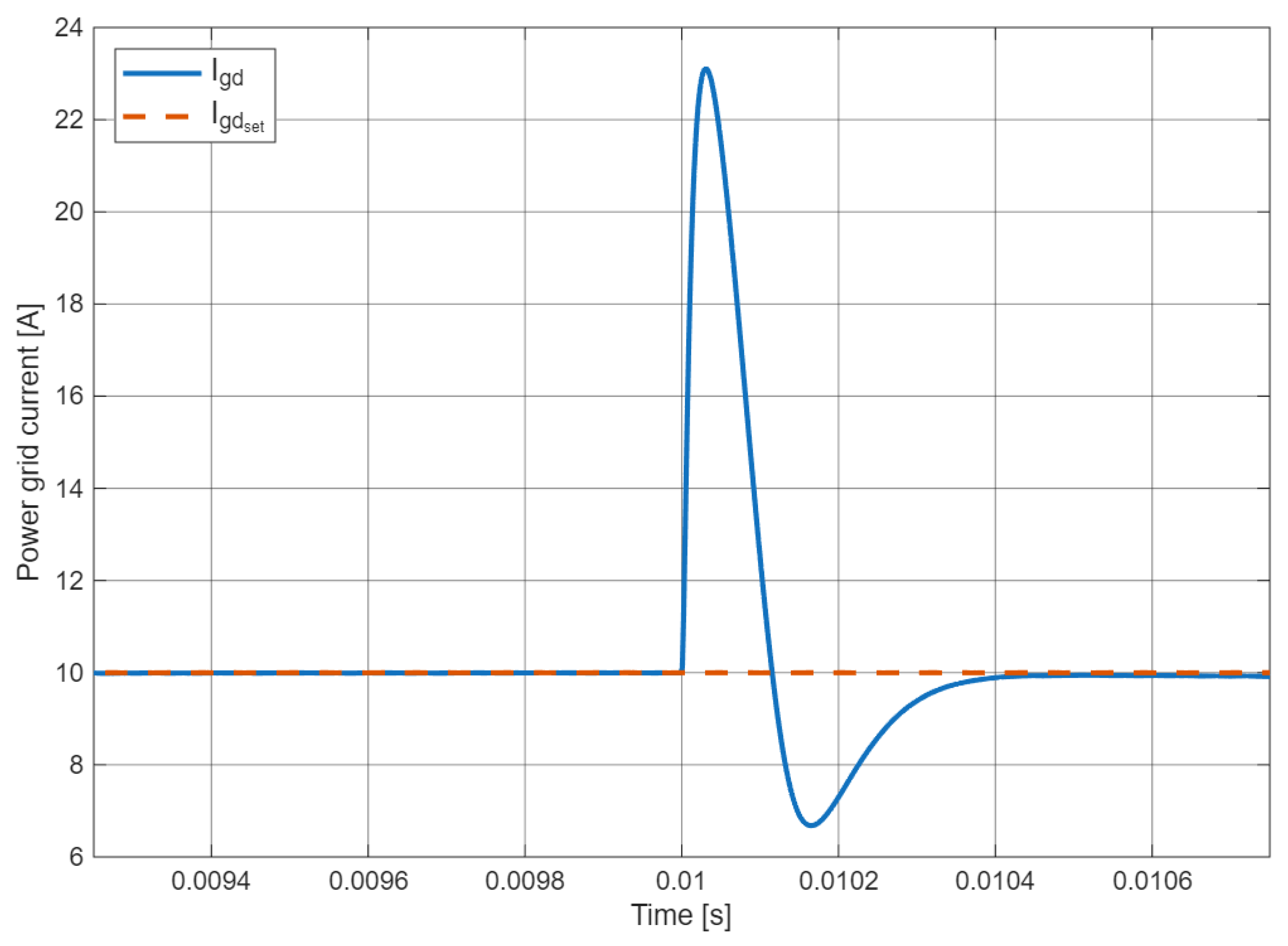
In Figure 10, the result of the disturbance introduction is visible in the context of the grid current waveform. The waveform of this current fully reflects the nature of the voltage disturbance, i.e., it is oscillatory, short-duration, and transient.
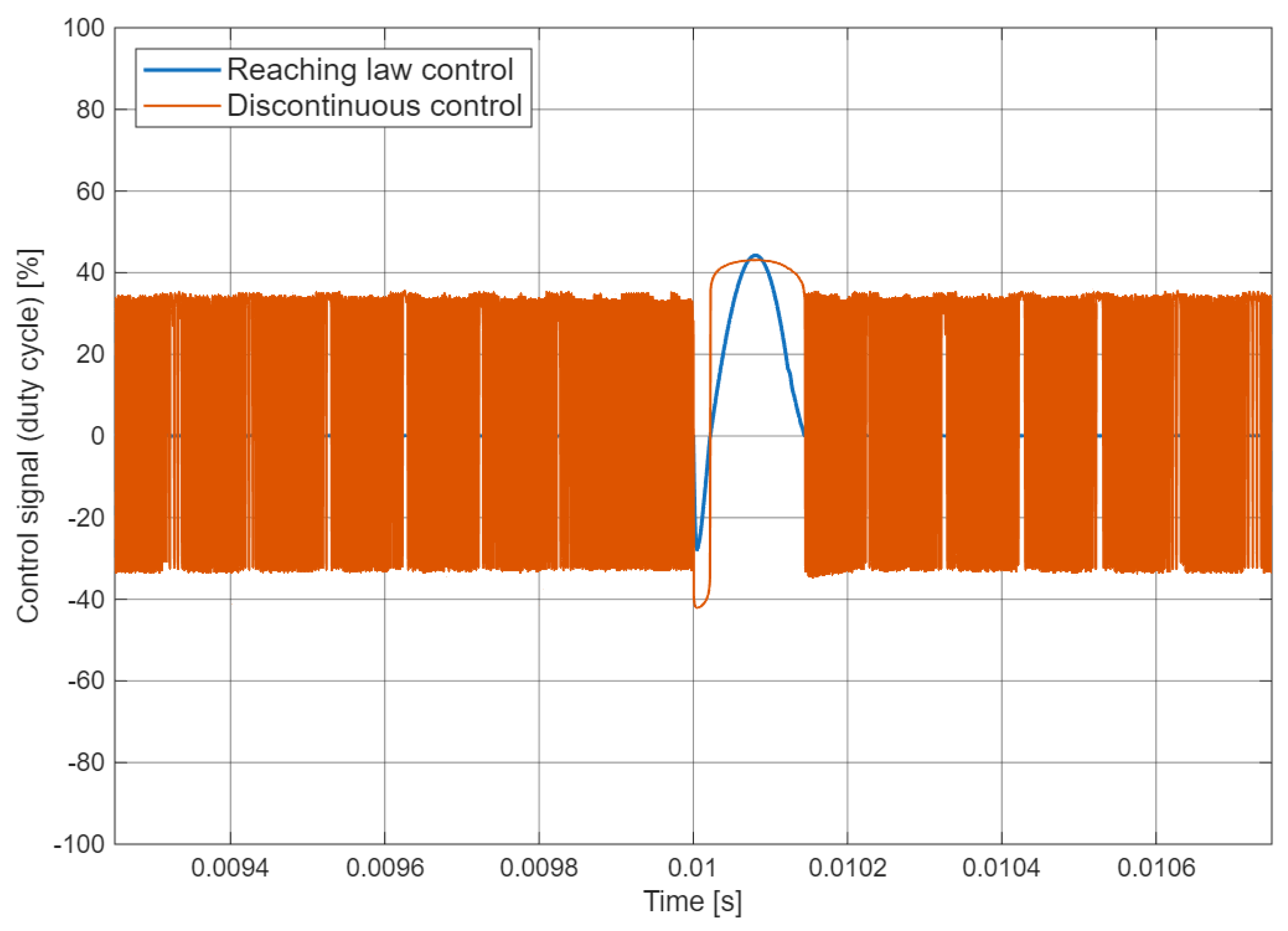
The discontinuous control performs excellently during steady-state operation; however, as shown in Figure 11, the action of this part of the control law becomes ineffective and interferes with the operation of the reaching law, whose purpose is to provide benefits specifically in dynamic states. The very design of the hybrid control, particularly considering the specifics of the algorithm from Equations (19) and (20), allows all parts of the control law to be appropriately parameterized to correctly divide their operational range between steady-state and dynamic conditions.
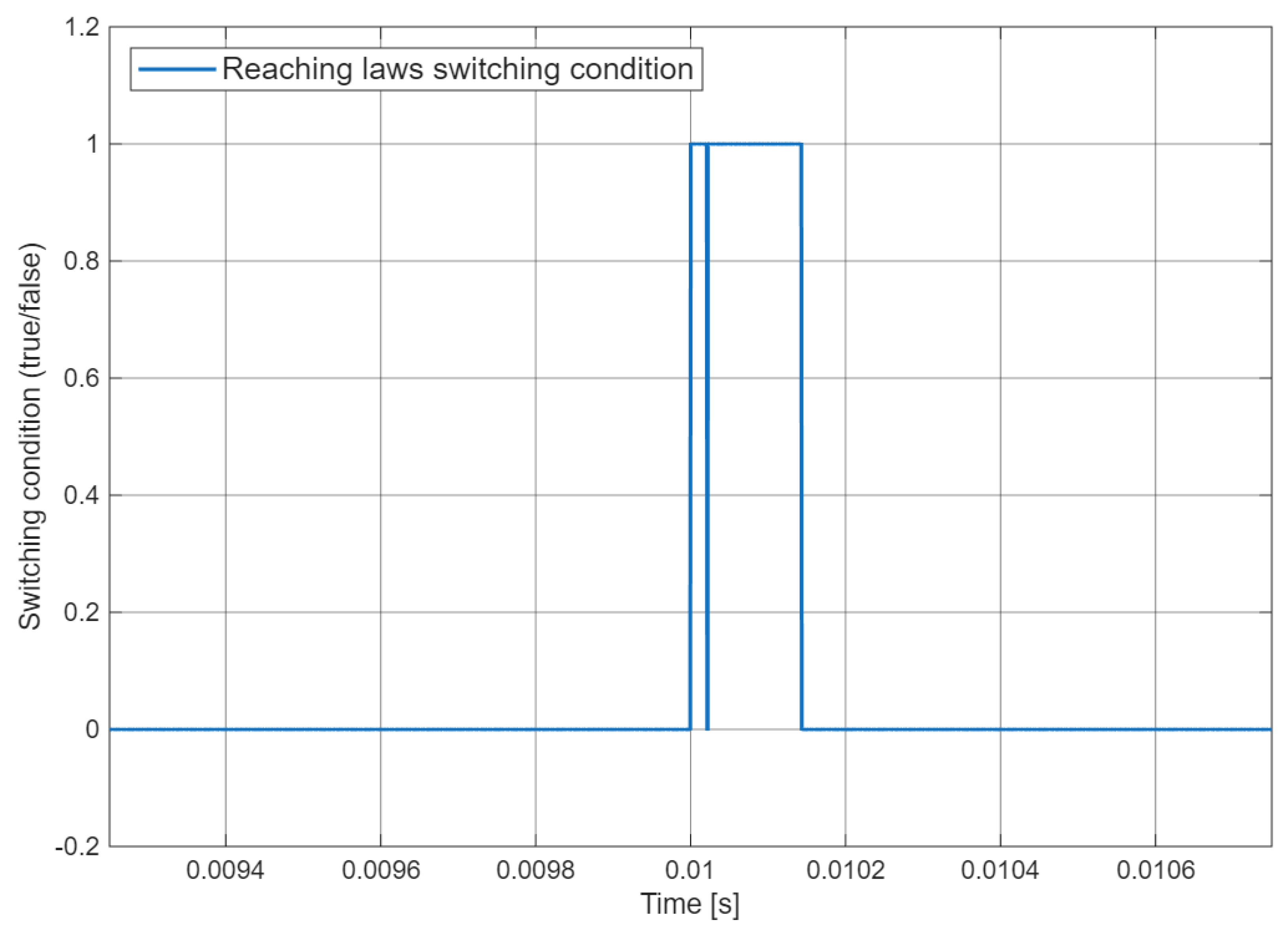
Another observed issue is the incorrect switching of the reaching law rules in the hybrid algorithm—in Figure 12 it can be seen that during a single dynamic action, switching occurs multiple times. The saturated-type rule alternates with the proportional rule for a specific operational mode, whereas only the former should be active. Once again, this results from improper parameterization of the discontinuous control. The following figures present the case in which active compensation of the effects of the voltage disturbance is enabled.
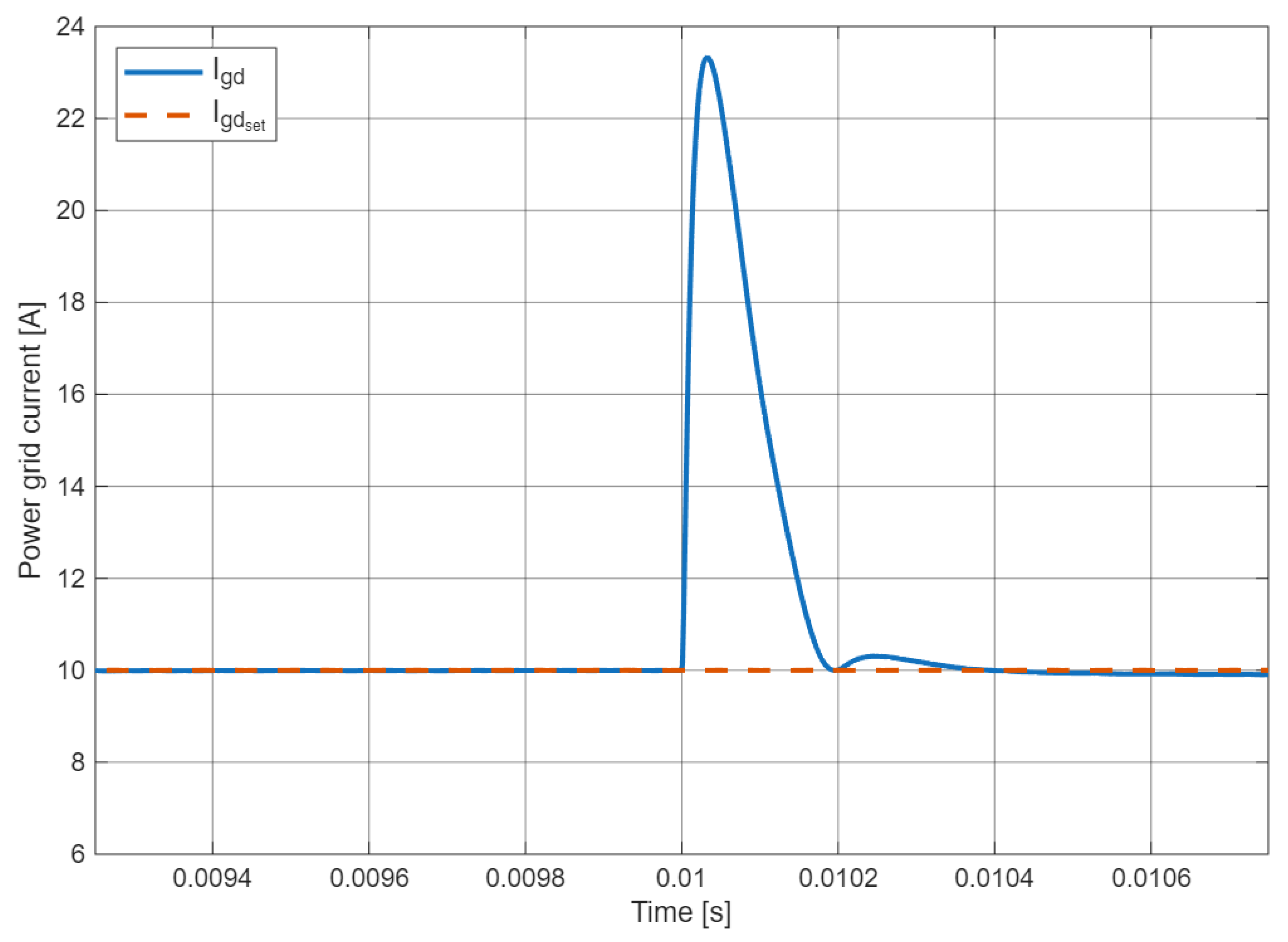
The application of active compensation of the disturbance effects makes it possible to avoid the grid current overshoot observed in Figure 10. This is achieved by reducing the influence of the discontinuous control in the dynamic state and by appropriately parameterizing the saturated-type reaching law, in accordance with the relation given in (40). The absence of grid current overshoot indicates that the oscillatory nature of this signal is suppressed, even though the disturbance itself remains oscillatory. Ultimately, a higher control quality is obtained, with a faster and safer return to equilibrium in terms of system stability. The described result is visible in Figure 13.
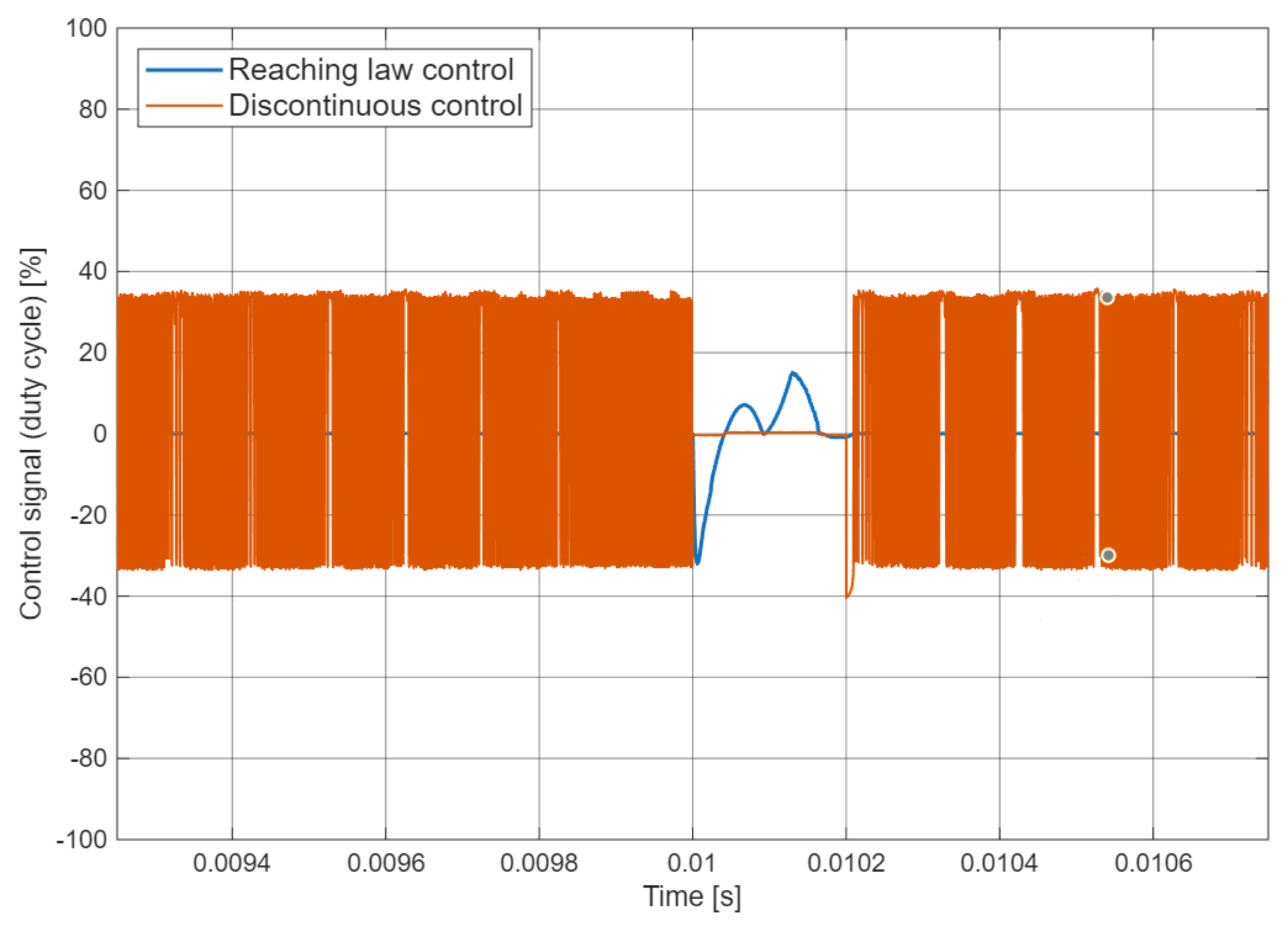
According to the description from the beggining of this chapter, the amplitude of the discontinous control part is reduced during the transient state caused by the disturbance. It is visible in Figure 14—the reaching law control part is in the presented case a key part of the algorithm, whose role is to ensure proper operation under dynamic conditions.
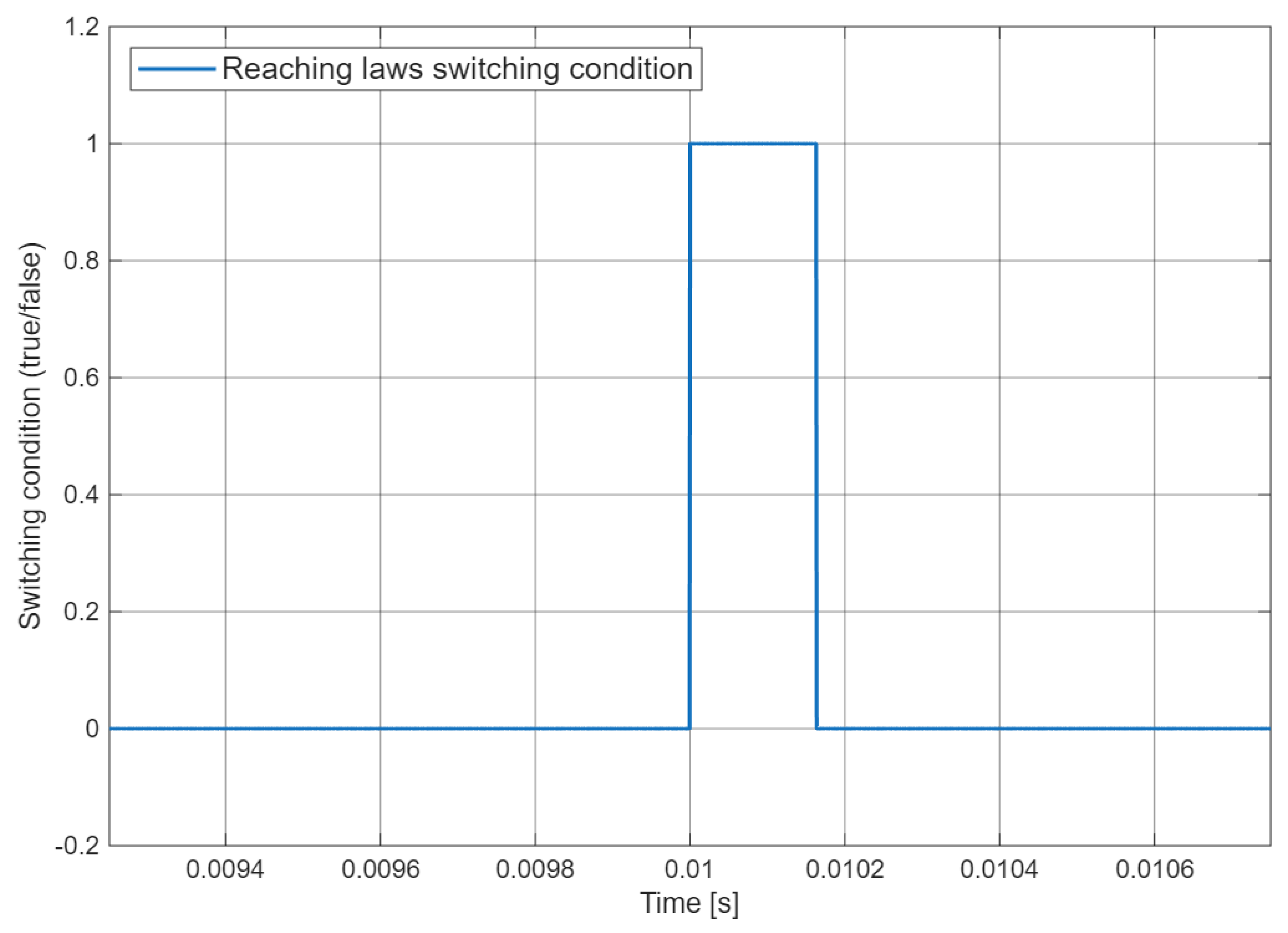
Another advantage of the presented approach is that the switching between the two reaching law rules in the hybrid form is performed correctly; that is, the saturated-type rule is activated once at the beginning of the system’s displacement from equilibrium and deactivated once after the system state returns to the desired point. The switching signal is presented in Figure 15. In this subsection the simulation-based implementation of the tests for the methods defined by the following relations, (19), (20), and (40), is presented. The simulation-based evaluation of the algorithm is carried out using the data from Table 1, Table 2 and Table 3, which contain the estimated and calculated parameters of the control system. The results confirm that the presented methods enhance the system’s robustness to oscillatory disturbances and improve overall control performance.

3.2. Laboratory Experiment Results of Described SMC Algorithms

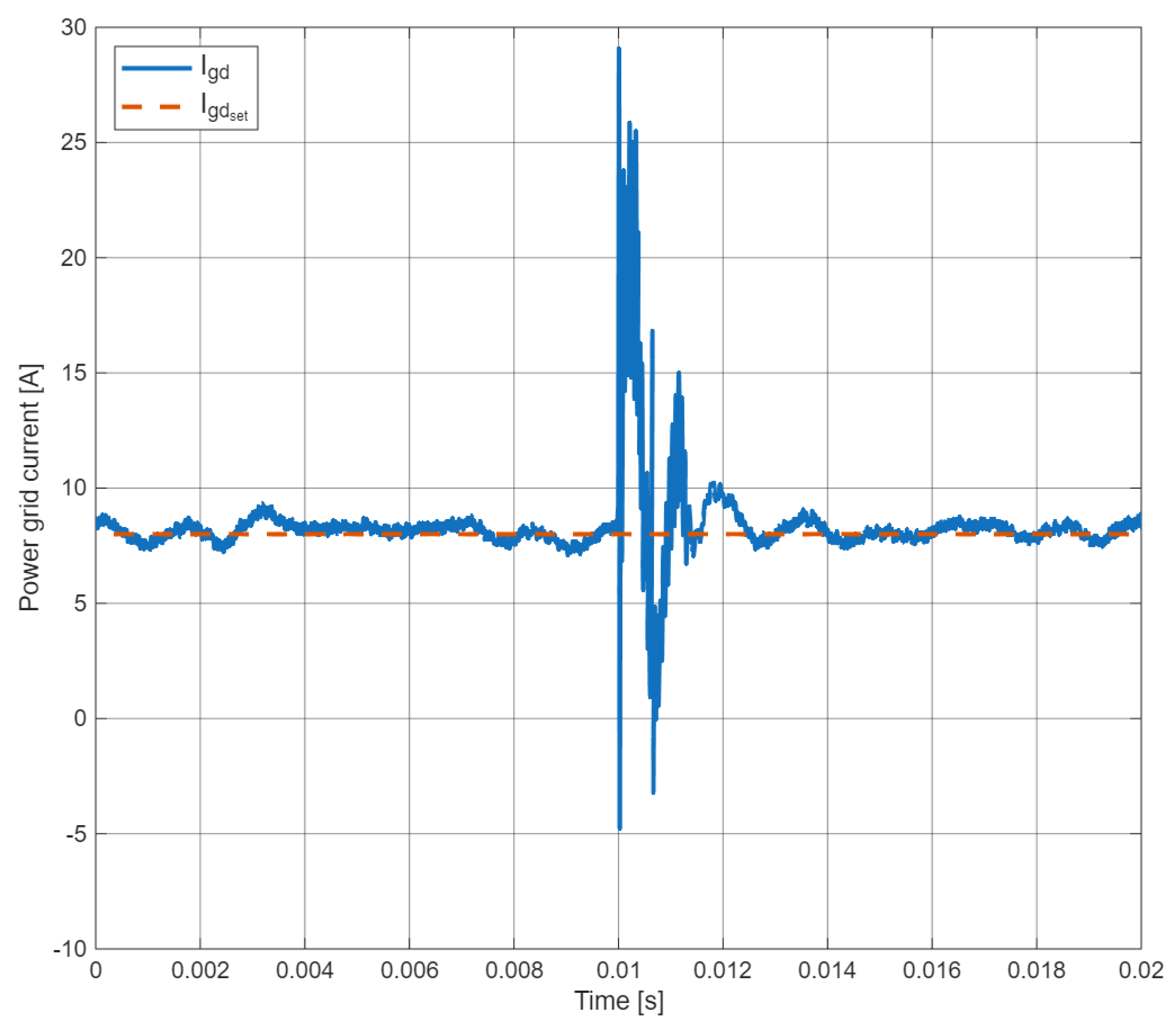
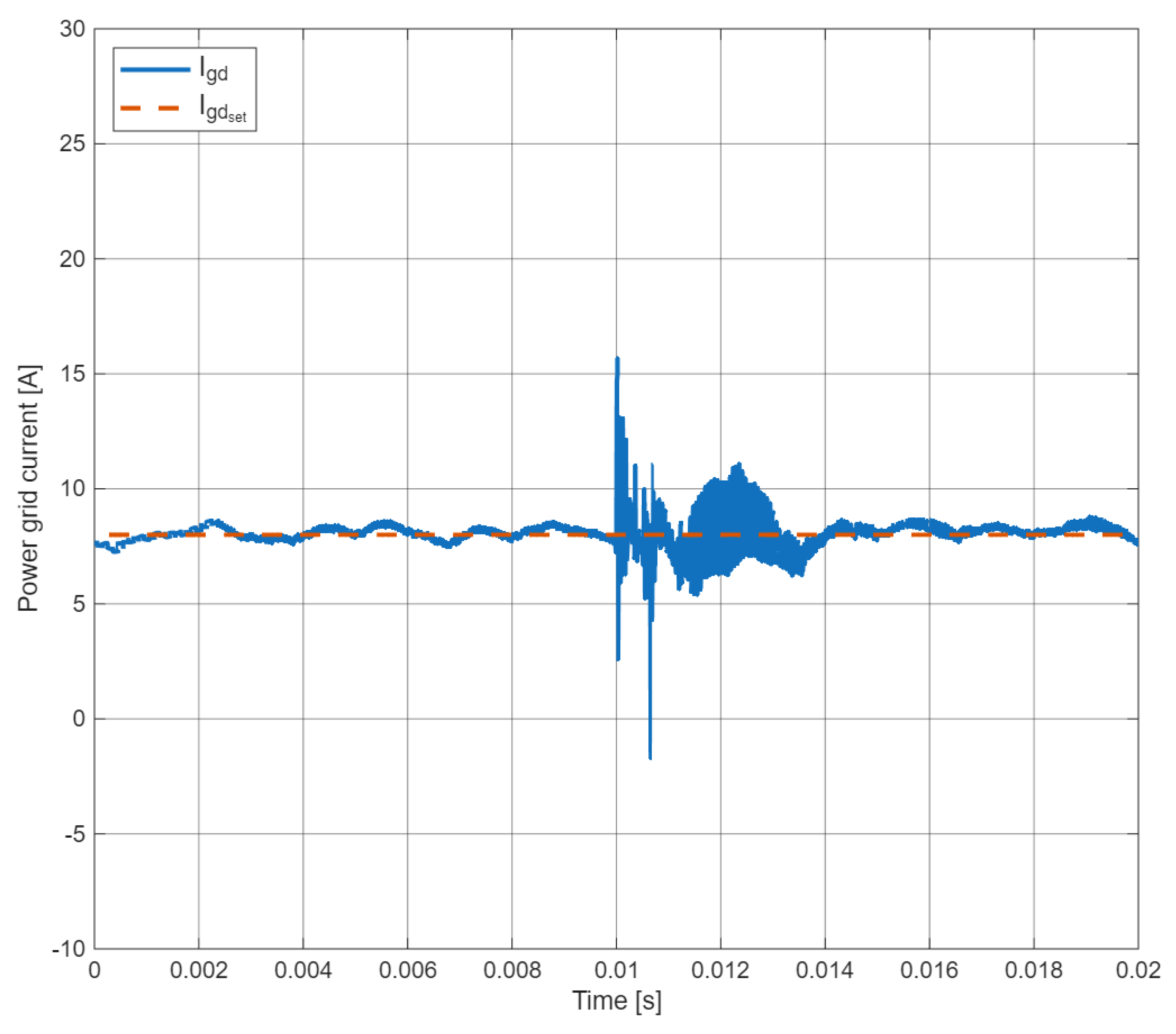
Analogous experiments were carried out on the laboratory setup described in chapter: Section 2.3 and shown in Figure 8. The control system, presented by equations from (19) to (40), was implemented in the dSPACE system using the MATLAB/Simulink interface. The algorithm was adapted to the hardware limitations of this device. The setpoint for the grid current is 8 A. Tests were conducted both for the control system without the voltage disturbance compensation mechanism and with the mechanism active. The test results for the first described case are presented in Figure 16. The character of the presented waveform is analogous to the one shown in Figure 10—it is a typical example of a short-duration oscillatory voltage disturbance described in Section 1 based on [19,20].
For the second case, an algorithm designed to reduce the impact of the short-duration disturbance is introduced. The results of tests conducted to verify this method are visible in Figure 17.
Despite the inability to fully suppress the influence of the oscillatory nature of the voltage disturbance, the achieved results substantiate that compensation of the disturbance’s effects is indeed attainable. This is manifested by a markedly reduced regulation error under dynamic conditions. The overall robustness of the system has been enhanced, as the control scheme executes the sliding motion considerably more effectively. Consequently, the state trajectory of the plant remains confined to the sliding manifold rather than being repeatedly driven away from it, as was the case previously. The basic quantitative performance metrics for the conducted study are presented in Table 4.

4. Conclusions

The new control method, belonging to the class of hybrid sliding mode controllers, enables a satisfactory regulation process in which each part of the control algorithm is responsible for specific operating conditions of the system. One of the key advantages is the ability to select the switching point between the two reaching laws, combined with a straightforward parameterization of the algorithm, while maintaining high flexibility in shaping the control signal with respect to the dependence on the sliding variable. The achieved results facilitate the design of the control structure compared to systems with classical PID controllers with parameter adaptation, since the parameters of the proposed control structure are determined as functions of the inverter and grid parameters, rather than through an experimental tuning process, as is typically the case with classical PID controllers enhanced with parameter adaptation. Future work will focus on the formulation and comparative analysis of the continuous and discrete sliding mode control methods proposed by the authors, with particular emphasis on the investigation and development of hybrid reaching law algorithms.

Author Contributions

Conceptualization, A.S. and P.C.; methodology, A.S. and P.C.; software, A.S.; validation, A.S., P.C., and K.T.; formal analysis, P.C., K.T., and A.S.; investigation, A.S.; resources, A.S. and K.T.; data curation, A.S., P.C., and K.T.; writing—original draft preparation, A.S.; writing—review and editing, A.S. and K.T.; visualization, A.S. and K.T.; supervision, P.C.; project administration, A.S. and K.T. All authors have read and agreed to the published version of the manuscript.

Funding

This research received no external funding.

Data Availability Statement

The data presented in this study are available on request from the corresponding author.

Acknowledgments

This work has been completed while the first author was the Doctoral Candidate in the Interdisciplinary Doctoral School at the Lodz University of Technology, Poland.

Conflicts of Interest

The authors declare no conflicts of interest.

References

  1. Babayomi, O.; Li, Y.; Zhang, Z.; Park, K.B. Advanced Control of Grid-Connected Microgrids: Challenges, Advances, and Trends. IEEE Trans. Power Electron. 2025, 40, 7681–7708. [Google Scholar] [CrossRef]
  2. Zhang, Z.; Wang, Q.; Wang, G.; Hu, Y.; Li, B.; Zhang, G.; Xu, D. Direct-Axis Current Orientation-Based Grid Voltage Sensorless Control Strategy for Vienna Rectifier Under Unbalanced and Distorted Grid Conditions. IEEE Trans. Power Electron. 2024, 39, 10910–10920. [Google Scholar] [CrossRef]
  3. Forouzanfar, M.; Pinnarelli, A.; Mohammad Sadegh Ghiasi, S.; Menniti, D.; Sorrentino, N.; Brusco, G.; Vizza, P.; Safaiepour, H. Enhancing Transient and Steady-State Performance in Grid-Connected VSCs: A Comprehensive Frequency Region Analysis of Decoupling Current Units. IEEE Access 2025, 13, 123682–123698. [Google Scholar] [CrossRef]
  4. Xu, H.; Yu, C.; Chen, C.; Guo, L.; Su, J.; Li, M.; Zhang, X. Impedance Model-based Stability Analysis of Single-Stage Grid-Connected Inverters Considering PV Panel Characteristics and DC-Side Voltage. Prot. Control Mod. Power Syst. 2025, 10, 130–145. [Google Scholar] [CrossRef]
  5. Sawiński, A.; Chudzik, P.; Tatar, K. SMC Algorithms in T-Type Bidirectional Power Grid Converter. Energies 2024, 17, 2970. [Google Scholar] [CrossRef]
  6. Schonardie, M.F.; Ruseler, A.; Coelho, R.F.; Martins, D.C. Three-phase grid-connected PV system with active and reactive power control using dq0 transformation. In Proceedings of the 2010 9th IEEE/IAS International Conference on Industry Applications—INDUSCON 2010, Sao Paulo, Brazil, 8–10 November 2010; pp. 1–6. [Google Scholar] [CrossRef]
  7. Rąbkowski, J.; Kopacz, R. Extended T-type Inverter. Power Electron. Drives 2018, 3, 55–64. [Google Scholar] [CrossRef]
  8. Bouzid, A.M.; Guerrero, J.M.; Cheriti, A.; Bouhamida, M.; Sicard, P.; Benghanem, M. A survey on control of electric power distributed generation systems for microgrid applications. Renew. Sustain. Energy Rev. 2015, 44, 751–766. [Google Scholar] [CrossRef]
  9. Liu, S.; Liu, X.; Jiang, S.; Zhao, Z.; Wang, N.; Liang, X.; Zhang, M.; Wang, L. Application of an Improved STSMC Method to the Bidirectional DC–DC Converter in Photovoltaic DC Microgrid. Energies 2022, 15, 1636. [Google Scholar] [CrossRef]
  10. Mahto, K.K.; Mahato, B.; Chandan, B.; Das, D.; Das, P.; Kumari, S.; Vita, V.; Pavlatos, C.; Fotis, G. A Modified Criss-Cross-Based T-Type MLI with Reduced Power Components. Technologies 2024, 12, 90. [Google Scholar] [CrossRef]
  11. Gupta, K.K.; Ranjan, A.; Bhatnagar, P.; Sahu, L.K.; Jain, S. Multilevel Inverter Topologies with Reduced Device Count: A Review. IEEE Trans. Power Electron. 2016, 31, 135–151. [Google Scholar] [CrossRef]
  12. Wei, L.; Patel, Y.; Murthy, C.S.N. Active front end rectifier design trade-off between PWM and direct power control method. In Proceedings of the 2014 IEEE Energy Conversion Congress and Exposition (ECCE), Pittsburgh, PA, USA, 14–18 September 2014; pp. 1015–1021. [Google Scholar] [CrossRef]
  13. Xu, X.; Zhu, Y.; Chen, X.; Su, C.Y. Data-Driven Control for Three-Phase AC–DC Power Converters Modeled by Switched Affine Systems. IEEE Trans. Ind. Electron. 2025, 72, 11875–11884. [Google Scholar] [CrossRef]
  14. Dannehl, J.; Wessels, C.; Fuchs, F. Limitations of Voltage-Oriented PI Current Control of Grid-Connected PWM Rectifiers with LCL Filters. IEEE Trans. Ind. Electron. 2009, 56, 380–388. [Google Scholar] [CrossRef]
  15. Fu, X.; Sun, J.; Huang, M.; Tian, Z.; Yan, H.; Iu, H.H.C.; Hu, P.; Zha, X. Large-Signal Stability of Grid-Forming and Grid-Following Controls in Voltage Source Converter: A Comparative Study. IEEE Trans. Power Electron. 2021, 36, 7832–7840. [Google Scholar] [CrossRef]
  16. Choi, W.; Lee, W.; Sarlioglu, B. Effect of grid inductance on grid current quality of parallel grid-connected inverter system with output LCL filter and closed-loop control. In Proceedings of the 2016 IEEE Applied Power Electronics Conference and Exposition (APEC), Long Beach, CA, USA, 20–24 March 2016. [Google Scholar] [CrossRef]
  17. Tatar, K.; Chudzik, P.; Leśniewski, P. Sliding Mode Control of Buck DC–DC Converter with LC Input Filter. Energies 2023, 16, 6983. [Google Scholar] [CrossRef]
  18. Tregubov, A.; Karamanakos, P.; Ortombina, L. Long-Horizon Direct Model Predictive Control for Medium-Voltage Converters Connected to a Distorted Grid. IEEE Open J. Ind. Appl. 2025, 6, 191–205. [Google Scholar] [CrossRef]
  19. IEEE. IEEE Recommended Practice for Monitoring Electric Power Quality; IEEE: Piscataway, NJ, USA, 2012. [Google Scholar] [CrossRef]
  20. Gupta, M.; Saxena, D.; Gupta, N. Simulation of single and composite power quality events for analysis and characterization. In Proceedings of the 2015 IEEE Students Conference on Engineering and Systems (SCES), Allahabad, India, 6–8 November 2015; pp. 1–6. [Google Scholar] [CrossRef]
  21. Utkin, V.; Shi, J. Integral sliding mode in systems operating under uncertainty conditions. In Proceedings of the 35th IEEE Conference on Decision and Control, Kobe, Japan, 13 December 1996; Volume 4, CDC-96. pp. 4591–4596. [Google Scholar] [CrossRef]
  22. Zenteno-Torres, J.; Cieslak, J.; Dávila, J.; Henry, D. Sliding Mode Control with Application to Fault-Tolerant Control: Assessment and Open Problems. Automation 2021, 2, 1–30. [Google Scholar] [CrossRef]
  23. Bartoszewicz, A. Conventional sliding modes in continuous and discrete time domains. In Proceedings of the 2017 18th International Carpathian Control Conference (ICCC), Sinaia, Romania, 28–31 May 2017; pp. 588–593. [Google Scholar] [CrossRef]
  24. Latosiński, P.; Adamiak, K. Discrete-Time Sliding Mode Control Strategies—State of the Art. Energies 2024, 17, 4564. [Google Scholar] [CrossRef]
  25. Leng, J.; Ma, C. Sliding Mode Control for PMSM Based on a Novel Hybrid Reaching Law. In Proceedings of the 2018 37th Chinese Control Conference (CCC), Wuhan, China, 25–27 July 2018; pp. 3006–3011. [Google Scholar] [CrossRef]
  26. Guo, X.; Huang, S.; Peng, Y. Sliding Mode Speed Control of PMSM Based on A Novel Hybrid Reaching Law and High-Order Terminal Sliding-Mode Observer. In Proceedings of the 2021 IEEE 4th International Electrical and Energy Conference (CIEEC), Wuhan, China, 28–30 May 2021; pp. 1–6. [Google Scholar] [CrossRef]
  27. Rajanna, G.S.; Nagaraj, H.N. Comparison between sigmoid variable reaching law and exponential reaching law for sliding mode controlled DC-DC Buck converter. In Proceedings of the 2013 International Conference on Power, Energy and Control (ICPEC), Dindigul, India, 6–8 February 2013; pp. 316–319. [Google Scholar] [CrossRef]
  28. Kumar, N.; Saha, T.K.; Dey, J. Design and analysis of a double band hysteresis SMC for cascaded inverter-based PV system. In Proceedings of the 2016 IEEE Region 10 Conference (TENCON), Singapore, 22–25 November 2016; pp. 898–902. [Google Scholar] [CrossRef]
  29. Lyu, S.; Zheng, L.; Song, J.; Liu, Z.; Tian, M. A Repetitive Sliding Mode Control for Household Mircogrid Inverter Operating in Islanding Mode. In Proceedings of the 2018 IEEE International Power Electronics and Application Conference and Exposition (PEAC), Shenzhen, China, 4–7 November 2018; pp. 1–6. [Google Scholar] [CrossRef]
  30. Sawiński, A.; Leśniewski, P.; Chudzik, P. Discrete Adaptive Nonswitching Reaching Law Algorithm for Sliding Mode Control of a Grid-Following Inverter. Energies 2025, 18, 4696. [Google Scholar] [CrossRef]
  31. Sawiński, A.; Chudzik, P.; Tatar, K. Cascade Sliding Mode Control for Linear Displacement Positioning of a Quadrotor. Sensors 2025, 25, 883. [Google Scholar] [CrossRef]
  32. Bartoszewicz, A. A new reaching law for sliding mode control of continuous time systems with constraints. Trans. Inst. Meas. Control 2014, 37, 515–521. [Google Scholar] [CrossRef]
  33. Bartoszewicz, A.; Latosinski, P. Generalization of Gao’s Reaching Law for Higher Relative Degree Sliding Variables. IEEE Trans. Autom. Control 2018, 63, 3173–3179. [Google Scholar] [CrossRef]
  34. Volosencu, C.; Saghafinia, A.; Chakrabarty, S.; Du, X. Control Theory in Engineering; IntechOpen: London, UK, 2019. [Google Scholar] [CrossRef]
  35. Lesniewski, P. Discrete time reaching law based sliding mode control: A survey. In Proceedings of the 2018 22nd International Conference on System Theory, Control and Computing (ICSTCC), Sinaia, Romania, 10–12 October 2018; pp. 734–739. [Google Scholar] [CrossRef]
  36. Bartoszewicz, A.; Lesniewski, P. Non-switching type reaching law with application to congestion control in connection-oriented communication networks. In Proceedings of the 2014 European Control Conference (ECC), Strasbourg, France, 24–27 June 2014; pp. 1211–1216. [Google Scholar] [CrossRef]
  37. Bartoszewicz, A.; Lesniewski, P. New Switching and Nonswitching Type Reaching Laws for SMC of Discrete Time Systems. IEEE Trans. Control Syst. Technol. 2016, 24, 670–677. [Google Scholar] [CrossRef]
  38. Xi, L.; Yang, S.; Dong, H.; Qi, X. Terminal Sliding Mode Control for Robotic Manipulator Based on Combined Reaching Law. In Proceedings of the 2019 International Conference on Computer Network, Electronic and Automation (ICCNEA), Xi’an, China, 27–29 September 2019; pp. 436–441. [Google Scholar] [CrossRef]
  39. Rani, T.; Roy, T.K. Design of an Integral Sliding Mode Controller-Based on a Hybrid Reaching Law for DC Microgrids. In Proceedings of the 2021 5th International Conference on Electrical Engineering and Information Communication Technology (ICEEICT), Dhaka, Bangladesh, 18–20 November 2021; pp. 1–5. [Google Scholar] [CrossRef]
  40. Jewel, A.S.; Roy, T.K. A Hybrid Reaching Law Based Double-Integral Sliding Mode Controller Design to Mitigate SSR Effects in a DFIG-Based Wind Farm. In Proceedings of the 2021 5th International Conference on Electrical Engineering and Information Communication Technology (ICEEICT), Dhaka, Bangladesh, 18–20 November 2021; pp. 1–5. [Google Scholar] [CrossRef]
  41. Dehghani, M.; Mardaneh, M.; Shafiei, M.H. Sliding mode control for load harmonics compensation and PV voltage regulation in a grid-tied inverter through a single-stage MPPT. In Proceedings of the 2020 28th Iranian Conference on Electrical Engineering (ICEE), Tabriz, Iran, 4–6 August 2020; pp. 1–6. [Google Scholar] [CrossRef]
  42. Kumar, N.; Buwa, O. A Review on Reactive Power Compensation of Distributed Energy System. In Proceedings of the 2020 7th International Conference on Smart Structures and Systems (ICSSS), Chennai, India, 23–24 July 2020; pp. 1–6. [Google Scholar] [CrossRef]
  43. Hao, X.; Yang, X.; Xie, R.; Huang, L.; Liu, T.; Li, Y. A fixed switching frequency integral resonant sliding mode controller for three-phase grid-connected photovoltaic inverter with LCL-filter. In Proceedings of the 2013 IEEE ECCE Asia Downunder, Melbourne, Australia, 3–6 June 2013; pp. 793–798. [Google Scholar] [CrossRef]
Figure 1. Timedomain single phase voltage waveform with sudden drop. (a) Laboratory experiment results. (b) Simulation experiment results.
Energies 19 00790 g001
Figure 2. Topology of T-type power converter, where T 1 T 12 —transistors, V d c —DC source voltage, U , V , W —inverter output.
Energies 19 00790 g002
Figure 3. Control system diagram, where U g a , U g b , U g c , I g a , I g b , I g c — grid voltages and currents, L g —grid inductance, C f —filter capacity, U c a , U c b , U c c — filter voltage, I a , I b , I c —inverter currents, U a , U b , U c —control signals, C—capacity between energy storage and inverter.
Energies 19 00790 g003
Figure 4. Control signal waveforms depending on s 0 d parameter value.
Energies 19 00790 g004
Figure 5. Control signal waveforms depending on c S T parameter value.
Energies 19 00790 g005
Figure 6. MATLAB/Simulink model scheme top view. (a) Control system. (b) Measurement system. (c) Grid and power electronics system. (d) Park and Clarke transtormation systems.
Energies 19 00790 g006
Figure 7. Laboratory stand control and acquisition setup.
Energies 19 00790 g007
Figure 8. Laboratory stand control—front view, where 1—±60 V DC power source, 2—T-type bidirectional power grid converter with 12 IGBTs transistors and Concept drivers, 3—LEM measurement card, 4—Transistor logic and control board with CPLD Xinlix Coolrunner II module, 5—Auto-transformer for adjusting the grid voltage to DC power supply limitations, 6—dSPACE DS1104 card.
Energies 19 00790 g008
Figure 9. Waveforms of the system voltage phase signals.
Energies 19 00790 g009
Figure 10. Waveform of the grid current vector first component—only parameters for steady-state operation are implemented.
Energies 19 00790 g010
Figure 11. Waveforms of the control law parts: discontinuous and reaching law control—only parameters for steady-state operation are implemented.
Energies 19 00790 g011
Figure 12. Hybrid control switching condition waveform—only parameters for steady-state operation are implemented.
Energies 19 00790 g012
Figure 13. Waveform of the grid current vector first component—control algorithm parameters are implemented based on disturbance presence.
Energies 19 00790 g013
Figure 14. Waveforms of the control law parts: discontinuous and reaching law control—control algorithm parameters are implemented based on disturbance presence.
Energies 19 00790 g014
Figure 15. Hybrid control switching condition waveform—control algorithm parameters are implemented based on disturbance presence.
Energies 19 00790 g015
Figure 16. Waveform of the grid current vector first component—only parameters for steady-state operation are implemented.
Energies 19 00790 g016
Figure 17. Waveform of the grid current vector first component—control algorithm parameters are implemented based on disturbance presence.
Energies 19 00790 g017
Table 1. Control algorithm estimated parameters.
Symbol of the ParameterValue
M 0 90 V
s d m a x 13.2
U d i s m a x 1.6971
Table 2. Control algorithm adopted and calculated parameters.
Symbol of the ParameterValue for Dynamic OperationValue for Static Operation
c 1 0.50.5
c 2 11
c 3 11
k 1 0.003750.3750
k 2 0.48080.0585
k r a t 0.01-
α 0.950.95
s 0 d 55
c S T 0.260.26
P s 0.36250.3625
Table 3. System parameters used for simulation and laboratory experiments.
Name of ParameterValue in Simulation ExperimentValue in Laboratory Experiment
Simulation time step200 ns100  μ s
Modulator frequency20 kHz20 kHz
Filter inductance L330 μ H330  μ H
Filter capacitance C f 50 μ F50  μ F
Grid inductance L g 120 μ H μ H
DC source voltage U D C 350 V32 V
Grid voltages frequency f50 Hz50 Hz
Table 4. Laboratory experiment control measures.
Control Measure TypeValue for Dynamic OperationValue for Static Operation
Peak current15.6679 A29.0811 A
Settling time0.0112 s0.0124 s
Integral square error0.00490.0099
Integral absolute error0.00590.0372
Disclaimer/Publisher’s Note: The statements, opinions and data contained in all publications are solely those of the individual author(s) and contributor(s) and not of MDPI and/or the editor(s). MDPI and/or the editor(s) disclaim responsibility for any injury to people or property resulting from any ideas, methods, instructions or products referred to in the content.