


Abstract
The evolution of Hybrid Power Supply Systems (HPSSs) has extended from ground-based microgrids to the safety-critical domain of More Electric Aircraft (MEA). This paper presents a comprehensive review of dynamic power allocation strategies, bridging the gap between mature ground-based control theories and the stringent operational requirements of aerospace systems. Strategies are systematically classified into centralized, decentralized, and distributed architectures based on control structures. Evaluations indicate that centralized strategies, while effective in microgrids, achieve global optimality but face reliability constraints in airborne environments. In contrast, decentralized strategies based on virtual impedance ensure the high reliability and “plug-and-play” modularity essential for avionics yet often yield suboptimal coordination. Consequently, distributed cooperative control is identified as the most promising paradigm to bridge this gap, synthesizing optimization with fault tolerance. Finally, critical challenges in adapting these technologies to aviation—spanning algorithmic determinism and airworthiness certification—are discussed, and future trends in hybrid intelligence and digital twin-based verification are outlined for next-generation airborne energy systems.
1. Introduction
The rapid growth of the aviation industry has led to a continuous increase in fuel consumption, as well as associated greenhouse gas emissions and noise pollution, thereby exerting considerable pressure on the environment [1,2]. Recent studies indicate that, when accounting for the effects of aircraft contrails and other non-CO2 emissions, aviation may contribute up to 3.5% of global anthropogenic climate forcing [3,4]. Without effective mitigation measures, aviation-related CO2 emissions are projected to nearly double by 2050, potentially accounting for approximately one quarter of total global emissions [5].
Against this backdrop, the concept of the More Electric Aircraft (MEA) has emerged as one of the most promising technological pathways for reducing fuel consumption and environmental impact in aviation [6,7]. The core idea of MEA is to progressively replace conventional hydraulic, pneumatic, and mechanical subsystems with electrically driven counterparts, thereby unifying secondary energy systems around electrical power. This paradigm shift enables a simplified onboard energy architecture, reduced system weight, improved energy efficiency, and enhanced operational reliability. Consequently, MEA has been widely recognized as a key enabler for next-generation civil aircraft, and its development priorities and technical roadmaps have been clearly identified by both industry and academia [8,9,10].
From the power-source perspective, significant efforts have been devoted to the development of high-efficiency, low-emission, and low-noise power generation technologies. In particular, proton exchange membrane fuel cells (PEMFCs) have demonstrated remarkable progress in specific power, with laboratory-scale fuel cell stacks achieving values as high as 5.5 kW/kg [11]. Major aircraft manufacturers, such as Boeing and Airbus, are actively investigating the feasibility of replacing conventional auxiliary power units (APUs) with fuel cell-based systems [12]. From the load perspective, the degree of onboard electrification continues to increase, as electrically driven actuators and subsystems gradually substitute traditional hydraulic and pneumatic systems. This transition eliminates complex fluid networks, reduces weight and volume, and improves maintainability and fuel economy [13]. In the contemporary aviation market, distinct electrification features have become prevalent. The Boeing 787 Dreamliner, representing a milestone in MEA evolution, implements a “no-bleed” architecture where traditional pneumatic systems are replaced by high-power electrical compressors. This necessitates a hybrid voltage network featuring 230 VAC variable frequency and ±270 VDC systems to support megawatt-level loads. Similarly, the Airbus A380 and A350 extensively utilize Electro-Hydrostatic Actuators (EHAs) and Electro-Mechanical Actuators (EMAs) for flight control surfaces, replacing centralized hydraulic loops with distributed electrical power [14]. These prevalent applications highlight a shift toward heterogeneous, multi-voltage architectures, creating urgent demand for sophisticated power allocation strategies to manage diverse loads while ensuring stability.
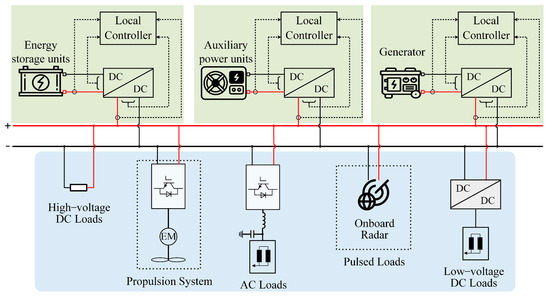
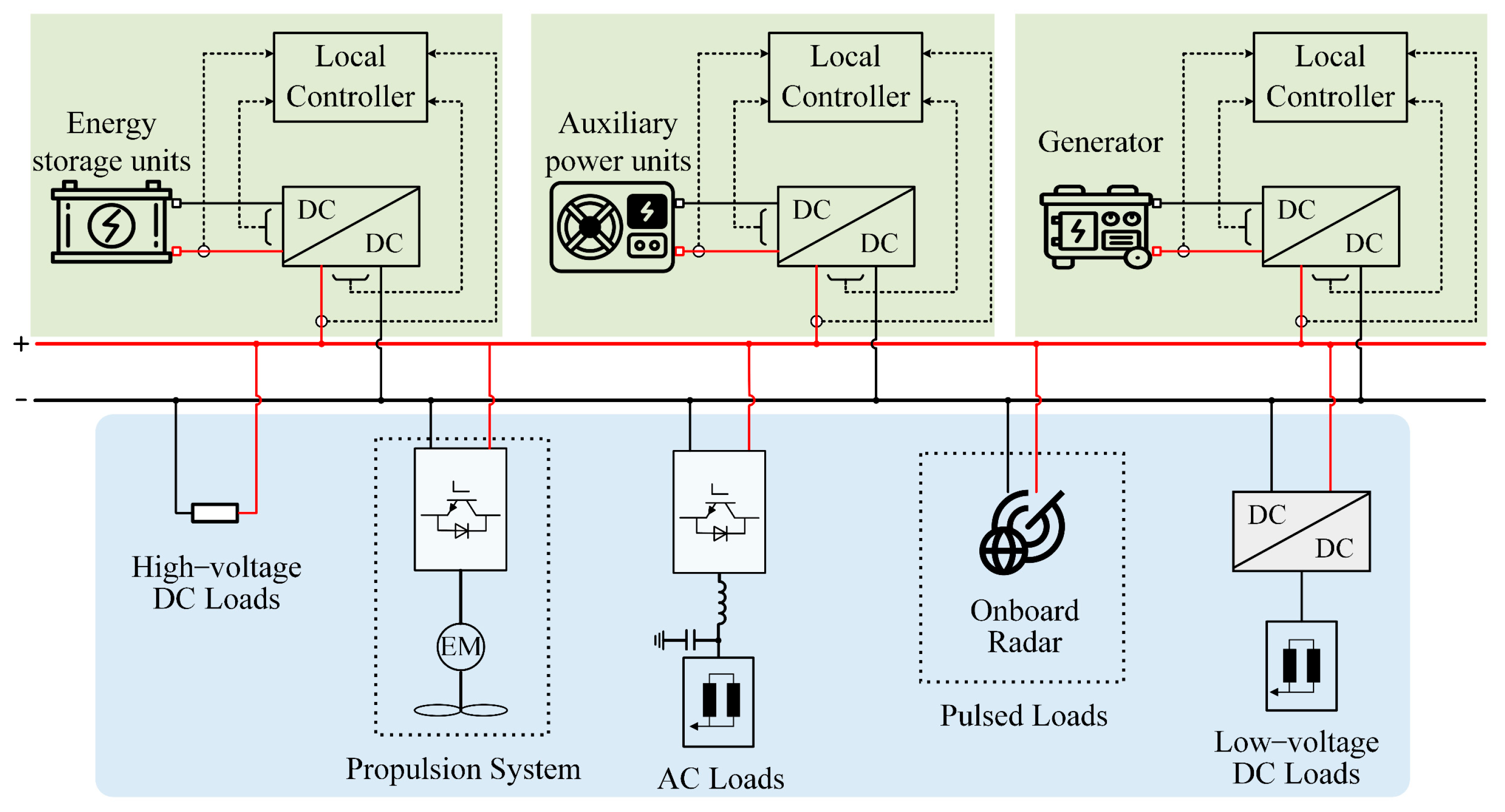
Architecturally, a typical MEA hybrid power supply system (HPSS) functions as a safety-critical, islanded DC microgrid. It consists of generator-based primary power sources, lithium-ion batteries, and supercapacitor energy storage units, while supplying a wide variety of loads, including AC loads, high- and low-voltage DC loads, and high-power pulsed loads such as onboard radar systems [15,16]. As a result, MEA HPSSs are characterized by heterogeneous power sources and loads operating across multiple time scales. Together with highly dynamic and mission-dependent operating conditions, these features pose significant challenges to dynamic power allocation and optimization. Moreover, as onboard electrification intensifies, the strong coupling and interaction among multiple sources and loads introduce severe stability issues, which have become a critical bottleneck hindering the further development of MEA technologies.
To address these challenges, Energy Management Strategies (EMSs) are essential as the supervisory control framework for MEA HPSSs. Within this framework, dynamic power allocation serves as the core functional mechanism, explicitly governing the real-time energy flow among heterogeneous sources. Therefore, optimizing dynamic power allocation strategies is widely regarded as the key solution for suppressing power fluctuations, ensuring system stability, and improving overall energy efficiency. Furthermore, the significance of dynamic power allocation extends beyond real-time operation; it is intrinsic to the optimal design of MEA. By effectively shaving peak loads and managing transient energy fluxes, advanced allocation strategies allow for the downsizing of generators and energy storage units. This “Control-for-Design” perspective is critical for minimizing the Size, Weight, and Power metrics, which are the primary constraints in aerospace engineering [17]. Based on control architecture and information flow, EMSs are classified into centralized, decentralized, and distributed control [18]. Centralized strategies rely on a supervisory controller with global information for coordination, whereas decentralized strategies emphasize autonomous operation based on local measurements. Distributed strategies integrate the strengths of both, employing cooperative structures to achieve system-level optimization. To provide a clear conceptual framework, the fundamental distinctions among these architectures—focusing on communication topologies, decision mechanisms, and applicability—are summarized in Table 1.
Table 1.
Comparative summary of control architectures for MEA HPSSs.
Although the theoretical foundations of dynamic power allocation have been extensively established in electric vehicles [19] and ground-based DC microgrids [20], migrating these strategies from ground-based applications to the aerospace domain remains a complex engineering challenge. Compared with ground-based systems, MEA HPSSs impose far more stringent requirements on power density, reliability, safety, and transient response. In addition, harsh operating conditions—including low ambient pressure, wide temperature ranges, and frequent high-power pulsed loads—demand power allocation strategies with superior robustness, rapid dynamic response, and strong adaptability. To date, a comprehensive and systematic review focusing specifically on the adaptation and evolution of dynamic power allocation strategies from general microgrid theories to specialized MEA HPSSs is still lacking.
Bridging the maturity of terrestrial microgrid control with the stringent constraints of aerospace engineering presents a critical research opportunity. By systematically evaluating how to adapt these strategies to meet such rigorous airborne standards, this review provides a strategic roadmap for next-generation aviation energy management. The main contributions of this review lie in a systematic classification, critical comparison, and in-depth discussion of representative control strategies. The remainder of this paper is organized as follows. Section 2 reviews the principles and recent advances in centralized control strategies. Section 3 analyzes decentralized control methods, focusing on impedance-shaping mechanisms and their application in MEA HPSSs. Section 4 discusses distributed control architectures, emphasizing cooperative mechanisms that balance global optimization with fault tolerance. Section 5 elaborates on the critical implementation challenges and outlines future research trends toward intelligent and resilient airborne energy networks. Finally, Section 6 summarizes the main conclusions of this work.
2. Centralized Control Strategy
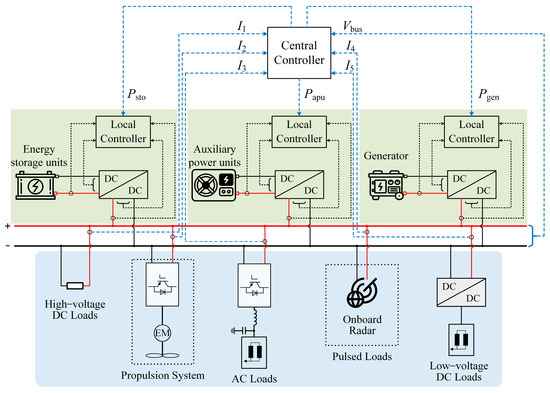
Centralized control represents the foundational paradigm for dynamic power allocation, originating from ground-based microgrid management and subsequently adapted for MEA applications to leverage mature grid-level optimization techniques. In this architecture, a system-level supervisory controller functions as the central intelligence, communicating with all distributed sources and loads via a global network. By continuously monitoring key variables (e.g., bus voltage and load demand), the central controller executes comprehensive optimization algorithms to generate real-time power references. These references are then transmitted to local controllers, which operate as subordinate execution units to strictly track the assigned targets, thereby ensuring precise system-level coordination. Figure 1 illustrates the fundamental operational framework of the centralized control strategy for a typical DC microgrid.
Figure 1.
Fundamental operational framework of the centralized control strategy for a typical DC microgrid.
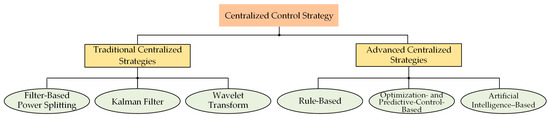
Owing to their global visibility and coordination capability, centralized control strategies can explicitly incorporate multiple control objectives, including power fluctuation suppression, state-of-charge (SOC) regulation, energy efficiency improvement, and component lifetime enhancement. According to the underlying control philosophy and algorithmic complexity, existing centralized dynamic power allocation strategies can be broadly categorized into two main classes: (i) traditional power-splitting strategies based on frequency separation and (ii) advanced multi-objective optimization-based control strategies. The detailed classification of the centralized control strategies is visually summarized in Figure 2.
Figure 2.
The detailed classification of the centralized control strategies.
2.1. Traditional Centralized Strategies Based on Frequency Splitting
Frequency-separation-based strategies constitute the most representative class of traditional centralized power allocation methods. The core idea is to decompose the load power demand into components with different frequency characteristics and allocate them to power sources according to their dynamic capabilities. Typically, slow-varying (low-frequency) power components are assigned to energy-dense sources such as fuel cells or batteries, while fast-varying (high-frequency) components are handled by power-dense devices such as supercapacitors.
2.1.1. Filter-Based Power Splitting
The simplest implementation of frequency separation relies on linear filters, such as low-pass filters and high-pass filters. By filtering the measured load current or power, reference signals for different energy storage units can be generated directly.
Owing to their simple structure, low computational burden, and ease of implementation, filter-based strategies have been widely applied in hybrid energy storage systems (ESDs) for electric vehicles and microgrids [21,22,23,24]. Specifically, in [21], a rule-based control strategy was employed as a comparative benchmark, highlighting the critical trade-off between power splitting performance and battery lifetime extension. The practicality of filtering methods was further validated in [22], where experimental results demonstrated that such approaches could achieve real-time performance comparable to complex optimization-based strategies, particularly under specific supercapacitor voltage constraints. To enhance system flexibility, an adaptive frequency splitter was proposed in [23], which dynamically routes power to preserve battery health while ensuring supercapacitor voltage variations remain within safe limits. Furthermore, frequency separation strategies were integrated with optimal system sizing in [24], where a multi-objective grey wolf optimizer algorithm was utilized to determine the optimal configuration of energy storage systems based on filtered power profiles.
However, despite these successful applications, filter-based strategies exhibit inherent limitations. Their performance is highly sensitive to the selection of cutoff frequencies. Moreover, conventional fixed-parameter filters often suffer from phase delays and lack the adaptability required to handle the highly stochastic operating conditions typical of More Electric Aircraft.
2.1.2. Wavelet Transform-Based Power Decomposition
To overcome the limitations of conventional linear filters, wavelet transform-based methods have been introduced for dynamic power allocation. Wavelet analysis features multi-resolution and time–frequency localization properties, making it well suited for non-stationary power signals with large amplitude variations. In these approaches, the load power is decomposed into high-frequency and low-frequency components using discrete or continuous wavelet transforms and then distributed to different power sources accordingly [25,26,27]. Compared with simple filtering methods, wavelet-based strategies offer improved power decomposition accuracy and reduced coupling between frequency bands. Nevertheless, their computational complexity is higher, and real-time implementation requires careful selection of wavelet bases and decomposition levels.
2.1.3. Kalman Filter-Based Power Allocation
Kalman filter-based methods represent a more advanced form of centralized frequency-domain power allocation. By incorporating system state equations and measurement models, Kalman filters enable online estimation and prediction of power demand and energy storage states. As a result, these methods can mitigate power fluctuations while alleviating the phase delay inherent in traditional filters [28]. Moreover, Kalman filter-based approaches can enhance SOC estimation accuracy and provide predictive capability for power reference generation [29]. However, their effectiveness strongly depends on the accuracy of system models and noise statistics, which may vary significantly under complex operating environments.
Overall, frequency-separation-based centralized strategies are characterized by conceptual simplicity and technological maturity. Advanced methods such as wavelet and Kalman filtering improve power decomposition performance but inevitably increase computational burden and implementation complexity.
2.2. Advanced Centralized Multi-Objective Optimization Strategies
Beyond traditional frequency-based methods, centralized control architectures also facilitate the implementation of advanced multi-objective optimization strategies, which aim to achieve optimal power allocation by explicitly considering system constraints and performance indices.
2.2.1. Rule-Based Centralized Control
Rule-based strategies employ predefined logical rules, fuzzy logic, or threshold-based mechanisms to allocate power among multiple sources. These methods are typically derived from expert knowledge and operational experience and can be enhanced by combining signal decomposition techniques such as empirical mode decomposition or wavelet analysis [30,31,32,33].
To address highly fluctuating load profiles and uncertainty, fuzzy logic control (FLC) has emerged as a robust alternative. For instance, in [30], a Complete Ensemble Empirical Mode Decomposition (CEEMD) algorithm was combined with a fuzzy controller. In this hybrid approach, power demand is decomposed into Intrinsic Mode Functions (IMFs) based on permutation entropy, effectively attenuating high-frequency stress on lithium-ion batteries while maintaining the supercapacitor’s SOC. Similarly, the adaptability of fuzzy logic was demonstrated in [31] for a Superconducting Magnetic Energy Storage (SMES) and battery system. By utilizing a three-input fuzzy controller, this method significantly smoothed battery charging/discharging currents compared to equivalent filtration methods, thereby extending battery lifetime. Moving towards theoretical rigor, a robust model-predictive-based fuzzy control method was investigated in [32]. By transforming the energy management problem into a nonlinear optimization task, this method not only accounts for component degradation but also ensures system Lyapunov stability in the presence of driver demand uncertainty.
Significant research efforts have been dedicated to optimizing these logic-based frameworks. In the domain of deterministic threshold methods, a novel Optimal Primary Source Strategy (OPSS) was developed in [33]. By refining the design principles of classical thermostat and power-follower strategies, this approach achieved fuel economy performance comparable to complex optimization-based techniques while retaining the structural simplicity of rule-based schemes.
Rule-based centralized controllers are relatively robust and interpretable, and they offer moderate computational requirements. However, their performance is often suboptimal, and extensive manual tuning is required to adapt to different operating conditions.
2.2.2. Optimization- and Predictive-Control-Based Strategies
Optimization-based centralized strategies, particularly those utilizing Model Predictive Control (MPC), have garnered significant attention for their capability to resolve multi-objective problems under rigorous system constraints. By predicting future power demand and system states over a finite horizon, these methods can simultaneously optimize fuel consumption, efficiency, and component degradation.
Advanced MPC architectures have been developed to enhance adaptability and prediction accuracy. In [34], a nonlinear MPC strategy integrated with deep learning-based working condition identification was proposed for hybrid ships. By dynamically adjusting to identified conditions, this approach reduced fuel consumption by 5.5% compared to conventional predictive control. Addressing the specific constraints of aerial platforms, a hierarchical MPC framework was established in [35] for Unmanned Aerial Vehicles (UAVs). This method utilizes a Grey Markov model to predict future demand, dividing the problem into a trajectory optimization layer (minimizing economic costs) and a control layer (tracking power references), thereby significantly extending UAV endurance. Beyond pure energy efficiency, component health was addressed in [36], where a cost-optimal strategy explicitly incorporated battery and fuel cell degradation models into the objective function to balance economy with longevity. In contrast to these model-dependent approaches, a model-free fractional-order Extremum Seeking method was utilized in [37]. This adaptive algorithm achieves fast convergence to maximum efficiency points without requiring precise system identification. However, the widespread adoption of standard MPC is often constrained by its heavy computational burden and high dependence on accurate system models. To mitigate these computational challenges, convex relaxation techniques have been introduced to simplify non-convex optimization problems. For instance, in [38], a steady-state convex model was developed for bi-directional converters in hybrid AC/DC networked microgrids. By applying least squares approximation to non-convex efficiency characteristics, this approach transforms the computationally intractable programming problem into a solvable convex form, effectively reducing the solution time by over two orders of magnitude while ensuring high-efficiency dispatch.
2.2.3. Artificial Intelligence-Based Centralized Control
Driven by the rapid advancement of computational intelligence, data-driven centralized power allocation strategies—utilizing neural networks (NNs), deep learning, and reinforcement learning (RL)—have emerged as a transformative paradigm [39,40,41,42]. Unlike traditional model-based approaches, these AI-driven methods possess the capability to approximate complex nonlinear mappings between system states and optimal power allocation decisions, exhibiting exceptional adaptability to varying operating conditions.
Various AI architectures have been tailored for specific power allocation tasks. In [39], NNs were employed to emulate the global optimality of Dynamic Programming (DP) for real-time applications, extending battery life by over 60% compared to rule-based baselines. Deep learning was extended to multi-physics domains in [40], where a framework optimizing both energy demand and thermal recovery was developed to enhance efficiency under diverse climatic conditions. To handle renewable intermittency, an Adaptive Neuro-Fuzzy Inference System (ANFIS) was proposed in [41], successfully combining learning capabilities with fuzzy interpretability to outperform conventional PI controllers. Furthermore, Reinforcement Learning (RL) was applied in [42] for integrative sizing and control, demonstrating that learning-based agents can effectively reduce required storage capacity without prior model knowledge.
Despite these performance benefits, the deployment of AI-based strategies in safety-critical MEA systems faces significant hurdles. The primary barrier is the “black-box” nature of deep neural networks, which fundamentally conflicts with stringent airworthiness certification standards, such as DO-178C. These standards mandate deterministic traceability and code coverage, which are difficult to guarantee with opaque data-driven models. To bridge this gap, Explainable AI (XAI) is emerging as a critical research direction. By employing techniques to extract interpretable rules from trained models or visualize feature importance, XAI aims to provide the transparency required for certification, theoretically transforming opaque decisions into verifiable control logic.
2.3. Limitations of Centralized Control for MEA HPSS Applications
Although centralized control strategies are capable of achieving accurate dynamic power allocation, SOC regulation, and multi-objective optimization, their applicability to MEA HPSSs is fundamentally constrained by several inherent drawbacks.
First, MEA HPSSs typically involve a large number of geographically distributed electrical loads and power sources, requiring extensive sensing and communication infrastructure. This significantly increases system complexity, weight, and cost, while adversely affecting overall reliability.
Second, centralized architectures inherently suffer from single-point-of-failure issues. Any malfunction in the central controller or communication network may lead to the loss of coordinated control, which is unacceptable for safety-critical onboard power systems.
Third, communication delays and bandwidth limitations degrade the real-time performance of dynamic power allocation, particularly under fast-varying and high-power pulsed load conditions commonly encountered in MEA applications.
Finally, centralized strategies generally lack plug-and-play capability, making it difficult to achieve redundancy, fault tolerance, and flexible system reconfiguration. These limitations conflict with the future development trends of MEA HPSSs toward distributed, scalable, and highly resilient power architectures.
For the above reasons, while centralized control strategies provide valuable theoretical foundations and design insights, they are increasingly regarded as unsuitable for large-scale deployment in practical MEA HPSSs. This has motivated the exploration of decentralized and distributed control strategies, which are discussed in the subsequent sections.
3. Decentralized Control Strategy
While standard in ground-based microgrids, decentralized control is prioritized in MEA for survivability. Rooted in droop theory, these strategies reshape converter impedance via virtual resistance, inductance, and capacitance to align heterogeneous source dynamics. This enables autonomous power–frequency decoupling without vulnerable communication links, satisfying safety-critical reliability mandates by eliminating central points of failure. The fundamental operational framework of the centralized control strategy is illustrated in Figure 3.
Figure 3.
Fundamental operational framework of the decentralized control strategy.
Among various decentralized approaches, hybrid droop-based dynamic power allocation strategies dominate the existing literature. According to the composition of the virtual output impedance, these methods can be broadly classified into three categories: virtual resistance–capacitance droop (VRCD), virtual resistance–inductance droop (VRID), and combined virtual resistance–inductance–capacitance droop (VRIC). Each category reflects a distinct philosophy for exploiting source dynamics and progressively extending control objectives from basic power splitting to comprehensive energy management.
3.1. Virtual Resistance–Capacitance Droop Control
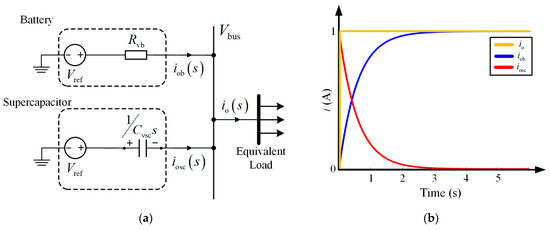
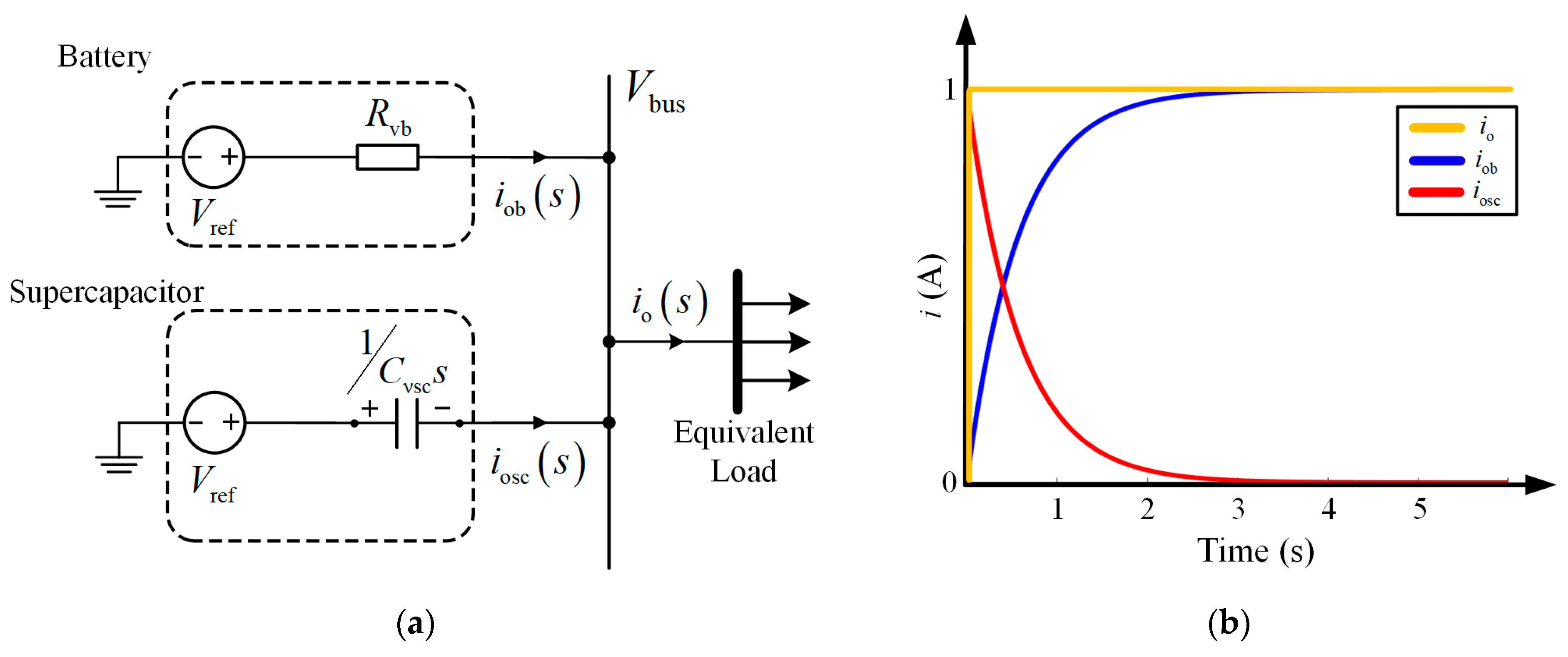
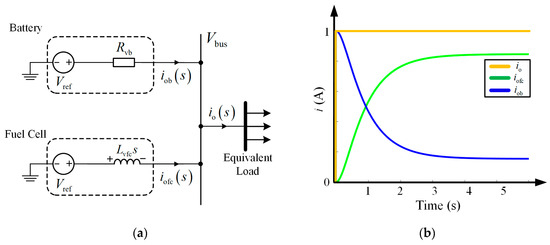
Early studies [43,44] introduced VRCD control for battery–supercapacitor hybrid systems, where a first-order filter is employed to shape the converter output impedance via virtual resistance and virtual capacitance. The fundamental principle of the VRCD strategy is illustrated in Figure 4, where (a) depicts the ideal equivalent circuit based on virtual resistance and capacitance, and (b) demonstrates the dynamic current distribution under a unit step perturbation. Specifically, the supercapacitor current rises rapidly to buffer high-frequency transients, while the battery current increases gradually to meet the steady-state demand. By tuning the cutoff frequency, high-frequency power fluctuations are naturally absorbed by the supercapacitor, while the battery supplies the low-frequency and steady-state power demand. This decentralized impedance-shaping mechanism enables autonomous dynamic power sharing without any supervisory controller, significantly reducing battery current stress during rapid load transients.
Figure 4.
Conventional virtual resistance–capacitance droop control strategy: (a) the ideal equivalent circuit; (b) corresponding unit step responses.
To overcome the inherent voltage deviations of traditional droop methods, restorative mechanisms have been developed. In [45], a high-pass filter-based design was introduced to achieve autonomous bus voltage restoration and simultaneous supercapacitor SOC recovery without communication. This concept was adapted for Fuel Cell/Supercapacitor Auxiliary Power Units in [46], effectively extending system lifetime under pulsating load conditions. Furthermore, the strategy was expanded to hydrogen-based low-inertia grids in [47], where supercapacitors were coordinated with slow-dynamic electrolyzers to provide fast frequency regulation.
In safety-critical aerospace applications, the robustness of VRC was validated in [48]. The study demonstrated that improved virtual impedance control could reliably compensate for pulsed power loads even during fault conditions, satisfying strict airborne reliability standards. Nevertheless, extending VRC to multi-source configurations remains challenging, as simple impedance superposition struggles to satisfy multi-timescale objectives simultaneously.
3.2. Virtual Resistance–Inductance Droop Control
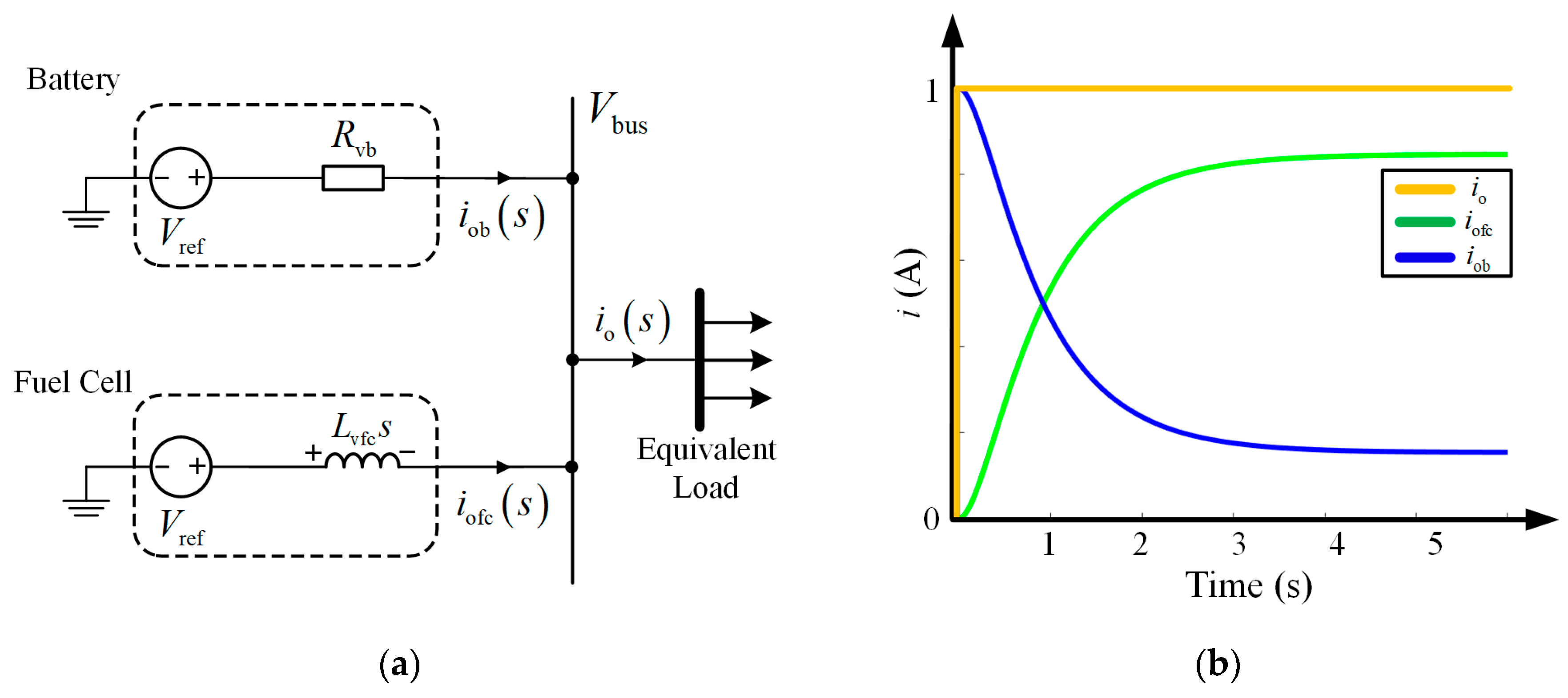
Virtual resistance–inductance droop control represents another important branch of decentralized power allocation, particularly suited for hybrid systems involving slow-response sources such as fuel cells. In this framework, virtual inductance is typically assigned to the fuel cell or battery converter, while virtual resistance is applied to the fast-response storage unit, enabling implicit power–frequency separation through impedance dynamics. The operational principle of the VRID strategy is presented in Figure 5. Specifically, Figure 5a shows the equivalent circuit incorporating virtual inductance, while Figure 5b illustrates the transient current sharing in response to a unit step load change. It reveals that the fuel cell current increases slowly toward its steady-state value, whereas the battery provides a rapid initial response before settling at a lower steady-state level, thereby assuming a minor portion of the low-frequency power.
Figure 5.
Conventional virtual resistance–inductance droop control strategy: (a) the ideal equivalent circuit; (b) corresponding unit step responses.
Representative studies [49,50,51] applied VRID control to fuel cell–supercapacitor and fuel cell–battery hybrid systems in MEA and electric vehicle applications. By properly designing the virtual inductance, the fuel cell is effectively isolated from rapid load variations and operates near its optimal efficiency region, while transient power demands are buffered by the auxiliary storage unit. Experimental and hardware-in-the-loop results confirm that VRID-based strategies enhance system stability, improve reliability under source disconnection, and extend the service life of slow electrochemical sources.
However, VRID control mainly targets two-source hybrid configurations and focuses on dynamic power decoupling. When additional energy management objectives—such as multi-source coordination or hierarchical SOC recovery—are required, standalone VRID schemes exhibit limited flexibility.
3.3. Virtual Resistance–Inductance–Capacitance Droop Control
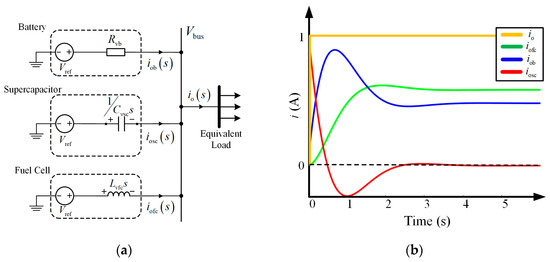
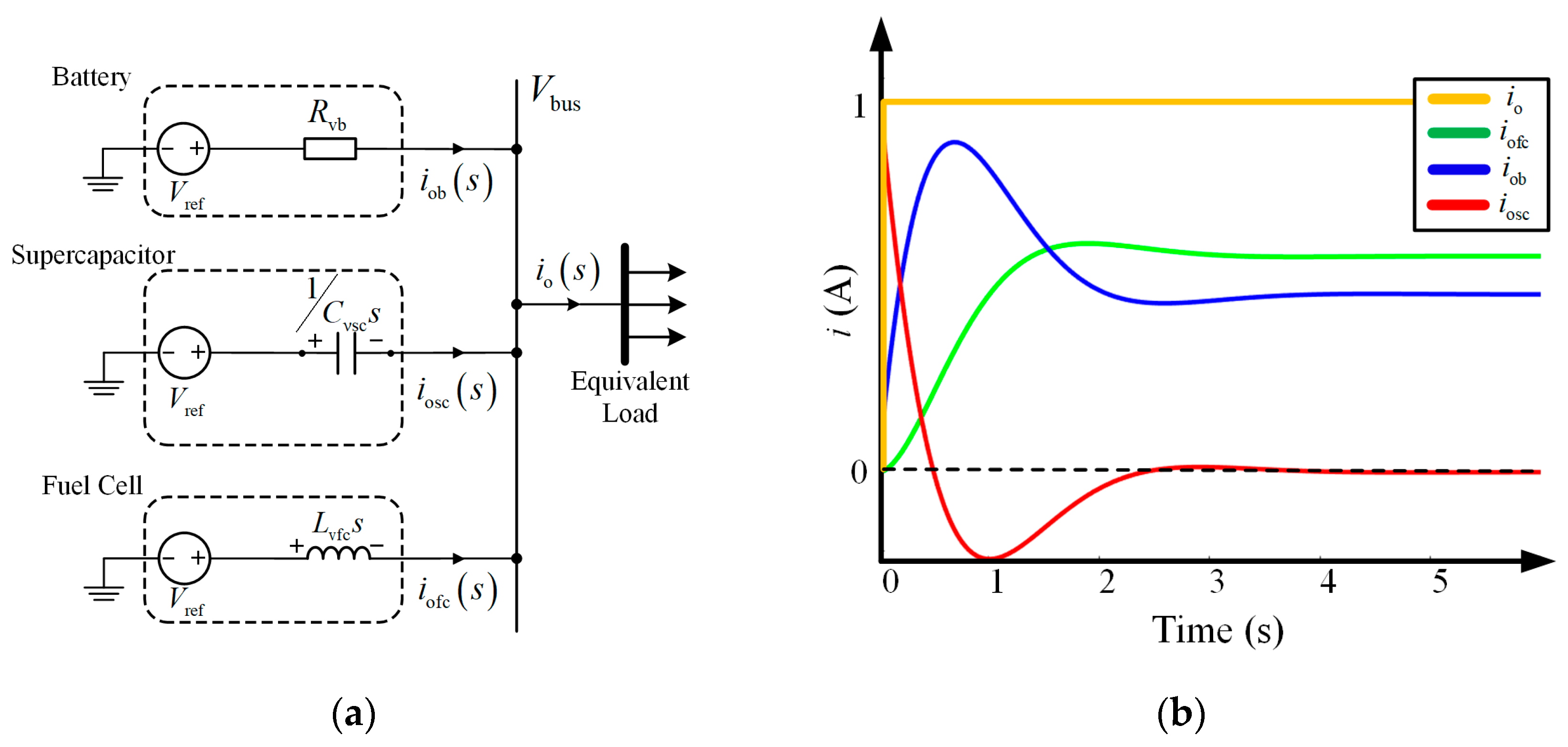
To overcome the limitations of two-source decentralized strategies, recent research has moved toward VRIC control, integrating virtual resistance, inductance, and capacitance within a unified droop framework. This approach enables explicit multi-timescale power allocation, assigning low-, medium-, and high-frequency components to fuel cells, batteries, and supercapacitors, respectively. Figure 6 depicts the VRIC framework, where Figure 6a displays the equivalent circuit, and Figure 6b reveals the multi-timescale current allocation under a unit step input. As observed, the supercapacitor current responds instantly to buffer the high-frequency power demand. Notably, it exhibits a negative undershoot before settling at zero. This phenomenon indicates a transient transition to charging mode, where the supercapacitor absorbs feedback energy to suppress bus voltage oscillations during the recovery phase, effectively functioning as a high-frequency damper. Meanwhile, the battery exhibits a moderate response time, and the fuel cell current slowly ramps up to the steady-state value.
Figure 6.
Conventional virtual resistance–inductance–capacitance droop control strategy: (a) the ideal equivalent circuit; (b) corresponding unit step responses.
Specific impedance shaping schemes have been validated in recent aerospace and vehicular applications. In [52], a decentralized strategy for aircraft auxiliary power units applied virtual inductance to fuel cells and virtual resistance to supercapacitors. This configuration not only achieved automatic frequency splitting but also demonstrated high reliability, maintaining stable operation even during source disconnection faults. Focusing on voltage quality, ref. [53] presented a decoupled design for battery–supercapacitor systems. Injecting virtual inductance into the battery converter achieved negligible DC bus voltage deviation without additional compensators, simplifying the control parameter design. To enhance robustness against parameter uncertainties, ref. [54] developed a composite control scheme. By integrating mixed droop control with a disturbance observer, this method ensured global stability and effective disturbance rejection for fuel cell–battery powertrains.
Nevertheless, VRIC-based strategies inevitably introduce increased parameter coupling and design complexity. Ensuring stability and performance across wide operating conditions requires careful impedance coordination and systematic design guidelines, which remain active research topics for future MEA hybrid power systems.
3.4. Evaluation of Decentralized Control Strategies for MEA HPSSs Applications
Despite their advantages in reliability, modularity, and plug-and-play capability, decentralized control strategies fundamentally rely on local autonomy, which introduces intrinsic limitations when applied to MEA HPSSs. Firstly, decentralized control exhibits a limited capability for global optimization and multi-objective coordination, as each local controller makes decisions based solely on local measurements, such as bus voltage and state of charge, without access to system-wide information. Consequently, system-level objectives, including coordinated economic optimization among fuel cell efficiency, battery aging mitigation, and hydrogen consumption, as well as environmental performance and overall efficiency, cannot be explicitly incorporated, often resulting in locally optimal but globally suboptimal power allocation.
Subsequently, the absence of upper-level coordination poses challenges to system-level dynamic interaction and stability. When multiple decentralized units independently respond to large-scale disturbances, such as the connection of high-power pulsed loads, uncoordinated actions may lead to power conflicts, overcompensation, or circulating currents. In addition, mismatched control bandwidths and dynamic responses among units may introduce low-frequency oscillations, threatening small-signal stability. After the disturbance, the lack of a unified recovery mechanism may further prolong the return to steady-state operation.
Furthermore, the adaptability of decentralized strategies to complex or unknown operating conditions remains limited. Control parameters are typically designed offline based on representative scenarios, leading to performance degradation under extreme or unforeseen flight conditions. Progressive degradation of individual units, such as battery capacity fading, cannot be effectively propagated across the system, preventing coordinated strategy adjustment and self-healing.
Finally, the high reliability achieved by decentralized control may be inherently conservative. Large safety margins are often imposed to avoid catastrophic failures, which sacrifices potential performance, efficiency, and power density. Moreover, achieving high reliability may require local hardware redundancy, partially offsetting the benefits of structural simplicity. From a system integration perspective, the autonomous nature of decentralized HPSS complicates its interaction with higher-level aircraft energy management systems, forming information barriers that hinder aircraft-level integrated energy optimization.
4. Distributed Control Strategy
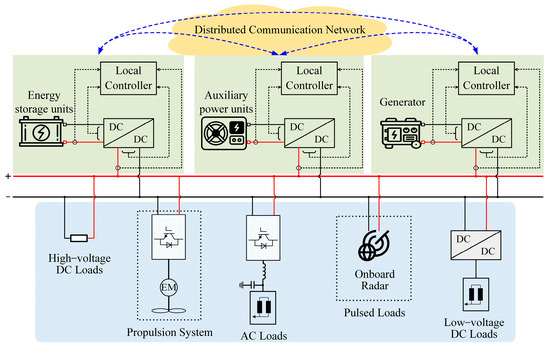
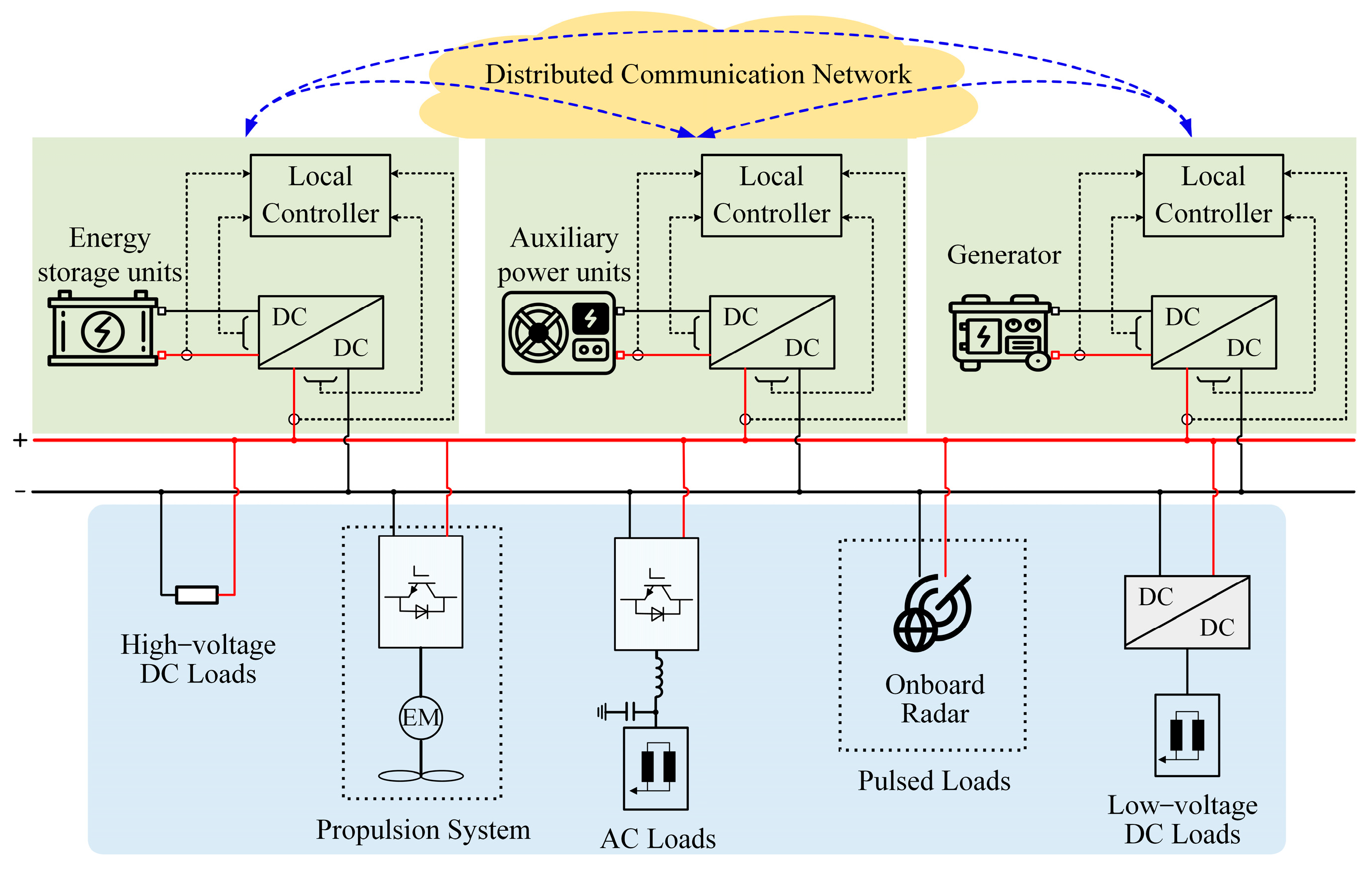
Distributed control strategies have been developed to bridge the gap between centralized and decentralized architectures for dynamic power allocation in HPSSs. In this framework, the central supervisory controller is eliminated, while limited state information is exchanged among power units through a communication network. The system-level control objectives are implicitly decomposed and embedded into local controllers, enabling coordinated operation and global optimization without relying on a single control entity. This cooperative approach enables global optimization and coordinated operation without introducing single points of failure, offering a robust solution that balances the scalability of microgrids with the safety-critical constraints of MEA. The fundamental operational framework of the distributed control strategy is illustrated in Figure 7.
Figure 7.
Fundamental operational framework of the distributed control strategy.
According to the communication structure, distributed control strategies can be broadly classified into distributed control with centralized communication and fully distributed cooperative control based on neighbor-to-neighbor information exchange. These two categories represent different tradeoffs between coordination capability, communication burden, and system robustness.
4.1. Distributed Control with Centralized Communication
Distributed control strategies with communication bridges the gap between decentralized and centralized architectures. In this framework, local controllers exchange key state variables (e.g., output voltage and current) through a shared communication network, enabling secondary-level coordination without relying on a vulnerable central processor.
Foundational studies have demonstrated that embedding communication loops into local controllers significantly enhances performance. In [55], a distributed controller utilizing the Controller Area Network (CAN) protocol was proposed for low-voltage DC microgrids. By embedding voltage and current compensation loops locally, this method successfully resolves the inherent conflict between proportional load sharing and voltage regulation, ensuring both objectives are met simultaneously. Similarly, the concept of Distributed Secondary Control (DSC) was advanced in [56], where the functionality of a central controller was distributed among local units. This networked approach not only restores voltage and frequency deviations but also ensures system robustness, as the failure of a single unit does not precipitate a system-wide collapse.
To further refine coordination efficiency, average consensus mechanisms have been widely adopted. In [57], an improved strategy based on Low-Bandwidth Communication (LBC) was developed. Instead of a separate secondary control unit, each local converter calculates system-wide average voltage and current values to directly participate in bus voltage restoration. This average-value approach significantly enhances current sharing accuracy while eliminating the need for high-speed communication. Addressing the optimization of power losses, an adaptive droop method was introduced in [58]. By defining a performance metric termed the “Droop Index (DI),” the strategy dynamically adjusts the instantaneous virtual resistance. This adaptation minimizes circulating currents and load sharing errors caused by parameter mismatches, effectively optimizing the trade-off between voltage regulation and current distribution. Complementing steady-state optimization, transient performance was prioritized in [59]. A transient-adaptive droop strategy utilizing Particle Swarm Optimization (PSO) was developed to dynamically tune virtual impedance, significantly mitigating current overshoot and ensuring Lyapunov-based stability. Pushing the envelope toward intelligent power quality control, a hybrid ANN-based adaptive strategy was proposed in [60] for AC subsystems. By synergizing neural networks with virtual impedance, this method drastically reduces Total Harmonic Distortion (THD) and power-sharing errors, ensuring strict compliance with power quality standards even under parameter uncertainties.
Despite their superior performance compared to purely decentralized methods, these strategies remain dependent on the integrity of the communication network. Consequently, issues such as communication latency, data packet dropouts, and scalability limits may degrade coordination performance as the number of nodes increases.
4.2. Distributed Cooperative Control Based on Neighboring Communication
To further enhance robustness and scalability, research has shifted towards fully distributed cooperative control strategies. In this paradigm, each unit communicates solely with its immediate neighbors through a sparse network. By leveraging consensus algorithms, system-wide coordination and global optimization are achieved without a central processor, effectively eliminating single-point failures and enabling plug-and-play functionality.
Consensus protocols have been effectively tailored for multi-source coordination. In [61], a leaderless consensus protocol was applied to multiple Hybrid Energy Storage Systems. By exchanging only neighboring information, this approach enables batteries and supercapacitors to autonomously converge to their respective optimal operating points for voltage and SOC regulation. Notably, this distributed architecture maintains system stability even under communication faults, provided the remaining network graph remains connected. Addressing the constraints of limited bandwidth, a PQ decoupling control was introduced in [62] for series PV-battery systems. This method significantly reduces the communication burden by transmitting only a few slow-dynamic variables, while still ensuring accurate reactive power distribution and preventing overmodulation.
Furthermore, distributed strategies have been extended to handle complex impedance mismatches and event-driven scenarios. Ref. [63] proposed a Consensus-Based Distributed Control Strategy (CDCS) specifically for multi-HESS configurations. This strategy coordinates virtual resistance and capacitance loops to achieve global average voltage regulation and precise current sharing, compensating for discrepancies in line impedances and terminal voltages. Similarly, for islanded DC microgrids, a secondary control layer was developed in [64] to restore bus voltage deviations caused by primary droop actions. By utilizing a “pinning control” concept, this method simplifies implementation by requiring bus voltage feedback at only a single node. To further optimize communication resources, an event-triggered framework was presented in [65]. This two-layer multi-agent system relies on aperiodic communication, triggering data exchange only when specific conditions are met, thereby excluding Zeno behavior and drastically reducing data traffic. Finally, in [66], a “virtual voltage drop” parameter was integrated into the secondary control, allowing for accurate current sharing and voltage restoration without direct bus voltage feedback, demonstrating robustness against constant power loads. Beyond physical disturbances, cyber–physical security was addressed in [67]. A collaborative defense model combining Sequential Hypothesis Testing (SHT) and Artificial Neural Networks (ANNs) was developed to detect False Data Injection Attacks (FDIAs). Upon detecting anomalies, the system reconfigures the adaptive droop control to rely on alternative measurements, ensuring reliability even under severe cyber threats.
In summary, distributed cooperative control effectively synthesizes the architectural benefits of both centralized and decentralized paradigms. It resolves the fundamental trade-off in avionics by leveraging sparse communication networks: it retains the global optimization capability typical of centralized methods—enabling precise load sharing and efficiency maximization—while preserving the high fault tolerance and modularity characteristic of decentralized schemes. This balance makes it particularly suitable for the safety-critical constraints of next-generation MEA. To provide a systematic overview of the diverse methodologies reviewed in Section 2, Section 3 and Section 4 and to assist researchers in architecture selection, the operational characteristics, core control mechanisms, and performance trade-offs of existing dynamic power allocation strategies are comprehensively summarized in Table 2.
Table 2.
Summary of representative dynamic power allocation strategies for MEA HPSSs.
5. Challenges and Future Trends
The preceding comparative analysis indicates a distinct trend: centralized architectures, while effective in ground-based grids, are structurally unsuitable for safety-critical MEA due to single-point vulnerabilities. Conversely, decentralized strategies, though robust, struggle to satisfy complex system-level optimization demands. Consequently, distributed cooperative control emerges as a highly promising evolutionary direction, theoretically synthesizing global intelligence with intrinsic fault tolerance. However, bridging the gap between this theoretical promise and practical aerospace deployment introduces significant multidimensional challenges. The following subsections delineate these hurdles—ranging from algorithmic determinism to airworthiness certification—that define the critical path for future research.
5.1. Key Challenges in Distributed Control Implementation
Despite the significant theoretical advantages of distributed control, its application in MEA HPSS faces multidimensional engineering challenges. These hurdles span the entire spectrum from algorithm design and real-time computation to stability analysis and final airworthiness certification.
5.1.1. Algorithmic Complexity and Coordination
The primary theoretical hurdle lies in achieving global optimization constraints while relying solely on sparse, neighbor-to-neighbor communication. Unlike centralized controllers with full system visibility, distributed algorithms must coordinate heterogeneous power sources while respecting subsystem privacy and handling asynchronous data updates. Designing robust consensus algorithms that can converge to a global optimum without exposing the internal dynamics of proprietary subsystems—while mitigating the impact of communication latency—remains a complex trade-off between optimality and information security.
5.1.2. Real-Time Determinism and Computational Constraints
Aerospace avionics demand strict guarantees on real-time performance. However, many distributed optimization algorithms rely on iterative processes to reach consensus, which inherently introduces uncertainty regarding convergence time. Ensuring that the Worst-Case Execution Time (WCET) of these iterative algorithms falls strictly within the microsecond-level control cycles of power electronics is a formidable challenge. Consequently, resolving the conflict between high algorithmic accuracy (requiring more iterations) and hard computational boundary guarantees (requiring determinism) is critical for flight-critical applications.
5.1.3. Cyber-Physical Stability and Verification
The introduction of communication networks creates a tightly coupled Cyber-Physical System (CPS), giving rise to network-induced stability issues—such as delay-dependent oscillations—that are absent in isolated systems. Current research predominantly relies on simplified average models for stability analysis, which often fail to capture high-frequency interactions present in detailed power electronic switching models. To bridge this gap, advanced mathematical tools are increasingly adopted to provide rigorous stability guarantees. Specifically, Lyapunov-based methods, particularly those utilizing Lyapunov–Krasovskii functionals, are essential for analyzing asymptotic stability under stochastic communication delays and time-varying topologies. Complementarily, passivity theory offers a robust energy-based perspective, ensuring that the networked system remains strictly passive—and thus stable—despite data quantization effects and transmission latency. Therefore, establishing a verification framework that integrates these rigorous mathematical tools with switching non-linearities is urgently needed to ensure robust operation.
5.1.4. Fault Tolerance and Dynamic Reconfiguration
To satisfy the plug-and-play requirements of MEA, distributed strategies must demonstrate graceful degradation capabilities. The system must seamlessly reconfigure its topology and control laws when a node fails or communication links are severed. A key challenge lies in developing consistency algorithms capable of distinguishing between temporary disturbances and permanent faults, thereby isolating faulty units without destabilizing the entire grid. This requires advanced topological management strategies that can maintain system controllability under partial failure conditions.
5.1.5. Hardware Implementation and Airworthiness Certification
Ultimately, the deployment of distributed control is gated by strict industrial standards. Hardware realization must adhere to rigorous Size, Weight, and Power constraints while enduring harsh environmental conditions (vibration, temperature extremes). Most critically, current airworthiness certification standards—such as DO-178C [68] for software and DO-254 [69] for airborne electronic hardware—are primarily designed for deterministic, centralized systems. Certifying a non-deterministic, distributed decision-making network—where control authority is shared among multiple nodes—presents a significant regulatory barrier that requires new validation methodologies.
5.2. Future Trends
In response to the aforementioned challenges, the evolution of distributed control for MEA HPSSs is increasingly oriented toward intelligence, resilience, and system-level integration. Rather than functioning merely as a power allocation technique, distributed control is expected to evolve into a core enabling framework for highly reliable and intelligent onboard energy networks.
5.2.1. Intelligent and Adaptive Distributed Energy Management
A primary development trend lies in the integration of intelligent algorithms to enhance adaptability across diverse operating conditions and life-cycle stages. Future strategies are likely to adopt hybrid intelligence architectures that combine model-based control with data-driven learning. In such frameworks, lightweight learning algorithms embedded in local controllers can identify component degradation and operating trends online, while distributed optimization layers incorporate this information as real-time constraints. This hierarchical organization enables a clear separation of time scales, where fast local control ensures stability, distributed predictive control supports coordinated multi-objective optimization, and higher-level learning mechanisms adjust control priorities according to flight phases and long-term efficiency objectives.
5.2.2. Resilience-Oriented Control and Communication Architectures
Parallel to intelligence enhancement, resilience under continuous disturbances has become a critical research focus. Future distributed control systems are expected to rely on resilient communication architectures that support plug-and-play operation and dynamic reconfiguration. Redundant communication topologies and time-sensitive networking technologies can improve robustness against link degradation and partial network failures. In extreme scenarios, fallback coordination mechanisms based on local interactions may enable subsystems to converge toward safe and stable operating points, ensuring graceful performance degradation rather than abrupt loss of functionality.
5.2.3. System Integration and Certification-Oriented Design
Beyond the power domain, distributed control is anticipated to facilitate deeper integration of HPSSs with other aircraft subsystems, such as flight and Thermal Management Systems (TMSs). In MEA, power allocation is strictly coupled with thermal loads, as the high-power density of electrical components generates significant heat. Efficient power splitting is futile if it disregards thermal limits, potentially triggering thermal runaway in a high-power battery pack during a pulsed load event. Therefore, future strategies must evolve from purely electrical optimization to electro-thermal coordinated control. In this paradigm, real-time thermal constraints (e.g., battery temperature limits, cable ampacity, and heat sink capacity) are explicitly embedded into the power allocation algorithms, ensuring that the system pursues electrical efficiency only within safe thermal boundaries. To bridge the gap between advanced control strategies and airworthiness certification, future research will increasingly adopt digital twin-based design and verification methodologies, allowing large-scale fault injection and accelerated validation under extreme conditions. Moreover, the development of standardized and modular control frameworks may further reduce implementation complexity and promote the deployment of certifiable, scalable distributed energy management solutions for next-generation MEA platforms.
6. Conclusions
This paper systematically reviewed dynamic power allocation strategies, identifying the cross-domain adaptation of ground-based microgrid theories to the safety-critical MEA environment as a pivotal research opportunity. Comparative analyses highlight a critical trade-off: centralized architectures offer the global optimality typical of microgrids but face reliability bottlenecks in airborne deployment, whereas decentralized strategies ensure the high survivability essential for avionics at the cost of coordination. Consequently, distributed cooperative control is identified as the optimal convergence, effectively bridging global optimization with fault tolerance to achieve coordinated power allocation and voltage regulation under strict airborne constraints.
Looking forward, dynamic power allocation for MEA HPSS is expected to evolve toward standardized, intelligent, and resilient distributed control frameworks. Future research should address algorithmic determinism, real-time performance guarantees, and airworthiness certification challenges associated with distributed optimization. The integration of hybrid intelligence for life-cycle-aware energy management, resilient communication mechanisms for fault-tolerant operation, and digital twin technologies for accelerated verification will be key enablers. Establishing certifiable and highly reliable distributed control architectures is essential to fully exploit the performance and efficiency potential of next-generation MEA power systems.
Author Contributions
Conceptualization, methodology, and software, G.L. and Y.T.; validation, formal analysis, and investigation, Y.T., X.W. and K.L.; resources and data curation, G.L.; writing—original draft preparation, G.L. and Y.T.; writing—review and editing, X.W. and K.L.; visualization and supervision, G.L.; project administration and funding acquisition, G.L. All authors have read and agreed to the published version of the manuscript.
Funding
This work was supported by the Ye Qisun Science Foundation of the National Science Foundation of China U2341276.
Data Availability Statement
No new data were created or analyzed in this study.
Conflicts of Interest
The authors declare no conflicts of interest.
References
- Xiong, X.; Song, X.; Kaygorodova, A.; Ding, X.; Guo, L.; Huang, J. Aviation and carbon emissions: Evidence from airport operations. J. Air Transp. Manag. 2023, 109, 102383. [Google Scholar] [CrossRef] [Scilit]
- Quadros, F.D.A.; van Loo, M.; Snellen, M.; Dedoussi, I.C. Nitrogen deposition from aviation emissions. Sci. Total Environ. 2023, 858, 159855. [Google Scholar] [CrossRef] [Scilit]
- Terrenoire, E.; Hauglustaine, D.A.; Gasser, T.; Penner, J.E. The contribution of carbon dioxide emissions from the aviation sector to future climate change. Environ. Res. Lett. 2019, 14, 084019. [Google Scholar] [CrossRef] [Scilit]
- Lee, D.S.; Fahey, D.W.; Skowron, A.; Allen, M.R.; Burkhardt, U.; Chen, Q.; Doherty, S.J.; Freeman, S.; Forster, P.M.; Fuglestvedt, J.; et al. The contribution of global aviation to anthropogenic climate forcing for 2000 to 2018. Atmos. Environ. 2021, 244, 117834. [Google Scholar] [CrossRef] [Scilit]
- Wheeler, P.; Sirimanna, T.S.; Bozhko, S.; Haran, K.S. Electric/hybrid-electric aircraft propulsion systems. Proc. IEEE 2021, 109, 1115–1127. [Google Scholar] [CrossRef] [Scilit]
- Barzkar, A.; Ghassemi, M. Components of electrical power systems in more and all-electric aircraft: A review. IEEE Trans. Transp. Electr. 2022, 8, 4037–4053. [Google Scholar] [CrossRef] [Scilit]
- Patnaik, B.; Kumar, S.; Gawre, S. Recent advances in converters and storage technologies for more electric aircrafts: A review. IEEE J. Miniatur. Air Space Syst. 2022, 3, 78–87. [Google Scholar] [CrossRef] [Scilit]
- Liang, Y.; Mouli, G.R.C.; Bauer, P. Charging technology for electric aircraft: State of the art, trends, and challenges. IEEE Trans. Transp. Electr. 2024, 10, 6761–6788. [Google Scholar] [CrossRef] [Scilit]
- Benzaquen, J.; He, J.B.; Mirafzal, B. Toward more electric powertrains in aircraft: Technical challenges and advancements. CES Trans. Electr. Mach. Syst. 2021, 5, 177–193. [Google Scholar] [CrossRef] [Scilit]
- Sahoo, S.; Zhao, X.; Kyprianidis, K. A review of concepts, benefits, and challenges for future electrical propulsion-based aircraft. Aerospace 2020, 7, 44. [Google Scholar] [CrossRef] [Scilit]
- Gao, Y.; Jausseme, C.; Huang, Z.; Yang, T. Hydrogen-powered aircraft: Hydrogen–electric hybrid propulsion for aviation. IEEE Electrif. Mag. 2022, 10, 17–26. [Google Scholar] [CrossRef] [Scilit]
- Waddington, E.; Merret, J.M.; Ansell, P.J. Impact of liquid-hydrogen fuel-cell electric propulsion on aircraft configuration and integration. J. Aircr. 2023, 60, 1588–1600. [Google Scholar] [CrossRef] [Scilit]
- Sarlioglu, B.; Morris, C.T. More electric aircraft: Review, challenges, and opportunities for commercial transport aircraft. IEEE Trans. Transp. Electr. 2015, 1, 54–64. [Google Scholar] [CrossRef] [Scilit]
- Roboam, X.; Sareni, B.; De Andrade, A. More electricity in the air: Toward optimized electrical networks embedded in more-electrical aircraft. IEEE Ind. Electron. Mag. 2012, 6, 6–17. [Google Scholar] [CrossRef] [Scilit]
- Barzkar, A.; Ghassemi, M. Electric power systems in more and all electric aircraft: A review. IEEE Access 2020, 8, 169314–169332. [Google Scholar] [CrossRef] [Scilit]
- Gao, F.; Bozhko, S. Modeling and impedance analysis of a single DC bus-based multiple-source multiple-load electrical power system. IEEE Trans. Transp. Electr. 2016, 2, 335–346. [Google Scholar] [CrossRef] [Scilit]
- Madonna, V.; Giangrande, P.; Galea, M. Electrical power generation in aircraft: Review, challenges, and opportunities. IEEE Trans. Transp. Electr. 2018, 4, 646–659. [Google Scholar] [CrossRef] [Scilit]
- Dragičević, T.; Lu, X.; Vasquez, J.C.; Guerrero, J.M. DC microgrids—Part I: A review of control strategies and stabilization techniques. IEEE Trans. Power Electron. 2016, 31, 4876–4891. [Google Scholar]
- Belkhier, Y.; Oubelaid, A.; Shaw, R.N. Hybrid power management and control of fuel cells–battery energy storage system in hybrid electric vehicle under three different modes. Energy Storage 2024, 6, e511. [Google Scholar] [CrossRef] [Scilit]
- Zhao, H.; Guo, W. Coordinated control method of multiple hybrid energy storage systems based on distributed event-triggered mechanism. Int. J. Electr. Power Energy Syst. 2021, 127, 106637. [Google Scholar] [CrossRef] [Scilit]
- Sorrentino, M.; Rizzo, G.; Arsie, I. Analysis of a rule-based control strategy for on-board energy management of series hybrid vehicles. Control Eng. Pract. 2011, 19, 1433–1441. [Google Scholar] [CrossRef] [Scilit]
- Castaings, A.; Lhomme, W.; Trigui, R.; Bouscayrol, A. Comparison of energy management strategies of a battery/supercapacitors system for electric vehicle under real-time constraints. Appl. Energy 2016, 163, 190–200. [Google Scholar] [CrossRef] [Scilit]
- Florescu, A.; Bacha, S.; Munteanu, I.; Bratcu, A.I.; Rumeau, A. Adaptive frequency-separation-based energy management system for electric vehicles. J. Power Sources 2015, 280, 410–421. [Google Scholar] [CrossRef] [Scilit]
- Snoussi, J.; Elghali, S.B.; Benbouzid, M.; Mimouni, M.F. Optimal sizing of energy storage systems using frequency-separation-based energy management for fuel cell hybrid electric vehicles. IEEE Trans. Veh. Technol. 2018, 67, 9337–9346. [Google Scholar] [CrossRef] [Scilit]
- Dusmez, S.; Khaligh, A. A supervisory power-splitting approach for a new ultracapacitor–battery vehicle deploying two propulsion machines. IEEE Trans. Ind. Inform. 2014, 10, 1960–1971. [Google Scholar] [CrossRef] [Scilit]
- Jiang, Q.; Hong, H. Wavelet-based capacity configuration and coordinated control of hybrid energy storage system for smoothing out wind power fluctuations. IEEE Trans. Power Syst. 2013, 28, 1363–1372. [Google Scholar] [CrossRef] [Scilit]
- Gao, T.; Liu, Y.; Zhang, J. A dynamic wavelet-based robust wind power smoothing approach using hybrid energy storage system. Int. J. Electr. Power Energy Syst. 2020, 116, 105579. [Google Scholar] [CrossRef] [Scilit]
- Lamsal, D.; Sreeram, V.; Mishra, Y.; Kumar, D. Achieving a minimum power fluctuation rate in wind and photovoltaic output power using discrete Kalman filter based on weighted average approach. IET Renew. Power Gener. 2018, 12, 633–638. [Google Scholar] [CrossRef] [Scilit]
- Zheng, Y.; He, F.; Wang, W. A method to identify lithium battery parameters and estimate SOC based on different temperatures and driving conditions. Electronics 2019, 8, 1391. [Google Scholar] [CrossRef] [Scilit]
- Shen, Y.; Xie, J.; He, T.; Yao, L.; Xiao, Y. CEEMD-fuzzy control energy management of hybrid energy storage systems in electric vehicles. IEEE Trans. Energy Convers. 2024, 39, 555–566. [Google Scholar] [CrossRef] [Scilit]
- Sun, Q.; Xing, D.; Yang, Q. A new design of fuzzy logic control for SMES and battery hybrid storage system. Energy Procedia 2017, 105, 4575–4580. [Google Scholar] [CrossRef] [Scilit]
- Shen, D.; Lim, C.C.; Shi, P. Fuzzy model-based control for energy management and optimization in fuel cell vehicles. IEEE Trans. Veh. Technol. 2020, 69, 14674–14688. [Google Scholar] [CrossRef] [Scilit]
- Shabbir, W.; Evangelou, S.A. Threshold-changing control strategy for series hybrid electric vehicles. Appl. Energy 2019, 235, 761–775. [Google Scholar] [CrossRef] [Scilit]
- Yan, Y.; Chen, Z.; Gao, D. Nonlinear model predictive control energy management strategy for hybrid power ships based on working condition identification. J. Mar. Sci. Eng. 2025, 13, 269. [Google Scholar] [CrossRef] [Scilit]
- Yao, Y.; Wang, J.; Zhou, Z.; Li, H.; Liu, H.; Li, T. Grey Markov prediction-based hierarchical model predictive control energy management for fuel cell/battery hybrid unmanned aerial vehicles. Energy 2023, 262, 125405. [Google Scholar] [CrossRef] [Scilit]
- Hu, X.; Murgovski, N.; Almqvist, L.; Egardt, B. Cost-optimal energy management of hybrid electric vehicles using fuel cell/battery health-aware predictive control. IEEE Trans. Power Electron. 2020, 35, 382–392. [Google Scholar] [CrossRef] [Scilit]
- Zhou, D.; Al-Durra, A.; Matraji, I.; Ravey, A.; Gao, F. Online energy management strategy of fuel cell hybrid electric vehicles: A fractional-order extremum seeking method. IEEE Trans. Ind. Electron. 2018, 65, 6787–6799. [Google Scholar] [CrossRef] [Scilit]
- Liang, Z.; Chung, C.Y.; Zhang, W.; Wang, Q.; Lin, W.; Wang, C. Enabling high-efficiency economic dispatch of hybrid AC/DC networked microgrids: Steady-state convex bi-directional converter models. IEEE Trans. Smart Grid 2025, 16, 45–61. [Google Scholar] [CrossRef] [Scilit]
- Shen, J.; Khaligh, A. A supervisory energy management control strategy in a battery/ultracapacitor hybrid energy storage system. IEEE Trans. Transp. Electr. 2015, 1, 223–231. [Google Scholar] [CrossRef] [Scilit]
- Wang, Y. Intelligent energy management and operation efficiency of electric vehicles based on artificial intelligence algorithms and thermal energy optimization. Thermal Sci. Eng. Prog. 2024, 55, 102900. [Google Scholar] [CrossRef] [Scilit]
- Al Smadi, T.; Handam, A.; Gaeid, K.S.; Al-Smadi, A.; Al-Husban, Y.; Khalid, A.S. Artificial intelligent control of energy management PV system. Results Control Optim. 2024, 14, 100343. [Google Scholar] [CrossRef] [Scilit]
- Forestieri, J.N.; Farasat, M. Integrative sizing/real-time energy management of a hybrid supercapacitor/undersea energy storage system for grid integration of wave energy conversion systems. IEEE J. Emerg. Sel. Top. Power Electron. 2019, 8, 3798–3810. [Google Scholar] [CrossRef] [Scilit]
- Xu, Q.; Hu, X.; Wang, P.; Xiao, J.; Tu, P.; Wen, C.; Lee, M.Y. A decentralized dynamic power sharing strategy for hybrid energy storage system in autonomous DC microgrid. IEEE Trans. Ind. Electron. 2016, 64, 5930–5941. [Google Scholar] [CrossRef] [Scilit]
- Zhang, Y.; Li, Y.W. Energy management strategy for supercapacitor in droop-controlled DC microgrid using virtual impedance. IEEE Trans. Power Electron. 2016, 32, 2704–2716. [Google Scholar] [CrossRef] [Scilit]
- Xu, Q.; Xiao, J.; Hu, X.; Wang, P.; Lee, M.Y. A decentralized power management strategy for hybrid energy storage system with autonomous bus voltage restoration and state-of-charge recovery. IEEE Trans. Ind. Electron. 2017, 64, 7098–7108. [Google Scholar] [CrossRef] [Scilit]
- Chen, J.; Song, Q. A decentralized dynamic load power allocation strategy for fuel cell/supercapacitor-based APU of large more electric vehicles. IEEE Trans. Ind. Electron. 2018, 66, 865–875. [Google Scholar] [CrossRef] [Scilit]
- Agredano-Torres, M.; Xu, Q. Decentralized power management of hybrid hydrogen electrolyzer–supercapacitor systems for frequency regulation of low-inertia grids. IEEE Trans. Ind. Electron. 2025, 72, 8072–8081. [Google Scholar] [CrossRef] [Scilit]
- Gao, P.; Li, Y.; Zheng, X.; Liu, W.; Yao, W.; Hua, Z. A decentralized power allocation method based on virtual impedance droop control for pulsed power load in aircraft electrical power system. IEEE Trans. Transp. Electron. 2024, 10, 9016–9030. [Google Scholar] [CrossRef] [Scilit]
- Chen, J.; Song, Q.; Yin, S.; Chen, J. On the decentralized energy management strategy for the all-electric APU of future more electric aircraft composed of multiple fuel cells and supercapacitors. IEEE Trans. Ind. Electron. 2019, 67, 6183–6194. [Google Scholar] [CrossRef] [Scilit]
- Wang, Z.; Wang, P.; Jiang, W. A decentralized automatic load power allocation strategy for hybrid energy storage system. IEEE Trans. Energy Convers. 2020, 36, 2227–2238. [Google Scholar] [CrossRef] [Scilit]
- Song, Q.; Wang, L.; Chen, J. A decentralized energy management strategy for a fuel cell–battery hybrid electric vehicle based on composite control. IEEE Trans. Ind. Electron. 2020, 68, 5486–5496. [Google Scholar] [CrossRef] [Scilit]
- Wen, Q.; Zhang, L.; Liang, Z.; Yang, S. Optimized multi-timescale energy management strategy of a novel all-electric aircraft power system unit based on decentralized control. J. Energy Storage 2023, 73, 108903. [Google Scholar] [CrossRef] [Scilit]
- Liu, G.; Tao, Y.; Wang, X.; Liu, K. An extended droop control strategy based on virtual impedance matching for MEA power supply system with pulsed loads. In Proceedings of the 5th International Conference on Power Engineering (ICPE), Shanghai, China, 13–15 December 2024; pp. 84–89. [Google Scholar]
- Song, Q.; Chen, J.; Chen, J.; Chen, G. Completely decentralized energy management system for fuel cell–battery–ultracapacitor hybrid energy storage system. IEEE Trans. Ind. Electron. 2023, 71, 438–449. [Google Scholar] [CrossRef] [Scilit]
- Anand, S.; Fernandes, B.G.; Guerrero, J. Distributed control to ensure proportional load sharing and improve voltage regulation in low-voltage DC microgrids. IEEE Trans. Power Electron. 2013, 28, 1900–1913. [Google Scholar] [CrossRef] [Scilit]
- Shafiee, Q.; Guerrero, J.M.; Vasquez, J.C. Distributed secondary control for islanded microgrids—A novel approach. IEEE Trans. Power Electron. 2014, 29, 1018–1031. [Google Scholar] [CrossRef] [Scilit]
- Lu, X.; Guerrero, J.M.; Sun, K.; Vasquez, J.C. An improved droop control method for DC microgrids based on low bandwidth communication with DC bus voltage restoration and enhanced current sharing accuracy. IEEE Trans. Power Electron. 2014, 29, 1800–1812. [Google Scholar] [CrossRef] [Scilit]
- Augustine, S.; Mishra, M.K.; Lakshminarasamma, N. Adaptive droop control strategy for load sharing and circulating current minimization in low-voltage standalone DC microgrid. IEEE Trans. Sustain. Energy 2015, 6, 132–141. [Google Scholar] [CrossRef] [Scilit]
- Shekhar, S.; Alam, A. A transient-adaptive droop control strategy for better current sharing, robustness, and stability in DC microgrids. IEEE Trans. Ind. Appl. 2025, 61, 5513–5524. [Google Scholar] [CrossRef] [Scilit]
- Adiche, S.; Larbi, M.; Toumi, D.; Bouddou, R.; Bajaj, M.; Bouchikhi, N.; Belabbes, A.; Zaitsev, I. Advanced control strategy for AC microgrids: A hybrid ANN-based adaptive PI controller with droop control and virtual impedance technique. Sci. Rep. 2024, 14, 31057. [Google Scholar] [CrossRef] [Scilit]
- Chen, X.; Shi, M.; Zhou, J.; Chen, Y.; Zuo, W.; Wen, J.; He, H. Distributed cooperative control of multiple hybrid energy storage systems in a DC microgrid using consensus protocol. IEEE Trans. Ind. Electron. 2020, 67, 1968–1979. [Google Scholar] [CrossRef] [Scilit]
- Pan, Y.; Sangwongwanich, A.; Yang, Y.; Blaabjerg, F. Distributed control of islanded series PV–battery-hybrid systems with low communication burden. IEEE Trans. Power Electron. 2021, 36, 10199–10213. [Google Scholar] [CrossRef] [Scilit]
- Cheng, L.; Yang, C. Distributed control for multiple hybrid energy storage systems using consensus algorithm in direct current power supply system. J. Power Sources 2023, 588, 233701. [Google Scholar] [CrossRef] [Scilit]
- Guo, F.; Xu, Q.; Wen, C.; Wang, L.; Wang, P. Distributed secondary control for power allocation and voltage restoration in islanded DC microgrids. IEEE Trans. Sustain. Energy 2018, 9, 1857–1869. [Google Scholar] [CrossRef] [Scilit]
- Guo, F.; Wang, L.; Wen, C.; Zhang, D.; Xu, Q. Distributed voltage restoration and current sharing control in islanded DC microgrid systems without continuous communication. IEEE Trans. Ind. Electron. 2019, 67, 3043–3053. [Google Scholar] [CrossRef] [Scilit]
- Xing, L.; Mishra, Y.; Guo, F.; Lin, P.; Yang, Y.; Ledwich, G.; Tian, Y.-C. Distributed secondary control for current sharing and voltage restoration in DC microgrid. IEEE Trans. Smart Grid 2020, 11, 2487–2497. [Google Scholar] [CrossRef] [Scilit]
- Pati, A.; Adhikary, N. Detection and mitigation against false data injection attacks using SHT and ANN in distributed control of DC microgrids. Electr. Power Syst. Res. 2025, 241, 111356. [Google Scholar]
- RTCA DO-178C; Software Considerations in Airborne Systems and Equipment Certification. RTCA, Inc.: Washington, DC, USA, 2011.
- RTCA DO-254; Design Assurance Guidance for Airborne Electronic Hardware. RTCA, Inc.: Washington, DC, USA, 2000.

Disclaimer/Publisher’s Note: The statements, opinions and data contained in all publications are solely those of the individual author(s) and contributor(s) and not of MDPI and/or the editor(s). MDPI and/or the editor(s) disclaim responsibility for any injury to people or property resulting from any ideas, methods, instructions or products referred to in the content. |
© 2026 by the authors. Licensee MDPI, Basel, Switzerland. This article is an open access article distributed under the terms and conditions of the Creative Commons Attribution (CC BY) license.