Article

Modelling, Simulation, and Experimental Validation of a Thermal Cabin Model of an Electric Minibus †

by
Thomas Bäuml
1,*,
Irina Maric
1,
Dominik Dvorak
1,
Dragan Šimić
1 and
Johannes Konrad
2
1
Electric Vehicle Technologies, AIT Austrian Institute of Technology GmbH, 1210 Vienna, Austria
2
Institute of Powertrain and Automotive Technology, Technische Universität Wien, 1060 Vienna, Austria
*
Author to whom correspondence should be addressed.
This paper is an extended version of our paper published in the 20th Conference on Sustainable Development of Energy Water and Environment Systems (SDEWES 2025), Dubrovnik, Croatia, 5–10 October 2025.
Energies 2026, 19(3), 655; https://doi.org/10.3390/en19030655
Submission received: 12 December 2025 / Revised: 20 January 2026 / Accepted: 22 January 2026 / Published: 27 January 2026

Abstract

In response to the urgent need for decarbonising the transport sector, this paper analyses the thermal performance of a battery electric minibus under cold ambient conditions. Thermal simulation models of the vehicle cabin and its electric heating circuits for both driver and passenger areas were developed using Modelica and validated with measurement data at −7 °C and 0 °C. The model showed good agreement with the measurements, with cabin temperature deviations within ±1.6 K and heating power deviations below 6%. Results show that the existing electric-only heating system is, in the automatic heating mode selected, insufficient to reach the target cabin temperature of 23 °C, as the optional fuel-powered heater was omitted to ensure fully zero-emission operation. To address this, an extended heating system with an additional heat exchanger was implemented in the simulation, which improved the overall cabin temperature level and also its spatial variation. However, it also increased the heating power demand by 43% at −7 °C (from 4.8 kW to 6.8 kW) and by 17% at 0 °C (from 4.8 kW to 5.6 kW). An additional heat loss analysis revealed that approx. 65–75% of all thermal losses occur through the window areas. Future improvements should therefore focus on optimising the heating strategy and enhancing cabin and heating system insulation to reduce energy demand while maintaining or even improving passenger comfort.

1. Introduction

Rising global CO2 emissions and increasing temperatures show the crucial need for drastic defossilisation of our economies and lifestyles. To transform Europe’s mobility, energy, and production systems, the European Union (EU) has approved the European Green Deal Action Plan [1], which has the ambition of moving the EU towards a resource-efficient, competitive, and inclusive economy and achieving net carbon neutrality in economic sectors by 2050. In 2022 the transport sector accounted for approx. 23.8% of all CO2 and greenhouse gas emissions. Of this, approx. 26.2% were produced by buses and heavy-duty vehicles [2]. This calls for a massive shift in this sector to deliver tangible benefits: reduced pollutant emission and noise, cleaner air, and more liveable urban and peri-urban spaces.
In 2022 7% of the EU passenger transport on land was carried out by buses and coaches, with 327 billion passenger-kilometres per year, making transport by bus the most widely used form of public transport. However, in 2022 only 1.4% of the total European bus fleet was zero-emission [3], indicating a huge potential for the transport sector transformation to zero-emission buses for reaching carbon neutrality.
The electrification of urban transport, particularly through electric vehicles (EVs) and electric minibuses, is gaining significant momentum as cities strive for sustainable mobility solutions [4,5]. Nonetheless, the widespread adoption of EVs faces challenges, especially in hot or cold climates where thermal management is critical for vehicle performance and passenger comfort [6,7]. In particular, low ambient temperatures have been shown to significantly reduce battery efficiency and driving range [8,9], as well as increase charging needs and impact on the electric grid [10], with studies indicating an even greater impact on range than high-temperature conditions [11]. These effects necessitate the implementation of effective heating strategies [12,13]. However, the limited onboard energy storage capacity of EVs exacerbates the issue, as heating systems can substantially reduce the vehicle’s range [14,15]. Consequently, there is a pressing need for efficient thermal management systems that balance passenger comfort with energy consumption [16], particularly in electric minibuses, which play a vital role in public transportation. These systems must not only maintain optimal battery temperature but also ensure a comfortable cabin environment without severely compromising the vehicle’s operational range.
Accurate modelling and simulation of a vehicle’s thermal system are essential for optimising its thermal and energy management strategy. For analysing the thermal environment within a vehicle’s cabin, two primary methodologies are used in modern automotive engineering. The first approach uses Computational Fluid Dynamics (CFD) simulations, which are widely applied to examine heat transfer, spatial temperature distribution, and internal airflow in detail. In [17] an analysis of the airflow and temperature behaviour in a vehicle cabin was performed by using a detailed CFD model. In [18] a CFD simulation was used to compare different thermal comfort criteria in a minibus cabin. This method provides high-resolution insights into the thermal variations around the occupants, making it ideal for optimising Heating, Ventilation, and Air Conditioning (HVAC) vent placements and airflow patterns to enhance thermal comfort. However, due to their high computational cost, CFD simulations are typically impractical for iterative optimisation tasks of operating strategies requiring rapid evaluations. Alternatively, lumped parameter models are frequently used based on the assumption that air properties remain uniformly distributed throughout the cabin, or at least in the control volumes that the cabin is divided into. These simplified models are particularly useful for predicting changes in local temperature and estimating the amount of heat that needs to be added or removed to maintain thermal comfort in the cabin. They are ideal for developing and optimising real-time control algorithms and thermal and energy management strategies because of their computational efficiency and ability to quickly predict temperature trends and estimate the cooling/heating load of the HVAC system. Various software platforms and modelling languages support lumped parameter modelling approaches, including Modelica [19], Matlab/Simulink [20,21], GT-Suite [22], AMESim [23], Autonomie [24], KULI [25], and TRNSYS [26], each offering specific capabilities for thermal system simulation.
Despite their differences, both CFD and lumped parameter models require experimental validation—a crucial step to ensure accuracy, reliability, and real-world applicability [27,28]. While computational models are powerful tools for simulating heat transfer, energy flows, and thermodynamic behaviour, their predictive accuracy depends on underlying assumptions, boundary conditions, and numerical approximations. Consequently, experimental validation is necessary to verify their performance and refine their predictive capabilities for practical applications.
This contribution presents models of the passenger cabin and the electric heating system circuits of a battery electric minibus, validated using measurement data. To support zero-emission operation and ensure locally emission-free use of the minibus, the optional fuel-powered heater typically employed in this vehicle in cold countries is omitted. However, the electric heating system alone is not capable of providing a comfortable cabin temperature in cold climates. As a result, an extended heating system, incorporating an additional heat exchanger, is analysed to enhance heat transfer to the cabin. Eventually, the impact of this solution on the vehicle’s electric power consumption is evaluated, and furthermore, an analysis of the thermal losses is conducted.

2. Materials and Methods

2.1. Battery Electric Minibus and Data Acquisition

The battery electric minibus used in this contribution is an IVECO eDAILY electric minibus [29], with the main parameters summarised in Table 1.
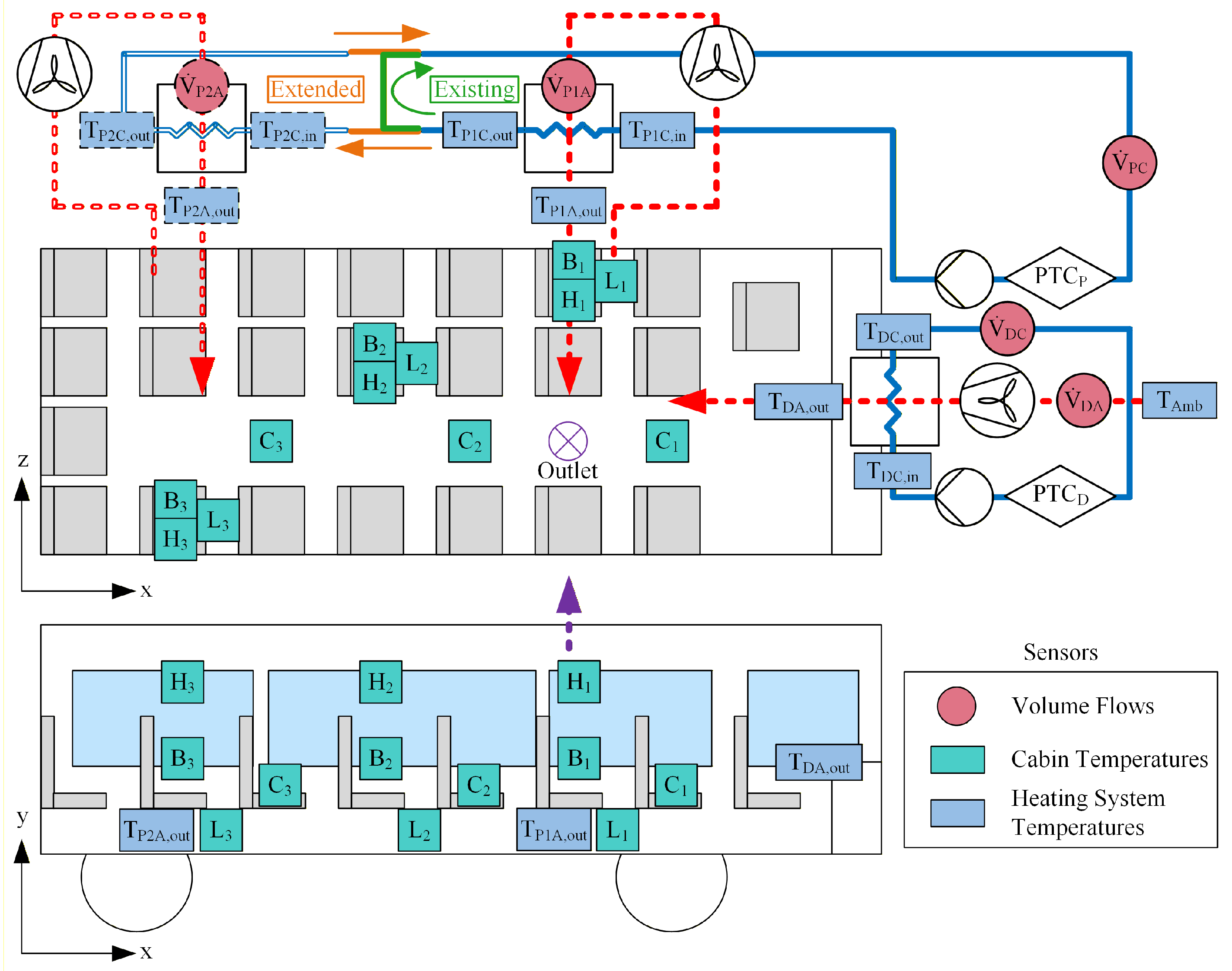
The bus was conditioned and measured at a climatised chassis dynamometer at temperatures of −7 °C and 0 °C. Temperatures in the passenger compartment were recorded at three distinct seats distributed diagonally throughout the cabin in the leg room ( L i ), at upper body height ( B i ), and in the head region ( H i ), as well as along the center aisle ( C i ). Additionally, temperatures and volume flows of the heating circuits were measured according to Figure 1.
The vehicle was driven on the dynamometer for five consecutive Worldwide Harmonised Light-Duty Vehicles Test Procedure (WLTP) cycles. For the purpose of simulation and performance optimisation, the measured vehicle speed profile was not used directly; instead, a constant mean WLTP vehicle speed of 42.76 km/h was applied. To ensure consistency and comparability between measurement and simulation, the recorded cabin air temperatures were averaged over the final 30 min of the test duration. This reduces fluctuations in the measurement signals.

2.1.1. Electric Cabin Heater Circuit

The cabin of the minibus is heated by two independent circuits: the driver heating circuit, denoted by subscript D, and the passenger heating circuit, denoted by subscript P1, as illustrated in Figure 1. In the current system implemented in the minibus, the pipe connection highlighted in green (Existing) is used for the passenger heating circuit. In each circuit, the coolant—a 50/50 mixture of ethylene-glycol and water—is circulated by a coolant pump and heated by a high-voltage Positive Temperature Coefficient (PTC) heater with 5 kW nominal power at 0 °C. Heat is then transferred to the air blown into the cabin via a heat exchanger.
In the driver heating circuit, a fan draws fresh air from the ambient ( T amb ), which is then heated up via the heat exchanger and blown into the cabin with temperature ( T DA , out ) via the inlets (foot, vent, and defrost) in the dashboard. To keep the model simple and fast, the HVAC control strategy in this paper uses a simplified version compared to the real vehicle. The control unit in automatic mode adjusts the coolant temperature setpoint, coolant volume flow rate, and air volume flow rate based solely on the air temperature C 1 of the cabin (see Table 2).
The heating power P DC on the coolant side of the heat exchanger is calculated with the temperature difference of the coolant between inlet T DC , in and outlet T DC , out , the volume flow V ˙ DC , and the material values density ρ DC and specific heat capacity c p , DC following
P DC = V ˙ DC · ρ DC · c p , DC · T DC , in T DC , out .
The passenger area heating system uses a floor radiator that functions as a heat exchanger. The air circuit operates in recirculation mode, drawing air from the cabin on the top of the radiator and discharging the heated-up air with temperature T P 1 A , out to the floor. Unlike the driver heating system, the passenger heating system operates in a fixed mode. This means that the PTC heater’s coolant temperature setpoint (75 °C), coolant (18 L/min), and air volume flow (250 m3/h) rates remain constantly in operation, providing heat without adapting to the cabin conditions. Similarly to the driver circuit, the heating power P PC , Existing of the passenger circuit is calculated on the coolant side of the heat exchanger according to
P PC , Existing = V ˙ PC · ρ PC · c p , PC · T P 1 C , in T P 1 C , out .

2.1.2. Extended Passenger Heating Circuit

To support zero-emission operation and ensure locally emission-free use of the minibus, the optional fuel-powered heater typically employed in cold countries is omitted. However, the electric heating system alone is not capable of providing a comfortable cabin temperature in cold climates. As a result, an extended heating system incorporating an additional heat exchanger is added to the simulation of the passenger heating circuit, as depicted in Figure 1. Accordingly, the vertical green flow path labelled Existing is replaced by the horizontal orange flow path labelled Extended. The additional passenger heat exchanger, denoted as P 2 , is connected in series with the existing passenger heating system P 1 . The heating power on the coolant side of the extended passenger heating circuit, P PC , Extended , is then calculated according to
P PC , Extended = V ˙ PC · ρ PC · c p , PC · T P 1 C , in T P 2 C , out
which increases the heat delivered to the cabin, helping to reach a comfortable temperature level.

2.2. Methodology

2.2.1. Modelica Modelling Approach

For modelling the cabin and heating systems of the battery electric minibus, the modelling language Modelica [30] was used. Modelica is an equation-based, object-oriented modelling language, which provides a highly flexible and efficient environment for the representation of multi-physical systems. Systems are described by algebraic and ordinary differential equations [31]. Modelica enables the seamless integration of multiple physical domains such as thermal, mechanical, and electrical systems within a unified framework. Consequently, larger systems can be created by using smaller subsystems. This enables the incorporation of a modular structure, where subsystems can easily be replaced by other subsystems with the same interfaces.

2.2.2. Cabin Heater Circuit Models

The cabin heater circuit models were developed using the Modelica TIL library [32], which is specifically designed for modelling thermodynamic systems. For all heat exchangers within the driver, existing, and extended passenger circuits, a moist air–coolant cross-flow heat exchanger model was employed. The heat transfer coefficients between solid components and the working media (air and coolant), as well as the thermal conductances of the solid materials, were calibrated to ensure that the temperature differences of coolant and air at the inlets and outlets aligned with measured data. Coolant pumps were modelled as ideal volume flow sources without representing mechanical or electrical behaviour. Furthermore, friction and pressure losses within the components were neglected. The PTC heaters were modelled as pipes with prescribed heat flow heating the coolant and constant heat transfer coefficients.

2.2.3. Thermal Cabin Model

For modelling the cabin of the minibus, the HumanComfort library [33] was used. This library provides a finite volume discretisation of the Navier–Stokes equations in Modelica. The cabin air volume is subdivided into a three-dimensional grid consisting of control volumes connected with flow elements. Conservation of mass, energy, and momentum is enforced in each control volume and flow element.
The transient mass balance of a control volume is given by
d d t m = α m ˙ α , α { E , W , N , S , T , B } ,
where m ˙ α denotes the signed mass flow rate through face α (positive for inflow and negative for outflow).
The corresponding energy balance in each control volume is formulated as
d d t m c v T = α m ˙ α h α + Q ˙ α + Q ˙ source ,
accounting for convective enthalpy transport, conductive heat transfer, and internal heat sources. Here, c v is the specific heat capacity of the cabin air at constant volume, h α is the specific enthalpy of the air at the corresponding face, Q ˙ α represents conductive heat transfer through face α between adjacent control volumes, and Q ˙ source accounts for internal heat sources, such as supplied heating power or occupants.
The momentum conservation in the cabin air domain is formulated in finite-volume form and solved component-wise using dedicated directional flow elements aligned with the Cartesian x-, y-, and z-directions. Each flow element connects adjacent control volumes along the respective coordinate direction and evaluates the corresponding velocity component. The transient momentum balance for a flow element is given by
d d t m v = α m ˙ α v α α p α n α A α + α τ α A α + m g
where m = ρ V is the mass of the control volume, v is the cell-centered velocity vector, and v α denotes the velocity vector at face α . Furthermore, p α is the pressure at face α , n α is the outward unit normal vector, and A α is the corresponding face area. The term τ α represents the viscous stress vector acting on face α , while m g accounts for gravitational body forces.
In the HumanComfort implementation, Equation (6) is evaluated separately for each velocity component within flow cells connecting the control volumes. Pressure forces are obtained from the two ports aligned with the considered coordinate direction, whereas convective and viscous contributions are computed from face-based mass flow rates and locally evaluated velocity gradients.
The viscous stress term τ in the momentum balance is evaluated under the assumption of a Newtonian fluid. In the numerical formulation, τ is computed from the local velocity gradient tensor using an effective dynamic viscosity μ eff . This effective viscosity accounts for both laminar and turbulent momentum transport and is determined according to the zero-equation turbulence model proposed in [34]. Turbulence effects are represented through an eddy-viscosity approach, in which unresolved turbulent motion is modelled by augmenting the laminar dynamic viscosity as
μ eff = μ 0 + a ρ Δ l c
where μ 0 is the laminar dynamic viscosity, a = 0.0387 is a dimensionless empirical constant, ρ is the air density, Δ l denotes a characteristic cell length, and c is the local velocity magnitude.
The spatial resolution of the cabin grid is deliberately limited, as the number of states in three-dimensional finite-volume models increases rapidly with refined discretisation. This leads to a substantial reduction in simulation speed and would diminish the intended advantage of the proposed approach over full three-dimensional CFD simulations. The cabin geometry was therefore divided into 26 elements in the x-direction (length), 6 elements in the y-direction (height), and 4 elements in the z-direction (width), resulting in a total of 624 control volumes. This resolution represents a reasonable compromise between model accuracy and computational effort and is sufficient for the intended investigations. It enables a realistic representation of large-scale flow patterns and temperature distributions within the vehicle cabin without leading to excessively long simulation times. The inlet ports of the heating systems and the outlet to the ambient were placed according to Figure 1.
A classical Grid Convergence Index (GCI) analysis was not performed in this study. The employed cabin model is not intended to represent a high-resolution CFD simulation, but rather a system-level, finite-volume-based thermal model designed for computational efficiency and robust integration into vehicle and control simulations. The spatial discretisation of the cabin is constrained by the underlying geometric representation, boundary conditions, and numerical limitations of the Modelica implementation. Refining the grid beyond the chosen resolution would significantly increase the number of equations and make it impossible to be simulated in the Modelica environment.
Moreover, the model parameters are calibrated against experimental measurement data, and the primary objective is to reproduce the measured cabin thermal behaviour with sufficient accuracy while enabling fast transient simulations and parametric studies. Consequently, the model is not used to resolve small-scale flow structures or detailed turbulence phenomena, such as local buoyancy-driven recirculation near the floor or window surfaces, which are typically required for a meaningful GCI analysis. For these reasons, a GCI study is not considered appropriate for the present modelling approach.
Thermal radiation is modelled using geometric view factors to account for radiative heat exchange between interior cabin surfaces. The net radiative heat transfer between two surfaces i and j is given by
Q ˙ rad , i = j σ A i F i j T i 4 T j 4 ,
where σ is the Stefan–Boltzmann constant, A i is the surface area, F i j is the geometric view factor between surfaces i and j, and T i and T j are the absolute surface temperatures. The resulting radiative heat fluxes are included in the corresponding energy balances of the surfaces.
To account for thermal storage effects, seats and the dashboard within the cabin were modelled as solid elements with assigned thermal capacitance and thermal conductivity properties. The transient energy balance of a solid element is given by
C s d T s d t = i Q ˙ s , i ,
where C s = m s c s denotes the thermal capacitance of the solid, T s is the solid temperature, and Q ˙ s , i represents heat transfer between the solid and adjacent air volumes or surrounding surfaces.
The surrounding cabin walls and windows were represented using a lumped-layer model. For each wall or window element, the corresponding energy balance is formulated as
C w d T w d t = h in A w T air T w + h out A w T amb T w ,
where C w is the effective thermal capacitance of the wall or window element, T w is its temperature, h in and h out are the convective heat transfer coefficients at the inner and outer surfaces, respectively, A w is the heat transfer area, T air is the cabin air temperature, and T amb is the ambient air temperature.
Based on [35], where heat transfer coefficients between a vehicle and the ambient environment were experimentally determined and correlated with vehicle velocity, the external heat transfer coefficients h out were optimised using a measured cooldown curve from the climatised chassis dynamometer. During the optimisation, the air velocity inside the cabin was assumed to be 0 m/s, while the external air velocity was, due to technical reasons concerning the dynamometer, 1 m/s in measurement and simulation. The heat transfer coefficients were then optimised by minimising the root mean square error (RMSE) between the measured and simulated average cabin temperatures.
In order to optimise the internal heat transfer coefficients h in between the cabin air and inner surface of the walls, a stochastic global optimisation approach based on the Simulated Annealing (SA) algorithm [36] was employed. The objective function was defined as the minimisation of the RMSE between the measured (leg L i , body B i , head H i , and center C i ) and simulated (leg L i S , body B i S , head H i S , and center C i S ) temperatures in the cabin on the three instrumented seats and the aisle, where i indicates the number of the position, as shown in Figure 1. The RMSE was then calculated according to
RMSE = 1 12 i = 1 3 ( L i L i S ) 2 + ( B i B i S ) 2 + ( H i H i S ) 2 + ( C i C i S ) 2
During each iteration, a new set of heat transfer coefficients was generated by introducing random variations to the current parameter values. If the new solution resulted in a lower RMSE, it was automatically accepted. Otherwise, it was accepted with a probability determined by the Metropolis criterion [37]
P = min 1 , exp Δ E T ,
where Δ E is the difference in RMSE compared to the best solution found so far, T is a temperature parameter that decreases exponentially over time to control the acceptance of worse solutions, and P is the probability of accepting the new solution. A random number Z [ 0 , 1 ] was drawn, and the new solution was accepted if Z < P . The search was constrained within physically meaningful bounds for the heat transfer coefficients, based on literature values and estimates, to ensure realistic and physically valid results. The optimisation was stopped as soon as the termination criterion, defined as RMSE < 1 K, was reached.

3. Results and Discussion

The identification of the external heat transfer coefficients led to the empirical relation
h out = 7 + 7.26 v + 0.069 v 2
with v as the vehicle speed in m/s, while the internal heat transfer coefficients were determined by the equation
h in = C F · ( 10.79 + 5.192 · v )
with the correction factor C F between 0.2 and 30, dependent on the surface and its position in different regions of airflow in the cabin.
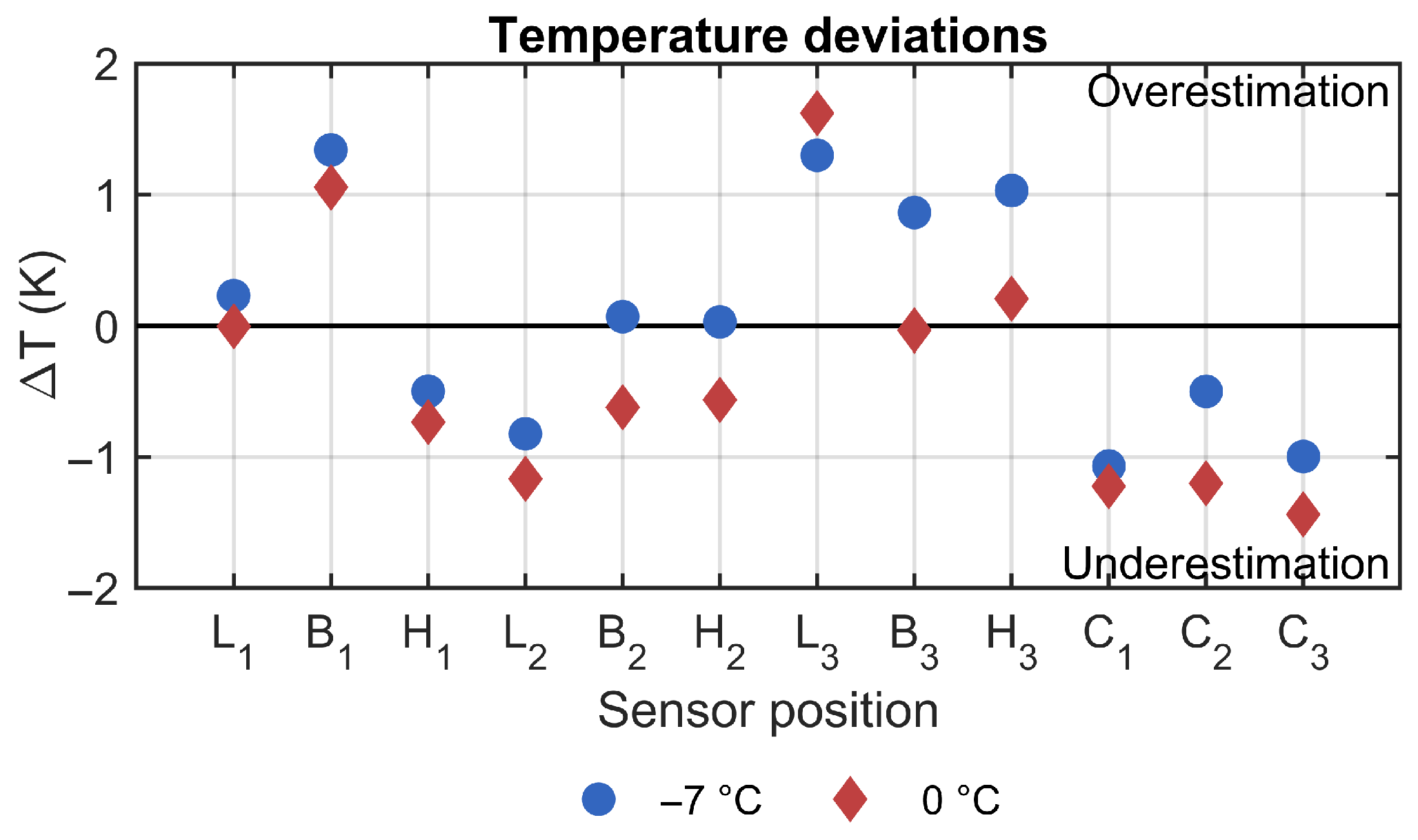
Simulations replicating the measurement scenarios at −7 °C and 0 °C were conducted using the cabin model and the existing heating circuits. Figure 2 presents the temperature deviations between measured and simulated cabin air temperatures at the sensor positions according to Figure 1 for ambient temperatures of −7 °C (blue circles) and 0 °C (red diamonds). At −7 °C, most deviations are positive, meaning the simulated temperatures are generally higher than the measured values. In contrast, at 0 °C, temperatures are underestimated and tend to be lower than the measured values. The deviation varies across sensor positions, with some locations, e.g., L 3 , showing larger differences. These deviations reflect the limitations due to the coarse grid in the large cabin, as well as the fact that the simulated values represent the temperature of an entire control volume, while the measured values correspond to the point value of the temperature sensor. Nevertheless, the model shows good agreement with the measurements, as all deviations lie within a range of ±1.6 K, demonstrating that the model satisfactorily reproduces the measured results under both temperature conditions.
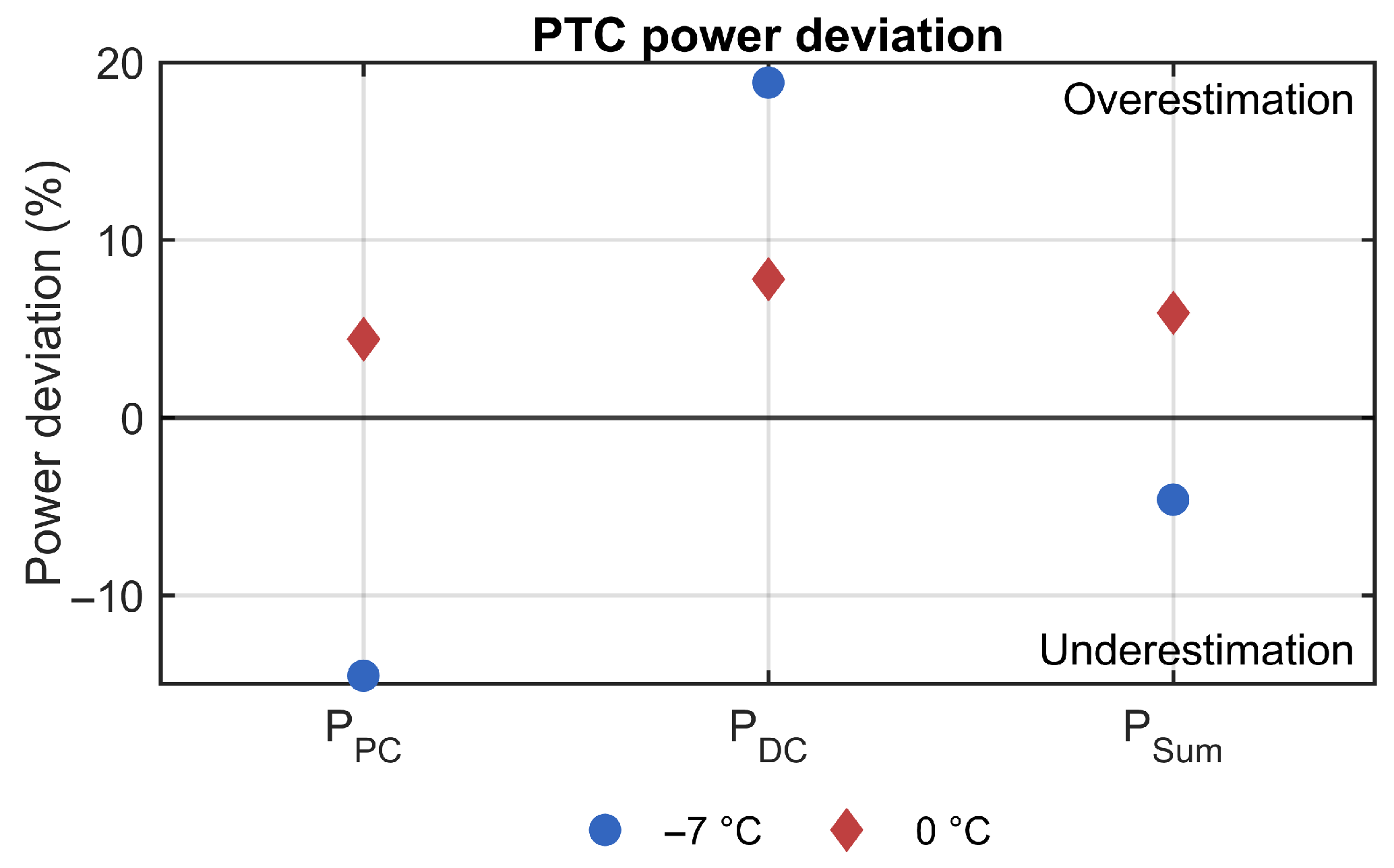
Figure 3 shows the deviation between measured and simulated heating power on the coolant side for the existing passenger heat exchanger and the heat exchanger of the driver circuit. The measured heating power is approx. 3.6 kW for the passenger PTC heater and around 1.5 kW for the driver PTC heater at −7 °C ambient temperature. At 0 °C ambient temperature this is reduced to 2.6 kW for the passenger PTC heater and increased to around 2.0 kW for the driver PTC heater, although each PTC element has a nominal power of 5 kW. This behaviour occurs despite each PTC element having a nominal power rating of 5 kW. The comparatively low utilisation of the heaters results from the operating strategy of the HVAC system in automatic mode, which continuously modulates the heater outputs. The simulation of the passenger circuit PTC is very conservative at −7 °C and slightly optimistic at 0 °C. In contrast, the heating power of the driver circuit PTC tends to be overrepresented in the simulation at both ambient temperatures. However, summing up the powers of driver and passenger heating systems, the overall deviation is lower than 6%.
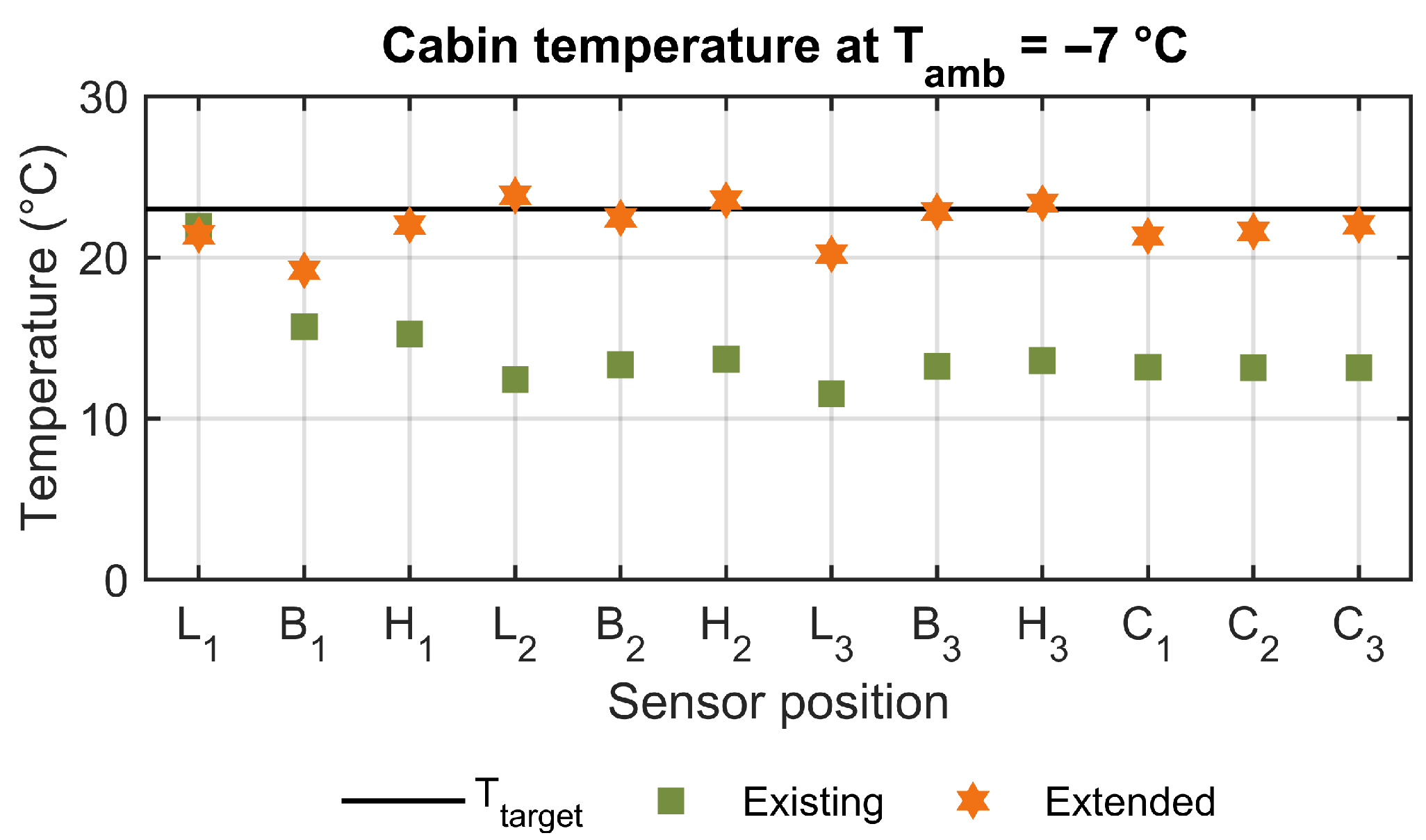
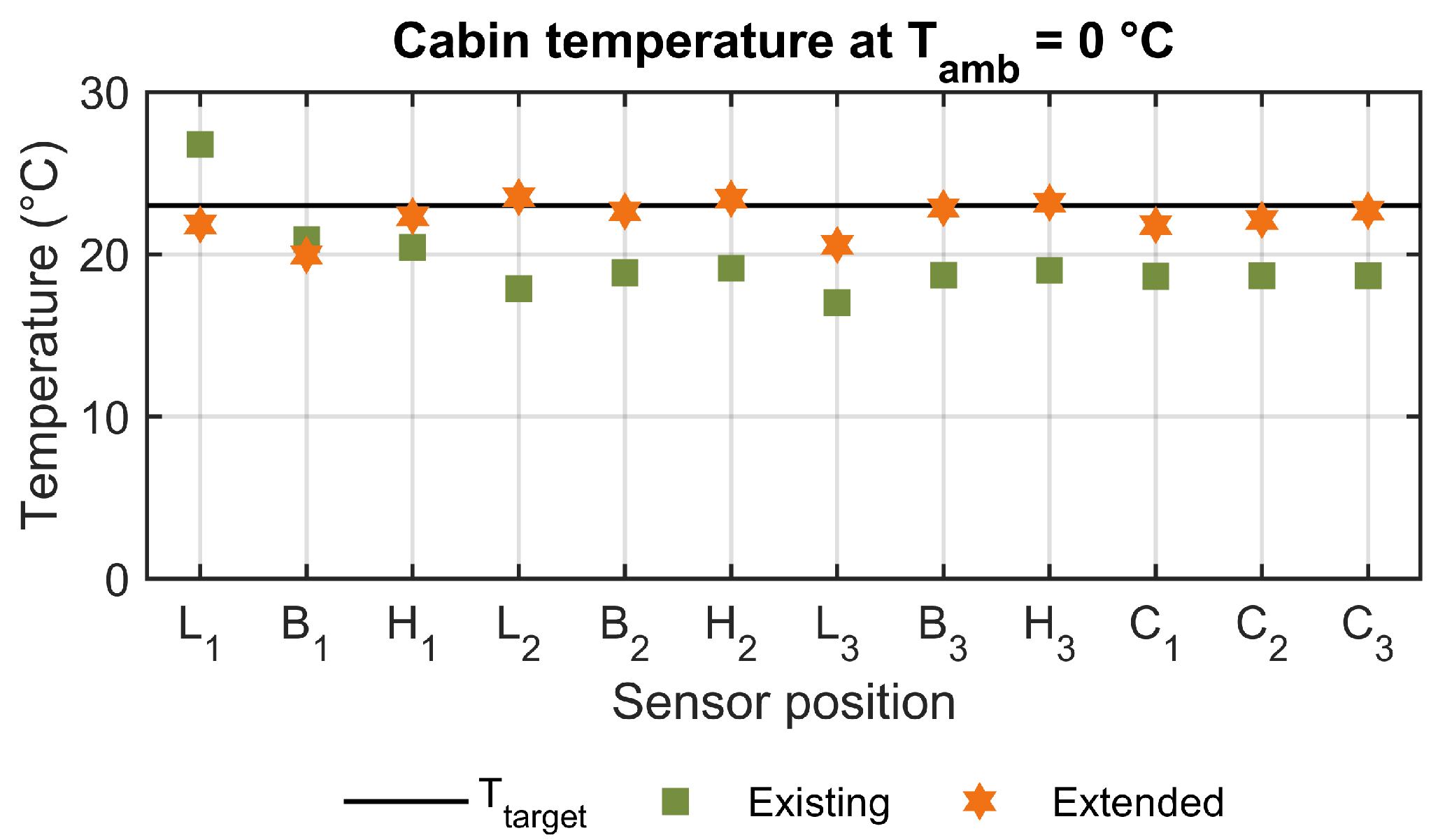
Simulating the validated model until a steady state is reached shows that with the existing heating system, the target cabin temperature of 23 °C is not achieved at either ambient condition. At an ambient temperature of −7 °C, the average cabin temperature reaches only about 13.8 °C, while at 0 °C it increases to approx. 19.2 °C. In addition to the low overall temperature level, pronounced spatial temperature differences are observed. At −7 °C, the maximum temperature of 21.9 °C occurs at location L 1 in the immediate vicinity of the radiator outlet, whereas the diagonally opposite position L 3 reaches only 11.5 °C. A similar pattern is found at 0 °C, with temperatures of 26.8 °C at L 1 and only 17.0 °C at L 3 .
Adding a second heat exchanger to the passenger heating circuit and evaluating the system again in steady state increases the overall cabin temperature level and significantly reduces the spatial temperature gradients, as illustrated in Figure 4 and Figure 5. For both ambient conditions, the existing heating system exhibits large temperature deviations between sensor locations, with particularly low temperatures in the rear and diagonally opposite cabin regions. In contrast, the extended heating configuration increases the temperature level at all sensor positions and substantially reduces the spread between minimum and maximum values. While the target temperature of 23 °C is still not fully achieved at all locations, especially at −7 °C, the extended system results in a more uniform and comfortable thermal environment throughout the cabin.
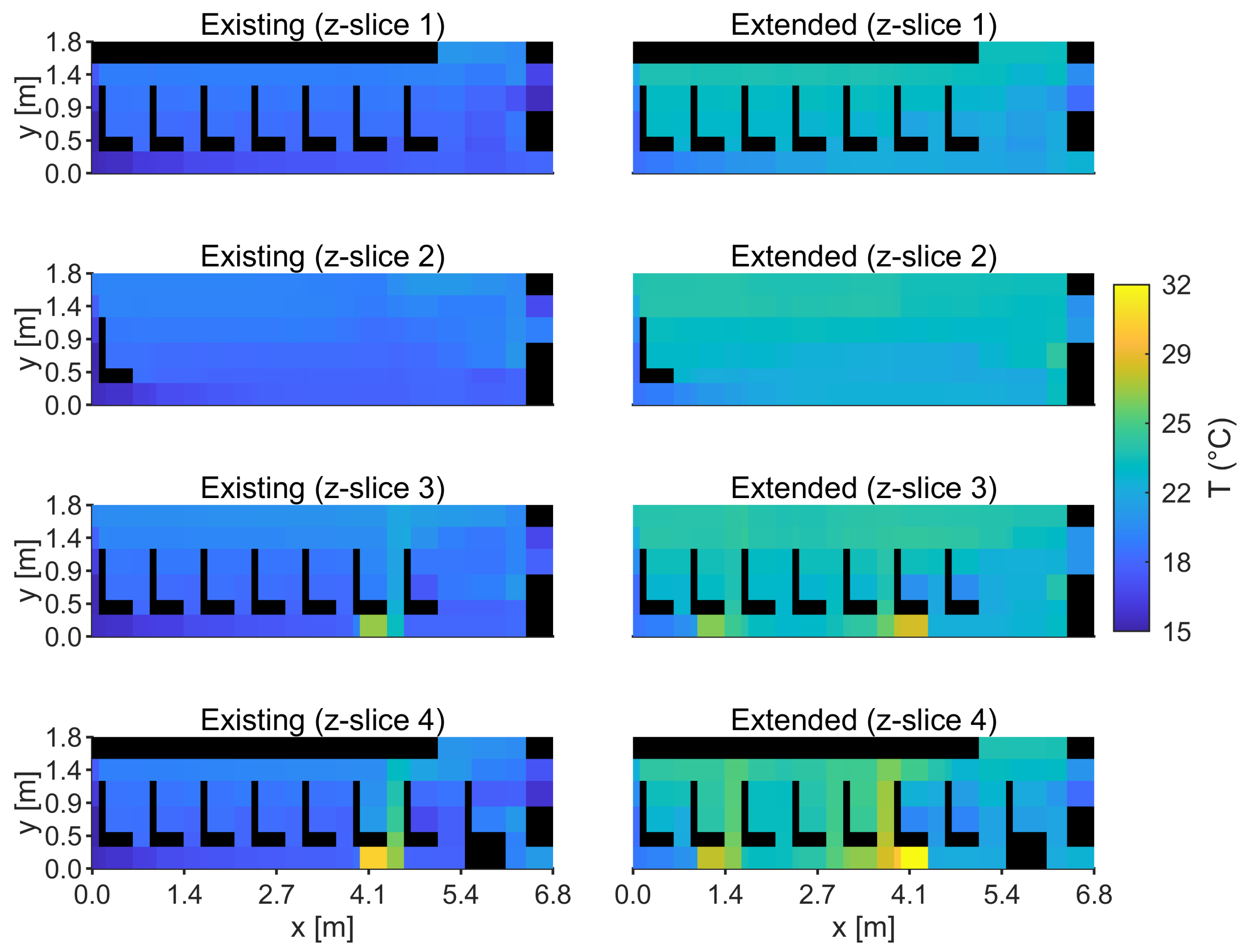
To further analyse the spatial characteristics underlying these sensor-based results, the steady-state cabin air temperature distributions in vertical z-slices (cutting along the length of the bus) are shown in Figure 6 for the existing (left column) and extended (right column) heating systems. With the existing system, pronounced local hot spots occur in the vicinity of the radiator outlet, while large cold regions persist in the rear and diagonally opposite areas of the cabin. Adding the second heat exchanger increases the overall temperature level and results in a more homogeneous temperature distribution across all z-slices, particularly in the rear cabin region.
This improvement in thermal comfort is accompanied by an increased heating power demand. At −7 °C ambient temperature, the required heating power rises from approx. 4.8 kW to 6.8 kW, corresponding to an increase of about 43%. At 0 °C, the heating power increases by 17%, from 4.8 kW to approx. 5.6 kW. Overall, the extended heating system trades higher energy consumption for improved passenger comfort by achieving higher and more evenly distributed cabin air temperatures.
A detailed analysis of the cabin’s thermal behaviour at different ambient temperatures is used to determine the heating power required to maintain a constant mean cabin air temperature during driving. In this context, vehicle speed is considered as a boundary condition for the external airflow around the vehicle. The resulting wind speed influences convective heat transfer at the cabin envelope and thus the distribution of thermal losses, in particular those associated with convection and outlet air. Radiative heat transfer at the exterior surfaces is only temperature-dependent and is modelled according to its physical dependence on the fourth power of absolute temperature.
The present study focuses on the effect of ambient temperature; a single representative driving condition is therefore assumed. The external airflow corresponds to the mean vehicle speed of the applied WLTP driving cycle, which is used to define the convective boundary conditions. Variations in convective heat transfer and ventilation-related losses due to different driving speeds are not investigated and are considered beyond the scope of this work.
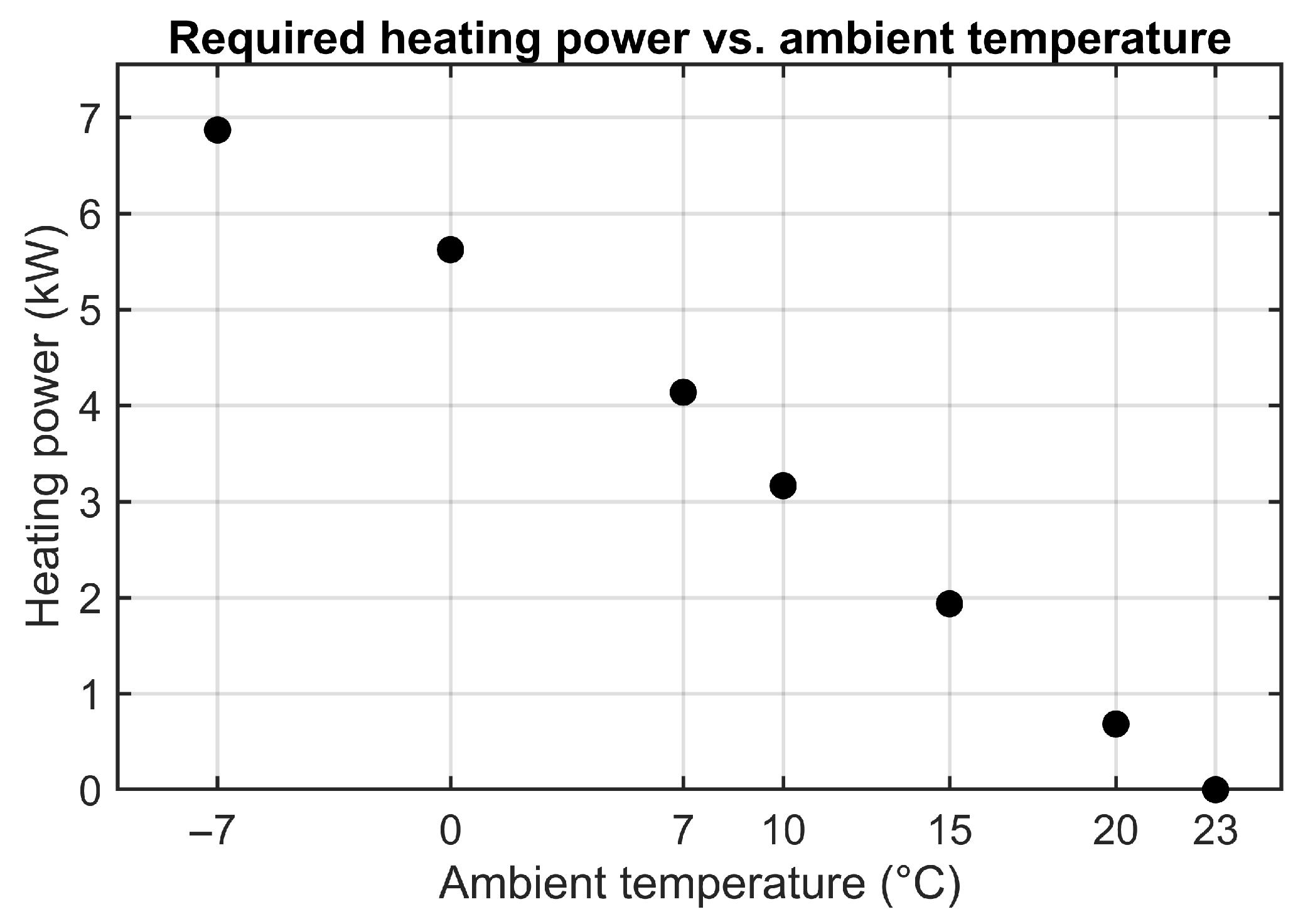
To sustain the target average cabin temperature of 23 °C, the thermal losses to the environment must be compensated by the heating system. These losses are primarily governed by the temperature difference between the ambient air and the cabin interior. Figure 7 illustrates the required heating power to balance the thermal losses and maintain an average cabin temperature of 23 °C as a function of ambient temperature.
The results show a strong increase in heating demand with decreasing ambient temperature. At an ambient temperature of −7 °C, the required heating power reaches approx. 6.8 kW, while it decreases continuously as the ambient temperature increases and approaches zero at 23 °C. At 0 °C ambient temperature, the heating demand remains significantly above the available heating power of the existing system, which is approx. 4.8 kW as measured during vehicle tests. This indicates that the existing heating system is insufficient to maintain the target cabin temperature under cold ambient conditions.
The observed behaviour is mainly attributed to increased thermal losses through the vehicle envelope at low ambient temperatures. Larger temperature differences between the cabin air and the surroundings enhance heat transfer through the vehicle body and windows, leading to higher heat losses that must be compensated by the heating system. These findings underline the dominant influence of ambient temperature on cabin heating demand and emphasise the need for adequate heating capacity to ensure thermal comfort under cold operating conditions.
It should be noted that the reported increase in heating power refers exclusively to the thermal power exchanged at the heat exchangers. The analysis does not explicitly account for auxiliary electrical loads, such as the coolant pump power. Adding a second heat exchanger in series inevitably increases the hydraulic pressure drop in the passenger heating circuit and thus requires additional pumping power. However, this effect is not included in the present evaluation, as the objective of this study is to assess the thermal performance and heat distribution within the cabin rather than the overall electrical energy consumption of the vehicle.
The additional pumping power associated with the increased hydraulic resistance is expected to be small compared to the heating power demand under cold ambient conditions and is therefore not expected to alter the main conclusions. While the extended heating system leads to a higher thermal energy demand, it significantly improves passenger comfort by increasing the overall temperature level and reducing spatial temperature gradients throughout the cabin.
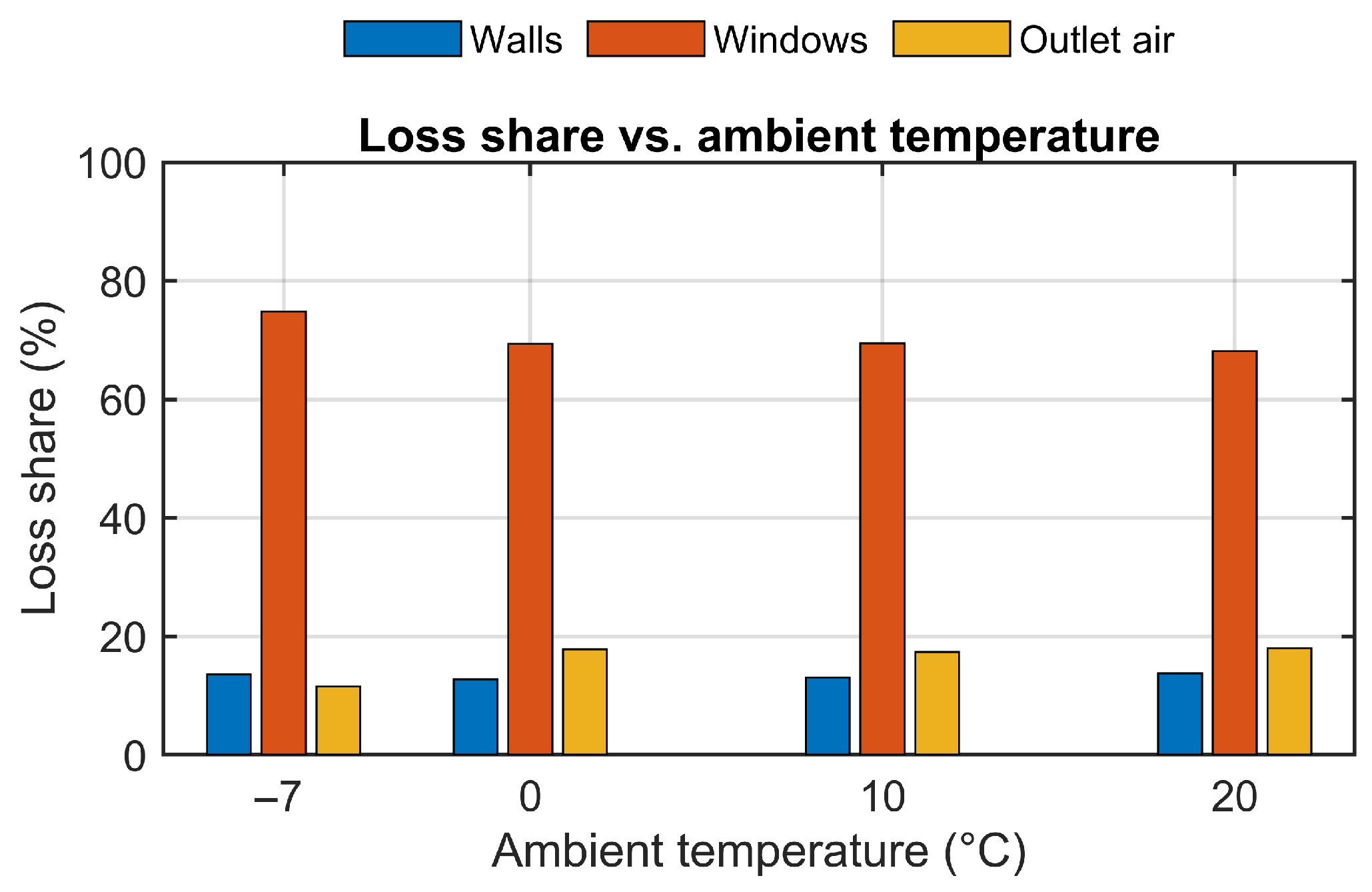
Figure 8 presents the distribution of thermal losses in the cabin as a function of ambient temperature at a mean airflow speed corresponding to the WLTP cycle (42.76 km/h). The bars show the mean shares of the total thermal losses attributed to the vehicle walls, windows, and outlet air, evaluated under steady-state conditions. Across all ambient temperatures investigated in this study, heat losses through the windows clearly dominate, accounting for approx. 65–75% of the total losses. Radiative heat transfer occurs at all external surfaces of the cabin envelope and scales with the fourth power of the absolute surface temperature. Due to the comparatively higher external surface temperatures of the windows relative to the insulated walls, the temperature dependence of radiative heat transfer has a more pronounced effect on the window-related loss share. As ambient temperature decreases, this contributes to an increased relative importance of window heat losses.
Losses through the cabin structure, including the walls, roof, and floor, contribute about 13–14% and show only a weak dependence on ambient temperature. This behaviour reflects the predominance of conductive heat transfer through the insulated vehicle body, resulting in lower external surface temperatures and a reduced sensitivity of radiative losses to ambient conditions.
The losses associated with the roof-side air outlet remain largely constant in relative terms (approx. 18%) across the investigated ambient temperatures. An exception is observed at an ambient temperature of −7 °C, where the relative share of air-related losses is reduced. This deviation is attributed to the operating strategy of the driver heating system, which applies a lower air volume flow rate under cold ambient conditions, thereby reducing ventilation-related heat losses.
Overall, these results highlight the dominant role of window heat transfer in the cabin’s thermal balance. This underlines the importance of improved glazing and window insulation as effective measures for reducing total thermal losses and, consequently, the heating power required to maintain passenger thermal comfort, particularly under cold ambient conditions.
Although the target cabin air temperature of 23 °C is used as the primary control and evaluation criterion in this study, thermal comfort also depends on radiative heat exchange between occupants and surrounding surfaces. Cold window surfaces can reduce the mean radiant temperature experienced by passengers and may lead to discomfort even when air temperature targets are met. While a detailed analysis of radiative comfort effects is beyond the scope of the present work, the strong contribution of window-related losses identified here further emphasises the relevance of window insulation not only for reducing heating demand, but also for improving overall passenger thermal comfort.

4. Conclusions

In this paper, thermal models of the cabin of a battery electric minibus and of both heating circuits—for the passenger compartment and the driver—were developed. An additional fuel-powered heater, which is typically installed for operation in cold climates, was omitted in order to strengthen the zero-emission concept and realise a locally emission-free battery electric minibus. First, the model was validated using measurement data at ambient temperatures of −7 °C and 0 °C. As the mean cabin temperature could not reach 23 °C in either case, the heating system was subsequently extended by an additional heat exchanger to increase the heat transfer into the cabin. Finally, an analysis of the thermal losses at different ambient temperatures was carried out to determine the heating power required to maintain a constant cabin temperature of 23 °C.
The thermal models showed satisfactory results, as the deviations of measured and simulated cabin temperature were in the range of ±1.6 K and the power of the heating system could be replicated with a deviation below 6%.
Results demonstrated that the existing electric-only heating system, to enable zero-emission operation without the optional fuel-powered heater, was insufficient to achieve the target cabin temperature of 23 °C. To address this, an extended heating system incorporating an additional heat exchanger was modelled. This solution improved both overall cabin temperatures and the spatial temperature distribution. However, the extended system also increased the total heating power requirement: from approx. 4.8 kW to 6.8 kW (a 43% rise) at −7 °C and from 4.8 kW to about 5.6 kW (a 17% rise) at 0 °C.
A thermal loss analysis showed that windows account for about 65–75% of total heat losses, indicating a strong potential for energy savings through improved insulation. Future work will focus on optimising heating control strategies and enhancing thermal insulation to balance energy efficiency with passenger comfort.

Author Contributions

Conceptualisation, T.B. and I.M.; methodology, T.B., D.D., and J.K.; validation, T.B. and D.Š.; formal analysis, T.B. and D.D.; investigation, T.B., I.M., and D.D.; writing—original draft preparation, T.B.; writing—review and editing, T.B. and D.Š.; visualisation, T.B.; supervision, J.K.; project administration, T.B.; funding acquisition, T.B. and D.Š. All authors have read and agreed to the published version of the manuscript.

Funding

This research was conducted in the project MINDED (Thermal and energy Management for INcreased Driving range of an Electric minibus including improved user-centric Design and thermal comfort) with grant agreement No. 101138202, which was funded by the European Union’s HORIZON EUROPE research and innovation programme under the topic “User-centric design and operation of EV for optimised energy efficiency (2ZERO Partnership)”. Views and opinions expressed are, however, those of the authors only and do not necessarily reflect those of the European Union or European Climate, Infrastructure and Environment Executive Agency (CINEA). Neither the European Union nor the granting authority can be held responsible for them.

Data Availability Statement

The data presented in this study are available on request from the corresponding author due to legal reasons.

Acknowledgments

We would like to acknowledge the close collaboration and support from IVECO who provided the minibus that was used in this study. This paper is an updated version of a paper [38], which was present at the 20th Conference on Sustainable Development of Energy Water and Environment Systems (SDEWES 2025), Dubrovnik, Croatia, 5–10 October 2025.

Conflicts of Interest

Authors Thomas Bäuml, Irina Maric, Dominik Dvorak, and Dragan Simic were employed by the company AIT Austrian Institute of Technology GmbH, Electric Vehicle Technologies. The remaining authors declare that the research was conducted in the absence of any commercial or financial relationships that could be construed as a potential conflict of interest.

Abbreviations

The following abbreviations are used in this manuscript:
CFDComputational Fluid Dynamics
EUEuropean Union
EVElectric Vehicle
GCIGrid Convergence Index
HVACHeating, Ventilation, and Air Conditioning
PTCPositive Temperature Coefficient
RMSERoot Mean Square Error
WLTPWorldwide Harmonised Light-Duty Vehicles Test Procedure
Nomenclature
A α Face area of control volume α
A i Surface area of surface element i
A w Heat transfer area of wall or window
B i Body-level air temperature of sensor group i ( i = 1 3 )
C i Center aisle air temperature at sensor position i ( i = 1 3 )
cLocal velocity magnitude
c p Specific heat capacity at constant pressure
c s Specific heat capacity of solid
C s Thermal capacitance of solid
c v Specific heat capacity at constant volume
C w Effective thermal capacitance of wall or window element
Δ l Characteristic cell length
F i j Radiative view factor between surfaces i and j
g Gravitational acceleration vector
h α Specific enthalpy at face α
h in Convective heat transfer coefficient at inner surface
h out Convective heat transfer coefficient at outer surface
H i Head-level air temperature of sensor group i ( i = 1 3 )
L i Leg-level air temperature of sensor group i ( i = 1 3 )
mMass of air control volume
m s Mass of solid
m ˙ α Mass flow rate through face α
μ eff Effective dynamic viscosity
μ 0 Laminar dynamic viscosity
n α Outward unit normal vector of face α
p α Pressure at face α
ρ Air density
σ Stefan–Boltzmann constant
T air Cabin air temperature
T amb Ambient air temperature
T i Temperature of surface i
T DA , out Air temperature at outlet of driver heat exchanger
T DC , in Coolant temperature at inlet of driver heat exchanger
T DC , out Coolant temperature at outlet of driver heat exchanger
T P 1 A , out Air temperature at outlet of existing passenger heat exchanger
T P 1 C , in Coolant temperature at inlet of existing passenger heat exchanger
T P 1 C , out Coolant temperature at outlet of existing passenger heat exchanger
T P 2 A , out Air temperature at outlet of extended passenger heat exchanger
T P 2 C , in Coolant temperature at inlet of extended passenger heat exchanger
T P 2 C , out Coolant temperature at outlet of extended passenger heat exchanger
T s Temperature of solid
T w Temperature of wall or window element
τ α Viscous stress vector acting on face α
PTC D Driver positive temperature coefficient heater
PTC P Passenger positive temperature coefficient heater
Q ˙ α Conductive heat transfer through face α
Q ˙ s , i Heat transfer between solid and adjacent air volumes or surfaces
Q ˙ source Internal heat sources
v Cell-centred velocity vector
v α Velocity vector at face α
V ˙ DA Air volume flow rate through driver heat exchanger
V ˙ DC Coolant volume flow rate through driver heating circuit
V ˙ P 1 A Air volume flow rate through existing passenger heat exchanger
V ˙ P 2 A Air volume flow rate through extended passenger heat exchanger
V ˙ PC Coolant volume flow rate through passenger heating circuit

References

  1. European Union. The European Green Deal. Available online: https://commission.europa.eu/strategy-and-policy/priorities-2019-2024/european-green-deal_en (accessed on 7 January 2025).
  2. European Environment Agency. Greenhouse Gases—Data Viewer. Available online: https://www.eea.europa.eu/en/analysis/maps-and-charts/greenhouse-gases-viewer-data-viewers (accessed on 7 January 2025).
  3. European Automobile Manufacturers’ Association. Fact Sheet: Buses. Available online: https://www.acea.auto/files/ACEA_fact_sheet_buses.pdf (accessed on 7 January 2025).
  4. Akrioti, M.; Basbas, S.; Georgiadis, G.; Nathanail, E. Investigation of Minibus Public Transport Service Characteristics in an Urban Area Through the Use of a Stated and Revealed Preference Survey. In Advances in Mobility-as-a-Service Systems; Nathanail, E.G., Adamos, G., Karakikes, I., Eds.; Springer International Publishing: Cham, Switzerland, 2021; Volume 1278, pp. 11–20. [Google Scholar]
  5. Etukudoh, E.A.; Adefemi, A.; Ilojianya, V.I.; Umoh, A.A.; Ibekwe, K.I.; Nwokediegwu, Z.Q.S. A Review of sustainable transportation solutions: Innovations, challenges, and future directions. World J. Adv. Res. Rev. 2024, 21, 1440–1452. [Google Scholar] [CrossRef]
  6. Zhang, Y.; Huang, J.; He, L.; Zhao, D.; Zhao, Y. A study of a thermal management system for passenger compartment comfort and battery heating in hybrid vehicles considering drive mode switching. Therm. Sci. Eng. Prog. 2024, 53, 102735. [Google Scholar] [CrossRef]
  7. Lajunen, A.; Yang, Y.; Emadi, A. Review of Cabin Thermal Management for Electrified Passenger Vehicles. IEEE Trans. Veh. Technol. 2020, 69, 6025–6040. [Google Scholar] [CrossRef]
  8. Steinstraeter, M.; Heinrich, T.; Lienkamp, M. Effect of Low Temperature on Electric Vehicle Range. World Electr. Veh. J. 2021, 12, 115. [Google Scholar] [CrossRef]
  9. Seo, J.; Vijayagopal, R.; Kim, N.; Rousseau, A.; Stutenberg, K. Effects of ambient temperature on electric vehicle range considering battery Performance, powertrain Efficiency, and HVAC load. Energy Convers. Manag. 2025, 326, 119493. [Google Scholar] [CrossRef]
  10. Senol, M.; Bayram, I.S.; Naderi, Y.; Galloway, S. Electric Vehicles Under Low Temperatures: A Review on Battery Performance, Charging Needs, and Power Grid Impacts. IEEE Access 2023, 11, 39879–39912. [Google Scholar] [CrossRef]
  11. Zhao, Z.; Li, L.; Ou, Y.; Wang, Y.; Wang, S.; Yu, J.; Feng, R. A Comparative Study on the Energy Flow of Electric Vehicle Batteries among Different Environmental Temperatures. Energies 2023, 16, 5253. [Google Scholar] [CrossRef]
  12. Cvok, I.; Ratković, I.; Deur, J. Multi-Objective Optimisation-Based Design of an Electric Vehicle Cabin Heating Control System for Improved Thermal Comfort and Driving Range. Energies 2021, 14, 1203. [Google Scholar] [CrossRef]
  13. Çelik, A. Investigation of cabin heating in electric vehicles with integrating solar cells and heat storage systems. J. Energy Storage 2024, 101, 113782. [Google Scholar] [CrossRef]
  14. Horrein, L.; Bouscayrol, A.; Lhomme, W.; Depature, C. Impact of Heating System on the Range of an Electric Vehicle. IEEE Trans. Veh. Technol. 2017, 66, 4668–4677. [Google Scholar] [CrossRef]
  15. Steinstraeter, M.; Buberger, J.; Minnerup, K.; Trifonov, D.; Horner, P.; Weiss, B.; Lienkamp, M. Controlling cabin heating to improve range and battery lifetime of electric vehicles. eTransportation 2022, 13, 100181. [Google Scholar] [CrossRef]
  16. Wang, W.; Ren, J.; Yin, X.; Qiao, Y.; Cao, F. Energy-efficient operation of the thermal management system in electric vehicles via integrated model predictive control. J. Power Sources 2024, 603, 234415. [Google Scholar] [CrossRef]
  17. Aris, M.H.M.; Darlis, N.; Ishak, I.A.; Sulaiman, S.; Jaat, N.; Hakim, A.F. HVAC CFD Analysis of Air Flow and Temperature Distribution Inside Passenger Compartment. J. Automot. Powertrain Transp. Technol. 2021, 1, 25–33. [Google Scholar] [CrossRef]
  18. Chen, T.; Huang, M.S.; Song, K. A New Evaluation Criterion of Minibus Compartment Thermal Comfort Based on the CFD. Appl. Mech. Mater. 2013, 318, 114–119. [Google Scholar] [CrossRef]
  19. Giuffre, A.; Colonna, P.; De Servi, C. Dynamic thermal model of passenger aircraft for the estimation of the cabin cooling and heating requirements. Appl. Therm. Eng. 2024, 244, 122641. [Google Scholar] [CrossRef]
  20. Ramsey, D.; Bouscayrol, A.; Boulon, L. Energy Consumption of a Battery Electric Vehicle in Winter Considering Preheating: Tradeoff Between Improved Performance and Total Energy Consumption. IEEE Veh. Technol. Mag. 2022, 17, 104–112. [Google Scholar] [CrossRef]
  21. Torregrosa-Jaime, B.; Bjurling, F.; Corberán, J.M.; Di Sciullo, F.; Payá, J. Transient thermal model of a vehicle’s cabin validated under variable ambient conditions. Appl. Therm. Eng. 2015, 75, 45–53. [Google Scholar] [CrossRef]
  22. Broatch, A.; Olmeda, P.; Bares, P.; Aceros, S. Integral Thermal Management Studies in Winter Conditions with a Global Model of a Battery-Powered Electric Bus. Energies 2022, 16, 168. [Google Scholar] [CrossRef]
  23. Sevilgen, G.; Bayram, H.; Kilic, M. The 1-D analysis of cool down simulation of vehicle HVAC system. Therm. Sci. 2021, 25, 1677–1687. [Google Scholar] [CrossRef]
  24. Shuofeng, Z.; Amini, M.R.; Sun, J.; Mi, C. A Two-Layer Real-Time Optimization Control Strategy for Integrated Battery Thermal Management and HVAC System in Connected and Automated HEVs. IEEE Trans. Veh. Technol. 2021, 70, 6567–6576. [Google Scholar] [CrossRef]
  25. Frühwirth, C.; Lorbeck, R.; Schutting, E.; Eichlseder, H. Co-Simulation of a BEV Thermal Management System with Focus on Advanced Simulation Methodologies; SAE Technical Paper 2023-01-1609; SAE International: Greenville, SC, USA, 2023. [Google Scholar] [CrossRef]
  26. Núñez, D.C.V.; Maciá, J.G.; Corberán, J.M.; Payá, J. Development and validation of a dynamic thermal model of a minibus using TRNSYS. Int. J. Veh. Des. 2018, 77, 87. [Google Scholar] [CrossRef]
  27. Zhao, L.; Zhou, Q.; Wang, Z. A systematic review on modelling the thermal environment of vehicle cabins. Appl. Therm. Eng. 2024, 257, 124142. [Google Scholar] [CrossRef]
  28. De Paoli Mendesa, R.; Pabonb, J.J.G.; Duartea, W.M.; Machadoa, L. Experimental validation of a dynamic lumped parameter model of an automotive cabin. Arch. Thermodyn. 2024, 45, 119–128. [Google Scholar] [CrossRef]
  29. IVECO eDAILY Minibus. Available online: https://www.ivecobus.com/worldwide/Daily (accessed on 3 April 2025).
  30. Modelica. Available online: https://modelica.org (accessed on 24 March 2025).
  31. Modelica—A Unified Object-Oriented Language for Systems Modeling (Language Specification); Modelica Association: Linköping, Sweden, 2023.
  32. TIL Suite—The Library for Thermodynamic Systems. Available online: https://tlk-energy.de/en/software/til-suite (accessed on 17 March 2025).
  33. Michaelsen, B.; Eiden, J. HumanComfort Modelica-Library Thermal Comfort in Buildings and Mobile Applications. In Proceedings of the 7th International Modelica Conference, Como, Italy, 20–22 September 2009; pp. 403–412. [Google Scholar] [CrossRef]
  34. Chen, Q.; Xu, W. A zero-equation turbulence model for indoor airflow simulation. Energy Build. 1998, 28, 137–144. [Google Scholar] [CrossRef]
  35. Hayakawa, Y.; Sato, D.; Yamada, N. Measurement of the Convective Heat Transfer Coefficient and Temperature of Vehicle-Integrated Photovoltaic Modules. Energies 2022, 15, 4818. [Google Scholar] [CrossRef]
  36. Kirkpatrick, S.; Gelatt, C.D.; Vecchi, M.P. Optimization by Simulated Annealing. Science 1983, 220, 671–680. [Google Scholar] [CrossRef]
  37. Salamon, P.; Sibani, P.; Frost, R. Facts, Conjectures, and Improvements for Simulated Annealing; Society for Industrial and Applied Mathematics: Philadelphia, PA, USA, 2002. [Google Scholar] [CrossRef]
  38. Bäuml, T.; Maric, I.; Dvorak, D.; Šimić, D.; Konrad, J. Modeling, Simulation and Experimental Validation of a Thermal Cabin Model of an Electric Minibus. In Proceedings of the 20th Conference on Sustainable Development of Energy Water and Environment Systems (SDEWES 2025), Dubrovnik, Croatia, 5–10 October 2025; Available online: https://publications.ait.ac.at/en/publications/modelling-and-experimental-validation-of-the-heating-system-and-t/ (accessed on 7 January 2025).
Figure 1. Cabin heating circuits, air inlets and outlet, and sensor positions in the minibus. The green connection and arrow denotes the flow direction of the existing heating system, while the orange connections and arrows illustrate the flow direction in the extended heating configuration with an additional heat exchanger. Red arrows indicate air flows, blue lines represent coolant flows, and the purple arrow marks the cabin air outlet.
Energies 19 00655 g001
Figure 2. Deviations between measured (baseline) and simulated temperatures on the 12 instrumented positions inside the minibus cabin.
Energies 19 00655 g002
Figure 3. Deviations between measured (baseline) and simulated heating power on the coolant side of the heat exchangers.
Energies 19 00655 g003
Figure 4. Comparison of the absolute simulated steady-state cabin temperatures with the existing and the extended passenger heating system at −7 °C ambient temperature.
Energies 19 00655 g004
Figure 5. Comparison of the absolute simulated steady-state cabin temperatures with the existing and the extended passenger heating systems at 0 °C ambient temperature.
Energies 19 00655 g005
Figure 6. Steady-state cabin air temperature distributions in vertical z-slices for the existing (left column) and extended (right column) heating systems at an ambient temperature of 0 °C. The four rows correspond to increasing z-positions from the door-side (z-slice 1) to the driver-side (z-slice 4) of the passenger compartment. Black regions indicate solid interior components excluded from the air domain. A common colour scale is used for all slices to enable direct comparison of temperature levels and spatial uniformity between both heating configurations.
Energies 19 00655 g006
Figure 7. Required heating power as a function of ambient temperature for the extended heating system. Discrete markers indicate the steady-state heating power averaged over the final 30 min of each simulation at different ambient temperatures. The additional point at 23 °C represents the reference condition with zero heating demand.
Energies 19 00655 g007
Figure 8. Relative shares of thermal losses through the cabin envelope components for selected ambient temperatures. The bars show the percentage contributions of heat losses through the vehicle walls, windows, and outlet air to the total thermal losses at different ambient temperatures. All values are obtained from steady-state averages over the final 30 min of each simulation at a mean airflow speed corresponding to the WLTP cycle (42.76 km/h).
Energies 19 00655 g008
Table 1. Main parameters of the IVECO eDAILY electric minibus.
ParameterValue
Maximum permitted weight7.5 t
Battery capacity111 kWh
Passenger capacity22 passengers + 1 driver
Cabin length (x-direction)6.8 m
Cabin height (y-direction)1.8 m
Cabin width (z-direction)1.8 m
Cabin volume22 m3
Total surface area55.4 m2
Window surface area12.9 m2
Table 2. Controller setpoint values of PTC D coolant temperature and volume flows based on cabin temperature C 1 .
Cabin Temperature ( C 1 ) PTC D Coolant Setpoint Temperature ( T DC , in )Coolant Volume Flow Rate ( V ˙ DC )Air Volume Flow Rate ( V ˙ DA )
(°C)(°C)(L/min)(m3/h)
−7805.0500
0805.0500
5805.0300
10785.0130
15655.8130
205810.2130
Disclaimer/Publisher’s Note: The statements, opinions and data contained in all publications are solely those of the individual author(s) and contributor(s) and not of MDPI and/or the editor(s). MDPI and/or the editor(s) disclaim responsibility for any injury to people or property resulting from any ideas, methods, instructions or products referred to in the content.