Figure 1.
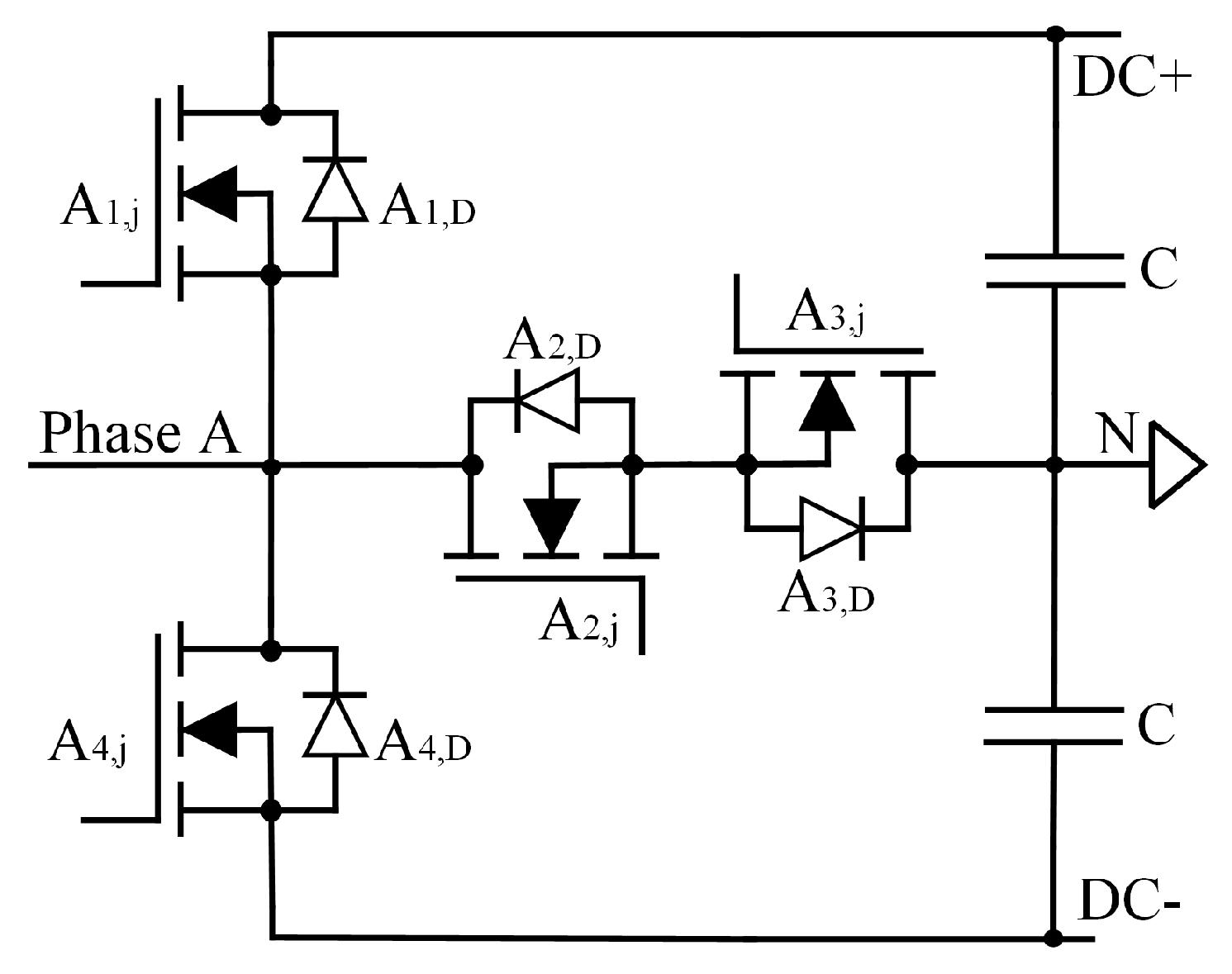
Single-phase illustration of the T-type AFE converter. The junction and body diodes are also marked to better illustrate the current paths.
Figure 1.
Single-phase illustration of the T-type AFE converter. The junction and body diodes are also marked to better illustrate the current paths.
Figure 2.
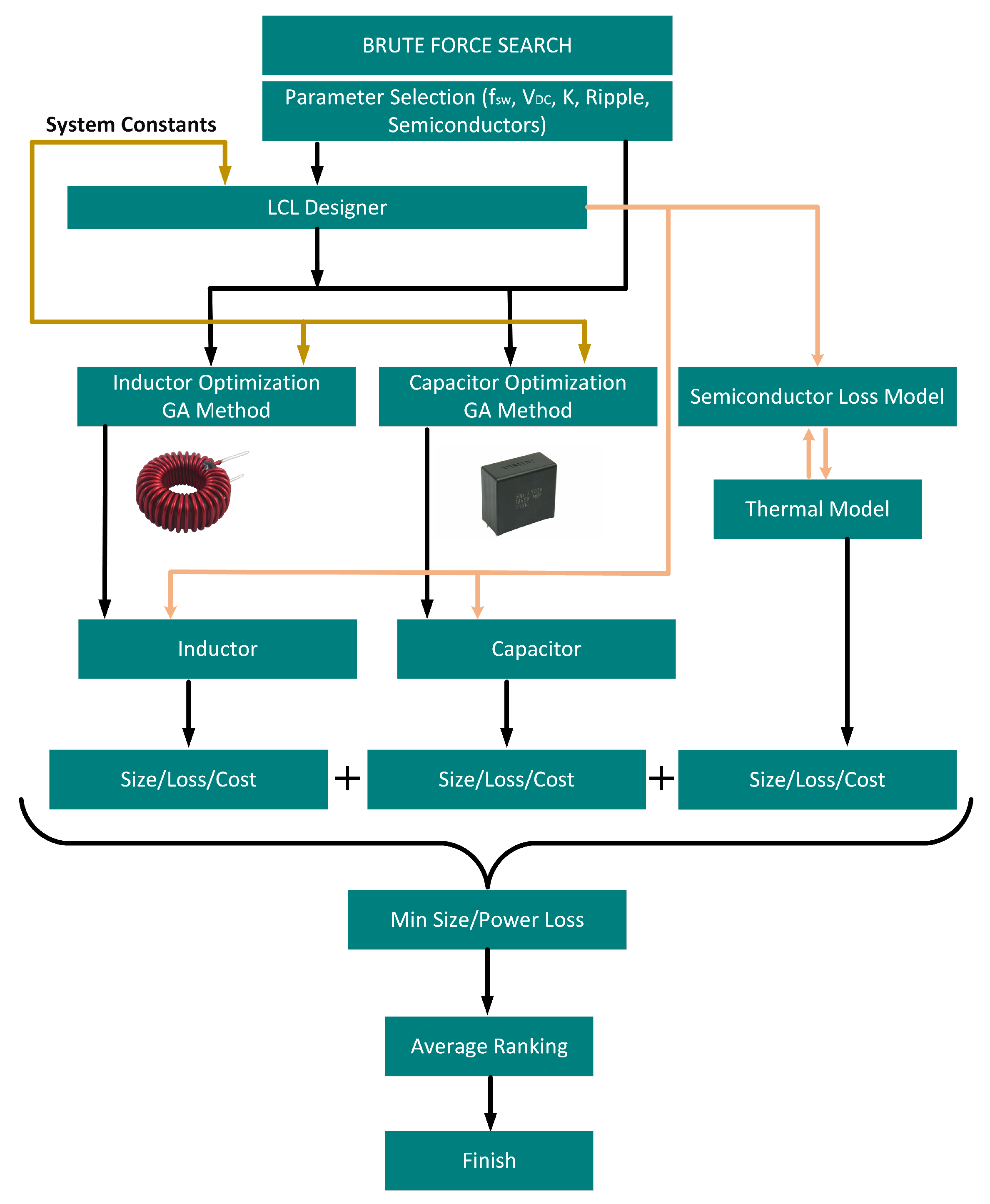
T-type AFE component level optimization flowchart.
Figure 2.
T-type AFE component level optimization flowchart.
Figure 3.
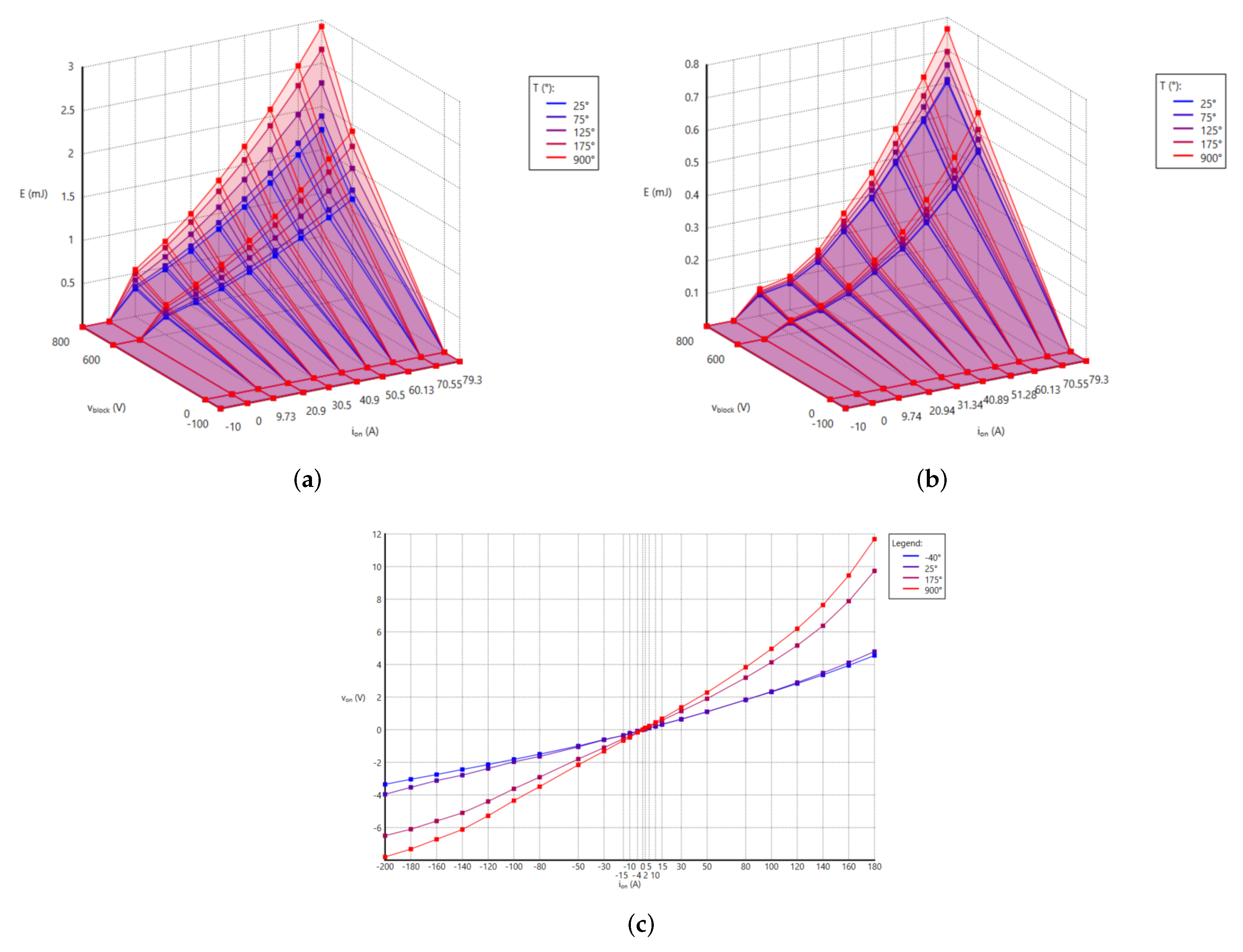
(a) Turn-on losses, (b) Turn-off losses, and (c) conduction losses and voltage across the junction for different junction currents for different junction temperatures for the 1200 V 100 A SiC “C3M0021120K” switch.
Figure 3.
(a) Turn-on losses, (b) Turn-off losses, and (c) conduction losses and voltage across the junction for different junction currents for different junction temperatures for the 1200 V 100 A SiC “C3M0021120K” switch.
Figure 4.
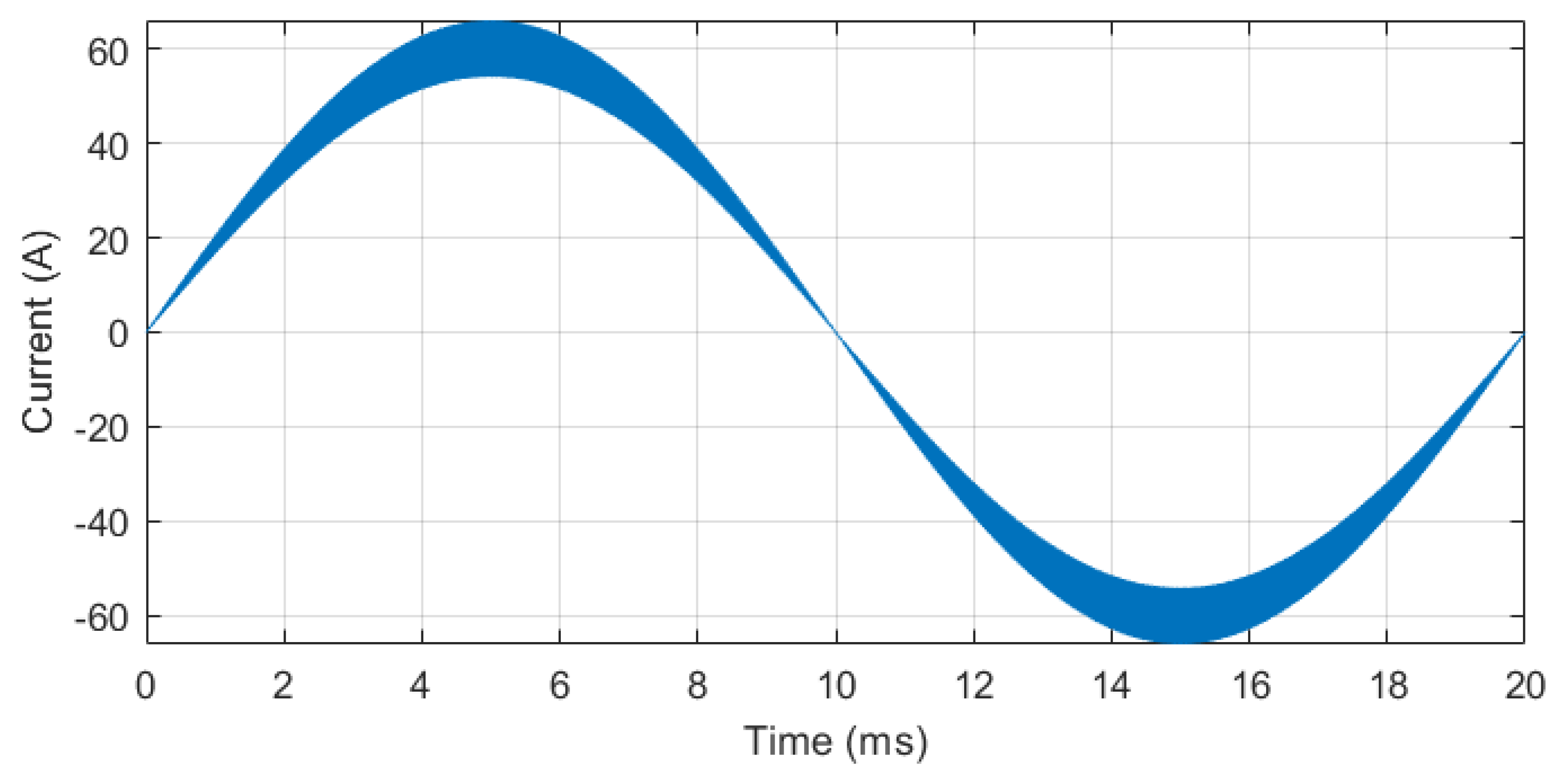
The waveform of the AFE side inductor current. The low frequency (50 Hz) component is a sine wave with an RMS of 43 A. The ripple changes and is maximum at the peak of the 50 Hz component. The current ripple changes depending on the parameters in the optimization.
Figure 4.
The waveform of the AFE side inductor current. The low frequency (50 Hz) component is a sine wave with an RMS of 43 A. The ripple changes and is maximum at the peak of the 50 Hz component. The current ripple changes depending on the parameters in the optimization.
Figure 5.
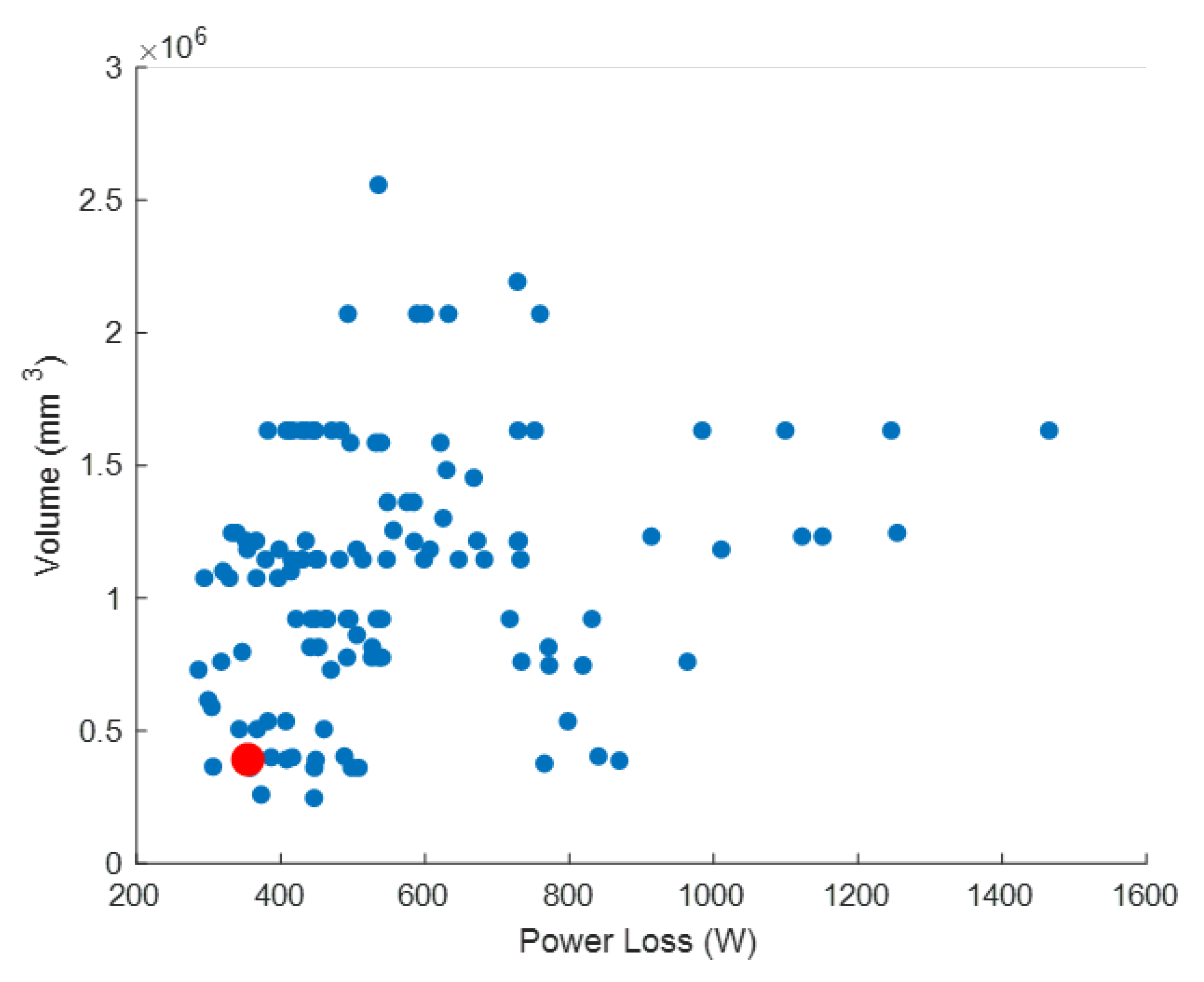
Pareto front plot of T-type AFE optimization. The selected solution is presented in red.
Figure 5.
Pareto front plot of T-type AFE optimization. The selected solution is presented in red.
Figure 6.
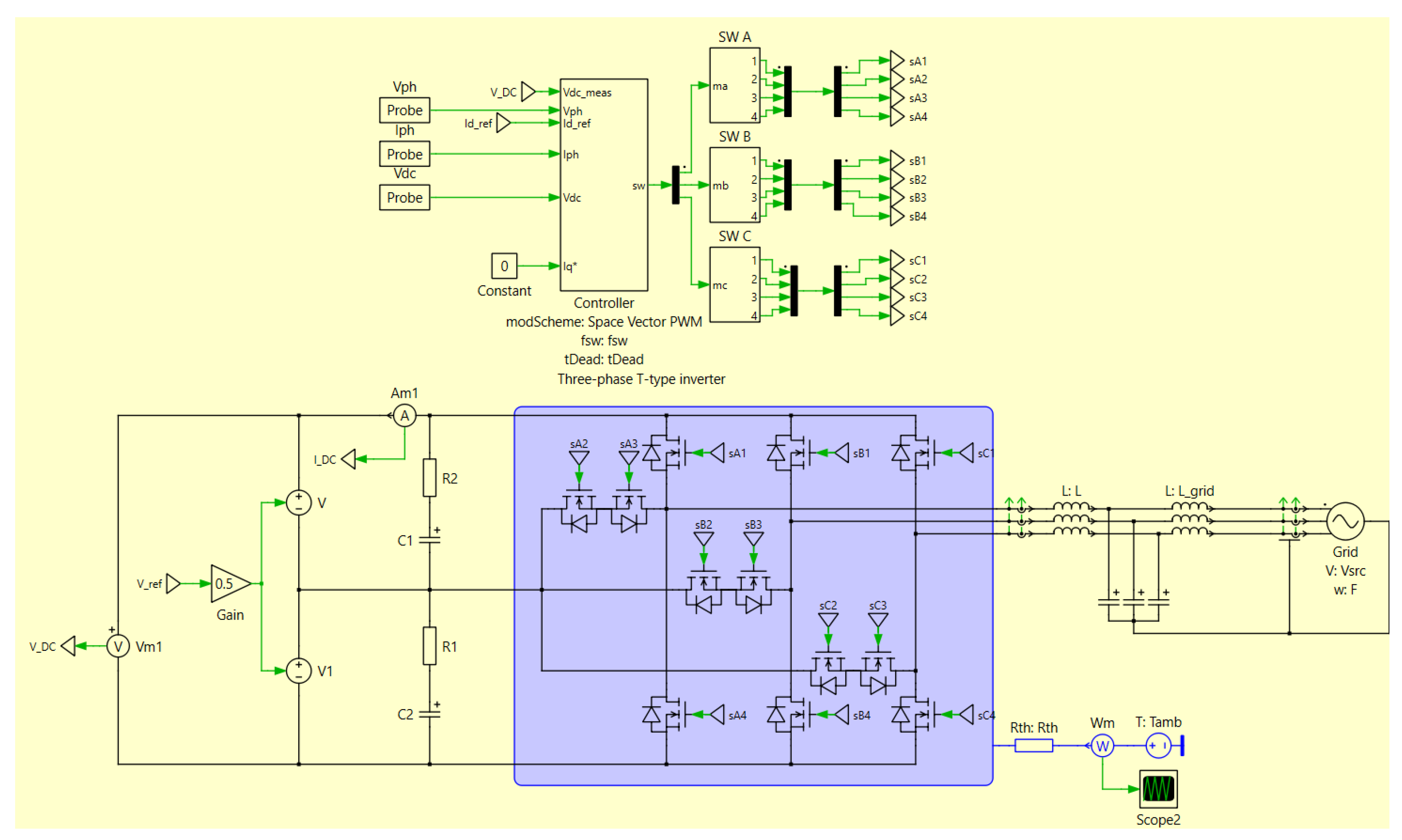
T-type AFE simulation model in PLECS. The circuit is coupled with a single heatsink thermal model shown in blue.
Figure 6.
T-type AFE simulation model in PLECS. The circuit is coupled with a single heatsink thermal model shown in blue.
Figure 7.
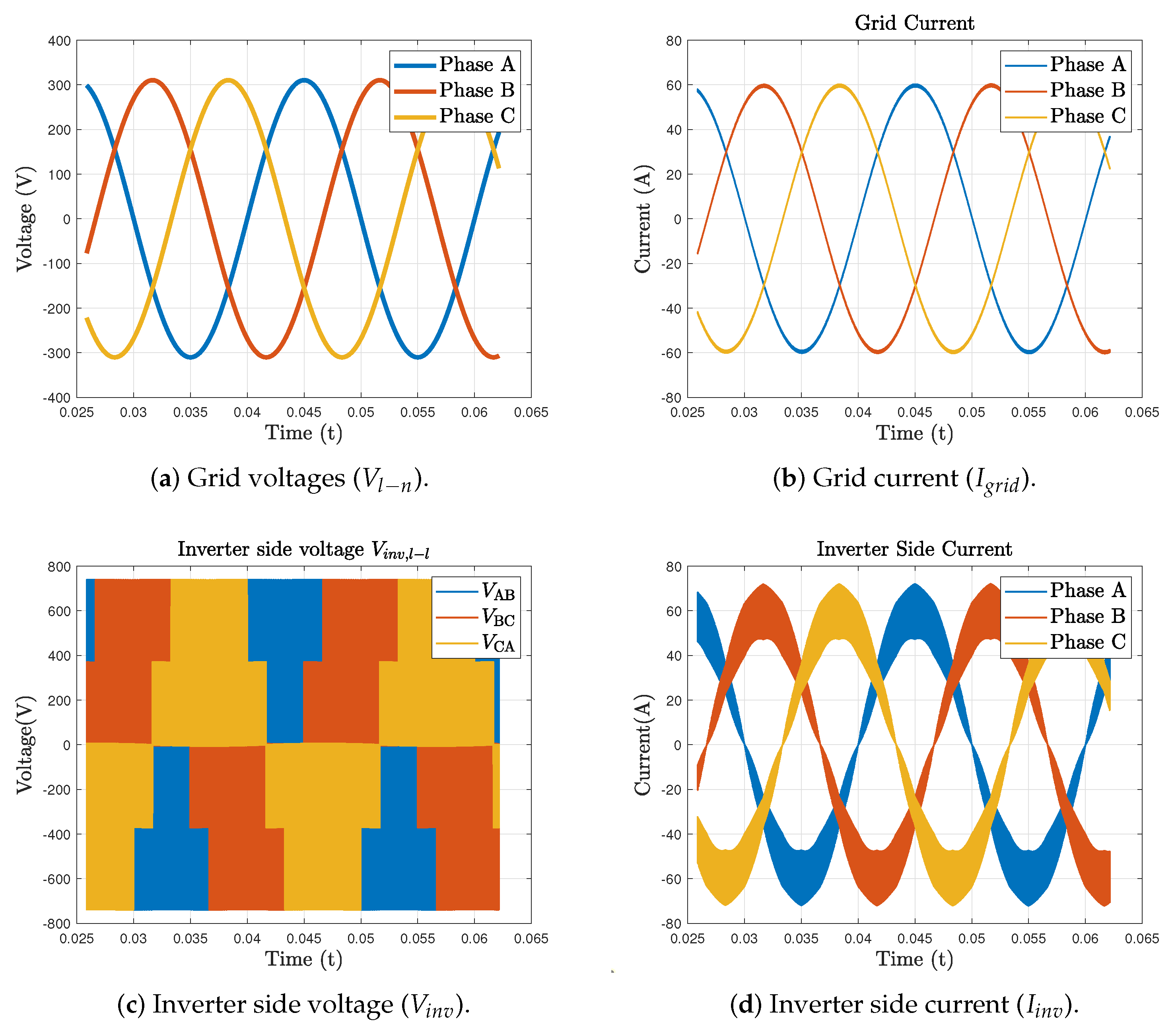
(a) Three-phase grid voltages, (b) grid side inductor current, (c) inverter side voltage, and (d) inverter side current waveforms for the optimal solution for the T-type AFE. The simulation is for the rated condition of 30 kW, 400 , 50 Hz grid and 742 .
Figure 7.
(a) Three-phase grid voltages, (b) grid side inductor current, (c) inverter side voltage, and (d) inverter side current waveforms for the optimal solution for the T-type AFE. The simulation is for the rated condition of 30 kW, 400 , 50 Hz grid and 742 .
Figure 8.
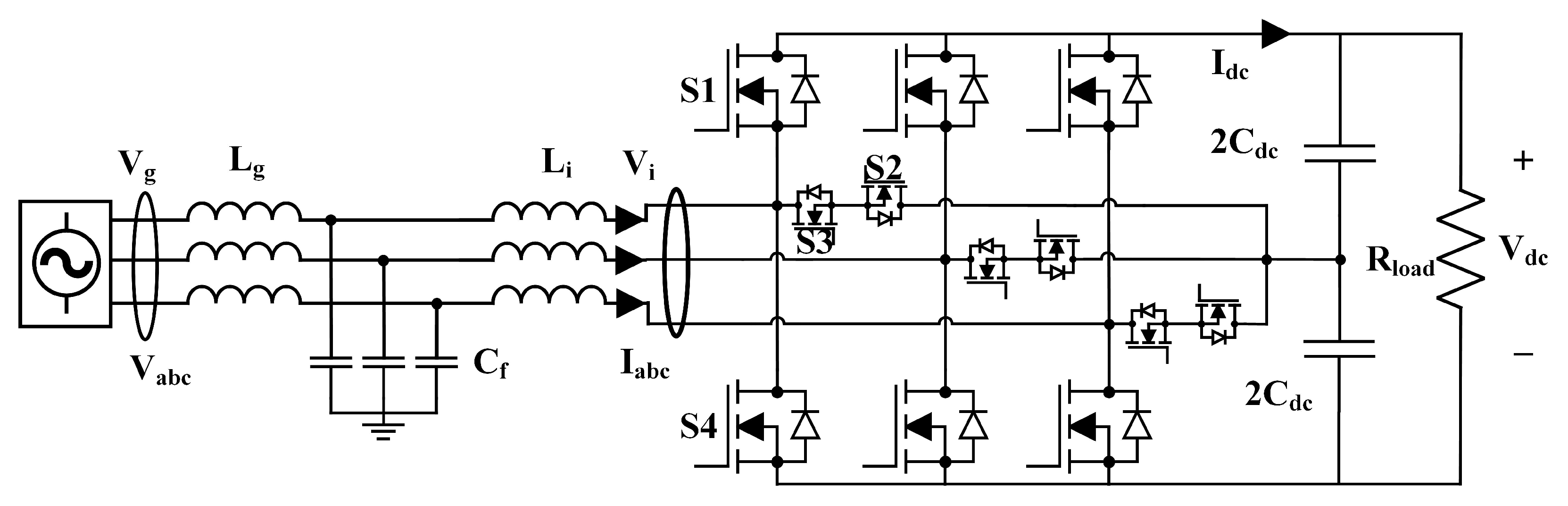
T-type AFE with voltage and current measurement.
Figure 8.
T-type AFE with voltage and current measurement.
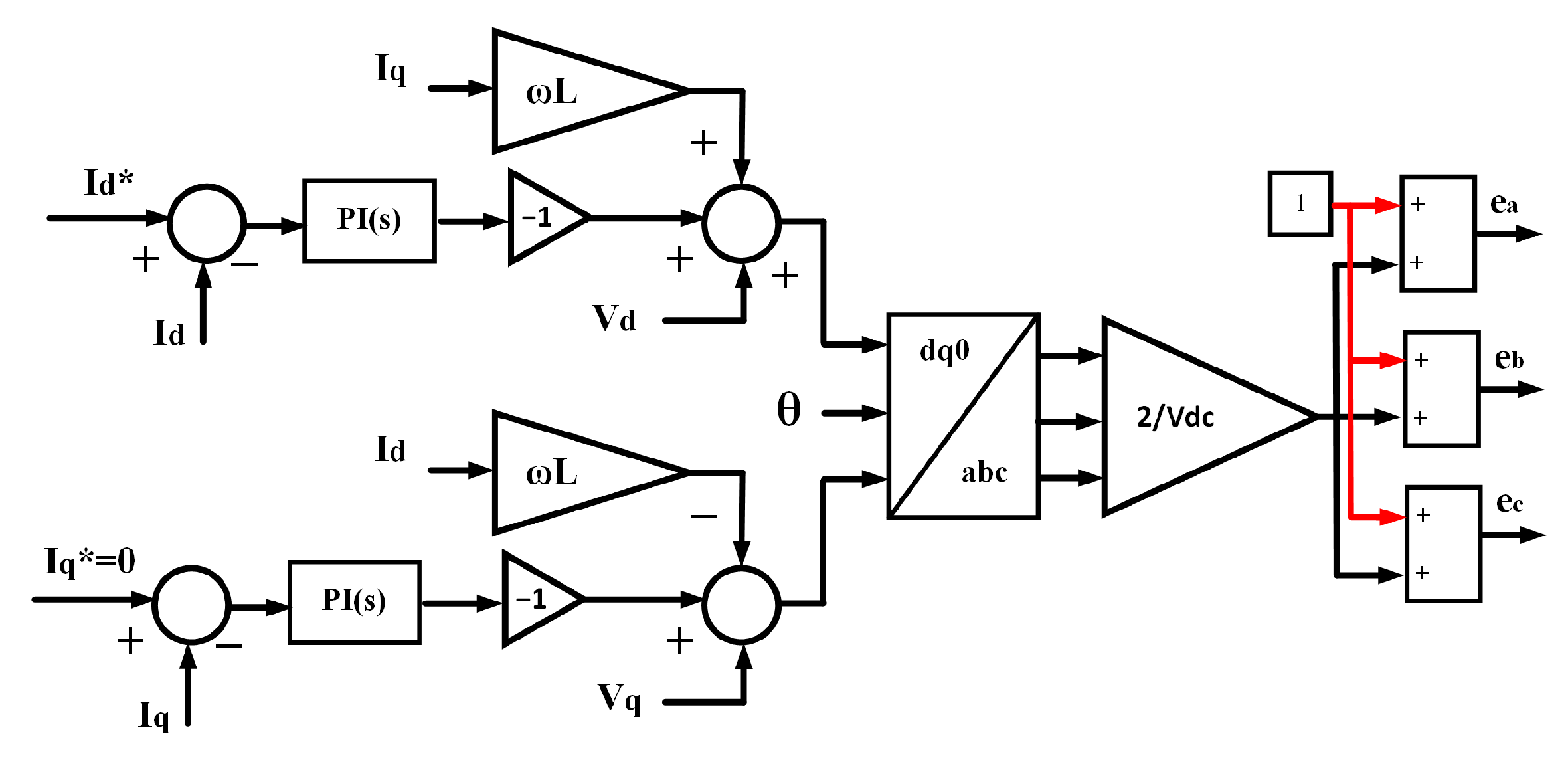
Figure 9.
Decoupled current controller structure for T-Type AFE.
Figure 9.
Decoupled current controller structure for T-Type AFE.
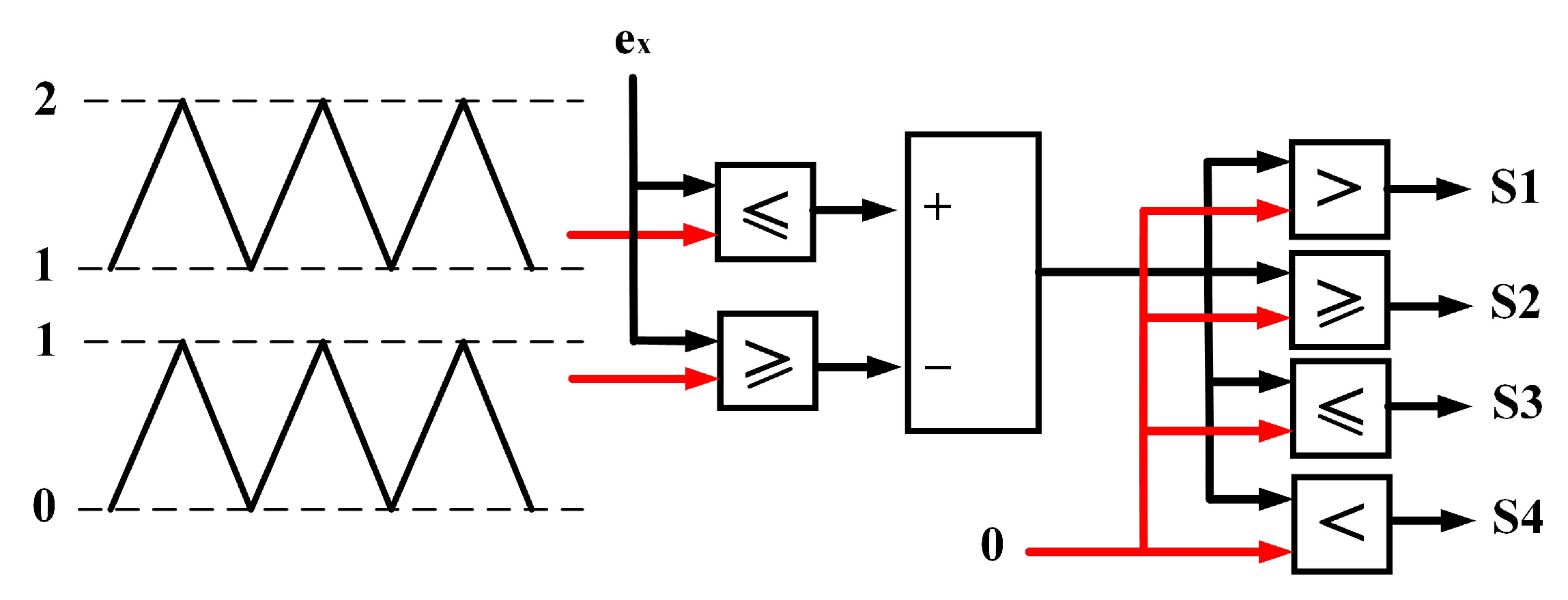
Figure 10.
Decoupled current control PWM generation.
Figure 10.
Decoupled current control PWM generation.
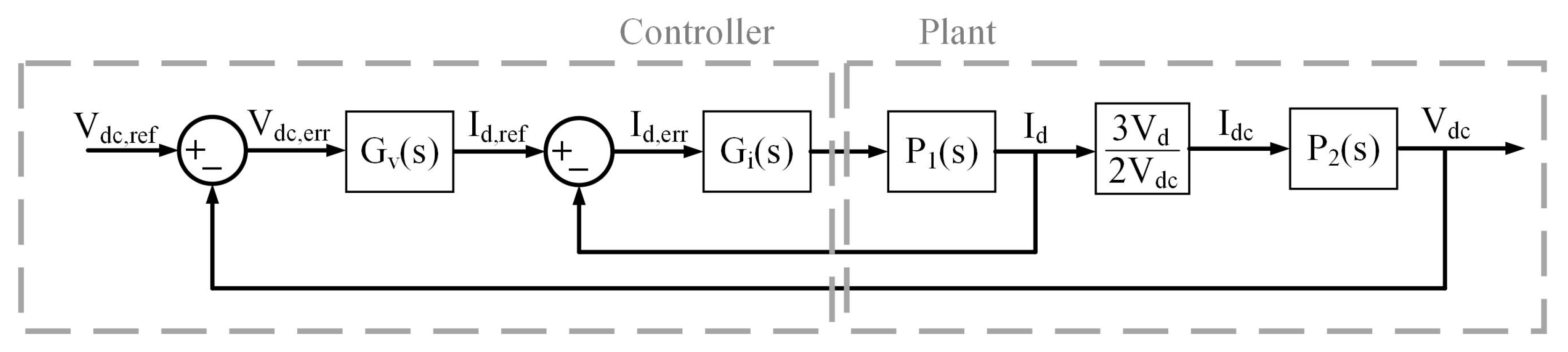
Figure 11.
Cascaded control methodology for T-type AFE. Plant LCL, id to Vdc PID control current PID voltage.
Figure 11.
Cascaded control methodology for T-type AFE. Plant LCL, id to Vdc PID control current PID voltage.
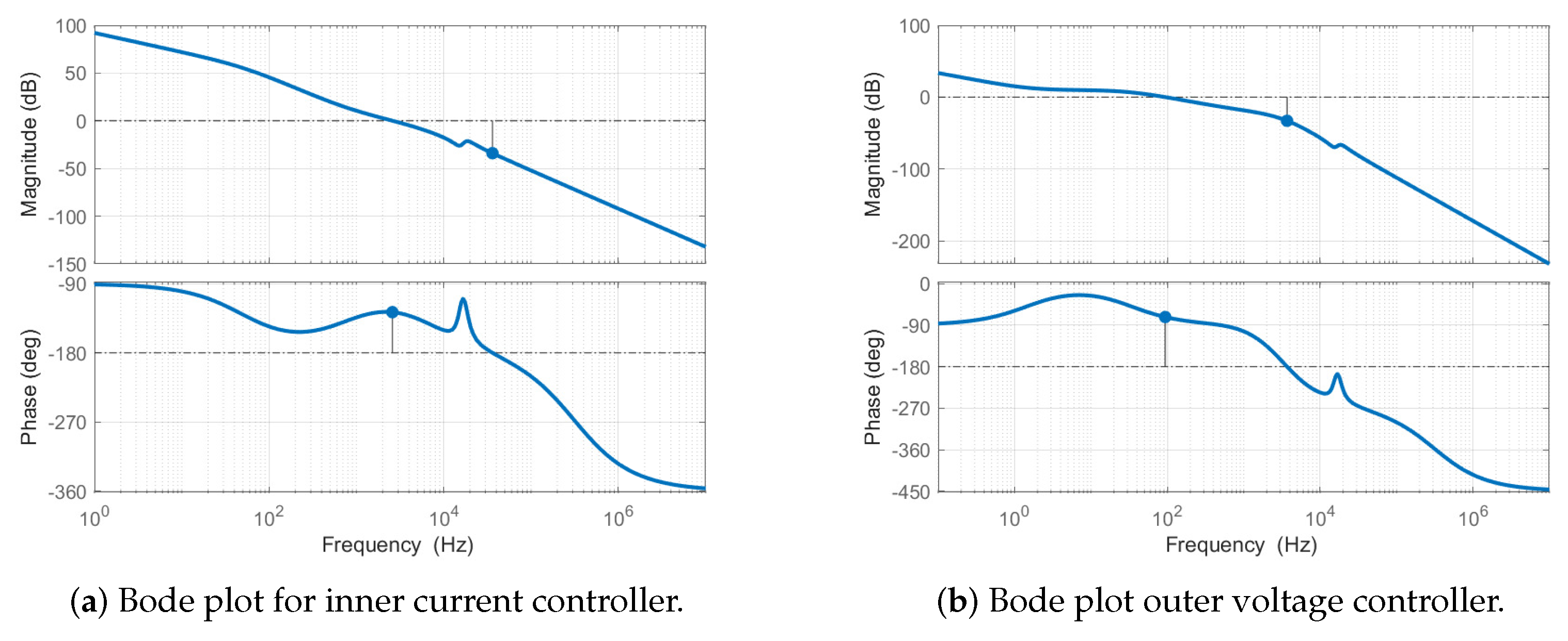
Figure 12.
Open-loop transfer function Bode plot for inner current and outer voltage controller.
Figure 12.
Open-loop transfer function Bode plot for inner current and outer voltage controller.
Figure 13.
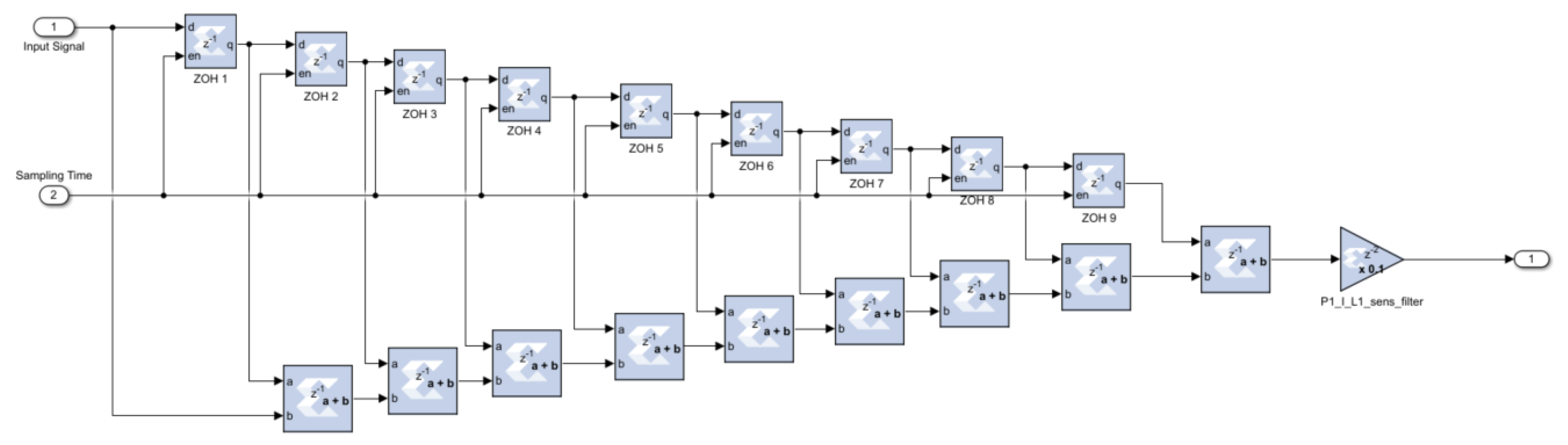
Measurement of signals and digital moving average filtering.
Figure 13.
Measurement of signals and digital moving average filtering.
Figure 14.
Moving average filter with a window of 10. Time—step is set as 1 s.
Figure 14.
Moving average filter with a window of 10. Time—step is set as 1 s.
Figure 15.
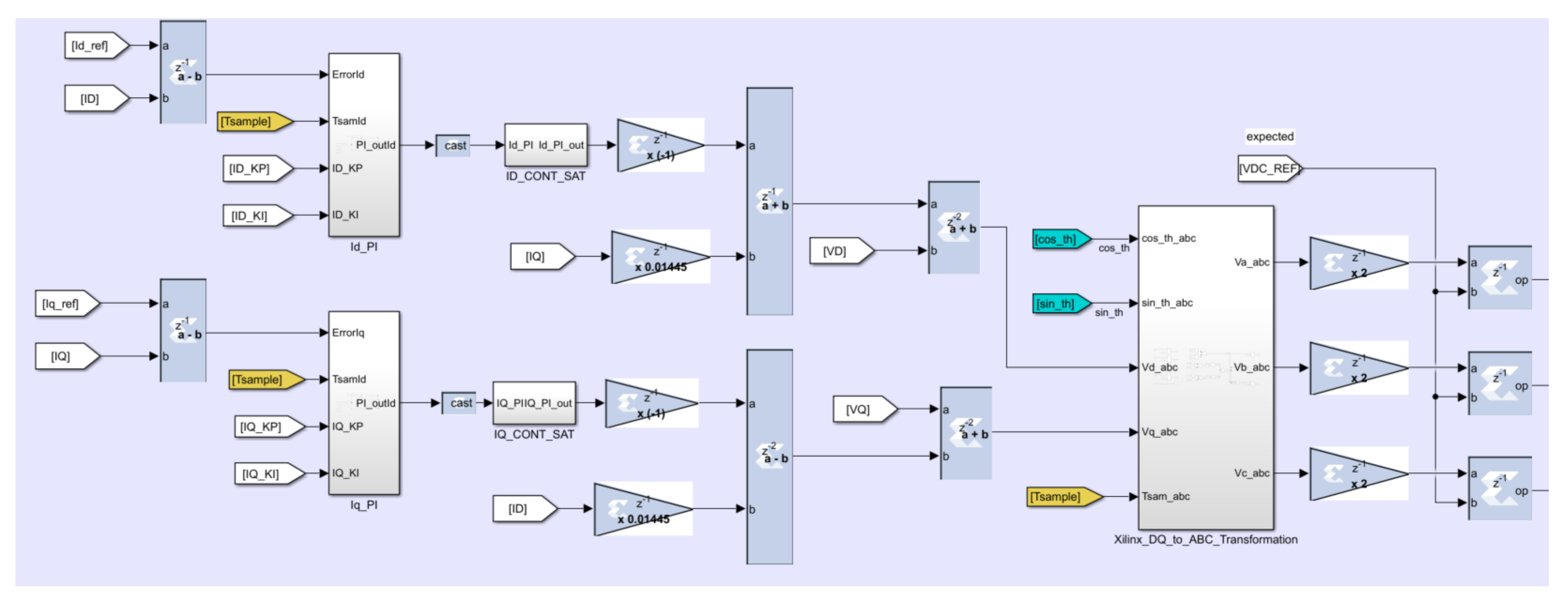
Decoupled current control implementation in dSPACE Xilinx FPGA program.
Figure 15.
Decoupled current control implementation in dSPACE Xilinx FPGA program.
Figure 16.
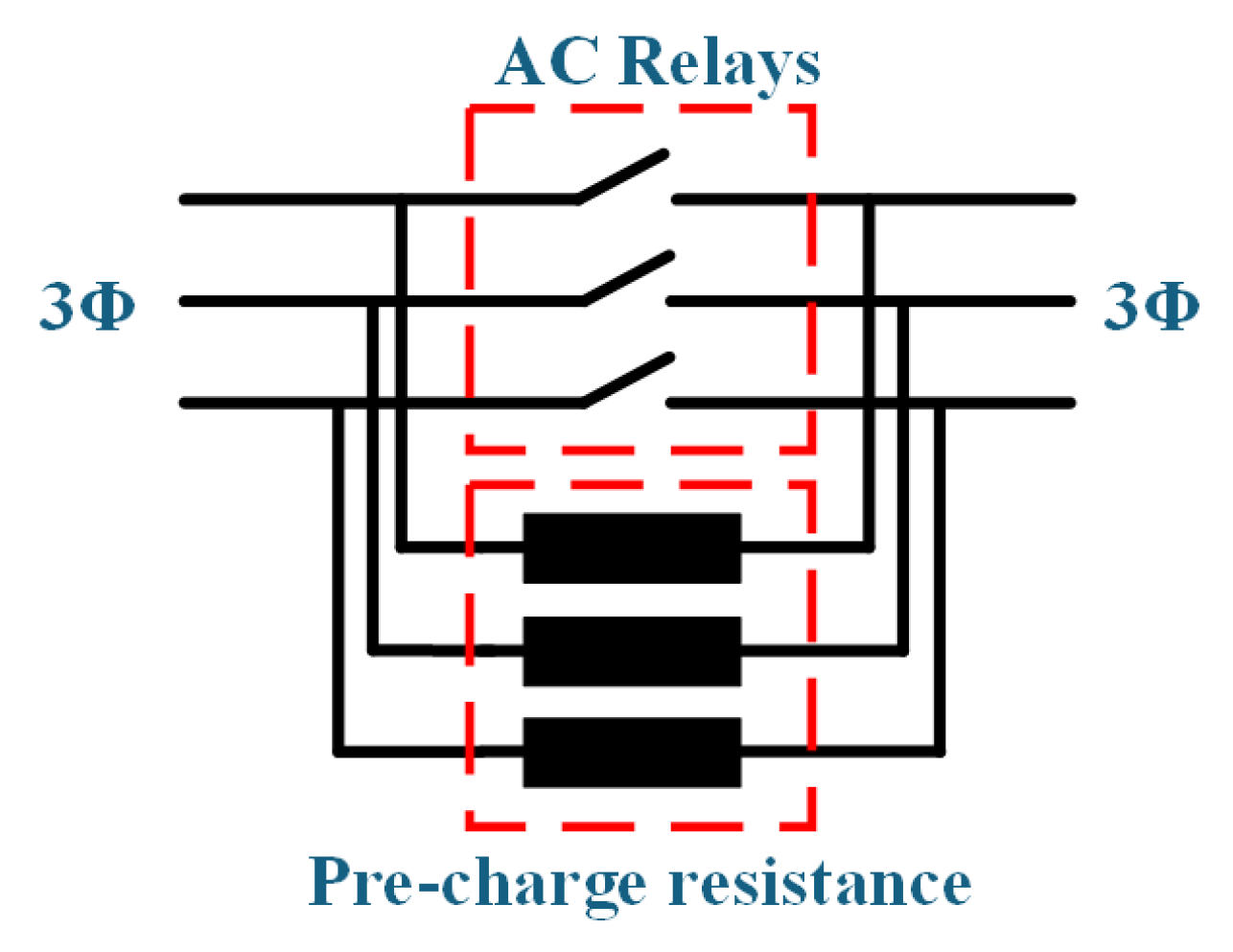
Pre-charge circuit illustration for T-type AFE.
Figure 16.
Pre-charge circuit illustration for T-type AFE.
Figure 17.
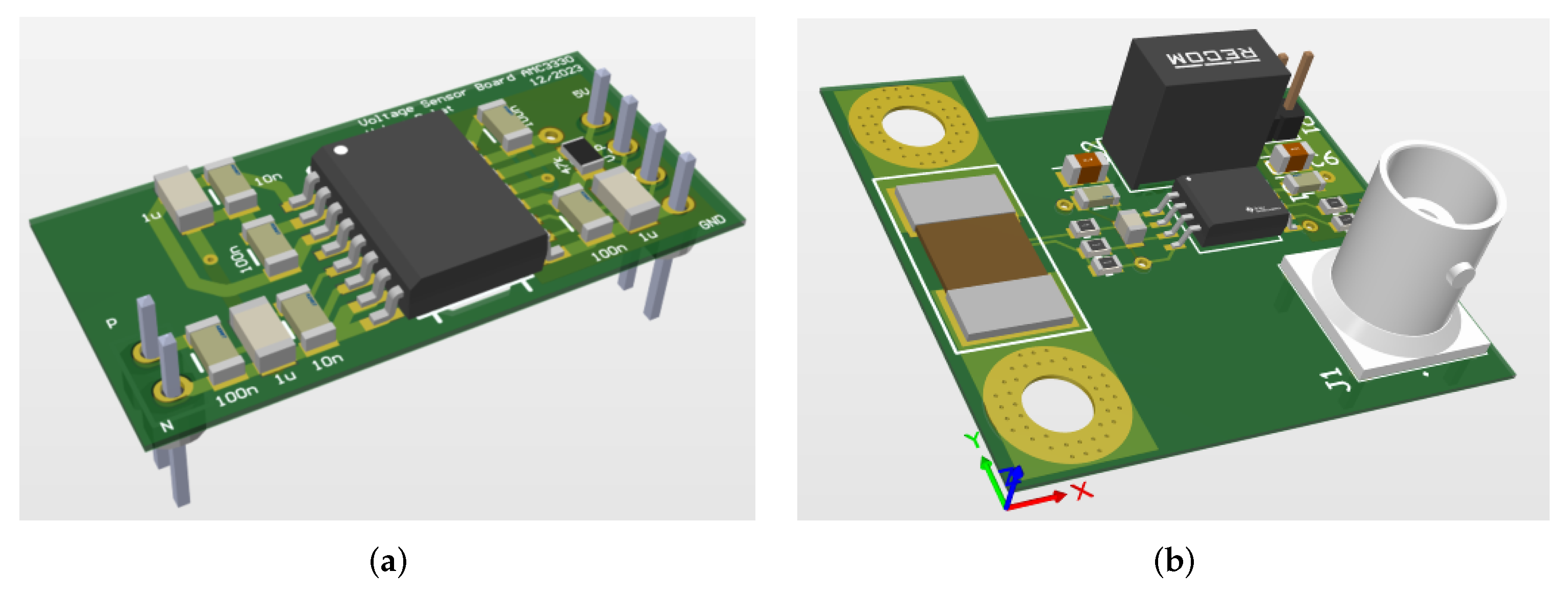
(a) AMC3330 based voltage sensor and (b) AMC1302 based current sensor boards.
Figure 17.
(a) AMC3330 based voltage sensor and (b) AMC1302 based current sensor boards.
Figure 18.
(a) Single-phase T-type power board. (b) Overall 3-phase T-type AFE system design including the gate-driver, relay, measurement, and control boards.
Figure 18.
(a) Single-phase T-type power board. (b) Overall 3-phase T-type AFE system design including the gate-driver, relay, measurement, and control boards.
Figure 19.
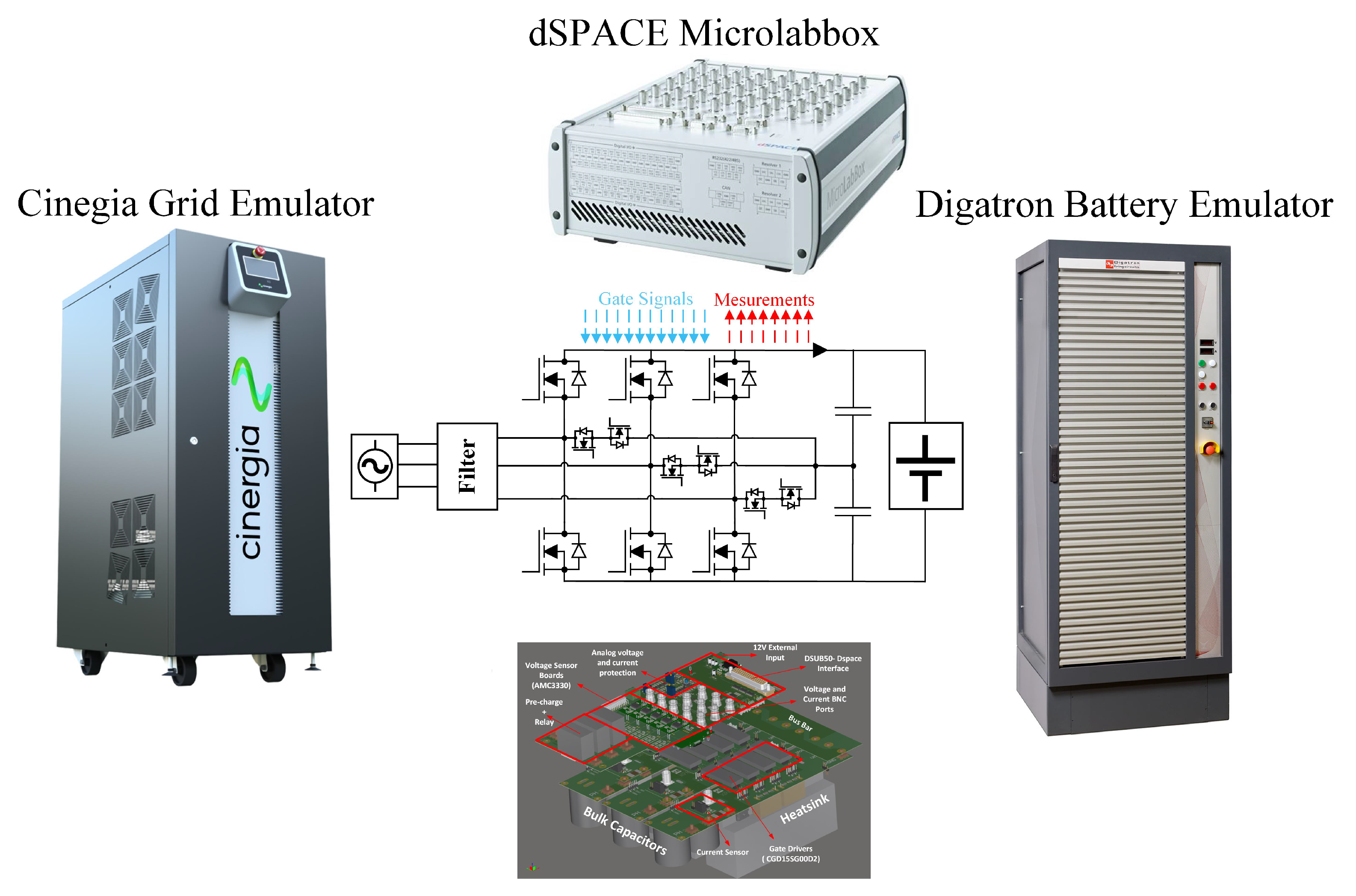
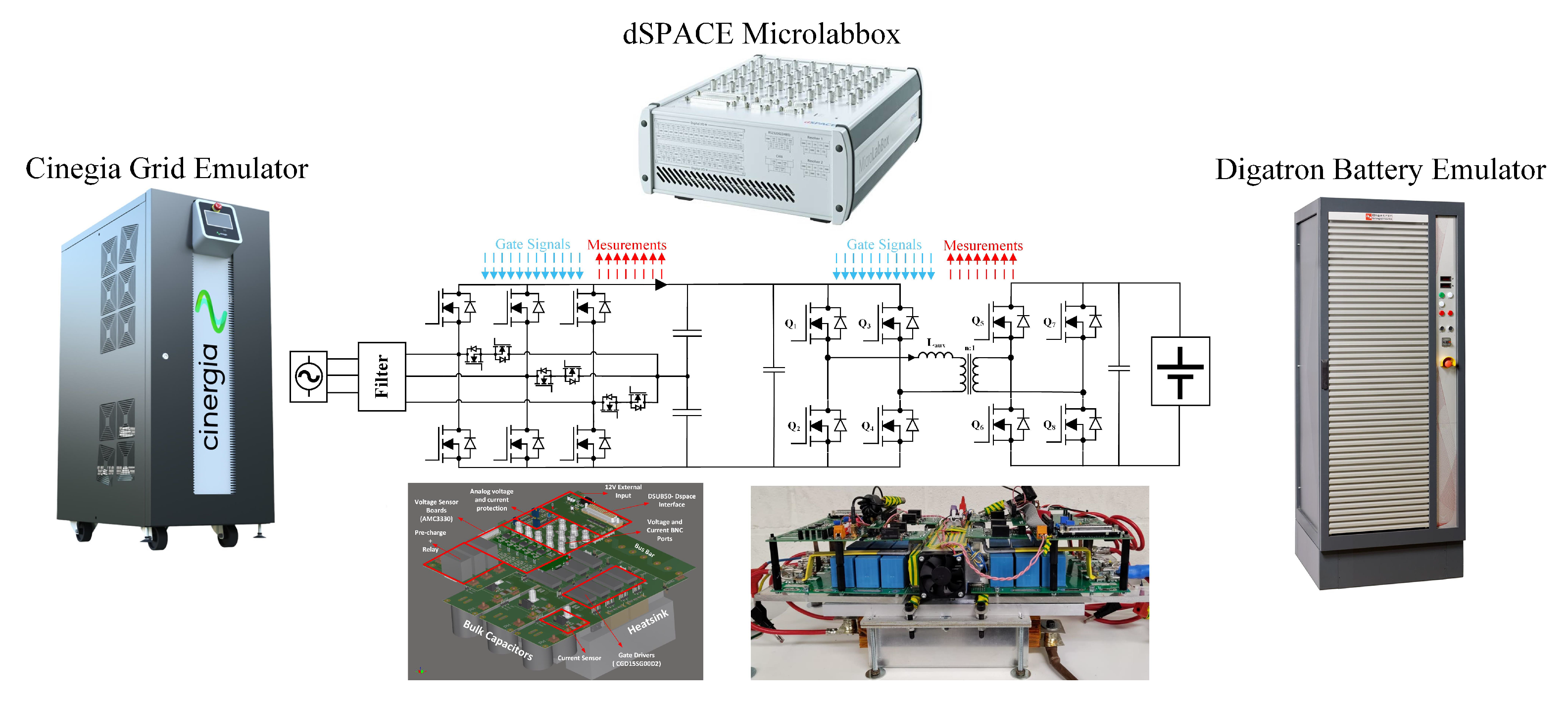
Illustration of the testing setup for T-type AFE. The grid is replaced with a grid emulator. The control is performed in the dSPACE Microlabbox. The battery is replaced with a bi-directional power supply that is capable of emulating a battery.
Figure 19.
Illustration of the testing setup for T-type AFE. The grid is replaced with a grid emulator. The control is performed in the dSPACE Microlabbox. The battery is replaced with a bi-directional power supply that is capable of emulating a battery.
Figure 20.
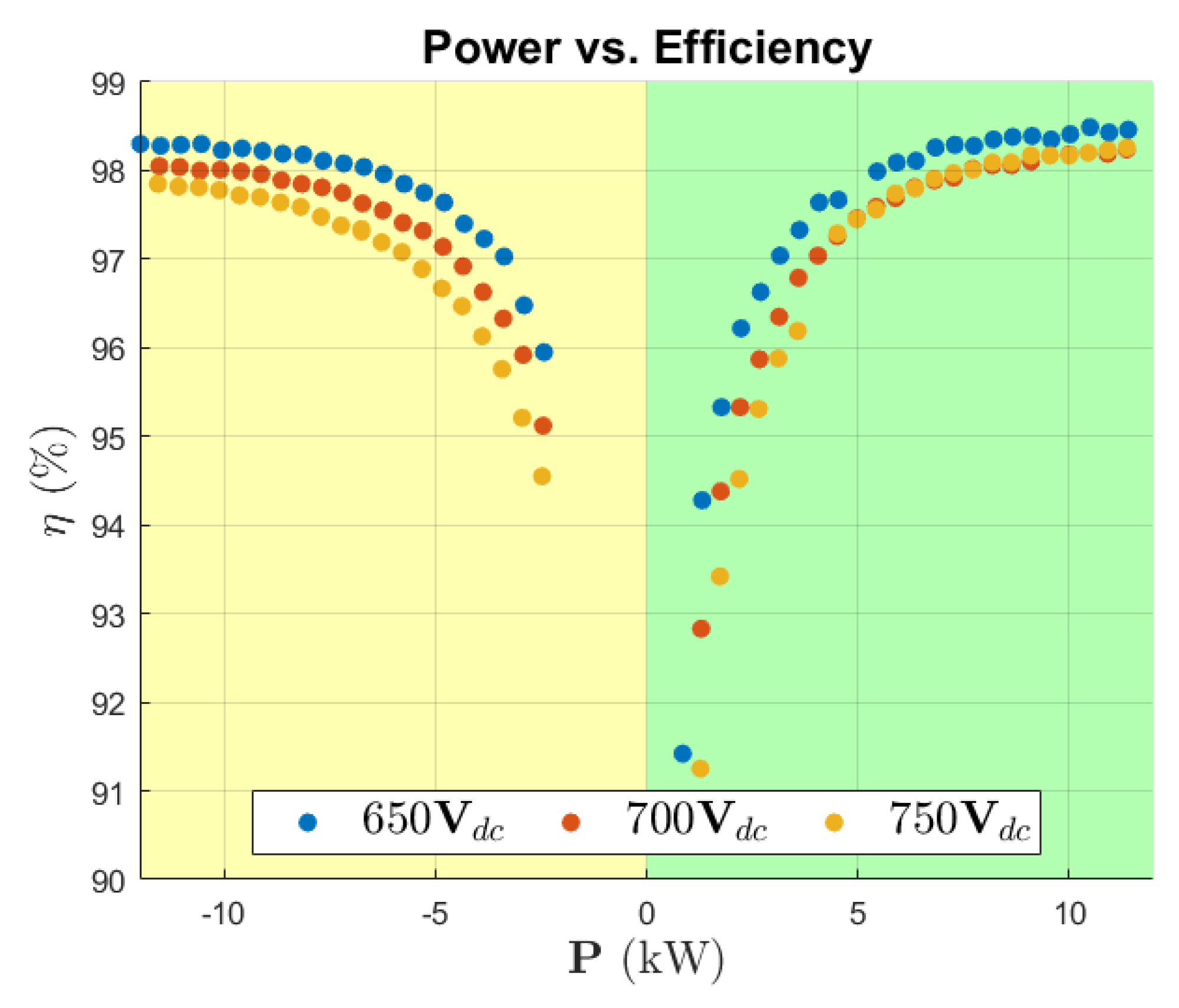
T-type AFE efficiency results for both G2V and V2G modes for 650, 700, and 750 V at the DC-link. The D-axis current is changed between +25 A and −25 A, resulting in G2V/V2G power flow between +11 kW and −11 kW. The input is 400 .
Figure 20.
T-type AFE efficiency results for both G2V and V2G modes for 650, 700, and 750 V at the DC-link. The D-axis current is changed between +25 A and −25 A, resulting in G2V/V2G power flow between +11 kW and −11 kW. The input is 400 .
Figure 21.
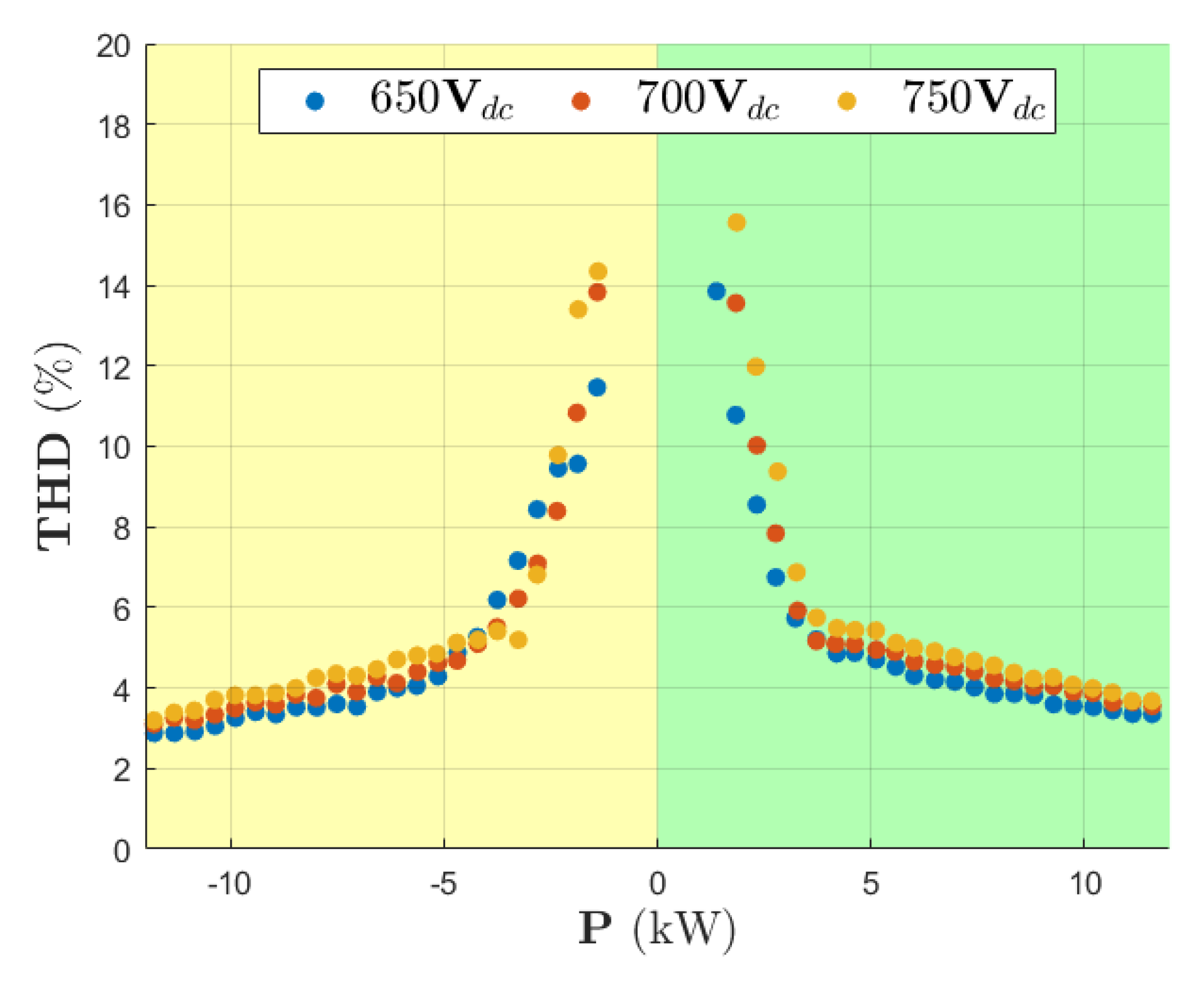
T-type AFE THD (Total harmonic distortion) results for both G2V and V2G modes for 650, 700, and 750 V at the DC-link. The input is 400 .
Figure 21.
T-type AFE THD (Total harmonic distortion) results for both G2V and V2G modes for 650, 700, and 750 V at the DC-link. The input is 400 .
Figure 22.
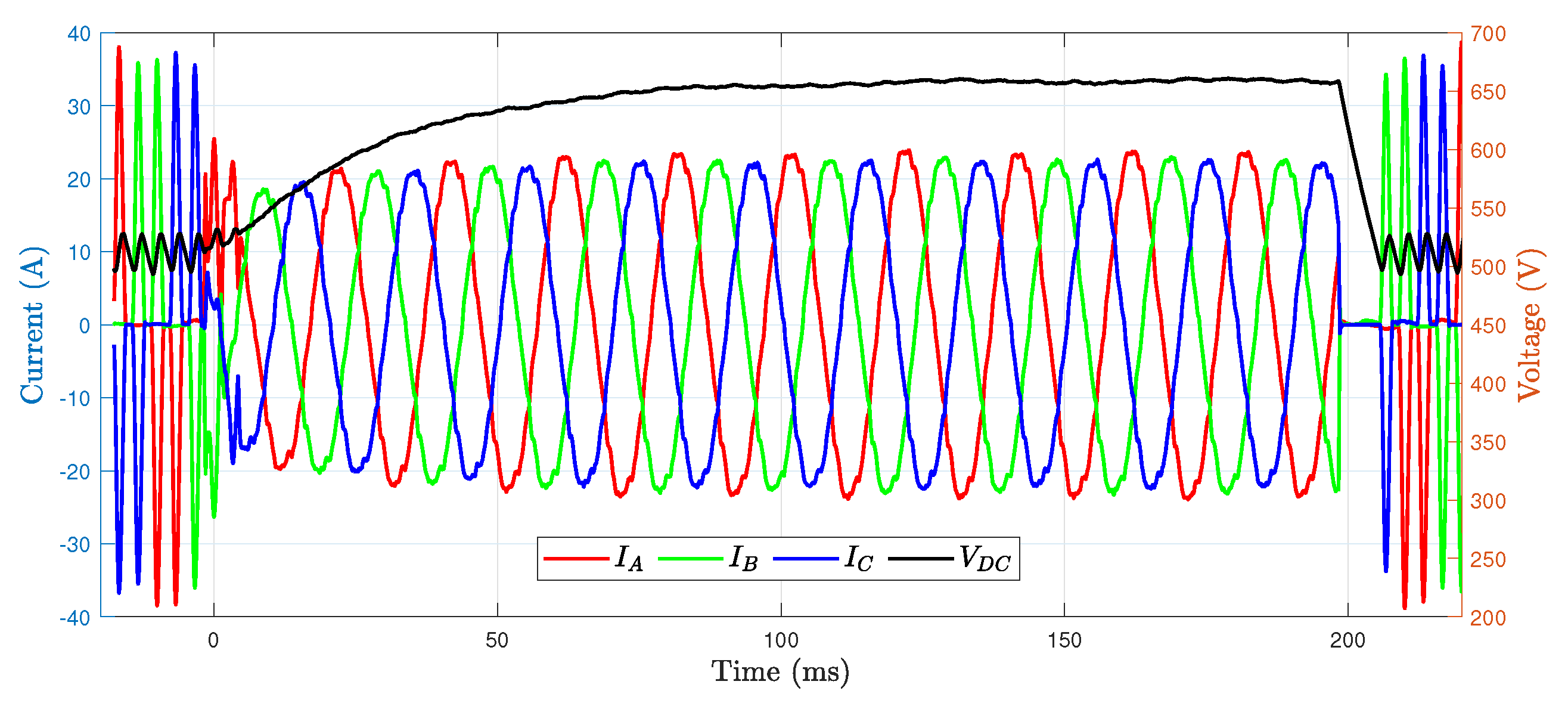
Step change from passive rectification ( V) to full load at V, A, 11.5 kW for the T-type AFE. The load is purely resistive. The input is 400 .
Figure 22.
Step change from passive rectification ( V) to full load at V, A, 11.5 kW for the T-type AFE. The load is purely resistive. The input is 400 .
Figure 23.
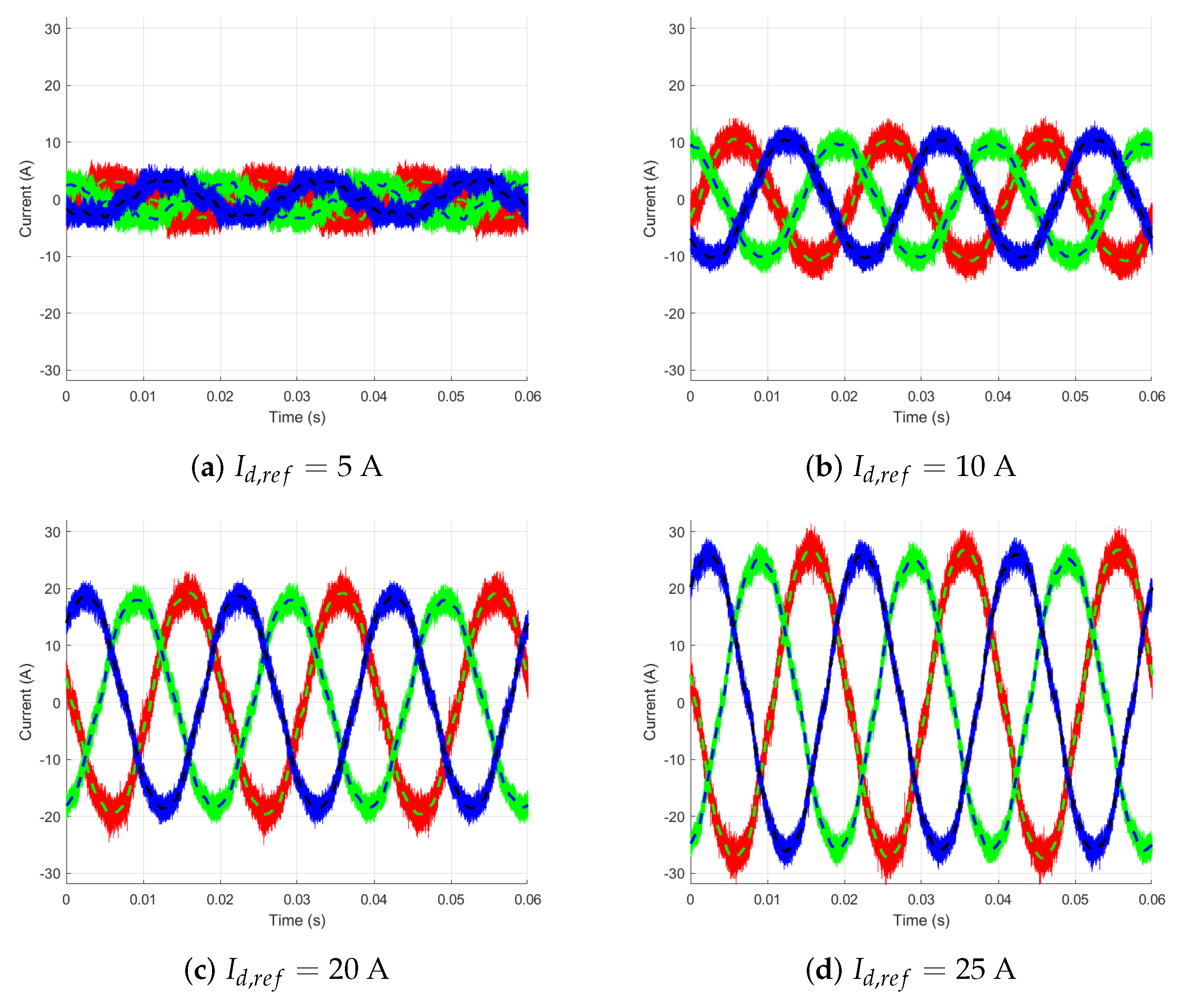
T-type AFE grid side current waveforms for V and A. The input is 400 .
Figure 23.
T-type AFE grid side current waveforms for V and A. The input is 400 .
Figure 24.
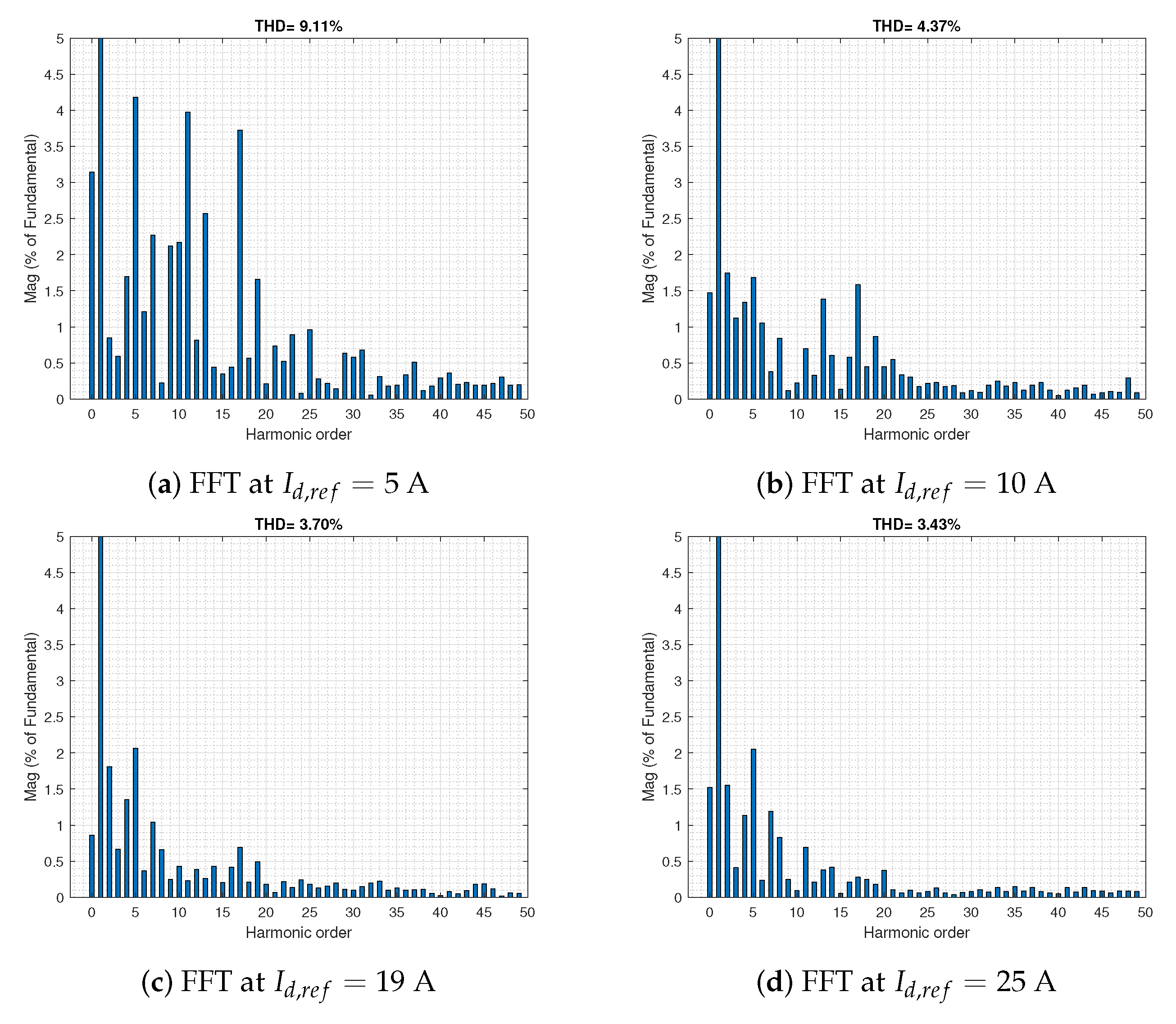
T-type AFE grid side current THD FFT plots for V and A. The input is 400 .
Figure 24.
T-type AFE grid side current THD FFT plots for V and A. The input is 400 .
Figure 25.
The full integrated power electronics interface.
Figure 25.
The full integrated power electronics interface.
Figure 26.
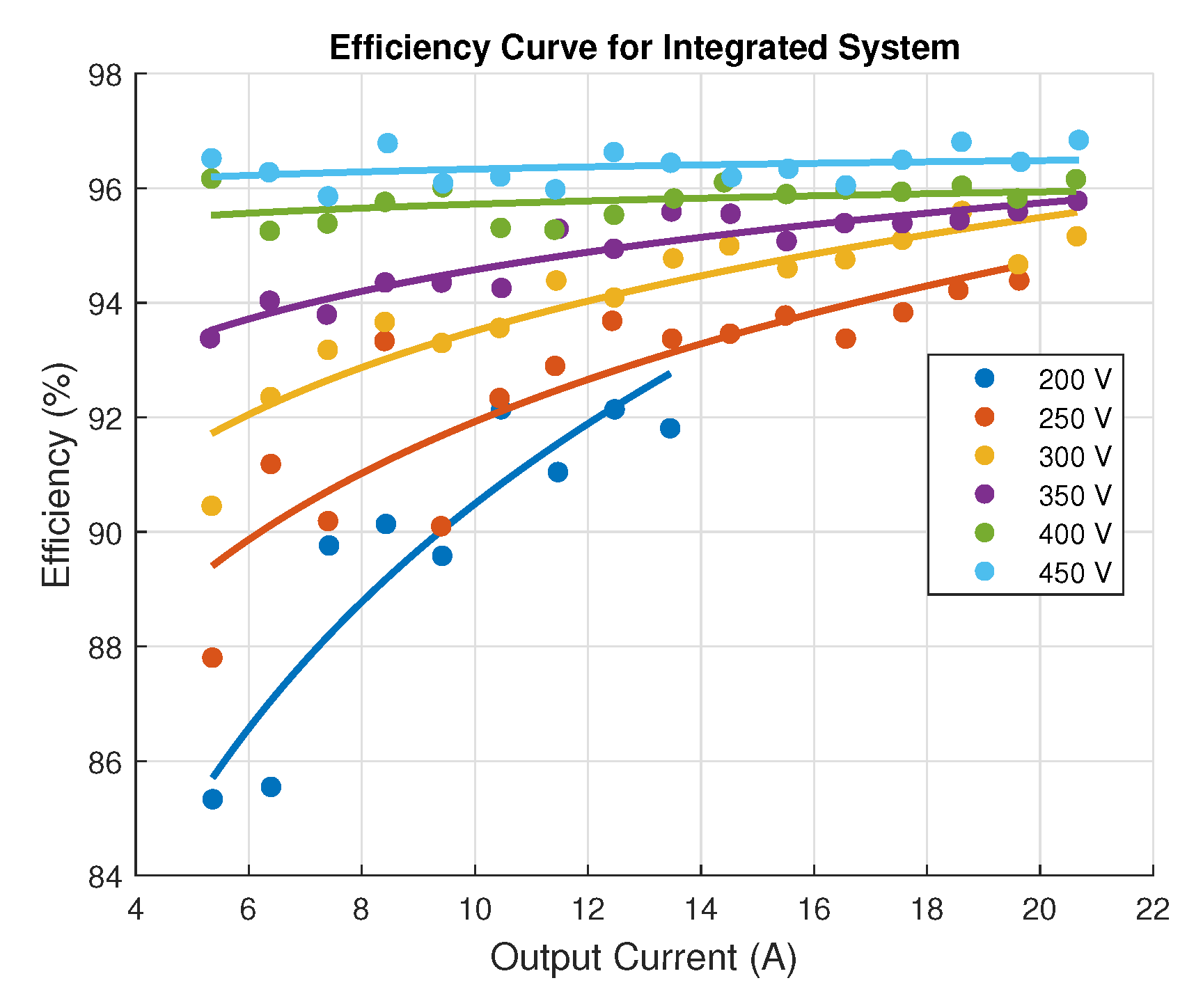
Efficiency map for integrated two-stage solution.
Figure 26.
Efficiency map for integrated two-stage solution.
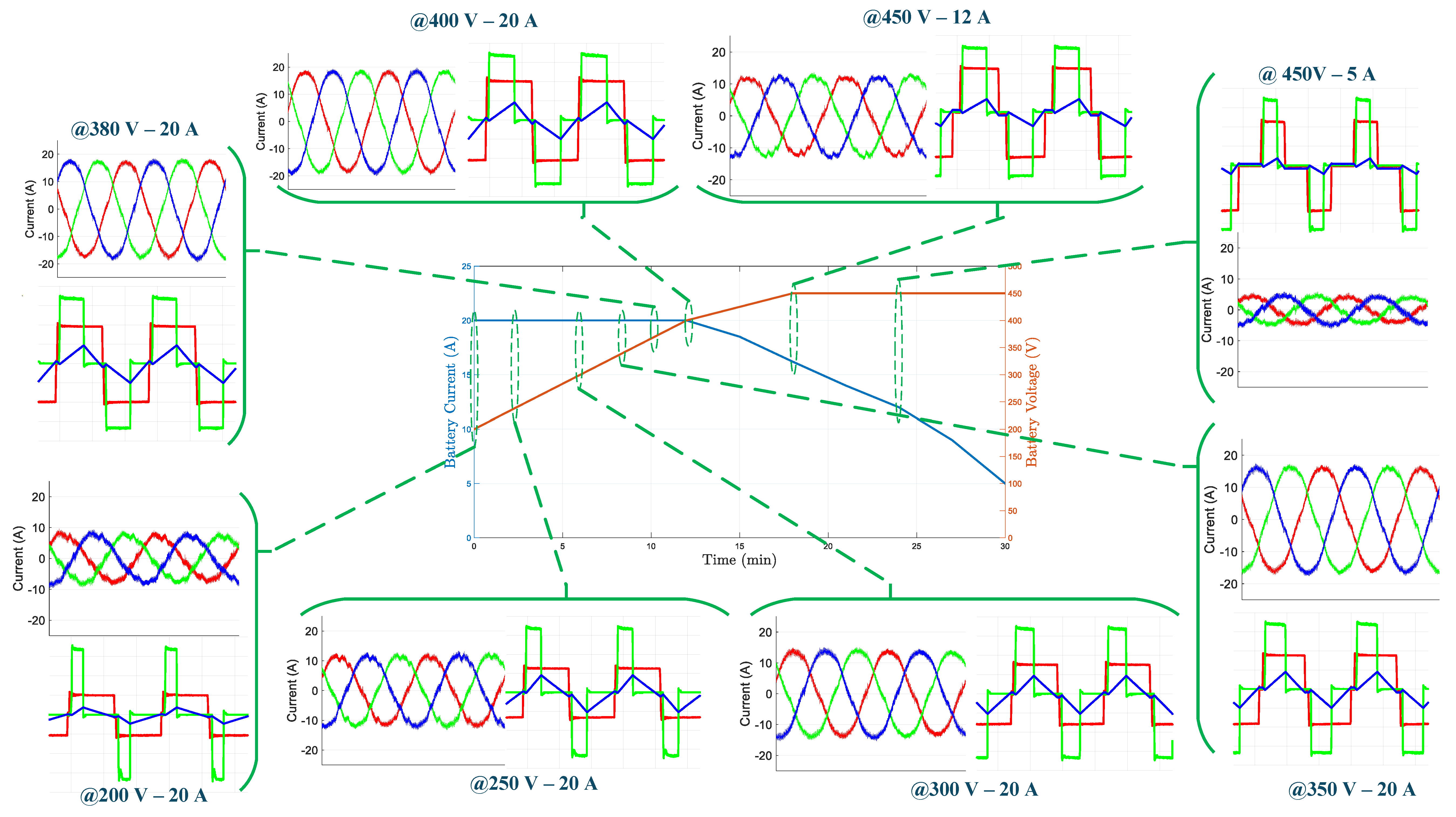
Figure 27.
G2V charging profile and testing results for 400 V EV battery charging.
Figure 27.
G2V charging profile and testing results for 400 V EV battery charging.
Table 1.
Comparison of AC/DC topologies. (AS = active switch, D = diode).
Table 1.
Comparison of AC/DC topologies. (AS = active switch, D = diode).
| Feature | 2-Level AFE | 3-Level NPC AFE [12] | T-Type AFE [13] | Vienna Rectifier [14] |
|---|
| Number of Semiconductors | 6 AS + 0 D | 12 AS + 6 D | 12 AS + 0 D | 6 AS + 6 D |
| Power Direction | Bi-directional | Bi-directional | Bi-directional | Uni-directional |
| | /2 | , /2 | , /2 |
| Filter Size | Large | Small | Small | Small |
Table 2.
Single-phase T-type AFE switching states.
Table 2.
Single-phase T-type AFE switching states.
| State | | | | | |
|---|
| 1 | | ON | OFF | ON | OFF |
| 2 | 0 | OFF | ON | ON | OFF |
| 3 | | OFF | ON | OFF | ON |
Table 3.
T-Type AFE optimization parameters and their boundaries.
Table 3.
T-Type AFE optimization parameters and their boundaries.
| Parameters | Value Range |
|---|
| Input Voltage () | 400 V |
| Output Voltage () | 650–800 V |
| Rated power () | 30 kW |
| Semiconductor Devices | 1200/650 SiC-MOSFET |
| Switching frequency | 10–200 kHz |
| 5–20% |
| K | 0.25–0.5 |
Table 4.
T-type AFE top 10 according to the average ranking method.
Table 4.
T-type AFE top 10 according to the average ranking method.
| Rank | | K | (kHz) | (V) | (W) | Volume () |
|---|
| 1 | 11.17 | 0.26 | 108.00 | 754.00 | 386.74 | 399,750 |
| 2 | 12.27 | 0.25 | 59.40 | 795.00 | 367.11 | 506,125 |
| 3 | 10.70 | 0.25 | 31.20 | 717.00 | 317.35 | 760,075 |
| 4 | 8.49 | 0.28 | 65.45 | 768.00 | 342.22 | 506,125 |
| 5 | 5.42 | 0.28 | 56.50 | 710.00 | 304.27 | 589,375 |
| 6 | 6.82 | 0.26 | 50.60 | 702.00 | 299.17 | 616,075 |
| 7 | 6.26 | 0.32 | 72.60 | 742.00 | 354.31 | 391,825 |
| 8 | 6.89 | 0.27 | 25.60 | 710.00 | 285.97 | 730,375 |
| 9 | 5.83 | 0.32 | 99.90 | 772.00 | 372.84 | 259,575 |
| 10 | 8.77 | 0.27 | 88.10 | 787.00 | 357.99 | 360,937 |
Table 5.
T-type AFE PLECS simulation parameters.
Table 5.
T-type AFE PLECS simulation parameters.
| Parameter | Value |
|---|
| Line switch | C3M0021120K (1200 V, 21 m, TO-247) |
| Neutral Switch | C3M0025065K (650 V, 25 m, TO-247) |
| 45 H (906, Edge-19 , 41 turns) |
| 15 H (906, Edge-19 , 25 turns) |
| 7 F |
| 742 V |
| 400 , 50 Hz |
| 70 kHz |
| Deadtime | 200 ns |
| DC-link Capacitor | MKP1848C66012JY5 |
| Equivalent DC-link Capacitance | 60 F |
Table 6.
T-type AFE testing parameters.
Table 6.
T-type AFE testing parameters.
| Parameters | Value Range |
|---|
| Modulation Method | Decoupled current control |
| Power Rating () | 10 kW |
| Rated Input Voltage () | 400 |
| Rated Input Current () | 15 |
| Output Voltage () | 650-700-750 |
| Rated Output Current () | 16 A |