Elemental Content and Distribution in Various Willow Clones and Tissue Types


Abstract
1. Introduction
2. Materials and Methods
2.1. Study Site
2.2. Planting Design
2.3. Sample Collection and Preparation
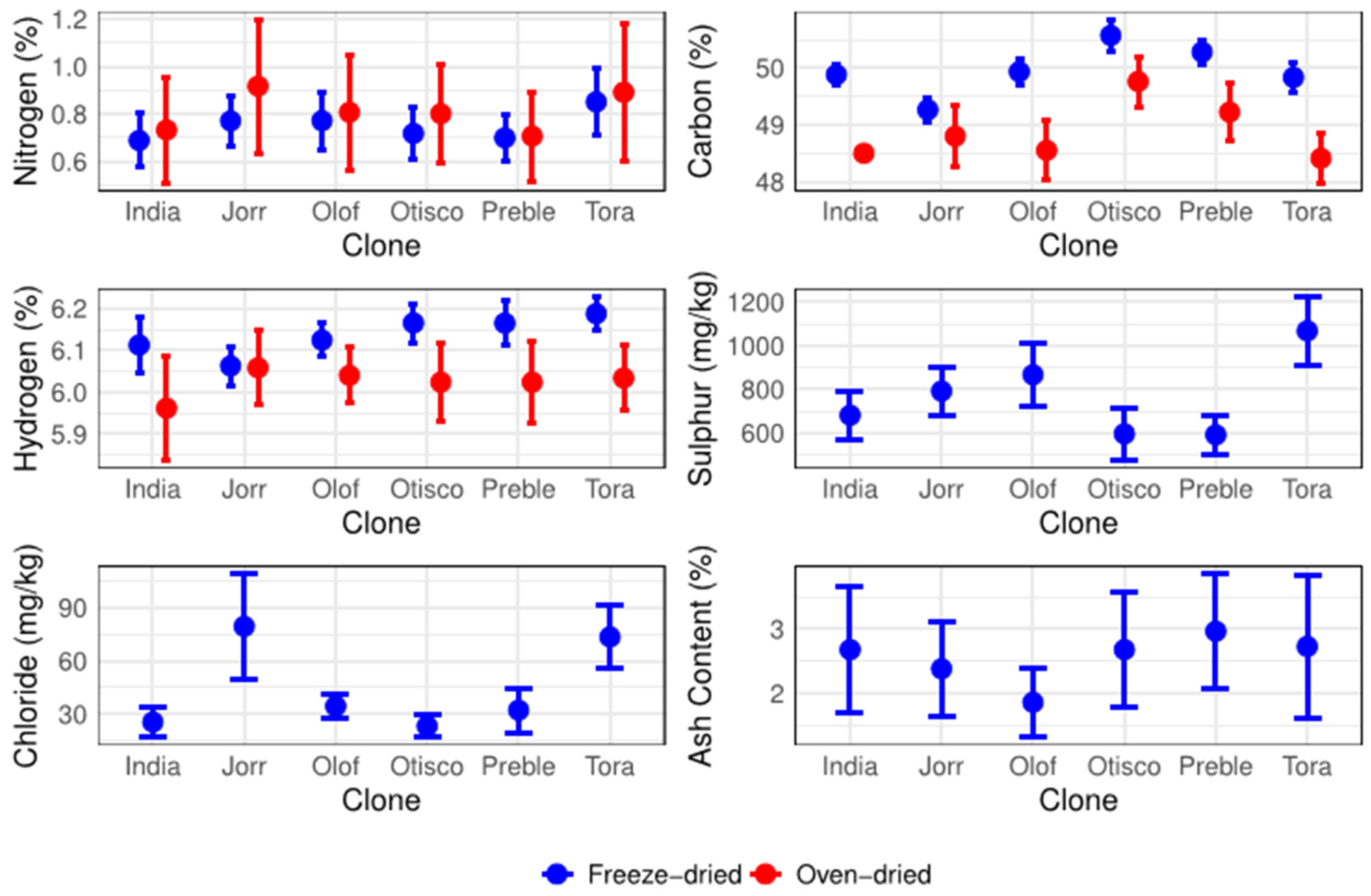
- Freeze-drying: All 90 samples were freeze-dried at −50 °C for 7 days using an 8 L freeze-drying system (Labconco Co., Kansas City, MO, USA).
- Oven-drying: A subset of 30 samples was oven-dried at +70 °C for 3 days using a forced-air oven (Thermo Scientific, Lindberg/Blue M, Model MO1450A-1, Asheville, NC, USA).
2.4. Elemental and Ash Content Analyses
2.5. Statistical Analyses
3. Results
3.1. Impact of Drying Technologies on Chemical Composition
3.2. Variation in Chemical Contents in Willow Clones
3.3. Variation in the Chemical Content in Relation to Willow Tissues
4. Discussion
4.1. Elemental Content Values and Impact of Drying Method on Chemical Composition
4.2. Variation Across Willow Clones and Tissue Types
4.3. Implications for Bioenergy Production and Breeding
5. Conclusions
Author Contributions
Funding
Data Availability Statement
Acknowledgments
Conflicts of Interest
References
- Argus, G.W. Infrageneric classification of Salix (Salicaceae) in the New World. Syst. Bot. Monogr. 1997, 52, 1–121. [Google Scholar] [CrossRef]
- Zomlefer, W.B. Guide to Flowering Plant Families; University of North Carolina Press: Chapel Hill, NC, USA, 1994. [Google Scholar]
- Baker, P.; Charlton, A.; Johnston, C.; Leahy, J.J.; Lindegaard, K.; Pisano, I.; Prendergast, J.; Preskett, D.; Skinner, C. A review of Willow (Salix spp.) as an integrated biorefinery feedstock. Ind. Crops Prod. 2022, 189, 115823. [Google Scholar] [CrossRef]
- Newsholme, C. Willows: The Genus Salix; Timber Press: Portland, OR, USA, 2003. [Google Scholar]
- Stott, K.G. Willows in the service of man. Proc. R. Soc. Edinb. 1992, 98, 169–182. [Google Scholar] [CrossRef]
- Ledin, S. Willow wood properties, production, and economy. Biomass Bioenergy 1996, 2, 75–83. [Google Scholar] [CrossRef]
- Sustainable Forest Development Act. Quebec, Canada. 2025. Available online: https://www.legisquebec.gouv.qc.ca/fr/document/lc/a-18.1?langCont=en (accessed on 8 January 2026).
- Desborough, M.J.; Keeling, D.M. The aspirin story—From willow to wonder drug. Br. J. Haematol. 2017, 177, 674–683. [Google Scholar] [CrossRef]
- Tahvanainen, J.; Helle, E.; Julkunen-Tiitto, R.; Lavola, A. Phenolic compounds of willow bark as deterrents against feeding by mountain hare. Oecologia 1985, 65, 319–323. [Google Scholar] [CrossRef]
- Adler, A.; Verwijst, T.; Aronsson, P. Estimation and relevance of bark proportion in a willow stand. Biomass Bioenergy 2005, 29, 102–113. [Google Scholar] [CrossRef]
- Serapiglia, M.J.; Cameron, K.D.; Stipanovic, A.J.; Smart, L.B. Analysis of biomass composition using high-resolution thermogravimetric analysis and percent bark content for the selection of shrub willow bioenergy crop varieties. BioEnergy Res. 2009, 2, 1–9. [Google Scholar] [CrossRef]
- Karp, A.; Hanley, S.J.; Trybush, S.O.; Macalpine, W.; Pei, M.; Shield, I. Genetic improvement of willow for bioenergy and biofuels. J. Integr. Plant Biol. 2011, 53, 151–165. [Google Scholar] [CrossRef]
- Kopp, R.F.; Smart, C.A.; Isebrands, J.G.; Tuskan, G.A.; Abrahamson, L.P. The development of improved willow clones for eastern North America. For. Chron. 2001, 77, 287–292. [Google Scholar] [CrossRef]
- Kuzovkina, Y.A.; Weih, M.; Abalos Romero, M.; Charles, J.; Hurst, S.; McIvor, I.; Karp, A.; Trybush, S.; Labrecque, M.; Teodorescu, T.I. Salix: Botany and global horticulture. Hortic. Rev. 2008, 34, 447–489. [Google Scholar]
- Labrecque, M.; Teodorescu, T.I. Field performance and biomass production of 12 willow and poplar clones in short-rotation coppice in southern Quebec (Canada). Biomass Bioenergy 2005, 29, 1–9. [Google Scholar] [CrossRef]
- Hangs, R.D.; Schoenau, J.J.; Van Rees, K.C.; Steppuhn, H. Examining the salt tolerance of willow (Salix spp.) bioenergy species for use on salt-affected agricultural lands. Can. J. Plant Sci. 2011, 91, 509–517. [Google Scholar] [CrossRef]
- Milbrandt, A.; Overend, R.P. Assessment of Biomass Resources from Marginal Lands in APEC Economies. 2009. Available online: https://digital.library.unt.edu/ark:/67531/metadc925795/m1/4/ (accessed on 20 October 2025).
- Ustak, S.; Sinko, J.; Munoz, J. Reed canary grass (Phalaris arundinacea L.) as a promising energy crop. J. Cent. Eur. Agric. 2019, 20, 1143–1168. [Google Scholar] [CrossRef]
- Holman, J.; Roberts, T.; Dumler, T.; Fick, W.; Gillen, R.; Harmoney, K.; Martin, K.; Maxwell, S.; Moyer, J.L.; Sloderbeck, P.; et al. Kansas Switchgrass Production Handbook; Kansas State University: Manhattan, KS, USA, 2011; Available online: https://bookstore.ksre.ksu.edu/pubs/kansas-switchgrass-production-handbook_MF3018.pdf (accessed on 6 January 2026).
- Tejera-Nieves, M.D.; Cordova, S.C.; Sears, M.; Thelen, K.D.; Robertson, P.G.; Walker, B.J. Switchgrass (Panicum virgatum) and miscanthus (Miscanthus × Giganteus) long-term yield patterns reveal consistent productivity declines. Glob. Change Biol. Bioenergy 2025, 17, 1–11. [Google Scholar] [CrossRef]
- de Melo Peixoto, M.; Friesen, P.C.; Sage, R.F. Winter cold-tolerance thresholds in field-grown Miscanthus hybrid rhizomes. J. Exp. Biol. 2015, 66, 4415–4425. [Google Scholar] [CrossRef]
- Paulrud, S.; Nilssoon, C.; Ohman, M. Reed canary-grass ash composition and its melting behaviour during combustion. Fuel 2001, 80, 1391–1398. [Google Scholar] [CrossRef]
- Wang, Y.; Shao, Y.; Matovic, M.D.; Whalen, J. Exploring switchgrass and hardwood combustion on excess air and ash fouling/slagging potential: Laboratory combustion test and thermogravimetric kinetic analysis. Energy Conserv. Manag. 2015, 97, 409–419. [Google Scholar] [CrossRef]
- Lanzerstorfer, C. Combustion of Miscanthus: Composition of the ash by particle size. Energies 2019, 12, 178. [Google Scholar] [CrossRef]
- Stolarski, M.J.; Krzyzaniak, M.; Warminski, K.; Zaluski, D.; Olba-Ziety, E. Willow biomass as energy feedstock: The effect of habitat, genotype and harvest rotation on thermophysical properties and elemental composition. Energies 2020, 13, 4130. [Google Scholar] [CrossRef]
- Antal, M.J.; Gronli, M. The art, science and technology of charcoal production. Ind. Eng. Chem. Res. 2003, 42, 1619–1640. [Google Scholar] [CrossRef]
- Puri, L.; Hu, Y.; Naterer, G. Critial review of the role of ash content and composition in biomass pyrolysis. Front. Fuels 2024, 2, 1378361. [Google Scholar] [CrossRef]
- Pitcher, J.A.; McKnight, J.S. Black willow. In Silvics of North America; USDA: Washington, DC, USA, 1990; Volume 2, pp. 285–295. [Google Scholar]
- Serapiglia, M.J.; Humiston, M.C.; Xu, H.; Hogsett, D.A.; de Orduna, R.M.; Stipanovic, A.J.; Smart, L.B. Enzymatic saccharification of shrub willow genotypes with differing biomass composition for biofuel production. Front. Plant Sci. 2013, 4, 57. [Google Scholar] [CrossRef] [PubMed]
- Ray, M.J.; Brereton, N.J.; Shield, I.; Karp, A.; Murphy, R.J. Variation in cell wall composition and accessibility in relation to biofuel potential of short rotation coppice willows. BioEnergy Res. 2012, 5, 685–698. [Google Scholar] [CrossRef]
- Dou, J.; Kim, H.; Li, Y.; Padmakshan, D.; Yue, F.; Ralph, F.; Vuroinen, T. Structural characterization of lignins from willow bark and wood. J. Agric. Food Chem. 2018, 66, 7294–7300. [Google Scholar] [CrossRef]
- Stolarski, M.J.; Krzyżaniak, M.; Waliszewska, B.; Szczukowski, S.; Tworkowski, J.; Zborowska, M. Lignocellulosic biomass derived from agricultural land as industrial and energy feedstock. Drewno 2013, 56, 5–18. [Google Scholar] [CrossRef]
- Personen, J.; Kuokkanen, T.; Kaipiainen, E.; Koskela, J.; Jerkku, I.; Pappinen, A.; Villa, A. Chemical and physical properties of short-rotation tree species. Eur. J. Wood Wood Prod. 2014, 72, 769–777. [Google Scholar] [CrossRef]
- Skovgaard, J.; Ferrari, S.S.; Knaggård, Å. Mapping and clustering the adoption of carbon pricing policies: What polities price carbon and why? Clim. Policy 2019, 19, 1173–1185. [Google Scholar] [CrossRef]
- Gao, B.; Taylor, A.R.; Chen, H.Y.H.; Wang, J. Variation in total and volatile carbon concentration among the major tree species of the boreal forest. For. Ecol. Manag. 2016, 375, 191–199. [Google Scholar] [CrossRef]
- Mvolo, C.S.; Boakye, E.A.; Koubaa, A. Chemical elements content and distributions within different tissue types of white spruce. Energies 2023, 16, 3257. [Google Scholar] [CrossRef]
- Mvolo, C.S.; Stewart, J.D.; Helmeste, C.; Koubaa, A. Variation of white spruce carbon content with age, height, social classes, and silvicultural management. Energies 2021, 14, 8015. [Google Scholar] [CrossRef]
- Merrill, W.; Cowling, E.B. Role of nitrogen in wood deterioration: Amounts and distribution of nitrogen in tree stems. Can. J. Bot. 1966, 44, 1555–1580. [Google Scholar] [CrossRef]
- Martin, A.R.; Gezahegn, S.; Thomas, S.C. Variation in carbon and nitrogen concentration among major woody tissue types in temperate trees. Can. J. For. Res. 2015, 45, 744–757. [Google Scholar] [CrossRef]
- Telmo, C.; Lousada, J.; Moreira, N. Proximate analysis, backwards stepwise regression between gross calorific value, ultimate and chemical analysis of wood. Fuel 2010, 89, 2734–2742. [Google Scholar] [CrossRef]
- Erol, M.; Haykiri-Acma, H.; Küçükbayrak, S. Calorific value estimation of biomass from proximate analyses data. Renew. Energy 2010, 35, 170–173. [Google Scholar] [CrossRef]
- Bushnell, D.J.; Haluzok, C.; Dadkhah-Nikoo, A. Biomass Fuel Characterization: Testing and Evaluating Combustion Characteristics of Selected Biomass Fuels; U.S. DOE Report; Oregon State University: Corvallis, OR, USA, 1990. [Google Scholar] [CrossRef][Green Version]
- Demirbaş, A. Calculation of higher heating values of biomass fuels. Fuel 1997, 76, 431–434. [Google Scholar] [CrossRef]
- Vassilev, S.V.; Baxter, D.; Andersen, L.K.; Vassileva, C.G. An overview of the chemical composition of biomass. Fuel 2010, 89, 913–933. [Google Scholar] [CrossRef]
- Kretschmann, D.E. Mechanical properties of wood. In Wood Handbook: Wood as an Engineering Material; FPL-GTR-190; Ross, R.J., Ed.; USDA Forest Service, Forest Products Laboratory: Madison, WI, USA, 2010; p. 509. [Google Scholar]
- Ward, K.R.; Matejtschuk, P. The principles of freeze-drying and application of analytical technologies. In Cryopreservation and Freeze-Drying Protocols; Methods in Molecular Biology; Wolkers, W.F., Oldenhof, H., Eds.; Humana: New York, NY, USA, 2020; Volume 2180, pp. 3–22. [Google Scholar] [CrossRef]
- Lamlom, S.H.; Savidge, R.A. Carbon content variation in boles of mature sugar maple and giant sequoia. Tree Physiol. 2006, 26, 459–468. [Google Scholar] [CrossRef]
- Martin, A.R.; Thomas, S.C. A reassessment of carbon content in tropical trees. PLoS ONE 2011, 6, e23533. [Google Scholar] [CrossRef]
- Agronomic Interpretations Working Group. Land Suitability Rating System for Agricultural Crops: 1. Spring-Seeded Small Grains; Tech. Bull. 1995-6E; Agriculture and Agri-Food Canada: Ottawa, ON, Canada, 1995.
- Liu, T.; Ma, Z.; McConkey, B.; Kulshreshtha, S.; Huffman, T.; Green, M.; Liu, J.; Du, Y.; Shang, J. Bioenergy production potential on marginal land in Canada. In Proceedings of the 2012 1st International Conference on Agro-Geoinformatics, Shanghai, China, 2–4 August 2012; pp. 1–4. [Google Scholar] [CrossRef]
- Government of Canada. Net-Zero Emissions by 2050. 2023. Available online: https://www.canada.ca/en/services/environment/weather/climatechange/climate-plan/net-zero-emissions-2050.html (accessed on 20 October 2025).
- Pereira, H.; Graça, J.; Rodrigues, J.C. Wood chemistry in relation to quality. ChemInform 2004, 35, 46. [Google Scholar] [CrossRef]
- Bouaziz, B.; Koubaa, A.; Mvolo, C.; Koubaa, S.; Krygier, R. Use of NIR spectroscopy and PLS regression for prediction of chemical properties of Salix clones. Eur. J. Wood Wood Prod. 2025, 83, 176. [Google Scholar] [CrossRef]
- Soil Classification Working Group. The Canadian System of Soil Classification, 3rd ed.; Agriculture and Agri-Food Canada Publication No. 1646; Agriculture and Agri-Food Canada: Ottawa, ON, Canada, 1998; p. 187.
- Boyd, J.; Christersson, L.; Dinkelbach, L. Energy from Willow; Scottish Agricultural College: Edinburgh, UK, 2000. [Google Scholar]
- Isebrands, J.G.; Richardson, J. Poplars and Willows: Trees for Society and the Environment; CAB International: Wallingford, UK; FAO: Rome, Italy, 2014. [Google Scholar] [CrossRef]
- Abrahamson, L.P.; Kopp, R.F.; Smart, L.B.; Volk, T.A. Fast-Growing Willow Shrub Named ‘Millbrook’; (PP17646); Oak Ridge National Laboratory (ORNL): Oak Ridge, TN, USA; State University of New York (SUNY): Albany, NY, USA, 2007. [Google Scholar]
- Sluiter, A.; Hames, B.; Ruiz, R.; Scarlata, C.; Sluiter, J.; Templeton, D. Determination of Ash in Biomass: Laboratory Analytical Procedure (LAP); Technical Report NREL/TP-510-42622; NREL: Golden, CO, USA, 2008. [Google Scholar]
- Zar, J.H. Biostatistical Analysis, 5th ed.; Pearson Prentice Hall: Upper Saddle River, NJ, USA, 2010. [Google Scholar]
- R Core Team. R: A Language and Environment for Statistical Computing, Version 4.3.3; R Foundation for Statistical Computing: Vienna, Austria, 2024.
- Shen, Y.; Gao, Z.; Hou, X.; Chen, H.; Jiang, J.; Sun, J. Spectral and thermal analysis of Eucalyptus wood drying at different temperatures and methods. Dry. Technol. 2020, 38, 313–320. [Google Scholar] [CrossRef]
- Leckner, B.; Karlsson, M. Gaseous emissions from circulating fluidized bed combustion of wood. Biomass Bioenergy 1993, 4, 379–389. [Google Scholar] [CrossRef]
- Akamatsu, F.; Suzuki, Y.; Kato, Y.; Yoshimizu, C.; Tayasu, I. A comparison of freeze-drying and oven-drying for carbon isotope analyses. Rapid Commun. Mass Spectrom. 2016, 30, 137–142. [Google Scholar] [CrossRef]
- Jones, J.M.; Heath, K.D.; Ferrer, A.; Dalling, J.W. Habitat-specific effects of bark on wood decomposition. Funct. Ecol. 2020, 34, 1123–1133. [Google Scholar] [CrossRef]
- Supriyadi, D.; Damayanti, D.; Veigel, S.; Hansmann, C.; Gindl-Altmutter, W. Unlocking the potential of tree bark. Mater. Today Sustain. 2025, 29, 101074. [Google Scholar] [CrossRef]
- Rosell, J.A.; Gleason, S.; Méndez-Alonzo, R.; Chang, Y.; Westoby, M. Bark functional ecology: Evidence for tradeoffs and environmental coordination. New Phytol. 2014, 201, 486–497. [Google Scholar]
- Adegbidi, H.G.; Volk, T.A.; White, E.H.; Abrahamson, L.P.; Briggs, R.D.; Bickelhaupt, D.H. Biomass and Nutrient Removal by Willow Clones in Experimental Bioenergy Plantations in New York State. Biomass Bioenergy 2001, 20, 399–411. [Google Scholar] [CrossRef]
- Hangs, R.D.; Schoenau, J.J.; Van Rees, K.C.J.; Bélanger, N.; Volk, T.A. Leaf Litter Decomposition and Nutrient-Release Characteristics of Several Willow Varieties within Short-Rotation Coppice Plantations in Saskatchewan, Canada. BioEnergy Res. 2014, 7, 1074–1090. [Google Scholar] [CrossRef]
- Amichev, B.Y.; Hangs, R.D.; Konecsni, S.M.; Stadnyk, C.N.; Volk, T.A.; Bélanger, N.; Vujanovic, V.; Schoenau, J.J.; Moukoumi, J.; Van Rees, K.C.J. Willow Short-Rotation Production Systems in Canada and Northern USA: A Review. Soil Sci. Soc. Am. J. 2014, 78, S168–S182. [Google Scholar] [CrossRef]


| Clone Name | Number of Samples | Planted Area (ha) | Number of Stools Sampled | Average (+Stdev) Height (cm) † | Average (+Stdev) Diameter (mm) † | Pedigree of Clone |
|---|---|---|---|---|---|---|
| India ‡ | 15 | 1.11 | 3 | 561.7 (61.7) | 59.8 (0.6) | S. dasyclados × S. dasyclados [56] |
| Jorr | 15 | 1.08 | 3 | 342.9 (84.7) | 24.3 (7.8) | S. viminalis × S. viminalis [56] |
| Olof | 15 | 5.11 | 3 | 339.7 (79.4) | 23.1 (5.2) | S. viminalis × (S. schwerinii × S. viminalis) [56] |
| Otisco | 15 | 19.5 | 3 | 332.9 (63.0) | 26.4 (9.5) | S. viminalis ‘SV2’ × S. miyabeana ‘SX64’ [57] |
| Preble | 15 | 6.63 | 3 | 343.2 (51.7) | 24.9 (5.0) | S. viminalis L. ‘SV2’ × (S. miyabeana ‘SX61’ × S. miyabeana ‘9970-037’) [56] |
| Tora | 15 | 7.21 | 3 | 454.1 (63.7) | 32.0 (5.4) | S. schwerinii × S. viminalis [56] |
| Clone | Tissue | FDN (%) | ODN (%) | FDC (%) | ODC (%) | FDH (%) | ODH (%) | FDS (mg/kg) | FDCl (mg/kg) | Ash (%) |
|---|---|---|---|---|---|---|---|---|---|---|
| India | Bark | 1.09 (0.09) | 1.09 (0.10) | 50.4 (0.52) a | 48.6 (0.07) b | 5.86 (0.23) | 5.68 (0.17) | 792.0 (47.4) | 11.6 (6.23) | 5.00 (0.24) |
| Twigs | 0.90 (0.02) | 1.10 (NA) | 50.1 (0.31) | 48.8 (NA) | 6.21 (0.07) | 6.06 (NA) | 459.0 (NA) | 52.9 (NA) | 1.86 (NA) | |
| Wood | 0.18 (0.04) | 0.19 (0.00) | 49.2 (0.19) | 48.3 (0.14) | 6.32 (0.05) | 6.20 (0.04) | NA | 25.8 (8.27) | 0.77 (0.01) | |
| Jorr | Bark | 1.15 (0.14) a | 1.55 (0.15) b | 49.0 (0.53) | 49.5 (NA) | 5.87 (0.10) | 5.95 (0.34) | 899.0 (38.5) | 142.0 (44.6) | 3.92 (0.24) |
| Twigs | 0.94 (0.09) | 0.86 (NA) | 50.5 (0.90) | 49.9 (NA) | 6.20 (0.11) | 6.13 (NA) | 575.0 (NA) | 69.1 (NA) | 2.71 (NA) | |
| Wood | 0.31 (0.03) | 0.31 (0.01) | 48.9 (0.36) | 47.9 (0.14) | 6.18 (0.04) | 6.13 (0.00) | NA | 21.5 (19.4) | 0.68 (0.12) | |
| Olof | Bark | 1.24 (0.23) | 1.33 (0.08) | 50.5 (1.08) | 49.8 (NA) | 6.02 (0.18) | 5.93 (0.20) | 1014.0 (20.5) | 42.8 (14.4) | 2.92 (1.01) |
| Twigs | 0.82 (0.13) | 0.88 (NA) | 49.9 (0.30) | 49.0 (NA) | 6.11 (0.07) | 6.06 (NA) | 570.0 (NA) | 43.3 (NA) | 2.04 (NA) | |
| Wood | 0.28 (0.02) | 0.25 (0.00) | 49.4 (0.35) a | 47.7 (0.28) b | 6.24 (0.05) | 6.14 (0.07) | NA | 21.9 (9.48) | 0.72 (0.01) | |
| Otisco | Bark | 1.15 (0.12) | 1.14 (0.06) | 51.5 (0.94) | 50.5 (0.14) | 6.02 (0.21) | 5.80 (0.08) | 716.0 (26.2) | 18.9 (11.2) | 4.69 (0.33) |
| Twigs | 0.80 (0.06) | 1.15 (NA) | 50.7 (0.51) | 50.4 (NA) | 6.27 (0.02) | 6.21 (NA) | 354.0 (NA) | 46.1 (NA) | 2.48 (NA) | |
| Wood | 0.25 (0.05) | 0.29 (0.08) | 49.6 (0.43) | 48.7 (0.28) | 6.26 (0.05) | 6.15 (0.00) | NA | 16.2 (5.30) | 0.77 (0.06) | |
| Preble | Bark | 1.11 (0.08) | 1.06 (0.14) | 50.8 (0.72) | 49.9 (NA) | 5.97 (0.17) | 5.79 (0.08) | 676.0 (42.4) | 50.6 (44.0) | 4.80 (0.03) |
| Twigs | 0.69 (0.04) | 0.89 (NA) | 50.8 (0.35) | 50.2 (NA) | 6.28 (0.05) | 6.20 (NA) | 418.0 (NA) | 22.7 (NA) | 3.46 (NA) | |
| Wood | 0.29 (0.02) a | 0.26 (0.01) b | 49.5 (0.35) | 48.4 (0.42) | 6.30 (0.12) | 6.17 (0.06) | NA | 18.6 (8.98) | 0.89 (0.08) | |
| Tora | Bark | 1.33 (0.27) a | 1.50 (0.04) b | 50.5 (1.13) | 49.2 (NA) | 6.10 (0.20) | 5.88 (0.22) | 1224.0 (11.3) | 85.4 (29.1) | 5.13 (1.93) |
| Twigs | 1.08 (0.09) | 1.01 (NA) | 50.0 (0.00) | 49.1 (NA) | 6.17 (0.04) | 6.15 (NA) | 755.0 (NA) | 96.5 (NA) | 2.18 (NA) | |
| Wood | 0.25 (0.08) | 0.22 (0.03) | 49.1 (0.39) a | 47.7 (0.18) b | 6.29 (0.06) | 6.12 (0.02) | NA | 26.5 (NA) | 0.61 (0.04) |
Disclaimer/Publisher’s Note: The statements, opinions and data contained in all publications are solely those of the individual author(s) and contributor(s) and not of MDPI and/or the editor(s). MDPI and/or the editor(s) disclaim responsibility for any injury to people or property resulting from any ideas, methods, instructions or products referred to in the content. |
© 2026 by the authors. Licensee MDPI, Basel, Switzerland. This article is an open access article distributed under the terms and conditions of the Creative Commons Attribution (CC BY) license.
Share and Cite
Mvolo, C.S.; Boakye, E.A.; Krygier, R. Elemental Content and Distribution in Various Willow Clones and Tissue Types. Energies 2026, 19, 607. https://doi.org/10.3390/en19030607
Mvolo CS, Boakye EA, Krygier R. Elemental Content and Distribution in Various Willow Clones and Tissue Types. Energies. 2026; 19(3):607. https://doi.org/10.3390/en19030607
Chicago/Turabian StyleMvolo, Cyriac S., Emmanuel A. Boakye, and Richard Krygier. 2026. "Elemental Content and Distribution in Various Willow Clones and Tissue Types" Energies 19, no. 3: 607. https://doi.org/10.3390/en19030607
APA StyleMvolo, C. S., Boakye, E. A., & Krygier, R. (2026). Elemental Content and Distribution in Various Willow Clones and Tissue Types. Energies, 19(3), 607. https://doi.org/10.3390/en19030607