


Abstract
Ground-source heat pump (GSHP) systems are widely regarded as an energy-efficient solution for building heating and cooling. However, their actual performance in large commercial buildings is often limited by rigid control strategies, insufficient equipment coordination, and suboptimal load matching. In the Liuzhou Fengqing Port commercial complex, the seasonal coefficient of performance (SCOP) of the GSHP system remains at a relatively low level of 3.0–3.5 under conventional operation. To address these challenges, this study proposes a gray-box-model-based cooperative optimization and group control strategy for GSHP systems. A hybrid gray-box modeling approach (YFU model), integrating physical-mechanism modeling with data-driven parameter identification, is developed to characterize the energy consumption behavior of GSHP units and variable-frequency pumps. On this basis, a multi-equipment cooperative optimization framework is established to coordinate GSHP unit on/off scheduling, load allocation, and pump staging. In addition, continuous operational variables (e.g., chilled-water supply temperature and circulation flow rate) are globally optimized within a hierarchical control structure. The proposed strategy is validated through both simulation analysis and on-site field implementation, demonstrating significant improvements in system energy efficiency, with annual electricity savings of no less than 3.6 × 10⁵ kWh and an increase in SCOP from approximately 3.2 to above 4.0. The results indicate that the proposed framework offers strong interpretability, robustness, and engineering applicability. It also provides a reusable technical paradigm for intelligent energy-saving retrofits of GSHP systems in large commercial buildings.
1. Introduction
With the rapid economic development and rising living standards in China, building energy consumption has increased continuously, posing significant challenges to energy conservation and carbon emission reduction. According to the China Building Energy Consumption and Carbon Emission Research Report (2023) [1,2], the building sector accounted for 36.3% of national energy consumption in 2021, with more than 60% occurring during the operational stage. In large public buildings, centralized heating, ventilation, and air-conditioning (HVAC) systems typically account for over 40% of total building energy use [3]. Therefore, improving the operational efficiency of HVAC systems is regarded as a critical pathway for achieving energy conservation and low-carbon building operation under China’s dual-carbon targets.
Among various low-carbon HVAC technologies, ground-source heat pump (GSHP) systems have attracted increasing attention due to their high theoretical efficiency and environmental advantages [4,5]. By utilizing the relatively stable thermal conditions of shallow geothermal resources, GSHP systems can operate with smaller temperature lifts than air-source systems, resulting in higher coefficients of performance and improved seasonal efficiency [5]. Owing to these advantages, GSHP technology has gradually matured in terms of system configurations and engineering applications and has been widely applied in building heating and cooling, particularly in large commercial and public buildings [4,5]. Long-term field measurements and performance assessments further confirm the feasibility and energy-saving potential of GSHP systems in real engineering applications [6,7].
However, the actual operational performance of GSHP systems often deviates from their theoretical potential. Unlike conventional chiller systems, GSHP systems involve strong coupling among multiple subsystems, including heat pump units, ground heat exchangers, circulation pumps, and terminal systems. Previous studies have reported that building load imbalance may lead to soil thermal imbalance in ground heat exchangers, which is recognized as a common long-term operational challenge in GSHP systems [8,9,10,11]. Long-term monitoring and numerical investigations have shown that such thermal imbalance can cause gradual degradation of ground temperature conditions and system coefficient of performance [10,12,13,14]. These strong coupling effects and long-term source–load interactions significantly increase the complexity of GSHP system operation and performance prediction [15]. In engineering practice, GSHP systems are commonly operated using rule-based control strategies with fixed setpoints or simple load-following logic [16], which lack adaptability to varying operating conditions and limit the potential for system-level energy efficiency improvement.
To address these challenges, increasing research efforts have been devoted to the modeling and optimization-based control of GSHP systems. Physics-based models have been widely used to describe system dynamics and heat-transfer processes, particularly for long-term performance assessment and thermal imbalance analysis [9,10,12,13,14]. Meanwhile, numerical simulation platforms and detailed component models have been applied to investigate hybrid GSHP configurations and operational strategies [17,18]. In addition, variable-flow control methods have been explored to improve the thermal and economic performance of GSHP systems under partial-load operation [19]. However, purely physics-based models usually require detailed system knowledge and extensive calibration effort, which limit their applicability in existing buildings. Conversely, purely data-driven approaches, although capable of capturing complex nonlinear relationships, often suffer from limited interpretability and unreliable extrapolation under unseen operating conditions [20]. These limitations have constrained the practical deployment of advanced optimization and control strategies in real GSHP installations.
In recent years, gray-box modeling approaches, which integrate simplified physical structures with data-driven parameter identification, have attracted growing interest in building energy modeling and control [20,21]. Gray-box models are capable of balancing modeling accuracy, robustness, and engineering feasibility, making them particularly suitable for HVAC systems characterized by strong coupling and slow thermal dynamics [20]. Reduced-order gray-box models, typically formulated using state-space or resistance–capacitance (RC) structures, have demonstrated reliable performance in HVAC energy prediction and model predictive control while maintaining physical interpretability [21]. For GSHP systems, such approaches are particularly promising, as they are well suited to capturing essential thermal behaviors of ground loops and equipment interactions while remaining computationally tractable for online optimization and group control [20,21].
More recently, advanced artificial intelligence-based control strategies have been increasingly explored for HVAC and heat pump systems to overcome the limitations of conventional rule-based operation. Reinforcement learning (RL), in particular, has attracted growing attention due to its model-free and adaptive learning capability. For example, Fu et al. [22] proposed a multi-agent deep reinforcement learning framework for coordinated control of building cooling water systems, demonstrating notable energy-saving performance through parallel learning and load distribution optimization. These studies indicate that multi-agent RL has strong potential for handling high-dimensional control problems in complex HVAC systems.
In parallel, model predictive control (MPC) has been widely applied to heat pump-based energy systems by explicitly incorporating system dynamics and operational constraints into the optimization process. Zhao et al. [23] developed an adaptive MPC strategy for a heat pump-assisted solar water heating system, in which time-varying heat pump efficiency and adaptive control boundaries were considered, resulting in improved energy and cost performance compared with conventional MPC and PID control.
Despite their promising performance, RL- and MPC-based control methods often face challenges when applied to existing large-scale commercial ground-source heat pump (GSHP) systems. These challenges include high data requirements for RL training, substantial computational burden for real-time MPC optimization, and limited physical interpretability for engineering deployment and long-term maintenance. In this context, gray-box-model-based optimization approaches offer a favorable compromise between physical interpretability, modeling accuracy, and computational efficiency, making them particularly suitable for coordinated control and energy optimization of GSHP systems with strong source–load coupling and multiple interacting components.
Motivated by the above considerations, this study proposes a gray-box-model-based group control optimization strategy for existing large-scale commercial ground-source heat pump (GSHP) air-conditioning systems. Energy consumption models are developed for GSHP units and variable-frequency pumps, and a multi-parameter cooperative optimization framework is established by jointly coordinating supply water temperature, circulation flow rate, and pump operating frequency. The proposed strategy is validated through both simulation analysis and on-site field testing in a real commercial GSHP installation, demonstrating its effectiveness, robustness, and strong potential for practical energy retrofits and intelligent operation of GSHP systems.
2. Optimization Model Development
2.1. System and Model
To implement the proposed gray-box-model-based group-control optimization strategy, a simplified yet physically meaningful representation of the GSHP system is first required. This representation captures the system structure and key operating characteristics for optimization. In this study, a typical GSHP air-conditioning system is considered as the modeling object, and its configuration is abstracted to capture the essential thermal and hydraulic interactions relevant to operational optimization, without reference to any specific engineering project.
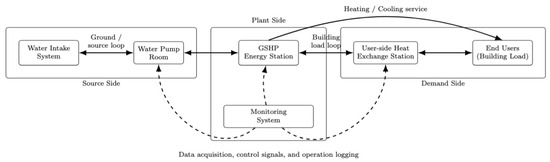
A typical GSHP system comprises buried ground heat exchanger loops, ground-side circulation pumps, heat pump units, chilled-water circulation pumps, and terminal air-conditioning equipment. These components form a closed-loop structure of ‘ground heat exchanger–heat pump units–building load’, as schematically illustrated in Figure 1. This configuration represents the fundamental energy transfer path and coupling relationships that govern GSHP system performance during cooling operation.
Figure 1.
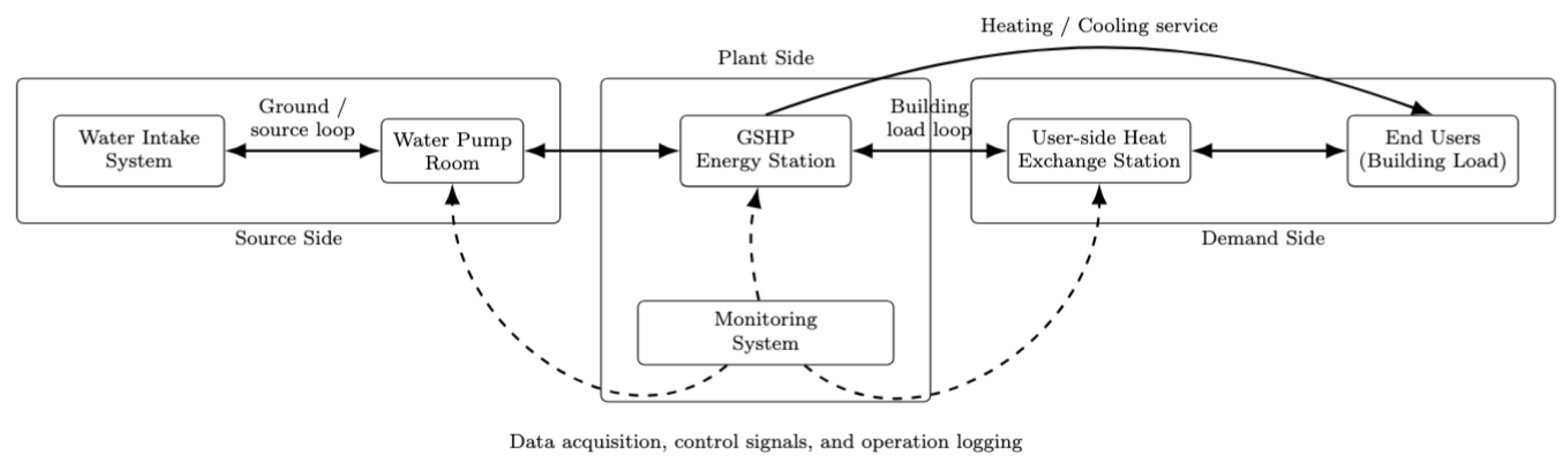
Schematic diagram of a typical ground-source heat pump (GSHP) system, illustrating the source-side loop, plant-side components, and demand-side heat exchange. Bidirectional arrows indicate hydraulic circulation loops, the curved arrow represents the direction of heating/cooling service delivery, and dashed arrows denote data acquisition, control signals, and operational logging.
In this section, a gray-box model of GSHP units (the GSHP-YFU model) and an energy-consumption model of variable-frequency pumps are developed based on the physical mechanisms of GSHP operation, forming the foundation for a multi-parameter cooperative optimization framework. Unlike conventional water-cooled chiller systems, GSHP systems rely on ground heat exchanger loops, and their performance is primarily affected by ground-side inlet and outlet water temperatures, load ratio, and circulation flow rate. These characteristics result in relatively small temperature fluctuations but complex coupling relationships.
To balance modeling accuracy and computational efficiency for optimization-oriented applications, recent advances in HVAC and GSHP modeling are incorporated to construct an engineering-applicable YFU model, which is further integrated with a particle swarm optimization (PSO) algorithm to achieve system-level group-control optimization.
2.2. Gray-Box Model of GSHP Units (GSHP-YFU Model)
2.2.1. Modeling Requirements
Ground-source heat pump (GSHP) systems utilize soil as a heat source during heating operation and as a heat sink during cooling operation. Ground temperature varies only mildly with seasonal changes, but it can exhibit long-term cumulative effects. Therefore, GSHP performance is influenced not only by instantaneous load but also by the evolution of the underground thermal field. To accurately describe unit performance, this study adopts a gray-box modeling approach combining physical mechanisms with data-driven parameter identification. This hybrid method incorporates fundamental thermodynamic laws together with measured engineering data, forming a model framework that is interpretable and suitable for real-time optimization.
The gray-box model for GSHP units must satisfy the following requirements: (1) The coefficient of performance (COP) must reflect simultaneous influences from chilled-water temperature, ground-loop water temperature, and unit part-load ratio (PLR); (2) internal parameters such as evaporating and condensing temperatures cannot be directly measured under practical engineering conditions; therefore, the model must be formulated using measurable quantities; (3) the model must provide sufficiently high prediction accuracy to support real-time optimization and control.
Based on these requirements, the classical YAO universal model [24] is extended and adapted to GSHP operation characteristics, forming the GSHP-YFU model.
2.2.2. Evaporator and Condenser Heat-Transfer Models
The modeling approach follows the principle of using “physically meaningful yet practically measurable parameters,” avoiding unobservable refrigerant-state variables.
- Evaporator Model: The evaporator absorbs heat from the chilled-water loop. Its evaporating temperature depends on the chilled-water return temperature and the water flow rate. The evaporating temperature model is expressed as follows:
- Condenser Model: The GSHP condenser rejects heat into the underground heat-exchanger loop. The condensing temperature depends on the ground-side inlet water temperature and the ground-loop flow rate. The condensing temperature model is expressed as follows:
2.2.3. Gray-Box COP Model for GSHP Units
There are various mathematical models for the energy efficiency of GSHP units, including white-box models, gray-box models, and black-box models. In practical engineering applications, gray-box and black-box models are commonly used, and a gray-box model is adopted in this subsection. The traditional YAO model constructs the COP based on the evaporation temperature, condensation temperature, and load ratio, as shown in Equation (3):
where r is the loading ratio of the chiller and a1 and a2 are empirical factors determined by experimental data.
The generalized YAO model is derived from the first and second laws of thermodynamics, under the assumption that the entropy of the refrigerant remains constant throughout the refrigeration cycle. The model further accounts for the influence of the unit load ratio on the COP. It employs three independent variables—load ratio, evaporating temperature, and condensing temperature—and includes two regression coefficients.
In commonly used gray-box models, the effects of load ratio, chilled-water flow rate, and cooling-water flow rate on the COP of GSHP units are typically not considered. The YAO model incorporates these influential parameters. However, in practical applications, quantities such as evaporating temperature, condensing temperature, heat-transfer coefficients, and heat-exchange areas are often difficult to measure accurately. Moreover, the heat-transfer coefficient is sensitive to variations in water flow rate. For these reasons, the original YAO formulation is revised and simplified in this study, and a new COP model for GSHP units is proposed.
The load ratio reflects the relative magnitude of the cooling demand on the chiller, and the water flow rate is generally positively correlated with the cooling load. Therefore, in the reformulated model, the product of the heat-transfer coefficient and heat-exchange area appearing in Equations (4) and (5) is replaced with a constant that is assumed to vary linearly with the load ratio within a bounded range, as follows:
In the revised formulation, and denote the minimum and maximum values of the empirical constant for the evaporator, respectively; similarly, and denote the minimum and maximum values for the condenser.
Accordingly, Equations (1) and (2) can be rewritten as follows:
Equations (3)–(7) establish a COP model that incorporates the supply and return temperature of chilled water, the inlet and outlet temperature of cooling water, and the chilled and cooling water flow rates. This model is hence named the YFU model.
2.2.4. Power Model of the GSHP Unit
The power consumption of the GSHP unit is determined by the cooling load and the coefficient of performance (COP), as expressed in Equation (8):
where is the heat pump unit power (kW).
2.3. Energy Consumption Model of Variable-Frequency Pumps
Pumps provide the circulation power for chilled water and ground-loop water in GSHP systems and constitute one of the most energy-intensive components aside from the heat pump units themselves. Because building loads fluctuate with weather and internal heat gains, constant-speed pumps often operate under high-flow, low-temperature-difference conditions in which the actual temperature difference falls below the design value, resulting in significant pumping energy waste. To support an optimal control scheme, this subsection develops a mathematical energy-consumption model for variable-frequency pumps.
2.3.1. Single Variable-Frequency Pump
The hydraulic output power of a single pump is expressed as follows:
where is the hydraulic output power of the pump (kW), is water density (kg/m3), is gravitational acceleration (m/s2), is the pump head (mH2O), and is the volume flow rate (m3/h). These parameters characterize the pump’s energy conversion capability.
The head–flow characteristic of the water pump can be approximated by a quadratic expression:
The electrical input power of the pump should account for pump efficiency, motor efficiency, and variable-frequency drive (VFD) efficiency:
where denote the pump, motor, and VFD efficiencies, respectively.
For motors rated above 18.375 kW, the motor efficiency is expressed as a function of the speed ratio k, as follows:
where k is the ratio of actual to rated motor speed.
Similarly, the VFD efficiency is given by the following equation:
According to pump affinity laws, the relationships between flow rate, head, and rotational speed n under two operating conditions can be expressed by Equation (14):
The key parameters H, can be expressed as functions of flow rate. The pump input power is reformulated as a polynomial of real-time flow rate:
where is a coefficient identified by field data.
2.3.2. Parallel Variable-Frequency Pumps
Parallel pump operation is adopted when the flow requirement exceeds the capacity of a single pump or when redundancy is needed for reliability. For n set of pumps operating in parallel, the total system flow rate equals the sum of the individual flow rates, while all pumps share the same head:
Under temperature-difference-based control, flow-regulating valves remain fixed, allowing system hydraulic resistance to be treated as constant. The relationship between head and flow rate is as follows:
where S is the system hydraulic resistance coefficient.
The head–flow characteristic of each pump in parallel can be rewritten as follows:
which provides the basis for determining flow distribution under parallel operation.
Although the total input power of n set of pumps can be theoretically derived by solving Equations (9)–(19) simultaneously, this approach is computationally intensive and sensitive to uncertainties in system hydraulic resistance. Therefore, for engineering applicability, the total power consumption is modeled as the summation of single-pump models:
where are identified from measured data under different pump staging and operating conditions. This formulation enables real-time optimization and integration into system-level cooperative control strategies.
2.4. Optimization Strategies for GSHP System
2.4.1. Overall Optimization Problem Formulation of the GSHP System
The ground-source heat pump (GSHP) system considered in this study consists of GSHP units, chilled-water circulation pumps, ground-side circulation pumps, and terminal heat exchangers. The overall system energy performance is determined by the combined effects of GSHP unit staging, load allocation, supply water temperature, and circulation flow rates. These decision variables are strongly coupled through thermodynamic and hydraulic relationships, resulting in a highly nonlinear and constrained optimization problem.
The primary optimization objective is to minimize the total system energy consumption while satisfying terminal cooling or heating demand and ensuring safe and stable system operation. The total system power consumption is composed of the power consumption of GSHP units, chilled-water pumps, and ground-side circulation pumps, and can be expressed as
where , , and denote the power consumption of the GSHP units, chilled-water pumps, and ground-side circulation pumps, respectively.
From an optimization perspective, the GSHP system involves both discrete and continuous decision variables, as follows.
Discrete variables:
- On/off states of GSHP units;
- On/off states (or operating numbers) of chilled-water pumps;
- On/off states (or operating numbers) of ground-side circulation pumps.
Continuous variables:
- Chilled-water supply temperature;
- Chilled-water circulation flow rate;
- Ground-side circulation flow rate.
The coexistence of discrete and continuous variables renders the GSHP system optimization problem a mixed-integer nonlinear programming (MINLP) problem.
The optimization is subject to multiple physical and operational constraints, which are summarized as follows.
- Cooling-load balance constraint:
- Chilled-water temperature constraints:
- Ground-side temperature constraints:
- Flow-rate constraints:
- GSHP unit and pump operational constraints:
GSHP units and pumps must satisfy minimum on/off time requirements, minimum part-load ratio constraints, and rated capacity limits to ensure operational safety and equipment protection.
Optimization decomposition strategy: Due to the high dimensionality and mixed-variable nature of the problem, directly solving the full MINLP formulation would lead to excessive computational complexity. To ensure computational feasibility while preserving optimization accuracy, a hierarchical decomposition strategy is adopted.
The optimization problem is decomposed into two coordinated stages:
- Discrete optimization stage, in which the on/off combinations of GSHP units and circulation pumps as well as the load allocation among the running GSHP units, are determined;
- Continuous optimization stage, in which the chilled-water supply temperature and circulation flow rates are optimized under fixed unit and pump configurations.
Due to the strong coupling among GSHP units with respect to on/off control, load allocation, supply-water temperature, and circulation flow rates, the overall optimization problem constitutes a high-dimensional mixed-integer nonlinear programming (MINLP) problem with complex constraints. Directly solving the complete MINLP formulation would impose excessive computational burden and limit its applicability in real-time engineering practice.
To address this challenge, a hierarchical two-stage cooperative optimization strategy is adopted in this study. In the first stage, discrete decision variables—including the on/off states of GSHP units and circulation pumps, as well as load allocation among operating units—are optimized using combinatorial logic and exhaustive search. In the second stage, continuous operational variables, such as the chilled-water supply temperature and ground-side circulation flow rate, are globally optimized under fixed on/off configurations using particle swarm optimization (PSO).
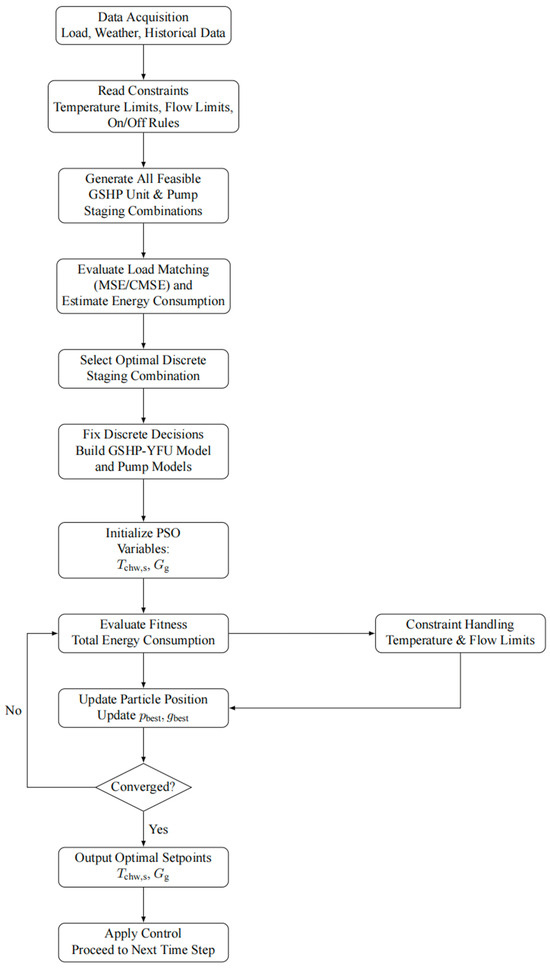
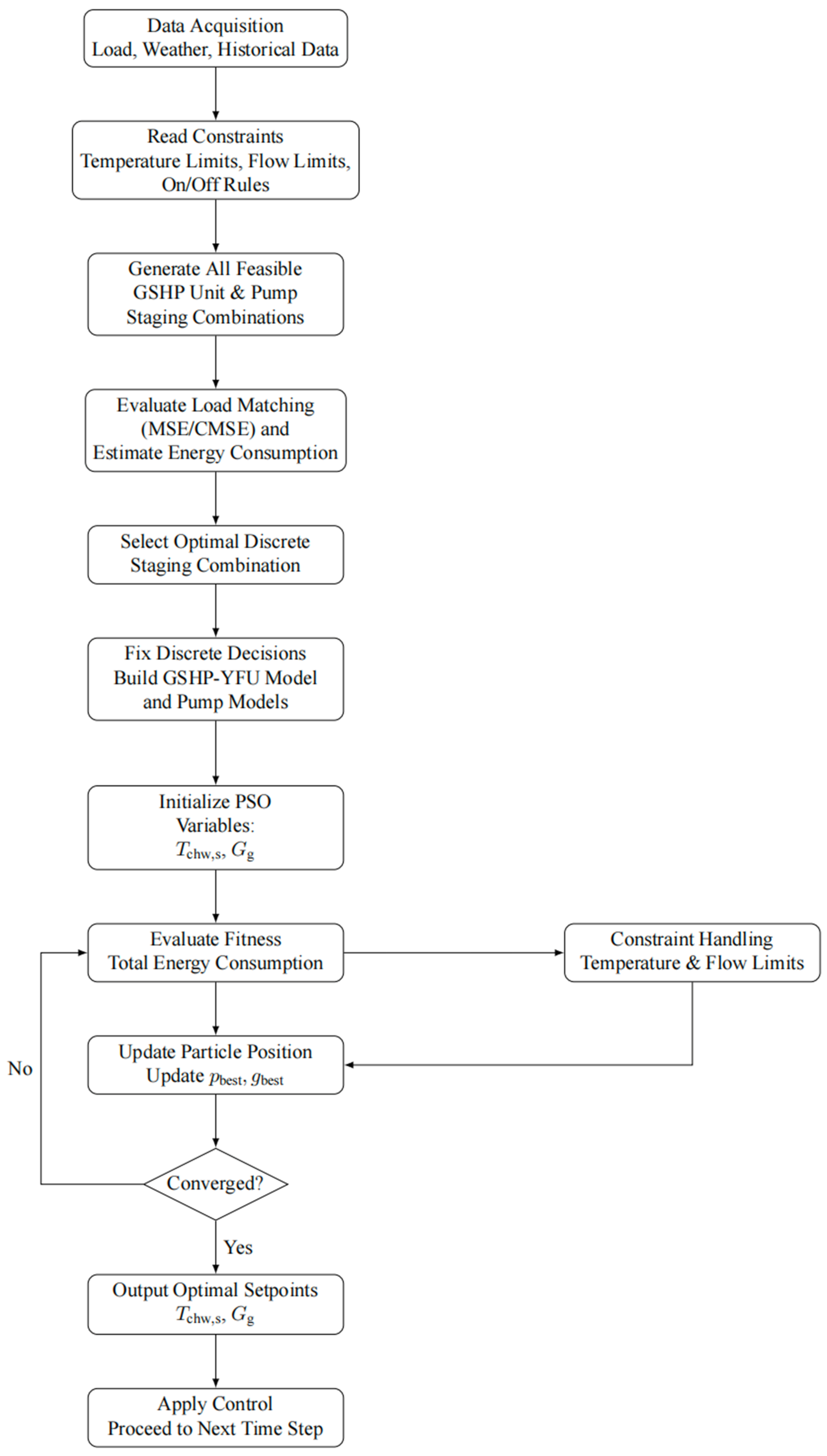
This two-stage strategy effectively decouples combinatorial on/off control decisions from continuous nonlinear optimization, significantly reducing computational complexity while preserving solution quality. The overall framework of the proposed optimization strategy is illustrated in Figure 2.
Figure 2.
Two-stage cooperative optimization framework for the GSHP system.
2.4.2. GSHP Unit On/Off Control and Load Allocation
As a key component of the discrete optimization stage described in Section 2.4.1, this subsection discusses the coupled optimization of GSHP unit on/off control and load allocation. Conventional on/off control strategies for ground-source heat pump (GSHP) units usually rely on fixed load thresholds or predefined staging sequences, while load allocation among operating units is treated independently, typically following equal-load or equal-load-ratio principles. Such decoupled control logic neglects the fact that GSHP units exhibit different efficiency characteristics under varying load levels, which often leads to suboptimal operating conditions and limits the achievable system efficiency.
To address this issue, this study proposes a coupled optimization strategy for GSHP unit on/off control and load allocation, aiming to maximize the system-level coefficient of performance (COP) while satisfying the terminal cooling or heating demand. The core idea is to coordinate unit staging and load distribution simultaneously, allowing different GSHP units to operate at different load levels so that as many units as possible remain close to their high-efficiency regions.
Based on the performance curves of individual GSHP units, the optimal load ratio corresponding to the maximum COP of each unit is identified. A Combined Mean Squared Error (CMSE) index is then defined to quantify the deviation between the actual load ratios of operating units and their respective optimal load ratios. A smaller CMSE indicates that the overall operating state of the GSHP system is closer to its optimal efficiency envelope.
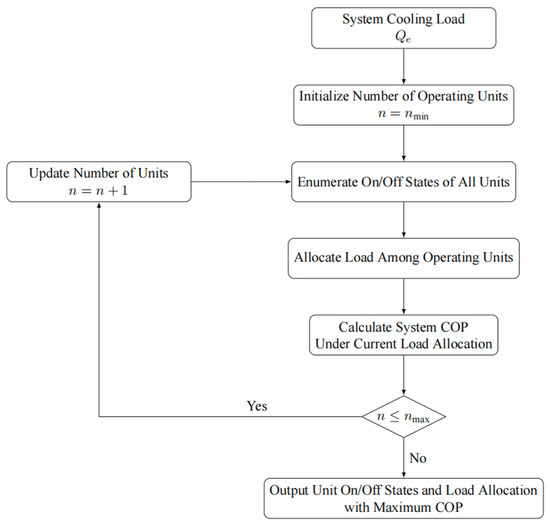
The overall coupled optimization procedure is illustrated in Figure 3.
Figure 3.
COP-based unit staging and load allocation optimization procedure.
First, according to the real-time system cooling or heating load, the minimum number of GSHP units required to meet the demand is determined. For a given number of operating units, all possible unit on/off combinations are enumerated using an exhaustive search. For each candidate combination, a load allocation procedure is performed, and the corresponding system COP is calculated. The unit combination and load allocation scheme yielding the maximum system COP are retained as the optimal solution. The number of operating units is then increased incrementally, and the above process is repeated until all feasible configurations have been evaluated.
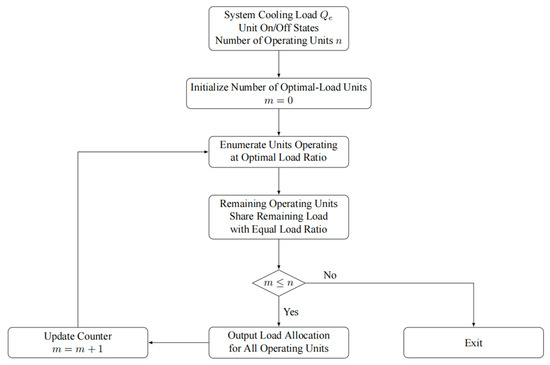
Within each candidate on/off configuration, the detailed load allocation procedure is conducted within the discrete optimization stage shown in Figure 4. A subset of GSHP units is allowed to operate at their optimal load ratios, while the remaining units share the residual load. Load allocation schemes that result in negative unit loads are discarded. When no unit is assigned to operate at its optimal load ratio, an equal-load-ratio allocation is adopted to avoid excessively low load levels that would cause severe COP degradation. Through this coupled optimization of unit staging and load allocation, inefficient operating conditions such as “large units serving small loads” or “small units overloaded by large demands” are effectively avoided, leading to a higher average system COP and reduced energy consumption associated with frequent on–off cycling.
Figure 4.
Inner-loop load allocation procedure under fixed unit staging.
2.4.3. Optimization of Chilled-Water and Ground-Side Pump On/Off Control
The objective of the optimized on/off control strategy for chilled-water pumps and ground-side circulation pumps is to minimize the total pump power consumption while satisfying the system flow-rate requirements. By optimally determining the operating status of each pump, unnecessary pump operation can be avoided and overall pump-system energy efficiency can be improved. The optimization problem is formulated with the total pump power consumption as the objective function, expressed as follows:
where is a binary variable indicating the operating status of , is the flow rate of , and () denotes the power consumption of as a function of its flow rate.
In this formulation, the total system flow rate must satisfy the required demand, which is determined by the cooling or heating load of the GSHP system. The flow rate of each pump is constrained within its allowable operating range, defined by the minimum and maximum flow-rate limits of the pump.
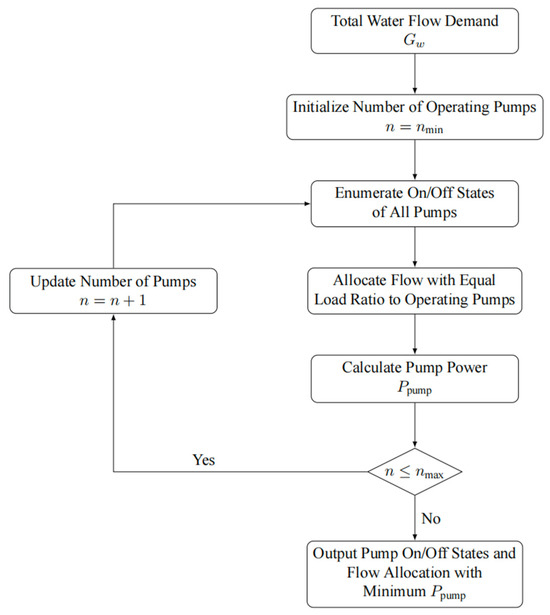
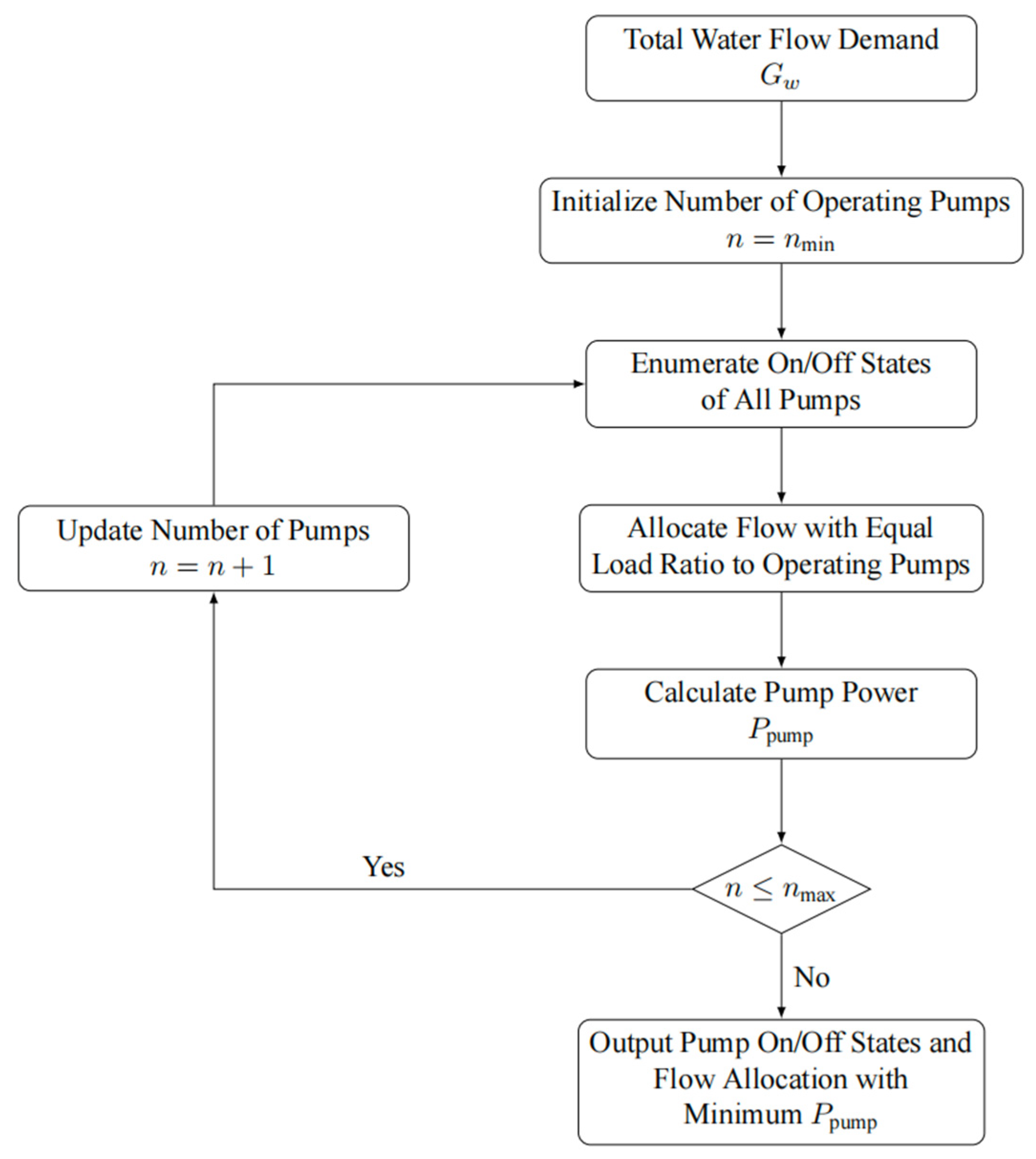
The optimization procedure for pump on/off control is implemented as follows. First, based on the required system flow rate, the minimum number of pumps necessary to meet the demand is determined and set as the initial number of operating pumps. For a given number of operating pumps, all possible pump on/off combinations are enumerated using an exhaustive search method. Since the pumps operate in parallel and are of identical or similar types, equal load ratio (equal flow-rate ratio) allocation is adopted for the operating pumps to ensure consistent head conditions and to prevent adverse hydraulic phenomena such as reverse flow caused by head mismatch.
For each candidate on/off configuration, the total pump power consumption is calculated based on the assigned flow rates. If the total pump power under the current configuration is lower than the previously recorded minimum value, the current pump on/off configuration is recorded as the optimal solution. When the number of operating pumps is smaller than the total number of installed pumps, the number of operating pumps is increased by one, and the above enumeration and evaluation process is repeated. Finally, the pump on/off configuration and corresponding flow-rate distribution that yield the minimum total pump power consumption are obtained, which are then used to determine the operating frequency of each pump. The detailed optimization procedure of the pump on/off control strategy is illustrated in Figure 5.
Figure 5.
Pump staging and flow allocation optimization procedure based on minimum power consumption.
2.4.4. Determination of the Optimal Staging Combination Based on Start–Stop Strategies
Following the optimization logic described in Section 2.4.1 and Section 2.4.2, the first stage of the proposed framework identifies feasible staging combinations for GSHP units and circulation pumps. The objective is to determine combinations that satisfy cooling-load requirements while minimizing total system energy consumption. The process consists of three steps.
- Construction of the feasible on/offsets: Considering minimum on/off time constraints, minimum part-load ratios, motor capacity limits, and operational safety requirements, a complete set of feasible unit start–stop combinations is generated.
- Load-matching-based combination screening: For each candidate combination, the mean squared error (MSE) between the operating point and the optimal efficiency region of each GSHP unit is calculated. This metric is used to select one or several candidate staging combinations that best match the prevailing load.
- Optimal pump-staging selection: Based on the head–flow characteristics of parallel pumps, the power consumption under different numbers of operating pumps is estimated. The staging combination that satisfies the target flow rate with the minimum energy consumption is selected.
The output of this first stage includes the following:
- The optimal on/off combination of GSHP units;
- The optimal number of operating chilled-water pumps;
- The optimal number of operating ground-side circulation pumps. These discrete decision variables serve as fixed boundary conditions for the second-stage PSO optimization.
2.4.5. PSO-Based Continuous Variable Optimization Using the Gray-Box Model
Once the unit and pump staging strategies have been determined, particle swarm optimization (PSO) is applied to perform global optimization of continuous operational variables. The optimization objective is to minimize the total system energy consumption while satisfying terminal cooling-load requirements and maintaining stable system operation.
The total system energy consumption is defined as the sum of the power consumption of GSHP units, chilled-water pumps, and ground-side circulation pumps. Operational constraints include limits on chilled-water supply temperature, ground-loop inlet temperature, temperature differences across heat exchangers, and allowable flow-rate ranges. To reduce problem dimensionality and improve computational efficiency, a hierarchical variable-selection strategy is adopted.
In the chilled-water loop, the supply chilled-water temperature is selected as the optimization variable, while the return temperature is treated as an uncontrollable variable determined by load conditions. In the ground-side loop, the circulation flow rate is selected as the optimization variable, whereas inlet and outlet temperatures are constrained by soil thermal characteristics. Continuous variables are optimized using PSO, while discrete variables are fixed based on the results of Stage 1. This hybrid optimization strategy ensures both computational efficiency and high-quality solutions for GSHP system operation.
3. Case Study
3.1. System Equipment Overview
3.1.1. Configuration of Cooling Source Equipment
The chilled-water plant of the Liuzhou Fengqing Port commercial complex is located in an independent area on the first floor of the building, fully isolated from other functional zones. The cooling-source subsystem is equipped with three DunAn ground-source heat pump (GSHP) units. Among these, one large-capacity unit provides a cooling capacity of 2627 kW and a rated power of 507 kW, while the other two smaller units each provide a cooling capacity of 2388 kW and a rated power of 364 kW.
The associated hydronic network includes four chilled-water pumps and four ground-loop circulation pumps, all operating under variable-frequency control. Each pump has a rated power of 75 kW, a design flow rate of 460 m3/h, and a head of 37 m. The chilled-water supply temperature is normally fixed as 9 °C.
The GSHP system operates year-round, and the annual operating cost is estimated using an average electricity tariff of 0.8 RMB/kWh. The annual load profile indicates approximately 90 days of high-load operation and 120 days of low-load operation. Based on on-site investigations and operational records, the GSHP System Equipment Parameter Table (Table 1) is compiled.
Table 1.
Equipment parameters of the GSHP system.
3.1.2. Current Status of Variable-Frequency Pump Control
All chilled-water and ground-loop circulation pumps are equipped with ABB variable-frequency drives (VFDs), enabling continuous modulation of pump speed. The control architecture consists of a centralized group-control panel and an electrical power cabinet, which together facilitate integrated control of GSHP units, pumps, and plate heat exchangers. This control infrastructure provides a reliable foundation for the subsequent implementation of AI-based group-control optimization.
3.1.3. System Operation and Data Acquisition
The GSHP system undergoes frequent start–stop cycles and wide variations in cooling load throughout the year. The system’s critical operational variables—including chilled-water supply and return temperatures, ground-side inlet and outlet temperatures, flow rates, pump and unit power consumption, and ambient temperature—are continuously monitored and recorded through on-site sensors. These measurements form a full-spectrum dataset that captures the system’s behavior across all operating conditions and serves as the basis for model training and parameter identification.
3.2. Model Development and Parameter Identification
Based on the GSHP-YFU model and the gray-box pump models introduced in Section 2, parameter identification is performed using measured operational data from the Liuzhou Fengqing Port GSHP system. Prior to model calibration, the dataset undergoes preprocessing, including outlier removal, segmentation according to load level, and imputation of missing values, ensuring data quality and improving the effectiveness of model fitting.
Subsequently, the least-squares method is applied to identify the model parameters. The resulting parameter sets allow the GSHP unit and pump models to accurately reflect equipment energy efficiency characteristics under varying operating conditions, and the results are presented in Table 2.
Table 2.
Model parameters of the GSHP-YFU units.
For the chilled-water pumps operating in parallel, separate parameter sets are identified for one, two, three, and four-pump operating scenarios, resulting in four corresponding gray-box pump models. Each model follows the cubic polynomial form described in Section 2, and the fitted coefficients are summarized in Table 3.
Table 3.
Model parameters of chilled-water pumps under different operating modes.
The ground-loop circulation pumps operate in series with the GSHP units and do not interfere with one another. Therefore, parameter identification is conducted individually for each pump, and the results are presented in Table 4.
Table 4.
Model parameters of ground-loop circulation pumps.
After parameter identification, the prediction accuracy of the proposed GSHP-YFU model was further evaluated using measured operational data. The modeled coefficient of performance (COP) was compared with field measurements under different load conditions. Considering the strong load dependency of GSHP system performance, a load-ratio-based grouping strategy was adopted for model evaluation. The quantitative prediction accuracy of the GSHP-YFU model is summarized in Table 5. The results show that the GSHP-YFU model achieves an RMSE of approximately 0.22 and a coefficient of variation (CV) of about 3.5%, indicating satisfactory prediction accuracy and robustness for optimization-oriented control applications.
Table 5.
Prediction accuracy of the GSHP-YFU model.
3.3. Simulation Platform and Performance Validation
To evaluate the effectiveness of the proposed multi-parameter cooperative optimization strategy, an integrated simulation platform is developed for the GSHP cooling-source system of the Liuzhou Fengqing Port commercial complex. The platform is constructed based on measured operational data and the identified gray-box models of GSHP units and pumps, enabling dynamic simulation of system operation, component-level power calculation, real-time cooperative optimization, and quantitative assessment of energy-saving performance.
Two representative operating scenarios are designed for comparative analysis during the cooling season:
- a conventional non-optimized operation mode, in which the chilled-water supply temperature is fixed at 9 °C, pump frequency is maintained at 50 Hz, and no load-adaptive control is applied; and
- an AI-based group-control optimization mode, in which chilled-water supply temperature and circulation flow rates are dynamically adjusted using the proposed optimization framework.
3.3.1. Performance Under Low-Load Operating Conditions
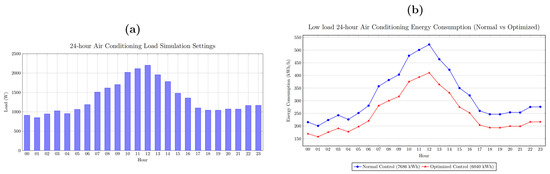
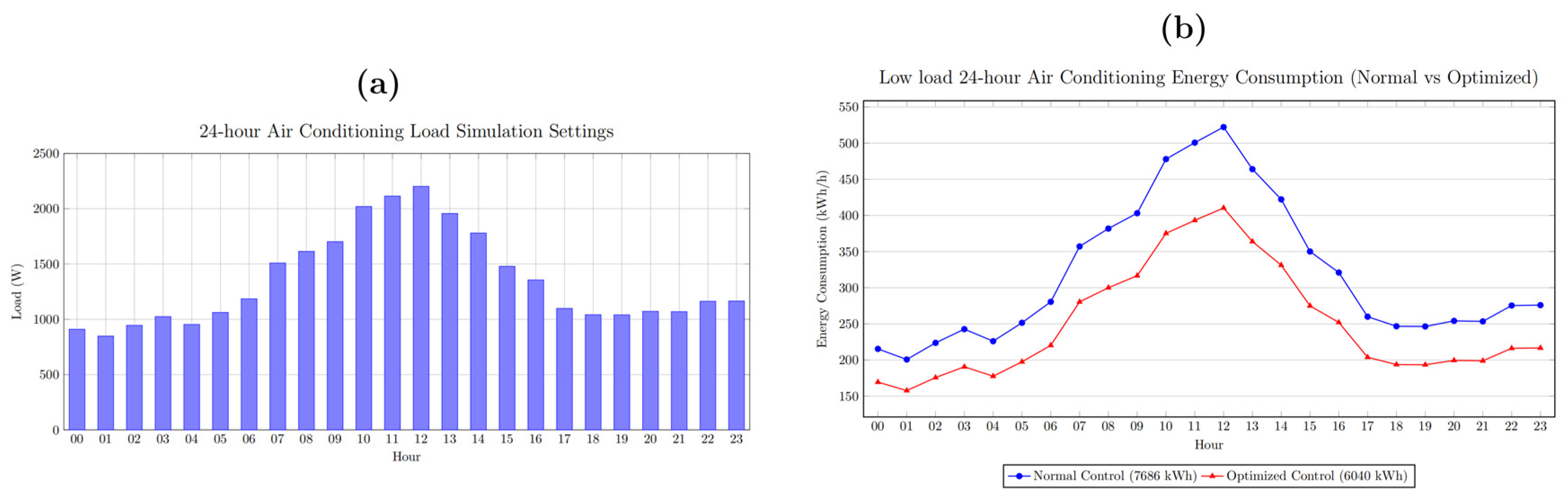
Figure 6a illustrates the system cooling-load profile under typical low-load operating conditions during the cooling season. Based on this load characteristic, Figure 6b compares the system energy consumption before and after the application of the AI-based optimization strategy.
Figure 6.
System performance under low-load operating conditions during the cooling season: (a) cooling-load variation; (b) comparison of energy consumption before and after AI-based optimization.
Simulation results indicate that under low-load conditions, the proposed control strategy effectively coordinates GSHP unit staging and pump operation, thereby maintaining system operation close to the high-efficiency region. As a result, unnecessary unit cycling and redundant pump operation are significantly reduced. Quantitative analysis shows that the optimized control achieves an average daily energy-saving rate of 21.4%, corresponding to a daily electricity saving of 1646 kWh. Assuming an electricity tariff of 0.8 RMB/kWh, the resulting daily cost reduction is approximately RMB 1316.
3.3.2. Performance Under High-Load Operating Conditions
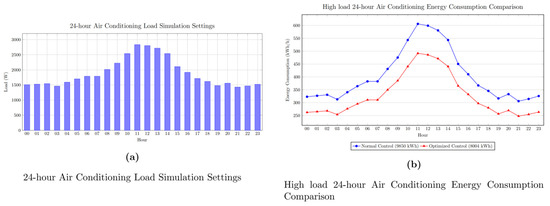
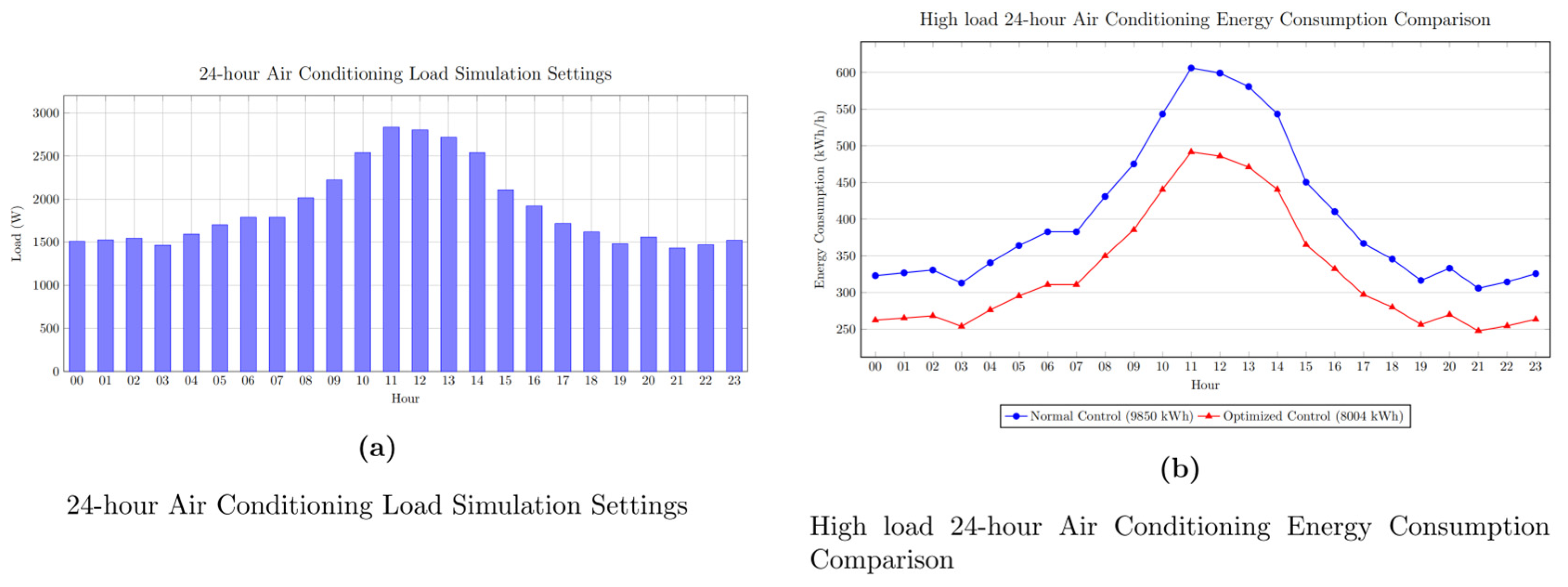
Figure 7a presents the cooling-load variation of the GSHP system under typical high-load operating conditions. Figure 7b shows the corresponding comparison of system energy consumption between conventional control and AI-based optimized control.
Figure 7.
System performance under high-load operating conditions during the cooling season: (a) cooling-load variation; (b) comparison of energy consumption before and after AI-based optimization.
Despite the significantly increased cooling demand under high-load conditions, the proposed optimization strategy remains effective in reducing total system energy consumption through real-time adjustment of chilled-water supply temperature and ground-loop circulation flow rate. The simulation results indicate that the system achieves an average daily energy-saving rate of 18.7% under high-load conditions, with a daily electricity saving of 1841 kWh. At an electricity price of 0.8 RMB/kWh, this corresponds to a daily cost saving of approximately RMB 1472.
3.3.3. Annual Energy-Saving Potential
Based on the annual operating profile of the Liuzhou Fengqing Port GSHP system, approximately 120 days of low-load operation and 90 days of high-load operation are assumed. Using the simulated daily energy-saving results, the total annual electricity saving of the cooling-source subsystem can be estimated as follows:
With an average electricity tariff of 0.8 RMB/kWh, the corresponding annual cost saving is approximately RMB 2.91 × 10⁵. These results demonstrate the significant energy-saving potential and practical applicability of the proposed AI-based cooperative optimization strategy for large-scale GSHP systems.
3.4. Field Implementation and Measured Energy-Saving Performance of AI-Based Optimization Control
After completing the modeling and simulation-based validation of the proposed optimization strategy, the AI-based cooperative optimization control was deployed to the cooling and heating source system of the Liuzhou Fengqing Port project for on-site verification. A continuous field test lasting approximately two months was conducted to evaluate the actual energy-saving performance under real operating conditions.
The AI control platform adopts a programmable logic controller (PLC) as the execution layer.
Operating data from ground-source heat pump (GSHP) units and pumps are acquired through standard industrial communication protocols, while optimized control setpoints—including unit start–stop scheduling, variable-frequency pump control, and supply-water temperature adjustment—are issued in real time. The overall control architecture forms a closed-loop structure consisting of data acquisition, model prediction, optimization decision, and command execution, enabling the optimization algorithm to continuously adapt to changing operating conditions in practice.
3.4.1. Test Methodology and Baseline Configuration
Energy-saving performance was evaluated using an alternating-day experimental method, in which one day of AI-based control was followed by one day of conventional (non-AI) control. The test period spanned from 19 September to 17 November 2024. Daily electricity consumption was used as the primary evaluation metric.
Under the non-AI baseline condition, system settings were configured as follows. In September, the chilled-water supply temperature was fixed at 10 °C, with the ground-side circulation pumps operating at 44 Hz and the chilled-water pumps at 50 Hz. During October and November, the chilled-water supply temperature remained at 10 °C, both pump types operated at a fixed frequency of 50 Hz, and the cooling tower ran at constant speed. These baseline settings reflect typical conventional control strategies without load-adaptive optimization.
3.4.2. Energy-Saving Performance of the Cooling System
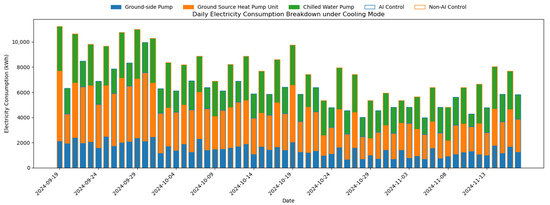
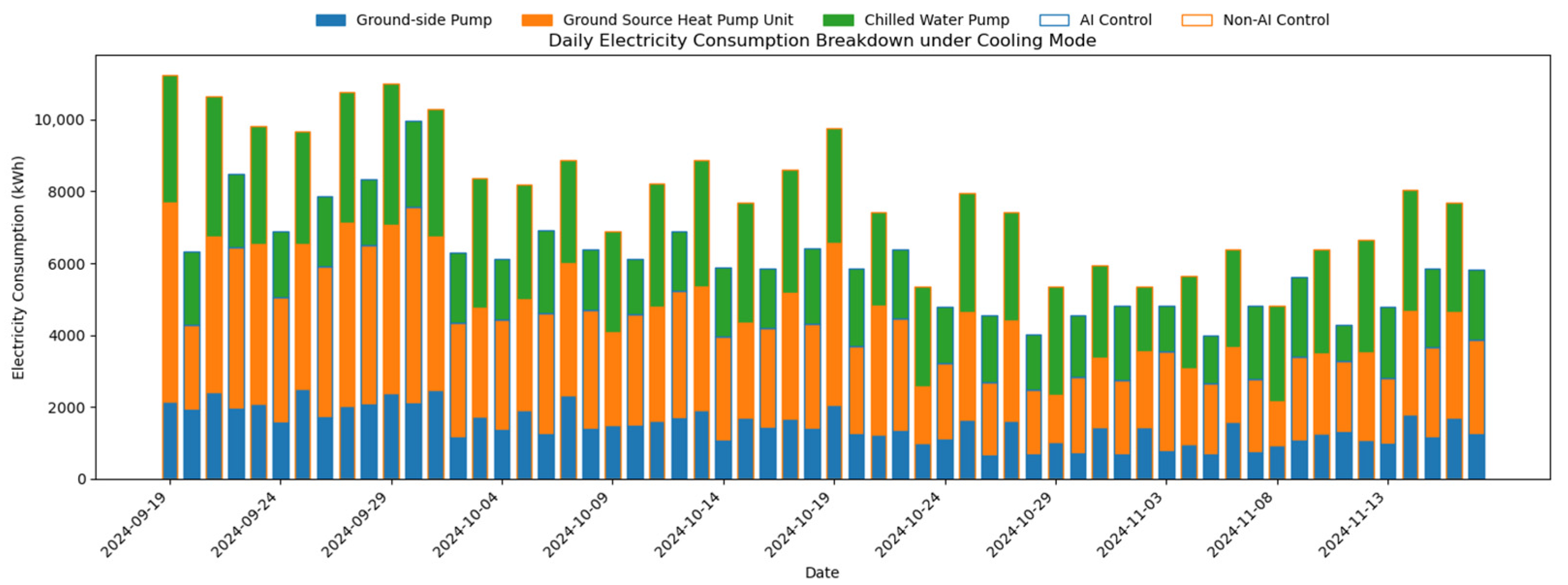
Figure 8 presents the comparative results of daily electricity consumption for the cooling system under AI-based control and conventional operation during the test period. In September, the AI-based strategy achieved energy-saving rates of 17.4% for the ground-side circulation pumps, 12.5% for the GSHP units, and 43.7% for the chilled-water pumps, resulting in an overall system energy-saving rate of 24.1%.
Figure 8.
Daily electricity consumption breakdown of the cooling system under different control strategies. Each stacked bar represents the total daily electricity consumption, consisting of ground-side circulation pumps, ground-source heat pump units and chilled-water pumps. Bars outlined in blue indicate AI-based control, while those outlined in orange indicate conventional (non-AI) operation.
In October, the energy-saving performance further improved, with the ground-side pump energy-saving rate increasing to 29.5%, while the chilled-water pumps maintained a stable saving rate of 42.2%. The overall system energy-saving rate reached 25.8%. As the system entered a low-load operating regime in November, the total system energy-saving rate remained at 21.8%, and the chilled-water pumps continued to exhibit a substantial energy-saving rate of 33.3%. These results indicate that the AI-based control strategy maintains robust performance across varying load conditions.
3.4.3. Energy-Saving Performance of the Heating System
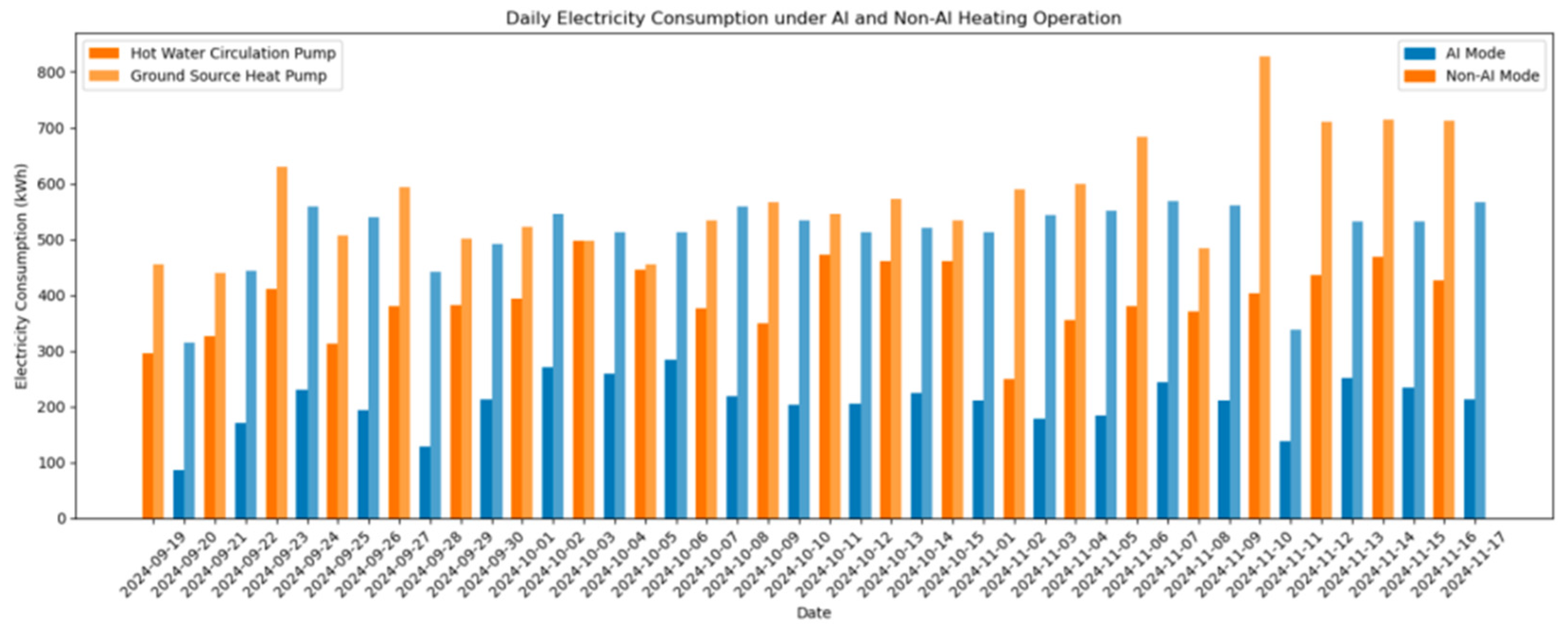
The measured energy-saving performance of the heating system during the same test period is shown in Figure 9. For the No. 1 hot-water heat pump unit, the AI-based control strategy achieved system-level energy-saving rates of 27.2%, 23.7%, and 21.8% in September, October, and November, respectively.
Figure 9.
Measured energy-saving performance of the heating system under AI-based control during the test period from September to November.
Throughout the entire heating test period, the chilled-water pumps consistently exhibited high energy-saving rates ranging from 39% to 51%. This sustained performance demonstrates the strong capability of the AI-based optimization strategy in continuously optimizing variable-flow operation, even under changing seasonal and load conditions.
3.4.4. Field Test Results
Based on the comprehensive multi-condition field test results, the AI-based control system achieved an average energy-saving rate of 24.1% during the cooling season and 24.2% during the heating season, with the chilled-water pumps identified as the primary contributors to overall energy reduction. Notably, even during low-load and transitional seasons, the system maintained an energy-saving rate exceeding 21.8%, demonstrating the stability, robustness, and strong potential for large-scale application of the proposed AI-based cooperative optimization strategy.
4. Conclusions
This study investigates the intelligent optimization of ground-source heat pump (GSHP) systems for large commercial buildings, taking the Liuzhou Fengqing Port commercial complex as a representative case. A comprehensive AI-based group-control optimization framework founded on gray-box modeling is proposed to address the long-standing issues of rigid operational strategies, insufficient equipment coordination, and suboptimal energy efficiency in conventional GSHP system operation. The main conclusions are summarized as follows.
- A gray-box performance modeling method for GSHP units is developed based on thermodynamic principles and measured operational data. By extending and reformulating the classical YAO model, the proposed GSHP-YFU model accurately captures the coupled effects of load ratio, chilled-water temperature, ground-loop temperature, and flow rate on the coefficient of performance (COP), while maintaining strong interpretability and suitability for real-time engineering applications.
- Energy consumption models for both single and parallel variable-frequency pumps are established using data-driven identification techniques. These models effectively characterize the nonlinear relationship between pump power consumption and real-time flow rate under different staging conditions, providing a reliable foundation for system-level hydraulic optimization.
- A multi-parameter cooperative optimization strategy is proposed, integrating GSHP unit start–stop scheduling, load allocation, pump-staging optimization, and continuous–variable regulation. To efficiently handle the coexistence of discrete and continuous decision variables, a two-stage hierarchical optimization framework is designed, in which discrete staging decisions are determined first, followed by particle swarm optimization (PSO)for continuous operational variables. This structure significantly reduces computational complexity while ensuring global optimization performance.
- An integrated simulation platform is constructed based on measured data and the developed gray-box models to validate the proposed optimization strategy under different operating conditions. Simulation results indicate that the AI-based optimization strategy achieves average daily energy-saving rates of 21.4% under low-load conditions and 18.7% under high-load conditions during the cooling season, demonstrating strong robustness across varying load regimes.
- Field implementation and alternating-day on-site testing further confirm the practical effectiveness of the proposed strategy. The AI-based control system achieves average energy-saving rates of 24.1% in the cooling season and 24.2% in the heating season, with chilled-water pumps identified as the primary contributors to energy reduction. Even during low-load and transitional periods, the system consistently maintains energy-saving rates exceeding 21.8%. The seasonal coefficient of performance (SCOP) of the GSHP system is improved from approximately 3.2 to above 4.0, corresponding to an annual electricity saving of more than 3.6 × 10⁵ kWh.
- Overall, the proposed AI-based cooperative optimization framework demonstrates strong engineering applicability, stability, and scalability. It provides a reusable technical paradigm for intelligent energy-saving retrofits of GSHP systems in large commercial buildings and contributes to the advancement of low-carbon building operation under the dual-carbon targets.
Despite the promising results, several aspects warrant further investigation. Future work will focus on improving the scalability of the proposed optimization framework by replacing the current exhaustive search strategy in the discrete decision stage with more efficient solution methods, such as genetic algorithms or mixed-integer particle swarm optimization, to enable application to larger-scale GSHP systems. In addition, longer-term field tests covering multiple seasons, together with soil temperature profiling, will be conducted to further evaluate the long-term thermal behavior of ground heat exchangers and the effectiveness of thermal imbalance mitigation under practical operating conditions.
Author Contributions
Conceptualization, K.W.; Methodology, Z.S. and Y.Y.; Software, Z.S. and Y.Y.; Formal analysis, K.W. and Y.Y.; Investigation, K.W., Z.S. and Y.Y.; Resources, K.W. and Y.Y.; Data curation, Z.S.; Writing—original draft, Z.S.; Writing—review & editing, Y.Y.; Supervision, Y.Y.; Project administration, K.W. All authors have read and agreed to the published version of the manuscript.
Funding
This research was funded by the Key R&D Program of Guangxi Province, Grant No. 2024AB02026.
Data Availability Statement
The original contributions presented in the study are included in the article, further inquiries can be directed to the corresponding author.
Conflicts of Interest
Author Kui Wang was employed by the company Guangxi Guiwu Jin’an Refrigeration and Air-Conditioning Technology Co., Ltd. and Guangxi Guiwu Energy Saving Co., Ltd. The remaining authors declare that the research was conducted in the absence of any commercial or financial relationships that could be construed as a potential conflict of interest.
References
- China Academy of Building Energy Efficiency. China Building Energy Consumption and Carbon Emission Research Report (2023); China Academy of Building Energy Efficiency: Beijing, China, 2024. [Google Scholar]
- Research Institute of Urban Construction, Department of Chongqing University. China Building Energy Consumption and Carbon Emission Research Report (2023); Chongqing University: Chongqing, China, 2024. [Google Scholar]
- Guo, S.Y.; Jiang, Y.; Hu, S. The pathways toward carbon peak and carbon neutrality in China’s building sector. Chin. J. Urban Environ. Stud. 2022, 10, 2250011. [Google Scholar] [CrossRef] [Scilit]
- Maghrabie, H.M.; Abdeltwab, M.M.; Tawfik, M.H.M. Ground-source heat pumps (GSHPs): Materials, models, applications, and sustainability. Energy Build. 2023, 299, 113560. [Google Scholar] [CrossRef] [Scilit]
- Adebayo, P.; Jathunge, C.B.; Darbandi, A.; Fry, N.; Shor, R.; Mohamad, A.; Wemhöner, C.; Mwesigye, A. Development, modeling, and optimization of ground source heat pump systems for cold climates: A comprehensive review. Energy Build. 2024, 320, 114646. [Google Scholar] [CrossRef] [Scilit]
- Spitler, J.D.; Gehlin, S. Measured performance of a mixed-use commercial-building ground source heat pump system in Sweden. Energies 2019, 12, 2020. [Google Scholar] [CrossRef] [Scilit]
- Zhi, C.Q.; Zhou, X.; Hong, X.Y.; Wang, A.X.; Ye, W.; Zhang, X.; Chen, H.X. Field study of the long-term performance and reliability of large-scale ground source heat pump systems applied to a mixed-use complex of buildings. Renew. Energy 2025, 241, 122344. [Google Scholar] [CrossRef] [Scilit]
- Bisengimana, E.; Zhou, J.Z.; Binama, M.; Zhao, K.M.; Abbas, S.; Yuan, Y.P. The frosting and soil imbalance performance issues of building heat pumps: An overview. Energy Build. 2022, 273, 112387. [Google Scholar] [CrossRef] [Scilit]
- Li, W.X.; Li, X.D.; Wang, Y.; Tu, J.Y. An integrated predictive model of the long-term performance of ground source heat pump (GSHP) systems. Energy Build. 2018, 159, 309–318. [Google Scholar] [CrossRef] [Scilit]
- Bina, S.M.; Fujii, H.; Kosukegawa, H.; Inagaki, F. A predictive model of long-term performance assessment of ground source heat pump (GSHP) systems in Japanese regions. Geothermics 2024, 119, 102955. [Google Scholar] [CrossRef] [Scilit]
- Liu, J.; Wang, F.H.; Gao, Y.; Zhang, Y.P.; Cai, W.L.; Wang, M.; Wang, Z.H. Influencing factors analysis and operation optimization for the long-term performance of medium-deep borehole heat exchanger coupled ground source heat pump systems. Energy Build. 2020, 226, 110385. [Google Scholar] [CrossRef] [Scilit]
- Li, J.L.; Qi, X.P.; Li, X.L.; Huang, H.J.; Gao, J. Coupled study on the building load dynamics and thermal response of ground sources in shallow geothermal heat pump systems under severe cold climate conditions. Modelling 2025, 6, 63. [Google Scholar] [CrossRef] [Scilit]
- Alavy, M.; Shirazi, P.; Rosen, M.A. Long-term energy performance of thermal caisson geothermal systems. Energy Build. 2023, 292, 113152. [Google Scholar] [CrossRef] [Scilit]
- Ma, W.T.; Kim, M.K.; Hao, J.L. Numerical simulation modeling of a GSHP and WSHP system for an office building in the hot summer and cold winter region of China: A case study in Suzhou. Sustainability 2019, 11, 3282. [Google Scholar] [CrossRef] [Scilit]
- Wang, J.L.; Yan, T.; Tang, X.; Pan, W.G. Design and operation of hybrid ground source heat pump systems: A review. Energy 2025, 316, 134537. [Google Scholar] [CrossRef] [Scilit]
- Noye, S.; Martinez, R.M.; Carnieletto, L.; De Carli, M.; Aguirre, A.C. A review of advanced ground source heat pump control: Artificial intelligence for autonomous and adaptive control. Renew. Sustain. Energy Rev. 2022, 153, 111685. [Google Scholar] [CrossRef] [Scilit]
- Cupeiro Figueroa, I.; Picard, D.; Helsen, L. Short-term modeling of hybrid geothermal systems for model predictive control. Energy Build. 2020, 215, 109884. [Google Scholar] [CrossRef] [Scilit]
- Hou, G.Y.; Taherian, H.; Li, L.J.; Fuse, J.; Moradi, L. System performance analysis of a hybrid ground source heat pump with optimal control strategies based on numerical simulations. Geothermics 2020, 86, 101849. [Google Scholar] [CrossRef] [Scilit]
- Zhou, K.; Mao, J.F.; Li, Y.; Zhang, H.; Chen, S.Y.; Chen, F. Thermal and economic performance of horizontal ground source heat pump systems with different flowrate control methods. J. Build. Eng. 2022, 53, 104554. [Google Scholar] [CrossRef] [Scilit]
- Li, Y.F.; O’Neill, Z.; Zhang, L.; Chen, J.L.; Im, P.; DeGraw, J. Grey-box modeling and application for building energy simulations: A critical review. Renew. Sustain. Energy Rev. 2021, 146, 111174. [Google Scholar] [CrossRef] [Scilit]
- Afram, A.; Janabi-Sharifi, F. Gray-box modeling and validation of residential HVAC system for control system design. Appl. Energy 2015, 137, 134–150. [Google Scholar] [CrossRef] [Scilit]
- Fu, Q.M.; Chen, X.Y.; Ma, S.A.; Fang, N.W.; Xing, B.; Chen, J.P. Optimal control method of HVAC based on multi-agent deep reinforcement learning. Energy Build. 2022, 270, 112284. [Google Scholar] [CrossRef] [Scilit]
- Zhao, Z.H.; Wang, C.L.; Wang, B.L. Adaptive model predictive control of a heat pump-assisted solar water heating system. Energy Build. 2023, 300, 113682. [Google Scholar] [CrossRef] [Scilit]
- Yao, Y.; Yu, Y. Modeling and Control in Air-Conditioning Systems; Springer: Berlin/Heidelberg, Germany, 2017. [Google Scholar]

Disclaimer/Publisher’s Note: The statements, opinions and data contained in all publications are solely those of the individual author(s) and contributor(s) and not of MDPI and/or the editor(s). MDPI and/or the editor(s) disclaim responsibility for any injury to people or property resulting from any ideas, methods, instructions or products referred to in the content. |
© 2026 by the authors. Licensee MDPI, Basel, Switzerland. This article is an open access article distributed under the terms and conditions of the Creative Commons Attribution (CC BY) license.