1. Introduction
Covering 70.8% of the Earth’s surface, the ocean is the ecosystem on the planet and holds vast wealth, including biological and mineral resources. It represents a new frontier for humanity to address resource shortages, climate change, and national security challenges. To effectively explore this complex and harsh environment, various underwater vehicles—including human-occupied vehicles, remotely operated vehicles, and autonomous underwater vehicles (AUVs)—have been widely applied in fields such as marine environmental observation, seabed topographic mapping, and underwater infrastructure maintenance [
1,
2].
Under the current strategic framework of the “Smart Ocean”, AUVs, as core carriers for deep-sea detection and operation, are undergoing a profound shift in mission paradigms: evolving from the early “short-duration, near-shore, single-survey” mode (e.g., the experimental application of SPURV in 1957) to a complex “full-ocean-depth, trans-oceanic, and clustered” mode [
3]. AUVs are no longer viewed merely as consumable detection tools but are endowed with the new role of intelligent nodes capable of “long-term residency” [
4,
5]. When performing tasks such as subsea oil and gas pipeline inspection, black box searching, or mid-ocean ridge hydrothermal vent monitoring, AUVs often need to operate continuously for weeks or even months. This demand for long-cycle missions, combined with the integration of high-power payloads such as synthetic aperture sonar and robotic arms, directly exacerbates the contradiction between energy supply and demand.
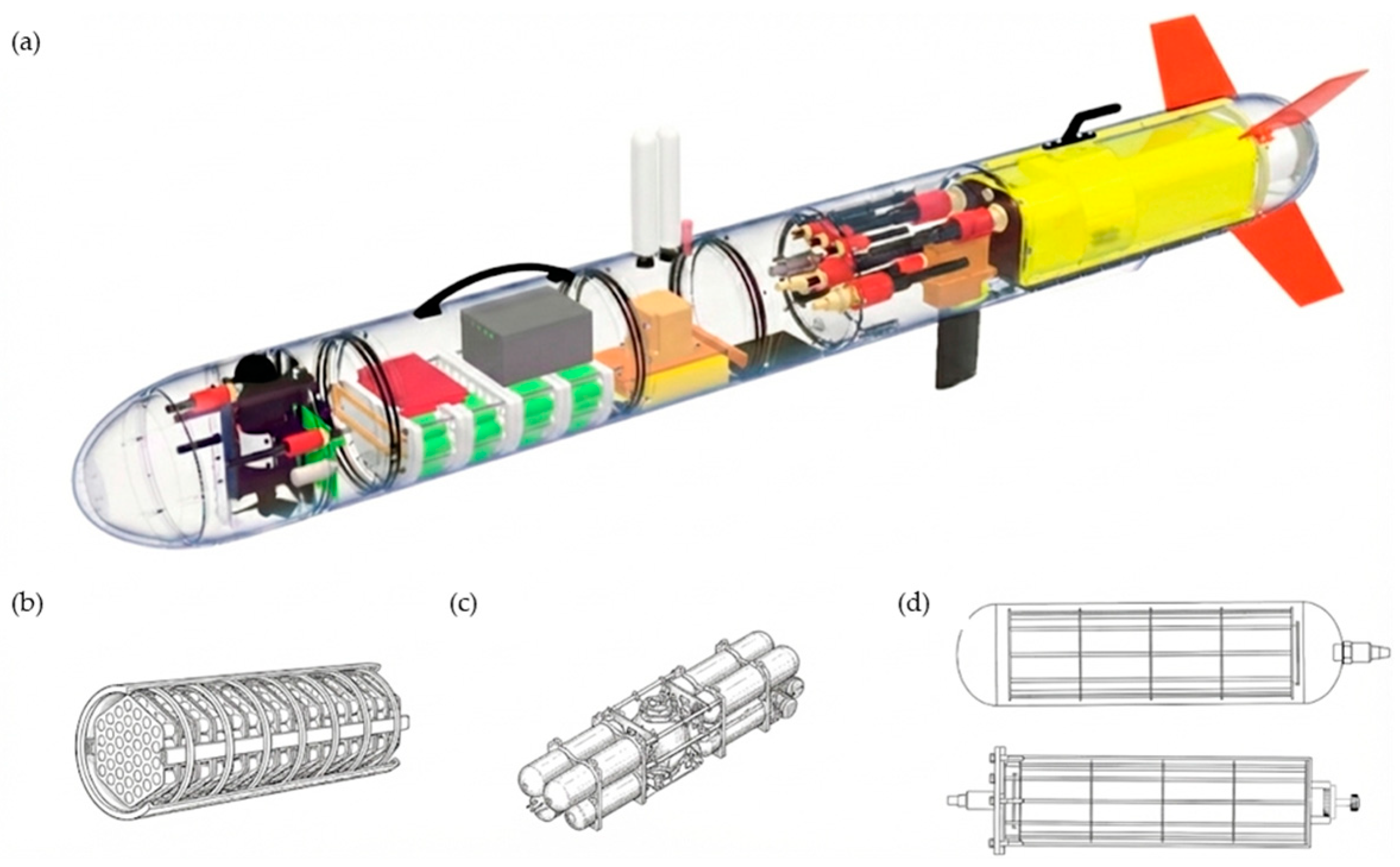
Figure 1 illustrates the internal components of an AUV and compares three different energy systems used to power it.
Distinct from terrestrial electric vehicles or aerospace vehicles, the design of underwater energy systems faces severe multi-physics coupling constraints imposed by the deep-sea environment. The immense hydrostatic pressure, strictly neutral buoyancy requirements, and thermodynamic conflicts within confined spaces create a unique set of engineering challenges. These factors do not act in isolation but result in a non-linear amplification of system weight and energy consumption, creating a bottleneck that surpasses navigation and control in constraining the performance leap of deep-sea equipment.
This fundamental physical requirement—to withstand the hydrostatic pressure of approximately 10 MPa per 1000 m—forces battery packs to be housed within heavy pressure hulls, which necessitates the addition of high-density syntactic foam for buoyancy compensation, thereby creating a cascading increase in total vehicle displacement [
6]. This leads to a sharp increase in the system’s total displacement, subsequently increasing the fluid wetted surface area and navigation drag, ultimately causing the energy gains from added batteries to be offset by their own weight and the incremental drag. Furthermore, the deep-sea environment typically maintains a constant low temperature of 0 to 4 °C, leading to reduced electrochemical reaction activity; conversely, during high-power missions (such as high-speed evasion), the internal thermally insulated space of the vehicle faces the risk of heat accumulation. This thermodynamic contradiction of “external extreme cold, internal heat accumulation” further increases the complexity of energy system design [
7,
8].
Facing these physical limits, existing energy technology solutions all seek compromises between energy density, power density, and safety. Electrochemical energy storage (particularly lithium-ion batteries), with its mature industrial chain and rapid power response, has established its current dominance. However, limited by the intercalation reaction mechanism, the cell energy density is approaching its theoretical ceiling, and after accounting for pressure-resistant packaging, the system-level specific energy often drops significantly to 100–150 Wh/kg [
9,
10]. As an alternative, high-energy chemical power sources (such as fuel cells) theoretically offer endurance far exceeding lithium batteries by decoupling energy storage and power generation units. However, the lack of atmospheric oxygen underwater forces the system to carry oxidants, and the efficient storage of oxidants and water–thermal management issues under closed-end operation modes severely limit their system reliability [
11,
12,
13]. Thermal power and nuclear technologies (such as Stirling engines and heat pipe reactors) provide a very high energy base suitable for large heavy-duty platforms, but their mechanical noise compromises the stealth of AUVs, and high costs and nuclear safety risks limit their widespread application [
14,
15]. Additionally, environmental energy harvesting technologies, such as ocean thermal energy and wave energy, aim to achieve “infinite endurance”, but the intermittency and randomness of their energy input make them difficult to use as primary propulsion, rendering them suitable only for low-power gliders or as auxiliary energy sources [
16,
17].
Although research on underwater energy has grown exponentially in recent years, existing review articles are mostly limited to a single technical dimension. For example, some literature focuses only on the microscopic modification of battery materials, ignoring the impact of deep-sea pressure on macroscopic packaging structures; others focus on algorithmic simulations of energy management strategies (EMS), lacking consideration of complex hydrodynamic environments and physical constraints. In view of this, this paper aims to integrate insights from materials science, fluid dynamics, and control theory. Adopting a system-level perspective, it provides a comprehensive review of underwater vehicle energy technologies. The core contribution of this paper lies in systematically sorting out four categories of technologies from mature lithium batteries to frontier nuclear energy, specifically revealing the microscopic influence mechanisms of deep-sea high-pressure and low-temperature environments on various energy conversion efficiencies; focusing on the discussion of system architecture design under the non-linear amplification effect, as well as thermodynamic and mass balance challenges within confined spaces; and combining the latest progress in artificial intelligence to analyze the potential of data-driven algorithms like deep reinforcement learning in handling underwater uncertain environments and achieving global energy efficiency optimization [
18,
19].
This paper first establishes an evaluation system and system architecture classification grounded in deep-sea physical constraints, followed by a detailed elaboration of the key modeling, simulation, and experimental testing technologies underpinning research in this field. Building upon this methodological foundation, this paper systematically evaluates the current status of mainstream technologies—including lithium-ion batteries, fuel cells, thermal/nuclear power, and environmental energy harvesting—and deeply dissects the deep-sea multi-physics coupling mechanisms that constrain their performance. Finally, this paper summarizes the critical challenges facing the overall system and outlines future directions for technological evolution.
2. Deep-Sea Physical Constraints and System Architecture Design
The design of energy systems for AUV is essentially a multi-objective optimization problem under severe physical constraints. Unlike terrestrial electric vehicles or aerospace vehicles that pursue simple lightweighting, the specificity of the underwater environment—especially the hydrostatic pressure that increases linearly with depth, strictly neutral buoyancy constraints, and heat/mass exchange limitations within confined spaces—dictates that its energy system must follow a unique set of engineering evaluation systems and architecture classification standards [
20,
21].
2.1. Deep-Sea Physical Constraints and Non-Linear Amplification Effect
The primary physical constraint imposed by the deep-sea environment on energy systems comes from the coupling effect of hydrostatic pressure and buoyancy equilibrium. According to the foundational theory of Parametric Analysis for submersible design established in 1990, underwater vehicles must strictly adhere to the principle of neutral buoyancy during design, meaning the total weight of the vehicle must equal the weight of the seawater it displaces.
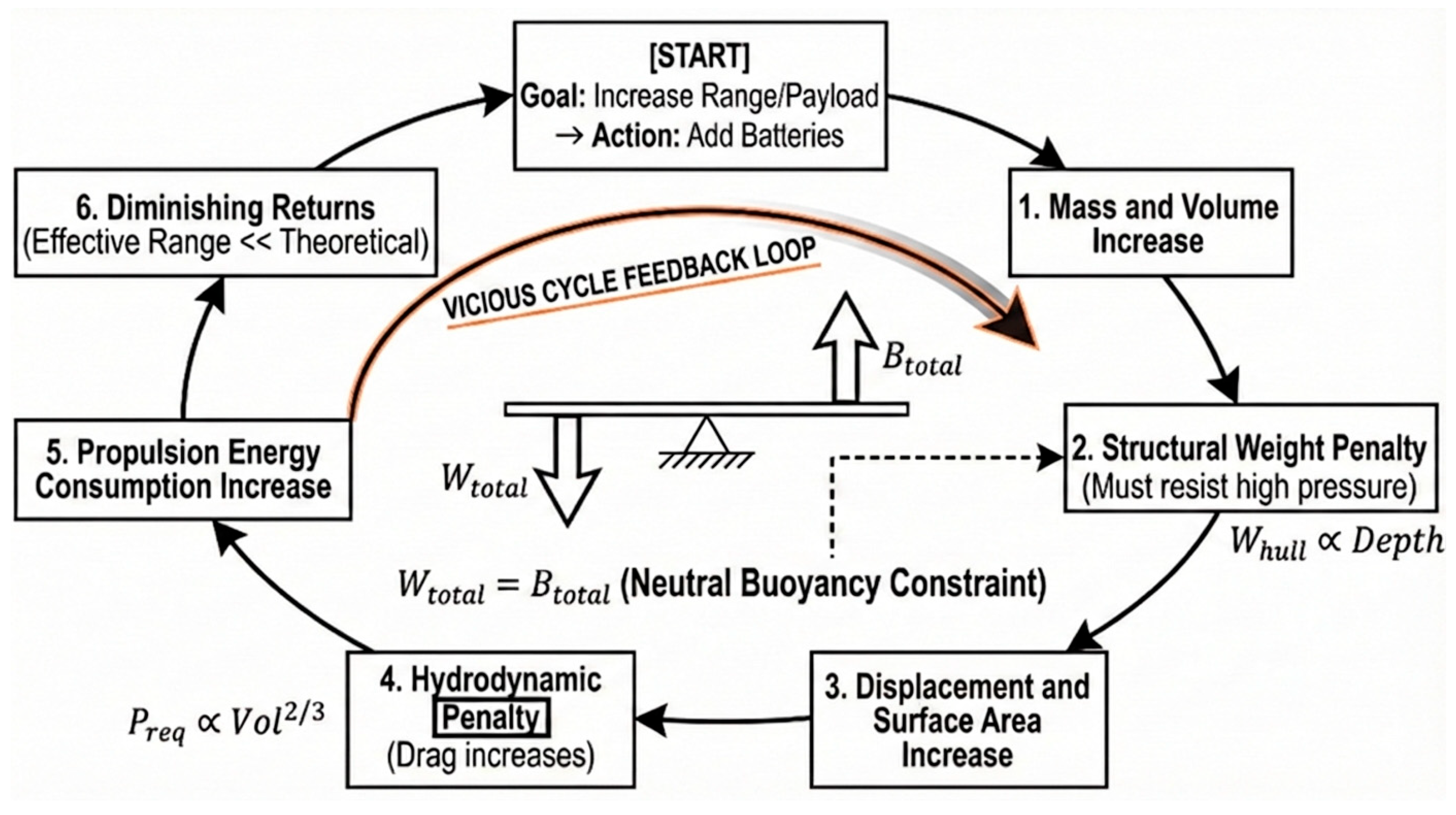
As shown in
Figure 2, adding batteries to increase an AUV’s range triggers a "vicious cycle" of increased mass, structural weight, and drag, ultimately leading to diminishing returns. This fundamental physical requirement induces a critical “Non-linear Weight Amplification Effect”. To withstand the hydrostatic pressure of approximately 10 MPa per 1000 m, energy systems (especially those in closed architectures) require heavy pressure hulls. This added structural weight necessitates the addition of high-density syntactic foam for buoyancy compensation, thereby creating a cascading increase in total vehicle displacement. This leads to a sharp increase in the fluid wetted surface area and navigation drag, ultimately causing the energy gains from added batteries to be significantly offset by their own weight penalty and the incremental power consumption required for propulsion.
Therefore, when evaluating the effectiveness of underwater energy systems, one cannot merely examine the specific energy (Wh/kg) at the cell level, but must introduce the metric of “System-Level Energy Density”. This indicator covers the total weight and volume of the cells, battery management system (BMS), pressure-resistant packaging structure, and necessary buoyancy compensation materials. Research shows that as depth increases, the weight proportion of the pressure-resistant structure rises exponentially, causing the system-level energy density to be significantly lower than the cell-level value [
22].
Additionally, the deep-sea environment presents a thermodynamic contradiction of “external extreme cold, internal heat accumulation”. The ambient temperature of 0 to 4 °C slows down electrochemical reaction kinetics and increases internal resistance; conversely, during high-power missions, the internal thermally insulated space faces the risk of heat accumulation. Therefore, a comprehensive evaluation system must also consider capacity retention rates and power output efficiency in complex thermodynamic environments [
23].
2.2. System Architecture Classification
Based on strategies for adaptation to deep-sea high hydrostatic pressure and the mode of material exchange with the external environment, the engineering architecture of underwater energy systems is mainly divided into two categories: closed systems and pressure-balanced/open system.
Closed systems refer to energy devices encapsulated within a rigid pressure hull, operating in a relatively independent atmospheric pressure (1 atm) environment. The technical characteristic of this architecture is its ability to provide a standard working environment similar to land for internal battery cells and electronic components, thereby protecting them from high-pressure seawater and corrosive media.
However, the application of this architecture is strictly constrained by the diminishing displacement-to-weight ratio at extreme depths. Research identifies 2000 m as a critical threshold. When the depth exceeds this value, the wall thickness of the pressure hull must increase significantly to resist the hydrostatic pressure, causing the weight of the structure to occupy a dominant proportion of the system. This leads to a sharp decline in payload capacity and system-level specific energy. Furthermore, as shown in
Table 1, for systems requiring product discharge, such as fuel cells, the closed architecture necessitates solving the storage problem of reaction-generated water within the limited pressure-resistant space, increasing mechanical complexity [
24].
To overcome the weight limit of pressure hulls, pressure-balancing technology (or open systems) emerged. Such systems typically use oil-filled structures, flexible membranes, or piston-type compensators to keep the internal pressure of the system in equilibrium with the external seawater pressure at all times [
22,
25]. Its core advantage lies in eliminating the heavy rigid pressure hull, significantly improving space utilization and system-level specific energy in deep-sea scenarios. For example, pouch battery packs filled with dielectric oil utilize the incompressibility of liquids to transmit external hydrostatic pressure, thereby maintaining structural integrity even in extremely deep waters. However, this architecture faces unique hydrodynamic and micromechanical challenges: the high-viscosity insulating oil filling the interior significantly increases the viscous drag of moving parts like motors, leading to a surge in energy consumption; meanwhile, high hydrostatic pressure at the microscopic level induces mechanical stress on electrode materials, potentially leading to active particle crushing, reduced porosity, and capacity decay [
26,
27]. This requires the cell materials themselves to possess extremely high structural stability.
2.3. Power Source Characteristics
Constrained by the non-linear coupling of fluid drag and carriage capacity, a single type of power source often cannot simultaneously meet the dual tactical indicators of long endurance (high energy demand) and high maneuverability (high power demand) for AUVs. Therefore, based on the characteristics of the Ragone plot, classifying energy sources into energy-dense and power-dense types, and performing reasonable decoupling and matching, is the basis for designing hybrid power systems.
Energy-dense sources are characterized primarily by high specific energy, aiming to support long-cycle underwater cruising missions and bear the system’s base load. Typical representatives include fuel cell systems and metal–water batteries (such as aluminum–water and magnesium–water systems) [
12,
28]. Fuel cells, by carrying high-density chemical fuels, theoretically offer endurance far exceeding that of storage batteries; metal–water batteries utilize seawater as an oxidant, greatly reducing the system’s carried weight. However, such power sources typically suffer from slow dynamic response and limited peak power output, making it difficult to cope with transient load fluctuations [
29].
In contrast, power-dense sources are characterized by high specific power and fast dynamic response, used to meet peak loads during startup, acceleration, communication, and sonar detection. Lithium-ion batteries (especially pouch polymer lithium batteries) and supercapacitors are typical representatives of such power sources [
9]. Although limited by the intercalation reaction mechanism, the energy density of lithium batteries has physical bottlenecks; their mature technology and high charge/discharge rates make them indispensable buffer power sources for AUVs dealing with complex operating conditions [
30]. By reasonably configuring these two types of power sources in the system architecture, the comprehensive effectiveness of the system can be maximized while avoiding their respective shortcomings.
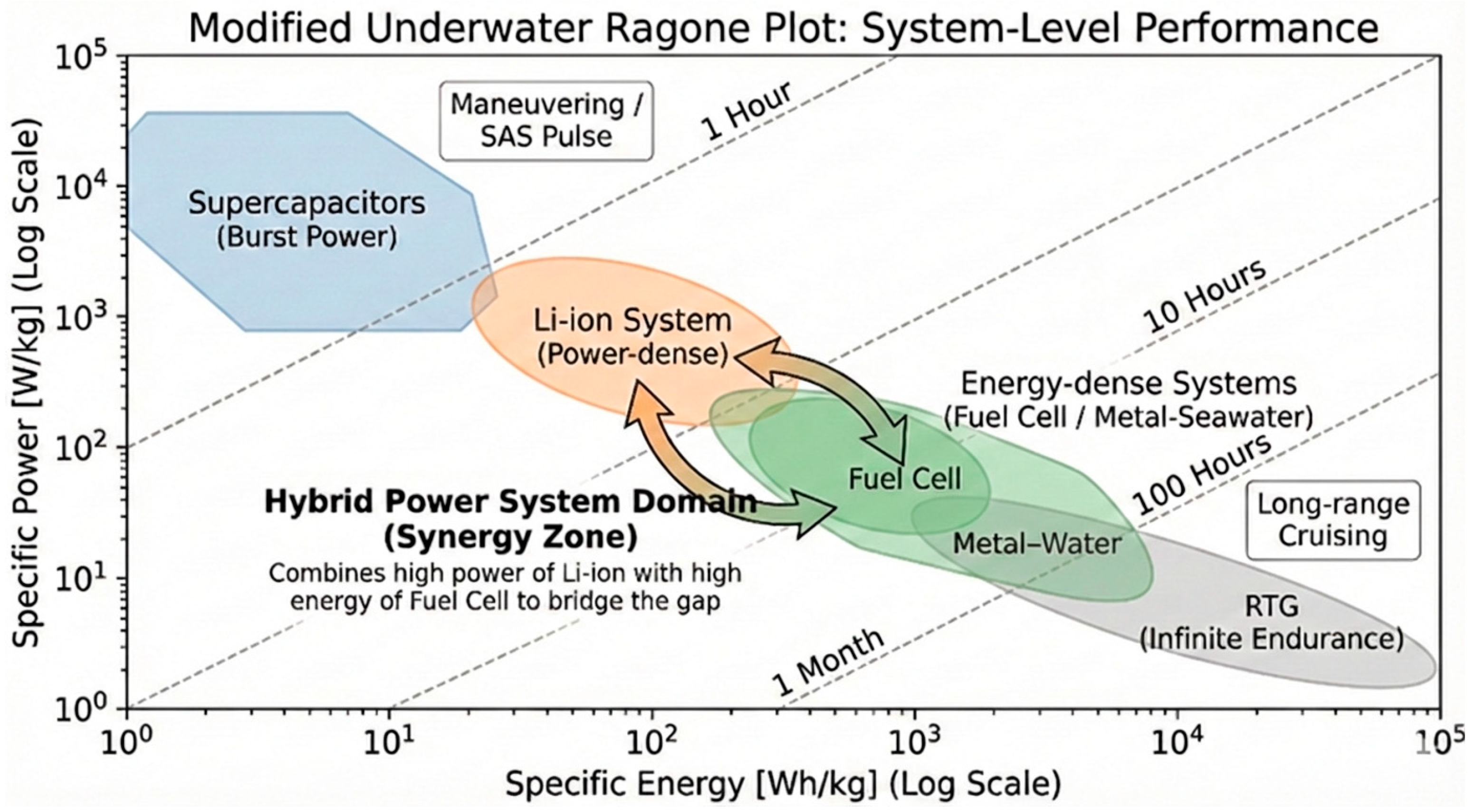
The modified underwater Ragone plot presented in
Figure 3 provides a quantitative visualization of this complementary relationship. Within this coordinate system, where specific energy is plotted on the abscissa and specific power on the ordinate, the diagonal contours represent the continuous discharge duration of the system, clearly delineating the applicability boundaries of distinct technologies. The burst power zone in the upper-left quadrant is dominated by supercapacitors and high-rate lithium-ion batteries, which are well suited for handling minute-level transient maneuvers or synthetic aperture sonar pulse loads, yet their low specific energy renders them insufficient for sustaining long-duration missions. In contrast, the long-endurance cruising zone in the lower-right quadrant is occupied by fuel cells, metal–water batteries, and radioisotope thermoelectric generators; while these technologies can support long-range cruising spanning days to months, they are constrained by relatively low specific power, making it difficult to respond to sudden load surges. Furthermore, the bidirectional arrow region in the center of the plot illustrates the synergistic design domain for hybrid power systems, demonstrating that by coupling power-dense lithium-ion batteries with energy-dense fuel cells, the system can effectively bridge the performance gap left by single technologies within the medium-power, medium-to-long-endurance mission interval of 10 to 100 h, thereby achieving simultaneous optimization of both energy density and power density.
3. Key Modeling, Simulation, and Experimental Testing Technologies
The research and development of underwater energy systems involve the cross-coupling of multiple physical fields such as electrochemistry, fluid dynamics, heat transfer, and solid mechanics. Given the inaccessibility of the deep-sea environment and the high cost of real-sea trials, constructing high-fidelity numerical simulation models and refined laboratory simulation test platforms is the core technical pathway to reveal failure mechanisms and achieve optimized system design. This chapter will systematically elucidate the mainstream numerical simulation methods and experimental testing technologies currently applied in underwater energy research.
3.1. Multi-Physics Coupling Numerical Simulation Technology
Numerical simulation technology aims to predict the response characteristics of energy systems under extreme deep-sea conditions by solving systems of partial differential equations. Depending on the research scale, current research mainly covers three key dimensions: microscopic mechano-electrochemical coupling simulation, fluid–thermal coupling simulation, and system-level energy management simulation. As shown in the
Table 2, four distinct simulation methods—ranging from finite element analysis to digital Twins—are compared based on their computational advantages, inherent limitations, and specific applications in system modeling.
Targeting the impact of deep-sea high hydrostatic pressure on the microstructure of batteries, the finite element method has become the current mainstream microscopic analysis tool. This method, by discretizing the mesh on a geometric model, achieves a strong coupling solution of solid mechanics equilibrium equations and electrochemical transport equations. At the microscopic scale, researchers typically use porous medium theory to describe the composite structure of electrodes and introduce pressure-dependent constitutive models to simulate the lattice distortion and crushing behavior of active particles under high-pressure environments. The simulation process requires simultaneous solving of the diffusion equation of lithium ions in the solid phase and the migration equation in the liquid phase, applying hydrostatic pressure as a stress tensor boundary condition to the model surface, thereby quantifying the non-linear effect of pressure-induced porosity reduction on ionic conductivity.
At the thermal management level, the enclosed design of underwater vehicles makes heat dissipation a typical conjugate heat transfer problem, and computational fluid dynamics (CFD) is the key means to solve this. By solving the Navier–Stokes equations and energy conservation equations, CFD technology can simulate the complex temperature field distribution within the closed pressure-resistant space. In setting deep-sea simulation boundary conditions, the exterior is usually set to a constant low temperature and high convective heat transfer coefficients, while the interior faces special conditions of quasi-adiabatic or restricted natural convection. This technology is mainly used to evaluate the heat accumulation effect of battery packs during high-power discharge and to optimize the heat dissipation structure design.
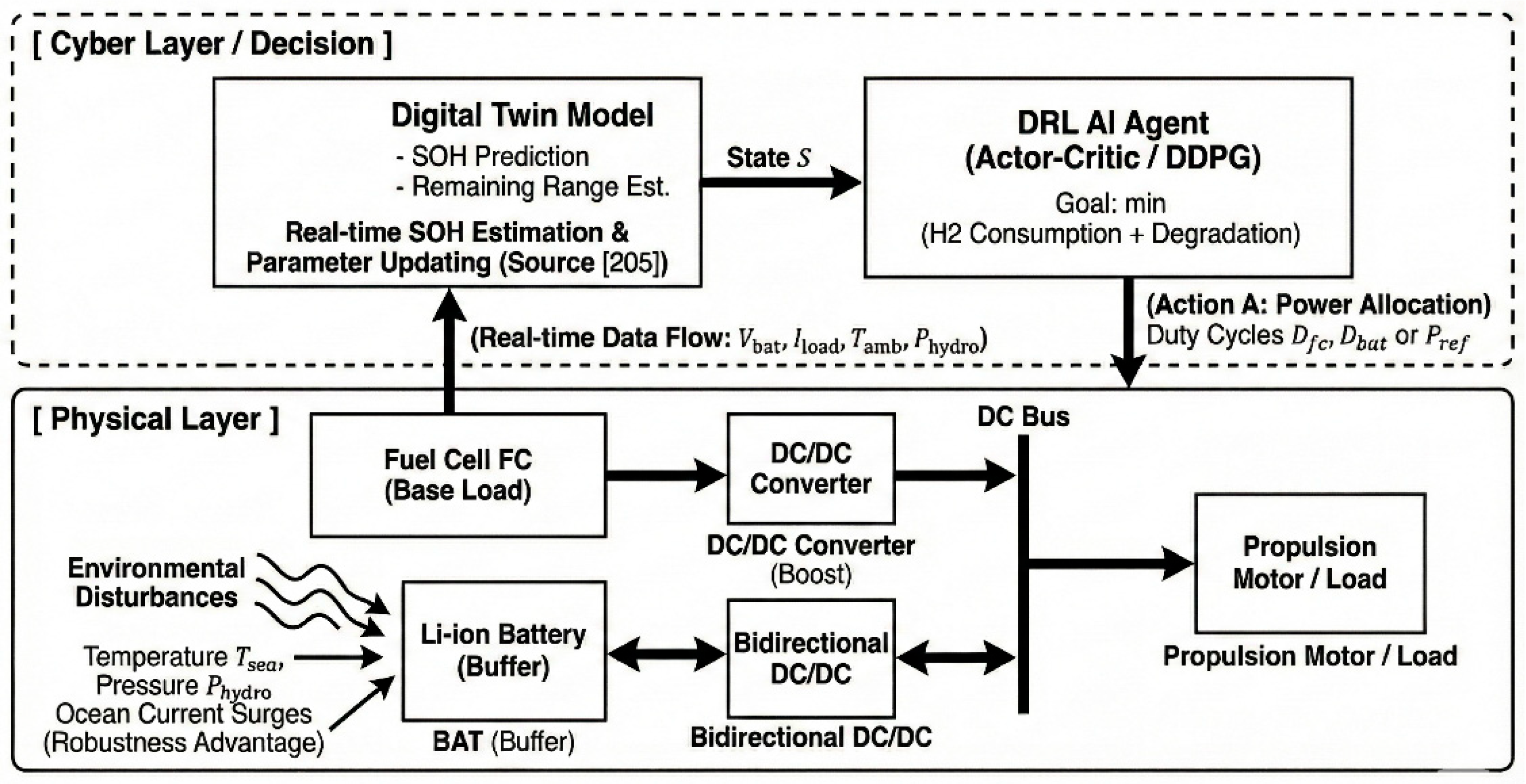
To achieve global energy efficiency optimization at the full-vehicle level, model-based design methods are used to construct system-level models covering propulsion, payload, and energy systems. Commonly used models include the computationally efficient equivalent circuit model and the physically more explicit pseudo-two-dimensional model. In recent years, digital twin technology combined with deep reinforcement learning has gradually emerged. This technology realizes high-precision prediction of remaining range in virtual space by real-time assimilation of sensor data to correct model parameters online.
3.2. Experimental Measurement and Environmental Simulation Technology
Experimental testing is not only the basis for validating simulation results but also the only way to obtain system performance boundaries. As deep-sea exploration depth increases, underwater energy testing technology is evolving from single static pressure tests to dynamic, in situ, and multi-field coupling directions.
Hyperbaric chambers are the infrastructure for conducting deep-sea energy research, with the core function of simulating the immense hydrostatic pressure environment of the deep sea. The system uses hydraulic pumps to pressurize the medium to the hydrostatic pressure value corresponding to the simulated depth. Advanced testing systems can not only maintain constant high pressure but also simulate the linear pressure change rate during the dive and ascent of AUV rough servo control systems to evaluate the dynamic fatigue life of pouch battery seals, oil-filled compensation structures, and sealing interfaces. This full-scale hardware-in-the-loop testing is a necessary link for assessing system engineering reliability.
To reveal the real-time impact of pressure on electrochemical reaction kinetics, in situ electrochemical characterization technology appears particularly important. This involves conducting electrochemical impedance spectroscopy and galvanostatic intermittent titration technique tests on batteries via special high-pressure watertight connectors while simulating the deep-sea environment. By analyzing impedance responses at different frequencies, the total polarization of the battery can be separated into ohmic polarization, charge transfer polarization, and diffusion polarization.
Targeting conditions where deep-sea low temperature and high pressure coexist, thermal–mechanical coupling testing technology has become a new research hotspot. Test systems typically integrate constant temperature water bath circulation devices to strictly control the medium temperature within the hyperbaric chamber. Using thermocouple arrays and infrared imaging technology within transparent hyperbaric chambers, researchers can capture the heat generation behavior and temperature distribution gradients of batteries under different pressure loads.
4. Current Status of Energy Systems Research
The technological evolution of energy systems for AUVs is not a single-dimensional performance enhancement but a result of seeking a multi-objective balance among energy density, power density, deep-sea environmental adaptability, and stealth performance. While solving specific bottlenecks, various technical routes often introduce new physical constraints and engineering costs.
Considering the current Technology Readiness Level (TRL) and application prevalence in the AUV sector, this section prioritizes electrochemical energy storage and conversion systems (e.g., Li-ion batteries and fuel cells), which constitute the mainstream of contemporary development and deployment. Nuclear power and thermal engines are discussed as strategic solutions tailored for large-displacement, long-endurance platforms, offering a comparative perspective rather than an exhaustive engineering analysis. The subsequent subsections systematically evaluate these technological pathways against the aforementioned multi-objective framework, dissecting their respective advantages, bottlenecks, and the unique deep-sea multi-physics coupling mechanisms that constrain their performance.
Table 3 shows the comprehensive comparison of characteristics of mainstream energy technologies for underwater vehicles.
4.1. Electrochemical Energy Storage Technology
Lithium-ion batteries, with their mature supply chain advantages, have established dominance in current underwater energy. However, deep-sea high-pressure and low-temperature environments pose severe challenges to their “macroscopic packaging architecture” and “microscopic mechano-electrochemical coupling mechanisms”, forcing a shift in technical routes from external pressure-resistant types to intrinsically safe types [
31].
Commercial AUVs predominantly use closed systems for shallow-water applications. However, for deep-sea missions exceeding the critical 2000 m threshold, the non-linear weight penalty renders rigid hulls inefficient. Consequently, research is shifting towards pressure-balanced architectures (e.g., dielectric fluid-filled enclosures). As noted by Li et al., adopting this pressure-tolerant design can reduce system-level weight by approximately 18.3% at 6000 m compared to rigid hulls. While this effectively mitigates the weight amplification effect, it introduces new challenges in hydrodynamic efficiency, as the high-viscosity insulating oil significantly increases the viscous drag of internal moving parts.
While pressure-balanced systems solve the macroscopic weight problem, the direct application of hydrostatic pressure to the cell introduces unique “mechano-electrochemical” challenges. Existing studies based on in situ electrochemical impedance spectroscopy reveal that although high pressure can initially enhance lithium-ion diffusion kinetics, continuous high-pressure loading transforms into a destructive factor over long cycles. This leads to irreversible capacity degradation and a non-linear increase in ohmic resistance. These performance losses are governed by complex micro-scale coupling mechanisms, primarily involving active particle damage and separator creep.
Furthermore, the deep-sea temperature profile (<4 °C) significantly increases electrolyte viscosity, potentially reducing usable capacity by over 50%. Conversely, during high-power discharge, the system faces the risk of internal heat accumulation due to the thermo-mechanical coupling effects inherent to confined spaces.
Current commercial battery material systems are not fully optimized for these extreme conditions. Future breakthroughs lie in developing All-Solid-State Battery (ASSB) systems. With higher mechanical moduli, solid electrolytes can inherently resist deep-sea pressure, paving the way for structural-energy integration that eliminates the need for both heavy pressure hulls and oil-filled compensators [
32].
4.2. High-Energy Chemical Power Technology
Fuel cells theoretically offer endurance far exceeding storage batteries by decoupling energy and power modules. However, the “anoxic environment” characteristic of the underwater environment forces the system to carry oxidants, making high-density storage technology and closed-cycle management the core shortcomings constraining their engineering reliability [
33].
Constrained by limited payload space, efficiently carrying or acquiring oxidants is the primary challenge. Current exploration focuses mainly on two paths: high-density storage and in situ extraction [
34].
High-Density Storage: Compared to high-pressure gaseous storage, metal hydrides sacrifice some mass density but offer high volumetric density and improved low-pressure safety. They serve effectively as a “functional ballast”, enhancing comprehensive system efficiency through thermal coupling with the stack.
In Situ Extraction: Artificial gill technology attempts to replicate biological mechanisms, utilizing hydrophobic membranes to extract dissolved oxygen directly from seawater. Regrettably, limited by the physical flux limits of membrane materials, this technology can currently only sustain watt-level power output. This flux bottleneck restricts its application scenarios strictly to low-power gliders, rendering it unable to support the high-intensity operation demands of large kW-class AUVs.
Unlike terrestrial open systems, underwater fuel cells must operate in dead-ended or recirculation modes, introducing unique material management challenges. In dead-ended operation, the accumulation of reaction products and impurities can lead to performance instabilities. Although introducing active pumping components like exhaust gas recirculation can alleviate this issue, it inevitably increases the mechanical complexity and failure rate of the system. Quantitative assessment based on Bayesian networks shows that this increased complexity leads to an exponential decay in system reliability with mission time (dropping to approximately 0.8 after 100 h due to the increased failure probability of mechanical auxiliary components) [
35].
In summary, while fuel cells offer superior endurance, their practical deployment is contingent upon overcoming the challenges of reactant storage and closed-loop operation. Future development directions lie in constructing heterogeneous hybrid power architectures of “fuel cell + battery” and focusing on breakthroughs in high-density solid-state storage technologies like metal hydrides, as well as adaptive water–thermal management strategies for closed environments [
11,
36].
4.3. Thermal Power and Nuclear Technology
As AUVs develop towards larger sizes and higher speeds, power demand rises exponentially. Calculations by Zhao et al. show that when an AUV’s speed reaches 32 knots, the power demand is as high as 1.11 × 10
5 W. Traditional electrochemical energy storage is increasingly unable to meet the power demands of such strategic platforms, prompting a technological evolution towards thermal power and nuclear energy, which simultaneously introduces significant acoustic signatures and volume adaptation issues [
14].
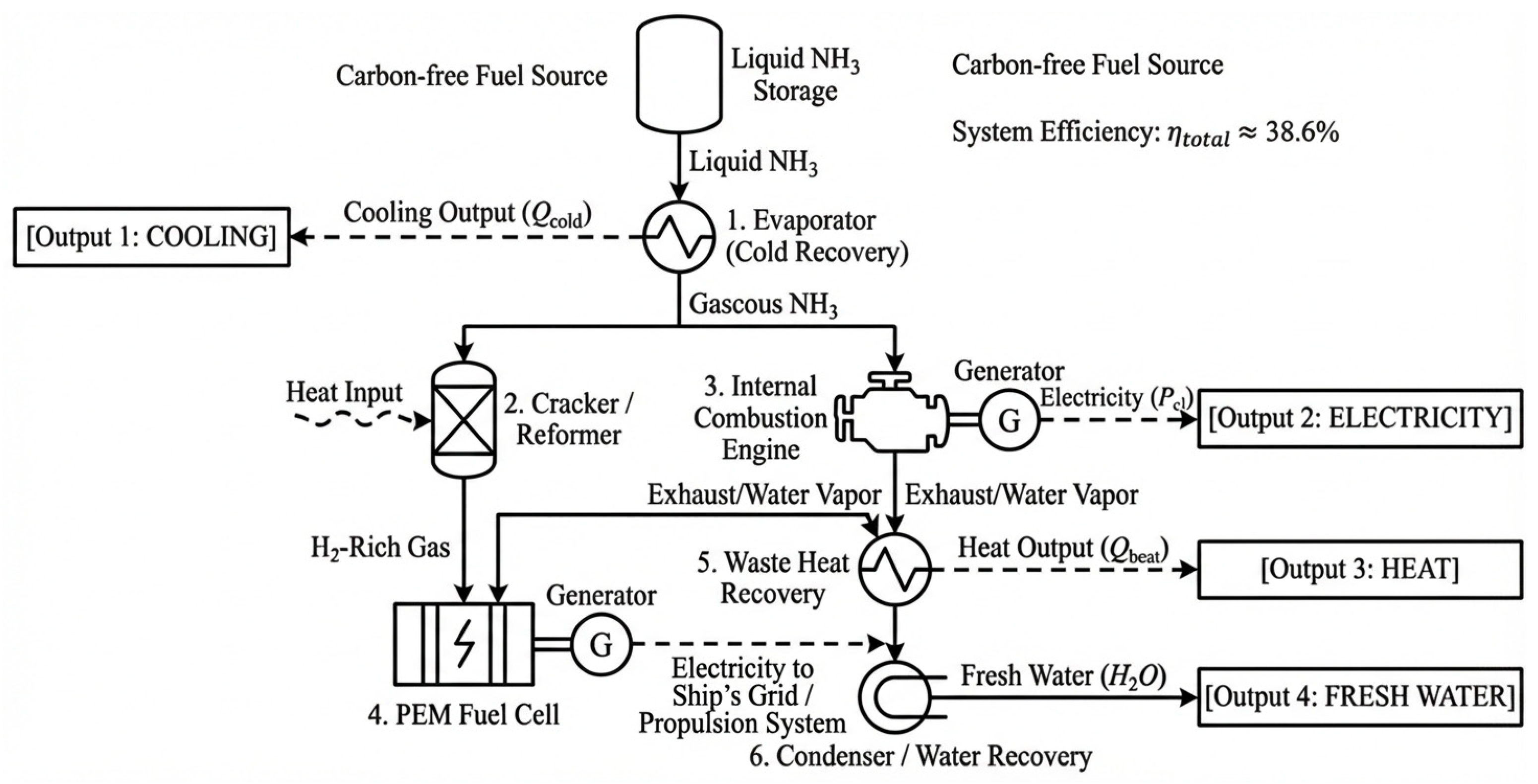
To improve energy conversion efficiency, air-independent propulsion systems are shifting from single propulsion to a “poly-generation” paradigm. As shown in the
Figure 4, a carbon-free liquid ammonia poly-generation system is illustrated, which integrates cold recovery, cracking, and dual power generation paths to simultaneously output cooling, electricity, heat, and fresh water. Ammonia-fuel-based cascaded architectures can theoretically achieve quad-generation of heat, electricity, cooling, and fresh water, with a total system energy efficiency as high as 38.58% [
37]. However, the engineering reality often falls short of theoretical expectations. Research points out that to adapt to the restricted internal volume of AUVs, the dimensions of combustion chambers and heat exchangers must be drastically reduced, leading to a significant drop in actual conversion efficiency (to only about 16–17%, constrained by the non-optimal thermodynamics of compact combustion chambers and miniaturized heat exchangers required for AUV integration) [
15]. Furthermore, low-frequency noise generated by mechanical moving parts seriously destroys the platform’s acoustic stealth performance, limiting its application in covert reconnaissance missions.
Targeting extreme long-endurance and high-power demands, the heat pipe reactor utilizes passive heat dissipation to eliminate traditional coolant pumps—a major noise source—making it a theoretically ideal solution for strategic missions. However, engineering applicability remains a bottleneck: cladding materials must simultaneously withstand external deep-sea hydrostatic pressure and seawater corrosion, as well as internal intense neutron irradiation. Furthermore, the substantial mass of necessary radiation shielding creates a severe weight penalty. Consequently, nuclear propulsion is currently restricted to large-displacement platforms and remains difficult to miniaturize for small-to-medium AUVs.
Thermal power and nuclear technologies are the unique physical solutions to the energy limitation of large, high-speed underwater platforms. Their advantages lie in extremely high power density and continuous output capability, supporting high-speed cruising above 30 knots. However, the bottlenecks for engineering application are evident: low-frequency noise generated by mechanical moving parts seriously destroys acoustic stealth performance, and nuclear technology faces high costs and extremely high safety entry barriers. Future development directions will focus on improving comprehensive system energy efficiency (such as combined heat and power) and silent design (such as passive heat dissipation heat pipe reactors), making them ideal power sources for strategic long-endurance platforms [
37].
4.4. Environmental Energy Harvesting Technology
Environmental energy harvesting technology aims to utilize ocean thermal, light, and mechanical energy to achieve a paradigm shift from “carried energy” to “in situ replenishment”. Although theoretically offering infinite endurance, the intermittency of energy input and extremely low power density limit its possibility as a primary propulsion source [
16,
38].
Thermal buoyancy engines based on phase-change materials can extract energy from temperature differences (about 24.2 kJ per cycle), but rigorous energy balance models reveal strict critical conditions: diving depth must exceed 900 m and speed must be strictly controlled [
39,
40,
41]. This implies that to harvest energy, the vehicle must be locked into specific slow deep-diving profiles, thereby losing the ability to perform rapid maneuver missions [
42,
43,
44].
To harvest solar energy, early flying-wing designs increased the light-receiving area but severely compromised hydrodynamic shape, increasing navigation drag [
45]. The development of flexible electronics offers a mitigation solution to this contradiction; flexible amorphous silicon cells, capable of conformal integration with streamlined pressure hulls and possessing better underwater spectral response, have become a new development direction [
46]. However, limited by the spatiotemporal randomness of sunlight and waves, such technologies are more suitable as auxiliary energy sources for distributed sensor networks or power sources for “underwater docking stations” rather than core power for AUVs.
Environmental energy harvesting technology is not just a supplement to energy but an innovation in operational modes. Its advantage lies in its theoretical “infinite endurance” and in situ replenishment capabilities, completely breaking free from mothership support. However, limited by the spatiotemporal heterogeneity of the marine environment, its bottlenecks lie in the intermittency of energy input and extremely low power density (usually only watt-level), and long-term deployment faces severe biofouling challenges. The future development direction is not to replace the main power but to serve as self-sustaining energy for distributed sensor networks or underwater residency base stations, realizing long-term power supply for low-power nodes through multi-energy complementation (e.g., OTEC + Solar) [
17,
47].
5. Multi-Physics Coupling Mechanisms in Deep-Sea Environments
The performance boundaries of underwater vehicle energy systems are not determined solely by the electrochemical properties of materials, but are the result of interactions between deep-sea environmental loads and the internal physical and chemical processes of the energy system. Unlike surface application environments, the deep-sea environment presents the superimposed characteristics of a high hydrostatic pressure field, a constant low-temperature field, and a high-salinity chemical field. These external physical fields are transmitted to the interior of the energy system through pressure-resistant structures or pressure-balancing interfaces, engaging in complex non-linear coupling with electrochemical reactions, heat conduction, and fluid flow processes. Understanding these coupling mechanisms is the scientific foundation for breaking through existing technological bottlenecks. As shown in the
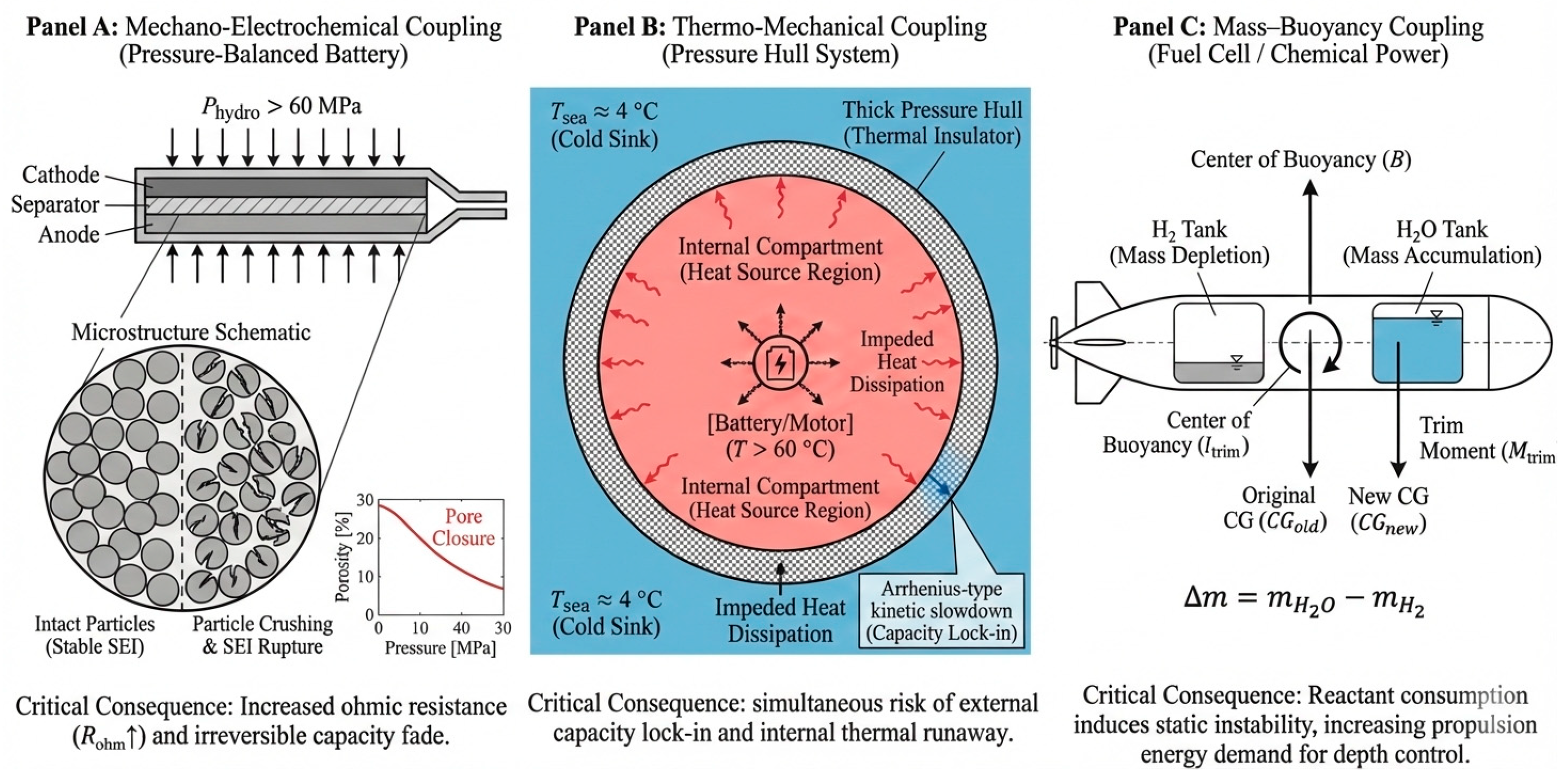
Figure 5, three critical multi-physics coupling mechanisms in deep-sea environments are illustrated—mechano-electrochemical, thermo-mechanical, and mass-buoyancy—which reveal how extreme pressure, thermal insulation, and fuel consumption respectively lead to battery degradation, overheating risks, and hydrodynamic instability.
5.1. Mechano-Electrochemical Coupling Mechanism of Hydrostatic Pressure and Electrochemical Processes
Hydrostatic pressure is the most significant physical feature of the deep sea. Its impact on battery performance extends far beyond the scope of mechanical damage to macroscopic structures, reaching deep into the level of microscopic electrode reaction kinetics. For lithium-ion batteries adopting a pressure-balanced (oil-filled) architecture, external liquid pressure acts directly on the cell surface, inducing significant “mechano-electrochemical” coupling effects [
26].
First, pressure alters the microstructure of porous media. Research by Zhao et al. revealed that under deep-sea high pressure, polymer separators and porous electrodes undergo creep and compressive deformation, leading to a significant reduction in porosity. This physical deformation increases the tortuosity of ion transport, macroscopically manifesting as a non-linear increase in the battery’s ohmic internal resistance. Second, pressure affects the intercalation and deintercalation kinetics of lithium ions. However, this gain effect has a clear critical threshold. As cycling extends, continuous high-pressure loading induces immense mechanical stress within active material particles, leading to lattice distortion and even particle crushing. This irreversible microscopic damage destroys the stability of the solid electrolyte interphase film, accelerating electrolyte decomposition and capacity decay. Therefore, the failure of deep-sea batteries is often not a simple electrochemical depletion, but the result of the synergistic action of mechanical fatigue and electrochemical degradation.
5.2. Thermo-Mechanical Coupling and Thermal Runaway Mechanisms in Confined Spaces
Underwater energy systems typically operate in a special thermodynamic environment of “external extreme cold (0–4 °C), internal adiabatic”. This environment constructs unique thermo-mechanical coupling boundary conditions. To withstand seawater corrosion and high pressure, energy systems are often encapsulated in heavy pressure hulls, constituting an approximately adiabatic system. When AUVs perform high-power tasks such as high-speed evasion or sonar detection, Joule heat generated by batteries and power electronics cannot dissipate through the thick-walled hull into the external water body. Simulation research by Andersson shows that under high-power operation, the temperature inside the closed compartment can rapidly rise above 60 °C, even leading to drying and cracking of fuel cell membranes [
48]. This heat accumulation effect easily forms local hotspots within the system, and if temperature control fails, it may induce irreversible thermal runaway.
Crucially, environmental pressure need not solely be a constraint; recent research indicates it can also serve as a functional enhancer for thermal management. Research by Fini has demonstrated that elevated hydrostatic pressure (e.g., 500 kPa) significantly enhances the contact melting heat transfer of phase-change materials (PCMs) by improving liquid phase flow. This mechanism suggests a potential “Pressure-Responsive Thermal Management” strategy for confined spaces: by coupling the PCM heat sinks directly with the pressure-transmitting interface, the deep-sea hydrostatic load is utilized to accelerate the phase-change process [
49]. This design effectively buffers the rapid temperature rise during high-power operations, thereby mitigating the conditions that could trigger thermal runaway, transforming the high-pressure environment from a thermal barrier into a cooling aid.
5.3. Mass–Buoyancy Dynamics and Hydrostatic Coupling
For open or semi-open systems like fuel cells and semi-fuel cells (e.g., aluminum–water batteries), their operation involves significant material exchange, introducing unique “mass–buoyancy” coupling problems. Unlike land vehicles where fuel weight change is ignored, underwater vehicles must maintain neutral buoyancy at all times to reduce propulsion energy consumption [
21]. Chiche et al. analyzed this problem in detail, pointing out that to maintain buoyancy equilibrium, the system may need to introduce additional “deadweight” or buoyancy materials, which directly offsets the advantages brought by high-energy-density fuels [
20].
In closed-cycle fuel cell systems, hydrogen consumption leads to a reduction in total system mass, while the accumulation of reaction-generated water leads to increased mass or volume changes. If a strategy of directly discharging generated water is adopted, the vehicle’s total weight will decrease over time, leading to increased positive buoyancy, forcing thrusters to consume extra energy to maintain depth; if flexible water bladders are used to store generated water, although total mass conservation is maintained, the expansion of the water bladder volume changes the displacement and center of gravity position, thereby affecting the hydrodynamic stability of the vehicle [
36].
Furthermore, under a dead-ended operation mode, research by Li et al. pointed out that reaction-generated water and nitrogen impurities accumulate as multi-phase flow in the anode channels [
50]. Under microgravity or dynamic tilting navigation attitudes, the distribution of this gas–liquid two-phase flow is highly random, easily triggering local flooding and leading to instantaneous voltage drops due to impeded mass transfer. This ternary coupling of “reaction product management–buoyancy equilibrium–voltage stability” is a unique control challenge in the design of underwater high-energy chemical power systems.
6. Future Development Trends
The development of underwater energy technology is approaching the limits of incremental improvement within existing physicochemical systems. To mitigate the physical constraints imposed by the deep-sea non-linear weight amplification effect and adapt to the uncertainties of extreme environments, future research emphasis must shift from merely enhancing material-level energy density to pursuing system-level transformations. Key directions include structural-energy integration, adaptive intelligent management, and networked replenishment architectures.
6.1. Solid-State and Structural-Energy Integration Design
To fundamentally resolve the non-linear weight amplification challenge, the design paradigm must shift from ‘passive pressure resistance’ to ‘intrinsic pressure adaptation’. While current pressure-compensated approaches mitigate this issue by substituting rigid hulls with fluid-filled structures, the ultimate solution lies in structural-energy integration enabled by All-Solid-State Batteries. Unlike liquid systems vulnerable to separator creep under pressure, solid electrolytes possess a high mechanical modulus that allows them to intrinsically withstand deep-sea hydrostatic loads. This capability enables the battery to serve simultaneously as an energy reservoir and a load-bearing component, thereby eliminating the parasitic mass of the pressure hull and effectively decoupling system weight from operating depth [
51]. This trajectory aligns with recent advancements highlighted by Wang et al., who emphasized structural lightweighting via carbon fiber-reinforced polymer, and demonstrated through surrogate models that shape–energy-coupled optimization can yield significant endurance gains [
52].
6.2. Full-Lifecycle Intelligent Management Based on Digital Twins
The inaccessibility and strong time variance of the deep-sea environment make it difficult for traditional rule-based or look-up-table-based energy management strategies to maintain optimal performance. Future battery management systems must evolve from simple state monitoring to “active life-extension” to address the accelerated degradation caused by deep-sea low temperatures and high pressures. By integrating micro-sensors, a high-fidelity digital twin can decouple the complex aging factors described in
Section 5 (e.g., differentiating between ohmic resistance increase due to pressure-induced porosity reduction and impedance rise due to low temperature). As shown in the
Figure 6, this digital-twin-based architecture enables the system to proactively optimize operation strategies: for instance, utilizing waste heat for active battery pre-heating to enhance low-temperature reaction kinetics and prevent severe voltage hysteresis during high-power discharges, or adjusting power allocation in hybrid systems to avoid stressing the battery under extreme hydrostatic loads. This shifts the energy system from a passive component to an intelligent agent capable of self-optimizing its useful life under harsh constraints. Furthermore, big-data-based state-of-health prediction models will replace simple ampere-hour integration methods, providing precise “remaining range” assessments for long-cycle residency missions and reducing mission decision risks [
23,
53]. Circuit optimization strategies proposed by Lu et al. also demonstrate the possibility of improving system efficiency through adaptive impedance matching [
54].
6.3. Evolution from Single-Unit Carriage to Underwater Energy Internet
Constrained by physical volume, the carrying capacity of any single vehicle has an upper limit. To achieve true “infinite endurance” and “long-term residency”, underwater operation modes will shift from a “self-sustained energy” single-unit mode to a “supply-en-route” networked mode. This transformation depends on the construction of underwater energy internet infrastructure. By deploying seabed wireless charging docking stations and sea-surface multi-energy complementary (wave/photovoltaic/diesel) buoy systems, standardized in situ energy replenishment interfaces are provided for AUVs [
3]. This architecture addresses the “low power density” limitation of environmental energy raised by critics. Instead of relying on intermittent sources (e.g., wave or thermal energy) for direct vehicle propulsion, a “Harvest–Store–Transfer” strategy is advocated. Distributed docking stations harvest low-power ambient energy over long periods and store it in large-capacity buffers. When an AUV docks, this accumulated energy is released rapidly via wireless power transfer [
55]. This functional decoupling allows the AUV to retain high-power propulsion systems for maneuvering, while the infrastructure ensures infinite endurance through in situ replenishment. Techno-economic optimization research by Palmer et al. on offshore hybrid power systems provides a basis for the design of such infrastructure [
56]. The key technological breakthrough lies in developing underwater wireless power transfer technology with low eddy current losses due to high seawater conductivity and high robustness against misalignment errors. Meanwhile, swarm-intelligence-based scheduling algorithms will coordinate the matching of AUV clusters with charging nodes, forming a continuous cycle of “sense–charge–operate” [
1].
6.4. Establishing Standardized Deep-Sea Energy Testing and Evaluation Systems
Therefore, future development urgently needs to establish a set of common deep-sea energy testing standards and benchmarks. Specifically, this includes the following: Unifying environmental simulation protocols, formulating standardized deep-sea pressure–temperature-operating condition cycle test profiles to simulate dynamic loads of ascent/descent in real missions, rather than conducting only static pressure tests. Developing accelerated aging testing specifications targeting “mechano-electrochemical” coupling failure modes to develop accelerated aging test methods equivalent to long-term deep-sea operation, thereby assessing system full-lifecycle reliability within a short time in the laboratory. Establishing safety assessment systems for thermal runaway in confined spaces, electrolyte leakage under high pressure, and structure-function failure boundaries.
In response to the challenges of low technology readiness and lack of standards for emerging technologies (e.g., deep-sea fuel cells and solid-state batteries), establishing a rigorous “Deep-Sea Energy Access Standard” is imperative. Future consolidation evaluations are recommended. A standardized “Dynamic Mission Profile Protocol”—incorporating rapid ascent/descent pressure cycling, low-temperature high-rate discharge, and long-term corrosion aging—should be mandatory. Only by constructing this standardized measurement system can we accurately benchmark the maturity of heterogeneous technologies, mitigate engineering risks, and provide rigorous scientific grounds for their transition from laboratory concepts to reliable engineering solutions.
7. Conclusions
This paper presents a systematic review of the development status, physical constraints, and future trends of underwater vehicle energy technologies from a system engineering perspective. The study indicates that the design of underwater energy systems is fundamentally constrained by the non-linear weight amplification effect and multi-physics coupling mechanisms. Although lithium-ion batteries currently occupy a dominant position, their performance in deep-sea environments is severely limited by the parasitic mass of pressure hulls and low-temperature degradation. While fuel cells possess high specific-energy potential, they are restricted by the complexity of oxidant storage and closed-loop water–thermal management. Meanwhile, thermal engines and nuclear propulsion remain indispensable choices for large-displacement strategic platforms.
To address future “full-ocean-depth, long-duration” mission requirements, a single technological path is no longer effective. Future developments will present a tiered trend: nuclear energy and thermal power will dominate strategic large-scale platforms, hybrid power systems will fill the relay tactical gap, and environmental energy harvesting will serve distributed sensor networks. Simultaneously, constructing standardized testing evaluation systems and safety access norms will be a critical link in eliminating technological uncertainty and promoting the transition of laboratory results to engineering applications. Ultimately, through structural innovation in solid-state batteries, intelligent empowerment via digital twins, and the construction of energy infrastructure networks, underwater vehicles will break through the limitations of “energy islands” and achieve true long-term ocean residency.