1. Introduction
Achieving ambitious emission reduction targets requires the efficient operation of energy systems. Computer-aided modeling and mathematical optimization, therefore, play a key role in improving energy efficiency and supporting decarbonization. This work is an extended version of our paper published in the 20th Conference on Sustainable Development of Energy, Water and Environment Systems [
1].
The accuracy of an energy system model depends on the selected modeling approach and the associated optimization methods. The majority of commonly used modeling tools for energy systems are based on Mixed-Integer Linear Programming (MILP) [
2,
3]. MILP formulations are most frequently applied for the optimization of the operation and design of energy systems in the literature [
4,
5,
6,
7]. MILP is especially used for the analysis of complex energy systems over long time periods, due to its short computational times and reliable convergence, particularly in finding a global optimum [
4,
6].
However, many relevant physical phenomena in energy systems exhibit nonlinear behavior, such as efficiency characteristics, part-load operation, pressure losses and heat transfer processes [
6,
7]. In state-of-the-art MILP models, these nonlinearities are either strongly simplified (e.g., constant efficiency) or approximated using piecewise linear formulations, often at the cost of model accuracy [
6,
7]. In particular, the selection of the number of segments in piecewise linear approximations represents a compromise between computational effort and accuracy, and regarding the operational optimization of district heating networks or multi-energy generation systems, deviations resulting from linearization cannot be fully avoided [
8].
Mixed-Integer Nonlinear Programming (MINLP) formulations allow a more accurate representation of nonlinear system behavior but typically require significantly higher computational effort than MILP approaches. In addition, MINLP models may suffer from convergence issues and do not generally guarantee the identification of a global optimum [
6,
9,
10]. Besides MILP, another way to simplify MINLP models and handle increasing model complexity is to reformulate them as mixed-integer quadratically constrained problems (MIQCPs) [
5].
MIQCP enables a more accurate representation of nonlinear relationships through quadratic or bilinear terms compared to linear modeling, while avoiding the full complexity of general nonlinear optimization. The potential benefits of MIQCP have been known for several years [
11]. Wasserfall et al. [
12] show that MIQCP models of temperature-sensitive systems can be solved within reasonable computational times. Further studies demonstrate successful applications in the optimization of district heating networks [
13] and nonlinear heat transfer in thermal storage systems [
14], as well as in economic lot scheduling [
15] and power-to-X scheduling under dynamic electricity markets [
16]. Recent work indicates that MIQCP-based formulations can remain computationally tractable for annual-coupled industrial energy systems with strong sequential time dependencies when combined with tailored two-stage solution approaches [
17]. A wide range of optimization solvers is available for solving MIQCP problems. Among the solvers commonly used in energy system optimization [
6,
7], several commercial solvers, including ANTIGONE, BARON, CPLEX, DICOPT, GUROBI, KNITRO, LINDO, MOSEK and XPRESS, as well as the open-source solver SCIP, support MIQCP formulations [
18]. In particular, GUROBI has shown performance improvements for complex, non-convex MIQCP, achieving speed-ups of approximately two orders of magnitude between version 9.1 (2020) and 11.0 (2023) [
19,
20,
21]. Nevertheless, despite these advances, MILP remains the predominant modeling approach, and the practical application of MIQCP in energy system optimization is not yet sufficiently researched and implemented. Among 75 energy system modeling tools reviewed in the literature, only one explicitly supports MIQCP formulations [
2].
One important class of energy systems are steam turbine systems. Steam turbines generate nearly two-thirds of the world’s electricity demand. The majority of this is generated by fossil-fueled power plants, which accounted for around 60% of global electricity generation in 2023 [
22]. Steam turbines are also used in geothermal and solar thermal power plants or in waste incineration plants and are therefore also important in the context of the energy transition. In particular, part-load behavior under off-design conditions becomes increasingly important with growing shares of renewable energy sources [
6].
Steam turbines can be modeled using different levels of detail. The selected modeling approach determines which optimization method is used. The following section presents typical modeling approaches for steam turbines in energy system optimization from the literature. The focus lies on the common simplifications and degrees of freedom in the corresponding linear, quadratic and nonlinear modeling approaches.
As discussed by Zhu et al. [
23], many existing studies represent steam turbines using macroscopic mass and energy balances combined with fixed-efficiency assumptions or simple linear or polynomial regressions. Within this context, two principal approaches can be identified for the linear description of steam turbines in MILP-based optimization models: Rahimi-Adli et al. [
24] apply Willan’s line to calculate the steam turbine. Willan’s line is a generic linear equation that calculates the electrical power as a function of the steam mass flow. The slope and ordinate intercept of the Willan’s line are fitted to the relationship of the measurements. An alternative linear approach is provided by Bojic et al. [
25], who model the turbine based on an energy balance, calculating power output as the product of steam mass flow and the enthalpy difference. Steam mass flow and power are taken into account as continuous decision variables. The enthalpy difference is considered as a parameter. Zhao et al. [
26] apply a comparable linear energy-balance-based turbine model for extraction–exhausting steam turbines. In addition, inlet and extraction steam mass flows are linked by parameters derived from historical data, which are treated as uncertain. To account for this uncertainty, the original MILP formulation is reformulated as a conic quadratic mixed-integer programming (CQMIP) model. The underlying turbine calculation itself remains linear.
For a more detailed description of steam turbines, nonlinear models can be used: Jüdes et al. [
27] provide an application of MINLP for the operational optimization of steam turbine systems that is of relevance in the context of this paper. The aim of the optimization is to minimize operating costs. The turbine is modeled using energy balances, with mass flow rates and power output treated as continuous decision variables. The isentropic efficiency is modeled by a nonlinear characteristic curve as a function of the mass flow in order to map the partial load behavior. In addition, fluid properties are calculated using nonlinear equations, and thus, pressures and temperatures are also considered as continuous optimization variables. Zhu et al. [
23] formulate a nonlinear turbine model for the minimization of operating costs based on energy balances, in which steam mass flow rates and power output are treated as continuous decision variables. Pressures and enthalpies are included as optimization variables and are linked through empirical regression equations. Although an empirical, nonlinear isentropic efficiency correlation is introduced, the authors ultimately employ a direct regression of the outlet steam enthalpy as a function of steam mass flow and pressure levels.
To the best of the authors’ knowledge, no previous studies have systematically analyzed the operational optimization of steam turbine part-load behavior using MIQCP formulations. While full-load operation can typically be represented using constant-efficiency assumptions, part-load operation requires the explicit modeling of load-dependent efficiency characteristics. Although MIQCP has been applied to energy systems in general, its practical benefits for representing the nonlinear behavior of part-load-dependent efficiency characteristics of steam turbines have not been analyzed so far.
This paper addresses this gap by introducing a novel MIQCP formulation with piecewise linear efficiency characteristics and systematically comparing it to MILP and MINLP approaches. The novelty of this work lies not in the MIQCP formulation alone, but in the structured assessment of the potential of MIQCP as a compromise between model accuracy, computational effort and implementation complexity for steam turbine part-load operation.
The evaluation is conducted using hourly measurement data from two steam turbines with distinct operational profiles in order to assess the robustness and applicability of the proposed approach.
2. Methods
This work introduces an MIQCP approach for the operational optimization of steam turbines with part-load-dependent efficiency characteristics for time series in hourly resolution. The MIQCP method is compared to the MILP and MINLP optimization methods to analyze the potential of MIQCP for this application. The analysis is based on measurement data from two differently operated steam turbines in a waste incineration plant, provided by EGK Entsorgungsgesellschaft Krefeld GmbH & Co. KG (Krefeld, Germany) for the purpose of this study. The linear and nonlinear turbine models considered in this study are adapted from established approaches reported in the literature and tailored to the specific optimization problem to ensure a consistent and systematic comparison of MILP, MIQCP and MINLP formulations. All models are parameterized using the measured data. Furthermore, the number of sections for the piecewise MILP and MIQCP approaches is systematically varied to analyze the trade-off between model accuracy and computational effort.
Various criteria are used in the literature to compare optimization methods, such as accuracy, computational time, convergence behavior, implementation complexity, effort required for model development and the target function values achieved [
6,
9,
10]. Following these criteria, the optimization methods in this paper are evaluated based on model accuracy, implementation complexity and computational time. In addition, the deviation in the calculated optimum is introduced to enable a consistent comparison of optimization results across different model formulations.
The model accuracy is evaluated through the root mean square error (RMSE) between model predictions and measurements. Implementation complexity is analyzed based on the number of variables and constraints. The result of the optimization is an optimal sequence of operating states. To evaluate the quality of these optimization results in a consistent manner, the resulting operating schedules are re-evaluated using a reference turbine model. Since objective function values are inherently model-dependent and therefore not directly comparable across different formulations, this re-evaluation provides a common basis for assessing the resulting operating strategies under identical conditions.
For each turbine, the most accurate model identified based on the RMSE analysis is selected as the reference. The resulting system power is then calculated using this reference model and compared with the predefined demand profile of the active power. The deviation in the calculated optimum is defined as the sum of absolute deviations between the calculated system power and the corresponding demand profile over the entire evaluation period. By definition, this deviation is zero for the reference formulation itself, provided that no constraint violations occur.
The evaluation is carried out on a 13th Gen Intel(R) Core(TM) i7-1360P, 2200 MHz, 32 GB RAM with Python 3.12.3. The open source solver SCIP version 9.1.0 is utilized, which can be used for both mixed-integer linear and nonlinear programs [
28]. Furthermore, the commercial solver Gurobi version 12.0.1 is used, which can also be used to solve MINLP in addition to MILP since version 11.0 [
21]. For nonlinear programming without binary variables, the solver IPOPT (v3.12) is also used [
29].
All optimization problems were solved using default solver settings for SCIP, Gurobi and IPOPT. No solver-specific parameter tuning was applied. In particular, default feasibility tolerances, integrality tolerances and stopping criteria were used consistently for all formulations within each solver.
The purpose of using multiple solvers is not to benchmark solver performance, but to assess the robustness of formulation-dependent trends across different algorithmic paradigms. Differences in absolute computational times and convergence behavior are therefore interpreted with caution and are not attributed solely to the modeling formulations. Accordingly, conclusions regarding solution quality are drawn primarily from comparisons within the same solver, while cross-solver differences are discussed separately as indicators of solver robustness rather than formulation superiority.
2.1. Modeling of the Steam Turbine System for Operational Optimization
The optimization variables are printed in bold italics below. For an isolated analysis of steam turbine modeling and optimization, an energy system with w = 2 instances of this component in a parallel configuration is considered. The fundamental objective of the operational optimization of a steam turbine system is to minimize costs and reduce CO
2 emissions caused by steam generation. Operating costs and CO
2 emissions are directly linked to the steam demand of the system. Therefore, the objective function is formulated as the minimization of the total steam demand, defined as the sum of the steam mass flows
of all turbines i over the considered time horizon t = 1, …, n. Explicit cost and CO
2 factors are omitted, as they would only introduce constant weighting coefficients and would not affect the relative comparison of the optimization formulations. The linear objective Function (1) applies to all modeling approaches:
The active power of the entire system at each time t results from the sum of the active powers
of the individual turbines i. The optimization focuses exclusively on steam deployment planning. Auxiliary energy consumption required to maintain turbine operation is not modeled explicitly, as these contributions are either approximately constant or weakly load-dependent compared to the primary steam flow, and, therefore, do not significantly affect the relative comparison of the investigated modeling approaches. In addition, for simplification, no start-up behavior or ramp constraints are modeled. When considering a complex energy system, the active power of the entire system can be an optimization variable. Since the present work considers an isolated steam turbine system, a demand profile of the active power
of the overall system is predefined to make the system solvable. This results in constraint (2) for all optimization approaches.
The predefined active power demand profile is constructed to systematically cover all relevant operating states of the turbine system rather than to represent a specific real-world dispatch case. By activating the full operating range with comparable frequency, the analysis avoids a bias toward particular load regions and enables a balanced methodological comparison of the optimization formulations.
The active power is calculated on the basis of an energy balance as described in the literature. The specific adaptation of this equation for each modeling approach can be found in
Table 1. In the present application, the product of the steam mass flow and the isentropic enthalpy difference
is multiplied by a mass flow-dependent static isentropic total efficiency
. This efficiency is derived from the data set of hourly measured values of the steam mass flow
, pressure
and temperature
before the turbine, pressure after the turbine
and the active power
for the year 2020. According to Equation (3), the efficiency is determined implicitly by matching the isentropic turbine power to the measured active power. The isentropic power is calculated as the product of the isentropic enthalpy difference
and the measured steam mass flow. This defined efficiency thus includes all losses between the isentropic change in state and the measured active power.
This paper focuses on the operational optimization of steam turbines with part-load-dependent efficiency characteristics. Since the available data set exhibits constant steam inlet and outlet conditions, the enthalpy difference is specified as a fixed parameter for each modeling approach. This modeling choice allows the impact of the mass flow-dependent efficiency representations to be isolated and consistently compared across different modeling formulations.
Varying thermodynamic state variables can generally be incorporated by updating the thermodynamic parameters based on measured operating data at each optimization instance. The calculation of the active power for each approach is summarized in
Table 1. In addition to the calculation using the energy balance, Willan’s line approach is also applied in this work and is therefore listed in
Table 1.
Table 1.
Calculation of the active power for different modeling approaches.
Table 1.
Calculation of the active power for different modeling approaches.
| Modeling Approach | Constraint | |
|---|
| Linear (Willan’s Line) | | (4) |
| Linear (Constant Efficiency) | | (5) |
| Quadratic | | (6) |
| Nonlinear | | (7) |
As a generic linear approach, Willan’s line is defined according to Equation (4). For the linear calculation of the power using the energy balance, no other optimization variable besides the mass flow can be taken into account. Accordingly, the efficiency is set as a parameter in Equation (5). In addition to the variable mass flow, the MIQCP approach allows multiplication with a linear dependence on another variable (classified as bilinear) or an additional linear dependence on the mass flow. For the quadratic approach, an efficiency curve that is linearly dependent on the mass flow is taken into account for calculating the power in Equation (6). For the nonlinear approach, the efficiency curve can be calculated in any nonlinear dependence on the mass flow according to Equation (7). The parameterization of the approaches is presented in the following.
Furthermore, the optimization variables, mass flows and active power, are restricted by upper and lower bounds. Two distinct turbines, referred to as turbines A and B, are analyzed. For turbine A, the mass flow range is between 0 and 63 t/h, with the minimum quantity being 17 t/h. The output is limited between 0 and 13.6 MW. For turbine B, the mass flow can range from 0 to 80 t/h, with a minimum quantity of 25 t/h. The output is limited between 0 and 2.8 MW.
The presented MILP, MIQCP and MINLP approaches are implemented using binary variables and Big-M formulations. The Big-M constants are derived directly from the physical upper and lower bounds of steam mass flow and active power defined for each turbine. These bounds are identical across all mixed-integer formulations and solvers and ensure that the Big-M values remain as tight as possible while preserving feasibility. No solver-specific tuning or formulation-dependent adjustment of Big-M values beyond these physically motivated bounds is applied. This ensures that differences in computational performance and solution quality can be attributed to the modeling formulations themselves rather than to numerical parameterization choices.
2.2. Parameterization of the Modeling Approaches
The modeling approaches summarized in
Table 1 can be implemented either using only continuous optimization variables or by including both continuous and integer variables, resulting in mixed-integer programming (MIP). Integer variables are introduced to activate individual segments of piecewise-defined functions, to switch between discrete parameter values and to represent minimum quantity shutdown. In this way, MIP enables the piecewise modeling of Willan’s line within MILP formulations and allows nonlinear efficiency characteristics to be approximated by piecewise representations, such as piecewise constant efficiencies in MILP and piecewise linear efficiency curves in the MIQCP approach.
Starting with the approaches based solely on continuous variables, model parameters are identified using MATLAB’s fit function (MATLAB R2023b, Curve Fitting Toolbox), which performs least-squares curve fitting by minimizing the squared deviations between measured and modeled data. For the parameterization of Equation (4), a linear regression of the measured active power as a function of the steam mass flow is performed, resulting in the constraint for linear programming (LP). When applying an unconstrained linear least-squares regression, the resulting Willan’s line has a negative ordinate intercept, which represents the basic steam consumption during idle operation. Since the objective of this study is the optimization of load distribution between several turbines, only the additional steam input contributing to power generation is considered. A Willan’s line with a negative ordinate intercept would lead to negative power outputs for some operating states, particularly in system states where only a single turbine is operated, and thus leads to systematically poorer optimization results. To ensure comparability with the other modeling approaches, Willan’s line in the LP approach is therefore constrained to pass through the origin. The resulting slight overestimation of the efficiency at low load is accepted.
For the parameterization of Equation (6), a linear regression of the static, isentropic total efficiency as a function of the mass flow is applied, which results in the constraint for quadratically constrained programming (QCP). A nonlinear regression of the static, isentropic total efficiency as a function of the mass flow for Equation (7) results in a constraint for nonlinear programming (NLP). When selecting the degree of the nonlinear regression function, the primary requirement is that the resulting efficiency curve represents the measured data in a physically meaningful manner. The lowest possible polynomial degree is chosen to avoid unnecessary model complexity and to keep computational effort as low as possible.
The remaining modeling approaches require a parameter identification procedure that goes beyond simple curve fitting. For the linear model with constant efficiency according to Equation (5), the efficiency is determined through an optimization problem. The efficiency is the optimization variable, and the objective is to minimize the RMSE between the measured active power and the active power calculated with the corresponding model
as defined in Equation (8).
To obtain the piecewise constant efficiency model and thus the MILP formulation, the set of optimization variables is systematically extended. Starting from a single efficiency parameter, additional variables are introduced to represent mass flow breakpoints and corresponding efficiency values. For example, extending the model from one constant efficiency to two segments increases the number of decision variables from one to three, consisting of two efficiency values and one mass flow breakpoint. For each configuration, the RMSE is minimized to identify the optimal parameters. Below the minimum mass flow, the efficiency is set to zero, thereby modeling minimum quantity shutdown.
A similar procedure is applied for the MILP approach of the piecewise Willan’s line. Here, the minimum mass flow and the end point of the characteristic curve, defined by mass flow and maximum power, are prescribed, while the minimum power at the start point is treated as an optimization variable. This formulation enables the modeling of minimum-load shutdown behavior, as the turbine delivers zero power below the minimum mass flow. Between the defined support points, the turbine behavior is described by linear interpolation. Additional breakpoints are introduced systematically for each model, and the corresponding steam mass flow and power variables are identified by minimizing the RMSE according to Equation (8).
The MIQCP approach follows the same principle. The efficiency curve is represented by piecewise linear segments defined by interpolation points, where both the mass flow and the efficiency values at these points are treated as optimization variables. Linear interpolation between the points describes the turbine efficiency characteristic. The number of interpolation points is increased systematically, and the parameters are determined by minimizing the RMSE between measured and modeled active power. Below the minimum mass flow, the efficiency is set to zero, thereby modeling minimum-quantity shutdown.
In the present case, an MINLP model is not strictly required to represent the turbine behavior but is investigated to improve the representation of boundary regions and to model minimum quantity shutdown. To avoid arbitrary model formulations, a systematic procedure is applied. The measured data are divided into two operating regions using a single interpolation point. For a given interpolation point, both data subsets are modeled independently using nonlinear regression functions of identical polynomial degree, starting from degree two. The location of the interpolation point is varied in a sensitivity analysis, and the interpolation point yielding the minimum RMSE between measured and modeled active power is selected, while enforcing the continuity of the characteristic curve at the interpolation point.
All model parameters are identified using the same measurement data that are subsequently used for model evaluation. Given the large number of available measurement points relative to the small number of model parameters, the risk of overfitting is considered limited. Moreover, the objective of this study is not predictive generalization, but a relative comparison of different optimization formulations under identical data conditions. Consequently, the RMSE is used as a consistent metric to compare different model structures rather than to assess predictive generalization.
3. Results and Discussion
In the following, the results of the comparative analysis of the optimization methods are presented and discussed. The evaluation is structured according to the defined assessment criteria: model accuracy, implementation complexity, computational time and the deviation in the calculated optimum. The investigated methods include formulations without integer variables (LP, QCP, NLP), as well as mixed-integer formulations (MILP, MIQCP, MINLP). The mixed-integer models are indexed as MIP k, where k = 1, …, 5 denotes an increasing level of model complexity within a given modeling approach.
For Willan’s line, the first mixed-integer formulation (MILP 1) represents a single linear segment combined with minimum quantity shutdown, while higher indices introduce additional segments. For the constant-efficiency formulation, MILP 1 corresponds to two efficiency regions, and higher indices add further piecewise constant efficiencies. Analogously, MIQCP 1 represents the efficiency characteristic using two linear segments, while higher indices increase the number of segments accordingly. The MINLP approach is not divided into more than two pieces and therefore has no further numbering.
3.1. Model Accuracy
Data from two distinct turbines, referred to as turbines A and B, are analyzed. The model accuracy is evaluated separately for the two turbines, as their operational characteristics differ significantly.
3.1.1. Models for Turbine A
Turbine A is a 14 MW condensing turbine that expands into the wet-steam region.
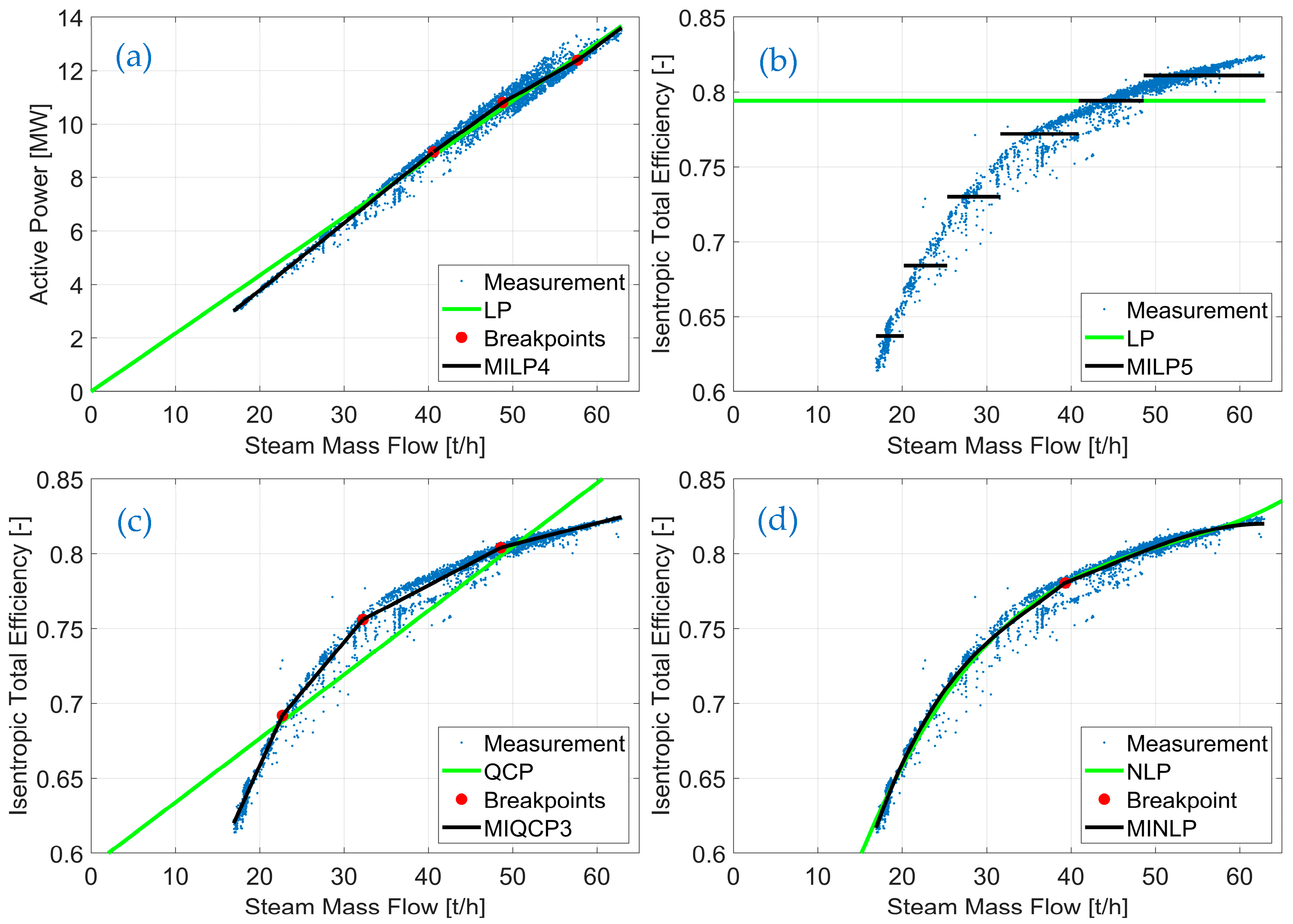
Figure 1 shows the measured data of turbine A along with selected parameterized models. The linear approach using Willan’s line is shown in the upper-left corner (a), the linear approach of the piecewise constant efficiency in the upper-right corner (b), the approach of the linear efficiency curve in the lower-left corner (c) and the nonlinear efficiency curve approach in the lower-right corner (d). Approaches without integer variables are shown in green, while mixed-integer approaches with the highest level of model complexity considered for each approach are shown in black. These formulations are referenced consistently in
Table 2 using the corresponding MIP k notation. The interpolation points are marked red.
Fundamentally, the approaches without integer variables are rather limited. This is particularly the case as no minimum quantity shutdown is taken into account, and therefore, extrapolations beyond the measured data are required. Nevertheless, the relationship between the measured values can be represented reasonably well by the linear Willan’s line without piecewise modeling (LP). In this case, a piecewise MILP formulation is not strictly required, and the main improvement of the MILP approach originates from the inclusion of minimum-load shutdown behavior. This behavior reflects an inherent limitation of formulations without integer variables and is therefore intentionally retained as part of the methodological comparison.
It is noticeable that the LP approach with fixed efficiency and the QCP approach show significant deviations from the measured data. The piecewise constant efficiency modeled within the MILP formulation improves the representation compared to the purely linear approach but still deviates substantially from the actual characteristic. In contrast, the MIQCP formulation with four sections reflects the course of the measured values accurately. The boundary areas, in particular, are well matched.
The NLP approach, implemented as a third-degree polynomial function, represents the measured values well, although slightly larger deviations occur in the boundary areas. An MINLP formulation is not necessary for this characteristic curve. However, an approach with two third-degree polynomial functions is presented. This formulation reduces deviations in the boundary regions compared to the NLP approach but introduces a kink at the interpolation point.
For every modeling approach, the accuracy is evaluated using the RMSE between the measured active power and the active power calculated by the corresponding model. The results for turbine A are listed in
Table 2.
Table 2 is structured to distinguish between formulations without integer variables and mixed-integer formulations with increasing model complexity. The column labeled “0” refers to models formulated exclusively with continuous decision variables (LP, QCP and NLP). The columns MIP k denote mixed-integer formulations. Depending on the underlying modeling approach, MIP 1 corresponds to MILP 1, MIQCP 1, or MINLP, respectively, while higher indices represent refinements with additional piecewise segments.
In line with the qualitative observations from
Figure 1a, the piecewise modeling of Willan’s line within the MILP framework only leads to a marginal improvement in accuracy compared to the LP formulation. Even for higher numbers of segments, the reduction in RMSE remains limited.
In contrast, the linear approach with piecewise constant efficiency shows a pronounced improvement in model accuracy as the number of segments increases. The RMSE decreases consistently with increasing model complexity, indicating that this approach benefits strongly from piecewise parameterization. Nevertheless, even the most complex MILP formulation with piecewise constant efficiency yields a higher RMSE than the simplest MIQCP formulation.
The NLP approach exhibits a low RMSE and confirms the good visual agreement observed in
Figure 1d. Only minor improvements are achieved by MINLP modeling. However, the MIQCP formulation achieves comparable or lower RMSE values while providing a more accurate representation of the boundary regions. Overall, the results from
Table 2 support the qualitative findings from
Figure 1 and highlight MIQCP as the most accurate modeling approach for turbine A among the investigated formulations.
3.1.2. Models for Turbine B
The exhaust steam from turbine B (3 MW) is utilized for district heating. Therefore, it is classified as a backpressure turbine. Turbine B shows a different Willan’s line and efficiency curve (
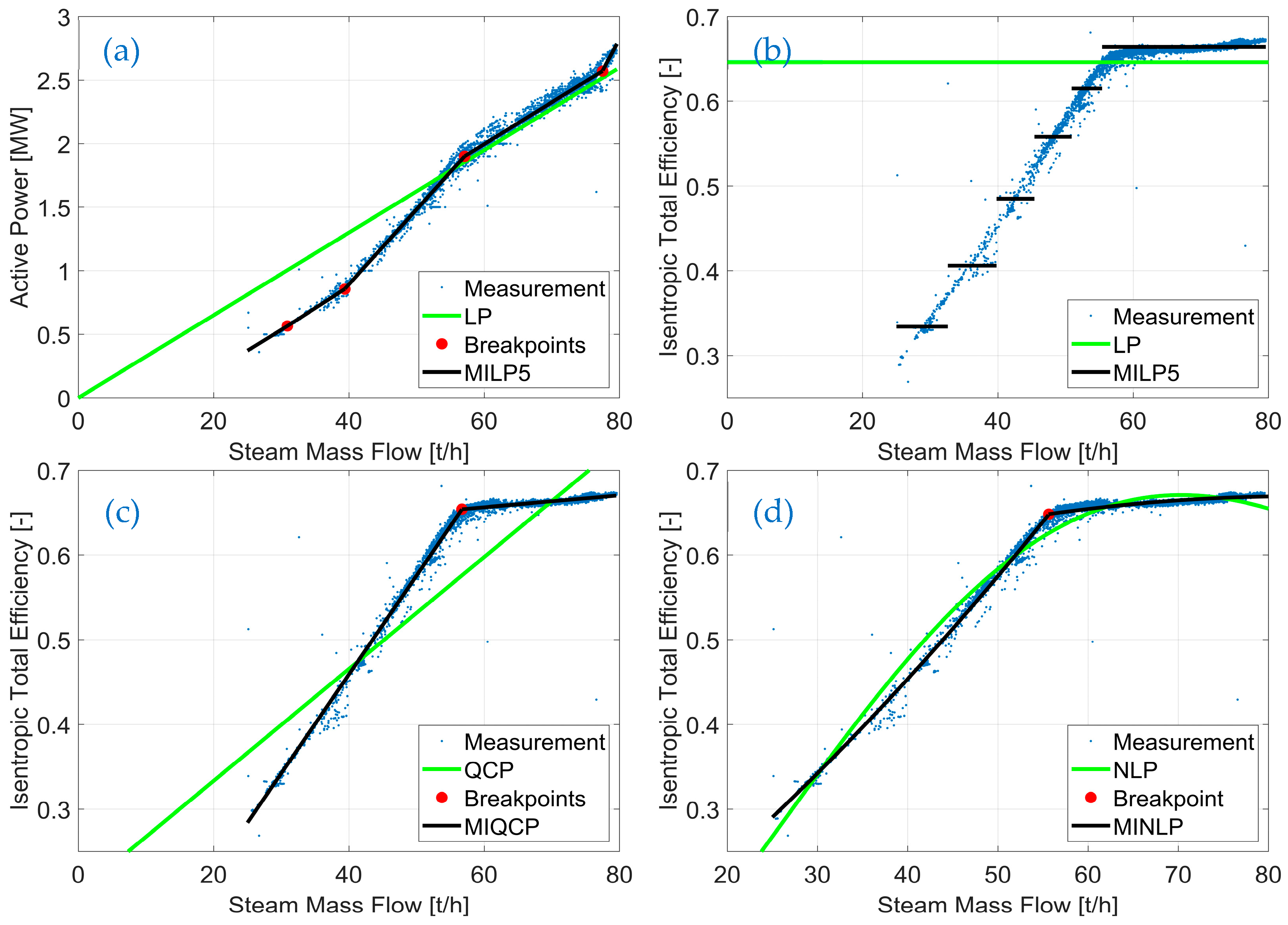
Figure 2) than turbine A. The modeling approaches are presented in the same way as for turbine A. The linear approach of Willan’s line is shown in the upper-left corner (a), the linear approach of the piecewise constant efficiency in the upper-right corner (b), the approach of the linear efficiency curve in the lower-left corner (c) and the nonlinear efficiency curve approach in the lower-right corner (d). Approaches without integer variables are shown in green, while mixed-integer approaches with the highest level of model complexity considered for each approach are shown in black. These formulations are referenced consistently in
Table 3 using the corresponding MIP k notation. The interpolation points are marked red.
Constraining Willan’s line to pass through the origin in order to avoid negative power outputs leads to considerable deviations in the LP formulation for turbine B. Through the MILP formulation the Willan’s line can be represented more accurately by explicitly accounting for minimum quantity shutdown. The LP approach with constant efficiency provides a reasonable approximation at high to full load but fails to capture the partial-load behavior. This limitation is mitigated in the corresponding MILP formulation, which allows a more differentiated representation. The QCP model again shows large deviations from the measured data. In contrast, the MIQCP formulation reproduces the measured values accurately with only two segments.
The NLP approach, implemented as a fourth-degree polynomial function, does not adequately reproduce the specific shape of the measured characteristic. The MINLP formulation is implemented using two quadratic functions and is nearly indistinguishable from the MIQCP approach.
For each modeling approach, the accuracy is evaluated using the RMSE between the measured and the calculated active power with the corresponding model. The results for turbine B are listed in
Table 3. The structure and notation of
Table 3 follow the same convention as introduced for
Table 2.
In agreement with the qualitative observations from
Figure 2, the introduction of minimum-quantity shutdown in the MIP 1 formulation leads to a substantial improvement in accuracy for the Willan’s line approach. Increasing the number of approximation segments results in an asymptotic reduction in the RMSE. A similar trend is observed for the approach with piecewise constant efficiency, which—analogous to turbine A—outperforms the Willan’s line approach in terms of RMSE. However, the difference between these two modeling approaches is smaller for turbine B, as the measured data in
Figure 2 exhibit less scatter than for turbine A. Overall, the MIQCP formulation again outperforms the most complex MILP and NLP formulations and achieves accuracy comparable to the MINLP approach.
3.2. Implementation Complexity
The presented MIP approaches are implemented using binary variables and Big-M formulations and take into account a minimum turbine shutdown. For the described system consisting of two parallel turbines and an observation period of two weeks with hourly resolution, the numbers of variables and constraints are summarized in
Table 4.
The mixed-integer models are numbered in ascending order of complexity. For the MILP 1 model based on Willan’s line, a single segment with minimum quantity shutdown is mapped. In the MILP 2 approach of Willan’s line, the characteristic is described using two segments, resulting in the same number of variables and constraints as in the MILP 1 formulation with piecewise constant efficiency, which includes two efficiency regions in addition to minimum quantity shutdown.
An analogous relationship applies to the MIQCP 1 formulation, which represents the efficiency characteristic using two linear segments. As the number of segments increases, the numbers of binary variables and constraints increase accordingly.
3.3. Computational Time and the Deviation in the Calculated Optimum
After analyzing model accuracy and implementation complexity, the following section focuses on the optimization results obtained from the different models. In particular, computational performance and the deviations in the calculated optimal operating strategy are evaluated.
The analysis is performed on a steam turbine system consisting of two parallel turbines of type A and two parallel turbines of type B. The demand profile of the active power is designed such that all relevant operating states for the system are represented.
3.3.1. Optimization Results for the Turbine A System
The system of two parallel turbines of type A covers a power range from 5 to 27 MW, corresponding to operation from a single turbine in minimum load up to twice the maximum active power observed in the measured data. Based on the qualitative assessment in
Figure 1 and the quantitative RMSE comparison, MIQCP 3 provides the most accurate representation of turbine A. It is therefore used as the reference model for calculating the deviation in the calculated optimum of all other formulations.
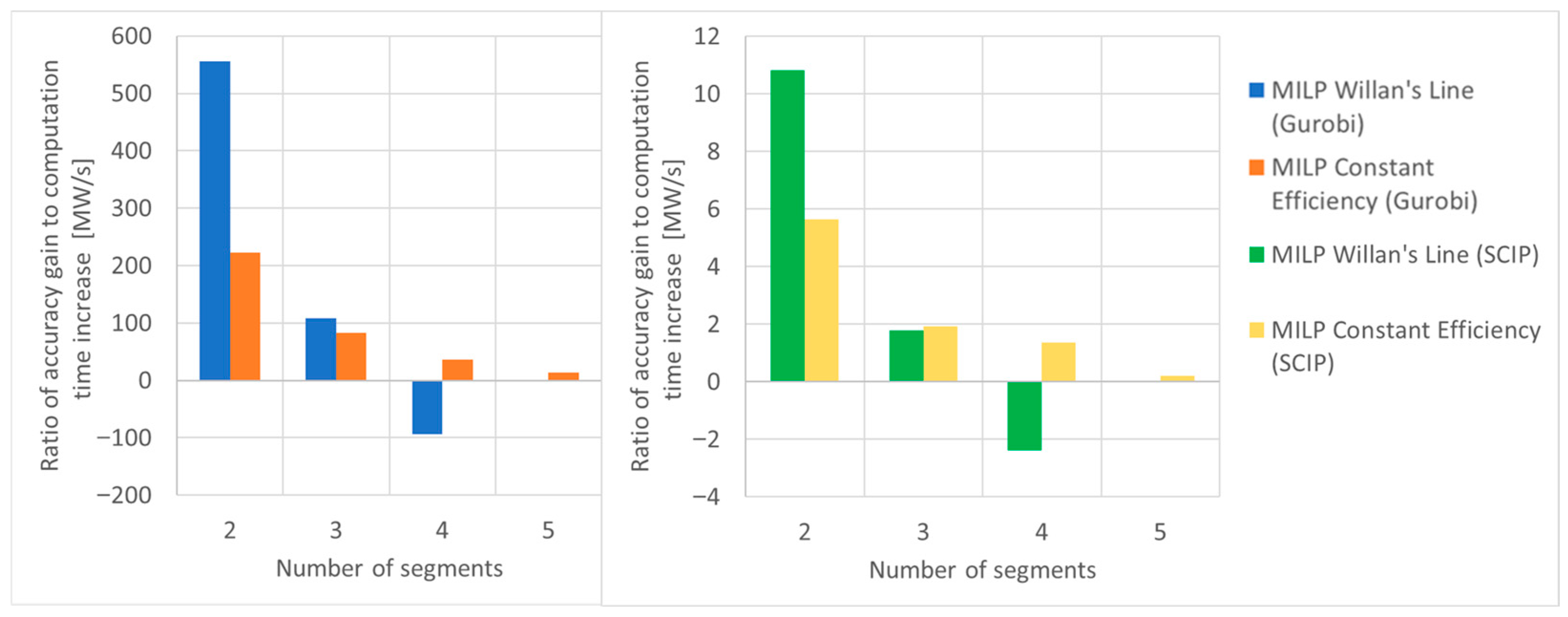
The reported computational times are average values of up to four runs and were obtained using SCIP, Gurobi and IPOPT for NLP formulations. As illustrated in
Figure 3, the ratio of accuracy gain to computational effort deteriorates for both SCIP and Gurobi as the number of variables and constraints increases, indicating diminishing returns in accuracy for increasing model complexity.
Table 5 summarizes the optimization results for a system consisting of two parallel turbines of type A. For the MILP formulations, computational time increases with model complexity. In the case of Willan’s line, further subdivision beyond three segments (MILP 4) leads to a deterioration of the solution quality compared to MILP 3. The comparatively large deviations observed for Willan’s line formulations cannot be explained solely by their higher RMSE values. Instead, they are also linked to the fact that the enthalpy difference is not explicitly represented in this modeling approach. Instead, the linear regression implicitly reflects an averaged operating condition, whereas the reference model assumes a fixed enthalpy difference corresponding to a specific operating point. Consequently, deviations in the calculated optimum depend on how strongly the actual operating conditions in one year deviate from this reference state.
Among the linear models, the MILP 5 formulation with piecewise constant efficiency yields the smallest deviation in the calculated optimum. Nevertheless, even this formulation remains inferior to the MIQCP approaches in terms of solution quality. MIQCP 1 and MIQCP 2 already achieve substantially lower deviations, while MIQCP 3 yields the smallest deviation by definition, as it serves as the reference model.
Considering formulation effects within each solver, MIQCP formulations consistently outperform MILP and NLP approaches in terms of deviation in the calculated optimum. The MINLP formulation improves solution quality compared to MILP and NLP but requires higher computational effort and remains inferior to MIQCP in terms of the accuracy–computational time trade-off.
With respect to solver performance, Gurobi is consistently faster than SCIP across all model classes. All linear formulations are solved faster by Gurobi than the MIQCP formulations, while for both solvers, the nonlinear formulations exhibit the longest computation times. With Gurobi, the MINLP formulation is both slower and less accurate than MIQCP. SCIP solves MINLP faster than the most complex MIQCP formulation (MIQCP 3), but with inferior accuracy. For MIQCP formulations, SCIP achieves shorter computation times than the most complex MILP formulation (MILP 5 with piecewise constant efficiency).
For the NLP formulation, Gurobi does not yield a solution of satisfactory optimization quality. Although a feasible solution is returned, constraint violations exceeding the default solver tolerances are reported. As a consequence, the resulting deviation in the calculated optimum is substantially higher, reaching 143.786 MW. For this reason, the NLP results obtained with Gurobi are not reported in the table.
IPOPT solves the NLP with comparatively low computational effort, reaching computation times that are comparable to those of the MILP formulations solved by Gurobi. However, IPOPT converges to a local optimum. SCIP and IPOPT both identify feasible NLP solutions but with different objective function values. SCIP attains a lower objective value (23 968 t/h) than IPOPT (24 888 t/h), yet this comes at the expense of a higher deviation in the calculated optimum. This behavior highlights a fundamental limitation of the NLP formulation in the boundary regions. In the optimized operating strategy, certain turbine states occur more frequently than others. In this particular system, one turbine is typically operated at full load, while the second turbine is added to satisfy increasing demand. Overestimation of efficiency at full load leads to an overestimation of power output and, consequently, to an incorrect allocation of steam mass flow to the second turbine. This effect results in increased deviations in the calculated optimum, despite favorable objective function values.
3.3.2. Optimization Results for the Turbine B System
The system of two parallel turbines of type B covers a power range from 2 to 5 MW. This range was selected to represent all practically relevant operating states, with particular emphasis on a characteristic operating regime in which both turbines are operated simultaneously at partial load. This operating condition, therefore, defines the lower and upper bounds of the considered system power range. The selected range does not aim to cover the full theoretical operating envelope but instead focuses on a representative and practically relevant subset of system states.
Based on the qualitative assessment in
Figure 2 and the quantitative RMSE comparison, the MINLP model provides the most accurate representation of turbine B. It is therefore used as the reference model for calculating the deviation in the calculated optimum of all other formulations.
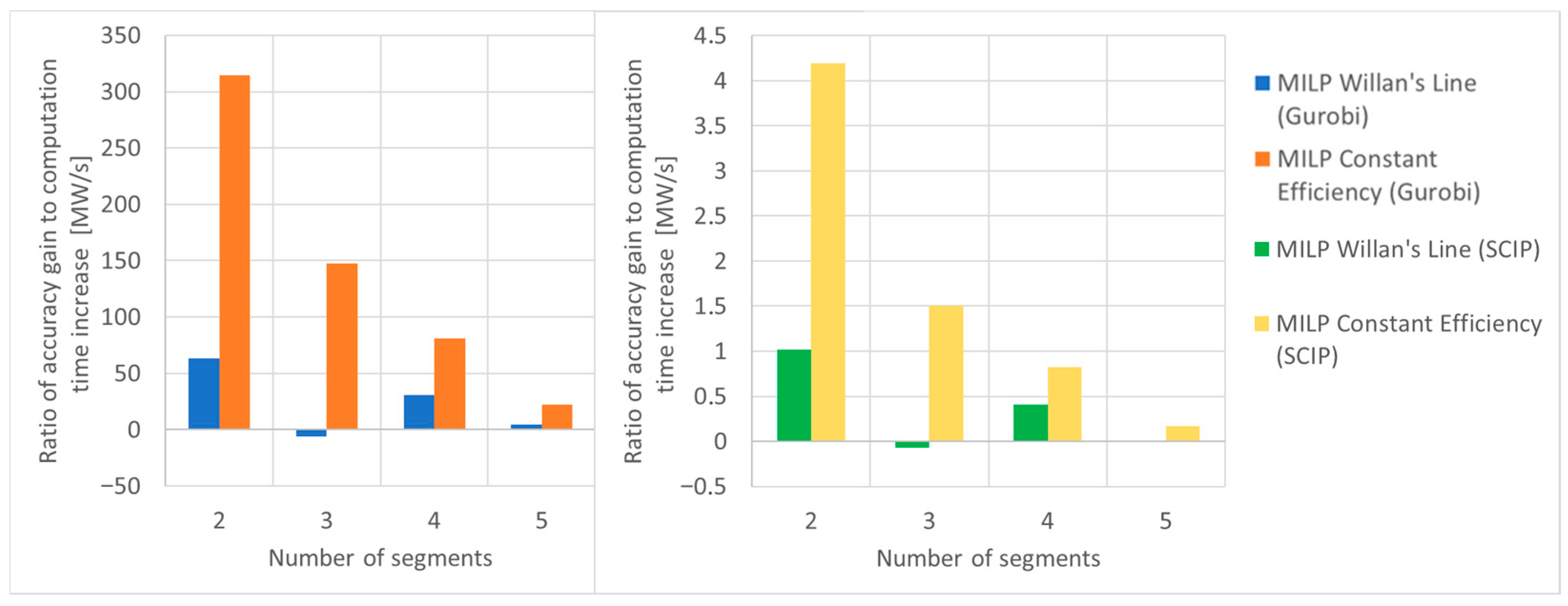
Despite the different operating conditions and efficiency characteristics of turbine B compared to turbine A, the same conclusions can be drawn from the analysis of this system as for the previous system. For both Gurobi and SCIP, the ratio of accuracy gain to computation time increase deteriorates as the number of variables and constraints increases for the MILP approaches, as illustrated in
Figure 4.
Table 6 summarizes the optimization results. In contrast to the turbine A system, the deviation in the calculated optimum for the Willan’s line approach is smaller than for the corresponding constant-efficiency formulations. This reflects the different efficiency characteristics and operating patterns of turbine B.
With respect to solver performance, SCIP solves the MIQCP formulation with better solution quality and shorter computation time than the most complex MILP formulation (MILP 5 with Willan’s Line). SCIP identifies a feasible MINLP solution with better solution quality than the MIQCP approach, but at the cost of substantially higher computation time. For the NLP formulation, SCIP does not terminate within a reasonable computation time, and the optimization run was therefore stopped.
Gurobi is consistently faster than SCIP across all optimization approaches. Linear models are solved faster than the MIQCP formulation, while the NLP model exhibits the longest calculation times. For the MINLP formulation, Gurobi does not yield a solution of satisfactory optimization quality. Although a feasible solution is returned, constraint violations exceeding the default solver tolerances are reported. As a consequence, the resulting deviation in the calculated optimum is substantially higher, reaching 83.071 MW. For this reason, the MINLP results obtained with Gurobi are not reported in the table.
IPOPT solves the NLP with comparatively low computational effort, achieving computation times that are comparable to those of the MILP formulations solved by Gurobi. However, IPOPT converges to a local optimum. Gurobi and IPOPT both identify feasible NLP solutions with different objective function values. Gurobi achieves a lower objective function value of 36 113 t/h than IPOPT with a value of 37 535 t/h. The deviation in the calculated optimum is smaller for the Gurobi result. In contrast to the turbine A system, the optimized operation does not predominantly consist of one turbine operating at full load with the second turbine being added as a supplement. Instead, due to the slight increase in efficiency starting at approximately 55 t/h, operating strategies are preferred in which both turbines are operated close to their respective efficiency maxima. Although the NLP formulation exhibits deviations in the boundary regions, this behavior is partially compensated by the presence of a local efficiency maximum around 70 t/h (see
Figure 2).
4. Conclusions
The conclusions drawn in this study are based on a simplified operational setting focusing on steam allocation under a predefined power demand. Start-up behavior, ramping constraints and minimum up/down times are not considered. While these aspects are relevant for full operational realism, their inclusion would require additional decision variables and constraints and could significantly affect the computational performance of the investigated formulations. The predefined demand profile is designed to systematically activate the full operating range of the turbine system rather than to represent a specific real-world dispatch case. The presented results should therefore be interpreted as a methodological assessment of optimization formulations rather than as a complete operational dispatch model. Extending the framework to include dynamic operational constraints and the investigation of realistic dispatch scenarios represents an important direction for future work.
For turbines with strongly varying thermodynamic boundary conditions, complex extraction schemes, or tight coupling to other process units, extended formulations with time-varying thermodynamic parameters may be required, and the quantitative results of this study should be interpreted accordingly.
Overall, MIQCP proves to be a promising optimization approach for steam turbine systems with part-load-dependent efficiency characteristics, particularly in terms of balancing accuracy, computational time and implementation complexity.
With regard to model accuracy, the MIQCP approach demonstrates significant potential, delivering results comparable to—and in some cases even superior to—those obtained with MINLP formulations. While MILP approaches exhibit the largest deviations compared to MIQCP and MINLP, they benefit from the lowest computational times and robust solver performance. MIQCP achieves shorter computational times than nonlinear models while maintaining a high level of accuracy. Nevertheless, further improvements in the problem formulation are recommended to reduce the computational time, which still exceeds that of MILP. MINLP formulations, although capable of accurately representing nonlinear efficiency characteristics, suffer from increased computational effort. To facilitate a more balanced comparison of the optimization methods, the application of commercial MINLP solvers should be considered in future studies and the solver selection could be further refined.
The implementation complexity of MIQCP is relatively low. In particular, the generic formulation of piecewise linear efficiency characteristics can be implemented in a straightforward and transparent manner. In contrast, MILP formulations require a comparatively high modeling effort to achieve a similar level of accuracy. Nevertheless, from a generic modeling standpoint, both the Willan’s line approach and the constant efficiency MILP formulation can be parameterized with limited effort. The suitability of these MILP approaches depends on the specific turbine characteristics and operating regime. Since MINLP formulations allow the representation of arbitrary nonlinear efficiency curves, they require careful formulation to ensure a physically reasonable representation, particularly in boundary regions.
Beyond this, the short computational times of MILP compared to MIQCP allow extensions in model resolution. However, the results show that further subdivision of Willan’s line yields diminishing returns and is therefore not recommended. Instead, increasing the resolution of constant-efficiency MILP formulations may be more effective, although the trade-off between improved accuracy and increased computational time becomes less favorable as model complexity grows.
Although the quantitative results presented in this study are specific to the investigated turbines, the methodological insights are transferable to other steam turbine systems with comparable operating characteristics. In particular, the observed trade-off between accuracy and computational effort, as well as the advantages of MIQCP formulations for representing part-load-dependent efficiency behavior, are expected to hold for turbines operating under relatively stable inlet conditions and pronounced partial-load regimes. For turbines with highly variable steam conditions, complex extraction structures, or strong thermodynamic coupling, extended formulations may be required.
Ultimately, the selection of an appropriate optimization method should be guided by the specific application context and the relative weighting of evaluation criteria relevant to the intended application.