Author Contributions
Methodology, O.R., S.E., D.A.R. and J.R.; Validation, O.R., S.E., D.A.R. and J.R.; Investigation, O.R., S.E., D.A.R. and J.R.; Software, O.R., S.E., D.A.R. and J.R.; Resources, S.E. and D.A.R.; Writing—original draft, O.R.; Writing—review & editing, S.E., D.A.R. and J.R.; Supervision, S.E., D.A.R. and J.R. All authors have read and agreed to the published version of the manuscript.
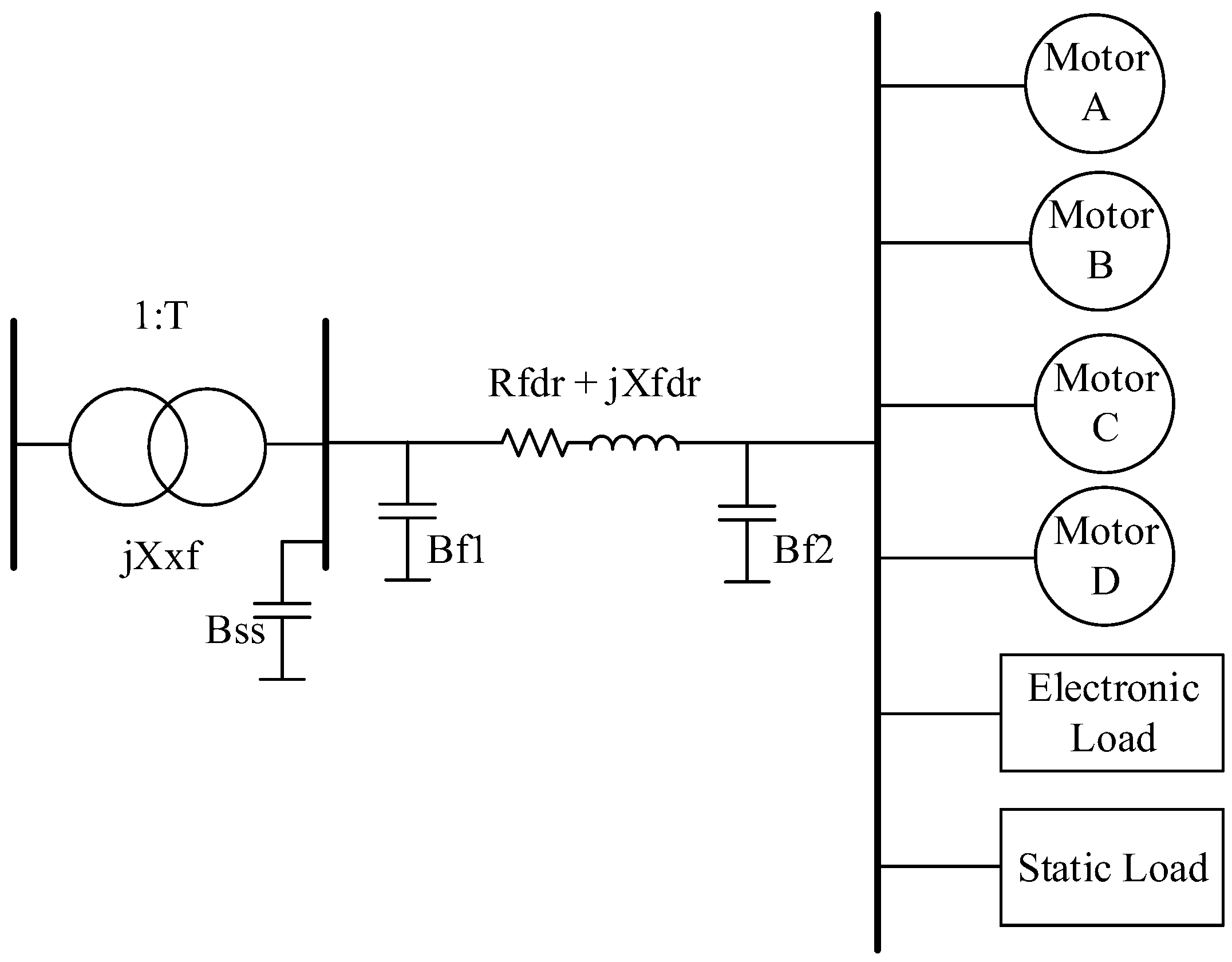
Figure 1.
WECC composite load model structure.
Figure 1.
WECC composite load model structure.
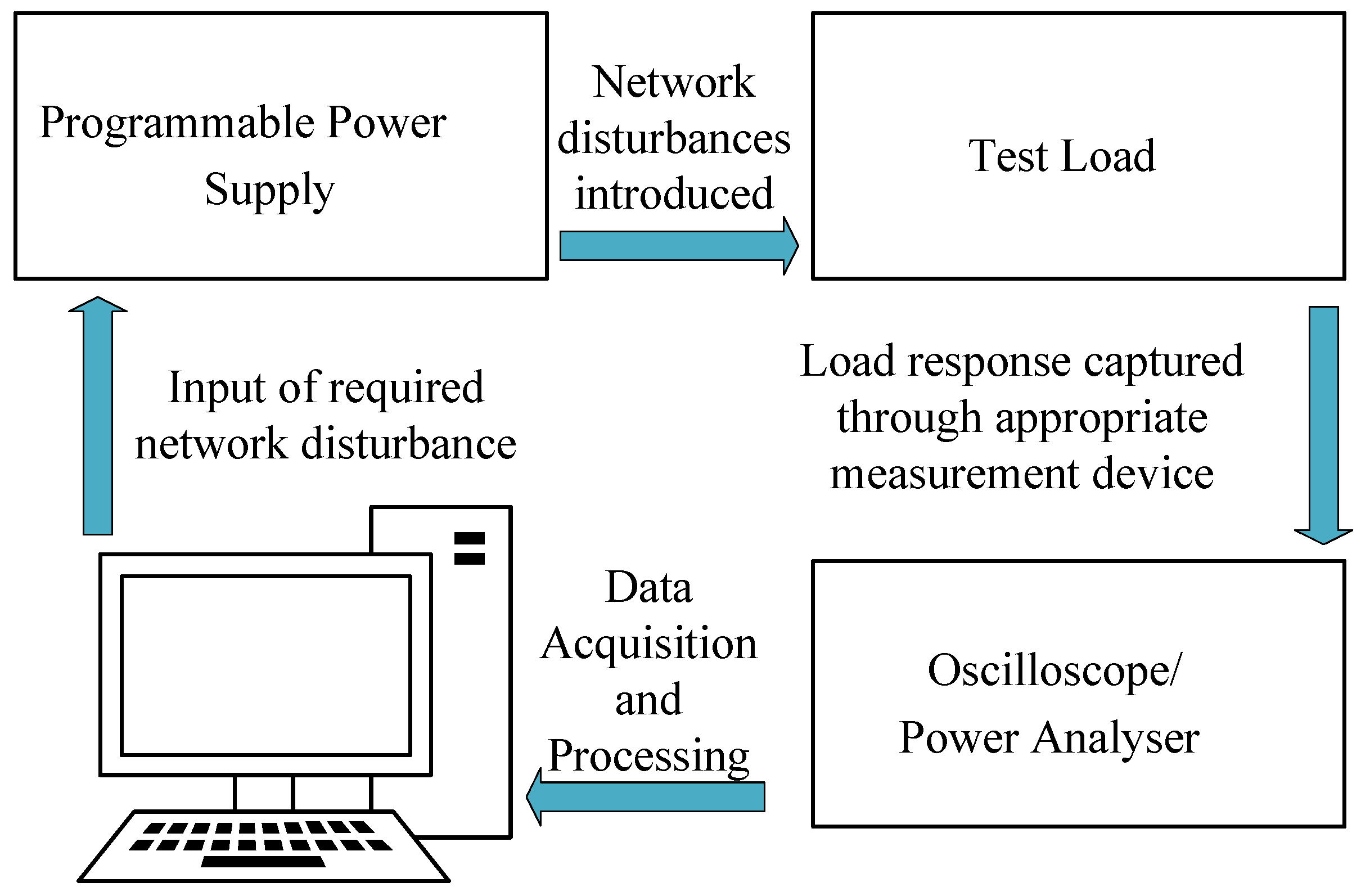
Figure 2.
Schematic of experimental setup.
Figure 2.
Schematic of experimental setup.
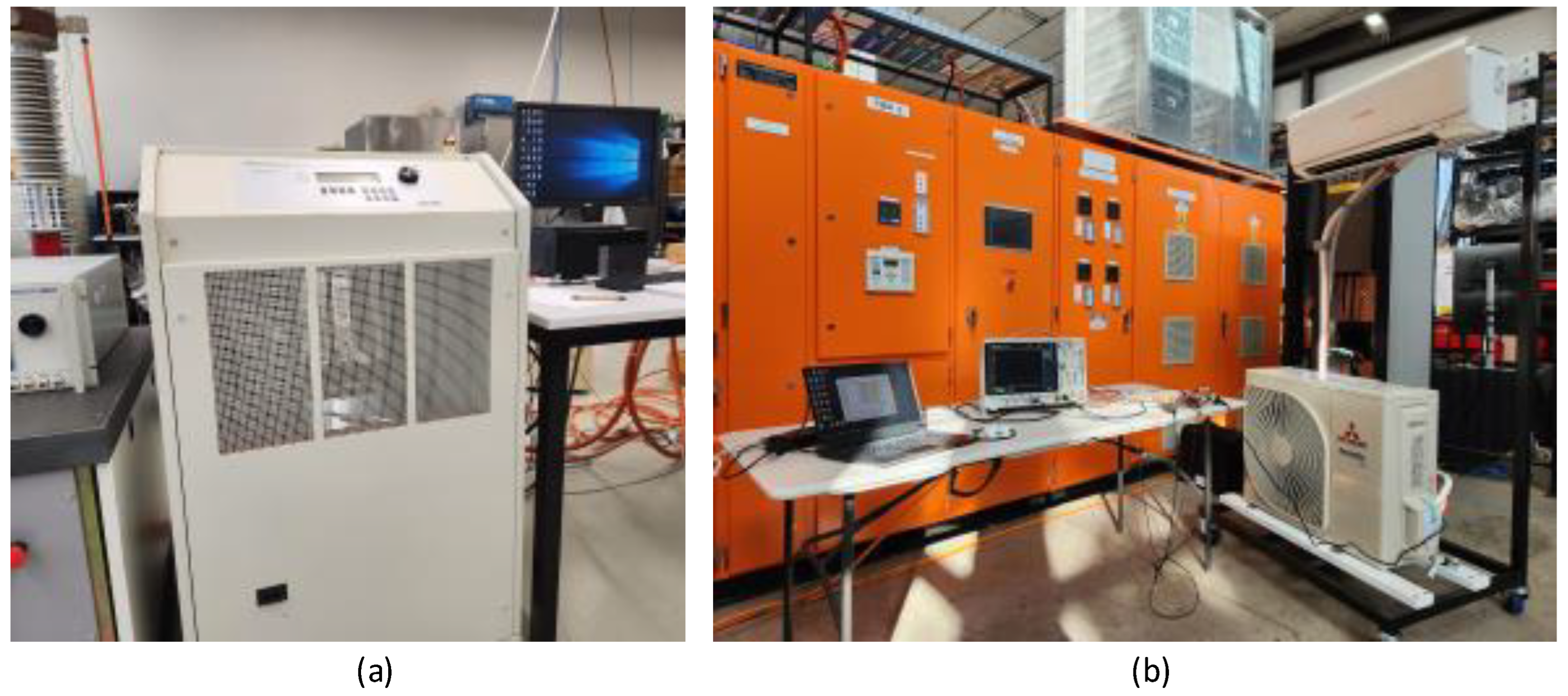
Figure 3.
Load testing setup: (a) programmable power supply and (b) air conditioner under test.
Figure 3.
Load testing setup: (a) programmable power supply and (b) air conditioner under test.
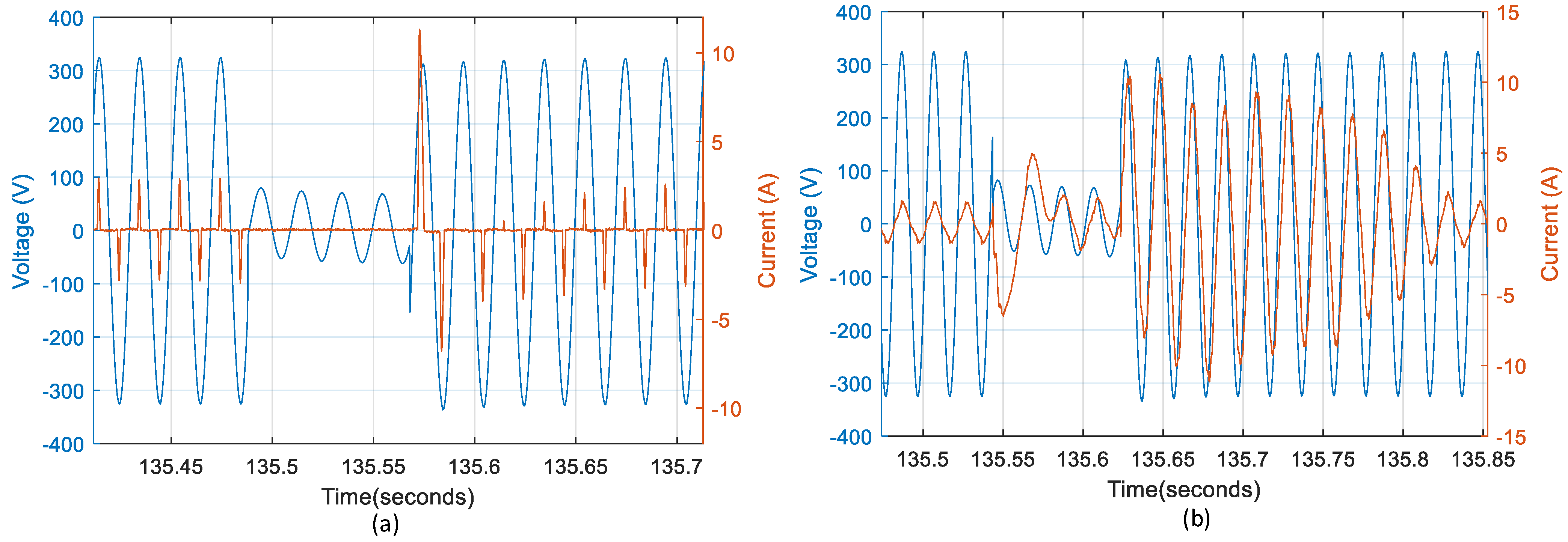
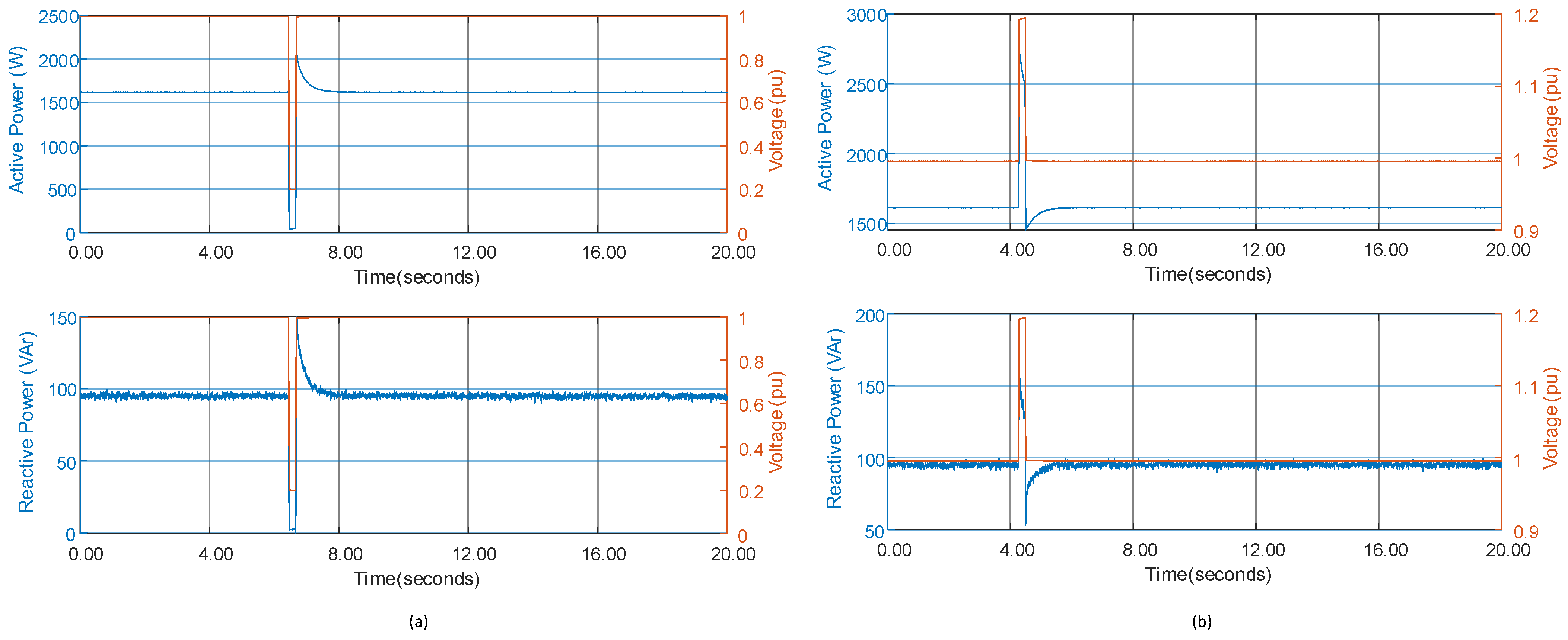
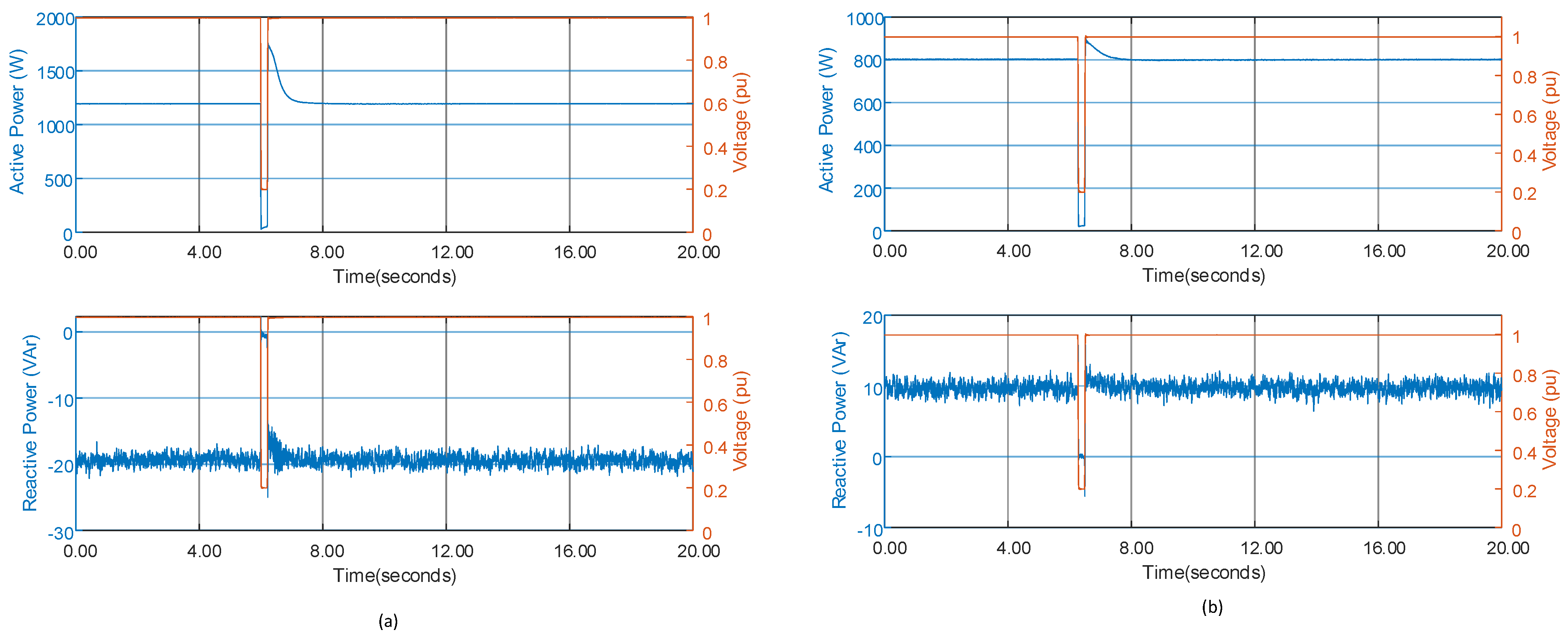
Figure 4.
Impact of voltage sag on (a) Refrigerator 1 and (b) Refrigerator 2.
Figure 4.
Impact of voltage sag on (a) Refrigerator 1 and (b) Refrigerator 2.
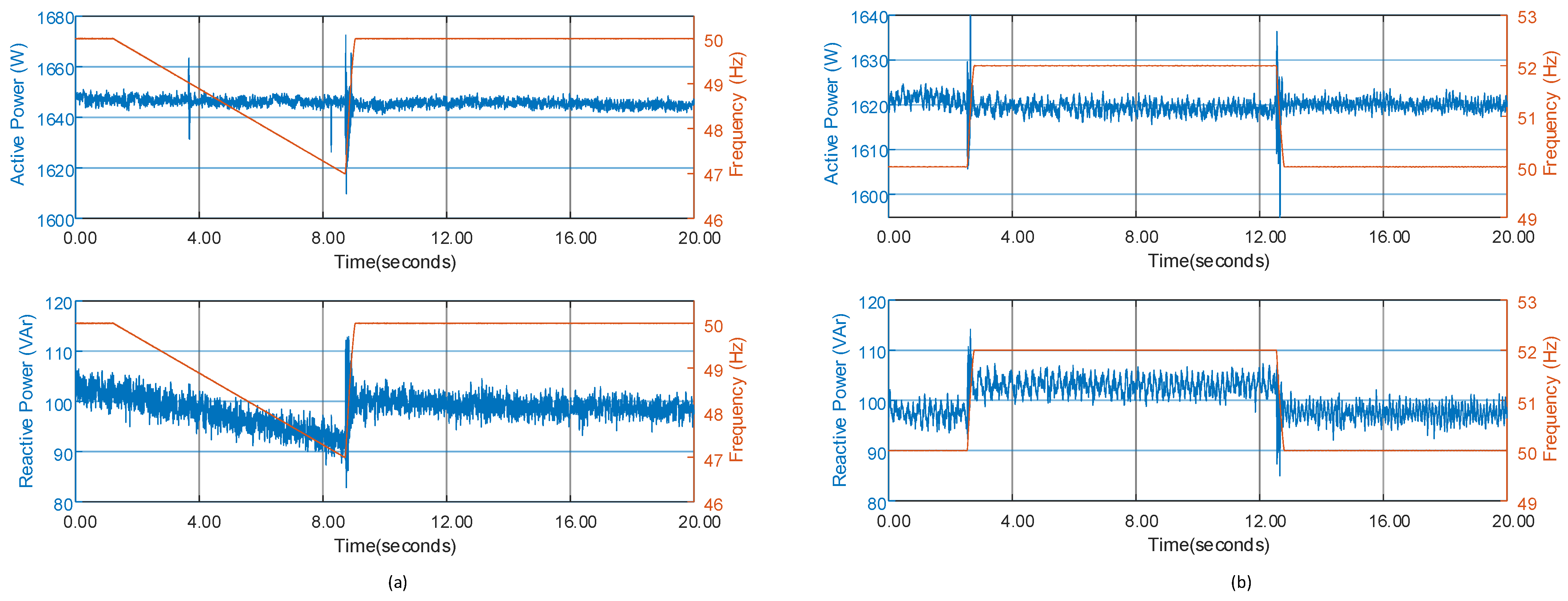
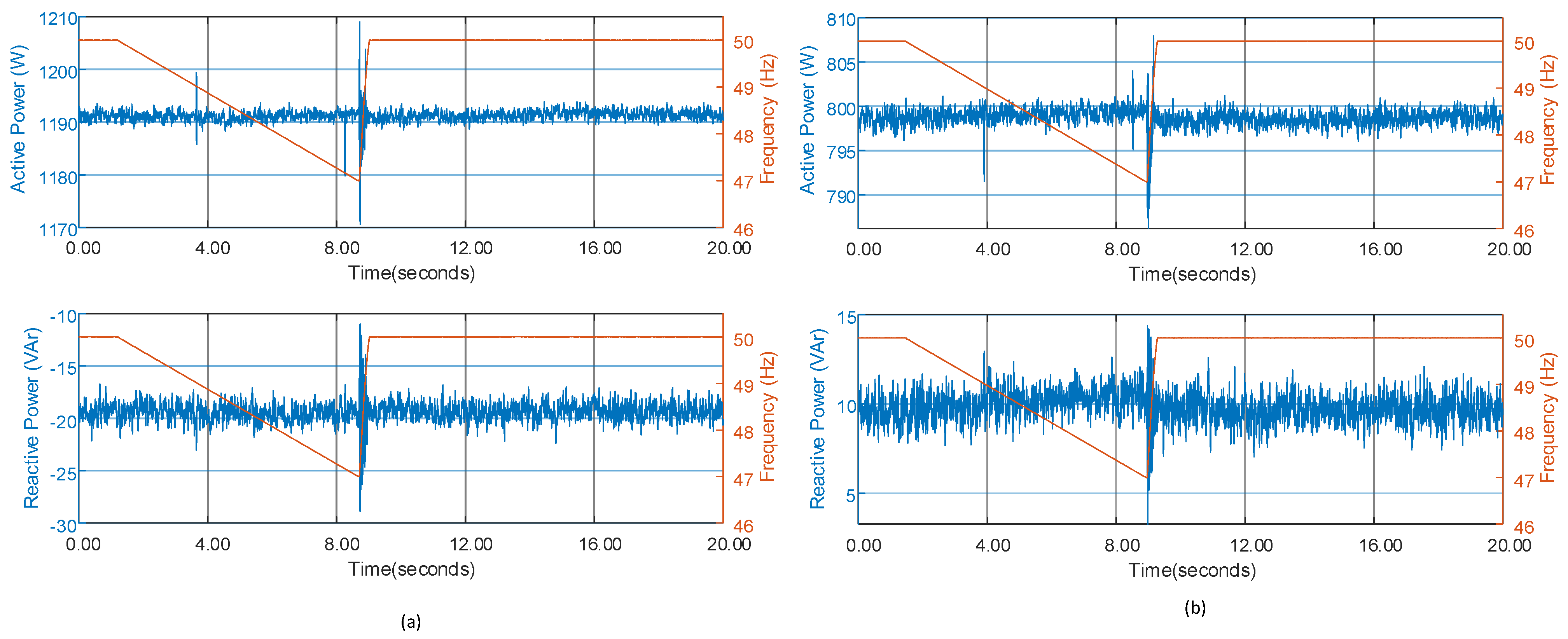
Figure 5.
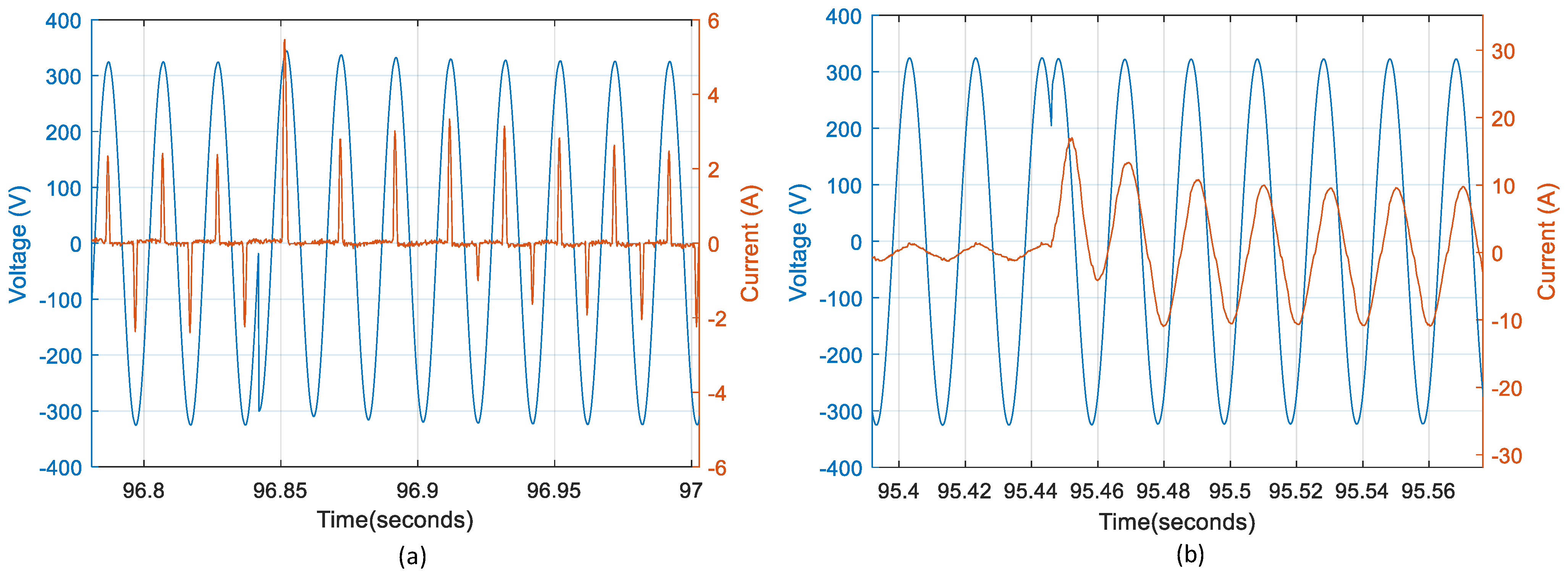
Impact of phase angle jumps on (a) Refrigerator 1 and (b) Refrigerator 2.
Figure 5.
Impact of phase angle jumps on (a) Refrigerator 1 and (b) Refrigerator 2.
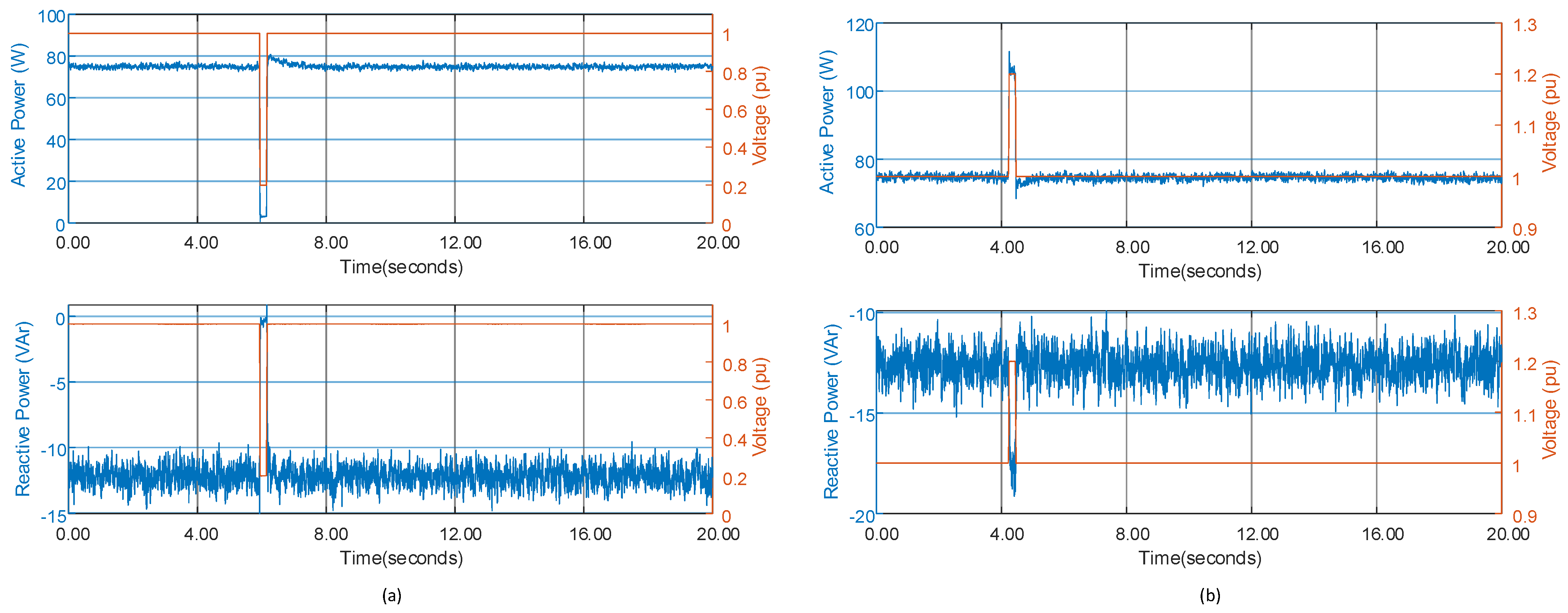
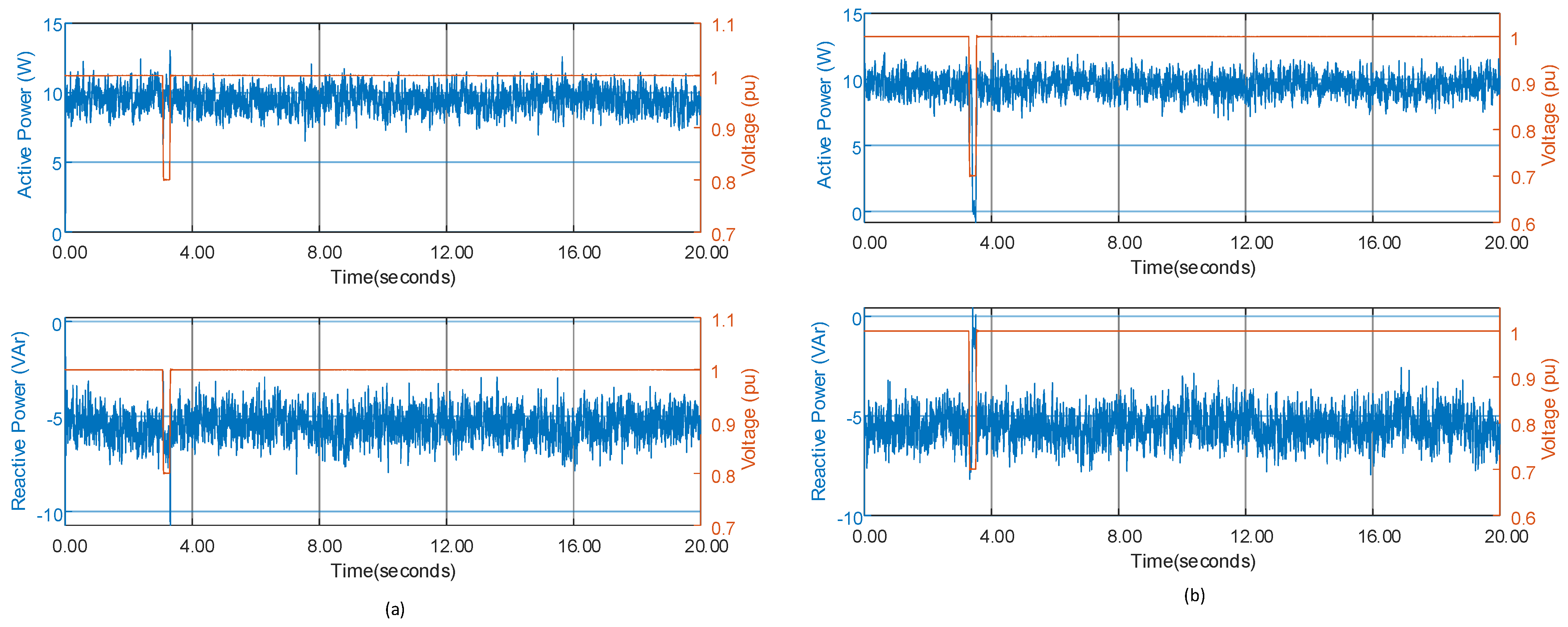
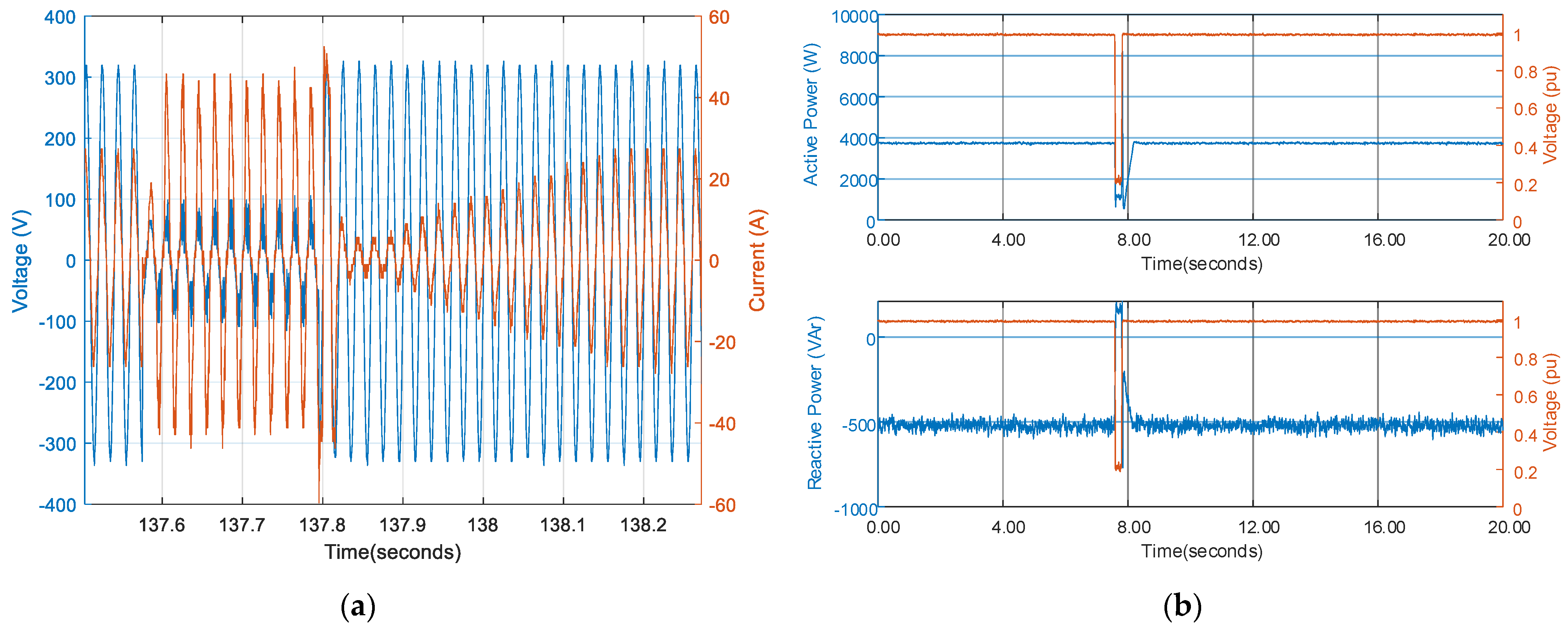
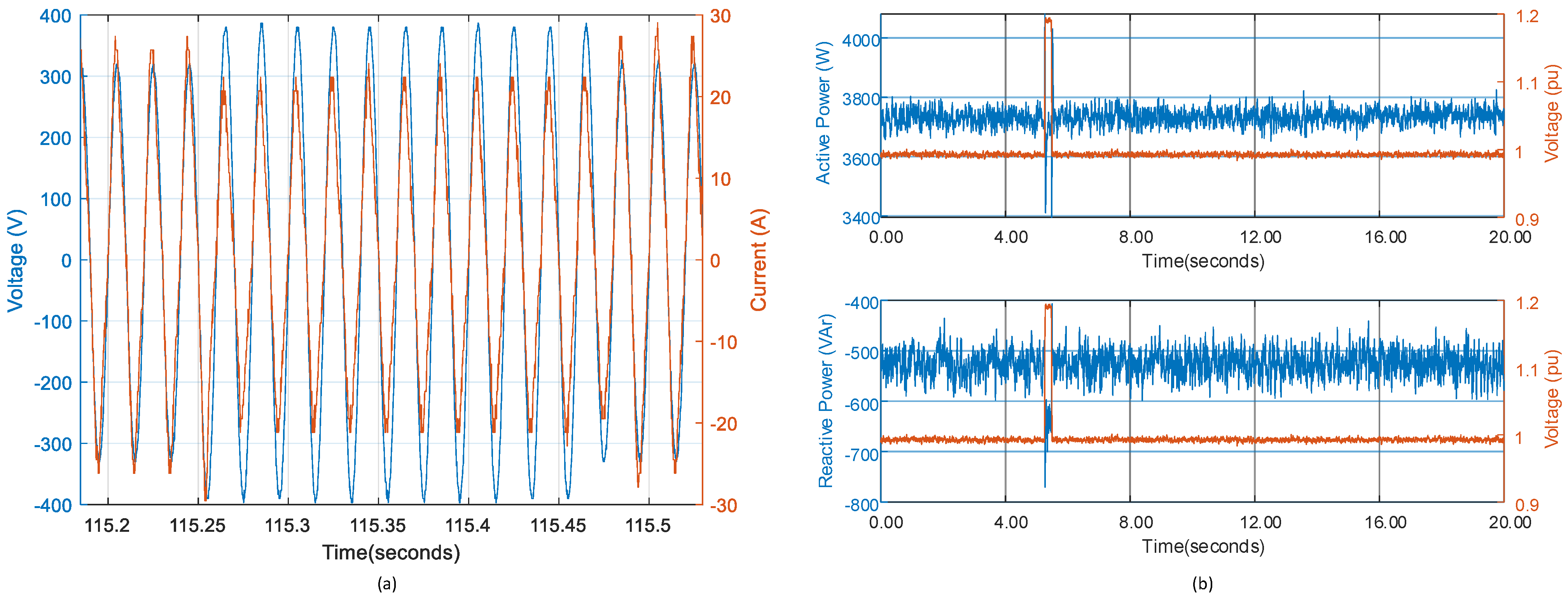
Figure 6.
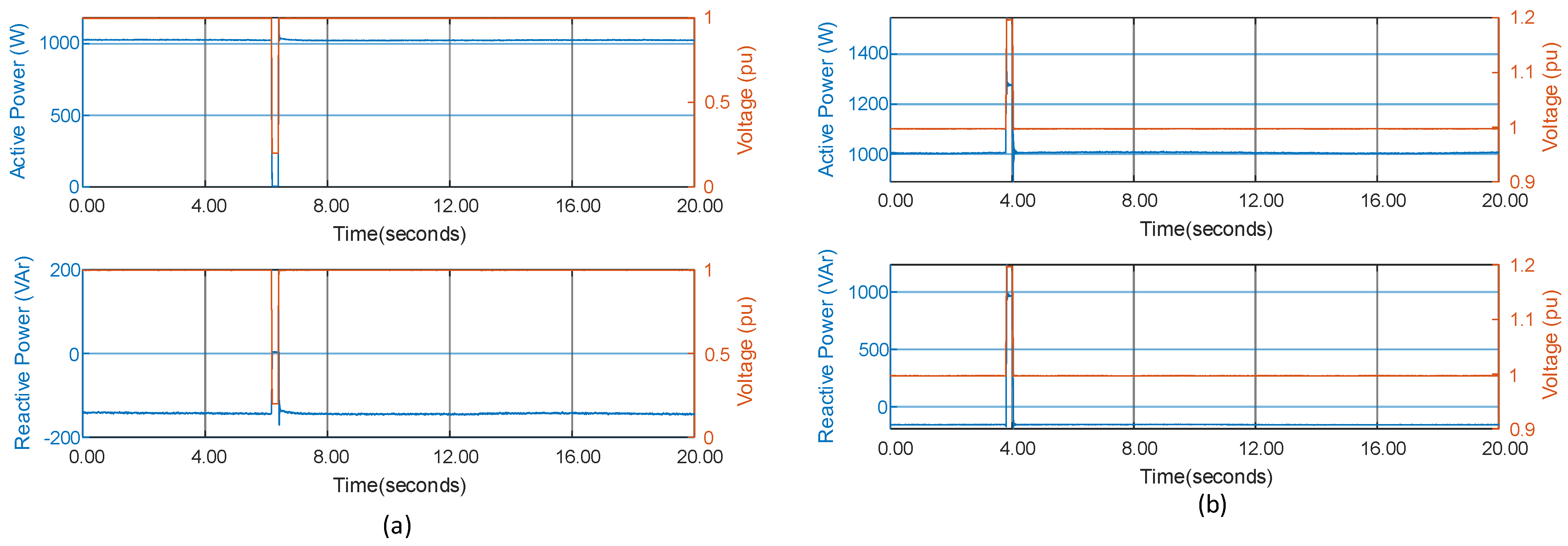
Response of microwave oven load when subject to a sag/swell with a duration of 220 ms: (a) a sag with a magnitude of 0.2 pu, and (b) a swell with a magnitude of 1.2 pu.
Figure 6.
Response of microwave oven load when subject to a sag/swell with a duration of 220 ms: (a) a sag with a magnitude of 0.2 pu, and (b) a swell with a magnitude of 1.2 pu.
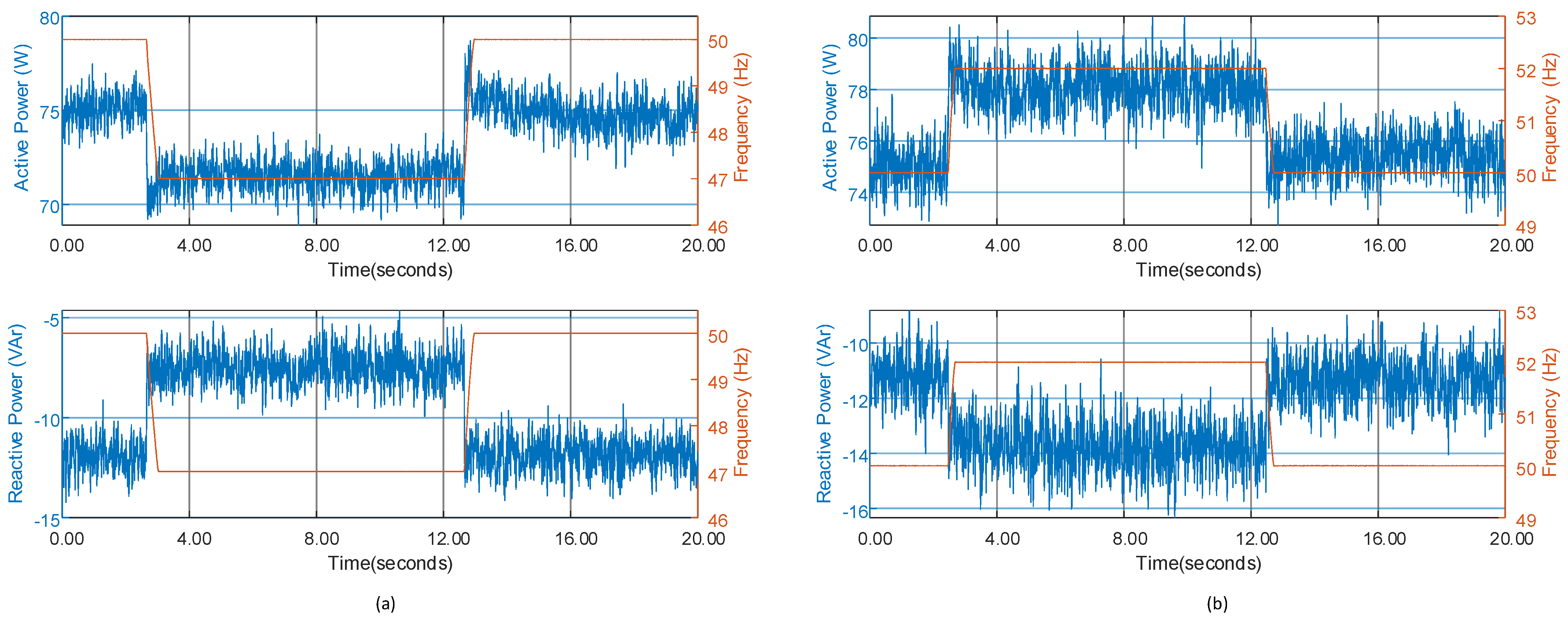
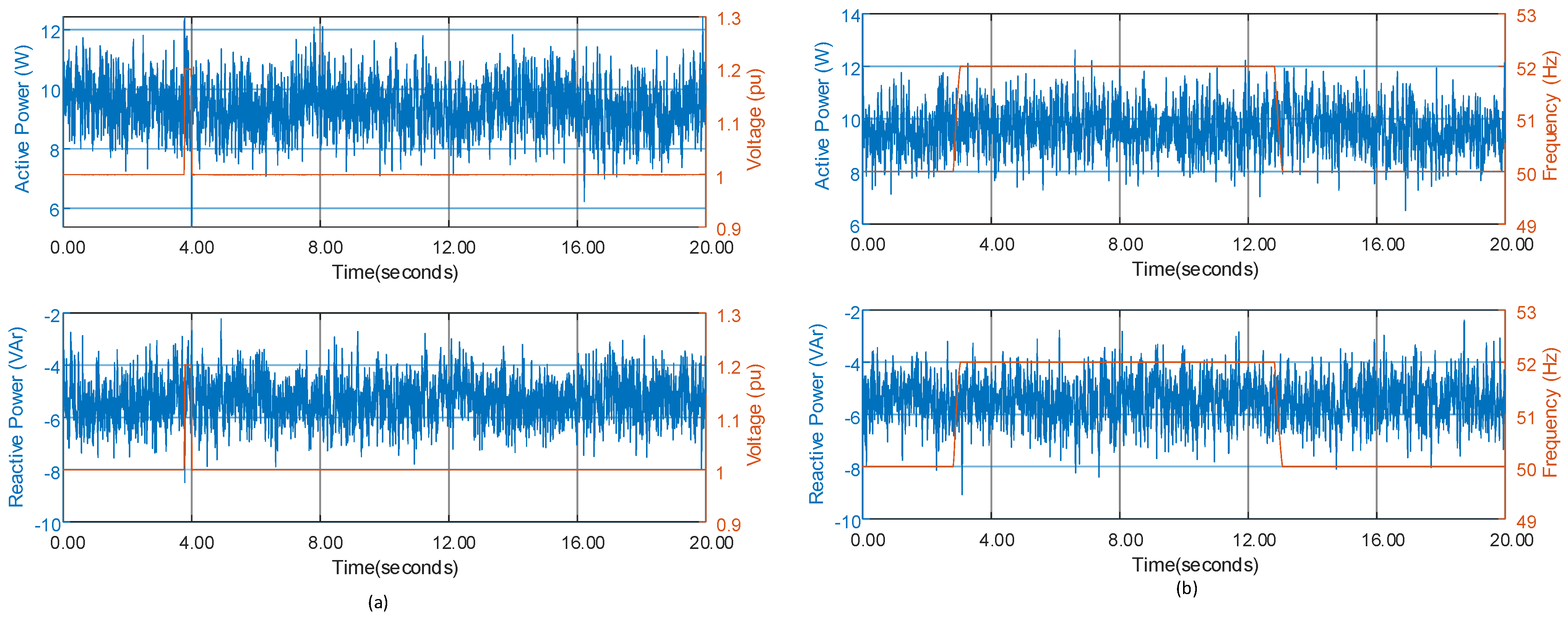
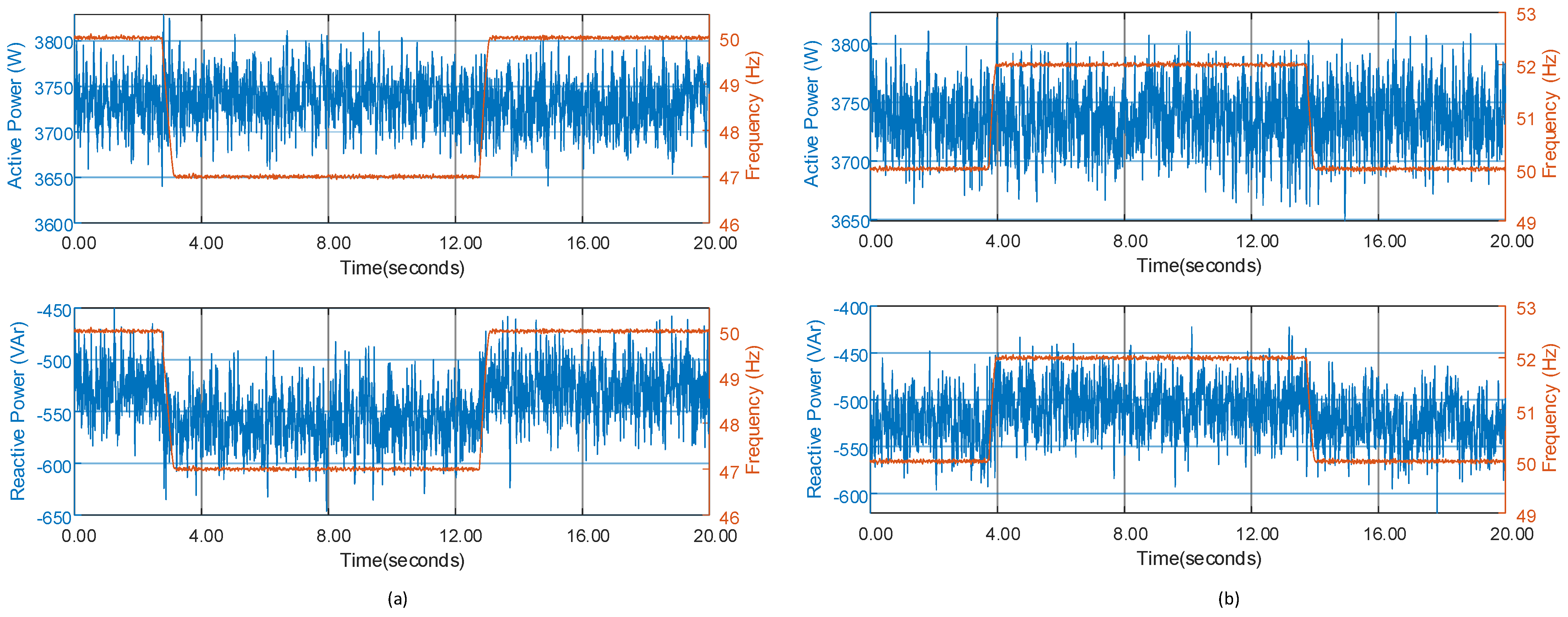
Figure 7.
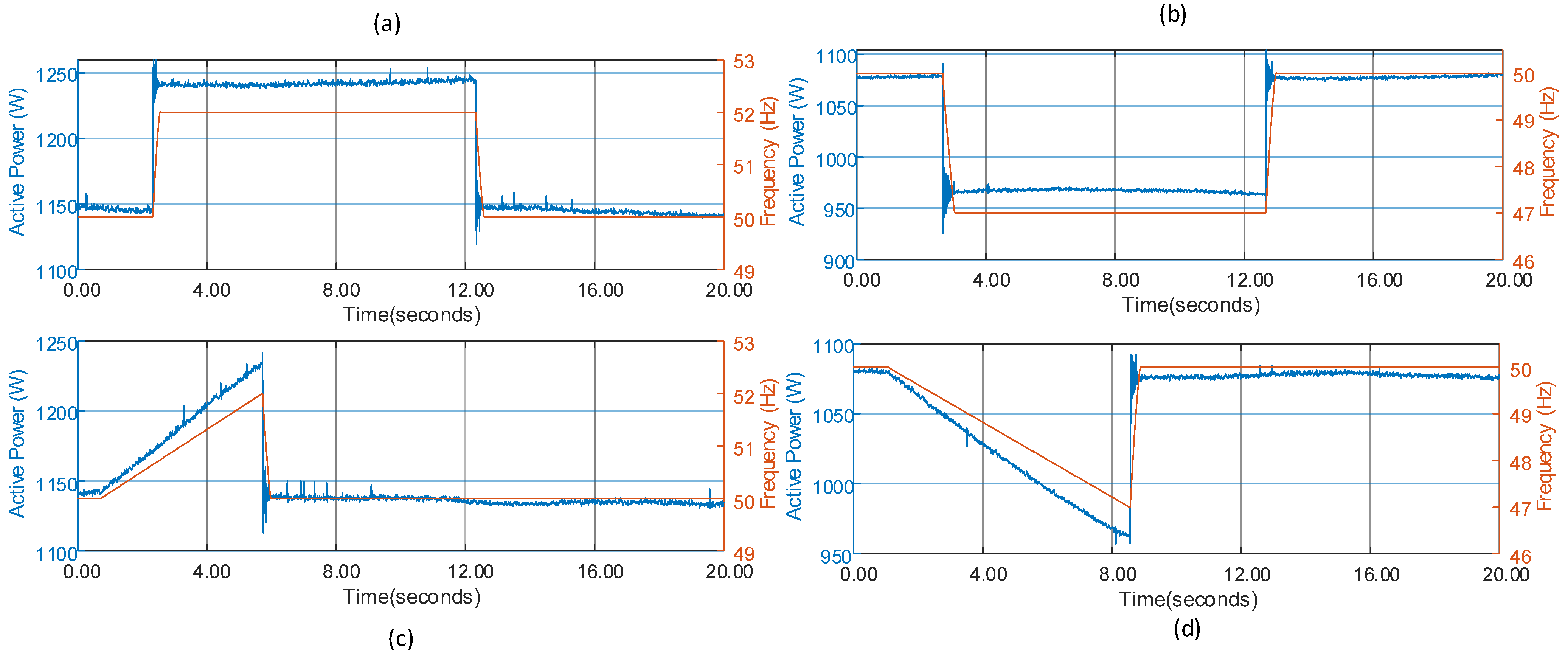
Frequency change responses of the microwave oven with (a) a step change from 50 Hz to 52 Hz and (b) 50 Hz to 47 Hz, (c) a ramp of +0.4 Hz/s, and (d) a ramp of −0.4 Hz/s.
Figure 7.
Frequency change responses of the microwave oven with (a) a step change from 50 Hz to 52 Hz and (b) 50 Hz to 47 Hz, (c) a ramp of +0.4 Hz/s, and (d) a ramp of −0.4 Hz/s.
Figure 8.
Response of the air conditioner when subject to voltage disturbances: (a) sag and (b) swell.
Figure 8.
Response of the air conditioner when subject to voltage disturbances: (a) sag and (b) swell.
Figure 9.
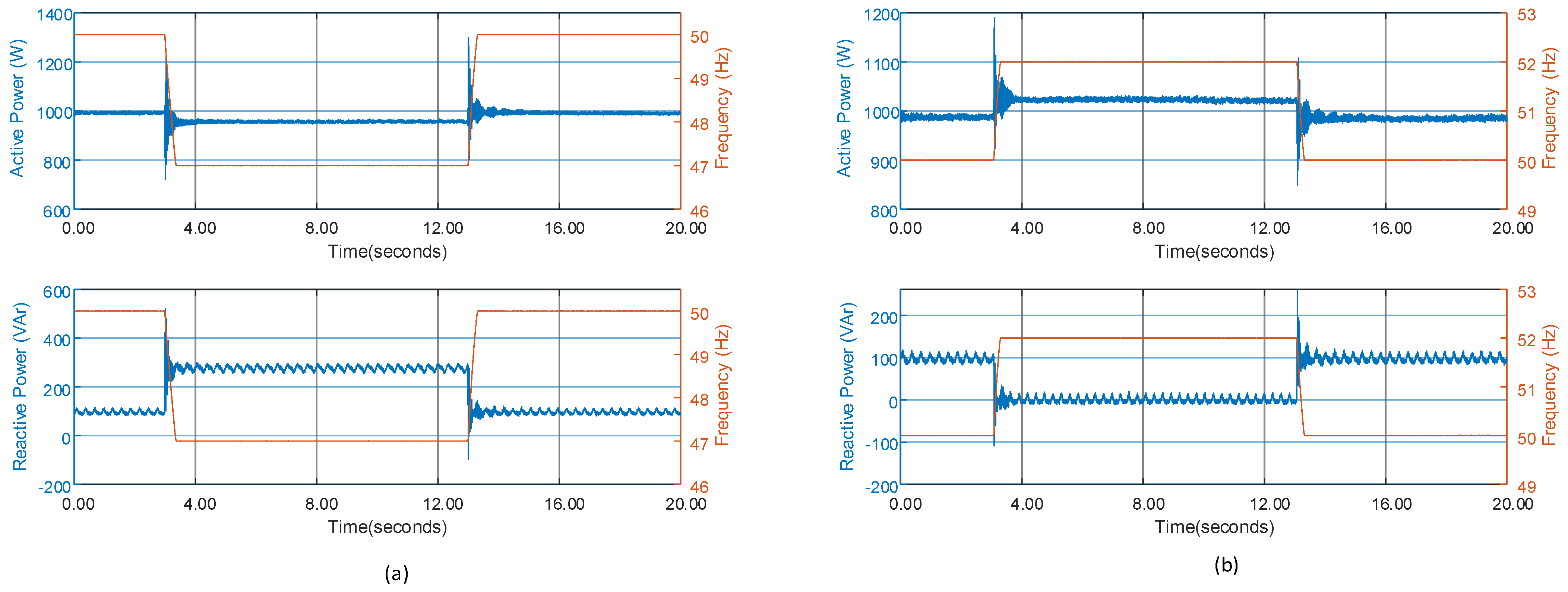
Frequency change responses for the air conditioner: (a) a step decrease to 47 Hz and (b) a step increase to 52 Hz.
Figure 9.
Frequency change responses for the air conditioner: (a) a step decrease to 47 Hz and (b) a step increase to 52 Hz.
Figure 10.
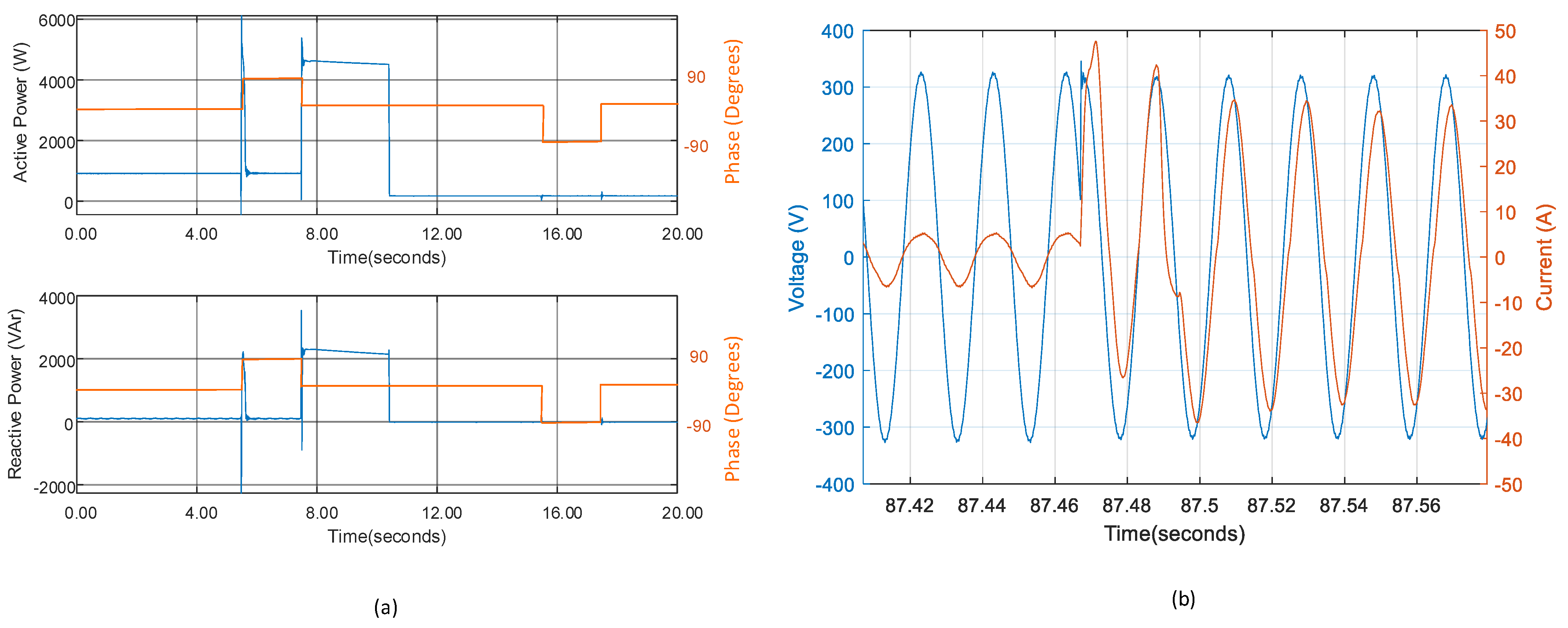
Impact of a phase angle jump on air conditioner operation: (a) P and Q response and (b) current drawn.
Figure 10.
Impact of a phase angle jump on air conditioner operation: (a) P and Q response and (b) current drawn.
Figure 11.
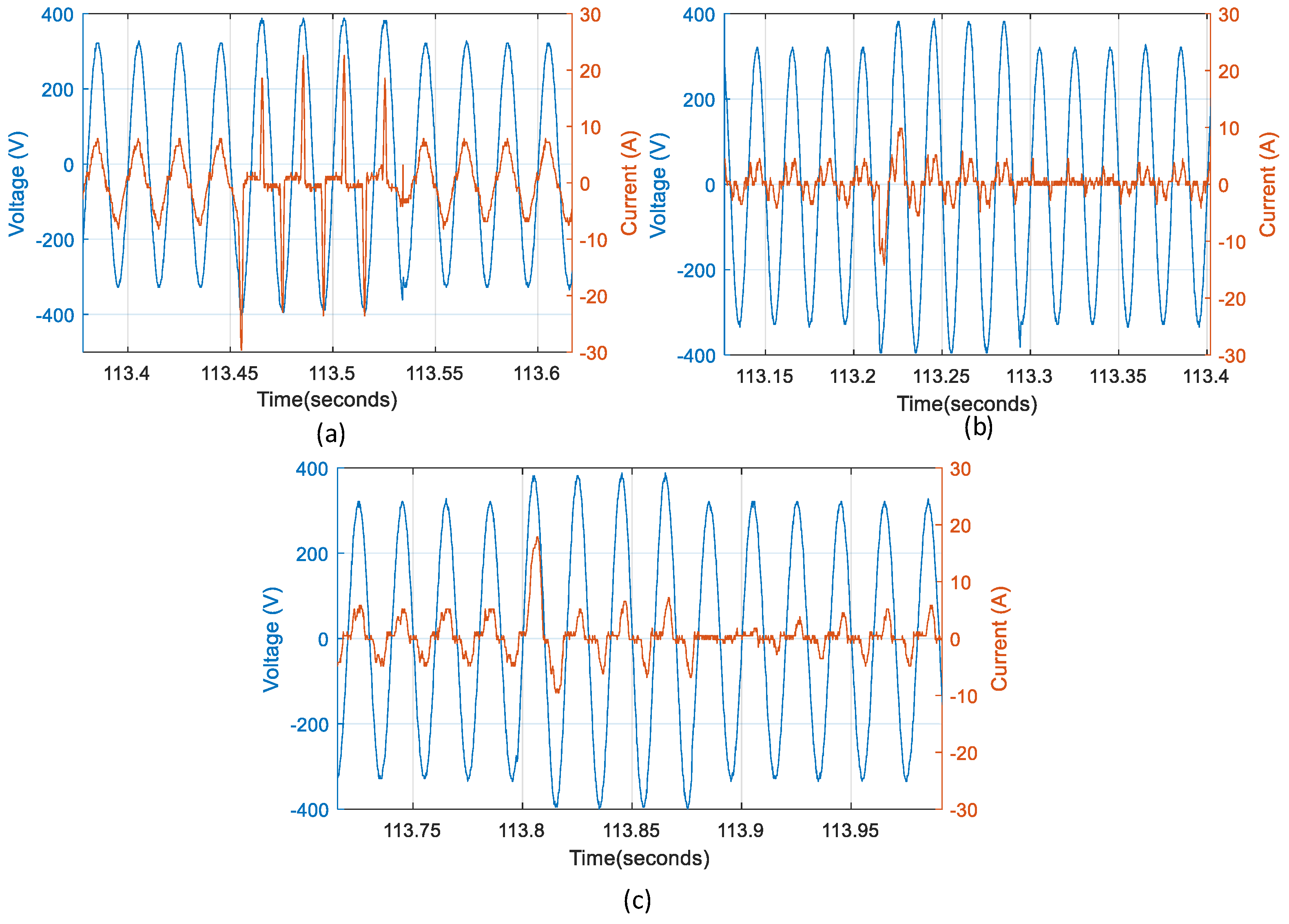
Response to a swell of voltage magnitude of 1.2 pu for 80 ms: (a) Air Conditioner 1, (b) Air Conditioner 2, and (c) Air Conditioner 3.
Figure 11.
Response to a swell of voltage magnitude of 1.2 pu for 80 ms: (a) Air Conditioner 1, (b) Air Conditioner 2, and (c) Air Conditioner 3.
Figure 12.
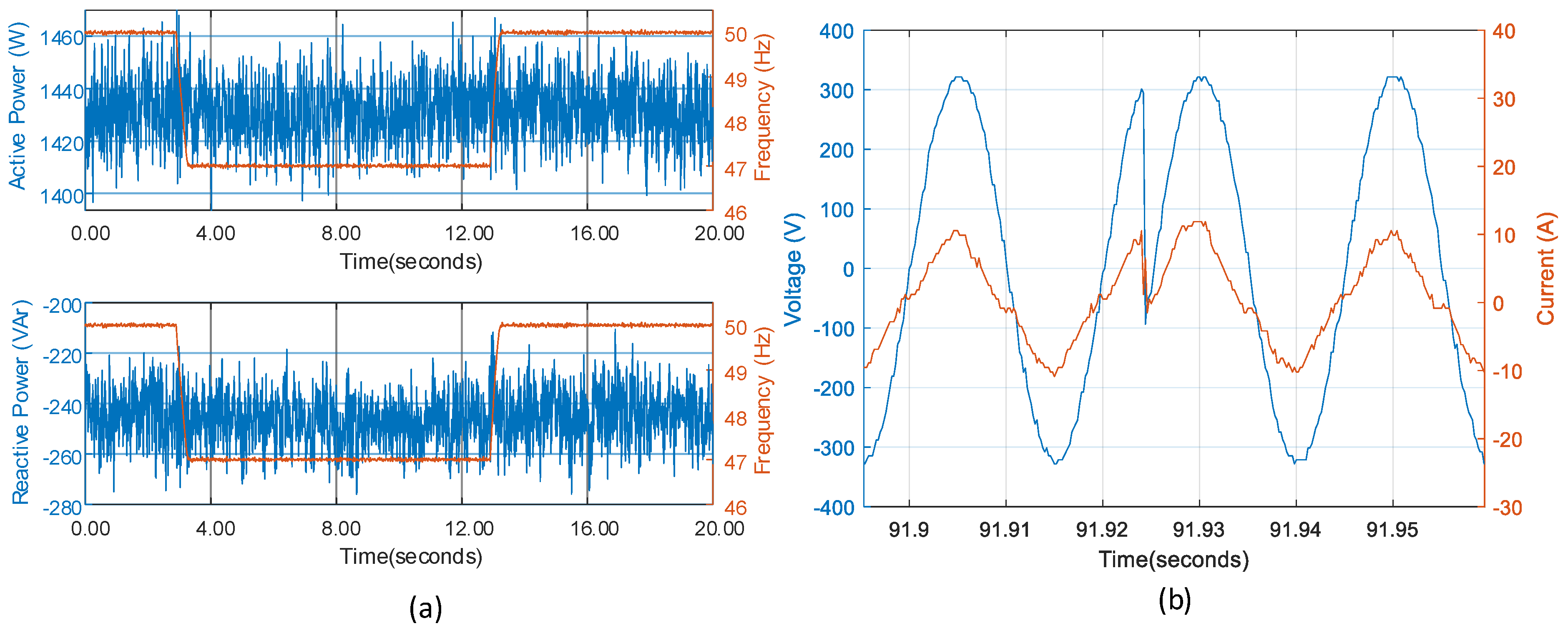
(a) Impact of step frequency disturbance on Air Conditioner 1, and (b) impact of −90° phase angle jump on Air Conditioner 1.
Figure 12.
(a) Impact of step frequency disturbance on Air Conditioner 1, and (b) impact of −90° phase angle jump on Air Conditioner 1.
Figure 13.
Response of the vacuum cleaner to (a) a sag with a retained voltage of 0.2 pu for 220 ms, and (b) a swell with a voltage of 1.2 pu for 220 ms.
Figure 13.
Response of the vacuum cleaner to (a) a sag with a retained voltage of 0.2 pu for 220 ms, and (b) a swell with a voltage of 1.2 pu for 220 ms.
Figure 14.
Frequency response of the vacuum cleaner with (a) a reduction in frequency at 0.4 Hz/s, and (b) a step increase in frequency from 50 Hz to 52 Hz.
Figure 14.
Frequency response of the vacuum cleaner with (a) a reduction in frequency at 0.4 Hz/s, and (b) a step increase in frequency from 50 Hz to 52 Hz.
Figure 15.
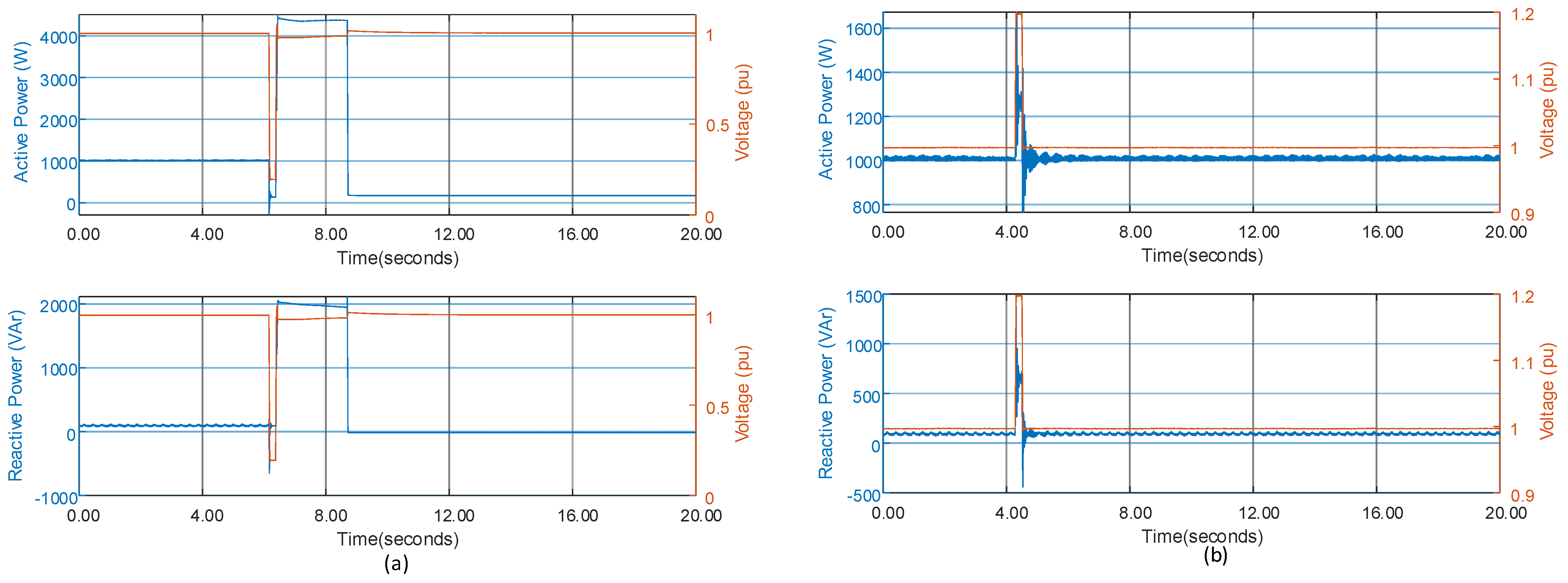
Response of fan for voltage sag and swell disturbances of (a) 0.2 pu sag for 220 ms, and (b) 1.2 pu swell for 220 ms.
Figure 15.
Response of fan for voltage sag and swell disturbances of (a) 0.2 pu sag for 220 ms, and (b) 1.2 pu swell for 220 ms.
Figure 16.
Frequency response of the fan with (a) a step decrease in frequency from 50 Hz to 47 Hz, and (b) a step frequency from 50 Hz to 52 Hz.
Figure 16.
Frequency response of the fan with (a) a step decrease in frequency from 50 Hz to 47 Hz, and (b) a step frequency from 50 Hz to 52 Hz.
Figure 17.
Heater response to sag of a retained voltage magnitude of 0.2 pu for 220 ms: (a) Heater 1 and (b) Heater 2.
Figure 17.
Heater response to sag of a retained voltage magnitude of 0.2 pu for 220 ms: (a) Heater 1 and (b) Heater 2.
Figure 18.
Impact of frequency disturbance: (a) Heater 1 and (b) Heater 2.
Figure 18.
Impact of frequency disturbance: (a) Heater 1 and (b) Heater 2.
Figure 19.
Response of the LED light bulb for a voltage sag of duration 220 ms with a retained voltage magnitude of (a) 0.8 pu and (b) 0.7 pu.
Figure 19.
Response of the LED light bulb for a voltage sag of duration 220 ms with a retained voltage magnitude of (a) 0.8 pu and (b) 0.7 pu.
Figure 20.
Response of the LED light bulb during a (a) voltage swell of 1.2 pu for 220 ms, and (b) step frequency increase from 50 Hz to 52 Hz.
Figure 20.
Response of the LED light bulb during a (a) voltage swell of 1.2 pu for 220 ms, and (b) step frequency increase from 50 Hz to 52 Hz.
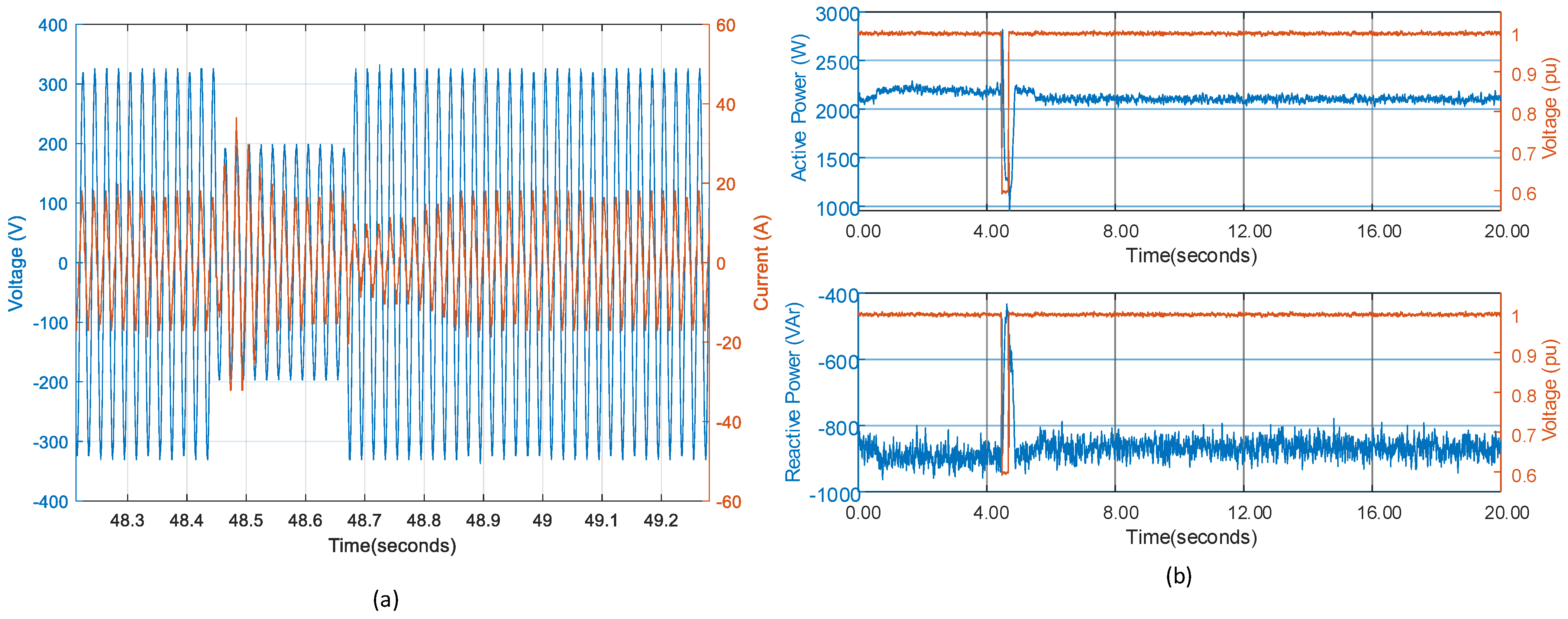
Figure 21.
Response of the EV Charger to a sag of 0.6 pu for 220 ms: (a) voltage–current response and (b) PQ response.
Figure 21.
Response of the EV Charger to a sag of 0.6 pu for 220 ms: (a) voltage–current response and (b) PQ response.
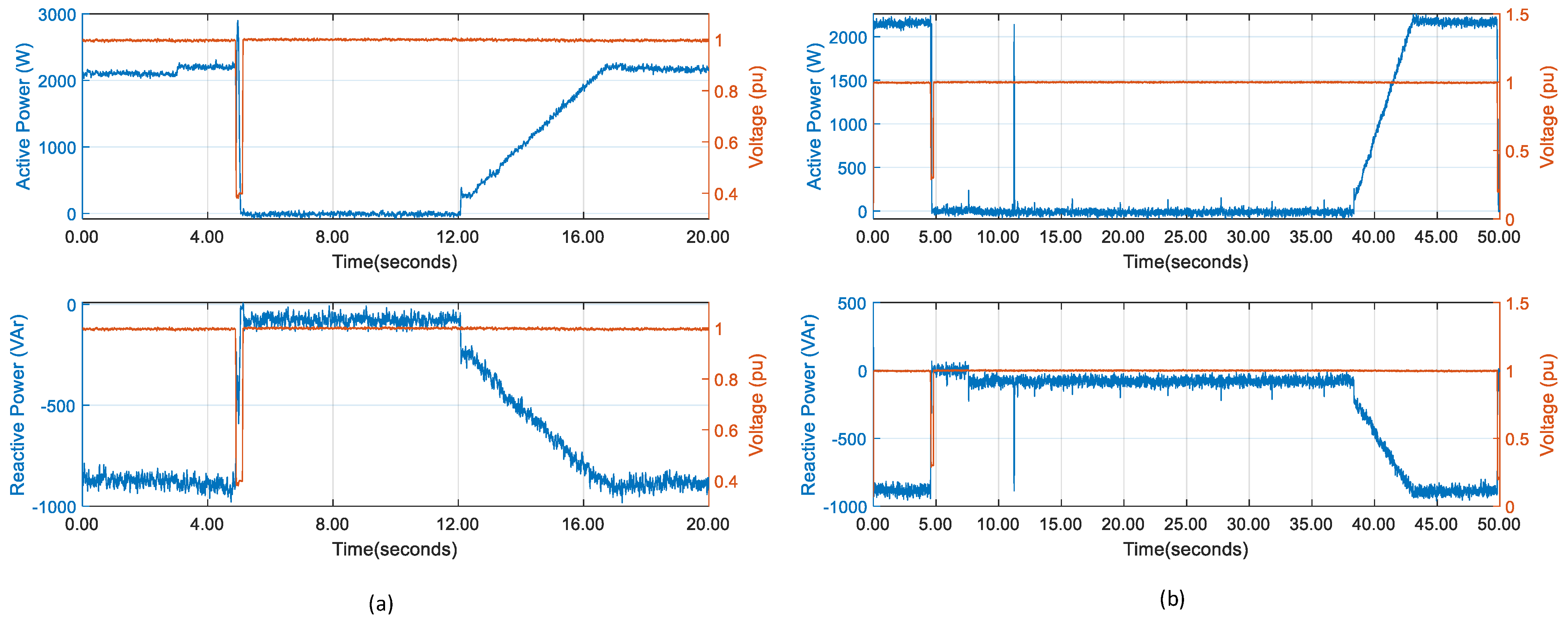
Figure 22.
Demonstration of different reconnection times depending on the retained voltage during a voltage sag of (a) 0.4 pu and (b) 0.3 pu.
Figure 22.
Demonstration of different reconnection times depending on the retained voltage during a voltage sag of (a) 0.4 pu and (b) 0.3 pu.
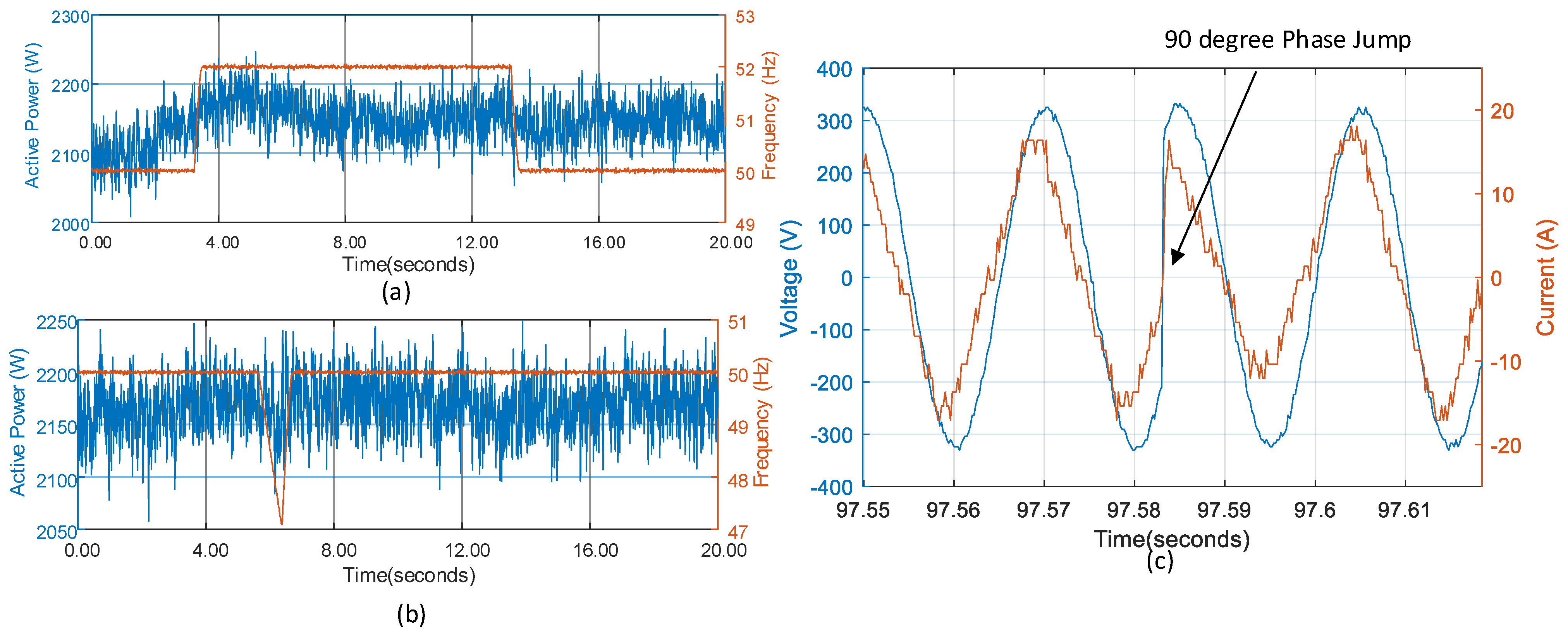
Figure 23.
Impact of frequency changes and phase angle jumps for the EV charger: (a) step frequency change from 50 Hz to 52 Hz, (b) ramp frequency at −4 Hz/s, and (c) phase angle jump.
Figure 23.
Impact of frequency changes and phase angle jumps for the EV charger: (a) step frequency change from 50 Hz to 52 Hz, (b) ramp frequency at −4 Hz/s, and (c) phase angle jump.
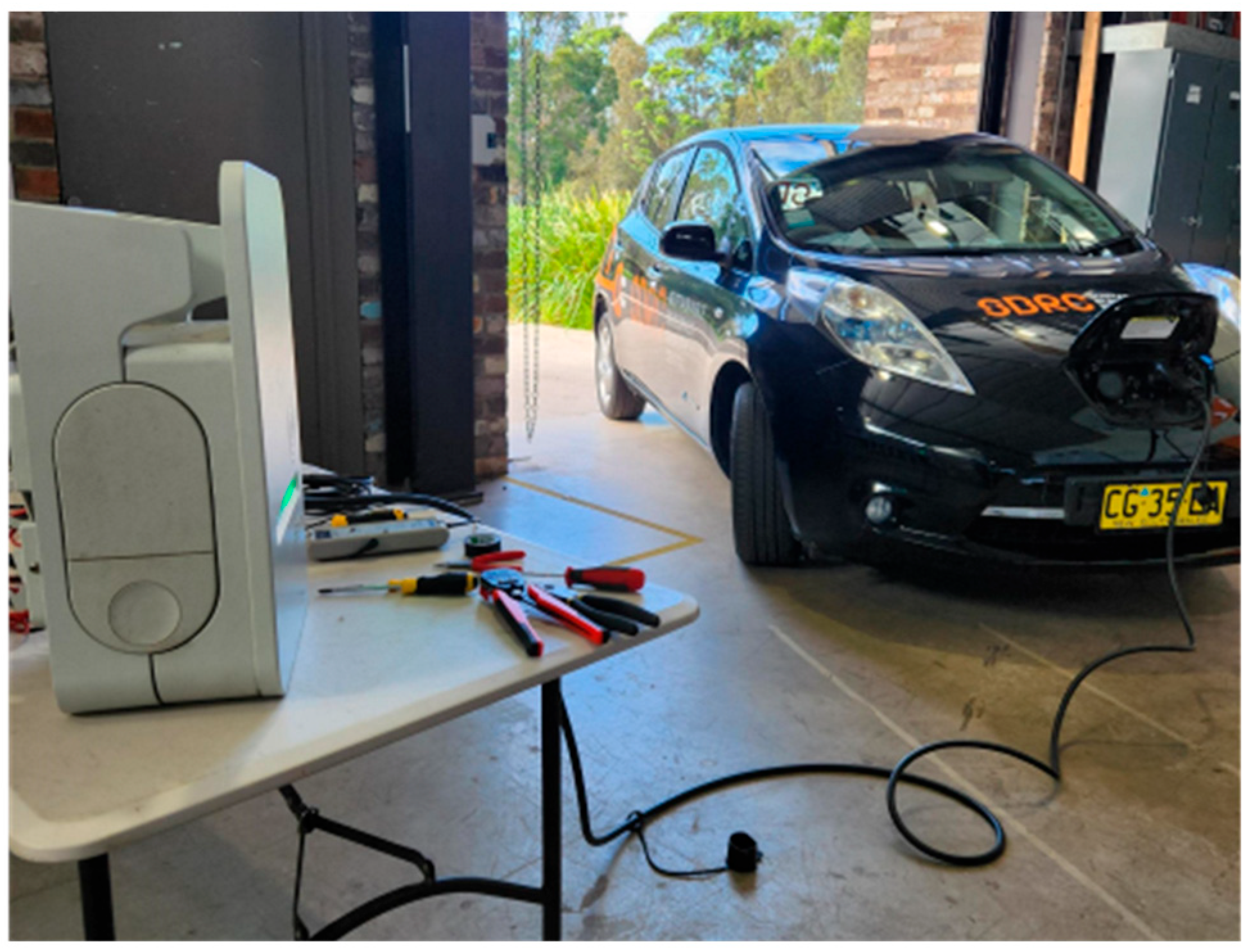
Figure 24.
Photograph of EV charger test setup.
Figure 24.
Photograph of EV charger test setup.
Figure 25.
Response of the EV charger to a voltage sag of 0.2 pu retained voltage for 220 ms: (a) current response and (b) P and Q response.
Figure 25.
Response of the EV charger to a voltage sag of 0.2 pu retained voltage for 220 ms: (a) current response and (b) P and Q response.
Figure 26.
EV charger response to a voltage swell of magnitude 1.2 pu for 220 ms: (a) current response and (b) P and Q response.
Figure 26.
EV charger response to a voltage swell of magnitude 1.2 pu for 220 ms: (a) current response and (b) P and Q response.
Figure 27.
EV charger response to step frequency disturbances: (a) 50 Hz to 47 Hz, and (b) 50 Hz to 52 Hz.
Figure 27.
EV charger response to step frequency disturbances: (a) 50 Hz to 47 Hz, and (b) 50 Hz to 52 Hz.
Table 1.
Classification of the different types of loads in CMPLDW.
Table 1.
Classification of the different types of loads in CMPLDW.
| Motor A | Refers to 3-phase induction motors that have high locked-rotor torque and low inertia (with an H value of 0.1 s) and are designed to drive constant torque loads. These types of motors are typically used in commercial and industrial air conditioning compressors and refrigeration systems. |
| Motor B | Another 3-phase induction motor, but with high inertia (with an H value ranging from 0.25 s to 1.0 s), which is designed to drive loads whose torque is proportional to the speed squared. These motors are commonly used in commercial ventilation fans and air-handling systems, with typical ratings of 4 kW to 19 kW. |
| Motor C | A 3-phase induction motor that has low inertia (with an H value ranging from 0.1 s to 0.2 s) and is designed to drive loads whose torque is proportional to the speed squared. These motors are typically used in commercial water circulation pumps in central cooling systems, with typical ratings of 4 kW to 19 kW. |
| Motor D | A specialised performance model that is specifically designed to represent single-phase (1P) compressors. These motors have a constant torque load characteristic and minimal inertia, which can make them prone to stalling. They are commonly used in single-phase residential and light commercial refrigerator compressor motors in Australia, with typical ratings of 2 kW to 4 kW. |
| Power Electronic | A power electronic load refers to electronic devices used by consumers (such as computers and televisions), appliances (e.g., dishwashers), office equipment, and variable frequency drives (VFDs) used in commercial and industrial settings. |
| Static | A static load represents the remaining unclassified aggregate loads, including constant impedance loads such as incandescent lighting. |
Table 2.
Voltage sag magnitude and duration.
Table 2.
Voltage sag magnitude and duration.
| Voltage Sag Magnitude (pu) | Duration of Sag (ms) |
|---|
| 0.8 | 80 | 120 | 220 |
| 0.7 | 80 | 120 | 220 |
| 0.6 | 80 | 120 | 220 |
| 0.5 | 80 | 120 | 220 |
| 0.4 | 80 | 120 | 220 |
| 0.3 | 80 | 120 | 220 |
| 0.2 | 80 | 120 | 220 |
Table 3.
Voltage swell magnitude and duration.
Table 3.
Voltage swell magnitude and duration.
| Voltage Swell Magnitude (pu) | Duration of Swell (ms) |
|---|
| 1.05 | 80 | 120 | 220 |
| 1.1 | 80 | 120 | 220 |
| 1.125 | 80 | 120 | 220 |
| 1.15 | 80 | 120 | 220 |
| 1.175 | 80 | 120 | 220 |
| 1.2 | 80 | 120 | 220 |
Table 4.
List of frequency disturbances.
Table 4.
List of frequency disturbances.
| Frequency Disturbance Type | Frequency Change (ΔF) |
|---|
| Step Frequency | −3 Hz |
| +2 Hz |
| Ramp Frequency Variations (RoCoF) | ±0.4 Hz/s |
| ±1 Hz/s |
| ±4 Hz/s |
Table 5.
List of phase angle jumps.
Table 5.
List of phase angle jumps.
| Disturbance Type | Phase Angle Change (Δθ) |
|---|
| Phase jump due to asymmetric fault | ±15° |
| ±30° |
| ±45° |
| ±60° |
| ±90° |
Table 6.
Modern loads selected for tests.
Table 6.
Modern loads selected for tests.
| Load Types |
|---|
| Refrigerators (conventional and inverter-based) |
| Heaters (electric fan and radiant) |
| Fans |
| Microwave Oven (inverter-based) |
| Air Conditioners (DOL and inverter-based) |
| Desktop (switch mode power supply) |
| Electric vehicle charger units |
| LED lights |
| Equipment with DOL motors (vacuum cleaner) |
Table 7.
Summary of voltage sag tests for Air Conditioner 1.
Table 7.
Summary of voltage sag tests for Air Conditioner 1.
Sag
Duration | Voltage Amplitude (pu) |
|---|
| 0.9 | 0.8 | 0.7 | 0.6 | 0.5 | 0.4 | 0.3 | 0.2 |
|---|
| 80 ms | ✓ | ✓ | ✓ | ✓ | ✓ | ✓ | ✗ | ✗ |
| 120 ms | ✓ | ✓ | ✓ | ✓ | ✓ | ✓ | ✗ | ✗ |
| 220 ms | ✓ | ✓ | ✓ | ✓ | ✓ | ✓ | ✗ | ✗ |
Table 8.
Summary of voltage sag tests for Air Conditioner 2.
Table 8.
Summary of voltage sag tests for Air Conditioner 2.
Sag
Duration | Voltage Amplitude (pu) |
|---|
| 0.9 | 0.8 | 0.7 | 0.6 | 0.5 | 0.4 | 0.3 | 0.2 |
|---|
| 80 ms | ✓ | ✓ | ✓ | ✓ | ✓ | ✓ | ✓ | ✓ |
| 120 ms | ✓ | ✓ | ✓ | ✓ | ✓ | ✓ | ✓ | ✓ |
| 220 ms | ✓ | ✓ | ✓ | ✓ | ✗ | ✗ | ✗ | ✗ |
Table 9.
Summary of voltage sag tests for Air Conditioner 3.
Table 9.
Summary of voltage sag tests for Air Conditioner 3.
Sag
Duration | Voltage Amplitude (p.u) |
|---|
| 0.9 | 0.8 | 0.7 | 0.6 | 0.5 | 0.4 | 0.3 | 0.2 |
|---|
| 80 ms | ✓ | ✓ | ✓ | ✓ | ✓ | ✗ | ✗ | ✗ |
| 120 ms | ✓ | ✓ | ✓ | ✓ | ✓ | ✗ | ✗ | ✗ |
| 220 ms | ✓ | ✓ | ✓ | ✓ | ✓ | ✗ | ✗ | ✗ |
Table 10.
Response of EV charger for voltage sags of different magnitudes and durations.
Table 10.
Response of EV charger for voltage sags of different magnitudes and durations.
| Voltage Sag | 0.8 pu | 0.7 pu | 0.6 pu | 0.5 pu | 0.4 pu | 0.3 pu | 0.2 pu |
|---|
| 80 ms | Ride Through | Ride Through | Ride Through | Ride Through | Ride Through | Disconnect for 32 s | Disconnect for 32 s |
| 120 ms | Ride Through | Ride Through | Ride Through | Disconnect for 7 s | Disconnect for 7 s | Disconnect for 32 s | Disconnect for 32 s |
| 220 ms | Ride Through | Ride Through | Ride Through | Disconnect for 7 s | Disconnect for 7 s | Disconnect for 32 s | Disconnect for 32 s |