Article

Experimental and Numerical Investigation of an Adsorption Desalination Exchanger for High-Purity Water Production in Hydrogen Systems


Department of Thermal and Fluid Flow Machines, Faculty of Energy and Fuels, AGH University of Krakow, al. A. Mickiewicza 30, 30-059 Krakow, Poland
*
Author to whom correspondence should be addressed.
Energies 2026, 19(2), 484; https://doi.org/10.3390/en19020484
Submission received: 12 December 2025 / Revised: 15 January 2026 / Accepted: 17 January 2026 / Published: 19 January 2026
(This article belongs to the Special Issue Advances in Numerical and Experimental Heat Transfer)

Abstract

Hydrogen-based energy systems require large amounts of high-purity water, motivating thermally driven desalination that can recover low-grade heat. This study evaluates a silica gel–water adsorption chiller–desalination unit as a coupled source of cooling and pre-treated water for electrolysers. A laboratory two-bed system was tested on saline feed using 300 s valve-switching periods at an 80 °C driving temperature and 20–30 °C cooling water. Dynamic vapour sorption measurements provided Dubinin–Astakhov equilibrium and linear driving force kinetic parameters, implemented in a CFD porous bed model via user-defined source terms. Experiments yielded COP values of 0.29–0.41, an SCP of 165 W·kg−1 of adsorbent, and an average distillate production of 1.68–1.82 kg·h−1, while distillate conductivity remained ≈2.3 μS·cm−1. The model reproduced the mean condensate production with a ≈6% underprediction. It was then used to compare six alternative fin geometries with a constant heat-transfer area. Fin-shape modifications changed inter-fin heating by <2 K and cumulative desorbed mass by <0.05%, indicating limited sensitivity to subtle local refinements. Performance gains are more likely to arise from operating conditions and exchanger-scale architecture than from minor fin-shape changes.

1. Introduction

The dynamic transformation of energy systems around the world means that hydrogen is seen as one of the key zero-emission fuels in the long term. The International Energy Agency’s report ‘The Future of Hydrogen’ indicates that demand for hydrogen could increase from the current ~90–100 Mt·year−1 to over 500 Mt·year−1 in deep decarbonisation scenarios, with most of this increase coming from so-called ‘green’ hydrogen produced from renewable energy sources [1].
A review of work on the hydrogen economy emphasizes that hydrogen can play a particularly important role in sectors that are difficult to electrify—heavy industry, long-distance transport and seasonal energy storage [2,3,4].
In many concepts for the development of energy systems, hydrogen is treated both as an energy carrier and a tool for managing surplus power from renewable energy sources. Vaccaro et al. conducted a techno-economic analysis of the potential for producing clean hydrogen from surplus energy in systems with a high share of RES, pointing to the possibility of significantly reducing curtailment by using flexible electrolysers [5].
Similar conclusions were presented for systems with surplus hydro, wind and photovoltaic power [6,7,8,9,10,11].
In these analyses, hydrogen becomes an element linking the electricity, heating, transport and chemical industries, and its ability to store energy in the long term is one of the main arguments for its widespread use. A prerequisite for implementing such scenarios on a large scale is not only to reduce the cost of hydrogen production, but also to ensure adequate availability of high-purity water. Mass-balance calculations show that at least 9 kg of process water is needed to produce 1 kg of hydrogen by water electrolysis, plus additional amounts consumed in auxiliary systems and treatment facilities [2,3]. The global scale of hydrogen production projected to be in the order of hundreds of millions of tons per year indicates water flows in the tens of billions of cubic meters, raising questions about competition with other sectors of the economy and the impact on local water resources. The quality of water supplied to electrolyser cells is just as important as the quantity balance. The JRC’s harmonized test protocols for low-temperature water electrolysers (PEM, AEM, AWE) require the use of at least Class 2 water in accordance with ISO 3696 for laboratories, with an electrical conductivity not exceeding 1 µS·cm−1 at 25 °C [5]. This means that multi-stage treatment systems must be used, typically combining filtration, reverse osmosis, ion exchange, and possibly final polishing on mixed beds. The JRC report emphasizes that ionic, siliceous, and organic contaminants can lead to accelerated membrane wear, increased cell voltage, and decreased process efficiency [5]. As a result, water quality requirements lead to both additional energy consumption and increased investment costs for electrolyser installations, especially in locations with limited access to fresh water [1,2,3,4]. This motivates interest in thermally driven desalination routes that can provide a distilled stream alongside useful cooling. Sorption systems play an important role in these concepts, in particular adsorption cooling and desalination installations capable of operating using low-temperature waste heat or solar energy. Saha et al. have developed a new refrigeration device using CaCl2–silica gel–water vapor, powered by relatively low-temperature heat, while achieving satisfactory refrigeration parameters [12]. Manila et al. analysed the dynamic behaviour of a two-stage, air-cooled water/silica gel system, pointing to the possibility of stable operation over a wide range of temperature conditions and the importance of coupling between mass and heat transfer in the adsorbent layer [13]. Bai et al. quantified the impact of salinity on combined cooling–desalination performance, while Li et al. demonstrated that metal foam integration can enhance both cooling output and water production [14,15].
The design of the heat exchanger with an adsorbent layer plays a key role in this type of installation [16]. Research by Kowsari et al. has shown that the geometry of the fins and the configuration of the adsorption bed in a flat-tube, finned exchanger have a significant impact on pressure drops, temperature uniformity, and the coefficient of performance (COP) [17]. Mitra et al. analysed the influence of adsorbent particle size and exchanger slenderness on the adsorption dynamics in a system with activated carbon and ethanol, showing that, for finer grains, the dominant limitation is the vapour flow resistance in the porous bed, while for larger particles, heat conduction and intramolecular diffusion play an increasingly important role [18]. Papakokkinos et al. proposed a generalized numerical model of adsorption reactors that allows different bed geometries (fin, tube, ring) to be compared in terms of their ability to provide cooling and distilled water [19]. These results clearly indicate that further improvement of adsorption cooling and desalination systems requires optimization of the adsorbent heat exchanger design and a careful control of temperature and pressure distributions within the bed volume.
This exchanger-level evidence naturally extends to system concepts, where adsorption cooling is coupled with distilled water production. Adsorption cooling-cum-desalination systems provide a promising pathway in this direction because the water-based working pair inherently produces a condensate stream with very low salinity. Experimental and system-level studies have demonstrated that stable cooling and desalination performance can be achieved under realistic boundary conditions and that operating parameters such as salinity, cycle timing, and regeneration temperature govern the achievable distillate productivity [12,13,14]. The enhancement of internal heat transfer—for example via conductive matrices and metal foam integration—has been shown to further improve both unit cooling output and freshwater production by reducing thermal resistance within the bed [15]. These findings support the hypothesis that adsorption-based devices can serve as local nodes for producing a distillate stream that may subsequently be polished to meet stringent electrolyser requirements, while simultaneously providing useful cooling capacity.
Building on these geometry-focused findings, a modelling framework that combines a pore-filling equilibrium model with an averaged kinetic description and a 3D representation of the exchanger is well aligned with the design questions raised in recent experimental and numerical studies [17,18,19,20,21,22,23,24,25].
A significant step in this direction was also the work on the use of materials with increased thermal conductivity, such as metal foams or high-conductivity metallic matrices or porous metallic structures. Pinheiro et al. simulated in the OpenFOAM environment the operation of a heat pump with a layer of CPO-27(Ni) adsorbent applied to copper foam, indicating the possibility of significantly reducing the cycle time by improving heat exchange between the bed and the working medium [20]. Palomba et al.’s own research on silica gels impregnated with metal salts showed that the appropriate selection of the structure and thermal conductivity of the material, while maintaining high sorption capacity, allows for a significant increase in the specific cooling capacity of the exchanger without the need to raise the supply temperature [22]. In this paper, these conclusions were used primarily in the context of describing the modelling of the sorption process and the design of the exchanger, rather than a detailed analysis of new composites.
Various adsorption equilibrium and mass transfer kinetics models are used to quantitatively describe the sorption processes in such systems. Rezk et al. showed that for the ethanol/silica gel pair, the family of classical isotherm models (Langmuir, Freundlich, Dubinin–Radushkevich, and Tóth) allows for good representation of measurements, with the highest accuracy obtained for the Langmuir and Tóth models [24]. These models describe the maximum sorption capacity, adsorption intensity, and energy of adsorbent–adsorbate interactions, and their properties are discussed in detail by Ayawei et al. [23] and Hu and Zhang [25]. In the case of water-based vapours, the Dubinin–Astakhov model or its modifications, which allow the filling of the pore volume of microporous materials to be described, are widely used [22,24,25].
To describe the kinetics of sorption in exchangers with a porous bed, averaged linear driving force (LDF) models are most commonly used, which assume that the mass transfer rate is proportional to the difference between the equilibrium concentration and the instantaneous concentration in the adsorbent particle. Saha et al. developed an adsorption chiller employing the CaCl2-in-silica gel/water working pair, showing that, with a suitably selected LDF constant, good agreement with experimental results can be achieved [12]. Papakokkinos et al. implemented the LDF model in a generalized description of reactors with different bed geometries, which allowed for a comparison of their operation while maintaining the same sorbent characteristics [19]. However, Mitra et al. showed that, with very fine adsorbent particles and high slenderness of the exchanger, the LDF model can lead to significant errors in the assessment of the cycle time if the flow resistance in the porous medium is ignored [18]. Therefore, an intermediate approach was adopted in this study: the adsorption equilibrium in the water/silica gel pair is described by a modified Dubinin–Astakhov model, and the mass transfer kinetics by an averaged LDF model, whose parameters were determined on the basis of experimentally determined isotherms and kinetic curves [22,24,25,26].
In summary, reports and studies to date indicate, on the one hand, a rapid increase in demand for hydrogen and the associated ultra-pure water [1,2,3,4,5,6,7,8,9,10,11] and, on the other hand, the great potential of adsorption cooling and desalination systems powered by low-temperature waste heat as a source of distillate and “process cooling” [12,13,14,15,17,18,19,20,22,24]. At the same time, few studies focus on a quantitative assessment of the possibility of using such systems to produce water that meets the stringent quality requirements for electrolyser feed, in accordance with JRC guidelines [11]. In particular, there is a lack of analyses combining detailed modelling of sorption phenomena in an exchanger with an adsorbent layer with a qualitative and quantitative balance of water throughout the entire hydrogen production chain.
The aim of this work is to fill this gap by presenting a concept of a system in which an adsorption chiller operating with water/silica gel vapor simultaneously acts as a source of cooling and a module for the preliminary production of ultrapure water for an electrolyser. Based on experimental data for silica gel, a numerical model of an exchanger with an adsorbent layer was developed, based on the energy and mass transport equation in the porous zone and on the Dubinin–Astakhov and LDF model describing the equilibrium and kinetics of sorption [22,23,24]. Next, the potential distilled water production capacity and the cooling temperatures and flows that can be achieved when the exchanger is supplied with heat with parameters typical for industrial heat recovery installations were determined. The results obtained provide a basis for assessing the extent to which this type of system can meet the demand for process water in planned hydrogen production installations.

2. Materials and Methods

2.1. Experimental Part

2.1.1. Laboratory Adsorption Chiller with Desalination Function

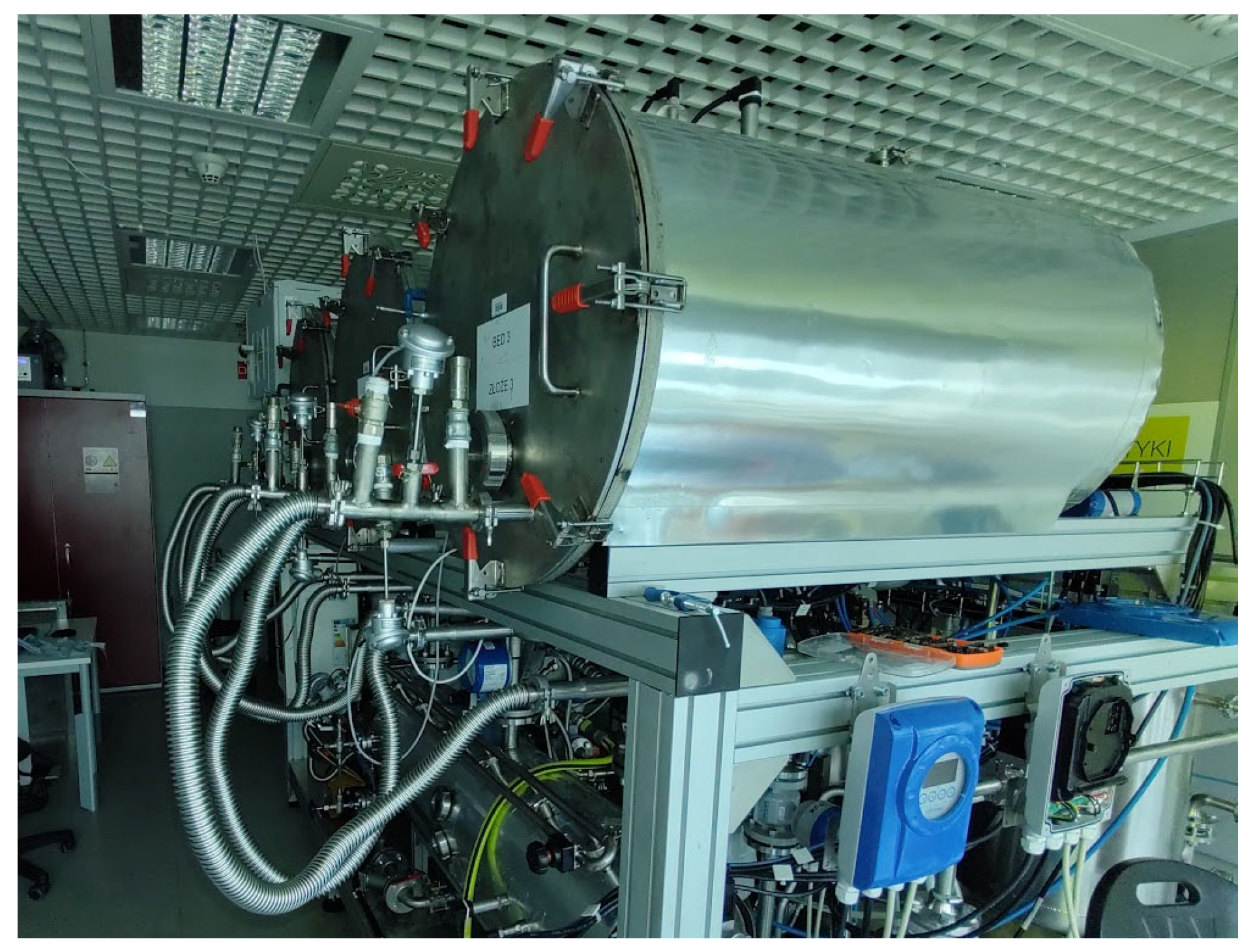
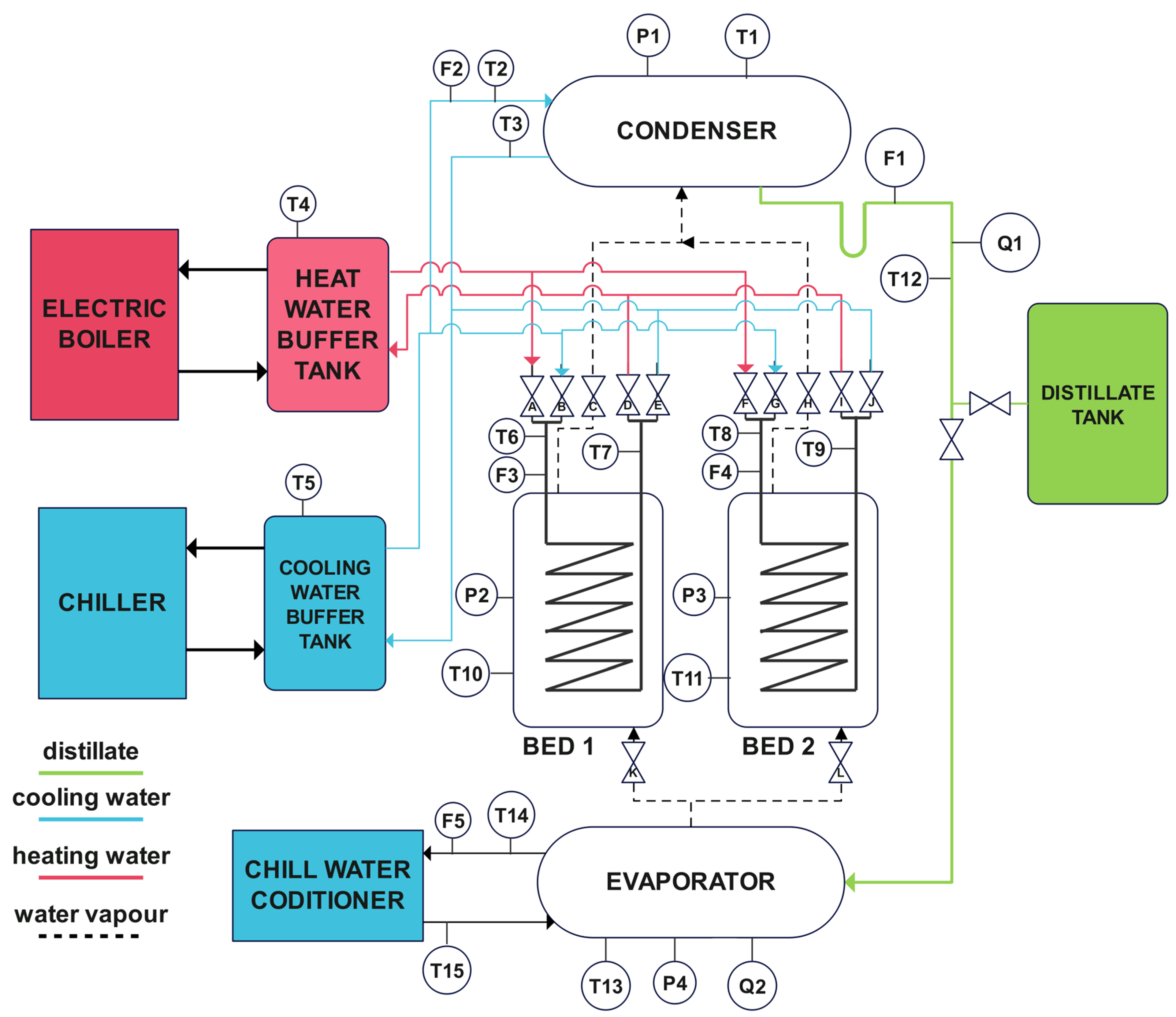
Experimental tests were carried out on a laboratory adsorption chiller with a desalination function, operating in a two-bed system (Figure 1). The system was equipped with an evaporator, a condenser, and two adsorbers with tube-and-fin heat exchangers filled with macroporous silica gel (type 55 SA). Each adsorption bed contained approximately 4 kg of silica gel i.e., 8 kg in total for the two-bed system. The installation allows adsorption and desorption cycles to be carried out with independent control of the heating, cooling, and chilled water temperatures and with full recording of operating parameters, such as flows, temperatures, and electrical conductivity of the distillate. The adsorbers operate in an alternating desorption/adsorption cycle, allowing continuous operation of the entire system. Figure 2 shows a simplified schematic of the test rig with the locations of all measurement points (T, P, F and Q).
The tests were carried out with heat supplied by an electric boiler and with the condenser and chilled water cooled by dedicated circuits that lower the temperature of the cooling media. The tests used brine obtained from the Baltic Sea, which made it possible to evaluate the desalination process under real salinity conditions. The physicochemical characteristics of the brine (including salinity ~3.7%, specific conductivity, ionic composition) were determined on the basis of laboratory analysis.

2.1.2. Testing the Operation of an Adsorption Refrigerator with a Desalination Function

All experiments were conducted in a repeatable time cycle comprising the following:
  • desorption phase—supplying heating water at a temperature of 80 °C to the bed;
  • adsorption phase—supplying cooling water at a temperature of 20–25 °C;
  • precooling/preheating phase (approx. 50 s) and heat recovery phase (approx. 30 s) to stabilize the thermal state;
  • the adsorption and desorption steps lasted 300 s each.
All operating parameters were recorded continuously throughout each cycle at the measurement points shown in Figure 2 and as follows:
  • temperatures: condenser temperature (T1); condenser cooling–water inlet/outlet temperatures (T2, T3); heating-water buffer tank temperature (T4); cooling-water buffer tank temperature (T5); heat transfer fluid (HTF) inlet/outlet temperatures for bed 1 (T6, T7) and bed 2 (T8, T9); adsorption bed chamber temperatures (T10, T11); distillate temperature (T12); evaporator temperature (T13); and chilled-water inlet/outlet temperatures (T15, T14);
  • pressures: condenser pressure (P1), bed 1 and bed 2 chamber pressures (P2, P3), and evaporator pressure (P4);
  • flow rates: distillate flow rate (F1), condenser cooling-water flow rate (F2), HTF flow rates through bed heat exchangers (F3, F4), and chilled-water flow rate (F5);
  • distillate quality: electrical conductivity of the distillate and brine (Q1, Q2),
  • valve states: the open/closed (on/off) status of valves A–L was continuously monitored during each cycle.
Each experimental run lasted 5 h and was recorded continuously. The first 2 h were excluded from post-processing to remove start-up transients. For quantitative evaluation, a post-processing window covering 10 complete cycles was selected (760 s per cycle, i.e., 50/300/30/50/300/30 s for precooling/adsorption/heat recovery/preheating/desorption/heat recovery, respectively; total evaluation time 7600 s), and all reported indicators were computed from this window. Instrumentation specifications and accuracies are summarised in Table 1.

2.1.3. Experimental Determination of Adsorbent Properties

Water vapor sorption properties of the silica gel samples were measured using a dynamic gravimetric system (DVS Vacuum), enabling continuous mass recording with 0.1 μg resolution under controlled temperature and humidity conditions. Prior to measurements, all samples were dried and degassed at 100 °C and then stabilized at the selected process temperature (30–60 °C). The 30–60 °C range was selected as a typical operating window for silica gel–water adsorption chillers due to the maximum temperature limitation of the DVS apparatus (60 °C).
Adsorption and desorption isotherms were obtained by varying the relative pressure p/p0 from 10% to 100% in ten steps, followed by a symmetric desorption sequence. Each step lasted 20 min, and the vapor flow rate was fixed at 15 sccm. The resulting isotherms exhibited clear hysteresis. This behaviour is typical for porous silica gels and is commonly associated with different mechanisms governing pore filling and emptying, including capillary condensation and evaporation in mesopores, metastable states, and transport limitations during stepwise changes of relative pressure. Therefore, adsorption and desorption equilibria were treated separately and fitted independently for use in the numerical model.
Kinetic measurements were additionally performed to determine mass transfer parameters. Approximately 30 mg of material was subjected to a two-cycle adsorption procedure under low-vacuum conditions. Only the second cycle was used for analysis, as it better reflects the operating conditions in the adsorption bed and provides stabilized sample behaviour. The q(t) curves showed quasi-exponential dynamics, supporting the use of the linear driving force (LDF) model in simulations.

2.2. Numerical Model of an Adsorption Bed with a Tube-Fin Heat Exchanger

2.2.1. Model Geometry and Computational Simplifications

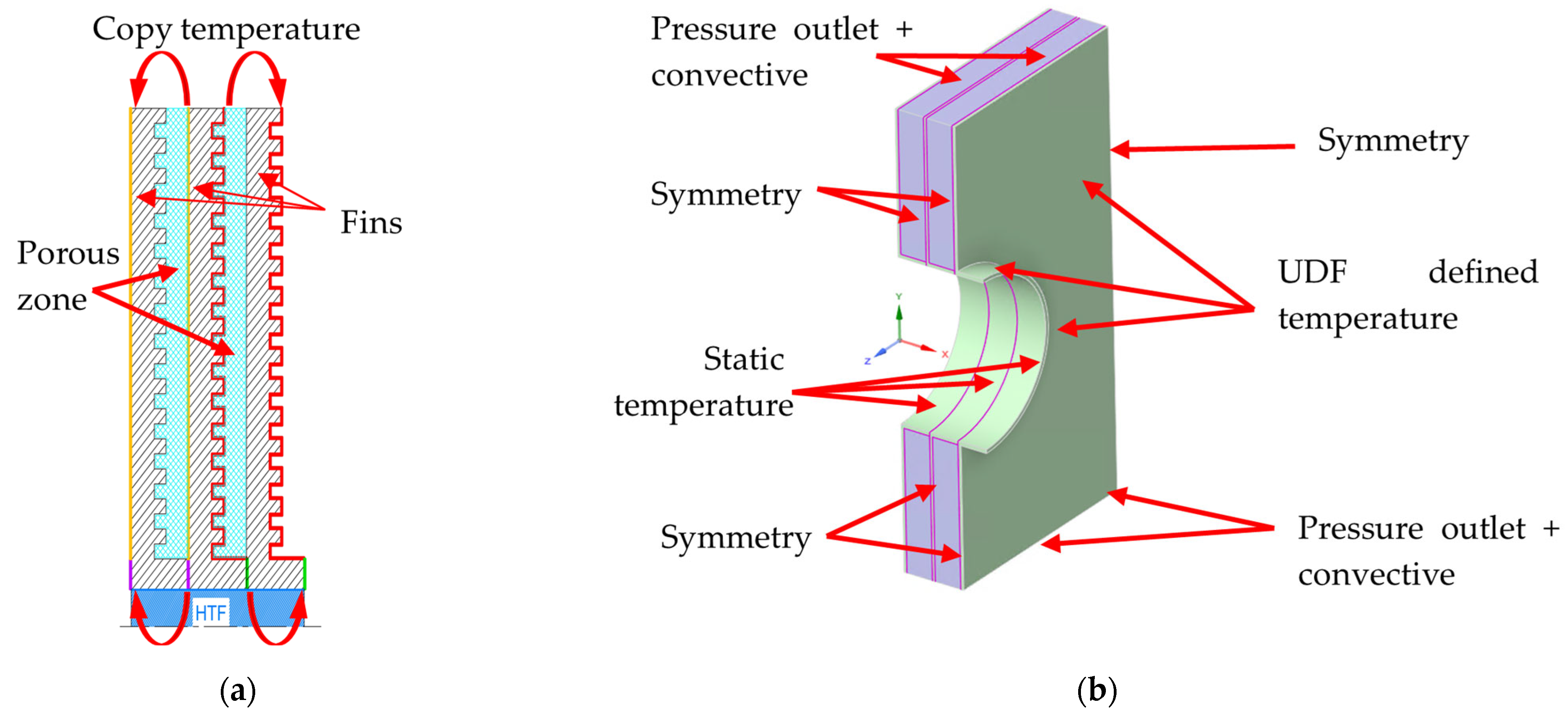
The numerical model represents a fragment of a fin-and-tube exchanger that is part of an adsorption bed. The domain includes three adjacent aluminium fins and two inter-fin spaces filled with a silica gel-based adsorbent. The system used is a representative periodic geometric module, which allows for a significant reduction in grid size while maintaining local thermal and mass dynamics. The central fin is adjacent to the HTF pipe, while the two side fins act as periodic surfaces. The geometry of the three-fin periodic segment and the applied boundary conditions are shown in Figure 3.
The inter-fin spaces are defined as a porous medium with a mixture of air and water vapor, remaining in local thermal equilibrium with the adsorbent. Heat conduction in the fins was treated as a process in a homogeneous solid medium. The implementation of the temperature copying algorithm using the UDF function made it possible to enforce thermal periodicity without the need to build a conformal mesh on the boundary surfaces.

2.2.2. Physical Models and Transport Equations

The model activates equations of flow, energy, and component transport. The gas mixture is described as an ideal gas, which allows for accurate representation of density changes resulting from the variable partial pressure of water vapor during desorption. The transport of species (water vapor, air) was solved using convection–diffusion equations with molecular diffusion.
The governing transport equations solved in the porous zone can be represented for water vapour mass fraction Yw as follows:
ρ · Y w t +   · ρ · u · Y w = · ρ · D e f f · Y w + S m
and for energy (LTE in the porous medium), as follows:
ρ · c p · T t +   · ρ · c p · u · T =   · k e f f · T +   S E
where Sm (mass source) and SE (energy source) are implemented via UDF (Section 2.2.7).
Due to the low Reynolds numbers in the porous space, a laminar flow model was used. The energy equation includes conduction in the solid skeleton and gas mixture, convection in the pores, and energy sources resulting from sorption heat.

2.2.3. Sorption Model: Dubinin–Astachow (D–A) and LDF

The description of sorption phenomena is based on a combination of two models: the Dubinin–Astakhov equilibrium model and the linear driving force kinetic model.
Adsorption equilibrium is expressed by the following equation:
q = W 0 exp R T l n p w p s T E n
where q* is the equilibrium adsorption charge, with the parameters W0, E, and n are adjusted to the experimentally determined adsorption and desorption isotherms; pw is the local water vapour partial pressure; and ps(T) is the saturation pressure evaluated from temperature (Section 2.2.6).
The sorption kinetic was determined by the LDF equation, as follows:
d q d t = K L D F q q
where q is the current adsorbed water content, and KLFD was determined based on kinetic curves from DVS experiments. The LDF model reflects diffusion resistance within the adsorbent particles and allows for the consideration of dynamic delay, characteristic of adsorption systems.
In the CFD model, Equation (3) is used to compute the local equilibrium uptake q* from the local water vapour partial pressure, pW, and the saturation pressure, pS(T). The transient uptake, q, is then updated using Equation (4), which provides the local sorption rate, dq/dt, in the transient simulations. q is updated at each time step as follows:
q n + 1 = q n + K L D F q q n t
This rate is converted into volumetric mass and energy source terms applied in the porous zone to the H2O species transport equation, continuity equation and the energy equation, enabling fully coupled transient heat and mass transfer.

2.2.4. Grid Generation and Grid Independence Test

The computational domain was discretized in ANSYS fluent meshing using a consistent meshing workflow for all cases. The surface mesh was generated with curvature and proximity sizing (curvature normal angle 18°, cells-per-gap 1, proximity scoped to edges) and a uniform growth rate of 1.2. Subsequently, the volume mesh was generated as a polyhedral mesh using global sizing with the same growth rate. Three meshes were created by varying only the target size limits (minimum/maximum surface size and maximum volume cell length), resulting in a coarse (m1), medium (m2), and fine (m3) grid (Table 2). The resulting cell counts and mesh quality metrics are also provided in Table 2.
Grid independence was assessed by repeating the same transient desorption simulation on all three meshes. The cumulative desorbed water mass was obtained by time-integrating the H2O mass flow rate at the pressure outlet over a 300 s desorption period and subsequently scaling the result from the periodic segment to the full adsorption bed. For the purpose of the grid-independence study, a fixed time step of 0.25 s was used in all simulations to ensure consistent temporal discretization across the tested meshes. The medium mesh (m2) predicted a scaled water production of 0.347 kg after 300 s. The deviations between meshes remained within ±1%: m1 produced ~1% less and m3 ~1% more (Table 3). Because refinement from m2 to m3 resulted in only a marginal change (~1%) at a substantially increased computational cost, the m2 mesh was selected for the remaining simulations.

2.2.5. Boundary Conditions

The temperature of the HTF pipe wall was set as constant, in accordance with the conditions of the desorption phase (80 °C). The surfaces corresponding to the repeating segments of the exchanger were treated as symmetric or periodic conditions, and the outer walls of the porous domain as convection-loaded. A pressure outlet boundary condition was applied at the outlet, which ensures the free discharge of evaporated water and allows the mass flow to be interpreted as vapour mass flow delivered to the condenser and collected as distillate.

2.2.6. Gas Mixture and Porous-Medium Closures

The gas phase inside the porous domain was modelled as a binary mixture of water vapour (H2O) and dry air using the species transport model without chemical reactions. Gas density was computed using the ideal gas law. Constant mixture transport properties were assumed: thermal conductivity k = 0.0454 W/(mK), dynamic viscosity µ = 1.72 × 10⁻⁵ kg/(ms), and binary mass diffusivity D = 2.88 × 10⁻⁵ m2/s. The diffusion energy source option was enabled, while thermal diffusion (Soret effect) was neglected.
The inter-fin region filled with silica gel was treated as a homogeneous porous medium under the local thermal equilibrium (LTE) assumption between the solid matrix and the gas mixture. Momentum losses were introduced via a Darcy-type viscous resistance with porosity ε = 0.37 and isotropic viscous resistance 1/K = 9× 10⁻¹⁰ 1/m2 (equivalent permeability K = 1.1 × 10⁻¹¹ m2). The inertial resistance term was neglected. Adsorption and desorption mass and energy effects were introduced via UDF source terms coupled with the Dubinin–Astakhov equilibrium model and the linear driving force kinetic model described in Section 2.2.3. The local water vapour partial pressure, pw, was evaluated from the local mixture composition by converting species mass fractions to mole fraction and using pw = Xwpabs, where pabs is the local absolute pressure. The saturation pressure ps(T) required in Equation (1) was evaluated as a function of temperature using an Antoine-type correlation.

2.2.7. Implementation of the UDF Function

The UDF was implemented in C and compiled within ANSYS Fluent 2024 R1 enabling fully coupled transient mass and energy source terms. The adsorption and desorption processes were implemented using a set of UDF functions.
S m = ρ s 1 ε d q d t  
where ρs is the adsorbent skeleton density and ε is porosity. The corresponding energy source term added to the energy equation is as follows:
S E = Δ H s t ρ s 1 ε d q d t  
where ΔHst is the isosteric heat of adsorption. With this convention, adsorption (dq/dt > 0) removes vapour from the gas phase (Sm < 0) and releases heat (SE > 0), while desorption (dq/dt < 0) generates vapour (Sm > 0) and acts as a heat sink (SE < 0).
In addition, a temperature-copying routine was used to enforce thermal periodicity on the side surfaces of the three-fin periodic segment. The UDF recalculates the parameters at each time step and enters them into the solver as sources in the energy, mass and species transport equations, ensuring full coupling of thermal and mass processes in the domain.

2.2.8. Solver Settin Gs and Time Configuration

The simulations were conducted as transient to capture the dynamic nature of desorption. An adaptive time step was used to accurately represent the rapid increase in desorption intensity during the initial heating period and the slower phase of approaching equilibrium.
The active physical models included energy, species transport, laminar flow, ideal-gas mixture, flow in a porous medium, and non-standard sources defined by UDF.
The transient simulation covered a single desorption step of 300 s with a uniform initial bed temperature of 80 °C. At the pressure outlet, the monitored quantity was the instantaneous mass flow rate of water vapour leaving the domain, m ˙ w , o u t t , evaluated from the local mixture properties. The cumulative desorbed water mass produced by the periodic three-fin segment was obtained by time integration, as follows:
m d i s t , s e g t = 0 t m ˙ w , o u t τ d ( τ )  
Assuming a condenser with sufficient capacity, the outlet water vapour mass is interpreted as condensed distillate mass. The result was then upscaled from the periodic three-fin segment to the full adsorption bed using a sorbent-volume scaling factor, as follows:
m d i s t , b e d t = m d i s t , s e g   t V s o r , b e d V s o r b , s e g  
Here, V s o r b , s e g denotes the sorbent volume contained in the periodic segment used in the CFD model, whereas V s o r b , b e d is the sorbent volume in the full laboratory bed. When the same porosity is assumed in both geometries, the factor V s o r b , b e d / V s o r b , s e g is equivalent to scaling by the mass of adsorbent.
For a system consisting of N b e d s adsorption beds operating in alternating phases, the per-cycle distillate production is computed from the desorbed mass at the end of the desorption step as follows:
m d i s t , s y s c y c l e = N b e d s m d i s t , b e d ( t d e s )  
Finally, the mean hourly distillate production rate is obtained using the total cycle duration t c y c l e (including desorption, adsorption, preheating, precooling, and heat-recovery steps, where applicable), as follows:
m ˙ d i s t , s y s = m d i s t , s y s c y c l e t c y c l e 3600
In the present work, N b e d s = 2 and both beds were assumed to operate with identical timing in counter-phase, yielding a continuous distillate production when averaged over the full cycle.

2.2.9. Model Validation

The CFD model was validated against the experimentally measured distillate production of the two-bed adsorption desalination chiller operating with Baltic Sea water. The experimental unit was operated with 300 s adsorption/desorption periods and a total cycle time of tcycle = 760 s (50/300/30/50/300/30 s for preheating/desorption/heat recovery/precooling/adsorption/heat recovery, respectively). The cycle-averaged experimental distillate productivity ranged from 1.68 to 1.82 kg h−1 across three cooling-water temperature cases.
In the CFD domain, desorption is represented by the release of water vapour at the pressure outlet. Assuming a condenser with sufficient capacity, the outlet water vapour mass is interpreted as condensed distillate mass. The cumulative distillate mass produced by the periodic three-fin segment is obtained by time-integration of the outlet vapour mass flow rate (Equation (8)), then upscaled to the full laboratory bed using the sorbent-volume scaling factor (Equation (9)) and converted to the system-level per-cycle distillate mass for Nbeds beds operating in alternating phases (Equation (10)). The corresponding cycle-averaged system productivity is finally computed from the per-cycle mass and the experimental cycle timing (Equation (11)).
A direct comparison of instantaneous outlet vapour-flow traces to the measured distillate flow rate is not pursued, because the experimental signal is affected by condensate hold-up and transport delays in the condenser and piping, and is therefore not time-aligned with the vapour release rate predicted at the CFD domain outlet. For this reason, the validation metric is the cycle-averaged productivity, m ˙ d i s t , s y s , consistent with the experimental post-processing based on a steady-state evaluation window (10 cycles after excluding start-up transients). The relative deviation is defined as follows:
δ i %   = m ˙ C F D m ˙ e x p , i   m ˙ e x p , i   · 100
For the reference “basic fin” geometry, the model predicts a system-level cumulative production of M 300 , s y s = 0.347   k g after 300 s desorption, corresponding to a cycle-averaged productivity of m ˙ C F D = 1.645   k g h 1 .

3. Results

3.1. Experimental Results for a 300-Second Cycle at a Supply Temperature of 80 °C

3.1.1. Scope of Research and Configuration of Measurement Series

Section 3.1 reports the results obtained for a heating-water supply temperature to the beds of 80 °C and a desorption and adsorption phase duration of 300 s. Each cycle additionally contained a 50 s pre-cooling or pre-heating stage and a 30 s heat-recovery stage, which ensured repeatable operating conditions of the adsorption system and comparable temperature and pressure profiles in successive cycles.
Three measurement series were carried out, differing only in the temperature of the cooling water supplied to the condenser and to the bed-cooling heat exchangers. In series 1 the cooling water temperature was 20 °C, in series 2 it was 25 °C, and in series 3 it was 30 °C. The bed geometry, the mass of silica gel and the valve switching sequence were identical in all cases. During each run the pressure in the adsorber chambers, evaporator and condenser, the temperature in representative points of the beds and heat exchangers, the instantaneous distillate flow rate and the electrical conductivity of the distillate were recorded. The main operating conditions of the adsorption chiller during the experiments are summarised in Table 4.

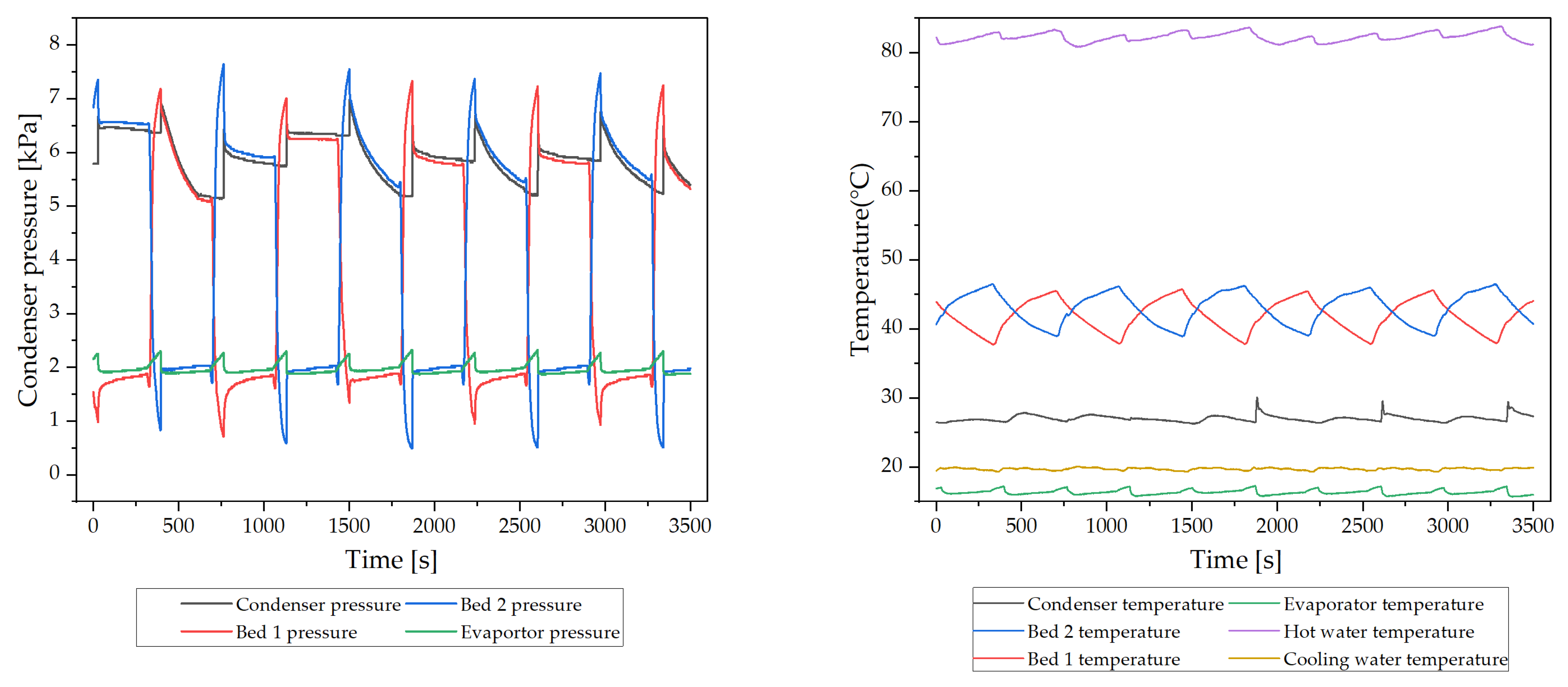
3.1.2. Desorption–Adsorption Cycle for Three Cooling Temperatures

For each of the three series, the pressure and temperature histories exhibit a clearly cyclic and repeatable pattern associated with the successive operating phases. At the beginning of the 300 s desorption phase, the temperature in the bed increases and the pressure in the adsorber chamber rises as water vapour is released from the silica gel. When the valves switch to the adsorption phase the bed is supplied with cooling water, its temperature decreases, and the pressure stabilises at a level close to the pressure in the evaporator. The condenser pressure remains between the evaporator and adsorber pressures and reflects the balance between the vapour flowrate from the desorbing bed and the heat-rejection capacity of the cooling-water loop.
Changing the cooling-water temperature from 20 to 30 °C primarily modifies the temperature histories in the beds and in the condenser. At 20 °C the beds cool down more rapidly after desorption and reach lower temperatures during the adsorption phase. This increases the temperature driving force between the beds and the cooling circuit and extends the part of the cycle during which the driving force for adsorption remains high. At 25 °C the temperature curves take intermediate values, whereas at 30 °C the beds remain noticeably warmer in the adsorption phase. As a consequence, the instantaneous distillate flowrate peak is lower and the duration of the period with the highest distillate production is shorter. Representative profiles of pressure and temperature are shown in Figure 4.

3.1.3. Cooling Performance and Desalination Capacity for a 300-Second Cycle

For the operating point with a supply temperature of 80 °C and a 300 s desorption/adsorption phase, the adsorption chiller achieves a cooling coefficient of performance COP equal to 0.58 and a specific cooling power SCP of 165 W·kg−1 of adsorbent. Under these conditions the nominal daily distillate production is 40 L·day−1, which corresponds to an average distillate mass flowrate of 1.82 kg·h−1 in the reference operating point.
The analysis of the three cooling-water temperatures shows that both COP and distillate productivity depend on the thermal conditions in the condenser and in the bed-cooling loop. For the 300 s cycle the highest desalination capacity is obtained in series 1 with a cooling-water temperature of 20 °C, where the average distillate production rate reaches 1.82 kg·h−1. In series 2, with 25 °C cooling water, the corresponding value is 1.68 kg·h−1, whereas in series 3 with 30 °C it is 1.72 kg·h−1. The differences between the three series reflect the combined effect of bed cooling and condenser performance: lower cooling-water temperature enhances heat removal during adsorption and condensation, which favours a larger amount of vapour being desorbed and subsequently condensed in each cycle.
The COP values for the 300 s cycle lie in the range from 0.29 to 0.41 when the cooling-water temperature is varied between 20 and 30 °C. The lowest COP is obtained for the lowest cooling-water temperature, where the system is operated closer to the maximum desalination output, while the highest COP is observed at 30 °C. This behaviour confirms the expected trade-off between cooling efficiency and water production: lowering the cooling-water temperature increases the distillate yield but slightly reduces COP, whereas raising the cooling-water temperature improves COP at the expense of distillate output.

3.1.4. Distillate Quality

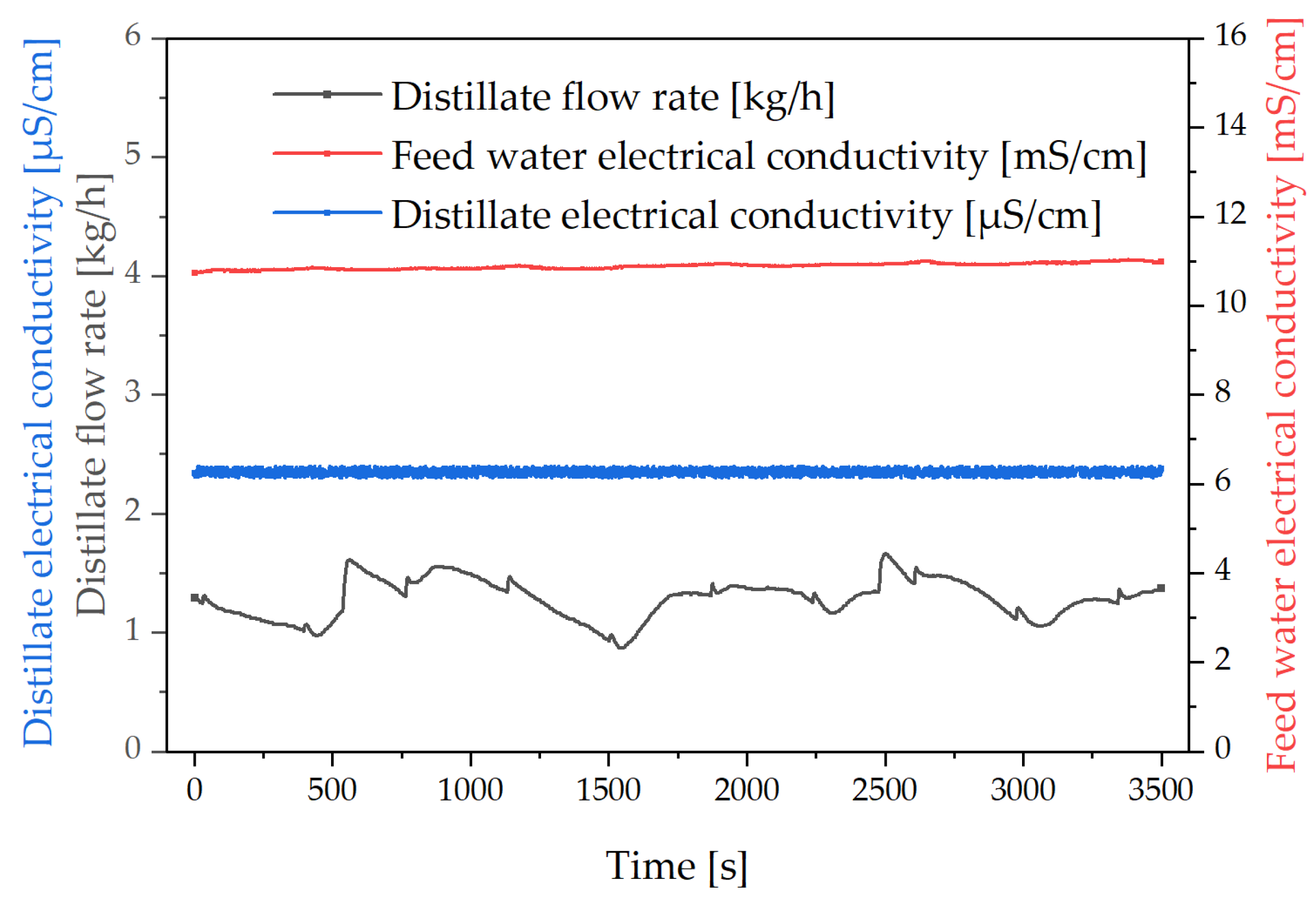
The brine used during the tests was obtained from the Baltic Sea and was characterised in laboratory analyses by a salinity of approximately 3.7 wt.% and a specific electrical conductivity of the order of 103 μS·cm−1. Throughout all three measurement series the distillate electrical conductivity remained practically constant and equal to 2.3 μS·cm−1, independently of the cooling-water temperature and of the precise cycle timing. An additional experiment in which the conductivity of the feed water was reduced to about 290 μS·cm−1 also showed no significant change in the distillate conductivity.
These observations demonstrate that, in the investigated operating range, changes in the cooling-water temperature and cycle configuration mainly affect the amount of condensate produced and the COP/SCP indicators, while the quality of the distillate remains stable and very close to that required for further polishing to electrolyser-grade water. A representative time series of distillate flowrate and electrical conductivity, together with the conductivity of the feed water, is presented in Figure 5 and confirms the absence of any degradation in distillate quality over the course of long-term cycling.

3.2. Determination of Sorption Model Parameters

Water vapour sorption data obtained with the DVS system were used to identify the parameters of the Dubinin–Astakhov equilibrium model and the LDF kinetic constant for the silica gel 55 SA. The adsorption and desorption isotherms measured at temperatures between 30 and 60 °C were fitted separately, which made it possible to account for the pronounced hysteresis observed between the two branches. In the whole temperature range the maximum adsorption capacity, W 0 , remains practically constant, increasing only slightly from about 41.0 to 42.2 g/100 g. In contrast, the characteristic energy, E , and the exponent, n , differ significantly between adsorption and desorption, especially at lower temperatures. At 30 °C the adsorption branch is described by E 1.5 kJ/mol and n 0.9 , whereas, for desorption, E increases to about 2.2 kJ/mol and n to almost 2.9. Similar trends are observed at 40.1, 50.0 and 59.5 °C, confirming that the energetic heterogeneity of the surface is more strongly expressed during desorption.
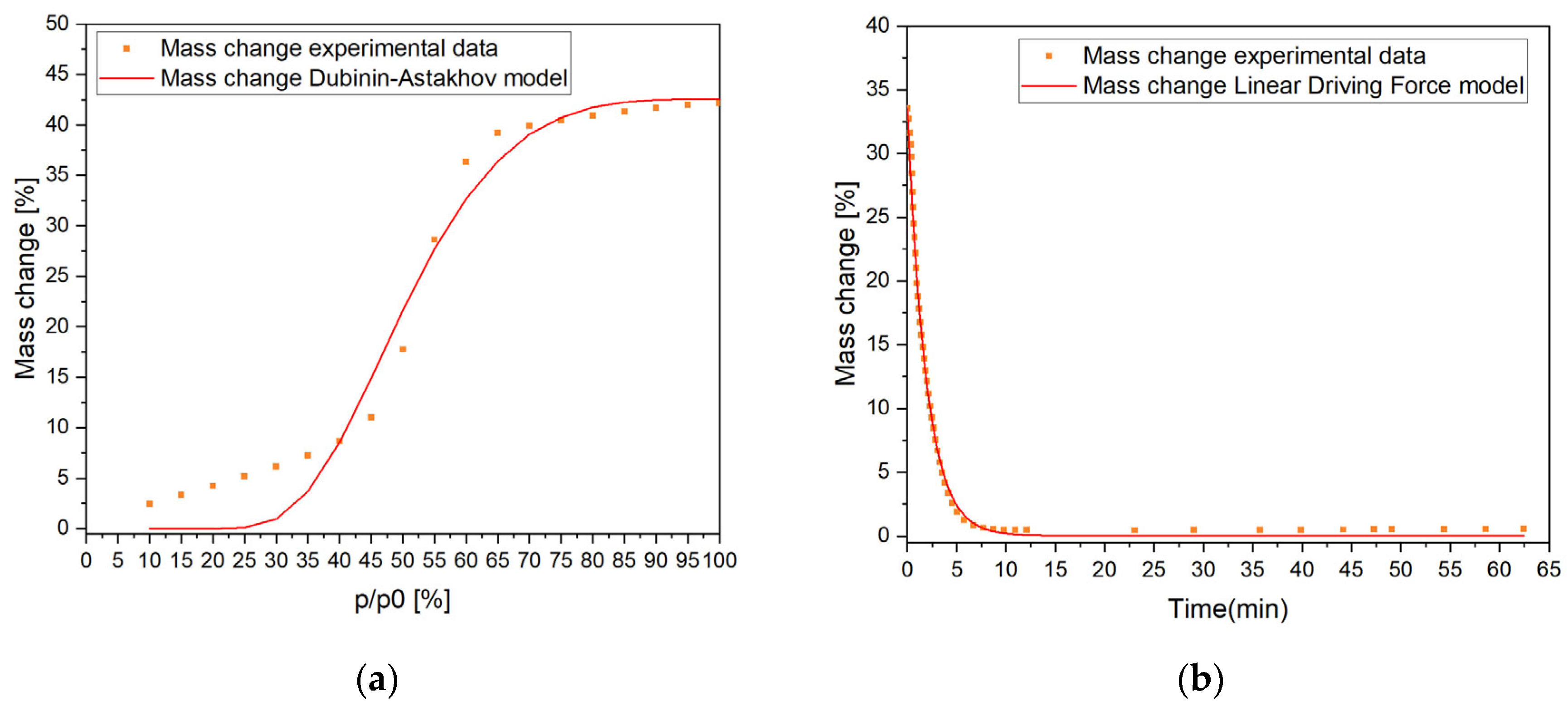
The quality of the D–A fit is satisfactory over the full loading range and very good in the region relevant for the operation of an adsorption chiller. When all data points between 0 and 100% relative loading are considered, the RMSE does not exceed about 5 g/100 g and the coefficient of determination R2 lies between 0.86 and 0.98, depending on temperature and process direction. Restricting the analysis to the range 0–60% loading, which corresponds to typical operating conditions in the bed, reduces the RMSE to values below 1.3 g/100 g with R2 greater than 0.93. This confirms that the modified D–A model reproduces very well the shape and curvature of the experimental isotherms in the range most important for heat and mass transfer in the exchanger. Figure 6 demonstrates the agreement between the measured data and the fitted D–A curves at representative temperatures. Table 5 summarises the identified D–A parameters (W0, E, and n) together with the corresponding RMSE and R2 values (reported for 0–100% and 0–60% relative humidity ranges) for both adsorption and desorption at all tested temperatures.
Kinetic parameters were determined by analysing the time evolution of the adsorbed amount q ( t ) for selected pressure steps. For each temperature, the equilibrium loading q was first calculated from the D–A model, and the LDF constant KLDF was then obtained from the slope of a linear fit to the dependence l n ( 1 q / q ) versus time. At 30 °C the resulting rate constant is about 0.61 min−1 for adsorption and 0.27 min−1 for desorption, which means that the approach to equilibrium is almost twice as fast during the uptake of vapour as during its release. At 58.9 °C this relationship is reversed: adsorption is characterised by KLDF ≈ 0.37 min−1, while desorption becomes faster with KLDF ≈ 0.57 min−1. The coefficients of determination for the linear fits exceed 0.95 in all analysed cases, confirming that the LDF model is adequate for describing the quasi-exponential kinetics observed in the experiments. The resulting KLDF values and the corresponding R2 coefficients are summarized in Table 6.
The DVS measurements were carried out in the temperature range 30–60 °C, although the adsorption chiller is supplied with heating water at 80 °C. The primary reason for this choice is the operating limits of the DVS apparatus: at higher temperatures it is difficult to ensure stable conditions and to obtain reliable sorption data for the silica gel–water system. In addition, the inlet water temperature of 80 °C does not correspond to the temperature of the adsorbent itself. Due to thermal resistances in the tube, fins and porous matrix, the solid phase in the bed remains significantly cooler, and the temperatures predicted by the CFD model during adsorption–desorption cycles fall largely within the 30–60 °C window. The equilibrium and kinetic parameters identified from DVS in this range are therefore both experimentally feasible and representative of the actual operating regime of the bed, and in the CFD model they are interpolated as a function of the local bed temperature.

3.3. Numerical Results for Modified Fin Geometries

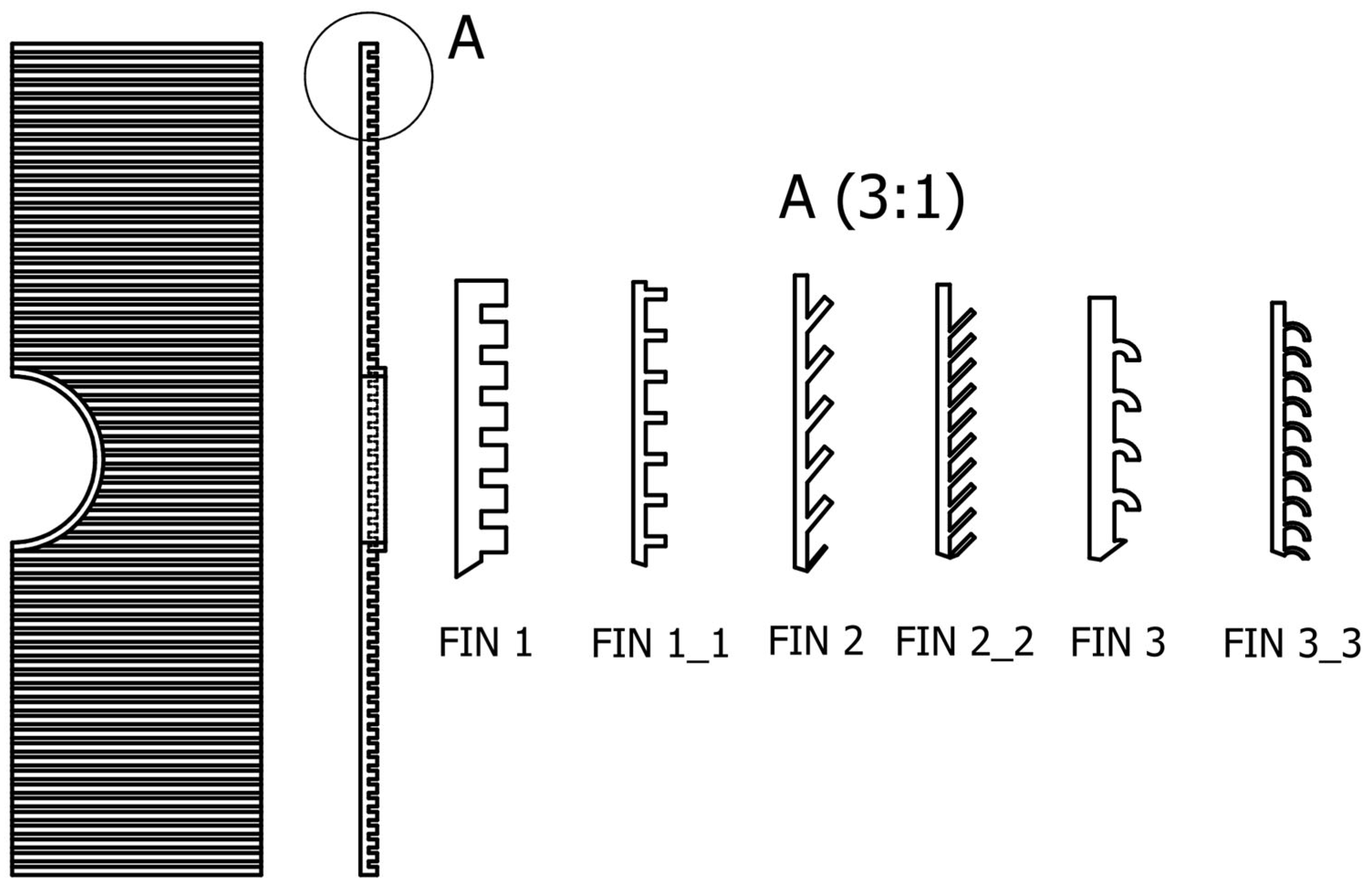
The three-dimensional periodic model of the fin–tube heat exchanger was used to evaluate how changes in the fin shape influence the heating of the inter-fin region and the amount of water desorbed during a 300 s desorption step. The reference configuration with the original flat fin is denoted as “Basic fin”. Three new geometries (FIN 1, FIN 2 and FIN 3) were derived from this design, and each of them was further modified, giving in total six variants (FIN 1, FIN 1_1, FIN 2, FIN 2_2, FIN 3 and FIN 3_3). The investigated fin geometries are illustrated in Figure 7. Two types of simulations were carried out. In the first set, used to analyse inter-fin heating, the bed was initially at 303.15 K and the tube wall temperature was stepped to 353.15 K. In the second set, used to compute water production, the initial temperature of the porous region was already equal to 353.15 K, identical to the HTF wall temperature, so that the wall acted purely as a heat source driving desorption.

3.3.1. Heating of the Sorbent in the Inter-Fin Region

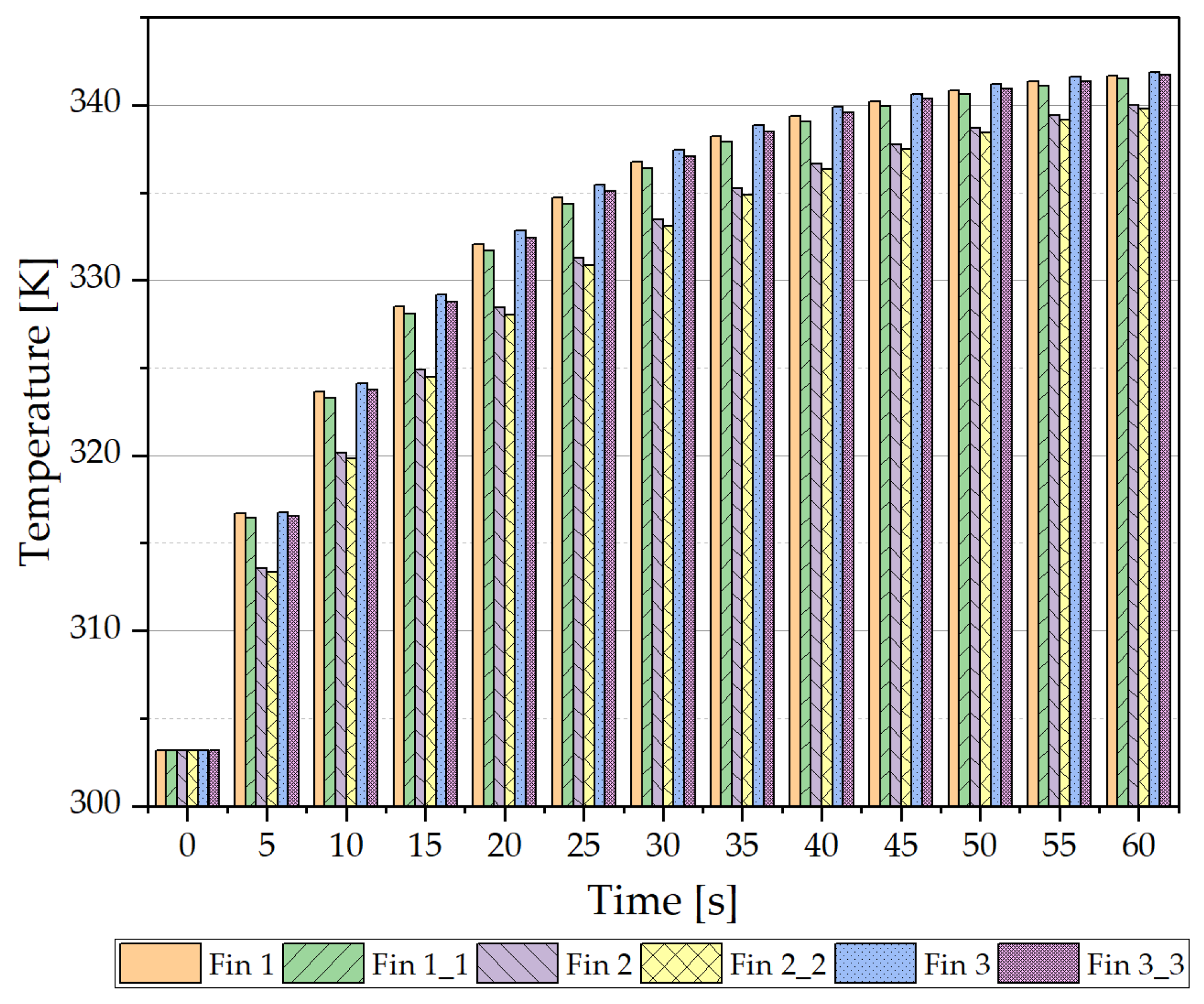
In the heating-only simulations, representing the preheating stage before desorption phase, the average temperature of the porous region between fins is 303.15 K for all geometries. The numerical results show a rapid increase in the first tens of seconds. The time evolution of the volume-averaged inter-fin temperature during the first 60 s of the preheating stage is shown in Figure 8. For the FIN 1 design the mean temperature reaches 323.65 K after 10 s and 336.74 K after 30 s, which corresponds to temperature rises of 20.5 K and 33.6 K, respectively. The other variants follow very similar trajectories. For example, after 30 s the average temperature is 336.38 K for FIN 1_1, 333.46 K for FIN 2, 333.10 K for FIN 2_2, 337.41 K for FIN 3 and 337.05 K for FIN 3_3.
After 60 s of heating the differences between the six geometries remain small. The FIN 1 design reaches an average temperature of 341.68 K, FIN 1_1 reaches 341.49 K, while FIN 3 and FIN 3_3 are slightly hotter with 341.88 K and 341.69 K, respectively. The FIN 2 and FIN 2_2 variants are about 2 K cooler, with final mean temperatures of 339.98 K and 339.79 K. In terms of temperature rise relative to the initial 303.15 K, this corresponds to ΔT values of 38.3–38.7 K for FIN 1, FIN 1_1, FIN 3 and FIN 3_3, and 36.6–36.8 K for FIN 2 and FIN 2_2. The maximum spread between all designs after 60 s is therefore below 2 K, indicating that modifications of fin shape mainly cause small changes in the rate of bed heating, without altering the overall thermal response of the inter-fin space.
Figure 8 shows the time evolution of the volume-averaged inter-fin temperature for all six geometries during the first 60 s of the preheating stage (prior to desorption).

3.3.2. Cumulative Water Production for Different Fin Geometries

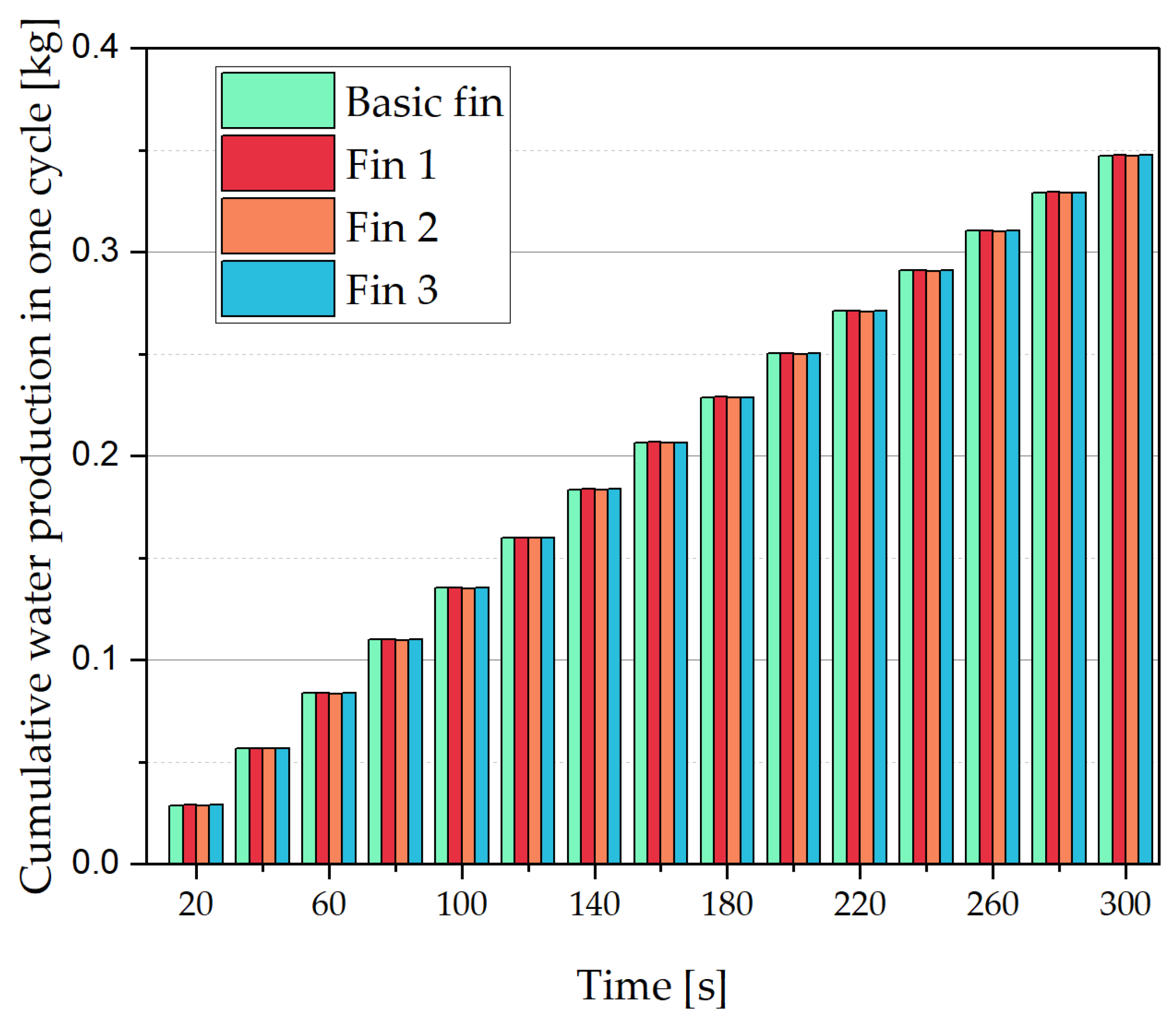
In a separate set of simulations, the desorption UDF was used to compute the cumulative water production (i.e., cumulative desorbed water mass) from the porous region as a function of time. The time evolution of cumulative water production is presented in Figure 9 to assess whether fin-shape modifications influence the desorption rate at any stage of the cycle. The curves nearly overlap over the full time range, confirming that the effect is negligible under the investigated conditions. In this case the initial temperature of the porous zone was set to 80 °C, equal to the HTF wall temperature, so that the boundary acted as a heat source sustaining desorption rather than heating up a cold bed. For the reference “Basic fin” geometry the cumulative water production reaches 0.0286 kg after 20 s, 0.084 kg after 60 s and 0.135 kg after 100 s of the desorption step. At 200 s the cumulative water production is 0.250 kg and at 300 s it is 0.347 kg. For the three modified geometries the corresponding values are almost identical.
For the three modified fin geometries, the predicted cumulative water production is virtually indistinguishable from the basic fin case. At 300 s, the model gives 0.347 kg for the basic fin, compared with 0.347 kg (FIN 1), 0.347 kg (FIN 2) and 0.347 kg (FIN 3), corresponding to relative deviations below 0.05%. This agreement persists to the end of the simulated interval (340 s), where the cumulative water production is approximately 0.382 kg for all cases. Overall, the differences remain below 0.05%, which is negligible for engineering purposes, indicating that—at a constant heat-transfer area—minor fin-shape refinements do not materially affect the cumulative desorption-driven water production under the investigated conditions.
These results indicate that, for the considered operating conditions and total heat-transfer area, the alternative fin shapes do not significantly affect the amount of water desorbed in a 300 s cycle. The small differences observed between the curves are much smaller than the expected experimental uncertainty of condensate measurements and can be regarded as negligible in practical terms. In other words, the investigated fin modifications mainly redistribute heat and mass within the inter-fin domain but do not change the global desorption capacity of the bed.

3.4. Model Validation Against Experiments

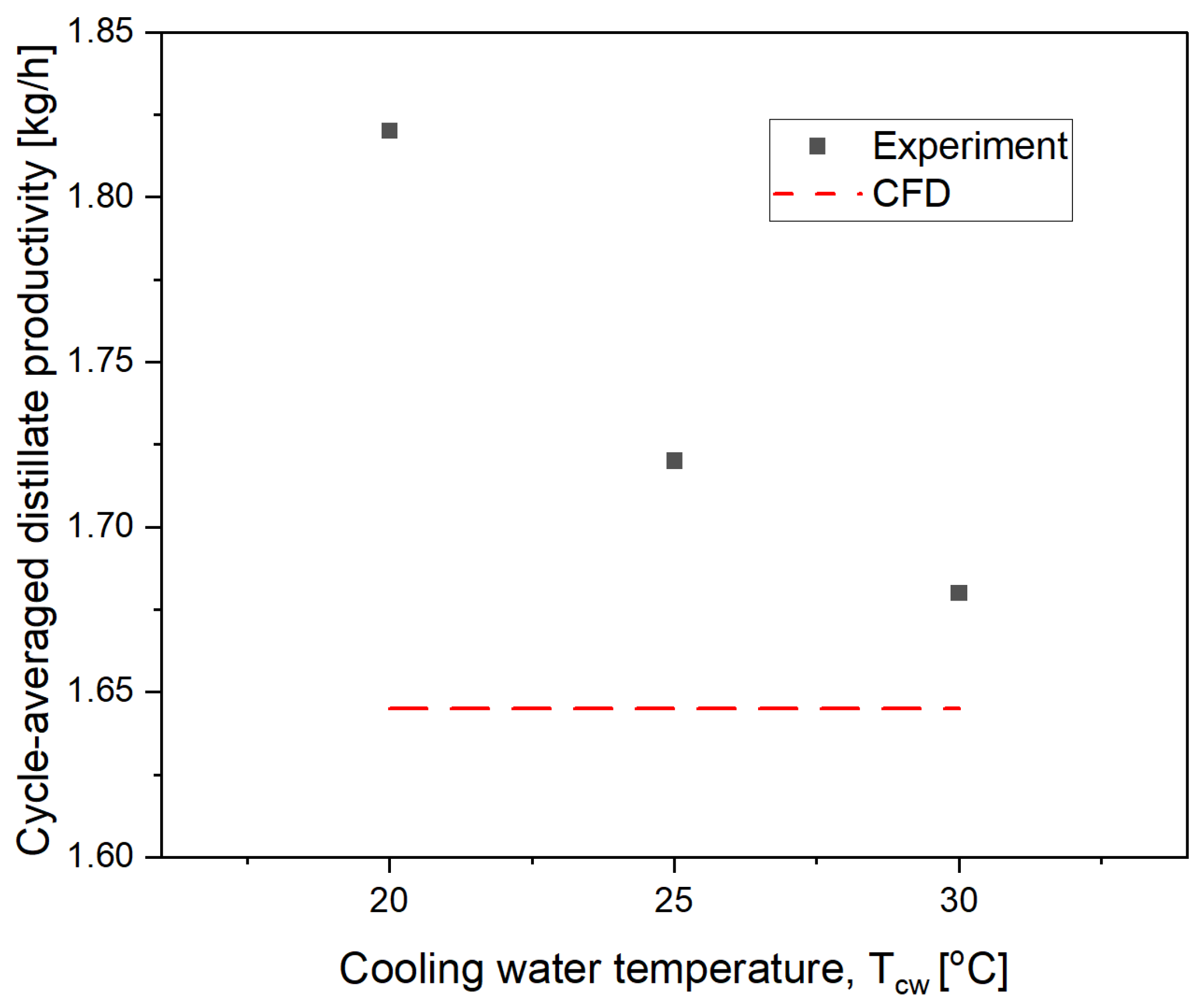
Figure 10 compares the experimentally measured cycle-averaged distillate productivity and the CFD-predicted system-level productivity, m ˙ C F D , computed using Equations (7)–(10). As the condenser and cooling-water loop are not explicitly modelled in the CFD domain, the predicted value is independent of the cooling-water temperature; therefore, a single predicted productivity is compared against the set of experimental measurements performed at 20–30 °C.
The CFD model yields m ˙ C F D = 1.645   k g h 1 , while the experiments give 1.68–1.82 k g h 1 . As summarised in Table 7, the model underpredicts the experiments by 2.1% relative to the lowest measured case (1.68 k g h 1 ) and by 9.6% relative to the highest measured case (1.82 k g h 1 ), corresponding to an average underprediction of approximately 5–6% across the three experimental series. This agreement supports the selected D–A/LDF parameter set and the applied boundary condition configuration for the desorption step.

4. Discussion

The experimental results demonstrate that the analysed silica gel–water adsorption chiller can simultaneously provide useful cooling and a stable stream of high-quality distillate when driven by 80 °C heating water. For a cycle with 300 s desorption and adsorption phases, the measured cooling performance is characterised by COP values between 0.29 and 0.41 and an SCP of 165 W·kg−1 of adsorbent, while the average distillate production ranges from 1.68 to 1.82 kg·h−1 depending on the cooling-water temperature. These performance indicators are consistent with values typically reported for small-scale silica gel adsorption chillers and show that the proposed configuration can efficiently utilise low-grade heat to deliver both cooling and desalinated water.
The influence of cooling-water temperature on system performance reveals a clear trade-off between cooling efficiency and water production. Reducing the cooling-water temperature from 30 to 20 °C increases the driving forces for adsorption and condensation, which leads to the highest distillate yield at 20 °C. At the same time, COP takes its lowest values in this operating point because more heat must be rejected per unit of useful cooling. Conversely, operating at 30 °C improves COP but reduces the amount of condensate produced per cycle. This behaviour implies that the optimal operating point cannot be defined solely in terms of COP or water production; instead, it depends on the relative importance of cooling and desalination in a given application. For hydrogen-related systems, where both cooling and ultra-pure water are required, this trade-off must be addressed at the system level rather than at the component level.
An important result of the study is that the quality of the distillate remains exceptionally high across all tested conditions. The distillate conductivity of about 2.3 μS·cm−1 is practically independent of the cooling-water temperature and of the detailed timing of the cycle. Additional tests with reduced conductivity of the feed water also did not lead to any deterioration of distillate quality. This confirms that, in the investigated configuration, process modifications that aim at increasing water production or COP primarily affect the quantity of water produced rather than its purity. From a practical perspective the adsorption chiller can therefore be regarded as a robust pre-treatment stage, delivering a stable stream of very low-conductivity water which requires only minor polishing to meet the stringent specifications for electrolyser feed water.
The DVS-based identification of Dubinin–Astakhov equilibrium parameters and LDF kinetic constants proved sufficient to capture the sorption behaviour of the silica gel in the loading range relevant for the bed operation. The small RMSE values and high coefficients of determination obtained for partial isotherms up to 60% of maximum loading indicate that the equilibrium model provides an accurate description of the material response in the region where most of the working cycle takes place. The LDF constants derived from the linearised kinetic curves reproduce well the quasi-exponential approach to equilibrium observed experimentally and show a pronounced dependence on temperature and process direction. This supports the use of a temperature-dependent LDF model in the CFD simulations and suggests that further refinement of the kinetic description could focus on explicitly accounting for this dependence in the UDF.
The comparison between numerical and experimental condensate production for the 300 s cycle shows that the model slightly underpredicts the average distillate output: the simulated value is about 6% lower than the measured one. Given the uncertainties of the condensate flow measurements, the scaling from the representative CFD domain to the full adsorber, and the use of a homogenised porous-medium LDF description, this bias is still acceptable for engineering purposes. The porous zone representation coupled with D–A equilibrium and LDF kinetics therefore provides a reliable tool for trend analysis and for exploring operating scenarios that are difficult to realise experimentally, such as alternative cycle timings or non-standard combinations of heating and cooling temperatures.
On the other hand, the analysis of six modified fin geometries indicates that, for the present exchanger dimensions and operating parameters, changing the local shape of individual fins has only a marginal impact on both bed heating and overall water production. Differences in volume-averaged inter-fin temperature after 60 s do not exceed 2 K, and the cumulative desorbed mass after 300 s varies by less than 0.05% between designs. This suggests that, at a constant heat-transfer area, local geometric refinements mainly redistribute heat and mass within the inter-fin region without significantly altering the global desorption capacity. Consequently, meaningful performance improvements are more likely to be achieved by adjusting higher-level design variables such as fin spacing, number of fins, tube layout or by introducing highly conductive inserts rather than by subtle modifications of fin outlines.
Finally, the presented results should be viewed in light of several limitations. The study focuses on a single adsorbent and a single heating-water temperature representative of typical waste-heat sources. The CFD model uses a homogenised porous-medium description and a classical LDF approach, which do not resolve pore-scale transport phenomena. Nevertheless, the good agreement with experiments and the robustness of the distillate quality indicate that the adopted level of detail is appropriate for system-scale analysis and provides a solid basis for future extensions towards advanced adsorbents, broader operating ranges and integrated hydrogen-production systems.

5. Conclusions

This study experimentally demonstrated that a silica gel–water adsorption chiller–desalination unit driven by 80 °C heating water can simultaneously deliver cooling and a stream of high-quality distillate. For a cycle with 300 s adsorption and desorption phases, the system achieved a COP in the range 0.29–0.41, an SCP of 165 W·kg−1 of adsorbent, and an average distillate production of 1.68–1.82 kg·h−1, while maintaining a distillate electrical conductivity of about 2.3 μS·cm−1.
Dynamic vapour sorption measurements were used to identify Dubinin–Astakhov equilibrium parameters and LDF kinetic constants for the silica gel, which were then implemented in a CFD model with a homogenised porous-zone description of the bed. For the 300 s cycle the simulated condensate production is about 6% lower than the experimental value, which is consistent with the expected combined uncertainty of the measurements and the modelling assumptions. The proposed modelling approach can therefore be used as a practical engineering tool for the analysis and preliminary design of adsorption heat exchangers and for assessing the influence of operating conditions and exchanger geometry on water production.
The analysis of six modified fin geometries revealed that, at constant heat-transfer area, local changes in fin shape have only a marginal effect on bed heating and on the total amount of desorbed water, with differences below 0.05% in cumulative water production after 300 s. This indicates that further performance improvements of adsorption cooling–desalination units should focus on optimising operating conditions and the global exchanger architecture (number and spacing of fins, tube layout, use of materials with enhanced thermal conductivity), as well as on extending the analysis to advanced sorbents.
The present study has several limitations. The CFD model is based on a periodic segment and a homogenised porous-zone description with effective transport parameters, and the validation was performed for a selected operating mode with a 300 s desorption step. Future work will extend the validation to a wider range of cycle times and operating temperatures, and will incorporate additional non-ideal effects such as external heat losses.

Author Contributions

Conceptualization, P.B., K.S. and Ł.M.; methodology, P.B. and W.K.; software, P.B.; validation, P.B., T.B., A.M.-M. and K.S.; formal analysis, T.B.; investigation, P.B., K.S., T.B. and W.K.; resources, W.K.; data curation, P.B.; writing—original draft preparation, P.B.; writing—review and editing, P.B., K.S. and T.B.; visualization, P.B.; supervision, Ł.M., A.M.-M. and K.S.; project administration, K.S. and A.M.-M.; funding acquisition, K.S. and A.M.-M. All authors have read and agreed to the published version of the manuscript.

Funding

This research was funded by the Ministry of Education and Science, Poland, Grant AGH No. 16.16.210.476, and partly supported by the program “Excellence initiative—research university” for the AGH University of Science and Technology.

Data Availability Statement

The original contributions presented in this study are included in the article. Further inquiries can be directed to the corresponding authors.

Conflicts of Interest

The authors declare no conflicts of interest.

Abbreviations

The following abbreviations are used in this manuscript:
COPCoefficient of performance
SCPSpecific cooling power
D-ADubinin–Astakhov
LDFLinear driving force
CFDComputational fluid dynamics
DVSDynamic vapour sorption
HTFHeat transfer fluid
UDFUser-defined function
RMSERoot mean square error
R2Coefficient of determination
PEMProton exchange membrane (electrolyser)
AWEAlkaline water electrolysis
AEMAnion exchange membrane (electrolyser)
RESRenewable energy sources
JRCJoint Research Centre (European Commission)

References

  1. IEA. The Future of Hydrogen The Future of Hydrogen 2019; IEA: Paris, France, 2019.
  2. Delpisheh, M.; Moradpoor, I.; Souhankar, A.; Koutsandreas, D.; Shah, N. Advancing the hydrogen economy: Economic, technological, and policy perspectives for a sustainable energy transition. Renew. Sustain. Energy Rev. 2025, 226, 116238. [Google Scholar] [CrossRef]
  3. Phogat, P.; Chand, B.; Shreya. Hydrogen economy: Pathways, production methods, and applications for a sustainable energy future. Sustain. Mater. Technol. 2025, 45, e01550. [Google Scholar] [CrossRef]
  4. Giocoli, A.; Motola, V.; Scarlat, N.; Pierro, N.; Dipinto, S. Techno-economic viability of renewable electricity surplus to green hydrogen and biomethane, for a future sustainable energy system: Hints from Southern Italy. Renew. Sustain. Energy Transit. 2023, 3, 100051. [Google Scholar] [CrossRef]
  5. Vaccaro, A.; Rosen, M.A.; Agelin-Chaab, M.; Santarelli, M. Future clean hydrogen potential from surplus energy: A techno-economic analysis. Energy Convers. Manag. 2025, 344, 120275. [Google Scholar] [CrossRef]
  6. Ma, F.; Li, L.; Zeng, Q.; Zheng, J. Development Concept of Integrated Energy Network and Hydrogen Energy Industry Based on Hydrogen Production Using Surplus Hydropower. IOP Conf. Ser. Earth Environ. Sci. 2020, 555, 012022. [Google Scholar] [CrossRef]
  7. Qu, W.; Zhang, J.; Jiang, R.; Liu, X.; Zhang, H.; Gao, Y.; Hong, H.; Liu, T. An energy storage approach for storing surplus power into hydrogen in a cogeneration system. Energy Convers. Manag. 2022, 268, 116032. [Google Scholar] [CrossRef]
  8. Nadaleti, W.C.; de Souza, E.G.; de Souza, S.N.M. The potential of hydrogen production from high and low-temperature electrolysis methods using solar and nuclear energy sources: The transition to a hydrogen economy in Brazil. Int. J. Hydrogen Energy 2022, 47, 34727–34738. [Google Scholar] [CrossRef]
  9. Tian, C.; Tan, Q.; Fang, G.; Wen, X. Hydrogen production to combat power surpluses in hybrid hydro–wind–photovoltaic power systems. Appl. Energy 2024, 371, 123627. [Google Scholar] [CrossRef]
  10. de Souza, E.G.; Nadaleti, W.C.; Thue, P.S.; dos Santos, M.C. Exploring the capacity and economic viability of green hydrogen production by utilising surplus energy from wind farms and small hydropower plants in Southern Brazil. Int. J. Hydrogen Energy 2024, 64, 1–14. [Google Scholar] [CrossRef]
  11. Tsotridis, G.; Pilenga, A. EU Harmonised Protocols for Testing of Low Temperature Water Electrolysers; Publications Office of the European Union: Luxembourg, 2021. [Google Scholar] [CrossRef]
  12. Saha, B.B.; Chakraborty, A.; Koyama, S.; Aristov, Y.I. A new generation cooling device employing CaCl2-in-silica gel–water system. Int. J. Heat Mass Transf. 2009, 52, 516–524. [Google Scholar] [CrossRef]
  13. Manila, R.M.; Mitra, S.; Dutta, P. Studies on dynamics of two-stage air cooled water/silica gel adsorption system. Appl. Therm. Eng. 2020, 178, 115552. [Google Scholar] [CrossRef]
  14. Bai, S.; Ho, T.; Ha, J.; An, A.; Tso, C. Study of the salinity effects on the cooling and desalination performance of an adsorption cooling cum desalination system with a novel composite adsorbent. Appl. Therm. Eng. 2020, 181, 115879. [Google Scholar] [CrossRef]
  15. Li, M.; Zhao, Y.; Long, R.; Liu, Z.; Liu, W. Metal foam packed adsorbent bed boosting the performance of the adsorption-based desalination and cooling system. Energy Convers. Manag. 2022, 254, 115250. [Google Scholar] [CrossRef]
  16. Bujok, T.; Boruta, P.; Mika, Ł.; Sztekler, K. Analysis of Designs of Heat Exchangers Used in Adsorption Chillers. Energies 2021, 14, 8038. [Google Scholar] [CrossRef]
  17. Kowsari, M.M.; Niazmand, H.; Tokarev, M.M. Bed configuration effects on the finned flat-tube adsorption heat exchanger performance: Numerical modeling and experimental validation. Appl. Energy 2018, 213, 540–554. [Google Scholar] [CrossRef]
  18. Mitra, S.; Muttakin, M.; Thu, K.; Saha, B.B. Study on the influence of adsorbent particle size and heat exchanger aspect ratio on dynamic adsorption characteristics. Appl. Therm. Eng. 2018, 133, 764–773. [Google Scholar] [CrossRef]
  19. Papakokkinos, G.; Castro, J.; López, J.; Oliva, A. A generalized computational model for the simulation of adsorption packed bed reactors—Parametric study of five reactor geometries for cooling applications. Appl. Energy 2019, 235, 409–427. [Google Scholar] [CrossRef]
  20. Pinheiro, J.M.; Salústio, S.; Geraldes, V.; Valente, A.A.; Silva, C.M. Copper foam coated with CPO-27(Ni) metal–organic framework for adsorption heat pump: Simulation study using OpenFOAM. Appl. Therm. Eng. 2020, 178, 115498. [Google Scholar] [CrossRef]
  21. Palomba, V.; Nowak, S.; Dawoud, B.; Frazzica, A. Dynamic modelling of Adsorption systems: A comprehensive calibrateddataset for heat pump and storage applications. J. Energy Storage 2021, 33, 102148. [Google Scholar] [CrossRef]
  22. Mlonka-Mędrala, A.; Kalawa, W.; Bujok, T.; Boruta, P.; Sztekler, K.; Mika, Ł.; Nowak, W. High-performance silica gel composites with metal salt impregnation for adsorption chillers: Experimental findings and theoretical modelling. Appl. Therm. Eng. 2025, 276, 126939. [Google Scholar] [CrossRef]
  23. Ayawei, N.; Ebelegi, A.N.; Wankasi, D. Modelling and Interpretation of Adsorption Isotherms. J. Chem. 2017, 2017, 3039817. [Google Scholar] [CrossRef]
  24. Rezk, A.; Ilis, G.G.; Demir, H. Experimental study on silica gel/ethanol adsorption characteristics for low-grade thermal driven adsorption refrigeration systems. Therm. Sci. Eng. Prog. 2022, 34, 101429. [Google Scholar] [CrossRef]
  25. Hu, Q.; Zhang, Z. Application of Dubinin–Radushkevich isotherm model at the solid/solution interface: A theoretical analysis. J. Mol. Liq. 2019, 277, 646–648. [Google Scholar] [CrossRef]
  26. Chen, X. Modeling of Experimental Adsorption Isotherm Data. Information 2015, 6, 14–22. [Google Scholar] [CrossRef]
Figure 1. The laboratory adsorption–desalination chiller used in the research.
Energies 19 00484 g001
Figure 2. Simplified schematic diagram of the laboratory adsorption chiller with desalination loop, showing measurement points: temperatures (T1–T15), pressures (P1–P4), flow rates (F1–F5) and electrical conductivity probes (Q1–Q2), bed valve states (A–L).
Energies 19 00484 g002
Figure 3. Geometry and boundary conditions of the three-fin periodic CFD model: (a) conceptual periodic segment and (b) 3D boundary-condition map (symmetry, pressure outlet + convection, constant HTF temperature, UDF-defined temperature).
Energies 19 00484 g003
Figure 4. Selected operating parameters of an adsorption chiller with desalination function.
Energies 19 00484 g004
Figure 5. Distillate flowrate and electrical conductivity of feed water and distillate during long-term cyclic operation.
Energies 19 00484 g005
Figure 6. (a) Experimental water vapour adsorption and desorption isotherms of silica gel 55 SA at 60 °C and the corresponding Dubinin–Astakhov fits. (b) Experimental mass change and linear driving force model fit for water vapour desorption on silica gel 55 SA at 60 °C.
Energies 19 00484 g006
Figure 7. Cross-sectional view of the investigated fin geometries (FIN 1, FIN 1_1, FIN 2, FIN 2_2, FIN 3 and FIN 3_3). Inset A (scale 3:1) presents an enlarged view of the fin profile/serration.
Energies 19 00484 g007
Figure 8. Time evolution of the volume-averaged inter-fin temperature for six fin geometries during the first 60 s of the preheating stage (prior to desorption).
Energies 19 00484 g008
Figure 9. Cumulative water production in one desorption cycle for the basic and modified fin geometries.
Energies 19 00484 g009
Figure 10. Comparison of the experimentally measured cycle-averaged distillate productivity (three cooling-water temperatures, steady-state window of 10 cycles) and the CFD-predicted system-level productivity computed from the integrated outlet vapour mass.
Energies 19 00484 g010
Table 1. Measured parameters and measuring devices.
Measured VariableMeasurement-Point IDsMeasuring DeviceRangeAccuracy
PressureP1–P4Pressure transducer, Simex DMK-457 (Simex, Gdańsk, Poland)0–99 kPa±0.5% FS
TemperatureT1–T15Pt-1000 sensor, JUMO 902020/15 (JUMO Polska, Wrocław, Poland)–80 to 150 °C±0.1 °C
Flow rateF1–F5Electromagnetic flow meter, KROHNE Optiflux 4050C (KROHNE Polska, Gdańsk, Poland)1–100 L/min±0.5% FS
Electrical conductivityQ1, Q2Inductive conductivity and temperature transmitter, JUMO CTI-500 (JUMO)Q1 (distillate) 0–500 µS/cm
Q2 (brine/feed) 0–20 mS/cm
(Q1) ≤ 1% FS
(Q2) ≤ 0.5% FS
Table 2. Variable mesh size limits and resulting mesh quality.
Gridm1 (Course)m2 (Medium)m3 (Fine)
Min size [m]0.00050.00015 × 10−5
Min size [m]0.0020.0010.0005
Max cell length [m]0.0020.0010.0005
Cells [-]20,30049,050315,016
Orthogonal quality (min)0.21690.20630.2028
Orthogonal quality (avg)0.88490.90440.9386
Skewness (avg)0.11010.09320.0602
Skewness (max)0.78310.79370.7972
Table 3. Grid-independence test based on scaled cumulative water production after 300 s desorption.
Gridm1 (Course)m2 (Medium)m3 (Fine)
Water production after 300 s [kg]0.3440.34730.351
Difference vs. m2 [%]−10+1
Table 4. Operating parameters of an adsorption chiller with desalination function.
ParameterSerie 1Serie 2Serie 3
Condenser cooling water temperature (inlet)20 °C25 °C30 °C
Hot water temperature (inlet)80 °C80 °C80 °C
Chilled water temperature (inlet)20 °C25 °C30 °C
Cycle time 150/300/30/50/300/3050/300/30/50/300/3050/300/30/50/300/30
1 precooling/adsorption/heat recovery/preheating/desorption/heat recovery, respectively.
Table 5. Dubinin–Astakhov parameters W0, E and n for water vapour adsorption and desorption on silica gel 55 SA at different temperatures, together with RMSE and R2 values.
TemperatureProcessW0EnRMSE (0–100%)R2 (0–100%)RMSE (0–60%)R2 (0–60%)
°C-g/100 gJ/mol-----
30Adsorption41.021522.420.924.750.8960.590.987
30Desorption41.022229.312.892.190.9422.790.942
40Adsorption41.601454.470.844.990.8600.660.980
40Desorption41.602164.702.922.560.9753.270.915
50Adsorption41.881602.140.874.920.8910.990.961
50Desorption41.882236.162.992.930.9683.800.889
60Adsorption42.201666.560.904.220.8701.300.937
60Desorption42.202197.892.004.050.9314.070.854
Table 6. LDF mass transfer coefficients K LDF obtained from DVS kinetic experiments for adsorption and desorption at 30 and 60 °C, with the corresponding R 2 values.
TemperatureProcessKLDFR2
°C---
30Adsorption0.61010.9868
30Desorption0.26930.9959
60Adsorption0.37260.9488
60Desorption0.57330.9976
Table 7. Validation summary: experimental cycle-averaged distillate productivity, CFD-predicted system productivity, and relative deviation.
Case (Tcw)Cycle-Averaged Distillate Productivity—ExperimentCycle-Averaged Distillate Productivity—SimulationError
°Ckg/hkg/h%
201.821.645−9.62
251.721.645−4.36
301.681.645−2.08
Disclaimer/Publisher’s Note: The statements, opinions and data contained in all publications are solely those of the individual author(s) and contributor(s) and not of MDPI and/or the editor(s). MDPI and/or the editor(s) disclaim responsibility for any injury to people or property resulting from any ideas, methods, instructions or products referred to in the content.