


Multi-Criteria Sustainability Assessment in Energy and Agricultural Systems: Challenges and Pathways for Low-Carbon Transition


Abstract
1. Introduction
2. The Current State of MCDM Use in Energy and Agricultural Sustainability Assessment
2.1. Classical MCDM Approaches in Sustainability Assessment
2.2. MCDM in Energy System Sustainability Evaluations
2.3. MCDM in Agricultural Sustainability and Resource Management
- High context-specificity and limited generalizability. Most agricultural MCDM studies are confined to particular regions, crops, or narrowly defined decision scenarios, which limits transferability between different agricultural systems. Case studies such as evaluations of orchard expansions [22], analyses of land suitability for potato cultivation [18], and comparisons of farm equipment reinforce the case-specific nature of most MCDM applications and resonate with broader issues of fragmentation in agricultural sustainability modelling [20].
- Limited incorporation of circularity and equity indicators. Although circular economy tenets—waste valorization, nutrient cycling, soil carbon sequestration—are gaining traction within MCDM frameworks [10], they remain largely absent from European Union agricultural policies. Likewise, social equity dimensions, including rural access, inequities in the distribution of benefits, and service gaps, remain largely unaddressed, even though there is considerable evidence of spatial equity deficiencies in rural areas [23].
2.4. Hybrid and Cross-Sectoral Developments
- life cycle assessment for determining environmental footprints and for the integration of criteria with the biophysical system boundaries [10].
- machine learning for scenario analysis, where criteria weighting can facilitate decision-support automation, particularly in situations of uncertainty [16].
- GIS and remote sensing in the improvement of spatial decision-making and in the detection of place-specific sustainable trade-offs [24].
- applications in the energy sector are usually more technology-focused;
- applications in the field of agriculture are more thematically or spatially limited;
- there are considerable absences of circularity and equity metrics;
- there is a vast underintegration of the systemic interrelations fundamental to a low-carbon transition.
3. Structural Challenges: Why MCDM Remains Fragmented
3.1. Methodological, Sectoral, and Data Fragmentation
3.2. Social Equity, Circularity, and Agricultural Heterogeneity
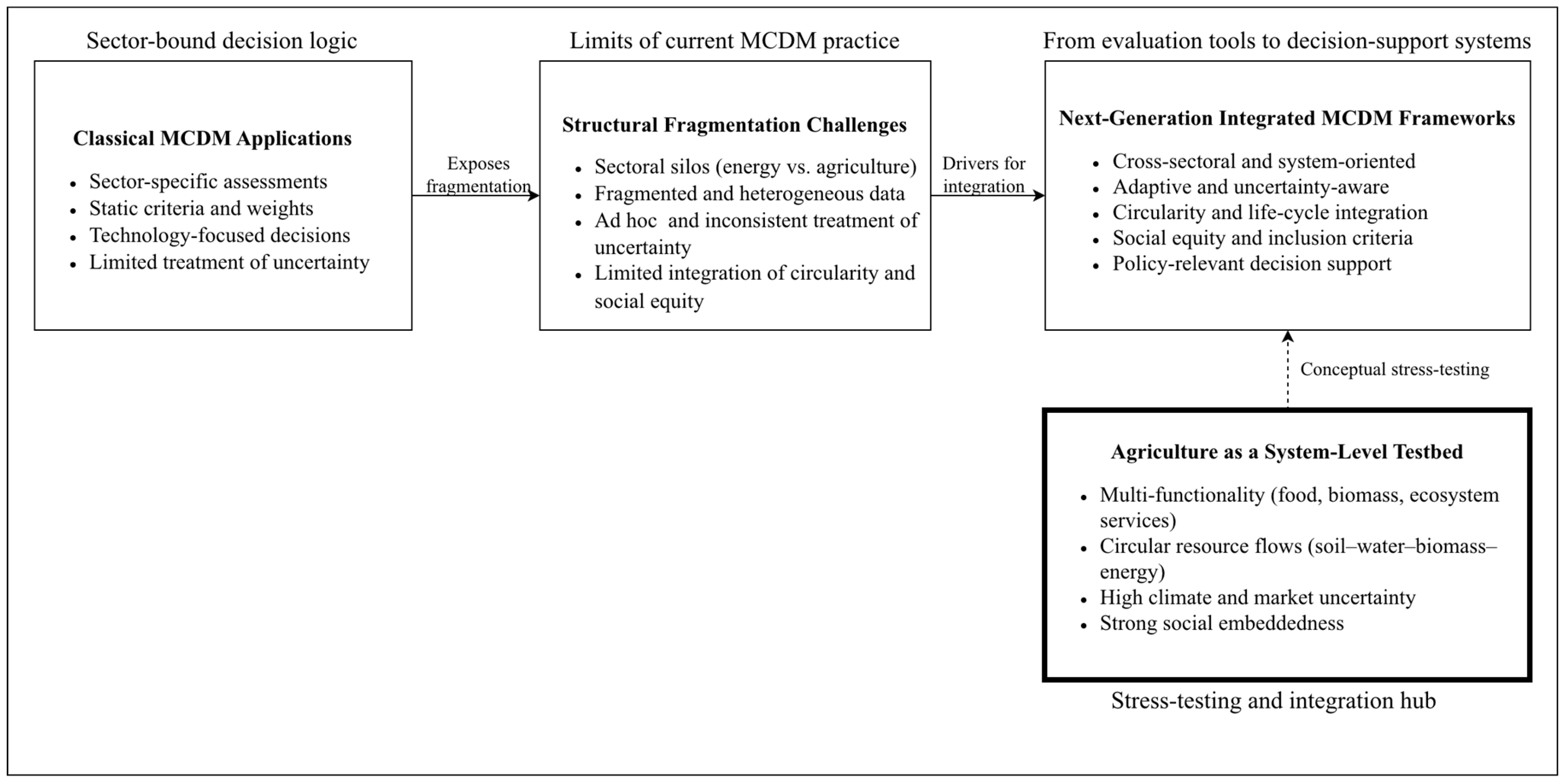
- methodological proliferation without clear convergence;
- sectoral silos and limited cross-domain knowledge transfer;
- fragmented data infrastructures and uneven treatment of uncertainty;
- weak embedding of social equity and circularity;
- agricultural heterogeneity and digital divides.
4. Agriculture as a Testbed for Integrated MCDM Approaches
4.1. Complexity, Circularity, and Climate Uncertainty in Agricultural Decision-Making
- material flow indicators;
- soil and biodiversity outcomes;
- waste-to-resource pathways;
- life cycle-based environmental impacts.
- volatile climatic conditions;
- unpredictable yield levels;
- resource availability constraints;
- market volatility.
4.2. Social Equity, Stakeholder Diversity, and Bio-Based Innovation
- bio-based polymers and packaging materials;
- valorization of agricultural residues;
- regenerative inputs of biomass;
- innovations within the waste-to-resource domain.
4.3. Why Agriculture Serves as an Ideal Pilot Sector for Integrated MCDM
- multi-criteria, incorporating environmental, economic, social, and circular aspects;
- the most climate-sensitive and uncertain, thus the most in need of adaptive decision-making;
- dominated by circular resource flows, signalling a need for system-level insights;
- closely interwoven with the social fabric of rural areas and equity implications;
- intersecting with energy, biomaterials, and waste in an increasingly complex way;
- in need of sound comparative analysis to support the technological advances of precision agriculture and bioeconomy innovations.
5. Toward Holistic, Adaptive, and Policy-Relevant MCDM Frameworks
5.1. Holistic and Adaptive MCDM Design Principles
- incorporate circular material cycles (i.e., biomass residue, soil carbon, water reuse) [26];
- incorporate life cycle perspectives that allow for comparisons between linear and circular options, congruent with LCA–MCDM hybrid approaches [54];
- provide insights on ecosystem service regeneration from practices like manure recycling or crop–livestock integration [45];
- incorporate the socio-economic benefits from circular innovations [55].
- fuzzy MCDM frameworks accommodate disparate expert opinions and ambiguous data sets [44];
- stochastic MCDM and Monte Carlo frameworks incorporate probabilistic outcomes [56];
- scenario matrices enable strategy comparisons under varying climate or policy conditions [57];
- climate-adaptive MCDM facilitates resilience planning under deep uncertainty [16].
5.2. Equity, Policy Alignment, and Governance Relevance
- social capital and community engagement strongly influence rural revitalization and participation in sustainability transitions [58];
- lack of access to technology is the determining factor of whether smallholders gain from sustainability innovations [6];
- farm-scale inequalities continue to exist and influence productivity, dietary diversity, and resilience [59];
- energy poverty constrains rural development and the adoption of improved agricultural practices [60].
- integrate social vulnerability indicators;
- include rural inclusion and energy access criteria;
- ensure stakeholder participation in the criteria definition and weighting;
- evaluate distributional impacts of policy interventions.
- the Green Deal and its climate neutrality targets require policy impact integration assessment tools [63];
- strategies of food systems require substantial monitoring and prioritization frameworks toward waste reduction and sustainability enhancement [64];
- the transition to a circular economy requires the assessment of multiple criteria regarding the feasibility of innovations, environmental benefits, and the impacts of the system as a whole [65];
- the transition of the bioeconomy requires tools that assess multiple sectors with a focus on environmental restoration and economic viability, as demonstrated by recent MCDM-based life cycle reviews in the circular agri-food bioeconomy [66].
5.3. Hybrid, Data-Driven, and Dynamic MCDM Systems
- ML–MCDM hybrid models improving criteria weighting, prediction, and ranking reliability [67];
- multi-dimensional MCDM applications for assessing environmental, economic, and social trade-offs in agricultural technology prioritization [68];
- IO–MCDM combinations for evaluating cross-sectoral economic–environmental implications [69];
- multi-period MCDM enabling dynamic planning under shifting technological and policy contexts [16].
- integrating environmental, economic, social, circularity, and policy dimensions;
- flexible about new data, scenarios, and stakeholder input;
- addressing uncertainties with fuzzy, stochastic, and scenario-based methods;
- equity-oriented with respect to the distributive impacts and inclusion of rural people;
- utilizing data through ML, LCA, and dynamic optimization models;
- providing clear and robust guidance for sustainable policy strategies.
5.4. Guiding Propositions for Next-Generation MCDM Frameworks
6. Future Research Agenda for Integrated MCDM Frameworks
6.1. Data-Driven and Adaptive MCDM Systems
- decision updates in real time;
- condition-adaptive weighting;
- sustainability indicator monitoring;
- early detection of climate and market risks.
6.2. Circularity and Equity-Oriented Indicator Development
- the consolidation of the material flow-based CE indicators with the LCA–MCDM hybrids [73];
- the development of integrated composite circularity indicators specific to agricultural systems [74];
- the development of circularity performance indicators for agriculture to be used for EU and regional benchmarking [75];
- the social dimension, particularly community engagement and knowledge diffusion pertaining to circular practices [76].
- constitute sets of criteria weighted to account for equity and rural vulnerabilities [77];
- embed community-informed participatory decision-making [10];
- introduce the dimensions of risk and uncertainty to rural energy assessments [78];
- prioritize interventions that balance economic viability, social inclusion, and environmental performance [79].
6.3. Advancing Hybrid Deterministic–Fuzzy–Probabilistic MCDM Models
- building fuzzy–probabilistic fusion models for climate-risk-sensitive decisions in agriculture [77];
- building multi-stage hybrid MCDM architectures for long-term planning [81];
- improving robustness and transparency via multi-method samplings [24];
- broadening MCDM to assess bio-innovation, regenerative practices, and circular systems [77].
6.4. Cross-Sectoral Integration and Policy Translation
- constructing nexus-based MCDM frameworks incorporating soil, water, energy, and waste [83];
- incorporating bioenergy and waste valorization pathways with agricultural production decisions [84];
- assessing resource recovery trade-offs and synergies [10];
- integrating stakeholder perspectives across sectors [1].
- developing policy translation protocols for MCDM outputs;
- building decision support systems and visualization to aid policymakers;
- deepening collaborative stakeholder engagement for enhanced legitimacy and uptake;
- incorporating predictive analytics for proactive policy design.
- Real-time, dynamic decision-making supported by big data and MCDM.
- Circularity and sustainability indicators integrated and tailored for the bioeconomy and agriculture transitions.
- Equity and participation frameworks specific to MCDM for energy poverty and rural development.
- Deep uncertainty under the hybrid deterministic, fuzzy, and probabilistic models for decision-making.
- Cross-sectoral, nexus-based MCDM for integrated agriculture, energy, water, and waste.
- Implementation of mechanisms that translate policy into action within the intended system.
7. Conclusions and Perspective Contributions
Funding
Data Availability Statement
Acknowledgments
Conflicts of Interest
Abbreviations
| AHP | Analytic Hierarchy Process |
| AHP–GIS | Analytic Hierarchy Process–Geographic Information Systems |
| BDA | Big Data Analytics |
| CE | Circular Economy |
| EU | European Union |
| ELECTRE | Elimination and Choice Expressing Reality |
| EV | Electric Vehicle |
| FMEA | Failure Mode and Effects Analysis |
| GIS | Geographic Information Systems |
| IO | Input–Output |
| LCA | Life Cycle Assessment |
| LID | Low Impact Development |
| MCDA | Multi-Criteria Decision Analysis |
| MCDM | Multi-Criteria Decision-Making |
| ML | Machine Learning |
| PROMETHEE | Preference Ranking Organization Method for Enrichment Evaluations |
| RS | Remote Sensing |
| SAW | Simple Additive Weighting |
| SDGs | Sustainable Development Goals |
| TOPSIS | Technique for Order Preference by Similarity to Ideal Solution |
References
- Dias, L.C.; Caldeira, C.; Sala, S. Multiple Criteria Decision Analysis to Support the Design of Safe and Sustainable Chemicals and Materials. Sci. Total Environ. 2023, 916, 169599. [Google Scholar] [CrossRef] [Scilit]
- Kardung, M.; Cingiz, K.; Costenoble, O.; Delahaye, R.; Heijman, W.; Lovrić, M.; van Leeuwen, M.; M’barek, R.; van Meijl, H.; Piotrowski, S.; et al. Development of the Circular Bioeconomy: Drivers and Indicators. Sustainability 2021, 13, 413. [Google Scholar] [CrossRef] [Scilit]
- Šikšnelytė-Butkienė, I.; Zavadskas, E.K.; Štreimikienė, D. Multi-Criteria Decision-Making (MCDM) for the Assessment of Renewable Energy Technologies in a Household: A Review. Energies 2020, 13, 1164. [Google Scholar] [CrossRef] [Scilit]
- Puška, A.; Nedeljković, M.; Šarkoćević, Ž.; Golubović, Z.; Ristić, V.; Stojanović, I. Evaluation of Agricultural Machinery Using Multi-Criteria Analysis Methods. Sustainability 2022, 14, 8675. [Google Scholar] [CrossRef] [Scilit]
- Walzberg, J.; Lonca, G.; Hanes, R.; Eberle, A.; Carpenter, A.; Heath, G. Do We Need a New Sustainability Assessment Method for the Circular Economy? A Critical Literature Review. Front. Sustain. 2021, 1. [Google Scholar] [CrossRef] [Scilit]
- Hackfort, S. Patterns of Inequalities in Digital Agriculture: A Systematic Literature Review. Sustainability 2021, 13, 12345. [Google Scholar] [CrossRef] [Scilit]
- Köninger, J.; Lugato, E.; Panagos, P.; Kochupillai, M.; Orgiazzi, A.; Briones, M.J.I. Manure Management and Soil Biodiversity: Towards More Sustainable Food Systems in the EU. Agric. Syst. 2021, 194, 103251. [Google Scholar] [CrossRef] [Scilit]
- Nazari, A.; Roozbahani, A.; Shahdany, S.M.H. Integrated SUSTAIN-SWMM-MCDM Approach for Optimal Selection of LID Practices in Urban Stormwater Systems. Water Resour. Manag. 2023, 37, 3769–3793. [Google Scholar] [CrossRef] [Scilit]
- Abdullah, M.F.; Siraj, S.; Hodgett, R. An Overview of Multi-Criteria Decision Analysis (MCDA) Application in Managing Water-Related Disaster Events: Analyzing 20 Years of Literature for Flood and Drought Events. Water 2021, 13, 1358. [Google Scholar] [CrossRef] [Scilit]
- Lombardi, P.; Todella, E. Multi-Criteria Decision Analysis to Evaluate Sustainability and Circularity in Agricultural Waste Management. Sustainability 2023, 15, 14878. [Google Scholar] [CrossRef] [Scilit]
- Effatpanah, S.K.; Ahmadi, M.H.; Aungkulanon, P.; Maleki, A.; Sadeghzadeh, M.; Sharifpur, M.; Chen, L. Comparative Analysis of Five Widely-Used Multi-Criteria Decision-Making Methods to Evaluate Clean Energy Technologies: A Case Study. Sustainability 2022, 14, 1403. [Google Scholar] [CrossRef] [Scilit]
- Taherdoost, H.; Madanchian, M. A Comprehensive Overview of the ELECTRE Method in Multi Criteria Decision-Making. J. Manag. Sci. Eng. Res. 2023, 6, 5–16. [Google Scholar] [CrossRef] [Scilit]
- Behabtu, H.A.; Messagie, M.; Coosemans, T.; Berecibar, M.; Fante, K.A.; Kebede, A.A.; Mierlo, J.V. A Review of Energy Storage Technologies’ Application Potentials in Renewable Energy Sources Grid Integration. Sustainability 2020, 12, 10511. [Google Scholar] [CrossRef] [Scilit]
- Liaqat, M.; Ghadi, Y.Y.; Adnan, M.; Fazal, M.R. Multicriteria Evaluation of Portable Energy Storage Technologies for Electric Vehicles. IEEE Access 2022, 10, 64890–64903. [Google Scholar] [CrossRef] [Scilit]
- Ramos, H.M.; Borkar, P.; Coronado-Hernández, Ó.E.; Sánchez-Romero, F.-J.; Pérez-Sánchez, M. Multi-Criteria Decision-Making for Hybrid Renewable Energy in Small Communities: Key Performance Indicators and Sensitivity Analysis. Energies 2025, 18, 5665. [Google Scholar] [CrossRef] [Scilit]
- Witt, T.; Klumpp, M. Multi-Period Multi-Criteria Decision Making under Uncertainty: A Renewable Energy Transition Case from Germany. Sustainability 2021, 13, 6300. [Google Scholar] [CrossRef] [Scilit]
- Hezam, I.M.; Mishra, A.R.; Rani, P.; Cavallaro, F.; Saha, A.; Ali, J.; Striełkowski, W.; Štreimikienė, D. A Hybrid Intuitionistic Fuzzy-Merec-Rs-Dnma Method for Assessing the Alternative Fuel Vehicles with Sustainability Perspectives. Sustainability 2022, 14, 5463. [Google Scholar] [CrossRef] [Scilit]
- Trigoso, D.I.; López, R.S.; Briceño, N.B.R.; Silva-López, J.O.; Fernández, D.G.; Oliva, M.; Huatangari, L.Q.; Murga, R.E.T.; Barboza, E.; Gurbillón, M.Á.B. Land Suitability Analysis for Potato Crop in the Jucusbamba and Tincas Microwatersheds (Amazonas, NW Peru): AHP and RS–GIS Approach. Agronomy 2020, 10, 1898. [Google Scholar] [CrossRef] [Scilit]
- Rouyendegh, B.D.; Savalan, Ş. An Integrated Fuzzy MCDM Hybrid Methodology to Analyze Agricultural Production. Sustainability 2022, 14, 4835. [Google Scholar] [CrossRef] [Scilit]
- Krstić, M.; Elia, V.; Agnusdei, G.P.; Leo, F.D.; Tadić, S.; Miglietta, P.P. Evaluation of the Agri-Food Supply Chain Risks: The Circular Economy Context. Br. Food J. 2024, 126, 113–133. [Google Scholar] [CrossRef] [Scilit]
- Patel, A.; Rao, K.V.R.; Rajwade, Y.A.; Saxena, C.K.; Singh, K.P.; Srivastava, A. Comparative Analysis of McDa Techniques for Identifying Erosion-Prone Areas in the Burhanpur Watershed in Central India for the Purposes of Sustainable Watershed Management. Water 2023, 15, 3891. [Google Scholar] [CrossRef] [Scilit]
- Mohammadi, M.; Hejazi, Z.; Saeedi, M.A.; Giordani, E. Using AHP and PROMETHEE Multicriteria Decision-Making Approaches to Rank Available Fruit Crops for Orchard Expansion in Nangarhar, Afghanistan. Erwerbs-Obstbau 2023, 65, 1837–1847. [Google Scholar] [CrossRef] [Scilit]
- Azmoodeh, M.; Haghighi, F.; Motieyan, H. Proposing an Integrated Accessibility-Based Measure to Evaluate Spatial Equity among Different Social Classes. Environ. Plan. B Urban. Anal. City Sci. 2021, 48, 2790–2807. [Google Scholar] [CrossRef] [Scilit]
- Wang, Z.; Ren, F. Developing a Decision Support System for Sustainable Urban Planning Using Machine Learning-Based Scenario Modeling. Sci. Rep. 2025, 15, 13210. [Google Scholar] [CrossRef] [Scilit] [PubMed]
- Onari, M.A.; Rezaee, M.J.; Saberi, M.; Nobile, M.S. An Explainable Data-Driven Decision Support Framework for Strategic Customer Development. Knowl. -Based Syst. 2024, 295, 111761. [Google Scholar] [CrossRef] [Scilit]
- Balasbaneh, A.T.; Aldrovandi, S.; Sher, W. A Systematic Review of Implementing Multi-Criteria Decision-Making (MCDM) Approaches for the Circular Economy and Cost Assessment. Sustainability 2025, 17, 5007. [Google Scholar] [CrossRef] [Scilit]
- Broniewicz, E.; Ogrodnik, K. A Comparative Evaluation of Multi-Criteria Analysis Methods for Sustainable Transport. Energies 2021, 14, 5100. [Google Scholar] [CrossRef] [Scilit]
- Ikram, M.; Zhang, Q.; Sroufe, R. Developing Integrated Management Systems Using an AHP-Fuzzy VIKOR Approach. Bus. Strategy Environ. 2020, 29, 2265–2283. [Google Scholar] [CrossRef] [Scilit]
- Panagos, P.; Liedekerke, M.V.; Borrelli, P.; Köninger, J.; Ballabio, C.; Orgiazzi, A.; Lugato, E.; Liakos, L.; Hervás, J.; Jones, A.; et al. European Soil Data Centre 2.0: Soil Data and Knowledge in Support of the EU Policies. Eur. J. Soil Sci. 2022, 73, e13315. [Google Scholar] [CrossRef] [Scilit]
- Phan, T.N.; Kuch, V.; Lehnert, L. Land Cover Classification Using Google Earth Engine and Random Forest Classifier—The Role of Image Composition. Remote Sens. 2020, 12, 2411. [Google Scholar] [CrossRef] [Scilit]
- Suproń, B.; Myszczyszyn, J. Impact of Renewable and Non-Renewable Energy Consumption on the Production of the Agricultural Sector in the European Union. Energies 2024, 17, 3743. [Google Scholar] [CrossRef] [Scilit]
- Guo, D.; Wang, Q.J.; Ryu, D.; Yang, Q.; Möller, P.; Western, A.W. An Analysis Framework to Evaluate Irrigation Decisions Using Short-Term Ensemble Weather Forecasts. Irrig. Sci. 2022, 41, 155–171. [Google Scholar] [CrossRef] [Scilit]
- Souto, A.L.; Carriquiry, M.; Rosas, F. An Integrated Assessment Model of the Impacts of Agricultural Intensification: Trade-Offs between Economic Benefits and Water Quality under Uncertainty. Aust. J. Agric. Resour. Econ. 2024, 64, 315–334. [Google Scholar] [CrossRef] [Scilit]
- Engen, S.; Hausner, V.H.; Gurney, G.G.; Broderstad, E.G.; Keller, R.; Lundberg, A.K.; Ancin-Murguzur, F.J.; Salminen, E.A.; Raymond, C.M.; Falk-Andersson, J.; et al. Blue Justice: A Survey for Eliciting Perceptions of Environmental Justice among Coastal Planners’ and Small-Scale Fishers in Northern-Norway. PLoS ONE 2021, 16, e0251467. [Google Scholar] [CrossRef] [Scilit] [PubMed]
- Gull, A.A.; Hussain, N.; Khan, S.A.; Khan, Z.; Saeed, A. Governing Corporate Social Responsibility Decoupling: The Effect of the Governance Committee on Corporate Social Responsibility Decoupling. J. Bus. Ethics 2022, 185, 349–374. [Google Scholar] [CrossRef] [Scilit]
- Mhlanga, D. Artificial Intelligence in the Industry 4.0, and Its Impact on Poverty, Innovation, Infrastructure Development, and the Sustainable Development Goals: Lessons from Emerging Economies? Sustainability 2021, 13, 5788. [Google Scholar] [CrossRef] [Scilit]
- Mehta, K.; Ehrenwirth, M.; Trinkl, C.; Zörner, W.; Greenough, R. The Energy Situation in Central Asia: A Comprehensive Energy Review Focusing on Rural Areas. Energies 2021, 14, 2805. [Google Scholar] [CrossRef] [Scilit]
- Yu, Y.; Yin, S. Incentive Mechanism for the Development of Rural New Energy Industry: New Energy Enterprise–Village Collective Linkages Considering the Quantum Entanglement and Benefit Relationship. Int. J. Energy Res. 2023, 2023, 1675858. [Google Scholar] [CrossRef] [Scilit]
- Velasco-Muñoz, J.F.; Mendoza, J.M.F.; Sánchez, J.Á.A.; Gallego-Schmid, A. Circular Economy Implementation in the Agricultural Sector: Definition, Strategies and Indicators. Resour. Conserv. Recycl. 2021, 170, 105618. [Google Scholar] [CrossRef] [Scilit]
- Çapanoğlu, E.; Nemli, E.; Tómas-Barberán, F.A. Novel Approaches in the Valorization of Agricultural Wastes and Their Applications. J. Agric. Food Chem. 2022, 70, 6787–6804. [Google Scholar] [CrossRef] [Scilit]
- Sáiz-Rubio, V.; Rovira-Más, F. From Smart Farming towards Agriculture 5.0: A Review on Crop Data Management. Agronomy 2020, 10, 207. [Google Scholar] [CrossRef] [Scilit]
- Karunathilake, E.M.B.; Le, A.T.; Heo, S.; Chung, Y.S.; Mansoor, S. The Path to Smart Farming: Innovations and Opportunities in Precision Agriculture. Agriculture 2023, 13, 1593. [Google Scholar] [CrossRef] [Scilit]
- Breure, T.; Estrada-Carmona, N.; Petsakos, A.; Gotor, E.; Jansen, B.; Groot, J.C.J. A Systematic Review of the Methodology of Trade-off Analysis in Agriculture. Nat. Food 2024, 5, 211–220. [Google Scholar] [CrossRef] [Scilit] [PubMed]
- Liu, S.; Wei, Y.; Chan, F.T.S.; Niu, B. A Variable Weight-based Hybrid Approach for Multi-attribute Group Decision Making under Interval-valued Intuitionistic Fuzzy Sets. Int. J. Intell. Syst. 2020, 36, 1015–1052. [Google Scholar] [CrossRef] [Scilit]
- Rauw, W.M.; Gomez-Raya, L.; Star, L.; Øverland, M.; Delezie, E.; Grīviņš, M.; Hamann, K.T.; Pietropaoli, M.; Klaassen, M.T.; Klemetsdal, G.; et al. Sustainable Development in Circular Agriculture: An Illustrative Bee↺legume↺poultry Example. Sustain. Dev. 2022, 31, 639–648. [Google Scholar] [CrossRef] [Scilit]
- Akanbi, R.T.; Davis, N.; Ndarana, T. Climate Change and Maize Production in the Vaal Catchment of South Africa: Assessment of Farmers’ Awareness, Perceptions and Adaptation Strategies. Clim. Res. 2021, 82, 191–209. [Google Scholar] [CrossRef] [Scilit]
- Nedeljković, M.; Puška, A.; Doljanica, S.; Jovanović, S.V.; Brzaković, P.; Stević, Ž.; Marinković, D. Evaluation of Rapeseed Varieties Using Novel Integrated Fuzzy PIPRECIA—Fuzzy MABAC Model. PLoS ONE 2021, 16, e0246857. [Google Scholar] [CrossRef] [Scilit]
- Tanim, A.H.; Goharian, E.; Moradkhani, H. Integrated Socio-Environmental Vulnerability Assessment of Coastal Hazards Using Data-Driven and Multi-Criteria Analysis Approaches. Sci. Rep. 2022, 12, 11625. [Google Scholar] [CrossRef] [Scilit]
- Elsacker, E.; Vandelook, S.; Wylick, A.V.; Ruytinx, J.; Laêt, L.D.; Peeters, E. A Comprehensive Framework for the Production of Mycelium-Based Lignocellulosic Composites. Sci. Total Environ. 2020, 725, 138431. [Google Scholar] [CrossRef] [Scilit]
- Yang, X.; Shu, L.; Chen, J.; Ferrag, M.A.; Wu, J.; Nurellari, E.; Huang, K. A Survey on Smart Agriculture: Development Modes, Technologies, and Security and Privacy Challenges. IEEE/CAA J. Autom. Sin. 2021, 8, 273–302. [Google Scholar] [CrossRef] [Scilit]
- Tzanakakis, V.A.; Paranychianakis, N.V.; Angelakis, A.N. Water Supply and Water Scarcity. Water 2020, 12, 2347. [Google Scholar] [CrossRef] [Scilit]
- Kumar, R.; Pamucar, D. A Comprehensive and Systematic Review of Multi-Criteria Decision-Making (MCDM) Methods to Solve Decision-Making Problems: Two Decades from 2004 to 2024. Spectr. Decis. Mak. Appl. 2025, 2, 177–196. [Google Scholar] [CrossRef] [Scilit]
- Zarei, E.; Ramavandi, B.; Darabi, A.H.; Omidvar, M. A Framework for Resilience Assessment in Process Systems Using a Fuzzy Hybrid MCDM Model. J. Loss Prev. Process Ind. 2021, 69, 104375. [Google Scholar] [CrossRef] [Scilit]
- Kara, S.; Hauschild, M.Z.; Sutherland, J.W.; McAloone, T.C. Closed-Loop Systems to Circular Economy: A Pathway to Environmental Sustainability? CIRP Ann. 2022, 71, 505–528. [Google Scholar] [CrossRef] [Scilit]
- Cecchin, A.; Salomone, R.; Deutz, P.; Raggi, A.; Cutaia, L. What Is in a Name? The Rising Star of the Circular Economy as a Resource-Related Concept for Sustainable Development. Circ. Econ. Sustain. 2021, 1, 83–97. [Google Scholar] [CrossRef] [Scilit]
- Wicaksono, F.D.; Arshad, Y.; Sihombing, H. Norm-Dist Monte-Carlo Integrative Method for the Improvement of Fuzzy Analytic Hierarchy Process. Heliyon 2020, 6, e03607. [Google Scholar] [CrossRef] [Scilit] [PubMed]
- Papadopoulos, C.; Bachoumis, A.; Skopetou, N.; Mylonas, C.; Tagkoulis, N.; Iliadis, P.; Mamounakis, I.; Nikolopoulos, N. Integrated Methodology for Community-Oriented Energy Investments: Architecture, Implementation, and Assessment for the Case of Nisyros Island. Energies 2023, 16, 6775. [Google Scholar] [CrossRef] [Scilit]
- Wu, B.; Ling-hui, L. Social Capital for Rural Revitalization in China: A Critical Evaluation on the Government’s New Countryside Programme in Chengdu. Land Use Policy 2019, 91, 104268. [Google Scholar] [CrossRef] [Scilit]
- Yang, Y.; Sun, Y. Practices, Challenges, and Future of Digital Transformation in Smallholder Agriculture: Insights from a Literature Review. Agriculture 2024, 14, 2193. [Google Scholar] [CrossRef] [Scilit]
- Ruben, R. What Smallholders Want: Effective Strategies for Rural Poverty Reduction. Sustainability 2024, 16, 5525. [Google Scholar] [CrossRef] [Scilit]
- Dash, S.; Chakravarty, S.; Giri, N.C.; Khargotra, R. Evaluating Sustainable Wind Energy Sources with Multiple Criteria Decision-Making (MCDM) Techniques. Comput. Electr. Eng. 2025, 123, 110285. [Google Scholar] [CrossRef] [Scilit]
- Bilbao-Terol, A.; Cañal-Fernández, V.; González-Pérez, C. Finding a Mix of Renewable Energy for Different Stakeholders by Applying Multi-Criteria Decision-Making Techniques. Int. Trans. Oper. Res. 2025. [Google Scholar] [CrossRef] [Scilit]
- Caruso, G.; Colantonio, E.; Gattone, S.A. Relationships between Renewable Energy Consumption, Social Factors, and Health: A Panel Vector Auto Regression Analysis of a Cluster of 12 EU Countries. Sustainability 2020, 12, 2915. [Google Scholar] [CrossRef] [Scilit]
- Amicarelli, V.; Bux, C. Food Waste Measurement toward a Fair, Healthy and Environmental-Friendly Food System: A Critical Review. Br. Food J. 2020, 123, 2907–2935. [Google Scholar] [CrossRef] [Scilit]
- Šikšnelytė-Butkienė, I.; Štreimikienė, D.; Baležentis, T.; Skulskis, V. A Systematic Literature Review of Multi-Criteria Decision-Making Methods for Sustainable Selection of Insulation Materials in Buildings. Sustainability 2021, 13, 737. [Google Scholar] [CrossRef] [Scilit]
- Perdomo, F.A.; González-Curbelo, M.Á. Integrating Multi-Criteria Techniques in Life-Cycle Tools for the Circular Bioeconomy Transition of Agri-Food Waste Biomass: A Systematic Review. Sustainability 2023, 15, 5026. [Google Scholar] [CrossRef] [Scilit]
- Hagenaars, R.; Heijungs, R.; Tukker, A.; Wang, R. Hybrid LCA for Sustainable Transitions: Principles, Applications, and Prospects. Renew. Sustain. Energy Rev. 2025, 212, 115443. [Google Scholar] [CrossRef] [Scilit]
- Gbegbelegbe, S.; Alene, A.D.; Nedumaran, S.; Frija, A. Multi-Dimensional Impact Assessment for Priority Setting of Agricultural Technologies: An Application of TOPSIS for the Drylands of Sub-Saharan Africa and South Asia. PLoS ONE 2024, 19, e0314007. [Google Scholar] [CrossRef] [Scilit]
- Dong, L.; Liu, Z.; Bian, Y. Match Circular Economy and Urban Sustainability: Re-Investigating Circular Economy Under Sustainable Development Goals (SDGs). Circ. Econ. Sustain. 2021, 1, 243–256. [Google Scholar] [CrossRef] [Scilit]
- Sahoo, S.K.; Goswami, S.S. A Comprehensive Review of Multiple Criteria Decision-Making (MCDM) Methods: Advancements, Applications, and Future Directions. Decis. Mak. Adv. 2023, 1, 25–48. [Google Scholar] [CrossRef] [Scilit]
- Yasmin, M.; Tatoğlu, E.; Kılıç, H.S.; Zaim, S.; Delen, D. Big Data Analytics Capabilities and Firm Performance: An Integrated McDm Approach. J. Bus. Res. 2020, 114, 1–15. [Google Scholar] [CrossRef] [Scilit]
- Donner, M.; de Vries, H. How to Innovate Business Models for a Circular Bio-economy? Bus. Strategy Environ. 2021, 30, 1932–1947. [Google Scholar] [CrossRef] [Scilit]
- Papageorgiou, A.; Björklund, A.; Sinha, R.; de Almeida, M.L.R.; Steubing, B. Coupling Material and Energy Flow Analysis with Life Cycle Assessment to Support Circular Strategies at the Urban Level. Int. J. Life Cycle Assess. 2024, 29, 1209–1228. [Google Scholar] [CrossRef] [Scilit]
- Sánchez-Ortiz, J.; Rodríguez-Cornejo, V.; Río-Sánchez, R.D.; Valderrama, T.G. Indicators to Measure Efficiency in Circular Economies. Sustainability 2020, 12, 4483. [Google Scholar] [CrossRef] [Scilit]
- Veloso, V.; Santos, A.; Carvalho, A.; Barbosa-Póvoa, A.P. A Comprehensive Framework for Assessing Circular Economy Strategies in Agri-Food Supply Chains. Environ. Dev. Sustain. 2025. [Google Scholar] [CrossRef] [Scilit]
- Payne, A.I.; Kwofie, E.M. Unleashing Circular Economy Potential in Agriculture: Integrating Social Impact Assessment with the ReSOLVE Framework as a Tool for Sustainable Development. Sustain. Dev. 2024, 32, 5074–5089. [Google Scholar] [CrossRef] [Scilit]
- Saraji, M.K.; Štreimikienė, D. A Novel Multicriteria Assessment Framework for Evaluating the Performance of the EU in Dealing with Challenges of the Low-Carbon Energy Transition: An Integrated Fermatean Fuzzy Approach. Sustain. Environ. Res. 2024, 34, 6. [Google Scholar] [CrossRef] [Scilit]
- Zandi, P.; Rahmani, A.M.; Khanian, M.; Mosavi, A. Agricultural Risk Management Using Fuzzy TOPSIS Analytical Hierarchy Process (AHP) and Failure Mode and Effects Analysis (FMEA). Agriculture 2020, 10, 504. [Google Scholar] [CrossRef] [Scilit]
- Sousa, M.; Almeida, M.F.L.; Calili, R.F. Multiple Criteria Decision Making for the Achievement of the UN Sustainable Development Goals: A Systematic Literature Review and a Research Agenda. Sustainability 2021, 13, 4129. [Google Scholar] [CrossRef] [Scilit]
- Wang, C.-N.; Nguyen, N.-A.-T.; Dang, T.-T.; Lu, C.-M. A Compromised Decision-Making Approach to Third-Party Logistics Selection in Sustainable Supply Chain Using Fuzzy AHP and Fuzzy VIKOR Methods. Mathematics 2021, 9, 886. [Google Scholar] [CrossRef] [Scilit]
- Kumar, M.; Raut, R.D.; Jagtap, S.; Choubey, V.K. Circular Economy Adoption Challenges in the Food Supply Chain for Sustainable Development. Bus. Strategy Environ. 2022, 32, 1334–1356. [Google Scholar] [CrossRef] [Scilit]
- Smol, M.; Duda, J.; Czaplicka-Kotas, A.; Szołdrowska, D. Transformation towards Circular Economy (CE) in Municipal Waste Management System: Model Solutions for Poland. Sustainability 2020, 12, 4561. [Google Scholar] [CrossRef] [Scilit]
- Haji, M.; Namany, S.; Al-Ansari, T. Strengthening Resilience: Decentralized Decision-Making and Multi-Criteria Analysis in the Energy-Water-Food Nexus Systems. Front. Sustain. 2024, 5, 1367931. [Google Scholar] [CrossRef] [Scilit]
- Zin, E.N.; Inoue, N.; Uenishi, Y. The Food Water Energy Nexus in Agriculture: Understanding Regional Challenges and Practices to Sustainability. Sustainability 2025, 17, 4428. [Google Scholar] [CrossRef] [Scilit]
Disclaimer/Publisher’s Note: The statements, opinions and data contained in all publications are solely those of the individual author(s) and contributor(s) and not of MDPI and/or the editor(s). MDPI and/or the editor(s) disclaim responsibility for any injury to people or property resulting from any ideas, methods, instructions or products referred to in the content. |
© 2026 by the author. Licensee MDPI, Basel, Switzerland. This article is an open access article distributed under the terms and conditions of the Creative Commons Attribution (CC BY) license.
Share and Cite
Streimikis, J. Multi-Criteria Sustainability Assessment in Energy and Agricultural Systems: Challenges and Pathways for Low-Carbon Transition. Energies 2026, 19, 436. https://doi.org/10.3390/en19020436
Streimikis J. Multi-Criteria Sustainability Assessment in Energy and Agricultural Systems: Challenges and Pathways for Low-Carbon Transition. Energies. 2026; 19(2):436. https://doi.org/10.3390/en19020436
Chicago/Turabian StyleStreimikis, Justas. 2026. "Multi-Criteria Sustainability Assessment in Energy and Agricultural Systems: Challenges and Pathways for Low-Carbon Transition" Energies 19, no. 2: 436. https://doi.org/10.3390/en19020436
APA StyleStreimikis, J. (2026). Multi-Criteria Sustainability Assessment in Energy and Agricultural Systems: Challenges and Pathways for Low-Carbon Transition. Energies, 19(2), 436. https://doi.org/10.3390/en19020436

