

Perspective

Multi-Criteria Sustainability Assessment in Energy and Agricultural Systems: Challenges and Pathways for Low-Carbon Transition


by
Justas Streimikis
Faculty of Bioeconomy Development, Vytautas Magnus University, 44248 Kaunas, Lithuania
Energies 2026, 19(2), 436; https://doi.org/10.3390/en19020436
Submission received: 18 December 2025 / Revised: 12 January 2026 / Accepted: 13 January 2026 / Published: 15 January 2026
(This article belongs to the Section B: Energy and Environment)

Abstract

The accelerating low-carbon transition requires decision-support approaches capable of addressing complex, interdependent sustainability challenges across multiple sectors. While Multi-Criteria Decision-Making (MCDM) techniques are gaining popularity in assessing sustainability within energy and agricultural systems, their current application remains fragmented, sector-focused, and poorly aligned with the fundamental system characteristics of uncertainty, circularity, and social equity. This Perspective employs a systematized conceptual analysis to integrate different MCDM techniques, methodological trends, and integration challenges in energy and agricultural systems. Through a literature review, this work provides a critical view of the predominant structural deficiencies, which stem from methodological isolation, the use of disparate and heterogeneous datasets, ad hoc treatment of uncertainty, and the lack of incorporation of the circular economy (CE) and equity dimensions in the analysis. Given the presence of multifunctionality, circularity, climate sensitivity, and strong social characteristics, the analysis underscores that agriculture is a prime candidate to serve as a system-level testbed for the development of integrated MCDM frameworks. Based on this analysis, the paper articulates the fundamental characteristics of next-generation MCDM frameworks that are cross-sectoral, flexible, adaptive, uncertainty-resilient, and actionable. In doing so, it prioritizes integrated approaches that combine MCDM with life cycle assessment (LCA), data analytics, and nexus modelling. This paper stresses that structural deficiencies need to be addressed for MCDM to evolve from sectoral and fragmented analytical frameworks to cohesive decision-support systems that can guide energy and agricultural systems transitions towards equity, circularity, and climate change adaptation. As a perspective, this paper does not aim to provide empirical validation but instead articulates conceptual design principles for next-generation MCDM frameworks that integrate uncertainty, circularity, and social equity across energy and agricultural systems.

1. Introduction

The rapid pace of the low-carbon transition in the EU and globally has further highlighted the need for sufficiently sophisticated analytical tools capable of tackling sustainability challenges and complexities in energy and resource-intensive sectors. Within these sectors, the interconnections between agriculture and energy systems are most significant in terms of the flows of materials and land resources, technological and socio-economic systems used, and innovations employed. There is a growing need to balance multiple and often conflicting targets in these sectors, including environmental, social, and economic objectives, as well as inclusion, circularity, and long-term resilience. This challenge is further compounded by increasing complexity in decision-making. Multi-Criteria Decision-Making (MCDM) techniques have been developed and are being used to address the problem of structuring, evaluating, and ranking alternative options in the context of sustainability [1,2].
In the field of energy systems, MCDM is mainly concerned with determining the ranking of renewable technologies or assessing alternative infrastructure choices [3], while in agriculture, it is commonly applied to crop selection, land suitability, or machinery evaluation [4]. While these applications are highly informative and valuable, most of them are unable to analyze the systemic interdependencies that constitute the most critical (and often overlooked) elements for achieving true sustainable outcomes. Some of these include the relationship between soil health and biomass, water availability, the use of renewable energy, rural livelihoods, and policy outcomes [5]. In addition, the MCDM models that are currently available focus on issues like uncertainty, circularity, and social equity inconsistently, making the MCDM models even less relevant for the transition path [6].
Agriculture is a domain where these limitations become particularly visible. It is simultaneously ecological, economic, technological, and social. It is circular by nature, shaped by nutrient and biomass flows, and deeply sensitive to climate variability. These features make the agricultural sector a prime candidate for the further refinements of integrated, adaptive, and equity-sensitive MCDM frameworks [5,7]. As agriculture becomes increasingly integrated into bioenergy systems, circular resource flows, and climate change mitigation strategies, the cross-sectoral decision-support systems needed become even more critical.
Meanwhile, digitalization, data democratization, and hybrid modelling are all advancing towards and offering new opportunities for MCDM to move beyond isolated methodological approaches. Integrating machine learning (ML), life cycle asssesment (LCA), input–output (IO) modelling, scenario analysis, and stakeholder-driven decision structures can enable MCDM to more accurately reflect the uncertainties, trade-offs, and systemic interactions inherent in sustainability transitions [8].
While a substantial body of research employs MCDM methods to assess the sustainability of energy and agricultural systems, this research is most often siloed by geography, methodology, and data type. The majority of contributions focus on singular decision problems and lack integrative conceptual frameworks capable of supporting adaptive, system-based, and policy-relevant MCDM decision-support systems for low-carbon transitions. This limitation is especially prevalent in cross-sectoral contexts, where the intersection of key elements, such as agricultural systems, energy, circular resources, and societal dimensions, is largely overlooked in most MCDM applications.
This paper takes a different approach and does not seek to propose another empirical case study or to validate a sector-specific methodology. By deliberately adopting a conceptual Perspective approach, the paper draws on existing empirical evidence to synthesize the disparate elements of an increasingly fragmented MCDM literature and to develop conceptual design guidance for future best-practice MCDM frameworks. With agriculture serving as a system-level testbed, this Perspective seeks to articulate a clear conceptual pathway to transform MCDM from disconnected analytical instruments into integrated decision support systems that facilitate equitable, circular, and climate-resilient transformations. Specifically, this Perspective contributes by (1) synthesizing the structural sources of fragmentation in current MCDM practice, (2) positioning agriculture as a system-level testbed for integration, and (3) outlining core design principles for next-generation MCDM frameworks.
The remainder of the paper is organized as follows. Figure 1 presents a conceptual overview of the evolution of MCDM frameworks, highlighting the transition from fragmented, sector-specific approaches toward integrated decision-support systems. Section 2 provides an overview of the literature on MCDM applications in sustainability assessment within energy and agriculture. Section 3 examines the structural features of fragmentation that constrain the effectiveness of prevailing approaches. Section 4 explains why the agricultural sector is a suitable system-level testbed for the integrated development of MCDM frameworks. Section 5 describes the key design elements of holistic, adaptive, and policy-relevant MCDM systems, followed by a future research agenda and concluding remarks.
Agriculture is positioned as a system-level testbed, reflecting its multifunctionality, circular resource flows, high exposure to climate and market uncertainty, and strong social embeddedness. The dashed arrow denotes the role of agriculture in conceptually stress-testing integrated MCDM frameworks and informing their broader application across energy, circular economy, and sustainability policy contexts.

2. The Current State of MCDM Use in Energy and Agricultural Sustainability Assessment

This section summarizes classical MCDM approaches in sustainability assessment. Later, it explores the current state of MCDM applications in energy and agriculture regarding sustainability, and the emerging development of hybrid and cross-sectoral evaluation models.

2.1. Classical MCDM Approaches in Sustainability Assessment

The traditional approaches to MCDM, notably the Analytic Hierarchy Process (AHP), TOPSIS, PROMETHEE, ELECTRE, SAW and VIKOR, have been, and remain, the mainstay of decision-making frameworks developed for and used in sustainability-related studies. The methodological summary used in this analysis outlines the main MCDM approaches, their decision logic, strengths, and typical areas of application in sustainability assessment.
One of the reasons why AHP is so widely used is that it is intuitive and hierarchical, which makes it easy to understand and is great for both expert and participatory decision-making systems. It has been extensively applied in disaster management [9], agricultural waste management [10], and land suitability assessment. TOPSIS is useful for comparing clean energy technologies, as it allows practitioners to determine the relative distance to an ideal solution through its geometric ranking logic [11]. For decision-making involving conflicting objectives for sustainability, the outranking flexibility in PROMETHEE and ELECTRE allows for more sustainable choices [12].
While these classical methods provide clarity and structure, they frequently remain detached from broader system-level linkages—such as circular material flows, equity considerations, and multi-sector resource interactions—that are increasingly fundamental to sustainability governance. For this reason, these approaches are commonly referred to as classical MCDM methods, as they typically rely on static weighting structures and offer limited support for adaptive decision-making under conditions of deep uncertainty.

2.2. MCDM in Energy System Sustainability Evaluations

In the energy system, MCDM methods are crucial for assessing renewable energy options to determine the environmental impacts, economic costs, and technical feasibility, as well as the social acceptance. MCDM frameworks are widely utilized for the selection of renewable technologies as evidenced by comprehensive reviews, especially for solar, wind, and biomass energy systems [3,11].
Researchers also use MCDM for the planning of electric vehicle infrastructure, which involves the assessment of battery systems and charging networks, as well as portable energy storage systems, due to the intricacy of the criteria [13,14]. The technology-driven nature of energy transitions—ranging from hydropower project ranking [15] to integrated renewable system planning under uncertainty [16]—further reinforces the relevance of MCDM tools.
An emerging methodological development is the hybridization of MCDM with fuzzy logic, probabilistic modelling, and scenario analysis to address uncertainties inherent in sustainability assessments. The use of unweighted fuzzy MCDM to assess alternative fuel vehicles illustrates how MCDM can be adjusted to deal with complex spheres of decision-making and a lack of clarity when it comes to stakeholder preferences or data [17].
Despite these advances, most energy-sector MCDM applications remain technology-centric, assessing isolated alternatives rather than evaluating systemic interdependencies among land use, agricultural biomass supply, water resources, and circular economy (CE) pathways.

2.3. MCDM in Agricultural Sustainability and Resource Management

Applications of MCDM in agriculture are varied and include land analysis and suitability, crop selection, evaluation of farm machinery, management of water resources, and risk evaluation of agricultural supply chains. Analytical Hierarchy Process–Geographic Information Systems (AHP–GIS) are integrated frameworks commonly employed in land analysis and suitability assessments, combining soil, weather, landforms, and socio-economic variables [18]. AHP–PROMETHEE combination has been used to rank fruit crops in regard to specific enabling and market eco-regions [19]. Multi-criteria evaluations of agricultural machinery—such as tractor selection—help operationalize sustainability at the farm level [4].
Agricultural supply chain risks, particularly in the context of the circular economy, are increasingly being assessed using MCDM to incorporate systemic environmental, logistical, and resource-constrained dimensions [20]. Similarly, erosion-prone areas of a watershed are prioritized using AHP and combined with VIKOR and TOPSIS to direct soil and water conservation investments [21].
However, the agricultural MCDM literature faces two systemic challenges:
  • High context-specificity and limited generalizability. Most agricultural MCDM studies are confined to particular regions, crops, or narrowly defined decision scenarios, which limits transferability between different agricultural systems. Case studies such as evaluations of orchard expansions [22], analyses of land suitability for potato cultivation [18], and comparisons of farm equipment reinforce the case-specific nature of most MCDM applications and resonate with broader issues of fragmentation in agricultural sustainability modelling [20].
  • Limited incorporation of circularity and equity indicators. Although circular economy tenets—waste valorization, nutrient cycling, soil carbon sequestration—are gaining traction within MCDM frameworks [10], they remain largely absent from European Union agricultural policies. Likewise, social equity dimensions, including rural access, inequities in the distribution of benefits, and service gaps, remain largely unaddressed, even though there is considerable evidence of spatial equity deficiencies in rural areas [23].
This gap illustrates the limitations of these approaches. Agricultural MCDM studies primarily focus on specific practices rather than systems, constraining their ability to address the integrated, cross-sectoral changes needed to achieve the climate neutrality targets.

2.4. Hybrid and Cross-Sectoral Developments

There is a consistent methodological pattern in both energy and agriculture, which is the application of a hybrid framework that combines MCDM with other modelling tools.
Examples include:
  • life cycle assessment for determining environmental footprints and for the integration of criteria with the biophysical system boundaries [10].
  • machine learning for scenario analysis, where criteria weighting can facilitate decision-support automation, particularly in situations of uncertainty [16].
  • GIS and remote sensing in the improvement of spatial decision-making and in the detection of place-specific sustainable trade-offs [24].
These mixed approaches indicate how gradually MCDM is evolving from a static, multi-criteria instrument to a more dynamic, information-rich sustainability assessment system. Recent literature increasingly explores the integration of machine learning and knowledge-based systems with multi-criteria decision-making to enhance adaptive, data-driven, and uncertainty-aware decision-support frameworks [25].
At the same time, recent research emphasizes the need for coherent and quantifiable circular economy indicators that can support integrated sustainability assessment and inform multi-criteria evaluation frameworks [26]. Nonetheless, their combined use is still limited, and a number of scenarios still do not fully address the integration of energy and agriculture, or the circular economy and social welfare, in a coordinated decision-making system.
Overall, MCDM is examined and applied in a variety of ways, with an increasing number of methods, growing methodological diversity, and a rising degree of hybridization within the field of sustainability. However, its fragmentation is the most prominent feature:
  • applications in the energy sector are usually more technology-focused;
  • applications in the field of agriculture are more thematically or spatially limited;
  • there are considerable absences of circularity and equity metrics;
  • there is a vast underintegration of the systemic interrelations fundamental to a low-carbon transition.
These realities point to the need for next-generation MCDM systems for sustainability in agricultural and energy contexts that are integrated, adaptable, robust under conditions of uncertainty, and capable of supporting the analysis of interlinked policy objectives.
While these approaches demonstrate the breadth and maturity of MCDM applications across energy and agricultural sustainability assessments, their widespread use across isolated decision contexts also reveals a set of recurring structural limitations that extend beyond individual methods or case studies.

3. Structural Challenges: Why MCDM Remains Fragmented

Building on the preceding overview of MCDM applications, this section examines the structural challenges that continue to limit the ability of existing approaches to support integrated, adaptive, and policy-relevant sustainability decision-making.

3.1. Methodological, Sectoral, and Data Fragmentation

The MCDM domain consists of a range of methods and approaches, each of which is differentiated by the type of decision logic, input structure, and preference function. This diversity has been pointed out by comparative studies as a reason for a lack of standardization and comparability in the field [3,27]. Even though hybrid models attempt to close a methodological gap, they end up further increasing the methodological diversification [28].
At the same time, MCDM use has developed in sectoral silos. In the energy domain, MCDA is mainly used in the selection of renewable technologies, grid planning, and rural electrification [1]. In the agricultural sector, it is employed in land suitability, crop selection, machine selection, and analysis of local supply-chain risks [4,20]. The calibration of criteria, indicators, and decision-making structures to the specific sectoral logics limits knowledge transfer and the creation of integrated, cross-sectoral, systems-thinking MCDM frameworks.
MCDM needs indicators to be coherent and comparable. However, this is not the case in either energy or agri-food systems. Soil data, for example, is acquired using different sampling and analytical techniques across EU Member States, resulting in inconsistent estimates of soil organic carbon stocks [29]. Remote sensing and GIS-based products for land use and crop monitoring differ in terms of image compositions used, classification algorithms, and spatial resolutions [30]. Energy input–output data for agriculture is also uneven across EU Member States. Empirical evidence shows that renewable and non-renewable energy inputs differ significantly in their impacts on agricultural productivity and emissions, further complicating data harmonization efforts [31]. These challenges also highlight the importance of data interoperability and open data infrastructures. Such infrastructures remain unevenly developed across sectors and regions, continuing to constrain integrated and cross-sectoral MCDM applications.
Uncertainty adds another structural layer. Climatic oscillations, biological systems, and human behavior profoundly shape and interact within agricultural and environmental systems. Fuzzy, probabilistic, and scenario-based MCDM models [17] suggest a more flexible methodological approach; however, uncertainty is still handled unevenly and ad hoc across the concepts. Research on the intersection of environmental trade-offs, yield prediction and weather-driven irrigation decisions helps understand how uncertainty propagates through the models [32,33]. Yet, these contributions have not been fully assimilated into the mainstream MCDM body of work. Consequently, both the inconsistency of the available data and the incomplete treatment of uncertainty have resulted in a set of fragmented decision-making frameworks.

3.2. Social Equity, Circularity, and Agricultural Heterogeneity

In the majority of cases, MCDM models place the most emphasis on the economic and environmental components of the model, placing comparatively less emphasis on the social equity and circular resource flow components. However, the current sustainability discourse considers the social value and equity of distribution, and the inclusion of justice in land-use and energy transitions is essential [34]. Evidence from governance and food systems research shows that power relations, access to resources and institutional conditions fundamentally shape outcomes [35]. In cases of digitized agriculture and ‘smart’ technologies, inequalities may be amplified when access to digital infrastructure and advanced AI-based systems is asymmetrically distributed. Evidence from broader Industry 4.0 and artificial intelligence research supports this risk [6,36].
The inclusion of rural and energy-poor populations reveals this gap most clearly. Rural populations often have little to no access to modern energy and energy infrastructure [37], while decentralized renewables may provide positive local welfare co-benefits [38]. However, only a small number of MCDM studies have addressed rural inclusion, vulnerability, or spatial equity components [23].
A similar pattern emerges with circularity. Circular economy and bioeconomy strategies require attention to material and energy flows, waste valorization, nutrient cycling and soil carbon regeneration [39]. Circular bio-based systems incorporate agri-residues, wastewater, biochar, and microbes [40]. However, most MCDM frameworks use static indicators instead of flow-based ones, meaning that closed-loop dynamics will always be structurally opaque within decision frameworks.
Unlike other sectors, agriculture is inherently heterogeneous across space and time. There are regional, farm-type, and production system differences. Climate, soil properties, farm size, labor, and tech systems create discontinuity that constrains the design of generalisable indicators and weighting schemes. While precision agriculture, digital platforms, and ‘Agriculture 4.0/5.0’ approaches—particularly those focused on advanced crop data management and digital decision-support systems—promise more granular, data-rich decision support [41], the uptake of such technologies remains uneven, especially among small and resource-constrained farms [42]. This creates digital gaps that dampen the scalability of data-rich MCDM models by reinforcing information asymmetries.
Given these circumstances, much of the agricultural MCDM literature continues to be highly regionalized and focused on particular crops, areas, or management choices [4]. Although there are tangible benefits derived from the particular regional focus, it also becomes a hindrance in building the transferable components necessary to form integrative models that would tie agricultural choices to energy systems, circular resource flows, and other low-carbon transition models.
To conclude, these challenges explain why MCDM remains fragmented despite its conceptual suitability for complex sustainability assessment:
  • methodological proliferation without clear convergence;
  • sectoral silos and limited cross-domain knowledge transfer;
  • fragmented data infrastructures and uneven treatment of uncertainty;
  • weak embedding of social equity and circularity;
  • agricultural heterogeneity and digital divides.
Collectively, these factors have constrained the ability of MCDM to function as an adaptive, system-integrated decision-support approach at the intersection of energy, agriculture, and circularity. Addressing these limitations requires a context in which integrated, adaptive, and policy-relevant MCDM frameworks can be meaningfully examined and refined. Taken together, these structural challenges therefore point to the need for a system-level testbed, which is explored in the following section.

4. Agriculture as a Testbed for Integrated MCDM Approaches

Building on the structural challenges identified in the preceding section, a system-level context is required in which integrated MCDM frameworks can be meaningfully examined and refined. Agriculture has an unparalleled appeal for the application of integrated MCDM due to its high system complexity, circularity of resources, social dependence, and constant exposure to climatic and market uncertainty. Unlike most industrial sectors, agriculture exhibits unique characteristics stemming from its ability to simultaneously produce food, biomass, ecosystem services, and socio-economic value, rendering its underlying structure inherently multi-criteria [43]. Therefore, agriculture is an ideal testbed for the development of advanced MCDM frameworks to tackle problems associated with the complexity of multi-dimensional sustainable development.

4.1. Complexity, Circularity, and Climate Uncertainty in Agricultural Decision-Making

Agricultural systems are characterized by the coexistence of complex ecological, economic, and social systems, and all must be integrated in the decision-making processes for sustainability. Specific MCDM techniques, such as AHP, TOPSIS, PROMETHEE, and ELECTRE, have already been employed in the literature to tackle problems in the agricultural domain, from crop selection to agricultural waste management [10]. The versatility of these techniques also shows the relevance of MCDM in the context of conflicting objectives, trade-offs, and varying interests of stakeholders.
Yet, agricultural choices are complex, requiring different weights, tailored contexts, and flexible adjustment. Research shows that variable-weight hybrid MCDM models improve decision rationality when criteria importance shifts due to changing environmental or market conditions [44]. In this context, adaptability is essential for farmers due to the limited availability of resources, uncertain climatic conditions, and variable costs of inputs.
As highlighted in scientific research, agriculture is a system where the circular flow of resources—nutrients, water, soil organic matter, and biomass residues—is not supplementary, but fundamental. Circular agricultural practices such as composting, crop–livestock integration, nutrient recycling, and manure valorization are also systems that involve multiple criteria that need to be balanced for environmental, economic, and operational outcomes [45].
Recent studies emphasise that while circularity metrics remain underdeveloped in sustainability assessments, their integration is crucial for understanding the effectiveness of regenerative and circular agricultural practices [39]. In this regard, MCDM can be the main method for integrating:
  • material flow indicators;
  • soil and biodiversity outcomes;
  • waste-to-resource pathways;
  • life cycle-based environmental impacts.
As agriculture moves towards regenerative and circular systems, MCDM becomes crucial for assessing different circular options and recognizing systemic synergies and resource flows.
Few sectors experience climate variability as acutely as agriculture. Climatic shocks influence yields, soil moisture, pest pressures, and market volatility, and create a cascade of effects within food systems. Smallholder farmers experience the highest levels of this food system vulnerability. Limited adaptive capacity can create a cascade of stressors on these systems [46].
Climate risk is primarily multi-dimensional and comprises biophysics, economics, and social systems. Agriculture needs decision support systems that can effectively measure and integrate such levels of uncertainty. There is evidence describing the utility of fuzzy, probabilistic, and hybrid MCDM frameworks for this purpose [47].
They enable evaluation of:
  • volatile climatic conditions;
  • unpredictable yield levels;
  • resource availability constraints;
  • market volatility.
Such conditions make agriculture a suitable area for developing adaptive MCDM systems that are able to evolve to accommodate new climate-related information.

4.2. Social Equity, Stakeholder Diversity, and Bio-Based Innovation

Due to the scope of the potential impacts of the transitions in agriculture, changes will be seen by a variety of actors, i.e., farmers, rural communities, and rural co-operatives, as well as processing and governmental (public) sectors. This makes the decision-making process equity-sensitive. Individuals engaged in the decision-making ought to be aware that ignoring the social dimensions concerning the smallholders and the marginalized rural areas would only create and/or widen the inequality gaps [6].
Based on the foregoing, the Multi-Criteria Decision-Making framework incorporating social equity, labor relations, community perceptions, along with rural inclusion in the decision-making process is essential in achieving just transitions in agriculture. Participatory applications of AHP and fuzzy MCDM in agricultural development and rural policy planning show that involving farmers, local communities, experts, and decision-makers in criteria definition and weighting helps to reveal distributional impacts and align interventions with local needs [48]. These experiences illustrate that equitable decision-making is achievable when MCDM methods explicitly incorporate social criteria and stakeholder perspectives. Moreover, integrating equity aligns agriculture with the broader sustainability agenda, which increasingly demands that transitions be not only efficient and low-carbon but also socially inclusive.
Agriculture is a fundamental part and the backbone of the emerging bioeconomy, as it provides the biomass necessary for the production of bio-composite and other renewable materials. Evaluating bio-based solutions requires balancing performance, environmental impacts, cost, and circularity potential [49].
MCDM provides a structured framework for assessing:
  • bio-based polymers and packaging materials;
  • valorization of agricultural residues;
  • regenerative inputs of biomass;
  • innovations within the waste-to-resource domain.
As the field continues to advance towards bio-based, circular alternatives, MCDM serves to assess technological choices, assist in ranking policies, and facilitate learning across sectors.

4.3. Why Agriculture Serves as an Ideal Pilot Sector for Integrated MCDM

Given these factors, it can be argued that the agriculture sector is an exceptional testbed for integrated MCDM development, because it is:
  • multi-criteria, incorporating environmental, economic, social, and circular aspects;
  • the most climate-sensitive and uncertain, thus the most in need of adaptive decision-making;
  • dominated by circular resource flows, signalling a need for system-level insights;
  • closely interwoven with the social fabric of rural areas and equity implications;
  • intersecting with energy, biomaterials, and waste in an increasingly complex way;
  • in need of sound comparative analysis to support the technological advances of precision agriculture and bioeconomy innovations.
In contrast to manufacturing and other industrial sectors, which are typically characterized by more bounded processes and predominantly technocentric decision criteria, agriculture operates as an open and highly context-dependent system [50]. Agricultural decision-making is simultaneously shaped by biophysical processes, climatic variability, resource constraints, market dynamics, and social considerations, resulting in deeply interdependent and uncertain evaluation criteria [51]. While manufacturing-oriented MCDM applications can frequently rely on relatively deterministic inputs and well-defined performance metrics, agricultural contexts demand adaptive, uncertainty-aware, and system-integrated decision-support approaches.
From this perspective, agriculture offers a setting in which integrated, uncertainty-aware, circular economy-oriented, and equity-sensitive MCDM frameworks can be meaningfully explored. Insights derived from agricultural contexts are therefore likely to be informative for other sectors, including energy, manufacturing, and the circular economy, thereby supporting the development of future cross-disciplinary and intersectoral MCDM frameworks. Viewed in this way, agriculture serves not only as a sectoral application domain, but also as a heuristic testbed from which broader design insights for integrated MCDM frameworks can be derived.

5. Toward Holistic, Adaptive, and Policy-Relevant MCDM Frameworks

The need for new MCDM frameworks, ones that operate across multiple domains, manage uncertainties, integrate social and circular dimensions, and are responsive to policy shifts, is evident from the sectoral fragmentation discussed earlier. The agricultural sector, given its intense interdependence on ecological, economic, and social processes, is a prime example that illustrates the necessity for MCDM applications to evolve into adaptive and integrated decision-support systems capable of addressing complex sustainability challenges.
Building on the insights emerging from agriculture as a system-level testbed, this section shifts the focus toward the broader design considerations required for developing holistic, adaptive, and policy-relevant MCDM frameworks. Various strands of literature are beginning to coalesce around what fully integrated systems might look like.

5.1. Holistic and Adaptive MCDM Design Principles

To clarify how adaptability and uncertainty resilience are understood in the context of next-generation MCDM frameworks, it is useful to briefly specify their functional meaning. Adaptability, within next-generation MCDM frameworks, refers to the ability of decision-support systems to modify evaluation criteria, weights, and structural configurations in response to changes in data, contextual conditions, or policy objectives [52]. MCDM frameworks that exhibit uncertainty resilience are, in most cases, not based on deterministic or fixed assumptions. Instead, such frameworks are designed to accommodate the absence, ambiguity, and volatility of information [53]. In practical terms, such attributes can be supported through dynamic weighting, scenario-based evaluation, and fuzzy, stochastic, or hybrid deterministic–probabilistic MCDM frameworks discussed in the literature.
Greater spatial and temporal integration of the environment, the economy, social outcomes, and circularity must all be included in a holistic MCDM framework, and the circular bioeconomy paradigm reinforces this need. Agricultural systems are increasingly predicated on regenerative practices, nutrient cycling, waste valorization, and energy-water-soil feedback loops [2]. It is increasingly clear from scientific research that circularity is not simply an environmental add-on; it is a systemic organizing principle that interlinks productivity, resource efficiency, and resilience [39,54].
Integrated MCDM frameworks should therefore:
  • incorporate circular material cycles (i.e., biomass residue, soil carbon, water reuse) [26];
  • incorporate life cycle perspectives that allow for comparisons between linear and circular options, congruent with LCA–MCDM hybrid approaches [54];
  • provide insights on ecosystem service regeneration from practices like manure recycling or crop–livestock integration [45];
  • incorporate the socio-economic benefits from circular innovations [55].
With the integration of circularity and social equity alongside the production and environmental metrics, MCDM can move from an option-ranking tool to a transformative system framework.
A defining characteristic of the energy and agricultural systems is uncertainty resulting from climate change, market shifts, environmental conditions, and behavioral change. For MCDM to be relevant to policy, uncertainty needs to be integrated not as a secondary technical issue, but as a fundamental structuring principle.
Recent developments illustrate promising directions:
  • fuzzy MCDM frameworks accommodate disparate expert opinions and ambiguous data sets [44];
  • stochastic MCDM and Monte Carlo frameworks incorporate probabilistic outcomes [56];
  • scenario matrices enable strategy comparisons under varying climate or policy conditions [57];
  • climate-adaptive MCDM facilitates resilience planning under deep uncertainty [16].
Given climate extremes, yield volatility, and supply chain disruptions, agriculture needs such adaptive frameworks. Integrated fuzzy-stochastic models applied to crop variety evaluation illustrate how uncertainty-aware MCDM can support real-world decision-making [47].

5.2. Equity, Policy Alignment, and Governance Relevance

With increased emphasis on sustainability governance on justice and inclusion, the next generation of MCDM models should reflect the social distributional outcomes, rural inclusion, energy deprivation, technology accessibility, and the inequities of climate change.
Evidence shows:
  • social capital and community engagement strongly influence rural revitalization and participation in sustainability transitions [58];
  • lack of access to technology is the determining factor of whether smallholders gain from sustainability innovations [6];
  • farm-scale inequalities continue to exist and influence productivity, dietary diversity, and resilience [59];
  • energy poverty constrains rural development and the adoption of improved agricultural practices [60].
Equity-sensitive MCDM should therefore:
  • integrate social vulnerability indicators;
  • include rural inclusion and energy access criteria;
  • ensure stakeholder participation in the criteria definition and weighting;
  • evaluate distributional impacts of policy interventions.
This sets a new course for MCDM that embraces the principles of just transitions that are necessary for global sustainability policy.
From a policy perspective, next-generation MCDM frameworks can function as boundary-spanning tools that translate policy instruments into structured decision criteria. Economic policies, such as subsidies or incentives, can be reflected through adaptive weighting schemes; regulatory instruments through constraints or threshold conditions; and strategic or informational policies through scenario-based assessments. In this way, MCDM frameworks do not prescribe policy outcomes but instead provide a transparent structure for evaluating competing objectives and the associated trade-offs [61].
MCDM frameworks do not address issues of interest coordination through predefined solutions. Rather, coordination emerges through participatory criteria definition, stakeholder-specific weighting, and comparative scenario assessment. At a conceptual level, this logic is consistent with mechanism design principles, where feedback, iteration, and stakeholder engagement allow policy objectives and sustainability indicators to co-evolve without imposing rigid or linear solutions [62].
To become more policy-relevant, MCDM applications must explicitly interface with major sustainability policy frameworks, such as the European Green Deal, the Circular Economy Action Plan, the Farm-to-Fork Strategy, and national bioeconomy strategies. These frameworks require transparent, multi-criteria evaluations of trade-offs across environmental, economic, and social dimensions.
High-level studies show:
  • the Green Deal and its climate neutrality targets require policy impact integration assessment tools [63];
  • strategies of food systems require substantial monitoring and prioritization frameworks toward waste reduction and sustainability enhancement [64];
  • the transition to a circular economy requires the assessment of multiple criteria regarding the feasibility of innovations, environmental benefits, and the impacts of the system as a whole [65];
  • the transition of the bioeconomy requires tools that assess multiple sectors with a focus on environmental restoration and economic viability, as demonstrated by recent MCDM-based life cycle reviews in the circular agri-food bioeconomy [66].
Therefore, future MCDM frameworks must not only reflect scientific rigour but also be aligned with policy hierarchies, enabling evidence-based decision-making across governance levels.

5.3. Hybrid, Data-Driven, and Dynamic MCDM Systems

The ongoing digitalization of the agriculture and energy sectors magnifies the potential of data-driven MCDM models. The integration of MCDM with other analytical tools such as machine learning, life cycle assessment, and input–output analysis increases the understanding of the system’s complexity and enables the assessment of several scenarios over extended time horizons.
Examples include:
  • ML–MCDM hybrid models improving criteria weighting, prediction, and ranking reliability [67];
  • multi-dimensional MCDM applications for assessing environmental, economic, and social trade-offs in agricultural technology prioritization [68];
  • IO–MCDM combinations for evaluating cross-sectoral economic–environmental implications [69];
  • multi-period MCDM enabling dynamic planning under shifting technological and policy contexts [16].
The development of these hybrid models aims to adapt MCDM with a focus on building a data-rich and responsive decision-support system that is crucial in planning for systems undergoing transition with a high degree of complexity and a long time horizon.
To summarize, across the literature, a consistent vision emerges for the future of MCDM in sustainability transitions. Next-generation frameworks should be:
  • integrating environmental, economic, social, circularity, and policy dimensions;
  • flexible about new data, scenarios, and stakeholder input;
  • addressing uncertainties with fuzzy, stochastic, and scenario-based methods;
  • equity-oriented with respect to the distributive impacts and inclusion of rural people;
  • utilizing data through ML, LCA, and dynamic optimization models;
  • providing clear and robust guidance for sustainable policy strategies.
Such models would consolidate MCDM from a disparate collection of tools to a coherent systemic structure to support evidence-based transitions in agriculture and energy.

5.4. Guiding Propositions for Next-Generation MCDM Frameworks

Building on the preceding discussion, this section seeks to consolidate the principal conceptual contributions of the paper into a set of guiding propositions for the advancement of future generations of MCDM frameworks. These propositions reflect the structural issues and possibilities articulated across current MCDM applications and are intentionally not intended to be testable hypotheses; rather, they represent integrative, design-oriented statements.
First, fragmentation in existing MCDM practices should not be understood as a loss of cohesion within a particular methodology, but rather as a consequence of how, and within which boundaries, sustainability challenges are being siloed, particularly across sectors, decision-making levels, and data granularity. As long as MCDM applications remain confined within specific sectoral contexts, fragmentation is likely to persist. Overcoming this condition requires a shift away from incremental, stepwise methodological refinements toward the design of decision-support frameworks that systematically incorporate cross-sectoral, multidimensional, and heterogeneous feedbacks, as well as disparate data paradigms.
Second, agricultural systems encompass processes, technologies, economic structures, and social relations, while remaining closely coupled with energy systems, circular resource flows, and climate processes. This combination makes agriculture a particularly systemically integrated sector for advancing the development of integrated MCDM frameworks. Testing adaptive, uncertainty-aware, equity-sensitive, and robustness-oriented MCDM designs within agricultural contexts can generate insights that support the evolution of decision-support processes in other sectors undergoing sustainability transitions.
Third, the policy relevance of future MCDM frameworks will ultimately depend on how uncertainty, circularity, and social equity are embedded within their core design, rather than treated as secondary criteria added to existing processes. Many current applications address these dimensions in a fragmented and uneven manner, often through static weighting schemes or disconnected indicators. Developing adaptive MCDM structures that explicitly account for potential imbalances in resource allocation, intertwined equity implications, long-term social resilience needs, and evolving policy objectives will be essential for creating decision-support systems that are genuinely responsive to policymaker requirements.

6. Future Research Agenda for Integrated MCDM Frameworks

The shift towards holistic, uncertainty-sensitive, equity-sensitive, and circular MCDM frameworks necessitates growing research around the methodological, data, and governance gaps addressed in the preceding sections. MCDM literature is beginning to suggest the need for hybrid, adaptable, and cross-sectoral decision-support systems, moving away from simpler, single-method MCDM systems [70]. The following agenda outlines key directions for advancing MCDM research in support of integrated agricultural and energy sustainability transitions.

6.1. Data-Driven and Adaptive MCDM Systems

The growing digitalization in agriculture and energy systems and their environmental monitoring increases the potential value of MCDM frameworks through big data analytics (BDA). Dynamic data-rich environments are reported to enhance the robustness and responsiveness of MCDM evaluations [71]. BDA-powered MCDM supports the following:
  • decision updates in real time;
  • condition-adaptive weighting;
  • sustainability indicator monitoring;
  • early detection of climate and market risks.
Future research should focus on designing frameworks to support real-time, complex, big-data-integrated, and dynamically responsive MCDM systems in the context of heterogeneous data (sensor networks, remote sensing, market data).

6.2. Circularity and Equity-Oriented Indicator Development

One of the most important components of the research concerns the development of composite, multi-dimensional indicators for the assessment of the circularity of agriculture. Existing conceptions of the circular economy in agriculture also stress, at a conceptual and systems level, the need to assess resource recovery, waste minimization, nutrient cycling, and soil regeneration, which together underpin circular bioeconomy-oriented business models [72]. Nevertheless, the systems of indicators remain scattered across the environment, the economy, and society.
Future efforts should concentrate on:
  • the consolidation of the material flow-based CE indicators with the LCA–MCDM hybrids [73];
  • the development of integrated composite circularity indicators specific to agricultural systems [74];
  • the development of circularity performance indicators for agriculture to be used for EU and regional benchmarking [75];
  • the social dimension, particularly community engagement and knowledge diffusion pertaining to circular practices [76].
With such composite indicators, the MCDM frameworks would be able to assess the transition of agriculture to a regenerative system rather than simply evaluating it for efficiency gains.
Addressing rural inequalities and energy poverty requires MCDM frameworks that explicitly incorporate distributional and accessibility criteria. Sustainability outcomes are greatly impacted by inequalities in the accessibility and distribution of the technology, income, and energy services [6]. MCDM research must therefore:
  • constitute sets of criteria weighted to account for equity and rural vulnerabilities [77];
  • embed community-informed participatory decision-making [10];
  • introduce the dimensions of risk and uncertainty to rural energy assessments [78];
  • prioritize interventions that balance economic viability, social inclusion, and environmental performance [79].
These equity-sensitive MCDM criteria make possible the just transition in agriculture, the deployment of decentralized renewable energy, and rural development.

6.3. Advancing Hybrid Deterministic–Fuzzy–Probabilistic MCDM Models

To address the intricacies of sustainability trade-offs, the next-generation MCDM needs to take advantage of hybrid modelling that integrates deterministic, fuzzy, grey-system, and probabilistic approaches. The promise for hybrid models has been shown in logistics, renewable energy, supply chains, and environmental management [80].
Research priorities include:
  • building fuzzy–probabilistic fusion models for climate-risk-sensitive decisions in agriculture [77];
  • building multi-stage hybrid MCDM architectures for long-term planning [81];
  • improving robustness and transparency via multi-method samplings [24];
  • broadening MCDM to assess bio-innovation, regenerative practices, and circular systems [77].
Such models would enable robust decision-making under deep uncertainty and provide grounded and reliable assessments of policies for long-term sustainability.

6.4. Cross-Sectoral Integration and Policy Translation

MCDM systems are required to deal with the interlinked sustainability challenges across agriculture, energy, water, and waste. The circular water and wastewater frameworks, together with waste-to-energy assessments in municipal waste management systems, highlight the demand for integrated multi-sectoral decision-support approaches grounded in circular economy principles [82].
Thus, the following are essential in future research:
  • constructing nexus-based MCDM frameworks incorporating soil, water, energy, and waste [83];
  • incorporating bioenergy and waste valorization pathways with agricultural production decisions [84];
  • assessing resource recovery trade-offs and synergies [10];
  • integrating stakeholder perspectives across sectors [1].
Such cross-sectoral MCDM systems would enable us to employ MCDM as a system-level tool for circular economy and bioeconomy policy assessment.
In MCDM research, there is a gap in how to advance from analytical outcomes to the formulation of actionable policies. Among many disciplines, public health and climate change studies demonstrate that evidence synthesis and policy pathways are vital to systematized policy governance [1,43,77].
Therefore, future research is needed to focus on:
  • developing policy translation protocols for MCDM outputs;
  • building decision support systems and visualization to aid policymakers;
  • deepening collaborative stakeholder engagement for enhanced legitimacy and uptake;
  • incorporating predictive analytics for proactive policy design.
The focus on these translation mechanisms will reinforce that MCDM is as much a methodological construction as it is an institutional one.
In sum, the research landscape presents multiple priorities under which the following stand out:
  • Real-time, dynamic decision-making supported by big data and MCDM.
  • Circularity and sustainability indicators integrated and tailored for the bioeconomy and agriculture transitions.
  • Equity and participation frameworks specific to MCDM for energy poverty and rural development.
  • Deep uncertainty under the hybrid deterministic, fuzzy, and probabilistic models for decision-making.
  • Cross-sectoral, nexus-based MCDM for integrated agriculture, energy, water, and waste.
  • Implementation of mechanisms that translate policy into action within the intended system.
Taken together, this line of inquiry illustrates how MCDM can evolve into an integrated, flexible, and policy-relevant instrument that can appropriately provide for equitable and circular low-carbon transitions.

7. Conclusions and Perspective Contributions

The accelerating low-carbon transition requires decision-support approaches that operate at the intersection of multiple systems and incorporate complexity, uncertainty, and equity. In this Perspective, it is highlighted that while multi-criteria decision-making (MCDM) is a central tool for most sustainability assessments, the cross-sector applications of agricultural and energy systems remain structurally disunited and misaligned with the intricacies of the transition.
As a Perspective, this paper does not aim to propose or empirically validate a new MCDM methodology. Most current applications remain primarily within sectoral, data, and governance silos, which limits their prospects for addressing circular flows of resources, inter-sectoral relations, deep uncertainty, and the social and distributional dimensions critical to low-carbon transitions.
A primary result of this Perspective is the framing of agriculture as a system-level testbed for developing next-generation MCDM frameworks. Unlike more technologically constrained fields such as manufacturing or industrial production, agricultural systems are open, multifunctional, climate-sensitive, socially embedded, and diverse. They integrate biophysical systems, economics, policies, and rural systems, and are intertwined with energy systems, the circular bioeconomy, and land-water-soil systems. These characteristics make agriculture particularly suitable for stress-testing integrated MCDM designs that explicitly embed uncertainty, circularity, and equity within their core structure rather than treating them as peripheral evaluation criteria.
The contribution of this paper lies in offering a design-led conceptual framing for advancing MCDM from static option-ranking tools to adaptive decision-support systems. By weaving together conceptual strands from the literature, the analysis aims to demonstrate, in a coherent and systematic way, how future MCDM frameworks can incorporate life-cycle thinking, hybrid deterministic-fuzzy-probabilistic methods, participatory decision-making processes, and aligned evaluation policies.
The results highlight the need to consider all dimensions of uncertainty, circularity, and social equity as fundamental design dimensions in MCDM frameworks instead of regarding them as extra criteria to be included in the models. The potential of MCDM and hybrid models to incorporate life cycle assessment, data analytics, scenario modelling, and nexus frameworks is particularly valuable in domains characterized by high systemic complexity and long-term transitional processes.
To conclude, this Perspective views the splintering of MCDM as more than an issue of technique, but as an issue of structure and conceptualization that is derived from current pathways of the sustainability assessment process. To overcome this barrier, there is a need for more integrated, adaptive, and, most importantly, responsive MCDM frameworks that are constructed to support pathways for just, circular, and climate-resilient transitions. Farming, when used as a system-level testbed, offers valuable insights for this transformation and for other sectors transitioning to a low-carbon economy.

Funding

This research was funded by the Research Council of Lithuania (LMTLT), agreement No. S-PD-25-26.

Data Availability Statement

No new data were created or analyzed in this study.

Acknowledgments

The Author is thankful for the Reviewers’ comments and suggestions.

Conflicts of Interest

The author declares no conflicts of interest.

Abbreviations

The following abbreviations are used in this manuscript:
AHPAnalytic Hierarchy Process
AHP–GISAnalytic Hierarchy Process–Geographic Information Systems
BDABig Data Analytics
CECircular Economy
EUEuropean Union
ELECTREElimination and Choice Expressing Reality
EVElectric Vehicle
FMEAFailure Mode and Effects Analysis
GISGeographic Information Systems
IOInput–Output
LCALife Cycle Assessment
LIDLow Impact Development
MCDAMulti-Criteria Decision Analysis
MCDMMulti-Criteria Decision-Making
MLMachine Learning
PROMETHEEPreference Ranking Organization Method for Enrichment Evaluations
RSRemote Sensing
SAWSimple Additive Weighting
SDGsSustainable Development Goals
TOPSISTechnique for Order Preference by Similarity to Ideal Solution

References

  1. Dias, L.C.; Caldeira, C.; Sala, S. Multiple Criteria Decision Analysis to Support the Design of Safe and Sustainable Chemicals and Materials. Sci. Total Environ. 2023, 916, 169599. [Google Scholar] [CrossRef] [Scilit]
  2. Kardung, M.; Cingiz, K.; Costenoble, O.; Delahaye, R.; Heijman, W.; Lovrić, M.; van Leeuwen, M.; M’barek, R.; van Meijl, H.; Piotrowski, S.; et al. Development of the Circular Bioeconomy: Drivers and Indicators. Sustainability 2021, 13, 413. [Google Scholar] [CrossRef] [Scilit]
  3. Šikšnelytė-Butkienė, I.; Zavadskas, E.K.; Štreimikienė, D. Multi-Criteria Decision-Making (MCDM) for the Assessment of Renewable Energy Technologies in a Household: A Review. Energies 2020, 13, 1164. [Google Scholar] [CrossRef] [Scilit]
  4. Puška, A.; Nedeljković, M.; Šarkoćević, Ž.; Golubović, Z.; Ristić, V.; Stojanović, I. Evaluation of Agricultural Machinery Using Multi-Criteria Analysis Methods. Sustainability 2022, 14, 8675. [Google Scholar] [CrossRef] [Scilit]
  5. Walzberg, J.; Lonca, G.; Hanes, R.; Eberle, A.; Carpenter, A.; Heath, G. Do We Need a New Sustainability Assessment Method for the Circular Economy? A Critical Literature Review. Front. Sustain. 2021, 1. [Google Scholar] [CrossRef] [Scilit]
  6. Hackfort, S. Patterns of Inequalities in Digital Agriculture: A Systematic Literature Review. Sustainability 2021, 13, 12345. [Google Scholar] [CrossRef] [Scilit]
  7. Köninger, J.; Lugato, E.; Panagos, P.; Kochupillai, M.; Orgiazzi, A.; Briones, M.J.I. Manure Management and Soil Biodiversity: Towards More Sustainable Food Systems in the EU. Agric. Syst. 2021, 194, 103251. [Google Scholar] [CrossRef] [Scilit]
  8. Nazari, A.; Roozbahani, A.; Shahdany, S.M.H. Integrated SUSTAIN-SWMM-MCDM Approach for Optimal Selection of LID Practices in Urban Stormwater Systems. Water Resour. Manag. 2023, 37, 3769–3793. [Google Scholar] [CrossRef] [Scilit]
  9. Abdullah, M.F.; Siraj, S.; Hodgett, R. An Overview of Multi-Criteria Decision Analysis (MCDA) Application in Managing Water-Related Disaster Events: Analyzing 20 Years of Literature for Flood and Drought Events. Water 2021, 13, 1358. [Google Scholar] [CrossRef] [Scilit]
  10. Lombardi, P.; Todella, E. Multi-Criteria Decision Analysis to Evaluate Sustainability and Circularity in Agricultural Waste Management. Sustainability 2023, 15, 14878. [Google Scholar] [CrossRef] [Scilit]
  11. Effatpanah, S.K.; Ahmadi, M.H.; Aungkulanon, P.; Maleki, A.; Sadeghzadeh, M.; Sharifpur, M.; Chen, L. Comparative Analysis of Five Widely-Used Multi-Criteria Decision-Making Methods to Evaluate Clean Energy Technologies: A Case Study. Sustainability 2022, 14, 1403. [Google Scholar] [CrossRef] [Scilit]
  12. Taherdoost, H.; Madanchian, M. A Comprehensive Overview of the ELECTRE Method in Multi Criteria Decision-Making. J. Manag. Sci. Eng. Res. 2023, 6, 5–16. [Google Scholar] [CrossRef] [Scilit]
  13. Behabtu, H.A.; Messagie, M.; Coosemans, T.; Berecibar, M.; Fante, K.A.; Kebede, A.A.; Mierlo, J.V. A Review of Energy Storage Technologies’ Application Potentials in Renewable Energy Sources Grid Integration. Sustainability 2020, 12, 10511. [Google Scholar] [CrossRef] [Scilit]
  14. Liaqat, M.; Ghadi, Y.Y.; Adnan, M.; Fazal, M.R. Multicriteria Evaluation of Portable Energy Storage Technologies for Electric Vehicles. IEEE Access 2022, 10, 64890–64903. [Google Scholar] [CrossRef] [Scilit]
  15. Ramos, H.M.; Borkar, P.; Coronado-Hernández, Ó.E.; Sánchez-Romero, F.-J.; Pérez-Sánchez, M. Multi-Criteria Decision-Making for Hybrid Renewable Energy in Small Communities: Key Performance Indicators and Sensitivity Analysis. Energies 2025, 18, 5665. [Google Scholar] [CrossRef] [Scilit]
  16. Witt, T.; Klumpp, M. Multi-Period Multi-Criteria Decision Making under Uncertainty: A Renewable Energy Transition Case from Germany. Sustainability 2021, 13, 6300. [Google Scholar] [CrossRef] [Scilit]
  17. Hezam, I.M.; Mishra, A.R.; Rani, P.; Cavallaro, F.; Saha, A.; Ali, J.; Striełkowski, W.; Štreimikienė, D. A Hybrid Intuitionistic Fuzzy-Merec-Rs-Dnma Method for Assessing the Alternative Fuel Vehicles with Sustainability Perspectives. Sustainability 2022, 14, 5463. [Google Scholar] [CrossRef] [Scilit]
  18. Trigoso, D.I.; López, R.S.; Briceño, N.B.R.; Silva-López, J.O.; Fernández, D.G.; Oliva, M.; Huatangari, L.Q.; Murga, R.E.T.; Barboza, E.; Gurbillón, M.Á.B. Land Suitability Analysis for Potato Crop in the Jucusbamba and Tincas Microwatersheds (Amazonas, NW Peru): AHP and RS–GIS Approach. Agronomy 2020, 10, 1898. [Google Scholar] [CrossRef] [Scilit]
  19. Rouyendegh, B.D.; Savalan, Ş. An Integrated Fuzzy MCDM Hybrid Methodology to Analyze Agricultural Production. Sustainability 2022, 14, 4835. [Google Scholar] [CrossRef] [Scilit]
  20. Krstić, M.; Elia, V.; Agnusdei, G.P.; Leo, F.D.; Tadić, S.; Miglietta, P.P. Evaluation of the Agri-Food Supply Chain Risks: The Circular Economy Context. Br. Food J. 2024, 126, 113–133. [Google Scholar] [CrossRef] [Scilit]
  21. Patel, A.; Rao, K.V.R.; Rajwade, Y.A.; Saxena, C.K.; Singh, K.P.; Srivastava, A. Comparative Analysis of McDa Techniques for Identifying Erosion-Prone Areas in the Burhanpur Watershed in Central India for the Purposes of Sustainable Watershed Management. Water 2023, 15, 3891. [Google Scholar] [CrossRef] [Scilit]
  22. Mohammadi, M.; Hejazi, Z.; Saeedi, M.A.; Giordani, E. Using AHP and PROMETHEE Multicriteria Decision-Making Approaches to Rank Available Fruit Crops for Orchard Expansion in Nangarhar, Afghanistan. Erwerbs-Obstbau 2023, 65, 1837–1847. [Google Scholar] [CrossRef] [Scilit]
  23. Azmoodeh, M.; Haghighi, F.; Motieyan, H. Proposing an Integrated Accessibility-Based Measure to Evaluate Spatial Equity among Different Social Classes. Environ. Plan. B Urban. Anal. City Sci. 2021, 48, 2790–2807. [Google Scholar] [CrossRef] [Scilit]
  24. Wang, Z.; Ren, F. Developing a Decision Support System for Sustainable Urban Planning Using Machine Learning-Based Scenario Modeling. Sci. Rep. 2025, 15, 13210. [Google Scholar] [CrossRef] [Scilit] [PubMed]
  25. Onari, M.A.; Rezaee, M.J.; Saberi, M.; Nobile, M.S. An Explainable Data-Driven Decision Support Framework for Strategic Customer Development. Knowl. -Based Syst. 2024, 295, 111761. [Google Scholar] [CrossRef] [Scilit]
  26. Balasbaneh, A.T.; Aldrovandi, S.; Sher, W. A Systematic Review of Implementing Multi-Criteria Decision-Making (MCDM) Approaches for the Circular Economy and Cost Assessment. Sustainability 2025, 17, 5007. [Google Scholar] [CrossRef] [Scilit]
  27. Broniewicz, E.; Ogrodnik, K. A Comparative Evaluation of Multi-Criteria Analysis Methods for Sustainable Transport. Energies 2021, 14, 5100. [Google Scholar] [CrossRef] [Scilit]
  28. Ikram, M.; Zhang, Q.; Sroufe, R. Developing Integrated Management Systems Using an AHP-Fuzzy VIKOR Approach. Bus. Strategy Environ. 2020, 29, 2265–2283. [Google Scholar] [CrossRef] [Scilit]
  29. Panagos, P.; Liedekerke, M.V.; Borrelli, P.; Köninger, J.; Ballabio, C.; Orgiazzi, A.; Lugato, E.; Liakos, L.; Hervás, J.; Jones, A.; et al. European Soil Data Centre 2.0: Soil Data and Knowledge in Support of the EU Policies. Eur. J. Soil Sci. 2022, 73, e13315. [Google Scholar] [CrossRef] [Scilit]
  30. Phan, T.N.; Kuch, V.; Lehnert, L. Land Cover Classification Using Google Earth Engine and Random Forest Classifier—The Role of Image Composition. Remote Sens. 2020, 12, 2411. [Google Scholar] [CrossRef] [Scilit]
  31. Suproń, B.; Myszczyszyn, J. Impact of Renewable and Non-Renewable Energy Consumption on the Production of the Agricultural Sector in the European Union. Energies 2024, 17, 3743. [Google Scholar] [CrossRef] [Scilit]
  32. Guo, D.; Wang, Q.J.; Ryu, D.; Yang, Q.; Möller, P.; Western, A.W. An Analysis Framework to Evaluate Irrigation Decisions Using Short-Term Ensemble Weather Forecasts. Irrig. Sci. 2022, 41, 155–171. [Google Scholar] [CrossRef] [Scilit]
  33. Souto, A.L.; Carriquiry, M.; Rosas, F. An Integrated Assessment Model of the Impacts of Agricultural Intensification: Trade-Offs between Economic Benefits and Water Quality under Uncertainty. Aust. J. Agric. Resour. Econ. 2024, 64, 315–334. [Google Scholar] [CrossRef] [Scilit]
  34. Engen, S.; Hausner, V.H.; Gurney, G.G.; Broderstad, E.G.; Keller, R.; Lundberg, A.K.; Ancin-Murguzur, F.J.; Salminen, E.A.; Raymond, C.M.; Falk-Andersson, J.; et al. Blue Justice: A Survey for Eliciting Perceptions of Environmental Justice among Coastal Planners’ and Small-Scale Fishers in Northern-Norway. PLoS ONE 2021, 16, e0251467. [Google Scholar] [CrossRef] [Scilit] [PubMed]
  35. Gull, A.A.; Hussain, N.; Khan, S.A.; Khan, Z.; Saeed, A. Governing Corporate Social Responsibility Decoupling: The Effect of the Governance Committee on Corporate Social Responsibility Decoupling. J. Bus. Ethics 2022, 185, 349–374. [Google Scholar] [CrossRef] [Scilit]
  36. Mhlanga, D. Artificial Intelligence in the Industry 4.0, and Its Impact on Poverty, Innovation, Infrastructure Development, and the Sustainable Development Goals: Lessons from Emerging Economies? Sustainability 2021, 13, 5788. [Google Scholar] [CrossRef] [Scilit]
  37. Mehta, K.; Ehrenwirth, M.; Trinkl, C.; Zörner, W.; Greenough, R. The Energy Situation in Central Asia: A Comprehensive Energy Review Focusing on Rural Areas. Energies 2021, 14, 2805. [Google Scholar] [CrossRef] [Scilit]
  38. Yu, Y.; Yin, S. Incentive Mechanism for the Development of Rural New Energy Industry: New Energy Enterprise–Village Collective Linkages Considering the Quantum Entanglement and Benefit Relationship. Int. J. Energy Res. 2023, 2023, 1675858. [Google Scholar] [CrossRef] [Scilit]
  39. Velasco-Muñoz, J.F.; Mendoza, J.M.F.; Sánchez, J.Á.A.; Gallego-Schmid, A. Circular Economy Implementation in the Agricultural Sector: Definition, Strategies and Indicators. Resour. Conserv. Recycl. 2021, 170, 105618. [Google Scholar] [CrossRef] [Scilit]
  40. Çapanoğlu, E.; Nemli, E.; Tómas-Barberán, F.A. Novel Approaches in the Valorization of Agricultural Wastes and Their Applications. J. Agric. Food Chem. 2022, 70, 6787–6804. [Google Scholar] [CrossRef] [Scilit]
  41. Sáiz-Rubio, V.; Rovira-Más, F. From Smart Farming towards Agriculture 5.0: A Review on Crop Data Management. Agronomy 2020, 10, 207. [Google Scholar] [CrossRef] [Scilit]
  42. Karunathilake, E.M.B.; Le, A.T.; Heo, S.; Chung, Y.S.; Mansoor, S. The Path to Smart Farming: Innovations and Opportunities in Precision Agriculture. Agriculture 2023, 13, 1593. [Google Scholar] [CrossRef] [Scilit]
  43. Breure, T.; Estrada-Carmona, N.; Petsakos, A.; Gotor, E.; Jansen, B.; Groot, J.C.J. A Systematic Review of the Methodology of Trade-off Analysis in Agriculture. Nat. Food 2024, 5, 211–220. [Google Scholar] [CrossRef] [Scilit] [PubMed]
  44. Liu, S.; Wei, Y.; Chan, F.T.S.; Niu, B. A Variable Weight-based Hybrid Approach for Multi-attribute Group Decision Making under Interval-valued Intuitionistic Fuzzy Sets. Int. J. Intell. Syst. 2020, 36, 1015–1052. [Google Scholar] [CrossRef] [Scilit]
  45. Rauw, W.M.; Gomez-Raya, L.; Star, L.; Øverland, M.; Delezie, E.; Grīviņš, M.; Hamann, K.T.; Pietropaoli, M.; Klaassen, M.T.; Klemetsdal, G.; et al. Sustainable Development in Circular Agriculture: An Illustrative Bee↺legume↺poultry Example. Sustain. Dev. 2022, 31, 639–648. [Google Scholar] [CrossRef] [Scilit]
  46. Akanbi, R.T.; Davis, N.; Ndarana, T. Climate Change and Maize Production in the Vaal Catchment of South Africa: Assessment of Farmers’ Awareness, Perceptions and Adaptation Strategies. Clim. Res. 2021, 82, 191–209. [Google Scholar] [CrossRef] [Scilit]
  47. Nedeljković, M.; Puška, A.; Doljanica, S.; Jovanović, S.V.; Brzaković, P.; Stević, Ž.; Marinković, D. Evaluation of Rapeseed Varieties Using Novel Integrated Fuzzy PIPRECIA—Fuzzy MABAC Model. PLoS ONE 2021, 16, e0246857. [Google Scholar] [CrossRef] [Scilit]
  48. Tanim, A.H.; Goharian, E.; Moradkhani, H. Integrated Socio-Environmental Vulnerability Assessment of Coastal Hazards Using Data-Driven and Multi-Criteria Analysis Approaches. Sci. Rep. 2022, 12, 11625. [Google Scholar] [CrossRef] [Scilit]
  49. Elsacker, E.; Vandelook, S.; Wylick, A.V.; Ruytinx, J.; Laêt, L.D.; Peeters, E. A Comprehensive Framework for the Production of Mycelium-Based Lignocellulosic Composites. Sci. Total Environ. 2020, 725, 138431. [Google Scholar] [CrossRef] [Scilit]
  50. Yang, X.; Shu, L.; Chen, J.; Ferrag, M.A.; Wu, J.; Nurellari, E.; Huang, K. A Survey on Smart Agriculture: Development Modes, Technologies, and Security and Privacy Challenges. IEEE/CAA J. Autom. Sin. 2021, 8, 273–302. [Google Scholar] [CrossRef] [Scilit]
  51. Tzanakakis, V.A.; Paranychianakis, N.V.; Angelakis, A.N. Water Supply and Water Scarcity. Water 2020, 12, 2347. [Google Scholar] [CrossRef] [Scilit]
  52. Kumar, R.; Pamucar, D. A Comprehensive and Systematic Review of Multi-Criteria Decision-Making (MCDM) Methods to Solve Decision-Making Problems: Two Decades from 2004 to 2024. Spectr. Decis. Mak. Appl. 2025, 2, 177–196. [Google Scholar] [CrossRef] [Scilit]
  53. Zarei, E.; Ramavandi, B.; Darabi, A.H.; Omidvar, M. A Framework for Resilience Assessment in Process Systems Using a Fuzzy Hybrid MCDM Model. J. Loss Prev. Process Ind. 2021, 69, 104375. [Google Scholar] [CrossRef] [Scilit]
  54. Kara, S.; Hauschild, M.Z.; Sutherland, J.W.; McAloone, T.C. Closed-Loop Systems to Circular Economy: A Pathway to Environmental Sustainability? CIRP Ann. 2022, 71, 505–528. [Google Scholar] [CrossRef] [Scilit]
  55. Cecchin, A.; Salomone, R.; Deutz, P.; Raggi, A.; Cutaia, L. What Is in a Name? The Rising Star of the Circular Economy as a Resource-Related Concept for Sustainable Development. Circ. Econ. Sustain. 2021, 1, 83–97. [Google Scholar] [CrossRef] [Scilit]
  56. Wicaksono, F.D.; Arshad, Y.; Sihombing, H. Norm-Dist Monte-Carlo Integrative Method for the Improvement of Fuzzy Analytic Hierarchy Process. Heliyon 2020, 6, e03607. [Google Scholar] [CrossRef] [Scilit] [PubMed]
  57. Papadopoulos, C.; Bachoumis, A.; Skopetou, N.; Mylonas, C.; Tagkoulis, N.; Iliadis, P.; Mamounakis, I.; Nikolopoulos, N. Integrated Methodology for Community-Oriented Energy Investments: Architecture, Implementation, and Assessment for the Case of Nisyros Island. Energies 2023, 16, 6775. [Google Scholar] [CrossRef] [Scilit]
  58. Wu, B.; Ling-hui, L. Social Capital for Rural Revitalization in China: A Critical Evaluation on the Government’s New Countryside Programme in Chengdu. Land Use Policy 2019, 91, 104268. [Google Scholar] [CrossRef] [Scilit]
  59. Yang, Y.; Sun, Y. Practices, Challenges, and Future of Digital Transformation in Smallholder Agriculture: Insights from a Literature Review. Agriculture 2024, 14, 2193. [Google Scholar] [CrossRef] [Scilit]
  60. Ruben, R. What Smallholders Want: Effective Strategies for Rural Poverty Reduction. Sustainability 2024, 16, 5525. [Google Scholar] [CrossRef] [Scilit]
  61. Dash, S.; Chakravarty, S.; Giri, N.C.; Khargotra, R. Evaluating Sustainable Wind Energy Sources with Multiple Criteria Decision-Making (MCDM) Techniques. Comput. Electr. Eng. 2025, 123, 110285. [Google Scholar] [CrossRef] [Scilit]
  62. Bilbao-Terol, A.; Cañal-Fernández, V.; González-Pérez, C. Finding a Mix of Renewable Energy for Different Stakeholders by Applying Multi-Criteria Decision-Making Techniques. Int. Trans. Oper. Res. 2025. [Google Scholar] [CrossRef] [Scilit]
  63. Caruso, G.; Colantonio, E.; Gattone, S.A. Relationships between Renewable Energy Consumption, Social Factors, and Health: A Panel Vector Auto Regression Analysis of a Cluster of 12 EU Countries. Sustainability 2020, 12, 2915. [Google Scholar] [CrossRef] [Scilit]
  64. Amicarelli, V.; Bux, C. Food Waste Measurement toward a Fair, Healthy and Environmental-Friendly Food System: A Critical Review. Br. Food J. 2020, 123, 2907–2935. [Google Scholar] [CrossRef] [Scilit]
  65. Šikšnelytė-Butkienė, I.; Štreimikienė, D.; Baležentis, T.; Skulskis, V. A Systematic Literature Review of Multi-Criteria Decision-Making Methods for Sustainable Selection of Insulation Materials in Buildings. Sustainability 2021, 13, 737. [Google Scholar] [CrossRef] [Scilit]
  66. Perdomo, F.A.; González-Curbelo, M.Á. Integrating Multi-Criteria Techniques in Life-Cycle Tools for the Circular Bioeconomy Transition of Agri-Food Waste Biomass: A Systematic Review. Sustainability 2023, 15, 5026. [Google Scholar] [CrossRef] [Scilit]
  67. Hagenaars, R.; Heijungs, R.; Tukker, A.; Wang, R. Hybrid LCA for Sustainable Transitions: Principles, Applications, and Prospects. Renew. Sustain. Energy Rev. 2025, 212, 115443. [Google Scholar] [CrossRef] [Scilit]
  68. Gbegbelegbe, S.; Alene, A.D.; Nedumaran, S.; Frija, A. Multi-Dimensional Impact Assessment for Priority Setting of Agricultural Technologies: An Application of TOPSIS for the Drylands of Sub-Saharan Africa and South Asia. PLoS ONE 2024, 19, e0314007. [Google Scholar] [CrossRef] [Scilit]
  69. Dong, L.; Liu, Z.; Bian, Y. Match Circular Economy and Urban Sustainability: Re-Investigating Circular Economy Under Sustainable Development Goals (SDGs). Circ. Econ. Sustain. 2021, 1, 243–256. [Google Scholar] [CrossRef] [Scilit]
  70. Sahoo, S.K.; Goswami, S.S. A Comprehensive Review of Multiple Criteria Decision-Making (MCDM) Methods: Advancements, Applications, and Future Directions. Decis. Mak. Adv. 2023, 1, 25–48. [Google Scholar] [CrossRef] [Scilit]
  71. Yasmin, M.; Tatoğlu, E.; Kılıç, H.S.; Zaim, S.; Delen, D. Big Data Analytics Capabilities and Firm Performance: An Integrated McDm Approach. J. Bus. Res. 2020, 114, 1–15. [Google Scholar] [CrossRef] [Scilit]
  72. Donner, M.; de Vries, H. How to Innovate Business Models for a Circular Bio-economy? Bus. Strategy Environ. 2021, 30, 1932–1947. [Google Scholar] [CrossRef] [Scilit]
  73. Papageorgiou, A.; Björklund, A.; Sinha, R.; de Almeida, M.L.R.; Steubing, B. Coupling Material and Energy Flow Analysis with Life Cycle Assessment to Support Circular Strategies at the Urban Level. Int. J. Life Cycle Assess. 2024, 29, 1209–1228. [Google Scholar] [CrossRef] [Scilit]
  74. Sánchez-Ortiz, J.; Rodríguez-Cornejo, V.; Río-Sánchez, R.D.; Valderrama, T.G. Indicators to Measure Efficiency in Circular Economies. Sustainability 2020, 12, 4483. [Google Scholar] [CrossRef] [Scilit]
  75. Veloso, V.; Santos, A.; Carvalho, A.; Barbosa-Póvoa, A.P. A Comprehensive Framework for Assessing Circular Economy Strategies in Agri-Food Supply Chains. Environ. Dev. Sustain. 2025. [Google Scholar] [CrossRef] [Scilit]
  76. Payne, A.I.; Kwofie, E.M. Unleashing Circular Economy Potential in Agriculture: Integrating Social Impact Assessment with the ReSOLVE Framework as a Tool for Sustainable Development. Sustain. Dev. 2024, 32, 5074–5089. [Google Scholar] [CrossRef] [Scilit]
  77. Saraji, M.K.; Štreimikienė, D. A Novel Multicriteria Assessment Framework for Evaluating the Performance of the EU in Dealing with Challenges of the Low-Carbon Energy Transition: An Integrated Fermatean Fuzzy Approach. Sustain. Environ. Res. 2024, 34, 6. [Google Scholar] [CrossRef] [Scilit]
  78. Zandi, P.; Rahmani, A.M.; Khanian, M.; Mosavi, A. Agricultural Risk Management Using Fuzzy TOPSIS Analytical Hierarchy Process (AHP) and Failure Mode and Effects Analysis (FMEA). Agriculture 2020, 10, 504. [Google Scholar] [CrossRef] [Scilit]
  79. Sousa, M.; Almeida, M.F.L.; Calili, R.F. Multiple Criteria Decision Making for the Achievement of the UN Sustainable Development Goals: A Systematic Literature Review and a Research Agenda. Sustainability 2021, 13, 4129. [Google Scholar] [CrossRef] [Scilit]
  80. Wang, C.-N.; Nguyen, N.-A.-T.; Dang, T.-T.; Lu, C.-M. A Compromised Decision-Making Approach to Third-Party Logistics Selection in Sustainable Supply Chain Using Fuzzy AHP and Fuzzy VIKOR Methods. Mathematics 2021, 9, 886. [Google Scholar] [CrossRef] [Scilit]
  81. Kumar, M.; Raut, R.D.; Jagtap, S.; Choubey, V.K. Circular Economy Adoption Challenges in the Food Supply Chain for Sustainable Development. Bus. Strategy Environ. 2022, 32, 1334–1356. [Google Scholar] [CrossRef] [Scilit]
  82. Smol, M.; Duda, J.; Czaplicka-Kotas, A.; Szołdrowska, D. Transformation towards Circular Economy (CE) in Municipal Waste Management System: Model Solutions for Poland. Sustainability 2020, 12, 4561. [Google Scholar] [CrossRef] [Scilit]
  83. Haji, M.; Namany, S.; Al-Ansari, T. Strengthening Resilience: Decentralized Decision-Making and Multi-Criteria Analysis in the Energy-Water-Food Nexus Systems. Front. Sustain. 2024, 5, 1367931. [Google Scholar] [CrossRef] [Scilit]
  84. Zin, E.N.; Inoue, N.; Uenishi, Y. The Food Water Energy Nexus in Agriculture: Understanding Regional Challenges and Practices to Sustainability. Sustainability 2025, 17, 4428. [Google Scholar] [CrossRef] [Scilit]
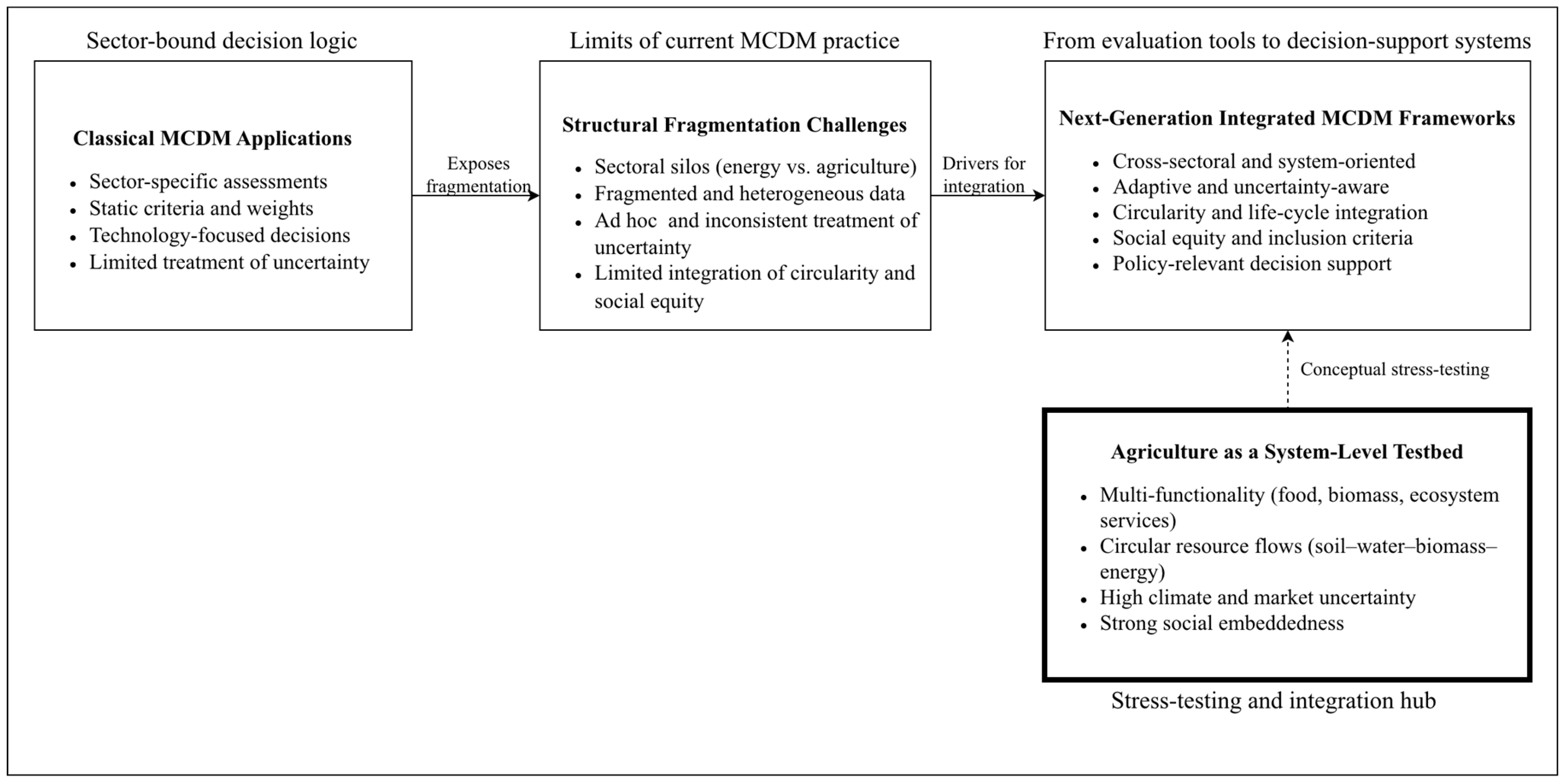
Figure 1. Conceptual evolution of Multi-Criteria Decision-Making (MCDM) frameworks in energy and agricultural systems. This figure illustrates the progression of MCDM frameworks from classical, sector-bound applications toward next-generation, integrated decision-support systems for sustainability assessment. The figure highlights how traditional MCDM practices expose structural fragmentation challenges, including sectoral silos, fragmented data, ad hoc treatment of uncertainty, and limited integration of circularity and social equity. These challenges serve as key drivers for the development of integrated, adaptive, and policy-relevant MCDM frameworks.
Energies 19 00436 g001
Disclaimer/Publisher’s Note: The statements, opinions and data contained in all publications are solely those of the individual author(s) and contributor(s) and not of MDPI and/or the editor(s). MDPI and/or the editor(s) disclaim responsibility for any injury to people or property resulting from any ideas, methods, instructions or products referred to in the content.

