Article

Deadbeat Control for a Three-Phase Solar T-Type Inverter and Comparison with PI Control

1
HD HYUNDAI PLASPO, Ilsan 10442, Republic of Korea
2
Faculty of Electrical Engineering, Korea National University of Transportation, Chungju-si 27469, Republic of Korea
*
Author to whom correspondence should be addressed.
Energies 2026, 19(2), 417; https://doi.org/10.3390/en19020417
Submission received: 29 October 2025 / Revised: 2 January 2026 / Accepted: 9 January 2026 / Published: 14 January 2026

Abstract

This paper proposes a deadbeat-based current control method for a three-phase T-type solar inverter to improve transient performance and harmonic immunity compared with conventional PI control. The control framework adopts a double-loop structure, in which the photovoltaic (PV) voltage is regulated by a perturb-and-observe (P&O)-based maximum power point tracking (MPPT) algorithm in the outer loop, while d–q axis currents are controlled in the inner loop. A performance comparison between the PI control and the proposed deadbeat control was conducted using an ESS T-type inverter with an inner current control loop, and the results were validated through combined simulation and experimental investigations. Under experimental conditions, when the d-axis reference current was stepped from 5.2 A to 9.2 A, the deadbeat controller achieved a transient settling time of approximately 1.89 ms, representing a 47.5% reduction compared to the 3.6 ms observed with the PI control. Furthermore, under 7th harmonic injection (0.225), the total harmonic distortion (THD) was reduced from 12.9% to 4.3%. These results demonstrate that the proposed deadbeat control strategy provides faster transient response and enhanced robustness against harmonic disturbances in three-phase T-type inverter applications.

1. Introduction

The global increase in energy demand, along with the severe impact of climate change, has accelerated the transition toward renewable energy sources such as photovoltaic (PV) systems and fuel cells. However, a typical PV cell generates only 20–50 V per module, and thus, requires efficient conversion and control strategies to extract maximum power [1]. To address this, Maximum Power Point Tracking (MPPT) algorithms such as Perturb & Observe (P&O) have been widely adopted [1].
As renewable energy penetration increases, there is a growing need for high-capacity and high-efficiency power conversion systems [2,3]. While increasing the switching frequency can enhance dynamic performance, it also raises switching losses. Alternatively, operating at higher DC-bus voltages improves conversion efficiency and reduces conduction losses [4,5]. In this context, the T-type inverter has gained attention due to its ability to support high-voltage applications using 1200 V semiconductor devices while offering lower switching losses and cost advantages compared to NPC or ANPC structures [6,7]. Specifically, NPC inverters suffer from neutral-point voltage imbalance and require additional balancing circuitry, whereas the T-type inverter minimizes conduction losses by approximately 30–40% due to a shorter current conduction path. Furthermore, unlike ANPC inverters, which require additional gate drivers and a larger number of switching components, the T-type structure achieves a favorable balance of performance and implementation cost, making it attractive for medium-voltage PV and ESS applications.
Compared with traditional two-level inverters, the three-level T-type inverter provides reduced harmonic distortion, lower switching stress, and improved efficiency, although this is at the expense of more complex switching states, capacitor balancing considerations, and increased modeling effort [8,9,10,11]. Nevertheless, these advantages in harmonic quality and loss reduction contribute to stable power conversion in high-voltage photovoltaic and high-power energy storage systems.
From a control perspective, the outer-loop PV voltage regulation is commonly performed using conventional PI control along with MPPT algorithms, while the inner-loop current regulation typically relies on PWM-based PI structures [12]. However, PI control is inherently linear and exhibits slower transient response, limited robustness to parameter uncertainties, and degraded performance in the presence of injected harmonics [13,14,15]. In contrast, advanced control approaches such as Model Predictive Control (MPC), Deadbeat control, H∞, and Sliding Mode Control have demonstrated superior dynamic response and robustness for nonlinear systems, including PV and grid-connected inverters [16,17,18,19].
However, existing studies applying MPC or PI control to T-type inverters often encounter practical limitations such as increased switching complexity, high computational burden, and strong sensitivity to model inaccuracies, which hinder real-time implementation in high-power applications [16,20]. In particular, the multilevel structure and increased number of switching states inherent to T-type inverters further amplify the computational burden of optimization-based MPC schemes, while simultaneously exposing the performance limitations of conventional PI control. To address these issues, there is a clear need for a control strategy that achieves fast transient response and strong robustness without relying on computationally intensive optimization procedures.
From this perspective, deadbeat current control represents an effective alternative, as it offers rapid dynamic response and improved current quality through a model-based, single-step control law, rather than cost-function optimization or multi-step prediction typically associated with conventional MPC schemes [21,22]. Rather than replacing MPC entirely, the deadbeat-based approach can be regarded as a practical control alternative that retains comparable dynamic advantages while significantly reducing computational complexity and implementation effort, making it particularly suitable for real-time control of high-power T-type PV and ESS inverters.
Motivated by these considerations, this paper investigates deadbeat-based current control using a three-phase T-type inverter configured to emulate ESS operating conditions, with particular focus on transient response characteristics and harmonic robustness. Furthermore, by integrating a photovoltaic module into the system, the practical applicability of the proposed control strategy in a PV-based operating environment is experimentally verified.
The main contributions of this paper are summarized as follows:
  • This paper applies a deadbeat-based predictive current control method to a three-phase T-type inverter operated under ESS-like operating conditions.
  • The performance of the proposed control strategy is quantitatively analyzed in terms of transient response improvement and harmonic robustness through both simulation and experimental studies.
  • Furthermore, by integrating a photovoltaic module into the system, the practical applicability of the proposed control strategy in a PV-based operating environment is experimentally validated.

2. Modeling of a Photovoltaic T-Type Inverter

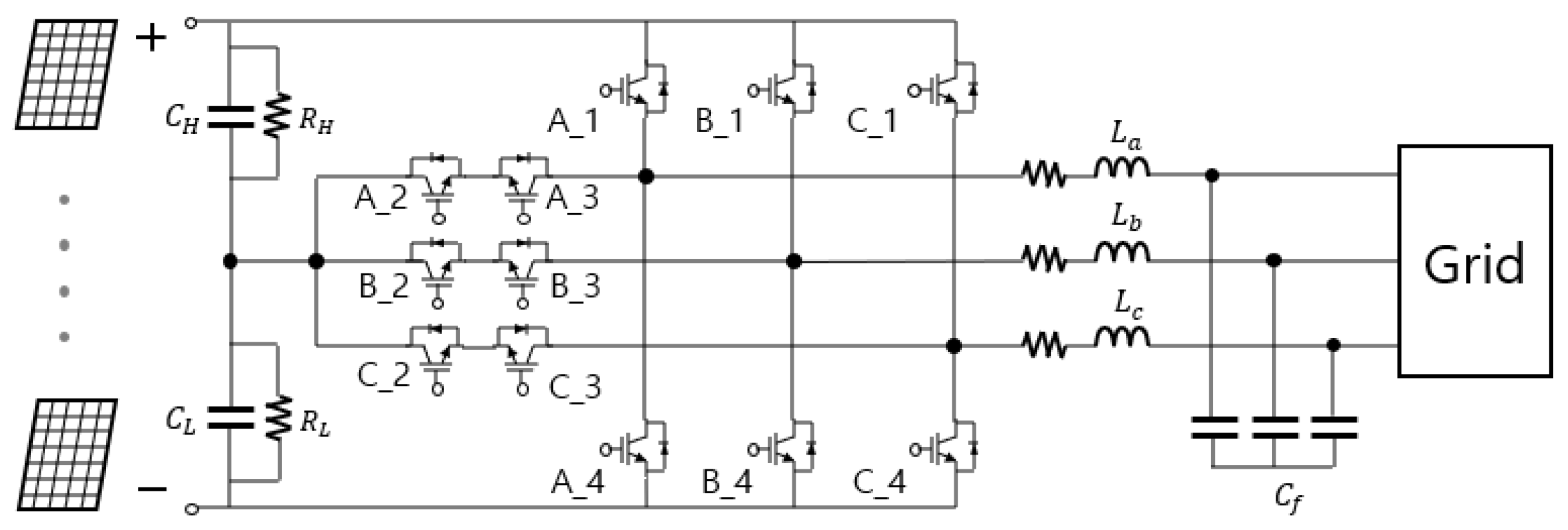
The configuration of the photovoltaic T-type inverter is shown in Figure 1. The switching operation of the three-phase photovoltaic T-type inverter is divided into three levels: upper, middle, and lower. In each level, the operation is determined by two switches and one capacitor. Through this, the inverter can generate three voltage levels: a positive value, a middle value (=0), and a negative value. This structure has the advantage of reducing the voltage stress on each switch and decreasing the harmonic distortion of output voltage and current [5,6,10,11].
The control method and state-averaged equations are similar to those of the two-level inverter. However, the proposed topology can represent the state equations in six intervals under medium or heavy load conditions, whereas the two-level inverter is represented with two intervals [5,12,22].

2.1. State Space and Averaged Modeling

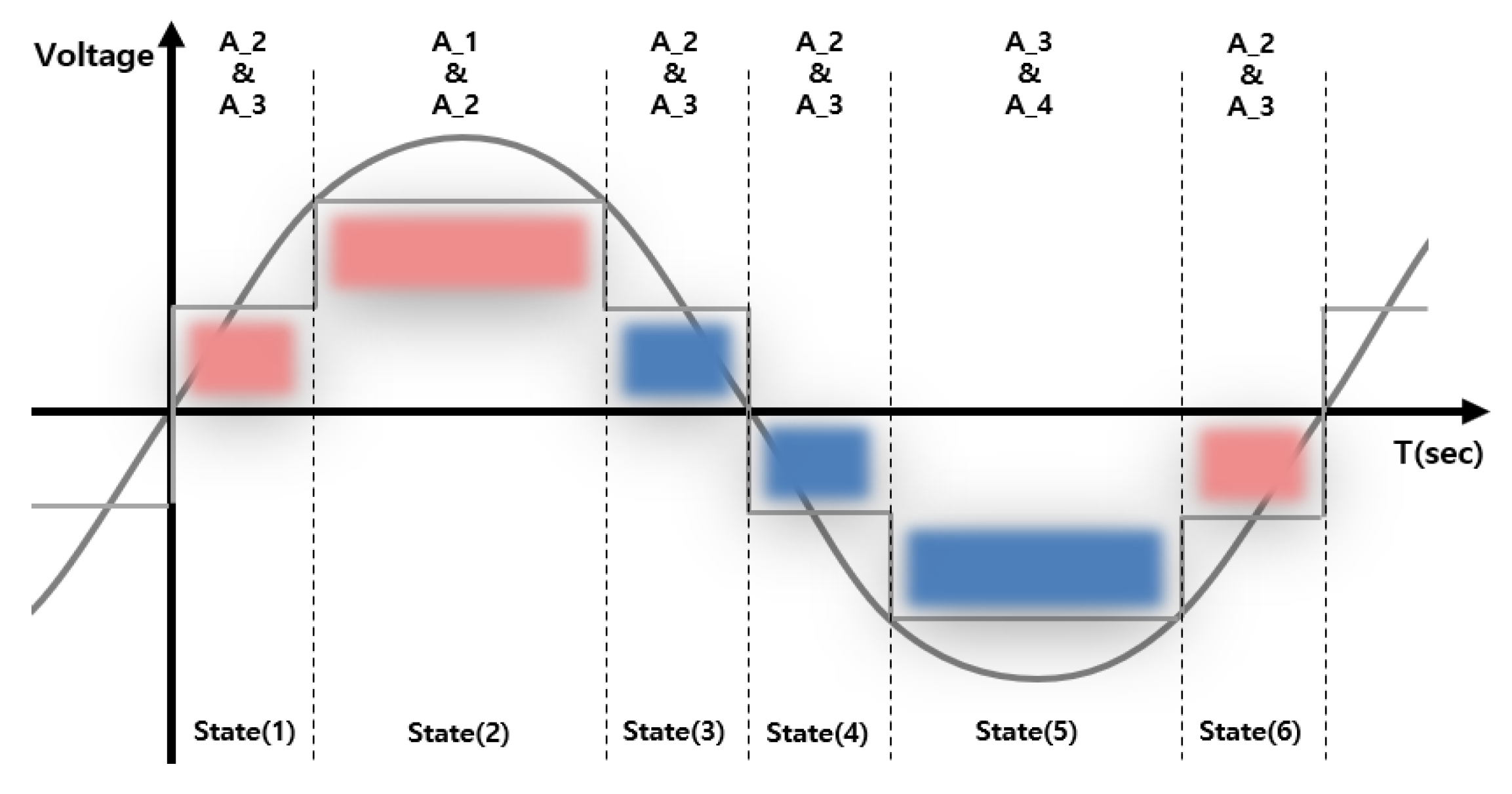
Focusing on the switching operation of the photovoltaic T-type inverter, the operation can be categorized into three representative cases: (i) A1 and A2 turn on, (ii) A2 and A3 turn on, and (iii) A3 and A4 turn on. As shown in Figure 2, the red-colored regions corresponding to State (1), State (2), and State (6) represent switching intervals in which switches A1, A2, and A3 operate in a complementary manner. In particular, States (1) and (6) are mainly dominated by the operation of switches A2 and A3, whereas State (2) is primarily governed by switches A1 and A2. Likewise, the blue-colored regions corresponding to State (3), State (4), and State (5) indicate switching intervals where switches A2, A3, and A4 operate complementarily. Among them, States (3) and (4) are dominated by switches A2 and A3, while State (5) is mainly characterized by the operation of switches A3 and A4 [5,10,11].
For phase a, the state-space equations are derived according to the switching intervals, and the slope α and y-intercept β at the Maximum Power Point (MPP) are applied based on the I-V curve representing the characteristics of the photovoltaic cell. Here, the slope α is defined as I m p / V m p , and the y-intercept β is defined as 2 I m p . Accordingly, the linearized output equation can be expressed as shown in Equation (1) [23].
I s a = α · V s a + β
The parameters used in the derivation of the state-space and averaged models are based on the actual electrical characteristics of the photovoltaic T-type inverter, including the PV module, DC-link capacitors, output filter, and grid interface. The detailed system parameters employed in the modeling and simulation are summarized in Table 1.
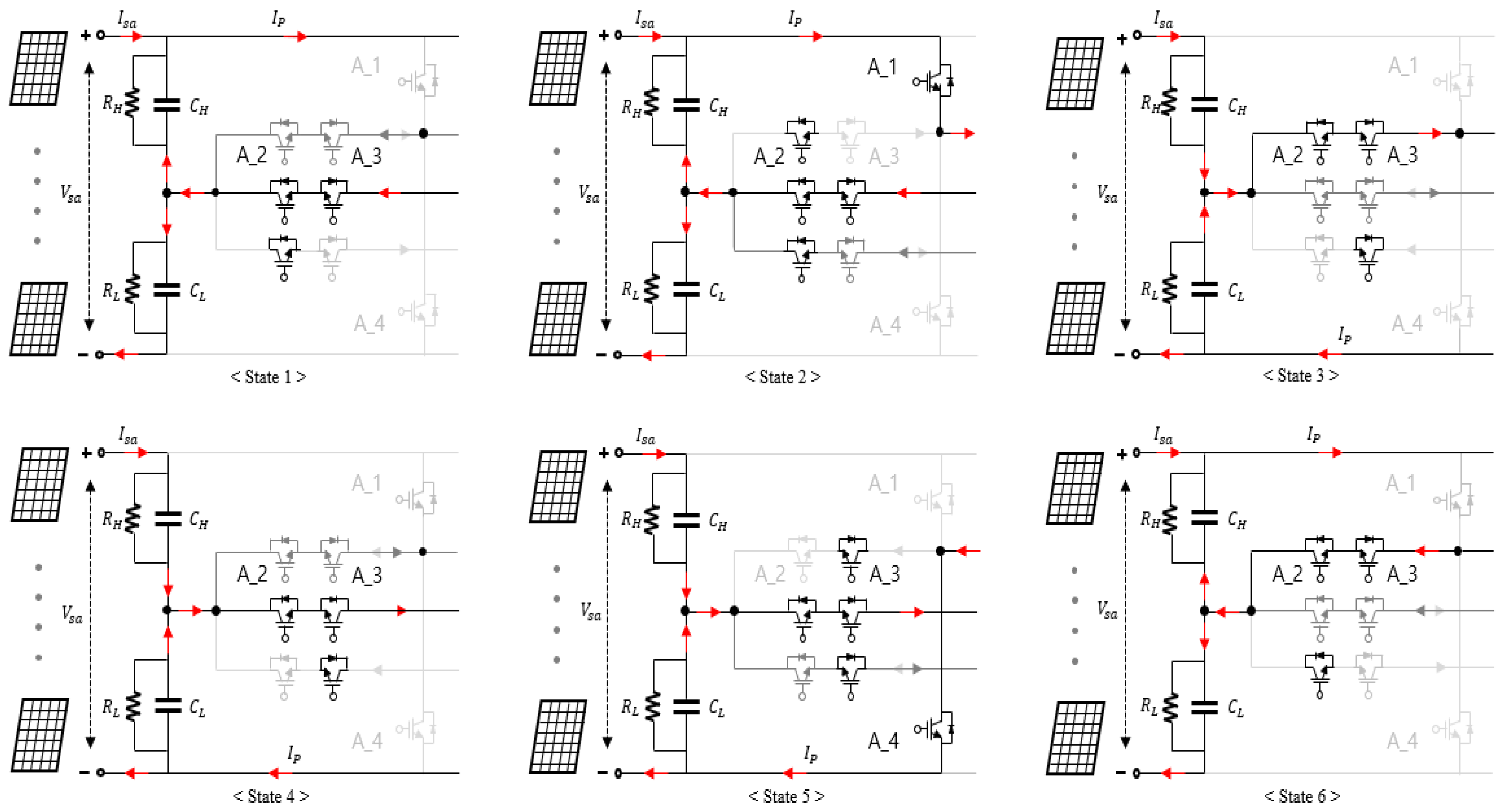
Based on the switching intervals illustrated in Figure 2, the corresponding operational sequence of the photovoltaic T-type inverter for phase a is illustrated in Figure 3. For each of the six switching states, the circuit operation and capacitor charging/discharging conditions are identified, and the corresponding state-space equations are derived accordingly [5,18].
For clarity, the symbols used in state-space modeling, averaged modeling, and small-signal analysis are summarized in Table 2.
State (1): A_2 & A_3 turn on
V s a = V s a , C H + V s a , C L = V L + V c f     v s a , C H 2 + v s a , C L 2 = r L i L + L d i L d t + V c f I C H = I s a I C H I C L I P     C H d v s a , C H d t = α ( v s a , C H + v s a , C L ) + β d v s a , C H R H d v s a , C L R L di L I C L = I s a I C H I C L I P     C L d v s a , C L d t = α ( v s a , C H + v s a , C L ) + β d v s a , C H R H d v s a , C L R L di L
State (2): A_1 & A_2 turn on
V s a = V s a , C H + V s a , C L = V L + V c f     v s a , C H 2 + v s a , C L 2 = r L i L + L d i L d t + V c f I C H = I s a I C H I C L I P     C H d v s a , C H d t = α ( v s a , C H + v s a , C L ) + β d v s a , C H R H d v s a , L R L di L I C L = I s a I C H I C L I P     C L d v s a , C L d t = α ( v s a , C H + v s a , C L ) + β d v s a , C H R H d v s a , C L R L di L
State (3): A_2 & A_3 turn on
V s a = V s a , C H + V s a , C L = V L + V c f   v s a , C H 2 v s a , C L 2 = r L i L + L d i L d t + V c f I C H = I s a I C H I C L I P     C H d v s a , C H d t = α ( v s a , C H + v s a , C L ) + β d v s a , C H R H d v s a , C L R L di L I C L = I s a I C H I C L I P     C L d v s a , C L d t = α ( v s a , C H + v s a , C L ) + β d v s a , C H R H d v s a , C L R L di L
State (4): A_2 & A_3 turn on
V s a = V s a , C H + V s a , C L = V L + V c f v s a , C H 2 v s a , C L 2 = r L i L + L d i L d t + V c f I C H = I s a I C H I C L I P     C H d v s a , C H d t = α ( v s a , C H + v s a , C L ) + β d v s a , C H R H d v s a , C L R L di L I C L = I s a I C H I C L I P     C L d v s a , C L d t = α ( v s a , C H + v s a , C L ) + β d v s a , C H R H d v s a , C L R L di L
State (5): A_3 & A_4 turn on
V s a = V s a , C H + V s a , C L = V L + V c f v s a , C H 2 v s a , C L 2 = r L i L + L d i L d t + V c f I C H = I s a I C H I C L I P     C H d v s a , C H d t = α ( v s a , C H + v s a , C L ) + β d v s a , C H R H d v s a , C L R L di L I C L = I s a I C H I C L I P     C L d v s a , C L d t = α ( v s a , C H + v s a , C L ) + β d v s a , C H R H d v s a , C L R L di L
State (6): A_2 & A_3 turn on
V s a = V s a , C H + V s a , C L = V L + V c f     v s a , C H 2 + v s a , C L 2 = r L i L + L d i L d t + V c f I C H = I s a I C H I C L I P     C H d v s a , C H d t = α ( v s a , C H + v s a , C L ) + β d v s a , C H R H d v s a , C L R L di L I C L = I s a I C H I C L I P     C L d v s a , C L d t = α ( v s a , C H + v s a , C L ) + β d v s a , C H R H d v s a , C L R L di L
At this point, the state equations for the respective regions, (2), (3), and (7), can be expressed in matrix form as shown in Equation (8).
d i L d t d v s a , C H d t d v s a , C L d t = r L L 1 2 L 1 2 L d C H ( α C H + 1 R H C H ) ( α C H + 1 R L C H ) d C L ( α C L + 1 R H C L ) ( α C L + 1 R L C L ) i L v s a , C H v s a , C L + V c f L β C H β C L
The state equations for the respective regions, (4), (5), and (6), can be expressed in matrix form as shown in Equation (9).
d i L d t d v s a , C H d t d v s a , C L d t = r L L 1 2 L 1 2 L d C H ( α C H + 1 R H C H ) ( α C H + 1 R L C H ) d C L ( α C L + 1 R H C L ) ( α C L + 1 R L C L ) i L v s a , C H v s a , C L + V c f L β C H β C L
As described above, the state-space equations for different operations, expressed in a (3 × 3) matrix form, can be categorized into two distinct representations. This demonstrates that they share similarities with the structure of a two-level inverter [5,12,22].
In Figure 3, it can be observed that during the operation of States (1), (2), and (6) in the photovoltaic T-type inverter, the lower capacitor is charged while the upper capacitor is discharged. Conversely, during the operation of States (3), (4), and (5), the upper capacitor is charged while the lower capacitor is discharged [5,11].
The state-averaged equation for these operational states, represented as ( X ˙ = A X + B ), can be formulated as follows.
d i L d t d v s a , C H d t d v s a , C L d t = r L L ( d 0.5 ) L ( d 0.5 ) L d C H ( α C H + 1 R H C H ) ( α C H + 1 R L C H ) d C L ( α C L + 1 R H C L ) ( α C L + 1 R L C L ) i L v s a , C H v s a , C L + V c f L β C H β C L
At this point, since the system matrix A varies depending on the input duty ratio d , rather than being constant, the system exhibits non-linear characteristics. Furthermore, the overall state-averaged equations for phases a ,   b ,   c can be represented identically to Equation (10). Therefore, when the equations for the a b c -phase, as represented in Equation (10), are transformed into the d q -axis, they can be expressed as follows [12,22,24].
(i) Averaged state-space equations for current  ( i a b c )    in the  d q    transformation.
d i a b c d t = r L L i a b c + d 0.5 L v s a , C H + d 0.5 L v s a , C L V c f L ω P i q i d + d d t P i d i q = r L L P i d i q + d d 0.5 L d q 0.5 L P v s a , C H + d d 0.5 L d q 0.5 L P v s a , C L 1 L P v c f , d v c f , q   d i d d t d i q d t = r L L ω ω r L L i d i q + d d 0.5 L d q 0.5 L v s a , C H + d d 0.5 L d q 0.5 L v s a , C L + 1 L 0 0 1 L v c f , d v c f , q
(ii) Averaged state-space equations for voltage  ( v s a , C H )  in the   d q  transformation.
d v s a , C H d t = d C H i a b c α C H + 1 R H C H v s a , C H α C H + 1 R L C H v s a , C L + β C H   d v s a , C H d t = d d C H d q C H i d i q α C H + 1 R H C H v s a , C H α C H + 1 R L C H v s a , C L + β C H
(iii) Averaged state-space equations for voltage  ( v s a , C L )  in the  d q  transformation.
d v s a , C L d t = d C L i a b c α C L + 1 R H C L v s a , C H α C L + 1 R L C L v s a , C L + β C L   d v s a , C L d t = d d C L d q C L i d i q α C L + 1 R H C L v s a , C H α C L + 1 R L C L v s a , C L + β C L
(iv) Overall averaged state-space equations in  d q  transformation (4 × 4).
d i d d t d i q d t d v s a , C H d t d v s a , C L d t = r L L ω d d 0.5 L d d 0.5 L ω r L L d q 0.5 L d q 0.5 L d d C H d q C H ( α C H + 1 R H C H ) ( α C H + 1 R L C H ) d d C L d q C L ( α C L + 1 R H C L ) ( α C L + 1 R L C L ) i d i q v s a , C H v s a , C L + V c f , d L V c f , q L β C H β C L
Here, since the resistance of the input capacitors satisfies R H = R L , it can be represented as R . Additionally, the capacitance of the input capacitors satisfies C H = C L , so it can be denoted as C . Based on the parameter values in Table 1, 1 R C is approximately 3.48 × 10 5 s 1 , which is sufficiently small to be neglected without introducing a significant error.
The input voltage is always assumed to satisfy V s a = V s a , C H + V s a , C L , and by ensuring voltage balancing for the input capacitors, V s a , C H V s a , C L can be achieved. Therefore, the (4 × 4) matrix can be simplified to a (3 × 3) matrix [12].
(v) Overall averaged state-space equations in  d q  transformation (3 × 3).
d i d d t d i q d t d v s a d t = r L L ω d d 0.5 L ω r L L d q 0.5 L d d C d q C α C i d i q v s a + V c f , d L V c f , q L β C
The averaging equations for current and voltage at this point are represented as follows below.
① Averaging Equation for Current ( i L ) in the dq-frame:
d i d d t d i q d t = r L L ω ω r L L i d i q + d d 0.5 L d q 0.5 L v s a + 1 L 0 0 1 L v c f , d v c f , q
② Averaging Equation for Voltage ( v s a ) :
d v s a d t = d d C d q C i d i q α C v s a + β C

2.2. Small Signal Modeling

To analyze and control the operation near the operating point of the system more stably, it is necessary to linearize the values around the operating point to predict the system’s behavior.
i d = I d + i ^ d ,   d d = D d + d ^ d ,   v c f , d = V c f , d + v ^ c f , d ,   v s a = V s a + v ^ s a       i q = I q + i ^ q ,   d q = D q + d ^ q ,   v c f , q = V c f , q + v ^ c f , q
Substituting the perturbation term (18) into the previously derived averaging equations for current (16) and voltage (17) in the d q transformation, and separating the DC and AC components, the equations can be rearranged as follows [24].
① Averaging Equation for Current ( i L ) in the d q -frame:
d i ^ d d t d i ^ q d t = r L L ω ω r L L i ^ d i ^ q + d d 0.5 L d q 0.5 L v ^ s a + V s a L d ^ d d ^ q + 1 L 0 0 1 L v ^ c f , d v ^ c f , q
Here, terms such as ω i d , ω i q , d d 0.5 L , d q 0.5 L , v c f , d L , v c f , q L result in nonlinear functions. Additionally, the equations for i d and i q must be independent of each other to allow independent application of inputs d d , d q . By decomposing each into feed-back and feed-forward components, they can be expressed as d ^ d = d ^ d , f b + d ^ d , f f , d ^ q = d ^ q , f b + d ^ q , f f .
Thus, by applying feed-forward control to cancel out the nonlinear terms, the final linearized equation in the d q -axis can be represented in the form of X ˙ = A X + B as follows.
d ^ d , f f = ω L i ^ q + v ^ c f , d V s a ,   d ^ q , f f = ω L i ^ d + v ^ c f , q V s a d i ^ d d t d i ^ q d t = r L L 0         0 r L L i ^ d i ^ q + D d 0.5 L D q 0.5 L v ^ s a + V s a L d ^ d d ^ q
At this point, the following relationships hold due to the current controller.
d ^ d = d ^ d , f b ,   d ^ q = d ^ q , f b
② Averaging Equation for Voltage   ( v s a ) :
d v ^ s a d t = D d C D q C i ^ d i ^ q α C v ^ s a + I d C I q C d ^ d d ^ q
Similarly, the small-signal equation for voltage derived from the d q -axis transformation may appear as a nonlinear function. However, due to the small range of variation in the system’s operating values, it can be approximated as a linear system.
Thus, the (3 × 3) matrix representation of voltage and current using the Small Signal Model is shown in Equation (23).
d i ^ d d t d i ^ q d t d v ^ s a d t = r L L 0 D d 0.5 L 0 r L L D q 0.5 L D d C D q C α C i ^ d i ^ q v ^ s a + V s a L 0 0 V s a L I d C I q C d ^ d d ^ q
The (3 × 3) matrix (Equation (23)) of the previously described Small Signal Model can be decomposed and recombined based on the theory of Singular Value Decomposition (SVD) used in linear algebra. Through this process, a (2 × 2) matrix (Equation (24)) is derived.
d i ^ d q d t d v ^ s a d t = r L L D d q 0.5 L D d q C α C i ^ d q v ^ s a + V s a L I d q C d ^ d q
To analyze the dynamic characteristics of the system, the equation below (25) must be transformed into the Laplace domain [12,22].
s I A X s = B U
The relationships between the output and input in the transformed Laplace domain are expressed as small-signal transfer functions, as shown in Equations (26)–(28).
(i) Control to Inductor Current Transfer Function.
G 1 s = i ^ d q d ^ = s + α C V s a L ( D 0.5 L ) I d q C s 2 + r L L + α C s + α r L L C + D d q ( D d q 0.5 ) L C
(ii) Control to Solar Voltage Transfer Function.
G 2 s = v ^ s a d ^ = s + r L L I d q C D d q C V s a L s 2 + r L L + α C s + α r L L C + D d q ( D d q 0.5 ) L C
(iii) Inductor Current to Solar Voltage Transfer Function.
G 3 s = v ^ s a i ^ d q = s + r L L I d q C D d q C V s a L s + α C V s a L ( D d q 0.5 L ) I d q C

3. Controller Design

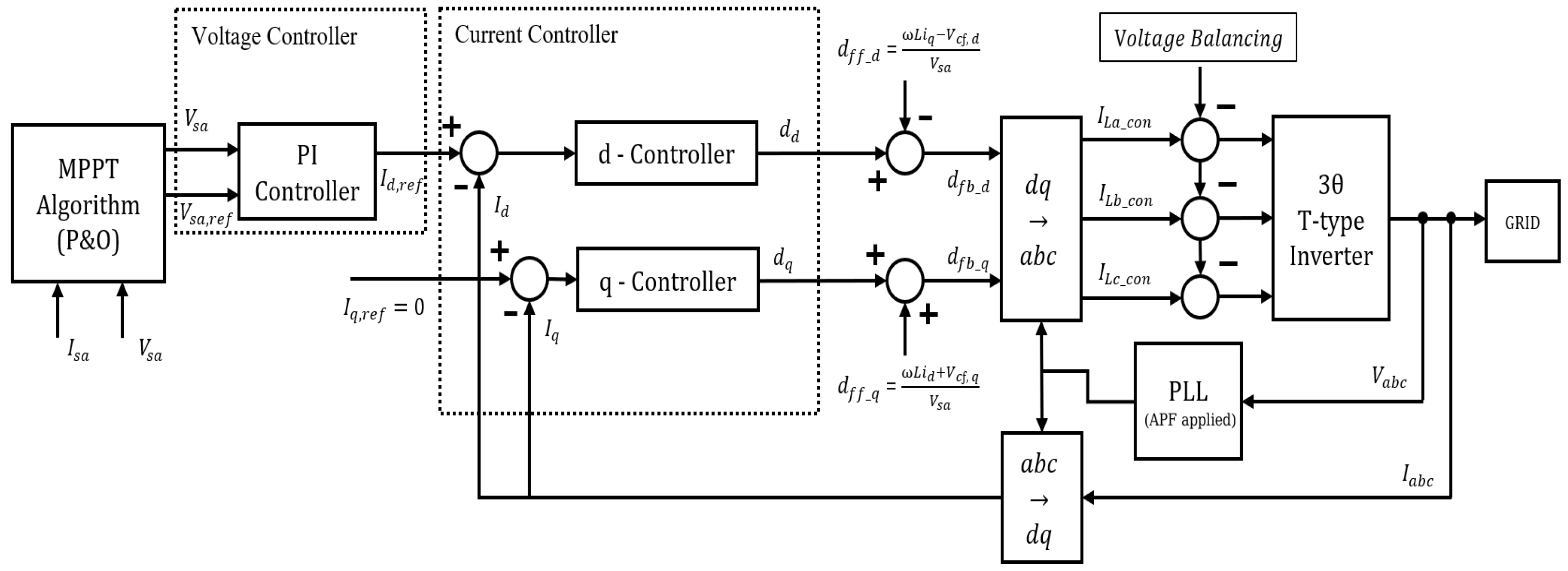
In Figure 4, the controller structure of the three-phase photovoltaic T-type inverter is illustrated. It is composed of a double-loop configuration, where the MPPT algorithm reliably tracks the output voltage at the Maximum Power Point (MPP) of the solar cell. In the outer (voltage) loop, PI control is applied to reach the voltage corresponding to the MPP. In the inner (current) loop, the three-phase currents are transformed into two orthogonal components through DQ transformation, allowing the AC signals to be analyzed and controlled from a fixed reference frame regardless of frequency and phase variations. This enables precise control of the amplitude and phase of the AC current, optimizing synchronization with the power grid [23,24,25].
It should be noted that the averaged and small-signal models derived in Section 2 are validated through the frequency-domain analyses employed in the controller design. The Bode plots and root locus results presented in Figure 5 and Figure 6 are obtained directly from the derived plant transfer functions, confirming that the proposed mathematical model accurately captures the dominant system dynamics within the control bandwidth of interest.

3.1. PI Controller Design

In the proposed controller structure, the bandwidth of the current controller is set to be more than 10 times greater than that of the voltage controller to ensure stability and improve performance. If this condition is not satisfied, external disturbances may affect the current controller, and the voltage controller will fail to respond quickly to system variations, potentially leading to instability in the overall system. Consequently, the voltage and current controllers are arranged in a cascade structure, where the current controller must respond at least 10 times faster than the voltage controller [12,24].
The characteristics of PI control are determined by key parameters such as phase margin and bandwidth in a closed-loop system. The bandwidth, however, is constrained by factors like the control cycle of the controller and the PWM switching frequency. To enable fast operation of the current controller, its frequency bandwidth is typically set higher. Generally, this bandwidth   ( ω c ) is chosen to be approximately (1/30~1/5) of the switching frequency. This ensures the current controller’s ability to respond quickly and maintain system stability [12,22,26].
Accordingly, the voltage controller operates more slowly than the current controller and is assigned a lower frequency bandwidth   ( ω c ) to maintain control stability [25,26].
Furthermore, the output of a solar inverter is subject to fluctuations due to external factors, making it unpredictable and potentially detrimental to the controller’s performance. These instabilities complicate the application of critical damping. As a result, a robust control approach using under-damping characteristics has been implemented to address these challenges effectively [14,18].

Single Loop (ESS) and Double Loop (Solar) Design

In this subsection, the controller design results for both the single-loop current control structure (ESS T-type inverter) and the double-loop voltage–current control structure (Solar T-type inverter) are presented and compared.
Table 3 summarizes the design specifications of the controllers, including the target bandwidth and phase margin for each control loop. In the proposed cascade control framework, the inner current loop is designed to operate significantly faster than the outer voltage loop in order to ensure stable loop interaction and effective disturbance rejection. Accordingly, the current controllers are designed with a relatively high bandwidth, while the voltage controller is designed with a lower bandwidth and higher phase margin.
Although the interaction between the voltage and current loops can be complex, the proposed cascade control structure ensures effective dynamic decoupling by assigning a sufficiently higher bandwidth to the inner current loop. This widely adopted design approach allows the voltage loop to be designed quasi-independently while preserving overall system stability and disturbance rejection capability.
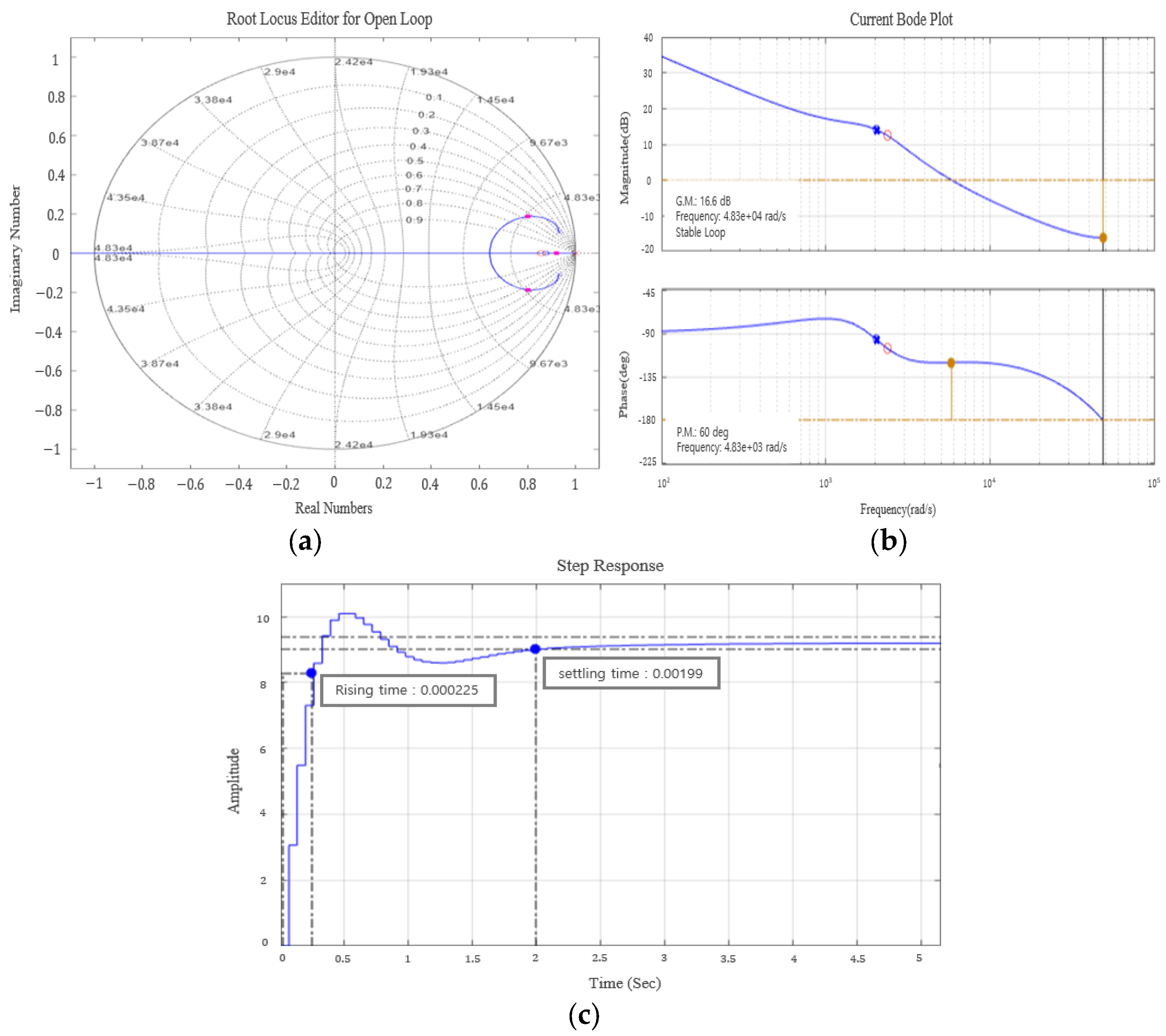
Figure 5a–c illustrate the stability and dynamic characteristics of the single-loop current controller for the ESS T-type inverter. As shown in the root locus plot in Figure 5a, all closed-loop poles remain within the stable region, confirming closed-loop stability. The Bode plot in Figure 5b verifies that the designed current controller satisfies the target bandwidth of 4833 rad/s and a phase margin of 60 deg, as specified in Table 3. Furthermore, the step response in Figure 5c demonstrates fast transient behavior, with a rise time of 0.225 ms and a settling time of 1.99 ms, indicating rapid convergence and stable current regulation.
Figure 5. Frequency- and time-domain characteristics of the current loop controller: (a) Root Locus; (b) Bode Diagram of G c i G 1 ; and (c) Step Response for Current Loop.
Energies 19 00417 g005
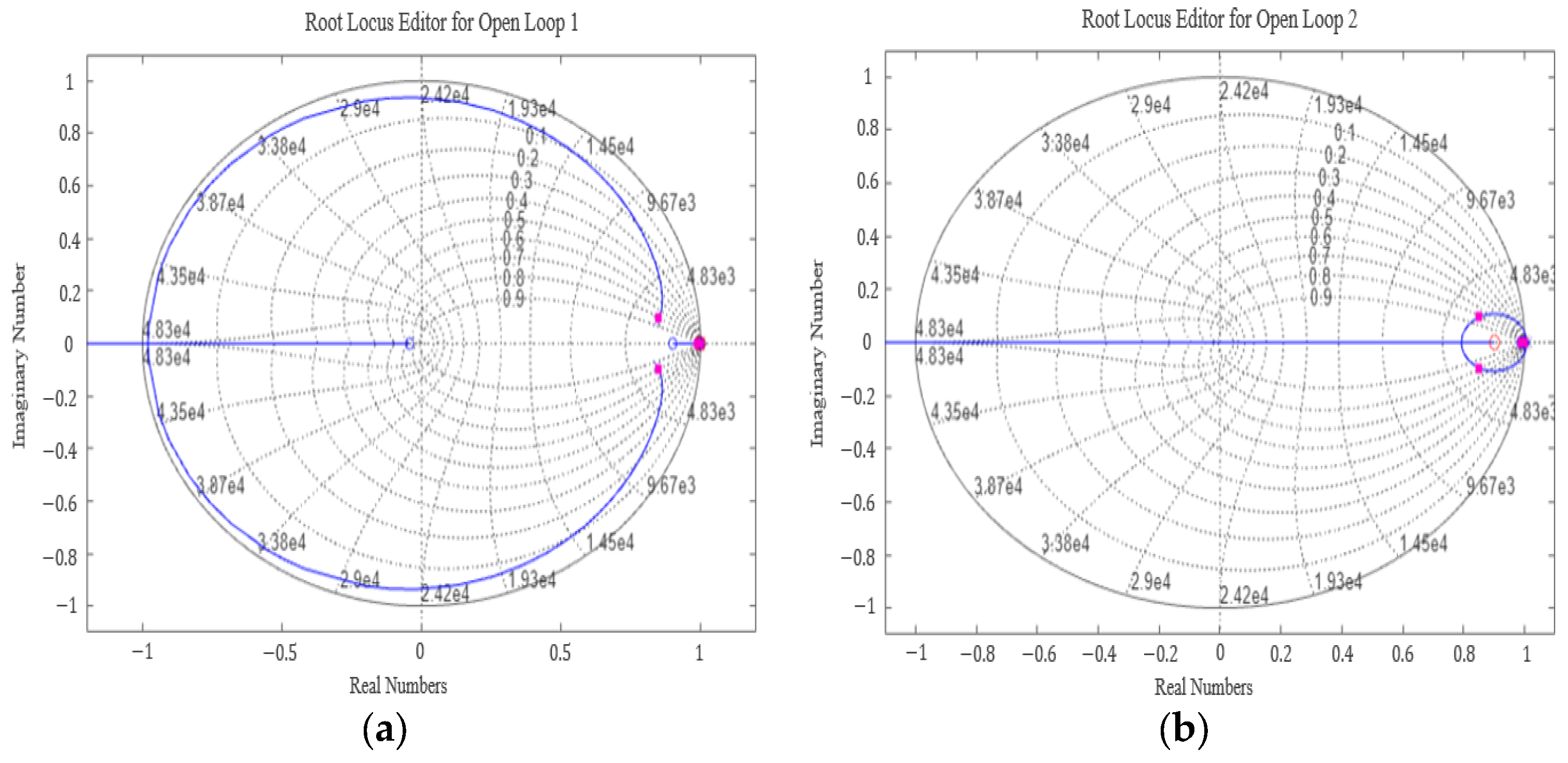
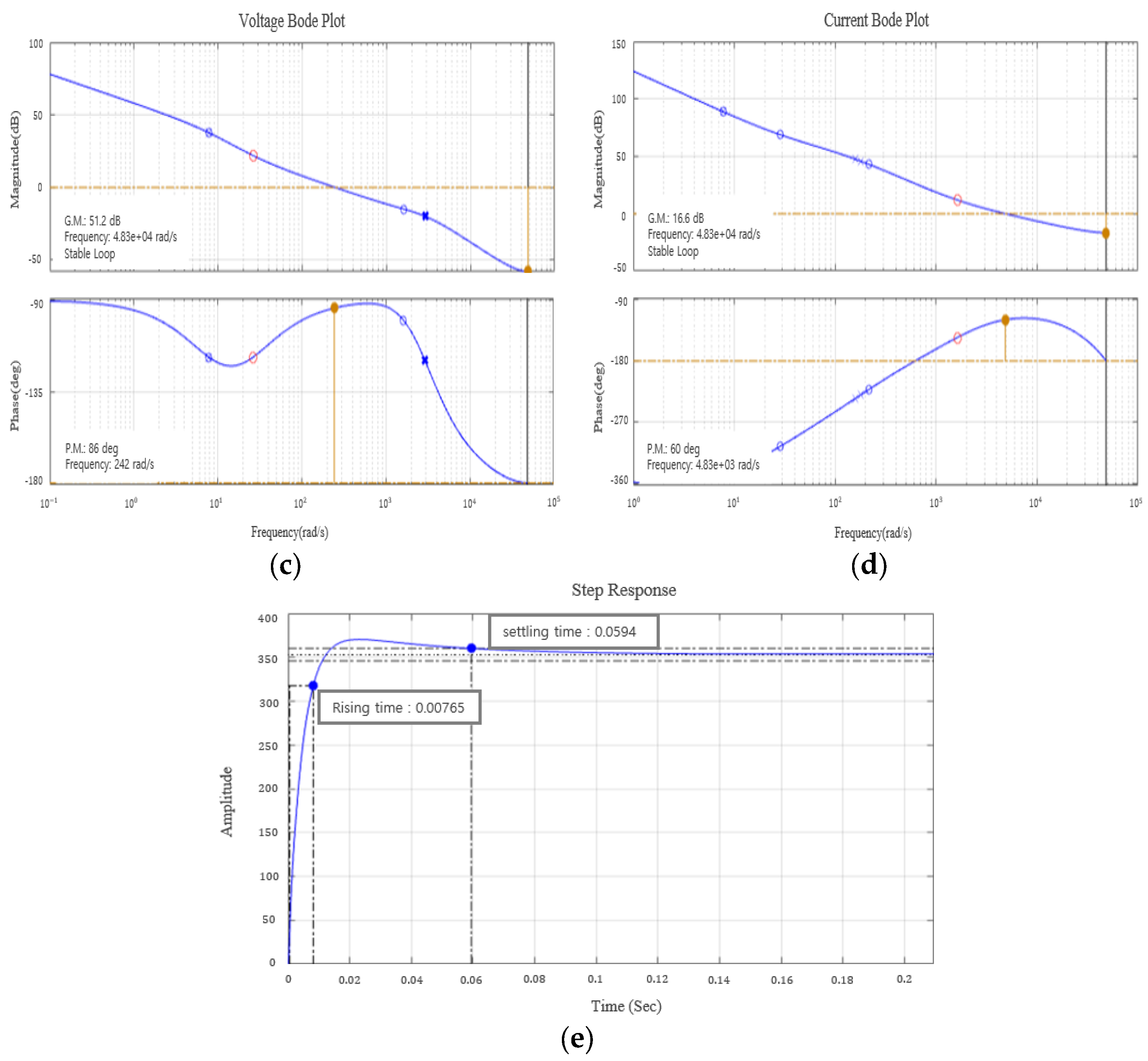
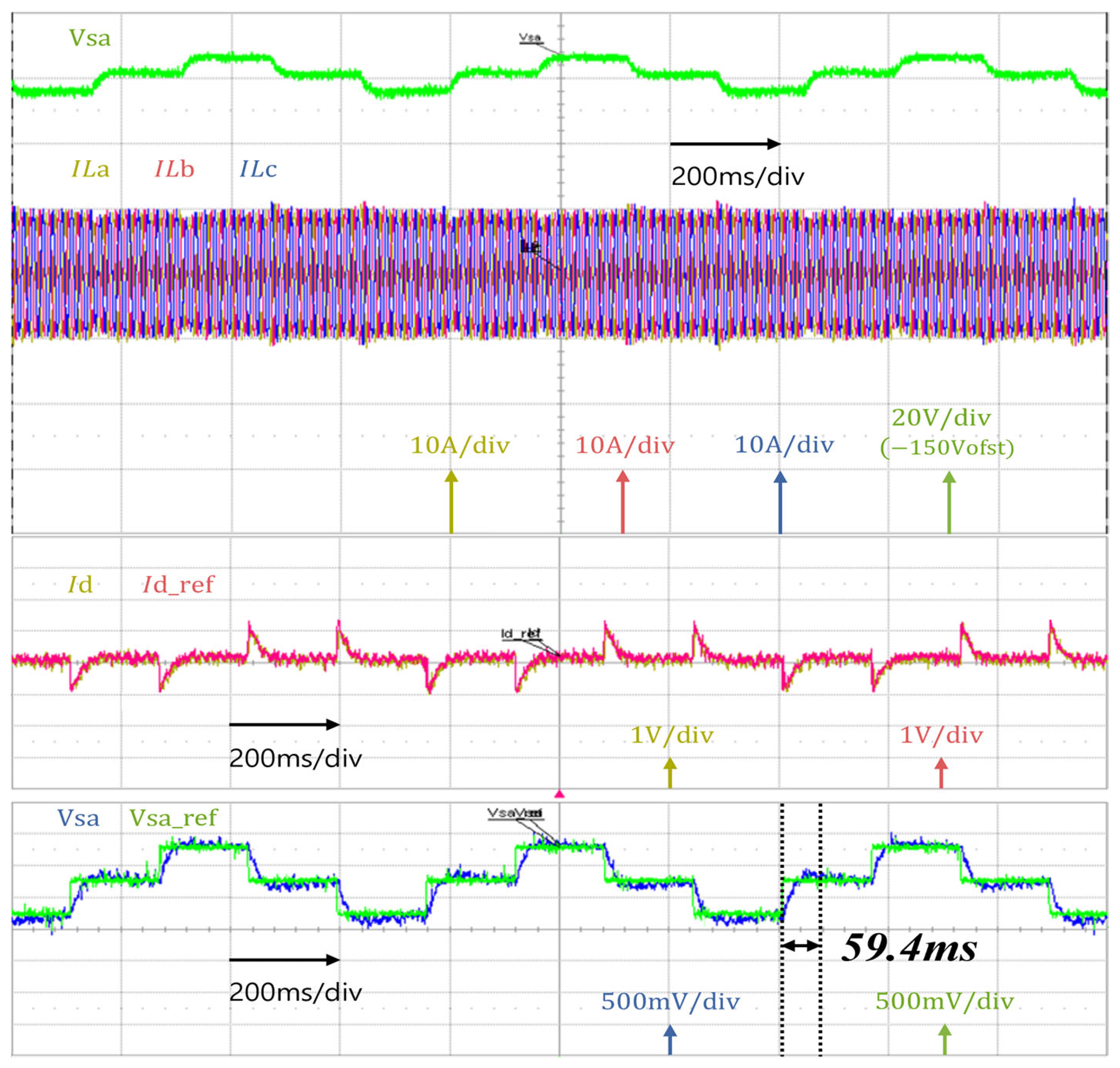
For the solar T-type inverter, a double-loop control structure consisting of an outer voltage loop and an inner current loop is adopted. The voltage controller is designed with a lower bandwidth of 242 rad/s and a higher phase margin of 86° to ensure stable interaction with the faster inner current loop. Figure 6a–e present the frequency- and time-domain characteristics of the double-loop control structure. The Bode plots in Figure 6c,d confirm that both voltage and current controllers satisfy their respective bandwidth and phase margin requirements. The step response of the voltage loop shown in Figure 6e exhibits a rise time of 7.65 ms and a settling time of 59.4 ms, demonstrating well-damped transient behavior and stable voltage regulation.
Figure 6. Frequency- and time-domain characteristics of the voltage and current control loops: (a) Bode Diagram of G c v G 3 ; (b) Bode Diagram of G c i G 1 ; (c) Bode Diagram of G c v G 3 ; (d) Bode Diagram of G c i G 1 ; (e) Step Response for Voltage Loop.
Energies 19 00417 g006aEnergies 19 00417 g006b
The controller gains were systematically tuned using the MATLAB SISO Tool in MATLAB R2023b based on frequency-domain design criteria. Discrete-time PI controllers were adopted in the following general z-domain form:
C ( z ) = K z z 0 z 1
For the single-loop ESS current controller, the obtained PI transfer function is
C Cur ,   Single ( z ) = 0.12327 z 0.858 z 1
In the double-loop control structure, the voltage and current controllers are expressed as
C Vol ,   Double z = 0.71663 z 0.998 z 1 ,   C Cur ,   Double ( z ) = 0.032013 z 0.9 z 1
These gain values were selected to satisfy the target bandwidth and phase margin specifications while ensuring sufficient dynamic separation between the voltage and current loops. The optimized PI gains were subsequently applied consistently in both simulation and experimental validation.

3.2. Deadbeat Controller Design

Deadbeat control, a type of Model Predictive Control (MPC), is designed to drive the system states to their reference values within the shortest possible time [19,22]. This control approach determines the control input directly from the system’s discrete-time dynamic model, resulting in a very fast transient response without iterative optimization [14,15,16].
For nonlinear power electronic systems such as solar T-type inverters, robustness against parameter variations and operating condition changes is essential for effective deadbeat control implementation. To enhance robustness while preserving fast dynamic characteristics, the proposed control structure applies deadbeat control to the inner current loop within a double-loop configuration [14,18]. By confining the deadbeat action to the fastest dynamic loop, the influence of nonlinearities and disturbances on the overall system stability is significantly reduced.
The continuous-time state-space model derived earlier in (11) is converted into a discrete-time form using forward conversion. This transformation enables efficient real-time implementation while ensuring that the system states converge to their reference values within a finite number of sampling steps. The general discrete-time representation is given by [21,22]
X ˙ = AX + Bu x k + 1 = e AT x k + A 1 e AT Ι Bu = ( Ι + A T ) x ( k ) + T Bu
Based on this formulation, the discrete-time dq-axis current averaging equations can be expressed as
I d k + 1 I q k + 1 = 1 r L T L ω T ω T 1 r L T L I d ( k ) I q ( k ) + d d 0.5 T L d q 0.5 T L V s a ( k ) + T L 0 0 T L V c f , d ( k ) V c f , q k
The discrete-time voltage averaging equation is similarly derived as
V s a k + 1 = d d T C d q T C I d ( k ) I q ( k ) + 1 α T C V s a k + β T C
Since deadbeat control is inherently a digital control method, the discrete-time model is evaluated at every sampling instant. In the proposed scheme, deadbeat control is applied exclusively to the inner current loop, which exhibits the fastest dynamic behavior and is therefore most suitable for finite-step convergence [18,21].
The dq-axis current dynamics can be rewritten as
I d k + 1 = 1 r L T L I d k + ω T I q k + d d 0.5 T L v s a k T L V c f , d k I q k + 1 = ω T I d k + 1 r L T L I q k + d q 0.5 T L v s a k T L V c f , q k
The duty command is composed of feedforward and feedback components such as
d d z = d d , f b z + d d , f f z
where the feedforward term compensates for known system dynamics
d d , f f z = 0.5 + V c f , d z ω T I q z V s a ( z )
and the feedback term is obtained through a discrete-time controller. Using the forward conversion s = z 1 T , the feedback controller is expressed as
C z = Y z X z = K p + K i T z 1 = K p + K p z 1 = K p z z 1
which can be rearranged as
u f b z = K p z k i z K z e z = d f b ( z )
where e z = I L , r e f z I L z = I L , e r r z denotes the current tracking error.
At this point, it should be emphasized that the parameters K p , K i , and K z in the deadbeat controller serve a fundamentally different role from those of a conventional PI controller. These parameters are not tuned heuristically in the frequency domain but are analytically derived in the z-domain based on the discrete-time system model. Consequently, they directly determine the closed-loop pole locations and the dynamic characteristics of the system.
Substituting the feedforward and feedback terms into (33) and applying the z-transform yields
z I d z = 1 r L T L I d z + T V s a L   K p z K i z K z I d , r e f z I d z z I q z = 1 r L T L I q z + T V s a L   K p z K i z K z I q , r e f z I q z
Rearranging the above equations leads to the closed-loop transfer function
I L ( z ) I r e f ( z ) = T V s a L K p ( Z K z ) z 2 + ( r L T L 1 K z + T V s a L · K p ) z + 1 r L T L K z T V s a L K p · K i
To achieve Deadbeat characteristics, all closed-loop poles must lie inside the unit circle in the z-domain, ensuring closed-loop stability and finite-step convergence. Accordingly, the characteristic equation is designed to take the form of z 2 . which requires the parameter K Z to satisfy 0 < K Z < 1 . The parameter K z directly determines the trade-off between convergence speed and robustness of the closed-loop system. Smaller values of K z result in faster finite-step convergence, whereas larger values improve robustness against modeling uncertainties and parameter variations. Therefore, the sensitivity of the proposed deadbeat controller to parameter deviations is analytically addressed through the z-domain pole placement constraint.
Based on this constraint, the controller gains K p and K i are analytically derived as [18,19,22]
r L T L 1 K z + T V s a L K p = 0                       K p = L T V s a 1 r L T L + K z 1 r L T L K z T V s a L K p K i = 0               K i = L T V s a · K p K z 1 r L T L
Thus, the values of K p and K i are uniquely determined once K z and the system parameters (inductance, DC-link voltage, and sampling period) are specified. This analytical design guarantees deadbeat current tracking while preserving closed-loop stability.
Finally, unlike conventional MPC schemes that rely on online optimization and iterative cost-function evaluation, the proposed deadbeat controller employs an explicit closed-form control law. As a result, the computational burden is significantly reduced, and the control input can be calculated within a single sampling period, making the proposed approach suitable for real-time implementation in digital control platforms.

3.3. Input Capacitor Voltage Balancing

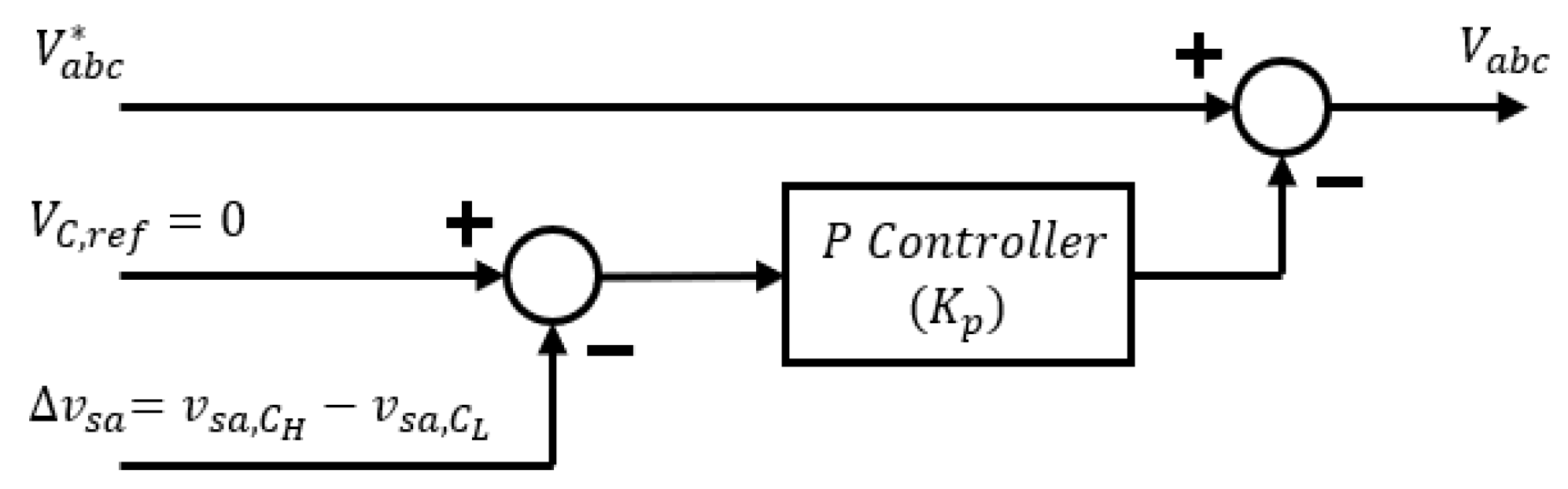
Due to the characteristics of the multilevel structure, voltage imbalance may occur among the input capacitors, which can lead to output voltage distortion, increased switching losses, and reduced system reliability. Therefore, a Carrier-Based PWM (CBPWM) neutral-point control technique is applied. In this section, a method incorporating voltage offset injection and duty cycle adjustment is proposed [5,12,27]. The overall control structure of the proposed input capacitor voltage balancing strategy is illustrated in Figure 7.
The average current of the input capacitors is determined by the voltage and the switching duty cycle and can be expressed as follows.
I C k , A V G = 1 T s 0 T s I G K t d t = 1 R V s a , C k + V s a , C k I L 1 D k k { H , L } ,   T s = Switching period , D H & D L = U p p e r / l o w e r   d u t y   c y c l e
The current difference between the upper and lower capacitors can be expressed as follows.
I C = I C H , A V G I C L , A V G = I L D H D L
The time-dependent change in the capacitor voltage is described by the capacitor equation, which can be expressed as follows.
d V C d t = I C C = I C C D H D L
By applying the Laplace transform to the above equation, the following transfer function can be derived.
G V C s = V C ( s ) d ( s ) = 2 I L s C
Thus, the closed-loop transfer function of the control block diagram for the voltage balancing of the input capacitor can be represented as follows.
H s = V C ( s ) V C r e f ( s ) = 1 τ s + 1 τ   ,     τ = C 2 K p I L
The core of the capacitor voltage balancing control based on SPWM (Sinusoidal PWM) lies in adjusting the duty cycle through the Zero Sequence Injection method [5,12,27,28,29]. The duty cycle is defined as the ratio of the time a switch remains on during one switching period, and by finely adjusting it, the current flowing into each input capacitor can be actively regulated. Accordingly, the waveform with the applied voltage balancing technique is illustrated in Figure 8 [5,11,12].

4. Simulation and Experimental Results

In the photovoltaic T-type inverter, it is difficult to directly compare the transient response speed of PI control and Deadbeat control under a conventional double-loop control structure, because the response characteristics of the inner current loop are influenced by the outer voltage loop. Therefore, to compare the intrinsic transient characteristics of the two current control methods in a fair manner, a single-loop current control structure was adopted, and a programmable DC power supply (Chroma) was used at the input side [16,21].
This single-loop configuration allows the intrinsic dynamics of the current controller to be first verified through simulation under idealized conditions, before considering non-ideal effects associated with practical hardware implementation. Accordingly, the performance comparison between PI control and Deadbeat control was initially conducted in the simulation environment, and the same controller structure and tuning parameters were subsequently applied to the experimental setup for validation [18,21].

4.1. Simulation Comparison Results

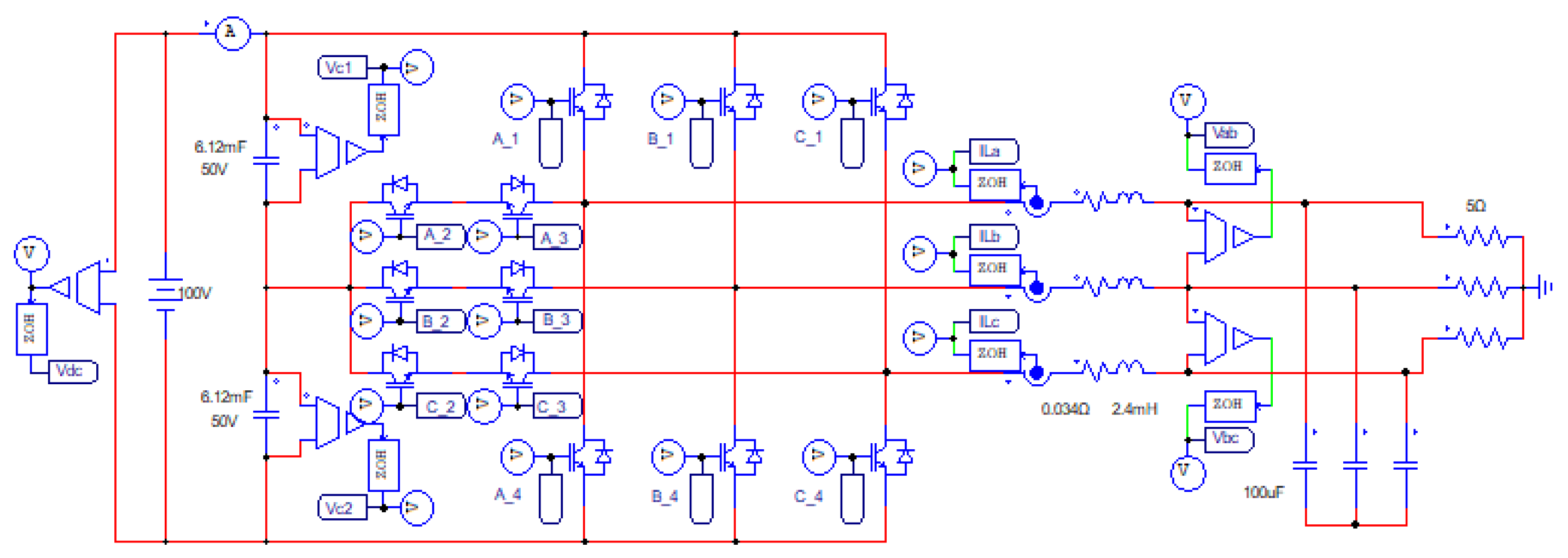
Figure 9 shows the circuit diagram for comparing the transient response speed and disturbance characteristics of PI control and Deadbeat control. The parameter values are identical to those listed in Table 1, and the input voltage is set to 100 V. The control was implemented using a single-loop current controller [16].
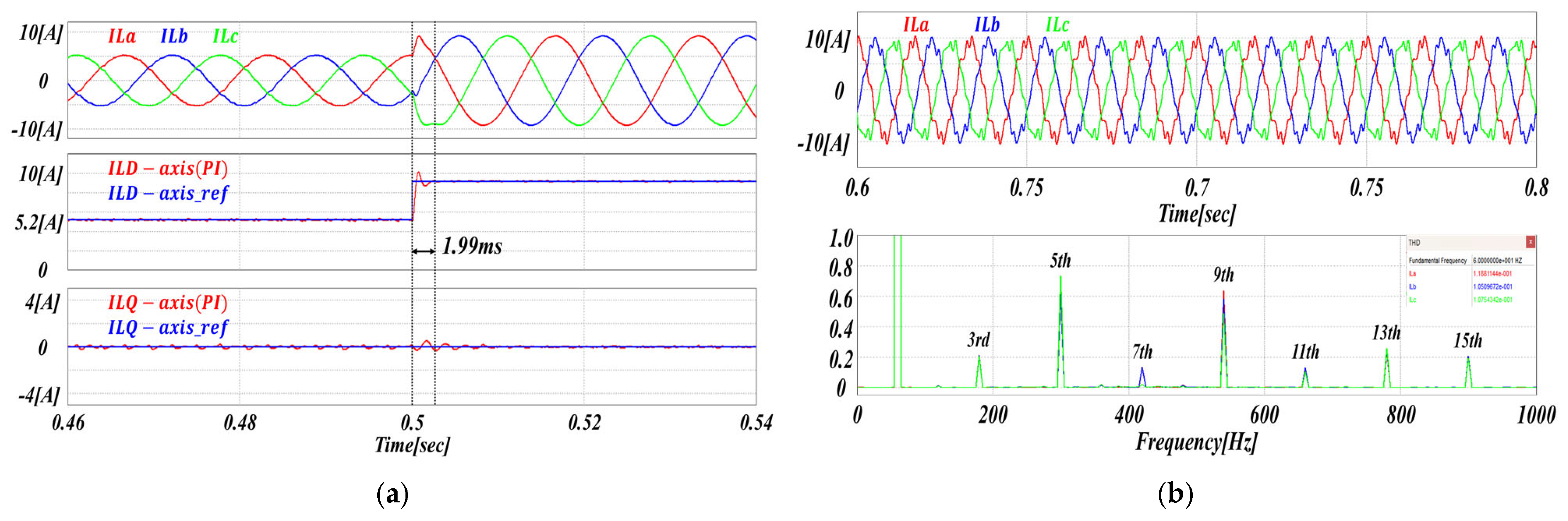
Before conducting the experiment, a three-phase current comparison simulation was performed for both the conventional PI control method and the Deadbeat control method. The d-axis current reference was stepped from 5.2 A to 9.2 A, while the q-axis current reference was fixed at 0 A. In addition, a 7th-order harmonic component with a magnitude of 0.225 was injected identically in both cases to evaluate disturbance response characteristics [15,21].
For the PI-controlled case, the controller gains obtained from the MATLAB SISO Tool were directly applied in the simulation. The discrete-time PI current controller is expressed as C cur , Single ( z ) = 0.12327 z 0.858 z 1 , and these gain values were selected to satisfy the target bandwidth and phase margin specifications defined in Section 3.
For the Deadbeat-controlled case, the ideal Deadbeat controller theoretically drives the system states to their reference values within a single sampling period. However, such rapid control action may result in excessive control effort and increased sensitivity to modeling errors and measurement noise. Therefore, a weighting factor K z = 0.5 was introduced in the Deadbeat control law to moderate the control action and ensure stable operation under practical hardware implementation conditions.
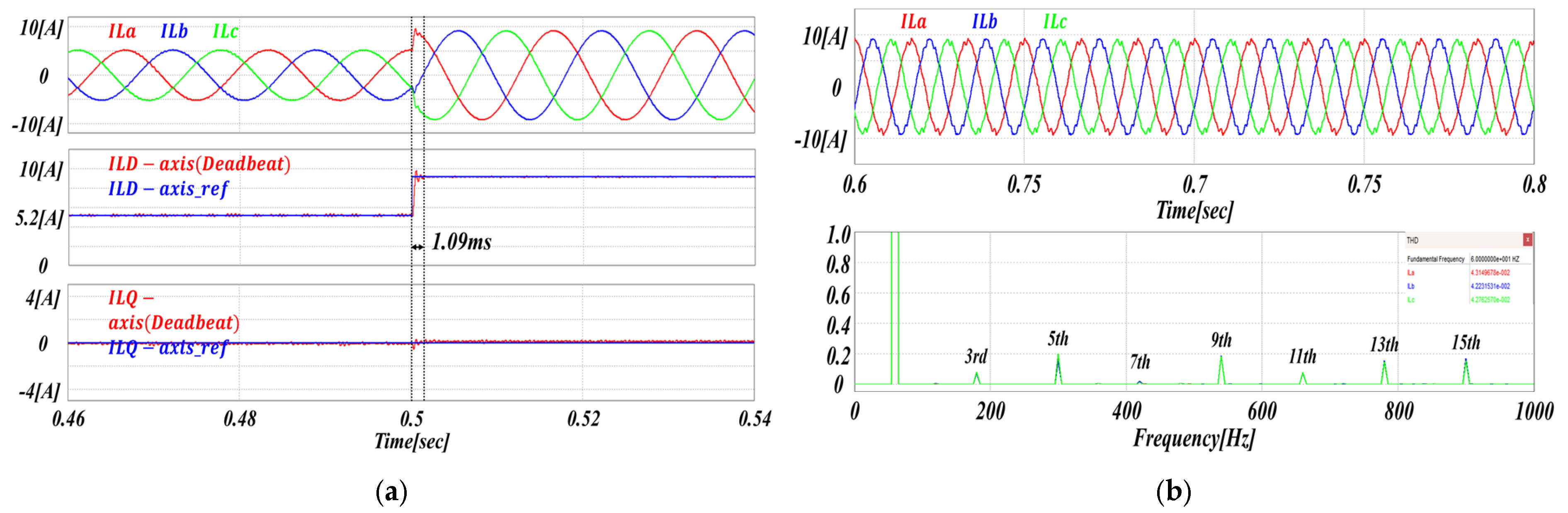
According to the controller design results presented in Section 3, the single-loop PI current controller was designed to achieve a settling time of approximately 1.99 ms, whereas the Deadbeat current controller achieved a faster designed settling time of approximately 1.09 ms. As shown in the step-response waveforms in Figure 10a and Figure 11a, these designed settling times were reproduced almost identically in the simulation results, indicating that the ideal current-loop dynamics derived in the controller design stage were directly reflected in the simulation environment. Consistent with the controller design, the Deadbeat-controlled current reached the steady state more rapidly than the PI-controlled current and exhibited reduced waveform distortion during the transient interval [19,20,21].
Under harmonic injection conditions, FFT analysis confirmed that the Deadbeat control method was less affected by harmonic disturbances than the PI control method [15,21,30]. Accordingly, the THD was measured to be approximately 11% for PI control and 4.2% for Deadbeat control [10,15,30].

4.2. Experimental Comparison Results

The ESS T-type inverter experiment was conducted under the same operating conditions and control structure as those used in the simulation in order to ensure a fair comparison between simulation and experimental results. The experimental setup consists of a programmable DC power supply (Chroma), a three-phase ESS T-type inverter prototype, and a digital control platform based on a TI C2000 DSP. All controller parameters were kept identical to the simulation setup.
The PI controller gains were set to K p = 0.12327 and K i = 0.858 , and the weighting factor of the Deadbeat controller was fixed at K z = 0.5 . In addition, the PWM switching frequency and current sampling period were set to be identical to those used in the simulation to ensure consistency between the simulation and experimental conditions. This parameter consistency enables direct validation of the control performance differences observed in the simulation.
To evaluate the control performance under practical operating conditions, the abc-phase currents and dq-axis currents analyzed in the simulation were experimentally measured [15,18,21]. The dq-axis currents were monitored through the DAC output of the control board, which has a 12-bit resolution with an output voltage range of 0–5 V.
(i) PI Control (D-axis Reference 5.2 → 9.2 A & Harmonic Injection).
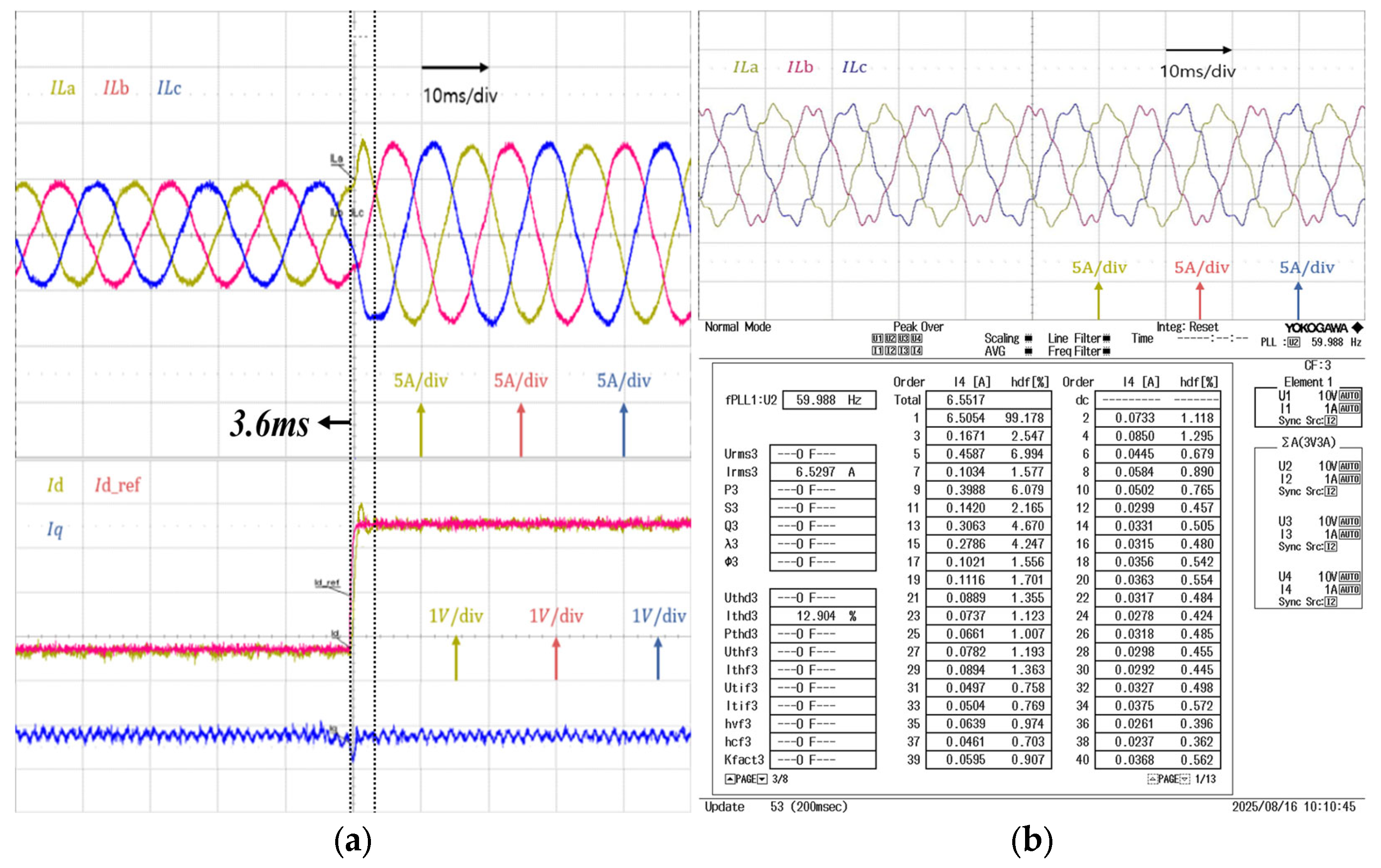
As shown in Figure 12a, when a step change was applied to the d-axis current reference under PI control, the settling time was measured to be approximately 3.6 ms. Compared with the designed settling time of 1.99 ms, the increased settling time observed in the experiment can be attributed to practical non-ideal factors, including PWM dead-time, digital computation and sampling delays, current sensing noise, as well as parasitic effects and parameter mismatch in the power stage.
In the steady-state condition where the d-axis current was regulated to 9.2 A, harmonic components injected into the three-phase current were measured using a power analyzer (YOKOGAWA WT1803E), as shown in Figure 12b.
The experimental harmonic spectrum indicates that the 5th and 9th harmonics are dominant, each exceeding 6%, followed by the 13th, 15th, 3rd, and 11th harmonics. As a result, the total harmonic distortion (THD) was measured to be 12.9%, which is consistent with the harmonic FFT results obtained in the simulation [10,15,21,30].
(ii) Deadbeat Control (D-axis Reference 5.2 → 9.2 A & Harmonic Injection).
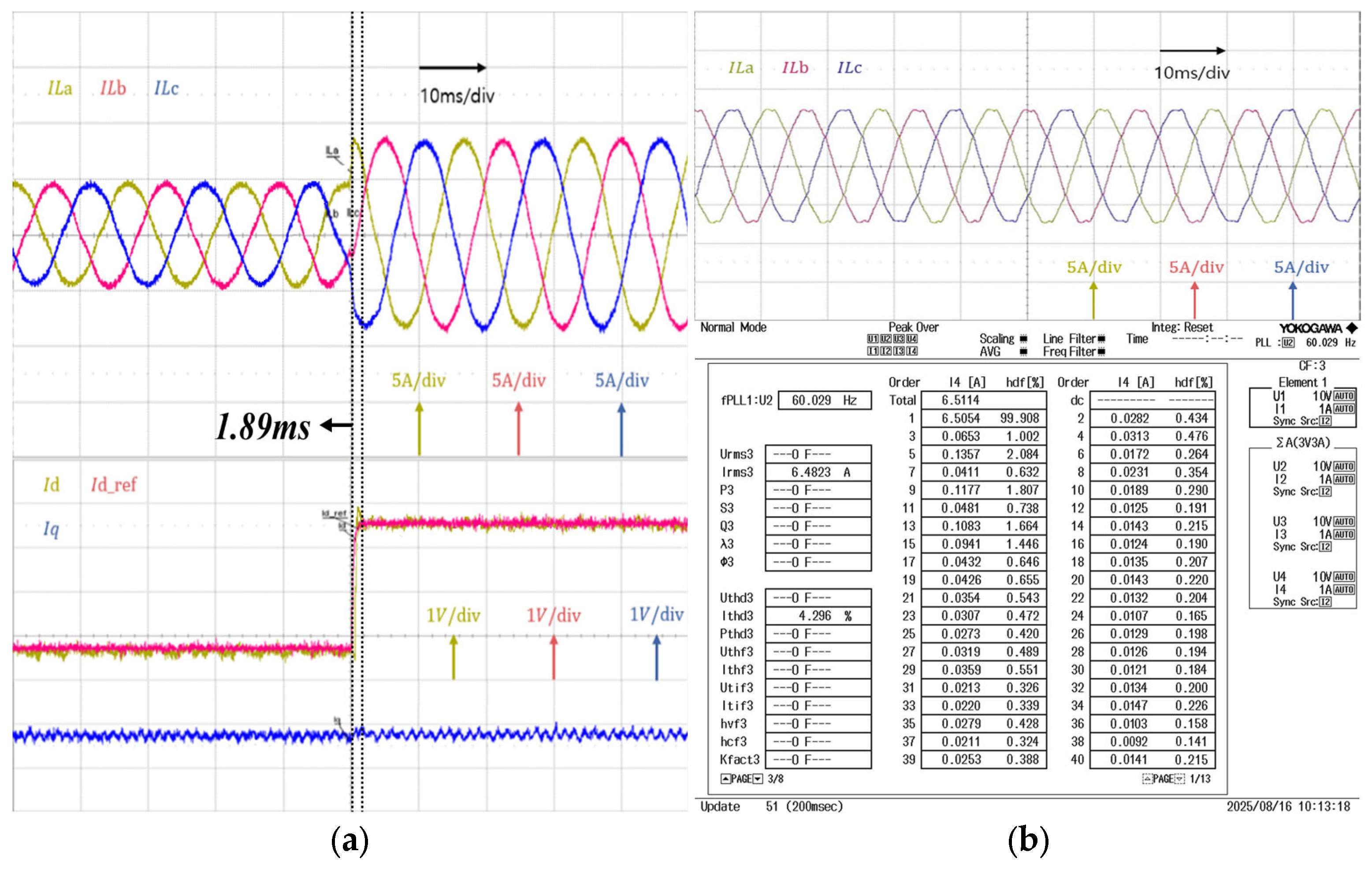
Similarly, as shown in Figure 13a, when the same step change was applied to the d-axis current reference under Deadbeat control, the settling time was measured to be approximately 1.89 ms [19,20,21]. Although the experimentally measured settling time is longer than the designed value of 1.09 ms, the deviation is significantly smaller than that observed in the PI-controlled case. This indicates that the Deadbeat controller maintains faster transient performance and exhibits lower sensitivity to implementation-related delays and non-idealities under practical operating conditions.
In the steady-state condition (d-axis current = 9.2 A), harmonic analysis was performed using the same power analyzer, as shown in Figure 13b. The 5th harmonic (2.1%) was identified as the dominant component, followed by the 9th, 13th, 15th, and 3rd harmonics. The measured THD was 4.3%, which closely matches the simulation results [10,15,30].
For a quantitative comparison of the harmonic characteristics, Table 4 summarizes the experimentally measured harmonic components of the output current under harmonic injection for both control methods.
Harmonic components were measured using a power analyzer (YOKOGAWA WT1803E) under the same operating conditions for both control methods.
Under identical operating conditions, the Deadbeat control significantly reduces the magnitude of dominant low-order harmonics, resulting in a THD reduction from 12.9% (PI control) to 4.3%. In addition, the settling time under Deadbeat control is reduced by approximately 47.5% compared to that of the PI control.
These experimental results indicate that while PI control offers simplicity and basic stability, its transient response and harmonic performance are limited under harmonic injection conditions. In contrast, the Deadbeat control strategy achieves a significantly faster transient response and substantially reduced harmonic distortion, thereby providing a more efficient and precise current control solution for the ESS T-type inverter under both transient and steady-state operating conditions [10,15,18,21].

4.3. Final Experimental Results Applied to a Solar Array

For the solar T-type inverter, a double-loop control structure consisting of an outer voltage loop and an inner current loop is adopted. The outer voltage loop is regulated using a discrete-time PI controller, whose gains were designed to achieve a relatively low bandwidth of 242 rad/s and a high phase margin of 86°, thereby ensuring stable interaction with the faster inner current loop and sufficient dynamic separation between the two loops. Figure 6a–e present the frequency- and time-domain characteristics of the designed double-loop control structure. The Bode plots shown in Figure 6c,d confirm that both the voltage and current controllers satisfy their respective bandwidth and phase margin requirements. The step response of the voltage loop illustrated in Figure 6e exhibits a settling time of 59.4 ms, demonstrating well-damped transient behavior and stable voltage regulation.
The controller gains were systematically tuned using the MATLAB SISO Tool based on frequency-domain design criteria. Discrete-time PI controllers were adopted in the general z-domain form C ( z ) = K z z 0 z 1 . In the double-loop control structure, the outer voltage-loop PI controller is expressed as C V o l , D o u b l e ( z ) = 0.71663 z 0.998 z 1 , which was selected to satisfy the voltage regulation bandwidth and phase margin specifications.
For the inner current loop, the proposed Deadbeat-based current controller was applied to achieve fast transient current regulation. To mitigate excessive control action and sensitivity to modeling errors and measurement noise inherent in ideal Deadbeat control, a weighting factor of K z = 0.5 was introduced. This weighting factor moderates the control input while preserving the rapid dynamic response of the Deadbeat control scheme, ensuring stable operation under practical experimental conditions.
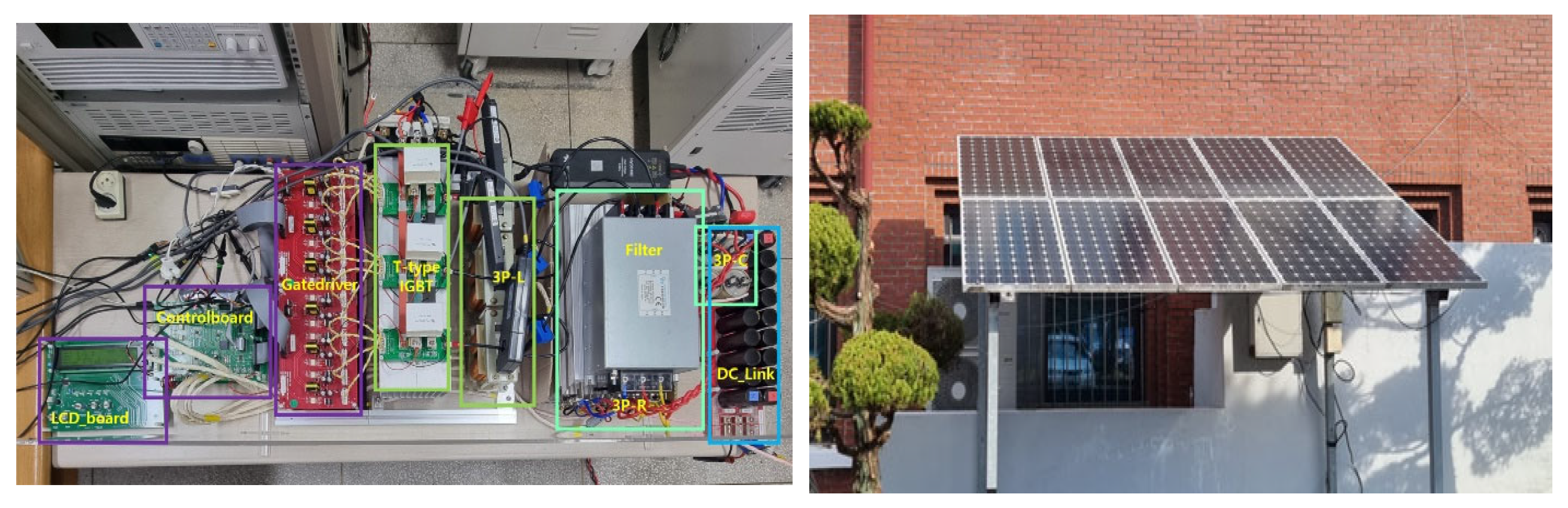
Based on this double-loop control configuration, the proposed control strategy was finally applied to a photovoltaic array-connected T-type inverter system, and experimental validation was conducted, as shown in Figure 14. In this setup, the outer voltage loop was regulated by the designed PI controller, while the inner current loop was controlled using the proposed Deadbeat controller with the weighting factor K z = 0.5 .
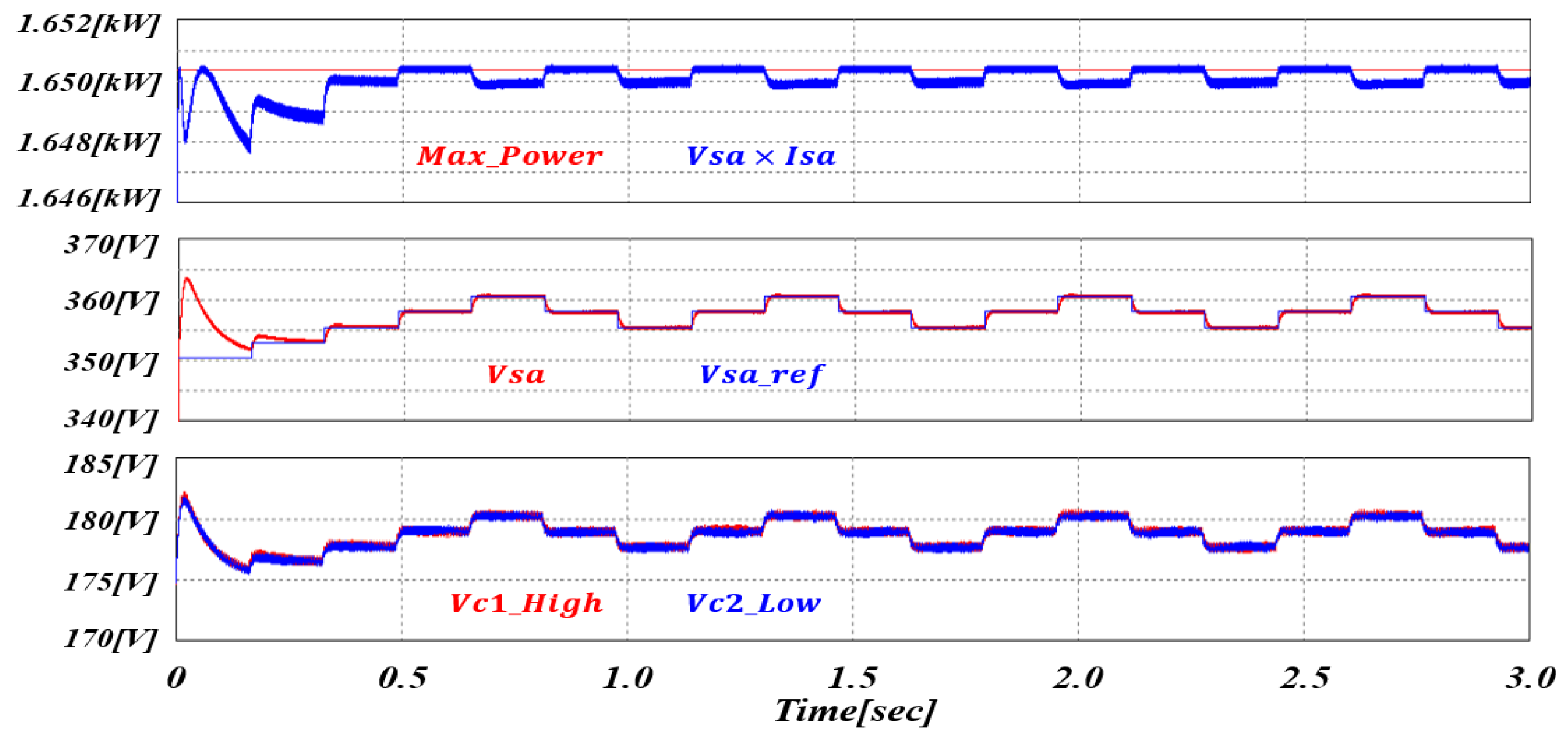
Figure 15 shows the simulation waveforms obtained when the photovoltaic array was applied, including the MPPT-controlled photovoltaic voltage, three-phase currents, and d-axis current.
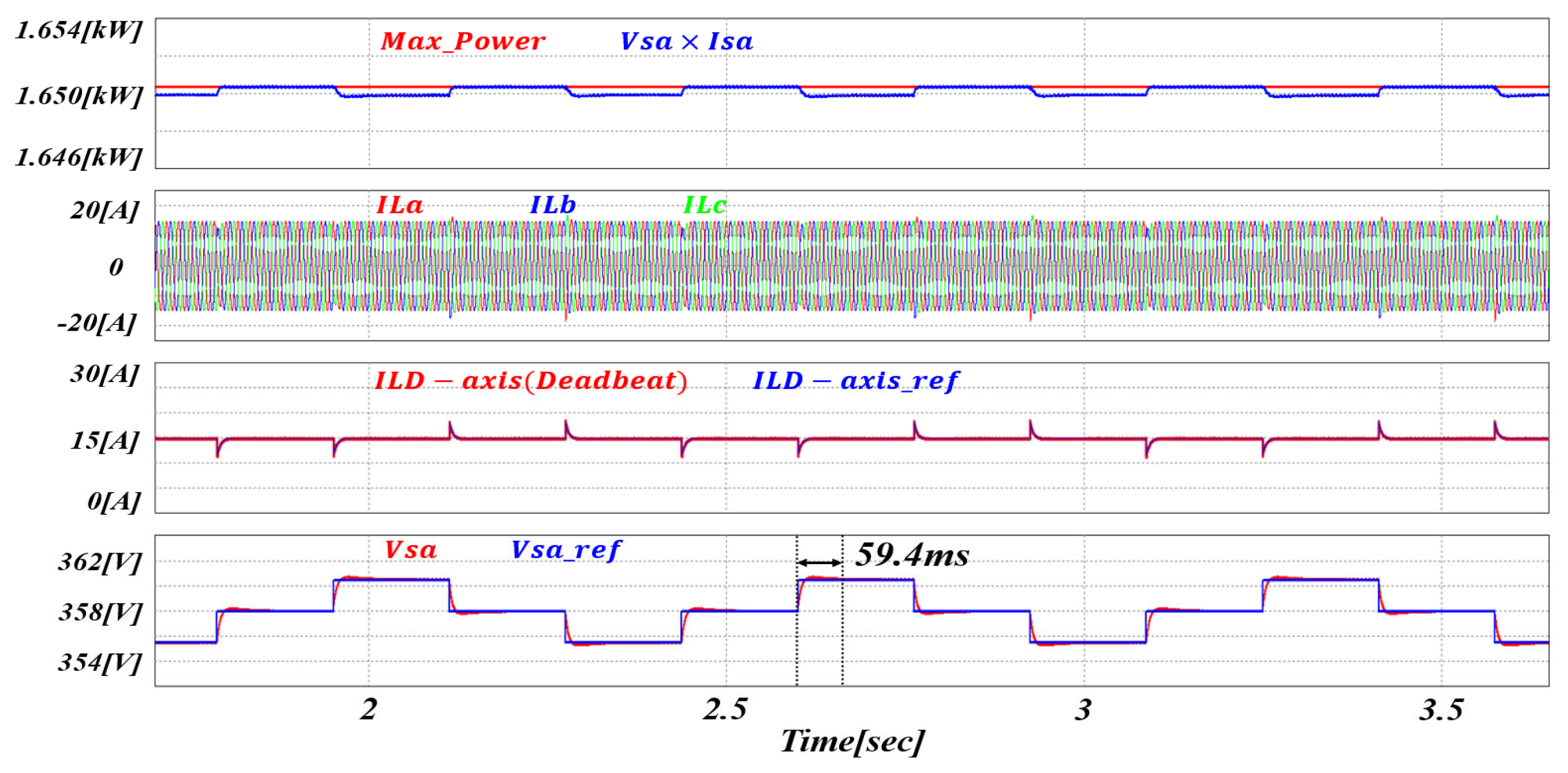
Figure 16 presents the corresponding experimental waveforms under the same operating conditions. As observed in Figure 16, consistent with the simulation results, the output voltage of the photovoltaic array effectively tracks the maximum power point (MPP) through the MPPT algorithm [1,2]. In the outer voltage loop, the PI-controlled voltage response exhibits an underdamped characteristic, which is consistent with the designed voltage-loop dynamics [24,25].
In addition, by applying the proposed Deadbeat control method to the inner current loop, the current control structure is configured to provide fast dynamic regulation and effective suppression of waveform distortion. As a result, the proposed double-loop control strategy enables coordinated operation between the outer MPPT-based voltage regulation loop and the inner current control loop under practical photovoltaic array-connected operating conditions [15,19,20,21].

5. Conclusions

This paper investigated the control performance of a photovoltaic T-type inverter system in accordance with the trend toward high-voltage and high-efficiency power conversion. To overcome the inherent limitations of conventional PWM-based PI current control, a Deadbeat-based Model Predictive Control (MPC) strategy was applied to the inner current loop, while a PI controller was retained in the outer voltage loop for MPPT-based voltage regulation.
To ensure a fair and objective comparison of the intrinsic dynamic characteristics of the current controllers, a single-loop current control structure was first adopted using a programmable DC power supply. Under identical operating conditions, both simulation and experimental results demonstrated that the proposed Deadbeat current controller achieved significantly faster transient response and improved harmonic performance compared to the conventional PI controller. Specifically, the experimental settling time was reduced from 3.6 ms to 1.89 ms, corresponding to an improvement of approximately 47.5%, while the total harmonic distortion (THD) under harmonic injection was reduced from 12.9% to 4.3%.
Based on these validated results, the proposed control strategy was further applied to a photovoltaic array-connected T-type inverter system employing a double-loop control structure. In this configuration, the outer voltage loop, regulated by a PI controller designed with sufficient bandwidth separation and phase margin, ensured stable MPPT operation, while the inner current loop utilized the Deadbeat control with a weighting factor of K z = 0.5 to balance fast dynamic regulation and robustness against modeling errors and practical non-idealities. Experimental results confirmed stable MPPT voltage tracking and coordinated operation between the voltage and current loops under realistic photovoltaic operating conditions.
Overall, the results demonstrate that the proposed control structure effectively enhances transient response and harmonic performance while maintaining stable system operation. These findings verify the feasibility and practical applicability of Deadbeat-based MPC for high-performance photovoltaic T-type inverter systems and indicate its potential for improving efficiency and reliability in advanced renewable energy conversion applications.

Author Contributions

Conceptualization, H.J. and I.S.K.; methodology, H.J.; software, H.J.; validation, H.J. and I.S.K.; formal analysis, H.J.; investigation, H.J.; resources, I.S.K.; data curation, H.J.; writing—original draft preparation, H.J.; writing—review and editing, H.J. and I.S.K.; visualization, H.J.; supervision, I.S.K.; project administration, I.S.K.; funding acquisition, I.S.K. All authors have read and agreed to the published version of the manuscript.

Funding

This work was supported by the Human Resources Development of the Korea Institute of Energy Technology Evaluation and Planning (KETEP) grant funded by the Korea government. (No. 20224000000070). This research was supported by the Ministry of Trade, Industry and Energy (MOTIE) and the Korea Institute for Advancement of Technology (KIAT) through the “Support for Middle Market Enterprises and Regional innovation Alliances (R&D, RS-2025-02633071)” program.

Data Availability Statement

The original contributions presented in this study are included in the article. Further inquiries can be directed to the corresponding author.

Conflicts of Interest

Author J.H.J. was employed by the company HD Hyundai Plaspo. The remaining author declares that the research was conducted in the absence of any commercial or financial relationships that could be construed as a potential conflict of interest.

References

  1. Lee, S.H.; Jang, K.Y.; Kim, S.M.; Kim, K.H.; Yu, G.J. A study of improved P&O MPPT algorithm go with a dynamic characteristic of photovoltaic system. Korean Soc. New Renew. Energy 2009, 107–110. [Google Scholar]
  2. Choi, U.-M.; Lee, J.-S. Comparative Evaluation of Lifetime of Three-Level Inverters in Grid-Connected Photovoltaic Systems. Energies 2020, 13, 1227. [Google Scholar] [CrossRef]
  3. Dragicevic, T.; Lu, X.; Vasquez, J.C.; Guerrero, J.M. DC microgrids—Part II: A review of power architectures, applications, and standardization issues. IEEE Trans. Power Electron. 2016, 31, 3528–3549. [Google Scholar] [CrossRef]
  4. Leon, J.I.; Vazquez, S.; Franquelo, L.G. Multilevel Converters: Control and Modulation Techniques for Their Operation and Industrial Applications. Proc. IEEE 2017, 105, 2066–2081. [Google Scholar] [CrossRef]
  5. Rodriguez, J.; Bernet, S.; Steimer, P.K.; Lizama, I.E. A Survey on Neutral-Point-Clamped Inverters. IEEE Trans. Ind. Electron. 2010, 57, 2219–2230. [Google Scholar] [CrossRef]
  6. Teichmann, R.; Bernet, S. A comparison of three-level converters versus two-level converters for low-voltage drives, traction, and utility applications. IEEE Trans. Ind. Appl. 2005, 41, 855–865. [Google Scholar] [CrossRef]
  7. Xing, X.; Chen, A.; Zhang, Z.; Chen, J.; Zhang, C. Model predictive control method to reduce common-mode voltage and balance the neutral-point voltage in three-level T-type inverter. In Proceedings of the 2016 IEEE Applied Power Electronics Conference and Exposition (APEC), Long Beach, CA, USA, 20–24 March 2016; pp. 3453–3458. [Google Scholar]
  8. Holtz, J. Pulsewidth modulation for electronic power conversion. Proc. IEEE 1994, 82, 1194–1214. [Google Scholar] [CrossRef]
  9. Akagi, H.; Nabae, A.; Atoh, S. Control Strategy of Active Power Filters Using Multiple Voltage-Source PWM Converters. IEEE Trans. Ind. Appl. 1986, IA-22, 460–465. [Google Scholar] [CrossRef]
  10. Kouro, S.; Malinowski, M.; Gopakumar, K.; Pou, J.; Franquelo, L.G.; Wu, B.; Rodriguez, J.; A Pérez, M.; I Leon, J. Recent Advances and Industrial Applications of Multilevel Converters. IEEE Trans. Ind. Electron. 2010, 57, 2553–2580. [Google Scholar] [CrossRef]
  11. Nabae, A.; Takahashi, I.; Akagi, H. A New Neutral-Point-Clamped PWM Inverter. IEEE Trans. Ind. Appl. 1981, IA-17, 518–523. [Google Scholar] [CrossRef]
  12. Kazmierkowski, M.; Malesani, L. Current control techniques for three-phase voltage-source PWM converters: A survey. IEEE Trans. Ind. Electron. 1998, 45, 691–703. [Google Scholar] [CrossRef]
  13. Deng, C.; Shu, Z.; Xia, Y.; Chen, N.; Wang, T.; Ma, H. Three-phase photovoltaic grid-connected inverter with LCL based on current deadbeat control and PI control. In Proceedings of the 2014 International Conference on Power System Technology, Chengdu, China, 20–22 October 2014; Volume 6, pp. 2864–2870. [Google Scholar]
  14. Cortés, P.; Kazmierkowski, M.P.; Kennel, R.M.; Quevedo, D.E.; Rodríguez, J. Predictive control in power electronics and drives. IEEE Trans. Ind. Electron. 2008, 55, 4312–4324. [Google Scholar] [CrossRef]
  15. Rodriguez, J.; Kazmierkowski, M.P.; Kennel, R.M.; Espinoza, J.R.; Cortés, P.; Silva, C.A. State of the art of finite control set model predictive control in power electronics. IEEE Trans. Ind. Electron. 2012, 9, 1003–1016. [Google Scholar] [CrossRef]
  16. Xu, J.; Soeiro, T.B.; Gao, F.; Tang, H.; Bauer, P. A simplified modulated model predictive control for a grid-tied three-level T-type inverter. In Proceedings of the 2020 IEEE 29th International Symposium on Industrial Electronics (ISIE), Delft, The Netherlands, 17–19 June 2020; pp. 618–623. [Google Scholar]
  17. Zorig, A.; Belkheiri, M.; Barkat, S. Control of three-level T-type inverter based grid connected PV system. In Proceedings of the 2016 13th International Multi-Conference on Systems, Signals & Devices (SSD), Leipzig, Germany, 21–24 March 2016; pp. 415–420. [Google Scholar]
  18. Abdel-Rahim, O.; Takeuchi, M.; Funato, H.; Junnosuke, H. T-type three-level neutral point clamped inverter with model predictive control for grid connected photovoltaic applications. In Proceedings of the 2016 19th International Conference on Electrical Machines and Systems (ICEMS), Chiba, Japan, 13–16 November 2016; pp. 1–5. [Google Scholar]
  19. Wang, Y.; Ruan, X.; Yao, K. A review of model predictive control for power electronics—Opportunities and challenges. IEEE J. Emerg. Sel. Top. Power Electron. 2023, 11, 1–20. [Google Scholar]
  20. Odeh, C.; Kondratenko, D.; Lewicki, A.; Jąderko, A. Adaptive selective harmonic elimination model predictive control for three-level T-type inverter. IEEE Access 2020, 8, 157983–157994. [Google Scholar]
  21. Xing, X.; Zhang, C.; Chen, A.; Geng, H.; Qin, C. Deadbeat control strategy for circulating current suppression in multiparalleled three-level inverters. IEEE Trans. Ind. Electron. 2018, 65, 6239–6249. [Google Scholar] [CrossRef]
  22. Rodriguez, J.; Cortes, P. Predictive Control of a Three-Phase Inverter. In Predictive Control of Power Converters and Electrical Drives; IEEE: New York, NY, USA, 2012; pp. 41–63. [Google Scholar]
  23. Lee, K.M.; Kim, I.S. A study on the controller design of the three-level boost converter for photovoltaic power conditioning system. Trans. Korean Inst. Power Electron. 2021, 26, 227–236. [Google Scholar]
  24. Kim, H.Y.; Ji, S.K.; Han, S.K.; Hong, S.S. Hong Small signal model and accurate two-loop controller design for bi-directional inverter using DQ transformation. Trans. Korean Inst. Power Electron. 2011, 2011, 194–195. [Google Scholar]
  25. Hong, C.-P.; Kim, H.-W.; Cho, K.-Y.; Lim, B.-K. Stationary reference frame voltage controller for single phase grid connected inverter for stand alone mode. Trans. Korean Inst. Power Electron. 2015, 20, 517–525. [Google Scholar] [CrossRef]
  26. Batool, Z.; Biricik, S.; Komurcugil, H.; Ngo, T.; Vu, T.V. Photovoltaic supplied T-type three-phase inverter with harmonic current compensation capability. In Proceedings of the 2019 2nd International Conference on Smart Grid and Renewable Energy (SGRE), Doha, Qatar, 19–21 November 2019; pp. 1–5. [Google Scholar]
  27. Ko, Y.H.; Lee, K.J.; Kim, R.Y.; Hyun, D.S. Predictive control of the neutral point voltage in the three-level NPC inverter. Trans. Korean Inst. Power Electron. 2011, 7, 356–357. [Google Scholar]
  28. Odeh, C.; Kondratenko, D.; Lewicki, A.; Jąderko, A. Modified SPWM technique with zero-sequence voltage injection for a five-phase, three-level NPC inverter. Energies 2021, 14, 1198. [Google Scholar] [CrossRef]
  29. Chen, F.; Qiao, W.; Wang, H.; Qu, L. A simple zero-sequence voltage injection method for carrier-based pulsewidth modulation of the three-level NPC inverter. J. Emerg. Sel. Top. Power Electron. 2021, 9, 4687–4699. [Google Scholar] [CrossRef]
  30. Wang, J.; Liu, X.; Xiao, Q.; Zhou, D.; Qiu, H.; Tang, Y. Modulated Model Predictive Control for Modular Multilevel Converters With Easy Implementation and Enhanced Steady-State Performance. IEEE Trans. Power Electron. 2020, 35, 9107–9118. [Google Scholar] [CrossRef]
Figure 1. Solar T-type Inverter Configuration.
Energies 19 00417 g001
Figure 2. Operational Waveform (Line to Line) of Solar T-type Inverter.
Energies 19 00417 g002
Figure 3. Operational sequence of the photovoltaic T-type inverter for phase A.
Energies 19 00417 g003
Figure 4. Controller Structure of Solar T-type Inverter System.
Energies 19 00417 g004
Figure 7. Input Capacitor Voltage Balancing Control Block Diagram.
Energies 19 00417 g007
Figure 8. Simulation Waveform for Voltage Balancing of Input Capacitors.
Energies 19 00417 g008
Figure 9. Simulation Circuit of ESS T-type Inverter.
Energies 19 00417 g009
Figure 10. PI-controlled current simulation results of the ESS T-type inverter: (a) Transient response waveform of PI control; (b) waveform and spectrum (FFT) of harmonic injection.
Energies 19 00417 g010
Figure 11. Deadbeat-controlled current simulation results of the ESS T-type inverter. (a) Transient response waveform of Deadbeat control; (b) waveform and spectrum (FFT) of harmonic injection.
Energies 19 00417 g011
Figure 12. Experimental current waveforms under PI control in the ESS T-type inverter: (a) Transient response waveform of PI control; (b) waveform and component ratio (power analyzer) of harmonic injection.
Energies 19 00417 g012
Figure 13. Experimental current waveforms under deadbeat control in the ESS T-type inverter: (a) Transient response waveform of Deadbeat control; (b) waveform and component ratio (power analyzer) of harmonic injection.
Energies 19 00417 g013
Figure 14. Solar Array and T-type Inverter Experiment Set.
Energies 19 00417 g014
Figure 15. Simulation Waveforms of MPPT Voltage and 3-p Current and d-axis Current in PV T-type Inverter.
Energies 19 00417 g015
Figure 16. Experimental Waveforms of MPPT Voltage, 3-p Current, and d-axis Current in PV T-type Inverter.
Energies 19 00417 g016
Table 1. Electrical parameters of the solar T-type inverter used for modeling and simulation.
SymbolDescriptionValue
V o c Open Circuit Voltage440 [V]
I S C Short Circuit Current5.1 [A]
V m p Voltage at Maximum Power358 [V]
I m p Current at Maximum Power4.61 [A]
C H ,   C L Link Capacitance High & Low6.12 [mF]
R H ,   R L Link Resistance High & Low47 [kΩ]
L a ,   L b ,   L c Inductance (a & b & c)2.4 [mH]
r L Inductance ESR0.034 [Ω]
R Resistance of grid5 [Ω]
C f Filter Capacitance100 [uF]
f s w Switch Frequency15.384 [kHz]
Table 2. Symbols used in the modeling and control derivations.
SymbolDescription
V s a Phase-a PV-side voltage
αSlope of linearized PV I–V curve ( α = I mp / V mp )
βIntercept of linearized PV I–V curve ( β = 2 I mp )
V s a , C H ,   V s a , C L Voltage across upper DC-link capacitor & lower DC-link capacitor
V c f Filter capacitor voltage
I s a Phase-a PV current
i L Filter inductor current
I P PV module current
I d ,   I q d–q axis currents
d d ,   d q d–q axis duty ratios
Table 3. The Specification of Controller.
Single Loop
Current Controller
B a n d w i d t h ( ω c ) 4833   [ r a d / s ]
P h a s e   m a r g i n ( P . M . ) 60   [ d e g ]
Double Loop
Voltage Controller
B a n d w i d t h ( ω c ) 242   [ r a d / s ]
P h a s e   m a r g i n ( P . M . ) 86   [ d e g ]
Current Controller
B a n d w i d t h ( ω c ) 4833   [ r a d / s ]
P h a s e   m a r g i n ( P . M . ) 60   [ d e g ]
Table 4. Experimental comparison of transient settling time (step response) and harmonic components of output current under harmonic injection.
PIDeadbeat
Settling Time3.6 ms1.89 ms
Harmonic OrderPI (%)Deadbeat (%)
3 t h 2.5471.002
5 h 6.9942.084
7 t h 1.5770.632
9 t h 6.0791.807
11 t h 2.1650.738
13 t h 4.671.664
15 t h 4.2471.446
T H D 12.9044.296
Disclaimer/Publisher’s Note: The statements, opinions and data contained in all publications are solely those of the individual author(s) and contributor(s) and not of MDPI and/or the editor(s). MDPI and/or the editor(s) disclaim responsibility for any injury to people or property resulting from any ideas, methods, instructions or products referred to in the content.