1. Introduction
Recently, the European Commission has included maritime transport among the sectors subject to the Emissions Trading System (ETS) [
1,
2], and the European Council has adopted a new regulation on the FuelEU Maritime initiative (the “Fit For 55” package) [
3,
4], which contains several provisions for the decarbonisation of maritime transport.
The ETS, used for trading carbon emissions quotas within the European Union and originally established by Directive 2003/87/EC [
5], is a key reference point for EU climate policy and a key instrument for cost-effectively mitigating greenhouse gas emissions. The goal is to reduce net greenhouse gas emissions by at least 55% by 2030 compared to 1990 levels and contribute to achieving climate neutrality by 2050. The ETS is thus gradually being extended to maritime transport, specifically to greenhouse gases emitted by ships of 5000 gross tonnage or more. The “Fit for 55” package increases the 2030 emissions reduction target for the ETS sector from −43% to −62% compared to 2005 levels, with a corresponding reduction in emission allowances at the EU level.
Various vessel power technologies are now available, promising to achieve the objectives within the time limits set by EU legislation.
Italy’s strategic location, its geographical features and the presence of two large populous islands along with several archipelagos contribute to a well-developed maritime traffic network. Roll-on/roll-off (Ro-Ro) transport, used for vehicles on board, plays a major role, accounting for over 120 million tonnes moved across thirty-two ports in 2022 [
6].
Accordingly, this report assesses the technical and, more crucially, economic potential and challenges of various diesel alternatives, including ammonia, biofuels, hydrogen and nuclear energy, with a specific focus on the national context.
The technical–economic convenience of adopting the electric vector within the Italian context has already been addressed previously [
7], which provided an initial framework for understanding the potential benefits and limitations of electrification in maritime transport. These studies, however, were developed under conditions of significant uncertainty, primarily due to the lack of comprehensive and reliable reference data regarding vessel energy consumption, operational patterns and infrastructure requirements. As a result, their findings were necessarily preliminary and theoretical, offering only indicative estimates of the feasibility of electrified solutions for public service applications.
Pure electric propulsion systems are then only briefly addressed in this study. This is also justified in [
8], indicating that for the long-haul routes and power requirements analyzed, battery energy density remains a critical constraint. The excessive weight of energy storage systems and the associated charging downtime render full-electric propulsion economically unviable for deep-sea shipping, effectively limiting its application to short-sea shipping and coastal ferries.
The present work aims to overcome these limitations by introducing a more robust and data-driven approach. Leveraging updated datasets and advanced modelling techniques, it provides a detailed characterization of vessel energy demand, evaluates integration strategies with existing grid infrastructures and examines the potential for coupling with renewable energy sources. Furthermore, the analysis extends beyond the mere comparison of operational and capital costs, incorporating considerations related to peak load management, network reinforcement needs and environmental performance under realistic operating conditions. By doing so, this study not only refines the economic assessment but also delivers actionable insights for policymakers, operators and stakeholders, bridging the gap between theoretical convenience and practical feasibility. The contribution lies in offering a comprehensive, context-specific evaluation that supports informed decision-making for the sustainable electrification of maritime transport in Italy.
It should be noted that this analysis focuses strictly on ship-related costs, accounting for CAPEX and OPEX associated with the propulsion technology and vessel operations. Consequently, costs pertaining to port infrastructure upgrades, such as alternative fuel bunkering facilities or specialized nuclear fuel logistics, are excluded from the scope of this study. This boundary is intentionally set to isolate the intrinsic economic viability of the technology from the shipowner’s perspective, leaving the assessment of land-side infrastructure investments for future research.
The aim of this document is therefore to address the main issues concerning a context of rapidly transforming policies for the decarbonisation of the maritime sector, according to the following sequence:
Section 2—Technical–economic calculation related to the adoption of alternative fuels (specifically ammonia, biofuels, e-fuels, hydrogen and nuclear) for maritime connections of the main types of commercial vessels;
Section 3—Application of the results of the technical–economic calculation to the national framework relating to maritime transport, determination of the case studies and the methodology to be applied, processing and evaluation of the results; and
Section 4—Final considerations and conclusion.
2. Technical and Economic Considerations for Alternative Maritime Power Supply
Analyzing capital (CAPEX) and operating (OPEX) costs in the shipping sector for the adoption of alternative fuels requires a careful assessment of available sources. In this context, the European Maritime Safety Agency (EMSA, Portugal) represents a key reference, providing useful data, but often fragmented and/or in inconsistent formats across various documents. One of the main challenges encountered has been the lack of timely and consistent cost information, which made it necessary to consider ranges of variation to account for uncertainties related to both technological developments and market price fluctuations (often driven by geopolitical factors).
This work therefore focused on reorganizing the various cost items reported in available sources, structuring them into organized and easily accessible tables. This approach provides a clearer and more immediate framework to support the economic analysis of energy alternatives in the maritime sector and to apply them immediately to conduct the analyses illustrated in
Section 3.
2.1. CAPEX
The term CAPEX commonly refers to “capital costs” or the fixed costs incurred for the construction of a new ship. These costs include
As outlined in the following sections, the initial investment costs for alternative fuels are higher than those for traditional diesel and bunker oil systems [
7]. This is primarily due to the need for more complex technologies and infrastructures, which are not yet fully mature for large-scale production and fuel management. The aim of this paper is to provide information on capital costs to enable the reconstruction of a comparative total cost of ownership (TCO) for the various types of vessels and fuel systems that can be applied to real-world cases.
2.1.1. Propulsion System Costs
Propulsion system costs are primarily associated with the so-called “engine unit,” which represents one of the largest costs in building a ship, tied to the power required and the technology used. Obviously, the unit cost of an engine unit varies based on the type of fuel and the size of the vessel in question (a propulsion system for a large vessel has a lower cost per kW than that for a small vessel), except in the case of modular systems (such as nuclear and hydrogen fuel-cell power). Furthermore, internal combustion engines (ICEs) that use conventional fuels have a lower CAPEX than engines powered by alternative fuels such as ammonia, biofuels, e-fuels and hydrogen.
For example, for small vessels powered by VLSFO (very low sulphur fuel oil), the cost, corresponding to the total CAPEX, is around 250 €/kW, while for large vessels it is around 200 €/kW [
9,
10]. Bio-diesels use the same engines as VLSFO, so the costs are identical [
11]. For ammonia-powered vessels, costs are higher: 330 €/kW for short-sea vessels and 280 €/kW for ocean-going vessels [
9]. As for e-fuel engines, the cost of the engine varies from 190 €/kW for conventional fuel ICEs to 330 €/kW for methanol engines [
12]. In the case of hydrogen, the following two types of propulsion systems must be considered: the dual-fuel internal combustion engine (pilot diesel plus hydrogen) suitable for hydrogen combustion and a fuel-cell (FC) system, combined with an electric motor to convert the generated electrical power into motive power [
13,
14,
15]. This application also requires the installation of an electric battery system [
16] to cover the peaks in engine power consumption. The estimated costs from [
13] assume a range between 550 €/kW (large vessels) and 850 €/kW (small vessels) for ICEs, as well as a range between 1150 €/kW and 1300 €/kW (for the same categories of vessels already exposed above and including the specific cost of the batteries, respectively).
Nuclear propulsion systems ultimately require a high initial investment due to the sophisticated technologies and rigorous safety measures required; in this case, experience with the costs of land-based systems and military applications on aircraft carriers and submarines is used [
17]. For this last technology, there is a significant uncertainty regarding the unit costs and, always in agreement with [
17], a range of variation between 4350 €/kW and 9350 €/kW is considered for power outputs between 10 and 300 MW. These costs include the decommissioning of the propulsion system, estimated at 1850 €/kW and derived as the midpoint between the lower decommissioning costs for land-based plants and the higher ones incurred by navies [
17]. From the literature analysis, it is possible to extract the unit costs of propulsion systems (€/kW) in 2030 for different types of fuels and ships (dwt, gross tonnage), as reported in
Table 1.
2.1.2. Exhaust Fumes Post-Treatment Costs
Post-treatment costs refer to the costs incurred by the shipowner for the processing system of harmful substances or elements that would potentially be emitted at the exhaust but cannot be released into the environment due to regulatory restrictions. The most used technique is the selective catalytic reduction (SCR) system to treat exhaust gases after fuel combustion to bring SO
x and NO
x emissions within regulatory limits. For vessels powered by VLSFO/bio-diesel/e-fuel, the cost of an SCR is around 116 €/kW for all types and sizes of vessel—a cost that is expected to remain stable over the long term [
11,
12]. The cost of an SCR system for a vessel burning ammonia (assuming NO
x values like those emitted by VLSFO-powered engines, but lower SO
x values) is 44 €/kW for two-stroke diesel engines [
9]. As regards the dual-fuel hydrogen fuelling (pilot VLSFO), the cost of the after-treatment system can be considered negligible, as it is of very low value [
13]. Finally, for nuclear power plants, post-treatment costs for spent fuel, typically accounted for in conventional land-based facilities, are not well defined for maritime applications due to limited available data. However, these costs can be indirectly reflected in the potential loss of the ship’s residual value [
17]. In contrast, ships powered by other fuels retain potential residual value, often due to the value of materials such as steel, which can be recovered during scrapping. However, this topic will be discussed more fully afterwards.
Here,
Table 2 summarizes the data collected from the bibliographic analysis described above, reporting them using the same unit of measurement used to define the costs of sizing the propulsion system. Indeed, as can be imagined, post-treatment is correlated with the size of the engines from which it processes the exhaust gases.
2.1.3. Storage Costs
Storage costs refer to the tank assembly and piping for transferring fuel to the propulsion system. These costs vary based on the type of fuel used and the size of the vessel. Both the tanks and the fuel delivery system are assumed to have a service life of 25 years, provided necessary maintenance is performed.
In the case of ammonia, we are dealing with pressurized tanks. It is important to note that this fuel has a significantly lower volumetric density than VLSFO (marine gas oil), which implies that a vessel must either increase the frequency of refuelling to maintain transport performance similar to that of marine gas oil or be equipped with much larger tanks [
9].
For what concerns hydrogen, this can be stored in two distinct ways as follows: in the form of gas or as liquid hydrogen, through cryogenic or cold-compressed storage [
13,
14,
15,
18]. Liquefied hydrogen offers the advantage of a higher volumetric energy density (expressed in MJ per unit volume) than gaseous hydrogen, even when the latter is compressed. For this reason, the analysis focuses primarily on storage in liquid form. Despite this advantage, compared to other fuels, liquid hydrogen has a significantly lower volumetric energy density (7.55 MJ/L versus 38.3 MJ/L for VLSFO), which is why its cryogenic storage requires large tanks. Without compression, it liquefies at a temperature of −253 °C, requiring highly insulated systems to prevent fuel evaporation. Once stored, the volumetric energy density of “contained” liquid hydrogen, i.e., considering the actual volume of the tanks, is lower than theoretical: 4.6 MJ/L versus 7.55 MJ/L. Vessels sailing long distances would have to refuel during route or sacrifice extra space to accommodate larger tanks. This requirement would be associated with a loss of profit if the placement of larger/additional tanks compromised the vessels’ cargo-carrying capacity. Storing bio-methanol and e-methanol can be a challenge for ships on long-distance routes, as their volumetric energy density is less than half that of conventional fuel oils. In contrast, bio-diesel/e-diesel does not pose any significant limitations, as this type of fuel can replace (or be used in a blend) its fossil fuel counterpart [
11].
Finally, regarding the nuclear solution, there is not a problem of storing new fuel, but rather that of spent fuel. The literature [
17] argues that, since the reactor itself is the site of fuel storage, these costs can be considered zero. Finally, based on the above-mentioned literature, the storage costs for the various fuels under consideration were extracted, dimensionally adapting them to the other CAPEX items and summarizing them in
Table 3. Although intuitively this expense item should be expressed as a function of the vessels’ autonomy, it is common practice for shipowners to consider it proportional to the size of the propulsion system [
9]. Where available, the breakdown of costs by vessel type has been made explicit.
2.2. OPEX
OPEX refers to operating costs, i.e., variable costs that depend on the vessels’ use, and include fuel, refuelling and maintenance costs. In the context of the various alternative fuels, we aim to provide these details in a schematic manner, maintaining the objective of providing comparable values to develop a TCO applicable to reality. Unlike capital costs, these costs can vary over the vessels’ lifespan and for this reason, both expected cost values for 2030 and 2050 will be reported. It is anticipated that, in accordance with all the literature considered, the temporal evolution will primarily impact fuel costs (
Section 2.2.1), while constant values (or average over time) are assumed for the other expenditure items, which are represented by maintenance costs.
2.2.1. Fuel and Refuelling Costs
Fuel costs are a significant component of OPEX in the maritime industry and are a crucial factor in the economic evaluation of various alternative fuels. These costs, as we will see, significantly impact the final TCO and their fluctuations make them an extremely sensitive variable to manage, often subject to external factors such as international geopolitics.
Reviewing the fuels considered, it can be stated that the cost of ammonia varies depending on the production method. Green ammonia, produced with renewable electricity, is more expensive than blue ammonia, produced from hydrogen generated from natural gas with CO
2 capture. Currently, the cost of green ammonia is estimated to be more than seven times higher than that of VLSFO, while blue ammonia costs approximately one to two times more [
9]. Green ammonia prices are considered for production sites closest to Europe (Spain and Morocco), which are characterized by greater development and widespread use of synthesis plants. However, the cost of ammonia is expected to decrease over time, potentially becoming cheaper than diesel fuel by 2050 [
9].
Biofuel prices vary depending on the type (FAME, HVO and FT) and the feedstock used. Biofuels, such as HVO and FAME, offer a certain economic advantage compared to VLSFO and for the applications under consideration, the lowest-cost solution can be chosen for each case from those indicated.
E-fuels (such as e-methanol, e-diesel and e-methane) are assumed to be synthetized using renewable energy to produce hydrogen and extract CO
2 from the atmosphere, which is then captured in e-fuels and released during combustion. This process is expected to be zero impact in the long term. By 2030, the cost of e-fuels is expected to be 45–85% higher than conventional fuels. However, their cost is expected to decrease by 2050, potentially reaching parity with VLSFO [
12].
The cost of green hydrogen is currently more than seven times higher than that of VLSFO; however, the production of this fuel (both green and blue) is expected to decline significantly in the coming decades, although it will not reach price parity with other fuels in the absence of significant incentives and/or penalties on carbon emissions [
13]. Even more so, the need for dual power supply via pilot VLSFO has a negligible impact on costs.
For nuclear power, fuel costs are influenced by the price of raw materials, the quantity needed and their conversion into fuel. The price of uranium enriched to 5% has been estimated at 2368 €/kg based on a cost of 120 €/kg for mined uranium [
17]. Considering a 33% efficiency for converting thermal energy into electrical energy [
19], 1 kg of nuclear fuel generates approximately 712 MWh of electricity [
20]. By comparison, the average energy produced per kilogram for diesel-powered marine engines is only 0.005 MWh. Despite the high cost per kilogram, nuclear fuel offers a remarkably high energy content, which has a low impact on OPEX and therefore also on TCO.
The values available in the literature mentioned above have been reported in
Table 4, adapting the units of measurement to facilitate comparison and, subsequently, total cost calculations. Since for the TCO calculation it is easier to find the mechanical energy delivered by the engines, rather than the chemical energy (or physical energy in the case of nuclear) of the fuels reported in [
9,
11,
12,
13,
17], an average efficiency of 40% was adopted for combustion engines, 55% for fuel-cell-based systems and 33% for nuclear-based systems.
Regarding the data in
Table 4, carbon costs are incorporated based on the projections (e.g., by [
21,
22]), which anticipate carbon prices ranging per tons of CO
2 during the 2030–2050 period, within a related confidence interval. Given that this levy is strictly proportional to fuel consumption and its carbon intensity, it is modelled as a surcharge on the fuel price. For consistency with the other financial metrics in this study, the carbon cost has been rescaled into €/GJ, thereby internalizing the economic impact of decarbonization policies (such as the EU ETS) directly into the vessels’ operational expenditures.
One of the issues to be highlighted associated with fuel consists of the management of storage volumes (already considered in
Section 2.1.3). Some of these fuels have a significantly lower volumetric energy density than VLSFO, which has implications for fuelling costs. For example, a bio-methanol vessel would need more than double its refuelling frequency to maintain similar transport performance (same volume) as a VLSFO vessel. This results in higher refuelling costs, although negligible overall, but also in extended downtime (lack of commercial activity) for the vessel. This is not considered as a first approximation, but it is nevertheless an important aspect.
2.2.2. Maintenance Costs
Maintenance and repair costs are a component of OPEX and refer to the costs incurred to maintain and repair a vessel. This cost item is expressed on an annual basis and common practice defines it as a percentage of the vessels’ CAPEX [
17].
In the case of ammonia fuel, maintenance and repair costs are estimated at 1.5% of the CAPEX [
9]. In the case of biofuels, these costs can be quantified overall between 3% of the CAPEX for bio-methanol (plausibly due to the greater impurities it may contain) and 1.5% for all others, including e-fuels [
11,
12]. In the case of hydrogen for vessels with internal combustion engines, this cost element is assumed to be 2.5% of the CAPEX regardless of the fuel source, while for fuel-cell systems it is assumed to be approximately 1% of the CAPEX [
13].
For nuclear-powered vessels, maintenance includes refuelling operations, waste management and storage. There are therefore two cost components, one proportional to the power of the propulsion system (and therefore also proportional to CAPEX) and one based on fuel consumption [
17].
The costs identified in the above references have been processed and reported in
Table 5.
2.3. Convenience of Retrofit and New Construction According to the Literature
Retrofitting involves modifying existing ships to adapt them to the use of alternative fuels or to improve their performance and efficiency. This process may include upgrading propulsion systems, installing modern technologies, improving safety features and complying with environmental regulations.
Regarding biofuels, retrofitting a medium-sized container ship to use bio-methanol and bio-methane is costly. The increased tank volumes required for their storage can also impact cargo capacity and indirect costs [
11].
Converting a ship to e-fuel also involves replacing engines and tanks, with significant costs, unless e-diesel is used. Since e-fuels have the same physical properties as biofuels, the CAPEX component can be like that of biofuels [
11].
Retrofitting propulsion and hydrogen storage systems is particularly costly for conventional ships. Costs can vary around 15 M€ for a small bulk carrier, 10 M€ for a medium-sized tanker and around 25 M€ for a small container ship. These costs are double with respect to the additional capital expenditure compared to a new build [
13].
Given the limited experience and high uncertainty in the costs and suitability of nuclear reactors to replace conventional power systems, retrofitting for nuclear propulsion is not considered practical at present [
17].
That said, the cost-effectiveness of retrofitting depends on fuel prices and the vessels’ remaining useful life. This practice is particularly expensive but could be characterized by low retrofit costs in the case of adopting e-fuels, the cost-effectiveness of which (currently) requires policies that incentivize the use of green fuels or penalize emissions [
21,
22]. The same cannot be said for retrofitting existing vessels for hydrogen propulsion, where the capital expenditure required for retrofitting is not expected to be offset by fuel cost savings.
In summary, although retrofitting represents a viable option for adapting existing ships to the use of certain alternative fuels, it entails significant costs and uncertainties that must be carefully assessed. Economic feasibility depends on the type of fuel, incentive policies and the cost evolution of traditional and alternative fuels.
Conversely, new shipbuilding represents a key aspect of the transition to alternative fuels in the maritime sector, although each technology must be neutrally analyzed for both its advantages and disadvantages.
From this perspective, it can be argued that, unlike retrofitting, new construction represents a cost-effective opportunity to integrate cleaner technologies and reduce the environmental impact of maritime transport, without neglecting a careful assessment of initial costs, long-term benefits and the necessary infrastructure.
2.4. Comparative Synthesis
This paper has evaluated various alternative fuel options for the main types of passenger and cargo vessels. Purely electric fuel options have not been considered, as anticipated in
Section 1. Otherwise, the economics for vessels powered by blue or green ammonia are in line with those for similar vessels powered by conventional fuels. Compared to ammonia, the picture for biofuels appears slightly more favourable, with increasingly less attractive prospects, as their costs are expected to increase over time, with the exception of bio-methanol (as indicated in [
11]).
Regarding e-fuels (e-methanol, e-diesel and e-methane), a negative context is emerging, especially in the early years of the 2030–2050 period considered, with costs even higher than those of VLSFO, although tending to decrease in subsequent years.
The TCO of hydrogen-powered ships (blue or green) is higher than that of vessels running on conventional fuels. Due to the practical limitations of using this fuel in long-distance shipping, the literature identifies some ship types that may be technically suitable for hydrogen use, but the examples (and the study reported below) show that the additional TCO of the green variant in 2030 is significantly higher than that of conventional ships (fuelled by fossil fuels). Shipowners will not be able to compete with hydrogen-powered ships, for which both CAPEX and OPEX are significantly higher than those for other fuel types. Furthermore, there are practical and financial uncertainties in developing sufficient hydrogen production, storage and refuelling facilities in and around ports.
The TCO of nuclear-powered ships appears to be lower than that of conventionally powered ships over long voyages. Analyses reported in the literature focus only on new construction, as limited data on the costs and feasibility of reactors directly replacing conventional power systems means that retrofitting is not considered commercially viable at this time.
Following the collection and processing of the data required to calculate the TCO, the uncertainty associated with the various cost components can be crucial in identifying the most promising energy sources. As discussed in the next chapter, assessments can be made regarding the likelihood of economic viability in building a vessel based on various alternative fuels, comparing their costs with those of a reference fuel (VLSFO), whose cost evolution is also subject to considerable uncertainty.
3. Application to Real Cases
Analyzing the energy transition in the maritime sector requires a careful assessment of the routes on which new propulsion solutions could be successfully implemented. This chapter identifies the main Italian shipping routes based on information shared by shipowners, providing a realistic operational framework for studying the potential of alternative fuels. Route selection is crucial to understanding the context in which different energy solutions must be evaluated, considering the specific requirements of each maritime route and the operational needs of freight and passenger transport.
Next, the methodology used to calculate TCO is illustrated, integrating both CAPEX and OPEX, allowing for an objective comparison of available options. The approach adopted considers the uncertainties associated with technological developments and fuel price fluctuations, providing a robust assessment of the economic viability of each energy carrier compared to traditional fuel oil.
Finally, the chapter analyses in detail the results of the simulation conducted on a set of selected routes, highlighting the differences in terms of total costs and identifying the conditions under which the adoption of alternative fuels is economically advantageous.
3.1. National Maritime Transport
The importance of maritime transport to the national economy is even more significant in Italy than the EU average, both due to its geographical location and structure and the unique characteristics of the Italian manufacturing system. Indeed, Italy is located within one of the most complex contexts globally, the Mediterranean basin. Maritime transport accounts for 25.48% of national freight traffic measured, according to [
23]. Italy holds a world-leading position in the Ro-Ro fleet, which is particularly useful for domestic and intra-Mediterranean (intraMED) trade. The Ro-Ro market has shown remarkable vitality from 2013 to 2022, with a 38.5% increase in volumes, compared to a 7% increase in other segments of the Italian port and maritime sector [
23].
The Italian Shipowners’ Confederation (Confitarma, Italy) provides an overview of Ro-Ro and Ro-Pax (roll-on/roll-off passenger) traffic within the Motorways of the Sea system operated by Italian-flagged vessels and [
24] highlights a total of fifty-eight non-seasonal routes sailed each week. The routes are classified based on the linear metres available per week (indicative of the size of the vessel and the cargo carried), the frequency with which they are operated (weekly round trips) and nautical miles (nm) per route.
In this context, the routes are listed in macro-directions for different destinations outside Italy and the European Union (international routes) compared to those from/to Sicily and from/to Sardinia (
Table 6 and
Table 7); then, we analyzed them with a view to converting the routes to the alternative fuels analyzed in the previous chapter.
Based on the data reported in these tables, each route can be assigned a vessel that guarantees coverage of the indicated load (linear metres) and has an annual energy output from the engines proportionate to the distances travelled. Both parameters, it should be remembered, are necessary for an assessment of the total cost of ownership and can be estimated from the information above:
The power can be assumed to be proportional to the linear metres offered (per route/round trip) and the Moby (Milan, Italy) AKI ship is taken as a reference [
25], with a power of 50,400 kW and a cruising speed of 27 knots (or 50 km/h). This vessel operates on the Livorno–Olbia route and offers approximately 2000 linear metres per trip [
25].
As for fuel consumption, assuming the reference speed of 27 knots [
25], annual sailing times can easily be calculated. While a vessels’ powerplant is rated for its maximum continuous rating, standard operational profiles dictate a transition to a normal continuous rating, typically situated around 70–75% of the nominal power. This practice is technically justified by the need to optimize the specific fuel consumption and to preserve the engine’s structural integrity by avoiding prolonged thermal stress. Furthermore, this power buffer integrates a necessary “sea margin” to counteract environmental resistances, while ensuring compliance with current decarbonization frameworks [
13]. Assuming then an average engine power output of 70%, it is necessary to multiply it by the times, thus obtaining the energy supplied by the motors annually.
3.2. TCO Calculation Methodology
Once the input data for TCO estimation are available, a method must be developed to account for the uncertainty associated with the parameters required to define the cost items. Specifically, the quantities most susceptible to fluctuation based on external factors (technological evolution and geopolitical context) are fuel costs and, in the specific case of nuclear power, the adaptation of land-based small modular reactors for maritime use.
In this regard, it was decided to consider these variations as stochastic quantities of the problem and, not having detailed information on the uncertainty bands defined in the literature, it was assumed that they are uncorrelated with each other.
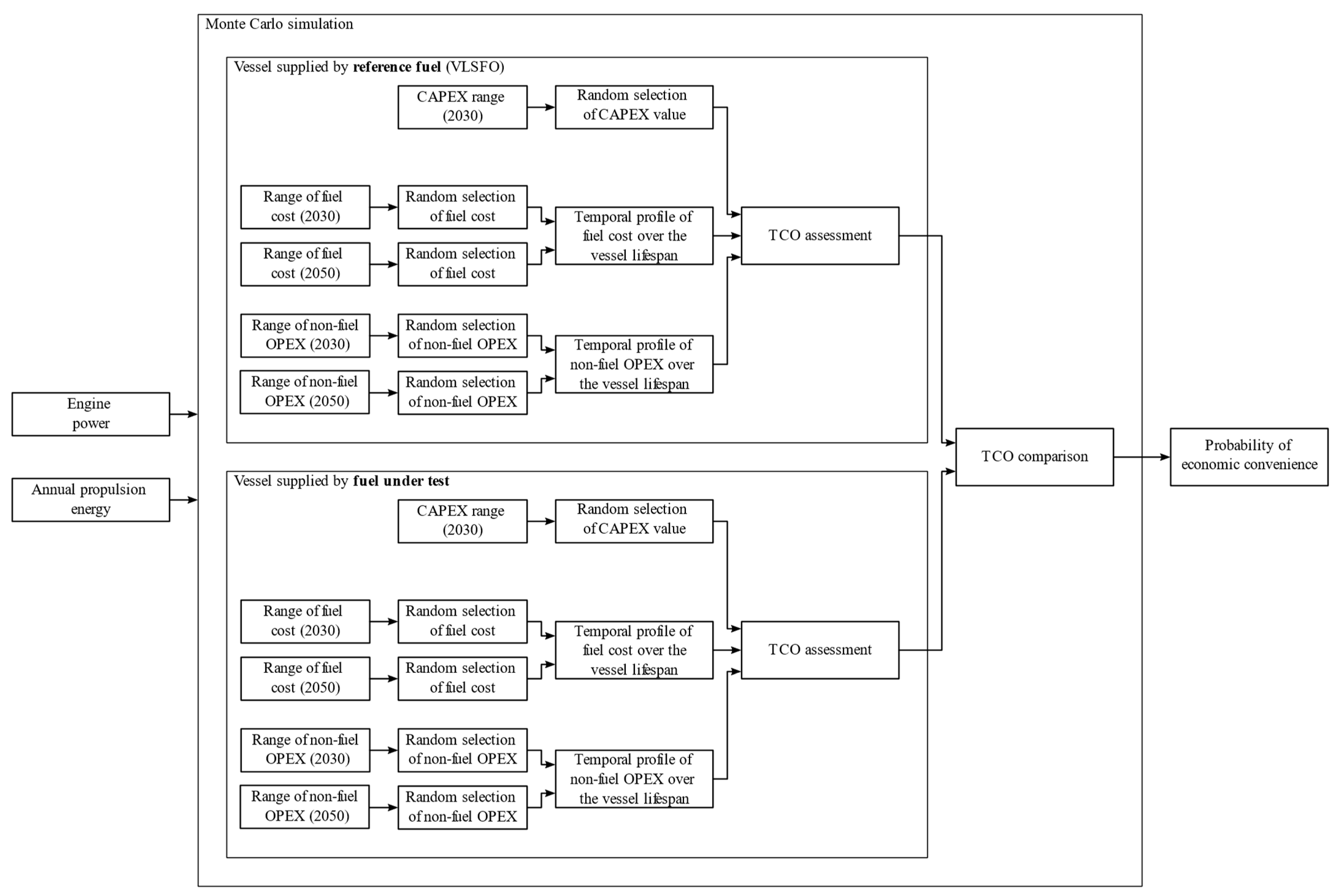
Random number generation, performed on the assumption that the values within the defined intervals are all equal, is inserted into a Monte Carlo simulation that allows for the calculation of many possible TCOs for each type of vessel and fuel (
Figure 1). By comparing these with the costs obtained for the reference vector (VLSFO), it is possible to calculate the probability that the adoption of a particular fuel is economically viable.
The assumptions of uniform probability distribution and stochastic independence are adopted as necessary hypotheses to facilitate the analysis. The current literature does not provide sufficient data granularity to support more realistic correlation frameworks. Nevertheless, the proposed methodology is inherently scalable; the model’s architecture allows for the seamless integration of higher-quality data as soon as more accurate figures regarding expected cost drivers and their mutual correlations become available. While performing a sensitivity analysis would undoubtedly yield valuable insights and remains straightforward to implement due to the simplicity of the simulation procedure, the sheer volume of scenarios to investigate would exceed the scope of this publication and prove difficult to summarize effectively.
It is important to note that the methodology adopted considers the TCO for a new build, so CAPEX is defined based on the values assumed for 2030, while OPEX is calculated over the entire lifespan of the vessel (which is assumed to be 25 years). For simplicity, a linear relationship between costs (e.g., fuel) was considered by interpolating the values assumed for the two dates considered (2030 and 2050), so as not to neglect the impact of cost variations on TCO. The adoption of linear interpolation for cost projections represents a baseline hypothesis, as it could not be found currently modelling alternatives. Furthermore, the methodology remains agnostic to the specific interpolation function used; alternative approaches, such as step-change functions, can be seamlessly integrated without redefining the core framework, should more robust data on cost evolution patterns emerge.
Since the costs are defined for different categories of vessels, the next chapters will illustrate separately the results returned by the simulations conducted for
These two intervals, divided along the middle of the vessels listed above, are assigned the costs relating to tonnages above and below 15,000 dwt, respectively. As anticipated, the container ship category was not considered. In
Table 8,
Table 9,
Table 10 and
Table 11, CAPEX and OPEX assumptions are shown related to the Ro-Ro connections between mainland Italy and Sardinia. They are derived from the aggregation of the analytical costs presented in the preceding sections. Specifically, these final values result from the summation of the individual cost components detailed in
Table 1,
Table 2,
Table 3,
Table 4 and
Table 5, which encompass propulsion system costs, fixed and variable maintenance and decommissioning provisions. This data consolidation ensures a consistent basis for comparing the overall economic viability of the different technologies analyzed.
3.3. Conversion of Routes with Vessels with Power Exceeding 9 MW
Based on the hypotheses set out, vessels whose linear metres can be associated with powers greater than 9 MW were selected. According to the same assumptions, the annual propulsion energy was calculated as a function of speed and distances travelled, thus obtaining the input data for the methodology described. The values are reported in
Table 12.
Below are the simulation results, i.e., the probability of economic convenience of conversion to alternative fuel, for most of listed vessels. To support the analysis of the returned data, the discussion focuses on four representative sections of four separate clusters.
3.3.1. Genoa–Livorno–Catania Route
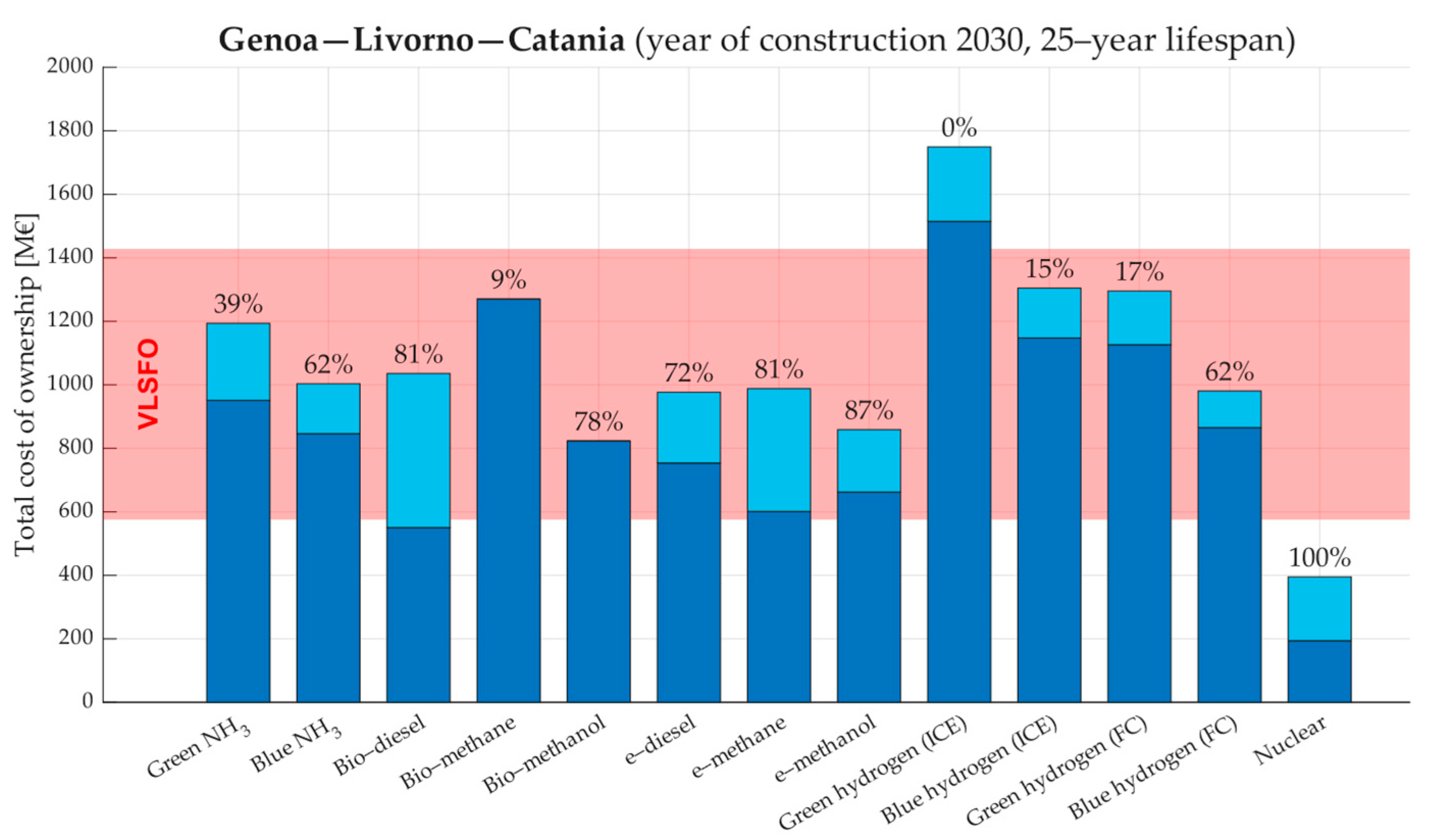
This route represents a central point in the sample of routes considered. It is served by vessels estimated to have a power of 18 MW, with a propulsion energy consumption of 180 TJ. The application of the simulation methodology yields the results shown in
Figure 2.
It can be observed that many of the proposed fuels, despite uncertainties about their costs, are likely to be economically viable compared to VLSFO. The only exceptions are green ammonia, bio-methane and hydrogen associated with the internal combustion engine (ICE). The latter, however, has good prospects for success in its “blue” origin if managed efficiently (via fuel-cell propulsion).
The only energy carrier for which the simulations leave no doubts regarding economic efficiency is nuclear power which, despite the uncertainty associated with both the cost of VLSFO and the cost of the reactors, shows a systematically lower TCO.
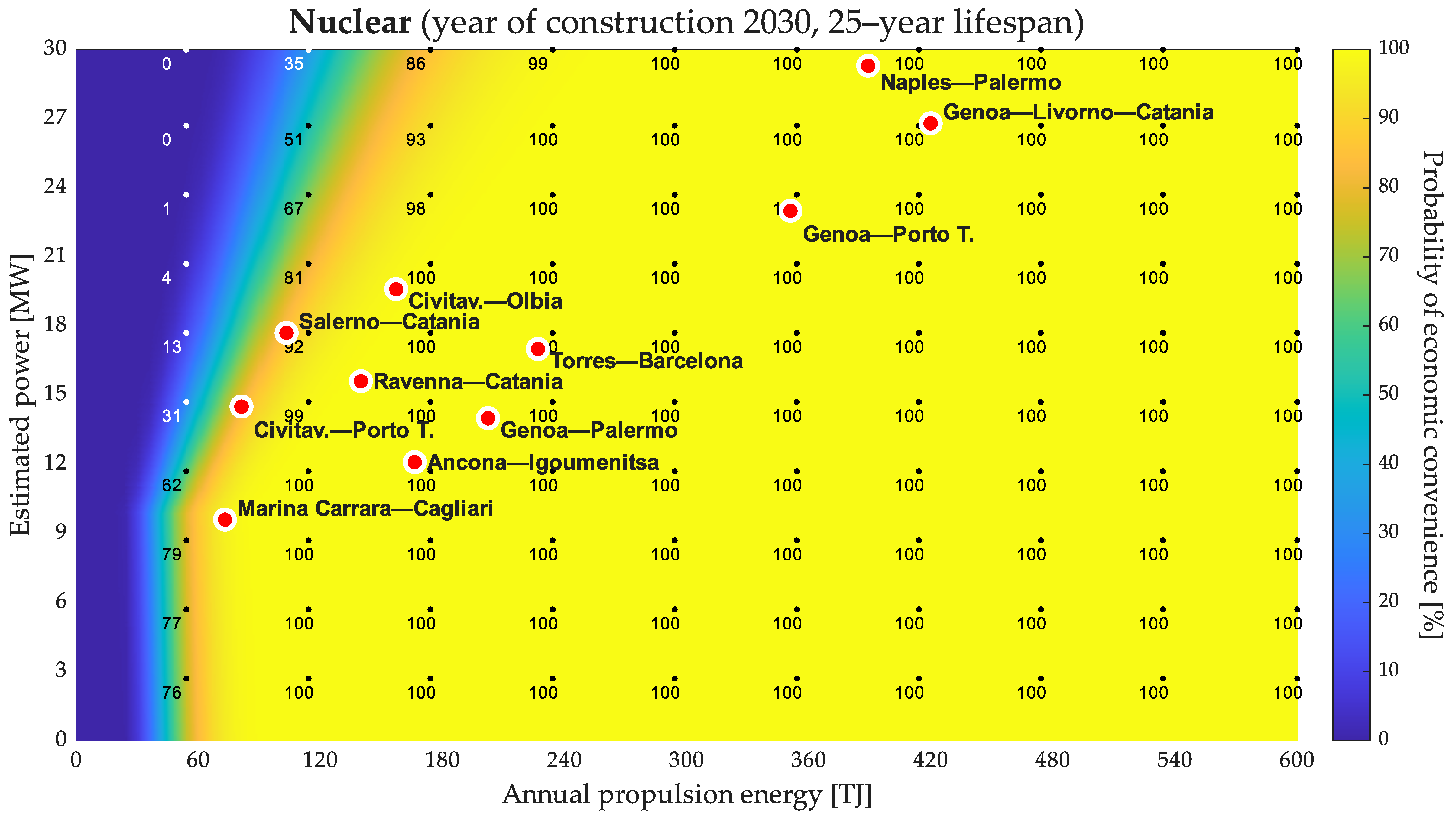
Repeating the simulation for the other sea routes, we note that nuclear energy has a large area where it becomes economically viable (
Figure 3) and intuitively, this occurs beyond a certain consumption threshold (remember that nuclear energy has a high CAPEX and low OPEX). The same figure shows a route where adopting this energy source might be less cost-effective, the Civitavecchia–Porto Torres route, illustrated in the next section.
3.3.2. Civitavecchia–Porto Torres Route
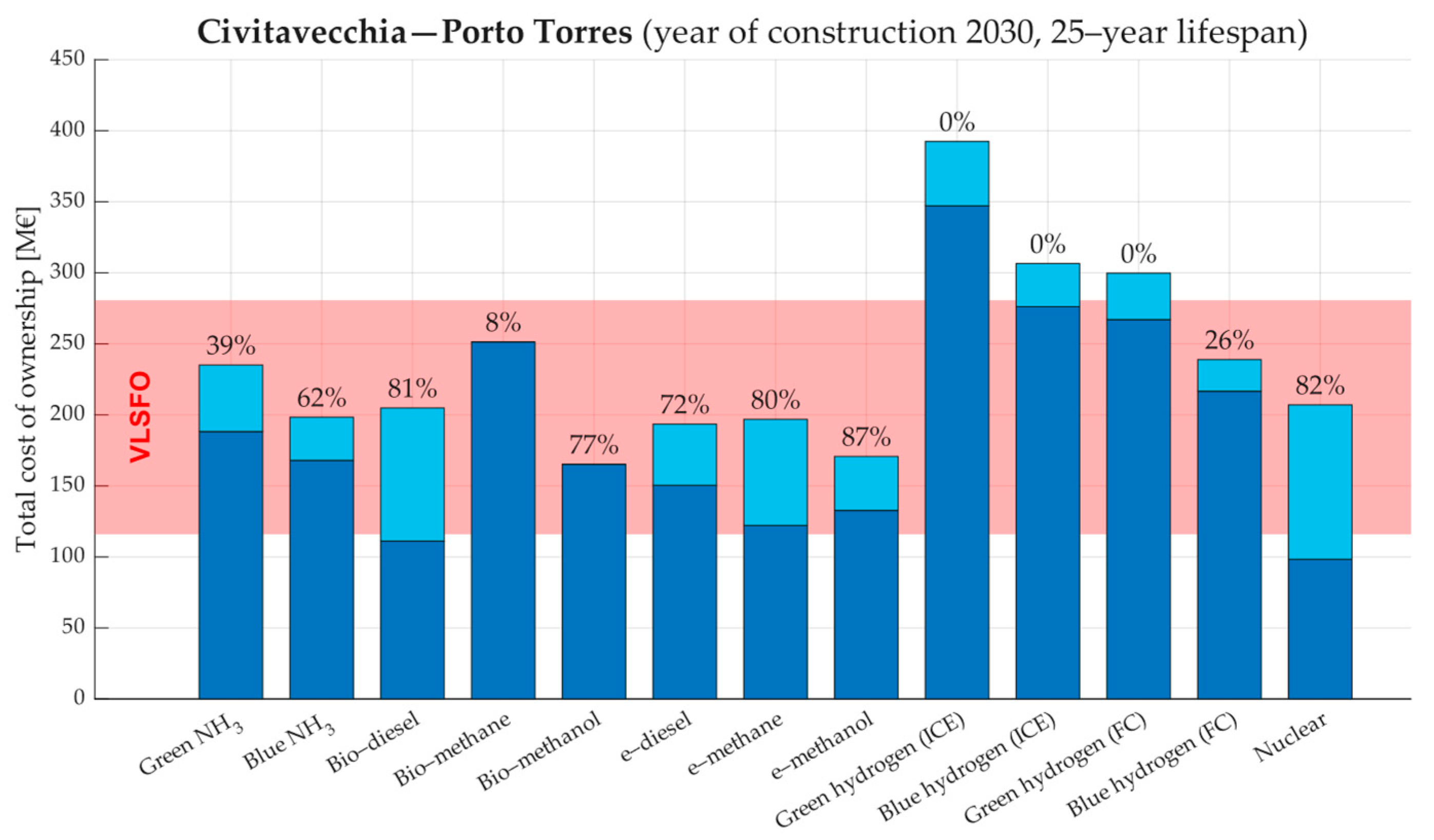
Compared to the previous route, the Civitavecchia–Porto Torres route is served by vessels with lower power and consumption. As mentioned above, especially regarding the lower propulsion energy, the economic viability of adopting nuclear power is lower, although there is a good probability (82%) that it is still promising.
Figure 4 highlights that there is indeed an overlap of the uncertainty bands between the costs attributed to VLSFO with the simulated TCO of nuclear power.
Interestingly, the TCOs of other fuels (compared to VLSFO) remain unchanged compared to those of the Genoa–Livorno–Catania route. Once again, there is the exception of blue hydrogen converted via fuel-cells, which, in this specific case, has a behaviour (in terms of costs) like that of nuclear fuel.
Repeating the analysis for this technology on the other routes (
Figure 5), we note that, for the power and energy ranges considered, there is a strong variability in economic convenience, making it more advantageous to serve (with the same power) longer or more frequent routes (by increasing the energy). For example, this occurs for the Genoa–Palermo route.
3.3.3. Genoa–Palermo Route
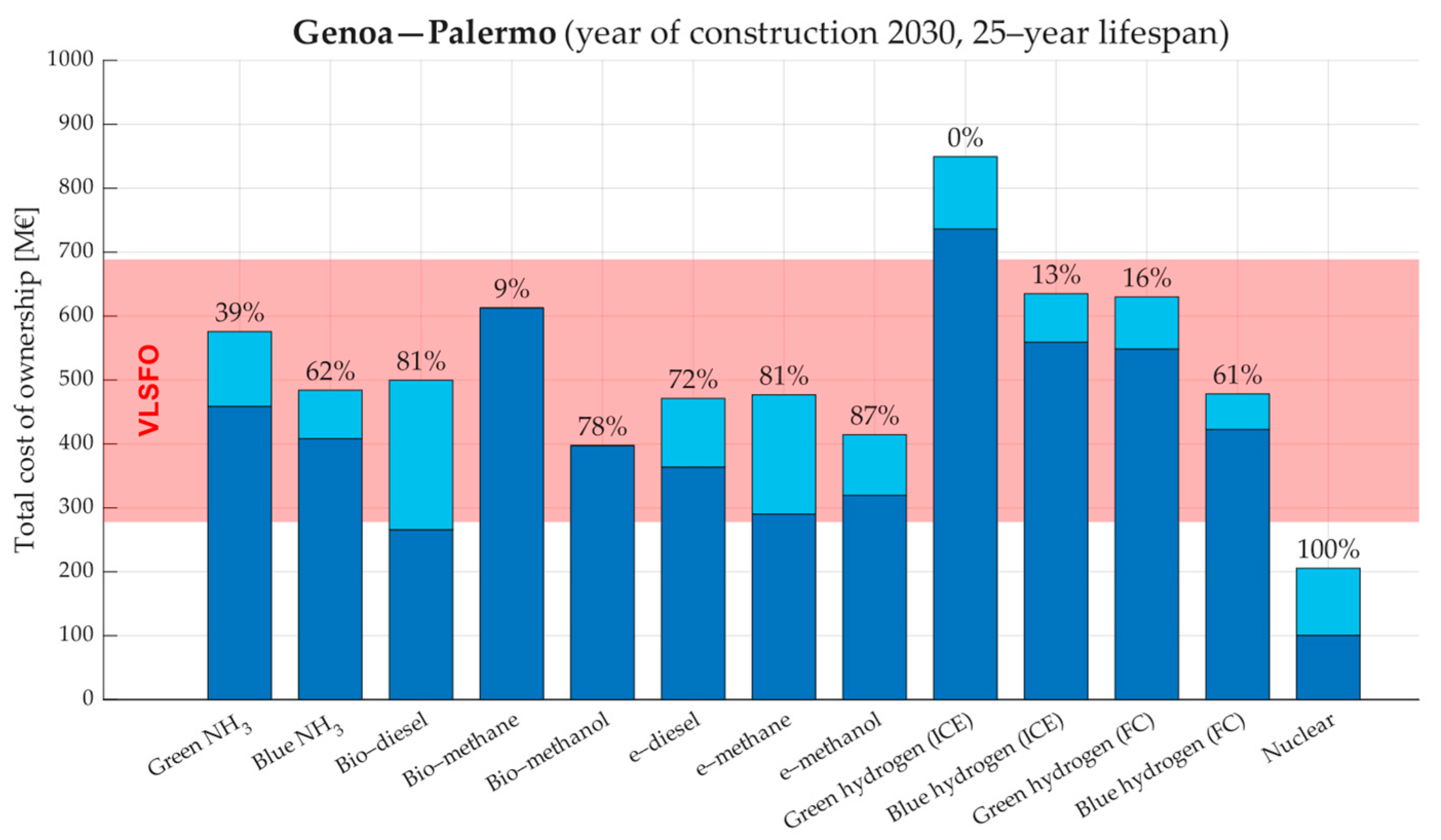
The same simulation is performed for the Genoa–Palermo route which, despite having the same propulsion system as the Civitavecchia–Porto Torres route, foresees consumption that is more than double. As expected and shown in
Figure 6, these input data restore the economic convenience of nuclear and blue hydrogen (FC) found for the Genoa–Livorno–Catania case.
Despite the significant variations in power and energy considered, all other fuels demonstrated the same probability of investment profitability.
3.3.4. Livorno–Olbia Route
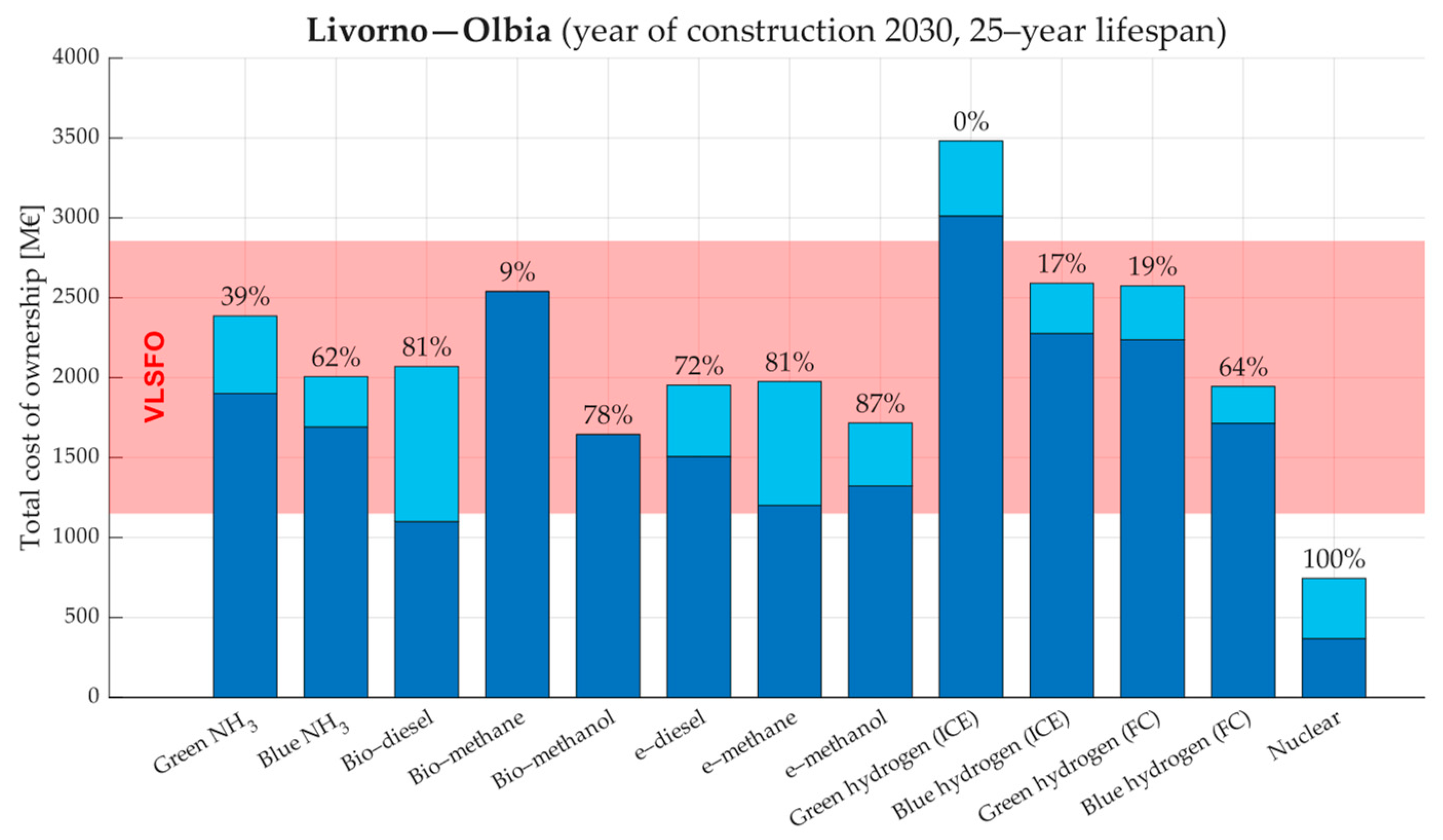
Finally, reference is made to the most energy-intensive route, for which the required power levels are also higher than those of the other sea routes. The simulation results are reported in
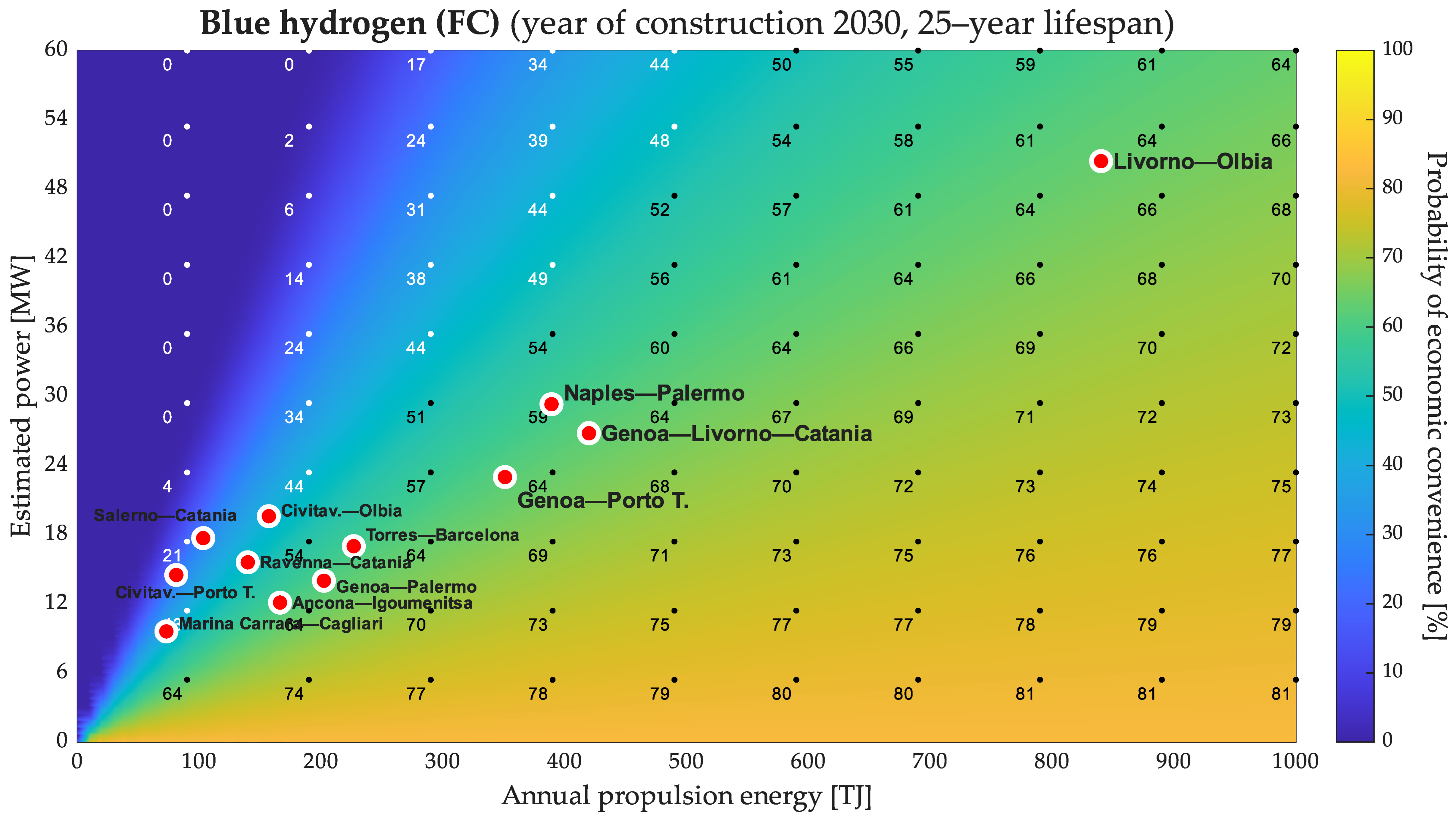
Figure 7 and are shown to be in line with the analyses illustrated in the previous sub-sections. From the analysis of the power–energy diagram (shown in
Figure 5), it is immediately evident that this route lies on the same bisector as the other itineraries, a condition that also allows the blue hydrogen vector to have good prospects for economic performance.
3.4. Conversion of Routes with Vessels with Power Less than 9 MW
The assumptions already indicated allow to identify vessels whose linear metres can be associated with powers lower than 9 MW.
Table 13 reports the annual propulsion power and energy, thus obtaining the input data of the methodology described.
3.4.1. Naples–Milazzo Route
The shortest route reported by the consulted data source [
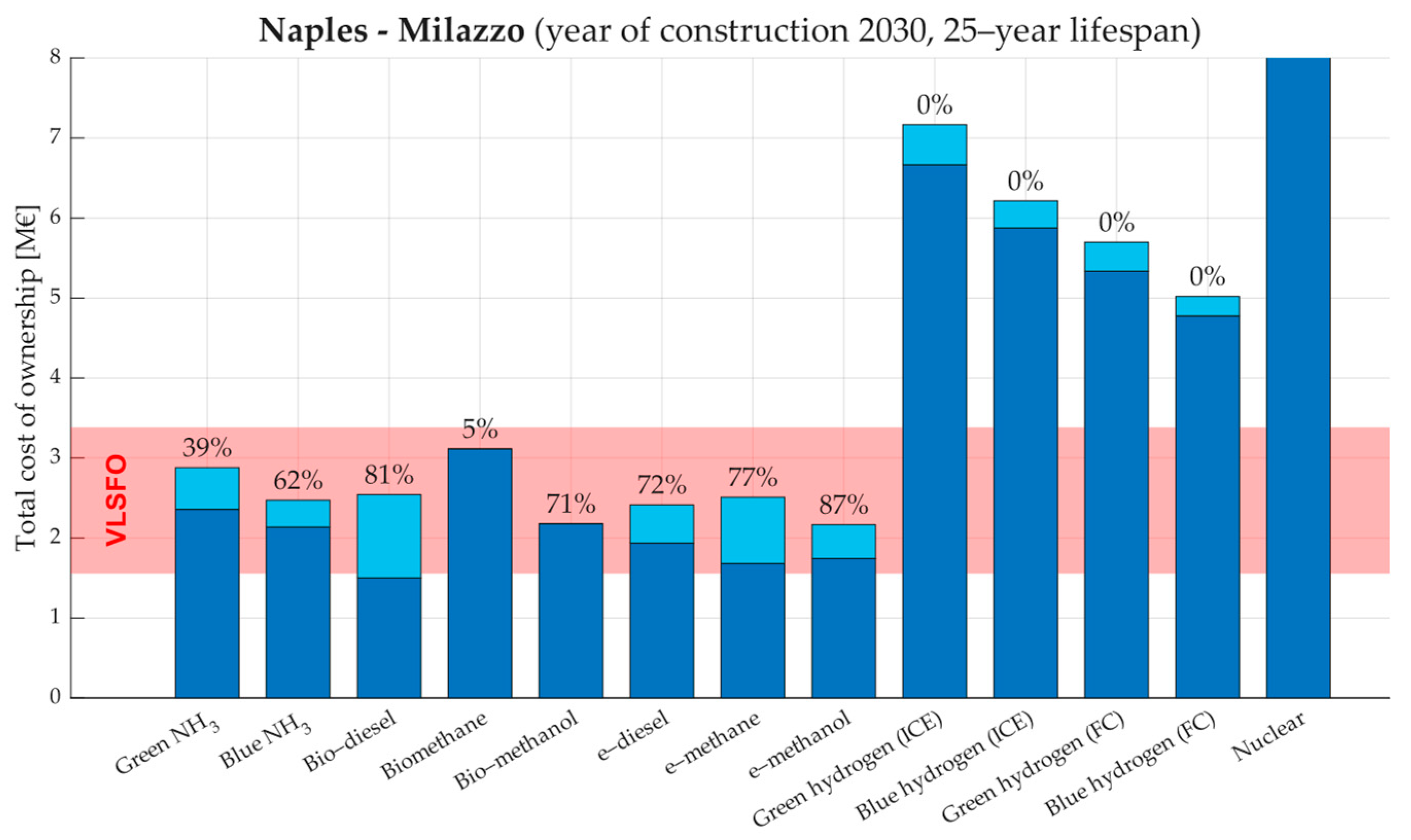
24] is represented by the Naples–Milazzo route, characterized by vessels with a power of 600 kW and an annual propulsion energy of 900 GJ. The simulations were conducted considering the unit CAPEX values increased for low powers, until obtaining the results illustrated in
Figure 8.
It is immediate (and intuitive) to note that nuclear fuel has TCOs that are not comparable to reference fuels (VLSFO) and the same is true for hydrogen in all its origins and uses. Equally intuitive, bio/diesel remains economically viable in the cases described.
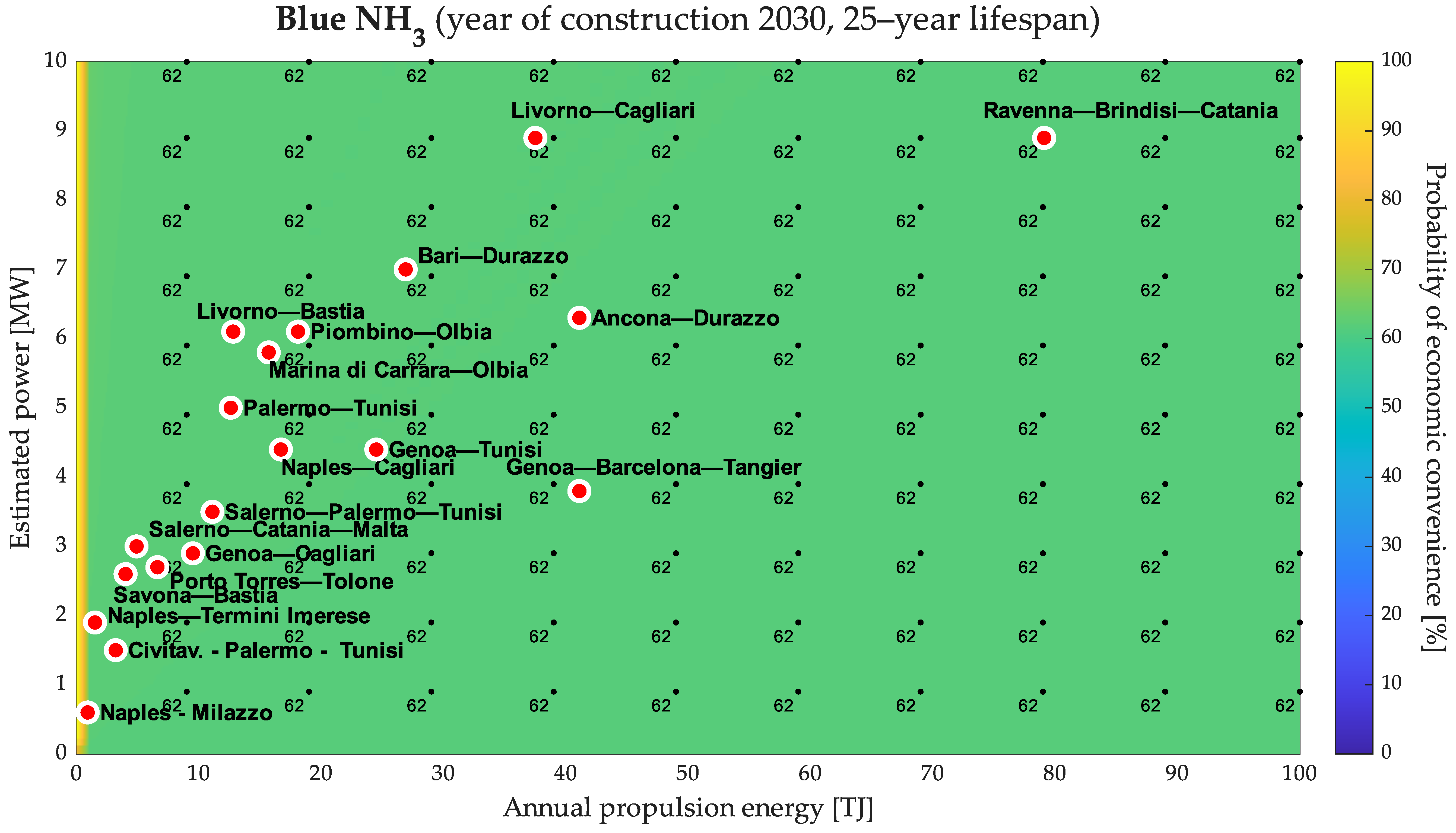
As previously noted, blue ammonia also has good potential to replace VLSFO. When analyzing its economic viability (
Figure 9), it shows an opposite trend compared to, for example, methanol, since the CAPEX per unit of power is lower than that for fuel oil. However, ammonia as a fuel has a slightly higher cost than the reference marine gas oil and, as cruising hours increase, it negatively impacts the TCO (ranging from 100% for short routes to stabilizing at around 62%).
3.4.2. Genoa–Barcelona–Tangier Route
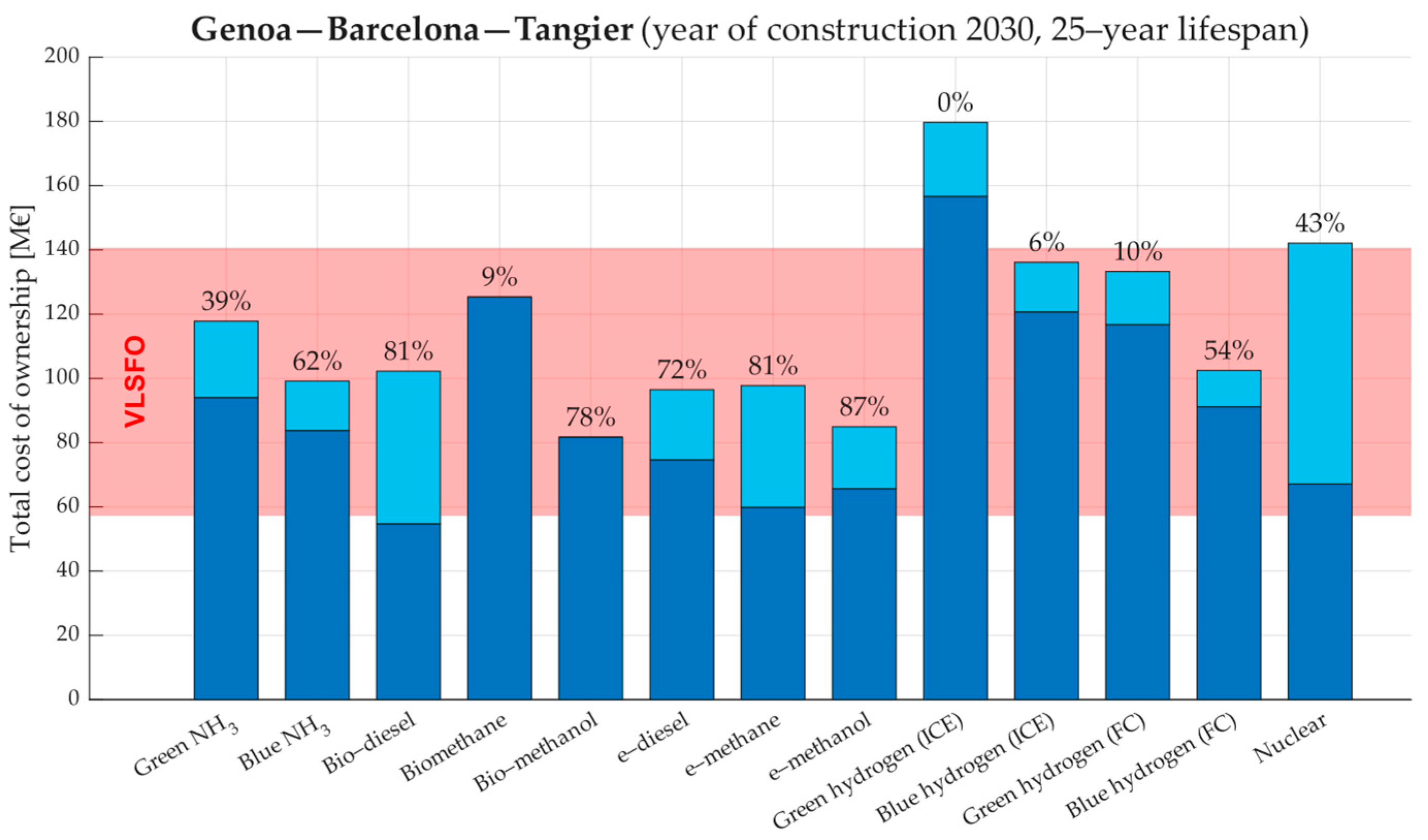
By increasing the propulsion power and, even more, the energy, the Genoa–Barcelona–Tangier route shows results of particular interest as regards nuclear and hydrogen. Indeed, it is noted that the cost-effectiveness of converting the route to these latter fuels increases compared to the Naples–Milazzo case, with good margins for both blue hydrogen and, to a lesser extent, nuclear. It is observed that energy conversion efficiency plays a significant role: despite the higher costs of fuel-cells, their performance overcomes the CAPEX obstacles that would not arise with internal combustion propulsion systems (
Figure 10).
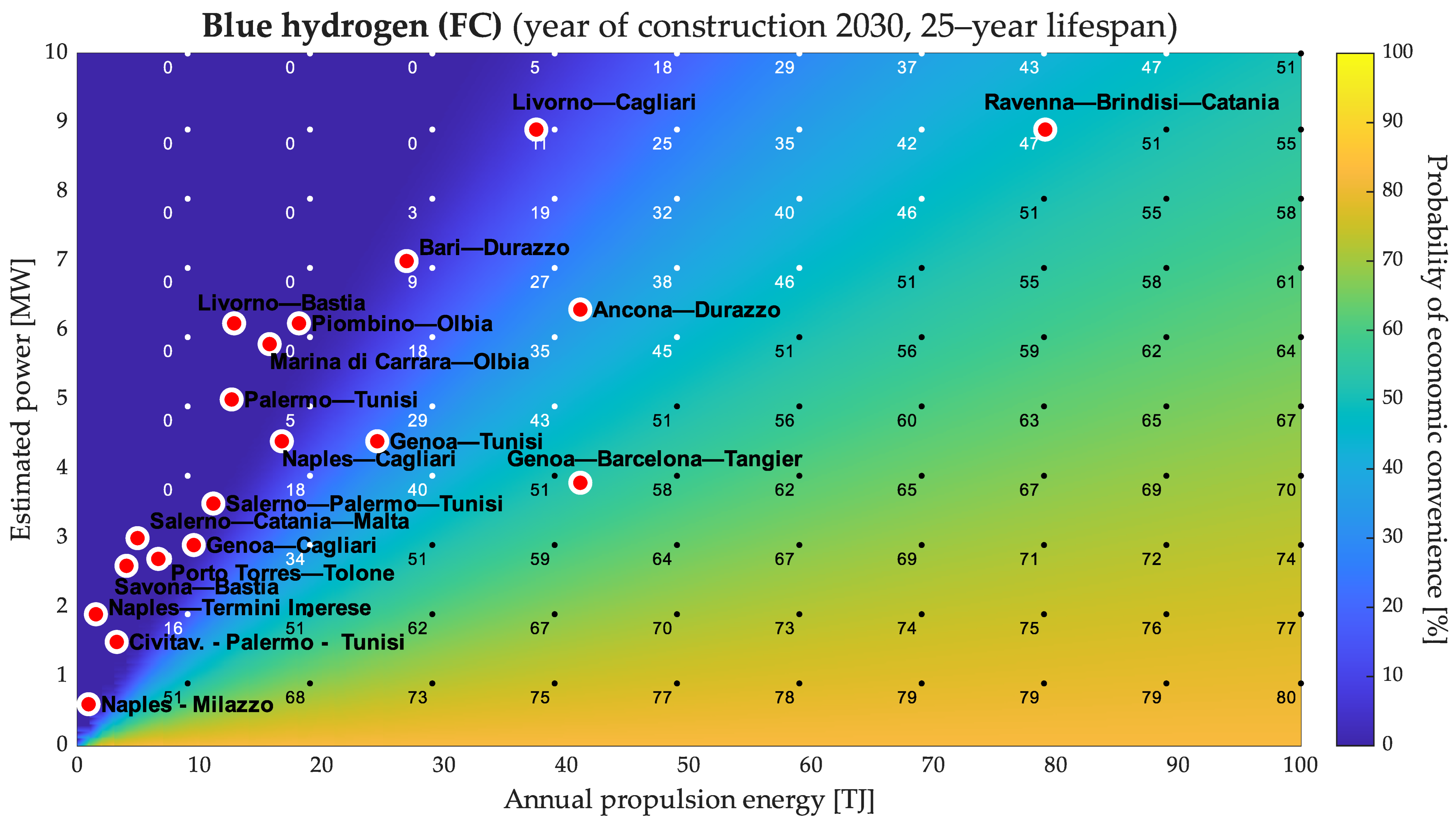
However, examination of the probability diagram for the economic viability of blue hydrogen (
Figure 11) reveals that this route represents an exception for vessels in this category, along with the Ravenna–Brindisi–Catania route. The same figure indicates that most routes fall within a region where this energy vector is not economically advantageous.
3.4.3. Livorno–Cagliari Route
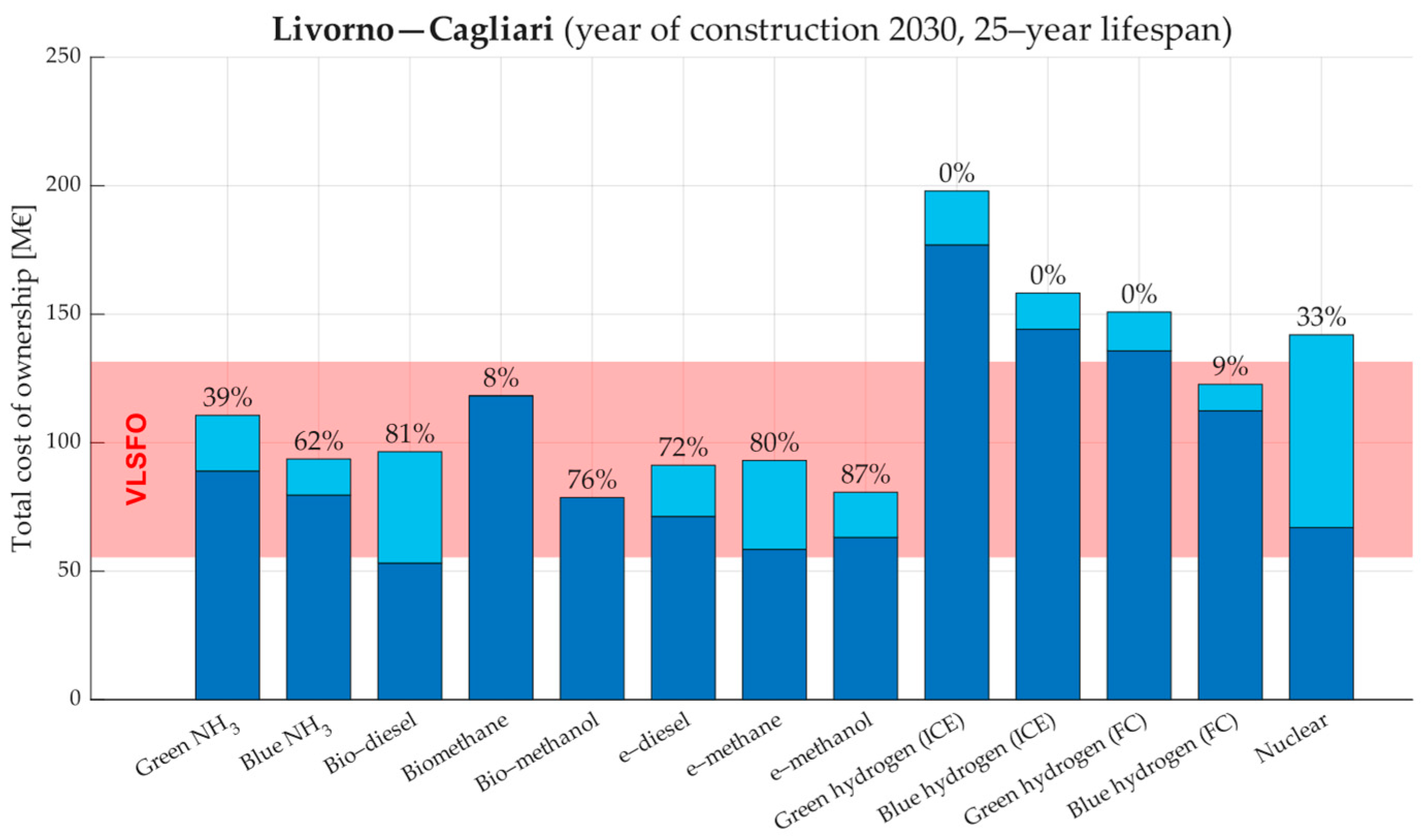
The same propulsion energy value as the Genoa–Barcelona–Tangier route, at double the power, characterizes the Livorno–Cagliari route. As anticipated in the previous section and compared to the results reported in this one, the simulations confirm a reduction in the cost-effectiveness of hydrogen, while the other propulsion systems maintain an economic efficiency equivalent to the routes previously analyzed (
Figure 12).
3.4.4. Ravenna–Brindisi–Catania Route
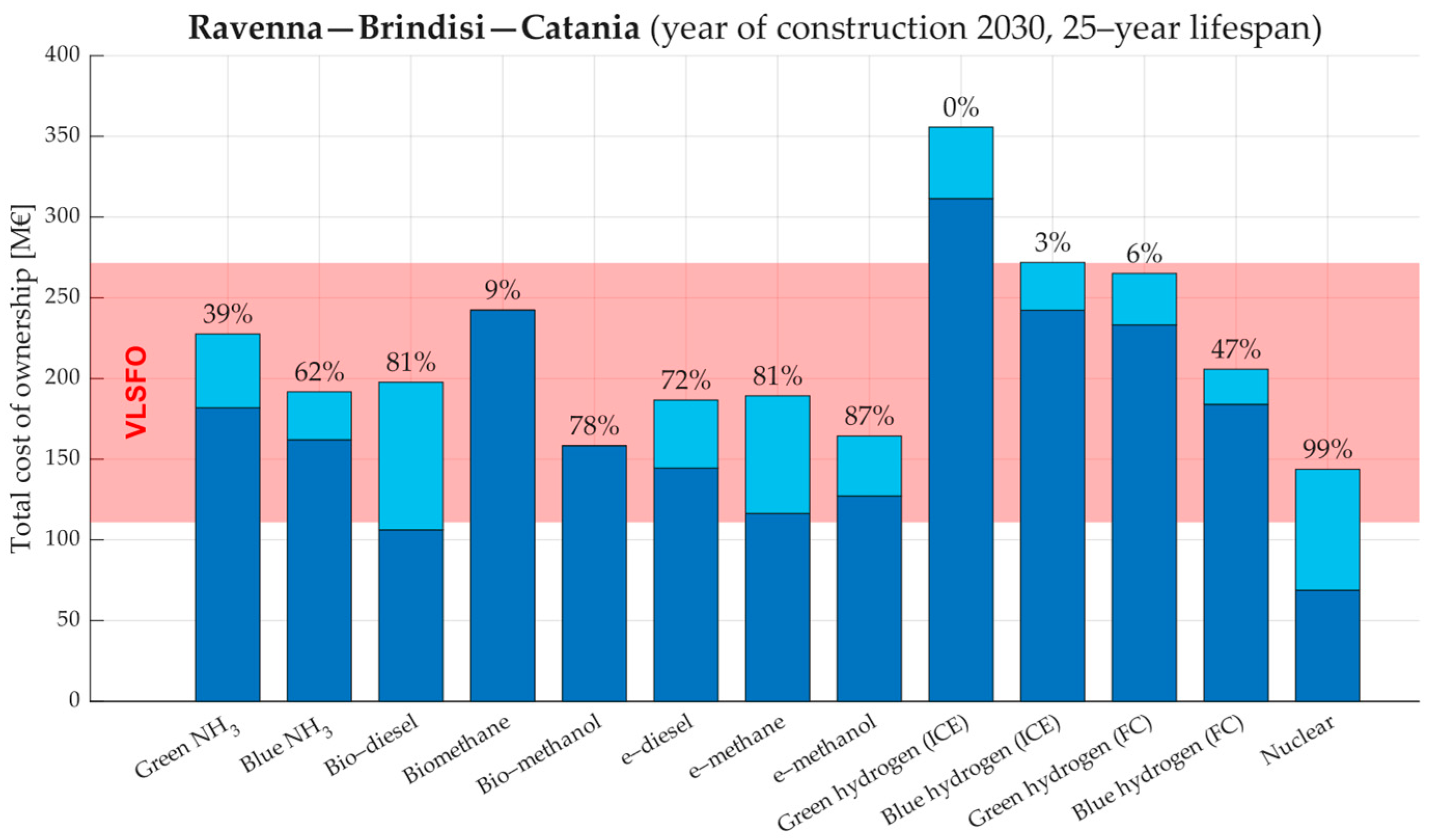
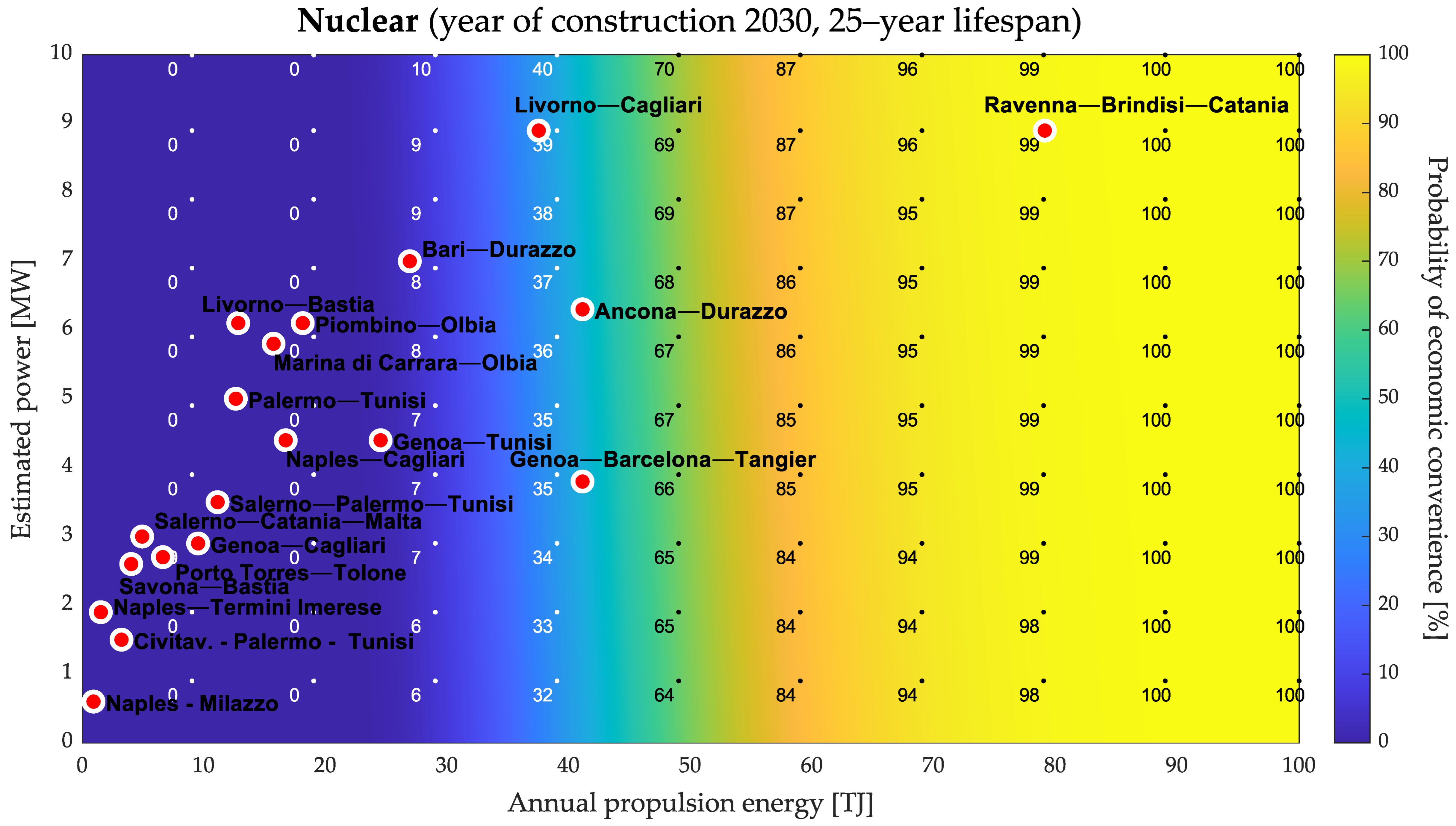
As in the case of the Genoa–Barcelona–Tangier route, nuclear propulsion has margins of convenience which, as already observed, can be improved by increasing the energy associated with the vessel and the route considered. For this category of vessels (power less than 9 MW), the only route for which nuclear is an interesting alternative is represented by Ravenna–Brindisi–Catania (as shown in
Figure 13 and
Figure 14).
4. Conclusions
This report analyses the potential of adopting alternative fuels for the operation of Italy’s main maritime routes. Thanks to the availability of extensive documentation on the development of these solutions at the European level, it was possible to identify and elaborate in detail all the twenty items necessary for a comprehensive economic assessment of the various energy sources applicable to maritime transport.
A further challenge was defining a cost assessment methodology based on a limited set of input data, easily available or estimable from publicly available sources. Fortunately, both the scientific literature and documentation provided by Italian shipowners have already outlined a simplified approach to the economic evaluation of alternative fuels. This study represents an evolution of this approach, offering the advantage of bringing together in a single document all the most relevant cost items for the main energy carriers considered as alternatives to VLSFO in the maritime sector.
Additionally, the analysis addressed the uncertainty associated with specific cost components, with a particular focus on fuel costs. To this end, a stochastic investigation was conducted to determine the likelihood of different energy carriers being cost-effective compared to the traditionally used fuel, marine fuel oil.
From the analyses conducted, which due to the number and heterogeneity of the routes considered can be defined as representative of the Italian context, it can be concluded that
Across all routes, e-fuels demonstrated excellent potential for a cost-effective replacement of VLSFO. Considering the uncertainties associated with fuel costs, simulations identified TCO benefits with a probability of 72%÷87% depending on fuel type.
Except for bio-methane, the other biofuels have shown economic advantages like those of e-fuels (probability of convenience of 71%÷81%). Even in this case, convenience is dictated by the variability of fuel costs over time.
Hydrogen is a carrier characterized by high capital costs for both the propulsion system and fuel supply. For some applications (low power and very frequent routes), it offers good economic viability, provided the propulsion systems enable high energy efficiency. However, the likelihood of achieving a lower TCO than VLSFO has consistently proven low, with only one case achieving 64% (the Livorno–Olbia route).
Nuclear power promises significant economic benefits for long and/or very frequent routes, as the significant investment costs for reactors are more than offset by low fuel costs. Of the identified routes, all those served by vessels with propulsion power greater than 9 MW have excellent potential.
Route-specific analyses and the resulting economic viability findings are directly applicable to the individual vessels operating them. While more granular assessments could be conducted using technology-specific references, given the inherent uncertainty of the scenario analyses presented in this paper, further levels of detail would yield diminishing returns. Any incremental improvements in estimation accuracy would be offset by the model’s overall definitional uncertainty.
New climate policies in the EU signal a major shift for maritime decarbonisation with the potential of a commercially viable pathway. Demand for alternative fuels can trigger a virtuous cycle, where the adoption of alternatives leads to greater economies of scale and practical learning. As we have seen, the variability in economic viability is significant, but it must be calibrated for each type of vessel and the routes travelled. It is important to note, however, that technologies such as hydrogen and nuclear, while they may appear economically attractive, are not yet fully mature and there is significant uncertainty surrounding the related industrial supply chains.
It is plausible that, at least initially, interventions on vessel propulsion systems will be kept to a minimum, favouring those types of fuel that, while less efficient, can help overcome the current period of uncertainty.
Author Contributions
Conceptualization, C.C. and D.B.; Methodology, C.C. and M.R.; Software, M.R.; Validation, C.C. and M.R.; Formal analysis, C.C.; Investigation, C.C. and D.B.; Resources, C.C.; Data curation, D.B.; Writing—original draft, C.C.; Writing—review & editing, M.R.; Supervision, M.R. All authors have read and agreed to the published version of the manuscript.
Funding
This work has been financed by the Research Fund for the Italian Electrical System under the Three-Year Research Plan 2025–2027 (MASE, Decree n.388 of 6 November 2024), in compliance with the Decree of 12 April 2024.
Data Availability Statement
The original contributions presented in this study are included in the article. Further inquiries can be directed to the corresponding authors.
Conflicts of Interest
Authors Claudio Carlini, Marco Rossi and Danilo Bertini were employed by the company Ricerca sul Sistema Energetico. The remaining authors declare that the research was conducted in the absence of any commercial or financial relationships that could be construed as a potential conflict of interest.
Abbreviations
The following abbreviations are used in this manuscript:
| CAPEX | CAPital EXPenditure |
| DWT | Gross tonnage |
| EMSA | European Maritime Safety Agency |
| ETS | Emissions Trade System |
| FAME | Fatty Acid Methyl Esther |
| FC | Fuel Cell |
| FT | Fischer-Tropsch Diesel |
| HVO | Hydrogenated Vegetable Oil |
| ICE | Internal combustion engine |
| NOx | Nitrogen oxide |
| OPEX | OPerational EXpenditure |
| Ro-Ro | Roll on—Roll off ferry |
| Ro-Pax | Roll on—Roll off passenger ferry |
| SCR | Selective Catalytic Reduction |
| SMR | Small Modular Reactor |
| SOx | Sulphur oxide |
| TCO | Total Cost of Ownership |
| VLSFO | Very Low Sulphur Fuel Oil |
References
- Regulation (EU) 2023/957; Amending Regulation (EU) 2015/757 to Provide for the Inclusion of Maritime Transport Activities in the Emissions Trading Scheme. European Commission: Luxembourg, 2023.
- Directive (EU) 2023/959; Amending Directive 2003/87/EC Establishing a Scheme for Greenhouse Gas Emission Allowance Trading Within the Union. European Commission: Luxembourg, 2023.
- European Commission. Regulation (EU) 2023/1804 on the Deployment of Alternative Fuels Infrastructure; European Commission: Brussels, Belgium, 2023. [Google Scholar]
- European Commission. Regulation (EU) 2023/1805 on the Use of Renewable and Low-Carbon Fuels in Maritime Transport and Amending Directive 2009/16/EC; European Commission: Brussels, Belgium, 2023. [Google Scholar]
- European Commission. Directive 2003/87/EC on greenhouse gas emission allowance trading within the Union and amending Council Directive 96/61/EC; European Commission: Brussels, Belgium, 2003. [Google Scholar]
- Baccelli, O. Policy europee e nazionali per lo sviluppo dell’intermodalità marittima: Stima degli effetti socio-economici dell’applicazione dell’Emission Trading System (ETS) e del Sea Modal Shift (SMS) in Italia. J. Transp. Econ. Policy 2024, 2, 2. [Google Scholar]
- Carlini, C.; Clerici, D.; Michelangeli, C.; Moneta, D.; Viganò, G. Sustainable Mobility and Energy Infrastructures in New Forms of Transport. 2021. Available online: https://www.rse-web.it/en/reports/sustainable-mobility-and-energy-infrastructures-in-new-forms-of-transport/ (accessed on 1 December 2025).
- Carlini, C.; Bertini, D. Sustainable Maritime Transport in the Current and Future Energy Context. 2023. Available online: https://www.rse-web.it/en/reports/sustainable-maritime-transport-in-current-and-future-energy-overall-context/ (accessed on 1 December 2025).
- EMSA. Potential of Ammonia as Fuel in Shipping. 2021. Available online: https://www.emsa.europa.eu/publications/item/4833-potential-of-ammonia-as-fuel-in-shipping.html (accessed on 1 December 2025).
- EMSA. Safety of Ammonia for Use in Ships. 2024. Available online: https://www.emsa.europa.eu/newsroom/latest-news/item/5532-safety-of-ammonia-as-a-fuel-in-shipping-new-reports.html (accessed on 1 December 2025).
- EMSA. Potential of Biofuels for Shipping. 2021. Available online: https://www.emsa.europa.eu/newsroom/latest-news/item/4834-update-on-potential-of-biofuels-for-shipping.html (accessed on 1 December 2025).
- EMSA. Potential of Synthetic Fuels for Shipping. 2024. Available online: https://www.emsa.europa.eu/publications/item/5349-synthetic-fuels-for-shipping.html (accessed on 1 December 2025).
- EMSA. Potential of Hydrogen as Fuel for Shipping. 2023. Available online: https://emsa.europa.eu/damage-stability-study/items.html?cid=14&id=5062 (accessed on 1 December 2025).
- EMSA. Reliability and Safety Analysis for Hydrogen-Fuelled Ships. 2024. Available online: https://www.emsa.europa.eu/damage-stability-study/items.html?cid=77&id=5263 (accessed on 1 December 2025).
- EMSA. Mapping Safety Risks for Hydrogen-Fuelled Ships. 2024. Available online: https://www.emsa.europa.eu/publications/item/5263-mapping-safety-risks-for-hydrogen-fuelled-ships-study-investigating-the-safety-of-hydrogen-as-fuel-on-ships.html (accessed on 1 December 2025).
- EMSA. Guidance on the Safety of BESS on Board Ships. 2023. Available online: https://www.emsa.europa.eu/electrification/bess.html (accessed on 1 December 2025).
- EMSA. Potential of Use of Nuclear Power in Shipping. 2024. Available online: https://www.emsa.europa.eu/publications/reports/item/5366-potential-use-of-nuclear-power-for-shipping.html (accessed on 1 December 2025).
- Armaroli, N. The Hydrogen Dilemma in the Italian Energy Transition. Nature 2021. Available online: https://www.nature.com/articles/d43978-021-00110-w (accessed on 1 December 2025).
- Sayres and Associates Corporation. NS Savannah Post Shutdown Decommissioning Activities Report; US Department of Transportation Maritime Administration; Office of Ship Disposal Programs. 2008. Available online: https://www.maritime.dot.gov/sites/marad.dot.gov/files/docs/national-defense-reserve-fleet/ns-savannah-program/6071/sts100rev1.pdf (accessed on 1 December 2025).
- Houtkoop, K.C. Nuclear Reactors for Marine Propulsion and Power Generation Systems. 2022. Available online: https://repository.tudelft.nl/islandora/object/uuid%3Afb44c464-6936-4ec6-96b1-52333ff799e3 (accessed on 1 December 2025).
- Anderson, B.; Den Boer, E.; Ng, S.; Dunlap, L.; Hon, G.; Nelissen, D.; Agrawal, A.; Faber, J.; Ray, J. Study of Emission Control and Energy Efficiency Measures for Ships in the Port Area. 2015. Available online: https://cedelft.eu/publications/study-of-emission-control-and-energy-efficiency-measures-for-ships-in-the-port-area/ (accessed on 1 December 2025).
- ICS; IMO. Reduction of GHG Emissions from Ships. 2025. Available online: https://www.ics-shipping.org/wp-content/uploads/2025/03/MEPC-83-7-37-Suggested-pragmatic-solution-if-necessary-to-achieve-consensus-and-approval-ofMARPOL-Ann.-Liberia-and-ICS.pdf (accessed on 1 December 2025).
- Italian Ministry of Infrastructure and Transport. Conto Nazionale delle Infrastrutture e dei Trasporti—Anni 2022–2023. Available online: https://www.mit.gov.it/node/20030 (accessed on 1 December 2025).
- Confitarma. Annual Report. 2023. Available online: https://www.confitarma.it/wp-content/uploads/2023/11/Relazione-completa-english-versione-04032024.pdf (accessed on 1 December 2025).
- Fincantieri Moby AKI. 2024. Available online: https://www.fincantieri.com/it/prodotti-servizi/traghetti/moby-aki/ (accessed on 1 December 2025).
- OECD. The Costs of Decarbonization: System Costs with High Shares of Nuclear and Renewables. 2019. Available online: https://www.oecd.org/content/dam/oecd/en/publications/reports/2019/01/the-costs-of-decarbonisation_g1g9f42f/9789264312180-en.pdf (accessed on 1 December 2025).
- IEA. Projected Costs of Generating Electricity. 2020. Available online: https://www.iea.org/reports/projected-costs-of-generating-electricity-2020 (accessed on 1 December 2025).
- CORE POWER. Advanced Maritime Nuclear: A Unique Opportunity for the UK. 2025. Available online: https://www.lr.org/en/knowledge/research-reports/2025/advanced-maritime-nuclear-a-unique-opportunity-for-the-uk/ (accessed on 1 December 2025).
Figure 1.
Vessels’ TCOs Monte Carlo simulation scheme.
Figure 1.
Vessels’ TCOs Monte Carlo simulation scheme.
Figure 2.
Total cost of ownership (TCO) of a vessel serving the Genoa–Livorno–Catania route. The red area indicates the confidence interval of the vessel TCO when supplied with VLSFO, while the light blue bars represent the confidence intervals of other fuels. The printed percentages indicate the probability that each TCO is lower than that of the reference fuel.
Figure 2.
Total cost of ownership (TCO) of a vessel serving the Genoa–Livorno–Catania route. The red area indicates the confidence interval of the vessel TCO when supplied with VLSFO, while the light blue bars represent the confidence intervals of other fuels. The printed percentages indicate the probability that each TCO is lower than that of the reference fuel.
Figure 3.
Economic viability (probability that TCO is lower than that of the reference fuel) chart for converting maritime routes to nuclear propulsion versus VLSFO. Routes characterized by different propulsion power values (above 9 MW) and annual consumption (propulsion energy).
Figure 3.
Economic viability (probability that TCO is lower than that of the reference fuel) chart for converting maritime routes to nuclear propulsion versus VLSFO. Routes characterized by different propulsion power values (above 9 MW) and annual consumption (propulsion energy).
Figure 4.
Total cost of ownership (TCO) of a vessel serving the Civitavecchia–Porto Torres route. The red area indicates the confidence interval of the vessel TCO when supplied with VLSFO, while the light blue bars represent the confidence intervals of other fuels. The printed percentages indicate the probability that each TCO is lower than that of the reference fuel.
Figure 4.
Total cost of ownership (TCO) of a vessel serving the Civitavecchia–Porto Torres route. The red area indicates the confidence interval of the vessel TCO when supplied with VLSFO, while the light blue bars represent the confidence intervals of other fuels. The printed percentages indicate the probability that each TCO is lower than that of the reference fuel.
Figure 5.
Economic viability (probability that TCO is lower than that of the reference fuel) chart for converting maritime routes to blue hydrogen (FC) propulsion versus VLSFO. Routes characterized by different propulsion power values (above 9 MW) and annual consumption (propulsion energy).
Figure 5.
Economic viability (probability that TCO is lower than that of the reference fuel) chart for converting maritime routes to blue hydrogen (FC) propulsion versus VLSFO. Routes characterized by different propulsion power values (above 9 MW) and annual consumption (propulsion energy).
Figure 6.
Total cost of ownership (TCO) of a vessel serving the Genoa–Palermo route. The red area indicates the confidence interval of the vessel TCO when supplied with VLSFO, while the light blue bars represent the confidence intervals of other fuels. The printed percentages indicate the probability that each TCO is lower than that of the reference fuel.
Figure 6.
Total cost of ownership (TCO) of a vessel serving the Genoa–Palermo route. The red area indicates the confidence interval of the vessel TCO when supplied with VLSFO, while the light blue bars represent the confidence intervals of other fuels. The printed percentages indicate the probability that each TCO is lower than that of the reference fuel.
Figure 7.
Total cost of ownership (TCO) of a vessel serving the Livorno–Olbia route. The red area indicates the confidence interval of the vessel TCO when supplied with VLSFO, while the light blue bars represent the confidence intervals of other fuels. The printed percentages indicate the probability that each TCO is lower than that of the reference fuel.
Figure 7.
Total cost of ownership (TCO) of a vessel serving the Livorno–Olbia route. The red area indicates the confidence interval of the vessel TCO when supplied with VLSFO, while the light blue bars represent the confidence intervals of other fuels. The printed percentages indicate the probability that each TCO is lower than that of the reference fuel.
Figure 8.
Total cost of ownership (TCO) of a vessel serving the Naples–Milazzo route. The red area indicates the confidence interval of the vessel TCO when supplied with VLSFO, while the light blue bars represent the confidence intervals of other fuels. The printed percentages indicate the probability that each TCO is lower than that of the reference fuel.
Figure 8.
Total cost of ownership (TCO) of a vessel serving the Naples–Milazzo route. The red area indicates the confidence interval of the vessel TCO when supplied with VLSFO, while the light blue bars represent the confidence intervals of other fuels. The printed percentages indicate the probability that each TCO is lower than that of the reference fuel.
Figure 9.
Economic viability (probability that TCO is lower than that of the reference fuel) chart for converting maritime routes to blue ammonia propulsion versus VLSFO. Routes characterized by different propulsion power values (below 9 MW) and annual consumption (propulsion energy).
Figure 9.
Economic viability (probability that TCO is lower than that of the reference fuel) chart for converting maritime routes to blue ammonia propulsion versus VLSFO. Routes characterized by different propulsion power values (below 9 MW) and annual consumption (propulsion energy).
Figure 10.
Total cost of ownership (TCO) of a vessel serving the Genoa–Barcelona–Tangier route. The red area indicates the confidence interval of the vessel TCO when supplied with VLSFO, while the light blue bars represent the confidence intervals of other fuels. The printed percentages indicate the probability that each TCO is lower than that of the reference fuel.
Figure 10.
Total cost of ownership (TCO) of a vessel serving the Genoa–Barcelona–Tangier route. The red area indicates the confidence interval of the vessel TCO when supplied with VLSFO, while the light blue bars represent the confidence intervals of other fuels. The printed percentages indicate the probability that each TCO is lower than that of the reference fuel.
Figure 11.
Economic viability (probability that TCO is lower than that of the reference fuel) chart for converting maritime routes to blue hydrogen (FC) propulsion versus VLSFO. Routes characterized by different propulsion power values (below 9 MW) and annual consumption (propulsion energy).
Figure 11.
Economic viability (probability that TCO is lower than that of the reference fuel) chart for converting maritime routes to blue hydrogen (FC) propulsion versus VLSFO. Routes characterized by different propulsion power values (below 9 MW) and annual consumption (propulsion energy).
Figure 12.
Total cost of ownership (TCO) of a vessel serving the Livorno–Cagliari route. The red area indicates the confidence interval of the vessel TCO when supplied with VLSFO, while the light blue bars represent the confidence intervals of other fuels. The printed percentages indicate the probability that each TCO is lower than that of the reference fuel.
Figure 12.
Total cost of ownership (TCO) of a vessel serving the Livorno–Cagliari route. The red area indicates the confidence interval of the vessel TCO when supplied with VLSFO, while the light blue bars represent the confidence intervals of other fuels. The printed percentages indicate the probability that each TCO is lower than that of the reference fuel.
Figure 13.
Total cost of ownership (TCO) of a vessel serving the Ravenna–Brindisi–Catania route. The red area indicates the confidence interval of the vessel TCO when supplied with VLSFO, while the light blue bars represent the confidence intervals of other fuels. The printed percentages indicate the probability that each TCO is lower than that of the reference fuel.
Figure 13.
Total cost of ownership (TCO) of a vessel serving the Ravenna–Brindisi–Catania route. The red area indicates the confidence interval of the vessel TCO when supplied with VLSFO, while the light blue bars represent the confidence intervals of other fuels. The printed percentages indicate the probability that each TCO is lower than that of the reference fuel.
Figure 14.
Economic viability (probability that TCO is lower than that of the reference fuel) chart for converting maritime routes to nuclear propulsion versus VLSFO. Routes characterized by different propulsion power values (below 9 MW) and annual consumption (propulsion energy).
Figure 14.
Economic viability (probability that TCO is lower than that of the reference fuel) chart for converting maritime routes to nuclear propulsion versus VLSFO. Routes characterized by different propulsion power values (below 9 MW) and annual consumption (propulsion energy).
Table 1.
Specific cost of propulsion systems.
Table 1.
Specific cost of propulsion systems.
| | Short-Sea Transport Vessels (<15,000 dwt) | Ocean-going Vessels (>15,000 dwt) | Container Ships
(All Sizes) |
|---|
| | [€/kW] | [€/kW] | [€/kW] |
|---|
| VLSFO | 250 | 200 | 190 |
| NH3 green and blue | 330 | 280 | 270 * |
| Bio-diesel and e-diesel | 250 | 200 | 190 |
| Bio-methane and e-methane | 300 | 250 | 220 |
| Bio-methanol and e-methanol | 330 | 280 | 240 |
| Green and blue hydrogen (ICE) | 850 * | 600 * | 550 * |
| Green and blue hydrogen (FC) | 1300
(FC + motor + batteries) | 1250
(FC + motor + batteries) | 1150
(FC + motor + batteries) |
| Nuclear (SMR) | 4350 ÷ 9350
(minimum 10 MW) |
Table 2.
Specific cost of post-treatment systems.
Table 2.
Specific cost of post-treatment systems.
| | All Vessels
[€/kW] |
|---|
| VLSFO | 116 |
| NH3 green and blue | 44 |
| Bio-diesel and e-diesel | 116 |
Table 3.
Specific cost of storage systems.
Table 3.
Specific cost of storage systems.
| | Short-Sea Transport Vessels (<15,000 dwt) | Ocean-going Vessels (>15,000 dwt) | Container Ships
(All Sizes) |
|---|
| | [€/kW] | [€/kW] | [€/kW] |
|---|
| VLSFO | 60 |
| NH3 green and blue | 50 | 30 | 30 |
| Bio-diesel and e-diesel | 60 |
| Bio-methane and e-methane | 220 |
| Bio-methanol and e-methanol | 100 |
| Green and blue hydrogen (ICE) | 3000 |
| Green and blue hydrogen (FC) | 3000 |
| Nuclear (SMR) | 0 |
Table 4.
Specific cost of marine fuels per unit of energy delivered by the engines and energy density of the fuels compared to that of VLSFO.
Table 4.
Specific cost of marine fuels per unit of energy delivered by the engines and energy density of the fuels compared to that of VLSFO.
| | Costs up to 2030 | Costs up to 2050 | Vol. Density vs. VLSFO |
|---|
| | [€/GJ] | [€/GJ] | [%] |
|---|
| VLSFO | 36 ÷ 91 * | 64 ÷ 161 * | 100 |
| NH3 green | 105 ÷ 125 | 80 ÷ 105 | 42 |
| NH3 blue | 70 ÷ 80 | 85 ÷ 103 | 42 |
| Bio-diesel | 48 ÷ 93 | 53 ÷ 100 | 89 |
| Bio-methane | 85 | 140 | 36 |
| Bio-methanol | 88 | 70 | 42 |
| e-diesel | 83 ÷ 103 | 63 ÷ 85 | 89 |
| e-methane | 60 ÷ 80 | 53 ÷ 100 | 36 |
| e-methanol | 73 ÷ 93 | 55 ÷ 73 | 42 |
| Green hydrogen (ICE) | 145 ÷ 163 | 120 ÷ 145 | 24 |
| Blue hydrogen (ICE) | 85 ÷ 100 | 100 ÷ 115 | 24 |
| Green hydrogen (FC) | 105 ÷ 118 | 87 ÷ 105 | 24 |
| Blue hydrogen (FC) | 62 ÷ 73 | 73 ÷ 84 | 24 |
| Nuclear | ~1 | ~1 | 1900 |
Table 5.
Specific cost of maintenance operations.
Table 5.
Specific cost of maintenance operations.
| | Costs Proportional to CAPEX | Costs Proportional to Consumption |
|---|
| | [% CAPEX] | [€/GJ] |
|---|
| VLSFO | 1.5 | 0 |
| NH3 green and blue | 1.5 | 0 |
| Bio-diesel and e-diesel | 1.5 | 0 |
| Bio-methane and e-methane | 1.5 | 0 |
| Bio-methanol and e-methanol | 3 | 0 |
| Green and blue hydrogen (ICE) | 2.5 | 0 |
| Green and blue hydrogen (FC) | 1 | 0 |
| Nuclear (SMR) | 2 | 0.9 |
Table 6.
Ro-Ro (roll-on/roll-off) connections Italy–IntraMED (data elaborated from [
24]).
Table 6.
Ro-Ro (roll-on/roll-off) connections Italy–IntraMED (data elaborated from [
24]).
| Route | Weekly Round Trips | Weekly Linear Metres Offered | Route Length [nm] |
|---|
| Livorno–Savona–Barcelona–Valencia | 5 | 78,000 | 575.0 |
| Genoa–Livorno–Catania–Malta | 3 | 46,800 | 680.7 |
| Salerno–Sagunto | 3 | 46,800 | 728.6 |
| Venice–Bari–Patras | 4 | 46,600 | 628.0 |
| Torres–Barcelona | 6 | 44,400 | 457.3 |
| Brindisi–Igoumenitsa | 7 | 32,900 | 136.9 |
| Ancona–Igoumenitsa | 7 | 31,500 | 405.1 |
| Bari–Durres | 7 | 18,200 | 113.5 |
| Ancona–Durres | 4.5 | 16,398 | 299.1 |
| Livorno–Bastia | 7 | 15,960 | 61.5 |
| Palermo–Tunis | 3 | 13,000 | 173.7 |
| Genoa–Tunis | 2.5 | 11,500 | 456.9 |
| Genoa–Barcelona–Tangier | 2.5 | 10,000 | 882.1 |
| Salerno–Palermo–Tunis | 2 | 9000 | 331.9 |
| Salerno–Catania–Malta | 1 | 7000 | 343.7 |
| Porto Torres–Toulon | 3 | 6984 | 169.7 |
| Savona–Bastia | 3 | 6840 | 105.6 |
| Civitavecchia–Tunis | 1 | 4500 | 319.8 |
| Civitavecchia–Palermo–Tunis | 1 | 4000 | 423.7 |
Table 7.
Ro-Ro connections between mainland Italy and Sicily (data elaborated from [
24]).
Table 7.
Ro-Ro connections between mainland Italy and Sicily (data elaborated from [
24]).
| Route | Weekly Round Trips | Weekly Linear Metres Offered | Route Length [nm] |
|---|
| Naples–Palermo | 17 | 76,400 | 160.9 |
| Genoa–Livorno–Catania | 6 | 69,900 | 537.7 |
| Salerno–Catania | 6 | 46,200 | 200.0 |
| Ravenna–Catania | 3 | 40,800 | 613.3 |
| Salerno–Messina | 7 | 40,600 | 147.4 |
| Genoa–Palermo | 7 | 36,400 | 426.5 |
| Genoa–Salerno–Palermo | 4 | 30,800 | 537.5 |
| Livorno–Palermo | 5 | 30,000 | 356.4 |
| Civitavecchia–Termini Imerese | 5 | 25,000 | 261.7 |
| Ravenna–Brindisi–Catania | 3 | 23,100 | 613.3 |
| Naples–Termini Imerese | 1 | 5000 | 165.5 |
| Cagliari–Palermo | 1 | 4512 | 210.2 |
| Civitavecchia–Palermo | 1 | 3920 | 250.0 |
| Naples–Milazzo | 2 | 1600 | 157.2 |
Table 8.
Ro-Ro connections between mainland Italy and Sardinia (data elaborated from [
24]).
Table 8.
Ro-Ro connections between mainland Italy and Sardinia (data elaborated from [
24]).
| Route | Weekly Round Trips | Weekly Linear Metres Offered | Route Length [nm] |
|---|
| Livorno–Olbia | 22 | 131,400 | 156.1 |
| Genoa–Porto Torres | 15 | 60,000 | 209.4 |
| Civitavecchia–Olbia | 15 | 51,000 | 110.3 |
| Civitavecchia–Porto Torres | 7 | 37,800 | 164.7 |
| Salerno–Cagliari | 2 | 31,200 | 274.6 |
| Livorno–Golfo Aranci | 7 | 27,020 | 163.5 |
| Marina di Carrara–Cagliari | 5 | 25,000 | 313.9 |
| Livorno–Cagliari | 3 | 23,300 | 288.5 |
| Piombino–Olbia | 5 | 16,000 | 121.6 |
| Marina di Carrara–Olbia | 3 | 15,000 | 187.8 |
| Civitavecchia–Cagliari | 3 | 13,500 | 156.0 |
| Naples–Cagliari | 3 | 11,556 | 258.1 |
| Civitavecchia–Arbatax–Cagliari | 2 | 9000 | 227.8 |
| Genoa–Cagliari | 2 | 7460 | 343.3 |
Table 9.
CAPEX assumed (2030) for simulations for vessels with propulsion power less than 9 MW.
Table 9.
CAPEX assumed (2030) for simulations for vessels with propulsion power less than 9 MW.
| | Propulsion
[€/kW] | Post-Treatment
[€/kW] | Storage
[€/kW] |
|---|
| VLSFO | 250 | 116 | 60 |
| NH3 green and blue | 330 | 44 | 50 |
| Bio-diesel and e-diesel | 250 | 116 | 60 |
| Bio-methane and e-methane | 300 | 0 | 220 |
| Bio-methanol and e-methanol | 330 | 0 | 100 |
| Green and blue H (ICE) | 850 | 0 | 3000 |
| Green and blue H (FC) | 1300 | 0 | 3000 |
| Nuclear (SMR) | 5000 * | 0 | 0 |
Table 10.
CAPEX assumed (2030) for simulations for vessels with propulsion power greater than 9 MW.
Table 10.
CAPEX assumed (2030) for simulations for vessels with propulsion power greater than 9 MW.
| | Propulsion
[€/kW] | Post-Treatment
[€/kW] | Storage
[€/kW] |
|---|
| VLSFO | 200 | 116 | 60 |
| NH3 green and blue | 280 | 44 | 30 |
| Bio-diesel and e-diesel | 200 | 116 | 60 |
| Bio-methane and e-methane | 250 | 0 | 220 |
| Bio and e-methanol | 280 | 0 | 100 |
| Green and blue H (ICE) | 600 | 0 | 3000 |
| Green and blue H (FC) | 1250 | 0 | 3000 |
| Nuclear (SMR) | 5000 * | 0 | 0 |
Table 11.
OPEX targets assumed (2030 and 2050) for simulations.
Table 11.
OPEX targets assumed (2030 and 2050) for simulations.
| | Fuel in 2030
[€/GJ] | Fuel in 2050
[€/GJ] | Maintenance
[% CAPEX] |
|---|
| VLSFO | 64 | 113 | 1.5 |
| NH3 green and blue | 115 | 93 | 1.5 |
| Bio-diesel and e-diesel | 75 | 94 | 1.5 |
| Bio-methane and e-methane | 71 | 77 | 1.5 |
| Bio-methanol and e-methanol | 85 | 140 | 3.0 |
| Green and blue H (ICE) | 88 | 70 | 2.5 |
| Green and blue H (FC) | 93 | 74 | 1.0 |
| Nuclear (SMR) | 70 | 77 | 2.0 + 0.9 €/GJ * |
Table 12.
Input data for the TCO calculation for Ro-Ro vessels with engines with power greater than 9 MW (standard speed assumed to be 27 knots).
Table 12.
Input data for the TCO calculation for Ro-Ro vessels with engines with power greater than 9 MW (standard speed assumed to be 27 knots).
| Route | Estimated Power [kW] | Annual Propulsion Energy [GJ] |
|---|
| Livorno–Olbia | 50,400 | 840,100 |
| Livorno–Savona–Barcelona–Valencia | 29,900 | 417,500 |
| Naples–Palermo | 29,300 | 389,100 |
| Genoa–Livorno–Catania | 26,800 | 419,800 |
| Genoa–Porto Torres | 23,000 | 350,900 |
| Civitavecchia–Olbia | 19,600 | 157,100 |
| Genoa–Livorno–Catania–Malta | 18,000 | 177,900 |
| Salerno–Sagunto | 18,000 | 190,400 |
| Venice–Bari–Patras | 17,900 | 217,900 |
| Salerno–Catania | 17,700 | 103,200 |
| Torres–Barcelona | 17,000 | 226,800 |
| Ravenna–Catania | 15,600 | 139,800 |
| Salerno–Messina | 15,600 | 78,000 |
| Civitavecchia–Porto Torres | 14,500 | 81,100 |
| Genoa–Palermo | 14,000 | 202,300 |
| Brindisi–Igoumenitsa | 12,600 | 58,700 |
| Ancona–Igoumenitsa | 12,100 | 166,300 |
| Salerno–Cagliari | 12,000 | 31,900 |
| Genoa–Salerno–Palermo | 11,800 | 123,300 |
| Livorno–Palermo | 11,500 | 99,500 |
| Livorno–Golfo Aranci | 10,400 | 57,600 |
| Marina Carrara–Cagliari | 9600 | 73,000 |
| Civitavecchia–Termini Imerese | 9600 | 60,900 |
Table 13.
Input data for the TCO calculation for Ro-Ro vessels with engines with power less than 9 MW (standard speed assumed to be 27 knots).
Table 13.
Input data for the TCO calculation for Ro-Ro vessels with engines with power less than 9 MW (standard speed assumed to be 27 knots).
| Route | Estimated Power [kW] | Annual Propulsion Energy [GJ] |
|---|
| Livorno–Cagliari | 8900 | 37,500 |
| Ravenna–Brindisi–Catania | 8900 | 79,100 |
| Bari–Durazzo | 7000 | 26,900 |
| Ancona–Durazzo | 6300 | 41,100 |
| Piombino–Olbia | 6100 | 18,100 |
| Livorno–Bastia | 6100 | 12,800 |
| Marina di Carrara–Olbia | 5800 | 15,700 |
| Civitavecchia–Cagliari | 5200 | 11,800 |
| Palermo–Tunisi | 5000 | 12,600 |
| Napoli–Cagliari | 4400 | 16,700 |
| Genova–Tunisi | 4400 | 24,500 |
| Genova–Barcellona–Tangeri | 3800 | 41,100 |
| Civitavecchia–Arbatax–Cagliari | 3500 | 7600 |
| Salerno–Palermo–Tunisi | 3500 | 11,100 |
| Salerno–Catania–Malta | 3000 | 4900 |
| Genova–Cagliari | 2900 | 9500 |
| Porto Torres–Tolone | 2700 | 6600 |
| Savona–Bastia | 2600 | 4000 |
| Napoli–Termini Imerese | 1900 | 1500 |
| Cagliari–Palermo | 1700 | 1800 |
| Civitavecchia–Tunisi | 1700 | 2700 |
| Civitavecchia–Palermo–Tunisi | 1500 | 3200 |
| Civitavecchia–Palermo | 1500 | 1800 |
| Napoli–Milazzo | 600 | 900 |
| Disclaimer/Publisher’s Note: The statements, opinions and data contained in all publications are solely those of the individual author(s) and contributor(s) and not of MDPI and/or the editor(s). MDPI and/or the editor(s) disclaim responsibility for any injury to people or property resulting from any ideas, methods, instructions or products referred to in the content. |