Article

A Parametric Study on the Aerodynamic Parameters of Desert Photovoltaic Arrays: The Effect of Spacing on Friction Velocity and Roughness Length


School of New Energy and Power Engineering, Lanzhou Jiaotong University, Anning West Road, Lanzhou 730070, China
*
Author to whom correspondence should be addressed.
Energies 2026, 19(1), 282; https://doi.org/10.3390/en19010282
Submission received: 10 November 2025 / Revised: 24 December 2025 / Accepted: 29 December 2025 / Published: 5 January 2026

Abstract

Desert photovoltaic (PV) plants suffer significant efficiency loss due to dust deposition, which is closely linked to near-surface aerodynamic conditions. This study investigates how PV array row spacing influences key aerodynamic parameters. Numerical simulations using the Realizable k-ε turbulence model were performed for multi-row arrays with varying normalized spacings (D/L = 0, 0.5, 1, 1.5, 2). Results show that the friction velocity and aerodynamic roughness length initially increase, then decrease with row number before stabilizing. Their stabilized values exhibit a positive linear correlation with D/L. Empirical formulas were fitted. These findings provide a theoretical basis for optimizing the layout of desert PV plants to mitigate dust-related efficiency losses.

1. Introduction

As a cornerstone technology for global energy transition and the achievement of “dual-carbon” goals, PV power generation provides crucial momentum for the green upgrade of the energy structure [1]. To maximize the utilization of solar radiation resources, PV power plants are often situated in solar-rich regions such as deserts and arid areas, where severe challenges from wind and sand make dust deposition a core bottleneck constraining system efficiency [2]. More critically, the distribution patterns and intensity of dust deposition are tightly coupled with the aerodynamic characteristics of PV arrays. Clarifying this relationship and optimizing the aerodynamic environment are essential for enhancing power plant performance.
The negative impacts of dust on PV systems operate at multiple levels. Optically, Abd, H.S. et al. found in a field experiment in Baghdad, Iraq, that at a dust concentration of 10 g/m2, photovoltaic panel output decreased by 34%, with conversion efficiency dropping from 19.8% to 6.3% over three months under constant irradiance. These are field-based findings, not laboratory-controlled results [3]. Thermally, Xu, L. et al. confirmed that dusty glass panels exhibit significantly higher temperatures than clean panels [4]. The convective heat transfer coefficient model established by Hu, W. et al., influenced by wind speed, dust density, and tilt angle, shows that the coefficient for dusty modules is 4.13% higher than for clean panels [5]. Electrically, Younis, A. et al. indicated a proportional relationship between dust accumulation and PV performance loss [6]. At the microscopic level, Mehdi, M. et al. discovered that dust in Morocco is primarily composed of quartz, leading to a 15.19% transmittance loss after two weeks of exposure without rainfall [7]. Wang, J. et al. demonstrated that the installation parameters of PV arrays alter the aerodynamic flow field, causing heterogeneity in dust particle size distribution and consequently affecting transmittance [8].
Various technologies have been developed to mitigate dust-related issues. In monitoring, the DVNET model by Chen, L. et al. quantifies dust density with a mean square error as low as 0.00044 [9]. In predictive modeling, Li, X. et al. developed a model based on the Lambert–Beer law to predict transmittance [10]. The multi-factor model by Hu, S. et al. significantly reduced power generation prediction errors [11]. For protection techniques, Gao, X. et al. found that a 2.5 m high windbreak fence with 50% porosity can substantially reduce efficiency loss [12]. Yan, X.’s electrostatic barrier technology could suppress up to 90% of the conversion efficiency loss [13]. Furthermore, Li, X. et al. discovered that particles of suitable size can focus solar radiation [14]. The ferrofluid cooling technology by Aldien, M.S. et al. improved thermal efficiency by 17.8% [15]. Wang, J. et al. confirmed that monocrystalline silicon panels are better suited to the aerodynamic and electrostatic environment of deserts [16].
The aerodynamic characteristics of PV arrays are key to regulating dust deposition. Yi, Z. et al. found that the low-speed zone formed behind PV panels, accounting for 31.95% of the area, can inhibit dust deposition [17]. Zhang, F. et al. indicated that the friction velocity and aerodynamic roughness length of PV arrays exhibit an S-shaped growth with installation height and increase with tilt angle [18]. Li, Z. proposed a turbulent resistance model for organized rough walls, which normalized the roughness shear stress and categorized rough walls into sparse, intermediate, and dense types, providing a core theoretical framework for the quantification of aerodynamic parameters [19]. Li, Z. further established a roughness length model, revealing the consistency of dimensionless expressions and parameter correlation between roughness length and shear stress, laying a key foundation for the aerodynamic research of organized rough structures such as PV arrays [20]. Wen, Y. et al. reported that a wind speed of 12 m/s can lower temperature by 25 °C, and a 90° wind direction angle can reduce temperature by 22.9% [21]; Zhang, K. et al. confirmed a negative correlation between wind speed and deposition rate, and a positive correlation between wind direction angle and deposition rate [22]. The coupled model by Liu, H. showed that wind speed significantly affects particle resuspension [23].
Component design parameters, coupled with aerodynamic characteristics, influence deposition patterns. Wang, J. et al. found efficiency loss exceeds 7% at a 15° tilt angle, but is about 4.5% at 90° [8], and mutual interference of dust accumulation between panels becomes negligible when the spacing exceeds twice the panel height [24]. Zheng, C. et al. showed that large particles tend to deposit on the front rows, while the deposition rate of fine particles increases with tilt angle [25]. Xu, L. et al. discovered that BIPV arrays accumulate more dust on the front rows, with a deposition rate of 7.17% for 200 μm particles [4]. Wen, Y. et al. confirmed non-uniformity in the heat transfer coefficient across multi-module arrays, identifying 15° and 60° as the optimal tilt angles for thermal regulation [26].
In contrast, this study employs multi-physics coupling simulations to investigate large-scale PV power plants. It examines the influence of PV module spacing on friction velocity and aerodynamic roughness length, and establishes empirical formulas for these parameters. This research can provide a basis for the design of PV power plants in desert environments and offer practical guidance for optimizing meteorological predictions in densely arranged PV areas, demonstrating both theoretical innovation and engineering application value.

2. Model Establishment and Validation

2.1. Mathematical Model

This study employs the Realizable k–ε turbulence model, which is an improved version of the standard k–ε model. Its distinguishing feature is the imposition of a mathematical constraint on the Reynolds stresses, ensuring that the normal turbulent stresses remain positive, thereby aligning more closely with physical reality [27]. This improvement is primarily achieved by introducing a variable eddy viscosity coefficient, C μ , which changes with the mean flow deformation and rotation rates. This makes the model perform better than the standard version when dealing with complex flows such as large-scale separated flows, swirling flows, and boundary layers.
The Realizable k–ε model consists of two transport equations: one for the turbulent kinetic energy (k) and another for its dissipation rate (ε). The transport equation for turbulent kinetic energy is as follows:
ρ k t + ρ k u j x j = x j μ + μ t σ k k x j + P k + P b ρ ε Y M + S k
ρ denotes the fluid density; t represents time; k is the turbulent kinetic energy; u j indicates the velocity component in the j-direction; x j stands for the spatial coordinate in the j-direction; μ is the molecular dynamic viscosity of the fluid; μ t represents the turbulent viscosity; σ k is the turbulent Prandtl number for turbulent kinetic energy; P k denotes the generation term of turbulent kinetic energy due to mean velocity gradients; P b signifies the generation term of turbulent kinetic energy due to buoyancy effects; ε represents the turbulent dissipation rate; Y M accounts for the contribution of fluctuating dilatation to the overall dissipation rate in compressible turbulence; S k denotes a user-defined source term for turbulent kinetic energy.
The transport equation for the turbulent dissipation rate is as follows:
ρ ε t + ρ ε u j x j = x j μ + μ t σ ε ε x j + ρ C 1 S ε ρ C 2 ε 2 k + ν ε + C 1 ε ε k C 3 ε P b + S ε
σ ε represents the turbulent Prandtl number for the dissipation rate; C 1 and C 2 are empirical constants; S denotes the modulus of the mean strain rate tensor; ν is the kinematic viscosity of the fluid; C 1 ε and C 3 ε are model constants related to buoyancy effects; S ε signifies a user-defined source term for the dissipation rate.
The calculation formula for C 1 is as follows:
C 1 = max 0.43 , η η + 5
η = S k ε
The turbulent viscosity μ t is calculated as follows:
μ t = ρ C μ k 2 ε
where C μ is a variable coefficient, calculated as follows:
C μ = 1 A 0 + A s k U * ε
U * S i j S i j + Ω ~ i j Ω ~ i j
Ω ~ i j = Ω i j 2 ϵ i j k ω k
where Ω i j is the mean rotation rate tensor observed in a reference frame rotating with angular velocity ω k . A 0 and A s are model constants.
The model constants ( C μ , C 1 ε , C 2 ε , σ k , σ ε ) were assigned their default values.
This study employed the velocity inlet boundary condition to define the incoming wind field. The wind speed profile and turbulence parameters at the inlet were configured according to atmospheric boundary layer characteristics and implemented in ANSYS Fluent 2023 R1 via a user-defined function (UDF).
The inlet wind speed was defined using the power-law wind speed profile, expressed as:
v y v 0 = ( y y 0 ) α
v y is the average wind speed at height y ; v 0 is the reference wind speed at the reference height y 0 . In this paper, v 0 = 5   m / s ; y is the height above ground; y 0 is the reference height, taken as 0.5 m in this study; α is the ground roughness index, taken as 0.16 in this study.
Turbulence intensity is a key parameter characterizing the strength of atmospheric turbulence, reflecting the magnitude of fluctuating wind speed relative to the mean wind speed. Its vertical profile is defined using a piecewise function:
I u = 0.23 y y B 0.1 ( y / y G ) 0.2 y B < y y G 0.1 y > y G
where I u is the turbulence intensity; y B = 5 m ; y G = 450 m .
For the turbulence model used in this study, the inlet boundary requires direct specification of the turbulent kinetic energy k and the turbulent dissipation rate ε . Their calculation formulas are as follows:
k = 3 2 ( v z I u ) 2
ε = C μ 3 4 k 3 2 l
where l is the turbulence integral length scale (m), calculated as l = 100   ( y / 30 ) 0.5 .

2.2. Physical Model

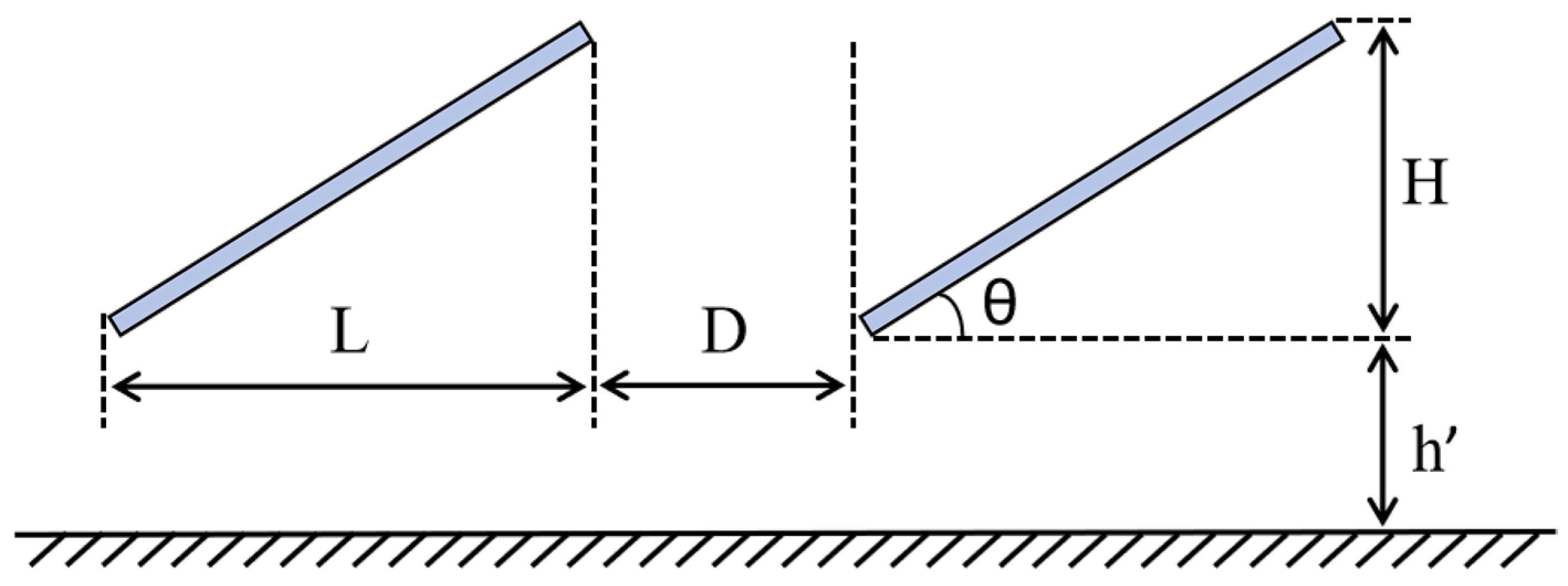
Peng, H. compared the velocity differences and vertical velocity profile characteristics between a simplified PV module model and a model incorporating support structures. The results demonstrated that the simplified model exhibits behavioral characteristics closely matching those of the physical model [28]. Therefore, this study employs the simplified model for the PV modules. As shown in Figure 1, the PV module has a projected length L and a projected height H, with a ground clearance height of h’ = 50 cm. The distance between the leading edge of one PV row and the trailing edge of the preceding row is D. This study investigates the influence of the spacing D on the wind field, with D set to values of 0, 0.5 L, L, 1.5 L, and 2 L. The dimensions of the photovoltaic panel are 16,160 mm × 3160 mm × 40 mm, and the incoming flow direction is along the x-axis.
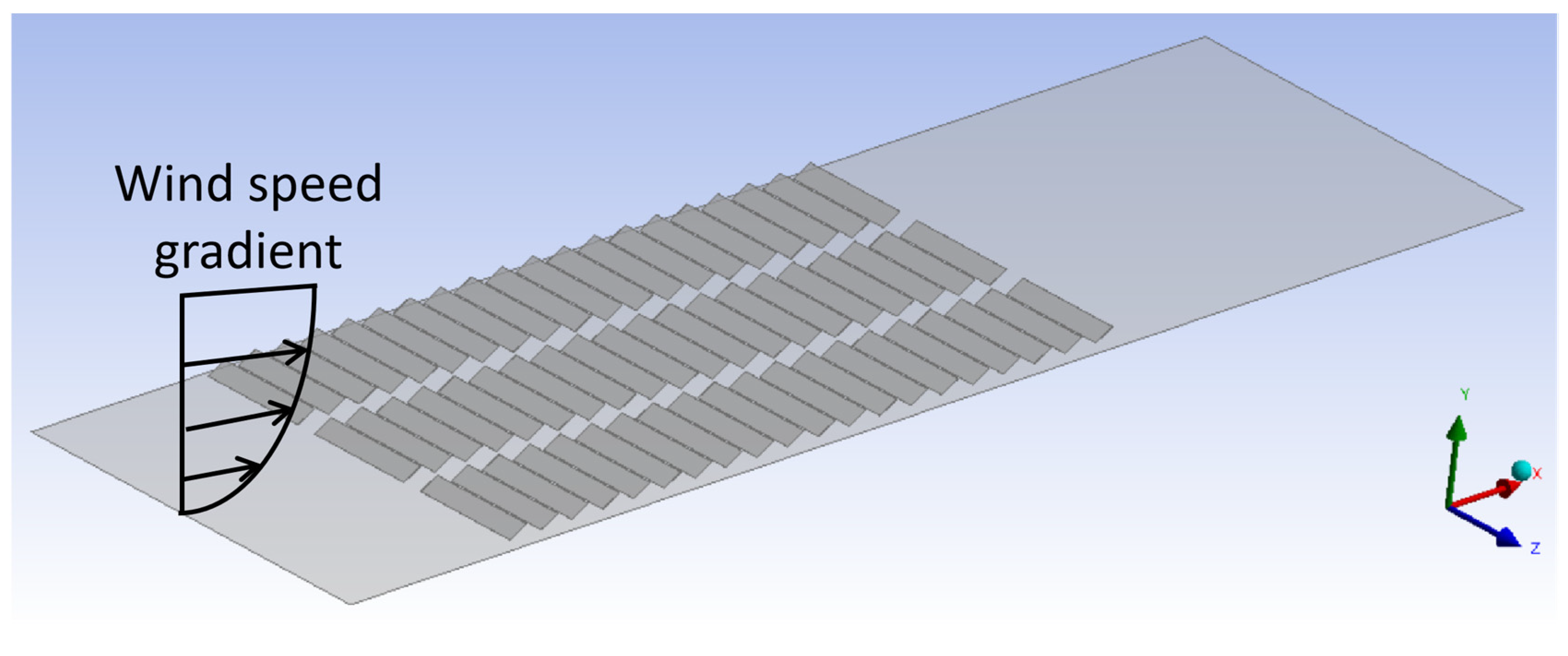
To ensure the accuracy of the computational results and minimize the interference of boundary effects on the core flow region, the dimensions of the computational domain were carefully designed. The height of the domain was set to 11 H. This vertical space allows for the full development of the incoming wind above the PV array and the formation of complex vortex structures, ensuring physical authenticity of the flow. This dimension establishes an adequate buffer zone between the top boundary and the maximum acceleration region above the array, effectively preventing non-physical reflections of the pressure and velocity fields near the array from the top boundary. Consequently, it guarantees the accuracy of simulating the flow field structure in the target region. A schematic diagram of the PV array design is shown in Figure 2.
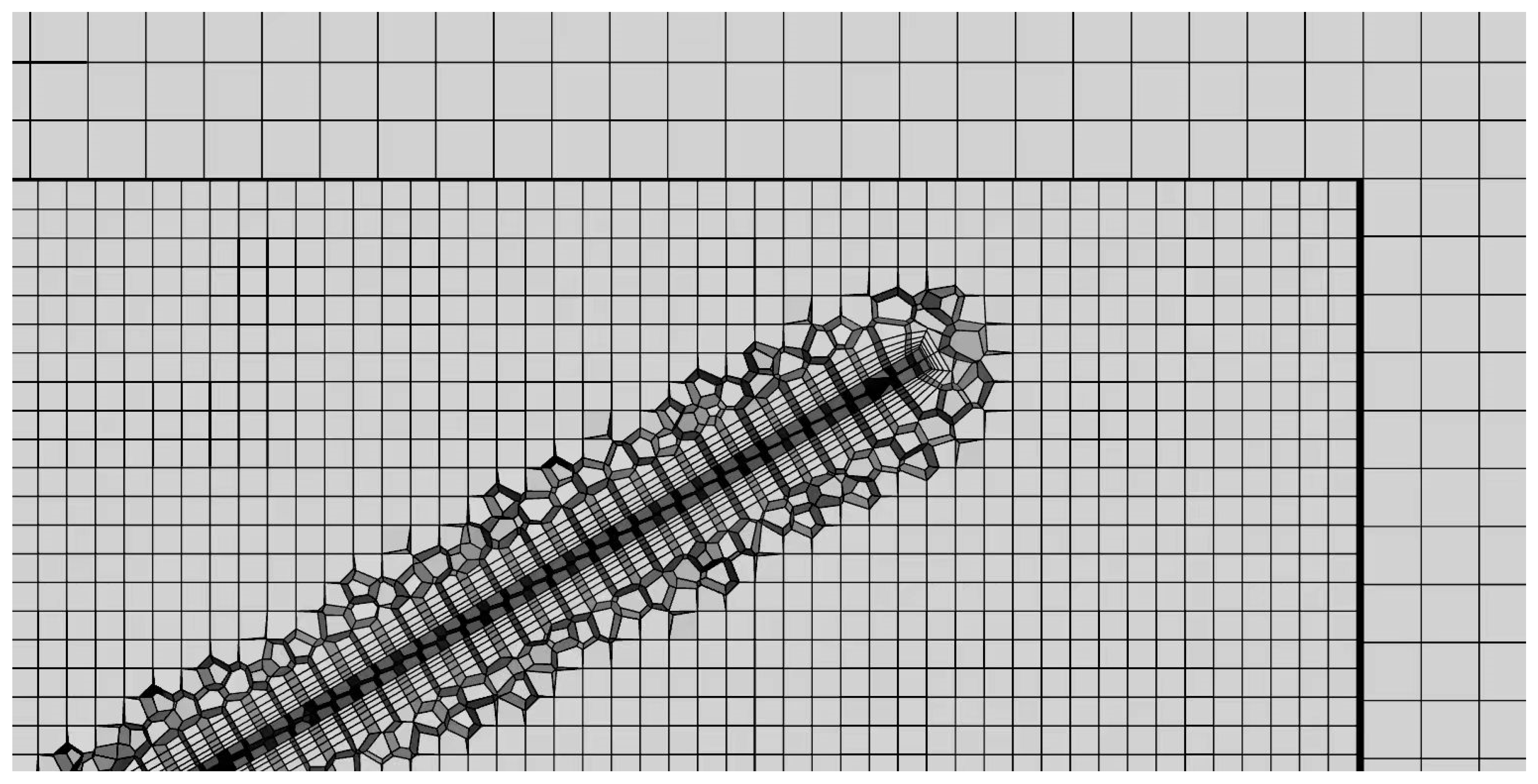
To perform numerical simulations, preprocessing work was first carried out. Mesh generation was accomplished using the Fluent Meshing component. Mesh density has a significant impact on computational accuracy: an overly coarse mesh may lead to distorted results, while an excessively dense mesh would substantially increase computational cost. The box refinement method in Fluent Meshing enables efficient local mesh refinement by defining rectangular regions. This technique strategically increases grid resolution in critical areas such as shear layers and wake regions, thereby ensuring computational accuracy while effectively controlling overall computational cost. The box method was selected over other strategies, such as global uniform refinement or solution-adaptive mesh refinement, for its direct control and efficiency in this specific study. Global refinement, while simple, would waste computational resources on regions of less interest. Solution-adaptive refinement, though powerful, requires prior simulation results to guide refinement and introduces additional computational cycles. In contrast, the box method allows for precise, a priori refinement in known critical zones—specifically around the PV modules where complex shear and wake interactions govern the aerodynamic parameters of interest. This proactive approach ensures the necessary resolution is present from the first iteration, providing a reliable and computationally efficient framework for the parametric study of spacing effects. To focus on the research priorities, the BOX local refinement method was employed to densify the fluid domain near the PV modules, while appropriately increasing the mesh size in the inlet and outlet regions to improve computational efficiency. As shown in Figure 3, the mesh around the photovoltaic panel is presented.
This study utilizes Poly-Hexcore mesh to discretize the computational domain. This meshing strategy achieves a good balance between computational accuracy, convergence, and efficiency. Poly-Hexcore is a hybrid mesh technique that generates polyhedral control volumes in the near-wall boundary layer regions and transitions to hexahedral control volumes in the core flow region [29]. Polyhedral control volumes, with their greater number of adjacent control volumes, facilitate more accurate capture of gradients, particularly in areas of high velocity gradients and turbulent dissipation near PV module surfaces, providing more reliable flow predictions. Simultaneously, polyhedral meshes enable a smooth transition from complex boundaries to the internal core region. The hexahedral control volumes in the core region exhibit low numerical dissipation and high computational efficiency, making them suitable for the main flow areas away from the components. This hybrid strategy effectively reduces the total cell count while maintaining accuracy in critical regions, improving convergence, and thus offering both efficiency and reliability for high-Reynolds-number, multi-condition wind field simulations.
To reduce computational resource requirements and avoid full-scale simulation of the entire photovoltaic power plant, this study employs periodic boundary conditions to reduce the model scale. The inlet is defined as a velocity inlet boundary, while the outlet is set as a fully developed outflow boundary. Additionally, 5 and 8 layers in the near-wall mesh were configured near the PV panel surfaces and the ground, respectively, to capture near-wall flow characteristics. All wall surfaces adopt the no-slip wall condition.
To balance accuracy and stability, a second-order upwind scheme is adopted for spatial discretization to improve the resolution of convective terms, while the PISO algorithm is used for pressure-velocity coupling due to its suitability for transient flow calculations. The wall boundary condition is set as no-slip to realistically simulate the near-ground wind velocity profile, and the outlet boundary is defined as a fully developed outflow to allow the flow to exit smoothly. All simulations are performed in transient form to capture the unsteady flow features induced by variations in array spacing. All other parameters/settings were maintained at their default values. To ensure the stability and computational efficiency of the transient simulation, a phased time-step strategy was adopted in this study. Initially, a smaller time step of Δt = 0.01 s was applied for the first 10 steps to facilitate a smooth transition of the initial flow field and allow it to rapidly approach a stable developing state. Subsequently, the time step was increased to Δt = 0.025 s for the next 4990 steps, enabling efficient advancement of the flow toward full development while maintaining satisfactory accuracy. Throughout the iteration process, all residual convergence criteria were set to 0.001, ensuring the reliability and numerical stability of the simulation results.

2.3. Model Validation

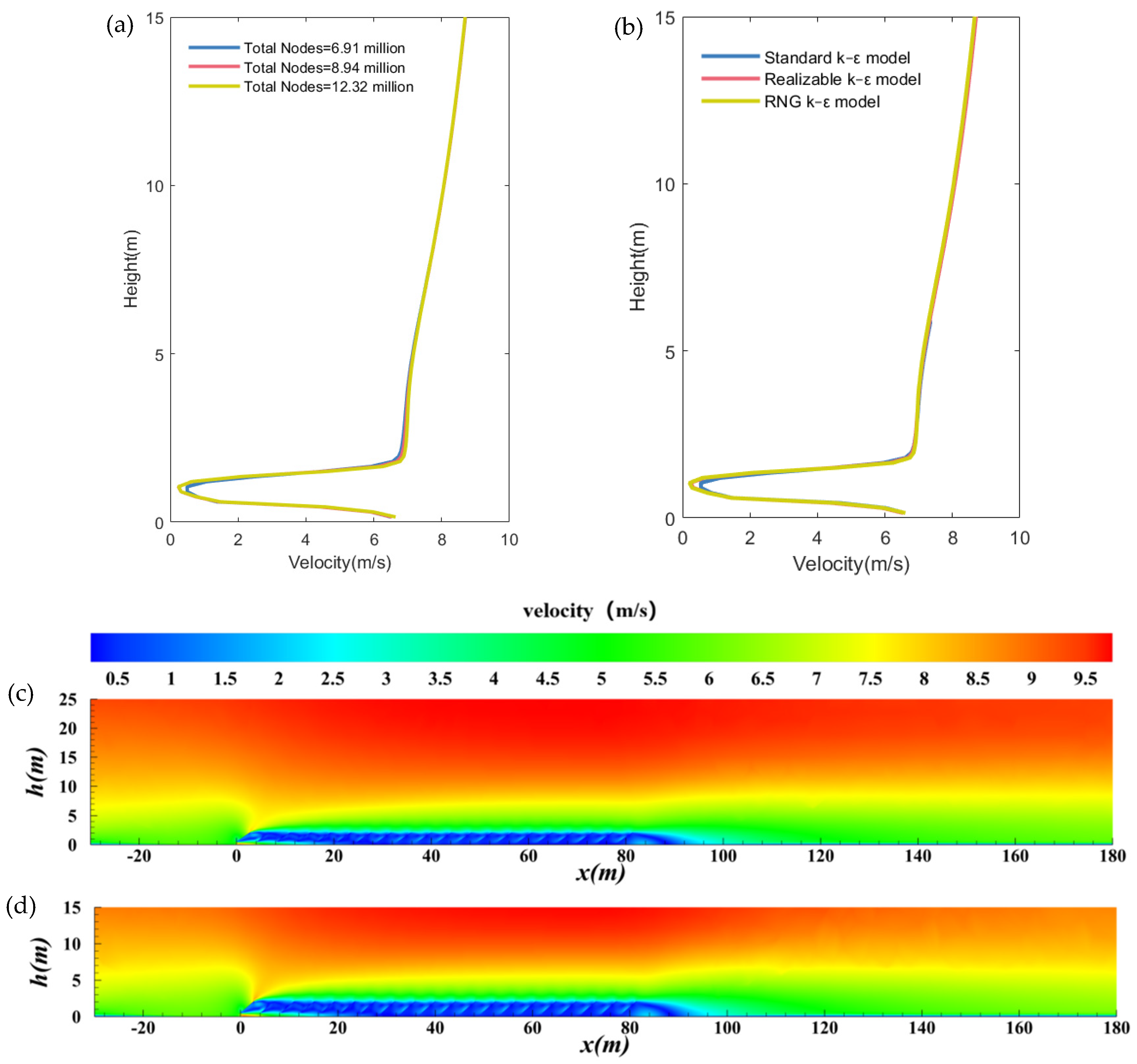
To eliminate the influence of grid cell count on the simulation results, a grid independence study was conducted. Based on the same generation strategy, three sets of grids with similar overall layouts but different total control volumes counts were created: a coarse grid (approximately 6.91 million control volumes), a medium grid (approximately 8.94 million control volumes), and a fine grid (approximately 12.32 million control volumes). As shown in Figure 4a, the comparison of wind speed profiles at the same monitoring location demonstrates that the variation in key physical parameters between the medium and fine grids is less than 3.24%. The sampling point was located 1 mm upstream of the second-row photovoltaic panel. Considering the optimal balance between accuracy and computational cost offered by the medium grid, it was ultimately selected for all subsequent simulations.
Based on the comparison of wind speed profiles from the three k-ε turbulence models in Figure 4b, the Realizable k-ε model was selected for subsequent simulations in this study. The predictions of this model are generally more robust, with reasonable wind profile trends. It avoids the potential systematic overestimation observed in the Standard model, while also yielding smoother results than the RNG model, without significant local fluctuations. This indicates that under the complex external flow conditions involved in this study, the Realizable k-ε model achieves a better balance between computational stability and physical plausibility.
The primary focus is on the parameters of the roughness sublayer, since inner-layer quantities such as roughness length and friction velocity are inherently related to surface roughness. In contrast, the characteristics of the outer-layer flow are closely linked to the height of the computational domain. Altering the domain height can affect the simulation results of the outer flow. According to the study by Gao, X. [10], a computational domain height of 7 H was used for calculating inner-layer parameters. Liu, H. et al. [14] employed a domain height of 4H in their computations. Similarly, Zhang, K. et al. [22] and Hu, S. et al. [11] adopted a computational domain height of 9 H in their respective studies.
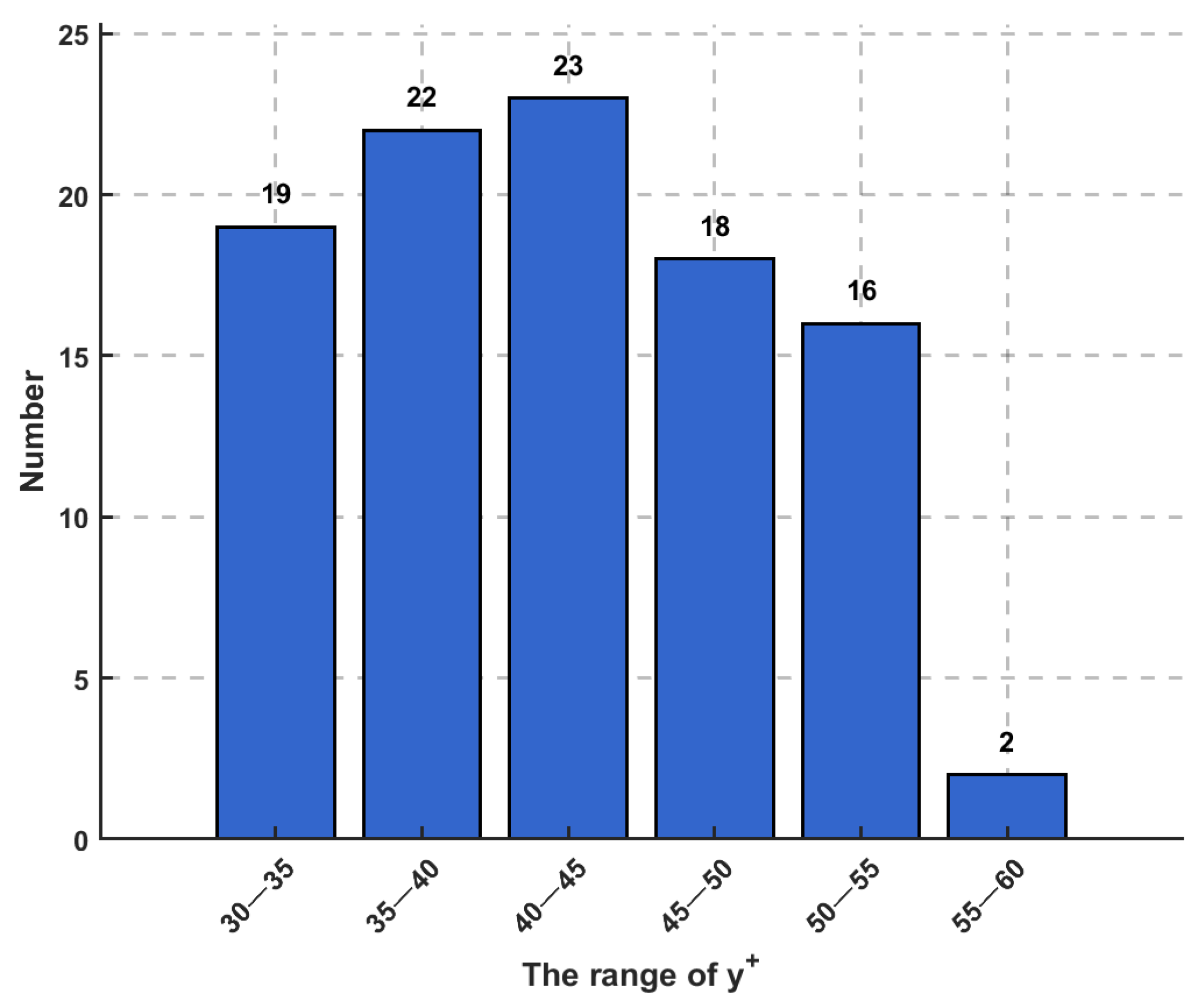
To ensure the compatibility between the adopted Realizable k–ε turbulence model and the wall functions, the near-wall y+ values in the simulations were verified. The ideal applicable range for y+ in the Realizable k–ε model is 30 to 300. A y+ value ranging from thirty to two hundred is acceptable for the realizable k-epsilon turbulence model. This model relies on wall functions to simulate near-wall flow, and this specific range corresponds to the logarithmic law layer where the empirical formulas of the wall functions are most effective. If the y+ value is too low, for instance less than one, the grid falls into the viscous sublayer which the model cannot resolve, leading to inaccurate computational results. Conversely, if the y+ value is too high, significantly exceeding two hundred, it indicates an excessively coarse grid that severely underestimates wall shear stress, thereby distorting predictions of the entire flow field and deposition phenomena. Computational results demonstrate that under all simulated conditions, the y+ values on both the PV module surfaces fall within the range of 30 to 50. This fully complies with the y+ requirements of the selected turbulence model and wall functions, ensuring accurate resolution of the near-wall flow and shear stress, thereby guaranteeing the reliability of the core flow field results. As shown in Figure 5, it is the y+ value distribution diagram. The validation of y+ primarily focuses on the surface of the PV panels.

3. Simulation Results and Analysis

3.1. Wind Field Analysis

This study reveals the spatial evolution of the flow field within the PV array by extracting wind speed distributions on vertical cross-sections and horizontal planes.
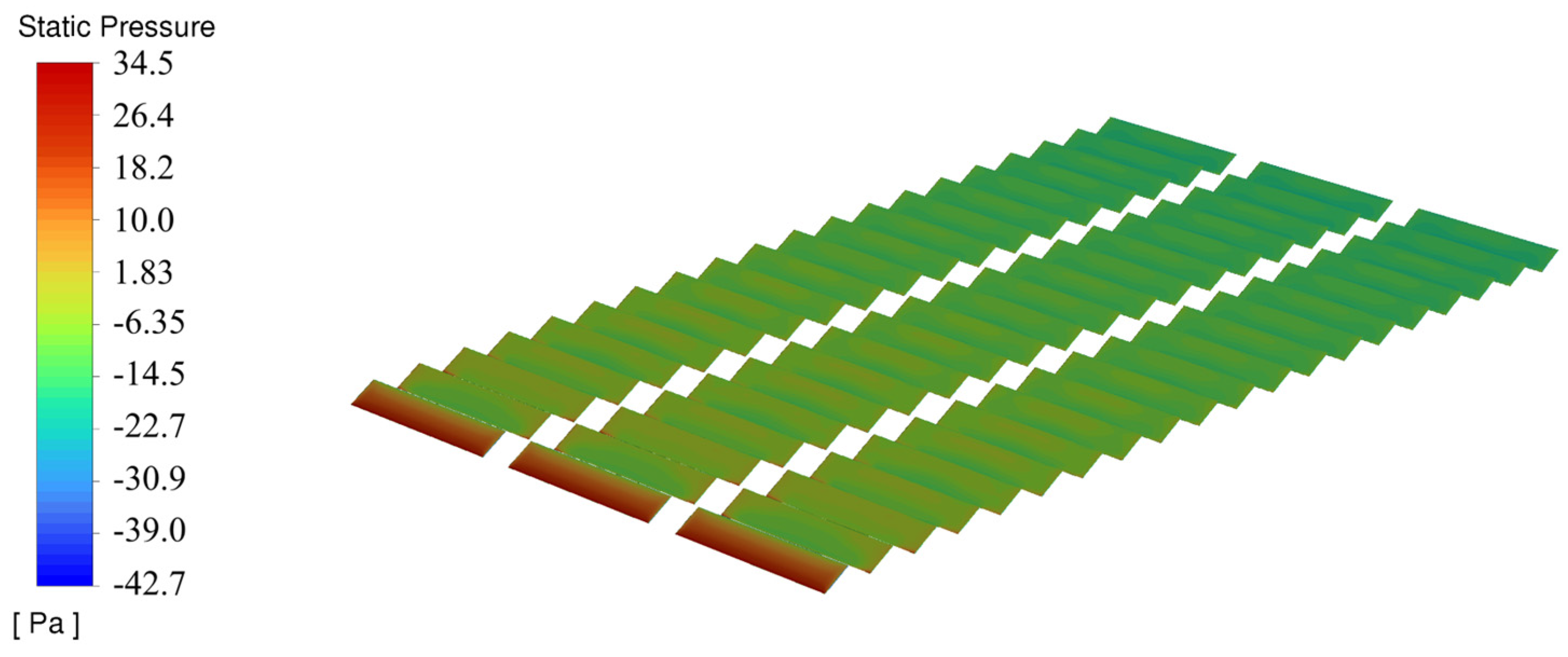
As shown in Figure 6, the wind pressure acting on each row of PV panels in the array exhibits a clear decreasing trend along the flow direction. The first row of panels, being directly exposed to the incoming wind, experiences the highest wind pressure. As the airflow develops downstream, the wind pressure on the second and subsequent rows decreases progressively and gradually stabilizes.
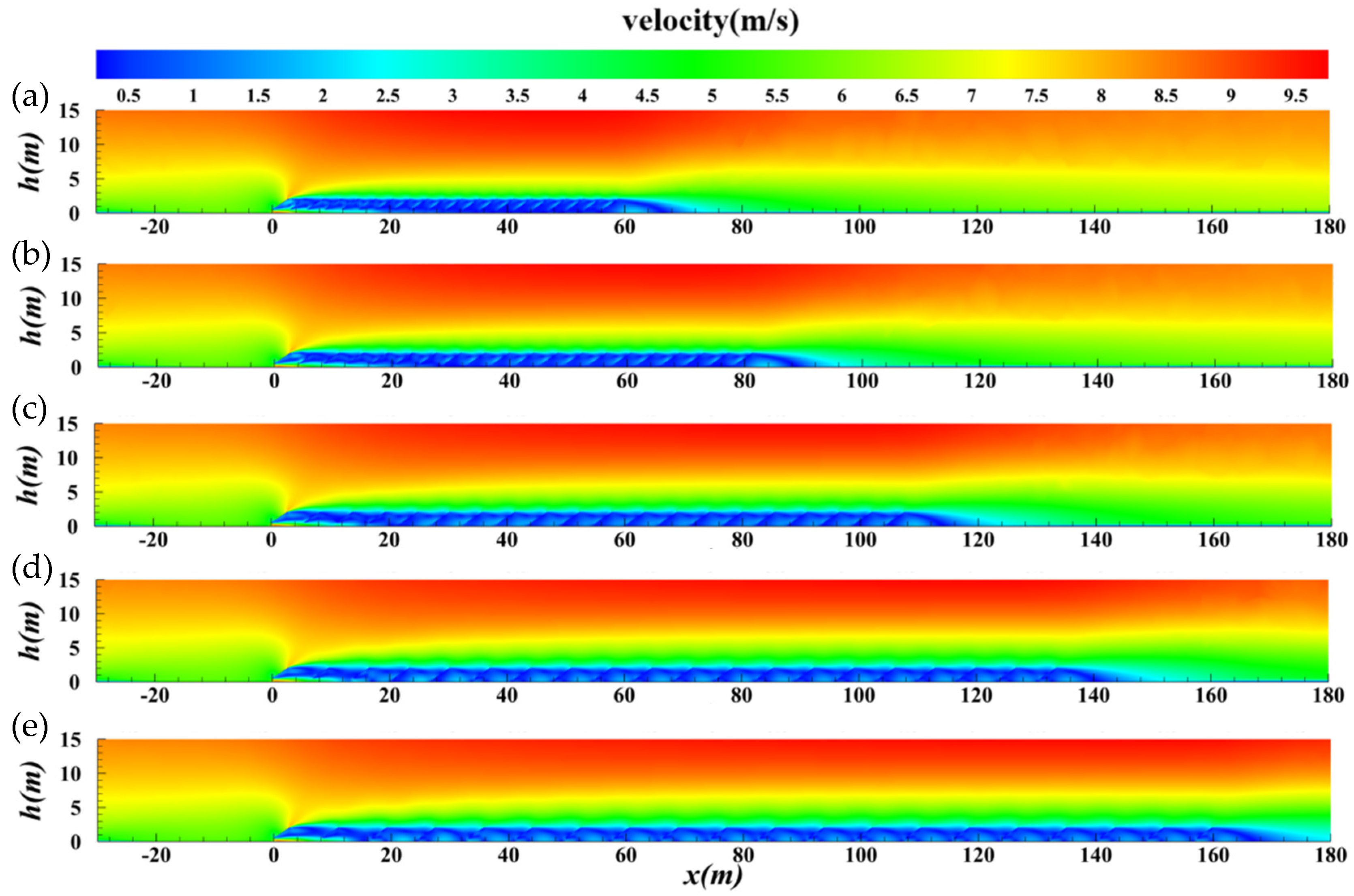
On the vertical cross-section, the PV array demonstrates significant blocking and lifting effects on the near-ground airflow. As shown in Figure 7, the airflow separates distinctly at the leading edge of the first PV panel, forming typical corner vortex structures and creating a low-speed recirculation zone behind the panel. This separation is primarily due to the abrupt pressure gradient induced by the geometric obstruction, which leads to flow detachment and subsequent vortex shedding. The recirculation zone acts as a region of reduced kinetic energy, where dust particles are more likely to deposit due to decreased aerodynamic transport capacity. This characteristic aligns with findings reported by Debnath, K. et al. [30], who observed similar separation phenomena in floating photovoltaic systems. As the airflow develops downstream, stable periodic vortex structures gradually form between the second and subsequent rows of PV panels. These coherent vortices enhance momentum mixing and contribute to the self-sustaining turbulence within the array, promoting a more predictable flow regime.
As the row number increases, the wind speed distribution between the PV panels gradually becomes more consistent, indicating that the wind field progressively reaches a dynamic equilibrium within the array. This equilibrium is characterized by a balance between turbulence production from shear layers and dissipation in the wake regions. Furthermore, with increasing row spacing, the stabilization process of the wind field accelerates, manifested by an earlier emergence of a homogenized velocity distribution and reduced fluctuations in turbulence intensity. The increased spacing allows for more complete flow reattachment and recovery between rows, which dampens large-scale turbulent fluctuations and promotes a smoother transition to a fully developed internal boundary layer. This behavior underscores the critical role of array geometry in modulating near-surface aerodynamic stability, which in turn influences dust deposition patterns and convective cooling efficiency of the PV modules.
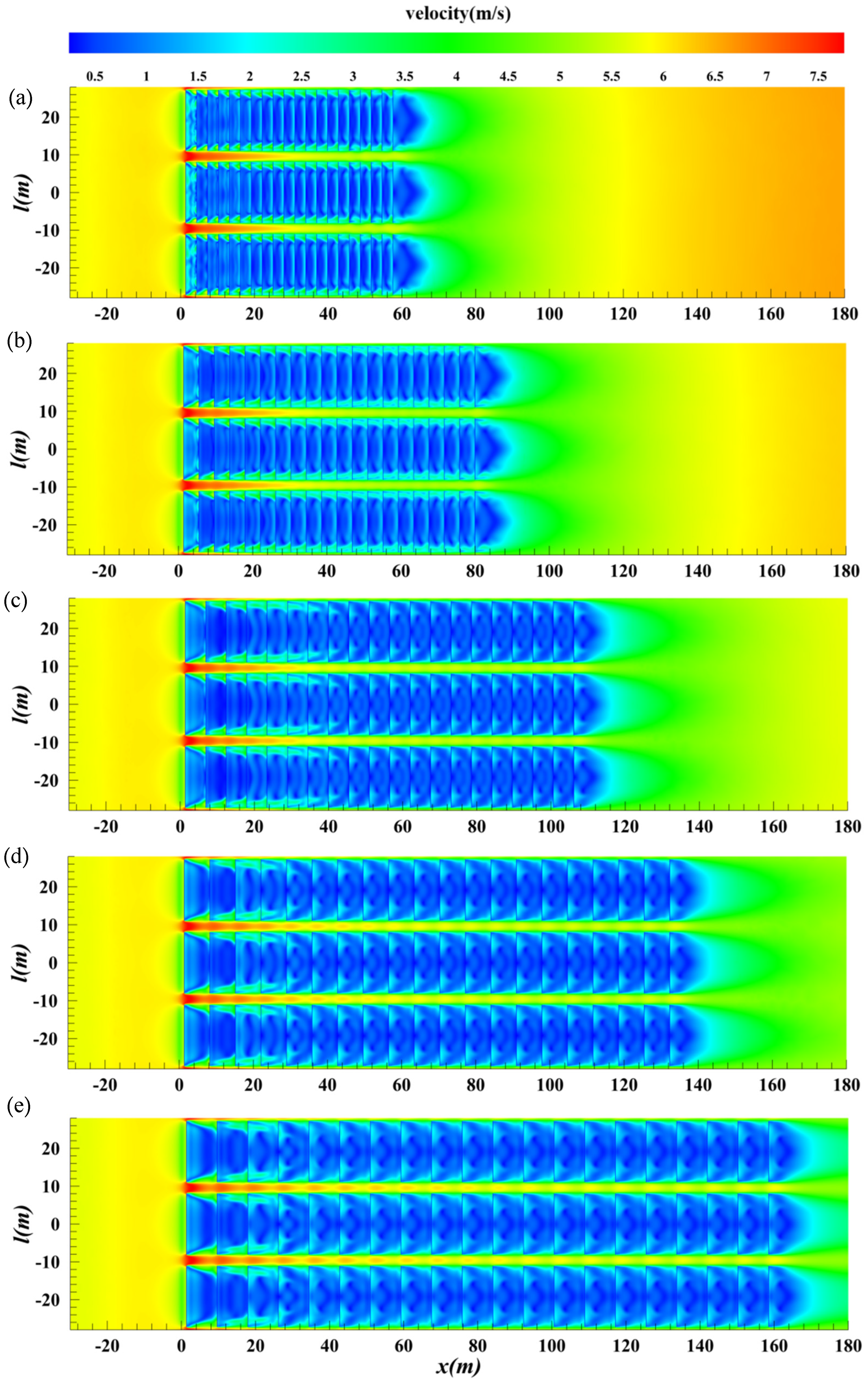
On the horizontal plane, the disturbance of the airflow by the PV array exhibits significant spatial heterogeneity. As shown in Figure 8, high-speed zones appear on the windward side of the first-row panels, while distinct low-speed shadow zones form on the leeward side. This acceleration on the windward side results from flow constriction and deflection over the panel surface, which enhances convective cooling but may also increase wind-induced structural loads. Conversely, the leeward low-speed zones are characterized by flow separation and wake formation, where reduced air velocities can lead to localized heat accumulation and higher susceptibility to dust deposition. As the airflow propagates downstream, the velocity differences between successive rows gradually diminish, and the wind field tends to become more uniform. This homogenization reflects the progressive adaptation of the flow to the periodic array geometry and the damping of large-scale turbulent fluctuations through momentum redistribution. Notably, the row spacing significantly influences the wind field stability. Larger row spacings facilitate faster flow recovery, resulting in a more consistent velocity distribution between the downstream panels. This accelerated stabilization is attributed to the increased distance available for flow reattachment and turbulence decay, which reduces interference between adjacent rows. These findings are consistent with those reported in [31], confirming that optimized spacing can effectively modulate near-surface flow uniformity and enhance the overall aerodynamic performance of PV arrays.
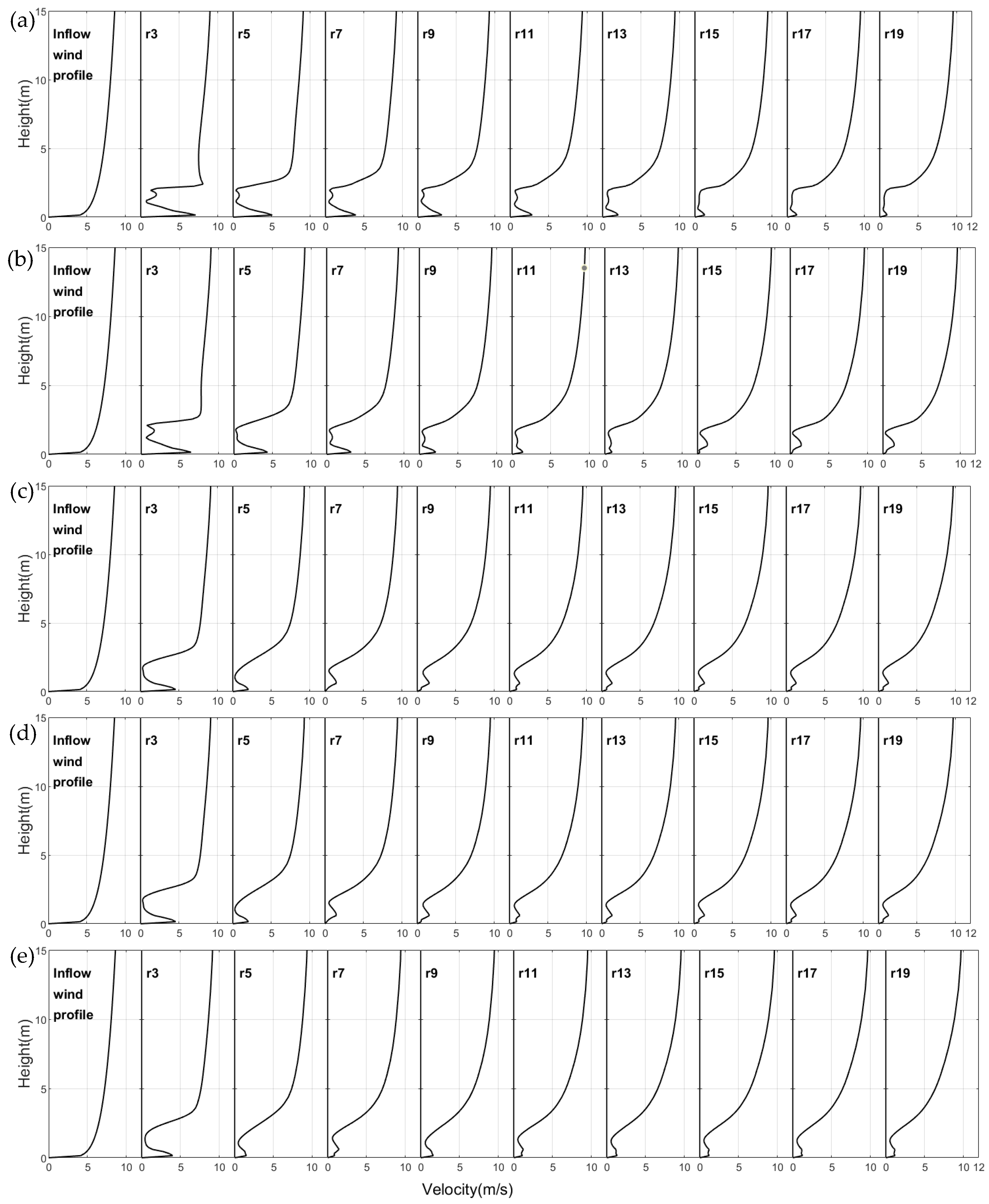
As shown in Figure 9, the wind profiles upstream of the PV module are presented. Analysis of the evolution characteristics of wind profiles upstream and downstream of the PV array reveals that the flow field structure develops systematically with increasing row number. In the frontal region of the array, the wind speed profiles within the 0–4 m height range exhibit significant variations in velocity gradient. The sudden blockage effect of the initial rows on the incoming flow triggers strong flow separation, creating a notable pressure difference ahead of and behind the modules. This adverse pressure gradient promotes the formation of shear layers and enhances turbulent kinetic energy production near the surface. Simultaneously, vortices shed from the trailing edges of the modules interact with the subsequent incoming flow, generating complex turbulent structures in the near-ground region. This flow instability is directly reflected in the pronounced vertical variations in the wind speed profiles, indicating a highly disturbed and momentum-deficient layer close to the ground.
As the flow develops downstream, the wind profiles gradually stabilize. This transition indicates that the flow structure within the array undergoes significant adjustment: the turbulent energy generated upstream gradually reaches a balance between production and dissipation during its downstream transport; the continuous influence of multiple module rows promotes more thorough flow mixing, causing the distinct shear layers observed in the frontal array to evolve into a more uniform vertical distribution. The gradual smoothing of the wind profile signifies the establishment of an internal equilibrium, where the array-induced turbulence integrates into a coherent boundary layer. Particularly in the rear section of the array, the wind profile morphology remains essentially stable, marking the establishment of a self-sustaining equilibrium within the PV array flow and the development of a stable internal boundary layer structure. This fully developed region exhibits a log-like velocity distribution, which can be described by classical boundary layer theory with modified aerodynamic parameters, thereby providing a predictable flow environment for subsequent rows and supporting consistent operational performance across the array.

3.2. Fitting the Friction Velocity

For the neutral atmospheric surface layer, the mean wind speed profile with height satisfies the following logarithmic law:
u ( z ) = u * κ l n ( z d z 0 )
where u ( z ) is the mean wind speed at height z; z is the height above the ground; u * is the friction velocity; κ is the von Kármán constant; z 0 is the aerodynamic roughness length; d is the zero-plane displacement.
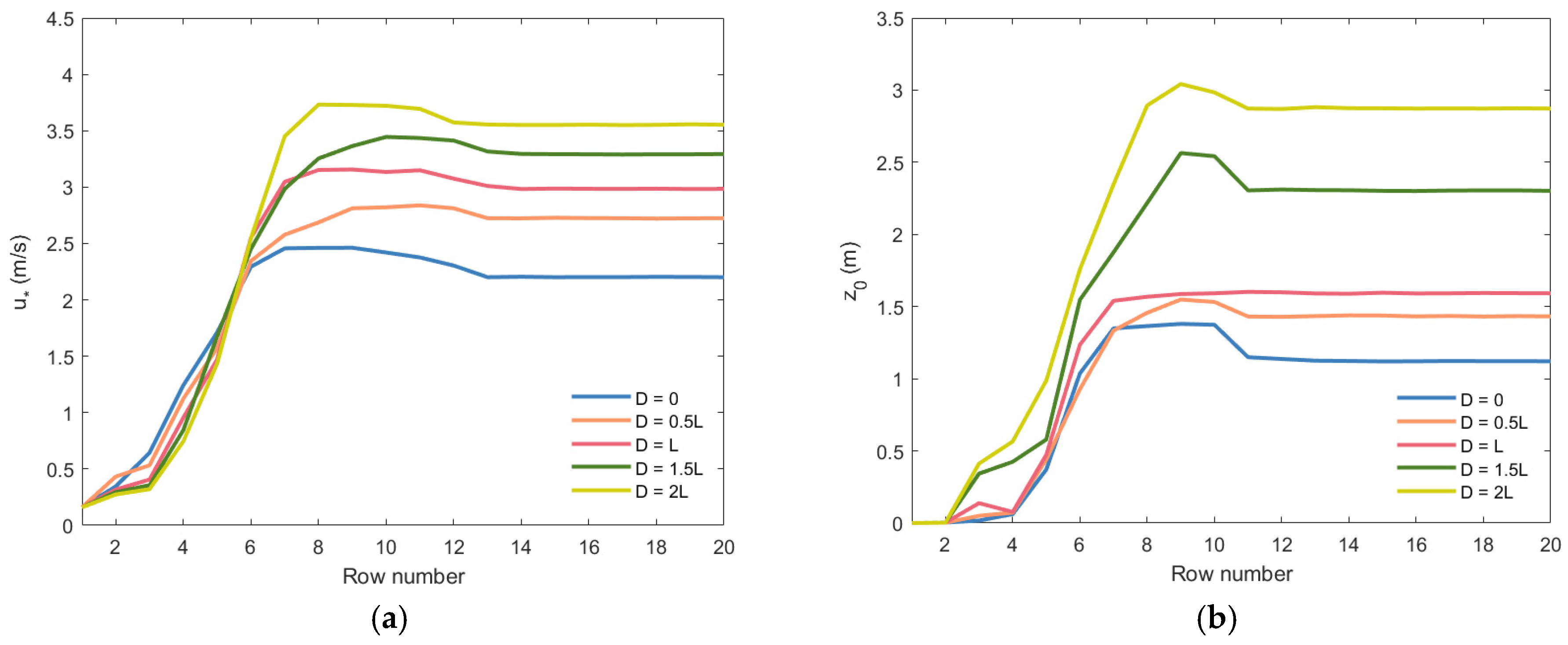
In this study, the values of u * and z 0 between each row of the photovoltaic array were fitted, as shown in Figure 10. Both the roughness length and the friction velocity exhibit similar trends. As the row number increases, both parameters initially rise rapidly, reach a peak, then gradually decrease slowly, and eventually stabilize. This trend likely stems from the dynamic process of flow development. In the first few rows of the PV array, pronounced flow separation and reattachment phenomena lead to enhanced turbulence intensity, causing the rapid increase in both roughness length and friction velocity. As the row number increases, the flow gradually adapts to the array structure, and the turbulent boundary layer tends towards full development, resulting in a slow decrease in the parameter values. Once the flow field undergoes a full development process and reaches a stabilized regime, key aerodynamic parameters—such as the mean velocity distribution, turbulence intensity, and pressure coefficients around the photovoltaic modules—cease to exhibit significant temporal or spatial variations downstream. This indicates the establishment of a dynamically equilibrium and spatially uniform flow state in the wake region behind the array, where the influence of initial installation configurations and upstream disturbances has been effectively smoothed out. The obtained stabilized values align closely with the experimental and numerical results documented in reference [18], thereby validating the reliability of the present simulation setup and the general flow characteristics under similar geometric and boundary conditions.
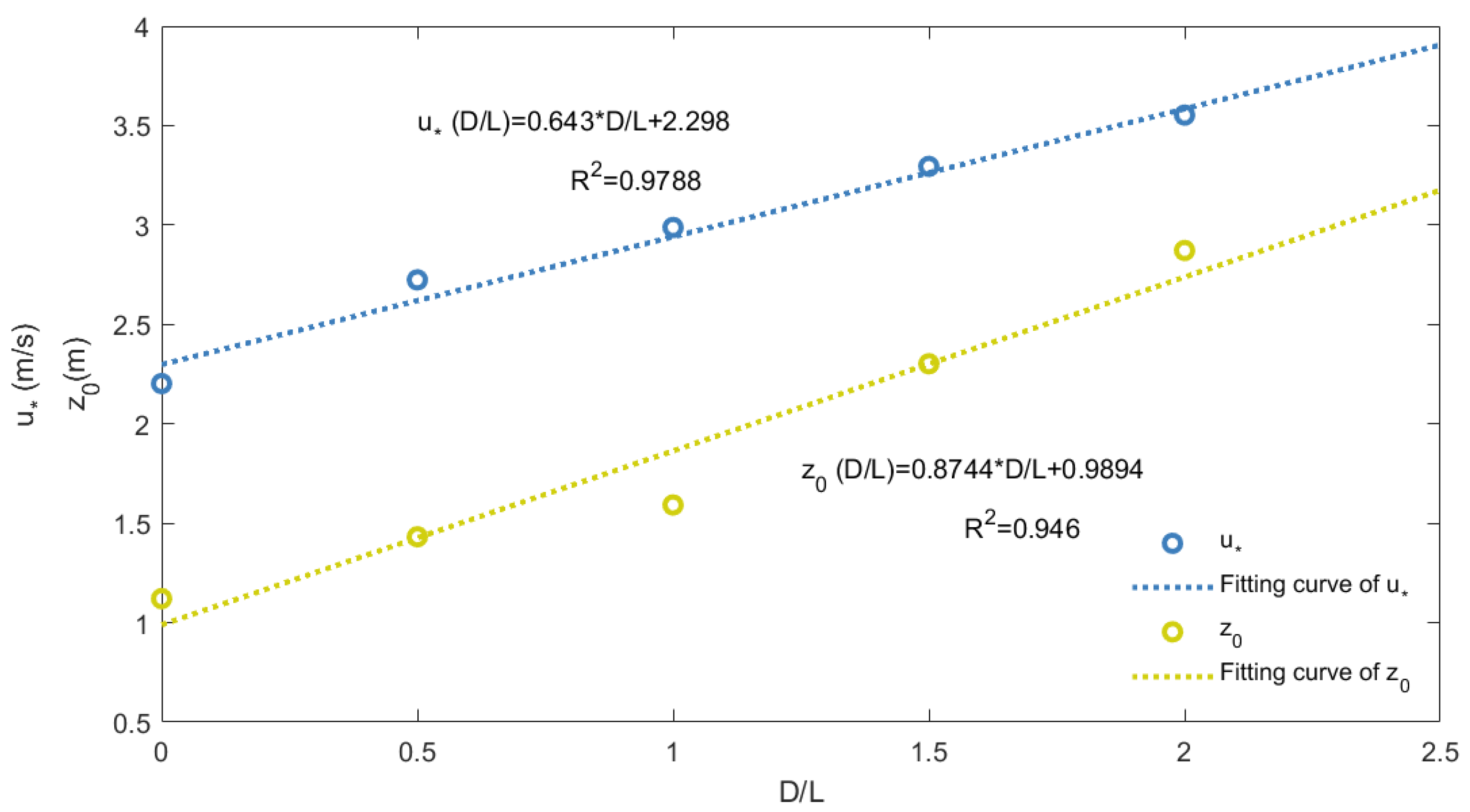
Based on the simulation results, Figure 11 presents the stabilized values of friction velocity ( u * ) and aerodynamic roughness length ( z 0 ) under different normalized spacings (D/L), along with their fitted curves. The results indicate that both u * and z 0 exhibit a linear increasing trend with the growth of D/L. The fitted empirical formulas are as follows:
u * D L = 0.643 D L + 2.298
z 0 D L = 0.8744 D L + 0.9894
This phenomenon can be explained by the disturbance mechanism of PV arrays on the airflow structure. Analysis of the simulated wind field reveals that as the row spacing increases, the airflow recovery capability within the array is enhanced, resulting in a more uniform wind speed distribution on horizontal cross-sections and reduced intensity of flow separation and recirculation in the vertical direction. However, the expanded spacing simultaneously prolongs the interaction path between the airflow and the PV panel surfaces, improving momentum exchange efficiency. Under larger spacing conditions, although the airflow reaches a stable state more rapidly, the overall blocking effect of the array on the airflow becomes more significant, leading to increased surface shear stress, which manifests as a rise in u * . Concurrently, the geometric layout of the PV array directly affects the density of roughness control volumes on the surface. Increased spacing expands the disturbance range of the array on the airflow, enhancing turbulence intensity in the near-ground region, thereby elevating the value of z 0 .
Furthermore, the linear relationship of the fitted formulas indicates a clear correlation between the layout parameters of the PV array (such as D/L) and its aerodynamic characteristics, providing a key parameterization basis for wind field simulations of PV power plants. In practical applications, although a larger D/L facilitates airflow recovery and optimizes power generation efficiency, it also increases surface frictional drag, which may influence the wind load design of the array structure and the regulation of the local microclimate. Therefore, in the planning of PV power plants in desert regions, it is necessary to balance the multiple effects of spacing on flow characteristics and engineering safety.
Furthermore, from the perspective of energy transport in the atmospheric boundary layer, the increase in friction velocity implies an enhancement of surface momentum flux. As the array spacing expands, the scale and intensity of the periodic vortex structures formed between PV panels increase, which intensifies the turbulent mixing efficiency in the near-ground region. Enhanced turbulent mixing not only improves vertical momentum exchange but may also affect the transport processes of heat and water vapor. This mechanism is particularly significant in desert regions: a higher friction velocity can enhance the initiation and transport of surface dust particles, potentially exacerbating dust accumulation on module surfaces; simultaneously, an increased roughness length may alter the surface radiation balance, affecting local thermal circulation. The parameterization relationship established in this study directly links the geometric layout of the PV array to surface fluxes, providing essential input parameters and a theoretical foundation for subsequent research on the impact of PV power plants on regional dust cycles and energy balance.
The core physical significance of the discovered pattern lies in revealing the complete dynamic process through which the turbulent boundary layer inside a photovoltaic array evolves from an externally imposed disturbance to a state of self-sustaining internal equilibrium. The initial peak response essentially reflects the instantaneous disruption of the original equilibrium state of the incoming flow when it suddenly encounters the rigid geometric obstacle, i.e., the first row of PV panels. At this stage, intense shear and separated flows dominate the redistribution of energy and momentum. The subsequent decay and stabilization signify the establishment of a new internal equilibrium state governed by the geometric periodicity of the array. In this state, turbulence generation is no longer primarily determined by the impact of the incoming flow on individual obstacles but is instead dominated by the interaction between the established periodic vortex shedding within the array and the inter-row shear layers. Therefore, the stabilized values do not simply reflect the physical properties of the surface; rather, they characterize the ultimate efficiency of momentum exchange between the specific array layout (D/L), acting as an integrated aerodynamic entity, and the atmospheric boundary layer.
This understanding provides a new dimension for optimizing the design of PV power plants that goes beyond mere flow field uniformity. First, it emphasizes that the existence of an aerodynamically fully developed zone is not only related to the statistical steady state of the flow but also implies that the probability distribution characteristics of the wind loads borne by components within this zone, as well as the soiling deposition and thermal environments they face, converge and become predictable. This provides a theoretical basis for power plant reliability design, such as structural fatigue analysis, and for differentiated operational strategies, such as optimizing cleaning schedules for front and rear rows. Second, the positive linear correlation between the stabilized values and the spacing (D/L) quantitatively reveals how the array layout regulates the efficiency of surface momentum absorption. Increasing the spacing is macroscopically equivalent to reducing the effective density of the array, yet microscopically, it prolongs the effective path of interaction between the airflow and the ground/panel surfaces, thereby enhancing the overall drag effect. This presents a critical trade-off for the design of desert PV power plants. On one hand, a larger spacing may be beneficial for improving module cooling through enhanced turbulent mixing and may accelerate the lateral diffusion of pollutants. On the other hand, it inevitably leads to a higher stabilized friction velocity, which directly increases the wind load acting on the supporting structures and may exacerbate the potential for sand erosion and dust transport in the downwind region, creating complex impacts on the array itself and the surrounding ecological environment. Consequently, when planning array spacing in desert regions, it must be considered as a systematic aerodynamic parameter that couples structural safety, power generation efficiency, cooling requirements, and environmental impact, rather than merely a geometric decision based on land use efficiency or shadow occlusion. The parameterized formulas established in this study provide crucial quantitative inputs for seeking the optimal spacing under multi-objective constraints.

4. Conclusions

This study systematically investigated the influence of row spacing on the aerodynamic parameters of desert photovoltaic arrays through numerical simulations based on the Realizable k-ε turbulence model. The results demonstrate that the layout of PV arrays significantly alters the near-surface wind field structure, thereby affecting key aerodynamic parameters—friction velocity and aerodynamic roughness length. As the airflow develops through the array, both parameters exhibit a consistent trend: an initial increase followed by a gradual decrease and eventual stabilization with increasing row number. This dynamic evolution is attributed to the progressive adaptation of the flow to the periodic array geometry, transitioning from strong separation and recirculation in the front rows to a fully developed, equilibrated internal boundary layer downstream.
Furthermore, the stabilized values of u * and z0 show a clear positive linear correlation with the normalized spacing (D/L). The fitted empirical formulas quantitatively describe this relationship, revealing that increased spacing enhances momentum exchange between the airflow and the ground surface, leading to higher surface shear stress and greater aerodynamic roughness. This highlights the direct role of array geometry in modulating surface fluxes and turbulent mixing efficiency within the atmospheric boundary layer.
The findings of this research provide an important theoretical basis for the optimal design of PV plants in desert environments. The established parameterization relationships can be integrated into larger-scale meteorological or dust-transport models to improve the accuracy of environmental impact assessments and energy yield predictions. In practical applications, while larger spacing may promote airflow recovery and potentially reduce mutual shading or cooling interference, it also increases surface drag and may influence local dust suspension and deposition patterns. Therefore, a balanced consideration of spacing is essential to harmonize energy efficiency, structural wind loads, and long-term operational reliability in dust-prone regions.
Future work could extend this study by considering the effects of non-neutral atmospheric stratification, varying wind directions, and the coupling of aerodynamic outcomes with actual dust deposition and thermal performance measurements. Such integrated approaches would further refine layout guidelines and enhance the sustainability and efficiency of large-scale photovoltaic power generation in arid and semi-arid areas.

Author Contributions

Conceptualization, X.D. and Z.L.; methodology, X.D. and Z.L.; validation, X.D., Z.L. and X.W.; formal analysis, X.D., Z.L. and X.W.; investigation, X.D. and X.W.; resources, Z.L.; data curation, X.D.; writing—original draft preparation, X.D.; writing—review and editing, X.D., Z.L. and X.W.; visualization, X.D.; supervision, Z.L.; project administration, Z.L.; funding acquisition, Z.L. All authors have read and agreed to the published version of the manuscript.

Funding

This research was supported by the Key Research and Development Program of Gansu Province—Industrial Project under Grant No. 25YFGF002, the Natural Science Foundation of Gansu Province No. 24JRRA241, the Key Entrusted Projects of Gansu Provincial Social Science Planning No. 2024ZD002, College Students’ Innovative Entrepreneurial Training Plan Program No. DC2510732CX0333.

Data Availability Statement

The original contributions presented in this study are included in the article. Further inquiries can be directed to the corresponding author.

Conflicts of Interest

The authors declare no conflicts of interest.

Abbreviations

The following abbreviations are used in this manuscript:
PVPhotovoltaic
CFDComputational Fluid Dynamics
UDFUser-Defined Function
BIPVBuilding-Integrated Photovoltaics
SSTShear Stress Transport
ABLAtmospheric Boundary Layer

References

  1. Wan, L.; Zhao, L.; Xu, W.; Guo, F.; Jiang, X. Dust deposition on the photovoltaic panel: A comprehensive survey on mechanisms, effects, mathematical modeling, cleaning methods, and monitoring systems. Sol. Energy 2024, 268, 112300. [Google Scholar] [CrossRef]
  2. Li, X.; Zhang, X.; Zhang, F.; Liao, Q. Experimental Research on Sand Sediment Protection on Railway Tracks. Appl. Sci. 2022, 12, 12734. [Google Scholar] [CrossRef]
  3. Abd, H.S.; Judran, H.K.; Aun, S.H.A.; Jaddoa, A.A.; Hammoodi, K.A.; Kadhim, S.A.; Daif, J.M. Dust deposition and cleaning effect on PV panel: Experimental approach. Results Eng. 2025, 27, 106041. [Google Scholar] [CrossRef]
  4. Xu, L.; Li, S.; Jiang, J.; Liu, T.; Wu, H.; Wang, J.; Li, X. The influence of dust deposition on the temperature of soiling photovoltaic glass under lighting and windy conditions. Sol. Energy 2020, 199, 491–496. [Google Scholar] [CrossRef]
  5. Hu, W.; Li, X.; Wang, J.; Tian, Z.; Zhou, B.; Wu, J.; Li, R.; Li, W.; Ma, N.; Kang, J.; et al. Experimental research on the convective heat transfer coefficient of photovoltaic panel. Renew. Energy 2022, 185, 820e826. [Google Scholar] [CrossRef]
  6. Younis, A.; Cotfas, P.A.; Cotfas, D.T. Systematic indoor experimental practices for simulating and investigating dust deposition effects on photovoltaic surfaces: A review. Energy Strategy Rev. 2024, 51, 101310. [Google Scholar] [CrossRef]
  7. Mehdi, M.; Conceição, R.; Ammari, N.; Merrouni, A.A.; González-Aguilar, J.; Dahmani, M. Modeling, assessment and characterization of soiling on PV Technologies. Toward a Better understanding of the Relation between dust deposition and performance losses. Sustain. Energy Technol. Assess. 2024, 71, 104023. [Google Scholar] [CrossRef]
  8. Wang, J.; Wen, Y.; Zhang, F.; Jiang, M.; Li, X. Spatial heterogeneity of dust size distribution on photovoltaic arrays: A wind tunnel experimental study. Sol. Energy Mater. Sol. Cells 2026, 295, 113984. [Google Scholar] [CrossRef]
  9. Chen, L.; Fan, S.; Sun, S.; Cao, S.; Sun, T.; Liu, P.; Gao, H.; Zhang, Y.; Ding, W. A detection model for dust deposition on photovoltaic (PV) panels based on light transmittance estimation. Energy 2025, 322, 135284. [Google Scholar] [CrossRef]
  10. Li, X.; Niu, K. Effectively predict the solar radiation transmittance of dusty photovoltaic panels through Lambert-Beer law. Renew. Energy 2018, 123, 634–638. [Google Scholar] [CrossRef]
  11. Hu, S.; Liu, W.; Wen, H.; Liu, Z.; Huang, W. Numerical simulation of dust deposition on photovoltaic module surface based on multifactor fusion deposition mechanism. Sci. Total Environ. 2025, 959, 178327. [Google Scholar] [CrossRef] [PubMed]
  12. Gao, X.; Yang, Z.; James, S. Effects of wind barrier height and porosity on dust deposition and power generation efficiency of photovoltaic arrays. Sol. Energy 2025, 298, 113642. [Google Scholar] [CrossRef]
  13. Yan, X. Numerical investigation into the mechanism of dust deposition on photovoltaic panels in the presence of an electrostatic dust barrier. J. Wind Eng. Ind. Aerodyn. 2025, 261, 106071. [Google Scholar] [CrossRef]
  14. Li, X.; Liu, T.; Wang, J.; Xu, L.; Zhang, Z. Dust deposition can focus light at a limited distance on photovoltaic panels. J. Quant. Spectrosc. Radiat. Transf. 2020, 246, 106921. [Google Scholar] [CrossRef]
  15. Aldien, M.S.; Basem, A.; Abed, A.M.; Al-lehaibi, M.; AL-bonsrulah, H.A.Z.; Egami, R.H. Impact of confined nanofluid jets on the performance of solar Photovoltaic-thermal systems with dust deposition. Results Eng. 2025, 26, 105306. [Google Scholar] [CrossRef]
  16. Wang, J.; Li, X.; Hu, W.; Zhang, F. The impact of electric fields on the output of smart photovoltaic module. J. Electrost. 2025, 136, 104102. [Google Scholar] [CrossRef]
  17. Yi, Z.; Cui, L.; Liu, X.; Li, J.; Lu, L. Characteristics of airflow motion and distribution of dust microparticles deposition in the flow field of photovoltaic panels. Renew. Energy 2025, 245, 122811. [Google Scholar] [CrossRef]
  18. Zhang, F.; Wen, Y.; Jiang, M.; Liu, T.; Li, X. Wind speed profile model of the desert photovoltaic arrays. J. Wind Eng. Ind. Aerodyn. 2025, 267, 106239. [Google Scholar] [CrossRef]
  19. Li, Z. Turbulent-Resistance Model for Organized Rough Walls. Bound.-Layer Meteorol. 2020, 174, 393–410. [Google Scholar] [CrossRef]
  20. Li, Z. Roughness-length model for organized rough walls. Bound.-Layer Meteorol. 2021, 180, 435–455. [Google Scholar] [CrossRef]
  21. Wen, Y.; Li, X.; Hu, W.; Yang, F.; Yang, K.; Wang, J. Experimental research on the temperature distribution characteristics of photovoltaic array. Appl. Therm. Eng. 2025, 265, 125507. [Google Scholar] [CrossRef]
  22. Zhang, K.; Tian, J.; Liu, B.; Zhang, H.; Wang, Z.; Wang, T. Numerical simulation analysis of dust deposition characteristics and effects on parabolic trough solar collector. J. Wind Eng. Ind. Aerodyn. 2025, 261, 106086. [Google Scholar] [CrossRef]
  23. Liu, H.; Lu, H.; Zhao, W.; Han, Z.; Zheng, C. Investigation of particle deposition and power efficiency reduction of dust-laden wind flow over photovoltaic modules considering particle resuspension behaviors. Sol. Energy 2025, 296, 113562. [Google Scholar] [CrossRef]
  24. Wang, J.; Hu, W.; Wen, Y.; Zhang, F.; Li, X. Dust deposition characteristics on photovoltaic arrays investigated through wind tunnel experiments. Sci. Rep. 2025, 15, 1582. [Google Scholar] [CrossRef] [PubMed]
  25. Zheng, C.; Lu, H.; Zhao, W. Numerical simulation of dust deposition characteristics of photovoltaic arrays taking into account the effect of the row spacing of photovoltaic modules. Sol. Energy 2024, 278, 112804. [Google Scholar] [CrossRef]
  26. Wen, Y.; Li, X.; Wang, J. Non-uniformity of convective heat transfer coefficients in photovoltaic arrays: A wind tunnel experimental study. Appl. Therm. Eng. 2025, 279, 127767. [Google Scholar] [CrossRef]
  27. Shih, T.; Liou, W.W.; Shabbir, A.; Yang, Z.; Zhu, J. A new k-ϵ eddy viscosity model for high reynolds number turbulent flows. Comput. Fluids 1995, 24, 227–238. [Google Scholar] [CrossRef]
  28. Peng, H.; Li, Z.; Zhang, R.; Xin, J.; Chen, R. Simulation study on the impact of photovoltaic arrays on wind turbine performance in a wind-solar hybrid system. Int. J. Green Energy 2025, 22, 2967–2980. [Google Scholar] [CrossRef]
  29. Zore, K.; Caridi, D.; Lockley, I. Fast and Accurate Prediction of Vehicle Aerodynamics Using ANSYS Mosaic Mesh; SAE Technical Paper; SAE International: Warrendale, PA, USA, 2019. [Google Scholar] [CrossRef]
  30. Debnath, K.; Hsieh, C.-C.; Huang, C.-Y.; Kuo, C.-F.J. Numerical and experimental analysis of aerodynamic forces on floating photovoltaic systems: Insights into design optimization and economic feasibility. Results Eng. 2025, 25, 104435. [Google Scholar] [CrossRef]
  31. Sun, J.; He, Y.; Li, X.; Lu, Z.; Yang, X. CFD simulations for layout optimal design for ground-mounted photovoltaic panel arrays. J. Wind Eng. Ind. Aerodyn. 2023, 242, 105558. [Google Scholar] [CrossRef]
Figure 1. Schematic diagram of photovoltaic array parameter design.
Energies 19 00282 g001
Figure 2. Schematic diagram of photovoltaic array design.
Energies 19 00282 g002
Figure 3. Mesh diagram around the photovoltaic panel.
Energies 19 00282 g003
Figure 4. (a) Wind speed distribution curve of flow field under different grid resolutions. (b) Comparison of different k–ε models. (c) Simulation results of calculation domain height doubling. (d) Original height simulation results.
Energies 19 00282 g004
Figure 5. The value distribution is y+ under D/L=0.5 conditions.
Energies 19 00282 g005
Figure 6. Pressure nephogram of photovoltaic panel.
Energies 19 00282 g006
Figure 7. Wind speed distribution on vertical interface under different spacing: (a) D = 0; (b) D = 0.5 L; (c) D = L; (d) D = 1.5 L; (e) D = 2 L.
Energies 19 00282 g007
Figure 8. Wind speed distribution at horizontal interface under different spacing: (a) D = 0; (b) D = 0.5 L; (c) D = L; (d) D = 1.5 L; (e) D = 2 L.
Energies 19 00282 g008
Figure 9. Wind speed distribution between photovoltaic arrays under different spacing: (a) D = 0; (b) D = 0.5 L; (c) D = L; (d) D = 1.5 L; (e) D = 2 L.
Energies 19 00282 g009
Figure 10. Fitting values of u * (a) and z 0 (b) under different spacing.
Energies 19 00282 g010
Figure 11. Stable values of u * and z0 under different spacing.
Energies 19 00282 g011
Disclaimer/Publisher’s Note: The statements, opinions and data contained in all publications are solely those of the individual author(s) and contributor(s) and not of MDPI and/or the editor(s). MDPI and/or the editor(s) disclaim responsibility for any injury to people or property resulting from any ideas, methods, instructions or products referred to in the content.