1. Introduction
The Single-Diode Model (SDM) is one of the most widely adopted electrical models for representing the behavior of solar photovoltaic (PV) cells and modules. It offers a simplified yet sufficiently accurate description of the conversion of solar irradiance into electrical energy by capturing the essential physical and electrical characteristics of PV devices. The model comprises a single diode, a photocurrent source, and resistive elements, which together represent the light-generated current, the p–n junction behavior, and the inherent resistive losses present in practical PV cells [
1,
2]. Owing to its effective balance between computational simplicity and physical realism, the SDM is particularly well suited for the simulation, design, and performance evaluation of photovoltaic systems.
The origin of the SDM lies in semiconductor physics and is based on the Shockley diode equation developed in the 1950s. Researchers found that the electrical behavior of a PV cell could be effectively represented by combining a light-generated current source, which models the electron–hole pairs created by sunlight, with a diode that captures the recombination effects in the p–n junction. Series and shunt resistances are added to account for ohmic losses in the material and leakage currents, respectively. This combination forms the simplest yet effective representation of a solar cell, allowing engineers and researchers to predict its electrical behavior under varying conditions. The SDM primarily describes the current–voltage (I–V) characteristics of a PV cell. It enables the prediction of output current at different voltages and illustrates how the cell behaves under varying irradiance and temperature conditions. By accurately modeling the interplay between photocurrent generation, diode behavior, and internal losses, the SDM also provides insight into the maximum power point (MPP) and the overall power-voltage (P–V) characteristics. Its simplicity and physical relevance make it a foundational tool for PV modeling, simulation, and practical system design [
3].
Accurate modeling of the SDM is essential for predicting the electrical behavior of PV cells and modules. The SDM includes key parameters such as the photocurrent, diode saturation current, series and shunt resistances, and the diode ideality factor, which cannot be measured directly and must be estimated from measured current–voltage (I–V) data. Due to the nonlinear and implicit nature of the SDM, conventional analytical or gradient-based methods often fail to converge or become trapped in local minimum, limiting their effectiveness. Consequently, optimization techniques are required to systematically search the multidimensional parameter space and identify parameter sets that minimize the difference between measured and modeled I–V characteristics [
4].
Since PV model parameter estimation is an implicit, nonlinear, multivariable, and multimodal problem [
5], it remains both a research hotspot and a technical challenge in the field of solar power generation [
6]. Numerous methods have been developed to address this issue, which can generally be divided into three main categories: analytical approaches [
7], deterministic optimization methods [
8], and metaheuristic techniques [
9]. Analytical approaches rely on key operating points provided by PV manufacturers [
10], simplifying the model equations to reduce computational effort. However, these simplifications often compromise accuracy. Deterministic approaches, such as the Newton–Raphson algorithm and techniques using the Lambert W function [
11], depend on differentiability and convexity assumptions. Their performance is also highly sensitive to initial guesses, which can lead to divergence or incorrect solutions when the initial values are poorly selected [
12].
With the rapid advancement of intelligent computing technologies, metaheuristic optimization algorithms are particularly well-suited for PV parameter estimation because they are derivative-free, flexible, and capable of balancing global exploration with local exploitation. Inspired by natural or mathematical processes, metaheuristics efficiently navigate complex, multimodal search spaces and avoid local optima, making them highly effective for SDM parameter identification. Their application ensures accurate modeling, which is critical for maximum power point tracking, system performance evaluation, and reliable PV system design. In this study, a hybrid metaheuristic approach is employed to further enhance convergence speed and estimation accuracy [
13].
Recent hybrid studies, the whale optimization algorithm incorporating an information-sharing mechanism and the Nelder–Mead simplex method achieved notable improvements in global exploration [
14]. Similarly, an enhanced particle swarm optimization method to mitigate premature convergence and strengthen exploration–exploitation balance, achieving comparable root mean squared error (RMSE) values for both models [
15]. A hybrid rat swarm optimization and pattern search (RSO–PS) method is proposed demonstrating strong performance in both global and local search processes [
16]. To further overcome early convergence issues, a modified salp swarm optimization (MSSO) technique is developed achieving an RMSE reduction compared with several benchmark algorithms [
17].
Hybrid metaheuristic approaches significantly enhance parameter estimation by balancing exploration and exploitation to prevent premature convergence, improving accuracy and robustness, accelerating convergence, and adapting effectively to complex or noisy problems [
18,
19,
20]. Moreover, hybridization enhances algorithm performance by strategically combining two or three methods to balance exploration and exploitation. This approach leverages the complementary strengths of different algorithms, resulting in greater flexibility, improved adaptability, and superior convergence characteristics when solving complex engineering problems [
21,
22]. However, achieving a method that simultaneously offers faster convergence, higher precision, stronger robustness, and greater reliability is still a challenging task in PV model parameter estimation. Addressing these limitations continues to hold important practical value for improving the performance and predictability of PV systems [
23].
The Arithmetic Optimization Algorithm (AOA), introduced by [
24], is a metaheuristic inspired by basic arithmetic operations—addition, subtraction, multiplication, and division—which are used as mathematical operators to update candidate solutions iteratively toward the global optimum. The Golden Jackal Optimization (GJO), proposed by [
25], models the cooperative hunting behavior of golden jackals and performs its search process through three main stages: exploration, prey encircling (provocation), and exploitation (attack). The aim of this paper is to identify opportunities for improvement and to develop hybrid algorithms that balance search strategies to obtain optimal parameters for the SDM. Although AOA–GJO hybrids have thus far been developed and applied only in microgrid optimization [
26], this study provides another application and offers evidence of the hybrid algorithm’s capability and performance. Guided by the No Free Lunch theorem, which emphasizes the need for problem-specific algorithm selection [
27], this work further evaluates the general applicability and robustness of the algorithm.
The objective of this study is to demonstrate and apply the Jackal Arithmetic Algorithm (JAA) to address limitations in existing techniques for SDM parameter estimation in photovoltaic systems. The study aims to determine the optimal parameter set for the single-diode electrical equivalent circuit of a solar cell, a highly nonlinear optimization problem, while demonstrating improved search capability, robustness, and convergence stability. Performance evaluation employs minimum and mean solution values, standard deviation, and data-distribution analyses to compare JAA with its constituent algorithms, AOA and GJO, across different population settings. The contributions of this research include:
Application of the JAA hybrid approach to SDM parameter estimation, representing a new use of this algorithm in photovoltaic modeling.
Integration of AOA’s arithmetic-based operators with GJO’s cooperative foraging behavior, achieving a stronger balance between exploration and exploitation than the individual algorithms.
Comprehensive performance evaluation shows that JAA outperforms AOA and GJO individually, with higher accuracy, faster and more stable convergence, and improved robustness.
Validation of the hybrid method’s effectiveness in accurately extracting SDM parameters, highlighting its potential for broader applications in nonlinear optimization problems.
2. Modeling of Solar PV Equivalent Circuit
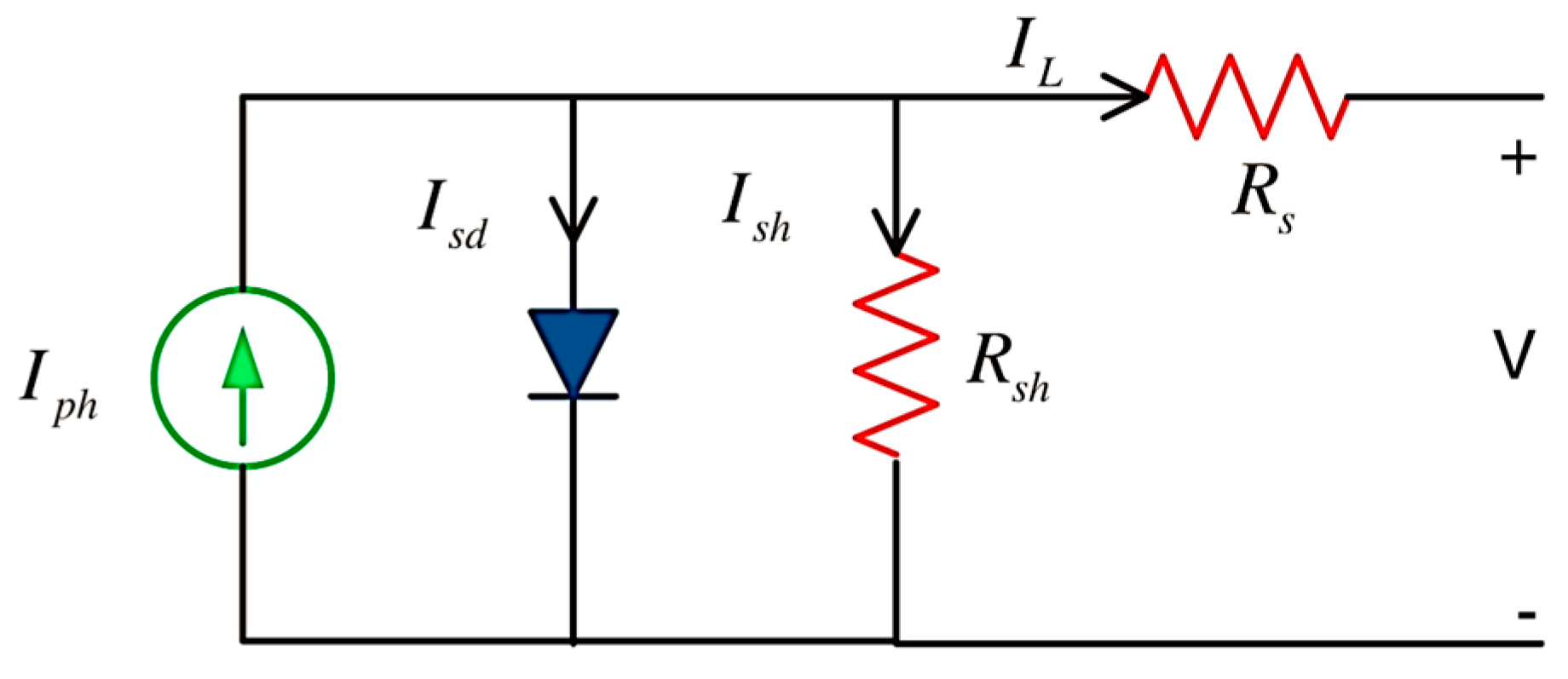
The single-diode photovoltaic model illustrated in
Figure 1 consists of five essential parameters: diode ideality factor (
n), reverse saturation current (
Isd), light-generated current (
Iph), series resistance (
Rs), and shunt resistance (
Rsh). All these parameters must be accurately estimated to capture the electrical behavior of a solar cell [
28].
Using Kirchhoff’s Law, the
I–
V character is given as Equation (1).
where
IL is output current,
denotes the photo-generated current,
represents the current flowing through the diode
, and
corresponds to the current passing through the shunt resistor
.
The diode current
is determined using the Shockley diode equation together with Kirchhoff’s voltage law and can be expressed mathematically as shown in Equation (2).
where
represents the diode reverse saturation current,
is the output voltage of the PV model,
denotes the diode ideality factor,
is the Boltzmann constant
,
is the operating temperature of the PV cell expressed in Kelvin, and
is the electron charge
.
The current across parallel resistor,
can be calculated according to Kirchhoff Voltage Laws as Formula (3)
Therefore, the relationship between the current output and output voltage of the SDM can be derived as shown in Equation (4).
In this model, the SDM contains five unknown parameters (, , , , ) that must be estimated. Accurate determination of these parameters is essential, as they directly influence photovoltaic cell modeling accuracy, performance optimization, and maximum power point tracking.
4. Jackal Arithmetic Algorithm (JAA)
In this study, the hybrid JAA, developed by combining the AOA and the GJO as illustrated in [
26], is employed to estimate the parameters of the SDM used for modeling the electrical equivalent circuit of PV cells.
4.1. Initialization
The candidate solutions (
X) are randomly initialized within predefined bounds:
where
and
define lower and upper boundaries, respectively.
The boundaries ensure the solutions remain within feasible search spaces throughout iterations.
4.2. Identify Limitiation and Improvement
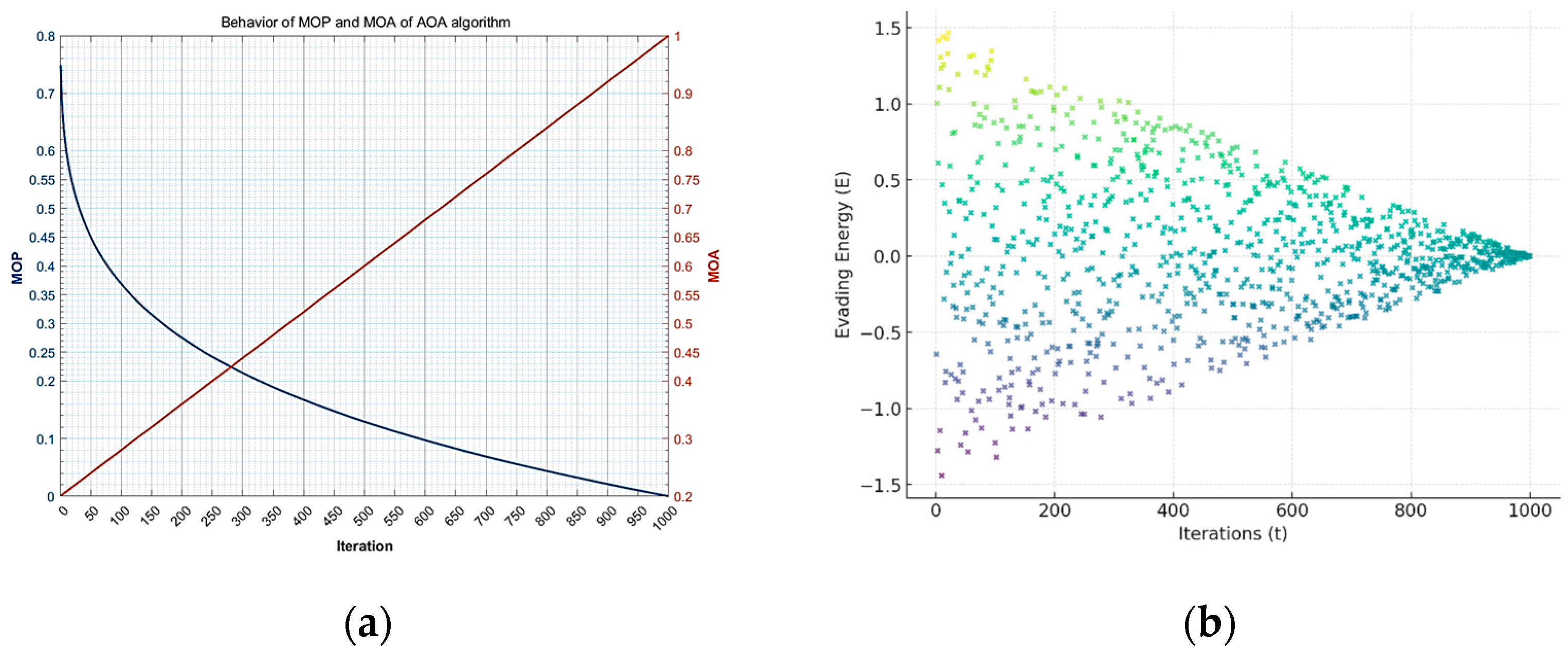
The performance of a metaheuristic algorithm largely depends on maintaining a proper balance between exploration and exploitation. Although the AOA is simple and versatile, it faces challenges with highly nonlinear and complex problems. These challenges include premature convergence, reduced population diversity, and high sensitivity to its controlling parameters, the Math Optimizer Accelerator (MOA) and Math Optimizer Probability (MOP) [
24], as defined in Equations (13) and (14) and shown in
Figure 2a. A linear adjustment of these parameters can cause the algorithm to stagnate early or waste time exploring fewer promising areas, limiting its overall effectiveness.
The parameter particularly influences AOA’s convergence behavior, making it more prone to local optima in large or complex search spaces and increasing computational effort without ensuring global optimality.
To overcome these limitations, GJO introduces the concept of Evading Energy (E), which dynamically improves the search process and helps maintain a better balance between exploration and exploitation. The Evading Energy, defined in Equations (15) and (16) and shown in
Figure 2b, consists of an initial random energy level
and a decaying energy component
that decreases gradually throughout the iterations:
where
denotes the random initial energy of the prey, and
represents its iterative decay, enabling smoother transitions between exploration and exploitation.
This mechanism enhances search diversity, reduces premature convergence, and improves global optimization capability. Although it introduces a slight increase in computational complexity, the improvement in stability and solution quality justifies its inclusion. These complementary strengths of AOA and GJO provide a strong foundation for the development of the hybrid JAA, designed to achieve more accurate and robust optimization performance for SDM parameter estimation.
4.3. Selection Phase
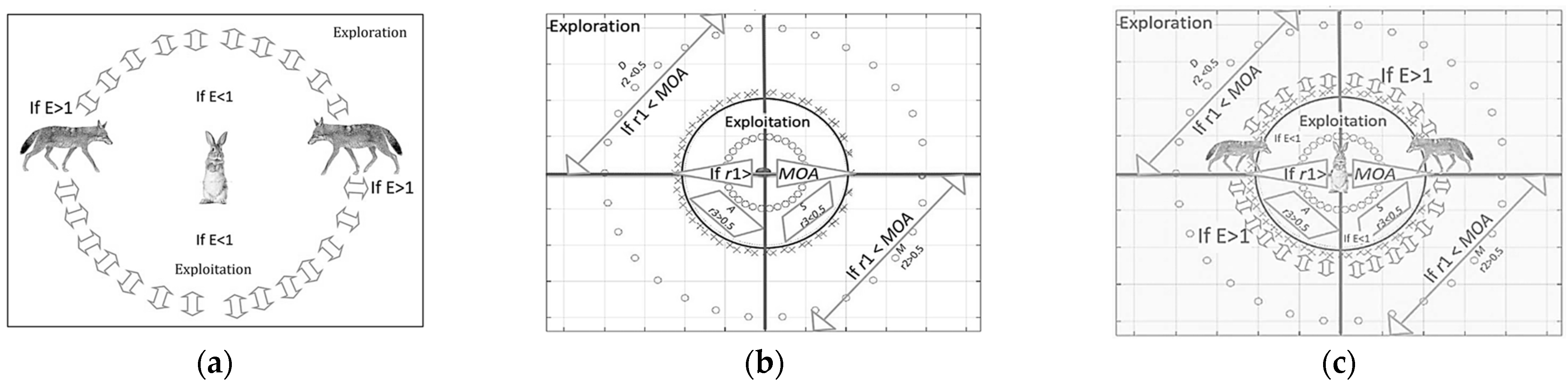
The JAA prioritizes an optimal balance between exploration and exploitation by integrating MOA and Evading Energy. Random numbers guide the selection of exploration or exploitation, while E facilitates dynamic transitions between extensive and intensive search phases, enhancing solution diversity.
Figure 3a presents the exploration-exploitation dynamics inherent in GJO, dictated by E. Higher values (|
E| > 1) favor exploration, while lower values (|
E| ≤ 1) promote exploitation.
Figure 3b depicts AOA’s approach, using arithmetic operators to dynamically adjust between exploration and exploitation based on the MOA parameter.
Figure 3c illustrates the JAA’s hybridization strategy, where the Evading Energy (E) from GJO and the MOA parameter from AOA collectively balance global exploration with local exploitation.
4.4. Searching Process
The optimization process employs two distinct strategies to ensure a robust search of the solution space:
4.4.1. Diversification Phase (
In the diversification phase, the algorithm aims to explore broader regions of the solution space, systematically moving away from known solutions to avoid premature convergence. The diversification strategies are detailed below:
Otherwise, the arithmetic exploration is applied:
4.4.2. Intensification Phase (
In the intensification phase, the algorithm concentrates on the search near promising candidate solutions, fine-tuning them to achieve optimal accuracy. The intensification strategies are:
Otherwise, the solutions are updated as follows:
In both phases, the MOP and the Lévy flight function (
), defined by Equation (21), determine position adjustments:
The Lévy flight function
LF(
x) is calculated using:
4.5. Update of Optimal Solutions
After each iteration, the optimal solution positions are updated based on the strategies outlined in Equations (18) and (20). Equations (17) and (19) positions are averaged to improve convergence stability using in (23).
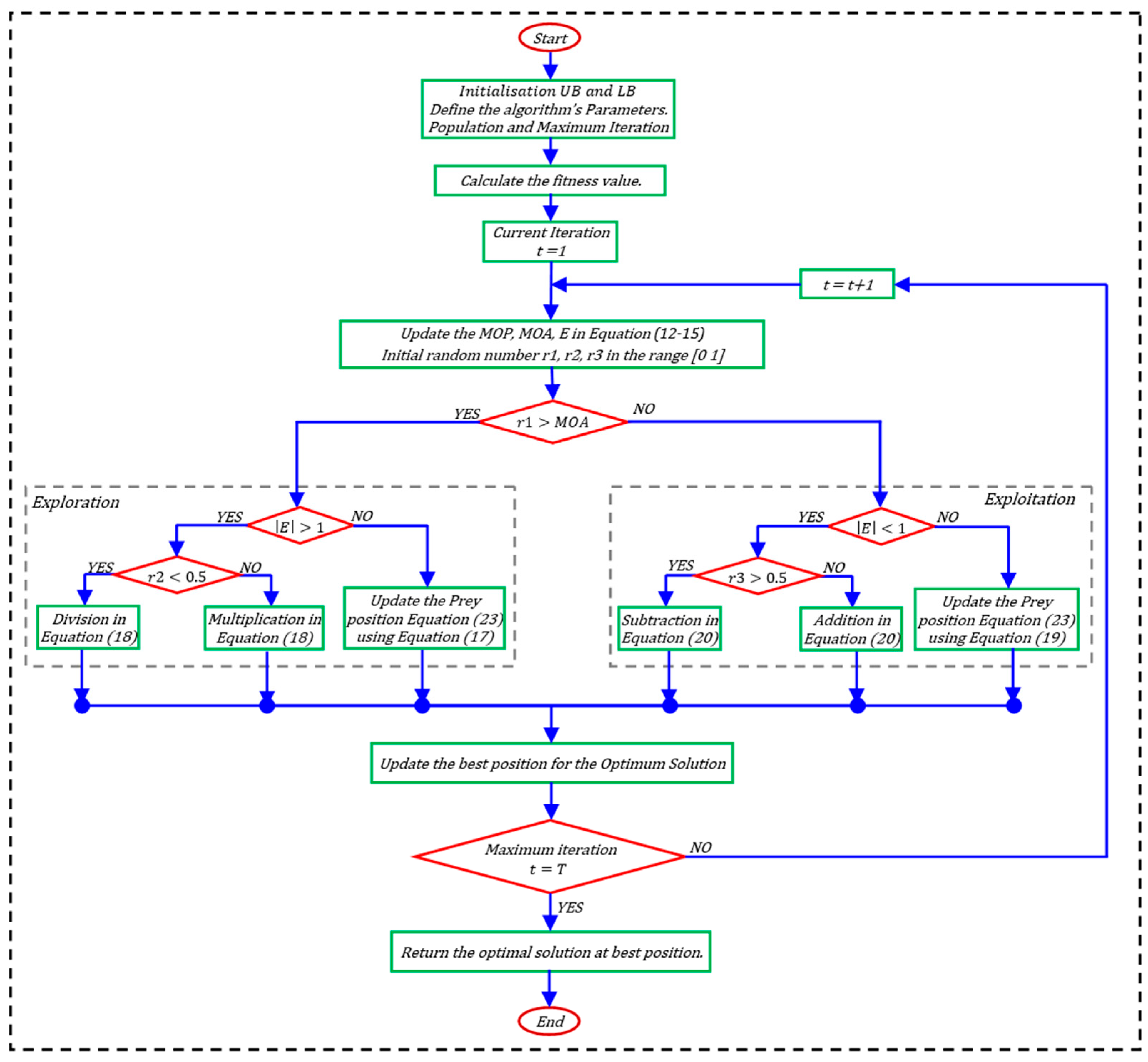
Algorithm 1 describes the pseudocode and
Figure 4 illustrates the flowchart.
| Algorithm 1: PSEEUDOCODE of Jackal Arithmetic Algorithm |
1: Initialise N, T, α, MOP, Max, MOP, Min, t
2: Randomly generate initial positions for i = 1: N
3: Define fitness and identify the best results
4: While t < T do
5: Update MOA and MOP (Equations (13) and (14))
6: Update (Equation (16))
7: For i = 1: N (for each solution) do
8: For j = 1: positions do
9: Update E (Equation (15))
10: Generate r1, r2, r3 ∈ [0, 1]
11: If r1 > MOA (Exploration) then
12: If |E| > 1 then
13: If r2 < 0.5 then Division (Equation (18))
14: Else Multiplication (Equation (18))
15: Else Update prey (Equation (17))
16: Else (Exploitation)
17: If |E| < 1 then
18: If r3 < 0.5 then Subtraction (Equation (20))
19: Else Addition (Equation (20))
20: Else Update prey (Equation (19))
21: End If
22: End For
23: Evaluate fitness and identify best solution
24: End For
25: t = t + 1
26: End While
27: Return best solution (X) |
4.6. Reliability and Stability
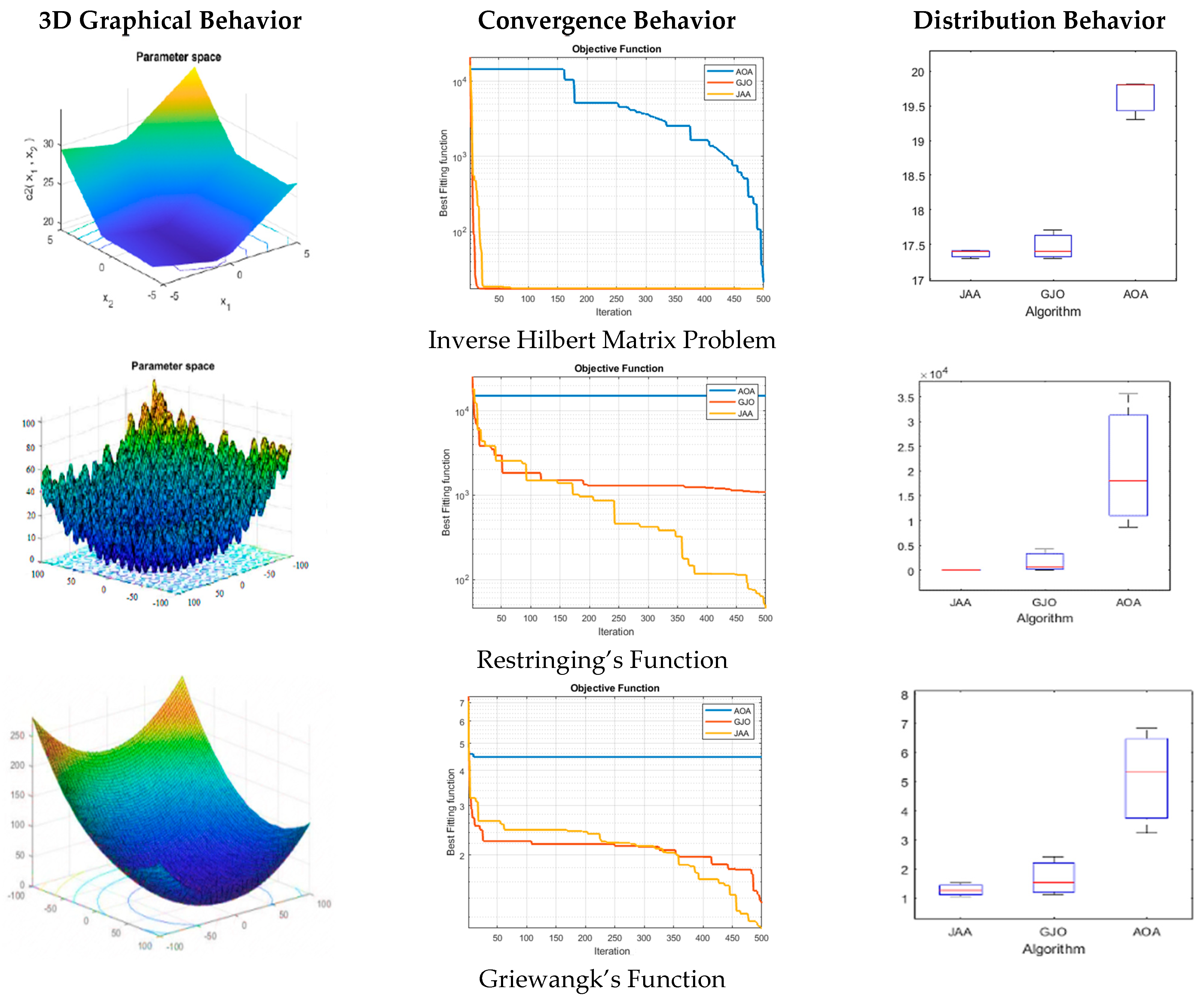
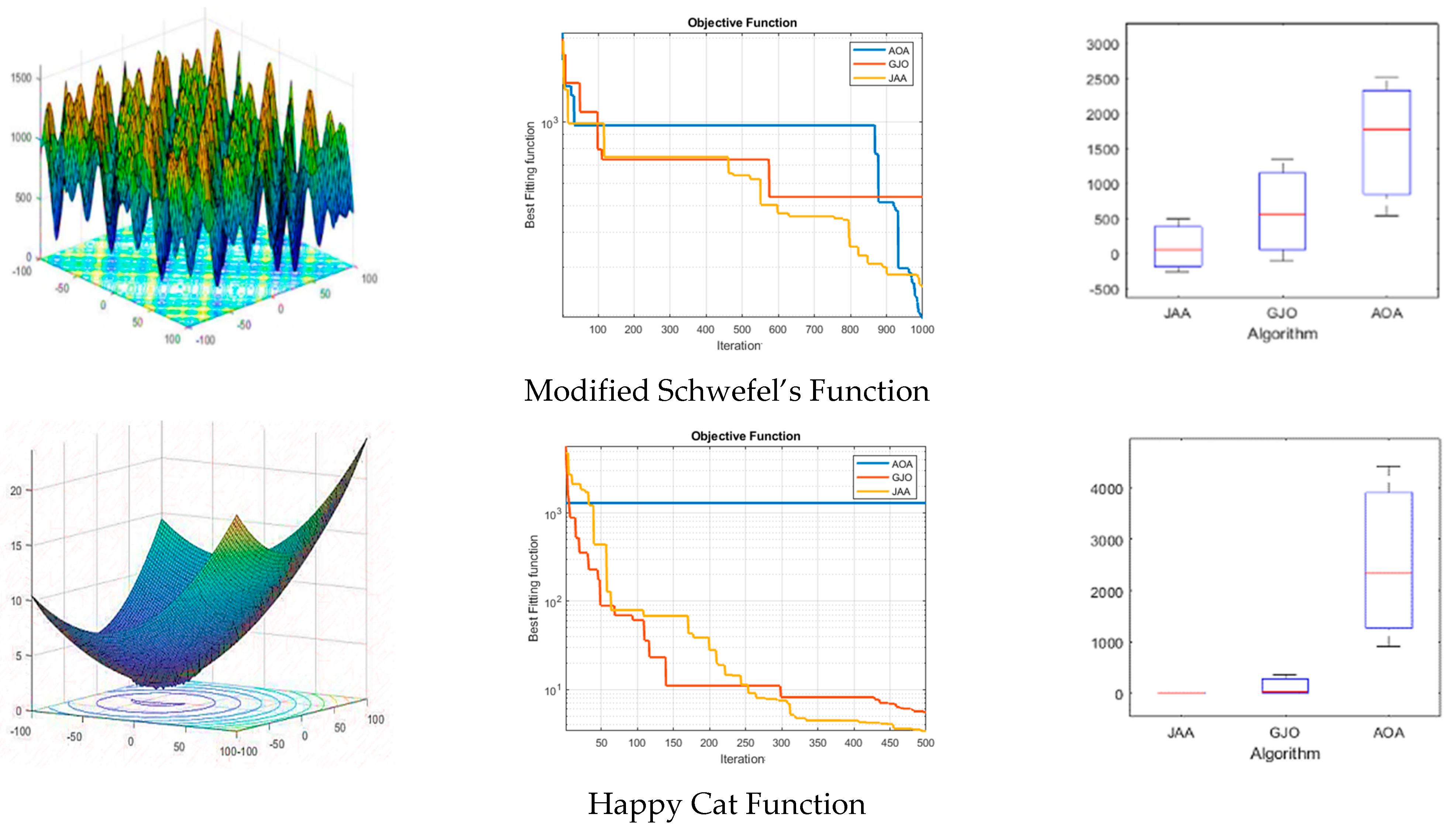
The hybrid algorithm JAA has been rigorously evaluated against the GJO and the AOA using five benchmark functions with diverse characteristics, as summarized in
Table 1 [
26]. These functions vary in modality, dimensionality, and search range, providing a demanding and representative test environment. For each algorithm, 20 independent runs are conducted with 500 iterations and a population size of 50, and the best, mean, and standard deviation values are reported to ensure statistical reliability.
A detailed comparative statistical assessment is presented in
Table 2, where the JAA consistently outperforms the original AOA and GJO. The results demonstrate that the JAA achieves a superior balance between exploration and exploitation, effectively mitigating premature convergence and avoiding local optima. To further validate these findings, the Wilcoxon rank-sum test (significance level 0.05) is employed, and the resulting
p-values across all benchmark functions confirm the statistical significance of the performance improvements.
In addition,
Figure 5 illustrates the three-dimensional landscapes of the benchmark functions, offering insight into the complexity of the optimization problems. The convergence analysis clearly shows faster and more stable convergence of the JAA compared to AOA and GJO, while the distribution analysis using box plots highlights the robustness and consistency of the hybrid approach. Collectively, these results provide strong evidence of the effectiveness and reliability of the JAA, validating its suitability for SDM optimization applications.
4.7. Computational Complexity Analysis
The computational complexity (O) of the JAA arises from three main processes: initialization, fitness evaluation, and iterative position updates. Initially, complexity is O(N × D), influenced by population size (N) and decision variables (D). During each iteration, complexities from updating MOP, MOA, Evading Energy (E), and Lévy flight calculations contribute O(4T). The position update complexity per iteration is O(N × D × T). Thus, the overall computational complexity is O(N × D × (1 + T) + 2T).
This complexity aligns closely with the original complexities of the AOA and the GJO. Although the JAA introduces slight computational overhead due to the integrated decision conditions, it notably enhances the global search capability, effectively identifying superior solutions [
26].
5. Results and Discussion
The objective function was defined as the RMSE between the measured and model-predicted currents across the measured voltage points; minimizing RMSE forces the fitted SDM to reproduce the observed I–V curve as closely as possible. All model evaluations used standard physical constants (Boltzmann constant , electron charge ) and an operating temperature of . For each candidate parameter vector , the implicit nonlinear SDM equation was solved numerically to obtain at each measured voltage, thus computing the RMSE, and all simulations were implemented using MATLAB 2021a.
To provide a statistically robust assessment, each algorithm was run for 500 iterations and repeated over 30 independent runs at three population sizes (30, 50 and 70). This design tests both convergence behavior (iterations) and stochastic stability (multiple runs) across a range of population diversities. The estimation problem was posed as a bounded nonlinear optimization task for the SDM. Parameter bounds were set in
Table 3. The three algorithms compared were the hybrid JAA, and conventional GJO, and AOA.
Table 4 summarizes comparative statistics (best, mean, worst, standard deviation, and
p-values) for the minimum RMSE achieved across the 30 runs.
Table 5 reports representative optimal parameters value and their RMSEs produced by each algorithm at each population size.
The numerical evaluation presented in
Table 4 and
Table 5 provides a comprehensive comparison of the performance of the three optimization algorithms (JAA, GJO, AOA) applied to the parameter estimation problem for the single-diode photovoltaic model. The results show clear performance distinctions among the algorithms, with JAA consistently outperforming its competitors across all population sizes. This consistency, paired with improvements observed as the population size increases, demonstrates the algorithm’s capacity to maintain both accuracy and stability. Overall, the combined results in these tables highlight JAA as the most efficient, reliable, and stable algorithm for identifying highly accurate SDM parameters.
Table 4 summarizes the RMSE performance of JAA, GJO, and AOA for the single-diode PV model at population sizes of 30, 50, and 70. Across all scenarios, JAA consistently achieves the lowest RMSE, demonstrating superior accuracy. At a population of 30, JAA attains a best RMSE of 0.00157, which is lower than GJO (0.00226) and AOA (0.00209). This trend continues at populations 50 and 70, where JAA further reduces RMSE to 0.0011283 and 0.00078, respectively. In contrast, GJO and AOA remain higher, with GJO reaching 0.00156 and AOA 0.00209 at population 70. The standard deviation values reinforce this pattern, as JAA consistently shows the smallest deviation, for example, 0.00178 at population 30, indicating better stability.
Table 5 provides the corresponding parameter estimates. JAA produces balanced and physically meaningful values, particularly noticeable at population 70, where it estimates
,
,
, and
, accompanied by the lowest RMSE (0.00078065). GJO and AOA show larger deviations; AOA frequently pushes parameters to boundary limits, such as
and
, which indicates reduced reliability and weaker convergence control. Overall, the numerical outcomes confirm that JAA consistently delivers the most accurate and stable parameter estimation. Its lower RMSE values, reduced variance, and physically consistent parameter sets indicate a robust optimization performance compared to GJO and AOA.
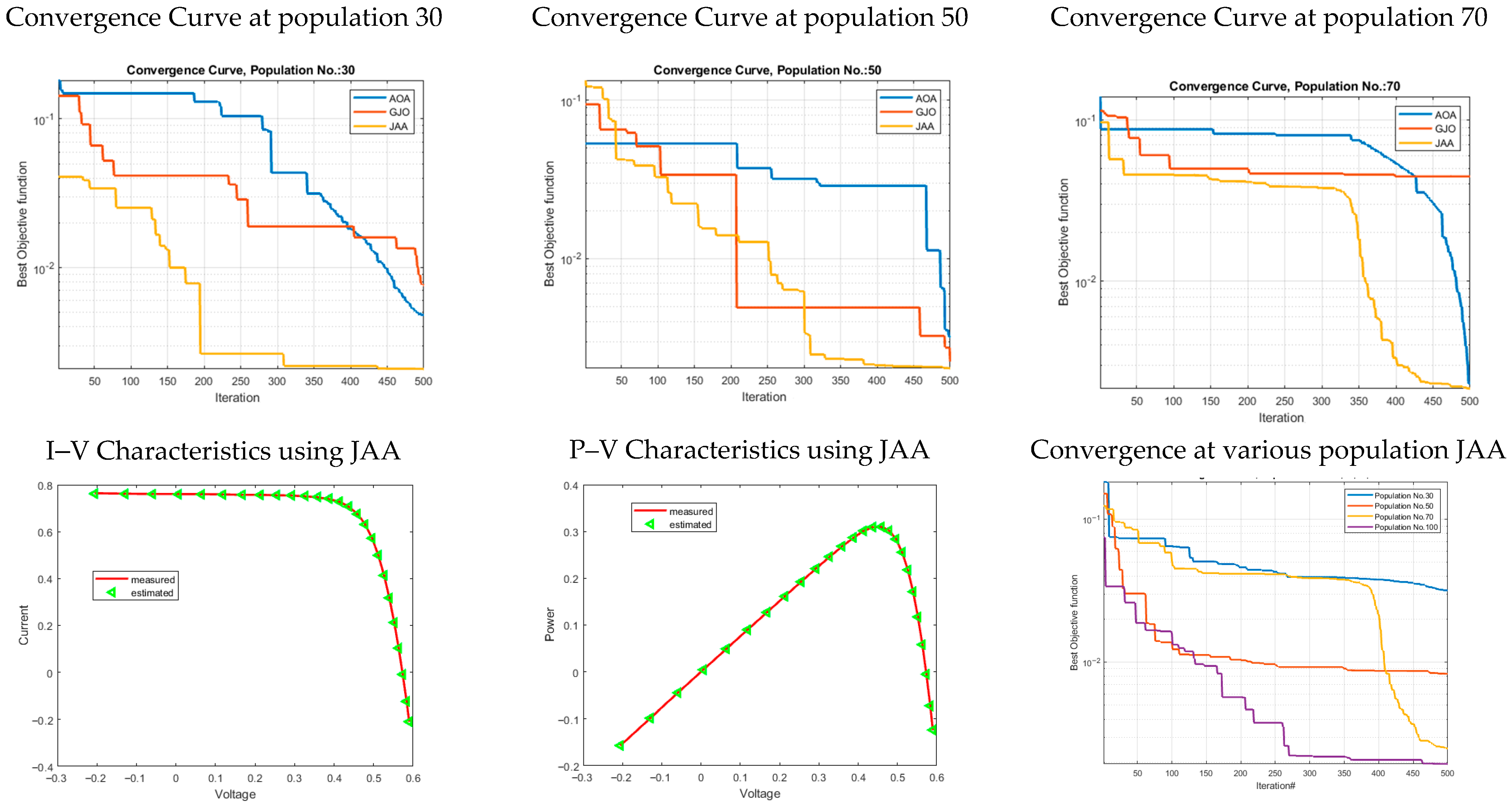
Figure 6 summarizes the identification and validation results obtained with three metaheuristics (JAA, GJO, AOA) under different population sizes. In the first row, the convergence histories at populations of 30, 50 and 70 display the best objective value on a logarithmic scale versus iteration. In every case, the JAA trajectory falls earliest and steeply, continuing to decrease until it reaches the lowest terminal error among the methods compared. JAA’s convergence curves for several populations to isolate the effect of population size. Larger populations begin at lower objective values, drop more rapidly during the early iterations and terminate at smaller residuals.
The I–V curve produced by JAA aligns almost perfectly with the measured data across the full voltage range, accurately capturing the short-circuit region, the knee point, and the high-voltage decline. Likewise, the P–V curve closely matches the measured power profile, including the location and height of the maximum-power point, confirming that the JAA-identified model reliably reflects the real device behavior.
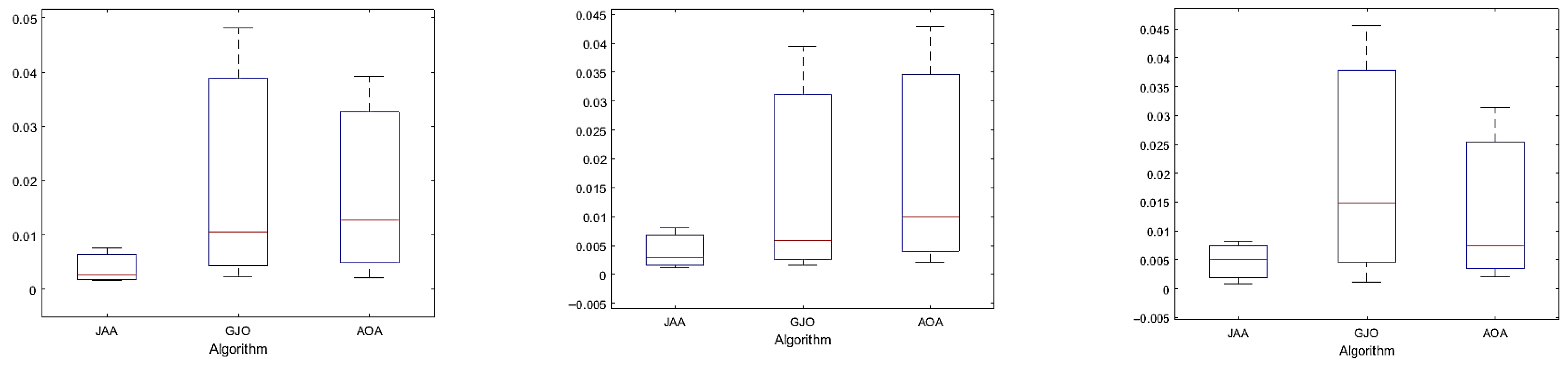
Figure 7 presents box plots of the best-of-run objective values for JAA, GJO and AOA at populations of 30, 50 and 70. The boxes associated with JAA occupy the lowest vertical positions with relatively short interquartile ranges and whiskers, reflecting both superior central tendency and tighter dispersion across repeated trials.
Finaly, the JAA achieves the smallest mean RMSE values among all algorithms, including a minimum of 0.00078 at a population size of 70, demonstrating both precision and stability. In contrast, the GJO and the AOA record higher mean RMSE values and noticeably larger variability between runs, indicating reduced consistency and increased sensitivity to stochastic initialization.
6. Discussion
The superior performance of the JAA can be attributed to the complementary strengths of its hybridized search mechanism. By integrating the arithmetic-based exploitation strategies of the AOA with the exploratory evading energy dynamics of the GJO, JAA achieves an effective balance between local refinement and global diversification. This synergy enables JAA to escape local minima more efficiently compared to the AOA, which is prone to premature convergence and boundary stagnation.
In contrast, while the GJO exhibits strong exploratory behavior, it may lack stability during later search stages. The hybrid framework of JAA mitigates this limitation by introducing controlled exploitation, thereby stabilizing the search process. Moreover, as the population size increases, the JAA demonstrates an enhanced ability to exploit the additional search agents, resulting in notable improvements in both convergence reliability and solution precision. Analysis of parameter distributions further indicates that the JAA avoids the unrealistic boundary solutions frequently produced by the AOA, suggesting a more effective exploration of the feasible search space. Collectively, these characteristics explain the consistent superiority of the JAA over its constituent algorithms.
7. Conclusions
This study presents a comprehensive evaluation of the Jackal Arithmetic Algorithm (JAA), a novel hybrid metaheuristic that combines the strengths of the AOA and the GJO. The proposed hybridization effectively addresses key challenges associated with balancing exploration and exploitation phases. Specifically, the AOA may suffer from entrapment in local optima due to its reliance on arithmetic operators, whereas the GJO can encounter instability in dynamic search environments. By leveraging their complementary characteristics, the JAA enhances both global search capability and local refinement, leading to improved optimization performance.
Initially applied to microgrid optimization problems [
26], the JAA demonstrated promising results compared to its parent algorithms. In this study, the JAA was further applied to a range of real-world engineering problems, including parameter estimation for solar photovoltaic systems. The results consistently indicate that the JAA outperforms the AOA and the GJO in terms of convergence speed, solution accuracy, robustness, and overall optimization quality. Statistical analyses, including standard deviations and
p-values, further confirm the effectiveness and stability of the JAA across diverse test scenarios.
Despite its strong performance, this study acknowledges the inherent limitations of metaheuristic algorithms, as articulated by the No Free Lunch (NFL) theorem, which states that no single algorithm can outperform all others across all problem domains. Future research may investigate the application of the JAA to multi-objective optimization problems, series–parallel photovoltaic cell configurations, emerging PV technologies, intelligent energy management systems, and AI-integrated engineering applications. Such extensions could further establish the JAA as a versatile and powerful optimization framework for addressing complex engineering challenges across diverse fields.