Article

Cyano-Functionalized Lithium Sulfonimide Salt for High-Voltage Lithium Metal Batteries

1
College of Materials Science and Engineering, Qingdao University of Science and Technology, Qingdao 266042, China
2
Qingdao Industrial Energy Storage Research Institute, Qingdao Institute of Bioenergy and Bioprocess Technology, Chinese Academy of Sciences, Qingdao 266101, China
3
Qingdao New Energy Shandong Laboratory, Shandong Energy Institute, Qingdao 266101, China
4
College of Chemistry and Chemical Engineering, Shandong Provincial Engineering Research Center of Organic Functional Materials and Green Low-Carbon Technology, Dezhou University, Dezhou 253023, China
*
Authors to whom correspondence should be addressed.
Energies 2026, 19(13), 3135; https://doi.org/10.3390/en19133135 (registering DOI)
Submission received: 15 April 2026 / Revised: 25 June 2026 / Accepted: 29 June 2026 / Published: 2 July 2026

Abstract

Lithium metal batteries are considered one of the most promising technological routes for next-generation energy storage systems with high energy density. However, when paired with high-voltage cathodes such as NCM811, conventional lithium bis(trifluoromethanesulfonyl)imide (LiTFSI)-based electrolytes face severe corrosion of the aluminum current collector when the operating voltage exceeds 3.8 V vs. Li+/Li, leading to rapid capacity decay and even cell failure. In this work, we designed and synthesized a cyano-containing lithium salt, lithium cyano(trifluoromethanesulfonyl)imide (LiCTFSI), to address this issue. The electrochemical performance of 1 M LiCTFSI and 1 M LiTFSI in the same carbonate solvent was systematically compared in NCM811/Li cells. The results demonstrate that LiCTFSI effectively suppresses aluminum corrosion at high potentials and forms a thinner and more compact cathode electrolyte interphase to protect NCM811 cathodes. With the LiCTFSI electrolyte, NCM811/Li cells (mass loading = 19.55 mg cm−2) achieve a capacity retention of 81.7% after 200 cycles at a high cutoff voltage of 4.6 V vs. Li+/Li. This work provides a new strategy for developing advanced electrolyte salts for high-voltage, high-energy-density lithium metal batteries.

1. Introduction

Since Sony first commercialized lithium-ion batteries (LIBs) in 1991 [1,2,3,4,5], they have found widespread use across nearly all sectors of modern society and currently represent the leading energy storage technology for portable electronic devices, electric vehicles (EVs), and grid-scale energy storage applications [6,7,8,9,10]. The pursuit of higher energy densities in LIBs has accelerated the development of high-voltage and nickel-rich layered oxide cathodes, particularly LiNi0.8Co0.1Mn0.1O2 (NCM811) [10,11,12,13,14,15]. With its high reversible capacity exceeding 200 mAh g−1, NCM811 coupled with a lithium metal anode has emerged as one of the most attractive candidates for next-generation electric vehicles and grid-scale energy storage systems [16,17,18,19]. However, under high-voltage operating conditions, nickel-rich cathodes often suffer from severe structural degradation, including microcracking, oxygen release, transition metal dissolution and severe parasitic side reactions with electrolytes, which lead to rapid capacity fading and poor cycle performance [20,21,22].
The electrolyte is often regarded as the “lifeblood” of a battery system, as it critically governs ion transport, interfacial stability, and safety performance [23,24,25,26]. While the conventional LiPF6-based electrolyte offers high ionic conductivity and good passivation ability for aluminum current collectors, it suffers from intrinsic limitations, including poor thermal stability and high sensitivity to moisture [27,28,29]. Once the temperature exceeds 60 °C or even trace amounts of water are present, LiPF6 readily decomposes, generating harmful byproducts such as HF [30,31,32,33]. In turn, the cathode–electrolyte interphase (CEI) is corroded by HF, leading to dissolution of transition metal (TM) ions and subsequent fast capacity fading [34,35]. More critically, dissolved TM ions can migrate across the electrolyte and deposit on the anode surface. This not only alters the SEI properties and affects Li plating/stripping behavior but also introduces extensive pores and cracks in the SEI, further accelerating side reactions [36,37]. Alternately, lithium bis(trifluoromethanesulfonyl)imide (LiTFSI) has been extensively investigated as an alternative salt, owing to its superior chemical stability, high thermal decomposition temperature (~380 °C), and excellent moisture tolerance [38,39,40]. Indeed, LiTFSI-based electrolytes significantly mitigate HF-induced transition metal dissolution and enable improved cycling stability at elevated temperatures. However, a well-documented problem of LiTFSI is its severe corrosion of the aluminum current collector at potentials above 3.8 V vs. Li/Li+ [41,42,43,44]. This corrosive behavior arises from the formation of Al(TFSI)3, which can easily dissolve into electrolytes, leading to pitting and crack aluminum corrosion and rapid cell failure [45]. Consequently, the practical application of LiTFSI in high-voltage NCM811 cells remains severely constrained. High LiTFSI concentrations favor the creation of a LiF-type passivation layer atop the Al surface, thereby suppressing corrosion [46,47]. However, this approach increases cost and poses practical application challenges. To address these limitations, Qiao et al. [9]. designed a novel asymmetric lithium salt, lithium (difluoromethanesulfonyl)(trifluoromethanesulfonyl)imide (LiDFTFSI), to solve this issue. Their study revealed that the reaction product between LiDFTFSI and aluminum, Al(DFTFSI)3, is chemically unstable in conventional carbonate solvents and undergoes rapid, spontaneous decomposition. This decomposition ultimately yields AlF3 and LiF, which effectively prevent further aluminum corrosion. However, significant challenges might still remain when it comes to high-nickel cathodes (>4.5 V vs. Li+/Li). Therefore, there is an urgent need to develop new lithium salts that possess strong aluminum passivation capability and high-voltage stability, thereby making it possible to use high-energy-density, high-voltage Li metal batteries in practice.
Hence, in this work, we reported a lithium cyano(trifluoromethanesulfonyl)imide (LiCTFSI) by replacing one of the (trifluoromethyl)sulfonylimide groups in LiTFSI with a cyano group. LiCTFSI significantly enhances the high-voltage stability of the aluminum current collector and forms a thinner CEI on high-voltage NCM811. Even at a high potential of 4.6 V vs. Li+/Li, a 1 M LiCTFSI solution dissolved in ethylene carbonate (EC) and ethyl methyl carbonate (EMC) (1:1, v/v) shows outstanding resistance to Al corrosion. This designed electrolyte enables NCM811/Li coin cells (19.55 mg cm−2 high mass loading) to deliver a capacity retention of 81.7% following 200 cycles under a high voltage of 4.6 V vs. Li+/Li. This work not only resolves the long-standing challenge of aluminum current collector corrosion under high-voltage conditions but also achieves cost efficiency by utilizing a conventional 1 M electrolyte concentration with fluorine-free carbonate solvents. These combined advantages provide a pragmatic and scalable pathway toward the practical deployment of high-nickel cathodes in next-generation lithium metal batteries with high energy density.

2. Experimental Section

2.1. Materials and Electrolyte Preparation

The commercially available mixed carbonate solvent (EC/EMC; 1:1, v/v) and the lithium bis(trifluoromethanesulfonyl)imide (LiTFSI) were bought from dodochem. The lithium cyano(trifluoromethanesulfonyl)imide (LiCTFSI) was synthesized in our laboratory. NCM811 (LiNi0.8Co0.1Mn0.1O2) cathode material was obtained from Guangdong Canrd New Energy Technology Co., Ltd. (Dongguan, China) A lithium metal foil 300 µm thick served as the counter electrode, while a Celgard® PP2500 separator (Kejing Biotechnology Co., Ltd., Yancheng, China) (≈25 µm thickness) was employed. High-loading NCM811 cathodes were fabricated using a standard casting procedure, with a composition of 80 wt% active material, 10 wt% Super P carbon black, and 10 wt% PVDF binder. The resulting areal mass loading of the active NCM811 reached 19.55 mg cm−2. All electrolyte formulations were assembled inside an argon-filled glovebox (Mikrouna Ind. Int. Tech. Co., Ltd., Shanghai, China) (H2O < 1 ppm, O2 < 1 ppm). Magnetic stirring was applied to achieve full dissolution of the components. The finished electrolytes were kept in sealed vials inside the same glovebox.

2.2. Physical and Electrochemical Tests

A BioLogic VMP-300 instrument (Bio-Logic SAS, Seyssinet-Pariset, France)was employed to determine the ionic conductivities of the electrolytes. Measurements were conducted with symmetric stainless steel (SS) cells across a frequency sweep of 1 Hz to 1 MHz. The resulting conductivity values were then computed according to Equation (1):
σ = L S × R b u l k
Here, σ denotes the ionic conductivity of the electrolytes, L refers to the separator thickness, S stands for the contact area between the electrolyte and the SS electrode, and Rbulk corresponds to the bulk resistance of the electrolyte.
To obtain the lithium-ion transference numbers (TLi+) of the electrolytes, a BioLogic VMP-300 was used with symmetric Li/Li cells. The measurement combined alternating-current electrochemical impedance spectroscopy (AC-EIS) and direct-current polarization. Equation (2) was applied to calculate TLi+.
T L i + = I S S Δ V I 0 R 0 I 0 Δ V I S S R S S
for which the parameters are defined as follows: TLi+ = lithium-ion transference number of the electrolytes; ∆V = cell voltage (5 mV applied here); I0 and R0 = initial current and initial resistance; ISS and RSS = steady-state current and resistance after the chronoamperometry measurement.
To evaluate the Li plating and stripping behavior of various electrolytes, symmetric cells containing two Li foils (16 mm in diameter) were assembled to investigate the Li plating/stripping behavior of the various electrolytes. Measurements were performed under stepwise current densities of 0.1, 0.2, 0.5, 1, and 2 mA cm−2, each applied for a duration of 1 h. Anodic stability of these two electrolytes was characterized by linear sweep voltammetry (LSV) experiments at a scan rate of 5 mV s−1 and room temperature using a two-electrode cell configuration with 300 μm thick lithium foils as the counter and reference electrodes, and fresh stainless steel (SS) as the working electrode. We conducted cyclic voltammetry (CV) tests on Li/Cu batteries at a scanning speed of 1 mV s−1. To evaluate the corrosion of aluminum by the two electrolytes under high voltage, using a three-electrode configuration, we conducted a potentiostatic corrosion test lasting 10 h at a fixed charging potential of 4.6 V. SEM was employed to investigate the surface morphologies and microstructures of lithium deposits collected from various electrolytes. The deposition was achieved galvanostatically on a copper electrode in Li/Cu cells at 0.25 mA cm−2 over a 6 h period. At the same time, SEM morphological analysis and transmission electron microscope (TEM, Leica Camera AG, Wetzlar, Germany) morphological analysis were performed on the NCM811 cathode after 50 cycles using different electrolytes.
After electrochemical testing, the Al current collectors, Li anodes, and Cu substrates were characterized by X-ray photoelectron spectroscopy (XPS, Thermo Scientific ESCA Lab 250Xi, Thermo Fisher Scientific, Wilmington, DE, USA). For the XPS tests, the C 1s binding energy at 284.8 eV was used as a reference to calibrate the energy scale.

2.3. Electrode Preparation and Cell Test

By using a LAND battery testing system (Wuhan LAND electronics Co., Ltd., Wuhan, China), NCM811/Li full cells were tested at room temperature. The cells underwent three formation cycles at a constant current (CC) charge of 0.1 C/0.1 C between 2.8 V and 4.6 V vs. Li+/Li. Subsequently, long-cycle testing was conducted at 0.2 C/0.5 C at the same voltage range.

2.4. Computational Details

The energies of the highest occupied molecular orbital (HOMO) and the lowest unoccupied molecular orbital (LUMO) were determined via first-principles density functional theory (DFT) calculations. These calculations employed the Dmol3 (2023) program suite and a DFT method incorporating the B3LYP Lee–Yang–Parr correlation functional [48,49,50].

3. Results and Discussion

3.1. Electrochemical Performance

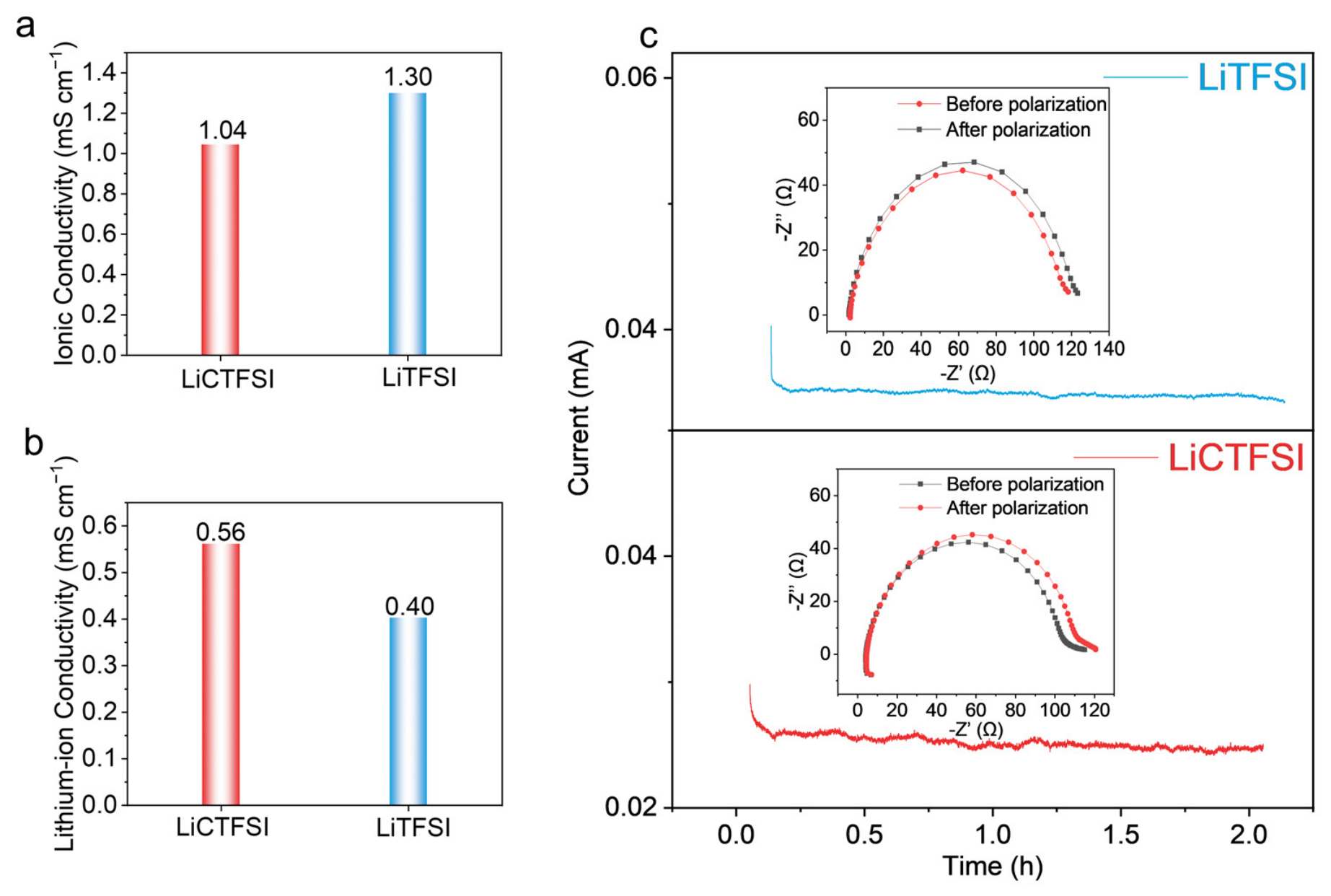
Ionic conductivity (σtotal) plays a critical role in determining the electrochemical performance of batteries, and a higher σtotal generally leads to improved cycling stability. As shown in Figure 1a, the LiTFSI-based electrolyte exhibits marginally higher σtotal at room temperature due to the highly delocalized anionic structure. However, it is well established that Li+ ions serve as the exclusive charge carriers, and it is the intercalation and deintercalation of Li+ between the electrodes that ultimately govern the electrochemical performance of batteries [51,52,53]. Therefore, in this work, the lithium ion transference numbers (TLi+) of the prepared electrolytes were measured using the Bruce–Vincent method [54] using symmetric Li/Li cells. As expected, the LiCTFSI-based electrolyte shows a higher TLi+ (Figure 1c; TLi+ = 0.54) than that of the LiTFSI-based counterpart (Figure 1c; TLi+ = 0.31). Consequently, a higher lithium-ion conductivity (σLi+; σLi+ = σtotal × TLi+) of 0.56 mS cm−1 is achieved when using LiCTFSI as the salt (Figure 1b). It is reported that a higher σLi+ is beneficial for enhancing cell performance [51,55,56,57,58].
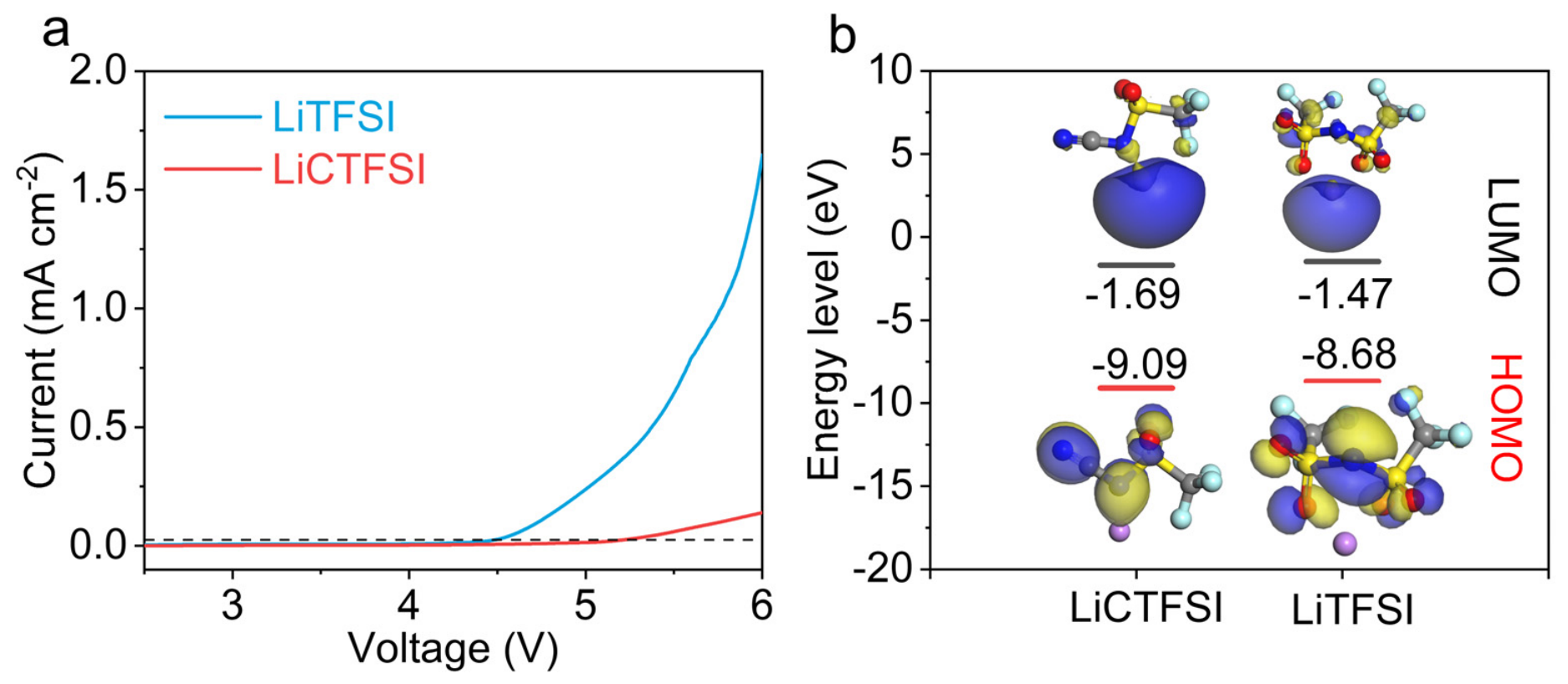
High anodic stability is an important prerequisite for a lithium salt to be coupled with high-voltage cathode materials. In this work, the anodic stability of the electrolytes was evaluated by linear sweep voltammetry (LSV); as shown in Figure 2a, it is demonstrated that the LiCTFSI-based electrolyte possesses superior oxidative stability compared to the LiTFSI-based counterpart. According to the literature [51], in LSV measurements, a criterion of 0.25 mA cm−2 was adopted to identify the initial oxidation potential. While the LiTFSI system showed a distinct oxidation decomposition current starting at roughly 4.4 V vs. Li+/Li, the LiCTFSI system shifted this potential upward to about 5.2 V vs. Li+/Li. The superior anodic stability of LiCTFSI can be explained by the strong electron-withdrawing effect of its –C≡N groups. To further clarify the enhanced anodic stability of LiCTFSI, we calculated the highest occupied molecular orbital (HOMO) energies of the ion pairs (Li+-TFSI and Li+-CTFSI). The results (Figure 2b) show that the HOMO energy of Li+-CTFSI is −9.09 eV, which is 0.41 eV lower than that of Li+-TFSI (−8.68 eV). A lower HOMO energy suggests greater resistance to electron removal, providing a computational explanation for the experimentally observed higher oxidation potential of LiCTFSI.
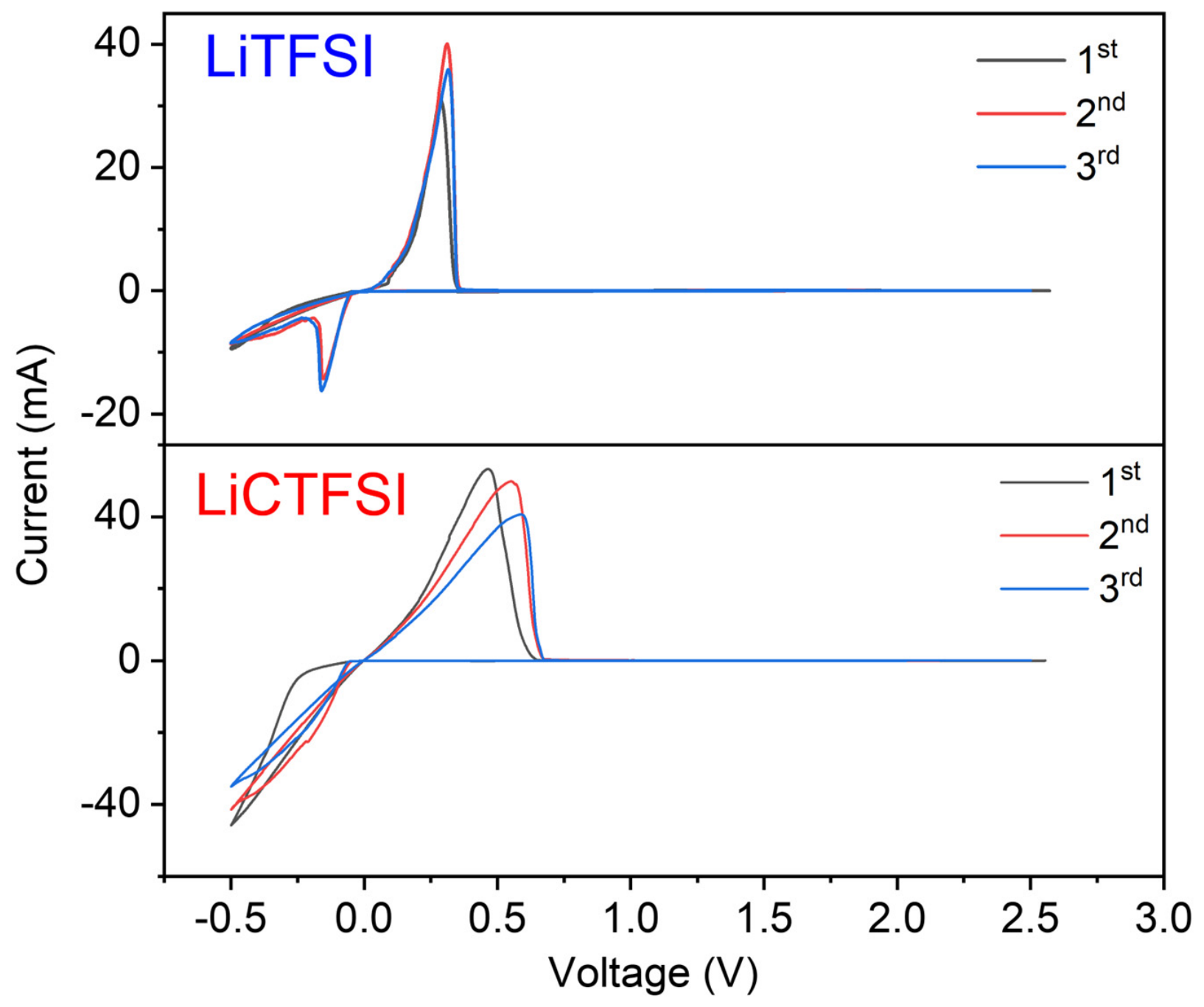
Figure 3 presents cyclic voltammograms of Li/Cu batteries recorded at 1 mV s−1. All tested electrolytes show distinct peaks between −0.5 V and 0.5 V vs. Li+/Li, associated with Li plating/stripping on Cu. The LiTFSI-based electrolyte exhibits noticeable side-reaction peaks during cycling, arising from electrolyte decomposition at the interface. The LiCTFSI-based electrolyte, however, displays superior redox characteristics—namely, higher peak currents and well-defined redox potentials—compared to the LiTFSI system.

3.2. Cell Performance and Interfacial Characterization

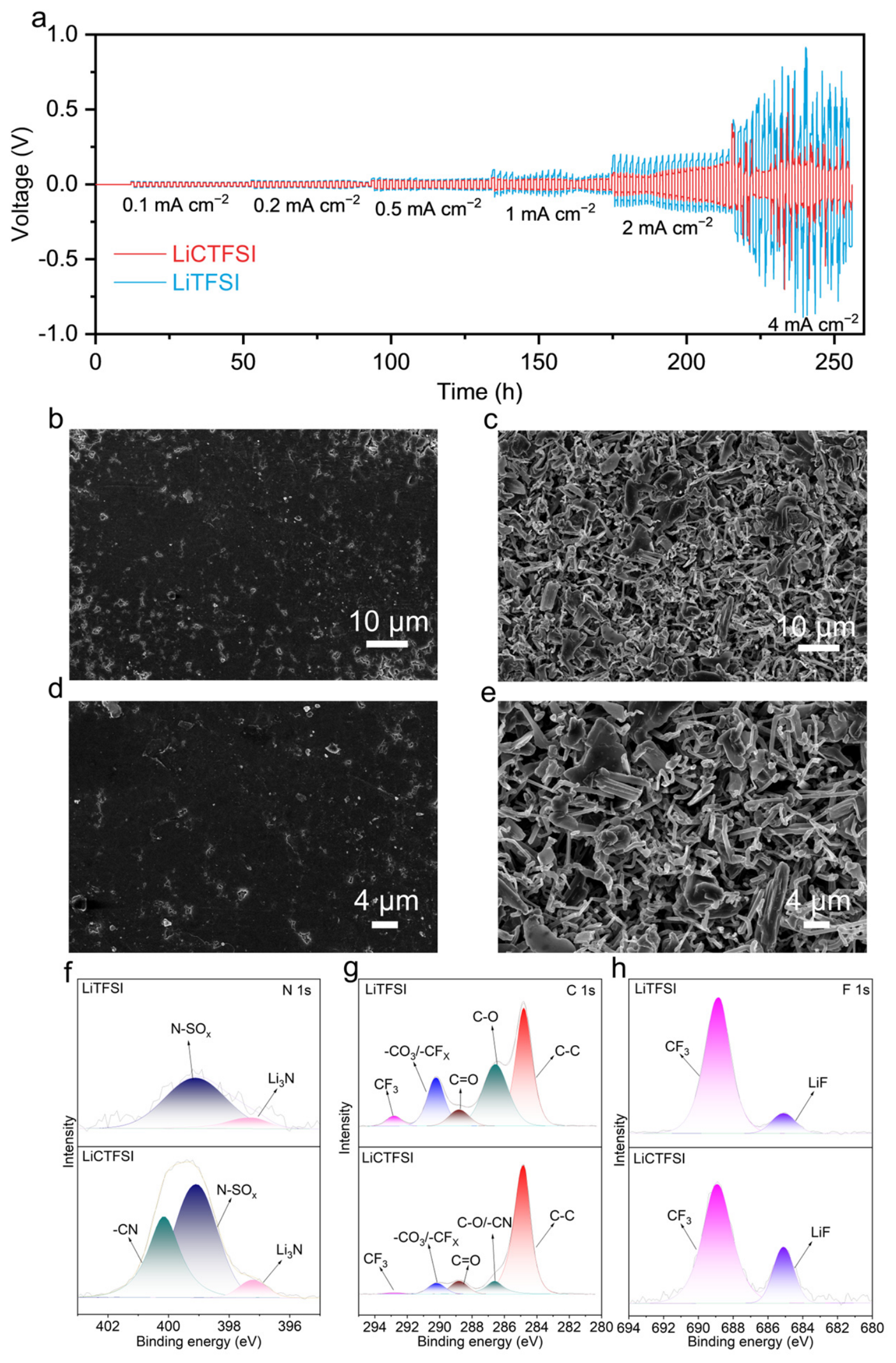
Li|Li symmetric cells were employed to evaluate the cycling stability of different electrolytes against lithium metal anodes. Tests were conducted under stepwise current densities of 0.1, 0.2, 0.5, 1, 2, and 4 mA cm−2. As shown in Figure 4a. In Li/Li symmetric cells, the LiCTFSI-based electrolyte exhibits excellent interfacial stability during 250 h of long-term cycling at various current densities; the polarization voltage curve remains consistently lower. In contrast, in symmetric cells using the LiTFSI-based electrolyte formulation, the polarization voltage gradually increases at current densities greater than 2 mA cm−2, indicating a significant accumulation of interfacial resistance.
Scanning electron microscopy (SEM) of lithium deposits in Li/Cu cells provides mechanistic insights into the advantageous properties of LiCTFSI. At a controlled deposition capacity of 0.25 mAcm−2 for 6 h, the LiCTFSI-based electrolyte facilitates the formation of large, densely packed lithium deposits on a Cu substrate (Figure 4b,d). In stark contrast, the LiTFSI-based electrolyte yielded heterogeneous, high-porosity, nodular lithium deposits with plenty of lithium dendrites, substantially amplifying the electrochemical incompatibility between the lithium metal electrode and LiTFSI-based electrolyte (Figure 4c,e). Compared with the LiTFSI-based electrolyte, the LiCTFSI-based one promotes a more stable morphology of deposited lithium. This morphological benefit reflects better compatibility between the LiCTFSI system and the Li metal electrode. On one hand, the uniform and compact lithium deposition helps suppress dendrite growth and reduces the formation of dead lithium, thereby improving the Coulombic efficiency (Figure S1) and cycling reversibility of the lithium anode. On the other hand, the stable deposition morphology also mitigates parasitic reactions between the electrolyte and the lithium metal, extending the cycle life of the battery. Therefore, the LiCTFSI-based electrolyte shows great promise for realizing long-life lithium metal batteries (LMBs). In addition, XPS analysis of the Cu substrates after Li deposition reveals three key differences between the two electrolytes (Figure 4f–h; Table S1). First, the N 1s spectra show a clear and distinct peak at 400.2 eV (C≡N) only for the LiCTFSI-derived interface, while it is completely absent for LiTFSI—providing direct, diagnostic evidence that the cyano group participates in the interfacial layer on Cu. Second, the C 1s spectra demonstrate that the LiCTFSI-derived interface exhibits significantly lower signals of C–O (286.6 eV), C=O (288.8 eV), and CO3 (289.9 eV) compared to LiTFSI, indicating effective suppression of solvent decomposition. Third, the F 1s spectra reveal that LiCTFSI promotes the formation of more LiF (685.1 eV)—a mechanically robust SEI component—while the CF3 signal (associated with undecomposed –CF3 groups) is lower for LiCTFSI than for LiTFSI, demonstrating that the cyano-functionalized anion contributes to the formation of LiF-rich SEI. Taken together, these XPS data unambiguously confirm that the deposits on Cu are not pure metallic lithium but include a CN-containing thin, protective interphase.
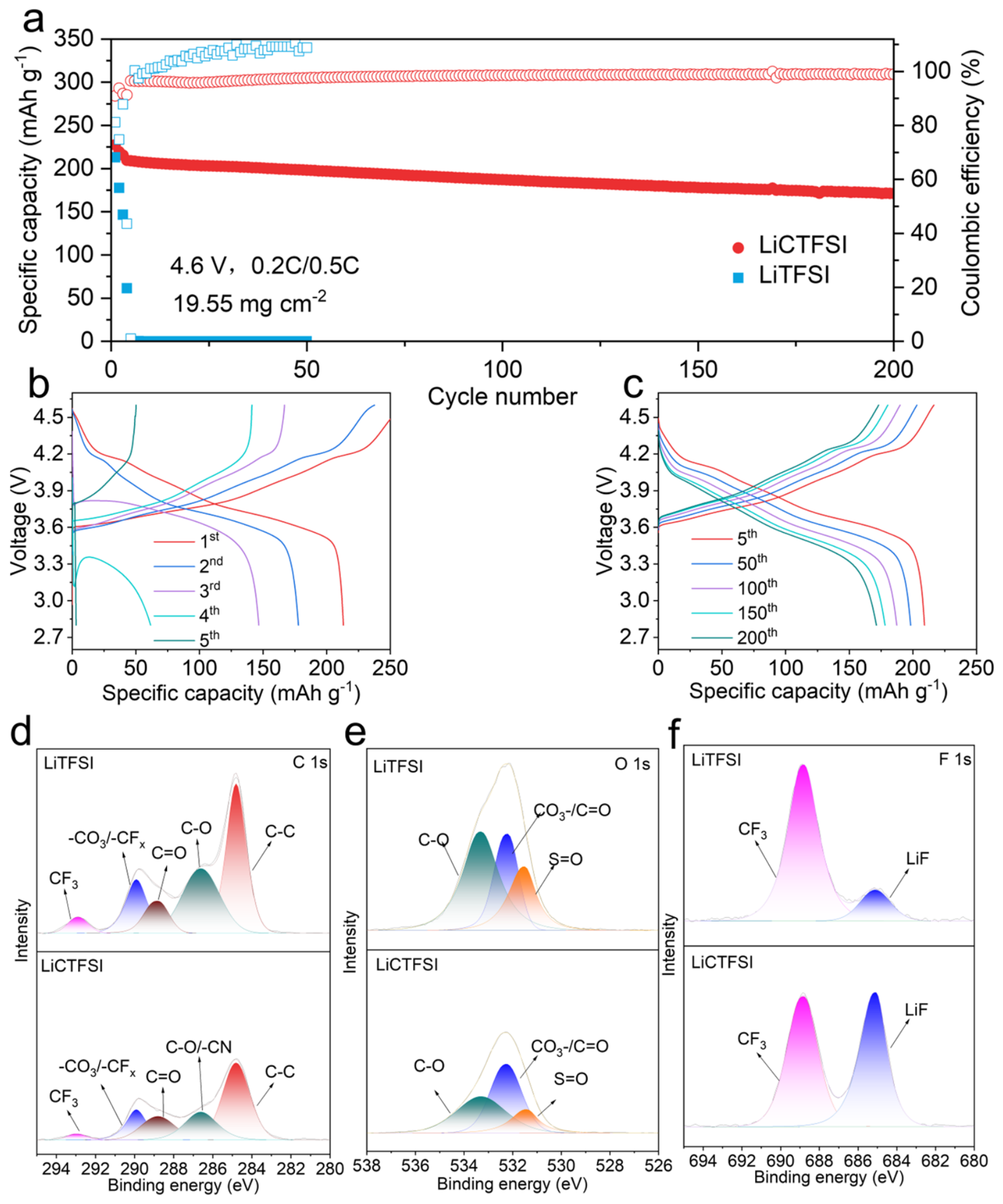
To evaluate the practical application of different electrolyte systems in LMBs, systematic investigations were carried out in NCM811/Li cells (areal mass loading: 19.55 mg cm−2) at room temperature. As shown in Figure 5a,c, the initial Coulombic efficiency of the LiCTFSI-based cell is 90.96%, while that of the LiTFSI-based cell is 81.15%. The LiCTFSI-based cell sustains stable and better cycling performance over 200 cycles while maintaining a capacity retention exceeding 81.7% at room temperature. This significantly outperforms the LiTFSI-based cell, which, after only five cycles (Figure 5a,b and Figure S2), has its capacity almost completely diminished to zero. In addition, compared with the 4 M LiFSI [24], 3.25 M LiTFSI [59] and 1 M LiDFTFSI [9]) electrolytes, the LiCTFSI-based cell exhibits superior cycling stability (81.7% after 200 cycles at 4.6 V vs. 88.6% at 120 cycles for LiFSI, 80.5% at 100 cycles for LiTFSI and 87% at 200 cycles but at lower voltage for LiDFTFSI), demonstrating competitive performance in a simpler single-salt formulation. The poor performance of the LiTFSI-based cell is attributed to the severe corrosion of the aluminum current collector induced by the LiTFSI-based electrolyte under such high-voltage conditions. This persistent and severe corrosion prevents the cell from undergoing normal charge–discharge cycles. Firstly, to clarify the different roles of these two salts in the interfacial chemistry on the lithium metal anode, we performed X-ray photoelectron spectroscopy (XPS) on the Li anodes after 50 cycles in both LiTFSI and LiCTFSI electrolytes, and the results are shown in Figure 5d–f. The results reveal clear chemical differences between the two SEIs, which directly explain the improved morphology observed with LiCTFSI. From the C 1s spectra, it can be observed that, compared with LiTFSI, the signals of C–O (286.6 eV), C=O (288.8 eV), and –CO3 (289.9 eV) in the SEI derived from LiCTFSI are significantly reduced, as also evidenced by the O 1s spectra. This indicates that the cyano-functionalized salt effectively suppresses solvent decomposition. It can be seen that LiCTFSI promotes the formation of more LiF (685.1 eV) as shown in the F 1s spectra, which is well known as a mechanically robust SEI component that suppresses dendrite growth. Meanwhile, the CF3 signal intensity of LiCTFSI is lower than that of LiTFSI, indicating that the –CF3 groups of the cyano functionalized anion undergo more complete decomposition during SEI formation. This more thorough decomposition contributes to the formation of a LiF-rich SEI. In addition, previous studies [60,61] have confirmed that the stabilizing effect of the cyano group is not specific to any particular system but rather reflects a universal phenomenon in interfacial chemistry: the strong electron-withdrawing nature of the -CN group promotes preferential decomposition of anions, thereby forming a LiF-rich SEI layer that provides exceptional passivation. The consistency of this mechanism has been verified through XPS analysis of different salt frameworks, further emphasizing that cyano functionalization is a reliable and generalizable strategy for high-voltage lithium-ion batteries.
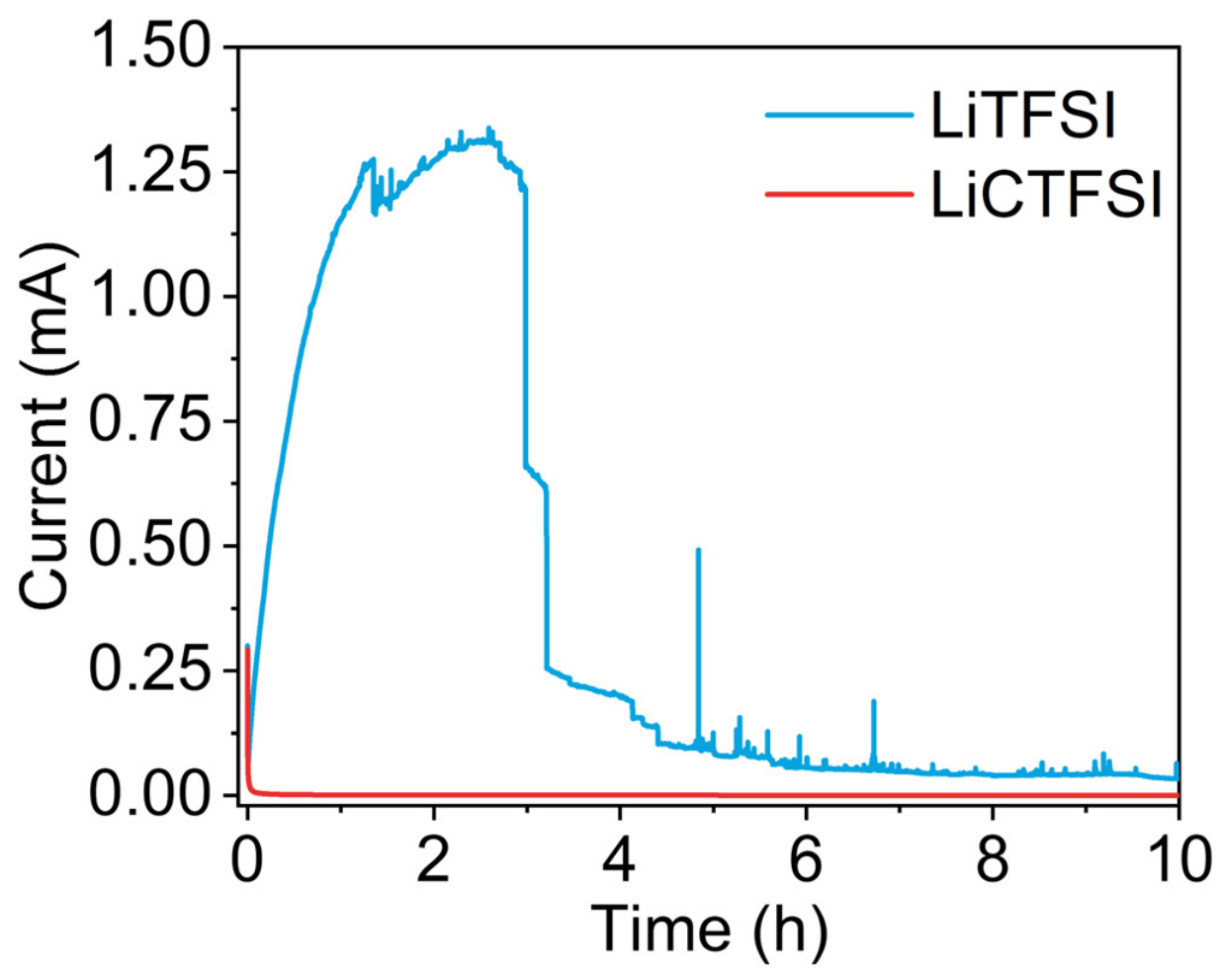
To examine the aluminum corrosion behaviors of different electrolytes, chronoamperometry (CA) testing was conducted on the two electrolytes using a three-electrode system. For the LiCTFSI-based electrolyte, as shown in Figure 6, when a voltage of 4.6 V Li+/Li was applied to the Al electrode, the current density dropped sharply and remained at a low level even after prolonged polarization for 10 h. This strongly suggests that a passivation layer forms on the surface of the Al electrode in the LiCTFSI-based electrolyte, thereby preventing corrosion of the Al electrode. However, under the same experimental conditions, for the LiTFSI-based electrolyte, the current density initially decreased but subsequently rose abruptly to an ultrahigh value, indicating severe Al corrosion [9].
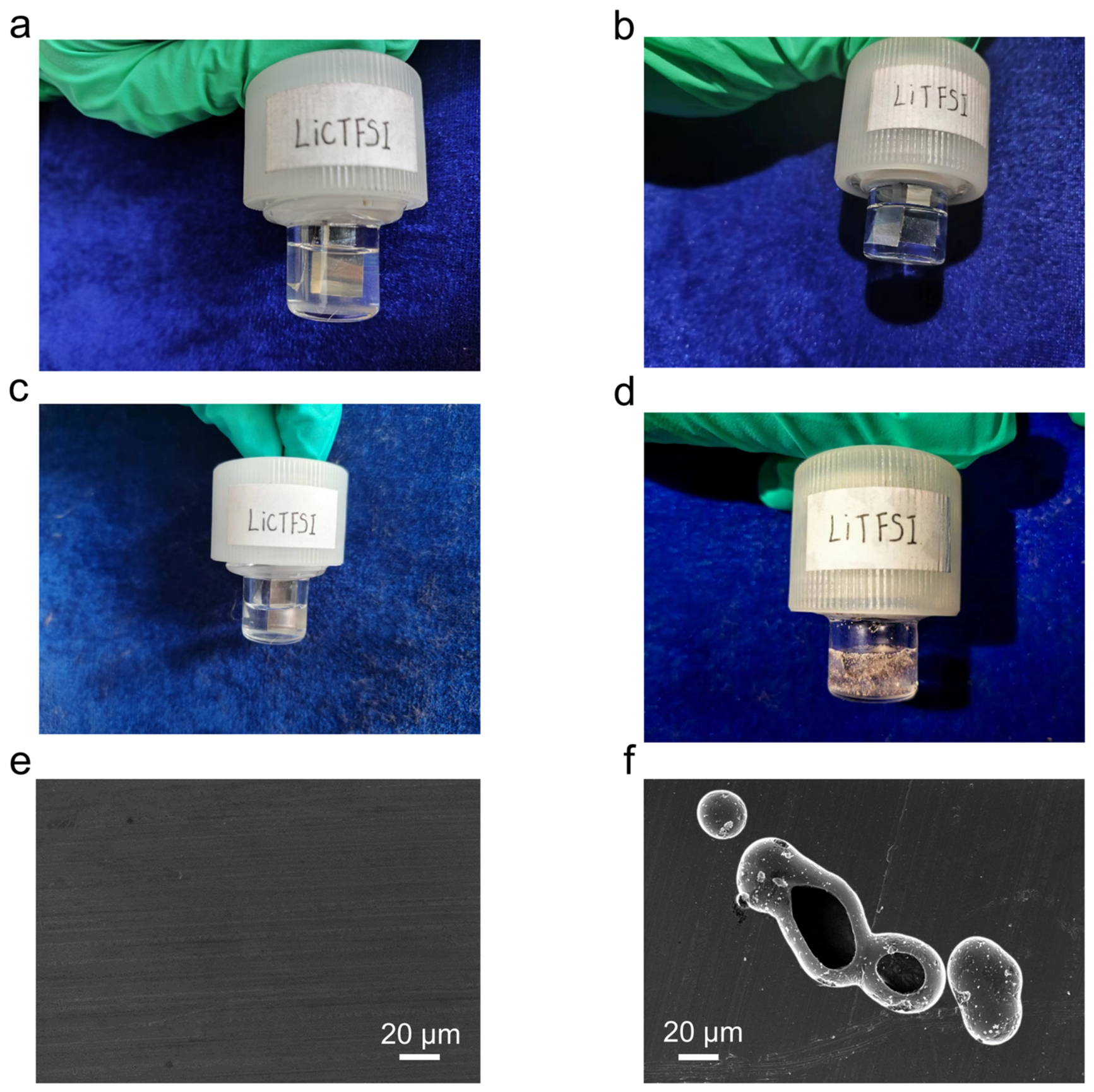
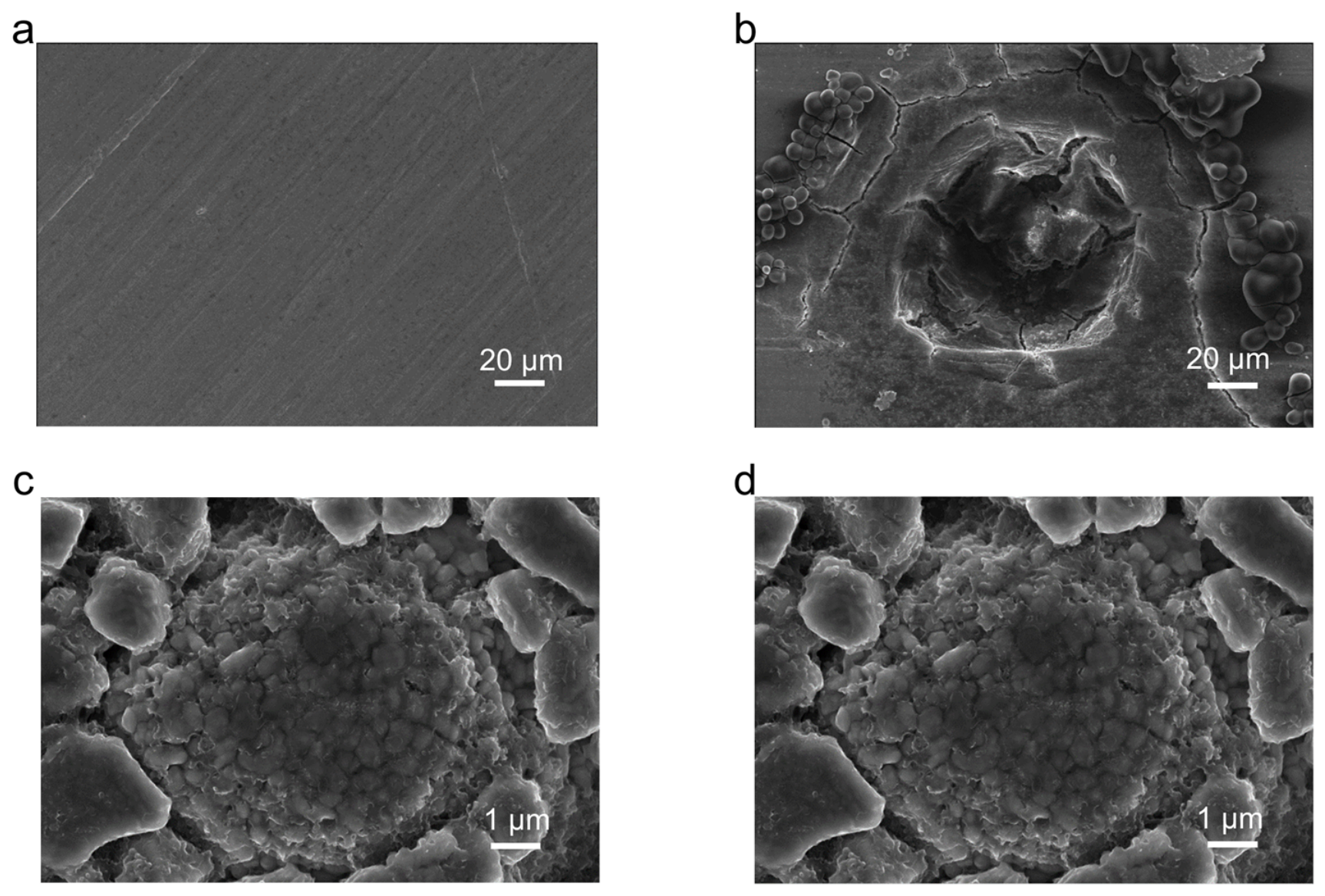
Figure 7a–d show digital photographs of the Al electrode before and after the CA tests. It can be observed that the Al remains intact in the LiCTFSI-based electrolyte, whereas severe crack corrosion occurred in the Al in the LiTFSI-based electrolyte. In addition, we also conducted a scanning electron microscope (SEM) examination of the Al current collector after the CA tests in various electrolytes. As shown in Figure 7e,f. the surfaces of the Al current collectors in the LiCTFSI-based electrolyte remain smooth, showing minimal change after the CA tests. In contrast, the LiTFSI-based electrolyte led to pronounced Al corrosion, suggesting anodic dissolution of the Al current collector under the same high-voltage conditions. These findings clearly demonstrate that the Al current collector undergoes severe corrosion and dissolution under high-voltage conditions in the LiTFSI-based electrolyte, whereas the LiCTFSI-based electrolyte effectively protects the Al current collector and prevents its corrosion.
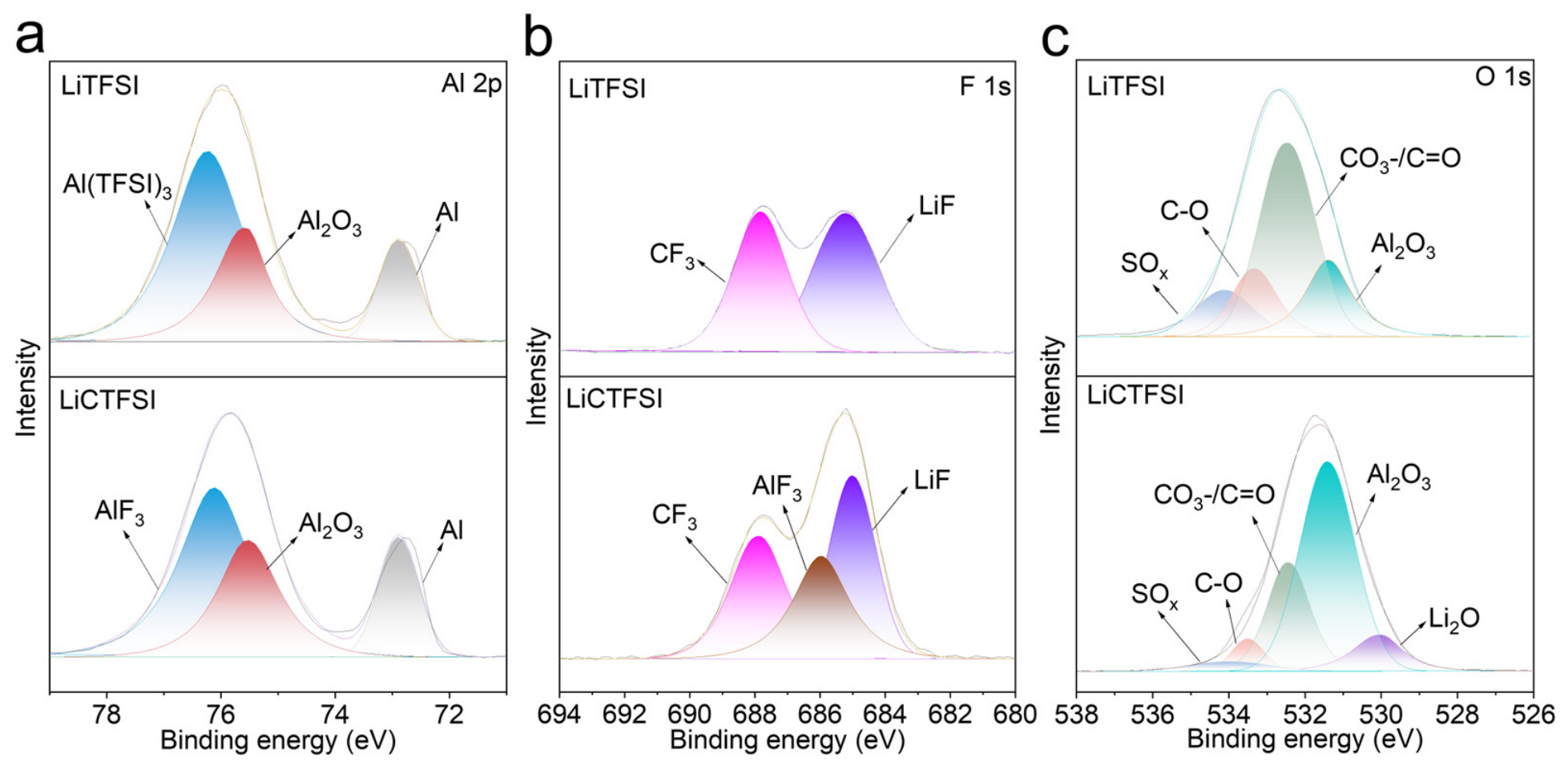
To provide direct chemical evidence for the Al-protection processes of LiCTFSI, we performed X-ray photoelectron spectroscopy (XPS) analysis on the Al current collectors after chronoamperometry (CA) testing in both electrolytes. As shown in the Al 2p spectra (Figure 8), all Al electrodes exhibit peaks corresponding to metallic Al and native Al2O3 [60]. In the LiCTFSI-based electrolyte, a strong AlF3 signal is detected at 76.7 eV in the Al 2p spectrum, which is further confirmed by the F 1s spectrum. In addition, a strong LiF signal at 685 eV is observed on the Al surface after the CA testing. Therefore, the observed reduction in Al corrosion and the improved electrochemical performance can be attributed to the formation of a robust protective layer rich in AlF3 and LiF. In stark contrast, for the LiTFSI-based electrolyte, no AlF3 is detected. Instead, Al(TFSI)3 is preferentially formed via reaction with TFSI anions, as evidenced by the strong CF3 signals in both the C 1s and F 1s spectra. Moreover, the Al2O3 signal is much weaker than that of Al(TFSI)3, indicating that LiTFSI aggressively attacks the native oxide layer on the Al surface. Because Al(TFSI)3 is highly soluble in carbonate solvents, its dissolution into the electrolyte continuously exposes fresh Al, thereby promoting further corrosion by LiTFSI.
SEM analysis was carried out on the NCM811 cathode side and Al current collector side on the NCM811 cathode after 50 cycles. As shown in Figure 9a,b, after 50 cycles, the Al current collector in LiCTFSI-based electrolyte retains a smooth surface. However, there is noticeable corrosion on the surface of the Al current collector using LiTFSI-based electrolyte. This indicates that using LiTFSI-based electrolyte under high voltages causes severe corrosion of the Al current collector. As shown in Figure 9c,d, SEM images show that the NCM811 cathode cycled in the LiCTFSI-based electrolyte retains a great spherical morphology, with no obvious cracks or fragmentation. The NCM811 cathode recovered from the LiTFSI-based electrolyte exhibits clear intergranular cracks and fractured grains. This will increase the contact area between the electrolyte and the interface, thereby intensifying parasitic reactions.
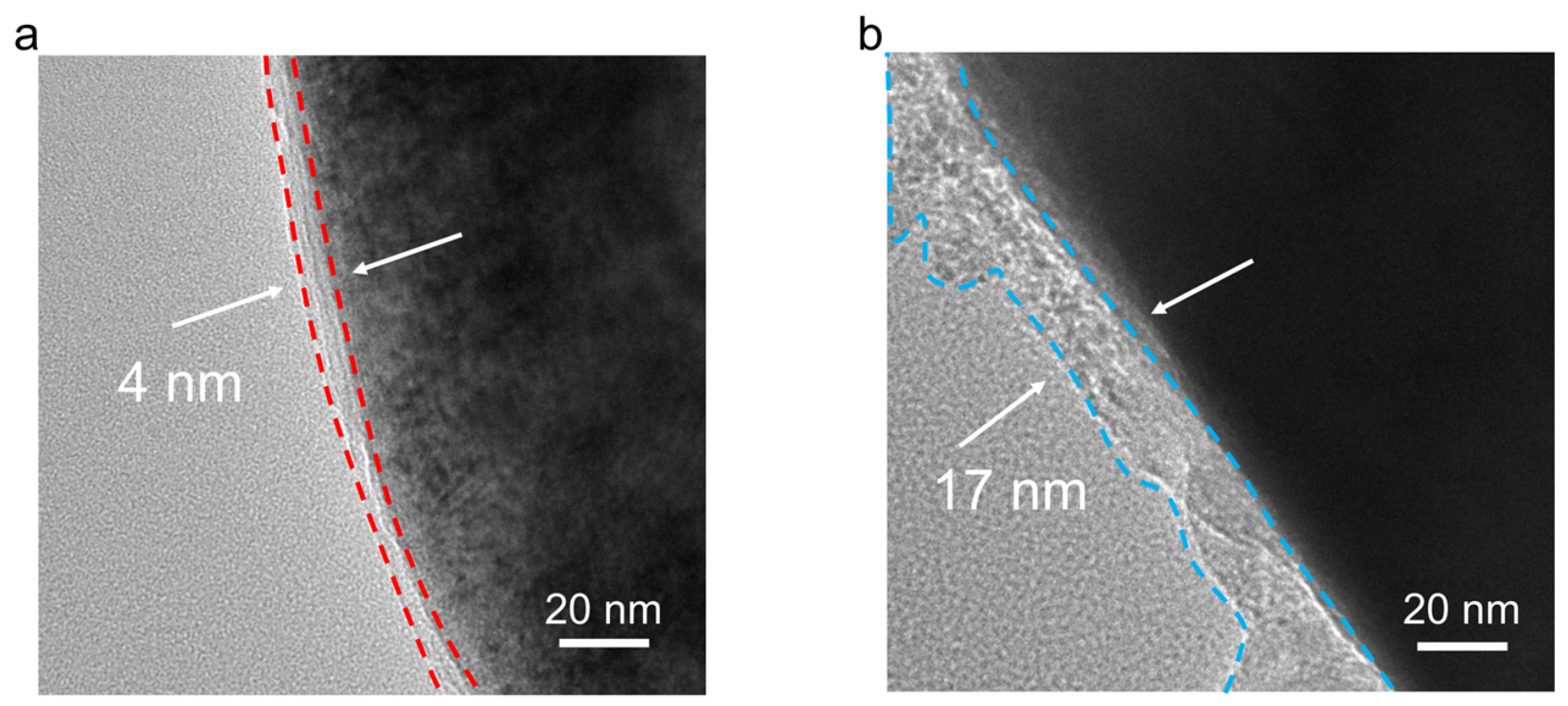
Transmission electron microscopy (TEM) was also conducted on the NCM811 electrode after 50 cycles. Figure 10a,b demonstrate that the LiCTFSI-based electrolyte gives rise to a CEI layer of reduced thickness and improved uniformity (~4 nm), whereas the LiTFSI-derived CEI is significantly thicker (~17 nm) and exhibits a non-uniform morphology. This is attributed to the severe side reactions between the LiTFSI-based electrolyte and high-nickel NCM811 cathode at a high voltage of 4.6 V vs. Li+/Li, resulting in the formation of a large number of byproducts.

4. Conclusions

We studied a cyano-containing lithium salt, LiCTFSI, which effectively prevents the aluminum corrosion commonly observed in LiTFSI-based electrolytes. When a LiCTFSI-based electrolyte was applied in NCM811/Li cells, a capacity retention of 81.7% was achieved after 200 cycles at a high cutoff voltage of 4.6 V vs. Li+/Li, with an areal mass loading of 19.55 mg cm−2. This significantly enhances the cycling stability of NCM811/Li cells under high-voltage operation. This work provides a direction for lithium metal batteries with high energy density and high operating voltage and also offers a promising strategic reference for the development of next-generation, high-performance energy storage technologies with high energy densities.

Supplementary Materials

The following supporting information can be downloaded at: https://www.mdpi.com/article/10.3390/en19133135/s1, Figure S1: Li||Cu Coulombic efficiencies of the two electrolytes measured by the Aurbach’s method; Figure S2: Cycling performance of the six replicative LiTFSI-based coin cells at room temperature; Table S1: XPS peak fitting parameters.

Author Contributions

Data curation, P.Y., X.S. and Y.M.; supervision, Z.Z., L.Q. and L.W.; funding acquisition, L.Q. and L.W.; writing—original draft, P.Y.; writing—review and editing, L.Q. All authors have read and agreed to the published version of the manuscript.

Funding

This work was supported by the National Natural Science Foundation of China (22409203), the Natural Science Foundation of Shandong Province (2023HWYQ-104; ZR2023QE297) and the Dezhou University university-level scientific research fund (2022xjrc411).

Data Availability Statement

The data that support the findings of this study are available from the corresponding author upon reasonable request.

Conflicts of Interest

The authors declare no conflicts of interest.

References

  1. Ma, X.X.; Zhang, H.; Liu, Y.; Yan, W.N.; Chen, C.; Zhang, K. MOF-derived Na3V2(PO4)3-carbon@graphene fibers for flexible fiber-shaped sodium ion battery. J. Electroanal. Chem. 2024, 975, 118740. [Google Scholar] [CrossRef]
  2. Lv, D.; Li, Q.; Wu, P.; Zhang, X.; Wang, L.; Li, B.; Gao, N.; Liu, Z.; Wang, L. High-Performance Anode Material Based on Zinc Naphthalocyanine/Graphene Composite. Langmuir 2024, 40, 11287–11296. [Google Scholar] [PubMed]
  3. Lin, H.; Zhang, Y.; Huang, Y. Unlocking the intercalation mechanism of blue phosphorene/MBene heterostructures for lithium/sodium-ion batteries: A first principles study. J. Mol. Liq. 2024, 409, 125528. [Google Scholar]
  4. Li, Z.; Yang, M.; Geng, F.; Zhang, D.; Zhang, Y.; Zhang, X.; Pang, X.; Geng, L. Nanotubular Fe2O3 and Mn3O4 with hierarchical porosity as high-performance anode materials for lithium-ion batteries. Dalton Trans. 2023, 52, 18194–18205. [Google Scholar] [PubMed]
  5. Li, Q.; Li, B.; Lv, D.; Wu, P.; Tang, Q.; Zhang, T.; Jiang, S.; Zhang, N. Synthesis of copper naphthalocyanine/graphene oxide composites as anode materials for lithium-ion batteries. Phys. Chem. Chem. Phys. 2023, 25, 31178–31187. [Google Scholar] [PubMed]
  6. Zhang, K.; Zhang, H.; Li, C.; Ma, X. Vertically oriented MoSe0.4S1.6/N-doped C nanostructures directly grown on carbon nanotubes as high-performance anode for potassium-ion batteries. J. Electroanal. Chem. 2022, 923, 116846. [Google Scholar]
  7. Li, C.; Yuan, C.; Zhu, J.; Ni, X.; Li, K.; Wang, L.; Qi, Y.; Ju, A. Fabrication of silicon nanoparticles/porous carbon@porous carbon nanofibers core-shell structured composites as high-performance anodes for lithium-ion batteries. Colloids Surf. A Physicochem. Eng. Asp. 2022, 655, 129721. [Google Scholar]
  8. Li, Y.-F.; Wang, S.-G.; Shi, Y.-H.; Fan, C.-Y.; Lin, J.; Wu, X.-L.; Sun, H.-Z.; Zhang, J.-P.; Xie, H.-M. In situ chemically encapsulated and controlled SnS2 nanocrystal composites for durable lithium/sodium-ion batteries. Dalton Trans. 2020, 49, 15874–15882. [Google Scholar] [PubMed]
  9. Qiao, L.; Oteo, U.; Martinez-Ibañez, M.; Santiago, A.; Cid, R.; Sanchez-Diez, E.; Lobato, E.; Meabe, L.; Armand, M.; Zhang, H. Stable non-corrosive sulfonimide salt for 4-V-class lithium metal batteries. Nat. Mater. 2022, 21, 455–462. [Google Scholar] [PubMed]
  10. Zhao, C.; Liu, H.; Liu, J.; Shi, Y.; Wang, S.; Tang, Q.; Zhu, X.; Zhang, H.; Zhao, Y. Petal-like Mn-doped α-Ni(OH)2 nanosheets for high-performance Li–S cathode material. RSC Adv. 2023, 13, 8706–8717. [Google Scholar] [PubMed]
  11. Xiao, Z.; Zhu, X.; Wang, S.; Shi, Y.; Zhang, H.; Xu, B.; Zhao, C.; Zhao, Y. Construction of Uniform LiF Coating Layers for Stable High-Voltage LiCoO2 Cathodes in Lithium-Ion Batteries. Molecules 2024, 29, 1414. [Google Scholar] [PubMed]
  12. Wen, L.; Cheng, F.; Wang, X.; Zeng, X.; Wang, T.; Li, L.; Hu, Y.; Yu, Q.; Lu, W. Recent advances of cobalt-free and nickel-rich cathode materials for lithium-ion batteries. Energy Mater. 2024, 4, 400054. [Google Scholar]
  13. Li, J.; Li, R.; Feng, X.; Pi, C.; Wang, Y.; Peng, Y.; Zheng, Y.; Wang, Y.; Chai, J.; Liu, Z. Phenothiazine derivative cathodes with tunable molecular structures for ultralong-life lithium batteries. Electrochim. Acta 2026, 555, 148388. [Google Scholar] [CrossRef]
  14. Li, Y.; Shen, X.-B.; Guo, S.-S.; Ao, D.-W.; Li, X.-P.; Sun, X.-F.; Li, W.-K.; Xu, X.-M.; Zeng, C.-S.; Liu, Z.-F.; et al. Impacts of lithium content on structural and electrochemical properties of nanostructured high-voltage cathode material LixNi0.5Mn1.5O4 (x = 0.96, 0.98, 1.0, 1.02, and 1.04). Int. J. Electrochem. Sci. 2022, 17, 22117. [Google Scholar]
  15. Wang, J.; Li, Y.; Liu, R.; Xu, X.-M.; Zeng, C.-S.; Shen, X.-B.; Gu, Y.-J. The Different Roles of Ni2+/Ni3+, Ni3+/Ni4+, and Mn3+/Mn4+ in Li-rich Layered Nanostructured LiNixMn1−xO2·Li2MnO3 with High Capacity. Int. J. Electrochem. Sci. 2021, 16, 210425. [Google Scholar]
  16. Li, W.; Erickson, E.M.; Manthiram, A. High-nickel layered oxide cathodes for lithium-based automotive batteries. Nat. Energy 2020, 5, 26–34. [Google Scholar]
  17. Wang, J.; Sun, H.; Zhao, W.; Pan, C.; Li, R.; Yao, Y.; Chang, C. Bimetallic chalcogenides enable highly efficient polysulfide capture and conversion in lean-electrolyte Li–S batteries. J. Appl. Electrochem. 2025, 55, 877–887. [Google Scholar]
  18. Liu, J.-H.; Liu, D.; Yu, M.-Y.; Liu, L.; Wang, Y.-Q.; Huo, Y.-F.; Sun, S.-Q.; Hao, S.-S. Manganese-Resorcin[4]Arene-Based Metal-Organic Framework: Syntheses, Structure and Lithium-Ion Battery Application. Eur. J. Inorg. Chem. 2025, 28, e202400785. [Google Scholar]
  19. Qi, J.; Li, Q.; Huang, M.; Ni, J.; Sui, Y.; Meng, Q.; Wei, F.; Zhu, L.; Wei, W. First-principles investigation of Boron-doped graphene/MoS2 heterostructure as a potential anode material for Mg-ion battery. Colloids Surf. A Physicochem. Eng. Asp. 2024, 683, 132998. [Google Scholar]
  20. Jin, W.; Cha, H.; Choi, S.; Song, G. Electrode-level strategies for high-Ni cathodes in high-energy-density batteries beyond material design. Energy Mater. 2025, 5, 500130. [Google Scholar]
  21. Han, D.; Zhang, J.; Yang, M.; Xie, K.; Peng, J.; Dolotko, O.; Huang, C.; Wu, Y.; Shao, L.; Hua, W.; et al. Enhancing the long-term cycling stability of Ni-rich cathodes via regulating the length/width ratio of primary particle. Energy Mater. 2024, 4, 400001. [Google Scholar]
  22. Jung, H.; Oh, C.; Park, S.; An, S.; Bang, J.; Youn, J.; Lee, J.; Park, J.-H.; Han, D. Lithium manganese iron phosphate (LiMn1−yFeyPO4) rechargeable batteries: Bridging material innovation with practical cell design. Energy Mater. 2025, 5, 500118. [Google Scholar]
  23. Fang, H. Challenges with the Ultimate Energy Density with Li-ion Batteries. IOP Conf. Ser. Earth Environ. Sci. 2021, 781, 042023. [Google Scholar] [CrossRef]
  24. Chen, Q.; Ma, Y.; Wang, L.; Zhang, Z.; Qiao, L. Highly Concentrated Carbonate Electrolytes for Stable High-Voltage Lithium Metal Batteries. Energies 2026, 19, 1805. [Google Scholar] [CrossRef]
  25. Wang, L.; Wang, B.; Li, H.; Qiao, L. Rapid response and wide-band regulation of an electrochromic device achieved by ultra-small V2O5 nanodots and a Zn2+/Li+ electrolyte. Inorg. Chem. Front. 2025, 12, 5091–5099. [Google Scholar]
  26. Castillo, J.; Qiao, L.; Santiago, A.; Judez, X.; Sáenz de Buruaga, A.; Jiménez-Martín, G.; Armand, M.; Zhang, H.; Li, C. Perspective of polymer-based solid-state Li-S batteries. Energy Mater. 2022, 2, 200003. [Google Scholar]
  27. Zhou, D.; Gao, G.; Yang, Z.; Guo, W.; Lin, L.; Zhang, Y.; Zhang, C.; Li, S.; Liu, Y.; Sa, B.; et al. A low-cost inorganic oxide as dual-functional electrolyte additive towards long cycling Li-rich Mn-based cathode materials. Energy Mater. 2025, 5, 500033. [Google Scholar]
  28. Jung, S.-Y.; Park, J.-Y.; Yu, S.-H. Recent advances in electrolyte design for optimized lithium polysulfides solvation in lithium-sulfur batteries. Energy Mater. 2025, 5, 500125. [Google Scholar] [CrossRef]
  29. Yang, B.; Li, T.; Pan, Y.; Yang, L.; Li, K.; Chen, J.; Yan, Z.; Hu, A.; Long, J. Design strategy towards flame-retardant gel polymer electrolytes for safe lithium metal batteries. Energy Mater. 2024, 4, 400061. [Google Scholar] [CrossRef]
  30. Chen, G.; Qiao, L.; Xu, G.; Li, L.; Li, J.; Li, L.; Liu, X.; Cui, Z.; Zhang, S.; Cheng, S.; et al. A Highly-Fluorinated Lithium Borate Main Salt Empowering Stable Lithium Metal Batteries. Angew. Chem. Int. Ed. 2024, 63, e202400797. [Google Scholar]
  31. Wan, J.; Wan, M.; Hou, X.; Vangosa, F.B.; Bresser, D.; Li, J.; Paillard, E. Combining ternary, ionic liquid-based, polymer electrolytes with a single-ion conducting polymer-based interlayer for lithium metal batteries. Energy Mater. 2024, 4, 400074. [Google Scholar]
  32. Boaretto, N.; Garcia-Calvo, O.; Cobos, M.; Fernandez de Añastro, A.; Diez Viera, M.; Al Sammarraie Shakir, M.; Lindberg, S.; Cid Barreno, R.; Godillot, G.; Jøsang, L.O.; et al. Quasi-solid polymer electrolytes with binary and ternary salt mixtures for high-voltage lithium metal batteries. Energy Mater. 2025, 5, 500040. [Google Scholar]
  33. Neumann, P.; Fortuin, B.A.; Sasieta-Barrutia, E.; Meabe, L.; Garcia, L.; Morant-Miñana, M.C.; Forsyth, M.; Lecuyer, M.; Deschamps, M.; Zhang, Y.; et al. Unveiling ion coordination in solid polymer electrolytes through alkyl chain length modulation in lithium salt chemistry. Energy Mater. 2025, 5, 500159. [Google Scholar] [CrossRef]
  34. Zhang, D.; Liu, M.; Ma, J.; Yang, K.; Chen, Z.; Li, K.; Zhang, C.; Wei, Y.; Zhou, M.; Wang, P.; et al. Lithium hexamethyldisilazide as electrolyte additive for efficient cycling of high-voltage non-aqueous lithium metal batteries. Nat. Commun. 2022, 13, 6966. [Google Scholar] [PubMed]
  35. Zhang, M.; Liu, K.; Gan, Y.; Wang, H.; Liu, F.; Bai, M.; Tang, X.; Wang, Z.; Li, S.; Shao, A.; et al. Boosting the Temperature Adaptability of Lithium Metal Batteries via a Moisture/Acid-Purified, Ion-Diffusion Accelerated Separator. Adv. Energy Mater. 2022, 12, 2201390. [Google Scholar]
  36. Zhan, C.; Wu, T.; Lu, J.; Amine, K. Dissolution, migration, and deposition of transition metal ions in Li-ion batteries exemplified by Mn-based cathodes—A critical review. Energy Environ. Sci. 2018, 11, 243–257. [Google Scholar]
  37. Delacourt, C.; Kwong, A.; Liu, X.; Qiao, R.; Yang, W.L.; Lu, P.; Harris, S.J.; Srinivasan, V. Effect of Manganese Contamination on the Solid-Electrolyte-Interphase Properties in Li-Ion Batteries. J. Electrochem. Soc. 2013, 160, A1099. [Google Scholar]
  38. Guo, S.; Li, X.; Zhang, Z.; Xu, X.; Wang, H.; Zhao, C.; Gu, Y. Advancements in lithium solid polymer batteries: Surface modification, in-situ operando characterization, and simulation methodologies. Energy Mater. 2025, 5, 500041. [Google Scholar]
  39. Wang, Z.; Chen, J.; Fu, J.; Li, Z.; Guo, X. Polymer-based electrolytes for high-voltage solid-state lithium batteries. Energy Mater. 2024, 4, 400050. [Google Scholar]
  40. Wang, Z.; Yang, H.; Li, S.; Tong, H.; Xu, W.; Zhao, Y.; Li, L. Small components play a big role-fillers in composite solid-state electrolytes for lithium metal batteries. Energy Mater. 2024, 4, 400080. [Google Scholar]
  41. Tekaligne, T.M.; Bezabh, H.K.; Merso, S.K.; Shitaw, K.N.; Weret, M.A.; Nikodimos, Y.; Jiang, S.-K.; Yang, S.-C.; Wang, C.-H.; Wu, S.-H.; et al. Enhancing aluminum foil performance in aqueous and organic electrolytes: Dual-secure passivation with phthalocyanine as a corrosion inhibitor. J. Mater. Chem. A 2024, 12, 2157–2171. [Google Scholar] [CrossRef]
  42. Xu, P.; Li, J.; Li, C.; Li, J.; Zhu, Y.; Zhong, B.; Yu, H.; Lu, Y.; Cui, H.; Zeng, R.; et al. Overcharge-Induced Thermal Runaway of LiNi0.5Co0.2Mn0.3O2 Batteries: An Integrated Electro-Thermal-Gas Model. J. Electrochem. Soc. 2025, 172, 070533. [Google Scholar]
  43. Yu, M.-Y.; Li, X.-Z.; Zhang, L.; Jia, Y.-L.; Zou, F.; Liu, Z.-L.; Zhang, X.-W.; Zhang, Q.; Liu, J.-H.; Li, W.; et al. Recent Advances in Polyoxometalate-Based Materials as Anodes for Lithium-Ion Batteries. ChemistrySelect 2025, 10, e03244. [Google Scholar] [CrossRef]
  44. Yuan, F.; Wang, J.; Ma, Q.; Sun, H.; Li, Z.; Zhang, D.; Wang, Q.; Wu, Y.; Li, W.; Wang, B. Edge-nitrogen synergize with micropores to realize fast and durable potassium storage for carbon anode. Carbon 2023, 213, 118291. [Google Scholar] [CrossRef]
  45. Han, C.; Chen, G.; Ma, Y.; Ma, J.; Shui, X.; Dong, S.; Xu, G.; Zhou, X.; Cui, Z.; Qiao, L.; et al. Strategies towards inhibition of aluminum current collector corrosion in lithium batteries. Energy Mater. 2023, 3, 300052. [Google Scholar] [CrossRef]
  46. Matsumoto, K.; Inoue, K.; Nakahara, K.; Yuge, R.; Noguchi, T.; Utsugi, K. Suppression of aluminum corrosion by using high concentration LiTFSI electrolyte. J. Power Sources 2013, 231, 234–238. [Google Scholar] [CrossRef]
  47. Li, F.; Gong, Y.; Jia, G.; Wang, Q.; Peng, Z.; Fan, W.; Bai, B. A novel dual-salts of LiTFSI and LiODFB in LiFePO4-based batteries for suppressing aluminum corrosion and improving cycling stability. J. Power Sources 2015, 295, 47–54. [Google Scholar]
  48. Becke, A.D. A new mixing of Hartree–Fock and local density-functional theories. J. Chem. Phys. 1993, 98, 1372–1377. [Google Scholar]
  49. Delley, B. From molecules to solids with the DMol3 approach. J. Chem. Phys. 2000, 113, 7756–7764. [Google Scholar] [CrossRef]
  50. Stephens, P.J.; Chabalowski, C.F.; Devlin, F.J.; Jalkanen, K.J. Ab initio calculation of vibrational circular dichroism spectra using large basis set MP2 force fields. Chem. Phys. Lett. 1994, 225, 247–257. [Google Scholar] [CrossRef]
  51. Qiao, L.; Oteo, U.; Zhang, Y.; Peña, S.R.; Martínez-Ibañez, M.; Santiago, A.; Cid, R.; Meabe, L.; Manzano, H.; Carrasco, J.; et al. Trifluoromethyl-free anion for highly stable lithium metal polymer batteries. Energy Storage Mater. 2020, 32, 225–233. [Google Scholar] [CrossRef]
  52. Qiao, L.; Rodriguez Peña, S.; Martínez-Ibañez, M.; Santiago, A.; Aldalur, I.; Lobato, E.; Sanchez-Diez, E.; Zhang, Y.; Manzano, H.; Zhu, H.; et al. Anion π–π Stacking for Improved Lithium Transport in Polymer Electrolytes. J. Am. Chem. Soc. 2022, 144, 9806–9816. [Google Scholar] [CrossRef] [PubMed]
  53. Zhang, H.; Li, C.; Piszcz, M.; Coya, E.; Rojo, T.; Rodriguez-Martinez, L.M.; Armand, M.; Zhou, Z. Single lithium-ion conducting solid polymer electrolytes: Advances and perspectives. Chem. Soc. Rev. 2017, 46, 797–815. [Google Scholar] [CrossRef] [PubMed]
  54. Zugmann, S.; Fleischmann, M.; Amereller, M.; Gschwind, R.M.; Wiemhöfer, H.D.; Gores, H.J. Measurement of transference numbers for lithium ion electrolytes via four different methods, a comparative study. Electrochim. Acta 2011, 56, 3926–3933. [Google Scholar] [CrossRef]
  55. Miyazaki, R.; Hihara, T. All-solid-state lithium battery using a NaI-based Li+ conductor. Mater. Lett. 2022, 312, 131646. [Google Scholar]
  56. Chen, F.; Wang, X.; Armand, M.; Forsyth, M. Cationic polymer-in-salt electrolytes for fast metal ion conduction and solid-state battery applications. Nat. Mater. 2022, 21, 1175–1182. [Google Scholar] [PubMed]
  57. Diederichsen, K.M.; McShane, E.J.; McCloskey, B.D. Promising Routes to a High Li+ Transference Number Electrolyte for Lithium Ion Batteries. ACS Energy Lett. 2017, 2, 2563–2575. [Google Scholar] [CrossRef]
  58. Liu, B.; Zhao, D.; Lyle, K.; Yuan, X.; Chen, P.-H.; Zhang, X.; Kim, J.K.; Wang, T.-Y.; Wu, H.; Wang, C.; et al. A quantitative figure of merit for battery SEI films and their use as functional solid-state electrolytes. Proc. Natl. Acad. Sci. USA 2025, 122, e2425556122. [Google Scholar] [CrossRef] [PubMed]
  59. Zhu, Y.; He, S.; Ding, J.; Zhao, G.; Lian, F. The sulfolane-based liquid electrolyte with LiClO4 additive for the wide-temperature operating high nickel ternary cathode. Nano Res. 2023, 16, 3855–3863. [Google Scholar]
  60. Zhang, N.; Li, A.-M.; Zhang, W.; Wang, Z.; Liu, Y.; Zhang, X.; Cai, G.; Wan, H.; Xu, J.; Wang, C. 4.6 V Moisture-Tolerant Electrolytes for Lithium-Ion Batteries. Adv. Mater. 2024, 36, 2408039. [Google Scholar]
  61. Min, X.; Han, C.; Zhang, S.; Ma, J.; Hu, N.; Li, J.; Du, X.; Xie, B.; Lin, H.-J.; Kuo, C.-Y.; et al. Highly Oxidative-Resistant Cyano-Functionalized Lithium Borate Salt for Enhanced Cycling Performance of Practical Lithium-Ion Batteries. Angew. Chem. Int. Ed. 2023, 62, e202302664. [Google Scholar]
Figure 1. (a) Ionic conductivity comparison of LiCTFSI- and LiTFSI-based electrolytes at room temperature. (b) Lithium-ion conductivity comparison of LiCTFSI- and LiTFSI-based electrolytes. (c) Polarization profiles and impedance spectra (inset) of representative symmetric cells using LiCTFSI-based electrolyte and LiTFSI-based electrolyte.
Energies 19 03135 g001
Figure 2. (a) Linear sweep voltammetry (LSV) profiles of LiCTFSI–and LiTFSI–based electrolytes. (b) The lowest unoccupied molecular orbital (LUMO) energy level and the highest occupied molecular orbital (HOMO) energy level of LiCTFSI and LiTFSI salt.
Energies 19 03135 g002
Figure 3. Cyclic voltammetry (CV) curves of different electrolytes: LiCTFSI-based electrolyte and LiTFSI-based electrolyte.
Energies 19 03135 g003
Figure 4. (a) Galvanostatic cycling of symmetric Li cells at different current densities with a half-cycle duration of 1 h. Scanning electron microscopy images of Li deposits on Cu substrates using different electrolytes at different magnifications: (b) LiCTFSI-based electrolyte (×1000); (c) LiTFSI-based electrolyte (×1000); (d) LiCTFSI-based electrolyte (×2000); (e) LiTFSI-based electrolyte (×2000). XPS spectra of the Cu electrodes after the deposition in various electrolytes, including (f) N 1s spectra, (g) C 1s spectra and (h) F 1s spectra.
Energies 19 03135 g004
Figure 5. (a) Long-term cycling performance of NCM811/Li cells using different electrolytes at room temperature. Charge/discharge profiles of the cells using (b) LiTFSI-based electrolyte and (c) LiCTFSI-based electrolyte. (d) C 1s, (e) O 1s and (f) F 1s XPS spectra of the Li anodes recovered from different electrolytes after 50 cycles between 2.5 and 4.6 V vs. Li+/Li.
Energies 19 03135 g005
Figure 6. Chronoamperometry (CA) profiles of·the·Al working electrode in LiCTFSI- and LiTFSI-based electrolytes at 4.6 V·vs. Li+/Li at room temperature.
Energies 19 03135 g006
Figure 7. Digital photograph of the Al current collector before the CA corrosion test using different electrolytes: (a) LiCTFSI-based electrolyte; (b) LiTFSI-based electrolyte. Photograph of the Al current collector after the CA corrosion test: (c) LiCTFSI-based electrolyte; (d) LiTFSI-based electrolyte. SEM images of the Al current collector after the CA corrosion test using (e) LiCTFSI- based electrolyte and (f) LiTFSI-based electrolyte.
Energies 19 03135 g007
Figure 8. XPS spectra of the Al electrodes after the chronoamperometry (CA) testing in various electrolytes, including (a) Al 2p spectra, (b) F 1s spectra and (c) O 1s spectra.
Energies 19 03135 g008
Figure 9. SEM images of the cycled Al current collector using (a) LiCTFSI-based electrolyte and (b) LiTFSI-based electrolyte. SEM images of the NCM811 cathodes obtained with the (c) LiCTFSI-based electrolyte and (d) LiTFSI-based electrolyte.
Energies 19 03135 g009
Figure 10. Transmission electron microscopy (TEM) images of the NCM811 cathodes obtained from the NCM811/Li cells with the (a) LiCTFSI- and (b) LiTFSI-based electrolyte after 50 cycles.
Energies 19 03135 g010
Disclaimer/Publisher’s Note: The statements, opinions and data contained in all publications are solely those of the individual author(s) and contributor(s) and not of MDPI and/or the editor(s). MDPI and/or the editor(s) disclaim responsibility for any injury to people or property resulting from any ideas, methods, instructions or products referred to in the content.