Article

Dependence of Transient Foam Behavior on Enriched Gas Flood Maturity in Sandstone

Hildebrand Department of Petroleum and Geosystems Engineering, The University of Texas at Austin, Austin, TX 78712, USA
*
Author to whom correspondence should be addressed.
Energies 2026, 19(12), 2797; https://doi.org/10.3390/en19122797
Submission received: 3 April 2026 / Revised: 2 June 2026 / Accepted: 4 June 2026 / Published: 10 June 2026

Abstract

This work evaluated the effect of enriched gas flood maturity and mobile water on transient foam behavior and oil recovery under high-pressure (2000 psi), moderate-temperature (38 °C) and salinity (20,000 ppm NaCl) conditions in high-permeability Bentheimer sandstone. A synthetic gas mixture containing relatively high contents of CO2 (20%) and propane (26%) was used to simulate the enriched field gas. Screening of foaming surfactants including alpha olefin sulfonates and a betaine for good foamability and stability as well as low adsorption on the sandstone indicates that the alpha olefin sulfonate with a longer chain length was the best candidate for foaming the enriched gas in the presence of oil. Core flooding experiments conducted with this surfactant showed a strong impact of gas flood maturity and injection foam quality on both the transient foam behavior and oil displacement efficiency. Foam injection at residual oil saturation (about 14%) to a gas–brine flood exhibited robust foam propagation. The presence of mobile oil before foam injection due to the immaturity of the gas–brine flood (e.g., oil saturations above 50%) posed a detrimental effect on the rate of foam viscosity buildup. However, water injection during the pre-foam flood strongly supported foam generation even at relatively high oil saturations. A further evaluation of water contribution to enhancing foam propagation by adjusting foam quality showed that the water injection strategy before and during foam flooding should be optimized to improve both transient foam behavior and gas–oil contact for enhanced oil sweep efficiency.

1. Introduction

With the decreased productivity of mature oil reservoirs, the importance of enhanced oil recovery (EOR) has become more critical [1]. One of the most established EOR techniques is gas flooding, especially with CO2 or other hydrocarbon-enriched gases due to their ability to effectively mobilize oil through multiple mechanisms such as miscibility, viscosity reduction, oil swelling, and solution gas drive [2,3], with the added benefit of maintaining reservoir pressure. However, one of the common issues encountered in gas EOR processes is the unfavorably high mobility of the injected gas due to the inherently low gas viscosity and density, as well as macroscopic reservoir heterogeneity. This leads to viscous fingering, gravity override, and gas channeling through thief zones, which would be detrimental to the oil recovery rate [4]. To mitigate such problems, foam-assisted gas injection has been used as a mobility control method to improve sweep efficiency by increasing the apparent viscosity of the injected gas and gas trapping, and thus reducing gas mobility [5,6,7,8]. The behavior of foam in porous media has proven to be rather complex, affected by key factors such as surfactant type and concentration, injection rate, pressure, foam quality (i.e., ratio of volumetric flow rate of gas to the total volumetric flow rate of gas and liquid), gas type, and reservoir heterogeneity [9,10,11,12]. Foam flow in porous media develops through a transient regime, where foam propagation is governed by the dynamic formation and rupture of lamellae and bubble trapping, before exhibiting a quasi-steady-state regime in which foam texture and pressure gradients stabilize [13,14,15].
This work investigates the transient behavior of foam and its effect on the displacement of viscous oil by an enriched gas mixture that contains methane and high contents of natural gas liquids and CO2 for the first time. Other than the enhanced miscibility and solubility effects of components such as CO2 and propane during the displacement of oil, the effects of enriched gas on foam generation, stability, and transport in porous media, especially under dynamic conditions of oil flow, are still poorly understood. A key variable in the performance of a foam-assisted EOR gas flood is the maturity of the production method that precedes it. Specifically, in the context of gas flooding, maturity refers to the lifetime of the flood in relation to oil production, changes in composition due to mixing, dissolution, dispersion, mass transfer and phase behavior changes [16,17,18,19,20]. As the gas flood matures, the composition of both the gas and oil is altered, changing fundamental fluid properties such as viscosity, density, and interfacial tension. These changes can be expected to alter foam behavior both in the transient state during generation and propagation, and in the quasi-steady state when flow is relatively stable. Investigation into the effects of pre-foam enriched gas–brine flood maturity on foam dynamics in natural rocks remains scarce. Existing research does provide insight into foam dynamics under single- or two-component gas compositions. For example, experimental studies in tight carbonate cores comparing CO2, N2, and CH4 showed that CO2 had a slightly lower optimum foam quality (i.e., foam quality at which apparent foam viscosity is highest) than N2 and CH4 for different surfactants, but that CH4 generated the strongest foam, followed by N2, then by CO2. This was attributed to the much greater miscibility of CO2 in water [21]. High-pressure, high-temperature microfluidic investigations of foam coarsening dynamics concluded the same when comparing N2 to gas CO2, but the opposite when comparing N2 to dense (liquid and supercritical) CO2 [22]. Similar experiments carried out in high-permeability Bentheimer sandstones (~2 Darcy) at ambient temperature and low pressure (300 psi) also showed that these three gases exhibit different foaming behavior under the same flowing conditions [23]. To date, there is a lack of literature regarding the study of foams with enriched gases that contain relatively high fractions of propane and CO2 and exhibit good miscibility with viscous oils. In this work, we present the first investigation of transient foam behavior in an enriched gas system containing relatively high fractions of CO2 and C3H8. We systematically examine how gas flood maturity—defined as the degree of oil desaturation prior to foam generation—affects foam generation and propagation in porous media. Specifically, we compare maturity levels of 0%, 50%, and 100%, and evaluate how foam quality influences transient foam behavior and oil-displacement efficiency. These results provide new insights into the coupled roles of gas-flood history, mobile oil, mobile water, and injection strategy in enriched-gas foam flooding.

2. Materials and Methods

2.1. Brine

Synthetic brine was prepared by mixing 20,000 parts per million (ppm) NaCl in de-ionized (DI) water. This was used as the base brine in which all surfactant solutions were made.

2.2. Surfactants

Three surfactants were tested in this work, including two alpha-olefin sulfonate surfactants with different chain lengths (SL with 10–12 carbons and SH with 16–18 carbons), and a zwitterionic betaine (BT with a hydrophobe of 12 carbons). All surfactants were used at a concentration of 0.2 wt% for all the tests presented here. This concentration was above the critical micelle concentration for all surfactants, ensuring micelle formation and that the foam tests were conducted under conditions relevant to practical foam generation. These surfactants were chosen because of their proven good foaming capabilities [24,25,26].

2.3. Injection Gas

The injection gas mixture used in this work was synthesized to approximate the composition of an enriched field gas that contains relatively high amounts of CO2 and propane. The molar composition is given in Table 1. It should be noted that field gas composition can vary depending on gas handling facilities and operational and reservoir conditions.

2.4. Crude Oil

Dead crude oil having a density of 0.96 g/mL was used for the bulk foam stability experiments as well as the core floods. The viscosity was measured to be around 266 cP at room temperature, and around 123 cP at 38 °C. It was filtered through a 0.2-micron filter (Thermo Fisher Scientific, Waltham, MA, USA) before use.

2.5. Bulk Foam Stability

Graduated centrifuge 15 mL tubes were filled with 4 mL of surfactant solution, sealed, and placed in an oven at 38 °C for 60 min. Then the samples were shaken vigorously for about 20 s, and periodic observations were made to determine the foam decay over a 90 min period. For the high-pressure bulk foam tests, the same procedure was followed but conducted in Separex SC350-L (P-max 350 bar, T-max 150 °C, Separex, Champigneulles, France) high pressure sapphire cells. To determine foam stability in the presence of oil, 0.4 mL of oil was added to each surfactant sample and the test was repeated.

2.6. Rock

Outcrop Bentheimer sandstone (Kocurek Industries, Caldwell, TX, USA) was used for the Brunauer–Emmett–Teller (BET) surface area measurements and static surfactant adsorption tests. For the core flood experiments, cores were drilled in the same direction from the block with the dimensions of 11.63 inches in length and 0.87 inches in diameter. This sandstone outcrop sample has a compressive strength of 40 megapascals and a density of 2.10 g/cm3. FTIR mineralogy showed a composition of about 95% quartz and 5% kaolinite. This sandstone is expected to be comparatively inert with respect to CO2-induced geochemical reactions. In carbonate rocks, however, CO2-rich injection gases may interact with the rock through mineral dissolution, influence surfactant adsorption, and affect foam transport.

2.7. BET Surface Area

The surface area of crushed rock samples was determined using a Micromeritics 3Flex high-performance gas adsorption analyzer (Norcross, GA, USA). The physisorption of nitrogen gas was determined at different relative pressures and the resulting isotherm was analyzed using the BET theory that allows for the calculation of the specific surface area.

2.8. Static Adsorption

Using crushed sandstone of known surface area, 1 g of rock was mixed with 10 g of surfactant solution having a concentration of 0.2 wt% in 20,000 ppm NaCl and left to equilibrate for three days at 38 °C. The samples were shaken four times a day to ensure proper mixing between the rock and the surfactant solution. After three days, the surfactant solution was extracted, and liquid chromatography–mass spectrometry (LCMS) was performed to determine the mass of surfactant adsorbed per unit area of rock.

2.9. Core Flooding

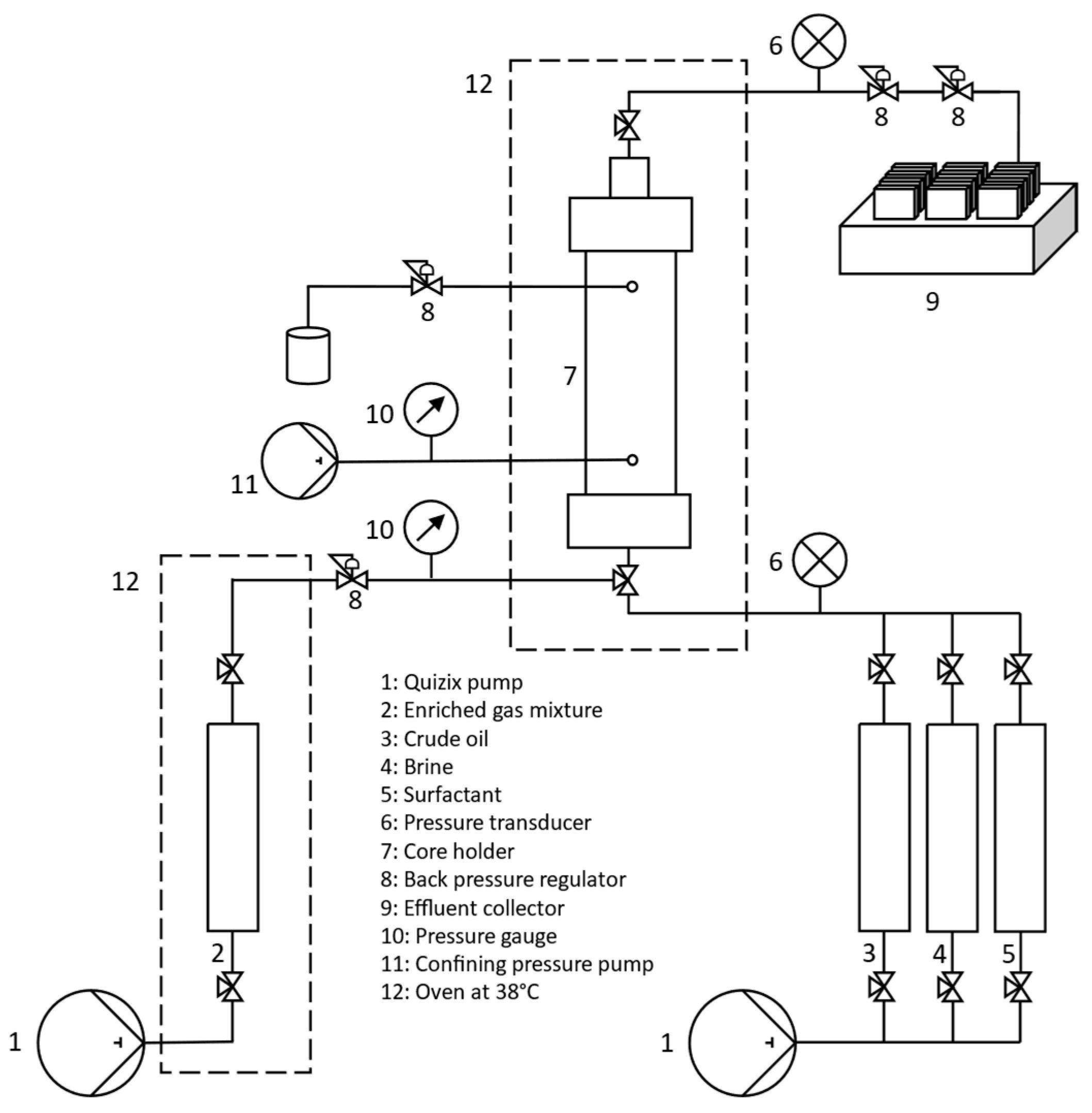
After the cores were cut, they were dried in an oven at 100 °C for 24 h. Following that, porosity and permeability were measured using the synthetic brine. Initial oil saturation was established by injecting crude oil at a constant rate until no more water was produced. Then, a co-injection of brine and gas was performed to achieve the desired gas/brine flood maturity in terms of oil saturation. Gas/brine flood maturity is defined as the extent of prior gas/brine flooding of the core, expressed in terms of the remaining oil saturation. A maturity of 0% corresponds to the initial oil-saturated state, with no prior brine/gas flood. A maturity of 50% indicates that approximately half of the mobile oil has been produced during the gas/brine flood, leaving both mobile oil and mobile water in the core. A maturity of 100% corresponds to a gas/brine flood carried to residual oil saturation, where mobile oil is largely depleted before foam injection. The experimental conditions are shown in Table 2, and a summary of the injection schemes is given in Table 3. A schematic of the experimental setup is shown in Figure 1.
For CF1, a simultaneous injection of brine and gas was carried out until residual oil saturation was obtained (full maturity). This core flood represents areas of a reservoir that have been gas flooded for an extended period of time and likely have no more mobile oil. For CF2, a brine/gas preflood was not performed (0% maturity) to simulate those areas of the reservoir that have not yet been exposed to the injected gas and brine (i.e., at initial oil saturation). CF3 began with a simultaneous injection of gas and brine at 80% GVF, which was stopped when only half of the mobile oil was produced (i.e., 50% maturity). This experiment represents areas of the reservoir that have undergone gas flooding but still have a substantial amount of mobile oil. For CF4 and CF5, the same 50% flood maturity was performed, but using 100% gas injection instead of the simultaneous gas–brine injection at 80% GVF to simulate reservoirs where water is either not available for injection or water injection is not economically feasible. The post-gas injection GVF, referred to as foam quality, was varied from 80% in CF4 to 50% in CF5 to determine the effect of injection foam quality on both oil production rate and transient foam behavior. The coreflood experiments were not repeated because natural rocks were used in these experiments.

3. Results and Discussion

3.1. High-Pressure Foam Stability

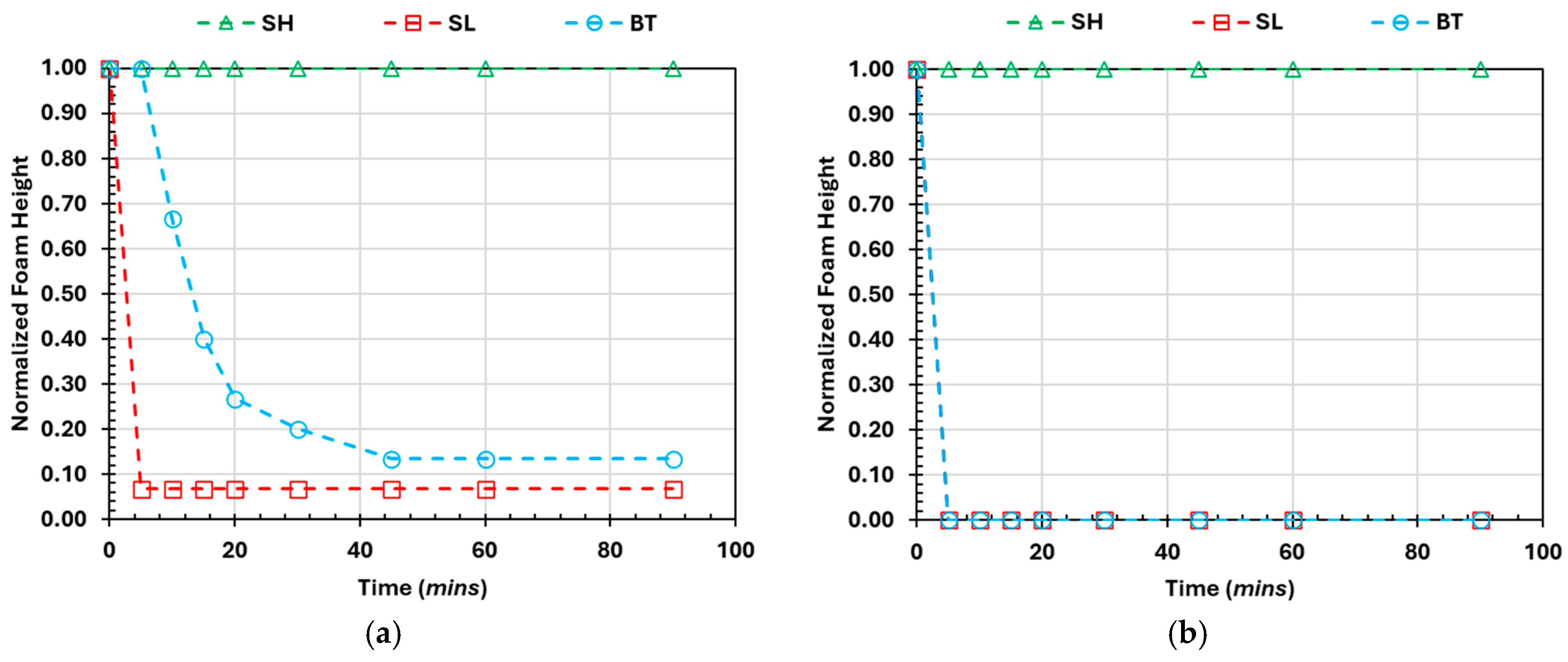
The first step in selecting an appropriate surfactant for core flooding experiments is to determine the foamability and foam stability of surfactants at reservoir conditions (20,000 ppm TDS, 38 °C, and 2000 psi). Three surfactants (SL, SH, and BT) were tested at 0.2 wt% both in the absence and presence of oil. The results are shown in Figure 2.
In the absence of oil, SH shows stable foam for the duration of the test, maintaining its original foam height for 90 min at 2000 psi. SL exhibits noticeably weaker and less stable foam, as evidenced by the rapid decay to only 7% of the original foam height within 5 min. Although this foam height was maintained for 90 min, the foaming performance of this surfactant is deemed to be quite poor. As for BT, the initial foam height was stable only for 5 min, after which it exhibited an exponential decay to about 13% at 45 min, which was maintained until the end of the 90 min test. These results show that SH provides the best foaming performance out of the three surfactants. In general, foam generated with more water-soluble gases such as CO2 is less stable than foam generated by relatively insoluble gases such as nitrogen or methane. This is because the enhanced gas dissolution and diffusion accelerate bubble coarsening and lamella thinning [27,28]. Moreover, hydrocarbon-like gases such as propane can partition into the surfactant films and reduce the interfacial viscoelasticity, which weakens foam lamellae compared to more inert gases such as nitrogen or methane [11,29,30]. This can explain the weaker foam exhibited by SL and BT. However, SH does not show the same effect. This is because of SH’s larger alkyl chain, making it more hydrophobic than either SL or BT. Both laboratory experiments and molecular dynamics studies suggest that an increased hydrophobic chain length contributes to improved foam stability in the presence of CO2 due to stronger, denser adsorption at the gas–liquid interface, and increased viscoelasticity of foam films [31,32,33]. When oil was introduced to the system, both SL and BT foam columns immediately collapsed within the first 5 min of the test. SH not only shows stable foam for the duration of the 90 min test but also remains as strong as it was in the absence of oil. Oil is known to destabilize foam by penetrating foam lamellae and reducing film stability, leading to faster bubble coalescence and foam collapse [34,35]. However, as mentioned earlier, a more hydrophobic surfactant with a larger alkyl chain (up to an optimum chain length) can mitigate those destabilizing effects by creating a more viscous film that resists oil penetration and liquid film drainage and rupture [36,37]. Based on these results, only SH and BT were further tested for static adsorption on rock surfaces.

3.2. Surfactant Adsorption

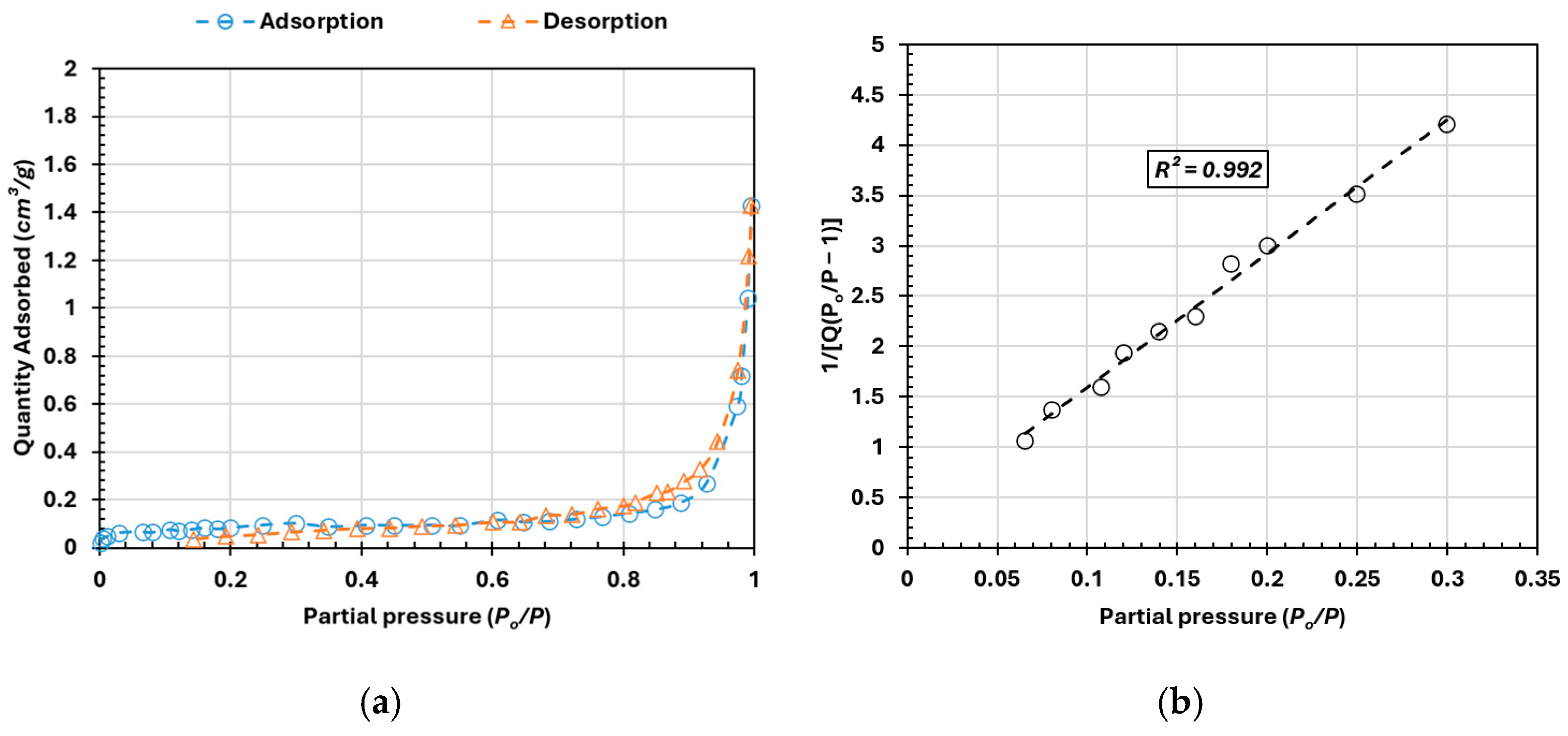
Evaluation of surfactant adsorption in the absence of oil is necessary to determine the economic performance of the chosen surfactant. If adsorption is relatively high, more surfactant needs to be injected before foam can start to propagate deeper into the reservoir. To determine the amount of surfactant adsorbed per unit area of rock, the specific surface area of crushed Bentheimer sandstone was measured. The BET isotherm and linearized BET plot are shown in Figure 3.
The quantity of nitrogen adsorbed by a crushed rock sample at various relative pressures (P0/P) can be used to calculate the specific surface area of the crushed rock [38]. The BET plot shows a linear relationship between the volume adsorbed and the partial pressure between 0.05 and 0.3, indicating no significant pore condensation and proving the validity of the BET surface area measurement. The specific surface area of the crushed Bentheimer sample calculated from the data shown in Figure 3b is 0.321 m2/g.
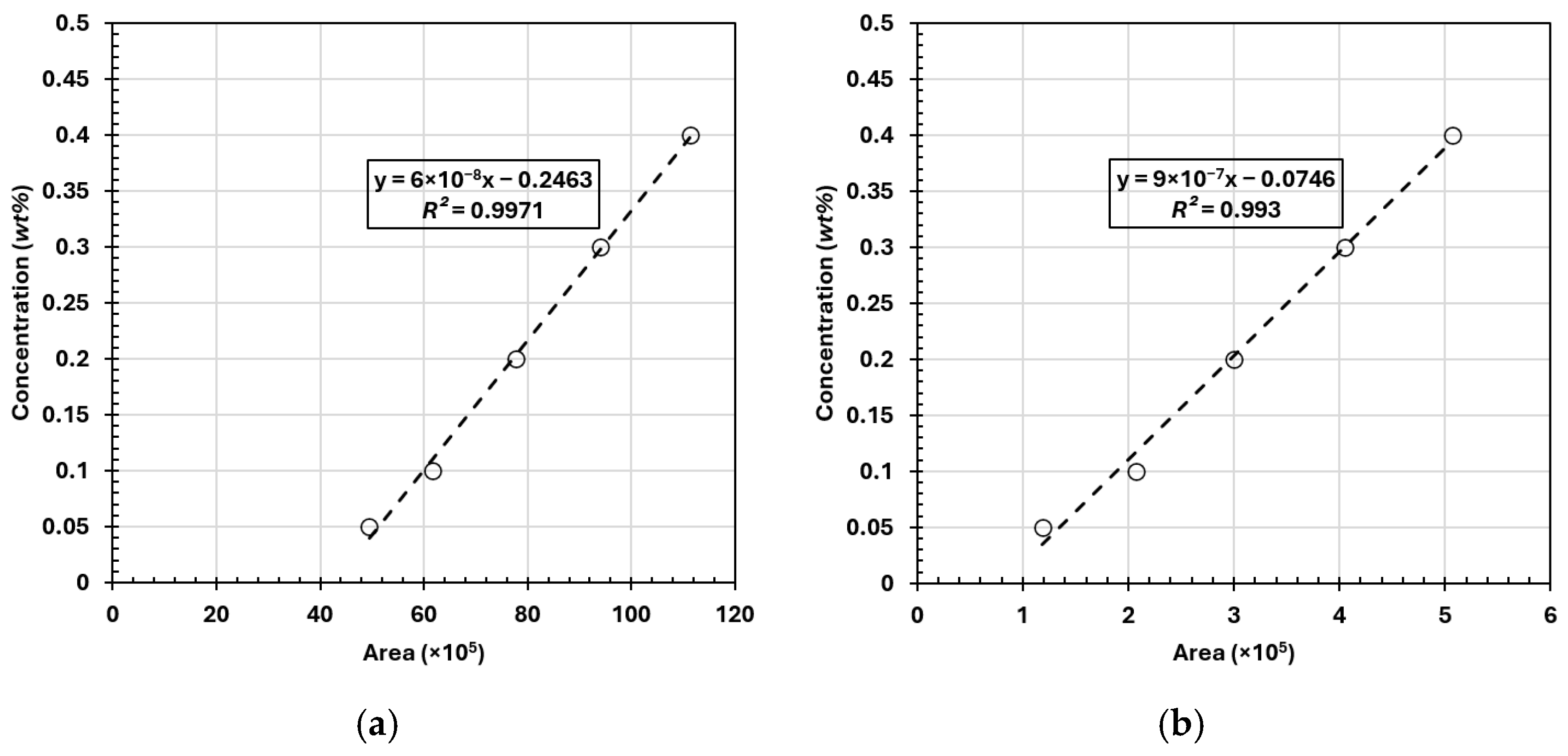
The calibration curves used to determine the amount of surfactant adsorbed on the crushed Bentheimer rock at the end of the adsorption test using LCMS are shown in Figure 4a for SH, and Figure 4b for BT.
Based on these calibration curves, the adsorption values of SH and BT were determined to be 2.32 (0.746 mg/g), and 17.65 mg/m2 (5.66 mg/g), respectively. This significant difference in the level of adsorption between these two surfactants could be explained by their molecular structure and charge. SH is a negatively charged surfactant, while BT is a zwitterionic surfactant, which contains both a positive and a negative charge. Since the rock sample is a sandstone with a negatively charged surface at neutral pH, it is expected that the negatively charged surfactant would have lower adsorption than a surfactant that also contains a positive charge. This is in agreement with previous studies of adsorption of anionic and zwitterionic foaming surfactants in sandstones [39].
An increase in surfactant adsorption is undesirable because it reduces surfactant transport and foam propagation deeper into the reservoir, increases chemical loss to the rock surface, and raises overall chemical costs. Based on the foam stability and adsorption test results (Table 4), only SH was used in the core flooding experiments as discussed in the following section.

3.3. Effect of Gas Flood Maturity on Transient Foam Behavior

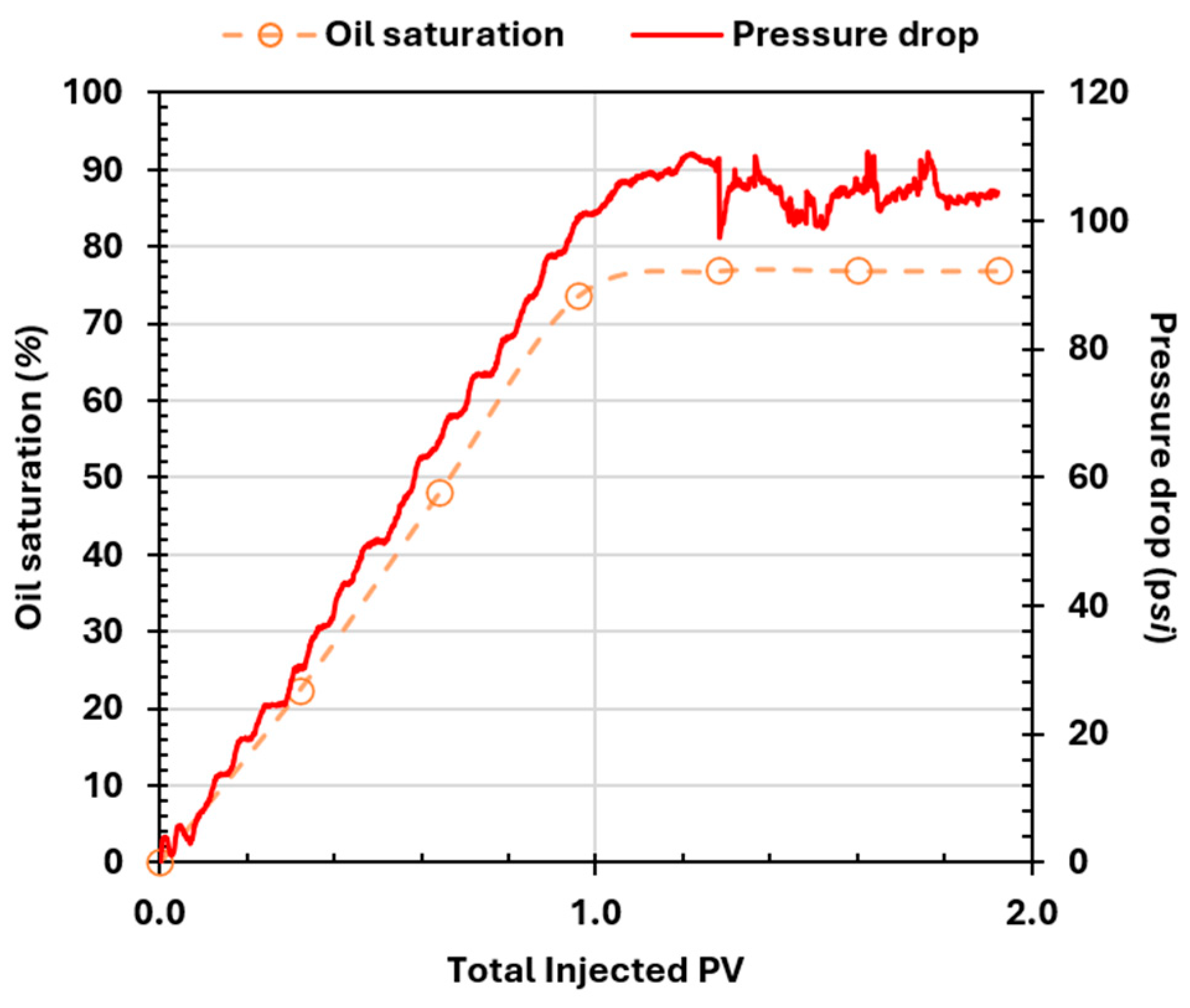
Three core floods (CF1–CF3) were conducted to investigate the impact of pre-foam displacement of oil on foam propagation. It is noted that these core floods exhibited very similar initial oil saturation processes. An example of pressure and oil saturation behaviors during the oil displacement of brine in CF1 is shown in Figure 5.
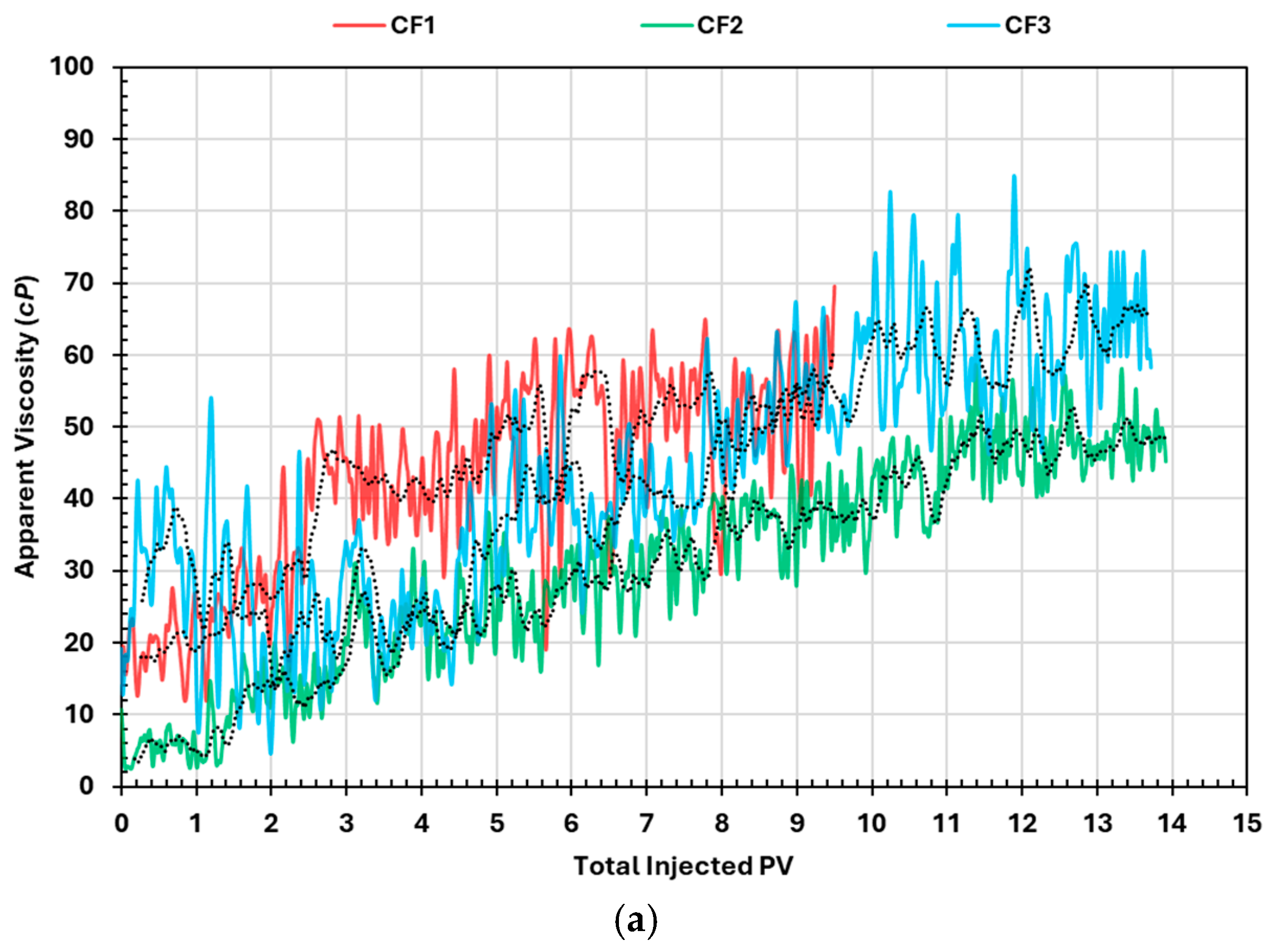
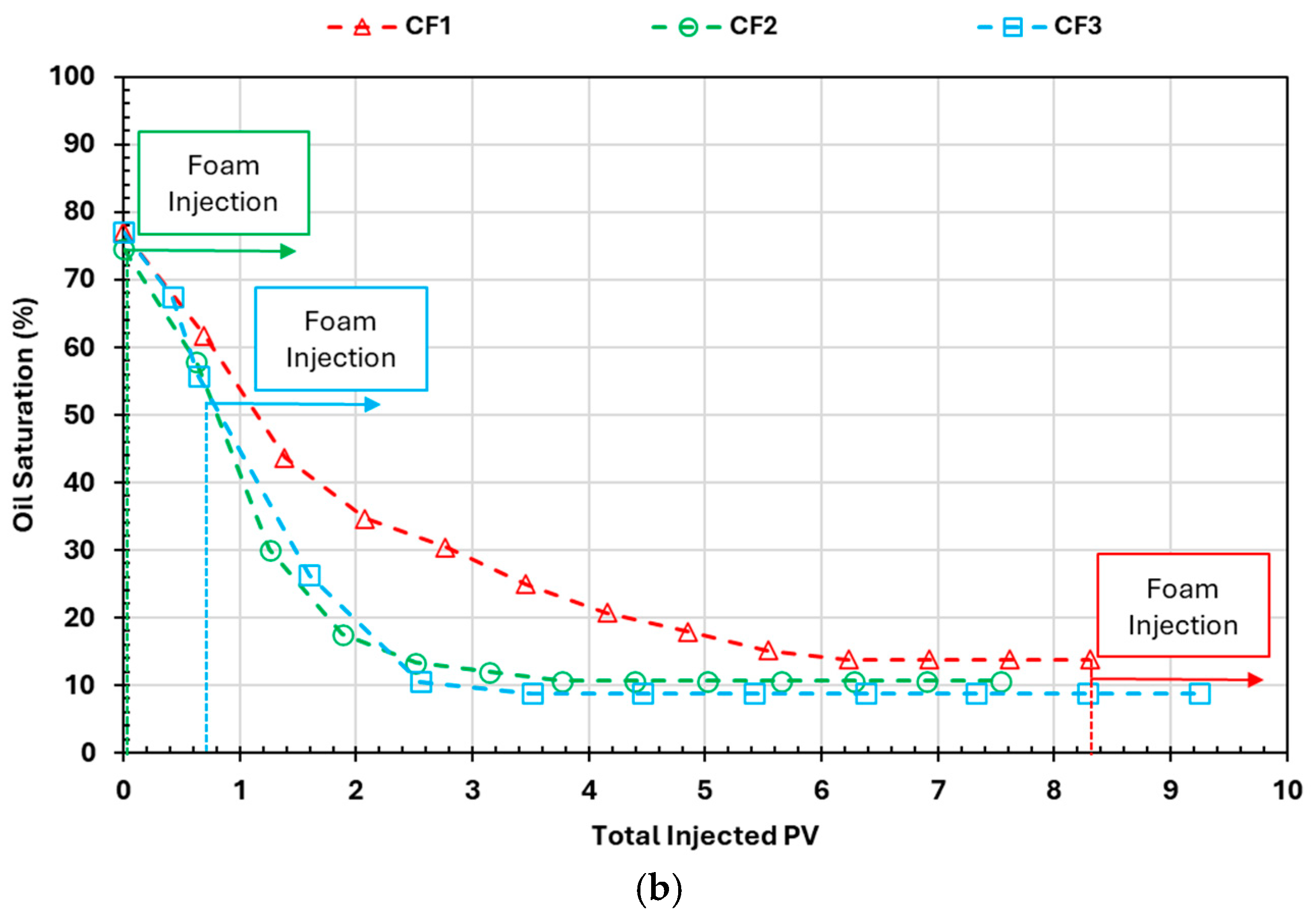
Figure 6a and Figure 6b show the apparent foam viscosity and residual oil saturation for CF1–CF3, respectively. The apparent viscosity was calculated from the measured pressure drop across the core using Darcy’s law. For core floods CF1 and CF3, maturity was established using a simultaneous injection of gas and brine at 80% GVF. Starting with CF1, it was flooded to residual oil saturation (100% maturity) before foam injection. After one injected pore volume (PV), oil saturation decreased to about 55%, and it took an extra five PVs to reach a residual oil saturation of 14% (Figure 6b). This slow production rate is typical in gas-dominated flow regimes, where the mobility of the oil is reduced due to the discontinuous oil phase connectivity at high gas volume fractions [40,41]. During the following foam injection at 80% foam quality (FQ), the apparent viscosity started around 20 cP and reached a quasi-steady-state value of 60 cP after about five PVs.
For CF2, it is obvious that the apparent viscosity is lower than CF1 (Figure 6a). It is only about 5 cP within the first injected PV and then starts to increase fairly linearly to about 45 cP after 14 injected PVs. This delay in foam propagation could be attributed to a much higher initial oil saturation of 75% at the beginning of foam injection for CF2 (0% maturity) as compared to about 14% for CF1 (100% maturity). As oil typically has a detrimental effect on foam stability [34,35], a higher mobile oil saturation would lead to more interaction between the foam and oil and a stronger oil impact on foam propagation. However, the transient oil saturation profile for CF2 (Figure 6b) indicates that oil production is notably faster in the presence of the foaming surfactant. After one injected PV, the residual oil saturation is 40% and reaches a minimum of 10% after only four PVs, compared to the slightly higher 14% oil saturation after six PVs for CF1. This observation highlights another benefit of foaming surfactants on oil production in addition to improved fluid mobility, which is IFT reduction. The relatively low apparent foam viscosity in CF2 suggests that the contribution of oil-water IFT reduction to the displacement of oil is much more than that of foam-induced gas mobility reduction. Indeed, the transient foam behavior in CF3 with 50% maturity falls in between CF1 and CF2 (Figure 6a). In the early stage of injection in this core flood, the apparent viscosity is about 30 cP. Between three and five injected PVs, the behavior of CF3 almost matches that of CF2. The apparent viscosity afterwards increases faster than CF2 before leveling off around 65 cP after 10 PVs. One would expect this difference to be a result of lower oil saturation in CF3 compared to CF2 (Figure 6b) because of the difference in maturity of the pre-foam flood. However, the oil saturation profiles in Figure 6b do not show any significant differences. At one injected PV, the residual oil saturation is around 45%, and the minimum saturation of 8% is reached after about 3.5 PVs. The difference, therefore, may be explained by the gas saturation and the mobile water saturation established by the pre-foam flood in CF3. The presence of a small gas saturation before the onset of foam injection appears to enhance the in situ dispersion of the injected gas into the surfactant solution, promoting foam generation. Once the generation of foam outperforms its destruction by capillary pressure and oil effects, gas saturation continues to increase, but only up to a critical value, to sustain foam propagation. This is one of the unique characteristics of foam dynamics in porous media [42,43,44,45]. It is even more intuitive that the presence of mobile water in CF2 before foam flooding, which is completely absent in CF3, would also further assist foam generation by “snap-off” and “leave-behind” mechanisms [21,46]. The nature of fluid saturations in porous media strongly influences the hysteresis of transient foam behavior that has been commonly observed in core flooding experiments of both transient and steady-state foam behaviors [47,48,49]. This hysteresis is partially related to the critical conditions for foam generation (i.e., minimum pressure gradient or critical flow rate), which are affected by the initial fluid (gas, water, and oil) saturations [5,34,50,51,52]. Therefore, the results from the core flooding experiments CF1–CF3 imply that the efficiency of foam propagation in a thief zone is influenced by the nature of oil desaturation by the injected gas and brine in that zone. It should be noted that the core permeabilities for CF1 and CF3 are very similar and slightly higher than that of CF2. However, this small variation in permeability does not affect the conclusions regarding the effect of flood maturity because (i) all cores were drilled in the same direction from the same 0.5 ft3 outcrop block, and (ii) the late-time foam viscosities for CF1 and CF2 are quite similar, despite the difference in their core permeabilities.
Strategies employed in water-alternating gas (WAG) injection as the most common injection mode for gas flooding in the field in terms of the gas/water volume, water-to-oil ratio per cycle, and the number of WAG cycles could play an important role in boosting foam propagation the thief zone. This leads to a further evaluation of the foam quality effect on transient foam behavior during the displacement of oil presented in the following section.

3.4. Effect of Injection Foam Quality on Transient Foam Behavior

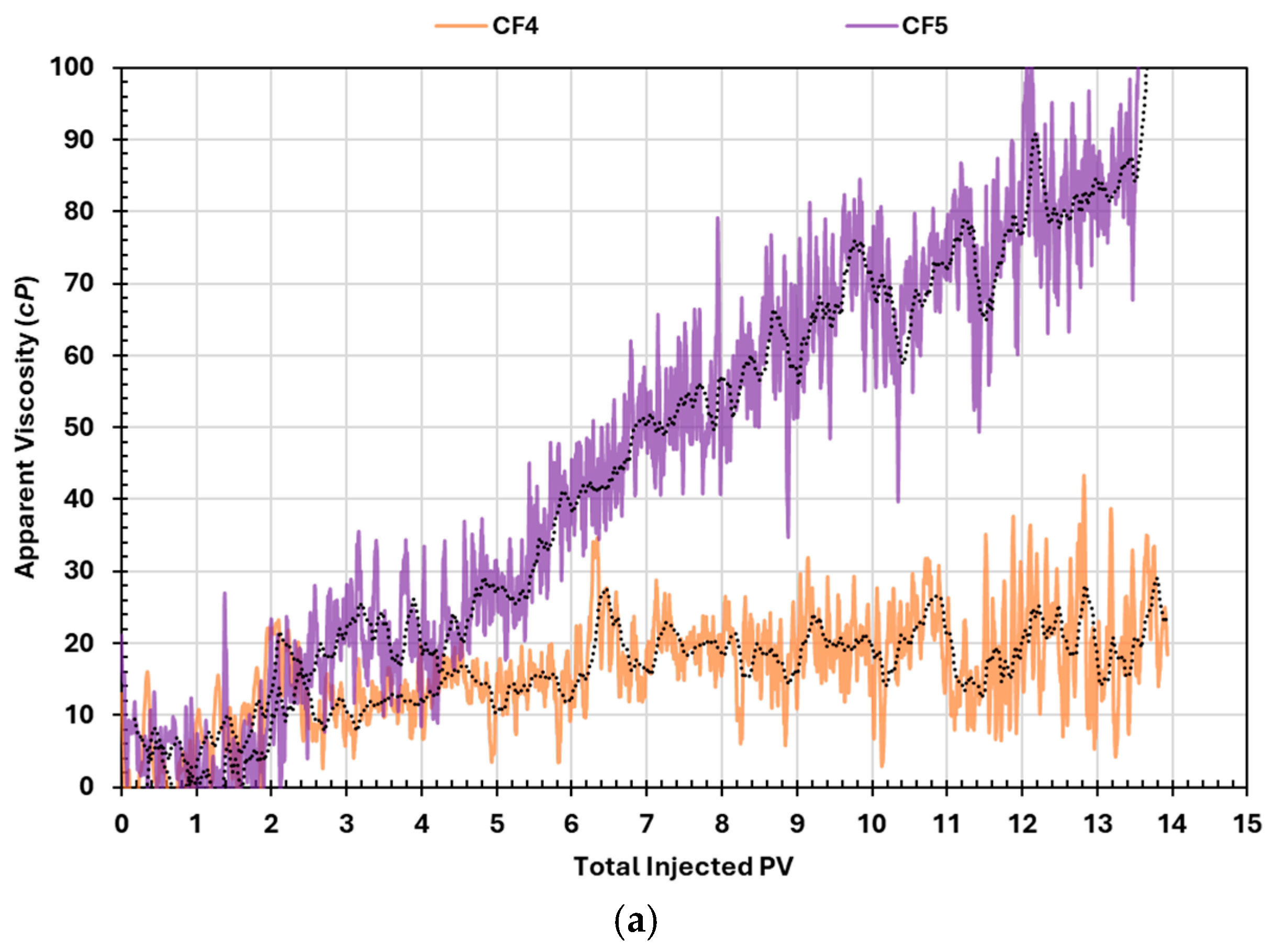
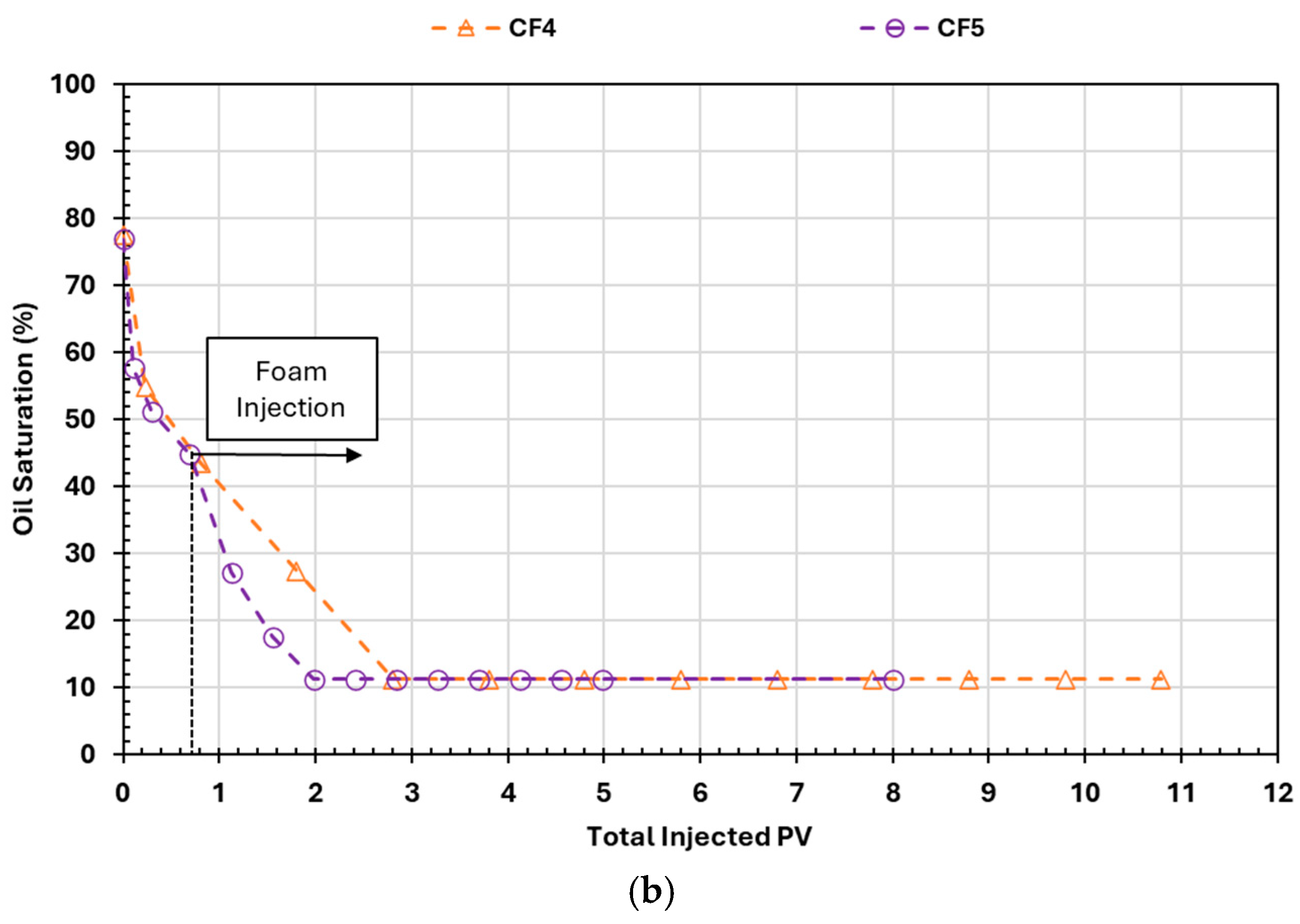
Even though the rate of foam propagation has been shown to improve with the level of maturity of the pre-foam gas–brine flood, the significant miscible interaction between the enriched gas and the viscous oil under the experimental conditions, as indicated by the efficient oil desaturation for CF1 (Figure 6b), still resulted in a clearly observed detrimental effect of oil on foam (Figure 6a). Thus, one would wonder whether or not an optimal injection foam quality can further assist a pre-foam gas–brine flood in reducing the impact of oil. This potential role of foam quality is evaluated in this work with two foam core flooding experiments (CF4 and CF5), in which only gas injection (i.e., no gas–brine simultaneous injection) was performed to obtain 50% maturity, followed by foam injection at 80% (CF4) and 50% foam quality (CF5), respectively. The core flood results are shown in Figure 7. It should be noted that CF3, CF4, and CF5 reflect differences not only in foam quality, but also in the pre-established fluid pathways created during the gas–brine flood. In CF3, the presence of brine co-injection introduced mobile water and a different saturation pathway compared with CF4 and CF5, where only gas was injected during the pre-foam injection stage.
For 80% foam quality, foam strength developed slowly and reached a quasi-steady-state value of around 20 cP within seven injected PVs. The foam propagation rate in CF4 is lower than that in CF3, where it reached 40 cP for the same injected PVs (Figure 6a), in spite of the pre-foam oil saturation for CF4 (45%) being lower than that for CF3 (52%). The observed difference in foam propagation between these two core floods could be related to the fact that brine injection was not involved in CF4 as opposed to CF3. The absence of mobile water before foam injection in CF4 is clearly unfavorable for foam generation, and the amount of water injected via 80% foam quality appears to provide insufficient assistance in foam development to achieve the same foam buildup rate as that for CF3. This effect is confirmed by the core flooding experiment CF5 that involved the same experimental parameters as CF4, except for a reduced foam quality of 50%. The results of this core flood (Figure 7) clearly show a remarkable improvement in foam propagation with relatively wetter foam, which robustly reduced gas mobility to accelerate the displacement of oil (i.e., oil saturation in CF5 reached a minimum of about 10% faster than CF4, as shown in Figure 7b). It should be noted that the higher permeability of CF5 compared with that of CF4 may also contribute to the stronger foam observed in CF5. However, a comparison of the late-time foam viscosities for CF5 and CF3 (which have nearly the same permeability) indicates that the strongest foam in CF5 is primarily attributed to the reduced foam quality.
Therefore, all the core flood results clearly evidence the impact of gas flood maturity and how foam process design parameters such as foam quality can be adjusted to improve foam propagation and enriched gas displacement of viscous oil.

4. Conclusions

The work presented here investigates the effects of enriched-gas flood maturity and injected foam quality on transient foam behavior and oil desaturation in high-permeability sandstone cores. After selecting a suitable surfactant based on bulk foam stability and surfactant adsorption tests, several core-flooding experiments were conducted at different levels of gas-flood maturity, with and without brine injection.
The core-flooding results provide valuable insight into the respective roles of pre-foam gas–brine flooding and mobile water in accelerating foam propagation and oil production. The enriched-gas composition reduced the oil saturation to 10% in all cases, indicating a strong miscible interaction between the enriched gas and the viscous oil. The gas–brine flood at 80% GVF to residual oil saturation before foam injection (100% maturity) resulted in the fastest foam generation, but the slowest oil recovery. Foam injection at initial oil saturation (0% maturity) or after 50% gas–brine flood maturity led to similar oil recoveries, both of which were higher than in the 100% maturity case.
Removing brine injection from the pre-foam gas flood significantly suppressed foam propagation, primarily due to the very limited mobile water saturation in the early stage of foam injection. This adverse effect could be mitigated by decreasing the injection foam quality from 80% to 50% under the specific experimental conditions used in this work. Thus, an optimum injection foam quality for field applications could be identified for a given surfactant type, gas–oil miscibility, and rock type.
The results from this work imply that strong foam can be generated quickly in the thief zones of a reservoir with a mature gas flood, allowing more gas to be continuously diverted to previously gas-unswept zones to displace oil in regions where foam strength is limited by the detrimental effect of high oil saturation on foam propagation. While water injection may impact the displacement of oil by gas in water-sensitive formations (i.e., water blocking gas from contacting oil, particularly in water-wet formations), it does support robust foam propagation in the thief zone with mobile oil saturation, which is important for improving sweep efficiency. Thus, the injected water volume and its timing, either before or during a foam flood, should be optimized to maximize gas–oil contact and transient foam performance in the presence of mobile oil.
For field applications, the injected water volume and its timing, either before or during a foam flood, should be optimized to maximize gas–oil contact and transient foam performance in the presence of mobile oil. An optimum injection foam quality could be identified for a given surfactant type, gas–oil miscibility, rock type, and pre-foam gas/brine flood conditions.

Author Contributions

Conceptualization, D.H., R.B. and Q.P.N.; Methodology, D.H., R.B. and Q.P.N.; Validation, D.H., R.B. and Q.P.N.; Formal analysis, D.H., R.B. and Q.P.N.; Investigation, D.H., R.B. and Q.P.N.; Resources, Q.P.N.; Data curation, D.H. and Q.P.N.; Writing—original draft, D.H.; Writing—review & editing, R.B. and Q.P.N.; Visualization, D.H., R.B. and Q.P.N.; Supervision, Q.P.N.; Funding acquisition, Q.P.N. All authors have read and agreed to the published version of the manuscript.

Funding

This research received no external funding.

Data Availability Statement

The original contributions presented in this study are included in the article. Further inquiries can be directed to the corresponding author.

Acknowledgments

The authors would like to thank Hilcorp and the Gas EOR Industry Affiliated Program at The University of Texas at Austin for supporting this work.

Conflicts of Interest

The authors declare no conflict of interest.

References

  1. Muggeridge, A.; Cockin, A.; Webb, K.; Frampton, H.; Collins, I.; Moulds, T.; Salino, P. Recovery rates, enhanced oil recovery and technological limits. Philos. Trans. R. Soc. Math. Phys. Eng. Sci. 2014, 372, 20120320. [Google Scholar] [CrossRef]
  2. Alvarado, V.; Manrique, E. Enhanced Oil Recovery: An Update Review. Energies 2010, 3, 1529–1575. [Google Scholar] [CrossRef]
  3. Green, D.W.; Willhite, G.P. Enhanced Oil Recovery, 2nd ed.; SPE International Textbook Series; Society of Petroleum Engineers: Richardson, TX, USA, 2018. [Google Scholar] [CrossRef]
  4. Lake, L.W.; Johns, R.; Rossen, B. Fundamentals of Enhanced Oil Recovery; Society of Petroleum Engineers: Richardson, TX, USA, 2014. [Google Scholar] [CrossRef]
  5. Gauglitz, P.A.; Friedmann, F.; Kam, S.I.; Rossen, W.R. Foam Generation in Porous Media. In Proceedings of the SPE/DOE Improved Oil Recovery Symposium, Tulsa, OK, USA, 13–17 April 2002. [Google Scholar] [CrossRef]
  6. Nguyen, Q.P.; Currie, P.K.; Zitha, P.L.J. Motion of foam films in diverging–converging channels. J. Colloid Interface Sci. 2004, 271, 473–484. [Google Scholar] [CrossRef]
  7. Nguyen, Q.P.; Currie, P.K.; Buijse, M.; Zitha, P.L.J. Mapping of foam mobility in porous media. J. Pet. Sci. Eng. 2007, 58, 119–132. [Google Scholar] [CrossRef]
  8. Rossen, W.R. Foams in Enhanced Oil Recovery. In Foams, 1st ed.; Routledge: New York, NY, USA, 2017; pp. 413–464. [Google Scholar] [CrossRef]
  9. Falls, A.H.; Musters, J.J.; Ratulowski, J. The Apparent Viscosity of Foams in Homogeneous Bead Packs. SPE Reserv. Eng. 1989, 4, 155–164. [Google Scholar] [CrossRef]
  10. Alvarez, J.M.; Rivas, H.J.; Rossen, W.R. Unified Model for Steady-State Foam Behavior at High and Low Foam Qualities. SPE J. 2001, 6, 325–333. [Google Scholar] [CrossRef]
  11. Farajzadeh, R.; Andrianov, A.; Krastev, R.; Hirasaki, G.J.; Rossen, W.R. Foam–oil interaction in porous media: Implications for foam assisted enhanced oil recovery. Adv. Colloid Interface Sci. 2012, 183–184, 1–13. [Google Scholar] [CrossRef]
  12. Li, B.-F.; Zhang, M.-Y.; Li, Z.-M.; Kovscek, A.; Xin, Y.; Li, B.-L. Flow characteristics and regime transition of aqueous foams in porous media over a wide range of quality, velocity, and surfactant concentration. Pet. Sci. 2023, 20, 1044–1052. [Google Scholar] [CrossRef]
  13. Kahrobaei, S.; Vincent-Bonnieu, S.; Farajzadeh, R. Experimental Study of Hysteresis behavior of Foam Generation in Porous Media. Sci. Rep. 2017, 7, 8986. [Google Scholar] [CrossRef]
  14. Wu, Y.; Zhang, Y.; Wang, J.; Ma, Y.; Song, Z.; Zeng, X.; Cao, A. Study on the mechanism of improved oil recovery by nitrogen foam flooding in bottom water reservoirs. Front. Energy Res. 2023, 11, 1120635. [Google Scholar] [CrossRef]
  15. Youssif, M.I.; Sharma, K.V.; Shoukry, A.E.; Goual, L.; Piri, M. Methane foam performance evaluation in fractured oil-wet carbonate systems at elevated pressure and temperature conditions. J. Environ. Chem. Eng. 2024, 12, 112444. [Google Scholar] [CrossRef]
  16. Luo, P.; Zhang, Y.; Wang, X.; Huang, S. Propane-Enriched CO2 Immiscible Flooding For Improved Heavy Oil Recovery. Energy Fuels 2012, 26, 2124–2135. [Google Scholar] [CrossRef]
  17. Sie, C.-Y.; Nguyen, B.; Castellanos Diaz, O.; Verlaan, M.; Nguyen, Q.P. Viscous oil recovery and in-situ deasphalting in fractured reservoirs–Part 2: Effect of solvent type and temperature. Fuel 2019, 247, 294–301. [Google Scholar] [CrossRef]
  18. Anand, N.; Tang, B.; Nguyen, B.; Sie, C.; Verlaan, M.; Castellanos Diaz, O.; Nguyen, Q.P. Effects of Rate, Temperature, and Solvent Type on Vapor/Oil Gravity Drainage (VOGD) in Fractured Reservoirs. SPE J. 2019, 24, 973–987. [Google Scholar] [CrossRef]
  19. Tang, B.; Anand, N.; Nguyen, B.; Sie, C.; Verlaan, M.; Castellanos, O.; Nguyen, Q.P. Effect of Pressure on Vapor/Oil Gravity Drainage in Fractured Reservoirs. SPE J. 2020, 25, 197–211. [Google Scholar] [CrossRef]
  20. Sie, C.; Nguyen, Q.P. Laboratory Investigations on Field Gas Huff-n-Puff for Improving Oil Recovery in Eagle Ford Shale─Effect of Operating Conditions. Energy Fuels 2022, 36, 195–209. [Google Scholar] [CrossRef]
  21. Hanamertani, A.S.; Saraji, S.; Piri, M. A comparative investigation of the effect of gas type on foam strength and flow behavior in tight carbonates. Chem. Eng. Sci. 2023, 276, 118798. [Google Scholar] [CrossRef]
  22. Yu, W.; Zhou, X.; Kanj, M.Y. Microfluidic Investigation of Foam Coarsening Dynamics in Porous Media at High-Pressure and High-Temperature Conditions. Langmuir 2022, 38, 2895–2905. [Google Scholar] [CrossRef]
  23. Zeng, Y.; Farajzadeh, R.; Eftekhari, A.A.; Vincent-Bonnieu, S.; Muthuswamy, A.; Rossen, W.R.; Hirasaki, G.J.; Biswal, S.L. Role of Gas Type on Foam Transport in Porous Media. Langmuir 2016, 32, 6239–6245. [Google Scholar] [CrossRef]
  24. Jones, S.A.; Van Der Bent, V.; Farajzadeh, R.; Rossen, W.R.; Vincent-Bonnieu, S. Surfactant screening for foam EOR: Correlation between bulk and core-flood experiments. Colloids Surf. Physicochem. Eng. Asp. 2016, 500, 166–176. [Google Scholar] [CrossRef]
  25. Yu, G.; Rossen, W.R.; Vincent-Bonnieu, S. Coreflood Study of Effect of Surfactant Concentration on Foam Generation in Porous Media. Ind. Eng. Chem. Res. 2019, 58, 420–427. [Google Scholar] [CrossRef]
  26. Davis, T.; Monette, M.; Nelson, J.; Mayfield, C.; Cunha, K.; Nguyen, Q. Using Foam Treatments to Control Gas-Oil Ratio in Horizontal Producing Wells at Prudhoe Bay. In Proceedings of the SPE Annual Technical Conference and Exhibition, San Antonio, TX, USA, 16–18 October 2023; p. D021S022R001. [Google Scholar] [CrossRef]
  27. Farajzadeh, R.; Vincent-Bonnieu, S.; Bourada Bourada, N. Effect of Gas Permeability and Solubility on Foam. J. Soft Matter 2014, 2014, 145352. [Google Scholar] [CrossRef]
  28. Poole, H.; Jessop, P.G.; Stubenrauch, C. Foaming and defoaming properties of CO2-switchable surfactants. J. Surfactants Deterg. 2022, 25, 467–475. [Google Scholar] [CrossRef]
  29. Zhang, F.; Schechter, D.S. Gas and foam injection with CO2 and enriched NGL’s for enhanced oil recovery in unconventional liquid reservoirs. J. Pet. Sci. Eng. 2021, 202, 108472. [Google Scholar] [CrossRef]
  30. Jones, S.A.; Kahrobaei, S.; Van Wageningen, N.; Farajzadeh, R. CO2 Foam Behavior in Carbonate Rock: Effect of Surfactant Type and Concentration. Ind. Eng. Chem. Res. 2022, 61, 11977–11987. [Google Scholar] [CrossRef]
  31. Liang, M.; Zhao, X.; Wang, J.; Feng, Y. A Comparative Study on CO2-Switchable Foams Stabilized by C22- or C18-Tailed Tertiary Amines. Molecules 2023, 28, 2567. [Google Scholar] [CrossRef]
  32. Zhang, Z.; Qiao, M.; Zhao, H.; Ran, Q.; Yuan, S. Effect of sodium alkyl sulfate chain length on foam stability: A molecular dynamics study. Colloids Surf. Physicochem. Eng. Asp. 2023, 656, 130394. [Google Scholar] [CrossRef]
  33. Wen, Y.; Zeng, P.; Xu, L.; Li, Q.; Guan, X.; Wei, K.; Wang, X. Impacts of hydrophobic chain length on foam stability and CO2 geo-sequestration capacity of sugar-based nonionic surfactants: Molecular dynamics simulation and laboratory experiments. J. Environ. Chem. Eng. 2024, 12, 114643. [Google Scholar] [CrossRef]
  34. Nikolov, A.D.; Wasan, D.T.; Huang, D.W.; Edwards, D.A. The Effect of Oil on Foam Stability: Mechanisms and Implications for Oil Displacement by Foam in Porous Media. In Proceedings of the SPE Annual Technical Conference and Exhibition, New Orleans, LA, USA, 5–8 October 1986; p. SPE-15443-MS. [Google Scholar] [CrossRef]
  35. Halsøy, H.; Graue, A.; Alcorn, Z.P. Supercritical CO2 Foam Stability in the Presence of Oil. SSRN 2024. [Google Scholar] [CrossRef]
  36. Memon, M.K.; Shuker, M.T.; Elraies, K.A. Study of blended surfactants to generate stable foam in presence of crude oil for gas mobility control. J. Pet. Explor. Prod. Technol. 2017, 7, 77–85. [Google Scholar] [CrossRef]
  37. Bello, A.; Ivanova, A.; Bakulin, D.; Yunusov, T.; Rodionov, A.; Burukhin, A.; Cheremisin, A. An experimental study of foam-oil interactions for nonionic-based binary surfactant systems under high salinity conditions. Sci. Rep. 2024, 14, 12208. [Google Scholar] [CrossRef]
  38. Brunauer, S.; Emmett, P.H.; Teller, E. Adsorption of Gases in Multimolecular Layers. J. Am. Chem. Soc. 1938, 60, 309–319. [Google Scholar] [CrossRef]
  39. Mannhardt, K.; Schramm, L.L.; Novosad, J.J. Effect of Rock type and Brine Composition on Adsorption of Two Foam-Forming Surfactants. SPE Adv. Technol. Ser. 1993, 1, 212–218. [Google Scholar] [CrossRef]
  40. Shafiei, M.; Kazemzadeh, Y.; Escrochi, M.; Cortés, F.B.; Franco, C.A.; Riazi, M. A comprehensive review direct methods to overcome the limitations of gas injection during the EOR process. Sci. Rep. 2024, 14, 7468. [Google Scholar] [CrossRef] [PubMed]
  41. Zhang, L.; He, Y.; Zhang, T.; Wang, Y.; Hong, X.; Zheng, Z.; Li, J.; Shui, L.; He, W. Experimental Study on Oil–Gas Interaction Mechanism during Offshore Heavy Oil Gas Injection. ACS Omega 2024, 9, 29700–29709. [Google Scholar] [CrossRef]
  42. Schramm, L.L. (Ed.) Foams: Fundamentals and Applications in the Petroleum Industry; Advances in Chemistry; American Chemical Society: Washington, DC, USA, 1994; Volume 242. [Google Scholar] [CrossRef]
  43. Ramadhan, G.B.; Nguyen, Q.P. A Pore Scale Study of Non-Newtonian Effect on Foam Propagation in Porous Media. Transp. Porous Media 2020, 131, 175–192. [Google Scholar] [CrossRef]
  44. Brame, S.D.; Mukherjee, B.; Patil, P.; Katiyar, A.; Nguyen, Q.P. The effect of rock microheterogeneity on steam foam rheology. J. Pet. Sci. Eng. 2020, 188, 106898. [Google Scholar] [CrossRef]
  45. Taha, M.; Patil, P.; Nguyen, Q.P. The effect of rock permeability and pore structure on foam in carbonate rocks. Fuel 2023, 346, 128246. [Google Scholar] [CrossRef]
  46. Skauge, A.; Solbakken, J.; Ormehaug, P.A.; Aarra, M.G. Foam Generation, Propagation and Stability in Porous Medium. Transp. Porous Media 2020, 131, 5–21. [Google Scholar] [CrossRef]
  47. Rossen, W.R. Minimum Pressure Gradient for Foam Flow in Porous Media: Effect of Interactions with Stationary Lamellae. J. Colloid Interface Sci. 1990, 139, 457–468. [Google Scholar] [CrossRef]
  48. Nguyen, Q.P.; Alexandrov, A.V.; Zitha, P.L.; Currie, P.K. Experimental and Modeling Studies on Foam in Porous Media: A Review. In Proceedings of the SPE International Symposium on Formation Damage Control, Lafayette, LA, USA, 23–24 February 2000. [Google Scholar] [CrossRef]
  49. M’barki, O.; Ma, K.; Ren, G.; Mateen, K.; Bourdarot, G.; Morel, D.C.; Nguyen, Q.P. Repeatable Steady-State Foam Experimental Data and Investigations of Foam Hysteresis in a Sand Pack. In Proceedings of the SPE Annual Technical Conference and Exhibition, San Antonio, TX, USA, 9–11 October 2017. [Google Scholar] [CrossRef]
  50. Ransohoff, T.C.; Radke, C.J. Mechanisms of Foam Generation in Glass-Bead Packs. SPE Reserv. Eng. 1988, 3, 573–585. [Google Scholar] [CrossRef]
  51. Dicksen, T.; Hirasaki, G.J.; Miller, C.A. Conditions for Foam Generation in Homogeneous Porous Media. In Proceedings of the SPE/DOE Improved Oil Recovery Symposium, Tulsa, OK, USA, 13–17 April 2002; p. SPE-75176-MS. [Google Scholar] [CrossRef]
  52. Monette, M.; Nguyen, Q.P. Dynamics of Foam Propagation for Gas Blocking in Sandstone Reservoirs. Energy Fuels 2025, 39, 10967–10979. [Google Scholar] [CrossRef]
Figure 1. Core flooding schematic.
Energies 19 02797 g001
Figure 2. Bulk foam stability for 0.2 wt% SH, SL, and BT at 38 °C and 2000 psi: (a) without oil, and (b) with oil.
Energies 19 02797 g002
Figure 3. (a) BET isotherm, and (b) linearized BET plot.
Energies 19 02797 g003
Figure 4. LCMS calibration curves for SH (a) and BT (b).
Energies 19 02797 g004
Figure 5. Oil saturation and pressure drop during oil injection for CF5.
Energies 19 02797 g005
Figure 6. (a) Apparent viscosity with a moving average (black dashed curve), and (b) measured residual oil saturation for CF1, CF2, and CF3.
Energies 19 02797 g006aEnergies 19 02797 g006b
Figure 7. (a) Apparent viscosity with a moving average (black dashed curve), and (b) measured residual oil saturation for CF4 and CF5.
Energies 19 02797 g007aEnergies 19 02797 g007b
Table 1. Enriched gas composition.
Componentmol%
CO220.31
CH432.89
C2H620.35
C3H826.54
Table 2. Core flood conditions.
Rock TypeBentheimer Sandstone
Length11.63 inches
Diameter0.87 inch
Pressure2000 psi
Temperature38 °C
Salinity20,000 ppm NaCl
Co-injection rate5 ft/day ± 1%
Surfactant concentration0.2 wt%
Table 3. Core flood injection schemes.
Core FloodPorosity
(%)
Permeability
(Darcy)
Flood
Maturity
(%)
Gas Volume Fraction,
GVF (%)
Foam Quality
(%)
Objective
CF1302.71008080Effect of gas flood maturity
CF2301.70-80
CF3302.4508080
CF4291.25010080Effect of injection foam quality
CF5272.35010050
Table 4. Summary of surfactant performance.
SurfactantFoam Stability
Without Oil
Foam Stability
with Oil
AdsorptionUsed in
Corefloods
SHStable for 90 minStable for 90 min0.746 mg/gYes
SLRapid decayImmediate collapse-No
BTSlow decayImmediate collapse5.66 mg/gNo
Disclaimer/Publisher’s Note: The statements, opinions and data contained in all publications are solely those of the individual author(s) and contributor(s) and not of MDPI and/or the editor(s). MDPI and/or the editor(s) disclaim responsibility for any injury to people or property resulting from any ideas, methods, instructions or products referred to in the content.