Article

IABC-Optimized 1D-CNN for Robust Open-Circuit Fault Diagnosis of IGBT Inverter Modules in Marine Ranching Power Systems


1
School of Electronic and Electrical Engineering, Minnan University of Science and Technology, Shishi 362700, China
2
Key Laboratory of Industrial Automation Control Technology and Application of Fujian Higher Education, Quanzhou 362700, China
3
School of Marine Engineering, Jimei University, Xiamen 361021, China
4
State Grid Fujian Electric Power Co., Ltd., Quanzhou Power Supply Company, Quanzhou 362011, China
5
College of Optoelectronics and Mechanical Engineering, Minnan University of Science and Technology, Shishi 362700, China
*
Authors to whom correspondence should be addressed.
Energies 2026, 19(11), 2695; https://doi.org/10.3390/en19112695
Submission received: 21 April 2026 / Revised: 22 May 2026 / Accepted: 31 May 2026 / Published: 3 June 2026

Abstract

To address the challenges of high feature similarity and severe noise interference in the open-circuit fault diagnosis of IGBT inverter modules under harsh marine conditions, this paper proposes an improved artificial bee colony-optimized one-dimensional convolutional neural network (IABC-1D-CNN) for robust fault diagnosis in marine ranching power systems. This study provides a MATLAB R2024a/Simulink-based feasibility validation rather than hardware or field verification. First, a photovoltaic grid-connected inverter simulation model is established to generate three-phase current signals under different operating conditions and fault states, and a sliding-window segmentation method combined with data augmentation is employed to improve sample diversity. Then, the improved artificial bee colony algorithm, incorporating differential evolution and genetic strategies, is used to globally optimize the key hyperparameters of the 1D-CNN, thereby improving convergence efficiency and model stability. Based on the optimized architecture, the proposed model enables automatic feature extraction and accurate identification of IGBT open-circuit faults under complex marine environments. Experimental results show that the proposed method achieves high diagnostic accuracy under both noise-free and noisy conditions. Under signal-to-noise ratios (SNRs) of 20 dB, 15 dB, 10 dB, and 0 dB, the diagnostic accuracies reach 99.55%, 98.86%, 97.27%, and 89.25%, respectively, consistently outperforming Baseline 1D-CNN, CNN-LSTM, and ELM. These results demonstrate that the proposed method provides a simulation-validated diagnostic framework with strong classification accuracy and noise robustness, while practical deployment requires further HIL and field-data validation.

1. Introduction

With the rapid development of emerging marine economic models such as marine ranching, higher requirements are imposed on the safety and reliability of offshore power systems [1,2]. As a core component for energy conversion, the inverter module plays a critical role in determining power quality and system stability [3]. Therefore, achieving accurate and robust fault diagnosis of inverter modules is essential for ensuring the reliable operation of marine ranching power systems [4].
However, the harsh offshore environment significantly increases the difficulty of fault diagnosis. High humidity, salt spray, and strong corrosion accelerate device aging and introduce severe noise interference, resulting in low signal-to-noise ratio (SNR) and non-stationary characteristics of electrical signals [5]. In addition, marine ranching systems are typically deployed in remote areas with limited communication and high maintenance costs, requiring diagnostic methods with strong autonomy and adaptability. Meanwhile, fault samples are often scarce and highly imbalanced, which restricts the performance of data-driven models [6]. Furthermore, multi-energy coupling leads to highly dynamic operating conditions, reducing the separability between different fault patterns and increasing diagnostic complexity [7,8].
To address these challenges, deep learning-based fault diagnosis methods have been widely investigated. For instance, one-dimensional convolutional neural networks (1D-CNNs) combined with attention mechanisms have demonstrated strong feature extraction capability in offshore wind power systems [9]. In marine mechanical fault diagnosis, multi-head attention networks (MANet) and transfer learning techniques have been applied to handle noisy and small-sample scenarios, improving model generalization [10]. In addition, signal processing methods such as wavelet packet decomposition (WPD) combined with conditional variational autoencoders (CVAE) have been used for noise reduction and data augmentation, followed by deep residual networks for classification [11]. To address feature similarity in inverter faults, Gramian angular field (GASF)-based approaches combined with improved AlexNet architectures have also been proposed [12]. Recently, more advanced deep-learning models have been introduced into power-electronic fault diagnosis. Attention-based models can adaptively emphasize discriminative fault features, while graph neural networks can model structural correlations among electrical signals. For example, a dual graph attention network was developed for robust photovoltaic inverter fault diagnosis [13], and graph neural network-based fault diagnosis methods have been systematically reviewed in [14]. In addition, recent inverter fault diagnosis studies have explored lightweight CNN structures, knowledge-reduction strategies, and CNN-LSTM architectures for open-circuit fault identification in NPC or T-type inverters and photovoltaic DC collection systems [15,16].
Despite these advances, several limitations remain. First, many advanced models, such as attention-based networks and graph neural networks, may introduce additional computational complexity or require more elaborate feature construction, which may limit their deployment in resource-constrained marine power systems [17,18]. Second, model generalization under complex operating conditions and imbalanced datasets remains insufficient. Third, systematic studies specifically targeting marine ranching environments are still limited.
In addition, traditional and deep learning methods have also been applied to power electronic fault diagnosis. Extreme learning machines (ELM) [19] offer fast training but are limited by weak shallow feature representation capability. Baseline 1D-CNN models can automatically extract local fault features from time-series signals, but their performance is highly dependent on empirical hyperparameter settings. CNN-LSTM models combine convolution-based feature extraction with temporal dependency modeling, yet their robustness and convergence stability may still degrade under strong noise interference and complex operating conditions [20]. Attention-1D-CNN models can improve feature representation through adaptive weighting, but their performance still depends on manually selected network hyperparameters [21,22]. These limitations are further aggravated in marine environments, resulting in reduced diagnostic accuracy and generalization capability.
To overcome these challenges, this paper proposes a robust fault diagnosis method for inverter modules in marine ranching power systems based on an IABC-optimized 1D-CNN. The proposed method performs end-to-end feature extraction from three-phase current signals and employs the IABC algorithm to globally optimize key hyperparameters, thereby improving convergence performance, diagnostic accuracy, and robustness under noisy operating conditions. Different from studies that mainly improve feature extraction modules, this work focuses on enhancing the hyperparameter optimization process of a compact 1D-CNN framework.
The main contributions of this study are summarized as follows:
  • A fault diagnosis framework for IGBT inverter modules in marine ranching power systems is developed by considering harsh environmental factors such as humidity, salt spray, strong noise, and multi-condition coupling.
  • An IABC-optimized 1D-CNN model is proposed to achieve global hyperparameter optimization, thereby improving convergence speed, classification accuracy, and model stability.
  • A simulation-based multi-condition fault dataset is constructed using a photovoltaic grid-connected inverter model, combined with sliding-window segmentation and data augmentation to improve sample diversity.
  • Comprehensive experiments under different noise conditions demonstrate that the proposed method consistently outperforms Attention-1D-CNN, Baseline 1D-CNN, CNN-LSTM, and ELM in terms of diagnostic accuracy, convergence behavior, and noise robustness.
The remainder of this paper is organized as follows. Section 2 introduces the structure of the marine ranching power system and the inverter fault modeling approach. Section 3 presents the proposed IABC-optimized 1D-CNN method, including network architecture and optimization strategy. Section 4 provides experimental setup and results analysis. Finally, Section 5 concludes the paper and outlines future research directions.

2. Marine Ranching Power System and Inverter Fault Model

2.1. Architecture of Islanded Marine Ranching Power System

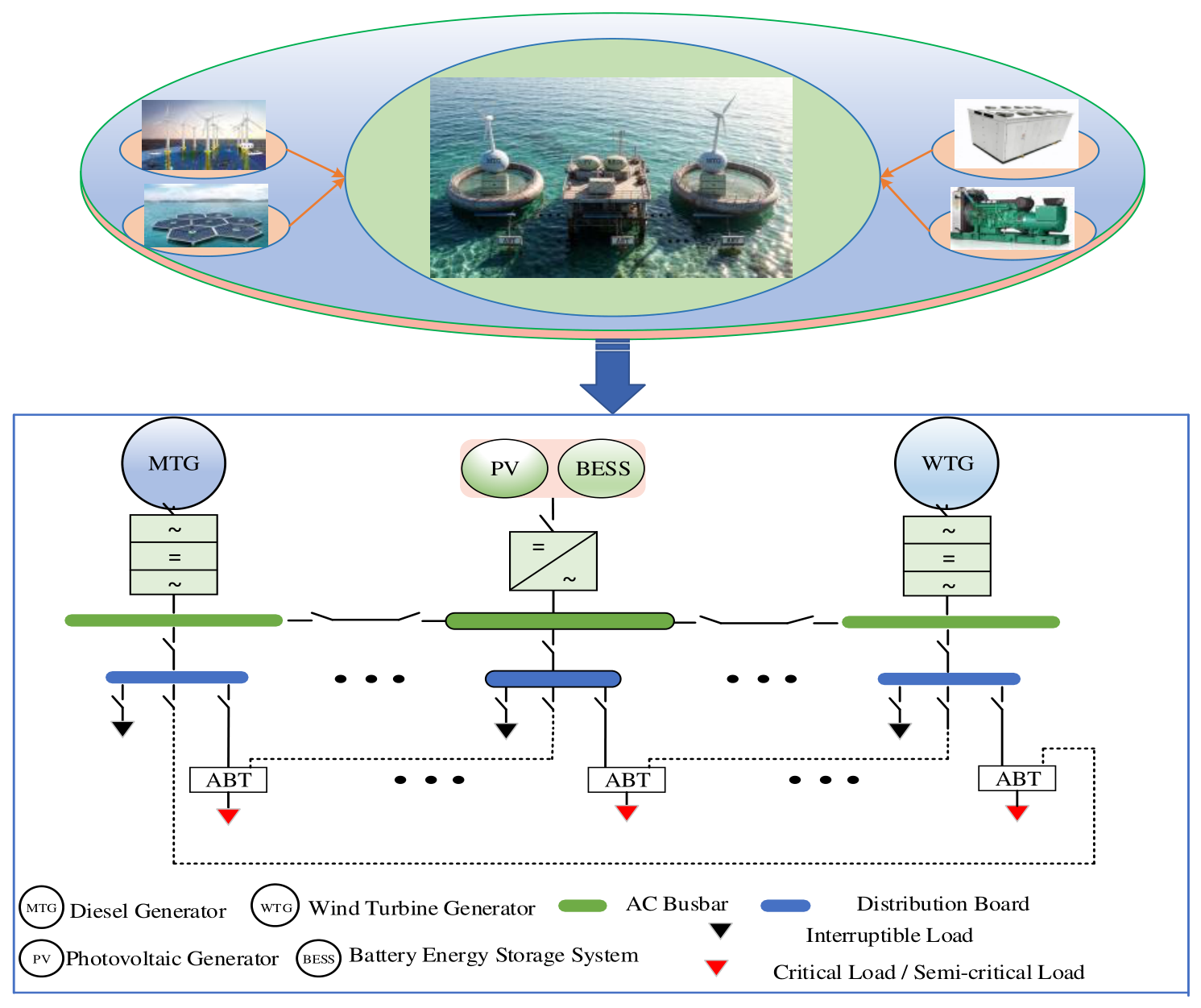
Marine ranching systems are typically deployed in offshore areas far from the main grid, where direct grid connection is impractical. As a result, islanded operation is commonly adopted. Such systems are generally composed of multiple distributed energy sources, including diesel generator units (MTG), wind turbine generators (WTG), photovoltaic (PV) systems, and battery energy storage systems (BESS). These sources are integrated through an AC bus to achieve coordinated power supply, forming a typical multi-energy coupled power system [23,24,25].
As shown in Figure 1, the system is centered on distributed energy sources, where power conversion and distribution are realized through inverters and distribution units [26,27]. The diesel generator provides a stable base load supply, while wind and photovoltaic systems serve as renewable energy supplements. The energy storage system is used to mitigate power fluctuations and enhance system stability. All power sources are connected to the AC bus and supply electricity to both critical and non-critical loads. This multi-energy coupled power supply mode exhibits the following characteristics and advantages:
  • A high proportion of renewable energy contributes to reduced carbon emissions;
  • Diesel generators provide stable support and improve supply reliability;
  • Energy storage systems enable dynamic energy regulation and enhance system stability;
  • Coordinated operation of multiple energy sources improves adaptability under complex marine conditions.
In summary, the islanded marine ranching power system achieves reliable power supply through multi-source complementarity and coordinated control, while improving energy efficiency and environmental performance. This provides a practical system foundation for subsequent inverter fault diagnosis.

2.2. Inverter Fault Analysis and Modeling

Marine ranching power systems operate under harsh environmental conditions characterized by high humidity, salt spray, and significant temperature fluctuations. Under the combined effects of environmental and electrical stresses, power electronic devices are prone to degradation and failure [28,29]. As a key interface between renewable energy sources and loads, the inverter module directly affects energy conversion efficiency and system reliability [30]. Once a fault occurs, it may lead to power degradation or even system interruption [31,32]. Therefore, systematic fault analysis and modeling of inverter modules are of great importance. Although the basic fault mechanisms of inverters in marine ranching power systems are similar to those in conventional power systems, harsh marine conditions accelerate insulation degradation, connector corrosion, gate-drive instability, and sensor noise, which increase the probability of device faults and reduce the reliability of fault feature extraction. Therefore, the marine ranching scenario mainly increases the difficulty of robust diagnosis rather than introducing completely different fault mechanisms.
To obtain high-quality fault data, a simulation model of the inverter module is developed in MATLAB/Simulink. Different operating conditions and fault states are simulated to generate representative datasets for subsequent fault diagnosis.

2.2.1. Inverter Structure and Operating Principle

The inverter is a core device responsible for converting DC power generated by renewable sources into AC power synchronized with grid frequency and phase [33,34]. In distributed power systems, three-phase voltage-source inverters are widely adopted due to their simple structure, flexible control, and cost-effectiveness.
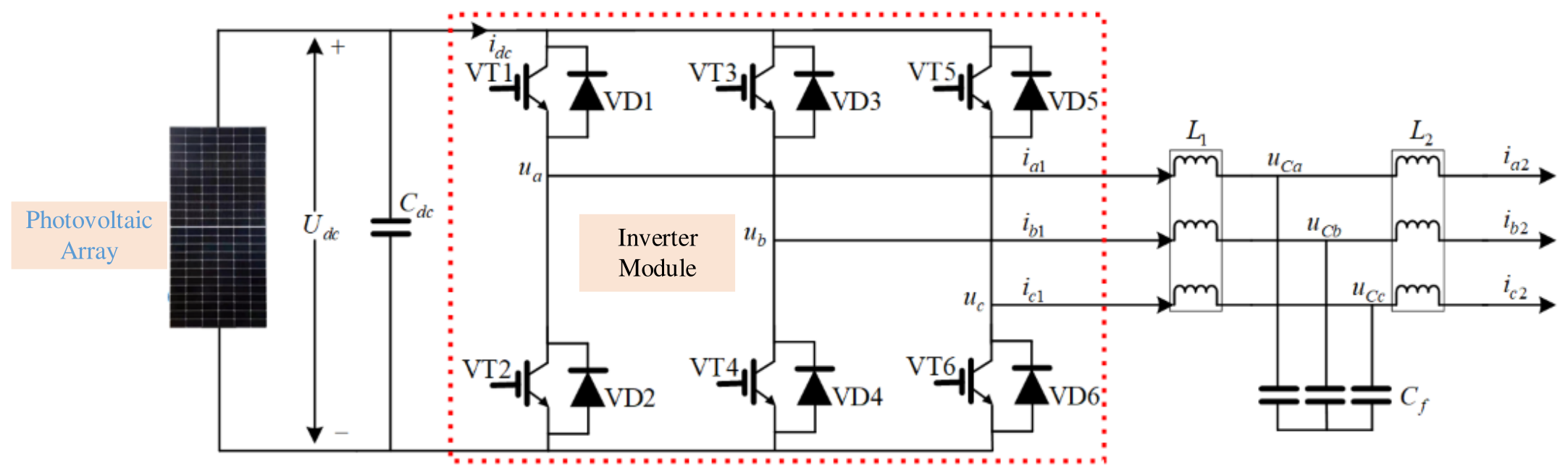
As shown in Figure 2, a typical three-phase inverter consists of six insulated gate bipolar transistors (IGBTs) arranged in a three-bridge configuration. The upper and lower switches in each leg operate alternately with a conduction angle of 180° over one fundamental cycle. Pulse-width modulation (PWM) is employed to achieve DC–AC conversion.
At the output side, an LC filter is typically used to suppress switching harmonics and improve current quality. Under ideal conditions, the three-phase output currents are balanced. However, in marine environments, device degradation and disturbances can lead to deviations from normal operation, resulting in faults.

2.2.2. IGBT Open-Circuit Fault Analysis

As a key power device in the inverter, the reliability of IGBTs directly determines system performance. Under long-term exposure to high temperature, humidity, and electrical stress, IGBTs are susceptible to open-circuit or short-circuit faults [35,36]. An IGBT open-circuit fault refers to the condition in which the device fails to conduct when a turn-on gate signal is applied [37]. This fault may be caused by gate-driver failure, bond-wire lift-off, solder fatigue, aging-induced degradation, or device disconnection. Among them, Short-circuit faults are generally severe and are usually interrupted within a very short time by hardware protection circuits. In contrast, open-circuit faults may not trigger immediate shutdown but can continuously distort output currents, cause three-phase imbalance, increase harmonics, and degrade power quality. Therefore, this study focuses on open-circuit faults as a representative and diagnostically challenging fault type. Short-circuit and compound faults are beyond the present scope and will be considered in future work.
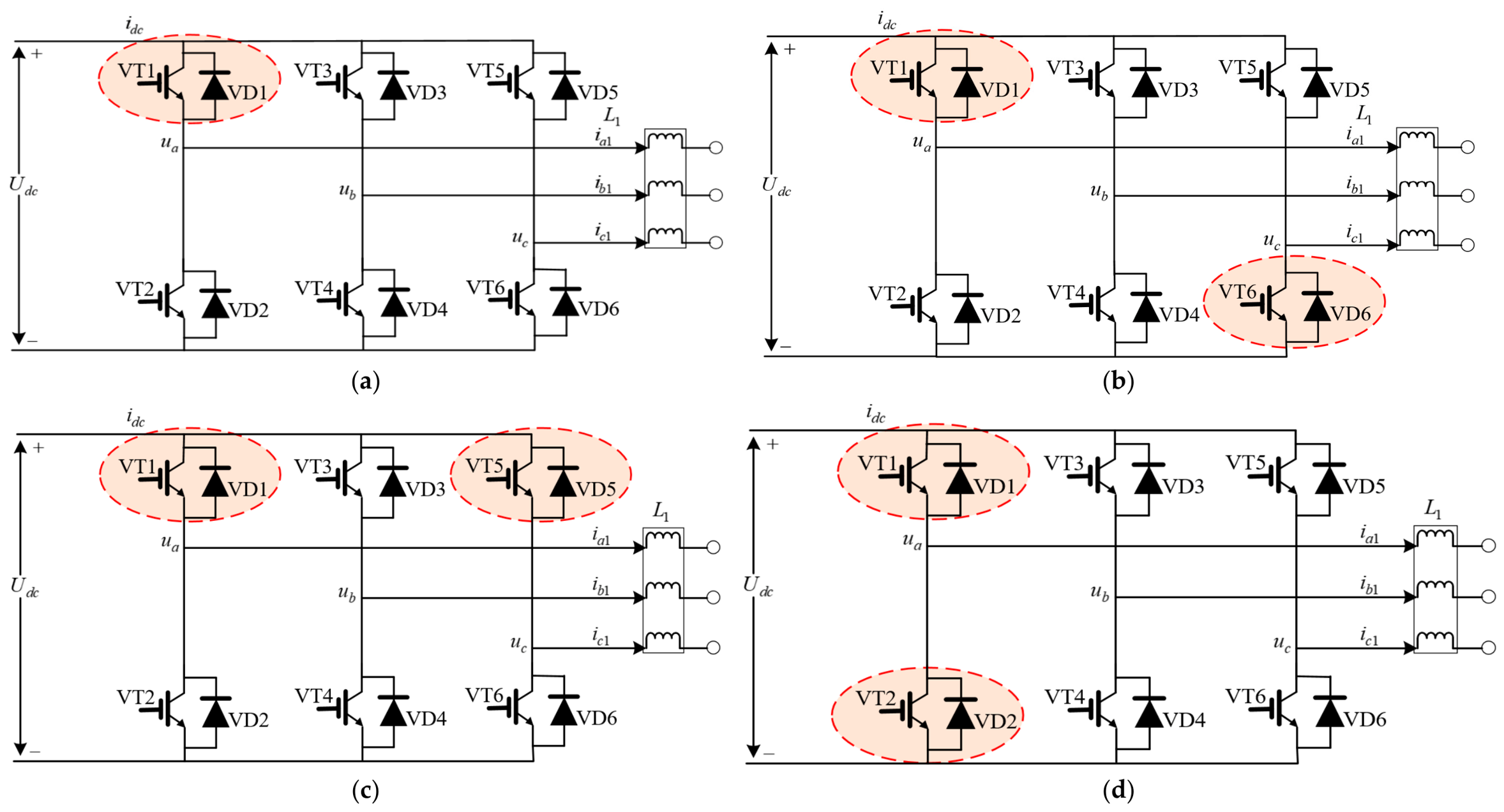
Considering a three-phase two-level inverter, open-circuit faults can be classified based on the position and combination of faulty switches, including single-switch faults and various double-switch fault configurations across different bridge arms [38]. Figure 3 illustrates typical fault topologies. Taking the VT1 open-circuit fault as an example, since VT1 is located in the upper arm of phase A, its failure causes the loss of the positive half-cycle component of phase-A current, while also affecting phases B and C, resulting in unbalanced three-phase currents.
Overall, a total of 21 open-circuit fault conditions and one normal condition can be defined, as summarized in Table 1.
Due to different fault conditions, the amplitude and phase of three-phase output currents exhibit significant variations. Therefore, three-phase current signals can serve as effective features for inverter fault detection and classification.

2.2.3. Simulation Modeling of Inverter Faults

To capture inverter behavior under various fault conditions, a simulation model is constructed in MATLAB/Simulink. The model consists of a photovoltaic array, a Boost converter, a three-phase inverter, a control system, and a load.
The photovoltaic unit provides DC input, which is stepped up by the Boost converter. The perturb and observe (P&O) method is adopted for maximum power point tracking (MPPT) [39]. The boosted DC voltage is then fed into the inverter, where PWM is applied to achieve DC–AC conversion. A three-phase two-level topology is used, and an LC filter is employed to reduce harmonic distortion.
In the simulation, an open-circuit fault is modeled by blocking the gate signal of the corresponding IGBT, so that the selected switch cannot conduct during the specified fault interval. During fault injection, the DC-link voltage, control strategy, load condition, and filter parameters are kept unchanged to isolate the influence of the faulty switch on the output current. The IGBT is assumed to be completely open after the fault occurs, while intermittent contact faults are not considered in this study.
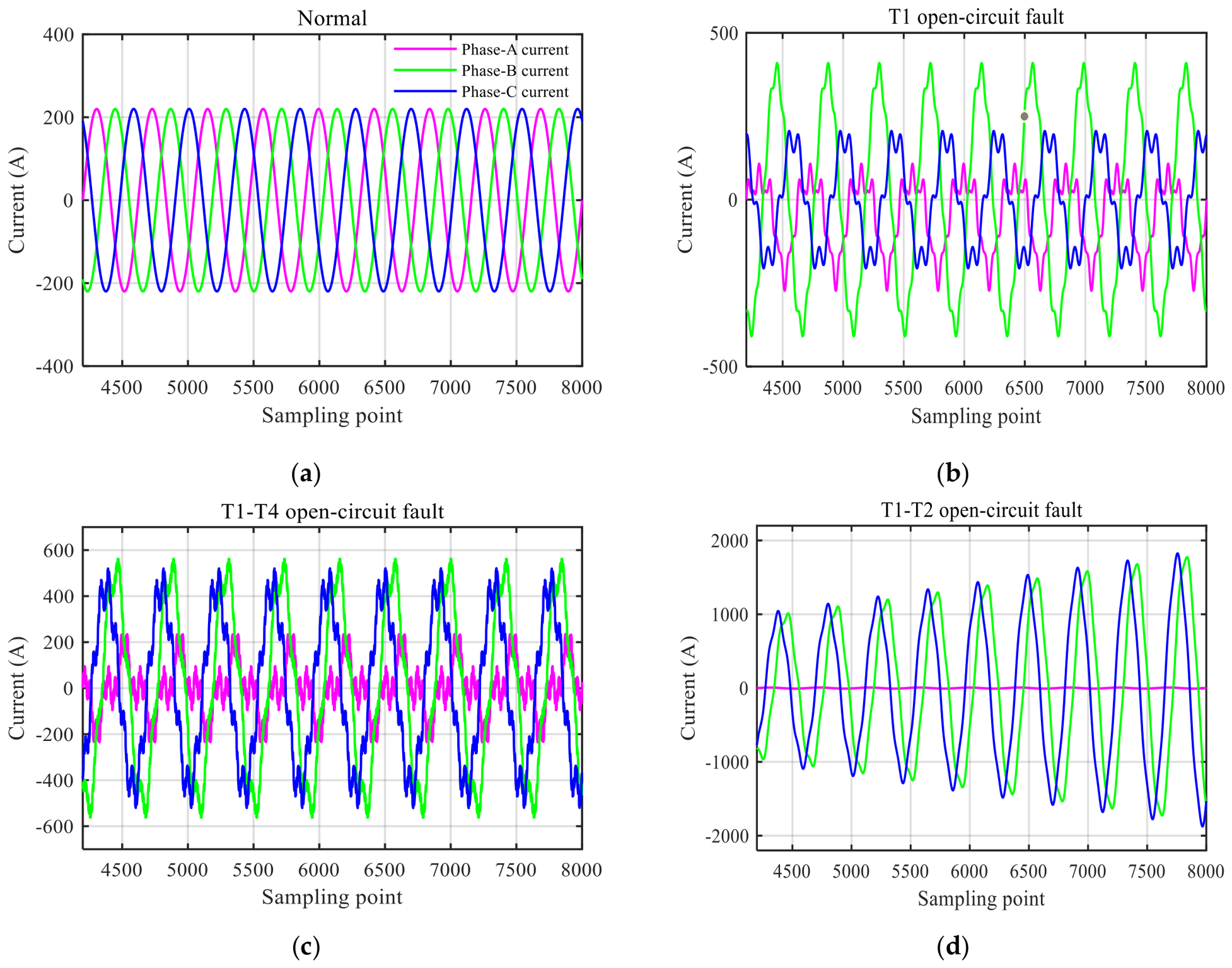
To illustrate the electrical effect of IGBT open-circuit faults, representative three-phase output current waveforms are shown in Figure 4. Compared with the normal condition, open-circuit faults lead to obvious current distortion, amplitude imbalance, phase asymmetry, and waveform fluctuation. For example, the T1 open-circuit fault causes distortion in the corresponding phase current, while double-switch faults such as T1–T4 and T1–T2 produce more severe current imbalance. These fault-dependent waveform characteristics provide the physical basis for using three-phase current signals as diagnostic inputs.
Under different fault conditions, the output currents exhibit distinct variations in amplitude and phase, which can be used as diagnostic features. The main simulation parameters are listed in Table 2. By varying operating conditions and fault types, a multi-class dataset is constructed for model training and validation.
The above analysis shows that IGBT open-circuit faults produce distinguishable temporal patterns in three-phase output currents. Therefore, a data-driven time-series feature extraction model is introduced in the next section for automatic fault classification.

3. Proposed Artificial Bee Colony-Optimized 1D-CNN Method

3.1. 1D-CNN Architecture

Convolutional neural networks (CNNs) have demonstrated strong capability in feature extraction and pattern recognition. Considering that the output signals of inverter modules are typical one-dimensional time-series data, a 1D-CNN is employed to automatically extract fault features and perform classification [40].
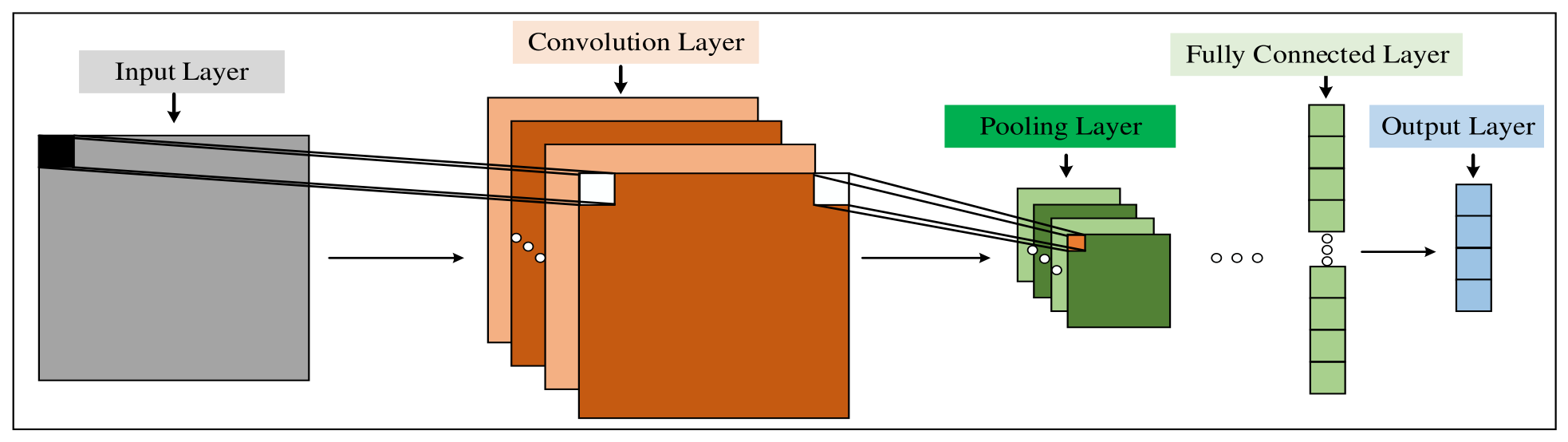
The 1D-CNN extracts local features through convolution operations and progressively learns higher-level abstract representations via a deep hierarchical structure. As illustrated in Figure 5, the network mainly consists of an input layer, multiple convolutional layers, pooling layers, and fully connected layers. The convolutional layers are responsible for feature extraction, while pooling layers reduce feature dimensionality and enhance robustness. The fully connected layers map extracted features to the output space for classification.
The convolution operation in the l-th layer can be expressed as:
A i l = a c t ( A l 1 W i l + B i l )
Re L U ( z ) = 0 , z < 0 z , z > 0 = max ( 0 , z )
where A l 1 and A l denote the input and output of the l-th layer, respectively; ∗ represents the convolution operation; W i l is the convolution kernel (weight matrix); B i l is the bias term.
To enhance the nonlinear representation capability, the rectified linear unit (ReLU) activation function is applied after each convolutional layer, which is defined as:
y = σ ( W · x + b )
where x denotes the output of the final fully connected layer for class W , and b is the number of fault categories. σ(.) denotes the activation function.

3.2. Improved Artificial Bee Colony Algorithm (IABC)

The Artificial Bee Colony (ABC) algorithm is a population-based stochastic optimization method inspired by the foraging behavior of honey bees. It has been widely applied to solve nonlinear optimization problems due to its simplicity and global search capability [41,42]. In this study, the ABC algorithm is employed to optimize the hyperparameters of the 1D-CNN model.
Assume that the search space has a dimensionality of D, and the population size is N. Each candidate solution (food source) is represented as a vector:
x i = [ x ( i , 1 ) , x ( i , 2 ) , , x ( i , D ) ] , i = 1 , 2 , , N
(1)
Initialization Phase
The initial population is randomly generated within the predefined bounds:
x ( i , j ) = x min ( j ) + [ x max ( j ) x min ( j ) ] r a n d
where x min ( j ) and x max ( j ) denote the lower and upper bounds of the j-th dimension, respectively, and rand( ) ∈ [0, 1] is a uniformly distributed random number.
(2)
Employed Bee Phase
In this phase, each employed bee searches for a new candidate solution in the neighborhood of its current position:
x n e w ( i , j ) = x ( i , j ) + φ i j [ x ( i , j ) x ( r 1 , j ) ]
where φ i j ∈ [−1, 1] is a random number, and ki is a randomly selected index. This operation enhances local exploitation around the current solution.
(3)
Onlooker Bee Phase
Onlooker bees select food sources based on their fitness values. The selection probability is defined as:
P i = F ( i ) / i = 1 N p F ( i )
where F(i) denotes the fitness value of the i-th candidate solution. Solutions with higher fitness are more likely to be selected for further exploration.
(4)
Onlooker-Based Solution Update
In the onlooker bee phase, candidate solutions are updated based on a probabilistic selection mechanism:
x O B ( i , j ) = x ( i , j ) + φ i j [ x ( i , j ) x ( r 1 , j ) ] , P i R x ( i , j ) , o t h e r w i s e
where R ∈ [0, 1] is a random number.
To address the limitations of the standard ABC algorithm, including slow convergence and susceptibility to local optima, two improvement strategies are introduced.
(1)
Crossover-Based Search Enhancement
A crossover operation inspired by genetic algorithms is incorporated to enhance global exploration capability. Specifically, candidate solutions are guided toward the current global best solution:
x n e w ( i , j ) = x b e s t ( j ) + φ i j [ x b e s t ( j ) x ( r 1 , j ) ] P i c r x ( i , j ) + φ i j [ x ( i , j ) x ( r 2 , j ) ] P i < c r
where xbest denotes the global optimal solution, cr represents the crossover probability (set to 0.6 in this study), and Pi is the fitness ratio of the i-th individual. This strategy enhances exploitation around promising regions while maintaining sufficient diversity in the population.
(2)
Differential Evolution-Based Mutation Strategy
To further improve convergence speed and population diversity, a mutation and crossover mechanism derived from differential evolution (DE) is introduced:
x G + 1 O B ( i , j ) = x G ( r 1 , j ) + β [ x G ( r 3 , j ) x G ( r 2 , j ) ]   r a n d c r   or   j = k x G ( i , j )   o t h e r w i s e
where G denotes the iteration index, β ∈ [0, 1] is the mutation factor, r1, r2, r3 are distinct random indices, and k is a randomly selected dimension. This mechanism significantly enhances global search capability and accelerates convergence by introducing directional mutation.
By integrating crossover and DE-based mutation strategies, the proposed IABC algorithm achieves a better balance between exploration and exploitation, leading to faster convergence, improved global optimization capability, and enhanced robustness in hyperparameter optimization. To clarify the use of IABC for 1D-CNN hyperparameter optimization, the main procedure is summarized as follows (Algorithm 1).
Algorithm 1. IABC-Optimized 1D-CNN
Input: D t r a i n   , D v a l   , hyperparameter search space Θ
Output: Fault diagnosis model with optimal hyperparameters
1: //Phase 1: Initialization
2: Initialize food sources θ i Θ
3: Train 1D-CNN with θ i and compute validation accuracy F i
4: Select the best food source θ b e s t  
5: //Phase 2: ABC-Based Search
6: Update candidate food sources using employed-bee and onlooker-bee strategies
7: Retain better candidates through greedy selection
8: //Phase 3: IABC Enhancement
9: Apply genetic crossover guided by θ b e s t  
10: Apply differential-evolution mutation to increase population diversity
11: Recalculate fitness values using validation accuracy
12: //Phase 4: Output
13: Update θ b e s t   until convergence or maximum iterations
14: Train the final 1D-CNN using θ b e s t  
15: return optimized 1D-CNN model
In this procedure, each food source represents a candidate hyperparameter set of the 1D-CNN, and the validation accuracy is used as the fitness value. The genetic crossover and differential-evolution mutation strategies are introduced to improve search diversity and reduce the risk of local optima.

3.3. Hyperparameter Optimization Strategy

The performance of the 1D-CNN model is highly dependent on its network architecture and hyperparameter configuration, including the number of convolutional filters, kernel size, pooling size, and dropout rate. Conventional methods such as grid search or empirical tuning are often inefficient and may lead to suboptimal solutions.
To address this issue, the IABC algorithm is employed to optimize the key hyperparameters of the 1D-CNN. The optimization objective is defined as maximizing the classification performance on the validation set, which can be expressed as:
θ * = arg   max F ( θ )
where θ denotes the hyperparameter set, and F(θ) represents the validation accuracy. The hyperparameters to be optimized and their corresponding search ranges are listed in Table 3.
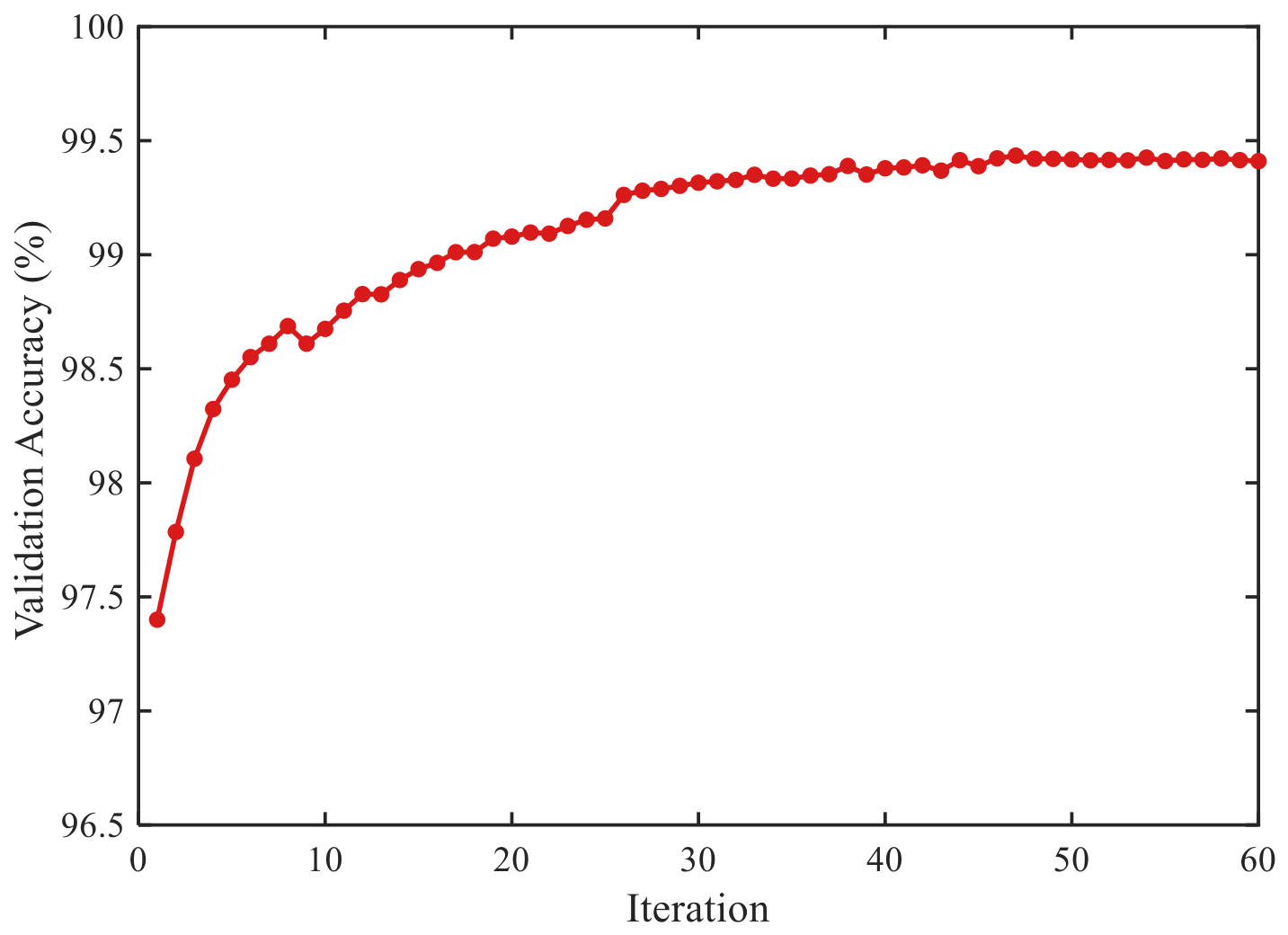
The computational cost of IABC mainly arises from the offline hyperparameter search, in which each candidate food source represents a 1D-CNN hyperparameter set and must be evaluated on the validation set. The cost is therefore related to the population size, iteration number, and training cost of each candidate model. However, IABC is executed only during offline training. In online diagnosis, only the optimized 1D-CNN is used for inference, so the IABC search process does not increase real-time diagnostic burden. During the optimization process, the IABC algorithm iteratively evaluates candidate solutions and updates the population to search for the optimal hyperparameter combination. The convergence curve of classification accuracy with respect to iterations is shown in Figure 6.
As shown in Figure 6, the validation accuracy increases rapidly during the early iterations and gradually stabilizes after approximately 45 iterations. The extended iteration range indicates that the optimization process reaches a stable convergence state rather than stopping prematurely at a local fluctuation.

3.4. Fault Diagnosis Framework

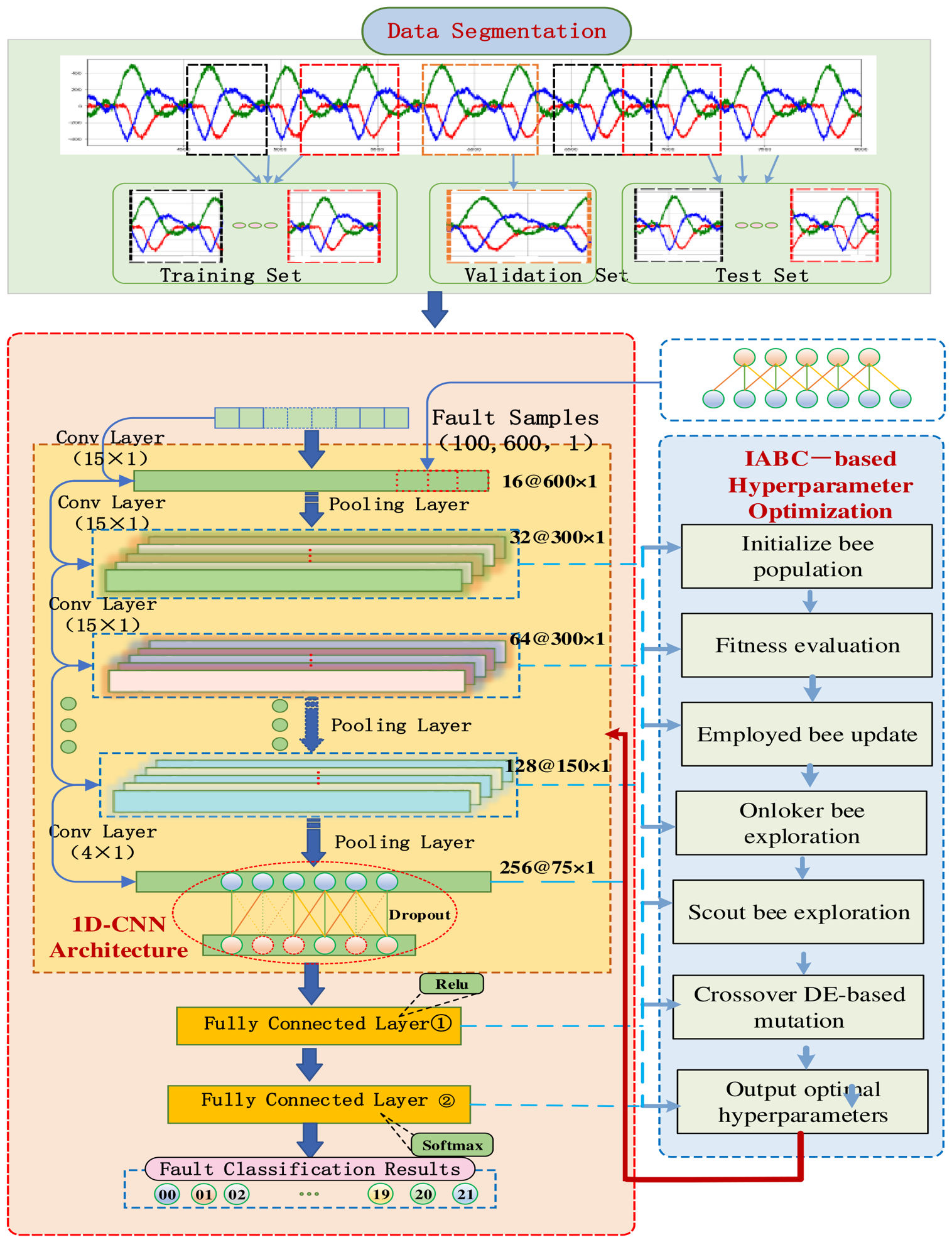
To address IGBT open-circuit faults in inverter modules of islanded marine ranching power systems, a fault diagnosis method based on an improved artificial bee colony-optimized IABC-1D-CNN is proposed. The overall framework is illustrated in Figure 7, which consists of two main stages: hyperparameter optimization and fault diagnosis.
In the hyperparameter optimization stage, the IABC algorithm, incorporating differential evolution and genetic crossover strategies, is employed to perform global search for the optimal configuration of the 1D-CNN. This process improves search efficiency and mitigates the risk of local optima, leading to a more effective network structure.
In the fault diagnosis stage, three-phase current signals of the inverter module are segmented using a sliding window approach to construct fault samples. The dataset is then divided into training, validation, and test sets. The processed data are fed into the 1D-CNN model, which automatically extracts discriminative features and performs fault classification.
To enhance robustness under complex marine conditions, Gaussian noise is introduced during training to simulate measurement disturbances. This enables the model to learn more representative features and improves its adaptability to low SNR environments.
Overall, the proposed IABC-1D-CNN framework integrates global hyperparameter optimization with deep feature learning, achieving accurate and robust fault diagnosis for inverter modules. The method provides an effective solution for intelligent fault diagnosis in marine ranching power systems.
The dashed boxes with different colors in the data segmentation part indicate different sliding-window samples. The red dashed box denotes the 1D-CNN fault diagnosis module, the blue dashed box denotes the IABC-based hyperparameter optimization module, blue arrows indicate the data and feature flow, and the red arrow indicates the feedback of optimized hyperparameters to the CNN model. The numbers 00–21 represent the 22 fault categories.

4. Experimental Setup and Results

4.1. Experimental Setup

To validate the effectiveness of the proposed IABC-optimized 1D-CNN method for inverter fault diagnosis in marine ranching power systems, simulation data are generated using a MATLAB/Simulink-based photovoltaic grid-connected inverter model. Three-phase current signals under different operating and fault conditions are collected for analysis.
The experiments are conducted on a platform equipped with an Intel i7-11700 CPU, 16 GB RAM, and an NVIDIA GTX 3060 GPU. The deep learning framework is implemented using TensorFlow with Python 3.8.
To further evaluate the global optimization capability of the IABC algorithm, three classical benchmark functions, including Sphere, Rosenbrock, and Ackley functions, are employed. The dimensionality of each function is set to 30, and their respective search ranges are defined as [−5.12, 5.12], [−2.048, 2.048], and [−10, 10]. Among them, the Sphere function is unimodal and is used to evaluate convergence accuracy, while the Rosenbrock and Ackley functions are more challenging nonlinear benchmark functions used to assess global search capability and the ability to avoid local optima.
The performance of the proposed IABC algorithm is compared with MRFO, LSO, and CSA algorithms. To ensure a more rigorous comparison, each algorithm is independently run 30 times under the same population size, dimensionality, search range, and maximum iteration number. Table 4 reports the best value, mean value, standard deviation (STD), rank, and Wilcoxon p-value of the final fitness values. The Wilcoxon p-value denotes the statistical comparison between IABC and the corresponding algorithm on the same benchmark function, and p < 0.05 indicates a statistically significant difference. The results in Table 4 show that the IABC algorithm achieves the best mean fitness value and the first rank on all three benchmark functions. Moreover, the lower STD values indicate improved convergence stability, while all Wilcoxon p-values are below 0.05, confirming that the performance differences between IABC and the comparison algorithms are statistically significant.
Based on the optimization results, the optimal hyperparameter configuration of the 1D-CNN model is obtained, as listed in Table 5.

4.2. Fault Diagnosis Performance

The fault dataset was generated from the inverter simulation model under various operating conditions and fault states. The sampling interval was set to 0.00001 s, and the three-phase current signals were segmented using a sliding-window strategy for data augmentation. The sample number of each category was adjusted through sliding-window segmentation to form a balanced dataset. The final dataset contains 20,000 samples generated from 22 categories, including one normal condition and 21 open-circuit fault conditions. The dataset was divided into training, validation, and test sets at a ratio of 8:1:1. To improve the robustness of the model under noisy environments, Gaussian noise with SNRs ranging from 0 dB to 20 dB was added to the training data. For model training, the learning rate was set to 0.001, the number of epochs was set to 90, and the hyperparameters of the optimized model were determined by the IABC algorithm.
To clarify the composition of the dataset, the main dataset information is summarized in Table 6. The input of each sample is a three-phase current segment obtained by sliding-window segmentation, and the output label corresponds to one of the 22 operating states.
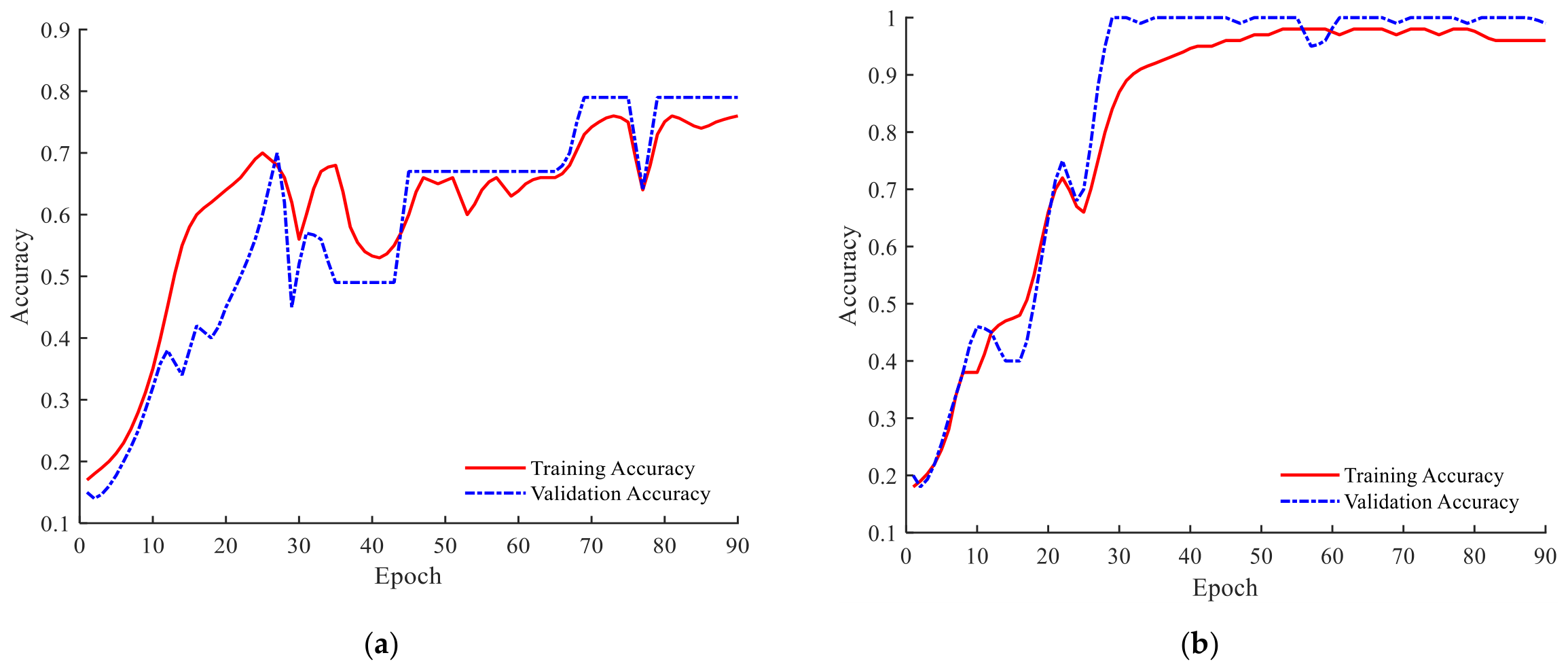
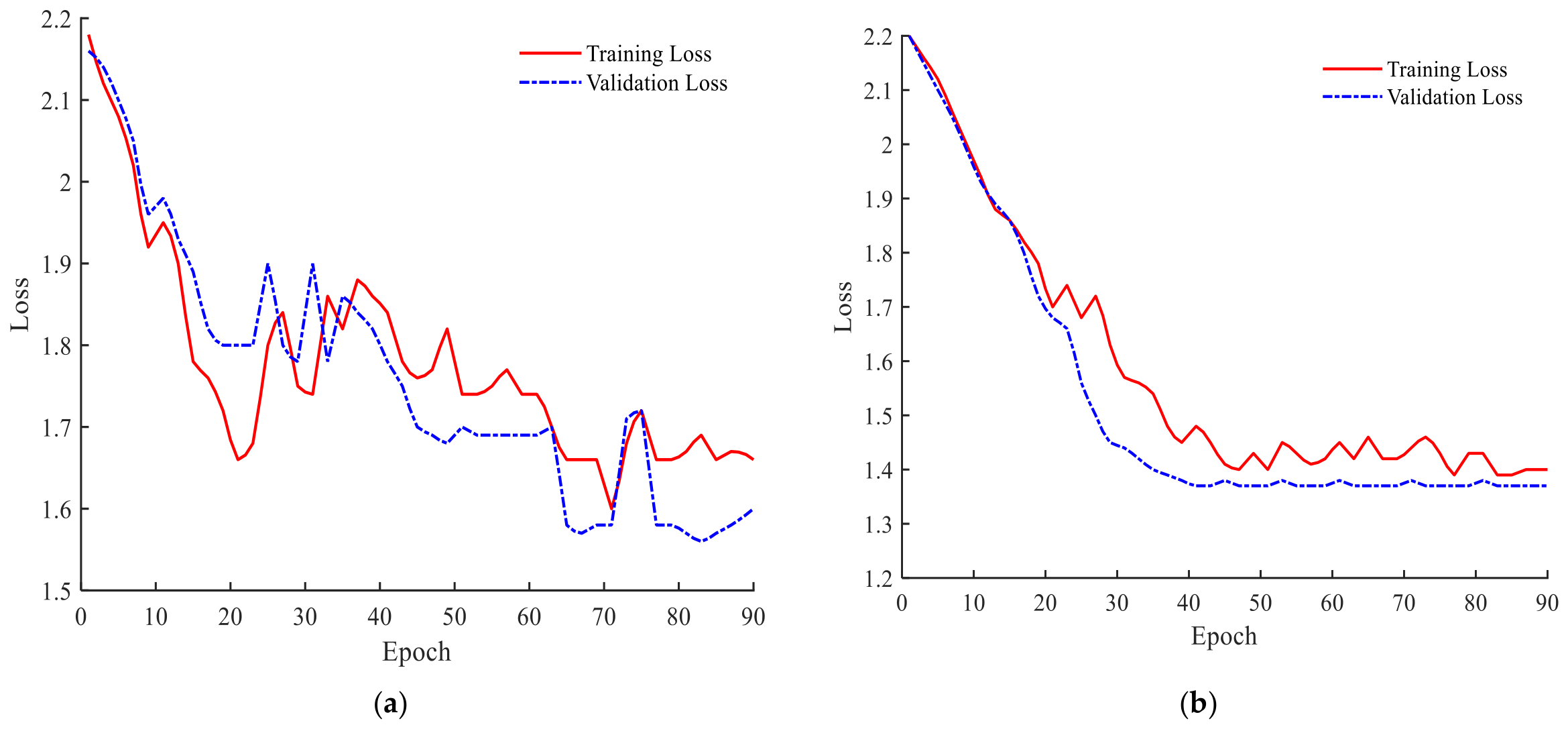
To evaluate the effectiveness of the proposed optimization strategy, comparative experiments were conducted between the baseline 1D-CNN and the optimized IABC-1D-CNN. The accuracy curves before and after optimization are shown in Figure 8, while the corresponding loss curves are presented in Figure 9. As shown in Figure 8, the optimized model converges faster and exhibits more stable training behavior than the baseline model. Specifically, the validation accuracy of the optimized model stabilizes at approximately 98.46%, whereas the baseline model shows larger fluctuations and lower final accuracy.
In addition, the training accuracy improves by approximately 25%, and the validation accuracy increases by about 22.5%, demonstrating the effectiveness of the proposed IABC-based optimization strategy.
As shown in Figure 9, the average training loss and validation loss of the optimized model are reduced to approximately 1.65 and 1.60, respectively. Compared with the baseline model, the training loss decreases by 15.15%, while the validation loss decreases by 12.5%. Moreover, the optimized model presents smoother loss curves, indicating improved convergence stability. These results confirm that the proposed IABC-1D-CNN effectively improves fault diagnosis accuracy and stability while alleviating overfitting, thereby enhancing the generalization performance under complex marine operating conditions.

4.3. Diagnostic Performance Evaluation and Visualization Analysis

To comprehensively evaluate the diagnostic performance of the proposed method, multiple evaluation metrics are adopted, including accuracy (ACC), precision (P), recall (R), and F1-score. These metrics provide a balanced assessment of classification performance under multi-class conditions. The evaluation metrics are defined as:
P = T P T P + F P
R = T P T P + F N
F 1 s c o r e = 2 P R P + R
where TP, FP, and FN denote the numbers of true positives, false positives, and false negatives, respectively. The trained IABC-1D-CNN model is evaluated on the test dataset. The results, summarized in Table 7, show that the proposed method achieves an accuracy of 98.89%, with precision, recall, and F1-score remaining at high levels. These results indicate that the model has strong feature extraction capability and high classification accuracy for inverter fault diagnosis.
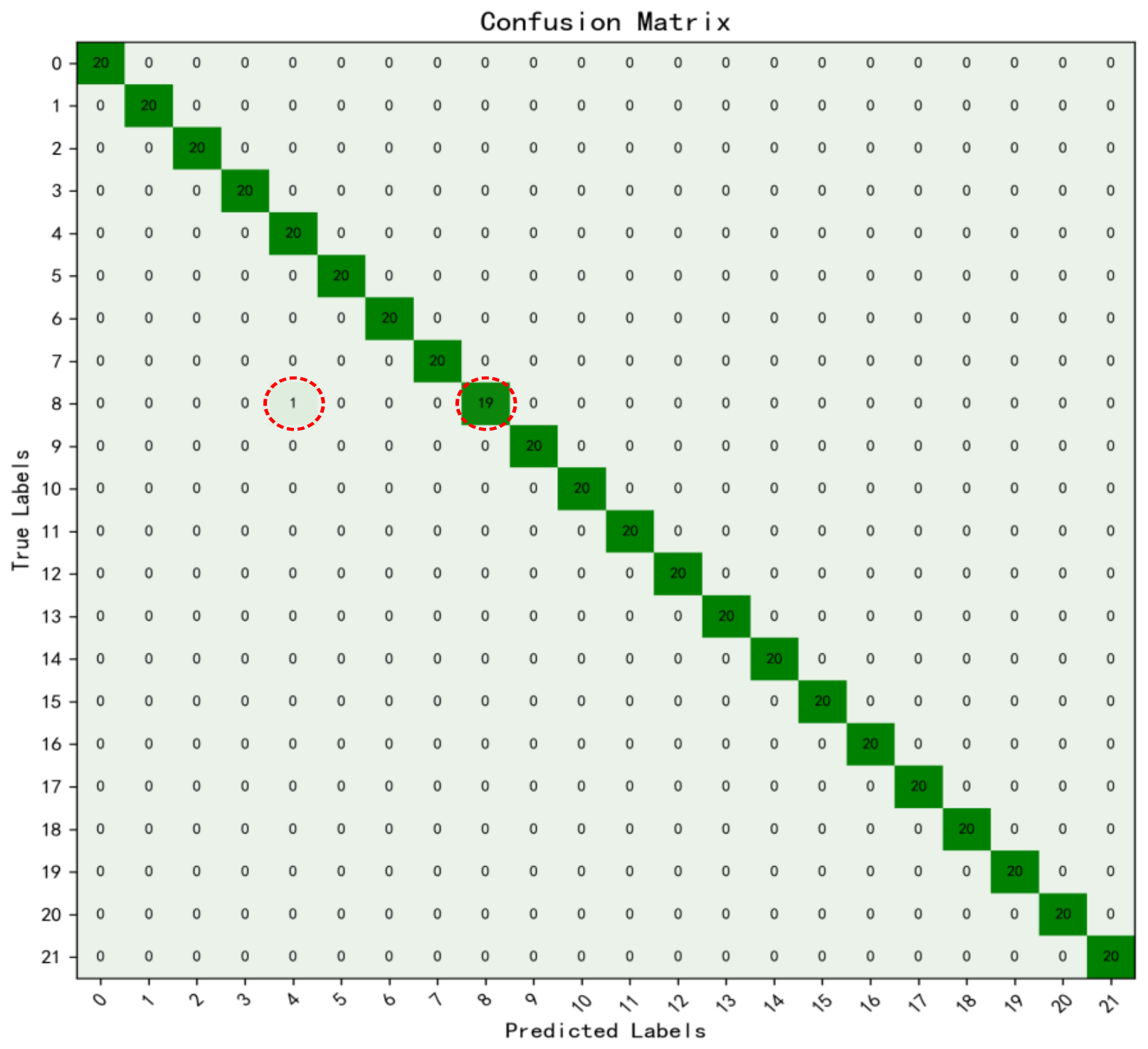
To further analyze classification performance, the confusion matrix of the test dataset is shown in Figure 10. Most samples are correctly classified along the diagonal, with only a few misclassifications observed. Specifically, misclassification occurs in class 8, where a small number of samples are incorrectly identified as class 4. This may be caused by similar current distortion patterns between the two fault categories, leading to partial overlap in the feature space. Overall, the proposed model achieves high diagnostic accuracy and stable classification performance across multiple fault categories. Further incorporation of multi-source signals may improve the discrimination of similar fault classes. The red dashed circles indicate the highlighted misclassification or abnormal positions.
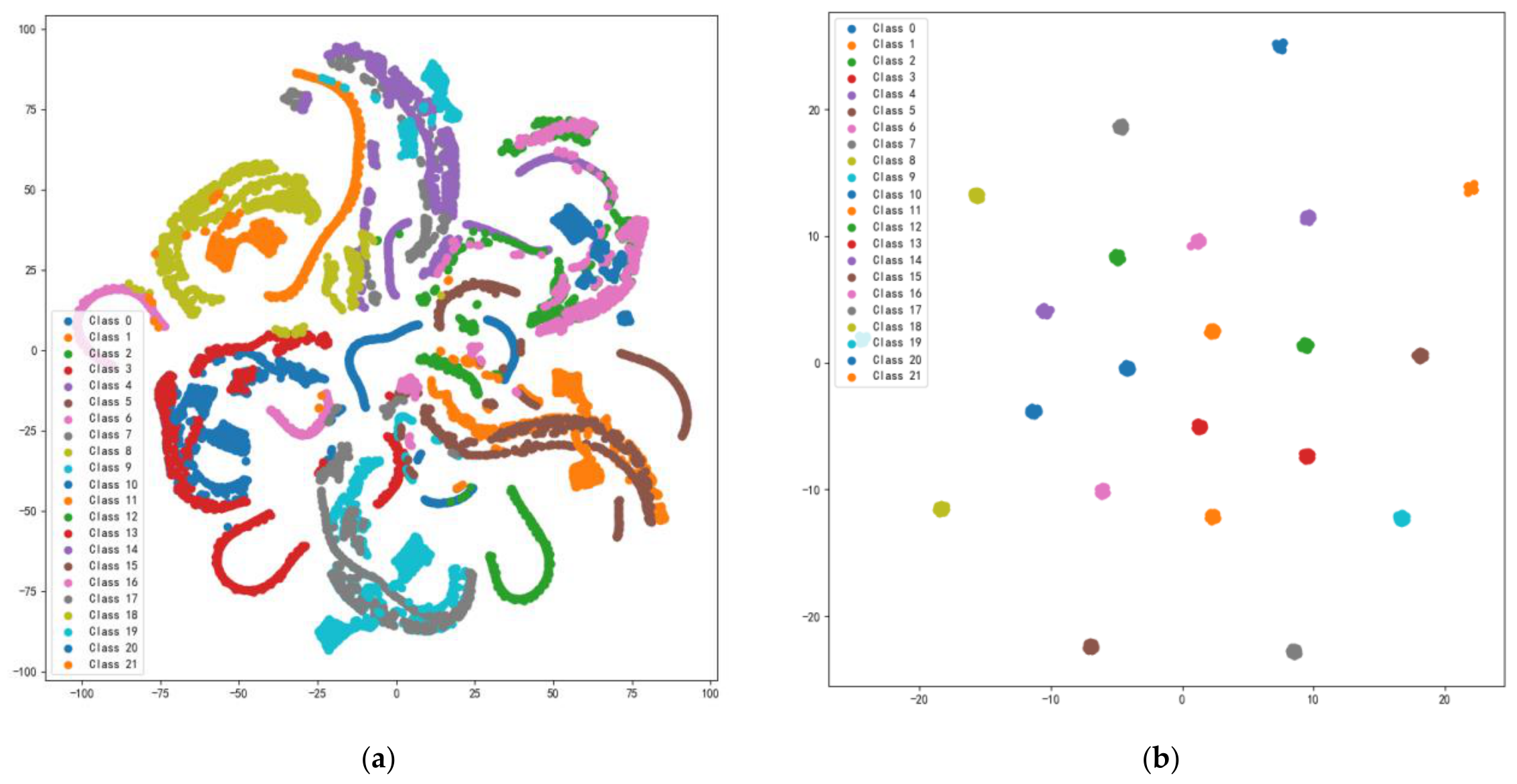
In addition, t-distributed stochastic neighbor embedding (t-SNE) is employed to visualize the feature distribution. As shown in Figure 11a, the raw fault data exhibit overlapping feature distributions, making class separation difficult. In contrast, the features extracted by the proposed model, as shown in Figure 11b, form well-separated clusters with clear class boundaries. This indicates that the model effectively learns discriminative fault features.
Overall, the proposed IABC-1D-CNN method demonstrates promising performance across multiple evaluation metrics and visualization analyses, enabling accurate identification of different fault types while maintaining strong generalization capability.

4.4. Ablation Study of the IABC Strategy

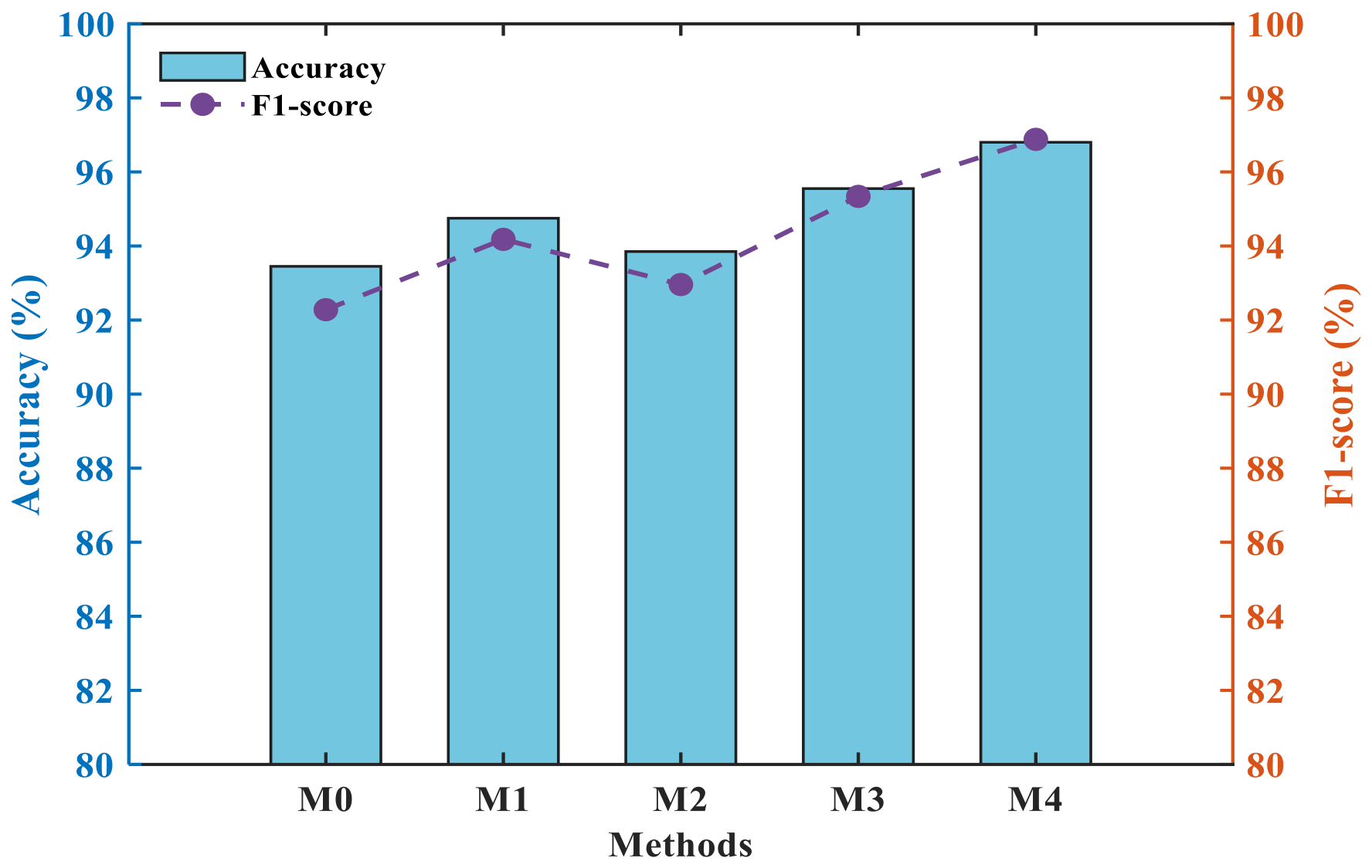
To evaluate the contributions of the genetic crossover and differential-evolution mutation strategies, five ablation models were compared under the 20 dB noise condition using the same dataset split and training settings. The five models include baseline 1D-CNN (M0), ABC-1D-CNN (M1), ABC-GA-1D-CNN (M2), ABC-DE-1D-CNN (M3), and the complete IABC-1D-CNN (M4). The results are listed in Table 8 and illustrated in Figure 12.
As shown in Table 8, M1 outperforms M0, indicating the effectiveness of ABC-based hyperparameter optimization. M2 shows limited improvement when the genetic crossover strategy is used alone, whereas M3 achieves higher accuracy and F1-score, suggesting that the differential-evolution mutation strategy contributes more directly to global search. The complete IABC-1D-CNN (M4) achieves the best performance, with an accuracy of 96.80% and an F1-score of 96.88%.
These results confirm that the genetic crossover and differential-evolution mutation strategies have complementary effects and improve the optimization capability of IABC.

4.5. Comparison with Other Methods

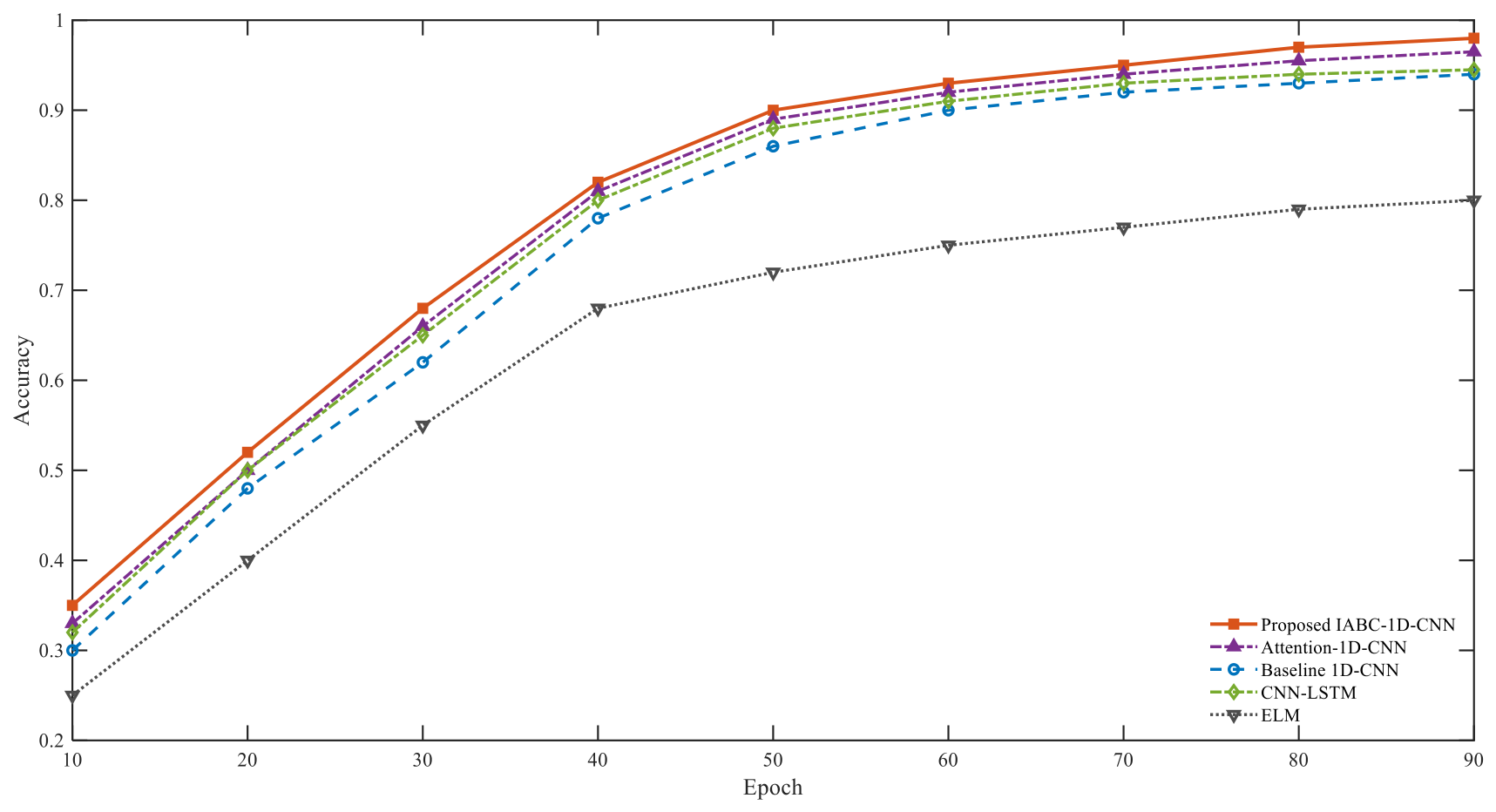
To further evaluate the convergence behavior and classification performance of the proposed method, comparative experiments were conducted with four representative models, namely Extreme Learning Machine (ELM), CNN-LSTM, Attention-1D-CNN, and baseline 1D-CNN. Among them, ELM was employed as a traditional shallow learning model, CNN-LSTM was selected as a representative hybrid deep learning model for time-series fault diagnosis, Attention-1D-CNN was introduced as an attention-enhanced deep learning baseline to evaluate the effect of adaptive feature weighting, and baseline 1D-CNN was used as the direct counterpart of the proposed model without IABC-based hyperparameter optimization. The test accuracy curves of different models during training are shown in Figure 13.
As shown in Figure 13, all models exhibit a rapid increase in accuracy during the early training stage. However, the proposed IABC-1D-CNN converges faster and reaches a higher accuracy level than the compared models. Specifically, the proposed method exceeds 0.80 accuracy at approximately 40 epochs and gradually stabilizes above 0.98 in the later training stage, demonstrating superior convergence performance and classification capability. The Attention-1D-CNN also achieves competitive performance and converges faster than the baseline 1D-CNN, indicating that the attention mechanism improves feature representation. Nevertheless, its final accuracy remains lower than that of the proposed IABC-1D-CNN.
In comparison, the ELM model converges rapidly but shows limited feature representation capability, resulting in relatively low final accuracy. The CNN-LSTM model, which combines convolution-based feature extraction with temporal dependency modeling, achieves better performance than ELM, but still exhibits slightly slower convergence and lower stability than the proposed method. The baseline 1D-CNN achieves competitive diagnostic performance; however, due to the absence of IABC-based hyperparameter optimization, its final accuracy and convergence stability remain inferior to those of the proposed model. Compared with Attention-1D-CNN, the proposed method further improves convergence stability and final diagnostic accuracy through global hyperparameter optimization rather than relying only on attention-based feature enhancement.
Moreover, the proposed IABC-1D-CNN presents a smoother accuracy curve with reduced oscillations during training, indicating that the IABC-based optimization strategy effectively improves convergence stability and model robustness. This result confirms that the performance gain is not only attributed to the feature extraction capability of 1D-CNN, but also to the global optimization of key hyperparameters by the IABC algorithm.
Overall, the proposed method outperforms ELM, CNN-LSTM, Attention-1D-CNN and baseline 1D-CNN in terms of convergence speed, stability, and final classification accuracy, demonstrating its effectiveness for inverter fault diagnosis under complex marine operating conditions.

4.6. Noise Robustness Analysis

Due to the harsh marine environment, inverter fault signals are inevitably affected by noise during acquisition. To evaluate the robustness of the proposed method under different noise conditions, Gaussian noise with signal-to-noise ratios (SNRs) of 20 dB, 15 dB, 10 dB, and 0 dB is added to the training data. The SNR is defined as:
S N R = 10 lg P s i g n a l P n o i s e
where P s i g n a l and P n o i s e represent the power of the original signal and noise, respectively. A lower SNR indicates stronger noise interference.
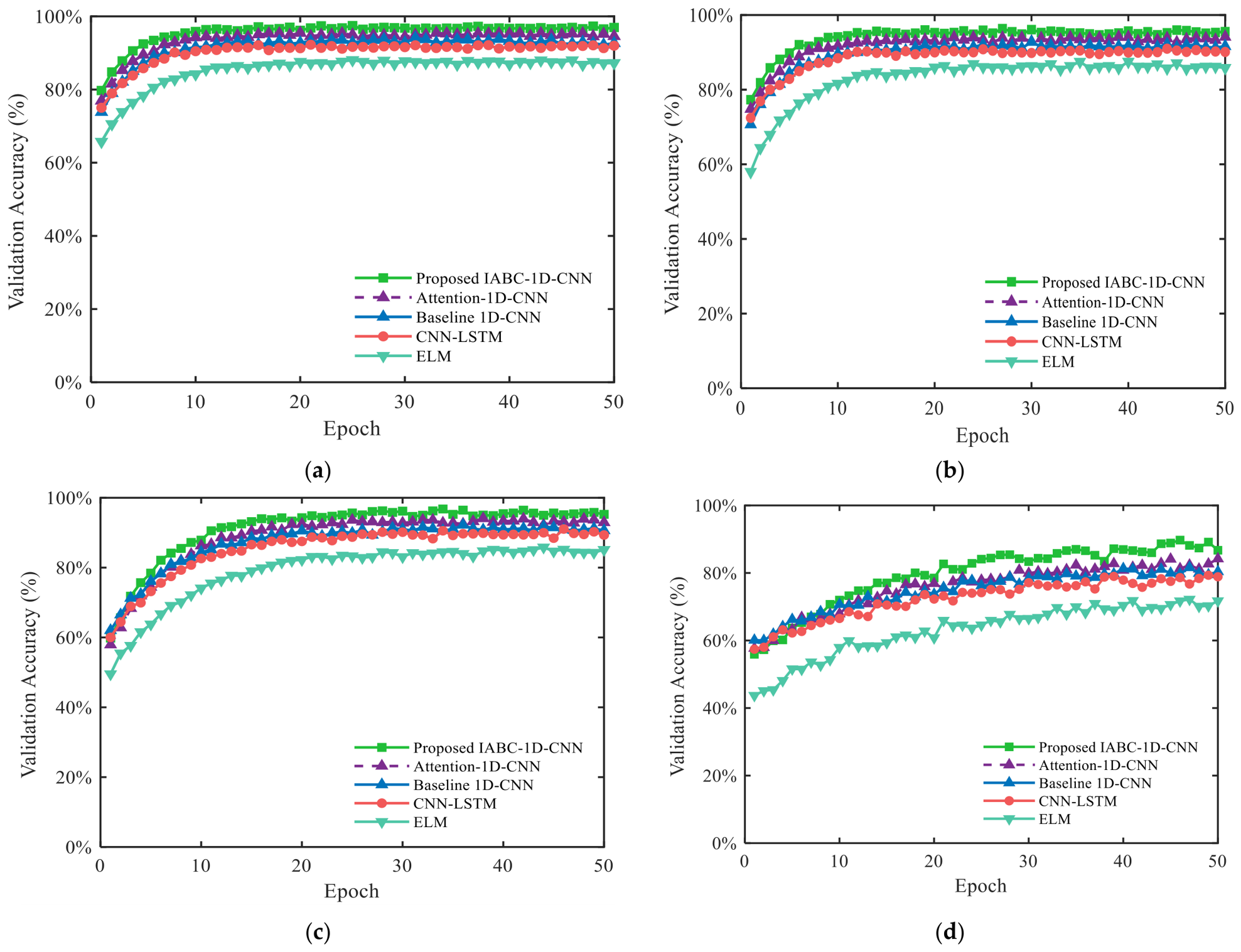
Under the same network parameters and training strategy, the variations in validation accuracy for different models are shown in Figure 14. As the noise level increases, the diagnostic accuracy of all methods decreases, and the degradation becomes most pronounced under the 0 dB condition.
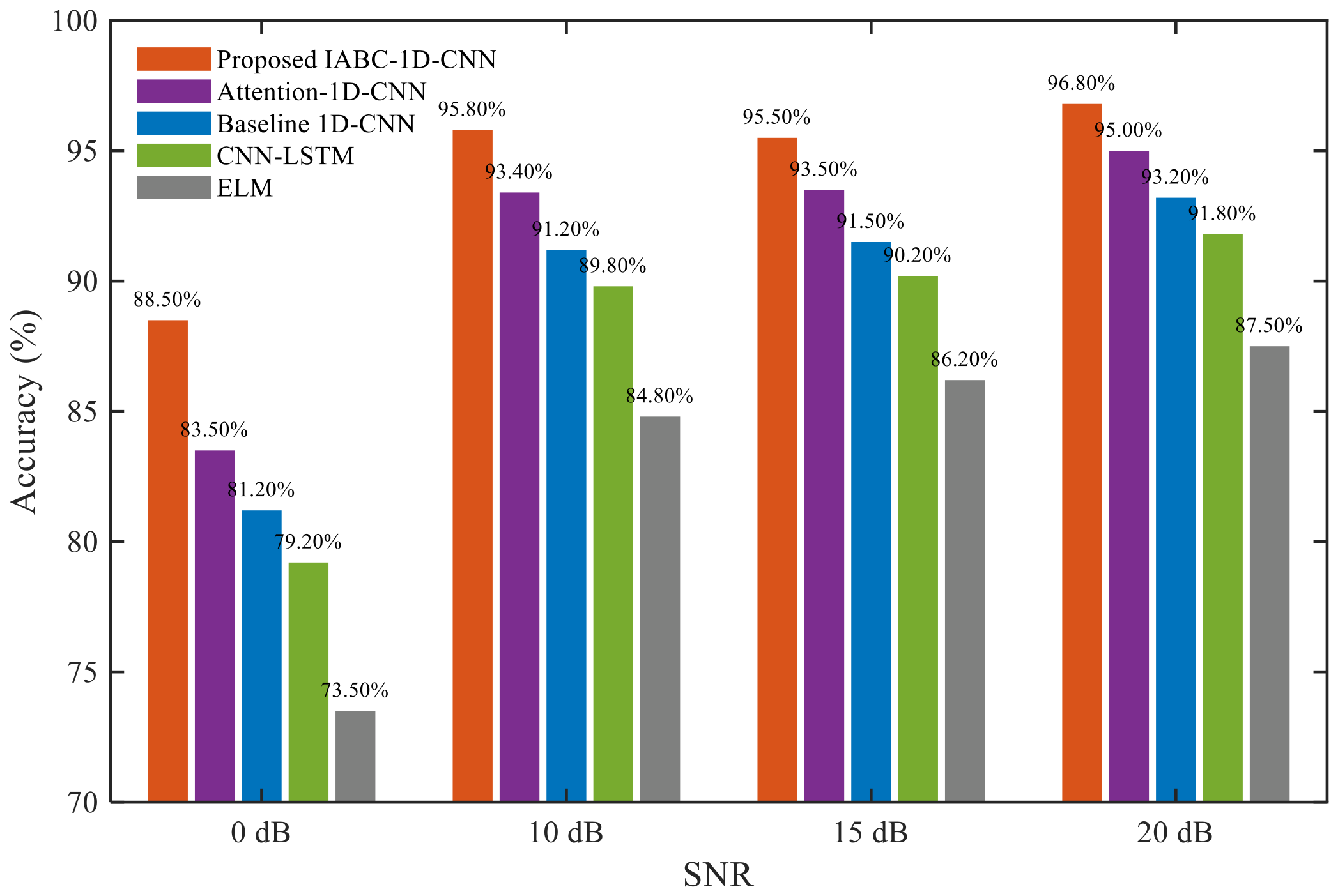
As shown in Table 9, the diagnostic accuracy of all models generally increases with SNR, indicating that noise interference significantly affects fault feature extraction and classification performance. Under all noise conditions, the proposed IABC-1D-CNN consistently achieves the highest accuracy, demonstrating superior noise robustness. In addition, Attention-1D-CNN performs better than the baseline 1D-CNN under all SNR conditions, confirming that the attention mechanism enhances discriminative feature representation. The corresponding comparison of diagnostic accuracy under different SNR conditions is illustrated in Figure 15.
Specifically, under SNRs of 20 dB, 15 dB, 10 dB, and 0 dB, the proposed method achieves diagnostic accuracies of 96.80%, 95.80%, 95.80%, and 88.50%, respectively, outperforming Attention-1D-CNN, Baseline 1D-CNN, CNN-LSTM, and ELM in all cases. Notably, under low-SNR conditions, the proposed method still maintains relatively high accuracy, indicating stronger adaptability to severe noise interference. Furthermore, when the SNR decreases from 20 dB to 0 dB, the proposed method exhibits a moderate reduction in accuracy while remaining higher than the compared models, the smallest reduction in accuracy, suggesting more stable performance degradation and better robustness.
This improvement can be attributed to the effective fault feature extraction capability of the 1D-CNN, together with the global optimization of key hyperparameters by the IABC algorithm, which enhances feature representation and classification stability under noisy conditions. Although Attention-1D-CNN improves robustness through adaptive feature weighting, its performance remains lower than that of the proposed method, indicating that IABC-based hyperparameter optimization further contributes to noise-resistant diagnosis. In contrast, although Baseline 1D-CNN and CNN-LSTM retain certain fault identification capability, their robustness remains limited under strong noise interference, whereas ELM suffers more severe performance degradation due to its weaker shallow feature representation ability.

5. Conclusions

This paper proposed an IABC-optimized 1D-CNN for open-circuit fault diagnosis of IGBT inverter modules in marine ranching power systems. A MATLAB/Simulink-based photovoltaic inverter model was used to generate three-phase current signals under different fault and noise conditions. By combining sliding-window segmentation, data augmentation, and IABC-based hyperparameter optimization, the proposed method improved fault feature extraction and classification performance.
The simulation results show that the proposed method achieved accuracies of 96.80%, 95.80%, 95.50%, and 88.50% under SNRs of 20 dB, 15 dB, 10 dB, and 0 dB, respectively, outperforming Attention-1D-CNN, baseline 1D-CNN, CNN-LSTM, and ELM. The confusion matrix and t-SNE visualization further confirmed its ability to extract discriminative fault features under noisy conditions.
This study provides a simulation-based feasibility validation rather than hardware or field verification. Practical uncertainties, such as sensor drift, device aging, controller delay, and electromagnetic interference, have not been fully covered. In addition, the proposed method is intended for open-circuit fault diagnosis rather than microsecond-level short-circuit protection, and short-circuit and compound faults are beyond the present scope. Future work will focus on HIL experiments, field-data validation, compound-fault diagnosis, lightweight embedded deployment, and end-to-end diagnostic latency evaluation, including sampling, preprocessing, and inference.

Author Contributions

F.C.: conceptualization, methodology, software, writing—original draft, writing—review and editing, and methodology. R.W.: formal analysis, data curation and methodology. T.Z.: conceptualization, methodology, formal analysis, validation, investigation, project administration, resources, supervision, writing—original draft, writing—review & editing. D.C.: funding acquisition, supervision, writing—review & editing and software. B.Z.: supervision, resources, and writing—review and editing. All authors have read and agreed to the published version of the manuscript.

Funding

This work was supported by the Natural Science Foundation of Fujian Province under Grants 2026H0045, 2026H6021, and the Science and Technology Innovation Team of Minnan Institute of Technology under Grant 23XTD112.

Data Availability Statement

The original contributions presented in this study are included in the article. Further inquiries can be directed to the corresponding author.

Acknowledgments

The authors would like to thank the anonymous reviewers who gave valuable suggestions that have helped to improve the quality of the manuscript.

Conflicts of Interest

Author Rongfu Wu was employed by Quanzhou Power Supply Company. The remaining authors declare that the research was conducted in the absence of any commercial or financial relationships that could be construed as a potential conflict of interest.

Abbreviations

The following abbreviations are used in this manuscript:
ABCArtificial Bee Colony
IABCImproved Artificial Bee Colony
1D-CNNOne-Dimensional Convolutional Neural Network
CNNConvolutional Neural Network
IGBTInsulated Gate Bipolar Transistor
SNRSignal-to-Noise Ratio
PVPhotovoltaic
MPPTMaximum Power Point Tracking
PWMPulse-Width Modulation
DEDifferential Evolution
GAGenetic Algorithm
ELMExtreme Learning Machine
LSTMLong Short-Term Memory
HILHardware-in-the-Loop
t-SNEt-Distributed Stochastic Neighbor Embedding

References

  1. Jin, J.; Quan, Y. Assessment of marine ranching ecological development using DPSIR-TOPSIS and obstacle degree analysis: A case study of Zhoushan. Ocean Coast. Manag. 2023, 244, 106821. [Google Scholar] [CrossRef]
  2. Jiao, M.; Yue, W.; Suo, A.; Zhang, L.; Li, H.; Xu, P.; Ding, D. Construction and influencing factors of an early warning system for marine ranching ecological security: Experience from China’s coastal areas. J. Environ. Manag. 2023, 335, 117515. [Google Scholar] [CrossRef]
  3. Satpathy, P.R.; Ramachandaramurthy, V.K.; Padmanaban, S. Advanced protection technologies for microgrids: Evolution, challenges, and future trends. Energy Strategy Rev. 2025, 58, 101670. [Google Scholar] [CrossRef]
  4. Liu, H.; Wang, R.; Wang, Y.; Zhang, B.; Wang, Y. Fault diagnosis of offshore wind turbine inverter modules based on multi-source information fusion. Recent Adv. Electr. Electron. Eng. 2026, 19. [Google Scholar] [CrossRef]
  5. Yan, Y.; Wu, J.; Cao, Y.; Liu, B.; Li, C.; Shi, T. An open-circuit fault diagnosis method for three-level neutral point clamped inverters based on multi-scale shuffled convolutional neural network. Sensors 2024, 24, 1745. [Google Scholar] [CrossRef] [PubMed]
  6. Cui, Y.; Wang, R.; Si, Y.; Zhang, S.; Wang, Y.; Lin, A. T-type inverter fault diagnosis based on GASF and improved AlexNet. Energy Rep. 2023, 9, 2718–2731. [Google Scholar] [CrossRef]
  7. Chai, Q.; Li, H.; Wang, W.; Yan, Q. Transfer learning based open-circuit fault diagnosis method for three-phase inverters. J. Power Electron. 2024, 25, 1030–1040. [Google Scholar] [CrossRef]
  8. Wang, S.; Tian, J.; Liang, P.; Xu, X.; Yu, Z.; Liu, S.; Zhang, D. Single and simultaneous fault diagnosis of gearbox via wavelet transform and improved deep residual network under imbalanced data. Eng. Appl. Artif. Intell. 2024, 133, 108146. [Google Scholar] [CrossRef]
  9. Xie, Y.; He, Y.; Zhan, Y.; Chang, Q.; Hu, K.; Wang, H. Multi-dimensional feature perception network for open-switch fault diagnosis in grid-connected PV inverters. Energies 2025, 18, 4044. [Google Scholar] [CrossRef]
  10. Panda, D.K.; Das, S. Smart grid architecture model for control, optimization and data analytics of future power networks with more renewable energy. J. Clean. Prod. 2021, 301, 126877. [Google Scholar] [CrossRef]
  11. Yuan, Y.; Wang, J.; Yan, X.; Shen, B.; Long, T. A review of multi-energy hybrid power system for ships. Renew. Sustain. Energy Rev. 2020, 132, 110081. [Google Scholar] [CrossRef]
  12. Yu, Y.; He, Y.; Tao, H.; Song, Y. An open-circuit fault diagnosis method for traction inverter based on zero-shot learning. IEEE Trans. Instrum. Meas. 2025, 74. [Google Scholar] [CrossRef]
  13. Zhang, G.; Li, M.; Gu, X.; Chen, W. Fault Diagnosis Method for Open-circuit Faults in NPC Three-level Inverter Based on WKCNN. CES Trans. Electr. Mach. Syst. 2025, 9, 234–245. [Google Scholar] [CrossRef]
  14. Zhang, X.; Shang, Z.; Gao, S.; Zhao, S.; Chen, C.; Wang, K. Open-circuit fault diagnosis for T-type three-level inverter via improved adaptive threshold sliding mode observer. Appl. Sci. 2025, 15, 6063. [Google Scholar] [CrossRef]
  15. Guo, K.; Lu, Z.; Liu, P.; Mo, Z. Fault diagnosis method for sub-module open-circuit faults in photovoltaic DC collection systems based on CNN-LSTM. Electronics 2025, 14, 1205. [Google Scholar] [CrossRef]
  16. Chen, X.; Zhang, Z. Open-circuit fault diagnosis of T-type three-level inverter based on knowledge reduction. Sensors 2024, 24, 1028. [Google Scholar] [CrossRef]
  17. Zhang, Y.; Lu, Y.; Huang, H.; Zhou, L. Analog circuit fault diagnosis based on across space-channel attention and double 1D-convolution network. Eng. Res. Express 2025, 7, 045305. [Google Scholar] [CrossRef]
  18. Zhao, W.; Zhang, Z.; Wang, L. Manta ray foraging optimization: An effective bio-inspired optimizer for engineering applications. Eng. Appl. Artif. Intell. 2020, 87, 103300. [Google Scholar] [CrossRef]
  19. Zhu, W.; Zheng, X.; Zhang, D.; Lai, W. A data-driven method for IGBT open-circuit fault diagnosis of NPC inverters in three-phase photovoltaic grid-connected systems. Meas. Sci. Technol. 2025, 36, 076209. [Google Scholar] [CrossRef]
  20. Chen, H.; Hu, N.; Cheng, Z.; Zhang, L.; Zhang, Y. A deep convolutional neural network based fusion method of two-direction vibration signal data for health state identification of planetary gearboxes. Measurement 2019, 146, 268–278. [Google Scholar] [CrossRef]
  21. Fu, Y.; Ji, Y.; Meng, G.; Chen, W.; Bai, X. Three-phase inverter fault diagnosis based on an improved deep residual network. Electronics 2023, 12, 3460. [Google Scholar] [CrossRef]
  22. Guo, Y.; Gao, C.; Jin, Y.; Li, Y.; Wang, J.; Li, Q.; Wang, H. A transfer learning-based method for marine machinery diagnosis with small samples in noisy environments. J. Ocean Eng. Sci. 2025, 10, 593–601. [Google Scholar] [CrossRef]
  23. Wang, Y.; Zhang, B.; Wang, R.; Desong, J.; Cui, Y.; Sun, Z.; Liu, H. Fault reconfiguration control strategy of islanded marine ranching power supply system based on deep reinforcement learning. Int. J. Electr. Power Energy Syst. 2025, 169, 110796. [Google Scholar] [CrossRef]
  24. M’zoughi, F.; Lekube, J.; Garrido, A.J.; Garrido, I. Machine learning-based diagnosis in wave power plants for cost reduction using real measured experimental data: Mutriku Wave Power Plant. Ocean Eng. 2024, 293, 116619. [Google Scholar] [CrossRef]
  25. Xu, X.; Lin, Y.; Ye, C. Fault diagnosis of marine machinery via an intelligent data-driven framework. Ocean Eng. 2023, 289, 116302. [Google Scholar] [CrossRef]
  26. Han, S.; Shang, Z.; Guo, Y.; Jia, X. A fault diagnosis method in three-phase voltage inverters based on the normalized current trajectory centroid. J. Electr. Eng. Technol. 2024, 19, 4421–4434. [Google Scholar] [CrossRef]
  27. Wu, X.; Chen, C.; Tian, R.; Li, K.; Yu, T. A simple and robust diagnosis method for open-circuit faults of voltage-source inverters based on abnormal voltage sequence. Electr. Eng. 2023, 106, 1853–1864. [Google Scholar] [CrossRef]
  28. Lu, S.-D.; Liu, H.-D.; Wang, M.-H.; Wu, C.-C. A novel strategy for multitype fault diagnosis in photovoltaic systems using multiple regression analysis and support vector machines. Energy Rep. 2024, 12, 2824–2844. [Google Scholar] [CrossRef]
  29. Cen, J.; Zhao, B.; Liu, X.; Li, X.; Deng, F.; Huang, H. Generalized zero-shot learning based on diffusion model and multilabel network for compound fault diagnosis. IEEE Trans. Ind. Inform. 2025, 21, 6723–6734. [Google Scholar] [CrossRef]
  30. Zhao, J.; Lu, P.; Du, C.; Cao, F. Active fault-tolerant strategy for flight vehicles: Transfer learning-based fault diagnosis and fixed-time fault-tolerant control. IEEE Trans. Aerosp. Electron. Syst. 2024, 60, 1047–1059. [Google Scholar] [CrossRef]
  31. Zhang, Y.; Wang, X.; Peng, J.; Kong, L.; Wang, Z.; Mao, Y. Fault diagnosis and adaptive fault-tolerant control of interturn short-circuit fault in PMSM drives. IEEE Trans. Instrum. Meas. 2025, 74, 1–11. [Google Scholar] [CrossRef]
  32. Arivalagan, D.; Vignesh, O.; Abinayaa, S.S.; Nishok, V.S. Advanced fault diagnosis in analog and digital VLSI circuits utilizing multi-anchor space-aware temporal convolutional neural network for efficient circuit reliability assessment. Integration 2026, 107, 102631. [Google Scholar] [CrossRef]
  33. Djaghloul, C.; Tehrani, K.; Vurpillot, F. Open-circuit fault detection in a 5-level cascaded H-bridge inverter using 1D CNN and LSTM. Energies 2025, 18, 5004. [Google Scholar] [CrossRef]
  34. Jung, J.; Apsari, D.P.; Lee, D.-C. Robust open-switch fault diagnosis of three-level NPC inverters based on data augmentation with white noise injection. IEEE Trans. Power Electron. 2025, 40, 3553–3565. [Google Scholar] [CrossRef]
  35. Lim, J.-S.; Cho, H.; Kwon, D.-H.; Lee, G.-S. Bi-LSTM-based fault diagnosis scheme having high accuracy for medium-voltage direct current systems using pre- and post-processing. Int. J. Electr. Power Energy Syst. 2025, 169, 110793. [Google Scholar] [CrossRef]
  36. Luo, W.; Xie, Z.; Li, Y.; Chen, M.; He, R.; Peng, Y.; Zhang, X. Enhanced 1-D convolutional neural network-based open-circuit fault diagnosis and hybrid fault-tolerant control for three-level NPC converters. IEEE Trans. Instrum. Meas. 2025, 74, 3545714. [Google Scholar] [CrossRef]
  37. Muzzammel, R. Comprehensive exploration of limitations of simplified machine learning algorithm for fault diagnosis under fault and ground resistances of multiterminal HVDC system. J. Sens. Actuator Netw. 2025, 14, 29. [Google Scholar] [CrossRef]
  38. Shi, X.; Yu, X.; He, D.; Li, J. Analog circuit fault diagnosis and parameter prediction via multibranch network and refined fusion module. IEEE Trans. Instrum. Meas. 2025, 74, 3566909. [Google Scholar] [CrossRef]
  39. Sun, T.; Chen, C.; Dai, J.; Zhang, B.; Gao, S. Inverter open-circuit fault diagnosis method based on residual evaluation and machine learning. IET Power Electron. 2025, 18, e70121. [Google Scholar] [CrossRef]
  40. Tang, F.; Luo, L.; Guo, Z.; Li, Y.; Zhao, M.; Kato, N. Semi-distributed network fault diagnosis based on digital twin network in highly dynamic heterogeneous networks. IEEE Trans. Mob. Comput. 2025, 24, 3979–3992. [Google Scholar] [CrossRef]
  41. Xu, Y.; Wang, J.; Sun, C. Open-circuit fault diagnosis for active rectifiers in doubly salient electromagnetic generator systems. IEEE Trans. Power Electron. 2025, 40, 5835–5845. [Google Scholar] [CrossRef]
  42. Bhadra, A.B.; Rime, M.H.K.; Sarker, Y.; Bhuiyan, E.A.; Hossen, J.; Morol, K. Dual graph attention network for robust fault diagnosis in photovoltaic inverters. Sci. Rep. 2025, 15, 31330. [Google Scholar] [CrossRef] [PubMed]
Figure 1. Architecture of the islanded hybrid power supply system for marine ranching.
Energies 19 02695 g001
Figure 2. Topology of the photovoltaic grid-connected inverter.
Energies 19 02695 g002
Figure 3. Topologies of inverter IGBT open-circuit faults: (a) single-switch fault; (b) two-switch faults (different legs, different phases); (c) two-switch faults (same leg, different phases); (d) two-switch faults (different legs, same phase).
Energies 19 02695 g003
Figure 4. Representative three-phase output current waveforms under normal and IGBT open-circuit fault conditions: (a) normal condition; (b) T1 open-circuit fault; (c) T1–T4 open-circuit fault; (d) T1–T2 open-circuit fault.
Energies 19 02695 g004
Figure 5. Structure diagram of the 1D-CNN architecture.
Energies 19 02695 g005
Figure 6. Convergence curve of 1D-CNN hyperparameter optimization.
Energies 19 02695 g006
Figure 7. IABC-optimized 1D-CNN fault diagnosis framework.
Energies 19 02695 g007
Figure 8. Accuracy curves before and after optimization: (a) before optimization; (b) after optimization.
Energies 19 02695 g008
Figure 9. Loss curves before and after optimization: (a) before optimization; (b) after optimization.
Energies 19 02695 g009
Figure 10. Confusion matrix of the test set.
Energies 19 02695 g010
Figure 11. t-SNE visualization results: (a) distribution of original fault data; (b) fault classification results.
Energies 19 02695 g011
Figure 12. Accuracy and F1-score of different ablation models.
Energies 19 02695 g012
Figure 13. Test accuracy curves of different fault diagnosis models.
Energies 19 02695 g013
Figure 14. Validation accuracy curves of different fault diagnosis models under varying Gaussian white noise levels: (a) 20 dB; (b) 15 dB; (c) 10 dB; (d) 0 dB.
Energies 19 02695 g014
Figure 15. Comparison of diagnostic accuracy of different models under varying SNR conditions.
Energies 19 02695 g015
Table 1. IGBT open-circuit fault categories in a two-level inverter.
CategoryFaulty SwitchesID
Normal-0
Single-switchVT1–VT61–6
Two-switch (same leg)(VT1, VT2), (VT3, VT4), (VT5, VT6)7–9
Two-switch (same leg, different phases)(VT1, VT3), (VT1, VT5), (VT3, VT5), (VT4, VT6), (VT2, VT4), (VT2, VT6)10–15
Two-switch (different legs, different phases)(VT1, VT4), (VT2, VT3), (VT3, VT6), (VT4, VT5), (VT2, VT5), (VT1, VT6)16–21
Table 2. Simulation parameters of the inverter system.
ParameterValue
Open-circuit voltage of PV array Uoc (V)363
MPPT voltage of PV array (V)270~300
Input filter capacitor of Boost converter C 1 ( μ F ) 1000
Boost inductor L 1 ( mH ) 1.45
Switching frequency of Boost converter f s ( kHz ) 5
Output filter capacitor of Boost converter C 2 ( μ F ) 3227
Output DC voltage of Boost converter U 0 ( V ) 600
Switching frequency of inverter f s ( kHz ) 2
Filter capacitor C 3 ( μ F ) 100
Filter inductor L 2 ( mH ) 500
Grid voltage U ( V ) 380
Grid frequency f ( Hz ) 50
Rated power ( kW ) 100
Table 3. Hyperparameter search space optimized by IABC.
HyperparameterSearch Range
Number of filters (first layer)16~64
Kernel size (first layer)3~15
Pooling size2~5
Dropout rate0.0~0.5
Table 4. Benchmark-function comparison with Wilcoxon test.
FunctionAlgorithmBestMeanSTDRankWilcoxon p-Value
SphereMRFO1.20 × 10−34.80 × 10−32.10 × 10−332.10 × 10⁻⁵
LSO2.30 × 10−37.60 × 10−33.50 × 10−348.40 × 10⁻⁶
CSA8.50 × 10−43.90 × 10−31.80 × 10−323.60 × 10⁻⁴
IABC2.40 × 10−51.10 × 10−46.80 × 10−51-
RosenbkMRFO2.154.821.3431.20 × 10−3
LSO2.866.271.7844.70 × 10−4
CSA1.924.311.2222.80 × 10−2
IABC1.182.760.911-
AckleyMRFO0.821.740.5236.30 × 10−4
LSO1.152.360.7141.90 × 10−4
CSA0.641.420.4621.60 × 10−2
IABC0.310.860.281-
Table 5. Hyperparameter settings of the IABC-optimized 1D-CNN model.
HyperparameterValue
Number of neurons in input layer22
Number of neurons in each conv layer16/32/64/128/256
Kernel size15
Dropout0.4
Output dimension and activation22, softmax
Batch size100
Table 6. Description of the simulation dataset.
ItemDescription
Data sourceMATLAB/Simulink photovoltaic inverter model
Input signalThree-phase output currents
Sample formatSliding-window time-series segment
Number of categories22
Normal condition1 class
Open-circuit fault conditions21 classes
Total samples20,000
Dataset splitTraining/validation/test = 8:1:1
Noise levels0, 10, 15, and 20 dB
Output labelFault category
Table 7. Performance metrics of the proposed method (%).
AccuracyP (%)R (%)F1-Score
98.89%99.12%99.19%99.58%
Table 8. Performance indicators of different ablation models.
MethodsStrategyAccuracy (%)Precision (%)Recall (%)F1-Score (%)
M01D-CNN93.4593.1091.4892.28
M1ABC-1D-CNN94.7594.5293.8494.18
M2ABC-GA-1D-CNN93.8593.3092.6292.96
M3ABC-DE-1D-CNN95.5595.5895.1095.34
M4IABC-1D-CNN96.8097.0596.7196.88
Table 9. Diagnostic accuracy (%) of different models under varying SNR conditions.
Model0 dB10 dB15 dB20 dB
IABC-1D-CNN88.5095.5095.8096.80
Attention-1D-CNN83.5093.4093.5095.00
Baseline 1D-CNN81.2091.2091.5093.20
CNN-LSTM79.2089.8090.2091.80
ELM73.5084.8086.2087.50
Disclaimer/Publisher’s Note: The statements, opinions and data contained in all publications are solely those of the individual author(s) and contributor(s) and not of MDPI and/or the editor(s). MDPI and/or the editor(s) disclaim responsibility for any injury to people or property resulting from any ideas, methods, instructions or products referred to in the content.