Article

Improved Thermal Transient Testing of Wide Bandgap Devices with Extremely Low Channel Resistance †

1
Department of Electron Devices, Faculty of Electrical Engineering and Informatics, Budapest University of Technology and Economics, 1111 Budapest, Hungary
2
Siemens Digital Industries Software, 1036 Budapest, Hungary
*
Author to whom correspondence should be addressed.
This paper is an extended version of our paper published in 2025 at the IEEE Therminic Workshop in Naples, Italy, September, pp. 1–6, doi: 10.1109/THERMINIC65879.2025.11216958.
Energies 2026, 19(11), 2678; https://doi.org/10.3390/en19112678
Submission received: 21 April 2026 / Revised: 22 May 2026 / Accepted: 25 May 2026 / Published: 2 June 2026
(This article belongs to the Special Issue Advances in Thermal Management and Reliability of Electronic Systems)

Abstract

Thermal transient testing (TTT) is an essential technique for characterizing electronic systems, including packaged devices, modules, and subassemblies. These tests serve two closely related purposes: first, they enable determination of peak operating temperatures under various power conditions; on the other hand, they allow extraction of partial thermal resistances within the tested structure and identification of structural details near the active devices. The latter objective has become increasingly challenging with the advent of wide bandgap devices featuring extremely low on-state resistance, such as GaN HEMTs. This paper first identifies the temperature-sensitive electrical parameters and heater structures relevant for TTT of semiconductor devices. It then narrows the focus on GaN power devices and analyzes how external series resistances, originating from HEMT packages and the associated printed circuit boards, affect thermal impedances and structure functions. To remove the influence of these external resistances, which distort the extracted thermal descriptors, an analytical correction methodology has been developed. The proposed approach is validated through measurements performed on real devices. The results demonstrate that the method successfully restores the intrinsic thermal properties of the devices, yielding more accurate and physically meaningful thermal characteristics.

1. Introduction

Thermal transient testing is the essential characterization methodology for the analysis of a wide range of electronic systems, including discrete packaged semiconductor devices, power modules with internal wiring, LED luminaires, and complete subassemblies. It provides a deep analysis of the whole heat conducting path, from the heat generating semiconductor chips through the package, thermal interfaces and cooling mounts.
In all cases, the main steps in thermal transient analysis are: identifying semiconductor structures for heating, others with temperature-sensitive electric parameters (TSPs), switching between two power levels and recording the temperature change during cooling [1].
Comprehensive thermal transient testing of modules and subassemblies is essential in quality assurance, as it reveals potential manufacturing defects and failures, thus preventing the mass recall of high-value products, which can damage business reputation and cause significant financial losses [2].
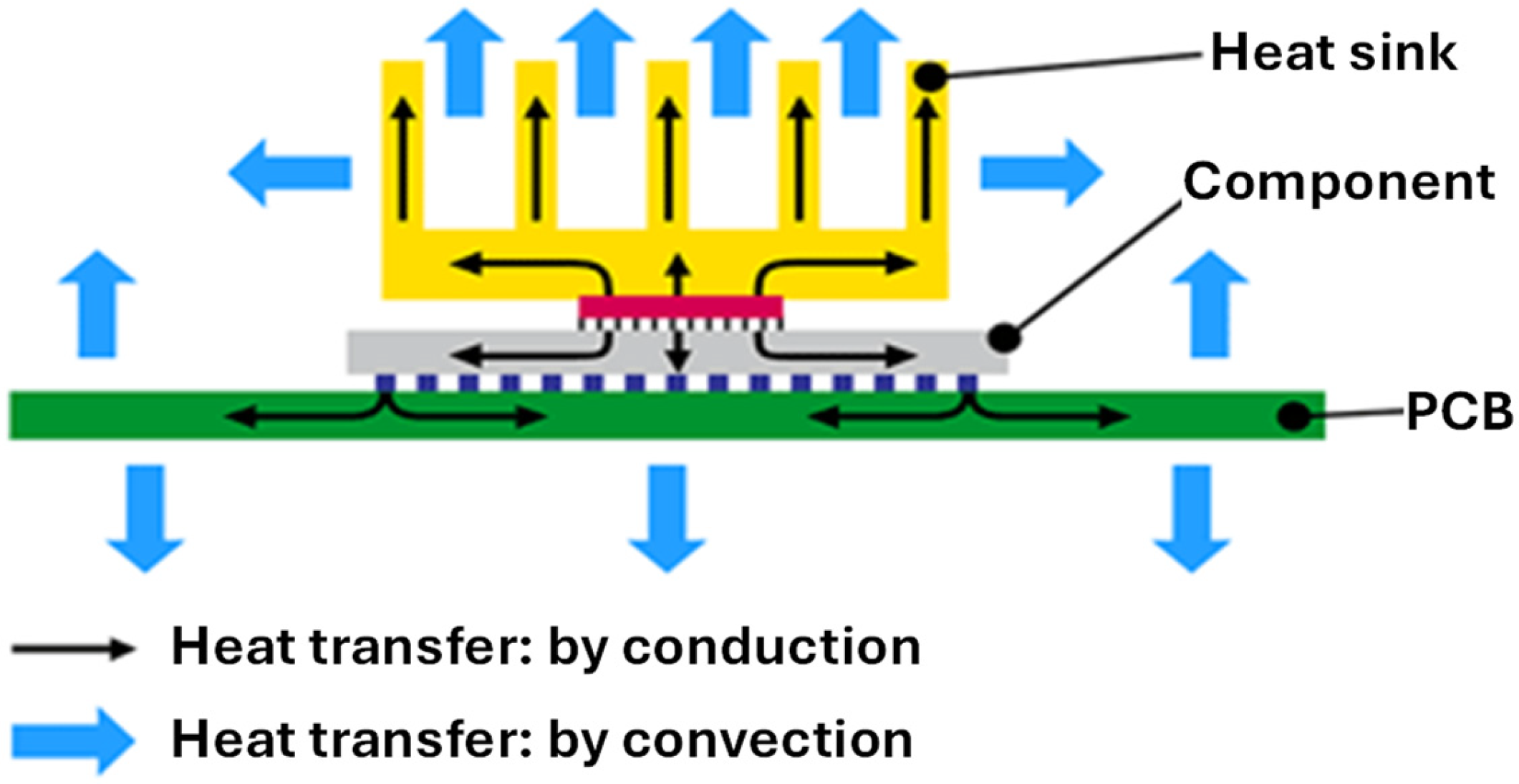
In recent decades, relevant procedures have been elaborated for handling complex structures with multiple heat-conducting paths (Figure 1), based on various boundary conditions applied on several parts within the structure. These methods have a theoretical background [1] and are supported with a combination of simulations [3] and measurements [1].
In reality, with the advent of novel power switching elements, such as SiC MOSFETs and GaN HEMTs combining high blocking voltage and extremely low ON resistance, a significant portion of heat is dissipated in the bond wiring, PCB traces, cables and test jigs of a transient tester.
The current research gap in thermal transient testing for wide bandgap (WBG) devices is that neither engineering praxis nor related standards [4,5] take into consideration the significant power component which is dissipated farther from the powered die and leaves the system through an alternative heat conducting path.
This work targets resolving the problem with a series of thermal transient tests at various power levels and analytical calculations on the results for clear separation of the dissipating constituents.
Based on these new results, the accuracy of thermal transient measurements on WBG devices can be highly improved.
Below, Section 2 reviews the state of the art in thermal transient concepts and Section 3 presents the equivalent model on which the analytical equations can be formulated.
Section 4 presents the analytical apparatus which is applied. Section 5 shortly summarizes the GaN operation only to the extent needed to understand the measurement principles and refers to a broader background; further on, it presents typical transient measurement schemes.
In Section 6, a case study proves the validity of the novel measurement and evaluation concept.

2. Review of Existing Thermal Transient Measurement Concepts

In the case of traditional packaged transistors and IGBT modules, the heat flow is basically one-dimensional, and thermal metrics are based on temperature measurements in a single major heat-conducting path.
An eminent field of use of transient analysis is in situ testing. Appropriate excitation on power components in a subassembly or in an appropriate mockup may reveal structural details, material parameters and failure locations.
In modules and subassemblies, the largest dissipation typically occurs on simple power semiconductor devices, such as diodes (two-terminal devices) and transistors (three-terminal devices). Below, we discuss the measurement and calculation methods which are relevant for these categories.

2.1. Thermal Transient Measurement on Basic Semiconductor Devices

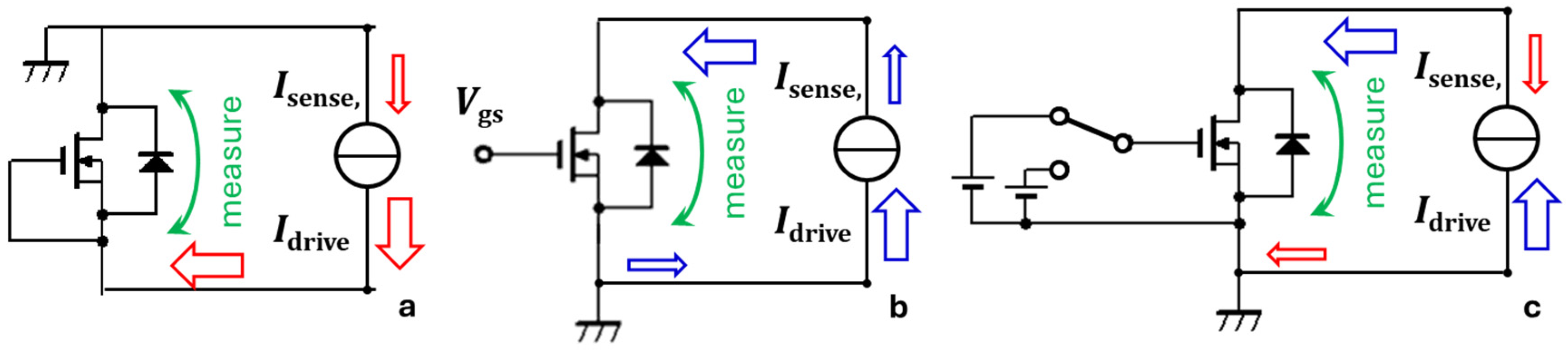
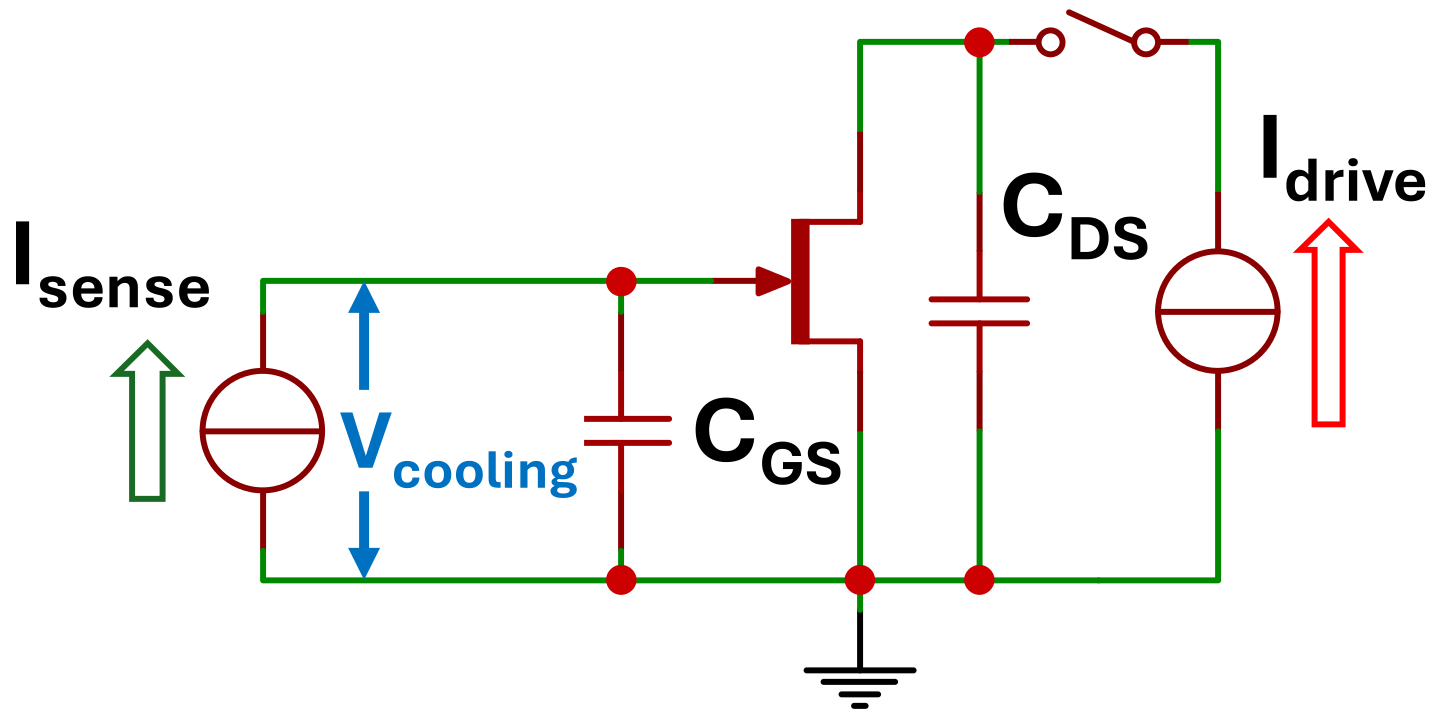
We first recapitulate measurements on standard MOSFETs, as conventional thermal transient testers provide the required instrumentation. By shorting two of the three terminals (Figure 2a), a power step can be produced by switching between two current levels, while the voltage across the terminals is recorded as TSP.
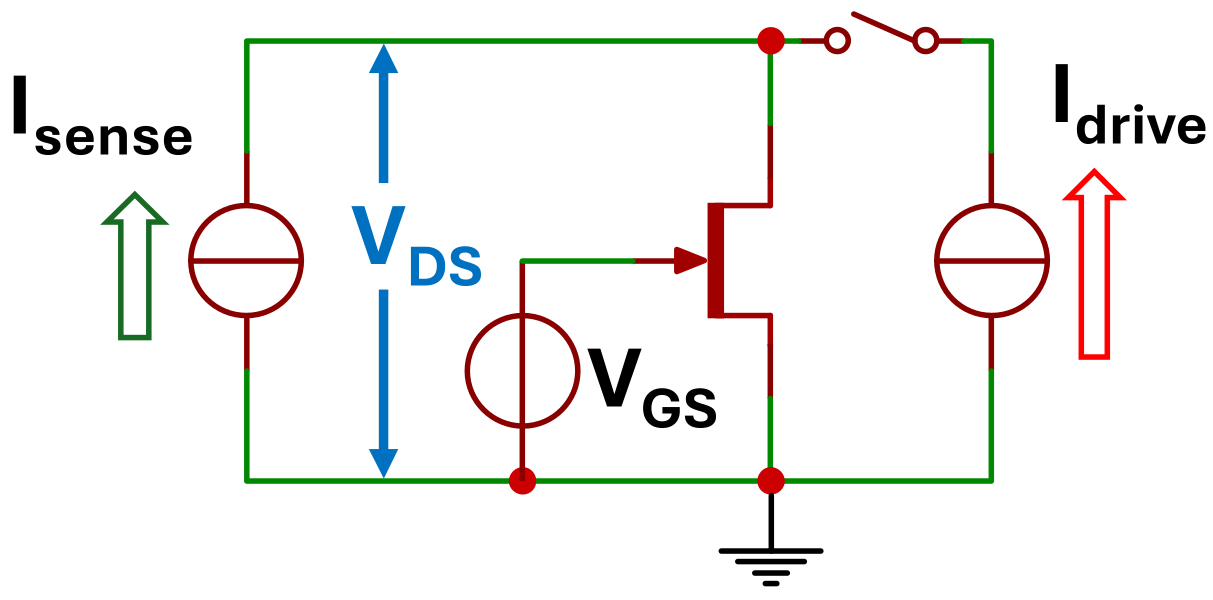
In real applications, a constant Isense “sensor” or “measurement” current is maintained on the device, and a significantly larger Idrive current is switched on and off.
The schematic of Figure 2a poorly resembles the real-world use of the device; the heating and sensing occur on the reverse diode of the MOSFET.
The power is limited; it is the product of the VF forward voltage and the forward current (IF = Idrive + Isense). Nonetheless, junctions provide crisp and noise-free transient at low Isense, enabling high-fidelity evaluation.
Heating and sensing on the channel (Figure 2b) correctly mimic the power dissipation during operation. However, this method provides low signal levels in devices with low channel resistance.
In the third method, the advantages of the two preceding methods are combined: heating is applied to the channel, as in realistic operating conditions, while temperature sensing is performed on the reverse diode, as can be seen in Figure 2c.
In all cases, parasitic electrical effects—including external and internal capacitances and inductances as well as time- and operating-point-dependent variations in device parameters—can generate transients in the same time domain as the thermal transient with comparable or higher amplitude, thus significantly distorting the temperature signal.
The removal and the substitution of this electrical transient is addressed in the corresponding standards [4,5], but separating the electrical and thermal transients may require additional treating, such as dynamic calibration introduced in [6].

2.2. Interpretations of Power, Thermal Resistance and Thermal Impedance in Thermal Transient Tests

It is important to note that thermal transient measurements serve two closely related, yet distinct objectives.
First, they predict the temperature response of the tested object (e.g., a subassembly or an LED lamp) under arbitrary power dissipation levels. In this interpretation, the assembly is handled as an entirety, without knowledge of its internal details. The prediction is based on the result of a transient thermal test performed at a single, selected test power. This Pel power is calculated from the changing External Electric quantities, i.e., voltages and currents applied on the Entire assembly, so this measurement objective is denoted below as Task E.
Linearity is assumed in the thermal domain, so the temperature responses at different locations in the assembly are upscaled and downscaled proportionally for different Pel powering.
A basic outcome of Task E is the junction-to-ambient thermal resistance RthJA. When a heat source within the system dissipates Pel power, RthJA provides a simple estimate on the T J temperature at the heat source location, traditionally called “junction”.
A different target is to determine the real thermal performance of the core component, such as a transistor or LED, either measured in a dedicated test fixture or in situ while embedded within a higher-level subassembly. This test, referred to here as Task R, relates calculations on the Preal power which appears on the core semiconductor component in an assembly. It yields detailed thermal metrics, including thermal properties of interface layers around the power source and the identification of thermal bottlenecks or failure locations. A fundamental output of Task R is, for instance, the junction-to-case thermal resistance RthJC, which is essential for thermal design and for evaluating the impact of different heat sinks with a given thermal resistance R t h , s i n k .
The distinction between Task E and Task R becomes critical when the Pel electrical input power applied to the system does not reach the core device under investigation. This arises, e.g., in optoelectronic devices, where a significant fraction of the input power is emitted as optical radiation and therefore does not contribute to heating of the light-emitting junction. A similar separation of Task E and Task R occurs when the device under test (DUT) is of mainly resistive nature. This effect becomes particularly important in field-effect transistors with extremely low RDSON channel on-resistance when the resistance of external wiring, test fixtures, or module interconnects is comparable to RDSON.
With the introduction of High Electron Mobility Transistors (HEMT) on gallium nitride (GaN) material, this issue became even more significant. In such cases, it is indispensable to determine the effective power Preal dissipated within the DUT by subtracting the externally dissipated power Pext associated with wiring and other external structures that do not thermally load the DUT.
Unfortunately, while extensive attention is devoted to system-level electrical testability in product design, the aspects of thermal testability are often neglected. In this work, we introduce a set of methods that also restore accurate thermal parameters when direct access to the core semiconductor device is limited.
As highlighted above, in transient thermal measurements, the temperature response of the DUT is recorded following an abrupt change in applied power. Dividing the ΔTJ junction temperature change in time by the applied power step δP, the normalized temperature response, also called thermal impedance curve, is obtained: Zth(t) = ΔTJ(t)/δP.
Note that throughout this work, the symbol Δ denotes temperature changes occurring over prolonged time intervals, whereas δ denotes instantaneous changes associated with switching events.
The use of thermal impedance assumes linearity of the device or assembly in the thermal domain; once a single Zth(t) curve has been measured, the transient temperature corresponding to any other δ P n e w power step may be approximated as
Δ T n e w ( t ) = δ P n e w Z t h ( t ) .
Complete transients, from steady state to steady state, provide information on the structure over the entire heat-conducting path. When the transient process reaches the opposite steady state at tss time, Zth(tss) produces the Rth thermal resistance value.
In Task R, when δ P r e a l is known, the measured thermal impedance curve Z t h , r e a l ( t ) can be further transformed into an equivalent one-dimensional network of thermal resistances and capacitances, known as structure functions [1,5]. These reveal structural features, material properties, and potential failure locations within the assembly, and help extract valid thermal metrics. Their underlying theory and practical applications are given in textbooks, e.g., [1].
The product δ P Z t h yields the correct junction temperature change Δ T J in both Task E and Task R, as long as the matching P and Zth functions are used. Combining the higher nominal power step δ P e l with measured temperature change leads to erroneous values of RthJC in Task E and distorted structural information when applied to Task R.
The heat sources generating δ P and the temperature sensors measuring Δ T within the DUT are typically realized using pn junctions or resistive semiconductor regions. The main limitations on achievable measurement accuracy are illustrated below in numerical calculations and a simplified test example.

3. Improved Model for Thermal Transient Testing: Testing of Series Circuits

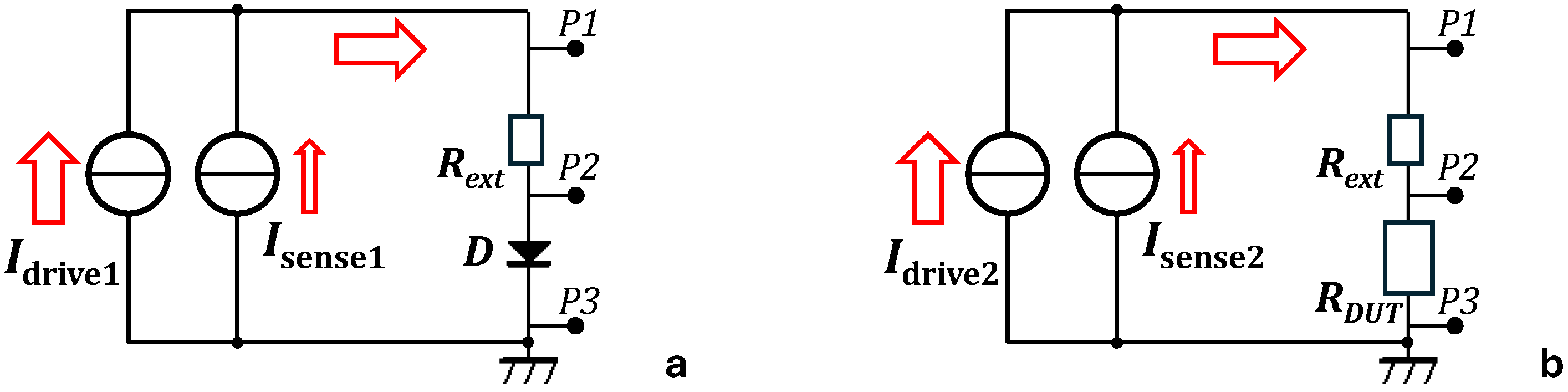
The first step towards improved test results is modeling the traces, wires, cables and similar resistive elements in the packaged device or test scheme in the form of an Rext series resistor (Figure 3).
In this approach, the core device under test is simplified to a diode D or resistor RDUT. Due to their temperature-sensitive electric parameters, they can operate as a heater and sensor simultaneously.
The impact of Rext is minor in conventional packaged silicon devices but becomes significant in modules, embedded systems, and GaN devices with low on-resistance.
In silicon devices, pn junctions (core part of D) play a central role due to their widespread availability. In GaN devices, only specific technologies provide such junctions; for this reason, resistive heaters and sensors, e.g., an RDUT channel resistance, are preeminent.
Condensing external structures into Rext is valid if, during the test, their location is not heated up drastically by the DUT.
In reality, these structures also heat up when the core device is dissipating power, but this is mostly negligible, especially in the critical high-temperature state of the core device. For example, when the device junction or channel has already reached 150 °C, the approximately 40 °C heating of the connecting leads causes only a minor calculation error. This effect can be observed in certain figures in Section 6.
Depending on the test setup, the nearest access points to the DUT may differ. Using standard terminology, configurations with separate access to the DUT and Rext (P1-P2-P3 in Figure 3) are referred to as four-wire (4W) measurements, whereas two-wire (2W) measurements provide access only via the outer terminals P1 and P3.
For two-pin devices, the obvious TSP is the Vsense voltage across the best accessible points at a low Isense current. Vsense is recorded between P2-P3 in 4W and P1-P3 in 2W configurations.
Expanding the definition of thermal transient testing, as given above in the Introduction section, we can state that the actual transient test always consists of more consecutive steps:
  • In a calibration process, the DUT is placed in a temperature-controlled environment and the TJ to Vsense relation defining the TSP is recorded at various temperatures.
  • During the heating phase, a high IH = Idrive + Isense current is applied until steady state is reached at t s s , and the corresponding voltage V H is stored. As defined by various standards, e.g., [4,5], the full electric power supplied to the device is PelH = IH · VH.
  • Before starting cooling, Idrive is switched off while maintaining Isense, and the transient Vsense is measured and converted to temperature using the TSP mapping.
  • The raw transient voltage data are converted to temperature change using the calibration points.
  • Normalizing the temperature change by the δP power step—whichever interpretation of it is relevant for the intended purpose—Zth curves and structure function are calculated.
The change in the electric powering at the moment of switching is δPel = PelHPelL, where the power at low current is PelL, which can be computed as the product of Isense and Vsense on the hot DUT, just after switching off.
Junctions exhibit a negative thermal coefficient, whereas resistive semiconductor regions may show a positive one, depending on technology. For example, the conductive channels in silicon MOSFETs and GaN HEMTs typically have a positive thermal coefficient.
The effect of Rext on the TSP calibration is negligible; it is largely compensated by the calibration which occurs at low power.
Regarding the power calculation, in cases such as module testing, the PRext = Rext · IH2 power does not heat the DUT, whose temperature is instead governed by Preal = PelPRext quantity (In optical devices, the emitted optical power is also to be subtracted, see [7]).
For this reason, the definition of Zth and Rth diverges into two interpretations; Rthel defines an electric while Rthreal a real thermal resistance, depending on whether the temperature change was divided by a δPel or δPreal change. Both definitions are physically meaningful and yield the same TJ = Rth_X · δP_X temperature rise.
Rthreal is a property of the internal DUT and is independent of the applied IH. It is relevant for cooling system design, as this is the power component which flows towards, e.g., the heat sinks. Corresponding Zthreal curves are to be used in the calculation of undistorted structure functions, providing correct material parameters of the structural components and accurate failure locations.
In contrast, Rthel reflects the actual final temperature of the DUT in a 2W assembly at IH current and Tamb ambient temperature.
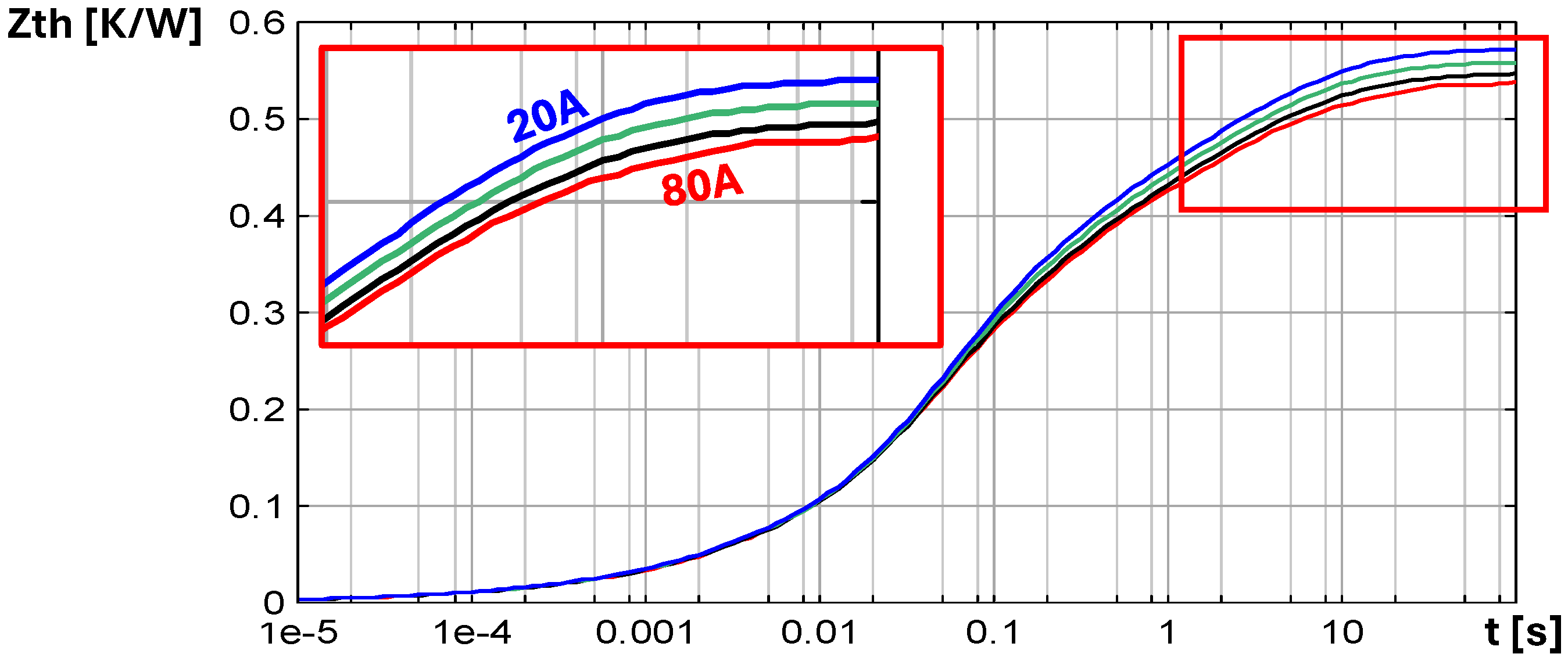
In diode-type devices, Preal grows logarithmically with I H , whereas PRext scales quadratically, leading to the characteristic shrinking (“accordion”) effect observed in Zthel functions (Figure 4).
When 4W access is available, measuring the voltage on P2-P3 pins for power calculation mostly eliminates the effect of Rext.
In the case of pn type DUTs, in the literature, a methodology for an acceptable restoration of Zthreal is proposed for 2W cases (e.g., in [1] Chapter 6).
Regarding the cooling phase of the transient, it is important to notice that at Isense, the power on Rext is low. Moreover, its existence does not affect the accuracy of the TSP calculation; this is processed out through the calibration process (step 1 above). However, when dividing the temperature change by the power (step 5), in the 2W case, the remaining power on the series resistance does not actually participate in the heating of the DUT, causing the known shrinking effect in Zth curves, typical when measuring modules and embedded structures.

4. Analytical Approach to Thermal Transient Problems

4.1. Estimations on the Impact of External Resistive Components

Surprisingly good estimates of the impact of an external Rext resistance can be made based on simple analytic calculations.
The behavior of pn junctions is sufficiently accurately determined by the Shockley equation. For the voltage, current and power:
VF = m·VT · ln(IF/I0),   PD = VF · IF
where, as is known from textbooks (e.g., [1]),
  • IF is the current applied to the device
  • VT is the thermal voltage, a physical amount proportional to the TJ absolute temperature of the device; its value is 26 mV at 300 K (27 °C)
  • m is a technological parameter, between 1 and 2 in practical cases and
  • I0 is a temperature-dependent saturation current.
In (1), only m and I0 are related to the actual device, while the test environment regulates the current IF and the temperature TJ, taking the thermal resistance of the assembly also into consideration.
Due to the exponential nature of the Shockley equation, just measuring at two different currents, many unknown quantities can be eliminated or calculated. The difference in the VF forward voltages is
VF2VF1 = m · VT · ln(IF2/IF1)
For resistors,
VR = R · I,   PR = R · I2
Example 1.
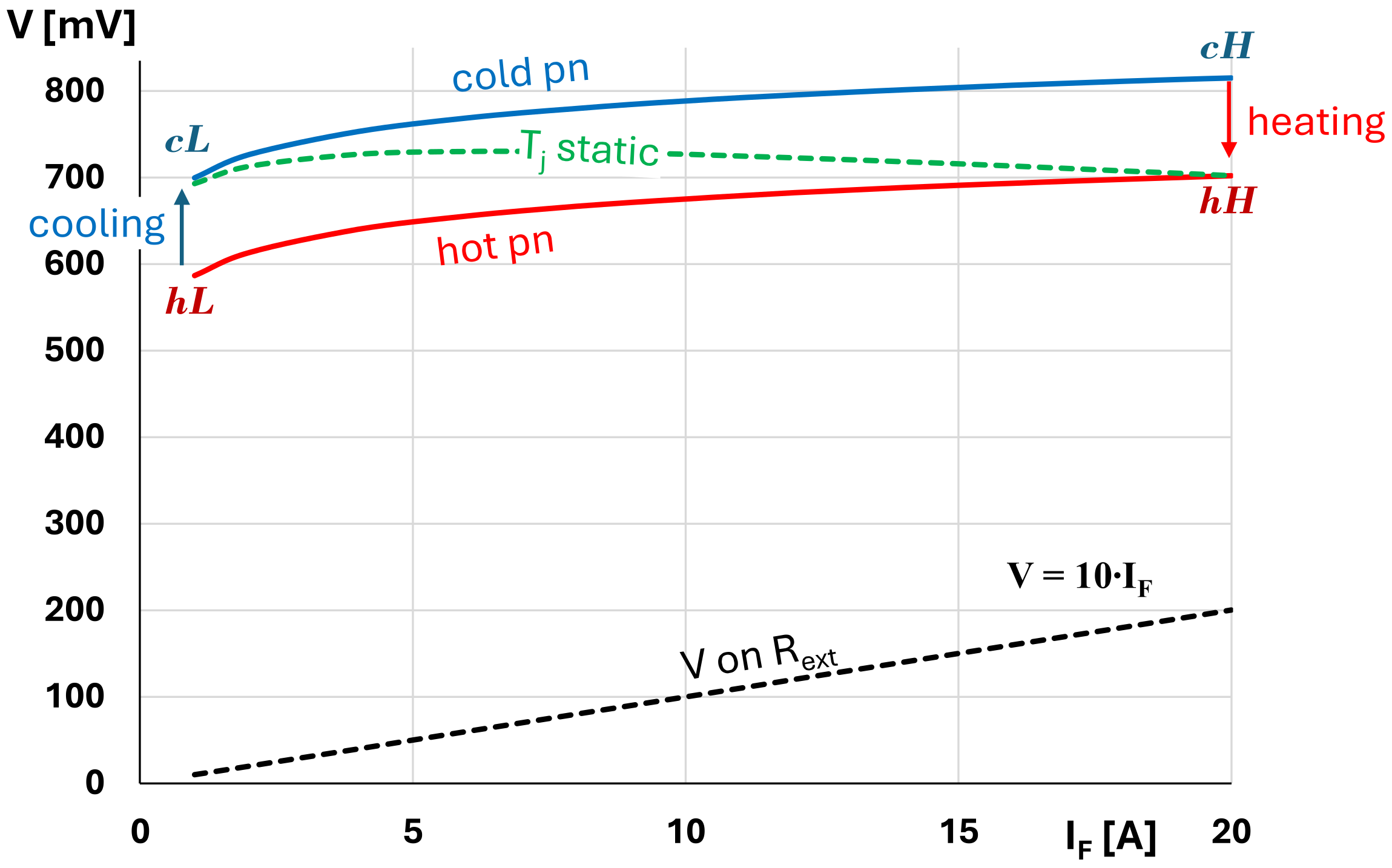
A typical chart illustrating the temperature and current-related changes in an ideal pn junction is presented in Figure 5.
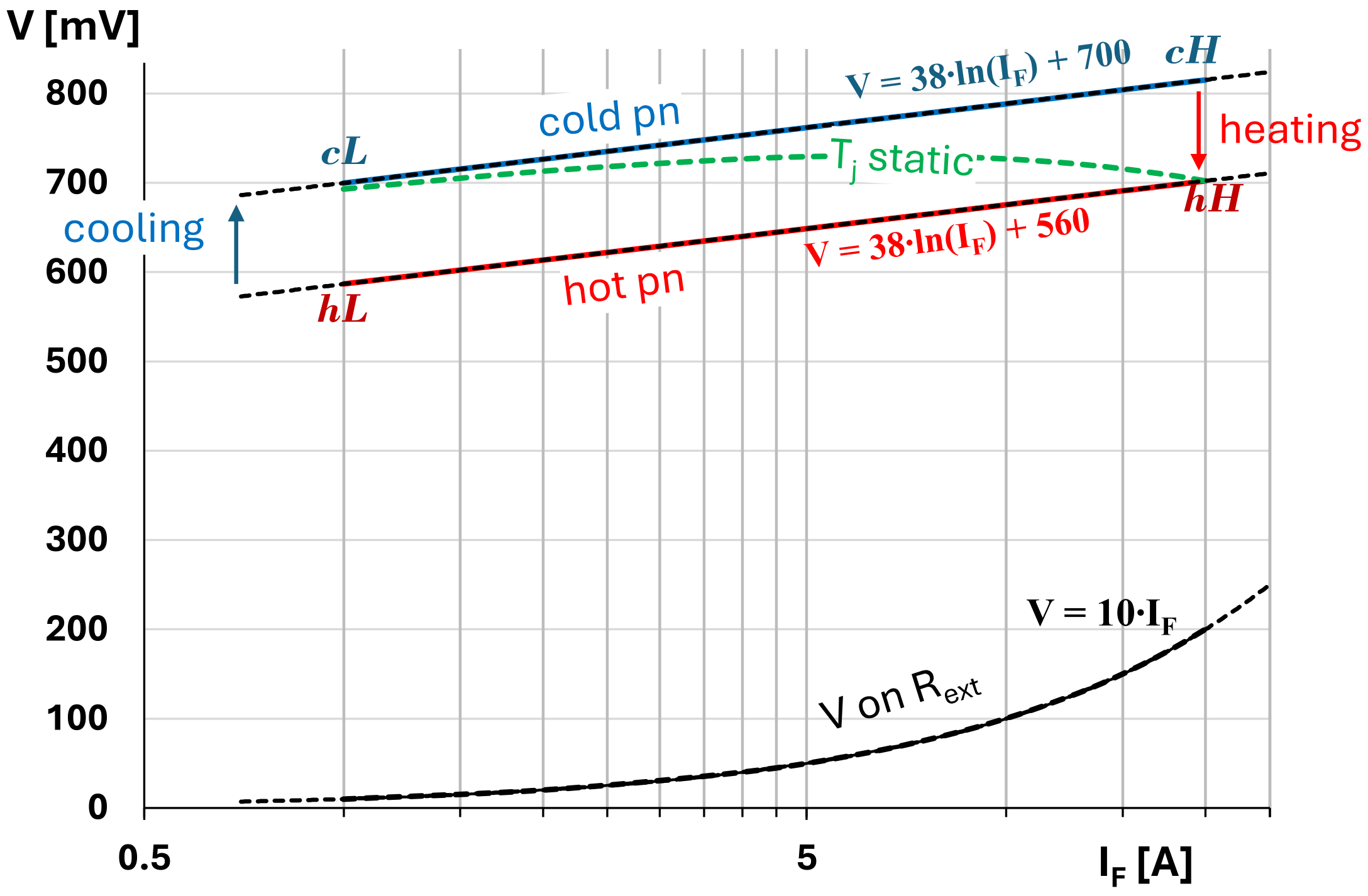
Figure 6 repeats the quantities of Figure 5 in logarithmic scale. The exponential nature of the Shockley equation can be observed as a straight line in the chart.
As (1) dictates the characteristics in a rigid way, measuring a typical single operating point already defines the core device behavior over a large temperature and current range. Suppose a typical silicon diode has VF = 700 mV forward voltage at IF1 = 1 A, at TJ = 25 °C junction temperature. This “Low current at cold temperature” point is denoted as cL in the chart. Curve tracers draw device characteristics at constant temperatures, in pulsed current operation. Such an instrument would draw the “cold pn” thread, corresponding to 25 °C in the 1 A to 20 A range, now calculated from (1). The thread ends in the “high current at cold temperature” point, denoted as cH.
Let us assume 5 K/W for the RthJA junction-to-ambient thermal resistance and dVF/dT = −2 mV/K temperature coefficient for the forward voltage change at increasing temperature. Both parameters are typical values. Using these parameters, in a later iteration process, we estimated that the junction temperature rise is about 70 °C at 20 A forward current.
With similar calculation, we established the “hot pn” thread, between the “low current at hot temperature” point, hL, and “high current at hot temperature” point, hH. We can observe that with the assumed thermal coefficient, the 70 °C temperature growth induces the 140 mV voltage decrease in Figure 6.
In an actual thermal transient testing process, the heating starts from the cL point and in a short time, determined by the tester electronics, jumps to the cH point. The heating process covers a few or many minutes, slowly descending from cH to hH (heating transient).
Switching down from 20 A to 1 A, an electric transient occurs in a few microseconds between hH and hL. Finally, the cooling transient is recorded for a prolonged time between hL and cL.
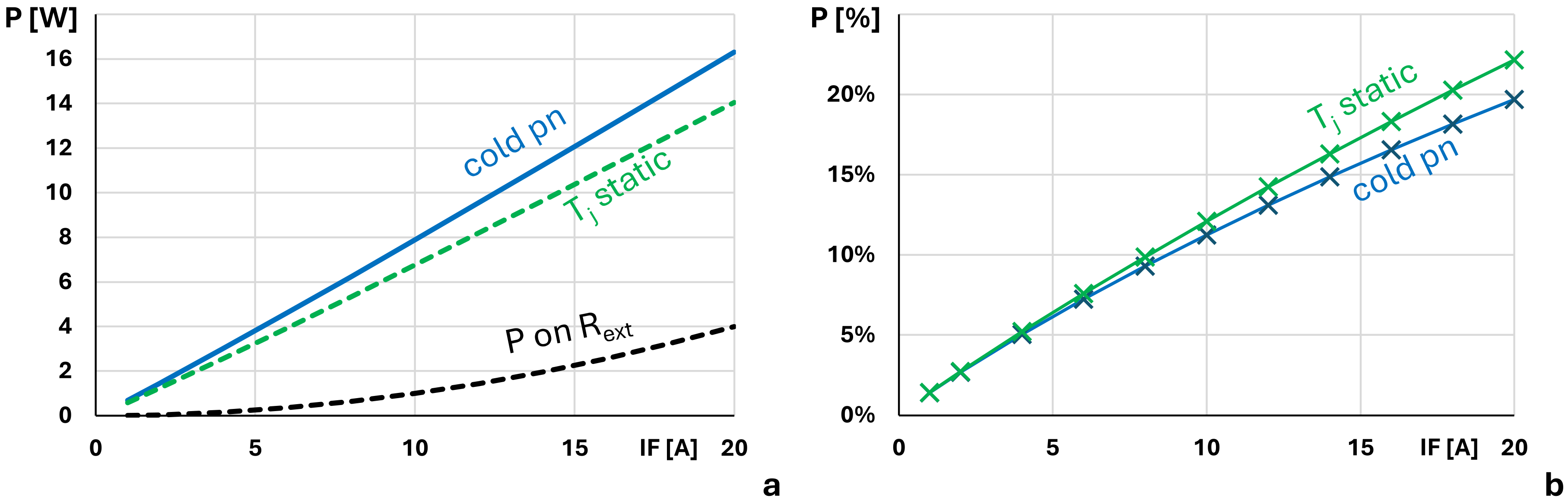
Assume the external package or wiring elements are concentrated in an Rext = 10 mΩ series resistance, only mildly affected by the heating of the junction. This resistance provides an additional 10 mV in the scheme of Figure 3a. In the starting cL point, the PD power on the D diode is 0.7 W, while Rext is dissipating 10 mW, only 1.4% of PD, which is often negligible.
Instead of sharp changes in the driving current, we can calculate the corresponding power and temperature of the diode at different currents while waiting at each current for equilibrium (TJ static curve in Figure 5). For presenting TJ static curve, Equation (2) was solved by a Python code in a few iterations. This curve also indicates where the final hH point would be if the transient occurred at lower than IF = 20 A; at this heating, the “hot pn” curve would be shifted up to this other hH point.
The power dissipation of each component in Figure 3 can also be easily calculated. The power loss on the external resistance scales quadratically with the current, and the power of the diode scales nearly linearly due to the logarithmic nature of the I-V characteristics and the negative thermal coefficient. As calculated from the simulation, the power loss therefore increases from 1.4% to 22% of the total dissipation while the current is changing from 1 A to 20 A (Figure 7). Exactly this growth of the power share on the resistor causes the characteristic “accordion” shrinking of the Zth thermal impedance in Figure 4.
It should be noted that in this simple model, we have neglected the current dependence of the d V F / d T , which slightly decreases with increasing forward current. Assuming constant Rext, we also neglected the temperature-dependent resistivity change of the internal layers inside the component.
Example 2.
Suppose in a data sheet, a MOSFET transistor is characterized with a drain-source on-state resistance of R25 = 55 mΩ value at room temperature and R150 = 100 mΩ at 150 °C. The related literature claims that the on-state resistance at a given temperature can be approximated with:
R D S ( T ) = R 25 T T 0 α
From the given datasheet resistivity values, using Equation (4), we can calculate α = 1.7 .
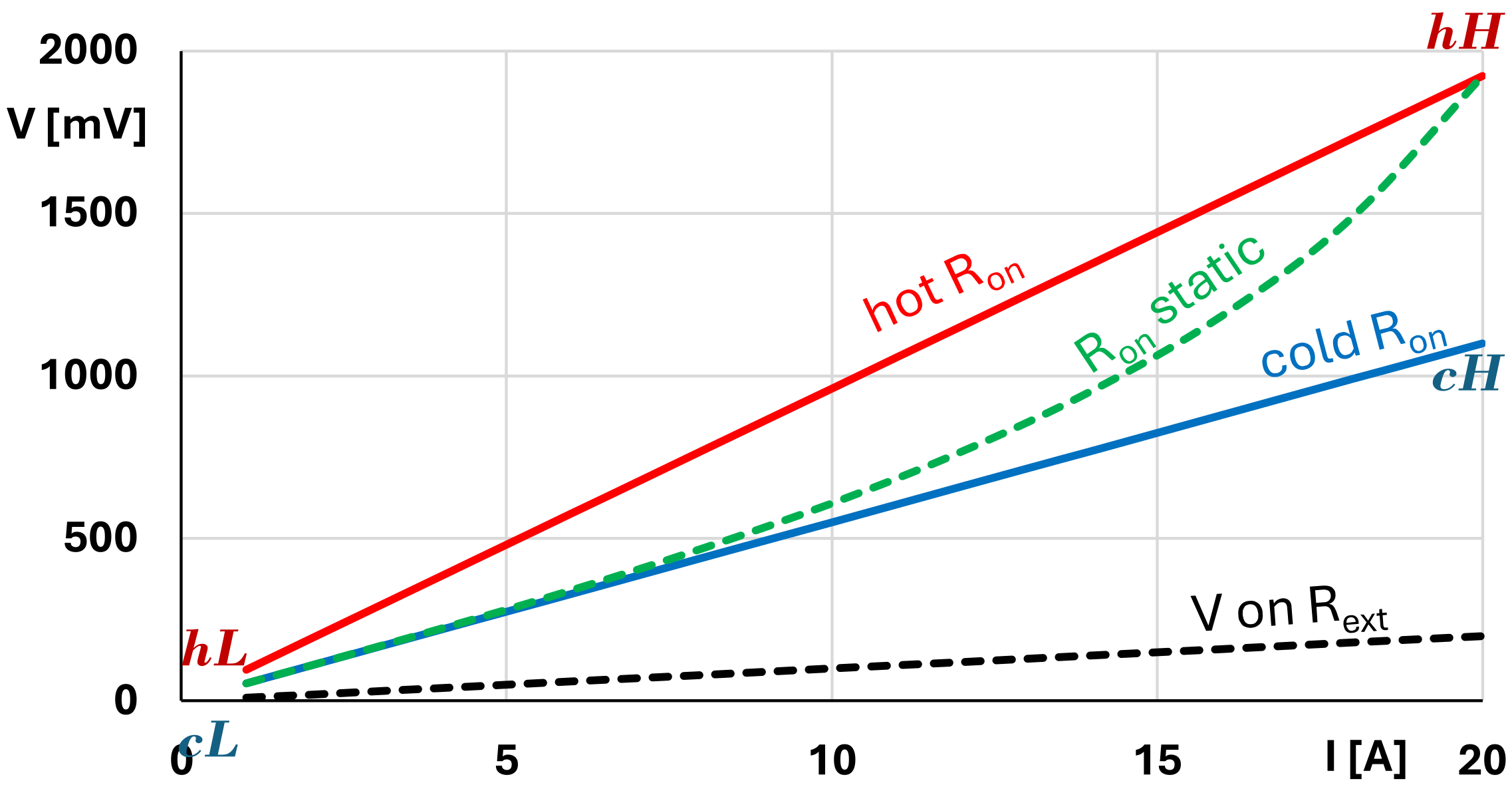
Let us assume a series Rext = 10 mΩ again and 2 K/W for the junction-to-ambient thermal resistance. Starting with 1 A transistor current again, the voltage on the channel would be 55 mV, to which the external resistance adds 10 mV. The power on the transistor is 55 mW, causing just 0.11 °C temperature elevation, so reckoning with 55 mΩ channel resistance is still valid. Rext is dissipating 10 mW, which is now a considerable 15% of the measured power.
Based on (4) and Ohm’s law, we can calculate the corresponding voltage, power and temperature of the transistor again at different currents, as we did in the previous example.
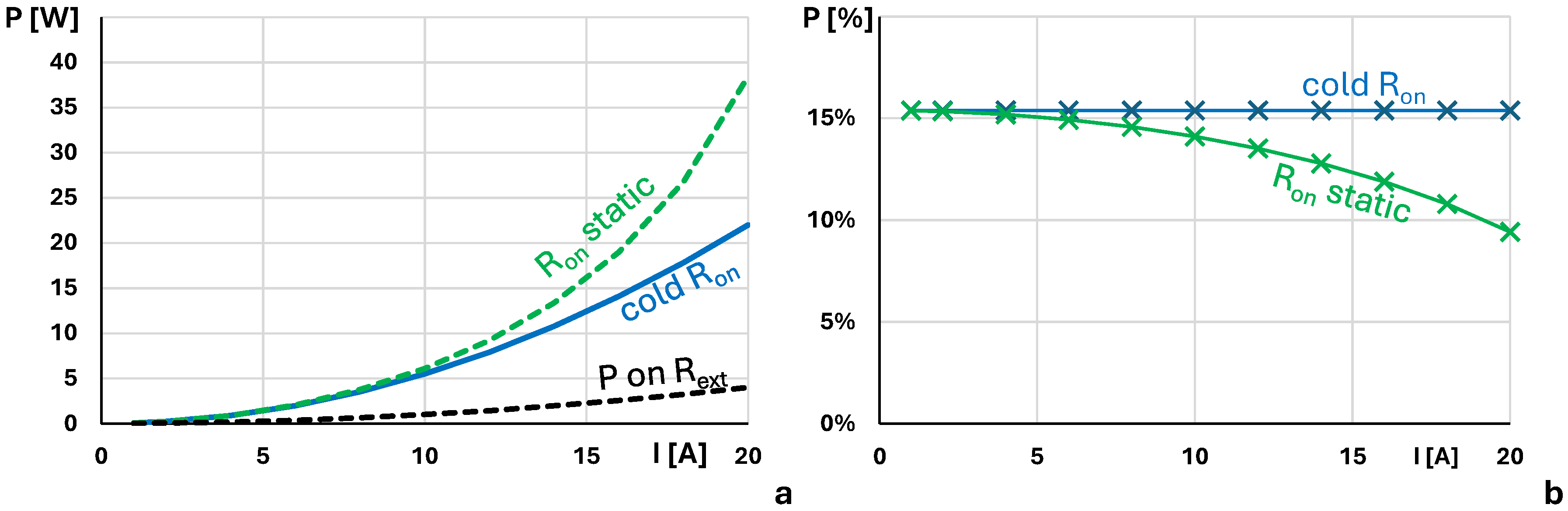
As shown in Figure 8, in this case, the hot and cold voltage–current curves are linear, but the static characteristic shows strong nonlinearity due to the increase in the channel resistance. At 20 A current, the power dissipated on the transistor in hot steady state is nearly doubled, growing to PRDS = 38 W from the initial 22 W dissipation on the cold device at 20 A. The series Rext still dissipates 4 W, but its share decreased to 9% of the total power.
A similar but opposite accordion effect is expected in Zth, in a two-wire measurement arrangement. Now, the percentage of the power remaining outside decreases, resulting in an increase in the calculated Zth (Figure 9).
If we compare the two examples, we find that with a diode-type heater/sensor, the shrinking effect can be suppressed by creating reference Zth curves at a lower current, and rescaling higher current curves by upscaling them to the reference. In resistive heater/sensor arrangements, the powering error is larger at low currents than at high ones, which makes this kind of correction unfeasible.

4.2. Calculation of Rext for Resistive Heaters and Sensors

The total ΔTJ temperature change on the DUT, from the moment of switching until the stabilization time tss, can be expressed in a true 4W measurement as ΔTJ = Rthreal · δPreal.
If one has only 2W access to the HEMT in the arrangement in Figure 12 or Figure 13, a higher δPel power step is measured at the best accessible points, due to the power dissipated on the wiring.
Although the wiring resistance exhibits temperature dependence, this effect is neglected in the first-order approximation of our model. Incorporating an averaged but temperature-independent external resistance yields improved results, as discussed in the subsequent sections. In power transistor structures, the temperature coefficient of the wiring is typically lower than that of the resistive channel in the transistor, while the temperature rise in the wiring remains substantially smaller than that in the junction region. Therefore, the applied approximation is considered justified.
For calculating Rext, we can express the ΔTJ total temperature change as:
ΔTJ = Rthel · δPel = Rthreal · [δPelRext · (IH2Isense2)]
In the equation, we corrected the measured power step by subtracting the dissipated power on the external wiring from the measured electrical power. IH is again the shorthand notation for Idrive + Isense.
Since Rthreal should not depend on the power applied, from (5), simply dividing two measurements at different Idrive2 and Idrive1 heating currents without varying Isense measurement currents gives the following equation:
Δ T J 2 Δ T J 1 = δ P e l 2   R e x t [ I d r i v e 2 + I s e n s e 2 I s e n s e 2 ) ] δ P e l 1   R e x t [ I d r i v e 1 + I s e n s e 2 I s e n s e 2 ) ]
Introducing the K X I d r i v e X , I s e n s e = I d r i v e X 2 + 2 I d r i v e X I s e n s e factor, (6) is simplified to
Δ T J 2 Δ T J 1 = δ P e l 2 R e x t K 2 δ P e l 1 R e x t K 1
From (7), Rext can be expressed as:
R e x t = Δ T J 2 δ P e l 1 Δ T J 1 δ P e l 2 K 1 Δ T J 2 K 2 Δ T J 1
Equations (6) and (8) provide a tool to determine Rext when there is only 2W access to a DUT, and so, no reference Zthreal is available. It may work well for larger power differences, but the formula is very sensitive to measurement errors and perturbations as both the numerator and the denominator are small.

5. Basic GaN Operation and Thermal Transient Measurement Schemes

5.1. Basic GaN Operation

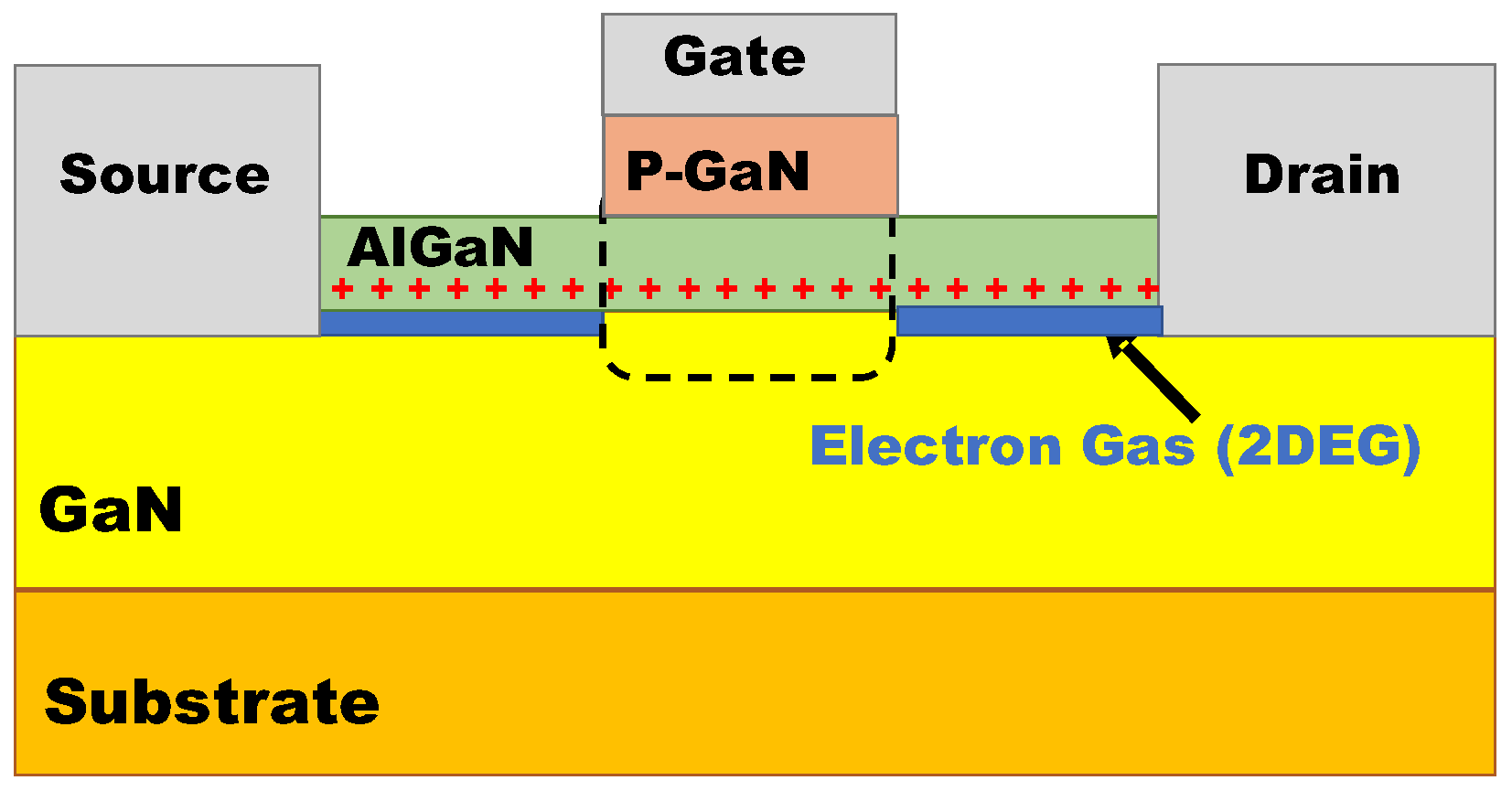
The most common type of GaN devices, the lateral HEMT, is sketched below in Figure 10.
In HEMTs, an aluminum–gallium nitride composite layer (AlGaN) is grown on top of monocrystalline GaN.
As in silicon MOSFET devices, a surface charge builds at the interface of the two materials, leaving unmovable positive ionized atoms in the AlGaN layer and freely moving electrons in the surface layer in the GaN base, next to the interface.
In the GaN bulk, no dopants impede the motion of electrons; the freely moving carriers ensure high channel conductivity. This is reflected in the device name: high-electron-mobility transistor (HEMT).
A more detailed treatment of its physics is given in [1,8].
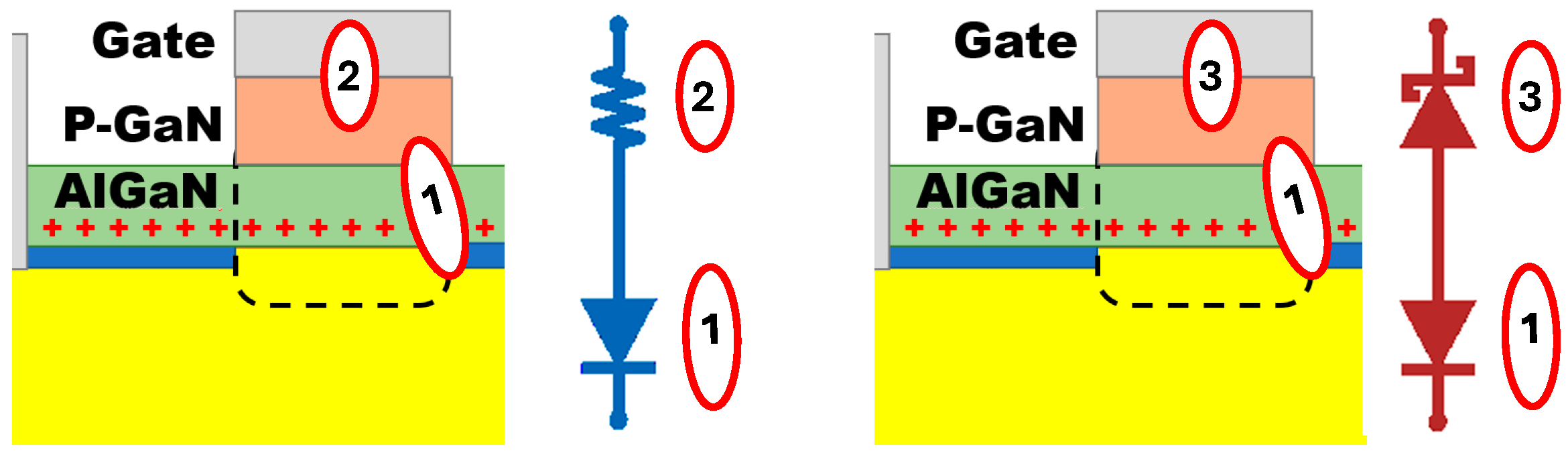
For producing normally off devices in power switching applications, two similar approaches are widely used, both based on inserting an acceptor-doped p-type layer (p-GaN) under the gate metallization (Figure 10 and Figure 11).
The p-GaN layer inserts two additional material interfaces (junctions) into the gate structure. The lower, depicted as 1 in Figure 11, forms between the p-GaN layer and the AlGaN.
The AlGaN layer is just a few rows of atoms deep; it falls fully into the depletion zone of 1.
At the upper junction, in certain cases, the contact potential between the gate metal and p-GaN accumulates charge carriers, which makes the junction of ohmic nature (shown as 2 in Figure 11). These devices are called gate-injection transistors (GIT). The gate voltage regulates the thickness of the depletion zone of the base GaN, resulting in three distinct operation modes:
  • Blocking at low gate voltage when the channel vanishes.
  • Classical field-effect operation when the channel appears but the voltage across the gate diode (junction 1) remains below the opening voltage (above 2 V for GaN material).
  • Gate current mode when the gate diode opens and injects further charge carriers into the channel.
Doping of the p-GaN layer differently, at the upper junction, the contact potential between the gate metal and p-GaN depletes the p-GaN side, which forms a reverse Schottky diode (denoted by 3). These devices are named reverse Schottky gate HEMT, Schottky gate HEMT or p-GaN gate HEMT.

5.2. Thermal Transient Measurement Schemes of Power HEMTs

In an attempt to find a proper TSP, the temperature dependence of the RDSON channel resistance or of the parasitic junction 1 in Figure 11 can be a good candidate.

5.2.1. Measuring with Heating and Sensing on the Channel

Figure 12 depicts a scheme in which both heating and sensing occur on the conducting channel, which is present in all HEMT types. As the RDSON channel resistance is very low, high Isense current is required for an adequate VDS voltage drop and a detectable temperature-induced change.
Figure 12. A thermal transient measurement scheme, heating and sensing on the channel.
Energies 19 02678 g012
Time variant effects can impose limitations on this measurement mode. For instance, when a movable charge is stored temporarily at trapping energy levels, its later release causes parasitic electrical transients [9]. These transients are hard to distinguish from the thermal response. Detailed analysis of the charge trapping mechanisms can be found in [10,11] for Schottky gate and GIT-type HEMT respectively.

5.2.2. Measuring with Continuous Gate Diode Current

As an alternative, the gate Schottky diode structure in GIT-type devices can be used for temperature sensing (Figure 13).
In this scheme, a small Isense current opens the gate diode, offering a TSP of high sensitivity and low noise. Heating is applied on the channel, driven by many amperes.
Figure 13. A measurement scheme with heating on the channel resistance, sensing on the gate diode at continuous gate current.
Energies 19 02678 g013
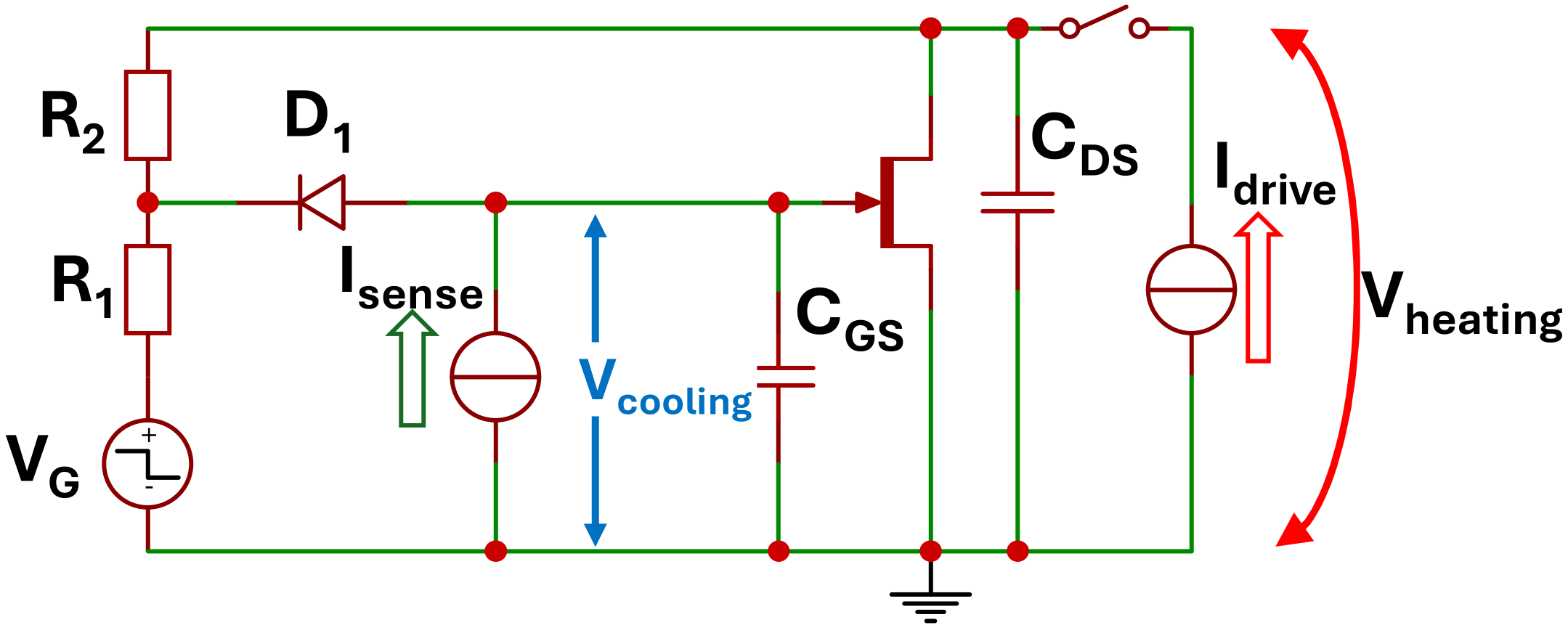
The circuitry in Figure 13 is susceptible to external parasitic inductances and capacitances caused by the measurement wiring. To avoid any oscillations, which can fake the measurement results and destroy the component, it is recommended to monitor the measurement using an oscilloscope during the experiments and to use appropriate bypass capacitors (CGS, CDS) and ferrite beads if necessary.

5.2.3. Measuring with a Switched Gate Diode Current

When the maximum Idrive current is limited, the δP power step can be too low, even at the maximum rated current.
Figure 14 shows a way to resolve this contradiction. The scheme is based on the switched gate concept, first presented in [12]. During heating, VG is of negative value, resulting in a thinner channel and higher VDS. For the cooling, VG is set to a positive voltage. Diode D1 is reverse-biased; thus, VG has no effect on the gate-source voltage, and Isense can flow through the gate diode.
Further details on thermal transient testing of GaN structures are presented in [13,14].

5.3. Measuring with Dedicated Temperature Sensors

It can be observed that HEMT devices typically lack the parasitic structures of high thermal sensitivity, which allow comfortable measurement techniques in standard MOSFETs. Novel research proposes additional integrated sensors into GaN power modules for enabling accurate and easy thermal transient testing.
Fabrication process-compatible Schottky diode sensors exhibit about 4 mV/K temperature sensitivity and accurate capture of the thermal transient, without affecting the operation of the device [15]. The voltage of a Schottky diode at constant current as a temperature sensing parameter would make thermal transient testing of HEMT devices analog to their silicon counterparts, for which well-established instruments and methodologies have been available for more than three decades.
Chang et al. constructed an on-chip array of patterned Ti/Pt thermistor strips on the surface of a GaN HEMT device, in order to achieve real-time temperature monitoring at different positions of the chip [16].
Mutsafi et al. found that depletion-mode AlGaN/GaN HEMT’s drain current in subthreshold operation mode have extremely high, more than 8%/K, temperature coefficient [17].
Various easy-to-integrate monolithic sensor circuits have been reported, demonstrating robust, high-temperature operation while avoiding complex fabrication. In Ref. [18], a proportional-to-absolute-temperature (PTAT) sensor with a 0.35 mV/°C sensitivity has been reported; Ang Li et al. [19] increased the sensitivity nearly two orders of magnitude using a logic inverter as a voltage amplifier, achieving 32 mV/°C sensitivity. Despite the availability of monolithically integrated sensing solutions, at the time of writing this article, only a limited number of commercial modules provide dedicated thermal sensor output functionality. For example, the LMG3522R030 [20] smart power stage outputs a fixed 9 kHz pulsed waveform, in which the device temperature is encoded in the duty cycle. While this approach is generally sufficient for system-level monitoring, the effective sampling rate is inadequate for thermal transient analysis.

6. Case Study: Thermal Transient Measurement of a Power GIT Device

In an illustrative experiment, a mockup of a subsystem with a PCB hosting a power switching device was built for a series of thermal transient measurements. The device was an Infineon IGOT60R070D1 GIT device.
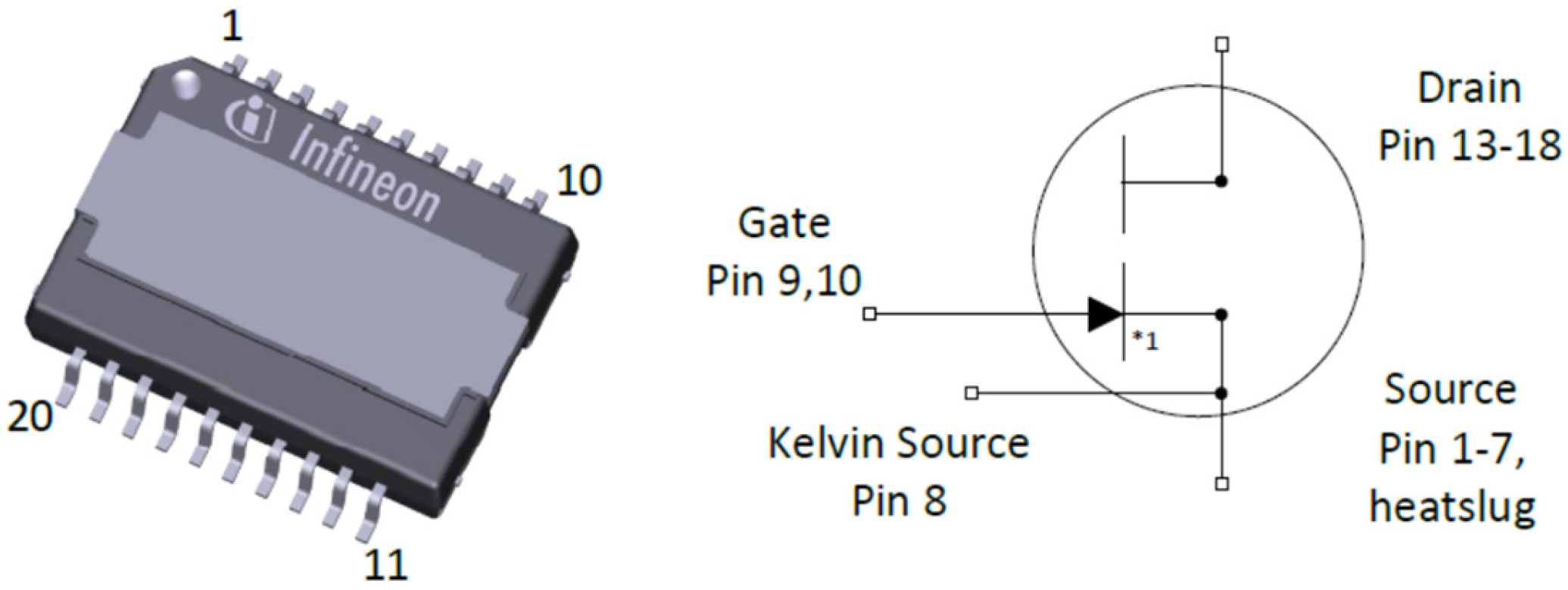
The device is packaged in a PG-DSO-20 package (Figure 15); characteristic data sheet values are 70 mΩ channel resistance and 31 A max, with continuous drain current at 25 °C.
This device was selected for the trials because it can be measured in all three modes presented in Section 5.2.

6.1. Measurement Planning

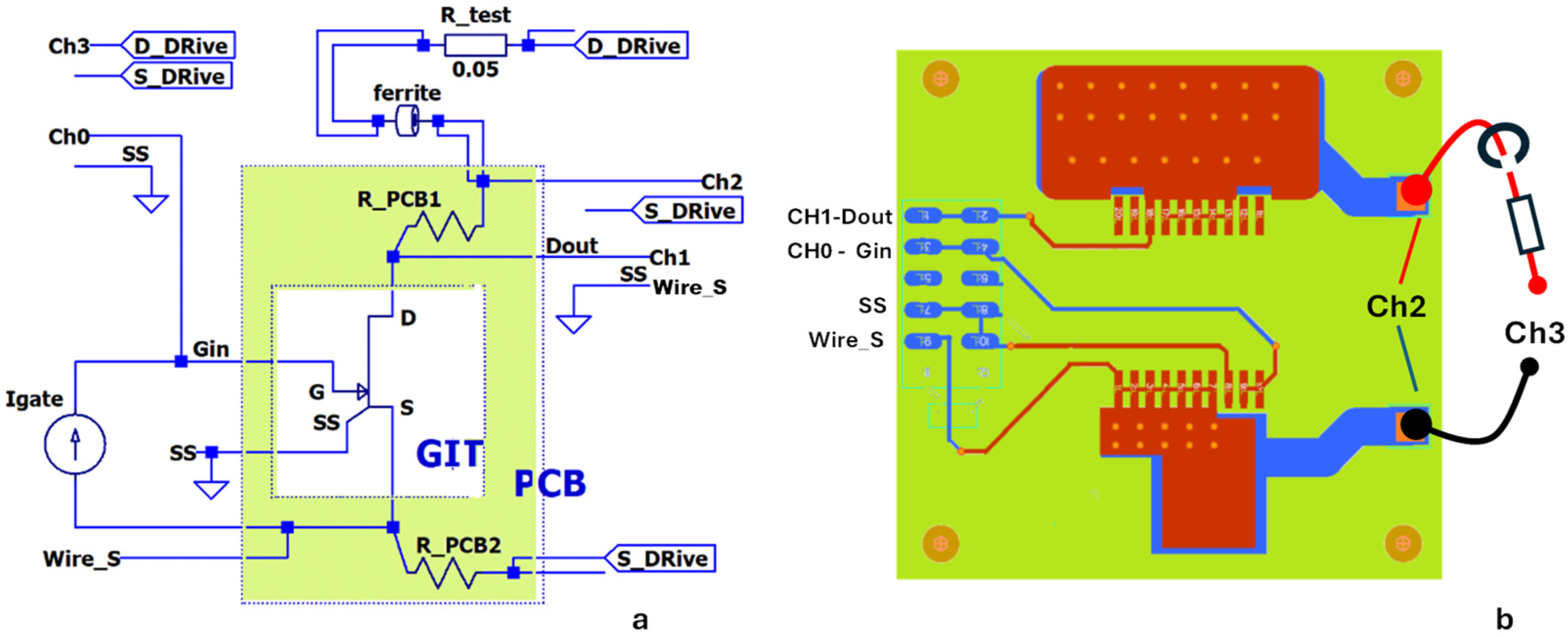
For studying the effects caused by internal wiring (bond wires in the package) and external segments (surface mount footprint, traces on the PCB, external cables belonging to the measurement setup), an appropriate circuit scheme (Figure 16a) and a wiring layout (Figure 16b) were designed.
To determine the power on the internal chip in the package, a complete 4W measurement arrangement would be optimal.
This is partly supported by the SS (source sense) Kelvin source pin, tied to an independent bond wire internally. For the drain, the best achievable approach is to separate a side pin from the main current path on the PCB (Dout in Figure 16b).
The assembly was mounted on the plate of a dry thermostat, with various thermal interface materials between the heat slug and the thermostat plate, as proposed in [4].
Appropriate currents for driving the gate, source and drain pins were applied from SIEMENS T3Ster Classic equipment, with booster extension, and it also provided recording the transient signals on its data acquisition channels.
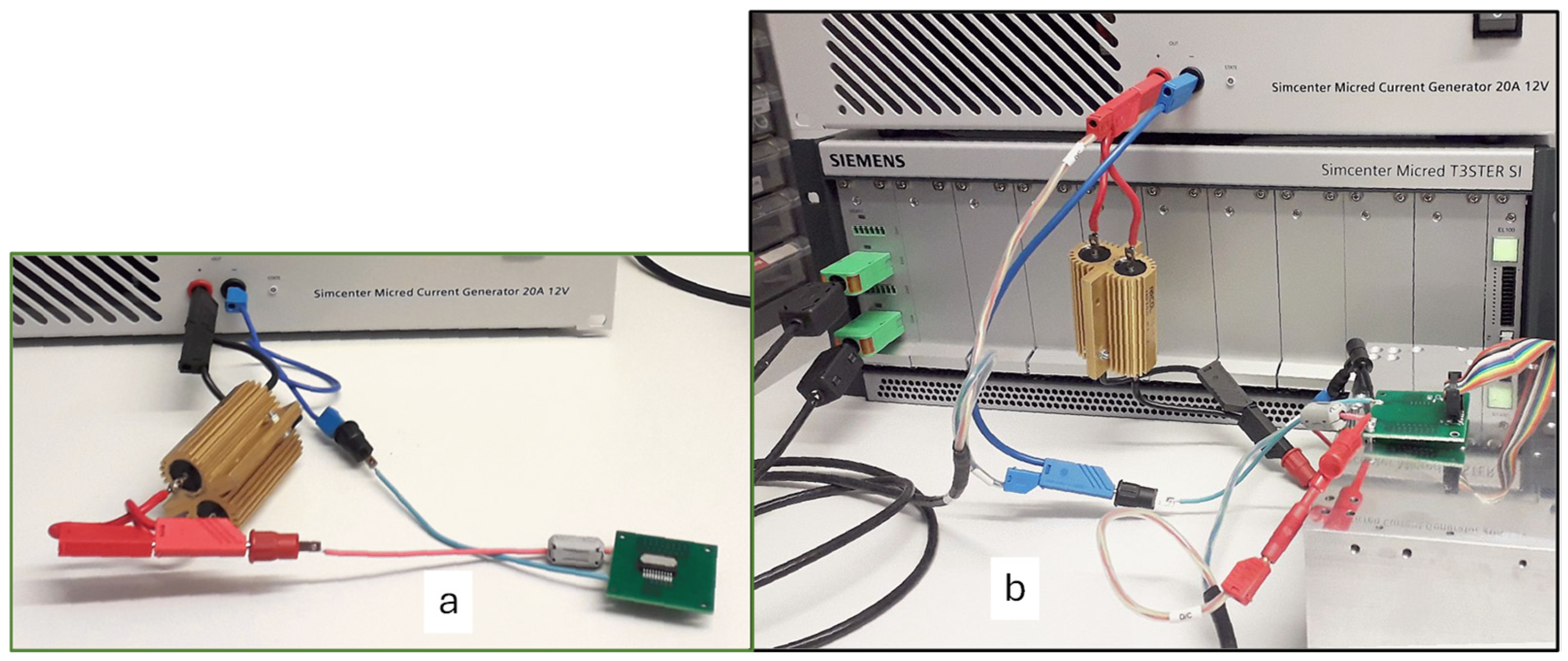
The calibration and the actual tests were carried out in the arrangement in Figure 17.
An Igate current (1 mA to 20 mA) turned the DUT into ON state when applied between the Gin and Wire_S access points.
From the measurement channels, Ch0 measured the VGS voltage on the gate, Ch1 the voltage drop between the points nearest to the chip (best 4W, Dout to SS), and Ch2 also recorded the additional voltage drop on the PCB “force” traces.
A ferrite core, clamped on the cabling next to the drain driving point on the PCB, was necessary for dumping high-frequency oscillations at high current. Various resistors (R_test) inserted into the drain drive emulated further external wiring in a real system (0 Ω to 55 mΩ); channel Ch3 recorded the signal between farthermost D_DRive and S_ DRive points.
This arrangement enabled the simultaneous measurement of two “external” resistances; the difference between measurements on Ch2 and Ch1 yields an Rboard quantity describing the effect of the PCB traces, while a similar difference between Ch3 and Ch1 yields an Rext+ resistance, in which the external R_test resistor, mimicking a larger appliance, is also added.

6.2. Measurement Results

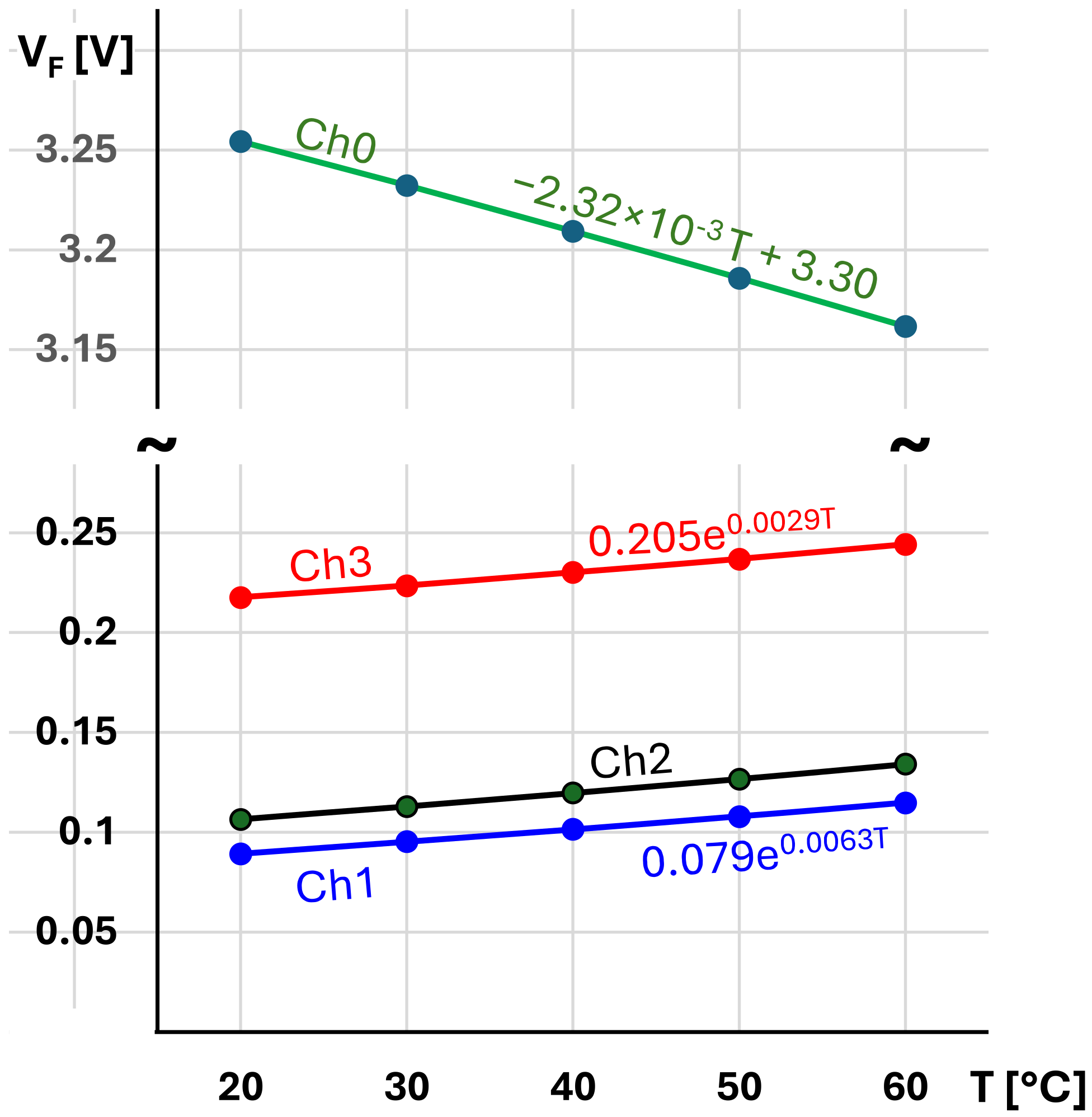
The calibration of all “sensors” occurred on the thermostat plate, at five temperatures from 20 °C to 60 °C. The PCB was separated from the plate by a few millimeters; the assumption that the series resistance related to it does not change with the plate temperature was approximately fulfilled.
As Figure 18 shows, linear interpolation fitted well the points for VGS, with approximately −2.3 mV/K slope at Igate = 10 mA.
The resistive sensors (Ch1 to Ch3) showed approximately 0.3%/K. 0.6%/K growth at Isense = 2 A, similar to the trend assumed in Example 2, in Section 4.
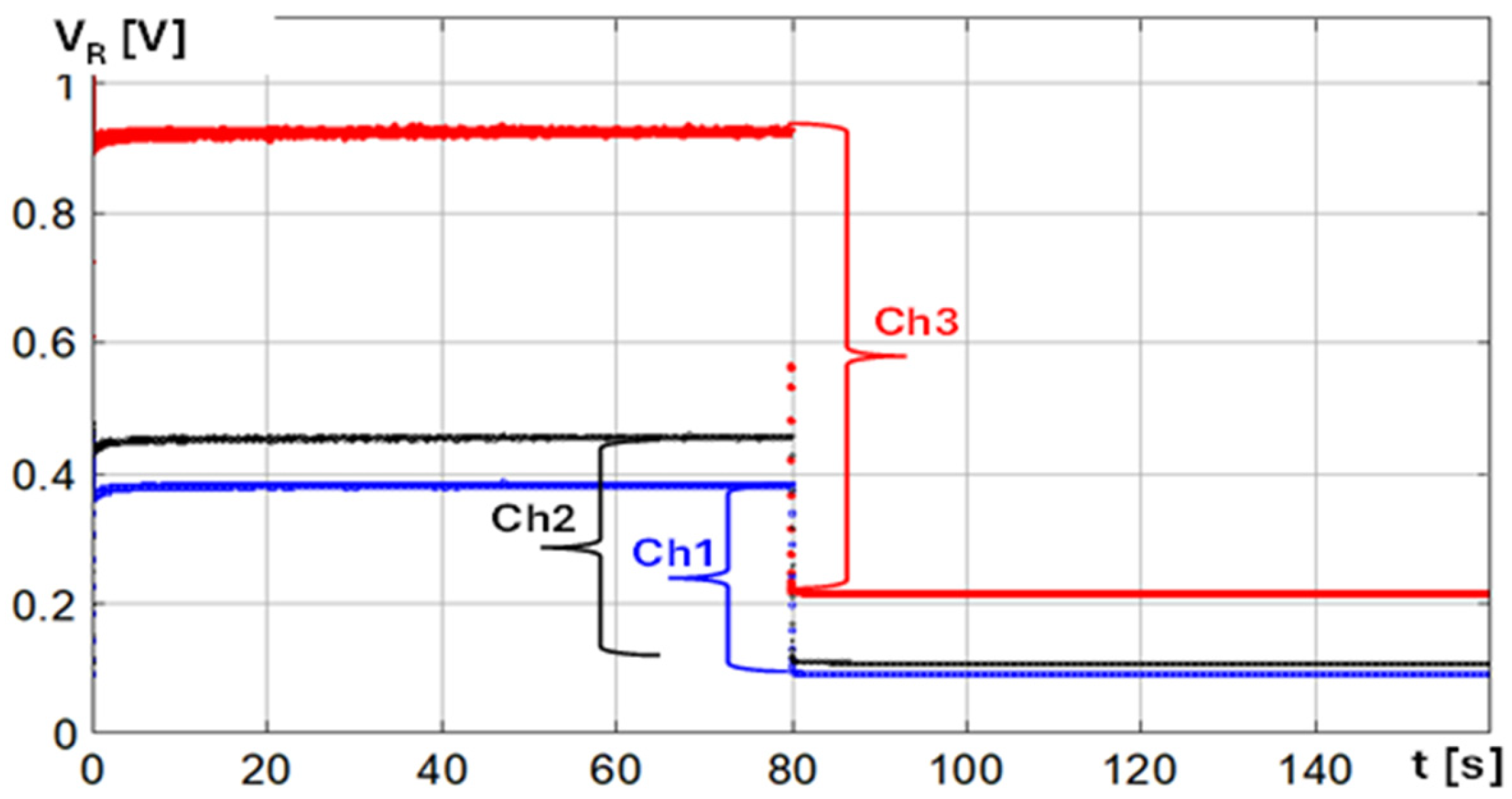
The recorded voltages at the access points Ch1 to Ch3 are shown in Figure 19 after switching down from 10 A to 2 A at 80 s. After this timepoint, all thermal information is encoded into the seemingly constant voltage, a bit above 0.2 V for Ch3, and around 0.1 V for the other two channels.
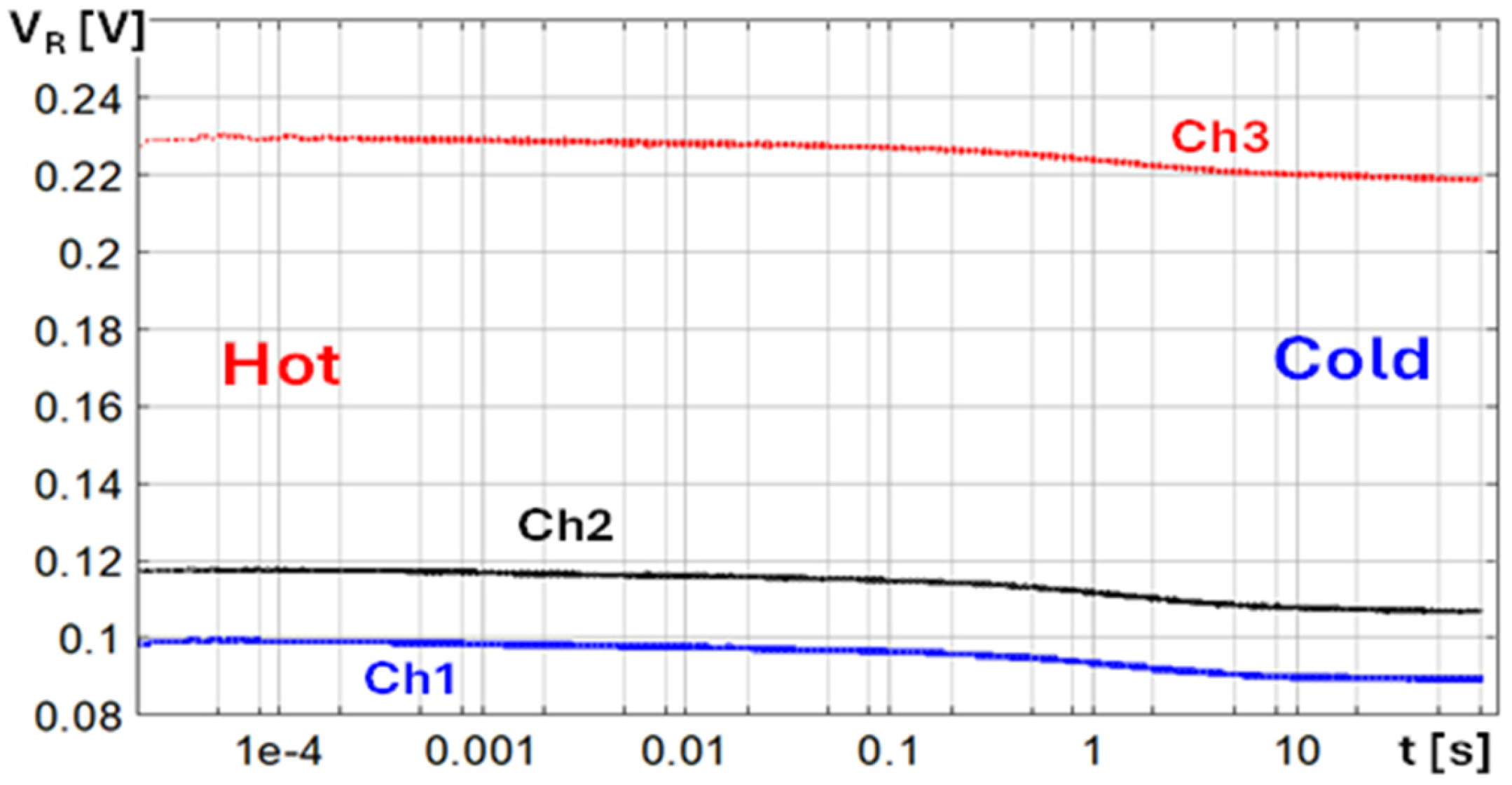
For focusing on the relevant details, Figure 20 shows the voltage change after the switching, in logarithmic scale. The cooling process can be well observed on each channel.
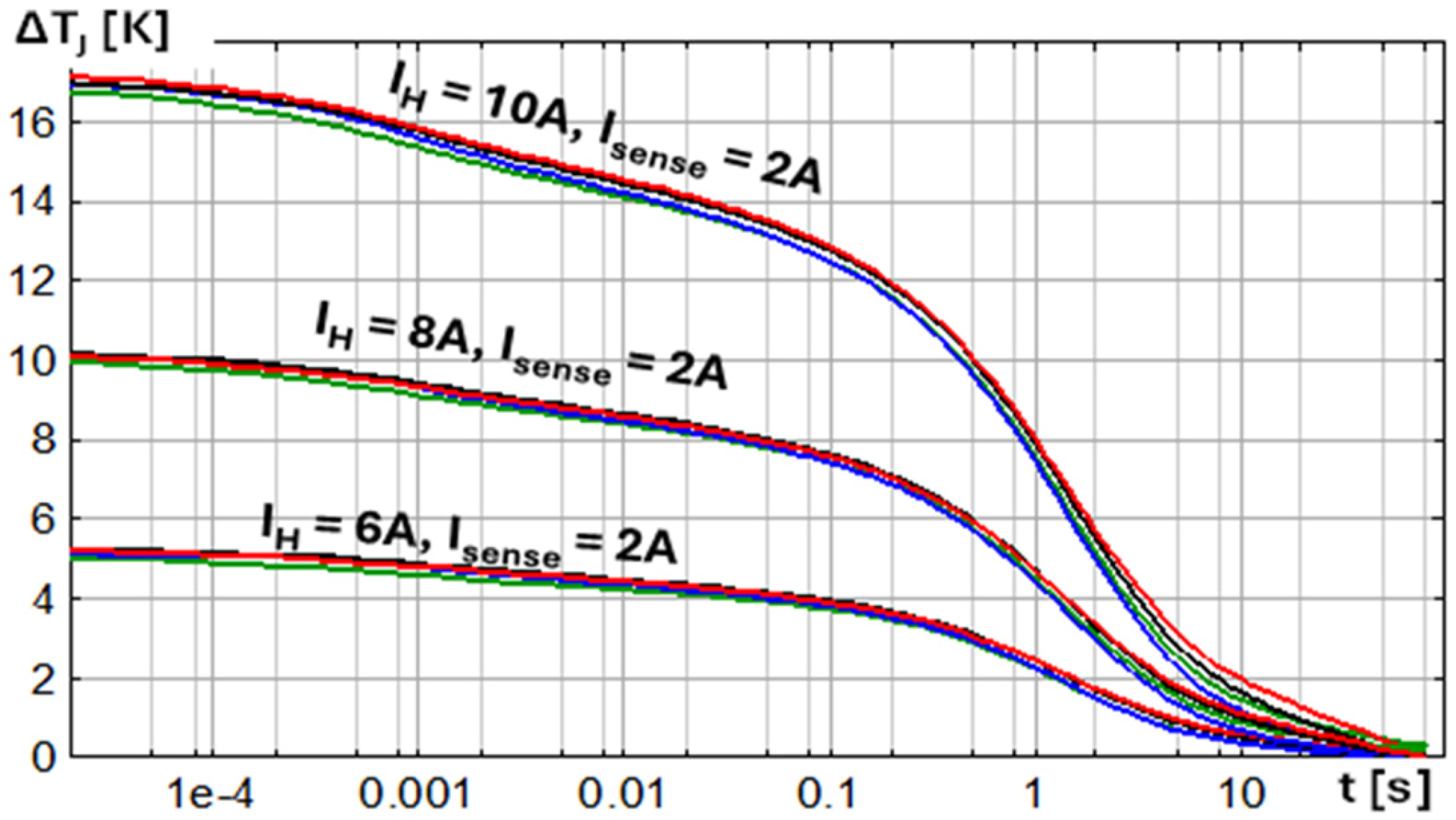
The voltage transients were converted to temperature change through the calibration process. Figure 21 presents all ΔTJ temperature changes on all channels, with gate signal Ch0 also added, at IH = 10 A, 8 A and 6 A.
The curves prove that the calibration on each channel was consistent, despite different temperature-dependent Vsense voltage being recorded on the channels at the same Isense = 2 A, due to different Rext in series. The voltage change curves are divided by the Pel power, which is calculated from the currents and channel voltages on each channel, to get Zth curves.
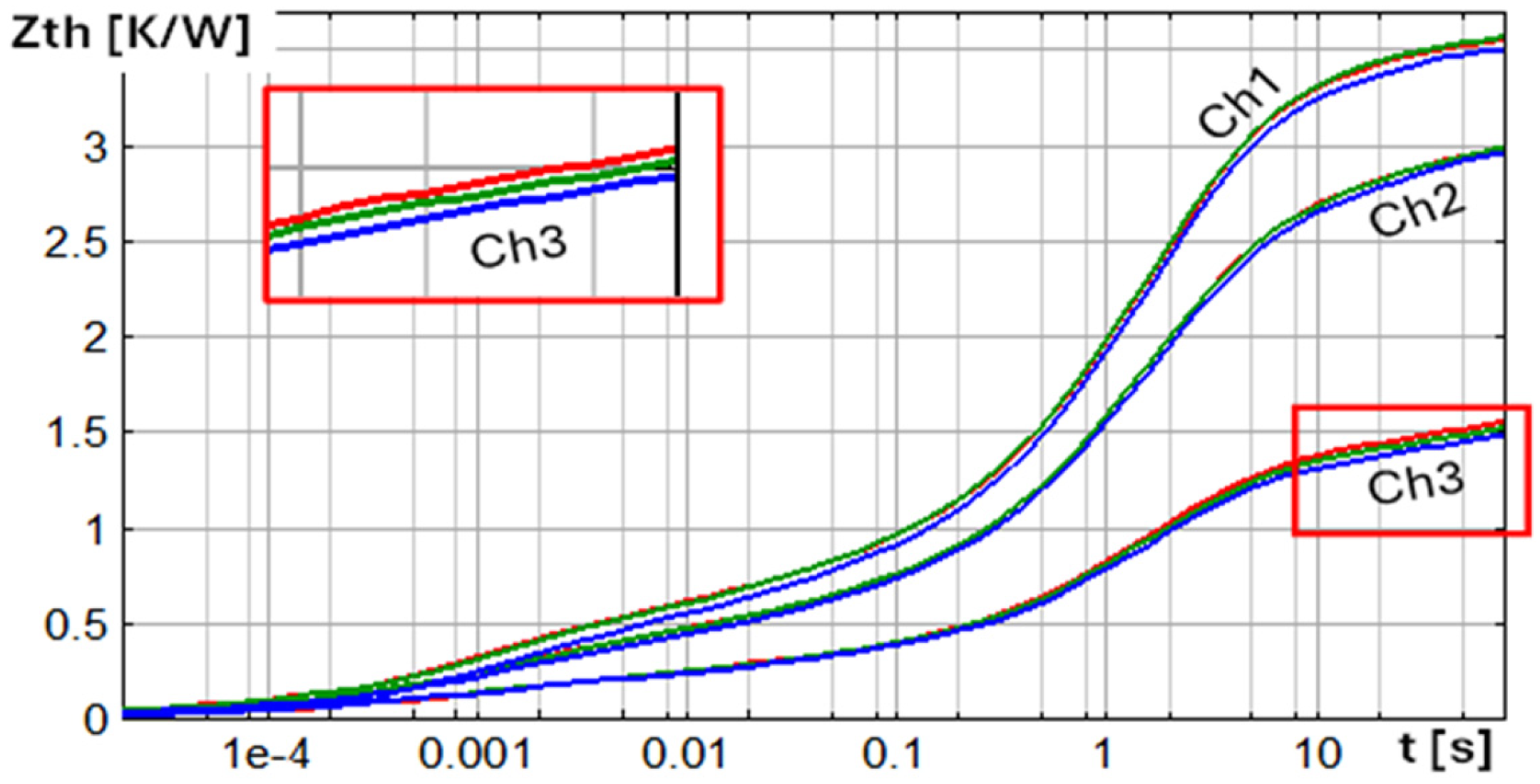
Figure 22 presents these Zth curves, namely, all channels at IH = 10 A (in red), the ones taken at 8 A (green) and 6 A current (blue curves).
As expected, the curves derived with the best 4W access, which is Ch1, run the highest in the figure. The curves belonging to Ch2 are considered 2W result, compressed corresponding to the power on Rboard = R_PCB1 + R_PCB2.
The external R_test adds 55 mΩ in series and shrinks the Ch3 curves further, below half of Ch1, as R_test is on the same scale as the HEMT channel resistance.
Figure 19 above presents how the voltages change when switching down from IH = 10 A to Isense = 2 A. Voltage difference of Ch2 and Ch1 divided by Isense yields the “external” Rboard value; from Ch3 and Ch1 voltages, Rext+ = Rboard + R_test can be calculated.
The RDUT hot channel resistance is also calculated in the same way.
The part resistances from the voltage on hot resistors at all other IH currents are listed in Table 1.
True 4W access can be rare in typical subassemblies. If the resistances in Table 1 cannot be obtained directly by Ohm’s law, other methods, like needle probe measurement or calculation from board trace layout, can still determine them.
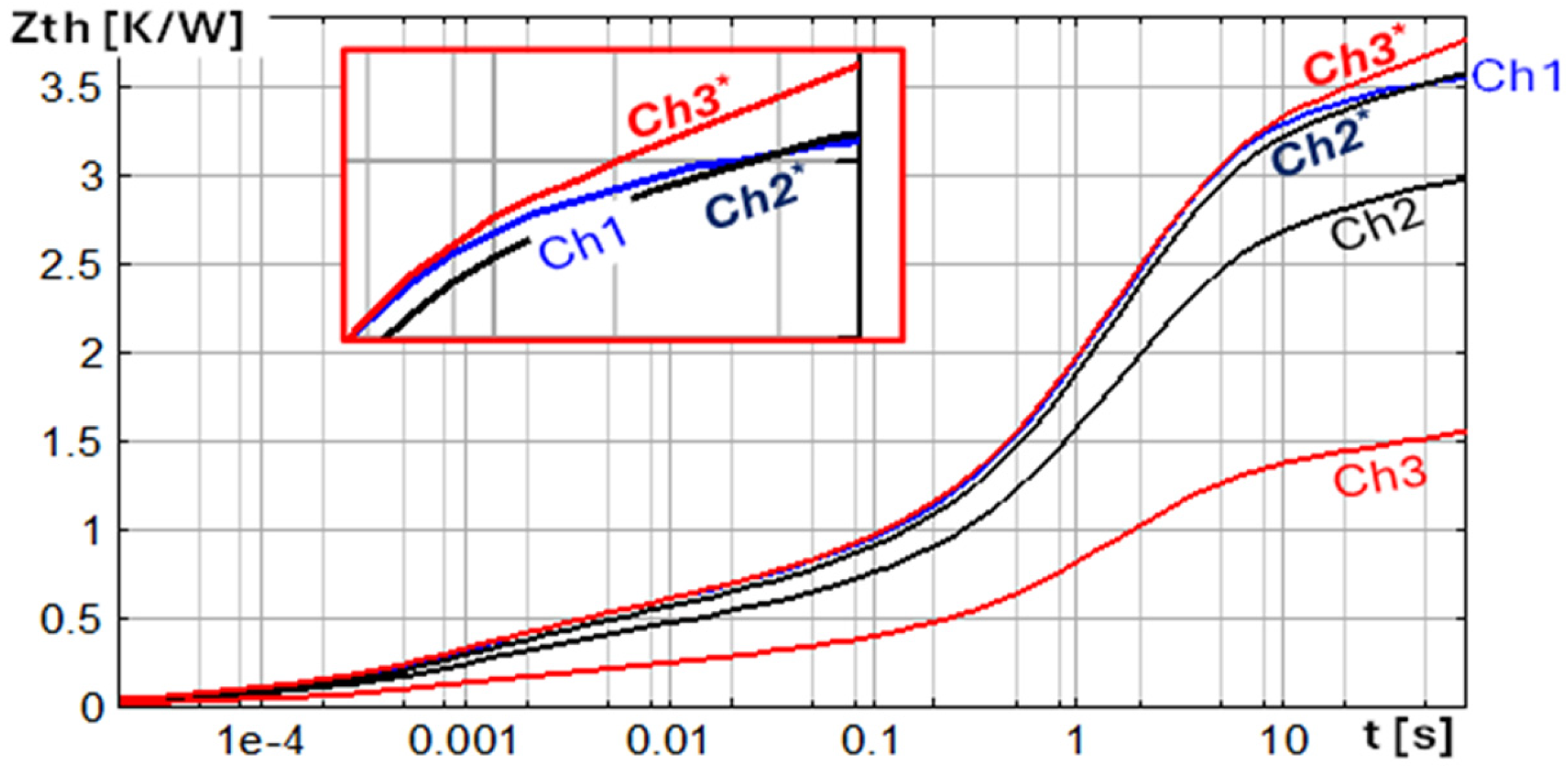
Subtracting the power on an Rext from δPel should yield the true δPreal power change. Thus, Rboard and Rext+ values from Table 1 can be used to rescale the 2W curves Ch2 and Ch3 to their corresponding Zthreal curves, Ch2* and Ch3* (Figure 23).
If calculated Rboard and Rext+ are true, temperature-independent resistances, Ch2* and Ch3* must fit perfectly with the 4W measurement of Ch1. They do in the 100 μs to 10 s range, with only a small divergence observed after 10 s, possibly reflecting a minor heating effect of Rboard and R_test.
As Equation (8) states, in a 2W arrangement, an estimation of external resistances and RDUT can be obtained, too, based on the ratio of powers and temperatures at different current levels. Taking the values at IH = 6 A as reference, and measuring at 8 A and 10 A currents, (8) yields the calculated part resistances in Table 2:
The calculated part resistances seem to be less consistent than the directly measured ones in Table 1, but the accuracy improves with a larger IH current ratio. The obtained R_test is of the same value.
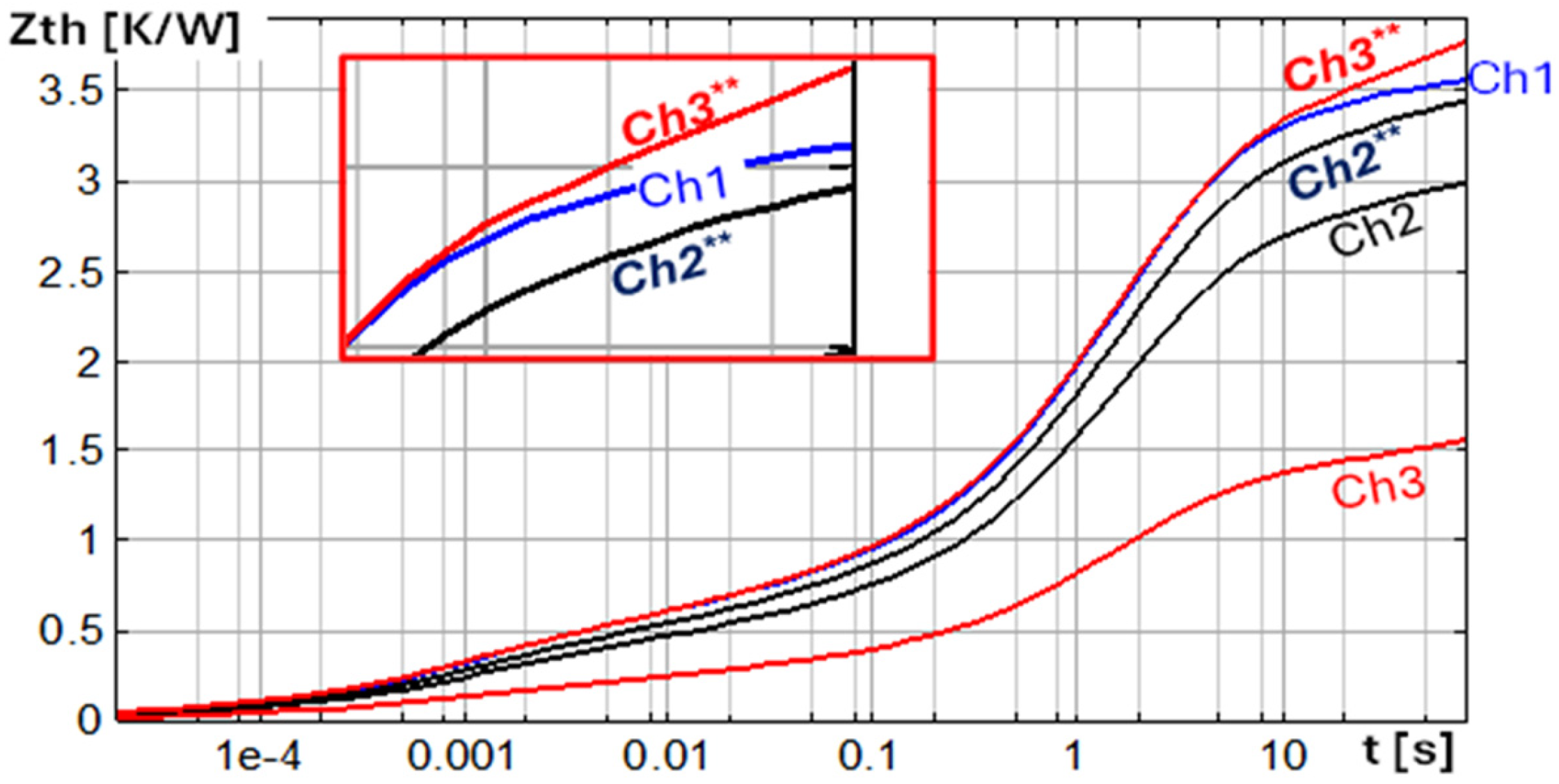
Similarly to Figure 23, the measured and normalized curves can also be rescaled to Zthreal by the power ratios calculated in Table 2, as shown in Figure 24:
The restored Ch3** is practically the same as its counterpart in Figure 23, as the power about the same 55 mΩ value was included in the correction. Rescaling of Ch2 is less exact, as the board resistance was extracted at lower precision; still, significant improvement is achieved in Ch2**, and even better is expected with a larger current ratio.
The elaborated test sequence also provided interesting results on the gate voltage change measured on Ch0; these results will be presented in the next paper.

7. Conclusions

With the advent of wide bandgap semiconductor devices, it became a must to adapt the existing thermal transient testing methodologies, originally developed for silicon material, to these new devices, such as GaN HEMT transistors.
First, proper heater and temperature sensor structures in HEMTs are to be found. Different constructions exist, and many of them lack the typical parasitic pn junctions, mostly used as sensors in similar silicon MOSFETs.
This way, the conductive channel in the HEMT became the typical heater and sensor used in thermal transient testing. It is of extremely low resistance, comparable to the wiring in test jigs, cabling and the package itself, which do not participate in the heating of the chips.
The fact that, in the test, a large portion of the applied power heats the external wiring rather than the device under test underlines remembering that the transient testing has two related but different targets. One is yielding peak system temperatures at various powering; the other is to provide partial thermal resistances and structural details near the active devices.
We have developed an analytical methodology to eliminate from the calculations of thermal descriptors those external resistances that distort the structural data gained from thermal tests. We have evaluated and demonstrated the validity of the method by measurements on actual samples. Application of the method demonstrated that restoration of true thermal properties became possible.

Author Contributions

Conceptualization, S.R., Z.S. and G.F.; methodology, S.R. and G.F.; software, S.R.; validation, S.R., G.F. and Z.S.; formal analysis, S.R.; investigation, S.R.; resources, M.R. and Z.S.; data curation, S.R.; writing—original draft preparation, S.R. and G.F.; writing—review and editing, S.R., G.F. and M.R.; visualization, S.R.; supervision, G.F.; project administration, M.R.; funding acquisition, M.R. and Z.S. All authors have read and agreed to the published version of the manuscript.

Funding

This research was partially funded by the Chips Joint Undertaking and its members, including the top-up funding by the national Authorities of Germany, Belgium, Spain, Sweden, Netherlands, Austria, Italy, Greece, Latvia, Finland, Hungary, Romania and Switzerland, grant number 101252572.

Data Availability Statement

The original data presented in the study are openly available at https://github.com/sandorress/wbgmeasurements, accessed on 1 June 2026.

Acknowledgments

The authors express their gratitude to G. Végh Jr. for preparing the measurement samples used in this work.

Conflicts of Interest

Author S. Ress (part time), G. Farkas and Z. Sarkany were employed by the company Siemens Digital Industries Software. The remaining authors declare that the research was conducted in the absence of any commercial or financial relationships that could be construed as potential conflicts of interest.

References

  1. Rencz, M.; Farkas, G.; Poppe, A. Theory and Practice of Thermal Transient Testing of Electronic Components; Springer International Publishing: Cham, Switzerland, 2022. [Google Scholar] [CrossRef]
  2. S&P Global Mobility. BMW Hits the Brakes with Vehicle Recall. Available online: https://www.spglobal.com/automotive-insights/en/blogs/2024/10/bmw-hits-the-brakes-with-vehicle-recall (accessed on 12 December 2025).
  3. Siemens. Simcenter Flotherm. Available online: https://www.siemens.com/en-us/products/simcenter/fluids-thermal-simulation/flotherm/ (accessed on 16 May 2026).
  4. JEDEC Standard JESD51-1; Integrated Circuit Thermal Measurement Method—Electrical Test Method—Single Semiconductor Device. JEDEC Solid State Technology Association: Arlington, VA, USA, 1995. Available online: https://www.jedec.org/system/files/docs/jesd51-1.pdf (accessed on 15 August 2025).
  5. JEDEC Standard JESD51-14; Transient Dual Interface Test Method for the Measurement of Thermal Resistance Junction-to-Case of Semiconductor Devices with Heat Flow through a Single Path. JEDEC Solid State Technology Association: Arlington, VA, USA, 2010. Available online: http://www.jedec.org/sites/default/files/docs/JESD51-14_1.pdf (accessed on 15 August 2025).
  6. Breuer, J.; Dresel, F.; Schletz, A.; Leib, J.; Eckardt, B.; März, M. Dynamic Calibration of Junction Temperature of SiC MOSFETs for Power Cycling. In Proceedings of the 2024 IEEE 10th Electronics System-Integration Technology Conference (ESTC), Berlin, Germany, 11–13 September 2024; pp. 1–6. [Google Scholar] [CrossRef]
  7. Farkas, G.; Haque, S.; Wall, F.; Martin, P.S.; Poppe, A.; van Voorst Vader, Q.; Bognár, G. Electric and Thermal Transient Effects in High Power Optical Devices. In Proceedings of the Twentieth Annual IEEE Semiconductor Thermal Measurement and Management Symposium (SEMITHERM), San Jose, CA, USA, 11 March 2004. [Google Scholar] [CrossRef]
  8. Udabe, A.; Baraia-Etxaburu, I.; Diez, D.G. Gallium Nitride Power Devices: A State of the Art Review. IEEE Access 2023, 11, 48628–48650. [Google Scholar] [CrossRef]
  9. Li, K.; Evans, P.L.; Johnson, C.M. Characterization and Modeling of Gallium Nitride Power Semiconductor Devices Dynamic On-State Resistance. IEEE Trans. Power Electron. 2018, 33, 5262–5273. [Google Scholar] [CrossRef]
  10. O’Sullivan, B.; Rathi, A.; Alian, A.; Yadav, S.; Yu, H.; Sibaja-Hernandez, A.; Peralagu, U.; Parvais, B.; Chasin, A.; Collaert, N. Charge Trapping and Emission during Bias Temperature Stressing of Schottky Gate GaN-on-Silicon HEMT Structures Targeting RF/mm Wave Power Amplifiers. Micromachines 2024, 15, 951. [Google Scholar] [CrossRef] [PubMed]
  11. Ning, Y.; Li, H.; Zheng, X.; Pan, C.; Zhao, L. The Influence of Charge Trapping Effects on GIT GaN-Based HEMTs. IEEE Trans. Electron Devices 2025, 72, 6170–6177. [Google Scholar] [CrossRef]
  12. Siemens Digital Industries Software. Overcoming GaN HEMT Thermal Characterization Challenges; White Paper. Available online: https://resources.sw.siemens.com/en-US/white-paper-overcoming-gan-hemt-thermal-characterization-challenges/ (accessed on 15 August 2025).
  13. Borghese, A.; Di Costanzo, A.; Riccio, M.; Maresca, L.; Breglio, G.; Irace, A. Gate Current in p-GaN Gate HEMTs as a Channel Temperature Sensitive Parameter: A Comparative Study between Schottky- and Ohmic-Gate GaN HEMTs. Energies 2021, 14, 8055. [Google Scholar] [CrossRef]
  14. Sarkany, Z.; Musolino, M.; Sitta, A.; Calabretta, M.; Nemeth, M.; Farkas, G.; Rencz, M. Thermal Transient Testing Alternatives for the Characterisation of GaN HEMT Power Devices. In Proceedings of the 2022 28th International Workshop on Thermal Investigations of ICs and Systems (THERMINIC), Dublin, Ireland, 28–30 September 2022. [Google Scholar] [CrossRef]
  15. Wang, P.; Tang, F.; Wang, R.; Guo, H.; Peng, Y.; Guo, H.; Zhou, Y.; Chen, D.; Zhang, R.; Zheng, Y. In Situ Junction Temperature Measurement and Thermal Resistance Extraction of AlGaN/GaN HEMTs Using Schottky Diode-Integrated Sensor. IEEE Electron Device Lett. 2026, 47, 804–807. [Google Scholar] [CrossRef]
  16. Chang, Y.; Su, Y.; Xiao, M.; Wu, J.; Zhang, X.; Chen, H. Gallium Nitride High Electron Mobility Transistor Device with Integrated On-Chip Array Junction Temperature Monitoring Unit. Micromachines 2025, 16, 304. [Google Scholar] [CrossRef] [PubMed]
  17. Mutsafi, Z.; Shimanovich, K.; Kairys, V.; Shima-Edelstein, R.; Roizin, Y.; Rosenwaks, Y. High-Temperature Sensitivity of a Depletion-Mode AlGaN/GaN MIS-HEMT. IEEE Trans. Electron Devices 2021, 68, 5695–5700. [Google Scholar] [CrossRef]
  18. Kwan, A.M.H.; Guan, Y.; Liu, X.; Chen, K.J. A Highly Linear Integrated Temperature Sensor on a GaN Smart Power IC Platform. IEEE Trans. Electron Devices 2014, 61, 2970–2976. [Google Scholar] [CrossRef]
  19. Li, A.; Shen, Y.; Li, Z.; Li, F.; Sun, R.; Mitrovic, I.Z.; Wen, H.; Lam, S.; Liu, W. A 4-Transistor Monolithic Solution to Highly Linear On-Chip Temperature Sensing in GaN Power Integrated Circuits. IEEE Electron Device Lett. 2023, 44, 333–336. [Google Scholar] [CrossRef]
  20. Texas Instruments. LMG342xR030 600 V 30 mΩ GaN FET with Integrated Driver, Protection, and Temperature Reporting Datasheet (Rev. F). Available online: https://www.ti.com/lit/ds/symlink/lmg3422r030.pdf (accessed on 10 May 2026).
Figure 1. Complex heat spreading profile in an in situ transient test.
Energies 19 02678 g001
Figure 2. Thermal transient measurement schemes for MOSFET devices:
(a) a reverse diode as heater and sensor; (b) heating and sensing on the channel;
(c) the heating is done on the channel and the measurement on the reverse diode.
Figure 2. Thermal transient measurement schemes for MOSFET devices:
(a) a reverse diode as heater and sensor; (b) heating and sensing on the channel;
(c) the heating is done on the channel and the measurement on the reverse diode.
Energies 19 02678 g002
Figure 3. Thermal testing of two-pin devices, using (a) junction type and
(b) resistive heater and sensor.
Figure 3. Thermal testing of two-pin devices, using (a) junction type and
(b) resistive heater and sensor.
Energies 19 02678 g003
Figure 4. Zth curves of a power MOSFET module, measured on the reverse bulk diode,
at IH = 20 A, 40 A, 60 A, 80 A (colors of the threads correspond with that of the current value in the caption). The characteristic “accordion” like shrinking towards higher IH currents is observable.
Figure 4. Zth curves of a power MOSFET module, measured on the reverse bulk diode,
at IH = 20 A, 40 A, 60 A, 80 A (colors of the threads correspond with that of the current value in the caption). The characteristic “accordion” like shrinking towards higher IH currents is observable.
Energies 19 02678 g004
Figure 5. Current–voltage characteristics of the internal pn junction, cold junction (blue),
hot junction (red) and of the external resistance (Rext, black dashed). When the power is applied slowly, through quasi-equilibrium stages, the voltage follows the green, dashed TJ static curve.
Figure 5. Current–voltage characteristics of the internal pn junction, cold junction (blue),
hot junction (red) and of the external resistance (Rext, black dashed). When the power is applied slowly, through quasi-equilibrium stages, the voltage follows the green, dashed TJ static curve.
Energies 19 02678 g005
Figure 6. The quantities of Figure 5 shown as function of the logarithm of the forward current.
The Shockley equations appear as straight lines.
Figure 6. The quantities of Figure 5 shown as function of the logarithm of the forward current.
The Shockley equations appear as straight lines.
Energies 19 02678 g006
Figure 7. (a) Power on the internal pn junction (PD) and on the external resistance (Rext) at IF current, (b) expressed as percentage of the total power.
Energies 19 02678 g007
Figure 8. Voltage on the transistor channel, cold channel (blue), hot channel (red) and on the external resistance (V on Rext, green) at different currents. When the power is applied slowly, through quasi-equilibrium stages, the voltage follows the green, dashed Ron static curve.
Energies 19 02678 g008
Figure 9. (a) Power on the transistor channel at cold junction (blue), in powered state when reaching equilibrium at given current (green), power on Rext (black).
(b) Power on Rext as percentage of the total power at different currents.
Figure 9. (a) Power on the transistor channel at cold junction (blue), in powered state when reaching equilibrium at given current (green), power on Rext (black).
(b) Power on Rext as percentage of the total power at different currents.
Energies 19 02678 g009
Figure 10. The layer structure of GaN HEMT devices: normally off device with
metal–p-GaN–AlGaN–GaN structure. The dashed line represents the limit of the depletion layer.
Figure 10. The layer structure of GaN HEMT devices: normally off device with
metal–p-GaN–AlGaN–GaN structure. The dashed line represents the limit of the depletion layer.
Energies 19 02678 g010
Figure 11. Junctions in the (gate, p-GaN, AlGaN, base GaN) structure. Equivalent circuit schemes of AlGaN—base GaN junction 1, ohmic 2 and the reverse Schottky junction 3 are shown.
The dashed line represents the limit of the depletion layer.
Figure 11. Junctions in the (gate, p-GaN, AlGaN, base GaN) structure. Equivalent circuit schemes of AlGaN—base GaN junction 1, ohmic 2 and the reverse Schottky junction 3 are shown.
The dashed line represents the limit of the depletion layer.
Energies 19 02678 g011
Figure 14. A measurement scheme with heating at an elevated voltage and switched gate current.
Energies 19 02678 g014
Figure 15. PG-DSO-20 package and pin assignment.
Energies 19 02678 g015
Figure 16. (a) Circuit scheme of the testing setup, packaged GIT device mounted on PCB.
The gate current is applied as shown, the channel is driven between D_Drive and S_Drive, data acquisition occurs on measurement channels Ch0 to Ch3. (b) PCB layout with reference to the access points on the left, external ferrite core and R_test resistor also shown.
Figure 16. (a) Circuit scheme of the testing setup, packaged GIT device mounted on PCB.
The gate current is applied as shown, the channel is driven between D_Drive and S_Drive, data acquisition occurs on measurement channels Ch0 to Ch3. (b) PCB layout with reference to the access points on the left, external ferrite core and R_test resistor also shown.
Energies 19 02678 g016
Figure 17. Test arrangement prepared for calibration and measurement,
(a) the SMD-mounted device connected to the tester equipment, (b) completed test setup.
Figure 17. Test arrangement prepared for calibration and measurement,
(a) the SMD-mounted device connected to the tester equipment, (b) completed test setup.
Energies 19 02678 g017
Figure 18. Calibration curves of all channels.
Energies 19 02678 g018
Figure 19. Recorded voltage at the three access points, a full ON–OFF cycle. Cooling starts at 80 s.
Energies 19 02678 g019
Figure 20. The cooling process is shown in logarithmic scale.
Energies 19 02678 g020
Figure 21. ΔTJ temperature changes at all powers and all channels, gate signal on Ch0 also added.
Energies 19 02678 g021
Figure 22. Zth at IH = 6 A (blue), 8 A (green) and 10 A (red) curve, Isense = 2 A.
Energies 19 02678 g022
Figure 23. Zth curves, IH = 10 A and Isense = 2 A. Ch1, Ch2 and Ch3 are copied from the IH = 10 A related curves of Figure 22; Ch2* and Ch3* are rescaled by the calculated true power in Table 1.
Energies 19 02678 g023
Figure 24. Zth curves, IH = 10 A and Isense = 2 A. Ch1, Ch2 and Ch3 are copied from the IH = 10 A related curves of Figure 22; Ch2** and Ch3** are rescaled by the calculated true power in Table 2.
Energies 19 02678 g024
Table 1. Applied currents and calculated resistances, 4 W.
Idrive [A]Isense [A]IH [A]Rboard [mΩ]R_test [mΩ]Rext+ [mΩ]RDUT [mΩ]
4269.3855.1964.5746.30
6289.3255.2364.5547.71
82109.4655.7965.2550.25
Table 2. Applied currents and calculated resistances, 2 W.
Idrive [A]Isense [A]IH [A]Rboard [mΩ]R_test [mΩ]Rext+ [mΩ]RDUT [mΩ]
426----
62819.8956.9976.8833.63
82107.5357.5765.1149.85
Disclaimer/Publisher’s Note: The statements, opinions and data contained in all publications are solely those of the individual author(s) and contributor(s) and not of MDPI and/or the editor(s). MDPI and/or the editor(s) disclaim responsibility for any injury to people or property resulting from any ideas, methods, instructions or products referred to in the content.