1. Introduction
Lithium-ion batteries are now widely used in electric vehicles because they offer high energy density, long service life, and good power capability. In practical operation, however, their performance and safety are strongly governed by temperature. Excessive heat can accelerate capacity degradation and increase safety risks, while a large temperature difference among cells may cause inconsistency within the battery module and shorten its service life [
1,
2,
3,
4]. Therefore, an effective battery thermal management system (BTMS) is required to control the maximum battery temperature and maintain a uniform temperature distribution.
Several BTMS strategies have been developed, including air cooling, liquid cooling, phase change material (PCM)-based cooling, heat-pipe cooling, and hybrid cooling methods [
5,
6]. Air cooling has the advantages of simple structure and low cost, but its heat-transfer capability is limited under high-power operation or high C-rate discharge conditions. PCM-based systems can improve temperature uniformity through latent heat storage, although their relatively low thermal conductivity and structural limitations may reduce their practical effectiveness [
7,
8,
9,
10]. Compared with these methods, liquid cooling provides stronger heat-transfer capacity, better controllability, and better suitability for compact battery modules, making it one of the most promising solutions for electric vehicle battery thermal management.
Recent studies have reported various liquid-cooling structures for lithium-ion battery modules, such as liquid cooling plates, mini-channel cooling plates, serpentine channels, spiral channels, Tesla-valve-based cold plates, and hybrid PCM–liquid cooling systems [
11,
12,
13,
14,
15]. These designs show that the channel layout, geometric parameters, coolant flow rate, contact area, and cold-plate configuration have significant effects on the maximum temperature, temperature difference, and pressure drop of battery packs [
16,
17]. In general, increasing the coolant velocity or using more complex channel structures can improve heat dissipation, but this may also increase pressure loss and pumping demand. Thus, the thermal–hydraulic trade-off between cooling performance and hydraulic resistance is still a key issue in the design of liquid-cooled BTMSs.
Computational fluid dynamics (CFD) has become an effective tool for investigating battery cooling systems because it can provide detailed information on temperature distribution, coolant flow, and pressure variation [
18,
19]. However, direct CFD-based optimization is time-consuming when several design variables and objective functions are considered simultaneously. To reduce the computational burden, surrogate-assisted optimization methods have been increasingly used in BTMS design, including response surface models, artificial neural networks, Gaussian process regression, and other data-driven approaches [
20,
21]. Among them, Gaussian process regression (GPR) is suitable for limited datasets and can capture nonlinear relationships between design variables and system responses. When combined with multi-objective optimization algorithms such as NSGA-II, surrogate models can efficiently search for Pareto-optimal solutions with fewer high-fidelity CFD simulations [
22,
23,
24].
In addition to conventional liquid cooling plates, other advanced BTMS concepts, including immersion cooling, PCM-based thermal management, passive–active safety enhancement strategies, and parallel liquid cooling modules, have been investigated to improve battery safety and thermal uniformity under demanding conditions [
25,
26,
27,
28,
29]. More recent CFD-based optimization studies on cold plates with non-uniform inlet and channel geometries have further confirmed that both thermal performance and hydraulic loss should be considered in practical battery cooling design [
30]. Previous related studies have provided useful foundations for CFD-based and surrogate-assisted optimization of battery cooling systems. Cong et al. [
31] analyzed the thermal efficiency of an EV battery pack using two heat dissipation models and highlighted the importance of heat-transfer structure selection in battery temperature control. Chau et al. [
32] developed a CFD–GPR–NSGA-II framework for the multi-objective optimization of a serpentine cooling channel for battery thermal management, showing the effectiveness of surrogate-assisted optimization in improving thermal performance. More recently, Chau et al. [
33] further proposed a surrogate-assisted multi-objective framework for the thermal–hydraulic optimization of serpentine liquid cooling in lithium-ion battery modules, in which channel wall thickness, coolant inlet velocity, and inlet temperature were optimized with respect to maximum temperature, maximum temperature difference, and pressure drop. Their results confirmed that the CFD–GPR–NSGA-II strategy is effective for Pareto-based thermal–hydraulic design of liquid-cooled battery modules. However, these studies mainly focused on serpentine cooling-channel configurations and did not address the coupled effects of mini-channel thickness, wall thickness, and coolant inlet velocity in a compact wavy mini-channel liquid cooling plate.
Recent studies published in
Energies have shown that EV battery thermal management is strongly affected by heat-transfer modeling, cooling-channel design, and operating conditions. Mahmood et al. [
34] studied heat-transfer modeling and optimal thermal management for EV battery systems, while Gao et al. [
35] proposed an efficient BTMS design to improve cooling performance and reduce pressure drop. In addition, Rodrigues et al. [
36] developed a hybrid ML–MOO–MCDM framework for a nano-enhanced U-channel cold plate, where
Tmax, Δ
T, and Δ
p were considered using prediction, optimization, and decision-making methods. However, these studies used different cooling structures and optimization strategies. The coupled effects of mini-channel thickness, wall thickness, and coolant inlet velocity on a compact wavy mini-channel liquid cooling plate for cylindrical 18650 battery modules remain insufficiently clarified. Therefore, the present study focuses on a compact wavy mini-channel liquid cooling plate for a cylindrical 18650 lithium-ion battery module under a 4C discharge condition. Unlike previous studies that mainly optimized serpentine channels or operating conditions, this work simultaneously considers mini-channel thickness
a, wall thickness
b, and coolant inlet velocity
v as design variables while minimizing the maximum battery temperature
Tmax, temperature difference Δ
T, and pressure drop Δ
p. The selected compromise design is further re-evaluated using full CFD simulation and examined under different heat generation levels. This treatment clarifies the thermal–hydraulic trade-off in mini-channel cooling plate design and more clearly positions the contribution of the present work with respect to existing CFD-based multi-objective optimization approaches.
Therefore, the key contribution of this study lies in integrating CFD, GPR, and NSGA-II into a geometry-focused thermal–hydraulic optimization framework for a compact wavy mini-channel liquid cooling plate used in a cylindrical 18650 battery module. The framework is designed to clarify how the mini-channel thickness a, wall thickness b, and coolant inlet velocity v jointly affect the maximum battery temperature Tmax, temperature difference ΔT, and pressure drop Δp. In this way, the study focuses on the trade-off between heat removal, temperature uniformity, and hydraulic resistance rather than optimizing a single thermal indicator.
The key innovations of this study are summarized as follows:
A compact wavy mini-channel liquid cooling plate for a cylindrical 18650 battery module is investigated under a 4C discharge condition.
A CFD–GPR–NSGA-II framework is developed to optimize Tmax, ΔT, and Δp simultaneously, providing a thermal–hydraulic compromise design instead of a single-objective cooling solution.
The coupled effects of mini-channel thickness a, wall thickness b, and coolant inlet velocity v are clarified through sensitivity analysis and response-surface interpretation.
The selected compromise solution is re-evaluated using full CFD simulation to check the reliability of the surrogate-assisted optimization result.
A heat-load robustness check is conducted to examine whether the optimized design maintains a predictable response under different volumetric heat generation levels.
2. Physical Model and Numerical Method
2.1. Geometry of the Battery Module and Mini-Channel Cooling Plate
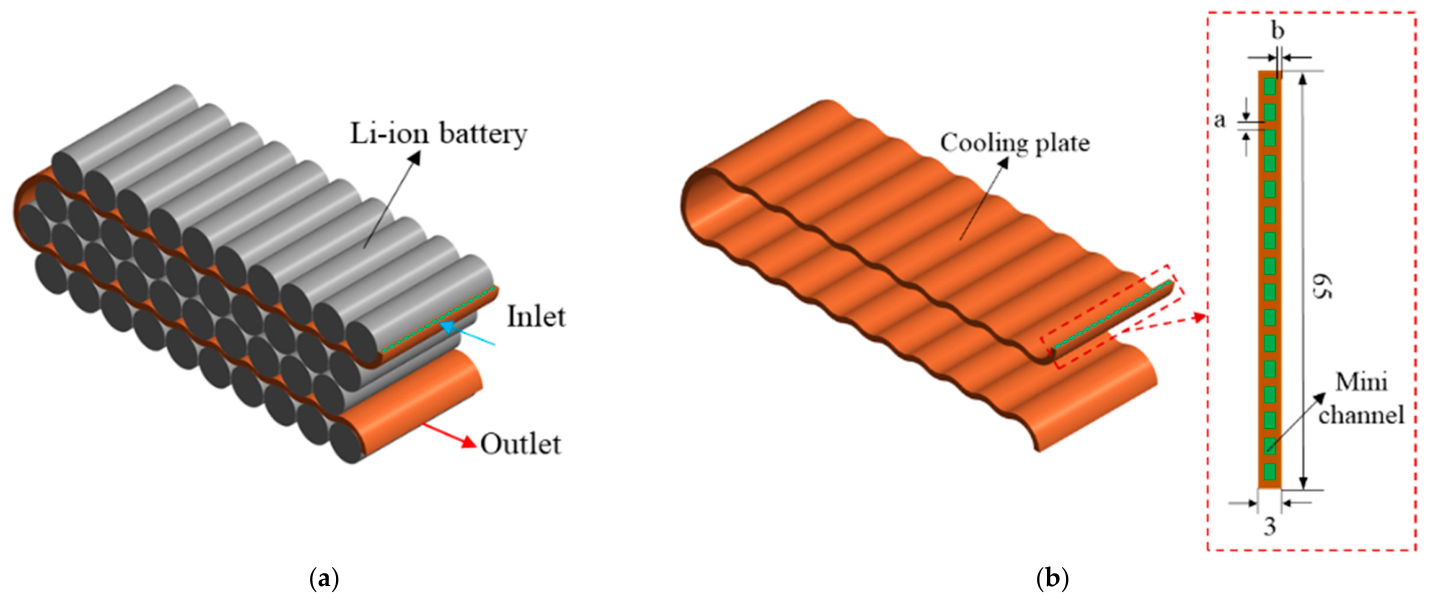
A liquid-cooled cylindrical lithium-ion battery module was developed as the physical model for the present numerical study. As shown in
Figure 1, the module consists of 40 cylindrical 18650 cells arranged in four rows, with ten cells in each row. A mini-channel liquid cooling plate is placed in thermal contact with the battery module to remove the heat generated during battery discharge. The cooling plate adopts a wavy channel configuration and contains 16 mini-channels, which are designed to enhance the contact area between the coolant and the heat-conducting plate while maintaining a compact structure suitable for electric vehicle battery modules.
The geometric configuration of the cooling plate is parameterized by two main structural variables: the mini-channel thickness, denoted as
a, and the wall thickness, denoted as
b. These two parameters directly affect the coolant flow area, heat conduction path, and hydraulic resistance of the cooling plate. The height of the cooling plate is 65 mm, corresponding to the height of the cylindrical 18650 cells. In this study,
a and
b, together with the coolant inlet velocity
v, are selected as the key design variables for the subsequent thermal–hydraulic optimization. The main specifications of the battery cell and the thermophysical properties of the materials used in the battery module, cooling plate, and coolant are listed in
Table 1 and
Table 2, respectively.
The computational geometry was constructed in ANSYS Workbench 2022 R2 and the CFD simulations were performed using ANSYS Fluent 2022 R2. In the model, the battery cells are treated as heat-generating solid domains, while the cooling plate and coolant channels are modeled as solid and fluid domains, respectively. This configuration allows the coupled heat transfer between the battery cells, cooling plate, and coolant to be evaluated under different geometric and operating conditions. Therefore, the established model provides a suitable basis for analyzing the effects of mini-channel geometry and coolant velocity on the maximum temperature, temperature difference, and pressure drop of the battery thermal management system.
The battery specifications and thermophysical properties used in the CFD model are summarized in
Table 1 and
Table 2, respectively. These parameters were adopted from the reference model and material database to ensure consistency in the numerical simulation.
The geometric parameters in
Table 1 were used to construct the cylindrical battery domains, whereas the thermophysical properties in
Table 2 were assigned to the corresponding battery, cooling plate, and coolant domains in the governing equations. In particular, the coolant density and viscosity were also used to evaluate the Reynolds number in Equation (8).
2.2. Governing Equations and Model Assumptions
The coupled heat-transfer and fluid-flow behavior of the battery thermal management system was described using the conservation equations for the battery cells, cooling plate, and coolant. In the CFD model, the cylindrical battery cells and the aluminum cooling plate were treated as solid domains, while the water coolant flowing through the mini-channels was modeled as an incompressible Newtonian fluid. The model was established to compare the thermal–hydraulic performance of different cooling plate designs under consistent operating conditions.
To make the numerical analysis suitable for surrogate-assisted multi-objective optimization, several assumptions were adopted. First, the thermophysical properties of the battery cell, aluminum cooling plate, and water coolant were assumed to be constant within the investigated temperature range. Second, each battery cell was modeled as a uniform volumetric heat source under the prescribed 4C discharge condition. Third, the coolant was assumed to be incompressible and Newtonian. Fourth, the coolant flow was treated as laminar because the calculated Reynolds number was lower than 2300. Finally, thermal contact resistance between the battery cells and the cooling plate, external natural convection, and radiative heat transfer were neglected. These assumptions allow the effects of mini-channel geometry and coolant inlet velocity on the maximum temperature, temperature difference, and pressure drop to be evaluated under the same baseline conditions.
These assumptions were adopted to make the CFD model computationally feasible and to ensure that all design cases were evaluated under the same modeling conditions. This treatment is consistent with the objective of the present study, which is to compare and optimize the thermal–hydraulic performance of different mini-channel cooling plate designs rather than reproduce every detail of a practical battery pack. Therefore, the assumptions are considered appropriate for evaluating the relative performance trends, sensitivity of design variables, and Pareto-based selection of the optimized design.
The possible effects of the neglected heat-transfer paths should also be noted. Neglecting thermal contact resistance idealizes the heat transfer between the battery cells and the cooling plate and may lead to a lower predicted Tmax. By contrast, neglecting external natural convection and radiation removes possible heat loss to the surroundings, which may slightly increase the predicted temperature. These effects mainly influence the absolute temperature level, while the relative comparison among design candidates remains meaningful because all cases are evaluated using the same assumptions. Further experimental validation and more detailed electro-thermal modeling will be considered in future work to improve the practical applicability of the proposed design framework.
For the battery cell domain, the energy conservation equation with internal heat generation is expressed as
where
,
,
, and
are the density, specific heat capacity, temperature, and thermal conductivity of the battery cell, respectively.
denotes the volumetric heat generation rate of the battery cell. In this study,
was applied as a uniform volumetric heat source in each cell. This treatment was adopted to isolate the effects of mini-channel geometry and coolant velocity on the thermal–hydraulic performance of the cooling plate. Although the actual heat generation of lithium-ion batteries may vary with state of charge, temperature, and discharge history, the prescribed heat source provides a consistent basis for comparing different cooling plate designs. Under the 4C discharge condition,
was set to 74,163 W m
−3, following the reference model used for CFD validation.
The uniform volumetric heat generation assumption was used to keep the same thermal load for all design cases and to focus on the effects of cooling plate geometry and coolant inlet velocity. This treatment is suitable for the comparative optimization carried out in this study. However, local heat generation non-uniformity inside practical cells is not fully represented in the present model.
For the aluminum cooling plate, no internal heat generation was considered. Heat conduction in the cooling plate is therefore governed by
where
,
,
and
are the density, specific heat capacity, temperature, and thermal conductivity of the cooling plate, respectively.
The coolant flow inside the mini-channels was described by the mass and momentum conservation equations. For incompressible flow, the continuity equation is written as
where
u is the local coolant velocity vector in the mini-channels.
The momentum conservation equation for the coolant is given by
where
,
u,
p, and
are the coolant density, velocity vector, static pressure, and dynamic viscosity, respectively.
The energy conservation equation for the coolant is expressed as
where
,
, and
are the specific heat capacity, temperature, and thermal conductivity of the coolant, respectively.
At the solid–fluid interfaces, temperature continuity and heat-flux continuity were imposed as
where the subscript s represents the solid domain adjacent to the coolant, and n is the unit normal vector at the solid–fluid interface.
The coolant flow regime was evaluated using the Reynolds number,
Here,
u denotes the local coolant velocity vector field inside the mini-channels, whereas
v denotes the prescribed scalar inlet velocity used as a design variable. In the Reynolds number calculation,
v is used as the representative inlet velocity magnitude together with the hydraulic diameter
to characterize the channel-scale flow regime.
where
is the cross-sectional area of the coolant channel, and
is the wetted perimeter of the mini-channel.
The Reynolds number was checked using the largest inlet velocity considered in this study, v = 0.30 m s−1. The estimated Reynolds number was approximately 657.3, which is well below the critical value of 2300. In addition, the Reynolds number remained below 2300 within the investigated ranges of coolant inlet velocity and mini-channel geometry. Therefore, the laminar-flow assumption is considered valid within the present design space.
2.3. Boundary Conditions and Numerical Settings
The CFD simulations were conducted under a prescribed 4C discharge condition. Water was used as the coolant, and the inlet coolant temperature was set to 300 K. A velocity-inlet boundary condition was assigned at the channel inlet, while a pressure-outlet boundary condition with a gauge pressure of 0 Pa was applied at the outlet. No-slip conditions were imposed on the channel walls.
The external surfaces of the cooling plate were assumed to be adiabatic, except for the coolant inlet and outlet openings. Each battery cell was modeled as a uniform volumetric heat source, and the heat generation rate was set to 74,163 W m−3 at the 4C discharge condition. Thermal contact resistance, external natural convection, and radiation were neglected to focus on the effects of mini-channel geometry and coolant velocity on the thermal–hydraulic performance.
The pressure–velocity coupling was solved using the SIMPLE algorithm. The residual convergence criterion for the continuity, momentum, and energy equations was set to 10
−6. During the simulations,
Tmax, Δ
T, and Δ
p were monitored and extracted as the main thermal–hydraulic responses for subsequent surrogate modeling and optimization. The boundary conditions and numerical settings used in the CFD simulations are summarized in
Table 3.
These settings were kept unchanged for all design cases to ensure a consistent comparison of the thermal–hydraulic responses.
2.4. Grid Independence Test
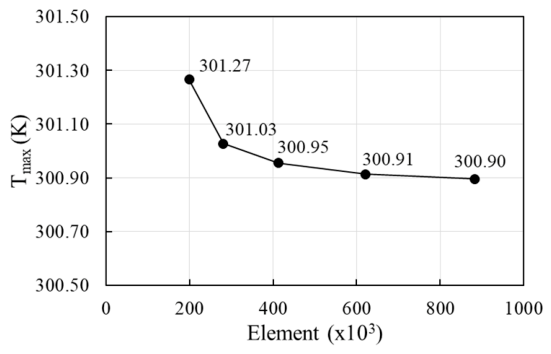
A grid independence test was performed to verify that the CFD results were not sensitive to the mesh resolution. Five mesh densities were examined, and the maximum battery temperature,
Tmax, was used as the comparison criterion. As shown in
Figure 2,
Tmax gradually stabilized as the number of elements increased. When the mesh was refined from 413,152 to 621,760 elements, the variation in
Tmax was only 0.04 K, indicating that further mesh refinement had a negligible effect on the thermal prediction.
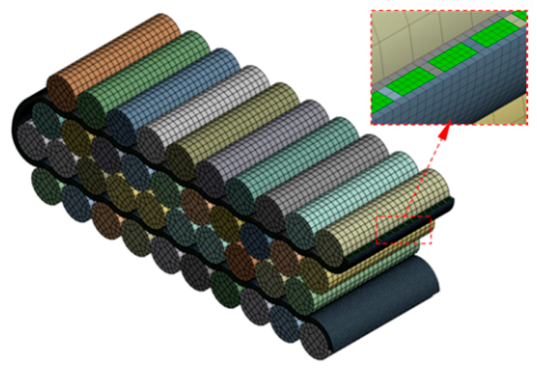
Considering both numerical accuracy and computational cost, the mesh with 413,152 elements was selected for all subsequent simulations. The selected mesh contained 682,722 nodes and 413,152 elements, with a maximum skewness of 0.51 and a minimum orthogonal quality of 0.76, confirming that the mesh quality was acceptable for the present CFD analysis. The final mesh configuration is shown in
Figure 3, and the main mesh quality parameters are summarized in
Table 4.
3. Surrogate-Assisted Multi-Objective Optimization Framework
3.1. Design Variables and Objective Functions
The optimization problem was formulated to improve the thermal–hydraulic performance of the mini-channel liquid cooling plate. Three parameters were selected as design variables: the mini-channel thickness a, the wall thickness b, and the coolant inlet velocity v. The two geometric parameters, a and b, influence the coolant flow area, the heat conduction path through the cooling plate, and the resulting hydraulic resistance. The coolant inlet velocity v directly affects convective heat transfer and pressure loss. These three variables were therefore used to characterize the main structural and operating factors of the cooling system.
The thermal–hydraulic performance of the mini-channel liquid cooling plate was evaluated using three objective functions: the maximum battery temperature Tmax, the temperature difference within the battery module ΔT, and the pressure drop of the coolant channel Δp. Tmax represents the peak temperature of the battery cells and is used to evaluate thermal safety. ΔT is defined as the difference between the maximum and minimum cell temperatures, indicating the temperature uniformity of the battery module. Δp is defined as the pressure difference between the coolant inlet and outlet, representing the hydraulic resistance of the cooling plate. A balanced design should reduce the battery temperature and improve temperature uniformity without causing excessive pressure loss.
The multi-objective optimization problem is expressed as
where the design vector is
subject to
where
a and
b are given in millimeters and
v is given in m s
−1. The objective values were obtained from CFD simulations and then used to construct the GPR surrogate models. The design variables and objective functions are summarized in
Table 5.
The initial structure was selected as a reference baseline using the midpoint values of the prescribed design ranges. Specifically, a = 1.400 mm, b = 0.900 mm, and v = 0.165 m s−1 correspond to the central values of the investigated ranges. This initial design was used only for comparison with the optimized design and was not used to restrict the NSGA-II search.
The design ranges of a, b, and v were selected based on the available geometric space of the cylindrical 18650 battery module, the compact layout of the wavy mini-channel cooling plate, manufacturability, and hydraulic resistance considerations. The lower bound of the wall thickness was used to avoid an excessively thin channel wall, which may reduce structural reliability and increase manufacturing difficulty. Therefore, the optimization domain represents a feasible engineering design space rather than an unrestricted mathematical range.
3.2. Latin Hypercube Sampling and CFD Dataset
Latin hypercube sampling (LHS) was used to generate the design dataset for surrogate modeling. Compared with a full-factorial design, LHS provides better space-filling capability with a limited number of samples, making it suitable for CFD-based optimization problems where each simulation is computationally expensive. In this study, 60 design points were generated within the prescribed ranges of the three design variables: mini-channel thickness a, wall thickness b, and coolant inlet velocity v.
For each sampled design point, a CFD simulation was conducted under the same boundary conditions and numerical settings described in
Section 2.3. The corresponding thermal–hydraulic responses, including the maximum battery temperature
Tmax, the temperature difference Δ
T, and the pressure drop Δ
p, were then extracted from the CFD results. The generated dataset therefore consists of three input variables (
a,
b,
v) and three output responses (
Tmax, Δ
T, Δ
p), as summarized in
Table 6.
This CFD dataset was subsequently used to construct the GPR surrogate models. By using LHS, the design points were distributed over the entire design space, which helps the surrogate models capture the nonlinear relationships between the design variables and the thermal–hydraulic responses. The trained surrogate models were then integrated with NSGA-II to efficiently search for Pareto-optimal solutions without requiring a large number of additional CFD simulations.
The dataset in
Table 6 shows a wide variation in
Tmax, Δ
T, and Δ
p, indicating that the selected design variables have clear effects on both cooling performance and hydraulic resistance. This confirms the suitability of the dataset for surrogate-assisted multi-objective optimization.
3.3. Gaussian Process Regression Model
Gaussian process regression (GPR) was used to construct surrogate models for the thermal–hydraulic responses of the mini-channel liquid cooling plate. In CFD-based battery thermal management optimization, direct evaluation of each design candidate is computationally expensive because a full numerical simulation is required. Therefore, surrogate-assisted optimization has been widely adopted to reduce computational cost while maintaining acceptable prediction accuracy in battery cooling design problems [
18,
20,
22,
32,
33].
Using the design vector x defined in Equation (11), three independent GPR models were developed for Tmax, ΔT, and Δp. This separate-model strategy was adopted because the three responses have different physical meanings and numerical scales. Tmax is related to the peak thermal load of the battery module, ΔT reflects temperature uniformity, and Δp represents the hydraulic resistance of the coolant flow.
For a response variable
y, the GPR model is written as
where
is the unknown nonlinear mapping between the design variables and the response, and
is the model noise. The latent function
is assumed to follow a Gaussian process:
where
is the mean function and
is the covariance function. The covariance function describes the correlation between different design points and allows the GPR model to capture nonlinear variations in the CFD responses. This is useful for the present problem because the cooling performance and pressure drop vary nonlinearly with mini-channel geometry and coolant inlet velocity.
For a new design point
, the predicted response is calculated as
where
is the predicted response at a new design point, and
denotes a new combination of
a,
b, and
v.
X and
y are the training input matrix and CFD response vector obtained from the LHS–CFD dataset, respectively.
K is the covariance matrix of the training samples,
is the covariance vector between
, and the training samples,
is the noise variance, and
I is the identity matrix. The trained GPR model was then used to predict
Tmax, Δ
T, and Δ
p for candidate designs during the NSGA-II optimization.
The prediction accuracy of the GPR models was evaluated using the coefficient of determination
and the root mean square error (RMSE):
where
is the CFD response,
is the GPR-predicted response,
is the mean value of the CFD responses, and
n is the number of samples.
A higher R2 value and a lower RMSE value indicate better agreement between the surrogate predictions and the CFD results. After the predictive accuracy was confirmed, the three trained GPR models were used as surrogate objective functions for Tmax, ΔT, and Δp. This strategy allowed many candidate designs to be evaluated efficiently without repeated high-fidelity CFD simulations. The full CFD model was then retained only for the final verification of the selected compromise design after the NSGA-II search. The integration of the validated GPR surrogate models with NSGA-II is described in the next subsection.
3.4. NSGA-II Optimization and Compromise Solution Selection
Based on the validated GPR surrogate models described in
Section 3.3, NSGA-II was employed to search for Pareto-optimal solutions of the mini-channel liquid cooling plate. During the optimization, the design variables
a,
b, and
v were constrained within the ranges defined in
Section 3.1, while the three surrogate-predicted objective functions,
Tmax, Δ
T, and Δ
p, were minimized simultaneously. NSGA-II was selected because it can handle conflicting objectives without converting them into a single weighted objective function. This feature is important for the present problem, since improving heat dissipation and temperature uniformity may increase the coolant pressure drop.
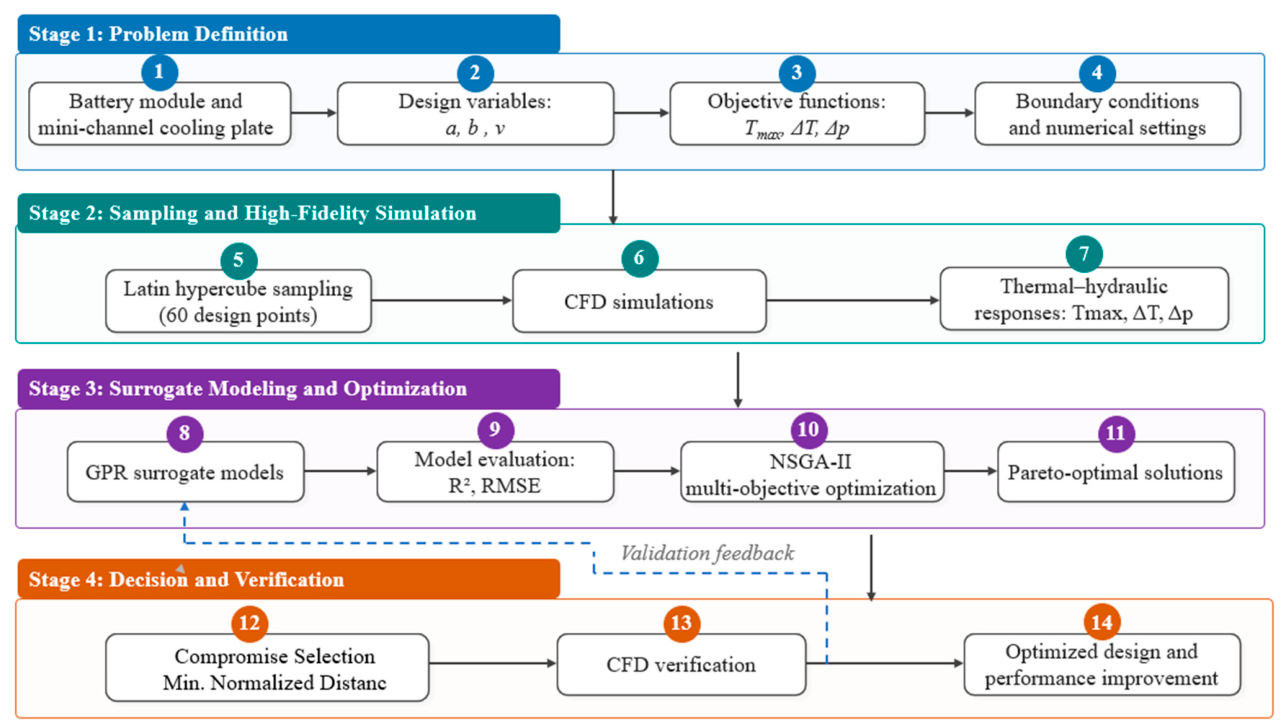
During the optimization, candidate solutions were ranked using the non-dominated sorting strategy, and solution diversity along the Pareto front was maintained using the crowding-distance mechanism. As a result, the algorithm generated a set of Pareto-optimal solutions representing different trade-offs among cooling capacity, temperature uniformity, and hydraulic resistance. As illustrated in
Figure 4, the workflow consists of LHS-based design sampling, CFD simulation, GPR surrogate modeling, NSGA-II optimization, compromise solution selection, and final CFD verification of the selected design.
To provide a quantitative basis for selecting the final design, the compromise solution was determined using a normalized distance-to-ideal-point criterion. This strategy is consistent with the multi-objective optimization framework of NSGA-II, in which non-dominated solutions are first generated and then further analyzed to identify a practical trade-off solution [
37]. Similar decision-making procedures have also been used in recent battery thermal management optimization studies involving cold plates, NSGA-II, and TOPSIS-based compromise selection [
23,
24]. Since
Tmax, Δ
T, and Δ
p have different physical units and numerical scales, each objective value was first normalized within the Pareto solution set as
where
is the value of the
i-th objective function, and
and
are the minimum and maximum values of that objective among the Pareto solutions, respectively. The normalized objective vector of the
j-th Pareto solution is expressed as
The distance between each Pareto solution and the ideal point was then calculated by
The Pareto solution with the minimum was selected as the final compromise design. This selection strategy avoids a purely visual choice of the Pareto point and provides a balanced trade-off among cooling capacity, temperature uniformity, and hydraulic resistance.
4. Results and Discussion
4.1. Validation of the Numerical Framework Using a Benchmark Liquid-Cooled Battery Case
Before applying the model to the proposed mini-channel cooling plate, a benchmark case reported by Xu et al. [
38] was reproduced. This benchmark was used to check the CFD framework for liquid-cooled cylindrical battery modules, including the governing equations, material properties, boundary conditions, and solver settings. It was not intended to directly validate the exact mini-channel geometry optimized in this study.
The benchmark case used an 18,650 cylindrical battery module cooled by pure water. The coolant inlet temperature was 298.15 K, the inlet velocity was 0.3 m s
−1, and the volumetric heat generation rate was 42,400 W m
−3, corresponding to a 3C discharge condition. These settings were kept consistent with the reference study [
38].
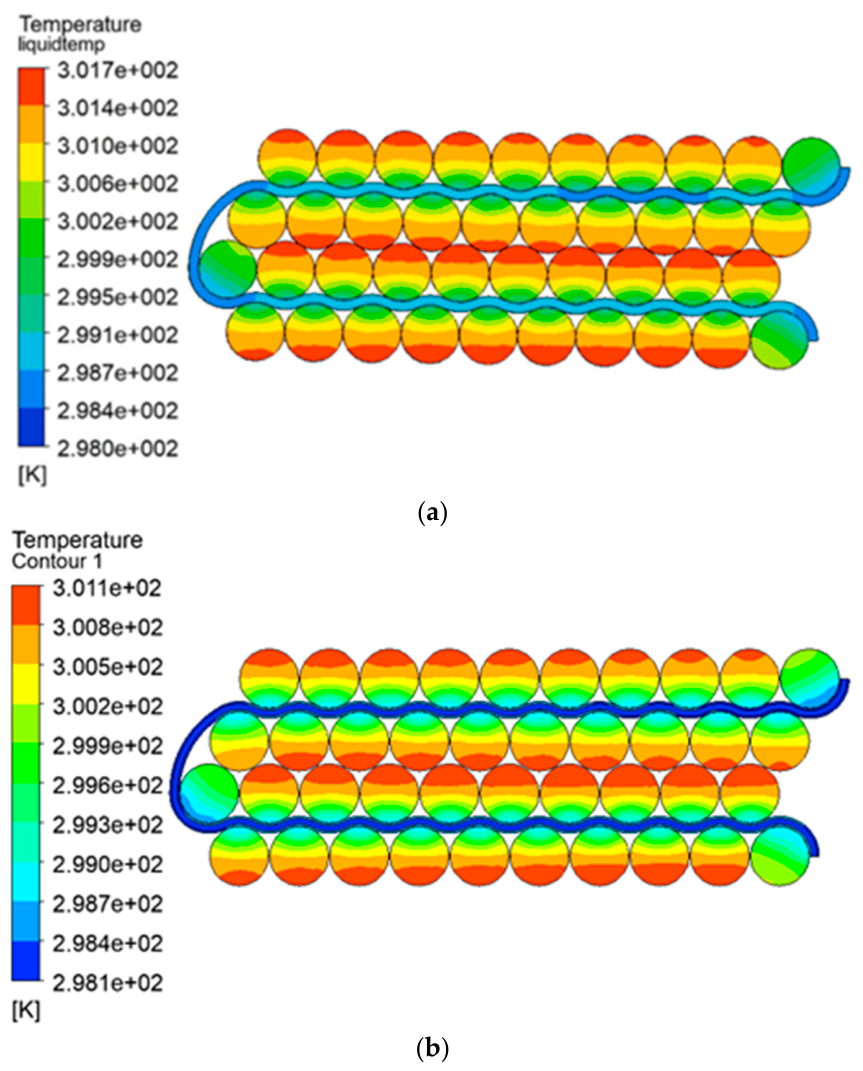
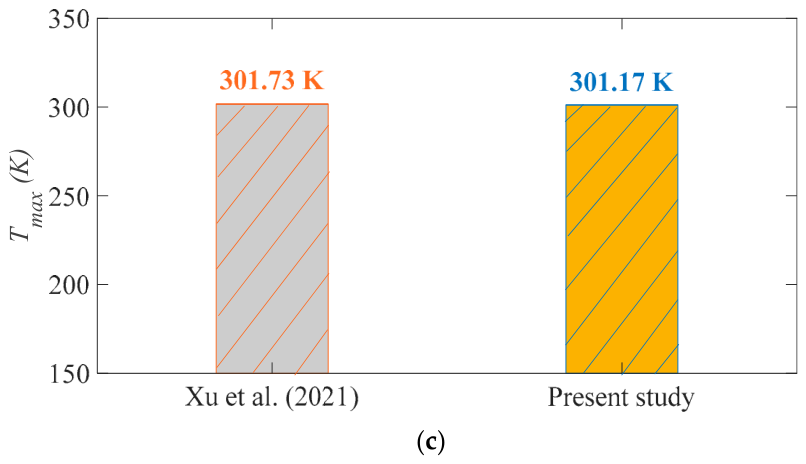
Figure 5 presents the benchmark validation results. As shown in
Figure 5a, the maximum battery temperature predicted by the present CFD model is
Tmax = 301.17 K, while the corresponding value reported by Xu et al. [
38] is 301.73 K. The relative deviation is 0.19%, indicating good agreement between the present simulation and the reference result.
Figure 5b shows the temperature contour obtained from the present CFD model. The contour is physically reasonable, with lower temperatures near the coolant path and higher temperatures in regions farther from the coolant inlet.
It should be noted that the benchmark case and the mini-channel cooling plate in this study are different in geometry. Therefore, this validation supports the reliability of the CFD framework for liquid-cooled battery thermal analysis, rather than serving as a direct validation of the final mini-channel design. After this benchmark check, the same governing equations, material models, boundary-condition treatment, and solver settings were applied to the proposed mini-channel cooling plate. The optimized mini-channel design was further verified by full CFD simulation after the GPR–NSGA-II optimization.
It should be noted that the benchmark validation confirms the reliability of the CFD modeling procedure, but it does not directly validate the final optimized mini-channel configuration. The optimized design was further re-evaluated using full CFD simulation to check the consistency of the surrogate-assisted optimization result. Nevertheless, the final design is still verified numerically rather than experimentally. Experimental validation of the optimized cooling plate will therefore be considered in future work.
Overall, although the benchmark does not directly validate the optimized geometry, the small deviation from the reference result supports the suitability of the CFD framework for the subsequent thermal–hydraulic analysis and numerical optimization.
4.2. Predictive Accuracy of the GPR Surrogate Models
Using the LHS–CFD dataset summarized in
Table 6, the predictive accuracy of the GPR surrogate models was evaluated using
R2 and RMSE, as defined in Equations (16) and (17).
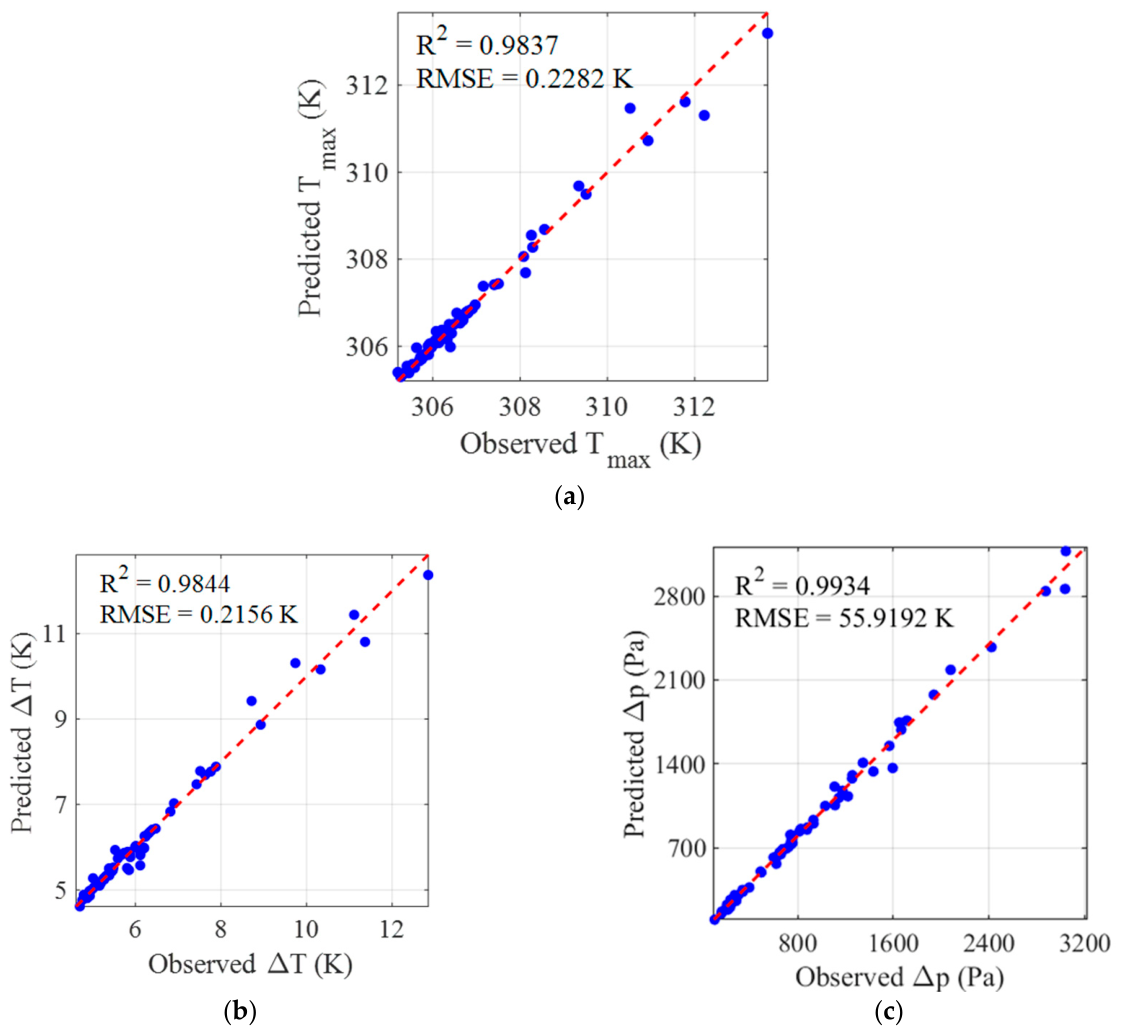
Figure 6 compares the GPR-predicted responses with the corresponding CFD results for the three objective functions. Overall, the data points are close to the
y = x reference line, indicating that the surrogate models can reproduce the CFD responses with good accuracy within the investigated design space.
For the maximum battery temperature,
Figure 6a shows that the predicted
Tmax values agree closely with the CFD results. The model gives
R2 = 0.9837 and
RMSE = 0.2282 K, indicating a small prediction error for the peak thermal response of the battery module. Since
Tmax is directly related to battery thermal safety, this level of agreement supports the use of the GPR model for optimization.
For the temperature difference,
Figure 6b also shows a close match between the predicted and CFD-based Δ
T values. The model achieves
R2 = 0.9844 and
RMSE = 0.2156 K, confirming that it can capture the variation in temperature uniformity caused by changes in the mini-channel thickness
a, wall thickness
b, and coolant inlet velocity
v.
For the pressure drop,
Figure 6c shows slightly greater scatter than
Figure 6a,b, especially in the higher-pressure region. This trend is reasonable because Δ
p is strongly affected by coolant velocity and channel geometry, and its numerical range is much wider than those of
Tmax and Δ
T. Nevertheless, the model still provides good predictive performance, with
R2 = 0.9934 and
RMSE = 55.9192 Pa. This accuracy is acceptable for surrogate-assisted thermal–hydraulic optimization.
Overall, all three GPR surrogate models achieve R2 values higher than 0.98. These results confirm that the models can approximate the nonlinear relationships between the design variables (a, b, v) and the responses (Tmax, ΔT, Δp). Therefore, the trained GPR models were used as surrogate objective functions in the subsequent NSGA-II optimization, reducing repeated CFD simulations while maintaining sufficient prediction accuracy.
To further examine the generalization ability of the GPR surrogate models, a five-fold cross-validation (CV) was performed. The 60 LHS–CFD samples were divided into five subsets. In each fold, 48 samples were used for training and the remaining 12 samples were used for validation. The process was repeated until each subset had been used once as the validation set. As shown in
Table 7, the cross-validation results gave
values of 0.9657, 0.9661, and 0.9942 for
Tmax, Δ
T, and Δ
p, respectively. The corresponding
values were 0.3309 K, 0.3176 K, and 52.6598 Pa. These results confirm that the GPR models have acceptable predictive ability for unseen design points within the investigated design space.
4.3. Sensitivity Analysis and Interaction Effects of Design Variables
Based on the validated GPR surrogate models discussed in
Section 4.2, the effects of the three design variables on the thermal–hydraulic responses were further analyzed.
Table 8 summarizes the relative influence of the design variables estimated from the GPR-based sensitivity analysis within the investigated design space. The coolant inlet velocity
v has the largest contribution to the two temperature-related responses, accounting for 71.92% of
Tmax and 71.54% of Δ
T. For the pressure drop, the wall thickness
b and coolant inlet velocity
v are the two most influential variables, with relative contributions of 52.94% and 41.10%, respectively. This result does not imply that Δ
p is governed by a single parameter only. Instead, it reflects the combined effects of channel geometry, hydraulic diameter, local flow passage, and inlet velocity within the present mini-channel design space.
The mini-channel thickness a has the lowest contribution among the three variables, especially for Δp, where its influence is only 5.96%. Although a is less influential than b and v, it should not be ignored because it still contributes to the thermal response and interacts with the other design variables.
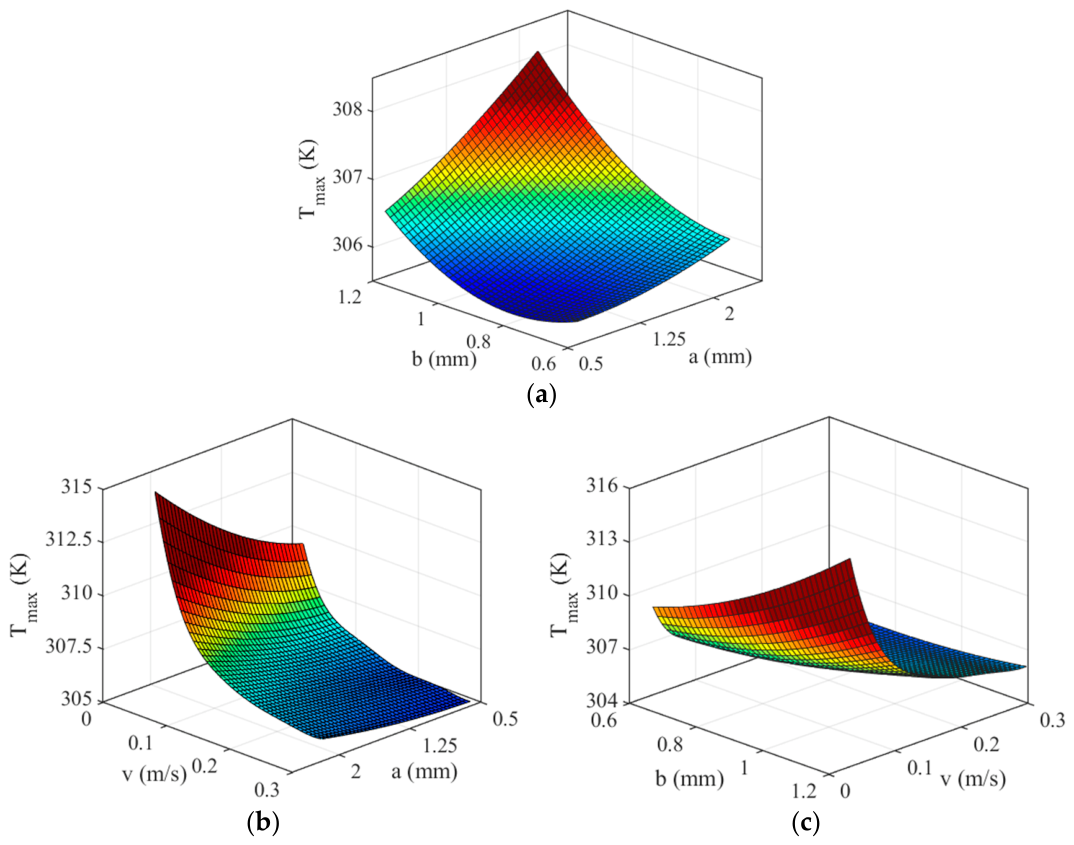
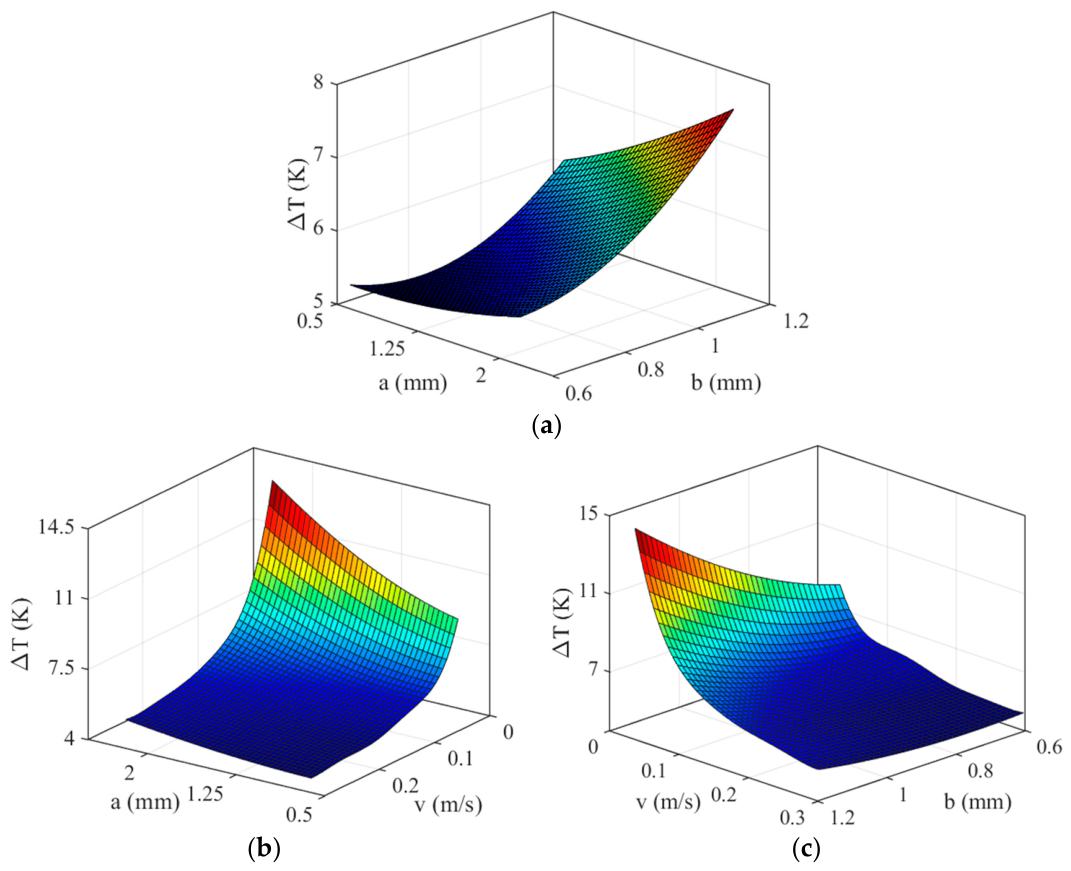
Figure 7 further illustrates the interaction effects of
a,
b, and
v on
Tmax. As shown in
Figure 7a, increasing
a and
b tends to increase
Tmax, indicating that the cooling plate geometry affects the heat conduction path and the effective heat removal process.
Figure 7b,c show that increasing the coolant inlet velocity clearly reduces
Tmax, especially in the low-velocity region. The curved response surfaces indicate nonlinear interactions between the geometric parameters and the operating condition.
Figure 8 presents the response surfaces for Δ
T. The trends are generally consistent with those observed for
Tmax. A higher coolant inlet velocity reduces Δ
T, showing that stronger coolant flow improves temperature uniformity within the battery module. However, larger values of
a and
b tend to increase the temperature difference, suggesting that the geometric design of the mini-channel plate affects not only the peak temperature but also the thermal balance among cells.
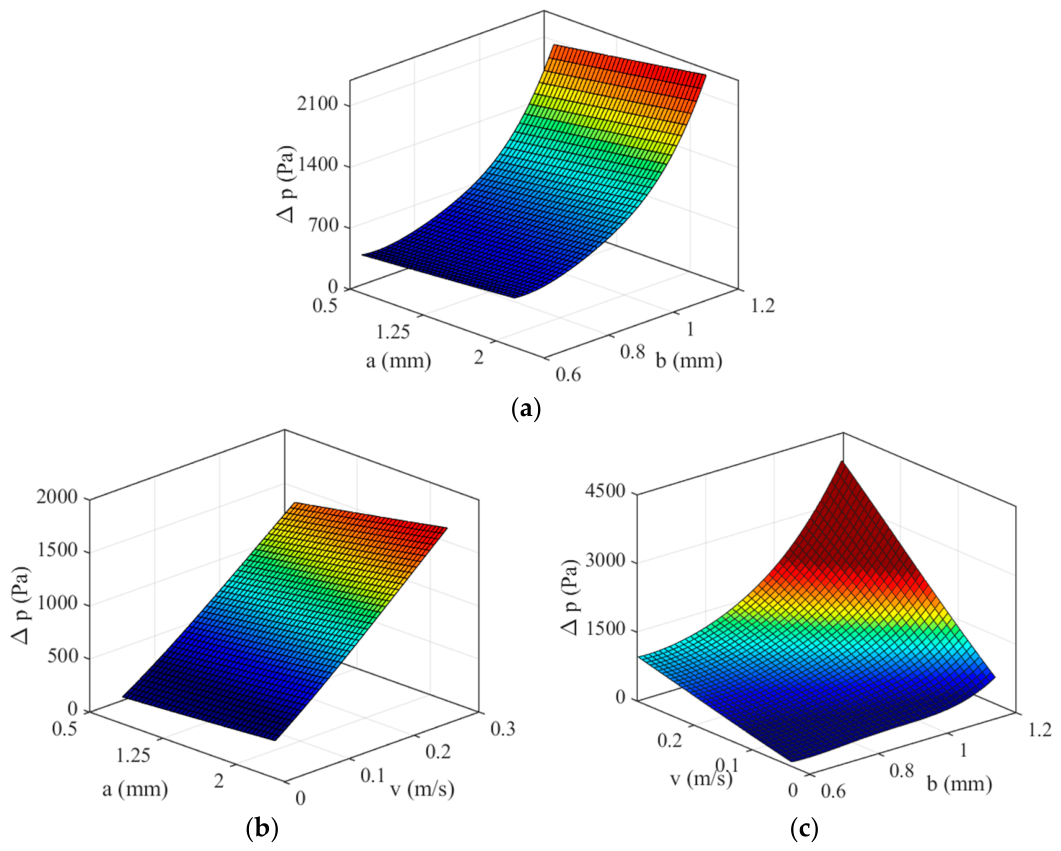
Figure 9 shows the response surfaces for Δ
p. Unlike
Tmax and Δ
T, the pressure drop increases markedly with wall thickness and coolant inlet velocity, especially when the combination of
b and
v at high values leads to substantially increased flow resistance. This result confirms the main thermal–hydraulic trade-off of the cooling plate: increasing
v improves heat dissipation and temperature uniformity, but it also increases pressure loss and pumping demand. Conversely, a decrease in
b is beneficial to both the thermal and hydraulic performance of the cooling plate.
Overall, the sensitivity results in
Table 8 and the response surfaces in
Figure 7,
Figure 8 and
Figure 9 show that the cooling plate should not be optimized based on thermal performance alone. Although coolant inlet velocity is the dominant variable, increasing it without considering pressure loss may reduce hydraulic efficiency. Therefore,
a,
b, and
v need to be optimized simultaneously to obtain a balanced design. These findings provide the physical basis for the subsequent Pareto-based optimization of
Tmax, Δ
T, and Δ
p.
Overall, the above results show that the optimized responses are controlled by the competition between heat-transfer enhancement and hydraulic resistance. The coolant inlet velocity mainly enhances convective heat transfer, while the mini-channel thickness and wall thickness change the effective flow passage, hydraulic diameter, and heat conduction path. Therefore, changing the channel geometry affects both the temperature response and the pressure loss. This explains why Tmax, ΔT, and Δp should be considered together in the optimization process.
To reduce repetition, the discussion of the response surfaces was revised to focus only on the main interaction trends that directly affect heat transfer and pressure loss.
4.4. Thermal–Hydraulic Trade-Off and Pareto Front
Based on the validated GPR surrogate models and the sensitivity analysis discussed in
Section 4.2 and
Section 4.3, NSGA-II was used to search for Pareto-optimal solutions of the mini-channel liquid cooling plate. The GPR surrogate models used in the optimization were trained using the 60 LHS–CFD samples described in
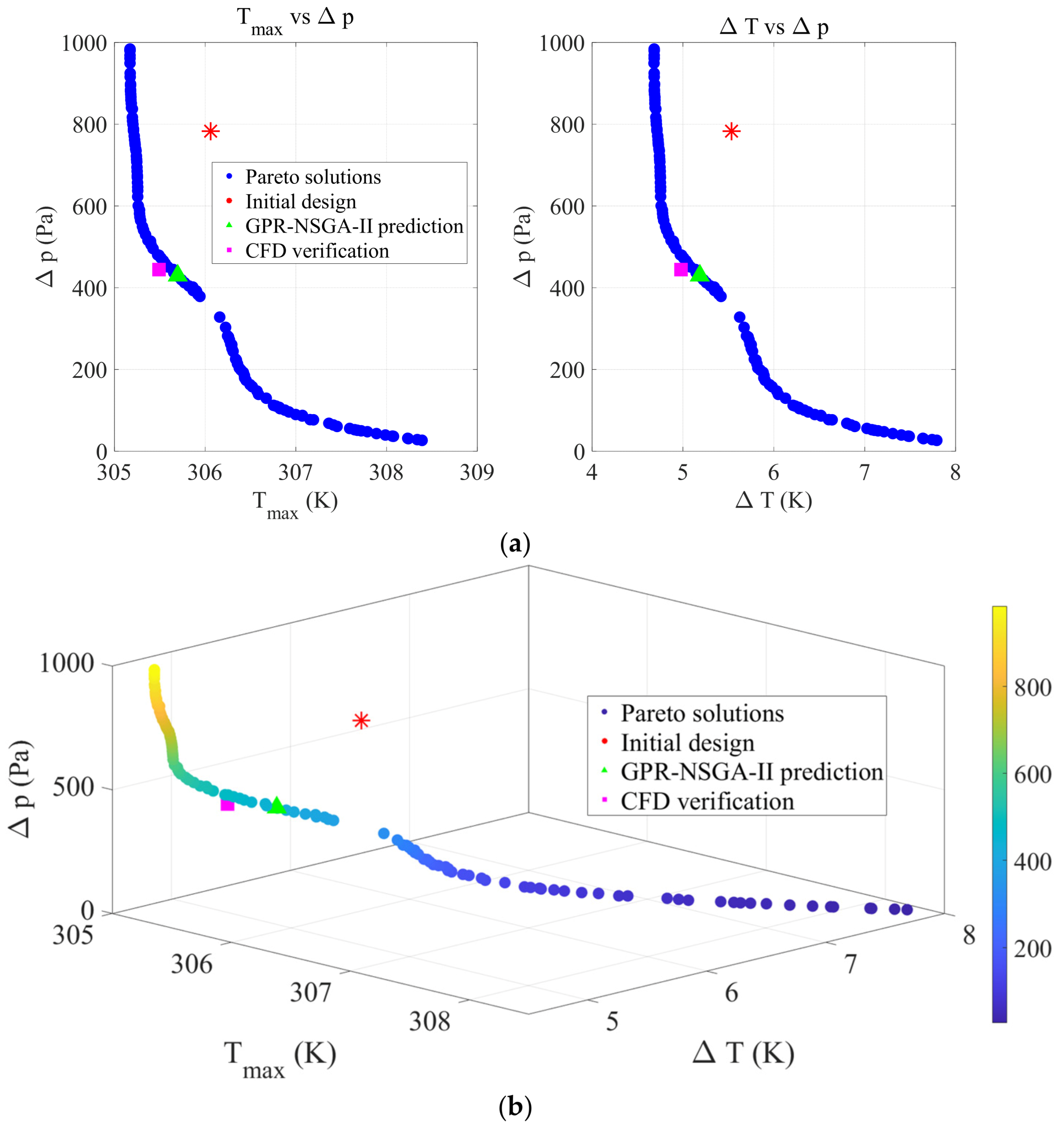
Section 3.2. The resulting Pareto front is shown in
Figure 10, where each point represents a non-dominated design solution with respect to
Tmax, Δ
T, and Δ
p.
Figure 10 shows a clear thermal–hydraulic trade-off among the three objective functions. In
Figure 10a, the
Tmax-Δ
T projection shows that the Pareto solutions with lower
Tmax generally correspond to lower Δ
T, indicating that peak-temperature reduction and temperature-uniformity improvement are not strongly conflicting in the investigated design space. However, the
Tmax-Δ
p and Δ
T-Δ
p projections show a clear conflict between thermal improvement and hydraulic resistance. Solutions with lower
Tmax and lower Δ
T tend to require a higher pressure drop, while solutions with very low Δ
p usually correspond to poorer thermal performance.
This behavior is physically consistent with the sensitivity results in
Section 4.3, where coolant inlet velocity
v was identified as a parameter with a strong influence on both heat removal and hydraulic resistance. Increasing
v enhances convective heat transfer and improves temperature uniformity, but it also increases the pressure loss and pumping demand. Therefore, the Pareto front does not indicate a single design that is best for all three objectives; instead, it provides a set of feasible trade-off solutions.
Figure 10b gives the three-dimensional view of the Pareto front. The initial design, marked by the red star, is located away from the main Pareto front, indicating that its thermal–hydraulic performance can be improved. The selected compromise solution, marked by the yellow square, is positioned in the intermediate region of the front rather than at the extreme low-temperature or low-pressure ends. This location is reasonable because the design objective is not to minimize one response alone, but to balance
Tmax, Δ
T, and Δ
p simultaneously.
From a thermal-management viewpoint, reducing Tmax is important for limiting the peak battery temperature, while reducing ΔT helps improve cell-to-cell temperature uniformity. However, minimizing these two thermal indicators alone may lead to excessive Δp. Therefore, the final design should not be selected only from the lowest-temperature region of the Pareto front. A practical cooling plate requires a compromise between thermal safety, temperature uniformity, and hydraulic efficiency.
The selected compromise solution is marked by the yellow square in
Figure 10. It was determined using the minimum normalized distance to the ideal point, as described in
Section 3.4. Compared with a purely visual selection of the Pareto point, this criterion provides a quantitative basis for balancing the three objectives with different physical units and numerical scales. The selected compromise design was then re-evaluated using the full CFD model in
Section 4.5 to verify the GPR prediction and confirm the thermal–hydraulic improvement.
The selected point is located in the middle part of the Pareto front rather than at either extreme end. This is reasonable because a lower Tmax or ΔT usually requires stronger coolant flow and may increase Δp, while an excessively low Δp may weaken heat removal. Therefore, the final solution was selected using the minimum normalized distance to the ideal point to balance the three objectives with different units and numerical ranges.
4.5. CFD Verification of the Optimized Design
To verify the reliability of the selected compromise solution, the optimized design obtained from the GPR–NSGA-II framework was re-evaluated using the full CFD model. The comparison among the initial structure, the NSGA-II-predicted solution, and the CFD-verified optimized design is summarized in
Table 9. The selected design corresponds to
a = 0.607 mm,
b = 0.693 mm, and
v = 0.164 m s
−1.
As shown in
Table 9, the CFD-verified optimized design reduces
Tmax from 306.061 K to 305.492 K, corresponding to a decrease of 0.569 K. When expressed relative to the initial Celsius-scale temperature, this reduction is approximately 1.73%. Although the reduction in peak temperature is moderate, it is accompanied by more evident improvements in temperature uniformity and hydraulic performance. Specifically, Δ
T decreases from 5.535 K to 4.978 K, corresponding to a reduction of 0.557 K, or 10.06%. Meanwhile, Δ
p decreases from 782.853 Pa to 444.241 Pa, corresponding to a reduction of 338.612 Pa, or 43.25%. These results show that the optimized mini-channel design improves the overall thermal–hydraulic balance rather than only reducing the maximum battery temperature.
The reduction in pressure drop is mainly related to the optimized flow resistance of the mini-channel structure. Although the coolant inlet velocity changes only slightly from 0.165 m s−1 to 0.164 m s−1, Δp decreases markedly from 782.853 Pa to 444.241 Pa. This indicates that the optimized channel geometry, especially the combined change in mini-channel thickness and wall thickness, improves the effective flow passage and reduces hydraulic resistance.
It should be noted that the initial structure serves only as a baseline case for evaluating the improvement after optimization. The final compromise solution was obtained from the Pareto search over the full feasible design space and was not constrained by the initial baseline values.
The agreement between the NSGA-II prediction and the CFD verification further supports the reliability of the surrogate-assisted optimization. The relative errors are 0.067%, 4.010%, and 3.369% for Tmax, ΔT, and Δp, respectively. The prediction error for ΔT is higher than those for the other two response variables. This is reasonable because ΔT has a relatively small magnitude, so even a small absolute deviation can lead to a larger relative error. Nevertheless, all prediction errors remain within an acceptable range for thermal–hydraulic design optimization, confirming that the GPR surrogate models can reliably guide the NSGA-II search within the investigated design space.
It is also worth noting that the pressure drop is reduced significantly despite only a very slight decrease in the coolant inlet velocity, from 0.165 m s−1 in the initial structure to 0.164 m s−1 in the optimized design. This indicates that the optimized combination of mini-channel thickness and wall thickness contributes to lowering hydraulic resistance while maintaining improved heat removal. Therefore, the benefit of the optimized design is not limited to a lower peak temperature; it also provides a more uniform temperature field and reduced pressure loss.
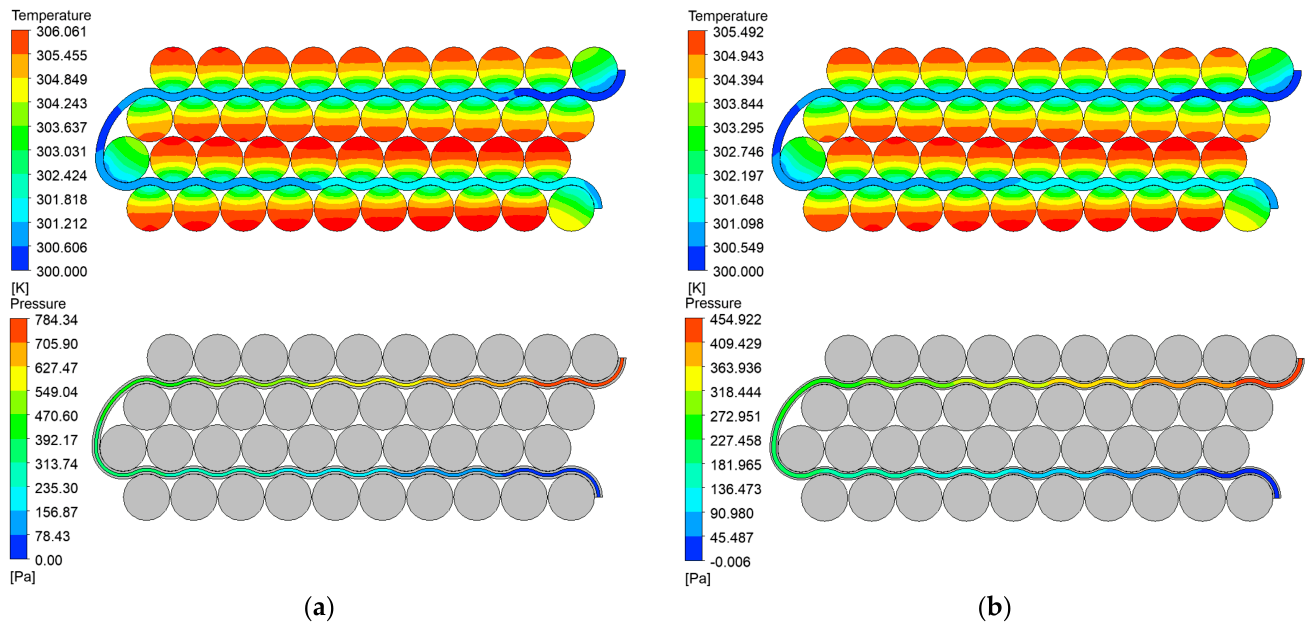
Figure 11 compares the temperature and pressure distributions before and after optimization. After optimization, the high-temperature region in the battery module becomes slightly weaker, and the temperature distribution is more uniform. The pressure contour also shows a lower pressure level along the coolant path, which is consistent with the reduced Δ
p reported in
Table 9. It should be noted that Δ
p in
Table 9 is calculated from the area-averaged static pressure difference between the coolant inlet and outlet, whereas the pressure contours show local pressure distributions inside the computational domain.
Compared with previous liquid-cooling BTMS optimization studies, the reduction in Tmax obtained in this work is modest. However, the optimized design gives clearer improvements in temperature uniformity and pressure loss. In particular, ΔT is reduced by 10.06%, and Δp is reduced by 43.25%, while Tmax still decreases slightly. A strict one-to-one comparison with the literature is difficult because different studies use different battery modules, cooling-channel structures, discharge rates, design variables, and objective functions. Even so, the present results show that the optimized wavy mini-channel cooling plate is useful mainly because it improves thermal uniformity and reduces hydraulic resistance at the same time.
The selected compromise solution is close to the lower bound of some geometric variables. This indicates that reducing these dimensions is beneficial within the investigated design space. However, the result should be interpreted as an optimum within the prescribed feasible range, not as a global optimum outside this range. Further reduction beyond the lower bound would require additional mechanical, manufacturing, and experimental constraints.
Overall, the CFD verification confirms that the proposed CFD–GPR–NSGA-II framework can identify a physically reliable compromise design for the mini-channel liquid cooling plate. The optimized configuration achieves a moderate reduction in peak temperature, a clear improvement in temperature uniformity, and a lower pressure drop. This balanced improvement is particularly important for electric vehicle battery thermal management, where both thermal safety and hydraulic efficiency must be considered simultaneously.
4.6. Robustness Check Under Different Heat Generation Levels
In the numerical model described in
Section 2.2, the heat generated inside each battery cell was represented by a uniform volumetric heat source
in the battery energy equation. This formulation allows the heat-load level to be adjusted directly while keeping the same governing equations, material properties, boundary conditions, coolant-flow setting, and optimized cooling plate geometry. Based on this setup, the CFD-verified optimized design was further examined under different volumetric heat generation levels to check whether its thermal response remains consistent beyond the nominal operating condition.
Four additional heat-load cases were considered, namely
,
,
, and
, where
denotes the nominal volumetric heat generation rate used in the optimization. The nominal case (
) was already discussed in
Section 4.5 and is included in
Table 10 for comparison.
As listed in
Table 10, both
Tmax and Δ
T increase with the heat generation level.
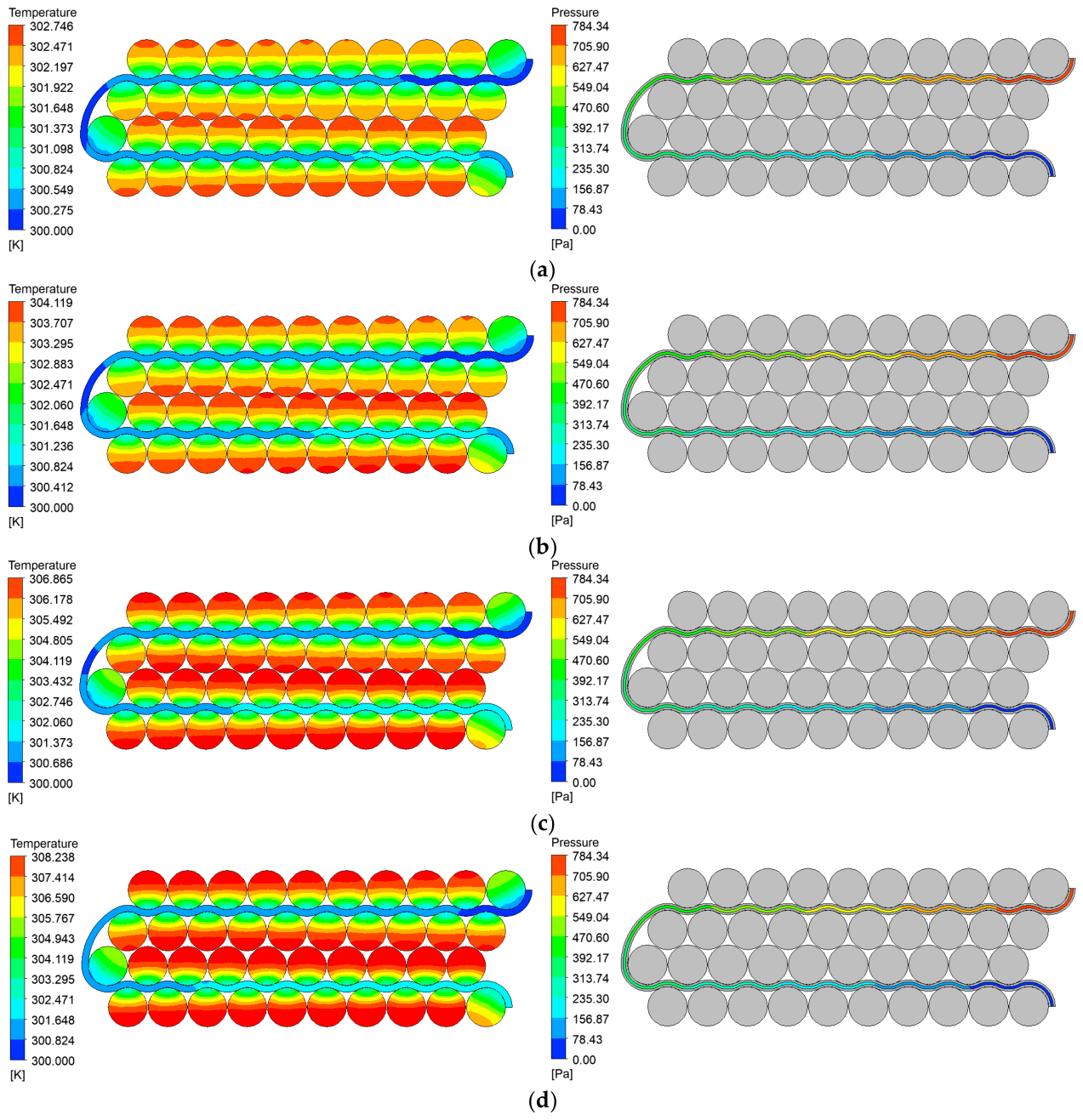
Tmax rises from 302.746 K at
to 308.238 K at
, while Δ
T increases from 2.489 K to 7.468 K. This trend is physically reasonable because a higher volumetric heat source imposes a larger thermal load on the battery module. Therefore, the robustness check mainly evaluates the thermal response of the optimized cooling plate under different heat-load levels.
In this check, the mini-channel geometry, coolant properties, and inlet velocity were kept unchanged. Therefore, the pressure drop is not used as a main comparison index in
Table 10 because it is mainly governed by the fixed flow path and coolant-flow condition. This point also reflects a limitation of the present model: possible coupling effects caused by temperature-dependent coolant properties or non-uniform heat generation are not considered. These effects should be further examined using a more detailed electro-thermal and thermos–fluid coupling model.
Figure 12 further shows the temperature and pressure contours of the optimized design under different heat generation levels. As
increases, the high-temperature region becomes more pronounced, but the overall temperature distribution remains consistent. The pressure contours are nearly identical among the four cases, confirming that the pressure field is insensitive to the heat generation level when the flow condition and channel geometry are unchanged.
It should be noted that the robustness check was still performed with spatially uniform heat generation. Therefore, it mainly shows how the optimized cooling plate responds to different heat-load levels, rather than to local heat generation non-uniformity inside real cells. This treatment is acceptable for comparing cooling plate designs under controlled conditions, while a more detailed electro-thermal heat generation model is needed for final practical validation.
4.7. Engineering Implications for EV Battery Thermal Management
The obtained results provide useful guidance for the practical design of liquid-cooled EV battery thermal management systems. The optimized mini-channel cooling plate does not achieve its improvement simply by increasing the coolant flow rate. Although the coolant inlet velocity changes only slightly by 0.001 m s−1, the pressure drop decreases from 782.853 Pa to 444.241 Pa. This indicates that the optimized combination of mini-channel thickness and wall thickness can improve the flow path and reduce hydraulic resistance while maintaining effective heat removal.
From a thermal–safety viewpoint, the reduction in Tmax is moderate. However, the decrease in ΔT from 5.535 K to 4.978 K, corresponding to a reduction of 10.06%, is important for improving temperature uniformity within the battery module. A more uniform temperature field can help reduce cell-to-cell thermal imbalance, which is closely related to cell consistency, aging uniformity, and the long-term reliability of EV battery packs. Therefore, the optimized design should be evaluated not only by the peak temperature but also by the improvement in temperature distribution.
The reduction in pressure drop by 43.25% also has practical relevance. In liquid-cooled BTMSs, a lower pressure drop can reduce the pumping burden of the cooling loop and contribute to better system-level energy efficiency. This is particularly meaningful because the optimized design achieves lower pressure loss while maintaining an almost unchanged coolant inlet velocity. This result indicates that mini-channel geometry optimization can provide a significant advantage in terms of hydraulic performance.
The sensitivity analysis further shows that coolant inlet velocity is the dominant factor affecting both heat removal and pressure loss, while the geometric variables a and b still influence the heat conduction path and the hydraulic resistance. Therefore, a practical cooling plate design should not rely on a single design parameter. Instead, channel geometry and operating conditions should be coordinated to balance cooling capacity, temperature uniformity, and pumping-power demand.
The robustness check under different heat generation levels further supports the applicability of the optimized design. As the heat generation level increases, Tmax and ΔT increase in a physically consistent manner, while Δp remains nearly unchanged because the flow path and inlet velocity are fixed. This confirms that the optimized cooling plate gives predictable thermal–hydraulic behavior over the examined heat-load range. Although a fully transient electro-thermal model should be considered in future work, the present results provide a useful design basis for early-stage BTMS development.
Overall, the proposed CFD–GPR–NSGA-II framework offers a practical route for screening and improving mini-channel liquid cooling plates. It reduces the number of expensive CFD simulations while still providing CFD-verified optimized designs. For EV battery thermal management, the main value of the optimized configuration lies in achieving a balanced improvement: a moderate reduction in peak temperature, clearer improvement in temperature uniformity, and lower hydraulic resistance. This balance is more relevant for engineering applications than optimizing thermal performance alone.
5. Conclusions
This study developed a CFD–GPR–NSGA-II-based multi-objective optimization framework for a mini-channel liquid cooling plate applied to a cylindrical 18650 lithium-ion battery module. Mini-channel thickness a, wall thickness b, and coolant inlet velocity v were selected as design variables, while the maximum battery temperature Tmax, temperature difference ΔT, and pressure drop Δp were minimized simultaneously. The CFD model was first benchmarked against a published liquid-cooled battery case, and the developed GPR surrogate models were then used to reduce the computational cost of the optimization process.
The GPR surrogate models showed good predictive accuracy for all three objective responses, with R2 = 0.9837, 0.9844, and 0.9934 for Tmax, ΔT, and Δp, respectively. Sensitivity analysis showed that the coolant inlet velocity v was the most influential parameter affecting thermal performance, contributing 71.92% and 71.54% to Tmax and ΔT, respectively. This confirms that coolant flow plays a dominant role in heat removal and has a considerable influence on hydraulic resistance. Meanwhile, wall thickness b has the greatest effect on pressure drop and affects the thermal response of the battery pack to some extent. In contrast, mini-channel thickness a exhibits relatively minor effects on both thermal and hydraulic behavior.
The selected compromise solution obtained from the GPR–NSGA-II optimization was a = 0.607 mm, b = 0.693 mm, and v = 0.164 m s−1. Full CFD verification confirmed that the optimized design reduced Tmax from 306.061 K to 305.492 K, ΔT from 5.535 K to 4.978 K, and Δp from 782.853 Pa to 444.241 Pa. These changes correspond to reductions of 0.569 K, 0.557 K, and 338.612 Pa, respectively. Although the reduction in peak temperature is moderate, the optimized configuration improves temperature uniformity by 10.06% and reduces pressure drop by 43.25%, demonstrating a balanced improvement in thermal–hydraulic performance.
The robustness check under different heat generation levels further showed that the optimized design maintains a predictable response when the heat load changes. As the heat generation level increased from to , Tmax and ΔT increased monotonically, while Δp remained nearly unchanged because the channel geometry and coolant-flow condition were fixed. This result indicates that the optimized cooling plate is not limited to a single nominal heat generation condition.
Overall, the proposed CFD–GPR–NSGA-II framework provides a useful CFD-based route for the early-stage design of compact mini-channel liquid cooling plates. The optimized design gives only a modest reduction in peak temperature, but it improves temperature uniformity and reduces pressure loss at the same time. Therefore, the main contribution of this study is the identification of a practical compromise design with a more balanced thermal–hydraulic response, rather than a design aimed only at lowering Tmax.




 ,
,