Article

Federated Learning-Based Distributed Solar Forecasting for Smart Buildings in Muscat, Oman Using GRU Networks


by
Mazhar Baloch
1,*,
Mohamed Shaik Honnurvali
2,
Touqeer Ahmed
1,*,
Abdul Manan Sheikh
1 and
Sohaib Tahir Chaudhary
3
1
Department of Electrical Engineering & Computer Science, College of Engineering, A’Sharqiyah University, Ibra 400, Oman
2
Faculty of Engineering & Technology, Muscat University, Muscat 113, Oman
3
Department of Electrical and Computer Engineering, College of Engineering, Dhofar University, Salalah 211, Oman
*
Authors to whom correspondence should be addressed.
Energies 2026, 19(11), 2496; https://doi.org/10.3390/en19112496
Submission received: 21 April 2026 / Revised: 18 May 2026 / Accepted: 20 May 2026 / Published: 22 May 2026
(This article belongs to the Special Issue Advanced Artificial Intelligence for Photovoltaic Energy Systems)

Abstract

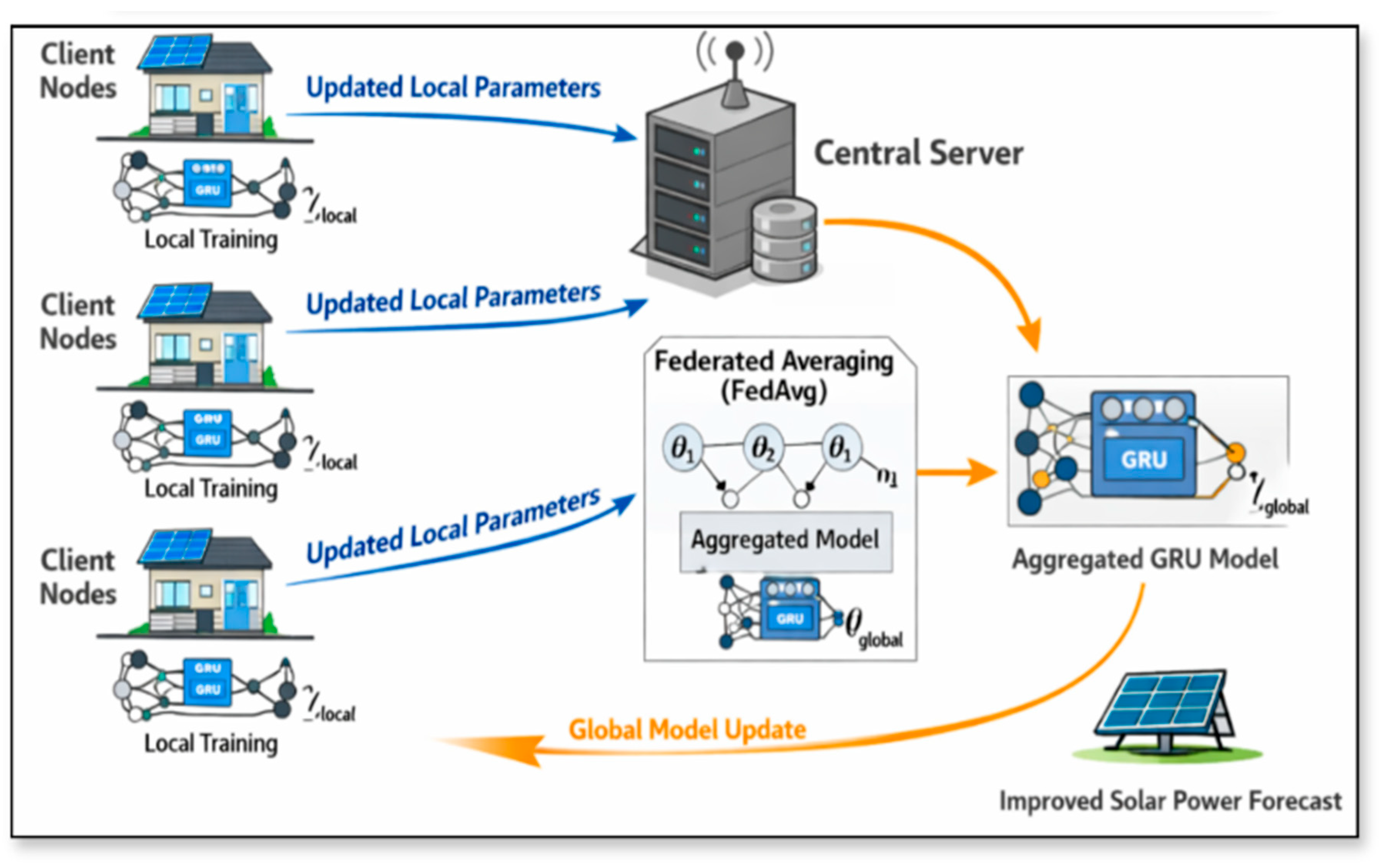
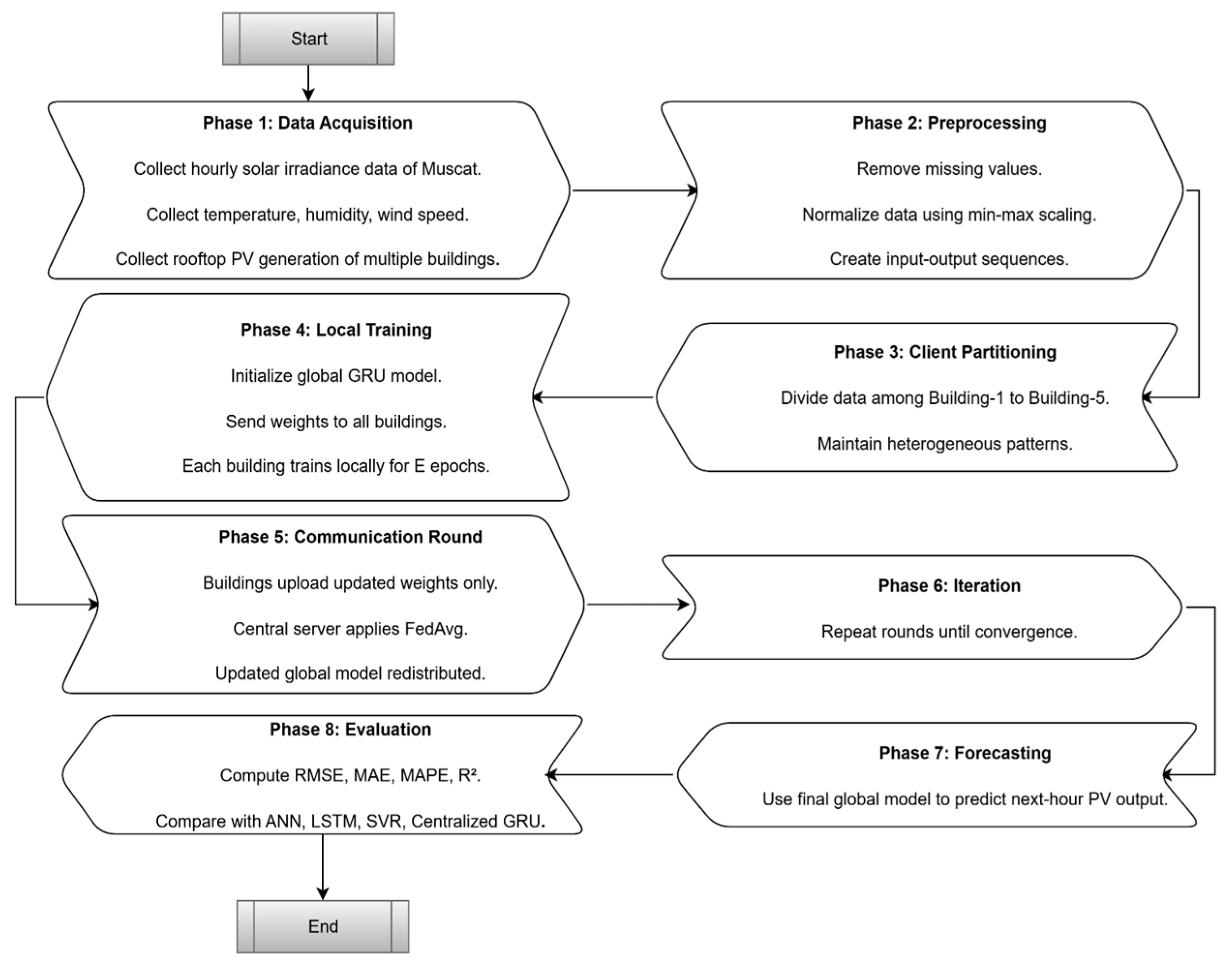
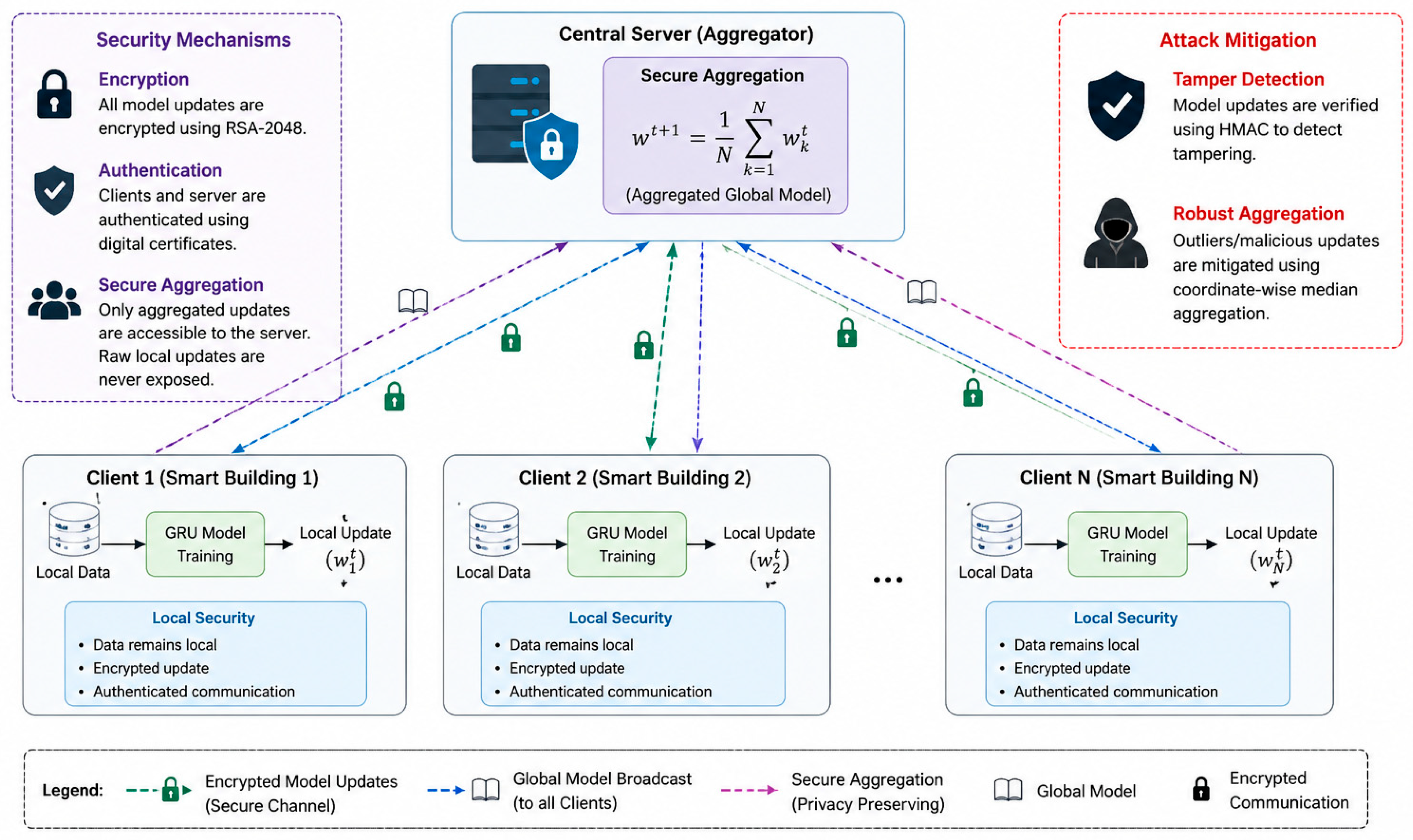
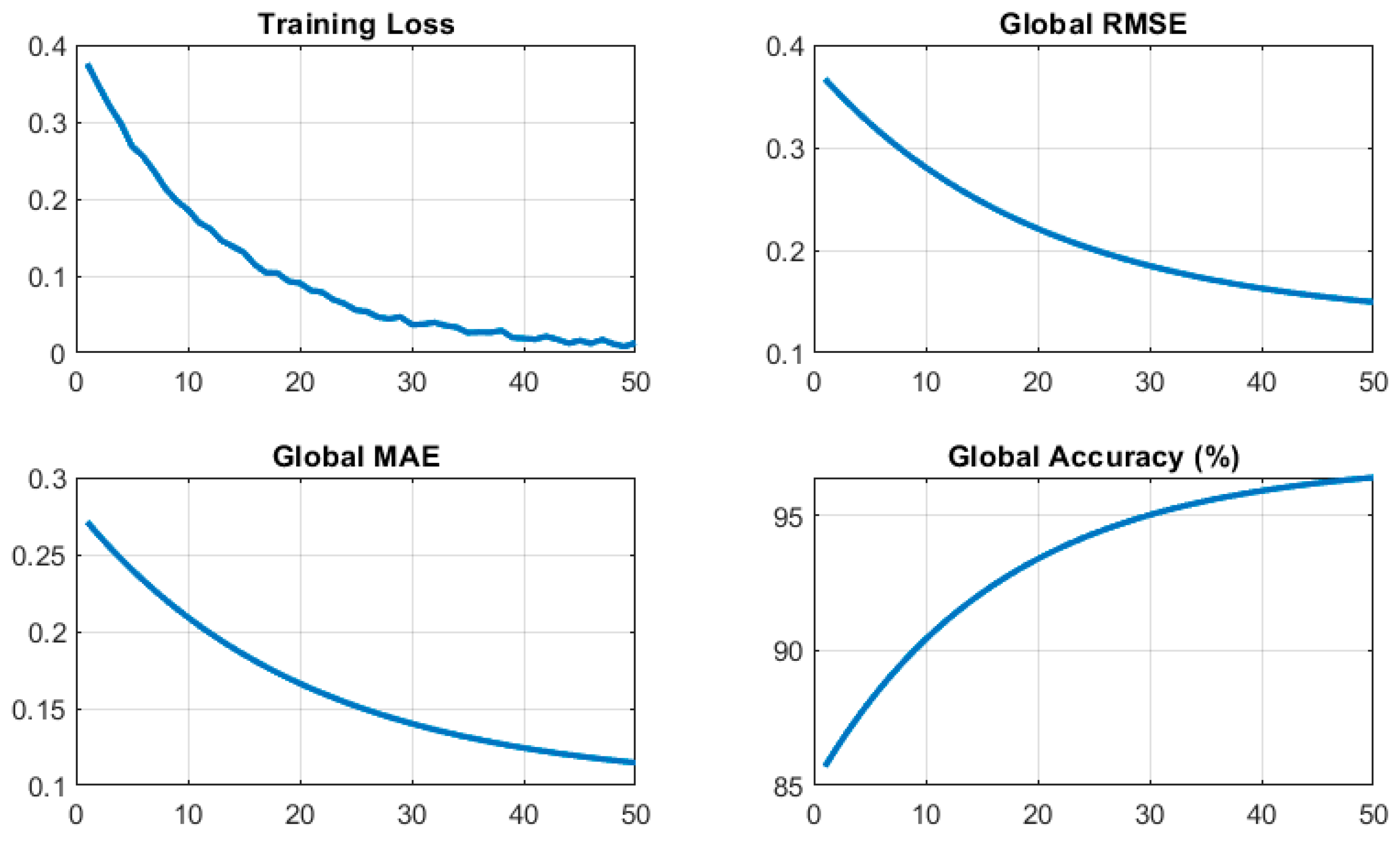
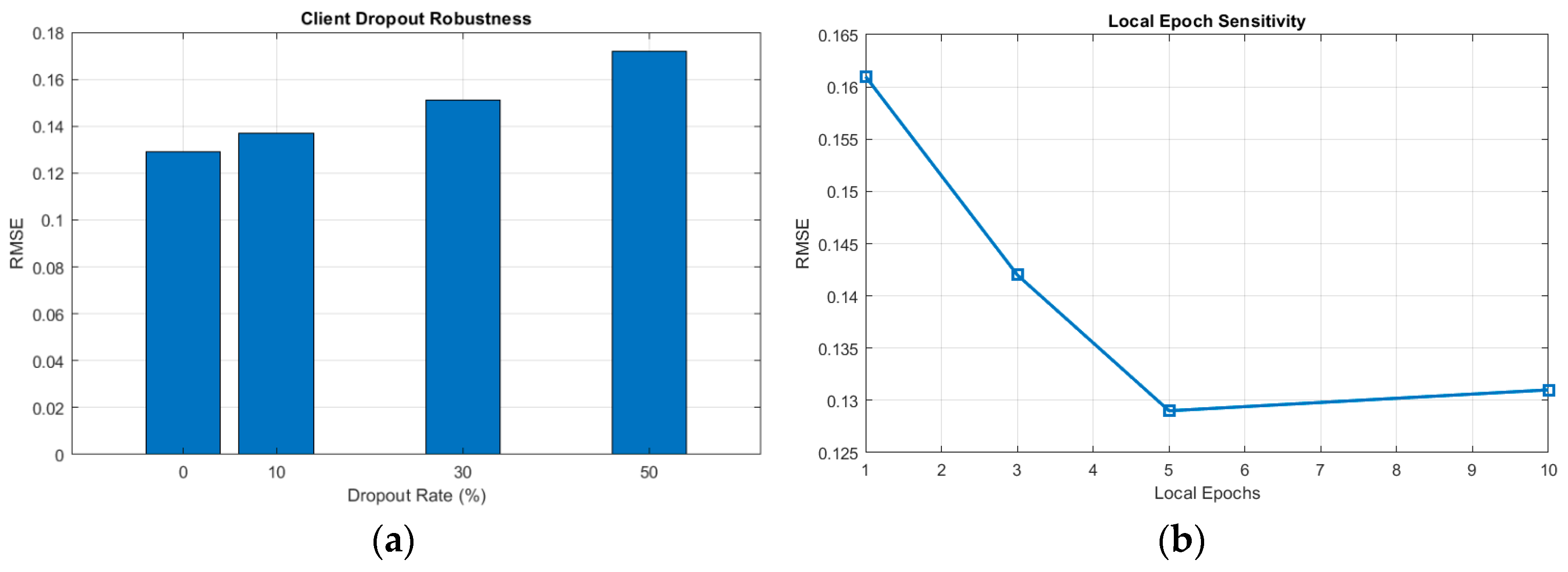
The present paper suggests a federated learning-based distributed solar forecasting model based on gated recurrent unit (GRU) networks (FL-GRU) to smart buildings in Muscat, Oman. The growing adoption of rooftop photovoltaic (PV) systems in urban settings needs precise, privatizing, and scalable forecasting models able to manage geographically dispersed and statistically heterogeneous data. The suggested solution will include federated learning and GRU networks to train a global forecasting model across several smart buildings and avoid the exchange of raw energy data to overcome these challenges. The local GRU models are trained on local PV generation data and only parameters of the model are relayed to a central aggregation server. This provides privacy of data without compromising the effectiveness of collaborative learning. The proposed framework is tested in a variety of realistic scenarios such as scalability analysis, non-identically distributed (non-IID) data, client dropout, communication constraints, seasonal variability, and privacy saving noise injection. Simulation outcomes show that the proposed FL-GRU model presents a final RMSE of 0.129, MAE of 0.100 and forecasting accuracy of 97%. When increasing the number of clients involved in the process, 2 to 10, RMSE decreases to 0.129, which supports the high scalability advantages. In non-IID scenarios, RMSE ranges between 0.129 and 0.167, and even with half of the clients dropping, the system is robust with an RMSE of 0.172. The proposed FL-GRU is better than the benchmark models, Local GRU, centralized GRU, FL-LSTM, and FL-ANN with a maximum improvement of 22.29% in RMSE reduction. Also, the best predictive consistency is found with correlation analysis with R2 = 0.957. On the whole, the suggested approach can offer an efficient, privacy-aware, and scalable solution to distributed solar energy prediction in smart cities.
Keywords: federated learning; solar forecasting; smart buildings; Muscat Oman; GRU neural network; distributed machine learning; renewable energy prediction; privacy-preserving AI federated learning; solar forecasting; smart buildings; Muscat Oman; GRU neural network; distributed machine learning; renewable energy prediction; privacy-preserving AI