Article

Research on the Coordination of Surge Protectors in Communication Power Systems

1
School of Electronic and Information Engineering, Nanjing University of Information Science and Technology, Nanjing 210044, China
2
School of Electrical and Energy Engineering, Nantong Institute of Technology, Nantong 226002, China
3
Signal & Communication Research Institute, China Academy of Railway Sciences Corporation Limited, Beijing 100081, China
*
Author to whom correspondence should be addressed.
Energies 2026, 19(10), 2454; https://doi.org/10.3390/en19102454
Submission received: 12 April 2026 / Revised: 8 May 2026 / Accepted: 14 May 2026 / Published: 20 May 2026

Abstract

To address the issue of coordination failure in multi-stage surge protective devices (SPDs) under lightning surges in communication power systems, this study employs traveling wave propagation theory and electromagnetic transient simulations using the PSCAD/EMTDC platform. It systematically evaluates how lightning strike location, interstage cable length, and load type affect energy coordination and overvoltage response in a two-stage SPD configuration. By combining time-domain and frequency-domain analysis, the coupling mechanism of SPD conduction timing is revealed. There exists a critical length for the interstage cable to ensure coordinated operation of the SPDs. This critical length decreases with increasing surge intensity but increases significantly with greater lightning strike distance. Incorporating an appropriate series inductor can provide the necessary time delay, serving as an alternative to using a long cable. For capacitive loads, although an excessively short cable can reduce the amplitude of oscillatory voltage spikes, it aggravates the surge steepness, thereby stressing the SPD. These oscillations can be effectively suppressed by installing a damping resistor in front of the SPD2. Furthermore, the study reveals a strong coupling between energy coordination and overvoltage behavior under capacitive load conditions, indicating that the two must be jointly optimized. The parameter configurations and practical recommendations presented offer quantitative design guidance for SPD selection, cable layout, and resonance suppression in communication power systems.

1. Introduction

As communication infrastructure advances, power systems for communications demand tighter power quality and lightning protection. Unlike conventional grids, they feature precision loads, short paths, complex wiring, and limited space—conditions that require coordinated multistage SPDs to share energy and protect sensitive devices. Yet short interstage distances, lower equipment withstand levels, and diverse loads complicate coordination, risking energy imbalance and uncontrolled overvoltage. Thus, studying multistage SPD coordination—where upstream stages absorb energy, limit residual voltage, and interstage impedance/spacing set firing order and sharing—has clear theoretical and engineering value [1,2,3,4]. Insulation-coordination practices for HVDC converter stations provides the envelope for arrester ratings and stress determinations [5]. Device-level refinements consistent with this voltage-limiting scheme include countermeasures for multi-pulse excitation and Metal-Oxide Varistor (MOV)-based current-limiting stages that shape fault onsets without introducing overvoltage transients, which together improve selectivity and timing in coordinated designs [6,7]. Case-driven studies further show that adopting lower-protection-voltage varistors and carefully composed MOV networks sharpens clamping performance and time selectivity across distributed power–electronic interfaces and protection circuits, and hardening strategies for strong electromagnetic environments support these coordination principles in practice.
At the system and application level, numerical lightning-transient analyses inform optimal choices for medium-voltage arresters in wind-turbine nacelles [8], while decision-theory formulations guide arrester placement by balancing discharge energy, risk, and cost in distribution networks [9]. In PV and storage systems, reliable operation under lightning exposure depends on coordinated voltage-limiting protection that accounts for surge amplitude, cable length, grounding, and other external conditions [10,11,12]; airborne electronic equipment likewise benefits from SPD selection matched to interface-signal characteristics [4]. Modeling and verification—from device equivalence to system-level EMTP/ATP studies—provide quantitative evaluation of trigger thresholds, response timing, and energy allocation, and vector-surge estimation offers detection-side support against disturbances and inadvertent trips [12,13]. Looking ahead, cross-domain advances in neural-network control and intelligent sensing can enable adaptive thresholds and online health monitoring, while environmental effects on insulation parameters underscore the need to fold operating conditions and aging into long-term coordination for resilient communication-power systems [14,15,16].
Compared with existing studies that primarily focus on single SPD performance, arrester placement, or isolated overvoltage suppression, this work further investigates the coordinated behavior of two-stage voltage-limiting SPDs in communication power systems from the coupled perspectives of traveling-wave propagation, energy sharing, and load-side overvoltage response. The main contributions of this paper are as follows:
(1)
A PSCAD/EMTDC-based two-stage SPD model is established to evaluate the effects of lightning strike location, interstage cable length, and load type on SPD triggering and energy distribution.
(2)
The critical interstage cable length required for successful energy coordination is quantified under different surge amplitudes and strike distances.
(3)
An equivalent series-inductor approach is proposed to replace impractically long interstage cables.
(4)
The coupling relationship between energy coordination and overvoltage coordination is revealed, especially under capacitive-load conditions.
(5)
Quantitative design implications are provided for SPD selection, cable layout, and load-side oscillation suppression in communication power systems.

2. Surge Protection for Power Systems

2.1. Surge Protection for Communication Power Systems

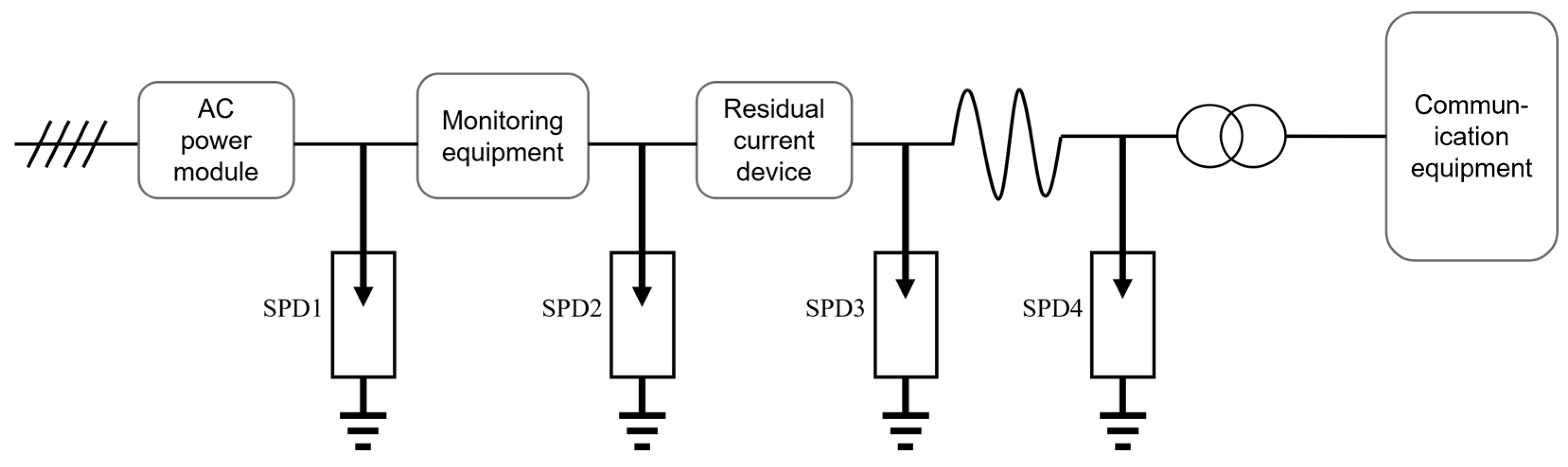
In this study, the communication power system refers to the low-voltage AC power supply section of a communication station, with a nominal voltage level of 220/380 V AC. This section is typically supplied by a 10 kV/0.4 kV distribution transformer or a backup generator, and it is the main focus of the SPD coordination analysis in this paper. Lightning interference in communication power systems is primarily introduced through low-voltage distribution lines, which can easily cause damage to precision communication equipment. To enhance the system’s lightning protection capability, the communications industry typically adopts a multi-stage SPD collaborative protection strategy. This approach implements step-by-step protection for low-voltage distribution systems to disperse surge energy and reduce terminal overvoltage levels. Communication power systems generally employ a hierarchical protection structure, in which primary, secondary, and tertiary SPDs are respectively installed at the power distribution inlet, the rectifier/Uninterruptible Power Supply (UPS) stage, and the terminal equipment side, enabling staged coordination between energy attenuation and residual voltage limitation [6]. In accordance with IEC 61643-11 [17] and IEEE C62.41.2 [18] standards, the installation location diagram of a multi-level protection SPD in the power system of a communication station is shown in Figure 1.
(1)
First-level protection: Installed at the input of the 220/380 VAC low-voltage main distribution panel, it is primarily responsible for absorbing high-energy surges originating from the output of a 10 kV transformer or the input of a backup diesel generator. Its main function is to provide initial attenuation of the surge amplitude.
(2)
Secondary protection: Installed at the input of the AC distribution panel, UPS system, and communication rectifier, it is responsible for withstanding the residual voltage from the first-level SPD and further suppressing medium-frequency surges.
(3)
Third-level protection: Positioned close to terminal load equipment—such as AC distribution cabinets in communication rooms, power terminals of communication air-conditioning units, and 3G/4G/5G outdoor base stations—it provides precision protection against low-amplitude, high-frequency surges [19].
Different levels of SPDs are designed with specific emphasis on current handling capacity, response time, and voltage protection level. By appropriately allocating these SPDs, graded peak suppression and final-stage protection can be effectively achieved. Figure 1 illustrates a typical multi-stage SPD installation structure in a communication power system.

2.2. Coordination Between SPDs

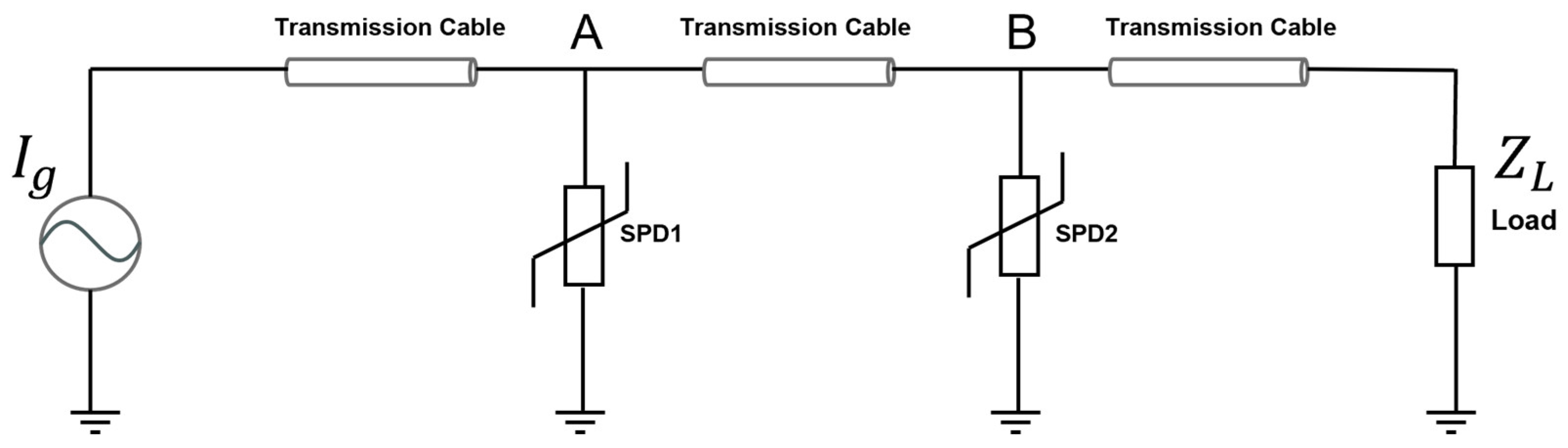
Figure 2 shows a typical two-stage voltage-limiting SPD layout. Total injected energy grows with surge voltage. The firing order depends on interstage energy coordination: with short spacing and high surge amplitude, SPD1 tends to conduct first. At conduction, the SPD1 terminal voltage equals the SPD2 terminal voltage plus the inductive drop of the interconnecting leads. The lead inductance per unit length is calculated using (1).
L l e a d = μ 0 2 π ln 2 h r
where L l e a d is the lead inductance per unit length, h is the height of the wire above the ground, r is the wire radius, and μ 0 is the permeability of free space, taken as 4π × 10−7 H/m [20]. In this study, h and r are set to 1 m and 0.006 m, respectively. Therefore, the calculated lead inductance is approximately 0.7 μH/m.
Two-stage SPD coordination rests on energy sharing and voltage protection. Upstream SPD1 should absorb most surge energy to prevent SPD2 from overloading. Because SPD2 is close to the sensitive load, its protection threshold must be lower than SPD1, and the load’s residual voltage must stay below the equipment’s withstand level to ensure proper operation and avoid damage.
The core principles of SPD coordination and cooperation mainly include:
  • Energy distribution principle: SPD1 should bear the main surge energy to avoid SPD2 failure due to energy overload.
  • Voltage protection principle: Since SPD2 is located close to the sensitive load, its voltage protection threshold should be lower than that of SPD1. The residual overvoltage at the load end must also be kept below the withstand voltage of the protected equipment to ensure that SPD2 activates as intended and to prevent potential damage caused by excessive residual voltage [21].
However, these two principles are inherently potentially conflicting. A lower voltage setting for SPD2 may cause it to trigger before SPD1 operates, thereby violating the principle of energy coordination. Therefore, in engineering design, a balance between the two must be achieved using the following methods:
(1)
Introduce an appropriate cable length or a series inductor between SPD1 and SPD2 to utilize the voltage delay caused by inductive reactance, promoting upstream energy sharing and preventing SPD2 from becoming the dominant energy-absorbing device.
(2)
Functional layering is achieved through appropriate SPD device selection: SPD1 employs a high-energy-handling type, while SPD2 adopts a fast-response type.
(3)
Adjust the installation positions, voltage protection level differences, and wiring layout of the two-stage SPD to establish an ordered triggering sequence.
To sum up, effective coordination of a two-stage SPD system requires comprehensive consideration of inductive reactance, voltage levels, response times, and device characteristics. Only through the collaborative design of multi-dimensional parameters can proper energy distribution and voltage protection be achieved.

2.3. SPD Device Model and Energy Accounting

For reproducibility, this study adopts the default MOV arrester model in PSCAD; the parameters are taken from the component dialog. The MOV’s nonlinear V–I characteristic is approximated by a power law:
V ( I ) V ref I I ref 1 / n
Here V I and I are the terminal voltage and current, V r e f   is the voltage at the reference current I r e f   , and n is the nonlinearity exponent; these three parameters map one-to-one to the PSCAD default MOV settings and anchor the clamping threshold used throughout this study.
Δ v L ( t ) = L e q d i d t , L e q = L lead l lead + L a d d
Moving from device behavior to interstage interaction, the relation in Equation (3), captures the instantaneous inductive drop along the path between stages. Here L l e a d is the per-unit-length lead inductance, l l e a d is the interstage length, and L a d d is any added series inductor. A larger L e q or a steeper surge front (higher d i / d t increases Δ v L , delaying the downstream stage and helping ensure SPD1 priority.
E k = t 0 t 1 v k ( t ) i k ( t ) d t
Finally, linking timing to energy, defines the single-shot energy absorbed by stage k . We use a common window [ t 0   ,   t 1 ] for both stages—from the surge onset to the time when the SPD current decays to 5% of its peak value—to enable fair comparison. With Equations (2)–(4), we jointly assess energy sharing via ε 1 and ε 2 under the same aperture.
Based on the SPD device model and energy-accounting method described above, a unified set of simulation parameters was adopted for the subsequent case studies. To make the modeling assumptions explicit and to improve the reproducibility of the results, the key parameters and their corresponding values are summarized in Table 1.

3. Influencing Factors of SPD Coordination

3.1. Line Wave Impedance and Load Impedance

Treating communication cables as lossless lines fails under high-frequency surges. Series resistance and skin effect make per-unit-length resistance rise with frequency, causing amplitude attenuation and phase distortion that alter SPD firing and voltage-limiting performance. Therefore, a lossy transmission line model should be adopted by introducing the equivalent distributed parameters R(f), L(f), G(f), and C(f), with each expressed as a frequency-dependent variable.
Z 0 ( f ) = R ( f ) + j 2 π f L ( f ) G ( f ) + j 2 π f C ( f )
γ ( f ) = α ( f ) + j β ( f ) = R ( f ) + j ω L ( f ) G ( f ) + j ω C ( f )
Among them, Z 0 f is the frequency-dependent wave impedance, γ f is the complex propagation constant, α f represents the attenuation constant, and β f is the phase constant. Classical reflection theory applies only to linear, frequency-independent resistive loads and misses surge non-idealities: SPD conduction is nonlinear varying with current, heating, and time, while capacitive loads are strongly frequency-dependent; for a capacitor, the impedance of the capacitive load decreases rapidly with the increase in frequency, and its reflection coefficient Γ ( f ) expression is:
Γ ( f ) = Z L ( f ) Z 0 ( f ) Z L ( f ) + Z 0 ( f ) , Z L ( f ) = 1 j 2 π f C
Under high-frequency surge conditions, the low-impedance characteristics of capacitive loads cause the reflection coefficient to approach −1, which can easily result in high-frequency peaks due to enhanced reflections, thereby posing a challenge to SPD2. Therefore, for different types of loads, variations in reflection amplitude and energy distribution should be evaluated in conjunction with time-domain simulation results.

3.2. Time-Domain Analysis of Traveling Waves

To describe the waveform characteristics of the lightning-induced surge considered in this study, a Heidler-type expression is introduced as a representative analytical form of the standard 8/20 μs surge current. In the PSCAD/EMTDC simulations, the surge pulse was generated using the built-in 8/20 μs surge source, while the following expression is used only to clarify the waveform parameters and peak-current normalization:
i ( t ) = I p η ( t / τ 1 ) n 1 + ( t / τ 1 ) n e t / τ 2
where i ( t ) is the lightning surge current, I p is the specified peak current, τ1 is the front-time control parameter, τ2 is the tail-time control parameter, n is the steepness factor, and η is the peak correction factor. The correction factor η is introduced to ensure that the maximum value of i ( t ) is equal to I p . The parameters τ1, τ2, and n are selected to generate a standard 8/20 μs induced-lightning surge waveform, which has a steep rising edge and broadband frequency characteristics and can represent the typical surge condition faced by low-voltage communication power systems under indirect lightning strikes.
In practical engineering, the point of lightning surge generation varies with the location of the lightning strike, and the length of the transmission line to the SPD also changes accordingly. When the transmission line is short, it can be approximated as a lossless transmission line; however, when the line is long, the surge signal undergoes attenuation. According to the principle of superposition, any fault on the line can be decomposed into a steady-state component and a fault-induced component, which can be regarded as a transient mechanism superimposed on the voltage source.
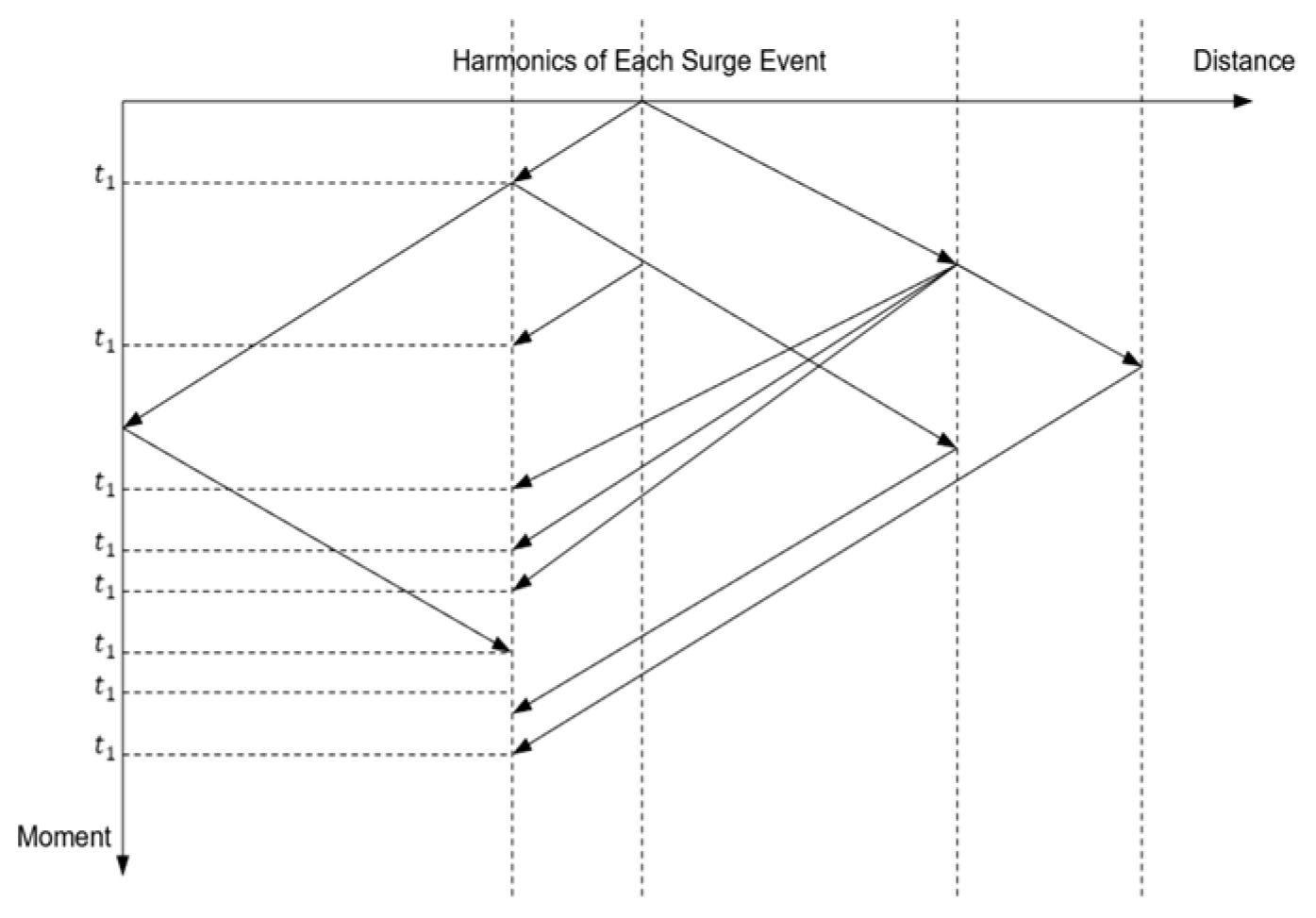
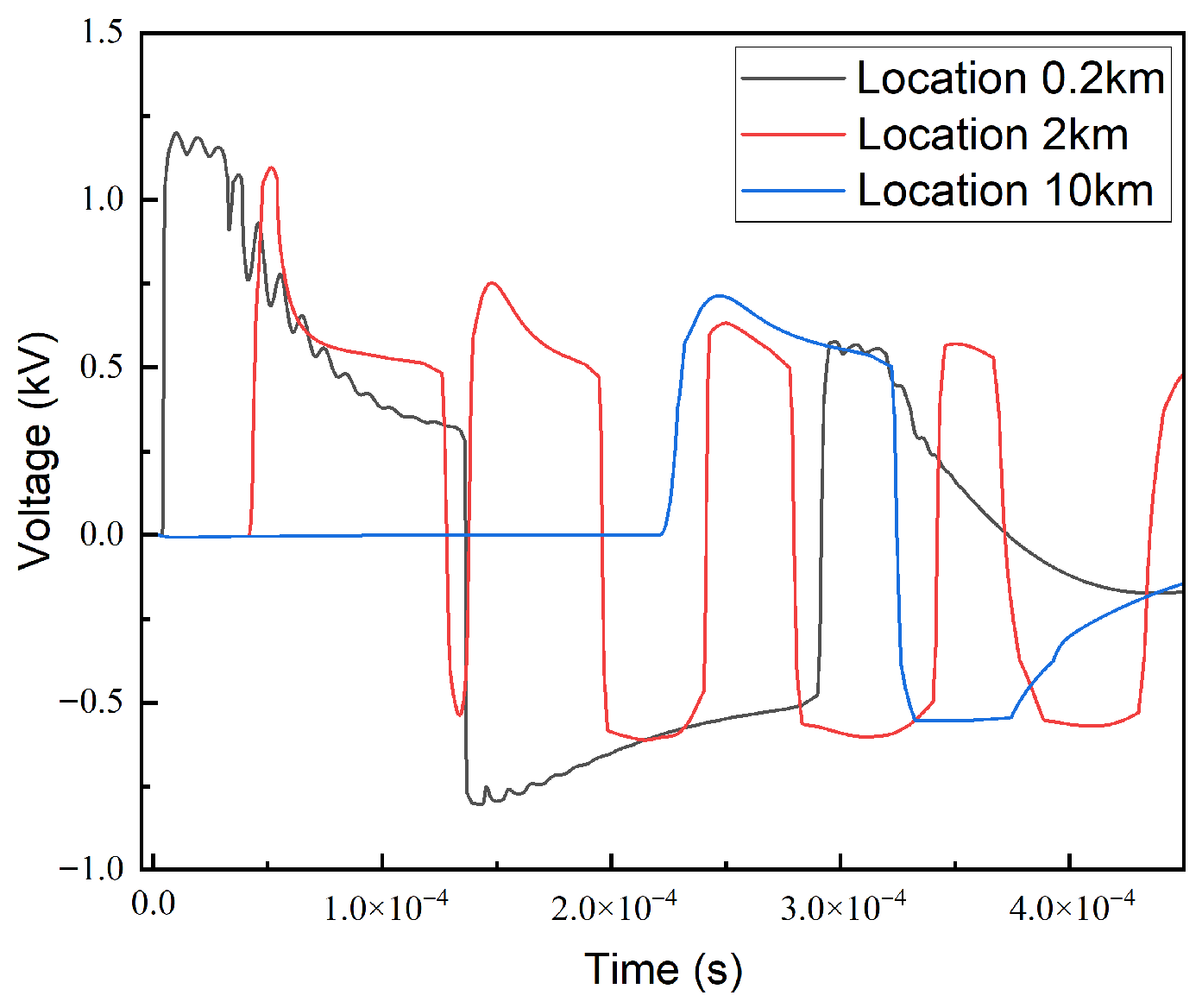
The traveling wave reflection and refraction paths shown in Figure 3 are mainly based on theoretical derivation and the general models reported in the literature [22,23,24]. Figure 3 and Figure 4 illustrate the transmission paths and arrival time differences in downward traveling waves under different lightning strike locations and line configurations. All simulations are based on double-exponential waveform modeling and are conducted in PSCAD for time-domain analysis. The results are used to validate the dynamic evolution of reflection delays and the energy coordination process in a multi-stage SPD structure, showing that variations in the lightning strike position lead to significant differences in the propagation paths and reflection nodes of the traveling waves.
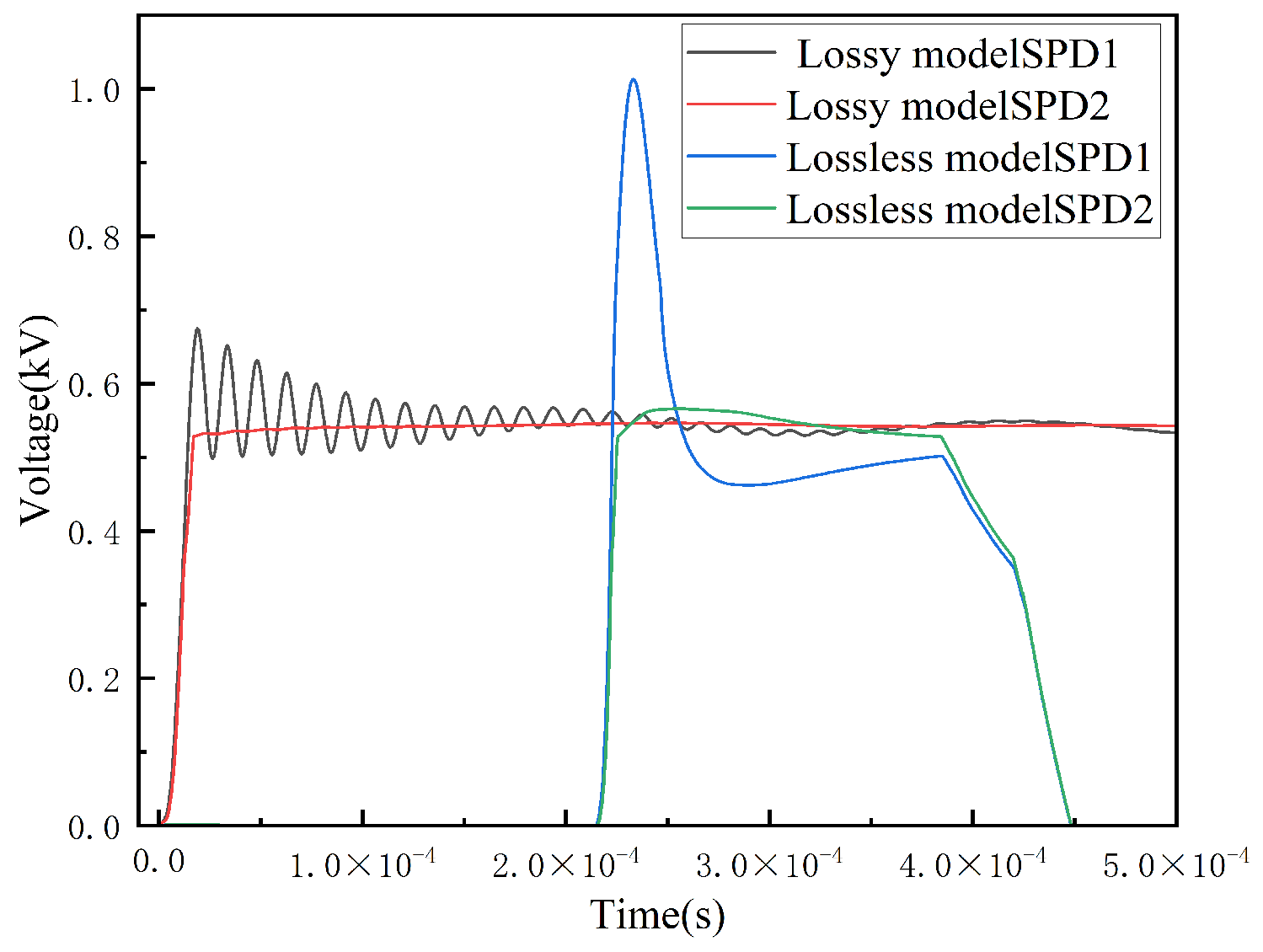
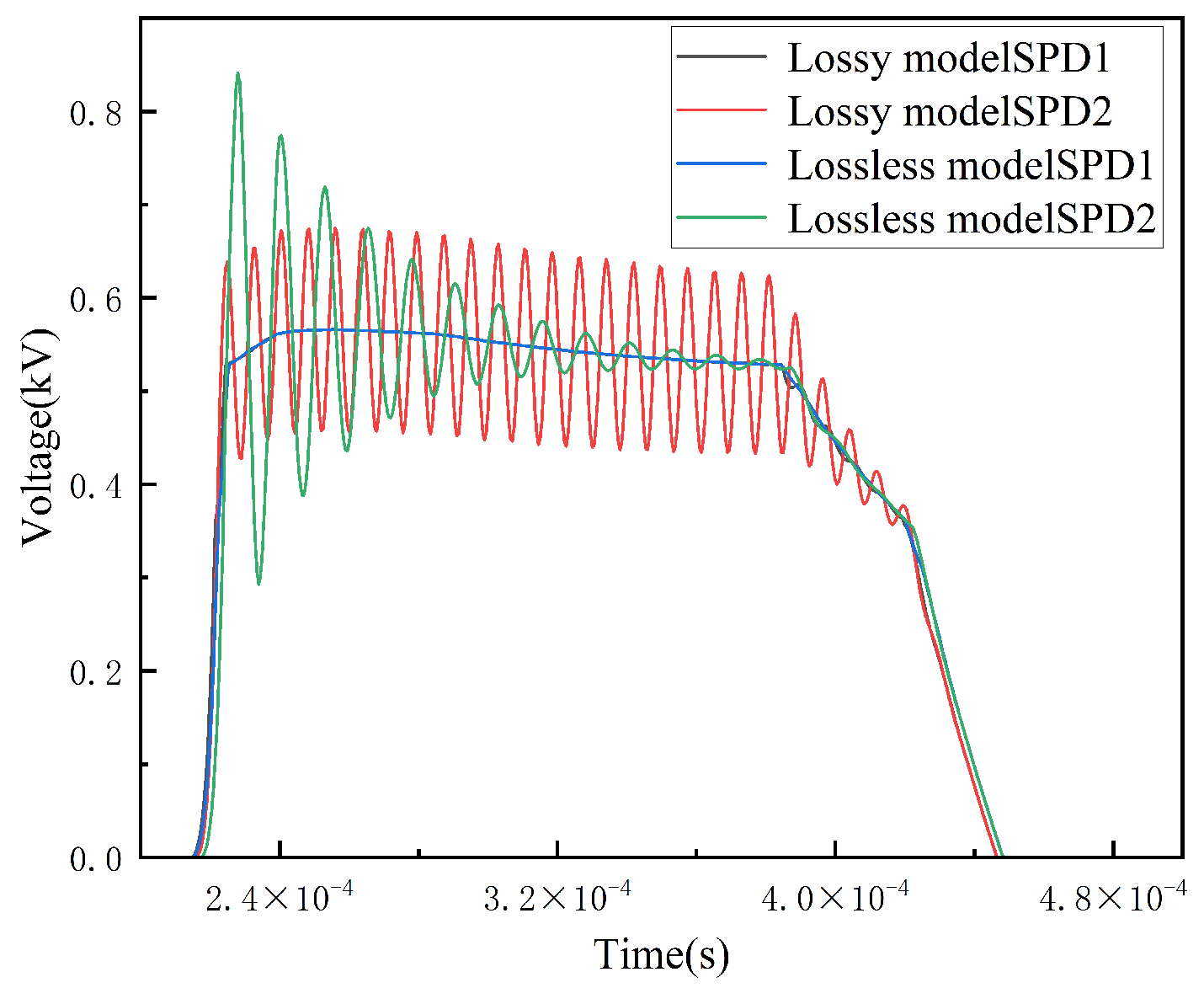
To compare the propagation characteristics of the lossy and lossless line models under the same surge-injection condition, the voltage waveforms were observed at two locations, after a 20 km incoming-line propagation distance from the remote surge-entry point and at the terminal of the cable section connected to the protected equipment, as shown in Figure 5 and Figure 6. Here, the 20 km distance represents the external incoming-line propagation distance before the surge reaches the communication power system, rather than the interstage cable length between SPD1 and SPD2, as shown in Figure 5 and Figure 6.
As shown in Figure 5 and Figure 6, the transmission cable model affects both the surge amplitude and the oscillation characteristics at the SPD terminal. In the lossy model, since the cable itself contains series resistance and distributed conductance, high-frequency components undergo non-uniform attenuation and phase distortion during propagation. This causes the waveform to stretch over time and the frequency components to become desynchronized, thereby generating a multi-frequency mixing interference effect at the SPD end. This combination of spectral broadening and phase inconsistency is a key reason for the resulting high-frequency oscillations. Therefore, although the peak amplitude is suppressed, the waveform exhibits more complex and intense oscillatory behavior.
In contrast, in the lossless cable model, the transmission path does not introduce energy dissipation. The surge wave retains its original spectral structure, and all frequency components arrive at the SPD terminal simultaneously. As a result, the reflection behavior is highly regular, and the oscillation is relatively stable, making it less prone to generating high-frequency spikes and strong oscillations.
It is evident that although lossy transmission is beneficial for controlling overall surge amplitude, it also introduces problems such as spectral mismatch and time-domain oscillations. As previously mentioned, capacitive loads can produce strong reflective spikes when surge waves propagate. Therefore, in modeling and design, attention must be paid not only to energy peaks, but also to oscillation control, to ensure the responsiveness and safety margins of multi-level SPD coordination.

3.3. Frequency-Domain Analysis of Traveling Waves

Although the analysis introduced the propagation constant r = α + j β , its engineering significance in SPD coordination was not discussed. The propagation loss coefficient α f directly affects the weakening of the amplitude of the high-frequency surge. At the same time, the phase-shift term β f will change the time distribution of the wave head to each SPD, thereby affecting the trigger sequence and energy coordination ability.
According to the dispersion theory, the phase velocity v p ( f ) is defined as:
v p ( f ) = ω β ( f ) = 2 π f β ( f )
Since β f usually has a nonlinear growth trend at high frequencies, the following can be obtained:
d v p ( f ) d f < 0
This indicates that there is a more obvious phase lag during the transmission of high-frequency surges, and the arrival time of different frequency components at SPD1 and SPD2 positions will be offset. The propagation time difference can be expressed as t ( f ) :
Δ t ( f ) = x v p ( f ) = β ( f ) x 2 π f
Here, t S P D 1 and t S P D 2 denote the simulated operation times of SPD1 and SPD2, respectively, measured from the surge injection instant, t = 0. These times correspond to the moments when the terminal voltage/current conditions of the SPDs satisfy their conduction criteria, rather than the intrinsic response times of the devices.
When the incident wave reaching SPD1 is dominated by lower-frequency components while the wave reaching SPD2 contains high-frequency components enhanced by reflection superposition, the downstream SPD may satisfy its conduction condition earlier than the upstream SPD. In this case, t S P D 2 < t S P D 1 . However, this does not necessarily indicate coordination failure. In a properly coordinated multi-stage SPD system, the downstream SPD, which is installed closer to the protected load and usually has a lower voltage protection level, may start conducting first to limit the initial load-side overvoltage.
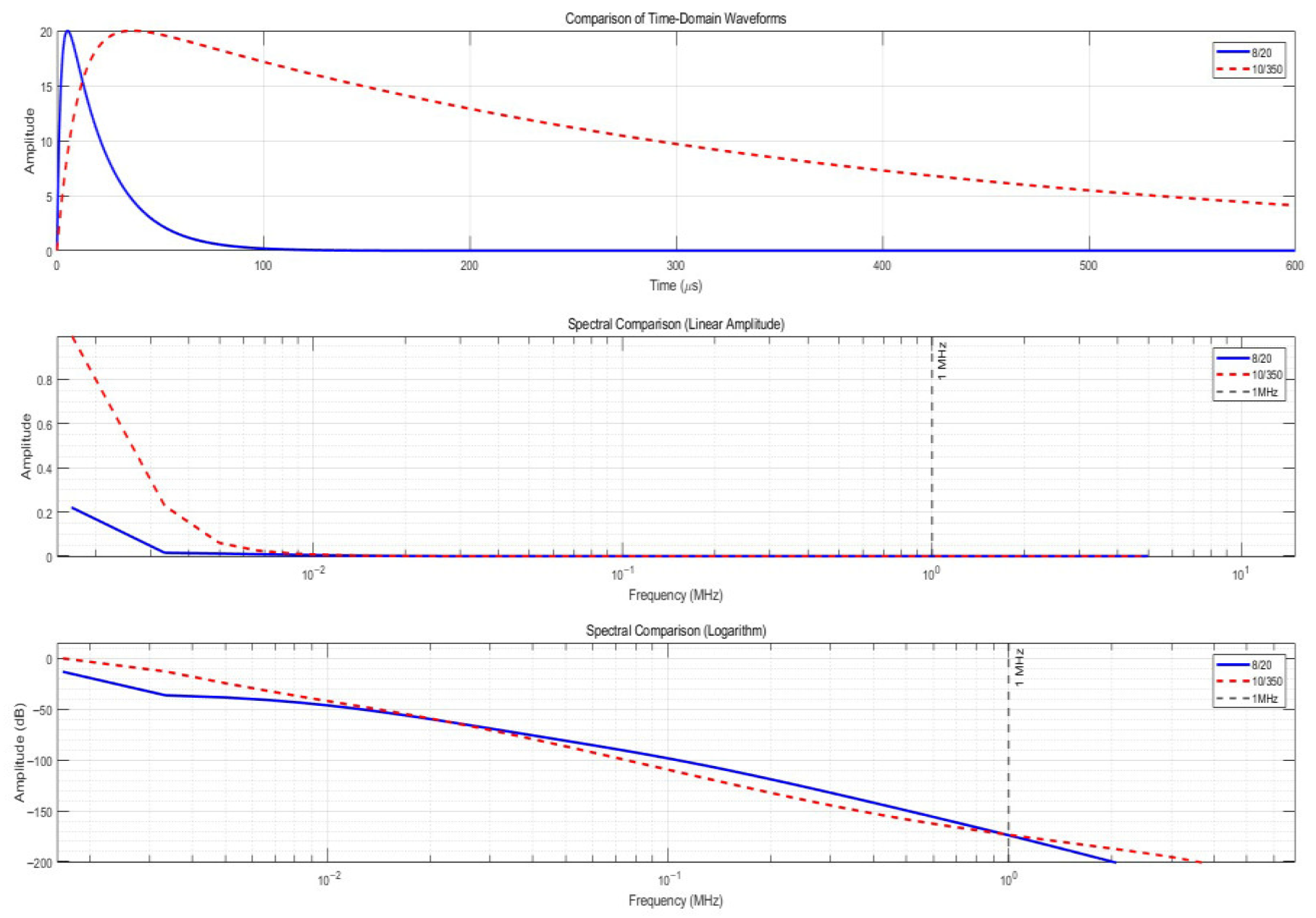
The purpose of the interstage decoupling impedance, such as the cable section, choke, or dedicated damping network between SPD1 and SPD2, is to ensure that the upstream SPD starts to conduct and share the surge energy before the downstream SPD becomes overloaded. Therefore, the key criterion for successful coordination is not whether SPD1 turns on before SPD2, but whether SPD1 can take over a sufficient portion of the surge energy before SPD2 exceeds its energy or thermal withstand capability. If the interstage decoupling is insufficient, SPD2 may remain the dominant energy-absorbing device and become overstressed, which may lead to coordination failure in the multi-stage SPD system. Figure 7 compares the standard lightning current waveforms used in the simulation in both the time and frequency domains.
This figure compares the typical characteristics of two standard lightning current waveforms—8/20 µs and 10/350 µs—in both the time and frequency domains. In the time domain, the 8/20 µs surge exhibits a steeper rising edge and shorter duration, representing a high-frequency, rapidly changing induced lightning waveform. In contrast, the 10/350 µs waveform rises more slowly, has a longer duration, and concentrates more energy, making it commonly used to simulate direct lightning strikes. In the linear frequency spectrum, both waveforms show nearly identical characteristics below 1 MHz, indicating similar low-frequency behavior. However, the logarithmic spectrum reveals that above 1 MHz, the spectral amplitude of the 10/350 µs waveform is slightly higher than that of the 8/20 µs waveform, which may be attributed to its greater total energy and slower energy dissipation in the tail. Therefore, the two waveforms are not merely differences in testing methods, but also correspond to the functional stratification principle of multi-stage SPDs. The SPD1 should primarily meet the energy withstand requirements of the 10/350 µs waveform, while the latter-stage SPD should ensure low residual voltage clamping for fast surges of 8/20 µs. If the waveform characteristics are mismatched with SPD selection, it may easily lead to coordination failure or cause the latter-stage SPD to endure excessive stress.
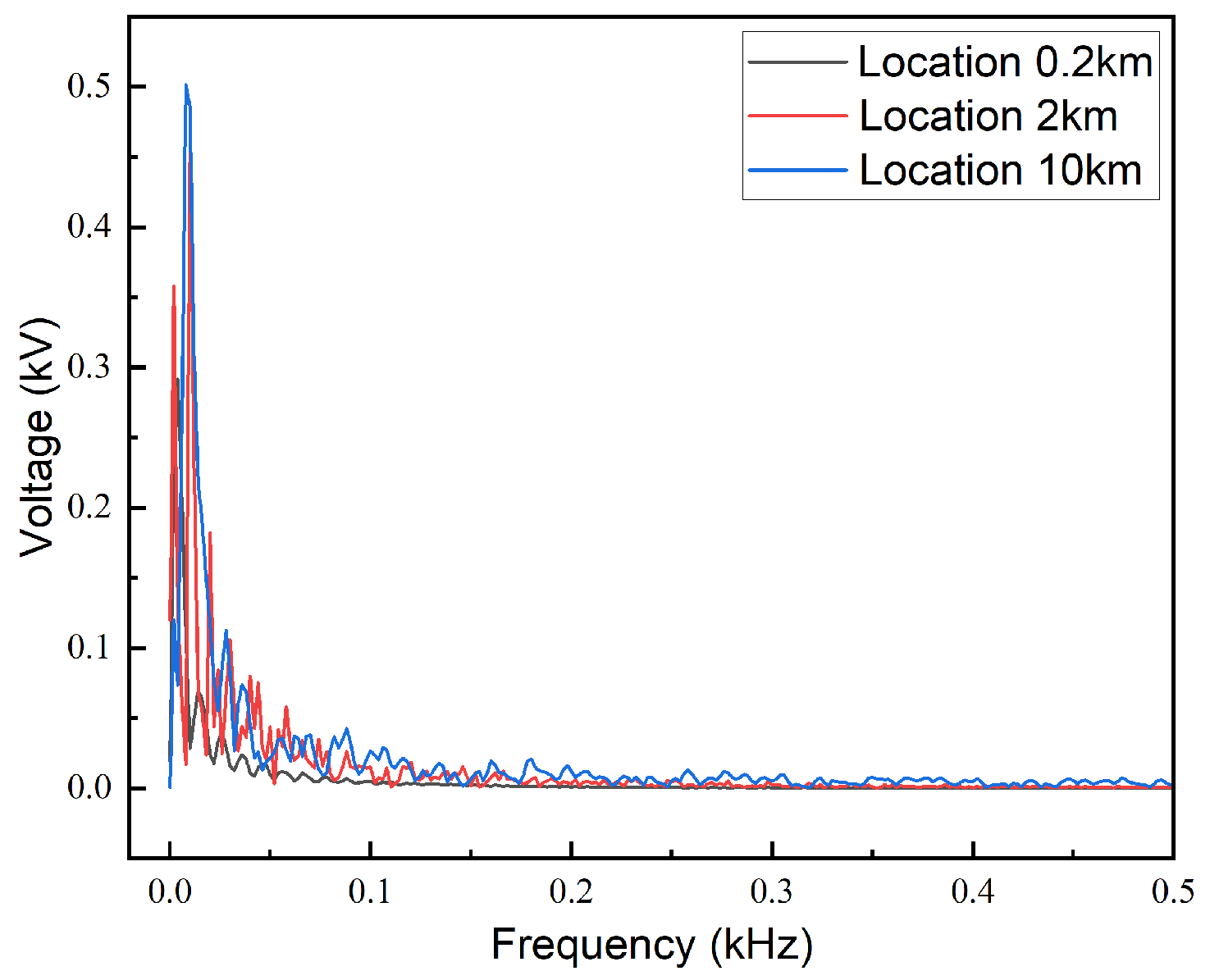
Given that this paper focuses on induced lightning surges invading transmission lines, with particular emphasis on the protection performance of terminal equipment, all subsequent simulations adopt the 8/20 µs induced lightning waveform as the standardized test condition. For multi-stage SPD selection, in order to ensure effective energy distribution and coordination, the clamping voltage of the upstream SPD should, in principle, be optimized based on specific system characteristics and device ratings. The upstream SPD typically absorbs the majority of surge energy to reduce the burden on the SPD2. This ensures proper surge mitigation, rational interstage coordination, and stable overvoltage control under varying surge intensities. Finally, the frequency domain characteristics of lightning waveforms are used to assess different lightning strike locations, as illustrated in Figure 8.
The lightning-induced surge considered in this study is treated as an external overvoltage disturbance entering the communication power system through the incoming line. The distances shown in Figure 8, such as 0.2 km, 2 km, and 10 km, represent the longitudinal propagation distances along the incoming line from the equivalent surge-entry point to the station-side observation point. They are not lateral distances between the lightning strike point and the transmission line. The voltage waveform shown in Figure 8 is measured at the incoming-line terminal close to the SPD installation position, before the surge enters the two-stage SPD coordination section.
From the perspective of the frequency domain, the corresponding surge traveling wave contains a wide range of frequency components, and the line impedance, transmission function, reflection coefficient, and refraction coefficient are all frequency-dependent [23]. According to the above analysis and Figure 8, the main energy of the lightning-induced surge is concentrated in the low-frequency range. However, during propagation, different frequency components experience different attenuation and phase-shift characteristics due to the frequency-dependent transmission function and reflection/refraction coefficients.

3.4. Simulation Strategies for SPDs in a Multistage Arrangement

The simulation system was established in PSCAD/EMTDC to reproduce the transient response of a two-stage voltage-limiting SPD configuration in a communication power supply system. The lightning surge was represented by an 8/20 μs double-exponential current waveform. The surge source was injected at different locations along the transmission line to represent different lightning strike distances. The upstream and downstream SPDs were modeled using MOV arrester components, while the interstage cable was represented using either lossless or lossy transmission-line models depending on the scenario. The terminal side was connected to different load models, including purely resistive, purely capacitive, and resistive–capacitive loads.
The simulation cases were divided into four groups. First, the effect of surge amplitude was examined by applying 10 kV, 20 kV, and 50 kV surges under different interstage cable lengths. Second, the effect of lightning strike location was investigated by setting representative strike distances of 20 m, 100 m, 500 m, and 1 km. Third, the feasibility of replacing long interstage cables with an equivalent series inductor was evaluated using inductance values of 60 μH, 65 μH, 70 μH, 75 μH, and 80 μH. Finally, the influence of load type was analyzed by comparing resistive, capacitive, and resistive–capacitive terminal loads. For each case, the absorbed energy of SPD1 and SPD2, the peak overvoltage at the SPD2, and the peak voltage at the load side were recorded.
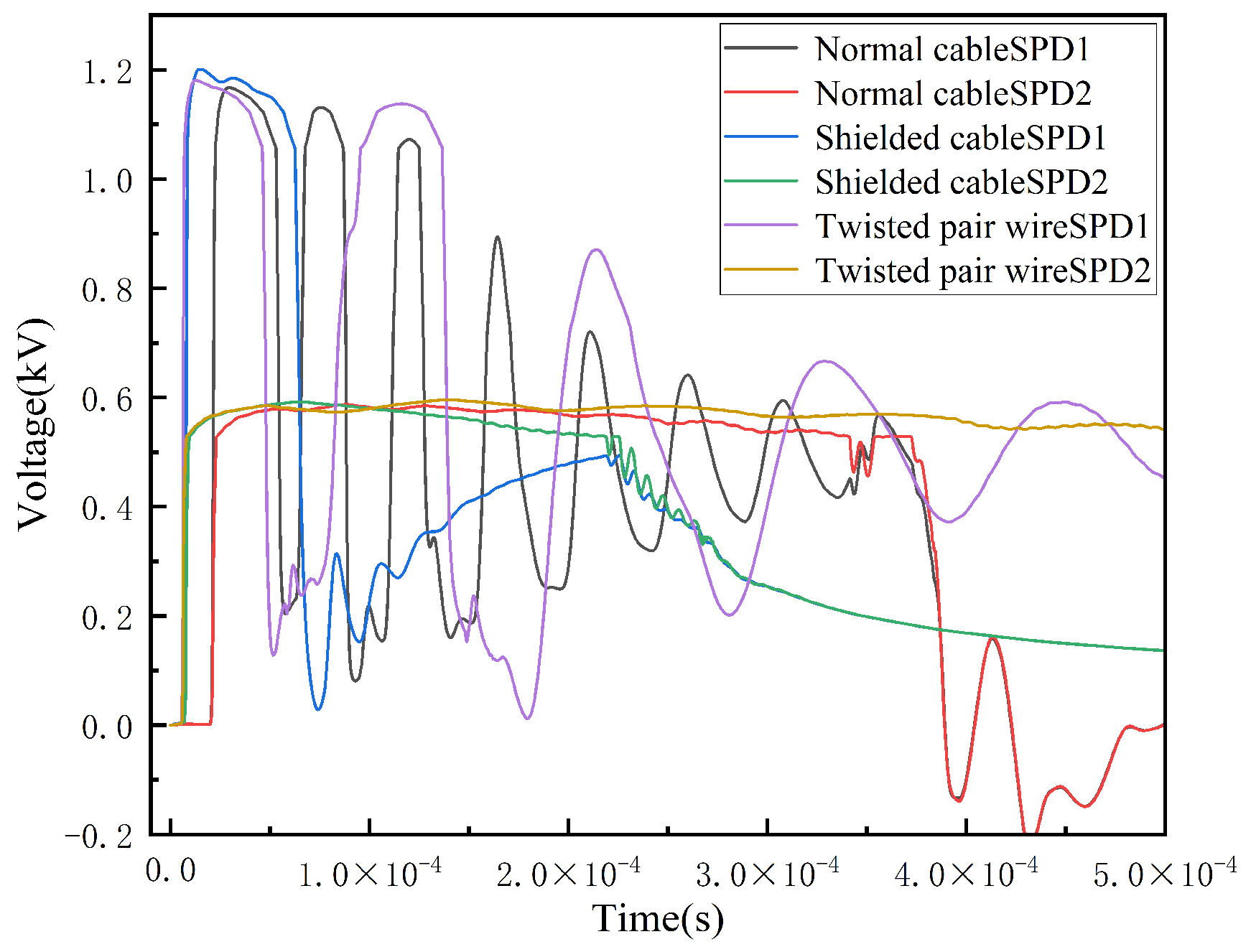
In this study, three common cable types—ordinary cables, shielded cables, and twisted pairs—are evaluated using both lossy and lossless line models. Figure 9 compares the overvoltage responses of the two-stage SPD system under the same surge-injection condition but with different cable types. For this comparison, the voltage waveforms are measured at the terminals of SPD1 and SPD2, so that the influence of cable type on the overvoltage stress of each SPD can be evaluated under identical observation conditions. In addition, a simulation-based verification framework is developed to evaluate SPD coordination performance, thereby improving the applicability of the proposed analysis to practical power supply systems for communication equipment.
As shown in Figure 9, unshielded cables cause higher residual voltage and multiple reflections, making them prone to coupling interference and SPD failures. Shielded cables suppress reflections and high-frequency noise, offering reliable protection in critical/sensitive systems. Twisted pairs sit between: symmetry helps against differential noise, but poor termination or imbalance under high-frequency surges still yields strong reflections/oscillations. In practice, without proper shielding or matching, twisted pairs undermine SPD coordination. Hence, use shielded cables for high-interference links, or add shielding and surge filters to twisted pairs.

4. Results and Discussion

4.1. Energy Coordination of SPDs

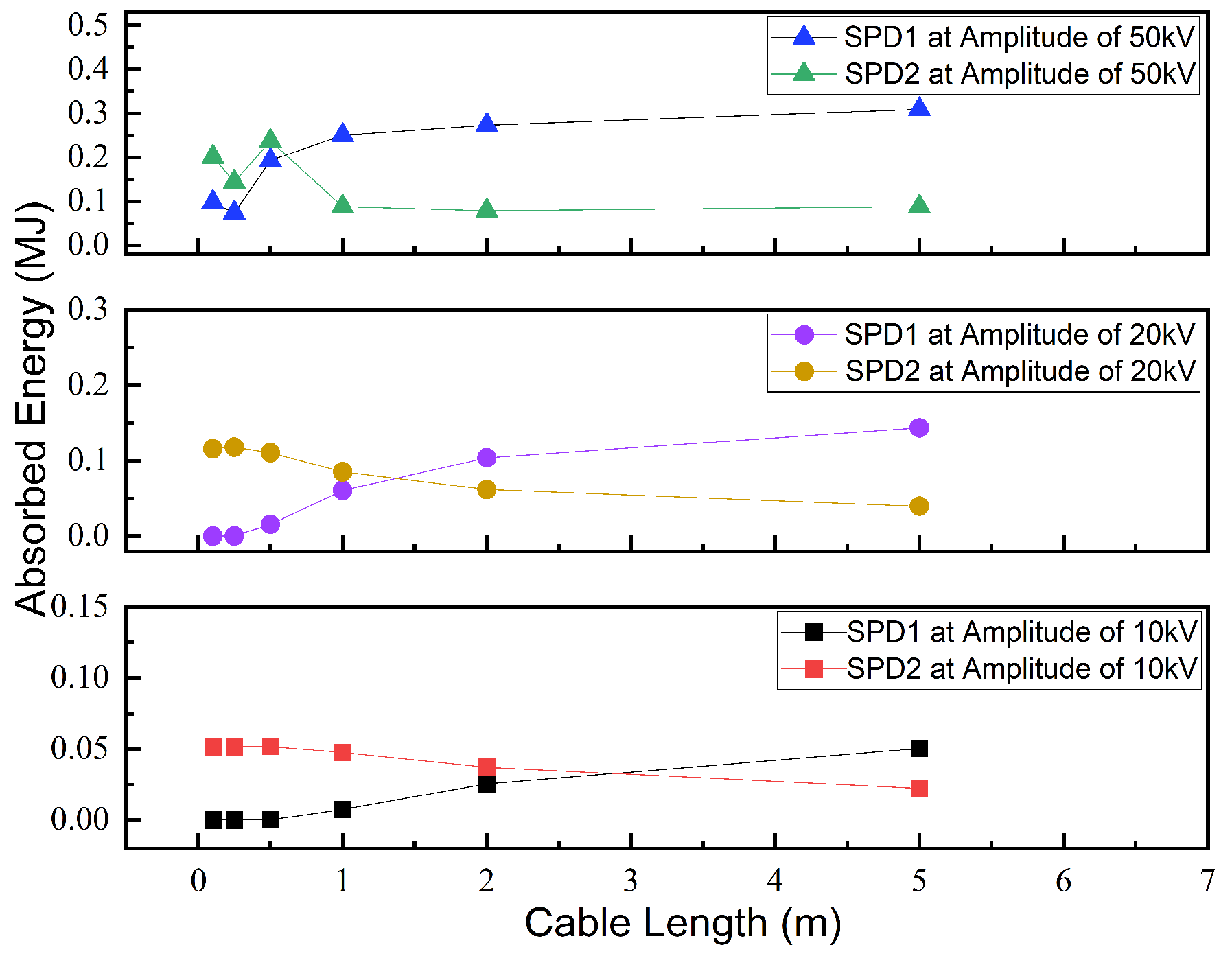
When only the effect of lightning surge amplitude was considered, a series of simulations were conducted to investigate different distances between the two stages of a series-connected SPD system using a surge generator capable of producing 8/20 µs lightning current. The energy coordination behavior of the two-stage surge protection system was studied using SPD1 with a rated voltage of 660 V and SPD2 with a rated voltage of 330 V. Lightning surge peak voltages of 10 kV, 20 kV, and 50 kV were applied. The energy absorbed by SPD1 and SPD2 under each condition is shown in Figure 10.
The figure compares the energy absorption distribution between SPD1 and SPD2 under different surge voltage amplitudes. As previously analyzed, when multi-stage SPDs operate in coordination, SPD1 is expected to conduct first and absorb the majority of the surge energy to reduce the burden on SPD2 and achieve effective energy sharing. The simulation results show that, with all other conditions held constant, as the surge voltage increases from 10 kV to 50 kV, the critical cable length required for proper SPD coordination decreases from 3 m to approximately 1 m. This corresponds to a reduction of approximately 66.7% in the required critical cable length, indicating that a higher surge amplitude can establish the required upstream SPD triggering condition with a shorter interstage inductive delay. Therefore, the critical cable length is not a fixed design value, but varies with the applied surge amplitude. This indicates that under high-voltage surge conditions, shorter interstage delays are needed to ensure SPD1 operates with priority.
However, this value is not universally applicable and may vary significantly under actual engineering conditions, depending on factors such as line impedance, wiring layout, and SPD response characteristics.
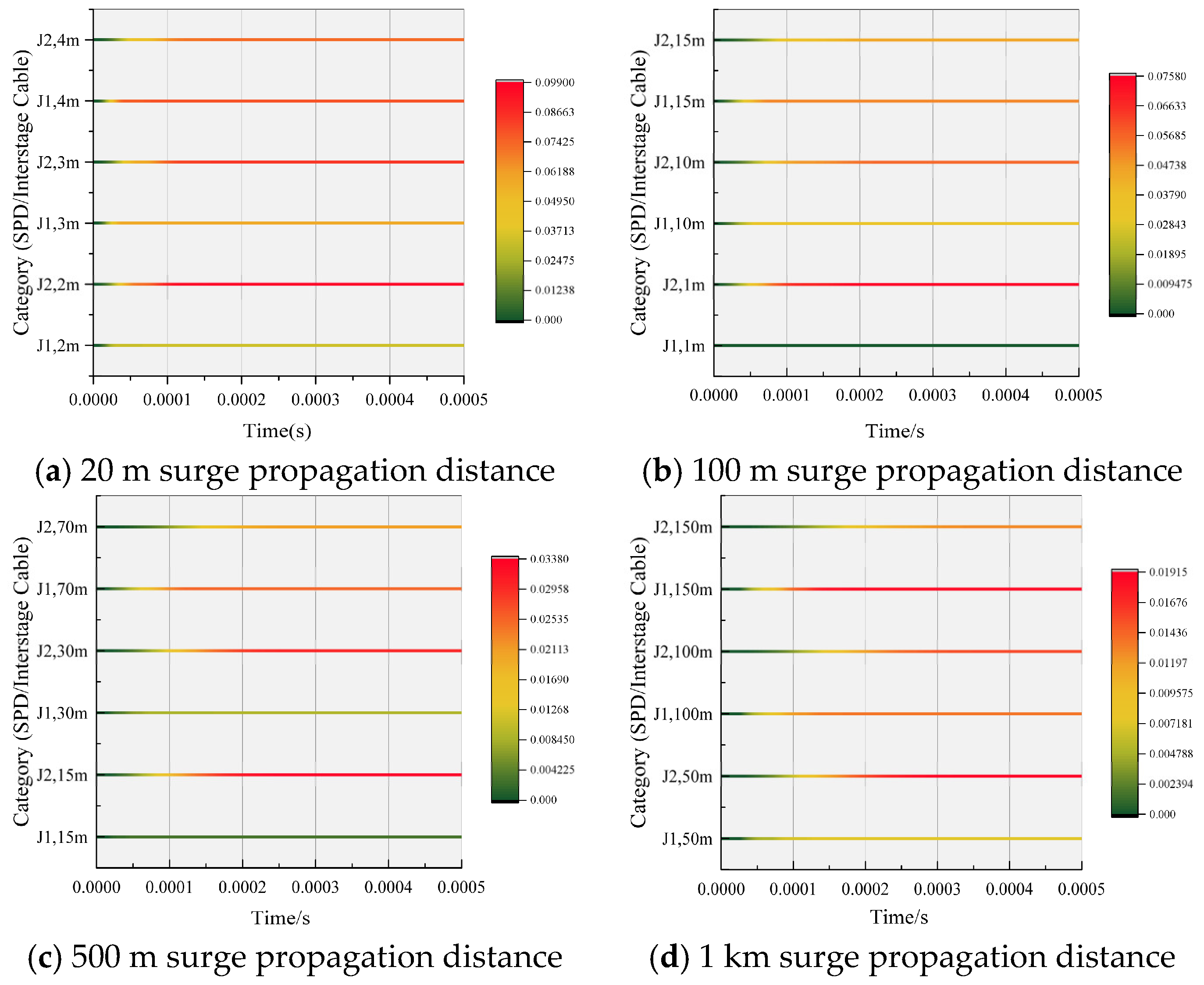
As shown in Figure 11, the absorbed energies of SPD1 and SPD2 are recorded under different interstage cable lengths and four representative surge propagation distances along the incoming line: 20 m, 100 m, 500 m, and 1 km. These distances represent the longitudinal propagation distances from the equivalent surge-entry point to the station-side SPD installation position, rather than the lateral distances from the lightning strike point to the cable. In the figure, J1 denotes the energy absorbed by SPD1, and J2 denotes the energy absorbed by SPD2. The purpose of this comparison is to evaluate how the interstage cable length affects the energy-sharing behavior and coordination performance of the two-stage SPD system under different surge propagation distances. The results demonstrate that appropriately increasing the interstage cable length can improve the energy coordination between SPD1 and SPD2.
A comprehensive analysis of the four cases leads to the following conclusion: as the surge propagation distance increases, the total energy absorbed by the two-stage SPD system gradually decreases. When the interstage cable is short, SPD1 tends to absorb significantly less energy than SPD2, resulting in an imbalanced energy distribution. In this case, SPD1 does not sufficiently share the incoming surge energy, while SPD2 may become overstressed or even fail due to excessive energy absorption.
In long-distance transmission lines, lightning surges are no longer ideal waveforms but are influenced by frequency-dependent attenuation and dispersion effects. From the time-domain waveforms of lightning surges at different propagation distances in Figure 4 and the frequency-domain waveforms at different propagation distances in Figure 8, it can be observed that high-frequency components decay more rapidly, while low-frequency components become relatively more dominant. This results in a broadened wavefront and reduced steepness. The broadened surge reaches the downstream equipment with a more dispersed temporal distribution, and the terminal voltage of SPD2 may reach its conduction condition earlier than that of SPD1. However, this earlier conduction of SPD2 does not necessarily indicate coordination failure; successful coordination depends on whether SPD1 can subsequently share sufficient surge energy before SPD2 becomes overstressed.
Changes in the SPD operation timing can alter the energy distribution between SPD1 and SPD2, thereby affecting the coordination performance of the two-stage SPD system. As the surge propagation distance along the incoming line increases, the waveform arriving at the station-side SPD terminal becomes broader and less steep. Under such conditions, a longer interstage decoupling path may be required to ensure that the upstream SPD can share sufficient surge energy before the downstream SPD becomes overstressed. Therefore, appropriately increasing the interstage cable length can improve the energy-sharing behavior between SPD1 and SPD2.
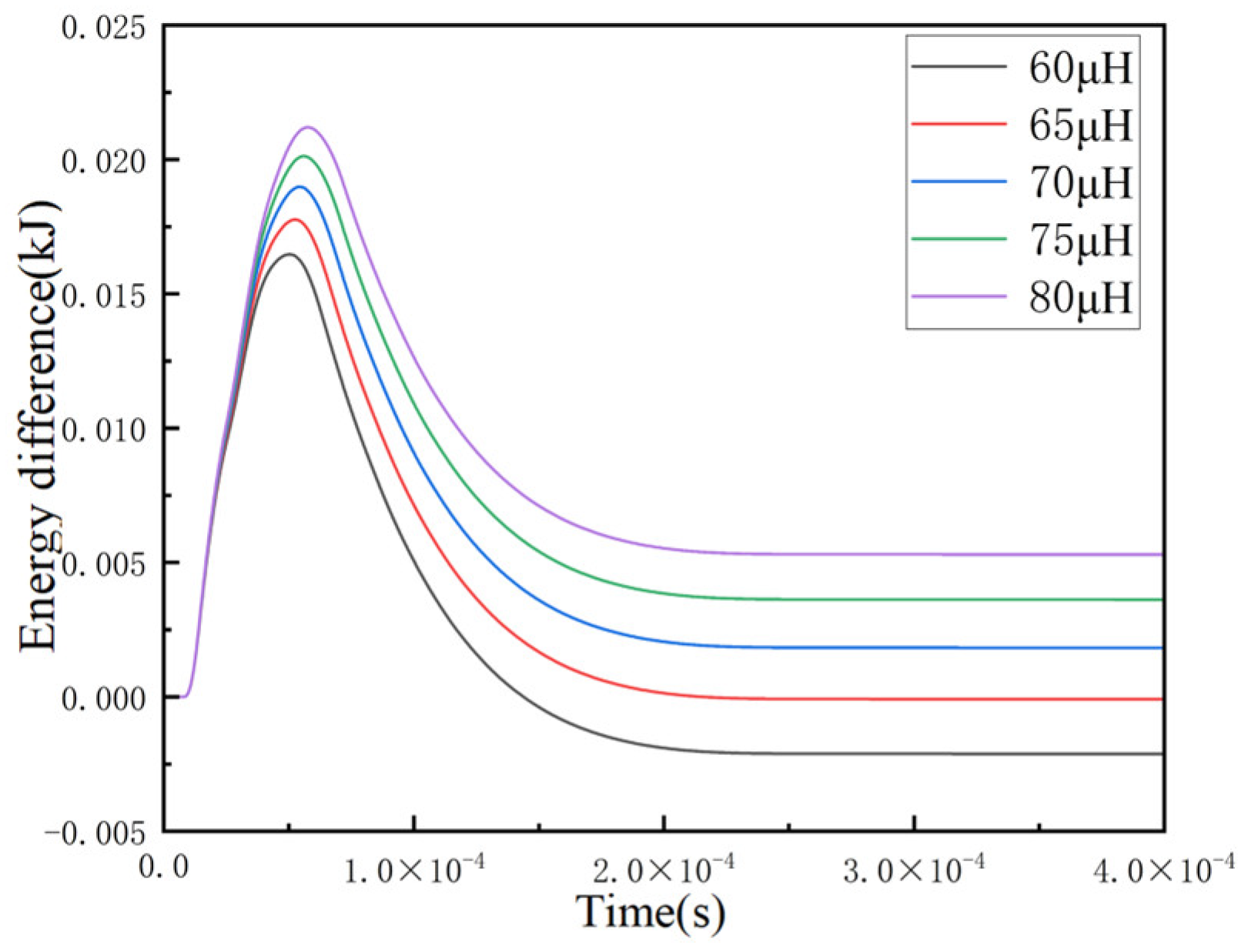
However, in practical communication power supply systems, installing an excessively long interstage cable may be limited by space and wiring constraints. Therefore, an equivalent series inductance can be used as an alternative decoupling element between SPD1 and SPD2. In this part of the simulation, the same surge-injection condition, SPD parameters, load condition, and voltage/energy observation method are maintained. The absorbed energies of SPD1 and SPD2 are calculated at their terminals by integrating the instantaneous power of each SPD. The cumulative energy difference is defined as Δ E   =   E S P D 1 E S P D 2 , where E S P D 1 and E S P D 2 are the cumulative energies absorbed by SPD1 and SPD2, respectively. The time-dependent curve of Δ E is used to show the dynamic evolution of energy sharing during the surge event, while its final value is used to evaluate whether the upstream SPD absorbs more energy than the downstream SPD.
To evaluate the impact of equivalent decoupling inductance, a comparison was conducted under the simulated 20 kV surge condition with a transmission distance of 5 km. The inductance range of 60–80 μH was selected according to the adopted SPD parameters, cable inductance, and energy-coordination requirement in this study, and was used as a simulation-based parameter sweep to identify the coordination threshold. Accordingly, five representative series inductance values, namely 60 μH, 65 μH, 70 μH, 75 μH, and 80 μH, were considered.
As shown in Figure 12, when the inductance value reaches 65 μH, the energy difference becomes positive, indicating that the energy absorbed by the upstream SPD exceeds that of the SPD2. Thus, 65 μH can be regarded as the approximate critical inductance for successful energy coordination under the simulated 20 kV surge condition. Compared with the 60 μH case, the 65 μH condition changes the energy-sharing state from downstream-dominant absorption to upstream-dominant absorption, indicating a clear coordination threshold. It also implies that a properly selected inductance can effectively replace a long cable in increasing the voltage drop. Consequently, when a surge current occurs, SPD1 can be triggered and activated in time, thereby sharing a portion of the surge energy and alleviating the energy burden on the SPD2.
In the preceding analysis, the SPD performance was assumed to remain ideal. However, in practical applications, devices often experience aging phenomena such as increased clamping voltage and delayed response time. These degradation effects play a critical role in the coordination and reliability of multi-stage SPD systems. Zhou et al. [25] proposed a finite element modeling approach based on multi-physics coupling to simulate the electrothermal behavior of ZnO varistors, revealing that under repeated lightning surges, local thermal accumulation and current crowding occur within the device, eventually leading to cracks, breakdown, and other irreversible damage.
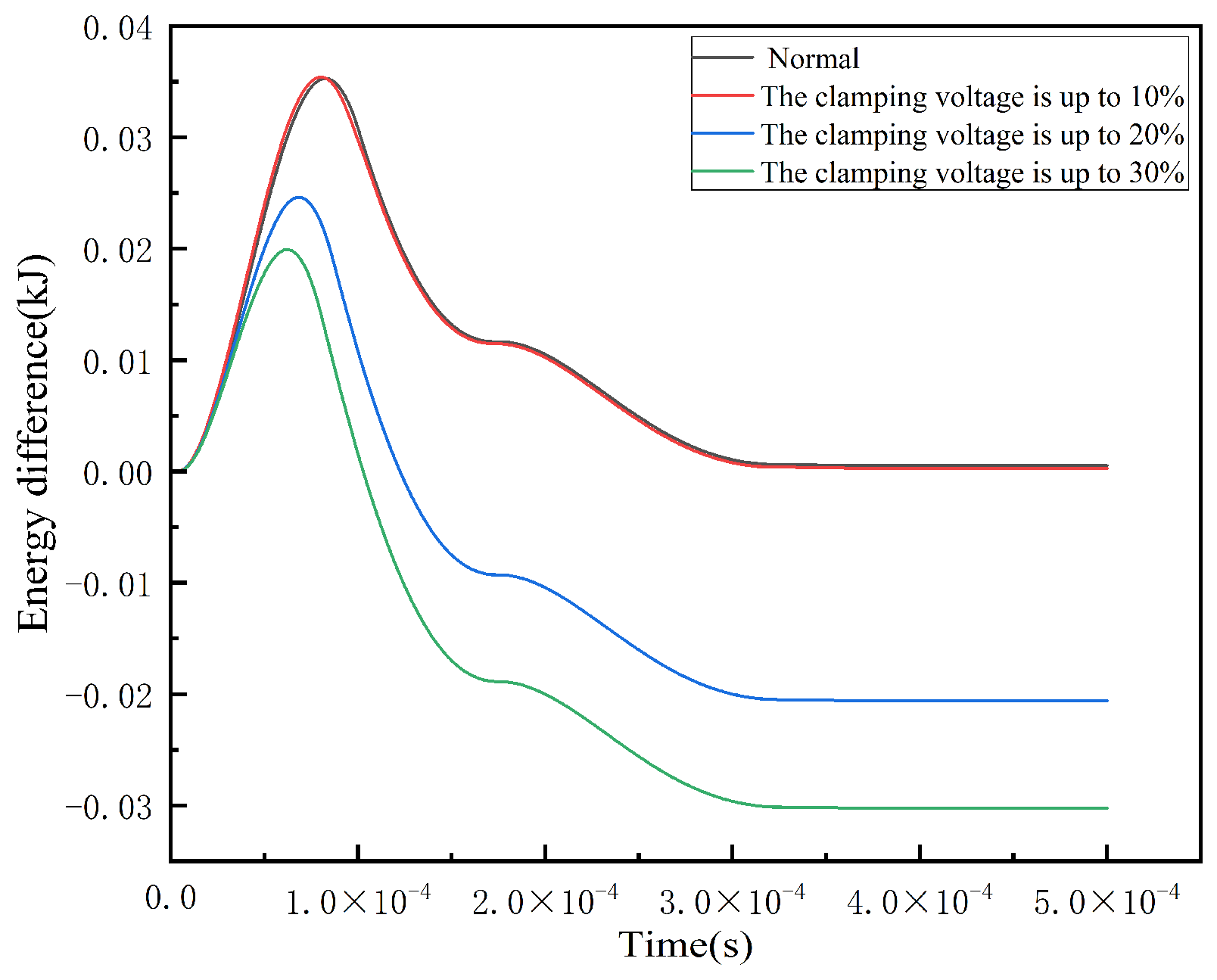
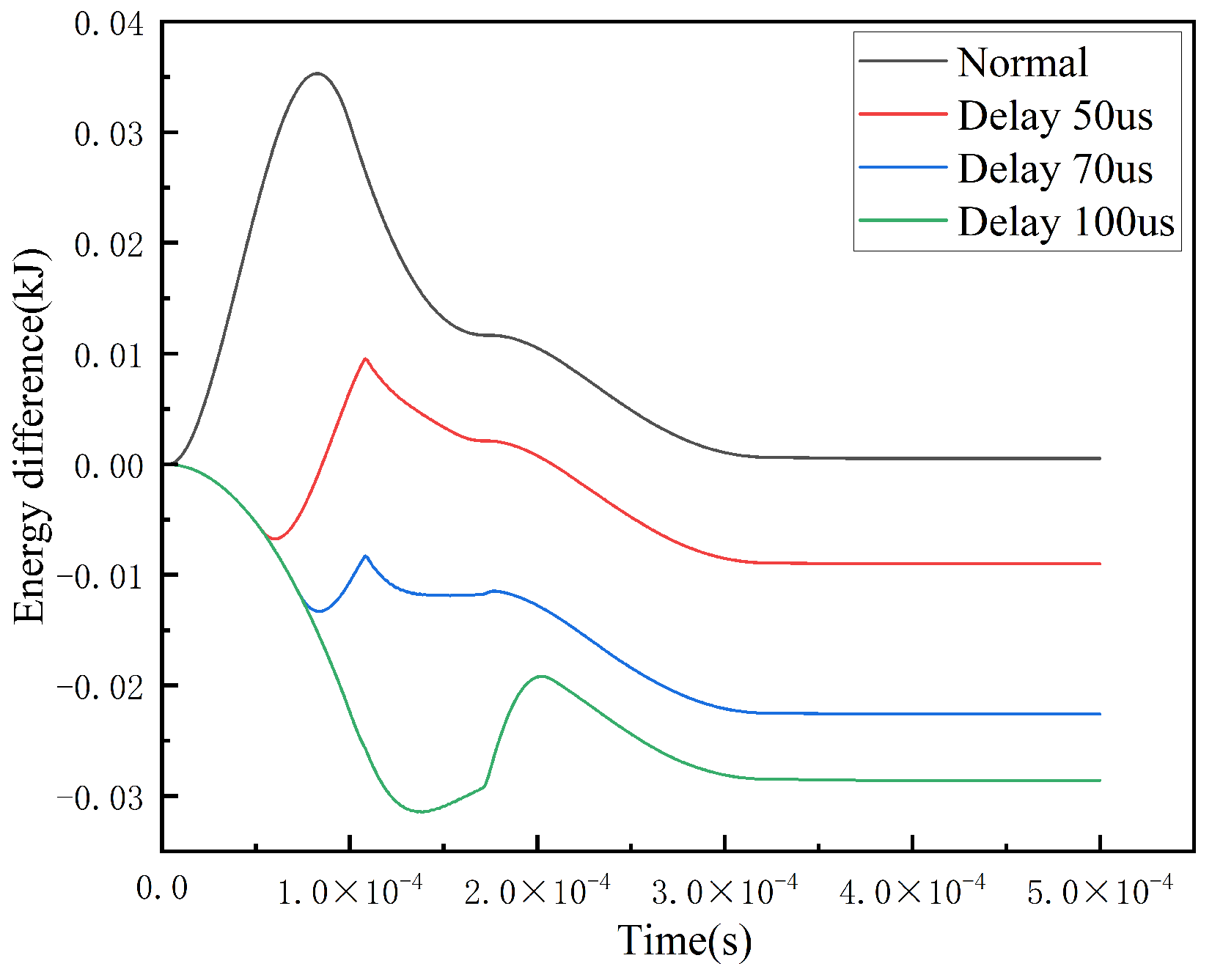
To simulate the degraded SPD, we conducted numerical experiments on the SPD1 considering elevated clamping voltage and delayed response time. As shown in Figure 13, when the clamping voltage of the SPD1 was increased by 10%, 20%, and 30%, the corresponding changes in the energy distribution between the two SPDs were obtained. As shown in Figure 14, when the response time of the SPD1 was delayed by 50 μs, 70 μs, and 100 μs, the energy coordination between the two SPDs was further analyzed, along with its associated impacts.
These cases provide a sensitivity analysis of SPD degradation. The results show that both a 10–30% increase in clamping voltage and a 50–100 μs response delay shift more surge energy to SPD2, thereby increasing the probability of downstream overload and coordination failure. As shown in Figure 13, the aging of the SPD1, manifested as an increase in clamping voltage, weakens its ability to absorb surge energy. Consequently, more energy is transferred to the SPD2, disrupting the original energy distribution and operating sequence, which causes the SPD2 to intervene prematurely and reduces overall system coordination. Similarly, as shown in Figure 14, when the response of the SPD1 is delayed by tens to hundreds of microseconds, a comparable mismatch effect arises. The greater the delay, the more energy is borne by the SPD2, and the larger the energy imbalance between the two stages becomes. In other words, whether due to increased clamping voltage or delayed response time, the protection role of the SPD1 is essentially weakened, thereby increasing the risk of overload in the SPD2 and coordination failure in the multi-stage protection system. Likewise, the aging of the SPD2 inevitably affects the protected equipment. Therefore, in the long term, the degradation of any stage of SPD can significantly reduce the overall protection reliability of the system. It is thus essential to replace SPDs promptly once clear signs of aging—such as increased clamping voltage or slower response—are detected, and to recalibrate the interstage coordination parameters to ensure that surge energy can be effectively shared and absorbed.
It should be noted that SPD aging is not limited to increased clamping voltage and delayed response; the simulations presented here only quantify these specific aspects of degradation for comparative analysis. Although existing research has confirmed the degradation trend of MOVs under repeated surge impacts, the precise threshold for functional failure in terms of the number of surges has not yet been clearly quantified, which poses challenges for predictive maintenance in engineering practice. Therefore, it is recommended that SPD design and deployment incorporate degradation-aware mechanisms by monitoring multiple indicators—such as leakage current, clamping voltage, and surface temperature rise—in real time. Combined with environmental conditions and surge intensities, these data can be used to construct lifecycle-based performance evaluation models, thereby ensuring that SPDs maintain stable and reliable protection capability throughout their entire service life.

4.2. Different Loads

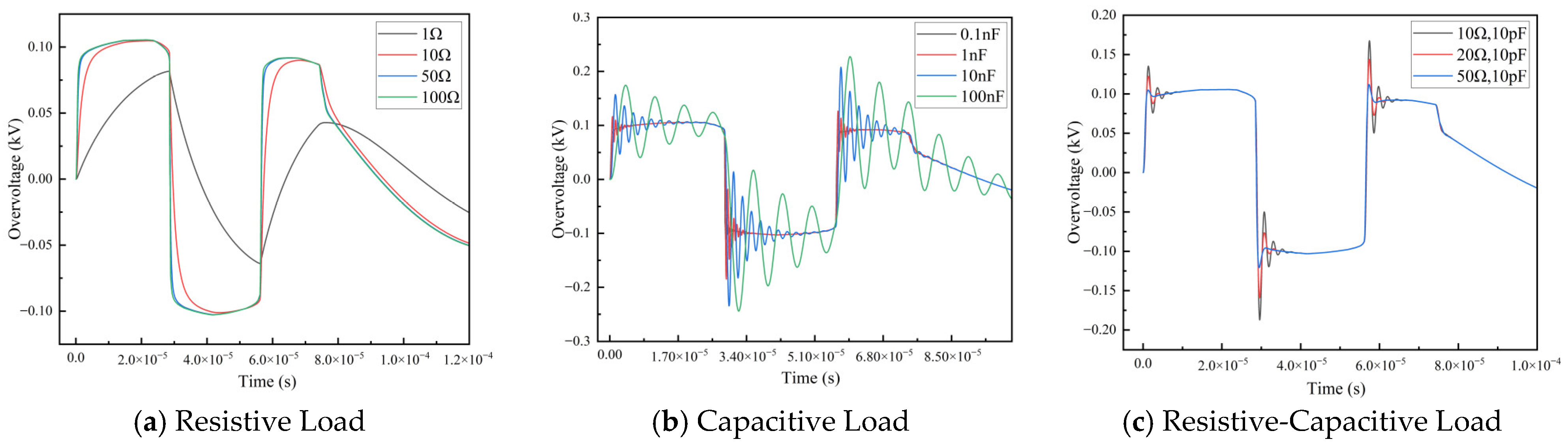
When the protected equipment is subjected to different load types, the system analyzes the electrical response under three load conditions: purely resistive, purely capacitive, and combined resistive–capacitive loads. As shown in Figure 15, the maximum overvoltage amplitude on resistive loads of 1 Ω, 10 Ω, 50 Ω, and 100 Ω varies with the distance between the SPD and the load; the maximum overvoltage amplitude on capacitive loads of 0.1 nF, 1 nF, 10 nF, and 100 nF also changes with the SPD-to-load distance; for resistive–capacitive loads such as 10 Ω/10 pF, 20 Ω/10 pF, and 50 Ω/10 pF, the maximum overvoltage amplitude likewise varies with the distance between the SPD and the load.
In addition, based on the second principle of SPD coordination, the cable sections between SPD2 and different types of protected loads, including resistive and capacitive loads, were investigated to determine the effective protection distance during SPD2 operation. For resistive loads, a cable length of 100 m between SPD2 and the protected load was used as a reference, and the peak overvoltage values at both the load terminal and the SPD2 terminal were recorded after SPD2 was triggered. For capacitive loads, the length of the cable section between SPD2 and the protected load was adjusted to identify the overvoltage condition corresponding to the maximum voltage difference between the load terminal and SPD2 during SPD2 operation. The specific simulation results are presented in Table 2 and Table 3. These results provide a reference for optimizing SPD configuration and improving load-side protection strategies.
The simulation results show that when the protected equipment is modeled as a purely resistive load, the clamping action of the SPD can effectively suppress the steepness of the surge voltage only when the load impedance is relatively low under the given simulated conditions. When the load impedance is lower than the characteristic impedance of the cable (approximately 84.5 Ω), the SPD achieves optimal impedance matching with the cable, effectively reducing the surge peak and resulting in a longer theoretical protection distance. However, when the load impedance exceeds the characteristic impedance—especially beyond approximately 120 Ω—the voltage at the load after SPD activation exhibits a pronounced peak that may even surpass the clamping voltage of the SPD. This leads to a sharp reduction in the protection distance and a significant deterioration in protection effectiveness. Quantitatively, when the load resistance increases from 120 Ω to 200 Ω, the maximum protection cable length decreases from 6 m to 0.8 m, corresponding to an 86.7% reduction. At the same time, the load voltage peak increases from 0.593 kV to 0.721 kV, with an increase of approximately 21.6%. These results indicate that high-resistance loads not only increase the terminal overvoltage but also sharply reduce the effective protection distance of the SPD2.
In this case, the physical wiring distance between the SPD and the device becomes a key factor affecting the protection performance. Suppose the terminal SPD is too far away from the device. In that case, its protection response delay and energy absorption capacity may cause the device to be directly exposed to high-energy spikes, resulting in damage. In addition, high current surges can lead to substantial heat buildup in the SPD, which may result in thermal breakdown if its heat capacity is surpassed. Therefore, in actual engineering applications, the “effective protection distance” of SPD is not only limited by cable impedance matching, but also comprehensively considers its clamp voltage upper limit and thermal damage threshold.
If the protected device is modeled as a capacitive load, the load-side voltage may exhibit oscillatory behavior within a certain capacitance range, which can impose additional electrical stress on the device. As shown in Figure 15b, both the frequency and amplitude of the oscillation vary with the capacitance value. Within the simulated capacitance range, a larger capacitance generally leads to a lower oscillation frequency and a higher oscillation amplitude, while a smaller capacitance results in a higher oscillation frequency and a lower amplitude.
As shown in Table 3, reducing the length of the protection cable can effectively suppress the amplitude of overvoltage oscillations. For the 100 nF capacitive load, reducing the protection cable length from 1 m to 0.25 m decreases the load voltage peak from 0.714 kV to 0.628 kV, corresponding to a reduction of approximately 12.0%. For the 0.1 nF capacitive load, reducing the cable length from 8 m to 1 m decreases the load voltage peak from 0.581 kV to 0.533 kV, corresponding to a reduction of approximately 8.3%. These comparisons show that cable shortening can reduce the oscillatory overvoltage amplitude, but the suppression effect depends on the load capacitance. Furthermore, the larger the load capacitance, the shorter the cable segment length required to suppress the oscillatory overvoltage on the load side.
It should be noted that this oscillatory behavior is not expected for all capacitance values. Very small capacitances, such as values below several picofarads, have little influence on the surge response, whereas very large capacitances, such as values above the microfarad range, may provide a bypass effect and help suppress the surge voltage. Therefore, the resonance effect discussed here mainly applies to the specific capacitance range considered in this study. During the simulations, adjusting the capacitance value within this range and changing the cable section between SPD2 and the protected load did not completely eliminate the oscillatory behavior. These results indicate that, for capacitive loads within the considered range, cable configuration alone may be insufficient to suppress load-side resonance.
Under capacitive-load conditions, the effective protection distance is constrained not only by cable configuration, but also by the SPD clamping limit and thermal withstand capability. Therefore, cable length optimization alone cannot fully eliminate the oscillatory overvoltage risk.
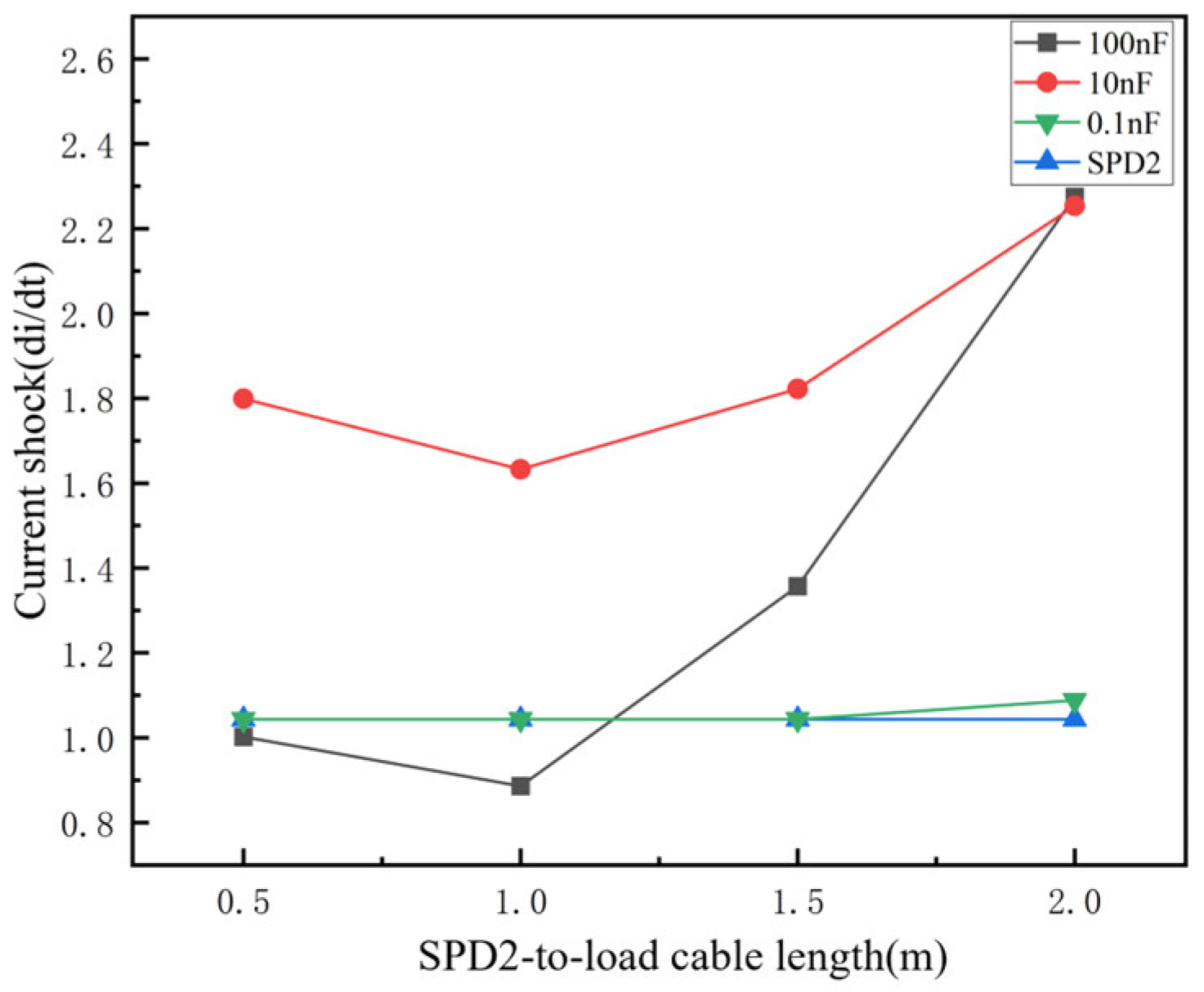
In this paper, under the surge action of SPD2, three capacitive loads of 0.1 nF, 10 nF, and 100 nF were tested, and the cable segment length between SPD2 and the protected load was set to vary within the range of 0.5 m to 2 m. Voltage measurements were taken at the protected load end, while the surge current and its steepness di/dt were evaluated at the output terminal of SPD2 facing the protected load side. The results are shown in Figure 16.
Although this study recommends appropriately shortening the cable section between SPD2 and the protected load to reduce high-frequency oscillation amplitude, shorter is not always better. In the simulation, it was observed that reducing the cable length also shortens the transmission path of the lightning surge front, thereby increasing the di/dt steepness. Under such conditions, SPDs are subjected to more intense surge shocks, which not only increase the turn-on voltage peak but may also shorten their service life and even lead to breakdown failure. Therefore, it is additionally recommended to incorporate secondary protection in series near the protected device to mitigate the impact of oscillations. The specific rationale for this recommendation will be discussed in detail in the subsequent section on capacitive loads.
Suppose the protected device is modeled as a resistive–capacitive load, as illustrated in Figure 15c. Similar to a purely capacitive load, voltage oscillations occur at both terminals of the load, and the oscillation frequency and amplitude vary with the capacitance value. However, the presence of the resistive component introduces a significant damping effect on the system’s surge oscillation response, which cannot be neglected. In the SPD protection path, the RC series structure constitutes a second-order underdamped system, and the following expression can describe its transient response.
V ( t ) = V 0 e ς ω n t sin ( ω d t )
The parameters are defined as follows:
ς = R 2 C L , ω n = 1 L C , ω d = ω n 1 ς 2
where ς is the system damping ratio, V 0 is the initial peak voltage, L is the equivalent inductive reactance, ω n is the natural angular frequency, and ω d is the oscillation angular frequency after damping. The larger the R, the stronger the damping, the smaller the surge peak amplitude, and the shorter the duration. Actual simulation shows that, as shown in Figure 15c, for the same capacitance of 10 pF, when the series resistance is from 10 Ω to 20 Ω, and then to 50 Ω, the maximum surge oscillation voltage drops from 0.17 kV to about 0.12 kV, and the duration of the peak oscillation is shortened by nearly 30%.
Therefore, adding an appropriate damping resistance in the surge path or in a dedicated RC damping branch near the capacitive load can reduce high-frequency voltage peaks and slow the transient voltage rise. However, a resistor directly inserted in series with the main power-supply path would cause voltage drop, power loss, and heating under normal operating current. Therefore, this measure should not be interpreted as simply adding a large resistor in the main supply line. In practical communication power supply systems, the damping element should be carefully designed, for example as a small series damping resistor, an RC snubber, or another dedicated surge-damping network, so that transient overvoltage suppression is achieved without unacceptable steady-state voltage drop or power loss.

4.3. Coupling Relationship Between Energy Coordination and Overvoltage Coordination

When both the energy coordination criterion and the overvoltage coordination criterion are satisfied, the protection performance of the two-stage SPD system can be improved. However, in practical applications, it is necessary to examine whether these two criteria can be satisfied simultaneously and whether they influence each other. Therefore, this study further investigates the coupling relationship between energy coordination and overvoltage coordination.
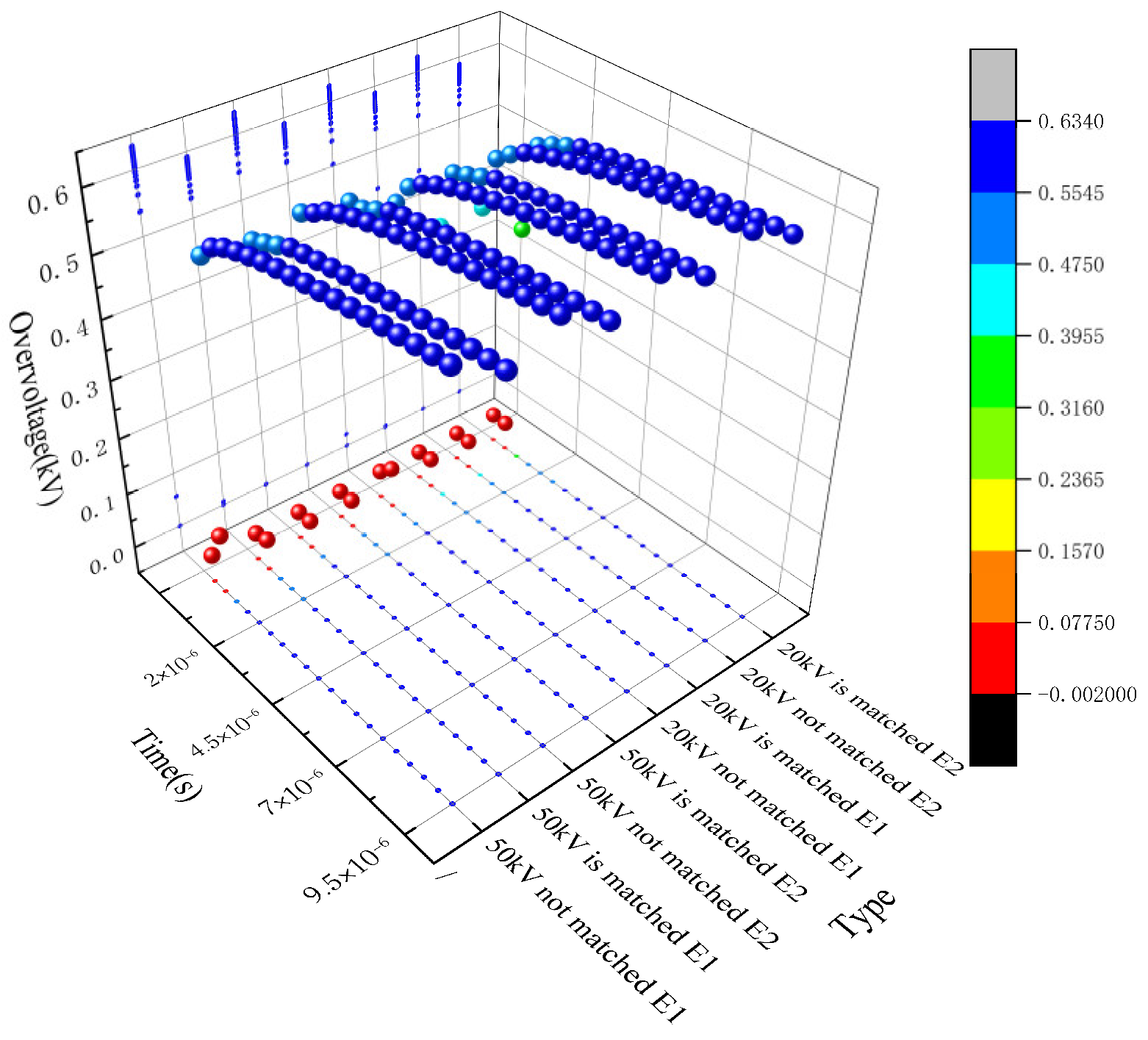
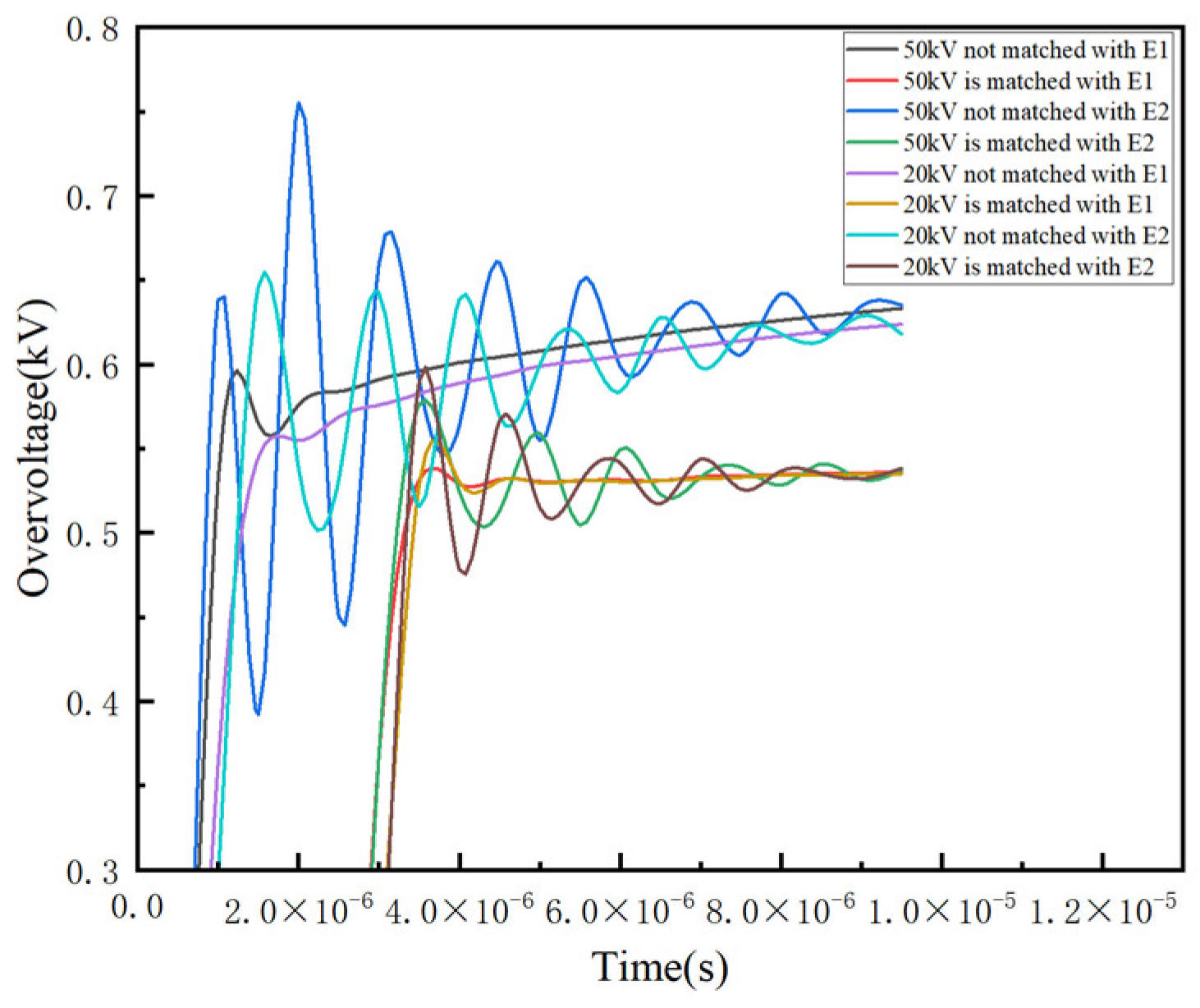
Simulations were conducted under both resistive-load and capacitive-load conditions, as well as under two lightning surge amplitudes, to evaluate whether energy coordination between SPD1 and SPD2 is achieved and whether the overvoltage criterion is satisfied. The corresponding results are shown in Figure 17 and Figure 18.
Figure 17 presents a three-dimensional scatter plot of the overvoltage results under resistive-load conditions. The x-axis represents different simulation cases, including different surge amplitudes and whether energy coordination is achieved. The y-axis represents time, and the z-axis and color bar represent the overvoltage magnitude. A scatter plot is used because the overvoltage waveforms under resistive-load conditions are similar, making direct waveform comparison less clear.
The results show that, under the same surge amplitude, the cases without successful energy coordination generally produce slightly higher overvoltage than the coordinated cases. However, the difference is not significant. In addition, for both surge amplitudes considered, the load-side overvoltage, remains lower than the overvoltage at the downstream SPD. This indicates that, under resistive-load conditions, the load provides a relatively stable damping path, and overvoltage coordination is not strongly affected by the energy coordination state between SPD1 and SPD2.
As shown in Figure 18, the surge amplitude significantly affects the overvoltage amplitude. When the two-stage SPD is not coordinated, the overvoltage generated by the SPD2 is higher under higher surge lightning conditions, and the load overvoltage is also higher. Under the same surge amplitude, when energy coordination is not successfully achieved, the load overvoltage of the two-stage SPD exhibits larger voltage fluctuations compared to when energy coordination is successfully implemented. Moreover, the larger the surge amplitude, the more pronounced the voltage fluctuations. This indicates that overvoltage coordination is directly influenced by whether energy coordination is successfully achieved.

4.4. Practical Design Implications and Comparison with Standards

The simulation results can be interpreted as supplementary guidance for SPD coordination design in accordance with the protection concepts of IEC 61643-11 [17] and IEEE C62.41.2 [18]. These standards emphasize the classification, selection, and installation of SPDs under representative surge conditions, while the present study further quantifies how interstage cable length, equivalent inductance, and load impedance influence the actual coordination behavior in communication power systems.
From an engineering perspective, the upstream SPD should be selected with sufficient energy-handling capability, while the SPD2 should provide a lower voltage protection level for sensitive terminal equipment. However, the results show that voltage protection level alone is insufficient for reliable coordination. If the interstage impedance is too small, SPD2 may conduct prematurely and absorb excessive surge energy. Therefore, an appropriate interstage cable length or an equivalent series inductor should be introduced to ensure that SPD1 operates first. Under the simulated conditions, a series inductance of approximately 60–80 μH can provide an effective coordination delay when long cable installation is impractical.
For load-side protection, the simulation results indicate that resistive loads lower than the cable characteristic impedance of approximately 84.5 Ω are less likely to produce severe overvoltage amplification. When the load resistance exceeds approximately 120 Ω, the effective protection distance decreases sharply. For capacitive loads, the protection design should not rely solely on shortening the cable length, because this may increase surge steepness and SPD stress. Instead, an additional damping resistor or RC-type suppression measure should be considered near the protected equipment to reduce oscillatory overvoltage.
It should be noted that the numerical values obtained in this study, such as the 60–80 μH equivalent inductance range, the approximately 84.5 Ω characteristic impedance, and the 120 Ω load-resistance threshold, are derived from the adopted PSCAD/EMTDC model and selected surge conditions. Therefore, these values should be regarded as simulation-based design references rather than universal standard limits. In practical applications, they should be checked together with the SPD voltage protection level, discharge current rating, installation category, cable layout, and equipment withstand voltage specified in relevant standards and manufacturer datasheets.

5. Conclusions

This study investigated the coordination mechanism of two-stage voltage-limiting SPDs in communication power systems using PSCAD/EMTDC simulations and traveling-wave analysis. The effects of surge amplitude, incoming-line surge propagation distance, interstage cable length, equivalent series inductance, and load type were evaluated. The main conclusions are as follows:
  • Interstage cable length plays a key role in SPD energy coordination. Under the simulated conditions, as the surge voltage increases from 10 kV to 50 kV, the critical cable length decreases from approximately 3 m to 1 m. For longer incoming-line surge propagation distances, a larger interstage decoupling delay is required. When cable extension is impractical, an equivalent series inductance of 60–80 μH can improve energy sharing, with approximately 65 μH identified as the critical value under the simulated 20 kV condition.
  • Load characteristics strongly affect load-side overvoltage. For resistive loads, protection performance is better when the load impedance is lower than the cable characteristic impedance of approximately 84.5 Ω. Once the load impedance exceeds approximately 120 Ω, the effective protection distance decreases sharply; for example, increasing the load resistance from 120 Ω to 200 Ω reduces the allowable protection cable length from 6 m to 0.8 m. For capacitive loads, shortening the cable section between SPD2 and the protected load can reduce oscillation amplitude, but it may also increase surge steepness and SPD stress.
  • Energy coordination and overvoltage coordination are strongly coupled under capacitive-load conditions. When energy coordination fails, load-side voltage fluctuations become more severe, especially under high surge amplitudes. Adding an appropriate damping resistance can suppress resonance; for instance, under the 10 nF capacitive-load condition, increasing the resistance from 10 Ω to 50 Ω reduces the oscillatory voltage peak from approximately 0.17 kV to 0.12 kV and shortens the oscillation duration by nearly 30%.
The results are limited by the adopted MOV, surge waveform, cable parameters, and simplified load models. Future work will focus on experimental validation, refined SPD aging models, and field measurements in practical communication power systems.

Author Contributions

Conceptualization, Z.W.; Methodology, K.Y.; Investigation, L.S.; Resources, L.S.; Writing—original draft, K.Y.; Project administration, H.X. and Z.W.; Funding acquisition, H.X. All authors have read and agreed to the published version of the manuscript.

Funding

This research was funded by the National Natural Science Foundation of China (Grant No. 62171228) and Joint Fund of the National Natural Science Foundation of China for High-Speed Rail (Grant No. U2268217).

Data Availability Statement

The original contributions presented in this study are included in the article. Further inquiries can be directed to the corresponding author.

Conflicts of Interest

Author Zhoulong Wang was employed by the company Signal and Communication Research Institute, China Academy of Railway Sciences, Beijing, China. The remaining authors declare that the research was conducted in the absence of any commercial or financial relationships that could be construed as a potential conflict of interest. The authors declare that this study received funding from the China Academy of Railway Sciences. The funder was not involved in the study design, collection, analysis, interpretation of data, the writing of this article, or the decision to submit it for publication.

References

  1. Mosamane, S.; Gomes, C. Lightning-induced overvoltage protection for microinverters using surge protective devices. In 2022 36th International Conference on Lightning Protection (ICLP); IEEE: New York, NY, USA, 2022. [Google Scholar]
  2. Radulovic, V.M.; Miljanic, Z.V. Effects of built-in varistors with low protection voltages on surge protection performances in low-voltage AC power systems. IEEE Trans. Electromagn. Compat. 2019, 62, 933–946. [Google Scholar] [CrossRef]
  3. Zhang, Y.; Zhang, W.; Ji, J. Study of a combined surge protective device for a relay protection circuit in a UHV converter station. IEEE Access 2020, 8, 159956–159964. [Google Scholar] [CrossRef]
  4. Wang, Q.; Wang, D.; Yang, Y.; Fang, C. Design and Optimisation of Strong Electromagnetic Pulse Protection Devices Based on Semiconductors and Gas Discharges Tube. In 2023 Cross Strait Radio Science and Wireless Technology Conference (CSRSWTC); IEEE: New York, NY, USA, 2023. [Google Scholar]
  5. Mohaddes, M.; Mukherjee, B.B. Insulation Co-Ordination for LCC and VSC HVDC Converter Stations. In High Voltage DC Transmission Systems: HVDC; Springer International Publishing: Cham, Switzerland, 2023; pp. 1–53. [Google Scholar]
  6. Li, C.; Zhang, C.; Zhang, G.; Kong, M.; Yang, Z. Analysis of the failure mode of surge protector under multi-pulse lightning strikes and its mechanism. Energy Rep. 2022, 8, 487–497. [Google Scholar] [CrossRef]
  7. Huang, Z.; Zhao, S.; Zou, L.; Li, Y.; Zou, J. Principle and Simulation of High Voltage Varistor Current Limiter. In Conference Proceedings of 2021 International Joint Conference on Energy, Electrical and Power Engineering: Component Design, Optimization and Control Algorithms in Electrical and Power Engineering Systems; Springer Nature: Singapore, 2022. [Google Scholar]
  8. Sarajcev, P.; Meglic, A.; Goic, R. Lightning overvoltage protection of step-up transformer inside a nacelle of onshore new-generation wind turbines. Energies 2021, 14, 322. [Google Scholar] [CrossRef]
  9. Ravichandran, N.; Proto, D.; Andreotti, A. Surge arrester optimal placement in distribution networks: A decision theory-based approach. Electr. Power Syst. Res. 2024, 234, 110744. [Google Scholar] [CrossRef]
  10. Ahmad, N.I.; Ali, Z.; Kadir, M.Z.A.A.; Osman, M.; Zaini, N.H.; Roslan, M.H. Analysis of lightning-induced voltages effect with SPD placement for sustainable operation in hybrid solar PV-battery energy storage system. Sustainability 2021, 13, 6889. [Google Scholar] [CrossRef]
  11. Ahmad, N.I.; Ali, Z.; Kadir, M.Z.A.A.; Osman, M.; Zaini, N.H.; Roslan, M.H. Impacts of lightning-induced overvoltage on a hybrid solar PV–battery energy storage system. Appl. Sci. 2021, 11, 3633. [Google Scholar] [CrossRef]
  12. Formisano, A.; Hernández, J.C.; Petrarca, C.; Sanchez-Sutil, F. Modeling of PV module and DC/DC converter assembly for the analysis of induced transient response due to nearby lightning strike. Electronics 2021, 10, 120. [Google Scholar] [CrossRef]
  13. Friedemann, D.F.; Motter, D. Vector surge estimation methods for loss of mains protection and an equivalence relation with frequency estimation for system disturbances. Electr. Power Syst. Res. 2023, 223, 109555. [Google Scholar] [CrossRef]
  14. Puentes, K.; Morales, L.; Pozo-Espin, D.F.; Moya, V. Enhancing control systems with neural network-based intelligent controllers. Emerg. Sci. J. 2024, 8, 1243–1261. [Google Scholar] [CrossRef]
  15. Jiang, Y.; Pang, X.; Zhang, Z.; Jing, H.; Wei, L.; Su, J.; Zhang, P. Integrating Intelligent Sensors for Safe UAV Distribution: Design and Evaluation of Ranging System. High Tech Innov. J. 2024, 5, 603–613. [Google Scholar] [CrossRef]
  16. Bagaskara, A. Environmental Effects on Parameters of Leakage Current Equivalent Circuits of Outdoor Insulators. Emerg. Sci. J. 2024, 8, 310–325. [Google Scholar] [CrossRef]
  17. IEC 61643-11; Low-Voltage Surge Protective Devices—Part 11: Surge Protective Devices Connected to AC low-Voltage Power Systems—Requirements and Test Methods. International Electrotechnical Commission: Geneva, Switzerland, 2025.
  18. IEEE C62.41.2-2002; IEEE Recommended Practice on Characterization of Surges in Low-Voltage (1000 V and less) AC Power Circuits. IEEE: New York, NY, USA, 2002.
  19. Tsovilis, T.E.; Topcagic, Z. DC over-load behavior of low-voltage varistor-based surge protective devices. IEEE Trans. Power Deliv. 2020, 35, 2541–2543. [Google Scholar] [CrossRef]
  20. Huang, P.; Huang, J.; Huang, S.; Yang, G.; Wu, Z. High-Resistance Grounding Fault Location in High-Voltage Direct Current Transmission Systems Based on Deep Residual Shrinkage Network. Electronics 2025, 14, 628. [Google Scholar] [CrossRef]
  21. Rousseau, A. (Ed.) Surge Protection for Low Voltage Systems; IET: Stevenage, UK, 2021; Volume 182. [Google Scholar]
  22. Xi, Y.; Cui, Y.; Tang, X.; Li, Z.; Zeng, X. Fault location of lightning strikes using residual analysis based on an adaptive Kalman filter. IEEE Access 2019, 7, 88126–88137. [Google Scholar] [CrossRef]
  23. Chiradeja, P.; Ngaopitakkul, A. Identify direct lightning strike location based on discrete wavelet transform for 115-kv transmission system. IEEE Access 2022, 10, 80609–80622. [Google Scholar] [CrossRef]
  24. Wu, Y.; Li, Z.; Lin, X.; Feng, Z.; Cao, S.; Wei, F. A novel single-ended transient-based boundary protection based on the instantaneous energy of traveling waves. IEEE Trans. Power Deliv. 2024, 39, 1321–1336. [Google Scholar] [CrossRef]
  25. Zhou, Q.; Huang, X.; Cao, T.; Shao, B.; Liu, Y. Research on electrothermal characteristics of metal oxide varistor based on multi-physical fields. IET Gener. Transm. Distrib. 2022, 16, 3636–3644. [Google Scholar] [CrossRef]
Figure 1. Representative installation positions of SPDs in a three-level protection structure for a communication power system.
Energies 19 02454 g001
Figure 2. Wiring diagram of two-stage voltage-limiting SPDs.
Energies 19 02454 g002
Figure 3. Arrival time for each surge frequency component.
Energies 19 02454 g003
Figure 4. Time domain difference between different lightning strike locations.
Energies 19 02454 g004
Figure 5. Overvoltages of different models at 20 km of lightning strike position.
Energies 19 02454 g005
Figure 6. Overvoltages of different line models at the terminal of a 100 m cable section connected to the protected equipment.
Energies 19 02454 g006
Figure 7. Comparison of two waveforms.
Energies 19 02454 g007
Figure 8. Different frequency domains of lightning strike locations.
Energies 19 02454 g008
Figure 9. Comparison of overvoltage of different cables.
Energies 19 02454 g009
Figure 10. Energy absorption of SPD1 and SPD2 under different surge amplitudes and interstage cable lengths.
Energies 19 02454 g010
Figure 11. Comparison of energy absorption by the two-stage SPD with different interstage cables at different lightning strike positions.
Energies 19 02454 g011
Figure 12. Effect of equivalent series inductance on the cumulative energy difference between SPD1 and SPD2.
Energies 19 02454 g012
Figure 13. The aging of the SPD1 leads to an increase in its clamping voltage.
Energies 19 02454 g013
Figure 14. The aging of the SPD1 results in a delayed response time.
Energies 19 02454 g014
Figure 15. Load-side overvoltage responses under different load types: (a) resistive load, (b) capacitive load, and (c) resistive–capacitive load.
Energies 19 02454 g015
Figure 16. Effect of shortening the cable section between SPD2 and the protected load on surge current stress.
Energies 19 02454 g016
Figure 17. Relationship between energy coordination and overvoltage coordination under resistive-load conditions.
Energies 19 02454 g017
Figure 18. Relationship between energy coordination and overvoltage coordination under capacitive-load conditions.
Energies 19 02454 g018
Table 1. Unified Simulation Parameters Used in the Case Studies.
ParameterValue or SettingDescription or Source
Simulation platform PSCAD/EMTDCElectromagnetic transient simulation
SPD model Default MOV arrester modelPSCAD component model
Lightning waveform 8/20 μsStandard induced-lightning surge waveform
Surge peak voltage10 kV, 20 kV, 50 kVSurge-amplitude comparison
SPD1 rated voltage660 VUpstream SPD setting
SPD2 rated voltage330 VSPD2 setting
Wire height1 mUsed in lead inductance calculation
Wire radius0.006 mUsed in lead inductance calculation
Lead inductanceapproximately 0.7 μH/mCalculated from lead inductance formula
Surge propagation distance along incoming line20 m, 100 m, 500 m, 1 kmStrike-distance comparison
Equivalent series inductance60–80 μHAlternative to long interstage cable
Cable characteristic impedanceapproximately 84.5 ΩReference value for load matching
Resistive load1–200 ΩLoad-side overvoltage analysis
Capacitive load0.1 nF, 10 nF, 100 nFCapacitive-load oscillation analysis
RC load10 Ω/10 pF, 20 Ω/10 pF, 50 Ω/10 pFDamping effect analysis
Table 2. Impact of resistive load.
Load Impedance (Ω)SPD2 Peak Overvoltage (kV)Load Voltage Peak (kV)Maximum Protection Cable Length (m)
1N/AN/AUnlimited
50N/AN/AUnlimited
84.5N/AN/AUnlimited
1000.5760.545Unlimited
1050.5750.532Unlimited
1200.5740.5936
1500.5730.6511.2
2000.5730.7210.8
Table 3. Impact of capacitive load.
Load Capacitance (nF)Protection Cable Length (m)SPD2 Overvoltage (kV)Load Voltage (kV)
0.1100.5320.549
0.180.5300.581
0.150.5290.557
0.130.5280.546
0.110.5280.533
1010.5310.581
100.50.5310.562
10010.5610.714
1000.250.5490.628
Disclaimer/Publisher’s Note: The statements, opinions and data contained in all publications are solely those of the individual author(s) and contributor(s) and not of MDPI and/or the editor(s). MDPI and/or the editor(s) disclaim responsibility for any injury to people or property resulting from any ideas, methods, instructions or products referred to in the content.