Article

Using Ultrasonic to Study the Overcharge Damage Threshold of Lithium-Ion Batteries

1
School of New Energy, North China Electric Power University, Beijing 102206, China
2
Institute of Energy Power Innovation, North China Electric Power University, Beijing 102206, China
*
Author to whom correspondence should be addressed.
Energies 2026, 19(10), 2455; https://doi.org/10.3390/en19102455
Submission received: 18 March 2026 / Revised: 11 May 2026 / Accepted: 15 May 2026 / Published: 20 May 2026
(This article belongs to the Section D: Energy Storage and Application)

Abstract

Monitoring the internal structural evolution and gas generation in lithium-ion batteries is critical for effective battery management; however, conventional electrical and thermal sensing techniques lack the sensitivity to capture these dynamic changes accurately. To address this limitation, we apply ultrasonic diagnostic techniques—specifically A-scan and C-scan modalities—to characterize the acoustic responses of pouch-type LFP batteries subjected to a range of current densities (0.5C–5C) and overcharge conditions defined by cutoff voltage and SOC. Our findings show that ultrasonic signals are highly sensitive to concentration polarization and electrode lithiation processes occurring during charge–discharge cycles. At elevated current densities (>2C), an imbalance in the Li+ intercalation/deintercalation process occurs. Overcharge tests reveal that 4.2 V can serve as the threshold voltage for early warning during ultrasonic testing of LFP batteries When SOC exceeds 110%, internal gas generation and mechanical degradation significantly accelerate and become irreversible.

1. Introduction

Lithium-ion batteries (LIBs) have attracted considerable attention as a class of electrochemical energy storage systems owing to their high energy and power densities, long cycle life, and environmental friendliness, and are now regarded as one of the most promising energy storage technologies [1,2,3,4]. However, with the rapid expansion of application scenarios and increasing usage, safety concerns associated with LIBs have become more prominent. The intricate electrochemical processes inside the battery are highly sensitive to external environmental factors and operating conditions. Under improper conditions, the battery’s stability and safety can be significantly compromised, rendering it particularly susceptible to failure. Such conditions mainly encompass thermal, electrical, and mechanical abuse, which can lead to battery malfunction, deformation, or even catastrophic failure such as explosion [5,6,7,8,9,10].
At present, battery monitoring predominantly relies on electrical and thermal signals. However, under abusive conditions such as overcharging, irreversible side reactions—including lithium plating and electrolyte decomposition with gas generation—often occur internally within the battery. These changes are difficult to capture promptly using conventional electrical signals during their initial stages [11]. By the time significant abnormalities in voltage or temperature become detectable, the battery may already be on the verge of thermal runaway, posing a severe challenge to battery safety management. Consequently, accurate detection of the internal battery state and early warning of potential hazards have become essential, driving the development of various advanced characterization techniques [12,13]. These techniques can be broadly classified into two categories: destructive and non-destructive. Destructive methods encompass Raman spectroscopy, scanning electron microscopy (SEM), and X-ray diffraction (XRD) [14,15,16], while non-destructive approaches include neutron imaging [17,18,19] and electrochemical impedance spectroscopy (EIS) [20,21]. Destructive techniques provide ultra-high spatial resolution, in some cases reaching nanometer precision, allowing for atomic-scale structural analysis. However, in practical settings, battery diagnostics prioritize real-time and in-situ capabilities over spatial resolution, rendering destructive techniques unsuitable for engineering applications. Compared with other non-destructive techniques, ultrasonic imaging offers intuitive diagnostics, spatially resolves localized side reactions, and captures dynamic processes during charge–discharge cycles.
Ultrasonic testing is widely regarded as an ideal technique for rapid, non-destructive, real-time monitoring [22,23,24]. It leverages the propagation characteristics of ultrasound to detect material property variations, offering deep penetration, high sensitivity, rapid response, and directional selectivity. In recent years, it has been increasingly employed for internal state diagnostics in LIBs [25]. The technique is non-invasive and does not compromise battery performance or integrity. Due to the multilayered structure of batteries composed of heterogeneous materials, each layer exhibits distinct acoustic impedance. As ultrasound propagates, reflections and transmissions occur at material interfaces. The corresponding expressions for acoustic impedance, reflection coefficient, and transmission coefficient are given in Equations (1)–(3) [26].
Z = ρ × E
where ρ represents the density of the material and E represents the elastic modulus of the material.
Reflection   ratio :   R = Z 2 Z 1 2 Z 2 + Z 1 2
Transmission   ratio :   T = 4 × Z 1 × Z 2 Z 2 + Z 1 2
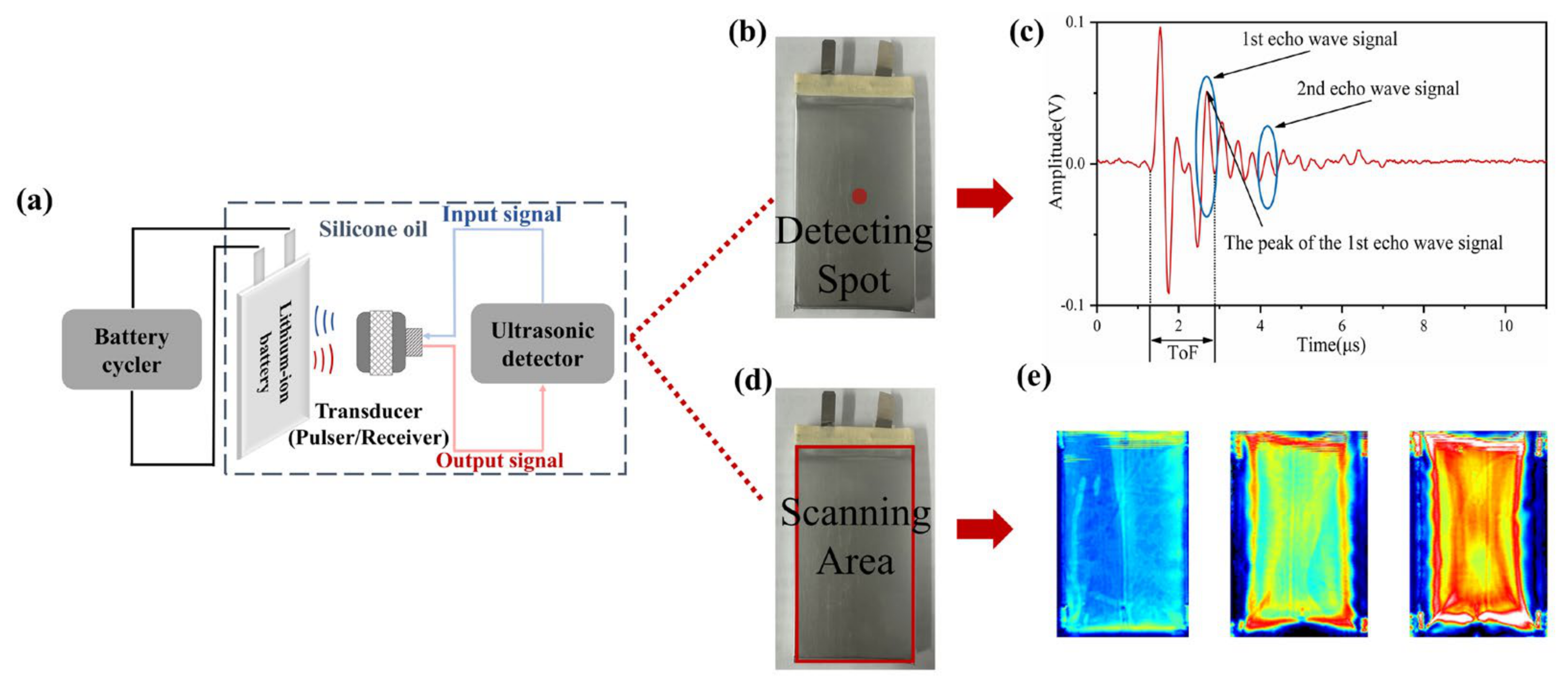
Z1 and Z2 represent the acoustic impedances of two distinct materials. Conventional ultrasonic monitoring instruments operate in two primary modes based on the type of received signal: pulse-echo and through-transmission, as illustrated in Figure 1. As indicated by the equations above, when ultrasonic waves encounter an interface between materials with similar acoustic impedances, most of the energy is transmitted; conversely, significant impedance mismatches result in strong reflections. Due to differences in Li+ migration rates between solid electrodes and electrolytes, as well as between the electrode surface and interior, a concentration gradient of Li+ at the onset of charging or discharging can result in changes in the reflection coefficient, either increasing or decreasing. Once the system reaches electrochemical equilibrium, Li+ are uniformly distributed across the electrode, leading to notable shifts in the physical properties of the electrode materials—and consequently, significant changes in acoustic impedance contrast. Table 1 summarizes the calculated elastic modulus, density, and other key physical properties of electrodes at various lithium-insertion stages. It should be noted that the data listed in Table 1 are primarily used to qualitatively describe the general trends in the physical property changes in LiFePO4 material during Li+ intercalation and deintercalation. These data are representative for the LFP/graphite system used in this study. However, due to variations in material preparation processes and battery design, the actual values may exhibit slight deviations across different cells within the same system. The pouch battery packaging layer used in this study consists of a single-layer aluminum-plastic film, whose acoustic impedance lies between that of the internal electrodes and the external coupling medium. During normal charging and discharging, the thickness and acoustic properties of the packaging layer remain relatively stable, and its effect on ultrasonic echo signals can be regarded as a constant background. Therefore, in the comparative analysis, we focused on discussing the dominant signal changes caused by lithium insertion and deintercalation in the electrode materials. However, when significant gas is generated inside the battery, the aluminum-plastic film is stretched and thinned, and the battery surface changes from flat to curved. These factors affect the propagation of ultrasound. In this study, the abnormal attenuation of ultrasonic signals during battery swelling caused by overcharging is the result of the combined effects of internal gas accumulation, electrode structural damage, and encapsulation layer deformation. The electrode delamination and internal gas voids directly observed in CT images provide direct evidence of internal structural damage, indicating that structural changes caused by internal electrochemical side reactions are the dominant factor in the abnormal ultrasonic signals; however, the contribution of packaging layer deformation should not be completely ignored. Since changes in the acoustic properties of the encapsulation layer occur simultaneously with and are coupled to internal gas accumulation during the swelling process, it is difficult to completely decouple their contributions to the ultrasonic signal using existing experimental designs; furthermore, the ultrasonic detector used in this study features a curved surface compensation function. Therefore, the interpretation of ultrasonic signal anomalies in this paper relies primarily on a combined qualitative analysis with multimodal characterization methods such as CT images and optical photographs, rather than attributing signal changes solely to a single physical mechanism. As shown, the anode’s acoustic impedance gradually increases during charging, while the cathode’s decreases; during discharging, the trend reverses. Notably, the anode exhibits more pronounced changes. Hence, the observed ultrasonic behavior is primarily governed by changes in the anode’s physical properties.
By accurately analyzing variations in ultrasonic signal features, it is possible to monitor the battery’s operational state and internal structural evolution in real time. Bommier et al. [26] found that an increased degree of passivation in silicon particles within silicon/graphite composite anodes is correlated with an increase in the acoustic time-of-flight (TOF) shift, as confirmed through combined electrochemical and chemical analysis. They further observed that the transient disappearance of acoustic signals during the first cycle was significantly related to gas evolution inside the cell, highlighting the strong potential of ultrasonic diagnostics for commercial-scale applications. Davies et al. [27] utilized two classical ultrasonic signal features—TOF shift and total amplitude—alongside voltage data to train a simple machine learning (ML) model for battery SOC estimation. The model achieved an average error of 1%, compared to 3–6% for ML models using only voltage data, demonstrating the clear value of incorporating ultrasonic signals. Gold et al. [28] demonstrated a strong correlation between acoustic responses and SOC by applying Biot theory, showing that slow wave behavior changes significantly during charge/discharge processes. Ladpli et al. [29] were the first to employ ultrasonic guided waves for LIB diagnostics, reporting a decrease in TOF with increasing cycle number. Their results indicate that as cycling progresses, the propagation speed of guided waves increases, underscoring the potential of guided-wave ultrasonics for long-term degradation monitoring.
Table 1. Physical properties of the battery. Reproduced with permission from [30].
ComponentDensity
(g/cm3)
Poisson
Ratio
Elastic
Modulus
(GPa)
Acoustic
Impedance
(106 s Pa/m)
CathodeFePO43.510.2212519.84
LiFePO43.490.2812420.80
AnodeC62.260.32328.50
LiC182.240.39277.78
LiC122.230.3457.511.32
LiC62.20.2410915.49
ElectrolyteLiPF6 based1.27--1.94
While previous studies have primarily concentrated on using ultrasonic data for battery SOC estimation within the normal operating range, limited research has addressed the capability of ultrasound to detect battery failure and issue early warnings of safety risks. In particular, under extreme operating conditions—such as high current densities and overcharging—the relationship between ultrasonic signals and internal structural damage and gas generation behavior in batteries, as well as the damage threshold, has not been fully explored. Therefore, this paper aims to provide a feasible method for determining this threshold by investigating the ultrasonic signal characteristics of pouch-type LFP cells under different current densities and varying degrees of overcharging. It qualitatively analyzes how fluctuations in ultrasonic signal characteristics correspond to charge/discharge rates and interprets anomalous ultrasonic responses under overcharge conditions. Ultrasonic techniques offer a rapid, non-invasive method for identifying gas evolution events and issuing timely safety warnings.

2. Experiment

Ultrasonic signals acquired by the probe typically require signal processing to yield more intuitive and interpretable results. This study employs two ultrasonic scanning methods—A-scan and C-scan—illustrated in Figure 1c and Figure 1e, respectively. The A-scan technique involves probing a single point on the battery surface and acquiring the reflected waveform. In contrast, the C-scan, also known as the two-dimensional Total Focusing Method (TFM), performs a point-by-point scan across the entire battery surface, recording reflected signals within a defined depth and reconstructing a planar image. This technique offers a highly controllable acoustic field, enabling real-time, in-situ imaging of internal battery states. Integrating A-scan with TFM enables high-resolution in-situ imaging of the battery’s internal structure. The ultrasonic signal feature selected in this work is the energy of the first echo signal (denoted as Wave Energy). This feature is defined as the integral of the squared signal amplitude over a fixed time window, representing the intensity of the reflected wave from the bottom surface of the battery. It provides a more intuitive numerical representation of the reflected wave signal strength. The calculation method is given by Equation (4):
E n e r g y = T 1 T 2 | A m p l i t u d e | 2   d t
The integration window in Equation (4) is set to a fixed 4μs window on the absolute time axis. During charging and discharging, the time-of-flight (TOF) shift caused by changes in acoustic impedance is approximately 0.1 μs [31], which is much smaller than the 4 μs integration window width. Therefore, a slightly larger fixed window is sufficient to accommodate the minor TOF drift, allowing the first-echo energy to be reliably captured without the need for peak tracking. The normalization method adopted in this paper for processing wave energy data is minimum-maximum linear normalization. This method uniformly maps ultrasonic characteristic curves from different batteries and operating conditions to the same scale, effectively eliminating differences in absolute signal intensity caused by external factors such as variations in probe coupling and battery manufacturing tolerances. This allows for direct comparison of relative signal trends under different experimental conditions. Although this method is helpful for comparing relative trends, it may mask the absolute attenuation differences under different conditions.
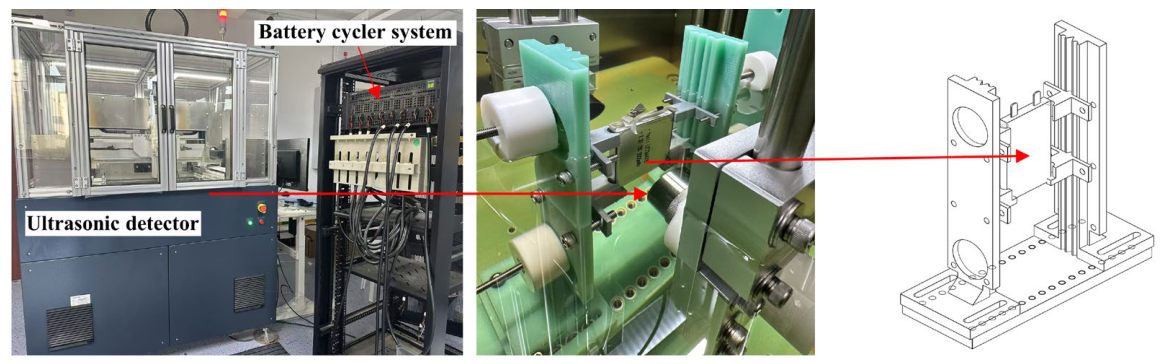
This paper uses pouch-type batteries with LFP (LiFePO4) as the cathode material and graphite as the anode material. The battery parameters are shown in Table 2. The experimental platform consists of an ultrasonic monitoring instrument, a battery cycling tester, and a host computer. The ultrasonic monitoring instrument has a scanning range of 350 mm × 300 mm × 100 mm, with positioning accuracy of X/Y ≤ ±0.5 μm and Z ≤ ±5 μm, the positioning method is 3D coordinate positioning. A focused ultrasonic transducer with a center frequency of 2 MHz was employed in the experiment. The pulse voltage was continuously adjustable from 20 V to 300 V via the equipment software. Each test point was scanned three times to minimize random errors. The transducer was immersed in a silicone oil bath to ensure effective acoustic wave transmission. The battery cycler featured a maximum test voltage of 5 V and a maximum test current of 20 A per channel, with customizable test procedures. Other specifications are provided in Table 3.
Before performing ultrasonic testing, the battery is first discharged at 0.5C to a cut-off voltage of 2.0 V, left to rest for 24 h, and then subjected to three small current charge–discharge cycles to activate the electrode material. After another 24 h rest period, the experiment is conducted. Silicone oil is used as the coupling agent between the ultrasonic probe and the battery being tested. Multiple batteries were used in this experiment to conduct repeated tests, thereby minimizing random errors caused by issues such as fixture placement during the experiment. For each test condition in this experiment, a minimum of three parallel battery samples were used for repeated testing. The graphical data presented in the paper are representative results from a single test run, with the observed trends being consistent across all repeated experiments. Furthermore, considering the unique physical properties and application scenarios of pouch-type batteries, a specialized fixture, as shown in Figure 2, was designed to securely clamp and position the batteries. This ensured consistent relative spatial positioning between the ultrasonic transducer and the battery for each experiment, effectively enhancing the reproducibility of the measurement conditions.
To investigate the differences in the energy of the first echo signal at different current densities, the charge and discharge rates set in the same experiment included 0.5C, 1C, 2C, 3C, 4C, and 5C. The experiment used the CC/CV protocol for battery charging and the CC protocol for battery discharging. Here, CC denotes Constant Current and CV denotes Constant Voltage. Specifically, the battery was charged at a constant current until the battery voltage reached the cutoff voltage, after which the battery voltage was maintained at the cutoff value, and the battery was charged at a constant voltage until the current dropped to the cutoff current. During the discharging process, the battery was discharged at a constant current until the battery voltage reached the cutoff voltage. A 10 min rest period is set between charging and discharging steps in the same experiment, with a 24 h interval between each charging and discharging cycle to ensure that each charging and discharging experiment is not affected by the previous one.
Overcharging, as a typical form of battery misuse, is widely prevalent in practical applications. To investigate the impact of different overcharging levels on the ultrasonic signal response characteristics within batteries, this study designed multiple sets of control experiments based on two quantification standards: charging cutoff voltage and state of charge (SOC). These experiments aimed to explore changes in ultrasonic signal characteristics within batteries at different voltage thresholds and SOC levels. In the overcharging experiments based on cutoff voltage, eight voltage levels were set (3.65 V, 3.8 V, 4.0 V, 4.2 V, 4.4 V, 4.6 V, 4.8 V, 5.0 V) with an increment of 0.2 V. In the SOC-based overcharge experiments, four overcharge levels (105%, 110%, 115%, and 120%) were set with 5% SOC increments. Herein, 110% SOC refers to the charged capacity reaching 110% of the nominal capacity. This terminology will be consistently used hereafter for clarity of expression. A 30 min resting period was set between charge and discharge steps in the same experiment to ensure that the battery state stabilized and to reduce the interference of polarization effects on the test results. The aged battery (SOH ≈ 90.5%) used for comparison in this study was obtained by subjecting a pristine battery from the same batch to 1500 consecutive cycles at a 0.5C rate under 25 °C. Its state of health (SOH) was determined via the capacity calibration method.

3. Result and Discussion

3.1. Battery Monitoring at Different C-Rates

As previously noted, the propagation of ultrasound within a cell is primarily governed by the acoustic impedance of its internal materials, which depends on both density and elastic modulus, as shown in Equation (1). During the dynamic evolution of electrochemical processes, variations in acoustic impedance closely correlate with the cell’s state of charge and discharge. At the macroscopic scale, the acoustic impedance contrast typically decreases during charging and increases during discharging. On a microscopic level, the initial phase of charging is critical, as Li+ are inserted into the anode surface at a faster rate than they diffuse into the electrode bulk due to limited solid-state diffusion. This imbalance creates a pronounced Li+ concentration gradient (Δx > 0.5 mol/dm3) [32], leading to localized anisotropic changes in the anode’s density and modulus. Consequently, the acoustic impedance of the anode transiently increases, raising the reflection coefficient R. While the cathode undergoes similar reactions, its property changes are comparatively negligible, making the anode the dominant factor in acoustic signal variation.
As charging progresses, Li+ gradually diffuse from the anode surface into its interior. Simultaneously, the anode undergoes a lithium insertion reaction from C6 to LiC6, during which its density decreases from 2.26 g/cm3 to 2.20 g/cm3 and its elastic modulus increases significantly from 32 GPa to 109 GPa. On the cathode side, delithiation occurs as LiFePO4 converts to FePO4, accompanied by a slight increase in density (from 3.49 g/cm3 to 3.51 g/cm3) and a marginal increase in elastic modulus (from 124 GPa to 125 GPa). Compared to the anode, these changes on the cathode side are minimal and can be considered negligible. This asymmetric evolution leads to a substantial reduction in the interfacial acoustic impedance difference ΔZ, decreasing from 11.34 × 10⁶ kg/(m2·s) to 3.69 × 10⁶ kg/(m2·s). Consequently, the ultrasonic reflection coefficient R declines, resulting in an increase in the energy of the first echo signal. During the constant-voltage phase at the end of charging, the current density gradually decreases, reducing Li+ concentration polarization. When the current density drops to 0.05C, the Li+ diffusion relaxation time shortens to 18% of its initial value, and the concentration gradient decreases by 63% [33]. As a result, the rate of change in acoustic impedance difference slows, and the reflection coefficient R decreases more gradually, causing the first echo signal to stabilize.
The discharge process mirrors that of charging. Initially, Li+ rapidly deintercalate at the anode–electrolyte interface, but their diffusion from the bulk electrode to the surface lags behind, resulting in concentration polarization. This leads to a temporary reduction in the acoustic impedance difference and reflection coefficient R. As discharge continues, bulk diffusion becomes the dominant transport mechanism, alleviating concentration polarization, restoring the acoustic impedance difference, and increasing R. By the end of discharge, the Li+ concentration gradient stabilizes, and the impedance difference returns to its pre-discharge state. At lower current densities (e.g., 0.5C), concentration polarization is weaker, and the structural evolution of electrodes proceeds more gradually, resulting in a smoother ultrasonic signal profile throughout the charging process. Additionally, during the initial stages of both charging and discharging, the ultrasonic signal exhibits sharp reductions in peak values.
Under high current density conditions (2C to 4C), the overall trends in ultrasonic signal evolution are similar to those at standard current (1C), but with greater magnitude. Accelerated charge transfer intensifies the insertion/extraction dynamics and enhances concentration polarization at both the electrode interior and surface. As a result, the acoustic impedance difference fluctuates more strongly, manifesting as a higher reflection coefficient R at the beginning of charging and a lower R at the onset of discharging.
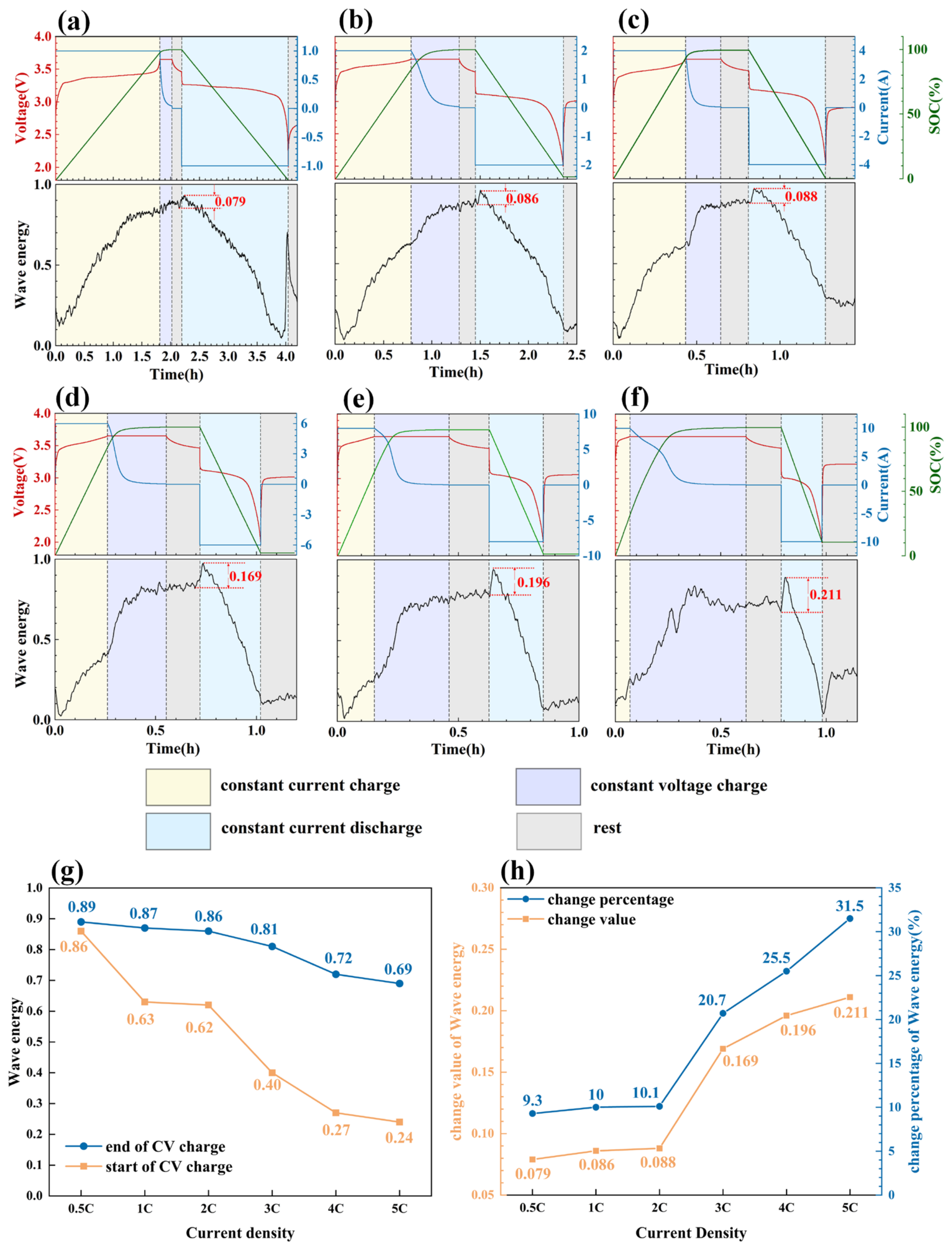
Figure 3 presents the characteristic curves of electrical signals and first-echo signal energy under various current densities. All ultrasonic curves have been normalized and denoised for clarity. Figure 3b illustrates a single charge/discharge cycle at a 1C rate. During the initial 5 min of charging, the ultrasonic characteristic value sharply decreases from 0.21 to 0.03. This phenomenon is attributed to pronounced concentration polarization at the electrode, which temporarily increases the acoustic impedance difference, thereby enhancing the reflection ratio R and reducing the ultrasonic characteristic value. As charging proceeds, the concentration polarization gradually weakens, leading to a decrease in acoustic impedance difference and reflection ratio R, with the ultrasonic characteristic value increasing over time. During the constant-current charging phase, this increase approximates a linear trend with time, suggesting a positive correlation between the characteristic value and SOC. This linearity indicates that ultrasonic parameters may serve as auxiliary indicators to improve SOC estimation accuracy. At current densities below 2C, the transition from constant-current (CC) to constant-voltage (CV) charging is characterized by a relatively smooth evolution of the ultrasonic characteristic curve. In contrast, at current densities of 2C and above, a distinct step-like increase begins to appear during this transition, becoming more pronounced at higher rates. This phenomenon indicates an imbalance in the Li+ inter-deintercalation process within the electrode material under higher current densities. At the onset of the constant-voltage charging stage, the current density begins to decrease, leading to a weakening of Li+ concentration polarization. Consequently, the slope of the characteristic curve increases. When the current density drops to 0.05C, both Li+ diffusion relaxation time and concentration gradient significantly reduce, leading the ultrasonic curve to stabilize.
At the beginning of discharge under 1C, the ultrasonic characteristic value increases from 0.86 to 0.95 within 2 min—an increase of approximately 10%. At higher current densities (e.g., 4C), this increase reaches 22%. This effect, similar to the early charging behavior, arises from Li+ concentration polarization. Throughout the discharge process, the ultrasonic characteristic value shows a nearly linear relationship with SOC, further supporting the feasibility of using ultrasonic signals in SOC estimation. During the rest period following discharge, slight fluctuations remain in the ultrasonic curve, attributed to hysteresis effects in Li+ insertion and extraction [34]. Compared to electrical signals, ultrasonic characteristic curves provide richer information, offering detailed insights into the battery’s internal dynamics, such as concentration polarization.
Figure 3c–e illustrate individual charge–discharge cycles at current densities of 2C, 3C, and 4C, respectively. As shown in Figure 3, the overall trends in ultrasonic characteristic curves remain generally consistent across different current densities, suggesting that the underlying physicochemical processes during a single cycle are largely comparable. However, at specific stages—particularly the onset of charging and discharging—variations in concentration polarization result in differing magnitudes of curve fluctuation. While higher current densities offer a practical means to reduce charging time, they also shorten the constant-current stage, prolong the constant-voltage stage, intensify concentration polarization, and diminish the quantity of Li+ intercalation and deintercalation. Figure 3g,h shows the values and changes in wave energy at different specific stages. At the start of the constant-voltage charging phase, the ultrasonic characteristic values for 0.5C to 5C are 0.86, 0.63, 0.62, 0.40, 0.27, and 0.24, respectively, indicating progressively milder electrode lithiation. As charging progresses, the distribution of Li+ becomes increasingly uniform and lithiation essentially completes—a phenomenon not captured by electrical signals.
Ideally, the ultrasonic values at the end of the constant-voltage phase should converge across current densities. However, experimental data indicate clear discrepancies, with final values of 0.89, 0.87, 0.86, 0.81, 0.72 and 0.69 at 0.5C to 5C, respectively. This deviation may be attributed to lithium plating on the graphite anode [34,35], a phenomenon consistent with the observed signal attenuation. Under high currents, Li+ deintercalate rapidly but cannot be efficiently re-intercalated, causing deposition on the anode surface when its potential drops below the Li/Li+ level [36]. Such deposition, if confirmed, would alter the acoustic properties of the electrode, increasing viscoelastic attenuation and potentially degrading structural integrity. It should be noted that ultrasonic signals alone cannot definitively confirm lithium plating, and direct post-mortem analysis would be required for conclusive identification. Particular attention should be given to the 5C condition, where, as depicted in Figure 3f, the ultrasonic curve exhibits pronounced fluctuations and deviates markedly from other current densities. This behavior is consistent with severe internal side reactions, likely including electrolyte decomposition and lithium plating. Substantial gas generation occurred inside the battery, leading to visible swelling, indicating that it had essentially lost its practical functionality. As shown in Figure 3h, under conditions ranging from 0.5C to 2C, the change in wave energy at the onset of CC discharge is minimal; however, at 3C, the wave energy change is approximately twice that at 2C. This indicates that the wave-energy behavior remains stable up to 2C, while a clear deviation emerges beyond 2C. Under the present criterion, 2C can therefore be regarded as the upper limit of stable current density, rather than an exact universal threshold.

3.2. Battery Overcharging Monitoring at Different Cut-Off Voltages

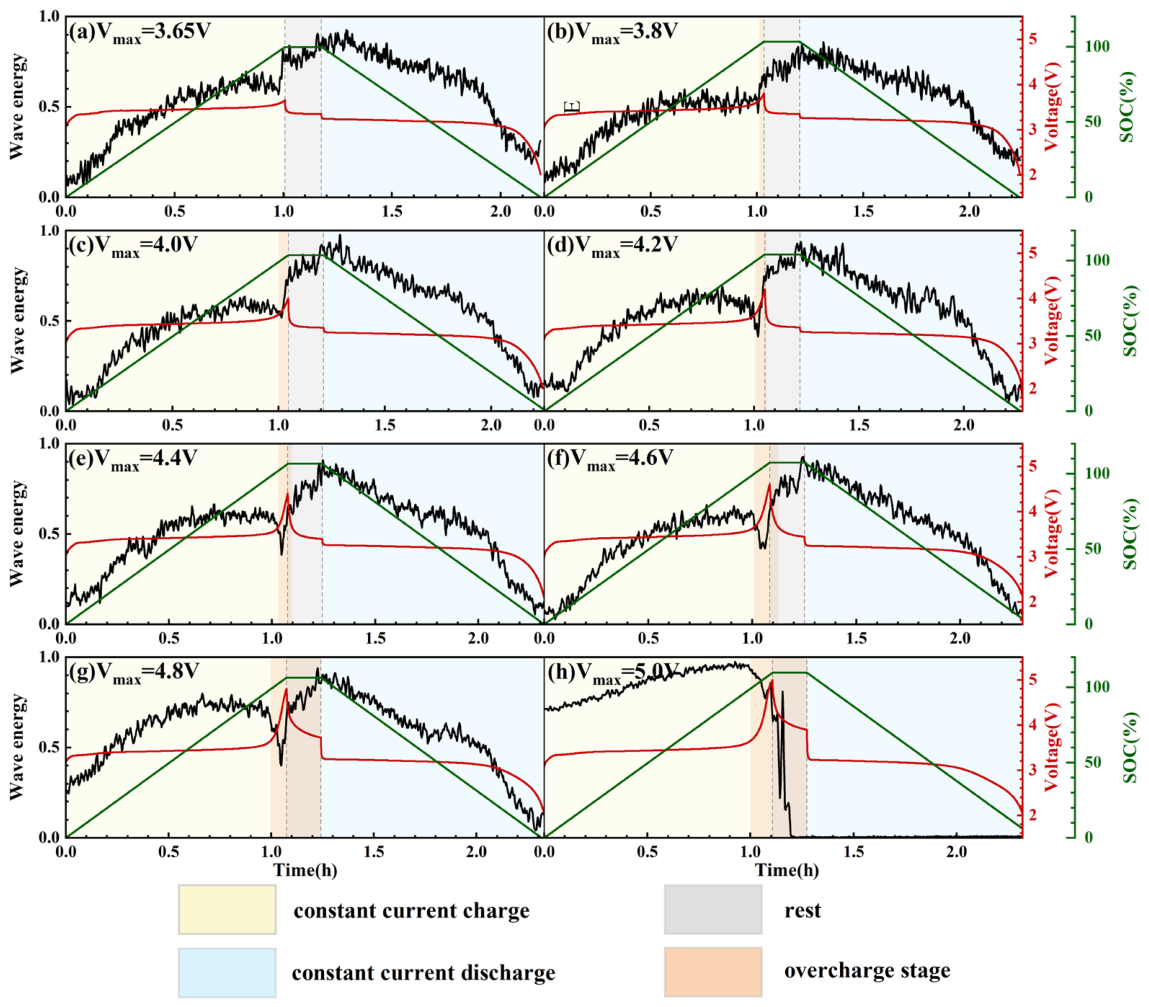
Further analysis shows that as the maximum cutoff voltage (Vmax) increases, ultrasonic characteristic curves indicate escalating gas production and structural degradation within the cell. A threshold of 4.2 V is identified as the critical point for irreversible damage in LFP cells induced by overcharging. Milder early-stage damage and finer voltage variations may require the use of other, more sensitive characterization methods. Compared to electrical signals, ultrasonic features observed during charge–discharge cycles can capture structural changes such as Li+ insertion/extraction, phase transitions, and side reactions. These signals reveal the electrochemical stability limits of LFP materials and provide valuable insights for optimizing charging strategies and implementing overcharge warning systems.

3.3. Battery Overcharging Monitoring at Different SOC

This study adopts two criteria to quantify and evaluate the severity of cell overcharging, and the charging modes used for each are also different. In this subsection, the charging cutoff voltage is employed as the evaluation metric, the CC-CV charging mode is used, which involves first charging at a constant current until the specified cut-off voltage is reached, followed by constant-voltage charging at the specified voltage until the current drops below 0.02C and the associated abnormal ultrasonic responses observed during overcharging are examined. Typically, the theoretical charge–discharge voltage range for LFP pouch cells spans 2.0 V to 3.65 V, beyond which overcharging is considered to occur [37]. Figure 4 presents the characteristic curves of voltage signals and first echo signal energy under different cutoff voltages, where all ultrasonic signals have been normalized and denoised. Figure 5 displays the corresponding ultrasonic scan images of batteries subjected to varying cutoff voltages. During the constant-current charging stage, the ultrasonic characteristic values exhibit a continuously increasing trend. This behavior is attributed to the following mechanism: as Li+ deintercalate from the cathode and intercalate into the anode, the acoustic impedance mismatch at the electrode interface gradually decreases, thereby lowering the reflection ratio R and increasing the ultrasonic characteristic value. Simultaneously, as electrode lithiation progresses, the concentration polarization effect weakens, reducing the rate of change in impedance mismatch. This manifests as a more gradual decrease in the reflection ratio R and a corresponding reduction in the slope of the ultrasonic curve. During the resting stage, due to the relaxation behavior of Li+ diffusion, the electrode does not reach complete lithiation. As the Li+ concentration gradient diminishes, the reflection ratio R continues to decrease, and the characteristic value further increases. At the onset of discharge, Li+ deintercalates from the anode, increasing the acoustic impedance mismatch at the electrode interface, which elevates the reflection ratio R and leads to a declining trend in the ultrasonic characteristic value.
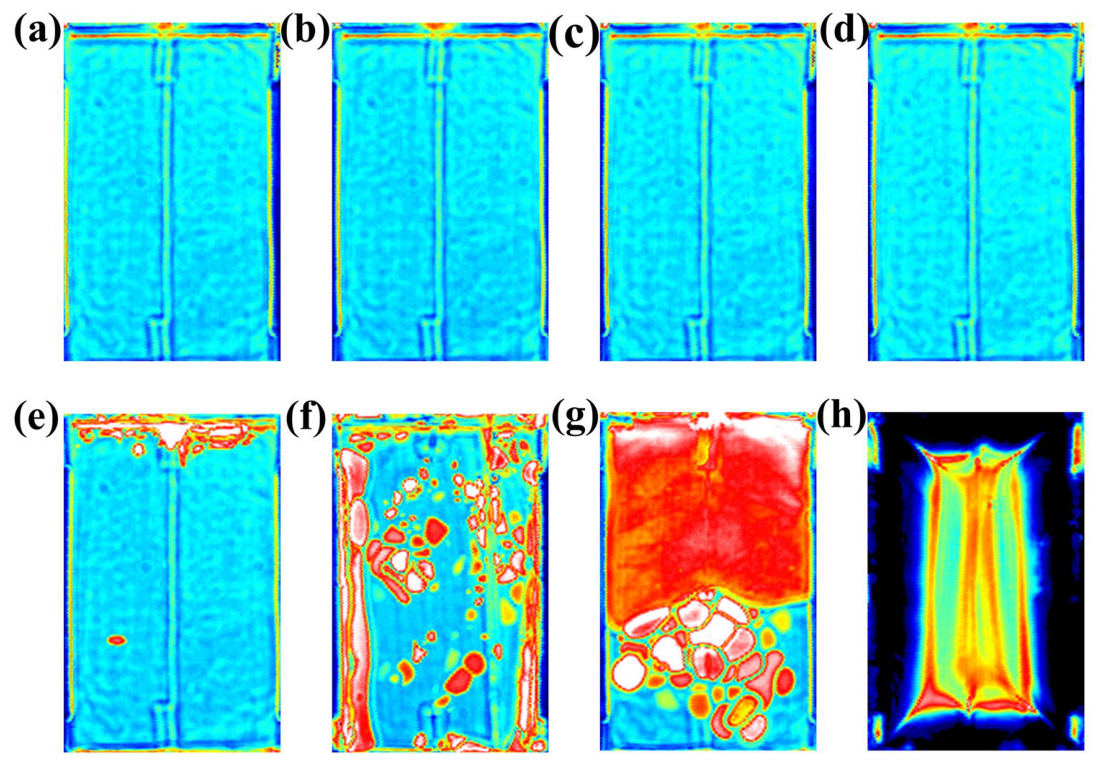
Within the voltage range of 3.65 V to 4.0 V, the ultrasonic characteristic curves exhibit smooth fluctuations with no abnormal phenomena detected, as shown in Figure 5a–c. This indicates that Li+ undergo orderly insertion and extraction, the electrode structure remains stable, and variations in acoustic properties primarily arise from concentration polarization and lattice structural changes. When the cutoff voltage exceeds 4.2 V, the ultrasonic characteristic curve exhibits a characteristic abnormal attenuation, with the amplitude of this decline increasing as the cutoff voltage rises. This presents a distinct contrast to the stable profile of the voltage curve, indicating that the ultrasonic signal can provide early warning prior to the occurrence of significant abnormalities in the electrical signals. The minimum characteristic values drop sequentially to 0.41, 0.40, 0.39, 0.38, and eventually to zero at 5.0 V, at which point the ultrasonic echo signal is completely lost. As shown in Figure 5h, ultrasonic imaging of the cell becomes impossible at this stage. This abnormal behavior is consistent with severe side reactions triggered by high voltage, which may include electrolyte decomposition that generates gases such as CO2 and H2 [38,39]. Meanwhile, since the cathode cannot continue de-lithiation, the continuous influx of charge from the external circuit may force Li+ to reduce to metallic lithium on the anode surface [40], a process that is also accompanied by gas generation. The accumulation of internal gas causes battery swelling, with part of the ultrasonic waves being scattered at the surface and part reflected by internal gas pockets, resulting in near-zero echo energy. Electrical signals corresponding to cutoff voltages between 3.65 V and 4.8 V exhibit minimal differences, with only a slight slope variation observed at 5.0 V. The ultrasonic signal remained normal at 4.0 V but exhibited a distinct anomaly at 4.2 V, indicating that it can detect voltage changes between 4.0 V and 4.2 V. The determination of the critical voltage is limited by the voltage gradient set in the experiment and the precision of the equipment; more refined experiments will be required in the future to verify these findings.
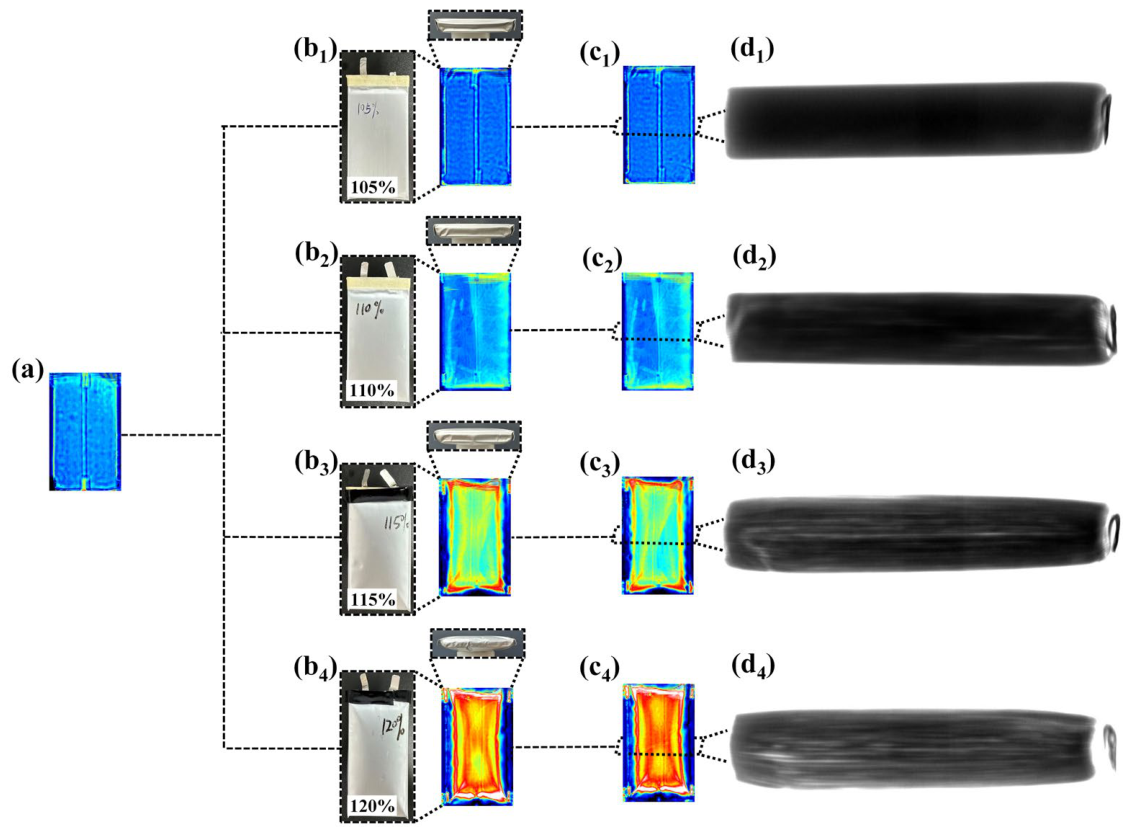
In practical applications, BMS may employ different control strategies; some are voltage-limited, while others are capacity-limited. This section discusses abnormal ultrasonic phenomena observed during cell overcharging, using SOC as the evaluation criterion, the CC charging mode is used, which charges at a constant current until a specific SOC is reached. Figure 6 presents ultrasonic scan images, corresponding optical photographs, and CT scans of batteries at varying overcharge levels. These three types of images intuitively reveal internal gas evolution and structural changes in the cell. At 100% and 105% SOC, the cell surfaces remain flat, with no visible deformation in the optical images, and the ultrasonic images show no significant abnormalities, indicating that internal structural changes are minimal and the battery remains in good condition. Although such changes are not yet macroscopically visible, continued overcharging can accumulate and degrade performance over time. At 110% SOC, the cell casing shows no obvious swelling and no macroscopic changes are visible; however, the ultrasonic scan reveals localized signal enhancement and slight edge deformation, indicating intensified side reactions caused by overcharging, such as minor gas generation from electrolyte decomposition. These reactions result in localized compression of electrodes and separators, reducing contact with the current collector and disrupting electron conduction. At 115% SOC, the cell casing exhibits noticeable swelling, along with increased ultrasonic signal intensity and distinct irregular high-impedance regions (gas pockets) and low-impedance areas (active material detachment). This is attributed to intensified side reactions, likely including electrolyte decomposition and metallic lithium deposition, producing significant internal gas. At 120% SOC, the ultrasonic signals further intensify, with abnormal acoustic impedance regions spreading across nearly the entire cell area, reflecting severe internal gas accumulation and extensive structural degradation. At this stage, extensive electrolyte decomposition and SEI degradation are likely occurring, accompanied by continued lithium dendrite formation, which consumes active lithium, reduces capacity, and may pierce the separator, increasing the risk of internal short circuits and further instability.
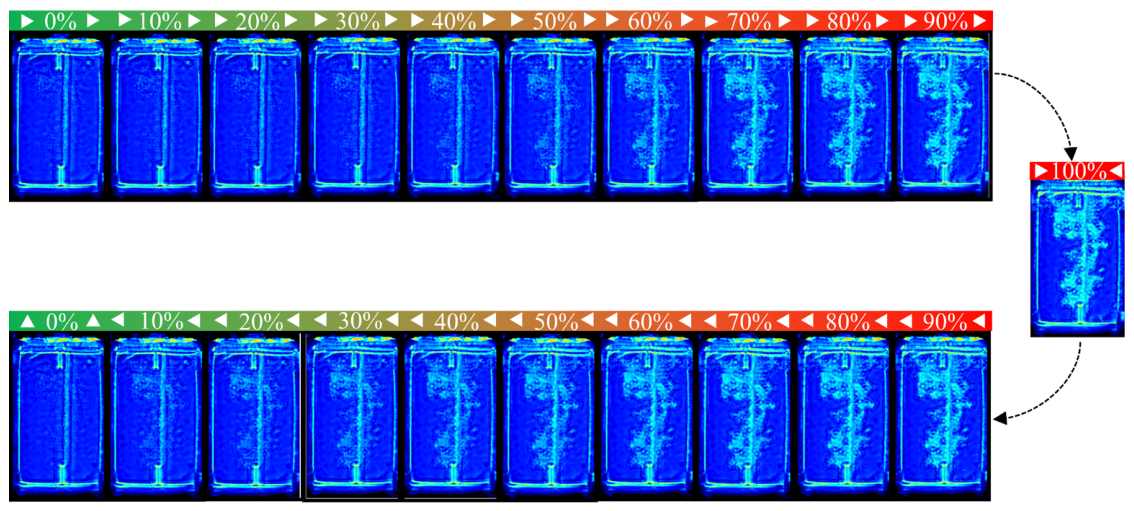
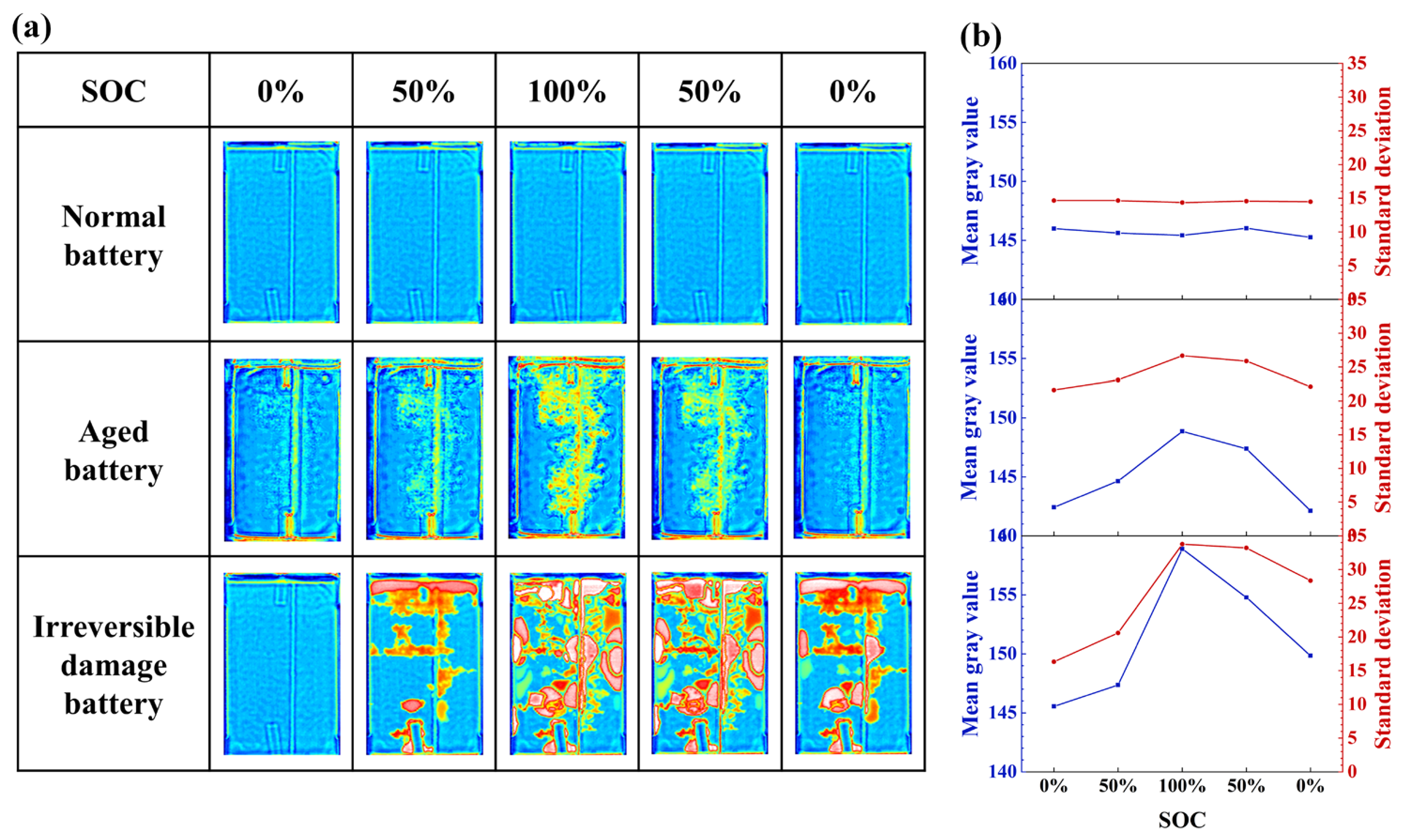
After discharging the overcharged cells to 0% SOC, Figure 6(c1–c4) reveal that the extent of internal structural damage varies with overcharge level, exhibiting differing degrees of irreversibility. At mild overcharge levels (e.g., 105% SOC), the post-discharge ultrasonic images exhibit good reversibility, suggesting that the structural changes induced by overcharging are partially reversible upon discharge. However, at higher overcharge levels (e.g., 110%, 115%, and 120% SOC), post-discharge ultrasound images continue to show distinct abnormal regions, indicating that the structural damage from deep overcharging is largely irreversible. Figure 7 presents ultrasonic scan images of an aged cell (SOH ≈ 90.5%) recorded during a full charge–discharge cycle (0% to 100% to 0% SOC) at 10% SOC intervals. Figure 8a displays ultrasonic scans of cells at identical SOC levels—i.e., after charging the same coulombic amount—for normal, aged, and high-rate cycling batteries exhibiting irreversible damage. These three battery types correspond to distinct ultrasonic imaging characteristics. During high-rate charge–discharge cycles, the battery has a charge capacity of 1.85 Ah, a discharge capacity of 1.50 Ah, a coulombic efficiency of 81.08%, and an SOH of 75%. For the normal cell, its ultrasonic images at different SOCs are nearly identical. For the aged cell, although its SOH has decreased, preventing complete Li+ insertion into the electrode during a single charge and resulting in some degree of lithium plating, Figure 8 indicates that these changes are almost entirely reversible. To conduct a preliminary quantitative comparison of the ultrasound C-scan images in Figure 8b, we extracted the statistical features of the image grayscale. The mean grayscale value of the images from normal batteries is approximately 145, with a standard deviation of about 15, and neither shows significant fluctuations. The mean and standard deviation of the gray-scale values for aged batteries fluctuated significantly during the charge–discharge process; however, after one complete charge–discharge cycle, these values essentially returned to their initial values, indicating that these changes are almost entirely reversible, consistent with the results in Figure 7. The mean and standard deviation of the gray-scale values for damaged batteries fluctuated significantly and did not return to their initial values after the cycle ended, indicating that irreversible damage has occurred internally. The image of the damaged cell exhibits large-scale irregular bright regions, representing severe damage such as accumulated gas pockets. The spatial extent of these features is significantly greater than the changes observed in the aged battery. The comparison clearly demonstrates that electrical abuse inflicts more severe irreversible damage on the cell compared to aging.
To verify the reliability of ultrasonic testing, this study also employed computed tomography (CT), a well-established characterization technique. CT provides high-resolution imaging that clearly reveals the internal electrode stacking and structural changes within the cell. At 105% SOC, the electrodes and separators remained tightly stacked, and no gas generation was observed inside the cell. At 110% SOC, a very small gap of approximately 100 μm appeared internally, accounting for about 0.22% of the total area. Slight deformation was also observed at the edges of the electrodes, which is consistent with the ultrasonic testing results, indicating limited gas generation that remains undetectable to the naked eye. At 115% SOC, CT imaging revealed irregular delamination within the cell, with delamination gaps ranging from 200 to 500 μm in width and covering 5.47% of the area, reflecting a significant increase in gas generation. As the charging process progressed to 120% SOC, these delamination patterns became more pronounced, with the width of the delamination gaps reaching the mm range and the area ratio reaching 7.88%, indicating further structural degradation.
These observations suggest that with increasing SOC, the cell evolves from stable, reversible changes to progressive irreversible structural damage. A critical threshold for such irreversible damage is identified at 110% SOC. Furthermore, the high resolution and dynamic monitoring capabilities of ultrasonic testing offer a solid theoretical and technical foundation for future quantitative analysis of the relationship between overcharge severity and structural damage mechanisms.

4. Conclusions

This study employs ultrasonic non-destructive testing to investigate internal cell behavior under varying current densities and overcharge conditions. By analyzing ultrasonic signal variations across these conditions, the research reveals the internal state evolution patterns of LIBs. Fluctuations in ultrasonic signal curves are closely correlated with changes in the cell’s internal physicochemical properties, such as density, elastic modulus, and lithium intercalation/deintercalation. These signals effectively reflect Li+ concentration polarization and electrode lithiation state. They are also sensitive to the onset of degradation processes such as lithium plating and electrolyte decomposition, and enable accurate localization of gas-producing regions within the cell.
The results demonstrate the following: (1) At current densities below 2C, ultrasonic characteristics remain stable. However, between 2C and 4C, irregular fluctuations appear in the ultrasonic signal curves, indicating internal instabilities. Thus, under the present test conditions and criterion, 2C can be regarded as the upper limit of stable current density, beyond which abnormal ultrasonic behavior becomes increasingly evident. At 5C, the cell fails completely. (2) Mild overcharging induces minimal damage, but once the cutoff voltage exceeds 4.2 V, gas generation and structural degradation are initiated, intensifying with further voltage increase. Therefore, 4.2 V represents the critical cutoff voltage. (3) Overcharging induces more severe degradation than aging. As the overcharge capacity increases, the internal damage gradually shifts from reversible to irreversible, with 110% SOC marking the threshold of irreversible transition.
To evaluate the reproducibility of the threshold determination, three indicators were selected corresponding to the three experimental conditions. For the current density part, the indicator used was the percentage change in the wave energy step rise value of the 3C discharge starting point relative to the 2C discharge at the beginning of the charge–discharge cycle of the cell. For the charging cut-off voltage part, the indicator used was the fraction of abnormal area in the ultrasonic C-scan image after a single cycle of charging with a cut-off voltage of 4.2 V. For the charging capacity part, the indicator used was the difference in the average gray value of the two images obtained by ultrasonic C-scan of the cell when it was charged at 110% SOC and discharged to 0% SOC respectively during a single charge–discharge cycle with a charging cut-off capacity of 110% SOC. All these three indicators have no units, and the results are shown in Table 4.
These findings provide practical guidance for battery state estimation and charging strategy optimization. The non-destructive nature of the technology shows great potential for industrial applications. It should be pointed out that the critical parameters identified in this study—namely, the critical current density (2C), the onset voltage for irreversible damage (4.2 V), and the charging capacity threshold for irreversible damage (110% SOC)—are determined based on the specific cell model used and the signal analysis methodology described herein. The specific values of these parameters can vary depending on the cell’s chemical system, design specifications, initial SOH, and the specific ultrasonic signal feature criteria employed. Consequently, the universal applicability of these absolute values requires further validation across different cell types. The core value of this work lies in demonstrating that ultrasonic non-destructive testing can sensitively and in-situ capture the critical internal changes in cells under overcharge and high-rate charging conditions, and possesses the capability to quantitatively define these safety thresholds.

Author Contributions

Conceptualization, S.W. and J.S.; methodology, S.W.; software, S.W.; validation, Z.Y., S.W. and W.Z.; formal analysis, M.D.; investigation, H.Y.; resources, J.S.; data curation, S.W.; writing—original draft preparation, S.W.; writing—review and editing, S.W.; visualization, S.W.; supervision, J.S.; project administration, M.D.; funding acquisition, J.S. All authors have read and agreed to the published version of the manuscript.

Funding

This work is supported by Project “Vice President of Science and Technology” of Changping District, Beijing (202502007023) and partly supported by the Fundamental Research Funds for the Central Universities (2024JC007).

Data Availability Statement

The original contributions presented in this study are included in the article. Further inquiries can be directed to the corresponding authors.

Conflicts of Interest

The authors declare no conflicts of interest.

References

  1. Duan, C.; Le, H.; Wu, D. Lithium-ion battery state-of-health estimation using intra-domain and cross-domain transfer learning: Mitigating domain shift based on Wasserstein distance. J. Energy Storage 2025, 132, 117601. [Google Scholar] [CrossRef]
  2. Villevieille, C. The Numerous Materials Challenges Related to Post-Li-Ion Batteries. ACS Mater. Lett. 2025, 7, 1057–1059. [Google Scholar] [CrossRef]
  3. Zhang, C.; Chou, S.; Guo, Z.; Dou, S.-X. Beyond Lithium-Ion Batteries. Adv. Funct. Mater. 2024, 34, 2308001. [Google Scholar] [CrossRef]
  4. Ouyang, D.; Chung, Y.-H.; Liu, J.; Bai, J.; Zhou, Y.; Chen, S.; Wang, Z.; Shu, C.-M. Characteristics and mechanisms of as well as evaluation methods and countermeasures for thermal runaway propagation in lithium-ion batteries. Prog. Energy Combust. Sci. 2025, 108, 101209. [Google Scholar] [CrossRef]
  5. Mao, N.; Zhang, T.; Wang, Z.; Cai, Q. A systematic investigation of internal physical and chemical changes of lithium-ion batteries during overcharge. J. Power Sources 2022, 518, 230767. [Google Scholar] [CrossRef]
  6. Wang, Z.; Yuan, J.; Zhu, X.; Wang, H.; Huang, L.; Wang, Y.; Xu, S. Overcharge-to-thermal-runaway behavior and safety assessment of commercial lithium-ion cells with different cathode materials: A comparison study. J. Energy Chem. 2021, 55, 484–498. [Google Scholar] [CrossRef]
  7. Zeng, J.; Liu, S. Research on aging mechanism and state of health prediction in lithium batteries. J. Energy Storage 2023, 72, 108274. [Google Scholar] [CrossRef]
  8. Es-satte, M.; Afaynou, I.; Faraji, H.; Choukairy, K.; Regragui, I.; Amghar, K.; Boucetta, M.; Saadeddine, S.; Bourich, M. Phase change materials, bionic structures and artificial intelligence for lithium-ion battery thermal management: A comprehensive review. Int. Commun. Heat Mass Transf. 2026, 173, 110870. [Google Scholar] [CrossRef]
  9. Ouyang, D.; Liu, X.; Sun, R.; Shi, D.; Liu, B.; Xiao, P.; Zhi, M.; Wang, Z. Relationship between interior temperature and exterior parameters for thermal runaway warning of large-format LiFePO4 energy storage cells with various heating patterns and heating powers. Appl. Therm. Eng. 2025, 269, 126062. [Google Scholar] [CrossRef]
  10. Weng, J.; Huang, Q.; Li, X.; Zhang, G.; Ouyang, D.; Chen, M.; Yuen, A.C.Y.; Li, A.; Lee, E.W.M.; Yang, W.; et al. Safety issue on PCM-based battery thermal management: Material thermal stability and system hazard mitigation. Energy Storage Mater. 2022, 53, 580–612. [Google Scholar] [CrossRef]
  11. Li, W.; Rentemeister, M.; Badeda, J.; Jöst, D.; Schulte, D.; Sauer, D.U. Digital twin for battery systems: Cloud battery management system with online state-of-charge and state-of-health estimation. J. Energy Storage 2020, 30, 101557. [Google Scholar] [CrossRef]
  12. Lu, J.; Wu, T.; Amine, K. State-of-the-art characterization techniques for advanced lithium-ion batteries. Nat. Energy 2017, 2, 17011. [Google Scholar] [CrossRef]
  13. Ziesche, R.F.; Heenan, T.M.M.; Kumari, P.; Williams, J.; Li, W.; Curd, M.E.; Burnett, T.L.; Robinson, I.; Brett, D.J.L.; Ehrhardt, M.J.; et al. Multi-Dimensional Characterization of Battery Materials. Adv. Energy Mater. 2023, 13, 2300103. [Google Scholar] [CrossRef]
  14. Carbonó dela Rosa, M.E.; Velasco Herrera, G.; Nava, R.; Quiroga González, E.; Sosa Echeverría, R.; Sánchez Álvarez, P.; Gandarilla Ibarra, J.; Velasco Herrera, V.M. A New Methodology for Early Detection of Failures in Lithium-Ion Batteries. Energies 2023, 16, 1073. [Google Scholar] [CrossRef]
  15. Diao, W.; Naqvi, I.H.; Pecht, M. Early detection of anomalous degradation behavior in lithium-ion batteries. J. Energy Storage 2020, 32, 101710. [Google Scholar] [CrossRef]
  16. Qian, G.; Chen, X.; Lin, H.; Yang, L. Failure-detecting techniques for commercial anodes of lithium-ion batteries. Cell Rep. Phys. Sci. 2024, 5, 102153. [Google Scholar] [CrossRef]
  17. Nikolic, M.; Cesarini, A.; Billeter, E.; Weyand, F.; Trtik, P.; Strobl, M.; Borgschulte, A. Hydrogen Transport and Evolution in Ni-MH Batteries by Neutron Imaging. Angew. Chem. Int. Ed. 2023, 62, e202307367. [Google Scholar] [CrossRef]
  18. Siegel, J.B.; Lin, X.; Stefanopoulou, A.G.; Hussey, D.S.; Jacobson, D.L.; Gorsich, D. Neutron Imaging of Lithium Concentration in LFP Pouch Cell Battery. J. Electrochem. Soc. 2011, 158, A523. [Google Scholar] [CrossRef]
  19. Ziesche, R.F.; Kardjilov, N.; Kockelmann, W.; Brett, D.J.L.; Shearing, P.R. Neutron imaging of lithium batteries. Joule 2022, 6, 35–52. [Google Scholar] [CrossRef]
  20. Kemeny, M.; Ondrejka, P.; Sismisova, D.; Mikolasek, M. Determination of internal temperature of EV battery modules via electrochemical impedance spectroscopy (EIS) and distribution of relaxation times (DRT). J. Energy Storage 2024, 104, 114566. [Google Scholar] [CrossRef]
  21. Liv, L.; Gençtürk Tosun, S. A novel perspective for estimating the passivation and energy storage characteristics in micro-mass coatings using CV, EIS, and EQCM techniques: Ultrahigh supercapacitor behaviors of Bismarck Brown R and Bismarck Brown Y polymer films. J. Energy Storage 2025, 115, 115985. [Google Scholar] [CrossRef]
  22. Owen, R.E.; Robinson, J.B.; Weaving, J.S.; Pham, M.T.M.; Tranter, T.G.; Neville, T.P.; Billson, D.; Braglia, M.; Stocker, R.; Tidblad, A.A.; et al. Operando Ultrasonic Monitoring of Lithium-Ion Battery Temperature and Behaviour at Different Cycling Rates and under Drive Cycle Conditions. J. Electrochem. Soc. 2022, 169, 040563. [Google Scholar] [CrossRef]
  23. Amsterdam, S.; Chang, W. Design of a low-cost ultrasonic testing instrument for battery metrology. Electrochim. Acta 2025, 524, 146012. [Google Scholar] [CrossRef]
  24. McGee, T.M.; Neath, B.; Matthews, S.; Ezekoye, O.A.; Haberman, M.R. Ultrasonic detection of pre-existing thermal abuse in lithium-ion pouch cells. J. Power Sources 2024, 595, 234035. [Google Scholar] [CrossRef]
  25. Chou, Y.-S.; Hsu, N.-Y.; Jeng, K.-T.; Chen, K.-H.; Yen, S.-C. A novel ultrasonic velocity sensing approach to monitoring state of charge of vanadium redox flow battery. Appl. Energy 2016, 182, 253–259. [Google Scholar] [CrossRef]
  26. Bommier, C.; Chang, W.; Li, J.; Biswas, S.; Davies, G.; Nanda, J.; Steingart, D. Operando Acoustic Monitoring of SEI Formation and Long-Term Cycling in NMC/SiGr Composite Pouch Cells. J. Electrochem. Soc. 2020, 167, 020517. [Google Scholar] [CrossRef]
  27. Davies, G.; Knehr, K.W.; Van Tassell, B.; Hodson, T.; Biswas, S.; Hsieh, A.G.; Steingart, D.A. State of Charge and State of Health Estimation Using Electrochemical Acoustic Time of Flight Analysis. J. Electrochem. Soc. 2017, 164, A2746–A2755. [Google Scholar] [CrossRef]
  28. Gold, L.; Bach, T.; Virsik, W.; Schmitt, A.; Müller, J.; Staab, T.E.M.; Sextl, G. Probing lithium-ion batteries’ state-of-charge using ultrasonic transmission—Concept and laboratory testing. J. Power Sources 2017, 343, 536–544. [Google Scholar] [CrossRef]
  29. Ladpli, P.; Kopsaftopoulos, F.; Chang, F.-K. Estimating state of charge and health of lithium-ion batteries with guided waves using built-in piezoelectric sensors/actuators. J. Power Sources 2018, 384, 342–354. [Google Scholar] [CrossRef]
  30. Shen, Y.; Zou, B.; Zhang, Z.; Xu, M.; Wang, S.; Li, Q.; Li, H.; Zhou, M.; Jiang, K.; Wang, K. In situ detection of lithium-ion batteries by ultrasonic technologies. Energy Storage Mater. 2023, 62, 102915. [Google Scholar] [CrossRef]
  31. Zhang, S.; Zuo, P.; Yin, X.; Fan, Z. Exploring the correlation between ultrasound time of flight and the state of health of LiFePO4 prismatic cells. J. Energy Storage 2024, 83, 110715. [Google Scholar] [CrossRef]
  32. Wei, Z.; Salehi, A.; Lin, G.; Hu, J.; Jin, X.; Agar, E.; Liu, F. Probing Li-ion concentration in an operating lithium ion battery using in situ Raman spectroscopy. J. Power Sources 2020, 449, 227361. [Google Scholar] [CrossRef]
  33. Zhao, Y.; Kücher, S.; Jossen, A. Investigation of the diffusion phenomena in lithium-ion batteries with distribution of relaxation times. Electrochim. Acta 2022, 432, 141174. [Google Scholar] [CrossRef]
  34. Li, X.; Zhang, Z.; Gong, L.; Zhang, Z.; Liu, G.; Tan, P. Revealing the mechanism of stress rebound during discharging in lithium-ion batteries. J. Energy Storage 2023, 58, 106454. [Google Scholar] [CrossRef]
  35. Sun, B.; Zhang, C.; Liu, S.; Xu, Z.; Zhao, Z. Ultrasonic Non-Destructive Testing on Fast-Charging Lithium-Ion Battery’s Capacity Fading. J. Electrochem. Soc. 2024, 171, 030517. [Google Scholar] [CrossRef]
  36. Lu, W.; López, C.M.; Liu, N.; Vaughey, J.T.; Jansen, A.; Dennis, W.D. Overcharge Effect on Morphology and Structure of Carbon Electrodes for Lithium-Ion Batteries. J. Electrochem. Soc. 2012, 159, A566. [Google Scholar] [CrossRef]
  37. Ouyang, D.; Shen, Y.; Liu, X.; Shi, D.; Wang, K.; Zhi, M.; Wang, Z. Investigation on thermal runaway features of large-format energy storage cells under overcharge scenarios. Appl. Therm. Eng. 2025, 279, 128051. [Google Scholar] [CrossRef]
  38. Jin, Y.; Zheng, Z.; Wei, D.; Jiang, X.; Lu, H.; Sun, L.; Tao, F.; Guo, D.; Liu, Y.; Gao, J.; et al. Detection of Micro-Scale Li Dendrite via H2 Gas Capture for Early Safety Warning. Joule 2020, 4, 1714–1729. [Google Scholar] [CrossRef]
  39. Zhang, G.; Wei, X.; Zhu, J.; Chen, S.; Han, G.; Dai, H. Revealing the failure mechanisms of lithium-ion batteries during dynamic overcharge. J. Power Sources 2022, 543, 231867. [Google Scholar] [CrossRef]
  40. Ren, D.; Hsu, H.; Li, R.; Feng, X.; Guo, D.; Han, X.; Lu, L.; He, X.; Gao, S.; Hou, J.; et al. A comparative investigation of aging effects on thermal runaway behavior of lithium-ion batteries. eTransportation 2019, 2, 100034. [Google Scholar] [CrossRef]
Figure 1. The schematic diagram and test results of ultrasonic testing technology: (a) pulse-echo mode; (b) detecting spot; (c) the waveform obtained from A-scan; (d) scanning area; (e) full battery image obtained from C-scan.
Energies 19 02455 g001
Figure 2. Experimental setup for battery testing.
Energies 19 02455 g002
Figure 3. Voltage, current, SOC, and ultrasonic wave energy curves at different charge–discharge rates: (a) 0.5C; (b) 1C; (c) 2C; (d) 3C; (e) 4C; (f) 5C; (g) wave energy values at the start and end of CV charging; (h) change in wave energy and percentage change at the start of CC discharge.
Energies 19 02455 g003
Figure 4. Voltage, SOC and ultrasonic wave energy curves at different cut-off voltages: (a) 3.65 V; (b) 3.8 V; (c) 4.0 V; (d) 4.2 V; (e) 4.4 V; (f) 4.6 V; (g) 4.8 V; (h) 5.0 V.
Energies 19 02455 g004
Figure 5. C-scan of cell charged to different cut-off voltages: (a) 3.65 V; (b) 3.8 V; (c) 4.0 V; (d) 4.2 V; (e) 4.4 V; (f) 4.6 V; (g) 4.8 V; (h) 5.0 V.
Energies 19 02455 g005
Figure 6. Ultrasonic scans, real images and CT images of cells with different levels of overcharging: (a) 0%; (b1b4) 105–120%; (c1c4) 0%; (d1d4) CT images.
Energies 19 02455 g006
Figure 7. Ultrasonic scans of a single normal charge/discharge cycle of an aged cell (10% SOC as a gradient).
Energies 19 02455 g007
Figure 8. (a). Ultrasound scan images of three different battery conditions at the same SOC; (b) mean gray values and standard deviations of the scan images.
Energies 19 02455 g008
Table 2. Parameters of battery.
ParameterUnitValue
Type Pouch Cell
Standard charge–discharge capacityAh2.0
Nominal voltageV3.2
Charging cut-off voltageV3.65
Charging cut-off currentmA40
Discharging cut-off voltageV2.0
Operating temperature°CCharge: 0~+45
Discharge: −20~+60
Dimensionsmm44 × 78 × 7.3
Table 3. Parameters of the battery cycler.
ParameterUnitValue
Equipment model-LANHE-D350A
Voltage rangeV0–5
Current rangeA0–20
Sampling frequencyHz1–1000
Voltage accuracyFS±0.01%
Current accuracyFS±0.01%
Table 4. Experimental results of repeatability indicators.
Cell 1Cell 2Cell 3Mean ± Standard Deviation
Current density192%183%189.3%188.1 ± 4.61 (%)
Cut-off voltages12.9%14.7%13.3%13.63 ± 0.95 (%)
Charging capacity4.4875.5395.0125.01 ± 0.53
Disclaimer/Publisher’s Note: The statements, opinions and data contained in all publications are solely those of the individual author(s) and contributor(s) and not of MDPI and/or the editor(s). MDPI and/or the editor(s) disclaim responsibility for any injury to people or property resulting from any ideas, methods, instructions or products referred to in the content.