Article

Anaerobic Digestion of Fallen Leaf Biomass for Methane and Hydrogen Generation: Comparison of Single- and Two-Stage Systems


by
Jarosław Domański
1,*,
Sebastian Gosławski
1,2,
Urszula Dziekońska
3 and
Weronika Cieciura-Włoch
1
1
Department of Environmental Biotechnology, Faculty of Biotechnology and Food Sciences, Lodz University of Technology, 90-530 Lodz, Poland
2
Interdisciplinary Doctoral School, Lodz University of Technology, 90-924 Lodz, Poland
3
Institute of Fermentation Technology and Microbiology, Faculty of Biotechnology and Food Sciences, Lodz University of Technology, 90-530 Lodz, Poland
*
Author to whom correspondence should be addressed.
Energies 2026, 19(1), 63; https://doi.org/10.3390/en19010063
Submission received: 10 November 2025 / Revised: 15 December 2025 / Accepted: 16 December 2025 / Published: 22 December 2025
(This article belongs to the Special Issue Biomass, Biofuels and Waste: 3rd Edition)

Abstract

Single- and two-stage anaerobic digestion (AD) of fallen tree leaves was conducted. The AD process was preceded by mechanical, chemical, and enzymatic pretreatment. The most efficient option was the use of sulfuric acid (1%) at 121 °C for 60 min, resulting in a reducing sugar yield of 28.2 g glucose/L. The highest methane yield for single-stage AD was achieved for the 1–2 mm leaf fraction, 1.5% H2SO4 at 121 °C for 90 min, at 115.54 dm3 CH4/kg VS. For two-stage AD, 10.25 dm3 H4/kg VS and 81.24 dm3 CH4/kg VS were achieved for the variant fraction >2 mm, 1.5% H2SO4, 121 °C, 60 min. The AD process can be useful for utilizing fallen leaves. Therefore, fallen leaves from trees can be used as a renewable energy source.

1. Introduction

Global plant biomass production is estimated at around 200 billion tons per year. Of this, 8–20 billion tons of biomass represent a potential feedstock for biofuel production [1,2]. Biomethane is a key sustainable alternative to natural gas and thus plays a crucial role in the energy transition aimed at decarbonizing the economy. Biomass, and in particular Poland’s vast reserves of biomass and biowaste, can be valorized into biofuels within a circular economy (CE) framework, which maximizes raw material use by keeping products in circulation for as long as possible. Within the bioeconomy (an integral part of CE), the use of fallen leaves as a lignocellulosic feedstock for producing gaseous, liquid, and solid biofuels not only generates energy and value-added coproducts but also advances sustainable development [3,4]. The use of fallen leaves as a lignocellulosic feedstock within the bioeconomy (a core part of CE) produces gaseous, liquid, and solid biofuels, generating energy and value-added coproducts, while also advancing sustainable development [3,4].
Fallen leaves are rich in lignocellulosic biocomponents, making them a valuable raw material for biomethane production via anaerobic digestion. Although seasonally available in excess, once ensiled they can provide a consistent substrate supply for biogas plants. The energy value of municipal green waste, mainly leaves, ranges from 12.0 to 17.9 kJ per g dry matter; common maple leaves average 14.3 kJ per g dry matter [5]. In cities, fallen leaves form a major stream of organic waste: for example, Berlin collects about 36,000 t of leaves annually from streets and parks. This biomass is a mix of species, the “Berlin Mixture” model assumes 22.3% Norway maple (Acer platanoides), 13.7% small-leaved lime, and 5.3% oak [5]. Leaves are gathered each autumn primarily for composting or landfill disposal, rarely for energy use, and also to prevent eutrophication and clogging of storm drains. In 2016, 62,000 t of leaves were composted in Berlin, emitting 3225 t CO2eq [6]. Modeled anaerobic digestion of fresh leaves yields −140 kg CO2 eq/t, and pre-treated leaves −167 kg CO2 eq/t, compared with +49 kg CO2 eq/t from composting [5]. Consequently, using fallen leaves as a biogas substrate is being actively explored [5,7]. For example, Norway maple leaves subjected to ozonation and enzymatic treatment showed a 6.6-fold increase in methane yield compared to untreated leaves [8].
Fallen leaves, which are a type of lignocellulosic biomass, consist of three main components: cellulose, hemicellulose, and lignin. These components form a compact complex. Therefore, preliminary treatment of the biomass is required. Lignocellulosic biomass is characterized by a high calorific value and is a valuable energy source that can be used effectively in various biochemical processes. It can be used as a substrate to produce biomethane or be processed to obtain second-generation liquid biofuels, such as bioethanol and biodiesel [9]. Pretreating lignocellulosic raw materials increases the amount of reducing sugars released during the first stage of methane fermentation. This stage involves enzymatic hydrolysis, which occurs without carbohydrate degradation or the formation of by-products known as inhibitors. The main objective of pretreatment is to increase the efficiency of waste biomass used in biotechnological processes. However, if preliminary biomass treatment is carried out under too extreme conditions, toxic compounds are produced, such as furfural derivatives, carboxylic acids, and phenolic compounds. These compounds are derivatives of pentose and hexose degradation [2,10].
Pretreatment methods can be categorized as physical, physicochemical, chemical or biological. These methods introduce different transformations in the structure of the lignocellulose complex (matrix). This stage is crucial for using leaves as a raw material in anaerobic, dark fermentation. Without pretreatment, the degree of polysaccharide hydrolysis is below 20%, but using this process increases it to 90% or higher [11]. Fall leaves are a potential source of lignocellulosic biomass but are characterized by epicuticular waxes on their surface. These waxes disrupt the fermentation process and require pretreatment for an optimal reaction [2,12].
Acid treatment is one of the most preferred strategies in the chemical processing of lignocellulosic materials. During treatment with diluted inorganic acids, such as sulfuric acid, nitric acid, hydrochloric acid or orthophosphoric acid, some of the lignin precipitates and the hemicellulose depolymerizes. This treatment method increases the availability of cellulose. The result is a liquid fraction rich in simple sugars derived from the depolymerized hemicellulose and a solid fraction containing the remaining lignin and cellulose. Acid treatment can be carried out continuously at temperatures above 160 °C using acids at concentrations of 5–10%, or periodically at temperatures below 160 °C using acids at concentrations of 10–40%. However, at temperatures above 110 °C, by-products such as furfural and 5-hydroxymethylfurfural are formed. These by-products act as inhibitors, limiting the effectiveness of enzymatic hydrolysis. These substances can be effectively removed using activated carbon or precipitation with calcium hydroxide [2,13]. Another method is enzymatic treatment, which uses enzymes. Commercial enzyme preparations contain mixtures of hydrolytic enzymes, such as pectinases, cellulases, cellobioses and β-glucosidases. These enzymes lead to the depolymerization of cellulose and hemicellulose. Biological methods are defined by not requiring the purchase of reagents or special apparatus, low energy utilization, and being environmentally benign, secure, and non-poisonous. However, they have several disadvantages, including slow hydrolysis, long digestion times, and the need to maintain appropriate conditions and use large technological spaces [9,14].
This study conducted a systematic examination of mixed fallen leaves as a lignocellulosic substrate for both methane and dark fermentation following size fractionation into two particle classes (≥2 mm and 1–2 mm) and treatment using physical, chemical, or biological methods. Chemical pretreatment comprised dilute sulfuric acid hydrolysis, with acid concentration, reaction time and temperature varied for each particle fraction; biological pretreatment employed enzymatic or microbial hydrolysis under analogous time- and temperature-controlled conditions. Substrate performance was evaluated in terms of solubilization yield, fermentable sugar release and biogas (methane) or biohydrogen production metrics.

2. Materials and Methods

2.1. Material

The biological substrate comprised mixed fallen leaves from four tree species: Acer platanoides (Norway maple), Tilia cordata L. (small-leaved linden), Populus tremula L. (common aspen) and Carpinus betulus (European hornbeam) in a mass ratio (2:1:1:1). Size reduction was performed in a high-speed laboratory blender on 50 g leaf batches. The blender was operated at 18,000 rpm in five 20 s pulses, each followed by a 15 s pause to avoid sample overheating. A 100 g sample of the ground material was then sieved using six different mesh sizes: 2 mm or greater, 1–2 mm, 0.5–1 mm, 0.1–0.5 mm, 0.045–0.1 mm, and less than 0.045 mm, following a 5 min vigorous shaking over analytical sieves. Fractions >2 mm (FR-2) and 1–2 mm (FR-1) were retained for further experiments; all material was stored at 4 °C until use. Chemical composition of unprocessed mix leaves was determined as follows: total solids (TS) = 935.50 ± 0.44 g TS/kg FM; volatile solids (VS) = 811.12 ± 2.56 g VS/kg TS. Aqueous leachate from soaked leaves exhibited a chemical oxygen demand (COD) of 1270 ± 55 mg O2/dm3 and reducing sugars (RS, expressed as glucose) of 1.66 ± 0.33 g L−1.

2.2. Inoculum

The microbial inoculum for the biohydrogen and biomethane potential experiments was obtained from the Zduńska Wola Wastewater Treatment, Poland. The TS and VS of the inoculum were 19.01 ± 0.04 g/kg and 12.71 ± 0.19 g/kg, respectively. Before to its utilization for hydrogen tests, a thermal pretreatment (80 °C, 1.5 h) was applied to the inoculum to select hydrogen-producing bacteria capable of surviving elevated temperatures and initiating efficient fermentative activity under mesophilic conditions.

2.3. Pretreatment of Lignocellulosic Material

Pretreatment of lignocellulosic biomass can improve the solubility and biodegradation of lignin, hemicelluloses, and cellulose. Overcoming the hydrolysis limitation is crucial for increasing the biogas production rate and yield through anaerobic digestion (AD).

2.3.1. Physico-Chemical Pretreatments

Three different concentrations of H2SO4 were used: 0.5%, 1.0%, and 1.5% solutions in 400 mL flasks at a S:L ratio of 1:15 (10 g). Each chemical treatment variant was performed at two temperatures: room temperature (25 °C) and 121 °C (autoclave). The hydrolysis process was carried out for 30, 60, and 90 min. After autoclaving, the mixture was cooled to room temperature, and the solid fraction was separated from the filtrate. It was stored at −7 ± 2 °C for later analysis.

2.3.2. Enzymatic Hydrolisys

Enzymatic pretreatment was conducted in triplicate within a 400 mL flask with a solid-to-liquid fraction ratio of 1:15 (10 g). For the enzymatic pretreatment of each sample, 10 g of FR-1 and FR-2 were mixed with 0.75 mL of cellulase enzyme at a pH of 5.5 ± 0.1. After the enzymatic pretreatment, the pH of the samples was adjusted to 7 by adding NaOH. Commercial enzyme Cellic® CTec2 from Novozymes (Bagsvaerd, Denmark) was used for enzymatic pretreatment. Cellulases, β-glucosidases, and hemicellulases are included in this product to facilitate the hydrolysis of cellulose into fermentable sugars. Enzyme dosage of 0.075 mL/g substrate was investigated within three different incubation times (i.e., 30, 60, and 90 min) at 50 ± 1 °C and room temperature. At the end of the hydrolysis process, the samples were collected for subsequent analytical procedures.

2.4. Determination of the Amount of Compounds Using HPLC

The analysis of carbohydrates was performed with a mobile phase flow of 0.6 mL/min at a temperature of 60–70 °C with a diluted acid as the eluent. Samples were separated on a Hi-Plex H column (7.7 × 300 mm, 8 μm, Agilent Technologies, St. Clara, CA, USA). For the organic acid analysis, the determinations were performed at a flow rate of 0.6 mL/min, a temperature of 40–60 °C, and a water eluent. The separation process was performed on a Hi-Plex H column.

2.5. Fourier Transform Infrared Spectroscopy (FTIR) Analysis

All samples were analyzed after undergoing acid and biological pretreatment. We used a Nicolet 6700 FT-IR spectrometer (Thermo Fisher Scientific Instruments, Madison, WI, USA) and OMNIC version 9.6 (Thermo Fisher Scientific, Madison, WI, USA) analytical software for infrared spectrometry. For each measurement, spectra ranging from 4000 to 400 cm−1 were obtained, with 114 scans collected. The equipment was cleaned with isopropanol between analyses [15]. Samples were run in triplicate, all within a single day.

2.6. Biohydrogen and Biomethane Potential

Following the analysis of pretreatment methods, the most effective variants were selected for anaerobic digestion with the addition of inoculum. The process was carried out under mesophilic conditions, maintaining a constant temperature of 35 ± 1 °C. Batch fermentation experiments were conducted using 1 dm3 glass bottles with a working volume of 500 cm3. Each fermentation unit was connected to a 1 dm3 gas collection tank, enabling daily biogas measurement via the water displacement method.

2.6.1. Biohydrogen

Laboratory-scale co-digestion experiments were performed to evaluate the Biochemical Hydrogen Potential (BHP) of the substrates. Hydrogen production batch tests were performed in triplicate in sealed 1000 mL serum bottles in a 600 mL working volume. The reactors were filled with 250 g of inoculum after heating, and then the inoculum was added to achieve the inoculum to substrate (Xo/So) ratio of 1:4 based on volatile solids concentration. The initial pH was adjusted to 5.5 with 20% H2SO4 or 20% NaOH. The headspace was purged with N2 for 1 min to ensure anaerobic conditions, incubating the bottles at 35 °C with manual shaking once a day until the gas production stopped (approx. 2 days). Gas production was measured daily by the liquid displacement method.

2.6.2. Biomethane

The methane production potential was evaluated using the remaining material from hydrogen production tests. Methane production batch tests were performed in triplicate in sealed 1000 mL serum bottles with a 600 mL working volume. Only anaerobic sludge as the inoculum was added to the residual material from the hydrogen tests, using a ratio of 2:1 (Xo/So) based on volatile solids concentration. For biomethane production, inoculum was employed without any additional treatment, thereby reflecting its residual characteristics directly as collected. The initial pH was adjusted to 7.0 with 20% NaOH. The headspace was purged with N2 for 1 min to ensure anaerobic conditions, and the bottles were incubated at 35 °C with manual shaking once a day until the gas production stopped. Gas production was monitored daily using a gas analyzer (Madur—GA 21, Zgierz, Poland).

2.6.3. Analytical Methods

Analyses of total and volatile solids (TS, VS), pH and chemical oxygen demand (COD)were performed following the procedures outlined in the Standard Methods for the Examination of Water and Wastewater. The supernatants were assessed for reducing sugar content using the Miller dinitrosalicylic acid method, employing D-glucose as the calibration standard [10,15]. Calculations of mean values and standard deviations as well as one-way analysis of variance (ANOVA) were performed using Statistica 13.3 software. Differences between the means of individual groups and the control mean were assessed using Tukey’s post hoc test. The level of significance was set at p = 0.05. In the absence of a normal distribution in the analyzed samples, non-parametric tests were applied, namely the Kruskal–Wallis test (as an ANOVA equivalent) and Dunn’s test as the corresponding post hoc procedure.

3. Results and Discussion

Fallen leaves were subjected to mechanical (physical) treatment to reduce the particle size of the lignocellulosic matrix. Following the comminution of the dried leaves, a particle size distribution analysis was conducted using six sieve mesh sizes: >2 mm, 1–2 mm, 0.5–1 mm, 0.1–0.5 mm, 0.045–0.1 mm, and <0.045 mm. The percentages for each fraction were 53.76%, 26.23%, 9.24%, 7.89%, 2.08%, and 0.80%, in order. For subsequent experiments, the two coarsest fractions were selected. Before to chemical pretreatment (diluted sulfuric acid) and enzymatic hydrolysis, the total solids (TS) and volatile solids (VS) contents of the leaf mixture were determined. Analysis of the results revealed distinct decreasing or increasing trends in TS, VS, and the percentage of volatile solids (%VS) depending on particle size. The highest TS value was observed for the <45 µm fraction (966.22 ± 1.52 g/kg), whereas the lowest TS value was found for the >2 mm fraction (935.50 ± 0.44 g/kg), representing a 3.28% reduction. Madej et al. reported similar results, showing that untreated leaves reached a TS content of 875 ± 15 g/kg [16]. In the case of VS, a decreasing trend was observed with the reduction in particle size. The highest VS value was obtained for the >2 mm fraction (811.12 ± 2.56 g/kg), while the lowest value was recorded for particles <45 µm (422.25 ± 0.59 g/kg), corresponding to a 47.93% decrease. Pearson’s correlation coefficient was −0.97, indicating a strong negative correlation between VS and TS in the mixture of fallen leaves, i.e., an increase in VS content corresponded to a decrease in TS content. Regarding %VS, the highest proportion (86.70 ± 0.31%) was found in the >2 mm fraction, while the lowest (43.70 ± 0.12%) occurred in the <45 µm fraction, representing a 43% decrease. Similar untreated leaf values have been found by Madej et al. (2010), with a VS content of 87.1%, and by Gosławski et al. (2025), who reported a value of 93.0% for the >2 mm fraction of Norway maple leaves [8,16].
Mechanical pretreatment likely increased the specific surface area of the substrate and disrupted crystalline regions of cellulose, thereby reducing cellulose crystallinity and enhancing its accessibility to enzymatic attack. Moreover, the breakdown of the complex lignocellulosic matrix facilitates the release of fermentable sugars, improving the efficiency of subsequent enzymatic hydrolysis. These effects are in agreement with the findings from the literature, suggesting that particle size reduction and fiber structure disruption could be key factors in enhancing the enzymatic digestibility of lignocellulosic biomass. It is likely that with decreasing particle size, the specific surface area increases, thereby enhancing the accessibility of the substrate to enzymatic action [14,17].

3.1. Products Resulting from the Pretreatment of Mixed Leaves

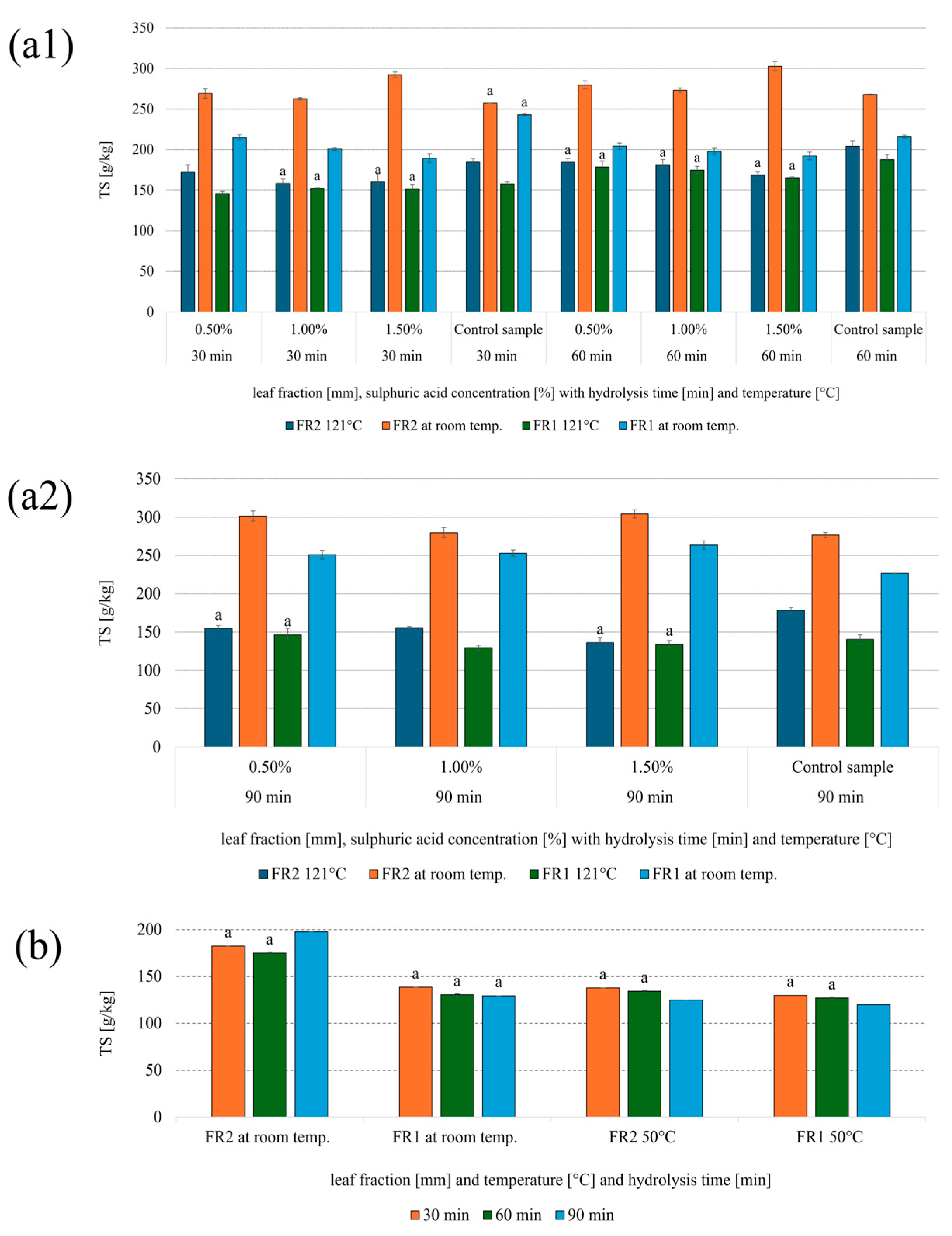
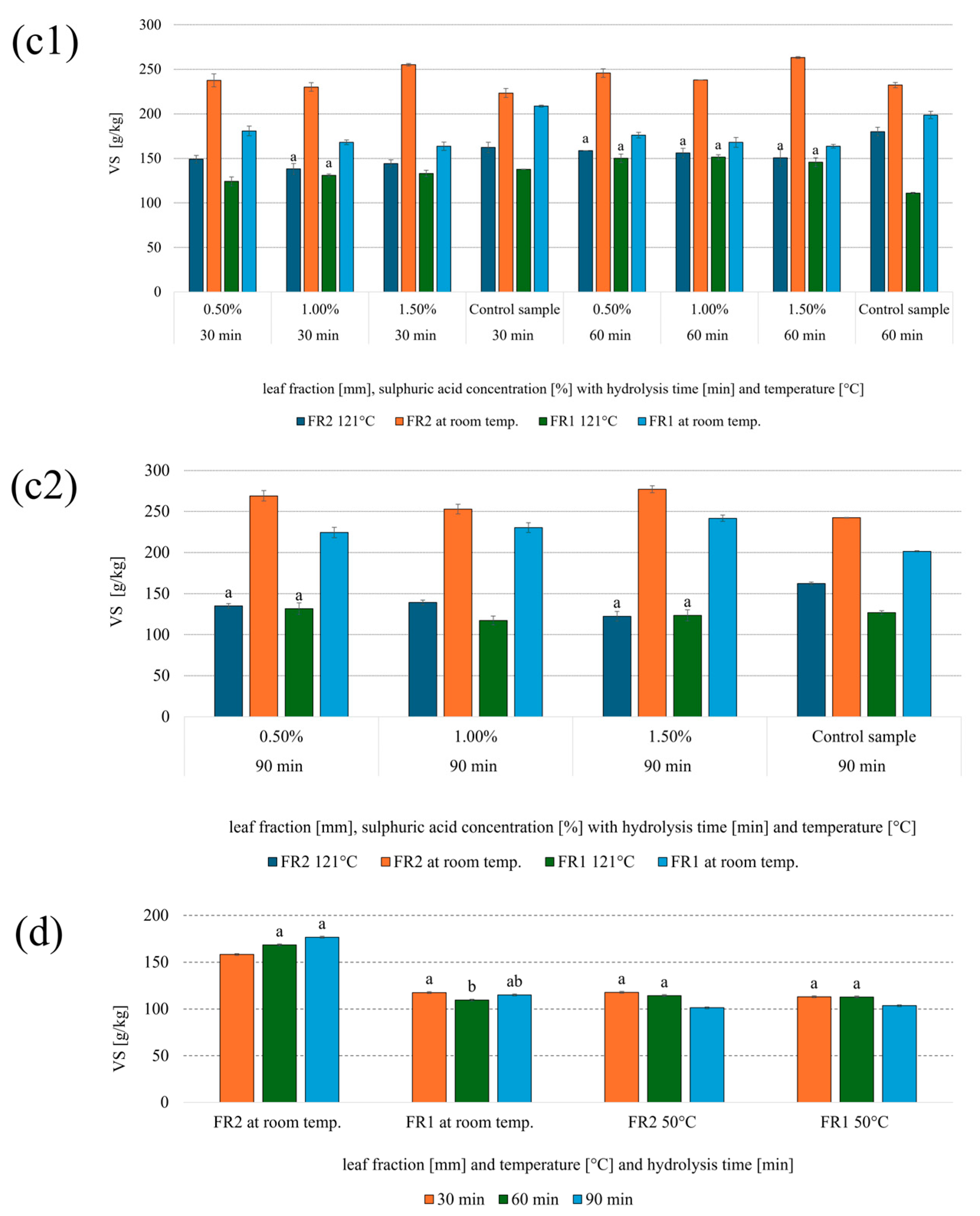
The highest dry organic matter content for acid pretreatment was achieved using 1.5% H2SO4 and a hydrolysis time of 90 min at room temperature for particles > 2 mm, yielding 277.11 ± 4.18 g/kg (Figure 1). The lowest value was obtained in the control test with a hydrolysis time of 60 min at 121 °C for the 1–2 mm fraction (110.88 ± 0.95 g/kg). This represents a 60% difference. The second lowest value was obtained in the test with the 1–2 mm fraction at 121 °C with a 90 min hydrolysis time and 1.0% H2SO4, yielding 117.26 ± 5.32 g/kg. As the sulfuric acid concentration increases, the dry organic matter content decreases. The leaf fraction affects the dry organic matter content of biological material. A characteristic downward trend is observed for fractions with diameters between 1 and 2 mm, at both room temperature and 121 °C. The results for 1.5% H2SO4 hydrolysis at 121 °C for 90 min are also noteworthy: 122.48 ± 5.83 g/kg for fractions > 2 mm and 123.56 ± 6.73 g/kg for fractions 1–2 mm. This difference is 0.87%. Wysocka-Czubaszek and Czubaszek (2024) demonstrated that Norway maple leaves had a dry mass (TS) of 70.99 ± 3.46% and a volatile solids content (VS) of 82.16 ± 5.51% [18].
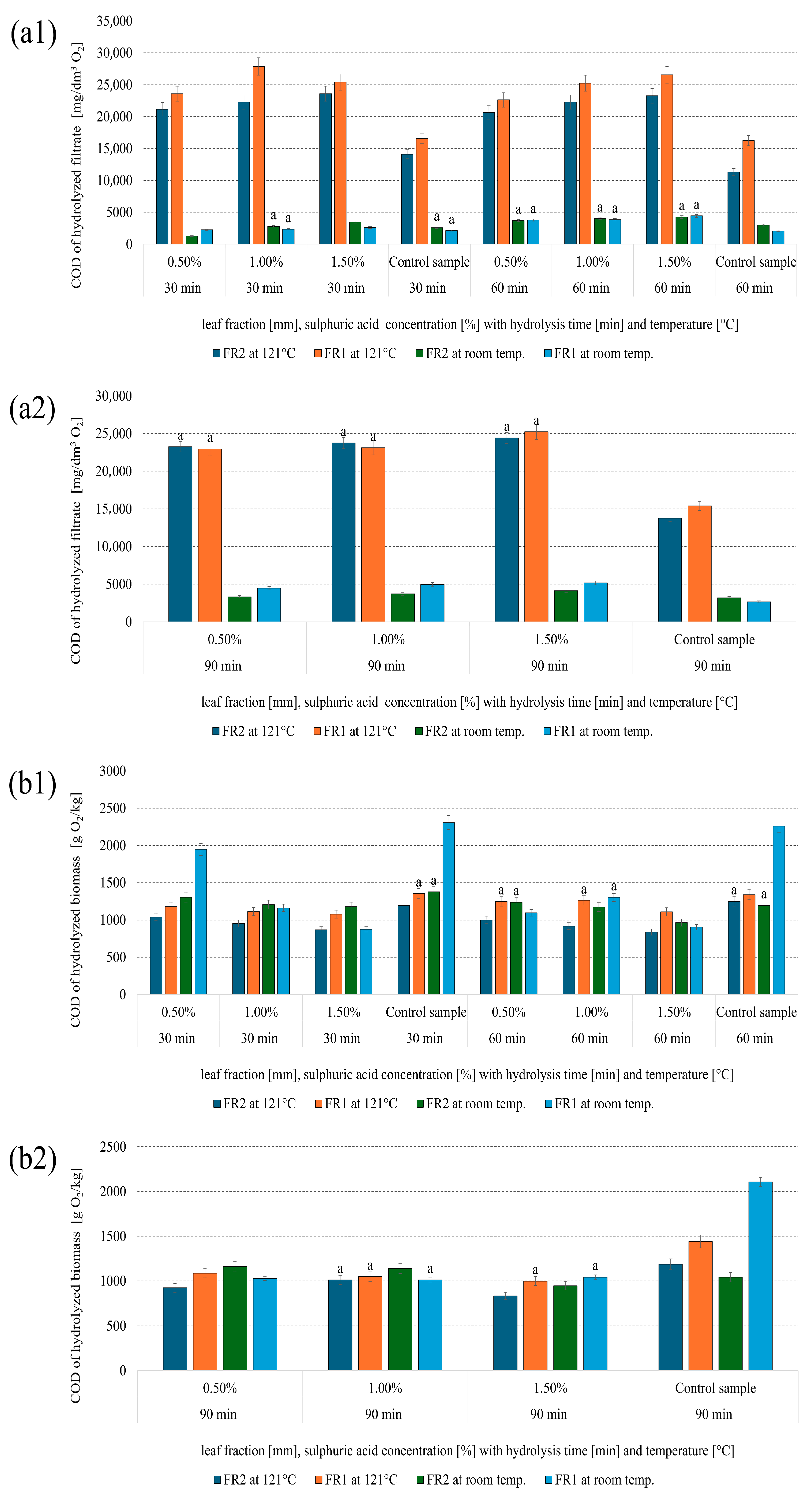
As the concentration of H2SO4 increased and the hydrolysis time was extended from 30 to 60 min, both at room temperature and at 121 °C, the COD concentration in the filtrate increased, whereas the COD concentration in the biomass decreased (Figure 2). Hydrolysis at 121 °C yielded markedly higher COD values in the filtrate. This indicates that a greater proportion of organic compounds was solubilized and subsequently oxidized. In contrast, following chemical and biological pretreatment, fewer organic compounds remained bound within the biomass. The content of dry organic matter in mixed leaves decreased as H2SO4 concentration and hydrolysis duration increased, indicating that hemicellulose was broken down into simple sugars and its cellulose became more accessible due to cell structure disruption. Based on data from the literature, it can be assumed that due to its high acid sensitivity, hemicellulose likely underwent nearly complete depolymerization into monosaccharides [19,20].
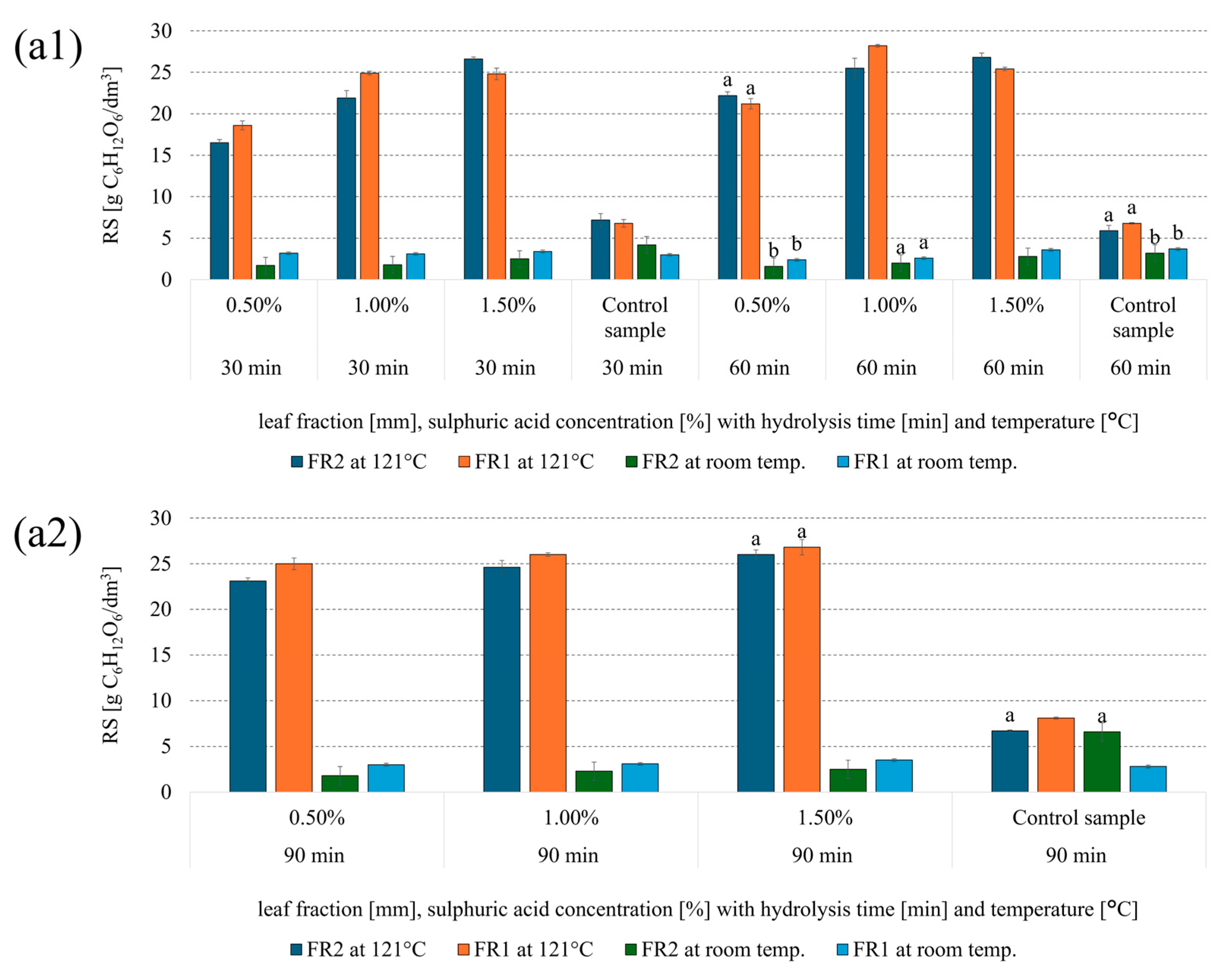
The 1–2 mm fraction treated with 1% H2SO4 at 121 °C for 60 min exhibited the highest reducing sugar content, yielding 28.20 ± 0.15 g/L C6H12O6 (Figure 3). The disparity between the highest and lowest values surged by 94.33% after chemical pretreatment. Higher sugar yields were attained by elevating the temperature, especially when using diluted sulfuric acid, as this process promotes partial lignin precipitation and the hydrolysis of hemicellulose into simple sugars. This, in turn, enhances cellulose accessibility [9,21].
The results of the analysis of simple sugar and chemical compound content are presented in Table 1. Studies on chemical pretreatment have shown that elevated temperature alone is not the primary factor governing lignocellulose degradation. Rather dilute H2SO4 promotes the depolymerization of hemicellulose as well as the decrystallization and depolymerization of cellulose. Under dilute acid conditions, xylose, the main pentose component of hemicellulose, is easily released. According to literature reports, near-complete recovery can be achieved under optimized thermal and acidic conditions, with xylose being the primary pentose constituent of hemicellulose. Zhang et al. (2015) reported that dilute H2SO4 at 110 °C can recover nearly 100% of xylose monomers from xylan oligomers. This finding underscores the effectiveness of acid pretreatment in converting hemicellulosic fractions into fermentable sugars [22,23].
Glucose production rose as sulfuric acid concentration and treatment time increased. The highest glucose content was achieved in the 1.5% H2SO4-treated leaf sample (>2 mm) at 121 °C for 90 min (variant FR2-A), which contained 1.45 g/L of glucose. This represented a 21.2% increase over the FR2-B sample (60 min pretreatment time) and a 369% increase over the FR2-C variant. For the 1–2 mm leaf fraction, a comparable trend was seen, but with significantly smaller differences: 48.4% and 68.5%, respectively (Table 1). The particle size of the fraction is probably the cause, as the smaller particles (1–2 mm) yielded 0.9 g of glucose per liter after a 30 min acid treatment, which is three times the amount obtained from the >2 mm fraction. Smaller leaf particles are likely that smaller leaf particles are more vulnerable to acid attack and the breakdown of cellulose to glucose, with a similar trend observed in rye straw treated with sulfuric acid. For 1% acid, extending the pretreatment time from 1 h to 2 h increased the glucose yield by 38.4%; for 2% acid, by 21%; for 5% acid, by 9%; and for 10% acid, by 41.7% [10].
Galacturonic acid is a byproduct of the decomposition of leaf pectins and, to a lesser extent, hemicellulose compounds that form an integral part of the plant cell wall. Cellulose decomposition yields cellobiose, which is subsequently hydrolyzed to glucose monomers. The formation of inhibitors may be caused by increasing temperature, sulfuric acid concentration, and hydrolysis time, leading to the degradation of pentoses into compounds like furfural to formic acid, and hexoses into compounds such as HMF to formic acid, and also acetic acid from the hydrolysis of hemicellulose’s acetyl groups [24,25,26].
Cellobiose is a disaccharide consisting of two glucose units linked by a β-1,4-glycosidic bond and is an intermediate product of cellulose depolymerization. The maximum cellobiose concentration (0.47 g/L) was obtained for fractions larger than 2 mm treated with a 1.5% H2SO4 solution for 30 min at 121 °C. In contrast, the minimum concentration (0.01 g/L) was recorded for 1–2 mm fractions subjected to 1.5% H2SO4 at room temperature for 60 min. Hydrolysis lasting for a prolonged period led to a decrease in cellobiose content and an increase in glucose concentration for fractions larger than 2 mm and those between 1 and 2 mm in size; in the 1–2 mm fraction, cellobiose levels were particularly low at 0.38 g/L. This indicates that sulfuric acid facilitates partial cellulose depolymerization to glucose monomers. A strong negative Pearson correlation coefficient (r = −0.71) confirms that as cellobiose decreases, glucose increases. The 1–2 mm fraction showed enhanced cellulose decrystallization and depolymerization, leading to a 7.29% rise in glucose yield; in contrast, the >2 mm fraction had higher xylose, arabinose, and galacturonic acid contents, with increases of 42.80%, 64.90%, and 51.15% respectively. The simultaneous detection of both cellobiose and glucose indicates that hydrolysis and depolymerization occurred in all cases as a result of chemical and enzymatic pretreatment [1].
For 1.5% H2SO4 at 121 °C, the fractions larger than 2 mm and between 1 and 2 mm showed the highest concentrations of inhibitors: formic acid (0.12 g/L), acetic acid (0.93 g/L), HMF (0.04 g/L), and furfural (0.1 g/L). The smaller fraction (1–2 mm) contained 48.31% less formic acid, 71.24% less acetic acid, 77.90% less HMF, and 124.30% less furfural. These compounds inhibit the growth of the microorganisms responsible for methane fermentation. The presence of HMF and furfural in the filtrate causes losses of fermentable sugars (pentoses and hexoses), thus affecting the efficiency of the process [10].
Compared to chemical pretreatment, biological pretreatment using the commercial enzyme preparation Cellic® CTec2 (Novozymes, Franklinton, NC, USA) yielded a markedly higher glucose concentration. The highest glucose value (2.38 g/L) was obtained from the >2 mm fraction after 90 min of hydrolysis at 50 °C, representing a 34.5% increase over the highest glucose yield from acid-pretreated samples.
The concentrations of formic and acetic acids were significantly lower by 91.1% and 93.8% respectively, compared to the maximum levels seen following chemical treatment. In contrast, when total simple sugars (glucose, xylose, and arabinose) were considered, acid pretreatment produced a higher combined yield, primarily due to a substantially greater release of pentoses (xylose and arabinose). Acid pretreatment of the >2 mm fraction with 1.5% H2SO4 at 121 °C for 90 min resulted in 6.34 g/L total simple sugars, whereas biological pretreatment under comparable conditions produced only 2.93 g/L, representing a 53.84% increase in total sugar yield.

3.2. FTIR Analysis of Mixed Leaves Before and After Chemical and Biological Hydrolysis

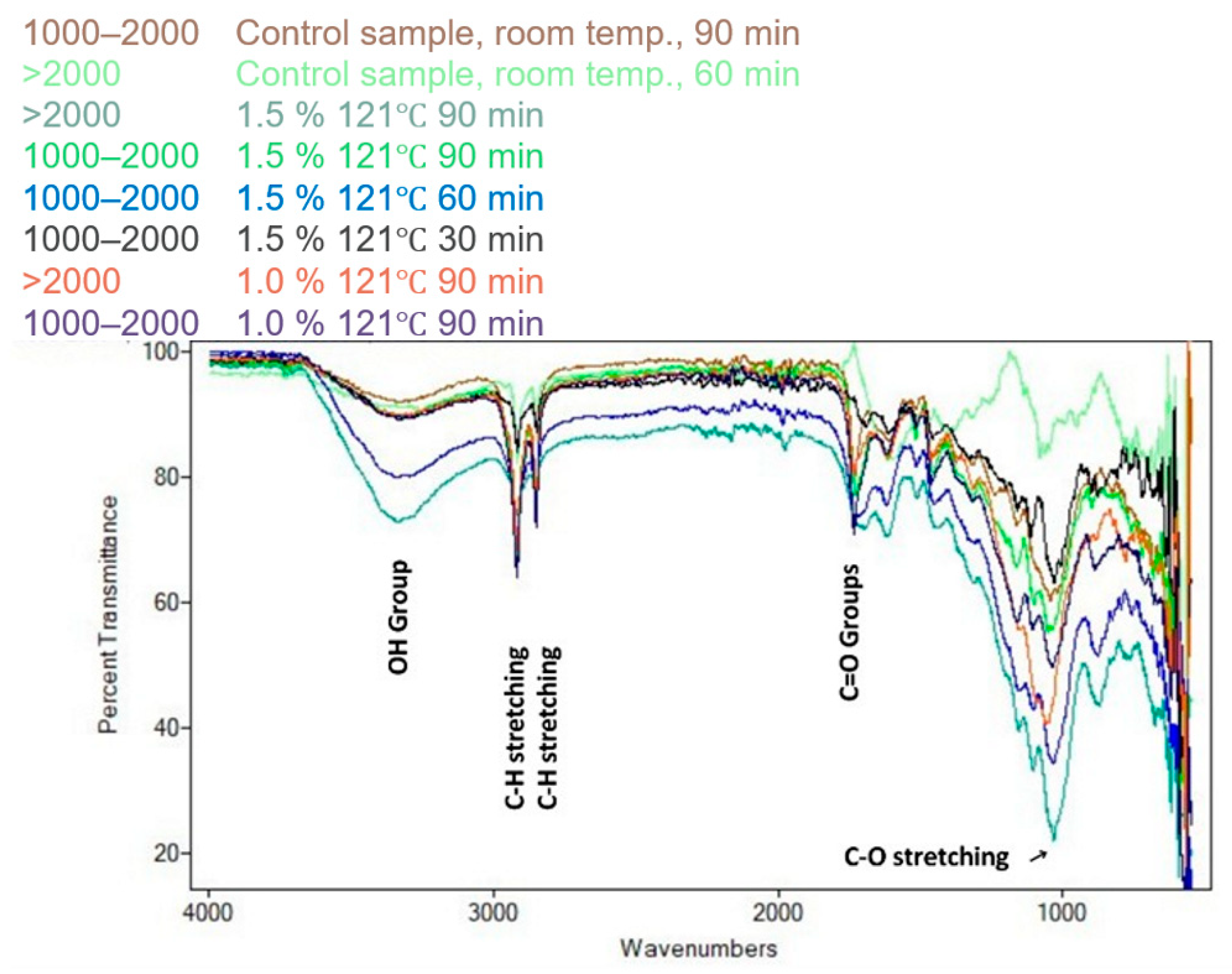
The FT-IR spectra of the mixed leaves, both before and after acid (H2SO4) pretreatment, show the characteristic broad O-H stretching envelope at 3600–3000 cm−1. This indicates extensive hydrogen bonding within the cellulose-hemicellulose network [10,27,28] (Figure 4). Two bands at 2920 and 2850 cm−1 correspond to aliphatic C-H stretching (CH2/CH3) of polysaccharides and residual cuticular waxes. The band at 1730–1736 cm−1 in the carbonyl region, which is diagnostic of acetyl/ester groups in hemicelluloses, significantly weakens or vanishes as acid severity increases (in terms of concentration, temperature, or time), suggesting deacetylation and the selective solubilization of hemicelluloses [15,24,29]. A shoulder near 1630 cm−1 may be due to H-O-H bending from residual moisture and should not be assigned to carbonyls [24].
Following treatment, lignin’s aromatic skeletal vibrations at 1595 and 1510 cm−1 increase in intensity, a pattern that matches lignin enrichment after hemicellulose removal and, under harsh conditions, the formation of potential secondary condensation products [29,30]. In the fingerprint region (approximately 1200–900 cm−1), the spectra are dominated by cellulose and hemicellulose vibrations. Bands near 1160, 1105, and 1050 cm−1 arise mainly from C-O and C-O-C stretching in glycosidic linkages [15,24,31]. The β-1,4 glycosidic band of cellulose at ~897 cm−1 is retained under moderate acid conditions, indicating that the cellulose backbone remains largely intact. Conversely, the progressive decrease in several polysaccharide-related bands across 1200–900 cm−1 with increasing pretreatment severity is consistent with the cleavage of amorphous domains and the partial depolymerization of hemicelluloses [15,30,32].
The spectral evolution, characterized by (i) the diminishing or weakening of the 1730 cm−1 acetyl/ester band, (ii) the relative increase in the lignin aromatic bands at 1595 and 1510 cm−1, and (iii) the persistence of the 897 cm−1 cellulose marker, supports the concept of selective hemicellulose hydrolysis and deacetylation, with the cellulose framework being preserved under moderate conditions. These FT-IR trends align with the process data reported in this study, which includes higher COD in the filtrate and higher reducing sugar release under severe acid/thermal conditions. This indicates increased solubilization of low-molecular-weight organics and improved cellulose accessibility. Following pretreatment, organic and inorganic compounds from biomass were transferred to the filtrate.

3.3. Methane and Hydrogen Production

Lignocellulosic biomass (including leafy biomass) possesses a complex, three-dimensional structure composed of cellulose, hemicellulose, and lignin, which significantly hinders its enzymatic hydrolysis during anaerobic digestion [33]. Therefore, pretreatment methods are recommended to remove hemicellulose and part of the lignin, as well as to reduce the crystallinity of cellulose, to release easily accessible sugars for methanogenic microorganisms [34,35].
The results presented in Table 2 demonstrate the impact of various pretreatment methods on biogas and methane yields from mixed leaf biomass. Untreated samples (FR1, FR2) yielded relatively low methane production, with a 38.26 cm3/g VS methane yield. In contrast, samples subjected to chemical pretreatment using sulfuric acid (H2SO4) exhibited significantly enhanced methane yields. Notably, FR1-A, treated with 1.5% H2SO4 at 121 °C for 90 min, achieved a methane yield of 77.56 cm3/g VS, more than doubling the yield of the untreated control. This indicates that acid hydrolysis under elevated temperature and pressure effectively increases the availability of fermentable substrates, thereby improving methane production efficiency. The results highlight the significance of chemical pretreatment in enhancing anaerobic digestion processes for lignocellulosic biomass. Decreasing the particle size of biomass expands the overall available surface area for reactions, enabling the adherence of enzymes and microorganisms to the substrate and speeding up hydrolysis [33,36].
In our study, the 1–2 mm fractions yielded higher amounts of biogas and methane compared to those larger than 2 mm, which is consistent with numerous reports in the literature. In a study by Jankovičová and co-authors (2025), corn residues—encompassing all parts of the plant after harvesting, excluding the grain—were examined in two forms: cut into 1–3 cm pieces or ground to 2 mm. The results showed a specific biogas production (SBP) of 498 cm3/g VS for the 2 mm fraction, compared to 419 cm3/g VS for the chopped material [36].
Menardo et al. (2012) noted a similar effect that resulted from grinding wheat straw to an average length of 0.2 cm, which led to a specific methane production increase from 182 to 334 LN/kg VS, a rise of 83.5% over the untreated sample [37]. The literature indicates that the optimal particle size varies depending on the material. Dumas et al. (2015) studied wheat straw particles ranging from 0.7 to 0.2 mm and found no significant differences in biogas yield; further reduction to 0.048 mm did not improve methane production [38]. A study by Sharma and co-authors in 1988 found the highest total biogas yield from seven plant residues, including wheat and rice straw, Mirabilis jalapa leaves, cauliflower, Ipomoea fistulosa, dhub grass, and banana peels, when the particle sizes were 0.088 mm and 0.40 mm, with no significant difference between them, suggesting that further grinding below 0.40 mm is not energy-efficient. In the case of succulent leaves such as Mirabilis, cauliflower, or Ipomoea, whole leaves can be used for fermentation without grinding [39]. Our results confirm the trend that the 1–2 mm fraction significantly increases yield compared to larger particle sizes. Fractionating leafy biomass to this scale appears optimal—it avoids overly coarse fragments that limit access to cell walls, while also preventing excessive accumulation of volatile fatty acids associated with minimal particles or fractions.
Acid pretreatment, particularly with diluted H2SO4, is a well-established method for the initial breakdown of lignocellulose. Sulfuric acid cleaves glycosidic bonds in polysaccharides, solubilizes hemicellulose, and partially disrupts the lignocellulosic matrix, thereby increasing cellulose accessibility for microorganisms [35]. The literature consistently reports a notable increase in methane yield following dilute acid treatment. For example, Syaichurrozi and co-authors (2019) applied a pretreatment using 2% (v/v) H2SO4 to the floating fern Salvinia molesta. After 30 days, the cumulative biogas yield increased from 13.28 to 22.72 mL/g VS. Although the methane content in the gas decreased from 83.6% to 73.1%, the specific methane yield reached 16.6 mL CH4/g VS, approximately 50% higher than in the control sample. These findings confirm that moderate hydrolysis with sulfuric acid is an effective and low-cost pretreatment step, capable of at least doubling the rate of methanogenesis without extending retention time [40]. These results suggest that our conditions (1.5% H2SO4 at 121 °C for 90 min) are close to optimal for cellulose and hemicellulose rich leaves. Treatment under these conditions effectively hydrolyzes hemicellulose into simple sugars, which can be directly fermented by microorganisms, thereby enhancing biogas yield.
The methane yield generated from fermenting blended leaves in this study (115.5 ± 3.2 NL CH4/kg VS after pretreatment with 1.5% H2SO4 at 121 °C for 90 min) is comparable to, or indeed surpasses, the values cited by Wysocka-Czubaszek and Czubaszek (2024) [18]. Their study discovered that under wet fermentation conditions (where the total solids content was less than 10%, at 38 ± 1 °C), the maple leaves produced 107.52 ± 4.46 NL CH4 per kilogram of volatile solids. Conversely, under dry fermentation (with a total solids content of approximately 20%), a yield of 108.22 ± 2.02 NL CH4 per kilogram of volatile solids was recorded. For comparison, red oak leaves reached the highest methane yield under wet fermentation—115.69 ± 4.11 NL/kg VS, but this dropped to 98.49 ± 3.15 NL/kg VS under dry conditions. Small-leaved lime (Tilia cordata) leaves exhibited the lowest values: 56.80 ± 1.34 NL/kg VS (wet anaerobic digestion) and 55.23 ± 3.36 NL/kg VS (dry anaerobic digestion).
Thus, maple leaves rank in the mid-range in terms of biomethane potential, but under dry fermentation conditions (108.22 NL/kg VS), they even outperform oak, achieving the highest yield among the tested species. Importantly, both our study and the work of Wysocka-Czubaszek and Czubaszek (2024) [18] confirm that pretreatment of leafy biomass is essential. In our experiment, the control sample (raw mixed leaves, 1–2 mm) yielded only 43.5 NL CH4 kg VS, while sulfuric acid hydrolysis increased the yield by approximately 165% [24].
Intensifying acid pretreatment causes the creation of inhibitors. Domański et al. (2020) [10] showed that treatment with 10% H2SO4 (121 °C, 2 h) resulted in a furfural concentration of 2.17 g L−1, exceeding the toxicity threshold for methanogens, whereas the use of 2% H2SO4 produced 17.5 g L−1 of xylose with furfural levels below 0.4 g L−1. Furfural concentrations and 5-HMF in the hydrolysates of mixed leaves were found to be ≤0.10 g/L−1 and ≤0.04 g/L−1, respectively, thereby indicating that the release of sugars and inhibitory by-products was at least one order of magnitude lower [10].
The variant of mixed leaves ground to 1–2 mm and subjected to 1.5% H2SO4 at 121 °C for 90 min achieved a 144.2% higher biogas yield and a 165.6% higher methane yield (115.54 cm3 CH4/gVS; 75.2% CH4 v/v) compared to the control sample (43.51 cm3 CH4/gVS). The findings clearly show that combining particle size reduction to 1–2 mm with moderate sulfuric acid hydrolysis is an effective approach for enhancing the anaerobic digestion of leafy biomass, increasing both methane production rates and total methane yields, while keeping inhibitor concentrations below the levels that could hinder methanogenic microbial activity.
The two-stage anaerobic digestion process demonstrated distinct gas production profiles in each phase (Figure 5 and Table 3). During the dark fermentation stage, the primary focus was on hydrogen generation. The experimental results of the first-stage dark fermentation process, as presented in the table, demonstrate the influence of substrate concentration on gas production parameters under constant inoculum conditions (250 g). Substrate quantities ranged from 20 g to 152 g, with initial pH values between 5.45 and 5.55 and final pH values between 5.25 and 5.47. The pH remained in the mildly acidic range (initial: 5.43–5.52; final: 5.25–5.47), favoring hydrogen-producing bacteria. Specific gas production (SGP) varied notably, reaching a maximum of 71.16 dm3/kgVS (FR2-B), representing a 40.92% increase compared to the FR2 control (29.12 dm3/kgVS). Similarly, specific hydrogen production (SHP) peaked at 10.25 dm3/kgVS (FR2-B) under the same conditions, marking a 56.98% increase relative to FR2 (5.84 dm3/kgVS), indicating optimal hydrogen generation. In comparison, FR1-B achieved an SGP of 56.37 dm3/kgVS (41.56% increase), SHP of 7.65 dm3/kgVS (24.11% increase), and hydrogen content of 34.87% (31.89% increase) over FR1.
Through the DF process, Yang et al. (2019) reported a 30.5 cm3/g-VS added biohydrogen yield of the fallen leaves (dried and comminuted to about 18-mesh) [41]. This is a three times higher yield than in our case, but this may be due to the presence of potential inhibitors in the hydrolysates, such as furfural (0.1–0.011 g/L) and hydroxymethylfurfural (0.042–0.021 g/L). Furan derivatives are formed through the dehydration of pentoses and hexoses. These compounds are problematic in fermentation processes because of their widespread occurrence and marked toxicity. Their presence can elicit multiple adverse effects on microbial cells, including inhibition of cell growth, disruption of glycolytic and fermentative enzyme activity, reduced membrane permeability [42].
In hydrogen fermentation, there remains no clear consensus regarding which inhibitory compounds exert the most significant impact on hydrogen yield. While some studies have reported that furan derivatives possess stronger inhibitory effects than phenolic compounds or weak acids, others have observed the opposite trend. These conflicting findings may be attributed to several factors, including the type of microorganism involved, the specific fermentation conditions, and the potential synergistic interactions among inhibitory compounds. In addition, the threshold concentration at which inhibition occurs seems to vary depending on the context, making direct comparisons between studies even more complicated [42,43,44].
According to the results, it can be concluded that pretreated leaves fermentation is an effective method to improve the biohydrogen production. Notably, specific methane production (SMP) remained at 0 dm3/kgVS across all trials, confirming the absence of methanogenesis during this fermentation stage. Hydrogen content in the produced gas ranged from 11% to approximately 36%, with the highest concentrations observed in setup FR2-B. Methane content was consistently undetectable. These results demonstrate that setups FR2-B and FR1-B significantly enhance hydrogen yield, with FR2-B being the most effective configuration. The findings underscore the importance of substrate optimization and pretreatment strategies in maximizing hydrogen output during dark fermentation.
In the first stage, the process is dominated by hydrogen-producing bacteria (HPB), primarily from the genera Clostridium, Enterobacter, and Bacillus [45,46]. These facultative or obligate anaerobes metabolize carbohydrates via acidogenic pathways, converting sugars into volatile fatty acids (VFAs), hydrogen (H2), and carbon dioxide (CO2) [47]. The mildly acidic pH (5.2–5.5) and short retention time inhibit methanogens and favor HPB activity. Importantly, methanogens are suppressed in this stage due to low pH and short hydraulic retention time (HRT), preventing premature methane formation [48].
In contrast, the methane fermentation stage prioritized methane production. The second-stage anaerobic digestion focused on methane fermentation, using a consistent inoculum mass of 500 g across all setups. During dark fermentation, the archaea were almost completely inactivated following pretreatment. In the next phase, the presence of these microorganisms is required for methane fermentation to occur. Substrate quantities ranged from 20 g to 124 g, with initial pH values between 7.00 and 7.11 and final pH values from 6.48 to 6.93. The pH was neutral to slightly alkaline, optimal for methanogens. The highest specific gas production was observed in the setup FR2-B, reaching 131.87 dm3/kgVS, which represents a 34.18% increase compared to the control setup (45.07 dm3/kgVS). Methane content in the biogas ranged from 54% to 70%. Specific Methane Production also peaked in this configuration at 81.24 dm3/kgVS, corresponding to a 48.87% increase over the control (39.70 dm3/kgVS).
Hydrogen content remained negligible (0.50–0.80%), confirming the dominance of methanogenic pathways in this phase. These results indicate that increasing the substrate concentration significantly enhances both total gas and methane yields, with setup FR2-B demonstrating the most efficient methane production. In the second stage, the microbial community shifts toward methanogenic archaea, which thrive under neutral pH and longer retention times [49].
These include acetoclastic methanogens (e.g., Methanosaeta, Methanosarcina), which convert acetate to methane and hydrogenotrophic methanogens (e.g., Methanobacterium, Methanospirillum), which reduce CO2 with H2 to produce methane [47,50]. These archaea rely on the VFAs and H2 produced in the first stage. The presence of syntrophic bacteria (e.g., Syntrophomonas) is also critical, as they degrade longer-chain VFAs into acetate and H2, which are then utilized by methanogens [47]. The absence of hydrogen in this stage confirms efficient H2 consumption by hydrogenotrophic methanogens, while the high methane content (up to ~70%) indicates robust methanogenic activity [51].
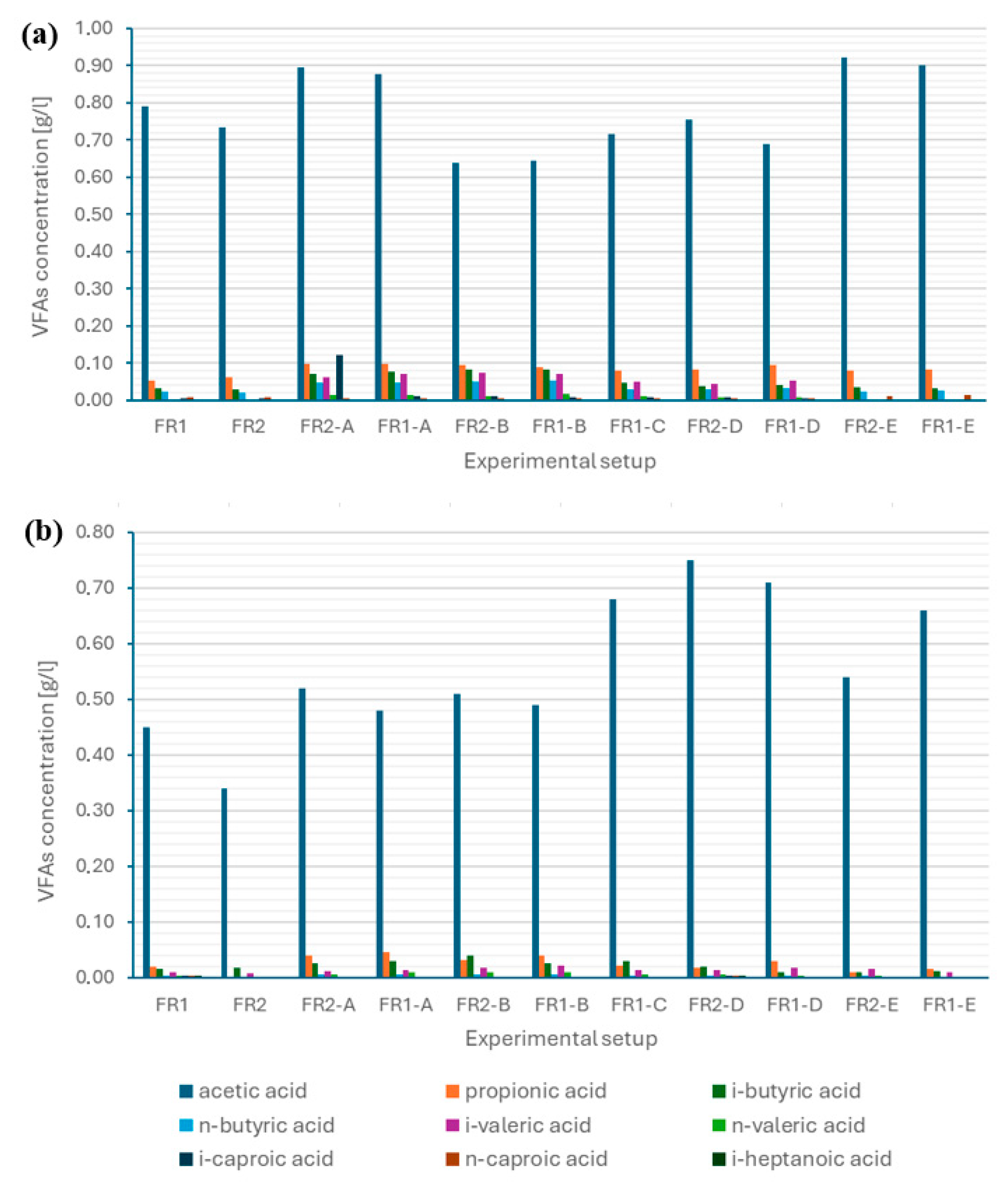
Fermentative hydrogen and methane production is accompanied by the production of liquid metabolites such as volatile organic acids (VFAs). Figure 5 summarizes the concentrations of individual acids measured in the digestates from H2 and CH4 experiments when the DF and AD processes reached maximum hydrogen and methane yield. No consistent correlation was observed between the type of pretreatment applied, the resulting hydrogen and methane yield, and the concentration of volatile fatty acids in the digestate. In the first stage (Figure 5a), acetic acid was the dominant VFA, exhibiting the highest concentrations across all experimental setups (0.64–0.92 g/L). The concentrations of the remaining VFAs were substantially lower, indicating that acetic acid was the principal metabolic product during the hydrogenogenic phase. This observation aligns with previous findings that acetic acid is a key intermediate in hydrogen-producing fermentation pathways [52].
The inhibitory effects of propionic acid on fermentative methane and hydrogen production have been reported in several studies. Zhang et al. (2019) demonstrated that methane production from propionate proceeds at a slower rate compared to acetic and butyric acids [53]. Furthermore, propionic acid has been shown to inhibit the growth of both methanogenic archaea and hydrogen-producing bacteria during AD and DF processes. As a result of its inhibitory properties, propionic acid is regarded as an undesirable byproduct in anaerobic digestion. The second stage of the dark fermentation process, acidogenesis, which follows hydrolysis, is the crucial phase where biohydrogen is produced. In this stage, acidogenic bacteria degrade the hydrolysis products—soluble organic monomers such as sugars and amino acids—into volatile fatty acids (VFAs), acetate, alcohols, and aldehydes, accompanied by the release of hydrogen (H2) and carbon dioxide (CO2) [54].
In the second stage (Figure 5b), corresponding to methane production, a marked decrease in acetic acid concentration was observed across all experimental setups. This decline is indicative of its active consumption by methanogenic archaea, particularly acetoclastic methanogens, which utilize acetic acid as a substrate for methane synthesis [55]. The concentrations of the other VFAs remained relatively low and exhibited minimal variation between the two stages. These results demonstrate a clear metabolic shift between the two phases, characterized primarily by the depletion of acetic acid during the transition from hydrogenogenic to methanogenic conditions, while the overall profile of minor VFAs has also been reduced [55].
The findings validate the effectiveness of a two-stage fermentation strategy, where hydrogen is maximized in the first phase and methane in the second, under optimized pH and substrate conditions. The two-stage approach allows for targeted enhancement of each gas, maximizing overall bioenergy recovery while minimizing inhibitory cross-effects between microbial communities. This sequential strategy enhances total bioenergy yield and process stability, making it a promising approach for the valorization of organic biomass.

3.4. The Potential Energy Gain from Fallen Leaves

An estimated assessment of the energy benefits and costs related to the use of fallen leaves was conducted. The estimated energy required for grinding and sieving 1 kg of fallen leaves (VS) was 0.058 MJ, based on laboratory equipment. Because the other operational parameters remained constant, the additional energy demand can be attributed primarily to the anaerobic digestion process. In the simulation, the digester volume was fixed at 1 L and the operating temperature was maintained at 35 °C. This baseline requirement was considered essential for system operation and, for simplification, was excluded from the benefits assessment. Furthermore, given the short duration of the pre-treatment stage, the energy associated with thermal insulation (enzymatic treatment) was regarded as negligible.
The estimated energy required for thermal hydrolysis was 0.118 MJ, 0.237 MJ, and 0.336 MJ for process durations of 30, 60, and 90 min, respectively. The energy obtainable from the combustion of 1 L of hydrogen is 0.0107 MJ, while that from 1 L of methane is 0.036 MJ [10]. The methane yield from the best single-stage AD variant was 115.55 L/kg of VS leaves, while the same variant under two-stage AD conditions produced 7.01 L of hydrogen and 62.72 L of methane. This resulted in energy yields of 4.15 MJ and 2.33 MJ, respectively. It is assumed that 10% of the energy produced by the anaerobic digestion (AD) processes is used to sustain the process itself and operate the reactor along with its auxiliary equipment (biogas plant). Therefore, the net energy gain from these variants is 3.34 MJ and 1.7 MJ, respectively. The best variant of two-stage fermentation produced 10.25 L of H2 and 81.24 L of CH4 per kg of leaves (VS). For the same variant, the methane yield from single-stage anaerobic digestion (AD) was 76.65 L of CH4 per kg of leaves (VS). Thus, the potential net energy yield is 2.43 MJ for two-stage AD and 2.18 MJ for single-stage AD. The estimated energy calculation is based on laboratory equipment, which may have a different energy efficiency compared to industrial equipment. The calculation also excludes the cost of constructing bioreactors for the anaerobic digestion process.
Fallen leaves from trees are an often underestimated source of biomass that can be utilized for biotechnological purposes. This approach addresses the issue of fallen leaves, as current disposal methods are not always aligned with the principles of sustainable development and the circular economy. The results presented aim to assess the feasibility of this form of pretreatment (both chemical and biological). A preliminary selection of the ground leaf fraction size will also help determine its feasibility. Fractionation of biological material is rarely explored in the work of other researchers. Single- or two-stage anaerobic fermentation offers the potential for selecting a more cost-effective process in terms of energy yield and the chemical compounds produced.
Lastly, but not least, the overall system analysis should be conducted for most processes currently in use and those under development to clarify the benefits and environmental impacts of the AD systems of interest. Methane and hydrogen recovery from waste represents a sustainable strategy for mitigating carbon dioxide equivalent emissions. Yet, when the energy demand and chemical inputs associated with specific stages, such as pre-treatment are considered, the net benefits for certain substrates or reactor configurations may be less substantial than anticipated. To accurately assess the advantages and environmental implications of anaerobic digestion systems—both established and emerging—comprehensive system analyses are required. In this regard, life cycle assessment (LCA) and environmental impact assessment (EIA) provide essential frameworks for delivering a global perspective on the proposed scenarios.

4. Conclusions

This study demonstrates that acid and enzymatic hydrolysis of fallen leaves substantially improves the efficiency of anaerobic digestion compared to untreated biomass. Single-stage digestion under optimal conditions yielded 115.54 dm3 CH4/kgVS, while two-stage digestion produced 10.25 dm3 H2/kgVS and 81.24 dm3 CH4/kgVS, highlighting the potential for dual gas recovery. In single-stage systems, moderate acid pretreatment of finely milled leaves (1–2 mm) enhanced methane yield in the absence of inhibitors, whereas particle size exerted no measurable effect in two-stage digestion, suggesting distinct mechanistic pathways. These findings underscore the importance of tailored pretreatment strategies in optimizing biogas production from lignocellulosic waste and provide a foundation for further research into process configuration and scalability. The results confirm that fallen leaves represent a promising renewable feedstock for sustainable energy generation.

Author Contributions

Conceptualization, J.D. and W.C.-W.; methodology, J.D. and W.C.-W.; formal analysis, J.D. and S.G.; investigation, S.G., W.C.-W., U.D. and J.D.; resources, S.G., W.C.-W., U.D. and J.D.; writing—original draft preparation, S.G., W.C.-W. and J.D.; writing—review and editing, J.D., U.D. and W.C.-W.; visualization, S.G. and J.D.; supervision, J.D.; project administration, J.D. All authors have read and agreed to the published version of the manuscript.

Funding

This research received no external funding. The APC was funded by Lodz University of Technology.

Data Availability Statement

The original contributions presented in this study are included in the article. Further inquiries can be directed to the corresponding author.

Acknowledgments

The authors would like to thank to the Department of Environmental Biotechnology, Institute of Fermentation Technology and Microbiology (Lodz University of Technology) and MNiSW for their financial aid.

Conflicts of Interest

The authors declare no conflicts of interest. The funders had no role in the design of the study; in the collection, analyses, or interpretation of data; in the writing of the manuscript; or in the decision to publish the results.

Abbreviations

The following abbreviations are used in this manuscript:
ADanaerobic digestion
CODchemical oxygen demand
DFdark fermentation
FIDflame ionization detector
FR1fraction 1–2 mm
FR2fraction >2 mm
FR1-Afraction 1–2 mm, 1.5% H2SO4, 121 °C, 90 min
FR2-Afraction >2 mm, 1.5% H2SO4, 121 °C, 90 min
FR1-Bfraction 1–2 mm, 1.5% H2SO4, 121 °C, 60 min
FR2-Bfraction >2 mm, 1.5% H2SO4, 121 °C, 60 min
FR1-Cfraction 1–2 mm, 1.5% H2SO4, 121 °C, 30 min
FR1-Dfraction 1–2 mm, 1.0% H2SO4, 121 °C, 90 min
FR2-Dfraction >2 mm, 1.0% H2SO4, 121 °C, 90 min
FR1-Efraction 1–2 mm, enzyme treatment
FR2-Efraction >2 mm, enzyme treatment
OLRorganic loading rate
SGPspecific gas production
SHPspecific hydrogen production
SMPspecific methane production
SRTsolids retention time
TANtotal ammonium nitrogen
TStotal solids
VFAvolatile fatty acids
VSvolatile solids

References

  1. Saini, J.K.; Saini, R.; Tewari, L. Lignocellulosic agriculture wastes as biomass feedstocks for second-generation bioethanol production: Concepts and recent developments. 3 Biotech 2015, 5, 337–353. [Google Scholar] [CrossRef] [PubMed]
  2. Zabed, H.; Sahu, J.N.; Boyce, A.N.; Faruq, G. Fuel ethanol production from lignocellulosic biomass: An overview on feedstocks and technological approaches. Renew. Sustain. Energy Rev. 2016, 66, 751–774. [Google Scholar] [CrossRef]
  3. Banu, J.R.; Yukesh Kannah, R.; Dinesh Kumar, M.; Preethi Kavitha, S.; Gunasekaran, M.; Zhen, G.; Awasthi, M.K.; Kumar, G. Spent coffee grounds based circular bioeconomy: Technoeconomic and commercialization aspects. Renew. Sustain. Energy Rev. 2021, 152, 111721. [Google Scholar] [CrossRef]
  4. Gosławski, S.; Skura, K. Assessment of the impact of pretreatment of spent coffee grounds with diluted sulfuric acid on the efficiency of methane and lactic acid fermentation. Acta Univ. Lodz. Folia Biol. Oecol. 2024, 18, 14–22. [Google Scholar] [CrossRef]
  5. Vargas-Soplín, A.J.; Prochnow, A.; Herrmann, C.; Tscheuschner, B.; Kreidenweis, U. The potential for biogas production from autumn tree leaves to supply energy and reduce greenhouse gas emissions—A case study from the city of Berlin. Resour. Conserv. Recycl. 2022, 187, 106598. [Google Scholar] [CrossRef]
  6. Vogt, R.; Fehrenbach, S.; Heidelberg, I. Stoffstrom-, Klimagas- und Umweltbilanz für das Jahr 2016 für das Land Berlin; Senate Department for the Environment, Transport and Climate Protection: Berlin, Germany, 2017. [Google Scholar]
  7. Xu, Y.; Li, Q.; Pan, Y.; Wang, Y.; Cheng, X.; Hu, X.; Qi, J.; Lu, Z. The leaf litterfall pattern in an old-growth evergreen broad-leaved forest and its implication for leaf litter mixing studies. Glob. Ecol. Conserv. 2024, 54, e03121. [Google Scholar] [CrossRef]
  8. Gosławski, S.; Pielech-Przybylska, K.; Jastrzabek, K.; Domański, J. Ozonolysis and Enzymatic Pretreatment of Fallen Norway Maple (Acer platanoides L.) Leaves for Anaerobic Digestion. Energies 2025, 18, 4963. [Google Scholar] [CrossRef]
  9. Robak, K.; Balcerek, M. Review of Second Generation Bioethanol Production from Residual Biomass. Food Technol. Biotechnol. 2018, 56, 174–187. [Google Scholar] [CrossRef] [PubMed]
  10. Domański, J.; Marchut-Mikołajczyk, O.; Cieciura-Włoch, W.; Patelski, P.; Dziekońska-Kubczak, U.; Januszewicz, B.; Bolin, Z.; Zhang, B.; Dziugan, P. Production of methane, hydrogen and ethanol from Secale cereale L. straw pretreated with sulfuric acid. Molecules 2020, 25, 1013. [Google Scholar] [CrossRef] [PubMed]
  11. Kordala, N.; Lewandowska, M.; Świątek, M.; Bednarski, W. The evaluation of the dependence of the effects of enzymatic hydrolysis of miscanthus giganteus and rape straw polysaccharides on the conditions of ammonia pretreatment. Acta Sci. Pol. Biotechnol. 2013, 12, 19–30. [Google Scholar]
  12. Laskoś, K.; Czyczyło-Mysza, I. Leaf epicuticular wax as a determinant trait for drought resistance in cereals. Postępy Biochemii 2023, 69, 104–112. [Google Scholar] [CrossRef] [PubMed]
  13. Kucharska, K.; Rybarczyk, P.; Hołowacz, I.; Łukajtis, R.; Glinka, M.; Kamiński, M. Pretreatment of lignocellulosic materials as substrates for fermentation processes. Molecules 2018, 23, 2937. [Google Scholar] [CrossRef]
  14. Witaszek, K.; Kupryaniuk, K.; Kupryaniuk, J.; Panasiewicz, J.; Czekała, W. Optimization of straw particle size for enhanced biogas production: A comparative study of wheat and rapeseed straw. Energies 2025, 18, 1794. [Google Scholar] [CrossRef]
  15. Domański, J.; Borowski, S.; Marchut-Mikołajczyk, O.; Kubacki, P. Pretreatment of rye straw with aqueous ammonia for conversion to fermentable sugars as a potential substrates in biotechnological processes. Biomass Bioenergy 2016, 91, 91–97. [Google Scholar] [CrossRef]
  16. Madej, M.; Siuta, J.; Wasiak, G. Warsaw’s urban green areas as source of raw material for compost production. Part II. Chemical compostion ofthe plant matter collected from different urban green areas. Inżynieria Ekol. 2010, 23, 22–35. [Google Scholar]
  17. Arce, C.; Kratky, L. Mechanical pretreatment of lignocellulosic biomass toward enzymatic/fermentative valorization. iScience 2022, 25, 104610. [Google Scholar] [CrossRef]
  18. Wysocka-Czubaszek, A.; Czubaszek, R. Fallen leaves as a substrate for biogas production. Energies 2024, 17, 6038. [Google Scholar] [CrossRef]
  19. Dziekońska-Kubczak, U.; Berłowska, J.; Dziugan, P.; Patelski, P.; Balcerek, M.; Pielech-Przybylska, K.; Czyżowska, A.; Domański, J. Comparison of steam explosion, dilute acid, and alkali pretreatments on enzymatic saccharification and fermentation of hardwood sawdust. BioResources 2018, 13, 6970–6984. [Google Scholar] [CrossRef]
  20. Ledakowicz, S. Biochemical processes of lignocellulosic biomass conversion. Energies 2025, 18, 3353. [Google Scholar] [CrossRef]
  21. Galbe, M.; Zacchi, G. Pretreatment: The key to efficient utilization of lignocellulosic materials. Biomass Bioenergy 2012, 46, 70–78. [Google Scholar] [CrossRef]
  22. Zhang, T.; Kumar, R.; Tsai, Y.-D.; Elander, R.T.; Wyman, C.E. Xylose yields and relationship to combined severity for dilute acid post-hydrolysis of xylooligomers from hydrothermal pretreatment of corn stover. Green Chem. 2015, 17, 394–403. [Google Scholar] [CrossRef]
  23. Mu, L.; Zhou, J.; Yue, W.; Feng, J.; Qin, C.; Liang, C.; Liu, B.; Huang, C.; Yao, S. Selective separation of poplar hemicellulose and simultaneous enrichment of soluble xylose in the hydrolysate by itaconic acid pretreatment. Int. J. Biol. Macromol. 2025, 310, 143498. [Google Scholar] [CrossRef]
  24. Ibrahim, M.M.; Fahmy, T.Y.A.; Salaheldin, E.I.; Mobarak, F.; Youssef, M.A.; Mabrook, M.R. Role of tosyl cellulose acetate as potential carrier for controlled drug release. Life Sci. J. 2015, 12, 127–133. [Google Scholar] [CrossRef]
  25. Jönsson, L.J.; Martín, C. Pretreatment of lignocellulose: Formation of inhibitory by-products and strategies for minimizing their effects. Bioresour. Technol. 2016, 199, 103–112. [Google Scholar] [CrossRef]
  26. Janković, T.; Straathof, A.J.J.; Kiss, A.A. Enhanced hot-liquid water pretreatment of biomass with recovery and valorization of side products. In Computer Aided Chemical Engineering; Kokossis, A., Georgiadis, M.C., Pistikopoulos, E.N., Eds.; Elsevier: Amsterdam, The Netherlands, 2023; Volume 52, pp. 2113–2118. [Google Scholar] [CrossRef]
  27. Gieparda, W. Hemp biomass pretreatment in the process of bioethanol production. Przemysł Chem. 2019, 98, 124–127. [Google Scholar] [CrossRef]
  28. Zhuang, J.; Li, M.; Pu, Y.; Ragauskas, A.J.; Yoo, C.G. Observation of Potential Contaminants in Processed Biomass Using Fourier Transform Infrared Spectroscopy. Appl. Sci. 2020, 10, 4345. [Google Scholar] [CrossRef]
  29. Jiang, H.; Nie, J.; Zeng, L.; Zhu, F.; Gao, Z.; Zhang, A.; Xie, J.; Chen, Y. Selective removal of hemicellulose by diluted sulfuric acid assisted by aluminum sulfate. Molecules 2024, 29, 2027. [Google Scholar] [CrossRef] [PubMed]
  30. Domański, J.; Marchut-Mikołajczyk, O.; Polewczyk, A.; Januszewicz, B. Ozonolysis of straw from Secale cereale L. for anaerobic digestion. Bioresour. Technol. 2017, 245, 394–400. [Google Scholar] [CrossRef] [PubMed]
  31. Ikhmal, W.; Yasmin, M.; Fazira, M.; Wan Abdullah, W.R.; Wan Nik, W.S.; Ghazali, M. Anticorrosion coating using Olea sp. leaves extract. In Proceedings of the 3rd International Conference on Science, Technology, and Interdisciplinary Research (IC-STAR), Bandar Lampung, Indonesia, 18–20 September 2017; Volume 344, p. 012028. [Google Scholar] [CrossRef]
  32. Terasawat, A.; Phoolphundh, S. Simultaneous biological pretreatment and saccharification of rice straw by ligninolytic enzymes from Panus neostrigosus I9 and commercial cellulase. J. Fungi 2021, 7, 853. [Google Scholar] [CrossRef]
  33. Manyi-Loh, C.E.; Lues, R. Anaerobic digestion of lignocellulosic biomass: Substrate characteristics (challenge) and innovation. Fermentation 2023, 9, 755. [Google Scholar] [CrossRef]
  34. Hernández-Beltrán, J.U.; Hernández-De Lira, I.O.; Cruz-Santos, M.M.; Saucedo-Luevanos, A.; Hernández-Terán, F.; Balagurusamy, N. Insight into Pretreatment Methods of Lignocellulosic Biomass to Increase Biogas Yield: Current State, Challenges, and Opportunities. Appl. Sci. 2019, 9, 3721. [Google Scholar] [CrossRef]
  35. Di Mario, J.; Montegiove, N.; Gambelli, A.M.; Brienza, M.; Zadra, C.; Gigliotti, G. Waste biomass pretreatments for biogas yield optimization and for the extraction of valuable high-added-value products: Possible combinations of the two processes toward a biorefinery purpose. Biomass 2024, 4, 865–885. [Google Scholar] [CrossRef]
  36. Jankovičová, B.; Hutňan, M.; Sammarah, M. Enhancing biogas production: Pre-treatment of lignocellulosic biomass using biogas plant digestate. Sustainability 2025, 17, 3898. [Google Scholar] [CrossRef]
  37. Menardo, S.; Airoldi, G.; Balsari, P. The effect of particle size and thermal pre-treatment on the methane yield of four agricultural by-products. Bioresour. Technol. 2012, 104, 708–714. [Google Scholar] [CrossRef] [PubMed]
  38. Dumas, C.; Damasceno, G.S.G.; Barakat, A.; Carrere, H.; Steyer, J.-P.; Rouau, X. Effects of grinding processes on anaerobic digestion of wheat straw. Ind. Crop. Prod. 2015, 74, 450–456. [Google Scholar] [CrossRef]
  39. Sharma, S.K.; Mishra, I.M.; Sharma, M.P.; Saini, J.S. Effect of Particle Size on Biogas Generation from Biomass Residues. Biomass 1988, 17, 251–263. [Google Scholar] [CrossRef]
  40. Syaichurrozi, I.; Villta, P.K.; Nabilah, N.; Rusdi, R. Effect of sulfuric acid pretreatment on biogas production from Salvinia molesta. J. Environ. Chem. Eng. 2019, 7, 102857. [Google Scholar] [CrossRef]
  41. Yang, G.; Hu, Y.; Wang, J. Biohydrogen production from co-fermentation of fallen leaves and sewage sludge. Bioresour. Technol. 2019, 285, 121342. [Google Scholar] [CrossRef]
  42. Lin, R.; Cheng, J.; Ding, L.; Song, W.; Zhou, J.; Cen, K. Inhibitory effects of furan derivatives and phenolic compounds on dark hydrogen fermentation. Bioresour. Technol. 2015, 196, 250–255. [Google Scholar] [CrossRef]
  43. Monlau, F.; Sambusiti, C.; Barakat, A.; Quéméneur, M.; Trably, E.; Steyer, J.-P.; Carrère, H. Do furanic and phenolic compounds of lignocellulosic and algae biomass hydrolyzate inhibit anaerobic mixed cultures? A comprehensive review. Biotechnol. Adv. 2014, 32, 934–951. [Google Scholar] [CrossRef]
  44. Akobi, C.; Hafez, H.; Nakhla, G. The impact of furfural concentrations and substrate-to-biomass ratios on biological hydrogen production from synthetic lignocellulosic hydrolysate using mesophilic anaerobic digester sludge. Bioresour. Technol. 2016, 221, 598–606. [Google Scholar] [CrossRef]
  45. Palomo-Briones, R.; Razo-Flores, E.; Bernet, N.; Trably, E. Dark-fermentative biohydrogen pathways and microbial networks in continuous stirred tank reactors: Novel insights on their control. Appl. Energy 2017, 198, 77–87. [Google Scholar] [CrossRef]
  46. Litti, Y.V.; Khuraseva, N.D.; Vishnyakova, A.V.; Zhuravleva, E.A.; Kovalev, A.A.; Kovalev, D.A.; Panchenko, V.A.; Parshina, S.N. Comparative study on biohydrogen production by newly isolated Clostridium butyricum SP4 and Clostridium beijerinckii SP6. Int. J. Hydrogen Energy 2023, 48, 27540–27556. [Google Scholar] [CrossRef]
  47. Harirchi, S.; Wainaina, S.; Sar, T.; Nojoumi, S.A.; Parchami, M.; Parchami, M.; Varjani, S.; Khanal, S.K.; Wong, J.; Awasthi, M.K.; et al. Microbiological insights into anaerobic digestion for biogas, hydrogen or volatile fatty acids (VFAs): A review. Bioengineered 2022, 13, 4849–4886. [Google Scholar] [CrossRef]
  48. Kim, I.S.; Hwang, M.H.; Jang, N.J.; Hyun, S.H.; Lee, S.T. Effect of low pH on the activity of hydrogen-utilizing methanogen in bio-hydrogen process. Int. J. Hydrogen Energy 2004, 29, 1133–1140. [Google Scholar] [CrossRef]
  49. Llamas, M.; Greses, S.; Tomás-Pejó, E.; González-Fernández, C. Tuning microbial community in non-conventional two-stage anaerobic bioprocess for microalgae biomass valorization into targeted bioproducts. Bioresour. Technol. 2021, 337, 125387. [Google Scholar] [CrossRef]
  50. Vítězová, M.; Kohoutová, A.; Vítěz, T.; Hanišáková, N.; Kushkevych, I. Methanogenic Microorganisms in Industrial Wastewater Anaerobic Treatment. Processes 2020, 8, 1546. [Google Scholar] [CrossRef]
  51. Rahimieh, A.; Nosrati, M. A review on biochemistry, microbiology and thermodynamic aspects of propionate: The key intermediate in the anaerobic digestion and wastewater treatment. Desalination Water Treat. 2024, 317, 100191. [Google Scholar] [CrossRef]
  52. Beschkov, V.N.; Angelov, I.K. Volatile Fatty Acid Production vs. Methane and Hydrogen in Anaerobic Digestion. Fermentation 2025, 11, 172. [Google Scholar] [CrossRef]
  53. Zhang, W.; Zhang, F.; Li, Y.-X.; Zeng, R.J. Inhibitory effects of free propionic and butyric acids on the activities of hydrogenotrophic methanogens in mesophilic mixed culture fermentation. Bioresour. Technol. 2019, 272, 458–464. [Google Scholar] [CrossRef] [PubMed]
  54. Jalil, A.; Yu, Z. Impact of Substrates, Volatile Fatty Acids, and Microbial Communities on Biohydrogen Production: A Systematic Review and Meta-Analysis. Sustainability 2024, 16, 10755. [Google Scholar] [CrossRef]
  55. Wainaina, S.; Lukitawesa Awasthi, M.K.; Taherzadeh, M.J. Bioengineering of anaerobic digestion for volatile fatty acids, hydrogen or methane production: A critical review. Bioengineered 2019, 10, 437–458. [Google Scholar] [CrossRef] [PubMed]
Figure 1. (a1,a2) Total solids (TS) content of mixed leaves after acid pretreatment; (b) Total solids (TS) content of mixed leaves after biological pretreatment; (c1,c2) Volatile solids (VS) content of mixed leaves after acid pretreatment; (d) Volatile solids (VS) content of mixed leaves after biological pretreatment. The same lowercase letters indicate no statistically significant differences (p < 0.05).
Energies 19 00063 g001aEnergies 19 00063 g001b
Figure 2. (a1,a2) Chemical oxygen demand (COD) concentrations in the filtrate after chemical pretreatment; (b1,b2) Chemical oxygen demand (COD) concentrations in the wet biomass after chemical pretreatment. The same lowercase letters indicate no statistically significant differences (p < 0.05).
Energies 19 00063 g002
Figure 3. (a1,a2) Reducing sugar content after acid pretreatment. The same lowercase letters indicate no statistically significant differences (p < 0.05).
Energies 19 00063 g003
Figure 4. FTIR spectrum for mixed leaves before and after sulfuric acid (VI) pretreatment.
Energies 19 00063 g004
Figure 5. (a) concentration of volatile fatty acids in the first stage (hydrogen production), (b) concentration of volatile fatty acids in the second stage (methane production).
Energies 19 00063 g005
Table 1. Concentration of analyzed compounds for chemical pretreatment and biological pretreatment.
Type of SampleTS [g/kg]VS [g/kg]Glucose [g/L]Xylose [g/L]Arabinose [g/L]Cellobiose [g/L]Formic Acid [g/L]Acetic Acid [g/L]Furfural [g/L]HMF [g/L]
>2 mm; 1.5%; 121 °C; 90 min136.25 ± 6.70122.48 ± 5.831.4513.6731.2130.4660.1210.9300.1000.042
>2 mm; 1.5%; 121 °C; 60 min168.59 ± 4.32150.67 ± 6.171.1983.5251.2430.5600.0900.9250.0660.034
>2 mm; 1.5%; 121 °C; 30 min170.10 ± 9.63144.30 ± 4.010.3091.0603.4600.6010.0650.8750.0140.025
1–2 mm; 1.5%; 121 °C; 90 min134.12 ± 4.54123.56 ± 6.731.5572.5720.7350.3840.0810.5430.0450.024
1–2 mm; 1.5%; 121 °C; 60 min165.26 ± 1.2145.63 ± 5.141.0492.7890.8880.4320.0700.7150.0500.027
1–2 mm; 1.5%; 121 °C; 30 min151.58 ± 5.3133.14 ± 3.600.9242.5450.9890.4560.0440.6440.0110.021
>2 mm; enzymatic pretreatment, 50 °C; 90 min123.78 ± 3.66101.31 ± 2.142.3710.5130.4020.2850.0050.035--
1–2 mm; enzymatic pretreatment, 50 °C; 90 min119.78 ± 3.91103.54 ± 2.182.1590.5510.0690.2530.0030.025--
Table 2. Operating parameters and performances of the anaerobic digestion.
Substrate MasspH
Initial
pH
Final
TSVSSGPSHPSMPH2 ContentCH4 ContentCO2
Content
g--g/kgg/kgdm3/kgVSdm3H2/kgVSdm3CH4/kgVS%%%
FR157.307.21935.50811.1258.670.2138.262.665.2028.7
FR257.337.12935.17800.0062.970.2943.513.269.1022.4
FR2-A326.257.44136.25122.48140.310.1665.091.346.3944.6
FR2-B266.997.09168.59150.67125.000.1976.651.761.3227.3
FR1-A206.277.71134.12123.56153.650.44115.555.175.2012.6
FR1-B276.306.81165.26145.6356.130.1977.761.856.1336.9
FR1-C296.386.97151.58133.1459.600.1577.312.159.6029.2
FR2-D337.347.41133.61121.3859.690.1870.041.759.6933.4
FR1-D387.367.29159.26143.6460.980.2678.343.960.9828.8
FR2-E387.507.49123.78101.3163.780.3141.313.464.7725.5
FR1-E377.497.54119.78103.5475.570.2949.874.165.9921.1
Table 3. Operating parameters and performance of dark fermentation and anaerobic digestion.
Substrate MassFR1FR2FR2-AFR2-BFR1-AFR1-BFR1-CFR2-DFR1-DFR2-EFR1-E
1 Stage—dark fermentation
Inoculum [g]250250250250250250250250250250250
Substrate [g]202012496809488126152152148
pH initial5.525.495.475.505.455.485.465.525.455.525.55
pH final5.435.405.395.415.325.295.255.405.375.455.47
SGP [dm3/kgVS]23.4329.1262.8171.1652.1557.4256.3744.2145.4939.1842.01
SHP [dm3/kgVS]1.695.846.9810.257.018.247.656.016.343.146.26
SMP [dm3/kgVS]0.000.000.000.000.000.000.000.000.000.000.00
H2 content [%]11.1218.5228.4536.5431.0434.8736.1219.0126.4515.4717.36
CH4 content [%]0.000.000.000.000.000.000.000.000.000.000.00
2 Stage—anaerobic digestion
Inoculum [g]500500500500500500500500500500500
Substrate [g]202012496809488126152152148
pH initial7.117.017.007.156.966.946.956.997.016.896.94
pH final6.786.86.936.996.726.686.616.816.926.746.82
SGP [dm3/kgVS]40.0745.07122.14131.87107.09118.39110.01101.04104.2851.2861.08
SHP [dm3/kgVS]0.210.590.911.060.810.940.810.620.680.180.21
SMP [dm3/kgVS]34.2139.7057.0881.2462.7368.1266.1462.3167.0939.9242.87
H2 content [%]0.500.600.800.900.700.800.700.600.600.200.30
CH4 content [%]54.2558.4949.7870.0962.1464.1257.8959.1962.7558.1557.63
CO2 content [%]35.7532.8139.4722.6828.7726.2533.1929.0626.9431.3531.24
Disclaimer/Publisher’s Note: The statements, opinions and data contained in all publications are solely those of the individual author(s) and contributor(s) and not of MDPI and/or the editor(s). MDPI and/or the editor(s) disclaim responsibility for any injury to people or property resulting from any ideas, methods, instructions or products referred to in the content.