1. Introduction
In recent years, environmental problems caused by human activity have garnered widespread attention. Countries have taken proactive measures to address natural challenges, such as climate change, including regulating their carbon emissions and accelerating their transition to renewable energy. Low-carbon energy transition involves shifting the focus of energy consumption from fossil fuels to renewable energy sources to reduce the adverse environmental effects of pollution emissions from energy use [
1,
2,
3]. According to publicly available data from the National Bureau of Statistics and the Ministry of Ecology and Environment in 2022, China’s industrial energy consumption accounted for 67.2% of its total energy consumption in 2021, with carbon emissions from industrial activities reaching 68.5% of the national total. Industry is a major contributor to China’s energy consumption and carbon emissions; thus, the progress of industry’s low-carbon energy transition will directly affect the strategic achievement of the country’s dual carbon goals. Therefore, advancing the optimization of industrial energy structures and promoting efficiency improvements have become key pathways in national energy strategies and climate policies. In this regard, the Chinese government has formulated numerous policies and regulations to strengthen its overall environmental protection framework and drive the development of clean energy and green technology [
4]. In addition, China is actively promoting and using renewable energy sources, such as solar and wind power, nationwide to reduce the dependence of industrial production activities on traditional energy sources [
5]. Given the importance of the industrial sector, identifying an effective pathway to accelerate the low-carbon transformation of industrial energy (LTIE) remains a priority for the Chinese government in this stage.
Driving the LTIE will require substantial financial support; thus, optimizing the financial supply side and implementing structural reforms are imperative. Financial supply side structural reform (FSSR) can significantly alleviate financing constraints and further promote technological innovation among enterprises [
6,
7]. From a macroeconomic perspective, FSSR can play a positive role in promoting economic growth [
8]. Although research has yet to thoroughly examine the effect of FSSR on the LTIE, a causal relationship may theoretically exist between the two factors, which must be elucidated further. Since 2012, China has successively established financial comprehensive reform pilot zones (NFCRPZs) with local characteristics in 11 provinces including Guangdong, Zhejiang, and Xinjiang. Such zones aim to explore locally tailored approaches to drive supply side structural reforms that can foster a two-way linkage between financial innovation and services and the real economy [
9]. Can FSSR effectively drive the LTIE? What is the specific driving mechanism? Do any heterogeneous differences exist? To address the aforementioned questions comprehensively, this study utilizes the NFCRPZs as a quasi-natural experiment to examine empirically the effect of FSSR on the LTIE and the underlying mechanisms.
The contributions of this study primarily encompass three aspects. First, this study uses an improved weighted multidimensional vector angle method to measure the LTIE and thus demonstrates a degree of innovation. At the theoretical level, by breaking through the existing framework of traditional environmental research, this study explores how FSSR can influence the LTIE to provide a new perspective for understanding the theoretical mechanisms through which financial system reforms can facilitate green development. At the same time, this study conducts empirical validation. Second, research has yet to reveal the effect of FSSR on the LTIE. This study systematically examines the crucial role of green financial support (GFS), green industrial development (GID), and green technological innovation (GTI) from theoretical and empirical perspectives. Simultaneously, this study conducts an in-depth investigation into the heterogeneous differences of external factors, such as varying environmental regulation and financial development levels. Third, from a practical standpoint, by building on existing findings, this study provides empirical evidence to formulate policies that will support green development through financial reform. Furthermore, this study offers practical insights and policy implications to advance the LTIE.
2. Literature Review
Driven by the dual imperatives of economic growth and environmental governance, the LTIE has become a critical issue in China that requires in-depth research. The concept of energy transition originated in Germany, with its core essence being the shift from petroleum and nuclear power, as primary energy sources, toward renewable alternatives [
10]. In 2014, the World Energy Council defined energy transition as a fundamental shift in a nation’s energy mix. Energy transition signifies the comprehensive and deep transformation of the entire energy system [
11]. Research has explored the potential influencing factors of energy transition from multiple perspectives. From an internal perspective, key factors include technological innovation [
12,
13], chief executive officers’ risk aversion [
14], and workforce gender composition [
15]. Specifically, intelligent technology can accelerate the LTIE by promoting industrial structure upgrades and thus reverse the high-carbon consumption patterns of traditional energy- and carbon-intensive industries [
13]. From an external perspective, key factors include financial system support [
16], environmental regulation [
17], and the digital economy [
18]. For example, the digital economy is an economic model that relies on emerging technology, such as big data, the Internet of things, cloud computing, and artificial intelligence. The digital economy can achieve high-quality economic and industrial development with the input of key production factors, such as digital knowledge and information. Characterized by the distinct features of intelligence, networking, platformization, and sharing, the digital economy can lead the green and low-carbon transformation of industries from multiple dimensions across society [
18]. Regarding measurement approaches, research has proposed multiple metrics. For instance, energy structure transformation has been measured by the proportion of clean energy consumption in the total energy consumption [
19]. In recent years, most scholars employed two methods to calculate the “energy decarbonization index”: Kaya-based indicators and aggregated indicators. However, the two methods have certain limitations. Analysis of carbon content in energy consumption to construct an index is a sound approach [
20]. Wan et al. employed the weighted multidimensional vector angle index to measure the low-carbon transition of energy [
21]. However, the method has yet to be used in the industrial sector. This study attempts to measure the LTIE by using the aforementioned method.
The LTIE is characterized by substantial investments, high risks, and extended timelines, with the underlying cause being the misallocation of resources within the traditional financial system. The overarching objective of the NFCRPZs is to establish a diversified modern financial system that is commensurate with its level of economic development to address the distortions in the allocation of financial resources and reduce the regulatory constraints on financial innovation. The objective can enhance the capability of financial services to support the real economy [
22] and thus meet the practical demands of the LTIE.
The NFCRPZ policy is a key tool for implementing FSSR, which exerts a distinct effect at the macro and micro levels. At the macro level, domestic financial and trade reforms are closely associated with economic growth [
8]. At the meso level, comprehensive financial reforms can significantly enhance urban resilience through technological innovation and industrial clustering [
23]. Notably, financial policy innovations send a positive signal to the outside world of the importance of the transformation of high-pollution industries. That is, institutional frameworks may play a role in fostering environmental innovation to a certain extent [
24]. In terms of GID, FSSR can enhance capital aggregation in green industries and strengthen market information transmission [
25], which can facilitate the improvement of investment efficiency in green industries, with a particularly pronounced effect on the clean energy sector [
26,
27]. At the micro level, comprehensive financial reform is conducive to improving corporate operations. For example, fintech is defined as financial innovation that is achieved through the introduction of advanced technology, such as artificial intelligence, blockchain, and big data, into the financial sector [
28]. Such technology can substantially alleviate corporate financing constraints by mitigating information asymmetry [
6]. As the NFCRPZ policy is implemented progressively, industrial enterprises have begun to prioritize the low-carbon energy transition of their production models. The financial resources that flow into such sectors can address their deep-seated development needs while enhancing their investment efficiency [
29] and thus significantly boost corporate green innovation [
7]. Although the literature has elucidated the significant economic and social impact of FSSR, it has yet to explore the underlying mechanisms for the LTIE. This gap serves as a research opportunity for this study.
In summary, the literature has conducted in-depth research on the factors that can influence the LTIE and the economic consequences of FSSR. However, it has limitations. First, from the perspective of metric measurement, existing methods exhibit certain limitations. This study innovatively employs an improved weighted multidimensional vector angle method to address such shortcomings. Although research has examined the link between the financial and industrial sectors [
30,
31], it has yet to delve into the effect of FSSR on systems involved in the LTIE. Thus, gaps exist in the literature. This study discusses the topics comprehensively to fill such gaps. Second, the mechanism through which FSSR can affect the LTIE has yet to be revealed. This study further examines the crucial role of GTI, GFS, and GID to fill the research gaps. Finally, this study further examines heterogeneous variations in external factors, such as differing environmental regulation and financial development levels, to deepen its investigation.
3. Theoretical Analysis and Hypothesis Development
FSSR is a long-term institutional innovation that aims to serve the real economy effectively by optimizing the allocation of financial resources and adjusting the financial structure [
32]. The traditional financial system is suffering from severe financial resource misallocation [
33], which can significantly hinder the progress of the LTIE. FSSR can address the issue, as manifested primarily in three aspects. First, FSSR can significantly enhance financial resource allocation efficiency to effectively address the challenge of “difficult and costly financing” faced by real economy enterprises. FSSR can guide substantial financial resources toward green enterprises through factor allocation and thus effectively curb the flow of resources to polluting enterprises [
34]. This scenario can incentivize green enterprises to advance their development and compel high-energy-consuming and high-polluting enterprises to pursue low-carbon transformation. The scenario can further drive the industrial sector to shift from reliance on traditional high-carbon energy sources toward reliance on clean energy alternatives to achieve enhanced energy efficiency [
35]. Second, FSSR can enhance organizations’ operational efficiency. FSSR has optimized the corporate investment structure and efficiency [
29] and thus can further guide the precise implementation of green innovation projects and promote widespread application in the field of industrial decarbonization. The upgrading and optimization of industrial structures can be achieved by effectively ensuring the availability of funding [
36], which can drive the LTIE. Finally, FSSR can strengthen financial system regulation to ensure the stability of financial resource supply and demand [
37]. Under the FSSR framework, the management of special funds has become highly standardized. Such conditions have enhanced financial resource utilization efficiency, effectively mitigated the associated risks, and maximized support for the development of green projects in the industrial sector to achieve the LTIE. On the basis of the above theoretical analysis, this study proposes the following hypothesis:
Hypothesis 1. FSSR can positively drive the LTIE.
FSSR can facilitate the adjustment and optimization of the traditional financial system and thus provide institutional safeguards for GFS and promote coordinated economic and environmental development. FSSR can enhance GFS and thus promote improved financial services for the real economy and guide green industrial upgrading [
38,
39]. Under the FSSR framework, green finance can broadly encourage social environmental protection and guide financial markets toward eco-friendly investments [
40].
Owing to growing societal concern about environmental issues, improving the green financial service system and developing new green finance projects have become key strategies for advancing the LTIE [
41]. FSSR can enable green finance to break through the traditional financial system. On the one hand, it can channel increased resources toward green projects, incentivize green innovation activities to enhance competitive advantages, and reduce financing and transaction costs for green enterprises [
34]. On the other hand, FSSR can increase environmental costs for high-energy-consuming and high-polluting enterprises through the dual effects of penalties and incentives. This situation can compel profit-maximizing polluting enterprises to pursue green investments, improve their processing techniques, and achieve low-carbon transformation [
42]. At the same time, FSSR can increase creditors’ environmental risk awareness to a certain extent [
43] and thus further promote the LTIE. On the basis of the above theoretical analysis, this study proposes the following hypothesis:
Hypothesis 2. FSSR can drive the LTIE by increasing GFS.
FSSR can promote the development of financial markets to guide credit resources and social capital away from high-carbon sectors toward green industries and provide stable and reliable financial support for the LTIE [
44]. For example, in China and India, financial markets have become the primary financing channel for clean energy industries [
45]. In addition, stock market development can exert a significant positive effect on clean energy [
46]. FSSR can alleviate economic pressures associated with clean energy targets [
44] and thus provide essential support for GID.
GID has driven the LTIE in two aspects. First, green industries focus on adjusting the proportion of various energy sources within the total energy mix to establish a highly rational and efficient energy allocation system. The approach can control fossil fuel consumption and achieve the LTIE [
47]. Second, GID can drive the upgrading of emerging technology related to clean energy [
48,
49], enhance energy efficiency, and accelerate energy substitution and thus demonstrates considerable potential in long-term energy intensification. On the basis of the above theoretical analysis, this study proposes the following hypothesis:
Hypothesis 3. FSSR can drive the LTIE by fostering GID.
In the process of economic transformation and development, GTI represents an innovative practice within the environmental technology sector. GTI by enterprises is characterized by high risks, long payback periods, and uncertain returns and thus requires robust financial support [
50]. FSSR can broaden corporate financing channels and enable risk hedging throughout the innovation process and thus ensure the smooth progression of GTI activities [
23]. Moreover, FSSR can prompt green enterprises to develop green technology by squeezing out traditional high-polluting, high-energy-consuming enterprises [
51]. Compared with other enterprises in the industrial sector, green enterprises will more likely secure financial support and thus facilitate the promotion of GTI.
GTI can increase a company’s market share and core competitiveness and effectively offset related pollution costs and thus generate an innovation compensation effect [
31], which can help promote technological decarbonization in the industrial sector and achieve energy efficiency improvements. Furthermore, GTI can provide viable solutions for the transformation and upgrading of traditional industries and thus achieve efficient resource utilization, reduce pollution, and protect the environment. GTI can also offer essential financial support and demand exchange for the energy sector. Specifically, green technology can optimize production processes and reduce energy waste to lower carbon emissions within high-carbon-emissions industrial sectors [
52,
53]. The condition can ultimately drive the LTIE and achieve the win–win outcome of economic growth and environmental protection. On the basis of the above theoretical analysis, this study proposes the following hypothesis:
Hypothesis 4. FSSR can drive the LTIE by promoting GTI.
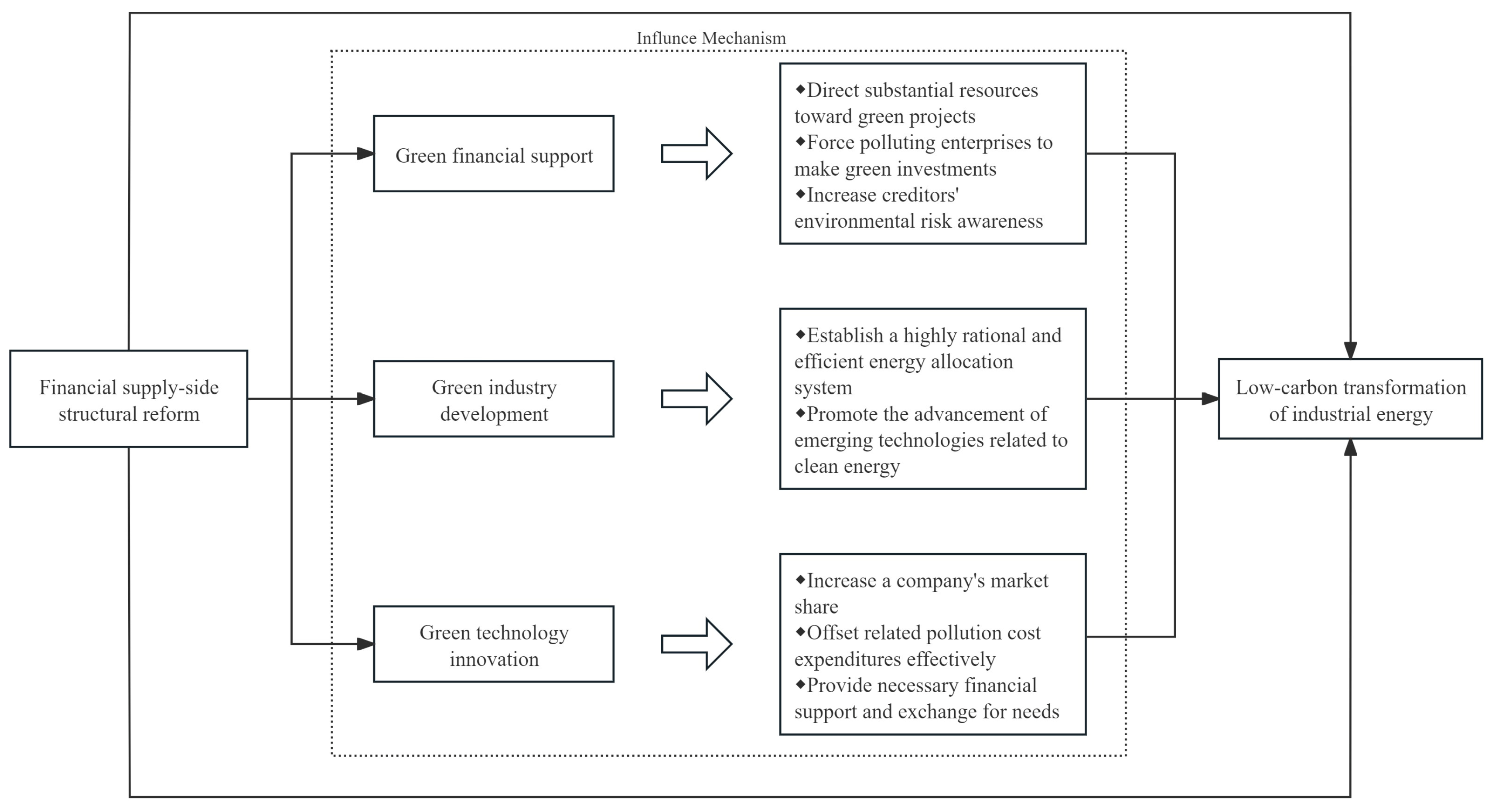
The impact mechanism is shown in
Figure 1.
7. Discussion
China is currently in a critical window period for achieving its dual carbon goals [
41]. The industrial sector, as the primary contributor to energy consumption and carbon emissions, plays a pivotal role in achieving the nation’s overarching strategic objectives through its low-carbon transition [
69]. However, the path to transformation is fraught with challenges. The inertia of traditional high-carbon industrial systems is strong, with pronounced lock-in effects on technological pathways and high transition costs. Meanwhile, GTI involves long cycles and high risks [
31]. Green industries require substantial, long-term, and low-cost financial support during their early development stages. The traditional financial system is fraught with structural contradictions, rendering it incapable of providing effective assistance to the LTIE. Previous studies suggested that financial system innovation can help drive the low-carbon transition of the energy sector [
21,
56]. The primary and core finding of this study is that FSSR can significantly drive the LTIE. The finding underscores the importance of FSSR as a major strategic initiative in China and is consistent with that of previous studies. Within the international community, financial resource support is also regarded as a key means to drive the low-carbon transformation of energy [
70]. Strengthening financial innovation to address challenges and changes across different periods is equally essential [
71]. The findings drawn in this study offer valuable insights for other countries worldwide.
Previous studies examined the impact of financial policies on low-carbon transition from a single perspective, such as technological progress, but rarely conducted systematic analysis [
72,
73]. This study reveals three specific transmission pathways from the perspective of green development: increase in GFS, facilitation of GID, and promotion of GTI. The mechanism analysis can considerably deepen our understanding of how FSSR can affect the LTIE. FSSR can redirect financial resources toward green projects by reshaping capital flows and thus effectively curb the allocation of resources to polluting enterprises [
34]. This can provide financial backing to green industries and guide their industrial restructuring toward low-carbon development through market signals [
35]. At the same time, FSSR can stimulate vitality in green technology R&D and thus safeguard corporate innovation. Compared with previous studies, this study offers a more comprehensive framework by organically linking financial support, industrial upgrading, and technological innovation.
This study also examines the heterogeneous effects of external factors such as environmental regulation and financial development. The findings provide some important insights. Specifically, in regions with stringent environmental regulation, strict administrative orders and penalties will impose strong constraints on high carbon emissions [
74]. Thus, the LTIE serves primarily as a passive choice driven by compliance pressures and hence can potentially obscure the marginal effects of financial policies. Conversely, in areas with weak environmental regulation, where administrative constraints fall short, market-based financial incentives are crucial in filling regulatory gaps and driving the LTIE. Similarly, in regions with a low level of financial development, financial resource allocation may be distorted [
75]. FSSR can expand the resource allocation scope and exert a pronounced effect on the LTIE. For regions with relatively weak environmental governance and financial systems, FSSR can serve as a crucial mechanism for addressing institutional shortcomings and promoting coordinated green development.
We must be acutely aware that the impact of FSSR on the LTIE may be accompanied by certain challenges and unintended consequences. In guiding financial resources toward large-scale, long-term investment in green and low-carbon sectors, the identification and management of financial risks are crucial. The success of FSSR will require not only incentive mechanisms but also complementary risk-monitoring, early warning, and risk-sharing mechanisms to ensure its sustainability. The neglect of the risk dimension may expose the LTIE process to disruptions caused by financial turbulence. In addition, regional disparities, institutional quality, and economic reforms may lead to unintended consequences. Overall, emphasizing policy adaptability, refining market mechanisms, and mitigating risks are crucial to ensuring the smooth implementation of the LTIE during FSSR.
8. Conclusions and Policy Recommendations
Advancing the LTIE is a crucial strategic measure for achieving the “3060” dual carbon goals. FSSR can provide the necessary funding and policy support; thus, examining industrial energy decarbonization through the perspective of FSSR is important. By using provincial panel data from China for the period of 2008–2022 and leveraging the NFCRPZs as a quasi-natural experiment, this study uses the DID method to empirically examine the effect of FSSR on the LTIE and the underlying mechanisms. The research findings indicate that, first, FSSR can significantly advance the LTIE. The conclusion remains unchanged after other policies, omitted variables, and other potential influencing factors were controlled. Second, the mechanism tests indicate that FSSR can drive the LTIE by increasing GFS, fostering GID, and promoting GTI. Third, the heterogeneity tests indicate that the benchmark effect is highly pronounced in the regions with weak environmental regulation and a low level of financial development.
On the basis of the aforementioned research findings, the current study proposes the following policy recommendations. First, the proven experiences of NFCRPZs in advancing LTIE are summarized and synthesized, providing practical references for other regions. Aligned with the key tasks outlined in the Guiding Opinions on Further Strengthening Financial Support for Green and Low-Carbon Development, local governments should elevate effective innovative explorations into exemplary models for dissemination and sharing, while simultaneously establishing universally applicable practical pathways. Second, the deep enabling role of GFS, GID, and GTI in LTIE should be enhanced. Focusing on typical high-energy-consumption and high-carbon-emission industries, such as steel, building materials, nonferrous metals, and petrochemicals, targeted industrial energy low-carbon transformation service modules must be developed. Local governments should provide dedicated funding support to foster green industry growth and improve financial service mechanisms for green industries. Third, differentiated financial service strategies must be applied to achieve tailored approaches. Local governments should consider differentiated financial support measures based on provincial conditions, leveraging financial tools in tandem with environmental governance to promote the precise implementation of FSSR strategies.