Research on a Low-Carbon Economic Dispatch Model and Control Strategy for Multi-Zone Hydrogen Hybrid Integrated Energy Systems


Abstract
1. Introduction
- Existing solutions primarily rely on hydrogen long-tube trailers for short-distance hydrogen delivery. They ignore the practical demands of long-distance, large-scale hydrogen transportation.
- Current technical approaches mainly promote hydrogen consumption by expanding diversified utilization scenarios. Yet the overall potential of hydrogen energy remains underexplored. Its peak-shaving capability is particularly untapped.
- Most studies only conduct qualitative analyses of source-load uncertainty risks in multi-regional HHIESs. They lack supporting quantitative assessment methods. This gap directly leads to ambiguous operational risks in the pipeline. It also results in insufficient reliability of hydrogen blending strategies.
- For multiregional HHIESs, a dynamic hydrogen blending model for natural gas pipelines is established. It considers pipeline operation and maintenance costs. Regional interconnections enable cross-regional hydrogen interaction. This resolves the technical challenges of long-distance, large-scale hydrogen transportation. The limitations of fixed hydrogen blending modes are overcome. System energy balance is ensured.
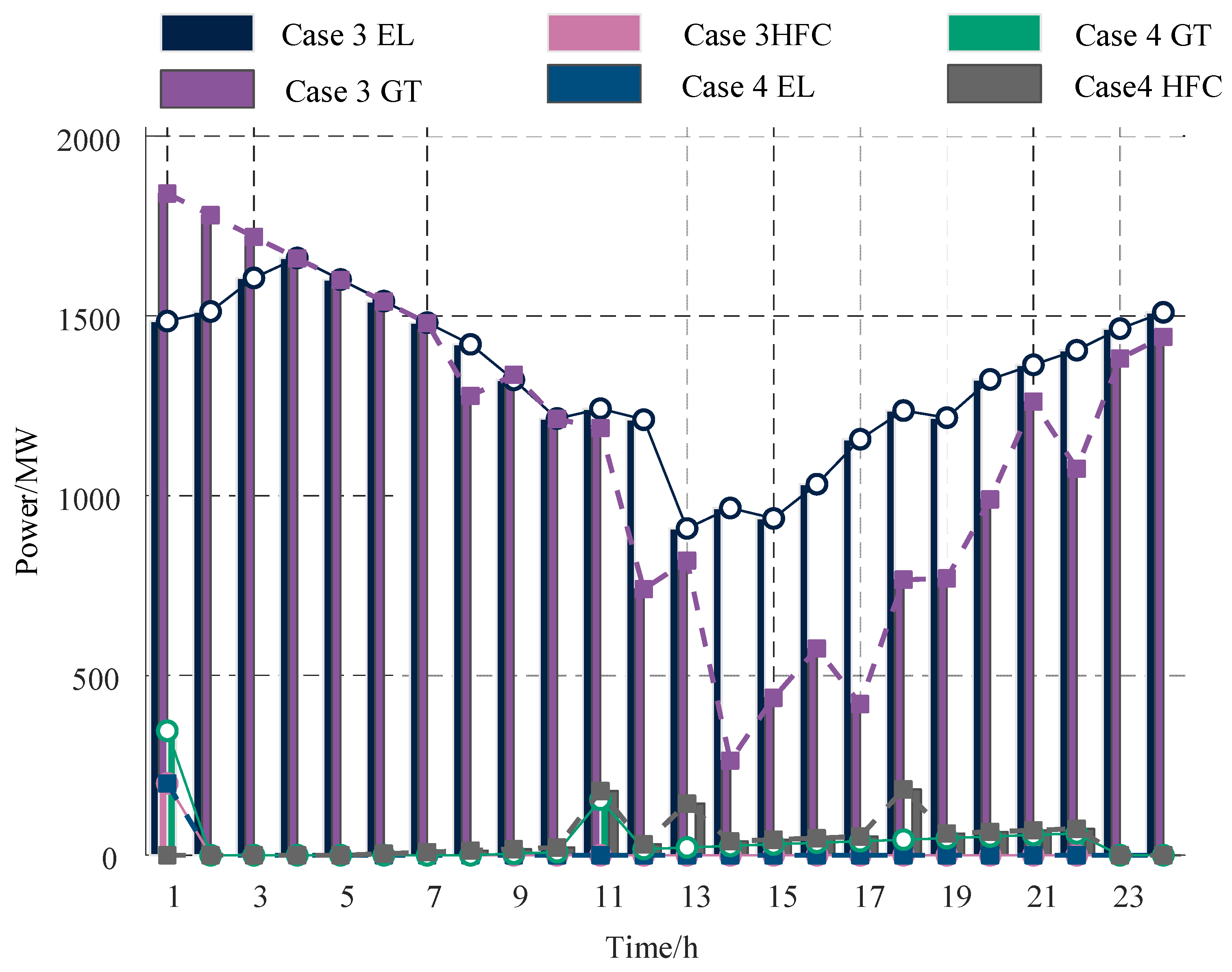
- An electricity-hydrogen-electricity coordinated control mechanism is designed. A collaborative peak-shaving model is constructed. It integrates ELs, HFCs, and hydrogen-blended GTs. This model taps into hydrogen’s peak-shaving potential. It significantly enhances system peak-shaving flexibility and response speed. A peak-shaving economic coefficient is introduced. It characterizes the proportion of peak-shaving costs in total operating costs. The optimal hydrogen blending upper limit is updated. Corresponding dynamic schemes are adjusted under different coefficients.
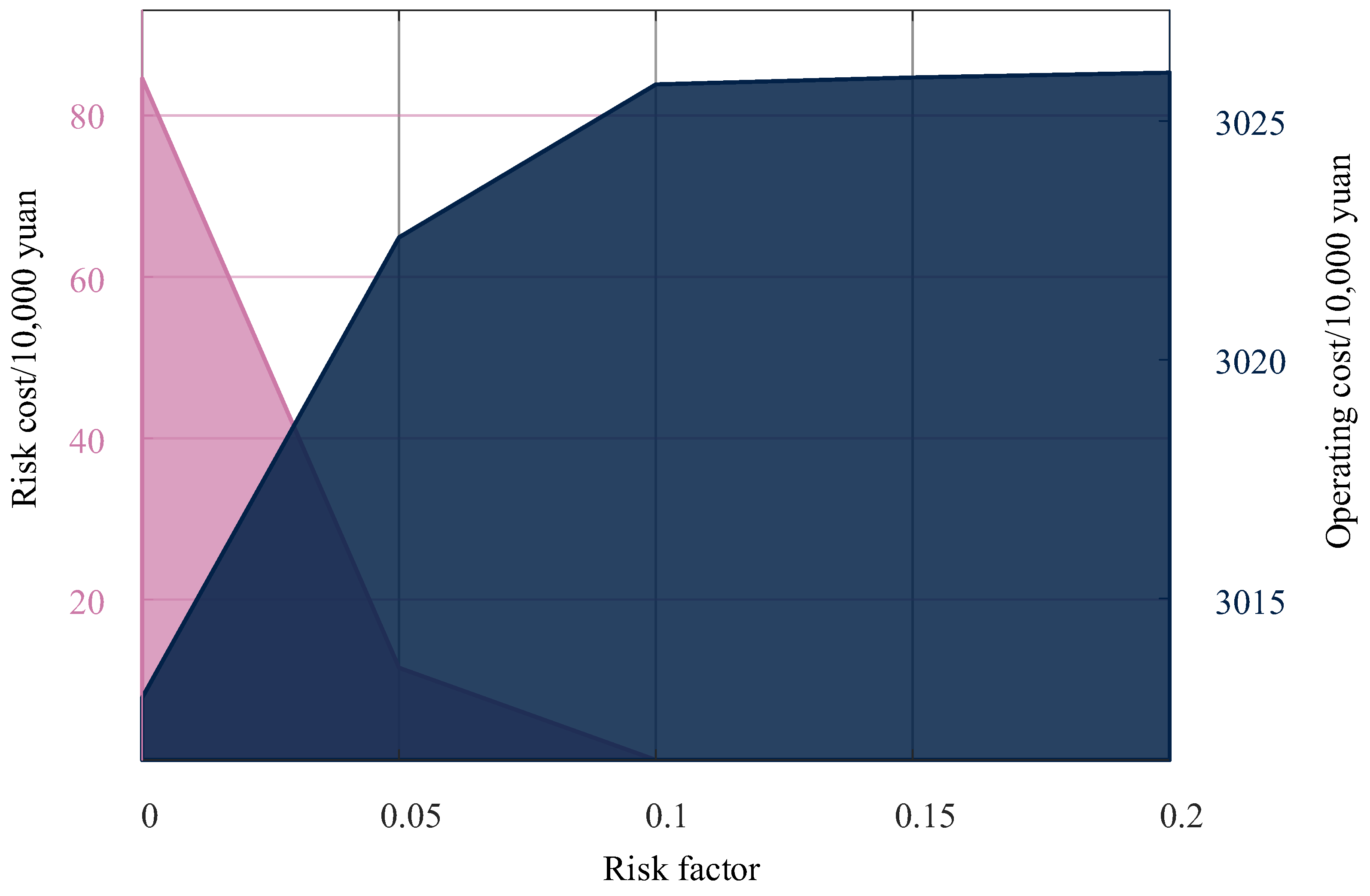
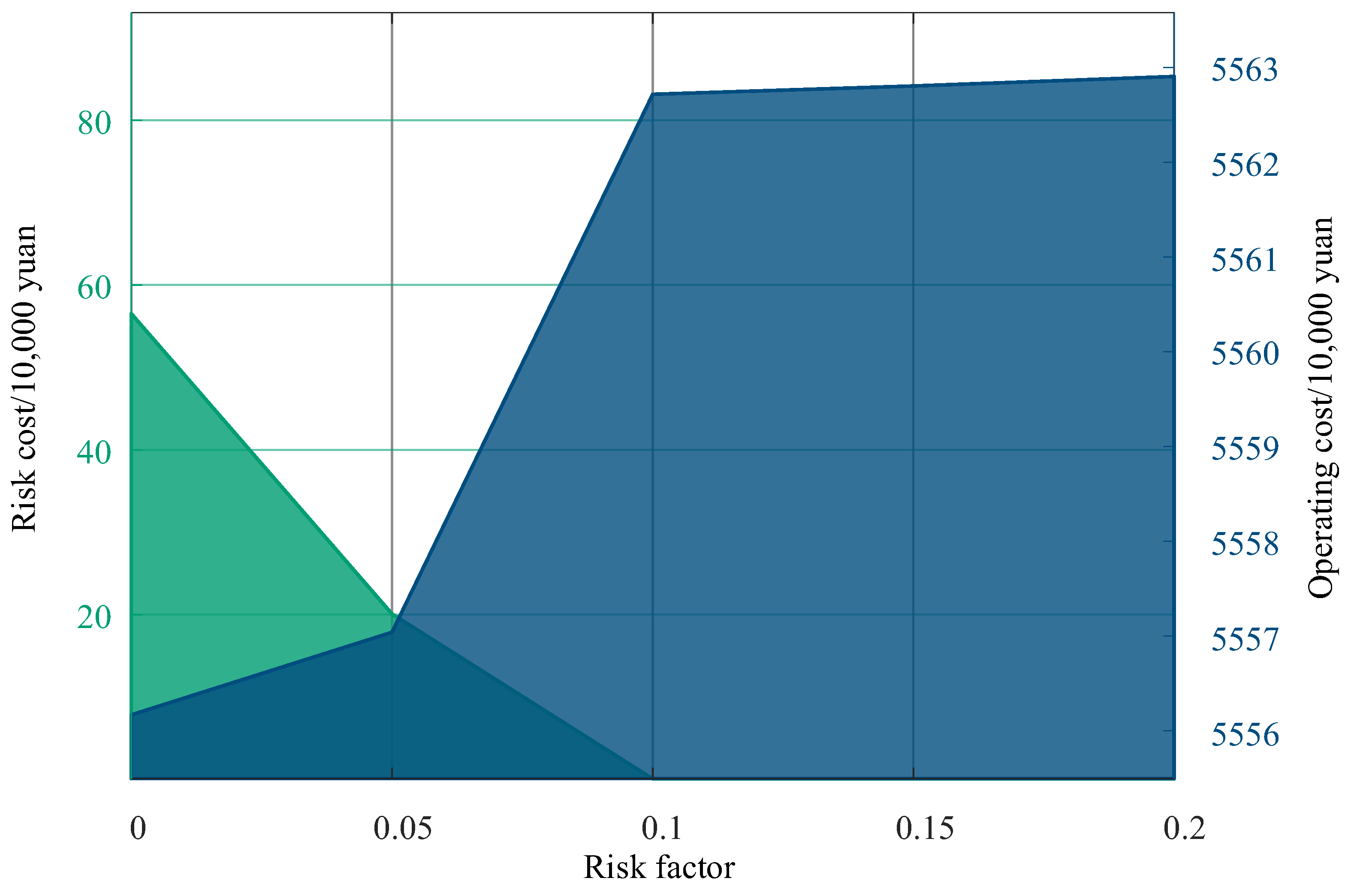
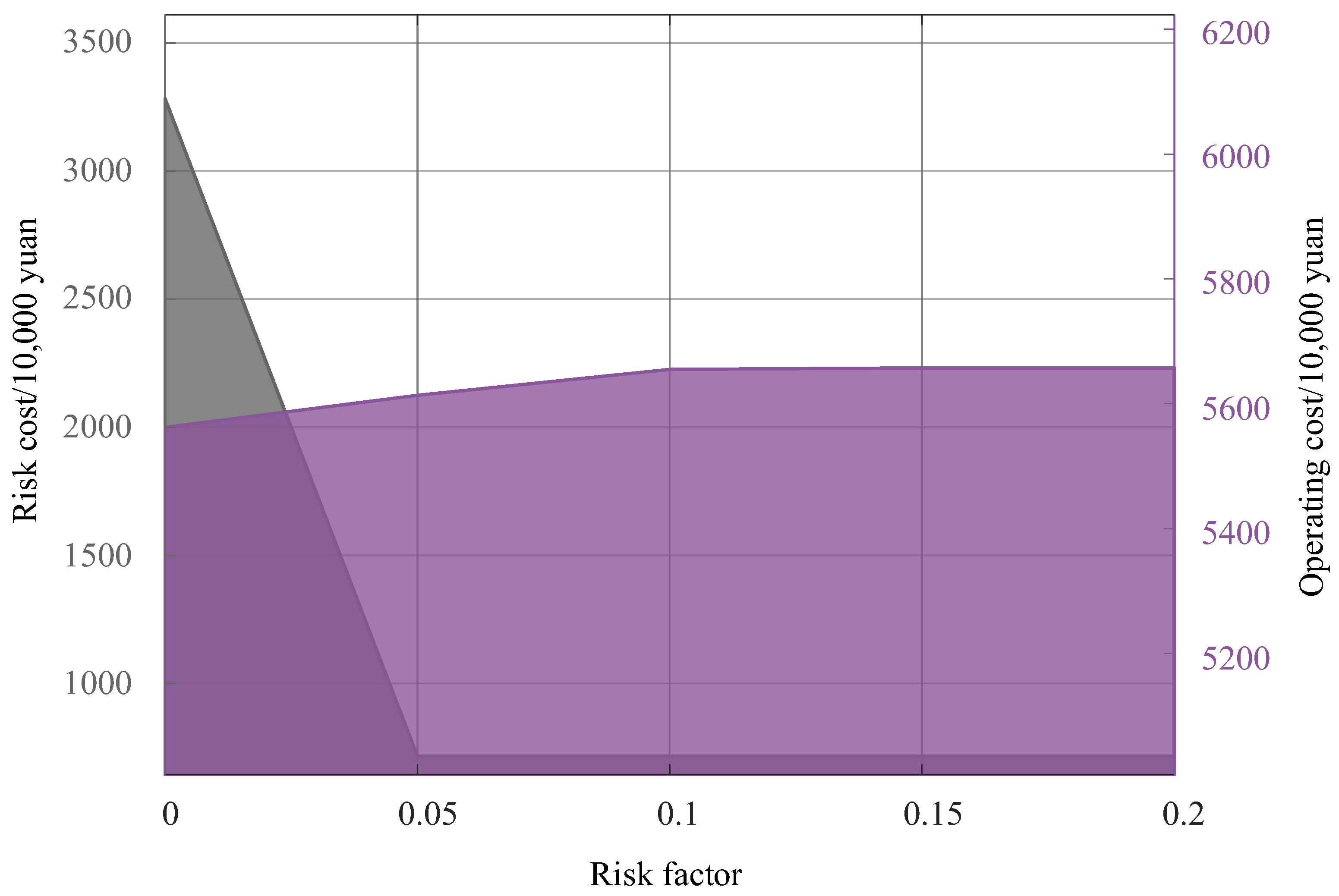
- Based on CVaR theory, source-load uncertainty risks in multiregional HHIESs are quantified. A risk coefficient is introduced to represent the share of risk costs in operating costs, providing a quantitative basis for decision-makers to formulate dispatch strategies. A low-carbon economic dispatch model is constructed, considering both risk assessment and peak-shaving requirements. By adjusting the risk coefficient and peak-shaving economic coefficient, the optimal upper limit for hydrogen blending is determined, and a dynamic strategy is developed that comprehensively balances risk, peak shaving, and financial objectives. The proposed method clarifies natural gas pipeline operational risks, further exploits hydrogen’s peak-shaving performance, improves the reliability of hydrogen blending strategies, and achieves dynamic optimization of hydrogen blending ratios through risk quantification and cross-regional collaboration.
2. General Framework
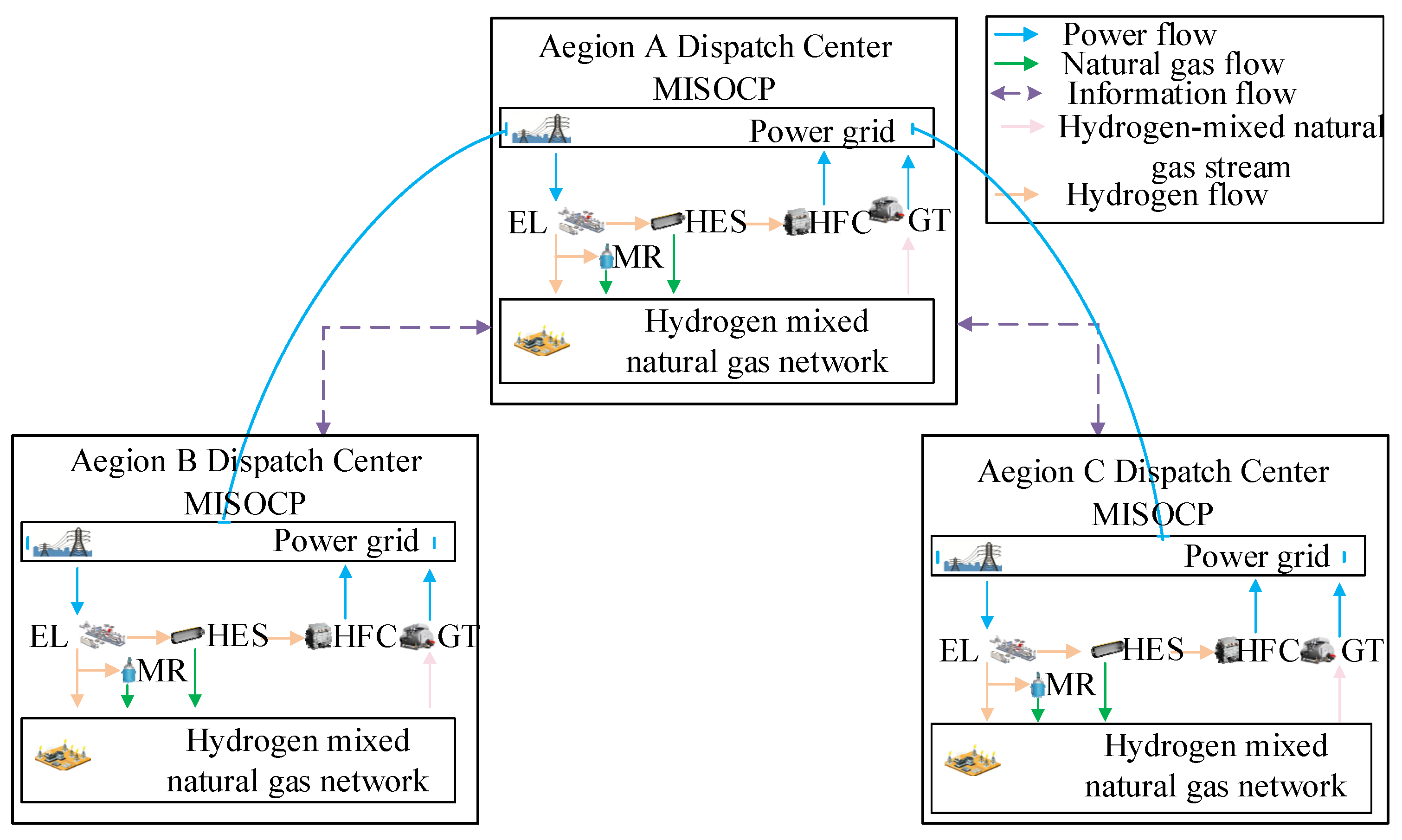
- Hydrogen can react with carbon dioxide captured by carbon capture units in methanation reactors to produce synthetic methane, which is then injected into natural gas pipelines to support gas grid dispatch.
- Hydrogen can be directly mixed into natural gas pipelines to supply gaseous loads.
- Hydrogen can be converted into electricity using hydrogen fuel cells to power electrical loads, helping with peak shaving and valley filling.
- Surplus hydrogen can be stored in hydrogen storage tanks to increase wind power utilization.
3. Low-Carbon Economic Dispatch Model for HHIESs
3.1. Conditional Value-at-Risk Model
3.2. Peak Demand Model
3.3. Pipeline Operation and Maintenance Cost Model
4. Low-Carbon Economic Dispatch Model of a Multiregional HHIES
4.1. Objective Function
4.2. Constraints
4.2.1. Electric Power Balance Constraints
4.2.2. Constraints on Natural Gas Grid Hydrogen Blending
4.2.3. Tie Line Constraints
5. Model Solution
6. Case Analysis
6.1. Basic Data
- Case 1: No wind power interaction among the three hydrogen-blended integrated energy systems (HHIESs)
- Case 2: With wind power interactions among the three HHIES
- Case 3: Based on Case 2 with additional consideration of CVaR
- Case 4: Simultaneous consideration of wind power interaction, CVaR, and peak shaving demand
6.2. Algorithm Convergence Analysis
6.3. Uncertainty Risk Analysis
6.3.1. Comparative Analysis of the Low-Carbon and Economic Benefits of Wind Power Interactions Under Multiregional Coordinated Dispatch
6.3.2. Impacts of the Risk Coefficients on the Economic Performance of the Hydrogen Blending System
6.4. Analysis of Peak Shaving Performance
6.5. Analysis of Hydrogen Blending Strategies in Gas Grids Based on Multi-Zone Operation
6.5.1. Impact of the Peak Shaving Economic Coefficient on the Cost of Hydrogen Blending in the Gas Grid
6.5.2. Impacts of Peak Shaving Economic Coefficients on the Hydrogen Blending Strategy of the Gas Grid Based on Multizone Operation
7. Conclusions
- With respect to the system structure, the multiregional system established in Case 4 demonstrates significant advancements over Case 1. The implementation of dynamic hydrogen blending control reduces carbon emissions by approximately 12.3%, effectively enhancing the system’s decarbonization capability. Furthermore, by leveraging a coordinated operation mechanism among ELs, GTs, and HFCs, the system’s peak-shaving and valley-filling performance is substantially improved. Specifically, during peak load periods, the power output of hydrogen fuel cells in Case 4 is approximately twice that in Case 3. During off-peak load periods, the power output of electrolyzers in Case 4 exceeds that in Case 3 by about 730 MW.
- With respect to dispatch model optimization, we use the CVaR to quantify uncertainty and economic coefficients to adjust cost proportions. This process achieves synergy among the economy, risk, and system performance, thus improving the applicability of the model.
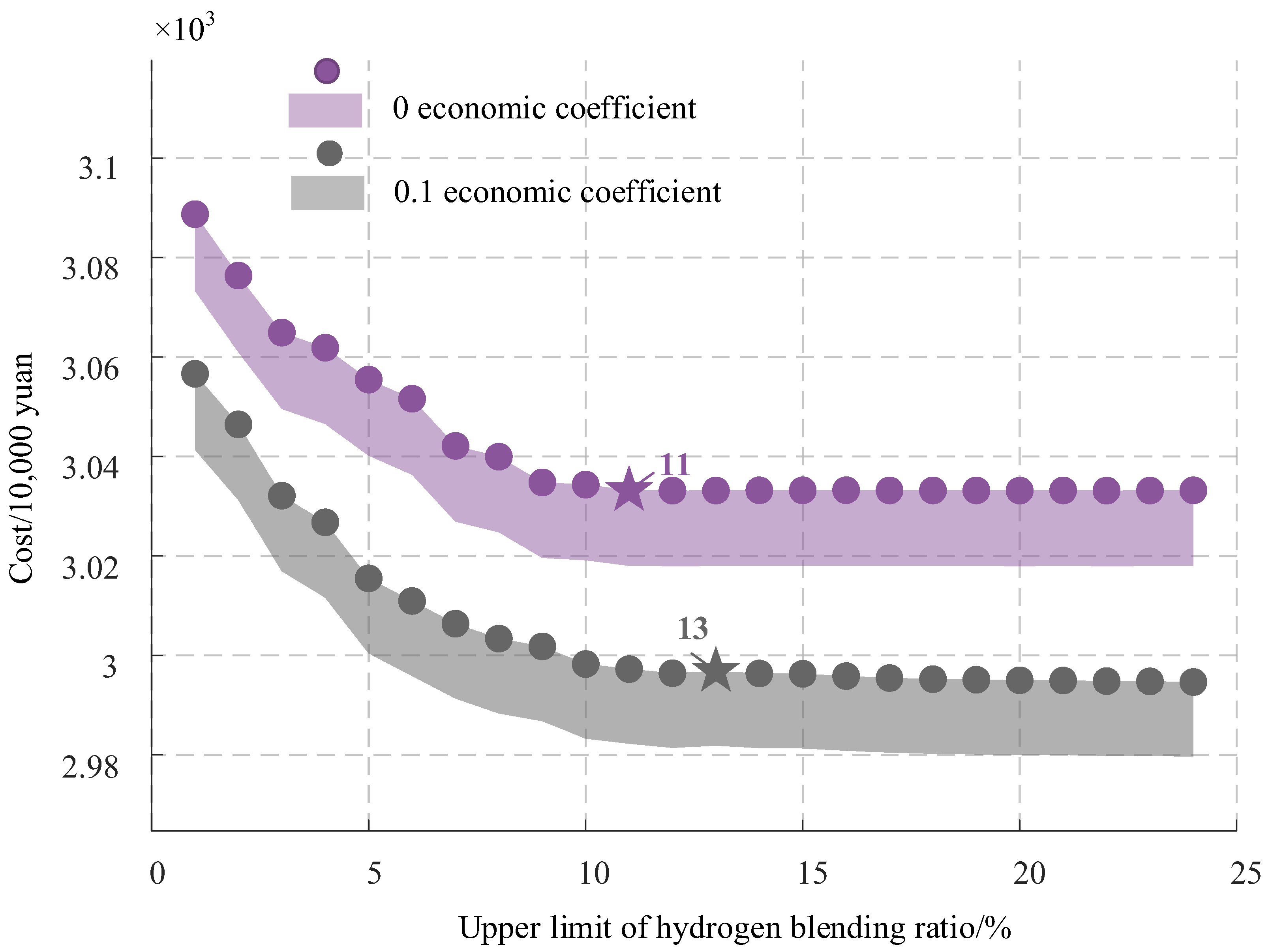
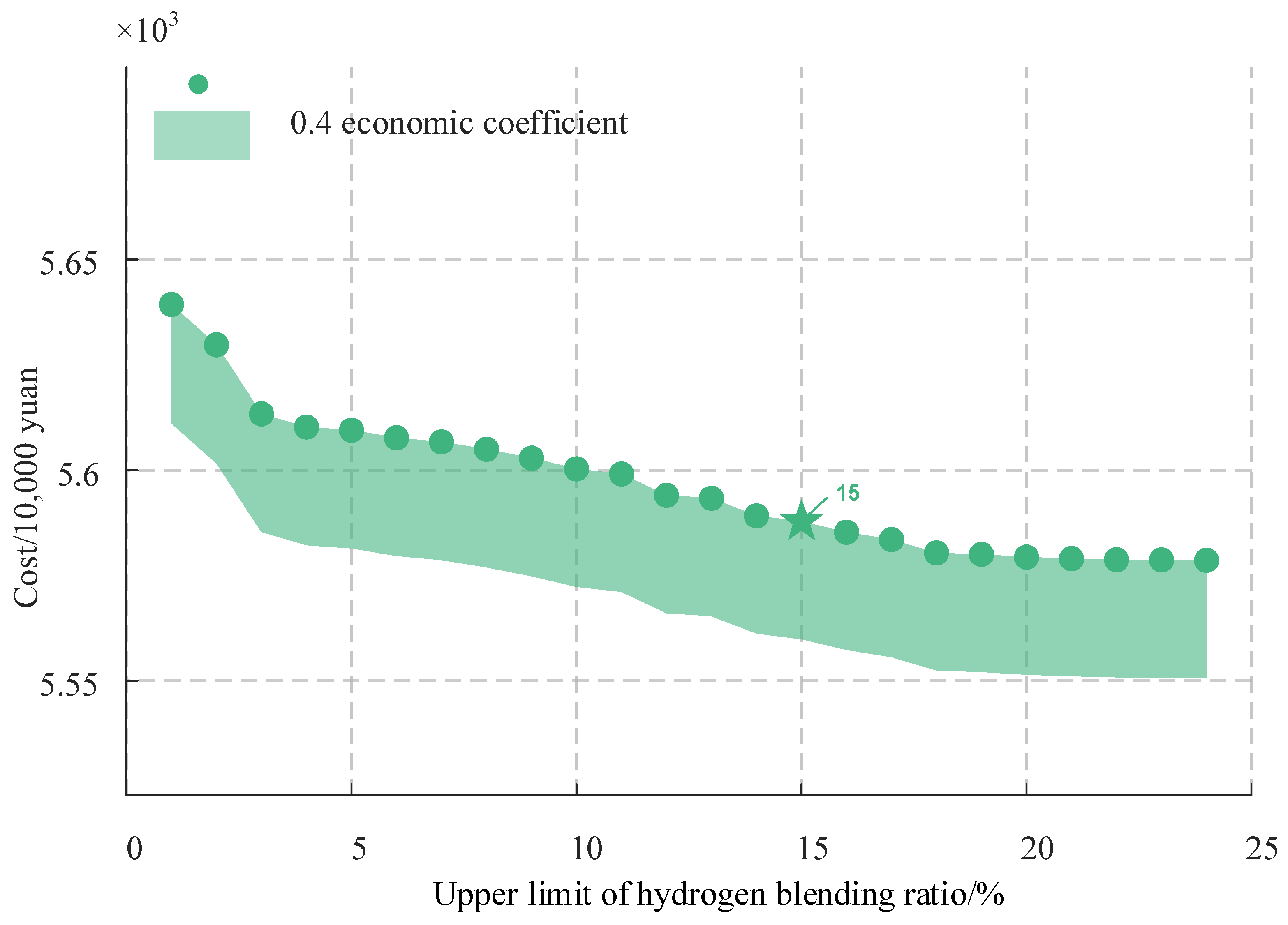
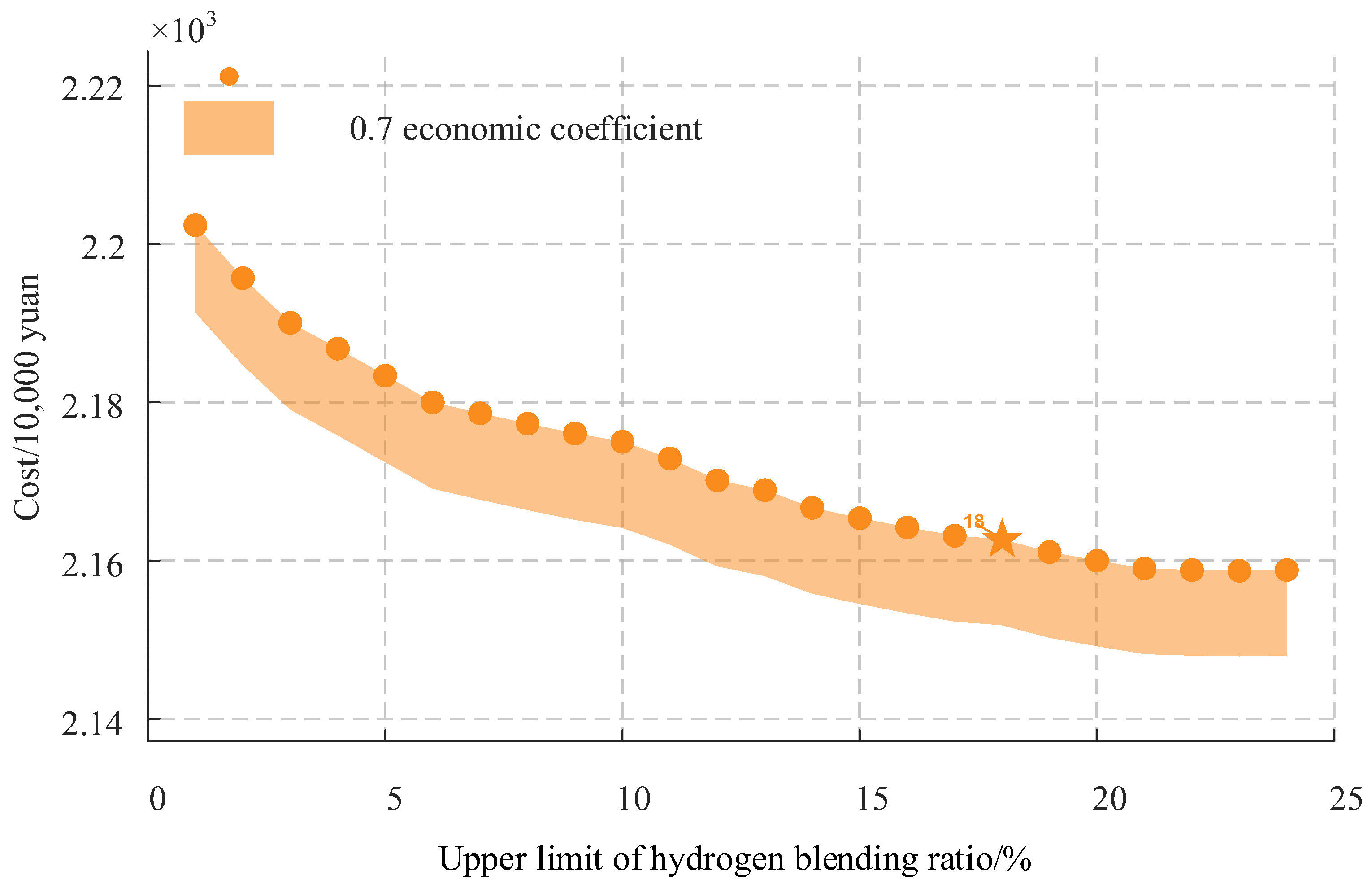
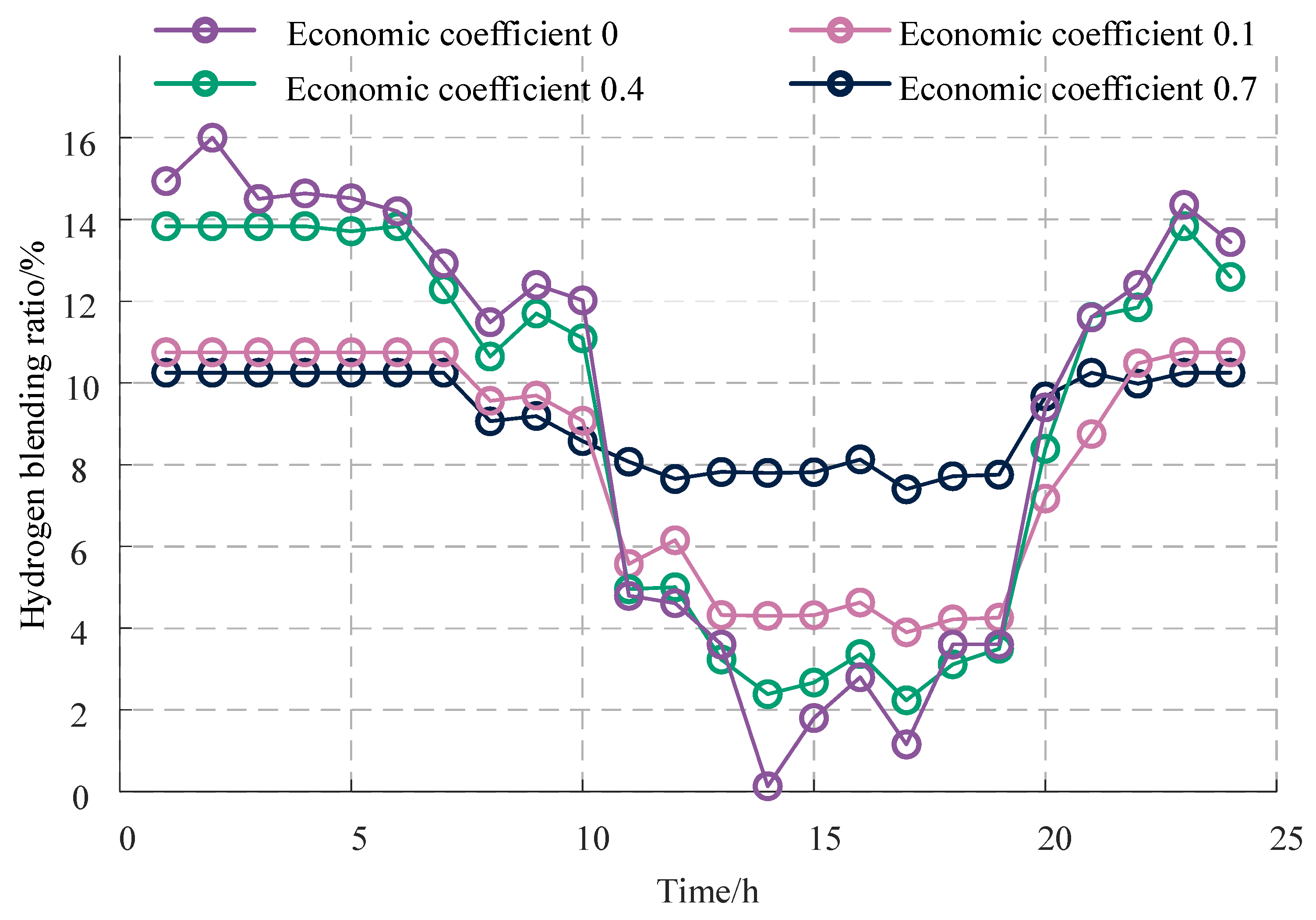
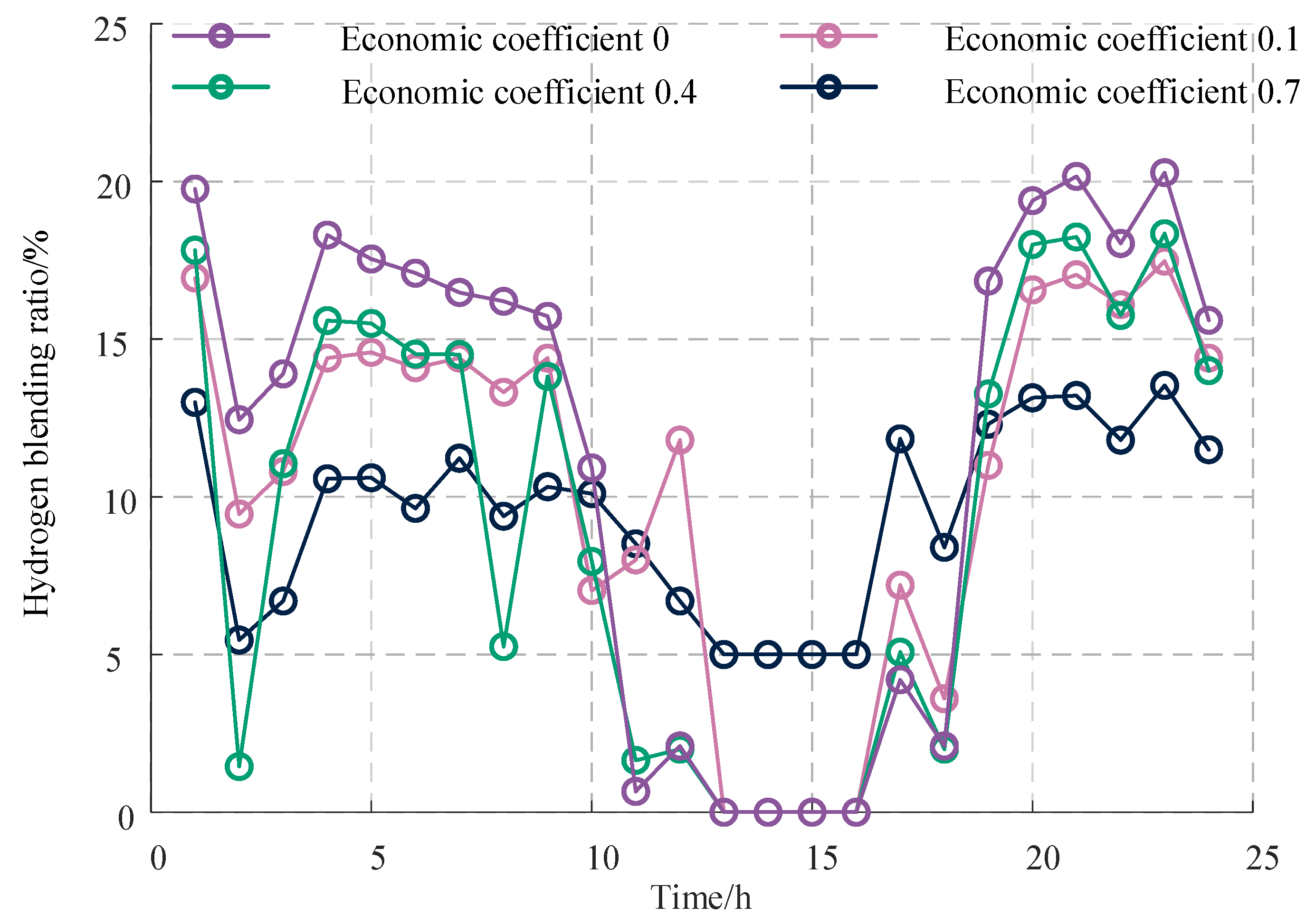
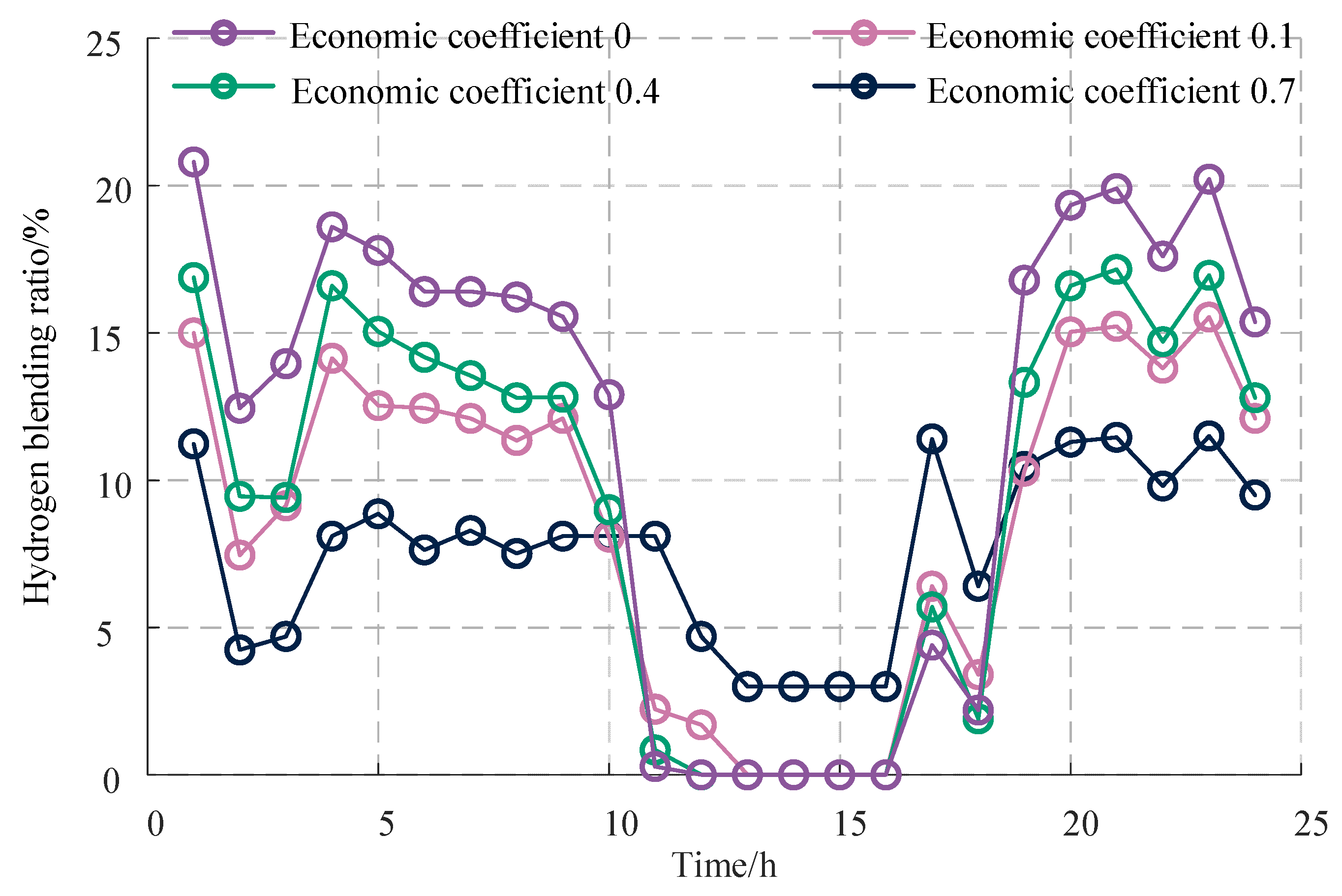
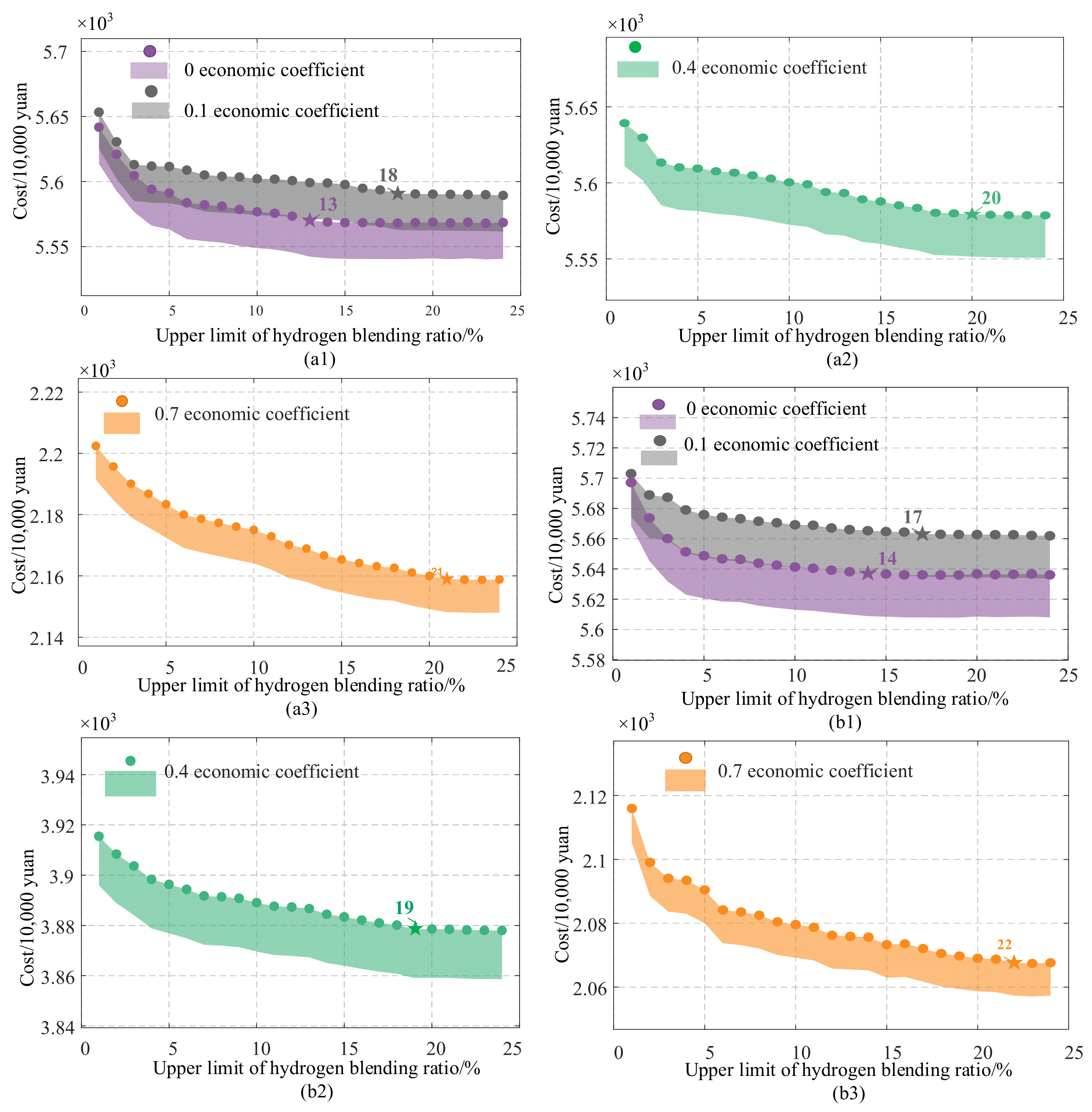
- With respect to operational decisions, the upper limit of hydrogen blending exhibits economic coefficient-dependent inflection points. Dynamic adjustment of this limit alongside elevated economic coefficients identifies optimal blending thresholds; subsequent optimization of hydrogen allocation strategies enhances peak-shaving capability. Consequently, the rational dispatch of EL output further reduces operating costs. An analysis of Region 1 verifies this effect: setting peak-shaving economic coefficients to 0, 0.1, 0.4, and 0.7 lowers system operating costs by 1.8%, 1.9%, 3.5%, and 3.3%, respectively.
Author Contributions
Funding
Data Availability Statement
Conflicts of Interest
Nomenclature
| A. Abbreviations | |
| ADMM | Alternating direction method of multipliers |
| CVaR | Conditional value at risk |
| VaR | Value at risk |
| MR | Methane reactor |
| HES | Hydrogen energy storage |
| HHIES | Hydrogen hybrid integrated energy systems |
| HCNG | Hydrogen-enriched compressed natural gas |
| IES | Integrated energy systems |
| HFC | Hydrogen fuel cell |
| EL | Electrolytic cell |
| GT | Gas turbine |
| HES | Hydrogen Energy Storage |
| MISOCP | Mixed-integer second-order cone programming |
| B. Indices and Sets | |
| s | the number of typical scenarios |
| NPL | the number of electrical load nodes |
| Nccus | the number of carbon capture units |
| NGT | the number of hydrogen-blended gas turbines |
| Nwind | the number of wind farms, from c to Nwind |
| NHFC | the number of HFCs, from d to NHFC |
| NEES | the number of energy storage, from e to NEES |
| NEL | the number of ELs, from i to NEL |
| Nsource | the number of gas sources, from k to Nsource |
| Narea | the number of regions in the integrated energy system |
| Ncapture | the number of Carbon capture units, from w to Ncapture |
| a | the number of hydrogen-mixed gas turbines |
| k | the gas source |
| k1 | the number of electrical load nodes |
| k2 | the number of hydrogen fuel cells |
| b | the number of gas load nodes |
| d | the number of wind farms |
| t | the number of dispatch periods |
| convergence condition | |
| T | System operating cycle, T = 24 h |
| l | the number of tie lines, from g1 to l |
| C. Parameters | |
| x | decision variable |
| h | the boundary value |
| θ | the confidence level |
| g | the value of the VaR |
| hs | the value of the random variable in the scenario |
| γ1 | the load loss penalty coefficient |
| γ2 | the wind curtailment penalty coefficient |
| ϑ0 | the hydrogen blending ratio |
| h0 | the coefficients of the pipeline operation |
| f | the coefficients of the maintenance cost function |
| D. Cost Functions | |
| the distribution function of the loss function is not greater than the boundary value h | |
| the VaR value under the given confidence level | |
| the CVaR value under the given confidence level | |
| the loss function | |
| the probability density function of h | |
| the total forecast deviation of the system at time t | |
| the wind power forecast deviation at time t | |
| the load forecast deviation at time t | |
| the risk loss cost of the system at time t | |
| the net load power | |
| the average net load | |
| the operation and maintenance cost per unit volume of mixed gas transported per unit length | |
| the operation and maintenance costs per unit volume of natural gas | |
| the pure hydrogen transported per unit length | |
| the total cost of the multiregional HHIES | |
| the operating cost of region a | |
| the risk cost of a single region | |
| the peak shaving cost of region a | |
| E. Variables | |
| the electrical load power of node k1 | |
| the output power of the a-th GT | |
| ) | the output power of the k2-th HFC unit |
| the proportional coefficient of the gas volume delivered from gas source k to gas load node b in the gas grid | |
| the coefficient of the inversely proportional function | |
| the distance between gas source k and gas load node b | |
| the volume of gas purchased from gas source k | |
| the probability of the typical scenario s occurring | |
| the start-up and shutdown cost | |
| the operating costs of the thermal power units in region a | |
| the solvent loss cost of the carbon capture unit in region a | |
| the depreciation cost of the carbon capture power plant in region a | |
| the unit carbon sequestration cost | |
| the operation and maintenance costs of the pipeline in a single region | |
| carbon trading cost in region a | |
| the predicted output of wind farm d at time t | |
| the actual output of wind farm d at time t | |
| the operation and maintenance costs of the wind farm | |
| the gas price of gas source k | |
| the gas volume purchased from gas source k | |
| the price of pure water | |
| the total mass of pure water consumed by the EL | |
| the hydrogen purchase price | |
| the economic conversion coefficient of the peak-shaving target | |
| the amount of carbon dioxide captured by the carbon capture unit w | |
| the amount of carbon dioxide consumed by MR | |
| the net output power of carbon capture unit a1 | |
| the power generated by the wind farm c | |
| the power output by HFC d | |
| the power output by energy storage e | |
| the power stored by energy storage e | |
| the power transmitted through the interconnection line | |
| the power received through the interconnection line | |
| the power consumed by EL i | |
| the calorific value of the mixed gas at time t | |
| the volumetric ratio of hydrogen doping in gas grid | |
| the volumetric calorific values of hydrogen | |
| the volumetric calorific values of methane | |
| the maximum hydrogen doping ratio in the gas grid | |
| the total transaction volume of the g1-th tie-line | |
| the maximum values of the tie-line power | |
| the minimum values of the tie-line power | |
| the state variable of the g1-th tie-line at time t | |
| the peak-to-valley difference rate of the tie-line power | |
| the start state variables of the g1-th tie-line at time t | |
| the stop state variables of the g1-th tie-line at time t | |
| the start-stop number limit of the g1-th tie-line | |
| after k0 + 1 iterations, the regional interaction variable on the g1-th tie-line | |
| the Lagrange multiplier on the g1-th tie-line after k0 iterations | |
| updated regional interaction variables | |
| penalty coefficient | |
Appendix A

Appendix B

| Power Grid Number | Equipment Type | Conversion Efficiency | Output Upper Limit/MW | Lower Limit of Output/MW |
|---|---|---|---|---|
| 1 | 8000 | 0.74 | 270 | 0 |
| 5 | 6900 | 0.74 | 300 | 0 |
| 8 | 7300 | 0.6 | 120 | 0 |
| 14 | 7600 | 0.65 | 150 | 0 |
| Carbon Emission Coefficient/(MW·h) | Startup Costs/Yuan | Shutdown Costs/Yuan | Output Upper Limit/MW | Lower Limit of Output/MW | Gas Network Number |
|---|---|---|---|---|---|
| 0.4 | 80 | 60 | 820 | 0 | 23 |
| 0.4 | 80 | 60 | 820 | 0 | 15 |
| Unit Number | Maximum Contribute/MW | Minimum Contribute/MW | Start-Stop Cost/Yuan | Minimum Start-Stop Time/h | Unit Climbing Slope/(MW/15 min) | Carbon Emission Intensity/(t/(MW·h)) |
|---|---|---|---|---|---|---|
| 1 | 1100 | 200 | 35,000 | 10/10 | 50 | 1.06 |
| 2 | 1100 | 200 | 35,000 | 10/10 | 50 | 1.06 |
| 3 | 580 | 150 | 6300 | 6/6 | 25 | 0.92 |
| 4 | 580 | 150 | 6300 | 6/6 | 25 | 0.92 |
| 5 | 580 | 150 | 6300 | 6/6 | 25 | 0.92 |
| 6 | 455 | 100 | 3920 | 5/5 | 18 | 0.9 |
| 7 | 455 | 100 | 3920 | 5/5 | 18 | 0.9 |
| 8 | 455 | 100 | 3920 | 5/5 | 18 | 0.9 |
| Name | Numerical Values |
|---|---|
| Carbon capture efficiency | 0.9 |
| Maximum operating condition coefficient | 1.05 |
| Energy consumption per unit carbon capture/((MW·h)/t) | 0.269 |
| Fixed energy consumption (MW·h) | 5 |
| Total cost of carbon capture equipment (in ten thousand yuan) | 165,159.4 |
| Carbon capture equipment depreciation period/year | 15 |
| Discount rate for carbon capture power plant projects | 8% |
| Depreciation period of solution storage devices (years) | 5 |
| Ethanolamine solvent cost coefficient (yuan/kg) | 8.2 |
| Solvent operating loss coefficient (kg/t) | 1.5 |
| Gas Network Number | Gas Price/(Yuan·Mm3) | Upper Limit of Gas Production/Mm3 | Lower Limit of Gas Production/Mm3 |
|---|---|---|---|
| 1 | 8000 | 6.5 | 0 |
| 5 | 6900 | 3.6 | 0 |
| 8 | 7300 | 5.5 | 0 |
| 14 | 7600 | 4.6 | 0 |
References
- Shahbazbegian, V.; Shafie-Khah, M.; Laaksonen, H.; Strbac, G.; Ameli, H. Resilience-oriented Operation of microgrids in the presence of power-to-hydrogen systems. Appl. Energy 2023, 348, 121429. [Google Scholar] [CrossRef]
- Wang, S.; Zhao, Q.; Dong, S.; Li, H. Optimal dispatch of integrated energy station considering carbon capture and hydrogen demand. Energy 2023, 269, 126981. [Google Scholar] [CrossRef]
- Yun, Y.; Zhang, D.; Yang, S.; Li, Y.; Yan, J. Low carbon optimal dispatch of integrated energy system considering the operation of oxy-fuel combustion coupled with power-to-gas and hydrogen-doped gas equipment. Energy 2023, 283, 129127. [Google Scholar] [CrossRef]
- Meng, J.; Ren, Z.Y.; Wang, H. Reliability Improvement Strategies for Multi-Region Integrated Hydrogen-Electricity Energy Systems under Hydrogen Energy Interaction. Trans. China Electrotech. Soc. 2024, 39, 5011–5027. [Google Scholar]
- Gunawan, T.A.; Cavana, M.; Leone, P.; Monaghan, R.F.D. Solar hydrogen for high capacity, dispatchable, long-distance energy transmission—A case study for injection in the Greenstream natural gas pipeline. Energy Convers. Manag. 2022, 273, 116398. [Google Scholar] [CrossRef]
- Qiu, Y.; Zhou, S.; Gu, W.; Lu, Y.; Zhang, X.P.; Zhang, K.; Han, G.; Lyu, H. Network Modeling and Operation Optimization of Electricity-HCNG-Integrated Energy System. CSEE J. Power Energy Syst. 2023, 9, 1251–1265. [Google Scholar]
- Sun, H.; Duan, W.; Chen, L.; Liu, J.; Peng, C. Low-carbon Economic Scheduling of Hydrogen Integrated Energy System Based on Optimistic Actor-critic Deep Reinforcement Learning. Power Syst. Technol. 2024, 48, 1873–1883. [Google Scholar]
- Yao, Z.L.; Wang, Z.X. Two-level Collaborative Optimal Allocation Method of Integrated Energy System Considering Wind and Solar Uncertainty. Power Syst. Technol. 2020, 44, 4521–4531. [Google Scholar]
- Zheng, W.; Li, J.; Lei, K.; Shao, Z.; Li, J.; Xu, Z. Optimal dispatch of HCNG penetrated integrated energy system based on modelling of HCNG process. Int. J. Hydrogen Energy 2023, 48, 19437–19449. [Google Scholar] [CrossRef]
- Gangammanavar, H.; Sen, S.; Zavala, V.M. Stochastic Optimization of Sub-Hourly Economic Dispatch with Wind Energy. IEEE Trans. Power Syst. 2015, 31, 949–959. [Google Scholar] [CrossRef]
- Wang, X.; Liu, R.P.; Wang, X.; Hou, Y.; Bouffard, F. A data-driven uncertainty quantification method for stochastic economic dispatch. IEEE Trans. Power Syst. 2021, 37, 812–815. [Google Scholar] [CrossRef]
- Lu, X.; Chan, K.W.; Xia, S.; Zhou, B.; Luo, X. Security-constrained multiperiod economic dispatch with renewable energy utilizing distributionally robust optimization. IEEE Trans. Sustain. Energy 2018, 10, 768–779. [Google Scholar] [CrossRef]
- Papavasiliou, A.; Mou, Y.; Cambier, L.; Scieur, D. Application of stochastic dual dynamic programming to the real-time dispatch of storage under renewable supply uncertainty. IEEE Trans. Sustain. Energy 2017, 9, 547–558. [Google Scholar] [CrossRef]
- Fu, Y.; Liu, M.; Li, L. Multiobjective stochastic economic dispatch with variable wind generation using scenario-based decomposition and asynchronous block iteration. IEEE Trans. Sustain. Energy 2015, 7, 139–149. [Google Scholar] [CrossRef]
- Lu, R.; Ding, T.; Qin, B.; Ma, J.; Fang, X.; Dong, Z. Multi-stage stochastic programming to joint economic dispatch for energy and reserve with uncertain renewable energy. IEEE Trans. Sustain. Energy 2019, 11, 1140–1151. [Google Scholar] [CrossRef]
- Li, Y.; Zou, Y.; Tan, Y.; Cao, Y.; Liu, X.; Shahidehpour, M.; Tian, S.; Bu, F. Optimal stochastic operation of integrated low-carbon electric power, natural gas, and heat delivery system. IEEE Trans. Sustain. Energy 2017, 9, 273–283. [Google Scholar] [CrossRef]
- Liu, C.; Wang, C.; Yin, Y.; Yang, P.; Jiang, H. Bi-level dispatch and control strategy based on model predictive control for community integrated energy system considering dynamic response performance. Appl. Energy 2022, 310, 118641. [Google Scholar] [CrossRef]
- Shen, W.; Zeng, B.; Zeng, M. Multi-timescale rolling optimization dispatch method for integrated energy system with hybrid energy storage system. Energy 2023, 283, 129006. [Google Scholar] [CrossRef]
- Zhang, B.; Wu, X.; Ghias, A.M.; Chen, Z. Coordinated carbon capture systems and power-to-gas dynamic economic energy dispatch strategy for electricity–gas coupled systems considering system uncertainty: An improved soft actor–critic approach. Energy 2023, 271, 126965. [Google Scholar] [CrossRef]
- Kou, Y.; Wu, J.; Zhang, H.; Yang, J.; Jiang, H. Low carbon economic dispatch for a power system considering carbon capture and CVaR. Power Syst. Prot. Control 2023, 51, 131–140. [Google Scholar]
- Liu, K.Z.; Chen, M.; Dai, Y.H. Optimal Dispatch of Power System Considering Source-load Uncertainty and Conditional Value-at-risk. Electr. Power Sci. Eng. 2023, 39, 1–13. [Google Scholar]
- Che, Q.H.; Lou, S.H.; Wu, Y.W.; Luo, Q.; Liu, B.L. Economic dispatching for power system of concentrated solar power plant with thermal energy storage and wind power considering conditional value-at-risk. Trans. China Electrotech. Soc. 2019, 34, 2047–2055. [Google Scholar]
- Wang, P.; Zhang, H.Z.; Jia, R.; Zhou, C.W.; Zhao, N.B. Low-Carbon Operation of the Integrated Energy System Based on Conditional Value at Risk. Power Syst. Clean Energy 2021, 37, 80–86. [Google Scholar]
- Su, H.F.; Dong, X.X.; Sun, M.H. Optimal Scheduling Strategy of Virtual Power Plant Considering Tiered Carbon Trading and Conditional Value-at-Risk. J. North China Electr. Power Univ. (Nat. Sci. Ed.) 2025, 1–11. Available online: https://link.cnki.net/urlid/13.1212.tm.20250115.1103.002 (accessed on 6 November 2025).
- Vahedipour-Dahraie, M.; Rashidizadeh-Kermani, H.; Anvari-Moghaddam, A. Risk-based stochastic scheduling of resilient microgrids considering demand response programs. IEEE Syst. J. 2020, 15, 971–980. [Google Scholar] [CrossRef]
- Wang, J.; Bian, Y.; Xu, Q.; Kong, X. Distributionally robust optimal dispatching of microgrid considering risk and carbon trading mechanism. High Volt. Eng 2023, 49, 1–12. [Google Scholar]
- Zhu, Z.; Liao, Q.; Qiu, R.; Liang, Y.; Song, Y.; Xue, S. Technical and economic analysis on long-distance hydrogen pipeline transportation. Pet. Sci. Bull. 2023, 8, 112–124. [Google Scholar]


| Paper | IES | HHIES | Fixed Hydrogen Doping | Dynamic Hydrogen Doping | Multiregional Interaction | Source Uncertainty | Source Load Uncertainty | Risk Quantification |
|---|---|---|---|---|---|---|---|---|
| [1,2,3] | × | √ | × | × | × | × | × | × |
| [4] | × | √ | × | × | √ | × | × | × |
| [5,6,7] | × | √ | √ | × | × | × | × | × |
| [8,9] | × | √ | × | √ | × | × | × | × |
| [10,11,12,13,14,15] | √ | × | × | × | × | √ | × | × |
| [16,17,18,19] | √ | × | × | × | × | √ | √ | × |
| [20,21,22,23,24,25,26] | √ | × | × | × | × | √ | √ | √ |
| Case | Total Cost/(10,000 Yuan) | Carbon Emissions/(Tons) |
|---|---|---|
| Case 1 | 4420.1 | 51,368.2 |
| Case 2 | 3908.4 | 48,579.1 |
| Case 3 | 3033.1 | 46,879.0 |
| Case 4 | 2800.3 | 45,060.0 |
| Peak-Shaving Economic Coefficient | Region 2 Inflection Point | Region 3 Inflection Point |
|---|---|---|
| 0 | 13% (Appendix A Figure A1(a1)) | 14%(Appendix A Figure A1(b1)) |
| 0.1 | 18% (Appendix A Figure A1(a1) | 17% (Appendix A Figure A1(b1)) |
| 0.4 | 20% (Appendix A Figure A1(a2) | 19% (Appendix A Figure A1(b2)) |
| 0.7 | 21% (Appendix A Figure A1(a3)) | 22% (Appendix A Figure A1(b3)) |
Disclaimer/Publisher’s Note: The statements, opinions and data contained in all publications are solely those of the individual author(s) and contributor(s) and not of MDPI and/or the editor(s). MDPI and/or the editor(s) disclaim responsibility for any injury to people or property resulting from any ideas, methods, instructions or products referred to in the content. |
© 2025 by the authors. Licensee MDPI, Basel, Switzerland. This article is an open access article distributed under the terms and conditions of the Creative Commons Attribution (CC BY) license.
Share and Cite
Li, J.; Wei, Z.; Zang, T.; Yang, C.; Niu, W.; Wang, D. Research on a Low-Carbon Economic Dispatch Model and Control Strategy for Multi-Zone Hydrogen Hybrid Integrated Energy Systems. Energies 2026, 19, 140. https://doi.org/10.3390/en19010140
Li J, Wei Z, Zang T, Yang C, Niu W, Wang D. Research on a Low-Carbon Economic Dispatch Model and Control Strategy for Multi-Zone Hydrogen Hybrid Integrated Energy Systems. Energies. 2026; 19(1):140. https://doi.org/10.3390/en19010140
Chicago/Turabian StyleLi, Jie, Zhenbo Wei, Tianlei Zang, Chao Yang, Wenhui Niu, and Danyu Wang. 2026. "Research on a Low-Carbon Economic Dispatch Model and Control Strategy for Multi-Zone Hydrogen Hybrid Integrated Energy Systems" Energies 19, no. 1: 140. https://doi.org/10.3390/en19010140
APA StyleLi, J., Wei, Z., Zang, T., Yang, C., Niu, W., & Wang, D. (2026). Research on a Low-Carbon Economic Dispatch Model and Control Strategy for Multi-Zone Hydrogen Hybrid Integrated Energy Systems. Energies, 19(1), 140. https://doi.org/10.3390/en19010140