A Day-Ahead Wind Power Dynamic Explainable Prediction Method Based on SHAP Analysis and Mixture of Experts


Abstract
1. Introduction
- (1)
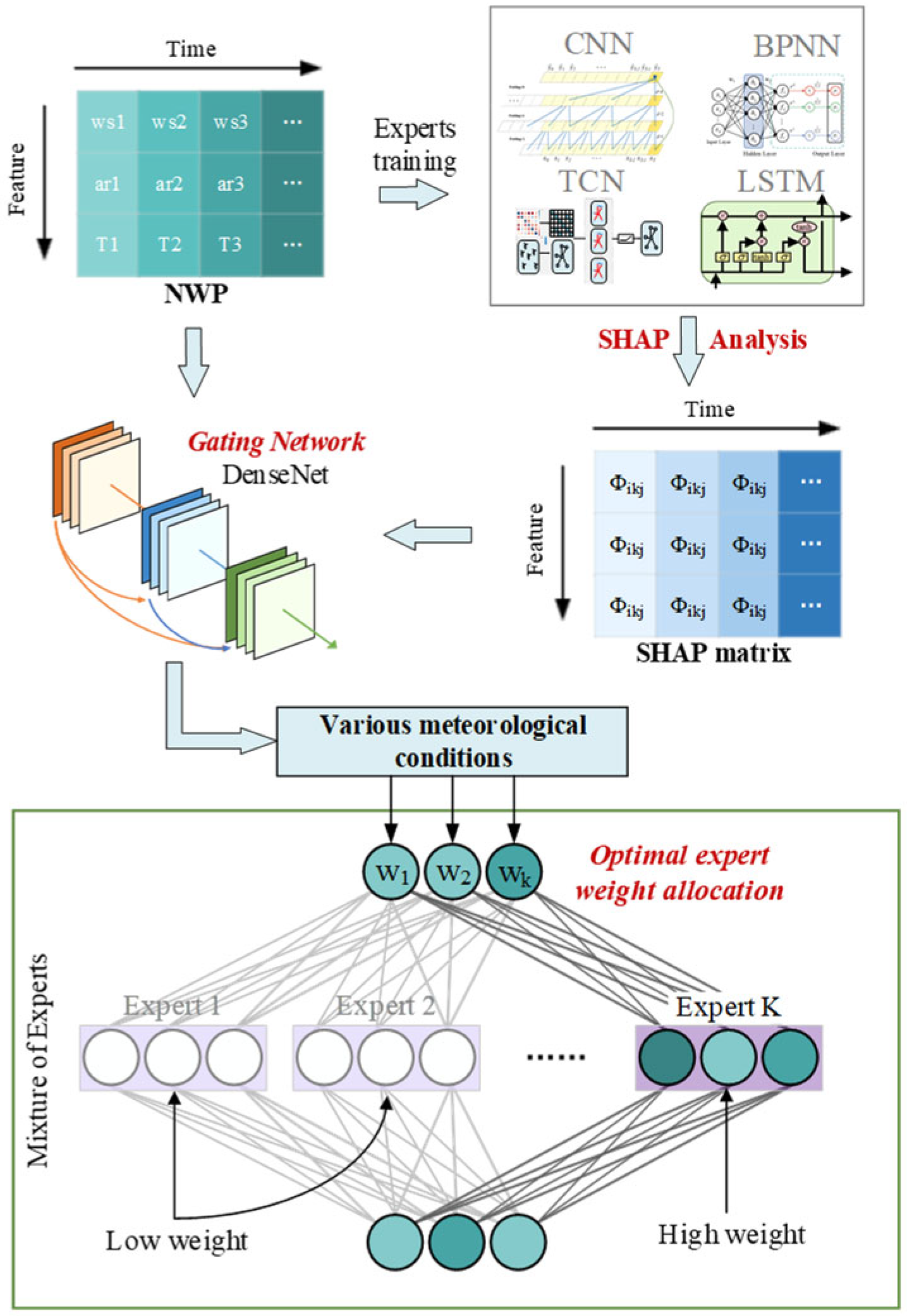
- A SHAP knowledge-guided and data-driven MoE gating model is proposed. This study innovatively transforms SHAP analysis from a post hoc interpretation tool into prior knowledge that guides the decision-making process of the MOE gating network. An enhanced high-dimensional gating feature matrix is constructed by integrating original numerical weather prediction (NWP) features with expert SHAP attribution results, which reflect the decision-making rationale of each expert model, thereby achieving the transformation from post hoc interpretation to prior guidance. This design enables the gating network to more accurately select the optimal expert model under specific meteorological conditions based on feature contribution information, thereby enhancing both the prediction accuracy and interpretability of the forecasting network.
- (2)
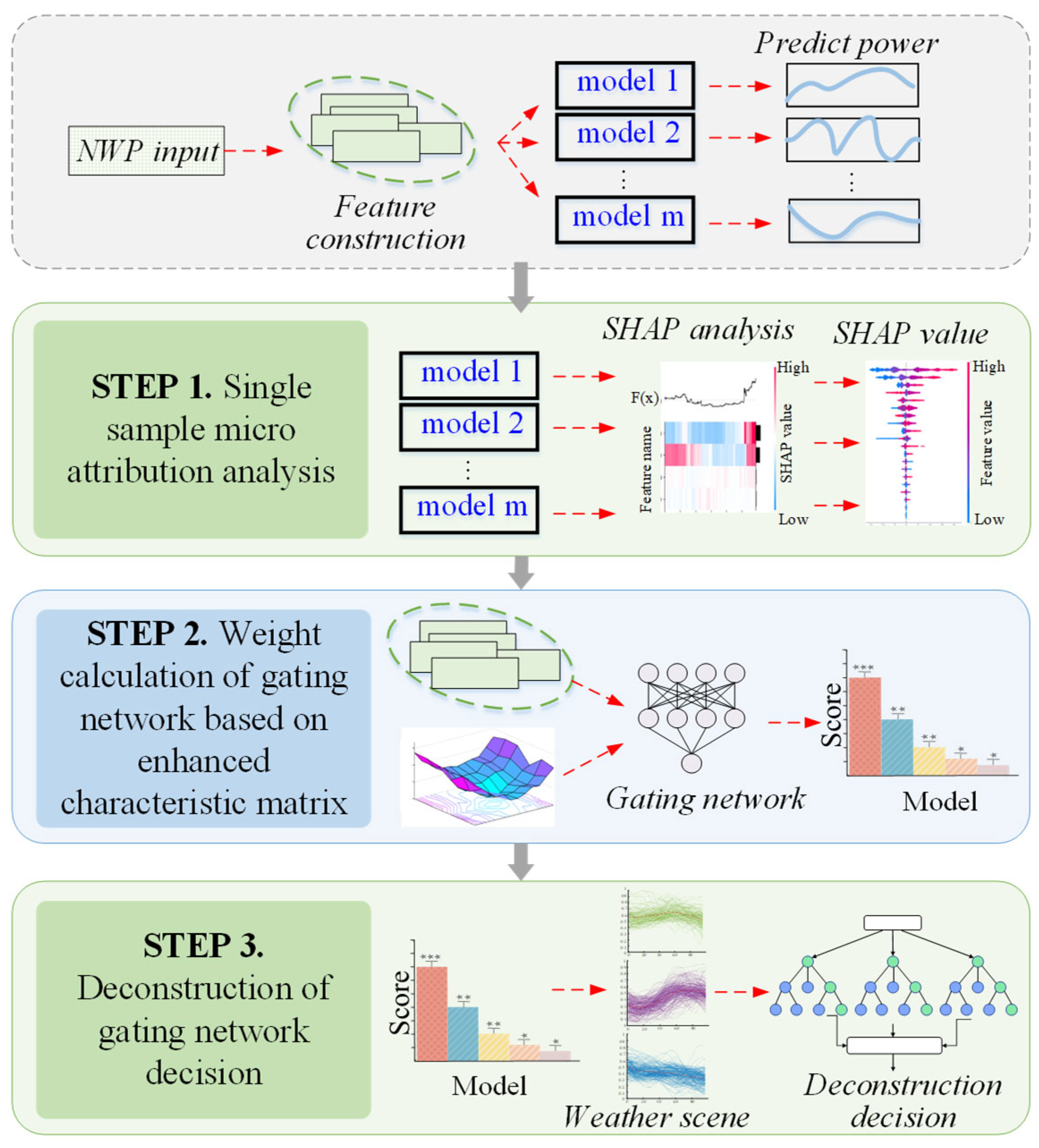
- A two-layer dynamically interpretable forecasting method is proposed, based on the synergistic analysis of gating expert weights and SHAP attribution. This method aims to dynamically reveal the model’s decision logic across various scenarios and guide subsequent model optimization. At the feature level, analysis of the SHAP feature contribution distribution corresponding to high-weight experts facilitates the identification of key meteorological factors that dominate prediction decisions in specific scenarios, enabling dynamic interpretability analysis of forecasting behavior. At the expert level, analysis of the expert weight distribution output by the SHAP attribution-based gating network across different scenarios enables the delineation of expert “trust boundaries,” thereby clarifying the strengths and weaknesses of various model types in specific scenarios. Furthermore, interpretable quantification of the model’s intrinsic uncertainty is achieved through dispersion analysis of the expert weight distribution.
2. Dynamic Explainable Prediction Method Based on SHAP Analysis and Mixture of Experts
2.1. General Framework
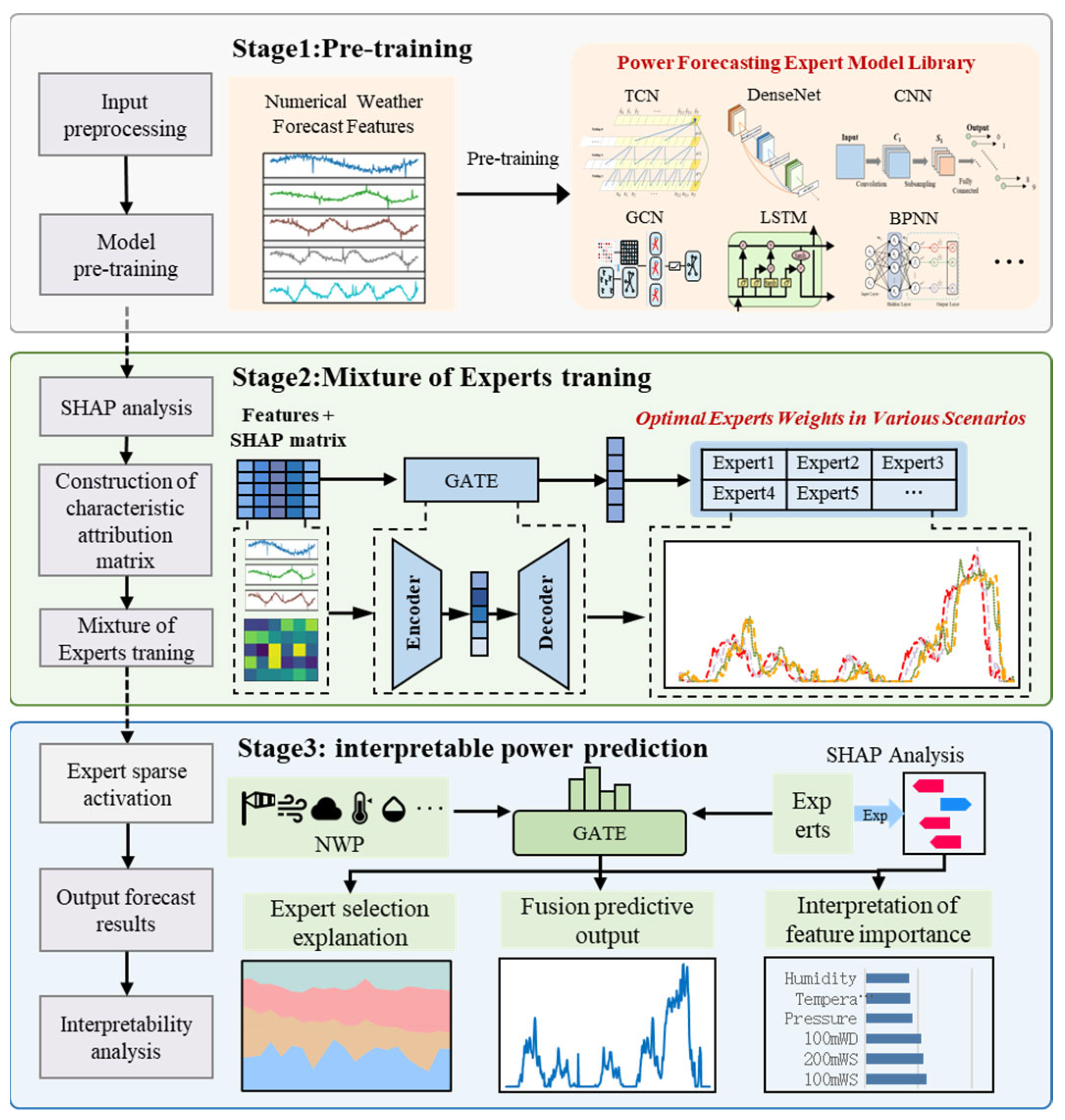
2.1.1. Step 1: Pre-Training of Candidate Experts
2.1.2. Step 2: SHAP Attribution Analysis and Mixture of Experts Model Training
2.1.3. Step 3: Explainable Wind Power Prediction
2.2. SHAP Knowledge-Guided Mixture of Experts Gating Model
2.3. Prediction Dynamic Interpretability Method Based on Synergistic Analysis of Expert Weights and SHAP Values
3. Case Study
3.1. Introduction of Dataset and Judging Criteria
3.2. Model Parameters and Training
3.3. Comparison Between the Proposed Method and the Baseline Expert Model Library
3.4. Comparison Between the MoE Model and Other Ensemble Learning Methods
3.5. Interpretability Analysis
- (a)
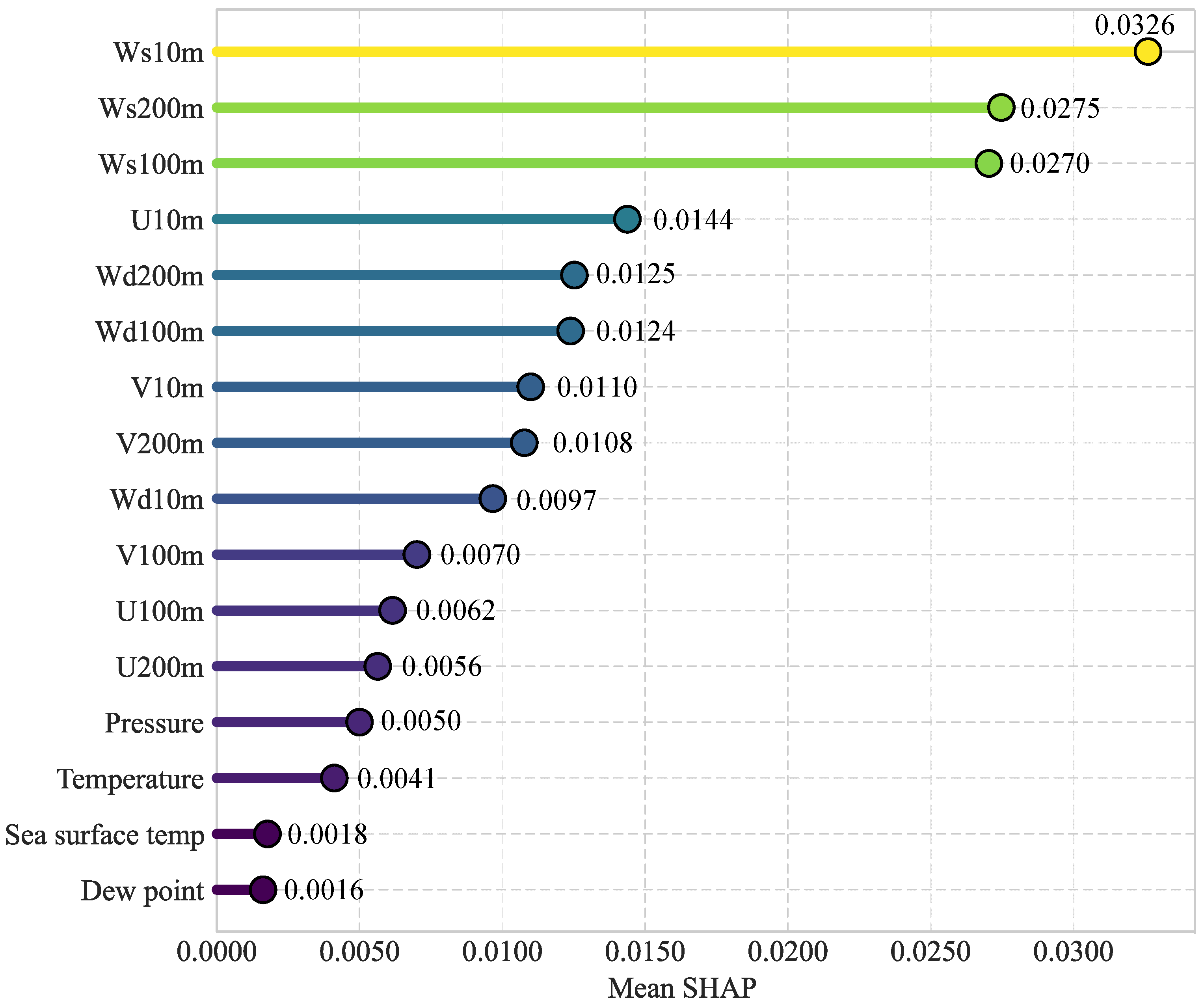
- Global Feature Importance
- (b)
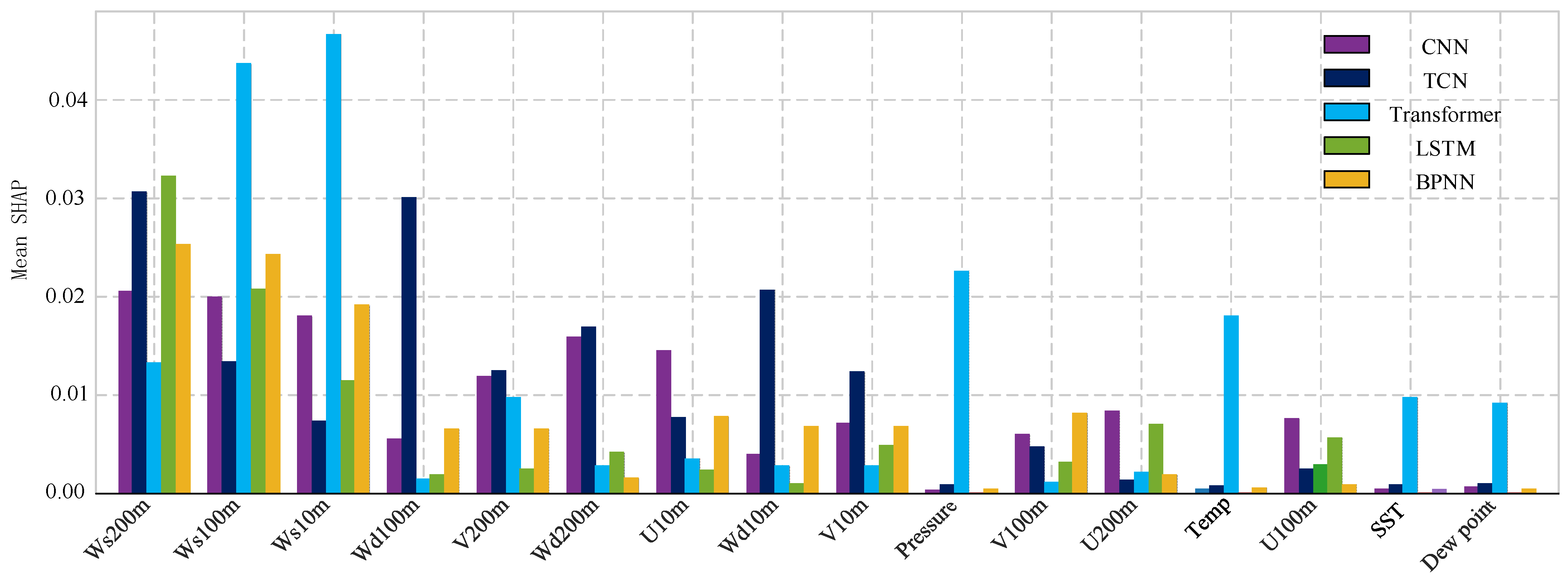
- Differences in Feature Importance Across Models
- (c)
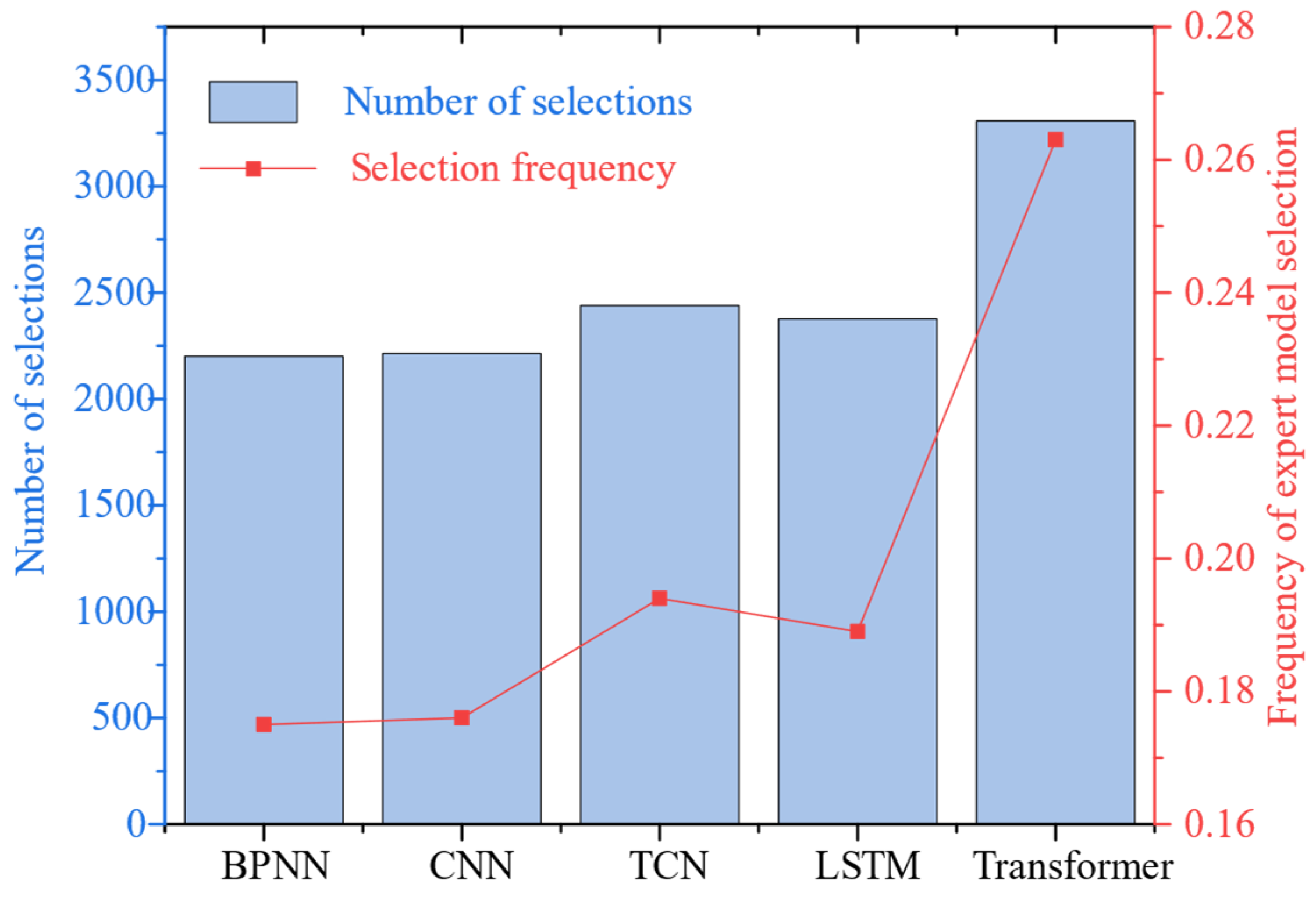
- Model Selection Analysis
4. Conclusions
- (1)
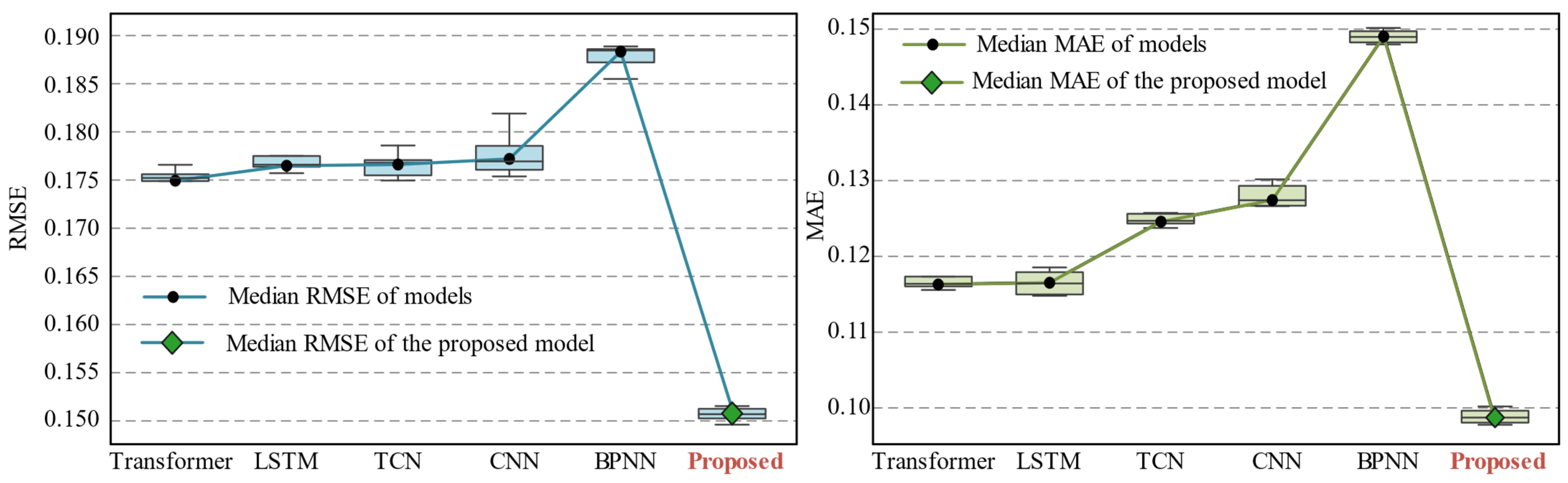
- First, compared to five representative single-model architectures, BPNN, CNN, LSTM, TCN, and Transformer, the SHAP-MOE method achieved the lowest prediction error, with RMSE and MAE values of 0.15121 and 0.09836, respectively. Compared to the best-performing single model (transformer), the relative improvements in RMSE and MAE ranged from 0.57% to 4.92% and 0.46% to 4.94%, respectively. These results confirm that dynamically integrating multiple expert models based on input features can produce more accurate and robust predictions than relying on a single architecture.
- (2)
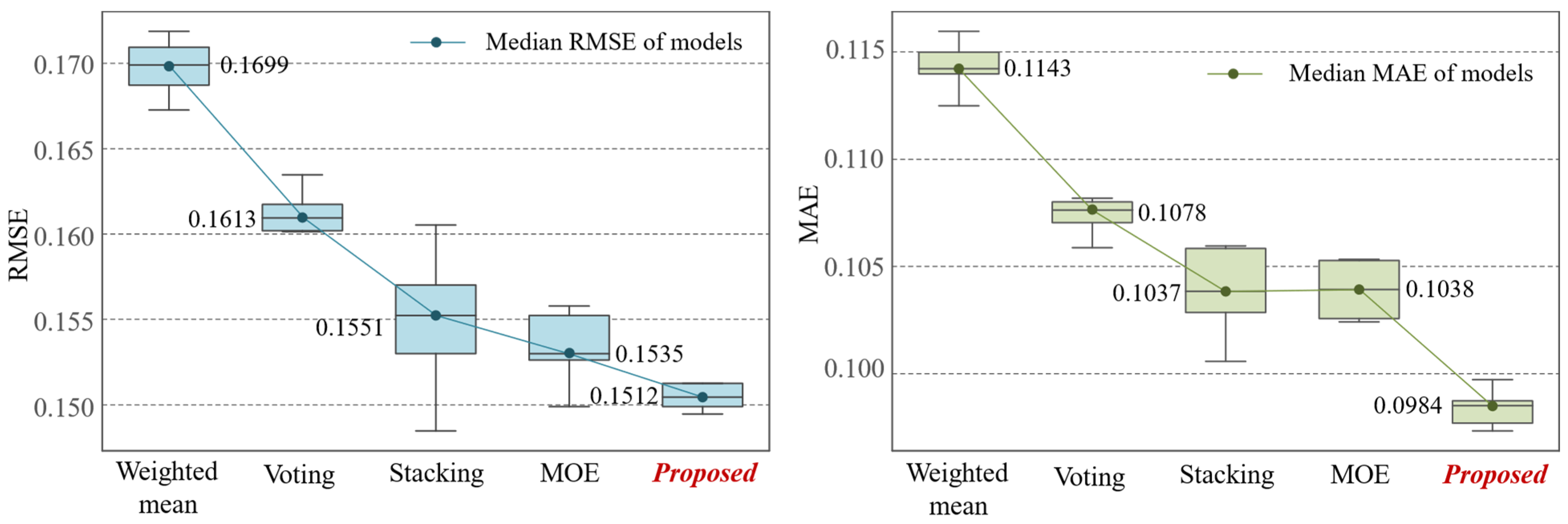
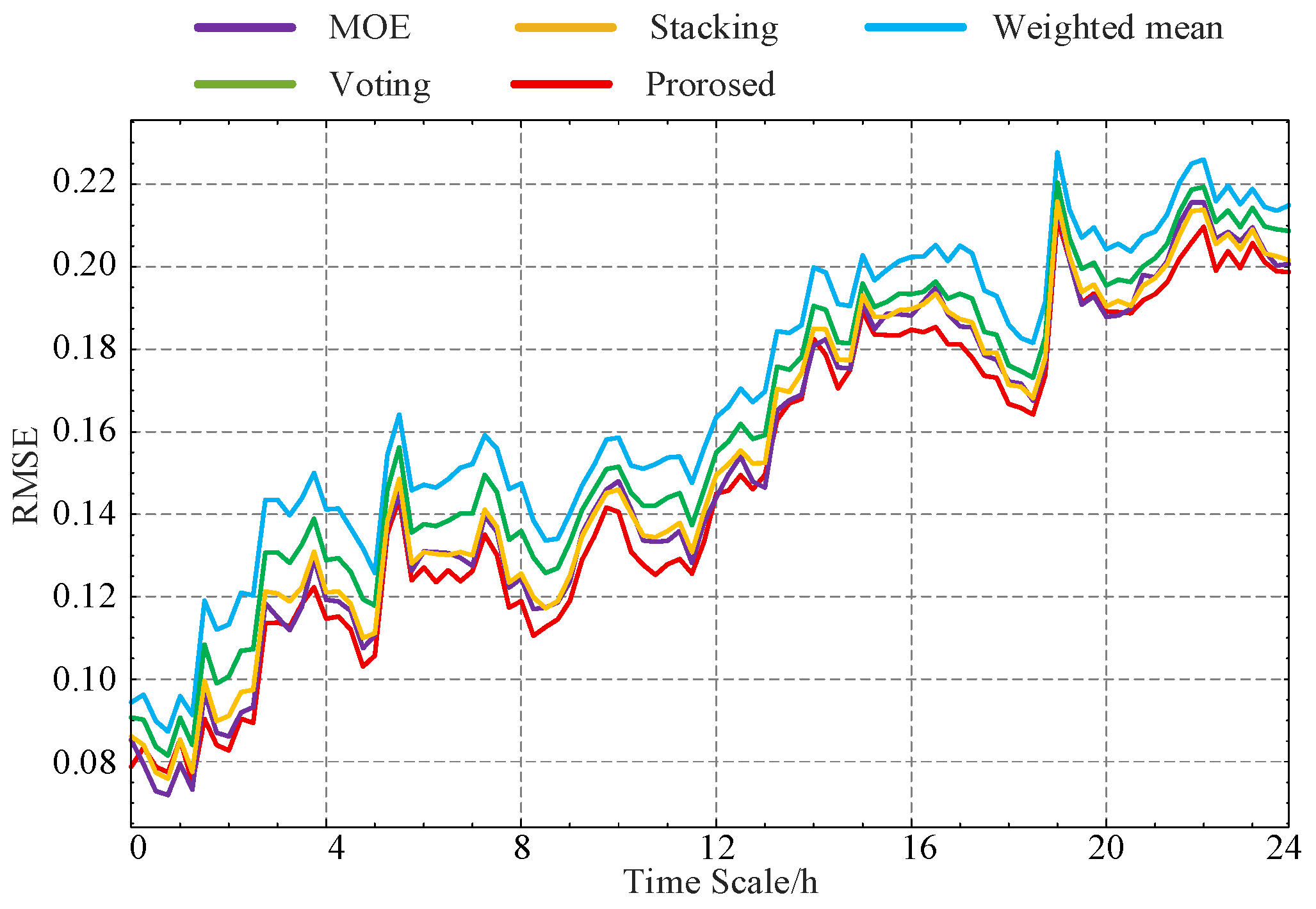
- The method outperformed widely used ensemble techniques, including weighted averaging, voting, stacking, and standard MOE. Specifically, SHAP-MOE achieved RMSE reductions of 0.23–1.87% and MAE reductions of 0.55–1.59% relative to these baselines. Temporal error analysis further revealed that SHAP-MOE consistently maintained the lowest RMSE over the entire prediction horizon, highlighting its robustness and adaptability in handling the increasing uncertainty associated with longer prediction lead times.
- (3)
- In addition to the prediction accuracy, the SHAP ensemble also achieved model interpretability. Global feature importance analysis shows that wind speed at different heights, particularly at 10 m, is the primary factor affecting power output, whereas wind direction plays a secondary but significant role. Interpretability analysis also revealed model-specific sensitivities: Transformer demonstrated a stronger ability to capture complex nonlinear interactions between meteorological variables (such as pressure and temperature), partially explaining its superior performance over the base expert model. Meanwhile, the TCN demonstrated more balanced attention in the input features. Although TCN’s overall accuracy is lower than that of the LSTM model, it still exhibited a stronger performance under extreme conditions. Model analysis revealed that expert selection in SHAP-MOE is not dominated by any single model; instead, the mechanism adaptively assigns weights based on the shape-derived relevance of the input features for each prediction instance. During testing, the proposed method selected Transformer more frequently (26.3%) due to their high baseline accuracy, whereas TCN was preferred over LSTM owing to superior robustness under extreme conditions. Unlike the proposed method, static or accuracy-only weighting schemes overlook such nuanced, scenario-dependent model advantages.
Author Contributions
Funding
Data Availability Statement
Conflicts of Interest
References
- Nguyen, N.; Almasabi, S.; Mitra, J. Impact of Correlation Between Wind Speed and Turbine Availability on Wind Farm Reliability. IEEE Trans. Ind. Appl. 2019, 55, 2392–2400. [Google Scholar] [CrossRef]
- Jimmy, G.; McDonald, A.; Carroll, J. Energy Yield and Operations and Maintenance Costs of Parallel Wind Turbine Powertrains. IEEE Trans. Sustain. Energy 2020, 11, 674–681. [Google Scholar] [CrossRef] [Scilit]
- Liu, J.; Zang, H.; Ding, T.; Cheng, L.; Wei, Z.; Sun, G. A Principle-Constrained Wind Field Image Generation Framework for Short-Term Wind power prediction. IEEE Trans. Power Syst. 2025, 40, 1790–1801. [Google Scholar] [CrossRef] [Scilit]
- Yang, M.; Huang, Y.; Wang, Z.; Wang, B.; Su, X. A Framework of Day-Ahead Wind Supply Power Forecasting by Risk Scenario Perception. IEEE Trans. Sustain. Energy 2025, 16, 1659–1672. [Google Scholar] [CrossRef] [Scilit]
- Zhang, H.; Liu, Y.; Yan, J.; Han, S.; Li, L.; Long, Q. Improved Deep Mixture Density Network for Regional Wind Power Probabilistic Forecasting. IEEE Trans. Power Syst. 2020, 35, 2549–2560. [Google Scholar] [CrossRef] [Scilit]
- Song, W.; Yan, J.; Han, S.; Zhang, N.; Liu, S.; Ge, C.; Liu, Y. A Self-Supervised Pre-Learning Method for Low Wind power prediction. IEEE Trans. Sustain. Energy 2025, 16, 1723–1736. [Google Scholar] [CrossRef] [Scilit]
- Lin, S.; Wang, S.; Xu, X.; Li, R.; Shi, P. GAOformer: An adaptive spatiotemporal feature fusion transformer utilizing GAT and optimizable graph matrixes for offshore wind speed prediction. Energy 2024, 292, 130404. [Google Scholar] [CrossRef] [Scilit]
- Wu, Y.-K.; Huang, C.-L.; Wu, S.-H.; Hong, J.-S.; Chang, H.-L. Deterministic and Probabilistic Wind Power Forecasts by Considering Various Atmospheric Models and Feature Engineering Approaches. IEEE Trans. Ind. Appl. 2023, 59, 192–206. [Google Scholar] [CrossRef] [Scilit]
- Lu, P.; Ye, L.; Zhao, Y.; Dai, B.; Pei, M.; Li, Z. Feature extraction of meteorological factors for wind power prediction based on variable weight combined method. Renew. Energy 2021, 179, 1925–1939. [Google Scholar] [CrossRef] [Scilit]
- Feng, C.; Cui, M.; Hodge, B.-M.; Zhang, J. A data-driven multi-model methodology with deep feature selection for short-term wind forecasting. Appl. Energy 2017, 190, 1245–1257. [Google Scholar] [CrossRef] [Scilit]
- Cao, W.; Wang, G.; Liang, X.; Hu, Z. A STAM-LSTM model for wind power prediction with feature selection. Energy 2024, 296, 131030. [Google Scholar] [CrossRef] [Scilit]
- Im, S.; Kim, K.; Lee, G.; Lim, H.-J. Development of a Weighted Average Ensemble Model for Predicting Officially Assessed Land Prices Using Grid Map Data and SHAP. IEEE Access 2025, 13, 96251–96260. [Google Scholar] [CrossRef] [Scilit]
- Kim, K.J.; Park, J.H.; Min, D.H.; Min, S.G. Data-Driven Optimization of Aspect Ratio in Permanent Magnet Machines Using Deep Learning and SHAP Analysis. IEEE Access 2025, 13, 122164–122174. [Google Scholar] [CrossRef] [Scilit]
- Zhao, Z.; Wang, M.; Wei, J.; Cen, X.; Du, S.; Wu, Z.; Liu, H.; Wang, W. Interpretable Machine Learning for Multi-Energy Supply Station Revenue Forecasting: A SHAP-Driven Framework to Accelerate Urban Carbon Neutrality. Energies 2025, 18, 1624. [Google Scholar] [CrossRef] [Scilit]
- Suárez-Cetrulo, A.L.; Burnham-King, L.; Haughton, D.; Carbajo, R.S. Wind power prediction using ensemble learning for day-ahead energy trading. Renew. Energy 2022, 191, 685–698. [Google Scholar] [CrossRef] [Scilit]
- Ye, L.; Dai, B.; Li, Z.; Pei, M.; Zhao, Y.; Lu, P. An ensemble method for short-term wind power prediction considering error correction strategy. Appl. Energy 2022, 322, 119475. [Google Scholar] [CrossRef] [Scilit]
- Yang, Z.; Peng, X.; Song, J.; Duan, R.; Jiang, Y.; Liu, S. Short-Term Wind Power Prediction Based on Multi-Parameters Similarity Wind Process Matching and Weighed-Voting-Based Deep Learning Model Selection. IEEE Trans. Power Syst. 2024, 39, 2129–2142. [Google Scholar] [CrossRef] [Scilit]
- Liang, Z.; Chung, C.; Yang, H.; Liang, J.; Zhang, W.; Dong, H.; Zhu, J. A Heterogeneous Multiple-Experts Approach to Low-Frequency Nonintrusive Load Monitoring. IEEE Trans. Smart Grid 2025, 17, 746–765. [Google Scholar] [CrossRef] [Scilit]
- Chang, Y.; Yang, H.; Chen, Y.; Zhou, M.; Yang, H.; Wang, Y.; Zhang, Y. A Hybrid Model for Long-Term Wind power prediction Utilizing NWP Subsequence Correction and Multi-Scale Deep Learning Regression Methods. IEEE Trans. Sustain. Energy 2024, 15, 263–275. [Google Scholar] [CrossRef] [Scilit]
- Qin, G.; Peng, X.; Yang, Z. Regional Short-Term Wind Power Prediction Based on CEEMDAN-FTC Feature Mapping and EC-TCN-BiLSTM Deep Learning. Wind Energy 2025, 28, e70025. [Google Scholar] [CrossRef] [Scilit]
- Cai, W.; Jiang, J.; Wang, F.; Tang, J.; Kim, S.; Huang, J. A Survey on Mixture of Experts in Large Language Models. IEEE Trans. Knowl. Data Eng. 2025, 37, 3896–3915. [Google Scholar] [CrossRef] [Scilit]
- Cheng, M.; Zhang, Y.; Liu, C.; Lai, X.; Lu, S.; Zhu, S. PV Mid- and Long-Term Power Prediction Method Based on SDCN-TiDE and Power Reconstruction. In Proceedings of the 2025 10th Asia Conference on Power and Electrical Engineering (ACPEE), Beijing, China, 15–19 April 2025; pp. 263–267. [Google Scholar]



| Number | Features | Number | Features |
|---|---|---|---|
| 1 | 200 m U-component wind speed | 9 | 10 m U-component wind speed |
| 2 | 200 m V-component wind speed | 10 | 10 m V-component wind speed |
| 3 | 200 m wind speed | 11 | 10 m wind direction |
| 4 | 200 m wind direction | 12 | 10 m wind speed |
| 5 | 100 m U-component wind speed | 13 | Sea level pressure |
| 6 | 100 m V-component wind speed | 14 | Dew point temperature |
| 7 | 100 m wind direction | 15 | 2 m temperature |
| 8 | 100 m wind speed | 16 | Sea surface temperature |
| Model Name | Model Dimension | Model Depth |
|---|---|---|
| Transformer | 128 | 4 |
| LSTM | 256/128/64 | 3 |
| CNN | 64 | 4 |
| BPNN | 256 | 3 |
| TCN | 128 | 4 |
| Superparameter | Value |
|---|---|
| Batch size | 64 |
| Epoch | 100 |
| Learning rate | 0.001 |
| Dropout rate | 0.1 |
| Loss function | MSE |
| Optimizer | AdamW |
| Model | RMSE | MAE |
|---|---|---|
| Transformer | 0.17493 | 0.11631 |
| LSTM | 0.17648 | 0.11654 |
| TCN | 0.17661 | 0.1246 |
| CNN | 0.17719 | 0.12745 |
| BPNN | 0.18833 | 0.14905 |
| Proposed | 0.15121 | 0.09836 |
| Model | RMSE | MAE |
|---|---|---|
| Weighted mean | 0.1699 | 0.1143 |
| Voting | 0.1613 | 0.1078 |
| Stacking | 0.1551 | 0.1037 |
| MOE | 0.1535 | 0.1038 |
| Proposed | 0.1512 | 0.0984 |
Disclaimer/Publisher’s Note: The statements, opinions and data contained in all publications are solely those of the individual author(s) and contributor(s) and not of MDPI and/or the editor(s). MDPI and/or the editor(s) disclaim responsibility for any injury to people or property resulting from any ideas, methods, instructions or products referred to in the content. |
© 2025 by the authors. Licensee MDPI, Basel, Switzerland. This article is an open access article distributed under the terms and conditions of the Creative Commons Attribution (CC BY) license.
Share and Cite
Zhang, H.; Qin, G.; Chen, X.; Lu, L.; Zhang, Z.; Song, J. A Day-Ahead Wind Power Dynamic Explainable Prediction Method Based on SHAP Analysis and Mixture of Experts. Energies 2026, 19, 124. https://doi.org/10.3390/en19010124
Zhang H, Qin G, Chen X, Lu L, Zhang Z, Song J. A Day-Ahead Wind Power Dynamic Explainable Prediction Method Based on SHAP Analysis and Mixture of Experts. Energies. 2026; 19(1):124. https://doi.org/10.3390/en19010124
Chicago/Turabian StyleZhang, Hao, Guoyuan Qin, Xiangyan Chen, Linhai Lu, Ziliang Zhang, and Jiajiong Song. 2026. "A Day-Ahead Wind Power Dynamic Explainable Prediction Method Based on SHAP Analysis and Mixture of Experts" Energies 19, no. 1: 124. https://doi.org/10.3390/en19010124
APA StyleZhang, H., Qin, G., Chen, X., Lu, L., Zhang, Z., & Song, J. (2026). A Day-Ahead Wind Power Dynamic Explainable Prediction Method Based on SHAP Analysis and Mixture of Experts. Energies, 19(1), 124. https://doi.org/10.3390/en19010124