

Economic and Energy Efficiency of Bivalent Heating Systems in a Retrofitted Hospital Building: A Case Study

 ,
,  , , and
Abstract
1. Introduction
1.1. Research Gap and Scientific Novelty
- Estimate detailed CAPEX and OPEX for a baseline scenario versus three modernization variants (20 kW, 40 kW, and 60 kW thermal capacity) based on 2025 market data.
- Identify the variant that maximizes Net Present Value (NPV) and minimizes the Levelized Cost of Heating (LCOH) while ensuring energy security.
- Demonstrate the impact of oversizing on the project’s profitability indicators.
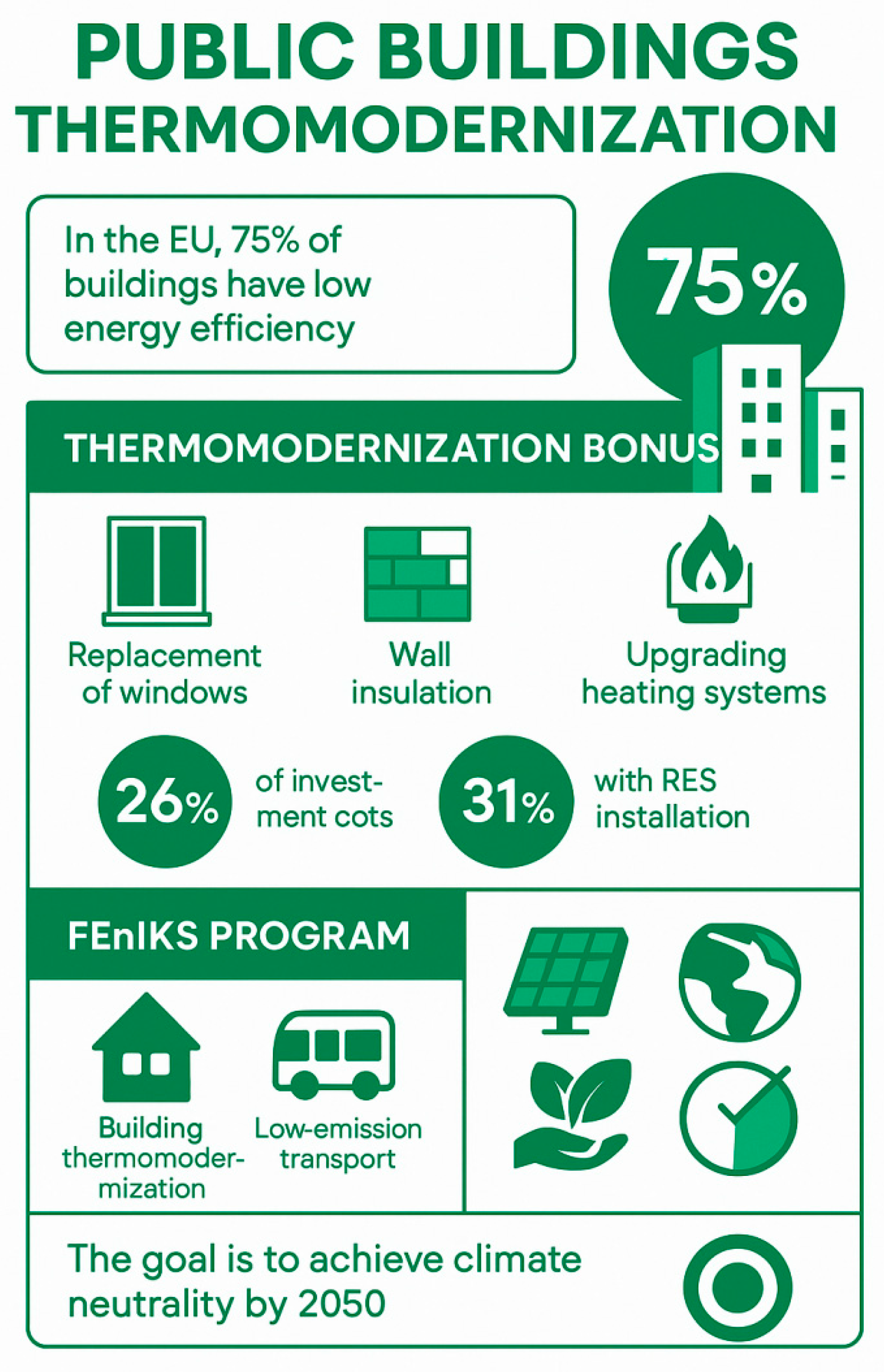
1.2. Financing Possibilities for the Thermal Modernization of Public Buildings in Light of EU Climate Policy—An Analysis and Assessment
- Unlike broad hourly models, this study applies a 10 min time step quasi-steady-state simulation. This granularity is crucial for accurately capturing the transient cooperation between the PV generation peaks, battery storage dynamics, and the thermal inertia of the hospital’s heating system.
- The paper moves beyond simple feasibility to explicitly analyze the economic saturation point. By comparing incrementally scaled variants (20, 40, and 60 kW), we quantitatively demonstrate the ‘law of diminishing returns’, providing a clear warning against oversizing in public investments.
- We propose a reproducible methodology for transforming District Heating from a primary source into a strategic peak/backup source, enhancing energy security without the need for costly total infrastructure replacement.
- To estimate the detailed capital expenditures (CAPEX) and annual operating costs (OPEX) for the baseline scenario and the three modernization variants, based on current market prices.
- To determine and compare key profitability indicators, including the Simple Payback Period (SPBT), in order to objectively assess the viability of the analyzed scenarios.
- To identify the optimal modernization variant that represents the best compromise between the investment amount, the level of generated savings, and the degree of energy independence achieved.
- To conduct a sensitivity analysis of the results to changes in key economic parameters, such as energy and heat prices.
- To provide a comprehensive and repeatable assessment methodology that can be adapted for the analysis of similar modernization projects in the public sector in Poland and the region.
2. Materials and Methods—Methodology
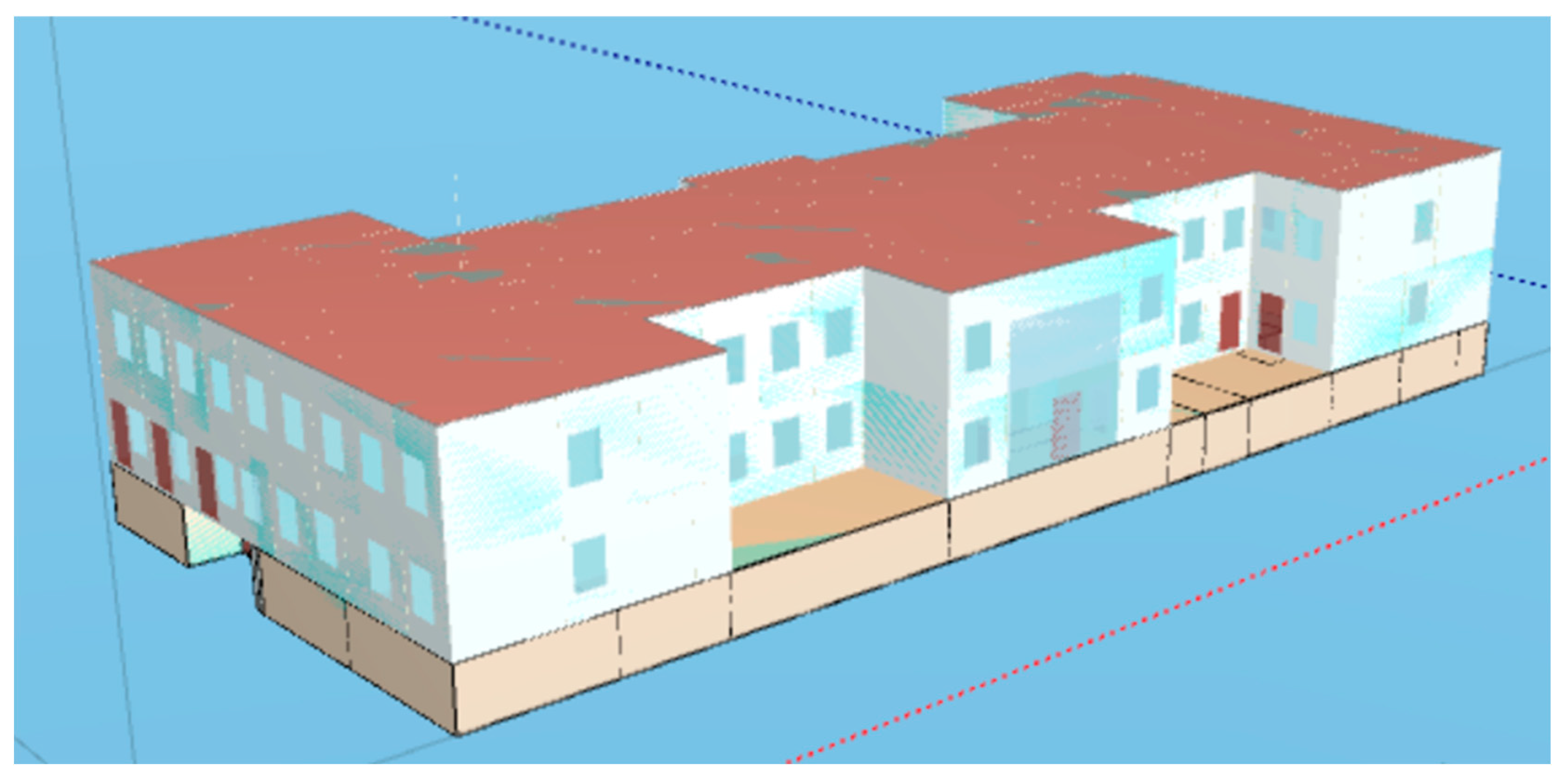
- Building heat calculations resulting in the design heat load of the building for different temperatures and solar gains. The values are approximated by ambient temperatures and solar irradiance, respectively. The model is based on the construction project of the building, and the calculation methodology used in certification and energy auditing of the buildings.
- Simulation of the heating system in a quasi-steady state in the Ebsilon environment using a 10 min time step and meteorological data for temperatures and irradiance. The feed data for the model are the meteorological data, while assumptions are made on the design size of the heat source and buffer tank. The heat calculations provide the characteristics for actual heat demand.
2.1. Transient Heat Pump Model
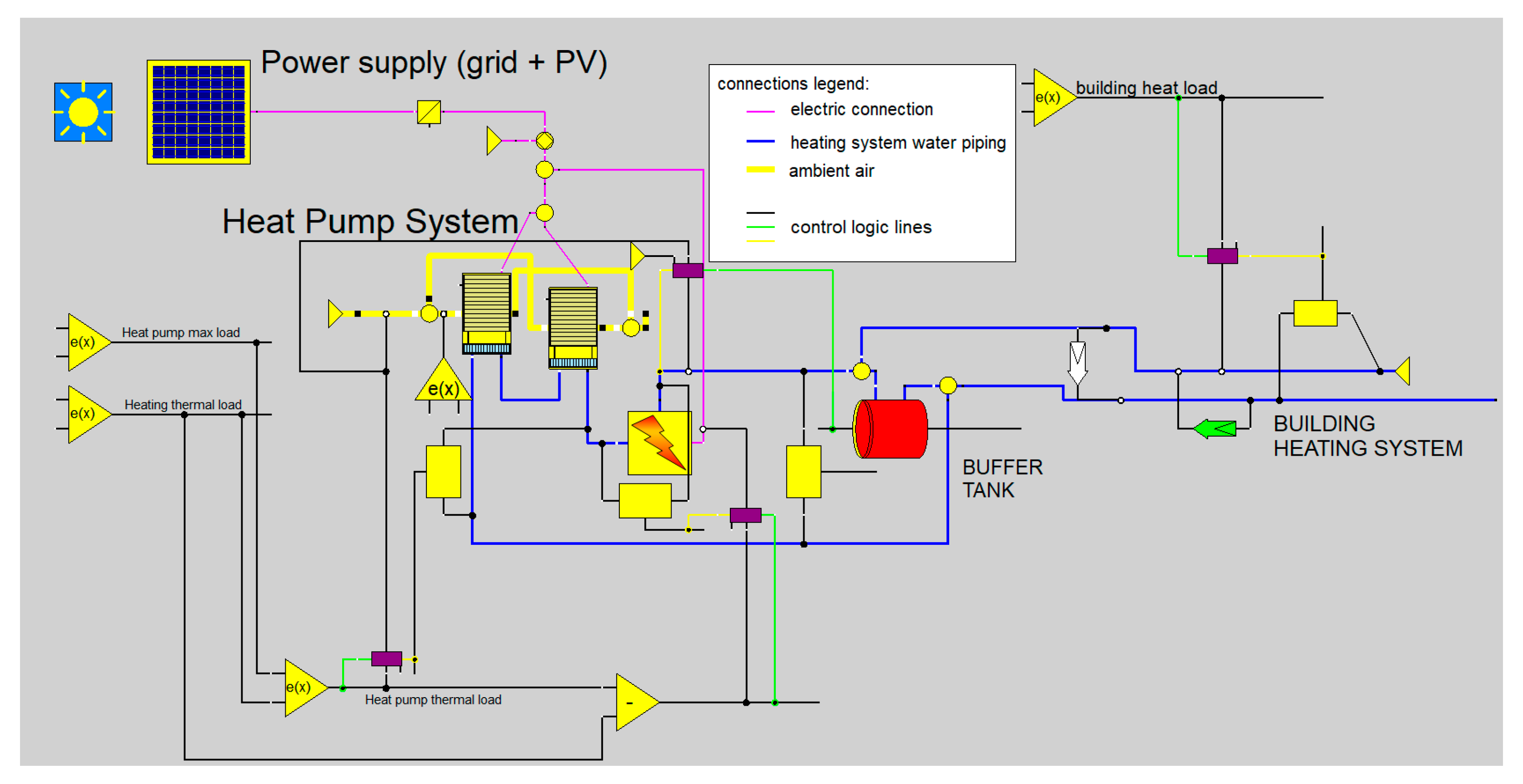
- The heating system piping, using water as the heat transfer medium, represented by the blue line. This system represents the hydraulic connection of heat pump system. Peak heat source—district heating, buffer tank, and connection to the building heating system. Heat sources deliver the heat to the water connected to the buffer tank. The temperature of the medium is set to be 5 K higher than the tank temperature. Increasing the overheat would lead to higher heat pump temperature lift, causing a decrease in efficiency. The heating system in the building is controlled by the building’s heat load. The temperature drop in the system is set to a constant value of 12 K, corresponding to ISO 52016-1:2017 [63] for a floor heating system.
- The electrical system is represented by magenta lines. The PV system supplies power to the inverter and is connected to the external grid, transferring power to the heat pump system. The PV system’s effectiveness is calculated using global irradiance historical meteorological data and sun angles. The PV component uses the current–voltage relationship to derive the maximum power point (MPP), with parameters provided by the manufacturer.
- The remaining thin lines represent logic connections used to control the components in the time series. The controllers use EBSscript, a language based on PASCAL syntax.
- Heat pump production is controlled by the buffer tank temperature, building demand, and PV production. The minimum temperature in the buffer tank is maintained at 35 °C. The availability of PV energy triggers heat production up to a temperature of 50 °C in the buffer tank. Additional control logic is implemented to compensate for heat losses and maintain continuous operation.
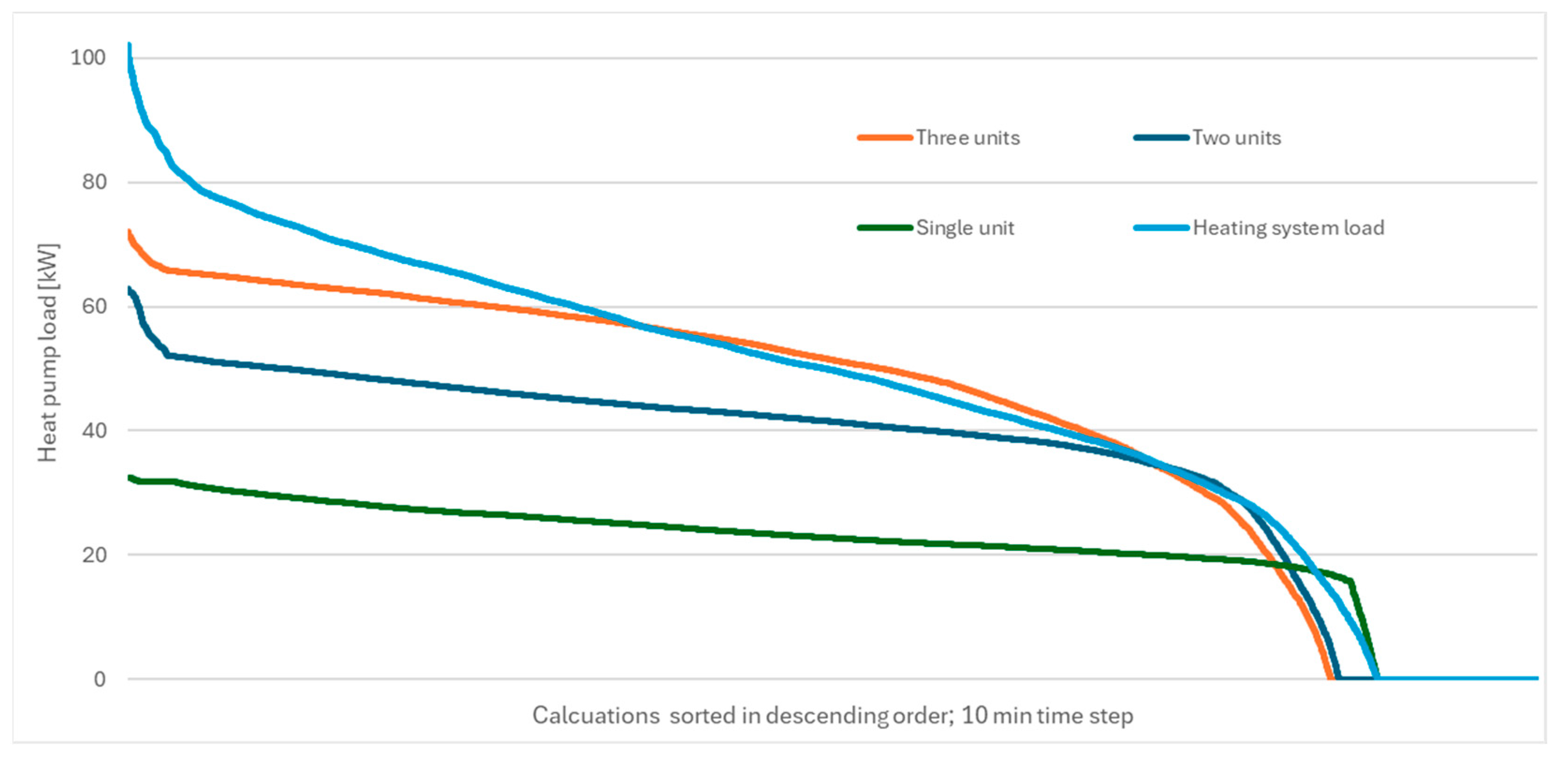
- The heat pump system is configured to use only the required number of units at any given moment. The thermal power of a single unit is calculated based on its performance characteristics. In variants using multiple heat pump units, exceeding the current thermal power capacity of a single unit triggers an additional unit to operate in cascade. This control scheme optimizes the load distribution among the heat pumps.
- The meteorological data (solar irradiance, temperature, and wind speed) were obtained from the PVGIS database with a native hourly resolution. To align with the simulation’s requirements, these data were adapted to a 10 min time step using linear interpolation.
- The choice of a 10 min step, despite the hourly input, is strictly dictated by the dynamic control logic of the Energy Storage (ES) and the thermal inertia of the buffer tank. Standard hourly simulations average out solar generation peaks, which frequently leads to an underestimation of battery saturation events and an overestimation of RES self-consumption. By using a 10 min step, the model accurately captures intra-hour dynamics—such as rapid battery charging during peak irradiance or short-cycling of the heat pump—ensuring that the calculated Key Performance Indicators (KPIs), particularly the OPEX and self-consumption rates, are robust and not artificially smoothed.
- The exact algorithm governing the control of the time series calculations remains unchanged from the one used in the previous paper [28].
2.2. Description of the Analyzed Object and System
2.2.1. System Sizing and Configuration Rationale
- The analysis adopts a modular approach using a commercial-grade 20 kW air-to-water monobloc unit as the base module. The variants (20, 40, and 60 kW) were selected to analyze the economic efficiency of covering different shares of the building’s thermal load. The intention was explicitly not to cover the peak thermal load (which would require oversizing), but to identify the optimal base-load capacity that cooperates with the district heating network.
- The capacity of 180 kWp was dimensioned to achieve an annual energy production of approximately 180 MWh. This value was targeted to balance the electrical demand of the heat pump system on an annual basis, aiming for a “net-zero” heating solution, while remaining within the physical constraints of the hospital’s available roof area.
- The 120 kWh capacity was selected as an economic trade-off between investment costs (CAPEX) and functionality. It is sized to facilitate daily energy time-shifting—storing the mid-day generation peak for use during evening peak demand—without aiming for prohibitively expensive seasonal storage.
- Roof: U-value = 0.120 W/m2K (required: 0.150).
- Exterior walls: U-value = 0.187 W/m2K (required: 0.200).
- Basement floor: U-value = 0.231 W/m2K (required: 0.300).
- The main building partitions meet and even exceed the requirements, which indicates relatively low heat loss through transmission via these elements.
- Exterior windows: U-values range from 1.3 to 1.7 W/m2K, while the current requirement is 0.9 W/m2K. The windows are the primary weak point of the building’s thermal envelope and generate significant heat loss.
- Exterior doors: The U-value is 1.3 W/m2K, which barely meets the requirement and is far from modern standards.
2.2.2. Baseline Scenario (Variant W0)
2.2.3. Modernization Scenarios (V1, V2, V3)
- Heat Pumps (HP): Air-to-water compression heat pumps, operating in a parallel system. The nominal power of each unit is 20 kW. The variants differ in the number of units:
- -
- V1: 1 HP unit (total nominal power 20 kW)
- -
- V2: 2 HP units (total nominal power 40 kW)
- -
- V3: 3 HP units (total nominal power 60 kW)
- Photovoltaic (PV) installation: A rooftop PV installation with a peak power of 180 kWp, which is constant for all variants.
- Energy storage (ES): A battery electricity storage system with a capacity of 120 kWh, which is constant for all variants.
2.3. Economic Model and Assumptions
2.3.1. Capital Expenditure (CAPEX)
- CAPEXHP: Cost of purchase and installation of the heat pumps, dependent on the variant.
- CAPEXPV: Cost of the “turnkey” photovoltaic installation.
- CAPEXES: Cost of the battery energy storage system including the management system (BMS).
- CAPEXadd: Costs of the project design, adaptation works, the hydraulic system, heat buffers, and control automation, assumed as a percentage of the sum of the main costs.
2.3.2. Operating Costs (OPEX)
- CMHPC: Annual cost of purchasing heat from the MHPC network (amount of heat from MHPC [kWh] × Unit price of heat [EUR/kWh]).
- Cgrid: Annual cost of purchasing electricity from the grid for the needs of the heat pumps (amount of energy from the grid [kWh] × Unit price of electricity [PLN/kWh]).
- RPV: Annual revenue from the sale of surplus energy from the PV installation to the grid (amount of energy sold to the grid [kWh] × Market sale price [EUR/kWh]).
- CO&M: Annual costs of service, maintenance, and insurance for the system, assumed as a percentage of the total CAPEX value.
2.3.3. Profitability Indicators
- Annual savings = OPEXW0 − OPEXvarData sources and pricing assumptions:The analysis was based on two pillars of data.
- Energy Data: The annual energy flows for each variant were taken directly from the simulation results as well as from actual data from the billing records provided by the hospital.
- Cost Data: Investment costs and energy prices were estimated based on an analysis of the Polish market for the year 2025. Average prices for business customers were assumed (B23 tariff for electricity, the business tariff for MHPC Krakow) as well as the market resale price for energy in the net-billing system (monthly market price—RCEm). The detailed values of the assumed prices and unit costs have been presented in previous iterations of the analysis.
3. Key Assumptions and Data Sources
3.1. Energy Data from the Simulation
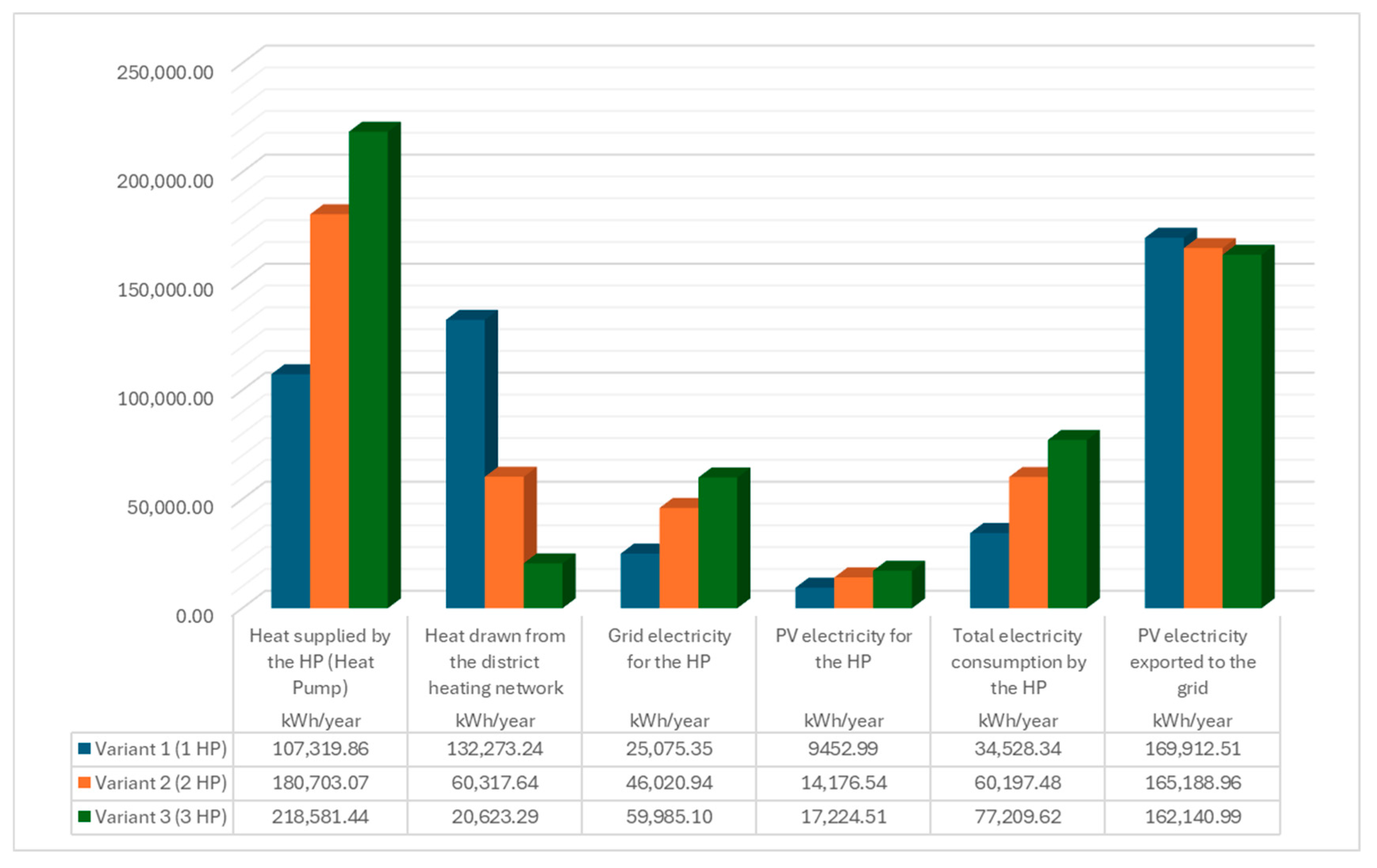
- Already in Variant 1, the heat pumps become a significant source of heat, supplying 107,319.86 kWh, which constitutes almost a half of the energy. However, there is still a large demand for supplemental heating from the MHPC network, amounting to 132,273.24 kWh.
- The most striking change occurs when moving from Variant 1 to Variant 2. Doubling the number of heat pumps causes a drastic reduction in the amount of heat drawn from MHPC—from over 132,273 kWh to just 60,317 kWh (a 54% decrease). The share of the heat pumps becomes absolutely dominant, covering almost the entire demand.
- Variant 3 shows a state close to full independence from the district heating network. The amount of heat drawn from MHPC drops to a symbolic level of 20,623 kWh which constitutes less than 8.62% of the total demand. This means that the MHPC network now only serves as a peak backup source in case of extremely low temperatures or failure.
3.2. Assumptions for Capital Expenditures (CAPEX)
- Heat pumps (HP): Monobloc compression air-to-water heat pumps with a nominal capacity of 20 kW each.
- -
- Unit cost including installation: 21,177 EUR/unit.
- -
- Justification: The price includes high-efficiency, reversible air-to-water monobloc units, optimized for operation in Polish climate conditions. The cost includes basic automation, installation, and integration with the hospital’s existing hydraulic system.
- Photovoltaic (PV) installation: The simulation indicates an annual production of approx. 180 MWh/year, which corresponds to an installation with a capacity of approx. 180 kWp.
- -
- Unit cost (turnkey): 824 EUR/kWp.
- -
- Justification: The installation capacity (180 kWp) was selected based on the annual production from the simulation (~180 MWh), assuming a standard yield for Poland at the level of 1000 kWh/kWp/year. The unit price is a “turnkey” price for a commercial installation and includes panels, inverters, the mounting structure, cabling, and protective equipment, as well as design and installation costs.
- Energy storage (ES): An electrical energy storage system is necessary to optimize self-consumption. A capacity adequate for the PV installation’s power was assumed.
- -
- Unit cost: 517.66 EUR/kWh.
- -
- Assumed capacity: 120 kWh.
- -
- Justification: Energy storage is a key element of the system allowing for the maximization of self-consumption. It enables the storage of surplus energy from the PV system during the day and its use during the evening and night hours, when the hospital’s energy demand is still high, and grid electricity prices are at their highest. The 120 kWh capacity represents a trade-off between the ability for energy time-shifting and the investment cost.
- Additional system elements: These include the buffer tanks (2 × 1000 L), the hydraulic system, and the control system, as well as design and adaptation works.
- -
- Estimated as 15% of the main component costs.
- -
- Justification: This item covers the necessary costs that are difficult to estimate precisely at this stage, such as the high-capacity buffer tanks (min. 2000 L), an advanced Energy Management System (EMS), adaptation works in the boiler room, detailed design costs, and unforeseen expenses.
3.3. Assumptions for Operational Expenditures (OPEX)
- Price of heat from MHPC Krakow: Based on the business tariff, an averaged variable, and fixed price.
- -
- Price: 0.106 EUR/kWh (106 EUR/MWh).
- Price of electricity from the grid (Tauron): B23 tariff for business customers, and average price of active energy and distribution fees.
- -
- Purchase price: 0.212 EUR/kWh (211.77 EUR/MWh).
- Resale price of energy from PV: In accordance with the net-billing system, a conservative monthly market price of energy (RCEm) was assumed.
- -
- Sale price: 0.118 EUR/kWh (118 EUR/MWh).
- Service and maintenance (O&M) costs: Annual flat rate.
- -
- Value: 1.5% of total capital expenditures (CAPEX).
- -
- Justification: This is a standard indicator for energy systems (1.5% of CAPEX annually). Over the 20-year lifecycle, this accumulates to 30% of the initial investment. This provision is intended to cover not only annual inspections, insurance, and minor consumables but also to amortize the costs of major component replacements (e.g., PV inverters or battery cell servicing) anticipated during the project lifespan [42].
4. Investment Analysis: CAPEX, Risks, and Non-Financial Benefits
5. Comprehensive Economic Analysis and Lifecycle Profitability
5.1. Baseline Scenario (Variant 0—District Heating Network Only)
- Total heat demand: 107,319.86 kWh (HP) + 132,273.24 kWh (MHPC) = 239,593.10 kWh
- Annual cost: 239,593.10 kWh × 0.106 EUR/kWh = EUR 25,396.87
5.2. Operational Costs for the Modernization Variants (V1, V2, V3)
5.3. Profitability Indicators and Variant Comparison
- Sensitivity to energy and heat prices: It is important to note that current forecasts indicate a further increase in the prices of both electricity (due to the cost of CO2 emission allowances) and district heating (due to gas and coal prices). Paradoxically, a simultaneous increase in both of these prices will shorten the investment payback period. This is because the savings from avoiding the purchase of very expensive heat from MHPC will grow faster than the costs of purchasing electricity from the grid, the consumption of which is partially offset by self-generation from the PV installation. The system is therefore inherently resilient to a general increase in energy prices.
- Sensitivity to investment costs: The SPBT is directly proportional to the CAPEX. Potentially securing grants or preferential financing (e.g., from the National Fund for Environmental Protection and Water Management (NFOŚiGW) programs or EU funds [50,51]) could shorten the payback period to as little as 11–13 years, making the project attractive.
- Regulatory and technical risks: The most significant financial risk is a potential adverse change in the net-billing settlement system. The technical risk, on the other hand, is the possibility of failure of key components (the compressor in the HP, or the inverter in the PV system), which highlights the importance of choosing reputable suppliers and entering into long-term service agreements.
5.4. Dynamic Lifecycle Profitability Analysis (NPV, LCC, AEC, LCOH)
- Project lifespan (n = 20 years): Selected to reflect the technical lifecycle of the main components. While PV panels often have a 25-year performance warranty, the operational lifespan of heat pumps in commercial applications is typically estimated at 15–20 years. A 20-year horizon provides a balanced approach for a hybrid system [25,26,53].
- Real discount rate (r = 4%): This value aligns with the European Commission’s Guide to Cost–Benefit Analysis of Investment Projects, which recommends a social discount rate in the range of 3–5% for public infrastructure projects in Cohesion Countries, such as Poland. It reflects the lower risk profile of public healthcare facilities compared to private commercial investments.
- Real energy price escalation rate (e = 2%): This represents a conservative forecast of the annual real price increase (above inflation). It accounts for the anticipated rise in electricity and district heating generation costs in Poland, driven primarily by the tightening EU Emissions Trading System (ETS) and the costs of energy transition.
- O&M Costs: Assumed to increase with inflation, and therefore their real escalation rate is 0%.
- Low-end scenario (r = 5%, e = 0%): Even with higher discounting and flat real energy prices, Variant 2 maintains a positive NPV, though the margin over Variant 1 narrows.
- High-end scenario (r = 3%, e = 4%): With aggressive price hikes and lower discounting, the NPV of all variants doubles, but Variant 2 remains the economic optimum. Variant 3 fails to overtake Variant 2 because the marginal cost of the third heat pump unit continues to exceed the marginal savings, regardless of the escalation rate.
5.4.1. Net Present Value (NPV)
- PVEnergySavings = Discounted savings from energy purchase (with 2% escalation).
- PVO&M = Discounted maintenance costs (without escalation).
- CAPEX = Capital expenditure.

| Indicator | Variant 1 (1 HP) | Variant 2 (2 HP) | Variant 3 (3 HP) |
|---|---|---|---|
| (EUR) | 427,934 | 470,882 | 485,450 |
| (EUR) | −54,279 | −59,243 | −64,213 |
| (EUR) | −266,265 | −290,618 | −314,973 |
| (EUR) | 107,390 | 121,021 | 106,264 |
5.4.2. Analysis of Annual Equivalent Cost (AEC) and Levelized Cost of Heat (LCOH)
- Baseline Cost: The levelized cost of purchasing heat from MHPC over 20 years (with 2% escalation) is 0.1280 EUR/kWh.
- Optimal Variant: Variant 2 lowers this cost to 0.0908 EUR/kWh, “freezing” the cost of heat for the hospital at a level 29% lower than the projected baseline cost.
- Variant 3 (0.0953 EUR/kWh) is more expensive than Variant 2. Investing in the third heat pump is unprofitable because the capital cost (CAPEX) exceeds the additional operational savings.
5.4.3. Dynamic Analysis Summary
- Shortest SPBT—11.94 years
- Highest NPV—EUR 121,021
- Lowest LCOH—0.0908 EUR/kWh
6. Results and Discussion
- Net CAPEX reduction: The effective investment cost drops from EUR 290,618 to approximately EUR 200,526.
- Payback Period (SPBT) improvement: With the annual savings remaining constant at EUR 24,339, the Simple Payback Time decreases drastically from 11.94 years to 8.24 years.
- NPV increase: The reduced initial outlay would significantly boost the Net Present Value, making the investment highly attractive compared to standard financial instruments.
- The table visually demonstrates that Variant 2 is the unequivocal optimal solution. It wins across all three key profitability metrics, achieving the shortest Simple Payback Time (SPBT), the highest Net Present Value (NPV), and the lowest Levelized Cost of Heating (LCOH).
- The table perfectly illustrates the law of diminishing returns, a key finding of the study. The move from Variant 2 to Variant 3 yields only a marginal increase in annual savings (approx. EUR 522) and heat coverage, but the higher CAPEX causes all three profitability indicators (SPBT, NPV, and LCOH) to worsen. This confirms that Variant 3 is an inefficient, oversized investment.
- The table also reinforces the conclusion about the limitations of relying only on SPBT. While the SPBT for V1 (12.06 years) and V2 (11.94 years) appear very similar, the NPV analysis reveals the true, significant difference in long-term value, with Variant 2 generating over 12.7% more real value (EUR 121,021) than Variant 1 (EUR 107,390).
7. Conclusions
- Variant 2 (integrating 40 kW of heat pumps, 180 kWp PV, and 120 kWh energy storage) was identified as the undisputed optimal configuration. It achieves the highest Net Present Value (EUR 121,021), the lowest Levelized Cost of Heating (0.0908 EUR/kWh), and a Simple Payback Time of 11.94 years. This configuration reduces reliance on the district heating network by approximately 75%, maintaining it only as a necessary peak/backup source.
- The study proves that “bigger is not always better” for bivalent systems. While increasing capacity from 20 kW to 40 kW significantly boosted NPV, further expanding to 60 kW (Variant 3) resulted in value destruction, decreasing the NPV by over EUR 14,000. This confirms that covering the final peak loads with heat pumps is economically inefficient compared to utilizing the existing district heating connection. Beyond standard profitability, the system provides critical long-term price stability. The optimal variant “freezes” the cost of heat at 0.0908 EUR/kWh for 20 years, which is significantly lower than the projected baseline cost of district heat (0.1280 EUR/kWh). This acts as a hedge against future energy market volatility, a key advantage for public healthcare facilities.
- The analysis highlights the limitations of relying solely on the Simple Payback Time (SPBT) metric. SPBT suggested little difference between Variant 1 and Variant 2 (~12 years for both). However, the NPV analysis revealed that Variant 2 generates 12.7% more real value over the project lifecycle, proving that dynamic indicators are essential for correct sizing decisions in hybrid systems.
- A key element for the system’s profitability is the maximization of the self-consumption of energy from the PV installation, which in the case of a facility with a 24/7 consumption profile, is made possible by use of an energy storage system.
Author Contributions
Funding
Data Availability Statement
Conflicts of Interest
References
- Nikolaidou, A.; Kopsacheilis, A.; Gavanas, N.; Politis, I.; Nikolaidou, A.; Kopsacheilis, A.; Gavanas, N.; Politis, I. Assessing the EU Climate and Energy Policy Priorities for Transport and Mobility through the Analysis of User-Generated Social Media Content Based on Text-Mining Techniques. Sustainability 2024, 16, 3932. [Google Scholar] [CrossRef]
- Locke, J.; Dsilva, J.; Zarmukhambetova, S.; Locke, J.; Dsilva, J.; Zarmukhambetova, S. Decarbonization Strategies in the UAE Built Environment: An Evidence-Based Analysis Using COP26 and COP27 Recommendations. Sustainability 2023, 15, 11603. [Google Scholar] [CrossRef]
- Iacobuţă, G.I.; Höhne, N.; van Soest, H.L.; Leemans, R. Transitioning to Low-Carbon Economies under the 2030 Agenda: Minimizing Trade-Offs and Enhancing Co-Benefits of Climate-Change Action for the Sdgs. Sustainability 2021, 13, 10774. [Google Scholar] [CrossRef]
- Chomać-Pierzecka, E. Innovation as an Attribute of the Sustainable Development of Pharmaceutical Companies. Sustainability 2025, 17, 2417. [Google Scholar] [CrossRef]
- Legal Documents on Delivering the European Green Deal—European Commission. Available online: https://commission.europa.eu/publications/legal-documents-delivering-european-green-deal_en?prefLang=pl (accessed on 11 December 2025).
- Neugebauer, M.; d’Obyrn, J.; Sołowiej, P. Economic Analysis of Profitability of Using Energy Storage with Photovoltaic Installation in Conditions of Northeast Poland. Energies 2024, 17, 3075. [Google Scholar] [CrossRef]
- Ishraque, M.F.; Shezan, S.A.; Rashid, M.M.; Bhadra, A.B.; Hossain, M.A.; Chakrabortty, R.K.; Ryan, M.J.; Fahim, S.R.; Sarker, S.K.; Das, S.K. Techno-Economic and Power System Optimization of a Renewable Rich Islanded Microgrid Considering Different Dispatch Strategies. IEEE Access 2021, 9, 77325–77340. [Google Scholar] [CrossRef]
- Sáez-de-Guinoa, A.; Zambrana-Vasquez, D.; Fernández, V.; Bartolomé, C.; Sáez-de-Guinoa, A.; Zambrana-Vasquez, D.; Fernández, V.; Bartolomé, C. Circular Economy in the European Construction Sector: A Review of Strategies for Implementation in Building Renovation. Energies 2022, 15, 4747. [Google Scholar] [CrossRef]
- Wang, S.; Li, Y.; Cui, Y.; Yu, J.; Zhou, C.; Ametefe, D.S.; John, D.; Darboe, T. Integrating Renewable Energy into Building Energy Systems: A Systematic Review of Strategies, Barriers, and Policy Interfaces. Discov. Sustain. 2025, 6, 1116. [Google Scholar] [CrossRef]
- Zarco-Periñán, P.J.; Zarco-Soto, F.J.; Zarco-Soto, I.M.; Martínez-Ramos, J.L.; Sánchez-Durán, R.; Zarco-Periñán, P.J.; Zarco-Soto, F.J.; Zarco-Soto, I.M.; Martínez-Ramos, J.L.; Sánchez-Durán, R. CO2 Emissions in Buildings: A Synopsis of Current Studies. Energies 2022, 15, 6635. [Google Scholar] [CrossRef]
- Ali, K.A.; Ahmad, M.I.; Yusup, Y.; Ali, K.A.; Ahmad, M.I.; Yusup, Y. Issues, Impacts, and Mitigations of Carbon Dioxide Emissions in the Building Sector. Sustainability 2020, 12, 7427. [Google Scholar] [CrossRef]
- Roulot, J.; Raineri, R. The Impacts of Photovoltaic Electricity Self-Consumption on Value Transfers between Private and Public Stakeholders in France. Energy Policy 2018, 122, 459–473. [Google Scholar] [CrossRef]
- Mura, B.; Caputo, P.; Ferla, G. Decarbonization Roadmap and Compliance to Art. 26 of Energy Efficiency Directive for an Existing Fossil Fuelled District Heating System. Energy Rep. 2025, 14, 5447–5459. [Google Scholar] [CrossRef]
- Directive (EU) 2024/1275 of The European Parliament and of the Council of 24 April 2024 on the Energy Performance of Buildings (Recast). Available online: https://eur-lex.europa.eu/eli/dir/2024/1275/oj/eng (accessed on 11 December 2025).
- Wejnert-Depue, C.; Zhang, Y.; Casper, K.; O’Neill, B.C.; Waldhoff, S.T. A Conceptual Framework for Residential Energy Security in the Context of Clean Energy Transitions. Energy Res. Soc. Sci. 2025, 126, 104096. [Google Scholar] [CrossRef]
- Liu, H.; Zhai, R.; Patchigolla, K.; Turner, P.; Yang, Y. Analysis of Integration Method in Multi-Heat-Source Power Generation Systems Based on Finite-Time Thermodynamics. Energy Convers. Manag. 2020, 220, 113069. [Google Scholar] [CrossRef]
- Fialko, N.; Tymchenko, M. Energy Climate Security and Energy Supply Systems of the Building Stock. Lect. Notes Civ. Eng. 2023, 290, 76–82. [Google Scholar] [CrossRef]
- Pieper, H.; Ommen, T.; Elmegaard, B.; Brix Markussen, W. Assessment of a Combination of Three Heat Sources for Heat Pumps to Supply District Heating. Energy 2019, 176, 156–170. [Google Scholar] [CrossRef]
- Forghani, A.H.; Solghar, A.A.; Hajabdollahi, H. Assessment of Novel Strategies in Optimal Design of Hybrid Multi-Generation System. Int. J. Ambient. Energy 2025, 46, 2493679. [Google Scholar] [CrossRef]
- Central Statistical Office of Poland, Warsaw 2018, The Research and Statistical Education Centre, Changes in Energy Efficiency and Emissivity of Health Care Buildings. Available online: https://stat.gov.pl/files/gfx/portalinformacyjny/en/defaultaktualnosci/3572/2/1/1/raport_badanie_zmian_efektywnosci_energetycznej_i_emisyjnosci_budynkow_sluzby_zdrowia.pdf (accessed on 11 December 2025).
- Lund, H.; Werner, S.; Wiltshire, R.; Svendsen, S.; Thorsen, J.E.; Hvelplund, F.; Mathiesen, B.V. 4th Generation District Heating (4GDH): Integrating Smart Thermal Grids into Future Sustainable Energy Systems. Energy 2014, 68, 1–11. [Google Scholar] [CrossRef]
- Chomać-Pierzecka, E.; Błaszczak, B.; Godawa, S.; Kęsy, I. Human Safety in Light of the Economic, Social and Environmental Aspects of Sustainable Development—Determination of the Awareness of the Young Generation in Poland. Sustainability 2025, 17, 6190. [Google Scholar] [CrossRef]
- Sayegh, M.A.; Danielewicz, J.; Nannou, T.; Miniewicz, M.; Jadwiszczak, P.; Piekarska, K.; Jouhara, H. Trends of European Research and Development in District Heating Technologies. Renew. Sustain. Energy Rev. 2017, 68, 1183–1192. [Google Scholar] [CrossRef]
- Chwieduk, B.; Chwieduk, D. Analysis of Operation and Energy Performance of a Heat Pump Driven by a PV System for Space Heating of a Single Family House in Polish Conditions. Renew. Energy 2021, 165, 117–126. [Google Scholar] [CrossRef]
- Rupar-Gadd, K.; Gelius, M.; Wickman, P. Energy Efficiency and Economy with Hybrid Control: District Heating and Heat Pumps in Multi-Family Houses. Energy Build. 2025, 342, 115897. [Google Scholar] [CrossRef]
- Michalak, P.; Szczotka, K.; Szymiczek, J. Energy Effectiveness or Economic Profitability? A Case Study of Thermal Modernization of a School Building. Energies 2021, 14, 1973. [Google Scholar] [CrossRef]
- Wei, W.; Skye, H.M. Residential Net-Zero Energy Buildings: Review and Perspective. Renew. Sustain. Energy Rev. 2021, 142, 110859. [Google Scholar] [CrossRef] [PubMed]
- Szymiczek, J.; Szczotka, K.; Michalak, P. Simulation of Heat Pump with Heat Storage and PV System—Increase in Self-Consumption in a Polish Household. Energies 2025, 18, 2325. [Google Scholar] [CrossRef]
- Rezaie, B.; Rosen, M.A. District Heating and Cooling: Review of Technology and Potential Enhancements. Appl. Energy 2012, 93, 2–10. [Google Scholar] [CrossRef]
- Ali Yildirim, M.; Bartyzel, F.; Vallati, A.; Woźniak, M.K.; Ocłoń, P. Efficient Energy Storage in Residential Buildings Integrated with RESHeat System. Appl. Energy 2023, 335, 120752. [Google Scholar] [CrossRef]
- Drzymała, A.; Korzeniewska, E. Profitability of a Hybrid Heating System for a Single-Family House in Poland Based on a Heat Pump and Photovoltaics. J. Phys. Conf. Ser. 2021, 1782, 012006. [Google Scholar] [CrossRef]
- Sporleder, M.; Rath, M.; Ragwitz, M. Design Optimization of District Heating Systems: A Review. Front. Energy Res. 2022, 10, 971912. [Google Scholar] [CrossRef]
- Guelpa, E.; Marincioni, L.; Deputato, S.; Capone, M.; Amelio, S.; Pochettino, E.; Verda, V. Demand Side Management in District Heating Networks: A Real Application. Energy 2019, 182, 433–442. [Google Scholar] [CrossRef]
- Sayegh, M.A.; Jadwiszczak, P.; Axcell, B.P.; Niemierka, E.; Bryś, K.; Jouhara, H. Heat Pump Placement, Connection and Operational Modes in European District Heating. Energy Build. 2018, 166, 122–144. [Google Scholar] [CrossRef]
- Fino, D.; Grisolia, G.; Stokowiec, K.; Wci’slik, S.W.; Kotrys-Działak, D. Innovative Modernization of Building Heating Systems: The Economy and Ecology of a Hybrid District-Heating Substation. Inventions 2023, 8, 43. [Google Scholar] [CrossRef]
- Icaza, D.; Arévalo, P.; Jurado, F. Techno-Economic Analysis of an Air–Water Heat Pump Assisted by a Photovoltaic System for Rural Medical Centers: An Ecuadorian Case Study. Appl. Sci. 2025, 15, 6462. [Google Scholar] [CrossRef]
- Özcan, Ö.; Duman, A.C.; Gönül, Ö.; Güler, Ö. Techno-Economic Analysis of Grid-Connected PV and Second-Life Battery Systems for Net-Zero Energy Houses. J. Build. Eng. 2024, 89, 109324. [Google Scholar] [CrossRef]
- Liu, S.; Pu, J.; Li, J.; Zhang, H.; Ye, T.; Zhang, X.; Wan, Z.; Wang, Z.; Fan, X.; Zheng, W. Thermo-Economic Performance of an Integrated Unglazed Solar-Air Dual-Source Heat Pump: An Experimental Investigation. Int. J. Refrig. 2026, 182, 383–398. [Google Scholar] [CrossRef]
- Papadimitriou, A.; Tosios, A.; Giannini, E. Techno-Economic Performance Assessment of a Trigeneration System Operating in a Hospital. Energies 2021, 14, 5105. [Google Scholar] [CrossRef]
- Becchio, C.; Ferrando, D.G.; Fregonara, E.; Milani, N.; Quercia, C.; Serra, V. The Cost-Optimal Methodology for the Energy Retrofit of an Ex-Industrial Building Located in Northern Italy. Energy Build. 2016, 127, 590–602. [Google Scholar] [CrossRef]
- Jannesar, M.R.; Sedighi, A.; Savaghebi, M.; Guerrero, J.M. Optimal Placement, Sizing, and Daily Charge/Discharge of Battery Energy Storage in Low Voltage Distribution Network with High Photovoltaic Penetration. Appl. Energy 2018, 226, 957–966. [Google Scholar] [CrossRef]
- Sadeghi, M.; Petersen, T.; Yang, Z.; Zühlsdorf, B.; Madsen, K.S. Thermal and Economic Performance Assessment of Different High Temperature Heat Pump Layouts for Upgrading District Heating to Process Heating of Steam Production at 160 °C. Energy 2024, 313, 133832. [Google Scholar] [CrossRef]
- Takam, P.H.; Wunderlich, R. Cost-Optimal Management of a Residential Heating System With a Geothermal Energy Storage Under Uncertainty. Int. J. Dyn. Control 2025, 13, 424. [Google Scholar] [CrossRef]
- Directive (EU) 2023/2413 of the European Parliament and of the Council of 18 October 2023 Amending Directive (EU) 2018/2001. Regulation (EU) 2018/1999 and Directive 98/70/EC as Regards the Promotion of Energy from Renewable Sources. and Repealing Council Directive (EU) 2015/652. Available online: https://eur-lex.europa.eu/eli/dir/2023/2413/oj/eng (accessed on 11 December 2025).
- Implementing Regulation-2020/1294-EN-EUR-Lex. Available online: https://eur-lex.europa.eu/legal-content/EN/TXT/?uri=CELEX%3A32020R1294 (accessed on 11 December 2025).
- Directive (EU) 2018/844 of the European Parliament and of the Council of 30 May 2018 Amending Directive 2010/31/EU on the Energy Performance of Buildings and Directive 2012/27/EU on Energy Efficiency. Available online: https://eur-lex.europa.eu/eli/dir/2018/844/oj/eng (accessed on 11 December 2025).
- Kang, A.; Korolija, I.; Rovas, D. Photovoltaic Thermal District Heating: A Review of the Current Status, Opportunities and Prospects. Appl. Therm. Eng. 2022, 217, 119051. [Google Scholar] [CrossRef]
- Averfalk, H.; Ingvarsson, P.; Persson, U.; Gong, M.; Werner, S. Large Heat Pumps in Swedish District Heating Systems. Renew. Sustain. Energy Rev. 2017, 79, 1275–1284. [Google Scholar] [CrossRef]
- Healthy Buildings Barometer 2024, How to Build Healthy, Sustainable, and Climate-Resilient Buildings. Available online: https://www.bpie.eu/wp-content/uploads/2024/04/Barometr-zdrowych-budynkow-2024_Polska_CMYK_30.10.pdf (accessed on 11 December 2025).
- Ministry of Development Funds and Regional Policy. Available online: https://www.gov.pl/web/funds-regional-policy/the-largest-national-programme-in-the-entire-eu-has-been-launched---european-funds-for-infrastructure-climate-environment-2021-2027 (accessed on 11 December 2025).
- Thermal Modernization Bonus with Thermal Modernization Grant Option—BGK Bank. Available online: https://www.bgk.pl/produkty/premia-termomodernizacyjna-z-opcja-grantu-termomodernizacyjnego/ (accessed on 11 December 2025).
- Baniasadi, A.; Habibi, D.; Al-Saedi, W.; Masoum, M.A.S.; Das, C.K.; Mousavi, N. Optimal Sizing Design and Operation of Electrical and Thermal Energy Storage Systems in Smart Buildings. J. Energy Storage 2020, 28, 101186. [Google Scholar] [CrossRef]
- Sawle, Y.; Gupta, S.C.; Bohre, A.K. Socio-Techno-Economic Design of Hybrid Renewable Energy System Using Optimization Techniques. Renew. Energy 2018, 119, 459–472. [Google Scholar] [CrossRef]
- Tiamiyu, N.; Ejenakevwe, K.A.; Hlanze, P.; Song, L. Evaluating the Performance of Ground Source Heat Pumps under Different Vertical Borehole Ground Heat Exchanger Design Methods Using Modelica-Based Dynamic Modeling and Simulation. Sci. Technol. Built Environ. 2025, 1–18. [Google Scholar] [CrossRef]
- Wang, A.; Xue, Q.; Jiang, S.; Wang, Z.; Yang, Y.; Cheng, Y.; Zheng, Z. Distributionally Robust Optimization of Energy System Configuration for Near-Zero Energy Buildings Considering Load Uncertainty. Int. J. Green Energy 2025, 1–13. [Google Scholar] [CrossRef]
- Karypidis, A.I.S.; Misirlis, D.K.; Papapostolou, C.M.; Kleidis, K.D. Thermodynamic Performance and Components Cost Analysis for a Low Enthalpy Geothermal Power Plant. Chem. Eng. Trans. 2025, 120, 529–534. [Google Scholar] [CrossRef]
- Soudagar, M.E.M.; Ramesh, S.; Yunus Khan, T.M.; Almakayeel, N.; Ramesh, R.; Nik Ghazali, N.N.; Cuce, E.; Shelare, S. An Overview of the Existing and Future State of the Art Advancement of Hybrid Energy Systems Based on PV-Solar and Wind. Int. J. Low Carbon. Technol. 2024, 19, 207–216. [Google Scholar] [CrossRef]
- Barelli, L.; Ciupageanu, D.A.; Ottaviano, A.; Pelosi, D.; Lazaroiu, G. Stochastic Power Management Strategy for Hybrid Energy Storage Systems to Enhance Large Scale Wind Energy Integration. J. Energy Storage 2020, 31, 101650. [Google Scholar] [CrossRef]
- Talaat, M.; Farahat, M.A.; Elkholy, M.H. Renewable Power Integration: Experimental and Simulation Study to Investigate the Ability of Integrating Wave, Solar and Wind Energies. Energy 2019, 170, 668–682. [Google Scholar] [CrossRef]
- Kantola, M.; Saari, A. Renewable vs. Traditional Energy Management Solutions—A Finnish Hospital Facility Case. Renew. Energy 2013, 57, 539–545. [Google Scholar] [CrossRef]
- Photovoltaic Geographical Information System (PVGIS)—European Commission. Available online: https://joint-research-centre.ec.europa.eu/photovoltaic-geographical-information-system-pvgis_en (accessed on 28 July 2025).
- Huld, T.; Müller, R.; Gambardella, A. A New Solar Radiation Database for Estimating PV Performance in Europe and Africa. Sol. Energy 2012, 86, 1803–1815. [Google Scholar] [CrossRef]
- ISO 52016-1:2017; Energy Performance of Buildings—Energy Needs for Heating and Cooling, Internal Temperatures and Sensible and Latent Heat Loads Part 1: Calculation Procedures. ISO: Geneva, Switzerland, 2017.
- Werner, S. International Review of District Heating and Cooling. Energy 2017, 137, 617–631. [Google Scholar] [CrossRef]


| Parameter | Units | Variant 1 (1 HP) | Variant 2 (2 HP) | Variant 3 (3 HP) |
|---|---|---|---|---|
| Heat supplied by the HP | kWh | 107,319.86 | 180,703.07 | 218,581.44 |
| Heat drawn from the DHC | kWh | 132,273.24 | 60,317.64 | 20,623.29 |
| Grid electricity for the HP | kWh | 25,075.35 | 46,020.94 | 59,985.10 |
| PV electricity for the HP | kWh | 9452.99 | 14,176.54 | 17,224.51 |
| Total electricity consumption by the HP | kWh | 34,528.34 | 60,197.48 | 77,209.62 |
| PV electricity exported to the grid | kWh | 169,912.51 | 165,188.96 | 162,140.99 |
| Component | Variant 1 (1 HP) | Variant 2 (2 HP) | Variant 3 (3 HP) |
|---|---|---|---|
| Heat Pumps (EUR) | 21,177 | 42,354 | 63,531 |
| PV Installation (EUR) | 148,239 | 148,239 | 148,239 |
| Energy Storage (EUR) | 62,119 | 62,119 | 62,119 |
| Total primary costs (EUR) | 231,535 | 252,712 | 273,889 |
| Additional costs (15%) (EUR) | 34,730 | 37,907 | 41,083 |
| Total CAPEX (EUR) | 266,265 | 290,619 | 314,972 |
| Category | Type | Detailed Description |
|---|---|---|
| RISKS | Financial & Market | Regulatory Risk: Potential adverse changes to the net-billing settlement system for PV energy sales. Price Volatility: A significant drop in market energy prices (for grid electricity or district heat) could negatively impact savings and extend the payback period. Cost Overruns: An increase in service (O&M) costs or higher-than-expected initial CAPEX. The project’s economics are highly sensitive to these costs. |
| Technical | Equipment Failure: Failure of key components, especially high-value items like heat pump compressors or PV inverters, leading to downtime and repair costs. Performance Risk: The system achieving a lower-than-expected real-world efficiency (e.g., seasonal COP) than simulated, reducing savings. | |
| Operational | Human Factor: The need to properly train the hospital’s existing technical staff to manage and maintain the new, more complex hybrid system. | |
| BENEFITS | Financial & Strategic | Cost Stabilization (Hedging): Acts as a long-term hedge against energy price volatility. It “freezes” the hospital’s unit cost of heat at a stable, predictable level (e.g., 0.0908 EUR/kWh for V2) for 20 years, insulating the budget from market shocks. Operational Resilience: Stabilizes the hospital’s operational costs for decades, which is a key strategic advantage for a public-sector entity. |
| Energy Security | Supplier Independence: Creates significant independence from the municipal district heating network (MHPC) and volatile district heating prices. Variant 2 covers over 75% of heat demand. Grid Resilience: The combination of the PV installation and the 120 kWh energy storage system provides partial resilience to short-term grid power outages, enhancing operational continuity for a critical facility. | |
| Reputational (ESG/CSR) | Institutional Leadership: Positions the hospital as a leader in the energy transition and as an environmentally conscious institution. Stakeholder Relations: Serves as a positive communication tool for patients, staff, and the local community. Policy Alignment: The investment directly aligns with and supports national and EU climate policy goals, such as the European Green Deal. | |
| Environmental | CO2 Emissions Reduction: A direct and measurable contribution to combating climate change by significantly lowering the building’s carbon footprint. Local Impact: Contributes to the improvement of air quality in Krakow, a city with known air pollution challenges. |
| Cost/Revenue Item | Variant 1 (1 HP) | Variant 2 (2 HP) | Variant 3 (3 HP) |
|---|---|---|---|
| 1. Cost of heat from district heating network (EUR) | 14,005.81 | 6386.75 | 2183.62 |
| 2. Cost of grid electricity (EUR) | 5310.25 | 9745.89 | 12,703.14 |
| 3. Revenue from PV energy sales (EUR) | 20,000.15 | 19,434.37 | 19,075.77 |
| 4. Cost of service and maintenance (EUR) | 3994.08 | 4359.31 | 4724.59 |
| Annual OPEX (1 + 2–3 + 4) (EUR) | 3310.00 | 1057.58 | 535.58 |
| Indicator | Variant 1 (1 HP) | Variant 2 (2 HP) | Variant 3 (3 HP) |
|---|---|---|---|
| Total CAPEX (EUR) | 266,265.48 | 290,618.03 | 314,972.58 |
| Annual savings (EUR) | 22,086.87 | 24,339.29 | 24,861.29 |
| Simple Payback Time (SPBT) | 12.06 year | 11.94 year | 12.67 year |
| Heat demand coverage by HP | 44.79% | 74.97% | 91.38% |
| Indicator | Variant 0 (Base) | Variant 1 (1 HP) | Variant 2 (2 HP) | Variant 3 (3 HP) |
|---|---|---|---|---|
| CAPEX (EUR) | 0 | 266,265 | 290,618 | 314,973 |
| PVTotalOPEX (EUR) | 416,718 | 43,056 | 5080 | −4522 * |
| LCCTotal (EUR) | 416,718 | 309,321 | 295,698 | 310,451 |
| AEC (EUR) | 30,663 | 22,760 | 21,758 | 22,844 |
| LCOH (EUR/kWh) | 0.1280 | 0.0950 | 0.0908 | 0.0953 |
| Parameter | Value/Range | Source/Justification | Sensitivity Ranking |
|---|---|---|---|
| ECONOMIC PARAMETERS | |||
| District Heat Price (MHPC) | 0.105 EUR/kWh | Analysis of the MHPC business tariff for 2025. | 1 (High) |
| Grid Electricity Purchase Price | 0.212 EUR/kWh | Analysis of the Tauron B23 tariff for 2025. | 1 (High) |
| PV Energy Sale Price | 0.116 EUR/kWh | Projected market energy price (RCEm) in the net-billing system for 2025. | 1 (High) |
| Heat Pump Unit Cost | 1 059 EUR/kW unit | Market analysis for commercial-grade units (Poland, 2025). | 1 (High) |
| PV Installation Unit Cost | 814 EUR/kWp | Market analysis for turnkey commercial installations (Poland, 2025). | 1 (High) |
| Energy Storage Unit Cost | 512 EUR/kWh | Market analysis (Poland, 2025). | 1 (High) |
| SYSTEM PARAMETERS | |||
| Heat Pump (HP) Nominal Power | 20/40/60 kW | The design variable for the analyzed scenarios. | 2 (Medium) |
| PV Installation Peak Power | 180 kWp | Size based on the annual energy production from the simulation. | 2 (Medium) |
| Energy Storage (ES) Capacity | 120 kWh | Sized to optimize self-consumption. | 2 (Medium) |
| Additional Costs (Hydraulics. Controls) | 15% of primary costs | Engineering estimate based on the scope of work. | 2 (Medium) |
| Service and Maintenance (O&M) Costs | 1.5% of total CAPEX annually | Standard industry metric for energy systems. | 2 (Medium) |
| SIMULATION PARAMETERS | |||
| HP Performance Maps (COP. Power) | Matrix of values | Manufacturer’s data for ambient temperatures of −7, 2, 7, and 12 °C, and outlet temperatures of 35/55 °C. | 3 (Low) |
| Minimum Buffer Tank Temperature | 35 °C | Control algorithm setpoint. | 3 (Low) |
| Maximum Buffer Tank Temperature (with PV surplus) | 50 °C | Control algorithm setpoint for storing surplus energy. | 3 (Low) |
| Parameter Name | Parameter Type | Description |
|---|---|---|
| Ambient temperature | Controlling | Ambient air temperature based on meteorological data at a height of 2 m. |
| Global solar irradiation | Controlling | Global solar irradiance in the horizontal plane based on the meteorological data. |
| Building heat load | Result | Heat load of the building on the ambient air temperature. |
| Heat pump load | Result | Required load of the heat pump system, calculated based on the control algorithm. |
| Peak source heat load | Result | Power produced by the PV system, calculated based on the sun, DNI, and geometric sun height. |
| Heat pump energy use | Result | Electric energy use of the heat pump. |
| Heat pump COP value | Result | COP value for the heat pump, based on specification matrices and the parameters of ambient air temperature and heat pump heat sink temperature. |
| Buffer tank temperature | Result | Current temperature in the buffer tank at the beginning of the calculation period. |
| Variant | Total Provided Heat | Total Energy Provided by Heat Pump | PV Power Used for Heat Pump | Heat Pump Total Power Use | District Heating Power Use | Mean COP | Share of PV Power Used in Heat Pump | Share of Heat Produced by Heat Pump |
|---|---|---|---|---|---|---|---|---|
| [kWh] | [kWh] | [kWh] | [kWh] | [-] | [%] | [%] | ||
| Single unit | 239,593 | 107,320 | 9453 | 25,075 | 132,273 | 4.31 | 27.4 | 47 |
| Two units | 241,021 | 180,703 | 14,177 | 46,021 | 60,317 | 4.05 | 23.6 | 77 |
| Two units in series | 240,995 | 180,693 | 13,986 | 45,282 | 60,302 | 4.17 | 23.6 | 77 |
| Three units | 239,204 | 218,581 | 17,225 | 59,985 | 20,623 | 3.92 | 22.3 | 92 |
| Metric | Variant 0 (Baseline) | Variant 1 (1 HP) | Variant 2 (2 HP) | Variant 3 (3 HP) | Source in Publication |
|---|---|---|---|---|---|
| Capital Expenditure (CAPEX) | EUR 0 | EUR 266,265 | EUR 290,618 | EUR 314,973 | Table 5 |
| Annual Operating Costs (OPEX) | EUR 25,397 | EUR 3310 | EUR 1058 | EUR 536 | Table 4 Section 5.1 |
| Annual Savings (vs V0) | - | EUR 22,087 | EUR 24,339 | EUR 24,861 | Table 5 |
| Heat Demand Coverage by HP | 0% | 44.79% | 74.97% | 91.38% | Table 5 |
| Simple Payback Time (SPBT) | - | 12.06 years | 11.94 years | 12.67 years | Table 5 |
| Net Present Value (NPV) | - | EUR 107,390 | EUR 121,021 | EUR 106,264 | Table 6 |
| Levelized Cost of Heating (LCOH) | 0.1280 EUR/kWh | 0.0950 EUR/kWh | 0.0908 EUR/kWh | 0.0953 EUR/kWh | Table 7 |
| Optimal Choice | - | - | √ | - | - |
Disclaimer/Publisher’s Note: The statements, opinions and data contained in all publications are solely those of the individual author(s) and contributor(s) and not of MDPI and/or the editor(s). MDPI and/or the editor(s) disclaim responsibility for any injury to people or property resulting from any ideas, methods, instructions or products referred to in the content. |
© 2025 by the authors. Licensee MDPI, Basel, Switzerland. This article is an open access article distributed under the terms and conditions of the Creative Commons Attribution (CC BY) license.
Share and Cite
Szymiczek, J.; Szczotka, K.; Michalak, P.; Pyrek, R.; Chomać-Pierzecka, E. Economic and Energy Efficiency of Bivalent Heating Systems in a Retrofitted Hospital Building: A Case Study. Energies 2026, 19, 10. https://doi.org/10.3390/en19010010
Szymiczek J, Szczotka K, Michalak P, Pyrek R, Chomać-Pierzecka E. Economic and Energy Efficiency of Bivalent Heating Systems in a Retrofitted Hospital Building: A Case Study. Energies. 2026; 19(1):10. https://doi.org/10.3390/en19010010
Chicago/Turabian StyleSzymiczek, Jakub, Krzysztof Szczotka, Piotr Michalak, Radosław Pyrek, and Ewa Chomać-Pierzecka. 2026. "Economic and Energy Efficiency of Bivalent Heating Systems in a Retrofitted Hospital Building: A Case Study" Energies 19, no. 1: 10. https://doi.org/10.3390/en19010010
APA StyleSzymiczek, J., Szczotka, K., Michalak, P., Pyrek, R., & Chomać-Pierzecka, E. (2026). Economic and Energy Efficiency of Bivalent Heating Systems in a Retrofitted Hospital Building: A Case Study. Energies, 19(1), 10. https://doi.org/10.3390/en19010010