


Abstract
Carbon nanocomposites have gained interest due to the rapid development of nanotechnology. The graphite-based composites have been demonstrated to possess unique mechanical, electrical, and thermal properties. This paper presents a facile one-step sonochemical synthesis of antimony sulfoiodide (SbSI)/graphite nanocomposite. The weight concentrations of graphite in the prepared material varied from 0% to 33.3%. The morphology and chemical composition of the SbSI/graphite nanocomposites are studied with scanning electron microscopy (SEM) and energy-dispersive X-ray spectroscopy (EDS), respectively. SEM examination shows that SbSI/graphite nanocomposite consists of one-dimensional SbSI nanostructures and graphite microparticles. The influence of graphite concentration on the energy band gap of SbSI/graphite nanocomposite is investigated using diffuse reflectance spectroscopy (DRS). The prepared materials are cold-pressed to obtain the bulk samples. They are characterized by direct current (DC) electrical measurements and thermoelectric examination. The increase in the graphite concentration in the SbSI/graphite nanocomposite resulted in a significant reduction in the electrical resistivity of the material. The Seebeck coefficients of the pristine SbSI nanowires and SbSI/graphite nanocomposite are determined for the first time. The investigations of the thermoelectric effect reveal that these nanomaterials exhibited p-type electrical conductivity. The thermoelectric power factor of the SbSI/graphite nanocomposite is examined as a function of the graphite concentration. The presented work demonstrates the comprehensive optical, electrical, and thermoelectric characterization of novel hybrid SbSI/graphite nanocomposites, which has not been studied before.
1. Introduction
Chalcohalides are inorganic materials that consist of chalcogen and halogen atoms. Pnictogen chalcohalides [1,2] also contain chemical elements from group 15 of the Periodic Table. They are usually denoted as A5B6C7 [3] or AVBVICVII [4] compounds. Chalcohalides have been reported to have remarkable photosensitive [5,6], photovoltaic [7,8], photocatalytic [9,10], piezoelectric [11], and gas sensing [12] properties. Among pnictogen chalcohalide materials, the antimony sulfoiodide (SbSI) is one of the most examined compounds. The existence of ferroelectricity [13], pyroelectricity [14], piezoelectricity [15], and photoconductivity [16] in this material makes it attractive for use in optoelectronics [17], photovoltaics [18], photocatalysis [19], and energy harvesting [16,20]. Rao and Mansingh [21,22] investigated the thermoelectric properties of SbSI thin films. They identified holes as the majority charge carriers and measured a large Seebeck coefficient of 8 mV/K at 320 K for 1 µm thick SbSI layer [21]. First-principles calculations of the thermoelectric properties of SbSI were presented in refs. [23,24]. It should be noted that the electrical conductivity of SbSI is low. Furthermore, the SbSI nanowires, as one-dimensional nanostructures, are even more resistive than the bulk crystals of this material. This drawback limits the potential thermoelectric applications of SbSI nanowires. Therefore, a new method of this material preparation must be proposed to enhance the electrical transport properties of SbSI nanowires. This aim can be achieved by the preparation of a hybrid composite that exhibits both low electrical resistivity and strong thermoelectric properties.
Graphite composites possess a large potential for industrial applications since their fabrication is simple and low-cost in comparison to the preparation of composites based on other carbon materials, such as graphene [25,26,27] and carbon nanotubes [28,29]. Graphite composites were demonstrated to be suitable for use in electromagnetic shielding materials [30], lithium-ion batteries [31], supercapacitors [32], electrically conductive concrete [33], heating elements for de-icing applications [34], and thermoelectric generators [35,36,37]. Anjum et al. [38] reported improved mechanical strength and thermoelectric properties of Bi2S3/graphite composite. Hu and co-workers [39] presented that the introduction of graphite into graphite/Bi0.5Sb1.5Te3 composite decreased material thermal conductivity, slightly increased electrical properties, and gained thermoelectric figure of merit (ZT). Similarly, determination of an optimum concentration of graphite enabled a reduction in the thermal conductivity of both polyaniline/graphite/Bi2Te3 [40] and Sb2Te3/graphite [41] composites. Different carbon materials were used to fabricate nanocomposites of chalcohalide compounds with desired functional properties, such as BiOBr/nitrogen-doped carbon dots [42], BiOBr/AgBr/carbon nanofibers [43], BiOI/BiOIO3/carbon spheres [44], BiOI/activated carbon [45], and BiSI/amorphous carbon [46]. The majority of aforementioned chalcohalide-based carbon nanocomposites were investigated as photocatalysts suitable for the removal of harmful organic dyes from aqueous solutions [42,43,45] and gaseous inorganic contaminants from the air [44]. However, a description of the electrical and thermoelectric properties of the chalcohalide-based carbon nanocomposites is missing in the scientific literature and needs detailed examination.
In this paper, a facile and low-temperature ultrasonic method is used to synthesize SbSI/graphite nanocomposite with various weight concentrations of graphite ranging from 0% to 33.3%. This method is undertaken to obtain hybrid materials with improved electrical conductivity in comparison to the highly resistive pristine SbSI nanowires. The SbSI/graphite nanocomposite is characterized through scanning electron microscopy (SEM), energy-dispersive X-ray spectroscopy (EDS), diffuse reflectance spectroscopy (DRS), direct current (DC) electrical examination, and thermoelectric measurements. The electrical conductivity type of the prepared materials is determined. The influence of the graphite weight concentration on the electrical conductivity, Seebeck coefficient, and thermoelectric power factor of the SbSI/graphite nanocomposite is investigated. It allowed us to find the most optimal graphite weight concentration for which the best thermoelectric performance is observed. This study clearly confirmed that a sonochemical synthesis can be applied to prepare hybrid nanomaterials with the desired electrical properties.
2. Materials and Methods
2.1. Sonochemical Synthesis of SbSI/Graphite Nanocomposite
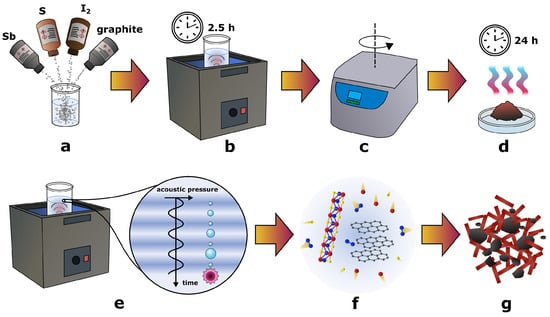
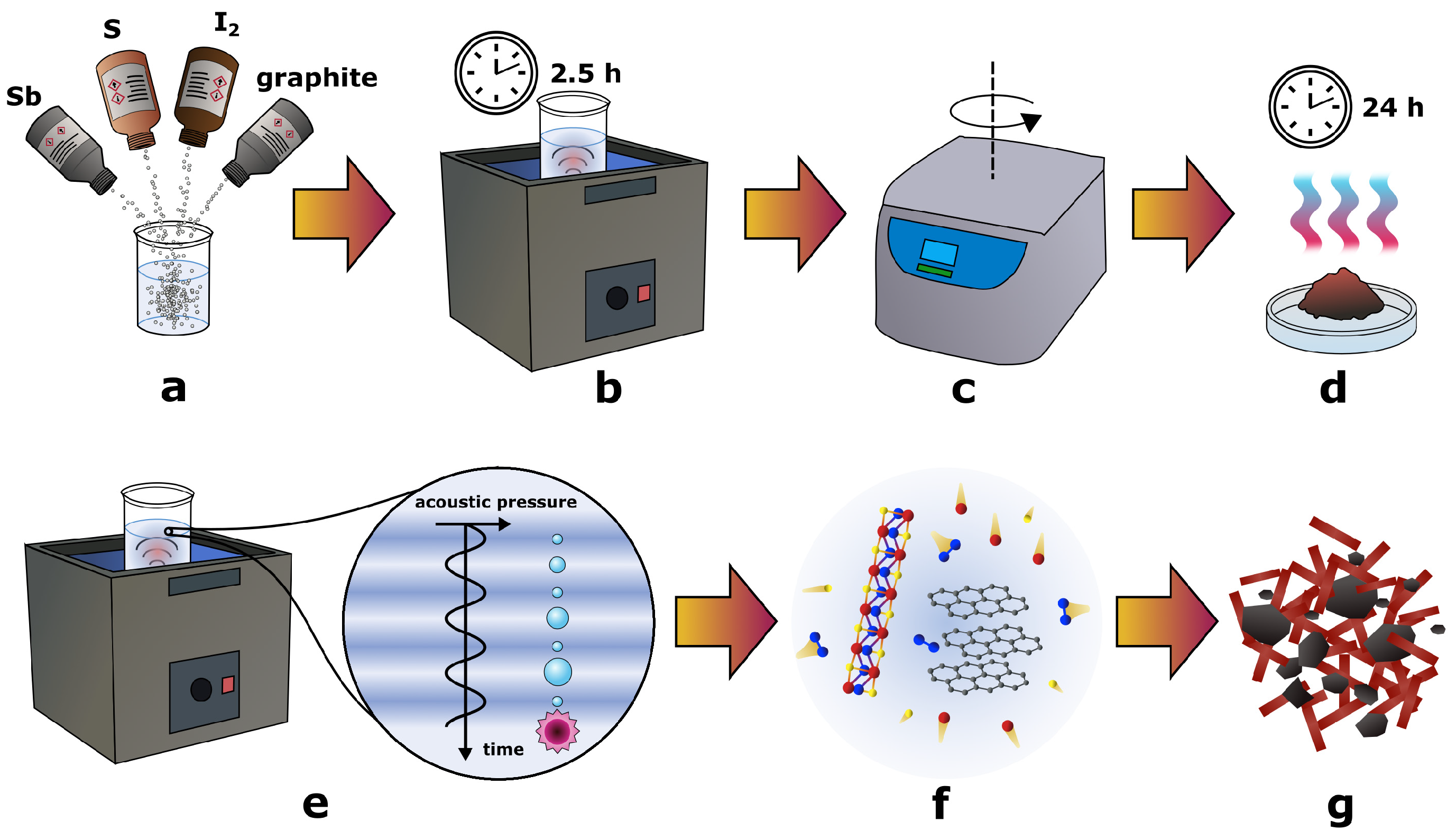
The material was synthesized using a sonochemical method similar to the one described in ref. [47]. The synthesis process was carried out in a 20 mL closed polypropylene/polyethylene vessel. Antimony (Sigma–Aldrich, St. Louis, MO, USA), sulfur (Avantor Performance Materials Poland S.A., Gliwice, Poland), and iodine (Avantor Performance Materials Poland S.A., Gliwice, Poland) were put into the vessel in stoichiometric amounts (Figure 1a). Five different amounts of graphite were weighed and added to the separate vessels to fabricate composites with different graphite (B&K, Bytom, Poland, technical purity, 60 μm) content (0, 4.8, 11.1, 20, and 33.3 wt.%). Then, the cylinders were immersed in an ultrasonic cleaner 509 (Ultron, Dywity, Poland) for 2.5 h (Figure 1b). When the synthesis was completed, the materials were washed six times with deionized water and four times with pure ethanol to remove the remaining residuals. After each washing process, the composites were separated from the ethanol by centrifuging at 3000 rpm (Figure 1c). Finally, the prepared materials were dried for 24 h at 323 K (Figure 1d).
Figure 1.
Key steps for the sonochemical preparation of SbSI/graphite nanocomposite: (a) inserting stoichiometric amounts of reagents into the vessel, (b) synthesis under ultrasonic treatment, (c) washing and centrifugation, and (d) drying of material. A diagram showing a mechanism of material synthesis: (e) cavitation phenomenon, (f) growth of 1D SbSI nanostructures and their collisions with graphite particles, driven by ultrasound, leading to (g) formation of the final product.
The acoustic pressure inside the liquid, subjected to the action of ultrasounds, changes periodically with time (Figure 1e). It leads to an acoustic cavitation effect [48,49], which involves the nucleation of gas bubbles in the irradiated liquid, their growth, and collapse when their radii achieve critical values. The extraordinary conditions (large pressure and temperature) are generated locally during the bubble implosion [50,51]. It favors the creation of radicals in the solvent, which promote chemical reactions [52]. Three sites for various chemical reactions are available in sonochemical synthesis, i.e., bubble interior, the interface region at around the bubble surface, and the liquid volume outside the interface region [48]. Therefore, a sonochemical method is a versatile approach that allows us to prepare low-dimensional nanomaterials [49,53]. SbSI exhibits a tendency to grow into the double one-dimensional [54,55,56] chains connected with others with weak van der Waals forces (Figure 1f). The action of ultrasonic waves may lead to the fragmentation and exfoliation [57] of graphite flakes. Moreover, the ultrasounds are expected to drive particle collisions (Figure 1f), affecting the formation of carbon-SbSI heterostructures. This results in the formation of a mixed-dimensional composite consisting of 1D nanowires and 2D carbon sheets (Figure 1g). The possibility of the creation of such carbon-based nanohybrids using an ultrasonication-assisted method was also demonstrated in the case of another chalcohalide compound, i.e., BiOBr [42].
2.2. Characterization of SbSI/Graphite Nanocomposite Morphology, Chemical Composition, and Optical Properties
The morphology and chemical composition of the prepared material were examined using a Phenom Pro X (Thermo Fisher Scientific, Waltham, MA, USA) SEM microscope equipped with an EDS detector. The SEM microscope was operated at an acceleration voltage of 5, 10, or 15 kV. The EDS spectrum was quantified using ProSuite Element Identification software (Thermo Fisher Scientific).
The DRS spectrum of the nanocomposite was recorded at room temperature using a PC-2000 spectrophotometer (Ocean Optics Inc., Duiven, The Netherlands) connected to the ISP-REF integrating sphere (Ocean Optics Inc.). A small amount of materials was suspended in isopropanol using ultrasonic mixing for 15 min. The measurements were made on 10 mL of suspension.
2.3. Examination of SbSI/Graphite Nanocomposite Electrical and Thermoelectric Properties
The prepared powders of nanocomposites were pressed into bulk pellets at room temperature using the 4469 testing machine (Instron, Norwood, MA, USA). The nanocomposite mass of 0.2 g was evenly inserted into a metal cylinder mold with an inner diameter of 1 cm. Then, a force of 30 kN was applied to the mold and held for 2 min. A density of 2.23 g/cm3 of compressed SbSI/graphite nanocomposite was calculated using information on sample thickness, diameter, and mass loaded into the mold. In order to prepare electrodes required for electrical measurements, the top and bottom sides of the samples were covered with 0.4 mm-thick electric paint (Bare Conductive, London, UK).
The pellets of SbSI/graphite nanocomposite were placed inside the SH-242 (Espec, Osaka, Japan) environmental chamber to investigate their electrical properties. The measurements were carried out at a relative humidity (RH) of 50% and within the temperature range from 283 K to 343 K. The 6517B bench multimeter (Keithley, Solon, OH, USA) was connected to the sample. The automatic measurement acquisition was undertaken using LabView software. Current-voltage (I-U) characteristics were registered in the voltage range from –0.2 V to 0.2 V at temperatures of 283 K and 293 K. Resistance-temperature measurements were conducted at a DC voltage of 0.2 V in the temperature range from 283 K to 343 K with a temperature change rate of 0.3 K/min.
The thermoelectric properties of SbSI/graphite nanocomposites were examined using a self-built experimental setup. It consisted of two thermostats: Haake AC200 (Thermo Fisher Scientific) and Haake DC30 (Thermo Fisher Scientific). The thermoelectric voltage was measured using a precise 2182 A nanovoltmeter (Keithley). The temperatures at the hot and cold sides of the sample were measured using Pt100 sensors connected to the 2410-C source meter (Keithley) and 196 multimeter (Keithley). The time dependence of the hot side temperature was controlled via a program written in the Python 3.10 programming language. The measurement data were collected using the LabView program.
3. Results and Discussion
3.1. SEM, EDS, and DRS Investigations
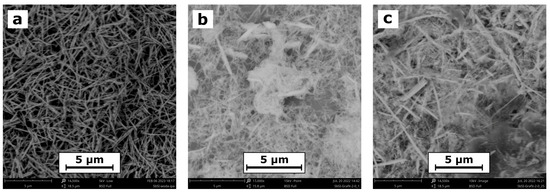
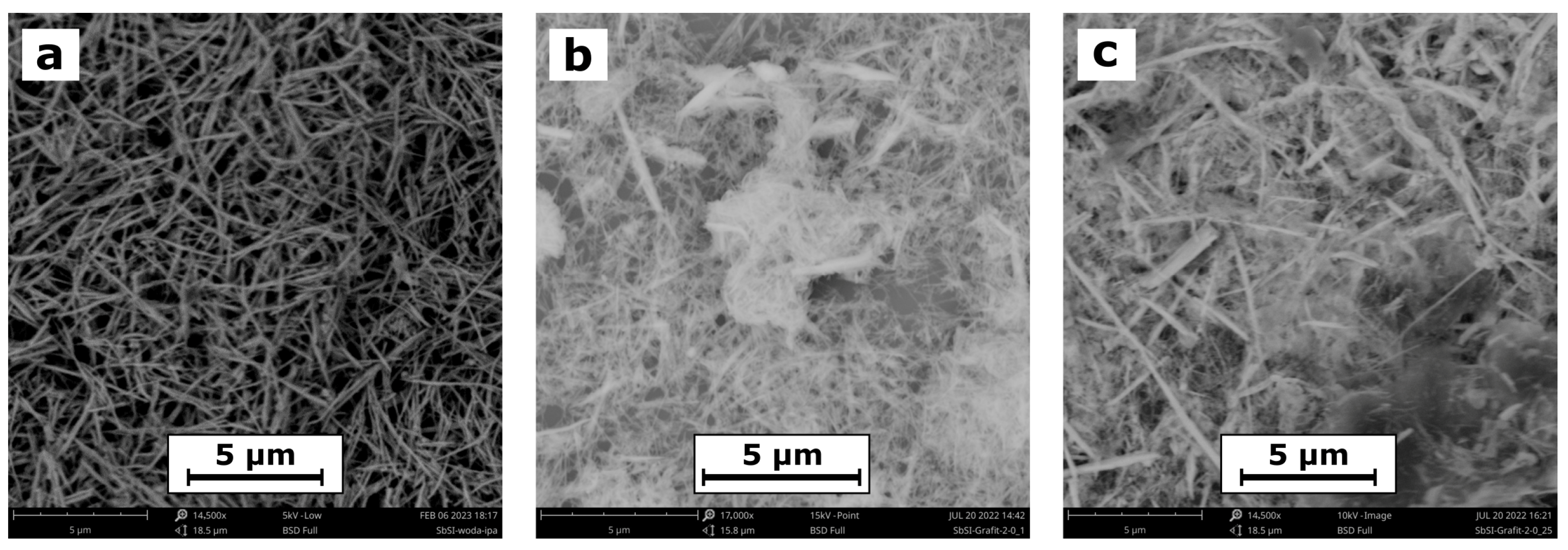
The SEM studies revealed that crystalline nanowires of SbSI (Figure 2a) and the SbSI/graphite (Figure 2b,c) nanocomposite were obtained as the products of sonochemical synthesis without and in the presence of graphite, respectively. The SbSI nanowires grown in a graphite vicinity showed an increased tendency toward agglomeration, as presented in Figure 2b,c. The SbSI nanowires seem to adhere to the surfaces of larger graphite flakes, suggesting a good connection between these two phases.
Figure 2.
SEM images of prepared materials: (a) pristine SbSI nanowires and SbSI/graphite nanocomposite with graphite weight concentrations of (b) 4.8% and (c) 20%.
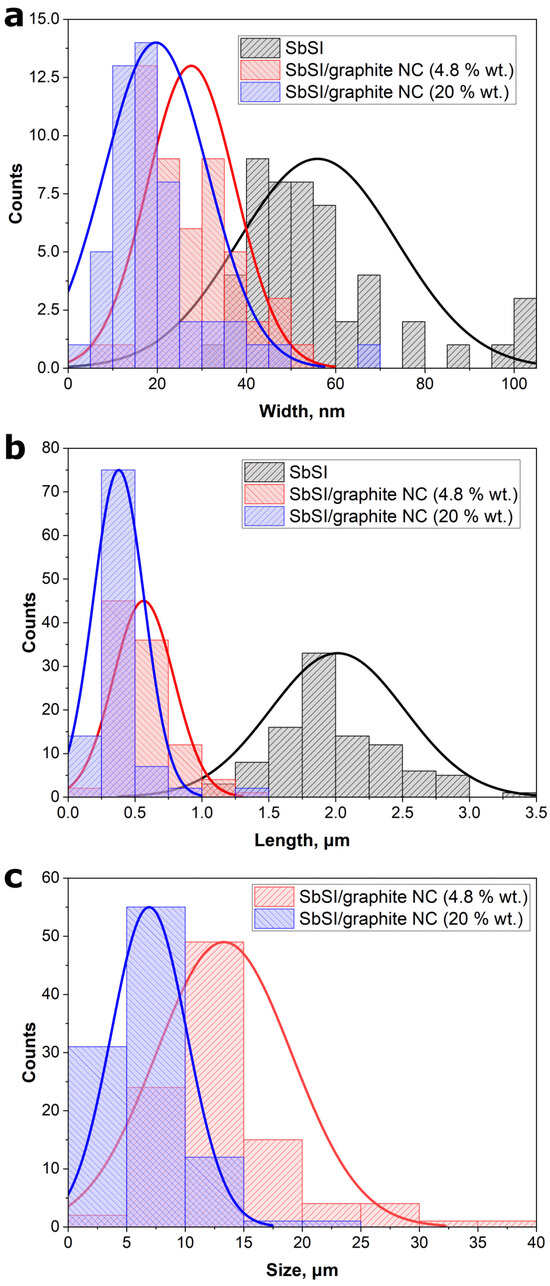
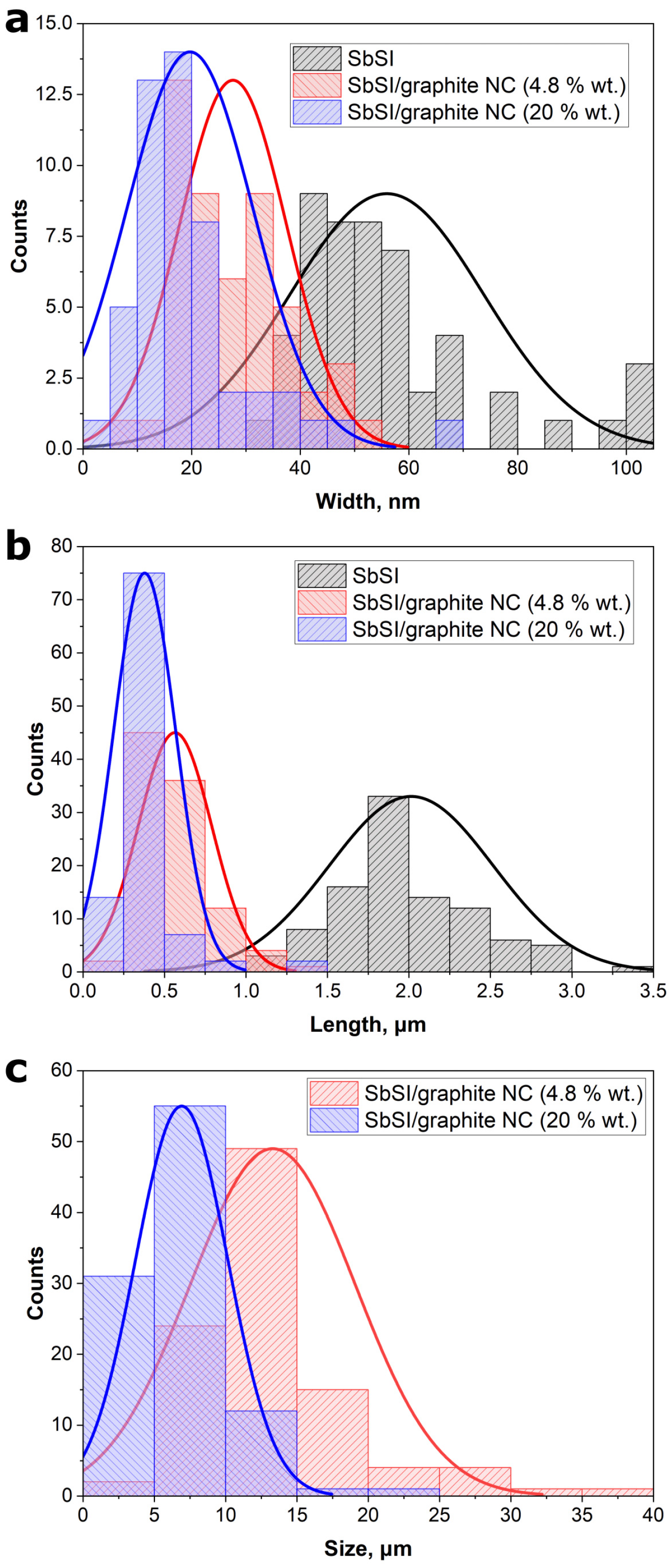
The sizes of the SbSI nanowires and graphite flakes were examined in detail. The distribution histograms and average values of the particle sizes are presented in Figure 3 and Table 1, respectively. A determined mean width of the pristine SbSI nanowires (56 nm) is equal within measurement uncertainty (18 nm) to the average diameter of 69 nm reported in ref. [8]. A remarkable decrease in the SbSI nanowires widths and lengths was observed with an increase in graphite concentration in the SbSI/graphite nanocomposite. Therefore, the presence of graphite can be recognized as a key factor responsible for the inhibition of SbSI nanowires growth.
Figure 3.
A distribution of particles sizes of pristine SbSI and SbSI/graphite nanocomposite: (a) widths, (b) lengths of SbSI nanowires, and (c) graphite dimensions.
Table 1.
Average sizes of the particles in the examined materials 1. The values in the brackets represent two significant digits of standard deviations of particle size measurements.
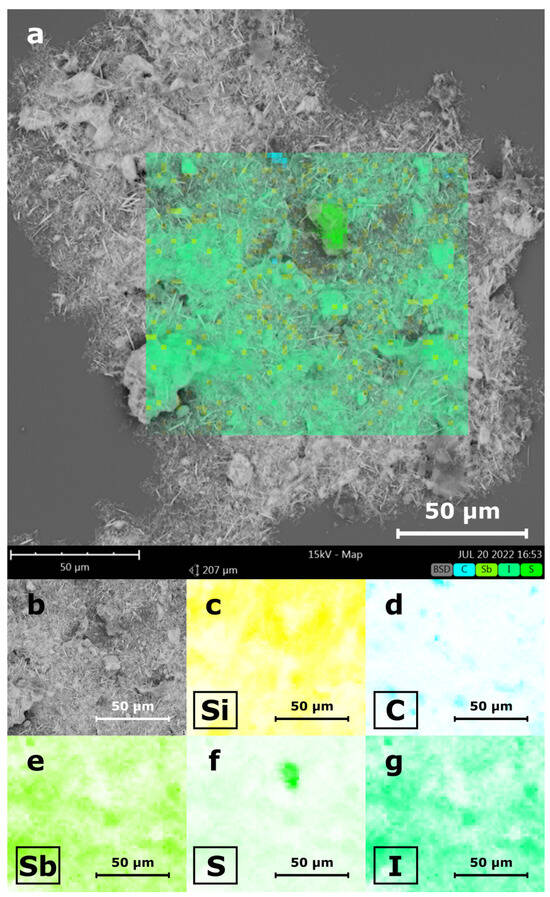
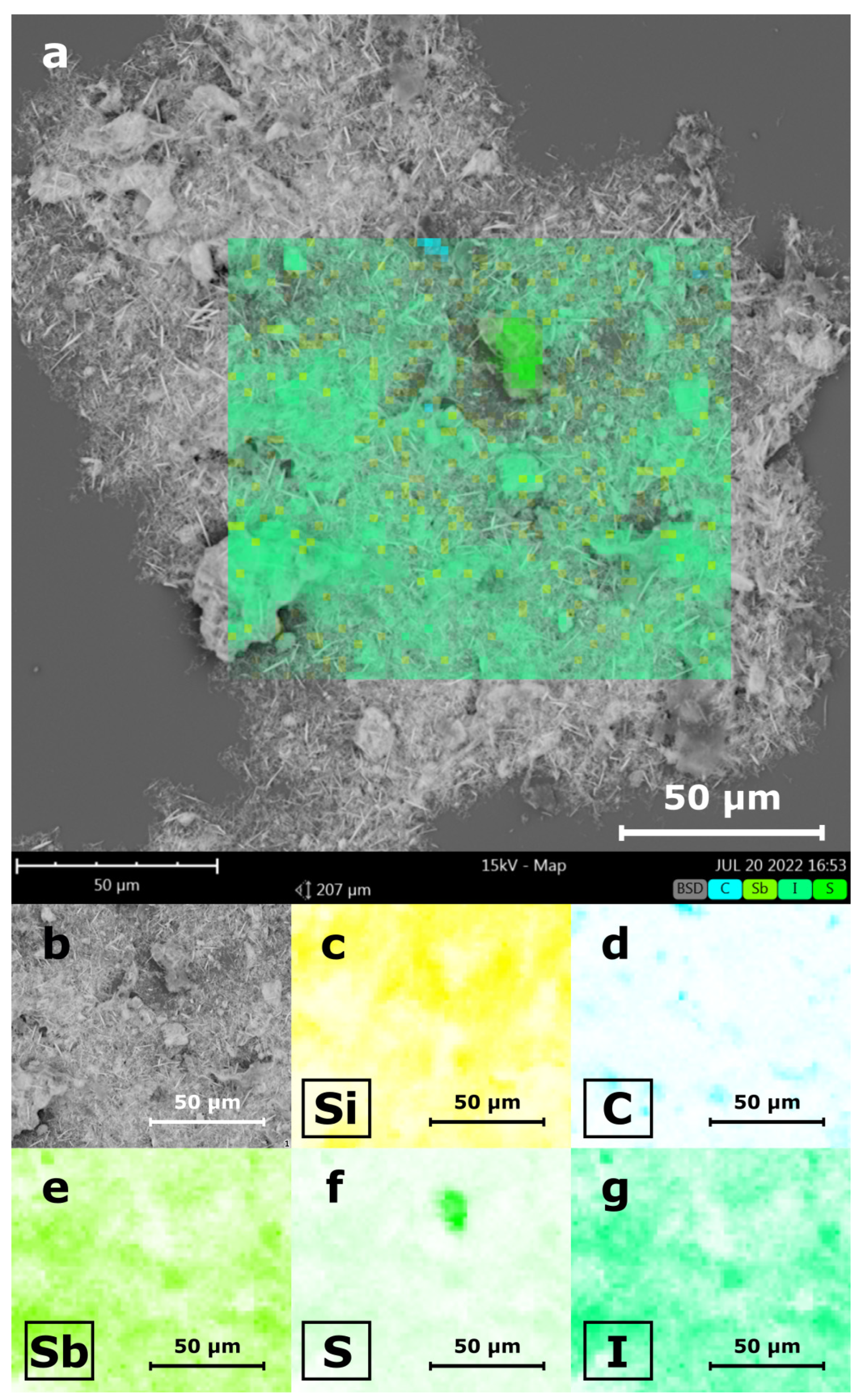
Figure 4 shows the exemplary result of the EDS analysis performed for the SbSI/graphite nanocomposite containing 11.1 wt.% graphite. An almost uniform distribution of detected elements was obtained. A significant contribution to the EDS signal originated from silicon, since the examined SbSI/graphite nanocomposite was deposited on a Si wafer. No other chemical elements than Si, C, Sb, S, and I were identified. It confirmed the high purity of the prepared material. The exact concentrations of all the detected chemical elements are provided in Table 2. A slight deviation of graphite weight concentration (8.5%) from this expected (11.1%) probably resulted from the fact that the graphite flakes could not be evenly distributed on the small surface sample. Thus, a higher area of the sample was needed to obtain a more accurate average value of graphite concentration. The atomic ratio of 38.9:26.5:34.6 was determined for antimony, sulfur, and iodine when carbon contribution to the SbSI/graphite nanocomposite was neglected. This result is close to the expected theoretical atomic composition of SbSI and confirms the formation of this compound. The excess amount of antimony, revealed by the EDS analysis, is a typical feature of SbSI prepared using different methods, including physical vapor deposition [58], hydrothermal growth [59], and sonochemical synthesis [8]. Average atomic and weight concentrations of chemical elements for all the investigated materials are given in Tables S1–S5 in the Supplementary Materials. The comparison of nominal and experimentally determined weight concentrations of graphite, antimony, sulfur, and iodine in SbSI/graphite nanocomposite is presented in Tables S6–S9, respectively. The maximum and average graphite concentration errors attained the small values of 2.3% and 1.1%, respectively.
Figure 4.
Combined elemental maps of (a) SbSI/graphite nanocomposite (11.1 wt.% graphite) deposited on Si substrate, (b) corresponding SEM image of selected sample area, and distributions of (c) silicon, (d) carbon, (e) antimony, (f) sulfur, and (g) iodine. The chemical composition of the examined material is provided in Table 2.
Table 2.
Atomic (at.) and weight (wt.) concentrations of the chemical elements of the sample, which are presented in Figure 2 (SbSI/graphite nanocomposite deposited on Si wafer).
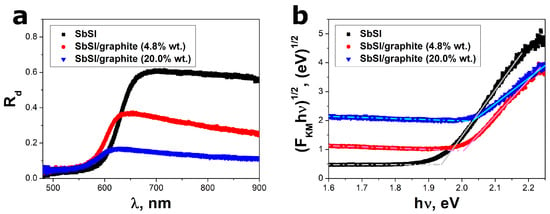
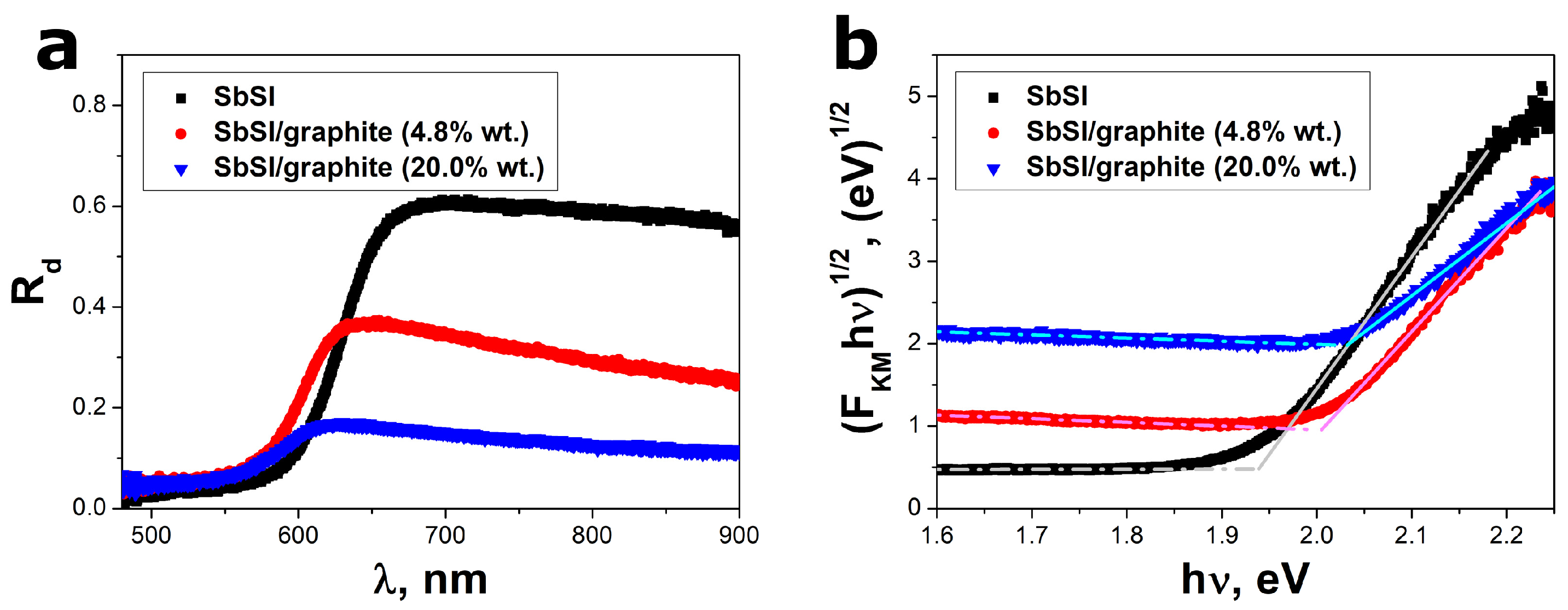
The diffuse reflectance spectra of pristine SbSI nanowires and SbSI/graphite nanocomposite are presented in Figure 5a. The Kubelka–Munk function (Figure 5b) was calculated using the following formula [60]:
where Rd is a dimensionless diffuse reflectance coefficient in the range from 0 to 1. The Kubelka–Munk function is proportional to the absorption coefficient (α). The Tauc formula [61,62] is used to determine the energy band gaps (Eg) for all the prepared materials, which is given as follows:
where h denotes the Planck constant expressed in units of J∙s, υ is the frequency of the electromagnetic wave given in Hz units, hν is an incident photon energy expressed in eV, and A and n are dimensionless constants. SbSI is a semiconductor with an indirect energy band gap [54,63,64]. Thus, the n coefficient was set at 2. It was observed that all the studied materials exhibited considerable light absorption for photon energies lower than the energy corresponding to the absorption edge (Figure 5b). This is probably due to the existence of intraband gap states, which were introduced by a modification of the SbSI surface with graphite flakes. In such a case, a simple application of the Tauc formula (Equation (2)) may result in an improper determination of an energy band gap. Therefore, a special strategy, known as the “baseline approach” [65], was used to calculate a more accurate value of Eg. According to this method, the energy band gap is determined by finding an intersection of the absorption edge and the baseline in the sub-band gap region of the Tauc plot. The calculated Eg values are given in Table 3. They are slightly higher than the energy band gaps usually reported for nanowires [64] or nanorods [66] of SbSI. Furthermore, a slight shift of Eg toward higher energies was observed with an increase in graphite concentration. This can be explained by electron confinement at the nanoscale, known as a quantum size effect [67]. A rise in graphite concentration for the SbSI/graphite nanocomposite led to an evident drop in the widths and lengths of the SbSI nanowires, as shown in Figure 3 and Table 1. This corresponded to an increase in the energy band gap, which is in agreement with the quantum size effect theory.
Figure 5.
(a) Diffuse reflectance spectra and (b) corresponding Tauc plots measured for pristine SbSI nanowires and SbSI/graphite nanocomposite. The determined energy band gap values of the examined materials are provided in Table 3. The solid lines in (b) represent the best fit dependence described by Equation (2). The baselines in the sub-band gap region of the Tauc plot are represented by dashed lines. A detailed description is provided in the text.
Table 3.
Literature data on the energy band gaps of the SbSI-based nanomaterials compared with Eg values determined for pristine SbSI nanowires and SbSI/graphite nanocomposite 1. The uncertainties of energy band gaps are given in round brackets. These values were calculated using Equation (S2) presented in the Supplementary Materials.
3.2. Electrical and Thermoelectric Examination
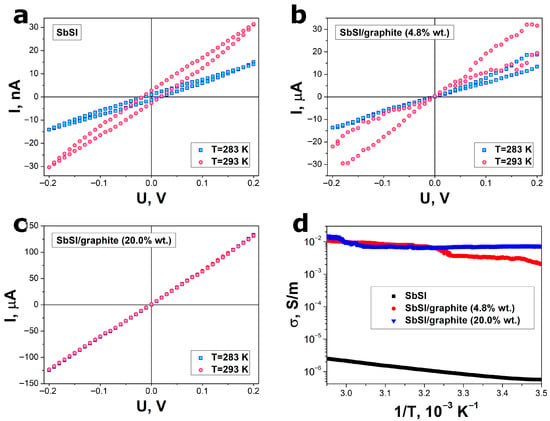
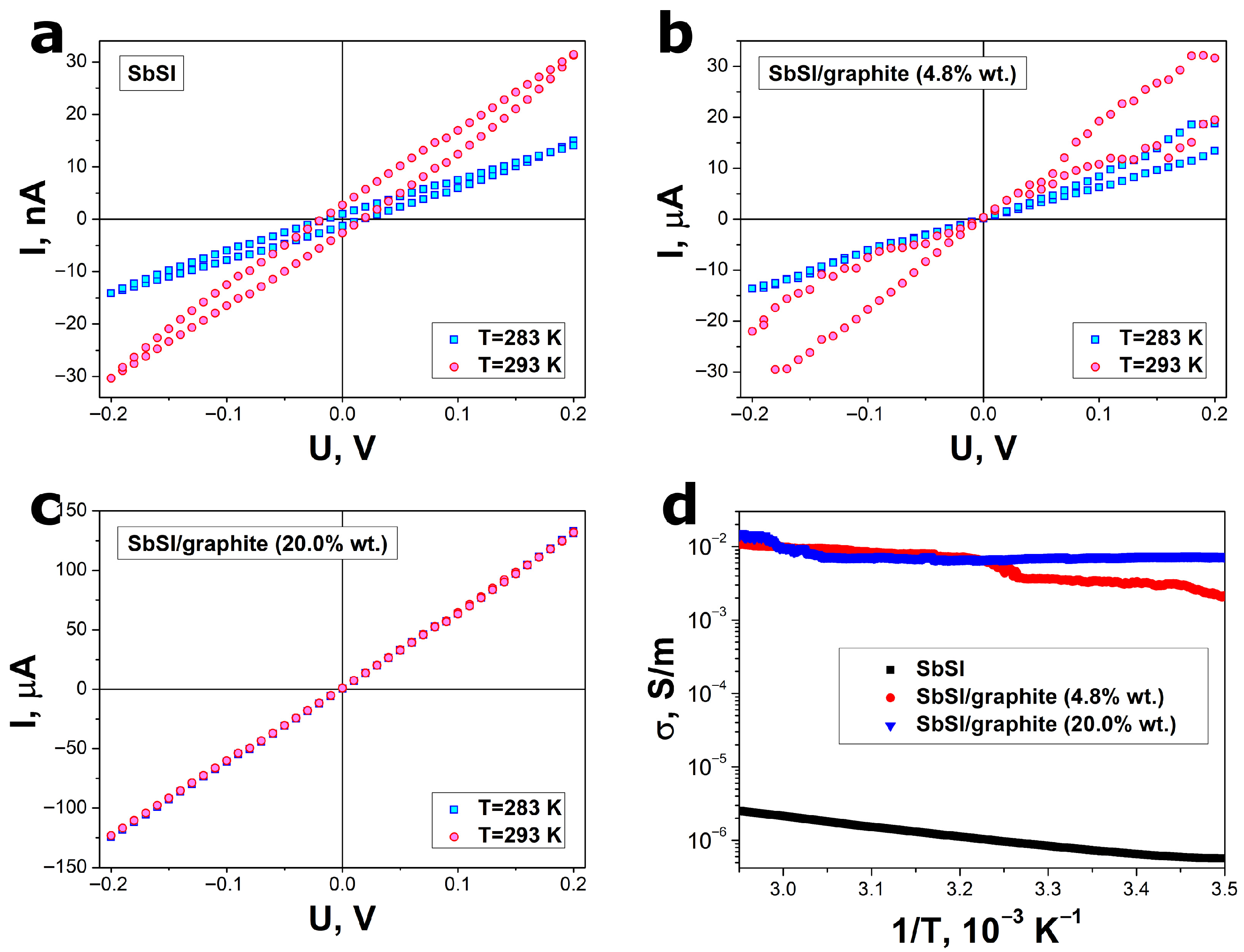
Figure 6a–c present the current-voltage (I-U) dependence of the prepared materials cold-pressed into the bulk samples. Hysteresis was observed in the I-U characteristics of bare SbSI nanowires (Figure 6a) and SbSI/graphite nanocomposite with a small concentration of graphite (Figure 6b). It suggests the existence of polarization effects in these materials, probably originating from the ferroelectric properties of SbSI [13,69]. The measurements were performed at a ferroelectric phase, i.e., below a phase transition temperature of SbSI, which was determined by different researchers as 294 K [70], 295 K [13], or 300 K [69]. Hysteresis vanished when the graphite concentration in the nanocomposite reached 20% (Figure 6c). A vast increase in the electric current by over three orders of magnitude was noted for the SbSI/graphite nanocomposite (Figure 6b,c) in comparison to pristine SbSI nanowires (Figure 6a). This clearly proves that the graphite sheets were responsible for the improvement of the electrical transport. The geometrical dimensions of the samples were used to calculate electrical conductivity, as follows:
where R is the electrical resistance of a sample [Ω], d is the sample thickness [cm], and A is the area of the electrodes [cm2]. Arrhenius plots of electrical conductance (Figure 6d) confirmed the typical semiconductor behavior of pristine SbSI nanowires and SbSI/graphite nanocomposite with small graphite concentration (4.8 wt.%). The increase in temperature led to a logarithmic rise in σ due to the mechanism of thermal generation of carriers in a semiconductor. This effect was not so evident in the case of SbSI/graphite nanocomposite containing a high amount of graphite (20 wt.%).
Figure 6.
Current-voltage characteristics of (a) pristine SbSI nanowires and SbSI/graphite nanocomposite with graphite weight concentrations of (b) 4.8% and (c) 20%, measured at the two temperatures of 283 K and 293 K. (d) Arrhenius plot of electrical conductance for the investigated materials.
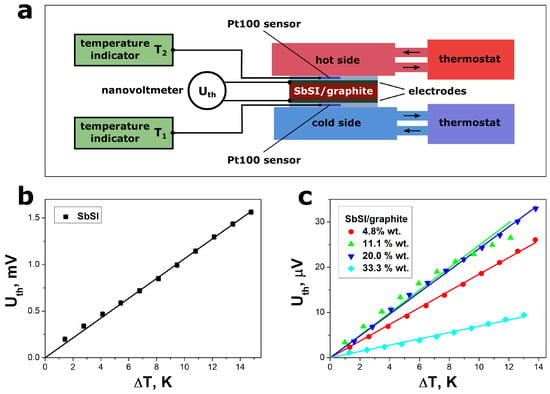
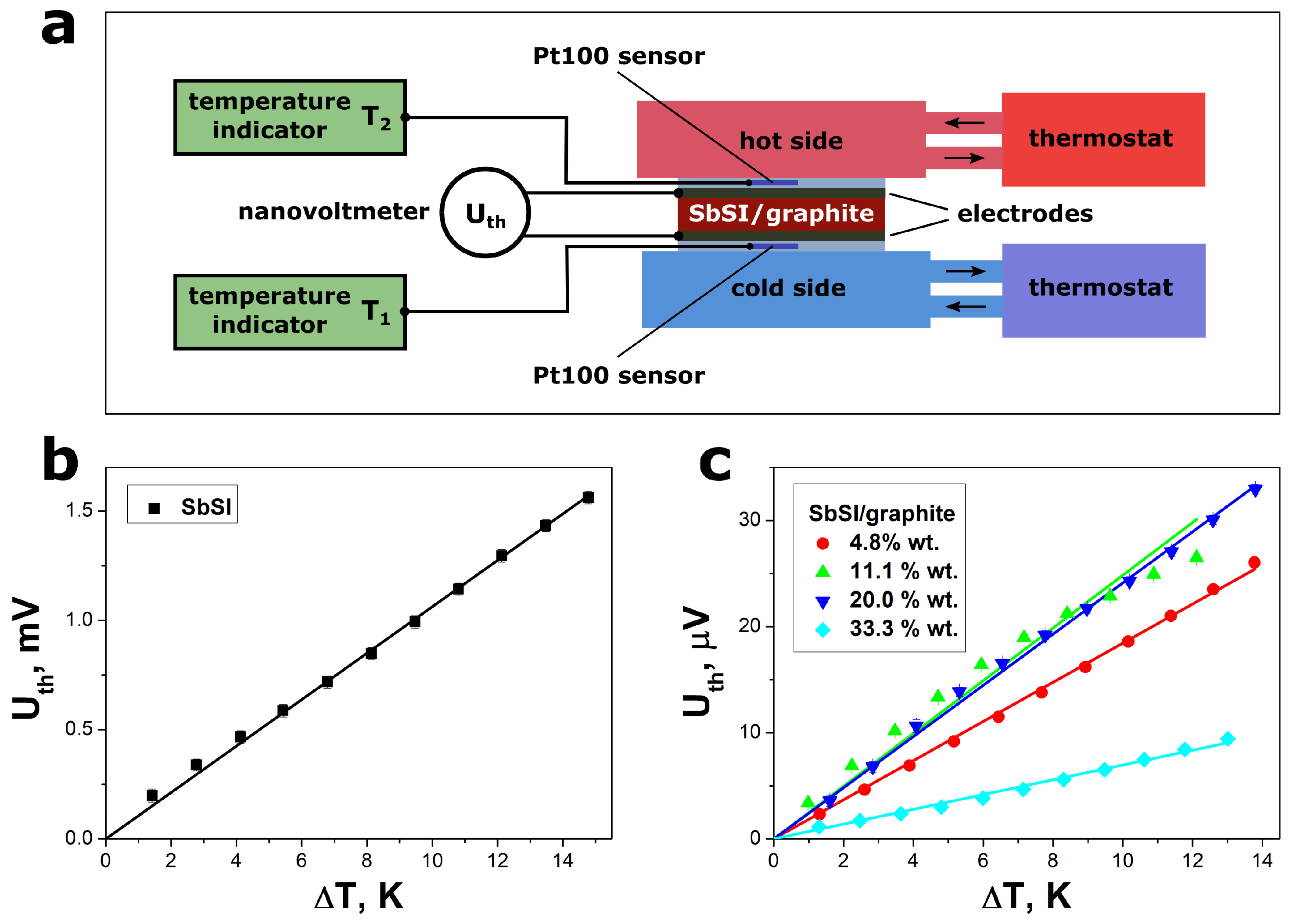
Figure 7a presents an experimental setup used to measure the Seebeck coefficient (S) of the examined materials in the steady-state condition. The sample was mounted between two heating and cooling parts, combined with two thermostats with high thermal capacity. One side of the sample was maintained at room temperature (T1), whereas the second one was heated up to T2 temperature. The spatial temperature gradient led to the generation of an open-circuit thermoelectric voltage (Uth) between the two sides of the investigated sample. In order to avoid an undesirable interference between temperature and thermoelectric voltage monitoring, the measurements were performed using two independent circuits.
Figure 7.
(a) A schematic representation of the experimental setup used for the determination of the Seebeck coefficients of the examined materials. The open-circuit thermoelectric voltage as a function of temperature difference measured for (b) pristine SbSI nanowires and (c) SbSI/graphite nanocomposite with various graphite weight concentrations.
A large difference in the magnitude of open-circuit thermoelectric voltage was observed between samples of pristine SbSI nanowires (Figure 7b) and SbSI/graphite nanocomposite (Figure 7c). The Seebeck coefficient (also called the thermopower) can be calculated using a well-known relation [71,72,73], i.e.,
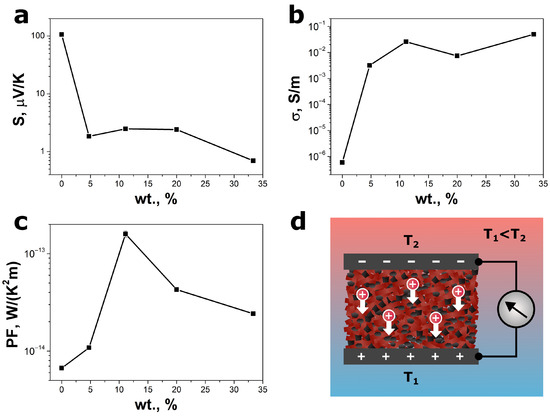
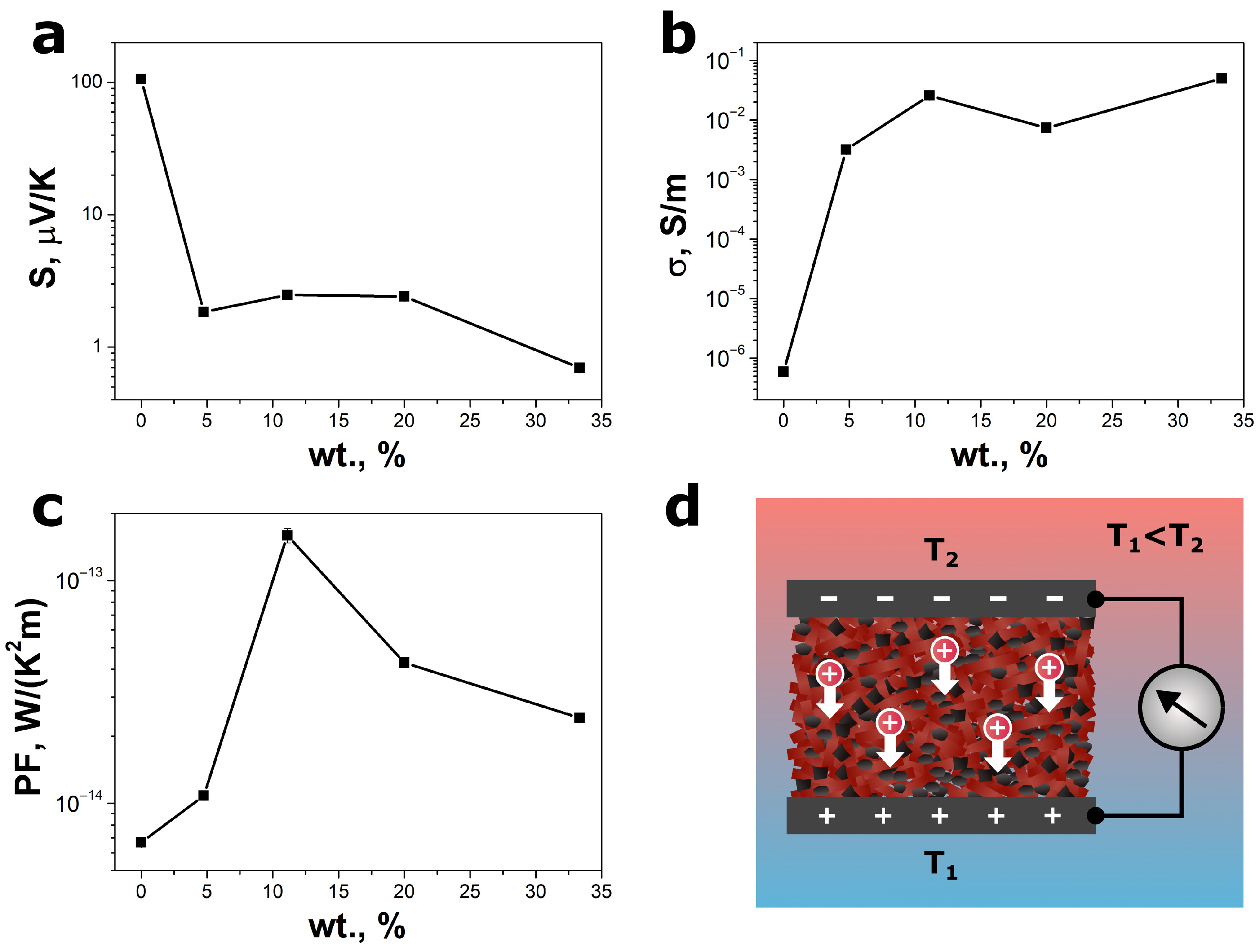
where Uth is the thermoelectric voltage (also known as a thermoelectromotive force) [µV] and ∆T is the temperature difference [K]. It is commonly agreed [71,74,75] that the Seebeck coefficient can be negative or positive for n-type and p-type semiconductors, respectively. The Seebeck coefficients of examined materials (Figure 8a) were determined as slopes of linear dependences that best fit the experimental data, as presented in Figure 7b,c. A high-valued thermopower of 106.2(8) µV/K was obtained for pristine SbSI nanowires. However, this value is lower than a large Seebeck coefficient of 8 mV/K measured by Rao and Mansingh for the SbSI film at a temperature of 320 K [21]. The presence of graphite in the SbSI/graphite nanocomposite led to a reduction in the Seebeck coefficient by over one order of magnitude (Figure 8a). A similar effect of a thermopower decrease with an increase in graphite concentration was reported for polythiophene (PTh)/graphite composite [76]. In this case, a significant drop in the Seebeck coefficient of PTh/graphite composite occurred above the graphite concentration threshold of 50%. There are discrepancies in research on the Seebeck coefficient of pure graphite published in different scientific papers. The negative values of this parameter of −8 µV/K [77], −13.6 µV/K [78], and −2.6 µV/K [79] were measured for graphite samples confirming the n-type electrical conductivity of this material. In contrast to these results, Mulla and co-workers reported a positive Seebeck coefficient of 16.1 µV/K for p-type graphite at room temperature. Piao et al. [37] fabricated the composite of expanded graphite (ExG), polyvinyl alcohol (PVA), and polyethyleneimine (PEI). They measured the Seebeck coefficients as −25.3 µV/K and 10.4 µV/K for n-type ExG/PVA/PEI composite thin film and p-type ExG foil, respectively. Culebras and co-workers [80] investigated thermoelectric properties of poly(3,4-ethylenedioxythiophene)-poly(styrenesulfonate) (PEDOT:PSS)/ExG composites with different concentrations of expanded graphite. Almost no influence of the expanded graphite content on the Seebeck coefficient was observed. This parameter was approximately equal to 15 µV/K [80]. The positive values of the Seebeck coefficients indicated a p-type conduction of PEDOT:PSS/ExG composites.
Figure 8.
Influence of the graphite weight concentration on (a) Seebeck coefficient, (b) electrical conductance, and (c) thermoelectric power factor of SbSI/graphite nanocomposite. (d) A scheme describing thermoelectric voltage generation in p-type SbSI/graphite nanocomposite subjected to the spatial temperature difference.
As presented in Figure 8b, the incorporation of graphite into the SbSI/graphite nanocomposite resulted in a vast increase in the electrical conductivity by over three orders of magnitude in comparison to the bare SbSI nanowires. This is in agreement with other papers on graphite composites [76,80,81,82], which describe the rise in electrical conductivity with graphite content increase.
The highest thermoelectric power coefficient was obtained for 11.1% graphite concentration. This corresponded to a Seebeck coefficient of 2.48(9) µV/K and electrical conductivity of 2.58(7)∙10−2 S/m. A comprehensive summary of the electrical and thermoelectric parameters of all the examined materials is provided in Table 4.
Table 4.
Influence of the graphite concentration on the Seebeck coefficient, electrical conductivity, and power factor of SbSI/graphite nanocomposites. The values in the brackets represent measurement uncertainties. Detailed information on the uncertainty calculation is provided in the Supplementary Materials.
It should be noted that the method used for sample preparation significantly affected their electrical and thermoelectric properties. A high-pressure compression of SbSI/graphite nanocomposite at room temperature allowed us to avoid the need for material heating. Therefore, it eliminated any undesired change in the chemical composition of the processed material. This technology provides a simple and convenient way to transform the xerogel of one-dimensional chalcohalide nanostructures with a low packing factor of 4.7% [47] into the denser samples. However, chalcohalide nanowires still do not constitute more than 50% of the total volume of the sample [84]. In the present study, the fill factor ranged from approximately 42% to 52% depending on the graphite weight concentration from 0% to 33.3%, respectively. Furthermore, the presence of the nano/micro voids between the separate nanowires and nanowire bundles was confirmed as a characteristic property of the samples fabricated through compression of the chalcohalide nanowires at room temperature [84]. This feature significantly limited electrical conductivity, as well as affected the thermoelectric performance by reducing the Seebeck coefficient and the power factor. Further progress in sample preparation technology by the application of pressure-assisted sintering may lead to an improvement of the connections between individual SbSI nanowires and graphite flakes. This should result in improved thermoelectric performance of the material.
The sign of the thermoelectric voltage was analyzed to determine the electrical conductivity type of the investigated materials. In the case of all the samples of SbSI/graphite nanocomposites and pristine SbSI nanowires, a negative electric potential appeared at the heated sample side, demonstrating holes as the majority charge carriers (Figure 8d). It should be underlined that this observation is in agreement with the scientific literature on SbSI. A p-type electrical conductivity of bare SbSI was confirmed in different experimental methods, such as thermoelectric examination [21,22], investigation of electrical response to adsorption of oxidizing or reducing gases [85], X-ray photoelectron spectroscopy (XPS) [86], and ultraviolet photoelectron spectroscopy (UPS) combined with UV–vis absorption spectroscopy [87].
The electrical conductivity of cold-pressed SbSI/graphite nanocomposite is relatively low in comparison to good thermoelectric materials, such as commonly used Bi2Te3. Therefore, the possible applications of it can be devoted to temperature measurement, rather than thermal energy harvesting. Since SbSI possesses excellent pyroelectric properties [14], the SbSI/graphite nanocomposite can be considered for use in novel hybrid pyroelectric/thermoelectric devices for the sensitive detection of temperature variations.
4. Conclusions
A facile and low-temperature sonochemical synthesis was developed to prepare SbSI/graphite nanocomposite with various graphite concentrations. The application of an ultrasonic method allowed us to turn highly resistive SbSI nanowires into a hybrid material with improved electrical conductivity. The thermoelectric properties of bare SbSI nanowires and SbSI/graphite nanocomposites were studied experimentally for the first time.
The SEM investigations revealed the formation of a mixed-dimensional composite consisting of 1D nanowires and 2D carbon flakes. The EDS analysis indicated high purity of the obtained materials and confirmed the growth of stoichiometric SbSI inside the SbSI/graphite nanocomposite. The indirect energy band gaps of pristine SbSI nanowires and SbSI/graphite nanocomposite were derived from the DRS examination. A slight shift in the energy band gap toward higher values was observed with an increase in graphite concentration. The temperature dependences of electrical conductivity showed that the semiconductor properties were preserved up to a 20% graphite weight concentration in SbSI/graphite nanocomposite. A vast increase in the electrical conductivity of over three orders of magnitude was observed for SbSI/graphite nanocomposite compared with pristine SbSI nanowires. This clearly proved that the graphite flakes played a key role in the improvement of electrical transport. The influence of graphite concentration on the Seebeck coefficient and thermoelectric power factor of SbSI/graphite nanocomposite was examined. The best thermoelectric performance was achieved with an 11.1% graphite concentration. A p-type electrical conductivity of pristine SbSI nanowires and SbSI/graphite nanocomposite was concluded from the results of the thermoelectric experiments.
A sonochemical synthesis, as described in this paper, is a convenient and promising way for preparing hybrid nanomaterials with desired electrical properties. It is expected that, in the near future, it will be used to fabricate mixed-dimensional nanocomposites of SbSI and a second phase other than graphite.
Supplementary Materials
The following supporting information can be downloaded at: https://www.mdpi.com/article/10.3390/en19010009/s1, Table S1. Atomic (at.) and weight (wt.) concentrations of the chemical elements averaged for SbSI nanowires deposited on Si wafer. Table S2. Atomic (at.) and weight (wt.) concentrations of the chemical elements averaged for SbSI/graphite nanocomposite (4.8 wt.% graphite) deposited on Si wafer. Table S3. Atomic (at.) and weight (wt.) concentrations of the chemical elements averaged for SbSI/graphite nanocomposite (11.1 wt.% graphite) deposited on Si wafer. Table S4. Atomic (at.) and weight (wt.) concentrations of the chemical elements averaged for SbSI/graphite nanocomposite (20 wt.% graphite) deposited on Si wafer. Table S5. Atomic (at.) and weight (wt.) concentrations of the chemical elements averaged for SbSI/graphite nanocomposite (33.3 wt.% graphite) deposited on Si wafer. Table S6. A comparison of nominal and experimentally determined weight concentrations of graph-ite in SbSI/graphite nanocomposite. Table S7. A comparison of nominal and experimentally determined weight concentrations of anti-mony in SbSI/graphite nanocomposite. Table S8. A comparison of nominal and experimentally determined weight concentrations of sulfur in SbSI/graphite nanocomposite. Table S9. A comparison of nominal and experimentally determined weight concentrations of iodine in SbSI/graphite nanocomposite.
Author Contributions
Conceptualization, B.N. and K.M.; methodology, B.N., K.M. and J.J.; software, K.M.; validation, B.N., K.M., and J.J.; investigation, B.N., K.M., and M.K.; resources, A.S.; data curation, B.N.; writing—original draft preparation, K.M.; writing—review and editing, K.M., B.N., J.J., M.K., and A.S.; visualization, B.N. and K.M.; supervision, K.M. and A.S.; project administration, K.M. and A.S.; funding acquisition, B.N., K.M., M.K., and A.S. All authors have read and agreed to the published version of the manuscript.
Funding
This paper was partially supported by Silesian University of Technology (Gliwice, Poland) through the statutory research projects for young scientists BKM-748/RM4/2024 (11/040/BKM24/0038), BKM-554/RM4/2025 (11/040/BKM25/0042), the pro-quality Rector’s grant no. 14/010/RGJ25/0018, and within the frame of the statutory research grants no. BK-208/RIF1/2025, 11/030/BK_25/1221, 11/040/BK_25/0040, EU funds FSD—10.25 Development of higher education focused on the needs of the green economy. European Funds for Silesia 2021–2027: The modern methods of the monitoring of the level and isotopic composition of atmospheric CO2 (project no. FESL.10.25-IZ.01-06C9/23-00, PM: Barbara Sensuła).
Data Availability Statement
The data is contained within the article.
Conflicts of Interest
The authors declare no competing interests.
Abbreviations
The following abbreviations are used in this manuscript:
| CNTs | carbon nanotubes |
| DRS | diffuse reflectance spectroscopy |
| EDS | energy-dispersive X-ray spectroscopy |
| NC | nanocomposite |
| NRs | nanorods |
| NWs | nanowires |
| PAN | polyacrylonitrile |
| PEDOT | poly(3,4-ethylenedioxythiophene) |
| PSS | poly(styrenesulfonate) |
| RH | relative humidity |
| SbSI | antimony sulfoiodide |
| SEM | scanning electron microscopy |
| UPS | ultraviolet photoelectron spectroscopy |
References
- Wlaźlak, E.; Blachecki, A.; Bisztyga-Szklarz, M.; Klejna, S.; Mazur, T.; Mech, K.; Pilarczyk, K.; Przyczyna, D.; Suchecki, M.; Zawal, P.; et al. Heavy pnictogen chalcohalides: The synthesis, structure and properties of these rediscovered semiconductors. Chem. Commun. 2018, 54, 12133. [Google Scholar] [CrossRef] [Scilit] [PubMed]
- Mistewicz, K. Introduction, in Low-Dimensional Chalcohalide Nanomaterials; Mistewicz, K., Ed.; Springer Nature: Cham, Switzerland, 2023; pp. 1–17. [Google Scholar]
- Koc, H.; Palaz, S.; Mamedov, A.M.; Ozbay, E. Optical, electronic, and elastic properties of some A5B6C7 ferroelectrics (A = Sb, Bi; B = S, Se; C = I, Br, Cl): First principle calculation. Ferroelectrics 2017, 511, 22. [Google Scholar]
- Bai, R.; Xiao, B.; Li, F.; Liu, X.; Xi, S.; Zhu, M.; Jie, W.; Zhang, B.B.; Xu, Y. Growth of bismuth- and antimony-based chalcohalide single crystals by the physical vapor transport method. CrystEngComm 2022, 24, 1094. [Google Scholar]
- Shen, J.; Liu, X.; Wang, C.; Wang, J.; Wu, B.; Chen, X.; Chen, X.; Yi, G.C. Sbsi microrod based flexible photodetectors. J. Phys. D Appl. Phys. 2020, 53, 345106. [Google Scholar] [CrossRef] [Scilit]
- Farooq, S.; Feeney, T.; Mendes, J.O.; Krishnamurthi, V.; Walia, S.; Della Gaspera, E.; van Embden, J. High Gain Solution-Processed Carbon-Free BiSI Chalcohalide Thin Film Photodetectors. Adv. Funct. Mater. 2021, 31, 2104788. [Google Scholar] [CrossRef] [Scilit]
- Palazon, F. Metal Chalcohalides: Next Generation Photovoltaic Materials? Sol. RRL 2022, 6, 2100829. [Google Scholar] [CrossRef] [Scilit]
- Mistewicz, K.; Matysiak, W.; Jesionek, M.; Jarka, P.; Kępińska, M.; Nowak, M.; Tański, T.; Stróż, D.; Szade, J.; Balin, K.; et al. A simple route for manufacture of photovoltaic devices based on chalcohalide nanowires. Appl. Surf. Sci. 2020, 517, 146138. [Google Scholar] [CrossRef] [Scilit]
- Gembo, R.O.; Ratshiedana, R.; Madikizela, L.M.; Kamika, I.; King’ondu, C.K.; Kuvarega, A.T.; Msagati, T.A.M. Enhancing light-driven photocatalytic reactions through solid solutions of bismuth oxyhalide/bismuth rich photocatalysts: A systematic review. Catal. Sci. Technol. 2024, 14, 6466. [Google Scholar] [CrossRef] [Scilit]
- Wang, C.-Y.; Zhang, X.; Yu, H.-Q. Bismuth oxyhalide photocatalysts for water purification: Progress and challenges. Coord. Chem. Rev. 2023, 493, 215339. [Google Scholar] [CrossRef] [Scilit]
- Ghorpade, U.V.; Suryawanshi, M.P.; Green, M.A.; Wu, T.; Hao, X.; Ryan, K.M. Emerging Chalcohalide Materials for Energy Applications. Chem. Rev. 2023, 123, 327. [Google Scholar] [CrossRef] [Scilit]
- Chen, Q.; Feng, N.B.; Huang, X.H.; Yao, Y.; Jin, Y.R.; Pan, W.; Liu, D. Humidity-Sensing Properties of a BiOCl-Coated Quartz Crystal Microbalance. ACS Omega 2020, 5, 18818. [Google Scholar] [CrossRef] [Scilit]
- Fatuzzo, E.; Harbeke, G.; Merz, W.J.; Nitsche, R.; Roetschi, H.; Ruppel, W. Ferroelectricity in SbSI. Phys. Rev. 1962, 127, 2036. [Google Scholar] [CrossRef] [Scilit]
- Bhalla, A.S.; Newnham, R.E.; Cross, L.E.; Dougherty, J.P.; Smith, W.A. Pyroelectricity in SbSI. Ferroelectrics 1981, 33, 3. [Google Scholar] [CrossRef] [Scilit]
- Hamano, K.; Shinmi, T. Electrostriction, Piezoelectricity and Elasticity in Ferroelectric SbSI. J. Phys. Soc. Jpn. 1972, 33, 118. [Google Scholar] [CrossRef] [Scilit]
- Purusothaman, Y.; Alluri, N.R.; Chandrasekhar, A.; Kim, S.J. Photoactive piezoelectric energy harvester driven by antimony sulfoiodide (SbSI): A AVBVICVII class ferroelectric-semiconductor compound. Nano Energy 2018, 50, 256. [Google Scholar] [CrossRef] [Scilit]
- Liu, H.; Yang, H.; Zheng, Y. Two-dimensional Janus SbTeBr/SbSI heterostructures as multifunctional optoelectronic systems with efficient carrier separation. Phys. Chem. Chem. Phys. 2024, 26, 6228. [Google Scholar] [CrossRef] [Scilit]
- Kobayashi, T.; Nishikubo, R.; Chen, Y.; Marumoto, K.; Saeki, A. Wavelength-Recognizable SbSI:Sb2S3 Photovoltaic Devices: Elucidation of the Mechanism and Modulation of their Characteristics. Adv. Funct. Mater. 2024, 34, 2311794. [Google Scholar] [CrossRef] [Scilit]
- Wang, R.; Wang, Y.; Zhang, N.; Lin, S.; He, Y.; Yan, Y.; Hu, K.; Sun, H.; Liu, X. Synergetic piezo-photocatalytic effect in SbSI for highly efficient degradation of methyl orange. Ceram. Int. 2022, 48, 31818. [Google Scholar] [CrossRef] [Scilit]
- Song, H.; Hajra, S.; Panda, S.; Hwang, S.; Kim, N.; Jo, J.; Vittayakorn, N.; Mistewicz, K.; Joon Kim, H. Antimony Sulfoiodide-Based Energy Harvesting and Self-Powered Temperature Detection. Energy Technol. 2024, 12, 2301125. [Google Scholar] [CrossRef] [Scilit]
- Rao, T.S.; Mansingh, A. Electrical and Optical Properties of SbSI Films. Jpn. J. Appl. Phys. 1985, 24, 422. [Google Scholar] [CrossRef] [Scilit]
- Rao, T.S.; Mansingh, A. Electrical properties of antimony sulphoiodide (SbSI) thin films. Ferroelectrics 1989, 93, 53. [Google Scholar] [CrossRef] [Scilit]
- Khan, W.; Hussain, S.; Minar, J.; Azam, S. Electronic and Thermoelectric Properties of Ternary Chalcohalide Semiconductors: First Principles Study. J. Electron. Mater. 2018, 47, 1131. [Google Scholar] [CrossRef] [Scilit]
- Peng, B.; Xu, K.; Zhang, H.; Ning, Z.; Shao, H.; Ni, G.; Li, J.; Zhu, Y.; Zhu, H.; Soukoulis, C.M. 1D SbSeI, SbSI, and SbSBr With High Stability and Novel Properties for Microelectronic, Optoelectronic, and Thermoelectric Applications. Adv. Theory Simul. 2018, 1, 1700005. [Google Scholar] [CrossRef] [Scilit]
- Mohan, V.B.; Lau, K.; Hui, D.; Bhattacharyya, D. Graphene-based materials and their composites: A review on production, applications and product limitations. Compos. B Eng. 2018, 142, 200. [Google Scholar] [CrossRef] [Scilit]
- Tarhini, A.; Tehrani-Bagha, A.R. Advances in Preparation Methods and Conductivity Properties of Graphene-based Polymer Composites. Appl. Compos. Mater. 2023, 30, 1737. [Google Scholar] [CrossRef] [Scilit]
- Ji, T.; Sun, M.; Han, P. A review of the preparation and applications of graphene/semiconductor composites. Carbon 2014, 70, 319. [Google Scholar] [CrossRef] [Scilit]
- Choudhary, M.; Sharma, A.; Raj, S.A.; Sultan, M.T.H.; Hui, D.; Shah, A.U.M. Contemporary review on carbon nanotube (CNT) composites and their impact on multifarious applications. Nanotechnol. Rev. 2022, 11, 2632–2660. [Google Scholar] [CrossRef] [Scilit]
- Fenta, E.W.; Mebratie, B.A. Advancements in carbon nanotube-polymer composites: Enhancing properties and applications through advanced manufacturing techniques. Heliyon 2024, 10, e36490. [Google Scholar] [CrossRef] [Scilit]
- Wu, L.; Yang, H.; Cheng, J.; Hu, C.; Wu, Z.; Feng, Y. Review in preparation and application of nickel-coated graphite composite powder. J. Alloys Compd. 2021, 862, 158014. [Google Scholar] [CrossRef] [Scilit]
- Xiong, Y.; Xing, H.; Fan, Y.; Wei, Y.; Shang, J.; Chen, Y.; Yan, J. SiOx-based graphite composite anode and efficient binders: Practical applications in lithium-ion batteries. RSC Adv. 2021, 11, 7801. [Google Scholar] [CrossRef] [Scilit]
- Jellett, C.; Ghosh, K.; Browne, M.P.; Urbanová, V.; Pumera, M. Flexible Graphite–Poly(Lactic Acid) Composite Films as Large-Area Conductive Electrodes for Energy Applications. ACS Appl. Energy Mater. 2021, 4, 6975. [Google Scholar] [CrossRef] [Scilit]
- Wu, J.; Liu, J.; Yang, F. Three-phase composite conductive concrete for pavement deicing. Constr. Build. Mater. 2015, 75, 129. [Google Scholar] [CrossRef] [Scilit]
- Jała, J.; Nowacki, B.; Mistewicz, K.; Gradoń, P. Graphite-epoxy composite systems for Joule heating based de-icing. Cold Reg. Sci. Technol. 2023, 216, 104024. [Google Scholar] [CrossRef] [Scilit]
- Staab, L.; Kötzsch, T.; Noack, T.J.; Oeckler, O. Decomposition behavior and thermoelectric properties of copper selenide—Graphite composites. Appl. Phys. Lett. 2023, 122, 083901. [Google Scholar] [CrossRef] [Scilit]
- Lai, C.; Li, J.; Pan, C.; Wang, L.; Bai, X. Preparation and Characterization of Bi2Te3/Graphite/Polythiophene Thermoelectric Composites. J. Electron. Mater. 2016, 45, 5246. [Google Scholar] [CrossRef] [Scilit]
- Piao, M.; Kim, G.; Kennedy, G.P.; Roth, S.; Dettlaff-Weglikowska, U. Preparation and characterization of expanded graphite polymer composite films for thermoelectric applications. Phys. Status Solidi (b) 2013, 250, 2529. [Google Scholar] [CrossRef] [Scilit]
- Anjum, F.; Dixit, P.; Maiti, T. Enhanced thermoelectric performance with improved mechanical strength in Bi2S3/graphite composites. Carbon 2024, 218, 118692. [Google Scholar] [CrossRef] [Scilit]
- Hu, W.; Zhou, H.; Mu, X.; He, D.; Ji, P.; Hou, W.; Wei, P.; Zhu, W.; Nie, X.; Zhao, W. Preparation and Thermoelectric Properties of Graphite/Bi0.5Sb1.5Te3 Composites. J. Electron. Mater. 2018, 47, 3344. [Google Scholar] [CrossRef] [Scilit]
- Yoshitha, P.A.; Shankar, M.R.; Prabhu, A.N.; Nayak, R.; Rao, A.; Poojitha, G. Fabrication and characterisation of a flexible thermoelectric generator using PANI/graphite/bismuth telluride composites. RSC Adv. 2024, 14, 40117. [Google Scholar]
- Das, S.; Singha, P.; Deb, A.K.; Das, S.C.; Chatterjee, S.; Kulbachinskii, V.A.; Kytin, V.G.; Zinoviev, D.A.; Maslov, N.V.; Dhara, S.; et al. Role of graphite on the thermoelectric performance of Sb2Te3/graphite nanocomposite. J. Appl. Phys. 2019, 125, 195105. [Google Scholar] [CrossRef] [Scilit]
- Zhang, Y.; Park, M.; Kim, H.Y.; Ding, B.; Park, S.J. A facile ultrasonic-assisted fabrication of nitrogen-doped carbon dots/BiOBr up-conversion nanocomposites for visible light photocatalytic enhancements. Sci. Rep. 2017, 7, 45086. [Google Scholar] [CrossRef] [Scilit] [PubMed]
- Huang, Q.; Jiang, G.; Chen, H.; Li, L.; Liu, Y.; Tong, Z.; Chen, W. Hierarchical nanostructures of BiOBr/AgBr on electrospun carbon nanofibers with enhanced photocatalytic activity. MRS Commun. 2016, 6, 61. [Google Scholar] [CrossRef] [Scilit]
- Wu, J.; Chen, X.; Li, C.; Qi, Y.; Qi, X.; Ren, J.; Yuan, B.; Ni, B.; Zhou, R.; Zhang, J.; et al. Hydrothermal synthesis of carbon spheres—BiOI/BiOIO3 heterojunctions for photocatalytic removal of gaseous Hg0 under visible light. Chem. Eng. J. 2016, 304, 533. [Google Scholar] [CrossRef] [Scilit]
- Hou, J.; Jiang, K.; Shen, M.; Wei, R.; Wu, X.; Idrees, F.; Cao, C. Micro and nano hierachical structures of BiOI/activated carbon for efficient visible-light-photocatalytic reactions. Sci. Rep. 2017, 7, 11665. [Google Scholar] [CrossRef] [Scilit] [PubMed]
- Frutos, M.M.; Barthaburu, M.E.P.; Fornaro, L.; Aguiar, I. Bismuth chalcohalide-based nanocomposite for application in ionising radiation detectors. Nanotechnology 2020, 31, 225710. [Google Scholar] [CrossRef] [Scilit]
- Nowak, M.; Szperlich, P.; Bober; Szala, J.; Moskal, G.; Stróz, D. Sonochemical preparation of SbSI gel. Ultrason. Sonochem 2008, 15, 709. [Google Scholar] [CrossRef] [Scilit] [PubMed]
- Yasui, K. Fundamentals of acoustic cavitation and sonochemistry. In Theoretical and Experimental Sonochemistry Involving Inorganic Systems; Ashokkumar, M., Ed.; Springer: Dordrecht, The Netherlands, 2011; pp. 1–29. [Google Scholar]
- Wang, C.; Tao, R.; Wu, J.; Jiang, H.; Hu, Z.; Wang, B.; Yang, Y. Sonochemistry: Materials science and engineering applications. Coord. Chem. Rev. 2025, 526, 216373. [Google Scholar] [CrossRef] [Scilit]
- Qin, Z.; Alehossein, H. Heat transfer during cavitation bubble collapse. Appl. Therm. Eng. 2016, 105, 1067. [Google Scholar] [CrossRef] [Scilit]
- Nguyen, V.-T.; Sagar, H.J.; el Moctar, O.; Park, W.-G. Understanding cavitation bubble collapse and rebound near a solid wall. Int. J. Mech. Sci. 2024, 278, 109473. [Google Scholar] [CrossRef] [Scilit]
- Pankaj. Aqueous inorganic sonochemistry. In Theoretical and Experimental Sonochemistry Involving Inorganic Systems; Ashokkumar, M., Ed.; Springer: Dordrecht, The Netherlands, 2011; pp. 213–271. [Google Scholar]
- Okitsu, K.; Cavalieri, F. Synthesis of metal nanomaterials with chemical and physical effects of ultrasound and acoustic cavitation. In Sonochemical Production of Nanomaterials; Okitsu, K., Cavalieri, F., Eds.; Springer International Publishing: Cham, Switzerland, 2018; pp. 19–37. [Google Scholar]
- Cho, I.; Min, B.K.; Joo, S.W.; Sohn, Y. One-dimensional single crystalline antimony sulfur iodide, SbSI. Mater. Lett. 2012, 86, 132. [Google Scholar] [CrossRef] [Scilit]
- Chen, G.; Li, W.; Yu, Y.; Yang, Q. Fast and low-temperature synthesis of one-dimensional (1D) single-crystalline SbSI microrod for high performance photodetector. RSC Adv. 2015, 5, 21859. [Google Scholar] [CrossRef] [Scilit]
- Pathak, A.K.; Prasad, M.D.; Batabyal, S.K. One-dimensional SbSI crystals from Sb, S, and I mixtures in ethylene glycol for solar energy harvesting. Appl. Phys. A Mater. Sci. Process 2019, 125, 213. [Google Scholar]
- Morton, J.A.; Kaur, A.; Khavari, M.; Tyurnina, A.V.; Priyadarshi, A.; Eskin, D.G.; Mi, J.; Porfyrakis, K.; Prentice, P.; Tzanakis, I. An eco-friendly solution for liquid phase exfoliation of graphite under optimised ultrasonication conditions. Carbon 2023, 204, 434. [Google Scholar]
- Narayanan, S.; Pandey, R.K. Physical Vapor Deposition of Antimony Sulpho-Iodide (SbSI) Thin Films and Their Properties. In Proceedings of the IEEE International Symposium on Applications of Ferroelectrics, University Park, PA, USA, 7–10 August 1994; pp. 309–311. [Google Scholar]
- Wang, C.; Zhang, M.; Fang, Y.; Chen, G.; Li, Q.; Sheng, X.; Xu, X.; Hui, J.; Lan, Y.; Fang, M.; et al. SbSI Nanocrystals: An Excellent Visible Light Photocatalyst with Efficient Generation of Singlet Oxygen. ACS Sustain. Chem. Eng. 2018, 6, 12166. [Google Scholar] [CrossRef] [Scilit]
- Pei, S.-M.; Jiang, L.-T.; Liu, B.-W.; Guo, G.-C. A new salt-inclusion chalcogenide exhibiting distinctive [Cd11In9S26]3− host framework and decent nonlinear optical performances. J. Alloys Compd. 2022, 902, 163656. [Google Scholar]
- Li, S.; Xu, L.; Kong, X.; Kusunose, T.; Tsurumachi, N.; Feng, Q. Bismuth chalcogenide iodides Bi13S18I2 and BiSI: Solvothermal synthesis, photoelectric behavior, and photovoltaic performance. J. Mater. Chem. C Mater. 2020, 8, 3821. [Google Scholar] [CrossRef] [Scilit]
- Pathak, A.K.; Mohan, A.C.; Batabyal, S.K. Bismuth sulfoiodide (BiSI) for photo-chargeable charge storage device. Appl. Phys. A Mater. Sci. Process 2022, 128, 298. [Google Scholar]
- Mistewicz, K.; Nowak, M.; Stróż, D. A Ferroelectric-Photovoltaic Effect in SbSI Nanowires. Nanomaterials 2019, 9, 580. [Google Scholar] [CrossRef] [Scilit] [PubMed]
- Kwolek, P.; Pilarczyk, K.; Tokarski, T.; Mech, J.; Irzmański, J.; Szaciłowski, K. Photoelectrochemistry of n-type antimony sulfoiodide nanowires. Nanotechnology 2015, 26, 105710. [Google Scholar] [CrossRef] [Scilit] [PubMed]
- Makuła, P.; Pacia, M.; Macyk, W. How to Correctly Determine the Band Gap Energy of Modified Semiconductor Photocatalysts Based on UV–Vis Spectra. J. Phys. Chem. Lett. 2018, 9, 6814. [Google Scholar] [CrossRef] [Scilit]
- Justinabraham, R.; Sowmya, S.; Durairaj, A.; Sakthivel, T.; Wesley, R.J.; Vijaikanth, V.; Vasanthkumar, S. Synthesis and characterization of SbSI modified g-C3N4 composite for photocatalytic and energy storage applications. J. Alloys Compd. 2023, 935, 168115. [Google Scholar] [CrossRef] [Scilit]
- Inico, E.; Saetta, C.; Di Liberto, G. Impact of quantum size effects to the band gap of catalytic materials: A computational perspective*. J. Phys. Condens. Matter 2024, 36, 361501. [Google Scholar] [CrossRef] [Scilit]
- Tasviri, M.; Sajadi-Hezave, Z. SbSI nanowires and CNTs encapsulated with SbSI as photocatalysts with high visible-light driven photoactivity. Mol. Catal. 2017, 436, 174. [Google Scholar] [CrossRef] [Scilit]
- Fu, L.; Zhao, Y.; Li, D.; Dong, W.; Wang, P.; Liu, J.; Kong, D.; Jia, L.; Yang, Y.; Wang, M.; et al. Chemical vapor deposition synthesis of intrinsic van der Waals ferroelectric SbSI nanowires. Nano Res. 2024, 17, 9756. [Google Scholar] [CrossRef] [Scilit]
- Yoshida, M.; Yamanaka, K.; Hamakawa, Y. Semiconducting and dielectric properties of c-axis oriented sbsi thin film. Jpn. J. Appl. Phys. 1973, 12, 1699. [Google Scholar] [CrossRef] [Scilit]
- Prunet, G.; Pawula, F.; Fleury, G.; Cloutet, E.; Robinson, A.J.; Hadziioannou, G.; Pakdel, A. A review on conductive polymers and their hybrids for flexible and wearable thermoelectric applications. Mater. Today Phys. 2021, 18, 100402. [Google Scholar] [CrossRef] [Scilit]
- Kajima, T.; Ogawa, K.; Nagano, H.; Yamazaki, T.; Tsuruta, A.; Shin, W. Verification of high throughput simultaneous measurement for Seebeck coefficient, resistivity, and thermal diffusivity of thermoelectric materials. Measurement 2023, 223, 113746. [Google Scholar] [CrossRef] [Scilit]
- Carraro, P.A.; Maragoni, L.; Paipetis, A.S.; Quaresimin, M.; Tzounis, L.; Zappalorto, M. Prediction of the Seebeck coefficient of thermoelectric unidirectional fibre-reinforced composites. Compos. B Eng. 2021, 223, 109111. [Google Scholar] [CrossRef] [Scilit]
- Al Naim, A.F.; El-Shamy, A.G. Review on recent development on thermoelectric functions of PEDOT:PSS based systems. Mater. Sci. Semicond. Process 2022, 152, 107041. [Google Scholar] [CrossRef] [Scilit]
- Kousar, H.S.; Srivastava, D.; Karttunen, A.J.; Karppinen, M.; Tewari, G.C. p-type to n-type conductivity transition in thermoelectric CoSbS. APL Mater. 2022, 10, 091104. [Google Scholar] [CrossRef] [Scilit]
- Li, J.; Wang, L.; Jia, X.; Xiang, X.; Ho, C.-L.; Wong, W.-Y.; Li, H. Preparation and thermoelectric properties of diphenylaminobenzylidene-substituted poly(3-methylthiophene methine)/graphite composite. RSC Adv. 2014, 4, 62096. [Google Scholar] [CrossRef] [Scilit]
- Yin, J.; Zhou, J.; Li, X.; Chen, Y.; Tai, G.; Guo, W. Enhanced gas-flow-induced voltage in graphene. Appl. Phys. Lett. 2011, 99, 073103. [Google Scholar] [CrossRef] [Scilit]
- Li, X.; Yin, J.; Zhou, J.; Wang, Q.; Guo, W. Exceptional high Seebeck coefficient and gas-flow-induced voltage in multilayer graphene. Appl. Phys. Lett. 2012, 100, 183108. [Google Scholar] [CrossRef] [Scilit]
- Hoi, Y.M.; Chung, D.D.L. Flexible graphite as a compliant thermoelectric material. Carbon 2002, 40, 1134. [Google Scholar] [CrossRef] [Scilit]
- Culebras, M.; Gómez, C.M.; Cantarero, A. Thermoelectric measurements of PEDOT:PSS/expanded graphite composites. J. Mater. Sci. 2013, 48, 2855. [Google Scholar] [CrossRef] [Scilit]
- Zhao, Y.; Tang, G.-S.; Yu, Z.-Z.; Qi, J.-S. The effect of graphite oxide on the thermoelectric properties of polyaniline. Carbon 2012, 50, 3064. [Google Scholar] [CrossRef] [Scilit]
- Wang, L.; Wang, D.; Zhu, G.; Li, J.; Pan, F. Thermoelectric properties of conducting polyaniline/graphite composites. Mater. Lett. 2011, 65, 1086. [Google Scholar] [CrossRef] [Scilit]
- Singha, P.; Das, S.; Kulbachinskii, V.A.; Kytin, V.G.; Apreleva, A.S.; Voneshen, D.J.; Guidi, T.; Powell, A.V.; Chatterjee, S.; Deb, A.K.; et al. Evidence of improvement in thermoelectric parameters of n-type Bi2Te3/graphite nanocomposite. J. Appl. Phys. 2021, 129, 055108. [Google Scholar] [CrossRef] [Scilit]
- Starczewska, A.; Mistewicz, K.; Kozioł, M.; Zubko, M.; Stróż, D.; Dec, J. Interfacial Polarization Phenomena in Compressed Nanowires of SbSI. Materials 2022, 15, 1543. [Google Scholar] [CrossRef] [Scilit]
- Mistewicz, K.; Nowak, M.; Starczewska, A.; Jesionek, M.; Rzychoń, T.; Wrzalik, R.; Guiseppi-Elie, A. Determination of electrical conductivity type of SbSI nanowires. Mater. Lett. 2016, 182, 78. [Google Scholar] [CrossRef] [Scilit]
- Nowak, M.; Talik, E.; Szperlich, P.; Stróz, D. XPS analysis of sonochemically prepared SbSI ethanogel. Appl. Surf. Sci. 2009, 255, 7689. [Google Scholar] [CrossRef] [Scilit]
- Nie, R.; Yun, H.S.; Paik, M.J.; Mehta, A.; Park, B.W.; Choi, Y.C.; Seok, S.I. Efficient Solar Cells Based on Light-Harvesting Antimony Sulfoiodide. Adv. Energy Mater. 2018, 8, 1701901. [Google Scholar] [CrossRef] [Scilit]

Disclaimer/Publisher’s Note: The statements, opinions and data contained in all publications are solely those of the individual author(s) and contributor(s) and not of MDPI and/or the editor(s). MDPI and/or the editor(s) disclaim responsibility for any injury to people or property resulting from any ideas, methods, instructions or products referred to in the content. |
© 2025 by the authors. Licensee MDPI, Basel, Switzerland. This article is an open access article distributed under the terms and conditions of the Creative Commons Attribution (CC BY) license.