Article

Toward Cobalt-Free SOC Stacks: Comparative Study of (Mn,Cu,Fe)3O4 vs. (Mn,Co)2O4 Spinels as Protective Coatings for SOFC Interconnects


by
Agnieszka Żurawska
1,2,
Yevgeniy Naumovich
1,2,*,
Leszek Ajdys
1,2,
Magdalena Kosiorek
1,2,
Michał Wierzbicki
1,2,
Marek Skrzypkiewicz
1,2,
Justyna Ignaczak
3,
Sebastian Molin
3 and
Piotr Jasiński
3
1
Institute of Power Engineering—National Research Institute, Mory 8, 01-330 Warsaw, Poland
2
Center for Hydrogen Technologies (CTH2), Institute of Power Engineering, Augustowka 36, 02-981 Warsaw, Poland
3
Advanced Materials Center, Faculty of Electronics, Telecommunications and Informatics, Gdańsk University of Technology, ul. G. Narutowicza 11/12, 80-233 Gdańsk, Poland
*
Author to whom correspondence should be addressed.
Energies 2026, 19(1), 11; https://doi.org/10.3390/en19010011
Submission received: 21 November 2025 / Revised: 11 December 2025 / Accepted: 15 December 2025 / Published: 19 December 2025
(This article belongs to the Special Issue Solid Oxide Cells in the Future of Clean Energy Systems)

Abstract

The paper presents the experimental results of applying a novel protective coating made from Mn1.7Cu1.3-xFexO4, compared to commercial spinels Mn1.5Co1.5O4 and MnCo2O4, as a key component responsible for preventing chromium diffusion and slowing the increase in area-specific resistance (ASR) in solid oxide fuel cells (SOFCs). The layers of selected materials were deposited on Crofer 22APU steel by electrophoretic deposition (EPD) on small samples and by roll painting on full-scale interconnects. The coatings were evaluated by measuring the ASR of small samples for short and long runs (1000 h), as well as real-scale interconnects assembled in a SOFC stack composed of three cells, measuring 11 × 11 cm2, which operated for 1000 h at 670 °C. The collected data on the electrochemical performance of the stack allowed for estimation of the degradation rates of all the repeating units, revealing benefits from using (Mn,Cu,Fe)3O4 as a coating. The results are compared to the literature reports. Post-mortem analysis by the SEM-EDS technique allowed for investigation of Cr diffusion levels.

1. Introduction

Contemporary planar solid oxide cell design, for both fuel cells and electrolysers, is based on the use of a bipolar plate or interconnect fabricated from chromium-alloyed ferritic steel [1,2]. The chemical composition of such steels must be precisely tailored to meet specific requirements, including high conductivity and good adhesion of the oxide scale under oxidative conditions, thermal expansion (ca. 11 × 10−6 K−1), and chemical compatibility with functional ceramic parts [3]. The most popular of such steels are materials belonging to the Crofer 22 family from VDM Metals, dedicated to SOC application [4,5]; however, even stock ferritic stainless steels might be used after proper protection of the surfaces exposed to airflow [6,7,8]. During operation at elevated temperature in air, the surface undergoes oxidation with the formation of the Cr- and Mn-containing scale with relatively high conductivity and density [9,10].
There are two key problems related to the usage of steel interconnects for SOC. The first one concerns the growth of the oxide scale, which results in a rise in the ohmic losses on the electrode–interconnect interface [11]. The second issue relates to the phenomenon of the evaporation of volatile chromia compounds from CrOx-based scale [12]. These compounds can migrate to the air electrode and poison it, resulting in a reduction in its catalytic activity. The mechanism of poisoning may differ for different materials; however, the state-of-the-art air electrodes—namely lanthanum-strontium cobaltite (LSC), lanthanum-strontium cobaltite–ferrite (LSCF), and lanthanum–strontium manganite (LSM), are subjected to chromium contamination, which leads to irreversible depreciation of electrochemical activity and growth of the internal resistance of the fuel cell stack [13]. The common approach to mitigate these issues is based on the formation of a dense protective layer on the surface of steel, which is expected to block the evaporation of chromia compounds and mitigate further oxidation of the metal.
The most appropriate materials for these purposes are transient-metal spinels [14]. These materials demonstrate relatively high conductivity, can form a dense layer on the surface of steel using relatively simple manufacturing methods, and are compatible in terms of thermal expansion. (Mn,Co)3O4-based materials are commonly use and are available commercially [15,16,17]. The most common procedure for the formation of a protective layer from spinels is the reductive sintering of the oxide deposited on a metal surface [18,19]. Its deposition might be performed by various procedures, including painting, electrophoretic deposition (EPD), various types of spraying methods, or electrochemical deposition [20]. Reductive sintering allows for densification of the spinel deposit and ensures its adhesion to the surface of the steel during a relatively low-cost thermal treatment in a temperature range of 800–1000 °C. A known industrial-grade alternative to the spinel coating is PVD of the Co-Ce film, which is a patented technology from Alleima (former Sandvik, Sandviken, Sweden) [14].
As mentioned, state-of-the-art materials for protective layers are based on (Mn,Co)3O4 spinels. However, cobalt as a component becomes undesirable. It is mainly related to the constrained access to deposits of this metal. It is extracted in countries with problematic social development, which raises concerns about ecological and humanitarian issues [21]. Additionally, the supply of cobalt cannot be considered stable, while marked demands are growing due to the development of automation, electric transport, and batteries, where cobalt plays a very important, albeit decreasing, role [22]. Thereby, the mitigation of cobalt dependency will help to ensure a more sustainable production of the SOCs.
The most well-justified spinel protective coating used in stacks is MnCo1.9Fe0.1O4, designed and tested in Forschungszentrum Jülich GmbH (Jülich, Germany), which has reached 10 years of exploitation [23,24]. Stacks from the Elcogen have the Cr barrier labeled as MCO, which is expected to be MnCo2O4 spinel [25,26]. Unfortunately, it is problematic to collect comparable degradation data at the SOC stack level. Degradation processes are complicated, and their explanation cannot be reduced to one or two factors [23,27]. Observed total degradation rates in long-term tests of the Forschungszentrum Jülich stacks varied from 0.3 to 0.7%/1000 h of the voltage degradation at 700 °C for 0.5 A/cm2 current density in a 70,000 h test of the short stack. Cathodes of the cells were fabricated from La0.6Sr0.4Fe0.8Co0.2O3-δ perovskite. Post-mortem analysis revealed that, among other factors like Ni migration in the anode, Cr poisoning of the cathode and fragmentation of the GDC layer immediately adjacent to the stratum of the cathode are the key factors responsible for degradation of the stack [27,28]. ELCOGEN announced voltage degradation values of 0.3–0.5%/1000 h for 0.25 A/cm2 using partially reformed CH4 as fuel at a fuel outlet temperature of ca. 670 °C [26]. SolydEra GmbH (formerly SOLIDpower GmbH, Pergine Valsugana, Italy) claimed 0.2%/1000 h of average degradation of the BlueGEN stacks [29] at T = 725 °C, 0.16 A/cm2 current density, and using CH4 reformate as fuel. Analysis of the published SOC stack degradation data [30] reveals that typical published results for long-term tests of any type of stack include the presentation of relative voltage or ASR degradation per 1000 h. Reported voltage degradation rates were between 0 and 2%, with most typical values distributed near 0.5%/1000 h. Typical values for ASR are ca. 20 mΩ cm2/1000 h. The SOFC stack assembled with the use of the interconnects provided by Sunfire GmbH (Dresden, Germany), covered with Mn1.5Co1.5O4 by means of EPD, operated for 3000 h at 850 °C, achieved ASR values for a single repeating unit of 5–10 mΩcm2, which was considered a significant improvement [31].
There are also alternative spinel oxides, considered Co-free protective layers, like NiFe2O4 [32], CuFe2O4 [33], (Mn,Cu)3O4, [34], CuMn2O4 [35,36], Cu1.3Mn1.7O4 [37], CuMn1.8O4 [38], and Cu1.35Mn1.65O4 [39]. However, the most promising alternative to (Mn,Co)3O4 materials is solid solutions based on (Mn,Cu)3O4 stabilized by doping with a third transient metal cation, typically iron. There are also promising studies showing benefits from doping Cu1.3Mn1.7O4 with Ni [40]. The undoped (Mn,Cu)3O4 materials demonstrate high electronic conductivity; however, even for single-phase compositions, precipitation of copper oxides at elevated temperatures (>600 °C) was observed, which is undesirable for practical applications. Doping allows for stabilizing the spinel solid solutions, with some trade-offs in conductivity and possible cubic-tetragonal phase transition. In previous works, it was found that iron-substituted Mn1.7Cu1.3-xFexO4 spinel oxides can be a promising alternative solution [41,42], competitive with (Mn,Co)3O4; therefore, this research field is continued in the present study. The recent review study by Loboichenko states that protective coatings are critical for the full commercialization of SOC technology, indicating a clear need to focus not only on basic research but also on applied research [43]. While there are several comparative studies concerning new protective coatings on small flat steel samples, there are few that involve experimental work on full-scale profiled interconnects [44,45,46]. The target shape of interconnects limits the usage of some coating methods and raises additional upscaling difficulties in the overall process, including reductive sintering steps. The fabrication technique employed fundamentally determines the chemical composition and microstructural features of the coatings, such as low, closed porosity, strong adhesion to the steel substrate, and uniform thickness, which in turn govern their overall effectiveness [47,48,49,50,51].

2. Materials and Methods

The presented research covers two stages of experimental work. The first stage aimed to deposit various protective coatings on the small flat steel surfaces by the EPD method. This allowed characterization of the electric properties of the coatings and determine the area-specific resistance of the samples at different temperatures during ‘short-term test’ and ‘long-term run’ approaches, conducted at a temperature of 700 °C for up to 1000 h. The results became the basis for the second stage, in which only the selected materials were used for deposition of protective coatings on the real-scale interconnects by roll painting. These interconnects were assembled in a SOFC stack composed of 3 cells of 11 × 11 cm2 size. The stack operated for 1000 h and was subjected to electrochemical studies as well as post-mortem analysis.

2.1. Materials

The steel chosen for the study was Crofer 22APU (VDM Metals GmbH, Werdohl, Germany), which is known as the state-of-the-art material for the production of the SOFC/SOEC interconnects and thus was implemented in the construction of the stack by the Institute of Power Engineering—National Research Institute (IPE-NRI). The chemical composition of the steel given by the manufacturer was as follows: (wt%): Cr 20–24, Mn 0.3–0.8, Si 0.5 max, Cu 0.5 max, Al 0.5 max, Ti 0.03–0.2, La 0.04–0.2, C 0.03 max, P 0.05 max, S 0.02 max, balanced with iron [5]. The metal sheets of 0.2 mm thickness were taken to laser-cut the samples (coupons) in the shape of 10 mm diameter disks with two symmetrical 12 mm × 2 mm contact stripes, as well as to manufacture the real interconnects for the SOFC stack according to the proprietary design [52]. The steel substrates were degreased in high-purity acetone for 15 min, using an ultrasonic bath, before deposition of the protective layers.
In the first stage of the research, commercial spinel structure powder MnCo2O4 (Kceracell Co., Ltd., Boksu-myeon, Republic of Korea) was used as a reference material to perform the study together with the newly synthesized powders of the general formula Mn1.7Cu1.3-xFexO4, where x = 0, 0.1, and 0.3, following previous work [41,42]. In the second stage, the material with the most promising properties—Mn1.7CuFe0.3O4—was selected for application to the real interconnect of 150 × 200 mm2 manufactured by IPE-NRI and subsequent stack assembly, together with commercial reference materials—MnCo2O4 and Mn1.5Co1.5O4 (Kceracell). The latter one is used in IEN-NRI stacks by design.

2.2. Electrophoretic Deposition of the Protective Layers on Flat Steel Coupons

Deposition of the Mn1.7Cu1.3-xFexO4 and MnCo2O4 coatings was carried out in the same manner as described in previous work [42]. The suspensions were prepared with the use of a mixture of acetone and isopropanol as a solvent (4:1), and iodine was added as a surface charge enhancer (0.5 g/L). The obtained concentration of spinel powders was 10 g/L. The applied voltage for deposition was 60 V, and the deposition time was 60 s. The samples were dried in air for 2 h and sintered according to the typical two-stage procedure: firstly in dry hydrogen at 1000 °C for 10 h and secondly in air at 800 °C for 2 h. The samples made from Mn1.7Cu1.3O4, Mn1.7Cu1.2Fe0.1O4, Mn1.7CuFe0.3O4, and MnCo2O4 prepared in that way were subjected to ASR measurements. In the case of Mn1.5Co1.5O4, samples were prepared according to the procedure described in other work [53], for compatibility with the IEN-NRI methodology of stack fabrication. The procedure for the Mn1.5Co1.5O4 differed in EPD parameters (120 V, 2 min), suspension content (mixture 1:1 of terpineol and ethanol as a solvent, 0.1 g/L of iodine as a dispersant), and sintering conditions (inert atmosphere with a reduction step in 4% H2/in N2 atmosphere at 900 °C), which matches the sintering conditions for the full-scale interconnects. The acronyms used to denote various chemical compositions of the spinels can be found in Table 1.

2.3. Area-Specific Resistance Measurements

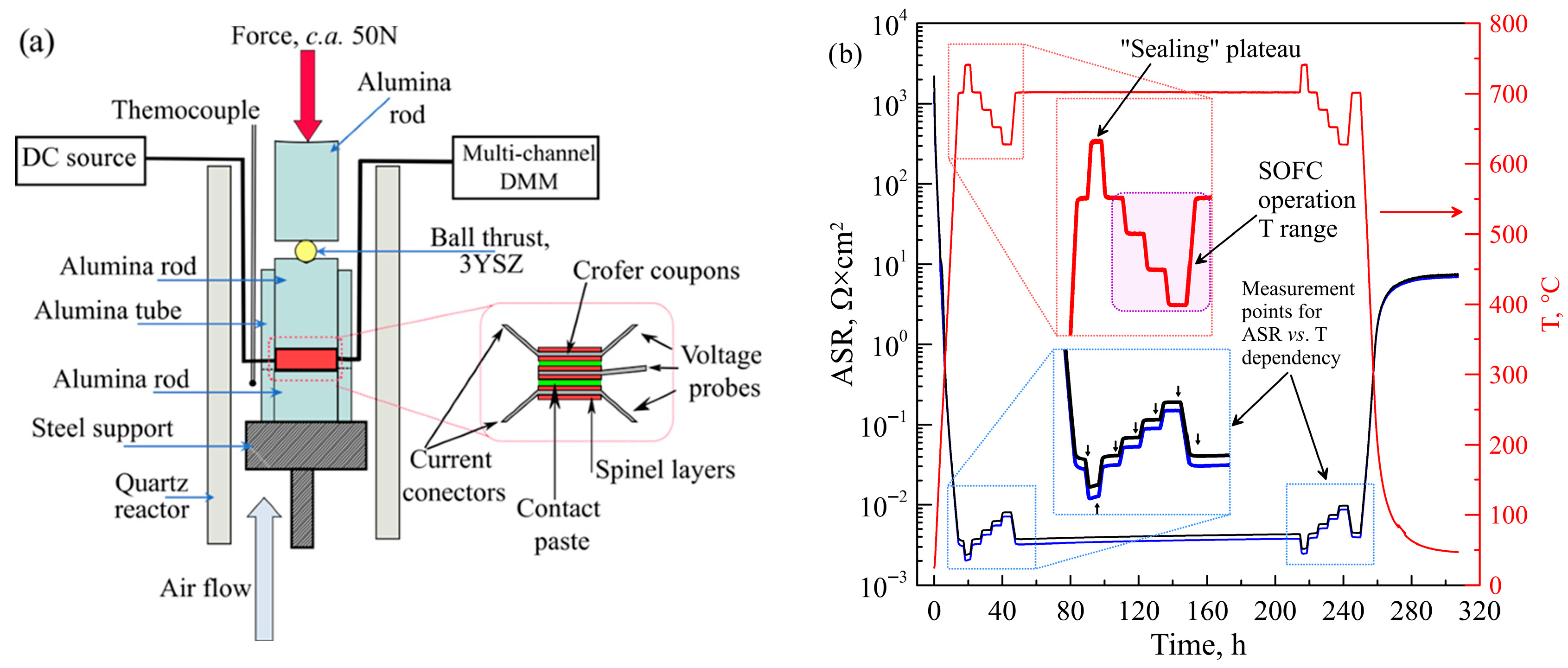
Area-specific resistance was measured according to the methodology described earlier [53]. A schematic drawing of the setup for ASR measurements is presented in Figure 1a. Three identical coupons, each covered with a spinel protective coating and an additional contact layer (40–60 µm thickness) made of LSCF ((La0.60Sr0.40)0.95Co0.20Fe0.80O3-X, Nexceris, Lewis Center, OH, USA), were inserted into a housing placed in a quartz reactor. The massive steel support (Kanthal ® APMT, Alleima) of the sample holder suppressed possible thermal gradients induced by the transient process in the furnace. A Keithley 2000 digital multimeter (Tektronix, Inc., Beaverton, OR, USA) with a multichannel extension board and ITEC IT6862A DC source (Itech Electronic Co., Ltd., New Taipei City, Taiwan) was used for the electrical measurements in automatic mode. Short-term measurements of the ASR were conducted according to the temperature profile presented in Figure 1b. The long-term measurements were organized using the same pattern; the only difference was that the last plateau at 700 °C was extended to 1000 h. The pattern includes 2 scans of the temperature in the range typical for SOC preparation and operation. These scans allow for the calculation of activation energy and the detection of the evolution of the electric properties of the steel-ceramic interface.

2.4. Deposition of the Protective Layers on the Steel Interconnects for SOFC Stack Assembly

Since the electrophoretic deposition process had not been well elaborated for full-size interconnects of 150 × 200 mm2, the roll-painting technique was used for coating the steel in the second stage of experimental work. Although this technique was not beneficial for small-scale samples due to the uneven repeatability, it had been applied and optimized for full-size interconnects at IPE-NRI, allowing satisfactory results to be obtained. The slurries were prepared using the chosen powders (MC11, MC12, MCF3), α-terpineol (96%, Sigma-Aldrich, Burlington, MA, USA) as the solvent, KD-1 (Croda Int., Snaith, UK) as the surfactant, and polyvinyl butyral (abcr GmbH, Karlsruhe, Germany ) as the binder, in a weight ratio of 10:10:0.3:1, respectively. The composition with approximately 50% wt solid loading allows a slurry of adequate viscosity to be obtained within the range of 4–5 Pa·s, exhibiting shear thinning behavior. All components of the suspension were mixed in a ball mill at 300 rpm for 2 h. The interconnects were coated with the suspension with a roller of 6 cm width made of polyurethane foam in 6 passes, then dried at 60 °C for 1 h and sintered in an inert atmosphere with a reduction step in 4% H2/in N2 atmosphere at 900 °C, following the procedure reported previously [53]. The lower sintering temperature of the interconnects, compared to the sample coupons (sintered at 1000 °C), is attributed to the technical aspects of process scaling; however, the sintering procedure for the interconnects had been adopted [15,54] and optimized earlier at IPE-NRI (as part of the internal optimization process, unpublished). The oxidation step occurred in situ during the sealing procedure of the ready SOFC stack.

2.5. SOFC Stack Assembly and Post Mortem

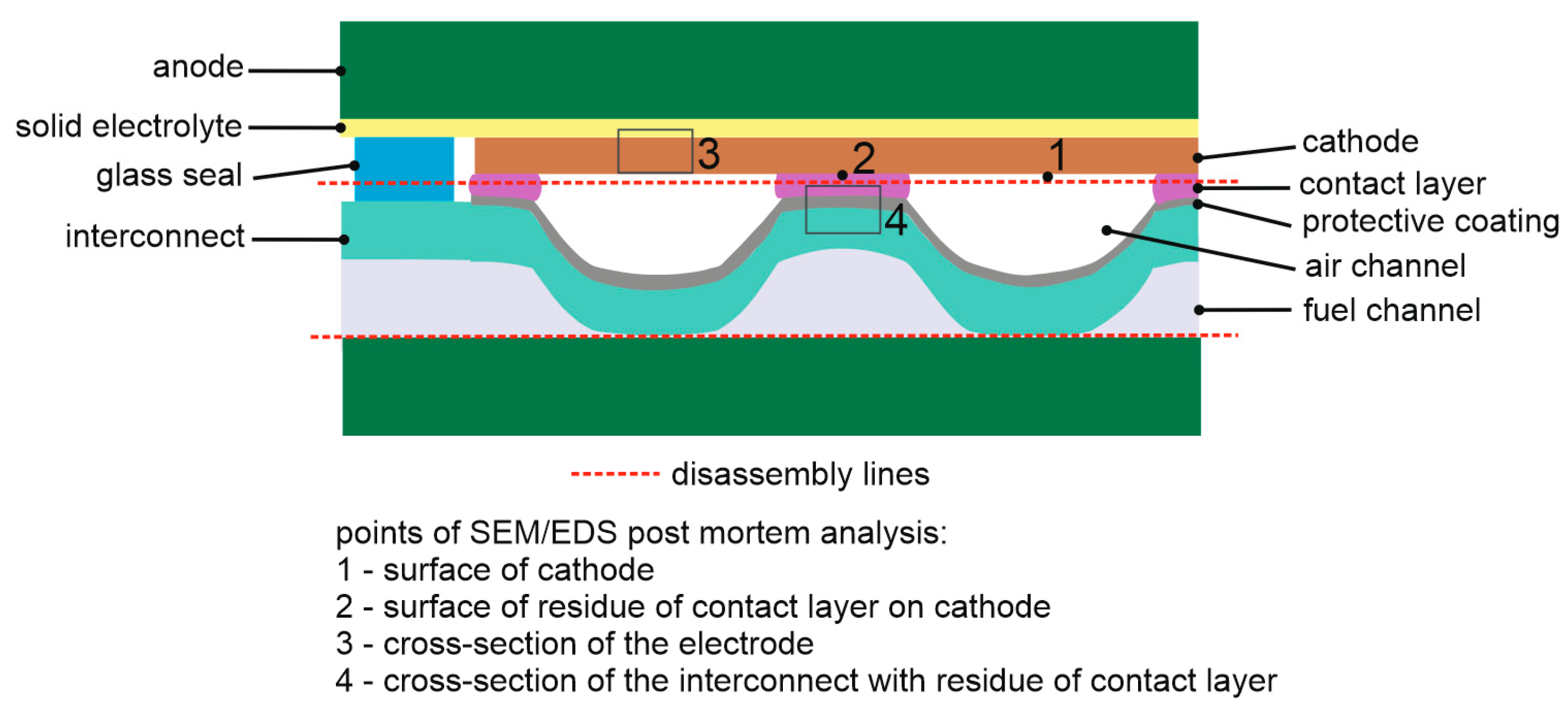
The stack was assembled according to the patents [52,55], with technical details designed by IPE-NRI. Three Elcogen (Elcogen AS, Harju maakond, Estonia) cells of ASC-400 type 11 × 11 cm2 were joined using thin (0.2–0.3 mm) profiled interconnects, separator plates, and glass seals, forming single repeating units (SRU). Each interconnect was covered with a different protective coating: the bottom one (SRU1) with Mn1.5Co1.5O4, the middle one (SRU2) with Mn1.7CuFe0.3O4, and the top one (SRU3) with MnCo2O4. The tops of the ribs of the interconnects, which determine the contact area with the cathode, were covered with a layer of 50 µm thickness made of LSCF ((La0.60Sr0.40)0.95Co0.20Fe0.80O3-X, Nexceris, Lewis Center, OH, USA), referred to as the contact-helper. The surface of the separators, exposed to the air flow, was covered with MC11. After the electrochemical measurements and 1000 h of operation, the stack was disassembled into separate components, as marked in Figure 2. The disassembly was followed by the post-mortem analysis in 4 types of areas: the surface of the cathode, the surface of the residue of the contact layer on the cathode, the cross-section of the electrode, and the cross-section of the top of the rib of the interconnect with the residue of the contact layer.

2.6. Stack Testing Methodology

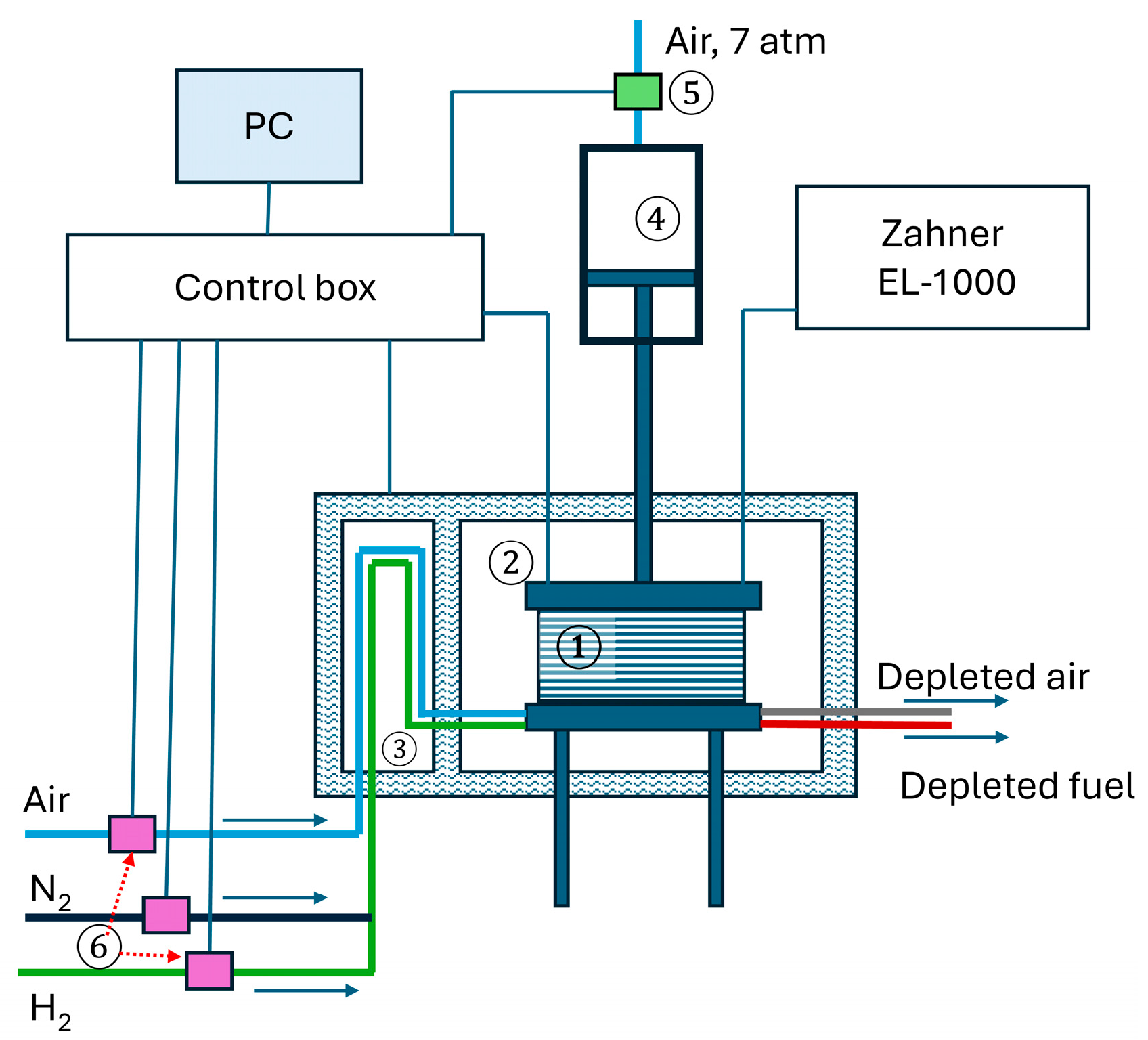
The stack was installed in the test rig, which included a furnace with a separate chamber for heating the inlet gases, a pneumatic cylinder for compression, as well as gas flow, temperature control, and monitoring equipment (Figure 3). The stack was compressed with a force up to 5 kN and connected to the gas supply lines. The flows of all gases were controlled by Bronkhorst El-flow (Bronkhorst High-Tech B.V., Gelderland, The Netherlands) mass flow controllers. Hydrogen (Air Products N 3.5, c(H2) > 99.95 vol%, Air Products and Chemicals, Inc., Allentown, PE, USA) and nitrogen (Air Products N 4.8, c(N2) > 99.998) were used to admix the fuel, while dried compressed air was used as the oxidizer. Monitoring of temperature and cell voltage was conducted using a dedicated multichannel data acquisition system based on the KOLIBRIK Tevomet TV16 device (Kolibrik.net, s.r.o., Žďár nad Sázavou, Czech Republic). Monitoring and operation of the stack were automated, except for the EIS and CVC measurements. The temperature of the stack was controlled by 6 N-type thermocouples: 4 in gas flows (inlets and outlets) and 2 in the top and bottom plates. Air and fuel outlets were considered a proxy for temperature of the cells.
The assembled stack was heated to sealing temperature at a rate of ca. 1 °C/h, with a constant airflow in both the anode and cathode compartments to eliminate organic matter present in the glass seals. At a sufficiently high temperature (ca. 600 °C), airflow in the anode compartment was replaced with nitrogen, and then approx. 5% of H2 was added to start the reduction of the anode. After sealing the stack at ca. 750 °C for 2 h and cooling it to the expected operating temperature of 680–685 °C, the concentration of H2 in the fuel gas was increased to 50%. During stack preparation and testing, no temperature or gas pressure anomalies were detected, i.e., sealing and cells maintained gas tightness and mechanical stability.
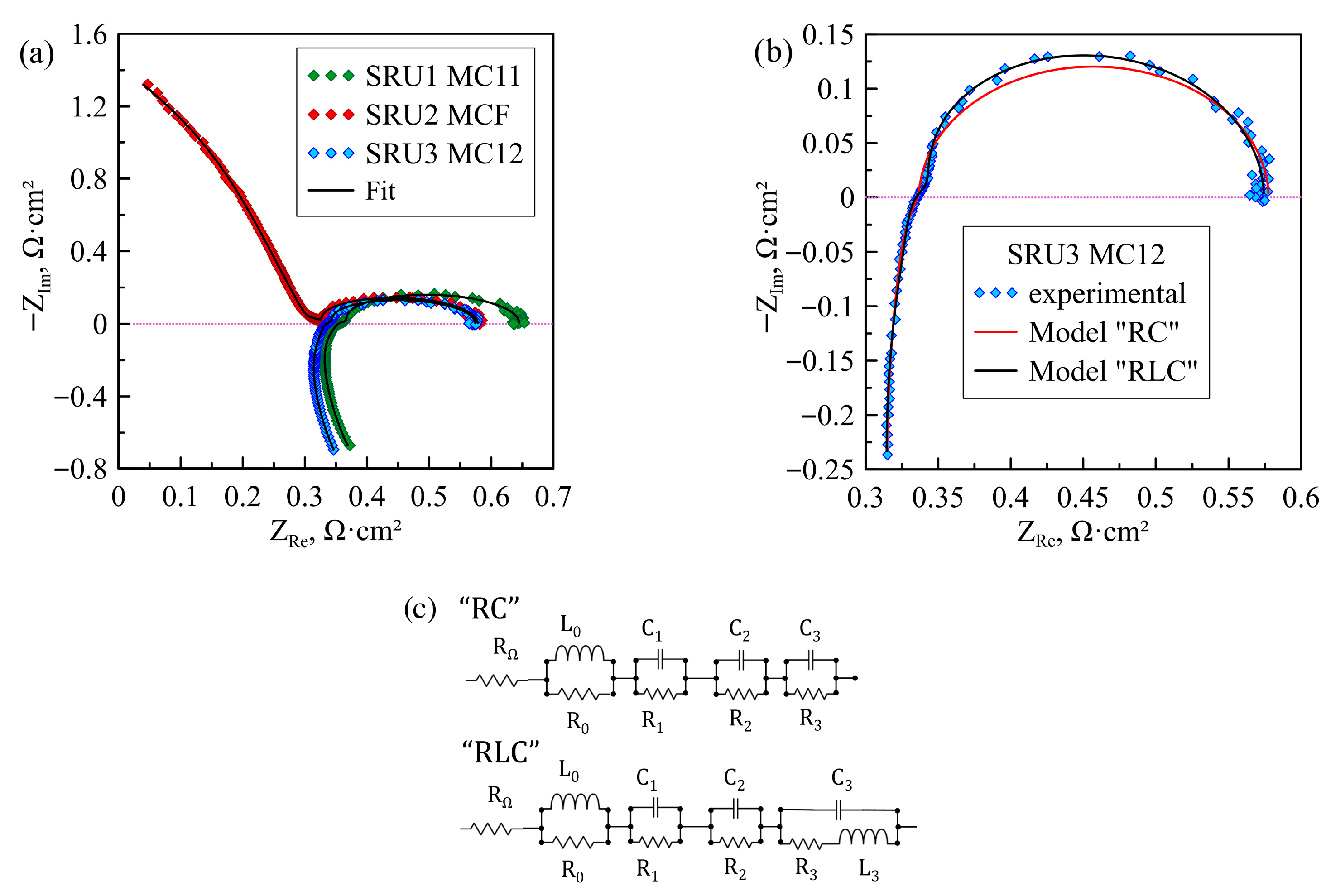
Stack testing methodology was based on long-term constant-current operation with periodic measurements of current–voltage characteristics and electrochemical impedance spectra (EIS), using a Zahner EL1000 (Zahner-Elektrik GmbH & Co., Kronach Gundelsdorf, Germany) electronic load with EIS capability. Spectra were collected in the frequency range 25 mHz–112 kHz, with c.a. 30 samples per decade. Current–voltage characteristics were collected with a current rate of 0.005 A⋅cm−2⋅s−1, up to 0.33 A⋅cm2. Operating conditions were selected according to Elcogen’s recommendations for this type of cell [56]. The long-term operating current density of 0.26 A⋅cm−2 corresponds to moderate fuel (~50%) and air (~33%) consumption, which allows avoidance of other degradation mechanisms not related to Cr poisoning. The collected EIS measurement data were analyzed using an in-house software package (a brief description of the software can be found in [57,58]) dedicated to fitting SOFC/SOEC/rSOC spectra. Analysis of the spectra disclosed some complications that constrain the usability of the EIS for the extraction of the SRU ASR. EIS measurements collected on SRU2 demonstrated a “negative inductance” high-frequency artifact, which could be corrected by an appropriate fitting model (Figure 4a). Plots of the fit residuals, corresponding to Figure 4a, can be found in Supplementary Materials, Figure S5. The low-frequency semicircle for all the collected EIS measurement data requires the introduction of an inductance-like element (Figure 4b,c). Such behavior made the spectra incompatible with the DRT analysis method. Additionally, some spectra from the initial stage of the long-term measurement were corrupted, resulting in the disabling of rigorous separation of the Ohmic and polarization resistances. Hence, the evolution of the voltage vs. time under constant current conditions and combined ASR data (extracted partially from EIS and partially from CVC) were considered criteria of the stack degradation. ASR from CVC was calculated as a linear fit of the voltage vs. current density:
E(j) = E0 + ASR × j,
where E(j) is SRU voltage (V), at current density j (A⋅cm−2), and E0 is a constant. ASR values were calculated for j in the range 0.2–0.3 A/cm2 to avoid non-linearity of the activation polarization at low current [59].

2.7. SEM Analysis

Microstructure studies were performed for the following types of samples: cross-sections of the coupons with deposited sintered coatings, cross-sections of the fuel cells, cross-sections of the interconnects, and surfaces of the electrodes.
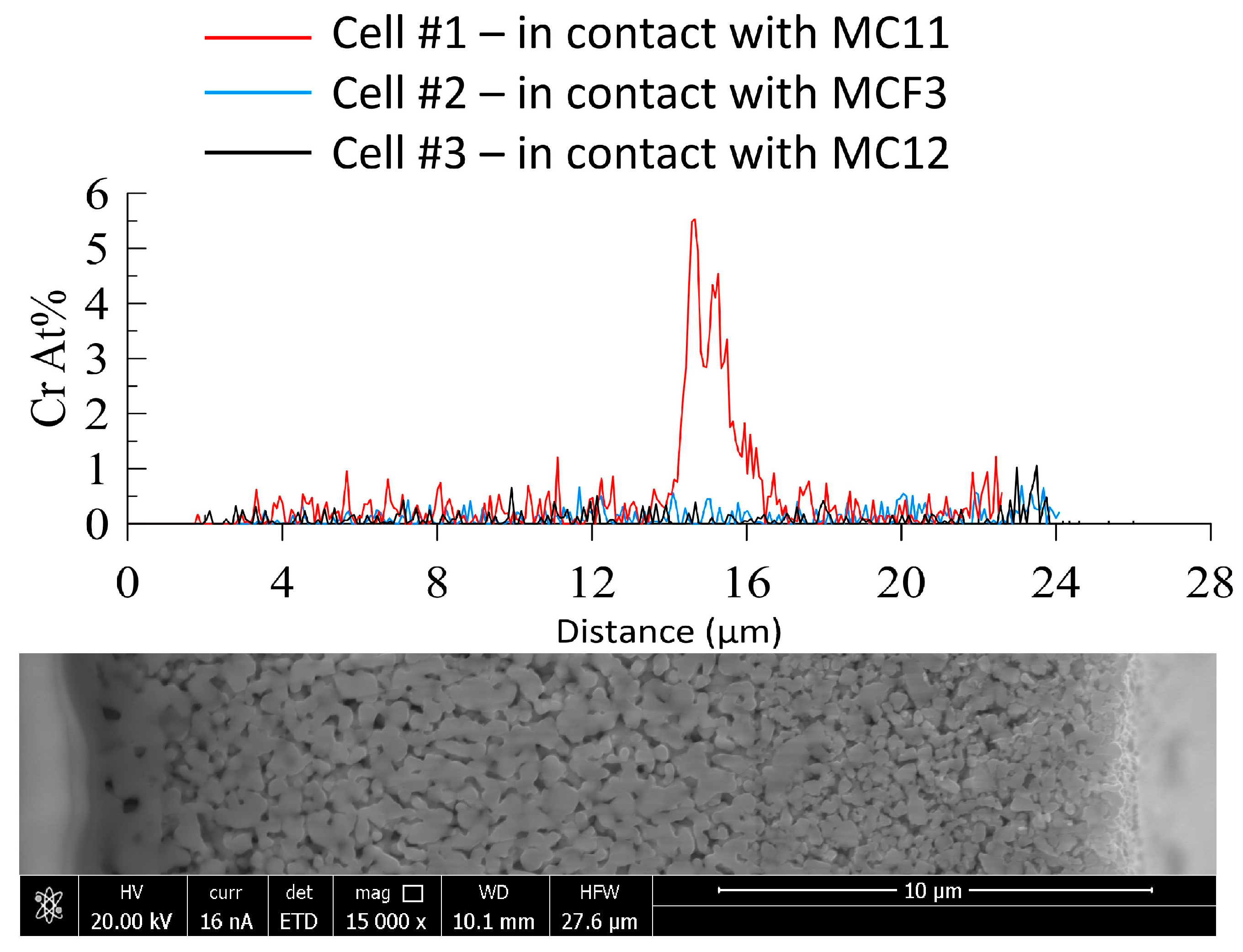
The cross-sections of the electrode samples (Figure 9) were prepared using ion milling with argon ions at 5 kV by an Ion Milling System Hitachi IM4000Plus (Hitachi High-Tech Corp., Tokyo, Japan). Microstructure observations and elemental composition analyses for Figure 9 and Table 4 and Table 5 were performed using an FEI Versa 3D scanning electron microscope (SEM; FEI Company, Hillsboro, OR, USA) equipped with an Oxford Instruments Ultim Max energy-dispersive X-ray spectrometer (EDS; Oxford Instruments plc, Abingdon, UK). Other microstructure studies were performed with the use of a Thermo Fisher Phenom XL scanning electron microscope (SEM) equipped with an energy-dispersive X-ray (EDX) detector (Thermo Fisher Scientific Inc., Waltham, MA, USA). The porosity and the thickness of the as-prepared coatings were calculated from SEM images through image analysis (ImageJ software v1.54g, National Institutes of Health, Bethesda, MD, USA, [60]).

3. Results and Discussion

3.1. Properties of the Deposited Layers

The general properties of the coatings prepared from the new materials and commercial ones were described in previous works [42,53]. Cross-section images of the as-prepared electrophoretically deposited coating on the Crofer 22 APU steel coupons are shown in Figure S1. The images were the basis for determining the thickness and porosity of the coatings with the use of ImageJ software, and the calculated values are presented in Table 1. It needs to be highlighted that EPD is an efficient method to obtain a uniform, dense coating. A higher sintering temperature ensures a lower porosity of the coatings. The thicknesses of the coatings made from Mn1.7Cu1.3O4, Mn1.7Cu1.2Fe0.1O4, Mn1.7CuFe0.3O4, and MnCo2O4 are comparable in the range of 10–13 µm; however, the coating based on Mn-Cu without the addition of iron (MnCuFe0) is thicker than the others and exhibits higher porosity, which might be attributed to the lower sinterability of the powder [41,42]. The thickness of Mn1.5Co1.5O4 is the highest (29 µm), which is attributed to the different deposition procedure (EPD). Due to the sintering conditions, particularly during the reduction step in hydrogen, an interlayer of corrosion products formed on the substrate surface. Achieving dense coatings is crucial to ensure effective protection against chromium evaporation. However, a high sintering temperature (1000 °C) is not favorable in terms of technical issues for full-scale interconnects. Therefore, a more porous layer resulting from sintering at a lower temperature must be thicker to ensure equivalent protection. The previous studies at IPE-NRI on the optimization of the full-scale interconnect coating indicate that the thickness range of 20–30 µm is regarded as optimal.

3.2. ASR Results and Post-Mortem Analysis of the Measured Samples

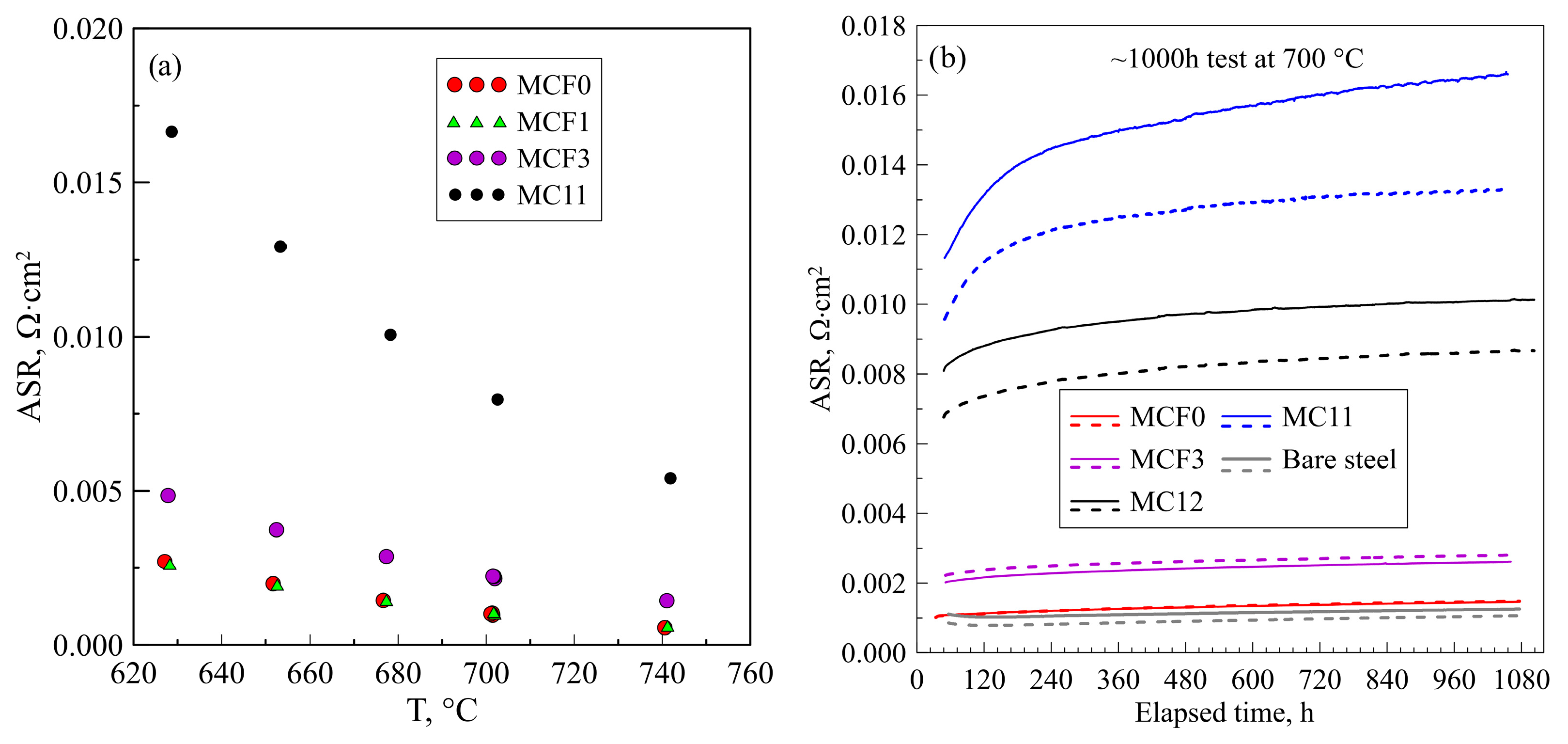
Figure 5a shows the area-specific resistance (ASR) values in the temperature range of 620–740 °C for the new materials Mn1.7Cu1.3O4, Mn1.7Cu1.2Fe0.1O4, and Mn1.7CuFe0.3O4 compared to the commercial MnCo2O4. As shown, two levels of the obtained ASR values were observed related to the tested materials. The cobalt material MC12 had a specific resistivity at 700 °C of 0.008 Ω⋅cm2, while the group of materials containing copper was characterized by a specific resistivity at 700 °C of 0.002 Ω⋅cm2. This gives a value of the specific resistivity several times lower for copper materials compared to that of the commonly used cobalt materials. These results are consistent with the literature reports [42], proving the correctly selected research methodology. Activation energy for the interface conductance was calculated as a linearized fit of the ASR(T) dependence:
l n T A S R = ln A S R 0 E a k B T
where T—temperature, K; kB = 8.617333262⋅10−5 eV/K—Boltzmann constant; ASR0—constan; and Ea activation energy, eV. For copper-based spinels, Ea decreased with iron content from 1.2 ± 0.1 eV for Mn1.7Cu1.3O4 down to 0.93 ± 0.05 eV for Mn1.7CuFe0.3O4. These values, as well as 0.86 ± 0.03 eV for MnCo2O4, are slightly higher compared to those observed in the literature (77–78 kJ/mol) for similar interfaces [61] and sufficiently higher than can be expected from the properties of the materials in the studied temperature range: 0.20–0.25 eV for the spinels [41] and negligible for LSCF [54]. Such values of activation energy can be explained by the impact of the interlayer of (Mn,Cr)3O4 phases, which demonstrate Ea > 1 eV [62].
The longer ASR measurements provide much more interesting results and areas of interpretation. In order to determine the stability of the materials over time under the operating conditions of the SOC cell stack, area-specific resistance tests extending for 1000 h at 700 °C were conducted. For this purpose, Mn1.7Cu1.3O4, Mn1.7CuFe0.3O, MnCo2O4, and Mn1.5Co1.5O4 samples, as well as an uncoated sample, were selected.
The obtained results are presented in Figure 5b. Materials with the addition of copper exhibited a higher repeatability of the area-specific resistance values compared to the samples with cobalt materials. Cobalt materials stabilized in time up to 200 h, whereas in the case of materials with copper, the area-specific resistance value was stable from the beginning of the measurements. Samples covered with copper-containing materials were characterized by the value of area-specific resistance at a similar level to that of stainless steel. Degradation rate, calculated by linear approximation for the last ca. 600 h of measurements, demonstrated the same tendency (Table 2): better repeatability and lower values for the Cu-containing materials compared to Co-containing ones. It is necessary to note that the values of the ASR gain from these measurements allow one to expect a very low impact of interconnect-related resistance on the total ASR of the repeating unit: 10 kh projection for the worst case. Mn1.5Co1.5O4 gives a gain of 0.01 Ω⋅cm2, which is not significant compared to ca. 0.5–0.6 Ω⋅cm2 of the observed total ASR. However, necessary to note that stack degradation may also be affected by the dual-atmosphere effects [63,64], so such a prognosis is optimistic. Literature data demonstrate similar values of degradation rate with respect to different experimental conditions; for example, 0.92 mΩ⋅cm2/kh reported by Zanchi et al. [65] for Mn1.5Co1.5O4 on Crofer 22 APU at 750 °C; Talic et al. [61] reported values of 0.6–3.60 mΩ⋅cm2/kh for various (Mn,Co,Cu)3O4 spinels at 800 °C or 1.2 mΩ⋅cm2/kh for SUS445 at 800 °C, as reported in [66] for MnCo2O4.

3.3. Electrochemical Performance of the Stack

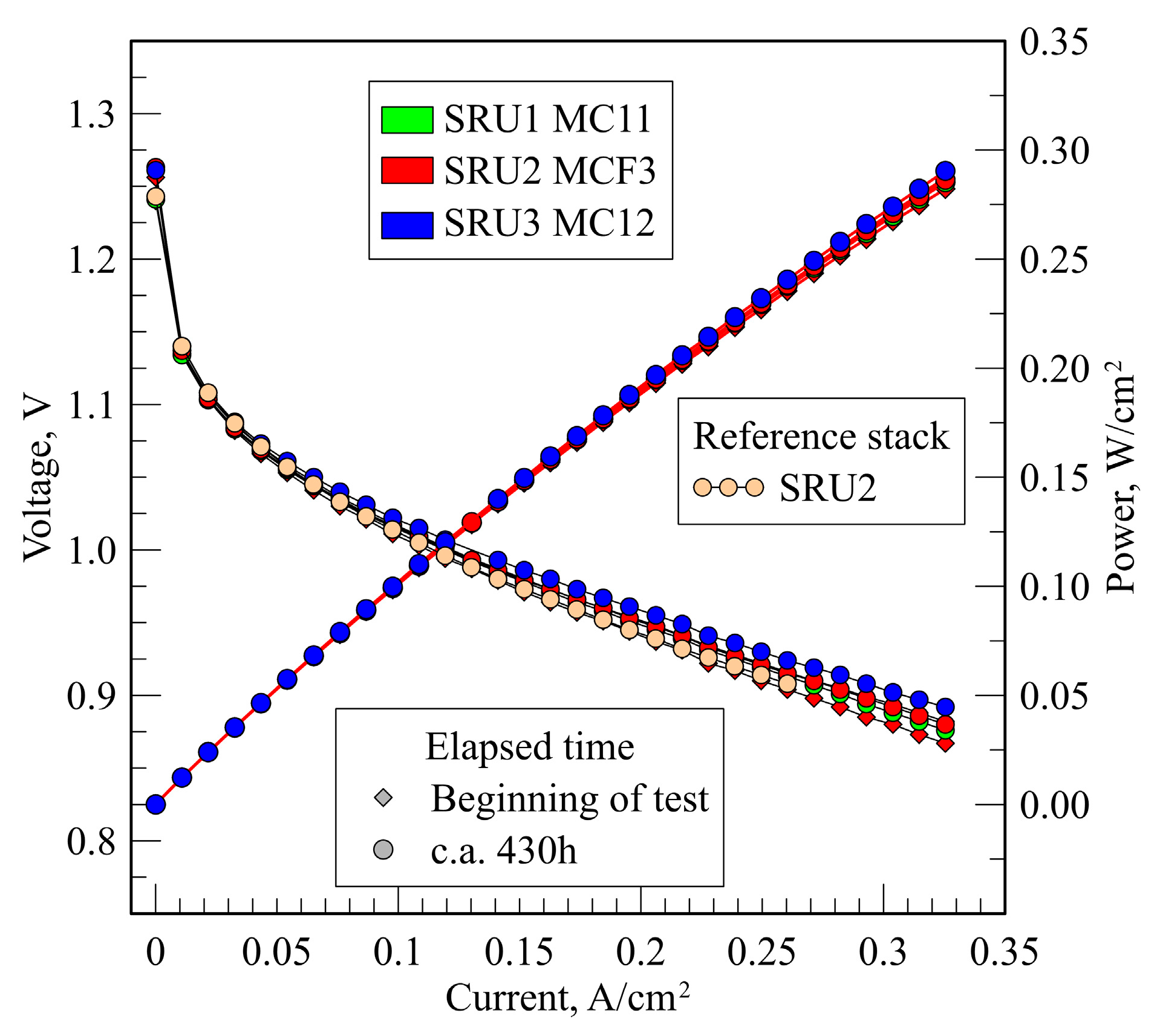
Current–voltage characteristics measured over time did not reveal explicit degradation (Figure 6). CVCs have a profile typical of SOFCs [59]: a sharp drop in voltage in the activation zone from ca. 1.25 V down to 1.1 V, followed by an almost linear decrease to 0.89–0.90 V at the final current density of 0.33 A/cm2. These values are slightly lower than those published on the cell manufacturer’s website [56]; however, they can be considered similar and typical for contemporary IT-SOFC stacks operating under similar conditions [23,67,68,69].
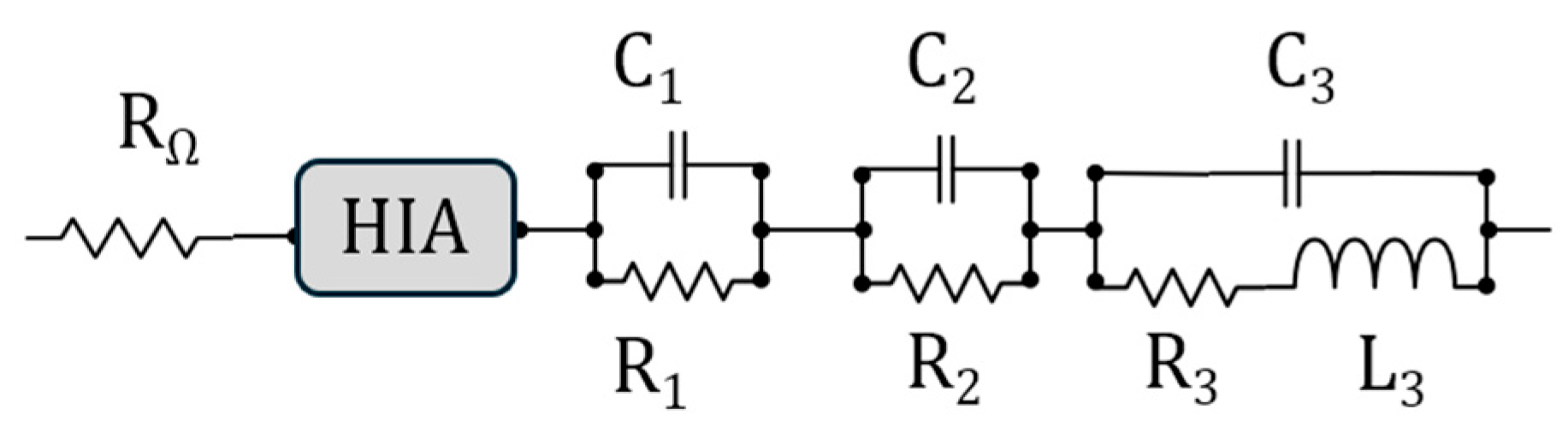
The impedance of all SRUs can be fitted to a model with three RC-like elements, where high-frequency inductance artifacts, marked as “HIA” (Figure 7), are different for each SRU. Statistically significant data were collected only from the last two measurements; they can be found in Table 3.
Data from the fit demonstrated a small but systematic increase in all resistive elements, related to both ohmic and polarization components. The presence of the low-frequency inductance can be attributed to slow degradation processes of the electrodes (for example, CO poisoning in the case of PEMFC [70] or, in the form of negative pseudo-capacitance, for an SOEC cathode [71]) or to a side effect of gas flow regulation, which can be observed under similar conditions [72]. It is necessary to note that the introduction of L3 in the equivalent model does not impact the total ASR value (see Figure 4b) but allows better identification of the R1C1 and R2C2 circuits. Overall, the degradation observed in Figure 8 cannot be directly attributed to a single process, such as steel oxidation or cathode chromium poisoning.
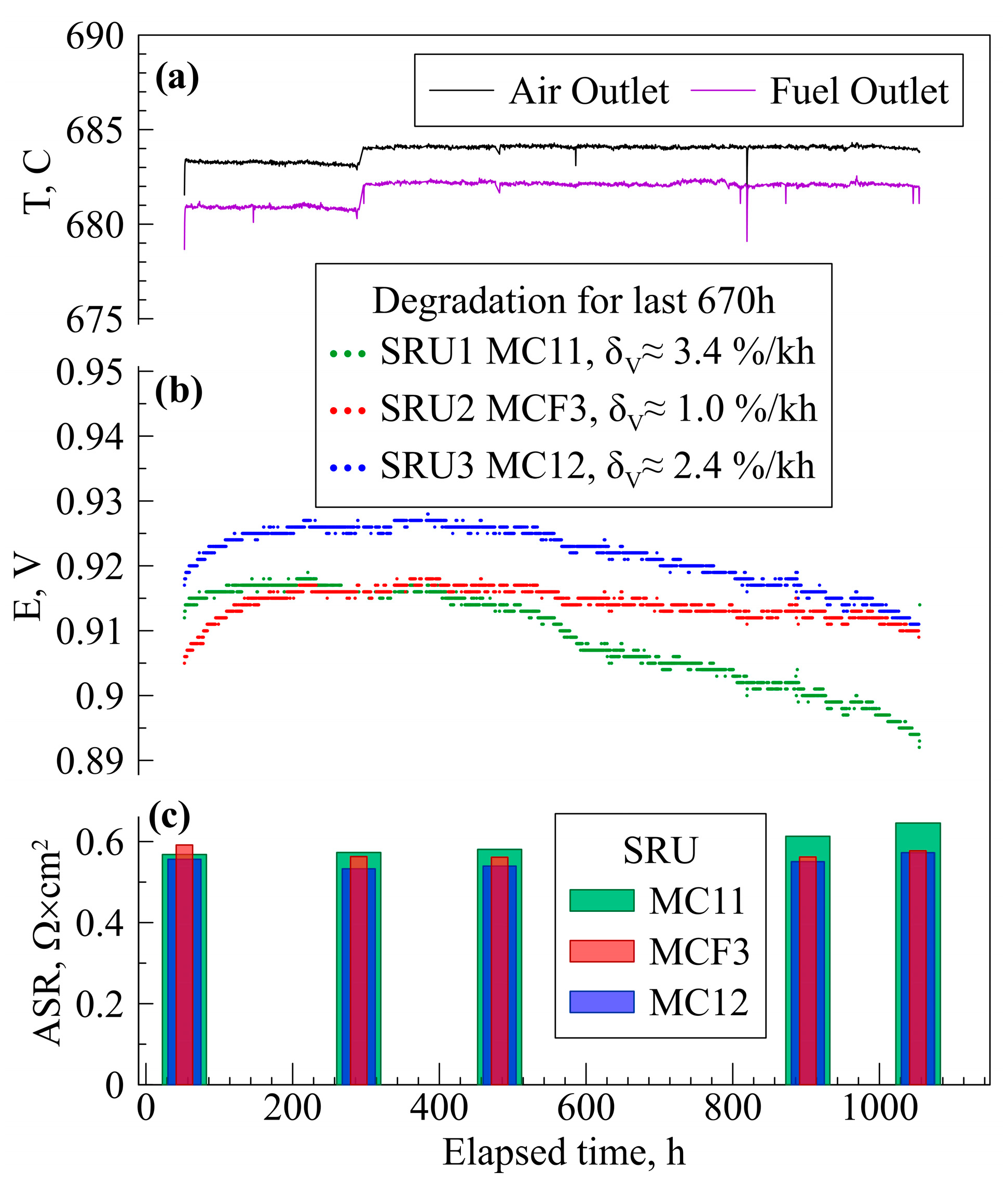
After the stack reduction, the performance of all SRUs was developed over ca. 200 h. This behavior was expected, taking into account the slow sintering of the cathode contact material and in-depth reduction of the thick anodic support (Figure 8). A quasi-linear degradation became visually observable after ca. 400 h of operation. Linear approximation of the voltage vs. time for the last two-thirds of the scheduled operating time demonstrated that the SRU with cobalt-based protective layers had an observably higher degradation rate compared to the MCF3 one. Degradation was calculated as:
δ V = V V 0 100 %
where ∆V and V0—parameters of the linear fit model for voltage vs. time in kh V t = V 0 + V × t , calculated for the last 670 h of measurements.
ASR values demonstrated minor growth, which was, however, mainly observed for SRU1 with MC11 protective coating. In general, ASR remains at a level of ca. 0.6 Ω⋅cm2. Both ASR and stack measurement results somewhat contradict the conclusions of Goebel et al. [73] regarding the dominance of chromia interlayer resistance in the Ohmic losses of the protective coating. While, in general, chromia impact is crucial, copper-based spinels clearly demonstrate lower ASR and a more favorable degradation profile compared to cobalt-based ones. This allows the conclusion that the resistivity of the junction between chromia and the protective coating is also important, and it is governed by the chemical composition of the coating.

3.4. Post-Mortem Analysis of the Stack

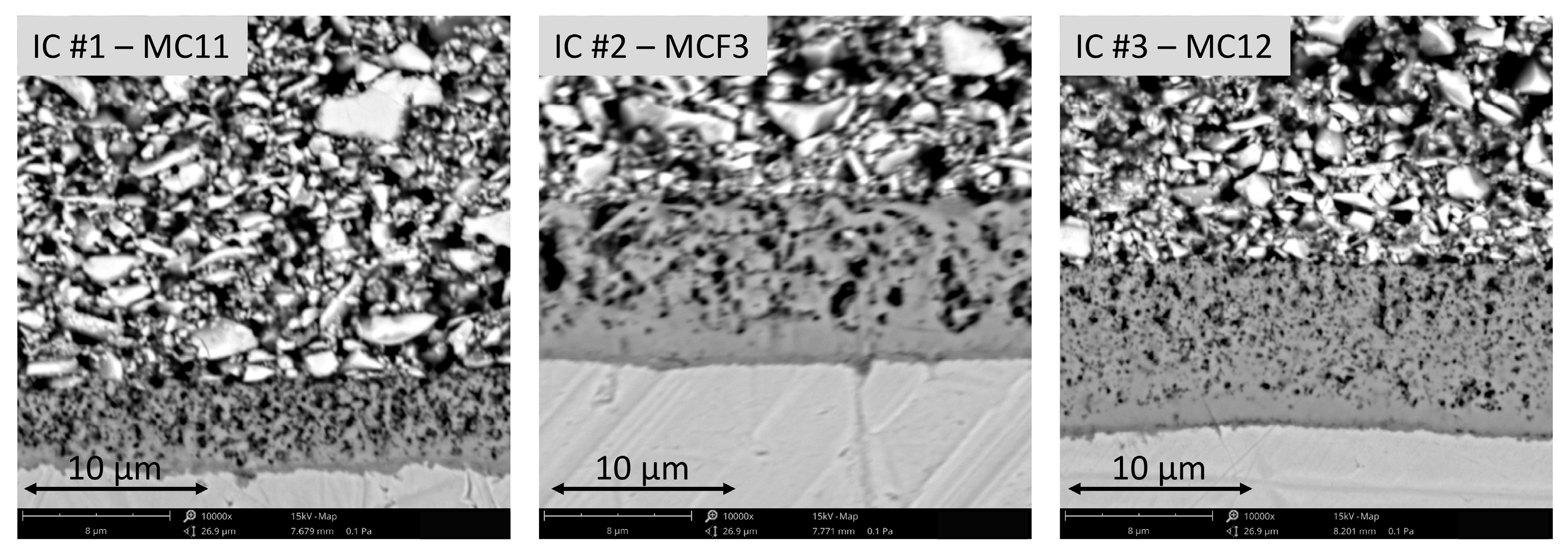
Post-mortem analysis of the stack components was aimed mainly at investigating the level of Cr diffusion from the steel surfaces through the protective layers to the oxygen electrode surfaces, which can be the main factor responsible for the differences in the degradation rates of single repeating units. Therefore, it was studied by four approaches, using the SEM/EDS technique. Firstly, the surfaces of the oxygen electrodes made of LSC were analyzed in spots that were not in direct contact with the tops of the ribs of the interconnects (see results in Table 4, Figure S3). Secondly, the surfaces of the residues of the contact layer made of LSCF on the oxygen electrodes were analyzed; these were the spots of direct contact with the tops of the ribs of the interconnects (see results in Table 5, Figure S4). Thirdly, the cross-sections of the electrodes were analyzed by EDS linescan (see results in Figure 9). Finally, as the fourth approach, the cross-sections of the interconnects were examined (see results in Figure 10, Table 6 and Table 7). Prior to the SEM/EDS analysis, the stack was disassembled into individual components (cells, interconnects, separator plates), which were scanned with the use of optical microscope in search of any mechanical flaws or other defects (e.g., microcracks in cells, discontinuity of the seal, signs of local overheating, shape deformations, etc.) that could be responsible for the degradation of the repeating units. No defects were observed, all elements appeared as expected after the stack operation; therefore, it could be assumed that the only difference between single repeating units in the stack was the material of the protective coating.
The EDS area scan results presented in Table 4 did not reveal major differences between the oxygen electrodes of the cells. The amount of detected Cr was extremely low, at or below the level of measurement error. Such results were expected because the general performance of the cells was good, and the technology of coating the interconnects with a protective layer has been well established. It is estimated that such a surface without direct contact with the interconnect comprises more than 75–77% of the oxygen electrode. The results of EDS analyses of the areas of direct contact between the cell and the interconnect, namely the residues of the contact layer made of LSCF on the oxygen electrode, presented in Table 5, revealed similar concentrations of Cr in cells #1 and #3 (0.11–0.13%) that were in contact with MC11 and MC12, and slightly higher in cell #2 (0.60%) that was in contact with MCF3. Moreover, it needs to be highlighted that a small migration of Cu and Mn from the spinel coating to the contact layer was detected in cell #2.
Such subtle differences concerning Cr migration detected on the surfaces could not be responsible for the much quicker degradation of the repeating unit with the protective coating made of MC11. It was expected that the main difference must have been inside the electrode, so the third applied approach was to study the cross-section of the cells, which was therefore considered the key one. The results, shown in Figure 9, confirmed that the difference was indeed significant. The thickness of the electrodes was ~23 µm, and only in the case of cell #1 in contact with MC11, a significant concentration of Cr (up to 5%At) was detected inside the electrode, localized near its middle. At the same time, no other possible reasons for degradation were detected, e.g., there were no signs of delamination of the electrodes, no Sr migration issues, no cracks in electrolytes, and no other impurities. Hence, one can conclude that Cr contamination is a key reason for the lower performance of SRU1, since the final degradation rate is similar for MC11 and MC12, while for MCF3 it appears sufficiently more favorable. It needs to be noted that the cathode surface size was 9.6 × 9.6 cm2, but only small pieces were investigated by SEM/EDS. It is necessary to note that degradation of the single repeating units can originate from a wide variety of factors [27], which are not directly related to interconnect oxidation and Cr volatilization.
Table 4. EDS analysis of the oxygen electrode surface made of LSC.
Element SymbolAtomic %
Cell #1
(in Contact with MC11)
Cell #2
(in Contact with MCF3)
Cell #3
(in Contact with MC12)
O54.1653.8853.65
Cr0.030.000.07
Co23.6123.8024.11
Sr8.458.528.21
La13.7513.8013.96
Total100.00100.00100.00
Table 5. EDS analysis of residues of the contact layer made of LSCF on the oxygen electrode surface.
Element SymbolAtomic %
Cell #1
(in Contact with MC11)
Cell #2
(in Contact with MCF3)
Cell #3
(in Contact with MC12)
O54.6152.6055.07
Cr0.110.600.13
Fe19.0418.9518.23
Co4.954.625.04
Sr7.556.697.82
La13.7513.9313.71
Cu-0.60-
Mn-2.02-
Total100.00100.00100.00
Figure 9. EDS line scan for the atomic concentration of Cr on the cross-section of the oxygen electrodes.
Energies 19 00011 g009
The fourth approach to investigate Cr diffusion by analyzing the cross-section of the interconnects on the tops of the ribs also enabled the depiction of the main quality differences between the coatings. The other important factor is the quality of the protective layer itself, including its thickness and porosity. Porosity of the spinel layer increases from the steel to the open surface. De facto, two zones of different morphology can be observed: a relatively thin but dense internal zone (IZ) and a porous external zone (EZ) (Figure 10, Table 7). The MC11 coating was the most porous (porosity was estimated as ca. 18%) and the thinnest one. Additionally, IZ in this case appeared marginal. The average thickness measured on the top of the rib was only 5.5 µm, and it was even lower on the side of the ribs. The pores were relatively large and elongated, up to 1.5 µm in size. It can be found in the literature that such a low thickness combined with significant porosity is not enough for effective limiting of Cr diffusion [15,74]; therefore, the worst results concerning the degradation rate could be expected. On the other hand, the coatings made from MCF3 and MC12 had a similar average thickness of 10 µm and a well-developed, dense IZ; however, they differed sufficiently in pore size distribution. The coating made out of MC12 had much smaller, spherical pores of 0.1–0.5 µm in diameter, while the MCF3 coating had larger, elongated pores of 1–3 µm, accompanied by smaller, spherical pores of 0.3–0.6 µm in size. The thickness of the chromia scale between the steel and protective coating was similar in all samples and close to 1 µm.
To investigate the difference in Cr diffusion levels in all three samples, the contact layers of ~50 µm thickness were analyzed with EDS, divided into three equal areas: Area 1—close to the protective coating; Area 2—intermediate; and Area 3—close to the edge of the sample. The results are shown in Table 7. The concentrations of Cr in the LSCF contact layers correspond directly to the quality of the layers. The highest concentration of Cr was detected for the layer adjacent to the coating made of MC11 (2.17–0.63%), the lowest—for the layer adjacent to the coating made of MC12 (0.16–0.10%); however, the concentration of Cr detected for the layer adjacent to the coating made of MCF3 is also considered very low (0.26–0.09%). In all three samples, the highest concentration of Cr was detected in Area 1. Chromium yield (or penetration) may be approached as
β C r = C C r C L a + C S r
where C x is the atomic concentration of element x on the surface of the contact layer. In this case, Cr penetration through MC11 is 0.039, while for MC12 and for MCF3 it is 0.053 and 0.055, i.e., the MC12 and MCF3 layers demonstrated ≈7 times better protective efficiency compared to the MC11 one.
Table 6. Main characteristics of the protective coating estimated based on post-mortem SEM images of the cross-section.
Type of CoatingAverage Thickness [µm]Porosity [%]Average
Thickness of
Cr-Scale [µm]
Average Thickness
of the Dense Part of the Coating
Adjacent to Cr-Scale [µm]
MC115.518.10.50.4
MCF39.516.90.51.4
MC129.715.80.51.1
Figure 10. Cross-sections of the tops of the ribs of the interconnects coated with MC11, MCF3, and MC12 that were subjected to EDS analysis (10,000× magnification).
Energies 19 00011 g010
Table 7. EDS analysis of contact layers made of LSCF adjacent to protective layers on the interconnects: Area 1—close to the protective layer; Area 2—intermediate; and Area 3—close to the edge of the sample.
Element SymbolAtomic %
Cell #1 (in Contact with MC11)Cell #2 (in Contact with MCF3)Cell #3 (in Contact with MC12)
Area 1Area 2Area 3Area 1Area 2Area 3Area 1Area 2Area 3
O62.7765.5365.0469.8767.2367.1467.3967.7765.25
Cr2.171.490.630.260.130.090.160.060.10
Fe14.0613.1813.7911.9212.912.4214.0812.0813.7
Co3.63.123.872.332.763.253.135.942.78
Sr7.296.876.726.366.797.397.636.17.8
La10.129.819.938.639.729.4910.618.0610.36
Cu---0.290.210.09---
Mn---0.350.240.13---
Total100.00100.00100.00100.00100.00100.00100.00100.00100.00

4. Conclusions

Experimental characterization of the copper-manganese spinels as protective layers for the SOFC interconnects demonstrated that iron-stabilized materials can compete with the state-of-the-art (Mn,Co)O4. Testing of the ASR on coupons revealed a great advantage of the (Mn,Cu,Fe)3O4 materials over (Mn,Co)O4 ones, which was expected, taking into account the higher conductivity of the corresponding ceramics. The most perspective material, Mn1.7CuFe0.3O4, demonstrated ASR below 3 mΩcm2 after a 1000 h test, which was 3–6 times better compared to Co-containing analogs. In the case of the real short stacks, on corrugated interconnects, Mn1.7CuFe0.3O4 performance was slightly worse than observed in SRU with MnCo2O4 protection, which may be explained by differences in the procedures of layer formation for test coupons and interconnects for 11 × 11 cm2 cells. These differences result in layer morphology, namely enlarged pores for Mn1.7CuFe0.3O4 in comparison to MnCo2O4. However, both Mn1.7CuFe0.3O4 and MnCo2O4 layers sufficiently limit the migration of chromia compounds to the SOFC cathode. The locked Cr can be found in the densified strata of the protective layer, which was clearly observed in the studied cases. Contrary to that, in the Mn1.5Co1.5O4 layer, the densified strata were too thin, and chromia breakthrough was clearly observed with a corresponding impact on cell performance. The degradation rate for the Mn1.7CuFe0.3O4 in the stack was found significantly lower than for (Mn,Co)3O4 spinels, ca. 1%/kh in voltage. While it is higher than that observed in commercial stacks, the technology for Mn1.7CuFe0.3O4 application requires some tuning to suppress the formation of large pores and to decrease the total porosity. It is believed that implementing the EPD process for full-scale interconnects will allow for obtaining a higher density of the coating. The total ASR of all the cells in the investigated SOFC stack remained at the level of ca. 0.6 Ωcm2 at 680 °C. The degradation cannot be attributed to a simple stage, i.e., both electrochemical and ohmic resistances after 500 h of operation demonstrated a slight but monotonic growth.

Supplementary Materials

The following supporting information can be downloaded at: https://www.mdpi.com/article/10.3390/en19010011/s1. Figure S1: SEM images of the cross-section of the sintered coatings deposited by EPD on steel flat coupon samples; Figure S2: Current–voltage characteristics of the reference stack; Figure S3. SEM images of the surface of the oxygen electrode made of LSC that were not in direct contact with the tops of the ribs of the interconnects, (a) magnification ×5000, (b) magnification ×15,000—basis for EDS area analysis; Figure S4, SEM images of residues of the contact layer made of LSCF on the surface of the oxygen electrode—basis for EDS area analysis; Figure S5. Residuals of the fits presented in Figure 4a.

Author Contributions

Conceptualization, Y.N., S.M., and P.J.; methodology, Y.N.; formal analysis, Y.N.; investigation, A.Ż., L.A., M.K., M.S., M.W., and J.I.; resources, J.I.; data curation, A.Ż.; writing—original draft preparation, A.Ż. and Y.N.; writing—review and editing, M.S. and S.M.; visualization, A.Ż. and Y.N.; supervision, Y.N. and P.J.; funding acquisition, P.J. All authors have read and agreed to the published version of the manuscript.

Funding

This project is supported by the National Science Centre (Narodowe Centrum Nauki, Kraków, Poland) Harmonia 9 project number UMO-2017/26/M/ST8/00438: “Quest for novel materials for solid oxide cell interconnect coatings”.

Data Availability Statement

The data will be made available by the authors on request.

Conflicts of Interest

The authors declare no conflicts of interest.

References

  1. Stambouli, A.B.; Traversa, E. Solid oxide fuel cells (SOFCs): A review of an environmentally clean and efficient source of energy. Renew. Sustain. Energy Rev. 2002, 6, 433. [Google Scholar] [CrossRef]
  2. Hu, Y.; Li, D.; Guo, H.; Liu, S.; Meng, Y.; Ding, S.; Li, C.-X. Recent progress of high-performance interconnectors for SOFC: From materials protective coatings optimizing strategies towards the real stack applications. Chem. Eng. J. 2025, 505, 159321. [Google Scholar] [CrossRef]
  3. Blum, L. An Analysis of Contact Problems in Solid Oxide Fuel Cell Stacks Arising from Differences in Thermal Expansion Coefficients. Electrochim. Acta 2017, 223, 100–108. [Google Scholar] [CrossRef]
  4. Crofer 22 H—Material Data Sheet No. 4050. ThyssenKrupp VDM, 2010. Available online: https://www.scribd.com/document/399382936/50-Digital-Joints# (accessed on 21 November 2023).
  5. Crofer 22APU—Material Data Sheet No. 4046. ThyssenKrupp VDM, 2010. Available online: https://www.vdm-metals.com/fileadmin/user_upload/Downloads/Data_Sheets/Data_Sheet_VDM_Crofer_22_APU.pdf (accessed on 21 November 2024).
  6. Couturier, K.; Giacometti, N.; Hanoux, P.; Yahiaoui, S.; David, T.; Lai, T.; Dejob, T.; Bestautte, J.; Bouvier, M.; Rouillard, F. Improved Oxidation Resistance and Cr Retention of Coated AISI441 for SOC Application. High. Temp. Corros. Mater. 2024, 101, 1421–1435. [Google Scholar] [CrossRef]
  7. Reddy, M.J.; Chausson, T.E.; Svensson, J.E.; Froitzheim, J. 11–23% Cr steels for solid oxide fuel cell interconnect applications at 800 °C—How the coating determines oxidation kinetics. Int. J. Hydrogen Energy 2023, 48, 12893–12904. [Google Scholar] [CrossRef]
  8. Talic, B.; Venkatachalam, V.; Hendriksen, P.V.; Kiebach, R. Comparison of MnCo2O4 coated Crofer 22 H, 441, 430 as interconnects for intermediate-temperature solid oxide fuel cell stacks. J. Alloys Compd. 2020, 821, 153229. [Google Scholar] [CrossRef]
  9. Niewolak, L.; Young, D.J.; Hattendorf, H.; Singheiser, L.; Quadakkers, W.J. Mechanisms of Oxide Scale Formation on Ferritic Interconnect Steel in Simulated Low and High pO2 Service Environments of Solid Oxide Fuel Cells. Oxid. Met. 2014, 82, 123–143. [Google Scholar] [CrossRef]
  10. Tan, K.H.; Rahman, H.A.; Taib, H. Coating layer and influence of transition metal for ferritic stainless steel interconnector solid oxide fuel cell: A review. Int. J. Hydrogen Energy 2019, 44, 30591. [Google Scholar] [CrossRef]
  11. Zhou, Z.; Nadimpalli, V.K.; Pedersen, D.B.; Esposito, V. Degradation mechanisms of metal-supported solid oxide cells and countermeasures: A review. Materials 2021, 14, 3139. [Google Scholar] [CrossRef] [PubMed]
  12. Hilpert, K.; Dos, D.; Miller, M.; Peck, D.H.; Weiss, R. Chromium vapor species over solid oxide fuel cell interconnect materials and their potential for degradation processes. J. Electrochem. Soc. 1996, 143, 3642. [Google Scholar] [CrossRef]
  13. Harrison, C.M.; Slater, P.R.; Steinberger-Wilckens, R. A review of Solid Oxide Fuel Cell cathode materials with respect to their resistance to the effects of chromium poisoning. Solid. State Ion. 2020, 354, 115410. [Google Scholar] [CrossRef]
  14. Goebel, C.; Berger, R.; Bernuy-Lopez, C.; Westlinder, J.; Svensson, J.E.; Froitzheim, J. Long-term (4 year) degradation behavior of coated stainless steel 441 used for solid oxide fuel cell interconnect applications. J. Power Sources 2020, 449, 227480. [Google Scholar] [CrossRef]
  15. Yang, Z.; Xia, G.; Li, X.; Stevenson, J.W. (Mn,Co)3O4 spinel coatings on ferritic stainless steels for SOFC interconnect applications. Int. J. Hydrogen Energy 2007, 32, 3648–3654. [Google Scholar] [CrossRef]
  16. Wang, X.; Si, X.; Gao, J.; Zhou, Q.; Li, C.; Li, M.; Qi, J.; Cao, J. Low-cost, high-density Mn–Co spinel coatings for stainless steel interconnect via efficient microwave heating. J. Clean. Prod. 2023, 389, 136107. [Google Scholar] [CrossRef]
  17. Abdoli, H.; Alizadeh, P. Electrophoretic deposition of (Mn,Co)3O4 spinel nano powder on SOFC metallic interconnects. Mater. Lett. 2012, 80, 53. [Google Scholar] [CrossRef]
  18. Magdefrau, N.J.; Chen, L.; Sun, E.Y.; Yamanis, J.; Aindow, M. Formation of spinel reaction layers in manganese cobaltite-coated Crofer22 APU for solid oxide fuel cell interconnects. J. Power Sources 2013, 227, 318–326. [Google Scholar] [CrossRef]
  19. Ou, D.R.; Cheng, M.; Wang, X.L. Development of low-temperature sintered Mn-Co spinel coatings on Fe-Cr ferritic alloys for solid oxide fuel cell interconnect applications. J. Power Sources 2013, 236, 200. [Google Scholar] [CrossRef]
  20. Reddy, M.J.; Kamecki, B.; Talic, B.; Zanchi, E.; Smeacetto, F.; Hardy, J.S.; Choi, J.P.; Mazur, L.; Vaßen, R.; Basu, S.N.; et al. Experimental review of the performances of protective coatings for interconnects in solid oxide fuel cells. J. Power Sources 2023, 568, 232831. [Google Scholar] [CrossRef]
  21. Banza, C.L.N.; Nawrot, T.S.; Haufroid, V.; Decrée, S.; Putter, T.D.; Smolders, E.; Kabyla, B.I.; Luboya, O.N.; Ilunga, A.N.; Mutombo, A.M.; et al. High human exposure to cobalt and other metals in Katanga, a mining area of the Democratic Republic of Congo. Environ. Res. 2009, 109, 745–752. [Google Scholar] [CrossRef] [PubMed]
  22. Mancini, L.; Eslava, N.A.; Traverso, M.; Mathieux, F. Assessing impacts of responsible sourcing initiatives for cobalt: Insights from a case study. Resour. Policy 2021, 71, 102015. [Google Scholar] [CrossRef]
  23. Blum, L.; Batfalsky, P.; Fang, Q.; de Haart, L.G.J.; Malzbender, J.; Margaritis, N.; Menzler, N.H.; Peters, R. SOFC Stack and System Development at Forschungszentrum Jülich. J. Electrochem. Soc. 2015, 162, F1199. [Google Scholar] [CrossRef]
  24. Lastam, J.; Sergeev, D.; Grüner, D.; Müller, M.; Schwaiger, R. Unlocking the Value of End-of-Life JÜLICH Solid Oxide Cell Stack Interconnect Assembly: A Combined Experimental and Thermodynamic Study on Metallic Resource Recyclability. Metals 2024, 14, 406. [Google Scholar] [CrossRef]
  25. Tallgren, J.; Bianco, M.; Himanen, O.; Thomann, O.; Kiviaho, J.; van Herle, J. Evaluation of Protective Coatings for SOFC Interconnects. ECS Trans. 2015, 68, 1597. [Google Scholar] [CrossRef]
  26. Noponen, M.; Torri, P.; Göös, J.; Puranen, J.; Kaar, H.; Pylypko, S.; Roostar, M.; Õunpuu, E. Elcogen—Next Generation Solid Oxide Cell and Stack Technology. ECS Trans. 2019, 91, 91. [Google Scholar] [CrossRef]
  27. McPhail, S.J.; Frangini, S.; Laurencin, J.; Effori, E.; Abaza, A.; Padinjarethil, A.K.; Hagen, A.; Léon, A.; Brisse, A.; Vladikova, D.; et al. Addressing planar solid oxide cell degradation mechanisms: A critical review of selected components. Electrochem. Sci. Adv. 2021, 2, e2100024. [Google Scholar] [CrossRef]
  28. Menzler, N.H.; Sebold, D.; Sohn, Y.J.; Zischke, S. Post-test characterization of a solid oxide fuel cell after more than 10 years of stack testing. J. Power Sources 2020, 478, 228770. [Google Scholar] [CrossRef]
  29. Bertoldi, M.; Bucheli, O.F.; Ravagni, A.V. Development, Manufacturing and Deployment of SOFC-Based Products at SOLIDpower. ECS Trans. 2017, 78, 117. [Google Scholar] [CrossRef]
  30. Skafte, T.L.; Hjelm, J.; Blennow, P.; Graves, C.R. Quantitative review of degradation and lifetime of solid oxide cells and stacks. In Proceedings of the 12th European SOFC & SOE Forum, Lucerne, Switzerland, 5–8 July 2016; pp. 8–27. [Google Scholar]
  31. Sabato, A.G.; Zanchi, E.; Molin, S.; Cempura, G.; Javed, H.; Herbrig, K.; Walter, C.; Boccaccini, A.R.; Smeacetto, F. Mn-Co spinel coatings on Crofer 22 APU by electrophoretic deposition: Up scaling, performance in SOFC stack at 850 °C and compositional modifications. J. Eur. Ceram. Soc. 2021, 41, 4496–4504. [Google Scholar] [CrossRef]
  32. Ludwig, G.A.; Korb, M.A.; Lima, D.A.S.; Macías, M.A.; Gauthier, G.H.; Malfatti, C.F. Protective coatings for AISI 430 stainless steel at high temperatures using perovskite oxides La0.6Sr0.4CoO3 on spinel type oxide NiFe2O4. Ceram. Int. 2015, 41, 14561–14573. [Google Scholar] [CrossRef]
  33. Zhao, Y.; Zhang, Y.; Su, M.; Huan, D.; Peng, R.; Xia, C. In-situ formed CuFe2O4 spinel coating by electroplating method for solid oxide fuel cell interconnect. Chem. Eng. J. 2023, 470, 144397. [Google Scholar] [CrossRef]
  34. Waluyo, N.S.; Park, B.; Lee, S.; Lim, T.; Park, S.; Song, R.; Lee, J. (Mn,Cu)3O4-based conductive coatings as effective barriers to high-temperature oxidation of metallic interconnects for solid oxide fuel cells. J. Solid. State Electrochem. 2014, 18, 445–452. [Google Scholar] [CrossRef]
  35. Ranjbar-Nouri, Z.; Soltanieh, M.; Rastegari, S. Applying the protective CuMn2O4 spinel coating on AISI-430 ferritic stainless steel used as solid oxide fuel cell interconnects. Surf. Coat. Technol. 2018, 334, 365. [Google Scholar] [CrossRef]
  36. Joshi, S.; Petric, A. Nickel substituted CuMn2O4 spinel coatings for solid oxide fuel cell interconnects. Int. J. Hydrogen Energy 2017, 42, 5584. [Google Scholar] [CrossRef]
  37. Sun, Z.; Gopalan, S.; Pal, U.B.; Basu, S.N. Cu1.3Mn1.7O4 spinel coatings deposited by electrophoretic deposition on Crofer 22APU substrates for solid oxide fuel cell applications. Surf. Coat. Technol. 2017, 323, 49–57. [Google Scholar] [CrossRef]
  38. Sun, Z.; Wang, R.; Nikiforov, A.; Gopalan, S.; Pal, U.B.; Basu, S.N. CuMn1.8O4 protective coatings on metallic interconnects for prevention of Cr-poisoning in solid oxide fuel cells. J. Power Sources 2018, 378, 125. [Google Scholar] [CrossRef]
  39. Oh, S.-U.; Kim, D.; Lee, I.-T.; Choi, C.-S.; Lee, J.-A.; Heo, Y.-W.; Lee, J.-H. Electrophoretic deposition and low-temperature densification of Cu1.35Mn1.65O4 spinel for an interconnect protective coating in solid oxide fuel cells. Int. J. Hydrogen Energy 2022, 47, 33410–33419. [Google Scholar] [CrossRef]
  40. Mazur, Ł.; Koszelow, D.; Zajusz, M.; Lapinski, M.; Bik, M.; Zając, P.; Adamczyk, A.; Rutkowski, P.; Molin, S.; Brylewski, T. Comparison of Cu1.3Mn1.7O4 spinels doped with Ni or Fe and synthesized via wet chemistry and solid-state reaction methods, designed as potential coating materials for metallic interconnects. J. Eur. Ceram. Soc. 2023, 43, 5557–5574. [Google Scholar] [CrossRef]
  41. Ignaczak, J.; Naumovich, Y.; Gornicka, K.; Jamroz, J.; Wrobel, W.; Karczewski, J.; Chen, M.; Jasinski, P.; Molin, S. Preparation and characterisation of iron substituted Mn1.7Cu1.3-xFexO4 spinel oxides (x = 0, 0.1, 0.3, 0.5). J. Eur. Ceram. Soc. 2020, 40, 5920–5929. [Google Scholar] [CrossRef]
  42. Ignaczak, J.; Zeng, L.; Sanchez, D.R.; Makowska, M.; Gornicka, K.; Lankauf, K.; Karczewski, J.; Jasinski, P.; Molin, S. Fe-modified Mn2CuO4 spinel oxides: Coatings based on abundant elements for solid oxide cell interconnects. Int. J. Hydrogen Energy 2023, 48, 36076–36093. [Google Scholar] [CrossRef]
  43. Loboichenko, V.; Grassi, J.; González-Comesaña, M.; Toharias-Góngora, B.; Iranzo, A. Comparative analysis of interconnects for solid oxide electrolysis. Energy Rep. 2025, 14, 3563–3577. [Google Scholar] [CrossRef]
  44. Aznam, I.; Mah, J.C.W.; Muchtar, A.; Somalu, M.R.; Ghazali, M.J. Electrophoretic deposition of (Cu,Mn,Co)3O4 spinel coating on SUS430 ferritic stainless steel: Process and performance evaluation for solid oxide fuel cell interconnect applications. J. Eur. Ceram. Soc. 2021, 41, 1360–1373. [Google Scholar] [CrossRef]
  45. Mao, J.; Wang, E.; Wang, H.; Ouyang, M.; Chen, Y.; Hu, H.; Lu, L.; Ren, D.; Liu, Y. Progress in metal corrosion mechanism and protective coating technology for interconnect and metal support of solid oxide cells. Renew. Sustain. Energy Rev. 2023, 185, 113597. [Google Scholar] [CrossRef]
  46. Mendonça, C.; Ferreira, A.; Santos, D.M.F. Towards the Commercialization of Solid Oxide Fuel Cells: Recent Advances in Materials and Integration Strategies. Fuels 2021, 2, 393–419. [Google Scholar] [CrossRef]
  47. Shaigan, N.; Qu, W.; Ivey, D.G.; Chen, W. A review of recent progress in coatings, surface modifications and alloy developments for solid oxide fuel cell ferritic stainless steel interconnects. J. Power Sources 2010, 195, 1529–1542. [Google Scholar] [CrossRef]
  48. Pandiyan, S.; El-Kharouf, A.; Steinberger-Wilckens, R. Formulation of spinel based inkjet inks for protective layer coatings in SOFC interconnects. J. Colloid. Interface Sci. 2020, 579, 82–95. [Google Scholar] [CrossRef] [PubMed]
  49. Gannon, P.; Deibert, M.; White, P.; Smith, R.; Chen, H.; Priyantha, W.; Lucas, J.; Gorokhovsky, V. Advanced PVD protective coatings for SOFC interconnects. Int. J. Hydrogen Energy 2008, 33, 3991–4000. [Google Scholar] [CrossRef]
  50. Choi, J.J.; Ryu, J.; Hahn, B.D.; Yoon, W.H.; Lee, B.K.; Park, D.S. Dense spinel MnCo2O4 film coating by aerosol deposition on ferritic steel alloy for protection of chromic evaporation and low-conductivity scale formation. J. Mater. Sci. 2009, 44, 843–848. [Google Scholar] [CrossRef]
  51. Mah, J.C.W.; Muchtar, A.; Somalu, M.R.; Ghazali, M.J. Metallic interconnects for solid oxide fuel cell: A review on protective coating and deposition techniques. Int. J. Hydrogen Energy 2017, 42, 9219–9229. [Google Scholar] [CrossRef]
  52. EP2338195A1; SOFC Stack with Corrugated Separator Plate. European Patent Office (EPO): Munich, Germany, 2011.
  53. Ajdys, L.; Zurawska, A.; Kosiorek, M.; Naumovich, Y.; Zybert, M.; Wiecinska, P.; Chen, M. Improving functional properties of protective coatings obtained by electrophoretic deposition on steel interconnects for solid oxide cells by tuning particle size distribution. Ceram. Int. 2023, 49, 33818–33827. [Google Scholar] [CrossRef]
  54. Naumovich, Y.; Zakharchuk, K.; Obrebowski, S.; Yaremchenko, A. (La,Sr)(Fe,Co)O3-based cathode contact materials for intermediate-temperature solid oxide fuel cells. Int. J. Hydrogen Energy 2017, 42, 29443–29453. [Google Scholar] [CrossRef]
  55. Żurawska, A.; Kosiorek, M.; Skrzypkiewicz, M.; Kupecki, J. Method of preparation of an intermediate product, intermediate product, and method of manufacturing a gasket. Patent PL238936B1, 18 October 2021. [Google Scholar]
  56. Solid Oxide Fuel Cells. Available online: https://elcogen.com/products/solid-oxide-fuel-cells/ (accessed on 20 November 2025).
  57. Wierzbicki, M.; Jagielski, S.; Naumovich, Y.; Niemczyk, A.; Skrzypkiewicz, M.; Kupecki, J. Impact of Sweep Gas on the Degradation of an La0.6Sr0.4Co0.8Fe0.8O3 Anode in a Solid Oxide Electrolysis Cell. Energies 2024, 17, 1144. [Google Scholar] [CrossRef]
  58. Naumovich, Y.; Jagielski, S.; Kupecki, J.; Motylinski, K.; Martsinchyk, K.; Niemczyk, A.; Milewski, J. Carbon dioxide capture by direct methanation in co-electrolysis using solid oxide cell. Sustain. Mater. Technol. 2024, 40, e00944. [Google Scholar] [CrossRef]
  59. Fuel Cell Handbook, 7th, ed.; EG&G Technical Services: Morgantown, VA, USA; US Department of Energy: Morgantown, VA, USA, 2004.
  60. Schneider, C.; Rasband, W.; Eliceiri, K. NIH Image to ImageJ: 25 years of image analysis. Nat. Methods 2012, 9, 671. [Google Scholar] [CrossRef]
  61. Talic, B.; Molin, S.; Wiik, K.; Hendriksen, P.V.; Lein, H.L. Comparison of iron and copper doped manganese cobalt spinel oxides as protective coatings for solid oxide fuel cell interconnects. J. Power Sources 2017, 372, 145. [Google Scholar] [CrossRef]
  62. Petric, A.; Ling, H. Electrical Conductivity and Thermal Expansion of Spinels at Elevated Temperatures. J. Am. Ceram. Soc. 2007, 90, 1515–1520. [Google Scholar] [CrossRef]
  63. Yang, Z.; Walker, M.S.; Singh, P.; Stevenson, J.W.; Norby, T. Oxidation Behavior of Ferritic Stainless Steels under SOFC Interconnect Exposure Conditions. J. Electrochem. Soc. 2004, 151, B669. [Google Scholar] [CrossRef]
  64. Gannon, P.; Amendola, R. High-Temperature, Dual-Atmosphere Corrosion of Solid-Oxide Fuel Cell Interconnects. JOM 2012, 64, 1470–1476. [Google Scholar] [CrossRef]
  65. Zanchi, E.; Molin, S.; Sabato, A.G.; Talic, B.; Cempura, G.; Boccaccini, A.R.; Smeacetto, F. Iron doped manganese cobaltite spinel coatings produced by electrophoretic co-deposition on interconnects for solid oxide cells: Microstructural and electrical characterization. J. Power Sources 2020, 455, 227910. [Google Scholar] [CrossRef]
  66. Zanchi, E.; Sabato, A.G.; Monterede, M.C.; Bernadet, L.; Torrell, M.; Calero, J.A.; Tarancón, A.; Smeacetto, F. Electrophoretic deposition of MnCo2O4 coating on solid oxide cell interconnects manufactured through powder metallurgy. Mater. Des. 2023, 227, 111768. [Google Scholar] [CrossRef]
  67. Noponen, M.; Torri, P.; Goos, J.; Chade, D.; Hallanoro, P.; Temmo, A.; Koit, A.; Ounpuu, E. Status of Solid Oxide Fuel Cell Development at Elcogen. ECS Trans. 2015, 68, 151. [Google Scholar] [CrossRef]
  68. Margaritis, N.; Blum, L.; Batfalsky, P.; Ceschini, S.; Fang, Q.; Federman, D.; Kroemer, J.; Menzler, N.H.; Peters, R.; Steinberger-Wilckens, R. Status of Light Weight Cassette Design of SOFC. ECS Trans. 2015, 68, 209. [Google Scholar] [CrossRef]
  69. Lang, M.; Bohn, C.; Henke, M.; Schiller, G.; Willich, C.; Hauler, F. Understanding the Current-Voltage Behavior of High Temperature Solid Oxide Fuel Cell Stacks. J. Electrochem. Soc. 2017, 164, F1460. [Google Scholar] [CrossRef]
  70. Pivac, I.; Barbir, F. Inductive phenomena at low frequencies in impedance spectra of proton exchange membrane fuel—A review. J. Power Sources 2016, 326, 112–119. [Google Scholar] [CrossRef]
  71. Nechache, A.; Boukamp, B.A.; Cassir, M.; Ringuedé, A. Premature degradation study of a cathode-supported solid oxide electrolysis cell. J. Solid. State Electrochem. 2019, 23, 109. [Google Scholar] [CrossRef]
  72. Meyer, Q.; Zhao, C. Air perturbation-induced low-frequency inductive electrochemical impedance arc in proton exchange membrane fuel cells. J. Power Sources 2021, 488, 229245. [Google Scholar] [CrossRef]
  73. Goebel, C.; Fefekos, A.G.; Svensson, J.E.; Froitzheim, J. Does the conductivity of interconnect coatings matter for solid oxide fuel cell applications? J. Power Sources 2018, 383, 110–114. [Google Scholar] [CrossRef]
  74. Bateni, M.R.; Wei, P.; Deng, X.; Petric, A. Spinel coatings for UNS 430 stainless steel interconnects. Surf. Coat. Technol. 2007, 201, 4677–4684. [Google Scholar] [CrossRef]
Figure 1. (a) ASR setup, similar to one described earlier [53], (b) Temperature profile of the ASR measurements.
Energies 19 00011 g001
Figure 2. Scheme of the stack design.
Energies 19 00011 g002
Figure 3. Schematic of the test rig used in long-term stack testing: 1—stack; 2—furnace, main chamber; 3—air heating chamber; 4—gas cylinder; 5—gas pressure controller (Bronkhorst High-Tech B.V., Gelderland, The Netherlands); and 6—gas mass flow controllers (Bronkhorst).
Energies 19 00011 g003
Figure 4. Characteristic EIS data collected on SRUs. (a) “Negative inductance” artifact on SRU2 compared to regular behavior of SRU1 and SRU3. (b) Low-frequency inductance (plot is trimmed in the high-frequency domain for visibility); measurements after ca. 1000 h of operation at 680–685 °C, j = 0.26 A/cm2, fuel flow: 50% H2 in N2, 2.0 LN/min total; air flow: 3.6 LN/min. (c) Equivalent circuit models “RC” and “RLC” for SRU3. R0 and L0 correspond to a high-frequency inductance-like artifact, R: resistor, C: capacitor, L: inductor elements, with an index 3 corresponding to the large semicircle at low frequencies.
Energies 19 00011 g004
Figure 5. Results of ASR measurements: (a) temperature dependence of ASR values, (b) long-term (1000 h) ASR test results.
Energies 19 00011 g005
Figure 6. Current-voltage characteristics for the first half of the test time. Temperature: 680–685 °C; fuel flow: 50% H2 in N2, 2.0 LN/min total; airflow: 3.6 LN/min. Reference data correspond to the stack of the same design with an MC11 protection layer can be found in Figure S2.
Energies 19 00011 g006
Figure 7. Generalized model used in the fit. HIA denotes “high-frequency inductance artifacts”.
Energies 19 00011 g007
Figure 8. Evolution of the stack performance under a constant current density of 0.26 A/cm2 at 680–685 °C; fuel flow: 50% H2 in N2, 2.0 LN/min total; air flow: 3.6 LN/min. Perturbations in voltage data related to CVC and EIS measurements were removed from the plots for better visualization. (a) Temperatures of the fuel and air outlets; (b) voltage measured on SRU; (c) evolution of the ASR.
Energies 19 00011 g008
Table 1. The properties of the coatings deposited by EPD on steel flat coupons.
Spinel MaterialFormula
Acronyms
Sintering Temperature [°C]Porosity [%] Estimated Based on SEMThickness [µm]
Mn1.7Cu1.3O4MCF0100016 ± 2%13 ± 1
Mn1.7Cu1.2Fe0.1O4MCF1100010 ± 1%11 ± 1
Mn1.7CuFe0.3O4MCF310006 ± 1%10 ± 1
MnCo2O4MC1210009 ± 2%10 ± 1
Mn1.5Co1.5O4MC1190014 ± 2%29 ± 1
Table 2. Linear ASR growth rate during the last 600 h of long-term measurements.
Spinel MaterialASR Growth Rate [mΩ/kh]
Top SampleBottom Sample
Mn1.7Cu1.3O40.49 0.48
Mn1.7CuFe0.3O40.61 0.61
MnCo2O41.00 1.15
Mn1.5Co1.5O43.73 1.47
Crofer 22APU0.43 0.52
Table 3. Fit results for selected EISes.
Elapsed Time:ca. 850 hca. 1000 h
Element *SRU1SRU2SRU3SRU1SRU2SRU3
RΩ, Ω⋅cm20.304(1)0.300(1)0.286(2)0.322(2)0.307(1)0.300(2)
R1, Ω⋅cm20.026(1)s/n **0.026(2)0.027(2)s/n **0.028(6)
C1, F⋅cm−20.010(1)s/n **0.007(1)0.009(1)s/n **0.005(1)
R2, Ω·cm20.014(1)0.019(1)0.013(1)0.017(2)0.021(1)0.014(1)
C2, F⋅cm−20.26(5)0.15(2)0.24(5)0.16(4)0.12(2)0.16(3)
R3, Ω⋅cm20.270(1)0.245(1)0.224(1)0.278(2)0.250(2)0.231(1)
C3, F⋅cm−20.606(4)0.670(2)0.610(2)0.577(7)0.66(5)0.584(7)
L3, H⋅cm20.0128(3)0.0115(5)0.0089(3)0.0132(5)0.0116(5)0.0087(4)
Statistics
R R e 2 0.99990.99970.99970.99960.99960.9997
R I m 2 0.999950.99970.99970.999930.99980.99994
χ21.4 × 10−54.4 × 10−54.3 × 10−52.6 × 10−54.5 × 10−52.1 × 10−5
Nf ***124126124125125126
* The HIA elements are omitted to avoid cluttering the table with information that has no physical meaning. ** values are statistically non-significant; 95% confidence interval includes zero; *** actual number of frequency counts used in fits.
Disclaimer/Publisher’s Note: The statements, opinions and data contained in all publications are solely those of the individual author(s) and contributor(s) and not of MDPI and/or the editor(s). MDPI and/or the editor(s) disclaim responsibility for any injury to people or property resulting from any ideas, methods, instructions or products referred to in the content.