Article

Evolved Gas Analysis of Waste Polypropylene, Cardboard, Wood Biomass and Their Blends: A TG–FTIR Approach


Faculty of Science and Engineering, Southern Cross University, Lismore 2480, NSW, Australia
*
Authors to whom correspondence should be addressed.
Energies 2025, 18(23), 6372; https://doi.org/10.3390/en18236372
Submission received: 11 November 2025 / Revised: 1 December 2025 / Accepted: 2 December 2025 / Published: 4 December 2025

Abstract

In this study, the evolved gas analysis of polypropylene (PP), mixed wood biomass (WB), cardboard (CB), and their blends was investigated using a coupled thermo-gravimetric analysis–Fourier transform infrared spectroscopy (TG–FTIR) approach. The data obtained were used to semi-quantify the yield of volatile products from the individual feedstocks and their blends. Using N2/O2 (80/20) as the gasifying agent, the TG–FTIR setup was operated from ambient temperature to 850 °C at heating rates of 20 and 40 °C/min. The results indicated that the C–H stretching functional group exhibited higher yields in blends with greater PP mass percentages. In the CB/WB blends, C–H stretching recorded the lowest yield, ranging from 5 to 10 a.u. Conversely, blends containing an average PP mass of 16% showed C–H yields between 20 and 25 a.u. The levels of C–H were observed to increase proportionally with the PP mass fraction in the sample. Furthermore, the evolution of gases from carbonyl functional groups was the highest in the three-component blend with equal mass percentages, with C=O yields reaching 20–25 a.u. at 20 °C/min and 35–40 a.u. at 40 °C/min. The production of carbon monoxide (CO) was also highest in the three-component blend with equal mass percentages, yielding 9–10 a.u. Among the two-component blends, the PP/CB 50/50% blend exhibited the highest CO levels, ranging from 8 to 9 a.u. Overall, higher heating rates resulted in comparatively greater yields across all functional groups, particularly for C–H volatiles. These findings underscore the significance of blend composition and thermal ramping in optimising gasification performance. The results contribute to a deeper understanding of co-gasification dynamics and support the development of targeted feedstock strategies for efficient thermochemical conversion and improved control over volatile emissions.

1. Introduction

Global solid waste generation is increasing exponentially due to population growth, urbanisation, and industrialisation, with total waste production projected to reach 3.4 billion tonnes by 2050 [1]. The rapid increase in post-consumer plastics and organic matter—both representing the dominant fractions of residual municipal solid waste (MSW)—has greatly amplified the complexity of achieving sustainable waste management. [2]. Furthermore, the vast diversity of plastics and the complex, heterogeneous composition of residual MSW often render mechanical recycling impractical, resulting in most of the waste being directed to landfills. However, issues such as limited land availability, greenhouse gas emissions, potential contamination of marine ecosystems, and the risk of microplastic infiltration into aquifers make landfilling an increasingly problematic and unsustainable long-term solution [3,4].
Converting waste into energy may be considered a more sustainable approach to managing residual MSW, as it contains high quantities of combustible components [5]. In addition to offering a high volume reduction capacity, this method presents opportunities for the recovery of energy, fuels, and chemicals, thereby aligning more closely with the principles of a circular economy in waste management [6]. However, the heterogeneous nature of residual waste poses significant challenges for energy recovery [7]. Traditional combustion processes are hindered by low energy recovery efficiencies and the generation of substantial quantities of toxic off-gases, making them generally unfavourable for sustainable waste management [8].
A thermal conversion technique, such as gasification, can convert waste plastics into gaseous products like CH4, CO, and H2, which serve as energy sources and contribute to the development of a circular economy [6]. Under optimised operating conditions, gasification can substantially lower the generation and release of dioxins, furans and other hazardous compounds compared to conventional incineration and combustion [9]. The operational parameters in gasification play a critical role in determining product quality and overall efficiency. For instance, temperature influences the devolatilisation stages during co-gasification, thereby affecting product yields when blending different plastic feedstocks with varying optimal operating temperatures [10]. Consequently, setting the appropriate equivalence ratio (ER) and blending ratios of different plastics significantly affects the formation of H2 and CH4, which ultimately affects syngas composition, higher heating values, and overall quality [11]. Alvarez et al. [12] investigated the co-gasification of plastics and biomass using a blend of 20% plastics and 80% biomass. Their findings revealed that the addition of plastics increased the H2 fraction in syngas, with polypropylene (PP) identified as a more suitable option for H2 production than polystyrene (PS). This improvement was attributed to synergistic effects involving intermediate species through co-pyrolysis and enhancement of the water–gas shift reactions. Straka and Bicakova [13] observed only a minor change in the quantity of syngas produced when an approximately 20% plastic mix was co-gasified with low-sulphur, low-ash lignite. They also noted that the higher heating value of the resulting syngas was comparable to that produced via large-scale Lurgi gasification. In general, syngas composition, typically comprising H2, CO, CH4, and CO2, is highly dependent on feedstock type, gasifying medium, and temperature. However, certain properties of plastics, such as high viscosity, elevated calorific value, and a tendency to form tar at high temperatures, introduce complexities during gasification [14].
Biomass is widely regarded as a clean, renewable energy source. Its utilisation contributes to energy sustainability by reducing dependence on fossil fuels and lowering net greenhouse gas emissions [15]. Biomass gasification is an effective method for converting biomass feedstock into syngas [16]. However, due to its high oxygen content, biomass tends to produce numerous oxygenated compounds during gasification, resulting in low-value syngas [6]. In contrast, plastics have a low oxygen and high hydrogen content [17]. The operational challenges, such as reactor temperature control, due to the high calorific value of plastics, and clogging caused by elevated tar yields, can be mitigated through co-gasification with organic feedstocks like biomass [18]. Cai et al. [19] investigated the co-gasification of straw biomass and refuse-derived fuel (RDF), which predominantly consisted of polyethylene (PE), PP, and cardboard residues. Their study concluded that co-gasification of straw and RDF at a 1:1 mass ratio at 800 °C significantly enhanced syngas performance, yielding a 12.7% increase in carbon conversion efficiency, a 14.43% rise in gas yield, and a 26.42% improvement in cold gas efficiency compared to individual feedstock gasification. These improvements were attributed to the catalytic effect of biomass ash, which facilitated tar conversion and cracking, thereby increasing syngas yields [19].
Consequently, the co-gasification of biomass and plastics may overcome the limitations of individual feedstocks and potentially deliver synergistic effects, particularly in promoting the formation of hydrocarbon radicals that contribute to higher-quality syngas [20,21]. Several studies have explored the characteristics and benefits of plastic–biomass co-gasification. For instance, Urzden et al. [22] reported that co-gasifying sorghum and polyethylene terephthalate (PET) produced synergistic effects on H2 generation, exceeding the combined yields from individual feedstocks by at least 4.0 mol H2/kg. Similarly, Ajorloo et al. [23] examined the co-gasification yields of blends comprising high-density polyethylene (HDPE), PP, sawdust, and ethylene-vinyl acetate (EVA). Their results indicated that co-gasifying PP with pine sawdust led to increased yields of CO2 (40.6%), CH4 (6%), and 7.2% of other alkane species.
The combined use of thermogravimetric analysis (TG) and Fourier-transform infrared spectroscopy (FTIR) offers a robust and insightful approach for syngas analysis, particularly in characterising volatile products during gasification. TG provides real-time data on mass loss and thermal stability, while FTIR enables simultaneous identification and semi-quantification of evolved gases based on their molecular vibrations. This technique allows for detailed tracking of functional group evolution, such as C–H, C=O, CO, and CO2, offering critical insights into decomposition pathways and reaction mechanisms. Studies confirmed that TG–FTIR is especially effective in analysing complex feedstocks like heavy fuel oils and biomass blends, revealing distinct profiles of aromatic and oxygenated compounds under varying thermal conditions [24]. Moreover, the integration of TG and FTIR enhances analytical sensitivity and temporal resolution, making it a valuable tool for optimising syngas composition, improving reactor design, and tailoring feedstock blends for cleaner and more efficient energy recovery [24].
The increasing diversity of waste streams and the global demand for cleaner energy have positioned co-gasification as a promising strategy for sustainable syngas production. However, the continuous understanding of how different feedstock combinations influence syngas yield and composition is beneficial to process optimisation. Variability in gas output and constituent ratios across blended materials complicates efforts to predict performance and design efficient conversion systems. Temperature effects, particularly within the 800–1200 °C range, play a pivotal role in determining the concentration of key syngas components, yet their impact remains underexplored [25]. Our study sought to advance knowledge of how feedstock synergy and thermal conditions influence key process parameters and affect syngas generation, with the aim of supporting more reliable, scalable, and sustainable energy recovery strategies via waste co-gasification. To achieve this, the study evaluated the co-gasification of three waste streams commonly found in residual MSW: waste PP, cardboard (CB), and wood biomass (WB). These plastic and organic feedstocks were processed individually and in blended forms using a simultaneous thermal analysis approach. In the first phase of our study, we reported on how mixed feedstock blending in co-gasification and heating rates significantly influenced thermodynamics and reaction kinetics [26]. In this second phase, we extend our study by coupling TG with FTIR at laboratory scale to investigate the gas evolution of mixed residual MSW components co-gasified under oxidative conditions. The TG–FTIR setup enabled continuous monitoring of volatile gas species and the temperature ranges at which they evolved. Specifically, the study analysed the evolution of key functional groups: carbonyl (C=O), carbon monoxide (C≡O), and hydrocarbons (C–H) and the influence of heating rates.
This study builds upon an earlier TG–kinetic investigation [26], which concentrated on deriving kinetic parameters and modelling the thermal decomposition behaviour of PP, CB, and WB mixtures. The present work represents the second stage of that research, extending the analysis to the functional group evolution of evolved gases using TG–FTIR. By examining the influence of feedstock mixing ratios and heating rates on the qualitative trends of syngas precursors, this study provides new insights into the mechanistic pathways of gas formation that were not addressed in the kinetic article. Thus, while the earlier work established the kinetic framework for thermal conversion, the current study contributes additional information by situating those kinetics within the context of gas evolution chemistry. This dual perspective strengthens the overall understanding of co-gasification processes and highlights the complementary nature of the two investigations.

2. Materials and Methods

2.1. Materials

In this study, three types of waste feedstocks and their blended combinations were employed. Cardboard (CB) and polypropylene (PP) materials were obtained from a resource recovery facility located in Lismore, New South Wales, Australia. Additionally, woody biomass (WB), consisting of mixed local species, was gathered from the Southern Cross University campus in Lismore. All feedstocks were dried at ≈100 °C for 24, to remove moisture and milled to a fine powder before gasification. In this study, polypropylene, wood chips, and cardboard were homogenised immediately prior to measurement without the preparation of a parent composite. The materials were milled to a particle size of approximately 250–500 µm to minimise segregation and ensure uniformity. Aliquots of 25 mg were weighed for thermogravimetric analysis. To maintain representativeness, samples were mixed thoroughly before weighing, duplicate aliquots were prepared, and measurements were conducted promptly to reduce moisture drift. To maintain consistency in thermogravimetric (TG) measurements, each blend was manually homogenised immediately prior to measurement. No bulk or mechanical mixing was performed. This helped maintain the natural structure of the materials while ensuring that each sample was evenly distributed in the crucible. The feedstock blending ratios used in the ensuing experiments are presented in Table 1 and were designed using the Design of Experiments functionality in Minitab 20.4 Statistical Software (Minitab, LLC., State College, PA, USA). For the TG measurements, 25 ± 0.5 mg of a representative sample was used, and all experiments were conducted in triplicate.

2.2. Test Methods

Coupled Thermogravimetric–FTIR Analyses

This study aimed to investigate how the co-gasification of PP, WB, CB, and their blends influences syngas production and functional group composition as observed through FTIR spectroscopy. Infrared spectra were subsequently used to qualify and semi-quantify specific product formation in the released syngas. Additionally, the effect of heating rates on syngas composition and yield was explored. A thermal analyser (NETZSCH 449 F3 Jupiter Series, Dresden, Germany) was used for TG analyses. The instrument consists of a balance system, a hoisting control, gas control systems, and a furnace compartment. The furnace compartment houses the thermocouple, heating element, sample carrier, protective tubes, and the radiation shields. The furnace thermocouple functions as a sensor system for temperature measurement during the heating process. The equipment accommodates sample mass ranging from a minimum of 1 mg to a maximum of 50 mg within the carrier. The gas outlet valve enables the trapping of evolved gases, which were subsequently analysed using FTIR. The specifications used for TG experiments are presented in Table 2.
In this study, the TG–FTIR results are presented in terms of arbitrary units (a.u.), reflecting the semi-quantitative nature of the technique. Unlike calibrated gas analysis methods, TG–FTIR does not provide absolute concentrations unless the system is specifically calibrated against standard gas mixtures. Our approach therefore emphasises relative signal intensities, which are sufficient for identifying trends in volatile evolution and comparing samples under controlled conditions. TG–FTIR analysis provides valuable indirect insight into the composition of evolved gases by monitoring the characteristic absorption bands of functional groups. This enables the identification of species such as carbonyls, hydrocarbons, and oxygenated compounds, and allows semi-quantitative comparisons of their relative evolution during thermal decomposition. However, it is important to emphasise that TG–FTIR does not directly yield the exact molar fractions of individual gases such as H2, CO, CH4, or CO2.
For all TG/DTG measurements, 25 ± 0.5 mg of representative sample was placed in a sample carrier and top-loaded from into the furnace compartment. The samples were heated from 30 °C to 850 °C, and subsequently cooled to 30 °C. This was repeated at 20 and 40 °C/min. Air was used as a gasifying agent composed of N2/O2 (80/20) and was introduced at a flow rate of 50 mL/min, entering from under the pan and efflux at the top. In the top loader TG configuration, a stem support rod holds the sample pan and thermocouple above the balance. Instrument control and heating parameters were adjusted using the STA 449 F3 Jupiter v8.0.3 software (NETZSCH 449 F3 Jupiter Series, Dresden, Germany). The thermocouple enabled continuous temperature monitoring of the sample, with temperature increase plotted against mass losses in a thermogram.
Simultaneous TG–FTIR experiments were conducted using the Bruker Invenio R FTIR spectrometer (Bruker OPTIK GmbH, Ettlingen, Germany), featuring a spectral range of 8000 to 340 cm−1 and wavenumber accuracy of 0.01 cm−1. The transfer line connecting the TG and FTIR systems consisted of a 2 m tube maintained at an internal temperature of 200 °C. The TG accessory of the IR spectrometer included an 11.8 mL gas cell with a 123 mm path length, also maintained at 200 °C. IR spectra were collected at a resolution of 8 cm−1, with 32 scans per spectrum, resulting in a temporal resolution of 2 s and a lag time for gas product flow from the furnace to the gas cell. FTIR spectral identification was performed using reference spectra from the Bruker OPUS 8.8.4 library (Bruker OPTIK GmbH, Ettlingen, Germany) and literature-reported functional groups and corresponding wavelengths. Typical functional groups and their associated wavelengths are presented in Table 3. Yield intensities of C–H stretching bonds, C=O, and CO bonds were determined using the integration (area under the curve) function in Bruker OPUS Software 8.8.4. The absorption range between 2250 and 2100 cm−1 is formally associated with the stretching vibration of carbon monoxide (C≡O), but it can also overlap with signals from alkyne C≡C–H stretching. In the context of co-gasification of biomass and plastics in air, both CO and triple-bonded hydrocarbons could theoretically contribute to this region. However, several factors support the attribution of the observed signal primarily to CO. First, the spectra consistently show a sharp, well-defined band in this region, characteristic of CO, whereas alkyne absorptions are typically weaker and less distinct under oxidative gasification conditions. Second, the absence of accompanying alkyne-related bands, C–H stretching near 3300 cm−1 suggests that triple-bonded hydrocarbons are not present in significant quantities (refer to Figures S1–S3). Third, reference spectra from TG–FTIR studies of biomass and polymer gasification under air atmospheres confirm that the dominant contributor in this region is carbon monoxide, with alkyne signals rarely reported under similar conditions.
Integration was carried out over specific frequency ranges: 2250–2100 cm−1 for CO, 3000–2850 cm−1 for C–H, and 1800–1750 cm−1 for C=O. The integration was carried out between the band, the abscissa, and the specified frequency limits, enabling the evaluation of peak intensities and the relative abundance of functional groups during the gasification process.
Carbonyl absorptions are known to extend broadly across the 1810–1630 cm−1 region, encompassing contributions from ketones and carboxylic acids. For the present analysis, the integration window of 1800–1750 cm−1 was selected to maintain methodological consistency and comparability across spectra. This restricted range corresponds to the most intense and well-resolved portion of the carbonyl stretching band, dominated by aldehyde and ester signals, and is less susceptible to baseline drift or overlapping contributions from adjacent functional groups. Confining integration to this narrower region reduces the likelihood of artificially inflated carbonyl signals that may arise when broader ranges are used, particularly where weaker or overlapping absorptions (such as C=C stretching near 1650 cm−1 or interference from water and CO2) contribute. The methodological choice therefore prioritises reproducibility and clarity, while acknowledging that broader integration ranges could capture additional carbonyl species at the expense of increased spectral ambiguity.

3. Results

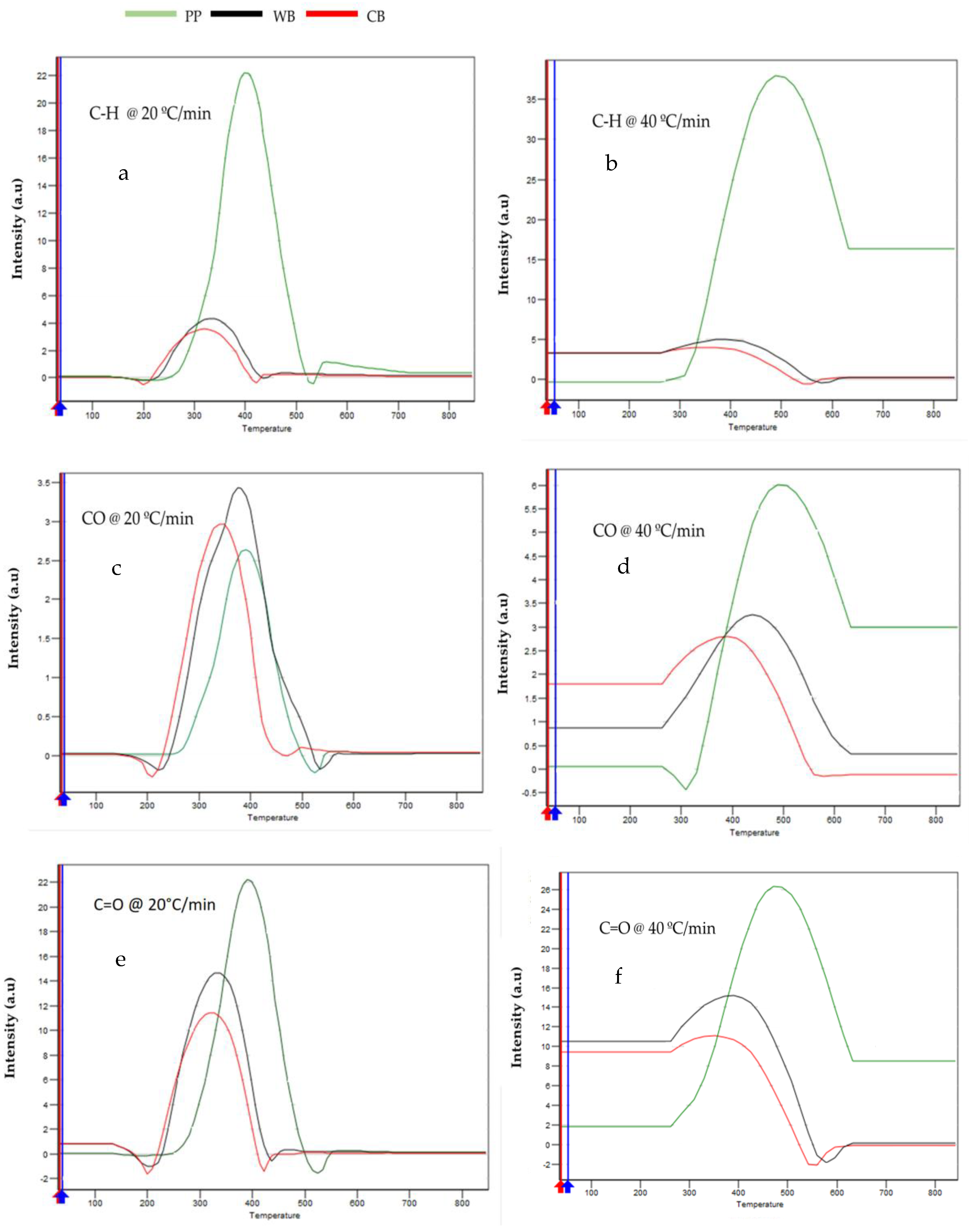
To identify the main volatile species and continuously monitor their evolution, TG coupled with FTIR spectroscopy was applied in this study. The composition of volatile products was evaluated using characteristic wavenumber bands (Table 3) derived from IR spectra for pure PP, CB, and WB (Figures S1 and S2), as well as for blended feedstocks (Figures S3 and S4) at both heating rates. Key bands of interest were identified at 3700–3800 cm−1, assigned to phenols (free alcohols); 2800–3000 cm−1, assigned to alkane and alkyne stretching; 2357 cm−1, assigned to CO2; and 1600–1800 cm−1, assigned to the carbonyl group, specifically aldehydes, ketones, carboxylic acids, and esters. Similar peaks were observed at both heating rates of 20 °C/min and 40 °C/min across all three feedstocks and their blends, although peak intensities varied widely. The detected functional groups in the spectra were integrated over the process temperature range to determine the yield or area under the curve. Yield intensities for functional groups corresponding to C–H stretching, CO, and C=O gases at both heating rates of 20 °C/min and 40 °C/min for PP, WB, and CB are presented in Figure 1a–f.
For PP, the yield of C–H was the most abundant volatile species. At a heating rate of 20 °C/min, the C–H yield was 22 a.u., but this increased nearly twofold to 35–40 a.u. at 40 °C/min (Figure 1a,b). The CO yield was relatively low, ranging from 2.5 to 3 a.u. at 20 °C/min (Figure 1c), but increased to 6 a.u. at 40 °C/min (Figure 1d). The yield of C=O for PP was comparable to C–H, recorded at 22 a.u. at 20 °C/min (Figure 1e), and increased to 26 a.u. at the higher heating rate (Figure 1f).
For WB, C=O was the most dominant volatile species, with yields between 14 and 16 a.u., consistent across both heating rates (Figure 1e,f). Notably, at 40 °C/min, C=O production commenced at a lower temperature, below 100 °C (Figure 1f). CO production for WB was the lowest among the feedstocks, ranging from 3 to 3.5 a.u. at both heating rates (Figure 1c,d). C–H yields were similarly low, between 4 and 5 a.u., and remained unchanged across heating rates (Figure 1a,b).
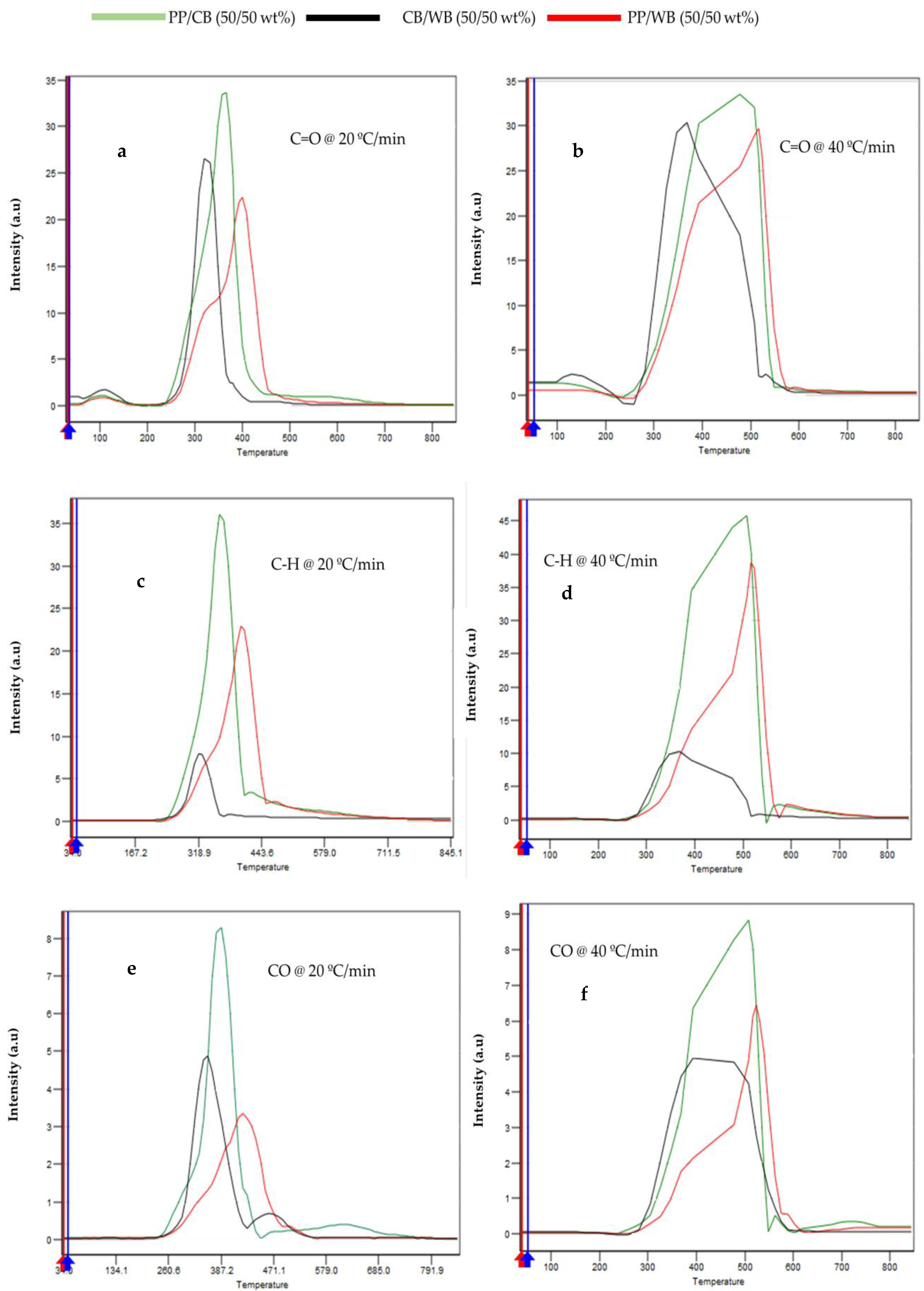
For CB, the yield profiles resembled those of WB. C=O was the most abundant species, with yields of 10–12 a.u. at both heating rates (Figure 1e,f). At 40 °C/min, C=O production began at a lower temperature, under 100 °C (Figure 1f). Both CO and C–H yields were low, ranging from 2.5 to 3 a.u. and 3 to 5 a.u., respectively (Figure 1a–d). Increasing the heating rate had a minimal effect on CO and C–H yields. At 40 °C/min, CO evolution commenced below 100 °C (Figure 1d), whereas at 20 °C/min it began near 200 °C. C–H yields remained stable at 3–4 a.u. across both heating rates, although at 40 °C/min production initiated earlier, below 100 °C (Figure 1b). In Figure 2, the relative volatile yield intensities of equal mass (50/50 mass %) blends of PP/CB, PP/WB, and CB/WB are presented. Among the three volatile species analysed, C–H was the most abundant in PP-containing blends, with the highest yield observed in the PP/CB blend, reaching approximately 45 a.u. at a heating rate of 40 °C/min (Figure 2c,d). Similarly, in PP/WB blends, the C–H yield attained approximately 40 a.u. C=O was the second most abundant species, ranging from 30 to 35 a.u. in PP/CB and 20 to 30 a.u. in PP/WB blends. In contrast, C=O was the most dominant species in the CB/WB blend, with yields between 25 and 30 a.u., surpassing both C–H and CO (Figure 2a,b). CO yields were the lowest across all blends, ranging from 3 to 7 a.u. in CB/WB and PP/WB; however, CO yield increased approximately twofold in the PP/CB blend (Figure 2e,f). At higher heating rates, all volatile species exhibited increased yields, particularly C–H in the PP-containing blends, which nearly doubled in intensity.
In the final stage of the study, the effect of three-component blending on the relative volatile yield intensities of C–H, CO, and C=O was investigated. Blending ratios included combinations at 4:1:1 (67%:16%:16%; Figure 3) and equal blend ratios (33% each; Figure 4). Typically, C–H was the most abundant species across blends with higher PP ratios (Figure 3a,b and Figure 4a,b). Higher PP mass percentages (33% and 67%) correlated with elevated C–H yields, ranging from 30 to 37 a.u. at a heating rate of 20 °C/min. When the heating rate increased to 40 °C/min, C–H yields further increased, reaching a maximum of 60 a.u. in the 67% PP blend. In contrast, in the high WB blend (67%), C–H yields were lower than those of carbonyl groups.
C=O yields were relatively consistent across all blend ratios at 20 °C/min, ranging from 20 to 26 a.u. (Figure 3e and Figure 4a). At the higher heating rate of 40 °C/min, all C=O yields increased by approximately 10 a.u., reaching values in the range of 30–40 a.u. (Figure 3f and Figure 4b). As observed in other blend ratios, CO production was the least abundant species across all three-component blends (Figure 3c,d and Figure 4a,b). Increased WB and CB mass percentages led to slight increases in CO yield, with the highest observed in the equal blend ratio (33%) at 9–10 a.u. (Figure 4a). Additionally, slight increases in CO yield were recorded at the higher heating rate of 40 °C/min.

4. Discussion

4.1. Carbon Monoxide (CO)

The production of carbon monoxide (CO) was relatively low, ranging from approximately 2.5 to 6 a.u., and remained consistent across all individual feedstocks. Among the two-component blends, the PP/CB 50/50 % combination exhibited the highest CO levels, while the three-component blend with equal mass proportions further enhanced CO production to approximately 12 a.u. In general, higher heating rates resulted in slightly increased CO yields. These results indicate that CO production is positively influenced by blending, suggesting a synergistic effect whereby blending can increase CO yield by a factor of two to three. This enhancement is attributed to tar thermal cracking facilitated by the catalytic effect of biomass ash. The metals present in the ash act as oxygen carriers, accelerating oxidation reactions, catalysing tar decomposition, and thereby increasing CO production [32]. Similarly, in this study, blends containing PP and CB—both of which possess proportionally higher residue ash content—produced elevated CO yields. This finding suggests that optimal ash content can catalyse tar decomposition, thereby improving CO yield and enhancing the lower heating value of the resulting syngas. Gasification temperature exerts a critical influence on syngas composition. At moderate ranges (800–1000 °C), carbon monoxide yield is maximised through partial oxidation and the Boudouard reaction. At higher temperatures, however, CO is increasingly oxidised to CO2, reducing its fraction in the product gas [33]. The oxygen supply exerts a critical influence on syngas composition. At low to moderate levels, partial oxidation reactions favour carbon monoxide formation, while excessive oxygen shifts the equilibrium toward carbon dioxide, thereby reducing CO yield. Optimal oxygen input provides sufficient heat to sustain endothermic gasification reactions while maintaining a syngas rich in CO and H2 [34]. Moreover, the ability to tailor CO composition is advantageous for achieving desired molar ratios with H2 and CO2, making the syngas more versatile for downstream chemical processing applications.

4.2. Carbonyls (C=O)

In this study, the evolution of gases from carbonyl functional groups was identified as the second most dominant species after C–H. The highest yields (35–40 a.u.) were observed in three-component blends, particularly those containing higher proportions of PP. Among the two-component blends, the combination of PP with CB produced higher carbonyl yields compared to blends with WB or those lacking PP. Increasing the heating rate from 20 °C/min to 40 °C/min had minimal effect on C=O yields in PP/CB blends. In PP/WB and CB/WB blends, there was an increase of nearly 10 and 5 a.u, respectively. However, in three-component blends, yields increased by approximately 50% (or 10 a.u.) at the higher heating rate of 40 °C/min.
Alcohol oxidation is a key reaction in the conversion of alcohols into aldehydes, ketones, or carboxylic acids (carbonyl compounds) [35]. In the presence of metal oxides or complexes, this process typically involves two steps: (1) adsorption of alcohol onto the metal surface to activate the hydroxyl (OH) group, forming a metal alkoxide; and (2) elimination of a β-hydride to yield carbonyl compounds and a metal hydride [36]. During alcohol oxidation, various oxidising agents facilitate electron transfer. Inorganic metals, capable of changing oxidation states, act as catalysts by providing surfaces for reactant adsorption and electron exchange. This catalytic action lowers the activation energy required for alcohol oxidation to carbonyls [35].
Consequently, feedstocks that generate higher ash content—such as CB—containing metal complexes can catalyse the alcohol conversion process, resulting in increased carbonyl compound formation [32]. In this study, blends containing CB and PP exhibited elevated carbonyl gas yields, further supporting the catalytic role of ash-derived metal species in enhancing carbonyl evolution.

4.3. C–H Stretching

The C–H stretching functional group exhibited higher yields in blends with increased PP mass percentages. These functional groups are closely linked to the presence of tar in plastics. One of the key challenges in plastic gasification is tar formation [37], which is influenced by the choice of gasifying agent. Studies have shown that O2 or air typically result in lower tar yields compared to steam [38]. However, in large-scale systems, tar content in the produced gas can vary significantly depending on factors such as catalyst utilisation, reactor design, plastic composition, and experimental conditions, including residence time, temperature, and equivalence ratio [39]. Generally, tar levels are lower in biomass gasification, a trend confirmed in this study [40,41]. Light hydrocarbons in tar originate from the decomposition of methoxyl (–O–CH3) and methylene (–CH2–) groups within the feedstock. Primary tar from polyolefin degradation mainly consists of long-chain alkanes and alkenes, which can be rapidly converted into lighter hydrocarbons during gasification. Consequently, gasification of polyolefins such as PP and PE enhances hydrocarbon formation [42,43]. These polyolefins are known to fully volatilise at elevated temperatures [44]. Li et al. [42] demonstrated that tar content diminishes with temperature due to efficient cracking between 600 and 1000 °C or catalytically above 700 °C, enhancing syngas yield. Chen et al. [45] reported a 95% tar removal efficiency when incorporating biomass char, attributing this to complex homogeneous and heterogeneous reactions. At high temperatures, tar decomposes into non-condensable gases, small and macromolecular aromatic hydrocarbons, and free radicals (H•, O•, OH•). Metal oxides such as MgO, CaO, Na2O, and Fe2O3 in char catalyse the conversion of intermediate aromatics into lighter alkane and alkene components and fuel gases like CO2, CO, and H2S. Operationally, increased temperature and residence time reduce tar content in gas products [46,47].
Co-gasification of plastics and biomass is therefore advocated as a strategy to reduce lighter tar formation while producing high-calorific syngas [42]. Déparrois et al. [48] found that in co-gasifying paper and polystyrene (PS) at 1173 K, increasing paper content elevated char yield, which accelerated tar cracking in PS and improved gas yield. Ahmad and Gupta [49] also observed higher syngas yields from co-gasifying PE and woodchips compared to individual feedstocks, consistent with this study’s findings, where CO, C=O, and C–H yields were higher in blends. The synergistic effect of biomass–plastic co-gasification can be attributed to two mechanisms: (1) mutual chemical reactions between volatiles, where plastics donate free radicals that enhance biomass devolatilisation and light hydrocarbon formation; and (2) interactions between plastic volatiles and biomass char, where catalytic cracking and reforming reactions further increase gas yield [49,50,51].

4.4. Effect of Heating Rate on Product Yield for Blended Feedstocks

For pure CB, WB, and their two-component blends, the effect of heating rate was minimal, with little to no change in volatile product yields. In contrast, pure PP and PP-containing blends exhibited a clear increase in the yields of CO, C=O, and C–H volatiles at the higher heating rate of 40 °C/min. This trend became more pronounced as the PP mass percentage increased, with C–H yields nearly doubling. The most notable effect of PP content and heating rate was observed in the C–H functional group, which is closely linked to the hydrocarbon-rich nature of PP and its tar-forming tendencies. Increasing the heating rate also resulted in peak shape broadening in the FTIR spectra, indicating that functional group evolution occurred across a wider temperature range at 40 °C/min. Additionally, gas production began at higher temperatures compared to the lower heating rate of 20 °C/min. The enhanced syngas yield at elevated heating rates can be attributed to accelerated thermal decomposition, which reduces char and tar formation, by-products of slower heating processes. Rapid heating exposes the feedstock to higher and more uniform temperatures, thereby improving reaction kinetics and overall gasification efficiency [52,53]. Importantly, higher gas yields were not solely a function of heating rate but also of feedstock composition. The inclusion of PP increased the hydrocarbon content, driving C–H production [42]. Its carbon-rich structure also contributed to elevated CO and C=O yields. Furthermore, CB’s optimal ash residue promoted oxidation reactions, enhancing the formation of CO and C=O gases [32].

5. Conclusions

This study employed a combined TG–FTIR experimental approach to investigate the evolved gas composition and volatile product yields of WB, CB, PP, and their blends. The focus was on three-component blends—PP/WB, CB/WB, CB/PP, and PP/CB/WB—at varying ratios and heating rates. PP consistently produced the highest yields of C–H stretching gases, attributed to tar rich in alkanes and alkenes typical of polyolefins. WB and CB exhibited similar gas evolution profiles across both heating rates, likely due to their shared lignocellulosic composition. Heating rate variation did not alter FTIR peak profiles but significantly influenced gas evolution temperatures and yields. Higher heating rates initiated gas release at lower temperatures and extended it to higher ranges, resulting in increased volatile yields, especially for C–H species, which in some cases doubled.
Blending PP with CB and WB, particularly under elevated heating rates, enhanced CO production, indicating a synergistic effect linked to intensified tar cracking and the catalytic role of ash-derived metal oxides. The three-component blend with equal mass ratios produced the highest CO levels, suggesting that optimal ash content and feedstock synergy can elevate the lower heating value of syngas. Carbonyl compounds (C=O) were the second most dominant species, with yields highest in PP-rich blends and further increased by higher heating rates. Co-gasification presents a promising and adaptable strategy for converting waste into energy. The results demonstrated that blending and optimal heating rates improved gas yield and composition, supporting the development of cleaner, more efficient waste-to-energy systems.

Supplementary Materials

The following supporting information can be downloaded at: https://www.mdpi.com/article/10.3390/en18236372/s1, Figure S1: IR Spectrum for Evolved Gas in CB, WB, and PP with 20 °C/min sampled at 340 °C, 350 °C and 440 °C; Figure S2: IR Spectrum for Evolved Gas in CB, WB, and PP with 40 °C/min sampled at 350 °C, 360 °C and 470 °C, respectively. Figure S3: IR Spectrum for Evolved Gas in CB.PP, CB.WB, CB.WB.PP and PP.WB blends at 20 °C/min at 380 °C, 350 °C, 410 °C and 445 °C. Figure S4: IR Spectrum for Evolved Gas in CB.PP, CB.WB, CB.WB.PP and PP.WB blends at 40 °C/min at 420 °C, 380 °C, 440 °C and 480 °C, respectively.

Author Contributions

Conceptualization, M.J.D.B.; Methodology, S.M., M.J.D.B., M.S.R., L.H.Y. and G.P.; Validation, E.D.T.; Investigation, S.M., M.J.D.B. and M.S.R.; Writing—original draft, S.M. and M.J.D.B.; Writing—review and editing, M.S.R., L.H.Y., E.D.T. and G.P.; Supervision, M.S.R., L.H.Y. and G.P.; Project administration, S.M.; Funding acquisition, S.M. All authors have read and agreed to the published version of the manuscript.

Funding

This research was funded by the Australian Government’s Strategic University Reform Fund.

Data Availability Statement

The original contributions presented in this study are included in the article/Supplementary Materials. Further inquiries can be directed to the corresponding authors.

Acknowledgments

The authors acknowledge the Faculty of Science and Engineering for providing the research facility for this project.

Conflicts of Interest

The authors declare no conflicts of interest.

References

  1. Kaza, S.; Yao, L.; Bhada-Tata, P.; Van Woerden, F. What a Waste 2.0: A Global Snapshot of Solid Waste Management to 2050; World Bank Publications: Washington, DC, USA, 2018. [Google Scholar]
  2. Kumar, R.; Verma, A.; Shome, A.; Sinha, R.; Sinha, S.; Jha, P.K.; Kumar, R.; Kumar, P.; Shubham; Das, S.; et al. Impacts of plastic pollution on ecosystem services, sustainable development goals, and need to focus on circular economy and policy interventions. Sustainability 2021, 13, 9963. [Google Scholar] [CrossRef]
  3. Zhao, X.; Korey, M.; Li, K.; Copenhaver, K.; Tekinalp, H.; Celik, S.; Kalaitzidou, K.; Ruan, R.; Ragauskas, A.J.; Ozcan, S. Plastic waste upcycling toward a circular economy. Chem. Eng. J. 2022, 428, 131928. [Google Scholar] [CrossRef]
  4. Kedzierski, M.; Frère, D.; Le Maguer, G.; Bruzaud, S. Why is there plastic packaging in the natural environment? Understanding the roots of our individual plastic waste management behaviours. Sci. Total Environ. 2020, 740, 139985. [Google Scholar] [CrossRef] [PubMed]
  5. Lombardi, L.; Castaldi, M.J. Energy recovery from residual municipal solid waste: State of the art and perspectives within the challenge to climate change. Energies 2024, 17, 395. [Google Scholar] [CrossRef]
  6. Wei, Z.; Li, Y.; Chu, L.; Wang, Y. Initial reaction mechanism of lignin and polyethylene steam co-gasification based on ReaxFF molecular dynamics simulation. Biomass Convers. Biorefinery 2025, 15, 813–830. [Google Scholar] [CrossRef]
  7. Ollila, H.; Moilanen, A.; Tiainen, M.; Laitinen, R. SEM–EDS characterization of inorganic material in refuse-derived fuels. Fuel 2006, 85, 2586–2592. [Google Scholar] [CrossRef]
  8. Fazil, A.; Kumar, S.; Mahajani, S.M. Downdraft co-gasification of high ash biomass and plastics. Energy 2022, 243, 123055. [Google Scholar] [CrossRef]
  9. Wang, H.; Ren, R.; Liu, B.; You, C. Hydrogen production with an auto-thermal MSW steam gasification and direct melting system: A process modeling. Int. J. Hydrog. Energy 2022, 47, 6508–6518. [Google Scholar] [CrossRef]
  10. Aentung, T.; Patcharavorachot, Y.; Wu, W. Co-Gasification of Plastic Waste Blended with Biomass: Process Modeling and Multi-Objective Optimization. Processes 2024, 12, 1906. [Google Scholar] [CrossRef]
  11. Shahbaz, M.; Al-Ansari, T.; Inayat, M.; Sulaiman, S.A.; Parthasarathy, P.; McKay, G. A critical review on the influence of process parameters in catalytic co-gasification: Current performance and challenges for a future prospectus. Renew. Sustain. Energy Rev. 2020, 134, 110382. [Google Scholar] [CrossRef]
  12. Alvarez, J.; Kumagai, S.; Wu, C.; Yoshioka, T.; Bilbao, J.; Olazar, M.; Williams, P.T. Hydrogen production from biomass and plastic mixtures by pyrolysis-gasification. Int. J. Hydrog. Energy 2014, 39, 10883–10891. [Google Scholar] [CrossRef]
  13. Bičáková, O.; Straka, P. Production of hydrogen from renewable resources and its effectiveness. Int. J. Hydrog. Energy 2012, 37, 11563–11578. [Google Scholar] [CrossRef]
  14. Parrillo, F.; Ardolino, F.; Boccia, C.; Calì, G.; Marotto, D.; Pettinau, A.; Arena, U. Co-gasification of plastics waste and biomass in a pilot scale fluidized bed reactor. Energy 2023, 273, 127220. [Google Scholar] [CrossRef]
  15. Bobadilla, L.F.; Azancot, L.; González-Castaño, M.; Ruíz-López, E.; Pastor-Pérez, L.; Durán-Olivencia, F.J.; Ye, R.; Chong, K.; Blanco-Sánchez, P.H.; Wu, Z. Biomass gasification, catalytic technologies and energy integration for production of circular methanol: New horizons for industry decarbonisation. J. Environ. Sci. 2024, 140, 306–318. [Google Scholar] [CrossRef]
  16. Wang, Y.; Ge, Z.; Shang, F.; Zhou, C.; Guo, S.; Ren, C. Kinetic analysis of CO2 gasification of corn straw. Renew. Energy 2023, 203, 219–227. [Google Scholar] [CrossRef]
  17. He, S.; Xu, Y.; Zhang, Y.; Bell, S.; Wu, C. Waste plastics recycling for producing high-value carbon nanotubes: Investigation of the influence of Manganese content in Fe-based catalysts. J. Hazard. Mater. 2021, 402, 123726. [Google Scholar] [CrossRef]
  18. Pang, Y.; Zhu, X.; Li, N.; Wang, Z. Study on CO2 co-gasification of cellulose and high-density polyethylene via TG-FTIR and ReaxFF MD. Process Saf. Environ. Prot. 2024, 186, 1471–1480. [Google Scholar] [CrossRef]
  19. Cai, J.; Zhu, L.; Yang, J.; Guo, M.; Fang, M.; Yao, S. Synergistic co-steam gasification of biomass and refuse-derived fuel: A path to enhanced gasification performance. Environ. Technol. Innov. 2024, 36, 103745. [Google Scholar] [CrossRef]
  20. Wang, Y.; Li, Y.; Zhang, C.; Yang, L.; Fan, X.; Chu, L. A study on co-pyrolysis mechanisms of biomass and polyethylene via ReaxFF molecular dynamic simulation and density functional theory. Process Saf. Environ. Prot. 2021, 150, 22–35. [Google Scholar] [CrossRef]
  21. Guo, S.; Wang, Z.; Chen, G.; Zhang, M.; Sun, T.; Wang, Q.; Du, Z.; Chen, Y.; Wu, M.; Li, Z. Co-pyrolysis characteristics of forestry and agricultural residues and waste plastics: Thermal decomposition and products distribution. Process Saf. Environ. Prot. 2023, 177, 380–390. [Google Scholar] [CrossRef]
  22. Üzden, Ş.T.; Secer, A.; Fakı, E.; Hasanoğlu, A. Utilization of PET (waste) via hydrothermal co–gasification with sorghum for hydrogen rich gas production. J. Energy Inst. 2023, 107, 101193. [Google Scholar] [CrossRef]
  23. Ajorloo, M.; Ghodrat, M.; Scott, J.; Strezov, V. Experimental analysis of the effects of feedstock composition on the plastic and biomass Co-gasification process. Renew. Energy 2024, 231, 120960. [Google Scholar] [CrossRef]
  24. AlAbbad, M.; Gautam, R.; Romero, E.G.; Saxena, S.; Barradah, E.; Chatakonda, O.; Kloosterman, J.W.; Middaugh, J.; D’Agostini, M.D.; Sarathy, S.M. TG-DSC and TG-FTIR analysis of heavy fuel oil and vacuum residual oil pyrolysis and combustion: Characterization, kinetics, and evolved gas analysis. J. Therm. Anal. Calorim. 2023, 148, 1875–1898. [Google Scholar] [CrossRef]
  25. Mohammadi, A.; Anukam, A. The technical challenges of the gasification technologies currently in use and ways of optimizing them: A review. In Latest Research on Energy Recovery; IntechOpen: London, UK, 2022. [Google Scholar]
  26. Bonsu, M.J.D.; Palmer, G.; Yee, L.; Du Toit, E.; Rahman, M.S.; McIntosh, S. Thermal and Kinetic Study of Waste Polypropylene, Cardboard, Wood Biomass, and Their Blends: A Thermogravimetry Approach. Energies 2025, 18, 5193. [Google Scholar] [CrossRef]
  27. Niu, S.; Zhou, Y.; Yu, H.; Lu, C.; Han, K. Investigation on thermal degradation properties of oleic acid and its methyl and ethyl esters through TG-FTIR. Energy Convers. Manag. 2017, 149, 495–504. [Google Scholar] [CrossRef]
  28. Scaccia, S. TG–FTIR and kinetics of devolatilization of Sulcis coal. J. Anal. Appl. Pyrolysis 2013, 104, 95–102. [Google Scholar] [CrossRef]
  29. Feng, L.; Zhao, G.; Zhao, Y.; Zhao, M.; Tang, J. Construction of the molecular structure model of the Shengli lignite using TG-GC/MS and FTIR spectrometry data. Fuel 2017, 203, 924–931. [Google Scholar] [CrossRef]
  30. Liu, J.; Li, R.; Guo, M.; Tao, H.; Sun, D.; Zong, C.; Liu, C.; Fu, F. Study of the thermal degradation of benzene-containing glycerol carbonate derivatives by a combined TG–FTIR and theoretical calculation. Thermochim. Acta 2017, 654, 179–185. [Google Scholar] [CrossRef]
  31. Worzakowska, M. TG/FTIR/QMS studies of long chain esters of geraniol. J. Anal. Appl. Pyrolysis 2014, 110, 181–193. [Google Scholar] [CrossRef]
  32. Guo, Q.; Yan, B.; Hu, Y.; Cheng, Z.; Zhang, R.; Chen, G.; Hou, L. Biomass gasification ash reutilization: Recirculation reusability and mechanism analysis. Waste Manag. 2022, 154, 64–73. [Google Scholar] [CrossRef]
  33. Fuchs, J.; Schmid, J.C.; Müller, S.; Mauerhofer, A.M.; Benedikt, F.; Hofbauer, H. The impact of gasification temperature on the process characteristics of sorption enhanced reforming of biomass. Biomass Convers. Biorefinery 2020, 10, 925–936. [Google Scholar] [CrossRef]
  34. Basu, P. Biomass Gasification, Pyrolysis and Torrefaction: Practical Design and Theory; Academic Press: Cambridge, MA, USA, 2018. [Google Scholar]
  35. Davis, S.E.; Ide, M.S.; Davis, R.J. Selective oxidation of alcohols and aldehydes over supported metal nanoparticles. Green Chem. 2013, 15, 17–45. [Google Scholar] [CrossRef]
  36. Zaera, F. The surface chemistry of hydrocarbon partial oxidation catalysis. Catal. Today 2003, 81, 149–157. [Google Scholar] [CrossRef]
  37. Farmer, S.; Kennepohl, D.; Reusch, W.; 12.8 Infrared Spectra of Some Common Functional Groups. LibreTexts Chemistry. 2020. Available online: https://chem.libretexts.org/Bookshelves/Organic_Chemistry/Organic_Chemistry_(Morsch_et_al.)/12:_Structure_Determination_-_Mass_Spectrometry_and_Infrared_Spectroscopy/12.08:_Infrared_Spectra_of_Some_Common_Functional_Groups (accessed on 11 October 2025).
  38. Devi, L.; Ptasinski, K.J.; Janssen, F.J. A review of the primary measures for tar elimination in biomass gasification processes. Biomass Bioenergy 2003, 24, 125–140. [Google Scholar] [CrossRef]
  39. Mastellone, M.L.; Zaccariello, L.; Arena, U. Co-gasification of coal, plastic waste and wood in a bubbling fluidized bed reactor. Fuel 2010, 89, 2991–3000. [Google Scholar] [CrossRef]
  40. Filomena Pinto, R.A.; Miranda, M.; Neves, D.; Varela, F.; Santos, J. Effect of Gasification Agent on Co-Gasification of Rice Production Wastes Mixtures; Elsevier: Amsterdam, The Netherlands, 2016. [Google Scholar]
  41. Shah, H.H.; Amin, M.; Iqbal, A.; Nadeem, I.; Kalin, M.; Soomar, A.M.; Galal, A.M. A review on gasification and pyrolysis of waste plastics. Front. Chem. 2023, 10, 960894. [Google Scholar] [CrossRef]
  42. Li, J.; Burra, K.R.G.; Wang, Z.; Liu, X.; Gupta, A.K. Co-gasification of high-density polyethylene and pretreated pine wood. Appl. Energy 2021, 285, 116472. [Google Scholar] [CrossRef]
  43. Yu, H.; Wu, Z.; Chen, G. Catalytic gasification characteristics of cellulose, hemicellulose and lignin. Renew. Energy 2018, 121, 559–567. [Google Scholar] [CrossRef]
  44. Al-Salem, S.; Lettieri, P.; Baeyens, J. Recycling and recovery routes of plastic solid waste (PSW): A review. Waste Manag. 2009, 29, 2625–2643. [Google Scholar] [CrossRef] [PubMed]
  45. Chen, Y.; Luo, Y.-H.; Wu, W.-G.; Su, Y. Experimental investigation on tar formation and destruction in a lab-scale two-stage reactor. Energy Fuels 2009, 23, 4659–4667. [Google Scholar] [CrossRef]
  46. Ren, J.; Cao, J.-P.; Yang, F.-L.; Liu, Y.-L.; Tang, W.; Zhao, X.-Y. Understandings of catalyst deactivation and regeneration during biomass tar reforming: A crucial review. ACS Sustain. Chem. Eng. 2021, 9, 17186–17206. [Google Scholar] [CrossRef]
  47. Sun, H.; Feng, D.; Zhao, Y.; Sun, S.; Wu, J.; Wang, P.; Chang, G.; Lai, X.; Tan, H.; Qin, Y. Mechanism of catalytic tar reforming over biochar: Description of volatile-H2O-char interaction. Fuel 2020, 275, 117954. [Google Scholar] [CrossRef]
  48. Déparrois, N.; Singh, P.; Burra, K.; Gupta, A. Syngas production from co-pyrolysis and co-gasification of polystyrene and paper with CO2. Appl. Energy 2019, 246, 1–10. [Google Scholar] [CrossRef]
  49. Ahmed, I.; Nipattummakul, N.; Gupta, A. Characteristics of syngas from co-gasification of polyethylene and woodchips. Appl. Energy 2011, 88, 165–174. [Google Scholar] [CrossRef]
  50. Jin, Q.; Wang, X.; Li, S.; Mikulčić, H.; Bešenić, T.; Deng, S.; Vujanović, M.; Tan, H.; Kumfer, B.M. Synergistic effects during co-pyrolysis of biomass and plastic: Gas, tar, soot, char products and thermogravimetric study. J. Energy Inst. 2019, 92, 108–117. [Google Scholar] [CrossRef]
  51. Uzoejinwa, B.B.; He, X.; Wang, S.; Abomohra, A.E.-F.; Hu, Y.; Wang, Q. Co-pyrolysis of biomass and waste plastics as a thermochemical conversion technology for high-grade biofuel production: Recent progress and future directions elsewhere worldwide. Energy Convers. Manag. 2018, 163, 468–492. [Google Scholar] [CrossRef]
  52. Khlifi, S.; Pozzobon, V.; Lajili, M. A comprehensive review of syngas production, fuel properties, and operational parameters for biomass conversion. Energies 2024, 17, 3646. [Google Scholar] [CrossRef]
  53. Nguyen, M.; Duddy, G.; Karam, C. Analysis of industrial syngas production from biomass. PAM Rev. Energy Sci. Technol. 2015, 2, 67–91. [Google Scholar] [CrossRef]
Figure 1. Relative volatile product yields for C–H, CO and C=O from pure PP, WB and CB at a heating rate of 20 and 40 °C/min. (a) C–H at 20 °C/min; (b) C–H at 40 °C/min; (c) CO at 20 °C/min; (d) CO at 40 °C/min; (e) C=O at 20 °C/min; (f) C=O at 40 °C/min.
Energies 18 06372 g001
Figure 2. Relative volatile Product Yields for C–H, CO and C=O from equal mass PP/CB, PP/WB and CB/WB at a heating rate of 20 and 40 °C/min. (a) C=O at 20 °C/min; (b) C=O at 40 °C/min; (c) C–H at 20 °C/min; (d) C–H at 40 °C/min; (e) CO at 20 °C/min; (f) CO at 40 °C/min.
Energies 18 06372 g002
Figure 3. Relative volatile product yields for C–H, CO and C=O from PP, WB and CB blended in combinations of 4:1:1 at a heating rate of 20 and 40 °C/min. (a) C–H at 20 °C/min; (b) C–H at 40 °C/min; (c) CO at 20 °C/min; (d) CO at 40 °C/min; (e) C=O at 20 °C/min; (f) C=O at 40 °C/min.
Energies 18 06372 g003
Figure 4. Relative volatile product yields for C–H, CO and C=O from PP, WB and CB blended at equal (33%) amounts at heating rates of 20 and 40 °C/min. (a) C–H, CO and C=O evolution at 20 °C/min. (b) C–H, CO and C=O evolution at 40 °C/min.
Energies 18 06372 g004
Table 1. Experimental matrix for feedstock blending.
Feedstock BlendsCB (Mass %)WB (Mass %)PP (Mass %)
Pure feedstock10000
01000
00100
Two feedstock blends50500
50050
05050
Three feedstock blends671616
166716
161667
333333
Table 2. TG controls and parameters.
Apparatus/ControlsDescription
FurnaceSilicon Carbide (0 °C to 1600 °C). Heating rates range, 0 °C/min to 50 °C/min.
Gas ControlsPurge Gas MFC—Air (N2/O2) (80/20) at flow rate of 50 L/min
Protective Gas MFC—Air (N2/O2) (80/20) at flow rate of 20 L/min
CruciblesAl2O3 (Temperature range 0 °C to 1564 °C)
Temperature resolution0.001 °C
Table 3. Types of bonds and typical wavenumber values during the Fourier transform.
Types of BondsWavenumber (cm−1)References
C–H3000–2850 (alkanes stretch)[27,28,29]
3000 (alkyne stretch)
2900–2800 (aldehyde)
C=C1680–1600 (alkene)[30]
1600–1475 (aromatics)
C≡O2250–2100 (alkynes)[31]
Disclaimer/Publisher’s Note: The statements, opinions and data contained in all publications are solely those of the individual author(s) and contributor(s) and not of MDPI and/or the editor(s). MDPI and/or the editor(s) disclaim responsibility for any injury to people or property resulting from any ideas, methods, instructions or products referred to in the content.